Interconnection Quotes (12 quotes)
[Mathematics] is security. Certainty. Truth. Beauty. Insight. Structure. Architecture. I see mathematics, the part of human knowledge that I call mathematics, as one thing—one great, glorious thing. Whether it is differential topology, or functional analysis, or homological algebra, it is all one thing. … They are intimately interconnected, they are all facets of the same thing. That interconnection, that architecture, is secure truth and is beauty. That’s what mathematics is to me.
From interview with Donald J. Albers. In John H. Ewing and Frederick W. Gehring, Paul Halmos Celebrating 50 Years of Mathematics (1991), 13.
A careful analysis of the process of observation in atomic physics has shown that the subatomic particles have no meaning as isolated entities, but can only be understood as interconnections between the preparation of an experiment and the subsequent measurement.
The Tao of Physics: An Exploration of the Parallels Between Modern Physics (1975), 68.
All appearances to the contrary, the only watchmaker in nature is the blind forces of physics, albeit deployed in very special way. A true watchmaker has foresight: he designs his cogs springs, and plans their interconnections, with a future purpose in his mind's eye. Natural selection, the blind, unconscious, automatic process which Darwin discovered, and which we now know is the explanation for the existence and apparently purposeful form of all life, has no purpose in mind. It has no mind and no mind's eye. It does not plan for the future. It has no vision, no foresight, no sight at all. If it can be said to play the role of watchmaker in nature, it is the blind watchmaker.
The Blind Watchmaker (1986), 5.
Freeman’s gift? It’s cosmic. He is able to see more interconnections between more things than almost anybody. He sees the interrelationships, whether it’s in some microscopic physical process or in a big complicated machine like Orion. He has been, from the time he was in his teens, capable of understanding essentially anything that he’s interested in. He’s the most intelligent person I know.
As quoted in Kenneth Brower, 'The Danger of Cosmic Genius', The Atlantic (Dec 2010). Webmaster note: The Orion Project was a study of the possibility of nuclear powered propulsion of spacecraft.
How often people speak of art and science as though they were two entirely different things, with no interconnection. An artist is emotional, they think, and uses only his intuition; he sees all at once and has no need of reason. A scientist is cold, they think, and uses only his reason; he argues carefully step by step, and needs no imagination. That is all wrong. The true artist is quite rational as well as imaginative and knows what he is doing; if he does not, his art suffers. The true scientist is quite imaginative as well as rational, and sometimes leaps to solutions where reason can follow only slowly; if he does not, his science suffers.
'Prometheus.' The Roving Mind (1983), Chap 25.
Since the seventeenth century, physical intuition has served as a vital source for mathematical porblems and methods. Recent trends and fashions have, however, weakened the connection between mathematics and physics; mathematicians, turning away from their roots of mathematics in intuition, have concentrated on refinement and emphasized the postulated side of mathematics, and at other times have overlooked the unity of their science with physics and other fields. In many cases, physicists have ceased to appreciate the attitudes of mathematicians. This rift is unquestionably a serious threat to science as a whole; the broad stream of scientific development may split into smaller and smaller rivulets and dry out. It seems therefore important to direct our efforts towards reuniting divergent trends by classifying the common features and interconnections of many distinct and diverse scientific facts.
As co-author with David Hilbert, in Methods of Mathematical Physics (1937, 1989), Preface, v.
Subatomic particles have no meaning as isolated entities, but can only be understood as interconnections between the preparation of an experiment and the subsequent measurement.
In The Tao of Physics (1975), 68.
The analysis of Nature into its individual parts, the grouping of the different natural processes and natural objects in definite classes, the study of the internal anatomy of organic bodies in their manifold forms—these were the fundamental conditions of the gigantic strides in our knowledge of Nature which have been made during the last four hundred years. But this method of investigation has also left us as a legacy the habit of observing natural objects and natural processes in their isolation, detached from the whole vast interconnection of things; and therefore not in their motion, but in their repose; not as essentially changing, but fixed constants; not in their life, but in their death.
Herr Eugen Dühring's Revolution in Science (Anti-Dühring), First Publication (1878). Trans. Emile Burns and ed. C.P. Dutt (1935), 27-8.
The progress of Science consists in observing interconnections and in showing with a patient ingenuity that the events of this ever-shifting world are but examples of a few general relations, called laws. To see what is general in what is particular, and what is permanent in what is transitory, is the aim of scientific thought.
In An Introduction to Mathematics (1911), 11.
The shell model, although proposed by theoreticians, really corresponds to the experimentalist’s approach. It was born from a thorough study of the experimental data, plotting them in different ways, and looking for interconnections.
The Shell Model, Nobel Lecture.
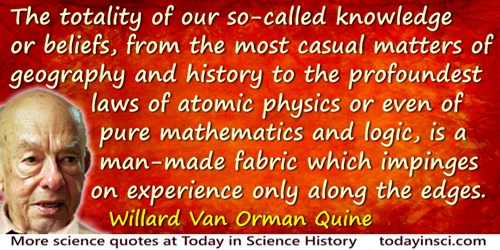
The totality of our so-called knowledge or beliefs, from the most casual matters of geography and history to the profoundest laws of atomic physics or even of pure mathematics and logic, is a man-made fabric which impinges on experience only along the edges. Or, to change the figure, total science is like a field of force whose boundary conditions are experience. A conflict with experience at the periphery occasions readjustments in the interior of the field. Truth values have to be redistributed over some of our statements. Reevaluation of some statements entails reevaluation of others, because of their logical interconnections—the logical laws being in turn simply certain further statements of the system, certain further elements of the field.
'Two Dogmas of Experience,' in Philosophical Review (1951). Reprinted in From a Logical Point of View (1953), 42.
While natural science up to the end of the last century was predominantly a collecting science, a science of finished things, in our century it is essentially a classifying science, a science of processes, of the origin and development of these things and of the interconnection which binds these processes into one great whole.
Speaking of the 18th (last) and 19th (our) centuries, in Ludwig Feuerbach and the Outcome of Classical German Philosophy (1886, 1941).
 In science it often happens that scientists say, 'You know that's a really good argument; my position is mistaken,' and then they would actually change their minds and you never hear that old view from them again. They really do it. It doesn't happen as often as it should, because scientists are human and change is sometimes painful. But it happens every day. I cannot recall the last time something like that happened in politics or religion.
(1987) --
In science it often happens that scientists say, 'You know that's a really good argument; my position is mistaken,' and then they would actually change their minds and you never hear that old view from them again. They really do it. It doesn't happen as often as it should, because scientists are human and change is sometimes painful. But it happens every day. I cannot recall the last time something like that happened in politics or religion.
(1987) -- 




