Intellect Quotes (253 quotes)
Intellectually Quotes
Intellectually Quotes
...I have always maintained that, excepting fools, men did not differ much in intellect, only in zeal and hard work; and I still think there is an eminently important difference.
letter cit. R. Pearson (1914-1930) in The Life, Letters and Labours of Francis Galton
“Going fishing!” How often the question has been asked by acquaintances, as they have met me, with rod and basket, on an excursion after materials for microscopic study. “Yes!” has been the invariable answer, for it saved much detention and explanation; and now, behold! I offer them the results of that fishing. No fish for the stomach, but, as the old French microscopist Joblet observed, “some of the most remarkable fishes that have ever been seen”; and food-fishes for the intellect.
From 'Concluding Remarks', Fresh-Water Rhizopods of North America (1879), 295. Leidy explains how actively he pursued his interest in finding new microscopic life forms to examine by frequent exploration of suitable habitats in the neighborhood of Philadelphia, where he lived and taught.
[Certain students] suppose that because science has penetrated the structure of the atom it can solve all the problems of the universe. ... They are known in every ... college as the most insufferable, cocksure know-it-alls. If you want to talk to them about poetry, they are likely to reply that the "emotive response" to poetry is only a conditioned reflex .... If they go on to be professional scientists, their sharp corners are rubbed down, but they undergo no fundamental change. They most decidedly are not set apart from the others by their intellectual integrity and faith, and their patient humility in front of the facts of nature.... They are uneducated, in the fullest sense of the word, and they certainly are no advertisement for the claims of science teachers.
In Science is a Sacred Cow (1950), 18-19.
[Davy's] March of Glory, which he has run for the last six weeks—within which time by the aid and application of his own great discovery, of the identity of electricity and chemical attractions, he has placed all the elements and all their inanimate combinations in the power of man; having decomposed both the Alkalies, and three of the Earths, discovered as the base of the Alkalies a new metal... Davy supposes there is only one power in the world of the senses; which in particles acts as chemical attractions, in specific masses as electricity, & on matter in general, as planetary Gravitation... when this has been proved, it will then only remain to resolve this into some Law of vital Intellect—and all human knowledge will be Science and Metaphysics the only Science.
In November 1807 Davy gave his famous Second Bakerian Lecture at the Royal Society, in which he used Voltaic batteries to “decompose, isolate and name” several new chemical elements, notably sodium and potassium.
In November 1807 Davy gave his famous Second Bakerian Lecture at the Royal Society, in which he used Voltaic batteries to “decompose, isolate and name” several new chemical elements, notably sodium and potassium.
Letter to Dorothy Wordsworth, 24 November 1807. In Earl Leslie Griggs (ed.), The Collected Letters of Samuel Taylor Coleridge (1956), Vol. 3, 38.
[Howard] Aiken considered Babbage his intellectual “father.”
As stated in Howard Aiken: Portrait of a Computer Pioneer (2000), 61.
[Martin Gardner is] the single brightest beacon defending rationality and good science against the mysticism and anti-intellectualism that surround us.
As quoted in Kendrick Frazier, 'A Mind at Play: An Interview with Martin Gardner', Skeptical Inquirer (Mar/Apr 1998), 22, No. 2, 36.
[T]he explosive development of our intellect, … I personally think was at least partly triggered by the fact we developed this way of talking with words. … We can bring people from different disciplines together to discuss a problem. That’s because of words. We now have developed a moral code with our words. And we know perfectly well what we should and shouldn’t do.
From huffpost.com webpage interview by Alexander C. Kaufman, 'Jane Goodall: If We Don’t Make Peace With Nature, Expect More Deadly Pandemics' (28 May 2021).
[The famous attack of Sir William Hamilton on the tendency of mathematical studies] affords the most express evidence of those fatal lacunae in the circle of his knowledge, which unfitted him for taking a comprehensive or even an accurate view of the processes of the human mind in the establishment of truth. If there is any pre-requisite which all must see to be indispensable in one who attempts to give laws to the human intellect, it is a thorough acquaintance with the modes by which human intellect has proceeded, in the case where, by universal acknowledgment, grounded on subsequent direct verification, it has succeeded in ascertaining the greatest number of important and recondite truths. This requisite Sir W. Hamilton had not, in any tolerable degree, fulfilled. Even of pure mathematics he apparently knew little but the rudiments. Of mathematics as applied to investigating the laws of physical nature; of the mode in which the properties of number, extension, and figure, are made instrumental to the ascertainment of truths other than arithmetical or geometrical—it is too much to say that he had even a superficial knowledge: there is not a line in his works which shows him to have had any knowledge at all.
In Examination of Sir William Hamilton's Philosophy (1878), 607.
[The Royal Society] is quite simply the voice of science in Britain. It is intellectually rigorous, not afraid to be outspoken on controversial issues such as climate change, but it is not aggressively secular either, insisting on a single view of the world. In fact, there are plenty of eminent scientists – Robert Winston, for instance – who are also men of faith.
Quoted in Max Davidson, 'Bill Bryson: Have faith, science can solve our problems', Daily Telegraph (26 Sep 2010)
[The scientist] believes passionately in facts, in measured facts. He believes there are no bad facts, that all facts are good facts, though they may be facts about bad things, and his intellectual satisfaction can come only from the acquisition of accurately known facts, from their organization into a body of knowledge, in which the inter-relationship of the measured facts is the dominant consideration.
'Scientist and Citizen', Speech to the Empire Club of Canada (29 Jan 1948), The Empire Club of Canada Speeches (29 Jan 1948), 209-221.
Cogitatio in vero exquirendo maxime versatur. Appetitus impellit ad agendum.
The Intellect engages us in the pursuit of Truth. The Passions impel us to Action.
The Intellect engages us in the pursuit of Truth. The Passions impel us to Action.
D. H. Barnes (Ed.) De Officiis ad Marcum Filium: Libri Tres (1814), 51.
A greater gain to the world … than all the growth of scientific knowledge is the growth of the scientific spirit, with its courage and serenity, its disciplined conscience, its intellectual morality, its habitual response to any disclosure of the truth.
In The Religion of an Educated Man (1903), 54.
A man has no reason to be ashamed of having an ape for his grandfather. If there were an ancestor whom I should feel shame in recalling it would rather be a man—a man of restless and versatile intellect—who … plunges into scientific questions with which he has no real acquaintance, only to obscure them by an aimless rhetoric, and distract the attention of his hearers from the real point at issue by eloquent digressions and skilled appeals to religious prejudice.
As recollected in a letter written by an undergraduate, John Richard Green, writing to his friend, afterwards Professor Boyd Dawkins. This was Huxley's rebuttal to Bishop Samuel Wilberforce who ridiculed Darwin's theory of evolution at a meeting of the British Association at Oxford (30 Jun 1860). After hearing Wilberforce's speech, and before rising himself, Huxley is said to have remarked, “The Lord has delivered him into my hands!” (No transcript was taken at the time, so the words are not verbatim. The version above is commonly seen, and was said by Huxley to be fair in substance, if not wholely accurate. The letter excerpt is in Leonard Huxley (ed.), Life and Letters of Thomas Henry Huxley (1916), Vol. 1, 199. Additional accounts of the debate are given in the book.
A pound of energy with an ounce of talent will achieve greater results than a pound of talent with an ounce of energy.
In Getting on in the World; Or, Hints on Success in Life (1873), 55.
A science is not mere knowledge, it is knowledge which has undergone a process of intellectual digestion. It is the grasp of many things brought together in one, and hence is its power; for, properly speaking, it is Science that is power, not Knowledge..,
Discourses on the Scope and Nature of University Education. Addressed to the Catholics of Dublin (1852), Discourse 5, 144.
A theoretical physicist can spend his entire lifetime missing the intellectual challenge of experimental work, experiencing none of the thrills and dangers — the overhead crane with its ten-ton load, the flashing skull and crossbones and danger, radioactivity signs. A theorist’s only real hazard is stabbing himself with a pencil while attacking a bug that crawls out of his calculations.
In Leon Lederman and Dick Teresi, The God Particle: If the Universe is the Answer, What is the
Question (1993), 15.
Abstract thought is the neoteny of the intellect, by which man is able to continue to carry out activities which have no immediate goal.
In The Ascent of Man (2011), 324. [The word neoteny refers to the retention of juvenile features in the adult animal. —Webmaster.]
Algebra and money are essentially levelers; the first intellectually, the second effectively.
In Gravity and Grace (1952), 209.
All good intellects have repeated, since Bacon’s time, that there can be no real knowledge but that which is based on observed facts. This is incontestable, in our present advanced stage; but, if we look back to the primitive stage of human knowledge, we shall see that it must have been otherwise then. If it is true that every theory must be based upon observed facts, it is equally true that facts cannot be observed without the guidance of some theory. Without such guidance, our facts would be desultory and fruitless; we could not retain them: for the most part we could not even perceive them.
The Positive Philosophy, trans. Harriet Martineau (1853), Vol. 1, 3-4.
And, notwithstanding a few exceptions, we do undoubtedly find that the most truly eminent men have had not only their affections, but also their intellect, greatly influenced by women. I will go even farther; and I will venture to say that those who have not undergone that influence betray a something incomplete and mutilated. We detect, even in their genius, a certain frigidity of tone; and we look in vain for that burning fire, that gushing and spontaneous nature with which our ideas of genius are indissolubly associated. Therefore, it is, that those who are most anxious that the boundaries of knowledge should be enlarged, ought to be most eager that the influence of women should be increased, in order that every resource of the human mind may be at once and quickly brought into play.
Lecture (19 Mar 1858) at the Royal Institution, 'The Influence Of Women On The Progress Of Knowledge', collected in The Miscellaneous and Posthumous Works of Henry Thomas Buckle (1872), Vol. 1, 17. Published in Frazier’s Magazine (Apr 1858).
As a scientist, I am hostile to fundamentalist religion because it actively debauches the scientific enterprise. It teaches us not to change our minds, and not to want to know exciting things that are available to be known. It subverts science and saps the intellect.
In The God Delusion (2007), 321. As cited in John C. Weaver and John David Weaver, Christianity and Science (1973, 1984), 22.
As for the excellent little wretches who grow up in what they are taught, with never a scruple or a query, ... they signify nothing in the intellectual life of the race.
'Poet at the Breakfast-Table', The Atlantic Monthly (Oct 1872), 429.
As I review the nature of the creative drive in the inventive scientists that have been around me, as well as in myself, I find the first event is an urge to make a significant intellectual contribution that can be tangible embodied in a product or process.
Quoted in New York Times (2 Mar 1991), 1 and 29.
Behold the mighty dinosaur,
Famous in prehistoric lore,
Not only for his power and strength
But for his intellectual length.
You will observe by these remains
The creature had two sets of brains—
One in his head (the usual place),
The other at his spinal base.
Thus he could reason 'A priori'
As well as 'A posteriori'.
No problem bothered him a bit
He made both head and tail of it.
So wise was he, so wise and solemn,
Each thought filled just a spinal column.
If one brain found the pressure strong
It passed a few ideas along.
If something slipped his forward mind
'Twas rescued by the one behind.
And if in error he was caught
He had a saving afterthought.
As he thought twice before he spoke
He had no judgment to revoke.
Thus he could think without congestion
Upon both sides of every question.
Oh, gaze upon this model beast
Defunct ten million years at least.
Famous in prehistoric lore,
Not only for his power and strength
But for his intellectual length.
You will observe by these remains
The creature had two sets of brains—
One in his head (the usual place),
The other at his spinal base.
Thus he could reason 'A priori'
As well as 'A posteriori'.
No problem bothered him a bit
He made both head and tail of it.
So wise was he, so wise and solemn,
Each thought filled just a spinal column.
If one brain found the pressure strong
It passed a few ideas along.
If something slipped his forward mind
'Twas rescued by the one behind.
And if in error he was caught
He had a saving afterthought.
As he thought twice before he spoke
He had no judgment to revoke.
Thus he could think without congestion
Upon both sides of every question.
Oh, gaze upon this model beast
Defunct ten million years at least.
'The Dinosaur: A Poem' (1912). In E. H. Colbert (ed.), The Dinosaur Book (1951), 78.
Büchsel in his reminiscences from the life of a country parson relates that he sought his recreation in Lacroix’s Differential Calculus and thus found intellectual refreshment for his calling. Instances like this make manifest the great advantage which occupation with mathematics affords to one who lives remote from the city and is compelled to forego the pleasures of art. The entrancing charm of mathematics, which captivates every one who devotes himself to it, and which is comparable to the fine frenzy under whose ban the poet completes his work, has ever been incomprehensible to the spectator and has often caused the enthusiastic mathematician to be held in derision. A classic illustration is the example of Archimedes….
From Die Entwickelung der Mathematik im Zusammenhange mit der Ausbreitung der Kultur (1893), 22. As translated in Robert Édouard Moritz, Memorabilia Mathematica; Or, The Philomath’s Quotation-Book (1914), 186. From the original German, “Wenn Büchsel in seinen Erinnerungen aus dem Leben eines Landgeistlichen erzählt, dass er in der Differentialrechnung von Lacroix Erholung gesucht und geistige Erfrischung ftir seinen Beruf gefunden habe, so erkennen wir darin den grossen Vorzug, den die Beschaftigung mit der Mathematik für jemanden hat, der fern von einer Stadt lebt und auf ihre Kunstgenüsse verzichten muss. Der berückende Zauber der
Mathematik, dem jeder unterliegt, der sich ihr ergiebt, und der dem holden Wahnsinn vergleichbar ist, unter dessen Bann der Dichter sein Work vollendet, ist dem betrachtenden Mitmenschen immer unbegreiflich gewesen und hat den begeisterten Mathematiker oft zum Gespött werden lassen. Als klassisches Beispiel wird jedem Schüler Archimedes…”
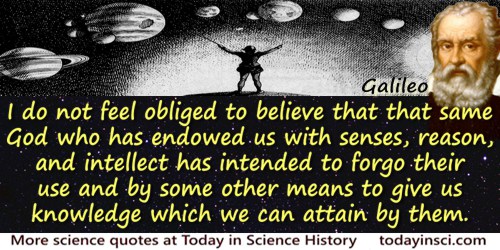
But I do not feel obliged to believe that that same God who has endowed us with senses, reason, and intellect has intended to forgo their use and by some other means to give us knowledge which we can attain by them.
Letter to Madame Christina of Lorraine, Grand Duchess of Tuscany: (1615). In Discoveries and Opinions of Galileo, trans. Stillman Drake (1957), 183.
But just as astronomy succeeded astrology, following Kepler's discovery of planetary regularities, the discoveries of these many principles in empirical explorations of intellectual processes in machines should lead to a science, eventually.
[Co-author with South African mathematician, Seymour Papert (1928- )]
[Co-author with South African mathematician, Seymour Papert (1928- )]
Artificial Intelligence (1973), 25.
Chemical research conducts to the knowledge of philosophical truth, and forms the mind to philosophical enlargement and accuracy of thought, more happily than almost any other species of investigation in which the human intellect can be employed.
Quote following title page of Samuel Parkes, A Chemical Catechism With Notes, Illustrations and Experiments (8th ed. 1818).
Chemistry: that most excellent child of intellect and art.
From presidential address to 1953 conference of Science Masters Association, Oxford, part of the Centenary Celbrations of the Chemical Society of London. As quoted in Charles Alfred Coulson, Science and Christian Belief (1956), 51.
Creation science has not entered the curriculum for a reason so simple and so basic that we often forget to mention it: because it is false, and because good teachers understand why it is false. What could be more destructive of that most fragile yet most precious commodity in our entire intellectual heritage—good teaching—than a bill forcing our honorable teachers to sully their sacred trust by granting equal treatment to a doctrine not only known to be false, but calculated to undermine any general understanding of science as an enterprise?.
In 'The Verdict on Creationism' The Sketical Inquirer (Winter 1987/88), 12, 186.
Curiosity atrophies after childhood unless it is transferred to an intellectual plane. The research worker is usually a person whose curiosity is turned toward seeking explanations for phenomena that are not understood.
In The Art of Scientific Investigation (1950), 67.
Education has, thus, become the chief problem of the world, its one holy cause. The nations that see this will survive, and those that fail to do so will slowly perish. There must be re-education of the will and of the heart as well as of the intellect, and the ideals of service must supplant those of selfishness and greed. ... Never so much as now is education the one and chief hope of the world.
Confessions of a Psychologist (1923). Quoted in Bruce A. Kimball, The True Professional Ideal in America: A History (1996), 198.
Electricity is often called wonderful, beautiful; but it is so only in common with the other forces of nature. The beauty of electricity or of any other force is not that the power is mysterious, and unexpected, touching every sense at unawares in turn, but that it is under law, and that the taught intellect can even govern it largely. The human mind is placed above, and not beneath it, and it is in such a point of view that the mental education afforded by science is rendered super-eminent in dignity, in practical application and utility; for by enabling the mind to apply the natural power through law, it conveys the gifts of God to man.
Notes for a Friday Discourse at the Royal Institution (1858).
Endowed with two qualities, which seemed incompatible with each other, a volcanic imagination and a pertinacity of intellect which the most tedious numerical calculations could not daunt, Kepler conjectured that the movements of the celestial bodies must be connected together by simple laws, or, to use his own expression, by harmonic laws. These laws he undertook to discover. A thousand fruitless attempts, errors of calculation inseparable from a colossal undertaking, did not prevent him a single instant from advancing resolutely toward the goal of which he imagined he had obtained a glimpse. Twenty-two years were employed by him in this investigation, and still he was not weary of it! What, in reality, are twenty-two years of labor to him who is about to become the legislator of worlds; who shall inscribe his name in ineffaceable characters upon the frontispiece of an immortal code; who shall be able to exclaim in dithyrambic language, and without incurring the reproach of anyone, “The die is cast; I have written my book; it will be read either in the present age or by posterity, it matters not which; it may well await a reader, since God has waited six thousand years for an interpreter of his words.”
In 'Eulogy on Laplace', in Smithsonian Report for the year 1874 (1875), 131-132.
Even those to whom Providence has allotted greater strength of understanding, can expect only to improve a single science. In every other part of learning, they must be content to follow opinions, which they are not able to examine; and, even in that which they claim as peculiarly their own, can seldom add more than some small particle of knowledge, to the hereditary stock devolved to them from ancient times, the collective labour of a thousand intellects.
In Samuel Johnson and W. Jackson Bate (Ed.), ',The Rambler, No. 121, Tuesday, 14 May 1751.' The Selected Essays from the Rambler, Adventurer, and Idler (1968), 172.
Every intellectual revolution which has ever stirred humanity into greatness has been a passionate protest against inert ideas. Then, alas, with pathetic ignorance of human psychology, it has proceeded by some educational scheme to, bind humanity afresh with inert ideas of its own fashioning.
In 'The Aims of Education', The Aims of Education and Other Essays (1929), 14.
First, the chief character, who is supposed to be a professional astronomer, spends his time fund raising and doing calculations at his desk, rather than observing the sky. Second, the driving force of a scientific project is institutional self-aggrandizement rather than intellectual curiosity.
[About the state of affairs in academia.]
[About the state of affairs in academia.]
In Marc J. Madou, Fundamentals of Microfabrication: the Science of Miniaturization (2nd ed., 2002), 535
For me, the first challenge for computing science is to discover how to maintain order in a finite, but very large, discrete universe that is intricately intertwined. And a second, but not less important challenge is how to mould what you have achieved in solving the first problem, into a teachable discipline: it does not suffice to hone your own intellect (that will join you in your grave), you must teach others how to hone theirs. The more you concentrate on these two challenges, the clearer you will see that they are only two sides of the same coin: teaching yourself is discovering what is teachable.
…...
For nearly twelve years I travelled and lived mostly among uncivilised or completely savage races, and I became convinced that they all possessed good qualities, some of them in a very remarkable degree, and that in all the great characteristics of humanity they are wonderfully like ourselves. Some, indeed, among the brown Polynesians especially, are declared by numerous independent and unprejudiced observers, to be physically, mentally, and intellectually our equals, if not our superiors; and it has always seemed to me one of the disgraces of our civilisation that these fine people have not in a single case been protected from contamination by the vices and follies of our more degraded classes, and allowed to develope their own social and political organislll under the advice of some of our best and wisest men and the protection of our world-wide power. That would have been indeed a worthy trophy of our civilisation. What we have actually done, and left undone, resulting in the degradation and lingering extermination of so fine a people, is one of the most pathetic of its tragedies.
In 'The Native Problem in South Africa and Elsewhere', Independent Review (1906), 11, 182.
For science, in so far as it is a substitute for religion, and reason, in so far as it is a substitute for faith, have always foundered. Science will be able to satisfy in an increasing measure, and in fact does satisfy, our increasing logical and intellectual needs, our desire to know and understand the truth; but science does not satisfy the needs of our heart and our will, our hunger for immortality—far from satisfying it, it contradicts it.
From Miguel Unamuno and J. E. Crawford Flitch (trans.), Essays and Soliloquies (1926), 209.
Genius itself has been analyzed by the shrewdest observers into a higher capacity of attention. “Genius,” says Helvetius … “is nothing but a continued attention,” (une attention suivie). “Genius,” says Buffon, “is only a protracted patience,” (une longue patience). “In the exact sciences, at least,” says Cuvier, “it is the patience of a sound intellect, when invincible, which truly constitutes genius.” And Chesterfield has also observed, that “the power of applying an attention, steady and undissipated, to a single object, is the sure mark of a superior genius.”
In Lectures on Metaphysics and Logic (1860), Vol. 1, 179.
Geometry enlightens the intellect and sets one’s mind right. All of its proofs are very clear and orderly. It is hardly possible for errors to enter into geometrical reasoning, because it is well arranged and orderly. Thus, the mind that constantly applies itself to geometry is not likely to fall into error. In this convenient way, the person who knows geometry acquires intelligence.
In Ibn Khaldûn, Franz Rosenthal (trans.) and N.J. Dawood (ed.), The Muqaddimah: An Introduction to History (1967, 1969), Vol. 1, 378.
Here is the element or power of conduct, of intellect and knowledge, of beauty, and of social life and manners, and all needful to build up a complete human life. … We have instincts responding to them all, and requiring them all, and we are perfectly civilized only when all these instincts of our nature—all these elements in our civilization have been adequately recognized and satisfied.
Collected in Tryon Edwards (ed.), A Dictionary of Thoughts: Being a Cyclopedia of Laconic Quotations from the Best Authors Both Ancient and Modern (1891), 75.
Historical theories are, after all, intellectual apple carts. They are quite likely to be upset. Nor should it be forgotten that they tend to attract, when they gain ascendancy, a fair number of apple-polishers
'Books of the Times'. New York Times (9 Dec 1965), 45.
How strange it would be if the final theory were to be discovered in our lifetimes! The discovery of the final laws of nature will mark a discontinuity in human intellectual history, the sharpest that has occurred since the beginning of modern science in the seventeenth century. Can we now imagine what that would be like?
In Dreams of a Final Theory (1992), 235.
However far the mathematician’s calculating senses seem to be separated from the audacious flight of the artist’s imagination, these manifestations refer to mere instantaneous images, which have been arbitrarily torn from the operation of both. In designing new theories, the mathematician needs an equally bold and inspired imagination as creative as the artist, and in carrying out the details of a work the artist must unemotionally reckon all the resources necessary for the success of the parts. Common to both is the fabrication, the creation of the structure from the intellect.
From Die Entwickelung der Mathematik im Zusammenhange mit der Ausbreitung der Kultur (1893), 4. Translated by Webmaster using online resources. From the original German, “Wie weit auch der rechnende Verstand des Mathematikers von dem kühnen Fluge der Phantasie des Künstlers getrennt zu sein scheint, so bezeichnen diese Ausdrücke doch blosse Augenblicksbilder, die willkürlich aus der Thätigkeit Beider herausgerissen sind. Bei dem Entwurfe neuer Theorieen bedarf der Mathematiker einer ebenso kühnen und schöpferischen Phantasie wie der schaffende Künstler, und bei der Ausführung der Einzelheiten eines Werkes muss auch der Künstler kühl alle Mittel berechnen, welche zum Gelingen der Theile erforderlich sind. Gemeinsam ist Beiden die Hervorbringung, die Erzeugung der Gebilde aus dem Geiste.”
Husserl has shown that man’s prejudices go a great deal deeper than his intellect or his emotions. Consciousness itself is “prejudiced”—that is to say, intentional.
In Introduction to the New Existentialism (1966), 54.
I am coming more and more to the conviction that the necessity of our geometry cannot be demonstrated, at least neither by, nor for, the human intellect...geometry should be ranked, not with arithmetic, which is purely aprioristic, but with mechanics.
Quoted in J Koenderink, Solid Shape (1990).
I believe that in every person is a kind of circuit which resonates to intellectual discovery—and the idea is to make that resonance work
Quoted by Dennis Meredith, in 'Carl Sagan's Cosmic Connection and Extraterrestrial Life-Wish', Science Digest (Jun 1979), 85, 37. Reproduced in Carl Sagan and Tom Head (editor), Conversations With Sagan (2006), 54.
I cannot anyhow be contented to view this wonderful universe, and especially the nature of man, and to conclude that everything is the result of brute force. I am inclined to look at everything as resulting from designed laws, with the details, whether good or bad, left to the working out of what we call chance. Not that this notion at all satisfies me. I feel most deeply that the whole subject is too profound for the human intellect. A dog might as well speculate on the mind of Newton. Let each man hope and believe what he can.
Letter to Asa Gray (22 May 1860). In Charles Darwin and Francis Darwin (ed.), Charles Darwin: His Life Told in an Autobiographical Chapter, and in a Selected Series of His Published Letters (1892), 236.
I conclude that, while it is true that science cannot decide questions of value, that is because they cannot be intellectually decided at all, and lie outside the realm of truth and falsehood. Whatever knowledge is attainable, must be attained by scientific methods; and what science cannot discover, mankind cannot know.
Religion and Science (1935), 243.
I consider the differences between man and animals in propensities, feelings, and intellectual faculties, to be the result of the same cause as that which we assign for the variations in other functions, viz. difference of organization; and that the superiority of man in rational endowments is not greater than the more exquisite, complicated, and perfectly developed structure of his brain, and particularly of his ample cerebral hemispheres, to which the rest of the animal kingdom offers no parallel, nor even any near approximation, is sufficient to account for.
Lectures on Physiology, Zoology, and the Natural History of Man (1819), 237.
I could almost wish, at this point, that I were in the habit of expressing myself in theological terms, for if I were, I might be able to compress my entire thesis into a sentence. All knowledge of every variety (I might say) is in the mind of God—and the human intellect, even the best, in trying to pluck it forth can but “see through a glass, darkly.”
In Asimov on Physics (1976), 146. Also in Isaac Asimov’s Book of Science and Nature Quotations (1988), 279.
I do not … reject the use of statistics in medicine, but I condemn not trying to get beyond them and believing in statistics as the foundation of medical science. … Statistics … apply only to cases in which the cause of the facts observed is still [uncertain or] indeterminate. … There will always be some indeterminism … in all the sciences, and more in medicine than in any other. But man’s intellectual conquest consists in lessening and driving back indeterminism in proportion as he gains ground for determinism by the help of the experimental method..
From An Introduction to the Study of Experimental Medicine (1865), as translated by Henry Copley Greene (1957), 138-140.
I do not think words alone will solve humanity’s present problems. The sound of bombs drowns out
men’s voices. In times of peace I have great faith in the communication of ideas among thinking men, but today, with brute force dominating so many millions of lives, I fear that the appeal to
man’s intellect is fast becoming virtually meaningless.
In 'I Am an American' (22 Jun 1940), Einstein Archives 29-092. Excerpted in David E. Rowe and Robert J. Schulmann, Einstein on Politics: His Private Thoughts and Public Stands on Nationalism, Zionism, War, Peace, and the Bomb (2007), 470. It was during a radio broadcast for the Immigration and Naturalization Service, interviewed by a State Department Official. Einstein spoke following an examination on his application for American citizenship in Trenton, New Jersey. The attack on Pearl Harbor and America’s declaration of war on Japan was still over a year in the future.
I had a dislike for [mathematics], and ... was hopelessly short in algebra. ... [One extraordinary teacher of mathematics] got the whole year's course into me in exactly six [after-school] lessons of half an hour each. And how? More accurately, why? Simply because he was an algebra fanatic—because he believed that algebra was not only a science of the utmost importance, but also one of the greatest fascination. ... [H]e convinced me in twenty minutes that ignorance of algebra was as calamitous, socially and intellectually, as ignorance of table manners—That acquiring its elements was as necessary as washing behind the ears. So I fell upon the book and gulped it voraciously. ... To this day I comprehend the binomial theorem.
In Prejudices: third series (1922), 261-262.
For a longer excerpt, see H. L. Mencken's Recollections of School Algebra.
For a longer excerpt, see H. L. Mencken's Recollections of School Algebra.
I have been speculating last night what makes a man a discoverer of undiscovered things; and a most perplexing problem it is. Many men who are very clever - much cleverer than the discoverers - never originate anything.
A Century of Family Letters, 1792-1896
I have now said enough to show you that it is indispensable for this country to have a scientific education in connexion with manufacturers, if we wish to outstrip the intellectual competition which now, happily for the world, prevails in all departments of industry. As surely as darkness follows the setting of the sun, so surely will England recede as a manufacturing nation, unless her industrial population become much more conversant with science than they are now.
In 'The Study of Abstract Science Essential to the Progress of Industry', Records of the School of Mines (1852) 1, 48.
I only became fired up [deciding to become a scientist] in my second year of a science degree. … I was never a boy naturalist, to my regret. It was more the intellectual, philosophical questions that interested me.
From 'Interview: Of Mind and Matter: David Attenborough Meets Richard Dawkins', The Guardian (11 Sep 2010).
I regret that it has been necessary for me in this lecture to administer such a large dose of four-dimensional geometry. I do not apologize, because I am really not responsible for the fact that nature in its most fundamental aspect is four-dimensional. Things are what they are; and it is useless to disguise the fact that “what things are” is often very difficult for our intellects to follow.
From The Concept of Nature (1920, 1964), 118.
I sometimes ask myself how it came about that I was the one to develop the theory of relativity. The reason, I think, is that a normal adult never stops to think about the problem of space and time. These are things which he has thought of as a child. But my intellectual development was retarded, as a result of which I began to wonder about space and time only when I had already grown up.
In Ronald W. Clark, Einstein: The Life and Times (1971), 10.
I think it’s time we recognized the Dark Ages are over. Galileo and Copernicus have been proven right. The world is in fact round; the Earth does revolve around the sun. I believe God gave us intellect to differentiate between imprisoning dogma and sound ethical science, which is what we must do here today.
Debating federal funding for stem cell research as Republican Representative (CT).
Debating federal funding for stem cell research as Republican Representative (CT).
In Eve Herold, George Daley, Stem Cell Wars (2007), 57.
I trust ... I have succeeded in convincing you that modern chemistry is not, as it has so long appeared, an ever-growing accumulation of isolated facts, as impossible for a single intellect to co-ordinate as for a single memory to grasp.
The intricate formulae that hang upon these walls, and the boundless variety of phenomena they illustrate, are beginning to be for us as a labyrinth once impassable, but to which we have at length discovered the clue. A sense of mastery and power succeeds in our minds to the sort of weary despair with which we at first contemplated their formidable array. For now, by the aid of a few general principles, we find ourselves able to unravel the complexities of these formulae, to marshal the compounds which they represent in orderly series; nay, even to multiply their numbers at our will, and in a great measure to forecast their nature ere we have called them into existence. It is the great movement of modern chemistry that we have thus, for an hour, seen passing before us. It is a movement as of light spreading itself over a waste of obscurity, as of law diffusing order throughout a wilderness of confusion, and there is surely in its contemplation something of the pleasure which attends the spectacle of a beautiful daybreak, something of the grandeur belonging to the conception of a world created out of chaos.
The intricate formulae that hang upon these walls, and the boundless variety of phenomena they illustrate, are beginning to be for us as a labyrinth once impassable, but to which we have at length discovered the clue. A sense of mastery and power succeeds in our minds to the sort of weary despair with which we at first contemplated their formidable array. For now, by the aid of a few general principles, we find ourselves able to unravel the complexities of these formulae, to marshal the compounds which they represent in orderly series; nay, even to multiply their numbers at our will, and in a great measure to forecast their nature ere we have called them into existence. It is the great movement of modern chemistry that we have thus, for an hour, seen passing before us. It is a movement as of light spreading itself over a waste of obscurity, as of law diffusing order throughout a wilderness of confusion, and there is surely in its contemplation something of the pleasure which attends the spectacle of a beautiful daybreak, something of the grandeur belonging to the conception of a world created out of chaos.
Concluding remark for paper presented at the Friday Discourse of the the Royal Institution (7 Apr 1865). 'On the Combining Power of Atoms', Proceedings of the Royal Institution (1865), 4, No. 42, 416.
I venture to maintain, that, if the general culture obtained in the Faculty of Arts were what it ought to be, the student would have quite as much knowledge of the fundamental principles of Physics, of Chemistry, and of Biology, as he needs, before he commenced his special medical studies. Moreover, I would urge, that a thorough study of Human Physiology is, in itself, an education broader and more comprehensive than much that passes under that name. There is no side of the intellect which it does not call into play, no region of human knowledge into which either its roots, or its branches, do not extend; like the Atlantic between the Old and the New Worlds, its waves wash the shores of the two worlds of matter and of mind; its tributary streams flow from both; through its waters, as yet unfurrowed by the keel of any Columbus, lies the road, if such there be, from the one to the other; far away from that Northwest Passage of mere speculation, in which so many brave souls have been hopelessly frozen up.
'Universities: Actual and Ideal' (1874). In Collected Essays (1893), Vol. 3, 220.
I was just going to say, when I was interrupted, that one of the many ways of classifying minds is under the heads of arithmetical and algebraical intellects. All economical and practical wisdom is an extension or variation of the following arithmetical formula: 2+2=4. Every philosophical proposition has the more general character of the expression a+b=c. We are mere operatives, empirics, and egotists, until we learn to think in letters instead of figures.
The Autocrat of the Breakfast Table (1858), 1.
I would like it if everyone could make the prejudice vanish as I have that there is really a problem whether ants are machines, whether my brother is a machine, whether we are in the world, or the world is in us, if perhaps behind the word there is matter, power pushes or not, or if Locke is right that the intellect is between us and things. Or whether we are free or not free…
Given as “fashioned from Boltzmann’s notes for his lecture on natural philosophy on October 26, 1904” and translated in John Blackmore (ed.), Ludwig Boltzmann: His Later Life and Philosophy, 1900-1906 (1995), 136. Blackmore indicates (p.133) that since Boltzmann spoke freely, this may not be verbatim for what he actually said, because he did not read his lectures from his notes. However, it does “rather accurately represent his thinking” at the time he wrote his lecture. His Lectures on Natural Philosophy (1903-1906) were reconstructed from Boltzmann’s shorthand notes by Ilse M. Fasol-Boltzmann (ed.), in Ludwig Boltzmann Principien der Naturfolosofti (1990). This quote is translated from p.109.
If a man will comprehend the richness and variety of the universe, and inspire his mind with a due measure of wonder and awe, he must contemplate the human intellect not only on its heights of genius but in its abysses of ineptitude...
M. Manilii Astronomicon. Liber Primus Recensuit et enarravit A.E. Housman. Editio Altera (1937), i, xix. Quoted in David Womersley, 'Dulness and Pope', British Academy, 2004 Lectures, (2005), 233.
If a photographic plate under the center of a lens focused on the heavens is exposed for hours, it comes to reveal stars so far away that even the most powerful telescopes fail to reveal them to the naked eye. In a similar way, time and concentration allow the intellect to perceive a ray of light in the darkness of the most complex problem.
From Reglas y Consejos sobre Investigacíon Cientifica: Los tónicos de la voluntad. (1897), as translated by Neely and Larry W. Swanson, in Advice for a Young Investigator (1999), 34.
If a solution fails to appear … and yet we feel success is just around the corner, try resting for a while. … Like the early morning frost, this intellectual refreshment withers the parasitic and nasty vegetation that smothers the good seed. Bursting forth at last is the flower of truth.
From Reglas y Consejos sobre Investigacíon Cientifica: Los tónicos de la voluntad. (1897), as translated by Neely and Larry W. Swanson, in Advice for a Young Investigator (1999), 35.
If intellectual curiosity, professional pride, and ambition are the dominant incentives to research, then assuredly no one has a fairer chance of gratifying them than a mathematician.
In A Mathematician’s Apology (1940, 1967), 80.
If order appeals to the intellect, then disorder titillates the imagination.
Quoted in the original French, “Si l’ordre satisfait la raison, /Le désordre fait les deélices de l’imagination,” in P.H. Gaskell (ed.), Structure of Non-crystalline Materials 1976: Symposium Proceedings (1977), 260. As translated in Alan A. Mackay, A Dictionary of Scientific Quotations (1991), 56.
If the Weismann idea triumphs, it will be in a sense a triumph of fatalism; for, according to it, while we may indefinitely improve the forces of our education and surroundings, and this civilizing nurture will improve the individuals of each generation, its actual effects will not be cumulative as regards the race itself, but only as regards the environment of the race; each new generation must start de novo, receiving no increment of the moral and intellectual advance made during the lifetime of its predecessors. It would follow that one deep, almost instinctive motive for a higher life would be removed if the race were only superficially benefited by its nurture, and the only possible channel of actual improvement were in the selection of the fittest chains of race plasma.
'The Present Problem of Heredity', The Atlantic Monthly (1891), 57, 363.
If we evolved a race of Isaac Newtons, that would not be progress. For the price Newton had to pay for being a supreme intellect was that he was incapable of friendship, love, fatherhood, and many other desirable things. As a man he was a failure; as a monster he was superb.
Interview with J.W.N. Sullivan, Contemporary Mind, London, 1934. As cited in James Roy Newman, The World of Mathematics (1956), Vol. 4, 2222.
If we look into ourselves we discover propensities which declare that our intellects have arisen from a lower form; could our minds be made visible we should find them tailed.
In The Martyrdom of Man (1876), 242.
In 1944 Erwin Schroedinger, stimulated intellectually by Max Delbruck, published a little book called What is life? It was an inspiration to the first of the molecular biologists, and has been, along with Delbruck himself, credited for directing the research during the next decade that solved the mystery of how 'like begat like.' Max was awarded this Prize in 1969, and rejoicing in it, he also lamented that the work for which he was honored before all the peoples of the world was not something which he felt he could share with more than a handful. Samuel Beckett's contributions to literature, being honored at the same time, seemed to Max somehow universally accessible to anyone. But not his. In his lecture here Max imagined his imprisonment in an ivory tower of science.
'The Polymerase Chain Reaction', Nobel Lecture (8 Dec 1993). In Nobel Lectures: Chemistry 1991-1995 (1997), 103.
In an era in which the domain of intellect and politics were almost exclusively male, Theon [her father] was an unusually liberated person who taught an unusually gifted daughter [Hypatia] and encouraged her to achieve things that, as far as we know, no woman before her did or perhaps even dreamed of doing.
From 'Hypatia', in Louise S. Grinstein (ed.), Women of Mathematics, (1987), 74.
In honoring the Wright Brothers, it is customary and proper to recognize their contribution to scientific progress. But I believe it is equally important to emphasize the qualities in their pioneering life and the character in man that such a life produced. The Wright Brothers balanced sucess with modesty, science with simplicity. At Kitty Hawk their intellects and senses worked in mutual support. They represented man in balance, and from that balance came wings to lift a world.
Speech, quoted in Leonard Mosley, Lindbergh (2000), 347. In 1949, Lindbergh gave a speech when he received the Wright Brothers Memorial Trophy.
In its earliest development knowledge is self-sown. Impressions force themselves upon men’s senses whether they will or not, and often against their will. The amount of interest in which these impressions awaken is determined by the coarser pains and pleasures which they carry in their train or by mere curiosity; and reason deals with the materials supplied to it as far as that interest carries it, and no further. Such common knowledge is rather brought than sought; and such ratiocination is little more than the working of a blind intellectual instinct. It is only when the mind passes beyond this condition that it begins to evolve science. When simple curiosity passes into the love of knowledge as such, and the gratification of the æsthetic sense of the beauty of completeness and accuracy seems more desirable that the easy indolence of ignorance; when the finding out of the causes of things becomes a source of joy, and he is accounted happy who is successful in the search, common knowledge passes into what our forefathers called natural history, whence there is but a step to that which used to be termed natural philosophy, and now passes by the name of physical science.
In this final state of knowledge the phenomena of nature are regarded as one continuous series of causes and effects; and the ultimate object of science is to trace out that series, from the term which is nearest to us, to that which is at the farthest limit accessible to our means of investigation.
The course of nature as it is, as it has been, and as it will be, is the object of scientific inquiry; whatever lies beyond, above, or below this is outside science. But the philosopher need not despair at the limitation on his field of labor; in relation to the human mind Nature is boundless; and, though nowhere inaccessible, she is everywhere unfathomable.
In this final state of knowledge the phenomena of nature are regarded as one continuous series of causes and effects; and the ultimate object of science is to trace out that series, from the term which is nearest to us, to that which is at the farthest limit accessible to our means of investigation.
The course of nature as it is, as it has been, and as it will be, is the object of scientific inquiry; whatever lies beyond, above, or below this is outside science. But the philosopher need not despair at the limitation on his field of labor; in relation to the human mind Nature is boundless; and, though nowhere inaccessible, she is everywhere unfathomable.
The Crayfish: an Introduction to the Study of Zoölogy (1880), 2-3. Excerpted in Popular Science (Apr 1880), 16, 789-790.
In my experience most mathematicians are intellectually lazy and especially dislike reading experimental papers. He (René Thom) seemed to have very strong biological intuitions but unfortunately of negative sign.
In What Mad Pursuit: A Personal View of Scientific Discovery (1988), 136.
In Science the paramount appeal is to the Intellect—its purpose being instruction; in Art, the paramount appeal is to the Emotions—its purpose being pleasure.
In The Principles of Success in Literature (1901), 63.
In science, attempts at formulating hierarchies are always doomed to eventual failure. A Newton will always be followed by an Einstein, a Stahl by a Lavoisier; and who can say who will come after us? What the human mind has fabricated must be subject to all the changes—which are not progress—that the human mind must undergo. The 'last words' of the sciences are often replaced, more often forgotten. Science is a relentlessly dialectical process, though it suffers continuously under the necessary relativation of equally indispensable absolutes. It is, however, possible that the ever-growing intellectual and moral pollution of our scientific atmosphere will bring this process to a standstill. The immense library of ancient Alexandria was both symptom and cause of the ossification of the Greek intellect. Even now I know of some who feel that we know too much about the wrong things.
Voices in the Labyrinth: Nature, Man, and Science (1979), 46.
In some remote corner of the universe, poured out and glittering in innumerable solar systems, there once was a star on which clever animals invented knowledge. That was the haughtiest and most mendacious minute of ‘world history’—yet only a minute. After nature had drawn a few breaths the star grew cold, and the clever animals had to die. ... There have been eternities when [human intellect] did not exist; and when it is done for again, nothing will have happened.
…...
In the last fifteen years we have witnessed an event that, I believe, is unique in the history of the natural sciences: their subjugation to and incorporation into the whirls and frenzies of disgusting publicity and propaganda. This is no doubt symptomatic of the precarious position assigned by present-day society to any form of intellectual activity. Such intellectual pursuits have at all times been both absurd and fragile; but they become ever more ludicrous when, as is now true of science, they become mass professions and must, as homeless pretentious parasites, justify their right to exist in a period devoted to nothing but the rapid consumption of goods and amusements. These sciences were always a divertissement in the sense in which Pascal used the word; but what is their function in a society living under the motto lunam et circenses? Are they only a band of court jesters in search of courts which, if they ever existed, have long lost their desire to be amused?
Voices in the Labyrinth: Nature, Man, and Science (1979), 27.
In the past we see that periods of great intellectual activity have followed certain events which have acted by freeing the mind from dogma, extending the domain in which knowledge can be sought, and stimulating the imagination. … [For example,] the development of the cell theory and the theory of evolution.
From address, 'A Medical Retrospect'. Published in Yale Medical Journal (Oct 1910), 17, No. 2, 59.
In the temple of science are many mansions, and various indeed are they that dwell therein and the motives that have led them thither. Many take to science out of a joyful sense of superior intellectual power; science is their own special sport to which they look for vivid experience and the satisfaction of ambition; many others are to be found in the temple who have offered the products of their brains on this altar for purely utilitarian purposes. Were an angel of the Lord to come and drive all the people belonging to these two categories out of the temple, the assemblage would be seriously depleted, but there would still be some men, of both present and past times, left inside. Our Planck is one of them, and that is why we love him.
Address at Physical Society, Berlin (1918), for Max Planck’s 60th birthday, 'Principles of Research' in Essays in Science (1934, 2004), 1.
In their capacity as a tool, computers will be but a ripple on the surface of our culture. In their capacity as intellectual challenge, they are without precedent in the cultural history of mankind.
From Turing Award acceptance speech.
Infidels are intellectual discoverers. They sail the unknown seas and find new isles and continents in the infinite realms of thought. An Infidel is one who has found a new fact, who
has an idea of his own, and who in the mental sky has seen another star. He is an intellectual capitalist, and for that reason excites the envy and hatred of the theological pauper.
In 'The Great Infidels', The Works of Robert G. Ingersoll (1902), Vol. 3, 309.
Intellect in a weak body is “like gold in a spent swimmer’s pocket.”
In Getting on in the World; Or, Hints on Success in Life (1873), 55-56.
Intellect is void of affection and sees an object as it stands in the light of science, cool and disengaged. The intellect goes out of the individual, floats over its own personality, and regards it as a fact, and not as I and mine.
From 'Intellect', collected in The Complete Works of Ralph Waldo Emerson (1903), 326.
Intellectual beauty is sufficient unto itself, and only for it rather than for the future good of humanity does the scholar condemn himself to arduous and painful labors.
From Reglas y Consejos sobre Investigacíon Cientifica: Los tónicos de la voluntad. (1897), as translated by Neely and Larry W. Swanson, in Advice for a Young Investigator (1999), 51.
Intellectual evolution … is…, under all its aspects, a progress in representativeness of thought.
In The Principles of Psychology (1872), Vol. 2, 535.
Intellectual work is an act of creation. It is as if the mental image that is studied over a period of time were to sprout appendages like an ameba—outgrowths that extend in all directions while avoiding one obstacle after another—before interdigitating with related ideas.
From Reglas y Consejos sobre Investigacíon Cientifica: Los tónicos de la voluntad. (1897), as translated by Neely and Larry W. Swanson, in Advice for a Young Investigator (1999), 34.
Inventions are best developed on your own. When you work for other people or borrow money from them, maintaining freedom of intellect is difficult.
As quoted by Franz Lidz in 'Dr. NakaMats, the Man With 3300 Patents to His Name', Smithsonian Magazine (Dec 2012).
Inventive genius requires pleasurable mental activity as a condition for its vigorous exercise. “Necessity is the mother of invention” is a silly proverb. “Necessity is the mother of futile dodges” is much closer to the truth. The basis of growth of modern invention is science, and science is almost wholly the outgrowth of pleasurable intellectual curiosity.
In 'Technical Education and Its Relation to Science and Literature', The Aims of Education and Other Essays (1917), 69.
It has cost them but a moment to cut off that head; but a hundred years will not be sufficient to produce another like it.
Comment to Delambre about Lavoisier, who was executed on 8 May 1794. As quoted by Charles Hutton in
A Philosophical and Mathematical Dictionary (1815), Vol. 1, 708. The quotation is given in Douglas McKie, Antoine Lavoisier: The Father of Modern Chemistry (1935), 299, as: “Only a moment to cut off this head and perhaps a hundred years before we shall have another like it.” In The Doctor Explains (1931), 134-135, Ralph Hermon Major words it as, “It took but an instant to cut off his head; a hundred years will not suffice to produce one like it,” but in A History of Medicine (1954), Vol. 2, 618, Major repeats it as, “A moment was sufficient to sever his head, but a hundred years will not be enough perhaps to produce another like it.” Please contact Webmaster if you know the primary source, presumably in French.
It has long been a complaint against mathematicians that they are hard to convince: but it is a far greater disqualification both for philosophy, and for the affairs of life, to be too easily convinced; to have too low a standard of proof. The only sound intellects are those which, in the first instance, set their standards of proof high. Practice in concrete affairs soon teaches them to make the necessary abatement: but they retain the consciousness, without which there is no sound practical reasoning, that in accepting inferior evidence because there is no better to be had, they do not by that acceptance raise it to completeness.
In An Examination of Sir William Hamilton’s Philosophy (1878), 611.
It is a matter of primary importance in the cultivation of those sciences in which truth is discoverable by the human intellect that the investigator should be free, independent, unshackled in his movement; that he should be allowed and enabled to fix his mind intently, nay, exclusively, on his special object, without the risk of being distracted every other minute in the process and progress of his inquiry by charges of temerariousness, or by warnings against extravagance or scandal.
In The Idea of a University Defined and Illustrated (1905), 471.
It is a remarkable illustration of the ranging power of the human intellect that a principle first detected in connection with the clumsy puffing of the early steam engines should be found to apply to the whole world, and possibly, even to the whole cosmic universe.
In Man and Energy (1955, 1963), 132.
It is not I who seek to base Man's dignity upon his great toe, or insinuate that we are lost if an Ape has a hippocampus minor. On the contrary, I have done my best to sweep away this vanity. I have endeavoured to show that no absolute structural line of demarcation, wider than that between the animals which immediately succeed us in the scale, can be drawn between the animal world and ourselves; and I may add the expression of my belief that the attempt to draw a physical distinction is equally futile, and that even the highest facuities of feeling and of intellect begin to germinate in lower forms of life. At the same time, no one is more strongly convinced than I am of the vastness of the gulf between civilized man and the brutes; or is more certain that whether from them or not, he is assuredly not of them.
'On the Relations of Man to the Lower Animals' (1863). In Collected Essays (1894), Vol. 7. 152-3.
It is not, indeed, strange that the Greeks and Romans should not have carried ... any ... experimental science, so far as it has been carried in our time; for the experimental sciences are generally in a state of progression. They were better understood in the seventeenth century than in the sixteenth, and in the eighteenth century than in the seventeenth. But this constant improvement, this natural growth of knowledge, will not altogether account for the immense superiority of the modern writers. The difference is a difference not in degree, but of kind. It is not merely that new principles have been discovered, but that new faculties seem to be exerted. It is not that at one time the human intellect should have made but small progress, and at another time have advanced far; but that at one time it should have been stationary, and at another time constantly proceeding. In taste and imagination, in the graces of style, in the arts of persuasion, in the magnificence of public works, the ancients were at least our equals. They reasoned as justly as ourselves on subjects which required pure demonstration.
History (May 1828). In Samuel Austin Allibone, Prose Quotations from Socrates to Macaulay (1880), 36.
It is sometimes asserted that a surgical operation is or should be a work of art … fit to rank with those of the painter or sculptor. … That proposition does not admit of discussion. It is a product of the intellectual innocence which I think we surgeons may fairly claim to possess, and which is happily not inconsistent with a quite adequate worldly wisdom.
Address, opening of 1932-3 session of U.C.H. Medical School (4 Oct 1932), 'Art and Science in Medicine', The Collected Papers of Wilfred Trotter, FRS (1941), 93.
It is true that M. Fourier believed that the main aim of mathematics was public utility and the explanation of natural phenomena; but a philosopher of his ability ought to have known that the sole aim of science is the honour of the human intellect, and that on this ground a problem in numbers is as important as a problem on the system of the world.
In Letter to Legendre, as quoted in an Address by Emile Picard to the Congress of Science and Art, St. Louis (22 Sep 1904), translated in 'Development of Mathematical Analysis', The Mathematical Gazette (Jul 1905), 3, No. 52, 200. A different translation begins, “It is true that Fourier had the opinion…” on the Karl Jacobi Quotes web page on this site.
It may well be doubted whether, in all the range of science, there is any field so fascinating to the explorer—so rich in hidden treasures—so fruitful in delightful surprises—as that of Pure Mathematics. The charm lies chiefly, I think, in the absolute certainty of its results; for that is what, beyond all mental treasures, the human intellect craves for. Let us only be sure of something! More light, more light!
Written without pseudonym as Charles L. Dodgson. Opening remarks in Introduction to A New Theory of Parallels (1888, 1890), xv.
It may well be doubted whether, in all the range of Science, there is any field so fascinating to the explorer—so rich in hidden treasures—so fruitful in delightful surprises—as that of Pure Mathematics. The charm lies chiefly, I think, in the absolute certainty of its results: for that is what, beyond all mental treasures, the human intellect craves for. Let us only be sure of something! More light, more light … “And if our fate be death, give light and let us die” This is the cry that, through all the ages, is going up from perplexed Humanity, and Science has little else to offer, that will really meet the demands of its votaries, than the conclusions of Pure Mathematics.
Opening of 'Introduction', A New Theory of Parallels (1890), xv. As a non-fiction work, the author’s name on the title page of this book was Charles Lutwidge Dodgson. Being better known for his works of fiction as Lewis Carroll, all quotes relating to this one person, published under either name, are gathered on this single web page under his pen name.
Just as iron rusts from disuse and stagnant water putrefies, or when cold turns to ice, so our intellect wastes unless it is kept in use.
C.A. 289 v. c. In Irma A. Richter and Thereza Wells (eds.), Leonardo da Vinci: Notebooks (1952, 1980), 245. Also translated as “Iron rusts from disuse; stagnant water loses its purity and in cold weather becomes frozen; even so does inaction sap the vigour of the mind,” in Edward McCurdy, The Notebooks of Leonardo Da Vinci (1939), Vol. 1, 89. Translated as “Just as iron rusts unless it is used, and water putrifies or, in cold, turns to ice, so our intellect spoils unless it is kept in use,” in Jean Paul Richter (trans.), The Notebooks of Leonardo Da Vinci (1888), Note 1177.
Look, first of all, the climate is changing. I don’t think the science is clear what percentage is man-made and what percentage is natural. It’s convoluted. And for the people to say the science is decided on, this is just really arrogant, to be honest with you, it’s this intellectual arrogance that now you can’t have a conversation about it, even. The climate is changing, and we need to adapt to that reality.
— Jeb Bush
As quoted by Carrie Dann, 'Jeb Bush Blasts ‘Intellectual Arrogance’ in Climate Change Debate', in article accompanying NBC News video (21 May 2015) on nbcnews.com website. Responding in a statement, Democratic National Committee press secretary Holly Shulman said, “Ninety-seven percent of climate scientists agree that human activity has led to climate change. Ninety-seven percent. But Jeb Bush thinks they’re wrong. Who’s being intellectually arrogant now?”
Love is the triumph of imagination over intelligence.
An Ideal Husband (1906), 82. In Lily Splane, Quantum Consciousness (2004), 309
Man is a rational animal—so at least I have been told. … Aristotle, so far as I know, was the first man to proclaim explicitly that man is a rational animal. His reason for this view was … that some people can do sums. … It is in virtue of the intellect that man is a rational animal. The intellect is shown in various ways, but most emphatically by mastery of arithmetic. The Greek system of numerals was very bad, so that the multiplication table was quite difficult, and complicated calculations could only be made by very clever people.
From An Outline of Intellectual Rubbish (1937, 1943), 5. Collected in The Basic Writings of Bertrand Russell (2009), 45.
Man may be excused for feeling some pride at having risen, though not through his own exertions, to the very summit of the organic scale; and the fact of his having thus risen, instead of having been aboriginally placed there, may give him hopes for a still higher destiny in the distant future. But we are not here concerned with hopes or fears, only with the truth as far as our reason allows us to discover it. I have given the evidence to the best of my ability; and we must acknowledge, as it seems to me, that man with all his noble qualities, with sympathy which feels for the most debased, with benevolence which extends not only to other men but to the humblest living creature, with his god-like intellect which has penetrated into the movements and constitution of the solar system—with all these exalted powers—Man still bears in his bodily frame the indelible stamp of his lowly origin.
Concluding remarks. The Descent of Man (1871), Vol. 2, 405.
Man was born to be rich, or, inevitably grows rich by the use of his faculties; by the union of thought with nature. Property is an intellectual production. The game requires coolness, right reasoning, promptness, and patience in the players. Cultivated labor drives out brute labor. An infinite number of shrewd men, in infinite years, have arrived at certain best and shortest ways of doing, and this accumulated skill in arts, cultures, harvestings, curings, manufactures, navigations, exchanges, constitutes the worth of our world to-day.
In 'Wealth', Power, Wealth, Illusions (1860, 1875), 56-57.
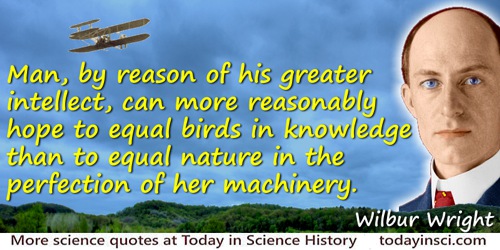
Man, by reason of his greater intellect, can more reasonably hope to equal birds in knowledge than to equal nature in the perfection of her machinery.
In The Papers of Wilbur and Orville Wright: 1899-1905 (1953), 15.
Martin Gardner is one of the greatest intellects produced in this country in this century.
As quoted in Kendrick Frazier, 'A Mind at Play: An Interview with Martin Gardner', Skeptical Inquirer (Mar/Apr 1998), 22, No. 2, 36.
Mathematical knowledge is not—as all Cambridge men are surely aware—the result of any special gift. It is merely the development of those conceptions of form and number which every human being possesses; and any person of average intellect can make himself a fair mathematician if he will only pay continuous attention; in plain English, think enough about the subject.
'Science', a lecture delivered at the Royal Institution. The Works of Charles Kingsley (1880), 241.
Mathematical knowledge, therefore, appears to us of value not only in so far as it serves as means to other ends, but for its own sake as well, and we behold, both in its systematic external and internal development, the most complete and purest logical mind-activity, the embodiment of the highest intellect-esthetics.
In 'Ueber Wert und angeblichen Unwert der Mathematik', Jahresbericht der Deutschen Mathematiker Vereinigung, Bd. 13, 381.
Mathematics contain a great number of premises, and there is perhaps a kind of intellect that can search with ease a few premises to the bottom, and cannot in the least penetrate those matters in which there are many premises.
In Pascal’s Pensées (1958), 3.
Men have called me mad; but the question is not yet settled, whether madness is or is not the loftiest intelligence—whether much that is glorious—whether all that is profound—does not spring from disease of thought—from moods of mind exalted at the expense of the general intellect.
In Eleonora (1850). Collected on The Works of the Late Edgar Allan Poe (1859), Vol. 1, 446.
Men who do not know the truth of things try to reach certainty about them, so that, if they cannot satisfy their intellects by science, their wills at least may rest on conscience.
In The New Science (3rd ed., 1744), Book 1, Para. 137, as translated by Thomas Goddard Bergin and Max Harold Fisch, The New Science of Giambattista Vico (1948), 56.
Modern civilization depends on science … James Smithson was well aware that knowledge should not be viewed as existing in isolated parts, but as a whole, each portion of which throws light on all the other, and that the tendency of all is to improve the human mind, and give it new sources of power and enjoyment … narrow minds think nothing of importance but their own favorite pursuit, but liberal views exclude no branch of science or literature, for they all contribute to sweeten, to adorn, and to embellish life … science is the pursuit above all which impresses us with the capacity of man for intellectual and moral progress and awakens the human intellect to aspiration for a higher condition of humanity.
[Joseph Henry was the first Secretary of the Smithsonian Institution, named after its benefactor, James Smithson.]
[Joseph Henry was the first Secretary of the Smithsonian Institution, named after its benefactor, James Smithson.]
The first clause is inscribed on the National Museum of American History, Washington, D.C. In Library of Congress, Respectfully Quoted: A Dictionary of Quotations (1989), 313. From 'On the Smithsonian Institution', (Aug 1853), Proceedings of the Third Session of the American Association for the Advancement of Education (1854), 101.
Modern mathematics, that most astounding of intellectual creations, has projected the mind’s eye through infinite time and the mind’s hand into boundless space.
In 'What Knowledge is of Most Worth?', Presidential address to the National Education Association, Denver, Colorado (9 Jul 1895). In Educational Review (Sep 1895), 10, 108.
Modern war, even from the consideration of physical welfare, is not creative. Soldiers and civilians alike are supposed to put on mental khaki. … War means the death of that fertile war which consists of the free, restless conflict of ideas. The war which matters is that of the scientist with nature; of the farmer with the tawny desert; of … philosopher against … mob stupidity. Such war is creative. … Inventions that further life and joy; freedom; new knowledge, whether Luther Burbank’s about the breeding of fruits or Einstein's about relativity; great cathedrals and Beethoven's music: these modern mechanical war can destroy but never produce. At its most inventive height, war creates the Maxim gun, the submarine, disseminable germs of disease, life-blasting gases. Spiritually and intellectually, modern war is not creative.
From ‘The Stagnation of War’, in Allen D. Hole (ed.) The Messenger of Peace (Nov 1924), 49, No. 11, 162-163.
Moral certainty is intellectual immorality
Quotations: Superultramodern Science and Philosophy (2005), 2
Most scientists think of science as being a kind of purifying intellectual machinery that leads to honesty, to the withering away of ignorance and wrong ideas, including, provided they are of the atheistic persuasion, those of religion.
In Pamela Weintraub (ed.), 'E. O. Wilson', The Omni Interviews (1984), 231.
My practice as a scientist is atheistic. That is to say, when I set up an experiment I assume that no god, angel or devil is going to interfere with its course; and this assumption has been justified by such success as I have achieved in my professional career. I should therefore be intellectually dishonest if I were not also atheistic in the affairs of the world.
In Fact and Faith (1934), vi.
My soul is an entangled knot,
Upon a liquid vortex wrought
By Intellect in the Unseen residing,
And thine doth like a convict sit,
With marline-spike untwisting it,
Only to find its knottiness abiding;
Since all the tools for its untying
In four-dimensional space are lying,
Wherein they fancy intersperses
Long avenues of universes,
While Klein and Clifford fill the void
With one finite, unbounded homoloid,
And think the Infinite is now at last destroyed. (1878)
Upon a liquid vortex wrought
By Intellect in the Unseen residing,
And thine doth like a convict sit,
With marline-spike untwisting it,
Only to find its knottiness abiding;
Since all the tools for its untying
In four-dimensional space are lying,
Wherein they fancy intersperses
Long avenues of universes,
While Klein and Clifford fill the void
With one finite, unbounded homoloid,
And think the Infinite is now at last destroyed. (1878)
A parody of Shelley as 'A Paradoxical Ode', quoted in Lewis Campbell and William Garnett, The Life of James Clerk Maxwell (1882), 649-650.
Nicolle was one of those men who achieve their successes by long preliminary thought before an experiment is formulated, rather than by the frantic and often ill-conceived experimental activities that keep lesser men in ant-like agitation. Indeed. I have often thought of ants in observing the quantity output of ‘what-of-it’ literature from many laboratories. … Nicolle did relatively few and simple experiments. But every time he did one, it was the result of long hours of intellectual incubation during which all possible variants had been considered and were allowed for in the final tests. Then he went straight to the point, without wasted motion. That was the method of Pasteur, as it has been of all the really great men of our calling, whose simple, conclusive experiments are a joy to those able to appreciate them.
In As I Remember Him: The Biography of R.S. (1948). As quoted and cited in W.I.B. Beveridge, The Art of Scientific Investigation (1957), 11.
Not only are there meaningless questions, but many of the problems with which the human intellect has tortured itself turn out to be only 'pseudo problems,' because they can be formulated only in terms of questions which are meaningless. Many of the traditional problems of philosophy, of religion, or of ethics, are of this character. Consider, for example, the problem of the freedom of the will. You maintain that you are free to take either the right- or the left-hand fork in the road. I defy you to set up a single objective criterion by which you can prove after you have made the turn that you might have made the other. The problem has no meaning in the sphere of objective activity; it only relates to my personal subjective feelings while making the decision.
The Nature of Physical Theory (1936), 12.
Note the saying of Protagoras that man is the measure of things. With the senses man measures perceptible things, with the intellect he measures intelligible things, and he attains unto supra-intelligible things transcendently
Dialog, 'De Beryllo' (1458). As translated in Jasper Hopkins, Complete Philosophical and Theological Treatises of Nicholas of Cusa: De visione Dei (2001), Vol. 2, 793.
Nothing is in the intellect that was not first in the senses.
Nihil est in intellectu quod non sit prius in sensu.
Nihil est in intellectu quod non sit prius in sensu.
Original Latin in Quaestiones Disputatae de Veritate, q. 2 a. 3 arg. 19. Also seen translated as “There is nothing in the mind that has not been previously in the senses.” In plain language, it means that the knowledge (or understanding) of outward objects “is conveyed to the mind through the senses,” as given in William Sullivan and George Barrell Emerson, The Political Class Book: Intended to Instruct the Higher Classes in Schools (1831), 9.
Observation and experiment for gathering material, induction and deduction for elaborating it: these are are only good intellectual tools.
In Claude Bernard, Henry C. Greene and L. J. Henderson, An Introduction to the Study of Experimental Medicine (1957), 6.
Of the many forms of false culture, a premature converse with abstractions is perhaps the most likely to prove fatal to the growth of a masculine vigour of intellect.
In A Treatise on Differential Equations (1859), Preface, vi.
Of what use is it that your mind has become a vast granary of knowledge, if you have not strength to turn the key?
In Getting on in the World; Or, Hints on Success in Life (1873), 56.
One has a feeling that one has a kind of home in this timeless community of human beings that strive for truth ... I have always believed that Jesus meant by the Kingdom of God the small group scattered all through time of intellectually and ethically valuable people.
…...
One precept for the scientist-to-be is already obvious. Do not place yourself in an environment where your advisor is already suffering from scientific obsolescence. If one is so unfortunate as to receive his training under a person who is either technically or intellectually obsolescent, one finds himself to be a loser before he starts. It is difficult to move into a position of leadership if one’s launching platform is a scientific generation whose time is already past.
In 'Scientific innovation and creativity: a zoologist’s point of view', American Zoologist (1982), 22, 229.
One-story intellects, two-story intellects, three-story intellects with skylights. All fact-collectors, who have no aim beyond their facts, are one-story men. Two-story men compare, reason, generalize, using the labors of the fact-collectors as well as their own. Three-story men idealize, imagine, predict; their best illumination comes from above, through the skylight. There are minds with large ground-floors, that can store an infinite amount of knowledge; some librarians, for instance, who know enough of books to help other people, without being able to make much other use of their knowledge, have intellects of this class. Your great working lawyer has two spacious stories; his mind is clear, because his mental floors are large, and he has room to arrange his thoughts so that lie can get at them,—facts below, principles above, and all in ordered series; poets are often narrow below, incapable of clear statement, and with small power of consecutive reasoning, but full of light, if sometimes rather bare of furniture, in the attics.
The Poet at the Breakfast Table (1883), 50.
Others consider us superior because of our cultured ways and intellectual tendencies; our technology lets us drive cars, use word processors and travel great distances by air. Some of us live in air-conditioned houses and we are entertained by the media. We think that we are more intelligent than stone-agers, yet how many modern humans could live successfully in caves, or would know how to light wood fires for cooking, or make clothes and shoes from animal skins or bows and arrows good enough to keep their families fed?
In The Revenge of Gaia: Earth’s Climate Crisis & The Fate of Humanity (2006, 2007), 185
Perfect clarity would profit the intellect but damage the will.
In Pensées (1670), Section 12, No. 3. As translated in W.H. Auden and L. Kronenberger (eds.) The Viking Book of Aphorisms (1966), 347. From the original French, “La clarté parfaite ne servirait qu’à l’esprit, et nuirait à la volonté,” in Pensées de Blaise Pascal (1847),
Perhaps I occasionally sought to give, or inadvertently gave, to the student a sense of battle on the intellectual battlefield. If all you do is to give them a faultless and complete and uninhabited architectural masterpiece, then you do not help them to become builders of their own.
National Academy of Sciences, Biographical Memoirs Vol. 66 (1995), 86-87.
Perhaps the best reason for regarding mathematics as an art is not so much that it affords an outlet for creative activity as that it provides spiritual values. It puts man in touch with the highest aspirations and lofiest goals. It offers intellectual delight and the exultation of resolving the mysteries of the universe.
Mathematics: a Cultural Approach (1962), 671. Quoted in H. E. Hunter, The Divine Proportion (1970), 6.
Persons possessing great intellect and a capacity for excelling in the creative arts and also in the sciences are generally likely to have heavier brains than the ordinary individual. Arguing from this we might expect to find a corresponding lightness in the brain of the criminal, but this is not always the case ... Many criminals show not a single anomaly in their physical or mental make-up, while many persons with marked evidences of morphological aberration have never exhibited the criminal tendency.
Every attempt to prove crime to be due to a constitution peculiar only to criminals has failed signally. It is because most criminals are drawn from the ranks of the low, the degraded, the outcast, that investigators were ever deceived into attempting to set up a 'type' of criminal. The social conditions which foster the great majority of crimes are more needful of study and improvement.
From study of known normal brains we have learned that there is a certain range of variation. No two brains are exactly alike, and the greatest source of error in the assertions of Benedict and Lombroso has been the finding of this or that variation in a criminal’s brains, and maintaining such to be characteristic of the 'criminal constitution,' unmindful of the fact that like variations of structure may and do exist in the brains of normal, moral persons.
Every attempt to prove crime to be due to a constitution peculiar only to criminals has failed signally. It is because most criminals are drawn from the ranks of the low, the degraded, the outcast, that investigators were ever deceived into attempting to set up a 'type' of criminal. The social conditions which foster the great majority of crimes are more needful of study and improvement.
From study of known normal brains we have learned that there is a certain range of variation. No two brains are exactly alike, and the greatest source of error in the assertions of Benedict and Lombroso has been the finding of this or that variation in a criminal’s brains, and maintaining such to be characteristic of the 'criminal constitution,' unmindful of the fact that like variations of structure may and do exist in the brains of normal, moral persons.
Address to the American Association for the Advancement of Science in Philadelphia (28 Dec 1904), as quoted in 'Americans of Future Will Have Best Brains', New York Times (29 Dec 1904), 6.
Physicists are not regular fellows—and neither are poets. Anyone engaged in an activity that makes considerable demands on both the intellect and the emotions is not unlikely to be a little bit odd.
In Physics for Poets (1978).
Plato compared the intellect to a charioteer guiding the powerful horses of the passions, i.e., he gave it both the power of perception and the power of control.
From Intelligence: Its Structure, Growth and Action: Its Structure, Growth and Action (1987), 2.
Psychoanalytic theory is the most stupendous intellectual confidence trick of the twentieth century and a terminal product as well—something akin to a dinosaur or zeppelin in the history of ideas, a vast structure of radically unsound design and with no posterity.
'Victims of Psychiatry', The New York Review of Books (23 Jan 1975), 21. Cited in David E. Stannard, Shrinking History: On Freud and the Failure of Psychohistory (1980), 150.
Random search for data on ... off-chance is hardly scientific. A questionnaire on 'Intellectual Immoralities' was circulated by a well-known institution. 'Intellectual Immorality No. 4' read: 'Generalizing beyond one's data'. [Wilder Dwight] Bancroft asked whether it would not be more correct to word question no. 4 'Not generalizing beyond one's data.'
From Dream to Discovery: On Being a Scientist (1964), 279. In Henry Mintzberg, essay, 'Developing Theory About the Development of Theory,' in Ken G. Smith and Michael A. Hitt, Great Minds in Management: the Theory of Process Development (2005), 361.
Religion is the antithesis of science; science is competent to illuminate all the deep questions of existence, and does so in a manner that makes full use of, and respects the human intellect. I see neither need nor sign of any future reconciliation.
In 'Religion - The Antithesis to Science', Chemistry & Industry (Feb 1997).
Religions, themselves, are (intellectual) blasphemies.
Quotations: Superultramodern Science and Philosophy (2005).
Science and religion cannot be reconciled, and humanity should begin to appreciate the power of its child, and to beat off all attempts at compromise. Religion has failed, and its failures should stand exposed. Science, with its currently successful pursuit of universal competence through the identification of the minimal, the supreme delight of the intellect, should be acknowledged king.
In John Cornwell (ed.), Nature’s Imagination: The Frontiers of Scientific Vision (1995), 132.
Science does not mean an idle resting upon a body of certain knowledge; it means unresting endeavor and continually progressing development toward an end which the poetic intuition may apprehend, but which the intellect can never fully grasp.
In The Philosophy of Physics (1936). Collected in The New Science: 3 Complete Works (1959), 290.
Science is a magnificent force, but it is not a teacher of morals. It can perfect machinery, but it adds no moral restraints to protect society from the misuse of the machine. It can also build gigantic intellectual ships, but it constructs no moral rudders for the control of storm tossed human vessel. It not only fails to supply the spiritual element needed but some of its unproven hypotheses rob the ship of its compass and thus endangers its cargo.
Proposed summation written for the Scopes Monkey Trial (1925), in Genevieve Forbes Herrick and John Origen Herrick ,The Life of William Jennings Bryan (1925), 405. This speech was prepared for delivery at the trial, but was never heard there, as both sides mutually agreed to forego arguments to the jury.
Science itself is badly in need of integration and unification. The tendency is more and more the other way ... Only the graduate student, poor beast of burden that he is, can be expected to know a little of each. As the number of physicists increases, each specialty becomes more self-sustaining and self-contained. Such Balkanization carries physics, and indeed, every science further away, from natural philosophy, which, intellectually, is the meaning and goal of science.
Science, The Center of Culture (1970), 92. Quoted by Victor F. Weisskopf, 'One Hundred Years of the Physical Review', in H. Henry Stroke, Physical Review: The First Hundred Years: a Selection of Seminal Papers and Commentaries, Vol. 1, 15.
Science would be ruined if (like sports) it were to put competition above everything else, and if it were to clarify the rules of competition by withdrawing entirely into narrowly defined specialties. The rare scholars who are nomads-by-choice are essential to the intellectual welfare of the settled disciplines.
Appended to his entry in Who’s Who. In Alan Lindsay Mackay, A Dictionary of Scientific Quotations (1991), 163.
Science would not be what it is if there had not been a Galileo, a Newton or a Lavoisier, any more than music would be what it is if Bach, Beethoven and Wagner had never lived. The world as we know it is the product of its geniuses—and there may be evil as well as beneficent genius—and to deny that fact, is to stultify all history, whether it be that of the intellectual or the economic world.
What is Science? (1921), 73.
Science, above all, respects the power of the human intellect. Science is the apotheosis of the intellect and the consummation of the Renaissance. Science respects more deeply the potential of humanity than religion ever can.
Essay collected in John Cornwell (ed.), 'The Limitless Power of Science', Nature's Imagination: The Frontiers of Scientific Vision (1995), 125.
Scientists are convinced that they, as scientists, possess a number of very admirable human qualities, such as accuracy, observation, reasoning power, intellectual curiosity, tolerance, and even humility.
In Science is a Sacred Cow (1950), 15-16.
Scientists, therefore, are responsible for their research, not only intellectually but also morally. This responsibility has become an important issue in many of today's sciences, but especially so in physics, in which the results of quantum mechanics and relativity theory have opened up two very different paths for physicists to pursue. They may lead us—to put it in extreme terms—to the Buddha or to the Bomb, and it is up to each of us to decide which path to take.
In The Turning Point: Science, Society, and the Rising Culture (1983), 87.
She is a reflection of comfortable middle-class values that do not take seriously the continuing unemployment. What I particularly regret is that she does not take seriously the intellectual decline. Having given up the Empire and the mass production of industrial goods, Britain's future lay in its scientific and artistic pre-eminence. Mrs Thatcher will be long remembered for the damage she has done.
On Mrs Margaret H. Thatcher.
On Mrs Margaret H. Thatcher.
The Guardian, 15 Oct 1988.
Simple as the law of gravity now appears, and beautifully in accordance with all the observations of past and of present times, consider what it has cost of intellectual study. Copernicus, Galileo, Kepler, Euler, Lagrange, Laplace, all the great names which have exalted the character of man, by carrying out trains of reasoning unparalleled in every other science; these, and a host of others, each of whom might have been the Newton of another field, have all labored to work out, the consequences which resulted from that single law which he discovered. All that the human mind has produced—the brightest in genius, the most persevering in application, has been lavished on the details of the law of gravity.
in The Ninth Bridgewater Treatise: A Fragment (1838), 57.
Some proofs command assent. Others woo and charm the intellect. They evoke delight and an overpowering desire to say, 'Amen, Amen'.
Quoted in H. E. Hunter, The Divine Proportion (1970), 6; but with no footnote identifying primary source.
Species do not grow more perfect: the weaker dominate the strong, again and again— the reason being that they are the great majority, and they are also cleverer. Darwin forgot the mind (—that is English!): the weak possess more mind. … To acquire mind, one must need mind—one loses it when one no longer needs it.
[Criticism of Darwin’s Origin of Species.]
[Criticism of Darwin’s Origin of Species.]
The Twilight of the Idols (1888), translated by R. J. Hollingdale, Twilight of the Idols and the Anti Christ (1990), 67. Also see alternate translations.
Species do not evolve towards perfection: the weak always prevail over the strong—simply because they are the majority, and because they are also the more crafty. Darwin forgot the intellect (that is English!), the weak have more intellect. In order to acquire intellect, one must be in need of it. One loses it when one no longer needs it.
[Criticism of Darwin's Origin of Species.]
[Criticism of Darwin's Origin of Species.]
The Twilight of the Idols (1888) collected in Twilight of the Idols, with The Antichrist and Ecce Homo, translated by Anthony M. Ludovici (2007), 56. Also see alternate translations.
Such explosives [atomic bombs] in men’s hands, while their moral and intellectual status is declining, is about as useful as giving out firearms to all inmates of a gaol and then saying that you hope ‘this will ensure peace’.
From Letter (No. 102) to Christopher Tolkien (9 Aug 1945). In Humphrey Carpenter (ed.) assisted by Christopher Tolkien, The Letters of J.R.R. Tolkien (1995, 2014), 116, Letter No. 102.
Sweet is the lore which Nature brings;
Our meddling intellect
Mis-shapes the beauteous forms of things
We murder to dissect.
Enough of Science and of Art;
Close up these barren leaves;
Come forth, and bring with you a heart
That watches and receives.
Our meddling intellect
Mis-shapes the beauteous forms of things
We murder to dissect.
Enough of Science and of Art;
Close up these barren leaves;
Come forth, and bring with you a heart
That watches and receives.
In poem, 'The Tables Turned: An Evening Scene, on the Same Subject', Lyrical Ballads: With a Few Other Poems (1798), 188.
The advancement of science is slow; it is effected only by virtue of hard work and perseverance. And when a result is attained, should we not in recognition connect it with the efforts of those who have preceded us, who have struggled and suffered in advance? Is it not truly a duty to recall the difficulties which they vanquished, the thoughts which guided them; and how men of different nations, ideas, positions, and characters, moved solely by the love of science, have bequeathed to us the unsolved problem? Should not the last comer recall the researches of his predecessors while adding in his turn his contribution of intelligence and of labor? Here is an intellectual collaboration consecrated entirely to the search for truth, and which continues from century to century.
[Respecting how the work of prior researchers had enabled his isolation of fluorine.]
[Respecting how the work of prior researchers had enabled his isolation of fluorine.]
Proceedings of the Royal Institution (1897). In Annual Report of the Board of Regents of the Smithsonian Institution to July 1897 (1898), 262.
The domain of mathematics is the sole domain of certainty. There and there alone prevail the standards by which every hypothesis respecting the external universe and all observation and all experiment must be finally judged. It is the realm to which all speculation and thought must repair for chastening and sanitation, the court of last resort, I say it reverently, for all intellection whatsoever, whether of demon, or man, or deity. It is there that mind as mind attains its highest estate.
In 'The Universe and Beyond', Hibbert Journal (1904-1906), 3, 314.
The education of the intellect is a great business, but an unconsecrated intellect is a sight than which the sun in all his daily course can see no sadder.
From a book review giving the quote in an extract from John W. Chadwick’s book, The Education of Conscience in Herald of Health (Mar 1876), 27, 135. Note that this is clearly identified as the work of JOHN Chadwick. IMPORTANT NOTE: It is thus apparently NOT a quote by Edwin Chadwick, to whom it is attributed in 19th century quote collections, and now virally spread across the web. John Chadwick writes sermons; Edwin Chadwick writes on public health and clearly this quote is typical of lines from a sermon. The error traces back at least as early as Tryon Edwards, A Dictionary of Thoughts: Being a Cyclopedia of Laconic Quotations (1891), 266. Edwards gives the quote in the body of the text, attributed with the single word, “Chadwick,” then, in the prefatory material, the 'Index of Authors' lists only “Chadwick, Erwin”. Since the book review cited above makes clear the quote was written in a book by John W. Chadwick, Tryon Edwards must be in error.
The essence of the simplest mineral phenomenon is as completely unknown to chemists and physicists today as is the essence of intellectual phenomenon to physiologists.
The estimate we form of the intellectual capacity of our race, is founded on an examination of those productions which have resulted from the loftiest flights of individual genius, or from the accumulated labors of generations of men, by whose long-continued exertions a body of science has been raised up, surpassing in its extent the creative powers of any individual, and demanding for its development a length of time, to which no single life extends.
In The Ninth Bridgewater Treatise: A Fragment (1838), 30.
The existence of an extensive Science of Mathematics, requiring the highest scientific genius in those who contributed to its creation, and calling for the most continued and vigorous exertion of intellect in order to appreciate it when created, etc.
In System of Logic, Bk. 2, chap. 4, sect. 4.
The fact that man knows right from wrong proves his intellectual superiority to other creatures; but the fact that he can do wrong proves his moral inferiority to any creature that cannot.
Spoken by Old Man in What is Man? In What is Man? and Other Essays (1917), 89.
The first business of a teacher … should be to excite … curiosity. … This process saves a student from being (as many are) intellectually damaged by having a very good memory.
From Annotation to Essay 50, 'Of Studies', in Bacon’s Essays: With Annotations (1856), 446.
The first thing the intellect does with an object is to class it along with something else. But any object that is infinitely important to us and awakens our devotion feels to us also as if it must be sui generis and unique. Probably a crab would be filled with a sense of personal outrage if it could hear us class it without ado or apology as a crustacean, and thus dispose of it. 'I am no such thing,' it would say; 'I am MYSELF, MYSELF alone.
The Varieties of Religious Experience: A Study in Human Nature (1902), 9.
The Geometer has the special privilege to carry out, by abstraction, all constructions by means of the intellect.
In Paolo Mancosu, Philosophy of Mathematics and Mathematical Practice in the Seventeenth Century (1999), 138-139.
The great mathematician, like the great poet or naturalist or great administrator, is born. My contention shall be that where the mathematic endowment is found, there will usually be found associated with it, as essential implications in it, other endowments in generous measure, and that the appeal of the science is to the whole mind, direct no doubt to the central powers of thought, but indirectly through sympathy of all, rousing, enlarging, developing, emancipating all, so that the faculties of will, of intellect and feeling learn to respond, each in its appropriate order and degree, like the parts of an orchestra to the “urge and ardor” of its leader and lord.
In Lectures on Science, Philosophy and Art (1908), 22.
The greater intellect one has, the more originality one finds in men. Ordinary persons find no difference between men.
In Pascal’s Pensées (1958), 4.
The greater intellect one has, the more originality one finds in men. Ordinary persons find no difference between men.
In Pensées (1670), Section 7, No. 1. As translated in Blaise Pascal and W.F. Trotter (trans.), 'Thoughts', No. 7, collected in Charles W. Eliot (ed.), The Harvard Classics (1910), Vol. 48, 10. Also seen translated as, “The more intelligent one is, the more men of originality one finds. Ordinary people find no difference between men.” From the original French, “A mesure qu’on a plus d’esprit, on trouve qu’il y a plus d’hommes originaux. Les gens du commun ne trouvent pas de différence entre les hommes,” in Ernest Havet (ed.), Pensées de Pascal (1892), 205.
The Greeks made Space the subject-matter of a science of supreme simplicity and certainty. Out of it grew, in the mind of classical antiquity, the idea of pure science. Geometry became one of the most powerful expressions of that sovereignty of the intellect that inspired the thought of those times. At a later epoch, when the intellectual despotism of the Church, which had been maintained through the Middle Ages, had crumbled, and a wave of scepticism threatened to sweep away all that had seemed most fixed, those who believed in Truth clung to Geometry as to a rock, and it was the highest ideal of every scientist to carry on his science “more geometrico.”
In Space,Time, Matter, translated by Henry Leopold Brose (1952), 1.
The history of civilization proves beyond doubt just how sterile the repeated attempts of metaphysics to guess at nature’s laws have been. Instead, there is every reason to believe that when the human intellect ignores reality and concentrates within, it can no longer explain the simplest inner workings of life’s machinery or of the world around us.
From Reglas y Consejos sobre Investigacíon Cientifica: Los tónicos de la voluntad. (1897), as translated by Neely and Larry W. Swanson, in Advice for a Young Investigator (1999), 2.
The history of Science is not a mere record of isolated discoveries; it is a narrative of the conflict of two contending powers, the expansive force of the human intellect on one side, and the compression arising from traditionary faith and human interests on the other.
In History of the Conflict Between Religion and Science (1875), vi.
The hypothesis is the principal intellectual instrument in research.
In The Art of Scientific Investigation (1957), 52.
The infinite! No other question has ever moved so profoundly the spirit of man; no other idea has so fruitfully stimulated his intellect; yet no other concept stands in greater need of clarification than that of the infinite.
Address in memory of Karl Weierstrass. As quoted in Journal of the University of Bombay (1933), 2, 201. Also in Tobias Dantzig, Number: The Language of Science (1937), 237. Also partially quoted as epigraph in in James Roy Newman, The World of Mathematics (1956), Vol. 3, 1593. which dates the address as 1921. Another translation for perhaps the same address ('On the Infinite'), in honor of Weierstrass, dates it as 4 Jun 1925, in Paul Benacerraf (ed.) Philosophy of Mathematics (1983), 183. See this alternate version elsewhere on this page, beginning, “From time immemorial…”.
The intellect has little to do on the road to discovery. There comes a leap in consciousness, call it intuition or what you will, and the solution comes to you and you don’t know why or how.
Quoted in Forbes (15 Sep 1974). In Larry Chang, Wisdom for the Soul (2006), 179.
The intellect is a cleaver; it discerns and rifts its way into the secret of things.
In 'Where I Lived and What I Lived For', in Walden: Or, Life in the Woods (1854, 1899), 112.
The known is finite, the unknown infinite; intellectually we stand on an islet in the midst of an illimitable ocean of inexplicability. Our business in every generation is to reclaim a little more land, to add something to the extent and the solidity of our possessions. And even a cursory glance at the history of the biological sciences during the last quarter of a century is sufficient to justify the assertion, that the most potent instrument for the extension of the realm of natural knowledge which has come into men’s hands, since the publication of Newton's ‘Principia’, is Darwin's ‘Origin of Species.’
From concluding remarks to a chapter by Thomas Huxley, 'On the Reception of the ‘Origin of Species’', the last chapter in Charles Darwin and Francis Darwin (ed.), The Life and Letters of Charles Darwin (1887), Vol. 1, 557.
The laws of nature, as we understand them, are the foundation of our knowledge in natural things. So much as we know of them has been developed by the successive energies of the highest intellects, exerted through many ages. After a most rigid and scrutinizing examination upon principle and trial, a definite expression has been given to them; they have become, as it were, our belief or trust. From day to day we still examine and test our expressions of them. We have no interest in their retention if erroneous. On the contrary, the greatest discovery a man could make would be to prove that one of these accepted laws was erroneous, and his greatest honour would be the discovery.
Experimental researches in chemistry and physics (1859), 469.
The main sources of mathematical invention seem to be within man rather than outside of him: his own inveterate and insatiable curiosity, his constant itching for intellectual adventure; and likewise the main obstacles to mathematical progress seem to be also within himself; his scandalous inertia and laziness, his fear of adventure, his need of conformity to old standards, and his obsession by mathematical ghosts.
In The Study of the History of Mathematics (1936), 16.
The mathematical intellectualism is henceforth a positive doctrine, but one that inverts the usual doctrines of positivism: in place of originating progress in order, dynamics in statics, its goal is to make logical order the product of intellectual progress. The science of the future is not enwombed, as Comte would have had it, as Kant had wished it, in the forms of the science already existing; the structure of these forms reveals an original dynamism whose onward sweep is prolonged by the synthetic generation of more and more complicated forms. No speculation on number considered as a category a priori enables one to account for the questions set by modern mathematics … space affirms only the possibility of applying to a multiplicity of any elements whatever, relations whose type the intellect does not undertake to determine in advance, but, on the contrary, it asserts their existence and nourishes their unlimited development.
As translated in James Byrnie Shaw, Lectures on the Philosophy of Mathematics (1918), 193. From Léon Brunschvicg, Les Étapes de La Philosophie Mathématique (1912), 567-568, “L’intellectualisme mathématique est désormais une doctrine positive, mais qui intervertira les formules habituelles du positivisme: au lieu de faire sortir le progrès de l’ordre, ou le dynamique du statique, il tend à faire de l'ordre logique le produit du progrès intellectuel. La science à venir n'est pas enfermée, comme l’aurait voulu Comte, comme le voulait déjà Kant, dans les formes de la science déjà faite; la constitution de ces formes révèle un dynamisme originel dont l’élan se prolonge par la génération synthétique de notions de plus en plus compliquées. Aucune spéculation sur le nombre, considéré comme catégorie a priori, ne permet de rendre compte des questions qui se sont posées pour la mathématique moderne … … l’espace ne fait qu'affirmer la possibilité d'appliquer sur une multiplicité d’éléments quelconques des relations dont l’intelligence ne cherche pas à déterminer d’avance le type, dont elle constate, au contraire, dont elle suscite le développement illimité.”
The mind of man may be compared to a musical instrument with a certain range of notes, beyond which in both directions we have an infinitude of silence. The phenomena of matter and force lie within our intellectual range, and as far as they reach we will at all hazards push our inquiries. But behind, and above, and around all, the real mystery of this universe [Who made it all?] lies unsolved, and, as far as we are concerned, is incapable of solution.
In 'Matter and Force', Fragments of Science for Unscientific People (1871), 93.
The mind of this man [Adme Mariotte] was highly capable of all learning, and the works published by him attest to the highest erudition. In 1667, on the strength of a singular doctrine, he was elected to the Academy. In him, sharp inventiveness always shone forth combined with the industry to carry through, as the works referred to in the course of this treatise will testify. His cleverness in the design of experiments was almost incredible, and he carried them out with minimal expense.
Translated from the Latin in Regiae Scientiarum Academiae Historia (1698), 233.
The Modern Theory of Functions—that stateliest of all the pure creations of the human intellect.
In Lectures on Science, Philosophy and Art (1908), 16.
The most successful men in the end are those whose success is the result of steady accretion. That intellectuality is more vigorous that has attained its strength gradually. It is the man who carefully advances step by step, with his mind becoming wider and wider—and progressively better able to grasp any theme or situation—persevering in what he knows to be practical, and concentrating his thought upon it, who is bound to succeed in the greatest degree.
In Orison Swett Marden, 'Bell Telephone Talk: Hints on Success by Alexander G. Bell', How They Succeeded: Life Stories of Successful Men Told by Themselves (1901), 35.
The motive for the study of mathematics is insight into the nature of the universe. Stars and strata, heat and electricity, the laws and processes of becoming and being, incorporate mathematical truths. If language imitates the voice of the Creator, revealing His heart, mathematics discloses His intellect, repeating the story of how things came into being. And Value of Mathematics, appealing as it does to our energy and to our honor, to our desire to know the truth and thereby to live as of right in the household of God, is that it establishes us in larger and larger certainties. As literature develops emotion, understanding, and sympathy, so mathematics develops observation, imagination, and reason.
In A Theory of Motives, Ideals and Values in Education (1907), 406.
The name of Sir Isaac Newton has by general consent been placed at the head of those great men who have been the ornaments of their species. … The philosopher [Laplace], indeed, to whom posterity will probably assign a place next to Newton, has characterized the Principia as pre-eminent above all the productions of human intellect.
In Life of Sir Isaac Newton (1831), 1, 2.
The object of geometry in all its measuring and computing, is to ascertain with exactness the plan of the great Geometer, to penetrate the veil of material forms, and disclose the thoughts which lie beneath them? When our researches are successful, and when a generous and heaven-eyed inspiration has elevated us above humanity, and raised us triumphantly into the very presence, as it were, of the divine intellect, how instantly and entirely are human pride and vanity repressed, and, by a single glance at the glories of the infinite mind, are we humbled to the dust.
From 'Mathematical Investigation of the Fractions Which Occur in Phyllotaxis', Proceedings of the American Association for the Advancement of Science (1850), 2, 447, as quoted by R. C. Archibald in 'Benjamin Peirce: V. Biographical Sketch', The American Mathematical Monthly (Jan 1925), 32, No. 1, 12.
The one who stays in my mind as the ideal man of science is, not Huxley or Tyndall, Hooker or Lubbock, still less my friend, philosopher and guide Herbert Spencer, but Francis Galton, whom I used to observe and listen to—I regret to add, without the least reciprocity—with rapt attention. Even to-day. I can conjure up, from memory’s misty deep, that tall figure with its attitude of perfect physical and mental poise; the clean-shaven face, the thin, compressed mouth with its enigmatical smile; the long upper lip and firm chin, and, as if presiding over the whole personality of the man, the prominent dark eyebrows from beneath which gleamed, with penetrating humour, contemplative grey eyes. Fascinating to me was Francis Galton’s all-embracing but apparently impersonal beneficence. But, to a recent and enthusiastic convert to the scientific method, the most relevant of Galton’s many gifts was the unique contribution of three separate and distinct processes of the intellect; a continuous curiosity about, and rapid apprehension of individual facts, whether common or uncommon; the faculty for ingenious trains of reasoning; and, more admirable than either of these, because the talent was wholly beyond my reach, the capacity for correcting and verifying his own hypotheses, by the statistical handling of masses of data, whether collected by himself or supplied by other students of the problem.
In My Apprenticeship (1926), 134-135.
The only solid piece of scientific truth about which I feel totally confident is that we are profoundly ignorant about nature. ... It is this sudden confrontation with the depth and scope of ignorance that represents the most significant contribution of twentieth-century science to the human intellect.
In Medusa and the Snail: More Notes of a Biology Watcher (1974, 1979), 58.
The opinion of Bacon on this subject [geometry] was diametrically opposed to that of the ancient philosophers. He valued geometry chiefly, if not solely, on account of those uses, which to Plato appeared so base. And it is remarkable that the longer Bacon lived the stronger this feeling became. When in 1605 he wrote the two books on the Advancement of Learning, he dwelt on the advantages which mankind derived from mixed mathematics; but he at the same time admitted that the beneficial effect produced by mathematical study on the intellect, though a collateral advantage, was “no less worthy than that which was principal and intended.” But it is evident that his views underwent a change. When near twenty years later, he published the De Augmentis, which is the Treatise on the Advancement of Learning, greatly expanded and carefully corrected, he made important alterations in the part which related to mathematics. He condemned with severity the pretensions of the mathematicians, “delidas et faslum mathematicorum.” Assuming the well-being of the human race to be the end of knowledge, he pronounced that mathematical science could claim no higher rank than that of an appendage or an auxiliary to other sciences. Mathematical science, he says, is the handmaid of natural philosophy; she ought to demean herself as such; and he declares that he cannot conceive by what ill chance it has happened that she presumes to claim precedence over her mistress.
In 'Lord Bacon', Edinburgh Review (Jul 1837). Collected in Critical and Miscellaneous Essays: Contributed to the Edinburgh Review (1857), Vol. 1, 395.
The origin of an adaptive structure and the purposes it comes to fulfill are only chance combinations. Purposefulness is a very human conception for usefulness. It is usefulness looked at backwards. Hard as it is to imagine, inconceivably hard it may appear to many, that there is no direct relation between the origin of useful variations and the ends they come to serve, yet the modern zoologist takes his stand as a man of science on this ground. He may admit in secret to his father confessor, the metaphysician, that his poor intellect staggers under such a supposition, but he bravely carries forward his work of investigation along the only lines that he has found fruitful.
'For Darwin', The Popular Science Monthly (1909), 74, 380.
The proving power of the intellect or the senses was questioned by the skeptics more than two thousand years ago; but they were browbeaten into confusion by the glory of Newtonian physics.
In Radio Lecture (30 Jun 1973) broadcast by the Open University, collected in Imre Lakatos, John Worrall (ed.) and Gregory Currie (ed.), 'Introduction: Science and Pseudoscience', The Methodology of Scientific Research Programmes (1978, 1980), Vol. 1, 8.
The purpose of the history of science is to establish the genesis and the development of scientific facts and ideas, taking into account all intellectual exchanges and all influences brought into play by the very progress of civilization. It is indeed a history of civilization considered from its highest point of view. The center of interest is the evolution of science, but general history remains always in the background.
In 'The History of Science', The Monist (July 1916), 26, No. 3, 333.
The refuge of the morally, intellectually, artistically and economically bankrupt is war.
The scientist, by the very nature of his commitment, creates more and more questions, never fewer. Indeed the measure of our intellectual maturity, one philosopher suggests, is our capacity to feel less and less satisfied with our answers to better problems.
Becoming: Basic Considerations for a Psychology of Personality (1955), 67.
The species does not grow in perfection: the weak again and again get the upper hand of the strong,—and their large number and their greater cunning are the cause of it. Darwin forgot the intellect (that was English!); the weak have more intellect. ... One must need intellect in order to acquire it; one loses it when it is no longer necessary.
[Criticism of Darwin’s Origin of Species.]
[Criticism of Darwin’s Origin of Species.]
In The Twilight of the Idols (1886) collected in Thomas Common (trans.), The Works of Nietzsche (1896), Vol. 11, 177. Also see alternate translations.
The struggle for existence holds as much in the intellectual as in the physical world. A theory is a species of thinking, and its right to exist is coextensive with its power of resisting extinction by its rivals.
Science and Culture, and Other Essays (1890), 335.
The study of abstract science … offers unbounded fields of pleasurable, healthful, and ennobling exercise to the restless intellect of man, expanding his powers and enlarging his conceptions of the wisdom, the energy, and the beneficence of the Great Ruler of the universe
In 'Report of the Secretary', Annual Report of the Board of Regents of the Smithsonian Institution for 1859 (1860), 17.
The study of economics does not seem to require any specialised gifts of an unusually high order. Is it not, intellectually regarded, a very easy subject compared with the higher branches of philosophy and pure science? Yet good, or even competent, economists are the rarest of birds. An easy subject, at which very few excel! The paradox finds its explanation, perhaps, in that the master-economist must possess a rare combination of gifts. He must reach a high standard in several different directions and must combine talents not often found together. He must be mathematician, historian, statesman, philosopher—in some degree. He must understand symbols and speak in words. He must contemplate the particular in terms of the general, and touch abstract and concrete in the same flight of thought. He must study the present in the light of the past for the purposes of the future. No part of man's nature or his institutions must lie entirely outside his regard. He must be purposeful and disinterested in a simultaneous mood; as aloof and incorruptible as an artist, yet sometimes as near the earth as a politician.
'Alfred Marshall: 1842-1924' (1924). In Geoffrey Keynes (ed.), Essays in Biography (1933), 170.
The sublime discoveries of Newton, and, together with these, his not less fruitful than wonderful application, of the higher mathesis to the movement of the celestial bodies, and to the laws of light, gave almost religious sanction to the corpuscular system and mechanical theory. It became synonymous with philosophy itself. It was the sole portal at which truth was permitted to enter. The human body was treated an hydraulic machine... In short, from the time of Kepler to that of Newton, and from Newton to Hartley, not only all things in external nature, but the subtlest mysteries of life, organization, and even of the intellect and moral being, were conjured within the magic circle of mathematical formulae.
Hints Towards the Formation of a more Comprehensive Theory of Life (1848). In The Collected Works of Samuel Taylor Coleridge: Shorter Works and Fragments (1995), H. J. Jackson and J. R. de J. Jackson (eds.), Vol. 11, 1, 498.
The synthetic theory of evolution has always seemed to me to be one of the most impressive achievements of the human intellect, a collective scientific product of indubitable validity.
In Internal Factors in Evolution (1965), 23.
The true mathematician is always a good deal of an artist, an architect, yes, of a poet. Beyond the real world, though perceptibly connected with it, mathematicians have intellectually created an ideal world, which they attempt to develop into the most perfect of all worlds, and which is being explored in every direction. None has the faintest conception of this world, except he who knows it.
In Jahresbericht der Deutschen Mathematiker Vereinigung, 32, 381. As translated in Robert Édouard Moritz, Memorabilia Mathematica; Or, The Philomath’s Quotation-Book (1914), 184.
The true wealth of a nation consists not in the stored-up gold but in the intellectual and physical strength of its people.
Quoted in India Today (Apr 2008), 33, No 16, as cited on webpage of Dhirubhai Ambani Institute of Information and Communication Technology.
The two poles of social and political philosophy seem necessarily to be organization or anarchy; man’s intellect or the forces of nature.
In Mont-Saint-Michel and Chartres (1913), 344.
The vacuum-apparatus requires that its manipulators constantly handle considerable amounts of mercury. Mercury is a strong poison, particularly dangerous because of its liquid form and noticeable volatility even at room temperature. Its poisonous character has been rather lost sight of during the present generation. My co-workers and myself found from personal experience-confirmed on many sides when published—that protracted stay in an atmosphere charged with only 1/100 of the amount of mercury required for its saturation, sufficed to induce chronic mercury poisoning. This first reveals itself as an affection of the nerves, causing headaches, numbness, mental lassitude, depression, and loss of memory; such are very disturbing to one engaged in intellectual occupations.
Hydrides of Boron and Silicon (1933), 203.
The various systems of doctrine that have held dominion over man have been demonstrated to be true beyond all question by rationalists of such power—to name only a few—as Aquinas and Calvin and Hegel and Marx. Guided by these master hands the intellect has shown itself more deadly than cholera or bubonic plague and far more cruel. The incompatibility with one another of all the great systems of doctrine might surely be have expected to provoke some curiosity about their nature.
In 'Has the Intellect A Function?', The Collected Papers of Wilfred Trotter, FRS (1941), 167.
The whole strenuous intellectual work of an industrious research worker would appear, after all, in vain and hopeless, if he were not occasionally through some striking facts to find that he had, at the end of all his criss-cross journeys, at last accomplished at least one step which was conclusively nearer the truth.
Nobel Lecture (2 Jun 1920), in Nobel Lectures in Physics, 1901-1921 (1998), 407.
Theorists tend to peak at an early age; the creative juices tend to gush very early and start drying up past the age of fifteen—or so it seems. They need to know just enough; when they’re young they haven’t accumulated the intellectual baggage.
In Leon Lederman and Dick Teresi, The God Particle: If the Universe is the Answer, What is the
Question (1993), 16.
There are then two kinds of intellect: the one able to penetrate acutely and deeply into the conclusions of given premises, and this is the precise intellect; the other able to comprehend a great number of premises without confusing them, and this is the mathematical intellect. The one has force and exactness, the other comprehension. Now the one quality can exist without the other; the intellect can be strong and narrow, and can also be comprehensive and weak.
In Pascal’s Pensées (1958), 3.
There is in the chemist a form of thought by which all ideas become visible in the mind as strains of an imagined piece of music. This form of thought is developed in Faraday in the highest degree, whence it arises that to one who is not acquainted with this method of thinking, his scientific works seem barren and dry, and merely a series of researches strung together, while his oral discourse when he teaches or explains is intellectual, elegant, and of wonderful clearness.
Autobiography, 257-358. Quoted in William H. Brock, Justus Von Liebig (2002), 9.
There is no doubt that human survival will continue to depend more and more on human intellect and technology. It is idle to argue whether this is good or bad. The point of no return was passed long ago, before anyone knew it was happening.
…...
There is no subject more captivating, more worthy of study, than nature. To understand this great mechanism, to discover the forces which are active, and the laws which govern them, is the highest aim of the intellect of man.
Lecture (20 May 1891) to American Institute of Electrical Engineers, Columbia College, N. Y., 'Experiments With Alternate Currents Of Very High Frequencv And Their Application To Methods Of Artificial Illumination', collected in Nikola Tesla and Thomas Commerford Martin (ed.), The Inventions, Researches and Writings of Nikola Tesla: With Special Reference to His Work in Polyphase Currents and High Potential Lighting (1894), 145.
There is no thing as a man who does not create mathematics and yet is a fine mathematics teacher. Textbooks, course material—these do not approach in importance the communication of what mathematics is really about, of where it is going, and of where it currently stands with respect to the specific branch of it being taught. What really matters is the communication of the spirit of mathematics. It is a spirit that is active rather than contemplative—a spirit of disciplined search for adventures of the intellect. Only as adventurer can really tell of adventures.
Reflections: Mathematics and Creativity', New Yorker (1972), 47, No. 53, 39-45. In Douglas M. Campbell, John C. Higgins (eds.), Mathematics: People, Problems, Results (1984), Vol. 2, 7.
There's nothing situate under heaven's eye
But hath his bond in earth, in sea, in sky.
The beasts, the fishes, and the winged fowls
Are their males' subjects and at their controls.
Man, more divine, the master of all these,
Lord of the wide world and wild wat'ry seas,
Indu'd with intellectual sense and souls,
Of more pre-eminence than fish and fowls,
Are masters to their females, and their lords;
Then let your will attend on their accords.
But hath his bond in earth, in sea, in sky.
The beasts, the fishes, and the winged fowls
Are their males' subjects and at their controls.
Man, more divine, the master of all these,
Lord of the wide world and wild wat'ry seas,
Indu'd with intellectual sense and souls,
Of more pre-eminence than fish and fowls,
Are masters to their females, and their lords;
Then let your will attend on their accords.
The Comedy of Errors (1594), II, i.
They hold that the function of universities is to make learning repellent and thus to prevent its becoming dangerously common. And they discharge this beneficent function all the more efficiently because they do it unconsciously and automatically. The professors think they are advancing healthy intellectual assimilation and digestion when they are in reality little better than cancer on the stomach.
Samuel Butler, Henry Festing Jones (ed.), The Note-Books of Samuel Butler (1917), 32.
They that know the entire course of the development of science will … judge more freely and more correctly of the significance of any present scientific movement than they who, limited in their views to the age in which their own lives have been spent, contemplate merely the momentary trend that the course of intellectual events takes at the present moment.
In Ernst Mach and Thomas J.McCormack (trans.), The Science of Mechanics (1902), 7. As cited in George Sarton, 'The History of Science', The Monist (Jul 1916), 26, No. 3, 349.
This leads us to ask for the reasons which call for this new theory of transmutation. The beginning of things must needs lie in obscurity, beyond the bounds of proof, though within those of conjecture or of analogical inference. Why not hold fast to the customary view, that all species were directly, instead of indirectly, created after their respective kinds, as we now behold them,--and that in a manner which, passing our comprehension, we intuitively refer to the supernatural? Why this continual striving after “the unattained and dim,”—these anxious endeavors, especially of late years, by naturalists and philosophers of various schools and different tendencies, to penetrate what one of them calls “the mystery of mysteries,” the origin of species? To this, in general, sufficient answer may be found in the activity of the human intellect, “the delirious yet divine desire to know,” stimulated as it has been by its own success in unveiling the laws and processes of inorganic Nature,—in the fact that the principal triumphs of our age in physical science have consisted in tracing connections where none were known before, in reducing heterogeneous phenomena to a common cause or origin, in a manner quite analogous to that of the reduction of supposed independently originated species to a common ultimate origin,—thus, and in various other ways, largely and legitimately extending the domain of secondary causes. Surely the scientific mind of an age which contemplates the solar system as evolved from a common, revolving, fluid mass,— which, through experimental research, has come to regard light, heat, electricity, magnetism, chemical affinity, and mechanical power as varieties or derivative and convertible forms of one force, instead of independent species,—which has brought the so-called elementary kinds of matter, such as the metals, into kindred groups, and raised the question, whether the members of each group may not be mere varieties of one species,—and which speculates steadily in the direction of the ultimate unity of matter, of a sort of prototype or simple element which may be to the ordinary species of matter what the protozoa or component cells of an organism are to the higher sorts of animals and plants,—the mind of such an age cannot be expected to let the old belief about species pass unquestioned.
— Asa Gray
'Darwin on the Origin of Species', The Atlantic Monthly (Jul 1860), 112-3. Also in 'Natural Selection Not Inconsistent With Natural Theology', Darwiniana: Essays and Reviews Pertaining to Darwinism (1876), 94-95.
This relation logical implication is probably the most rigorous and powerful of all the intellectual enterprises of man. From a properly selected set of the vast number of prepositional functions a set can be selected from which an infinitude of prepositional functions can be implied. In this sense all postulational thinking is mathematics. It can be shown that doctrines in the sciences, natural and social, in history, in jurisprudence and in ethics are constructed on the postulational thinking scheme and to that extent are mathematical. Together the proper enterprise of Science and the enterprise of Mathematics embrace the whole knowledge-seeking activity of mankind, whereby “knowledge” is meant the kind of knowledge that admits of being made articulate in the form of propositions.
In Mathematics as a Culture Clue: And Other Essays (1947), 127.
This therefore is Mathematics:
She reminds you of the invisible forms of the soul;
She gives life to her own discoveries;
She awakens the mind and purifies the intellect;
She brings light to our intrinsic ideas;
She abolishes oblivion and ignorance which are ours by birth...
She reminds you of the invisible forms of the soul;
She gives life to her own discoveries;
She awakens the mind and purifies the intellect;
She brings light to our intrinsic ideas;
She abolishes oblivion and ignorance which are ours by birth...
— Proclus
Quoted in Benjamin Franklin Finkel, Mathematical Association of America, The American Mathematical Monthly (1947), Vol. 54, 425.
Those that can readily master the difficulties of Mathematics find a considerable charm in the study, sometimes amounting to fascination. This is far from universal; but the subject contains elements of strong interest of a kind that constitutes the pleasures of knowledge. The marvellous devices for solving problems elate the mind with the feeling of intellectual power; and the innumerable constructions of the science leave us lost in wonder.
In Education as a Science (1879), 153.
Though the parallel is not complete, it is safe to say that science will never touch them unaided by its practical applications. Its wonders may be catalogued for purposes of education, they may be illustrated by arresting experiments, by numbers and magnitudes which startle or fatigue the imagination but they will form no familiar portion of the intellectual furniture of ordinary men unless they be connected, however remotely, with the conduct of ordinary life.
Decadence (1908), 53.
Thursday, May 30 [1912]. This morning at 3:15, Wilbur passed away, aged 45 years, 1 month, and 14 days. A short life, full of consequences. An unfailing intellect, imperturbable temper, great selfreliance and as great modesty, seeing the right clearly, pursuing it steadily, he lived and died. Many called - many telegrams. (Probably over a thousand.)
From Milton’s handwritten Diary entry for Thur, 30 May 1912.
To be always poring over the same Object, dulls the Intellects and tires the Mind, which is delighted and improved by a Variety: and therefore it ought, at times, to be relaxed from the more severe mathematical Contemplations, and to be employed upon something more light and agreeable, as Poetry, Physic, History, &c
In Dr. Boerhaave's Academical Lectures on the Theory of Physic (1746), Vol. 6, 264.
To expect the unexpected shows a thoroughly modern intellect.
In Lily Splane, Quantum Consciousness (2004), 309
Truth can only be found by the human intellect, exercised in perfect freedom, and trained to submit itself to the facts of nature. This is the essence of the Scientific Method, which is the exact opposite of the Theological Method. Science teaches men to think with absolute independence of all arbitrary authority, but to submit all their thoughts to the test of actual experiences of Nature. Christianity teaches them to think only according to its own foregone dogmatic conclusions, and to stick to these dogmatic conclusion in defiance of all possible experience.
Leading article in Francis Ellingwood Abbot (ed.), The Index (1 Jan 1880), Volume 11, No. 523, 1.
Truth travels down from the heights of philosophy to the humblest walks of life, and up from the simplest perceptions of an awakened intellect to the discoveries which almost change the face of the world. At every stage of its progress it is genial, luminous, creative. When first struck out by some distinguished and fortunate genius, it may address itself only to a few minds of kindred power. It exists then only in the highest forms of science; it corrects former systems, and authorizes new generalizations. Discussion, controversy begins; more truth is elicited, more errors exploded, more doubts cleared up, more phenomena drawn into the circle, unexpected connexions of kindred sciences are traced, and in each step of the progress, the number rapidly grows of those who are prepared to comprehend and carry on some branches of the investigation,— till, in the lapse of time, every order of intellect has been kindled, from that of the sublime discoverer to the practical machinist; and every department of knowledge been enlarged, from the most abstruse and transcendental theory to the daily arts of life.
In An Address Delivered Before the Literary Societies of Amherst College (25 Aug 1835), 16-17.
Tyndall, ... I must remain plain Michael Faraday to the last; and let me now tell you, that if accepted the honour which the Royal Society desires to confer upon me, I would not answer for the integrity of my intellect for a single year.
On being offered the Presidency of the Royal Society.
On being offered the Presidency of the Royal Society.
John Tyndall, Faraday as a Discoverer (1868), 157-8.
Unconscious, perhaps, of the remote tendency of his own labours, he [Joseph Black] undermined that doctrine of material heat, which he seemed to support. For, by his advocacy of latent heat, he taught that its movements constantly battle, not only some of our senses, but all of them; and that, while our feelings make us believe that heat is lost, our intellect makes us believe that it is not lost. Here, we have apparent destructability, and real indestructibility. To assert that a body received heat without its temperature rising, was to make the understanding correct the touch, and defy its dictates. It was a bold and beautiful paradox, which required courage as well as insight to broach, and the reception of which marks an epoch in the human mind, because it was an immense step towards idealizing matter into force.
History of Civilization in England (1861), Vol. 2, 494.
Wallace’s error on human intellect arose from the in adequacy of his rigid selectionism, not from a failure to apply it. And his argument repays our study today, since its flaw persists as the weak link in many of the most ‘modern’ evolutionary speculations of our current literature. For Wallace’s rigid selectionism is much closer than Darwin’s pluralism to the attitude embodied in our favored theory today, which, ironically in this context, goes by the name of ‘Neo-Darwinism.’
…...
We don’t teach our students enough of the intellectual content of experiments—their novelty and their capacity for opening new fields… . My own view is that you take these things personally. You do an experiment because your own philosophy makes you want to know the result. It’s too hard, and life is too short, to spend your time doing something because someone else has said it’s important. You must feel the thing yourself—feel that it will change your outlook and your way of life.
In Bernstein, 'Profiles: Physicists: I', The New Yorker (13 Oct 1975), 108.
We live in a capitalist economy, and I have no particular objection to honorable self-interest. We cannot hope to make the needed, drastic improvement in primary and secondary education without a dramatic restructuring of salaries. In my opinion, you cannot pay a good teacher enough money to recompense the value of talent applied to the education of young children. I teach an hour or two a day to tolerably well-behaved near-adults–and I come home exhausted. By what possible argument are my services worth more in salary than those of a secondary-school teacher with six classes a day, little prestige, less support, massive problems of discipline, and a fundamental role in shaping minds. (In comparison, I only tinker with intellects already largely formed.)
…...
We may be sure, that if Lyell were now living he would frankly recognize new facts, as soon as they were established, and would not shrink from any modification of his theory which these might demand. Great as were his services to geology, this, perhaps, is even greater—for the lesson applies to all sciences and to all seekers alter knowledge—that his career, from first to lost, was the manifestation of a judicial mind, of a noble spirit, raised far above all party passions and petty considerations, of an intellect great in itself, but greater still in its grand humility; that he was a man to whom truth was as the “pearl of price,” worthy of the devotion and, if need be, the sacrifice of a life.
Conclusion in Charles Lyell and Modern Geology (1895), 213.
We must also teach science not as the bare body of fact, but more as human endeavor in its historic context—in the context of the effects of scientific thought on every kind of thought. We must teach it as an intellectual pursuit rather than as a body of tricks.
In Kermit Lansner, Second-Rate Brains: A Factual, Perceptive Report by Top Scientists, Educators, Journalists, and Their Urgent Recommendations (1958), 31. Note: Dr. I.I. Rabi was chairman of President Eisenhower's Science Advisory Committee.
We must painfully acknowledge that, precisely because of its great intellectual developments, the best of man's domesticated animals—the dog—most often becomes the victim of physiological experiments. Only dire necessity can lead one to experiment on cats—on such impatient, loud, malicious animals. During chronic experiments, when the animal, having recovered from its operation, is under lengthy observation, the dog is irreplaceable; moreover, it is extremely touching. It is almost a participant in the experiments conducted upon it, greatly facilitating the success of the research by its understanding and compliance.
'Vivisection' (1893), as translated in Daniel P. Todes, Pavlov’s Physiology Factory: Experiment, Interpretation, Laboratory Enterprise (2002), 123.
We pass with admiration along the great series of mathematicians, by whom the science of theoretical mechanics has been cultivated, from the time of Newton to our own. There is no group of men of science whose fame is higher or brighter. The great discoveries of Copernicus, Galileo, Newton, had fixed all eyes on those portions of human knowledge on which their successors employed their labors. The certainty belonging to this line of speculation seemed to elevate mathematicians above the students of other subjects; and the beauty of mathematical relations and the subtlety of intellect which may be shown in dealing with them, were fitted to win unbounded applause. The successors of Newton and the Bernoullis, as Euler, Clairaut, D’Alembert, Lagrange, Laplace, not to introduce living names, have been some of the most remarkable men of talent which the world has seen.
In History of the Inductive Sciences, Vol. 1, Bk. 4, chap. 6, sect. 6.
We receive it as a fact, that some minds are so constituted as absolutely to require for their nurture the severe logic of the abstract sciences; that rigorous sequence of ideas which leads from the premises to the conclusion, by a path, arduous and narrow, it may be, and which the youthful reason may find it hard to mount, but where it cannot stray; and on which, if it move at all, it must move onward and upward… . Even for intellects of a different character, whose natural aptitude is for moral evidence and those relations of ideas which are perceived and appreciated by taste, the study of the exact sciences may be recommended as the best protection against the errors into which they are most likely to fall. Although the study of language is in many respects no mean exercise in logic, yet it must be admitted that an eminently practical mind is hardly to be formed without mathematical training.
In Orations and Speeches (1870), Vol. 8, 510.
We reverence ancient Greece as the cradle of western science. Here for the first time the world witnessed the miracle of a logical system which proceeded from step to step with such precision that every single one of its propositions was absolutely indubitable—I refer to Euclid’s geometry. This admirable triumph of reasoning gave the human intellect the necessary confidence in itself for its subsequent achievements. If Euclid failed to kindle your youthful enthusiasm, then you were not born to be a scientific thinker.
From 'On the Method of Theoretical Physics', in Essays in Science (1934, 2004), 13.
We should take care not to make the intellect our god; it has, of course, powerful muscles, but no personality.
From NBC radio broadcast for the United Jewish Appeal (11 Apr 1943), 'The Goal of Human Existence.' Einstein Archives 28-587. Transcript reprinted in full in David E. Rowe and Robert Schulmann (eds.), Einstein on Politics (2007), 322. Also in Albert Einstein, Out of My Later Years: The Scientist, Philosopher, and Man Portrayed Through His Own Words (1956), 260-261.
We think of Euclid as of fine ice; we admire Newton as we admire the peak of Teneriffe. Even the intensest labors, the most remote triumphs of the abstract intellect, seem to carry us into a region different from our own—to be in a terra incognita of pure reasoning, to cast a chill on human glory.
In Estimates of Some Englishmen and Scotchmen (1856), 411-412
Western science is a product of the Apollonian mind: its hope is that by naming and classification, by the cold light of intellect, archaic night can be pushed back and defeated.
In Sexual Personae: Art and Decadence from Nefertiti to Emily Dickinson (1990), 5.
What the founders of modern science, among them Galileo, had to do, was not to criticize and to combat certain faulty theories, and to correct or to replace them by better ones. They had to do something quite different. They had to destroy one world and to replace it by another. They had to reshape the framework of our intellect itself, to restate and to reform its concepts, to evolve a new approach to Being, a new concept of knowledge, a new concept of science—and even to replace a pretty natural approach, that of common sense, by another which is not natural at all.
In 'Galileo and Plato', Journal of the History of Ideas (1943), 405.
Whatever universe a professor believes in must at any rate be a universe that lends itself to lengthy discourse. A universe definable in two sentences is something for which the professorial intellect has no use. No faith in anything of that cheap kind!
First of eight lectures on ‘Pragmatism: A New Name For an Old Way of Thinking’ given at the Lowell Institute, Boston and the Departments of Philosophy and Psychology, Columbia University. In The Popular Science Monthly (Mar 1907), 193.
When I quitted business and took to science as a career, I thought I had left behind me all the petty meannesses and small jealousies which hinder man in his moral progress; but I found myself raised into another sphere, only to find poor human nature just the same everywhere—subject to the same weaknesses and the same self-seeking, however exalted the intellect.
As quoted “as well as I can recollect” by Mrs. Cornelia Crosse, wife of the scientist Andrew Crosse. She was with him during a visit by Andrew to see his friend Faraday at the Royal Institution, and she had some conversation with him. This was Faraday’s reply to her comment that he must be happy to have elevated himself (presumably, from his apprenticeship as a bookbinder) above all the “meaner aspects and lower aims of common life.” As stated in John Hall Gladstone, Michael Faraday (1872), 117.
When we say “science” we can either mean any manipulation of the inventive and organizing power of the human intellect: or we can mean such an extremely different thing as the religion of science, the vulgarized derivative from this pure activity manipulated by a sort of priestcraft into a great religious and political weapon.
'The Art of Being Ruled'. Revolution and Progress (1926), 4.
Whenever the essential nature of things is analysed by the intellect, it must seem absurd or paradoxical. This has always been recognized by the mystics, but has become a problem in science only very recently.
In The Tao of Physics (1975), 50.
While medicine is to be your vocation, or calling, see to it that you have also an avocation—some intellectual pastime which may serve to keep you in touch with the world of art, of science, or of letters. Begin at once the cultivation of some interest other than the purely professional. … No matter what it is—but have an outside hobby.
From address at McGill College, Montreal (1899), 'After Twenty-Five Years', No. 11 in Aequanimitas and other Addresses (1904, 1906), 213.
Widespread intellectual and moral docility may be convenient for leaders in the short term, but it is suicidal for nations in the long term. One of the criteria for national leadership should therefore be a talent for understanding, encouraging, and making constructive use of vigorous criticism.
Billions and Billions: Thoughts on Life and Death at the Brink of the Millenium (1998), 189.
Wilbur, a bright star among the Wright intellects…
Snippet from Milton’s Diary entry for Sat, 1 Jan 1916. Milton was in good health, and reflecting on his own advancing age (88), compared to the ages reached by other relatives and ancestors who had passed on. In the subject quote, he continued by writing [Wilbur] “…has been gone nearly four years.” Wilbur had died at age 45 (1912) after suffering from typhoid fever.
 In science it often happens that scientists say, 'You know that's a really good argument; my position is mistaken,' and then they would actually change their minds and you never hear that old view from them again. They really do it. It doesn't happen as often as it should, because scientists are human and change is sometimes painful. But it happens every day. I cannot recall the last time something like that happened in politics or religion.
(1987) --
In science it often happens that scientists say, 'You know that's a really good argument; my position is mistaken,' and then they would actually change their minds and you never hear that old view from them again. They really do it. It doesn't happen as often as it should, because scientists are human and change is sometimes painful. But it happens every day. I cannot recall the last time something like that happened in politics or religion.
(1987) -- 





