Instinct Quotes (91 quotes)
...I believe there exists, & I feel within me, an instinct for the truth, or knowledge or discovery, of something of the same nature as the instinct of virtue, & that our having such an instinct is reason enough for scientific researches without any practical results ever ensuing from them.
The Correspondence of Charles Darwin, Vol. 4. (1847-50)
[Gut instinct is more important than expertise.] Muscle memory isn't very helpful when you're charting new territory.
In Issie Lapowsky, 'Scott Belsky', Inc. (Nov 2013), 140. Biography in Context,
[Public cynicism towards professional expertise is] entirely wrong, and it’s the road back to the cave. The way we got out of the caves and into modern civilisation is through the process of understanding and thinking. Those things were not done by gut instinct. Being an expert does not mean that you are someone with a vested interest in something; it means you spend your life studying something. You’re not necessarily right–but you’re more likely to be right than someone who’s not spent their life studying it.
As quoted in interview with Decca Aitkenhead, 'Prof Brian Cox: Being anti-expert – that’s the way back to the cave', The Guardian (2 Jul 2016)

A child’s world is fresh and new and beautiful, full of wonder and excitement. It is our misfortune that for most of us that clear-eyed vision, that true instinct for what is beautiful and awe-inspiring, is dimmed and even lost before we reach adulthood.
In The Sense of Wonder (1956, 1998), 54.
A favourite piece of advice [by William Gull] to his students was, “never disregard what a mother says;” he knew the mother’s instinct, and her perception, quickened by love, would make her a keen observer.
Stated in Sir William Withey Gull and Theodore Dyke Acland (ed.), A Collection of the Published Writings of William Withey Gull (1896), xxiii.
A persistent and age-old instinct makes us want to wander
Into regions yet untrod
And read what is still unread
In the manuscripts of God.
Into regions yet untrod
And read what is still unread
In the manuscripts of God.
Address upon receiving the Perkin Medal Award, 'The Big Things in Chemistry', The Journal of Industrial and Engineering Chemistry (Feb 1921), 13, No. 2, 163. These lines concluded his remarks, without citation, and since Webmaster has found no other source has assumed the words are his own. Contact Webmaster if you know a different primary source.
Abraham Maslow, felt … [an] instinctive revolt against the “atmosphere” of Freudian psychology, with its emphasis on sickness and neurosis, and decided that he might obtain some equally interesting results if he studied extremely healthy people.
In Introduction to the New Existentialism (1966), 15.
As man advances in civilisation, and small tribes are united into larger communities, the simplest reason would tell each individual that he ought to extend his social instincts and sympathies to all the members of the same nation, though personally unknown to him. This point being once reached, there is only an artificial barrier to prevent his sympathies extending to the men of all nations and races.
…...
Be a good animal, true to your animal instinct.
In The White Peacock (1911), 224.
Beavers bred in captivity, inhabiting a concrete pool, will, if given the timber, fatuously go through all the motions of damming an ancestral stream.
In short story Work Suspended (1943) collected in Evelyn Waugh: The Complete Short Stories (1998), 320.
Besides love and sympathy, animals exhibit other qualities connected with the social instincts which in us would be called moral.
Brutes by their natural instinct have produced many discoveries, whereas men by discussion and the conclusions of reason have given birth to few or none.
Novum Organum, LXXIII
But how is one to determine what is pleasing to God? ... Whatever is unpleasant to man is pleasant to God. The test is the natural instinct of man. If there arises within one’s dark recesses a hot desire to do this or that, then it is the paramount duty of a Christian to avoid doing this or that. And if, on the contrary, one cherishes an abhorrence of the business, then one must tackle it forthwith, all the time shouting ‘Hallelujah!’ A simple enough religion, surely–simple, satisfying and idiotic.
…...
Children are to be guided to make a beginning in all the arts and sciences without interference with their spontaneity, the instinct of imitation being so used as to give them order without constraining them.
In Friedrich Fröbel and Josephine Jarvis (trans.), 'American Preface', The Education of Man (1885), vi.
Common sense iz instinkt, and instinkt don’t make enny blunders mutch, no more than a rat duz, in coming out, or going intew a hole, he hits the hole the fust time, and just fills it.
In The Complete Works of Josh Billings (1876), 79.
Creativity comes from trust. Trust your instincts. And never hope more than you work.
In Starting From Scratch: A Different Kind of Writers’ Manual (1988), xi.
Everybody notices as a fact an exception when it is striking and frequent, but he [Charles Darwin] had a special instinct for arresting an exception. A point apparently slight and unconnected with his present work is passed over by many a man almost unconsciously with some half considered explanation, which is in fact no explanation. It was just these things that he seized on to make a start from.
In The Life and Letters of Charles Darwin (1887), 125.
Governments and parliaments must find that astronomy is one of the sciences which cost most dear: the least instrument costs hundreds of thousands of dollars, the least observatory costs millions; each eclipse carries with it supplementary appropriations. And all that for stars which are so far away, which are complete strangers to our electoral contests, and in all probability will never take any part in them. It must be that our politicians have retained a remnant of idealism, a vague instinct for what is grand; truly, I think they have been calumniated; they should be encouraged and shown that this instinct does not deceive them, that they are not dupes of that idealism.
In Henri Poincaré and George Bruce Halsted (trans.), The Value of Science: Essential Writings of Henri Poincare (1907), 84.
He who is only a traveler learns things at second-hand and by the halves, and is poor authority. We are most interested when science reports what those men already know practically or instinctively, for that alone is a true humanity.
In 'Higher Laws', in Walden: Or, Life in the Woods (1854, 1899), 239.
Here is the element or power of conduct, of intellect and knowledge, of beauty, and of social life and manners, and all needful to build up a complete human life. … We have instincts responding to them all, and requiring them all, and we are perfectly civilized only when all these instincts of our nature—all these elements in our civilization have been adequately recognized and satisfied.
Collected in Tryon Edwards (ed.), A Dictionary of Thoughts: Being a Cyclopedia of Laconic Quotations from the Best Authors Both Ancient and Modern (1891), 75.
His [Thomas Edison] method was inefficient in the extreme, for an immense ground had to be covered to get anything at all unless blind chance intervened and, at first, I was almost a sorry witness of his doings, knowing that just a little theory and calculation would have saved him 90 per cent of the labor. But he had a veritable contempt for book learning and mathematical knowledge, trusting himself entirely to his inventor's instinct and practical American sense. In view of this, the truly prodigious amount of his actual accomplishments is little short of a miracle.
As quoted in 'Tesla Says Edison Was an Empiricist', The New York Times (19 Oct 1931), 25. In 1884, Tesla had moved to America to assist Edison in the designing of motors and generators.
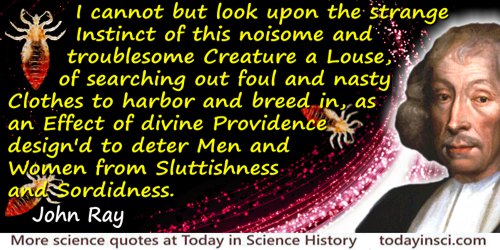
I cannot but look upon the strange Instinct of this noisome and troublesome Creature a Louse, of searching out foul and nasty Clothes to harbor and breed in, as an Effect of divine Providence, design’d to deter Men and Women from Sluttishness and Sordidness.
— John Ray
In The Wisdom of God Manifested in the Works of the Creation (1691), 309.
I consider then, that generally speaking, to render a reason of an effect or Phaenomenon, is to deduce It from something else in Nature more known than it self, and that consequently there may be divers kinds of Degrees of Explication of the same thing. For although such Explications be the most satisfactory to the Understanding, wherein ’tis shewn how the effect is produc’d by the more primitive and Catholick Affection of Matter, namely bulk, shape and motion, yet are not these Explications to be despis’d, wherein particular effects are deduc’d from the more obvious and familiar Qualities or States of Bodies, … For in the search after Natural Causes, every new measure of Discovery does both instinct and gratifie the Understanding.
Physiological Essays (1669), 20.
I do believe that a scientist is a freelance personality. We’re driven by an impulse which is one of curiosity, which is one of the basic instincts that a man has. So we are … driven … not by success, but by a sort of passion, namely the desire of understanding better, to possess, if you like, a bigger part of the truth. I do believe that science, for me, is very close to art.
From 'Asking Nature', collected in Lewis Wolpert and Alison Richards (eds.), Passionate Minds: The Inner World of Scientists (1997), 197.
I have always liked horticulturists, people who make their living from orchards and gardens, whose hands are familiar with the feel of the bark, whose eyes are trained to distinguish the different varieties, who have a form memory. Their brains are not forever dealing with vague abstractions; they are satisfied with the romance which the seasons bring with them, and have the patience and fortitude to gamble their lives and fortunes in an industry which requires infinite patience, which raise hopes each spring and too often dashes them to pieces in fall. They are always conscious of sun and wind and rain; must always be alert lest they lose the chance of ploughing at the right moment, pruning at the right time, circumventing the attacks of insects and fungus diseases by quick decision and prompt action. They are manufacturers of a high order, whose business requires not only intelligence of a practical character, but necessitates an instinct for industry which is different from that required by the city dweller always within sight of other people and the sound of their voices. The successful horticulturist spends much time alone among his trees, away from the constant chatter of human beings.
I see with much pleasure that you are working on a large work on the integral Calculus [ ... ] The reconciliation of the methods which you are planning to make, serves to clarify them mutually, and what they have in common contains very often their true metaphysics; this is why that metaphysics is almost the last thing that one discovers. The spirit arrives at the results as if by instinct; it is only on reflecting upon the route that it and others have followed that it succeeds in generalising the methods and in discovering its metaphysics.
Letter to S. F. Lacroix, 1792. Quoted in S. F. Lacroix, Traité du calcul differentiel et du calcul integral (1797), Vol. 1, xxiv, trans. Ivor Grattan-Guinness.
Ideas pull the trigger, but instinct loads the gun.
Attributed. Widely seen, but without citation. An early example of the aphorism, stated without naming Marquis, is in Southwestern Medicine (Oct 1920). 4, No. 10, 4. If you know the primary source, please contact Webmaster.
If Mozart, instead of playing the pianoforte at three years old with wonderfully little practice, had played a tune with no practice at all, he might truly have been said to have done so instinctively.
Origin of Species
If the Weismann idea triumphs, it will be in a sense a triumph of fatalism; for, according to it, while we may indefinitely improve the forces of our education and surroundings, and this civilizing nurture will improve the individuals of each generation, its actual effects will not be cumulative as regards the race itself, but only as regards the environment of the race; each new generation must start de novo, receiving no increment of the moral and intellectual advance made during the lifetime of its predecessors. It would follow that one deep, almost instinctive motive for a higher life would be removed if the race were only superficially benefited by its nurture, and the only possible channel of actual improvement were in the selection of the fittest chains of race plasma.
'The Present Problem of Heredity', The Atlantic Monthly (1891), 57, 363.
In departing from any settled opinion or belief, the variation, the change, the break with custom may come gradually; and the way is usually prepared; but the final break is made, as a rule, by some one individual, … who sees with his own eyes, and with an instinct or genius for truth, escapes from the routine in which his fellows live. But he often pays dearly for his boldness.
In The Harveian Oration, delivered before the Royal College of Physicians of London (18 Oct 1906). Printed in 'The Growth of Truth, as Illustrated in the Discovery of the Circulation of Blood', The Lancet (27 Oct 1906), Vol. 2, Pt. 2, 1114.
In its earliest development knowledge is self-sown. Impressions force themselves upon men’s senses whether they will or not, and often against their will. The amount of interest in which these impressions awaken is determined by the coarser pains and pleasures which they carry in their train or by mere curiosity; and reason deals with the materials supplied to it as far as that interest carries it, and no further. Such common knowledge is rather brought than sought; and such ratiocination is little more than the working of a blind intellectual instinct. It is only when the mind passes beyond this condition that it begins to evolve science. When simple curiosity passes into the love of knowledge as such, and the gratification of the æsthetic sense of the beauty of completeness and accuracy seems more desirable that the easy indolence of ignorance; when the finding out of the causes of things becomes a source of joy, and he is accounted happy who is successful in the search, common knowledge passes into what our forefathers called natural history, whence there is but a step to that which used to be termed natural philosophy, and now passes by the name of physical science.
In this final state of knowledge the phenomena of nature are regarded as one continuous series of causes and effects; and the ultimate object of science is to trace out that series, from the term which is nearest to us, to that which is at the farthest limit accessible to our means of investigation.
The course of nature as it is, as it has been, and as it will be, is the object of scientific inquiry; whatever lies beyond, above, or below this is outside science. But the philosopher need not despair at the limitation on his field of labor; in relation to the human mind Nature is boundless; and, though nowhere inaccessible, she is everywhere unfathomable.
In this final state of knowledge the phenomena of nature are regarded as one continuous series of causes and effects; and the ultimate object of science is to trace out that series, from the term which is nearest to us, to that which is at the farthest limit accessible to our means of investigation.
The course of nature as it is, as it has been, and as it will be, is the object of scientific inquiry; whatever lies beyond, above, or below this is outside science. But the philosopher need not despair at the limitation on his field of labor; in relation to the human mind Nature is boundless; and, though nowhere inaccessible, she is everywhere unfathomable.
The Crayfish: an Introduction to the Study of Zoölogy (1880), 2-3. Excerpted in Popular Science (Apr 1880), 16, 789-790.
In shades of black and blue the skies do bow as darkness falls the lights go out.
Nature softly immersed in glee as all mankind drifts off to sleep.
Water breathes a sigh of relief now aquatic creatures can do as they please.
Animals whether large or small regain the natural instincts that man has fought.
The moon shines bright he’s happy too people can’t over-ride his rules.
Midnight calms the wounds of the world the break of dawn disperses new hope...
Nature softly immersed in glee as all mankind drifts off to sleep.
Water breathes a sigh of relief now aquatic creatures can do as they please.
Animals whether large or small regain the natural instincts that man has fought.
The moon shines bright he’s happy too people can’t over-ride his rules.
Midnight calms the wounds of the world the break of dawn disperses new hope...
…...
In the first place, there can be no living science unless there is a widespread instinctive conviction in the existence of an Order of Things, and, in particular, of an Order of Nature.
In Science and the Modern World (1927), 4.
Instinct is defined as the untaught ability to perform actions of all kinds, and more especially such as are necessary or useful to the animal.
The Senses and the Intellect (1855, 1974), p. 246.
It does not matter what men say in words, so long as their activities are controlled by settled instincts. The words may ultimately destroy the instincts. But until this has occurred, words do not count.
In Science and the Modern World (1925), 4.
It is clear, then, that the idea of a fixed method, or of a fixed theory of rationality, rests on too naive a view of man and his social surroundings. To those who look at the rich material provided by history, and who are not intent on impoverishing it in order to please their lower instincts, their craving for intellectual security in the form of clarity, precision, “objectivity”, “truth”, it will become clear that there is only one principle that can be defended under all circumstances and in all stages of human development. It is the principle: anything goes.
Against Method: Outline of an Anarchistic Theory of Knowledge (1975, 1993), 18-19.
It is worthy of note that nearly all that has been done for the improvement of the steam engine has been accomplished, not by men educated in colleges or technical schools, but by laborers, mechanics, and engine-men. There seem to be instances where the mechanical instinct takes precedence over the higher powers of the mind, in efficiency in harnessing the forces of nature and causing them to do our work.
In paper 'Stephenson and Transportation' (1916), collected in Francis Edgar Stanley, Theories Worth Having and Other Papers (1919), 66-67.
Let him [the author] be permitted also in all humility to add … that in consequence of the large arrears of algebraical and arithmetical speculations waiting in his mind their turn to be called into outward existence, he is driven to the alternative of leaving the fruits of his meditations to perish (as has been the fate of too many foregone theories, the still-born progeny of his brain, now forever resolved back again into the primordial matter of thought), or venturing to produce from time to time such imperfect sketches as the present, calculated to evoke the mental co-operation of his readers, in whom the algebraical instinct has been to some extent developed, rather than to satisfy the strict demands of rigorously systematic exposition.
In Philosophic Magazine (1863), 460.
Man is an animal with primary instincts of survival. Consequently his ingenuity has developed first and his soul afterwards. The progress of science is far ahead of man's ethical behavior.
My Autobiography (1964), 471.
Man is still by instinct a predatory animal given to devilish aggression.
The discoveries of science have immensely increased productivity of material things. They have increased the standards of living and comfort. They have eliminated infinite drudgery. They have increased leisure. But that gives more time for devilment.
The work of science has eliminated much disease and suffering. It has increased the length of life. That, together with increase in productivity, has resulted in vastly increased populations. Also it increased the number of people engaged in devilment.
The discoveries of science have immensely increased productivity of material things. They have increased the standards of living and comfort. They have eliminated infinite drudgery. They have increased leisure. But that gives more time for devilment.
The work of science has eliminated much disease and suffering. It has increased the length of life. That, together with increase in productivity, has resulted in vastly increased populations. Also it increased the number of people engaged in devilment.
Address delivered to Annual Meeting of the York Bible Class, Toronto, Canada (22 Nov 1938), 'The Imperative Need for Moral Re-armament', collected in America's Way Forward (1939), 50.
Many of the things that have happened in the laboratory have happened in ways it would have been impossible to foresee, but not impossible to plan for in a sense. I do not think Dr. Whitney deliberately plans his serendipity but he is built that way; he has the art—an instinctive way of preparing himself by his curiosity and by his interest in people and in all kinds of things and in nature, so that the things he learns react on one another and thereby accomplish things that would be impossible to foresee and plan.
Quoted in Guy Suits, 'Willis Rodney Whitney', National Academy of Sciences, Biographical Memoirs (1960), 355.
Men cannot help feeling a little ashamed of their cousin-german the Ape. His close yet grotesque and clumsy semblance of the human form is accompanied by no gleams of higher instinct. Our humble friend the dog, our patient fellow-labourer the horse, are nearer to us in this respect. The magnanimous and sagacious elephant, doomed though he be to all fours, is godlike compared with this spitefully ferocious creature. Strangely enough, too, the most repulsive and ferocious of all apekind, the recently discovered Gorilla is, the comparative anatomist assures us, nearest to us all: the most closely allied in structure to the human form.
In 'Our Nearest Relation', All Year Round (28 May 1859), 1, No. 5, 112. Charles Dickens was both the editor and publisher of this magazine. The author of the article remains unknown. The articles were by custom printed without crediting the author. Biographers have been able to use extant office records to identify various authors of other articles, but not this specific one. Dickens and Richard Owen were friends; they read each other’s work. Owen is known to have found at least a little time to write a few articles for Dickens’ magazines. Owen had given a talk at the Royal Institution (4 Feb 1859) titled 'On the Gorilla.' This would suggest why Dickens may have had a definite interest in publishing on this subject, regardless of who in fact wrote the article.
Metaphysics is the finding of bad reasons for what we believe upon instinct, but to find these reasons is no less an instinct.
Appearance and Reality: A Metaphysical Essay (1893), preface, xlv.
Morality is the herd-instinct of the individual.
The Joyful Wisdom (1882). Quoted in Willard Huntington Wright, What Nietzsche Taught (1915), 124.
No! What we need are not prohibitory marriage laws, but a reformed society, an educated public opinion which will teach individual duty in these matters. And it is to the women of the future that I look for the needed reformation. Educate and train women so that they are rendered independent of marriage as a means of gaining a home and a living, and you will bring about natural selection in marriage, which will operate most beneficially upon humanity. When all women are placed in a position that they are independent of marriage, I am inclined to think that large numbers will elect to remain unmarried—in some cases, for life, in others, until they encounter the man of their ideal. I want to see women the selective agents in marriage; as things are, they have practically little choice. The only basis for marriage should be a disinterested love. I believe that the unfit will be gradually eliminated from the race, and human progress secured, by giving to the pure instincts of women the selective power in marriage. You can never have that so long as women are driven to marry for a livelihood.
In 'Heredity and Pre-Natal Influences. An Interview With Dr. Alfred Russel Wallace', Humanitarian (1894), 4, 87.
Not in the ground of need, not in bent and painful toil, but in the deep-centred play-instinct of the world, in the joyous mood of the eternal Being, which is always young, science has her origin and root; and her spirit, which is the spirit of genius in moments of elevation, is but a sublimated form of play, the austere and lofty analogue of the kitten playing with the entangled skein or of the eaglet sporting with the mountain winds.
In Mathematics (1907), 44.
One of the commonest dietary superstitions of the day is a belief in instinct as a guide to dietary excellence ... with a corollary that the diets of primitive people are superior to diets approved by science ... [and even] that light might be thrown on the problems of human nutrition by study of what chimpanzees eat in their native forests. ... Such notions are derivative of the eighteenth-century fiction of the happy and noble savage.
Nutrition and Public Health', League of Nations Health Organization Quarterly Bulletin (1935) 4, 323–474. In Kenneth J. Carpenter, 'The Work of Wallace Aykroyd: International Nutritionist and Author', The Journal of Nutrition (2007), 137, 873-878.
One's instinct is at first to try and get rid of a discrepancy, but I believe that experience shows such an endeavour to be a mistake. What one ought to do is to magnify a small discrepancy with a view to finding out the explanation.
General Monthly Meeting, on Argon, (1 Apr 1895), Proceedings of the Royal Institution (1895), 14, 525.
Only human beings were given the power of speech, because only to them was it necessary. It was not necessary that either angels or the lower animals should be able to speak; rather, this power would have been wasted on them, and nature, of course, hates to do anything superfluous. …
As for the lower animals, since they are guided only by their natural instinct, it was not necessary for them to be given the power of speech. For all animals that belong to the same species are identical in respect of action and feeling; and thus they can know the actions and feelings of others by knowing their own. Between creatures of different species, on the other hand, not only was speech unnecessary, but it would have been injurious, since there could have been no friendly exchange between them.
In Dante Alighieri and Steven Botterill (trans.), De Vulgari Eloquentia (1305), Book 1, Chap 2. from the Latin original.
Permanence of instinct must go with permanence of form. … The history of the present must teach us the history of the past.
Referring to studying fossil remains of the weevil, largely unchanged to the present day. In Jean-Henri Fabre and Alexander Teixeira de Mattos (trans.), The Life and Love of the Insect, (1911, 1914), 183.
POTABLE, n. Suitable for drinking. Water is said to be potable; indeed, some declare it our natural beverage, although even they find it palatable only when suffering from the recurrent disorder known as thirst, for which it is a medicine. Upon nothing has so great and diligent ingenuity been brought to bear in all ages and in all countries, except the most uncivilized, as upon the invention of substitutes for water. To hold that this general aversion to that liquid has no basis in the preservative instinct of the race is to be unscientific—and without science we are as the snakes and toads.
The Collected Works of Ambrose Bierce (1911), Vol. 7, The Devil's Dictionary, 260-261.
Psychogenesis has led to man. Now it effaces itself, relieved or absorbed by another and a higher function—the engendering and subsequent development of the mind, in one word noogenesis. When for the first time in a living creature instinct perceived itself in its own mirror, the whole world took a pace forward.
In Teilhard de Chardin and Bernard Wall (trans.), The Phenomenon of Man (1959, 2008), 181. Originally published in French as Le Phénomene Humain (1955).
Reflexes and instincts are not pretty. It is their decoration that initiates art.
Science had better not free the minds of men too much, before it has tamed their instincts.
The Substance of Man (1962), 19.
Sexual instinct—as emotion, idea, and impulse—is a function of the cerebral cortex. Thus far no definite region of the cortex has been proved to be exclusively the seat of sexual sensations and impulses.
Psychopathia Sexualis: With Special Reference to Contrary Sexual Instinct: A Medico-Legal Study (1886), trans. Charles Gilbert Chaddock (1892), 24.
So far from having a materialistic tendency, the supposed introduction into the earth at successive geological periods of life,—sensation,—instinct,—the intelligence of the higher mammalia bordering on reason,—and lastly the improvable reason of Man himself, presents us with a picture of the ever-increasing dominion of mind over matter.
The Antiquity of Man (1863), 506.
So long as a man remains a gregarious and sociable being, he cannot cut himself off from the gratification of the instinct of imparting what he is learning, of propagating through others the ideas and impressions seething in his own brain, without stunting and atrophying his moral nature and drying up the surest sources of his future intellectual replenishment.
In Address (22 Feb 1877) for Commemoration Day at Johns Hopkins University. Published as a pamphlet, and reprinted in The Collected Mathematical Papers of James Joseph Sylvester: (1870-1883) (1909), Vol. 3, 77.
Take away these instinctive dispositions with their powerful impulses, and the organism would become incapable of activity of any kind; it would lie inert and motionless like a wonderful clockwork whose mainspring had been removed or a steam-engine whose fires had been withdrawn.
An Introduction to Social Psychology (1928), 38.
The aid which we feel impelled to give to the helpless is mainly an incidental result of the instinct of sympathy, which was originally acquired as part of the social instincts, but subsequently rendered, in the manner previously indicated, more tender and more widely diffused. Nor could we check our sympathy, even at the urging of hard reason, without deterioration in the noblest part of our nature.
In The Descent of Man (1874), Part 1, Chap 5, 136.
The desire to preserve to future ages the memory of past achievements is a universal human instinct, as witness the clay tablets of old Chaldea, the hieroglyphs of the obelisks, our countless thousands of manuscripts and printed volumes, and the gossiping old story-teller of the village or the backwoods cabin. The reliability of the record depends chiefly on the truthfulness of the recorder and the adequacy of the method employed. In Asia, the cradle of civilization, authentic history goes back thousands of years; in Europe the record begins much later, while in America the aboriginal narrative, which may be considered as fairly authentic, is all comprised within a thousand years.
The first paragraph, 'Introduction: Age of American Aboriginal Records', Calendar History of the Kiowa Indians (1898).
The fateful question for the human species seems to me to be whether and to what extent their cultural development will succeed in mastering the disturbance of their communal life by the human instinct of aggression and self-destruction … One thing only do I know for certain and that is that man's judgements of value follow directly from his wihes for happiness—that, accordingly, they are an attempt to support his illusions with arguments. (1930)
Civilization and its Discontents (2005), 154.
The instinct for collecting, which began as in other animals as an adaptive property, could always in man spread beyond reason; it could become a hoarding mania. But in its normal form it provides a means of livelihood at the hunting and collecting stage of human evolution. It is then attached to a variety of rational aptitudes, above all in observing, classifying, and naming plants, animals and minerals, skills diversely displayed by primitive peoples. These skills with an instinctive beginning were the foundation of most of the civilised arts and sciences. Attached to other skills in advanced societies they promote the formation of museums and libraries; detached, they lead to acquisition and classification by eccentric individuals, often without any purpose or value at all.
As quoted in Richard Fifield, 'Cytologist Supreme', New Scientist (16 Apr 1981), 90, No. 1249, 179; citing C.D. Darlington, The Little Universe of Man (1978).
The instinct of brutes and insects can be the effect of nothing else than the wisdom and skill of a powerful ever-living agent.
From 'Query 31', Opticks (1704, 2nd ed., 1718), 379.
The instinct to command others, in its primitive essence, is a carnivorous, altogether bestial and savage instinct. Under the influence of the mental development of man, it takes on a somewhat more ideal form and becomes somewhat ennobled, presenting itself as the instrument of reason and the devoted servant of that abstraction, or political fiction, which is called the public good. But in its essence it remains just as baneful, and it becomes even more so when, with the application of science, it extends its scope and intensifies the power of its action. If there is a devil in history, it is this power principle.
In Mikhail Aleksandrovich Bakunin, Grigorii Petrovich Maksimov, Max Nettlau, The political philosophy of Bakunin (1953), 248.
The mathematician requires tact and good taste at every step of his work, and he has to learn to trust to his own instinct to distinguish between what is really worthy of his efforts and what is not; he must take care not to be the slave of his symbols, but always to have before his mind the realities which they merely serve to express. For these and other reasons it seems to me of the highest importance that a mathematician should be trained in no narrow school; a wide course of reading in the first few years of his mathematical study cannot fail to influence for good the character of the whole of his subsequent work.
In Presidential Address British Association for the Advancement of Science, Section A, (1890), Nature, 42, 467.
The mathematician requires tact and good taste at every step of his work, and he has to learn to trust to his own instinct to distinguish between what is really worthy of his efforts and what is not.
In Presidential Address to the 60th Meeting of the British Association for the Advancement of Science, Section A (Sep 1890), published in Report of the Annual Meeting (1891), 60, 725.
The meaning of the evolution of culture is no longer a riddle to us. It must present to us the struggle between Eros and Death, between the instincts of life and the instincts of destruction, as it works itself out in the human species.
In Sigmund Freud and Joan Riviere (trans.), Civilization and Its Discontents (1930, 1994), 49.
The more efficient causes of progress seem to consist of a good education during youth whilst the brain is impressible, and of a high standard of excellence, inculcated by the ablest and best men, embodied in the laws, customs and traditions of the nation, and enforced by public opinion. It should, however, be borne in mind, that the enforcement of public opinion depends on our appreciation of the approbation and disapprobation of others; and this appreciation is founded on our sympathy, which it can hardly be doubted was originally developed through natural selection as one of the most important elements of the social instincts.
…...
The neuro-physiological organization which we call instinct functions in a blindly mechanical way, particularly apparent when its function goes wrong.
On Aggression, trans. M. Latzke (1966), 73.
The ordinary naturalist is not sufficiently aware that when dogmatizing on what species are, he is grappling with the whole question of the organic world & its connection with the time past & with Man; that it involves the question of Man & his relation to the brutes, of instinct, intelligence & reason, of Creation, transmutation & progressive improvement or development. Each set of geological questions & of ethnological & zool. & botan. are parts of the great problem which is always assuming a new aspect.
Leonard G. Wilson (ed.), Sir Charles Lyell's Scientific Journals on the Species Question (1970), 164.
The philosopher may very justly be delighted with the extent of his views, the artificer with the readiness of his hands, but let the one remember that without mechanical performance, refined speculation is an empty dream, and the other that without theoretical reasoning, dexterity is little more than brute instinct.
In 'The Rambler' (17 Apr 1750), No. 9. Collected in The Rambler (1763), Vol. 1, 48.
The theory of probabilities is at bottom nothing but common sense reduced to calculus; it enables us to appreciate with exactness that which accurate minds feel with a sort of instinct for which of times they are unable to account.
Introduction to Théorie Analytique des Probabilitiés
The theory of probabilities is at bottom only common sense reduced to calculation; it makes us appreciate with exactitude what reasonable minds feel by a sort of instinct, often without being able to account for it. … It is remarkable that [this] science, which originated in the consideration of games of chance, should have become the most important object of human knowledge.
From A Philosophical Essay on Probabilities. As given in epigraph, E.T. Bell, Men of Mathematics (2014), 71.
The theory of probabilities is basically only common sense reduced to a calculus. It makes one estimate accurately what right-minded people feel by a sort of instinct, often without being able to give a reason for it.
Philosophical Essay on Probabilities (1814), 5th edition (1825), trans. Andrew I. Dale (1995), 124.
The wise are instructed by reason; ordinary minds by experience; the stupid, by necessity; and brutes by instinct.
In Charles Simmons, A Laconic Manual and Brief Remarker (1852), 273.
There was one quality of mind which seemed to be of special and extreme advantage in leading him [Charles Darwin] to make discoveries. It was the power of never letting exceptions pass unnoticed. Everybody notices a fact as an exception when it is striking or frequent, but he had a special instinct for arresting an exception. A point apparently slight and unconnected with his present work is passed over by many a man almost unconsciously with some half-considered explanation, which is in fact no explanation. It was just these things that he seized on to make a start from. In a certain sense there is nothing special in this procedure, many discoveries being made by means of it. I only mention it because, as I watched him at work, the value of this power to an experimenter was so strongly impressed upon me.
In Charles Darwin: His Life Told in an Autobiographical Chapter, and in a Selected Series of his Published Letters (1908), 94-95.
Throughout his career, [Richard] Drew tried to create an environment where people were encouraged to follow their instincts. He was known at 3M as a consummate mentor, encouraging and helping to train many of the company’s young scientists, who went on to develop successful products of their own, paving the way for 3M’s culture of innovation.
— Magazine
In Press Release (7 May 2007) on 3M Company website.
To consider the matter aright, reason is nothing but a wonderful and unintelligible instinct in our souls, which carries us along a certain train of ideas, and endows them with particular qualities, according to their particular situations and relations. This instinct, 'tis true, arises from past observation and experience; but can anyone give the ultimate reason, why past experience and observation produces such an effect, any more than why nature alone should produce it?
A Treatise on Human Nature (1739-40), ed. L. A. Selby-Bigge (1888), book 1, part 3, section 16, 179.
To the east was our giant neighbor Makalu, unexplored and unclimbed, and even on top of Everest the mountaineering instinct was sufficient strong to cause me to spend some moments conjecturing as to whether a route up that mountain might not exist. Far away across the clouds the great bulk of Kangchenjunga loomed on the horizon. To the west, Cho Oyu, our old adversary from 1952, dominated the scene and we could see the great unexplored ranges of Nepal stretching off into the distance. The most important photograph, I felt, was a shot down the north ridge, showing the North Col and the old route that had been made famous by the struggles of those great climbers of the 1920s and 1930s. I had little hope of the results being particularly successful, as I had a lot of difficulty in holding the camera steady in my clumsy gloves, but I felt that they would at least serve as a record. After some ten minutes of this, I realized that I was becoming rather clumsy-fingered and slow-moving, so I quickly replaced my oxygen set and experience once more the stimulating effect of even a few liters of oxygen. Meanwhile, Tenzing had made a little hole in the snow and in it he placed small articles of food – a bar of chocolate, a packet of biscuits and a handful of lollies. Small offerings, indeed, but at least a token gifts to the gods that all devoted Buddhists believe have their home on this lofty summit. While we were together on the South Col two days before, Hunt had given me a small crucifix that he had asked me to take to the top. I, too, made a hole in the snow and placed the crucifix beside Tenzing’s gifts.
As quoted in Whit Burnett, The Spirit of Adventure: The Challenge (1955), 349.
To write the true natural history of the world, we should need to be able to follow it from within. It would thus appear no longer as an interlocking succession of structural types replacing one another, but as an ascension of inner sap spreading out in a forest of consolidated instincts. Right at its base, the living world is constituted by conscious clothes in flesh and bone.
In Teilhard de Chardin and Bernard Wall (trans.), The Phenomenon of Man (1959, 2008), 151. Originally published in French as Le Phénomene Humain (1955).
We all know, from what we experience with and within ourselves, that our conscious acts spring from our desires and our fears. Intuition tells us that that is true also of our fellows and of the higher animals. We all try to escape pain and death, while we seek what is pleasant. We are all ruled in what we do by impulses; and these impulses are so organized that our actions in general serve for our self preservation and that of the race. Hunger, love, pain, fear are some of those inner forces which rule the individual’s instinct for self preservation. At the same time, as social beings, we are moved in the relations with our fellow beings by such feelings as sympathy, pride, hate, need for power, pity, and so on. All these primary impulses, not easily described in words, are the springs of man’s actions. All such action would cease if those powerful elemental forces were to cease stirring within us. Though our conduct seems so very different from that of the higher animals, the primary instincts are much alike in them and in us. The most evident difference springs from the important part which is played in man by a relatively strong power of imagination and by the capacity to think, aided as it is by language and other symbolical devices. Thought is the organizing factor in man, intersected between the causal primary instincts and the resulting actions. In that way imagination and intelligence enter into our existence in the part of servants of the primary instincts. But their intervention makes our acts to serve ever less merely the immediate claims of our instincts.
…...
We are accustomed to say that every human being displays both male and female instinctual impulses, needs, and attributes, but the characteristics of what is male and female can only be demonstrated in anatomy, and not in psychology.
In Sigmund Freud and Joan Riviere (trans.), Civilization and Its Discontents (1930, 1994), 35.
What a weak, credulous, incredulous, unbelieving, superstitious, bold, frightened, what a ridiculous world ours is, as far as concerns the mind of man. How full of inconsistencies, contradictions and absurdities it is. I declare that taking the average of many minds that have recently come before me … I should prefer the obedience, affections and instinct of a dog before it.
Letter to C. Schoenbein (25 Jul 1853). In Georg W.A. Kahlbaum and Francis V. Darbishire (eds.), The Letters of Faraday and Schoenbein, 1836-1862 (1899), 215.
What is terrorism? Terrorism in some sense is a reaction against the creation of a type one [planet-wide advanced] civilization. Now most terrorists cannot articulate this. … What they’re reacting to is not modernism. What they’re reacting to is the fact that we’re headed toward a multicultural tolerant scientific society and that is what they don’t want. They don’t want science. They want a theocracy. They don’t want multiculturalism. They want monoculturalism. So instinctively they don’t like the march toward a type one civilization. Now which tendency will win? I don’t know, but I hope that we emerge as a type one civilization.
From transcript of online video interview (29 Sep 2010) with Paul Hoffman, 'What is the likelihood that mankind will destroy itself?', on bigthink.com website.
What we remember, belonging more particularly to some special active pattern, is always normally checked by the reconstructed or the striking material of other active settings. It is, accordingly, apt to take on a peculiarity of some kind which, in any given case, expresses the temperament, or the character, of the person who effects the recall. This may be why, in almost all psychological descriptions of memory processes, memory is said to have a characteristically personal flavour … depending upon an interplay of appetites, instincts, interests and ideals peculiar to any given subject.
In Chapter 10, 'A Theory of Remembering', Remembering: A Study in Experimental and Social Psychology (1932, 1995), 213.
Wheeler’s First Moral Principle: Never make a calculation until you know the answer. Make an estimate before every calculation, try a simple physical argument (symmetry! invariance! conservation!) before every derivation, guess the answer to every paradox and puzzle. Courage: No one else needs to know what the guess is. Therefore make it quickly, by instinct. A right guess reinforces this instinct. A wrong guess brings the refreshment of surprise. In either case life as a spacetime expert, however long, is more fun!
In E.F. Taylor and J.A. Wheeler, Spacetime Physics (1992), 20.
When something comes along and is really important to your career and important to science, important enough so that lots of other people are working on it, you have got to do it in a short time. You have got to get in there and run experiments quickly and get published. That is the killer instinct. I do not think women have that part of it. Part of it comes from sports. It's like scoring a goal.
Quoted in The Door in the Dream: Conversations with Eminent Women in Science by Elga Wasserman, National Academy Press/John Henry Press (2000), p. 182
When we no longer look at an organic being as a savage looks at a ship, as something wholly beyond his comprehension; when we regard every production of nature as one which has had a long history; when we contemplate every complex structure and instinct as the summing up of many contrivances, each useful to the possessor, in the same way as any great mechanical invention is the summing up of the labour, the experience, the reason, and even the blunders of numerous workmen; when we thus view each organic being, how far more interesting, I speak from experience, does the study of natural history become!
From the Conclusion of Origin of Species by Means of Natural Selection, Or the Preservation of Favoured Races in the Struggle for Life (3rd. ed., 1861), 521.
When... the biologist is confronted with the fact that in the organism the parts are so adapted to each other as to give rise to a harmonious whole; and that the organisms are endowed with structures and instincts calculated to prolong their life and perpetuate their race, doubts as to the adequacy of a purely physiochemical viewpoint in biology may arise. The difficulties besetting the biologist in this problem have been rather increased than diminished by the discovery of Mendelian heredity, according to which each character is transmitted independently of any other character. Since the number of Mendelian characters in each organism is large, the possibility must be faced that the organism is merely a mosaic of independent hereditary characters. If this be the case the question arises: What moulds these independent characters into a harmonious whole? The vitalist settles this question by assuming the existence of a pre-established design for each organism and of a guiding 'force' or 'principle' which directs the working out of this design. Such assumptions remove the problem of accounting for the harmonious character of the organism from the field of physics or chemistry. The theory of natural selection invokes neither design nor purpose, but it is incomplete since it disregards the physiochemical constitution of living matter about which little was known until recently.
The Organism as a Whole: From a Physiochemical Viewpoint (1916), v-vi.
Whether we like it or not, quantification in history is here to stay for reasons which the quantifiers themselves might not actively approve. We are becoming a numerate society: almost instinctively there seems now to be a greater degree of truth in evidence expressed numerically than in any literary evidence, no matter how shaky the statistical evidence, or acute the observing eye.
Is History Sick? (1973), 64.
While up to this time contrary sexual instinct has had but an anthropological, clinical, and forensic interest for science, now, as a result of the latest investigations, there is some thought of therapy in this incurable condition, which so heavily burdens its victims, socially, morally, and mentally. A preparatory step for the application of therapeutic measures is the exact differentiation of the acquired from the congenital cases; and among the latter again, the assignment of the concrete case to its proper position in the categories that have been established empirically.
Psychopathia Sexualis: With Special Reference to Contrary Sexual Instinct: A Medico-Legal Study (1886), trans. Charles Gilbert Chaddock (1892), 319.
 In science it often happens that scientists say, 'You know that's a really good argument; my position is mistaken,' and then they would actually change their minds and you never hear that old view from them again. They really do it. It doesn't happen as often as it should, because scientists are human and change is sometimes painful. But it happens every day. I cannot recall the last time something like that happened in politics or religion.
(1987) --
In science it often happens that scientists say, 'You know that's a really good argument; my position is mistaken,' and then they would actually change their minds and you never hear that old view from them again. They really do it. It doesn't happen as often as it should, because scientists are human and change is sometimes painful. But it happens every day. I cannot recall the last time something like that happened in politics or religion.
(1987) -- 





