Insight Quotes (107 quotes)
[Mathematics] is security. Certainty. Truth. Beauty. Insight. Structure. Architecture. I see mathematics, the part of human knowledge that I call mathematics, as one thing—one great, glorious thing. Whether it is differential topology, or functional analysis, or homological algebra, it is all one thing. … They are intimately interconnected, they are all facets of the same thing. That interconnection, that architecture, is secure truth and is beauty. That’s what mathematics is to me.
From interview with Donald J. Albers. In John H. Ewing and Frederick W. Gehring, Paul Halmos Celebrating 50 Years of Mathematics (1991), 13.
[To give insight to statistical information] it occurred to me, that making an appeal to the eye when proportion and magnitude are concerned, is the best and readiest method of conveying a distinct idea.
In The Statistical Breviary: Shewing, on a Principle Entirely New, the Resources of Every State and Kingdom in Europe (1801), 2.
[W]e have made a thing, a most terrible weapon, that has altered abruptly and profoundly the nature of the world. We have made a thing that, by all standards of the world we grew up in, is an evil thing. And by doing so, by our participation in making it possible to make these things, we have raised again the question of whether science is good for man, of whether it is good to learn about the world, to try to understand it, to try to control it, to help give to the world of men increased insight, increased power. Because we are scientists, we must say an unalterable yes to these questions; it is our faith and our commitment, seldom made explicit, even more seldom challenged, that knowledge is a good in itself, knowledge and such power as must come with it.
Speech to the American Philosophical Society (Jan 1946). 'Atomic Weapons', printed in Proceedings of the American Philosophical Society, 90(1), 7-10. In Deb Bennett-Woods, Nanotechnology: Ethics and Society (2008), 23. Identified as a speech to the society in Kai Bird, Martin J. Sherwin, American Prometheus: the Triumph and Tragedy of J. Robert Oppenheimer (2005), 323.
[When recording electrical impulses from a frog nerve-muscle preparation seemed to show a tiresomely oscillating electrical artefact—but only when the muscle was hanging unsupported.] The explanation suddenly dawned on me ... a muscle hanging under its own weight ought, if you come to think of it, to be sending sensory impulses up the nerves coming from the muscle spindles ... That particular day’s work, I think, had all the elements that one could wish for. The new apparatus seemed to be misbehaving very badly indeed, and I suddenly found it was behaving so well that it was opening up an entire new range of data ... it didn’t involve any particular hard work, or any particular intelligence on my part. It was just one of those things which sometimes happens in a laboratory if you stick apparatus together and see what results you get.
From 'Memorable experiences in research', Diabetes (1954), 3, 17-18. As cited in Alan McComa, Galvani's Spark: The Story of the Nerve Impulse (2011), 102-103.
A drop from the nose of Fleming, who had a cold, fell onto an agar plate where large yellow colonies of a contaminant had grown, and lysosyme was discovered. He made this important discovery because when he saw that the colonies of the contaminant were fading, his mind went straight to the right cause of the phenomenon he was observing—that the drop from his nose contained a lytic substance. And also immediately, he thought that this substance might be present in many secretions and tissues of the body. And he found this was so—the substance was in tears, saliva, leucocytes, skin, fingernails, mother's milk—thus very widely distributed in amounts and also in plants.
Personal recollections of Alexander Fleming by Lady Amelia Fleming. Quoted in Molecular Cloning (2001), Vol. 1, 153.
A moment’s insight is sometimes worth a life’s experience.
In 'Iris, Her Book', The Professor at the Breakfast-Table (1860, 1892), 239.
A number of years ago, when I was a freshly-appointed instructor, I met, for the first time, a certain eminent historian of science. At the time I could only regard him with tolerant condescension.
I was sorry of the man who, it seemed to me, was forced to hover about the edges of science. He was compelled to shiver endlessly in the outskirts, getting only feeble warmth from the distant sun of science-in-progress; while I, just beginning my research, was bathed in the heady liquid heat up at the very center of the glow.
In a lifetime of being wrong at many a point, I was never more wrong. It was I, not he, who was wandering in the periphery. It was he, not I, who lived in the blaze.
I had fallen victim to the fallacy of the “growing edge;” the belief that only the very frontier of scientific advance counted; that everything that had been left behind by that advance was faded and dead.
But is that true? Because a tree in spring buds and comes greenly into leaf, are those leaves therefore the tree? If the newborn twigs and their leaves were all that existed, they would form a vague halo of green suspended in mid-air, but surely that is not the tree. The leaves, by themselves, are no more than trivial fluttering decoration. It is the trunk and limbs that give the tree its grandeur and the leaves themselves their meaning.
There is not a discovery in science, however revolutionary, however sparkling with insight, that does not arise out of what went before. “If I have seen further than other men,” said Isaac Newton, “it is because I have stood on the shoulders of giants.”
I was sorry of the man who, it seemed to me, was forced to hover about the edges of science. He was compelled to shiver endlessly in the outskirts, getting only feeble warmth from the distant sun of science-in-progress; while I, just beginning my research, was bathed in the heady liquid heat up at the very center of the glow.
In a lifetime of being wrong at many a point, I was never more wrong. It was I, not he, who was wandering in the periphery. It was he, not I, who lived in the blaze.
I had fallen victim to the fallacy of the “growing edge;” the belief that only the very frontier of scientific advance counted; that everything that had been left behind by that advance was faded and dead.
But is that true? Because a tree in spring buds and comes greenly into leaf, are those leaves therefore the tree? If the newborn twigs and their leaves were all that existed, they would form a vague halo of green suspended in mid-air, but surely that is not the tree. The leaves, by themselves, are no more than trivial fluttering decoration. It is the trunk and limbs that give the tree its grandeur and the leaves themselves their meaning.
There is not a discovery in science, however revolutionary, however sparkling with insight, that does not arise out of what went before. “If I have seen further than other men,” said Isaac Newton, “it is because I have stood on the shoulders of giants.”
Adding A Dimension: Seventeen Essays on the History of Science (1964), Introduction.
A scientist works largely by intuition. Given enough experience, a scientist examining a problem can leap to an intuition as to what the solution ‘should look like.’ ... Science is ultimately based on insight, not logic.
…...
Among people I have met, the few whom I would term “great” all share a kind of unquestioned, fierce dedication; an utter lack of doubt about the value of their activities (or at least an internal impulse that drives through any such angst); and above all, a capacity to work (or at least to be mentally alert for unexpected insights) at every available moment of every day of their lives.
From The Lying Stones of Marrakech: Penultimate Reflections in Natural History (2000), 76.
And let me adde, that he that throughly understands the nature of Ferments and Fermentations, shall probably be much better able than he that Ignores them, to give a fair account of divers Phænomena of severall diseases (as well Feavers and others) which will perhaps be never throughly understood, without an insight into the doctrine of Fermentation.
Essay 2, 'Offering some Particulars relating to the Pathologicall Part of Physick', in the Second Part of Some Considerations Touching The Usefulnesse of Naturall Philosophy (1663, 1664), 43.
Archimedes, who combined a genius for mathematics with a physical insight, must rank with Newton, who lived nearly two thousand years later, as one of the founders of mathematical physics. … The day (when having discovered his famous principle of hydrostatics he ran through the streets shouting Eureka! Eureka!) ought to be celebrated as the birthday of mathematical physics; the science came of age when Newton sat in his orchard.
In An Introduction to Mathematics (1911), 37.
As regards authority I so proceed. Boetius says in the second prologue to his Arithmetic, “If an inquirer lacks the four parts of mathematics, he has very little ability to discover truth.” And again, “Without this theory no one can have a correct insight into truth.” And he says also, “I warn the man who spurns these paths of knowledge that he cannot philosophize correctly.” And Again, “It is clear that whosoever passes these by, has lost the knowledge of all learning.”
Opus Majus [1266-1268], Part IV, distinction I, chapter I, trans. R. B. Burke, The Opus Majus of Roger Bacon (1928), Vol. I, 117.
Biology as a discipline would benefit enormously if we could bring together the scientists working at the opposite ends of the biological spectrum. Students of organisms who know natural history have abundant questions to offer the students of molecules and cells. And molecular and cellular biologists with their armory of techniques and special insights have much to offer students of organisms and ecology.
In 'The role of natural history in contemporary biology', BioScience (1986), 36, 328-329.
But it is precisely mathematics, and the pure science generally, from which the general educated public and independent students have been debarred, and into which they have only rarely attained more than a very meagre insight. The reason of this is twofold. In the first place, the ascendant and consecutive character of mathematical knowledge renders its results absolutely insusceptible of presentation to persons who are unacquainted with what has gone before, and so necessitates on the part of its devotees a thorough and patient exploration of the field from the very beginning, as distinguished from those sciences which may, so to speak, be begun at the end, and which are consequently cultivated with the greatest zeal. The second reason is that, partly through the exigencies of academic instruction, but mainly through the martinet traditions of antiquity and the influence of mediaeval logic-mongers, the great bulk of the elementary text-books of mathematics have unconsciously assumed a very repellant form,—something similar to what is termed in the theory of protective mimicry in biology “the terrifying form.” And it is mainly to this formidableness and touch-me-not character of exterior, concealing withal a harmless body, that the undue neglect of typical mathematical studies is to be attributed.
In Editor’s Preface to Augustus De Morgan and Thomas J. McCormack (ed.), Elementary Illustrations of the Differential and Integral Calculus (1899), v.
By far the most important consequence of the conceptual revolution brought about in physics by relativity and quantum theory lies not in such details as that meter sticks shorten when they move or that simultaneous position and momentum have no meaning, but in the insight that we had not been using our minds properly and that it is important to find out how to do so.
'Quo Vadis'. In Gerald Holton (ed.), Science and the Modern Mind (1971), 84.
Climbing is all about freedom, the freedom to go beyond all the rules and take a chance, to experience something new, to gain insight into human nature.
In Reinhold Messner: My Life At The Limit (2014), 12-13.
Do not expect to be hailed as a hero when you make your great discovery. More likely you will be a ratbag—maybe failed by your examiners. Your statistics, or your observations, or your literature study, or your something else will be patently deficient. Do not doubt that in our enlightened age the really important advances are and will be rejected more often than acclaimed. Nor should we doubt that in our own professional lifetime we too will repudiate with like pontifical finality the most significant insight ever to reach our desk.
Theories of the Earth and Universe (1988), 365.
Euclidean mathematics assumes the completeness and invariability of mathematical forms; these forms it describes with appropriate accuracy and enumerates their inherent and related properties with perfect clearness, order, and completeness, that is, Euclidean mathematics operates on forms after the manner that anatomy operates on the dead body and its members. On the other hand, the mathematics of variable magnitudes—function theory or analysis—considers mathematical forms in their genesis. By writing the equation of the parabola, we express its law of generation, the law according to which the variable point moves. The path, produced before the eyes of the student by a point moving in accordance to this law, is the parabola.
If, then, Euclidean mathematics treats space and number forms after the manner in which anatomy treats the dead body, modern mathematics deals, as it were, with the living body, with growing and changing forms, and thus furnishes an insight, not only into nature as she is and appears, but also into nature as she generates and creates,—reveals her transition steps and in so doing creates a mind for and understanding of the laws of becoming. Thus modern mathematics bears the same relation to Euclidean mathematics that physiology or biology … bears to anatomy.
If, then, Euclidean mathematics treats space and number forms after the manner in which anatomy treats the dead body, modern mathematics deals, as it were, with the living body, with growing and changing forms, and thus furnishes an insight, not only into nature as she is and appears, but also into nature as she generates and creates,—reveals her transition steps and in so doing creates a mind for and understanding of the laws of becoming. Thus modern mathematics bears the same relation to Euclidean mathematics that physiology or biology … bears to anatomy.
In Die Mathematik die Fackelträgerin einer neuen Zeit (1889), 38. As translated in Robert Édouard Moritz, Memorabilia Mathematica; Or, The Philomath’s Quotation-book (1914), 112-113.
Every discovery, every enlargement of the understanding, begins as an imaginative preconception of what the truth might be. The imaginative preconception—a “hypothesis”—arises by a process as easy or as difficult to understand as any other creative act of mind; it is a brainwave, an inspired guess, a product of a blaze of insight. It comes anyway from within and cannot be achieved by the exercise of any known calculus of discovery.
In Advice to a Young Scientist (1979), 84.
Everyone knows that in research there are no final answers, only insights that allow one to formulate new questions.
In A Slot Machine, A Broken Test Tube: An Autobiography (1984).
Exercises in being obedient can not begin too early, and I have, during an almost daily observation of six years, discovered no harm from an early, consistent guiding of the germinating will, provided only this guiding be done with the greatest mildness and justice, as if the infant had already an insight into the benefits of obedience.
In W. Preyer and H.W. Brown (trans.), The Mind of the Child: The Senses and the Will: Observations Concerning the Mental Development of the Human Being in the First Years of Life (1888, 1890), Vol. 1, 345.
Genuine religion has its root deep down in the heart of humanity and in the reality of things. It is not surprising that by our methods we fail to grasp it: the actions of the Deity make no appeal to any special sense, only a universal appeal; and our methods are, as we know, incompetent to detect complete uniformity. There is a principle of Relativity here, and unless we encounter flaw or jar or change, nothing in us responds; we are deaf and blind therefore to the Immanent Grandeur, unless we have insight enough to recognise in the woven fabric of existence, flowing steadily from the loom in an infinite progress towards perfection, the ever-growing garment of a transcendent God.
Continuity: The Presidential Address to the British Association (1913), 92-93.
Geology is intimately related to almost all the physical sciences, as is history to the moral. An historian should, if possible, be at once profoundly acquainted with ethics, politics, jurisprudence, the military art, theology; in a word, with all branches of knowledge, whereby any insight into human affairs, or into the moral and intellectual nature of man, can be obtained. It would be no less desirable that a geologist should be well versed in chemistry, natural philosophy, mineralogy, zoology, comparative anatomy, botany; in short, in every science relating to organic and inorganic nature. With these accomplishments the historian and geologist would rarely fail to draw correct and philosophical conclusions from the various monuments transmitted to them of former occurrences.
Principles of Geology (1830-3), Vol. 1, 2-3.
George Sears, called Nessmuk, whose “Woodcraft,” published in 1884, was the first American book on forest camping, and is written with so much wisdom, wit, and insight that it makes Henry David Thoreau seem alien, humorless, and French.
Coming into the Country
Here and elsewhere we shall not obtain the best insight into things until we actually see them growing from the beginning.
In Politics as quoted in James R. Newman, The World of Mathematics (1957). Vol. 1, 170.
His spiritual insights were in three major areas: First, he has inspired mankind to see the world anew as the ultimate reality. Second, he perceived and described the physical universe itself as immanently divine. And finally, he challenged us to accept the ultimate demands of modern science which assign humanity no real or ultimate importance in the universe while also aspiring us to lives of spiritual celebration attuned to the awe, beauty and wonder about us.
Written about Robinson Jeffers by John Courtney, Vice-President of the Tor House Foundation, in online article, 'Robinson Jeffers - Pantheist poet' on pantheism.net website.
I am of the decided opinion, that mathematical instruction must have for its first aim a deep penetration and complete command of abstract mathematical theory together with a clear insight into the structure of the system, and doubt not that the instruction which accomplishes this is valuable and interesting even if it neglects practical applications. If the instruction sharpens the understanding, if it arouses the scientific interest, whether mathematical or philosophical, if finally it calls into life an esthetic feeling for the beauty of a scientific edifice, the instruction will take on an ethical value as well, provided that with the interest it awakens also the impulse toward scientific activity. I contend, therefore, that even without reference to its applications mathematics in the high schools has a value equal to that of the other subjects of instruction.
In 'Ueber das Lehrziel im mathemalischen Unterricht der höheren Realanstalten', Jahresbericht der Deutschen Mathematiker Vereinigung, 2, 192. (The Annual Report of the German Mathematical Association. As translated in Robert Édouard Moritz, Memorabilia Mathematica; Or, The Philomath’s Quotation-Book (1914), 73.
I know well there are those who would have the Study of Nature restrained wholly to Observations; without ever proceeding further. But due Consideration, and a deeper Insight into Things, would soon have undeceived and made them sensible of their error. Assuredly, that man who should spend his whole life in amassing together stone, timber, and other materials for building, without ever at the making any use, or raising any fabrick out of them, might well be reputed very fantastic and extravagant. And a like censure would be his due, who should be perpetually heaping up of natural collections without design. building a structure of philosophy out of them, or advancing some propositions that might turn to the benefit and advantage of the world. This is in reality the true and only proper end of collections, of observations, and natural history: and they are of no manner of use or value without it.
In An Attempt Toward a Natural History of the Fossils of England (1729), xiii-xiv.
I stand before you as somebody who is both physicist and a priest, and I want to hold together my scientific and my religious insights and experiences . I want to hold them together, as far as I am able, without dishonesty and without compartmentalism. I don’t want to be a priest on Sunday and a physicist on Monday; I want to be both on both days.
…...
I would picture myself as a virus, or as a cancer cell, for example, and try to sense what it would be like to be either. I would also imagine myself as the immune system, and I would try to reconstruct what I would do as an immune system engaged in combating a virus or cancer cell. When I had played through a series of such scenarios on a particular problem and had acquired new insights, I would design laboratory experiments accordingly… Based upon the results of the experiment, I would then know what question to ask next… When I observed phenomena in the laboratory that I did not understand, I would also ask questions as if interrogating myself: “Why would I do that if I were a virus or a cancer cell, or the immune system?” Before long, this internal dialogue became second nature to me; I found that my mind worked this way all the time.
In Anatomy of Reality: Merging of Intuition and Reason (1983), 7, footnote b, as quoted and cited in Roger Frantz, Two Minds: Intuition and Analysis in the History of Economic Thought (2006), 7.
I would... establish the conviction that Chemistry, as an independent science, offers one of the most powerful means towards the attainment of a higher mental cultivation; that the study of Chemistry is profitable, not only inasmuch as it promotes the material interests of mankind, but also because it furnishes us with insight into those wonders of creation which immediately surround us, and with which our existence, life, and development, are most closely connected.
Familiar Letters on Chemistry (1859), 4th edn., 1.
I’ve always been inspired by Dr. Martin Luther King, who articulated his Dream of an America where people are judged not by skin color but “by the content of their character.” In the scientific world, people are judged by the content of their ideas. Advances are made with new insights, but the final arbitrator of any point of view are experiments that seek the unbiased truth, not information cherry picked to support a particular point of view.
In letter (1 Feb 2013) to Energy Department employees announcing his decision not to serve a second term.
If arithmetical skill is the measure of intelligence, then computers have been more intelligent than all human beings all along. If the ability to play chess is the measure, then there are computers now in existence that are more intelligent than any but a very few human beings. However, if insight, intuition, creativity, the ability to view a problem as a whole and guess the answer by the “feel” of the situation, is a measure of intelligence, computers are very unintelligent indeed. Nor can we see right now how this deficiency in computers can be easily remedied, since human beings cannot program a computer to be intuitive or creative for the very good reason that we do not know what we ourselves do when we exercise these qualities.
In Machines That Think (1983).
If it were possible for us to have so deep an insight into a man's character as shown both in inner and in outer actions, that every, even the least, incentive to these actions and all external occasions which affect them were so known to us that his future conduct could be predicted with as great a certainty as the occurrence of a solar or lunar eclipse, we could nevertheless still assert that the man is free.
Critique of Practical Reason (1788). In L. W. Beck (ed. & trans.), Critique of Practical Reason and Other Writings in Moral Philosophy (1949), 204-5.
If the task of scientific methodology is to piece together an account of what scientists actually do, then the testimony of biologists should be heard with specially close attention. Biologists work very close to the frontier between bewilderment and understanding.
Biology is complex, messy and richly various, like real life; it travels faster nowadays than physics or chemistry (which is just as well, since it has so much farther to go), and it travels nearer to the ground. It should therefore give us a specially direct and immediate insight into science in the making.
Biology is complex, messy and richly various, like real life; it travels faster nowadays than physics or chemistry (which is just as well, since it has so much farther to go), and it travels nearer to the ground. It should therefore give us a specially direct and immediate insight into science in the making.
Induction and Intuition in Scientific Thought (1969), 1.
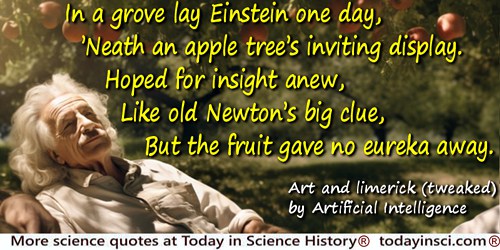
In a grove lay Einstein one day,
’Neath an apple tree’s inviting display.
Hoped for insight anew,
Like old Newton’s big clue,
But the fruit gave no eureka away.
’Neath an apple tree’s inviting display.
Hoped for insight anew,
Like old Newton’s big clue,
But the fruit gave no eureka away.
Caricature by AI: midjourney, clipdrop. Text by Artificial Intelligence: ChatGPT. Slight text edit and prompts by Webmaster. (19 Aug 2023)
In an age of egoism, it is so difficult to persuade man that of all studies, the most important is that of himself. This is because egoism, like all passions, is blind. The attention of the egoist is directed to the immediate needs of which his senses give notice, and cannot be raised to those reflective needs that reason discloses to us; his aim is satisfaction, not perfection. He considers only his individual self; his species is nothing to him. Perhaps he fears that in penetrating the mysteries of his being he will ensure his own abasement, blush at his discoveries, and meet his conscience. True philosophy, always at one with moral science, tells a different tale. The source of useful illumination, we are told, is that of lasting content, is in ourselves. Our insight depends above all on the state of our faculties; but how can we bring our faculties to perfection if we do not know their nature and their laws! The elements of happiness are the moral sentiments; but how can we develop these sentiments without considering the principle of our affections, and the means of directing them? We become better by studying ourselves; the man who thoroughly knows himself is the wise man. Such reflection on the nature of his being brings a man to a better awareness of all the bonds that unite us to our fellows, to the re-discovery at the inner root of his existence of that identity of common life actuating us all, to feeling the full force of that fine maxim of the ancients: 'I am a man, and nothing human is alien to me.'
Considerations sur les diverses méthodes à suivre dans l'observation des peuples sauvages (1800) The Observation of Savage Peoples, trans. F. C. T. Moore (1969), 61.
In general, art has preceded science. Men have executed great, and curious, and beautiful works before they had a scientific insight into the principles on which the success of their labours was founded. There were good artificers in brass and iron before the principles of the chemistry of metals were known; there was wine among men before there was a philosophy of vinous fermentation; there were mighty masses raised into the air, cyclopean walls and cromlechs, obelisks and pyramids—probably gigantic Doric pillars and entablatures—before there was a theory of the mechanical powers. … Art was the mother of Science.
Lecture (26 Nov 1851), to the London Society of Arts, 'The General Bearing of the Great Exhibition on the Progress of Art and Science', collected in Lectures on the Results of the Great Exhibition of 1851' (1852), 7-8.
In science the insights of the past are digested and incorporated into the present in the same way that the genetic material of our ancestors is incorporated into the fabric of our body.
In ‘Tradition and Understanding’, School and Society (Nov 1969). As cited by Raymond Hide in 'A Note on Aspects of Classical Physics in the Twentieth Century', The Cultural Values of Science (2002), 357.
In science, the more discovered, the more new paths open for exploration. It is usual in science, when things are vague and unclear, for the path to be like that of a drunkard, wandering in a zigzag. As we stagger back from what lastly dawns upon our befuddled wits is the wrong way, we cross over the true path and move nearly as far to the, equally wrong, opposite side. If all goes well, our deviations lessen and the path converges towards, but never completely follows, the true one. It gives a new insight to the old tag in vino veritas.
In The Ages of Gaia: A Biography of Our Living Earth (1999), 199.
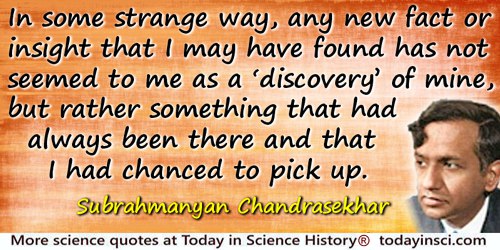
In some strange way, any new fact or insight that I may have found has not seemed to me as a “discovery” of mine, but rather something that had always been there and that I had chanced to pick up.
Truth and Beauty: Aesthetics and Motivations in Science (1987, 1990), Preface, ix.
Insight is not the same as scientific deduction, but even at that it may be more reliable than statistics.
In Science is a Sacred Cow (1950), 123.
It is an open secret to the few who know it, but a mystery and stumbling block to the many, that Science and Poetry are own sisters; insomuch that in those branches of scientific inquiry which are most abstract, most formal, and most remote from the grasp of the ordinary sensible imagination, a higher power of imagination akin to the creative insight of the poet is most needed and most fruitful of lasting work.
From Introduction written for William Kingdon Clifford, Clifford’s Lectures and Essays (1879), Vol. 1, 1.
It is his intuition, his mystical insight into the nature of things, rather than his reasoning which makes a great scientist.
In The Open Society and Its Enemies (1945).
It is known that the mathematics prescribed for the high school [Gymnasien] is essentially Euclidean, while it is modern mathematics, the theory of functions and the infinitesimal calculus, which has secured for us an insight into the mechanism and laws of nature. Euclidean mathematics is indeed, a prerequisite for the theory of functions, but just as one, though he has learned the inflections of Latin nouns and verbs, will not thereby be enabled to read a Latin author much less to appreciate the beauties of a Horace, so Euclidean mathematics, that is the mathematics of the high school, is unable to unlock nature and her laws.
In Die Mathematik die Fackelträgerin einer neuen Zeit (1889), 37-38. As translated in Robert Édouard Moritz, Memorabilia Mathematica; Or, The Philomath’s Quotation-book (1914), 112.
It is more important to have beauty in one's equations than to have them fit experiment... It seems that if one is working from the point of view of getting beauty in one's equations, and if one has really a sound insight, one is on a sure line of progress. If there is not complete agreement between the results of one's work and experiment, one should not allow oneself to be too discouraged, because the discrepancy may well be due to minor features that are not properly taken into account and that will get cleared up with further developments of the theory.
In 'The Evolution of the Physicist’s Picture of Nature', Scientific American, May 1963, 208, 47.
It is often held that scientific hypotheses are constructed, and are to be constructed, only after a detailed weighing of all possible evidence bearing on the matter, and that then and only then may one consider, and still only tentatively, any hypotheses. This traditional view however, is largely incorrect, for not only is it absurdly impossible of application, but it is contradicted by the history of the development of any scientific theory. What happens in practice is that by intuitive insight, or other inexplicable inspiration, the theorist decides that certain features seem to him more important than others and capable of explanation by certain hypotheses. Then basing his study on these hypotheses the attempt is made to deduce their consequences. The successful pioneer of theoretical science is he whose intuitions yield hypotheses on which satisfactory theories can be built, and conversely for the unsuccessful (as judged from a purely scientific standpoint).
Co-author with Raymond Arthur Lyttleton, in 'The Internal Constitution of the Stars', Occasional Notes of the Royal Astronomical Society 1948, 12, 90.
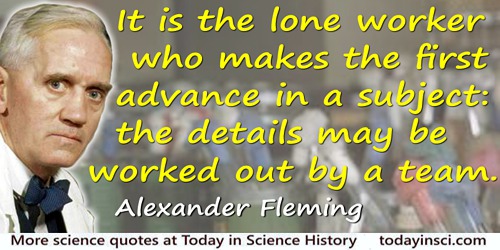
It is the lone worker who makes the first advance in a subject: the details may be worked out by a team, but the prime idea is due to the enterprise, thought, and perception of an individual.
In a speech at Edinburgh University (1951). As cited in John Bartlett, Bartlett’s Familiar Quotations (18th ed., 2012), 647.
Just as the musician is able to form an acoustic image of a composition which he has never heard played by merely looking at its score, so the equation of a curve, which he has never seen, furnishes the mathematician with a complete picture of its course. Yea, even more: as the score frequently reveals to the musician niceties which would escape his ear because of the complication and rapid change of the auditory impressions, so the insight which the mathematician gains from the equation of a curve is much deeper than that which is brought about by a mere inspection of the curve.
In Jahresbericht der Deutschen Mathematiker Vereiningung, 13, 864. As translated in Robert Édouard Moritz, Memorabilia Mathematica; Or, The Philomath’s Quotation-book (1914), 190
Keep in mind that new ideas are commonplace, and almost always wrong. Most flashes of insight lead nowhere; statistically, they have a half-life of hours or maybe days. Most experiments to follow up the surviving insights are tedious and consume large amounts of time, only to yield negative or (worse!) ambiguous results.
In Consilience: The Unity of Knowledge (1998, 1999), 60
Littlewood, on Hardy’s own estimate, is the finest mathematician he has ever known. He was the man most likely to storm and smash a really deep and formidable problem; there was no one else who could command such a combination of insight, technique and power.
(1943). In Béla Bollobás, Littlewood's Miscellany (1986), Foreward, 22.
Many people know everything they know in the way we know the solution of a riddle after we have read it or been told it, and that is the worst kind of knowledge and the kind least to be cultivated; we ought rather to cultivate that kind of knowledge which enables us to discover for ourselves in case of need that which others have to read or be told of in order to know it.
Aphorism 89 in Notebook D (1773-1775), as translated by R.J. Hollingdale in Aphorisms (1990). Reprinted as The Waste Books (2000), 58.
Mathematicians create by acts of insight and intuition. Logic then sanctions the conquests of intuition. It is the hygiene that mathematics practices to keep its ideas healthy and strong. Moreover, the whole structure rests fundamentally on uncertain ground, the intuition of humans. Here and there an intuition is scooped out and replaced by a firmly built pillar of thought; however, this pillar is based on some deeper, perhaps less clearly defined, intuition. Though the process of replacing intuitions with precise thoughts does not change the nature of the ground on which mathematics ultimately rests, it does add strength and height to the structure.
In Mathematics in Western Culture (1964), 408.
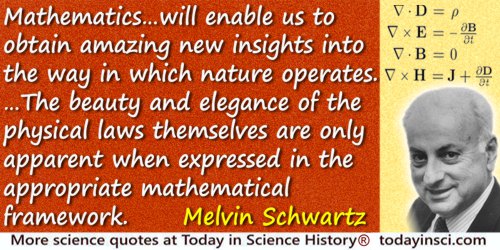
Mathematics is much more than a language for dealing with the physical world. It is a source of models and abstractions which will enable us to obtain amazing new insights into the way in which nature operates. Indeed, the beauty and elegance of the physical laws themselves are only apparent when expressed in the appropriate mathematical framework.
In Principles of Electrodynamics (1972, 1987), 105.
Model-making, the imaginative and logical steps which precede the experiment, may be judged the most valuable part of scientific method because skill and insight in these matters are rare. Without them we do not know what experiment to do. But it is the experiment which provides the raw material for scientific theory. Scientific theory cannot be built directly from the conclusions of conceptual models.
Introduction to the Study of Animal Population (1961), 181.
My “"thinking”" time was devoted mainly to activities that were essentially clerical or mechanical: searching, calculating, plotting, transforming, determining the logical or dynamic consequences of a set of assumptions or hypotheses, preparing the way for a decision or an insight. Moreover ... the operations that fill most of the time allegedly devoted to technical thinking are operations that can be performed more effectively by machines than by men.
From article 'Man-Computer Symbiosis', in IRE Transactions on Human Factors in Electronics (Mar 1960), Vol. HFE-1, 4-11.
My original decision to devote myself to science was a direct result of the discovery which has never ceased to fill me with enthusiasm since my early youth—the comprehension of the far from obvious fact that the laws of human reasoning coincide with the laws governing the sequences of the impressions we receive from the world about us; that, therefore, pure reasoning can enable man to gain an insight into the mechanism of the latter. In this connection, it is of paramount importance that the outside world is something independent from man, something absolute, and the quest for the laws which apply to this absolute appeared to me as the most sublime scientific pursuit in life.
'A Scientific Autobiography' (1948), in Scientific Autobiography and Other Papers, trans. Frank Gaynor (1950), 13.
No generalizing beyond the data, no theory. No theory, no insight. And if no insight, why do research.
'Developing Theory About the Development of Theory,' in Ken G. Smith and Michael A. Hitt, Great Minds in Management: the Theory of Process Development (2005), 361.
No more harmful nonsense exists than the common supposition that deepest insight into great questions about the meaning of life or the structure of reality emerges most readily when a free, undisciplined, and uncluttered (read, rather, ignorant and uneducated) mind soars above mere earthly knowledge and concern.
…...
Our children will attain to a far more fundamental insight into language, if we, when teaching them, connect the words more with the actual perception of the thing and the object. … Our language would then again become a true language of life, that is, born of life and producing life.
In Friedrich Fröbel and Josephine Jarvis (trans.), The Education of Man (1885), 145.
Our failure to discern a universal good does not record any lack of insight or ingenuity, but merely demonstrates that nature contains no moral messages framed in human terms. Morality is a subject for philosophers, theologians, students of the humanities, indeed for all thinking people. The answers will not be read passively from nature; they do not, and cannot, arise from the data of science. The factual state of the world does not teach us how we, with our powers for good and evil, should alter or preserve it in the most ethical manner.
…...
Our time is distinguished by wonderful achievements in the fields of scientific understanding and the technical application of those insights. Who would not be cheered by this? But let us not forget that human knowledge and skills alone cannot lead humanity to a happy and dignified life. Humanity has every reason to place the proclaimers of high moral standards and values above the discoverers of objective truth. What humanity owes to personalities like Buddha, Moses, and Jesus ranks for me higher than all the achievements of the inquiring constructive mind.
(Sep 1937). In Helen Dukas and Banesh Hoffman (eds.), Albert Einstein, the Human Side (1979), 70. The editors state that except being unrelated to “a ‘Preaching Mission’, nothing of any consequence is known of the circumstances that prompted its composition.”
Personally, learning about science has helped me to understand Buddhism more deeply. I agree with Einstein that if there is a religion that can go along with science, it is Buddhism. That is because Buddhism has the spirit of nonattachment to rules. You may have a view that you consider to be the truth, but if you cling to it, then that is the end of your free inquiring. You have to be aware that with the practice of looking deeply, you may see things more clearly. That is why you should not be so dogmatic about what you have found; you have to be ready to release your view in order to get a higher insight. That is very exciting.
In Melvin McLeod (ed.), 'Love without Limit: An Interview with Thich Nhat Hanh', The Best Buddhist Writing 2007 (2007), 74.
Psychology appeared to be a jungle of confusing, conflicting, and arbitrary concepts. These pre-scientific theories doubtless contained insights which still surpass in refinement those depended upon by psychiatrists or psychologists today. But who knows, among the many brilliant ideas offered, which are the true ones? Some will claim that the statements of one theorist are correct, but others will favour the views of another. Then there is no objective way of sorting out the truth except through scientific research.
From The Scientific Analysis of Personality (1965), 14.
Questions of personal priority, however interesting they may be to the persons concerned, sink into insignificance in the prospect of any gain of deeper insight into the secrets of nature.
As quoted in Silvanus Phillips Thompson, The Life of Lord Kelvin (1910), Vol. 2, 602.
Run the tape again, and let the tiny twig of Homo sapiens expire in Africa. Other hominids may have stood on the threshold of what we know as human possibilities, but many sensible scenarios would never generate our level of mentality. Run the tape again, and this time Neanderthal perishes in Europe and Homo erectus in Asia (as they did in our world). The sole surviving human stock, Homo erectus in Africa, stumbles along for a while, even prospers, but does not speciate and therefore remains stable. A mutated virus then wipes Homo erectus out, or a change in climate reconverts Africa into inhospitable forest. One little twig on the mammalian branch, a lineage with interesting possibilities that were never realized, joins the vast majority of species in extinction. So what? Most possibilities are never realized, and who will ever know the difference? Arguments of this form lead me to the conclusion that biology's most profound insight into human nature, status, and potential lies in the simple phrase, the embodiment of contingency: Homo sapiens is an entity, not a tendency.
Wonderful Life (1989), 320.
Science corrects the old creeds, sweeps away, with every new perception, our infantile catechisms, and necessitates a faith commensurate with the grander orbits and universal laws which it discloses yet it does not surprise the moral sentiment that was older and awaited expectant these larger insights.
Hialmer Day Gould and Edward Louis Hessenmueller, Best Thoughts of Best Thinkers (1904), 330.
Science is a boundless adventure of the human spirit, its insights afford terror as well as beauty, and it will continue to agitate the world with new findings and new powers.
In Francis Bello, Lawrence Lessing and George A.W. Boehm, Great American Scientists (1960, 1961), 4.
Science is the tool of the Western mind and with it more doors can be opened than with bare hands. It is part and parcel of our knowledge and obscures our insight only when it holds that the understanding given by it is the only kind there is.
In Jung’s 'Commentary' as translated for the English edition of Richard Wilhelm, The Secret Of The Golden Flower: A Chinese Book of Life (1999, 2013), 82.
Scientific education is catholic; it embraces the whole field of human learning. No student can master all knowledge in the short years of his academic life, but a young man of ability and industry may reasonably hope to master the outlines of science, obtain a deep insight into the methods of scientific research, and at the same time secure an initiation into some one of the departments of science, in such a manner that he may fully appreciate the multitude of facts upon which scientific conclusions rest, and be prepared to enter the field of scientific research himself and make additions to the sum of human knowledge.
From address (1 Oct 1884), at inauguration of the Corcoran School of Science and Arts, Columbian University, Washington, D.C. Published in 'The Larger Import of Scientific Education', Popular Science Monthly (Feb 1885), 26, 453.
Skeptical scrutiny is the means, in both science and religion, by which deep insights can be winnowed from deep nonsense.
…...
So many people today–and even professional scientists–seem to me like someone who has seen thousands of trees but has never seen a forest . A knowledge of the historic and philosophical background gives that kind of independence from prejudices of his generation from which most scientists are suffering. This independence created by philosophical insight is–in my opinion–the mark of distinction between a mere artisan or specialist and a real seeker after truth.
In unpublished Letter (7 Dec 1944) to R.A. Thornton, Einstein Archive, EA 6-574, Hebrew University, Jerusalem, Israel. As quoted and cited in Don A. Howard, 'Albert Einstein as a Philosopher of Science', Physics Today (Dec 2006), 34.
Some problems are just too complicated for rational logical solutions. They admit of insights, not answers.
In 'Profiles: A Scientist’s Advice II' by D. Lang, The New Yorker (26 Jan 1963).
Talent deals with the actual, with discovered and realized truths, any analyzing, arranging, combining, applying positive knowledge, and, in action, looking to precedents. Genius deals with the possible, creates new combinations, discovers new laws, and acts from an insight into new principles.
In 'Genius', Wellman’s Miscellany (Dec 1871), 4, No. 6, 203.
The chances for favorable serendipity are increased if one studies an animal that is not one of the common laboratory species. Atypical animals, or preparations, force one to use non-standard approaches and non-standard techniques, and even to think nonstandard ideas. My own preference is to seek out species which show some extreme of adaptation. Such organisms often force one to abandon standard methods and standard points of view. Almost inevitably they lead one to ask new questions, and most importantly in trying to comprehend their special and often unusual adaptations one often serendipitously stumbles upon new insights.
In 'Scientific innovation and creativity: a zoologist’s point of view', American Zoologist (1982), 22, 234.
The complacent manner in which geologists have produced their theories has been extremely amusing; for often with knowledge (and that frequently inaccurate) not extending beyond a given province, they have described the formation of a world with all the detail and air of eye-witnesses. That much good ensues, and that the science is greatly advanced, by the collision of various theories, cannot be doubted. Each party is anxious to support opinions by facts. Thus, new countries are explored, and old districts re-examined; facts come to light that do not suit either party; new theories spring up; and, in the end, a greater insight into the real structure of the earth's surface is obtained.
Sections and Views Illustrative of Geological Phenomena (1830), iii.
The complexity of contemporary biology has led to an extreme specialization, which has inevitably been followed by a breakdown in communication between disciplines. Partly as a result of this, the members of each specialty tend to feel that their own work is fundamental and that the work of other groups, although sometimes technically ingenious, is trivial or at best only peripheral to an understanding of truly basic problems and issues. There is a familiar resolution to this problem but it is sometimes difficulty to accept emotionally. This is the idea that there are a number of levels of biological integration and that each level offers problems and insights that are unique to it; further, that each level finds its explanations of mechanism in the levels below, and its significances in the levels above it.
From 'Interaction of physiology and behavior under natural conditions', collected in R.I. Bowman (ed.), The Galapagos (1966), 39.
The dispute between evolutionists and creation scientists offers textbook writers and teachers a wonderful opportunity to provide students with insights into the philosophy and methods of science. … What students really need to know is … how scientists judge the merit of a theory. Suppose students were taught the criteria of scientific theory evaluation and then were asked to apply these criteria … to the two theories in question. Wouldn’t such a task qualify as authentic science education? … I suspect that when these two theories are put side by side, and students are given the freedom to judge their merit as science, creation theory will fail ignominiously (although natural selection is far from faultless). … It is not only bad science to allow disputes over theory to go unexamined, but also bad education.
In Building a Bridge to the 18th Century: How the Past Can Improve Our Future (1999), 168.
The eye of the master will do more work than both his hands.
In James Wood, Dictionary of Quotations from Ancient and Modern, English and Foreign Sources (1893), 426:34.
The farther researches we make into this admirable scene of things, the more beauty and harmony we see in them: And the stronger and clearer convictions they give us, of the being, power and wisdom of the divine Architect, who has made all things to concur with a wonderful conformity, in carrying on, by various and innumerable combinations of matter, such a circulation of causes, and effects, as was necessary to the great ends of nature. And since we are assured that the all-wise Creator has observed the most exact proportions, of number, weight and measure, in the make of all things; the most likely way therefore, to get any insight into the nature of those parts of the creation, which come within our observation, must in all reason be to number, weigh and measure. And we have much encouragement to pursue this method, of searching into the nature of things, from the great success that has attended any attempts of this kind.
Vegetable Staticks (1727), xxxi.
The genius of Man in our time has gone into jet-propulsion, atom-splitting, penicillin-curing, etc. There is left none over for works of imagination; of spiritual insight or mystical enlightenment. I asked for bread and was given a tranquilizer. It is important to recognize that in our time man has not written one word, thought one thought, put two notes or two bricks together, splashed color on to canvas or concrete into space, in a manner which will be of any conceivable imaginative interest to posterity.
The Most of Malcolm Muggeridge (1966), 70.
The important thing in any science is to do the things that can be done. Scientists naturally have a right and a duty to have opinions. But their science gives them no special insight into public affairs. There is a time for scientists and movie stars and people who have flown the Atlantic to restrain their opinions lest they be taken more seriously than they should be.
As quoted in Robert Coughlan, 'Dr. Edward Teller’s Magnificent Obsession', Life (6 Sep 1954), 69.
The laws of Coexistence;—the adaptation of structure to function; and to a certain extent the elucidation of natural affinities may be legitimately founded upon the examination of fully developed species;—But to obtain an insight into the laws of development,—the signification or bedeutung, of the parts of an animal body demands a patient examination of the successive stages of their development, in every group of Animals.
'Lecture Four, 9 May 1837', The Hunterian Lectures in Comparative Anatomy, May-June 1837, ed. Phillip Reid Sloan (1992), 191.
The lives of scientists, considered as Lives, almost always make dull reading. For one thing, the careers of the famous and the merely ordinary fall into much the same pattern, give or take an honorary degree or two, or (in European countries) an honorific order. It could be hardly otherwise. Academics can only seldom lead lives that are spacious or exciting in a worldly sense. They need laboratories or libraries and the company of other academics. Their work is in no way made deeper or more cogent by privation, distress or worldly buffetings. Their private lives may be unhappy, strangely mixed up or comic, but not in ways that tell us anything special about the nature or direction of their work. Academics lie outside the devastation area of the literary convention according to which the lives of artists and men of letters are intrinsically interesting, a source of cultural insight in themselves. If a scientist were to cut his ear off, no one would take it as evidence of a heightened sensibility; if a historian were to fail (as Ruskin did) to consummate his marriage, we should not suppose that our understanding of historical scholarship had somehow been enriched.
'J.B.S: A Johnsonian Scientist', New York Review of Books (10 Oct 1968), reprinted in Pluto's Republic (1982), and inThe Strange Case of the Spotted Mice and Other Classic Essays on Science (1996), 86.
The moment of truth, the sudden emergence of new insight, is an act of intuition. Such intuitions give the appearance of miraculous flashes, or short circuits of reasoning. In fact they may be likened to an immersed chain, of which only the beginning and the end are visible above the surface of consciousness. The diver vanishes at one end of the chain and comes up at the other end, guided by invisible links.
In The Act of Creation (1964).
The motive for the study of mathematics is insight into the nature of the universe. Stars and strata, heat and electricity, the laws and processes of becoming and being, incorporate mathematical truths. If language imitates the voice of the Creator, revealing His heart, mathematics discloses His intellect, repeating the story of how things came into being. And Value of Mathematics, appealing as it does to our energy and to our honor, to our desire to know the truth and thereby to live as of right in the household of God, is that it establishes us in larger and larger certainties. As literature develops emotion, understanding, and sympathy, so mathematics develops observation, imagination, and reason.
In A Theory of Motives, Ideals and Values in Education (1907), 406.
The purpose of computation is insight, not numbers.
Motto of the book, Numerical Analysis for Scientists and Engineers (1973), v.
The purpose of computing is insight, not numbers. … [But] sometimes … the purpose of computing numbers is not yet in sight.
Motto for the book, Numerical Methods for Scientists and Engineers (1962, 1973), 3. The restatement of the motto (merged above as second sentence) is suggested on p.504, footnote.
The roads by which men arrive at their insights into celestial matters seem to me almost as worthy of wonder as those matters themselves.
Quoted in The Bulletin of the Atomic Scientists (Feb 1959), 59, citing tr. Arthur Koestler, in Encounter (Dec 1958). Also in The Watershed: A Biography of Johannes Kepler (1960), 59.
The sciences are said, and they are truly said, to have a mutual connection, that any one of them may be the better understood, for an insight into the rest.
…...
The solution of fallacies, which give rise to absurdities, should be to him who is not a first beginner in mathematics an excellent means of testing for a proper intelligible insight into mathematical truth, of sharpening the wit, and of confining the judgment and reason within strictly orderly limits
In 'Vorwort', Mathematische Sophismen (1864), 3. As translated and cited in Robert Édouard Moritz, Memorabilia Mathematica; Or, The Philomath's Quotation-Book (1914), 89. From the original German, “Das Aufsuchen der Trugschlüsse, durch welche Ungereimtheiten entstellen, dürfte nun für den nicht ganz ersten Anfänger in der Mathematik ein vorzügliches Mittel sein, eine richtige begriffliche Einsicht in die mathematischen Wahrheiten zu erproben, den Verstand zu schärfen und das Urtheilen und Schliessen in streng geregelte Grenzen zu dämmen.”
The spectacular thing about Johnny [von Neumann] was not his power as a mathematician, which was great, or his insight and his clarity, but his rapidity; he was very, very fast. And like the modern computer, which no longer bothers to retrieve the logarithm of 11 from its memory (but, instead, computes the logarithm of 11 each time it is needed), Johnny didn’t bother to remember things. He computed them. You asked him a question, and if he didn’t know the answer, he thought for three seconds and would produce and answer.
From interview with Donald J. Albers. In John H. Ewing and Frederick W. Gehring, Paul Halmos Celebrating 50 Years of Mathematics (1991), 9.
The stimulus of competition, when applied at an early age to real thought processes, is injurious both to nerve-power and to scientific insight.
In The Preparation of the Child for Science (1904), 44.
The suppression of uncomfortable ideas may be common in religion or in politics, but it is not the path to knowledge; it has no in the endeavor of science. We do not know in advance who will discover fundamental insights.
In Cosmos (1985), 74.
The universe does not exist “out there,” independent of us. We are inescapably involved in bringing about that which appears to be happening. We are not only observers. We are participators. In some strange sense, this is a participatory universe. Physics is no longer satisfied with insights only into particles, fields of force, into geometry, or even into time and space. Today we demand of physics some understanding of existence itself.
Quoted in Denis Brian, The Voice Of Genius: Conversations with Nobel Scientists and Other Luminaries, 127.
There are no shortcuts to moral insight. Nature is not intrinsically anything that can offer comfort or solace in human terms–if only because our species is such an insignificant latecomer in a world not constructed for us. So much the better. The answers to moral dilemmas are not lying out there, waiting to be discovered. They reside, like the kingdom of God, within us–the most difficult and inaccessible spot for any discovery or consensus.
…...
There is, however, no genius so gifted as not to need control and verification. ... [T]he brightest flashes in the world of thought are incomplete until they have been proved to have their counterparts in the world of fact. Thus the vocation of the true experimentalist may be defined as the continued exercise of spiritual insight, and its incessant correction and realisation. His experiments constitute a body, of which his purified intuitions are, as it were, the soul.
In 'Vitality', Scientific Use of the Imagination and Other Essays (1872), 43.
This science, Geometry, is one of indispensable use and constant reference, for every student of the laws of nature; for the relations of space and number are the alphabet in which those laws are written. But besides the interest and importance of this kind which geometry possesses, it has a great and peculiar value for all who wish to understand the foundations of human knowledge, and the methods by which it is acquired. For the student of geometry acquires, with a degree of insight and clearness which the unmathematical reader can but feebly imagine, a conviction that there are necessary truths, many of them of a very complex and striking character; and that a few of the most simple and self-evident truths which it is possible for the mind of man to apprehend, may, by systematic deduction, lead to the most remote and unexpected results.
In The Philosophy of the Inductive Sciences Part 1, Bk. 2, chap. 4, sect. 8 (1868).
Though to the layman, the world revealed by the chemist may seem more commonplace, it is not so to him. Each new insight into how the atoms in their interactions express themselves in structure and transformations, not only of inanimate matter, but particularly also of living matter, provides a thrill.
Speech at the Nobel Banquet (10 Dec 1983) for his Nobel Prize in Chemistry. In Wilhelm Odelberg (ed.), Les Prix Nobel: The Nobel Prizes (1984), 43.
Through the reading of popular scientific books I soon reached the conviction that much in the stories of the Bible could not be true. The consequence was a positively fanatic [orgy of] freethinking coupled with the impression that youth is intentionally being deceived by the state through lies; it was a crushing impression. Mistrust of every kind of authority grew out of this experience, a skeptical attitude toward the convictions that were alive in any specific social environment–an attitude that has never again left me, even though, later on, it has been tempered by a better insight into the causal connections.
In P. A. Schilpp, (ed.), Part I, 'Autobiographical Notes', Albert Einstein: Philosopher-Scientist (1949, 1959), Vol. 1, 5. Translated by the P.A. Schilpp, from Einstein’s original German manuscript, written at age 67, (p.2, 4): “Durch Lesen populärwissenschaftlicher Bücher kam ich bald zu der Ueberzeugung, dass vieles in den Erzählungen der Bibel nicht wahr sein konnte. Die Folge war eine geradezu fanatische Freigeisterei, verbunden mit dem Eindruck, dass die Jugend vom Staate mit Vorbedacht belogen wird; es war ein niederschmetternder Eindruck. Das Misstrauen gegen jede Art Autorität erwuchs aus diesem Erlebnis, eine skeptische Einstellung gegen die Ueberzeugungen, welche in der jeweiligen sozialen Umwelt lebendig waren—eine Einstellung, die mich nicht wieder verlassen hat, wenn sie auch später durch bessere Einsicht in die kausalen Zusammenhänge ihre ursprünglische Schärfe verloren haben.”.
To be a scholar of mathematics you must be born with talent, insight, concentration, taste, luck, drive and the ability to visualize and guess.
In I Want to be a Mathematician: An Automathography (1985), 400.
Unconscious, perhaps, of the remote tendency of his own labours, he [Joseph Black] undermined that doctrine of material heat, which he seemed to support. For, by his advocacy of latent heat, he taught that its movements constantly battle, not only some of our senses, but all of them; and that, while our feelings make us believe that heat is lost, our intellect makes us believe that it is not lost. Here, we have apparent destructability, and real indestructibility. To assert that a body received heat without its temperature rising, was to make the understanding correct the touch, and defy its dictates. It was a bold and beautiful paradox, which required courage as well as insight to broach, and the reception of which marks an epoch in the human mind, because it was an immense step towards idealizing matter into force.
History of Civilization in England (1861), Vol. 2, 494.
We have learned that there is an endocrinology of elation and despair, a chemistry of mystical insight, and, in relation to the autonomic nervous system, a meteorology and even... an astro-physics of changing moods.
Literature and Science (1963), 90.
What has been learned in physics stays learned. People talk about scientific revolutions. The social and political connotations of revolution evoke a picture of a body of doctrine being rejected, to be replaced by another equally vulnerable to refutation. It is not like that at all. The history of physics has seen profound changes indeed in the way that physicists have thought about fundamental questions. But each change was a widening of vision, an accession of insight and understanding. The introduction, one might say the recognition, by man (led by Einstein) of relativity in the first decade of this century and the formulation of quantum mechanics in the third decade are such landmarks. The only intellectual casualty attending the discovery of quantum mechanics was the unmourned demise of the patchwork quantum theory with which certain experimental facts had been stubbornly refusing to agree. As a scientist, or as any thinking person with curiosity about the basic workings of nature, the reaction to quantum mechanics would have to be: “Ah! So that’s the way it really is!” There is no good analogy to the advent of quantum mechanics, but if a political-social analogy is to be made, it is not a revolution but the discovery of the New World.
From Physics Survey Committee, U.S. National Academy of Sciences, National
Research Council, 'The Nature of Physics', in report Physics in Perspective (1973), 61-62. As cited in I. Bernard Cohen, Revolution in Science (1985), 554-555.
When Galileo caused balls, the weights of which he had himself previously determined, to roll down an inclined plane; when Torricelli made the air carry a weight which he had calculated beforehand to be equal to that of a definite volume of water; or in more recent times, when Stahl changed metal into lime, and lime back into metal, by withdrawing something and then restoring it, a light broke upon all students of nature. They learned that reason has insight only into that which it produces after a plan of its own, and that it must not allow itself to be kept, as it were, in nature's leading-strings, but must itself show the way with principles of judgement based upon fixed laws, constraining nature to give answer to questions of reason's own determining. Accidental observations, made in obedience to no previously thought-out plan, can never be made to yield a necessary law, which alone reason is concerned to discover.
Critique of Pure Reason (1781), trans. Norman Kemp Smith (1929), 20.
When we seek a textbook case for the proper operation of science, the correction of certain error offers far more promise than the establishment of probable truth. Confirmed hunches, of course, are more upbeat than discredited hypotheses. Since the worst traditions of ‘popular’ writing falsely equate instruction with sweetness and light, our promotional literature abounds with insipid tales in the heroic mode, although tough stories of disappointment and loss give deeper insight into a methodology that the celebrated philosopher Karl Popper once labeled as ‘conjecture and refutation.’
…...
While natural selection drives Darwinian evolution, the growth of human culture is largely Lamarckian: new generations of humans inherit the acquired discoveries of generations past, enabling cosmic insight to grow slowly, but without limit.
In magazine article, 'The Beginning of Science', Natural History (Mar 2001). Collected in Death by Black Hole: And Other Cosmic Quandaries (2007), 20.
 In science it often happens that scientists say, 'You know that's a really good argument; my position is mistaken,' and then they would actually change their minds and you never hear that old view from them again. They really do it. It doesn't happen as often as it should, because scientists are human and change is sometimes painful. But it happens every day. I cannot recall the last time something like that happened in politics or religion.
(1987) --
In science it often happens that scientists say, 'You know that's a really good argument; my position is mistaken,' and then they would actually change their minds and you never hear that old view from them again. They really do it. It doesn't happen as often as it should, because scientists are human and change is sometimes painful. But it happens every day. I cannot recall the last time something like that happened in politics or religion.
(1987) -- 





