Insect Quotes (90 quotes)
Insects Quotes
Insects Quotes
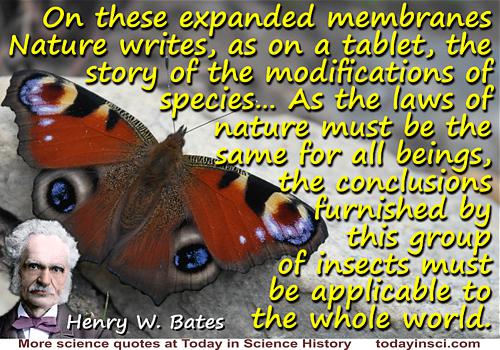
… on these expanded membranes [butterfly wings] Nature writes, as on a tablet, the story of the modifications of species, so truly do all changes of the organisation register themselves thereon. Moreover, the same colour-patterns of the wings generally show, with great regularity, the degrees of blood-relationship of the species. As the laws of nature must be the same for all beings, the conclusions furnished by this group of insects must be applicable to the whole world.
From The Naturalist on the River Amazons: A record of Adventures, Habits of Animals, Sketches of Brazilian and Indian life, and Aspects of Nature under the Equator, During Eleven Years of Travel (1864), 413.
[L]et us not overlook the further great fact, that not only does science underlie sculpture, painting, music, poetry, but that science is itself poetic. The current opinion that science and poetry are opposed is a delusion. … On the contrary science opens up realms of poetry where to the unscientific all is a blank. Those engaged in scientific researches constantly show us that they realize not less vividly, but more vividly, than others, the poetry of their subjects. Whoever will dip into Hugh Miller’s works on geology, or read Mr. Lewes's “Seaside Studies,” will perceive that science excites poetry rather than extinguishes it. And whoever will contemplate the life of Goethe will see that the poet and the man of science can co-exist in equal activity. Is it not, indeed, an absurd and almost a sacrilegious belief that the more a man studies Nature the less he reveres it? Think you that a drop of water, which to the vulgar eye is but a drop of water, loses anything in the eye of the physicist who knows that its elements are held together by a force which, if suddenly liberated, would produce a flash of lightning? Think you that what is carelessly looked upon by the uninitiated as a mere snow-flake, does not suggest higher associations to one who has seen through a microscope the wondrously varied and elegant forms of snow-crystals? Think you that the rounded rock marked with parallel scratches calls up as much poetry in an ignorant mind as in the mind of a geologist, who knows that over this rock a glacier slid a million years ago? The truth is, that those who have never entered upon scientific pursuits know not a tithe of the poetry by which they are surrounded. Whoever has not in youth collected plants and insects, knows not half the halo of interest which lanes and hedge-rows can assume. Whoever has not sought for fossils, has little idea of the poetical associations that surround the places where imbedded treasures were found. Whoever at the seaside has not had a microscope and aquarium, has yet to learn what the highest pleasures of the seaside are. Sad, indeed, is it to see how men occupy themselves with trivialities, and are indifferent to the grandest phenomena—care not to understand the architecture of the Heavens, but are deeply interested in some contemptible controversy about the intrigues of Mary Queen of Scots!—are learnedly critical over a Greek ode, and pass by without a glance that grand epic written by the finger of God upon the strata of the Earth!
In Education: Intellectual, Moral, and Physical (1889), 82-83.
A human being should be able to change a diaper, plan an invasion, butcher a hog, conn a ship, design a building, write a sonnet, balance accounts, build a wall, set a bone, comfort the dying, take orders, give orders, cooperate, act alone, solve equations, analyze a new problem, pitch manure, program a computer, cook a tasty meal, fight efficiently, die gallantly. Specialization is for insects.
In Time Enough for Love: The Lives of Lazarus Long (1973), 265.
A single swallow, it is said, devours ten millions of insects every year. The supplying of these insects I take to be a signal instance of the Creator's bounty in providing for the lives of His creatures.
Attributed to Henry Ward Beecher as a quote under the definition of 'Bounty' in Ambrose Bierce, The Collected Works of Ambrose Bierce (1911), Vol. 7, The Devil's Dictionary, 40. Webmaster has not yet found a primary print source confirming the quote is by Beecher, and thus presently lists it under Bierce. Please contact webmaster if you know a primary print source for Beecher.
After the planet becomes theirs, many millions of years will have to pass before a beetle particularly loved by God, at the end of its calculations will find written on a sheet of paper in letters of fire that energy is equal to the mass multiplied by the square of the velocity of light. The new kings of the world will live tranquilly for a long time, confining themselves to devouring each other and being parasites among each other on a cottage industry scale.
'Beetles' Other People’s Trades (1985, trans. 1989).
All life is linked together in such a way that no part of the chain is unimportant. Frequently, upon the action of some of these minute beings depends the material success or failure of a great commonwealth.
Insect Life: An Introduction To Nature-Study And A Guide For Teachers (1897), 1.
All the summer long is the swallow a most instructive pattern of unwearied industry and affection; for, from morning to night, while there is a family to be supported, she spends the whole day in skimming close to the ground, and exerting the most sudden turns and quick evolutions. Avenues, and long walks under hedges, and pasture-fields, and mown meadows where cattle graze, are her delight, especially if there are trees interspersed; because in such spots insects most abound. When a fly is taken a smart snap from her bill is heard, resembling the noise at the shutting of a watch case; but the motion of the mandibles are too quick for the eye.
In Letter to Daines Barrington (29 Jan 1774), in In The Natural History and Antiquities of Selborne (1789), 169-170.
Almost daily we shudder as prophets of doom announce the impending end of civilization and universe. We are being asphyxiated, they say, by the smoke of the industry; we are suffocating in the ever growing mountain of rubbish. Every new project depicts its measureable effects and is denounced by protesters screaming about catastrophe, the upsetting of the land, the assault on nature. If we accepted this new mythology we would have to stop pushing roads through the forest, harnessing rivers to produce the electricity, breaking grounds to extract metals, enriching the soil with chemicals, killing insects, combating viruses … But progress—basically, an effort to organise a corner of land and make it more favourable for human life—cannot be baited. Without the science of pomiculture, for example, trees will bear fruits that are small, bitter, hard, indigestible, and sour. Progress is desirable.
Uncredited. In Lachman Mehta, Stolen Treasure (2012), 117.
An infinity of these tiny animals defoliate our plants, our trees, our fruits... they attack our houses, our fabrics, our furniture, our clothing, our furs ... He who in studying all the different species of insects that are injurious to us, would seek means of preventing them from harming us, would seek to cause them to perish, proposes for his goal important tasks indeed.
In J. B. Gough, 'Rene-Antoine Ferchault de Réaumur', in Charles Gillispie (ed.), Dictionary of Scientific Biography (1975), Vol. 11, 332.
Animals, even plants, lie to each other all the time, and we could restrict the research to them, putting off the real truth about ourselves for the several centuries we need to catch our breath. What is it that enables certain flowers to resemble nubile insects, or opossums to play dead, or female fireflies to change the code of their flashes in order to attract, and then eat, males of a different species?
In Late Night Thoughts on Listening to Mahler's Ninth Symphony(1984), 131.
As physicists have arranged an extensive series of effects under the general term of Heat, so they have named another series Light, and a third they have called Electricity. We find ... that all these principles are capable of being produced through the medium of living bodies, for nearly all animals have the power of evolving heat; many insects, moreover, can voluntarily emit light; and the property of producing electricity is well evinced in the terrible shock of the electric eel, as well as in that of some other creatures. We are indeed in the habit of talking of the Electric fluid, or the Galvanic fluid, but this in reality is nothing but a licence of expression suitable to our finite and material notions.
In the Third Edition of Elements of Electro-Metallurgy: or The Art of Working in Metals by the Galvanic Fluid (1851), 1.
Because I was less tied to Parliament, because I was freer to travel and investigate and explore, I found myself often with the odd jobs which nobody else wanted or had time for. One of these, I remember, was a study of the myxomatosis problem. Myxomatosis was a disease fatal to rabbits and without a cure—there had been prolonged examination of it on the Continent where there were dreams of eradicating or anyway reducing the rabbit population. A French chemical scientist carried out a series of experiments in the park of his chateau, with a view to rabbit control. He let the virus loose, apparently unaware that it could be carried by birds and insects. Very soon myxomatosis had spread like wildfire through France.
In Reflect on Things Past: The Memoirs of Lord Carrington (1089), 97.
Because we are urban dwellers we are obsessed with human problems. … We are so alienated from the world of nature that few of us can name the wild flowers and insects of our locality or notice the rapidity of their extinction.
In 'The Earth as a Living Organism', Essay collected in E. O. Wilson and F. M. Peter (eds.), Biodiversity (1988), Chap. 56, 489. The ellipsis is for a sentence that Webmaster has extracted as a standalone quote on this webpage, beginning: “Even environmentalists seem more concerned”.
Between men of different studies and professions, may be observed a constant reciprocation of reproaches. The collector of shells and stones derides the folly of him who pastes leaves and flowers upon paper, pleases himself with colours that are perceptibly fading, and amasses with care what cannot be preserved. The hunter of insects stands amazed that any man can waste his short time upon lifeless matter, while many tribes of animals yet want their history. Every one is inclined not only to promote his own study, but to exclude all others from regard, and having heated his imagination with some favourite pursuit, wonders that the rest of mankind are not seized with the same passion.
From 'Numb. 83, Tuesday, January 1, 1750', The Rambler (1756), Vol. 2, 150.
Biological disciplines tend to guide research into certain channels. One consequence is that disciplines are apt to become parochial, or at least to develop blind spots, for example, to treat some questions as “interesting” and to dismiss others as “uninteresting.” As a consequence, readily accessible but unworked areas of genuine biological interest often lie in plain sight but untouched within one discipline while being heavily worked in another. For example, historically insect physiologists have paid relatively little attention to the behavioral and physiological control of body temperature and its energetic and ecological consequences, whereas many students of the comparative physiology of terrestrial vertebrates have been virtually fixated on that topic. For the past 10 years, several of my students and I have exploited this situation by taking the standard questions and techniques from comparative vertebrate physiology and applying them to insects. It is surprising that this pattern of innovation is not more deliberately employed.
In 'Scientific innovation and creativity: a zoologist’s point of view', American Zoologist (1982), 22, 233.
Coming to the question of life being found on other planets, Professor Haldane apologized for discoursing, as a mere biologist, on a subject on which we had been expecting a lecture by a physicist [J. D. Bernal]. He mentioned three hypotheses:
(a) That life had a supernatural origin,
(b) That it originated from inorganic materials, and (c) That life is a constituent of the Universe and can only arise from pre-existing life. The first hypothesis, he said, should be taken seriously, and he would proceed to do so. From the fact that there are 400,000 species of beetle on this planet, but only 8,000 species of mammals, he concluded that the Creator, if he exists, has a special preference for beetles, and so we might be more likely to meet them than any other type of animal on a planet which would support life.
(a) That life had a supernatural origin,
(b) That it originated from inorganic materials, and (c) That life is a constituent of the Universe and can only arise from pre-existing life. The first hypothesis, he said, should be taken seriously, and he would proceed to do so. From the fact that there are 400,000 species of beetle on this planet, but only 8,000 species of mammals, he concluded that the Creator, if he exists, has a special preference for beetles, and so we might be more likely to meet them than any other type of animal on a planet which would support life.
In Mark Williamson, 'Haldane’s Special Preference', The Linnean, 1992, 8, 14.
Everything is determined … by forces over which we have no control. It is determined for the insect as well as the star. Human beings, vegetables, or cosmic dust—we all dance to a mysterious tune, intoned in the distance by an invisible piper.
In interview, George Sylvester Viereck, 'What Life Means to Einstein', The Saturday Evening Post (26 Oct 1929), 117.
Go to the ant, thou sluggard; consider her ways, and be wise.
— Bible
Proverbs 6:6. In Gary William Flake, The Computational Beauty of Nature (2000), 261.
He who contemplates nature finds an inexhaustible source of wonder and pleasure in considering, among the class of insects, their forms, their colours, the different offensive and defensive weapons with which they are provided, their curious habitudes, the bond of union which is shewn in some kinds, and the prudence and industry which they employ, less indeed for their individual preservation than with a view to secure the perpetuity of the species, while yielding to the soft and powerful impulse of nature. But if this innumerable family of little animals furnishes ample matter for the curious researches of the naturalist, it affords also a subject of meditation for public economy, since some kinds of these beings cause even national calamities, while on the contrary other species greatly contribute to the prosperity of states and individuals.
As translated (by uncredited trans.) in Chap. 1, 'Of Caterpillars Generally, Amongst Which is Comprised the Silk-Worm', The Art of Rearing Silk-Worms (1825), 1. Originally published in Italian as, Dell'arte di governare i bachi da seta (1815). Above quote from the original Italian, “Una sorgente inesausta di meraviglia e di piacere trova il contemplatore della natura nella classe degli insetti allorquando si fa a considerare l’abito esterno di çodesto iminenso popolo di esseri viventi, le tante differenti armi di offesa e di difesa loro prestate dalla provvida natura, le curiosissime loro abitudini, lo spirito di famiglia eminentissimo, che sì bene si mamifesta in alcune spezie, e la somma loro previdenza ed insdustria rispetto non tanto a’ mezzi che impiegano per la loro individuale conservazione, quanto a quelli cui, seguendo il dolce e possente invito della natura, mettono in opera, onde meglio assicurare la perpetuazione della spezie. Ma se questa innumerevole famiglia di animali fornisce ampia materia alle curiose indagini del naturalista, offre pur auco un soggetto di grande studio al pubblico economista, per la ragione che come alcune spezie di cotali esseri esercitano talvolta una influenza la più diretta sulle disgrazie dei popoli, così altre spezie per lo contrario l’hanno grandissima sulla prosperità degli Statie di quanti individui li compongono.” [Note: Whereas the printed translation gives “cause even national calamities”, the original Italian reads, “disgrazie dei popoli”—which might be translated less dramatically as, “misfortunes of the peoples.” —Webmaster
Here are a few things to keep in mind the next time ants show up in the potato salad. The 8,800 known species of the family Formicidae make up from 10% to 15% of the world's animal biomass, the total weight of all fauna. They are the most dominant social insect in the world, found almost everywhere except in the polar regions. Ants turn more soil than earthworms; they prune, weed and police most of the earth’s carrion. Among the most gregarious of creatures, they are equipped with a sophisticated chemical communications system. To appreciate the strength and speed of this pesky invertebrate, consider that a leaf cutter the size of a man could run repeated four-minute miles while carrying 750 lbs. of potato salad.
From book review, 'Nature: Splendor in The Grass', Time (3 Sep 1990).
I … object to dividing the study of living processes into botany, zoology, and microbiology because by any such arrangement, the interrelations within the biological community get lost. Corals cannot be studied without reference to the algae that live with them; flowering plants without the insects that pollinate them; grasslands without the grazing mammals.
In The Forest and the Sea (1960), 7.
I believe that life can go on forever. It takes a million years to evolve a new species, ten million for a new genus, one hundred million for a class, a billion for a phylum—and that’s usually as far as your imagination goes. In a billion years, it seems, intelligent life might be as different from humans as humans are from insects. But what would happen in another ten billion years? It’s utterly impossible to conceive of ourselves changing as drastically as that, over and over again. All you can say is, on that kind of time scale the material form that life would take is completely open. To change from a human being to a cloud may seem a big order, but it’s the kind of change you’d expect over billions of years.
Quoted in Omni (1986), 8, 38.
I can say, if I like, that social insects behave like the working parts of an immense central nervous system: the termite colony is an enormous brain on millions of legs; the individual termite is a mobile neurone.
In Late Night Thoughts on Listening to Mahler's Ninth Symphony(1984), 224. Note: Spelling “neurone&rdwuo; [sic].
I have always liked horticulturists, people who make their living from orchards and gardens, whose hands are familiar with the feel of the bark, whose eyes are trained to distinguish the different varieties, who have a form memory. Their brains are not forever dealing with vague abstractions; they are satisfied with the romance which the seasons bring with them, and have the patience and fortitude to gamble their lives and fortunes in an industry which requires infinite patience, which raise hopes each spring and too often dashes them to pieces in fall. They are always conscious of sun and wind and rain; must always be alert lest they lose the chance of ploughing at the right moment, pruning at the right time, circumventing the attacks of insects and fungus diseases by quick decision and prompt action. They are manufacturers of a high order, whose business requires not only intelligence of a practical character, but necessitates an instinct for industry which is different from that required by the city dweller always within sight of other people and the sound of their voices. The successful horticulturist spends much time alone among his trees, away from the constant chatter of human beings.
I have from my childhood, in conformity with the precepts of a mother void of all imaginary fear, been in the constant habit of taking toads in my hand, and applying them to my nose and face as it may happen. My motive for doing this very frequently is to inculcate the opinion I have held, since I was told by my mother, that the toad is actually a harmless animal; and to whose manner of life man is certainly under some obligation as its food is chiefly those insects which devour his crops and annoy him in various ways.
Letter to an unknown correspondent, quoted by Bowdler Sharpe, The Natural History and Antiquities of Selborne (1900), Vol. 1, 69. In Averil M. Lysaght, Joseph Banks in Newfoundland and Labrador, 1766: his Diary, Manuscripts, and Collections (1971), 44.
I took him [Lawrence Bragg] to a young zoologist working on pattern formation in insect cuticles. The zoologist explained how disturbances introduced into these regular patterns pointed to their formation being governed by some kind of gradient. Bragg listened attentively and then exclaimed: “Your disturbed gradient behaves like a stream of sand running downhill and encountering an obstacle.” “Good heavens,” replied the zoologist, “I had been working on this problem for years before this simple analogy occurred to me and you think of it after twenty minutes.”
As quoted in David Phillips, Biographical Memoirs of Fellows of the Royal Society (Nov 1979), 25, 132, citing: Perutz, M.F. 1971 New Sci. & Sci. J. 8 July 1967.
If all mankind were to disappear, the world would regenerate back to the rich state of equilibrium that existed ten thousand years ago. If insects were to vanish, the environment would collapse into chaos.
In Rosemarie Jarski, Words From The Wise (2007), 269. [Contact webmaster if you know the primary print source.]
If Darwin were alive today the insect world would delight and astound him with its impressive verification of his theories of the survival of the fittest. Under the stress of intensive chemical spraying the weaker members of the insect populations are being weeded out… . Only the strong and fit remain to defy our efforts to control them.
In Silent Spring (1952, 1962), 263.
If this book were to be dedicated to its first and chief encouragement is should probably salute starlight, insects, the galaxies, and the fossil plants and animals.
From Of Stars and Men: The Human Response to an Expanding Universe (1958 Rev. Ed. 1964), Foreword.
If we and the rest of the backboned animals were to disappear overnight, the rest of the world would get on pretty well. But if [the invertebrates] were to disappear, the world’s ecosystems would collapse. disappear, the land’s ecosystems would collapse. The soil would lose its fertility. Many of the plants would no longer be pollinated. Lots of animals, amphibians, reptiles, birds, mammals would have nothing to eat. And our fields and pastures would be covered with dung and carrion.
From BBC TV series Life in the Undergrowth (2005). As cited in Simon Barnes, History of the World in 100 Animals (2020), end of Chap. 72.
If we take a survey of our own world … our portion in the immense system of creation, we find every part of it, the earth, the waters, and the air that surround it, filled, and as it were crouded with life, down from the largest animals that we know of to the smallest insects the naked eye can behold, and from thence to others still smaller, and totally invisible without the assistance of the microscope. Every tree, every plant, every leaf, serves not only as an habitation, but as a world to some numerous race, till animal existence becomes so exceedingly refined, that the effluvia of a blade of grass would be food for thousands.
In The Age of Reason: Being an Investigation of True and Fabulous Theology (27 Jan O.S. 1794), 60. The word “crouded” is as it appears in the original.
If you confine yourself to this Skinnerian technique, you study nothing but the learning apparatus and you leave out everything that is different in octopi, crustaceans, insects and vertebrates. In other words, you leave out everything that makes a pigeon a pigeon, a rat a rat, a man a man, and, above all, a healthy man healthy and a sick man sick.
'Some Psychological Concepts and Issues. A Discussion between Konrad Lorenz and Richard I Evans'. In Richard I. Evans, Konrad Lorenz: The Man and his Ideas (1975), 60.
In 1847 I gave an address at Newton, Mass., before a Teachers’ Institute conducted by Horace Mann. My subject was grasshoppers. I passed around a large jar of these insects, and made every teacher take one and hold it while I was speaking. If any one dropped the insect, I stopped till he picked it up. This was at that time a great innovation, and excited much laughter and derision. There can be no true progress in the teaching of natural science until such methods become general.
In all works on Natural History, we constantly find details of the marvellous adaptation of animals to their food, their habits, and the localities in which they are found. But naturalists are now beginning to look beyond this, and to see that there must be some other principle regulating the infinitely varied forms of animal life. It must strike every one, that the numbers of birds and insects of different groups having scarcely any resemblance to each other, which yet feed on the same food and inhabit the same localities, cannot have been so differently constructed and adorned for that purpose alone. Thus the goat-suckers, the swallows, the tyrant fly-catchers, and the jacamars, all use the same kind ‘Of food, and procure it in the same manner: they all capture insects on the wing, yet how entirely different is the structure and the whole appearance of these birds!
In A Narrative of Travels on the Amazon and Rio Negro (1853), 83-84.
In my opinion, the cholera poison only produces its effects through the air when carried by insects, or when the evacuations become dry, and are wafted as a fine dust.
In 'On the Mode of Communication of Cholera', The Edinburgh Medical Journal (Jan 1856), Vol. 1, No. 7, 669.
In Sheldon it was not only the wild creatures [and cats] … that were sacrificed in the campaign against an insect. … Sheep [were in]… a small, untreated blue-grass pasture across a gravel road from a field which had been treated with dieldrin spray…. Evidently some spray had drifted across the road into the pasture, for the sheep began to show symptoms of intoxication almost at once…. They lost interest in food and displayed extreme restlessness, following the pasture fence around and around apparently searching for a way out… [They] bleated almost continuously, and stood with their heads lowered… [Several] sheep eventually died.
In 'Needless Havoc', Silent Spring (1962), 94.
In the study of this membrane [the retina] I for the first time felt my faith in Darwinism (hypothesis of natural selection) weakened, being amazed and confounded by the supreme constructive ingenuity revealed not only in the retina and in the dioptric apparatus of the vertebrates but even in the meanest insect eye. ... I felt more profoundly than in any other subject of study the shuddering sensation of the unfathomable mystery of life.
Recollections of My Life (1898), 576. Quoted in Sidney Perkowitz, Empire of Light (1999), 16.
In the vast cosmical changes, the universal life comes and goes in unknown quantities ... sowing an animalcule here, crumbling a star there, oscillating and winding, ... entangling, from the highest to the lowest, all activities in the obscurity of a dizzying mechanism, hanging the flight of an insect upon the movement of the earth... Enormous gearing, whose first motor is the gnat, and whose last wheel is the zodiac.
Victor Hugo and Charles E. Wilbour (trans.), Les Misérables (1862), 41.
In view of all the nests brimming over with eager mouths, it is a good thing that deciduous woodlands provide an incredible wealth of food for the birds that live there. There are … arthropods, snails and … the prodigious menu of nuts, seeds and juicy berries.
In The Amateur Naturalist (1989), 126.
Infectious disease is one of the few genuine adventures left in the world. The dragons are all dead and the lance grows rusty in the chimney corner. ... About the only sporting proposition that remains unimpaired by the relentless domestication of a once free-living human species is the war against those ferocious little fellow creatures, which lurk in dark corners and stalk us in the bodies of rats, mice and all kinds of domestic animals; which fly and crawl with the insects, and waylay us in our food and drink and even in our love
Rats, Lice and History (1935)
INSECTIVORA, n.
'See,' cries the chorus of admiring preachers,
'How Providence provides for all His creatures!"'
'His care,' the gnat said, 'even the insects follows: For us
He has provided wrens and swallows.'
[Under pen-name Sempen Railey.]
'See,' cries the chorus of admiring preachers,
'How Providence provides for all His creatures!"'
'His care,' the gnat said, 'even the insects follows: For us
He has provided wrens and swallows.'
[Under pen-name Sempen Railey.]
The Collected Works of Ambrose Bierce (1911), Vol. 7, The Devil's Dictionary, 169.
Is not disease the rule of existence? There is not a lily pad floating on the river but has been riddled by insects. Almost every shrub and tree has its gall, oftentimes esteemed its chief ornament and hardly to be distinguished from the fruit. If misery loves company, misery has company enough. Now, at midsummer, find me a perfect leaf or fruit.
In The Writings of Henry David Thoreau (1893), Vol. 9, 458.
It is a happy world after all. The air, the earth, the water teem with delighted existence. In a spring noon, or a summer evening, on whichever side I turn my eyes, myriads of happy beings crowd upon my view. “The insect youth are on the wing.” Swarms of new-born flies are trying their pinions in the air. Their sportive motions, their wanton mazes, their gratuitous activity testify their joy and the exultation they feel in their lately discovered faculties … The whole winged insect tribe, it is probable, are equally intent upon their proper employments, and under every variety of constitution, gratified, and perhaps equally gratified, by the offices which the author of their nature has assigned to them.
Natural Theology: or, Evidences of the Existence and Attributes of The Deity, Collected from the Appearances of Nature (1802), 490-1.
It is hard to imagine while strenuously walking in the heart of an equatorial rain forest, gasping for every breath in a stifling humid sauna, how people could have ever adapted to life under these conditions. It is not just the oppressive climate - the tall forest itself is dark, little light reaching the floor from the canopy, and you do not see any animals. It is a complete contrast to the herbivore-rich dry savannahs of tropical Africa. Yet there are many animals here, evident by the loud, continual noise of large cryptic insects and the constant threat of stepping on a deadly king cobra. This was my first impression of the rain forest in Borneo.
The Humans Who Went Extinct
It is interesting to contemplate an entangled bank, clothed with many plants of many kinds, with birds singing on the bushes, with various insects flitting about, and with worms crawling through the damp earth, and to reflect that these elaborately constructed forms, so different from each other, and dependent on each other in so complex a manner, have all been produced by laws acting around us. These laws, taken in the largest sense, being Growth with Reproduction; Inheritance which is almost implied by reproduction; Variability from the indirect and direct action of the external conditions of life, and from use and disuse; a Ratio of Increase so high as to lead to a Struggle for Life, and as a consequence to Natural Selection, entailing Divergence of Character and the Extinction of less-improved forms.
Concluding remarks in final chapter, The Origin of Species (1859), 490.
Let him who so wishes take pleasure in boring us with all the wonders of nature: let one spend his life observing insects, another counting the tiny bones in the hearing membrane of certain fish, even in measuring, if you will, how far a flea can jump, not to mention so many other wretched objects of study; for myself, who am curious only about philosophy, who am sorry only not to be able to extend its horizons, active nature will always be my sole point of view; I love to see it from afar, in its breadth and its entirety, and not in specifics or in little details, which, although to some extent necessary in all the sciences, are generally the mark of little genius among those who devote themselves to them.
'L'Homme Plante', in Oeuvres Philosophiques de La Mettrie (1796), Vol. 2, 70-1. Jacques Roger, The Life Sciences in Eighteenth-Century French Thought, edited by Keith R. Benson and trans. Robert Ellrich (1997), 377.
Life is hard for insects. And don’t think mice are having any fun either.
Without Feathers (1975), 103
Men should stop fighting among themselves and start fighting insects.
In George Seldes, The Great Quotations (1960), 125.
Most children have a bug period, and I never grew out of mine.
In Naturalist (1994, 2006), 53.
Nature vibrates with rhythms, climatic and diastrophic, those finding stratigraphic expression ranging in period from the rapid oscillation of surface waters, recorded in ripple-mark, to those long-deferred stirrings of the deep imprisoned titans which have divided earth history into periods and eras. The flight of time is measured by the weaving of composite rhythms- day and night, calm and storm, summer and winter, birth and death such as these are sensed in the brief life of man. But the career of the earth recedes into a remoteness against which these lesser cycles are as unavailing for the measurement of that abyss of time as would be for human history the beating of an insect's wing. We must seek out, then, the nature of those longer rhythms whose very existence was unknown until man by the light of science sought to understand the earth. The larger of these must be measured in terms of the smaller, and the smaller must be measured in terms of years.
'Rhythm and the Measurement of Geologic Time', Bulletin of the Geological Society of America, 1917, 28,746.
Never to have seen anything but the temperate zone is to have lived on the fringe of the world. Between the Tropic of Capricorn and the Tropic of Cancer live the majority of all the plant species, the vast majority of the insects, most of the strange ... quadrupeds, all of the great and most of the poisonous snakes and large lizards, most of the brilliantly colored sea fishes, and the strangest and most gorgeously plumaged of the birds.
Exploring For Plants (1930), 329.
Nothing is more humbling than to look with a strong magnifying glass at an insect so tiny that the naked eye sees only the barest speck and to discover that nevertheless it is sculpted and articulated and striped with the same care and imagination as a zebra. Apparently it does not occur to nature whether or not a creature is within our range of vision, and the suspicion arises that even the zebra was not designed for our benefit.
…...
Now when you cut a forest, an ancient forest in particular, you are not just removing a lot of big trees and a few birds fluttering around in the canopy. You are drastically imperiling a vast array of species within a few square miles of you. The number of these species may go to tens of thousands. … Many of them are still unknown to science, and science has not yet discovered the key role undoubtedly played in the maintenance of that ecosystem, as in the case of fungi, microorganisms, and many of the insects.
From On Human Nature (2000). As quoted in John H. Morgan, Naturally Good: A Behavioral History of Moral Development (2005), 251-252.
Organic chemistry has literally placed a new nature beside the old. And not only for the delectation and information of its devotees; the whole face and manner of society has been altered by its products. We are clothed, ornamented and protected by forms of matter foreign to Nature; we travel and are propelled, in, on and by them. Their conquest of our powerful insect enemies, their capacity to modify the soil and control its microscopic flora, their ability to purify and protect our water, have increased the habitable surface of the earth and multiplied our food supply; and the dramatic advances in synthetic medicinal chemistry comfort and maintain us, and create unparalleled social opportunities (and problems).
In 'Synthesis', in A. Todd (ed.), Perspectives in Organic Chemistry (1956), 180.
Our atom of carbon enters the leaf, colliding with other innumerable (but here useless) molecules of nitrogen and oxygen. It adheres to a large and complicated molecule that activates it, and simultaneously receives the decisive message from the sky, in the flashing form of a packet of solar light; in an instant, like an insect caught by a spider, it is separated from its oxygen, combined with hydrogen and (one thinks) phosphorus, and finally inserted in a chain, whether long or short does not matter, but it is the chain of life. All this happens swiftly, in silence, at the temperature and pressure of the atmosphere, and gratis: dear colleagues, when we learn to do likewise we will be sicut Deus [like God], and we will have also solved the problem of hunger in the world.
Levi Primo and Raymond Rosenthal (trans.), The Periodic Table (1975, 1984), 227-228. In this final section of his book, Levi imagines the life of a carbon atom. He calls this his first “literary dream”. It came to him at Auschwitz.
Our treasure lies in the beehives of our knowledge. We are perpetually on our way thither, being by nature winged insects and honey gatherers of the mind. The only thing that lies close to our heart is the desire to bring something home to the hive.
The Genealogy of Morals (1887), as translated by Francis Golffing (1956), 149. In another translation, by Maudemarie Clark and Alan J. Swensen, it appears as: “It has rightly been said: ‘where your treasure is, there will your heart be also’; our treasure is where the beehives of our knowledge stand. We are forever underway towards them, as born winged animals and honey-gathers of the spirit, concerned will all our heart about only one thing—"bringing home" something.”
People have noted with admiration how the progress of scientific enquiry is like the growth of a coral reef; each generation of little toilers building a sure foundation on which their successors may build yet further. The simile is apt in many ways, and in one way in particular that is worth considering. When we see how industrious and how prolific are the coral insects, our chief astonishment should be, not how vast are the structures they have built, but how few and scattered. Why is not every coast lined with coral? Why is the abyss if ocean not bridged with it. The answer is that coral only lives under certain limitations; it can only thrive at certain depths, in water of certain temperatures and salinities; outside these limits it languishes and dies. Science is like coral in this. Scientific investigators can only work in certain spots of the ocean of Being, where they are at home, and all outside is unknown to them...
Scientific Method: An Inquiry into the Character and Validy of Natural Law (1923), 195. Quoted in Wilson Gee, Social science research methods (1950), 182.
Perhaps there are somewhere in the infinite universe beings whose minds outrank our minds to the same extent as our minds surpass those of the insects. Perhaps there will once somewhere live beings who will look upon us with the same condescension as we look upon amoebae.
…...
See, thro' this air, this ocean, and this earth,
All matter quick, and bursting into birth.
Above, how high progressive life may go!
Around, how wide! how deep extend below!
Vast chain of being, which from God began,
Natures ethereal, human, angel, man,
Beast, bird, fish, insect! what no eye can see,
No glass can reach! from Infinite to thee,
From thee to Nothing—On superior pow'rs
Were we to press, inferior might on ours:
Or in the full creation leave a void,
Where, one step broken, the great scale's destroy'd:
From Nature's chain whatever link you strike,
Tenth or ten thousandth, breaks the chain alike.
All matter quick, and bursting into birth.
Above, how high progressive life may go!
Around, how wide! how deep extend below!
Vast chain of being, which from God began,
Natures ethereal, human, angel, man,
Beast, bird, fish, insect! what no eye can see,
No glass can reach! from Infinite to thee,
From thee to Nothing—On superior pow'rs
Were we to press, inferior might on ours:
Or in the full creation leave a void,
Where, one step broken, the great scale's destroy'd:
From Nature's chain whatever link you strike,
Tenth or ten thousandth, breaks the chain alike.
'An Essay on Man' (1733-4), Epistle I. In John Butt (ed.), The Poems of Alexander Pope (1965), 513.
Some primal termite knocked on wood.
And tasted it, and found it good.
And that is why your Cousin May
Fell through the parlor floor today.
And tasted it, and found it good.
And that is why your Cousin May
Fell through the parlor floor today.
Good Intentions (1942), 261. In Gary William Flake, The Computational Beauty of Nature (2000), 261.
The blue distance, the mysterious Heavens, the example of birds and insects flying everywhere, are always beckoning Humanity to rise into the air.
In The Successes of Air Balloons in the 19th Century (1901), 1.
The centipede was happy quite, until a toad in fun
Said, 'Pray which leg goes after which?'
That work'd her mind to such a pitch,
She lay distracted in a ditch, considering how to run.
Said, 'Pray which leg goes after which?'
That work'd her mind to such a pitch,
She lay distracted in a ditch, considering how to run.
Pinafore Poems in Cassell's Weekly (1871). In Steven Vogel and Rosemary Anne Calvert Life's Devices (1988), 254.
The colours of insects and many smaller animals contribute to conceal them from the larger ones which prey upon them. Caterpillars which feed on leaves are generally green; and earth-worms the colour of the earth which they inhabit; butter-flies, which frequent flowers, are coloured like them; small birds which frequent hedges have greenish backs like the leaves, and light-coloured bellies like the sky, and are hence less visible to the hawk who passes under them or over them.
The Botanic Garden (1791), part 2, note to canto I, line 375, page 38.
The custom of eating the lover after consummation of the nuptials, of making a meal of the exhausted pigmy, who is henceforth good for nothing, is not so difficult to understand, since insects can hardly be accused of sentimentality; but to devour him during the act surpasses anything the most morbid mind could imagine. I have seen the thing with my own eyes, and I have not yet recovered from my surprise.
In Jean-Henri Fabre and B. Miall (trans.), Social Life in the Insect World (1912), 84.
The instinct of brutes and insects can be the effect of nothing else than the wisdom and skill of a powerful ever-living agent.
From 'Query 31', Opticks (1704, 2nd ed., 1718), 379.
The mortal enemies of man are not his fellows of another continent or race; they are the aspects of the physical world which limit or challenge his control, the disease germs that attack him and his domesticated plants and animals, and the insects that carry many of these germs as well as working notable direct injury. This is not even the age of man, however great his superiority in size and intelligence; it is literally the age of insects.
In Chap. 7, 'Some Human Implications', The Social Life of Animals (1938), 240-241. [Books that cite a source of The Social Life of Insects are incorrect. There is no such title in the Library of Congress catalog. —Webmaster]
The question, What is cholera? is left unsolved. Concerning this, the fundamental point, all is darkness and confusion, vague theory, and a vain speculation. Is it a fungus, an insect, a miasm,
an electrical disturbance, a deficiency of ozone, a morbid offscouring from the intestinal canal? We know nothing; we are at sea, in a whirlpool of conjecture.
Editorial in Lancet 1 (1853), 393. As quoted in Peter Vinten-Johansen, et al., Cholera, Chloroform, and the Science of Medicine: A Life of John Snow (2003), 116.
The Reproductions of the living Ens
From sires to sons, unknown to sex, commence...
Unknown to sex the pregnant oyster swells,
And coral-insects build their radiate shells...
Birth after birth the line unchanging runs,
And fathers live transmitted in their sons;
Each passing year beholds the unvarying kinds,
The same their manners, and the same their minds.
From sires to sons, unknown to sex, commence...
Unknown to sex the pregnant oyster swells,
And coral-insects build their radiate shells...
Birth after birth the line unchanging runs,
And fathers live transmitted in their sons;
Each passing year beholds the unvarying kinds,
The same their manners, and the same their minds.
The Temple of Nature (1803), canto 2, lines 63-4, 89-90, 107-10, pages 48-52.
The seeds of things have mysterious workings. In the water they become Break Vine, on the edges of the water they become Frog’s Robe. If they sprout on the slopes they become Hill Slippers. If Hill Slippers get rich soil, they turn into Crow’s Feet. The roots of Crow’s Feet turn into maggots and their leaves turn into butterflies. Before long the butterflies are transformed and turn into insects that live under the stove; they look like snakes and their name is Ch’u-t’o. After a thousand days, the Ch’u-t’o insects become birds called Dried Leftover Bones. The saliva of the Dried Leftover Bones becomes Ssu-mi bugs and the Ssu-mi bugs become Vinegar Eaters. I-lo bugs are born from the Vinegar Eaters, and Huang-shuang bugs from Chiu-yu bugs. Chiu-yu bugs are born from Mou-jui bugs and Mou-jui bugs are born from Rot Grubs and Rot Grubs are born from Sheep’s Groom. Sheep’s Groom couples with bamboo that has not sprouted for a long while and produces Green Peace plants. Green Peace plants produce leopards and leopards produce horses and horses produce men. Men in time return again to the mysterious workings. So all creatures come out of the mysterious workings and go back into them again.
An ancient consideration of transmutation of species, which—over two millenia ago—anticipated the modern theory of evolution. As translated by Burton Watson in The Complete Works Of Chuang Tzu (1968, 2013), 143-144.
The stories of Whitney’s love for experimenting are legion. At one time he received a letter asking if insects could live in a vacuum. Whitney took the letter to one of the members of his staff and asked the man if he cared to run an experiment on the subject. The man replied that there was no point in it, since it was well established that life could not exist without a supply of oxygen. Whitney, who was an inveterate student of wild life, replied that on his farm he had seen turtles bury themselves in mud each fall, and, although the mud was covered with ice and snow for months, emerge again in the spring. The man exclaimed, “Oh, you mean hibernation!” Whitney answered, “I don’t know what I mean, but I want to know if bugs can live in a vacuum.”
He proceeded down the hall and broached the subject to another member of the staff. Faced with the same lack of enthusiasm for pursuing the matter further, Whitney tried another illustration. “I’ve been told that you can freeze a goldfish solidly in a cake of ice, where he certainly can’t get much oxygen, and can keep him there for a month or two. But if you thaw him out carefully he seems none the worse for his experience.” The second scientist replied, “Oh, you mean suspended animation.” Whitney once again explained that his interest was not in the terms but in finding an answer to the question.
Finally Whitney returned to his own laboratory and set to work. He placed a fly and a cockroach in a bell jar and removed the air. The two insects promptly keeled over. After approximately two hours, however, when he gradually admitted air again, the cockroach waved its feelers and staggered to its feet. Before long, both the cockroach and the fly were back in action.
He proceeded down the hall and broached the subject to another member of the staff. Faced with the same lack of enthusiasm for pursuing the matter further, Whitney tried another illustration. “I’ve been told that you can freeze a goldfish solidly in a cake of ice, where he certainly can’t get much oxygen, and can keep him there for a month or two. But if you thaw him out carefully he seems none the worse for his experience.” The second scientist replied, “Oh, you mean suspended animation.” Whitney once again explained that his interest was not in the terms but in finding an answer to the question.
Finally Whitney returned to his own laboratory and set to work. He placed a fly and a cockroach in a bell jar and removed the air. The two insects promptly keeled over. After approximately two hours, however, when he gradually admitted air again, the cockroach waved its feelers and staggered to its feet. Before long, both the cockroach and the fly were back in action.
'Willis Rodney Whitney', National Academy of Sciences, Biographical Memoirs (1960), 357-358.
The virgin fertility of our soils, and the vast amount of unskilled labor, have been more of a curse than a blessing to agriculture. This exhaustive system for cultivation, the destruction of forests, the rapid and almost constant decomposition of organic matter, together with the problems of nitrification and denitrification, the multitudinous insects and fungus diseases which are ever increasing with marvelous rapidity year by year, make our agricultural problem one requiring more brains than of the North, East or West.
In Farmer’s Leaflet 7: The Need of Scientific Agriculture in the South (1902). Reprinted in The Review of Reviews (1902), 25, 322.
The world is a museum in which all men are destined to be employed and amused, and they cannot be too much interested in the objects around them. Goldsmith the elegant imitator of Buffon, says “The mere uninformed spectator passes on in gloomy solitude; while the naturalist in every plant, in every insect, and in every pebble, finds something to entertain his curiosity and excite his speculation.”
From Introduction to a Course of Lectures on Natural History: Delivered in the University of Pennsylvania, Nov. 16, 1799 (1800), 19.
There is a finite number of species of plants and animals—even of insects—upon the earth. … Moreover, the universality of the genetic code, the common character of proteins in different species, the generality of cellular structure and cellular reproduction, the basic similarity of energy metabolism in all species and of photosynthesis in green plants and bacteria, and the universal evolution of living forms through mutation and natural selection all lead inescapably to a conclusion that, although diversity may be great, the laws of life, based on similarities, are finite in number and comprehensible to us in the main even now.
Presidential Address (28 Dec 1970) to the American Association for the Advancement of Science. 'Science: Endless Horizons or Golden Age?', Science (8 Jan 1971), 171, No. 3866, 24.
There is a kind of plant that eats organic food with its flowers: when a fly settles upon the blossom, the petals close upon it and hold it fast till the plant has absorbed the insect into its system; but they will close on nothing but what is good to eat; of a drop of rain or a piece of stick they will take no notice. Curious! that so unconscious a thing should have such a keen eye to its own interest.
In Erewhon: Or Over the Range (1880), 190.
These duplicates in those parts of the body, without which a man might have very well subsisted, though not so well as with them, are a plain demonstration of an all-wise Contriver, as those more numerous copyings which are found among the vessels of the same body are evident demonstrations that they could not be the work of chance. This argument receives additional strength if we apply it to every animal and insect within our knowledge, as well as to those numberless living creatures that are objects too minute for a human eye: and if we consider how the several species in this whole world of life resemble one another in very many particulars, so far as is convenient for their respective states of existence, it is much more probable that a hundred millions of dice should be casually thrown a hundred millions of times in the same number than that the body of any single animal should be produced by the fortuitous concourse of matter.
In The Spectator (22 Nov 1712), No. 543, as collected in Vol. 4 (1721, 10th ed.), 48.
This Academy [at Lagado] is not an entire single Building, but a Continuation of several Houses on both Sides of a Street; which growing waste, was purchased and applied to that Use.
I was received very kindly by the Warden, and went for many Days to the Academy. Every Room hath in it ' one or more Projectors; and I believe I could not be in fewer than five Hundred Rooms.
The first Man I saw was of a meagre Aspect, with sooty Hands and Face, his Hair and Beard long, ragged and singed in several Places. His Clothes, Shirt, and Skin were all of the same Colour. He had been Eight Years upon a Project for extracting Sun-Beams out of Cucumbers, which were to be put into Vials hermetically sealed, and let out to warm the Air in raw inclement Summers. He told me, he did not doubt in Eight Years more, that he should be able to supply the Governor's Gardens with Sunshine at a reasonable Rate; but he complained that his Stock was low, and interested me to give him something as an Encouragement to Ingenuity, especially since this had been a very dear Season for Cucumbers. I made him a small Present, for my Lord had furnished me with Money on purpose, because he knew their Practice of begging from all who go to see them.
I saw another at work to calcine Ice into Gunpowder; who likewise shewed me a Treatise he had written concerning the Malleability of Fire, which he intended to publish.
There was a most ingenious Architect who had contrived a new Method for building Houses, by beginning at the Roof, and working downwards to the Foundation; which he justified to me by the life Practice of those two prudent Insects the Bee and the Spider.
In another Apartment I was highly pleased with a Projector, who had found a device of plowing the Ground with Hogs, to save the Charges of Plows, Cattle, and Labour. The Method is this: In an Acre of Ground you bury at six Inches Distance, and eight deep, a quantity of Acorns, Dates, Chestnuts, and other Masts or Vegetables whereof these Animals are fondest; then you drive six Hundred or more of them into the Field, where in a few Days they will root up the whole Ground in search of their Food, and make it fit for sowing, at the same time manuring it with their Dung. It is true, upon Experiment they found the Charge and Trouble very great, and they had little or no Crop. However, it is not doubted that this Invention may be capable of great Improvement.
I had hitherto seen only one Side of the Academy, the other being appropriated to the Advancers of speculative Learning.
Some were condensing Air into a dry tangible Substance, by extracting the Nitre, and letting the acqueous or fluid Particles percolate: Others softening Marble for Pillows and Pin-cushions. Another was, by a certain Composition of Gums, Minerals, and Vegetables outwardly applied, to prevent the Growth of Wool upon two young lambs; and he hoped in a reasonable Time to propagate the Breed of naked Sheep all over the Kingdom.
I was received very kindly by the Warden, and went for many Days to the Academy. Every Room hath in it ' one or more Projectors; and I believe I could not be in fewer than five Hundred Rooms.
The first Man I saw was of a meagre Aspect, with sooty Hands and Face, his Hair and Beard long, ragged and singed in several Places. His Clothes, Shirt, and Skin were all of the same Colour. He had been Eight Years upon a Project for extracting Sun-Beams out of Cucumbers, which were to be put into Vials hermetically sealed, and let out to warm the Air in raw inclement Summers. He told me, he did not doubt in Eight Years more, that he should be able to supply the Governor's Gardens with Sunshine at a reasonable Rate; but he complained that his Stock was low, and interested me to give him something as an Encouragement to Ingenuity, especially since this had been a very dear Season for Cucumbers. I made him a small Present, for my Lord had furnished me with Money on purpose, because he knew their Practice of begging from all who go to see them.
I saw another at work to calcine Ice into Gunpowder; who likewise shewed me a Treatise he had written concerning the Malleability of Fire, which he intended to publish.
There was a most ingenious Architect who had contrived a new Method for building Houses, by beginning at the Roof, and working downwards to the Foundation; which he justified to me by the life Practice of those two prudent Insects the Bee and the Spider.
In another Apartment I was highly pleased with a Projector, who had found a device of plowing the Ground with Hogs, to save the Charges of Plows, Cattle, and Labour. The Method is this: In an Acre of Ground you bury at six Inches Distance, and eight deep, a quantity of Acorns, Dates, Chestnuts, and other Masts or Vegetables whereof these Animals are fondest; then you drive six Hundred or more of them into the Field, where in a few Days they will root up the whole Ground in search of their Food, and make it fit for sowing, at the same time manuring it with their Dung. It is true, upon Experiment they found the Charge and Trouble very great, and they had little or no Crop. However, it is not doubted that this Invention may be capable of great Improvement.
I had hitherto seen only one Side of the Academy, the other being appropriated to the Advancers of speculative Learning.
Some were condensing Air into a dry tangible Substance, by extracting the Nitre, and letting the acqueous or fluid Particles percolate: Others softening Marble for Pillows and Pin-cushions. Another was, by a certain Composition of Gums, Minerals, and Vegetables outwardly applied, to prevent the Growth of Wool upon two young lambs; and he hoped in a reasonable Time to propagate the Breed of naked Sheep all over the Kingdom.
Gulliver's Travels (1726, Penguin ed. 1967), Part III, Chap. 5, 223.
This compassion, or sympathy with the pains of others, ought also to extend to the brute creation, as far as our necessities will admit; for we cannot exist long without the destruction of other animal or vegetable beings either in their mature or embryon state. Such is the condition of mortality, that the first law of nature is “eat, or be eaten.” Hence for the preservation of our existence we may be supposed to have a natural right to kill those brute creatures, which we want to eat, or which want to eat us; but to destroy even insects wantonly shows an unreflecting mind, or a depraved heart.
In A Plan for the Conduct of Female Education in Boarding Schools (1797), 48.
To see every day how people get the name “genius” just as the wood-lice in the
cellar the name “millipede”—not because they have that many feet, but because most people don't want to count to 14—this has had the result that I don't believe anyone any more without checking.
Lichtenberg: Aphorisms & Letters (1969), 48, translated by Franz H. Mautner and Henry Hatfield.
Trees are more than just havens for animals, birds, insects, and humans; they are also the lungs of the earth. Just as we breathe oxygen into our lungs and exhale carbon dioxide, so trees breathe carbon dioxide into their leaves and exhale oxygen.
In If You Love This Planet: A Plan to Save the Earth (1992, 2009), 51.
TZETZE, (or TSETSE) FLY, n. An African insect (Glossina morsitans) whose bite is commonly regarded as nature's most efficacious remedy for insomnia, though some patients prefer that of the American novelist (Mendax interminabilis.)
The Collected Works of Ambrose Bierce (1911), Vol. 7, The Devil's Dictionary, 353.
We can allow satellites, planets, suns, universe, nay whole systems of universe[s,] to be governed by laws, but the smallest insect, we wish to be created at once by special act.
In Notebook N (1838), 36. Excerpted in Charles Darwin, Thomas F. Glick (ed.) and David Kohn (ed.) On Evolution: The Development of the Theory of Natural Selection (1996), 80.
We have the opportunity of observing her [Nature] through these delicate and pellucid teguments of the bodies of Insects acting according to her usual course and way, undisturbed, whereas when we endeavour to pry into her secrets by breaking open the doors upon her, and dissecting and mangling creatures whil'st there is life yet within them, we find her indeed at work, but put into such disorder by the violence offer'd, as it may easily be imagin'd how differing a thing we should find, if we could, as we can with a Microscope, in these smaller creatures, quietly peep in at the windows, without frighting her out of her usual byas.
Micrographia, or some Physiological Descriptions of Minute Bodies made by Magnifying Glasses with Observations and Inquiries thereupon (1665), 186.
We’re proud of humanity’s powers,
But these potions and medicine of ours,
Coffee, garlic, and spices
Evolved as devices
So that insects would stop bugging flowers.
But these potions and medicine of ours,
Coffee, garlic, and spices
Evolved as devices
So that insects would stop bugging flowers.
In History of Life (1989, 5th ed. 2013), 198. As a chapter review question to explain the science indicated.
Well do I remember that dark hot little office in the hospital at Begumpett, with the necessary gleam of light coming in from under the eaves of the veranda. I did not allow the punka to be used because it blew about my dissected mosquitoes, which were partly examined without a cover-glass; and the result was that swarms of flies and of 'eye-flies' - minute little insects which try to get into one's ears and eyelids - tormented me at their pleasure
In Memoirs, With a Full Account of the Great Malaria Problem and its Solution (1923), 221.
What is the use of this history, what the use of all this minute research? I well know that it will not produce a fall in the price of pepper, a rise in that of crates of rotten cabbages, or other serious events of this kind, which cause fleets to be manned and set people face to face intent upon one another's extermination. The insect does not aim at so much glory. It confines itself to showing us life in the inexhaustible variety of its manifestations; it helps us to decipher in some small measure the obscurest book of all, the book of ourselves.
Introducing the natural history and his study of the insect Minotaurus typhoeus. In Jean-Henri Fabre and Alexander Teixeira de Mattos (trans.), The Life and Love of the Insect (1918), 128.
Wherever we go on land, these small creatures [insects, worms] are within a few inches of our feet—often disregarded. We would do very well to remember them.
From BBC TV series Life in the Undergrowth (2005), as quoted in BBC press release (10 Oct 2005).
Who shall declare the time allotted to the human race, when the generations of the most insignificant insect also existed for unnumbered ages? Yet man is also to vanish in the ever-changing course of events. The earth is to be burnt up, and the elements are to melt with fervent heat—to be again reduced to chaos—possibly to be renovated and adorned for other races of beings. These stupendous changes may be but cycles in those great laws of the universe, where all is variable but the laws themselves and He who has ordained them.
Physical Geography (1848), Vol. 1, 2-3.
Whoever looks at the insect world, at flies, aphides, gnats and innumerable parasites, and even at the infant mammals, must have remarked the extreme content they take in suction, which constitutes the main business of their life. If we go into a library or newsroom, we see the same function on a higher plane, performed with like ardor, with equal impatience of interruption, indicating the sweetness of the act. In the highest civilization the book is still the highest delight.
In Lecture, second in a series given at Freeman Place Chapel, Boston (Mar 1859), 'Quotation and Originality', in Letters and Social Aims (1875, 1917), 177.
Why do we study insects? Because, together with man, hummingbirds and the bristlecone pine, they are among the great achievements of organic evolution.
In The Insect Societies (1971), 1.
Without birds to feed on them, the insects would multiply catastrophically. ... The insects, not man or other proud species, are really the only ones fitted for survival in the nuclear age. ... The cockroach, a venerable and hardy species, will take over the habitats of the foolish humans, and compete only with other insects or bacteria.
As quoted in obituary by Douglas Martin, New York Times (20 Jan 2005).
 In science it often happens that scientists say, 'You know that's a really good argument; my position is mistaken,' and then they would actually change their minds and you never hear that old view from them again. They really do it. It doesn't happen as often as it should, because scientists are human and change is sometimes painful. But it happens every day. I cannot recall the last time something like that happened in politics or religion.
(1987) --
In science it often happens that scientists say, 'You know that's a really good argument; my position is mistaken,' and then they would actually change their minds and you never hear that old view from them again. They really do it. It doesn't happen as often as it should, because scientists are human and change is sometimes painful. But it happens every day. I cannot recall the last time something like that happened in politics or religion.
(1987) -- 





