Innovation Quotes (49 quotes)
…it ought to be remembered that there is nothing more difficult to take in hand, more perilous to conduct, or more uncertain in its success, than to take the lead in the introduction of a new order of things. Because the innovator has for enemies all those who have done well under the old conditions, and lukewarm defenders in those who may do well under the new.
The Prince (1532). W. K. Marriott (translator) and Rob McMahon (editor), The Prince (2008), 71.
'...no pleasure is comparable to the standing upon the vantage ground of truth … and to see the errors … in the vale below:' so always that this prospect be with pity, and not with swelling or pride.
Quoting an unnamed poet and adding a comment.
Quoting an unnamed poet and adding a comment.
I. Of Truth,' Essays (1597). In Francis Bacon and Basil Montagu, The Works of Francis Bacon, Lord Chancellor of England (1852), 11
A work of genius is something like the pie in the nursery song, in which the four and twenty blackbirds are baked. When the pie is opened, the birds begin to sing. Hereupon three fourths of the company run away in a fright; and then after a time, feeling ashamed, they would fain excuse themselves by declaring, the pie stank so, they could not sit near it. Those who stay behind, the men of taste and epicures, say one to another, We came here to eat. What business have birds, after they have been baked, to be alive and singing? This will never do. We must put a stop to so dangerous an innovation: for who will send a pie to an oven, if the birds come to life there? We must stand up to defend the rights of all the ovens in England. Let us have dead birds..dead birds for our money. So each sticks his fork into a bird, and hacks and mangles it a while, and then holds it up and cries, Who will dare assert that there is any music in this bird’s song?
Co-author with his brother Augustus William Hare Guesses At Truth, By Two Brothers: Second Edition: With Large Additions (1848), Second Series, 86. (The volume is introduced as “more than three fourths new.” This quote is identified as by Julius; Augustus had died in 1833.)
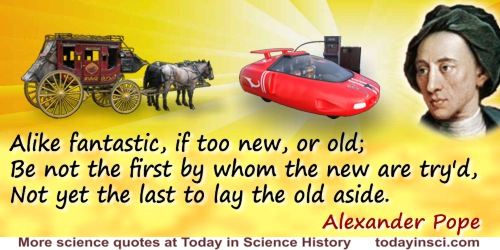
Alike fantastic, if too new, or old;
Be not the first by whom the new are try'd,
Not yet the last to lay the old aside.
Be not the first by whom the new are try'd,
Not yet the last to lay the old aside.
In An Essay on Criticism. With notes by Mr. Warburton (1749), 49.
An important scientific innovation rarely makes its way by gradually winning over and converting its opponents. What does happen is that its opponents gradually die out, and that the growing generation is familiarized with the ideas from the beginning.
Scientific Autobiography and Other Papers, trans. F. Gaynor (1950), 97. Quoted in David L. Hull, Science as a Process (1990), 379.
Around here, however, we don't look backwards for very long. We keep moving forward, opening up new doors, and doing new things, because we're curious and curiosity keeps leading us down new paths.
In Juz Griffiths, Disneyland Paris - The Family Guide (2007), opening page.
As the birth of living creatures are ill shapen; so are all innovations, which are the births of time.
From essay, 'Of Innovations'. As collected and translated in The Works of Francis Bacon (1765), Vol. 1, 479.
As the births of living creatures are ill-shapen, so are all innovations, which are the births of time.
XXIV. On Innovation,' Essays (1597). In Francis Bacon and Basil Montagu, The Works of Francis Bacon, Lord Chancellor of England (1852), 32
Biological disciplines tend to guide research into certain channels. One consequence is that disciplines are apt to become parochial, or at least to develop blind spots, for example, to treat some questions as “interesting” and to dismiss others as “uninteresting.” As a consequence, readily accessible but unworked areas of genuine biological interest often lie in plain sight but untouched within one discipline while being heavily worked in another. For example, historically insect physiologists have paid relatively little attention to the behavioral and physiological control of body temperature and its energetic and ecological consequences, whereas many students of the comparative physiology of terrestrial vertebrates have been virtually fixated on that topic. For the past 10 years, several of my students and I have exploited this situation by taking the standard questions and techniques from comparative vertebrate physiology and applying them to insects. It is surprising that this pattern of innovation is not more deliberately employed.
In 'Scientific innovation and creativity: a zoologist’s point of view', American Zoologist (1982), 22, 233.
Creativity is the basis of all innovation, and although it is doubtful that it can be taught, creativity should be nurtured in those who have it.
From keynote address, 'Will Innovation Flourish in the Future?' (2002), as adapted for Opinion article in The Industrial Physicist (Dec-Jan 2003-03), 8, No. 6, 23. The address was presented at Conference, 'Infrastructure for e-Business, e-Education, e-Science, and e-Medicine', at Scuola Superiore G. Reiss Romoli in L’Aquila, Italy (Jul 29-Aug 4, 2002).
Environmentalism opposes reckless innovation and makes conservation the central order of business.
…...
Great innovations, whether in art or literature, in science or in nature, seldom take the world by storm. They must be understood before they can be estimated, and must be cultivated before they can be understood.
In Tertiary History of the Grand Cañon District: With Atlas (1882), 142.
I believe [the Department of Energy] should be judged not by the money we direct to a particular State or district, company, university or national lab, but by the character of our decisions. The Department of Energy serves the country as a Department of Science, a Department of Innovation, and a Department of Nuclear Security.
In letter (1 Feb 2013) to Energy Department employees announcing his decision not to serve a second term.
I had an immense advantage over many others dealing with the problem inasmuch as I had no fixed ideas derived from long-established practice to control and bias my mind, and did not suffer from the general belief that whatever is, is right.
In Sir Henry Bessemer, F.R.S.: An Autobiography (1905), 93.
I think it perfectly just, that he who, from the love of experiment, quits an approved for an uncertain practice, should suffer the full penalty of Egyptian law against medical innovation; as I would consign to the pillory, the wretch, who out of regard to his character, that is, to his fees, should follow the routine, when, from constant experience he is sure that his patient will die under it, provided any, not inhuman, deviation would give his patient a chance.
From his researches in Fever, 196. In John Edmonds Stock, Memoirs of the life of Thomas Beddoes (1810), 400.
I would like to see us continue to explore space. There's just a lot for us to keep learning. I think it’s a good investment, so on my list of things that I want our country to invest in—in terms of research and innovation and science, basic science, exploring space, exploring our oceans, exploring our genome—we’re at the brink of all kinds of new information. Let's not back off now!
At Town Hall Meeting, Dover, New Hampshire (16 Jul 2015). As quoted in Clare Foran, 'Hillary Clinton: I Wanted to Be an Astronaut', National Journal (16 Jul 2015).
I’m convinced that the best solutions are often the ones that are counterintuitive—that challenge conventional thinking—and end in breakthroughs. It is always easier to do things the same old way … why change? To fight this, keep your dissatisfaction index high and break with tradition. Don’t be too quick to accept the way things are being done. Question whether there’s a better way. Very often you will find that once you make this break from the usual way - and incidentally, this is probably the hardest thing to do—and start on a new track your horizon of new thoughts immediately broadens. New ideas flow in like water. Always keep your interests broad - don’t let your mind be stunted by a limited view.
1988
I'd climb in the car as it went down the assembly line and introduce myself. Then I'd ask for ideas.
[How, as Ford manager of development for the Taurus car, he sought input from Ford production employees.]
[How, as Ford manager of development for the Taurus car, he sought input from Ford production employees.]
Quoted in Business Week, Issues 3015-3023 (1987). In Robert H. Waterman, The Renewal Factor (1988), 147.
If mankind is to profit freely from the small and sporadic crop of the heroically gifted it produces, it will have to cultivate the delicate art of handling ideas. Psychology is now able to tell us with reasonable assurance that the most influential obstacle to freedom of thought and to new ideas is fear; and fear which can with inimitable art disguise itself as caution, or sanity, or reasoned skepticism, or on occasion even as courage.
'The Commemoration of Great Men', Hunterian Oration, Royal College of Surgeons (15 Feb 1952) British Medical Journal (20 Feb 1932), 1, 317-20. The Collected Papers of Wilfred Trotter, FRS (1941), 30.
If there is a regulation that says you have to do something—whether it be putting in seat belts, catalytic converters, clean air for coal plants, clean water—the first tack that the lawyers use, among others things, and that companies use, is that it’s going to drive the electricity bill up, drive the cost of cars up, drive everything up. It repeatedly has been demonstrated that once the engineers start thinking about it, it’s actually far less than the original estimates. We should remember that when we hear this again, because you will hear it again.
Talk (Apr 2007) quoted in 'Obama's Energy and Environment Team Includes a Nobel Laureate', Kent Garber, US News website (posted 11 Dec 2008).
In 1847 I gave an address at Newton, Mass., before a Teachers’ Institute conducted by Horace Mann. My subject was grasshoppers. I passed around a large jar of these insects, and made every teacher take one and hold it while I was speaking. If any one dropped the insect, I stopped till he picked it up. This was at that time a great innovation, and excited much laughter and derision. There can be no true progress in the teaching of natural science until such methods become general.
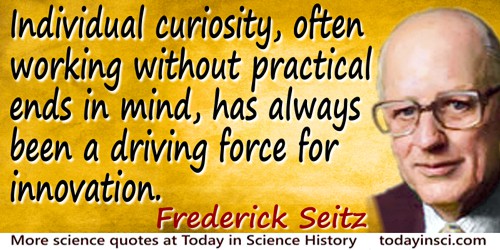
Individual curiosity, often working without practical ends in mind, has always been a driving force for innovation.
From The Science Matrix: The Journey, Travails, Triumphs (1992, 1998), 39.
Innovation is not the product of logical thought, even though the final product is tied to a logical structure.
…...
Innovation is the key to the future, but basic research is the key to future innovation.
From keynote address, 'Will Innovation Flourish in the Future?' (2002), as adapted for Opinion article in The Industrial Physicist (Dec-Jan 2003-03), 8, No. 6, 22. The address was presented at Conference, 'Infrastructure for e-Business, e-Education, e-Science, and e-Medicine', at Scuola Superiore G. Reiss Romoli in L’Aquila, Italy (Jul 29-Aug 4, 2002).
Innovations, free thinking is blowing like a storm; those that stand in front of it, ignorant scholars like you, false scientists, perverse conservatives, obstinate goats, resisting mules are being crushed under the weight of these innovations. You are nothing but ants standing in front of the giants; nothing but chicks trying to challenge roaring volcanoes!
From the play Galileo Galilei (2001) .
It’s a good thing to turn your mind upside down now and then, like an hour-glass, to let the particles run the other way.
The Haunted Bookshop (1919), 13.
It’s very dangerous to invent something in our times; ostentatious men of the other world, who are hostile to innovations, roam about angrily. To live in peace, one has to stay away from innovations and new ideas. Innovations, like trees, attract the most destructive lightnings to themselves.
From the play Galileo Galilei (2001) .
Most of the crackpot papers which are submitted to The Physical Review are rejected, not because it is impossible to understand them, but because it is possible. Those which are impossible to understand are usually published. When the great innovation appears, it will almost certainly be in a muddled, incomplete and confusing form. To the discoverer himself it will be only half-understood; to everybody else it will be a mystery. For any speculation which does not at first glance look crazy, there is no hope.
In 'Innovation in Physics', Scientific American (Sep 1958), 199. Collected in From Eros to Gaia (1993).
Natural conservatism and dislike of innovation appear in the ranks of science more strongly than most people are aware.
In 'The Discovery of Radioactivity: Radioactivity, a New Science', The Interpretation of Radium and the Structure of the Atom (4th ed., 1920), 3.
New ideas seem like frightening ghosts to people at the beginning; they run away from them for a long time, but they get tired of it in the end!
From the play Galileo Galilei (2001) .
Obviously everyone wants to be successful, but I want to be looked back on as being very innovative, very trusted and ethical and ultimately making a big difference in the world.
Concerning philanthropy and investment in alternative energy research. In Tim Walker, 'Sergey Brin: Engine Driver', Independent (15 Jan 2010).
Our attention will focus on the institutional context of technological innovation rather than … individual inventors, for the actual course of work that leads to the conception and use of technology always involves a group that has worked for a considerable period of time on the basic idea before success is achieved.
In The Social Context of Innovation: Bureaucrats, Families, and Heroes in the Early Industrial Revolution as Foreseen in Bacon’s New Atlantis (1982, 2003), 3.
Surely every medicine is an innovation, and he that will not apply new remedies must expect new evils for time is the greatest innovator.
From essay, 'Of Innovations' (1625). As collected and translated in The Works of Francis Bacon (1765), Vol. 1, 479.
The feudal model of agriculture collided, first, with environmental limits and then with a massive external shock – the Black Death. After that, there was a demographic shock: too few workers for the land, which raised their wages and made the old feudal obligation system impossible to enforce. The labour shortage also forced technological innovation. The new technologies that underpinned the rise of merchant capitalism were the ones that stimulated commerce (printing and accountancy), the creation of tradeable wealth (mining, the compass and fast ships) and productivity (mathematics and the scientific method).
In 'The End of Capitalism Has Begun', The Guardian (17 Jul 2015) (online).
The Grand Cañon of the Colorado is a great innovation in modern ideas of scenery, and in our conceptions of the grandeur, beauty, and power of nature. As with all great innovations it is not to be comprehended in a day or a week, nor even in a month. It must be dwelt upon and studied, and the study must comprise the slow acquisition of the meaning and spirit of that marvelous scenery which characterizes the Plateau Country, and of which the great chasm is the superlative manifestation.
In Tertiary History of the Grand Cañon District: With Atlas (1882), Vol. 2, 141.
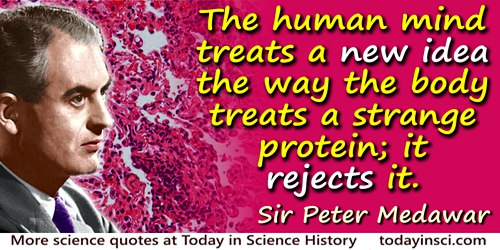
The human mind treats a new idea the way the body treats a strange protein; it rejects it.
The Art of the Soluble (1967). Quoted in Colin J. Sanderson, Understanding Genes and GMOs (2007), 1.
The kind of lecture which I have been so kindly invited to give, and which now appears in book form, gives one a rare opportunity to allow the bees in one's bonnet to buzz even more noisily than usual.
From Assumption and Myth in Physical Theory (1967), v.
The principal goal of education is to create men who are capable of doing new things, not simply of repeating what other generations have done—men who are creative, inventive, and discovers. The second goal of education is to form minds which can be critical, can verify, and not accept everything they are offered.
From remarks at a conference on cognitive development, Cornell University (1964). In Philip Hampson Taylor, New Directions in Curriculum Studies (1979), 90.
The reason why new concepts in any branch of science are hard to grasp is always the same; contemporary scientists try to picture the new concept in terms of ideas which existed before.
In 'Innovation in Physics', Scientific American, 1958, 199, 76. Collected in From Eros to Gaia (1993).
The same society which receives the rewards of technology must, as a cooperating whole, take responsibility for control. To deal with these new problems will require a new conservation. We must not only protect the countryside and save it from destruction, we must restore what has been destroyed and salvage the beauty and charm of our cities. Our conservation must be not just the classic conservation of protection and development, but a creative conservation of restoration and innovation. Its concern is not with nature alone, but with the total relation between man and the world around him. Its object is not just man's welfare, but the dignity of man's spirit.
In his 'Message to Congress on Conservation and Restoration of Natural Beauty' written to Congress (8 Feb 1965). It was a broad initiative aimed at beautifying America, guaranteeing water and air quality, and preserving natural areas. In Lyndon B. Johnson: Containing the Public Messages, Speeches, and Statements of the President (1965), Vol.1, 156.
United States. President (1963-1969 : Johnson), Lyndon Baines Johnson, United States. Office of the Federal Register - 1970
There are those who say we cannot afford to invest in science, that support for research is somehow a luxury at moments defined by necessities. I fundamentally disagree. Science is more essential for our prosperity, our security, our health, our environment, and our quality of life than it has ever been before. … we can't allow our nation to fall behind. Unfortunately, that's exactly what's happened. Federal funding in the physical sciences as a portion of our gross domestic product has fallen by nearly half over the past quarter century. Time and again we've allowed the research and experimentation tax credit, which helps businesses grow and innovate, to lapse.
Speech to the National Academy of Sciences Annual Meeting (27 Apr 2009).
There are, as we have seen, a number of different modes of technological innovation. Before the seventeenth century inventions (empirical or scientific) were diffused by imitation and adaption while improvement was established by the survival of the fittest. Now, technology has become a complex but consciously directed group of social activities involving a wide range of skills, exemplified by scientific research, managerial expertise, and practical and inventive abilities. The powers of technology appear to be unlimited. If some of the dangers may be great, the potential rewards are greater still. This is not simply a matter of material benefits for, as we have seen, major changes in thought have, in the past, occurred as consequences of technological advances.
Concluding paragraph of "Technology," in Dictionary of the History of Ideas (1973), Vol. 4, 364.
Throughout his career, [Richard] Drew tried to create an environment where people were encouraged to follow their instincts. He was known at 3M as a consummate mentor, encouraging and helping to train many of the company’s young scientists, who went on to develop successful products of their own, paving the way for 3M’s culture of innovation.
— Magazine
In Press Release (7 May 2007) on 3M Company website.
Until its results have gone through the painful process of publication, preferably in a refereed journal of high standards, scientific research is just play. Publication is an indispensable part of science. “Publish or perish” is not an indictment of the system of academia; it is a partial prescription for creativity and innovation. Sustained and substantial publication favors creativity. Novelty of conception has a large component of unpredictability. ... One is often a poor judge of the relative value of his own creative efforts. An artist’s ranking of his own works is rarely the same as that of critics or of history. Most scientists have had similar experiences. One’s supply of reprints for a pot-boiler is rapidly exhausted, while a major monograph that is one’s pride and joy goes unnoticed. The strategy of choice is to increase the odds favoring creativity by being productive.
In 'Scientific innovation and creativity: a zoologist’s point of view', American Zoologist (1982), 22, 233-234.
We were not the victims of ancestor worship. We had the benefits of a fresh start.
[Explaining why his company became a leader in the digital HDTV industry.]
[Explaining why his company became a leader in the digital HDTV industry.]
Quoted in Edmund L. Andrews, 'And Now for Something Substantially Different: Digital TV', New York Times (12 Jul 1992), 127.
Were I to make the announcement and to run, the reasons I would run is because I have a great belief in this country [America]. … There’s more natural resources than any nation in the world; the greatest education population in the world; the greatest technology of any country in the world; the greatest capacity for innovation in the world; and the greatest political system in the world.
Answer to “Why do you want to be President,” interview with Roger Mudd, CBS TV documentary (12 Oct 1979). In Jim Lehrer and James Lehrer, Tension City: Inside the Presidential Debates (2011), 184.
When it’s too easy to get money, then you get a lot of noise mixed in with the real innovation and entrepreneurship. Tough times bring out the best parts of Silicon Valley
As quoted by Jessica Guynn, reporting on a media roundtable at a conference on Google’s campus, in 'Google’s Schmidt, Page and Brin hold court at Zeitgeist', Los Angeles Times (17 Sep 2008). On latimesblogs.latimes.com webpage.
Whether it’s the science to slow global warming; the technology to protect our troops and confront bioterror and weapons of mass destruction; the research to find life-saving cures; or the innovations to remake our industries and create twenty-first century jobs—Today, more than ever before, science holds the key to our survival as a planet and our security and prosperity as a nation. It’s time we once again put science at the top of our agenda and work to restore America’s place as the world leader in science and technology.
From weekly Democratic address as President-Elect, online video (20 Dec 2008), announcing his selection of science and technology advisers. C-Span video 282995-102.
Who never walks save where he see men's tracks makes no discoveries.
In Kathrina, her Life and Mine in a Poem (1895), 220.
 In science it often happens that scientists say, 'You know that's a really good argument; my position is mistaken,' and then they would actually change their minds and you never hear that old view from them again. They really do it. It doesn't happen as often as it should, because scientists are human and change is sometimes painful. But it happens every day. I cannot recall the last time something like that happened in politics or religion.
(1987) --
In science it often happens that scientists say, 'You know that's a really good argument; my position is mistaken,' and then they would actually change their minds and you never hear that old view from them again. They really do it. It doesn't happen as often as it should, because scientists are human and change is sometimes painful. But it happens every day. I cannot recall the last time something like that happened in politics or religion.
(1987) --