Inference Quotes (45 quotes)
A mere inference or theory must give way to a truth revealed; but a scientific truth must be maintained, however contradictory it may appear to the most cherished doctrines of religion.
More Worlds Than One: The Creed of the Philosopher and the Hope of the Christian (1856), 132.
A principle of induction would be a statement with the help of which we could put inductive inferences into a logically acceptable form. In the eyes of the upholders of inductive logic, a principle of induction is of supreme importance for scientific method: “... this principle”, says Reichenbach, “determines the truth of scientific theories. To eliminate it from science would mean nothing less than to deprive science of the power to decide the truth or falsity of its theories. Without it, clearly, science would no longer have the right to distinguish its theories from the fanciful and arbitrary creations of the poet’s mind.” Now this principle of induction cannot be a purely logical truth like a tautology or an analytic statement. Indeed, if there were such a thing as a purely logical principle of induction, there would be no problem of induction; for in this case, all inductive inferences would have to be regarded as purely logical or tautological transformations, just like inferences in inductive logic. Thus the principle of induction must be a synthetic statement; that is, a statement whose negation is not self-contradictory but logically possible. So the question arises why such a principle should be accepted at all, and how we can justify its acceptance on rational grounds.
…...
All the human culture, all the results of art, science and technology that we see before us today, are almost exclusively the creative product of the Aryan. This very fact admits of the not unfounded inference that he alone was the founder of all higher humanity, therefore representing the prototype of all that we understand by the word 'man.' He is the Prometheus of mankind from whose shining brow the divine spark of genius has sprung at all times, forever kindling anew that fire of knowledge which illuminated the night of silent mysteries and thus caused man to climb the path to mastery over the other beings of the earth ... It was he who laid the foundations and erected the walls of every great structure in human culture.
Mein Kampf (1925-26), American Edition (1943), 290. In William Lawrence Shirer, The Rise and Fall of the Third Reich (1990), 86-87.
Certain students of genetics inferred that the Mendelian units responsible for the selected character were genes producing only a single effect. This was careless logic. It took a good deal of hammering to get rid of this erroneous idea. As facts accumulated it became evident that each gene produces not a single effect, but in some cases a multitude of effects on the characters of the individual. It is true that in most genetic work only one of these character-effects is selected for study—the one that is most sharply defined and separable from its contrasted character—but in most cases minor differences also are recognizable that are just as much the product of the same gene as is the major effect.
'The Relation of Genetics to Physiology and Medicine', Nobel Lecture (4 Jun 1934). In Nobel Lectures, Physiology or Medicine 1922-1941 (1965), 317.
Gödel proved that the world of pure mathematics is inexhaustible; no finite set of axioms and rules of inference can ever encompass the whole of mathematics; given any finite set of axioms, we can find meaningful mathematical questions which the axioms leave unanswered. I hope that an analogous Situation exists in the physical world. If my view of the future is correct, it means that the world of physics and astronomy is also inexhaustible; no matter how far we go into the future, there will always be new things happening, new information coming in, new worlds to explore, a constantly expanding domain of life, consciousness, and memory.
From Lecture 1, 'Philosophy', in a series of four James Arthur Lectures, 'Lectures on Time and its Mysteries' at New York University (Autumn 1978). Printed in 'Time Without End: Physics and Biology in an Open Universe', Reviews of Modern Physics (Jul 1979), 51, 449.
Haldane was engaged in discussion with an eminent theologian. “What inference,” asked the latter, “might one draw about the nature of God from a study of his works?” Haldane replied: “An inordinate fondness for beetles.”
As quoted in Clifton Fadiman (ed.), André Bernard (ed.), Bartlett's Book of Anecdotes (2000), 253.
Historical science is not worse, more restricted, or less capable of achieving firm conclusions because experiment, prediction, and subsumption under invariant laws of nature do not represent its usual working methods. The sciences of history use a different mode of explanation, rooted in the comparative and observational richness in our data. We cannot see a past event directly, but science is usually based on inference, not unvarnished observation (you don’t see electrons, gravity, or black holes either).
…...
I believed that, instead of the multiplicity of rules that comprise logic, I would have enough in the following four, as long as I made a firm and steadfast resolution never to fail to observe them.
The first was never to accept anything as true if I did not know clearly that it was so; that is, carefully to avoid prejudice and jumping to conclusions, and to include nothing in my judgments apart from whatever appeared so clearly and distinctly to my mind that I had no opportunity to cast doubt upon it.
The second was to subdivide each on the problems I was about to examine: into as many parts as would be possible and necessary to resolve them better.
The third was to guide my thoughts in an orderly way by beginning, as if by steps, to knowledge of the most complex, and even by assuming an order of the most complex, and even by assuming an order among objects in! cases where there is no natural order among them.
And the final rule was: in all cases, to make such comprehensive enumerations and such general review that I was certain not to omit anything.
The long chains of inferences, all of them simple and easy, that geometers normally use to construct their most difficult demonstrations had given me an opportunity to think that all the things that can fall within the scope of human knowledge follow from each other in a similar way, and as long as one avoids accepting something as true which is not so, and as long as one always observes the order required to deduce them from each other, there cannot be anything so remote that it cannot be reached nor anything so hidden that it cannot be uncovered.
The first was never to accept anything as true if I did not know clearly that it was so; that is, carefully to avoid prejudice and jumping to conclusions, and to include nothing in my judgments apart from whatever appeared so clearly and distinctly to my mind that I had no opportunity to cast doubt upon it.
The second was to subdivide each on the problems I was about to examine: into as many parts as would be possible and necessary to resolve them better.
The third was to guide my thoughts in an orderly way by beginning, as if by steps, to knowledge of the most complex, and even by assuming an order of the most complex, and even by assuming an order among objects in! cases where there is no natural order among them.
And the final rule was: in all cases, to make such comprehensive enumerations and such general review that I was certain not to omit anything.
The long chains of inferences, all of them simple and easy, that geometers normally use to construct their most difficult demonstrations had given me an opportunity to think that all the things that can fall within the scope of human knowledge follow from each other in a similar way, and as long as one avoids accepting something as true which is not so, and as long as one always observes the order required to deduce them from each other, there cannot be anything so remote that it cannot be reached nor anything so hidden that it cannot be uncovered.
Discourse on Method in Discourse on Method and Related Writings (1637), trans. Desmond M. Clarke, Penguin edition (1999), Part 2, 16.
If ... the past may be no Rule for the future, all Experience becomes useless and can give rise to no Inferences or Conclusions.
An Enquiry Concerning Human Understanding (1748), 65.
In attempting to understand the elements out of which mental phenomena are compounded, it is of the greatest importance to remember that from the protozoa to man there is nowhere a very wide gap either in structure or in behaviour. From this fact it is a highly probable inference that there is also nowhere a very wide mental gap.
Lecture II, 'Instinct and Habit', The Analysis of Mind
![Ronald Aylmer Fisher quote Inductive inference … [for] new knowledge.](https://todayinsci.com/F/Fisher_Ronald/FisherRonald-Inference500x250px.jpg "Click here for larger picture")
Inductive inference is the only process known to us by which essentially new knowledge comes into the world.
In The Design of Experiments (1935, 1971), 7.
Intelligence is an extremely subtle concept. It’s a kind of understanding that flourishes if it’s combined with a good memory, but exists anyway even in the absence of good memory. It’s the ability to draw consequences from causes, to make correct inferences, to foresee what might be the result, to work out logical problems, to be reasonable, rational, to have the ability to understand the solution from perhaps insufficient information. You know when a person is intelligent, but you can be easily fooled if you are not yourself intelligent.
In Irv Broughton (ed.), The Writer's Mind: Interviews with American Authors (1990), Vol. 2, 57.
It is as true now, as it was in the days when Werner first drew his far-reaching inferences before his charmed listeners, that on the characteristic phenomena and varying distribution of the grand mineral masses of the rock-formations, almost all that concerns the relative habitability of a land depends.
In 'The Relations of Geology', Scottish Geographical Magazine (Aug 1902), 19, No. 8, 409.
It is difficult for the matter-of-fact physicist to accept the view that the substratum of everything is of mental character. But no one can deny that mind is the first and most direct thing in our experience, and all else is remote inference—inference either intuitive or deliberate.
From Gifford Lecture, Edinburgh, (1927), 'Reality', collected in The Nature of the Physical World (1928), 281.
It might be thought … that evolutionary arguments would play a large part in guiding biological research, but this is far from the case. It is difficult enough to study what is happening now. To figure out exactly what happened in evolution is even more difficult. Thus evolutionary achievements can be used as hints to suggest possible lines of research, but it is highly dangerous to trust them too much. It is all too easy to make mistaken inferences unless the process involved is already very well understood.
In What Mad Pursuit: A Personal View of Scientific Discovery (1988), 138-139.
Mind is the first and most direct thing in our experience; all else is remote inference.
Swarthmore Lecture (1929) at Friends’ House, London, printed in Science and the Unseen World (1929), 37.
One of the main purposes of scientific inference is to justify beliefs which we entertain already; but as a rule they are justified with a difference. Our pre-scientific general beliefs are hardly ever without exceptions; in science, a law with exceptions can only be tolerated as a makeshift. Scientific laws, when we have reason to think them accurate, are different in form from the common-sense rules which have exceptions: they are always, at least in physics, either differential equations, or statistical averages. It might be thought that a statistical average is not very different from a rule with exceptions, but this would be a mistake. Statistics, ideally, are accurate laws about large groups; they differ from other laws only in being about groups, not about individuals. Statistical laws are inferred by induction from particular statistics, just as other laws are inferred from particular single occurrences.
The Analysis of Matter (1927), 191.
Organs, faculties, powers, capacities, or whatever else we call them; grow by use and diminish from disuse, it is inferred that they will continue to do so. And if this inference is unquestionable, then is the one above deduced from it—that humanity must in the end become completely adapted to its conditions—unquestionable also. Progress, therefore, is not an accident, but a necessity.
Social Statics: Or, The Conditions Essential to Human Happiness Specified, and the First of them Developed (1851), 65.
Science gives us the grounds of premises from which religious truths are to be inferred; but it does not set about inferring them, much less does it reach the inference; that is not its province. It brings before us phenomena, and it leaves us, if we will, to call them works of design, wisdom, or benevolence; and further still, if we will, to proceed to confess an Intelligent Creator. We have to take its facts, and to give them a meaning, and to draw our own conclusions from them. First comes Knowledge, then a view, then reasoning, then belief. This is why Science has so little of a religious tendency; deductions have no power of persuasion. The heart is commonly reached, not through the reason, but through the imagination, by means of direct impressions, by the testimony of facts and events, by history, by description. Persons influence us, voices melt us, looks subdue us, deeds inflame us. Many a man will live and die upon a dogma; no man will be a martyr for a conclusion.
Letter collected in Tamworth Reading Room: Letters on an Address Delivered by Sir Robert Peel, Bart., M.P. on the Establishment of a Reading Room at Tamworth (1841), 32. Excerpted in John Henry Newman, An Essay in Aid of a Grammar of Assent (1870), 89 & 94 footnote.
Science, then, is the attentive consideration of common experience; it is common knowledge extended and refined. Its validity is of the same order as that of ordinary perception; memory, and understanding. Its test is found, like theirs, in actual intuition, which sometimes consists in perception and sometimes in intent. The flight of science is merely longer from perception to perception, and its deduction more accurate of meaning from meaning and purpose from purpose. It generates in the mind, for each vulgar observation, a whole brood of suggestions, hypotheses, and inferences. The sciences bestow, as is right and fitting, infinite pains upon that experience which in their absence would drift by unchallenged or misunderstood. They take note, infer, and prophesy. They compare prophesy with event, and altogether they supply—so intent are they on reality—every imaginable background and extension for the present dream.
The Life of Reason, or the Phases of Human Progress (1954), 393.
Scientific method, although in its more refined forms it may seem complicated, is in essence remarkably simply. It consists in observing such facts as will enable the observer to discover general laws governing facts of the kind in question. The two stages, first of observation, and second of inference to a law, are both essential, and each is susceptible of almost indefinite refinement. (1931)
In The Scientific Outlook (1931, 2009), 3.
Scientists are not robotic inducing machines that infer structures of explanation only from regularities observed in natural phenomena (assuming, as I doubt, that such a style of reasoning could ever achieve success in principle). Scientists are human beings, immersed in culture, and struggling with all the curious tools of inference that mind permits ... Culture can potentiate as well as constrain–as Darwin’s translation of Adam Smith’s laissez-faire economic models into biology as the theory of natural selection. In any case, objective minds do not exist outside culture, so we must make the best of our ineluctable embedding.
…...
Suppose then I want to give myself a little training in the art of reasoning; suppose I want to get out of the region of conjecture and probability, free myself from the difficult task of weighing evidence, and putting instances together to arrive at general propositions, and simply desire to know how to deal with my general propositions when I get them, and how to deduce right inferences from them; it is clear that I shall obtain this sort of discipline best in those departments of thought in which the first principles are unquestionably true. For in all our thinking, if we come to erroneous conclusions, we come to them either by accepting false premises to start with—in which case our reasoning, however good, will not save us from error; or by reasoning badly, in which case the data we start from may be perfectly sound, and yet our conclusions may be false. But in the mathematical or pure sciences,—geometry, arithmetic, algebra, trigonometry, the calculus of variations or of curves,— we know at least that there is not, and cannot be, error in our first principles, and we may therefore fasten our whole attention upon the processes. As mere exercises in logic, therefore, these sciences, based as they all are on primary truths relating to space and number, have always been supposed to furnish the most exact discipline. When Plato wrote over the portal of his school. “Let no one ignorant of geometry enter here,” he did not mean that questions relating to lines and surfaces would be discussed by his disciples. On the contrary, the topics to which he directed their attention were some of the deepest problems,— social, political, moral,—on which the mind could exercise itself. Plato and his followers tried to think out together conclusions respecting the being, the duty, and the destiny of man, and the relation in which he stood to the gods and to the unseen world. What had geometry to do with these things? Simply this: That a man whose mind has not undergone a rigorous training in systematic thinking, and in the art of drawing legitimate inferences from premises, was unfitted to enter on the discussion of these high topics; and that the sort of logical discipline which he needed was most likely to be obtained from geometry—the only mathematical science which in Plato’s time had been formulated and reduced to a system. And we in this country [England] have long acted on the same principle. Our future lawyers, clergy, and statesmen are expected at the University to learn a good deal about curves, and angles, and numbers and proportions; not because these subjects have the smallest relation to the needs of their lives, but because in the very act of learning them they are likely to acquire that habit of steadfast and accurate thinking, which is indispensable to success in all the pursuits of life.
In Lectures on Teaching (1906), 891-92.
That man is the noblest creature may also be inferred from the fact that no other creature has yet contested this claim.
Aphorism 58 in Notebook D (1773-1775), as translated by R.J. Hollingdale in Aphorisms (1990). Reprinted as The Waste Books (2000), 52.
The development of mathematics toward greater precision has led, as is well known, to the formalization of large tracts of it, so that one can prove any theorem using nothing but a few mechanical rules... One might therefore conjecture that these axioms and rules of inference are sufficient to decide any mathematical question that can at all be formally expressed in these systems. It will be shown below that this is not the case, that on the contrary there are in the two systems mentioned relatively simple problems in the theory of integers that cannot be decided on the basis of the axioms.
'On Formally Undecidable Propositions of Principia Mathematica and Related Systems I' (193 1), in S. Feferman (ed.), Kurt Gödel Collected Works: Publications 1929-1936 (1986), Vol. I, 145.
The difference between an ordinary mind and the mind of Newton consists principally in this, that the one is capable of a more continuous attention than the other,—that a Newton is able, without fatigue, to connect inference with inference in one long series towards a determinate end; while the man of inferior capacity is soon obliged to break or let full the thread which lie had begun to spin.
In Lectures on Metaphysics and Logic (1860), Vol. 1, 178.
The ends to be attained [in Teaching of Mathematics in the secondary schools] are the knowledge of a body of geometrical truths, the power to draw correct inferences from given premises, the power to use algebraic processes as a means of finding results in practical problems, and the awakening of interest in the science of mathematics.
In 'Aim of the Mathematical Instruction', International Commission on Teaching of Mathematics, American Report: United States Bureau of Education: Bulletin 1912, No. 4, 7.
The first man who said “fire burns” was employing scientific method, at any rate if he had allowed himself to be burnt several times. This man had already passed through the two stages of observation and generalization. He had not, however, what scientific technique demands—a careful choice of significant facts on the one hand, and, on the other hand, various means of arriving at laws otherwise than my mere generalization. (1931)
In The Scientific Outlook (1931, 2009), 3.
The inherent unpredictability of future scientific developments—the fact that no secure inference can be drawn from one state of science to another—has important implications for the issue of the limits of science. It means that present-day science cannot speak for future science: it is in principle impossible to make any secure inferences from the substance of science at one time about its substance at a significantly different time. The prospect of future scientific revolutions can never be precluded. We cannot say with unblinking confidence what sorts of resources and conceptions the science of the future will or will not use. Given that it is effectively impossible to predict the details of what future science will accomplish, it is no less impossible to predict in detail what future science will not accomplish. We can never confidently put this or that range of issues outside “the limits of science”, because we cannot discern the shape and substance of future science with sufficient clarity to be able to say with any assurance what it can and cannot do. Any attempt to set “limits” to science—any advance specification of what science can and cannot do by way of handling problems and solving questions—is destined to come to grief.
The Limits of Science (1984), 102-3.
The statistician cannot excuse himself from the duty of getting his head clear on the principles of scientific inference, but equally no other thinking man can avoid a like obligation.
The Design of Experiments (1935), 2.
The very foundation of our science is only an inference; far the whole of it rests an the unprovable assumption that, all through the inferred lapse of time which the inferred performance of inferred geological processes involves, they have been going on in a manner consistent with the laws of nature as we know them now.
'The Value of Outrageous Geological Hypotheses', Science, 1926, 63, 465-466.
Theories rarely arise as patient inferences forced by accumulated facts. Theories are mental constructs potentiated by complex external prods (including, in idealized cases, a commanding push from empirical reality) . But the prods often in clude dreams, quirks, and errors–just as we may obtain crucial bursts of energy from foodstuffs or pharmaceuticals of no objective or enduring value. Great truth can emerge from small error. Evolution is thrilling, liberating, and correct. And Macrauchenia is a litoptern.
…...
There is a mask of theory over the whole face of nature, if it be theory to infer more than we see.
The Philosophy of the Inductive Sciences: Founded Upon Their History (1840), Vol. 1, 24.
There is in every step of an arithmetical or algebraical calculation a real induction, a real inference from facts to facts, and what disguises the induction is simply its comprehensive nature, and the consequent extreme generality of its language.
In System of Logic, Bk. 2, chap. 6, 2.
There is nothing distinctively scientific about the hypothetico-deductive process. It is not even distinctively intellectual. It is merely a scientific context for a much more general stratagem that underlies almost all regulative processes or processes of continuous control, namely feedback, the control of performance by the consequences of the act performed. In the hypothetico-deductive scheme the inferences we draw from a hypothesis are, in a sense, its logical output. If they are true, the hypothesis need not be altered, but correction is obligatory if they are false. The continuous feedback from inference to hypothesis is implicit in Whewell’s account of scientific method; he would not have dissented from the view that scientific behaviour can be classified as appropriately under cybernetics as under logic.
Induction and Intuition in Scientific Thought (1969), 54-5.
Thinking is merely the comparing of ideas, discerning relations of likeness and of difference between ideas, and drawing inferences. It is seizing general truths on the basis of clearly apprehended particulars. It is but generalizing and particularizing. Who will deny that a child can deal profitably with sequences of ideas like: How many marbles are 2 marbles and 3 marbles? 2 pencils and 3 pencils? 2 balls and 3 balls? 2 children and 3 children? 2 inches and 3 inches? 2 feet and 3 feet? 2 and 3? Who has not seen the countenance of some little learner light up at the end of such a series of questions with the exclamation, “Why it’s always that way. Isn’t it?” This is the glow of pleasure that the generalizing step always affords him who takes the step himself. This is the genuine life-giving joy which comes from feeling that one can successfully take this step. The reality of such a discovery is as great, and the lasting effect upon the mind of him that makes it is as sure as was that by which the great Newton hit upon the generalization of the law of gravitation. It is through these thrills of discovery that love to learn and intellectual pleasure are begotten and fostered. Good arithmetic teaching abounds in such opportunities.
In Arithmetic in Public Education (1909), 13. As quoted and cited in Robert Édouard Moritz, Memorabilia Mathematica; Or, The Philomath’s Quotation-book (1914), 68.
This leads us to ask for the reasons which call for this new theory of transmutation. The beginning of things must needs lie in obscurity, beyond the bounds of proof, though within those of conjecture or of analogical inference. Why not hold fast to the customary view, that all species were directly, instead of indirectly, created after their respective kinds, as we now behold them,--and that in a manner which, passing our comprehension, we intuitively refer to the supernatural? Why this continual striving after “the unattained and dim,”—these anxious endeavors, especially of late years, by naturalists and philosophers of various schools and different tendencies, to penetrate what one of them calls “the mystery of mysteries,” the origin of species? To this, in general, sufficient answer may be found in the activity of the human intellect, “the delirious yet divine desire to know,” stimulated as it has been by its own success in unveiling the laws and processes of inorganic Nature,—in the fact that the principal triumphs of our age in physical science have consisted in tracing connections where none were known before, in reducing heterogeneous phenomena to a common cause or origin, in a manner quite analogous to that of the reduction of supposed independently originated species to a common ultimate origin,—thus, and in various other ways, largely and legitimately extending the domain of secondary causes. Surely the scientific mind of an age which contemplates the solar system as evolved from a common, revolving, fluid mass,— which, through experimental research, has come to regard light, heat, electricity, magnetism, chemical affinity, and mechanical power as varieties or derivative and convertible forms of one force, instead of independent species,—which has brought the so-called elementary kinds of matter, such as the metals, into kindred groups, and raised the question, whether the members of each group may not be mere varieties of one species,—and which speculates steadily in the direction of the ultimate unity of matter, of a sort of prototype or simple element which may be to the ordinary species of matter what the protozoa or component cells of an organism are to the higher sorts of animals and plants,—the mind of such an age cannot be expected to let the old belief about species pass unquestioned.
— Asa Gray
'Darwin on the Origin of Species', The Atlantic Monthly (Jul 1860), 112-3. Also in 'Natural Selection Not Inconsistent With Natural Theology', Darwiniana: Essays and Reviews Pertaining to Darwinism (1876), 94-95.
Those who are unacquainted with the details of scientific investigation have no idea of the amount of labour expended in the determination of those numbers on which important calculations or inferences depend. They have no idea of the patience shown by a Berzelius in determining atomic weights; by a Regnault in determining coefficients of expansion; or by a Joule in determining the mechanical equivalent of heat.
In Sound: A Course of Eight Lectures Delivered at the Royal Institution of Great Britain (1867), 26.
Truly grand and powerful theories … do not and cannot rest upon single observations. Evolution is an inference from thousands of independent sources, the only conceptual structure that can make unified sense of all this disparate information. The failure of a particular claim usually records a local error, not the bankruptcy of a central theory … If I mistakenly identify your father’s brother as your own dad, you don’t become genealogically rootless and created de novo. You still have a father; we just haven’t located him properly.
Leonardo’s Mountain of Clams and the Diet of Worms: Essays on Natural History (1998), 155.
Truths are known to us in two ways: some are known directly, and of themselves; some through the medium of other truths. The former are the subject of Intuition, or Consciousness; the latter, of Inference; the latter of Inference. The truths known by Intuition are the original premisses, from which all others are inferred.
A System of Logic, Ratiocinative and Inductive (1858), 3.
We can scarcely avoid the inference that light consists in the transverse undulations of the same medium which is the cause of electric and magnetic phenomena.
'On Physical Lines of Force' (1862). In W. D. Niven (ed.), The Scientific Papers of James Clerk Maxwell (1890), Vol. 1, 500.
We do not learn by inference and deduction, and the application of mathematics to philosophy, but by direct intercourse and sympathy.
In 'Natural History of Massachusetts', The Dial: A Magazine for Literature, Philosophy, and Religion (Jul 1842), 3, No. 1, 40.
When a man of science speaks of his “data,” he knows very well in practice what he means. Certain experiments have been conducted, and have yielded certain observed results, which have been recorded. But when we try to define a “datum” theoretically, the task is not altogether easy. A datum, obviously, must be a fact known by perception. But it is very difficult to arrive at a fact in which there is no element of inference, and yet it would seem improper to call something a “datum” if it involved inferences as well as observation. This constitutes a problem. …
In The Analysis of Matter (1954).
Whoever wishes to acquire a deep acquaintance with Nature must observe that there are analogies which connect whole branches of science in a parallel manner, and enable us to infer of one class of phenomena what we know of another. It has thus happened on several occasions that the discovery of an unsuspected analogy between two branches of knowledge has been the starting point for a rapid course of discovery.
Principles of Science: A Treatise on Logic and Scientific Method (1874, 2nd ed., 1913), 631.
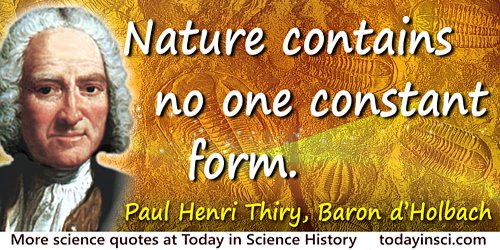
With respect to those who may ask why Nature does not produce new beings? We may enquire of them in turn, upon what foundation they suppose this fact? What it is that authorizes them to believe this sterility in Nature? Know they if, in the various combinations which she is every instant forming, Nature be not occupied in producing new beings, without the cognizance of these observers? Who has informed them that this Nature is not actually assembling, in her immense elaboratory, the elements suitable to bring to light, generations entirely new, that will have nothing in common with those of the species at present existing? What absurdity then, or what want of just inference would there be, to imagine that the man, the horse, the fish, the bird will be no more? Are these animals so indispensably requisite to Nature, that without them she cannot continue her eternal course? Does not all change around us? Do we not ourselves change? ... Nature contains no one constant form.
The System of Nature (1770), trans. Samuel Wilkinson (1820), Vol. 1, 94-95.
 In science it often happens that scientists say, 'You know that's a really good argument; my position is mistaken,' and then they would actually change their minds and you never hear that old view from them again. They really do it. It doesn't happen as often as it should, because scientists are human and change is sometimes painful. But it happens every day. I cannot recall the last time something like that happened in politics or religion.
(1987) --
In science it often happens that scientists say, 'You know that's a really good argument; my position is mistaken,' and then they would actually change their minds and you never hear that old view from them again. They really do it. It doesn't happen as often as it should, because scientists are human and change is sometimes painful. But it happens every day. I cannot recall the last time something like that happened in politics or religion.
(1987) -- 





