Increase Quotes (230 quotes)
“Divide et impera” is as true in algebra as in statecraft; but no less true and even more fertile is the maxim “auge et impera”.The more to do or to prove, the easier the doing or the proof.
In 'Proof of the Fundamental Theorem of Invariants', Philosophic Magazine (1878), 186. In Collected Mathematical Papers, 3, 126. [The Latin phrases, “Divide/auge et impera” translate as “Divide/increase and rule”.
“Every moment dies a man,/ Every moment one is born”:
I need hardly point out to you that this calculation would tend to keep the sum total of the world's population in a state of perpetual equipoise whereas it is a well-known fact that the said sum total is constantly on the increase. I would therefore take the liberty of suggesting that in the next edition of your excellent poem the erroneous calculation to which I refer should be corrected as follows:
'Every moment dies a man / And one and a sixteenth is born.” I may add that the exact figures are 1.167, but something must, of course, be conceded to the laws of metre.
I need hardly point out to you that this calculation would tend to keep the sum total of the world's population in a state of perpetual equipoise whereas it is a well-known fact that the said sum total is constantly on the increase. I would therefore take the liberty of suggesting that in the next edition of your excellent poem the erroneous calculation to which I refer should be corrected as follows:
'Every moment dies a man / And one and a sixteenth is born.” I may add that the exact figures are 1.167, but something must, of course, be conceded to the laws of metre.
Unpublished letter to Tennyson in response to his Vision of Sin (1842). Quoted in Philip and Emily Morrison, Charles Babbage and his Calculating Engines: Selected Writings by Charles Babbage and Others (1961), xxiii.
[1665-08-31] Up, and after putting several things in order to my removal to Woolwich, the plague having a great increase this week beyond all expectation, of almost 2000 - making the general Bill 7000, odd 100 and the plague above 6000 .... Thus this month ends, with great sadness upon the public through the greateness of the plague, everywhere through the Kingdom almost. Every day sadder and sadder news of its increase. In the City died this week 7496; and all of them, 6102 of the plague. But it is feared that the true number of the dead this week is near 10000 - partly from the poor that cannot be taken notice of through the greatness of the number, and partly from the Quakers and others that will not have any bell ring for them. As to myself, I am very well; only, in fear of the plague, and as much of an Ague, by being forced to go early and late to Woolwich, and my family to lie there continually.
Diary of Samuel Pepys (31 August 1665)
[Because a nation’s level of prosperity depends directly on the amount of energy used,] it is an illusion to think that we can solve our problem by energy conservation alone. For the next few years, conservation must play a very important role, but at the same time, we must use and develop all our alternative energy sources. With the demand for energy increasing constantly, there seems to me no prospect that oil will be plentiful. The hope for a lower oil price is paralyzing long-range action on energy in Washington and elsewhere. Only if we achieve virtual energy independence can there be any hope for a drop in the oil price.
In address at City College, reported in Victor K. McElheny, 'Hans Bethe Urges U.S. Drive for Atom Power and Coal', The New York Times (14 Dec 1974), 58.
[E.H.] Moore was presenting a paper on a highly technical topic to a large gathering of faculty and graduate students from all parts of the country. When half way through he discovered what seemed to be an error (though probably no one else in the room observed it). He stopped and re-examined the doubtful step for several minutes and then, convinced of the error, he abruptly dismissed the meeting—to the astonishment of most of the audience. It was an evidence of intellectual courage as well as honesty and doubtless won for him the supreme admiration of every person in the group—an admiration which was in no wise diminished, but rather increased, when at a later meeting he announced that after all he had been able to prove the step to be correct.
In Obituary, 'Eliakim Hastings Moore', The American Mathematical Monthly (Apr 1933), 40, 191.
[For the] increase of knowledge and … the useful application of the knowledge gained, … there never is a sudden beginning; even the cloud change which portends the thunderstorm begins slowly.
From address, 'A Medical Retrospect'. Published in Yale Medical Journal (Oct 1910), 17, No. 2, 59.
Ode to The Amoeba
Recall from Time's abysmal chasm
That piece of primal protoplasm
The First Amoeba, strangely splendid,
From whom we're all of us descended.
That First Amoeba, weirdly clever,
Exists today and shall forever,
Because he reproduced by fission;
He split himself, and each division
And subdivision deemed it fitting
To keep on splitting, splitting, splitting;
So, whatsoe'er their billions be,
All, all amoebas still are he.
Zoologists discern his features
In every sort of breathing creatures,
Since all of every living species,
No matter how their breed increases
Or how their ranks have been recruited,
From him alone were evoluted.
King Solomon, the Queen of Sheba
And Hoover sprang from that amoeba;
Columbus, Shakespeare, Darwin, Shelley
Derived from that same bit of jelly.
So famed is he and well-connected,
His statue ought to be erected,
For you and I and William Beebe
Are undeniably amoebae!
Recall from Time's abysmal chasm
That piece of primal protoplasm
The First Amoeba, strangely splendid,
From whom we're all of us descended.
That First Amoeba, weirdly clever,
Exists today and shall forever,
Because he reproduced by fission;
He split himself, and each division
And subdivision deemed it fitting
To keep on splitting, splitting, splitting;
So, whatsoe'er their billions be,
All, all amoebas still are he.
Zoologists discern his features
In every sort of breathing creatures,
Since all of every living species,
No matter how their breed increases
Or how their ranks have been recruited,
From him alone were evoluted.
King Solomon, the Queen of Sheba
And Hoover sprang from that amoeba;
Columbus, Shakespeare, Darwin, Shelley
Derived from that same bit of jelly.
So famed is he and well-connected,
His statue ought to be erected,
For you and I and William Beebe
Are undeniably amoebae!
(1922). Collected in Gaily the Troubadour (1936), 18.
[On the propulsive force of rockets] One part of fire takes up as much space as ten parts of air, and one part of air takes up the space of ten parts of water, and one part of water as much as ten parts of earth. Now powder is earth, consisting of the four elementary principles, and when the sulfur conducts the fire into the dryest part of the powder, fire, and air increase … the other elements also gird themselves for battle with each other and the rage of battle is changed by their heat and moisture into a strong wind.
In De La Pirotechnia (1540). From the 1943 English translation, as given in Willy Ley, Rockets: The Future of Travel Beyond the Stratosphere (1944), 64. Though Birinuccio provided the first insight into what propels a rocket, the “strong wind” blowing downward, he did not explain why that should cause the rocket to rise upward, as Issac Newton would do with his Third Law of Motion, nearly a century and a half later.
À mesure que la science rabaisse ainsi notre orgueil, elle augmente notre puissance.
Science increases our power in proportion as it lowers our pride.
Science increases our power in proportion as it lowers our pride.
Original French quote from Introduction à l’étude de la médecine expérimentale (1865), 141. As translated in Fielding H. Garrison, 'Medical Proverbs, Aphorisms and Epigrams', Bulletin of New York Academy of Medicine (Oct 1928), 4, No. 10, 997. The translation above is literal. For a clearer interpretation, see another version on this web page: “But by a marvellous compensation, science, in humbling our pride, proportionately increases our power.”
Combination does not produce though mergers and combinations are still the accepted panacea. In Big business there appears to be increasing aridity, bureaucracy, and stultifying sacrifice of initiative and above all fear.
Aphorism listed Frederick Seitz, The Cosmic Inventor: Reginald Aubrey Fessenden (1866-1932) (1999), 55, being Transactions of the American Philosophical Society, Held at Philadelphia For Promoting Useful Knowledge, Vol. 86, Pt. 6.
Les hommes ne sont pas faits pour savoir; les hommes ne sont pas faits pour comprendre … et nos illusions croissent avec nos connaissances.
Men are not created to know, men are not created to understand … and our illusions increase with our knowledge.
Men are not created to know, men are not created to understand … and our illusions increase with our knowledge.
From the fictional Dr. Trublet in Histoire Comique (1900), 212. As translated in Lewis P. Shanks, Anatole France (1919), 165. Shanks comments that Anatole France was writing, not as “an idealist of science, but as a skeptic content to accept truths merely pragmatic. … Trublet has lost faith in absolute truth.”
Mais, par une merveilleuse compensation, à mesure que la science rabaisse ainsi notre orgueil, elle augmente notre puissance.
But by a marvellous compensation, science, in humbling our pride, proportionately increases our power.
But by a marvellous compensation, science, in humbling our pride, proportionately increases our power.
Original French quote from Introduction à l’étude de la médecine expérimentale (1865), 141. As translated by H.C. Greene in An Introduction to the Study of Experimental Medicine (1927, 1949), 82. Most often seen quoted in a shorter, more literal translation as “Science increases our power in proportion as it lowers our pride” (detailed elsewhere on this web page).
Question: State the relations existing between the pressure, temperature, and density of a given gas. How is it proved that when a gas expands its temperature is diminished?
Answer: Now the answer to the first part of this question is, that the square root of the pressure increases, the square root of the density decreases, and the absolute temperature remains about the same; but as to the last part of the question about a gas expanding when its temperature is diminished, I expect I am intended to say I don't believe a word of it, for a bladder in front of a fire expands, but its temperature is not at all diminished.
Answer: Now the answer to the first part of this question is, that the square root of the pressure increases, the square root of the density decreases, and the absolute temperature remains about the same; but as to the last part of the question about a gas expanding when its temperature is diminished, I expect I am intended to say I don't believe a word of it, for a bladder in front of a fire expands, but its temperature is not at all diminished.
Genuine student answer* to an Acoustics, Light and Heat paper (1880), Science and Art Department, South Kensington, London, collected by Prof. Oliver Lodge. Quoted in Henry B. Wheatley, Literary Blunders (1893), 175, Question 1. (*From a collection in which Answers are not given verbatim et literatim, and some instances may combine several students' blunders.)
1122 … Thereafter there were many sailors on the sea and on inland water who said that they had seen a great and extensive fire near the ground in the northeast which continuously increased in width as it mounted to the sky. And the heavens opened into four parts and fought against it as if determined to put it out, and the fire stopped rising upwards. They saw that fire at the first streak of dawn, and it lasted until full daylight: this happened on 7 December.
From the 'Peterborough Chronicle (Laud Manuscript)', The Anglo-Saxon Chronicle, as translated in The Anglo-Saxon Chronicle, Issue 1624 (1975), 250. The Chronicle is the work of many successive hands at several monasteries across England.
A great department of thought must have its own inner life, however transcendent may be the importance of its relations to the outside. No department of science, least of all one requiring so high a degree of mental concentration as Mathematics, can be developed entirely, or even mainly, with a view to applications outside its own range. The increased complexity and specialisation of all branches of knowledge makes it true in the present, however it may have been in former times, that important advances in such a department as Mathematics can be expected only from men who are interested in the subject for its own sake, and who, whilst keeping an open mind for suggestions from outside, allow their thought to range freely in those lines of advance which are indicated by the present state of their subject, untrammelled by any preoccupation as to applications to other departments of science. Even with a view to applications, if Mathematics is to be adequately equipped for the purpose of coping with the intricate problems which will be presented to it in the future by Physics, Chemistry and other branches of physical science, many of these problems probably of a character which we cannot at present forecast, it is essential that Mathematics should be allowed to develop freely on its own lines.
In Presidential Address British Association for the Advancement of Science, Sheffield, Section A,
Nature (1 Sep 1910), 84, 286.
A premature attempt to explain something that thrills you will destroy your perceptivity rather than increase it, because your tendency will be to explain away rather than seek out.
Victor K. McElhenty, Insisting on the Impossible, 245.
A science or an art may be said to be “useful” if its development increases, even indirectly, the material well-being and comfort of men, it promotes happiness, using that word in a crude and commonplace way.
In A Mathematician's Apology (1940, 2012), 115.
About eight days ago I discovered that sulfur in burning, far from losing weight, on the contrary, gains it; it is the same with phosphorus; this increase of weight arises from a prodigious quantity of air that is fixed during combustion and combines with the vapors. This discovery, which I have established by experiments, that I regard as decisive, has led me to think that what is observed in the combustion of sulfur and phosphorus may well take place in the case of all substances that gain in weight by combustion and calcination; and I am persuaded that the increase in weight of metallic calxes is due to the same cause... This discovery seems to me one of the most interesting that has been made since Stahl and since it is difficult not to disclose something inadvertently in conversation with friends that could lead to the truth I have thought it necessary to make the present deposit to the Secretary of the Academy to await the time I make my experiments public.
Sealed note deposited with the Secretary of the French Academy 1 Nov 1772. Oeuvres de Lavoisier, Correspondance, Fasc. II. 1770-75 (1957), 389-90. Adapted from translation by A. N. Meldrum, The Eighteenth-Century Revolution in Science (1930), 3.
All science is concerned with the relationship of cause and effect. Each scientific discovery increases man’s ability to predict the consequences of his actions and thus his ability to control future events.
…...
All that we can do, is to keep steadily in mind that each organic being is striving to increase at a geometrical ratio; that each at some period of its life, during some season of the year, during each generation or at intervals, has to struggle for life, and to suffer great destruction. When we reflect on this struggle, we may console ourselves with the full belief, that the war of nature is not incessant, that no fear is felt, that death is generally prompt, and that the vigorous, the healthy, and the happy survive and multiply.
From On the Origin of Species by Means of Natural Selection; or, The Preservation of Favoured Races in the Struggle for Life (1861), 76.
An increase in knowledge acquired too quickly and with too little participation on one’s own part is not very fruitful: erudition can produce foliage without bearing fruit.
Aphorism 26 in Notebook C (1772-1773), as translated by R.J. Hollingdale in Aphorisms (1990). Reprinted as The Waste Books (2000), 36.
And do you know what “the world” is to me? Shall I show it to you in my mirror? This world: a monster of energy, without beginning, without end; a firm, iron magnitude of force that does not grow bigger or smaller, that does not expend itself but only transforms itself; as a whole, of unalterable size, a household without expenses or losses, but likewise without increase or income; enclosed by “nothingness”' as by a boundary; not by something blurry or wasted, not something endlessly extended, but set in a definite space as a definite force, and not a space that might be “empty” here or there, but rather as force throughout, as a play of forces and waves of forces, at the same time one and many, increasing here and at the same time decreasing there; a sea of forces flowing and rushing together, eternally changing, eternally flooding back, with tremendous years of recurrence, with an ebb and a flood of its forms; out of the simplest forms striving toward the most complex, out of the stillest, most rigid, coldest forms toward the hottest, most turbulent, most self-contradictory, and then again returning home to the simple out of this abundance, out of the play of contradictions back to the joy of concord, still affirming itself in this uniformity of its courses and its years, blessing itself as that which must return eternally, as a becoming that knows no satiety, no disgust, no weariness: this, my Dionysian world of the eternally self-creating, the eternally self-destroying, this mystery world of the twofold voluptuous delight, my “beyond good and evil,” without goal, unless the joy of the circle itself is a goal; without will, unless a ring feels good will toward itself-do you want a name for this world? A solution for all its riddles? A light for you, too, you best-concealed, strongest, most intrepid, most midnightly men?—This world is the will to power—and nothing besides! And you yourselves are also this will to power—and nothing besides!
The Will to Power (Notes written 1883-1888), book 4, no. 1067. Trans. W. Kaufmann and R. J. Hollingdale and ed. W. Kaufmann (1968), 549-50.
Any increase in knowledge anywhere helps pave the way for an increase in knowledge everywhere.
Epigraph in Isaac Asimov’s Book of Science and Nature Quotations (1988), 243.
As a great man’s influence never ends, so also there is no definite finality, no end, to a great survey; it runs along for centuries, ever responsive to the strain of the increasing needs of a growing population and an enlarging domain.
In 'Charles Anthony Scott', Biographical Memoirs: Vol. VIII (1919), 87.
As agonizing a disease as cancer is, I do not think it can be said that our civilization is threatened by it. … But a very plausible case can be made that our civilization is fundamentally threatened by the lack of adequate fertility control. Exponential increases of population will dominate any arithmetic increases, even those brought about by heroic technological initiatives, in the availability of food and resources, as Malthus long ago realized.
From 'In Praise of Science and Technology', in Broca's Brain: Reflections on the Romance of Science (1975, 2011), 43.
As an organ is exercised, circulation is more particularly directed to it and is more readily performed in it. Consequently, all its secretions and excretions increase. The more an organ is exercised, the more it is nourished.
'Réflexions sur les corps organisés et les sciences dont ils sont l'objet', Magasin Encyclopedique, III (1799), 471. Trans. Jonathan Mandelbaum in Pietro Corsi, The Age of Lamarck (1988), 75.
As nuclear and other technological achievements continue to mount, the normal life span will continue to climb. The hourly productivity of the worker will increase.
…...
At present we begin to feel impatient, and to wish for a new state of chemical elements. For a time the desire was to add to the metals, now we wish to diminish their number. They increase upon us continually, and threaten to enclose within their ranks the bounds of our fair fields of chemical science. The rocks of the mountain and the soil of the plain, the sands of the sea and the salts that are in it, have given way to the powers we have been able to apply to them, but only to be replaced by metals.
In his 16th Lecture of 1818, in Bence Jones, The Life and Letters of Faraday (1870), Vol. 1, 256-257.
At the end of the book [Zoonomia] he sums up his [Erasmus Darwin] views in the following sentences: “The world has been evolved, not created: it has arisen little by little from a small beginning, and has increased through the activity of the elemental forces embodied in itself, and so has rather grown than come into being at an almighty word.” “What a sublime idea of the infinite might of the great Architect, the Cause of all causes, the Father of all fathers, the Ens Entium! For if we would compare the Infinite, it would surely require a greater Infinite to cause the causes of effects than to produce the effects themselves.”
[This is a restatement, not a verbatim quote of the original words of Erasmus Darwin, who attributed the idea he summarized to David Hume.]
[This is a restatement, not a verbatim quote of the original words of Erasmus Darwin, who attributed the idea he summarized to David Hume.]
In August Weismann, John Arthur Thomson (trans.), Margaret R. Thomson (trans.) The Evolution Theory (1904), Vol. 1, 17-18. The verbatim form of the quote from Zoonomia, in context, can be seen on the webpage here for Erasmus Darwin. Later authors have quoted from Weismann's translated book, and given the reworded passage as a direct quote by Erasmus Darwin. Webmaster has found a verbatim form in Zoonomia (1794), but has been unable to find the wording used by Weismann in any primary source by Erasmus Darwin. The rewording is perhaps due to the translation of the quote into German for Weismann's original book, Vorträge über Descendenztheorie (1902) followed by another translation for the English edition.
Augustine's Law XVI: Software is like entropy. It is difficult to grasp, weighs nothing, and obeys the second law of thermodynamics; i.e. it always increases.
In Augustine's Laws (1997), 114.
Bacteria are highly adaptable. They frequently change both morphologically and functionally. Their virulence is also an essentially fluctuating property, that increases or diminishes according to the conditions to which the pathogenic organism is subjected.
In Studies in Immunity (1909), 1.
Beyond a critical point within a finite space, freedom diminishes as numbers increase. ...The human question is not how many can possibly survive within the system, but what kind of existence is possible for those who do survive.
Dune
Bradley is one of the few basketball players who have ever been appreciatively cheered by a disinterested away-from-home crowd while warming up. This curious event occurred last March, just before Princeton eliminated the Virginia Military Institute, the year’s Southern Conference champion, from the NCAA championships. The game was played in Philadelphia and was the last of a tripleheader. The people there were worn out, because most of them were emotionally committed to either Villanova or Temple-two local teams that had just been involved in enervating battles with Providence and Connecticut, respectively, scrambling for a chance at the rest of the country. A group of Princeton players shooting basketballs miscellaneously in preparation for still another game hardly promised to be a high point of the evening, but Bradley, whose routine in the warmup time is a gradual crescendo of activity, is more interesting to watch before a game than most players are in play. In Philadelphia that night, what he did was, for him, anything but unusual. As he does before all games, he began by shooting set shots close to the basket, gradually moving back until he was shooting long sets from 20 feet out, and nearly all of them dropped into the net with an almost mechanical rhythm of accuracy. Then he began a series of expandingly difficult jump shots, and one jumper after another went cleanly through the basket with so few exceptions that the crowd began to murmur. Then he started to perform whirling reverse moves before another cadence of almost steadily accurate jump shots, and the murmur increased. Then he began to sweep hook shots into the air. He moved in a semicircle around the court. First with his right hand, then with his left, he tried seven of these long, graceful shots-the most difficult ones in the orthodoxy of basketball-and ambidextrously made them all. The game had not even begun, but the presumably unimpressible Philadelphians were applauding like an audience at an opera.
A Sense of Where You Are: Bill Bradley at Princeton
But we must take other steps, such as increasing conservation, developing an ethanol industry, and increasing CAFE standards if we are to make our country safer by cutting our reliance on foreign oil.
…...
By destroying the biological character of phenomena, the use of averages in physiology and medicine usually gives only apparent accuracy to the results. From our point of view, we may distinguish between several kinds of averages: physical averages, chemical averages and physiological and pathological averages. If, for instance, we observe the number of pulsations and the degree of blood pressure by means of the oscillations of a manometer throughout one day, and if we take the average of all our figures to get the true or average blood pressure and to learn the true or average number of pulsations, we shall simply have wrong numbers. In fact, the pulse decreases in number and intensity when we are fasting and increases during digestion or under different influences of movement and rest; all the biological characteristics of the phenomenon disappear in the average. Chemical averages are also often used. If we collect a man's urine during twenty-four hours and mix all this urine to analyze the average, we get an analysis of a urine which simply does not exist; for urine, when fasting, is different from urine during digestion. A startling instance of this kind was invented by a physiologist who took urine from a railroad station urinal where people of all nations passed, and who believed he could thus present an analysis of average European urine! Aside from physical and chemical, there are physiological averages, or what we might call average descriptions of phenomena, which are even more false. Let me assume that a physician collects a great many individual observations of a disease and that he makes an average description of symptoms observed in the individual cases; he will thus have a description that will never be matched in nature. So in physiology, we must never make average descriptions of experiments, because the true relations of phenomena disappear in the average; when dealing with complex and variable experiments, we must study their various circumstances, and then present our most perfect experiment as a type, which, however, still stands for true facts. In the cases just considered, averages must therefore be rejected, because they confuse, while aiming to unify, and distort while aiming to simplify. Averages are applicable only to reducing very slightly varying numerical data about clearly defined and absolutely simple cases.
From An Introduction to the Study of Experimental Medicine (1865), as translated by Henry Copley Greene (1957), 134-135.
By encouraging conservation, increasing investments in clean, renewable sources of energy, and promoting increased domestic production of oil and gas, we can build a more secure future for our country.
…...
By relieving the brain of all unnecessary work, a good notation sets it free to concentrate on more advanced problems, and in effect increases the mental power of the race.
In An Introduction to Mathematics (1911), 59.
By the end of the next century, the “greenhouse effect” may increase temperatures worldwide to levels that have not been reached for at least 100,000 years. And the effects on sea level and on agriculture and other human activities are likely to be so profound that we should be planning for them now.
In 'Temperatures Rise in the Global Greenhouse', New Scientist (15 May 1986), 110, No. 1508, 32.
Consider the plight of a scientist of my age. I graduated from the University of California at Berkeley in 1940. In the 41 years since then the amount of biological information has increased 16 fold; during these 4 decades my capacity to absorb new information has declined at an accelerating rate and now is at least 50% less than when I was a graduate student. If one defines ignorance as the ratio of what is available to be known to what is known, there seems no alternative to the conclusion that my ignorance is at least 25 times as extensive as it was when I got my bachelor’s degree. Although I am sure that my unfortunate condition comes as no surprise to my students and younger colleagues, I personally find it somewhat depressing. My depression is tempered, however, by the fact that all biologists, young or old, developing or senescing, face the same melancholy situation because of an interlocking set of circumstances.
In 'Scientific innovation and creativity: a zoologist’s point of view', American Zoologist (1982), 22, 228.
Cosmic evolution may teach us how the good and evil tendencies of man may have come about; but, in itself, it is incompetent to furnish any better reason why what we call good is preferable to what we call evil than we had before. Some day, I doubt not, we shall arrive at an understanding of the evolution of the aesthetic faculty; but all the understanding in the world will neither increase nor diminish the force of the intuition that this is beautiful and that is ugly.
'Evolution and Ethics' (1893). In Collected Essays (1894), Vol. 9, 80.
Cosmology is a science which has only a few observable facts to work with. The discovery of the cosmic microwave background radiation added one—the present radiation temperature of the universe. This, however, was a significant increase in our knowledge since it requires a cosmology with a source for the radiation at an early epoch and is a new probe of that epoch. More sensitive measurements of the background radiation in the future will allow us to discover additional facts about the universe.
'Discovery of the Cosmic Microwave Background', in B. Bertotti (ed.) Modern Cosmology in Retrospect (1990), 304.
Curves that have no tangents are the rule. … Those who hear of curves without tangents, or of functions without derivatives, often think at first that Nature presents no such complications. … The contrary however is true. … Consider, for instance, one of the white flakes that are obtained by salting a solution of soap. At a distance its contour may appear sharply defined, but as we draw nearer its sharpness disappears. The eye can no longer draw a tangent at any point. … The use of a magnifying glass or microscope leaves us just as uncertain, for fresh irregularities appear every time we increase the magnification. … An essential characteristic of our flake … is that we suspect … that any scale involves details that absolutely prohibit the fixing of a tangent.
(1906). As quoted “in free translation” in Benoit B. Mandelbrot, The Fractal Geometry of Nature (1977, 1983), 7.
Disorder increases with time because we measure time in the direction in which disorder increases.
In 'The Direction of Time', New Scientist (9 Jul 1987), 115, No. 1568, 47. Also in 'The Arrow of Time', A Brief History of Time: From the Big Bang to Black Holes (1988, 1998), Chap. 9, 152.
Dr. Wallace, in his Darwinism, declares that he can find no ground for the existence of pure scientists, especially mathematicians, on the hypothesis of natural selection. If we put aside the fact that great power in theoretical science is correlated with other developments of increasing brain-activity, we may, I think, still account for the existence of pure scientists as Dr. Wallace would himself account for that of worker-bees. Their function may not fit them individually to survive in the struggle for existence, but they are a source of strength and efficiency to the society which produces them.
In Grammar of Science (1911), Part, 1, 221.
Every answer given arouses new questions. The progress of science is matched by an increase in the hidden and mysterious.
In Judaism and Science (1949).
Everybody using C is a dangerous thing. We have other languages that don’t have buffer overflows.
But what is the longer-term cost to us as an enterprise in increased vulnerability, increased need for add-on security services or whatever else is involved? Those kinds of questions don’t get asked often enough.
As quoted in magazine article, an interview by John McCormick, 'Computer Security as a Business Enabler', Baseline (7 Jul 2007).
Exercise in the most rigorous thinking that is possible will of its own accord strengthen the sense of truth and right, for each advance in the ability to distinguish between correct and false thoughts, each habit making for rigour in thought development will increase in the sound pupil the ability and the wish to ascertain what is right in life and to defend it.
In Anleitung zum mathematischen Unterricht in den höheren Schulen (1906), 28.
Experience can only increase.
In Critical Path (1982), 198.
For in much wisdom is much grief and he that increaseth knowledge, increaseth sorrow.
— Bible
From 'Ecclesiastes', 1:18. In King James Version, The Bible: Containing the Old and New Testaments Translated Out Of the Original Tongues (circa 725 B.C., 1834)
https://books.google.com/books?id=qbaVYV0QiPMC
1834
For just as musical instruments are brought to perfection of clearness in the sound of their strings by means of bronze plates or horn sounding boards, so the ancients devised methods of increasing the power of the voice in theaters through the application of the science of harmony.
In Vitruvius Pollio and Morris Hicky Morgan (trans.), 'Book V: Chapter III', Vitruvius, the Ten Books on Architecture (1914), 139. From the original Latin, “Ergo veteres Architecti, naturae vestigia persecuti, indagationibus vocis scandentes theatrorum perfecerunt gradationes: & quaesiuerunt per canonicam mathematicorum,& musicam rationem, ut quaecunq; vox effet in scena, clarior & suauior ad spectatorum perueniret aures. Uti enim organa in aeneis laminis, aut corneis, diesi ad chordarum sonituum claritatem perficiuntur: sic theatrorum, per harmonicen ad augendam vocem, ratiocinationes ab antiquis sunt constitutae.” In De Architectura libri decem (1552), 175.
For some years I have been afflicted with the belief that flight is possible to man. My disease has increased in severity and I feel that it will soon cost me an increased amount of money if not my life.
Opening line his first letter (13 May 1900) to Octave Chanute. In Marvin W. McFarland (ed.) The Papers of Wilbur and Orville Wright: 1899-1905 (1953), Vol. 1, 13.
For the environmentalists, The Space Option is the ultimate environmental solution. For the Cornucopians, it is the technological fix that they are relying on. For the hard core space community, the obvious by-product would be the eventual exploration and settlement of the solar system. For most of humanity however, the ultimate benefit is having a realistic hope in a future with possibilities.... If our species does not soon embrace this unique opportunity with sufficient commitment, it may miss its one and only chance to do so. Humanity could soon be overwhelmed by one or more of the many challenges it now faces. The window of opportunity is closing as fast as the population is increasing. Our future will be either a Space Age or a Stone Age.
Arthur Woods and Marco Bernasconi
For the masses, science is largely a matter of miracle, mystery, and authority. Translated into educational terms, the slogan that through science man has gained increasing knowledge of nature really means that a few men now know a great deal about how nature “works,” while the rest of us are about as ignorant as we have always been. Translated into political terms, the slogan that through knowledge man has gained power really means that a few men have gained the means of unprecedented power over a great many other men.
In Legitimacy in the Modern State (1981), 29.
For those of us who make only a brief study of chemistry, the benefits to be expected are of an indirect nature. Increased capacity for enjoyment, a livelier interest in the world in which we live, a more intelligent attitude toward the great questions of the day—these are the by-products of a well-balanced education, including chemistry in its proper relation to other studies.
In 'Introduction', General Chemistry: An Elementary Survey Emphasizing Industrial Applications of Fundamental Principles (1923), 4.

From our home on the Earth, we look out into the distances and strive to imagine the sort of world into which we were born. Today, we have reached far into space. Our immediate neighborhood we know rather intimately. But with increasing distance our knowledge fades … The search will continue. The urge is older than history. It is not satisfied and will not be suppressed.
In 'From Our Home On The Earth', The Land (1946), 5, 145. As cited on the webpage of the Edwin Powell Hubble Papers.
Good methods can teach us to develop and use to better purpose the faculties with which nature has endowed us, while poor methods may prevent us from turning them to good account. Thus the genius of inventiveness, so precious in the sciences, may be diminished or even smothered by a poor method, while a good method may increase and develop it.
Having always observed that most of them who constantly took in the weekly Bills of Mortality made little other use of them than to look at the foot how the burials increased or decreased, and among the Casualties what had happened, rare and extraordinary, in the week current; so as they might take the same as a Text to talk upon in the next company, and withal in the Plague-time, how the Sickness increased or decreased, that the Rich might judg of the necessity of their removal, and Trades-men might conjecture what doings they were likely to have in their respective dealings.
From Natural and Political Observations Mentioned in a Following Index and Made upon Bills of Mortality (1662), Preface. Reproduced in Cornelius Walford, The Insurance Cyclopaedia (1871), Vol. 1, 286. Italicizations from another source.
He who appropriates land to himself by his labor, does not lessen but increases the common stock of mankind. For the provisions serving to the support of human life, produced by one acre of inclosed and cultivated land, are … ten times more than those which are yielded by an acre of land, of an equal richness lying waste in common. And therefore he that incloses land and has a greater plenty of the conveniences of life from ten acres than he could have from a hundred left to nature, may truly be said to give ninety acres to mankind.
In John Locke and Thomas Preston Peardon (ed.), The Second Treatise of Civil Government: An Essay Concerning the True Original, Extent and End of Civil Government (Dec 1689, 1952), 22.
How can altruism, which by definition reduces personal fitness, possibly evolve by natural selection? The answer is kinship: if the genes causing the altruism are shared by two organisms because of common descent, and if the altruistic act by one organism increases the joint contribution of these genes to the next generation, the propensity to altruism will spread through the gene pool. This occurs even though the altruist makes less of a solitary contribution to the gene pool as the price of its altruistic act.
In Sociobiology (1975), 3-4.
Human societies increased the abundance and distribution of useful species. This can also be used to preserve the forest, I think. We can use this as an opportunity to reduce the impacts of deforestation. Now we have huge plantations of soybeans that are destroying the Amazon—while in the forest we have lots of plants that can be used while maintaining the forest as it is.
As quoted in Robinson Meyer, 'The Amazon Rainforest Was Profoundly Changed by Ancient Humans', The Atlantic (2 Mar 2017).
I beg this committee to recognize that knowledge is not simply another commodity. On the contrary. Knowledge is never used up, it increases by diffusion, and grows by dispersion. Knowledge and information cannot be quantitatively assessed, as a percentage of the G.N.P. Any willful cut in our resources of knowledge is an act of self-destruction.
While Librarian of Congress, asking a House Appropriations subcommittee to restore money cut from the library’s budget. As reported in New York Times (23 Feb 1986).
I came here to help make America more competitive and prosperous by developing an energy policy that increases conservation, promotes cleaner technologies, encourages development of renewables and enhances domestic production of gas and oil.
…...
I do not believe that science per se is an adequate source of happiness, nor do I think that my own scientific outlook has contributed very greatly to my own happiness, which I attribute to defecating twice a day with unfailing regularity. Science in itself appears to me neutral, that is to say, it increases men’s power whether for good or for evil. An appreciation of the ends of life is something which must be superadded to science if it is to bring happiness, but only the kind of society to which science is apt to give rise. I am afraid you may be disappointed that I am not more of an apostle of science, but as I grow older, and no doubt—as a result of the decay of my tissues, I begin to see the good life more and more as a matter of balance and to dread all over-emphasis upon anyone ingredient.
Letter to W. W. Norton, Publisher (27 Jan 1931). In The Autobiography of Bertrand Russell, 1914-1944 (1968), Vol. 2, 200.
I don’t think America can just drill itself out of its current energy situation. We don’t need to destroy the environment to meet our energy needs. We need smart, comprehensive, common-sense approaches that balance the need to increase domestic energy supplies with the need to maximize energy efficiency.
Statement on New Long-Term Energy Solutions (22 Mar 2001). In Bill Adler (ed.), The Wit and Wisdom of Ted Kennedy (2011).
I gang my own gait and have never belonged to my country, my home, my friends, or even my immediate family, with my whole heart; in the face of all these ties I have never lost an obstinate sense of detachment, of the need for solitude–a feeling which increases with the years.
…...
I have come to the conclusion that the exertion, without which a knowledge of mathematics cannot be acquired, is not materially increased by logical rigor in the method of instruction.
In Jahresbericht der Deutschen Mathematiker Vereinigung (1898), 143.
I have no doubt that the fundamental problem the planet faces is the enormous increase in the human population. You see it overrunning everywhere. Places that were very remote when I went there 50 years ago are now overrun.
From interview with Michael Bond, 'It’s a Wonderful Life', New Scientist (14 Dec 2002), 176, No. 2373, 48.
I picture the vast realm of the sciences as an immense landscape scattered with patches of dark and light. The goal towards which we must work is either to extend the boundaries of the patches of light, or to increase their number. One of these tasks falls to the creative genius; the other requires a sort of sagacity combined with perfectionism.
Thoughts on the Interpretation of Nature and Other Philosophical Works (1753/4), ed. D. Adams (1999), Section XIV, 42.
I shall devote only a few lines to the expression of my belief in the importance of science for mankind…. … [I]t is by…daily striving after knowledge that man has raised himself to the unique position he occupies on earth, and that his power and well-being have continually increased.
In opening paragraph of 'Memorandum by Madame Curie, Member of the Committee, on the Question of International Scolarships for the Advancement of the Sciences and the Development of Laboratories' published by the League of Nations, Committee on Intellectual Co-operation, Geneva (16 Jun 1926)
I then bequeath the whole of my property … to the United States of America, to found at Washington, under the name of the Smithsonian Institution, an establishment for the increase and diffusion of knowledge among men.
From the will of James Smithson written on 23 Oct 1826. (The amount excluded a modest lifetime annuity to a former faithful servant.) Smithson willed his estate firstly to his nephew, but it was to be bequeathed to the U.S. in the case his nephew died without heir—which did come to pass in 1835. Smithson included no further instructions concerning the Smithsonian Institution.
I think popular belief in bogus sciences is steadily increasing. … Almost every paper except the New York Times, not to mention dozens of magazines, features a horoscope column. Professional astrologers now outnumber astronomers.
As quoted in Kendrick Frazier, 'A Mind at Play: An Interview with Martin Gardner', Skeptical Inquirer (Mar/Apr 1998), 22, No. 2, 37.
I trust and believe that the time spent in this voyage … will produce its full worth in Natural History; and it appears to me the doing what little we can to increase the general stock of knowledge is as respectable an object of life, as one can in any likelihood pursue.
In Charles Darwin and Francis Darwin (ed.), The Life and Letters of Charles Darwin (1888), 245.
I was suffering from a sharp attack of intermittent fever, and every day during the cold and succeeding hot fits had to lie down for several hours, during which time I had nothing to do but to think over any subjects then particularly interesting me. One day something brought to my recollection Malthus's 'Principles of Population', which I had read about twelve years before. I thought of his clear exposition of 'the positive checks to increase'—disease, accidents, war, and famine—which keep down the population of savage races to so much lower an average than that of more civilized peoples. It then occurred to me that these causes or their equivalents are continually acting in the case of animals also; and as animals usually breed much more rapidly than does mankind, the destruction every year from these causes must be enormous in order to keep down the numbers of each species, since they evidently do not increase regularly from year to year, as otherwise the world would long ago have been densely crowded with those that breed most quickly. Vaguely thinking over the enormous and constant destruction which this implied, it occurred to me to ask the question, Why do some die and some live? The answer was clearly, that on the whole the best fitted live. From the effects of disease the most healthy escaped; from enemies, the strongest, swiftest, or the most cunning; from famine, the best hunters or those with the best digestion; and so on. Then it suddenly flashed upon me that this self-acting process would necessarily improve the race, because in every generation the inferior would inevitably be killed off and the superior would remain—that is, the fittest would survive.
[The phrase 'survival of the fittest,' suggested by the writings of Thomas Robert Malthus, was expressed in those words by Herbert Spencer in 1865. Wallace saw the term in correspondence from Charles Darwin the following year, 1866. However, Wallace did not publish anything on his use of the expression until very much later, and his recollection is likely flawed.]
[The phrase 'survival of the fittest,' suggested by the writings of Thomas Robert Malthus, was expressed in those words by Herbert Spencer in 1865. Wallace saw the term in correspondence from Charles Darwin the following year, 1866. However, Wallace did not publish anything on his use of the expression until very much later, and his recollection is likely flawed.]
My Life: A Record of Events and Opinions (1905), Vol. 1, 361-362, or in reprint (2004), 190.
If entropy must constantly and continuously increase, then the universe is remorselessly running down, thus setting a limit (a long one, to be sure) on the existence of humanity. To some human beings, this ultimate end poses itself almost as a threat to their personal immortality, or as a denial of the omnipotence of God. There is, therefore, a strong emotional urge to deny that entropy must increase.
In Asimov on Physics (1976), 141. Also in Isaac Asimov’s Book of Science and Nature Quotations (1988), 279.
If Melancholy increases so far, that from the great motion of the Liquid of the Brain the Patient be thrown into a wild Fury, it is call’d Madness.… The greatest Remedy for it is to throw the Patient unwarily into the Sea, and to keep him under Water as long as he can possibly bear without being quite stifled.
Aphorism No. 1118 and 1123 in Boerhaave’s Aphorisms: Concerning The Knowledge and Cure of Diseases (1715), 302-303.
If one of these elements, heat, becomes predominant in any body whatsoever, it destroys and dissolves all the others with its violence. …Again if too much moisture enters the channels of a body, and thus introduces disproportion, the other elements, adulterated by the liquid, are impaired, and the virtues of the mixture dissolved. This defect, in turn, may arise from the cooling properties of moist winds and breezes blowing upon the body. In the same way, increase or diminution of the proportion of air or of the earthy which is natural to the body may enfeeble the other elements.
In De Architectura, Book 1, Chap 4, Sec. 6. As translated in Morris Hicky Morgan (trans.), Vitruvius: The Ten Books on Architecture (1914), 18-19.
If the arrangement of society is bad (as ours is), and a small number of people have power over the majority and oppress it, every victory over Nature will inevitably serve only to increase that power and that oppression.
In Science, Liberty and Peace by Aldous Huxley (1947).
If the earth’s population continues to double every 50 years (as it is now doing) then by 2550 A.D. it will have increased 3,000-fold. … by 2800 A.D., it would reach 630,000 billion! Our planet would have standing room only, for there would be only two-and-a-half square feet per person on the entire land surface, including Greenland and Antarctica. In fact, if the human species could be imagined as continuing to multiply further at the same rate, by 4200 A.D. the total mass of human tissue would be equal to the mass of the earth.
In The Intelligent Man's Guide to Science: The Biological Sciences (1960), 117. Also in Isaac Asimov’s Book of Science and Nature Quotations (1988), 237.
If the term education may be understood in so large a sense as to include all that belongs to the improvement of the mind, either by the acquisition of the knowledge of others or by increase of it through its own exertions, we learn by them what is the kind of education science offers to man. It teaches us to be neglectful of nothing — not to despise the small beginnings, for they precede of necessity all great things in the knowledge of science, either pure or applied.
'Science as a Branch of Education', lecture to the Royal Institution, 11 Jun 1858. Reprinted in The Mechanics Magazine (1858), 49, 11.
If there is technological advance without social advance, there is, almost automatically, an increase in human misery, in impoverishment.
The Other America (1962).
If we are to follow in the wake of other countries in the pursuit of material prosperity, we must give up aimless activities and bring our ideals into line with the standards of the West, namely, to spread education in all grades, multiply occupations and increase production and wealth. All other activities should conform themselves to the economic ideal.
Speech (16 Mar 1912), at Central College Bangalore Visvesvaraya. Collected in Speeches: 1910-11 to 1916-17: by Sir Mokshagundam Visvesvaraya (1917), 23.
If we follow the advice of these people [who oppose nuclear power, increased strip-mining and stepped-up off-shore oil exploration], we might as well go back into the cave right away. There would be incredible unemployment. Food production would be cut severely. In that direction lies catastrophe.
In address at City College, reported in Victor K. McElheny, 'Hans Bethe Urges U.S. Drive for Atom Power and Coal', The New York Times (14 Dec 1974), 58.
If we thus go very far back to the source of the Mammalian type of organisation; it is extremely improbable that any of [his relatives shall likewise] the successors of his relations now exist,—In same manner, if we take [a man from] any large family of 12 brothers & sisters [in a state which does not increase] it will be chances against anyone [of them] having progeny living ten thousand years hence; because at present day many are relatives so that tracing back the [descen] fathers would be reduced to small percentage.—& [in] therefore the chances are excessively great against, any two of the 12, having progeny, after that distant period.
P. H. Barrett et al. (eds.), Charles Darwin's Notebooks, 1836-1844: Geology, Transmutation of the Species and Metaphysical Enquiries (1987), Notebook B, 40-1.
If we view mathematical speculations with reference to their use, it appears that they should be divided into two classes. To the first belong those which furnish some marked advantage either to common life or to some art, and the value of such is usually determined by the magnitude of this advantage. The other class embraces those speculations which, though offering no direct advantage, are nevertheless valuable in that they extend the boundaries of analysis and increase our resources and skill. Now since many investigations, from which great advantage may be expected, must be abandoned solely because of the imperfection of analysis, no small value should be assigned to those speculations which promise to enlarge the field of anaylsis.
In Novi Comm. Petr., Vol. 4, Preface.
If we were capable of following the progress of increase of the number of the parts of the most perfect animal, as they first formed in succession, from the very first to its state of full perfection, we should probably be able to compare it with some one of the incomplete animals themselves, of every order of animals in the Creation, being at no stage different from some of the inferior orders; or, in other words, if we were to take a series of animals, from the more imperfect to the perfect, we should probably find an imperfect animal, corresponding with some stage of the most perfect.
R. Owen (ed.), John Hunter's Observations on Animal Development (1841), 14.
In addition to the clean coal provisions, the energy conference agreement contains provisions instrumental in helping increase conservation and lowering consumption.
…...
In all cases when a particular agent or cause is to be studied, experiments should be arranged in such a way as to lead if possible to results depending on it alone ; or, if this cannot be done, they should be arranged so as to increase the effects due to the cause to be studied till these so far exceed the unavoidable concomitants, that the latter may be considered as only disturbing, not essentially modifying the effects of the principal agent.
In William Thomson and Peter Guthrie Tait, Treatise on Natural Philosophy (1867), Vol. 1, 305.
In discussing the state of the atmosphere following a nuclear exchange, we point especially to the effects of the many fires that would be ignited by the thousands of nuclear explosions in cities, forests, agricultural fields, and oil and gas fields. As a result of these fires, the loading of the atmosphere with strongly light absorbing particles in the submicron size range (1 micron = 10-6 m) would increase so much that at noon solar radiation at the ground would be reduced by at least a factor of two and possibly a factor of greater than one hundred.
Paul J. Crutzen -and John W. Birks (1946-, American chemist), 'The Atmosphere after a Nuclear War: Twilight at Noon', Ambio, 1982, 11, 115.
In every combustion there is disengagement of the matter of fire or of light. A body can burn only in pure air [oxygen]. There is no destruction or decomposition of pure air and the increase in weight of the body burnt is exactly equal to the weight of air destroyed or decomposed. The body burnt changes into an acid by addition of the substance that increases its weight. Pure air is a compound of the matter of fire or of light with a base. In combustion the burning body removes the base, which it attracts more strongly than does the matter of heat, which appears as flame, heat and light.
'Memoire sur la combustion en général', Mémoires de l'Académie des Sciences, 1777, 592. Reprinted in Oeuvres de Lavoisier (1864), Vol. 2, 225-33, trans. M. P. Crosland.
In general … science per se does not increase the destructiveness of war, since, as a rule, it strengthens the defense as much as the attack.
In 'Boredom or Doom in a Scientific World', United Nations World (Sep 1948), Vol. 2, No. 8, 14.
In recent years several new particles have been discovered which are currently assumed to be “elementary,” that is, essentially structureless. The probability that all such particles should be really elementary becomes less and less as their number increases. It is by no means certain that nucleons, mesons, electrons, neutrinos are all elementary particles.
Opening statement, Enrico Fermi and C.N. Yang, 'Are Mesons Elementary Particles?', Physical Review (1949), 76, 1739. As cited in James Gleick, Genius: The Life and Science of Richard Feynman (1992), 283.
In scientific matters ... the greatest discoverer differs from the most arduous imitator and apprentice only in degree, whereas he differs in kind from someone whom nature has endowed for fine art. But saying this does not disparage those great men to whom the human race owes so much in contrast to those whom nature has endowed for fine art. For the scientists' talent lies in continuing to increase the perfection of our cognitions and on all the dependent benefits, as well as in imparting that same knowledge to others; and in these respects they are far superior to those who merit the honour of being called geniuses. For the latter's art stops at some point, because a boundary is set for it beyond which it cannot go and which has probably long since been reached and cannot be extended further.
The Critique of Judgement (1790), trans. J. C. Meredith (1991), 72.
In the fall of 1972 President Nixon announced that the rate of increase of inflation was decreasing. This was the first time a sitting president used the third derivative to advance his case for reelection.
In 'Mathematics Is an Edifice, Not a Toolbox', Notices of the AMS (Oct 1996), 43, No. 10, 1108.
In the physical world, one cannot increase the size or quantity of anything without changing its quality. Similar figures exist only in pure geometry.
In W.H. Auden and Louis Kronenberger, The Viking Book of Aphorisms: A Personal Selection, (1966), 98.
In the years since 1932, the list of known particles has increased rapidly, but not steadily. The growth has instead been concentrated into a series of spurts of activity.
From Nobel Lecture (11 Dec 1968). Collected in Yong Zhou (ed.), Nobel Lecture: Physics, 1963-1970 (2013), 241.
In vertebrate paleontology, increasing knowledge leads to triumphant loss of clarity.
Synapsid Evolution and Dentition, International Colloquium on the Evolution of Mammals, Brussels (1962.)
Increased knowledge of heredity means increased power of control over the living thing, and as we come to understand more and more the architecture of the plant or animal we realize what can and what cannot be done towards modification or improvement.
Reginald C. Punnett, in article 'Mendelism', from Hugh Chisholm (ed.) The Encyclopædia Britannica (1911), Vol. 18, 120.
Increasing knowledge lessens the sphere of the supernatural.
In The Origin and Development of the Moral Ideas (1908), Vol. 2, 746.
Intelligence increases mere physical ability one half. The use of the head abridges the labor of the hands.
In Proverbs from Plymouth Pulpit (1887), 44.
It has been stated that the research should be discontinued because it involved “meddling with evolution.” Homo sapiens has been meddling with evolution in many ways and for a long time. We started in a big way when we domesticated plants and animals. We continue every time we alter the environment. In general, recombinant DNA research docs not seem to represent a significant increase in the risks associated with such meddling—although it may significantly increase the rate at which we meddle.
In letter to the Board of Directors of Friends of the Earth, published in The Coevolutionary Quarterly (Spring 1978), as abstracted and cited in New Scientist (6 Jul 1978), 35.
It is above all the duty of the methodical text-book to adapt itself to the pupil’s power of comprehension, only challenging his higher efforts with the increasing development of his imagination, his logical power and the ability of abstraction. This indeed constitutes a test of the art of teaching, it is here where pedagogic tact becomes manifest. In reference to the axioms, caution is necessary. It should be pointed out comparatively early, in how far the mathematical body differs from the material body. Furthermore, since mathematical bodies are really portions of space, this space is to be conceived as mathematical space and to be clearly distinguished from real or physical space. Gradually the student will become conscious that the portion of the real space which lies beyond the visible stellar universe is not cognizable through the senses, that we know nothing of its properties and consequently have no basis for judgments concerning it. Mathematical space, on the other hand, may be subjected to conditions, for instance, we may condition its properties at infinity, and these conditions constitute the axioms, say the Euclidean axioms. But every student will require years before the conviction of the truth of this last statement will force itself upon him.
In Methodisches Lehrbuch der Elementar-Mathemalik (1904), Teil I, Vorwort, 4-5.
It is hardly possible to maintain seriously that the evil done by science is not altogether outweighed by the good. For example, if ten million lives were lost in every war, the net effect of science would still have been to increase the average length of life.
In A Mathematician's Apology (1940, 2012), 65.
It is interesting to contemplate an entangled bank, clothed with many plants of many kinds, with birds singing on the bushes, with various insects flitting about, and with worms crawling through the damp earth, and to reflect that these elaborately constructed forms, so different from each other, and dependent on each other in so complex a manner, have all been produced by laws acting around us. These laws, taken in the largest sense, being Growth with Reproduction; Inheritance which is almost implied by reproduction; Variability from the indirect and direct action of the external conditions of life, and from use and disuse; a Ratio of Increase so high as to lead to a Struggle for Life, and as a consequence to Natural Selection, entailing Divergence of Character and the Extinction of less-improved forms.
Concluding remarks in final chapter, The Origin of Species (1859), 490.
It is just as foolish to complain that people are selfish and treacherous as it is to complain that the magnetic field does not increase unless the electric field has a curl. Both are laws of nature.
As quoted, without source by Eugene Wigner in 'John von Neumann (1903-1957)', Year Book of the American Philosophical Society: Biographical Memoirs (1958), 153. Collected in Eugene P. Wigner, The Collected Works of Eugene Paul Wigner: Historical, Philosophical, and Socio-Political Papers. Historical and Biographical Reflections and Syntheses (2013), 130.
It is not always the most brilliant speculations nor the choice of the most exotic materials that is most profitable. I prefer Monsieur de Reaumur busy exterminating moths by means of an oily fleece; or increasing fowl production by making them hatch without the help of their mothers, than Monsieur Bemouilli absorbed in algebra, or Monsieur Leibniz calculating the various advantages and disadvantages of the possible worlds.
Spectacle, 1, 475. Quoted in Camille Limoges, 'Noel-Antoine Pluche', in C. C. Gillispie (ed.), Dictionary of Scientific Biography (1974 ), Vol. 11, 43.
It is not enough that you should understand about applied science in order that your work may increase man's blessings. Concern for man himself and his fate must always form the chief interest of all technical endeavours... in order that the creations of our minds shall be a blessing and not a curse to mankind. Never forget this in the midst of your diagrams and equations.
Address to students of the California Institute of Technology, Pasadena, California (16 Feb 1931). In New York Times (17 Feb 1931), p. 6.

It is notorious that the desire to live increases as life itself shortens.
In Charlas de Café: pensamientos, anécdotas y confidencias (1920). (Café Chats: Thoughts, Anecdotes and Confidences). As translated in Peter McDonald (ed.) Oxford Dictionary of Medical Quotations (2004), 83.
It is now necessary to indicate more definitely the reason why mathematics not only carries conviction in itself, but also transmits conviction to the objects to which it is applied. The reason is found, first of all, in the perfect precision with which the elementary mathematical concepts are determined; in this respect each science must look to its own salvation .... But this is not all. As soon as human thought attempts long chains of conclusions, or difficult matters generally, there arises not only the danger of error but also the suspicion of error, because since all details cannot be surveyed with clearness at the same instant one must in the end be satisfied with a belief that nothing has been overlooked from the beginning. Every one knows how much this is the case even in arithmetic, the most elementary use of mathematics. No one would imagine that the higher parts of mathematics fare better in this respect; on the contrary, in more complicated conclusions the uncertainty and suspicion of hidden errors increases in rapid progression. How does mathematics manage to rid itself of this inconvenience which attaches to it in the highest degree? By making proofs more rigorous? By giving new rules according to which the old rules shall be applied? Not in the least. A very great uncertainty continues to attach to the result of each single computation. But there are checks. In the realm of mathematics each point may be reached by a hundred different ways; and if each of a hundred ways leads to the same point, one may be sure that the right point has been reached. A calculation without a check is as good as none. Just so it is with every isolated proof in any speculative science whatever; the proof may be ever so ingenious, and ever so perfectly true and correct, it will still fail to convince permanently. He will therefore be much deceived, who, in metaphysics, or in psychology which depends on metaphysics, hopes to see his greatest care in the precise determination of the concepts and in the logical conclusions rewarded by conviction, much less by success in transmitting conviction to others. Not only must the conclusions support each other, without coercion or suspicion of subreption, but in all matters originating in experience, or judging concerning experience, the results of speculation must be verified by experience, not only superficially, but in countless special cases.
In Werke [Kehrbach] (1890), Bd. 5, 105. As quoted, cited and translated in Robert Édouard Moritz, Memorabilia Mathematica; Or, The Philomath’s Quotation-Book (1914), 19.
It is of priceless value to the human race to know that the sun will supply the needs of the earth, as to light and heat, for millions of years; that the stars are not lanterns hung out at night, but are suns like our own; and that numbers of them probably have planets revolving around them, perhaps in many cases with inhabitants adapted to the conditions existing there. In a sentence, the main purpose of the science is to learn the truth about the stellar universe; to increase human knowledge concerning our surroundings, and to widen the limits of intellectual life.
In 'The Nature of the Astronomer’s Work', North American Review (Jun 1908), 187, No. 631, 915.
It is tempting to wonder if our present universe, large as it is and complex though it seems, might not be merely the result of a very slight random increase in order over a very small portion of an unbelievably colossal universe which is virtually entirely in heat-death. Perhaps we are merely sliding down a gentle ripple that has been set up, accidently and very temporarily, in a quiet pond, and it is only the limitation of our own infinitesimal range of viewpoint in space and time that makes it seem to ourselves that we are hurtling down a cosmic waterfall of increasing entropy, a waterfall of colossal size and duration.
(1976). In Isaac Asimov’s Book of Science and Nature Quotations (1988), 331.
It is, I believe, justifiable to make the generalization that anything an organic chemist can synthesize can be made without him. All he does is increase the probability that given reactions will “go”. So it is quite reasonable to assume that given sufficient time and proper conditions, nucleotides, amino acids, proteins, and nucleic acids will arise by reactions that, though less probable, are as inevitable as those by which the organic chemist fulfills his predictions. So why not self-duplicating virus-like systems capable of further evolution?
The Place of Genetics in Modern Biology (1959),18.
It may be said “In research, if you know what you are doing, then you shouldn't be doing it.” In a sense, if the answer turns out to be exactly what you expected, then you have learned nothing new, although you may have had your confidence increased somewhat.
In Numerical Methods for Scientists and Engineers (1973), 704.
It must be conceded that a theory has an important advantage if its basic concepts and fundamental hypotheses are 'close to experience,' and greater confidence in such a theory is certainly justified. There is less danger of going completely astray, particularly since it takes so much less time and effort to disprove such theories by experience. Yet more and more, as the depth of our knowledge increases, we must give up this advantage in our quest for logical simplicity in the foundations of physical theory...
'On the Generalized Theory of Gravitation', Scientific American (Apr 1950), 13. In David H. Levy (Ed.), The Scientific American Book of the Cosmos (2000), 19.
It seems that the increased number of scientific workers, their being split up into groups whose studies are limited to a small subject, and over-specialization have brought about a shrinking of intelligence. There is no doubt that the quality of any human group decreases when the number of the individuals composing this group increases beyond certain limits… The best way to increase the intelligence of scientists would be to decrease their number.
Man the Unknown (1935), 48-9.
It was his [Leibnitz’s] love of method and order, and the conviction that such order and harmony existed in the real world, and that our success in understanding it depended upon the degree and order which we could attain in our own thoughts, that originally was probably nothing more than a habit which by degrees grew into a formal rule. This habit was acquired by early occupation with legal and mathematical questions. We have seen how the theory of combinations and arrangements of elements had a special interest for him. We also saw how mathematical calculations served him as a type and model of clear and orderly reasoning, and how he tried to introduce method and system into logical discussions, by reducing to a small number of terms the multitude of compound notions he had to deal with. This tendency increased in strength, and even in those early years he elaborated the idea of a general arithmetic, with a universal language of symbols, or a characteristic which would be applicable to all reasoning processes, and reduce philosophical investigations to that simplicity and certainty which the use of algebraic symbols had introduced into mathematics.
A mental attitude such as this is always highly favorable for mathematical as well as for philosophical investigations. Wherever progress depends upon precision and clearness of thought, and wherever such can be gained by reducing a variety of investigations to a general method, by bringing a multitude of notions under a common term or symbol, it proves inestimable. It necessarily imports the special qualities of number—viz., their continuity, infinity and infinite divisibility—like mathematical quantities—and destroys the notion that irreconcilable contrasts exist in nature, or gaps which cannot be bridged over. Thus, in his letter to Arnaud, Leibnitz expresses it as his opinion that geometry, or the philosophy of space, forms a step to the philosophy of motion—i.e., of corporeal things—and the philosophy of motion a step to the philosophy of mind.
A mental attitude such as this is always highly favorable for mathematical as well as for philosophical investigations. Wherever progress depends upon precision and clearness of thought, and wherever such can be gained by reducing a variety of investigations to a general method, by bringing a multitude of notions under a common term or symbol, it proves inestimable. It necessarily imports the special qualities of number—viz., their continuity, infinity and infinite divisibility—like mathematical quantities—and destroys the notion that irreconcilable contrasts exist in nature, or gaps which cannot be bridged over. Thus, in his letter to Arnaud, Leibnitz expresses it as his opinion that geometry, or the philosophy of space, forms a step to the philosophy of motion—i.e., of corporeal things—and the philosophy of motion a step to the philosophy of mind.
In Leibnitz (1884), 44-45. [The first sentence is reworded to better introduce the quotation. —Webmaster]
It will be noticed that the fundamental theorem proved above bears some remarkable resemblances to the second law of thermodynamics. Both are properties of populations, or aggregates, true irrespective of the nature of the units which compose them; both are statistical laws; each requires the constant increase of a measurable quantity, in the one case the entropy of a physical system and in the other the fitness, measured by m, of a biological population. As in the physical world we can conceive the theoretical systems in which dissipative forces are wholly absent, and in which the entropy consequently remains constant, so we can conceive, though we need not expect to find, biological populations in which the genetic variance is absolutely zero, and in which fitness does not increase. Professor Eddington has recently remarked that “The law that entropy always increases—the second law of thermodynamics—holds, I think, the supreme position among the laws of nature.” It is not a little instructive that so similar a law should hold the supreme position among the biological sciences. While it is possible that both may ultimately be absorbed by some more general principle, for the present we should note that the laws as they stand present profound differences—-(1) The systems considered in thermodynamics are permanent; species on the contrary are liable to extinction, although biological improvement must be expected to occur up to the end of their existence. (2) Fitness, although measured by a uniform method, is qualitatively different for every different organism, whereas entropy, like temperature, is taken to have the same meaning for all physical systems. (3) Fitness may be increased or decreased by changes in the environment, without reacting quantitatively upon that environment. (4) Entropy changes are exceptional in the physical world in being irreversible, while irreversible evolutionary changes form no exception among biological phenomena. Finally, (5) entropy changes lead to a progressive disorganization of the physical world, at least from the human standpoint of the utilization of energy, while evolutionary changes are generally recognized as producing progressively higher organization in the organic world.
The Genetical Theory of Natural Selection (1930), 36.
It would seem at first sight as if the rapid expansion of the region of mathematics must be a source of danger to its future progress. Not only does the area widen but the subjects of study increase rapidly in number, and the work of the mathematician tends to become more and more specialized. It is, of course, merely a brilliant exaggeration to say that no mathematician is able to understand the work of any other mathematician, but it is certainly true that it is daily becoming more and more difficult for a mathematician to keep himself acquainted, even in a general way, with the progress of any of the branches of mathematics except those which form the field of his own labours. I believe, however, that the increasing extent of the territory of mathematics will always be counteracted by increased facilities in the means of communication. Additional knowledge opens to us new principles and methods which may conduct us with the greatest ease to results which previously were most difficult of access; and improvements in notation may exercise the most powerful effects both in the simplification and accessibility of a subject. It rests with the worker in mathematics not only to explore new truths, but to devise the language by which they may be discovered and expressed; and the genius of a great mathematician displays itself no less in the notation he invents for deciphering his subject than in the results attained. … I have great faith in the power of well-chosen notation to simplify complicated theories and to bring remote ones near and I think it is safe to predict that the increased knowledge of principles and the resulting improvements in the symbolic language of mathematics will always enable us to grapple satisfactorily with the difficulties arising from the mere extent of the subject.
In Presidential Address British Association for the Advancement of Science, Section A., (1890), Nature, 42, 466.
Just as the constant increase of entropy is the basic law of the universe, so it is the basic law of life to be ever more highly structured and to struggle against entropy.
In 'Letter to Dr. Gustáv Husák', Václav Havel: Or Living in Truth (1986), Pt. 1, 23.
Knowledge always desires increase; it is like fire which must first be kindled by some external agent, but which will afterward propagate itself.
…...
Knowledge has been accumulating at an ever increasing rate, and knowledge, once it is available, can be used for evil as well as for good. It was inevitable that a day would come when the expanding body of knowledge would sweep across the danger level. That day, as you know, has come—and passed. Knowledge is already available by means of which men could wreck the civilization of the world—and the growth of knowledge continues faster than ever before.
The Nature of Science and Other Lectures (1954), 4.
Let me describe briefly how a black hole might be created. Imagine a star with a mass 10 times that of the sun. During most of its lifetime of about a billion years the star will generate heat at its center by converting hydrogen into helium. The energy released will create sufficient pressure to support the star against its own gravity, giving rise to an object with a radius about five times the radius of the sun. The escape velocity from the surface of such a star would be about 1,000 kilometers per second. That is to say, an object fired vertically upward from the surface of the star with a velocity of less than 1,000 kilometers per second would be dragged back by the gravitational field of the star and would return to the surface, whereas an object with a velocity greater than that would escape to infinity.
When the star had exhausted its nuclear fuel, there would be nothing to maintain the outward pressure, and the star would begin to collapse because of its own gravity. As the star shrank, the gravitational field at the surface would become stronger and the escape velocity would increase. By the time the radius had got down to 10 kilometers the escape velocity would have increased to 100,000 kilometers per second, the velocity of light. After that time any light emitted from the star would not be able to escape to infinity but would be dragged back by the gravitational field. According to the special theory of relativity nothing can travel faster than light, so that if light cannot escape, nothing else can either. The result would be a black hole: a region of space-time from which it is not possible to escape to infinity.
When the star had exhausted its nuclear fuel, there would be nothing to maintain the outward pressure, and the star would begin to collapse because of its own gravity. As the star shrank, the gravitational field at the surface would become stronger and the escape velocity would increase. By the time the radius had got down to 10 kilometers the escape velocity would have increased to 100,000 kilometers per second, the velocity of light. After that time any light emitted from the star would not be able to escape to infinity but would be dragged back by the gravitational field. According to the special theory of relativity nothing can travel faster than light, so that if light cannot escape, nothing else can either. The result would be a black hole: a region of space-time from which it is not possible to escape to infinity.
'The Quantum Mechanics of Black Holes', Scientific American, 1977, 236, 34-40.
Like taxes, radioactivity has long been with us and in increasing amounts; it is not to be hated and feared, but accepted and controlled. Radiation is dangerous, let there be no mistake about that—but the modern world abounds in dangerous substances and situations too numerous to mention. ... Consider radiation as something to be treated with respect, avoided when practicable, and accepted when inevitable.
Recommending the same view towards radiation as the risks of automobile travel.
Recommending the same view towards radiation as the risks of automobile travel.
While in the Office of Naval Research. In Must we Hide? (1949), 44.
Man cannot have an effect on nature, cannot adopt any of her forces, if he does not know the natural laws in terms of measurement and numerical relations. Here also lies the strength of the national intelligence, which increases and decreases according to such knowledge. Knowledge and comprehension are the joy and justification of humanity; they are parts of the national wealth, often a replacement for the materials that nature has too sparcely dispensed. Those very people who are behind us in general industrial activity, in application and technical chemistry, in careful selection and processing of natural materials, such that regard for such enterprise does not permeate all classes, will inevitably decline in prosperity; all the more so were neighbouring states, in which science and the industrial arts have an active interrelationship, progress with youthful vigour.
Kosmos (1845), vol.1, 35. Quoted in C. C. Gillispie (ed.), Dictionary of Scientific Biography (1970), vol. 6, 552.
Man has two conditions of existence in the body. Hardly two creatures can be less alike than an infant and a man. The whole fetal state is a preparation for birth ... The human brain, in its earlier stage, resembles that of a fish: as it is developed, it resembles more the cerebral mass of a reptile; in its increase, it is like that of a bird, and slowly, and only after birth, does it assume the proper form and consistence of the human encephalon.
Attributed.
Man is still by instinct a predatory animal given to devilish aggression.
The discoveries of science have immensely increased productivity of material things. They have increased the standards of living and comfort. They have eliminated infinite drudgery. They have increased leisure. But that gives more time for devilment.
The work of science has eliminated much disease and suffering. It has increased the length of life. That, together with increase in productivity, has resulted in vastly increased populations. Also it increased the number of people engaged in devilment.
The discoveries of science have immensely increased productivity of material things. They have increased the standards of living and comfort. They have eliminated infinite drudgery. They have increased leisure. But that gives more time for devilment.
The work of science has eliminated much disease and suffering. It has increased the length of life. That, together with increase in productivity, has resulted in vastly increased populations. Also it increased the number of people engaged in devilment.
Address delivered to Annual Meeting of the York Bible Class, Toronto, Canada (22 Nov 1938), 'The Imperative Need for Moral Re-armament', collected in America's Way Forward (1939), 50.
Men are weak now, and yet they transform the Earth’s surface. In millions of years their might will increase to the extent that they will change the surface of the Earth, its oceans, the atmosphere, and themselves. They will control the climate and the Solar System just as they control the Earth. They will travel beyond the limits of our planetary system; they will reach other Suns, and use their fresh energy instead of the energy of their dying luminary.
In Plan of Space Exploration (1926). Quote as translated in Vitaliĭ Ivanovich Sevastʹi︠a︡nov, Arkadiĭ Dmitrievich Ursul, I︠U︡riĭ Andreevich Shkolenko, The Universe and Civilisation (1981), 104.
More than ever before in the history of science and invention, it is safe now to say what is possible and what is impossible. No one would claim for a moment that during the next five hundred years the accumulated stock of knowledge of geography will increase as it has during the last five hundred In the same way it may safely be affirmed that in electricity the past hundred years is not likely to be duplicated in the next, at least as to great, original, and far-reaching discoveries, or novel and almost revolutionary applications.
In A Century of Electricity (1890), 223.
Nature being capricious and taking pleasure in creating and producing a continuous sucession of lives and forms because she knows that they serve to increase her terrestrial substance, is more ready and swift in her creating than time is in destroying, and therefore she has ordained that many animals shall serve as food one for the other; and as this does not satisfy her desire she sends forth frequently certain noisome and pestilential vapours and continual plagues upon the vast accumulations and herds of animals and especially upon human beings who increase very rapidly because other animals do not feed upon them.
'Philosophy', in The Notebooks of Leonardo da Vinci, trans. E. MacCurdy (1938), Vol. 1 80.
Nothing will benefit human health and increase chances for survival of life on Earth as much as the evolution to a vegetarian diet.
…...
Of all regions of the earth none invites speculation more than that which lies beneath our feet, and in none is speculation more dangerous; yet, apart from speculation, it is little that we can say regarding the constitution of the interior of the earth. We know, with sufficient accuracy for most purposes, its size and shape: we know that its mean density is about 5½ times that of water, that the density must increase towards the centre, and that the temperature must be high, but beyond these facts little can be said to be known. Many theories of the earth have been propounded at different times: the central substance of the earth has been supposed to be fiery, fluid, solid, and gaseous in turn, till geologists have turned in despair from the subject, and become inclined to confine their attention to the outermost crust of the earth, leaving its centre as a playground for mathematicians.
'The Constitution of the Interior of the Earth, as Revealed by Earthquakes', Quarterly Journal of the Geological Society (1906), 62, 456.
One of my complaints is that you’ve got far more scientists than ever before but the pace of discovery has not increased. Why? Because they’re all busy just filling in the details of what they think is the standard story. And the youngsters, the people with different ideas have just as big a fight as ever and normally it takes decades for science to correct itself. But science does correct itself and that’s the reason why science is such a glorious thing for our species.
From transcript of Interview (16 Aug 2007) by Robyn Williams, 'InConversation', Australian Broadcasting Corporation.
One of the greatest gifts science has brought to the world is continuing elimination of the supernatural, and it was a lesson that my father passed on to me, that knowledge liberates mankind from superstition. We can live our lives without the constant fear that we have offended this or that deity who must be placated by incantation or sacrifice, or that we are at the mercy of devils or the Fates. With increasing knowledge, the intellectual darkness that surrounds us is illuminated and we learn more of the beauty and wonder of the natural world.
…...
One of the principal results of civilization is to reduce more and more the limits within which the different elements of society fluctuate. The more intelligence increases the more these limits are reduced, and the nearer we approach the beautiful and the good. The perfectibility of the human species results as a necessary consequence of all our researches. Physical defects and monstrosities are gradually disappearing; the frequency and severity of diseases are resisted more successfully by the progress of modern science; the moral qualities of man are proving themselves not less capable of improvement; and the more we advance, the less we shall have need to fear those great political convulsions and wars and their attendant results, which are the scourges of mankind.
…...
Our account does not rob mathematicians of their science, by disproving the actual existence of the infinite in the direction of increase, in the sense of the untraceable. In point of fact they do not need the infinite and do not use it. They postulate any that the finite straight line may be produced as far as they wish.
In Physics.
Peter Atkins, in his wonderful book Creation Revisited, uses a … personification when considering the refraction of a light beam, passing into a medium of higher refractive index which slows it down. The beam behaves as if trying to minimize the time taken to travel to an end point. Atkins imagines it as a lifeguard on a beach racing to rescue a drowning swimmer. Should he head straight for the swimmer? No, because he can run faster than he can swim and would be wise to increase the dry-land proportion of his travel time. Should he run to a point on the beach directly opposite his target, thereby minimizing his swimming time? Better, but still not the best. Calculation (if he had time to do it) would disclose to the lifeguard an optimum intermediate angle, yielding the ideal combination of fast running followed by inevitably slower swimming. Atkins concludes:
That is exactly the behaviour of light passing into a denser medium. But how does light know, apparently in advance, which is the briefest path? And, anyway, why should it care?
He develops these questions in a fascinating exposition, inspired by quantum theory.
That is exactly the behaviour of light passing into a denser medium. But how does light know, apparently in advance, which is the briefest path? And, anyway, why should it care?
He develops these questions in a fascinating exposition, inspired by quantum theory.
In 'Introduction to the 30th Anniversary Edition', The Selfish Gene: 30th Anniversary Edition (1976, 2006), xi-xii.
Physical concepts are free creations of the human mind, and are not, however it may seem, uniquely determined by the external world. In our endeavour to understand reality we are somewhat like a man trying to understand the mechanism of a closed watch. He sees the face and the moving hands, even hears its ticking, but he has no way of opening the case. If he is ingenious he may form some picture of a mechanism which could be responsible for all the things he observes, but he may never be quite sure his picture is the only one which could explain his observations. He will never be able to compare his picture with the real mechanism and he cannot even imagine the possibility or the meaning of such a comparison. But he certainly believes that, as his knowledge increases, his picture of reality will become simpler and simpler and will explain a wider and wider range of his sensuous impressions. He may also believe in the existence of the ideal limit of knowledge and that it is approached by the human mind. He may call this ideal limit the objective truth.
Albert Einstein and Leopold Infeld, The Evolution of Physics (1938), 33.
Population, when unchecked, goes on doubling itself every twenty-five years, or increases in a geometrical ratio. … The means of subsistence, under circumstances the most favorable to human industry, could not possibly be made to increase faster than in an arithmetical ratio.
In An Essay on the Principle of Population: (new ed. 1803), Vol. 1, 5 and 7.
Population, when unchecked, increases in a geometrical ratio. Subsistence increases only in an arithmetical ratio. A slight acquaintance with numbers will show the immensity of the first power in comparison of the second.
An Essay on the Principle of Population (1798), 1st edition, 14. As cited in James Bonar, Parson Malthus (1881), 18.
Presumably, technology has made man increasingly independent of his environment. But, in fact, technology has merely substituted nonrenewable resources for renewables, which is more an increase than a decrease in dependence.
Steady-State Economics (1977).
Proprietors of lands, then, after all, have to bear the mutation taxes. All increase of these taxes is a loss for them, and these taxes are heavier on the small proprietors than on the large, because their changes are more frequent. The tax on the farms, on the contrary, would bear more heavily on large estates.
From Appendix A, 'Extracts From the Unpublished Writings of Carnot', Reflections on the Motive Power of Heat (1890, 2nd ed. 1897), 215.
Red is the color in which the interior of the body is painted. If an operation be thought of as a painting in progress, and blood red the color on the brush, it must be suitably restrained and attract no undue attention; yet any insufficiency of it will increase the perishability of the canvas.
In 'Letter to a Young Surgeon II', Letters to a Young Doctor (1996), 47.
Remember that accumulated knowledge, like accumulated capital, increases at compound interest: but it differs from the accumulation of capital in this; that the increase of knowledge produces a more rapid rate of progress, whilst the accumulation of capital leads to a lower rate of interest. Capital thus checks its own accumulation: knowledge thus accelerates its own advance. Each generation, therefore, to deserve comparison with its predecessor, is bound to add much more largely to the common stock than that which it immediately succeeds.
The Exposition of 1851: Or the Views of Industry, Science and Government of England (1851), 192-3.
Science … is perpetually advancing. It is like a torch in the sombre forest of mystery. Man enlarges every day the circle of light which spreads round him, but at the same time, and in virtue of his very advance, he finds himself confronting, at an increasing number of points, the darkness of the Unknown.
In Einstein and the Universe; A Popular Exposition of the Famous Theory (1922), xvi.
Science and knowledge are subject, in their extension and increase, to laws quite opposite to those which regulate the material world. Unlike the forces of molecular attraction, which cease at sensible distances; or that of gravity, which decreases rapidly with the increasing distance from the point of its origin; the farther we advance from the origin of our knowledge, the larger it becomes, and the greater power it bestows upon its cultivators, to
add new fields to its dominions.
In 'Future Prospects', On the Economy of Machinery and Manufactures (1st ed., 1832), chap. 32, 277-278.
Science and technology multiply around us. To an increasing extent they dictate the languages in which we speak and think. Either we use those languages, or we remain mute.
In the Introduction to the French edition (1984) of Crash (1974),
Science Fiction, SF, is related to the mainstream of writing much as ghost stories were related to it in the past. Possibly tales of the supernatural were a by-product of a waning religious faith and possibly SF is a by-product of our increasing loss of faith in science.
In 'Utopia and Utopias',A Moving Target (1982), 174.
Science has always promised two things not necessarily related—an increase first in our powers, second in our happiness and wisdom, and we have come to realize that it is the first and less important of the two promises which it has kept most abundantly.
In 'The Disillusion with the Laboratory,', The Modern Temper (1929).
Science has now been for a long time—and to an ever-increasing extent—a collective enterprise. Actually, new results are always, in fact, the work of specific individuals; but, save perhaps for rare exceptions, the value of any result depends on such a complex set of interrelations with past discoveries and possible future researches that even the mind of the inventor cannot embrace the whole.
In Oppression and Liberty (1955, 1958), 109.
Science itself is badly in need of integration and unification. The tendency is more and more the other way ... Only the graduate student, poor beast of burden that he is, can be expected to know a little of each. As the number of physicists increases, each specialty becomes more self-sustaining and self-contained. Such Balkanization carries physics, and indeed, every science further away, from natural philosophy, which, intellectually, is the meaning and goal of science.
Science, The Center of Culture (1970), 92. Quoted by Victor F. Weisskopf, 'One Hundred Years of the Physical Review', in H. Henry Stroke, Physical Review: The First Hundred Years: a Selection of Seminal Papers and Commentaries, Vol. 1, 15.
Scientific studies on marine reserves around the world show that if you close a place to fishing, the number of species increases 20 percent, the average size of a fish increases by a third, and the total weight of fish per hectare increases almost five times—in less than a decade.
From interview with Terry Waghorn, 'Can We Eat Our Fish and Protect Them Too?', Forbes (21 Feb 2012)
Sir Edward Bullard maintains that the recent upsurge of keenness in oceanography is correlated with the development of modern sea-sick remedies.
In 'Man Explores the Sea', Journal of the Royal Society of Arts (Sep 1963), 111, No. 5086, Footnote, 786.
So long as the fur of the beaver was extensively employed as a material for fine hats, it bore a very high price, and the chase of this quadruped was so keen that naturalists feared its speedy consideration. When a Parisian manufacturer invented the silk hat, which soon came into almost universal use, the demand for beavers' fur fell off, and this animal–whose habits, as we have seen, are an important agency in the formation of bogs and other modifications of forest nature–immediately began to increase, reappeared in haunts which we had long abandoned, and can no longer be regarded as rare enough to be in immediate danger of extirpation. Thus the convenience or the caprice of Parisian fashion has unconsciously exercised an influence which may sensibly affect the physical geography of a distant continent.
In Man and Nature, (1864), 84.
Society is becoming increasingly aware of the power of science to bring weal or woe to mankind. But now when it is seen that the same science that brings prosperity and comfort may lead to depression and discomfort, men are beginning to look with mixed feelings at this monster which society may exalt or persecute, but cannot view with indifference. Perhaps my topic today should have read “Ought Scientists to be Burnt at the Stake?” I shall not attempt to decide this question, but only to present in a cursory way some of the pros and cons … But if scientists are to be destroyed, let them not alone by the victims; every creative thought must be extirpated. A philosopher’s epigram may kindle a world war. So scientist, inventor, artist, poet and every sort of troublous enthusiast must together be brought before the bar of the new inquisition
As quoted in Lecture (1981), American Chemical Society, Symposium of the Division of Chemical Education on Gilbert Newton Lewis Melvin Calvin, 'Gilbert Newton Lewis: His Influence on Physical-Organic Chemists at Berkeley', published in Chemical Biodynamics Division, Lawrence Berkeley Laboratory, Proceedings (Mar 1982).
Something to remember. If you have remembered every word in this article, your memory will have recorded about 150 000 bits of information. Thus, the order in your brain will have increased by about 150 000 units. However, while you have been reading the article, you will have converted about 300 000 joules of ordered energy, in the form of food, into disordered energy, in the form of heat which you lose to the air around you by convection and sweat. This will increase the disorder of the Universe by about 3 x 1024 units, about 20 million million million times the increase in order because you remember my article.
An afterword to his three-page article discussing thermodynamics and entropy, in 'The Direction of Time', New Scientist (9 Jul 1987), 49.
Statisticians tell us that for many years the death-rate from cancer has been slowly but steadily rising: and not unnaturally, many people conclude from this that for some reason or other we are becoming more susceptible to cancer. Actually, that conclusion does not follow at all. The rise in the cancer death-rate is probably due entirely to the fact that other causes of death have been reduced. Numbers of people who, if they had been born a century earlier, would have died in their twenties of typhoid or smallpox, say, are now living on into their seventies and dying of cancer.
From 'Figures Can Lie', Science Digest (Sep 1951), 30, No. 3, 53. (As condensed from The Listener). Excerpted in Meta Riley Emberger and Marian Ross Hall, Scientific Writing (1955), 407.
The age of the earth was thus increased from a mere score of millions [of years] to a thousand millions and more, and the geologist who had before been bankrupt in time now found himself suddenly transformed into a capitalist with more millions in the bank than he knew how to dispose of … More cautious people, like myself, too cautious, perhaps, are anxious first of all to make sure that the new [radioactive] clock is not as much too fast as Lord Kelvin’s was too slow.
1921 British Association for the Advancement of Science symposium on 'The Age of the Earth'. In Nature (1921), 108, 282.
The American Cancer Society's position on the question of a possible cause-effect relationship between cigarette smoking and lung cancer is:
1. The evidence to date justifies suspicion that cigarette smoking does, to a degree as yet undetermined, increase the likelihood of developing cancer of the lung.
2. That available evidence does not constitute irrefutable proof that cigarette smoking is wholly or chiefly or partly responsible for lung cancer.
3. That the evidence at hand calls for the extension of statistical and laboratory studies designed to confirm or deny a causual relationship between cigarette smoking and lung cancer.
4. That the society is committed to furthering such intensified investigation as its resources will permit.
1. The evidence to date justifies suspicion that cigarette smoking does, to a degree as yet undetermined, increase the likelihood of developing cancer of the lung.
2. That available evidence does not constitute irrefutable proof that cigarette smoking is wholly or chiefly or partly responsible for lung cancer.
3. That the evidence at hand calls for the extension of statistical and laboratory studies designed to confirm or deny a causual relationship between cigarette smoking and lung cancer.
4. That the society is committed to furthering such intensified investigation as its resources will permit.
Conclusions of statement after a meeting of the ACS board of directors in San Francisco (17 Mar 1954). Quoted in 'Tobacco Industry Denies Cancer Tie'. New York Times (14 Apr 1954), 51.
The automatic computing engine now being designed at N.P.L. [National Physics Laboratory] is atypical large scale electronic digital computing machine. In a single lecture it will not be possible to give much technical detail of this machine, and most of what I shall say will apply equally to any other machine of this type now being planned. From the point of view of the mathematician the property of being digital should be of greater interest than that of being electronic. That it is electronic is certainly important because these machines owe their high speed to this, and without the speed it is doubtful if financial support for their construction would be forthcoming. But this is virtually all that there is to be said on that subject. That the machine is digital however has more subtle significance. It means firstly that numbers are represented by sequences of digits which can be as long as one wishes. One can therefore work to any desired degree of accuracy. This accuracy is not obtained by more careful machining of parts, control of temperature variations, and such means, but by a slight increase in the amount of equipment in the machine.
Lecture to the London Mathematical Society, 20 February 1947. Quoted in B. E. Carpenter and R. W. Doran (eds.), A. M. Turing's Ace Report of 1946 and Other Papers (1986), 106.
The best way to increase the intelligence of scientists would be to decrease their number.
In Man the Unknown (1935), 49.
The biggest difficulty with mankind today is that our knowledge has increased so much faster than our wisdom
…...
The cancer scare has increased the use of borrowed cigarettes.
In E.C. McKenzie, 14,000 Quips and Quotes for Speakers, Writers, Editors, Preachers, and Teachers (1990), 85.
The chances for favorable serendipity are increased if one studies an animal that is not one of the common laboratory species. Atypical animals, or preparations, force one to use non-standard approaches and non-standard techniques, and even to think nonstandard ideas. My own preference is to seek out species which show some extreme of adaptation. Such organisms often force one to abandon standard methods and standard points of view. Almost inevitably they lead one to ask new questions, and most importantly in trying to comprehend their special and often unusual adaptations one often serendipitously stumbles upon new insights.
In 'Scientific innovation and creativity: a zoologist’s point of view', American Zoologist (1982), 22, 234.
The competition of the sellers would cause a momentary fall in the price of the lands, and would enable small farmers to become land-owners. The number of vast estates often badly managed would then be diminished, and considerable fortunes, changing hands more easily, would naturally pass into those which would be most likely to increase their value.
From Appendix A, 'Extracts From the Unpublished Writings of Carnot', Reflections on the Motive Power of Heat (1890, 2nd ed. 1897), 213.
The condensed air becomes attached to [the metallic calx], and adheres little by little to the smallest of its particles: thus its weight increases from the beginning to the end: but when all is saturated, it can take up no more.
— Jean Rey
The Increase in Weight of Tin and Lead on Calcination (1630), Alembic Club Reprint (1895), 52.
The crescendo of noise—whether it comes from truck or jackhammer, siren or airplane—is more than an irritating nuisance. It intrudes on privacy, shatters serenity, and can inflict pain. We dare not be complacent about this ever mounting volume of noise. In the years ahead, it can bring even more discomfort—and worse—to the lives of people.
In 'Special Message to the Congress on Conservation: “To Renew a Nation” (8 Mar 1968). Collected in Public Papers of the Presidents of the United States: Lyndon B. Johnson: 1968-69 (1970), 363.
https://books.google.com/books?isbn=1623768977
Johnson, Lyndon B. - 1970
The edge of the sea is a strange and beautiful place. All through the long history of Earth it has been an area of unrest where waves have broken heavily against the land, where the tides have pressed forward over the continents, receded, and then returned. For no two successive days is the shore line precisely the same. Not only do the tides advance and retreat in their eternal rhythms, but the level of the sea itself is never at rest. It rises or falls as the glaciers melt or grow, as the floor of the deep ocean basins shifts under its increasing load of sediments, or as the Earth’s crust along the continental margins warps up or down in adjustment to strain and tension. Today a little more land may belong to the sea, tomorrow a little less. Always the edge of the sea remains an elusive and indefinable boundary.
Opening paragraph in The Edge of the Sea (1955), 1.
The effort to eliminate synthetic pesticides because of unsubstantiated fears about residues in food will make fruits and vegetables more expensive, decrease consumption, and thus increase cancer rates. The levels of synthetic pesticide residues are trivial in comparison to natural chemicals, and thus their potential for cancer causation is extremely low. [Ames believes that “to eat your veggies” is the best way to prevent cancer.]
Paper to the American Chemical Society, 'Pollution, Pesticides and Cancer Misconceptions.' As cited by Art Drysdale, 'Latest Insider News: Natural vs. Synthetic Chemical Pesticides' (14 Feb 1999), on the mitosyfraudes.org website. Bruce Ames has written a similar sentiment in various other publications.
The energy of a covalent bond is largely the energy of resonance of two electrons between two atoms. The examination of the form of the resonance integral shows that the resonance energy increases in magnitude with increase in the overlapping of the two atomic orbitals involved in the formation of the bond, the word ‘overlapping” signifying the extent to which regions in space in which the two orbital wave functions have large values coincide... Consequently it is expected that of two orbitals in an atom the one which can overlap more with an orbital of another atom will form the stronger bond with that atom, and, moreover, the bond formed by a given orbital will tend to lie in that direction in which the orbital is concentrated.
Nature of the Chemical Bond and the Structure of Molecules and Crystals (1939), 76.
The excessive increase of anything causes a reaction in the opposite direction.
— Plato
The Republic
The explorations of space end on a note of uncertainty. And necessarily so. … We know our immediate neighborhood rather intimately. With increasing distance our knowledge fades, and fades rapidly. Eventually, we reach the dim boundary—the utmost limits of our telescopes. There, we measure shadows, and we search among ghostly errors of measurement for landmarks that are scarcely more substantial. The search will continue. Not until the empirical resources are exhausted, need we pass on to the dreamy realms of speculation.
From conclusion of The Silliman Memorial Lectures Series delivered at Yale University (Fall 1935). Collected in The Realm of the Nebulae: The Silliman Memorial Lectures Series (1936), 201-202.
The explosive component in the contemporary scene is not the clamor of the masses but the self-righteous claims of a multitude of graduates from schools and universities. This army of scribes is clamoring for a society in which planning, regulation, and supervision are paramount and the prerogative of the educated. They hanker for the scribe’s golden age, for a return to something like the scribe-dominated societies of ancient Egypt, China, and Europe of the Middle Ages. There is little doubt that the present trend in the new and renovated countries toward social regimentation stems partly from the need to create adequate employment for a large number of scribes. And since the tempo of the production of the literate is continually increasing, the prospect is of ever-swelling bureaucracies.
In 'Scribe, Writer, and Rebel', The Ordeal of Change (1963), 109.
The fact that death from cancer is on the increase is not only a problem of medicine, but its at the same time testifies to the wonderful efficiency of medical science... [as it] enables more persons top live long enough to develop some kind of cancer in old and less resistant tissues.
Charles H. Mayo and William A. Hendricks, 'Carcinoma of the Right Segment of the Colon', presented to Southern Surgical Assoc. (15 Dec 1925). In Annals of Surgery (Mar 1926), 83, 357.
The figure of 2.2 children per adult female was felt to be in some respects absurd, and a Royal Commission suggested that the middle classes be paid money to increase the average to a rounder and more convenient number.
— Magazine
Quoted from Punch in epigraph, M.J. Moroney, 'On the Average', Facts From Figures (1951), Chap. 4, 34.
The game of chess has always fascinated mathematicians, and there is reason to suppose that the possession of great powers of playing that game is in many features very much like the possession of great mathematical ability. There are the different pieces to learn, the pawns, the knights, the bishops, the castles, and the queen and king. The board possesses certain possible combinations of squares, as in rows, diagonals, etc. The pieces are subject to certain rules by which their motions are governed, and there are other rules governing the players. … One has only to increase the number of pieces, to enlarge the field of the board, and to produce new rules which are to govern either the pieces or the player, to have a pretty good idea of what mathematics consists.
In Book review, 'What is Mathematics?', Bulletin American Mathematical Society (May 1912), 18, 386-387.
The good news is that Americans will, in increasing numbers, begin to value and protect the vast American Landscape. The bad news is that they may love it to death.
The American Land
The greater our knowledge increases the more our ignorance unfolds.
From Address at Rice Stadium (12 Sep 1962). On website of John F. Kennedy Presidential Library and Museum. [This go-to-the-moon speech was largely written by presidential advisor and speechwriter Ted Sorensen.]
The greatest inventions are those inquiries which tend to increase the power of man over matter.
Unverified. If you know a primary source for this quote, please contact Webmaster who searched and, as yet, found none.
The history of mathematics may be instructive as well as agreeable; it may not only remind us of what we have, but may also teach us to increase our store. Says De Morgan, “The early history of the mind of men with regards to mathematics leads us to point out our own errors; and in this respect it is well to pay attention to the history of mathematics.” It warns us against hasty conclusions; it points out the importance of a good notation upon the progress of the science; it discourages excessive specialization on the part of the investigator, by showing how apparently distinct branches have been found to possess unexpected connecting links; it saves the student from wasting time and energy upon problems which were, perhaps, solved long since; it discourages him from attacking an unsolved problem by the same method which has led other mathematicians to failure; it teaches that fortifications can be taken by other ways than by direct attack, that when repulsed from a direct assault it is well to reconnoiter and occupy the surrounding ground and to discover the secret paths by which the apparently unconquerable position can be taken.
In History of Mathematics (1897), 1-2.
The increase of disorder or entropy with time is one example of what is called an arrow of time something that gives a direction to time and distinguishes the past from the future. There are at least three different directions of time. First, there is the thermodynamic arrow of time—the direction of time in which disorder or entropy increases. Second, there is the psychological arrow of time. This is the direction in which we feel time passes—the direction of time in which we remember the past, but not the future. Third, there is the cosmological arrow of time. This is the direction of time in which the universe is expanding rather than contracting.
In 'The Direction of Time', New Scientist (9 Jul 1987), 46.
The lame (as they say) in the path outstrip the swift who wander from it, and it is clear that the very skill and swiftness of him who runs not in the right direction must increase his aberration.
From Novum Organum, Book 1, as translated in Francis Bacon, The Works of Francis Bacon (1857), Vol. 3, 350.
The law that entropy always increases—the Second Law of Thermodynamics—holds, I think, the supreme position among the laws of Nature. If someone points out to you that your pet theory of the universe is in disagreement with Maxwell’s equations—then so much the worse for Maxwell’s equations. If it is found to be contradicted by observation—well these experimentalists do bungle things sometimes. But if your theory is found to be against the second law of thermodynamics I can give you no hope; there is nothing for it but to collapse in deepest humiliation.
Gifford Lectures (1927), The Nature of the Physical World (1928), 74.
The law that entropy increases—the Second Law of Thermodynamics—holds, I think, the supreme position among the laws of Nature.
Gifford Lectures (1927), The Nature of the Physical World (1928), 74.
The love of mathematics is daily on the increase, not only with us but in the army. The result of this was unmistakably apparent in our last campaigns. Bonaparte himself has a mathematical head, and though all who study this science may not become geometricians like Laplace or Lagrange, or heroes like Bonaparte, there is yet left an influence upon the mind which enables them to accomplish more than they could possibly have achieved without this training.
In Letter (26 Jan 1798) to Von Zach. As quoted in translation in Karl Bruhns (ed.), Jane Lassell (trans.) and Caroline Lassell (trans.), Life of Alexander von Humboldt (1872), Vol. 1, 232. [Webmaster assigns this quote to Jérôme Lalande as an informed guess for the following reasons. The cited text gives only the last names, Lalande and von Zach, but it does also give a source footnote to a Allgemeine geographische Ephemeriden, 1, 340. The journal editor, Franz Xaver von Zach, was a Hungarian astronomer. Jérôme Lalande was a French astronomer, living at the same time, who called himself Jérôme Le Français de la Lande. Their names are seen referred to together in the same journal, Vol. 6, 360.]
The major gift of science to the world is a mighty increase of power. Did science then create that power? Not a bit of it! Science discovered that power in the universe and set it free. Science found out the conditions, fulfilling which, the endless dynamic forces of the cosmos are liberated. Electricity is none of man’s making, but man has learned how to fulfill the conditions that release it. Atomic energy is a force that man did not create, but that some day man may liberate. Man by himself is still a puny animal; a gorilla is much the stronger. Man's significance lies in another realm—he knows how to fulfill conditions so that universal power not his own is set free. The whole universe as man now sees it is essentially a vast system of power waiting to be released.
In 'When Prayer Means Power', collected in Living Under Tension: Sermons On Christianity Today (1941), 78-79.
The most ominous conflict of our time is the difference of opinion, of outlook, between men of letters, historians, philosophers, the so-called humanists, on the one side and scientists on the other. The gap cannot but increase because of the intolerance of both and the fact that science is growing by leaps and bounds.
The History of Science and the New Humanism (1931), 69.Omnious;Conflict;Difference;Opinion;Outlook;Men OfLetters;Historian;Philosopher;Humanist;So-Called;Scientist;Gap;Intolerance;Fact;Growth;Leap;Bound
The natural scientists of the previous age knew less than we do and believed they were very close to the goal: we have taken very great steps in its direction and now discover we are still very far away from it. With the most rational philosophers an increase in their knowledge is always attended by an increased conviction of their ignorance.
Aphorisms, trans. R. J. Hollingdale (1990), 89.
The opinion appears to be gaining ground that this very general conception of functionality, born on mathematical ground, is destined to supersede the narrower notion of causation, traditional in connection with the natural sciences. As an abstract formulation of the idea of determination in its most general sense, the notion of functionality includes and transcends the more special notion of causation as a one-sided determination of future phenomena by means of present conditions; it can be used to express the fact of the subsumption under a general law of past, present, and future alike, in a sequence of phenomena. From this point of view the remark of Huxley that Mathematics “knows nothing of causation” could only be taken to express the whole truth, if by the term “causation” is understood “efficient causation.” The latter notion has, however, in recent times been to an increasing extent regarded as just as irrelevant in the natural sciences as it is in Mathematics; the idea of thorough-going determinancy, in accordance with formal law, being thought to be alone significant in either domain.
In Presidential Address British Association for the Advancement of Science, Sheffield, Section A,
Nature (1 Sep 1910), 84, 290.
The origin of a science is usually to be sought for not in any systematic treatise, but in the investigation and solution of some particular problem. This is especially the case in the ordinary history of the great improvements in any department of mathematical science. Some problem, mathematical or physical, is proposed, which is found to be insoluble by known methods. This condition of insolubility may arise from one of two causes: Either there exists no machinery powerful enough to effect the required reduction, or the workmen are not sufficiently expert to employ their tools in the performance of an entirely new piece of work. The problem proposed is, however, finally solved, and in its solution some new principle, or new application of old principles, is necessarily introduced. If a principle is brought to light it is soon found that in its application it is not necessarily limited to the particular question which occasioned its discovery, and it is then stated in an abstract form and applied to problems of gradually increasing generality.
Other principles, similar in their nature, are added, and the original principle itself receives such modifications and extensions as are from time to time deemed necessary. The same is true of new applications of old principles; the application is first thought to be merely confined to a particular problem, but it is soon recognized that this problem is but one, and generally a very simple one, out of a large class, to which the same process of investigation and solution are applicable. The result in both of these cases is the same. A time comes when these several problems, solutions, and principles are grouped together and found to produce an entirely new and consistent method; a nomenclature and uniform system of notation is adopted, and the principles of the new method become entitled to rank as a distinct science.
Other principles, similar in their nature, are added, and the original principle itself receives such modifications and extensions as are from time to time deemed necessary. The same is true of new applications of old principles; the application is first thought to be merely confined to a particular problem, but it is soon recognized that this problem is but one, and generally a very simple one, out of a large class, to which the same process of investigation and solution are applicable. The result in both of these cases is the same. A time comes when these several problems, solutions, and principles are grouped together and found to produce an entirely new and consistent method; a nomenclature and uniform system of notation is adopted, and the principles of the new method become entitled to rank as a distinct science.
In A Treatise on Projections (1880), Introduction, xi. Published as United States Coast and Geodetic Survey, Treasury Department Document, No. 61.
The prestige of government has undoubtedly been lowered considerably by the prohibition law. For nothing is more destructive of respect for the government and the law of the land than passing laws which cannot be enforced. It is an open secret that the dangerous increase of crime in the United States is closely connected with this.
…...
The processes concerned in simple descent are those of Family Variability and Reversion. It is well to define these words clearly. By family variability is meant the departure of the children of the same or similarly descended families from the ideal mean type of all of them. Reversion is the tendency of that ideal mean type to depart from the parent type, 'reverting' towards what may be roughly and perhaps fairly described as the average ancestral type. If family variability had been the only process in simple descent, the dispersion of the race would indefinitely increase with the number of the generations, but reversion checks this increase, and brings it to a standstill.
Typical Laws of Heredity (1877), 513.

The rapid growth of industry, the ever increasing population and the imperative need for more varied, wholesome and nourishing foodstuff makes it all the more necessary to exhaust every means at our command to fill the empty dinner pail, enrich our soils, bring greater wealth and influence to our beautiful South land, which is synonymous to a healthy, happy and contented people.
Letter to Marlin E. Penn (18 Jun 1927), Box 17, George Washington Carver Papers. Cited in Linda O. McMurry, George Washington Carver, Scientist and Symbol (1982), 264-5. Smith's book is about his recollections of G.W. Carver's Sunday School classes at Tuskegee, some 40 years earlier. Webmaster, who has not yet been able to see the original book, cautions this quote may be the gist of Carver's words, rather than an exact quote.
The risk of developing carcinoma of the lung increases steadily as the amount smoked increases. If the risk among non-smokers is taken as unity and the resulting ratios in the three age groups in which a large number of patients were interviewed (ages 45 to 74) are averaged, the relative risks become 6, 19, 26, 49, and 65 when the number of cigarettes smoked a day are 3, 10, 20, 35, and, say, 60—that is, the mid-points of each smoking group. In other words, on the admittedly speculative assumptions we have made, the risk seems to vary in approximately simple proportion with the amount smoked.
William Richard Shaboe Doll and Austin Bradford Hill (1897-1991 British medical statistician) 'Smoking and Carcinoma of the Lung', British Medical Journal, 1950, ii, 746.
The Struggle for Existence amongst all organic beings throughout the world, which inevitably follows from their high geometrical powers of increase ... This is the doctrine of Malthus, applied to the whole animal and vegetable kingdoms. As many more individuals of each species are born than can possibly survive; and as, consequently, there is a frequently recurring struggle for existence, it follows that any being, if it vary however slightly in any manner profitable to itself, under the complex and sometimes varying conditions of life, will have a better chance of surviving, and thus be naturally selected. From the strong principle of inheritance, any selected variety will tend to propagate its new and modified form.
From On the Origin of Species by Means of Natural Selection; or, The Preservation of Favoured Races in the Struggle for Life (1861), 12.
The study of fish in the sea may be the most necessary of all our oceanographic researches because we shall increasingly be made to turn to the sea as a vast food producer by the increase in the population of the world.
In 'Man Explores the Sea', Journal of the Royal Society of Arts (Sep 1963), 111, No. 5086, 787.
The sun’s rays proceed from the sun along straight lines and are reflected from every polished object at equal angles, i.e. the reflected ray subtends, together with the line tangential to the polished object which is in the plane of the reflected ray, two equal angles. Hence it follows that the ray reflected from the spherical surface, together with the circumference of the circle which is in the plane of the ray, subtends two equal angles. From this it also follows that the reflected ray, together with the diameter of the circle, subtends two equal angles. And every ray which is reflected from a polished object to a point produces a certain heating at that point, so that if numerous rays are collected at one point, the heating at that point is multiplied: and if the number of rays increases, the effect of the heat increases accordingly.
— Alhazan
In H.J.J. Winter, 'A Discourse of the Concave Spherical Mirror by Ibn Al-Haitham', Journal of the Royal Asiatic Society of Bengal, 1950, 16, 2.
The total disorder in the universe, as measured by the quantity that physicists call entropy, increases steadily steadily as we go from past to future. On the other hand, the total order in the universe, as measured by the complexity and permanence of organized structures, also increases steadily as we go from past to future.
From Page-Barbour lecture, University of Virginia (Mar 2004). Collected in 'A Friendly Universe', A Many-Colored Glass: Reflections on the Place of Life in the Universe (2007), 62.
The unavoidable conclusion is that the unprecedented meekness of the majority is responsible for the increase in violence. Social stability is the product of an equilibrium between a vigorous majority and violent minorities. Disorder does not come from an increased inner pressure or from the interaction of explosive ingredients. There is no reason to believe that the nature of the violent minorities is now greatly different from what it was in the past. What has changed is the will and ability of the majority to react.
In 'Thoughts on the Present', First Things, Last Things (1971), 110.
The world is devoted to physical science, because it believes theses discoveries will increase its capacity of luxury and self-indulgence. But the pursuit of science only leads to the insoluble.
In Lothair (1879), 70.
The world's forests need to be seen for what they are—giant global utilities, providing essential public services to humanity on a vast scale. They store carbon, which is lost to the atmosphere when they burn, increasing global warming. The life they support cleans the atmosphere of pollutants and feeds it with moisture. They act as a natural thermostat, helping to regulate our climate and sustain the lives of 1.4 billion of the poorest people on this Earth. And they do these things to a degree that is all but impossible to imagine.
Speech (25 Oct 2007) at the World Wildlife Fund gala dinner, Hampton Court Palace, announcing the Prince's Rainforests Project. On the Prince of Wales website.
There are two kinds of physician - those who work for love, and those who work for their own profit. They are both known by their works; the true and just physician is known by his love and by his unfailing love for his neighbor. The unjust physicians are known for their transgressions against the commandment; for they reap, although they have not sown, and they are like ravening wolves; they reap because they want to reap, in order to increase their profit, and they are heedless of the commandment of love.
…...
There seem to be but three ways for a nation to acquire wealth: the first is by war, as the Romans did, in plundering their conquered neighbors—this is robbery; the second by commerce, which is generally cheating; the third by agriculture, the only honest way, wherein man receives a real increase of the seed thrown into the ground, in a kind of continual miracle, wrought by the hand of God in his favor, as a reward for his innocent life and his virtuous industry.
In 'Positions to be Examined', The Works of Benjamin Franklin Consisting of Essays, Humorous, Moral and Literary (1824), 241.
These changes—the more rapid pulse, the deeper breathing, the increase of sugar in the blood, the secretion from the adrenal glands—were very diverse and seemed unrelated. Then, one wakeful night, after a considerable collection of these changes had been disclosed, the idea flashed through my mind that they could be nicely integrated if conceived as bodily preparations for supreme effort in flight or in fighting. Further investigation added to the collection and confirmed the general scheme suggested by the hunch.
The Way of an Investigator: A Scientist's Experiences in Medical Research (1945), 59-60.
These days, engineering is seldom a solo effort and is increasingly a global endeavour.
From a speech by The Queen at The Queen Elizabeth Prize for Engineering (25 Jun 2013).
Thus, we have three principles for increasing adequacy of data: if you must work with a single object, look for imperfections that record historical descent; if several objects are available, try to render them as stages of a single historical process; if processes can be directly observed, sum up their effects through time. One may discuss these principles directly or recognize the ‘little problems’ that Darwin used to exemplify them: orchids, coral reefs, and worms–the middle book, the first, and the last.
…...
Time out of mind—or, rather, ever since Nicolas Le Fèvre … pointed out that chemistry was the art of separations as well as of transmutations—it has been recognized that, with every increase of temperature, or dissociating power, bodies were separated from each other.
In The Chemistry of the Sun (1887), x.
To engage in experiments on heat was always one of my most agreeable employments. This subject had already begun to excite my attention when, in my seventeenth year, I read Boerhave’s admirable Treatise on Fire. Subsequently, indeed, I was often prevented by other matters from devoting my attention to it, but whenever I could snatch a moment I returned to it anew, and always with increased interest.
In 'Historical Review of the Various Experiments of the Author on the Subject of Heat', The Complete Works of Count Rumford (1873), Vol. 2, 188. It is translated from the original German, in Vol. IV, of Rumford’s Kleine Schriften.
To him who devotes his life to science, nothing can give more happiness than increasing the number of discoveries, but his cup of joy is full when the results of his studies immediately find practical applications.
As quoted in René J. Dubos, Louis Pasteur, Free Lance of Science (1960, 1986), 85.
To what part of electrical science are we not indebted to Faraday? He has increased our knowledge of the hidden and unknown to such an extent, that all subsequent writers are compelled so frequently to mention his name and quote his papers, that the very repetition becomes monotonous. [How] humiliating it may be to acknowledge so great a share of successful investigation to one man...
In the Second Edition ofElements of Electro-Metallurgy: or The Art of Working in Metals by the Galvanic Fluid (143), 128.
Two lights for guidance. The first, our little glowing atom of community, with all that it signifies. The second, the cold light of the stars, symbol of the hypercosmical reality, with its crystal ecstasy. Strange that in this light, in which even the dearest love is frostily asserted, and even the possible defeat of our half-waking world is contemplated without remission of praise, the human crisis does not lose but gains significance. Strange, that it seems more, not less, urgent to play some part in this struggle, this brief effort of animalcules striving to win for their race some increase of lucidity before the ultimate darkness.
…...
Two managers decided they would go moose hunting. They shot a moose, and as they were about to drag the animal by the hind legs, a biologist and an engineer came along.
The Biologist said, “You know, the hair follicles on a moose have a grain to them that causes the hair to lie toward the back.”
The Engineer said, “So dragging the moose that way increases your coefficient of friction by a tremendous amount. Pull from the other end, and you will find the work required to be quite minimal.”
The managers thanked the two and started dragging the moose by the antlers.
After about an hour, one manager said, “I can’t believe how easy it is to move this moose this way. I sure am glad we ran across those two.”
“Yeah,” said the other.“But we’re getting further and further away from our truck.”
The Biologist said, “You know, the hair follicles on a moose have a grain to them that causes the hair to lie toward the back.”
The Engineer said, “So dragging the moose that way increases your coefficient of friction by a tremendous amount. Pull from the other end, and you will find the work required to be quite minimal.”
The managers thanked the two and started dragging the moose by the antlers.
After about an hour, one manager said, “I can’t believe how easy it is to move this moose this way. I sure am glad we ran across those two.”
“Yeah,” said the other.“But we’re getting further and further away from our truck.”
In Jon Fripp, Michael Fripp and Deborah Fripp, Speaking of Science (2000), 193.
Until its results have gone through the painful process of publication, preferably in a refereed journal of high standards, scientific research is just play. Publication is an indispensable part of science. “Publish or perish” is not an indictment of the system of academia; it is a partial prescription for creativity and innovation. Sustained and substantial publication favors creativity. Novelty of conception has a large component of unpredictability. ... One is often a poor judge of the relative value of his own creative efforts. An artist’s ranking of his own works is rarely the same as that of critics or of history. Most scientists have had similar experiences. One’s supply of reprints for a pot-boiler is rapidly exhausted, while a major monograph that is one’s pride and joy goes unnoticed. The strategy of choice is to increase the odds favoring creativity by being productive.
In 'Scientific innovation and creativity: a zoologist’s point of view', American Zoologist (1982), 22, 233-234.
War has been represented as necessary to prevent the too rapid increase of the population, but war mows down the flower of the young men, while it spares the men disgraced by nature. Hence it tends to the degeneration of the species
From Appendix A, 'Extracts From the Unpublished Writings of Carnot', Reflections on the Motive Power of Heat (1890, 2nd ed. 1897), 210.
We do not ask what hope of gain makes a little bird warble, since we know that it takes delight in singing because it is for that very singing that the bird was made, so there is no need to ask why the human mind undertakes such toil in seeking out these secrets of the heavens. ... And just as other animals, and the human body, are sustained by food and drink, so the very spirit of Man, which is something distinct from Man, is nourished, is increased, and in a sense grows up on this diet of knowledge, and is more like the dead than the living if it is touched by no desire for these things.
Mysterium Cosmographicum. Translated by A. M. Duncan in The Secret of the Universe (1981), 55.
We have increased conservation spending, enacted legislation that enables us to clean up and redevelop abandoned brownfields sites across the country, and implemented new clean water standards that will protect us from arsenic.
…...
We have vastly increased the amount of funding that is available for conservation partnerships.
…...
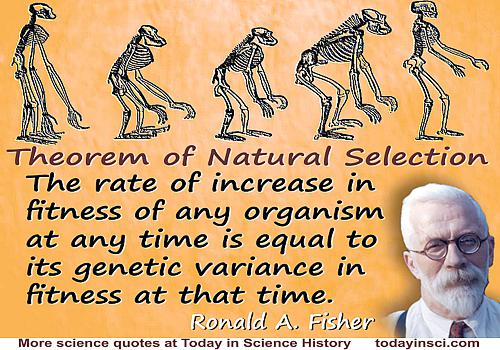
We may consequently state the fundamental theorem of Natural Selection in the form: The rate of increase in fitness of any organism at any time is equal to its genetic variance in fitness at that time.
The Genetical Theory of Natural Selection (1930), 35.
We may now give the following more precise expression to our chief law of biogeny:— The evolution of the foetus (or ontogenesis) is a condensed and abbreviated recapitulation of the evolution of the stem (or phylogenesis); and this recapitulation is the more complete in proportion as the original development (or palingenesis) is preserved by a constant heredity; on the other hand, it becomes less complete in proportion as a varying adaptation to new conditions increases the disturbing factors in the development (or cenogenesis).
The Evolution of Man. Translated from the 5th edition of Anthropogenie by Joseph McCabe (1910), 8.
We must have a relentless commitment to producing a meaningful, comprehensive energy package aimed at conservation, alleviating the burden of energy prices on consumers, decreasing our country’s dependency on foreign oil, and increasing electricity grid reliability.
…...
We must therefore bear the undoubtedly bad effect s of the weak surviving and propagating their kind; but there appears to be at least one check in steady action, namely that the weaker and inferior members of society do not marry so freely as the sound; and this check might be indefinitely increased by the weak in body or mind refraining from marriage, though this is more to be hoped for than expected.
…...
We need to move from the open access regime that results in overfishing in much of the ocean to rights-based fisheries, giving fishermen a vested interest in preventing overfishing and increasing compliance with catch limits.
From The Nature of Nature: Why We Need the Wild (2020).
We should admit in theory what is already very largely a case in practice, that the main currency of scientific information is the secondary sources in the forms of abstracts, reports, tables, &c., and that the primary sources are only for detailed reference by very few people. It is possible that the fate of most scientific papers will be not to be read by anyone who uses them, but with luck they will furnish an item, a number, some facts or data to such reports which may, but usually will not, lead to the original paper being consulted. This is very sad but it is the inevitable consequence of the growth of science. The number of papers that can be consulted is absolutely limited, no more time can be spent in looking up papers, by and large, than in the past. As the number of papers increase the chance of any one paper being looked at is correspondingly diminished. This of course is only an average, some papers may be looked at by thousands of people and may become a regular and fixed part of science but most will perish unseen.
'The Supply of Information to the Scientist: Some Problems of the Present Day', The Journal of Documentation, 1957, 13, 195.
When an element A has an affinity for another substance B, I see no mechanical reason why it should not take as many atoms of B as are presented to it, and can possibly come into contact with it (which may probably be 12 in general), except so far as the repulsion of the atoms of B among themselves are more than a match for the attraction of an atom of A. Now this repulsion begins with 2 atoms of B to 1 atom of A, in which case the 2 atoms of B are diametrically opposed; it increases with 3 atoms of B to 1 of A, in which case the atoms are only 120° asunder; with 4 atoms of B it is still greater as the distance is then only 90; and so on in proportion to the number of atoms. It is evident from these positions, that, as far as powers of attraction and repulsion are concerned (and we know of no other in chemistry), binary compounds must first be formed in the ordinary course of things, then ternary and so on, till the repulsion of the atoms of B (or A, whichever happens to be on the surface of the other), refuse to admit any more.
Observations on Dr. Bostock's Review of the Atomic Principles of Chemistry', Nicholson's Journal, 1811, 29, 147.
When I orbited the Earth in a spaceship, I saw for the first time how beautiful our planet is. Mankind, let us preserve and increase this beauty, and not destroy it!
…...
When not protected by law, by popular favor or superstition, or by other special circumstances, [birds] yield very readily to the influences of civilization, and, though the first operations of the settler are favorable to the increase of many species, the great extension of rural and of mechanical industry is, in a variety of ways, destructive even to tribes not directly warred upon by man.
In Man and Nature, (1864), 93-93.
When physiologists revealed the existence and functions of hormones they not only gave increased opportunities for the activities of biochemists but in particular gave a new charter to biochemical thought, and with the discovery of vitamins that charter was extended.
'Biological Thought and Chemical Thought: A Plea for Unification', Linacre Lecture, Cambridge (6 May 1938), published in Lancet (1938),2, 1201.
While electric railroading is perhaps the most important branch of electrical engineering, at least as regards commercial importance, considering the amount capital invested therein, nevertheless it is a remarkable fact that while most other branches of electrical engineering had been developed to a very high degree of perfection, even a few years ago theoretical investigation of electric railroading was still conspicuous by its almost entire absence.
All the work was done by some kind of empirical experimenting, that is, some kind of motor was fitted up with some gearing or some sort of railway car, and then run, and if the motor burned out frequently it was replaced with a larger motor, and if it did not burn out, a trailer was put on the car, and perhaps a second trailer, until the increase of the expense account in burn-outs of the motors balanced the increased carrying capacity of the train.
All the work was done by some kind of empirical experimenting, that is, some kind of motor was fitted up with some gearing or some sort of railway car, and then run, and if the motor burned out frequently it was replaced with a larger motor, and if it did not burn out, a trailer was put on the car, and perhaps a second trailer, until the increase of the expense account in burn-outs of the motors balanced the increased carrying capacity of the train.
'The Electric Railway', Transactions of the American Institute of Electrical Engineers (1902), 125.
Will power is only the tensile strength of one’s own disposition. One cannot increase it by a single ounce.
In The Burning Brand: Diaries 1935-1950 (1961), 88.
With advancing years new impressions do not enter so rapidly, nor are they so hospitably received… There is a gradual diminution of the opportunities for age to acquire fresh knowledge. A tree grows old not by loss of the vitality of the cambium, but by the gradual increase of the wood, the non-vital tissue, which so easily falls a prey to decay.
From address, 'A Medical Retrospect'. Published in Yale Medical Journal (Oct 1910), 17, No. 2, 59. The context is that he is reflecting on how in later years of life, a person tends to give priority to long-learned experience, rather than give attention to new points of view.
Without an acquaintance with chemistry, the statesman must remain a stranger to the true vital interests of the state, to the means of its organic development and improvement; ... The highest economic or material interests of a country, the increased and more profitable production of food for man and animals, ... are most closely linked with the advancement and diffusion of the natural sciences, especially of chemistry.
Familiar Letters on Chemistry (1851), 3rd edn., 19.
Young writers find out what kinds of writers they are by experiment. If they choose from the outset to practice exclusively a form of writing because it is praised in the classroom or otherwise carries appealing prestige, they are vastly increasing the risk inherent in taking up writing in the first place.
…...
 In science it often happens that scientists say, 'You know that's a really good argument; my position is mistaken,' and then they would actually change their minds and you never hear that old view from them again. They really do it. It doesn't happen as often as it should, because scientists are human and change is sometimes painful. But it happens every day. I cannot recall the last time something like that happened in politics or religion.
(1987) --
In science it often happens that scientists say, 'You know that's a really good argument; my position is mistaken,' and then they would actually change their minds and you never hear that old view from them again. They really do it. It doesn't happen as often as it should, because scientists are human and change is sometimes painful. But it happens every day. I cannot recall the last time something like that happened in politics or religion.
(1987) -- 





