Improvement Quotes (121 quotes)
[A]s you know, scientific education is fabulously neglected … This is an evil that is inherited, passed on from generation to generation. The majority of educated persons are not interested in science, and are not aware that scientific knowledge forms part of the idealistic background of human life. Many believe—in their complete ignorance of what science really is—that it has mainly the ancillary task of inventing new machinery, or helping to invent it, for improving our conditions of life. They are prepared to leave this task to the specialists, as they leave the repairing of their pipes to the plumber. If persons with this outlook decide upon the curriculum of our children, the result is necessarily such as I have just described it.
Opening remarks of the second of four public lectures for the Dublin Institute for Advanced Studies at University College, Dublin (Feb 1950), The Practical Achievements of Science Tending to Obliterate its True Import', collected in Science and Humanism: Physics in Our Time (1951). Reprinted in 'Nature and the Greeks' and 'Science and Humanism' (1996), 113.
[Modern science] passed through a long period of uncertainty and inconclusive experiment, but as the instrumental aids to research improved, and the results of observation accumulated, phantoms of the imagination were exorcised, idols of the cave were shattered, trustworthy materials were obtained for logical treatment, and hypotheses by long and careful trial were converted into theories.
In The Present Relations of Science and Religion (1913, 2004), 3
A man … reflects, tests his observation by inquiry, and becomes the discoverer, the inventor; enriches a science, improves a manufacture, adds a new beauty to the arts, or, if engaged in professional active life, detects, as a physician, the secret cause of disease—extracts truth, as a lawyer, from contradictory evidence—or grapples, as a statesman, with the complicated principles by which nations flourish or decay. In short, … a man will always be eminent according to the vigilance with which he observes, and the acuteness with which he inquires.
Upon becoming Honorary President (18 Jan 1854). Printed in Address of Sir Edward Bulwer Lytton, Bart., to the Associated Societies of the University of Edinburgh (1854), 6.
A person by study must try to disengage the subject from useless matter, and to seize on points capable of improvement. ... When subjects are viewed through the mists of prejudice, useful truths may escape.
In An Essay on Aërial Navigation, With Some Observations on Ships (1844), 80.
A tax on the farms would then result in the proprietors themselves working the lands, and this would mean better cultivation, and improvements which would yield returns indeed, but at too remote a period for the tenant. It would tend to a division of landed property, men of small fortune uniting in the purchase with capitalists who seek only the rent or payment for the land.
From Appendix A, 'Extracts From the Unpublished Writings of Carnot', Reflections on the Motive Power of Heat (1890, 2nd ed. 1897), 212-213.
A tax on the rent of a farm would be much better than a tax on the land itself. Proprietors then could only avoid taxes by themselves improving their property. As it is, they merely collect the rents, and usually employ their surplus in unproductive expenditure, while the proprietary farmers voluntarily devote theirs to the improvement of the land.
From Appendix A, 'Extracts From the Unpublished Writings of Carnot', Reflections on the Motive Power of Heat (1890, 2nd ed. 1897), 212.
After all, most men are incapable of deciding for themselves, and have got to have a leader somewhere. If the new discoveries in mass suggestion enable us to make government easier, not only political, but moral and aesthetic, why not welcome them like other useful inventions? Why should science be limited to improvements in our control over nature, and exclude the most important part of our environment, our fellows? Get on the inside, join, as I used to be told, some party, and learn where the ropes come down within your reach. Adopt the high calling of Manipulator and save the State.
Such Machiavellis are not confined to Russia and Italy; one may find them all about even in this Land of the Free. … Still there remains in me a strange misgiving about making use of one’s fellows through an appeal to their weaknesses, even when all you do is to select their objects for them. In the elegant diction of Mr. Mencken, and in spite of the great weight of his authority, a government of the boobs, for the boobs and by the boobs to me still has its morbid charms.
Such Machiavellis are not confined to Russia and Italy; one may find them all about even in this Land of the Free. … Still there remains in me a strange misgiving about making use of one’s fellows through an appeal to their weaknesses, even when all you do is to select their objects for them. In the elegant diction of Mr. Mencken, and in spite of the great weight of his authority, a government of the boobs, for the boobs and by the boobs to me still has its morbid charms.
In Learned Hand and Irving Dilliard (ed.), The Spirit of Liberty: Papers and Addresses of Learned Hand (1952), 36.
An objective measure of the effects upon blood production was the chief basis of our conclusions that by feeding liver, significant improvement had been obtained.
From Nobel Prize Lecture (12 Dec 1934), collected in Nobel Lectures, Physiology or Medicine 1922-1941 (1965).
And, in this case, science could learn an important lesson from the literati–who love contingency for the same basic reason that scientists tend to regard the theme with suspicion. Because, in contingency lies the power of each person, to make a difference in an unconstrained world bristling with possibilities, and nudgeable by the smallest of unpredictable inputs into markedly different channels spelling either vast improvement or potential disaster.
…...
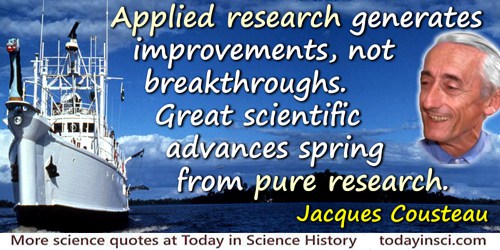
Applied research generates improvements, not breakthroughs. Great scientific advances spring from pure research. Even scientists renowned for their “useful” applied discoveries often achieved success only when they abandoned their ostensible applied-science goal and allowed their minds to soar—as when Alexander Fleming, “just playing about,” refrained from throwing away green molds that had ruined his experiment, studied them, and discovered penicillin. Or when C. A. Clarke, a physician affiliated with the University of Liverpool, became intrigued in the 1950s by genetically created color patterns that emerged when he cross-bred butterflies as a hobby. His fascination led him—“by the pleasant route of pursuing idle curiosity”—to the successful idea for preventing the sometimes fatal anemia that threatened babies born of a positive-Rhesus-factor father and a negative-Rhesus-factor mother.
In Jacques Cousteau and Susan Schiefelbein, The Human, the Orchid, and the Octopus: Exploring and Conserving Our Natural World (2007), 214-215.
Arguably the greatest technological triumph of the century has been the public-health system, which is sophisticated preventive and investigative medicine organized around mostly low- and medium-tech equipment; ... fully half of us are alive today because of the improvements.
In Visions of Technology (1999), 22.
As for me ... I would much rather be a perfected ape than a degraded Adam. Yes, if it is shown to me that my humble ancestors were quadrupedal animals, arboreal herbivores, brothers or cousins of those who were also the ancestors of monkeys and apes, far from blushing in shame for my species because of its genealogy and parentage, I will be proud of all that evolution has accomplished, of the continuous improvement which takes us up to the highest order, of the successive triumphs that have made us superior to all of the other species ... the splendid work of progress.
I will conclude in saying: the fixity of species is almost impossible, it contradicts the mode of succession and of the distribution of species in the sequence of extant and extinct creatures. It is therefore extremely likely that species are variable and are subject to evolution. But the causes, the mechanisms of this evolution are still unknown.
I will conclude in saying: the fixity of species is almost impossible, it contradicts the mode of succession and of the distribution of species in the sequence of extant and extinct creatures. It is therefore extremely likely that species are variable and are subject to evolution. But the causes, the mechanisms of this evolution are still unknown.
'Discussion sur la Machoire Humaine de la Naulette (Belgique)', Bulletin de la Societé d'Anthropologie de Paris, 2nd Series, I (1866), 595. Trans. Erik Trinkaus and Pat Shipman, The Neanderthals: Changing the Image of Mankind (1993), 103-4.
As the first monogamian family has improved greatly since the commencement of civilization, and very sensibly in our times, it is at least supposable that it is capable of still further improvement until the equality of the sexes is attained.
As quoted in Charles H. Seaholm, The Kelts and the Vikings (1974), 48.
As to the need of improvement there can be no question whilst the reign of Euclid continues. My own idea of a useful course is to begin with arithmetic, and then not Euclid but algebra. Next, not Euclid, but practical geometry, solid as well as plane; not demonstration, but to make acquaintance. Then not Euclid, but elementary vectors, conjoined with algebra, and applied to geometry. Addition first; then the scalar product. Elementary calculus should go on simultaneously, and come into vector algebraic geometry after a bit. Euclid might be an extra course for learned men, like Homer. But Euclid for children is barbarous.
Electro-Magnetic Theory (1893), Vol. 1, 148. In George Edward Martin, The Foundations of Geometry and the Non-Euclidean Plane (1982), 130.
Books have always a secret influence on the understanding; we cannot at pleasure obliterate ideas; he that reads books of science, thogh without any fixed desire of improvement, will grow more knowing…
In Samuel Johnson and W. Jackson Bate (Ed.), ',The Adventurer, No. 137, Tuesday, 26 Febraury 1754.' The Selected Essays from the Rambler, Adventurer, and Idler (1968), 273.
Chemistry is an art that has furnished the world with a great number of useful facts, and has thereby contributed to the improvement of many arts; but these facts lie scattered in many different books, involved in obscure terms, mixed with many falsehoods, and joined to a great deal of false philosophy; so that it is not great wonder that chemistry has not been so much studied as might have been expected with regard to so useful a branch of knowledge, and that many professors are themselves but very superficially acquainted with it. But it was particularly to be expected, that, since it has been taught in universities, the difficulties in this study should have been in some measure removed, that the art should have been put into form, and a system of it attempted—the scattered facts collected and arranged in a proper order. But this has not yet been done; chemistry has not yet been taught but upon a very narrow plan. The teachers of it have still confined themselves to the purposes of pharmacy and medicine, and that comprehends a small branch of chemistry; and even that, by being a single branch, could not by itself be tolerably explained.
John Thomson, An Account of the Life, Lectures and Writings of William Cullen, M.D. (1832), Vol. 1, 40.
Chess is a unique cognitive nexus, a place where art and science come together in the human mind and are then refined and improved by experience.
In How Life Imitates Chess: Making the Right Moves, from the Board to the Boardroom (2007), 4.
Engineering is quite different from science. Scientists try to understand nature. Engineers try to make things that do not exist in nature. Engineers stress invention. To embody an invention the engineer must put his idea in concrete terms, and design something that people can use. That something can be a device, a gadget, a material, a method, a computing program, an innovative experiment, a new solution to a problem, or an improvement on what is existing. Since a design has to be concrete, it must have its geometry, dimensions, and characteristic numbers. Almost all engineers working on new designs find that they do not have all the needed information. Most often, they are limited by insufficient scientific knowledge. Thus they study mathematics, physics, chemistry, biology and mechanics. Often they have to add to the sciences relevant to their profession. Thus engineering sciences are born.
Y.C. Fung and P. Tong, Classical and Computational Solid Mechanics (2001), 1.
Engineers apply the theories and principles of science and mathematics to research and develop economical solutions to practical technical problems. Their work is the link between scientific discoveries and commercial applications. Engineers design products, the machinery to build those products, the factories in which those products are made, and the systems that ensure the quality of the product and efficiency of the workforce and manufacturing process. They design, plan, and supervise the construction of buildings, highways, and transit systems. They develop and implement improved ways to extract, process, and use raw materials, such as petroleum and natural gas. They develop new materials that both improve the performance of products, and make implementing advances in technology possible. They harness the power of the sun, the earth, atoms, and electricity for use in supplying the Nation’s power needs, and create millions of products using power. Their knowledge is applied to improving many things, including the
quality of health care, the safety of food products, and the efficient operation of financial systems.
Bureau of Labor Statistics, Occupational Outlook Handbook (2000) as quoted in Charles R. Lord. Guide to Information Sources in Engineering (2000), 5. This definition has been revised and expanded over time in different issues of the Handbook.
Even happiness itself may become habitual. There is a habit of looking at the bright side of things, and also of looking at the dark side. Dr. Johnson has said that the habit of looking at the best side of a thing is worth more to a man than a thousand pounds a year. And we possess the power, to a great extent, of so exercising the will as to direct the thoughts upon objects calculated to yield happiness and improvement rather than their opposites.
In Self-help: With Illustrations of Character and Conduct (1859, 1861), 405-406.
Every great improvement has come after repeated failures. Virtually nothing comes out right the first time. Failures, repeated failures, are finger posts on the road to achievement. One fails forward toward success.
Every improvement that is put upon the real estate is the result of an idea in somebody's head. The skyscraper is another idea; the railroad is another; the telephone and all those things are merely symbols which represent ideas. An andiron, a wash-tub, is the result of an idea that did not exist before.
Speaking to a committee considering a new Copyright Bill (6 Dec 1906). In Mark Twain and William Dean Howells (ed.), Mark Twain’s Speeches? (1910), 320. An andiron is a metal bar, used in a pair, as a stand for logs in a fireplace. The Copyright Bill proposed to give authors, artists and musicians copyright for the term of his life and for 50 years thereafter. John Philip Sousa spoke for the musicians.
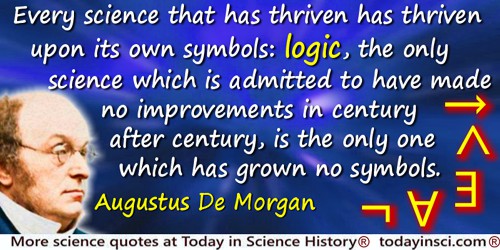
Every science that has thriven has thriven upon its own symbols: logic, the only science which is admitted to have made no improvements in century after century, is the only one which has grown no symbols.
Transactions Cambridge Philosophical Society, vol. X, 1864, p.184
Frequently, I have been asked if an experiment I have planned is pure or applied science; to me it is more important to know if the experiment will yield new and probably enduring knowledge about nature. If it is likely to yield such knowledge, it is, in my opinion, good fundamental research; and this is more important than whether the motivation is purely aesthetic satisfaction on the part of the experimenter on the one hand or the improvement of the stability of a high-power transistor on the other.
Quoted in Richard R. Nelson, 'The Link Between Science and Invention: The Case of the Transistor,' The Rate and Direction of the Inventive Activity (1962). In Daniel S. Greenberg, The Politics of Pure Science (1999), 32, footnote.
From the physician, as emphatically the student of Nature, is expected not only an inquiry into cause, but an investigation of the whole empire of Nature and a determination of the applicability of every species of knowledge to the improvement of his art.
In 'An Inquiry, Analogical and Experimental, into the Different Electrical conditions of Arterial and Venous Blood', New Orleans Medical and Surgical Journal (1853-4), 10, 584-602 & 738-757. As cited in George B. Roth, 'Dr. John Gorrie—Inventor of Artificial Ice and Mechanical Refrigeration', The Scientific Monthly (May 1936) 42 No. 5, 464-469.
From the sexual, or amatorial, generation of plants new varieties, or improvements, are frequently obtained; as many of the young plants from seeds are dissimilar to the parent, and some of them superior to the parent in the qualities we wish to possess... Sexual reproduction is the chef d'oeuvre, the master-piece of nature.
Phytologia. (1800), 115, 103.
From thus meditating on the great similarity of the structure of the warm-blooded animals, and at the same time of the great changes they undergo both before and after their nativity; and by considering in how minute a portion of time many of the changes of animals above described have been produced; would it be too bold to imagine that, in the great length of time since the earth began to exist, perhaps millions of ages before the commencement of the history of mankind would it be too bold to imagine that all warm-blooded animals have arisen from one living filament, which THE GREAT FIRST CAUSE endued with animality, with the power of acquiring new parts, attended with new propensities, directed by irritations, sensations, volitions and associations, and thus possessing the faculty of continuing to improve by its own inherent activity, and of delivering down these improvements by generation to its posterity, world without end!
Zoonomia, Or, The Laws of Organic Life, in three parts (1803), Vol. 1, 397.
Great discoveries and improvements invariably involve the cooperation of many minds. I may be given credit for having blazed the trail but when I look at the subsequent developments I feel the credit is due to others rather than to myself
Grouches are nearly always pinheads, small men who have never made any effort to improve their mental capacity.
As quoted from an interview by B.C. Forbes in The American Magazine (Jan 1921), 10.
I always rejoice to hear of your being still employed in experimental researches into nature, and of the success you meet with. The rapid progress true science now makes, occasions my regretting sometimes that I was born so soon: it is impossible to imagine the height to which may be carried, in a thousand years, the power of man over matter; we may perhaps learn to deprive large masses of their gravity, and give them absolute levity for the sake of easy transport. Agriculture may diminish its labour and double its produce; all diseases may by sure means be prevented or cured (not excepting even that of old age), and our lives lengthened at pleasure even beyond the antediluvian standard. Oh! that moral science were in as fair a way of improvement; that men would cease to be wolves to one another; and that human beings would at length learn what they now improperly call humanity!
Letter to Dr Priestley, 8 Feb 1780. In Memoirs of Benjamin Franklin (1845), Vol. 2, 152.
I am of opinion, then, ... that, if there is any circumstance thoroughly established in geology, it is, that the crust of our globe has been subjected to a great and sudden revolution, the epoch of which cannot be dated much farther back than five or six thousand years ago; that this revolution had buried all the countries which were before inhabited by men and by the other animals that are now best known; that the same revolution had laid dry the bed of the last ocean, which now forms all the countries at present inhabited; that the small number of individuals of men and other animals that escaped from the effects of that great revolution, have since propagated and spread over the lands then newly laid dry; and consequently, that the human race has only resumed a progressive state of improvement since that epoch, by forming established societies, raising monuments, collecting natural facts, and constructing systems of science and of learning.
'Preliminary discourse', to Recherches sur les Ossemens Fossiles (1812), trans. R. Kerr Essay on the Theory of the Earth (1813), 171-2.
I had gone on a walk on a fine Sabbath afternoon. I had entered the Green [of Glasgow] by the gate at the foot of Charlotte Street—had passed the old washing-house. I was thinking upon the engine at the time, and had gone as far as the herd's house, when the idea came into my mind that as steam was an elastic body it would rush into a vacuum, and if a communication were made between the cylinder and an exhausted vessel it would rush into it, and might be there condensed without cooling the cylinder. I then saw that I must get rid of the condensed steam and injection water if I used a jet, as in Newcomen's engine. Two ways of doing this occurred to me. First, the water might be run off by a descending pipe, if an outlet could be got at the depth of 35 or 36 feet, and any air might be extracted by a small pump. The second was to make the pump large enough to extract both water and air. ... I had not walked further than the Golf-house when the whole thing was arranged in my mind.
[In Robert Hart's words, a recollection of the description of Watt's moment of inspiration, in May 1765, for improving Thomas Newcomen's steam engine.]
[In Robert Hart's words, a recollection of the description of Watt's moment of inspiration, in May 1765, for improving Thomas Newcomen's steam engine.]
In Robert Hart, 'Reminiscences of James Watt' (read 2 Nov 1857), Transactions of the Glasgow Archaeological Society (1859), Vol. 1, 1. Note that these are not the verbatim words of James Watt, but are only a recollection of them by Robert Hart, who is quoting as best he can from memory of a conversation he and his brother had with James Watt that took place over 43 years previously. In his Reminiscences, Hart explains, “I have accordingly thrown together the following brief narrative:— As these meetings took place forty-three years since, many observations that were made at the time may have escaped me at present; yet, when the same subjects are touched on, I have as distinct recollection of his treatment of them as if it were yesterday.”
I have no doubt that it is a part of the destiny of the human race, in its gradual improvement, to leave off eating animals, as surely as the savage tribes have left off eating each other, when they came in contact with the more civilised.
In Walden: or, Life in the Woods (1854, 1899), 226.
I have no patience with attempts to identify science with measurement, which is but one of its tools, or with any definition of the scientist which would exclude a Darwin, a Pasteur or a Kekulé. The scientist is a practical man and his are practical aims. He does not seek the ultimate but the proximate. He does not speak of the last analysis but rather of the next approximation. His are not those beautiful structures so delicately designed that a single flaw may cause the collapse of the whole. The scientist builds slowly and with a gross but solid kind of masonry. If dissatisfied with any of his work, even if it be near the very foundations, he can replace that part without damage to the remainder. On the whole, he is satisfied with his work, for while science may never be wholly right it certainly is never wholly wrong; and it seems to be improving from decade to decade.
The Anatomy of Science (1926), 6-7.
If the Commission is to enquire into the conditions “to be observed,” it is to be presumed that they will give the result of their enquiries; or, in other words, that they will lay down, or at least suggest, “rules” and “conditions to be (hereafter) observed” in the construction of bridges, or, in other words, embarrass and shackle the progress of improvement to-morrow by recording and registering as law the prejudices or errors of to-day.
[Objecting to any interference by the State with the freedom of civil engineers in the conduct of their professional work.]
[Objecting to any interference by the State with the freedom of civil engineers in the conduct of their professional work.]
Letter (13 Mar 1848) to the Royal Commission on the Application of Iron in Railway Structures. Collected in The Life of Isambard Kingdom Brunel, Civil Engineer (1870), 487. The above verbatim quote may be the original source of the following statement as seen in books and on the web without citation: “I am opposed to the laying down of rules or conditions to be observed in the construction of bridges lest the progress of improvement tomorrow might be embarrassed or shackled by recording or registering as law the prejudices or errors of today.” Webmaster has not yet found a primary source for his latter form, and suspects it may be a synopsis, rather than a verbatim quote. If you know of such a primary source, please inform Webmaster.
If the term education may be understood in so large a sense as to include all that belongs to the improvement of the mind, either by the acquisition of the knowledge of others or by increase of it through its own exertions, we learn by them what is the kind of education science offers to man. It teaches us to be neglectful of nothing — not to despise the small beginnings, for they precede of necessity all great things in the knowledge of science, either pure or applied.
'Science as a Branch of Education', lecture to the Royal Institution, 11 Jun 1858. Reprinted in The Mechanics Magazine (1858), 49, 11.
If the Weismann idea triumphs, it will be in a sense a triumph of fatalism; for, according to it, while we may indefinitely improve the forces of our education and surroundings, and this civilizing nurture will improve the individuals of each generation, its actual effects will not be cumulative as regards the race itself, but only as regards the environment of the race; each new generation must start de novo, receiving no increment of the moral and intellectual advance made during the lifetime of its predecessors. It would follow that one deep, almost instinctive motive for a higher life would be removed if the race were only superficially benefited by its nurture, and the only possible channel of actual improvement were in the selection of the fittest chains of race plasma.
'The Present Problem of Heredity', The Atlantic Monthly (1891), 57, 363.
If we lived on a planet where nothing ever changed, there would be little to do. There would be nothing to figure out. There would be no impetus for science. And if we lived in an unpredictable world, where things changed in random or very complex ways, we would not be able to figure things out. But we live in an in-between universe, where things change, but according to patterns, rules, or as we call them, laws of nature. If I throw a stick up in the air, it always falls down. If the sun sets in the west, it always rises again the next morning in the east. And so it becomes possible to figure things out. We can do science, and with it we can improve our lives.
Cosmos (1980, 1985), 32.
Improvement makes straight road, but the crooked roads without improvement are roads of genius.
In 'Proverbs', The Poems: With Specimens of the Prose Writings of William Blake (1885), 281.
Improvements in industry can be left to chance in the hope that someone, sometime, will think of something useful. that some good invention will show up. The other way is to organize so that new knowledge shall always be coming from the researches in the fundamental sciences and engineering arts on which business is based. From that steady stream will arise inventions and new methods. This is the way of Bell Laboratories.
From a Bell Telephone System advertisement, 'The Search That Never Ends', placed, for example, in Life Magazine (17 Jan 1944), 33.
In general, mankind, since the improvement of cookery, eat about twice as much as nature requires.
Louis Klopsch, Many Thoughts of Many Minds (1896), 67.
In mathematics, … and in natural philosophy since mathematics was applied to it, we see the noblest instance of the force of the human mind, and of the sublime heights to which it may rise by cultivation. An acquaintance with such sciences naturally leads us to think well of our faculties, and to indulge sanguine expectations concerning the improvement of other parts of knowledge. To this I may add, that, as mathematical and physical truths are perfectly uninteresting in their consequences, the understanding readily yields its assent to the evidence which is presented to it; and in this way may be expected to acquire the habit of trusting to its own conclusions, which will contribute to fortify it against the weaknesses of scepticism, in the more interesting inquiries after moral truth in which it may afterwards engage.
In Elements of the Philosophy of the Human Mind (1827), Vol. 3, Chap. 1, Sec. 3, 182.
In our search after the Knowledge of Substances, our want of Ideas, that are suitable to such a way of proceeding, obliges us to a quite different method. We advance not here, as in the other (where our abstract Ideas are real as well as nominal Essences) by contemplating our Ideas, and considering their Relations and Correspondencies; that helps us very little, for the Reasons, and in another place we have at large set down. By which, I think it is evident, that Substances afford Matter of very little general Knowledge; and the bare Contemplation of their abstract Ideas, will carry us but a very little way in the search of Truth and Certainty. What then are we to do for the improvement of our Knowledge in Substantial beings? Here we are to take a quite contrary Course, the want of Ideas of their real essences sends us from our own Thoughts, to the Things themselves, as they exist.
An Essay Concerning Human Understanding (1690). Edited by Peter Nidditch (1975), Book 4, Chapter 12, Section 9, 644.
Increased knowledge of heredity means increased power of control over the living thing, and as we come to understand more and more the architecture of the plant or animal we realize what can and what cannot be done towards modification or improvement.
Reginald C. Punnett, in article 'Mendelism', from Hugh Chisholm (ed.) The Encyclopædia Britannica (1911), Vol. 18, 120.

Indians walk softly and hurt the landscape hardly more than the birds and squirrels, and their brush and bark huts last hardly longer than those of wood rats, while their more enduring monuments, excepting those wrought on the forests by the fires they made to improve their hunting grounds, vanish in a few centuries.
In My First Summer in the Sierra (1911), 73. Based on Muir’s original journals and sketches of his 1869 stay in the Sierra.
It be urged that the wild and uncultivated tree, hitherto yielding sour and bitter fruit only, can never be made to yield better; yet we know that the grafting art implants a new tree on the savage stock, producing what is most estimable in kind and degree. Education, in like manner, engrafts a new man on the native stock, and improves what in his nature was vicious and perverse into qualities of virtue and social worth.
From paper 'Report of the Commissioners Appointed to Fix the Site of the University of Virginia', included in Annual Report of the Board of Visitors of the University of Virginia for the Fiscal Year Ending May 31, 1879 (1879), 10. Collected in Commonwealth of Virginia, Annual Reports of Officers, Boards, and Institutions of the Commonwealth of Virginia, for the Year Ending September 30, 1879 (1879).
It is not, indeed, strange that the Greeks and Romans should not have carried ... any ... experimental science, so far as it has been carried in our time; for the experimental sciences are generally in a state of progression. They were better understood in the seventeenth century than in the sixteenth, and in the eighteenth century than in the seventeenth. But this constant improvement, this natural growth of knowledge, will not altogether account for the immense superiority of the modern writers. The difference is a difference not in degree, but of kind. It is not merely that new principles have been discovered, but that new faculties seem to be exerted. It is not that at one time the human intellect should have made but small progress, and at another time have advanced far; but that at one time it should have been stationary, and at another time constantly proceeding. In taste and imagination, in the graces of style, in the arts of persuasion, in the magnificence of public works, the ancients were at least our equals. They reasoned as justly as ourselves on subjects which required pure demonstration.
History (May 1828). In Samuel Austin Allibone, Prose Quotations from Socrates to Macaulay (1880), 36.
It is perhaps a law of nature that when a species (or group) fits itself to a place not previously occupied, and in which it is subject to no opposition from beings of its own class, or where it attains so great a perfection as to be able easily to overcome all opposition, the character eventually loses its original plasticity, or tendency to vary, since improvement in such a case would be superfluous, and becomes, so to speak, crystallized in that form which continues thereafter unaltered. … [Such as] the humming-bird.
In The Naturalist in La Plata (1895), 40.
It is the geniuses who, as pioneers, create the highways, and the cultivated who level and beautify them. Highway improvement would be a good thing in the sciences, so that we could get from one of them to another more easily.
Aphorism 39 in Notebook D (1773-1775), as translated by R.J. Hollingdale in Aphorisms (1990). Reprinted as The Waste Books (2000), 49.
It is worthy of note that nearly all that has been done for the improvement of the steam engine has been accomplished, not by men educated in colleges or technical schools, but by laborers, mechanics, and engine-men. There seem to be instances where the mechanical instinct takes precedence over the higher powers of the mind, in efficiency in harnessing the forces of nature and causing them to do our work.
In paper 'Stephenson and Transportation' (1916), collected in Francis Edgar Stanley, Theories Worth Having and Other Papers (1919), 66-67.
It may metaphorically be said that natural selection is daily and hourly scrutinising, throughout the world, the slightest variations; rejecting those that are bad, preserving and adding up all that are good; silently and insensibly working, whenever and wherever opportunity offers, at the improvement of each organic being in relation to its organic and inorganic conditions of life. We see nothing of these slow changes in progress, until the hand of time has marked the lapse of ages...
The Origin of Species (1870), 80.

It seems very strange … that in the course of the world’s history so obvious an improvement should never have been adopted. … The next generation of Britishers would be the better for having had this extra hour of daylight in their childhood.
In Report, and Special Report, from the Select Committee on the Daylight Saving Bill: Minutes of Evidence (1908), 116.
It will be noticed that the fundamental theorem proved above bears some remarkable resemblances to the second law of thermodynamics. Both are properties of populations, or aggregates, true irrespective of the nature of the units which compose them; both are statistical laws; each requires the constant increase of a measurable quantity, in the one case the entropy of a physical system and in the other the fitness, measured by m, of a biological population. As in the physical world we can conceive the theoretical systems in which dissipative forces are wholly absent, and in which the entropy consequently remains constant, so we can conceive, though we need not expect to find, biological populations in which the genetic variance is absolutely zero, and in which fitness does not increase. Professor Eddington has recently remarked that “The law that entropy always increases—the second law of thermodynamics—holds, I think, the supreme position among the laws of nature.” It is not a little instructive that so similar a law should hold the supreme position among the biological sciences. While it is possible that both may ultimately be absorbed by some more general principle, for the present we should note that the laws as they stand present profound differences—-(1) The systems considered in thermodynamics are permanent; species on the contrary are liable to extinction, although biological improvement must be expected to occur up to the end of their existence. (2) Fitness, although measured by a uniform method, is qualitatively different for every different organism, whereas entropy, like temperature, is taken to have the same meaning for all physical systems. (3) Fitness may be increased or decreased by changes in the environment, without reacting quantitatively upon that environment. (4) Entropy changes are exceptional in the physical world in being irreversible, while irreversible evolutionary changes form no exception among biological phenomena. Finally, (5) entropy changes lead to a progressive disorganization of the physical world, at least from the human standpoint of the utilization of energy, while evolutionary changes are generally recognized as producing progressively higher organization in the organic world.
The Genetical Theory of Natural Selection (1930), 36.
It would be difficult and perhaps foolhardy to analyze the chances of further progress in almost every part of mathematics one is stopped by unsurmountable difficulties, improvements in the details seem to be the only possibilities which are left… All these difficulties seem to announce that the power of our analysis is almost exhausted, even as the power of ordinary algebra with regard to transcendental geometry in the time of Leibniz and Newton, and that there is a need of combinations opening a new field to the calculation of transcendental quantities and to the solution of the equations including them.
From Rapport historique sur les progrès des sciences mathématiques depuis 1789, et sur leur état actuel (1810), 131. As translated in George Sarton, The Study of the History of Mathematics (1936), 13. In the original French: “Il seroit difficile et peut-être téméraire d’analyser les chances que l’avenir offre à l’avancement des mathématiques: dans presque toutes les parties, on est arrêté par des difficultés insurmontables; des perfectionnements de détail semblent la seule chose qui reste à faire… Toutes ces difficultés semblent annoncer que la puissance de notre analyse est à-peu-près épuisée, comme celle de l’algèbre ordinaire l’étoit par rapport à la géométrie transcendante au temps de Leibnitz et de Newton, et qu’il faut des combinaisons qui ouvrent un nouveau champ au calcul des transcendantes et à la résolution des équations qui les contiennent.” Sarton states this comes from “the report on mathematical progress prepared for the French Academy of Sciences at Napoleon’s request”.
It would be rash to say that nothing remains for discovery or improvement even in elementary mathematics, but it may be safely asserted that the ground has been so long and so thoroughly explored as to hold out little hope of profitable return for a casual adventurer.
In 'Private Study of Mathematics', Conflict of Studies and other Essays (1873), 73.
It would be rash to say that nothing remains for discovery or improvement even in elementary mathematics, but it may be safely asserted that the ground has been so long and so thoroughly explored as to hold out little hope of profitable return for a casual adventurer.
In 'Private Study of Mathematics', Conflict of Studies and other Essays (1873), 73.
It would seem at first sight as if the rapid expansion of the region of mathematics must be a source of danger to its future progress. Not only does the area widen but the subjects of study increase rapidly in number, and the work of the mathematician tends to become more and more specialized. It is, of course, merely a brilliant exaggeration to say that no mathematician is able to understand the work of any other mathematician, but it is certainly true that it is daily becoming more and more difficult for a mathematician to keep himself acquainted, even in a general way, with the progress of any of the branches of mathematics except those which form the field of his own labours. I believe, however, that the increasing extent of the territory of mathematics will always be counteracted by increased facilities in the means of communication. Additional knowledge opens to us new principles and methods which may conduct us with the greatest ease to results which previously were most difficult of access; and improvements in notation may exercise the most powerful effects both in the simplification and accessibility of a subject. It rests with the worker in mathematics not only to explore new truths, but to devise the language by which they may be discovered and expressed; and the genius of a great mathematician displays itself no less in the notation he invents for deciphering his subject than in the results attained. … I have great faith in the power of well-chosen notation to simplify complicated theories and to bring remote ones near and I think it is safe to predict that the increased knowledge of principles and the resulting improvements in the symbolic language of mathematics will always enable us to grapple satisfactorily with the difficulties arising from the mere extent of the subject.
In Presidential Address British Association for the Advancement of Science, Section A., (1890), Nature, 42, 466.
Land that is left wholly to nature, that has no improvement of pasturage, tillage, or planting, is called, as indeed it is, “waste”.
In John Locke and Thomas Preston Peardon (ed.), The Second Treatise of Civil Government: An Essay Concerning the True Original, Extent and End of Civil Government (Dec 1689, 1952), 25.

Man is not the only animal who labors; but he is the only one who improves his workmanship.
Lecture 'Discoveries and Inventions', (1860) in Discoveries and Inventions (1915).
Men of science have made abundant mistakes of every kind; their knowledge has improved only because of their gradual abandonment of ancient errors, poor approximations, and premature conclusions.
In A History of Science: Volume 2: Hellenistic Science and Culture in the Last Three Centuries B.C. (1959), xi.
Metals are the great agents by which we can examine the recesses of nature; and their uses are so multiplied, that they have become of the greatest importance in every occupation of life. They are the instruments of all our improvements, of civilization itself, and are even subservient to the progress of the human mind towards perfection. They differ so much from each other, that nature seems to have had in view all the necessities of man, in order that she might suit every possible purpose his ingenuity can invent or his wants require.
From 'Classification of Simple Bodies', The Artist & Tradesman’s Guide: Embracing Some Leading Facts & Principles of Science, and a Variety of Matter Adapted to the Wants of the Artist, Mechanic, Manufacturer, and Mercantile Community (1827), 16.
Most discussions of the population crisis lead logically to zero population growth as the ultimate goal, because any growth rate, if continued, will eventually use up the earth... Turning to the actual measures taken we see that the very use of family planning as the means for implementing population policy poses serious but unacknowledged limits the intended reduction in fertility. The family-planning movement, clearly devoted to the improvement and dissemination of contraceptive devices, states again and again that its purpose is that of enabling couples to have the number of children they want.
With the publication of this article 'zero population growth' and the acronym 'ZPG' came into general use.
With the publication of this article 'zero population growth' and the acronym 'ZPG' came into general use.
'Population Policy: Will Current Programs Succeed?', Science, 1967, 158, 732.
My belief (is) that one should take a minimum of care and preparation over first experiments. If they are unsuccessful one is not then discouraged since many possible reasons for failure can be thought of, and improvements can be made. Much can often be learned by the repetition under different conditions, even if the desired result is not obtained. If every conceivable precaution is taken at first, one is often too discouraged to proceed at all.
Nobel Lectures in Chemistry (1999), Vol. 3, 364.
My scientific work is motivated by an irresistible longing to understand the secrets of nature and by no other feeling. My love for justice and striving to contribute towards the improvement of human conditions are quite independent from my scientific interests.
In Helen Dukas and Banesh Hoffman, Albert Einstein, the Human Side: New Glipses from his Archives (1971) 18. In Vladimir Burdyuzha, The Future of Life and the Future of Our Civilization (2006), 374.
Natural science is founded on minute critical views of the general order of events taking place upon our globe, corrected, enlarged, or exalted by experiments, in which the agents concerned are placed under new circumstances, and their diversified properties separately examined. The body of natural science, then, consists of facts; is analogy,—the relation of resemblance of facts by which its different parts are connected, arranged, and employed, either for popular use, or for new speculative improvements.
'Introductory Lecture to the Chemistry of Nature' (1807), in J. Davy (ed.), The Collected Works of Sir Humphry Davy (1839-40), Vol 8, 167-8.
Natural selection is a theory of local adaptation to changing environments. It proposes no perfecting principles, no guarantee of general improvement,
Ever Since Darwin: Reflections in Natural History (1977), 45.
No national improvement can come from outside. It must come from within… But improved feeling has no chance of spreading throughout the body politic without that machinery of infection which we know by the name of education.
In paper 'On Social Unrest', The Daily Mail (1912). Collected and cited in A Sheaf (1916), 197-198.
Non-standard analysis frequently simplifies substantially the proofs, not only of elementary theorems, but also of deep results. This is true, e.g., also for the proof of the existence of invariant subspaces for compact operators, disregarding the improvement of the result; and it is true in an even higher degree in other cases. This state of affairs should prevent a rather common misinterpretation of non-standard analysis, namely the idea that it is some kind of extravagance or fad of mathematical logicians. Nothing could be farther from the truth. Rather, there are good reasons to believe that non-standard analysis, in some version or other, will be the analysis of the future.
In 'Remark on Non-standard Analysis' (1974), in S. Feferman (ed.), Kurt Gödel Collected Works: Publications 1938-1974 (1990), Vol. 2, 311.
Not one man in a thousand has accuracy of eye and judgment sufficient to become an eminent breeder. If gifted with these qualities, and he studies his subject for years, and devotes his lifetime to it with indomitable perseverance, he will succeed, and may make great improvements; if he wants any of these qualities, he will assuredly fail.
In On the Origin of Species by Means of Natural Selection (1859, 1860), 32.
One of the principal results of civilization is to reduce more and more the limits within which the different elements of society fluctuate. The more intelligence increases the more these limits are reduced, and the nearer we approach the beautiful and the good. The perfectibility of the human species results as a necessary consequence of all our researches. Physical defects and monstrosities are gradually disappearing; the frequency and severity of diseases are resisted more successfully by the progress of modern science; the moral qualities of man are proving themselves not less capable of improvement; and the more we advance, the less we shall have need to fear those great political convulsions and wars and their attendant results, which are the scourges of mankind.
…...
Our delight in any particular study, art, or science rises and improves in proportion to the application which we bestow upon it. Thus, what was at first an exercise becomes at length an entertainment.
In The Spectator (2 Aug 1712), No. 447, collected in The Spectator (9th ed., 1728), Vol. 6, 225.
Our job is to keep everlastingly at research and experiment, to adapt our laboratories to production as soon as practicable, to let no new improvement in flying and flying equipment pass us by.
End of Boeing’s quote, inscribed on his memorial at the Boeing Developmental Center, Tukwila, WA, as given in Mike Lombardi, 'Historical Perspective: 50 years at the Leading Edge', Boeing Frontiers (Aug 2009), 9.
Persons possessing great intellect and a capacity for excelling in the creative arts and also in the sciences are generally likely to have heavier brains than the ordinary individual. Arguing from this we might expect to find a corresponding lightness in the brain of the criminal, but this is not always the case ... Many criminals show not a single anomaly in their physical or mental make-up, while many persons with marked evidences of morphological aberration have never exhibited the criminal tendency.
Every attempt to prove crime to be due to a constitution peculiar only to criminals has failed signally. It is because most criminals are drawn from the ranks of the low, the degraded, the outcast, that investigators were ever deceived into attempting to set up a 'type' of criminal. The social conditions which foster the great majority of crimes are more needful of study and improvement.
From study of known normal brains we have learned that there is a certain range of variation. No two brains are exactly alike, and the greatest source of error in the assertions of Benedict and Lombroso has been the finding of this or that variation in a criminal’s brains, and maintaining such to be characteristic of the 'criminal constitution,' unmindful of the fact that like variations of structure may and do exist in the brains of normal, moral persons.
Every attempt to prove crime to be due to a constitution peculiar only to criminals has failed signally. It is because most criminals are drawn from the ranks of the low, the degraded, the outcast, that investigators were ever deceived into attempting to set up a 'type' of criminal. The social conditions which foster the great majority of crimes are more needful of study and improvement.
From study of known normal brains we have learned that there is a certain range of variation. No two brains are exactly alike, and the greatest source of error in the assertions of Benedict and Lombroso has been the finding of this or that variation in a criminal’s brains, and maintaining such to be characteristic of the 'criminal constitution,' unmindful of the fact that like variations of structure may and do exist in the brains of normal, moral persons.
Address to the American Association for the Advancement of Science in Philadelphia (28 Dec 1904), as quoted in 'Americans of Future Will Have Best Brains', New York Times (29 Dec 1904), 6.
Physiology is the basis of all medical improvement and in precise proportion as our survey of it becomes more accurate and extended, it is rendered more solid.
In 'An Inquiry, Analogical and Experimental, into the Different Electrical conditions of Arterial and Venous Blood', New Orleans Medical and Surgical Journal (1853-4), 10, 584-602 & 738-757. As cited in George B. Roth, 'Dr. John Gorrie—Inventor of Artificial Ice and Mechanical Refrigeration', The Scientific Monthly (May 1936) 42 No. 5, 464-469.
Post-operatively the transplanted kidney functioned immediately with a dramatic improvement in the patient’s renal and cardiopulmonary status. This spectacular success was a clear demonstration that organ transplantation could be life-saving. In a way, it was spying into the future because we had achieved our long-term goal by bypassing, but not solving, the issue of biological incompatibility.
Referring to the pioneering first kidney transplant. It was well-matched since it was between twins. In Nobel Lecture (8 Dec 1990). Printed in Tore Frängsmyr and Jan Lindsten (eds.), Nobel Lectures, Physiology or Medicine 1981-1990 (1993).
Progress, far from consisting in change, depends on retentiveness. When change is absolute there remains no being to improve and no direction is set for possible improvement: and when experience is not retained, as among savages, infancy is perpetual. Those who cannot remember the past are condemned to repeat it.
The Life of Reason, or the Phases of Human Progress (1954), 82.
Proprietors, becoming cultivators to escape the taxes, would settle in the country, where their presence would disseminate intelligence and comfort; their revenues, before spent unprofitably, would then pay expenses and improvements on their property.
From Appendix A, 'Extracts From the Unpublished Writings of Carnot', Reflections on the Motive Power of Heat (1890, 2nd ed. 1897), 213.
Said M. Waldman, “…Chemistry is that branch of natural philosophy in which the greatest improvements have been and may be made; it is on that account that I have made it my peculiar study; but at the same time, I have not neglected the other branches of science. A man would make but a very sorry chemist if he attended to that department of human knowledge alone. If your wish is to become really a man of science and not merely a petty experimentalist, I should advise you to apply to every branch of natural philosophy, including mathematics.”
In Frankenstein: Or, The Modern Prometheus (1823), Vol. 1, 73-74. Webmaster note: In the novel, when the fictional characters meet, M. Waldman, professor of chemistry, sparks Victor Frankenstein’s interest in science. Shelley was age 20 when the first edition of the novel was published anonymously (1818).
Science is best defined as a careful, disciplined, logical search for knowledge about any and all aspects of the universe, obtained by examination of the best available evidence and always subject to correction and improvement upon discovery of better evidence. What's left is magic. And it doesn't work.
The Mask of Nostradamus: The Prophecies of the World’s Most Famous Seer (1993), 66.
Science is cumulative. The apprentice in this generation can outdo his master of the last. Art is not cumulative, however much study of past masters may improve the novice’s skill. A relatively poorly equipped anthropologist in intellectual terms can on the basis of sound training produce good work.
In Politics, Law and Ritual in Tribal Society (1965), 303.
Science tells us how very far we are from attaining our industrial aims with anything approaching the theoretical expenditure of force. Science also tells us in what directions we may look forward to arriving at improvements. I might say that we are on the eve of creating a science of invention, that is, of developing scientific methods for solving industrial problems.
From paper at inaugural meeting of the Society of the Chemical Industry, London (1881), 'Patent Laws as Applied to Chemical Invention', quoted in obituary by Charles Baskerville, 'Ludwig Mond', The Engineering and Mining Journal (1 Jan 1910), 89, No. 1, 3.
Science, the partisan of no country, but the beneficent patroness of all, has liberally opened a temple where all may meet. Her influence on the mind, like the sun on the chilled earth, has long been preparing it for higher cultivation and further improvement. The philosopher of one country sees not an enemy in the philosopher of another; he takes his seat in the temple of science, and asks not who sits beside him.
In Letter to the Abbé Reynal, on the 'Affairs of North America in which the Mistakes in the Abbé’s Account of the Revolution of America are Corrected and Cleared Up', collected in The Works of Thomas Paine (1797), Vol. 1, 295. Originally published in the Pennsylvania magazine (1775).
Some see a clear line between genetic enhancement and other ways that people seek improvement in their children and themselves. Genetic manipulation seems somehow worse—more intrusive, more sinister—than other ways of enhancing performance and seeking success. But, morally speaking, the difference is less significant than it seems. Bioengineering gives us reason to question the low-tech, high-pressure child-rearing practices we commonly accept. The hyperparenting familiar in our time represents an anxious excess of mastery and dominion that misses the sense of life as a gift. This draws it disturbingly close to eugenics... Was the old eugenics objectionable only insofar as it was coercive? Or is there something inherently wrong with the resolve to deliberately design our progeny’s traits... But removing coercion does not vindicate eugenics. The problem with eugenics and genetic engineering is that they represent a one-sided triumph of willfulness over giftedness, of dominion over reverence, of molding over beholding.
Michael J. Sandel, 'The Case Against Perfection', The Atlantic Monthly (Apr 2004).
Such biological ideas as the “survival of the fittest,” whatever their doubtful value in natural science, are utterly useless in attempting to understand society … The life of a man in society, while it is incidentally a biological fact, has characteristics that are not reducible to biology and must be explained in the distinctive terms of a cultural analysis … the physical well-being of men is a result of their social organization and not vice versa … Social improvement is a product of advances in technology and social organization, not of breeding or selective elimination … Judgments as to the value of competition between men or enterprises or nations must be based upon social and not allegedly biological consequences; and … there is nothing in nature or a naturalistic philosophy of life to make impossible the acceptance of moral sanctions that can be employed for the common good.
Social Darwinism in American Thought 1860-1915 (1945), 176.
That which is perfect in science, is most commonly the elaborate result of successive improvements, and of various judgments exercised in the rejection of what was wrong, no less than in the adoption of what was right.
Reflection 490, in Lacon: Or Many Things in Few Words, Addressed to Those who Think (1832), 202.
The beginning of civilisation is the discovery of some useful arts, by which men acquire property, comforts, or luxuries. The necessity or desire of preserving them leads to laws and social institutions. The discovery of peculiar arts gives superiority to particular nations ... to subjugate other nations, who learn their arts, and ultimately adopt their manners;— so that in reality the origin as well as the progress and improvement of civil society is founded in mechanical and chemical inventions.
Consolations In Travel; or, the Last Days of a Philosopher (1830), 228.
The business of their weekly Meetings shall be, To order, take account, consider, and discourse of Philosophical Experiments, and Observations: to read, hear, and discourse upon Letters, Reports, and other Papers containing Philosophical matters, as also to view, and discourse upon the productions and rarities of Nature, and Art: and to consider what to deduce from them, or how they may be improv'd for use, or discovery.
'An Abstract of the Statutes of the Royal Society', in Thomas Sprat, History of the Royal Society (1667), 145.
The capital ... shall form a fund, the interest of which shall be distributed annually as prizes to those persons who shall have rendered humanity the best services during the past year. ... One-fifth to the person having made the most important discovery or invention in the science of physics, one-fifth to the person who has made the most eminent discovery or improvement in chemistry, one-fifth to the one having made the most important discovery with regard to physiology or medicine, one-fifth to the person who has produced the most distinguished idealistic work of literature, and one-fifth to the person who has worked the most or best for advancing the fraternization of all nations and for abolishing or diminishing the standing armies as well as for the forming or propagation of committees of peace.
From will (27 Nov 1895), in which he established the Nobel Prizes, as translated in U.S. Dept. of Commerce, Consular Reports, Issues 156-159 (1897), 331.
The chemist studies the effects produced by heat and by mixture, in all bodies, or mixtures of bodies, natural or artificial, and studies them with a view to the improvement of arts, and the knowledge of nature.
Restating his own definition in fewer words, from the first of a series of lectures on chemistry, collected in John Robison (ed.), Lectures on the Elements of Chemistry: Delivered in the University of Edinburgh (1807), Vol. 1, 11.
The Designe of the Royall Society being the Improvement of Naturall knowledge all ways and meanes that tend thereunto ought to be made use of in the prosecution thereof. Naturall knowledge then being the thing sought for, we are to consider by what meanes it may soonest easiest and most certainly attaind. These meanes we shall the sooner find if we consider where tis to be had to wit in three places. first in bookes, 2dly in men. 3ly in the things themselves. and these three point us out the search of books. the converse & correspondence with men the Experimenting and Examining the things themselves under each of these there is a multitude of businesse to be done but the first hath the Least [and is] the most easily attained, the 2d hath a great Deal and requires much en[deavour] and Industry; and the 3d is infinite and the difficultest of all.
'Proposals for advancement of the R[oyal] S[ociety]' (c.1700), quoted in Michael Hunter, Establishing the New Science: The Experience of the Early Royal Society (1989), 232.
The events of the past few years have led to a critical examination of the function of science in society. It used to be believed that the results of scientific investigation would lead to continuous progressive improvements in conditions of life; but first the War and then the economic crisis have shown that science can be used as easily for destructive and wasteful purposes, and voices have been raised demanding the cessation of scientific research as the only means of preserving a tolerable civilization. Scientists themselves, faced with these criticisms, have been forced to consider, effectively for the first time, how the work they are doing is connected around them. This book is an attempt to analyse this connection; to investigate how far scientists, individually and collectively, are responsible for this state of affairs, and to suggest what possible steps could be taken which would lead to a fruitful and not to a destructive utilization of science.
The Social Function of Science (1939), xlii.
The fact that human life can be prolonged with fewer physical problems requires that we give increasing attention to improving the quality of life. As the poet Edwin Markham stated: “We are all fools until we know that in the common plan, nothing is worth the building if it does not build the man; why build these temples glorious, if man unbuilded goes?”
In 'Millenial Musings', Chemical & Engineering News (6 Dec 1999), 77, No. 49, 48.
The Fundamental Regulator Paradox … The task of a regulator is to eliminate variation, but this variation is the ultimate source of information about the quality of its work. Therefore, the better the job a regulator does the less information it gets about how to improve.
In Gerald M. Weinberg and Daniela Weinberg, The Design of Stable Systems (1979), 250. As quoted in John R. Wilson, Evaluation of Human Work (2005), 220.
The great age of the earth will appear greater to man when he understands the origin of living organisms and the reasons for the gradual development and improvement of their organization. This antiquity will appear even greater when he realizes the length of time and the particular conditions which were necessary to bring all the living species into existence. This is particularly true since man is the latest result and present climax of this development, the ultimate limit of which, if it is ever reached, cannot be known.
Hydrogéologie (1802), trans. A. V. Carozzi (1964), 77.
The history of our enterprise…is one of evolution. We started by printing one letter at a time and justifying the sentences afterwards; then we impressed into papier maché one word at a time, justified it, and made a type from it by after process. Next we impressed a whole line and justified it, still leaving the production of the type as a second operation; but now we compose a line, justify and cast it all in one machine and by one operator.
From short Speech at the Chamberlain Hotel, Washington, D.C. (Feb 1885), concluding the exhibition of his own Linotype invention. As given in Carl Schlesinger (ed.), 'Mr. Mergenthaler’s Speech', The Biography of Ottmar Merganthaler: Inventor of the Linotype (1989), 20. [Describing the evolution of his Linotype invention. The word “justifying”, when used specifically for typesetting, refers to increasing the spaces between words to achieve a uniform overall line length for each row in a column. —Webmaster]

The improvement of forest trees is the work of centuries. So much more the reason for beginning now.
Letter to C. S. Sargent, 12 Jun 1879. In David Lowenthal, George Perkins Marsh: Versatile Vermonter (1958), 255.
The industry of artificers maketh some small improvement of things invented; and chance sometimes in experimenting maketh us to stumble upon somewhat which is new; but all the disputation of the learned never brought to light one effect of nature before unknown.
In The Works of Francis Bacon (1740), Vol. 1, 69.
The methods of science aren’t foolproof, but they are indefinitely perfectible. Just as important: there is a tradition of criticism that enforces improvement whenever and wherever flaws are discovered. The methods of science, like everything else under the sun, are themselves objects of scientific scrutiny, as method becomes methodology, the analysis of methods. Methodology in turn falls under the gaze of epistemology, the investigation of investigation itself—nothing is off limits to scientific questioning. The irony is that these fruits of scientific reflection, showing us the ineliminable smudges of imperfection, are sometimes used by those who are suspicious of science as their grounds for denying it a privileged status in the truth-seeking department—as if the institutions and practices they see competing with it were no worse off in these regards. But where are the examples of religious orthodoxy being simply abandoned in the face of irresistible evidence? Again and again in science, yesterday’s heresies have become today’s new orthodoxies. No religion exhibits that pattern in its history.
…...
The more important fundamental laws and facts of physical science have all been discovered, and these are now so firmly established that the possibility of their ever being supplanted in consequence of new discoveries is exceedingly remote. Nevertheless, it has been found that there are apparent exceptions to most of these laws, and this is particularly true when the observations are pushed to a limit, i.e., whenever the circumstances of experiment are such that extreme cases can be examined. Such examination almost surely leads, not to the overthrow of the law, but to the discovery of other facts and laws whose action produces the apparent exceptions. As instances of such discoveries, which are in most cases due to the increasing order of accuracy made possible by improvements in measuring instruments, may be mentioned: first, the departure of actual gases from the simple laws of the so-called perfect gas, one of the practical results being the liquefaction of air and all known gases; second, the discovery of the velocity of light by astronomical means, depending on the accuracy of telescopes and of astronomical clocks; third, the determination of distances of stars and the orbits of double stars, which depend on measurements of the order of accuracy of one-tenth of a second-an angle which may be represented as that which a pin's head subtends at a distance of a mile. But perhaps the most striking of such instances are the discovery of a new planet or observations of the small irregularities noticed by Leverrier in the motions of the planet Uranus, and the more recent brilliant discovery by Lord Rayleigh of a new element in the atmosphere through the minute but unexplained anomalies found in weighing a given volume of nitrogen. Many other instances might be cited, but these will suffice to justify the statement that “our future discoveries must be looked for in the sixth place of decimals.”
In Light Waves and Their Uses (1903), 23-4. Michelson had some years earlier referenced “an eminent physicist” that he did not name who had “remarked that the future truths of physical science are to be looked for in the sixth place of decimals,” near the end of his Convocation Address at the Dedication of the Ryerson Physical Laboratory at the University of Chicago, 'Some of the Objects and Methods of Physical Science' (4 Jul 1894), published in University of Chicago Quarterly Calendar (Aug 1894), 3, No.2, 15. Also
The ordinary naturalist is not sufficiently aware that when dogmatizing on what species are, he is grappling with the whole question of the organic world & its connection with the time past & with Man; that it involves the question of Man & his relation to the brutes, of instinct, intelligence & reason, of Creation, transmutation & progressive improvement or development. Each set of geological questions & of ethnological & zool. & botan. are parts of the great problem which is always assuming a new aspect.
Leonard G. Wilson (ed.), Sir Charles Lyell's Scientific Journals on the Species Question (1970), 164.
The origin of a science is usually to be sought for not in any systematic treatise, but in the investigation and solution of some particular problem. This is especially the case in the ordinary history of the great improvements in any department of mathematical science. Some problem, mathematical or physical, is proposed, which is found to be insoluble by known methods. This condition of insolubility may arise from one of two causes: Either there exists no machinery powerful enough to effect the required reduction, or the workmen are not sufficiently expert to employ their tools in the performance of an entirely new piece of work. The problem proposed is, however, finally solved, and in its solution some new principle, or new application of old principles, is necessarily introduced. If a principle is brought to light it is soon found that in its application it is not necessarily limited to the particular question which occasioned its discovery, and it is then stated in an abstract form and applied to problems of gradually increasing generality.
Other principles, similar in their nature, are added, and the original principle itself receives such modifications and extensions as are from time to time deemed necessary. The same is true of new applications of old principles; the application is first thought to be merely confined to a particular problem, but it is soon recognized that this problem is but one, and generally a very simple one, out of a large class, to which the same process of investigation and solution are applicable. The result in both of these cases is the same. A time comes when these several problems, solutions, and principles are grouped together and found to produce an entirely new and consistent method; a nomenclature and uniform system of notation is adopted, and the principles of the new method become entitled to rank as a distinct science.
Other principles, similar in their nature, are added, and the original principle itself receives such modifications and extensions as are from time to time deemed necessary. The same is true of new applications of old principles; the application is first thought to be merely confined to a particular problem, but it is soon recognized that this problem is but one, and generally a very simple one, out of a large class, to which the same process of investigation and solution are applicable. The result in both of these cases is the same. A time comes when these several problems, solutions, and principles are grouped together and found to produce an entirely new and consistent method; a nomenclature and uniform system of notation is adopted, and the principles of the new method become entitled to rank as a distinct science.
In A Treatise on Projections (1880), Introduction, xi. Published as United States Coast and Geodetic Survey, Treasury Department Document, No. 61.
Theories cannot claim to be indestructible. They are only the plough which the ploughman uses to draw his furrow and which he has every right to discard for another one, of improved design, after the harvest. To be this ploughman, to see my labours result in the furtherance of scientific progress, was the height of my ambition, and now the Swedish Academy of Sciences has come, at this harvest, to add the most brilliant of crowns.
'The Method of Direct Hydrogenation by Catalysis', Nobel Lecture (11 Dec 1912). Noble Lectures in Chemistry 1901-1921 (1966), 230-1.
There are, as we have seen, a number of different modes of technological innovation. Before the seventeenth century inventions (empirical or scientific) were diffused by imitation and adaption while improvement was established by the survival of the fittest. Now, technology has become a complex but consciously directed group of social activities involving a wide range of skills, exemplified by scientific research, managerial expertise, and practical and inventive abilities. The powers of technology appear to be unlimited. If some of the dangers may be great, the potential rewards are greater still. This is not simply a matter of material benefits for, as we have seen, major changes in thought have, in the past, occurred as consequences of technological advances.
Concluding paragraph of "Technology," in Dictionary of the History of Ideas (1973), Vol. 4, 364.
Thinking consists in envisaging, realizing structural features and structural requirements; proceeding in accordance with, and determined by, these requirements; thereby changing the situation in the direction of structural improvements.
In Productive Thinking (1959), 235.
This Academy [at Lagado] is not an entire single Building, but a Continuation of several Houses on both Sides of a Street; which growing waste, was purchased and applied to that Use.
I was received very kindly by the Warden, and went for many Days to the Academy. Every Room hath in it ' one or more Projectors; and I believe I could not be in fewer than five Hundred Rooms.
The first Man I saw was of a meagre Aspect, with sooty Hands and Face, his Hair and Beard long, ragged and singed in several Places. His Clothes, Shirt, and Skin were all of the same Colour. He had been Eight Years upon a Project for extracting Sun-Beams out of Cucumbers, which were to be put into Vials hermetically sealed, and let out to warm the Air in raw inclement Summers. He told me, he did not doubt in Eight Years more, that he should be able to supply the Governor's Gardens with Sunshine at a reasonable Rate; but he complained that his Stock was low, and interested me to give him something as an Encouragement to Ingenuity, especially since this had been a very dear Season for Cucumbers. I made him a small Present, for my Lord had furnished me with Money on purpose, because he knew their Practice of begging from all who go to see them.
I saw another at work to calcine Ice into Gunpowder; who likewise shewed me a Treatise he had written concerning the Malleability of Fire, which he intended to publish.
There was a most ingenious Architect who had contrived a new Method for building Houses, by beginning at the Roof, and working downwards to the Foundation; which he justified to me by the life Practice of those two prudent Insects the Bee and the Spider.
In another Apartment I was highly pleased with a Projector, who had found a device of plowing the Ground with Hogs, to save the Charges of Plows, Cattle, and Labour. The Method is this: In an Acre of Ground you bury at six Inches Distance, and eight deep, a quantity of Acorns, Dates, Chestnuts, and other Masts or Vegetables whereof these Animals are fondest; then you drive six Hundred or more of them into the Field, where in a few Days they will root up the whole Ground in search of their Food, and make it fit for sowing, at the same time manuring it with their Dung. It is true, upon Experiment they found the Charge and Trouble very great, and they had little or no Crop. However, it is not doubted that this Invention may be capable of great Improvement.
I had hitherto seen only one Side of the Academy, the other being appropriated to the Advancers of speculative Learning.
Some were condensing Air into a dry tangible Substance, by extracting the Nitre, and letting the acqueous or fluid Particles percolate: Others softening Marble for Pillows and Pin-cushions. Another was, by a certain Composition of Gums, Minerals, and Vegetables outwardly applied, to prevent the Growth of Wool upon two young lambs; and he hoped in a reasonable Time to propagate the Breed of naked Sheep all over the Kingdom.
I was received very kindly by the Warden, and went for many Days to the Academy. Every Room hath in it ' one or more Projectors; and I believe I could not be in fewer than five Hundred Rooms.
The first Man I saw was of a meagre Aspect, with sooty Hands and Face, his Hair and Beard long, ragged and singed in several Places. His Clothes, Shirt, and Skin were all of the same Colour. He had been Eight Years upon a Project for extracting Sun-Beams out of Cucumbers, which were to be put into Vials hermetically sealed, and let out to warm the Air in raw inclement Summers. He told me, he did not doubt in Eight Years more, that he should be able to supply the Governor's Gardens with Sunshine at a reasonable Rate; but he complained that his Stock was low, and interested me to give him something as an Encouragement to Ingenuity, especially since this had been a very dear Season for Cucumbers. I made him a small Present, for my Lord had furnished me with Money on purpose, because he knew their Practice of begging from all who go to see them.
I saw another at work to calcine Ice into Gunpowder; who likewise shewed me a Treatise he had written concerning the Malleability of Fire, which he intended to publish.
There was a most ingenious Architect who had contrived a new Method for building Houses, by beginning at the Roof, and working downwards to the Foundation; which he justified to me by the life Practice of those two prudent Insects the Bee and the Spider.
In another Apartment I was highly pleased with a Projector, who had found a device of plowing the Ground with Hogs, to save the Charges of Plows, Cattle, and Labour. The Method is this: In an Acre of Ground you bury at six Inches Distance, and eight deep, a quantity of Acorns, Dates, Chestnuts, and other Masts or Vegetables whereof these Animals are fondest; then you drive six Hundred or more of them into the Field, where in a few Days they will root up the whole Ground in search of their Food, and make it fit for sowing, at the same time manuring it with their Dung. It is true, upon Experiment they found the Charge and Trouble very great, and they had little or no Crop. However, it is not doubted that this Invention may be capable of great Improvement.
I had hitherto seen only one Side of the Academy, the other being appropriated to the Advancers of speculative Learning.
Some were condensing Air into a dry tangible Substance, by extracting the Nitre, and letting the acqueous or fluid Particles percolate: Others softening Marble for Pillows and Pin-cushions. Another was, by a certain Composition of Gums, Minerals, and Vegetables outwardly applied, to prevent the Growth of Wool upon two young lambs; and he hoped in a reasonable Time to propagate the Breed of naked Sheep all over the Kingdom.
Gulliver's Travels (1726, Penguin ed. 1967), Part III, Chap. 5, 223.
This example illustrates the differences in the effects which may be produced by research in pure or applied science. A research on the lines of applied science would doubtless have led to improvement and development of the older methods—the research in pure science has given us an entirely new and much more powerful method. In fact, research in applied science leads to reforms, research in pure science leads to revolutions, and revolutions, whether political or industrial, are exceedingly profitable things if you are on the winning side.
In Lord Rayleigh, The Life of Sir J. J. Thomson (1943), 199
This is my religion: I am filled with Wonder at the outcome of 4 billion years of evolution here on our speck in the universe and Hope regarding our opportunity to improve the lives of those around us through basic science discoveries and their translation to clinical practice.
In Acceptance Remarks, 2016 Lasker Awards Ceremony, published in 'Oxygen Sensing – An Essential Process for Survival', on laskerfoundation.org website.
Through art and science in their broadest senses it is possible to make a permanent contribution towards the improvement and enrichment of human life and it is these pursuits that we students are engaged in.
From Nobel Banquet Speech (10 Dec 1980).
Thus died Negro Tom [Thomas Fuller], this untaught arithmetician, this untutored scholar. Had his opportunities of improvement been equal to those of thousands of his fellow-men, neither the Royal Society of London, the Academy of Science at Paris, nor even a Newton himself need have been ashamed to acknowledge him a brother in science.
[Thomas Fuller (1710-1790), although enslaved from Africa at age 14, was an arithmetical prodigy. He was known as the Virginia Calculator because of his exceptional ability with arithmetic calculations. His intellectual accomplishments were related by Dr. Benjamin Rush in a letter read to the Pennsylvania Society for the Abolition of Slavery.]
[Thomas Fuller (1710-1790), although enslaved from Africa at age 14, was an arithmetical prodigy. He was known as the Virginia Calculator because of his exceptional ability with arithmetic calculations. His intellectual accomplishments were related by Dr. Benjamin Rush in a letter read to the Pennsylvania Society for the Abolition of Slavery.]
— Obituary
From obituary in the Boston Columbian Centinal (29 Dec 1790), 14, No. 31. In George Washington Williams, History of the Negro Race in America from 1619 to 1880 (1882), Vol. 1, 400
To each of us life is an experiment in Nature’s laboratory, and she tests and tries us in a thousand ways, using us and improving us if we serve her turn, ruthlessly dispensing with us if we do not.
In 'The Evolution of the Idea of Experiment in Medicine', Transactions of the Congress of American Physicians and Surgeons. Seventh Triennial Session (1907), 7.
Until now, physical theories have been regarded as merely models with approximately describe the reality of nature. As the models improve, so the fit between theory and reality gets closer. Some physicists are now claiming that supergravity is the reality, that the model and the real world are in mathematically perfect accord.
Superforce (1984, 1985), 149.
Very little comes easily to our poor, benighted species (the first creature, after all, to experiment with the novel evolutionary inventions of self-conscious philosophy and art). Even the most ‘obvious,’ ‘accurate,’ and ‘natural’ style of thinking or drawing must be regulated by history and won by struggle. Solutions must therefore arise within a social context and record the complex interactions of mind and environment that define the possibility of human improvement.
…...
Very old and wide-spread is the opinion that forests have an important impact on rainfall. ... If forests enhance the amount and frequency of precipitation simply by being there, deforestation as part of agricultural expansion everywhere, must necessarily result in less rainfall and more frequent droughts. This view is most poignantly expressed by the saying: Man walks the earth and desert follows his steps! ... It is not surprising that under such circumstances the issue of a link between forests and climate has ... been addressed by governments. Lately, the Italian government has been paying special attention to reforestation in Italy and its expected improvement of the climate. ... It must be prevented that periods of heavy rainfall alternate with droughts. ...In the Unites States deforestation plays an important role as well and is seen as the cause for a reduction in rainfall. ... committee chairman of the American Association for Advancement of Science demands decisive steps to extend woodland in order to counteract the increasing drought. ... some serious concerns. In 1873, in Vienna, the congress for agriculture and forestry discussed the problem in detail; and when the Prussian house of representatives ordered a special commission to examine a proposed law pertaining to the preservation and implementation of forests for safeguarding, it pointed out that the steady decrease in the water levels of Prussian rivers was one of the most serious consequences of deforestation only to be rectified by reforestation programs. It is worth mentioning that ... the same concerns were raised in Russia as well and governmental circles reconsidered the issue of deforestation.
as quoted in Eduard Brückner - The Sources and Consequences of Climate Change and Climate Variability in Historical Times editted by N. Stehr and H. von Storch (2000)
We are living now, not in the delicious intoxication induced by the early successes of science, but in a rather grisly morning-after, when it has become apparent that what triumphant science has done hitherto is to improve the means for achieving unimproved or actually deteriorated ends.
Ends and Means: an Inquiry into the Nature of Ideals and into Methods Employed for their Realization (1937), 310.
We create our future, by well improving present opportunities: however few and small they be.
Quoted, without citation, in front matter to T. A. Edison Foundation, Lewis Howard Latimer: A Black Inventor: a Biography and Related Experiments You Can Do (1973). Also in Kareem Abdul-Jabbar and Alan Steinberg, Black Profiles in Courage: A Legacy of African-American Achievement (1997), 219, cited only as from “an essay he wrote to inspire others.” If you know the primary source, please contact Webmaster.
We live in a capitalist economy, and I have no particular objection to honorable self-interest. We cannot hope to make the needed, drastic improvement in primary and secondary education without a dramatic restructuring of salaries. In my opinion, you cannot pay a good teacher enough money to recompense the value of talent applied to the education of young children. I teach an hour or two a day to tolerably well-behaved near-adults–and I come home exhausted. By what possible argument are my services worth more in salary than those of a secondary-school teacher with six classes a day, little prestige, less support, massive problems of discipline, and a fundamental role in shaping minds. (In comparison, I only tinker with intellects already largely formed.)
…...
What a scale of improvement is comprehended between the faculties of a Fuegian savage and a Sir Isaac Newton.
R. D. Keynes, Darwin's Beagle Diary (1988), 223.
Whereas there is nothing more necessary for promoting the improvement of Philosophical Matters, than the communicating to such, as apply their Studies and Endeavours that way, such things as are discovered or put in practice by others; it is therefore thought fit to employ the Press, as the most proper way to gratifie those, whose engagement in such Studies, and delight in the advancement of Learning and profitable Discoveries, doth entitle them to the knowledge of what this Kingdom, or other parts of the World, do, from time to time, afford as well of the progress of the Studies, Labours, and attempts of the Curious and learned in things of this kind, as of their compleat Discoveries and performances: To the end, that such Productions being clearly and truly communicated, desires after solid and usefull knowledge may be further entertained, ingenious Endeavours and Undertakings cherished, and those, addicted to and conversant in such matters, may be invited and encouraged to search, try, and find out new things, impart their knowledge to one another, and contribute what they can to the Grand design of improving Natural knowledge, and perfecting all Philosophical Arts, and Sciences. All for the Glory of God, the Honour and Advantage of these Kingdoms, and the Universal Good of Mankind.
'Introduction', Philosophical Transactions (1665), 1, 1-2.
Without an acquaintance with chemistry, the statesman must remain a stranger to the true vital interests of the state, to the means of its organic development and improvement; ... The highest economic or material interests of a country, the increased and more profitable production of food for man and animals, ... are most closely linked with the advancement and diffusion of the natural sciences, especially of chemistry.
Familiar Letters on Chemistry (1851), 3rd edn., 19.
You may perceive something of the distinction which I think necessary to keep in view between art and science, between the artist and the man of knowledge, or the philosopher. The man of knowledge, the philosopher, is he who studies and acquires knowledge in order to improve his own mind; and with a desire of extending the department of knowledge to which he turns his attention, or to render it useful to the world, by discoveries, or by inventions, which may be the foundation of new arts, or of improvements in those already established. Excited by one or more of these motives, the philosopher employs himself in acquiring knowledge and in communicating it. The artist only executes and practises what the philosopher or man of invention has discovered or contrived, while the business of the trader is to retail the productions of the artist, exchange some of them for others, and transport them to distant places for that purpose.
From the first of a series of lectures on chemistry, collected in John Robison (ed.), Lectures on the Elements of Chemistry: Delivered in the University of Edinburgh (1807), Vol. 1, 3.
Your theories are those which you and many other people find easiest and pleasantest to believe, but, so far as I can see, they have no foundation other than they lead to a pleasant view of life … I agree that faith is essential to success in life … but I do not accept your definition of faith, i.e. belief in life after death. In my view, all that is necessary for faith is the belief that by doing our best we shall come nearer to success and that success in our aims (the improvement of the lot of mankind, present and future) is worth attaining … I maintain that faith in this world is perfectly possible without faith in another world.
Letter to her father, Ellis Franklin (undated, summer 1940? while she was an undergraduate at Cambridge). Excerpted in Brenda Maddox, The Dark Lady of DNA (2002), 61.
 In science it often happens that scientists say, 'You know that's a really good argument; my position is mistaken,' and then they would actually change their minds and you never hear that old view from them again. They really do it. It doesn't happen as often as it should, because scientists are human and change is sometimes painful. But it happens every day. I cannot recall the last time something like that happened in politics or religion.
(1987) --
In science it often happens that scientists say, 'You know that's a really good argument; my position is mistaken,' and then they would actually change their minds and you never hear that old view from them again. They really do it. It doesn't happen as often as it should, because scientists are human and change is sometimes painful. But it happens every day. I cannot recall the last time something like that happened in politics or religion.
(1987) --