Imagination Quotes (351 quotes)
Imaginable Quotes
Imaginable Quotes
… I became captivated by the edifices chemists had raised through experiment and imagination—but still I had a lurking question. Would it not be better if one could really “see” whether molecules as complicated as the sterols, or strychnine were just as experiment suggested?
(11 Dec 1964) The X-ray analysis of complicated molecules, Nobel Lecture.
...a man estimable for his learning, amiable for his life, and venerable for his piety. Arbuthnot was a man of great comprehension, skilful in his profession, versed in the sciences, acquainted with ancient literature, and able to animate his mass of knowledge by a bright and active imagination; a scholar with great brilliance of wit; a wit who, in the crowd of life, retained and discovered a noble ardour of religious zeal.
The Lives of the English Poets (1826), vol. 2, 257.
...for the animals, which we resemble and which would be our equals if we did not have reason, do not reflect upon the actions or the passions of their external or internal senses, and do not know what is color, odor or sound, or if there is any differences between these objects, to which they are moved rather than moving themselves there. This comes about by the force of the impression that the different objects make on their organs and on their senses, for they cannot discern if it is more appropriate to go and drink or eat or do something else, and they do not eat or drink or do anything else except when the presence of objects or the animal imagination [l'imagination brutalle], necessitates them and transports them to their objects, without their knowing what they do, whether good or bad; which would happen to us just as to them if we were destitute of reason, for they have no enlightenment except what they must have to take their nourishment and to serve us for the uses to which God has destined them.
[Arguing the uniqueness of man by regarding animals to be merely automatons.].
[Arguing the uniqueness of man by regarding animals to be merely automatons.].
Les Préludes de l'Harmonie Universelle (1634), 135-139. In Charles Coulston Gillespie (ed.), Dictionary of Scientific Biography (1974), Vol. 9, 318.
...the need for a garden of rare palms and vines and ornamental trees and shrubs which would be near enough to a growing city to form a quiet place where children with their elders could peer, as it were, into those fascinating jungles and palm glades of the tropics which have for generations stimulated the imaginations of American youth.
...they have never affirm'd any thing, concerning the Cause, till the Trial was past: whereas, to do it before, is a most venomous thing in the making of Sciences; for whoever has fix'd on his Cause, before he experimented; can hardly avoid fitting his Experiment to his Observations, to his own Cause, which he had before imagin'd; rather than the Cause to the Truth of the Experiment itself.
Referring to experiments of the Aristotelian mode, whereby a preconceived truth would be illustrated merely to convince people of the validity of the original thought.
Referring to experiments of the Aristotelian mode, whereby a preconceived truth would be illustrated merely to convince people of the validity of the original thought.
Thomas Sprat, Abraham Cowley, History of the Royal Society (1667, 1734), 108.
[A] quality of an inventor is imagination, because invention is a leap of the imagination from what is known to what has never been before.
As quoted in French Strother, 'The Modern Profession of Inventing', World's Work and Play (Jul 1905), 6, No. 32, 187.
[Engineering] is a great profession. There is the fascination of watching a figment of the imagination emerge through the aid of science to a plan on paper. Then it moves to realization in stone or metal or energy. Then it brings homes to men or women. Then it elevates the standards of living and adds to the comforts of life. That is the engineer’s high privilege.
Reprint of his 1916 statement in 'Engineering as a Profession', Engineer’s Week (1954).
[Modern science] passed through a long period of uncertainty and inconclusive experiment, but as the instrumental aids to research improved, and the results of observation accumulated, phantoms of the imagination were exorcised, idols of the cave were shattered, trustworthy materials were obtained for logical treatment, and hypotheses by long and careful trial were converted into theories.
In The Present Relations of Science and Religion (1913, 2004), 3
[The chemical bond] First, it is related to the disposition of two electrons (remember, no one has ever seen an electron!): next, these electrons have their spins pointing in opposite directions (remember, no one can ever measure the spin of a particular electron!): then, the spatial distribution of these electrons is described analytically with some degree of precision (remember, there is no way of distinguishing experimentally the density distribution of one electron from another!): concepts like hybridization, covalent and ionic structures, resonance, all appear, not one of which corresponds to anything that is directly measurable. These concepts make a chemical bond seem so real, so life-like, that I can almost see it. Then I wake with a shock to the realization that a chemical bond does not exist; it is a figment of the imagination that we have invented, and no more real than the square root of - 1. I will not say that the known is explained in terms of the unknown, for that is to misconstrue the sense of intellectual adventure. There is no explanation: there is form: there is structure: there is symmetry: there is growth: and there is therefore change and life.
Quoted in his obituary, Biographical Memoirs of the Fellows of the Royal Society 1974, 20, 96.
[The purpose of flight research] is to separate the real from the imagined problems and to make known the overlooked and the unexpected.
Description of the purpose of the X-15 program given in a meeting at the Langley Research Center (Oct 1956). Quoted in Michael H. Gorn, Expanding the Envelope (2001), 3.
[W]e might expect intelligent life and technological communities to have emerged in the universe billions of years ago. Given that human society is only a few thousand years old, and that human technological society is mere centuries old, the nature of a community with millions or even billions of years of technological and social progress cannot even be imagined. ... What would we make of a billion-year-old technological community?
In Are We Alone?(1995), 48.
[When I was a child] I grew up in Brooklyn, New York, and I was a street kid. … [T]here was one aspect of that environment that, for some reason, struck me as different, and that was the stars. … I could tell they were lights in the sky, but that wasn’t an explanation. I mean, what were they? Little electric bulbs on long black wires, so you couldn’t see what they were held up by? What were they? … My mother said to me, "Look, we’ve just got you a library card … get out a book and find the answer.” … It was in there. It was stunning. The answer was that the Sun was a star, except very far away. … The dazzling idea of a universe vast beyond imagining swept over me. … I sensed awe.
In 'Wonder and Skepticism', Skeptical Enquirer (Jan-Feb 1995), 19, No. 1.
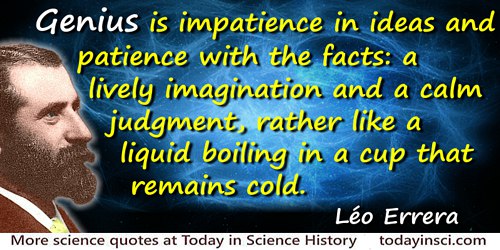
“Le génie n'est qu'une longue patience”, a dit Buffon. Cela est bien incomplet. Le génie, c'est l'impatience dans les idées et la patience dans les faits : une imagination vive et un jugement calme; quelque chose comme un liquide en ébullition dans un vase qui reste toujours froid.
“Genius is just enduring patience,” said Buffon. This is far from complete. Genius is impatience in ideas and patience with the facts: a lively imagination and a calm judgment, rather like a liquid boiling in a cup that remains cold.
“Genius is just enduring patience,” said Buffon. This is far from complete. Genius is impatience in ideas and patience with the facts: a lively imagination and a calm judgment, rather like a liquid boiling in a cup that remains cold.
In Recueil d'Œuvres de Léo Errera: Botanique Générale (1908), 198. Google translation by Webmaster.
L'imagination au contraire qui tend à nous porter continuellement au-delà du vrai, l'amour-propre et la confiance en nous-mêmes, qu'il sait si bien nous inspirer, nous sollicitent à tirer des conséquences qui ne dérivent pas immédiatement des faits.
Imagination, on the contrary, which is ever wandering beyond the bounds of truth, joined to self-love and that self-confidence we are so apt to indulge, prompt us to draw conclusions which are not immediately derived from facts.
Imagination, on the contrary, which is ever wandering beyond the bounds of truth, joined to self-love and that self-confidence we are so apt to indulge, prompt us to draw conclusions which are not immediately derived from facts.
From the original French in Traité élémentaire de chimie (1789, 1793), discours préliminaire, ix; and from edition translated into English by Robert Kerr, as Elements of Chemistry (1790), Preface, xvii.
Longtemps les objets dont s'occupent les mathématiciens étaient our la pluspart mal définis; on croyait les connaître, parce qu'on se les représentatit avec le sens ou l'imagination; mais on n'en avait qu'une image grossière et non une idée précise sure laquelle le raisonment pût avoir prise.
For a long time the objects that mathematicians dealt with were mostly ill-defined; one believed one knew them, but one represented them with the senses and imagination; but one had but a rough picture and not a precise idea on which reasoning could take hold.
For a long time the objects that mathematicians dealt with were mostly ill-defined; one believed one knew them, but one represented them with the senses and imagination; but one had but a rough picture and not a precise idea on which reasoning could take hold.
La valeur de la science. In Anton Bovier, Statistical Mechanics of Disordered Systems (2006), 97.
Where faith commences, science ends. Both these arts of the human mind must be strictly kept apart from each other. Faith has its origin in the poetic imagination; knowledge, on the other hand, originates in the reasoning intelligence of man. Science has to pluck the blessed fruits from the tree of knowledge, unconcerned whether these conquests trench upon the poetical imaginings of faith or not.
In Ernst Haeckel and E. Ray Lankester (trans.), The History of Creation (1880), Vol. 1, 9.
A discovery is like falling in love and reaching the top of a mountain after a hard climb all in one, an ecstasy not induced by drugs but by the revelation of a face of nature that no one has seen before and that often turns out to be more subtle and wonderful than anyone had imagined.
'True Science', review of Peter Medawar, Advice to a Young Scientist (1980). In The London Review of Books (Mar 1981), 6.
A first step in the study of civilization is to dissect it into details, and to classify these in their proper groups. Thus, in examining weapons, they are to be classed under spear, club, sling, bow and arrow, and so forth; among textile arts are to be ranged matting, netting, and several grades of making and weaving threads; myths are divided under such headings as myths of sunrise and sunset, eclipse-myths, earthquake-myths, local myths which account for the names of places by some fanciful tale, eponymic myths which account for the parentage of a tribe by turning its name into the name of an imaginary ancestor; under rites and ceremonies occur such practices as the various kinds of sacrifice to the ghosts of the dead and to other spiritual beings, the turning to the east in worship, the purification of ceremonial or moral uncleanness by means of water or fire. Such are a few miscellaneous examples from a list of hundreds … To the ethnographer, the bow and arrow is the species, the habit of flattening children’s skulls is a species, the practice of reckoning numbers by tens is a species. The geographical distribution of these things, and their transmission from region to region, have to be studied as the naturalist studies the geography of his botanical and zoological species.
In Primitive Culture (1871), Vol. 1, 7.
A good method of discovery is to imagine certain members of a system removed and then see how what is left would behave: for example, where would we be if iron were absent from the world: this is an old example.
Aphorism 258 in Notebook J (1789-1793), as translated by R. J. Hollingdale in Aphorisms (1990). Reprinted as The Waste Books (2000), 181.
A mind exclusively bent upon the idea of utility necessarily narrows the range of the imagination. For it is the imagination which pictures to the inner eye of the investigator the indefinitely extending sphere of the possible,—that region of hypothesis and explanation, of underlying cause and controlling law. The area of suggestion and experiment is thus pushed beyond the actual field of vision.
In 'The Paradox of Research', The North American Review (Sep 1908), 188, No. 634, 425.
A Miracle is a Violation of the Laws of Nature; and as a firm and unalterable Experience has established these Laws, the Proof against a Miracle, from the very Nature of the Fact, is as entire as any Argument from Experience can possibly be imagined. Why is it more than probable, that all Men must die; that Lead cannot, of itself, remain suspended in the Air; that Fire consumes Wood, and is extinguished by Water; unless it be, that these Events are found agreeable to the Laws of Nature, and there is required a Violation of these Laws, or in other Words, a Miracle to prevent them? Nothing is esteem'd a Miracle, if it ever happen in the common Course of Nature... There must, therefore, be a uniform Experience against every miraculous Event, otherwise the Event would not merit that Appellation. And as a uniform Experience amounts to a Proof, there is here a direct and full Proof, from the Nature of the Fact, against the Existence of any Miracle; nor can such a Proof be destroy'd, or the Miracle render'd credible, but by an opposite Proof, which is superior.
An Enquiry Concerning Human Understanding (1748), 180-181.
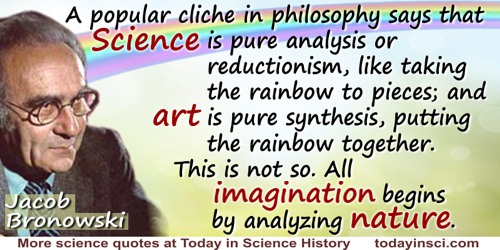
A popular cliche in philosophy says that science is pure analysis or reductionism, like taking the rainbow to pieces; and art is pure synthesis, putting the rainbow together. This is not so. All imagination begins by analyzing nature.
In The Ascent of Man (1973).
A scientist without imagination is a butcher with dull knives and out-worn scales.
In Kahlil Gibran: The Collected Works (2007), 204.
Accurate and minute measurement seems to the non-scientific imagination, a less lofty and dignified work than looking for something new. But nearly all the grandest discoveries of science have been but the rewards of accurate measurement and patient long-continued labour in the minute sifting of numerical results.
Presidential inaugural address, to the General Meeting of the British Association, Edinburgh (2 Aug 1871). In Report of the Forty-First Meeting of the British Association for the Advancement of Science (1872), xci.
Again and again the imaginary plan on which one attempts to build up order breaks down and then we must try another. This imaginative vision and faith in the ultimate success are indispensable. The pure rationalist has no place here.
In Max Planck and James Vincent Murphy (trans.), Where Is Science Going? (1932), 215.
All great scientists have, in a certain sense, been great artists; the man with no imagination may collect facts, but he cannot make great discoveries.
From The Grammar of Science (1892), 37.
All the different classes of beings which taken together make up the universe are, in the ideas of God who knows distinctly their essential gradations, only so many ordinates of a single curve so closely united that it would be impossible to place others between any two of them, since that would imply disorder and imperfection. Thus men are linked with the animals, these with the plants and these with the fossils which in turn merge with those bodies which our senses and our imagination represent to us as absolutely inanimate. And, since the law of continuity requires that when the essential attributes of one being approximate those of another all the properties of the one must likewise gradually approximate those of the other, it is necessary that all the orders of natural beings form but a single chain, in which the various classes, like so many rings, are so closely linked one to another that it is impossible for the senses or the imagination to determine precisely the point at which one ends and the next begins?all the species which, so to say, lie near the borderlands being equivocal, at endowed with characters which might equally well be assigned to either of the neighboring species. Thus there is nothing monstrous in the existence zoophytes, or plant-animals, as Budaeus calls them; on the contrary, it is wholly in keeping with the order of nature that they should exist. And so great is the force of the principle of continuity, to my thinking, that not only should I not be surprised to hear that such beings had been discovered?creatures which in some of their properties, such as nutrition or reproduction, might pass equally well for animals or for plants, and which thus overturn the current laws based upon the supposition of a perfect and absolute separation of the different orders of coexistent beings which fill the universe;?not only, I say, should I not be surprised to hear that they had been discovered, but, in fact, I am convinced that there must be such creatures, and that natural history will perhaps some day become acquainted with them, when it has further studied that infinity of living things whose small size conceals them for ordinary observation and which are hidden in the bowels of the earth and the depth of the sea.
Lettre Prétendue de M. De Leibnitz, à M. Hermann dont M. Koenig a Cité le Fragment (1753), cxi-cxii, trans. in A. O. Lovejoy, Great Chain of Being: A Study of the History of an Idea (1936), 144-5.
Among the multitude of animals which scamper, fly, burrow and swim around us, man is the only one who is not locked into his environment. His imagination, his reason, his emotional subtlety and toughness, make it possible for him not to accept the environment, but to change it. And that series of inventions, by which man from age to age has remade his environment, is a different kind of evolution—not biological, but cultural evolution. I call that brilliant sequence of cultural peaks The Ascent of Man. I use the word ascent with a precise meaning. Man is distinguished from other animals by his imaginative gifts. He makes plans, inventions, new discoveries, by putting different talents together; and his discoveries become more subtle and penetrating, as he learns to combine his talents in more complex and intimate ways. So the great discoveries of different ages and different cultures, in technique, in science, in the arts, express in their progression a richer and more intricate conjunction of human faculties, an ascending trellis of his gifts.
The Ascent of Man (1973), 19-20.
Ampère was a mathematician of various resources & I think might rather be called excentric [sic] than original. He was as it were always mounted upon a hobby horse of a monstrous character pushing the most remote & distant analogies. This hobby horse was sometimes like that of a child ['s] made of heavy wood, at other times it resembled those [?] shapes [?] used in the theatre [?] & at other times it was like a hypogrif in a pantomime de imagie. He had a sort of faith in animal magnetism & has published some refined & ingenious memoirs to prove the identity of electricity & magnetism but even in these views he is rather as I said before excentric than original. He has always appeared to me to possess a very discursive imagination & but little accuracy of observation or acuteness of research.
'Davy’s Sketches of his Contemporaries', Chymia, 1967, 12, 135-6.
An essential [of an inventor] is a logical mind that sees analogies. No! No! not mathematical. No man of a mathematical habit of mind ever invented anything that amounted to much. He hasn’t the imagination to do it. He sticks too close to the rules, and to the things he is mathematically sure he knows, to create anything new.
As quoted in French Strother, 'The Modern Profession of Inventing', World's Work and Play (Jul 1905), 6, No. 32, 187.
An expert problem solver must be endowed with two incompatible qualities, a restless imagination and a patient pertinacity.
From In Mathematical Circles (1969).
An honest man, armed with all the knowledge available to us now, could only state that in some sense, the origin of life appears at the moment to be almost a miracle, so many are the conditions which would have had to have been satisfied to get it going. But this should not be taken to imply that there are good reasons to believe that it could not have started on the earth by a perfectly reasonable sequence of fairly ordinary chemical reactions. The plain fact is that the time available was too long, the many microenvironments on the earth’s surface too diverse, the various chemical possibilities too numerous and our own knowledge and imagination too feeble to allow us to be able to unravel exactly how it might or might not have happened such a long time ago, especially as we have no experimental evidence from that era to check our ideas against.
In Life Itself: Its Origin and Nature (1981), 88.
Analogy is a wonderful, useful and most important form of thinking, and biology is saturated with it. Nothing is worse than a horrible mass of undigested facts, and facts are indigestible unless there is some rhyme or reason to them. The physicist, with his facts, seeks reason; the biologist seeks something very much like rhyme, and rhyme is a kind of analogy.... This analogizing, this fine sweeping ability to see likenesses in the midst of differences is the great glory of biology, but biologists don't know it.... They have always been so fascinated and overawed by the superior prestige of exact physical science that they feel they have to imitate it.... In its central content, biology is not accurate thinking, but accurate observation and imaginative thinking, with great sweeping generalizations.
In Science is a Sacred Cow (1950), 98-100.
Another argument of hope may be drawn from this–that some of the inventions already known are such as before they were discovered it could hardly have entered any man's head to think of; they would have been simply set aside as impossible. For in conjecturing what may be men set before them the example of what has been, and divine of the new with an imagination preoccupied and colored by the old; which way of forming opinions is very fallacious, for streams that are drawn from the springheads of nature do not always run in the old channels.
Translation of Novum Organum, XCII. In Francis Bacon, James Spedding, The Works of Francis Bacon (1864), Vol. 8, 128.
Any chemist reading this book can see, in some detail, how I have spent most of my mature life. They can become familiar with the quality of my mind and imagination. They can make judgements about my research abilities. They can tell how well I have documented my claims of experimental results. Any scientist can redo my experiments to see if they still work—and this has happened! I know of no other field in which contributions to world culture are so clearly on exhibit, so cumulative, and so subject to verification.
From Design to Discovery (1990), 119-20.
Archimedes had discovered the truth about several important natural laws, but more significant—at least from Galileo’s standpoint—was Archimedes’s discovery of a way for a scientist to solve problems: first separating what he truly wants to solve from irrelevant externals and then attacking the core of the problem with boldness and imagination. Galileo realized that this approach was suitable for his own studies.
In Galileo and Newton (1964), 23.
As I strayed into the study of an eminent physicist, I observed hanging against the wall, framed like a choice engraving, several dingy, ribbon-like strips of, I knew not what... My curiosity was at once aroused. What were they? ... They might be shreds of mummy-wraps or bits of friable bark-cloth from the Pacific, ... [or] remnants from a grandmother’s wedding dress... They were none of these... He explained that they were carefully-prepared photographs of portions of the Solar Spectrum. I stood and mused, absorbed in the varying yet significant intensities of light and shade, bordered by mystic letters and symbolic numbers. As I mused, the pale legend began to glow with life. Every line became luminous with meaning. Every shadow was suffused with light shining from behind, suggesting some mighty achievement of knowledge; of knowledge growing more daring in proportion to the remoteness of the object known; of knowledge becoming more positive in its answers, as the questions which were asked seemed unanswerable. No Runic legend, no Babylonish arrowhead, no Egyptian hieroglyph, no Moabite stone, could present a history like this, or suggest thoughts of such weighty import or so stimulate and exalt the imagination.
The Sciences of Nature Versus the Science of Man: A Plea for the Science of Man (1871), 7-9.
As usual, nature’s imagination far surpasses our own, as we have seen from the other theories which are subtle and deep.
In The Character of Physical Law (1965, 2001), 162.
At bottom each “exact” science is, and must be speculative, and its chief tool of research, too rarely used with both courage and judgement, is the regulated imagination.
In Igneous Rocks and their Origin (1914), Introduction, xxi.
Be daring, be different, be impractical; be anything that will assert integrity of purpose and imagination vision against the play-it-safers, the creatures of the commonplace, the slave of the ordinary.
…...
Between men of different studies and professions, may be observed a constant reciprocation of reproaches. The collector of shells and stones derides the folly of him who pastes leaves and flowers upon paper, pleases himself with colours that are perceptibly fading, and amasses with care what cannot be preserved. The hunter of insects stands amazed that any man can waste his short time upon lifeless matter, while many tribes of animals yet want their history. Every one is inclined not only to promote his own study, but to exclude all others from regard, and having heated his imagination with some favourite pursuit, wonders that the rest of mankind are not seized with the same passion.
From 'Numb. 83, Tuesday, January 1, 1750', The Rambler (1756), Vol. 2, 150.
But many of our imaginations and investigations of nature are futile, especially when we see little living animals and see their legs and must judge the same to be ten thousand times thinner than a hair of my beard, and when I see animals living that are more than a hundred times smaller and am unable to observe any legs at all, I still conclude from their structure and the movements of their bodies that they do have legs... and therefore legs in proportion to their bodies, just as is the case with the larger animals upon which I can see legs... Taking this number to be about a hundred times smaller, we therefore find a million legs, all these together being as thick as a hair from my beard, and these legs, besides having the instruments for movement, must be provided with vessels to carry food.
Letter to N. Grew, 27 Sep 1678. In The Collected Letters of Antoni van Leeuwenhoek (1957), Vol. 2, 391.
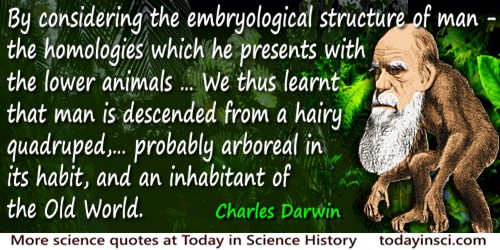
By considering the embryological structure of man - the homologies which he presents with the lower animals - the rudiments which he retains - and the reversions to which he is liable, we can partly recall in imagination the former condition of our early progenitors; and we can approximately place them in their proper position in the zoological series. We thus learnt that man is descended from a hairy quadruped, furnished with a tail and pointed ears, probably arboreal in its habit, and an inhabitant of the Old World. This creature, if its whole structure had been examined by a naturalist, would have been classed among the Quadrumana, as surely as would be the common and still more ancient progenitor of the Old and New World monkeys.
The Descent of Man (1871), Vol. 2, 389.
Can imagination picture what the future of this invention is to be! … We may talk by light to any visible distance without any conducting wire.
Letter to his father (26 Feb 1880), describing his photophone research. Transcript with Bell Papers, Library of Congress.
Computers are incredibly fast, accurate and stupid. Human beings are incredibly slow, inaccurate and brilliant. Together they are powerful beyond imagination.
Very often seen (?mis-)attributed to Albert Einstein, but there seems to be no authenticating primary source. (Webmaster has tried, but not yet found one.) Probably best regarded as Anonymous.
Creative imagination is likely to find corroborating novel evidence even for the most 'absurd' programme, if the search has sufficient drive. This look-out for new confirming evidence is perfectly permissible. Scientists dream up phantasies and then pursue a highly selective hunt for new facts which fit these phantasies. This process may be described as “science creating its own universe” (as long as one remembers that “creating” here is used in a provocative-idiosyncratic sense). A brilliant school of scholars (backed by a rich society to finance a few well-planned tests) might succeed in pushing any fantastic programme ahead, or alternatively, if so inclined, in overthrowing any arbitrarily chosen pillar of “established knowledge”.
In 'Falsification and the Methodology of Scientific Research Programmes', in I. Lakatos and A. Musgrave (eds.), Criticism and the Growth of Knowledge: Proceedings of the International Colloquium in the Philosophy of Science, London 1965 (1970), Vol. 4, 187-8.
Dare to be naïve.
Motto for Synergetics: Explorations for the Geometry of Thinking (1975), xix.
Don’t talk to me of your Archimedes’ lever. He was an absent-minded person with a mathematical imagination. Mathematics commands all my respect, but I have no use for engines. Give me the right word and the right accent and I will move the world.
In 'Preface', A Personal Record (1912), 2.
Endowed with two qualities, which seemed incompatible with each other, a volcanic imagination and a pertinacity of intellect which the most tedious numerical calculations could not daunt, Kepler conjectured that the movements of the celestial bodies must be connected together by simple laws, or, to use his own expression, by harmonic laws. These laws he undertook to discover. A thousand fruitless attempts, errors of calculation inseparable from a colossal undertaking, did not prevent him a single instant from advancing resolutely toward the goal of which he imagined he had obtained a glimpse. Twenty-two years were employed by him in this investigation, and still he was not weary of it! What, in reality, are twenty-two years of labor to him who is about to become the legislator of worlds; who shall inscribe his name in ineffaceable characters upon the frontispiece of an immortal code; who shall be able to exclaim in dithyrambic language, and without incurring the reproach of anyone, “The die is cast; I have written my book; it will be read either in the present age or by posterity, it matters not which; it may well await a reader, since God has waited six thousand years for an interpreter of his words.”
In 'Eulogy on Laplace', in Smithsonian Report for the year 1874 (1875), 131-132.
Engineering is the art of directing the great sources of power in nature for the use and the convenience of people. In its modern form engineering involves people, money, materials, machines, and energy. It is differentiated from science because it is primarily concerned with how to direct to useful and economical ends the natural phenomena which scientists discover and formulate into acceptable theories. Engineering therefore requires above all the creative imagination to innovate useful applications of natural phenomena. It seeks newer, cheaper, better means of using natural sources of energy and materials.
In McGraw Hill, Science and Technology Encyclopedia
Engineering without imagination sinks to a trade.
Reprint of his 1916 statement in 'Engineering as a Profession', Engineer’s Week (1954).
Every discovery, every enlargement of the understanding, begins as an imaginative preconception of what the truth might be. The imaginative preconception—a “hypothesis”—arises by a process as easy or as difficult to understand as any other creative act of mind; it is a brainwave, an inspired guess, a product of a blaze of insight. It comes anyway from within and cannot be achieved by the exercise of any known calculus of discovery.
In Advice to a Young Scientist (1979), 84.
Every great advance in science has issued from a new audacity of imagination. What are now working conceptions, employed as a matter of course because they have withstood the tests of experiment and have emerged triumphant, were once speculative hypotheses.
'The Copernican Revolution', in The Quest for Certainty: A Study of the Relation of Knowledge and Action (1929), 294. Collected in John Dewey. Volume 4: The Later Works, 1925-1953: 1929 The Quest for Certainty (1984), 247. The first sentence is used as the motto of The Bronx High School of Science, New York.
Every one who has seriously investigated a novel question, who has really interrogated Nature with a view to a distinct answer, will bear me out in saying that it requires intense and sustained effort of imagination.
In The Principles of Success in Literature (1901), 66.
Experience, the only logic sure to convince a diseased imagination and restore it to rugged health.
Written in 1892. In The American Claimant (1896), 203. In Mark Twain and Brian Collins (ed.), When in Doubt, Tell the Truth: and Other Quotations from Mark Twain (1996), 48.
Facts are not pure unsullied bits of information; culture also influences what we see and how we see it. Theories, moreover, are not inexorable inductions from facts. The most creative theories are often imaginative visions imposed upon facts; the source of imagination is also strongly cultural.
In The Mismeasure of Man (1981, 1996), 54.
For [Richard] Feynman, the essence of the scientific imagination was a powerful and almost painful rule. What scientists create must match reality. It must match what is already known. Scientific creativity is imagination in a straitjacket.
In Genius: The Life and Science of Richard Feynman (1992), 324.
For a scientist must indeed be freely imaginative and yet skeptical, creative and yet a critic. There is a sense in which he must be free, but another in which his thought must be very preceisely regimented; there is poetry in science, but also a lot of bookkeeping.
The Strange Case of the Spotted Mice and Other Classic Essays on Science (1996), 63.
For between true Science, and erroneous Doctrines, Ignorance is in the middle. Naturall sense and imagination, are not subject to absurdity. Nature it selfe cannot erre: and as men abound in copiousnesses of language; so they become more wise, or more mad than ordinary. Nor is it possible without Letters for any man to become either excellently wise, or (unless his memory be hurt by disease, or ill constitution of organs) excellently foolish. For words are wise men's counters, they do but reckon by them; but they are the money of fools that value them by the authority of an Aristotle, a Cicero, or a Thomas, or any other Doctor whatsoever, if but a man.
Leviathan (1651), ed. C. B. Macpherson (1968), Part 1, Chapter 4, 106.
For most scientists, I think the justification of their work is to be found in the pure joy of its creativeness; the spirit which moves them is closely akin to the imaginative vision which inspires an artist.
In Modern Science and Modern Man (1951), 58.
For, in mathematics or symbolic logic, reason can crank out the answer from the symboled equations—even a calculating machine can often do so—but it cannot alone set up the equations. Imagination resides in the words which define and connect the symbols—subtract them from the most aridly rigorous mathematical treatise and all meaning vanishes. Was it Eddington who said that we once thought if we understood 1 we understood 2, for 1 and 1 are 2, but we have since found we must learn a good deal more about “and”?
In 'The Biological Basis of Imagination', American Thought: 1947 (1947), 81.
Fortunately somewhere between chance and mystery lies imagination, the only thing that protects our freedom, despite the fact that people keep trying to reduce it or kill it off altogether.
My Last Breath? (1984), 174.
Fractal is a word invented by Mandelbrot to bring together under one heading a large class of objects that have [played] … an historical role … in the development of pure mathematics. A great revolution of ideas separates the classical mathematics of the 19th century from the modern mathematics of the 20th. Classical mathematics had its roots in the regular geometric structures of Euclid and the continuously evolving dynamics of Newton. Modern mathematics began with Cantor’s set theory and Peano’s space-filling curve. Historically, the revolution was forced by the discovery of mathematical structures that did not fit the patterns of Euclid and Newton. These new structures were regarded … as “pathological,” .… as a “gallery of monsters,” akin to the cubist paintings and atonal music that were upsetting established standards of taste in the arts at about the same time. The mathematicians who created the monsters regarded them as important in showing that the world of pure mathematics contains a richness of possibilities going far beyond the simple structures that they saw in Nature. Twentieth-century mathematics flowered in the belief that it had transcended completely the limitations imposed by its natural origins.
Now, as Mandelbrot points out, … Nature has played a joke on the mathematicians. The 19th-century mathematicians may not have been lacking in imagination, but Nature was not. The same pathological structures that the mathematicians invented to break loose from 19th-century naturalism turn out to be inherent in familiar objects all around us.
Now, as Mandelbrot points out, … Nature has played a joke on the mathematicians. The 19th-century mathematicians may not have been lacking in imagination, but Nature was not. The same pathological structures that the mathematicians invented to break loose from 19th-century naturalism turn out to be inherent in familiar objects all around us.
From 'Characterizing Irregularity', Science (12 May 1978), 200, No. 4342, 677-678. Quoted in Benoit Mandelbrot, The Fractal Geometry of Nature (1977, 1983), 3-4.
Geologists have not been slow to admit that they were in error in assuming that they had an eternity of past time for the evolution of the earth’s history. They have frankly acknowledged the validity of the physical arguments which go to place more or less definite limits to the antiquity of the earth. They were, on the whole, disposed to acquiesce in the allowance of 100 millions of years granted to them by Lord Kelvin, for the transaction of the whole of the long cycles of geological history. But the physicists have been insatiable and inexorable. As remorseless as Lear’s daughters, they have cut down their grant of years by successive slices, until some of them have brought the number to something less than ten millions. In vain have the geologists protested that there must somewhere be a flaw in a line of argument which tends to results so entirely at variance with the strong evidence for a higher antiquity, furnished not only by the geological record, but by the existing races of plants and animals. They have insisted that this evidence is not mere theory or imagination, but is drawn from a multitude of facts which become hopelessly unintelligible unless sufficient time is admitted for the evolution of geological history. They have not been able to disapprove the arguments of the physicists, but they have contended that the physicists have simply ignored the geological arguments as of no account in the discussion.
'Twenty-five years of Geological Progress in Britain', Nature, 1895, 51, 369.
Geologists have usually had recourse for the explanation of these changes to the supposition of sundry violent and extraordinary catastrophes, cataclysms, or general revolutions having occurred in the physical state of the earth's surface.
As the idea imparted by the term Cataclysm, Catastrophe, or Revolution, is extremely vague, and may comprehend any thing you choose to imagine, it answers for the time very well as an explanation; that is, it stops further inquiry. But it also has had the disadvantage of effectually stopping the advance of science, by involving it in obscurity and confusion.
As the idea imparted by the term Cataclysm, Catastrophe, or Revolution, is extremely vague, and may comprehend any thing you choose to imagine, it answers for the time very well as an explanation; that is, it stops further inquiry. But it also has had the disadvantage of effectually stopping the advance of science, by involving it in obscurity and confusion.
Considerations on Volcanoes (1825), iv.
Geologists on the whole are inconsistent drivers. When a roadcut presents itself, they tend to lurch and weave. To them, the roadcut is a portal, a fragment of a regional story, a proscenium arch that leads their imaginations into the earth and through the surrounding terrane.
Annals of the Former World
Geometry seems to stand for all that is practical, poetry for all that is visionary, but in the kingdom of the imagination you will find them close akin, and they should go together as a precious heritage to every youth.
From The Proceedings of the Michigan Schoolmasters’ Club, reprinted in School Review (1898), 6 114.
Giordano Bruno was the martyr; though the cause for which he suffered was not that of science, but that of free imaginative speculation. His death in the year 1600 ushered in the first century of modern science in the strict sense of the term.
In 'The Origins of Modern Science', Science and the Modern World (1926, 2011), 1.
Give me an ounce of civit, good apothecary, to sweeten my imagination.
In Raymond C. Rowe, Joseph Chamberlain, A Spoonful of Sugar (2007),
Guard against both doing experiments simply because they are likely to yield easy or easily manipulated results or because they are what a lively laboratory imagination is able to invent.
From archive recording (3 Jun 1959) with to John C. Kenna, giving his recollection of his farewell speech to Cambridge Psychological Society (4 Mar 1952), in which he gave a summary of points he considered to be basic requirements for a good experimental psychologist. Part of point 4 of 7, from transcription of recording held at British Psychological Society History of Psychology Centre, London, as abridged on thepsychologist.bps.org.uk website.
Haldane could have made a success of any one of half a dozen careers—as mathematician, classical scholar, philosopher, scientist, journalist or imaginative writer. On his life’s showing he could not have been a politician, administrator (heavens, no!), jurist or, I think, a critic of any kind. In the outcome he became one of the three or four most influential biologists of his generation.
Essay, 'J.B.S.', in Pluto’s Republic: Incorporating The Art of the Soluble and Induction and Intuition in Scientific Thought (1982), collected in The Strange Case of the Spotted Mice and Other Classic Essays on Science (1996), 87.
Half an imagination is worse than none at all.
Aphorism as given by the fictional character Dezhnev Senior, in Fantastic Voyage II: Destination Brain (1987), 178.
He who has imagination without learning has wings and no feet.
In Tryon Edwards, A Dictionary of Thoughts (1908), 245.
He who studies it [Nature] has continually the exquisite pleasure of discerning or half discerning and divining laws; regularities glimmer through an appearance of confusion, analogies between phenomena of a different order suggest themselves and set the imagination in motion; the mind is haunted with the sense of a vast unity not yet discoverable or nameable. There is food for contemplation which never runs short; you are gazing at an object which is always growing clearer, and yet always, in the very act of growing clearer, presenting new mysteries.
From 'Natural History', Macmillan's Magazine (1875), 31, 366.
Heredity, to our understanding is not capable of giving to this illness (paraphilia) its characteristic form ... Heredity invents nothing, creates nothing anew; it has no imagination.
Études de psychologie expérimentale: Le fétichisme dans l’amour (1888), 42.
How many famous men be there in this our age, which make scruple to condemne these old witches, thinking it to bee nothing but a melancholike humour which corrupteth thei imagination, and filleth them with all these vaines toyes. I will not cast my selfe any further into the depth of this question, the matter craveth a man of more leisure.
Describing melancholy as the innocent affliction of those regarded as witches instead of Satanic influence, while distancing himself from the controversy.
Describing melancholy as the innocent affliction of those regarded as witches instead of Satanic influence, while distancing himself from the controversy.
Discours de la conservation de la veue; des maladies mélancholiques, des catarrhes, et de la vieillese (1594). In Richard Surphlet (trans.) A Discourse of the Preservation of the Sight: of Melancholike Diseases; of Rheumes, and of Old Age (1599), 98-9. Quoted in Michael Heyd, Be sober and Reasonable (), 58.
How often people speak of art and science as though they were two entirely different things, with no interconnection. An artist is emotional, they think, and uses only his intuition; he sees all at once and has no need of reason. A scientist is cold, they think, and uses only his reason; he argues carefully step by step, and needs no imagination. That is all wrong. The true artist is quite rational as well as imaginative and knows what he is doing; if he does not, his art suffers. The true scientist is quite imaginative as well as rational, and sometimes leaps to solutions where reason can follow only slowly; if he does not, his science suffers.
'Prometheus.' The Roving Mind (1983), Chap 25.
However far the mathematician’s calculating senses seem to be separated from the audacious flight of the artist’s imagination, these manifestations refer to mere instantaneous images, which have been arbitrarily torn from the operation of both. In designing new theories, the mathematician needs an equally bold and inspired imagination as creative as the artist, and in carrying out the details of a work the artist must unemotionally reckon all the resources necessary for the success of the parts. Common to both is the fabrication, the creation of the structure from the intellect.
From Die Entwickelung der Mathematik im Zusammenhange mit der Ausbreitung der Kultur (1893), 4. Translated by Webmaster using online resources. From the original German, “Wie weit auch der rechnende Verstand des Mathematikers von dem kühnen Fluge der Phantasie des Künstlers getrennt zu sein scheint, so bezeichnen diese Ausdrücke doch blosse Augenblicksbilder, die willkürlich aus der Thätigkeit Beider herausgerissen sind. Bei dem Entwurfe neuer Theorieen bedarf der Mathematiker einer ebenso kühnen und schöpferischen Phantasie wie der schaffende Künstler, und bei der Ausführung der Einzelheiten eines Werkes muss auch der Künstler kühl alle Mittel berechnen, welche zum Gelingen der Theile erforderlich sind. Gemeinsam ist Beiden die Hervorbringung, die Erzeugung der Gebilde aus dem Geiste.”
I am certain of nothing but the holiness of the Heart’s affections and the truth of Imagination—What the imagination seizes as Beauty must be truth—whether it existed before or not.
Letter to Benjamin Bailey (22 Nov 1817). In H. E. Rollins (ed.), Letters of John Keats (1958), Vol. 1, 184.
I am quite aware that we have just now lightheartedly expelled in imagination many excellent men who are largely, perhaps chiefly, responsible for the buildings of the temple of science; and in many cases our angel would find it a pretty ticklish job to decide. But of one thing I feel sure: if the types we have just expelled were the only types there were, the temple would never have come to be, any more than a forest can grow which consists of nothing but creepers. For these people any sphere of human activity will do, if it comes to a point; whether they become engineers, officers, tradesmen, or scientists depends on circumstances.
…...
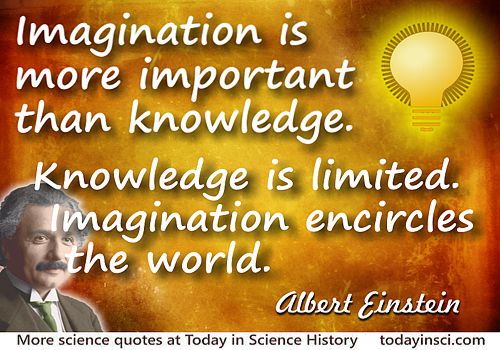
I believe in intuition and inspiration. Imagination is more important than knowledge. For knowledge is limited, whereas imagination embraces the entire world, stimulating progress, giving birth to evolution. It is, strictly speaking, a real factor in scientific research.
Cosmic Religion: With Other Opinions and Aphorisms (1931), 97.
I believe that life can go on forever. It takes a million years to evolve a new species, ten million for a new genus, one hundred million for a class, a billion for a phylum—and that’s usually as far as your imagination goes. In a billion years, it seems, intelligent life might be as different from humans as humans are from insects. But what would happen in another ten billion years? It’s utterly impossible to conceive of ourselves changing as drastically as that, over and over again. All you can say is, on that kind of time scale the material form that life would take is completely open. To change from a human being to a cloud may seem a big order, but it’s the kind of change you’d expect over billions of years.
Quoted in Omni (1986), 8, 38.
I cannot face with comfort the idea of life without work; work and the free play of the imagination are for me the same thing, I take no pleasure in anything else.
Letter to Oskar Pfister, 3 Jun 1910. Quoted in H. Meng and E. Freud (eds.), Psycho-Analysis and Faith: The Letters of Sigmund Freud and Oskar Pfister (1963), 146.
I feel that, in a sense, the writer knows nothing any longer. He has no moral stance. He offers the reader the contents of his own head, a set of options and imaginative alternatives. His role is that of a scientist, whether on safari or in his laboratory, faced with an unknown terrain or subject. All he can do is to devise various hypotheses and test them against the facts.
Crash (1973, 1995), Introduction. In Barry Atkins, More Than A Game: the Computer Game as a Fictional Form (2003), 144.
I had at one time a very bad fever of which I almost died. In my fever I had a long consistent delirium. I dreamt that I was in Hell, and that Hell is a place full of all those happenings that are improbable but not impossible. The effects of this are curious. Some of the damned, when they first arrive below, imagine that they will beguile the tedium of eternity by games of cards. But they find this impossible, because, whenever a pack is shuffled, it comes out in perfect order, beginning with the Ace of Spades and ending with the King of Hearts. There is a special department of Hell for students of probability. In this department there are many typewriters and many monkeys. Every time that a monkey walks on a typewriter, it types by chance one of Shakespeare's sonnets. There is another place of torment for physicists. In this there are kettles and fires, but when the kettles are put on the fires, the water in them freezes. There are also stuffy rooms. But experience has taught the physicists never to open a window because, when they do, all the air rushes out and leaves the room a vacuum.
'The Metaphysician's Nightmare', Nightmares of Eminent Persons and Other Stories (1954), 38-9.
I have from my childhood, in conformity with the precepts of a mother void of all imaginary fear, been in the constant habit of taking toads in my hand, and applying them to my nose and face as it may happen. My motive for doing this very frequently is to inculcate the opinion I have held, since I was told by my mother, that the toad is actually a harmless animal; and to whose manner of life man is certainly under some obligation as its food is chiefly those insects which devour his crops and annoy him in various ways.
Letter to an unknown correspondent, quoted by Bowdler Sharpe, The Natural History and Antiquities of Selborne (1900), Vol. 1, 69. In Averil M. Lysaght, Joseph Banks in Newfoundland and Labrador, 1766: his Diary, Manuscripts, and Collections (1971), 44.
I have often pondered over the roles of knowledge or experience, on the one hand, and imagination or intuition, on the other, in the process of discovery. I believe that there is a certain fundamental conflict between the two, and knowledge, by advocating caution, tends to inhibit the flight of imagination. Therefore, a certain naivete, unburdened by conventional wisdom, can sometimes be a positive asset.
In R. Langlands, 'Harish-Chandra', Biographical Memoirs of Fellows of the Royal Society (1985), Vol. 31, 206.
I imagine that when we reach the boundaries of things set for us, or even before we reach them, we can see into the infinite, just as on the surface of the earth we gaze out into immeasurable space.
Aphorism 52 in Notebook D (1773-1775), as translated by R.J. Hollingdale in Aphorisms (1990). Reprinted as The Waste Books (2000), 51.
I know of scarcely anything so apt to impress the imagination as the wonderful form of cosmic order expressed by the “Law of Frequency of Error.” The law would have been personified by the Greeks and deified, if they had known of it. It reigns with serenity and in complete self-effacement, amidst the wildest confusion. The huger the mob, and the greater the apparent anarchy, the more perfect is its sway. It is the supreme law of Unreason. Whenever a large sample of chaotic elements are taken in hand and marshaled in the order of their magnitude, an unsuspected and most beautiful form of regularity proves to have been latent all along.
In Natural Inheritance (1894), 66.
I learned what research was all about as a research student [with] Stoppani ... Max Perutz, and ... Fred Sanger... From them, I always received an unspoken message which in my imagination I translated as “Do good experiments, and don’t worry about the rest.”
From Nobel Lecture (8 Dec 1984), collected in Tore Frängsmyr and Jan Lindsten (eds.), Nobel Lectures in Physiology Or Medicine: 1981-1990 (1993), 268.
I like to look at mathematics almost more as an art than as a science; for the activity of the mathematician, constantly creating as he is, guided though not controlled by the external world of the senses, bears a resemblance, not fanciful I believe but real, to the activity of an artist, of a painter let us say. Rigorous deductive reasoning on the part of the mathematician may be likened here to technical skill in drawing on the part of the painter. Just as no one can become a good painter without a certain amount of skill, so no one can become a mathematician without the power to reason accurately up to a certain point. Yet these qualities, fundamental though they are, do not make a painter or mathematician worthy of the name, nor indeed are they the most important factors in the case. Other qualities of a far more subtle sort, chief among which in both cases is imagination, go to the making of a good artist or good mathematician.
From 'Fundamental Conceptions and Methods in Mathematics', Bulletin American Mathematical Society (1904), 9, 133. As cited in Robert Édouard Moritz, Memorabilia Mathematica; Or, The Philomath’s Quotation-Book (1914), 182.
I must, in the first place, ask my readers to grant me the scientific use of their imagination; and in order that it may not be called upon to cope with questions as to whether space is infinite or not, or whether space and time ever had a beginning, we will not consider the possibility of the beginning of things or attempt to define the totality of space, but we will in imagination clear a certain part of space and then set certain possibilities at work.
In 'The History of a Star', The Nineteenth Century (Nov 1889), 26, No. 153, 786.
I respect Kirkpatrick both for his sponges and for his numinous nummulosphere. It is easy to dismiss a crazy theory with laughter that debars any attempt to understand a man’s motivation–and the nummulosphere is a crazy theory. I find that few men of imagination are not worth my attention. Their ideas may be wrong, even foolish, but their methods often repay a close study ... The different drummer often beats a fruitful tempo.
…...
I think a strong claim can be made that the process of scientific discovery may be regarded as a form of art. This is best seen in the theoretical aspects of Physical Science. The mathematical theorist builds up on certain assumptions and according to well understood logical rules, step by step, a stately edifice, while his imaginative power brings out clearly the hidden relations between its parts. A well constructed theory is in some respects undoubtedly an artistic production. A fine example is the famous Kinetic Theory of Maxwell. ... The theory of relativity by Einstein, quite apart from any question of its validity, cannot but be regarded as a magnificent work of art.
Responding to the toast, 'Science!' at the Royal Academy of the Arts in 1932.)
Responding to the toast, 'Science!' at the Royal Academy of the Arts in 1932.)
Quoted in Lawrence Badash, 'Ernest Rutherford and Theoretical Physics,' in Robert Kargon and Peter Achinstein (eds.) Kelvin's Baltimore Lectures and Modern Theoretical Physics: Historical and Philosophical Perspectives (1987), 352.
I think at the moment we did not even want to break the seal [on the inner chamber of the tomb of Tutankhamen], for a feeling of intrusion had descended heavily upon us... We felt that we were in the presence of the dead King and must do him reverence, and in imagination could see the doors of the successive shrines open one.
Howard Carter, Arthur Cruttenden Mace, The Discovery of the Tomb of Tutankhamen (reprint 1977), 183.
Iconography becomes even more revealing when processes or concepts, rather than objects, must be depicted–for the constraint of a definite ‘thing’ cedes directly to the imagination. How can we draw ‘evolution’ or ‘social organization,’ not to mention the more mundane ‘digestion’ or ‘self-interest,’ without portraying more of a mental structure than a physical reality? If we wish to trace the history of ideas, iconography becomes a candid camera trained upon the scholar’s mind.
…...
Ideas can be willed, and the imagination is their engine.
In The Marketing Imagination (1983, 1986), 127.
If elephants didn’t exist, you couldn’t invent one. They belong to a small group of living things so unlikely they challenge credulity and common sense. Compared to them, we are primitive, hanging on to a stubborn, unspecialized, five-fingered state, clever but destructive. They are models of refinement, nature’s archangels, the oldest and largest land mammals, touchstones to our imagination
In Elephantoms: Tracking the Elephant (2002, 2003), 38.
If matter is not eternal, its first emergence into being is a miracle beside which all others dwindle into absolute insignificance. But, as has often been pointed out, the process is unthinkable; the sudden apocalypse of a material world out of blank nonentity cannot be imagined; its emergence into order out of chaos when “without form and void” of life, is merely a poetic rendering of the doctrine of its slow evolution.
In Nineteenth Century (Sep c.1879?). Quoted in John Tyndall, 'Professor Virchow and Evolution', Fragments of Science (1879), Vol. 2, 377.
If order appeals to the intellect, then disorder titillates the imagination.
Quoted in the original French, “Si l’ordre satisfait la raison, /Le désordre fait les deélices de l’imagination,” in P.H. Gaskell (ed.), Structure of Non-crystalline Materials 1976: Symposium Proceedings (1977), 260. As translated in Alan A. Mackay, A Dictionary of Scientific Quotations (1991), 56.
If time is treated in modern physics as a dimension on a par with the dimensions of space, why should we a priori exclude the possibility that we are pulled as well as pushed along its axis? The future has, after all, as much or as little reality as the past, and there is nothing logically inconceivable in introducing, as a working hypothesis, an element of finality, supplementary to the element of causality, into our equations. It betrays a great lack of imagination to believe that the concept of “purpose” must necessarily be associated with some anthropomorphic deity.
In 'Epilogue', The Sleepwalkers: A History of Man’s Changing Vision of the Universe (1959, 1968), 537.
If we betake ourselves to the statistical method, we do so confessing that we are unable to follow the details of each individual case, and expecting that the effects of widespread causes, though very different in each individual, will produce an average result on the whole nation, from a study of which we may estimate the character and propensities of an imaginary being called the Mean Man.
'Does the Progress of Physical Science tend to give any advantage to the opinion of necessity (or determinism) over that of the continuency of Events and the Freedom of the Will?' In P. M. Hannan (ed.), The Scientific Letters and Papers of James Clerk Maxwell (1995), Vol. 2, 1862-1873, 818.
If we do not learn to eliminate waste and to be more productive and more efficient in the ways we use energy, then we will fall short of this goal [for the Nation to derive 20 percent of all the energy we use from the Sun, by 2000]. But if we use our technological imagination, if we can work together to harness the light of the Sun, the power of the wind, and the strength of rushing streams, then we will succeed.
Speech, at dedication of solar panels on the White House roof, 'Solar Energy Remarks Announcing Administration Proposals' (20 Jun 1979).
If we imagine an observer to approach our planet from outer space, and, pushing aside the belts of red-brown clouds which obscure our atmosphere, to gaze for a whole day on the surface of the earth as it rotates beneath him, the feature, beyond all others most likely to arrest his attention would be the wedge-like outlines of the continents as they narrow away to the South.
The Face of the Earth (1904), Vol. 1, 1.
If you have imagination as a grain of sesame seed, all things are possible to you.
…...
If you want to find out anything from the theoretical physicists about the methods they use, I advise you to stick closely to one principle: don't listen to their words, fix your attention on their deeds. To him who is a discoverer in this field the products of his imagination appear so necessary and natural that he regards them, and would like to have them regarded by others, not as creations of thought but as given realities.
From 'On the Method of Theoretical Physics', in Essays in Science (1934, 2004), 12.
If you wish to learn from the theoretical physicist anything about the methods which he uses, I would give you the following piece of advice: Don’t listen to his words, examine his achievements. For to the discoverer in that field, the constructions of his imagination appear so necessary and so natural that he is apt to treat them not as the creations of his thoughts but as given realities.
In Herbert Spencer Lecture at Oxford (10 Jun 1933), 'On the Methods of Theoretical Physics'. Printed inPhilosophy of Science (Apr 1934), 1, No. 2, 163.
Imagination and even sentiment play an important part in chemistry, and that if too narrowly and rigidly interpreted, facts may become very misleading factors.
In article 'Chemistry', Encyclopedia Britannica (1902), 714.
Imagination comes first in both artistic and scientific creations, but in science there is only one answer and that has to be correct.
In 'Discoverers of the Double Helix', The Daily Telegraph (27 Apr 1987), in Max Perutz (ed.), Is Science Necessary: Essays on Science and Scientists (1991), 182.
Imagination is a contagious disease. It cannot be measured by the yard, or weighed by the pound, and then delivered to the students by members of the faculty. It can only be communicated by a faculty whose members themselves wear their learning with imagination.
In 'Universities and Their Function', The Aims of Education: & Other Essays (1917), 139.
Imagination is more robust in proportion as reasoning power is weak.
In The New Science (3rd ed., 1744), Book 1, Para. 185, as translated by Thomas Goddard Bergin and Max Harold Fisch, The New Science of Giambattista Vico (1948), 63.
Imagination is the Discovering Faculty, pre-eminently. … It is that which feels & discovers what is, the REAL which we see not, which exists not for our senses. … Mathematical science shows what is. It is the language of unseen relations between things. … Imagination too shows what is. … Hence she is or should be especially cultivated by the truly Scientific, those who wish to enter into the worlds around us!
Lovelace Papers, Bodleian Library, Oxford University, 175, folio 199, journal entry for 5 Jan 1841. As quoted and cited in Dorothy Stein (ed.), 'In Time I Will Do All, I Dare Say', Ada: A Life and a Legacy (1985), 128.
Imagination is the beginning of creation. You imagine what you desire, you will what you imagine and at last you create what you will.
From Back to Methuselah: A Metabiological Pentateuch (1921), 9.
Imagination is the eye of the soul.
…...
Imagination is the highest kite one can fly.
…...
Imagination only rarely leads one to a correct answer, and most of our ideas have to be discarded. Research workers ought not to be afraid of making mistakes provided they correct them in good time.
In The Art of Scientific Investigation (1950), 67.
Imagination will often carry us to worlds that never were. But without it we go nowhere.
In Cosmos (1980), 4.
Imagination, as well as reason, is necessary to perfection of the philosophical mind. A rapidity of combination, a power of perceiving analogies, and of comparing them by facts, is the creative source of discovery. Discrimination and delicacy of sensation, so important in physical research, are other words for taste; and the love of nature is the same passion, as the love of the magnificent, the sublime and the beautiful.
In Parallels Between Art and Science (1807).
IMAGINATION, n. A warehouse of facts, with poet and liar in joint ownership
The Collected Works of Ambrose Bierce (1911), Vol. 7, The Devil's Dictionary, 148.
Imagine Aristotle revivified and visiting Manhattan. Nothing in our social, political, economic, artistic, sexual or religious life would mystify him, but he would be staggered by our technology. Its products—skyscrapers, cars, airplanes, television, pocket calculators—would have been impossible without calculus.
In book review, 'Adventures Of a Mathematician: The Man Who Invented the H-Bomb', New York Times (9 May 1976), 201.
In assessing Audubon, whose firm grip on the popular imagination has scarcely lessened since 1826, we must as historians of science seriously ask who would remember him if he had not been an artist of great imagination and flair. ... The chances seem to be very poor that had he not been an artist, he would be an unlikely candidate for a dictionary of scientific biography, if remembered to science at all.
In Charles Coulston Gillespie (ed.), Dictionary of Scientific Biography (1972), Vol. 1, 331.
In fulfilling the wants of the public, a manufacturer should keep as far ahead as his imagination and his knowledge of his buying public will let him. One should never wait to see what it is a customer is going to want. Give him, rather, what he needs, before he has sensed that need himself.
As quoted by H.M. Davidson, in System: The Magazine of Business (Apr 1922), 41, 413.
In general, the more one augments the number of divisions of the productions of nature, the more one approaches the truth, since in nature only individuals exist, while genera, orders, and classes only exist in our imagination.
Histoire Naturelle (1749), trans. by John Lyon, The 'Initial Discourse' to Buffon’s Histoire Naturelle: The First Complete English Translation, Journal of the History of Biology, 9(1), 1976, 164.
In my personal view, a failure to discover unimagined objects and answer unasked questions, once HST functions properly, would indicate a lack of imagination in stocking the Universe on the part of the Deity.
In Hubble Space Telescope flaw: hearing before the Committee on Science, Space, and Technology, U.S. House of Representatives, One Hundred First Congress, second session, July 13, 1990 (1990), 105.
In order to consider in the most general way the principle of the production of motion by heat, it must be considered independently of any mechanism or any particular agent. It is necessary to establish principles applicable not only to steam engines but to all imaginable heat-engines, whatever the working substance and whatever the method by which it is operated.
In Reflections on the Motive Power of Heat and on Machines Fitted to Develop Power (1890, Rev. 1897), 43-44. Edited by R. H. Thurston, from the original French, Réflexions sur la Puissance Motrice du Feu (1824).
In scientific study, or, as I prefer to phrase it, in creative scholarship, the truth is the single end sought; all yields to that. The truth is supreme, not only in the vague mystical sense in which that expression has come to be a platitude, but in a special, definite, concrete sense. Facts and the immediate and necessary inductions from facts displace all pre-conceptions, all deductions from general principles, all favourite theories. Previous mental constructions are bowled over as childish play-structures by facts as they come rolling into the mind. The dearest doctrines, the most fascinating hypotheses, the most cherished creations of the reason and of the imagination perish from a mind thoroughly inspired with the scientific spirit in the presence of incompatible facts. Previous intellectual affections are crushed without hesitation and without remorse. Facts are placed before reasonings and before ideals, even though the reasonings and the ideals be more beautiful, be seemingly more lofty, be seemingly better, be seemingly truer. The seemingly absurd and the seemingly impossible are sometimes true. The scientific disposition is to accept facts upon evidence, however absurd they may appear to our pre-conceptions.
The Ethical Functions of Scientific Study: An Address Delivered at the Annual Commencement of the University of Michigan, 28 June 1888, 7-8.
In the past we see that periods of great intellectual activity have followed certain events which have acted by freeing the mind from dogma, extending the domain in which knowledge can be sought, and stimulating the imagination. … [For example,] the development of the cell theory and the theory of evolution.
From address, 'A Medical Retrospect'. Published in Yale Medical Journal (Oct 1910), 17, No. 2, 59.
In the pursuit of the physical sciences, the imagination supplies the hypothesis which bridges over the gulf that separates the known from the unknown.
Presidential Address to Anniversary meeting of the Royal Society (30 Nov 1859), Proceedings of the Royal Society of London (1860), 10, 165-166.
Indeed, the ideal for a well-functioning democratic state is like the ideal for a gentleman’s well-cut suit—it is not noticed. For the common people of Britain, Gestapo and concentration camps have approximately the same degree of reality as the monster of Loch Ness. Atrocity propaganda is helpless against this healthy lack of imagination.
In 'A Challenge to “Knights in Rusty Armor”', The New York Times (14 Feb 1943), Sunday Magazine, 5.
Inspiration plays no less a role in science than it does in the realm of art. It is a childish notion to think that a mathematician attains any scientifically valuable results by sitting at his desk with a ruler, calculating machines or other mechanical means. The mathematical imagination of a Weierstrass is naturally quite differently oriented in meaning and result than is the imagination of an artist, and differs basically in quality. But the psychological processes do not differ. Both are frenzy (in the sense of Plato’s “mania”) and “inspiration.”
From a Speech (1918) presented at Munich University, published in 1919, and collected in 'Wissenschaft als Beruf', Gessammelte Aufsätze zur Wissenschaftslehre (1922), 524-525. As given in H.H. Gerth and C. Wright-Mills (translators and eds.), 'Science as a Vocation', Max Weber: Essays in Sociology (1946), 136.
Investigators are commonly said to be engaged in a search for the truth. I think they themselves would usually state their aims less pretentiously. What the experimenter is really trying to do is to learn whether facts can be established which will be recognized as facts by others and which will support some theory that in imagination he has projected. But he must be ingenuously honest. He must face facts as they arise in the course of experimental procedure, whether they are favourable to his idea or not. In doing this he must be ready to surrender his theory at any time if the facts are adverse to it.
The Way of an Investigator: A Scientist's Experiences in Medical Research (1945), 34.
Is it absurd to imagine that our social behavior, from amoeba to man, is also planned and dictated, from stored Information, by the cells? And that the time has come for men to be entrusted with the task, through heroic efforts, of bringing life to other worlds?
From Nobel Prize Lecture (Dec 1974), 'The Coming Age of the Cell'. Collected in Jan Lindsten (ed.) Nobel Lectures, Physiology or Medicine 1971-1980 (1992).
Is it not true that the doctrine of attraction and gravity has done nothing but astonish our imagination? Is it not true that all chemical discoveries have done only the same?
Letter to Jean le Rond D'Alembert (7 Jan 1768). Collected in Correspondence: Letters Between Frederick II and M. D’Alembert (1789), 79, as translated by Thomas Holcroft.
Is there a due regard to be had, … for the golden tongue of wisdom, that relisheth all not by imagination but true judgement.
In 'To the Reader', The Optick Glass of Humors (1607), 10.
Isn’t it weird how scientists can imagine all the matter of the universe exploding out of a dot smaller than the head of a pin, but they can’t come up with a more evocative name for it than “The Big Bang”? … [I’d call it] “The Horrendous Space KABLOOUIE!”
Dialog by Calvin (fictional character) in syndicated newspaper comic strip Calvin and Hobbes (21 Jun 1992).
It [imagination] is a form of seeing.
In His Dark Materials, Book 3: The Amber Spyglass (1995, 2003), 494.
It has been asserted … that the power of observation is not developed by mathematical studies; while the truth is, that; from the most elementary mathematical notion that arises in the mind of a child to the farthest verge to which mathematical investigation has been pushed and applied, this power is in constant exercise. By observation, as here used, can only be meant the fixing of the attention upon objects (physical or mental) so as to note distinctive peculiarities—to recognize resemblances, differences, and other relations. Now the first mental act of the child recognizing the distinction between one and more than one, between one and two, two and three, etc., is exactly this. So, again, the first geometrical notions are as pure an exercise of this power as can be given. To know a straight line, to distinguish it from a curve; to recognize a triangle and distinguish the several forms—what are these, and all perception of form, but a series of observations? Nor is it alone in securing these fundamental conceptions of number and form that observation plays so important a part. The very genius of the common geometry as a method of reasoning—a system of investigation—is, that it is but a series of observations. The figure being before the eye in actual representation, or before the mind in conception, is so closely scrutinized, that all its distinctive features are perceived; auxiliary lines are drawn (the imagination leading in this), and a new series of inspections is made; and thus, by means of direct, simple observations, the investigation proceeds. So characteristic of common geometry is this method of investigation, that Comte, perhaps the ablest of all writers upon the philosophy of mathematics, is disposed to class geometry, as to its method, with the natural sciences, being based upon observation. Moreover, when we consider applied mathematics, we need only to notice that the exercise of this faculty is so essential, that the basis of all such reasoning, the very material with which we build, have received the name observations. Thus we might proceed to consider the whole range of the human faculties, and find for the most of them ample scope for exercise in mathematical studies. Certainly, the memory will not be found to be neglected. The very first steps in number—counting, the multiplication table, etc., make heavy demands on this power; while the higher branches require the memorizing of formulas which are simply appalling to the uninitiated. So the imagination, the creative faculty of the mind, has constant exercise in all original mathematical investigations, from the solution of the simplest problems to the discovery of the most recondite principle; for it is not by sure, consecutive steps, as many suppose, that we advance from the known to the unknown. The imagination, not the logical faculty, leads in this advance. In fact, practical observation is often in advance of logical exposition. Thus, in the discovery of truth, the imagination habitually presents hypotheses, and observation supplies facts, which it may require ages for the tardy reason to connect logically with the known. Of this truth, mathematics, as well as all other sciences, affords abundant illustrations. So remarkably true is this, that today it is seriously questioned by the majority of thinkers, whether the sublimest branch of mathematics,—the infinitesimal calculus—has anything more than an empirical foundation, mathematicians themselves not being agreed as to its logical basis. That the imagination, and not the logical faculty, leads in all original investigation, no one who has ever succeeded in producing an original demonstration of one of the simpler propositions of geometry, can have any doubt. Nor are induction, analogy, the scrutinization of premises or the search for them, or the balancing of probabilities, spheres of mental operations foreign to mathematics. No one, indeed, can claim preeminence for mathematical studies in all these departments of intellectual culture, but it may, perhaps, be claimed that scarcely any department of science affords discipline to so great a number of faculties, and that none presents so complete a gradation in the exercise of these faculties, from the first principles of the science to the farthest extent of its applications, as mathematics.
In 'Mathematics', in Henry Kiddle and Alexander J. Schem, The Cyclopedia of Education, (1877.) As quoted and cited in Robert Édouard Moritz, Memorabilia Mathematica; Or, The Philomath’s Quotation-book (1914), 27-29.
It is a vulgar belief that our astronomical knowledge dates only from the recent century when it was rescued from the monks who imprisoned Galileo; but Hipparchus…who among other achievements discovered the precession of the eqinoxes, ranks with the Newtons and the Keplers; and Copernicus, the modern father of our celestial science, avows himself, in his famous work, as only the champion of Pythagoras, whose system he enforces and illustrates. Even the most modish schemes of the day on the origin of things, which captivate as much by their novelty as their truth, may find their precursors in ancient sages, and after a careful analysis of the blended elements of imagination and induction which charaterise the new theories, they will be found mainly to rest on the atom of Epicurus and the monad of Thales. Scientific, like spiritual truth, has ever from the beginning been descending from heaven to man.
Lothair (1879), preface, xvii.
It is above all the duty of the methodical text-book to adapt itself to the pupil’s power of comprehension, only challenging his higher efforts with the increasing development of his imagination, his logical power and the ability of abstraction. This indeed constitutes a test of the art of teaching, it is here where pedagogic tact becomes manifest. In reference to the axioms, caution is necessary. It should be pointed out comparatively early, in how far the mathematical body differs from the material body. Furthermore, since mathematical bodies are really portions of space, this space is to be conceived as mathematical space and to be clearly distinguished from real or physical space. Gradually the student will become conscious that the portion of the real space which lies beyond the visible stellar universe is not cognizable through the senses, that we know nothing of its properties and consequently have no basis for judgments concerning it. Mathematical space, on the other hand, may be subjected to conditions, for instance, we may condition its properties at infinity, and these conditions constitute the axioms, say the Euclidean axioms. But every student will require years before the conviction of the truth of this last statement will force itself upon him.
In Methodisches Lehrbuch der Elementar-Mathemalik (1904), Teil I, Vorwort, 4-5.
It is an open secret to the few who know it, but a mystery and stumbling block to the many, that Science and Poetry are own sisters; insomuch that in those branches of scientific inquiry which are most abstract, most formal, and most remote from the grasp of the ordinary sensible imagination, a higher power of imagination akin to the creative insight of the poet is most needed and most fruitful of lasting work.
From Introduction written for William Kingdon Clifford, Clifford’s Lectures and Essays (1879), Vol. 1, 1.
It is as great a mistake to maintain that a high development of the imagination is not essential to progress in mathematical studies as to hold with Ruskin and others that science and poetry are antagonistic pursuits.
In Sphere of Science (1898), 107.
It is certainly true in the United States that there is an uneasiness about certain aspects of science, particularly evolution, because it conflicts, in some people’s minds, with their sense of how we all came to be. But you know, if you are a believer in God, it’s hard to imagine that God would somehow put this incontrovertible evidence in front of us about our relationship to other living organisms and expect us to disbelieve it. I mean, that doesn't make sense at all.
From video of interview with Huffington post reporter at the 2014 Davos Annual Meeting, World Economic Forum (25 Jan 2014). On web page 'Dr. Francis Collins: “There Is An Uneasiness” About Evolution'
It is from this absolute indifference and tranquility of the mind, that mathematical speculations derive some of their most considerable advantages; because there is nothing to interest the imagination; because the judgment sits free and unbiased to examine the point. All proportions, every arrangement of quantity, is alike to the understanding, because the same truths result to it from all; from greater from lesser, from equality and inequality.
In On the Sublime and Beautiful, Part 3, sect. 2.
It is here [in mathematics] that the artist has the fullest scope of his imagination.
In The Dance of Life (1923), 138-139.
It is impossible to imagine the universe run by a wise, just and omnipotent God, but it is quite easy to imagine it run by a board of gods. If such a board actually exists it operates precisely like the board of a corporation that is losing money.
Minority Report: H. L. Mencken's Notebooks (1956), Sample 79, 63.
It is known that there are an infinite number of worlds, simply because there is an infinite amount of space for them to be in. However, not every one of them is inhabited. Therefore, there must be a finite number of inhabited worlds. Any finite number divided by infinity is as near to nothing as makes no odds, so the average population of all the planets in the Universe can be said to be zero. From this it follows that the population of the whole Universe is also zero, and that any people you may meet from time to time are merely the products of a deranged imagination.
In The Restaurant at the End of the Universe (1980, 2005), 142-143. Slightly revised from 'Fit the Fifth', The Original Hitchhiker Radio Scripts (1985), 102. The show was recorded for the BBC on 21 Feb 1978.
It is not easy to imagine how little interested a scientist usually is in the work of any other, with the possible exception of the teacher who backs him or the student who honors him.
Pensées d'un Biologiste (1939). Translated in The Substance of Man (1962), 195.
It is not the business of science to inherit the earth, but to inherit the moral imagination; because without that, man and beliefs and science will perish together.
In The Ascent of Man (1973, 2011), 323.
It is not, indeed, strange that the Greeks and Romans should not have carried ... any ... experimental science, so far as it has been carried in our time; for the experimental sciences are generally in a state of progression. They were better understood in the seventeenth century than in the sixteenth, and in the eighteenth century than in the seventeenth. But this constant improvement, this natural growth of knowledge, will not altogether account for the immense superiority of the modern writers. The difference is a difference not in degree, but of kind. It is not merely that new principles have been discovered, but that new faculties seem to be exerted. It is not that at one time the human intellect should have made but small progress, and at another time have advanced far; but that at one time it should have been stationary, and at another time constantly proceeding. In taste and imagination, in the graces of style, in the arts of persuasion, in the magnificence of public works, the ancients were at least our equals. They reasoned as justly as ourselves on subjects which required pure demonstration.
History (May 1828). In Samuel Austin Allibone, Prose Quotations from Socrates to Macaulay (1880), 36.
It is one thing to treat your facts with imagination and quite another to imagine your facts.
Collected in 'Straight Seeing and Straight Thinking',Leaf and Tendril (1908), 111. Also seen shortened as, “To treat your facts with imagination is one thing, to imagine your facts is quite another,” with source given as Journal, October 24, 1907 in Science Says
It is only necessary to check the comic books and Reader’s Digest to see the extent of the influence of applied science on the popular imagination. How much it is used to provide an atmosphere of endless thrill and excitement, quite apart from its accidental menace or utility, one can decide from such typical daily headlines as these:
London, March 10, 1947, Reuters: ROCKET TO MOON SEEN POSSIBLE BUT THOUSANDS TO DIE IN ATTEMPT
Cleveland, January 5, 1948.: LIFE SPAN OF 100, BE YOUNG AT 80, ATOM PREDICTION
Washington, June 11, 1947: SCIENTISTS AWAIT COW’S DEATH TO SOLVE MATHEMATICS PROBLEM
Needham Market, Suffolk, England. (U.P.): VICAR PROPOSES BABIES FOR YEARNING SPINSTERS, TEST-TUBE BABIES WILL PRODUCE ROBOTS
Washington, D.C., January 3, 1948. U.S. FLYER PASSING SONIC BARRIER OPENS NEW VISTAS OF DESTRUCTION ONE OF BRAVEST ACTS IN HISTORY
Those headlines represent “human interest” attempts to gear science to the human nervous system.
London, March 10, 1947, Reuters: ROCKET TO MOON SEEN POSSIBLE BUT THOUSANDS TO DIE IN ATTEMPT
Cleveland, January 5, 1948.: LIFE SPAN OF 100, BE YOUNG AT 80, ATOM PREDICTION
Washington, June 11, 1947: SCIENTISTS AWAIT COW’S DEATH TO SOLVE MATHEMATICS PROBLEM
Needham Market, Suffolk, England. (U.P.): VICAR PROPOSES BABIES FOR YEARNING SPINSTERS, TEST-TUBE BABIES WILL PRODUCE ROBOTS
Washington, D.C., January 3, 1948. U.S. FLYER PASSING SONIC BARRIER OPENS NEW VISTAS OF DESTRUCTION ONE OF BRAVEST ACTS IN HISTORY
Those headlines represent “human interest” attempts to gear science to the human nervous system.
In The Mechanical Bride: Folklore of Industrial Man (1967), 93.
It is the reciprocity of these appearances—that each party should think the other has contracted—that is so difficult to realise. Here is a paradox beyond even the imagination of Dean Swift. Gulliver regarded the Lilliputians as a race of dwarfs; and the Lilliputians regarded Gulliver as a giant. That is natural. If the Lilliputians had appeared dwarfs to Gulliver, and Gulliver had appeared a dwarf to the Lilliputians—but no! that is too absurd for fiction, and is an idea only to be found in the sober pages of science. …It is not only in space but in time that these strange variations occur. If we observed the aviator carefully we should infer that he was unusually slow in his movements; and events in the conveyance moving with him would be similarly retarded—as though time had forgotten to go on. His cigar lasts twice as long as one of ours. …But here again reciprocity comes in, because in the aviator’s opinion it is we who are travelling at 161,000 miles a second past him; and when he has made all allowances, he finds that it is we who are sluggish. Our cigar lasts twice as long as his.
In Space, Time and Gravitation: An Outline of the General Relativity Theory (1920, 1921), 23-24.
It’s beyond imagination until you actually get up and see it and experience it and feel it.
…...
Knowledge falters when imagination clips its wings or fears to use them.
'The Copernican Revolution', in The Quest for Certainty: A Study of the Relation of Knowledge and Action (1929), 294. Collected in John Dewey. Volume 4: The Later Works, 1925-1953: 1929 The Quest for Certainty (1984), 247.
Knowledge is limited. Imagination encircles the world.
…...
Language is a guide to 'social reality.' Though language is not ordinarily thought of as essential interest to the students of social science, it powerfully conditions all our thinking about social problems and processes. Human beings do not live in the objective world alone, nor alone in the world of social activity as ordinarily understood, but are very much at the mercy of the particular language which has become the medium of expression for their society. It is quite an illusion to imagine that one adjusts to reality essentially without the use of language and that language is merely an incidental means of solving specific problems of communication or reflection. The fact of the matter is that the 'real world' is to a large extent unconsciously built up on the language habits of the group. No two languages are ever sufficiently similar to be considered as representing the same social reality. The worlds in which different societies live are distinct worlds, not merely the same world with different labels attached.
'The Status of Linguistics as a Science', Language (1929), 5, 207-14. In David Mandelbaum (ed.), Selected Writings of Edward Sapir in Language, Culture, and Personality (1949), 162.
Let him look at that dazzling light hung aloft as an eternal lamp to lighten the universe; let him behold the earth, a mere dot compared with the vast circuit which that orb describes, and stand amazed to find that the vast circuit itself is but a very fine point compared with the orbit traced by the stars as they roll their course on high. But if our vision halts there, let imagination pass beyond; it will fail to form a conception long before Nature fails to supply material. The whole visible world is but an imperceptible speck in the ample bosom of Nature. No notion comes near it. Though we may extend our thought beyond imaginable space, yet compared with reality we bring to birth mere atoms. Nature is an infinite sphere whereof the centre is everywhere, the circumference nowhere. In short, imagination is brought to silence at the thought, and that is the most perceptible sign of the all-power of God.
Let man reawake and consider what he is compared with the reality of things; regard himself lost in this remote corner of Nature; and from the tiny cell where he lodges, to wit the Universe, weigh at their true worth earth, kingdoms, towns, himself. What is a man face to face with infinity?
Let man reawake and consider what he is compared with the reality of things; regard himself lost in this remote corner of Nature; and from the tiny cell where he lodges, to wit the Universe, weigh at their true worth earth, kingdoms, towns, himself. What is a man face to face with infinity?
Pensées (1670), Section 1, aphorism 43. In H. F. Stewart (ed.), Pascal’s Pensées (1950), 19.
Let us now declare the means whereby our understanding can rise to knowledge without fear of error. There are two such means: intuition and deduction. By intuition I mean not the varying testimony of the senses, nor the deductive judgment of imagination naturally extravagant, but the conception of an attentive mind so distinct and so clear that no doubt remains to it with regard to that which it comprehends; or, what amounts to the same thing, the self-evidencing conception of a sound and attentive mind, a conception which springs from the light of reason alone, and is more certain, because more simple, than deduction itself. …
It may perhaps be asked why to intuition we add this other mode of knowing, by deduction, that is to say, the process which, from something of which we have certain knowledge, draws consequences which necessarily follow therefrom. But we are obliged to admit this second step; for there are a great many things which, without being evident of themselves, nevertheless bear the marks of certainty if only they are deduced from true and incontestable principles by a continuous and uninterrupted movement of thought, with distinct intuition of each thing; just as we know that the last link of a long chain holds to the first, although we can not take in with one glance of the eye the intermediate links, provided that, after having run over them in succession, we can recall them all, each as being joined to its fellows, from the first up to the last. Thus we distinguish intuition from deduction, inasmuch as in the latter case there is conceived a certain progress or succession, while it is not so in the former; … whence it follows that primary propositions, derived immediately from principles, may be said to be known, according to the way we view them, now by intuition, now by deduction; although the principles themselves can be known only by intuition, the remote consequences only by deduction.
It may perhaps be asked why to intuition we add this other mode of knowing, by deduction, that is to say, the process which, from something of which we have certain knowledge, draws consequences which necessarily follow therefrom. But we are obliged to admit this second step; for there are a great many things which, without being evident of themselves, nevertheless bear the marks of certainty if only they are deduced from true and incontestable principles by a continuous and uninterrupted movement of thought, with distinct intuition of each thing; just as we know that the last link of a long chain holds to the first, although we can not take in with one glance of the eye the intermediate links, provided that, after having run over them in succession, we can recall them all, each as being joined to its fellows, from the first up to the last. Thus we distinguish intuition from deduction, inasmuch as in the latter case there is conceived a certain progress or succession, while it is not so in the former; … whence it follows that primary propositions, derived immediately from principles, may be said to be known, according to the way we view them, now by intuition, now by deduction; although the principles themselves can be known only by intuition, the remote consequences only by deduction.
In Rules for the Direction of the Mind, Philosophy of Descartes. [Torrey] (1892), 64-65.
Long may Louis de Broglie continue to inspire those who suspect that what is proved by impossibility proofs is lack of imagination.
In 'On the Impossible Pilot Wave', Foundations of Physics (Oct 1982), 12, No. 10, 989-999. Reprinted in Speakable and Unspeakable in Quantum Mechanics (1987), 167.
Love is of all stimulants the most powerful. It sharpens the wits like danger, and the memory like hatred; it spurs the will like ambition; it exalts the imagination like hashish; it intoxicates like wine.
In novel, Debenham’s Vow (1870, publ. Hurst and Blackett), Vol. 1, 137. In later collections of quotations, the phrase about “imagination” is omitted, for example, in Maturin M. Ballou (ed.), Edge-Tools of Speech (1886), 284.
Love is the triumph of imagination over intelligence.
An Ideal Husband (1906), 82. In Lily Splane, Quantum Consciousness (2004), 309
̈Machines which do not receive their motion from heat, those which have for a motor the force of men or of animal, a waterfall, an air current, etc., can be studied even to their smallest details by the mechanical theory. All cases are foreseen, all imaginable movements are referred to these general principles, firmly established, and applicable under all circumstances. This is the character of a complete theory. A similar theory is evidently needed for heat-engines. A similar theory is evidently needed for heat-engines. We shall have it only when the laws of Physics shall be extended enough, generalized enough, to make known beforehand all of the effects of heat acting in a determined manner on any body.
As translated in Reflections on the Motive Power of Heat and on Machines Fitted to Develop Power (1890, Rev. 1897), 44. Edited by R. H. Thurston, from the original French, Réflexions sur la Puissance Motrice du Feu (1824).
Man is an eating animal, a drinking animal, and a sleeping animal, and one placed in a material world, which alone furnishes all the human animal can desire. He is gifted besides with knowing faculties, practically to explore and to apply the resources of this world to his use. These are realities. All else is nothing; conscience and sentiment are mere figments of the imagination. Man has but five gates of knowledge, the five senses; he can know nothing but through them; all else is a vain fancy, and as for the being of a God, the existence of a soul, or a world to come, who can know anything about them? Depend upon it, my dear madam, these are only the bugbears by which men of sense govern fools.
Attributed to Darwin by Mary Anne Schimmelpennick. Quoted in Christiana C. Hankin (ed.) Life of Mary Anne Schimmelpenninck (1858), Vol. I, 241-2.
Man is occupied and has been persistently occupied since his separate evolution, with three kinds of struggle: first with the massive unintelligent forces of nature, heat and cold, winds, rivers, matter and energy; secondly, with the things closer to him, animals and plants, his own body, its health and disease; and lastly, with his desires and fears, his imaginations and stupidities.
In The World, the Flesh and the Devil (1929).
Many Diseases arise from a perverted Imagination; and some of them are cured by affecting the Imagination only.
The Reflector: Representing Human Affairs As They Are (1750). In Allan Ingram, Patterns of Madness in the Eighteenth Century (1998), 69.
Many who have never had an opportunity of knowing any more about mathematics confound it with arithmetic, and consider it an arid science. In reality, however, it is a science which requires a great amount of imagination.
In a letter to Madame Schabelskoy, quoted in Sónya Kovalévsky: Her Recollections of Childhood, translated by Isabel F. Hapgood (1895), 316.
Mars tugs at the human imagination like no other planet. With a force mightier than gravity, it attracts the eye to its shimmering red presence in the clear night sky. It is like a glowing ember in a field of ethereal lights, projecting energy and promise. It inspires visions of an approachable world. The mind vaults to thoughts of what might have been (if Mars were a litter closer to the warming Sun) and of what could be (if humans were one day to plant colonies there). Mysterious Mars, alluring Mars, fourth planet from the Sun: so far away and yet, on a cosmic scale, so very near.
…...
Mathematicians go mad, and cashiers; but creative artists very seldom. I am not, as will be seen, in any sense attacking logic: I only say that the danger does lie in logic, not in imagination.
In Orthodoxy (1908), 27.
Mathematics and Poetry are … the utterance of the same power of imagination, only that in the one case it is addressed to the head, and in the other, to the heart.
From a review of William Rowan Hamilton’s, Lectures on Quaternions (1853), in 'The Imagination in Mathematics', The North American Review (Jul 1857), 85, No. 176, 230. Also in Robert Édouard Moritz, Memorabilia Mathematica; Or, The Philomath’s Quotation-book (1914), 189. The original text has “Mathematics…” but the latter text gives “Mathesis…”. The ellipsis is for the word “therefore”.
Mathematics is often erroneously referred to as the science of common sense. Actually, it may transcend common sense and go beyond either imagination or intuition. It has become a very strange and perhaps frightening subject from the ordinary point of view, but anyone who penetrates into it will find a veritable fairyland, a fairyland which is strange, but makes sense, if not common sense.
With co-author James R. Newman, in Mathematics and the Imagination (1940), 359.
Measure, time and number are nothing but modes of thought or rather of imagination.
Letter to Ludvicus Meyer (20 Apr 1663), in Correspondence of Spinoza (2003), 118.
Men always fool themselves when they give up experience for systems born of the imagination. Man is the work of nature, he exists in nature, he is subject to its laws, he can not break free, he can not leave even in thought; it is in vain that his spirit wants to soar beyond the bounds of the visible world, he is always forced to return.
Opening statement of first chapter of Système de la Nature (1770), Vol. 1, 1. Translation by Webmaster using Google Translate. From the original French, “Les hommes se tromperont toujours, quand ils abandonneront l'expérience pour des systèmes enfantés par l’imagination. L’homme est l’ouvrage de la nature, il existe dans la nature, il est soumis à ses lois, il ne peut s’en affranchir, il ne peut même par la pensée en sortir; c’est en vain que son esprit veut s’élancer au delà des bornes du monde visible, il est toujours forcé d’y rentrer.” In the English edition (1820-21), Samuel Wilkinson gives this as “Man has always deceived himself when he abandoned experience to follow imaginary systems.—He is the work of nature.—He exists in Nature.—He is submitted to the laws of Nature.—He cannot deliver himself from them:—cannot step beyond them even in thought. It is in vain his mind would spring forward beyond the visible world: direful and imperious necessity ever compels his return.”
Men will gather knowledge no matter what the consequences. Science will go on whether we are pessimistic or optimistic, as I am. More interesting discoveries than we can imagine will be made, and I am awaiting them, full of curiosity and enthusiasm.
'Dr Linus Pauling, Atomic Architect', Science Illustrated (1948), 3, 40.
Mother of all the sciences, it [mathematics] is a builder of the imagination, a weaver of patterns of sheer thought, an intuitive dreamer, a poet.
In The American Mathematical Monthly (1949), 56, 19. Excerpted in John Ewing (ed,), A Century of Mathematics: Through the Eyes of the Monthly (1996), 186.
My imagination would never have served me as it has, but for the habit of commonplace, humble, patient, daily, toiling, drudging attention
The Homiletic Review, Vol. 83-84 (1922), Vol. 84, 290.
Nevertheless, scientific method is not the same as the scientific spirit. The scientific spirit does not rest content with applying that which is already known, but is a restless spirit, ever pressing forward towards the regions of the unknown, and endeavouring to lay under contribution for the special purpose in hand the knowledge acquired in all portions of the wide field of exact science. Lastly, it acts as a check, as well as a stimulus, sifting the value of the evidence, and rejecting that which is worthless, and restraining too eager flights of the imagination and too hasty conclusions.
'The Scientific Spirit in Medicine: Inaugural Sessional Address to the Abernethian Society', St. Bartholomew's Hospital Journal, 1912, 20, 19.
Newton’s passage from a falling apple to a falling moon was an act of the prepared imagination. Out of the facts of chemistry the constructive imagination of Dalton formed the atomic theory. Davy was richly endowed with the imaginative faculty, while with Faraday its exercise was incessant, preceding, accompanying and guiding all his experiments. His strength and fertility as a discoverer are to be referred in great part to the stimulus of the imagination.
In 'The Scientific Use of the Imagination', Fragments of Science: A Series of Detached Essays, Addresses, and Reviews (1892), Vol. 2, 104.
No occupation is more worthy of an intelligent and enlightened mind, than the study of Nature and natural objects; and whether we labour to investigate the structure and function of the human system, whether we direct our attention to the classification and habits of the animal kingdom, or prosecute our researches in the more pleasing and varied field of vegetable life, we shall constantly find some new object to attract our attention, some fresh beauties to excite our imagination, and some previously undiscovered source of gratification and delight.
In A Practical Treatise on the Cultivation of the Dahlia (1838), 1-2.
No place affords a more striking conviction of the vanity of human hopes than a publick library; for who can see the wall crouded on every side by mighty volumes, the works of laborious meditation, and accurate inquiry, now scarcely known but by the catalogue, and preserved only to encrease the pomp of learning, without considering how many hours have been wasted in vain endeavours, how often imagination has anticipated the praises of futurity, how many statues have risen to the eye of vanity, how many ideal converts have elevated zeal, how often wit has exulted in the eternal infamy of his antagonists, and dogmatism has delighted in the gradual advances of his authority, the immutability of his decrees, and the perpetuity of his power.
Non unquam dedit
Documenta fors majora, quam fragili loco
Starent superbi.
Seneca, Troades, II, 4-6
Insulting chance ne'er call'd with louder voice,
On swelling mortals to be proud no more.
Of the innumerable authors whose performances are thus treasured up in magnificent obscurity, most are forgotten, because they never deserved to be remembered, and owed the honours which they have once obtained, not to judgment or to genius, to labour or to art, but to the prejudice of faction, the stratagem of intrigue, or the servility of adulation.
Nothing is more common than to find men whose works are now totally neglected, mentioned with praises by their contemporaries, as the oracles of their age, and the legislators of science. Curiosity is naturally excited, their volumes after long enquiry are found, but seldom reward the labour of the search. Every period of time has produced these bubbles of artificial fame, which are kept up a while by the breath of fashion and then break at once and are annihilated. The learned often bewail the loss of ancient writers whose characters have survived their works; but perhaps if we could now retrieve them we should find them only the Granvilles, Montagus, Stepneys, and Sheffields of their time, and wonder by what infatuation or caprice they could be raised to notice.
It cannot, however, be denied, that many have sunk into oblivion, whom it were unjust to number with this despicable class. Various kinds of literary fame seem destined to various measures of duration. Some spread into exuberance with a very speedy growth, but soon wither and decay; some rise more slowly, but last long. Parnassus has its flowers of transient fragrance as well as its oaks of towering height, and its laurels of eternal verdure.
Non unquam dedit
Documenta fors majora, quam fragili loco
Starent superbi.
Seneca, Troades, II, 4-6
Insulting chance ne'er call'd with louder voice,
On swelling mortals to be proud no more.
Of the innumerable authors whose performances are thus treasured up in magnificent obscurity, most are forgotten, because they never deserved to be remembered, and owed the honours which they have once obtained, not to judgment or to genius, to labour or to art, but to the prejudice of faction, the stratagem of intrigue, or the servility of adulation.
Nothing is more common than to find men whose works are now totally neglected, mentioned with praises by their contemporaries, as the oracles of their age, and the legislators of science. Curiosity is naturally excited, their volumes after long enquiry are found, but seldom reward the labour of the search. Every period of time has produced these bubbles of artificial fame, which are kept up a while by the breath of fashion and then break at once and are annihilated. The learned often bewail the loss of ancient writers whose characters have survived their works; but perhaps if we could now retrieve them we should find them only the Granvilles, Montagus, Stepneys, and Sheffields of their time, and wonder by what infatuation or caprice they could be raised to notice.
It cannot, however, be denied, that many have sunk into oblivion, whom it were unjust to number with this despicable class. Various kinds of literary fame seem destined to various measures of duration. Some spread into exuberance with a very speedy growth, but soon wither and decay; some rise more slowly, but last long. Parnassus has its flowers of transient fragrance as well as its oaks of towering height, and its laurels of eternal verdure.
The Rambler, Number 106, 23 Mar 1751. In W. J. Bate and Albrecht B. Strauss (eds.), The Rambler (1969), Vol. 2, 200-1.
No study is less alluring or more dry and tedious than statistics, unless the mind and imagination are set to work, or that the person studying is particularly interested in the subject; which last can seldom be the case with young men in any rank of life.
In The Statistical Breviary: Shewing, on a Principle Entirely New, the Resources of Every State and Kingdom in Europe (1801), 16.
Not only did he teach by accomplishment, but he taught by the inspiration of a marvelous imagination that refused to accept the permanence of what appeared to others to be insuperable difficulties: an imagination of the goals of which, in a number of instances, are still in the realms of speculation.
Testimonial on Tesla’s 75th birthday, Tesla Museum, Belgrade, Serbia. In Margaret Cheney, Tesla: Man Out of Time (2001), 86.
Not only is the universe stranger than we imagine, it is stranger than we can imagine.
This is often seen attributed—incorrectly—to Sir Arthur S. Eddington, for example, in Norman K. Glendenning, Our Place in the Universe (2007), 1. It is similar to a quote by J.B.S. Haldane, “The Universe is not only queerer than we suppose, but queerer than we can suppose.” In Possible Worlds and Other Papers (1927), 286.
Not since the Lord himself showed his stuff to Ezekiel in the valley of dry bones had anyone shown such grace and skill in the reconstruction of animals from disarticulated skeletons. Charles R. Knight, the most celebrated of artists in the reanimation of fossils, painted all the canonical figures of dinosaurs that fire our fear and imagination to this day.
In Wonderful Life: the Burgess Shale and the Nature of History (1990), 23. First sentence of chapter one.
Nothing drives progress like the imagination. The idea precedes the deed. The only exceptions
are accidents and natural selection.
In The Marketing Imagination (1983, 1986), 127.
Nothing is more humbling than to look with a strong magnifying glass at an insect so tiny that the naked eye sees only the barest speck and to discover that nevertheless it is sculpted and articulated and striped with the same care and imagination as a zebra. Apparently it does not occur to nature whether or not a creature is within our range of vision, and the suspicion arises that even the zebra was not designed for our benefit.
…...
Nothing is more symptomatic of the enervation, of the decompression of the Western imagination, than our incapacity to respond to the landings on the Moon. Not a single great poem, picture, metaphor has come of this breathtaking act, of Prometheus’ rescue of Icarus or of Phaeton in flight towards the stars.
…...
Now, I must tell you of a strange experience which bore fruit in my later life. … We had a cold [snap] drier that ever observed before. People walking in the snow left a luminous trail behind them and a snowball thrown against an obstacle gave a flare of light like a loaf of sugar hit with a knife. [As I stroked] Mačak’s back, [it became] a sheet of light and my hand produced a shower of sparks. … My father … remarked, this is nothing but electricity, the same thing you see on the trees in a storm. My mother seemed alarmed. Stop playing with the cat, she said, he might start a fire. I was thinking abstractly. Is nature a cat? If so, who strokes its back? It can only be God, I concluded. …
I cannot exaggerate the effect of this marvelous sight on my childish imagination. Day after day I asked myself what is electricity and found no answer. Eighty years have gone by since and I still ask the same question, unable to answer it.
I cannot exaggerate the effect of this marvelous sight on my childish imagination. Day after day I asked myself what is electricity and found no answer. Eighty years have gone by since and I still ask the same question, unable to answer it.
Letter to Miss Pola Fotitch, 'A Story of Youth Told by Age' (1939). In John Ratzlaff, editor, Tesla Said (1984), 283-84. Cited in Marc J. Seifer, Wizard: The Life and Times of Nikola Tesla (1998), 5.
Of all the sciences that pertain to reason, Metaphysics and Geometry are those in which imagination plays the greatest part. … Imagination acts no less in a geometer who creates than in a poet who invents. It is true that they operate differently on their object. The first shears it down and analyzes it, the second puts it together and embellishes it. … Of all the great men of antiquity, Archimedes is perhaps the one who most deserves to be placed beside Homer.
From the original French: “La Métaphysique & la Géométrie sont de toutes les Sciences qui appartiennent à la raison, celles où l’imagination à le plus de part. … L’imagination dans un Géometre qui crée, n’agit pas moins que dans un Poëte qui invente. Il est vrai qu’ils operent différemment sur leur objet; le premier le dépouille & l’analyse, le second le compose & l’embellit. … De tous les grands hommes de l’antiquité, Archimede est peut-être celui qui mérite le plus d’être placé à côté d’Homere.” In Discours Preliminaire de L'Encyclopedie (1751), xvi. As translated by Richard N. Schwab and Walter E. Rex, Preliminary Discourse to the Encyclopedia of Diderot (1963, 1995), xxxvi. A footnote states “Note that ‘geometer’ in d’Alembert’s definition is a term that includes all mathematicians and is not strictly limited to practitioners of geometry alone.” Also seen in a variant extract and translation: “Thus metaphysics and mathematics are, among all the sciences that belong to reason, those in which imagination has the greatest role. I beg pardon of those delicate spirits who are detractors of mathematics for saying this …. The imagination in a mathematician who creates makes no less difference than in a poet who invents…. Of all the great men of antiquity, Archimedes may be the one who most deserves to be placed beside Homer.” This latter translation may be from The Plan of the French Encyclopædia: Or Universal Dictionary of Arts, Sciences, Trades and Manufactures (1751). Webmaster has not yet been able to check for a verified citation for this translation. Can you help?
One cause of the error may be for want of a proper knowledge of the remote past. Here, as elsewhere, ’tis distance lends enchantment to the view. We fail to make due allowance for the refractive nature of the medium through which we are compelled to view the past. We naturally magnify the greatness of that which is remote. By this the imagination is addressed rather than the understanding. The dim and shadowing figures of the past are clothed in glorious light, and pigmies appear as giants.
From speech (20 Nov 1883) delivered to the Bethel Literary and Historical Association, Washington D.C.,'It Moves, or Philosophy of Reform' , collected in The Essential Douglass: Selected Writings and Speeches (2016), 288.
Only to often on meeting scientific men, even those of genuine distiction, one finds that they are dull fellows and very stupid. They know one thing to excess; they know nothing else. Pursuing facts too doggedly and unimaginatively, they miss all the charming things that are not facts. ... Too much learning, like too little learning, is an unpleasant and dangerous thing.
A Second Mencken Chrestomathy: A New Selection from the Writings of America's Legendary Editor, Critic, and Wit (2006), 157.
Orthodoxy can be as stubborn in science as in religion. I do not know how to shake it except by vigorous imagination that inspires unconventional work and contains within itself an elevated potential for inspired error. As the great Italian economist Vilfredo Pareto wrote: ‘Give me a fruitful error any time, full of seeds, bursting with its own corrections. You can keep your sterile truth for yourself.’ Not to mention a man named Thomas Henry Huxley who, when not in the throes of grief or the wars of parson hunting, argued that ‘irrationally held truths may be more harmful than reasoned errors.’
…...
Our exploration of the planets represents a triumph of imagination and will for the human race. The events of the last twenty years are perhaps too recent for us to adequately appreciate their proper historical significance.
We can, however, appraise the scientific significance of these voyages of exploration: They have been nothing less than revolutionary both in providing a new picture of the nature of the solar system, its likely origin and evolution, and in giving us a new perspective on our own planet Earth.
We can, however, appraise the scientific significance of these voyages of exploration: They have been nothing less than revolutionary both in providing a new picture of the nature of the solar system, its likely origin and evolution, and in giving us a new perspective on our own planet Earth.
— NASA
NASA Advisory Committee, report of Solar System Exploration Committee, Planetary Exploration Through Year 2000: A Core Program (1983).
Our first endeavors are purely instinctive prompting of an imagination vivid and undisciplined. As we grow older reason asserts itself and we become more and more systematic and designing. But those early impulses, though not immediately productive, are of the greatest moment and may shape our very destinies. Indeed, I feel now that had I understood and cultivated instead of suppressing them, I would have added substantial value to my bequest to the world. But not until I had attained manhood did I realize that I was an inventor.
In 'My Early Life', My Inventions: And Other Writings (2016), 1. Originally published in serial form in Part 1, 'My Inventions', Electrical Experimenter magazine (1919).
Our imagination is stretched to the utmost, not as in fiction, to imagine things which are not really there, but just to comprehend those things which are there.
In The Character of Physical Law (1965, reprint 2001), 127-128.
Our imagination is the only limit to what we can hope to have in the future.
Our most trustworthy safeguard in making general statements on this question is imagination. If we can imagine the breaking of a law of physics then… it is in some degree an empirical law. With a purely rational law we could not conceive an alternative… This ultimate criterion serves as an anchor to keep us from drifting unduly in a perilous sea of thought.
From concluding paragraph of 'Transition to General Relativity', The Special Theory of Relativity (1940, 2014), Chap 8, 91.
Philosophers, if they have much imagination, are apt to let it loose as well as other people, and in such cases are sometimes led to mistake a fancy for a fact. Geologists, in particular, have very frequently amused themselves in this way, and it is not a little amusing to follow them in their fancies and their waking dreams. Geology, indeed, in this view, may be called a romantic science.
Conversations on Geology (1840), 5.
Philosophy becomes poetry, and science imagination, in the enthusiasm of genius.
Literary Character of Men of Genius, Chap. 12. In In Jehiel Keeler Hoyt, The Cyclopedia of Practical Quotations (1996), 270.
Physical investigation, more than anything besides, helps to teach us the actual value and right use of the Imagination—of that wondrous faculty, which, left to ramble uncontrolled, leads us astray into a wilderness of perplexities and errors, a land of mists and shadows; but which, properly controlled by experience and reflection, becomes the noblest attribute of man; the source of poetic genius, the instrument of discovery in Science, without the aid of which Newton would never have invented fluxions, nor Davy have decomposed the earths and alkalies, nor would Columbus have found another Continent.
Presidential Address to Anniversary meeting of the Royal Society (30 Nov 1859), Proceedings of the Royal Society of London (1860), 10, 165.
Physics is imagination in a straight jacket.
In the University of Toronto Bulletin (5 May 1986). This quote has been widely copied and re-copied (each time with its misspelling of straitjacket!), for example in Rob Kaplan, Science Says (2001), 78. However, note that the metaphor is not original; it was expressed by Richard Feynman more than two decades earlier.
Poets say science takes away from the beauty of the stars—mere globs of gas atoms. Nothing is “mere.” I too can see the stars on a desert night, and feel them. But do I see less or more? The vastness of the heavens stretches my imagination—stuck on this carousel my little eye can catch one-million-year-old light. A vast pattern—of which I am a part. … What is the pattern, or the meaning, or the “why?” It does not do harm to the mystery to know a little about it. For far more marvelous is the truth than any artists of the past imagined it. Why do the poets of the present not speak of it? What men are poets who can speak of Jupiter if he were a man, but if he is an immense spinning sphere of methane and ammonia must be silent?
In 'Astronomy', The Feynman Lectures on Physics (1961), Vol. 1, 3-6, footnote.
Professor [Max] Planck, of Berlin, the famous originator of the Quantum Theory, once remarked to me that in early life he had thought of studying economics, but had found it too difficult! Professor Planck could easily master the whole corpus of mathematical economics in a few days. He did not mean that! But the amalgam of logic and intuition and the wide knowledge of facts, most of which are not precise, which is required for economic interpretation in its highest form is, quite truly, overwhelmingly difficult for those whose gift mainly consists in the power to imagine and pursue to their furthest points the implications and prior conditions of comparatively simple facts which are known with a high degree of precision.
'Alfred Marshall: 1842-1924' (1924). In Geoffrey Keynes (ed.), Essays in Biography (1933), 191-2
Proofs are the last thing looked for by a truly religious mind which feels the imaginative fitness of
its faith.
Interpretations of Poetry and Religion (1900), 95.
Put off your imagination, as you put off your overcoat, when you enter the laboratory. But put it on again, as you put on your overcoat, when you leave.
Attributed.
Radio has never ceased to stir the imagination; it has continually inspired research. That is why radio is always new. It has met the challenges of two world wars and of the 20 years of peace that intervened.
In address (Fall 1946) at a dinner in New York to commemorate the 40 years of Sarnoff’s service in the radio field, 'Institute News and Radio Notes: The Past and Future of Radio', Proceedings of the Institute of Radio Engineers (I.R.E.), (May 1947), 35, No. 5, 498.
Reason can answer questions, but imagination has to ask them.
In Kurt Hanks and Jay A. Parry, Wake Up Your Creative Genius (1991), 79.
Remembering is not the re-excitation of innumerable fixed, lifeless and fragmentary traces. It is an imaginative reconstruction, or construction, built out of the relation of our attitude towards a whole active mass of organised past reactions and experience, and to a little outstanding detail which commonly appears in image or in language form. It is thus hardly ever really exact, even in the most rudimentary cases of rote recapitulation, and it is not at all important that it should be so.
From the summary section of Chapter 10, 'A Theory of Remembering', Remembering: A Study in Experimental and Social Psychology (1932, 1995), 213.
Science becomes dangerous only when it imagines that it has reached its goal.
In Preface to the play, The Doctor’s Dilemma (1911), xc.
Science does not know its debt to imagination.
In 'Letters and Social Aims: Poetry and Imagination', Prose works of Ralph Waldo Emerson (1880), Vol. 3, 199.
Science gives us the grounds of premises from which religious truths are to be inferred; but it does not set about inferring them, much less does it reach the inference; that is not its province. It brings before us phenomena, and it leaves us, if we will, to call them works of design, wisdom, or benevolence; and further still, if we will, to proceed to confess an Intelligent Creator. We have to take its facts, and to give them a meaning, and to draw our own conclusions from them. First comes Knowledge, then a view, then reasoning, then belief. This is why Science has so little of a religious tendency; deductions have no power of persuasion. The heart is commonly reached, not through the reason, but through the imagination, by means of direct impressions, by the testimony of facts and events, by history, by description. Persons influence us, voices melt us, looks subdue us, deeds inflame us. Many a man will live and die upon a dogma; no man will be a martyr for a conclusion.
Letter collected in Tamworth Reading Room: Letters on an Address Delivered by Sir Robert Peel, Bart., M.P. on the Establishment of a Reading Room at Tamworth (1841), 32. Excerpted in John Henry Newman, An Essay in Aid of a Grammar of Assent (1870), 89 & 94 footnote.
Science is a human activity, and the best way to understand it is to understand the individual human beings who practise it. Science is an art form and not a philosophical method. The great advances in science usually result from new tools rather than from new doctrines. ... Every time we introduce a new tool, it always leads to new and unexpected discoveries, because Nature's imagination is richer
than ours.
Concluding remark from 'The Scientist As Rebel' American Mathemtical Monthly (1996), 103, 805. Reprinted in The Scientist as Rebel (2006), 17-18, identified as originally written for a lecture (1992), then published as an essay in the New York Review.
Science is vastly more stimulating to the imagination than are the classics, but the products of this stimulus do not normally see the light because scientific men as a class are devoid of any perception of literary form.
In Daedalus or Science and the Future (1924). Reprinted in Haldane's Daedalus Revisited (1995), 31.
Science may set limits to knowledge, but should not set limits to imagination.
In History of Western Philosophy (2004), 26.
Science seldom proceeds in the straightforward logical manner imagined by outsiders. Instead, its steps forward (and sometimes backward) are often very human events in which personalities and cultural traditions play major roles.
In The Double Helix: A Personal Account of the Discovery of the Structure of DNA (1968, 2001), Preface, xi.
Scientific education is a training in mental integrity. All along the history of culture from savagery to modern civilization men have imagined what ought to be, and then have tried to prove it true. This is the very spirit of metaphysic philosophy. When the imagination is not disciplined by unrelenting facts, it invents falsehood, and, when error has thus been invented, the heavens and the earth are ransacked for its proof.
From address (1 Oct 1884), at inauguration of the Corcoran School of Science and Arts, Columbian University, Washington, D.C. Published in 'The Larger Import of Scientific Education', Popular Science Monthly (Feb 1885), 26, 455.
Scientific knowledge does limit the imagination, but only in the same healthy way that sanity limits what we take as real.
As co-author with Nancy Ellen Abrams, in The View from the Center of the Universe: Discovering Our Extraordinary Place in the Cosmos (2006), 280.
Scientists should not be ashamed to admit, as many of them apparently are ashamed to admit, that hypotheses appear in their minds along uncharted by-ways of thought; that they are imaginative and inspirational in character; that they are indeed adventures of the mind.
In 'Is the Scientific Paper Fraudulent?', The Saturday Review (1 Aug 1964), 43.
So numerous are the objects which meet our view in the heavens, that we cannot imagine a point of space where some light would not strike the eye;—innumerable stars, thousands of double and multiple systems, clusters in one blaze with their tens of thousands of stars, and the nebulae amazing us by the strangeness of their forms and the incomprehensibility of their nature, till at last, from the limit of our senses, even these thin and airy phantoms vanish in the distance.
On the Connexion of the Physical Sciences (1858), 420.
So-called extraordinary events always split into two extremes naturalists who have not witnessed them: those who believe blindly and those who do not believe at all. The latter have always in mind the story of the golden goose; if the facts lie slightly beyond the limits of their knowledge, they relegate them immediately to fables. The former have a secret taste for marvels because they seem to expand Nature; they use their imagination with pleasure to find explanations. To remain doubtful is given to naturalists who keep a middle path between the two extremes. They calmly examine facts; they refer to logic for help; they discuss probabilities; they do not scoff at anything, not even errors, because they serve at least the history of the human mind; finally, they report rather than judge; they rarely decide unless they have good evidence.
Quoted in Albert V. Carozzi, Histoire des sciences de la terre entre 1790 et 1815 vue à travers les documents inédités de la Societé de Physique et d'Histoire Naturelle de Genève, trans. Albert V. and Marguerite Carozzi. (1990), 175.
Some of my youthful readers are developing wonderful imaginations. This pleases me. Imagination has brought mankind through the Dark Ages to its present state of civilization. Imagination led Columbus to discover America. Imagination led Franklin to discover electricity. Imagination has given us the steam engine, the telephone, the talking-machine and the automobile, for these things had to be dreamed of before they became realities. So I believe that dreams—day dreams, you know, with your eyes wide open and your brain-machinery whizzing—are likely to lead to the betterment of the world. The imaginative child will become the imaginative man or woman most apt to create, to invent, and therefore to foster civilization. A prominent educator tells me that fairy tales are of untold value in developing imagination in the young. I believe it.
Opening paragraph of preface, 'To My Readers', The Lost Princess of Oz (1917), 13.
Someone poring over the old files in the United States Patent Office at Washington the other day found a letter written in 1833 that illustrates the limitations of the human imagination. It was from an old employee of the Patent Office, offering his resignation to the head of the department His reason was that as everything inventable had been invented the Patent Office would soon be discontinued and there would be no further need of his services or the services of any of his fellow clerks. He, therefore, decided to leave before the blow fell.
— Magazine
Written jokingly, to contrast with the burgeoning of American inventions in the new century. In 'Nothing More to Invent?', Scientific American (16 Oct 1915), 334. Compare that idea, expressed in 1915, with the classic myth still in endless recirculation today, “Everything that can be invented, has been invented,” for example, in Chris Morgan and David Langford, Facts and Fallacies (1981), on the Charles Duell Quotations page on this website, which includes references debunking the myth.
Such is the character of mathematics in its profounder depths and in its higher and remoter zones that it is well nigh impossible to convey to one who has not devoted years to its exploration a just impression of the scope and magnitude of the existing body of the science. An imagination formed by other disciplines and accustomed to the interests of another field may scarcely receive suddenly an apocalyptic vision of that infinite interior world. But how amazing and how edifying were such a revelation, if it only could be made.
In Lectures on Science, Philosophy and Art (1908), 6.
That form of popular science which merely recites the results of investigations, which merely communicates useful knowledge, is from this standpoint bad science, or no science at all. … Apply this test to every work professing to give a popular account of any branch of science. If any such work gives a description of phenomena that appeals to his imagination rather than to his reason, then it is bad science.
From The Grammar of Science (1892), 12.
The Mathematics are Friends to Religion, inasmuch as they charm the Passions, restrain the Impetuosity of the Imagination, and purge the Mind from Error and Prejudice. Vice is Error, Confusion, and false Reasoning; and all Truth is more or less opposite to it. Besides, Mathematical Studies may serve for a pleasant Entertainment for those Hours which young Men are apt to throw away upon their Vices; the Delightfulness of them being such as to make Solitude not only easy, but desirable.
In An Essay On the Usefulness of Mathematical Learning, (1701) 8-9.
The basis of the discovery is imagination, careful reasoning and experimentation where the use of knowledge created by those who came before is an important component.
Nobel Banquet speech (10 Dec 1982). In Wilhelm Odelberg (ed.), Les Prix Nobel. The Nobel Prizes 1982 (1983)
The beautiful has its place in mathematics as elsewhere. The prose of ordinary intercourse and of business correspondence might be held to be the most practical use to which language is put, but we should be poor indeed without the literature of imagination. Mathematics too has its triumphs of the Creative imagination, its beautiful theorems, its proofs and processes whose perfection of form has made them classic. He must be a “practical” man who can see no poetry in mathematics.
In A Scrap-book of Elementary Mathematics: Notes, Recreations, Essays (1908), 208.
The chemist in America has in general been content with what I have called a loafer electron theory. He has imagined the electrons sitting around on dry goods boxes at every corner [viz. the cubic atom], ready to shake hands with, or hold on to similar loafer electrons in other atoms.
'Atomism in Modern Physics', Journal of the Chemical Society (1924), 1411.
The concept of an independent system is a pure creation of the imagination. For no material system is or can ever be perfectly isolated from the rest of the world. Nevertheless it completes the mathematician’s “blank form of a universe” without which his investigations are impossible. It enables him to introduce into his geometrical space, not only masses and configurations, but also physical structure and chemical composition. Just as Newton first conclusively showed that this is a world of masses, so Willard Gibbs first revealed it as a world of systems.
The Order of Nature: An Essay (1917), 126.
The constructions of the mathematical mind are at the same time free and necessary. The individual mathematician feels free to define his notions and set up his axioms as he pleases. But the question is will he get his fellow-mathematician interested in the constructs of his imagination. We cannot help the feeling that certain mathematical structures which have evolved through the combined efforts of the mathematical community bear the stamp of a necessity not affected by the accidents of their historical birth. Everybody who looks at the spectacle of modern algebra will be struck by this complementarity of freedom and necessity.
In 'A Half-Century of Mathematics',The American Mathematical Monthly (Oct 1951), 58, No. 8, 538-539.
The discovery that viral genes cause cancer was made by Peyton Rous, a medical pathologist whose imagination was aroused when a chicken breeder brought him a hen with a tumor.
In Banquet Speech, 'The Nobel Prize in Physiology or Medicine 1985', on website nobelprize.org. Published in Les Prix Nobel, 1985: Nobel Prizes, Presentations, Biographies and Lectures (1986).
The engineer is the key figure in the material progress of the world. It is his engineering that makes a reality of the potential value of science by translating scientific knowledge into tools, resources, energy and labor to bring them to the service of man ... To make contribution of this kind the engineer requires the imagination to visualize the needs of society and to appreciate what is possible as well as the technological and broad social age understanding to bring his vision to reality.
In Philip Sporn, Foundations of Engineering: Cornell College of Engineering Lectures, Spring 1963 (1964), 22.
The enthusiasm of Sylvester for his own work, which manifests itself here as always, indicates one of his characteristic qualities: a high degree of subjectivity in his productions and publications. Sylvester was so fully possessed by the matter which for the time being engaged his attention, that it appeared to him and was designated by him as the summit of all that is important, remarkable and full of future promise. It would excite his phantasy and power of imagination in even a greater measure than his power of reflection, so much so that he could never marshal the ability to master his subject-matter, much less to present it in an orderly manner.
Considering that he was also somewhat of a poet, it will be easier to overlook the poetic flights which pervade his writing, often bombastic, sometimes furnishing apt illustrations; more damaging is the complete lack of form and orderliness of his publications and their sketchlike character, … which must be accredited at least as much to lack of objectivity as to a superfluity of ideas. Again, the text is permeated with associated emotional expressions, bizarre utterances and paradoxes and is everywhere accompanied by notes, which constitute an essential part of Sylvester’s method of presentation, embodying relations, whether proximate or remote, which momentarily suggested themselves. These notes, full of inspiration and occasional flashes of genius, are the more stimulating owing to their incompleteness. But none of his works manifest a desire to penetrate the subject from all sides and to allow it to mature; each mere surmise, conceptions which arose during publication, immature thoughts and even errors were ushered into publicity at the moment of their inception, with utmost carelessness, and always with complete unfamiliarity of the literature of the subject. Nowhere is there the least trace of self-criticism. No one can be expected to read the treatises entire, for in the form in which they are available they fail to give a clear view of the matter under contemplation.
Sylvester’s was not a harmoniously gifted or well-balanced mind, but rather an instinctively active and creative mind, free from egotism. His reasoning moved in generalizations, was frequently influenced by analysis and at times was guided even by mystical numerical relations. His reasoning consists less frequently of pure intelligible conclusions than of inductions, or rather conjectures incited by individual observations and verifications. In this he was guided by an algebraic sense, developed through long occupation with processes of forms, and this led him luckily to general fundamental truths which in some instances remain veiled. His lack of system is here offset by the advantage of freedom from purely mechanical logical activity.
The exponents of his essential characteristics are an intuitive talent and a faculty of invention to which we owe a series of ideas of lasting value and bearing the germs of fruitful methods. To no one more fittingly than to Sylvester can be applied one of the mottos of the Philosophic Magazine:
“Admiratio generat quaestionem, quaestio investigationem investigatio inventionem.”
Considering that he was also somewhat of a poet, it will be easier to overlook the poetic flights which pervade his writing, often bombastic, sometimes furnishing apt illustrations; more damaging is the complete lack of form and orderliness of his publications and their sketchlike character, … which must be accredited at least as much to lack of objectivity as to a superfluity of ideas. Again, the text is permeated with associated emotional expressions, bizarre utterances and paradoxes and is everywhere accompanied by notes, which constitute an essential part of Sylvester’s method of presentation, embodying relations, whether proximate or remote, which momentarily suggested themselves. These notes, full of inspiration and occasional flashes of genius, are the more stimulating owing to their incompleteness. But none of his works manifest a desire to penetrate the subject from all sides and to allow it to mature; each mere surmise, conceptions which arose during publication, immature thoughts and even errors were ushered into publicity at the moment of their inception, with utmost carelessness, and always with complete unfamiliarity of the literature of the subject. Nowhere is there the least trace of self-criticism. No one can be expected to read the treatises entire, for in the form in which they are available they fail to give a clear view of the matter under contemplation.
Sylvester’s was not a harmoniously gifted or well-balanced mind, but rather an instinctively active and creative mind, free from egotism. His reasoning moved in generalizations, was frequently influenced by analysis and at times was guided even by mystical numerical relations. His reasoning consists less frequently of pure intelligible conclusions than of inductions, or rather conjectures incited by individual observations and verifications. In this he was guided by an algebraic sense, developed through long occupation with processes of forms, and this led him luckily to general fundamental truths which in some instances remain veiled. His lack of system is here offset by the advantage of freedom from purely mechanical logical activity.
The exponents of his essential characteristics are an intuitive talent and a faculty of invention to which we owe a series of ideas of lasting value and bearing the germs of fruitful methods. To no one more fittingly than to Sylvester can be applied one of the mottos of the Philosophic Magazine:
“Admiratio generat quaestionem, quaestio investigationem investigatio inventionem.”
In Mathematische Annalen (1898), 50, 155-160. As translated in Robert Édouard Moritz, Memorabilia Mathematica; Or, The Philomath’s Quotation-book (1914), 176-178.
The expression Similia similibus is a Latin phrase and means that an imaginary disease can best be cured by an imaginary remedy.
In Elbert Hubbard (ed. and publ.), The Philistine (Mar 1908), 26, No. 4, 105. The reference is to the phrase “similia similibus curantur” (similar things take care of similar things; or, like cures like).
The flights of the imagination which occur to the pure mathematician are in general so much better described in his formulas than in words, that it is not remarkable to find the subject treated by outsiders as something essentially cold and uninteresting— … the only successful attempt to invest mathematical reasoning with a halo of glory—that made in this section by Prof. Sylvester—is known to a comparative few, …
In Presidential Address British Association for the Advancement of Science (1871), Nature Vol. 4, 271,
The formulation of a problem is often more essential than its solution, which may be merely a matter of mathematical or experimental skill. To raise new questions, new possibilities, to regard old problems from a new angle requires creative imagination and marks real advances in science.
In Albert Einstein and Léopold Infeld, The Evolution of Physics: The Growth of Ideas from Early Concepts to Relativity and Quanta (1938, 1966), 92.
The function of Latin literature is its expression of Rome. When to England and France your imagination can add Rome in the background, you have laid firm the foundations of culture. The understanding of Rome leads back to the Mediterranean civilisation of which Rome was the last phase, and it automatically exhibits the geography of Europe, and the functions of seas and rivers and mountains and plains. The merit of this study in the education of youth is its concreteness, its inspiration to action, and the uniform greatness of persons, in their characters and their staging. Their aims were great, their virtues were great, and their vices were great. They had the saving merit of sinning with cart ropes.
In 'The Place of Classics in Education', The Aims of Education: & Other Essays (1917), 106.
The general mental qualification necessary for scientific advancement is that which is usually denominated “common sense,” though added to this, imagination, induction, and trained logic, either of common language or of mathematics, are important adjuncts.
From presidential address (24 Nov 1877) to the Philosophical Society of Washington. As cited by L.A. Bauer in his retiring president address (5 Dec 1908), 'The Instruments and Methods of Research', published in Philosophical Society of Washington Bulletin, 15, 103. Reprinted in William Crookes (ed.) The Chemical News and Journal of Industrial Science (30 Jul 1909), 59.
The genius of Man in our time has gone into jet-propulsion, atom-splitting, penicillin-curing, etc. There is left none over for works of imagination; of spiritual insight or mystical enlightenment. I asked for bread and was given a tranquilizer. It is important to recognize that in our time man has not written one word, thought one thought, put two notes or two bricks together, splashed color on to canvas or concrete into space, in a manner which will be of any conceivable imaginative interest to posterity.
The Most of Malcolm Muggeridge (1966), 70.
The great art consists in devising décisive experiments, leaving no place to the imagination of the observer. Imagination is needed to give wings to thought at the beginning of experimental investigations on any given subject. When, however, the time has come to conclude, and to interpret the facts derived from observations, imagination must submit to the factual results of the experiments.
Speech (8 Jul 1876), to the French Academy of Medicine. As translated in René J. Dubos, Louis Pasteur, Free Lance of Science (1950, 1986), 376. Date of speech identified in Maurice B. Strauss, Familiar Medical Quotations (1968), 502.
The great science [mathematics] occupies itself at least just as much with the power of imagination as with the power of logical conclusion.
In 'Pestalozzi's Idee eines A B C der Anschauung', Werke[Kehrbach] (1890), Bd.l, 174. As quoted, cited and translated in Robert Édouard Moritz, Memorabilia Mathematica; Or, The Philomath’s Quotation-Book (1914), 31.
The great scientists have been occupied with values—it is only their vulgar followers who think they are not. If scientists like Descartes, Newton, Einstein, Darwin, and Freud don’t “look deeply into experience,” what do they do? They have imaginations as powerful as any poet’s and some of them were first-rate writers as well. How do you draw the line between Walden and The Voyage of the Beagle? The product of the scientific imagination is a new vision of relations—like that of the artistic imagination.
In a letter to Allen Tate, July 20, 1931.
The human understanding is moved by those things most which strike and enter the mind simultaneously and suddenly, and so fill the imagination; and then it feigns and supposes all other things to be somehow, though it cannot see how, similar to those few things by which it is surrounded.
Translation of Novum Organum, XLVII. In Francis Bacon, James Spedding, The Works of Francis Bacon (1864), Vol. 8, 80.
The imagination is … the most precious faculty with which a scientist can be equipped. It is a risky possession, it is true, for it leads him astray a hundred times for once that it conducts him to truth; but without it he has no chance at all of getting at the meaning of the facts he has learned or discovered.
In Respiratory Proteids: Researches in Biological Chemistry (1897), Preface, iv.
The imagination is the secret and marrow of civilization. It is the very eye of faith. The soul without imagination is what an observatory would be without a telescope.
In Proverbs from Plymouth Pulpit (1887), 9.
The imagination merely enables us to wander into the darkness of the unknown where, by the dim light of the knowledge that we carry, we may glimpse something that seems of interest. But when we bring it out and examine it more closely it usually proves to be only trash whose glitter had caught our attention.
In The Art of Scientific Investigation (1957), 58.
The imagination of the crowds … is impressed above all by images. … It is possible to evoke them through the judicious use of words and formulas.
From Psychologie des Foules (1895), 90. English text in The Crowd: A Study of the Popular Mind (1897), Book 2, Chap. 2, 95. Original French text: “L’imagination des foules … est impressionnée surtout par des images. … Il est possible de les évoquer par l’emploi judicieux des mots et des formules.” A paraphrase is also seen, without the ellipses, as “Crowds are influenced mainly by images produced by the judicious employment of words and formulas.”
The Johns Hopkins University certifies that John Wentworth Doe does not know anything but Biochemistry. Please pay no attention to any pronouncements he may make on any other subject, particularly when he joins with others of his kind to save the world from something or other. However, he worked hard for this degree and is potentially a most valuable citizen. Please treat him kindly.
[An imaginary academic diploma reworded to give a more realistic view of the value of the training of scientists.]
[An imaginary academic diploma reworded to give a more realistic view of the value of the training of scientists.]
'Our Splintered Learning and the Nature of Scientists', Science (15 Apr 1955), 121, 516.
The man in the street will, therefore, twist the statement that the scientist has come to the end of meaning into the statement that the scientist has penetrated as far as he can with the tools at his command, and that there is something beyond the ken of the scientist. This imagined beyond, which the scientist has proved he cannot penetrate, will become the playground of the imagination of every mystic and dreamer. The existence of such a domain will be made the basis of an orgy of rationalizing. It will be made the substance of the soul; the spirits of the dead will populate it; God will lurk in its shadows; the principle of vital processes will have its seat here; and it will be the medium of telepathic communication. One group will find in the failure of the physical law of cause and effect the solution of the age-long problem of the freedom of the will; and on the other hand the atheist will find the justification of his contention that chance rules the universe.
Reflections of a Physicist (1950),102-3.
The mathematician is entirely free, within the limits of his imagination, to construct what worlds he pleases. What he is to imagine is a matter for his own caprice; he is not thereby discovering the fundamental principles of the universe nor becoming acquainted with the ideas of God. If he can find, in experience, sets of entities which obey the same logical scheme as his mathematical entities, then he has applied his mathematics to the external world; he has created a branch of science.
Aspects of Science: Second Series (1926), 92.
The mathematician’s best work is art, a high and perfect art, as daring as the most secret dreams of imagination, clear, and limpid. Mathematical genius and artistic genius touch each other.
As quoted in Havelock Ellis, The Dance of Life (1923), 139.
The mathematician’s best work is art, a high perfect art, as daring as the most secret dreams of imagination, clear and limpid. Mathematical genius and artistic genius touch one another.
As quoted, without citation, in Havelock Ellis, The Dance of Life (1923), 139.
The Mathematics are usually considered as being the very antipodes of Poesy. Yet Mathesis and Poesy are of the closest kindred, for they are both works of imagination. Poetry is a creation, a making, a fiction; and the Mathematics have been called, by an admirer of them, the sublimest and the most stupendous of fictions. It is true, they are not only μάθησις learning, but ποίησις, a creation.
From a review of William Rowan Hamilton’s, Lectures on Quaternions (1853), in 'The Imagination in Mathematics', The North American Review (Jul 1857), 85, No. 176, 229. Also in Robert Édouard Moritz, Memorabilia Mathematica; Or, The Philomath’s Quotation-book (1914), 189. The original text has “Poetry is a creation…” but the latter text gives “Poesy is a creation…”.
The moment a person forms a theory, his imagination sees, in every object, only the traits which favor that theory.
In Letter (20 Sep 1787) to Charles Thompson. Collected in Thomas Jefferson Randolph, Memoirs, Correspondence, and Private Papers of Thomas Jefferson (1829), Vol. 2, 223.
The moon, which is a favorite of the poets and portrayed by the Buddhists as representing the esthetic qualities of peace, serenity and beauty, is now being conquered by man’s ever expanding knowledge of science and technology. What was a mere conceptional imagination is today a concrete reality. The American landing on the moon symbolizes the very acme of scientific achievement. It is indeed a phenomenal feat of far-reaching consequences for the world of science.
In 'Reactions to Man’s Landing on the Moon Show Broad Variations in Opinions', The New York Times (21 Jul 1969), 6.
The more we study Art, the less we care for Nature. What Art really reveals to us is Nature’s lack of design, her curious crudities, her extraordinary monotony, her absolutely unfinished condition. … It is fortunate for us, however, that Nature is so imperfect, as otherwise we should have had no art at all. Art is our spirited protest, our gallant attempt to teach Nature her proper place. As for the infinite variety of Nature, that is a pure myth. It is not to be found in Nature herself. It resides in the imagination, or fancy, or cultivated blindness of the man who looks at her.
In 'Decay of Lying', The Writings of Oscar Wilde: Epigrams, Phrases and Philosophies For the Use of the Young (1907), 5.
The most important discoveries will provide answers to questions that we do not yet know how to ask and will concern objects that we can not yet imagine.
In Hubble Space Telescope flaw: hearing before the Committee on Science, Space, and Technology, U.S. House of Representatives, One Hundred First Congress, second session, July 13, 1990 (1990), 105.
The most important distinction between the two qualities [talent and genius] is this: one, in conception, follows mechanical processes; the other, vital. Talent feebly conceives objects with the senses and understanding; genius, fusing all its powers together in the alembic of an impassioned imagination, clutches every thing in the concrete, conceives objects as living realities, gives body to spiritual abstractions, and spirit to bodily appearances, and like
“A gate of steel
Fronting the sun, receives and renders back
His figure and his heat!”
“A gate of steel
Fronting the sun, receives and renders back
His figure and his heat!”
In 'Genius', Wellman’s Miscellany (Dec 1871), 4, No. 6, 203. The quotation at the end is from Wiliam Shakespeare, Tr. & Cress. iii, 3.
The motive for the study of mathematics is insight into the nature of the universe. Stars and strata, heat and electricity, the laws and processes of becoming and being, incorporate mathematical truths. If language imitates the voice of the Creator, revealing His heart, mathematics discloses His intellect, repeating the story of how things came into being. And Value of Mathematics, appealing as it does to our energy and to our honor, to our desire to know the truth and thereby to live as of right in the household of God, is that it establishes us in larger and larger certainties. As literature develops emotion, understanding, and sympathy, so mathematics develops observation, imagination, and reason.
In A Theory of Motives, Ideals and Values in Education (1907), 406.
The moving power of mathematical invention is not reasoning but imagination.
Quoted in Robert Perceval Graves, Life of Sir W. R. Hamilton, Vol. 3 (1889), 219.
The opportunities of man are limited only by his imagination. But so few have imagination that there are ten thousand fiddlers to one composer.
The Physician, by the study and inspection of urine and ordure, approves himself in the science; and in like sort should our author accustom and exercise his imagination upon the dregs of nature.
The Works of Alexander Pope (1806), Vol. 6, 209.
The poet’s eye, in fine frenzy rolling,
Doth glance from heaven to earth, from earth to heaven;
And as imagination bodies forth
The forms of things unknown, the poet's pen
Turns them into shapes, and gives to airy nothing
A local habitation and a name.
Doth glance from heaven to earth, from earth to heaven;
And as imagination bodies forth
The forms of things unknown, the poet's pen
Turns them into shapes, and gives to airy nothing
A local habitation and a name.
A Midsummer Night's Dream, Act 5, Scene 1. In Carl Sagan, Broca's Brain (1986), 162.
The poetic beauty of Davy's mind never seems to have left him. To that circumstance I would ascribe the distinguishing feature in his character, and in his discoveries,—a vivid imagination sketching out new tracts in regions unexplored, for the judgement to select those leading to the recesses of abstract truth.
Presidential Address to the Royal Society on Davy's Death, 1829. Quoted in J. Davy, Fragmentary Remains of Sir Humphry Davy (1858), 314.
The Primal Plant is going be the strangest creature in the world, which Nature herself must envy me. With this model and the key to it, it will be possible to go on for ever inventing plants and know that their existence is logical; that is to say, if they do not actually exist, they could, for they are not the shadowy phantoms of a vain imagination, but possess an inner necessity and truth. The same law will be applicable to all other living organisms.
To Herder, 17 May 1787. Italian Journey (1816-17), trans. W. H. Auden and Elizabeth Mayer (1970), 310-11.
The problems of the infinite have challenged man’s mind and have fired his imagination as no other single problem in the history of thought. The infinite appears both strange and familiar, at times beyond our grasp, at times easy and natural to understand. In conquering it, man broke the fetters that bound him to earth. All his faculties were required for this conquest—his reasoning powers, his poetic fancy, his desire to know.
With co-author James R Newman, in 'Beyond the Google', Mathematics and the Imagination (1940), 35.
The programmer, like the poet, works only slightly removed from pure thought-stuff. He builds his castles in the air, from air, creating by exertion of the imagination. Few media of creation are so flexible, so easy to polish and rework, so readily capable of realizing grand conceptual structures.…
Yet the program construct, unlike the poet's words, is real in the sense that it moves and works, producing visible outputs separate from the construct itself. […] The magic of myth and legend has come true in our time. One types the correct incantation on a keyboard, and a display screen comes to life, showing things that never were nor could be.
Yet the program construct, unlike the poet's words, is real in the sense that it moves and works, producing visible outputs separate from the construct itself. […] The magic of myth and legend has come true in our time. One types the correct incantation on a keyboard, and a display screen comes to life, showing things that never were nor could be.
In The Mythical Man-Month: Essays on Software Engineering (1975), 7.
The pursuit of science has often been compared to the scaling of mountains, high and not so high. But who amongst us can hope, even in imagination, to scale the Everest and reach its summit when the sky is blue and the air is still, and in the stillness of the air survey the entire Himalayan range in the dazzling white of the snow stretching to infinity? None of us can hope for a comparable vision of nature and of the universe around us. But there is nothing mean or lowly in standing in the valley below and awaiting the sun to rise over Kinchinjunga.
Truth and Beauty: Aesthetics and Motivations in Science (1987), 26.
The ridge of the Lammer-muir hills... consists of primary micaceous schistus, and extends from St Abb's head westward... The sea-coast affords a transverse section of this alpine tract at its eastern extremity, and exhibits the change from the primary to the secondary strata... Dr HUTTON wished particularly to examine the latter of these, and on this occasion Sir JAMES HALL and I had the pleasure to accompany him. We sailed in a boat from Dunglass ... We made for a high rocky point or head-land, the SICCAR ... On landing at this point, we found that we actually trode [sic] on the primeval rock... It is here a micaceous schistus, in beds nearly vertical, highly indurated, and stretching from S.E. to N. W. The surface of this rock... has thin covering of red horizontal sandstone laid over it, ... Here, therefore, the immediate contact of the two rocks is not only visible, but is curiously dissected and laid open by the action of the waves... On us who saw these phenomena for the first time, the impression will not easily be forgotten. The palpable evidence presented to us, of one of the most extraordinary and important facts in the natural history of the earth, gave a reality and substance to those theoretical speculations, which, however probable had never till now been directly authenticated by the testimony of the senses... What clearer evidence could we have had of the different formation of these rocks, and of the long interval which separated their formation, had we actually seen them emerging from the bosom of the deep? ... The mind seemed to grow giddy by looking so far into the abyss of time; and while we listened with earnestness and admiration to the philosopher who was now unfolding to us the order and series of these wonderful events, we became sensible how much farther reason may sometimes go than imagination can venture to follow.
'Biographical Account of the Late Dr James Hutton, F.R.S. Edin.' (read 1803), Transactions of the Royal Society of Edinburgh (1805), 5, 71-3.
The science of optics, like every other physical science, has two different directions of progress, which have been called the ascending and the descending scale, the inductive and the deductive method, the way of analysis and of synthesis. In every physical science, we must ascend from facts to laws, by the way of induction and analysis; and we must descend from laws to consequences, by the deductive and synthetic way. We must gather and group appearances, until the scientific imagination discerns their hidden law, and unity arises from variety; and then from unity must reduce variety, and force the discovered law to utter its revelations of the future.
In On a General Method of Expressing the Paths of Light, & of the Planets, by the Coefficients of a Characteristic Function (1833), 7-8. [The spelling as “groupe” in the original text, has her been corrected to “group” to avoid an intrusive “sic”.]
The scientific method is only imagination set within bounds. … Facts are bridged by imagination. They are tied together by the thread of speculation. The very essence of science is to reason from the known to the unknown.
In Philip Dorf, Liberty Hyde Bailey: An Informal Biography: a Pioneer Educator in Horticulture (1956), 136.
The scientist explores the world of phenomena by successive approximations. He knows that his data are not precise and that his theories must always be tested. It is quite natural that he tends to develop healthy skepticism, suspended judgment, and disciplined imagination.
In Commencement Address, California Institute of Technology (10 Jun 1938), 'Experiment and Experience'. Collected in abridged form in The Huntington Library Quarterly (Apr 1939), 2, No. 3, 245
The scientist, if he is to be more than a plodding gatherer of bits of information, needs to exercise an active imagination. The scientists of the past whom we now recognize as great are those who were gifted with transcendental imaginative powers, and the part played by the imaginative faculty of his daily life is as least as important for the scientist as it is for the worker in any other field—much more important than for most. A good scientist thinks logically and accurately when conditions call for logical and accurate thinking—but so does any other good worker when he has a sufficient number of well-founded facts to serve as the basis for the accurate, logical induction of generalizations and the subsequent deduction of consequences.
‘Imagination in Science’, Tomorrow (Dec 1943), 38-9. Quoted In Barbara Marinacci (ed.), Linus Pauling In His Own Words: Selected Writings, Speeches, and Interviews (1995), 82.
The sea fires our imagination and rekindles our spirit.
…...
The so-called ‘crank’ may be quite original in his ideas. … Invention, however, in the engineering sense involves originality; but not that alone, if the results are to be of value. There is imagination more or less fertile, but with it a knowledge of what has been done before, carried perhaps by the memory, together with a sense of the present or prospective needs in art or industry. Necessity is not always the mother of invention. It may be prevision.
Address as M.I.T. acting president, to the graduating class (11 Jun 1920). Published in Massachusetts Institute of Technology, Technology Review (Jul 1920), 22, 419-420.
The soul without imagination is what an observatory would be without a telescope.
Life Thoughts (1858), 56.
The story of scientific discovery has its own epic unity—a unity of purpose and endeavour—the single torch passing from hand to hand through the centuries; and the great moments of science when, after long labour, the pioneers saw their accumulated facts falling into a significant order—sometimes in the form of a law that revolutionised the whole world of thought—have an intense human interest, and belong essentially to the creative imagination of poetry.
In Prefactory Note, Watchers of the Sky (1922), v.
The structure known, but not yet accessible by synthesis, is to the chemist what the unclimbed mountain, the uncharted sea, the untilled field, the unreached planet, are to other men … The unique challenge which chemical synthesis provides for the creative imagination and the skilled hand ensures that it will endure as long as men write books, paint pictures, and fashion things which are beautiful, or practical, or both.
In 'Art and Science in the Synthesis of Organic Compounds: Retrospect and Prospect', in Maeve O'Connor (ed.), Pointers and Pathways in Research (1963), 41.
The surest way to health, say what they will,
Is never to suppose we shall be ill;
Most of the ills which we poor mortals know
From doctors and imagination flow.
Is never to suppose we shall be ill;
Most of the ills which we poor mortals know
From doctors and imagination flow.
In 'Night: An Epistle to Robert Lloyd', Poems of Charles Churchill (1822), Vol. 1, 98.
The task of a university is to weld together imagination and experience.
In 'Universities and Their Function', Aims of Education: & Other Essays (1917), 140.
The tragedy of the world is that those who are imaginative have but slight experience, and those who are experienced have feeble imaginations. Fools act on imagination without knowledge, pedants act on knowledge without imagination.
In 'Universities and Their Function', Aims of Education: & Other Essays (1917), 140.
The true method of discovery is like the flight of an aeroplane. It starts from the ground of particular observation; it makes a flight in the thin air of imaginative generalization; and it again lands for renewed observation rendered acute by rational interpretation.
Gifford lectures delivered in the University of Edinburgh during the session 1927-28. Process and Reality: An Essay in Cosmology (1929, 1979), 5.
The ultimate origin of the difficulty lies in the fact (or philosophical principle) that we are compelled to use the words of common language when we wish to describe a phenomenon, not by logical or mathematical analysis, but by a picture appealing to the imagination. Common language has grown by everyday experience and can never surpass these limits. Classical physics has restricted itself to the use of concepts of this kind; by analysing visible motions it has developed two ways of representing them by elementary processes; moving particles and waves. There is no other way of giving a pictorial description of motions—we have to apply it even in the region of atomic processes, where classical physics breaks down.
— Max Born
Atomic Physics (1957), 97.
The university imparts information, but it imparts it imaginatively. At least, this is the function which it should perform for society. A university which fails in this respect has no reason for existence. This atmosphere of excitement, arising from imaginative consideration, transforms knowledge. A fact is no longer a bare fact: it is invested with all its possibilities. It is no longer a bur. den on the memory: it is energising as the poet of our dreams, and as the architect of our purposes.
In 'Universities and Their Function', The Aims of Education: & Other Essays (1917), 139.
The use of traveling is to regulate the imagination by reality, and instead of thinking how things may be, to see them as they are.
…...
The whole of Mathematics consists in the organization of a series of aids to the imagination in the process of reasoning.
In Universal Algebra (1898), 12.
The whole question of imagination in science is often misunderstood by people in other disciplines. ... They overlook the fact that whatever we are allowed to imagine in science must be consistent with everything else we know.
In The Feynman Lectures in Physics (1964), Vol. 2, Lecture 20, p.20-10. As quoted by James Gleick in Genius: The Life and Science of Richard Feynman (1992), 324.
The whole question of imagination in science is often misunderstood by people in other disciplines. They try to test our imagination in the following way. They say, “Here is a picture of some people in a situation. What do you imagine will happen next?” When we say, “I can’t imagine,” they may think we have a weak imagination. They overlook the fact that whatever we are allowed to imagine in science must be consistent with everything else we know; that the electric fields and the waves we talk about are not just some happy thoughts which we are free to make as we wish, but ideas which must be consistent with all the laws of physics we know. We can’t allow ourselves to seriously imagine things which are obviously in contradiction to the laws of nature. And so our kind of imagination is quite a difficult game. One has to have the imagination to think of something that has never been seen before, never been heard of before. At the same time the thoughts are restricted in a strait jacket, so to speak, limited by the conditions that come from our knowledge of the way nature really is. The problem of creating something which is new, but which is consistent with everything which has been seen before, is one of extreme difficulty
In The Feynman Lectures in Physics (1964), Vol. 2, Lecture 20, p.20-10 to p.20-11.
The wildest stretch of the imagination of that time would not have permitted us to believe that within a space of fifteen years actually thousands of these machines would be in the air engaged in deadly combat.
From radio message (16 Dec 1923) broadcast on Station WLW, Cincinnati for 20th anniversay of the first flight. As quoted in Peter L. Jakab and Rick Young (eds.), The Published Writings of Wilbur and Orville Wright (2004).
The work I have done has, already, been adequately rewarded and recognized. Imagination reaches out repeatedly trying to achieve some higher level of understanding, until suddenly I find myself momentarily alone before one new corner of nature’s pattern of beauty and true majesty revealed. That was my reward.
Nobel Banquet Speech (10 Dec 1965).
The work of the inventor consists of conceptualizing, combining, and ordering what is possible according to the laws of nature. This inner working out which precedes the external has a twofold characteristic: the participation of the subconscious in the inventing subject; and that encounter with an external power which demands and obtains complete subjugation, so that the way to the solution is experienced as the fitting of one's own imagination to this power.
Philosophie der Technik (1927). 'Technology in Its Proper Sphere' translated by William Carroll. In Carl Mitcham (ed.) and Robert Mackey (ed.), Philosophy and Technology: Readings in the Philosophical Problems of Technology, (1972), Vol. 14, 321. In David Lovekin, Technique, Discourse, and Consciousness (1991), 73.
The world hath been much abused by the opinion of making gold; the work itself I judge to be possible; but the means, hitherto propounded, to effect it are, in the practice, full of error and imposture; and in the theory, full of unfound imaginations.
From 'Experiment Solitary Touching the Making of Gold', Sylva Sylvarum: Or, a Natural History (1627), published posthumously by William Rawley. As collected and translated in The Works of Francis Bacon (1765), Vol. 1, 204. As quoted in Samuel Austin Allibone, Prose Quotations From Socrates to Macaulay (1876), 28.
The world, I think, will wait a long time for Nikola Tesla's equal in achievement and imagination.
Attributed.
Then I had shown, in the same place, what the structure of the nerves and muscles of the human body would have to be in order for the animal spirits in the body to have the power to move its members, as one sees when heads, soon after they have been cut off, still move and bite the ground even though they are no longer alive; what changes must be made in the brain to cause waking, sleep and dreams; how light, sounds, odours, tastes, warmth and all the other qualities of external objects can impress different ideas on it through the senses; how hunger, thirst, and the other internal passions can also send their ideas there; what part of the brain should be taken as “the common sense”, where these ideas are received; what should be taken as the memory, which stores the ideas, and as the imagination, which can vary them in different ways and compose new ones and, by the same means, distribute the animal spirits to the muscles, cause the limbs of the body to move in as many different ways as our own bodies can move without the will directing them, depending on the objects that are present to the senses and the internal passions in the body. This will not seem strange to those who know how many different automata or moving machines can be devised by human ingenuity, by using only very few pieces in comparison with the larger number of bones, muscles, nerves, arteries, veins and all the other parts in the body of every animal. They will think of this body like a machine which, having been made by the hand of God, is incomparably better structured than any machine that could be invented by human beings, and contains many more admirable movements.
Discourse on Method in Discourse on Method and Related Writings (1637), trans. Desmond M. Clarke, Penguin edition (1999), Part 5, 39-40.
There exist limitless opportunities in every industry. Where there is an open mind, there will always be a frontier.
There is a fifth dimension beyond that which is known to man. It is a dimension as vast as space and as timeless as infinity. It is the middle ground between light and shadow, between science and superstition, and it lies between the pit of man’s fears and the summit of his knowledge. This is the dimension of imagination. It is an area which we call the Twilight Zone.
Opening narration of the first season episodes of CBS TV Series, The Twilight Zone (1959). Collected in Vincent Terrace, Television Introductions: Narrated TV Program Openings since 1949 (2013), 183.
There is an astonishing imagination, even in the science of mathematics. … We repeat, there was far more imagination in the head of Archimedes than in that of Homer.
In A Philosophical Dictionary: from the French (1824), 126.
There is poetry in science and the cultivation of the imagination is an essential prerequisite to the successful investigation of nature.
Presidential address to the American Association for the Advancement of Science (22 Aug 1850),The Papers of Joseph Henry, Vol. 8, 89. (Original text had typos: “immagination” and “prerequsite”.)
There may be instances of mere accidental discovery; but, setting these aside, the great advances made in the inductive sciences are, for the most part, preceded by a more or less probable hypothesis. The imagination, having some small light to guide it, goes first. Further observation, experiment, and reason follow.
Presidential Address to Anniversary meeting of the Royal Society (30 Nov 1859), Proceedings of the Royal Society of London (1860), 10, 166.
There really are not any spheres in the heavens ... Those which have been devised by the experts to save the appearances exist only in the imagination, for the purpose of enabling the mind to conceive the motion which the heavenly bodies trace in their course and, by the aid of geometry, to determine the motion numerically through the use of arithmetic.
J. L. E. Dreyer (ed.), Opera Omnia (1913-29), Vol. 4, 222. Trans. Edward Rosen, 'Nicholas Copernicus', in Charles C. Gillispie (ed.), Dictionary of Scientific Biography (1971), Vol. 3, 409.
There’s no question in my mind that the capability of [the space shuttle] to put 65,000 pounds in low earth orbit—to put payloads up there cheaper than we’ve been able to do it before, not having to throw away the booster—will absolutely revolutionize the way we do business here on earth in ways that we just can’t imagine. It will help develop science and technology. With the space shuttle—when we get it operational—we’ll be able to do in 5 or 10 years what it would take us 20 to 30 years to do otherwise in science and technology development.
Interview for U.S. News & World Report (13 Apr 1981), 56.
These creators, makers of the new, can never become obsolete, for in the arts there is no correct answer. The story of discoverers could be told in simple chronological order, since the latest science replaces what went before. But the arts are another story—a story of infinite addition. We must find order in the random flexings of the imagination.
In The Creators: A History of Heroes of the Imagination (1992), xv.
Those who judge of a work by rule are in regard to others as those who have a watch are in regard to others. One says, “It is two hours ago”; the other says, “It is only three-quarters of an hour.” I look at my watch, and say to the one, “You are weary,” and to the other, “Time gallops with you”; for it is only an hour and a half ago, and I laugh at those who tell me that time goes slowly with me, and that I judge by imagination. They do not know that I judge by my watch.
In Pascal’s Pensées (1958), 3-4.
Though the parallel is not complete, it is safe to say that science will never touch them unaided by its practical applications. Its wonders may be catalogued for purposes of education, they may be illustrated by arresting experiments, by numbers and magnitudes which startle or fatigue the imagination but they will form no familiar portion of the intellectual furniture of ordinary men unless they be connected, however remotely, with the conduct of ordinary life.
Decadence (1908), 53.
To discover a Conception of the mind which will justly represent a train of observed facts is, in some measure, a process of conjecture, ... and the business of conjecture is commonly conducted by calling up before our minds several suppositions, selecting that one which most agrees with what we know of the observed facts. Hence he who has to discover the laws of nature may have to invent many suppositions before he hits upon the right one; and among the endowments which lead to his success, we must reckon that fertility of invention which ministers to him such imaginary schemes, till at last he finds the one which conforms to the true order of nature.
Philosophy of the Inductive Sciences (1847), Vol. 2, 54.
To invent, you need a good imagination and a pile of junk.
Often seen on the web and in publications attributed to Thomas Edison, but without any citation. So, Webmaster is doubtful, having not yet been able to find a primary print source—especially doubtful because such an appealing quote would be expected to be well documented. If you know one, please contact Webmaster. Meanwhile, Anonymous seems more appropriate. For an undocumented example of the quote, see Alex Barnett, The Quotable American (2002), 145.
To suppose that the eye, with all its inimitable contrivances for adjusting the focus to different distances, for admitting different amounts of light, and for the correction of spherical and chromatic aberration, could have been formed by natural selection, seems, I freely confess, absurd in the highest possible degree. When it was first said that the sun stood still and the world turned round, the common sense of mankind declared the doctrine false; but the old saying of Vox populi, vox Dei, as every philosopher knows, cannot be trusted in science. Reason tells me, that if numerous gradations from a perfect and complex eye to one very imperfect and simple, each grade being useful to its possessor, can be shown to exist; if further, the eye does vary ever so slightly, and the variations be inherited, which is certainly the case; and if any variation or modification in the organ be ever useful to an animal under changing conditions of life, then the difficulty of believing that a perfect and complex eye could be formed by natural selection, though insuperable by our imagination, can hardly be considered real.
On The Origin of Species by Means of Natural Selection (1859, 1882), 143-144.
To the eyes of the man of imagination, Nature is Imagination itself.
Letter to Rev. Dr. Trusler (23 Aug 1799). Collected in William Blake and Archibald George Blomefield Russell (ed.), The Letters of William Blake (1906), Vol. 1, 62.
To the Victorian scientist, science was the pursuit of truth about Nature. In imagination, each new truth discovered could be ticked off on a list kept perhaps in a celestial planning office, so reducing by one the total number of truths to be discovered. But the practising scientist now knows that he is dealing with a living, growing thing. His task is never done.
Opening remark in article 'Musical Acoustics Today', New Scientist (1 Nov 1962), 16 No. 311, 256.
To those devoid of imagination a blank place on the map is a useless waste; to others, the most valuable part.
In A Sand County Almanac, and Sketches Here and There (1949, 1987), 176.
Today the function of the artist is to bring imagination to science and science to imagination, where they meet, in the myth.
…...
Today we are on the eve of launching a new industry, based on imagination, on scientific research and accomplishment. … Now we add radio sight to sound. It is with a feeling of humbleness that I come to this moment of announcing the birth in this country of a new art so important in its implications that it is bound to affect all society. It is an art which shines like a torch of hope in the troubled world. It is a creative force which we must learn to utilize for the benefit of all mankind. This miracle of engineering skill which one day will bring the world to the home also brings a new American industry to serve man’s material welfare … [Television] will become an important factor in American economic life.
Address at dedication of RCA Exhibit Building, New York World Fair before unveiling the RCA television exhibit (20 Apr 1939). In RCA Review: A Technical Journal (1938), Vols 3-4, 4.
As quoted in Marcy Carsey and Tom Werner, 'Father of Broadcasting: David Sarnoff (Time 100)', Time (7 Dec 1998), 152, No. 23, 88; and in Eugene Lyons, David Sarnoff: A Biography (1966), 216.
Too early and perverse sexual satisfaction injures not merely the mind, but also the body; inasmuch as it induces neuroses of the sexual apparatus (irritable weakness of the centres governing erection and ejaculation; defective pleasurable feeling in coitus), while, at the same time, it maintains the imagination and libido in continuous excitement.
Psychopathia Sexualis: With Special Reference to Contrary Sexual Instinct: A Medico-Legal Study (1886), trans. Charles Gilbert Chaddock (1892), 189.
Vision - It reaches beyond the thing that is, into the conception of what can be. Imagination gives you the picture. Vision gives you the impulse to make the picture your own.
…...
We all know, from what we experience with and within ourselves, that our conscious acts spring from our desires and our fears. Intuition tells us that that is true also of our fellows and of the higher animals. We all try to escape pain and death, while we seek what is pleasant. We are all ruled in what we do by impulses; and these impulses are so organized that our actions in general serve for our self preservation and that of the race. Hunger, love, pain, fear are some of those inner forces which rule the individual’s instinct for self preservation. At the same time, as social beings, we are moved in the relations with our fellow beings by such feelings as sympathy, pride, hate, need for power, pity, and so on. All these primary impulses, not easily described in words, are the springs of man’s actions. All such action would cease if those powerful elemental forces were to cease stirring within us. Though our conduct seems so very different from that of the higher animals, the primary instincts are much alike in them and in us. The most evident difference springs from the important part which is played in man by a relatively strong power of imagination and by the capacity to think, aided as it is by language and other symbolical devices. Thought is the organizing factor in man, intersected between the causal primary instincts and the resulting actions. In that way imagination and intelligence enter into our existence in the part of servants of the primary instincts. But their intervention makes our acts to serve ever less merely the immediate claims of our instincts.
…...
We are disappointed if the cold-blooded scientist assures us that Man cannot exist on Mars. … We do resent a restraint on our imagination. We should like to believe in marvelous men on Venus.
From Harlow Shapley and Cecilia H. Payne, eds., The Universe of Stars: Radio Talks from the Harvard Observatory (1926, Rev. Ed., 1929). As quoted and cited in Marcel Chotkowski LaFollette, Science on the Air: Popularizers and Personalities on Radio and Early Television (2009), 42 & 287.
We are told that “Mathematics is that study which knows nothing of observation, nothing of experiment, nothing of induction, nothing of causation.” I think no statement could have been made more opposite to the facts of the case; that mathematical analysis is constantly invoking the aid of new principles, new ideas, and new methods, not capable of being defined by any form of words, but springing direct from the inherent powers and activities of the human mind, and from continually renewed introspection of that inner world of thought of which the phenomena are as varied and require as close attention to discern as those of the outer physical world (to which the inner one in each individual man may, I think, be conceived to stand somewhat in the same relation of correspondence as a shadow to the object from which it is projected, or as the hollow palm of one hand to the closed fist which it grasps of the other), that it is unceasingly calling forth the faculties of observation and comparison, that one of its principal weapons is induction, that it has frequent recourse to experimental trial and verification, and that it affords a boundless scope for the exercise of the highest efforts of the imagination and invention.
In Presidential Address to British Association, Exeter British Association Report (1869), pp. 1-9, in Collected Mathematical Papers, Vol. 2, 654.
We can make an exception of opium “which the creator seems to prescribe, as we often see the scarlet poppy growing in the corn fields” but all other receipts of Omniscience must be condemned. The purple fox-glove, the many-tinted veratrum the lilac stramonium they are all “'noxious” but a little opium it helps the imagination.
[Criticizing the medical use of noxious psychoactive drugs.]
[Criticizing the medical use of noxious psychoactive drugs.]
'Dr. Holmes vs. the Medical Profession', a summary of his address to the Anniversary Meeting of the Massachusetts Medical Society (May 1860), in Maryland and Virginia Medical Journal reprinted in American Medical Gazette and Journal of Health? (Oct 1860), 11, 757.
We cannot idealize technology. Technology is only and always the reflection of our own imagination, and its uses must be conditioned by our own values. Technology can help cure diseases, but we can prevent a lot of diseases by old-fashioned changes in behavior.
Remarks at Knoxville Auditorium Coliseum, Knoxville, Tennessee (10 Oct 1996) while seeking re-election. American Presidency Project web page.
We especially need imagination in science. It is not all mathematics, nor all logic, but it is somewhat beauty and poetry.
In Phebe Mitchell Kendall (ed.), Maria Mitchell: Life, Letters, and Journals (1896), 186.
We have no other notion of cause and effect, but that of certain objects, which have always conjoin’d together, and which in all past instances have been found inseparable. We cannot penetrate into the reason of the conjunction. We only observe the thing itself, and always find that from the constant conjunction the objects acquire an union in the imagination.
A Treatise on Human Nature (1739-40), ed. L. A. Selby-Bigge (1888), book 1, part 3, section 6, 93.
We inhabit a dead ember swimming wide in the blank of space, dizzily spinning as it swims, and lighted up from several million miles away by a more horrible hell-fire than was ever conceived by the theological imagination. Yet the dead ember is a green, commodious dwelling-place; and the reverberation of this hell-fire ripens flower and fruit and mildly warms us on summer eves upon the lawn.
In Lay Morals, collected in Works: Letters and Miscellanies of Robert Louis Stevenson: Sketches, Criticism, Etc. (1898) Vol. 22, 552.
We may discover resources on the moon or Mars that will boggle the imagination, that will test our limits to dream. And the fascination generated by further exploration will inspire our young people to study math, and science, and engineering and create a new generation of innovators and pioneers.
Speech, NASA Headquarters (14 Jan 2004). In Office of the Federal Register (U.S.) Staff (eds.), Public Papers of the Presidents of the United States, George W. Bush (2007), 58-59.

We may fondly imagine that we are impartial seekers after truth, but with a few exceptions, to which I know that I do not belong, we are influenced—and sometimes strongly—by our personal bias; and we give our best thoughts to those ideas which we have to defend.
(Said in Boston, 1929.) As quoted by E. Snorrason, 'Krogh, Schack August Steenberg', in Charles Coulton Gillispie (ed.), Dictionary of Scientific Biography (1973), Vol 7, 503.
We must in imagination sweep off the drifted matter that clogs the surface of the ground; we must suppose all the covering of moss and heath and wood to be torn away from the sides of the mountains, and the green mantle that lies near their feet to be lifted up; we may then see the muscular integuments, and sinews, and bones of our mother Earth, and so judge of the part played by each of them during those old convulsive movements whereby her limbs were contorted and drawn up into their present posture.
Letter 2 to William Wordsworth. Quoted in the appendix to W. Wordsworth, A Complete Guide to the Lakes, Comprising Minute Direction for the Tourist, with Mr Wordsworth's Description of the Scenery of the County and Three Letters upon the Geology of the Lake District (1842), 15.
We need to quit praying out of memory and start praying out of imagination.
Quoted in Kim Lim (ed.), 1,001 Pearls of Spiritual Wisdom: Words to Enrich, Inspire, and Guide Your Life (2014), 177
What can you conceive more silly and extravagant than to suppose a man racking his brains, and studying night and day how to fly? ... wearying himself with climbing upon every ascent, ... bruising himself with continual falls, and at last breaking his neck? And all this, from an imagination that it would be glorious to have the eyes of people looking up at him, and mighty happy to eat, and drink, and sleep, at the top of the highest trees in the kingdom.
In A Serious Call to a Devout and Holy Life (1732), 168. This was written before Montgolfier brothers, pioneer balloonists, were born.
What is peculiar and new to the [19th] century, differentiating it from all its predecessors, is its technology. It was not merely the introduction of some great isolated inventions. It is impossible not to feel that something more than that was involved. … The process of change was slow, unconscious, and unexpected. In the nineteeth century, the process became quick, conscious, and expected. … The whole change has arisen from the new scientific information. Science, conceived not so much in its principles as in its results, is an obvious storehouse of ideas for utilisation. … Also, it is a great mistake to think that the bare scientific idea is the required invention, so that it has only to be picked up and used. An intense period of imaginative design lies between. One element in the new method is just the discovery of how to set about bridging the gap between the scientific ideas, and the ultimate product. It is a process of disciplined attack upon one difficulty after another This discipline of knowledge applies beyond technology to pure science, and beyond science to general scholarship. It represents the change from amateurs to professionals. … But the full self-conscious realisation of the power of professionalism in knowledge in all its departments, and of the way to produce the professionals, and of the importance of knowledge to the advance of technology, and of the methods by which abstract knowledge can be connected with technology, and of the boundless possibilities of technological advance,—the realisation of all these things was first completely attained in the nineteeth century.
In Science and the Modern World (1925, 1997), 96.
What remains to be learned may indeed dwarf imagination. Nevertheless, the universe itself is closed and finite. … The uniformity of nature and the general applicability of natural laws set limits to knowledge. If there are just 100, or 105, or 110 ways in which atoms may form, then when one has identified the full range of properties of these, singly and in combination, chemical knowledge will be complete.
Presidential Address (28 Dec 1970) to the American Association for the Advancement of Science. 'Science: Endless Horizons or Golden Age?', Science (8 Jan 1971), 171, No. 3866, 24.
What we need is imagination, but imagination is a terrible strait-jacket.
In The Character of Physical Law (1965, 2001), 171.
When experimental results are found to be in conflict with those of an earlier investigator, the matter is often taken too easily and disposed of for an instance by pointing out a possible source of error in the experiments of the predessessor, but without enquiring whether the error, if present, would be quantitatively sufficient to explain the discrepancy. I think that disagreement with former results should never be taken easily, but every effort should be made to find a true explanation. This can be done in many more cases than it actually is; and as a result, it can be done more easily by the man “on the spot” who is already familiar with the essential details. But it may require a great deal of imagination, and very often it will require supplementary experiments.
From 'August Krogh' in Festkrift Københavns Universitet 1950 (1950), 18, as cited by E. Snorrason, 'Krogh, Schack August Steenberg', in Charles Coulton Gillispie (ed.), Dictionary of Scientific Biography (1973), Vol 7, 501. The DSB quote is introduced, “All his life Krogh was more interested in physical than in chemiical problems in biology, and he explained his critical attitude thus.”
When Hitler arrived in 1933, the tradition of scholarship in Germany was destroyed, almost overnight. … Europe was no longer hospitable to the imagination—and not just the scientific imagination. A whole conception of culture was in retreat…. Silence fell, as after the trial of Galileo. The great men went out into a threatened world. Max Born. Erwin Schrödinger. Albert Einstein. Sigmund Freud. Thomas Mann. Bertolt Brecht. Arturo Toscanini. Bruno Walter. Marc Chagall. Enrico Fermi. Leo Szilard….
In Ch. 11, 'Knowledge or Certainty', The Ascent of Man, (1973), 367.
When I arrived in California to join the faculty of the New University which opened in October 1891, it was near the end of the dry season and probably no rain had fallen for three or four months. The bare cracked adobe fields surrounding the new buildings ... offered a decidedly unpromising outlook... A month or two later, however, there was a magical transformation. With the advent of the autumn rains the whole country quickly turned green, and a profusion of liverworts such as I had never seen before appeared on the open ground... I soon realized that right in my own backyard, so to speak, was a wealth of material such as I had never imagined would be my good fortune to encounter. ... Such an invitation to make a comprehensive study of the structure and development of the liverworts could not be resisted; and the next three years were largely devoted to this work which finally resulted in the publication of 'The Mosses and Ferns' in 1895.
In The Structure and Development of Mosses and Ferns (Archegoniatae) (1905, 3rd ed. 1918, rev. 1928). Cited in William C. Steere, Obituary, 'Douglas Houghton Campbell', American Bryological and Lichenological Society, The Bryologist (1953), 131.
When I first read Plato and came upon this gradation of beings which rises from the lightest atom to the Supreme Being, I was struck with admiration. But when I looked at it more closely, the great phantom vanished. … At first the imagination takes a pleasure in seeing the imperceptible transition from inanimate to organic matter, from plants to zoophytes, from these to animals, from these to genii, … and finally angels.
As quoted in Arthur O. Lovejoy, The Great Chain of Being: A Study of the History of an Idea (2011), 252.
When I think of the floor of the deep sea, the single, overwhelming fact that possesses my imagination is the accumulation of sediments.
(1961).
When I worked on the polio vaccine, I had a theory. Experiments were done to determine what might or might not occur. I guided each one by imagining myself in the phenomenon in which I was interested. The intuitive realm is constantly active—the realm of imagination guides my thinking.
From interview with James Reston, Jr., in Pamela Weintraub (ed.), The Omni Interviews (1984), 98. Previously published in magazine, Omni (May 1982).
When the great truth accidentally revealed and experimentally confirmed is fully recognized, that this planet, with all its appalling immensity, is to electric currents virtually no more than a small metal ball and that by this fact many possibilities, each baffling imagination and of incalculable consequence, are rendered absolutely sure of accomplishment; when the first plant is inaugurated and it is shown that a telegraphic message, almost as secret and non-interferable as a thought, can be transmitted to any terrestrial distance, the sound of the human voice, with all its intonations and inflections, faithfully and instantly reproduced at any other point of the globe, the energy of a waterfall made available for supplying light, heat or motive power, anywhere—on sea, or land, or high in the air—humanity will be like an ant heap stirred up with a stick: See the excitement coming!
In 'The Transmission of Electric Energy Without Wires', Electrical World and Engineer (5 Mar 1904), 43, No. 10, 431.
When the greatest of American logicians, speaking of the powers that constitute the born geometrician, had named Conception, Imagination, and Generalization, he paused. Thereupon from one of the audience there came the challenge, “What of reason?” The instant response, not less just than brilliant, was: “Ratiocination—that is but the smooth pavement on which the chariot rolls.”
In Lectures on Science, Philosophy and Art (1908), 31.
When the pioneer in science sets forth the groping feelers of his thought, he must have a vivid, intuitive imagination, for new ideas are not generated by deduction, but by an artistically creative imagination.
In Scientific Autobiography and Other Papers (1968), 109.
Where science stopped, imagination began.
In Kon-Tiki: Across the Pacific by Raft (1990), 15. Explaining how specialists put forward explanations for origins of the mysterious, such as the carved stone statues (moai) on Easter island.
Where we reach the sphere of mathematics we are among processes which seem to some the most inhuman of all human activities and the most remote from poetry. Yet it is just here that the artist has the fullest scope for his imagination. … We are in the imaginative sphere of art, and the mathematician is engaged in a work of creation which resembles music in its orderliness, … It is not surprising that the greatest mathematicians have again and again appealed to the arts in order to find some analogy to their own work. They have indeed found it in the most varied arts, in poetry, in painting, and in sculpture, although it would certainly seem that it is in music, the most abstract of all the arts, the art of number and time, that we find the closest analogy.
In The Dance of Life (1923), 138-139.
Wherever we seek to find constancy we discover change. Having looked at the old woodlands in Hutcheson Forest, at Isle Royale, and in the wilderness of the boundary waters, in the land of the moose and the wolf, and having uncovered the histories hidden within the trees and within the muds, we find that nature undisturbed is not constant in form, structure, or proportion, but changes at every scale of time and space. The old idea of a static landscape, like a single musical chord sounded forever, must be abandoned, for such a landscape never existed except in our imagination. Nature undisturbed by human influence seems more like a symphony whose harmonies arise from variation and change over many scales of time and space, changing with individual births and deaths, local disruptions and recoveries, larger scale responses to climate from one glacial age to another, and to the slower alterations of soils, and yet larger variations between glacial ages.
Discordant Harmonies (1990), 62.
Who can estimate the value to civilization of the Copernican system of the sun and planets? A round earth, an earth not the centre of the universe, an earth obeying law, an earth developed by processes of evolution covering tens of millions of years, is incomparably grander than the earth which ante-Copernican imagination pictured.
In 'The Nature of the Astronomer’s Work', North American Review (Jun 1908), 187, No. 631, 915.
Who has studied the works of such men as Euler, Lagrange, Cauchy, Riemann, Sophus Lie, and Weierstrass, can doubt that a great mathematician is a great artist? The faculties possessed by such men, varying greatly in kind and degree with the individual, are analogous with those requisite for constructive art. Not every mathematician possesses in a specially high degree that critical faculty which finds its employment in the perfection of form, in conformity with the ideal of logical completeness; but every great mathematician possesses the rarer faculty of constructive imagination.
In Presidential Address British Association for the Advancement of Science, Sheffield, Section A,
Nature (1 Sep 1910), 84, 290.
Why do the laws that govern [the universe] seem constant in time? One can imagine a Universe in which laws are not truly law-full. Talk of miracle does just this, invoking God to make things work. Physics aims to find the laws instead, and hopes that they will be uniquely constrained, as when Einstein wondered whether God had any choice when He made the Universe.
Gregory Benford, in John Brockman, What We Believe But Cannot Prove. In Clifford A. Pickover, Archimedes to Hawking: Laws of Science and the Great Minds Behind Them (2008), 182-183.
Why does the eye see a thing more clearly in dreams than the imagination when awake?
Br. M. 278 b. From the original Italian: “Perchè vede piv certa la cosa l’ochio ne’ sogni che colla imaginatione, stando desto?” English and Italian in Jean Paul Richter (trans.), 'Philosophical Maxims: Of Mechanics', The Literary Works of Leonardo da Vinci (1883), Vol. 1, Part 2, 287, Note 1144.
Why may we not add Geology to the list of poetical sciences? Why shall not that science, which is the second science in eras and magnitudes, and the first, in affording scope for the imagination, be brought into favor with the Muses and afford themes for the Poet?
In 'The Poetry of Geology', The Indicator, 1849, 109.
With accurate experiment and observation to work upon, imagination becomes the architect of physical theory.
In discourse delivered before the British Association at Liverpool (16 Sep 1870), 'Scientific Use of the Imagination', collected in Fragments of Science: a Series of Detached Essays, Addresses and Reviews (1892), Vol. 2, 104.
Without tracing back to the Tower of Babel, one can observe that the very idea of building a very tall tower has long haunted human imagination. That kind of victory over the formidable law of gravity that tethers man to the ground has always appeared to him a symbol of the force and the challenges overcome.
From the original French, “Sans remonter à la Tour de Babel, on peut observer que l’idée même de la construction d’une tour de très grande hauteur a depuis longtemps hanté l'imagination des hommes. Celle sorte de victoire sur cette terrible loi de la pesanteur qui attache l’homme au sol lui a toujours paru un symbole de la force et des difficultés vaincues.” First sentences of Chap. 1, in Travaux Scientifiques Exécutés à la Tour de 300 Mètres de 1889 à 1900 (1900), 1. English translation by Webmaster using online resources.
You are surprised at my working simultaneously in literature and in mathematics. Many people who have never had occasion to learn what mathematics is confuse it with arithmetic and consider it a dry and arid science. In actual fact it is the science which demands the utmost imagination. One of the foremost mathematicians of our century says very justly that it is impossible to be a mathematician without also being a poet in spirit. It goes without saying that to understand the truth of this statement one must repudiate the old prejudice by which poets are supposed to fabricate what does not exist, and that imagination is the same as “making things up”. It seems to me that the poet must see what others do not see, and see more deeply than other people. And the mathematician must do the same.
In letter (1890), quoted in S. Kovalevskaya and Beatrice Stillman (trans. and ed.), Sofia Kovalevskaya: A Russian Childhood (2013), 35. Translated the Russian edition of Vospominaniya detstva (1974).
You can be a thorough-going Neo-Darwinian without imagination, metaphysics, poetry, conscience, or decency. For “Natural Selection” has no moral significance: it deals with that part of evolution which has no purpose, no intelligence, and might more appropriately be called accidental selection, or better still, Unnatural Selection, since nothing is more unnatural than an accident. If it could be proved that the whole universe had been produced by such Selection, only fools and rascals could bear to live.
Back to Methuselah: A Metabiological Pentateuch (1921), lxi-lxii.
You cannot depend on your eyes when your imagination is out of focus.
In A Connecticut Yankee in King Arthur’s Court (1889), 422.
 In science it often happens that scientists say, 'You know that's a really good argument; my position is mistaken,' and then they would actually change their minds and you never hear that old view from them again. They really do it. It doesn't happen as often as it should, because scientists are human and change is sometimes painful. But it happens every day. I cannot recall the last time something like that happened in politics or religion.
(1987) --
In science it often happens that scientists say, 'You know that's a really good argument; my position is mistaken,' and then they would actually change their minds and you never hear that old view from them again. They really do it. It doesn't happen as often as it should, because scientists are human and change is sometimes painful. But it happens every day. I cannot recall the last time something like that happened in politics or religion.
(1987) --