Illusion Quotes (69 quotes)
... semantics ... is a sober and modest discipline which has no pretensions of being a universal patent-medicine for all the ills and diseases of mankind, whether imaginary or real. You will not find in semantics any remedy for decayed teeth or illusions of grandeur or class conflict. Nor is semantics a device for establishing that everyone except the speaker and his friends is speaking nonsense
In 'The Semantic Conception of Truth and the Foundations of Semantics', collected in
Leonard Linsky (ed.), Semantics and the Philosophy of Language: A Collection of Readings (1952), 17.
“By convention there is color, by convention sweetness, by convention bitterness, but in reality there are atoms and the void,” announced Democritus. The universe consists only of atoms and the void; all else is opinion and illusion. If the soul exists, it also consists of atoms.
In Masks of the Universe: Changing Ideas on the Nature of the Cosmos (1985), 55.
“Facts speak for themselves.” Illusion! Facts are ventriloquists’ dummies. Sitting on a wise man’s knee they may be made to utter words of wisdom; elsewhere, they say nothing, or talk nonsense, or indulge in sheer diabolism.
In Time Must Have A Stop (1916), 295.
[A man] must learn to understand the motives of human beings, their illusions, and their sufferings human beings, their illusions, and their sufferings in order to acquire a proper relationship to individual fellow-men and to the community. These precious things … primarily constitutes and preserves culture. This is what I have in mind when I recommend the “humanities” as important, not just dry specialized knowledge in the fields of history and philosophy.
From interview with Benjamin Fine, 'Einstein Stresses Critical Thinking', New York Times (5 Oct 1952), 37.
[Because a nation’s level of prosperity depends directly on the amount of energy used,] it is an illusion to think that we can solve our problem by energy conservation alone. For the next few years, conservation must play a very important role, but at the same time, we must use and develop all our alternative energy sources. With the demand for energy increasing constantly, there seems to me no prospect that oil will be plentiful. The hope for a lower oil price is paralyzing long-range action on energy in Washington and elsewhere. Only if we achieve virtual energy independence can there be any hope for a drop in the oil price.
In address at City College, reported in Victor K. McElheny, 'Hans Bethe Urges U.S. Drive for Atom Power and Coal', The New York Times (14 Dec 1974), 58.
[The Big Bang is] followed by what? By a dull-as-ditchwater expansion which degrades itself adiabatically until it is incapable of doing anything at all. The notion that galaxies form, to be followed by an active astronomical history, is an illusion. Nothing forms, the thing is as dead as a door-nail.
In 'The Big Bang in Astronomy', New Scientist (19 Nov 1981), 523. [Hoyle championed the “steady-state” theory instead.]
Compounds formed by chemical attraction, possess new properties different from those of their component parts... chemists have long believed that the contrary took place in their combination. They thought, in fact, that the compounds possessed properties intermediate between those of their component parts; so that two bodies, very coloured, very sapid, or insapid, soluble or insoluble, fusible or infusible, fixed or volatile, assumed in chemical combination, a shade or colour, or taste, solubility or volatility, intermediate between, and in some sort composed of, the same properties which were considered in their principles. This is an illusion or error which modern chemistry is highly interested to overthrow.
Quoted in A General System of Chemical Knowledge (1804), Vol. I, trans. W. Nicholson, 102-3.
Les hommes ne sont pas faits pour savoir; les hommes ne sont pas faits pour comprendre … et nos illusions croissent avec nos connaissances.
Men are not created to know, men are not created to understand … and our illusions increase with our knowledge.
Men are not created to know, men are not created to understand … and our illusions increase with our knowledge.
From the fictional Dr. Trublet in Histoire Comique (1900), 212. As translated in Lewis P. Shanks, Anatole France (1919), 165. Shanks comments that Anatole France was writing, not as “an idealist of science, but as a skeptic content to accept truths merely pragmatic. … Trublet has lost faith in absolute truth.”
~~[Misattributed]~~ The greatest enemy of progress is the illusion of knowledge.
This quote is a variant of one often used by author Daniel Boorstin. Seen misattributed to John Young, for example, in article 'International Space Hall of Fame: John W. Young', New Mexico Museum of Space History, nmspacemuseum.org website. See the Daniel Boorstin Quotes page on this website.
A machine is not a genie, it does not work by magic, it does not possess a will, and … nothing comes out which has not been put in, barring of course, an infrequent case of malfunctioning. … The “intentions” which the machine seems to manifest are the intentions of the human programmer, as specified in advance, or they are subsidiary intentions derived from these, following rules specified by the programmer. … The machine will not and cannot do any of these things until it has been instructed as to how to proceed. ... To believe otherwise is either to believe in magic or to believe that the existence of man’s will is an illusion and that man’s actions are as mechanical as the machine’s.
In Science, September 16, 1960.
After having a wash I proceeded to the bar where—believe it or not—there was a white-coated barman who was not only serving drinks but also cigarettes! I hastened forward and rather timidly said ‘Can I have some cigarettes?’
‘What’s your rank?’ was the slightly unexpected reply.
‘I am afraid I haven’t got one,’ I answered.
‘Nonsense—everyone who comes here has a rank.’
‘I’m sorry but I just don’t have one.’
‘Now that puts me in a spot,’ said the barman, ‘for orders about cigarettes in this camp are clear—twenty for officers and ten for other ranks. Tell me what exactly are you?’
Now I really wanted those cigarettes so I drew myself up and said ‘I am the Professor of Chemistry at Manchester University.’
The barman contemplated me for about thirty seconds and then said ‘I’ll give you five.’
Since that day I have had few illusions about the importance of professors!
‘What’s your rank?’ was the slightly unexpected reply.
‘I am afraid I haven’t got one,’ I answered.
‘Nonsense—everyone who comes here has a rank.’
‘I’m sorry but I just don’t have one.’
‘Now that puts me in a spot,’ said the barman, ‘for orders about cigarettes in this camp are clear—twenty for officers and ten for other ranks. Tell me what exactly are you?’
Now I really wanted those cigarettes so I drew myself up and said ‘I am the Professor of Chemistry at Manchester University.’
The barman contemplated me for about thirty seconds and then said ‘I’ll give you five.’
Since that day I have had few illusions about the importance of professors!
In A Time to Remember: The Autobiography of a Chemist (1983), 59. This event took place after a visit to the Defence Research Establishment at Porton to observe a demonstration of a new chemical anti-tank weapon (1941).
Another source of fallacy is the vicious circle of illusions which consists on the one hand of believing what we see, and on the other in seeing what we believe.
Attributed. Peter McDonald, In The Oxford Dictionary of Medical Quotations (2004), 2.
Any opinion as to the form in which the energy of gravitation exists in space is of great importance, and whoever can make his opinion probable will have, made an enormous stride in physical speculation. The apparent universality of gravitation, and the equality of its effects on matter of all kinds are most remarkable facts, hitherto without exception; but they are purely experimental facts, liable to be corrected by a single observed exception. We cannot conceive of matter with negative inertia or mass; but we see no way of accounting for the proportionality of gravitation to mass by any legitimate method of demonstration. If we can see the tails of comets fly off in the direction opposed to the sun with an accelerated velocity, and if we believe these tails to be matter and not optical illusions or mere tracks of vibrating disturbance, then we must admit a force in that direction, and we may establish that it is caused by the sun if it always depends upon his position and distance.
Letter to William Huggins (13 Oct 1868). In P. M. Hannan (ed.), The Scientific Letters and Papers of James Clerk Maxwell (1995), Vol. 2, 1862-1873, 451-2.
Art has a double face, of expression and illusion, just like science has a double face: the reality of error and the phantom of truth.
'The Lie of the Truth'. (1938) translated by Phil Powrie (1989). In Carol A. Dingle, Memorable Quotations (2000), 61.
Civilization is hooped together, brought
Under a rule, under the semblance of peace
By manifold illusion.
Under a rule, under the semblance of peace
By manifold illusion.
The Collected Poems of W. B. Yeats (1951), 287.
Consider the hateful brew compounded with gleaming, deadly white lead whose fresh colour is like milk…. Over the victim’s jaws and in the grooves of the gums is plastered an astringent froth, and the furrow of the tongue turns rough on either side, and the depth of the throat grows somewhat dry, and from the pernicious venom follows a dry retching and hawking, for this affliction is severe; meanwhile his spirit sickens and he is worn out with mortal suffering. His body too grows chill, while sometimes his eyes behold strange illusions or else he drowses; nor can he bestir his limbs as heretofore, and he succumbs to the overmastering fatigue.
— Nicander
As translated by A.S.F. Gow and A.F. Scholfield in Nicander: The Poems and Portical Fragments (1953), 99.
Deductivism in mathematical literature and inductivism in scientific papers are simply the postures we choose to be seen in when the curtain goes up and the public sees us. The theatrical illusion is shattered if we ask what goes on behind the scenes. In real life discovery and justification are almost always different processes.
Induction and Intuition in Scientific Thought (1969), 26.
Even if religion and morality are dismissed as illusion, the word “Ought” still has sway.
Swarthmore Lecture (1929) at Friends’ House, London, printed in Science and the Unseen World (1929), 55.
Fields of learning are surrounded ultimately only by illusory boundaries—like the “rooms” in a hall of mirrors.
It is when the illusion is penetrated that progress takes place. … Likewise science cannot be regarded as a thing apart, to be studied, admired or ignored. It is a vital part of our culture, our culture is part of it, it permeates our thinking, and its continued separateness from what is fondly called “the humanities” is a preposterous practical joke on all thinking men.
It is when the illusion is penetrated that progress takes place. … Likewise science cannot be regarded as a thing apart, to be studied, admired or ignored. It is a vital part of our culture, our culture is part of it, it permeates our thinking, and its continued separateness from what is fondly called “the humanities” is a preposterous practical joke on all thinking men.
In Modern Science and the Nature of Life (1957).
Finally, since I thought that we could have all the same thoughts, while asleep, as we have while we are awake, although none of them is true at that time, I decided to pretend that nothing that ever entered my mind was any more true than the illusions of my dreams. But I noticed, immediately afterwards, that while I thus wished to think that everything was false, it was necessarily the case that I, who was thinking this, was something. When I noticed that this truth “I think, therefore I am” was so firm and certain that all the most extravagant assumptions of the sceptics were unable to shake it, I judged that I could accept it without scruple as the first principle of the philosophy for which I was searching. Then, when I was examining what I was, I realized that I could pretend that I had no body, and that there was no world nor any place in which I was present, but I could not pretend in the same way that I did not exist. On the contrary, from the very fact that I was thinking of doubting the truth of other things, it followed very evidently and very certainly that I existed; whereas if I merely ceased to think, even if all the rest of what I had ever imagined were true, I would have no reason to believe that I existed. I knew from this that I was a substance, the whole essence or nature of which was to think and which, in order to exist, has no need of any place and does not depend on anything material. Thus this self—that is, the soul by which I am what I am—is completely distinct from the body and is even easier to know than it, and even if the body did not exist the soul would still be everything that it is.
Discourse on Method in Discourse on Method and Related Writings (1637), trans. Desmond M. Clarke, Penguin edition (1999), Part 4, 24-5.
How many times did the sun shine, how many times did the wind howl over the desolate tundras, over the bleak immensity of the Siberian taigas, over the brown deserts where the Earth’s salt shines, over the high peaks capped with silver, over the shivering jungles, over the undulating forests of the tropics! Day after day, through infinite time, the scenery has changed in imperceptible features. Let us smile at the illusion of eternity that appears in these things, and while so many temporary aspects fade away, let us listen to the ancient hymn, the spectacular song of the seas, that has saluted so many chains rising to the light.
In Tectonics of Asia (1924, 1977), 165, trans. Albert V. and Marguerite Carozzi.
I feel it myself, the glitter of nuclear weapons. It is irresistible if you come to them as a scientist. To feel it’s there in your hands. To release the energy that fuels the stars. To let it do your bidding. And to perform these miracles, to lift a million tons of rock into the sky, it is something that gives people an illusion of illimitable power, and it is in some ways responsible for all our troubles, I would say, this is what you might call ‘technical arrogance’ that overcomes people when they see what they can do with their minds.
As quoted in Ian Sample, Massive: The Hunt for the God Particle (2010), 41, citing it as: The Day After Trinity, a documentary about the life and work of Robert Oppenheimer.
I know no study which is so unutterably saddening as that of the evolution of humanity, as it is set forth in the annals of history. Out of the darkness of prehistoric ages man emerges with the marks of his lowly origin strong upon him. He is a brute, only more intelligent than the other brutes, a blind prey to impulses, which as often as not led him to destruction; a victim to endless illusions, which make his mental existence a terror and a burden, and fill his physical life with barren toil and battle.
'Agnosticism' (1889). In Collected Essays (1894), Vol. 5, 256.
I recognize nothing that is not material. In physics, chemistry and biology I see only mechanics. The Universe is nothing but an infinite and complex mechanism. Its complexity is so great that it borders on willfulness, suddenness, and randomness; it gives the illusion of free will possessed by conscious beings.
In Monism of the Universe (1931).
I wish that one would be persuaded that psychological experiments, especially those on the complex functions, are not improved [by large studies]; the statistical method gives only mediocre results; some recent examples demonstrate that. The American authors, who love to do things big, often publish experiments that have been conducted on hundreds and thousands of people; they instinctively obey the prejudice that the persuasiveness of a work is proportional to the number of observations. This is only an illusion.
L' Études expérimentale de l'intelligence (1903), 299.
If we take in our hand any Volume; of Divinity or School Metaphysics, for Instance; let us ask, Does it contain any abstract Reasoning concerning Quantity or Number? No. Does it contain any experimental Reasoning concerning Matter of Fact and Existence? No. Commit it then to the Flames: For it can contain nothing but Sophistry and Illusion.
An Enquiry Concerning Human Understanding (1748), 256.
In the field of thinking, the whole history of science from geocentrism to the Copernican revolution, from the false absolutes of Aristotle’s physics to the relativity of Galileo’s principle of inertia and to Einstein’s theory of relativity, shows that it has taken centuries to liberate us from the systematic errors, from the illusions caused by the immediate point of view as opposed to “decentered” systematic thinking.
As quoted in D. E. Berlyne, Structure and Direction in Thinking (1965), 232.
It seems to me, that the only Objects of the abstract Sciences or of Demonstration is Quantity and Number, and that all Attempts to extend this more perfect Species of Knowledge beyond these Bounds are mere Sophistry and Illusion.
An Enquiry Concerning Human Understanding (1748), 252.
Jefferson refused to pin his hopes on the occasional success of honest and unambitious men; on the contrary, the great danger was that philosophers would be lulled into complacence by the accidental rise of a Franklin or a Washington. Any government which made the welfare of men depend on the character of their governors was an illusion.
In The Lost World of Thomas Jefferson (1948, 1993), 178.
Language is a guide to 'social reality.' Though language is not ordinarily thought of as essential interest to the students of social science, it powerfully conditions all our thinking about social problems and processes. Human beings do not live in the objective world alone, nor alone in the world of social activity as ordinarily understood, but are very much at the mercy of the particular language which has become the medium of expression for their society. It is quite an illusion to imagine that one adjusts to reality essentially without the use of language and that language is merely an incidental means of solving specific problems of communication or reflection. The fact of the matter is that the 'real world' is to a large extent unconsciously built up on the language habits of the group. No two languages are ever sufficiently similar to be considered as representing the same social reality. The worlds in which different societies live are distinct worlds, not merely the same world with different labels attached.
'The Status of Linguistics as a Science', Language (1929), 5, 207-14. In David Mandelbaum (ed.), Selected Writings of Edward Sapir in Language, Culture, and Personality (1949), 162.
Man has undergone agonizing decentralization. He has waged a steady struggle against decentralization , but at the same time—paradoxically—his accumulated knowledge has gradually forced him to abandon all illusions about his centrality.
…...
Nirvana is a state of pure blissful knowledge ... It has nothing to do with the individual. The ego or its separation is an illusion. Indeed in a certain sense two ‘I’s are identical namely when one disregards all special contents–their Karma. The goal of man is to preserve his Karma and to develop it further ... when man dies his Karma lives and creates for itself another carrier.
…...
No, our science is no illusion. But an illusion it would be to suppose that what science cannot give us we can get elsewhere.
The Future of an Illusion (1927), in James Strachey (ed.), The Standard Edition of the Complete Psychological Works of Sigmund Freud (1961), Vol. 21, 56.
Now [Michele Besso] has departed from this strange world a little ahead of me. That signifies nothing. For us believing in physicists, the distinction between past, present and future is only a stubbornly persistent illusion.
Letter of condolence to the family of Michele Besso, his lifelong friend (21 Mar 1955). In Tabatha Yeatts, Albert Einstein (2007), 116. (Besso died on 15 Mar 1955. Einstein died 18 Apr 1955.)
On foundations we believe in the reality of mathematics, but of course, when philosophers attack us with their paradoxes, we rush to hide behind formalism and say 'mathematics is just a combination of meaningless symbols,'... Finally we are left in peace to go back to our mathematics and do it as we have always done, with the feeling each mathematician has that he is working with something real. The sensation is probably an illusion, but it is very convenient.
'The Work of Nicholas Bourbaki'American Mathematical Monthly (1970), 77, 134. In Carl C. Gaither, Alma E. Cavazos-Gaither, Mathematically Speaking: a Dictionary of Quotations (), 194.
Politics is a pendulum whose swings between anarchy and tyranny are fueled by perennially rejuvenated illusions.
(1937), in Albert Einstein, the Human Side by Helen Dukas and Banesh Hoffman (1979), 38.
Reality is merely an illusion, albeit a very persistent one.
…...
Science is not illusion. But it would be an illusion to suppose that we could get anywhere else what it cannot give us.
…...
That the fundamental aspects of heredity should have turned out to be so extraordinarily simple supports us in the hope that nature may, after all, be entirely approachable. Her much-advertised inscrutability has once more been found to be an illusion due to our ignorance. This is encouraging, for, if the world in which we live were as complicated as some of our friends would have us believe we might well despair that biology could ever become an exact science.
The Physical Basis of Heredity (1919), 15.
The assumptions of population thinking are diametrically opposed to those of the typologist. The populationist stresses the uniqueness of everything in the organic world. What is true for the human species,–that no two individuals are alike, is equally true for all other species of animals and plants ... All organisms and organic phenomena are composed of unique features and can be described collectively only in statistical terms. Individuals, or any kind of organic entities, form populations of which we can determine the arithmetic mean and the statistics of variation. Averages are merely statistical abstractions, only the individuals of which the populations are composed have reality. The ultimate conclusions of the population thinker and of the typologist are precisely the opposite. For the typologist, the type (eidos) is real and the variation. an illusion, while for the populationist the type (average) is an abstraction and only the variation is real. No two ways of looking at nature could be more different.
Darwin and the Evolutionary Theory in Biology (1959), 2.
The book [Future of an Illusion] testifies to the fact that the genius of experimental science is not necessarily joined with the genius of logic or generalizing power.
…...
The development of science has produced an industrial revolution which has brought different peoples in such close contact with one another through colonization and commerce that no matter how some nations may still look down upon others, no country can harbor the illusion that its career is decided wholly within itself.
In Democracy and Education: An Introduction to the Philosophy of Education (1916), 337.
The difference between science and Congress is that in science facts mean everything and the illusions mean nothing. And in politics, it’s just the opposite.
Seen attributed on the NPR website to perhaps congressman Rush Holt (Verification pending). Also seen recalled by NPR’s Ira Flatow as: “I think it was Rush Holt who was quoted when he got into Congress, his saying, when I was a scientist, facts meant everything and illusions meant nothing. When I became a politician, illusions meant everything and facts meant nothing.” From program transcript for Science Friday (11 May 2012).
The efforts of most human-beings are consumed in the struggle for their daily bread, but most of those who are, either through fortune or some special gift, relieved of this struggle are largely absorbed in further improving their worldly lot. Beneath the effort directed toward the accumulation of worldly goods lies all too frequently the illusion that this is the most substantial and desirable end to be achieved; but there is, fortunately, a minority composed of those who recognize early in their lives that the most beautiful and satisfying experiences open to humankind are not derived from the outside, but are bound up with the development of the individual's own feeling, thinking and acting. The genuine artists, investigators and thinkers have always been persons of this kind. However inconspicuously the life of these individuals runs its course, none the less the fruits of their endeavors are the most valuable contributions which one generation can make to its successors.
In letter (1 May 1935), Letters to the Editor, 'The Late Emmy Noether: Professor Einstein Writes in Appreciation of a Fellow-Mathematician', New York Times (4 May 1935), 12.
The external world of physics has … become a world of shadows. In removing our illusions we have removed the substance, for indeed we have seen that substance is one of the greatest of our illusions. Later perhaps we may inquire whether in our zeal to cut out all that is unreal we may not have used the knife too ruthlessly. Perhaps, indeed, reality is a child which cannot survive without its nurse illusion. But if so, that is of little concern to the scientist, who has good and sufficient reasons for pursuing his investigations in the world of shadows and is content to leave to the philosopher the determination of its exact status in regard to reality.
In Introduction to The Nature of the Physical World (1928), xiv.
The fact that man produces a concept ‘I’ besides the totality of his mental and emotional experiences or perceptions does not prove that there must be any specific existence behind such a concept. We are succumbing to illusions produced by our self-created language, without reaching a better understanding of anything. Most of so-called philosophy is due to this kind of fallacy.
…...
The fateful question for the human species seems to me to be whether and to what extent their cultural development will succeed in mastering the disturbance of their communal life by the human instinct of aggression and self-destruction … One thing only do I know for certain and that is that man's judgements of value follow directly from his wihes for happiness—that, accordingly, they are an attempt to support his illusions with arguments. (1930)
Civilization and its Discontents (2005), 154.
The great enemy of communication, we find, is the illusion of it. We have talked enough; but we have not listened. And by not listening we have failed to concede the immense complexity of our society–and thus the great gaps between ourselves and those with whom we seek understanding.
In magazine article, 'Is Anybody Listening?', Fortune magazine (Sep 1950), 174.
The great obstacle to discovering the shape of the earth, the continents, and the oceans was not ignorance, but the illusion of knowledge.
The Discoverers (1985), 86.
The greater part of it, I shall show, is nonsense, tricked out with a variety of tedious metaphysical conceits, and its author can be excused of dishonesty only on the grounds that before deceiving others he has taken great pains to deceive himself. … it is the style that creates the illusion of content, and which is a cause as well as merely a symptom of Teilhard's alarming apocalyptic seizures.
Medawar’s acerbic book review of The Phenomenon of Man by Teilhard de Chardin first appeared as 'Critical Notice' in the journal Mind (1961), 70, No. 277, 99. The book review was reprinted in The Art of the Soluble: Creativity and Originality in Science (1967), 71. Medawar thus strongly contradicted other reviewers of the book, which he said was “widely held to be of the utmost profundity and significance; it created something like a sensation upon its publication in France, and some reviewers hereabouts called it the Book of the Year—one, the Book of the Century.”
The greatest obstacle to discovery is not ignorance—it is the illusion of knowledge.
From interview, Carol Krucoff, 'The 6 O’Clock Scholar: Librarian of Congress Daniel Boorstin And His Love Affair With Books', The Washington Post (29 Jan 1984), K8.
The greatest problem of communication is the illusion that it has been achieved.
…...
The history of Western science confirms the aphorism that the great menace to progress is not ignorance but the illusion of knowledge.
In Cleopatra’s Nose: Essays on the Unexpected (1994), 7.
The idea of achieving security through national armament is, at the present state of military technique, a disastrous illusion.
…...
The idea of atomic energy is illusionary but it has taken so powerful a hold on the minds, that although I have preached against it for twenty-five years, there are still some who believe it to be realizable.
Quoted in 'Tesla, 75, Predicts New Power Source', New York Times (5 Jul 1931), Section 2, 1.
The idea that aptitude for mathematics is rarer than aptitude for other subjects is merely an illusion which is caused by belated or neglected beginners.
In 'Umriss pädagogischer Vorlesungen', Werke [Kehrbach] (1902), Bd. 10, 101. As quoted, cited and translated in Robert Édouard Moritz, Memorabilia Mathematica; Or, The Philomath’s Quotation-Book (1914), 74.
The illusion of purpose and design is perhaps the most pervasive illusion about nature that science has to confront on a daily basis. Everywhere we look, it appears that the world was designed so that we could flourish.
In op-ed, 'A Universe Without Purpose', Los Angeles Times (1 Apr 2012).
The last level of metaphor in the Alice books is this: that life, viewed rationally and without illusion, appears to be a nonsense tale told by an idiot mathematician. At the heart of things science finds only a mad, never-ending quadrille of Mock Turtle Waves and Gryphon Particles. For a moment the waves and particles dance in grotesque, inconceivably complex patterns capable of reflecting on their own absurdity.
In 'Introduction', The Annotated Alice (1974), viii.
The masses have never thirsted after truth. Whoever can supply them with illusions is easily their master; whoever attempts to destroy their illusions is always their victim.
From Psychologie des Foules (1895), 98. English text in The Crowd: A Study of the Popular Mind (1897), Book 2, Chap. 2, 105. The original French text is, “Les foules n’ont jamais eu soif de vérités. Devant les évidences qui leur déplaisent, elles se detournent, preferant déifier l’erreur, si l’erreur les séduit. Qui sait les illusionner est aisément leur maître; qui tente de les désillusionner est toujours leur victime.”
The mind has its illusions as the sense of sight; and in the same manner that the sense of feeling corrects the latter, reflection and calculation correct the former.
A Philosophical Essay on Probabilities translated by F.W. Truscott and F.L. Emory (1902), 160.
The most fatal illusion is the settled point of view. Since life is growth and motion, a fixed point of view kills anybody who has one.
In 'April 29', Once Around the Sun (1951), 115.
The motion of the stars over our heads is as much an illusion as that of the cows, trees and churches that flash past the windows of our train.
The Stars in their Courses (1931, 1948), 3.
The Question is what is The Question?
Is it all a Magic Show?
Is Reality an Illusion?
What is the framework of The Machine?
Darwin’s Puzzle: Natural Selection?
Where does Space-Time come from?
Is there any answer except that it comes from consciousness?
What is Out There?
T’is Ourselves?
Or, is IT all just a Magic Show?
Einstein told me:
“If you would learn, teach!”
Is it all a Magic Show?
Is Reality an Illusion?
What is the framework of The Machine?
Darwin’s Puzzle: Natural Selection?
Where does Space-Time come from?
Is there any answer except that it comes from consciousness?
What is Out There?
T’is Ourselves?
Or, is IT all just a Magic Show?
Einstein told me:
“If you would learn, teach!”
Speaking at the American Physical Society, Philadelphia (Apr 2003). As quoted and cited in Jack Sarfatti, 'Wheeler's World: It From Bit?', collected in Frank H. Columbus and Volodymyr Krasnoholovets (eds.), Developments in Quantum Physics (2004), 42.
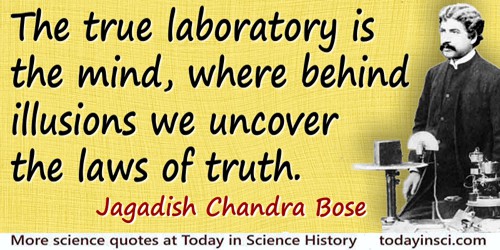
The true laboratory is the mind, where behind illusions we uncover the laws of truth.
Quoted in India Today (Apr 2008), 33, No 16, as cited on webpage of Dhirubhai Ambani Institute of Information and Communication Technology.
There is a curious illusion today that nature is both wise and good. The awful truth is that nature is a bitch from the human point of view I care about the whooping crane a little. I would even give $10 to save the whooping crane. The whooping crane doesn’t give a damn about me.
From paper presented at Laramie College of Commerce and Industry, University of Wyoming, 'Energy and the Environment' (Jan 1976), 12, as quoted in Kenneth Ewart Boulding and Richard P. Beilock (ed.), Illustrating Economics: Beasts, Ballads and Aphorisms (1980, 2009), 153.
We are apt to think we know what time is because we can measure it, but no sooner do we reflect upon it than that illusion goes. So it appears that the range of the measureable is not the range of the knowable. There are things we can measure, like time, but yet our minds do not grasp their meaning. There are things we cannot measure, like happiness or pain, and yet their meaning is perfectly clear to us.
The Elements of Social Science (1921), 15-16
We should not argue with the blind man who maintained that sight was an illusion to which some abnormal people were subject. Therefore in speaking of religious experience I do not attempt to prove the existence of religious experience…
Swarthmore Lecture (1929) at Friends’ House, London, printed in Science and the Unseen World (1929), 48-49.
We suffer primarily not from our vices or our weaknesses, but from our illusions. We are haunted, not by reality, but by those images we have put in their place.
In The Image: A Guide to Pseudo-Events in America (1961), Preface.
When we have fully discovered the scientific laws that govern life, we shall realise that one person who has more illusions than the dreamer is the man of action.
In Epigrams of Oscar Wilde (2007), 111.
 In science it often happens that scientists say, 'You know that's a really good argument; my position is mistaken,' and then they would actually change their minds and you never hear that old view from them again. They really do it. It doesn't happen as often as it should, because scientists are human and change is sometimes painful. But it happens every day. I cannot recall the last time something like that happened in politics or religion.
(1987) --
In science it often happens that scientists say, 'You know that's a really good argument; my position is mistaken,' and then they would actually change their minds and you never hear that old view from them again. They really do it. It doesn't happen as often as it should, because scientists are human and change is sometimes painful. But it happens every day. I cannot recall the last time something like that happened in politics or religion.
(1987) -- 





