Ignorance Quotes (256 quotes)
[A]s you know, scientific education is fabulously neglected … This is an evil that is inherited, passed on from generation to generation. The majority of educated persons are not interested in science, and are not aware that scientific knowledge forms part of the idealistic background of human life. Many believe—in their complete ignorance of what science really is—that it has mainly the ancillary task of inventing new machinery, or helping to invent it, for improving our conditions of life. They are prepared to leave this task to the specialists, as they leave the repairing of their pipes to the plumber. If persons with this outlook decide upon the curriculum of our children, the result is necessarily such as I have just described it.
Opening remarks of the second of four public lectures for the Dublin Institute for Advanced Studies at University College, Dublin (Feb 1950), The Practical Achievements of Science Tending to Obliterate its True Import', collected in Science and Humanism: Physics in Our Time (1951). Reprinted in 'Nature and the Greeks' and 'Science and Humanism' (1996), 113.
[About early aircraft:] We were ignorant, and we were ignorant of the fact that we were ignorant! This was ignorance squared, and it often led to disaster.
In The Story of the Winged-S: The Autobiography of Igor I. Sikorsky (2011).
[Ignorance] of the principle of conservation of energy … does not prevent inventors without background from continually putting forward perpetual motion machines… Also, such persons undoubtedly have their exact counterparts in the fields of art, finance, education, and all other departments of human activity… persons who are unwilling to take the time and to make the effort required to find what the known facts are before they become the champions of unsupported opinions—people who take sides first and look up facts afterward when the tendency to distort the facts to conform to the opinions has become well-nigh irresistible.
From Evolution in Science and Religion (1927), 58-59. An excerpt from the book including this quote appears in 'New Truth and Old', Christian Education (Apr 1927), 10, No. 7, 394-395.
[Science] dissipates errors born of ignorance about our true relations with nature, errors the more damaging in that the social order should rest only on those relations. TRUTH! JUSTICE! Those are the immutable laws. Let us banish the dangerous maxim that it is sometimes useful to depart from them and to deceive or enslave mankind to assure its happiness.
Exposition du Système du Monde (1796), 2, 312, trans. Charles Coulston Gillispie, Pierre-Simon Laplace 1749-1827: A Life in Exact Science (1997), 175.
[Science] intensifies religious truth by cleansing it of ignorance and superstition.
Quoted in 'Antiseptic Christianity', book review of Lindbergh, Of Flight and Life in Time magazine, (6 Sep 1948).
[T]he idea of protoplasm, which was really a name for our ignorance, [is] only a little less misleading than the expression “Vital force”.
Adventures of a Biologist (1940), 118.
[The teaching of Nature] is harsh and wasteful in its operation. Ignorance is visited as sharply as wilful disobedience—incapacity meets with the same punishment as crime. Nature’s discipline is not even a word and a blow, and the blow first; but the blow without the word. It is left to you to find out why your ears are boxed.
The object of what we commonly call education—that education in which man intervenes, and which I shall distinguish as artificial education—is to make good these defects in Nature’s methods; to prepare the child to receive Nature’s education, neither incapably, nor ignorantly, nor with wilful disobedience; and to understand the preliminary symptoms of her displeasure, without waiting for the box on the ear. In short, all artificial education ought to he an anticipation of natural education. And a liberal education is an artificial education, which has not only prepared a man to escape the great evils of disobedience to natural laws, but has trained him to appreciate and to seize upon the rewards, which Nature scatters with as free a hand as her penalties.
The object of what we commonly call education—that education in which man intervenes, and which I shall distinguish as artificial education—is to make good these defects in Nature’s methods; to prepare the child to receive Nature’s education, neither incapably, nor ignorantly, nor with wilful disobedience; and to understand the preliminary symptoms of her displeasure, without waiting for the box on the ear. In short, all artificial education ought to he an anticipation of natural education. And a liberal education is an artificial education, which has not only prepared a man to escape the great evils of disobedience to natural laws, but has trained him to appreciate and to seize upon the rewards, which Nature scatters with as free a hand as her penalties.
From Inaugural Address as Principal, South London Working Men’s College, in 'A Liberal Education; and Where to Find it', Macmillan's Magazine (Mar 1868), 17, 370.
[William Henry] Flower [the Anglican] too praised evolution as a cleansing solvent, dissolving the dross which had “encrusted” Christianity “in the days of ignorance and superstition.”
Huxley: From Devil's Disciple To Evolution's High Priest (1997), 305.
[With] our critical faculties in decline, unable to distinguish between what feels good and what’s true, we slide, almost without noticing, back into superstition. … We have also arranged things so that almost no one understands science and technology. We might get away with it for a while, but eventually this combustible mixture of ignorance and power is going to blow up in our faces.
In 'With Science on Our Side', Washington Post (9 Jan 1994).
Dieu, c'est le voile mystérieux sous lequel nous cachons notre ignorance de la cause première.
God is the mysterious veil under which we hide our ignorance of the cause.
God is the mysterious veil under which we hide our ignorance of the cause.
In Recueil d'Œuvres de Léo Errera: Botanique Générale (1908), 193. Google translation by Webmaster.
~~[Unverified]~~ To really know is science; to merely believe you know is ignorance.
Webmaster, as yet, has found no primary source showing Hippocrates as author for this quote. Although widely seen, it is always without citation. Similar unverified quotes attributed to Hippocrates are: “Science is the father of knowledge, but opinion breeds ignorance,” and “There are, in fact, two things: science and opinion; the former begets knowledge, the latter ignorance.”
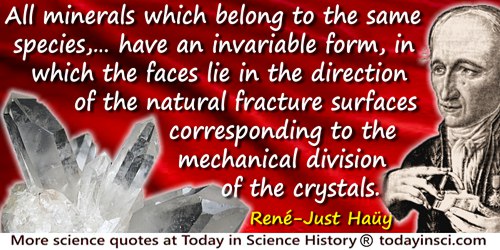
A casual glance at crystals may lead to the idea that they were pure sports of nature, but this is simply an elegant way of declaring one’s ignorance. With a thoughtful examination of them, we discover laws of arrangement. With the help of these, calculation portrays and links up the observed results. How variable and at the same time how precise and regular are these laws! How simple they are ordinarily, without losing anything of their significance! The theory which has served to develop these laws is based entirely on a fact, whose existence has hitherto been vaguely discerned rather than demonstrated. This fact is that in all minerals which belong to the same species, these little solids, which are the crystal elements and which I call their integrant molecules, have an invariable form, in which the faces lie in the direction of the natural fracture surfaces corresponding to the mechanical division of the crystals. Their angles and dimensions are derived from calculations combined with observation.
Traité de mineralogie … Publié par le conseil des mines (1801), Vol. 1, xiii-iv, trans. Albert V. and Marguerite Carozzi.
A few drops of science will often disinfect an entire barrel full of ignorance and prejudice.
In The Story of America (1921, 1934)
A learned blockhead is a greater blockhead than an ignorant one.
In Poor Richard's Almanack (1734).
A learned man is an idler who kills time with study. Beware of his false knowledge: it is more dangerous than ignorance.
In 'Maxims for Revolutionists: Education', in Man and Superman (1905), 230.
A person must have a certain amount of intelligent ignorance to get anywhere.
About 6 or 8 years ago My Ingenious friend Mr John Robinson having [contrived] conceived that a fire engine might be made without a Lever—by Inverting the Cylinder & placing it above the mouth of the pit proposed to me to make a model of it which was set about by having never Compleated & I [being] having at that time Ignorant little knoledge of the machine however I always thought the Machine Might be applied to [more] other as valuable purposes [than] as drawing Water.
Entry in notebook (1765). The bracketed words in square brackets were crossed out by Watt. in Eric Robinson and Douglas McKie (eds.), Partners in Science: Letters of James Watt and Joseph Black (1970), 434.
According to the estimate of a prominent advertising firm, above 90 per cent, of the earning capacity of the prominent nostrums is represented by their advertising. And all this advertising is based on the well-proven theory of the public's pitiable ignorance and gullibility in the vitally important matter of health.
'The Fundamental Fakes', Collier's Weekly (17 Feb 1906). Reprinted in The Great American Fraud (1907), 55.
Against logic there is no armor like ignorance.
Editorial comment Peter added under a quotation in his Peter's Quotations: Ideas for Our Times (1993), 308.
All frescoes are as high finished as miniatures or enamels, and they are known to be unchangeable; but oil, being a body itself, will drink or absorb very little colour, and changing yellow, and at length brown, destroys every colour it is mixed with, especially every delicate colour. It turns every permanent white to a yellow and brown putty, and has compelled the use of that destroyer of colour, white lead, which, when its protecting oil is evaporated, will become lead again. This is an awful thing to say to oil painters ; they may call it madness, but it is true. All the genuine old little pictures, called cabinet pictures, are in fresco and not in oil. Oil was not used except by blundering ignorance till after Vandyke’s time ; but the art of fresco painting being lost, oil became a fetter to genius and a dungeon to art.
In 'Opinions', The Poems: With Specimens of the Prose Writings of William Blake (1885), 276-277.
All science is full of statements where you put your best face on your ignorance, where you say: … we know awfully little about this, but more or less irrespective of the stuff we don’t know about, we can make certain useful deductions.
From Assumption and Myth in Physical Theory (1967), 11.
Another of my hobby-horses is the advantage of ignorance, in that it encourages creativity, both in the young and the old.
From Catastrophe Theory: Selected Papers, 1972-1977 (1977), 611. As quoted in a Review by: Hector J. Sussmann, SIAM Review (Apr 1979), 21, No. 2, 269.
Any frontal attack on ignorance is bound to fail because the masses are always ready to defend their most precious possession: their ignorance.
Quote appears in Henry Wysham Lanier, The Golden Book Magazine (Feb 1933), 17, 10.
Any ignorance is blank ignorance, because knowledge of any factor requires no ignorance.
'The Relatedness of Nature', The Principle of Relativity (1922, 2007), 22.
As scientific men we have all, no doubt, felt that our fellow men have become more and more satisfying as fish have taken up their work which has been put often to base uses, which must lead to disaster. But what sin is to the moralist and crime to the jurist so to the scientific man is ignorance. On our plane, knowledge and ignorance are the immemorial adversaries. Scientific men can hardly escape the charge of ignorance with regard to the precise effect of the impact of modern science upon the mode of living of the people and upon their civilisation. For them, such a charge is worse than that of crime.
From Banquet Speech (10 Dec 1922), Nobel Prize in Chemistry, collected in Carl Gustaf Santesson (ed.), Les Prix Nobel en 1921-1922 (1923).
At Gabriel College there was a very holy object on the high altar of the Oratory, covered with a black velvet cloth... At the height of the invocation the Intercessor lifted the cloth to reveal in the dimness a glass dome inside which there was something too distant to see, until he pulled a string attached to a shutter above, letting a ray of sunlight through to strike the dome exactly. Then it became clear: a little thing like a weathervane, with four sails black on one side and white on the other, began to whirl around as the light struck it. It illustrated a moral lesson, the Intercessor explained, for the black of ignorance fled from the light, whereas the wisdom of white rushed to embrace it.
[Alluding to Crookes's radiometer.]
[Alluding to Crookes's radiometer.]
Northern Lights (2001), 149.
Attainment is a poor measure of capacity, and ignorance no proof of defect.
From 'The Binet-Simon Scale: Practical Use of the Method', Mental and Scholastic Tests (1921), 1.
Bacon himself was very ignorant of all that had been done by mathematics; and, strange to say, he especially objected to astronomy being handed over to the mathematicians. Leverrier and Adams, calculating an unknown planet into a visible existence by enormous heaps of algebra, furnish the last comment of note on this specimen of the goodness of Bacon’s view… . Mathematics was beginning to be the great instrument of exact inquiry: Bacon threw the science aside, from ignorance, just at the time when his enormous sagacity, applied to knowledge, would have made him see the part it was to play. If Newton had taken Bacon for his master, not he, but somebody else, would have been Newton.
In Budget of Paradoxes (1872), 53-54.
Be a nuisance where it counts. … Do your part to inform and stimulate the public to join your action. Be depressed, discouraged, and disappointed at failure and the disheartening effects of ignorance, greed, corruption, and bad politics — but never give up.
As quoted in Post Editors, 'Marjory Stoneman Douglas and The Saturday Evening Post', Saturday Evening Post (26 Feb 2018). Cited as “From a 1980 article she wrote”, in 'A Life of Advocacy and Activism', a floridastateparks.org webpage.
Believing, as I do, in the continuity of nature, I cannot stop abruptly where our microscopes cease to be of use. Here the vision of the mind authoritatively supplements the vision of the eye. By a necessity engendered and justified by science I cross the boundary of the experimental evidence, and discern in that Matter which we, in our ignorance of its latent powers, and notwithstanding our professed reverence for its Creator, have hitherto covered with opprobrium, the promise and potency of all terrestrial Life.
'Address Delivered Before The British Association Assembled at Belfast', (19 Aug 1874). Fragments of Science for Unscientific People: A Series of Detached Essays, Lectures, and Reviews (1892), Vol. 2, 191.
Between true science and erroneous doctrines, ignorance is in the middle.
In Leviathan (1651).
Biographical history, as taught in our public schools, is still largely a history of boneheads: ridiculous kings and queens, paranoid political leaders, compulsive voyagers, ignorant generals—the flotsam and jetsam of historical currents. The men who radically altered history, the great creative scientists and mathematicians, are seldom mentioned if at all.
Opening paragraph of book review, 'Adventures Of a Mathematician: The Man Who Invented the H-Bomb', New York Times (9 May 1976), 201.
Book-knowledge is a poor resource … In many cases, ignorance is a good thing: the mind retains its freedom of investigation and does not stray along roads that lead nowhither, suggested by one’s reading. … Ignorance can have its advantages; the new is found far from the beaten track.
In Jean-Henri Fabre and Alexander Teixeira de Mattos (trans.), The Life and Love of the Insect (1918), 243.
Break the chains of your prejudices and take up the torch of experience, and you will honour nature in the way she deserves, instead of drawing derogatory conclusions from the ignorance in which she has left you. Simply open your eyes and ignore what you cannot understand, and you will see that a labourer whose mind and knowledge extend no further than the edges of his furrow is no different essentially from the greatest genius, as would have been proved by dissecting the brains of Descartes and Newton; you will be convinced that the imbecile or the idiot are animals in human form, in the same way as the clever ape is a little man in another form; and that, since everything depends absolutely on differences in organisation, a well-constructed animal who has learnt astronomy can predict an eclipse, as he can predict recovery or death when his genius and good eyesight have benefited from some time at the school of Hippocrates and at patients' bedsides.
Machine Man (1747), in Ann Thomson (ed.), Machine Man and Other Writings (1996), 38.
By the worldly standards of public life, all scholars in their work are of course oddly virtuous. They do not make wild claims, they do not cheat, they do not try to persuade at any cost, they appeal neither to prejudice nor to authority, they are often frank about their ignorance, their disputes are fairly decorous, they do not confuse what is being argued with race, politics, sex or age, they listen patiently to the young and to the old who both know everything. These are the general virtues of scholarship, and they are peculiarly the virtues of science.
In Science and Human Values (1956).
Certainty is the most vivid condition of ignorance and the most necessary condition for knowledge.
Quotations: Superultramodern Science and Philosophy (2005), 2
Chance ... must be something more than the name we give to our ignorance.
In Science and Method (1908) translated by Francis Maitland (1914, 2007), 66.
Consider the plight of a scientist of my age. I graduated from the University of California at Berkeley in 1940. In the 41 years since then the amount of biological information has increased 16 fold; during these 4 decades my capacity to absorb new information has declined at an accelerating rate and now is at least 50% less than when I was a graduate student. If one defines ignorance as the ratio of what is available to be known to what is known, there seems no alternative to the conclusion that my ignorance is at least 25 times as extensive as it was when I got my bachelor’s degree. Although I am sure that my unfortunate condition comes as no surprise to my students and younger colleagues, I personally find it somewhat depressing. My depression is tempered, however, by the fact that all biologists, young or old, developing or senescing, face the same melancholy situation because of an interlocking set of circumstances.
In 'Scientific innovation and creativity: a zoologist’s point of view', American Zoologist (1982), 22, 228.
Curiosity that inborn property of man, daughter of ignorance and mother of knowledge when wonder wakens our minds, has the habit, wherever it sees some extraordinary phenomenon of nature, a comet for example, a sun-dog, or a midday star, of asking straightway what it means.
In The New Science (3rd ed., 1744), Book 1, Para. 189, as translated by Thomas Goddard Bergin and Max Harold Fisch, The New Science of Giambattista Vico (1948), 64.
Dissections daily convince us of our ignorance of disease, and cause us to blush at our prescriptions. What mischief have we done under the belief of false facts and false theories! We have assisted in multiplying diseases; we have done more; we have increased their mortality. ... I am pursuing Truth, and am indifferent whither I am led, if she is my only leader.
From a public lecture by Rush. Quoted by Isaac Jennings, in Medical Reform; a Treatise on Man's Physical Being and Disorders (1847), 33.
Does it mean, if you don’t understand something, and the community of physicists don’t understand it, that means God did it? Is that how you want to play this game? Because if it is, here’s a list of the things in the past that the physicists—at the time—didn’t understand … [but now we do understand.] If that’s how you want to invoke your evidence for God, then God is an ever-receding pocket of scientific ignorance, that’s getting smaller and smaller and smaller, as time moves on. So just be ready for that to happen, if that’s how you want to come at the problem. That’s simply the “God of the Gaps” argument that’s been around for ever.
From interview, The Science Studio video series of The Science Network website, episode 'The Moon, the Tides and why Neil DeGrasse Tyson is Colbert’s God' (20 Jan 2011), time 26:58-27:55.
Doubtless the reasoning faculty, the mind, is the leading and characteristic attribute of the human race. By the exercise of this, man arrives at the properties of the natural bodies. This is science, properly and emphatically so called. It is the science of pure mathematics; and in the high branches of this science lies the truly sublime of human acquisition. If any attainment deserves that epithet, it is the knowledge, which, from the mensuration of the minutest dust of the balance, proceeds on the rising scale of material bodies, everywhere weighing, everywhere measuring, everywhere detecting and explaining the laws of force and motion, penetrating into the secret principles which hold the universe of God together, and balancing worlds against worlds, and system against system. When we seek to accompany those who pursue studies at once so high, so vast, and so exact; when we arrive at the discoveries of Newton, which pour in day on the works of God, as if a second fiat had gone forth from his own mouth; when, further, we attempt to follow those who set out where Newton paused, making his goal their starting-place, and, proceeding with demonstration upon demonstration, and discovery upon discovery, bring new worlds and new systems of worlds within the limits of the known universe, failing to learn all only because all is infinite; however we may say of man, in admiration of his physical structure, that “in form and moving he is express and admirable,” it is here, and here without irreverence, we may exclaim, “In apprehension how like a god!” The study of the pure mathematics will of course not be extensively pursued in an institution, which, like this [Boston Mechanics’ Institute], has a direct practical tendency and aim. But it is still to be remembered, that pure mathematics lie at the foundation of mechanical philosophy, and that it is ignorance only which can speak or think of that sublime science as useless research or barren speculation.
In Works (1872), Vol. 1, 180.
Each juggler should be trained in the ignorance of the laws of physics.
Unkempt Thoughts (1962), 66.
Each of us has read somewhere that in New Guinea pidgin the word for 'piano' is (I use English spelling) 'this fellow you hit teeth belonging to him he squeal all same pig'. I am inclined to doubt whether this expression is authentic; it looks just like the kind of thing a visitor to the Islands would facetiously invent. But I accept 'cut grass belong head belong me' for 'haircut' as genuine... Such phrases seem very funny to us, and make us feel very superior to the ignorant foreigners who use long winded expressions for simple matters. And then it is our turn to name quite a simple thing, a small uncomplicated molecule consisting of nothing more than a measly 11 carbons, seven hydrogens, one nitrogen and six oxygens. We sharpen our pencils, consult our rule books and at last come up with 3-[(1, 3- dihydro-1, 3-dioxo-2H-isoindol-2-yl) oxy]-3-oxopropanoic acid. A name like that could drive any self-respecting Papuan to piano-playing.
The Chemist's English (1990), 3rd Edition, 57.
Economists use the expression “opportunity costs” for losses incurred through certain choices made over others, including ignorance and inaction. For systematics, or more precisely the neglect of systematics and the biological research dependent upon it, the costs are very high.
In 'Edward O. Wilson: The Biological Diversity Crisis: A Challenge to Science', Issues in Science and Technology (Fall 1985), 2, No. 1, 25.
Even in Europe a change has sensibly taken place in the mind of man. Science has liberated the ideas of those who read and reflect, and the American example has kindled feelings of right in the people. An insurrection has consequently begun of science talents and courage against rank and birth, which have fallen into contempt. It has failed in its first effort, because the mobs of the cities, the instrument used for its accomplishment, debased by ignorance, poverty and vice, could not be restrained to rational action. But the world will soon recover from the panic of this first catastrophe.
Letter to John Adams (Monticello, 1813). In Thomas Jefferson and John P. Foley (ed.), The Jeffersonian Cyclopedia (1900), 49. From Paul Leicester Ford (ed.), The Writings of Thomas Jefferson (1892-99). Vol 4, 439.
Every appearance in nature corresponds to some state of the mind, and that state of the mind can only be described by presenting that natural appearance as its picture. An enraged man is a lion, a cunning man is a fox, a firm man is a rock, a learned man is a torch. A lamb is innocence; a snake is subtle spite; flowers express to us the delicate affections. Light and darkness are our familiar expressions for knowledge and ignorance ; and heat for love. Visible distance behind and before us, is respectively our image of memory and hope.
In essay, 'Language', collected in Nature: An Essay ; And, Lectures on the Times (1844), 23-24.
Every intellectual revolution which has ever stirred humanity into greatness has been a passionate protest against inert ideas. Then, alas, with pathetic ignorance of human psychology, it has proceeded by some educational scheme to, bind humanity afresh with inert ideas of its own fashioning.
In 'The Aims of Education', The Aims of Education and Other Essays (1929), 14.
Extremely hazardous is the desire to explain everything, and to supply whatever appears a gap in history—for in this propensity lies the first cause and germ of all those violent and arbitrary hypotheses which perplex and pervert the science of history far more than the open avowal of our ignorance, or the uncertainty of our knowledge: hypotheses which give an oblique direction, or an exaggerated and false extension, to a view of the subject originally not incorrect.
In Friedrich von Schlegel and James Burton Robertson (trans.), The Philosophy of History (1835), 12.
Faraday, who had no narrow views in regard to education, deplored the future of our youth in the competition of the world, because, as he said with sadness, “our school-boys, when they come out of school, are ignorant of their ignorance at the end of all that education.”
In Inaugural Presidential Address (9 Sep 1885) to the British Association for the Advancement of Science, Aberdeen, Scotland, 'Relations of Science to the Public Weal', Report to the Fifty-Fifth Meeting of the British Association (1886), 11.
Finally, I aim at giving denominations to things, as agreeable to truth as possible. I am not ignorant that words, like money, possess an ideal value, and that great danger of confusion may be apprehended from a change of names; in the mean time it cannot be denied that chemistry, like the other sciences, was formerly filled with improper names. In different branches of knowledge, we see those matters long since reformed: why then should chemistry, which examines the real nature of things, still adopt vague names, which suggest false ideas, and favour strongly of ignorance and imposition? Besides, there is little doubt but that many corrections may be made without any inconvenience.
Physical and Chemical Essays (1784), Vol. I, xxxvii.
For between true Science, and erroneous Doctrines, Ignorance is in the middle. Naturall sense and imagination, are not subject to absurdity. Nature it selfe cannot erre: and as men abound in copiousnesses of language; so they become more wise, or more mad than ordinary. Nor is it possible without Letters for any man to become either excellently wise, or (unless his memory be hurt by disease, or ill constitution of organs) excellently foolish. For words are wise men's counters, they do but reckon by them; but they are the money of fools that value them by the authority of an Aristotle, a Cicero, or a Thomas, or any other Doctor whatsoever, if but a man.
Leviathan (1651), ed. C. B. Macpherson (1968), Part 1, Chapter 4, 106.
For he who knows not mathematics cannot know any other science; what is more, he cannot discover his own ignorance, or find its proper remedy.
For it is owing to their wonder that men now both begin and at first began to philosophize; they wondered originally at the obvious difficulties, then advanced little by little and stated difficulties about the greater matters, e.g. about the phenomena of the moon and those of the sun and the stars, and about the genesis of the universe. And a man who is puzzled and wonders thinks himself ignorant (whence even the lover of myth is in a sense a lover of wisdom, for myth is composed of wonders); therefore since they philosophized in order to escape from ignorance, evidently they were pursuing science in order to know, and not for any utilitarian end. And this is confirmed by the facts; for it was when almost all the necessities of life and the things that make for comfort and recreation were present, that such knowledge began to be sought. Evidently then we do not seek it for the sake of any advantage; but as the man is free, we say, who exists for himself and not for another, so we pursue this as the only free science, for it alone exists for itself.
Metaphysics, 982b, 12-27. In Jonathan Baines (ed.), The Complete Works of Aristotle (1984), Vol. 2, 1554.
For man being the minister and interpreter of nature, acts and understands so far as he has observed of the order, the works and mind of nature, and can proceed no further; for no power is able to loose or break the chain of causes, nor is nature to be conquered but by submission: whence those twin intentions, human knowledge and human power, are really coincident; and the greatest hindrance to works is the ignorance of causes.
In The Great lnstauration.
For the masses, science is largely a matter of miracle, mystery, and authority. Translated into educational terms, the slogan that through science man has gained increasing knowledge of nature really means that a few men now know a great deal about how nature “works,” while the rest of us are about as ignorant as we have always been. Translated into political terms, the slogan that through knowledge man has gained power really means that a few men have gained the means of unprecedented power over a great many other men.
In Legitimacy in the Modern State (1981), 29.
Fortunately science, like that nature to which it belongs, is neither limited by time nor by space. It belongs to the world, and is of no country and of no age. The more we know, the more we feel our ignorance; the more we feel how much remains unknown; and in philosophy, the sentiment of the Macedonian hero can never apply,– there are always new worlds to conquer.
…...
Fullness of knowledge always means some understanding of the depths of our ignorance; and that is always conducive to humility and reverence.
In 'What I Believe: Living Philosophies II', The Forum (Oct 1929), 82, No. 4, 199.
Give me the storm and tempest of thought and action, rather than the dead calm of ignorance and faith. Banish me from Eden when you will, but first let me eat of the fruit of the Tree of Knowledge.
Epigraph, title page of The Works of Robert G. Ingersoll (1902), Vol. 3. Since it is not printed with a citation, Webmaster believes it is attributable to the author of the book.
Godless science reads nature only as Milton's daughters did Hebrew, rightly syllabling the sentences, but utterly ignorant of the meaning.
Lecture, 'The Blessed Life', collected in Lectures Delivered Before the Young Men's Christian Association (1861), Vol. 16, 347.
Goethe said that he who cannot draw on 3,000 years of learning is living hand to mouth. It could just as well be said that individuals who do tap deeply into this rich cultural legacy are wealthy indeed. Yet the paradox is that much of this wisdom is buried in a sea of lesser books or like lost treasure beneath an ocean of online ignorance and trivia. That doesn’t mean that with a little bit of diligence you can’t tap into it. Yet many people, perhaps most, never take advantage of all this human experience. They aren’t obtaining knowledge beyond what they need to know for work or to get by. As a result, their view of our amazing world is diminished and their lives greatly circumscribed.
In An Embarrassment of Riches: Tapping Into the World's Greatest Legacy of Wealth (2013), 65.
His [Sherlock Holmes] ignorance was as remarkable as his knowledge. … he was ignorant of the Copernican Theory and of the composition of the Solar System. … “But the Solar System!" I protested. “What the deuce is it to me?” he interrupted impatiently; “you say that we go round the sun. If we went round the moon it would not make a pennyworth of difference to me or to my work.”
In 'The Science Of Deduction', A Study In Scarlet (1887, 1904), 15-16.
Human consciousness is just about the last surviving mystery. A mystery is a phenomenon that people don’t know how to think about—yet. There have been other great mysteries: the mystery of the origin of the universe, the mystery of life and reproduction, the mystery of the design to be found in nature, the mysteries of time, space, and gravity. These were not just areas of scientific ignorance, but of utter bafflement and wonder. We do not yet have the final answers to any of the questions of cosmology and particle physics, molecular genetics and evolutionary theory, but we do know how to think about them. The mysteries haven't vanished, but they have been tamed. They no longer overwhelm our efforts to think about the phenomena, because now we know how to tell the misbegotten questions from the right questions, and even if we turn out to be dead wrong about some of the currently accepted answers, we know how to go about looking for better answers. With consciousness, however, we are still in a terrible muddle. Consciousness stands alone today as a topic that often leaves even the most sophisticated thinkers tongue-tied and confused. And, as with all the earlier mysteries, there are many who insist—and hope—that there will never be a demystification of consciousness.
Consciousness Explained (1991), 21-22.
Humanity has the stars in its future, and that future is too important to be lost under the burden of juvenile folly and ignorant superstition.
In 'The Deadly Information', Introduction written by Asimov for James Randi, Flim-Flam (1982), xiii.
I admitted, that the world had existed millions of years. I am astonished at the ignorance of the masses on these subjects. Hugh Miller has it right when he says that 'the battle of evidences must now be fought on the field of the natural sciences.'
Letter to Burke A. Hinsdale, president of Hiram College (10 Jan 1859), commenting on the audience at Garfield's debate with William Denton. Quoted in John Clark Ridpath, The Life and Work of James A. Garfield (1881), 80.
I am convinced that it is impossible to expound the methods of induction in a sound manner, without resting them upon the theory of probability. Perfect knowledge alone can give certainty, and in nature perfect knowledge would be infinite knowledge, which is clearly beyond our capacities. We have, therefore, to content ourselves with partial knowledge—knowledge mingled with ignorance, producing doubt.
The Principles of Science: A Treatise on Logic and Scientific Method, 2nd edition (1877), 197.
I am told that the wall paintings which we had the happiness of admiring in all their beauty and freshness [in the chapel she discovered at Abu Simbel] are already much injured. Such is the fate of every Egyptian monument, great or small. The tourist carves it over with names and dates, and in some instances with caricatures. The student of Egyptology, by taking wet paper “squeezes” sponges away every vestige of the original colour. The “Collector” buys and carries off everything of value that he can, and the Arab steals it for him. The work of destruction, meanwhile goes on apace. The Museums of Berlin, of Turin, of Florence are rich in spoils which tell their lamentable tale. When science leads the way, is it wonderful that ignorance should follow?
Quoted in Margaret S. Drower, The Early Years, in T.G.H. James, (ed.), Excavating in Egypt: The Egypt Exploration Society, 1882-1982 (1982), 10. As cited in Wendy M.K. Shaw, Possessors and Possessed: Museums, Archaeology, and the Visualization of History in the Late Ottoman Empire (2003), 37. Also quoted in Margaret S. Drower, Flinders Petrie: A Life in Archaeology (1995), 57.
I do not approve of anything that tampers with natural ignorance. Ignorance is like a delicate exotic fruit; touch it and the bloom is gone. The whole theory of modern education is radically unsound. Fortunately in England, at any rate, education produces no effect whatsoever. If it did, it would prove a serious danger to the upper classes.
Lines for fictional Lady Bracknell in play, The Importance of Being Earnest. Collected in Plays (1898), 293-294. [Wilde is speaking his mind through her voice, in characteristic trenchant style, about the mind-boggling stupidity of the British aristocratic leisure class. Wilde is making a serious social and political point. Effective education could threaten the established order. If the English downtrodden poor knew anything about anything they probably would overthrow the ruling class. —condensed from sparknotes.com]
I had a dislike for [mathematics], and ... was hopelessly short in algebra. ... [One extraordinary teacher of mathematics] got the whole year's course into me in exactly six [after-school] lessons of half an hour each. And how? More accurately, why? Simply because he was an algebra fanatic—because he believed that algebra was not only a science of the utmost importance, but also one of the greatest fascination. ... [H]e convinced me in twenty minutes that ignorance of algebra was as calamitous, socially and intellectually, as ignorance of table manners—That acquiring its elements was as necessary as washing behind the ears. So I fell upon the book and gulped it voraciously. ... To this day I comprehend the binomial theorem.
In Prejudices: third series (1922), 261-262.
For a longer excerpt, see H. L. Mencken's Recollections of School Algebra.
For a longer excerpt, see H. L. Mencken's Recollections of School Algebra.
I have a sense of humor; but over the years that sense has developed one blind spot. I can no longer laugh at ignorance or stupidity. Those are our chief enemies, and it is dangerous to make fun of them.
Draft (22 May 1970) of speech he hoped to give upon his retirement. In Susan Hough, Richter's Scale: Measure of an Earthquake, Measure of a Man (2007), 309.
I remember my first look at the great treatise of Maxwell’s when I was a young man… I saw that it was great, greater and greatest, with prodigious possibilities in its power… I was determined to master the book and set to work. I was very ignorant. I had no knowledge of mathematical analysis (having learned only school algebra and trigonometry which I had largely forgotten) and thus my work was laid out for me. It took me several years before I could understand as much as I possibly could. Then I set Maxwell aside and followed my own course. And I progressed much more quickly… It will be understood that I preach the gospel according to my interpretation of Maxwell.
From translations of a letter (24 Feb 1918), cited in Paul J. Nahin, Oliver Heaviside: The Life, Work, and Times of an Electrical Genius of the Victorian Age (2002), 24. Nahin footnotes that the words are not verbatim, but are the result of two translations. Heaviside's original letter in English was quoted, translated in to French by J. Bethenode, for the obituary he wrote, "Oliver Heaviside", in Annales des Posies Telegraphs (1925), 14, 521-538. The quote was retranslated back to English in Nadin's book. Bethenode footnoted that he made the original translation "as literally as possible in order not to change the meaning." Nadin assures that the retranslation was done likewise. Heaviside studyied Maxwell's two-volume Treatise on Electricity and Magnetism.
I said, that Superstition was the child of Fear, and Fear the child of Ignorance; and you might expect me to say antithetically, that Science was the child of Courage, and Courage the child of Knowledge.
Opening of 'Science', a lecture delivered at the Royal Institution, published in Fraser's Magazine (Jul 1866), 74, 15.
If feeling be not a property of matter, but owing to a superior principle, it must follow, that the motions of the heart, and other muscles of animals, after being separated from their bodies, are to be ascribed to this principle; and that any difficulties which may appear in this matter are owing to our ignorance of the nature of the soul, of the manner of its existence, and of its wonderful union with, and action upon the body.
In An Essay on the Vital and Other Involuntary Motions of Animals (1751), 389-390.
If I had my life to live over again I would not devote it to develop new industrial processes: I would try to add my humble efforts to use Science to the betterment of the human race.
I despair of the helter-skelter methods of our vaulted homo sapiens, misguided by his ignorance and his politicians. If we continue our ways, there is every possibility that the human race may follow the road of former living races of animals whose fossils proclaim that they were not fit to continue. Religion, laws and morals is not enough. We need more. Science can help us.
I despair of the helter-skelter methods of our vaulted homo sapiens, misguided by his ignorance and his politicians. If we continue our ways, there is every possibility that the human race may follow the road of former living races of animals whose fossils proclaim that they were not fit to continue. Religion, laws and morals is not enough. We need more. Science can help us.
Letter to a friend (14 Jan 1934). In Savage Grace (1985, 2007), 62.
If ignorance of nature gave birth to the Gods, knowledge of nature is destined to destroy them.
Systéme de la Nature (1770), Part 2, Chapter 1.
If there be some who, though ignorant of all mathematics, take upon them to judge of these, and dare to reprove this work, because of some passage of Scripture, which they have miserably warped to their purpose, I regard them not, and even despise their rash judgment. … What I have done in this matter, I submit principally to your Holiness, and then to the judgment of all learned mathematicians. And that I may not seem to promise your Holiness more concerning the utility of this work than I am able to perform, I pass now to the work itself.
The dedication to Pope Paul III in the Preface of De Revolutionibus Orbium Coelestium, (On the Revolutions of Heavenly Spheres), originally written in Latin. As translated and quoted in Sarah K. Bolton, Famous Men of Science (1926), 7-8. Webmaster, as yet, has not found this quotation, in these words verbatim, as part of a complete book translation of the original Latin by Copernicus. However, it is consistent with other translations.
If today you can take a thing like evolution and make it a crime to teach it in the public schools, tomorrow you can make it a crime to teach it in the private schools, and next year you can make it a crime to teach it to the hustings or in the church. At the next session you may ban books and the newspapers. Soon you may set Catholic against Protestant and Protestant against Protestant, and try to foist your own religion upon the minds of men. If you can do one you can do the other. Ignorance and fanaticism are ever busy and need feeding. Always it is feeding and gloating for more. Today it is the public school teachers; tomorrow the private. The next day the preachers and the lecturers, the magazines, the books, the newspapers. After a while, Your Honor, it is the setting of man against man and creed against creed until with flying banners and beating drums we are marching backward to the glorious ages of the sixteenth century when bigots lighted fagots to burn the men who dared to bring any intelligence and enlightenment and culture to the human mind.
Darrow’s concluding remarks before adjournment of the second day of the Scopes Monkey Trial, Dayton, Tennessee (Monday, 13 Jul 1925). In The World's Most Famous Court Trial: Tennessee Evolution Case: a Complete Stenographic Report of the Famous Court Test of the Tennessee Anti-Evolution Act, at Dayton, July 10 to 21, 1925 (1925), Second Day's Proceedings, 87.
If we knew all the laws of Nature, we should need only one fact or the description of one actual phenomenon to infer all the particular results at that point. Now we know only a few laws, and our result is vitiated, not, of course, by any confusion or irregularity in Nature, but by our ignorance of essential elements in the calculation. Our notions of law and harmony are commonly confined to those instances which we detect, but the harmony which results from a far greater number of seemingly conflicting, but really concurring, laws which we have not detected, is still more wonderful. The particular laws are as our points of view, as to the traveler, a mountain outline varies with every step, and it has an infinite number of profiles, though absolutely but one form. Even when cleft or bored through, it is not comprehended in its entireness.
In Walden (1878), 311.
If you are young, then I say: Learn something about statistics as soon as you can. Don’t dismiss it through ignorance or because it calls for thought. … If you are older and already crowned with the laurels of success, see to it that those under your wing who look to you for advice are encouraged to look into this subject. In this way you will show that your arteries are not yet hardened, and you will be able to reap the benefits without doing overmuch work yourself. Whoever you are, if your work calls for the interpretation of data, you may be able to do without statistics, but you won’t do as well.
In Facts from Figures (1951), 463.
Ignorance and credulous hope make the market for most proprietary remedies.
'The Subtle Poisons,' Collier’s Weekly (2 Dec 1905). Reprinted in The Great American Fraud (1907), 32.
Ignorance may find a truth on its doorstep that erudition vainly seeks in the stars.
From chapter 'Jottings from a Note-book', in Canadian Stories (1918), 168.
Ignorance more frequently begets confidence than does knowledge: it is those who know little, and not those who know much, who so positively assert that this or that problem will never be solved by science.
The Descent of Man (1871), Vol. 1, 3.
Ignorant people raise questions which were answered by the wise thousands of years ago.
In The Maxims and Reflections of Goethe (1906), 187.
Imagine the people who believe such things and who are not ashamed to ignore, totally, all the patient findings of thinking minds through all the centuries since the Bible was written. And it is these ignorant people, the most uneducated, the most unimaginative, the most unthinking among us, who would make themselves the guides and leaders of us all; who would force their feeble and childish beliefs on us; who would invade our schools and libraries and homes. I personally resent it bitterly.
In The Roving Mind (1983), 26.
In its earliest development knowledge is self-sown. Impressions force themselves upon men’s senses whether they will or not, and often against their will. The amount of interest in which these impressions awaken is determined by the coarser pains and pleasures which they carry in their train or by mere curiosity; and reason deals with the materials supplied to it as far as that interest carries it, and no further. Such common knowledge is rather brought than sought; and such ratiocination is little more than the working of a blind intellectual instinct. It is only when the mind passes beyond this condition that it begins to evolve science. When simple curiosity passes into the love of knowledge as such, and the gratification of the æsthetic sense of the beauty of completeness and accuracy seems more desirable that the easy indolence of ignorance; when the finding out of the causes of things becomes a source of joy, and he is accounted happy who is successful in the search, common knowledge passes into what our forefathers called natural history, whence there is but a step to that which used to be termed natural philosophy, and now passes by the name of physical science.
In this final state of knowledge the phenomena of nature are regarded as one continuous series of causes and effects; and the ultimate object of science is to trace out that series, from the term which is nearest to us, to that which is at the farthest limit accessible to our means of investigation.
The course of nature as it is, as it has been, and as it will be, is the object of scientific inquiry; whatever lies beyond, above, or below this is outside science. But the philosopher need not despair at the limitation on his field of labor; in relation to the human mind Nature is boundless; and, though nowhere inaccessible, she is everywhere unfathomable.
In this final state of knowledge the phenomena of nature are regarded as one continuous series of causes and effects; and the ultimate object of science is to trace out that series, from the term which is nearest to us, to that which is at the farthest limit accessible to our means of investigation.
The course of nature as it is, as it has been, and as it will be, is the object of scientific inquiry; whatever lies beyond, above, or below this is outside science. But the philosopher need not despair at the limitation on his field of labor; in relation to the human mind Nature is boundless; and, though nowhere inaccessible, she is everywhere unfathomable.
The Crayfish: an Introduction to the Study of Zoölogy (1880), 2-3. Excerpted in Popular Science (Apr 1880), 16, 789-790.
In mathematics there is no ignorabimus!
This is part of a longer quote that begins, “This conviction of the solvability…”, which has the full citation. See the David Hilbert Quotes page on this website. Note that ignorabimus (first-person plural future active indicative of the Latin verb ignoro) refers to the future: “we will not know” or “we will not be ignorant of”. Compare ignoramus, (first-person plural present active indicative of ignoro) meaning in the present, “we do not know” or “we are ignorant of”.
In our days everything seems pregnant with its contrary. Machinery, gifted with the wonderful power of shortening and fructifying human labor, we behold starving and overworking it… . At the same pace that mankind masters nature, man seems to become enslaved to other men or his own infamy. Even the pure light of science seems unable to shine but on the dark background of ignorance.
In Speech (14 Apr 1856) on the 4th Anniversary of the People’s Paper, collected in David McLellan (ed.), Karl Marx: Selected Writings (2000), 368.
In spite of ignorance, folly and passion, the scientific method has won field after field since the days of Galileo. From mechanics it passed to physics, from physics to biology, from biology to psychology, where it is slowly adapting itself to unfamiliar ground.
from A History of Science and Its Relations with Philosophy and Religion (1929, 4th Ed., 1948), 500.
In the fight which we have to wage incessantly against ignorance and quackery among the masses and follies of all sorts among the classes, diagnosis, not drugging, is our chief weapon of offence. Lack of systematic personal training in the methods of the recognition of disease leads to the misapplication of remedies, to long courses of treatment when treatment is useless, and so directly to that lack of confidence in our methods which is apt to place us in the eyes of the public on a level with empirics and quacks.
Address to the Canadian Medical Association, Montreal (17 Sep 1902), 'Chauvinism in Medicine', published in The Montreal Medical Journal (1902), 31, 267. Collected in Aequanimitas, with Other Addresses to Medical Students, Nurses and Practitioners of Medicine (1904), 299.
In the medical field [scientific ignorance] could lead to horrendous results. People who don’t understand the difference between a controlled experiment and claims by some quack may die as a result of not taking medical science seriously. One of the most damaging examples of pseudoscience is false memory syndrome. I’m on the board of a foundation exposing this problem.
As quoted by Lawrence Toppman, 'Mastermind', The Charlotte Observer (20 Jun 1993), 6E. As quoted and cited in Dana Richards, 'Martin Gardner: A “Documentary”', collected in Elwyn R. Berlekamp and Tom Rodgers (ed.) The Mathemagician and Pied Puzzler: A Collection in Tribute to Martin Gardner (1999), 11.
In this physical world there is no real chaos; all is in fact orderly; all is ordered by the physical principles. Chaos is but unperceived order- it is a word indicating the limitations of the human mind and the paucity of observational facts. The words “chaos,” “accidental,” “chance,” “unpredictable," are conveniences behind which we hide our ignorance.
From Of Stars and Men: The Human Response to an Expanding Universe (1958 Rev. Ed. 1964), Foreword.
In those parts of the world where learning and science has prevailed, miracles have ceased; but in those parts of it as are barbarous and ignorant, miracles are still in vogue.
In Reason, the Only Oracle of Man (1836), 46.
Increasingly, our leaders must deal with dangers that threaten the entire world, where an understanding of those dangers and the possible solutions depends on a good grasp of science. The ozone layer, the greenhouse effect, acid rain, questions of diet and heredity. All require scientific literacy. Can Americans choose the proper leaders and support the proper programs if they themselves are scientifically illiterate? The whole premise of democracy is that it is safe to leave important questions to the court of public opinion—but is it safe to leave them to the court of public ignorance?
In Los Angeles Times (31 Mar 1989).
Innovations, free thinking is blowing like a storm; those that stand in front of it, ignorant scholars like you, false scientists, perverse conservatives, obstinate goats, resisting mules are being crushed under the weight of these innovations. You are nothing but ants standing in front of the giants; nothing but chicks trying to challenge roaring volcanoes!
From the play Galileo Galilei (2001) .
Is what you are doing fun? Of course, physics is also fun—indeed it is an enjoyable way of life. One reason physics is fun is that each element of progress transforms an area of ignorance into knowledge, but it also creates, as a by-product, an amount of new and additional ignorance in excess of that which was reduced to understanding. Thus, the volume of delicious ignorance we produce is ever-expanding, like our exponentially exploding universe.
In 'Physics and the APS in 1979', Physics Today (Apr 1980), 33, No. 4, 50.
It has often been said that, to make discoveries, one must be ignorant. This opinion, mistaken in itself, nevertheless conceals a truth. It means that it is better to know nothing than to keep in mind fixed ideas based on theories whose confirmation we constantly seek, neglecting meanwhile everything that fails to agree with them.
From An Introduction to the Study of Experimental Medicine (1865), as translated by Henry Copley Greene (1957), 37.
It is almost as difficult to make a man unlearn his errors, as his knowledge. Mal-information is more hopeless than non-information: for error is always more busy than ignorance. Ignorance is a blank sheet on which we may write; but error is a scribbled one on which we first erase. Ignorance is contented to stand still with her back to the truth; but error is more presumptuous, and proceeds, in the same direction. Ignorance has no light, but error follows a false one. The consequence is, that error, when she retraces her footsteps, has farther to go, before we can arrive at the truth, than ignorance.
Reflection 1, in Lacon: or Many things in Few Words; Addressed to Those Who Think (1820), 15.
It is imperative in the design process to have a full and complete understanding of how failure is being obviated in order to achieve success. Without fully appreciating how close to failing a new design is, its own designer may not fully understand how and why a design works. A new design may prove to be successful because it has a sufficiently large factor of safety (which, of course, has often rightly been called a “factor of ignorance”), but a design's true factor of safety can never be known if the ultimate failure mode is unknown. Thus the design that succeeds (ie, does not fail) can actually provide less reliable information about how or how not to extrapolate from that design than one that fails. It is this observation that has long motivated reflective designers to study failures even more assiduously than successes.
In Design Paradigms: Case Histories of Error and Judgment in Engineering (1994), 31.
books.google.comHenry Petroski - 1994
It is no good to try to stop knowledge from going forward. Ignorance is never better that knowledge.
Note: Although attributed as his viewpoint to Enrico Fermi, it is probably not a direct quote by him.
Note: Although attributed as his viewpoint to Enrico Fermi, it is probably not a direct quote by him.
Not a direct quotation by Enrico Fermi, but his viewpoint, as described by his wife, Laura Fermi, in Atoms in the Family: My Life with Enrico Fermi (1954), 244. See it in context elsewhere on this page, in a longer quote that begins: “Some men said an atomic bomb…”
It is not necessary to probe into the nature of things, as was done by those whom the Greeks call physici; nor need we be in alarm lest the Christian should be ignorant of the force and number of the elements—the motion, and order, and eclipses of the heavenly bodies; the form of the heavens; the species and the natures of animals, plants, stones, fountains, rivers, mountains; about chronology and distances; the signs of coming storms; and a thousand other things which those philosophers either have found out, or think they have found out. … It is enough for the Christian to believe that the only cause of all created things, whether heavenly or earthly … is the goodness of the Creator, the one true God.
In Marcus Dods (ed.), J.F. Shaw (trans.), The Enchiridion of Augustine, Chap. 9, collected in The Works of Aurelius Augustine, Bishop of Hippo: A new translation (1873), Vol. 9, 180-181. The physici are natural philosophers.
It is not so bad being ignorant if you are totally ignorant; the hard thing is knowing in some detail the reality of ignorance...
In The Medusa and the Snail: More Notes of a Biology Watcher (1974, 1979), 74.
It is not the lie that passeth through the mind, but the lie that sinketh in and settleth in it, that doth the hurt.
'Essays or Counsels: Civil and Moral. I. Of Truth'. In Francis Bacon, James Spedding, The Works of Francis Bacon (1864), Vol. 6, 378.
It is the inefficiency and sham of … our schools … that save us from being dashed on the rocks of false doctrine instead of drifting down the midstream of mere ignorance.
Back to Methuselah: A Metabiological Pentateuch (1921), xii-xiii.
It is, however, a most astonishing but incontestable fact, that the history of the evolution of man as yet constitutes no part of general education. Indeed, our so-called “educated classes” are to this day in total ignorance of the most important circumstances and the most remarkable phenomena which Anthropogeny has brought to light.
From Oliver Joseph Thatcher, The Library Of Original Sources (1907), 345.
It may be observed of mathematicians that they only meddle with such things as are certain, passing by those that are doubtful and unknown. They profess not to know all things, neither do they affect to speak of all things. What they know to be true, and can make good by invincible arguments, that they publish and insert among their theorems. Of other things they are silent and pass no judgment at all, chusing [choosing] rather to acknowledge their ignorance, than affirm anything rashly. They affirm nothing among their arguments or assertions which is not most manifestly known and examined with utmost rigour, rejecting all probable conjectures and little witticisms. They submit nothing to authority, indulge no affection, detest subterfuges of words, and declare their sentiments, as in a Court of Judicature [Justice], without passion, without apology; knowing that their reasons, as Seneca testifies of them, are not brought to persuade, but to compel.
Mathematical Lectures (1734), 64.
It was a reaction from the old idea of “protoplasm”, a name which was a mere repository of ignorance.
Perspectives in Biochemistry (1938). As cited in Max Perutz, I Wish I’d Made You Angry Earlier: Essays on Science, Scientists, and Humanity (1998).
It was not until 1901 that humanity knew that nuclear energy existed. It is understandable now—but useless—to wish that we still lived in the ignorance of 1900.
Epigraph in Isaac Asimov’s Book of Science and Nature Quotations (1988), 176.
It’s a vacuous answer … To say that “God made the world” is simply a more or less sophisticated way of saying that we don't understand how the universe originated. A god, in so far as it is anything, is an admission of ignorance.
From Speech, Annual Meeting of the British Association for the Advancement of Science. As quoted in 'Professor Says Science Rules Out Belief in God', The Telegraph (11 Sep 1996). As cited in John C. Weaver and John David Weaver, Christianity and Science (1973, 1984), 22.
Know then thyself, presume not God to scan;
The proper study of Mankind is Man.
Plac'd on this isthmus of a middle state,
A being darkly wise, and rudely great:
With too much knowledge for the Sceptic side,
With too much weakness for the Stoic's pride,
He hangs between; in doubt to act, or rest;
In doubt to deem himself a God, or Beast;
In doubt his Mind or Body to prefer,
Born but to die, and reas'ning but to err;
Alike in ignorance, his reason such,
Whether he thinks too little, or too much:
Chaos of Thought and Passion, all confus'd;
Still by himself abus'd, or disabus'd;
Created half to rise, and half to fall;
Great lord of all things, yet a prey to all;
Sole judge of Truth, in endless Error hurl'd:
The glory, jest, and riddle of the world!
... Superior beings, when of late they saw
A mortal Man unfold all Nature's law,
Admir'd such wisdom in an earthly shape,
And shew'd a NEWTON as we shew an Ape.
The proper study of Mankind is Man.
Plac'd on this isthmus of a middle state,
A being darkly wise, and rudely great:
With too much knowledge for the Sceptic side,
With too much weakness for the Stoic's pride,
He hangs between; in doubt to act, or rest;
In doubt to deem himself a God, or Beast;
In doubt his Mind or Body to prefer,
Born but to die, and reas'ning but to err;
Alike in ignorance, his reason such,
Whether he thinks too little, or too much:
Chaos of Thought and Passion, all confus'd;
Still by himself abus'd, or disabus'd;
Created half to rise, and half to fall;
Great lord of all things, yet a prey to all;
Sole judge of Truth, in endless Error hurl'd:
The glory, jest, and riddle of the world!
... Superior beings, when of late they saw
A mortal Man unfold all Nature's law,
Admir'd such wisdom in an earthly shape,
And shew'd a NEWTON as we shew an Ape.
'An Essay on Man' (1733-4), Epistle II. In John Butt (ed.), The Poems of Alexander Pope (1965), 516-7.
Knowledge is not happiness, and science
But an exchange of ignorance for that
Which is another kind of ignorance.
But an exchange of ignorance for that
Which is another kind of ignorance.
Manfred (1816), Act 2, Scene 4. In George Gordon Byron and Thomas Moore, The Works of Lord Byron (1837), 333.
Knowledge of physical science will not console me for ignorance of morality in time of affliction, but knowledge of morality will always console me for ignorance of physical science.
Pensées (1670), No. 23, translated by A. J. Krailsheimer (1995), 6.
Learning begets humility because the more a man knows, the more he discovers his ignorance.
In Hialmer Day Gould, New Practical Spelling (1905), 27
LEARNING, n. The kind of ignorance distinguishing the studious.
The Collected Works of Ambrose Bierce (1911), Vol. 7, The Devil's Dictionary, 188.
Let no-one ignorant of geometry enter.
— Plato
Said to have been inscribed above the door of Plato's Academy. As stated in A.S. Riginos, Platonica: the Anecdotes concerning the Life and Writings of Plato (1976), 38-40.
Mankind have been slow to believe that order reigns in the universe—that the world is a cosmos and a chaos.
… The divinities of heathen superstition still linger in one form or another in the faith of the ignorant, and even intelligent men shrink from the contemplation of one supreme will acting regularly, not fortuitously, through laws beautiful and simple rather than through a fitful and capricious system of intervention.
... The scientific spirit has cast out the demons, and presented us with nature clothed in her right mind and living under the reign of law. It has given us, for the sorceries of the alchemist, the beautiful laws of chemistry; for the dreams of the astrologer, the sublime truths of astronomy; for the wild visions of cosmogony, the monumental records of geology; for the anarchy of diabolism, the laws of God.
… The divinities of heathen superstition still linger in one form or another in the faith of the ignorant, and even intelligent men shrink from the contemplation of one supreme will acting regularly, not fortuitously, through laws beautiful and simple rather than through a fitful and capricious system of intervention.
... The scientific spirit has cast out the demons, and presented us with nature clothed in her right mind and living under the reign of law. It has given us, for the sorceries of the alchemist, the beautiful laws of chemistry; for the dreams of the astrologer, the sublime truths of astronomy; for the wild visions of cosmogony, the monumental records of geology; for the anarchy of diabolism, the laws of God.
Speech (16 Dec 1867) given while a member of the U.S. House of Representatives, introducing resolution for the appointment of a committee to examine the necessities for legislation upon the subject of the ninth census to be taken the following year. Quoted in John Clark Ridpath, The Life and Work of James A. Garfield (1881), 216.
Marxism is sociobiology without biology … Although Marxism was formulated as the enemy of ignorance and superstition, to the extent that it has become dogmatic it has faltered in that commitment and is now mortally threatened by the discoveries of human sociobiology.
In On Human Nature (1978), 191.
Mathematics is the gate and key of the sciences. ... Neglect of mathematics works injury to all knowledge, since he who is ignorant of it cannot know the other sciences or the things of this world. And what is worse, men who are thus ignorant are unable to perceive their own ignorance and so do not seek a remedy.
In Opus Majus, Part 4, Distinctia Prima, cap. 1.
Medicine is of all the Arts the most noble; but, owing to the ignorance of those who practice it, and of those who, inconsiderately, form a judgment of them, it is at present behind all the arts.
The Genuine Works of Hippocrates, trans. Francis Adams (1886), Vol. 2, 283.
Medicine, like every useful science, should be thrown open to the observation and study of all. It should, in fact, like law and every important science, be made part of the primary education of the people. … We should at once explode the whole machinery of mystification and concealment—wigs, gold canes, and the gibberish of prescriptions—which serves but as a cloak to ignorance and legalized murder.
Populist philosophy, of Samuel Thomson (1769-1843), founder of the Thomsonian System of medicine, as stated in New York Evening Star (27 Dec 1833)., as cited in the Thomsonian Recorder (17 Jan 1835), 3, 127. Quoted in Paul Starr The Social Transformation of American Medicine (1984), 56.
Metaphysics. The science to which ignorance goes to learn its knowledge, and knowledge to learn its ignorance. On which all men agree that it is the key, but no two upon how it is to be put into the lock.
Lest remark in letter to Dr. Whewell (25 May 1850), collected in Sophia Elizabeth De Morgan (ed.), Memoir of Augustus De Morgan (1882), 210.
Most scientists think of science as being a kind of purifying intellectual machinery that leads to honesty, to the withering away of ignorance and wrong ideas, including, provided they are of the atheistic persuasion, those of religion.
In Pamela Weintraub (ed.), 'E. O. Wilson', The Omni Interviews (1984), 231.
My attitude was: “Just look at all the interesting atoms in that region of the periodic table; certainly the reason that carbon dominates chemistry is our own ignorance.”
Recollection of being unimpressed in high school when taught that carbon, being the basic building block of life, was the most important element in the periodic table. In Chappell Brown, 'A Carbon Copy of the Real Thing', Electronic Engineering Times (28 Dec 1998), 50.
My boyhood life in New York City has impressed me with the popular ignorance and also with the great need of something better than local lore and weather proverbs.
In 'How the United States Weather Bureau Was Started', Scientific American (20 May 1916), 114, 529.
Next to ignorance of the grammar of one’s native language, nothing betrays want of information so soon as ignorance in matters of geography, without which it is almost impossible to carry on conversation long on any general subject.
In The Statistical Breviary: Shewing, on a Principle Entirely New, the Resources of Every State and Kingdom in Europe (1801), 5.
Not ignorance, but ignorance of ignorance is the death of knowledge. [Attributed]
As quoted in a number of sources, but usually without further citation, for example, in Wordsworth Dictionary of Quotations (1998), 459. Webmaster so far cannot confirm, so if you know the primary source, please make contact.
Not to destroy but to construct,
I hold the unconquerable belief
that science and peace will triumph over ignorance and war
that nations will come together
not to destroy but to construct
and that the future belongs to those
who accomplish most for humanity.
[His 1956 Christmas card.]
I hold the unconquerable belief
that science and peace will triumph over ignorance and war
that nations will come together
not to destroy but to construct
and that the future belongs to those
who accomplish most for humanity.
[His 1956 Christmas card.]
In Respectfully Quoted: A Dictionary of Quotations (1980), 366-367. The card used a variant of Louis Pasteur's earlier remark in 1892 (q.v.)
Nothing in education is so astonishing as the amount of ignorance it accumulates in the form of inert facts.
The Education of Henry Adams (1907, 1918), 379.
Of all the frictional resistances, the one that most retards human movement is ignorance, what Buddha called 'the greatest evil in the world.' The friction which results from ignorance ... can be reduced only by the spread of knowledge and the unification of the heterogeneous elements of humanity. No effort could be better spent.
In 'The Problem of Increasing Human Energy', Century Illustrated Monthly Magazine (Jun 1900), 60, 182.
Of power does Man possess no particle:
Of knowledge—just so much as show that still
It ends in ignorance on every side…
Of knowledge—just so much as show that still
It ends in ignorance on every side…
'With Francis Furini', The Complete Poetic and Dramatic Works of Robert Browning (1895), 967.
One of the largest promises of science is, that the sum of human happiness will be increased, ignorance destroyed, and, with ignorance, prejudice and superstition, and that great truth taught to all, that this world and all it contains were meant for our use and service; and that where nature by her own laws has defined the limits of original unfitness, science may by extract so modify those limits as to render wholesome that which by natural wildness was hurtful, and nutritious that which by natural poverty was unnourishing. We do not yet know half that chemistry may do by way of increasing our food.
'Common Cookery'. Household Words (26 Jan 1856), 13, 45. An English weekly magazine edited by Charles Dickens.
One only passes from the darkness of ignorance to the enlightenment of science if one re-reads with ever-increasing love the works of the ancients. Let the dogs bark, let the pigs grunt! I will nonetheless be a disciple of the ancients. All my care will be for them and the dawn will see me studying them.
In Le Goff, Les Intellectuels ou moyen age (1957), 14
Our ignorance is God; what we know is science. When we abandon the doctrine that some infinite being created matter and force, and enacted a code of laws for their government ... the real priest will then be, not the mouth-piece of some pretended deity, but the interpreter of nature.
In The Gods, and Other Lectures, (1874), 56.
Our knowledge can only be finite, while our ignorance must necessarily be infinite.
Essy, 'On the Sources of Knowledge and of Ignorance', in Conjectures and Refutations: The Growth of Scientific Knowledge (1962), 28.
Our knowledge must always be limited, but the knowable is limitless. The greater the sphere of our knowledge the greater the surface of contact with our infinite ignorance.
Conclusion of the James Forrest Lecture (3 May 1894) at an Extra Meeting of the Institution of Civil Engineers, 'The Relation of Mathematics to Engineering', collected in Minutes of Proceedings of the Institution of Civil Engineers (1894), 347.
Our science is a drop, our ignorance a sea. Whatever else be certain, this at least is certain—that the world of our present natural knowledge is enveloped in a larger world of some sort of whose residual properties we at present can frame no positive idea.
In Address to Harvard Young Men’s Christian Association, 'Is Life Worth Living?', collected in The Will to Believe and other Essays in Popular Philosophy, (1897, 2006), 54. Published earlier in International Journal of Ethics (Oct 1895).
People are born ignorant, not stupid; they are made stupid by education.
In Dr. N Sreedharan, Quotations of Wit and Wisdom (2007), 20.
Perhaps it is better in this present world of ours that a revolutionary idea or invention instead of being helped and patted be hampered and ill-treated in its adolescence—by want of means, by selfish interest, pedantry, stupidity and ignorance; that it be attacked and stifled; that it pass through bitter trials and tribulations, through the heartless strife of commercial existence. ... So all that was great in the past was ridiculed, condemned, combatted, suppressed—only to emerge all the more powerfully, all the more triumphantly from the struggle.
'The Transmission of Electrical Energy Without Wires As a Means for Furthering Peace', Electrical World and Engineer (7 Jan 1905), 24. Reproduced in John T. Ratzlaff, editor, Tesla Said (1984), 86. Also reprinted in Nikola Tesla, Miscellaneous Writings (2007), 58.
Rampant scientific illiteracy in the general public is, in my opinion, one major cause of the current lack of opportunities for scientists. … A public that is ignorant of science, and of how science is done, is not going to support scientific research enthusiastically.
In 'Shattered Hopes and Dreams: The Dim Prospect for Careers in Science', Chronicle of Higher Education (5 Dec 1997). As cited in chapter 13 epigraph, Daniel S. Greenberg, Science, Money, and Politics: Political Triumph and Ethical Erosion (2003), 205.
Scholars are frequently to be met with who are ignorant of nothing saving their own ignorance.
In James Wood, Dictionary of Quotations from Ancient and Modern, English and Foreign Sources (1893), 382:11.
Science ... in other words, knowledge—is not the enemy of religion; for, if so, then religion would mean ignorance. But it is often the antagonist of school-divinity.
'The Professor at the Breakfast Table', The Writings of Oliver Wendell Holmes (1859, 1891), Vol. 2, 113.
Science begets knowledge; opinion, ignorance.
In Fielding Hudson Garrison, An Introduction to the History of Medicine (1929), 14.
Science did not germinate and grow on a healthy prairie of ignorance but in a noisome jungle of magic and superstition, which again and again choked the seedlings of knowledge.
In A Shorter History of Science (1944), 5.
Science is being daily more and more personified and anthromorphized into a god. By and by they will say that science took our nature upon him, and sent down his only begotten son, Charles Darwin, or Huxley, into the world so that those who believe in him, &c.; and they will burn people for saying that science, after all, is only an expression for our ignorance of our own ignorance.
Samuel Butler, Henry Festing Jones (ed.), The Note-Books of Samuel Butler (1917), 32.
Science is but a feeble means for motivating life. It enlightens men, but fails to arouse them to deeds of self-sacrifice and devotion. … It dispels ignorance, but it never launched a crusade. It gives aid in the struggle with the hard surroundings of life, but it does not inform us to what end we struggle, or whether the struggle is worth while. … Intelligence can do little more than direct.
As quoted by M.G. Mellon in his retiring Presidential Address to the Winter Meeting of the Indiana Academy of Science at the University of Notre Dame (30 Oct 1942), 'Science, Scientists, and Society', printed in Proceedings of the Indiana Academy of Science (1943), 52, 15. No source citation given.
Science is but the exchange of ignorance for that which is another kind of ignorance.
…...
Science is one of our best weapons against authoritarianism, but authoritarianism has been known to surface among scientists. When this happens, misguided perfectionists or romanticists sometimes seek to root it out by attacking science. Instead of destroying science, which would merely return us to ignorance and superstition, what we need to do is to expose and root out the authoritarians.
In How to Tell the Liars from the Statisticians (1983), 129.
Science is the belief in the ignorance of experts.
From address to the National Science Teachers’ Association convention (Apr 1966), 'What Is Science?', collected in Richard Phillips Feynman and Jeffrey Robbins (ed.), The Pleasure of Finding Things Out: The Best Short Works of Richard P. Feynman (1999, 2005), 187.
Science is the topography of ignorance. From a few elevated points we triangulate vast spaces, inclosing infinite unknown details. We cast the lead, and draw up a little sand from abysses we may never reach with our dredges.
'Border Lines of Knowledge in Some Provinces of Medical Science', an introductory lecture to the Medical Class of Harvard University (6 Nov 1861). In Works of Oliver Wendell Holmes (1892), 211.
Scientific literacy is an intellectual vaccine against the claims of charlatans who would exploit ignorance.
…...
Scientific training gives its votaries freedom from the impositions of modern quackery. Those who know nothing of the laws and processes of Nature fall an easy prey to quacks and impostors. Perfectionism in the realm of religion; a score of frauds in the realm of medicine, as electric shoe soles, hair brushes and belts, electropises, oxydonors, insulating bed casters, and the like; Christian science, in the presence of whose unspeakable stillness and self-stultifying idealism a wise man knows not whether to laugh or cry; Prof. Weltmer’s magnetic treatment of disease; divine healing and miracle working by long-haired peripatetics—these and a score of other contagious fads and rank impostures find their followers among those who have no scientific training. Among their deluded victims are thousands of men and women of high character, undoubted piety, good intentions, charitable impulses and literary culture, but none trained to scientific research. Vaccinate the general public with scientific training and these epidemics will become a thing of the past.
As quoted by S.D. Van Meter, Chairman, closing remarks for 'Report of Committee on Public Policy and Legislation', to the Colorado State Medical Society in Denver, printed in Colorado Medicine (Oct 1904), 1, No. 12, 363. Van Meter used the quote following his statement, “In conclusion, allow me to urge once more the necessity of education of the public as well as the profession if we ever expect to correct the evils we are striving to reach by State and Society legislation. Much can be accomplished toward this end by the publication of well edited articles in the secular press upon medical subjects the public is eager to know about.” Prof. Weltmer is presumably Sidney A. Weltmer, founder of The Weltmer Institute of Suggestive Therapeutics, who offered a Course in Magnetic Healing by mail order correspondence (1899). [The word printed as “electropises” in the article is presumably a typo for “electropoises”. —Webmaster]
Scientifically considered, nature is that which we have divested of mystery, stripped of autonomy, and subjected to our ends. It is that over which we have gained knowledge and manipulative power. This is the meaning concealed in the platitudinous expression that science “conquers nature” and pushes back the boundaries of ignorance and superstition.
In Legitimacy in the Modern State (1981), 176.
So long as the mother, Ignorance, lives, it is not safe for Science, the offspring, to divulge the hidden causes of things.
In Somnium (1634).
Some men said the atomic bomb should never have been built; researchers should have stopped working when they had realized that the bomb was feasible. Enrico did not think this would have been a sensible solution. It is no good trying to stop knowledge from going forward. Whatever Nature has in store for mankind, unpleasant as it may be, men must accept, for ignorance is never better than knowledge.
Note: Although attributed as his viewpoint to Enrico Fermi, it is probably not a direct quote by him.
Note: Although attributed as his viewpoint to Enrico Fermi, it is probably not a direct quote by him.
This is the viewpoint of Enrico Fermi, as written in her own words by his wife, Laura Fermi, in Atoms in the Family: My Life with Enrico Fermi (1954), 244. The last sentence is also seen on its own, contracted as: “It is no good to try to stop knowledge from going forward. Ignorance is never better that knowledge.” Webmaster has therefore flags each of these wordings as “not a direct quote”, with this cautionary note. If you know a primary source of the quote in this wording, please contact Webmaster.
Some writers, rejecting the idea which science had reached, that reefs of rocks could be due in any way to “animalcules,” have talked of electrical forces, the first and last appeal of ignorance.
In Corals and Coral Islands (1879), 17.
Statistics has been the handmaid of science, and has poured a flood of light upon the dark questions of famine and pestilence, ignorance and crime, disease and death.
Speech (16 Dec 1867) given while a member of the U.S. House of Representatives, introducing resolution for the appointment of a committee to examine the necessities for legislation upon the subject of the ninth census to be taken the following year. Quoted in John Clark Ridpath, The Life and Work of James A. Garfield (1881), 216.
Statistics, one may hope, will improve gradually, and become good for something. Meanwhile, it is to be feared the crabbed satirist was partly right, as things go: “A judicious man,” says he, “looks at Statistics, not to get knowledge, but to save himself from having ignorance foisted on him.”
In Chartism (1839, 1840), 10.
Statistics: the mathematical theory of ignorance.
From chapter title, 'The Mathematical Theory of Ignorance: The Statistical Approach to the Study of Man', in Mathematics in Western Culture (1953, 1964), 340.
Study the hindrances, acquaint yourself with the causes which have led up to the disease. Don’t guess at them, but know them through and through if you can; and if you do not know them, know that you do not, and still inquire. “Cannot” is a word for the idle, the indifferent, the self-satisfied, but it is not admissible in science. “I do not know” is manly if it does not stop there, but to say “I cannot” is a judgment both entirely illogical, and in itself bad as favouring rest in ignorance.
In Sir William Withey Gull and Theodore Dyke Acland (ed.), A Collection of the Published Writings of William Withey Gull (1896), lix.
Suppose it were perfectly certain that the life and fortune of every one of us would, one day or other, depend upon his winning or losing a game of chess. Don't you think that we should all consider it to be a primary duty to learn at least the names and the moves of the pieces; to have a notion of a gambit, and a keen eye for all the means of giving and getting out of check? Do you not think that we should look with a disapprobation amounting to scorn upon the father who allowed his son, or the state which allowed its members, to grow up without knowing a pawn from a knight?
Yet, it is a very plain and elementary truth that the life, the fortune, and the happiness of every one of us, and, more or less, of those who are connected with us, do depend upon our knowing something of the rules of a game infinitely more difficult and complicated than chess. It is a game which has been played for untold ages, every man and woman of us being one of the two players in a game of his or her own. The chess-board is the world, the pieces are the phenomena of the universe, the rules of the game are what we call the laws of nature. The player on the other side is hidden from us. We know that his play is always fair, just, and patient. But also we know, to our cost, that he never overlooks a mistake, or makes the smallest allowance for ignorance. To the man who plays well the highest stakes are paid with that sort of overflowing generosity with which the strong shows delight in strength. And one who plays ill is checkmated—without haste, but without remorse.
Yet, it is a very plain and elementary truth that the life, the fortune, and the happiness of every one of us, and, more or less, of those who are connected with us, do depend upon our knowing something of the rules of a game infinitely more difficult and complicated than chess. It is a game which has been played for untold ages, every man and woman of us being one of the two players in a game of his or her own. The chess-board is the world, the pieces are the phenomena of the universe, the rules of the game are what we call the laws of nature. The player on the other side is hidden from us. We know that his play is always fair, just, and patient. But also we know, to our cost, that he never overlooks a mistake, or makes the smallest allowance for ignorance. To the man who plays well the highest stakes are paid with that sort of overflowing generosity with which the strong shows delight in strength. And one who plays ill is checkmated—without haste, but without remorse.
Address to the South London Working Men’s College. 'A Liberal Education; and Where to Find It', in David Masson, (ed.), Macmillan’s Magazine (Mar 1868), 17, 369. Also in 'A Liberal Education and Where to Find it' (1868). In Collected Essays (1893), Vol. 3, 82.
Suppose that we are wise enough to learn and know—and yet not wise enough to control our learning and knowledge, so that we use it to destroy ourselves? Even if that is so, knowledge remains better than ignorance. It is better to know—even if the knowledge endures only for the moment that comes before destruction—than to gain eternal life at the price of a dull and swinish lack of comprehension of a universe that swirls unseen before us in all its wonder. That was the choice of Achilles, and it is mine, too.
Widely seen on the Web, but always without citation, so regard attribution as uncertain. Webmaster has not yet found reliable verification. Contact Webmaster if you know a primary print source.
That the fundamental aspects of heredity should have turned out to be so extraordinarily simple supports us in the hope that nature may, after all, be entirely approachable. Her much-advertised inscrutability has once more been found to be an illusion due to our ignorance. This is encouraging, for, if the world in which we live were as complicated as some of our friends would have us believe we might well despair that biology could ever become an exact science.
The Physical Basis of Heredity (1919), 15.
The Archetypal idea was manifested in the flesh, under divers such modifications, upon this planet, long prior to the existence of those animal species that actually exemplify it. To what natural laws or secondary causes the orderly succession and progression of such organic phaenomena may have been committed we as yet are ignorant. But if, without derogation of the Divine power, we may conceive the existence of such ministers, and personify them by the term 'Nature,' we learn from the past history of our globe that she has advanced with slow and stately steps, guided by the archetypal light, amidst the wreck of worlds, from the first embodiment of the Vertebrate idea under its old Ichthyic vestment, until it became arrayed in the glorious garb of the Human form.
On the Nature of Limbs (1849), 86.
The chess-board is the world; the pieces are the phenomena of the universe; the rules of the game are what we call the laws of Nature. The player on the other side is hidden from us. We know that his play is always fair, just and patient. But we know, to our cost, that he never overlooks a mistake, or makes the slightest allowance for ignorance.
From an address to the South London Working Men’s College (4 Jan 1868), 'A Liberal Education, and Where to Find It'. Printed in David Masson, (ed.), Macmillan’s Magazine (Mar 1868), 17, 369. Also collected in Chap. 3, 'The Physical Basis of Life', Select Works of Thomas H. Huxley (1886), 497.
The difference between myth and science is the difference between divine inspiration of “unaided reason” (as Bertrand Russell put it) on the one hand and theories developed in observational contact with the real world on the other. It is the difference between the belief in prophets and critical thinking, between Credo quia absurdum (I believe because it is absurd–Tertullian) and De omnibus est dubitandum (Everything should be questioned–Descartes). To try to write a grand cosmical drama leads necessarily to myth. To try to let knowledge substitute ignorance in increasingly large regions of space and time is science.
In 'Cosmology: Myth or Science?' Journal of Astrophysics and Astronomy (1984), 5, 79-98.
The fear of meeting the opposition of envy, or the illiberality of ignorance is, no doubt, the frequent cause of preventing many ingenious men from ushering opinions into the world which deviate from common practice. Hence for want of energy, the young idea is shackled with timidity and a useful thought is buried in the impenetrable gloom of eternal oblivion.
A Treatise on the Improvement of Canal Navigation (1796), preface, ix.
The first step in knowledge is to learn that we are ignorant.
In Hialmer Day Gould, New Practical Spelling (1905), 15.
The first thing the reasonable man must do is to be content with a very little knowledge and a very great deal of ignorance. The second thing he must do is to make the utmost possible use of the knowledge he has and not waste his energy crying for the moon. The third thing he must do is try and see clearly where his knowledge ends and his ignorance begins.
Scientific Method: An Inquiry into the Character and Validy of Natural Law (1923), 177.
The great obstacle to discovering the shape of the earth, the continents, and the oceans was not ignorance, but the illusion of knowledge.
The Discoverers (1985), 86.
The greater our knowledge increases the more our ignorance unfolds.
From Address at Rice Stadium (12 Sep 1962). On website of John F. Kennedy Presidential Library and Museum. [This go-to-the-moon speech was largely written by presidential advisor and speechwriter Ted Sorensen.]
The greater the ignorance the greater the dogmatism.
In Montréal Médical Journal (1902). Collected in Aequanimitas, with Other Addresses to Medical Students, Nurses and Practitioners of Medicine (1904), 279. Osler was referring to the ignorant dogmatism in literature from pharmaceutical houses and the hucksterism of some of their representatives.
The greatest achievements in the science of this [twentieth] century are themselves the sources of more puzzlement than human beings have ever experienced. Indeed, it is likely that the twentieth century will be looked back at as the time when science provided the first close glimpse of the profundity of human ignorance. We have not reached solutions; we have only begun to discover how to ask questions.
In 'On Science and Certainty', Discover Magazine (Oct 1980).
The greatest Inventions were produced in Times of Ignorance; as the Use of the Compass, Gunpowder, and Printing; and by the dullest Nation, as the Germans.
In 'Thoughts On Various Subjects' (1727), collected in The Works of Jonathan Swift (1746), Vol. 1, 309.
The greatest obstacle to discovery is not ignorance—it is the illusion of knowledge.
From interview, Carol Krucoff, 'The 6 O’Clock Scholar: Librarian of Congress Daniel Boorstin And His Love Affair With Books', The Washington Post (29 Jan 1984), K8.
The greatest slave is not he who is ruled by a despot, great though that evil be, but he who is in the thrall of his own moral ignorance, selfishness, and vice.
In Self-help: With Illustrations of Character and Conduct (1859, 1861), 17.
The highest reach of human science is the recognition of human ignorance.
In Discussions on Philosophy and Literature, Education and University Reform (1866), 629.
The history of the world is replete with illustrations to the effect that the greater the ignorance the greater the abomination of unconforming opinion, and the greater the knowledge the greater the charity for dissenting opinions.
From address (1 Oct 1884), at inauguration of the Corcoran School of Science and Arts, Columbian University, Washington, D.C. Published in 'The Larger Import of Scientific Education', Popular Science Monthly (Feb 1885), 26, 456.
The history of Western science confirms the aphorism that the great menace to progress is not ignorance but the illusion of knowledge.
In Cleopatra’s Nose: Essays on the Unexpected (1994), 7.
The ignorance of science means the enforced ignorance of mankind.
In The Grammar of Science (1892), 25.
The intensity and quantity of polemical literature on scientific problems frequently varies inversely as the number of direct observations on which the discussions are based: the number and variety of theories concerning a subject thus often form a coefficient of our ignorance. Beyond the superficial observations, direct and indirect, made by geologists, not extending below about one two-hundredth of the Earth's radius, we have to trust to the deductions of mathematicians for our ideas regarding the interior of the Earth; and they have provided us successively with every permutation and combination possible of the three physical states of matter—solid, liquid, and gaseous.
'Address delivered by the President of Section [Geology] at Sydney (Friday, Aug 21), Report of the Eighty-Fourth Meeting of the British Association for the Advancement of Science: Australia 1914, 1915, 345.
The last word in ignorance is the man who says of an animal or plant: “What good is it?” If the land mechanism as a whole is good, then every part is good, whether we understand it or not.
From 'Conservation' (c.1938), Round River: From the Journals of Aldo Leopold (1953), 141. Collected in The Essential Aldo Leopold: Quotations and Commentaries (1999), 142.
The more ignorant we become the less value we set on science, and the less inclination we shall have to seek it.
Letter from Jefferson at Monticello to John Adams (27 May 1795).
The most merciful thing in the world, I think, is the inability of the human mind to correlate all its contents. We live on a placid island of ignorance in the midst of black seas of infinity, and it was not meant that we should voyage far. The sciences, each straining in its own direction, have hitherto harmed us little; but some day the piecing together of dissociated knowledge will open up such terrifying vistas of reality, and of our frightful position therein, that we shall either go mad from the revelation or flee from the light into the peace and safety of a new dark age.
Written in 1926, and first published in magazine, Weird Tales (Feb 1928), 11, No. 2, first paragraph. In The Call of Cthulhu (2014), 2.
The natural scientists of the previous age knew less than we do and believed they were very close to the goal: we have taken very great steps in its direction and now discover we are still very far away from it. With the most rational philosophers an increase in their knowledge is always attended by an increased conviction of their ignorance.
Aphorisms, trans. R. J. Hollingdale (1990), 89.
The only solid piece of scientific truth about which I feel totally confident is that we are profoundly ignorant about nature. ... It is this sudden confrontation with the depth and scope of ignorance that represents the most significant contribution of twentieth-century science to the human intellect.
In Medusa and the Snail: More Notes of a Biology Watcher (1974, 1979), 58.
The ordinary man (or woman) thinks he knows what time is but cannot say. The learned man, physicist or philosopher, is not sure he knows but is ready to write volumes on the subject of his speculation and ignorance.
In Revolution in Time: Clocks and the Making of the Modern World (1983), 1.
The origin of all science is the desire to know causes, and the origin of all false science and imposture is the desire to accept false causes rather than none; or, which is the same thing, in the unwillingness to acknowledge our own ignorance.
From 'Burke and the Edinburgh Phrenologists', The Atlas (15 Feb 1829). Collected in William Hazlitt and Percival Presland Howe (ed.), New Writings by William Hazlitt (2nd Ed., 1925), 117.
The present state of the system of nature is evidently a consequence of what it was in the preceding moment, and if we conceive of an intelligence that at a given instant comprehends all the relations of the entities of this universe, it could state the respective position, motions, and general affects of all these entities at any time in the past or future. Physical astronomy, the branch of knowledge that does the greatest honor to the human mind, gives us an idea, albeit imperfect, of what such an intelligence would be. The simplicity of the law by which the celestial bodies move, and the relations of their masses and distances, permit analysis to follow their motions up to a certain point; and in order to determine the state of the system of these great bodies in past or future centuries, it suffices for the mathematician that their position and their velocity be given by observation for any moment in time. Man owes that advantage to the power of the instrument he employs, and to the small number of relations that it embraces in its calculations. But ignorance of the different causes involved in the production of events, as well as their complexity, taken together with the imperfection of analysis, prevents our reaching the same certainty about the vast majority of phenomena. Thus there are things that are uncertain for us, things more or less probable, and we seek to compensate for the impossibility of knowing them by determining their different degrees of likelihood. So it was that we owe to the weakness of the human mind one of the most delicate and ingenious of mathematical theories, the science of chance or probability.
'Recherches, 1º, sur l'Intégration des Équations Différentielles aux Différences Finies, et sur leur Usage dans la Théorie des Hasards' (1773, published 1776). In Oeuvres complètes de Laplace, 14 Vols. (1843-1912), Vol. 8, 144-5, trans. Charles Coulston Gillispie, Pierre-Simon Laplace 1749-1827: A Life in Exact Science (1997), 26.
The Principle of Uncertainty is a bad name. In science or outside of it we are not uncertain; our knowledge is merely confined, within a certain tolerance. We should call it the Principle of Tolerance. And I propose that name in two senses: First, in the engineering sense, science has progressed, step by step, the most successful enterprise in the ascent of man, because it has understood that the exchange of information between man and nature, and man and man, can only take place with a certain tolerance. But second, I also use the word, passionately, about the real world. All knowledge, all information between human beings, can only be exchanged within a play of tolerance. And that is true whether the exchange is in science, or in literature, or in religion, or in politics, or in any form of thought that aspires to dogma. It’s a major tragedy of my lifetime and yours that scientists were refining, to the most exquisite precision, the Principle of Tolerance, and turning their backs on the fact that all around them, tolerance was crashing to the ground beyond repair. The Principle of Uncertainty or, in my phrase, the Principle of Tolerance, fixed once for all the realization that all knowledge is limited. It is an irony of history that at the very time when this was being worked out there should rise, under Hitler in Germany and other tyrants elsewhere, a counter-conception: a principle of monstrous certainty. When the future looks back on the 1930s it will think of them as a crucial confrontation of culture as I have been expounding it, the ascent of man, against the throwback to the despots’ belief that they have absolute certainty. It is said that science will dehumanize people and turn them into numbers. That is false: tragically false. Look for yourself. This is the concentration camp and crematorium at Auschwitz. This is where people were turned into numbers. Into this pond were flushed the ashes of four million people. And that was not done by gas. It was done by arrogance. It was done by dogma. It was done by ignorance. When people believe that they have absolute knowledge, with no test in reality this is how they behave. This is what men do when they aspire to the knowledge of gods. Science is a very human form of knowledge. We are always at the brink of the known; we always feel forward for what is to be hoped. Every judgment in science stands on the edge of error, and is personal. Science is a tribute to what we can know although we are fallible. In the end, the words were said by Oliver Cromwell: “I beseech you, in the bowels of Christ: Think it possible you may be mistaken.” We have to cure ourselves of the itch for absolute knowledge and power. We have to close the distance between the push-button order and the human act. We have to touch people. [Referring to Heisenberg’s Uncertainty Principle.]
'Knowledge or Certainty,' episode 11, The Ascent of Man (1972), BBC TV series.
The pursuit of knowledge is but a course between two ignorances, as human life is itself only a wayfaring from grave to grave.
In Philosophy of Sir William Hamilton (1853), 517.
The question, What is cholera? is left unsolved. Concerning this, the fundamental point, all is darkness and confusion, vague theory, and a vain speculation. Is it a fungus, an insect, a miasm,
an electrical disturbance, a deficiency of ozone, a morbid offscouring from the intestinal canal? We know nothing; we are at sea, in a whirlpool of conjecture.
Editorial in Lancet 1 (1853), 393. As quoted in Peter Vinten-Johansen, et al., Cholera, Chloroform, and the Science of Medicine: A Life of John Snow (2003), 116.
The recipe for perpetual ignorance is: be satisfied with your opinions and content with your knowledge.
Philistine: A Periodical of Protest (Sep 1902), 15, No. 4, 92.
The result of all these experiments has given place to a new division of the parts of the human body, which I shall follow in this short essay, by distinguishing those which are susceptible of Irritability and Sensibility, from those which are not. But the theory, why some parts of the human body are endowed with these properties, while others are not, I shall not at all meddle with. For I am persuaded that the source of both lies concealed beyond the reach of the knife and microscope, beyond which I do not chuse to hazard many conjectures, as I have no desire of teaching what I am ignorant of myself. For the vanity of attempting to guide others in paths where we find ourselves in the dark, shews, in my humble opinion, the last degree of arrogance and ignorance.
'A Treatise on the Sensible and Irritable Parts of Animals' (Read 1752). Trans. 1755 and reprinted in Bulletin of the Institute of the History of Medicine, 1936, 4(2), 657-8.
The science of medicine is founded on conjecture, and improved by murder.
[Lamenting the deadly consequences of blind ignorance in medical treatments.]
[Lamenting the deadly consequences of blind ignorance in medical treatments.]
Quoted by William M. Scribner, 'Treatment of Pneumonia and Croup, Once More, Etc,' in The Medical World (1885), 3, 187.
The scientist who yields anything to theology, however slight, is yielding to ignorance and false pretenses, and as certainly as if he granted that a horse-hair put into a bottle of water will turn into a snake.
Minority Report (1956), 33.
The study of letters is the study of the operation of human force, of human freedom and activity; the study of nature is the study of the operation of non-human forces, of human limitation and passivity. The contemplation of human force and activity tends naturally to heighten our own force and activity; the contemplation of human limits and passivity tends rather to check it. Therefore the men who have had the humanistic training have played, and yet play, so prominent a part in human affairs, in spite of their prodigious ignorance of the universe.
Schools and Universities on the Continent (1868), in R. H. Super (ed.) The Complete Prose Works of Matthew Arnold: Schools and Universities on the Continent (1964), Vol. 4, 292.
The valuable attributes of research men are conscious ignorance and active curiosity.
In 'The Stimulation of Research in Pure Science Which Has Resulted from the Needs of Engineers and of Industry', Science, (March 1927).
The voice of the intelligence … is drowned out by the roar of fear. It is ignored by the voice of desire. It is contradicted by the voice of shame. It is biased by hate and extinguished by anger. Most of all it is silenced by ignorance.
The Progressive Oct 55
The whole premise of democracy is that it is safe to leave important questions to the court of public opinion—but is it safe to leave them to the court of public ignorance?
In 'Combatting U.S. Scientific Illiteracy', Los Angeles Times (31 Mar 1989).
The word “chance” then expresses only our ignorance of the causes of the phenomena that we observe to occur and to succeed one another in no apparent order. Probability is relative in part to this ignorance, and in part to our knowledge.
'Mémoire sur les Approximations des Formules qui sont Fonctions de Très Grands Nombres' (1783, published 1786). In Oeuvres complète de Laplace, 14 Vols. (1843-1912), Vol. 10, 296, trans. Charles Coulston Gillispie, Pierre-Simon Laplace 1749-1827: A Life in Exact Science (1997), 91.
The worst primary school scolding I ever received was for ridiculing a classmate who asked, ‘What’s an atom?’ To my third grader’s mind, the question betrayed a level of ignorance more befitting a preschooler, but the teacher disagreed and banned me from recess for a week. I had forgotten the incident until a few years ago, while sitting in on a quantum mechanics class taught by a Nobel Prizewinning physicist. Midway through a brutally abstract lecture on the hydrogen atom, a plucky sophomore raised his hand and asked the very same question. To the astonishment of all, our speaker fell silent. He stared out the window for what seemed like an eternity before answering, ‘I don’t know.’
'The Secret Life of Atoms'. Discover (Jun 2007), 28:6, 52.
Theory helps us to bear our ignorance of fact.
In The Sense of Beauty: Being the Outlines of Aesthetic Theory (1896), 125.
There are in fact two things, science and opinion; the former begets knowledge, the latter ignorance.
The Canon Law sect. 4, in Hippocrates, trans. W. H. S. Jones (1923), Vol. 2, 265. The second part is also seen translated as “Science is the father of knowledge, but opinion breeds ignorance,” as in Hippocratic Writings (1978), 69.
There are, and always have been, destructive pseudo-scientific notions linked to race and religion; these are the most widespread and damaging. Hopefully, educated people can succeed in shedding light into these areas of prejudice and ignorance, for as Voltaire once said: “Men will commit atrocities as long as they believe absurdities.”
From an article in a periodical of Miami-Dade Junior College by Bernard Sussman, 'Exclusive Interview with Martin Gardner', Southwind (Fall 1968), 3, No. 1, 7-11. As quoted and cited in Dana Richards, 'Martin Gardner: A “Documentary”', collected in Elwyn R. Berlekamp and Tom Rodgers (ed.) The Mathemagician and Pied Puzzler: A Collection in Tribute to Martin Gardner (1999), 11.
There is a cult of ignorance in the United States, and there has always been. The strain of anti-intellectualism has been a constant thread winding its way through our political and cultural life, nurtured by the false notion that democracy means that “my ignorance is just as good as your knowledge.”
In 'A Cult of Ignorance', Newsweek (21 Jan 1980), 19. As cited in Igor Ž. Žagar and Polona Kelava, From Formal to Non-Formal: Education, Learning and Knowledge (2014), 74.
There is no substitute for knowledge.
The New Economics: For Industry, Government, Education (), 17.
There is no supernatural, there is only nature. Nature alone exists and contains all. All is. There is the part of nature that we perceive, and the part of nature that we do not perceive. … If you abandon these facts, beware; charlatans will light upon them, also the imbecile. There is no mean: science, or ignorance. If science does not want these facts, ignorance will take them up. You have refused to enlarge human intelligence, you augment human stupidity. When Laplace withdraws Cagliostro appears.
In Victor Hugo and Lorenzo O'Rourke (trans.) Victor Hugo's Intellectual Autobiography: (Postscriptum de ma vie) (1907), 320.
There is not so contemptible a Plant or Animal that does not confound the most enlarged Understanding. Though the familiar use of Things, take off our Wonder; yet it cures not our Ignorance.
In An Essay Concerning Humane Understanding (1690), 211.
There is not, we believe, a single example of a medicine having been received permanently into the Materia Medica upon the sole ground of its physical, chemical, or physiological properties. Nearly every one has become a popular remedy before being adopted or even tried by physicians; by far the greater number were first employed in countries which were and are now in a state of scientific ignorance....
Therapeutics and Materia Medica (2006), 31
There is nothing more frightful than ignorance in action.
In 'Maximen und Reflexionen' (1826), Goethes Sprüche in Prosa: Maximen und Reflexionen (1908), 45. Translated using Google Translate from the original German, “Es ist nichts schrecklicher als eine tätige Unwissenheit.”
There may be a golden ignorance. If Professor Bell had known how difficult a task he was attempting, he would never have given us the telephone.
From chapter 'Jottings from a Note-book', in Canadian Stories (1918), 178.
This conviction of the solvability of every mathematical problem is a powerful incentive to the worker. We hear within us the perpetual call: There is the problem. Seek its solution. You can find it by pure reason, for in mathematics there is no ignorabimus!
Ignorabimus as used here, means “we will not know”, in the future (which is slightly different from ignoramus meaning ignorance in the present, “we do not know”). In Lecture (1900), 'Mathematische Probleme' (Mathematical Problems), to the International Congress of Mathematicians, Paris. From the original German reprinted in David Hilbert: Gesammelte Abhandlungen (Collected Treatises, 1970), Vol. 3, 298, “Diese Überzeugung von der Lösbarkeit eines jeden mathematischer Problems ist uns ein kräftiger Ansporn während der Arbeit ; wir hören in uns den steten Zuruf: Da ist das Problem, suche die Lösung. Du kannst sie durch reines Denken finden; denn in der Mathematik gibt es kein Ignorabimus. English version as translated by Dr. Maby Winton Newson for Bulletin of the American Mathematical Society (1902), 8, 437-479. The address was first published in Göttinger Nachrichten is Nachrichten von der Königl. Gesellschaft der Wiss. zu Göttingen (1900), 253-297; and Archiv der Mathematik und Physik (1901), 3, No. 1, 44-63.
This therefore is Mathematics:
She reminds you of the invisible forms of the soul;
She gives life to her own discoveries;
She awakens the mind and purifies the intellect;
She brings light to our intrinsic ideas;
She abolishes oblivion and ignorance which are ours by birth...
She reminds you of the invisible forms of the soul;
She gives life to her own discoveries;
She awakens the mind and purifies the intellect;
She brings light to our intrinsic ideas;
She abolishes oblivion and ignorance which are ours by birth...
— Proclus
Quoted in Benjamin Franklin Finkel, Mathematical Association of America, The American Mathematical Monthly (1947), Vol. 54, 425.
Tho' there be no such Thing as Chance in the World; our Ignorance of the real Ccause of any Event has the same Influence on the Understanding, and begets a like Species of Belief or Opinion.
An Enquiry Concerning Human Understanding (1748), 93.
Though Hippocrates understood not the Circulation of the Blood, yet by accurately observing the Effects of the Disease, which he looked upon as an unknown Entity, and by remarking the Endeavours of Nature, by which the Disease tended to either Health or Recovery, did from thence deduce a proper Method of Cure, namely by assisting the salutary Endeavours of Nature, and by resisting those of the Disease; and thus Hippocrates, ignorant of the Causes, cured Disease as well as ourselves, stocked with so many Discoveries.
In Dr. Boerhaave's Academical Lectures on the Theory of Physic (1746), Vol. 6, 352.
Though science can cause problems, it is not by ignorance that we will solve them.
…...
Three causes especially have excited the discontent of mankind; and, by impelling us to seek remedies for the irremediable, have bewildered us in a maze of madness and error. These are death, toil, and the ignorance of the future.
From Memoirs of Extraordinary Popular Delusions (2nd ed., 1852), Vol. 1, 93.
Thus identified with astronomy, in proclaiming truths supposed to be hostile to Scripture, Geology has been denounced as the enemy of religion. The twin sisters of terrestrial and celestial physics have thus been joint-heirs of intolerance and persecution—unresisting victims in the crusade which ignorance and fanaticism are ever waging against science. When great truths are driven to make an appeal to reason, knowledge becomes criminal, and philosophers martyrs. Truth, however, like all moral powers, can neither be checked nor extinguished. When compressed, it but reacts the more. It crushes where it cannot expand—it burns where it is not allowed to shine. Human when originally divulged, it becomes divine when finally established. At first, the breath of a rage—at last it is the edict of a god. Endowed with such vital energy, astronomical truth has cut its way through the thick darkness of superstitious times, and, cheered by its conquests, Geology will find the same open path when it has triumphed over the less formidable obstacles of a civilized age.
More Worlds than One: The Creed of the Philosopher and the Hope of the Christian (1854), 42.
To apply an experimental test would be to show ignorance of the difference between human nature and divine.
— Plato
In Timaeus and Critias (1971), 95, as translated by H.D.P. (Desmond) Lee.
To believe that the assertion that God is an explanation (of anything, let alone everything) is intellectually contemptible, for it amounts to an admission of ignorance packaged into the pretence of an explanation. To aver that “God did it” is worse than an admission of ignorance, for it shrouds ignorance in deceit.
In 'Religion - The Antithesis to Science', Chemistry & Industry (Feb 1997).
To inquisitive minds like yours and mine the reflection that the quantity of human knowledge bears no proportion to the quantity of human ignorance must be in one view rather pleasing, viz., that though we are to live forever we may be continually amused and delighted with learning something new.
In letter to Dr. Ingenhouz. Quoted in Theodore Diller, Franklin's Contribution to Medicine (1912), 65. The source gives no specific cite for the letter, and Webmaster has found the quote in no other book checked, so authenticity is in question.
To introduce something altogether new would mean to begin all over, to become ignorant again, and to run the old, old risk of failing to learn.
Isaac Asimov, Patricia S. Warrick, Martin Harry Greenberg, Machines That Think: The Best Science Fiction Stories About Robots and Computers? (1984), 2.
To solve a problem is to create new problems, new knowledge immediately reveals new areas of ignorance, and the need for new experiments. At least, in the field of fast reactions, the experiments do not take very long to perform.
From Nobel Lecture (11 Dec 1967), 'Flash Photolysis and Some of its Applications.' In Nobel Lectures: Chemistry 1963-1970 (1972), 261.
To surrender to ignorance and call it God has always been premature, and it remains premature today.
In The Roving Mind (1983), 6.
True science teaches us to doubt and, in ignorance, to refrain.
…...
Twin sister of natural and revealed religion, and of heavenly birth, science will never belie her celestial origin, nor cease to sympathize with all that emanates from the same pure home. Human ignorance and prejudice may for a time seem to have divorced what God has joined together; but human ignorance and prejudice shall at length pass away, and then science and religion shall be seen blending their particolored rays into one beautiful bow of light, linking heaven to earth and earth to heaven.
…...
Ultimately there can be no disagreement between history, science, philosophy, and theology. Where there is disagreement, there is either ignorance or error.
As quoted on title page of Max Weisman (ed.), Center for the Study of The Great Ideas, Philosphy is Everybody's Business, (Spring/Summer 2001), 8, No. 1, 1.
Until I became a published writer, I remained completely ignorant of books on how to write and courses on the subject ... they would have spoiled my natural style; made me observe caution; would have hedged me with rules.
In Isaac Asimov and Janet Asimov (ed.), It's Been a Good Life (2002), 38.
Untruth naturally afflicts historical information. There are various reasons that make this unavoidable. One of them is partisanship for opinions and schools … Another reason making untruth unavoidable in historical information is reliance upon transmitters … Another reason is unawareness of the purpose of an event … Another reason is unfounded assumption as to the truth of a thing. … Another reason is ignorance of how conditions conform with reality … Another reason is the fact that people as a rule approach great and high-ranking persons with praise and encomiums … Another reason making untruth unavoidable—and this one is more powerful than all the reasons previously mentioned—is ignorance of the nature of the various conditions arising in civilization. Every event (or phenomenon), whether (it comes into being in connection with some) essence or (as the result of an) action, must inevitably possess a nature peculiar to its essence as well as to the accidental conditions that may attach themselves to it.
In Ibn Khaldûn, Franz Rosenthal (trans.) and N.J. Dawood (ed.), The Muqaddimah: An Introduction to History (1967, 1969), Vol. 1, 35-36.
Very different would be the position of the profession toward homeopathy if it had aimed, like other doctrines advanced by physicians, to gain a foothold among medical men alone or chiefly, instead of making its appeal to the popular favour and against the profession. … And as its adherents do not aim simply at the establishment of a system of doctrines, but wage a war of radicalism against the profession, and seek to throw down the barricades and guard it from the intrusion of ignorance and quackery … our duty is to expel them.
Proceedings of the Connecticut Medical Society (1847), 24. Quoted by Harris L. Coulter in Divided Legacy: the Conflict Between Homeopathy and the American Medical Association (1982), 204.
We … are profiting not only by the knowledge, but also by the ignorance, not only by the discoveries, but also by the errors of our forefathers; for the march of science, like that of time, has been progressing in the darkness, no less than in the light.
Reflection 490, in Lacon: Or Many Things in Few Words, Addressed to Those who Think (1832), 202.
We are ignorant of the Beyond because this ignorance is the condition sine qua non of our own life. Just as ice cannot know fire except by melting, by vanishing.
Journal, September 1890.
We are profoundly ignorant about nature. Indeed, I regard this as the major discovery of the past hundred years of biology. It is, in its way, an illuminating piece of news.
Essay, 'The Hazards of Science', collected in The Medusa and the Snail: More Notes of a Biology Watcher (1979), 73.
We boast that we are mastering the secrets of Nature, but Nature has no secrets. We only tear off one by one the infinite peels of our ignorance.
Maxim 1895 in Maxims for a Modern Man (1965), 218.
We do not know the mode of action of almost all remedies. Why therefore fear to confess our ignorance? In truth, it seems that the words “I do not know” stick in every physicians throat.
In Bulletin de l’Académie impériale de médecine (1860), 25, 733.
We keep, in science, getting a more and more sophisticated view of our essential ignorance.
…...
We live at a time when emotions and feelings count more than truth, and there is a vast ignorance of science.
In The Revenge of Gaia: Earth’s Climate Crisis & The Fate of Humanity (2006, 2007), 16.
We live on an island of knowledge surrounded by a sea of ignorance. As our island of knowledge grows, so does the shore of our ignorance.
In 'Gravity quantized?', Scientific American (Sep 1992), 267, No. 3, 18-19. As quoted and cited in Clifford A. Pickover, Wonders of Numbers (2003), 195.
We’ve arranged a global civilization in which most critical elements profoundly depend on science and technology. We have also arranged things so that almost no one understands science and technology. This is a prescription for disaster. We might get away with it for a while, but sooner or later this combustible mixture of ignorance and power is going to blow up in our faces.
From The Demon-Haunted World: Science as a Candle in the Dark (1996), 26.
What attracted me to immunology was that the whole thing seemed to revolve around a very simple experiment: take two different antibody molecules and compare their primary sequences. The secret of antibody diversity would emerge from that. Fortunately at the time I was sufficiently ignorant of the subject not to realise how naive I was being.
From Nobel Lecture (8 Dec 1984), collected in Tore Frängsmyr and Jan Lindsten (eds.), Nobel Lectures in Physiology Or Medicine: 1981-1990 (1993), 248.
What has been done is little—scarcely a beginning; yet it is much in comparison with the total blank of a century past. And our knowledge will, we are easily persuaded, appear in turn the merest ignorance to those who come after us. Yet it is not to be despised, since by it we reach up groping to touch the hem of the garment of the Most High.
In A Popular History of Astronomy During the Nineteenth Century (1893), 528. Also quoted in Carl Sagan, Broca's Brain (1986), 240.
What we know here is very little, but what we are ignorant of is immense
In Hialmer Day Gould, New Practical Spelling (1905), 15.
Whatever some ignorant or invidious Men may clamour. They hate and revile Things only for being above their Reach; and therefore hurt no body but themselves by their noisy Ignorance: … they only move Laughter and Mirth in such as know better.
From Author’s Preface to Boerhaave’s Aphorisms: Concerning the Knowledge and Cure of Diseases as translated from Latin (1735). A footnote added to the translation explains that “Boerbaave points here at Dr. Le Mort, Professor of Chymie at Leyden, who wrote a very foolish Libel in a very scurrilous Stile”, against modern medical methods.
When men are ignorant of the natural causes producing things, and cannot even explain them by analogy with similar things, they attribute their own nature to them. The vulgar, for example, say the magnet loves the iron.
In The New Science (3rd ed., 1744), Book 1, Para. 185, as translated by Thomas Goddard Bergin and Max Harold Fisch, The New Science of Giambattista Vico (1948), 63.
Where there is no knowledge ignorance calls itself science.
In 'Maxims for Revolutionists: Stray Sayings', in Man and Superman (1903), 242.
While knowledge can create problems, it is not through ignorance that we can solve them.
In Asimov's New Guide to Science (1984), 15.
While the dogmatist is harmful, the sceptic is useless …; one is certain of knowing, the other of not knowing. What philosophy should dissipate is certainty, whether of knowledge or of ignorance. Knowledge is not so precise a concept as is commonly thought. Instead of saying ‘I know this’, we ought to say ‘I more or less know something more or less like this’. … Knowledge in practical affairs has not the certainty or the precision of arithmetic.
From 'Philosophy For Laymen', collected in Unpopular Essays (1950, 1996), 38-39.
Who is unable to count one, two, three, or to distinguish odd from even numbers, or is unable to count at all, or reckon night and day, and who is totally unacquainted with the revolution of the Sun and Moon, and the other stars … All freemen, I conceive, should learn as much of these branches of knowledge as every child in Egypt is taught when he learns the alphabet. In that country arithmetical games have been invented for the use of mere children, which they learn as pleasure and amusement … I … have late in life heard with amazement of our ignorance in these matters; to me we appear to be more like pigs than men, and I am quite ashamed, not only of myself, but of all Greeks.
— Plato
As translated by B. Jowett, in The Dialogues of Plato: Laws (1892), Vol. 5, 201-202. Quoted to compare scientific illiteracy in modern times and in Plato’s time, in Carl Sagan, 'The Most Precious Thing', The Demon-Haunted World (1996), 10.
Whoever would not remain in complete ignorance of the resources which cause him to act; whoever would seize, at a single philosophical glance, the nature of man and animals, and their relations to external objects; whoever would establish, on the intellectual and moral functions, a solid doctrine of mental diseases, of the general and governing influence of the brain in the states of health and disease, should know, that it is indispensable, that the study of the organization of the brain should march side by side with that of its functions.
On the Organ of the Moral Qualities and Intellectual Faculties, and the Plurality of the Cerebral Organs (1835), 45-6.
Why then be concerned about the conservation of wildlife when for all practical purposes we would be much better off if humans and their domestic animals and pets were the only living creatures on the face of the earth? There is no obvious and demolishing answer to this rather doubtful logic although in practice the destruction of all wild animals would certainly bring devastating changes to our existence on this planet as we know it today… The trouble is that everything in nature is completely interdependent. Tinker with one part of it and the repercussions ripple out in all directions… Wildlife—and that includes everything from microbes to blue whales and from a fungus to a redwood tree—has been so much part of life on the earth that we are inclined to take its continued existence for granted… Yet the wildlife of the world is disappearing, not because of a malicious and deliberate policy of slaughter and extermination, but simply because of a general and widespread ignorance and neglect.
World Wildlife Fund Dinner, York, (1969). As quoted and cited in 'The Mirror of a Duke', The Dorset Eye on dorseteye.com website
Wisdom is the right use of knowledge.
In Hialmer Day Gould, New Practical Spelling (1905), 16.
With moth cytochrome C there are 30 differences and 74 identities. With bread yeast and humans, there are about 45 amino acids that are different and about 59 that are identical. Think how close together man and this other organism, bread yeast, are. What is the probability that in 59 positions the same choice out of 20 possibilities would have been made by accident? It is impossibly small. There is, there must be, a developmental explanation of this. The developmental explanation is that bread yeast and man have a common ancestor, perhaps two billion years ago. And so we see that not only are all men brothers, but men and yeast cells, too, are at least close cousins, to say nothing about men and gorillas or rhesus monkeys. It is the duty of scientists to dispel ignorance of such relationships.
'The Social Responsibilities of Scientists and Science', The Science Teacher (1933), 33, 15.
Without any doubt, the regularity which astronomy shows us in the movements of the comets takes place in all phenomena. The trajectory of a simple molecule of air or vapour is regulated in a manner as certain as that of the planetary orbits; the only difference between them is that which is contributed by our ignorance. Probability is relative in part to this ignorance, and in part to our knowledge.
Philosophical Essay on Probabilities (1814), 5th edition (1825), trans. Andrew I. Dale (1995), 3.
Wonder [admiratio astonishment, marvel] is a kind of desire for knowledge. The situation arises when one sees an effect and does not know its cause, or when the cause of the particular effect is one that exceeds his power of understanding. Hence, wonder is a cause of pleasure insofar as there is annexed the hope of attaining understanding of that which one wants to know. ... For desire is especially aroused by the awareness of ignorance, and consequently a man takes the greatest pleasure in those things which he discovers for himself or learns from the ground up.
From Summa Theologiae Question 32, 'The Causes of Pleasure,' Article 8, 'Is Pleasure Caused by Wondering.'(1a2ae 32.8). As translated in James Vincent Cunningham, Tragic Effect and Tragic Process in Some Plays of Shakespeare (1945). Also in The Collected Essays of J.V. Cunningham (1976), 72-73.
Wonder [admiratio astonishment, marvel] is a kind of desire for knowledge. The situation arises when one sees an effect and does not know its cause, or when the cause of the particular effect is one that exceeds his power of understanding. Hence, wonder is a cause of pleasure insofar as there is annexed the hope of attaining understanding of that which one wants to know. ... For desire is especially aroused by the awareness of ignorance, and consequently a man takes the greatest pleasure in those things which he discovers for himself or learns from the ground up.
From Summa Theologiae Question 32, 'The Causes of Pleasure,' Article 8, 'Is Pleasure Caused by Wondering.'(1a2ae 32.8). As translated in James Vincent Cunningham, Tragic Effect and Tragic Process in Some Plays of Shakespeare (1945). Also in The Collected Essays of J.V. Cunningham (1976), 72-73.
You bring me the deepest joy that can be felt by a man [Pasteur himself] whose invincible belief is that Science and Peace will triumph over Ignorance and War, that nations will unite, not to destroy, but to build, and that the future will belong to those who will have done most for suffering humanity. But whether our efforts are or are not favored by life, let us be able to say, when we come near to the great goal, “I have done what I could.”
Speech at the Sorbonne, Paris, France (27 Dec 1892) where his 70th birth was recognized. His son presented the speech due to the weakness of Pastuer's voice. In René Vallery-Radot, The Life of Pasteur, R. L. Devonshire (trans.) (1902), Vol. 2, 297.
You must not know too much, or be too precise or scientific about birds and trees and flowers and water-craft; a certain free margin, and even vagueless—perhaps ignorance, credulity—helps your enjoyment of these things.
Specimen Days in America (1887), 282.
 In science it often happens that scientists say, 'You know that's a really good argument; my position is mistaken,' and then they would actually change their minds and you never hear that old view from them again. They really do it. It doesn't happen as often as it should, because scientists are human and change is sometimes painful. But it happens every day. I cannot recall the last time something like that happened in politics or religion.
(1987) --
In science it often happens that scientists say, 'You know that's a really good argument; my position is mistaken,' and then they would actually change their minds and you never hear that old view from them again. They really do it. It doesn't happen as often as it should, because scientists are human and change is sometimes painful. But it happens every day. I cannot recall the last time something like that happened in politics or religion.
(1987) -- 





.jpg)


