House Quotes (144 quotes)
[1665-04-30] ...Great fear of the sicknesses here in the City, it being said that two or three houses are already shut up. God preserve us all.
Diary of Samuel Pepys (30 Apr 1665)
[1665-06-07] ...This day, much against my will, I did in Drury Lane see two or three houses marked with a red cross upon the doors, and 'Lord have mercy upon us' writ there - which was a sad sight to me, being the first of that kind that to my remembrance I ever saw. It put me into an ill conception of myself and my smell, so that I was forced to buy some roll-tobacco to smell to and chaw - which took away the apprehension.
Diary of Samuel Pepys (7 Jun 1665)
[1665-06-20] ...This day I informed myself that there died four or five at Westminster of the Plague, in one alley in several houses upon Sunday last - Bell Alley, over against the Palace gate. yet people do think that the number will be fewer in the town then it was last week. ...
Diary of Samuel Pepys (20 Jun 1665)
[1665-09-14] ...my finding that although the Bill [total of dead] in general is abated, yet the City within the walls is encreasd and likely to continue so (and is close to our house there) - my meeting dead corps's of the plague, carried to be buried close to me at noonday through the City in Fanchurch-street - to see a person sick of the sores carried close by me by Grace-church in a hackney-coach - my finding the Angell tavern at the lower end of Tower-hill shut up; and more then that, the alehouse at the Tower-stairs; and more then that, that the person was then dying of the plague when I was last there, a little while ago at night, to write a short letter there, and I overheard the mistress of the house sadly saying to her husband somebody was very ill, but did not think it was of the plague - to hear that poor Payne my waterman hath buried a child and is dying himself - to hear that a labourer I sent but the other day to Dagenhams to know how they did there is dead of the plague and that one of my own watermen, that carried me daily, fell sick as soon as he had landed me on Friday morning last, when I had been all night upon the water ... is now dead of the plague - to hear ... that Mr Sidny Mountagu is sick of a desperate fever at my Lady Carteret's at Scott's hall - to hear that Mr. Lewes hath another daughter sick - and lastly, that both my servants, W Hewers and Tom Edwards, have lost their fathers, both in St. Sepulcher's parish, of the plague this week - doth put me into great apprehensions of melancholy, and with good reason. But I put off the thoughts of sadness as much as I can, and the rather to keep my wife in good heart and family also.
Diary of Samuel Pepys (14 Sep 1665)
[Boswell]: Sir Alexander Dick tells me, that he remembers having a thousand people in a year to dine at his house: that is, reckoning each person as one, each time that he dined there.
[Johnson]: That, Sir, is about three a day.
[Boswell]: How your statement lessens the idea.
[Johnson]: That, Sir, is the good of counting. It brings every thing to a certainty, which before floated in the mind indefinitely.
[Johnson]: That, Sir, is about three a day.
[Boswell]: How your statement lessens the idea.
[Johnson]: That, Sir, is the good of counting. It brings every thing to a certainty, which before floated in the mind indefinitely.
Entry for Fri 18 Apr 1783. In George Birkbeck-Hill (ed.), Boswell's Life of Johnson (1934-50), Vol. 4, 204.
[In research on bacteria metabolism] we have indeed much the same position as an observer trying to gain an idea of the life of a household by careful scrutiny of the persons and material arriving or leaving the house; we keep accurate records of the foods and commodities left at the door and patiently examine the contents of the dust-bin and endeavour to deduce from such data the events occurring within the closed doors.
Bacterial Metabolism (1930), Preface. In 'Obituary Notice: Marjory Stephenson, 1885–1948', Biochemistry Journal (1950), 46:4, 380.
[Locating, from scratch, the gene related to a disease is like] trying to find a burned-out light bulb in a house located somewhere between the East and West coasts without knowing the state, much less the town or street the house is on.
Quoted in Philip Elmer-Dewitt, et al.,'The Genetic Revolution', Time magazine (17 Jan 1994), 46-53.
[My grandmother] lived the latter years of her life in the horrible suspicion that electricity was dripping invisibly all over the house. It leaked, she contended, out of empty sockets if the wall switch had been left on. She would go around screwing in bulbs, and if they lighted up, she would fearfully turn off the wall switch and go back to her Pearson's or Everybody's, happy in the satisfaction that she had stopped not only a costly but dangerous leakage. nothing could ever clear this up for her.
In My Life and Hard Times (1937, 1999), 16.
[O]ne might ask why, in a galaxy of a few hundred billion stars, the aliens are so intent on coming to Earth at all. It would be as if every vertebrate in North America somehow felt drawn to a particular house in Peoria, Illinois. Are we really that interesting?
Quoted in 'Do Aliens Exist in the Milky Way', PBS web page for WGBH Nova, 'Origins.'
[The compass needle] as the guide of Vasco de Gama to the East Indies, and of Columbus to the West Indies and the New World, it was pre-eminently the precursor and pioneer of the telegraph. Silently, and as with finger on its lips, it led them across the waste of waters to the new homes of the world; but when these were largely filled, and houses divided between the old and new hemispheres longed to exchange affectionate greetings, it removed its finger and broke silence. The quivering magnetic needle which lies in the coil of the galvanometer is the tongue of the electric telegraph, and already engineers talk of it as speaking.
'Progress of the Telegraph.' In Jesse Aitken Wilson, Memoirs of George Wilson. Quoted in Natural History Society of Montreal, 'Reviews and Notices of Books,' The Canadian Naturalist and Geologist (1861) Vol. 6, 392.
Boss: Dilbert, You have been chosen to design the world’s safest nuclear power plant.
Dilbert: This is the great assignment that any engineer could hope for. I'm flattered by the trust you have in me.
Boss: By “safe” I mean “not near my house.”
Dilbert: This is the great assignment that any engineer could hope for. I'm flattered by the trust you have in me.
Boss: By “safe” I mean “not near my house.”
Dilbert comic strip (18 Feb 2002).
Dilbert: Maybe I’m unlucky in love because I’m so knowledgeable about science that I intimidate people. Their intimidation becomes low self-esteem, then they reject me to protect their egos.
Dogbert: Occam’s Razor.
Dilbert: What is “Occam's Razor”?
Dogbert: A guy named Occam had a rule about the world. Basically he said that when there are multiple explanations for something the simplest explanation is usually correct. The simplest explanation for your poor love life is that you’re immensely unattractive.
Dilbert: Maybe Occam had another rule that specifically exempted this situation, but his house burned down with all his notes. Then he forgot.
Dogbert: Occam’s Razor.
Dilbert: I’m an idiot.
Dogbert: I don’t think we can rule it out at this point.
Dogbert: Occam’s Razor.
Dilbert: What is “Occam's Razor”?
Dogbert: A guy named Occam had a rule about the world. Basically he said that when there are multiple explanations for something the simplest explanation is usually correct. The simplest explanation for your poor love life is that you’re immensely unattractive.
Dilbert: Maybe Occam had another rule that specifically exempted this situation, but his house burned down with all his notes. Then he forgot.
Dogbert: Occam’s Razor.
Dilbert: I’m an idiot.
Dogbert: I don’t think we can rule it out at this point.
Dilbert comic strip (11 Jul 1993).
A Canadian newspaperman said yesterday that this is the President's “Easter egghead roll on the White House lawn.” I want to deny that!
[Welcoming Nobel Prize winners as his guests at a White House dinner.]
[Welcoming Nobel Prize winners as his guests at a White House dinner.]
Remarks at a dinner honoring Nobel Prize Winners of the Western Hemisphere (29 Apr 1962). From John T. Woolley and Gerhard Peters, The American Presidency Project [online].
A discovery in science, or a new theory, even when it appears most unitary and most all-embracing, deals with some immediate element of novelty or paradox within the framework of far vaster, unanalysed, unarticulated reserves of knowledge, experience, faith, and presupposition. Our progress is narrow; it takes a vast world unchallenged and for granted. This is one reason why, however great the novelty or scope of new discovery, we neither can, nor need, rebuild the house of the mind very rapidly. This is one reason why science, for all its revolutions, is conservative. This is why we will have to accept the fact that no one of us really will ever know very much. This is why we shall have to find comfort in the fact that, taken together, we know more and more.
Science and the Common Understanding (1954), 53-4.
A formative influence on my undergraduate self was the response of a respected elder statesmen of the Oxford Zoology Department when an American visitor had just publicly disproved his favourite theory. The old man strode to the front of the lecture hall, shook the American warmly by the hand and declared in ringing, emotional tones: “My dear fellow, I wish to thank you. I have been wrong these fifteen years.” And we clapped our hands red. Can you imagine a Government Minister being cheered in the House of Commons for a similar admission? “Resign, Resign” is a much more likely response!
From a talk, 'Science, Delusion and the Appetite for Wonder', (21 Dec 1996), published on edge.org website.
A German once has said of the Chemical Laboratory in Munich: “In diesem Hause stinkt es sehr, Dies kommt von Adolf Baeyer her.” [It stinks a lot in this house; this comes from Adolf Baeyer.]
From 'What Can the Modern Chemist Learn From the Old Alchemy?', Introductory Lecture (1917), delivered at Cornell University, written in German, translated by L.F. Audrieth, and published in Salts, Acids, and Bases: Electrolytes Stereochemistry (1929), 1, as Vol. 4 of the George Fisher Baker Non-Resident Lectureship in Chemistry at Cornell University. Translation of German part of above quote by Webmaster using Google Translate.
After some experiments made one day at my house upon the phosphorus, a little piece of it being left negligently upon the table in my chamber, the maid making the bed took it up in the bedclothes she had put on the table, not seeing the little piece. The person who lay afterwards in the bed, waking at night and feeling more than ordinary heat, perceived that the coverlet was on fire.
Quoted in John Emsley, The 13th Element: The Sordid Tale of Murder, Fire, and Phosphorus (2000), 11.
Always design a thing by considering it in its next larger context—a chair in a room, a room in a house, a house in an environment, an environment in a city plan.
Time, July 2, 1956.
An infinity of these tiny animals defoliate our plants, our trees, our fruits... they attack our houses, our fabrics, our furniture, our clothing, our furs ... He who in studying all the different species of insects that are injurious to us, would seek means of preventing them from harming us, would seek to cause them to perish, proposes for his goal important tasks indeed.
In J. B. Gough, 'Rene-Antoine Ferchault de Réaumur', in Charles Gillispie (ed.), Dictionary of Scientific Biography (1975), Vol. 11, 332.
And yet I think that the Full House model does teach us to treasure variety for its own sake–for tough reasons of evolutionary theory and nature’s ontology, and not from a lamentable failure of thought that accepts all beliefs on the absurd rationale that disagreement must imply disrespect. Excellence is a range of differences, not a spot. Each location on the range can be occupied by an excellent or an inadequate representative– and we must struggle for excellence at each of these varied locations. In a society driven, of ten unconsciously, to impose a uniform mediocrity upon a former richness of excellence–where McDonald’s drives out the local diner, and the mega-Stop & Shop eliminates the corner Mom and Pop–an understanding and defense of full ranges as natural reality might help to stem the tide and preserve the rich raw material of any evolving system: variation itself.
…...
Another roof, another proof.
[His motto, as an itinerant between mathematical friends’ houses at which he collaborated.]
[His motto, as an itinerant between mathematical friends’ houses at which he collaborated.]
Quoted by Béla Bollobás, 'The Life and Work of Paul Erdos', in Shiing-Shen Chern and Friedrich Hirzebruch, Wolf Prize in Mathematics (2000), 293.
Anyone who cannot cope with mathematics is not fully human. At best he is a tolerable subhuman who has learned to wear shoes, bathe and not make messes in the house
In Time Enough for Love: The Lives of Lazarus Long (1973), 265.
ARCHITECT, n. One who drafts a plan of your house, and plans a draft of your money.
The Collected Works of Ambrose Bierce (1911), Vol. 7, The Devil's Dictionary, 25.
At that time, the river at Westminster was in such an abominable condition that they were obliged to close the windows of the Houses of Parliament and there was a talk of Parliament having to shift to other quarters altogether. What was the cause of it? The drains of London were pouring down their filth into the river at low water. There was no outflow from them at high water. The tide kept the sewage up the drains then; but when the tide had been running out for hours and the water in the river began to run low, then the drains began to pour out their sewage and of course when the tide came in again it was all swept up by the stream. When the tide ebbed it all came down and so it kept oscillating up and down the river, while more filth was continuously adding to it until the Thames became absolutely pestilential.
In 'Representative Men at Home; Sir Joseph Bazalgette, C.B.,at Wimbledon', Cassell's Saturday Journal (30 Aug 1890), 1160-1. As quoted and cited in Ph.D. Thesis by Stephen Halliday, 'Sir Joseph Bazalgette and the Main Drainage of London' (Dec 1977), 3.
But nothing of a nature foreign to the duties of my profession [clergyman] engaged my attention while I was at Leeds so much as the, prosecution of my experiments relating to electricity, and especially the doctrine of air. The last I was led into a consequence of inhabiting a house adjoining to a public brewery, where first amused myself with making experiments on fixed air [carbon dioxide] which found ready made in the process of fermentation. When I removed from that house, I was under the necessity making the fixed air for myself; and one experiment leading to another, as I have distinctly and faithfully noted in my various publications on the subject, I by degrees contrived a convenient apparatus for the purpose, but of the cheapest kind. When I began these experiments I knew very little of chemistry, and had in a manner no idea on the subject before I attended a course of chymical lectures delivered in the Academy at Warrington by Dr. Turner of Liverpool. But I have often thought that upon the whole, this circumstance was no disadvantage to me; as in this situation I was led to devise an apparatus and processes of my own, adapted to my peculiar views. Whereas, if I had been previously accustomed to the usual chemical processes, I should not have so easily thought of any other; and without new modes of operation I should hardly have discovered anything materially new.
Memoirs of Dr. Joseph Priestley, in the Year 1795 (1806), Vol. 1, 61-2.
By the nineteenth century … new circumstances called for new conformity enforcers… The government locked you in a house of penitence—a penitentiary—where your feelings of remorse would theoretically pummel you without cease.
In 'The Conformity Police', Global Brain: The Evolution of Mass Mind from the Big Bang to the 21st Century (2000), 89.
Cavendish gave me once some bits of platinum for my experiments, and came to see my results on the decomposition of the alkalis, and seemed to take an interest in them; but he encouraged no intimacy with any one, and received nobody at his own house. … He was acute, sagacious, and profound, and, I think, the most accomplished British philosopher of his time.
As quoted in Victor Robinson, Pathfinders in Medicine (1912), 143.
Changes That Have Occurred in the Globe: When we have seen with our own eyes a mountain progressing into a plain; that is to say, an immense boulder separating from this mountain and covering the fields; an entire castle broken into pieces over the ground; a river swallowed up which then bursts out from its abyss; clear marks of a vast amount of water having once flooded regions now inhabited, and a hundred vestiges of other transformations, then we are much more willing to believe that great changes altered the face of the earth, than a Parisian lady who knows only that the place where her house was built was once a cultivated field. However, a lady from Naples who has seen the buried ruins of Herculaneum, is much less subject to the bias which leads us to believe that everything has always been as it is today.
From article 'Changements arrivées dans le globe', in Dictionnaire philosophique (1764), collected in Œuvres Complètes de Voltaire (1878), Vol. 2, 427-428. Translated by Ian Ellis, from the original French: “Changements arrivées dans le globe: Quand on a vu de ses yeux une montagne s’avancer dans une plaine, c’est-à-dire un immense rocher de cette montagne se détacher et couvrir des champs, un château tout entier enfoncé dans la terre, un fleuve englouti qui sort ensuite de son abîme, des marques indubitables qu’un vaste amas d’eau inondait autrefois un pays habité aujourd’hui, et cent vestiges d’autres révolutions, on est alors plus disposé à croire les grands changements qui ont altéré la face du monde, que ne l’est une dame de Paris qui sait seulement que la place où est bâtie sa maison était autrefois un champ labourable. Mais une dame de Naples, qui a vu sous terre les ruines d’Herculanum, est encore moins asservie au préjugé qui nous fait croire que tout a toujours été comme il est aujourd’hui.”
Constant, or free, life is the third form of life; it belongs to the most highly organized animals. In it, life is not suspended in any circumstance, it unrolls along a constant course, apparently indifferent to the variations in the cosmic environment, or to the changes in the material conditions that surround the animal. Organs, apparatus, and tissues function in an apparently uniform manner, without their activity undergoing those considerable variations exhibited by animals with an oscillating life. This because in reality the internal environment that envelops the organs, the tissues, and the elements of the tissues does not change; the variations in the atmosphere stop there, so that it is true to say that physical conditions of the environment are constant in the higher animals; it is enveloped in an invariable medium, which acts as an atmosphere of its own in the constantly changing cosmic environment. It is an organism that has placed itself in a hot-house. Thus the perpetual changes in the cosmic environment do not touch it; it is not chained to them, it is free and independent.
Lectures on the Phenomena of Life Common to Animals and Plants (1878), trans. Hebbel E. Hoff, Roger Guillemin and Lucienne Guillemin (1974), 83.
Enlist a great mathematician and a distinguished Grecian; your problem will be solved. Such men can teach in a dwelling-house as well as in a palace. Part of the apparatus they will bring; part we will furnish.
Advice given to the Trustees of Johns Hopkins University on the choice of a professorial staff. In Report of the President of Johns Hopkins University (1888), 29. As quoted and cited in Robert Édouard Moritz, Memorabilia Mathematica; Or, The Philomath’s Quotation-book (1914), 122.
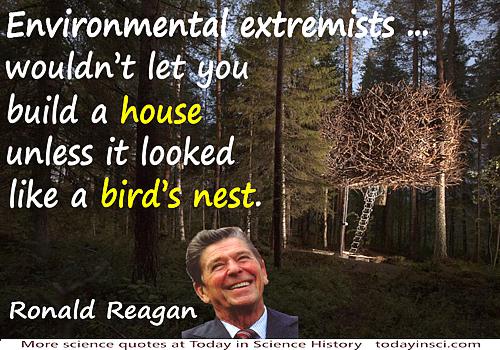
Environmental extremists ... wouldn’t let you build a house unless it looked like a bird’s nest.
As quoted by Kathy Koch, 'Candidates Come Clean on Environmental Positions', in the Florida newspaper Lakeland Ledger (25 Oct 1980), 11A.
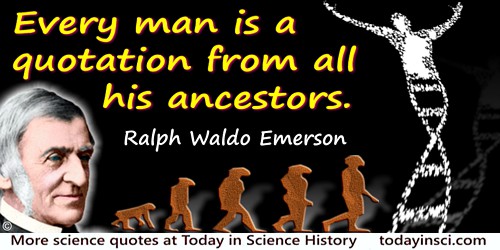
Every book is a quotation; and every house is a quotation out of all forests and mines and stone-quarries; and every man is a quotation from all his ancestors.
Epigraph for chapter 'Quotation and Originality', in Letters and Social Aims (1875, 1917), 176.
Every utterance from government - from justifying 90-day detention to invading other countries [and] to curtailing civil liberties - is about the dangers of religious division and fundamentalism. Yet New Labour is approving new faith schools hand over fist. We have had the grotesque spectacle of a British prime minister, on the floor of the House of Commons, defending - like some medieval crusader - the teaching of creationism in the science curriculum at a sponsor-run school whose running costs are wholly met from the public purse.
In The Guardian (10 Apr 2006).
From my father I learned to build things, to take them apart, and to fix mechanical and electrical equipment in general. I spent vast hours in a woodworking shop he maintained in the basement of our house, building gadgets, working both with my father and alone, often late into the night. … This play with building, fixing, and designing was my favorite activity throughout my childhood, and was a wonderful preparation for my later career as an experimentalist working on the frontiers of chemistry and physics.
From 'Richard E. Smalley: Biographical', collected in Tore Frängsmyr (ed.), Les Prix Nobel: The Nobel Prizes 1996 (1997).
Geology does better in reclothing dry bones and revealing lost creations, than in tracing veins of lead and beds of iron; astronomy better in opening to us the houses of heaven than in teaching navigation; surgery better in investigating organiation than in setting limbs; only it is ordained that, for our encouragement, every step we make in science adds something to its practical applicabilities.
Modern Painters (1852), Part 3, 8-9.
Hieron asked Archimedes to discover, without damaging it, whether a certain crown or wreath was made of pure gold, or if the goldsmith had fraudulently alloyed it with some baser metal. While Archimedes was turning the problem over in his mind, he chanced to be in the bath house. There, as he was sitting in the bath, he noticed that the amount of water that was flowing over the top of it was equal in volume to that part of his body that was immersed. He saw at once a way of solving the problem. He did not delay, but in his joy leaped out of the bath. Rushing naked through the streets towards his home, he cried out in a loud voice that he had found what he sought. For, as he ran, he repeatedly shouted in Greek; “Eureka! Eurekal I’ve found it! I’ve found it!”
Vitrivius Pollio, De Architectura, ix, prologue, section 10.
Houses were knocked down... enormous heaps of earth and clay thrown up; buildings that were undermined and shaking, propped up by great beams of wood... The yet unfinished and unopened Railway was in progress.
In Dealings with the Firm of Dombey and Son: Wholesale, Retail, and for Exportation (1847), Vol. 1, 78.
How hard to realize that every camp of men or beast has this glorious starry firmament for a roof! … In such places standing alone on the mountain-top it is easy to realize that whatever special nests we make—leaves and moss like the marmots and birds, or tents or piled stone—we all dwell in a house of one room—the world with the firmament for its roof—and are sailing the celestial spaces without leaving any track.
Journal Entry, written while camping on top of Quarry Mountain, seven or eight miles from the front of Muir Glacier, Alaska (18 Jul 1890). In John Muir and Linnie Marsh Wolfe (ed.), John of the Mountains: The Unpublished Journals of John Muir (1938, 1979), 321.
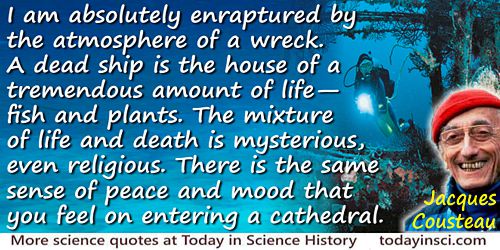
I am absolutely enraptured by the atmosphere of a wreck. A dead ship is the house of a tremendous amount of life—fish and plants. The mixture of life and death is mysterious, even religious. There is the same sense of peace and mood that you feel on entering a cathedral.
Quoted in 'Sport: Poet of the Depths', Time (28 Mar 1960)
I am not a lover of lawns; … the least interesting adjuncts of the country-house. … Rather would I see daisies in their thousands, ground ivy, hawkweed, and even the hated plantain with tall stems, and dandelions with splendid flowers and fairy down, than the too-well-tended lawn.
In The Book of a Naturalist (1919), 337.
I am sorry that the distinguished leader of the Republican Party in the House states that he is not versed in botany and publicly admits that he does not know anything of these terms or what it is all about; but, Mr. Chairman, it is indeed a sad day for the people of this country when we must close the doors of the laboratories doing research work for the people of the United States.
Speaking (28 Dec 1932) as a member of the 72nd Congress, early in the Great Depression, in opposition to an attempt to eliminate a small amount from the agricultural appropriation bill. As quoted in 'Mayor-Elect La Guardia on Research', Science (1933), New Series, 78, No. 2031, 511.
I appeal to the contemptible speech made lately by Sir Robert Peel to an applauding House of Commons. 'Orders of merit,' said he, 'were the proper rewards of the military' (the desolators of the world in all ages). 'Men of science are better left to the applause of their own hearts.' Most learned Legislator! Most liberal cotton-spinner! Was your title the proper reward of military prowess? Pity you hold not the dungeon-keys of an English Inquisition! Perhaps Science, like creeds, would flourish best under a little persecution.
Chemical Recreations (1834), 232.
I feel that I have at last struck the solution of a great problem—and the day is coming when telegraph wires will be laid on to houses just like water or gas—and friends converse with each other without leaving home.
Letter (10 Mar 1876) to his father on the day his first words were sent by wire to Mr. Watson. As quoted in Robert V. Bruce, Bell: Alexander Graham Bell and the Conquest of Solitude (1973, 1990), 181.
I grew up in Brooklyn, New York … a city neighborhood that included houses, lampposts, walls, and bushes. But with an early bedtime in the winter, I could look out my window and see the stars, and the stars were not like anything else in my neighborhood. [At age 5] I didn’t know what they were.
[At age 9] my mother … said to me, “You have a library card now, and you know how to read. Take the streetcar to the library and get a book on stars.” … I stepped up to the big librarian and asked for a book on stars. … I sat down and found out the answer, which was something really stunning.I found out that the stars are glowing balls of gas. I also found out that the Sun is a star but really close and that the stars are all suns except really far away I didn’t know any physics or mathematics at that time, but I could imagine how far you’d have to move the Sun away from us till it was only as bright as a star. It was in that library, reading that book, that the scale of the universe opened up to me. There was something beautiful about it.
At that young age, I already knew that I’d be very happy if I could devote my life to finding out more about the stars and the planets that go around them. And it’s been my great good fortune to do just that.
[At age 9] my mother … said to me, “You have a library card now, and you know how to read. Take the streetcar to the library and get a book on stars.” … I stepped up to the big librarian and asked for a book on stars. … I sat down and found out the answer, which was something really stunning.I found out that the stars are glowing balls of gas. I also found out that the Sun is a star but really close and that the stars are all suns except really far away I didn’t know any physics or mathematics at that time, but I could imagine how far you’d have to move the Sun away from us till it was only as bright as a star. It was in that library, reading that book, that the scale of the universe opened up to me. There was something beautiful about it.
At that young age, I already knew that I’d be very happy if I could devote my life to finding out more about the stars and the planets that go around them. And it’s been my great good fortune to do just that.
Quoted in interview with Jack Rightmyer, in 'Stars in His Eyes', Highlights For Children (1 Jan 1997). Ages as given in Tom Head (ed.), Conversations with Carl Sagan (2006), x.
I grew up in Japan and Hong Kong and then came to the States. Japan was a huge influence on me because, as a child, I would hear the oxcarts come and collect our sewage at night out of our house from the latrine and then take it off to the farms as fertilizer. And then the food would come back in oxcarts during the day. I always had this sort of “our poop became food” mental model. The idea of “waste equals food” was pretty inculcated, that everything was precious and the systems were coherent and cyclical.
In interview with Kerry A. Dolan, 'William McDonough On Cradle-to-Cradle Design', Forbes (4 Aug 2010)
I had a Meccano set with which I “played” endlessly. Meccano which was invented by Frank Hornby around 1900, is called Erector Set in the US. New toys (mainly Lego) have led to the extinction of Meccano and this has been a major disaster as far as the education of our young engineers and scientists is concerned. Lego is a technically trivial plaything and kids love it partly because it is so simple and partly because it is seductively coloured. However it is only a toy, whereas Meccano is a real engineering kit and it teaches one skill which I consider to be the most important that anyone can acquire: This is the sensitive touch needed to thread a nut on a bolt and tighten them with a screwdriver and spanner just enough that they stay locked, but not so tightly that the thread is stripped or they cannot be unscrewed. On those occasions (usually during a party at your house) when the handbasin tap is closed so tightly that you cannot turn it back on, you know the last person to use the washroom never had a Meccano set.
Nobel laureate autobiography in Les Prix Nobel/Nobel Lectures 1996 (1997), 189.
I had gone on a walk on a fine Sabbath afternoon. I had entered the Green [of Glasgow] by the gate at the foot of Charlotte Street—had passed the old washing-house. I was thinking upon the engine at the time, and had gone as far as the herd's house, when the idea came into my mind that as steam was an elastic body it would rush into a vacuum, and if a communication were made between the cylinder and an exhausted vessel it would rush into it, and might be there condensed without cooling the cylinder. I then saw that I must get rid of the condensed steam and injection water if I used a jet, as in Newcomen's engine. Two ways of doing this occurred to me. First, the water might be run off by a descending pipe, if an outlet could be got at the depth of 35 or 36 feet, and any air might be extracted by a small pump. The second was to make the pump large enough to extract both water and air. ... I had not walked further than the Golf-house when the whole thing was arranged in my mind.
[In Robert Hart's words, a recollection of the description of Watt's moment of inspiration, in May 1765, for improving Thomas Newcomen's steam engine.]
[In Robert Hart's words, a recollection of the description of Watt's moment of inspiration, in May 1765, for improving Thomas Newcomen's steam engine.]
In Robert Hart, 'Reminiscences of James Watt' (read 2 Nov 1857), Transactions of the Glasgow Archaeological Society (1859), Vol. 1, 1. Note that these are not the verbatim words of James Watt, but are only a recollection of them by Robert Hart, who is quoting as best he can from memory of a conversation he and his brother had with James Watt that took place over 43 years previously. In his Reminiscences, Hart explains, “I have accordingly thrown together the following brief narrative:— As these meetings took place forty-three years since, many observations that were made at the time may have escaped me at present; yet, when the same subjects are touched on, I have as distinct recollection of his treatment of them as if it were yesterday.”
I have procured some of the mice mentioned in my former letters, a young one and a female with young, both of which I have preserved in brandy. From the colour, shape, size, and manner of nesting, I make no doubt but that the species is nondescript [not known to science]. They are much smaller and more slender than the mus domesticus medius of Ray; and have more of the squirrel or dormouse colour ... They never enter into houses; are carried into ricks and barns with the sheaves; abound in harvest, and build their nests amidst the straws of the corn above the ground, and sometimes in thistles.
[Part of his observations on the harvest mouse, which he was the first to describe as a new species.]
[Part of his observations on the harvest mouse, which he was the first to describe as a new species.]
Letter XII (4 Nov 1767) in The Natural History of Selborne (1789, 1899), 31.
I was in a Printing-house in Hell, and saw the method in which knowledge is transmitted from generation to generation.
If a man write a better book, preach a better sermon, or make a better mouse-trap than his neighbour, tho' he build his house in the woods, the world will make a beaten path to his door.
Attributed to Emerson by Sarah S. B. Yule, in her book Borrowings (compiled 1889, published 1893). Mrs Yule was quoted in The Docket (Feb 1912), that she wrote this in her notebook of memorable statements during an Emerson address. The Docket thus disproved Elbert Hubbard's claim to its authorship.
If any person thinks the examination of the rest of the animal kingdom an unworthy task, he must hold in like disesteem the study of man. For no one can look at the primordia of the human frame—blood, flesh, bones, vessels, and the like—without much repugnance. Moreover, in every inquiry, the examination of material elements and instruments is not to be regarded as final, but as ancillary to the conception of the total form. Thus, the true object of architecture is not bricks, mortar or timber, but the house; and so the principal object of natural philosophy is not the material elements, but their composition, and the totality of the form to which they are subservient, and independently of which they have no existence.
On Parts of Animals, Book 1, Chap 5, 645a, 26-36. In W. Ogle (trans.), Aristotle on the Parts of Animals (1882), 17. Alternate translations: “primodia” = “elements”; “Moreover ... Thus” = “Moreover, when anyone of the parts or structures, be it which it may, is under discussion, it must not be supposed that it is its material composition to which attention is being directed or which is the object of the discussion, but rather the total form. Similarly”; “form ... subservient, and” = “totality of the substance.” See alternate translation in Jonathan Barnes (ed.), The Complete Works of Aristotle (1984), Vol. 1, 1004.
If atoms do, by chance, happen to combine themselves into so many shapes, why have they never combined together to form a house or a slipper? By the same token, why do we not believe that if innumerable letters of the Greek alphabet were poured all over the market-place they would eventually happen to form the text of the Iliad?
The Essays of Michel de Montaigne, Book 2, Chapter 12, 'Apology for Raymond Sebond', trans. M. A. Screech (1991), 612.
If Darwin had printed “The Origin of Species” as a serial running twenty or thirty years he might have found himself, at the end of it, a member of the House of Lords or even Archbishop of Canterbury. But he disgorged it in one stupendous and appalling dose, and in consequence he alarmed millions, including many of his fellow scientists, and got an evil name.
From Baltimore Evening Sun (6 Apr 1931). Collected in A Mencken Chrestomathy (1949, 1956), 330.
If to be the Author of new things, be a crime; how will the first Civilizers of Men, and makers of Laws, and Founders of Governments escape? Whatever now delights us in the Works of Nature, that excells the rudeness of the first Creation, is New. Whatever we see in Cities, or Houses, above the first wildness of Fields, and meaness of Cottages, and nakedness of Men, had its time, when this imputation of Novelty, might as well have bin laid to its charge. It is not therefore an offence, to profess the introduction of New things, unless that which is introduc'd prove pernicious in itself; or cannot be brought in, without the extirpation of others, that are better.
The History of the Royal Society (1667), 322.
If we are industrious, we shall never starve; for, ‘at the workingman’s house hunger looks in, but dares not enter.’ Nor will the bailiff or the constable enter, for ‘industry pays debts, while despair increaseth them.’
Published in Poor Richard's Almanac. Collected in Memoirs of Benjamin Franklin (1834), 477.
If we are recognizing athletic achievement, we should also be recognizing academic achievement and science achievement. If we invite the team that wins the Super Bowl to the White House, then we need to invite some Science Fair winners to the White House as well.
Speech (7 Feb 2012) in the East Room of the White house. 'Remarks by the President at the White House Science Fair'
If You Build Your House on a Crack in the Earth, It’s Your Own Fault.
Purported title of a scientific paper on earthquakes, in Laurence J. Peter, Peter’s People (1979), 168. Webmaster has found no evidence that this paper actually exists. Can you help?
In 1891, during the Presidency of William Henry Harrison [Benjamin Harrison], electric lights were first installed in the White House, the residence of the leaders of our country. At that time, commercial electricity was not economically feasible, but President Harrison wanted to affirm his confidence in the technological capability of our country.
Speech, at dedication of solar panels on the White House roof, 'Solar Energy Remarks Announcing Administration Proposals' (20 Jun 1979).
In a famous passage, René Descartes tells us that he considered himself to be placed in three simultaneous domiciles, patiently recognizing his loyalties to the social past, fervidly believing in a final solution of nature’s secrets and in the meantime consecrated to the pursuit of scientific doubt. Here we have the half way house of the scientific laboratory, of the scientific mind in the midst of its campaign.
In 'The Three Dimensions of Time', Part I, 'The Classic of Science', A Classic and a Founder (1937), collected in Rosenstock-Huessy Papers (1981), Vol. 1, 14.
In a purely technical sense, each species of higher organism—beetle, moss, and so forth, is richer in information than a Caravaggio painting, Mozart symphony, or any other great work of art. Consider the typical case of the house mouse, Mus musculus. Each of its cells contains four strings of DNA, each of which comprises about a billion nucleotide pairs organized into a hundred thousand structural nucleotide pairs, organized into a hundred thousand structural genes. … The full information therein, if translated into ordinary-sized printed letters, would just about fill all 15 editions of the Encyclopaedia Britannica published since 1768.
'The Biological Diversity Crisis: A Challenge to Science', Issues in Science and Technology (Fall 1985), 2:1, 22. Reprinted in Nature Revealed: Selected Writings, 1949-2006 (2006), 622.
In India we have clear evidence that administrative statistics had reached a high state of organization before 300 B.C. In the Arthasastra of Kautilya … the duties of the Gopa, the village accountant, [include] “by setting up boundaries to villages, by numbering plots of grounds as cultivated, uncultivated, plains, wet lands, gardens, vegetable gardens, fences (váta), forests altars, temples of gods, irrigation works, cremation grounds, feeding houses (sattra), places where water is freely supplied to travellers (prapá), places of pilgrimage, pasture grounds and roads, and thereby fixing the boundaries of various villages, of fields, of forests, and of roads, he shall register gifts, sales, charities, and remission of taxes regarding fields.”
Editorial, introducing the new statistics journal of the Indian Statistical Institute, Sankhayā (1933), 1, No. 1. Also reprinted in Sankhyā: The Indian Journal of Statistics (Feb 2003), 65, No. 1, viii.
In the course of centuries the naïve self-love of men has had to submit to two major blows at the hands of science. The first was when they learnt that our earth was not the centre of the universe but only a tiny fragment of a cosmic system of scarcely imaginable vastness… the second blow fell when biological research destroyed man’s supposedly privileged place in creation and proved his descent from the animal kingdom and his ineradicable animal nature… But human megalomania will have suffered its third and most wounding blow from the psychological research of the present time which seeks to prove to the ego that it is not even master in its own house, but must content itself with scanty information of what is going on unconsciously in its mind.
Introductory Lectures on Psychoanalyis (1916), in James Strachey (ed.), The Standard Edition of the Complete Psychological Works of Sigmund Freud (1963), Vol. 16, 284-5.
In this House on July 24, 1895 the Secret of Dreams was revealed to Dr. Sigmund Freud.
Plaque was placed on 6 May 1977 at Bellevue (a house on the slopes of the Wienerwald) where the Freud family spent their summers.
Plaque was placed on 6 May 1977 at Bellevue (a house on the slopes of the Wienerwald) where the Freud family spent their summers.
From a letter to Wilhelm Fliess, 20 Jun 1900. Quoted in Ernst L. Freud (ed.), Letters of Sigmund Freud 1873-1939 (1961), 250.
Into whatsoever houses I enter, I will enter to help the sick, and I will abstain from all intentional wrong-doing and harm, especially from abusing the bodies of man or woman, bond or free. And whatsoever I shall see or hear in the course of my profession, as well as outside my profession in my intercourse with men, if it be what should not be published abroad, I will never divulge, holding such things to be holy secrets.
Oath, in Hippocrates, trans. W. H. S. Jones (1923), Vol. 1, 301.
Investigating the conditions under which mutations occur … requires studies of mutation frequency under various methods of handling the organisms. As yet, extremely little has been done along this line. That is because, in the past, a mutation was considered a windfall, and the expression “mutation frequency” would have seemed a contradiction in terms. To attempt to study it would have seemed as absurd as to study the conditions affecting the distribution of dollar bills on the sidewalk. You were simply fortunate if you found one. … Of late, however, we may say that certain very exceptional banking houses have been found, in front of which the dollars fall more frequently—in other words, specially mutable genes have been discovered, that are beginning to yield abundant data at the hands of Nilsson-Ehle, Zeleny, Emerson, Anderson and others.
In 'Variation Due to Change in the Individual Gene', The American Naturalist (Jan-Feb 1922), 56, No. 642, 44.
It has always irked me as improper that there are still so many people for whom the sky is no more than a mass of random points of light. I do not see why we should recognize a house, a tree, or a flower here below and not, for example, the red Arcturus up there in the heavens as it hangs from its constellation Bootes, like a basket hanging from a balloon.
As quoted in J. L. Locher, Escher: With a Complete Catalogue of the Graphic Works (1982), 113.
It is both a sad and a happy fact of engineering history that disasters have been powerful instruments of change. Designers learn from failure. Industrial society did not invent grand works of engineering, and it was not the first to know design failure. What it did do was develop powerful techniques for learning from the experience of past disasters. It is extremely rare today for an apartment house in North America, Europe, or Japan to fall down. Ancient Rome had large apartment buildings too, but while its public baths, bridges and aqueducts have lasted for two thousand years, its big residential blocks collapsed with appalling regularity. Not one is left in modern Rome, even as ruin.
In Why Things Bite Back: Technology and the Revenge of Unintended Consequences (1997), 23.
It is by the aid of iron that we construct houses, cleave rocks, and perform so many other useful offices of life. But it is with iron also that wars, murders, and robberies are effected, and this, not only hand to hand, but from a distance even, by the aid of missiles and winged weapons, now launched from engines, now hurled by the human arm, and now furnished with feathery wings. This last I regard as the most criminal artifice that has been devised by the human mind; for, as if to bring death upon man with still greater rapidity, we have given wings to iron and taught it to fly. ... Nature, in conformity with her usual benevolence, has limited the power of iron, by inflicting upon it the punishment of rust; and has thus displayed her usual foresight in rendering nothing in existence more perishable, than the substance which brings the greatest dangers upon perishable mortality.
Natural History of Pliny, translation (1857, 1898) by John Bostock and H. T. Riley, 205-6.
It is curious to observe with what different degrees of architectonic skill Providence has endowed birds of the same genus, and so nearly correspondent in their general mode of life! for while the swallow and the house-martin discover the greatest address in raising and securely fixing crusts or shells of loam as cunabula for their young, the bank-martin terebrates a round and regular hole in the sand or earth, which is serpentine, horizontal, and about two feet deep. At the inner end of this burrow does this bird deposit, in a good degree of safety, her rude nest, consisting of fine grasses and feathers, usually goose-feathers, very inartificially laid together.
In Letter to Daines Barrington, (26 Feb 1774), in The Natural History and Antiquities of Selborne (1789), 176.
It is indeed an Opinion strangely prevailing amongst Men, that Houses, Mountains, Rivers, and in a word all sensible Objects have an Existence Natural or Real, distinct from their being perceived by the Understanding. But with how great an Assurance and Acquiescence soever this Principle may be entertained in the World; yet whoever shall find in his Heart to call it in Question, may, if I mistake not, perceive it to involve a manifest Contradiction. For what are the forementioned Objects but the things we perceive by Sense, and what do we perceive besides our own Ideas or Sensations; and is it not plainly repugnant that anyone of these or any Combination of them should exist unperceived?
A Treatise Concerning the Principles of Human Knowledge [first published 1710], (1734),38.
It is the wisdom of rats, that will be sure to leave a house somewhat before it fall.
From essay, 'Of Wisdom for a Man’s Self'. As collected and translated in The Works of Francis Bacon (1765), Vol. 1, 479.
It was about three o’clock at night when the final result of the calculation [which gave birth to quantum mechanics] lay before me ... At first I was deeply shaken ... I was so excited that I could not think of sleep. So I left the house ... and awaited the sunrise on top of a rock.
[That was “the night of Heligoland”.]
[That was “the night of Heligoland”.]
Quoted in Abraham Pais, Niels Bohr’s Times: in Physics, Philosophy, and Polity (1991), 275. Cited in Mauro Dardo, Nobel Laureates and Twentieth-Century Physics (2004), 179.
It was noted long ago that the front row of burlesque houses was occupied predominantly by bald-headed men. In fact, such a row became known as the bald-headed row. It might be assumed from this on statistical evidence that the continued close observation of chorus girls in tights caused loss of hair from the top of the head.
[Disputing a statistical study for the American Cancer Society showing smoking to be a cancer causative.]
[Disputing a statistical study for the American Cancer Society showing smoking to be a cancer causative.]
In Bess Furman, '2 Cite Extraction of Cigarette Tar', New York Times (26 Jul 1957), 21. The article reported on testimony before the Legal and Monetary Affairs Subcommittee of the House Government Operations Committee.
It was through living among these groups and much more I think, through moving regularly from one to the other and back again that I got occupied with the problem of what, long before I put it on paper, I christened to myself as the ‘two cultures’. For constantly I felt I was moving among two groups [scientists and literary intellectuals] comparable in intelligence, identical in race, not grossly different in social origin, earning about the same incomes, who had almost ceased to communicate at all, who in intellectual, moral and psychological climate had so little in common that instead of going from Burlington House or South Kensington to Chelsea, one might have crossed an ocean.
The Two Cultures: The Rede Lecture (1959), 2. The places mentioned are all in London. Burlington House is the home of the Royal Society and South Kensington is the site of the Natural History Museum, whereas Chelsea represents an affluent centre of artistic life.
Last night I invented a new pleasure, and as I was giving it the first trial an angel and a devil came rushing toward my house. They met at my door and fought with each other over my newly created pleasure; the one crying, “It is a sin!” - the other, “It is a virtue!”
In Kahlil Gibran: The Collected Works (2007), 21.
Mental events proceeding beneath the threshold of consciousness are the substrate upon which all conscious experience depends. To argue that all we need of our mental equipment is that part of which we are conscious is about as helpful as equating the United States with the Senate or England with the Houses of Parliament.
Quoted in 'Anthony (George) Stevens' in Gale, Contemporary Authors Online (2005).
Moreover, within the hollows of the earth,
When from one quarter the wind builds up, lunges,
Muscles the deep caves with its headstrong power,
The earth leans hard where the force of wind has pressed it;
Then above ground, the higher the house is built,
The nearer it rises to the sky, the worse
Will it lean that way and jut out perilously,
The beams wrenched loose and hanging ready to fall.
And to think, men can't believe that for this world
Some time of death and ruin lies in wait,
Yet they see so great a mass of earth collapse!
And the winds pause for breath—that's lucky, for else
No force could rein things galloping to destruction.
But since they pause for breath, to rally their force,
Come building up and then fall driven back,
More often the earth will threaten ruin than
Perform it. The earth will lean and then sway back,
Its wavering mass restored to the right poise.
That explains why all houses reel, top floor
Most then the middle, and ground floor hardly at all.
When from one quarter the wind builds up, lunges,
Muscles the deep caves with its headstrong power,
The earth leans hard where the force of wind has pressed it;
Then above ground, the higher the house is built,
The nearer it rises to the sky, the worse
Will it lean that way and jut out perilously,
The beams wrenched loose and hanging ready to fall.
And to think, men can't believe that for this world
Some time of death and ruin lies in wait,
Yet they see so great a mass of earth collapse!
And the winds pause for breath—that's lucky, for else
No force could rein things galloping to destruction.
But since they pause for breath, to rally their force,
Come building up and then fall driven back,
More often the earth will threaten ruin than
Perform it. The earth will lean and then sway back,
Its wavering mass restored to the right poise.
That explains why all houses reel, top floor
Most then the middle, and ground floor hardly at all.
On the Nature of Things, trans. Anthony M. Esolen (1995), Book 6, lines 558-77, 216.
Mr. Hobbes told me that the cause of his Lordship’s [Francis Bacon s] death was trying an experiment: viz., as he was taking the air in a coach with Dr. Witherborne, a Scotchman, physician to the King, towards Highgate, snow lay on the ground, and it came into my Lord’s thoughts, why flesh might not be preserved in snow as in salt. They were resolved they would try the experiment presently. They alighted out of the coach and went into a poor woman s house at the bottom of Highgate Hill and bought a hen and made the woman exenterate it, and then stuffed the body with snow, and my Lord did help to do it himself The snow so chilled him that he immediately fell so extremely ill that he could not return to his lodgings.
In Brief Lives (late 17th century), as excerpted in The Retrospective Review (1821), 292.
Mr. Hobbes told me that the cause of his Lordship's [Francis Bacon's] death was trying an Experiment: viz. as he was taking the aire in a Coach with Dr. Witherborne (a Scotchman, Physitian to the King) towards High-gate, snow lay on the ground, and it came into my Lord's thoughts, why flesh might not be preserved in snow, as in Salt. They were resolved they would try the Experiment presently. They alighted out of the Coach and went into a poore woman's house at the bottom of Highgate hill, and bought a Hen, and made the woman exenterate it, and then stuffed the body with Snow, and my Lord did help to doe it himselfe. The Snow so chilled him that he immediately fell so extremely ill, that he could not return to his Lodging.
John Aubrey, Brief Lives (1680), edited by Oliver Lawson Dick (1949), 16.
My method consists in allowing the mind to play freely for a very brief period, until a couple or so of ideas have passed through it, and then, while the traces or echoes of those ideas are still lingering in the brain, to turn the attention upon them with a sudden and complete awakening; to arrest, to scrutinise them, and to record their exact appearance... The general impression they have left upon me is like that which many of us have experienced when the basement of our house happens to be under thorough sanitary repairs, and we realise for the first time the complex system of drains and gas and water pipes, flues, bell-wires, and so forth, upon which our comfort depends, but which are usually hidden out of sight, and with whose existence, so long as they acted well, we had never troubled ourselves.
Inquiries into Human Faculty and its Development (1883),185-6.
Nature is not a partisan, but out of her ample treasue house she produces children in infinite variety, of which she is equally the mother, and disowns none of them…
Thomas Carlyle: A History of His Life in London, 1834-1881 (1884), 172.
Neil and Buzz, I am talking to you by telephone from the Oval Office at the White House, and this certainly has to be the most historic telephone call ever made. Because of what you have done, the heavens have become a part of man’s world. As you talk to us from the Sea of Tranquility, it inspires us to redouble our efforts to bring peace and tranquility to Earth.
Speaking to the first astronauts while they were standing on the Moon (20 Jul 1969).
New sources of power … will surely be discovered. Nuclear energy is incomparably greater than the molecular energy we use today. The coal a man can get in a day can easily do five hundred times as much work as himself. Nuclear energy is at least one million times more powerful still. If the hydrogen atoms in a pound of water could be prevailed upon to combine and form helium, they would suffice to drive a thousand-horsepower engine for a whole year. If the electrons, those tiny planets of the atomic systems, were induced to combine with the nuclei in hydrogen, the horsepower would be 120 times greater still. There is no question among scientists that this gigantic source of energy exists. What is lacking is the match to set the bonfire alight, or it may be the detonator to cause the dynamite to explode. The scientists are looking for this.
[In his last major speech to the House of Commons on 1 Mar 1955, Churchill quoted from his original printed article, nearly 25 years earlier.]
[In his last major speech to the House of Commons on 1 Mar 1955, Churchill quoted from his original printed article, nearly 25 years earlier.]
'Fifty Years Hence'. Strand Magazine (Dec 1931). Reprinted in Popular Mechanics (Mar 1932), 57:3, 395.
Of all the constituents of the human body, bone is the hardest, the driest, the earthiest, and the coldest; and, excepting only the teeth, it is devoid of sensation. God, the great Creator of all things, formed its substance to this specification with good reason, intending it to be like a foundation for the whole body; for in the fabric of the human body bones perform the same function as do walls and beams in houses, poles in tents, and keels and ribs in boats.
Bones Differentiated by Function
Some bones, by reason of their strength, form as it were props for the body; these include the tibia, the femur, the spinal vertebrae, and most of the bony framework. Others are like bastions, defense walls, and ramparts, affording natural protection to other parts; examples are the skull, the spines and transverse processes of the vertebrae, the breast bone, the ribs. Others stand in front of the joints between certain bones, to ensure that the joint does not move too loosely or bend to too acute an angle. This is the function of the tiny bones, likened by the professors of anatomy to the size of a sesame seed, which are attached to the second internode of the thumb, the first internode of the other four fingers and the first internodes of the five toes. The teeth, on the other hand, serve specifically to cut, crush, pound and grind our food, and similarly the two ossicles in the organ of hearing perform a specifically auditory function.
Bones Differentiated by Function
Some bones, by reason of their strength, form as it were props for the body; these include the tibia, the femur, the spinal vertebrae, and most of the bony framework. Others are like bastions, defense walls, and ramparts, affording natural protection to other parts; examples are the skull, the spines and transverse processes of the vertebrae, the breast bone, the ribs. Others stand in front of the joints between certain bones, to ensure that the joint does not move too loosely or bend to too acute an angle. This is the function of the tiny bones, likened by the professors of anatomy to the size of a sesame seed, which are attached to the second internode of the thumb, the first internode of the other four fingers and the first internodes of the five toes. The teeth, on the other hand, serve specifically to cut, crush, pound and grind our food, and similarly the two ossicles in the organ of hearing perform a specifically auditory function.
From De Humani Corporis Fabrica Libri Septem: (1543), Book I, 1, as translated by William Frank Richardson, in 'Nature of Bone; Function of Bones', On The Fabric of the Human Body: Book I: The Bones and Cartilages (1998), 1.
On May 15, 1957 Linus Pauling made an extraordinary speech to the students of Washington University. ... It was at this time that the idea of the scientists' petition against nuclear weapons tests was born. That evening we discussed it at length after dinner at my house and various ones of those present were scribbling and suggesting paragraphs. But it was Linus Pauling himself who contributed the simple prose of the petition that was much superior to any of the suggestions we were making.
Speech, "The 1962 Nobel Peace Prize," at Unitarian Church, Boulder, Colorado (20 Oct 1963). On Oregon State University Library website.
One of my inventions was a large thermometer made of an iron rod, … The expansion and contraction of this rod was multiplied by a series of levers … so that the slightest change in the length of the rod was instantly shown on a dial about three feet wide multiplied about thirty-two thousand times. The zero-point was gained by packing the rod in wet snow. The scale was so large that … the temperature read while we were ploughing in the field below the house.
From The Story of My Boyhood and Youth (1913), 258-259. One of the inventions made while growing up on his father’s farm, before he left the year after he was 21.
Others consider us superior because of our cultured ways and intellectual tendencies; our technology lets us drive cars, use word processors and travel great distances by air. Some of us live in air-conditioned houses and we are entertained by the media. We think that we are more intelligent than stone-agers, yet how many modern humans could live successfully in caves, or would know how to light wood fires for cooking, or make clothes and shoes from animal skins or bows and arrows good enough to keep their families fed?
In The Revenge of Gaia: Earth’s Climate Crisis & The Fate of Humanity (2006, 2007), 185
People, houses, streets, animals, flowers—everything in Holland looks as if it were washed and ironed each night in order to glisten immaculately and newly starched the next morning.
In The Mirror of Souls, and Other Essays (1966), 334.
Science is built up with facts, as a house is with stones. But a collection of facts is no more a science than a heap of stones is a house.
In George Bruce Halsted (trans.) Science and Hypothesis (1905), 101. From the original French, “On fait la science avec des faits, comme on fait une maison avec des pierres; mais une accumulation de faits n’est pas plus une science qu’un tas de pierres n’est une maison.”, in La Science et l’Hypothèse (1908), 168. Also seen translated as “Science is built up of facts, as a house is built of stones; but an accumulation of facts is no more a science than a heap of stones is a house.”
Science is facts; just as houses are made of stones, so is science made of facts; but a pile of stones is not a house and a collection of facts is not necessarily science.
In Science and Hypothesis.
Science—we have loved her well, and followed her diligently, what will she do? I fear she is too much in the pay of the counting-houses, and the drill-serjent, that she is too busy, and will for the present do nothing. Yet there are matters which I should have thought easy for her; say, for example, teaching Manchester how to consume its town smoke, or Leeds how to get rid of its superfluous black dye without turning it into the river, which would be as much worth her attention as the production of the heaviest black silks, or the biggest of useless guns.
In The Lesser Arts (1878).
Scientific knowledge scarcely exists amongst the higher classes of society. The discussion in the Houses of Lords or of Commons, which arise on the occurrence of any subjects connected with science, sufficiently prove this fact…
In Reflections on the Decline of Science in England (1830), 8.
Select such subjects that your pupils cannot walk out without seeing them. Train your pupils to be observers, and have them provided with the specimens about which you speak. If you can find nothing better, take a house-fly or a cricket, and let each one hold a specimen and examine it as you talk.
Lecture at a teaching laboratory on Penikese Island, Buzzard's Bay. Quoted from the lecture notes by David Starr Jordan, Science Sketches (1911), 146.
Some critics are like chimney-sweepers; they put out the fire below, or frighten the swallows from their nests above: they scrape a long time in the chimney, cover themselves with soot, and bring nothing away but a bag of cinders, and then sing from the top of the house as if they had built it.
In 'Table-Talk', The Poetical Works of Henry Wadsworth Longfellow: Volume 3 (1883), 1355.
Such an atmosphere is un-American, the most un-American thing we have to contend with today. It is the climate of a totalitarian country in which scientists are expected to change their theories to match changes in the police state's propaganda line.
[Stinging rebuke of J. Parnell Thomas, Chairman, House Committee on Un-American activities, who had attacked Dr. Condon (1 Mar 1948) as a weak link in American atomic security.]
[Stinging rebuke of J. Parnell Thomas, Chairman, House Committee on Un-American activities, who had attacked Dr. Condon (1 Mar 1948) as a weak link in American atomic security.]
Opening address (13 Sep 1953) at the annual meeting of the American Association for the Advancement of Science where Condon would be elected as the new AAAS president. Obituary, New York Times (27 Mar 1974), 46.
Such is the condition of organic nature! whose first law might be expressed in the words 'Eat or be eaten!' and which would seem to be one great slaughter-house, one universal scene of rapacity and injustice!
Phytologia (1800), 556.
Suppose you had a small electrical fire and... a structural engineer [looked] at your home’s wiring [and] reports that the wiring is “shot” and there is a 50% chance that your house would burn down in the next few years unless you replace all the wiring. The job will cost $20,000... so you get an independent assessment. The next engineer agrees with the first warning. You can either continue to shop for additional evaluations until you find the one engineer in 1,000 that is willing to give you the answer you want, “Your family is not in danger” or you can change the wiring.
[Comparing the urgency of action on climate change to a problem with electrical wiring in a house.]
[Comparing the urgency of action on climate change to a problem with electrical wiring in a house.]
From press conference at National Press Club (17 Sep 2008), 'Basic Research: Fueling America's Future'. Quoted on the Science Coalition website.
Taking a very gloomy view of the future of the human race, let us suppose that it can only expect to survive for two thousand millions years longer, a period about equal to the past age of the earth. Then, regarded as a being destined to live for three-score years and ten, humanity although it has been born in a house seventy years old, is itself only three days old. But only in the last few minutes has it become conscious that the whole world does not centre round its cradle and its trappings, and only in the last few ticks of the clock has any adequate conception of the size of the external world dawned upon it. For our clock does not tick seconds, but years; its minutes are the lives of men.
EOS: Or the Wider Aspects of Cosmology (1928), 12-3.
The bell ringing for church, we went thither immediately, and with hearts full of gratitude, returned sincere thanks to God for the mercies we had received: were I a Roman Catholic, perhaps I should on this occasion vow to build a chapel to some saint, but as I am not, if I were to vow at all, it should be to build a light-house. [Upon narrowly missing a shipwreck on the Scilly rocks.]
[Frequently seen summarized as, though not Franklin's own wording: Lighthouses are more helpful than churches.
[Frequently seen summarized as, though not Franklin's own wording: Lighthouses are more helpful than churches.
Letter written at Falmouth, England (17 Jul 1757) to Deborah Read Franklin (common-law wife). Quoted in Benjamin Franklin and William Temple Franklin, The Works of Dr. Benjamin Franklin (1818), 175 footnote added by W.T. Franklin.
The commissioners of the treasury moved the king, for the relief of his estate, to disafforest some forests of his, explaining themselves of such forests as lay out of the way, not near any of the king’s houses, nor in the course of his progress; whereof he should never have use nor pleasure. “Why,” saith the king, “do you think that Solomon had use and pleasure of all his three hundred concubines?”
In 'A Collection of Apophthegms, New and Old' (1625). As given in Essays, Moral, Economical, and Political: A New Edition, With the Latin Quotations Translated (1813), No. 9, 262. King James I was named in the preceding Apophthegm No. 3.
The ego is not master in its own house.
From the History of an Infantile Neuroses (1918), in James Strachey (ed.), The Standard Edition of the Complete Psychological Works of Sigmund Freud (1955), Vol. 17, 143.
The end of our foundation [Salomon's House in the New Atlantis] is the knowledge of Causes and the secret motions of things; and the enlarging of the bounds of Human Empire, to the effecting of all things possible.
In Francis Bacon and William Rawle (ed.), The Works of Francis Bacon: Philosophical Works (1887), 156.
The history of a species, or any natural phenomenon that requires unbroken continuity in a world of trouble, works like a batting streak. All are games of a gambler playing with a limited stake against a house with infinite resources. The gambler must eventually go bust. His aim can only be to stick around as long as possible, to have some fun while he’s at it, and, if he happens to be a moral agent as well, to worry about staying the course with honor.
In Bully for Brontosaurus: Reflections in Natural History (1991), 471-472.
The history of men of science has one peculiar advantage, as it shows the importance of little things in producing great results. Smeaton learned his principle of constructing a lighthouse, by noticing the trunk of a tree to be diminished from a curve to a cyclinder ... and Newton, turning an old box into a water-clock, or the yard of a house into a sundial, are examples of those habits of patient observation which scientific biography attractively recommends.
Pleasures, Objects, and Advantages of Literature (1855), 129.
The House is composed of very good men, not shining, but honest and reasonably well-informed, and in time will be found to improve, and not much inferior in eloquence, science, and dignity, to the British Commons. They are patriotic enough, and I believe there are more stupid (as well as more shining) people in the latter, in proportion.
Letter to George Richard Minot (27 May 1789). Quoted in Set Ames (Ed.) Works of Fisher Ames (1854), Vol. 1, 45.
The landlady of a boarding-house is a parallelogram—that is, an oblong figure, which cannot be described, but which is equal to anything.
In 'Boarding-House Geometry', Literary Lapses (1928), 26.
The late James McNeil Whistler had a French poodle of which he was extravagantly fond. This poodle was seized with an affection of the throat, and Whistler had the audacity to send for the great throat specialist, Mackenzie. Sir Morell, when he saw that he had been called to treat a dog, didn't like it much, it was plain. But he said nothing. He prescribed, pocketed a big fee, and drove away.
The next day he sent posthaste for Whistler. And Whistler, thinking he was summoned on some matter connected with his beloved dog, dropped his work and rushed like the wind to Mackenzie's. On his arrival Sir Morell said, gravely: “How do you do, Mr. Whistler? I wanted to see you about having my front door painted.”
The next day he sent posthaste for Whistler. And Whistler, thinking he was summoned on some matter connected with his beloved dog, dropped his work and rushed like the wind to Mackenzie's. On his arrival Sir Morell said, gravely: “How do you do, Mr. Whistler? I wanted to see you about having my front door painted.”
Attributed or merely a legend. This anecdote wording is from 'Turn About Is Fair Play', Collier's (26 Mar 1904), 32, No. 26, 24, the earliest version the Webmaster has found so far. It has been variously reworded and printed in a number of books and magazines over the decades since, and is still circulated in the present day. The wording of Mackenzie's remark changes from one version to another, but remains true to the sense of it. In Medical Record (4 Jan 1913), 83, No. 1, 46, a reprinted column from The Universal Medical Record says: “‘X’ relates that he ‘has recently been watching through the weekly papers, of a story anent the artist Whistler and Sir mrell Mackenzie, which, curiously enough, starting in Paris, has now reached the American medical Journals and seems embarked on a long and active career. ... Mr. Ben Trovato, the eminent raconteur, seems for the moment at fault. Still, the natural history of such legends as this leads us to suppose that the story of the laryngologist and the poodle will continue to circulate, till after having served its day it ‘falls on sleep,’ later to be revived by the journalists of the next generation about some heroes of to-day.” Examples of other versions are in La Vulgarisation scientifique: revue mensuelle illustrée (1906); Don C. Seitz Whistler Stories (1913); Lewis C. Henry, Humorous Anecdotes About Famous People (1948); Graeme Garden The Best Medicine (1984); The Reader's Digest (1986), 128, Nos. 765-769, 40. So, in fact, this anecdote has, indeed, been revived for over a century, but is still narrated about Whistler and Mackenzie. Meanwhile, the column in the Medical Record mentioned above comments: “Why Whistler—whose brother, by-the-bye, was almost equally celebrated in the same department of medicine—should have desired the services of a laryngologist for his poodle, heaven only knows.” So, whether to regard this as entirely legend, or perhaps having some foundation of truth, the Webmaster cannot say, but would like to hear from anyone with more historical background to add.
The laws of nature are the rules according to which the effects are produced; but there must be a cause which operates according to these rules. The laws of navigation never navigated a ship. The rules of architecture never built a house.
'Essay I: On Active Power In General: Chapter 6: On the Efficient Causes of the Phenomena of Nature', Essays on the Active Powers of Man (1785), Chap. 6, 47.

The most fundamental difference between compounds of low molecular weight and macromolecular compounds resides in the fact that the latter may exhibit properties that cannot be deduced from a close examination of the low molecular weight materials. Not very different structures can be obtained from a few building blocks; but if 10,000 or 100,000 blocks are at hand, the most varied structures become possible, such as houses or halls, whose special structure cannot be predicted from the constructions that are possible with only a few building blocks... Thus, a chromosome can be viewed as a material whose macromolecules possess a well defined arrangement, like a living room in which each piece of furniture has its place and not, as in a warehouse, where the pieces of furniture are placed together in a heap without design.
Quoted, without citation, in Ralph E. Oesper (ed.), The Human Side of Scientists (1975), 175.
THE OATH. I swear by Apollo [the healing God], the physician and Aesclepius [son of Apollo], and Health [Hygeia], and All-heal [Panacea], and all the gods and goddesses, that, according to my ability and judgment, I will keep this Oath and this stipulation—to reckon him who taught me this Art equally dear to me as my parents, to share my substance with him, and relieve his necessities if required; to look upon his offspring in the same footing as my own brothers, and to teach them this art, if they shall wish to learn it, without fee or stipulation; and that by precept, lecture, and every other mode of instruction, I will impart a knowledge of the Art to my own sons, and those of my teachers, and to disciples bound by a stipulation and oath according to the law of medicine, but to none others. I will follow that system of regimen which, according to my ability and judgment, I consider for the benefit of my patients, and abstain from whatever is deleterious and mischievous. I will give no deadly medicine to any one if asked, nor suggest any such counsel; and in like manner I will not give to a woman a pessary to produce abortion. With purity and with holiness I will pass my life and practice my Art. I will not cut persons laboring under the stone, but will leave this to be done by men who are practitioners of this work. Into whatever houses I enter, I will go into them for the benefit of the sick, and will abstain from every voluntary act of mischief and corruption; and, further, from the seduction of females or males, of freemen and slaves. Whatever, in connection with my professional practice or not, in connection with it, I see or hear, in the life of men, which ought not to be spoken of abroad, I will not divulge, as reckoning that all such should be kept secret. While I continue to keep this Oath unviolated, may it be granted to me to enjoy life and the practice of the art, respected by all men, in all times! But should I trespass and violate this Oath, may the reverse be my lot!
The Genuine Works of Hippocrates, trans. Francis Adams (1886), Vol. 2, 344-5.
The point [is] largely scientific in character …[concerning] the methods which can be invented or adopted or discovered to enable the Earth to control the Air, to enable defence from the ground to exercise control—indeed dominance—upon aeroplanes high above its surface. … science is always able to provide something. We were told that it was impossible to grapple with submarines, but methods were found … Many things were adopted in war which we were told were technically impossible, but patience, perseverance, and above all the spur of necessity under war conditions, made men’s brains act with greater vigour, and science responded to the demands.
[Remarks made in the House of Commons on 7 June 1935. His speculation was later proved correct with the subsequent development of radar during World War II, which was vital in the air defence of Britain.]
[Remarks made in the House of Commons on 7 June 1935. His speculation was later proved correct with the subsequent development of radar during World War II, which was vital in the air defence of Britain.]
Quoting himself in The Second World War: The Gathering Storm (1948, 1986), Vol. 1, 134.
The Post Office Committee of the House has referred to a sub-committee all the bills authorizing the building or buying of telegraph lines for the purpose of establishing a postal telegraph—that is, of sending mails by electricity … All is done by contract … with the carriage of mails by steam power [railroads] … It does not appear why there should be any difference of principle because of the substitution of electricity for steam.
[Foreshadowing email.]
[Foreshadowing email.]
In 'Mails by Electricity', New York Times (26 Apr 1884), 4. A previous proposal for U.S. Government ownership of a test postal telegraph received an adverse Report of the House Post Office Committee, reported in 'Postal Telegraph', New York Times (25 Feb 1869).
The same thing may have all the kinds of causes, e.g. the moving cause of a house is the art or the builder, the final cause is the function it fulfils, the matter is earth and stones, and the form is the definitory formula.
Metaphysics, 996b, 5-8. In Jonathan Barnes (ed.), The Complete Works of Aristotle (1984), Vol. 2, 1574.
The universe is merely a fleeting idea in God’s mind—a pretty uncomfortable thought, particularly if you’ve just made a down payment on a house.
In Getting Even (1971), 33.
There is another approach to the extraterrestrial hypothesis of UFO origins. This assessment depends on a large number of factors about which we know little, and a few about which we know literally nothing. I want to make some crude numerical estimate of the probability that we are frequently visited by extraterrestrial beings.
Now, there is a range of hypotheses that can be examined in such a way. Let me give a simple example: Consider the Santa Claus hypothesis, which maintains that, in a period of eight hours or so on December 24-25 of each year, an outsized elf visits one hundred million homes in the United States. This is an interesting and widely discussed hypothesis. Some strong emotions ride on it, and it is argued that at least it does no harm.
We can do some calculations. Suppose that the elf in question spends one second per house. This isn't quite the usual picture—“Ho, Ho, Ho,” and so on—but imagine that he is terribly efficient and very speedy; that would explain why nobody ever sees him very much-only one second per house, after all. With a hundred million houses he has to spend three years just filling stockings. I have assumed he spends no time at all in going from house to house. Even with relativistic reindeer, the time spent in a hundred million houses is three years and not eight hours. This is an example of hypothesis-testing independent of reindeer propulsion mechanisms or debates on the origins of elves. We examine the hypothesis itself, making very straightforward assumptions, and derive a result inconsistent with the hypothesis by many orders of magnitude. We would then suggest that the hypothesis is untenable.
We can make a similar examination, but with greater uncertainty, of the extraterrestrial hypothesis that holds that a wide range of UFOs viewed on the planet Earth are space vehicles from planets of other stars.
Now, there is a range of hypotheses that can be examined in such a way. Let me give a simple example: Consider the Santa Claus hypothesis, which maintains that, in a period of eight hours or so on December 24-25 of each year, an outsized elf visits one hundred million homes in the United States. This is an interesting and widely discussed hypothesis. Some strong emotions ride on it, and it is argued that at least it does no harm.
We can do some calculations. Suppose that the elf in question spends one second per house. This isn't quite the usual picture—“Ho, Ho, Ho,” and so on—but imagine that he is terribly efficient and very speedy; that would explain why nobody ever sees him very much-only one second per house, after all. With a hundred million houses he has to spend three years just filling stockings. I have assumed he spends no time at all in going from house to house. Even with relativistic reindeer, the time spent in a hundred million houses is three years and not eight hours. This is an example of hypothesis-testing independent of reindeer propulsion mechanisms or debates on the origins of elves. We examine the hypothesis itself, making very straightforward assumptions, and derive a result inconsistent with the hypothesis by many orders of magnitude. We would then suggest that the hypothesis is untenable.
We can make a similar examination, but with greater uncertainty, of the extraterrestrial hypothesis that holds that a wide range of UFOs viewed on the planet Earth are space vehicles from planets of other stars.
The Cosmic Connection: An Extraterrestrial Perspective (1973), 200.
They think that differential equations are not reality. Hearing some colleagues speak, it’s as though theoretical physics was just playing house with plastic building blocks. This absurd idea has gained currency, and now people seem to feel that theoretical physicists are little more than dreamers locked away ivory towers. They think our games, our little houses, bear no relation to their everyday worries, their interests, their problems, or their welfare. But I’m going to tell you something, and I want you to take it as a ground rule for this course. From now on I will be filling this board with equations. … And when I'm done, I want you to do the following: look at those numbers, all those little numbers and Greek letters on the board, and repeat to yourselves, “This is reality,” repeat it over and over.
Zig Zag, trans. Lisa Dillman (2008), 63.
This Academy [at Lagado] is not an entire single Building, but a Continuation of several Houses on both Sides of a Street; which growing waste, was purchased and applied to that Use.
I was received very kindly by the Warden, and went for many Days to the Academy. Every Room hath in it ' one or more Projectors; and I believe I could not be in fewer than five Hundred Rooms.
The first Man I saw was of a meagre Aspect, with sooty Hands and Face, his Hair and Beard long, ragged and singed in several Places. His Clothes, Shirt, and Skin were all of the same Colour. He had been Eight Years upon a Project for extracting Sun-Beams out of Cucumbers, which were to be put into Vials hermetically sealed, and let out to warm the Air in raw inclement Summers. He told me, he did not doubt in Eight Years more, that he should be able to supply the Governor's Gardens with Sunshine at a reasonable Rate; but he complained that his Stock was low, and interested me to give him something as an Encouragement to Ingenuity, especially since this had been a very dear Season for Cucumbers. I made him a small Present, for my Lord had furnished me with Money on purpose, because he knew their Practice of begging from all who go to see them.
I saw another at work to calcine Ice into Gunpowder; who likewise shewed me a Treatise he had written concerning the Malleability of Fire, which he intended to publish.
There was a most ingenious Architect who had contrived a new Method for building Houses, by beginning at the Roof, and working downwards to the Foundation; which he justified to me by the life Practice of those two prudent Insects the Bee and the Spider.
In another Apartment I was highly pleased with a Projector, who had found a device of plowing the Ground with Hogs, to save the Charges of Plows, Cattle, and Labour. The Method is this: In an Acre of Ground you bury at six Inches Distance, and eight deep, a quantity of Acorns, Dates, Chestnuts, and other Masts or Vegetables whereof these Animals are fondest; then you drive six Hundred or more of them into the Field, where in a few Days they will root up the whole Ground in search of their Food, and make it fit for sowing, at the same time manuring it with their Dung. It is true, upon Experiment they found the Charge and Trouble very great, and they had little or no Crop. However, it is not doubted that this Invention may be capable of great Improvement.
I had hitherto seen only one Side of the Academy, the other being appropriated to the Advancers of speculative Learning.
Some were condensing Air into a dry tangible Substance, by extracting the Nitre, and letting the acqueous or fluid Particles percolate: Others softening Marble for Pillows and Pin-cushions. Another was, by a certain Composition of Gums, Minerals, and Vegetables outwardly applied, to prevent the Growth of Wool upon two young lambs; and he hoped in a reasonable Time to propagate the Breed of naked Sheep all over the Kingdom.
I was received very kindly by the Warden, and went for many Days to the Academy. Every Room hath in it ' one or more Projectors; and I believe I could not be in fewer than five Hundred Rooms.
The first Man I saw was of a meagre Aspect, with sooty Hands and Face, his Hair and Beard long, ragged and singed in several Places. His Clothes, Shirt, and Skin were all of the same Colour. He had been Eight Years upon a Project for extracting Sun-Beams out of Cucumbers, which were to be put into Vials hermetically sealed, and let out to warm the Air in raw inclement Summers. He told me, he did not doubt in Eight Years more, that he should be able to supply the Governor's Gardens with Sunshine at a reasonable Rate; but he complained that his Stock was low, and interested me to give him something as an Encouragement to Ingenuity, especially since this had been a very dear Season for Cucumbers. I made him a small Present, for my Lord had furnished me with Money on purpose, because he knew their Practice of begging from all who go to see them.
I saw another at work to calcine Ice into Gunpowder; who likewise shewed me a Treatise he had written concerning the Malleability of Fire, which he intended to publish.
There was a most ingenious Architect who had contrived a new Method for building Houses, by beginning at the Roof, and working downwards to the Foundation; which he justified to me by the life Practice of those two prudent Insects the Bee and the Spider.
In another Apartment I was highly pleased with a Projector, who had found a device of plowing the Ground with Hogs, to save the Charges of Plows, Cattle, and Labour. The Method is this: In an Acre of Ground you bury at six Inches Distance, and eight deep, a quantity of Acorns, Dates, Chestnuts, and other Masts or Vegetables whereof these Animals are fondest; then you drive six Hundred or more of them into the Field, where in a few Days they will root up the whole Ground in search of their Food, and make it fit for sowing, at the same time manuring it with their Dung. It is true, upon Experiment they found the Charge and Trouble very great, and they had little or no Crop. However, it is not doubted that this Invention may be capable of great Improvement.
I had hitherto seen only one Side of the Academy, the other being appropriated to the Advancers of speculative Learning.
Some were condensing Air into a dry tangible Substance, by extracting the Nitre, and letting the acqueous or fluid Particles percolate: Others softening Marble for Pillows and Pin-cushions. Another was, by a certain Composition of Gums, Minerals, and Vegetables outwardly applied, to prevent the Growth of Wool upon two young lambs; and he hoped in a reasonable Time to propagate the Breed of naked Sheep all over the Kingdom.
Gulliver's Travels (1726, Penguin ed. 1967), Part III, Chap. 5, 223.
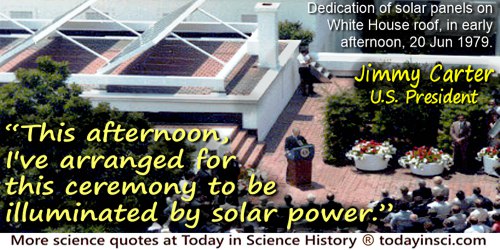
This afternoon, I’ve arranged for this ceremony to be illuminated by solar power. [In the early afternoon, on the White House roof, dedicating solar panels installed there.]
Speech, at dedication of solar panels on the White House roof, 'Solar Energy Remarks Announcing Administration Proposals' (20 Jun 1979).
This is the most extraordinary collection of talent, of human knowledge, that has ever been gathered together at the White House, with the possible exception of when Thomas Jefferson dined alone.
[Welcoming Nobel Prize winners as his guests at a White House dinner.]
[Welcoming Nobel Prize winners as his guests at a White House dinner.]
Remarks at a dinner honoring Nobel Prize Winners of the Western Hemisphere (29 Apr 1962).
This is the question
Marry
Children—(if it Please God)—Constant companion (& friend in old age) who will feel interested in one—object to be beloved and played with—better than a dog anyhow. Home, & someone to take care of house—Charms of music and female chit-chat.—These things good for one’s health.—but terrible loss of time.—
My God, it is Intolerable to think of spending ones whole life, like a neuter bee, working, working—& nothing after all.—No, no, won’t do. Imagine living all one’s day solitary in smoky dirty London House.—Only picture to yourself a nice soft wife on a sofa with good fire, & books & music perhaps-—Compare this vision with the dingy reality of Grt. Marlbro’ Street.
Not Marry
Freedom to go where one liked—choice of Society and little of it. —Conversation of clever men at clubs—Not forced to visit relatives, & to bend in every trifle. —to have the expense and anxiety of children—perhaps quarreling—Loss of time. —cannot read in the Evenings—fatness & idleness—Anxiety & responsibility—less money for books &c—if many children forced to gain one’s bread. —(but then it is very bad for ones health to work too much)
Perhaps my wife won’t like London; then the sentence is banishment & degradation into indolent, idle fool.
Marry—Marry—Marry Q.E.D.
It being proved necessary to Marry When? Soon or late?
Marry
Children—(if it Please God)—Constant companion (& friend in old age) who will feel interested in one—object to be beloved and played with—better than a dog anyhow. Home, & someone to take care of house—Charms of music and female chit-chat.—These things good for one’s health.—but terrible loss of time.—
My God, it is Intolerable to think of spending ones whole life, like a neuter bee, working, working—& nothing after all.—No, no, won’t do. Imagine living all one’s day solitary in smoky dirty London House.—Only picture to yourself a nice soft wife on a sofa with good fire, & books & music perhaps-—Compare this vision with the dingy reality of Grt. Marlbro’ Street.
Not Marry
Freedom to go where one liked—choice of Society and little of it. —Conversation of clever men at clubs—Not forced to visit relatives, & to bend in every trifle. —to have the expense and anxiety of children—perhaps quarreling—Loss of time. —cannot read in the Evenings—fatness & idleness—Anxiety & responsibility—less money for books &c—if many children forced to gain one’s bread. —(but then it is very bad for ones health to work too much)
Perhaps my wife won’t like London; then the sentence is banishment & degradation into indolent, idle fool.
Marry—Marry—Marry Q.E.D.
It being proved necessary to Marry When? Soon or late?
Notes on Marriage, July 1838. In F. Burkhardt and S. Smith (eds.), The Correspondence of Charles Darwin 1837-1843 (1986), Vol. 2, 444.
This perpetual motion machine she [Lisa] made today is a joke, it just keeps going faster and faster…. Lisa … In this house, we OBEY the laws of thermodynamics!
Spoken by fictional animated character, Homer Simpson, in TV show by Matt Groening, 'Simpsons Roasting On an Open Fire' (also known as 'The Simpsons Christmas Special'), The Simpsons (1989), Series 1, Ep. 1, voiced by Dan Castellaneta, written by Mimi Pond.
This sceptred isle,…
This fortress built by Nature for herself…
This precious stone set in the silver sea,
Which serves it in the office of a wall
Or as a moat defensive to a house,
Against the envy of less happier lands,
This blessed plot, this earth, this realm, this England.
This fortress built by Nature for herself…
This precious stone set in the silver sea,
Which serves it in the office of a wall
Or as a moat defensive to a house,
Against the envy of less happier lands,
This blessed plot, this earth, this realm, this England.
In Richard II, Act 2, Scene 1.
Thou shalt not have in thy bag divers weights, a great and a small. Thou shalt not have in thine house divers measures, a great and a small. But thou shalt have a perfect and just weight, a perfect and just measure shalt thou have.
— Bible
Book of Deuteronomy.
To speculate without facts is to attempt to enter a house of which one has not the key, by wandering aimlessly round and round, searching the walls and now and then peeping through the windows. Facts are the key.
'Heredity: 1. The Behaviour of the Chromosomes', in Essays in Popular Science (1926, 1945), 1-2.
Traditional dinosaur theory is full of short circuits. Like the antiquated wiring in an old house, the details sputter and burn out when specific parts are tested.
The Dinosaur Heresies (1986), 27.
True Agnosticism will not forget that existence, motion, and law-abiding operation in nature are more stupendous miracles than any recounted by the mythologies, and that there may be things, not only in the heavens and earth, but beyond the intelligible universe, which “are not dreamt of in our philosophy.” The theological “gnosis” would have us believe that the world is a conjurer’s house; the anti-theological “gnosis” talks as if it were a “dirt-pie,” made by the two blind children, Law and Force. Agnosticism simply says that we know nothing of what may be behind phenomena.
In Life and Letters of Thomas Henry Huxley (1913), Vol. 3, 98, footnote 3.
True science thrives best in glass houses where everyone can look in. When the windows are blacked out, as in war, the weeds take over; when secrecy muffles criticism, charlatans and cranks flourish.
In Is Science Necessary?: Essays on Science and Scientists (1989), xvi.
Unfortunately, we are a species with schizoid tendencies, and like an old lady who has to share her house with a growing and destructive group of teenagers, Gaia grows angry, and if they do not mend their ways she will evict them.
In The Revenge of Gaia: Earth’s Climate Crisis & The Fate of Humanity (2006, 2007), 60.
Very great charm of shadow and light is to be found in the faces of those who sit in the doors of dark houses. The eye of the spectator sees that part of the face which is in shadow lost in the darkness of the house, and that part of the face which is lit draws its brilliancy from the splendor of the sky. From this intensification of light and shade the face gains greatly in relief and beauty by showing the subtlest shadows in the light part and the subtlest lights in the dark part.
…...
Very old and wide-spread is the opinion that forests have an important impact on rainfall. ... If forests enhance the amount and frequency of precipitation simply by being there, deforestation as part of agricultural expansion everywhere, must necessarily result in less rainfall and more frequent droughts. This view is most poignantly expressed by the saying: Man walks the earth and desert follows his steps! ... It is not surprising that under such circumstances the issue of a link between forests and climate has ... been addressed by governments. Lately, the Italian government has been paying special attention to reforestation in Italy and its expected improvement of the climate. ... It must be prevented that periods of heavy rainfall alternate with droughts. ...In the Unites States deforestation plays an important role as well and is seen as the cause for a reduction in rainfall. ... committee chairman of the American Association for Advancement of Science demands decisive steps to extend woodland in order to counteract the increasing drought. ... some serious concerns. In 1873, in Vienna, the congress for agriculture and forestry discussed the problem in detail; and when the Prussian house of representatives ordered a special commission to examine a proposed law pertaining to the preservation and implementation of forests for safeguarding, it pointed out that the steady decrease in the water levels of Prussian rivers was one of the most serious consequences of deforestation only to be rectified by reforestation programs. It is worth mentioning that ... the same concerns were raised in Russia as well and governmental circles reconsidered the issue of deforestation.
as quoted in Eduard Brückner - The Sources and Consequences of Climate Change and Climate Variability in Historical Times editted by N. Stehr and H. von Storch (2000)
We are like tenant farmers chopping down the fence around our house for fuel when we should be using Natures inexhaustible sources of energy — sun, wind and tide. ... I'd put my money on the sun and solar energy. What a source of power! I hope we don't have to wait until oil and coal run out before we tackle that.
Edison in conversation Henry Ford and Harvey Firestone (1931), quoted as a recollection of the author, in James Newton, Uncommon Friends: Life with Thomas Edison, Henry Ford, Harvey Firestone, Alexis Carrel & Charles Lindbergh (1987), 31. The quote is not cited from a print source. However, in the introduction the author said he “kept a diary in which I noted times and places, key phrases, and vivid impressions.” He also “relied on publications by and about my friends, which jogged my memory.” Webmaster has found no earlier record of this quote, and thus suggests the author may have the gist of what Edison said, but is not quoting the exact words uttered by Edison, although quote marks are used to state what Edison said.
We consider species to be like a brick in the foundation of a building. You can probably lose one or two or a dozen bricks and still have a standing house. But by the time you’ve lost twenty percent of species, you’re going to destabilize the entire structure. That’s the way ecosystems work.
The Christian Science Monitor (26 May 1989)
We no longer can talk of unearned “rights.” We’ll have to get back to working for “rights” to adequate food, housing, education, opportunity, a place in the sun—and not everybody is going to make the grade. I don’t see this obsession with the lowest strata of humanity, against all natural biologic experience. We must accept that life is unfair.
In Raymond Mungo, 'Dixy Lee Ray: How Madame Nuke Took Over Washington', Mother Jones (May 1977), 2, No. 4, 31.
We quote not only books and proverbs, but arts, sciences, religion, customs and laws; nay, we quote temples and houses, tables and chairs by imitation.
In Lecture, second in a series given at Freeman Place Chapel, Boston (Mar 1859), 'Quotation and Originality', Letters and Social Aims (1875, 1917), 178-179.
We will be able to depart this life with the quiet peace-giving notion, that we were permitted to contribute to the happiness of many who will live after us. In our long lives we endeavored to unfold the collective consciousness. In our lives we have known hell and heaven; the final balance, however, is that we helped pave the way to dynamic harmony in this earthly house. That, I believe, is the meaning of this life.
Letter to old unnamed friend (Jul 1981), quoted in Willem J. M. van der Linden, 'In Memoriam: R. W. van Bemmelen', Netherlands Journal of Geosciences, Geologie en Mijnbouw (1984), 63, No. 1.
Well-observed facts, though brought to light by passing theories, will never die; they are the material on which alone the house of science will at last be built.
From An Introduction to the Study of Experimental Medicine (1865), as translated by Henry Copley Greene (1957), 165.
What do we plant when we plant the tree?
We plant the ship, which will cross the sea.
We plant the mast to carry the sails;
We plant the planks to withstand the gales—
The keel, the keelson, and beam and knee;
We plant the ship when we plant the tree.
What do we plant when we plant the tree?
We plant the houses for you and me.
We plant the rafters, the shingles, the floors,
We plant the studding, the lath, the doors,
The beams and siding, all parts that be;
We plant the house when we plant the tree.
What do we plant when we plant the tree?
A thousand things that we daily see;
We plant the spire that out-towers the crag,
We plant the staff for our country's flag,
We plant the shade, from the hot sun free;
We plant all these when we plant the tree.
We plant the ship, which will cross the sea.
We plant the mast to carry the sails;
We plant the planks to withstand the gales—
The keel, the keelson, and beam and knee;
We plant the ship when we plant the tree.
What do we plant when we plant the tree?
We plant the houses for you and me.
We plant the rafters, the shingles, the floors,
We plant the studding, the lath, the doors,
The beams and siding, all parts that be;
We plant the house when we plant the tree.
What do we plant when we plant the tree?
A thousand things that we daily see;
We plant the spire that out-towers the crag,
We plant the staff for our country's flag,
We plant the shade, from the hot sun free;
We plant all these when we plant the tree.
(Feb 1890) In The Poems of Henry Abbey (1895), 262.
When we survey our lives and endeavours we soon observe that almost the whole of our actions and desires are bound up with the existence of other human beings. We see that our whole nature resembles that of the social animals. We eat food that others have grown, wear clothes that others have made, live in houses that others have built. The greater part of our knowledge and beliefs has been communicated to us by other people through the medium of a language which others have created. Without language our mental capacities would be poor indeed, comparable to those of the higher animals; we have, therefore, to admit that we owe our principal advantage over the beasts to the fact of living in human society. The individual, if left alone from birth would remain primitive and beast-like in his thoughts and feelings to a degree that we can hardly conceive. The individual is what he is and has the significance that he has not so much in virtue of his individuality, but rather as a member of a great human society, which directs his material and spiritual existence from the cradle to the grave.
In 'Society and Personality', The World As I See It (1935, 2007), 8.
When you can dump a load of bricks on a corner lot, and let me watch them arrange themselves into a house — when you can empty a handful of springs and wheels and screws on my desk, and let me see them gather themselves together into a watch — it will be easier for me to believe that all these thousands of worlds could have been created, balanced, and set to moving in their separate orbits, all without any directing intelligence at all.
In 'If A Man Die, Shall He Live again?', More Power To You: Fifty Editorials From Every Week (1917), 218-219.
When you, my dear Father, see them, you will understand; at present I can say nothing except this: that out of nothing I have created a strange new universe. All that I have sent you previously is like a house of cards in comparison with a tower.
Referring to his creation of a non-euclidean geometry, in a letter (3 Nov 1823) to his father, Farkas Bolyai (in Hungarian). Quoted, as a translation, in Marvin J. Greenberg, Euclidean and Non-Euclidean Geometries: Development and History (1993), 163
Wherever man has left the stamp of mind on brute-matter; whether we designate his work as structure, texture, or mixture, mechanical or chymical; whether the result be a house, a ship, a garment, a piece of glass, or a metallic implement, these memorials of economy and invention will always be worthy of the attention of the Archaeologist.
In Lecture to the Oxford meeting of the Archaeological Institute (18 Jun 1850), printed in 'On the Study of Achaeology', Archaeological Journal (1851), 8, No. 29, 25.
Whilst you put up a public house at one end of your street and a provident dispensary at the other, how can you expect your people to be healthy?
As quoted in Sir William Withey Gull and Theodore Dyke Acland (ed.), A Collection of the Published Writings of William Withey Gull (1896), xxvi. [Note: a “public house” is better known as a pub or bar.]
Yet in this my stars were not Mercury as morning star in the angle of the seventh house, in quartile with Mars, but they were Copernicus, they were Tycho Brahe, without whose books of observations everything which has now been brought by me into the brightest daylight would lie buried in darkness.
Harmonice Mundi, The Harmony of the World (1619), book IV, Epilogue on Sublunary Nature. Trans. E. J. Aiton, A. M. Duncan and J. V. Field (1997), 377.
ZOOLOGY, n. The science and history of the animal kingdom, including its king, the House Fly (Musca maledicta.) The father of Zoology was Aristotle, as is universally conceded, but the name of its mother has not come down to us.
The Collected Works of Ambrose Bierce (1911), Vol. 7, The Devil's Dictionary, 376.
 In science it often happens that scientists say, 'You know that's a really good argument; my position is mistaken,' and then they would actually change their minds and you never hear that old view from them again. They really do it. It doesn't happen as often as it should, because scientists are human and change is sometimes painful. But it happens every day. I cannot recall the last time something like that happened in politics or religion.
(1987) --
In science it often happens that scientists say, 'You know that's a really good argument; my position is mistaken,' and then they would actually change their minds and you never hear that old view from them again. They really do it. It doesn't happen as often as it should, because scientists are human and change is sometimes painful. But it happens every day. I cannot recall the last time something like that happened in politics or religion.
(1987) --