Horizon Quotes (47 quotes)
Qui ergo munitam vult habere navem habet etiam acum jaculo suppositam. Rotabitur enim et circumvolvetur acus, donec cuspis acus respiciat orientem sicque comprehendunt quo tendere debeant nautaw cum Cynosura latet in aeris turbatione; quamvis ad occasum numquam tendat, propter circuli brevitatem.
If then one wishes a ship well provided with all things, then one must have also a needle mounted on a dart. The needle will be oscillated and turn until the point of the needle directs itself to the East* [North], thus making known to sailors the route which they should hold while the Little Bear is concealed from them by the vicissitudes of the atmosphere; for it never disappears under the horizon because of the smallness of the circle it describes.
If then one wishes a ship well provided with all things, then one must have also a needle mounted on a dart. The needle will be oscillated and turn until the point of the needle directs itself to the East* [North], thus making known to sailors the route which they should hold while the Little Bear is concealed from them by the vicissitudes of the atmosphere; for it never disappears under the horizon because of the smallness of the circle it describes.
Latin text from Thomas Wright, 'De Utensilibus', A Volume of Vocabularies, (1857) as cited with translation in Park Benjamin, The Intellectual Rise in Electricity: A History (1895), 129.
All fossil anthropoids found hitherto have been known only from mandibular or maxillary fragments, so far as crania are concerned, and so the general appearance of the types they represented had been unknown; consequently, a condition of affairs where virtually the whole face and lower jaw, replete with teeth, together with the major portion of the brain pattern, have been preserved, constitutes a specimen of unusual value in fossil anthropoid discovery. Here, as in Homo rhodesiensis, Southern Africa has provided documents of higher primate evolution that are amongst the most complete extant. Apart from this evidential completeness, the specimen is of importance because it exhibits an extinct race of apes intermediate between living anthropoids and man ... Whether our present fossil is to be correlated with the discoveries made in India is not yet apparent; that question can only be solved by a careful comparison of the permanent molar teeth from both localities. It is obvious, meanwhile, that it represents a fossil group distinctly advanced beyond living anthropoids in those two dominantly human characters of facial and dental recession on one hand, and improved quality of the brain on the other. Unlike Pithecanthropus, it does not represent an ape-like man, a caricature of precocious hominid failure, but a creature well advanced beyond modern anthropoids in just those characters, facial and cerebral, which are to be anticipated in an extinct link between man and his simian ancestor. At the same time, it is equally evident that a creature with anthropoid brain capacity and lacking the distinctive, localised temporal expansions which appear to be concomitant with and necessary to articulate man, is no true man. It is therefore logically regarded as a man-like ape. I propose tentatively, then, that a new family of Homo-simidæ be created for the reception of the group of individuals which it represents, and that the first known species of the group be designated Australopithecus africanus, in commemoration, first, of the extreme southern and unexpected horizon of its discovery, and secondly, of the continent in which so many new and important discoveries connected with the early history of man have recently been made, thus vindicating the Darwinian claim that Africa would prove to be the cradle of mankind.
'Australopithicus africanus: The Man-Ape of South Africa', Nature, 1925, 115, 195.
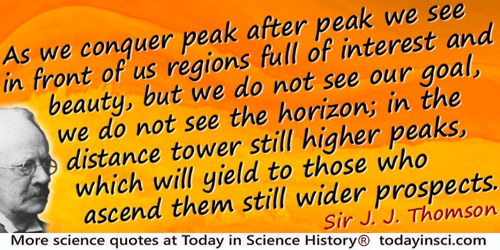
As we conquer peak after peak we see in front of us regions full of interest and beauty, but we do not see our goal, we do not see the horizon; in the distance tower still higher peaks, which will yield to those who ascend them still wider prospects, and deepen the feeling, the truth of which is emphasised by every advance in science, that “Great are the Works of the Lord.”
In Presidential Address to the British Association, as quoted in Arthur L. Foley, 'Recent Developments in Physical Science, The Popular Science Monthly (1910), 456.
As we look ahead through the vista of science with its tremendous possibilities for progress in peacetime, let us not feel that we are looking beyond the horizon of hope. The outlook is not discouraging, for there is no limit to man’s ingenuity and no end to the opportunities for progress.
In address (Fall 1946) at a dinner in New York to commemorate the 40 years of Sarnoff’s service in the radio field, 'Institute News and Radio Notes: The Past and Future of Radio', Proceedings of the Institute of Radio Engineers (I.R.E.), (May 1947), 35, No. 5, 498.
Computers are composed of nothing more than logic gates stretched out to the horizon in a vast numerical irrigation system.
In State of the Art: A Photographic History of the Integrated Circuit (1983), vii.
Error has indeed long darkened the horizon of medical science; and albeit there have been lightnings like coruscations of genius from time to time, still they have passed away, and left the atmosphere as dark as before.
Memoirs of John Abernethy (1854), 293.
Every serious scientific worker is painfully conscious of this involuntary relegation to an ever-narrowing sphere of knowledge, which threatens to deprive the investigator of his broad horizon and degrades him to the level of a mechanic.
In Ideas and Opinions (1954), 69.
For the first time in my life I saw the horizon as a curved line. It was accentuated by a thin seam of dark blue light - our atmosphere. Obviously this was not the ocean of air I had been told it was so many times in my life. I was terrified by its fragile appearance.
…...
Happy Birthday Mrs Chown! Tell your son to stop trying to fill your head with science—for to fill your heart with love is enough. Richard P. Feynman (the man you watched on BBC Horizon).
Note to the mother of Marcus Chown. Reproduced in Christopher Simon Sykes, No Ordinary Genius: The Illustrated Richard Feynman (1996), 161. Chown's mother, though usually disinterested in science, had given close attention to a 1981 BBC Horizon science documentary that profiled Feynman. This was Feynman’s own choice of a birthday message, although Chown (then a physics graduate student at Caltech) had anticipated that the scientist would have helped him interest his mother in scientific things. Marcus Chown was a radio astronomer at Caltech and is now a writer and broadcaster.
Here is the distinct trail of a fox stretching [a] quarter of a mile across the pond…. The pond his journal, and last night’s snow made a tabula rasa for him. I know which way a mind wended this morning, what horizon it faced, by the setting of these tracks; whether it moved slowly or rapidly, by the greater or less intervals and distinctness, for the swiftest step leaves yet a lasting trace.
(30 Jan 1841). In Henry David Thoreau and Bradford Torrey (ed.), The Writings of Henry Thoreau: Journal: I: 1837-1846 (1906), 185.
How can you shorten the subject? That stern struggle with the multiplication table, for many people not yet ended in victory, how can you make it less? Square root, as obdurate as a hardwood stump in a pasture nothing but years of effort can extract it. You can’t hurry the process. Or pass from arithmetic to algebra; you can’t shoulder your way past quadratic equations or ripple through the binomial theorem. Instead, the other way; your feet are impeded in the tangled growth, your pace slackens, you sink and fall somewhere near the binomial theorem with the calculus in sight on the horizon. So died, for each of us, still bravely fighting, our mathematical training; except for a set of people called “mathematicians”—born so, like crooks.
In Too Much College: Or, Education Eating up Life, with Kindred Essays in Education and Humour (1939), 8.
I shuddered when I saw a crimson flame through the porthole instead of the usual starry sky at the night horizon of the planet. Vast pillars of light were bursting into the sky, melting into it, and flooding over with all the colors of the rainbow. An area of red luminescence merged smoothly into the black of the cosmos. The intense and dynamic changes in the colors and forms of the pillars and garlands made me think of visual music. Finally, we saw that we had entered directly into the aurora borealis.
…...
I’m convinced that the best solutions are often the ones that are counterintuitive—that challenge conventional thinking—and end in breakthroughs. It is always easier to do things the same old way … why change? To fight this, keep your dissatisfaction index high and break with tradition. Don’t be too quick to accept the way things are being done. Question whether there’s a better way. Very often you will find that once you make this break from the usual way - and incidentally, this is probably the hardest thing to do—and start on a new track your horizon of new thoughts immediately broadens. New ideas flow in like water. Always keep your interests broad - don’t let your mind be stunted by a limited view.
1988
In modern Europe, the Middle Ages were called the Dark Ages. Who dares to call them so now? … Their Dante and Alfred and Wickliffe and Abelard and Bacon; their Magna Charta, decimal numbers, mariner’s compass, gunpowder, glass, paper, and clocks; chemistry, algebra, astronomy; their Gothic architecture, their painting,—are the delight and tuition of ours. Six hundred years ago Roger Bacon explained the precession of the equinoxes, and the necessity of reform in the calendar; looking over how many horizons as far as into Liverpool and New York, he announced that machines can be constructed to drive ships more rapidly than a whole galley of rowers could do, nor would they need anything but a pilot to steer; carriages, to move with incredible speed, without aid of animals; and machines to fly into the air like birds.
In 'Progress of Culture', an address read to the Phi Beta Kappa Society at Cambridge, 18 July 1867. Collected in Works of Ralph Waldo Emerson (1883), 475.
It is characteristic of experimental science that it opens ever-widening horizons to our vision.
As translated in René J. Dubos, Louis Pasteur, Free Lance of Science (1950, 1986), 329.
It must be admitted that science has its castes. The man whose chief apparatus is the differential equation looks down upon one who uses a galvanometer, and he in turn upon those who putter about with sticky and smelly things in test tubes. But all of these, and most biologists too, join together in their contempt for the pariah who, not through a glass darkly, but with keen unaided vision, observes the massing of a thundercloud on the horizon, the petal as it unfolds, or the swarming of a hive of bees. And yet sometimes I think that our laboratories are but little earthworks which men build about themselves, and whose puny tops too often conceal from view the Olympian heights; that we who work in these laboratories are but skilled artisans compared with the man who is able to observe, and to draw accurate deductions from the world about him.
The Anatomy of Science (1926), 170- 1.
Learn to reverence night and to put away the vulgar fear of it, for, with the banishment of night from the experience of man, there vanishes as well a religious emotion, a poetic mood, which gives depth to the adventure of humanity. By day, space is one with the earth and with man - it is his sun that is shining, his clouds that are floating past; at night, space is his no more. When the great earth, abandoning day, rolls up the deeps of the heavens and the universe, a new door opens for the human spirit, and there are few so clownish that some awareness of the mystery of being does not touch them as they gaze. For a moment of night we have a glimpse of ourselves and of our world islanded in its stream of stars - pilgrims of mortality, voyaging between horizons across eternal seas of space and time. Fugitive though the instant be, the spirit of man is, during it, ennobled by a genuine moment of emotional dignity, and poetry makes its own both the human spirit and experience.
…...
Let him who so wishes take pleasure in boring us with all the wonders of nature: let one spend his life observing insects, another counting the tiny bones in the hearing membrane of certain fish, even in measuring, if you will, how far a flea can jump, not to mention so many other wretched objects of study; for myself, who am curious only about philosophy, who am sorry only not to be able to extend its horizons, active nature will always be my sole point of view; I love to see it from afar, in its breadth and its entirety, and not in specifics or in little details, which, although to some extent necessary in all the sciences, are generally the mark of little genius among those who devote themselves to them.
'L'Homme Plante', in Oeuvres Philosophiques de La Mettrie (1796), Vol. 2, 70-1. Jacques Roger, The Life Sciences in Eighteenth-Century French Thought, edited by Keith R. Benson and trans. Robert Ellrich (1997), 377.
My greatest hope for a future without another Deepwater Horizon disaster lies in our schools, living rooms and community centers, not in boardrooms, political chambers and big industry. If this happens again, we won’t have the luxury of the unknown to shield us from answering “Why?”
In 'Gulf Dispatch: Time to Tap Power of Teens', CNN Blog (23 Jul 2010).
October 9, 1863
Always, however great the height of the balloon, when I have seen the horizon it has roughly appeared to be on the level of the car though of course the dip of the horizon is a very appreciable quantity or the same height as the eye. From this one might infer that, could the earth be seen without a cloud or anything to obscure it, and the boundary line of the plane approximately the same height as the eye, the general appearance would be that of a slight concavity; but I have never seen any part of the surface of the earth other than as a plane.
Towns and cities, when viewed from the balloon are like models in motion. I shall always remember the ascent of 9th October, 1863, when we passed over London about sunset. At the time when we were 7,000 feet high, and directly over London Bridge, the scene around was one that cannot probably be equalled in the world. We were still so low as not to have lost sight of the details of the spectacle which presented itself to our eyes; and with one glance the homes of 3,000,000 people could be seen, and so distinct was the view, that every large building was easily distinguishable. In fact, the whole of London was visible, and some parts most clearly. All round, the suburbs were also very distinct, with their lines of detached villas, imbedded as it were in a mass of shrubs; beyond, the country was like a garden, its fields, well marked, becoming smaller and smaller as the eye wandered farther and farther away.
Again looking down, there was the Thames, throughout its whole length, without the slightest mist, dotted over its winding course with innumerable ships and steamboats, like moving toys. Gravesend was visible, also the mouth of the Thames, and the coast around as far as Norfolk. The southern shore of the mouth of the Thames was not so clear, but the sea beyond was seen for many miles; when at a higher elevation, I looked for the coast of France, but was unable to see it. On looking round, the eye was arrested by the garden-like appearance of the county of Kent, till again London claimed yet more careful attention.
Smoke, thin and blue, was curling from it, and slowly moving away in beautiful curves, from all except one part, south of the Thames, where it was less blue and seemed more dense, till the cause became evident; it was mixed with mist rising from the ground, the southern limit of which was bounded by an even line, doubtless indicating the meeting of the subsoils of gravel and clay. The whole scene was surmounted by a canopy of blue, everywhere free from cloud, except near the horizon, where a band of cumulus and stratus extended all round, forming a fitting boundary to such a glorious view.
As seen from the earth, the sunset this evening was described as fine, the air being clear and the shadows well defined; but, as we rose to view it and its effects, the golden hues increased in intensity; their richness decreased as the distance from the sun increased, both right and left; but still as far as 90º from the sun, rose-coloured clouds extended. The remainder of the circle was completed, for the most part, by pure white cumulus of well-rounded and symmetrical forms.
I have seen London by night. I have crossed it during the day at the height of four miles. I have often admired the splendour of sky scenery, but never have I seen anything which surpassed this spectacle. The roar of the town heard at this elevation was a deep, rich, continuous sound the voice of labour. At four miles above London, all was hushed; no sound reached our ears.
Always, however great the height of the balloon, when I have seen the horizon it has roughly appeared to be on the level of the car though of course the dip of the horizon is a very appreciable quantity or the same height as the eye. From this one might infer that, could the earth be seen without a cloud or anything to obscure it, and the boundary line of the plane approximately the same height as the eye, the general appearance would be that of a slight concavity; but I have never seen any part of the surface of the earth other than as a plane.
Towns and cities, when viewed from the balloon are like models in motion. I shall always remember the ascent of 9th October, 1863, when we passed over London about sunset. At the time when we were 7,000 feet high, and directly over London Bridge, the scene around was one that cannot probably be equalled in the world. We were still so low as not to have lost sight of the details of the spectacle which presented itself to our eyes; and with one glance the homes of 3,000,000 people could be seen, and so distinct was the view, that every large building was easily distinguishable. In fact, the whole of London was visible, and some parts most clearly. All round, the suburbs were also very distinct, with their lines of detached villas, imbedded as it were in a mass of shrubs; beyond, the country was like a garden, its fields, well marked, becoming smaller and smaller as the eye wandered farther and farther away.
Again looking down, there was the Thames, throughout its whole length, without the slightest mist, dotted over its winding course with innumerable ships and steamboats, like moving toys. Gravesend was visible, also the mouth of the Thames, and the coast around as far as Norfolk. The southern shore of the mouth of the Thames was not so clear, but the sea beyond was seen for many miles; when at a higher elevation, I looked for the coast of France, but was unable to see it. On looking round, the eye was arrested by the garden-like appearance of the county of Kent, till again London claimed yet more careful attention.
Smoke, thin and blue, was curling from it, and slowly moving away in beautiful curves, from all except one part, south of the Thames, where it was less blue and seemed more dense, till the cause became evident; it was mixed with mist rising from the ground, the southern limit of which was bounded by an even line, doubtless indicating the meeting of the subsoils of gravel and clay. The whole scene was surmounted by a canopy of blue, everywhere free from cloud, except near the horizon, where a band of cumulus and stratus extended all round, forming a fitting boundary to such a glorious view.
As seen from the earth, the sunset this evening was described as fine, the air being clear and the shadows well defined; but, as we rose to view it and its effects, the golden hues increased in intensity; their richness decreased as the distance from the sun increased, both right and left; but still as far as 90º from the sun, rose-coloured clouds extended. The remainder of the circle was completed, for the most part, by pure white cumulus of well-rounded and symmetrical forms.
I have seen London by night. I have crossed it during the day at the height of four miles. I have often admired the splendour of sky scenery, but never have I seen anything which surpassed this spectacle. The roar of the town heard at this elevation was a deep, rich, continuous sound the voice of labour. At four miles above London, all was hushed; no sound reached our ears.
Travels in the Air (1871), 99-100.
One summer night, out on a flat headland, all but surrounded by the waters of the bay, the horizons were remote and distant rims on the edge of space. Millions of stars blazed in darkness, and on the far shore a few lights burned in cottages. Otherwise there was no reminder of human life. My companion and I were alone with the stars: the misty river of the Milky Way flowing across the sky, the patterns of the constellations standing out bright and clear, a blazing planet low on the horizon. It occurred to me that if this were a sight that could be seen only once in a century, this little headland would be thronged with spectators. But it can be seen many scores of nights in any year, and so the lights burned in the cottages and the inhabitants probably gave not a thought to the beauty overhead; and because they could see it almost any night, perhaps they never will.
In The Sense of Wonder (1956), as condensed in Reader’s Digest (1986), 129, 174.
Painting the desert, sun-setting the tone
Starving backstage, morning-stars are jaded
The moonshine murmur still shivers alone
Curved slice of sliver, shear breath shadows stone
Suspending twilight shiny and shaded
Painting the desert, sun-setting the tone
Carving solace into silver in June
On horizons’ glow from forgotten gold
The moonshine’s’ shilling delivers alone
Gleaming duels of knights, pierce deathly silence
Steel tines of starlight, clashing swords they hold
Painting the desert, sun-setting the tone
Dimples aware, sparkle sand on the dune
Winking at comets, after tails are told
The moon-sand whispers, sift rivers alone
Sharpness they hone, filing skills onto stone
Starlight dazzles, its own space created
Painting the desert, sun-setting the tone
From owls’ talon, moonlight shimmers alone
Starving backstage, morning-stars are jaded
The moonshine murmur still shivers alone
Curved slice of sliver, shear breath shadows stone
Suspending twilight shiny and shaded
Painting the desert, sun-setting the tone
Carving solace into silver in June
On horizons’ glow from forgotten gold
The moonshine’s’ shilling delivers alone
Gleaming duels of knights, pierce deathly silence
Steel tines of starlight, clashing swords they hold
Painting the desert, sun-setting the tone
Dimples aware, sparkle sand on the dune
Winking at comets, after tails are told
The moon-sand whispers, sift rivers alone
Sharpness they hone, filing skills onto stone
Starlight dazzles, its own space created
Painting the desert, sun-setting the tone
From owls’ talon, moonlight shimmers alone
…...
Standing beside each other, we feasted our eyes. Above us the cerulean sky deepened to an inky black as the remnants of the atmosphere gave way to the depths of space. The mighty Himalaya were now a sparkling relief map spread out before us and garnished with a gleaming lattice work of swirling glaciers. Even Cho Oyu, Lhotse and Makalu, all 8,000-meter giants, were dwarfed. To the east and west, Kanchenjunga and Shishapangma, two more great sentinels of the Himalaya, stood crystal clear over 100 kilometers away. To the north were the burnished plains of Tibet, and to the south the majestic peaks and lush foothills of Nepal. We stood on the crown jewel of the earth, the curved horizon spinning endlessly around us.
— Jo Gambi
…...
The astronomer is, in some measure, independent of his fellow astronomer; he can wait in his observatory till the star he wishes to observe comes to his meridian; but the meteorologist has his observations bounded by a very limited horizon, and can do little without the aid of numerous observers furnishing him contemporaneous observations over a wide-extended area.
Second Report on Meteorology to the Secretary of the Navy (1849), US Senate Executive Document 39, 31st Congress, 1st session. Quoted in J. R. Fleming, Meteorology in America: 1800-1870 (1990), vii.
The colors are stunning. In a single view, I see - looking out at the edge of the earth: red at the horizon line, blending to orange and yellow, followed by a thin white line, then light blue, gradually turning to dark blue and various gradually darker shades of gray, then black and a million stars above. It’s breathtaking.
…...
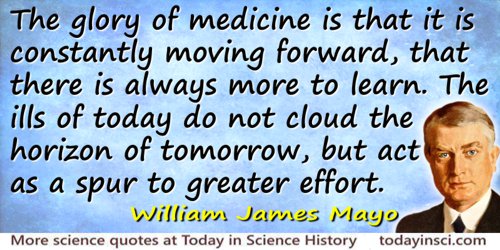
The glory of medicine is that it is constantly moving forward, that there is always more to learn. The ills of today do not cloud the horizon of tomorrow, but act as a spur to greater effort.
Address 'The Aims and Ideals of the American Medical Association', collected in Proceedings of the 66th Annual Meeting of the National Education Association of the United States (1928), 163. As cited in epigraph to Thomas M. Habermann (ed.), Mayo Clinic Internal Medicine Review (2006), Foreward.
The history of aëronautic adventure affords a curious illustration of the same [dip of the horizon] principle. The late Mr. Sadler, the celebrated aeronaut, ascended on one occasion in a balloon from Dublin, and was wafted across the Irish Channel, when, on his approach to the Welsh coast, the balloon descended nearly to the surface of the sea. By this time the sun was set, and the shades of evening began to close in. He threw out nearly all his ballast, and suddenly sprang upwards to a great height, and by so doing brought his horizon to dip below the sun, producing the whole phenomenon of a western sunrise. Subsequently descending in Wales, he of course witnessed a second sunset on the same evening.
This describes how a rapidly ascending balloonist can see more of a setting sun, from the top down, as the viewer gradually rises more and thus sees further, beyond the curvature of the earth. The sun gradually appears as if at sunrise. It is the reverse of the view of a ship sailing toward the horizon which disappears from its hull up to the tip of the mast. In Outlines of Astronomy (1849), 20. A similar description appeared earlier, in Astronomy (1833), 36, which also footnoted Herschel's comment that he had this anecdote from Dr. Lardner, who was present at the ascent
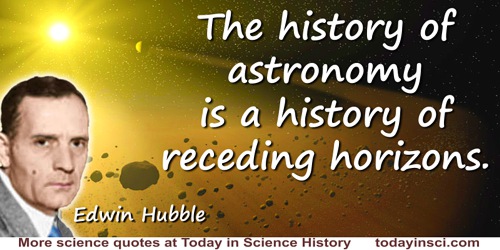
The history of astronomy is a history of receding horizons.
In The Realm of the Nebulae (1936), 21.
The problems of the world cannot possibly be solved by skeptics or cynics whose horizons are limited by the obvious realities. We need men who can dream of things that never were.
From Address (Jun 1963) to the Irish Parliament, Dublin, as collected in Public Papers of the Presidents of the United States: John F. Kennedy (1964), 537.
The sea from its extreme luminousness presented a wonderful and most beautiful appearance. Every part of the water which by day is seen as foam, glowed with a pale light. The vessel drove before her bows two billows of liquid phosphorus, and in her wake was a milky train. As far as the eye reached the crest of every wave was bright; and from the reflected light, the sky just above the horizon was not so utterly dark as the rest of the Heavens. It was impossible to behold this plane of matter, as if it were melted and consumed by heat, without being reminded of Milton’s description of the regions of Chaos and Anarchy.
The strata of the earth are frequently very much bent, being raised in some places, and depressed in others, and this sometimes with a very quick ascent or descent; but as these ascents and descents, in a great measure, compensate one another, if we take a large extent of country together, we may look upon the whole set of strata, as lying nearly horizontally. What is very remarkable, however, in their situation, is, that from most, if not all, large tracts of high and mountainous countries, the strata lie in a situation more inclined to the horizon, than the country itself, the mountainous countries being generally, if not always, formed out of the lower strata of earth. This situation of the strata may be not unaptly represented in the following manner. Let a number of leaves of paper, of several different sorts or colours, be pasted upon one another; then bending them up together into a ridge in the middle, conceive them to be reduced again to a level surface, by a plane so passing through them, as to cut off all the part that had been raised; let the middle now be again raised a little, and this will be a good general representation of most, if not of all, large tracts of mountainous countries, together with the parts adjacent, throughout the whole world.
'Conjectures Concerning the Cause, and Observations upon the Phenomena of Earthquakes', Philosophical Transactions of the Royal Society of London (1760), 51, 584-5.
The technologies which have had the most profound effects on human life are usually simple. A good example of a simple technology with profound historical consequences is hay. Nobody knows who invented hay, the idea of cutting grass in the autumn and storing it in large enough quantities to keep horses and cows alive through the winter. All we know is that the technology of hay was unknown to the Roman Empire but was known to every village of medieval Europe. Like many other crucially important technologies, hay emerged anonymously during the so-called Dark Ages. According to the Hay Theory of History, the invention of hay was the decisive event which moved the center of gravity of urban civilization from the Mediterranean basin to Northern and Western Europe. The Roman Empire did not need hay because in a Mediterranean climate the grass grows well enough in winter for animals to graze. North of the Alps, great cities dependent on horses and oxen for motive power could not exist without hay. So it was hay that allowed populations to grow and civilizations to flourish among the forests of Northern Europe. Hay moved the greatness of Rome to Paris and London, and later to Berlin and Moscow and New York. ... Great inventions like hay and printing, whatever their immediate social costs may be, result in a permanent expansion of our horizons, a lasting acquisition of new territory for human bodies and minds to cultivate.
Infinite In All Directions (1988, 2004), 135. The book is a revised version of a series of the Gifford Lectures under the title 'In Praise of Diversity', given at Aberdeen, Scotland.
The voyage of discovery lies not in seeking new horizons, but in seeing with new eyes.
A commonly seen, loose paraphrase shortened from text in La Prisonnière (1923), a volume in the series of novels À la Recherche du Temps Perdu (Remembrance of Things Past). Translated by C.K. Moncrief as The Captive (1929, 1949), 70-71. For more context, see the longer quote which begins, “The only true voyage of discovery,…” on the Marcel Proust Quotes page of this website.
Theories are like a stairway; by climbing, science widens its horizon more and more, because theories embody and necessarily include proportionately more facts as they advance.
From An Introduction to the Study of Experimental Medicine (1865), as translated by Henry Copley Greene (1957), 165.
Think of the image of the world in a convex mirror. ... A well-made convex mirror of moderate aperture represents the objects in front of it as apparently solid and in fixed positions behind its surface. But the images of the distant horizon and of the sun in the sky lie behind the mirror at a limited distance, equal to its focal length. Between these and the surface of the mirror are found the images of all the other objects before it, but the images are diminished and flattened in proportion to the distance of their objects from the mirror. ... Yet every straight line or plane in the outer world is represented by a straight line or plane in the image. The image of a man measuring with a rule a straight line from the mirror, would contract more and more the farther he went, but with his shrunken rule the man in the image would count out exactly the same results as in the outer world, all lines of sight in the mirror would be represented by straight lines of sight in the mirror. In short, I do not see how men in the mirror are to discover that their bodies are not rigid solids and their experiences good examples of the correctness of Euclidean axioms. But if they could look out upon our world as we look into theirs without overstepping the boundary, they must declare it to be a picture in a spherical mirror, and would speak of us just as we speak of them; and if two inhabitants of the different worlds could communicate with one another, neither, as far as I can see, would be able to convince the other that he had the true, the other the distorted, relation. Indeed I cannot see that such a question would have any meaning at all, so long as mechanical considerations are not mixed up with it.
In 'On the Origin and Significance of Geometrical Axioms,' Popular Scientific Lectures< Second Series (1881), 57-59. In Robert Édouard Moritz, Memorabilia Mathematica (1914), 357-358.
This is in a real sense the capstone of the initial missions to explore the planets. Pluto, its moons and this part of the solar system are such mysteries that New Horizons will rewrite all of the textbooks.
…...
To a body of infinite size there can be ascribed neither center nor boundary ... Just as we regard ourselves as at the center of that universally equidistant circle, which is the great horizon and the limit of our own encircling ethereal region, so doubtless the inhabitants of the moon believe themselves to be at the center (of a great horizon) that embraces this earth, the sun, and the stars, and is the boundary of the radii of their own horizon. Thus the earth no more than any other world is at the center; moreover no points constitute determined celestial poles for our earth, just as she herself is not a definite and determined pole to any other point of the ether, or of the world-space; and the same is true for all other bodies. From various points of view these may all be regarded either as centers, or as points on the circumference, as poles, or zeniths and so forth. Thus the earth is not in the center of the universe; it is central only to our own surrounding space.
Irving Louis Horowitz, The Renaissance Philosophy of Giordano Bruno (1952), 60.
To the east was our giant neighbor Makalu, unexplored and unclimbed, and even on top of Everest the mountaineering instinct was sufficient strong to cause me to spend some moments conjecturing as to whether a route up that mountain might not exist. Far away across the clouds the great bulk of Kangchenjunga loomed on the horizon. To the west, Cho Oyu, our old adversary from 1952, dominated the scene and we could see the great unexplored ranges of Nepal stretching off into the distance. The most important photograph, I felt, was a shot down the north ridge, showing the North Col and the old route that had been made famous by the struggles of those great climbers of the 1920s and 1930s. I had little hope of the results being particularly successful, as I had a lot of difficulty in holding the camera steady in my clumsy gloves, but I felt that they would at least serve as a record. After some ten minutes of this, I realized that I was becoming rather clumsy-fingered and slow-moving, so I quickly replaced my oxygen set and experience once more the stimulating effect of even a few liters of oxygen. Meanwhile, Tenzing had made a little hole in the snow and in it he placed small articles of food – a bar of chocolate, a packet of biscuits and a handful of lollies. Small offerings, indeed, but at least a token gifts to the gods that all devoted Buddhists believe have their home on this lofty summit. While we were together on the South Col two days before, Hunt had given me a small crucifix that he had asked me to take to the top. I, too, made a hole in the snow and placed the crucifix beside Tenzing’s gifts.
As quoted in Whit Burnett, The Spirit of Adventure: The Challenge (1955), 349.
Typhoons are a sort of violent whirlwinds. Before these whirlwinds come on... there appears a heavy cloud to the northeast which is very black near the horizon, but toward the upper part is a dull reddish color. The tempest came with great violence, but after a while, the winds ceased all at once and a calm succeeded. This lasted... an hour, more or less, then the gales were turned around, blowing with great fury from the southwest.
from A New Voyage Round the World (1697)
We are like the explorers of a great continent, who have penetrated its margins in most points of the compass and have mapped the major mountain chains and rivers. There are still innumerable details to fill in, but the endless horizons no longer exist.
Stating his belief that within a generation or two, scientific progress was likely to halt. In Presidential Address (28 Dec 1970) to the American Association for the Advancement of Science. 'Science: Endless Horizons or Golden Age?', Science (8 Jan 1971), 171, No. 3866, 24. Quoted in obituary by Douglas Martin, New York Times (20 Jan 2005).
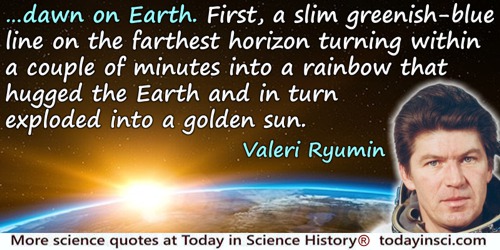
We entered into shadow. Contact with Moscow was gone. Japan floated by beneath us and I could clearly see its cities ablaze with lights. We left Japan behind to face the dark emptiness of the Pacific Ocean. No moon. Only stars, bright and far away. I gripped the handle like a man hanging onto a streetcar. Very slowly, agonizingly, half an hour passed, and with that, dawn on Earth. First, a slim greenish-blue line on the farthest horizon turning within a couple of minutes into a rainbow that hugged the Earth and in turn exploded into a golden sun. You’re out of your mind, I told myself, hanging onto a ship in space, and to your life, and getting ready to admire a sunrise.
…...
We should stop the non-scientific, pseudo-scientific, and anti-scientific nonsense emanating from the right wing, and start demanding immediate action to reduce global warming and prevent catastrophic climate change that may be on our horizon now. We must not let the [Bush] Administration distort science and rewrite and manipulate scientific reports in other areas. We must not let it turn the Environmental Protection Agency into the Environmental Pollution Agency.
Address to National Press Club, Washington, DC (12 Jan 2005). In Bill Adler (ed.), The Wit and Wisdom of Ted Kennedy (2011).
What are they doing, examining last month's costs with a microscope when they should be surveying the horizon with a telescope?
[Acerbic comment about directors of Brunner Mond, where he worked.]
[Acerbic comment about directors of Brunner Mond, where he worked.]
As quoted by Peter Allen in obituary, Biographical Memoirs of Fellows of the Royal Society (Nov 1976), 22, 116.
What beauty. I saw clouds and their light shadows on the distant dear earth…. The water looked like darkish, slightly gleaming spots…. When I watched the horizon, I saw the abrupt, contrasting transition from the earth’s light-colored surface to the absolutely black sky. I enjoyed the rich color spectrum of the earth. It is surrounded by a light blue aureole that gradually darkens, becomes turquoise, dark blue, violet, and finally coal black.
Describing his view while making the first manned orbit of the earth (12 Apr 1961). As quoted in Don Knefel, Writing and Life: A Rhetoric for Nonfiction with Readings (1986), 93.
Front Cover
When you are risen on the eastern horizon
You have filled every land with your beauty…
Though you are far away, your rays are on Earth.
You have filled every land with your beauty…
Though you are far away, your rays are on Earth.
…...
You’ve watched the Star Trek and the Star Wars and all those movies, and everything is evil looking and all sharp and angular. But on the moon it’s not that way at all. It’s all smooth and…just sort of rounded, general rolling terrain except for the individual rocks and things. And they were angular, but the general impression was just the rounded mountains that came down and then rolled into the valley, and then the valley rolled away to the horizon… it was mostly gray in color, but some of the rocks were white and some were gray…. It was just tremendously exciting to stand on the moon. I can’t even put into words the excitement that I experienced as I stood there looking across this dramatic landscape, which was absolutely lifeless.
Describing his first impression of the moon landscape and sky, as quoted in Colin Burgess, Footprints in the Dust: The Epic Voyages of Apollo, 1969-1975 (2010), 422-423.
Young people, especially young women, often ask me for advice. Here it is, valeat quantum. Do not undertake a scientific career in quest of fame or money. There are easier and better ways to reach them. Undertake it only if nothing else will satisfy you; for nothing else is probably what you will receive. Your reward will be the widening of the horizon as you climb. And if you achieve that reward you will ask no other.
In Cecilia Payne-Gaposchkin: An Autobiography and Other Recollections (1996), 227.
 In science it often happens that scientists say, 'You know that's a really good argument; my position is mistaken,' and then they would actually change their minds and you never hear that old view from them again. They really do it. It doesn't happen as often as it should, because scientists are human and change is sometimes painful. But it happens every day. I cannot recall the last time something like that happened in politics or religion.
(1987) --
In science it often happens that scientists say, 'You know that's a really good argument; my position is mistaken,' and then they would actually change their minds and you never hear that old view from them again. They really do it. It doesn't happen as often as it should, because scientists are human and change is sometimes painful. But it happens every day. I cannot recall the last time something like that happened in politics or religion.
(1987) --