Hope Quotes (327 quotes)
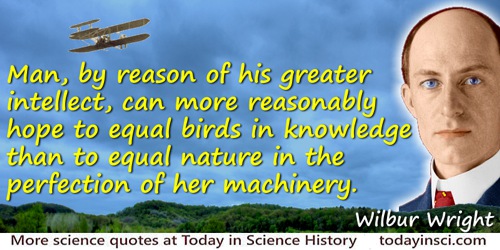
“Hope springs eternal in the human breast,” and is as necessary to life as the act of breathing.
Quoted, without citation, in front matter to T. A. Edison Foundation, Lewis Howard Latimer: A Black Inventor: a Biography and Related Experiments You Can Do (1973). If you know the primary source, please contact Webmaster.
(1) I have told you more than I know about osteoporosis. (2) What I have told you is subject to change without notice. (3) I hope I raised more questions than I have given answers. (4) In any case, as usual, a lot more work is necessary.
Conclusion of one of his papers.
Conclusion of one of his papers.
In Barry G. Firkin, Judith A. Whitworth, Dictionary of Medical Eponyms (1996), 5.
[1665-10-16] But Lord, how empty the streets are, and melancholy, so many poor sick people in the streets, full of sores, and so many sad stories overheard as I walk, everybody talking of this dead, and that man sick, and so many in this place, and so many in that. And they tell me that in Westminster there is never a physitian, and but one apothecary left, all being dead - but that there are great hopes of a great decrease this week. God send it.
Diary of Samuel Pepys (16 Oct 1665)
[1665-11-22] I heard this day that the plague is come very low; that is 600 and odd - and great hopes of a further decrease, because of this day's being a very exceeding hard frost - and continues freezing. ...
Diary of Samuel Pepys (22 Nov 1665)
[Civilization] is a highly complicated invention which has probably been made only once. If it perished it might never be made again. … But it is a poor thing. And if it to be improved there is no hope save in science.
In The Inequality of Man: And Other Essays (1937), 141.
[Euclid's Elements] has been for nearly twenty-two centuries the encouragement and guide of that scientific thought which is one thing with the progress of man from a worse to a better state. The encouragement; for it contained a body of knowledge that was really known and could be relied on, and that moreover was growing in extent and application. For even at the time this book was written—shortly after the foundation of the Alexandrian Museum—Mathematics was no longer the merely ideal science of the Platonic school, but had started on her career of conquest over the whole world of Phenomena. The guide; for the aim of every scientific student of every subject was to bring his knowledge of that subject into a form as perfect as that which geometry had attained. Far up on the great mountain of Truth, which all the sciences hope to scale, the foremost of that sacred sisterhood was seen, beckoning for the rest to follow her. And hence she was called, in the dialect of the Pythagoreans, ‘the purifier of the reasonable soul.’
From a lecture delivered at the Royal Institution (Mar 1873), collected postumously in W.K. Clifford, edited by Leslie Stephen and Frederick Pollock, Lectures and Essays, (1879), Vol. 1, 296.
[First use of the term science fiction:] We hope it will not be long before we may have other works of Science-Fiction [like Richard Henry Horne's The Poor Artist], as we believe such books likely to fulfil a good purpose, and create an interest, where, unhappily, science alone might fail.
[Thomas] Campbell says, that “Fiction in Poetry is not the reverse of truth, but her soft and enchanting resemblance.” Now this applies especially to Science-Fiction, in which the revealed truths of Science may be given interwoven with a pleasing story which may itself be poetical and true—thus circulating a knowledge of Poetry of Science, clothed in a garb of the Poetry of life.
[Thomas] Campbell says, that “Fiction in Poetry is not the reverse of truth, but her soft and enchanting resemblance.” Now this applies especially to Science-Fiction, in which the revealed truths of Science may be given interwoven with a pleasing story which may itself be poetical and true—thus circulating a knowledge of Poetry of Science, clothed in a garb of the Poetry of life.
In A Little Earnest Book Upon a Great Old Subject (1851), 137.
[Luis] Alvarez's whole approach to physics was that of an entrepreneur, taking big risks by building large new projects in the hope of large rewards, although his pay was academic rather than financial. He had drawn around him a group of young physicists anxious to try out the exciting ideas he was proposing.
As quoted in Walter Sullivan, 'Luis W. Alvarez, Nobel Physicist Who Explored Atom, Dies at 77: Obituary', New York Times (2 Sep 1988).
[Magic] enables man to carry out with confidence his important tasks, to maintain his poise and his mental integrity in fits of anger, in the throes of hate, of unrequited love, of despair and anxiety. The function of magic is to ritualize man's optimism, to enhance his faith in the victory of hope over fear. Magic expresses the greater value for man of confidence over doubt, of steadfastness over vacillation, of optimism over pessimism.
Magic, Science and Religion (1925), 90.
[Man] … his origin, his growth, his hopes and fears, his loves and his beliefs are but the outcome of accidental collocations of atoms; that no fire, no heroism, no intensity of thought and feeling can preserve an individual life beyond the grave; that all the labour of the ages, all the devotion, all the inspiration, all the noonday brightness of human genius are destined to extinction in the vast death of the solar system, and that the whole temple of Man's achievement must inevitably be buried beneath the debris of a universe in ruins…
From 'A Free Man's Worship', Independent Review (Dec 1903). Collected in Mysticism and Logic: And Other Essays (1918), 47-48.
[The problem I hope scientists will have solved by the end of the 21st century is:] The production of energy without any deleterious effects. The problem is then we’d be so powerful, there’d be no restraint and we’d continue wrecking everything. Solar energy would be preferable to nuclear. If you could harness it to produce desalination, you could make the Sahara bloom.
From 'Interview: Of Mind and Matter: David Attenborough Meets Richard Dawkins', The Guardian (11 Sep 2010).
[The problem I hope scientists will have solved by the end of the 21st century] thinking more academically: the problem of human consciousness.
From 'Interview: Of Mind and Matter: David Attenborough Meets Richard Dawkins', The Guardian (11 Sep 2010).
Strictly Germ-proof
The Antiseptic Baby and the Prophylactic Pup
Were playing in the garden when the Bunny gamboled up;
They looked upon the Creature with a loathing undisguised;—
It wasn't Disinfected and it wasn't Sterilized.
They said it was a Microbe and a Hotbed of Disease;
They steamed it in a vapor of a thousand-odd degrees;
They froze it in a freezer that was cold as Banished Hope
And washed it in permanganate with carbolated soap.
In sulphurated hydrogen they steeped its wiggly ears;
They trimmed its frisky whiskers with a pair of hard-boiled shears;
They donned their rubber mittens and they took it by the hand
And elected it a member of the Fumigated Band.
There's not a Micrococcus in the garden where they play;
They bathe in pure iodoform a dozen times a day;
And each imbibes his rations from a Hygienic Cup—
The Bunny and the Baby and the Prophylactic Pup.
The Antiseptic Baby and the Prophylactic Pup
Were playing in the garden when the Bunny gamboled up;
They looked upon the Creature with a loathing undisguised;—
It wasn't Disinfected and it wasn't Sterilized.
They said it was a Microbe and a Hotbed of Disease;
They steamed it in a vapor of a thousand-odd degrees;
They froze it in a freezer that was cold as Banished Hope
And washed it in permanganate with carbolated soap.
In sulphurated hydrogen they steeped its wiggly ears;
They trimmed its frisky whiskers with a pair of hard-boiled shears;
They donned their rubber mittens and they took it by the hand
And elected it a member of the Fumigated Band.
There's not a Micrococcus in the garden where they play;
They bathe in pure iodoform a dozen times a day;
And each imbibes his rations from a Hygienic Cup—
The Bunny and the Baby and the Prophylactic Pup.
Printed in various magazines and medical journals, for example, The Christian Register (11 Oct 1906), 1148, citing Women's Home Companion. (Making fun of the contemporary national passion for sanitation.)
The Mighty Task is Done
At last the mighty task is done;
Resplendent in the western sun
The Bridge looms mountain high;
Its titan piers grip ocean floor,
Its great steel arms link shore with shore,
Its towers pierce the sky.
On its broad decks in rightful pride,
The world in swift parade shall ride,
Throughout all time to be;
Beneath, fleet ships from every port,
Vast landlocked bay, historic fort,
And dwarfing all the sea.
To north, the Redwood Empires gates;
To south, a happy playground waits,
In Rapturous appeal;
Here nature, free since time began,
Yields to the restless moods of man,
Accepts his bonds of steel.
Launched midst a thousand hopes and fears,
Damned by a thousand hostile sneers,
Yet Neer its course was stayed,
But ask of those who met the foe
Who stood alone when faith was low,
Ask them the price they paid.
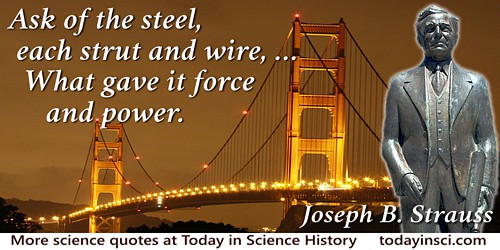
Ask of the steel, each strut and wire,
Ask of the searching, purging fire,
That marked their natal hour;
Ask of the mind, the hand, the heart,
Ask of each single, stalwart part,
What gave it force and power.
An Honored cause and nobly fought
And that which they so bravely wrought,
Now glorifies their deed,
No selfish urge shall stain its life,
Nor envy, greed, intrigue, nor strife,
Nor false, ignoble creed.
High overhead its lights shall gleam,
Far, far below lifes restless stream,
Unceasingly shall flow;
For this was spun its lithe fine form,
To fear not war, nor time, nor storm,
For Fate had meant it so.
At last the mighty task is done;
Resplendent in the western sun
The Bridge looms mountain high;
Its titan piers grip ocean floor,
Its great steel arms link shore with shore,
Its towers pierce the sky.
On its broad decks in rightful pride,
The world in swift parade shall ride,
Throughout all time to be;
Beneath, fleet ships from every port,
Vast landlocked bay, historic fort,
And dwarfing all the sea.
To north, the Redwood Empires gates;
To south, a happy playground waits,
In Rapturous appeal;
Here nature, free since time began,
Yields to the restless moods of man,
Accepts his bonds of steel.
Launched midst a thousand hopes and fears,
Damned by a thousand hostile sneers,
Yet Neer its course was stayed,
But ask of those who met the foe
Who stood alone when faith was low,
Ask them the price they paid.
Ask of the steel, each strut and wire,
Ask of the searching, purging fire,
That marked their natal hour;
Ask of the mind, the hand, the heart,
Ask of each single, stalwart part,
What gave it force and power.
An Honored cause and nobly fought
And that which they so bravely wrought,
Now glorifies their deed,
No selfish urge shall stain its life,
Nor envy, greed, intrigue, nor strife,
Nor false, ignoble creed.
High overhead its lights shall gleam,
Far, far below lifes restless stream,
Unceasingly shall flow;
For this was spun its lithe fine form,
To fear not war, nor time, nor storm,
For Fate had meant it so.
Written upon completion of the building of the Golden Gate Bridge, May 1937. In Allen Brown, Golden Gate: biography of a Bridge (1965), 229.
[About Sir Roderick Impey Murchison:] The enjoyments of elegant life you early chose to abandon, preferring to wander for many successive years over the rudest portions of Europe and Asia—regions new to Science—in the hope, happily realized, of winning new truths.
By a rare union of favourable circumstances, and of personal qualifications equally rare, you have thus been enabled to become the recognized Interpreter and Historian (not without illustrious aid) of the Silurian Period.
By a rare union of favourable circumstances, and of personal qualifications equally rare, you have thus been enabled to become the recognized Interpreter and Historian (not without illustrious aid) of the Silurian Period.
Dedication page in Thesaurus Siluricus: The Flora and Fauna of the Silurian Period (1868), iv.
[Describing the effects of over-indulgence in wine:]
But most too passive, when the blood runs low
Too weakly indolent to strive with pain,
And bravely by resisting conquer fate,
Try Circe's arts; and in the tempting bowl
Of poisoned nectar sweet oblivion swill.
Struck by the powerful charm, the gloom dissolves
In empty air; Elysium opens round,
A pleasing frenzy buoys the lightened soul,
And sanguine hopes dispel your fleeting care;
And what was difficult, and what was dire,
Yields to your prowess and superior stars:
The happiest you of all that e'er were mad,
Or are, or shall be, could this folly last.
But soon your heaven is gone: a heavier gloom
Shuts o'er your head; and, as the thundering stream,
Swollen o'er its banks with sudden mountain rain,
Sinks from its tumult to a silent brook,
So, when the frantic raptures in your breast
Subside, you languish into mortal man;
You sleep, and waking find yourself undone,
For, prodigal of life, in one rash night
You lavished more than might support three days.
A heavy morning comes; your cares return
With tenfold rage. An anxious stomach well
May be endured; so may the throbbing head;
But such a dim delirium, such a dream,
Involves you; such a dastardly despair
Unmans your soul, as maddening Pentheus felt,
When, baited round Citheron's cruel sides,
He saw two suns, and double Thebes ascend.
But most too passive, when the blood runs low
Too weakly indolent to strive with pain,
And bravely by resisting conquer fate,
Try Circe's arts; and in the tempting bowl
Of poisoned nectar sweet oblivion swill.
Struck by the powerful charm, the gloom dissolves
In empty air; Elysium opens round,
A pleasing frenzy buoys the lightened soul,
And sanguine hopes dispel your fleeting care;
And what was difficult, and what was dire,
Yields to your prowess and superior stars:
The happiest you of all that e'er were mad,
Or are, or shall be, could this folly last.
But soon your heaven is gone: a heavier gloom
Shuts o'er your head; and, as the thundering stream,
Swollen o'er its banks with sudden mountain rain,
Sinks from its tumult to a silent brook,
So, when the frantic raptures in your breast
Subside, you languish into mortal man;
You sleep, and waking find yourself undone,
For, prodigal of life, in one rash night
You lavished more than might support three days.
A heavy morning comes; your cares return
With tenfold rage. An anxious stomach well
May be endured; so may the throbbing head;
But such a dim delirium, such a dream,
Involves you; such a dastardly despair
Unmans your soul, as maddening Pentheus felt,
When, baited round Citheron's cruel sides,
He saw two suns, and double Thebes ascend.
The Art of Preserving Health: a Poem in Four Books (2nd. ed., 1745), Book IV, 108-110.
Between the frontiers of the three super-states Eurasia, Oceania, and Eastasia, and not permanently in possession of any of them, there lies a rough quadrilateral with its corners at Tangier, Brazzaville, Darwin, and Hongkong. These territories contain a bottomless reserve of cheap labour. Whichever power controls equatorial Africa, or the Middle East or Southern India or the Indonesian Archipelago, disposes also of the bodies of hundreds of millions of ill-paid and hardworking coolies, expended by their conquerors like so much coal or oil in the race to turn out more armaments, to capture more territory, to control more labour, to turn out more armaments, to capture more territory, to control…
Thus George Orwell—in his only reference to the less-developed world.
I wish I could disagree with him. Orwell may have erred in not anticipating the withering of direct colonial controls within the “quadrilateral” he speaks about; he may not quite have gauged the vehemence of urges to political self-assertion. Nor, dare I hope, was he right in the sombre picture of conscious and heartless exploitation he has painted. But he did not err in predicting persisting poverty and hunger and overcrowding in 1984 among the less privileged nations.
I would like to live to regret my words but twenty years from now, I am positive, the less-developed world will be as hungry, as relatively undeveloped, and as desperately poor, as today.
Thus George Orwell—in his only reference to the less-developed world.
I wish I could disagree with him. Orwell may have erred in not anticipating the withering of direct colonial controls within the “quadrilateral” he speaks about; he may not quite have gauged the vehemence of urges to political self-assertion. Nor, dare I hope, was he right in the sombre picture of conscious and heartless exploitation he has painted. But he did not err in predicting persisting poverty and hunger and overcrowding in 1984 among the less privileged nations.
I would like to live to regret my words but twenty years from now, I am positive, the less-developed world will be as hungry, as relatively undeveloped, and as desperately poor, as today.
'The Less-Developed World: How Can We be Optimists?' (1964). Reprinted in Ideals and Realities (1984), xv-xvi. Referencing a misquote from George Orwell, Nineteen Eighty Four (1949), Ch. 9.
Boss: Dilbert, You have been chosen to design the world’s safest nuclear power plant.
Dilbert: This is the great assignment that any engineer could hope for. I'm flattered by the trust you have in me.
Boss: By “safe” I mean “not near my house.”
Dilbert: This is the great assignment that any engineer could hope for. I'm flattered by the trust you have in me.
Boss: By “safe” I mean “not near my house.”
Dilbert comic strip (18 Feb 2002).
Dogbert (advice to Boss): Every credible scientist on earth says your products harm the environment. I recommend paying weasels to write articles casting doubt on the data. Then eat the wrong kind of foods and hope you die before the earth does.
Dilbert cartoon strip (30 Oct 2007).
Et j’espère que nos neveux me sauront gré, non seulement des choses que j'ai ici expliquées, mais aussi de celles que j'ai omises volontairement, afin de leur laisser le plaisir de les inventer.
I hope that posterity will judge me kindly, not only as to the things which I have explained, but also as to those which I have intentionally omitted so as to leave to others the pleasure of discovery.
I hope that posterity will judge me kindly, not only as to the things which I have explained, but also as to those which I have intentionally omitted so as to leave to others the pleasure of discovery.
Concluding remark in Géométrie (1637), as translated by David Eugene Smith and Marcia L. Latham, in The Geometry of René Descartes (1925, 1954), 240.
Lasciate ogni speranza voi ch'entrate.
Abandon all hope ye who enter here.
Abandon all hope ye who enter here.
From La Divina Commedia, in 'The Gate of Hell', Inferno (1308-1321), Canto III.
~~[Misattributed; NOT by Collins]~~ Hypochondriacs squander large sums of time in search of nostrums by which they vainly hope they may get more time to squander.
This appears in Charles Caleb Colton, Lacon: Or Many Things in Few Words, Addressed to Those who Think (1823), Vol. 1, 99. Since Mortimer Collins was born in 1827, four years after the Colton publication, Collins cannot be the author. Nevertheless, it is widely seen misattributed to Collins, for example in Peter McDonald (ed.), Oxford Dictionary of Medical Quotations (2004), 27. Even seen attributed to Peter Ouspensky (born 1878), in Encarta Book of Quotations (2000). See the Charles Caleb Colton Quotes page on this website. The quote appears on this page to include it with this caution of misattribution.
A common fallacy in much of the adverse criticism to which science is subjected today is that it claims certainty, infallibility and complete emotional objectivity. It would be more nearly true to say that it is based upon wonder, adventure and hope.
Quoted in E. J. Bowen's obituary of Hinshelwood, Chemistry in Britain (1967), Vol. 3, 536.
A few of the results of my activities as a scientist have become embedded in the very texture of the science I tried to serve—this is the immortality that every scientist hopes for. I have enjoyed the privilege, as a university teacher, of being in a position to influence the thought of many hundreds of young people and in them and in their lives I shall continue to live vicariously for a while. All the things I care for will continue for they will be served by those who come after me. I find great pleasure in the thought that those who stand on my shoulders will see much farther than I did in my time. What more could any man want?
In 'The Meaning of Death,' in The Humanist Outlook edited by A. J. Ayer (1968) [See Gerald Holton and Sir Isaac Newton].
A great man, [who] was convinced that the truths of political and moral science are capable of the same certainty as those that form the system of physical science, even in those branches like astronomy that seem to approximate mathematical certainty.
He cherished this belief, for it led to the consoling hope that humanity would inevitably make progress toward a state of happiness and improved character even as it has already done in its knowledge of the truth.
He cherished this belief, for it led to the consoling hope that humanity would inevitably make progress toward a state of happiness and improved character even as it has already done in its knowledge of the truth.
Describing administrator and economist Anne-Robert-Jacques Turgot in Essai sur l’application de l’analyse à la probabilité des décisions rendues à la pluralité des voix (1785), i. Cited epigraph in Charles Coulston Gillispie, Science and Polity in France: The End of the Old Regime (2004), 3
A hundred years ago, the electric telegraph made possible—indeed, inevitable—the United States of America. The communications satellite will make equally inevitable a United Nations of Earth; let us hope that the transition period will not be equally bloody.
Neil Armstrong, Michael Collins, Buzz Aldrin, Edwin E. Aldrin et al., First on the Moon (1970), 389.
A large proportion of mankind, like pigeons and partridges, on reaching maturity, having passed through a period of playfulness or promiscuity, establish what they hope and expect will be a permanent and fertile mating relationship. This we call marriage.
Genetics And Man (1964), 298.
A million million spermatozoa,
All of them alive:
Out of their cataclysm but one poor Noah
Dare hope to survive.
And among that billion minus one
Might have chanced to be Shakespeare, another Newton, a new Donne—
But the One was Me.
All of them alive:
Out of their cataclysm but one poor Noah
Dare hope to survive.
And among that billion minus one
Might have chanced to be Shakespeare, another Newton, a new Donne—
But the One was Me.
'Fifth Philosopher's Song', Leda (1920),33.
A modern branch of mathematics, having achieved the art of dealing with the infinitely small, can now yield solutions in other more complex problems of motion, which used to appear insoluble. This modern branch of mathematics, unknown to the ancients, when dealing with problems of motion, admits the conception of the infinitely small, and so conforms to the chief condition of motion (absolute continuity) and thereby corrects the inevitable error which the human mind cannot avoid when dealing with separate elements of motion instead of examining continuous motion. In seeking the laws of historical movement just the same thing happens. The movement of humanity, arising as it does from innumerable human wills, is continuous. To understand the laws of this continuous movement is the aim of history. … Only by taking an infinitesimally small unit for observation (the differential of history, that is, the individual tendencies of man) and attaining to the art of integrating them (that is, finding the sum of these infinitesimals) can we hope to arrive at the laws of history.
War and Peace (1869), Book 11, Chap. 1.
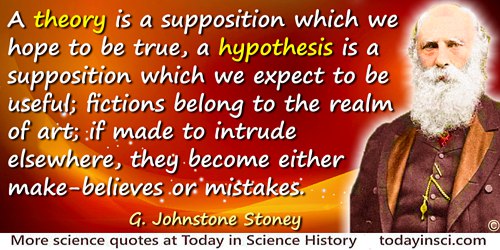
A theory is a supposition which we hope to be true, a hypothesis is a supposition which we expect to be useful; fictions belong to the realm of art; if made to intrude elsewhere, they become either make-believes or mistakes.
As quoted by William Ramsay, in 'Radium and Its Products', Harper’s Magazine (Dec 1904), 52. The first part, about suppositions, appears in a paper read by G. Johnson Stoney to the American Philosophical Society, Philadelphia (3 Apr 1903), printed in 'On the Dependence of What Apparently Takes Place in Nature Upon What Actually Occurs in the Universe of Real Existences', Proceedings of the American Philosophical Society Held at Philadelphia for Promoting Useful Knowledge (Apr-May 1903) 42, No. 173, 107. If you know a primary source for the part on fictions and mistakes, please contact Webmaster.
After five years' work I allowed myself to speculate on the subject, and drew up some short notes; these I enlarged in 1844 into a sketch of the conclusions, which then seemed to me probable: from that period to the present day I have steadily pursued the same object. I hope that I may be excused for entering on these personal details, as I give them to show that I have not been hasty in coming to a decision.
From On the Origin of Species by Means of Natural Selection; or, The Preservation of Favoured Races in the Struggle for Life (1861), 9.
All talk about science purely for its practical and wealth-producing results is … idle. … Practical results will follow right enough. No real knowledge is sterile. … With this faith in the ultimate usefulness of all real knowledge a man may proceed to devote himself to a study of first causes without apology, and without hope of immediate return.
Quoted in Larry R. Squire (ed.), The History of Neuroscience in Autobiography (1996), Vol. 1, 350-351. The above is a highlight excerpted from a longer quote beginning “To prove to an indignant questioner ….” in this same collection for A. V. Hill.
All that Anatomie can doe is only to shew us the gross and sensible parts of the body, or the vapid and dead juices all which, after the most diligent search, will be noe more able to direct a physician how to cure a disease than how to make a man; for to remedy the defects of a part whose organicall constitution and that texture whereby it operates, he cannot possibly know, is alike hard, as to make a part which he knows not how is made. Now it is certaine and beyond controversy that nature performs all her operations on the body by parts so minute and insensible that I thinke noe body will ever hope or pretend, even by the assistance of glasses or any other intervention, to come to a sight of them, and to tell us what organicall texture or what kinde offerment (for whether it be done by one or both of these ways is yet a question and like to be soe always notwithstanding all the endeavours of the most accurate dissections) separate any part of the juices in any of the viscera, or tell us of what liquors the particles of these juices are, or if this could be donne (which it is never like to be) would it at all contribute to the cure of the diseases of those very parts which we so perfectly knew.
'Anatomie' (1668). Quoted in Kenneth Dewhurst (ed.), Dr. Thomas Sydenham (1624-1689): His Life and Original Writings (1966), 85-6.
All that we can hope from these inspirations, which are the fruits of unconscious work, is to obtain points of departure for such calculations. As for the calculations themselves, they must be made in the second period of conscious work which follows the inspiration, and in which the results of the inspiration are verified and the consequences deduced.
Science and Method (1914, 2003), 62.
Always be suspicious of conclusions that reinforce uncritical hope and follow comforting traditions of Western thought.
From The Flamingo's Smile (1987), 401.
And so, after many years, victory has come, and the romance of exploration, of high hopes and bitter disappointment, will in a few years simply be recorded in the text-books of organic chemistry in a few terse sentences.
Recent Developments in the Vitamin A Field', The Pedlar Lecture, 4 Dec 1947, Journal of the Chemical Society, Part I (1948), 393.
Another argument of hope may be drawn from this–that some of the inventions already known are such as before they were discovered it could hardly have entered any man's head to think of; they would have been simply set aside as impossible. For in conjecturing what may be men set before them the example of what has been, and divine of the new with an imagination preoccupied and colored by the old; which way of forming opinions is very fallacious, for streams that are drawn from the springheads of nature do not always run in the old channels.
Translation of Novum Organum, XCII. In Francis Bacon, James Spedding, The Works of Francis Bacon (1864), Vol. 8, 128.
Anthropology has reached that point of development where the careful investigation of facts shakes our firm belief in the far-reaching theories that have been built up. The complexity of each phenomenon dawns on our minds, and makes us desirous of proceeding more cautiously. Heretofore we have seen the features common to all human thought. Now we begin to see their differences. We recognize that these are no less important than their similarities, and the value of detailed studies becomes apparent. Our aim has not changed, but our method must change. We are still searching for the laws that govern the growth of human culture, of human thought; but we recognize the fact that before we seek for what is common to all culture, we must analyze each culture by careful and exact methods, as the geologist analyzes the succession and order of deposits, as the biologist examines the forms of living matter. We see that the growth of human culture manifests itself in the growth of each special culture. Thus we have come to understand that before we can build up the theory of the growth of all human culture, we must know the growth of cultures that we find here and there among the most primitive tribes of the Arctic, of the deserts of Australia, and of the impenetrable forests of South America; and the progress of the civilization of antiquity and of our own times. We must, so far as we can, reconstruct the actual history of mankind, before we can hope to discover the laws underlying that history.
The Jesup North Pacific Expedition: Memoir of the American Museum of Natural History (1898), Vol. 1, 4.
Arithmetic is where you have to multiply—and you carry the multiplication table in your head and hope you won’t lose it.
From 'Arithmetic', Harvest Poems, 1910-1960 (1960), 116.
As each bit of information is added to the sum of human knowledge it is evident that it is the little things that count; that give all the fertility and character; that give all the hope and happiness to human affairs. The concept of bigness is apt to be a delusion, and standardizing processes must not supplant creative impulses.
In Nobel Banquet speech (10 Dec 1934). Collected in Gustaf Santesson (ed.) Les Prix Nobel en 1934 (1935).
As evolutionary time is measured, we have only just turned up and have hardly had time to catch breath, still marveling at our thumbs, still learning to use the brand-new gift of language. Being so young, we can be excused all sorts of folly and can permit ourselves the hope that someday, as a species, we will begin to grow up.
From 'Introduction' written by Lewis Thomas for Horace Freeland Judson, The Search for Solutions (1980, 1987), xvii.
As I had occasion to pass daily to and from the building-yard, while my boat was in progress, I have often loitered unknown near the idle groups of strangers, gathering in little circles, and heard various inquiries as to the object of this new vehicle. The language was uniformly that of scorn, or sneer, or ridicule. The loud laugh often rose at my expense; the dry jest; the wise calculation of losses and expenditures; the dull, but endless, repetition of “the Fulton folly”. Never did a single encouraging remark, a bright hope, or a warm wish, cross my path.
As quoted in Kirkpatrick Sale, The Fire of His Genius: Robert Fulton and the American Dream (2001), 10. Citing in end notes as from Story, Life and Letters, 24.
As the vernal equinox heralds the arrival of spring, it symbolizes not only the rebirth of nature but also the renewal of hope and possibility in our lives.
A fictional quote imagined in the style typical of a scientist (19 Mar 2024).
As we discern a fine line between crank and genius, so also (and unfortunately) we must acknowledge an equally graded trajectory from crank to demagogue. When people learn no tools of judgment and merely follow their hopes, the seeds of political manipulation are sown.
…...
As we look ahead through the vista of science with its tremendous possibilities for progress in peacetime, let us not feel that we are looking beyond the horizon of hope. The outlook is not discouraging, for there is no limit to man’s ingenuity and no end to the opportunities for progress.
In address (Fall 1946) at a dinner in New York to commemorate the 40 years of Sarnoff’s service in the radio field, 'Institute News and Radio Notes: The Past and Future of Radio', Proceedings of the Institute of Radio Engineers (I.R.E.), (May 1947), 35, No. 5, 498.
At terrestrial temperatures matter has complex properties which are likely to prove most difficult to unravel; but it is reasonable to hope that in the not too distant future we shall be competent to understand so simple a thing as a star.
The Internal Constitution of Stars, Cambridge. (1926, 1988), 393.
Basic research is not the same as development. A crash program for the latter may be successful; but for the former it is like trying to make nine women pregnant at once in the hope of getting a baby in a month’s time.
In New Scientist, November 18, 1976.
Beasts have not the high advantages which we possess; but they have some which we have not. They have not our hopes, but then they have not our fears; they are subject like us to death, but it is without being aware of it; most of them are better able to preserve themselves than we are, and make a less bad use of their passions.
In Edwin Davies, Other Men's Minds, Or, Seven Thousand Choice Extracts (1800), 55.
Before his [Sir Astley Cooper’s] time, operations were too often frightful alternatives or hazardous compromises; and they were not seldom considered rather as the resource of despair than as a means of remedy; he always made them follow, as it were, in the natural course of treatment; he gave them a scientific character; and he moreover, succeeded, in a great degree, in divesting them of their terrors, by performing them unostentatiously, simply, confidently, and cheerfully, and thereby inspiring the patient with hope of relief, where previously resignation under misfortune had too often been all that could be expected from the sufferer.
In John Forbes (ed.), British and Foreign Medical Review (Jul 1840), 10, No. 19, 104. In Bransby Blake Cooper, The Life of Sir Astley Cooper (1843), Vol. 2, 37.
Before Kuhn, most scientists followed the place-a-stone-in-the-bright-temple-of-knowledge tradition, and would have told you that they hoped, above all, to lay many of the bricks, perhaps even the keystone, of truth’s temple. Now most scientists of vision hope to foment revolution. We are, therefore, awash in revolutions, most self-proclaimed.
…...
Beware how you take away hope from any human being. Nothing is clearer than that the merciful Creator intends to blind most people as they pass down into the dark valley. Without very good reasons, temporal or spiritual, we should not interfere with his kind arrangements. It is the height of cruelty and the extreme of impertinence to tell your patient he must die, except you are sure that he wishes to know it, or that there is some particular cause for his knowing it. I should be especially unwilling to tell a child that it could not recover; if the theologians think it necessary, let them take the responsibility. God leads it by the hand to the edge of the precipice in happy unconsciousness, and I would not open its eyes to what he wisely conceals.
In Valedictory Address Delivered to the Medical Graduates at Harvard University, at the Annual Commencement, Wednesday, March 10, 1858) (1858), 14. Reprinted, as published in The Boston Medical and Surgical Journal (25 Mar 1858), 58, No. 8, 158.
By a recent estimate, nearly half the bills before the U.S. Congress have a substantial science-technology component and some two-thirds of the District of Columbia Circuit Court’s case load now involves review of action by federal administrative agencies; and more and more of such cases relate to matters on the frontiers of technology.
If the layman cannot participate in decision making, he will have to turn himself over, essentially blind, to a hermetic elite. … [The fundamental question becomes] are we still capable of self-government and therefore freedom?
Margaret Mead wrote in a 1959 issue of Daedalus about scientists elevated to the status of priests. Now there is a name for this elevation, when you are in the hands of—one hopes—a benevolent elite, when you have no control over your political decisions. From the point of view of John Locke, the name for this is slavery.
If the layman cannot participate in decision making, he will have to turn himself over, essentially blind, to a hermetic elite. … [The fundamental question becomes] are we still capable of self-government and therefore freedom?
Margaret Mead wrote in a 1959 issue of Daedalus about scientists elevated to the status of priests. Now there is a name for this elevation, when you are in the hands of—one hopes—a benevolent elite, when you have no control over your political decisions. From the point of view of John Locke, the name for this is slavery.
Quoted in 'Where is Science Taking Us? Gerald Holton Maps the Possible Routes', The Chronicle of Higher Education (18 May 1981). In Francis A. Schaeffer, A Christian Manifesto (1982), 80.
Charlie Holloway (human): “What we hoped to achieve was to meet our makers. To get answers. Why they even made us in the first place.”
David (AI robot): “Why do you think your people made me?”
Charlie Holloway (human): “We made you because we could.”
David (AI robot): “Can you imagine how disappointing it would be for you to hear the same thing from your creator?”
Charlie Holloway (human): “I guess it’s good you can’t be disappointed.”
David (AI robot): “Why do you think your people made me?”
Charlie Holloway (human): “We made you because we could.”
David (AI robot): “Can you imagine how disappointing it would be for you to hear the same thing from your creator?”
Charlie Holloway (human): “I guess it’s good you can’t be disappointed.”
Prometheus (2012)
Considerable obstacles generally present themselves to the beginner, in studying the elements of Solid Geometry, from the practice which has hitherto uniformly prevailed in this country, of never submitting to the eye of the student, the figures on whose properties he is reasoning, but of drawing perspective representations of them upon a plane. ...I hope that I shall never be obliged to have recourse to a perspective drawing of any figure whose parts are not in the same plane.
Quoted in Adrian Rice, 'What Makes a Great Mathematics Teacher?' The American Mathematical Monthly, (June-July 1999), 540.
Courage is like love; it must have hope to nourish it.
…...
Creativity comes from trust. Trust your instincts. And never hope more than you work.
In Starting From Scratch: A Different Kind of Writers’ Manual (1988), xi.
Darwin grasped the philosophical bleakness with his characteristic courage. He argued that hope and morality cannot, and should not, be passively read in the construction of nature. Aesthetic and moral truths, as human concepts, must be shaped in human terms, not ‘discovered’ in nature. We must formulate these answers for ourselves and then approach nature as a partner who can answer other kinds of questions for us–questions about the factual state of the universe, not about the meaning of human life. If we grant nature the independence of her own domain–her answers unframed in human terms–then we can grasp her exquisite beauty in a free and humble way. For then we become liberated to approach nature without the burden of an inappropriate and impossible quest for moral messages to assuage our hopes and fears. We can pay our proper respect to nature’s independence and read her own ways as beauty or inspiration in our different terms.
…...
Descended from the apes? My dear, we will hope it is not true. But if it is, let us pray that it may not become generally known.
Remark by the wife of a canon of Worcester Cathedral. Quoted in Ashley Montagu, Manʹs Most Dangerous Myth: the Fallacy of Race (1945), 27.
Despair is better treated with hope, not dope.
Lancet (1958), 1, 954.
Education has, thus, become the chief problem of the world, its one holy cause. The nations that see this will survive, and those that fail to do so will slowly perish. There must be re-education of the will and of the heart as well as of the intellect, and the ideals of service must supplant those of selfishness and greed. ... Never so much as now is education the one and chief hope of the world.
Confessions of a Psychologist (1923). Quoted in Bruce A. Kimball, The True Professional Ideal in America: A History (1996), 198.
Education is the most sacred concern, indeed the only hope, of a nation.
In paper 'On Social Unrest', The Daily Mail (1912). Collected and cited in A Sheaf (1916), 198.
England and all civilised nations stand in deadly peril of not having enough to eat. As mouths multiply, food resources dwindle. Land is a limited quantity, and the land that will grow wheat is absolutely dependent on difficult and capricious natural phenomena... I hope to point a way out of the colossal dilemma. It is the chemist who must come to the rescue of the threatened communities. It is through the laboratory that starvation may ultimately be turned into plenty... The fixation of atmospheric nitrogen is one of the great discoveries, awaiting the genius of chemists.
Presidential Address to the British Association for the Advancement of Science 1898. Published in Chemical News, 1898, 78, 125.
Every appearance in nature corresponds to some state of the mind, and that state of the mind can only be described by presenting that natural appearance as its picture. An enraged man is a lion, a cunning man is a fox, a firm man is a rock, a learned man is a torch. A lamb is innocence; a snake is subtle spite; flowers express to us the delicate affections. Light and darkness are our familiar expressions for knowledge and ignorance ; and heat for love. Visible distance behind and before us, is respectively our image of memory and hope.
In essay, 'Language', collected in Nature: An Essay ; And, Lectures on the Times (1844), 23-24.
Every generation has the right to build its own world out of the materials of the past, cemented by the hopes of the future.
Speech, Republican National Convention, Chicago (27 Jun 1944), 'Freedom in America and the World', collected in Addresses Upon the American Road: 1941-1945 (1946), 254.
Every thoughtful man who hopes for the creation of a contemporary culture knows that this hinges on one central problem: to find a coherent relation between science and the humanities.
With co-author Bruce Mazlish, in The Western Intellectual Tradition (1960).
Everything material which is the subject of knowledge has number, order, or position; and these are her first outlines for a sketch of the universe. If our feeble hands cannot follow out the details, still her part has been drawn with an unerring pen, and her work cannot be gainsaid. So wide is the range of mathematical sciences, so indefinitely may it extend beyond our actual powers of manipulation that at some moments we are inclined to fall down with even more than reverence before her majestic presence. But so strictly limited are her promises and powers, about so much that we might wish to know does she offer no information whatever, that at other moments we are fain to call her results but a vain thing, and to reject them as a stone where we had asked for bread. If one aspect of the subject encourages our hopes, so does the other tend to chasten our desires, and he is perhaps the wisest, and in the long run the happiest, among his fellows, who has learned not only this science, but also the larger lesson which it directly teaches, namely, to temper our aspirations to that which is possible, to moderate our desires to that which is attainable, to restrict our hopes to that of which accomplishment, if not immediately practicable, is at least distinctly within the range of conception.
From Presidential Address (Aug 1878) to the British Association, Dublin, published in the Report of the 48th Meeting of the British Association for the Advancement of Science (1878), 31.
Evil communication corrupts good manners. I hope to live to hear that good communication corrects bad manners.
On a leaf of one of Banneker’s almanacs, in his own handwriting. As quoted in George Washington Williams, History of the Negro Race in America from 1619 to 1880 (1882), Vol. 1, 390.
Finally one should add that in spite of the great complexity of protein synthesis and in spite of the considerable technical difficulties in synthesizing polynucleotides with defined sequences it is not unreasonable to hope that all these points will be clarified in the near future, and that the genetic code will be completely established on a sound experimental basis within a few years.
From Nobel Lecture (11 Dec 1962), 'On the Genetic Code'. Collected in Nobel Lectures: Physiology or Medicine 1942-1962 (1964), 808.
Firm support has been found for the assertion that electricity occurs at thousands of points where we at most conjectured that it was present. Innumerable electrical particles oscillate in every flame and light source. We can in fact assume that every heat source is filled with electrons which will continue to oscillate ceaselessly and indefinitely. All these electrons leave their impression on the emitted rays. We can hope that experimental study of the radiation phenomena, which are exposed to various influences, but in particular to the effect of magnetism, will provide us with useful data concerning a new field, that of atomistic astronomy, as Lodge called it, populated with atoms and electrons instead of planets and worlds.
'Light Radiation in a Magnetic Field', Nobel Lecture, 2 May 1903. In Nobel Lectures: Physics 1901-1921 (1967), 40.
Five centuries ago the printing press sparked a radical reshaping of the nature of education. By bringing a master’s words to those who could not hear a master’s voice, the technology of printing dissolved the notion that education must be reserved for those with the means to hire personal tutors. Today we are approaching a new technological revolution, one whose impact on education may be as far-reaching as that of the printing press: the emergence of powerful computers that are sufficiently inexpensive to be used by students for learning, play and exploration. It is our hope that these powerful but simple tools for creating and exploring richly interactive environments will dissolve the barriers to the production of knowledge as the printing press dissolved the barriers to its transmission.
As co-author with A.A. diSessa, from 'Preface', Turtle Geometry: The Computer as a Medium for Exploring Mathematics (1986), xiii.
Following the example of Archimedes who wished his tomb decorated with his most beautiful discovery in geometry and ordered it inscribed with a cylinder circumscribed by a sphere, James Bernoulli requested that his tomb be inscribed with his logarithmic spiral together with the words, “Eadem mutata resurgo,” a happy allusion to the hope of the Christians, which is in a way symbolized by the properties of that curve.
From 'Eloge de M. Bernoulli', Oeuvres de Fontenelle, t. 5 (1768), 112. As translated in Robert Édouard Moritz, Memorabilia Mathematica; Or, The Philomath’s Quotation-Book (1914), 143-144. [The Latin phrase, Eadem numero mutata resurgo means as “Though changed, I arise again exactly the same”. —Webmaster]
For any one who is pervaded with the sense of causal law in all that happens, who accepts in real earnest the assumption of causality, the idea of a Being who interferes with the sequence of events in the world is absolutely impossible! Neither the religion of fear nor the social-moral religion can have, any hold on him. A God who rewards and punishes is for him unthinkable, because man acts in accordance with an inner and outer necessity, and would, in the eyes of God, be as little responsible as an inanimate object is for the movements which it makes. Science, in consequence, has been accused of undermining morals—but wrongly. The ethical behavior of man is better based on sympathy, education and social relationships, and requires no support from religion. Man’s plight would, indeed, be sad if he had to be kept in order through fear of punishment and hope of rewards after death.
From 'Religion and Science', The New York Times Magazine, (9 Nov 1930), 1. Article in full, reprinted in Edward H. Cotton (ed.), Has Science Discovered God? A Symposium of Modern Scientific Opinion (1931), 101. The wording differs significantly from the version collected in 'Religion And Science', Ideas And Opinions (1954), 39, giving its source as: “Written expressly for the New York Times Magazine. Appeared there November 9, 1930 (pp. 1-4). The German text was published in the Berliner Tageblatt, November 11, 1930.” This variant form of the quote from the book begins, “The man who is thoroughly convinced of the universal operation of the law of causation….” and is also on the Albert Einstein Quotes page on this website. As for why the difference, Webmaster speculates the book form editor perhaps used a revised translation from Einstein’s German article.
For forty-nine months between 1968 and 1972, two dozen Americans had the great good fortune to briefly visit the Moon. Half of us became the first emissaries from Earth to tread its dusty surface. We who did so were privileged to represent the hopes and dreams of all humanity. For mankind it was a giant leap for a species that evolved from the Stone Age to create sophisticated rockets and spacecraft that made a Moon landing possible. For one crowning moment, we were creatures of the cosmic ocean, an epoch that a thousand years hence may be seen as the signature of our century.
…...
For if as scientists we seek simplicity, then obviously we try the simplest surviving theory first, and retreat from it only when it proves false. Not this course, but any other, requires explanation. If you want to go somewhere quickly, and several alternate routes are equally likely to be open, no one asks why you take the shortest. The simplest theory is to be chosen not because it is the most likely to be true but because it is scientifically the most rewarding among equally likely alternatives. We aim at simplicity and hope for truth.
Problems and Projects (1972), 352.
For the environmentalists, The Space Option is the ultimate environmental solution. For the Cornucopians, it is the technological fix that they are relying on. For the hard core space community, the obvious by-product would be the eventual exploration and settlement of the solar system. For most of humanity however, the ultimate benefit is having a realistic hope in a future with possibilities.... If our species does not soon embrace this unique opportunity with sufficient commitment, it may miss its one and only chance to do so. Humanity could soon be overwhelmed by one or more of the many challenges it now faces. The window of opportunity is closing as fast as the population is increasing. Our future will be either a Space Age or a Stone Age.
Arthur Woods and Marco Bernasconi
For the essence of science, I would suggest, is simply the refusal to believe on the basis of hope.
In Robert Paul Wolff, Barrington Moore, Herbert Marcuse, A Critique of Pure Tolerance (1965), 55. Worded as 'Science is the refusal to believe on the basis of hope,' the quote is often seen attributed to C. P. Snow as in, for example, Richard Alan Krieger, Civilization's Quotations: Life's Ideal (2002), 314. If you know the time period or primary print source for the C.P. Snow quote, please contact Webmaster.
For the most part, statistics is a method of investigation that is used when other methods are of no avail; it is often a last resort and a forlorn hope.
In Facts from Figures (1951), 3.
FORTRAN —’the infantile disorder’—, by now nearly 20 years old, is hopelessly inadequate for whatever computer application you have in mind today: it is now too clumsy, too risky, and too expensive to use. PL/I —’the fatal disease’— belongs more to the problem set than to the solution set. It is practically impossible to teach good programming to students that have had a prior exposure to BASIC: as potential programmers they are mentally mutilated beyond hope of regeneration. The use of COBOL cripples the mind; its teaching should, therefore, be regarded as a criminal offence. APL is a mistake, carried through to perfection. It is the language of the future for the programming techniques of the past: it creates a new generation of coding bums.
…...
Gödel proved that the world of pure mathematics is inexhaustible; no finite set of axioms and rules of inference can ever encompass the whole of mathematics; given any finite set of axioms, we can find meaningful mathematical questions which the axioms leave unanswered. I hope that an analogous Situation exists in the physical world. If my view of the future is correct, it means that the world of physics and astronomy is also inexhaustible; no matter how far we go into the future, there will always be new things happening, new information coming in, new worlds to explore, a constantly expanding domain of life, consciousness, and memory.
From Lecture 1, 'Philosophy', in a series of four James Arthur Lectures, 'Lectures on Time and its Mysteries' at New York University (Autumn 1978). Printed in 'Time Without End: Physics and Biology in an Open Universe', Reviews of Modern Physics (Jul 1979), 51, 449.
Grand telegraphic discovery today … Transmitted vocal sounds for the first time ... With some further modification I hope we may be enabled to distinguish … the “timbre” of the sound. Should this be so, conversation viva voce by telegraph will be a fait accompli.
Postscript (P.S.) on page 3 of letter to Sarah Fuller (1 Jul 1875). Bell Papers, Library of Congress.
He thought he saw an Argument
That proved he was the Pope:
He looked again and found it was
A Bar of Mottled Soap.
“A fact so dread.” he faintly said,
“Extinguishes all hope!”
That proved he was the Pope:
He looked again and found it was
A Bar of Mottled Soap.
“A fact so dread.” he faintly said,
“Extinguishes all hope!”
In Sylvie and Bruno Concluded (1893), 319.
He who has health has hope; and he who has hope has everything.
Arabic proverb.
Here is no final grieving,
but an abiding hope
The moving waters renew the earth.
It is spring.
but an abiding hope
The moving waters renew the earth.
It is spring.
Two verses from 'Sketch For a Modern Oratorio', collected in Michael Tippett and Meirion Bowen (ed.), Tippett on Music (1995), 175.
Hope being the greatest of all blessings, it is necessary, in order to be happy, to sacrifice the present to the future.
From Appendix A, 'Extracts From the Unpublished Writings of Carnot', Reflections on the Motive Power of Heat (1890, 2nd ed. 1897), 209.
Hope has as many lives as a cat or a king.
From Book III, 'A Talk on the Stairs', Hyperion: A Romance (1853), 213.
Hope is a good breakfast, but it is a bad supper.
'Apophthegms From the Resuscitatio' (1661). In Francis Bacon, James Spedding, The Works of Francis Bacon (1860), Vol. 13, 391.
Hope is a pathological belief in the occurrence of the impossible.
In A Mencken Chrestomathy (1949, 1956), 617.
Hope is a waking dream.
In Benjamin F. Powell (ed.), 'Selections Fron the Moral Remarks of Aristotle', Bible of Reason; or, Scriptures of Ancient Moralists (1837), Vol. 1, 9.
Hope is faith holding out its hands in the dark.
From chapter 'Jottings from a Note-book', in Canadian Stories (1918), 167.
Hope is the bedrock of this nation. The belief that our destiny will not be written for us, but by us, by all those men and women who are not content to settle for the world as it is, who have the courage to remake the world as it should be.
From address to supporters after the Iowa Caucuses, as provided by Congressional Quarterly via The Associated Press, published in New York Times (3 Jan 2008).
Hope is the companion of power and the mother of success, for those of us who hope strongest have within us the gift of miracles.
…...
Hopes are always accompanied by fears, and, in scientific research, the fears are liable to become dominant.
At age 67.
At age 67.
Eureka (Oct 1969), No.32, 2-4.
Hospitals are only an intermediate stage of civilization, never intended ... to take in the whole sick population. May we hope that the day will come ... when every poor sick person will have the opportunity of a share in a district sick-nurse at home.
In 'Nursing of the Sick' paper, collected in Hospitals, Dispensaries and Nursing: Papers and Discussions in the International Congress of Charities, Correction and Philanthropy, Section III, Chicago, June 12th to 17th, 1893 (1894), 457.
How can a modern anthropologist embark upon a generalization with any hope of arriving at a satisfactory conclusion? By thinking of the organizational ideas that are present in any society as a mathematical pattern.
In Rethinking Anthropology (1961), 2.
How often things occur by mere chance which we dared not even hope for.
— Terence
In Phormio, v.1, 31, as quoted and cited in (1908), 109.
How wonderful that we have met this paradox. Now we have some hope of making progress.
Comment to observers when an experiment took an unexpected turn. In Bill Becker, 'Pioneer of the Atom', New York Times Sunday Magazine (20 Oct 1957), 52. Also in quoted in Ruth Moore Niels Bohr: the Man, His Science, & The World They Changed (1966), 140.
Human consciousness is just about the last surviving mystery. A mystery is a phenomenon that people don’t know how to think about—yet. There have been other great mysteries: the mystery of the origin of the universe, the mystery of life and reproduction, the mystery of the design to be found in nature, the mysteries of time, space, and gravity. These were not just areas of scientific ignorance, but of utter bafflement and wonder. We do not yet have the final answers to any of the questions of cosmology and particle physics, molecular genetics and evolutionary theory, but we do know how to think about them. The mysteries haven't vanished, but they have been tamed. They no longer overwhelm our efforts to think about the phenomena, because now we know how to tell the misbegotten questions from the right questions, and even if we turn out to be dead wrong about some of the currently accepted answers, we know how to go about looking for better answers. With consciousness, however, we are still in a terrible muddle. Consciousness stands alone today as a topic that often leaves even the most sophisticated thinkers tongue-tied and confused. And, as with all the earlier mysteries, there are many who insist—and hope—that there will never be a demystification of consciousness.
Consciousness Explained (1991), 21-22.
Hypochondriacs squander large sums of time in search of nostrums by which they vainly hope they may get more time to squander.
In Lacon: Or Many Things in Few Words, Addressed to Those who Think (1823), 99. Misattributions to authors born later than this publication include to Mortimer Collins and to Peter Ouspensky.
I am an old man now, and when I die and go to heaven, there are two matters on which I hope for enlightenment. One is quantum electrodynamics and the other is the turbulent motion of fluids. About the former, I am really rather optimistic.
In Address to the British Society for the Advancement of Science (1932). As cited by Tom Mullin in 'Turbulent Times For FLuids', New Science (11 Nov 1989), 52. Werner Heisenberg is also reported, sometimes called apocryphal, to have expressed a similar sentiment, but Webmaster has found no specific citation.
I am certain that none of the world’s problems … have any hope of solution except through total democratic society’s becoming thoroughly … self-educated.
In Critical Path (1982), 266.
I am delighted that I have found a new reaction to demonstrate even to the blind the structure of the interstitial stroma of the cerebral cortex. I let the silver nitrate react with pieces of brain hardened in potassium dichromate. I have already obtained magnificent results and hope to do even better in the future.
Letter to Nicolo Manfredi, 16 Feb 1873. Archive source. Quoted in Paolo Mazzarello, The Hidden Structure: A Scientific Biography of Camillo Golgi, trans. and ed. Henry A. Buchtel and Aldo Badiani (1999), 63.
I believe … that we can still have a genre of scientific books suitable for and accessible alike to professionals and interested laypeople. The concepts of science, in all their richness and ambiguity, can be presented without any compromise, without any simplification counting as distortion, in language accessible to all intelligent people … I hope that this book can be read with profit both in seminars for graduate students and–if the movie stinks and you forgot your sleeping pills–on the businessman’s special to Tokyo.
In Wonderful Life: The Burgess Shale and the Nature of History (1990), Preface, 16.
I believe that the laws of physics such as they are, such as they have been taught to us, are not the inevitable truth. We believe in the laws, or we experiment* with them each day, yet I believe it is possible to consider the existence of a universe in which these laws would be extended, changed a very tiny bit, in a precisely demarcated way. Consequently we immediately achieve extraordinary results, different yet certainly not far from the truth. After all, every century or two a new scientist comes along who changes the laws of physics, isn’t that so? After Newton there were many who did, and there were even more after Einstein, right? We have to wait to see how the laws in question will change over time, then… In any case, without being a scientist myself I can still hope to reach parallel results, if you will, in art.
Epigraph, in James Housefield, Playing with Earth and Sky: Astronomy, Geography, and the Art of Marcel Duchamp (2016), ix. As modified by James Housefield, from Guy Viau interview of Marcel Duchamp on Canadian Radio Television (17 July 1960), 'Simply Change Your Name', translated by Sarah Skinner Kilborne in Tout-Fait: the Marcel Duchamp Studies Online Journal 2, no. 4 (2002). [*Note: Where the Housefield in the Epigraph uses the word “experiment”, the original French gives “expérimentons”, which in the unmodified translation by Sarah Skinner Kilborne is written more correctly as “experience.” —Webmaster]
I can certainly wish for new, large, and properly constructed instruments, and enough of them, but to state where and by what means they are to be procured, this I cannot do. Tycho Brahe has given Mastlin an instrument of metal as a present, which would be very useful if Mastlin could afford the cost of transporting it from the Baltic, and if he could hope that it would travel such a long way undamaged… . One can really ask for nothing better for the observation of the sun than an opening in a tower and a protected place underneath.
As quoted in James Bruce Ross and Mary Martin McLaughlin, The Portable Renaissance Reader (1968), 605.
I cannot anyhow be contented to view this wonderful universe, and especially the nature of man, and to conclude that everything is the result of brute force. I am inclined to look at everything as resulting from designed laws, with the details, whether good or bad, left to the working out of what we call chance. Not that this notion at all satisfies me. I feel most deeply that the whole subject is too profound for the human intellect. A dog might as well speculate on the mind of Newton. Let each man hope and believe what he can.
Letter to Asa Gray (22 May 1860). In Charles Darwin and Francis Darwin (ed.), Charles Darwin: His Life Told in an Autobiographical Chapter, and in a Selected Series of His Published Letters (1892), 236.
I confess that Fermat’s Theorem as an isolated proposition has very little interest for me, for a multitude of such theorems can easily be set up, which one could neither prove nor disprove. But I have been stimulated by it to bring our again several old ideas for a great extension of the theory of numbers. Of course, this theory belongs to the things where one cannot predict to what extent one will succeed in reaching obscurely hovering distant goals. A happy star must also rule, and my situation and so manifold distracting affairs of course do not permit me to pursue such meditations as in the happy years 1796-1798 when I created the principal topics of my Disquisitiones arithmeticae. But I am convinced that if good fortune should do more than I expect, and make me successful in some advances in that theory, even the Fermat theorem will appear in it only as one of the least interesting corollaries.
In reply to Olbers' attempt in 1816 to entice him to work on Fermat's Theorem. The hope Gauss expressed for his success was never realised.
In reply to Olbers' attempt in 1816 to entice him to work on Fermat's Theorem. The hope Gauss expressed for his success was never realised.
Letter to Heinrich Olbers (21 Mar 1816). Quoted in G. Waldo Dunnington, Carl Friedrich Gauss: Titan of Science (2004), 413.
I do not hope for any relief, and that is because I have committed no crime. I might hope for and obtain pardon, if I had erred, for it is to faults that the prince can bring indulgence, whereas against one wrongfully sentenced while he was innocent, it is expedient, in order to put up a show of strict lawfulness, to uphold rigor… . But my most holy intention, how clearly would it appear if some power would bring to light the slanders, frauds, and stratagems, and trickeries that were used eighteen years ago in Rome in order to deceive the authorities!
In Letter to Nicolas-Claude Fabri de Peiresc (22 Feb 1635). As quoted in translation in Giorgio de Santillana, The Crime of Galileo (1976), 324.
I do not personally want to believe that we already know the equations that determine the evolution and fate of the universe; it would make life too dull for me as a scientist. … I hope, and believe, that the Space Telescope might make the Big Bang cosmology appear incorrect to future generations, perhaps somewhat analogous to the way that Galileo’s telescope showed that the earth-centered, Ptolemaic system was inadequate.
From 'The Space Telescope (the Hubble Space Telescope): Out Where the Stars Do Not Twinkle', in NASA Authorization for Fiscal Year 1978: Hearings before the Committee on Commerce, Science and Transportation, United States Senate, 95th Congress, first session on S.365 (1977), 124. This was testimony to support of authorization for NASA beginning the construction of the Space Telescope, which later became known as the Hubble Space Telescope.
I do not see any reason to assume that the heuristic significance of the principle of general relativity is restricted to gravitation and that the rest of physics can be dealt with separately on the basis of special relativity, with the hope that later on the whole may be fitted consistently into a general relativistic scheme. I do not think that such an attitude, although historically understandable, can be objectively justified. The comparative smallness of what we know today as gravitational effects is not a conclusive reason for ignoring the principle of general relativity in theoretical investigations of a fundamental character. In other words, I do not believe that it is justifiable to ask: What would physics look like without gravitation?
…...
I find hope in the darkest of days, and focus in the brightest. I do not judge the universe.
Quoted in Kim Lim (ed.), 1,001 Pearls of Spiritual Wisdom: Words to Enrich, Inspire, and Guide Your Life (2014), 23
I have always liked horticulturists, people who make their living from orchards and gardens, whose hands are familiar with the feel of the bark, whose eyes are trained to distinguish the different varieties, who have a form memory. Their brains are not forever dealing with vague abstractions; they are satisfied with the romance which the seasons bring with them, and have the patience and fortitude to gamble their lives and fortunes in an industry which requires infinite patience, which raise hopes each spring and too often dashes them to pieces in fall. They are always conscious of sun and wind and rain; must always be alert lest they lose the chance of ploughing at the right moment, pruning at the right time, circumventing the attacks of insects and fungus diseases by quick decision and prompt action. They are manufacturers of a high order, whose business requires not only intelligence of a practical character, but necessitates an instinct for industry which is different from that required by the city dweller always within sight of other people and the sound of their voices. The successful horticulturist spends much time alone among his trees, away from the constant chatter of human beings.
I have been arranging certain experiments in reference to the notion that Gravity itself may be practically and directly related by experiment to the other powers of matter and this morning proceeded to make them. It was almost with a feeling of awe that I went to work, for if the hope should prove well founded, how great and mighty and sublime in its hitherto unchangeable character is the force I am trying to deal with, and how large may be the new domain of knowledge that may be opened up to the mind of man.
In Thomas Martin (ed.) Faraday’s Diary: Sept. 6, 1847 - Oct. 17, 1851 (1934), 156.
I have been driven to assume for some time, especially in relation to the gases, a sort of conducting power for magnetism. Mere space is Zero. One substance being made to occupy a given portion of space will cause more lines of force to pass through that space than before, and another substance will cause less to pass. The former I now call Paramagnetic & the latter are the diamagnetic. The former need not of necessity assume a polarity of particles such as iron has with magnetic, and the latter do not assume any such polarity either direct or reverse. I do not say more to you just now because my own thoughts are only in the act of formation, but this I may say: that the atmosphere has an extraordinary magnetic constitution, & I hope & expect to find in it the cause of the annual & diurnal variations, but keep this to yourself until I have time to see what harvest will spring from my growing ideas.
Letter to William Whewell, 22 Aug 1850. In L. Pearce Williams (ed.), The Selected Correspondence of Michael Faraday (1971), Vol. 2, 589.
I hope my studies may be an encouragement to other women, especially to young women, to devote their lives to the larger interests of the mind. It matters little whether men or women have the more brains; all we women need to do to exert our proper influence is just to use all the brains we have.
In Elinor Bluemel, Florence Sabin: Colorado Woman of the Century (1959), 124. Cited elsewhere as from speech accepting the Pictorial Review achievement award (1929).
I hope my studies may be an encouragement to other women, especially to young women, to devote their lives to the larger interests of the mind. It matters little whether men or women have the more brains; all we women need to do to exert our proper influence is just to use all the brains we have."
As quoted in part, in Eminent Women: Recipients of the National Achievement Award (1948), 8. Cited more completely elsewhere as from speech accepting the Pictorial Review achievement award (1929).
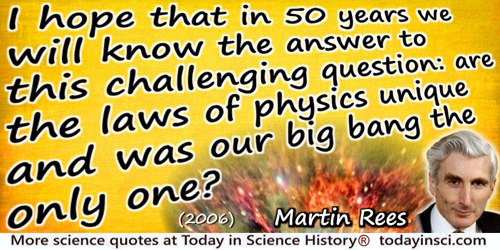
I hope that in 50 years we will know the answer to this challenging question: are the laws of physics unique and was our big bang the only one? … According to some speculations the number of distinct varieties of space—each the arena for a universe with its own laws—could exceed the total number of atoms in all the galaxies we see. … So do we live in the aftermath of one big bang among many, just as our solar system is merely one of many planetary systems in our galaxy? (2006)
In 'Martin Rees Forecasts the Future', New Scientist (18 Nov 2006), No. 2578.
I hope that in due time the chemists will justify their proceedings by some large generalisations deduced from the infinity of results which they have collected. For me I am left hopelessly behind and I will acknowledge to you that through my bad memory organic chemistry is to me a sealed book. Some of those here, [August] Hoffman for instance, consider all this however as scaffolding, which will disappear when the structure is built. I hope the structure will be worthy of the labour. I should expect a better and a quicker result from the study of the powers of matter, but then I have a predilection that way and am probably prejudiced in judgment.
Letter to Christian Schönbein (9 Dec 1852), The Letters of Faraday and Schoenbein, 1836-1862 (1899), 209-210.
I hope they all come back.
About the crews dropping his “dambuster” bombs during World War II. As quoted in W. B. Bartlett, Dam Busters: In the Words of the Bomber Crews (2011, 2013), 103. Wallis said this to Wing Cdr G. P. Gibson, leader of the force of Lancasters of Bomber Command on the raid. As described by historian Richard Morris, “At the final briefing late on the Sunday afternoon, Wallis had addressed 19 crews. The next day, only 11 of them came back. Fifty-six of the faces into which he had looked just a few hours before were gone, and all but three of them were dead.”
I hope when I get to Heaven I shall not find the women playing second fiddle.
(Shortly before her death)
(Shortly before her death)
I hope you enjoy the absence of pupils … the total oblivion of them for definite intervals is a necessary condition for doing them justice at the proper time.
Letter to Lewis Campbell (21 Apr 1862). In P.M. Harman (ed.), The Scientific Letters and Papers of James Clerk Maxwell (1990), Vol. 1, 712.
I hope you have not murdered too completely your own and my child.
Referring to their independently conceived ideas on the origin of species.
Referring to their independently conceived ideas on the origin of species.
Letter to A. R. Wallace, March 1869. In J. Marchant, Alfred Russel Wallace: Letters and Reminiscences (1916), Vol. 1, 240.
I love to read the dedications of old books written in monarchies—for they invariably honor some (usually insignificant) knight or duke with fulsome words of sycophantic insincerity, praising him as the light of the universe (in hopes, no doubt, for a few ducats to support future work); this old practice makes me feel like such an honest and upright man, by comparison, when I put a positive spin, perhaps ever so slightly exaggerated, on a grant proposal.
From essay 'The Razumovsky Duet', collected in The Dinosaur in a Haystack: Reflections in Natural History (1995, 1997), 263.
I tell my students, with a feeling of pride that I hope they will share, that the carbon, nitrogen, and oxygen that make up ninety-nine per cent of our living substance were cooked in the deep interiors of earlier generations of dying stars. Gathered up from the ends of the universe, over billions of years, eventually they came to form, in part, the substance of our sun, its planets, and ourselves. Three billion years ago, life arose upon the earth. It is the only life in the solar system.
From speech given at an anti-war teach-in at the Massachusetts Institute of Technology, (4 Mar 1969) 'A Generation in Search of a Future', as edited by Ron Dorfman for Chicago Journalism Review, (May 1969).
I think it’s a mistake to ever look for hope outside of one’s self.
After the Fall. Quoted in Kim Lim (ed.), 1,001 Pearls of Spiritual Wisdom: Words to Enrich, Inspire, and Guide Your Life (2014), 250
I think that support of this [stem cell] research is a pro-life pro-family position. This research holds out hope for more than 100 million Americans.
In Eve Herold, George Daley, Stem Cell Wars (2007), 39.
I was a child in a time of hope. I grew up when the expectations for science were very high: in the thirties and forties. … There was a sense of optimism about science and the future.
In article, 'Wonder and Skepticism', Skeptical Inquirer (Jan/Feb 1995), 19, No. 1.
I would efface the word atoms from science, persuaded that it goes further than experience... In chemistry we should never go further than experience. Could there be any hope of ever identifying the minuscule entities?
Quoted, without citation, in Nick Herbert, Quantum Reality: Beyond the New Physics, (1985), 9.
If at first, the idea is not absurd, there is no hope for it.
In Marc J. Madou, Fundamentals of Microfabrication: the Science of Miniaturization (2nd ed., 2002), 535.
If I would be a young man again and had to decide how to make my living, I would not try to become a scientist or scholar or teacher. I would rather choose to be a plumber or a peddler in the hope to find that modest degree of independence still available under present circumstances.
According to Ralph Keyes, The Quote Verifier: Who Said What, Where, and When (2006), 53, on other occasions Einstein said “he might rather have been a musician, or light-house keeper”; however it is a “popular misquotation” that refers to being a watchmaker.
If it is a terrifying thought that life is at the mercy of the multiplication of these minute bodies [microbes], it is a consoling hope that Science will not always remain powerless before such enemies...
Paper read to the French Academy of Sciences (29 Apr 1878), published in Comptes Rendus de l'Academie des Sciences, 86, 1037-43, as translated by H.C.Ernst. Collected in Charles W. Eliot (ed.) The Harvard Classics, Vol. 38; Scientific Papers: Physiology, Medicine, Surgery, Geology (1910), 366.
If people are good only because they fear punishment, and hope for reward, then we are a sorry lot indeed.
…...
If these d'Hérelle bodies were really genes, fundamentally like our chromosome genes, they would give us an utterly new angle from which to attack the gene problem. They are filterable, to some extent isolable, can be handled in test-tubes, and their properties, as shown by their effects on the bacteria, can then be studied after treatment. It would be very rash to call these bodies genes, and yet at present we must confess that there is no distinction known between the genes and them. Hence we can not categorically deny that perhaps we may be able to grind genes in a mortar and cook them in a beaker after all. Must we geneticists become bacteriologists, physiological chemists and physicists, simultaneously with being zoologists and botanists? Let us hope so.
'Variation Due to Change in the Individual Gene', The American Naturalist (1922), 56, 48-9.
If this [human kind’s extinction] happens I venture to hope that we shall not have destroyed the rat, an animal of considerable enterprise which stands as good a chance as any … of evolving toward intelligence.
In The Inequality of Man: And Other Essays (1937), 143.
If we die, we want people to accept it. We’re in a risky business, and we hope that if anything happens to us it will not delay the program. The conquest of space is worth the risk of life.
As quoted in John Andrews Barbour, Footprints on the Moon (1969), 125.
If you hope to make a success of life you must be willing to do whatever comes your way to the best of your ability.
From address to the Brown University YMCA, as quoted in 'Young Rockefeller: Defending Trusts, Uses American Beauty Similitude,' Cincinnati Enquirer (9 Feb 1902), 4, citing the New York Journal.
Ignorance and credulous hope make the market for most proprietary remedies.
'The Subtle Poisons,' Collier’s Weekly (2 Dec 1905). Reprinted in The Great American Fraud (1907), 32.
Imperceptibly a change had been wrought in me until I no longer felt alone in a strange, silent country. I had learned to hear the echoes of a time when every living thing upon this land and even the varied overshadowing skies had its voice, a voice that was attentively heard and devoutly heeded by the ancient people of America. Henceforth, to me the plants, the trees, the clouds and all things had become vocal with human hopes, fears and supplications.
From Preface, Indian Games and Dances with Native Songs (1915), v.
Improvements in industry can be left to chance in the hope that someone, sometime, will think of something useful. that some good invention will show up. The other way is to organize so that new knowledge shall always be coming from the researches in the fundamental sciences and engineering arts on which business is based. From that steady stream will arise inventions and new methods. This is the way of Bell Laboratories.
From a Bell Telephone System advertisement, 'The Search That Never Ends', placed, for example, in Life Magazine (17 Jan 1944), 33.
In a grove lay Einstein one day,
’Neath an apple tree’s inviting display.
Hoped for insight anew,
Like old Newton’s big clue,
But the fruit gave no eureka away.
’Neath an apple tree’s inviting display.
Hoped for insight anew,
Like old Newton’s big clue,
But the fruit gave no eureka away.
Caricature by AI: midjourney, clipdrop. Text by Artificial Intelligence: ChatGPT. Slight text edit and prompts by Webmaster. (19 Aug 2023)
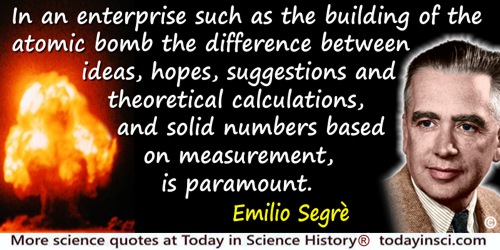
In an enterprise such as the building of the atomic bomb the difference between ideas, hopes, suggestions and theoretical calculations, and solid numbers based on measurement, is paramount. All the committees, the politicking and the plans would have come to naught if a few unpredictable nuclear cross sections had been different from what they are by a factor of two.
Epigraph in Richard Rhodes, The Making of the Atomic Bomb (1986), 8.
In France, where an attempt has been made to deprive me of the originality of these discoveries, experiments without number and without mercy have been made on living animals; not under the direction of anatomical knowledge, or the guidance of just induction, but conducted with cruelty and indifference, in hope to catch at some of the accidental facts of a system, which, is evident, the experimenters did not fully comprehend.
An Exposition of the Natural System of the Nerves of the Human Body (1824), 2-3.
In shades of black and blue the skies do bow as darkness falls the lights go out.
Nature softly immersed in glee as all mankind drifts off to sleep.
Water breathes a sigh of relief now aquatic creatures can do as they please.
Animals whether large or small regain the natural instincts that man has fought.
The moon shines bright he’s happy too people can’t over-ride his rules.
Midnight calms the wounds of the world the break of dawn disperses new hope...
Nature softly immersed in glee as all mankind drifts off to sleep.
Water breathes a sigh of relief now aquatic creatures can do as they please.
Animals whether large or small regain the natural instincts that man has fought.
The moon shines bright he’s happy too people can’t over-ride his rules.
Midnight calms the wounds of the world the break of dawn disperses new hope...
…...
In the beginning was the book of Nature. For eon after eon, the pages of the book turned with no human to read them. No eye wondered at the ignition of the sun, the coagulation of the earth, the birth of the moon, the solidification of a terrestrial continent, or the filling of the seas. Yet when the first primitive algae evolved to float on the waters of this ocean, a promise was born—a hope that someday all the richness and variety of the phenomena of the universe would be read with appreciative eyes.
Opening paragraph in Gary G. Tibbetts, How the Great Scientists Reasoned: The Scientific Method in Action (2012), 1.
In the case of a Christian clergyman, the tragic-comical is found in this: that the Christian religion demands love from the faithful, even love for the enemy. This demand, because it is indeed superhuman, he is unable to fulfill. Thus intolerance and hatred ring through the oily words of the clergyman. The love, which on the Christian side is the basis for the conciliatory attempt towards Judaism is the same as the love of a child for a cake. That means that it contains the hope that the object of the love will be eaten up.
…...
In the collecting of evidence upon any medical subject, there are but three sources from which we can hope to obtain it: viz. from observation of the living subject; from examination of the dead; and from experiments upon living animals.
Astley Cooper and Benjamin Travers, Surgical Essays (1821), Vol. 1, 84. In Ira M. Rutkow, The History of Surgery in the United States, 1775-1900 (1988), 394.
It has become, in my view, a bit too trendy to regard the acceptance of death as something tantamount to intrinsic dignity. Of course I agree with the preacher of Ecclesiastes that there is a time to love and a time to die - and when my skein runs out I hope to face the end calmly and in my own way. For most situations, however, I prefer the more martial view that death is the ultimate enemy - and I find nothing reproachable in those who rage mightily against the dying of the light.
Bully for Brontosaurus: Reflections on Natural History (1991).
It is bad when the mind survives the body; and worse still when the body survives the mind; but, when both these survive our spirits, our hopes, and our health, this is worst of all.
Reflection 324, in Lacon: Or Many Things in Few Words, Addressed to Those who Think (1820), 152.
It is characteristic of our age to endeavour to replace virtues by technology. That is to say, wherever possible we strive to use methods of physical or social engineering to achieve goals which our ancestors thought attainable only by the training of character. Thus, we try so far as possible to make contraception take the place of chastity, and anaesthetics to take the place of fortitude; we replace resignation by insurance policies and munificence by the Welfare State. It would be idle romanticism to deny that such techniques and institutions are often less painful and more efficient methods of achieving the goods and preventing the evils which unaided virtue once sought to achieve and avoid. But it would be an equal and opposite folly to hope that the take-over of virtue by technology may one day be complete, so that the necessity for the laborious acquisition of the capacity for rational choice by individuals can be replaced by the painless application of the fruits of scientific discovery over the whole field of human intercourse and enterprise.
'Mental Health in Plato's Republic', in The Anatomy of the Soul: Historical Essays in the Philosophy of Mind (1973), 26.
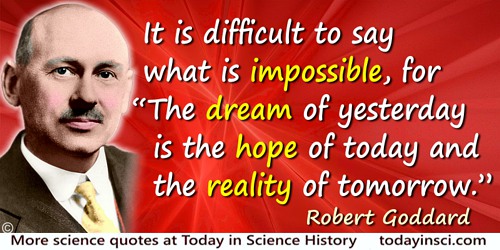
It is difficult to say what is impossible, for “The dream of yesterday is the hope of today and the reality of tomorrow.”
The opening clause is his own paraphrase of his own introductory remark, followed by quoting directly from his Oration (21 Jun 1904), 'On Taking Things for Granted', at his own graduation from South High School, Worcester, Massachusetts, in 'Material for an Autobiography of R.H. Goddard: written in July 1923 with interpolations made in 1933', The Papers of Robert H. Goddard: Vol. 1: 1898-1924 (1970), 11. The source of the paraphrase is seen in a longer direct quote from his Oration: “In the sciences we have learned that we are too ignorant to pronounce anything impossible,… The dream of yesterday is the hope of today and the reality of tomorrow”, in the epigraph on page v. The full Oration is on pp 63-66.
It is now necessary to indicate more definitely the reason why mathematics not only carries conviction in itself, but also transmits conviction to the objects to which it is applied. The reason is found, first of all, in the perfect precision with which the elementary mathematical concepts are determined; in this respect each science must look to its own salvation .... But this is not all. As soon as human thought attempts long chains of conclusions, or difficult matters generally, there arises not only the danger of error but also the suspicion of error, because since all details cannot be surveyed with clearness at the same instant one must in the end be satisfied with a belief that nothing has been overlooked from the beginning. Every one knows how much this is the case even in arithmetic, the most elementary use of mathematics. No one would imagine that the higher parts of mathematics fare better in this respect; on the contrary, in more complicated conclusions the uncertainty and suspicion of hidden errors increases in rapid progression. How does mathematics manage to rid itself of this inconvenience which attaches to it in the highest degree? By making proofs more rigorous? By giving new rules according to which the old rules shall be applied? Not in the least. A very great uncertainty continues to attach to the result of each single computation. But there are checks. In the realm of mathematics each point may be reached by a hundred different ways; and if each of a hundred ways leads to the same point, one may be sure that the right point has been reached. A calculation without a check is as good as none. Just so it is with every isolated proof in any speculative science whatever; the proof may be ever so ingenious, and ever so perfectly true and correct, it will still fail to convince permanently. He will therefore be much deceived, who, in metaphysics, or in psychology which depends on metaphysics, hopes to see his greatest care in the precise determination of the concepts and in the logical conclusions rewarded by conviction, much less by success in transmitting conviction to others. Not only must the conclusions support each other, without coercion or suspicion of subreption, but in all matters originating in experience, or judging concerning experience, the results of speculation must be verified by experience, not only superficially, but in countless special cases.
In Werke [Kehrbach] (1890), Bd. 5, 105. As quoted, cited and translated in Robert Édouard Moritz, Memorabilia Mathematica; Or, The Philomath’s Quotation-Book (1914), 19.
It is strange, but the longer I live the more I am governed by the feeling of Fatalism, or rather predestination. The feeling or free-will, said to be innate in man, fails me more and more. I feel so deeply that however much I may struggle, I cannot change fate one jot. I am now almost resigned. I work because I feel I am at the worst. I can neither wish nor hope for anything. You have no idea how indifferent I am to everything.
In Letter to Anna Carlotta, collected in Anna Charlotte Leffler, Sonya Kovalevsky: A Biography (1895), 133, as translated by A. De Furuhjelm and A.M. Clive Bayley.
It seems sensible to discard all hope of observing hitherto unobservable quantities, such as the position and period of the electron... Instead it seems more reasonable to try to establish a theoretical quantum mechanics, analogous to classical mechanics, but in which only relations between observable quantities occur.
In Helge Kragh, Quantum Generations: A History of Physics in the Twentieth Century (1999), 161.
It was a dark and stormy night, so R. H. Bing volunteered to drive some stranded mathematicians from the fogged-in Madison airport to Chicago. Freezing rain pelted the windscreen and iced the roadway as Bing drove on—concentrating deeply on the mathematical theorem he was explaining. Soon the windshield was fogged from the energetic explanation. The passengers too had beaded brows, but their sweat arose from fear. As the mathematical description got brighter, the visibility got dimmer. Finally, the conferees felt a trace of hope for their survival when Bing reached forward—apparently to wipe off the moisture from the windshield. Their hope turned to horror when, instead, Bing drew a figure with his finger on the foggy pane and continued his proof—embellishing the illustration with arrows and helpful labels as needed for the demonstration.
In 'R. H. Bing', Biographical Memoirs: National Academy of Sciences (2002), 49. Anecdote based on the recollections of Bing's colleagues, Steve Armentrout and C. E. Burgess. The narrative was given in a memorial tribute at the University of Texas at Austin.
It would be rash to say that nothing remains for discovery or improvement even in elementary mathematics, but it may be safely asserted that the ground has been so long and so thoroughly explored as to hold out little hope of profitable return for a casual adventurer.
In 'Private Study of Mathematics', Conflict of Studies and other Essays (1873), 73.
It would be rash to say that nothing remains for discovery or improvement even in elementary mathematics, but it may be safely asserted that the ground has been so long and so thoroughly explored as to hold out little hope of profitable return for a casual adventurer.
In 'Private Study of Mathematics', Conflict of Studies and other Essays (1873), 73.
It’s important to always bear in mind that life occurs in historical time. Everyone in every culture lives in some sort of historical time, though it might not be perceived in the same way an outside observer sees it. It’s an interesting question, “When is now?” “Now” can be drawn from some point like this hour, this day, this month, this lifetime, or this generation. “Now” can also have occurred centuries ago; things like unfair treaties, the Trail of Tears, and the Black Hawk War, for instance, remain part of the “Now” from which many Native Americans view their place in time today. Human beings respond today to people and events that actually occurred hundreds or even thousands of years ago. Ethnohistorians have played a major role in showing how now is a social concept of time, and that time is part of all social life. I can only hope that their work will further the understanding that the study of social life is a study of change over time.
From Robert S. Grumet, 'An Interview with Anthony F. C. Wallace', Ethnohistory (Winter 1998), 45, No. 1, 127.
It’s never been more important for us to understand the effects of biodiversity loss… only if we do that, will we have any hope of averting disaster.
From BBC TV program Extinction: The Facts (13 Sep 2020). As quoted in press release on a BBC Media Centre web page.
Jefferson refused to pin his hopes on the occasional success of honest and unambitious men; on the contrary, the great danger was that philosophers would be lulled into complacence by the accidental rise of a Franklin or a Washington. Any government which made the welfare of men depend on the character of their governors was an illusion.
In The Lost World of Thomas Jefferson (1948, 1993), 178.
Just by studying mathematics we can hope to make a guess at the kind of mathematics that will come into the physics of the future ... If someone can hit on the right lines along which to make this development, it m may lead to a future advance in which people will first discover the equations and then, after examining them, gradually learn how to apply the ... My own belief is that this is a more likely line of progress than trying to guess at physical pictures.
'The Evolution of the Physicist's Picture of Nature', Scientific American, May 1963, 208, 47. In Steve Adams, Frontiers (2000), 57.
Lavoisier was right in the deepest, almost holy, way. His passion harnessed feeling to the service of reason; another kind of passion was the price. Reason cannot save us and can even persecute us in the wrong hands; but we have no hope of salvation without reason. The world is too complex, too intransigent; we cannot bend it to our simple will.
…...
Leibnitz believed he saw the image of creation in his binary arithmetic in which he employed only two characters, unity and zero. Since God may be represented by unity, and nothing by zero, he imagined that the Supreme Being might have drawn all things from nothing, just as in the binary arithmetic all numbers are expressed by unity with zero. This idea was so pleasing to Leibnitz, that he communicated it to the Jesuit Grimaldi, President of the Mathematical Board of China, with the hope that this emblem of the creation might convert to Christianity the reigning emperor who was particularly attached to the sciences.
In 'Essai Philosophique sur les Probabiliés', Oeuvres (1896), t. 7, 119.
Let not a monument give you or me hopes,
Since not a pinch of dust remains of Cheops.
Since not a pinch of dust remains of Cheops.
Let us hope that the advent of a successful flying machine, now only dimly foreseen and nevertheless thought to be possible, will bring nothing but good into the world; that it shall abridge distance, make all parts of the globe accessible, bring men into closer relation with each other, advance civilization, and hasten the promised era in which there shall be nothing but peace and goodwill among all men.
Concluding paragraph, Progress in Flying Machines (1894), 269.
Lies are crafted to match the hopes and desires and the fears of the intended listener… truth, on the other hand, is what it is, neither what you want it to be, nor what you are afraid it will be. So that is why lies are always more believable than the truth.
In 'Why We Believe Lies' (2011), on web site geoffreylandis.com.
Like all things of the mind, science is a brittle thing: it becomes absurd when you look at it too closely. It is designed for few at a time, not as a mass profession. But now we have megascience: an immense apparatus discharging in a minute more bursts of knowledge than humanity is able to assimilate in a lifetime. Each of us has two eyes, two ears, and, I hope, one brain. We cannot even listen to two symphonies at the same time. How do we get out of the horrible cacophony that assails our minds day and night? We have to learn, as others did, that if science is a machine to make more science, a machine to grind out so-called facts of nature, not all facts are equally worth knowing. Students, in other words, will have to learn to forget most of what they have learned. This process of forgetting must begin after each exam, but never before. The Ph.D. is essentially a license to start unlearning.
Voices In the Labyrinth: Nature, Man, and Science (1979), 2.
Make no little plans. They have no magic to stir men’s blood and probably themselves will not be realized. Make big plans; aim high in hope and work. … Let your watchword be order and your beacon beauty,
(1907) As quoted in 'Closing In', Charles Moore, Daniel H. Burnham, Architect, Planner of Cities (1921), Vol. 2, 147.
Malthus argued a century and a half ago that man, by using up all his available resources, would forever press on the limits of subsistence, thus condemning humanity to an indefinite future of misery and poverty. We can now begin to hope and, I believe, know that Malthus was expressing not a law of nature, but merely the limitation then of scientific and social wisdom. The truth or falsity of his prediction will depend now, with the tools we have, on our own actions, now and in the years to come.
From Address to the Centennial Convocation of the National Academy of Sciences (22 Oct 1963), 'A Century of Scientific Conquest'. Online at The American Presidency Project.
Man may be excused for feeling some pride at having risen, though not through his own exertions, to the very summit of the organic scale; and the fact of his having thus risen, instead of having been aboriginally placed there, may give him hopes for a still higher destiny in the distant future. But we are not here concerned with hopes or fears, only with the truth as far as our reason allows us to discover it. I have given the evidence to the best of my ability; and we must acknowledge, as it seems to me, that man with all his noble qualities, with sympathy which feels for the most debased, with benevolence which extends not only to other men but to the humblest living creature, with his god-like intellect which has penetrated into the movements and constitution of the solar system—with all these exalted powers—Man still bears in his bodily frame the indelible stamp of his lowly origin.
Concluding remarks. The Descent of Man (1871), Vol. 2, 405.
Man, by reason of his greater intellect, can more reasonably hope to equal birds in knowledge than to equal nature in the perfection of her machinery.
In The Papers of Wilbur and Orville Wright: 1899-1905 (1953), 15.
Many years ago the great British explorer George Mallory, who was to die on Mount Everest, was asked why did he want to climb it. He said, “Because it is there.” Well, space is there, and we’re going to climb it, and the moon and the planets are there, and new hopes for knowledge and peace are there. And, therefore, as we set sail we ask God’s blessing on the most hazardous and dangerous and greatest adventure on which man has ever embarked.
From Address at Rice Stadium (12 Sep 1962). On website of John F. Kennedy Presidential Library and Museum. [This go-to-the-moon speech was largely written by presidential advisor and speechwriter Ted Sorensen.]
Mathematics, from the earliest times to which the history of human reason can reach, has followed, among that wonderful people of the Greeks, the safe way of science. But it must not be supposed that it was as easy for mathematics as for logic, in which reason is concerned with itself alone, to find, or rather to make for itself that royal road. I believe, on the contrary, that there was a long period of tentative work (chiefly still among the Egyptians), and that the change is to be ascribed to a revolution, produced by the happy thought of a single man, whose experiments pointed unmistakably to the path that had to be followed, and opened and traced out for the most distant times the safe way of a science. The history of that intellectual revolution, which was far more important than the passage round the celebrated Cape of Good Hope, and the name of its fortunate author, have not been preserved to us. … A new light flashed on the first man who demonstrated the properties of the isosceles triangle (whether his name was Thales or any other name), for he found that he had not to investigate what he saw in the figure, or the mere concepts of that figure, and thus to learn its properties; but that he had to produce (by construction) what he had himself, according to concepts a priori, placed into that figure and represented in it, so that, in order to know anything with certainty a priori, he must not attribute to that figure anything beyond what necessarily follows from what he has himself placed into it, in accordance with the concept.
In Critique of Pure Reason, Preface to the Second Edition, (1900), 690.
Meanwhile I flatter myself with so much success, that: students... will not be so easily mistaken in the subjects of the mineral kingdom, as has happened with me and others in following former systems; and I also hope to obtain some protectors against those who are so possessed with the figuromania, and so addicted to the surface of things, that they are shocked at the boldness of calling a marble a limestone, and of placing the Porphyry amongst the Saxa.
An Essay Towards a System of Mineralogy (1770), trans. G. Von Engestrom, xxi.
Modern anthropology has taught us, through comparative investigation of so-called primitive cultures, that the social behavior of human beings may differ greatly, depending upon prevailing cultural patterns and the types of organisation which predominate in society. It is on this that those who are striving to improve the lot of man may ground their hopes: human beings are not condemned, because of their biological constitution, to annihilate each other or to be at the mercy of a cruel, self-inflicted fate.
…...
Modern warfare is in every respect so horrifying, that scientific people will only regret that it draws its means from the progress of the sciences. I hope that the present war [World War I] will teach the peoples of Europe a lasting lesson and bring the friends of peace into power. Otherwise the present ruling classes will really deserve to be swept away by socialism.
Fischer to Margaret Oppenheim, 14 Dec 1917. Fischer Papers, Bancroft Library, University of California. Quotation supplied by W. H. Brock.
More and more, as it becomes necessary to preserve the game, let us hope that the camera will largely supplant the rifle.
Introduction to Allen Grant Wallihan, Camera Shots at Big Game (1901), 11.
Most of the crackpot papers which are submitted to The Physical Review are rejected, not because it is impossible to understand them, but because it is possible. Those which are impossible to understand are usually published. When the great innovation appears, it will almost certainly be in a muddled, incomplete and confusing form. To the discoverer himself it will be only half-understood; to everybody else it will be a mystery. For any speculation which does not at first glance look crazy, there is no hope.
In 'Innovation in Physics', Scientific American (Sep 1958), 199. Collected in From Eros to Gaia (1993).
My dear child, be not afraid of the pains and be not afraid, be as tough and confident as you can and let not your courage flag and your hope fail. I assure you, with God’s help it will go better than you think! Just hang on tight with both hands so you tremble not. It will soon pass. You will see that Our Dear Lord will soon help you. How quickly a pain passes! Who should let his courage flag so quickly, for God’s help is at hand.
Given as an example of how to reassure a woman giving birth as labor begins. In Justine Siegemund and Lynne Tatlock (trans.), The Court Midwife (2007), 158.
My greatest hope for a future without another Deepwater Horizon disaster lies in our schools, living rooms and community centers, not in boardrooms, political chambers and big industry. If this happens again, we won’t have the luxury of the unknown to shield us from answering “Why?”
In 'Gulf Dispatch: Time to Tap Power of Teens', CNN Blog (23 Jul 2010).
My life as a surgeon-scientist, combining humanity and science, has been fantastically rewarding. In our daily patients we witness human nature in the raw–fear, despair, courage, understanding, hope, resignation, heroism. If alert, we can detect new problems to solve, new paths to investigate.
In Tore Frängsmyr and Jan E. Lindsten (eds.), Nobel Lectures: Physiology Or Medicine: 1981-1990 (1993), 565.
My own thinking (and that of many of my colleagues) is based on two general principles, which I shall call the Sequence Hypothesis and the Central Dogma. The direct evidence for both of them is negligible, but I have found them to be of great help in getting to grips with these very complex problems. I present them here in the hope that others can make similar use of them. Their speculative nature is emphasized by their names. It is an instructive exercise to attempt to build a useful theory without using them. One generally ends in the wilderness.
The Sequence Hypothesis
This has already been referred to a number of times. In its simplest form it assumes that the specificity of a piece of nucleic acid is expressed solely by the sequence of its bases, and that this sequence is a (simple) code for the amino acid sequence of a particular protein...
The Central Dogma
This states that once 'information' has passed into protein it cannot get out again. In more detail, the transfer of information from nucleic acid to nucleic acid, or from nucleic acid to protein may be possible, but transfer from protein to protein, or from protein to nucleic acid is impossible. Information means here the precise determination of sequence, either of bases in the nucleic acid or of amino acid residues in the protein. This is by no means universally held—Sir Macfarlane Burnet, for example, does not subscribe to it—but many workers now think along these lines. As far as I know it has not been explicitly stated before.
The Sequence Hypothesis
This has already been referred to a number of times. In its simplest form it assumes that the specificity of a piece of nucleic acid is expressed solely by the sequence of its bases, and that this sequence is a (simple) code for the amino acid sequence of a particular protein...
The Central Dogma
This states that once 'information' has passed into protein it cannot get out again. In more detail, the transfer of information from nucleic acid to nucleic acid, or from nucleic acid to protein may be possible, but transfer from protein to protein, or from protein to nucleic acid is impossible. Information means here the precise determination of sequence, either of bases in the nucleic acid or of amino acid residues in the protein. This is by no means universally held—Sir Macfarlane Burnet, for example, does not subscribe to it—but many workers now think along these lines. As far as I know it has not been explicitly stated before.
'On Protein Synthesis', Symposia of the Society for Experimental Biology: The Biological Replication of Macromolecules, 1958, 12, 152-3.
My visceral perception of brotherhood harmonizes with our best modern biological knowledge ... Many people think (or fear) that equality of human races represents a hope of liberal sentimentality probably squashed by the hard realities of history. They are wrong. This essay can be summarized in a single phrase, a motto if you will: Human equality is a contingent fact of history. Equality is not true by definition; it is neither an ethical principle (though equal treatment may be) nor a statement about norms of social action. It just worked out that way. A hundred different and plausible scenarios for human history would have yielded other results (and moral dilemmas of enormous magnitude). They didn’t happen.
…...
Mystics always hope that science will some day overtake them.
…...
Never fear big long words.
Big long words name little things.
All big things have little names.
Such as life and death, peace and war.
Or dawn, day, night, hope, love, home.
Learn to use little words in a big way.
It is hard to do,
But they say what you mean.
When you don't know what you mean, use big words.
That often fools little people.
Big long words name little things.
All big things have little names.
Such as life and death, peace and war.
Or dawn, day, night, hope, love, home.
Learn to use little words in a big way.
It is hard to do,
But they say what you mean.
When you don't know what you mean, use big words.
That often fools little people.
Quoted in Saturday Review (1962), 45, No. 2. It was written (1936) for his son, as advice for young copy writers.
- 1995
No man that does not see visions will ever realize any high hope or undertake any high enterprise.
Address, Convention Hall, Philadelphia (10 May 1915). In 'Text of President’s Speech: Tells New Citizens, They Must Think Themselves Only Americans', New York Times (11 May 1915), 1.
No man who has not a decently skeptical mind can claim to be civilized. Euclid taught me that without assumptions there is no proof. Therefore, in any argument, examine the assumptions. Then, in the alleged proof, be alert for inexplicit assumptions. Euclid’s notorious oversights drove this lesson home. Thanks to him, I am (I hope!) immune to all propaganda, including that of mathematics itself.
In 'What Mathematics Has Meant to Me', Mathematics Magazine (Jan-Feb 1951), 24, 161.
No place affords a more striking conviction of the vanity of human hopes than a publick library; for who can see the wall crouded on every side by mighty volumes, the works of laborious meditation, and accurate inquiry, now scarcely known but by the catalogue, and preserved only to encrease the pomp of learning, without considering how many hours have been wasted in vain endeavours, how often imagination has anticipated the praises of futurity, how many statues have risen to the eye of vanity, how many ideal converts have elevated zeal, how often wit has exulted in the eternal infamy of his antagonists, and dogmatism has delighted in the gradual advances of his authority, the immutability of his decrees, and the perpetuity of his power.
Non unquam dedit
Documenta fors majora, quam fragili loco
Starent superbi.
Seneca, Troades, II, 4-6
Insulting chance ne'er call'd with louder voice,
On swelling mortals to be proud no more.
Of the innumerable authors whose performances are thus treasured up in magnificent obscurity, most are forgotten, because they never deserved to be remembered, and owed the honours which they have once obtained, not to judgment or to genius, to labour or to art, but to the prejudice of faction, the stratagem of intrigue, or the servility of adulation.
Nothing is more common than to find men whose works are now totally neglected, mentioned with praises by their contemporaries, as the oracles of their age, and the legislators of science. Curiosity is naturally excited, their volumes after long enquiry are found, but seldom reward the labour of the search. Every period of time has produced these bubbles of artificial fame, which are kept up a while by the breath of fashion and then break at once and are annihilated. The learned often bewail the loss of ancient writers whose characters have survived their works; but perhaps if we could now retrieve them we should find them only the Granvilles, Montagus, Stepneys, and Sheffields of their time, and wonder by what infatuation or caprice they could be raised to notice.
It cannot, however, be denied, that many have sunk into oblivion, whom it were unjust to number with this despicable class. Various kinds of literary fame seem destined to various measures of duration. Some spread into exuberance with a very speedy growth, but soon wither and decay; some rise more slowly, but last long. Parnassus has its flowers of transient fragrance as well as its oaks of towering height, and its laurels of eternal verdure.
Non unquam dedit
Documenta fors majora, quam fragili loco
Starent superbi.
Seneca, Troades, II, 4-6
Insulting chance ne'er call'd with louder voice,
On swelling mortals to be proud no more.
Of the innumerable authors whose performances are thus treasured up in magnificent obscurity, most are forgotten, because they never deserved to be remembered, and owed the honours which they have once obtained, not to judgment or to genius, to labour or to art, but to the prejudice of faction, the stratagem of intrigue, or the servility of adulation.
Nothing is more common than to find men whose works are now totally neglected, mentioned with praises by their contemporaries, as the oracles of their age, and the legislators of science. Curiosity is naturally excited, their volumes after long enquiry are found, but seldom reward the labour of the search. Every period of time has produced these bubbles of artificial fame, which are kept up a while by the breath of fashion and then break at once and are annihilated. The learned often bewail the loss of ancient writers whose characters have survived their works; but perhaps if we could now retrieve them we should find them only the Granvilles, Montagus, Stepneys, and Sheffields of their time, and wonder by what infatuation or caprice they could be raised to notice.
It cannot, however, be denied, that many have sunk into oblivion, whom it were unjust to number with this despicable class. Various kinds of literary fame seem destined to various measures of duration. Some spread into exuberance with a very speedy growth, but soon wither and decay; some rise more slowly, but last long. Parnassus has its flowers of transient fragrance as well as its oaks of towering height, and its laurels of eternal verdure.
The Rambler, Number 106, 23 Mar 1751. In W. J. Bate and Albrecht B. Strauss (eds.), The Rambler (1969), Vol. 2, 200-1.
No scientific subject has ever aroused quite the same mixture of hopes and fears [as atomic energy].
In Presidential address to the Annual Meeting of the British Association (Sep 1947), as quoted in Brian Austin, Schonland: Scientist and Soldier: From Lightning on the Veld to Nuclear Power at Harwell: The Life of Field Marshal Montgomery's Scientific Adviser (2010), 459.
Not every one of our desires can be immediately gratified. We’ve got to learn to wait patiently for our dreams to come true, especially on the path we’ve chosen. But while we wait, we need to prepare symbolically a place for our hopes and dreams.
…...
Nothing in physics seems so hopeful to as the idea that it is possible for a theory to have a high degree of symmetry was hidden from us in everyday life. The physicist's task is to find this deeper symmetry.
In American Scientist (1977) (as cited in The Atlantic (1984), 254, 81.) As an epigraph in Crystal and Dragon: The Cosmic Dance of Symmetry and Chaos in Nature, Art and Consciousness (1993), 139.
Nothing is there beyond hope
Nothing that can be sworn impossible
Nothing wonderful, since Zeus,
Father of the Olympians
Made night from mid-day
Hiding the bright sunlight
And sore fear came upon men.
[Perhaps written having seen the eclipse of 6 Apr 648 BC.]
Nothing that can be sworn impossible
Nothing wonderful, since Zeus,
Father of the Olympians
Made night from mid-day
Hiding the bright sunlight
And sore fear came upon men.
[Perhaps written having seen the eclipse of 6 Apr 648 BC.]
Quoted in B S Shylaja, Eclipse (1999), 16.
Objections … inspired Kronecker and others to attack Weierstrass’ “sequential” definition of irrationals. Nevertheless, right or wrong, Weierstrass and his school made the theory work. The most useful results they obtained have not yet been questioned, at least on the ground of their great utility in mathematical analysis and its implications, by any competent judge in his right mind. This does not mean that objections cannot be well taken: it merely calls attention to the fact that in mathematics, as in everything else, this earth is not yet to be confused with the Kingdom of Heaven, that perfection is a chimaera, and that, in the words of Crelle, we can only hope for closer and closer approximations to mathematical truth—whatever that may be, if anything—precisely as in the Weierstrassian theory of convergent sequences of rationals defining irrationals.
In Men of Mathematics (1937), 431-432.
Of course we have no means of staying back for any length of Time, any more than a savage or an animal has of staying six feet above the ground. But a civilized man is better off than the savage in this respect. He can go up against gravitation in a balloon, and why should he not hope that ultimately he may be able to stop or accelerate his drift along the Time-Dimension, or even turn about and travel the other way?
In The Time Machine (1898), 13.
Oh dark, dark, dark, amid the blaze of noon,
Irrecoverably dark, total Eclipse
Without all hope of day!
Irrecoverably dark, total Eclipse
Without all hope of day!
Samson Agonistes (1671), lines 80-2.
![Ernest Henry Starling quote: Only by following out the injunction of our great predecessor [William Harvey] to search out and st](https://todayinsci.com/S/Starling_Ernest/StarlingErnest-Mastery500x250px.jpg)
Only by following out the injunction of our great predecessor [William Harvey] to search out and study the secrets of Nature by way of experiment, can we hope to attain to a comprehension of 'the wisdom of the body and the understanding of the heart,' and thereby to the mastery of disease and pain, which will enable us to relieve the burden of mankind.
'The Wisdom of the Body', The Lancet (1923), 205, 870.
Only science can hope to keep technology in some sort of moral order.
In 'The Impact of the School,' The Vanishing Adolescent (1959).
Optimism is the faith that leads to achievement. Nothing can be done without hope or confidence.
…...
Our factories may well put an end to war sooner than your (peace) congresses. The day when two army corps can annihilate one another in one second, all civilized nations, it is to be hoped, will recoil from war and discharge their troops.
As quoted by Linus Pauling in Nobel Prize Acceptance Speech (10 Dec 1963). Pauling in his speech said it was from a statement by Nobel “in 1892, as reported by Bertha von Sutter.” Printed in Göran Liljestrand (ed.), Les Prix Nobel en 1963, (1964).
Our imagination is the only limit to what we can hope to have in the future.
People have been looking up at the skies for 10,000 years, wondering and dreaming. I hope we always do.
As quoted by Howard Wilkinson in 'John Glenn Had the Stuff U.S. Heroes are Made of', The Cincinnati Enquirer (20 Feb 2002)
Perfect concordance among reformers is not to be expected; and men who are honestly struggling towards the light cannot hope to attain at one bound to the complete truth. There is always a danger lest the fascination of a new discovery should lead us too far. Men of science, being human, are apt, like lovers, to exaggerate the perfections and be a little blind to the faults of the object of their choice.
'The Anniversary Address of the President', Quarterly Journal of the Geological Society of London, 1885, 41, 55.
Perhaps I am just a hopeless rationalist, but isn’t fascination as comforting as solace? Isn’t nature immeasurably more interesting for its complexities and its lack of conformity to our hopes? Isn’t curiosity as wondrously and fundamentally human as compassion?
…...
Perhaps randomness is not merely an adequate description for complex causes that we cannot specify. Perhaps the world really works this way, and many events are uncaused in any conventional sense of the word. Perhaps our gut feeling that it cannot be so reflects only our hopes and prejudices, our desperate striving to make sense of a complex and confusing world, and not the ways of nature.
…...
Perseus and St. George. These dragon-slayers did not take lessons in dragon-slaying, nor do leaders of forlorn hopes generally rehearse their parts beforehand. Small things may be rehearsed, but the greatest are always do-or-die, neck-or-nothing matters.
Samuel Butler, Henry Festing Jones (ed.), The Note-Books of Samuel Butler (1917), 222.
Personally I think there is no doubt that sub-atomic energy is available all around us, and that one day man will release and control its almost infinite power. We cannot prevent him from doing so and can only hope that he will not use it exclusively in blowing up his next door neighbour. (1936)
Concluding remark in Lecture (1936) on 'Forty Years of Atomic Theory', collected in Needham and Pagel (eds.) in Background to Modern Science: Ten Lectures at Cambridge Arranged by the History of Science Committee, (1938), 114.
Philosophers of science constantly discuss theories and representation of reality, but say almost nothing about experiment, technology, or the use of knowledge to alter the world. This is odd, because ‘experimental method’ used to be just another name for scientific method.... I hope [to] initiate a Back-to-Bacon movement, in which we attend more seriously to experimental science. Experimentation has a life of its own.
Representing and Intervening, p. 149f (1983). Announcing the author's intention to stress 'intervening' as an essential component of science.
Physical misery is great everywhere out here [Africa]. Are we justified in shutting our eyes and ignoring it because our European newspapers tell us nothing about it? We civilised people have been spoilt. If any one of us is ill the doctor comes at once. Is an operation necessary, the door of some hospital or other opens to us immediately. But let every one reflect on the meaning of the fact that out here millions and millions live without help or hope of it. Every day thousands and thousands endure the most terrible sufferings, though medical science could avert them. Every day there prevails in many and many a far-off hut a despair which we could banish. Will each of my readers think what the last ten years of his family history would have been if they had been passed without medical or surgical help of any sort? It is time that we should wake from slumber and face our responsibilities!
In On the Edge of the Primeval Forest, trans. C. T. Campion (1948, 1998), 126-127.
PHYSICIAN, n. One upon whom we set our hopes when ill and our dogs when well.
The Collected Works of Ambrose Bierce (1911), Vol. 7, The Devil's Dictionary, 252.
Poore soule, in this thy flesh what do'st thou know?
Thou know'st thy selfe so little, as thou know'st not.
How thou did'st die, nor how thou wast begot.
Thou neither know'st how thou at first camest in,
Nor how thou took'st the poyson of mans sin.
Nor dost thou, (though thou know'st, that thou art so)
By what way thou art made immortall, know.
Thou art too narrow, wretch, to comprehend
Even thy selfe; yea though thou wouldst but bend
To know thy body. Have not all soules thought
For many ages, that our body'is wrought
Of Ayre, and Fire, and other Elements?
And now they thinke of new ingredients,
And one soule thinkes one, and another way
Another thinkes, and 'tis an even lay.
Knowst thou but how the stone doth enter in
The bladder's Cave, and never breake the skin?
Knowst thou how blood, which to the hart doth flow,
Doth from one ventricle to th'other go?
And for the putrid stuffe, which thou dost spit,
Knowst thou how thy lungs have attracted it?
There are no passages, so that there is
(For aught thou knowst) piercing of substances.
And of those many opinions which men raise
Of Nailes and Haires, dost thou know which to praise?
What hope have we to know our selves, when wee
Know not the least things, which for our use bee?
Thou know'st thy selfe so little, as thou know'st not.
How thou did'st die, nor how thou wast begot.
Thou neither know'st how thou at first camest in,
Nor how thou took'st the poyson of mans sin.
Nor dost thou, (though thou know'st, that thou art so)
By what way thou art made immortall, know.
Thou art too narrow, wretch, to comprehend
Even thy selfe; yea though thou wouldst but bend
To know thy body. Have not all soules thought
For many ages, that our body'is wrought
Of Ayre, and Fire, and other Elements?
And now they thinke of new ingredients,
And one soule thinkes one, and another way
Another thinkes, and 'tis an even lay.
Knowst thou but how the stone doth enter in
The bladder's Cave, and never breake the skin?
Knowst thou how blood, which to the hart doth flow,
Doth from one ventricle to th'other go?
And for the putrid stuffe, which thou dost spit,
Knowst thou how thy lungs have attracted it?
There are no passages, so that there is
(For aught thou knowst) piercing of substances.
And of those many opinions which men raise
Of Nailes and Haires, dost thou know which to praise?
What hope have we to know our selves, when wee
Know not the least things, which for our use bee?
Of the Progresse of the Soule. The Second Anniversarie, I. 254-280. The Works of John Donne (Wordsworth edition 1994), 196-7.
Positive, objective knowledge is public property. It can be transmitted directly from one person to another, it can be pooled, and it can be passed on from one generation to the next. Consequently, knowledge accumulates through the ages, each generation adding its contribution. Values are quite different. By values, I mean the standards by which we judge the significance of life. The meaning of good and evil, of joy and sorrow, of beauty, justice, success-all these are purely private convictions, and they constitute our store of wisdom. They are peculiar to the individual, and no methods exist by which universal agreement can be obtained. Therefore, wisdom cannot be readily transmitted from person to person, and there is no great accumulation through the ages. Each man starts from scratch and acquires his own wisdom from his own experience. About all that can be done in the way of communication is to expose others to vicarious experience in the hope of a favorable response.
The Nature of Science and Other Lectures (1954), 7.
Psychology is in its infancy as a science. I hope, in the interests of art, it will always remain so.
In Epigrams of Oscar Wilde (2007), 51.
Pure mathematics consists entirely of such asseverations as that, if such and such is a proposition is true of anything, then such and such another propositions is true of that thing. It is essential not to discuss whether the first proposition is really true, and not to mention what the anything is of which it is supposed to be true. Both these points would belong to applied mathematics. … If our hypothesis is about anything and not about some one or more particular things, then our deductions constitute mathematics. Thus mathematics may be defined as the the subject in which we never know what we are talking about, not whether what we are saying is true. People who have been puzzled by the beginnings of mathematics will, I hope, find comfort in this definition, and will probably agree that it is accurate.
In 'Recent Work on the Principles of Mathematics', International Monthly (1901), 4, 84.
Putting together the mysteries of nature with the laws of mathematics, he dared to hope to be able to unlock the secrets of both with the same key.
Epitaph of René Descartes
Epitaph of René Descartes
— Epitaph
In Peter Pešic, Labyrinth: A Search for the Hidden Meaning of Science (2001), 73.
Q: Which place has special childhood memories for you?
A: Charnwood Forest, Leicestershire.
Q: In which place do you feel most “at home”?
A: Richmond, Surrey, where I live near Richmond Hill.
Q: In which place have you felt ill at ease or uncomfortable?
A: The Democratic Republic of the Congo.
Q: Which place that you have visited has for you a “tingle factor?”
A: New Guinea.
Q: Which place that you have visited has given you most hope about the future?
A: A primary school.
Q: Which place would you like to revisit?
A: Tuscany.
A: Charnwood Forest, Leicestershire.
Q: In which place do you feel most “at home”?
A: Richmond, Surrey, where I live near Richmond Hill.
Q: In which place have you felt ill at ease or uncomfortable?
A: The Democratic Republic of the Congo.
Q: Which place that you have visited has for you a “tingle factor?”
A: New Guinea.
Q: Which place that you have visited has given you most hope about the future?
A: A primary school.
Q: Which place would you like to revisit?
A: Tuscany.
In 'My Places: David Attenborough', Teaching Geography, (Summer 2008), 33, No. 2, 86.
Religion closes off the central questions of existence by attempting to dissuade us from further enquiry by asserting that we cannot ever hope to comprehend. We are, religion asserts, simply too puny.
Essay collected in John Cornwell (ed.), 'The Limitless Power of Science', Nature's Imagination: The Frontiers of Scientific Vision (1995), 125.
Sarcastic Science, she would like to know,
In her complacent ministry of fear,
How we propose to get away from here
When she has made things so we have to go
Or be wiped out. Will she be asked to show
Us how by rocket we may hope to steer
To some star off there, say, a half light-year
Through temperature of absolute zero?
Why wait for Science to supply the how
When any amateur can tell it now?
The way to go away should be the same
As fifty million years ago we came—
If anyone remembers how that was
I have a theory, but it hardly does.
In her complacent ministry of fear,
How we propose to get away from here
When she has made things so we have to go
Or be wiped out. Will she be asked to show
Us how by rocket we may hope to steer
To some star off there, say, a half light-year
Through temperature of absolute zero?
Why wait for Science to supply the how
When any amateur can tell it now?
The way to go away should be the same
As fifty million years ago we came—
If anyone remembers how that was
I have a theory, but it hardly does.
'Why Wait for Science?' In Edward Connery Latham (ed.), The Poetry of Robert Frost: The Collected Poems, Complete and Unabridged (1979), 395.
Science has taught us to think the unthinkable. Because when nature is the guide—rather than a priori prejudices, hopes, fears or desires—we are forced out of our comfort zone. One by one, pillars of classical logic have fallen by the wayside as science progressed in the 20th century, from Einstein's realization that measurements of space and time were not absolute but observer-dependent, to quantum mechanics, which not only put fundamental limits on what we can empirically know but also demonstrated that elementary particles and the atoms they form are doing a million seemingly impossible things at once.
In op-ed, 'A Universe Without Purpose', Los Angeles Times (1 Apr 2012).
Science now finds itself in paradoxical strife with society: admired but mistrusted; offering hope for the future but creating ambiguous choice; richly supported yet unable to fulfill all its promise; boasting remarkable advances but criticized for not serving more directly the goals of society.
How to Win the Nobel Prize: An Unexpected Life in Science (2004), xi.
Science, especially natural and medical science, is always undergoing evolution, and one can never hope to have said the last word upon any branch of it.
From Introduction to Alphonse Laveran and Felix Etienne Pierre Mesnil Trypanosomes and Trypanosomiasis (1904). English edition translated and much enlarged by David Nabarro, (1907), xvii.
Science, that gives man hope to live without lies
Or blast himself off the earth; curb science
Until morality catches up?
But look:
At present morality is running rapidly retrograde.
You’d have to turn science, too, back to the witch doctors,
the myth drunkards. Besides that,
Morality is not an end in itself; truth is an end.
To seek the truth is
better than good works, better than survival
Holier than innocence, and higher than love.
Or blast himself off the earth; curb science
Until morality catches up?
But look:
At present morality is running rapidly retrograde.
You’d have to turn science, too, back to the witch doctors,
the myth drunkards. Besides that,
Morality is not an end in itself; truth is an end.
To seek the truth is
better than good works, better than survival
Holier than innocence, and higher than love.
Poem, 'Curb Science?', in The Collected Poetry of Robinson Jeffers: 1938-1962 (1988), 199. The poem was suppressed until 1977.
Scientific truth, like juristic truth, must come about by controversy. Personally this view is abhorrent to me. It seems to mean that scientific truth must transcend the individual, that the best hope of science lies in its greatest minds being often brilliantly and determinedly wrong, but in opposition, with some third, eclectically minded, middle-of-the-road nonentity seizing the prize while the great fight for it, running off with it, and sticking it into a textbook for sophomores written from no point of view and in defense of nothing whatsoever. I hate this view, for it is not dramatic and it is not fair; and yet I believe that it is the verdict of the history of science.
From Address of the President before the American Psychological Association at New York (28 Dec 1928) 'The Psychology of Controversy', Psychological Review (1929), 36, 98. Collected in Robert I. Watson and Donald T. Campbell (eds.), History, Psychology and Science: Selected Papers by Edwin Boring (1963), 68.
Scientists still do not appear to understand sufficiently that all earth sciences must contribute evidence toward unveiling the state of our planet in earlier times, and that the truth of the matter can only be reached by combing all this evidence. ... It is only by combing the information furnished by all the earth sciences that we can hope to determine 'truth' here, that is to say, to find the picture that sets out all the known facts in the best arrangement and that therefore has the highest degree of probability. Further, we have to be prepared always for the possibility that each new discovery, no matter what science furnishes it, may modify the conclusions we draw.
The Origins of Continents and Oceans
Some blessings have been ours in the past, and these may be repeated or even multiplied.
Quoted, without citation, in front matter to T. A. Edison Foundation, Lewis Howard Latimer: A Black Inventor: a Biography and Related Experiments You Can Do (1973). If you know the primary source, please contact Webmaster.
Statistics, one may hope, will improve gradually, and become good for something. Meanwhile, it is to be feared the crabbed satirist was partly right, as things go: “A judicious man,” says he, “looks at Statistics, not to get knowledge, but to save himself from having ignorance foisted on him.”
In Chartism (1839, 1840), 10.
Such explosives [atomic bombs] in men’s hands, while their moral and intellectual status is declining, is about as useful as giving out firearms to all inmates of a gaol and then saying that you hope ‘this will ensure peace’.
From Letter (No. 102) to Christopher Tolkien (9 Aug 1945). In Humphrey Carpenter (ed.) assisted by Christopher Tolkien, The Letters of J.R.R. Tolkien (1995, 2014), 116, Letter No. 102.
Suppose physics soon succeeds, as Stephen Hawking and a few other physicists hope and believe, in reducing physics to a single equation or a small set of equations that will “explain” all of nature’s fundamental laws. We can then ask the unanswerable question, "Why this set of equations?”
In Introduction, The Night Is Large: Collected Essays 1938-1995 (1996), xvii.
Tactics used by many practitioners of pseudoscience: make a large number of vaguely scientific arguments in the hope of making the desired conclusion seem inevitable. It is essential to recognize that a disconnected assemblage of weak arguments does not create a single, strong scientific argument.
Co-author with Matt Ford, Chris Lee and Jonathan Gitlin, in 'Diluting the Scientific Method: Ars Looks at Homeopathy' (11 Sep 2007) on arstechnica.com web site.
That the fundamental aspects of heredity should have turned out to be so extraordinarily simple supports us in the hope that nature may, after all, be entirely approachable. Her much-advertised inscrutability has once more been found to be an illusion due to our ignorance. This is encouraging, for, if the world in which we live were as complicated as some of our friends would have us believe we might well despair that biology could ever become an exact science.
The Physical Basis of Heredity (1919), 15.
The “British Association for the Promotion of Science,” … is almost necessary for the purposes of science. The periodical assemblage of persons, pursuing the same or différent branches of knowledge, always produces an excitement which is favourable to the development of new ideas; whilst the long period of repose which succeeds, is advantageous for the prosecution of the reasonings or the experiments then suggested; and the récurrence of the meeting in the succeeding year, will stimulate the activity of the inquirer, by the hope of being then enabled to produce the successful result of his labours.
In 'Future Prospects', On the Economy of Machinery and Manufactures (1st ed., 1832), chap. 32, 274. Note: The British Association for the Advancement of Science held its first meeting at York in 1831, the year before the first publication of this book in 1832.
The arithmetization of mathematics … which began with Weierstrass … had for its object the separation of purely mathematical concepts, such as number and correspondence and aggregate, from intuitional ideas, which mathematics had acquired from long association with geometry and mechanics. These latter, in the opinion of the formalists, are so firmly entrenched in mathematical thought that in spite of the most careful circumspection in the choice of words, the meaning concealed behind these words, may influence our reasoning. For the trouble with human words is that they possess content, whereas the purpose of mathematics is to construct pure thought. But how can we avoid the use of human language? The … symbol. Only by using a symbolic language not yet usurped by those vague ideas of space, time, continuity which have their origin in intuition and tend to obscure pure reason—only thus may we hope to build mathematics on the solid foundation of logic.
In Tobias Dantzig and Joseph Mazur (ed.), Number: The Language of Science (1930, ed. by Joseph Mazur 2007), 99.
The American farmer should in no sense be the prototype of Edwin Markham’s brainless fellow, whom he so graphically portrays—
“Bowed by the weight of centuries, he leans
Upon his hoe and gazes on the ground,
The emptiness of ages in his face, …
A thing that grieves not and that never hopes,
Stolid and stunned, a brother to the ox.”
“Bowed by the weight of centuries, he leans
Upon his hoe and gazes on the ground,
The emptiness of ages in his face, …
A thing that grieves not and that never hopes,
Stolid and stunned, a brother to the ox.”
In Farmer’s Leaflet 7: The Need of Scientific Agriculture in the South (1902). Reprinted in The Review of Reviews (1902), 25, 322. Edwin Markham composed his poem, Man With a Hoe, after viewing a painting of the same name by Jean-François Millet.
The belief that mathematics, because it is abstract, because it is static and cold and gray, is detached from life, is a mistaken belief. Mathematics, even in its purest and most abstract estate, is not detached from life. It is just the ideal handling of the problems of life, as sculpture may idealize a human figure or as poetry or painting may idealize a figure or a scene. Mathematics is precisely the ideal handling of the problems of life, and the central ideas of the science, the great concepts about which its stately doctrines have been built up, are precisely the chief ideas with which life must always deal and which, as it tumbles and rolls about them through time and space, give it its interests and problems, and its order and rationality. That such is the case a few indications will suffice to show. The mathematical concepts of constant and variable are represented familiarly in life by the notions of fixedness and change. The concept of equation or that of an equational system, imposing restriction upon variability, is matched in life by the concept of natural and spiritual law, giving order to what were else chaotic change and providing partial freedom in lieu of none at all. What is known in mathematics under the name of limit is everywhere present in life in the guise of some ideal, some excellence high-dwelling among the rocks, an “ever flying perfect” as Emerson calls it, unto which we may approximate nearer and nearer, but which we can never quite attain, save in aspiration. The supreme concept of functionality finds its correlate in life in the all-pervasive sense of interdependence and mutual determination among the elements of the world. What is known in mathematics as transformation—that is, lawful transfer of attention, serving to match in orderly fashion the things of one system with those of another—is conceived in life as a process of transmutation by which, in the flux of the world, the content of the present has come out of the past and in its turn, in ceasing to be, gives birth to its successor, as the boy is father to the man and as things, in general, become what they are not. The mathematical concept of invariance and that of infinitude, especially the imposing doctrines that explain their meanings and bear their names—What are they but mathematicizations of that which has ever been the chief of life’s hopes and dreams, of that which has ever been the object of its deepest passion and of its dominant enterprise, I mean the finding of the worth that abides, the finding of permanence in the midst of change, and the discovery of a presence, in what has seemed to be a finite world, of being that is infinite? It is needless further to multiply examples of a correlation that is so abounding and complete as indeed to suggest a doubt whether it be juster to view mathematics as the abstract idealization of life than to regard life as the concrete realization of mathematics.
In 'The Humanization of Teaching of Mathematics', Science, New Series, 35, 645-46.
The Commonwealth of Learning is not at this time without Master-Builders, whose mighty Designs, in advancing the Sciences, will leave lasting Monuments to the Admiration of Posterity; But every one must not hope to be a Boyle, or a Sydenham; and in an Age that produces such Masters, as the Great-Huygenius, and the incomparable Mr. Newton, with some other of that Strain; 'tis Ambition enough to be employed as an Under-Labourer in clearing Ground a little, and removing some of the Rubbish, that lies in the way to Knowledge.
An Essay Concerning Human Understanding (1690). Edited by Peter Nidditch (1975), The Epistle to the Reader, 9-10.
The energy produced by the breaking down of the atom is a very poor kind of thing. Anyone who expects a source of power from transformation of these atoms is talking moonshine. … We hope in the next few years to get some idea of what these atoms are, how they are made, and the way they are worked.
Address at Leicester (11 Sep 1933), reported in The Times (12 Sep 1933). Also cited as 'Atom Powered World Absurd, Scientists Told: Lord Rutherford Scoffs at Theory of Harnessing Energy in Laboratories', New York Herald Tribune (12 Sep 1933), in Jacqueline D. Spears and Dean Zollman, The Fascination of Physics, (1985), 508.
The first difficulty of all is the production of a lamp which shall be thoroughly reliable, and neither complicated nor expensive. All attempts up to the present lamp in this direction are acknowledged to be failures, and, as I have pointed out, there does not seem to be any novelty such as would authorize us to hope for a better success in the present one.
In 'A Scientific View of It: Prof. Henry Morton Not Sanguine About Edison’s Success', New York Times (28 Dec 1879), 1.
The future offers very little hope for those who expect that our new mechanical slaves will offer us a world in which we may rest from thinking. Help us they may, but at the cost of supreme demands upon our honesty and our intelligence. The world of the future will be an ever more demanding struggle against the limitations of our intelligence, not a comfortable hammock in which we can lie down to be waited upon by our robot slaves.
In God & Golem, Inc (1964), 73-74.
The genesis of mathematical invention is a problem that must inspire the psychologist with the keenest interest. For this is the process in which the human mind seems to borrow least from the exterior world, in which it acts, or appears to act, only by itself and on itself, so that by studying the process of geometric thought, we may hope to arrive at what is most essential in the human mind
As translated in Arthur I. Miller, Imagery in Scientific Thought Creating 20th-Century Physics (1984, 2013), 307. Opening of Paper delivered at Conference at the Institut Général Psychologique, Paris, 'L’Invention Mathématique', published in Enseignment Mathématique (1908), 10, 357. From the original French, “La genèse do l’Invention mathématique est un problème qui doit inspirer le plus vif intérêt au psychologue. C’est l’acte dans lequel l’esprit humain semble le moins emprunter au monde extérieur, où il n’agit ou ne paraît agir que par lui-même et sur lui-même, de sorte, qu’en étudiant le processus de la pensée géométrique, c’est ce qu’il y a de plus essentiel dans l’esprit humain que nous pouvons espérer atteindre.”
The greatest possibility of evil in self-medication [with penicillin] is the use of too-small doses, so that, instead of clearing up the infection, the microbes are educated to resist penicillin and a host of penicillin-fast organisms is bred out which can be passed on to other individuals and perhaps from there to others until they reach someone who gets a septicemia or a pneumonia which penicillin cannot save. In such a case the thoughtless person playing with penicillin treatment is morally responsible for the death of the man who finally succumbs to infection with the penicillin-resistant organism. I hope this evil can be averted.
In 'Penicillin’s Finder Assays Its Future: Sir Alexander Fleming Says Improved Dosage Method is Needed to Extend Use', New York Times (26 Jun 1945), 21.
The harmony of the universe knows only one musical form - the legato; while the symphony of number knows only its opposite - the staccato. All attempts to reconcile this discrepancy are based on the hope that an accelerated staccato may appear to our senses as a legato.
…...
The history of semiconductor physics is not one of grand heroic theories, but one of painstaking intelligent labor. Not strokes of genius producing lofty edifices, but great ingenuity and endless undulation of hope and despair. Not sweeping generalizations, but careful judgment of the border between perseverance and obstinacy. Thus the history of solid-state physics in general, and of semiconductors in particular, is not so much about great men and women and their glorious deeds, as about the unsung heroes of thousands of clever ideas and skillful experiments—reflection of an age of organization rather than of individuality.
'Selected Topics from the History of Semiconductor Physics and Its Applications', in Lillian Hoddeson et al. (eds.), Out of the Crystal Maze (1992), 474.
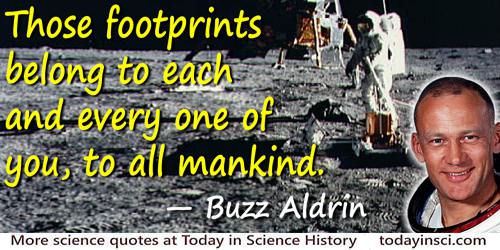
The honor you have given us goes not to us as a crew, but to ... all Americans, who believed, who persevered with us. What Apollo has begun we hope will spread out in many directions, not just in space, but underneath the seas, and in the cities to tell us unforgettably what we will and must do. There are footprints on the moon. Those footprints belong to each and every one of you, to all mankind. They are there because of the blood, sweat, and tears of millions of people. Those footprints are the symbol of true human spirit.
From his acceptance speech (13 Aug 1969) for the Medal of Freedom presented to him as one of the three astronauts on the first manned moon landing mission. In Leon Wagener, One Giant Leap: Neil Armstrong's Stellar American Journey (2004), 226.
The hope that new experiments will lead us back to objective events in time and space is about as well founded as the hope of discovering the end of the world in the unexplored regions of the Antarctic.
In Philosophical Problems of Quantum Physics (1952, 1979), 18.
The human race, whose intelligence dates back only a single tick of the astronomical clock, could hardly hope to understand so soon what it all means.
The Stars in their Courses (1931, 1948), 153.
The hype, skepticism and bewilderment associated with the Internet—concerns about new forms of crime, adjustments in social mores, and redefinition of business practices— mirror the hopes, fears, and misunderstandings inspired by the telegraph. Indeed, they are only to be expected. They are the direct consequences of human nature, rather than technology.
Given a new invention, there will always be some people who see only its potential to do good, while others see new opportunities to commit crime or make money. We can expect the same reactions to whatever new inventions appear in the twenty-first century.
Such reactions are amplified by what might be termed chronocentricity—the egotism that one’s own generation is poised on the very cusp of history. Today, we are repeatedly told that we are in the midst of a communications revolution. But the electric telegraph was, in many ways, far more disconcerting for the inhabitants of the time than today’s advances are for us. If any generation has the right to claim that it bore the full bewildering, world-shrinking brunt of such a revolution, it is not us—it is our nineteenth- century forebears.
Given a new invention, there will always be some people who see only its potential to do good, while others see new opportunities to commit crime or make money. We can expect the same reactions to whatever new inventions appear in the twenty-first century.
Such reactions are amplified by what might be termed chronocentricity—the egotism that one’s own generation is poised on the very cusp of history. Today, we are repeatedly told that we are in the midst of a communications revolution. But the electric telegraph was, in many ways, far more disconcerting for the inhabitants of the time than today’s advances are for us. If any generation has the right to claim that it bore the full bewildering, world-shrinking brunt of such a revolution, it is not us—it is our nineteenth- century forebears.
In The Victorian Internet (1998).
The influence of the mathematics of Leibnitz upon his philosophy appears chiefly in connection with his law of continuity and his prolonged efforts to establish a Logical Calculus. … To find a Logical Calculus (implying a universal philosophical language or system of signs) is an attempt to apply in theological and philosophical investigations an analytic method analogous to that which had proved so successful in Geometry and Physics. It seemed to Leibnitz that if all the complex and apparently disconnected ideas which make up our knowledge could be analysed into their simple elements, and if these elements could each be represented by a definite sign, we should have a kind of “alphabet of human thoughts.” By the combination of these signs (letters of the alphabet of thought) a system of true knowledge would be built up, in which reality would be more and more adequately represented or symbolized. … In many cases the analysis may result in an infinite series of elements; but the principles of the Infinitesimal Calculus in mathematics have shown that this does not necessarily render calculation impossible or inaccurate. Thus it seemed to Leibnitz that a synthetic calculus, based upon a thorough analysis, would be the most effective instrument of knowledge that could be devised. “I feel,” he says, “that controversies can never be finished, nor silence imposed upon the Sects, unless we give up complicated reasonings in favor of simple calculations, words of vague and uncertain meaning in favor of fixed symbols [characteres].” Thus it will appear that “every paralogism is nothing but an error of calculation.” “When controversies arise, there will be no more necessity of disputation between two philosophers than between two accountants. Nothing will be needed but that they should take pen in hand, sit down with their counting-tables, and (having summoned a friend, if they like) say to one another: Let us calculate.” This sounds like the ungrudging optimism of youth; but Leibniz was optimist enough to cherish the hope of it to his life’s end.
By Robert Latta in 'Introduction' to his translation of Gottfried Leibnitz, The Monadology and Other Philosophical Writings (1898), 85. Also quoted (omitting the last sentence) in Robert Édouard Moritz, Memorabilia Mathematica; Or, The Philomath’s Quotation-Book (1914), 205-206.
The iron labor of conscious logical reasoning demands great perseverance and great caution; it moves on but slowly, and is rarely illuminated by brilliant flashes of genius. It knows little of that facility with which the most varied instances come thronging into the memory of the philologist or historian. Rather is it an essential condition of the methodical progress of mathematical reasoning that the mind should remain concentrated on a single point, undisturbed alike by collateral ideas on the one hand, and by wishes and hopes on the other, and moving on steadily in the direction it has deliberately chosen.
In Ueber das Verhältniss der Naturwissenschaften zur Gesammtheit der Wissenschaft, Vorträge und Reden (1896), Bd. 1, 178.
The law that entropy always increases—the Second Law of Thermodynamics—holds, I think, the supreme position among the laws of Nature. If someone points out to you that your pet theory of the universe is in disagreement with Maxwell’s equations—then so much the worse for Maxwell’s equations. If it is found to be contradicted by observation—well these experimentalists do bungle things sometimes. But if your theory is found to be against the second law of thermodynamics I can give you no hope; there is nothing for it but to collapse in deepest humiliation.
Gifford Lectures (1927), The Nature of the Physical World (1928), 74.
The layman, taught to revere scientists for their absolute respect for the observed facts, and for the judiciously detached and purely provisional manner in which they hold scientific theories (always ready to abandon a theory at the sight of any contradictory evidence) might well have thought that, at [Dayton C.] Miller's announcement of this overwhelming evidence of a “positive effect” [indicating that the speed of light is not independent from the motion of the observer, as Einstein's theory of relativity demands] in his presidential address to the American Physical Society on December 29th, 1925, his audience would have instantly abandoned the theory of relativity. Or, at the very least, that scientists—wont to look down from the pinnacle of their intellectual humility upon the rest of dogmatic mankind—might suspend judgment in this matter until Miller's results could be accounted for without impairing the theory of relativity. But no: by that time they had so well closed their minds to any suggestion which threatened the new rationality achieved by Einstein's world-picture, that it was almost impossible for them to think again in different terms. Little attention was paid to the experiments, the evidence being set aside in the hope that it would one day turn out to be wrong.
Personal Knowledge: Towards a Post-Critical Philosophy (1958, 1998), 13. Miller had earlier presented his evidence against the validity of the relativity theory at the annual meeting, 28 Apr 1925, of the National Academy of Sciences. Miller believed he had, by a much-refined and improved repetition of the so-called Michelson-Morley experiment, shown that there is a definite and measurable motion of the earth through the ether. In 1955, a paper by R.S. Shankland, et al., in Rev. Modern Phys. (1955), 27, 167, concluded that statistical fluctuations and temperature effects in the data had simulated what Miller had taken to be he apparent ether drift.
The man who is thoroughly convinced of the universal operation of the law of causation cannot for a moment entertain the idea of a being who interferes in the course of events–provided, of course, that he takes the hypothesis of causality really seriously. He has no use for the religion of fear and equally little for social or moral religion. A God who rewards and punishes is inconceivable to him for the simple reason that a man’s actions are determined by necessity, external and internal, so that in God’s eyes he cannot be responsible, any more than an inanimate object is responsible for the motions it undergoes. Science has therefore been charged with undermining morality, but the charge is unjust. A man’s ethical behavior should be based effectually on sympathy, education, and social ties and needs; no religious basis is necessary. Man would indeed be in a poor way if he had to be restrained by fear of punishment and hopes of reward after death.
From 'Religion And Science', as collected in Ideas And Opinions (1954), 39, given its source as: “Written expressly for the New York Times Magazine. Appeared there November 9, 1930 (pp. 1-4). The German text was published in the Berliner Tageblatt, November 11, 1930.” The NYT Magazine article in full, is reprinted in Edward H. Cotton (ed.), Has Science Discovered God? A Symposium of Modern Scientific Opinion (1931), 101. This original version directly from the magazine has significantly different wording, beginning, “For anyone who is pervaded with the sense of causal law….” See this alternate form on the Albert Einstein Quotes page on this website. As for why the difference, Webmaster speculates the book form editor perhaps used a revised translation from Einstein’s German article.
The mathematicians have been very much absorbed with finding the general solution of algebraic equations, and several of them have tried to prove the impossibility of it. However, if I am not mistaken, they have not as yet succeeded. I therefore dare hope that the mathematicians will receive this memoir with good will, for its purpose is to fill this gap in the theory of algebraic equations.
Opening of Memoir on Algebraic Equations, Proving the Impossibility of a Solution of the General Equation of the Fifth Degree. The paper was originally published (1824) in French, as a pamphlet, in Oslo. Collected in Œuvres Complètes (1881), Vol. 1, 28. Translation by W.H. Langdon collected in David Eugene Smith, A Source Book in Mathematics (2012), 261. In this work, he showed why—despite two centuries of efforts by mathematicians—solving equations of the fifth degree would remain futile. The insights from this paper led to the modern theory of equations.
The meaning of human life and the destiny of man cannot be separable from the meaning and destiny of life in general. 'What is man?' is a special case of 'What is life?' Probably the human species is not intelligent enough to answer either question fully, but even such glimmerings as are within our powers must be precious to us. The extent to which we can hope to understand ourselves and to plan our future depends in some measure on our ability to read the riddles of the past. The present, for all its awesome importance to us who chance to dwell in it, is only a random point in the long flow of time. Terrestrial life is one and continuous in space and time. Any true comprehension of it requires the attempt to view it whole and not in the artificial limits of any one place or epoch. The processes of life can be adequately displayed only in the course of life throughout the long ages of its existence.
The Meaning of Evolution: A Study of the History of Life and of its Significance for Man (1949), 9.
The Microbe is so very small,
You cannot make him out at all.
But many sanguine people hope
To see him down a microscope.
His jointed tongue that lies beneath
A hundred curious rows of teeth;
His seven tufted tails with lots
Of lovely pink and purple spots
On each of which a pattern stands,
Composed of forty separate bands;
His eyebrows of a tender green;
All these have never yet been seen
But Scientists, who ought to know,
Assure us they must be so ...
Oh! let us never, never doubt
What nobody is sure about!
You cannot make him out at all.
But many sanguine people hope
To see him down a microscope.
His jointed tongue that lies beneath
A hundred curious rows of teeth;
His seven tufted tails with lots
Of lovely pink and purple spots
On each of which a pattern stands,
Composed of forty separate bands;
His eyebrows of a tender green;
All these have never yet been seen
But Scientists, who ought to know,
Assure us they must be so ...
Oh! let us never, never doubt
What nobody is sure about!
In More Beasts for Worse Children (1897), 47-8.
The motto in the pursuit of knowledge, of whatever kind, has always been, “Hope all things;—Prove all things.”
From Address (Oct 1874) delivered at Guy’s Hospital, 'On The Study of Medicine', printed in British Medical journal (1874), 2, 425. Collected in Sir William Withey Gull and Theodore Dyke Acland (ed.), A Collection of the Published Writings of William Withey Gull (1896), 5.
The only hope [of science] ... is in genuine induction.
Aphorism 14. In Francis Bacon and Basil Montagu, The Works of Francis Bacon (1831), Vol. 14, 32.
The only hope of science is genuine induction.
In Maturin Murray Ballou, Edge-Tools of Speech (1899), 440.
The position of the anthropologist of to-day resembles in some sort the position of classical scholars at the revival of learning. To these men the rediscovery of ancient literature came like a revelation, disclosing to their wondering eyes a splendid vision of the antique world, such as the cloistered of the Middle Ages never dreamed of under the gloomy shadow of the minster and within the sound of its solemn bells. To us moderns a still wider vista is vouchsafed, a greater panorama is unrolled by the study which aims at bringing home to us the faith and the practice, the hopes and the ideals, not of two highly gifted races only, but of all mankind, and thus at enabling us to follow the long march, the slow and toilsome ascent, of humanity from savagery to civilization. And as the scholar of the Renaissance found not merely fresh food for thought but a new field of labour in the dusty and faded manuscripts of Greece and Rome, so in the mass of materials that is steadily pouring in from many sides—from buried cities of remotest antiquity as well as from the rudest savages of the desert and the jungle—we of to-day must recognise a new province of knowledge which will task the energies of generations of students to master.
'Author’s Introduction' (1900). In Dr Theodor H. Gaster (ed.), The New Golden Bough (1959), xxv-xxvi.
The power of man to do work—one man-power—is, in its purely physical sense, now an insignificant accomplishment, and could only again justify his existence if other sources of power failed. … Curious persons in cloisteral seclusion are experimenting with new sources of energy, which, if ever harnessed, would make coal and oil as useless as oars and sails. If they fail in their quest, or are too late, so that coal and oil, everywhere sought for, are no longer found, and the only hope of men lay in their time-honoured traps to catch the sunlight, who doubts that galley-slaves and helots would reappear in the world once more?
Science and Life (1920), 6.
The pursuit of science has often been compared to the scaling of mountains, high and not so high. But who amongst us can hope, even in imagination, to scale the Everest and reach its summit when the sky is blue and the air is still, and in the stillness of the air survey the entire Himalayan range in the dazzling white of the snow stretching to infinity? None of us can hope for a comparable vision of nature and of the universe around us. But there is nothing mean or lowly in standing in the valley below and awaiting the sun to rise over Kinchinjunga.
Truth and Beauty: Aesthetics and Motivations in Science (1987), 26.
The rigid electron is in my view a monster in relation to Maxwell's equations, whose innermost harmony is the principle of relativity... the rigid electron is no working hypothesis, but a working hindrance. Approaching Maxwell's equations with the concept of the rigid electron seems to me the same thing as going to a concert with your ears stopped up with cotton wool. We must admire the courage and the power of the school of the rigid electron which leaps across the widest mathematical hurdles with fabulous hypotheses, with the hope to land safely over there on experimental-physical ground.
In Arthur I. Miller, Albert Einstein's Special Theory of Relativity (1981), 350.
The scientists speak with an authority which the ordinary citizen, the non-scientist, cannot challenge, and to which he is compelled to listen. Since they cannot hope for much help from the generals or the ministers, they must act for themselves, in a supreme endeavor to avert the mortal dangers which confront mankind.
In 'Science and Disarmament,' Impact, 1965.
The stakes are immense, the task colossal, the time is short. But we may hope–we must hope–that man’s own creation, man’s own genius, will not destroy him. Scholars, indeed all men, must move forward in the faith of that philosopher who held that there is no problem the human reason can propound which the human reason cannot reason out.
From 'Is Einstein Right?', in William Allison Shimer (ed.), The American Scholar (1946), 15, 476. Reprinted in American Thought 1947 (1947), 196. Gauss is commenting on an article by Einstein about the challenges following the creation of the atomic bomb, 'The Real Problem Is in the Hearts of Men', New York Times Magazine (23 Jun 1946), SM4.
The student of medicine can no more hope to advance in the mastery of his subject with a loose and careless mind than the student of mathematics. If the laws of abstract truth require such rigid precision from those who study them, we cannot believe the laws of nature require less. On the contrary, they would seem to require more; for the facts are obscure, the means of inquiry imperfect, and in every exercise of the mind there are peculiar facilities to err.
From Address (Oct 1874) delivered at Guy’s Hospital, 'On The Study of Medicine', printed in British Medical journal (1874), 2, 425. Collected in Sir William Withey Gull and Theodore Dyke Acland (ed.), A Collection of the Published Writings of William Withey Gull (1896), 6.
The Syllogism consists of propositions, propositions consist of words, words are symbols of notions. Therefore if the notions themselves (which is the root of the matter) are confused and over-hastily abstracted from the facts, there can be no firmness in the superstructure. Our only hope therefore lies in a true induction.
From Novum Organum (1620), Book 1, Aphorism 14. Translated as The New Organon: Aphorisms Concerning the Interpretation of Nature and the Kingdom of Man), collected in James Spedding, Robert Ellis and Douglas Heath (eds.), The Works of Francis Bacon (1857), Vol. 4, 49.
The truly scientific mind is altogether unafraid of the new, and while having no mercy for ideas which have served their turn or shown their uselessness, it will not grudge to any unfamiliar conception its moment of full and friendly attention, hoping to expand rather than to minimize what small core of usefulness it may happen to contain.
In 'Observation and Experiment and Their Use in the Medical Sciences', British Medical Journal (1930), 2, 129-34. As cited in Edward J. Huth and T.J. Murray, Medicine in Quotations: Views of Health and Disease Through the Ages (2006), 357 and 512.
The two fortresses which are the last to yield in the human heart, are hope and pride.
Quoted, without citation, in front matter to T. A. Edison Foundation, Lewis Howard Latimer: A Black Inventor: a Biography and Related Experiments You Can Do (1973). If you know the primary eource, please contact Webmaster.
The understanding must not however be allowed to jump and fly from particulars to axioms remote and of almost the highest generality (such as the first principles, as they are called, of arts and things), and taking stand upon them as truths that cannot be shaken, proceed to prove and frame the middle axioms by reference to them; which has been the practice hitherto, the understanding being not only carried that way by a natural impulse, but also by the use of syllogistic demonstration trained and inured to it. But then, and then only, may we hope well of the sciences when in a just scale of ascent, and by successive steps not interrupted or broken, we rise from particulars to lesser axioms; and then to middle axioms, one above the other; and last of all to the most general. For the lowest axioms differ but slightly from bare experience, while the highest and most general (which we now have) are notional and abstract and without solidity. But the middle are the true and solid and living axioms, on which depend the affairs and fortunes of men; and above them again, last of all, those which are indeed the most general; such, I mean, as are not abstract, but of which those intermediate axioms are really limitations.
The understanding must not therefore be supplied with wings, but rather hung with weights, to keep it from leaping and flying. Now this has never yet been done; when it is done, we may entertain better hopes of science.
The understanding must not therefore be supplied with wings, but rather hung with weights, to keep it from leaping and flying. Now this has never yet been done; when it is done, we may entertain better hopes of science.
From Novum Organum (1620), Book 1, Aphorism 104. Translated as The New Organon: Aphorisms Concerning the Interpretation of Nature and the Kingdom of Man), collected in James Spedding, Robert Ellis and Douglas Heath (eds.), The Works of Francis Bacon (1857), Vol. 4, 97.
The word which God has written on the brow of every man is Hope.
Les Miserables. Quoted in Kim Lim (ed.), 1,001 Pearls of Spiritual Wisdom: Words to Enrich, Inspire, and Guide Your Life (2014), 142
The world little knows how many of the thoughts and theories which have passed through the mind of a scientific investigator, have been crushed in silence and secrecy by his own severe criticism and adverse examination; that in the most successful instances not a tenth of the suggestions, the hopes, the wishes, the preliminary conclusions have been realized.
In 'Observations On Mental Education', a lecture before the Prince Consort and the Royal Institution (6 May 1854). Experimental Researches in Chemistry and Physics (1859), 486.
The world, unfortunately, rarely matches our hopes and consistently refuses to behave in a reasonable manner.
…...
There is another ground of hope that must not be omitted. Let men but think over their infinite expenditure of understanding, time, and means on matters and pursuits of far less use and value; whereof, if but a small part were directed to sound and solid studies, there is no difficulty that might not be overcome.
Translation of Novum Organum, CXI. In Francis Bacon, James Spedding, The Works of Francis Bacon (1864), Vol. 8, 144.
There is romance, the genuine glinting stuff, in typewriters, and not merely in their development from clumsy giants into agile dwarfs, but in the history of their manufacture, which is filled with raids, battles, lonely pioneers, great gambles, hope, fear, despair, triumph. If some of our novels could be written by the typewriters instead of on them, how much better they would be.
English Journey (1934), 123.
These are some of the things wilderness can do for us. That is the reason we need to put into effect, for its preservation, some other principle that the principles of exploitation or “usefulness” or even recreation. We simply need that wild country available to us, even if we never do more than drive to its edge and look in. For it can be a means of reassuring ourselves of our sanity as creatures, a part of the geography of hope.
Letter (3 Dec 1960) written to David E. Pesonen of the Outdoor Recreation Resources Review Commission. Collected in 'Coda: Wilderness Letter', The Sound of Mountain Water: The Changing American West (1969), 153.
Think impossible and dreams get discarded, projects get abandoned, and hope for wellness is torpedoed. But let someone yell the words it’s possible, and resources we hadn’t been aware of come rushing in to assist us in our quest.
…...
This beast is best felt. Shake, rattle, and roll. We are thrown left and right against our straps in spasmodic little jerks. It is steering like crazy, like a nervous lady driving a wide car down a narrow alley, and I just hope it knows where it’s going, because for the first ten seconds we are perilously close to that umbilical tower.
…...
This is my religion: I am filled with Wonder at the outcome of 4 billion years of evolution here on our speck in the universe and Hope regarding our opportunity to improve the lives of those around us through basic science discoveries and their translation to clinical practice.
In Acceptance Remarks, 2016 Lasker Awards Ceremony, published in 'Oxygen Sensing – An Essential Process for Survival', on laskerfoundation.org website.
This success permits us to hope that after thirty or forty years of observation on the new Planet [Neptune], we may employ it, in its turn, for the discovery of the one following it in its order of distances from the Sun. Thus, at least, we should unhappily soon fall among bodies invisible by reason of their immense distance, but whose orbits might yet be traced in a succession of ages, with the greatest exactness, by the theory of Secular Inequalities.
[Following the success of the confirmation of the existence of the planet Neptune, he considered the possibility of the discovery of a yet further planet.]
[Following the success of the confirmation of the existence of the planet Neptune, he considered the possibility of the discovery of a yet further planet.]
In John Pringle Nichol, The Planet Neptune: An Exposition and History (1848), 90.
Throughout his last half-dozen books, for example, Arthur Koestler has been conducting a campaign against his own misunderstanding of Darwinism. He hopes to find some ordering force, constraining evolution to certain directions and overriding the influence of natural selection ... Darwinism is not the theory of capricious change that Koestler imagines. Random variation may be the raw material of change, but natural selection builds good design by rejecting most variants while accepting and accumulating the few that improve adaptation to local environments.
In The Panda’s Thumb: More Reflections in Natural History (1990, 2010), 38.
To be in a world which is a hell, to be of that world and neither to believe in or guess at anything but that world is not merely hell but the only possible damnation: the act of a man damning himself. It may be—I hope it is—redemption to guess and perhaps perceive that the universe, the hell which we see for all its beauty, vastness, majesty, is only part of a whole which is quite unimaginable.
Lecture (11 Apr 1980), Hamburg, Germany. Collected in 'Belief and Creativity',A Moving Target (1982), 201.
To deride the hope of progress is the ultimate fatuity, the last word in poverty of spirit and meanness of mind.
From The Hope of Progress (1973), 137. Medawar defends science against the attacks of critics who claim that science cannot enrich our lives.
To prove to an indignant questioner on the spur of the moment that the work I do was useful seemed a thankless task and I gave it up. I turned to him with a smile and finished, “To tell you the truth we don’t do it because it is useful but because it’s amusing.” The answer was thought of and given in a moment: it came from deep down in my soul, and the results were as admirable from my point of view as unexpected. My audience was clearly on my side. Prolonged and hearty applause greeted my confession. My questioner retired shaking his head over my wickedness and the newspapers next day, with obvious approval, came out with headlines “Scientist Does It Because It’s Amusing!” And if that is not the best reason why a scientist should do his work, I want to know what is. Would it be any good to ask a mother what practical use her baby is? That, as I say, was the first evening I ever spent in the United States and from that moment I felt at home. I realised that all talk about science purely for its practical and wealth-producing results is as idle in this country as in England. Practical results will follow right enough. No real knowledge is sterile. The most useless investigation may prove to have the most startling practical importance: Wireless telegraphy might not yet have come if Clerk Maxwell had been drawn away from his obviously “useless” equations to do something of more practical importance. Large branches of chemistry would have remained obscure had Willard Gibbs not spent his time at mathematical calculations which only about two men of his generation could understand. With this faith in the ultimate usefulness of all real knowledge a man may proceed to devote himself to a study of first causes without apology, and without hope of immediate return.
From lecture to a scientific society in Philadelphia on “The Mechanism of the Muscle” given by invitation after he received a Nobel Prize for that work. The quote is Hill’s response to a post-talk audience question asking disapprovingly what practical use the speaker thought there was in his research. The above quoted answer, in brief, is—for the intellectual curiosity. As quoted about Hill by Bernard Katz in his own autobiographical chapter, 'Sir Bernard Katz', collected in Larry R. Squire (ed.), The History of Neuroscience in Autobiography (1996), Vol. 1, 350-351. Two excerpts from the above have been highlighted as standalone quotes here in this same quote collection for A. V. Hill. They begin “All talk about science…” and “The most useless investigation may prove…”.
To the distracting occupations belong especially my lecture courses which I am holding this winter for the first time, and which now cost much more of my time than I like. Meanwhile I hope that the second time this expenditure of time will be much less, otherwise I would never be able to reconcile myself to it, even practical (astronomical) work must give far more satisfaction than if one brings up to B a couple more mediocre heads which otherwise would have stopped at A.
Letter to Friedrich Bessel (4 Dec 1808). Quoted in G. Waldo Dunnington, Carl Friedrich Gauss: Titan of Science (2004), 415.
To the east was our giant neighbor Makalu, unexplored and unclimbed, and even on top of Everest the mountaineering instinct was sufficient strong to cause me to spend some moments conjecturing as to whether a route up that mountain might not exist. Far away across the clouds the great bulk of Kangchenjunga loomed on the horizon. To the west, Cho Oyu, our old adversary from 1952, dominated the scene and we could see the great unexplored ranges of Nepal stretching off into the distance. The most important photograph, I felt, was a shot down the north ridge, showing the North Col and the old route that had been made famous by the struggles of those great climbers of the 1920s and 1930s. I had little hope of the results being particularly successful, as I had a lot of difficulty in holding the camera steady in my clumsy gloves, but I felt that they would at least serve as a record. After some ten minutes of this, I realized that I was becoming rather clumsy-fingered and slow-moving, so I quickly replaced my oxygen set and experience once more the stimulating effect of even a few liters of oxygen. Meanwhile, Tenzing had made a little hole in the snow and in it he placed small articles of food – a bar of chocolate, a packet of biscuits and a handful of lollies. Small offerings, indeed, but at least a token gifts to the gods that all devoted Buddhists believe have their home on this lofty summit. While we were together on the South Col two days before, Hunt had given me a small crucifix that he had asked me to take to the top. I, too, made a hole in the snow and placed the crucifix beside Tenzing’s gifts.
As quoted in Whit Burnett, The Spirit of Adventure: The Challenge (1955), 349.
To the engineer falls the job of clothing the bare bones of science with life, comfort, and hope.
Reprint of his 1916 statement in 'Engineering as a Profession', Engineer’s Week (1954).
To use Newton’s words, our efforts up till this moment have but turned over a pebble or shell here and there on the beach, with only a forlorn hope that under one of them was the gem we were seeking. Now we have the sieve, the minds, the hands, the time, and, particularly, the dedication to find those gems—no matter in which favorite hiding place the children of distant worlds have placed them.
[Co-author with Dava Sobel.]
[Co-author with Dava Sobel.]
In Frank Drake and Dava Sobel, Is Anyone Out There? (1993), 236.
Today we are on the eve of launching a new industry, based on imagination, on scientific research and accomplishment. … Now we add radio sight to sound. It is with a feeling of humbleness that I come to this moment of announcing the birth in this country of a new art so important in its implications that it is bound to affect all society. It is an art which shines like a torch of hope in the troubled world. It is a creative force which we must learn to utilize for the benefit of all mankind. This miracle of engineering skill which one day will bring the world to the home also brings a new American industry to serve man’s material welfare … [Television] will become an important factor in American economic life.
Address at dedication of RCA Exhibit Building, New York World Fair before unveiling the RCA television exhibit (20 Apr 1939). In RCA Review: A Technical Journal (1938), Vols 3-4, 4.
As quoted in Marcy Carsey and Tom Werner, 'Father of Broadcasting: David Sarnoff (Time 100)', Time (7 Dec 1998), 152, No. 23, 88; and in Eugene Lyons, David Sarnoff: A Biography (1966), 216.
Tomorrow may be fair, however stormy the sky of today.
Quoted, without citation, in front matter to T. A. Edison Foundation, Lewis Howard Latimer: A Black Inventor: a Biography and Related Experiments You Can Do (1973). If you know the primary source, please contact Webmaster.
We are a caring nation, and our values should also guide us on how we harness the gifts of science. New medical breakthroughs bring the hope of cures for terrible diseases and treatments that can improve the lives of millions. Our challenge is to make sure that science serves the cause of humanity instead of the other way around.
Telephone remarks to the March for Life, in Public Papers of the Presidents of the United States: George W. Bush, 2007 (), Book I)President Calls March for Life Participants (22 Jan 2007), 41.
We are as yet got little farther than to the surface of things: yet ought we not to be discouraged; though we can never hope to attain to the complete knowledge of the texture, or constituent frame and nature of bodies, yet may we reasonably expect by this method of experiments, to make farther and farther advances abundantly sufficient to reward our pains.
In 'Preface', Statical Essays: Containing Hæmastatics (1769), Vol. 2, ii.
We are like tenant farmers chopping down the fence around our house for fuel when we should be using Natures inexhaustible sources of energy — sun, wind and tide. ... I'd put my money on the sun and solar energy. What a source of power! I hope we don't have to wait until oil and coal run out before we tackle that.
Edison in conversation Henry Ford and Harvey Firestone (1931), quoted as a recollection of the author, in James Newton, Uncommon Friends: Life with Thomas Edison, Henry Ford, Harvey Firestone, Alexis Carrel & Charles Lindbergh (1987), 31. The quote is not cited from a print source. However, in the introduction the author said he “kept a diary in which I noted times and places, key phrases, and vivid impressions.” He also “relied on publications by and about my friends, which jogged my memory.” Webmaster has found no earlier record of this quote, and thus suggests the author may have the gist of what Edison said, but is not quoting the exact words uttered by Edison, although quote marks are used to state what Edison said.
We cannot hope to build a better world without improving the individual. Toward this end, each of us must work for his own highest development, accepting at the same time his share of responsibility in the general life of humanity—our particular duty being to aid those to whom we think we can be most useful.
Quoted in Eve Curie Labouisse and Eve Curie, trans. by Vincent Sheean, Madame Curie (1937), 53.
We cannot hope to either understand or to manage the carbon in the atmosphere unless we understand and manage the trees and the soil too.
From From Eros to Gaia (1993). In Bill Swainson, Encarta Book of Quotations (2000), 299.
We cannot hope to fill the schools with persons of high intelligence, for persons of high intelligence simply refuse to spend their lives teaching such banal things as spelling and arithmetic. Among the teachers male we may safely assume that 95% are of low mentality, else they would depart for more appetizing pastures. And even among the teachers female the best are inevitably weeded out by marriage, and only the worst (with a few romantic exceptions) survive. The task before us, as I say, is … to search out and put to use the value lying concealed in it.
In 'Education' Prejudices: Third Series (1922), 3, 247.
We do not ask what hope of gain makes a little bird warble, since we know that it takes delight in singing because it is for that very singing that the bird was made, so there is no need to ask why the human mind undertakes such toil in seeking out these secrets of the heavens. ... And just as other animals, and the human body, are sustained by food and drink, so the very spirit of Man, which is something distinct from Man, is nourished, is increased, and in a sense grows up on this diet of knowledge, and is more like the dead than the living if it is touched by no desire for these things.
Mysterium Cosmographicum. Translated by A. M. Duncan in The Secret of the Universe (1981), 55.
We grow great by dreams. All big men are dreamers. They see things in the soft haze of a spring day or in the red fire of a long winter’s evening. Some of us let these great dreams die, but others nourish and protect them; nurse them through bad days till they bring them to the sunshine and light which comes always to those who sincerely hope that their dreams will come true.
Quoted, for example, in The American Exporter (1930), Vol. 106, 158. Webmaster has found this quote in numerous texts, but as yet has not identified the original. (Can you help?)
We have seen that a proton of energy corresponding to 30,000 volts can effect the transformation of lithium into two fast α-particles, which together have an energy equivalent of more than 16 million volts. Considering the individual process, the output of energy in the transmutation is more than 500 times greater than the energy carried by the proton. There is thus a great gain of energy in the single transmutation, but we must not forget that on an average more than 1000 million protons of equal energy must be fired into the lithium before one happens to hit and enter the lithium nucleus. It is clear in this case that on the whole the energy derived from transmutation of the atom is small compared with the energy of the bombarding particles. There thus seems to be little prospect that we can hope to obtain a new source of power by these processes. It has sometimes been suggested, from analogy with ordinary explosives, that the transmutation of one atom might cause the transmutation of a neighbouring nucleus, so that the explosion would spread throughout all the material. If this were true, we should long ago have had a gigantic explosion in our laboratories with no one remaining to tell the tale. The absence of these accidents indicates, as we should expect, that the explosion is confined to the individual nucleus and does not spread to the neighbouring nuclei, which may be regarded as relatively far removed from the centre of the explosion.
The Transmutation of the Atom (1933), 23-4
We have simply arrived too late in the history of the universe to see this primordial simplicity easily ... But although the symmetries are hidden from us, we can sense that they are latent in nature, governing everything about us. That's the most exciting idea I know: that nature is much simpler than it looks. Nothing makes me more hopeful that our generation of human beings may actually hold the key to the universe in our hands—that perhaps in our lifetimes we may be able to tell why all of what we see in this immense universe of galaxies and particles is logically inevitable.
Quoted in Nigel Calder, The Key to the Universe: A Report on the New Physics (1978), 185.
We hope to explain the universe in a single, simple formula that you can wear on your T-shirt.
In 'Quark City' by Richard Wolkomir, Omni, February 1984.
We live in a capitalist economy, and I have no particular objection to honorable self-interest. We cannot hope to make the needed, drastic improvement in primary and secondary education without a dramatic restructuring of salaries. In my opinion, you cannot pay a good teacher enough money to recompense the value of talent applied to the education of young children. I teach an hour or two a day to tolerably well-behaved near-adults–and I come home exhausted. By what possible argument are my services worth more in salary than those of a secondary-school teacher with six classes a day, little prestige, less support, massive problems of discipline, and a fundamental role in shaping minds. (In comparison, I only tinker with intellects already largely formed.)
…...
We may best hope to understand the nature and conditions of real knowledge, by studying the nature and conditions of the most certain and stable portions of knowledge which we already possess: and we are most likely to learn the best methods of discovering truth, by examining how truths, now universally recognised, have really been discovered.
In The Philosophy of the Inductive Sciences (1840), Vol. I, 3-4.
We must therefore bear the undoubtedly bad effect s of the weak surviving and propagating their kind; but there appears to be at least one check in steady action, namely that the weaker and inferior members of society do not marry so freely as the sound; and this check might be indefinitely increased by the weak in body or mind refraining from marriage, though this is more to be hoped for than expected.
…...
We need a name for the new replicator, a noun that conveys the idea of a unit of cultural transmission, or a unit of imitation. 'Mimeme' comes from a suitable Greek root, but I want a monosyllable that sounds a bit like 'gene'. I hope my classicist friends will forgive me if I abbreviate mimeme to meme. If it is any consolation, it could alternatively be thought of as being related to 'memory', or to the French word même. It should be pronounced to rhyme with 'cream'.
In The Selfish Gene (1976).
We simply need that wild country available to us, even if we never do more than drive to its edge and look in. For it can be a means of reassuring ourselves of our sanity as creatures, a part of the geography of hope.
Conclusion of Letter (3 Dec 1960) written to David E. Pesonen of the Outdoor Recreation Resources Review Commission. Collected in 'Coda: Wilderness Letter', The Sound of Mountain Water: The Changing American West (1969), 153.
We were very privileged to leave on the Moon a plaque ... saying, ‘For all Mankind’. Perhaps in the third millennium a wayward stranger will read the plaque at Tranquility Base. We’ll let history mark that this was the age in which that became a fact. I was struck this morning in New York by a proudly waved but uncarefully scribbled sign. It said, ‘Through you we touched the Moon.’ It was our privilege today to touch America. I suspect perhaps the most warm, genuine feeling that all of us could receive came through the cheers and shouts and, most of all, the smiles of our fellow Americans. We hope and think that those people shared our belief that this is the beginning of a new era—the beginning of an era when man understands the universe around him, and the beginning of the era when man understands himself.
Acceptance speech (13 Aug 1969), upon receiving the Medal of Freedom as a member of the first manned moon-landing mission. In James R. Hansen, First Man: The Life of Neil A. Armstrong (2005), 569.
Western science is a product of the Apollonian mind: its hope is that by naming and classification, by the cold light of intellect, archaic night can be pushed back and defeated.
In Sexual Personae: Art and Decadence from Nefertiti to Emily Dickinson (1990), 5.
What hopes filled me when I discovered that there were laws behind so many obscure phenomena!
In Speech (27 Dec 1892) at the Golden Jubilee celebration for Pasteur's 70th birthday. As translated in Nature (1893), 47, 205.
What is terrorism? Terrorism in some sense is a reaction against the creation of a type one [planet-wide advanced] civilization. Now most terrorists cannot articulate this. … What they’re reacting to is not modernism. What they’re reacting to is the fact that we’re headed toward a multicultural tolerant scientific society and that is what they don’t want. They don’t want science. They want a theocracy. They don’t want multiculturalism. They want monoculturalism. So instinctively they don’t like the march toward a type one civilization. Now which tendency will win? I don’t know, but I hope that we emerge as a type one civilization.
From transcript of online video interview (29 Sep 2010) with Paul Hoffman, 'What is the likelihood that mankind will destroy itself?', on bigthink.com website.
What, more petitions! Won't you be, and stay, intimidated? You must really annoy Sen. Dodd. Here it is [my signature], and I hope it does some good.
Letter to Linus and Ava Helen Pauling (17 Jan 1961). On Oregon State University Library website.
Whatever we Greeks receive from the barbarians, we improve and perfect; there is good hope and promise, therefore that Greeks will carry this knowledge far beyond that which was introduced from abroad.
— Plato
From the 'Epilogue to the Laws' (Epinomis). As quoted in William Whewell, History of the Inductive Sciences from the Earliest to the Present Time (1837), Vol. 1, 161. (Although referenced to Plato’s Laws, the Epinomis is regarded as a later addition, not by Plato himself.)
Wheeler hopes that we can discover, within the context of physics, a principle that will enable the universe to come into existence “of its own accord.” In his search for such a theory, he remarks: “No guiding principle would seem more powerful than the requirement that it should provide the universe with a way to come into being.” Wheeler likened this 'self-causing' universe to a self-excited circuit in electronics.
In God and the New Physics (1984), 39. Wheeler quotation footnoted 'From the Black Hole', in H. Woolf (Ed.),Some Strangeness in the Proportion (1980).
When a conjecture inspires new hopes or creates new fears, action is indicated. There is an important asymmetry between hope, which leads to actions that will test its basis, and fear, which leads to restriction of options frequently restricting testing of the basis for the fear. As we know only too well, many of our hopes do not survive their tests. However, fears accumulate untested. Our inventory of untested fears has always made humanity disastrously vulnerable to thought control. While science was independent of politics, its greatest triumph was the reduction of that vulnerability.
Dartmouth College (1994)
When Benjamin Franklin invented the lightning-rod, the clergy, both in England and America, with the enthusiastic support of George III, condemned it as an impious attempt to defeat the will of God. For, as all right-thinking people were aware, lightning is sent by God to punish impiety or some other grave sin—the virtuous are never struck by lightning. Therefore if God wants to strike any one, Benjamin Franklin [and his lightning-rod] ought not to defeat His design; indeed, to do so is helping criminals to escape. But God was equal to the occasion, if we are to believe the eminent Dr. Price, one of the leading divines of Boston. Lightning having been rendered ineffectual by the “iron points invented by the sagacious Dr. Franklin,” Massachusetts was shaken by earthquakes, which Dr. Price perceived to be due to God’s wrath at the “iron points.” In a sermon on the subject he said,“In Boston are more erected than elsewhere in New England, and Boston seems to be more dreadfully shaken. Oh! there is no getting out of the mighty hand of God.” Apparently, however, Providence gave up all hope of curing Boston of its wickedness, for, though lightning-rods became more and more common, earthquakes in Massachusetts have remained rare.
In An Outline of Intellectual Rubbish (1943), 6-7.
When Franklin drew the lightning from the clouds, he little dreamed that in the evolution of science his discovery would illuminate the torch of Liberty for France and America. The rays from this beacon, lighting this gateway to the continent, will welcome the poor and the persecuted with the hope and promise of homes and citizenship.
Speech at unveiling of the Statue of Liberty, New York. In E.S. Werner (ed.), Werner's Readings and Recitations (1908), 108.
When one considers in its length and in its breadth the importance of this question of the education of the nation's young, the broken lives, the defeated hopes, the national failures, which result from the frivolous inertia with which it is treated, it is difficult to restrain within oneself a savage rage. In the conditions of modern life the rule is absolute, the race which does not value trained intelligence is doomed. Not all your heroism, not all your social charm, not all your wit, not all your victories on land or at sea, can move back the finger of fate. To-day we maintain ourselves. To-morrow science will have moved forward yet one more step, and there will be no appeal from the judgment which will then be pronounced on the uneducated.
In 'Organisation of Thought', The Aims of Education: & Other Essays (1917), 22.
When the solution is simple, God is answering. Where the world ceases to be the scene of our personal hopes and wishes, where we face it as free beings admiring, asking and observing, there we enter the realm of Art and Science.
…...
When things are bad, we take comfort in the thought that they could always be worse. And when they are, we find hope in the thought that things are so bad that they have to get better.
…...
Where the world ceases to be the scene of our personal hopes and wishes, where we face it as free beings admiring, asking and observing, there we enter the realm of Art and Science. If what is seen is seen and experienced is portrayed in the language of logic, we are engaged in science. If it is communicated through forms whose connections are not accessible to the conscious mind but are recognized intuitively as meaningful, then we are engaged in art.
'What Artistic and Scientific Experience Have in Common', Menschen (27 Jan 1921). In Albert Einstein, Helen Dukas, Banesh Hoffmann, Albert Einstein, The Human Side (1981), 37-38. The article was published in a German magazine on modern art, upon a request from the editor, Walter Hasenclever, for a few paragraphs on the idea that there was a close connection between the artistic developments and the scientific results belonging to a given epoch. (The magazine name, and editor's name are given by Ze'ev Rosenkranz, The Einstein Scrapbook (2002), 27.
While the vaccine discovery was progressive, the joy I felt at the prospect before me of being the instrument destined to take away from the world one of its greatest calamities [smallpox], blended with the fond hope of enjoying independence and domestic peace and happiness, was often so excessive that, in pursuing my favourite subject among the meadows, I have sometimes found myself in a kind of reverie.
John Baron, The Life of Dr. Jenner (1827), 140.
Why do the laws that govern [the universe] seem constant in time? One can imagine a Universe in which laws are not truly law-full. Talk of miracle does just this, invoking God to make things work. Physics aims to find the laws instead, and hopes that they will be uniquely constrained, as when Einstein wondered whether God had any choice when He made the Universe.
Gregory Benford, in John Brockman, What We Believe But Cannot Prove. In Clifford A. Pickover, Archimedes to Hawking: Laws of Science and the Great Minds Behind Them (2008), 182-183.
With a thousand joys I would accept a nonacademic job for which industriousness, accuracy, loyalty, and such are sufficient without specialized knowledge, and which would give a comfortable living and sufficient leisure, in order to sacrifice to my gods [mathematical research]. For example, I hope to get the editting of the census, the birth and death lists in local districts, not as a job, but for my pleasure and satisfaction...
Letter to Heinrich Olbers (26 Oct 1802). Quoted in G. Waldo Dunnington, Carl Friedrich Gauss: Titan of Science (2004), 415.
Without theory, practice is but routine born of habit. Theory alone can bring forth and develop the spirit of invention. ... [Do not] share the opinion of those narrow minds who disdain everything in science which has not an immediate application. ... A theoretical discovery has but the merit of its existence: it awakens hope, and that is all. But let it be cultivated, let it grow, and you will see what it will become.
Inaugural Address as newly appointed Professor and Dean (Sep 1854) at the opening of the new Faculté des Sciences at Lille (7 Dec 1854). In René Vallery-Radot, The Life of Pasteur, translated by Mrs. R. L. Devonshire (1919), 76.
Wonder [admiratio astonishment, marvel] is a kind of desire for knowledge. The situation arises when one sees an effect and does not know its cause, or when the cause of the particular effect is one that exceeds his power of understanding. Hence, wonder is a cause of pleasure insofar as there is annexed the hope of attaining understanding of that which one wants to know. ... For desire is especially aroused by the awareness of ignorance, and consequently a man takes the greatest pleasure in those things which he discovers for himself or learns from the ground up.
From Summa Theologiae Question 32, 'The Causes of Pleasure,' Article 8, 'Is Pleasure Caused by Wondering.'(1a2ae 32.8). As translated in James Vincent Cunningham, Tragic Effect and Tragic Process in Some Plays of Shakespeare (1945). Also in The Collected Essays of J.V. Cunningham (1976), 72-73.
Wonder [admiratio astonishment, marvel] is a kind of desire for knowledge. The situation arises when one sees an effect and does not know its cause, or when the cause of the particular effect is one that exceeds his power of understanding. Hence, wonder is a cause of pleasure insofar as there is annexed the hope of attaining understanding of that which one wants to know. ... For desire is especially aroused by the awareness of ignorance, and consequently a man takes the greatest pleasure in those things which he discovers for himself or learns from the ground up.
From Summa Theologiae Question 32, 'The Causes of Pleasure,' Article 8, 'Is Pleasure Caused by Wondering.'(1a2ae 32.8). As translated in James Vincent Cunningham, Tragic Effect and Tragic Process in Some Plays of Shakespeare (1945). Also in The Collected Essays of J.V. Cunningham (1976), 72-73.
Wonder was the motive that led people to philosophy ... wonder is a kind of desire in knowledge. It is the cause of delight because it carries with it the hope of discovery.
In a summarized form, from Summa Theologiae (1266-73), I-II, Q.32.a.8.
Yet I exist in the hope that these memoirs... may find their way to the minds of humanity in Some Dimension, and may stir up a race of rebels who shall refuse to be confined to limited Dimensionality.
Flatland (1899), 154.
You all have learned reliance
On the sacred teachings of Science,
So I hope, through life, you will never decline
In spite of philistine Defiance
To do what all good scientists do.
Experiment.
Make it your motto day and night.
Experiment.
And it will lead you to the light.
On the sacred teachings of Science,
So I hope, through life, you will never decline
In spite of philistine Defiance
To do what all good scientists do.
Experiment.
Make it your motto day and night.
Experiment.
And it will lead you to the light.
From 'Experiment', a song in the musical Nymph Errant (1933).
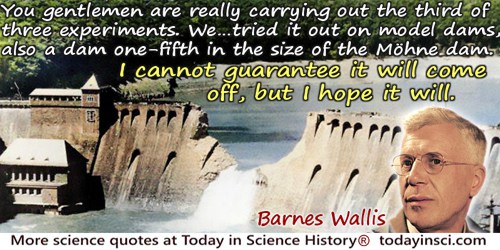
You gentlemen are really carrying out the third of three experiments. We have tried it out on model dams, also a dam one-fifth in the size of the Mohne dam. I cannot guarantee it will come off, but I hope it will.
To flight crews setting off to drop “dambuster” bombs during World War II. As quoted in W. B. Bartlett, Dam Busters: In the Words of the Bomber Crews (2011, 2013), 103.
You seek for knowledge and wisdom as I once did; and I ardently hope that the gratification of your wishes may not be a serpent to sting you, as mine has been.
In Frankenstein: Or, The Modern Prometheus (1818, 1823), Vol. 1, 35.
You, in this country [the USA], are subjected to the British insularity in weights and measures; you use the foot, inch and yard. I am obliged to use that system, but must apologize to you for doing so, because it is so inconvenient, and I hope Americans will do everything in their power to introduce the French metrical system. ... I look upon our English system as a wickedly, brain-destroying system of bondage under which we suffer. The reason why we continue to use it, is the imaginary difficulty of making a change, and nothing else; but I do not think in America that any such difficulty should stand in the way of adopting so splendidly useful a reform.
Journal of the Franklin Institute, Nov 1884, 118, 321-341
 In science it often happens that scientists say, 'You know that's a really good argument; my position is mistaken,' and then they would actually change their minds and you never hear that old view from them again. They really do it. It doesn't happen as often as it should, because scientists are human and change is sometimes painful. But it happens every day. I cannot recall the last time something like that happened in politics or religion.
(1987) --
In science it often happens that scientists say, 'You know that's a really good argument; my position is mistaken,' and then they would actually change their minds and you never hear that old view from them again. They really do it. It doesn't happen as often as it should, because scientists are human and change is sometimes painful. But it happens every day. I cannot recall the last time something like that happened in politics or religion.
(1987) -- 





.jpg)