History Quotes (722 quotes)
... in going over the history of all the inventions for which history could be obtained it became more and more clear that in addition to training and in addition to extensive knowledge, a natural quality of mind was also necessary.
Aphorism listed Frederick Seitz, The Cosmic Inventor: Reginald Aubrey Fessenden (1866-1932) (1999), 54, being Transactions of the American Philosophical Society, Held at Philadelphia For Promoting Useful Knowledge, Vol. 86, Pt. 6.
… the truth is that the knowledge of external nature and of the sciences which that knowledge requires or includes, is not the great or the frequent business of the human mind. Whether we provide for action or conversation, whether we wish to be useful or pleasing, the first requisite is the religious and moral knowledge of right and wrong; the next is an acquaintance with the history of mankind, and with those examples which may be said to embody truth, and prove by events the reasonableness of opinions. Prudence and justice are virtues, and excellencies, of all times and of all places; we are perpetually moralists, but we are geometricians only by chance. Our intercourse with intellectual nature is necessary; our speculations upon matter are voluntary, and at leisure. Physical knowledge is of such rare emergence, that one man may know another half his life without being able to estimate his skill in hydrostatics or astronomy; but his moral and prudential character immediately appears.
In Lives of the Poets (1779-81).
...[T]he natural history of the rat is tragically similar to that of man ... some of the more obvious qualities in which rats resemble men — ferocity, omnivorousness, and adaptability to all climates ... the irresponsible fecundity with which both species breed at all seasons of the year with a heedlessness of consequences, which subjects them to wholesale disaster on the inevitable, occasional failure of the food supply.... [G]radually, these two have spread across the earth, keeping pace with each other and unable to destroy each other, though continually hostile. They have wandered from East to West, driven by their physical needs, and — unlike any other species of living things — have made war upon their own kind. The gradual, relentless, progressive extermination of the black rat by the brown has no parallel in nature so close as that of the similar extermination of one race of man by another...
Rats, Lice and History(1935)
…The present revolution of scientific thought follows in natural sequence on the great revolutions at earlier epochs in the history of science. Einstein’s special theory of relativity, which explains the indeterminateness of the frame of space and time, crowns the work of Copernicus who first led us to give up our insistence on a geocentric outlook on nature; Einstein's general theory of relativity, which reveals the curvature or non-Euclidean geometry of space and time, carries forward the rudimentary thought of those earlier astronomers who first contemplated the possibility that their existence lay on something which was not flat. These earlier revolutions are still a source of perplexity in childhood, which we soon outgrow; and a time will come when Einstein’s amazing revelations have likewise sunk into the commonplaces of educated thought.
In The Theory of Relativity and its Influence on Scientific Thought (1922), 31-32
[Lord of the Rings] is … a piece of literature, … and not real history. … Its economics, science, artefacts, religion, and philosophy are defective, or at least sketchy.
From Letter draft to Peter Hastings (manager of a Catholic bookshop in Oxford, who wrote about his enthusiasm for Lord of the Rings) (Sep 1954). In Humphrey Carpenter (ed.) assisted by Christopher Tolkien, The Letters of J.R.R. Tolkien (1995, 2014), 188, Letter No. 153.
[A man] must learn to understand the motives of human beings, their illusions, and their sufferings human beings, their illusions, and their sufferings in order to acquire a proper relationship to individual fellow-men and to the community. These precious things … primarily constitutes and preserves culture. This is what I have in mind when I recommend the “humanities” as important, not just dry specialized knowledge in the fields of history and philosophy.
From interview with Benjamin Fine, 'Einstein Stresses Critical Thinking', New York Times (5 Oct 1952), 37.
[Among the books he chooses, a statesman] ought to read interesting books on history and government, and books of science and philosophy; and really good books on these subjects are as enthralling as any fiction ever written in prose or verse.
In Theodore Roosevelt: An Autobiography (1913), 333.
[Before college] I was almost more interested in literature and history than in the exact sciences; I was equally good in all subjects including the classical languages.
As quoted in Paul Forman and Armin Hermann, 'Sommerfeld, Arnold (Johannes Wilhelm)', Biography in Dictionary of Scientific Biography (1975), Vol. 12, 526. Cited from 'Autobiographische Skizze', Gesammelte Schriften, Vol 4, 673–682.
[Beyond natural history] Other biological sciences take up the study at other levels of organization: dissecting the individual into organs and tissues and seeing how these work together, as in physiology; reaching down still further to the level of cells, as in cytology; and reaching the final biological level with the study of living molecules and their interactions, as in biochemistry. No one of these levels can be considered as more important than any other.
In The Nature of Natural History (1961, 2014), 7.
[Bolyai’s Science Absolute of Space is] the most extraordinary two dozen pages in the history of thought!
In János Bolyai, Science Absolute of Space, translated from the Latin by George Bruce Halsted (1896), Translator's Introduction, xviii.
[Decoding the human genome sequence] is the most significant undertaking that we have mounted so far in an organized way in all of science. I believe that reading our blueprints, cataloguing our own instruction book, will be judged by history as more significant than even splitting the atom or going to the moon.
Interview (23 May 1998), 'Cracking the Code to Life', Academy of Achievement web site.
[Geology] may be looked upon as the history of the earth’s changes during preparation for the reception of organized beings, a history, which has all the character of a great epic.
Paper read to the Linnean Society, 7 Feb 1843. In George Wilson and Archibald Geikie, Memoir of Edward Forbes F.R.S. (1861), 343.
![Willem van Bemmelen quote: [In geology,] As in history, the material in hand remains silent if no questions are asked.](https://todayinsci.com/V/VanBemmelen_RW/VanBemmelenRW-Silent500x250px.jpg)
[In geology,] As in history, the material in hand remains silent if no questions are asked. The nature of these questions depends on the “school” to which the geologist belongs and on the objectivity of his investigations. Hans Cloos called this way of interrogation “the dialogue with the earth,” “das Gesprach mit der Erde.”
In 'The Scientific Character of Geology', The Journal of Geology (Jul 1961), 69, No. 4, 456.
[Other than fossils,] the most important of these other records of creation is, without doubt, ontogeny, that is, the history of the developmment of the organic individual (embryology and motamorphology). It briefly repeats in great and marked features the series of forms which the ancestors of the respective individuals have passed through from the beginning of their tribe. We have designated the palaeontological history of the development of the ancestors of a living form as the history of a tribe, or phylogeny, and we may therefore thus enunciate this exceedingly important biogenetic fundamental principle: “Ontogeny is a short and quick repetition, or recapitulation, of Phylogeny, determined by the laws of Inheritance and Adaptation.”
In Ernst Haeckel and E. Ray Lankester (trans.), The History of Creation (1876), Vol. 2, 33. Seen shortened to “Ontogeny recapitulates phylogeny.” This was Haeckel's (incorrect) answer to the vexing question of his time: what is the relationship between individual development (ontogeny) and the evolution of species and lineages (phylogeny)?
[The Big Bang is] followed by what? By a dull-as-ditchwater expansion which degrades itself adiabatically until it is incapable of doing anything at all. The notion that galaxies form, to be followed by an active astronomical history, is an illusion. Nothing forms, the thing is as dead as a door-nail.
In 'The Big Bang in Astronomy', New Scientist (19 Nov 1981), 523. [Hoyle championed the “steady-state” theory instead.]
[The Whig interpretation of history] ... is the tendency in many historians to write on the side of Protestants and Whigs, to praise revolutions provided they have been successful, to emphasise certain principles of progress in the past and to produce a story which is the ratification if not the glorification of the present.
The Whig Interpretation of History (1931), v.
[The] second fundamental rule of historical science may be thus simply expressed:—we should not wish to explain every thing. Historical tradition must never be abandoned in the philosophy of history—otherwise we lose all firm ground and footing. But historical tradition, ever so accurately conceived and carefully sifted, doth not always, especially in the early and primitive ages, bring with it a full and demonstrative certainty.
In Friedrich von Schlegel and James Burton Robertson (trans.), The Philosophy of History (1835), 12.
[Theodore Roosevelt] was a naturalist on the broadest grounds, uniting much technical knowledge with knowledge of the daily lives and habits of all forms of wild life. He probably knew tenfold more natural history than all the presidents who had preceded him, and, I think one is safe in saying, more human history also.
In 'Theodore Roosevelt', Natural History (Jan 1919), 19, No.1, 5.
[Tom Bombadil is] an exemplar, a particular embodying of pure (real) natural science: the spirit that desires knowledge of other things, their history and nature, because they are ‘other’ and wholly independent of the enquiring mind, a spirit coeval with the rational mind, and entirely unconcerned with ‘doing’ anything with the knowledge: Zoology and Botany not Cattle-breeding or Agriculture. Even the Elves hardly show this: they are primarily artists.
From Letter draft to Peter Hastings (manager of a Catholic bookshop in Oxford, who wrote about his enthusiasm for Lord of the Rings) (Sep 1954). In Humphrey Carpenter (ed.) assisted by Christopher Tolkien, The Letters of J.R.R. Tolkien (1995, 2014), 192, Letter No. 153.
[Watching natural history programs] brings a solace you can’t describe in words. It’s because we’re part of it fundamentally…. In moments of great grief, that’s where you look and immerse yourself. You realise you are not immortal, you are not a god, you are part of the natural world and you come to accept that.
Reflecting on the letters he received from newly bereaved people. While his series are running on TV, in dozens of letters daily (comprising the majority of the correspondence), they tell him that the only things they can face in their darkest moments are his natural-history programmes. From interview with Joe Shute, 'David Attenborough at 90: ‘I think about my mortality every day’', The Telegraph (29 Oct 2016).
[What verdict would a historian of the year 3000 pass upon our age? Let us hope this will be his judgement:]
“The twentieth century was, without question, the most momentous hundred years in the history of Mankind. It opened with the conquest of the air, and before it had run half its course had presented civilisation with its supreme challenge—the control of atomic energy. Yet even these events, each of which changed the world, were soon to be eclipsed. To us a thousand years later, the whole story of Mankind before the twentieth century seems like the prelude to some great drama, played on the narrow strip of stage before the curtain has risen and revealed the scenery. For countless generations of men, that tiny, crowded stage—the planet Earth—was the whole of creation, and they the only actors. Yet towards the close of that fabulous century, the curtain began slowly, inexorably to rise, and Man realised at last that the Earth was only one of many worlds; the Sun only one among many stars. The coming of the rocket brought to an end a million years of isolation. With the landing of the first spaceship on Mars and Venus, the childhood of our race was over and history as we know it began….”
“The twentieth century was, without question, the most momentous hundred years in the history of Mankind. It opened with the conquest of the air, and before it had run half its course had presented civilisation with its supreme challenge—the control of atomic energy. Yet even these events, each of which changed the world, were soon to be eclipsed. To us a thousand years later, the whole story of Mankind before the twentieth century seems like the prelude to some great drama, played on the narrow strip of stage before the curtain has risen and revealed the scenery. For countless generations of men, that tiny, crowded stage—the planet Earth—was the whole of creation, and they the only actors. Yet towards the close of that fabulous century, the curtain began slowly, inexorably to rise, and Man realised at last that the Earth was only one of many worlds; the Sun only one among many stars. The coming of the rocket brought to an end a million years of isolation. With the landing of the first spaceship on Mars and Venus, the childhood of our race was over and history as we know it began….”
In Chap. 18, 'Concerning Means and Ends', The Exploration of Space (1951), 195. [Clarke wrote this, not knowing there would be a Moon landing just 18 years later, on 20 Jul 1969. In fact, in an earlier chapter, he wrote “On our present knowledge, there is no likelihood of such spaceships for a very long time to come.” —Webmaster]
[William Gull] endeavoured, above all things, to study the natural history of disease, uncomplicated by the action of unnecessary drugs, and he resented all useless interference with the course of nature. He would say of meddlesome poly-pharmacy—“Fools rush in, where angels fear to tread.”
Stated in Sir William Withey Gull and Theodore Dyke Acland (ed.), A Collection of the Published Writings of William Withey Gull (1896), xxv-xxvi.
“The Universe repeats itself, with the possible exception of history.” Of all earthly studies history is the only one that does not repeat itself. ... Astronomy repeats itself; botany repeats itself; trigonometry repeats itself; mechanics repeats itself; compound long division repeats itself. Every sum if worked out in the same way at any time will bring out the same answer. ... A great many moderns say that history is a science; if so it occupies a solitary and splendid elevation among the sciences; it is the only science the conclusions of which are always wrong.
In 'A Much Repeated Repetition', Daily News (26 Mar 1904). Collected in G. K. Chesterton and Dale Ahlquist (ed.), In Defense of Sanity: The Best Essays of G.K. Chesterton (2011), 82.
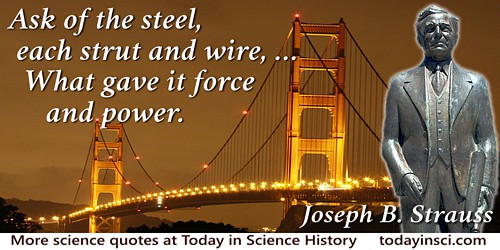
The Mighty Task is Done
At last the mighty task is done;
Resplendent in the western sun
The Bridge looms mountain high;
Its titan piers grip ocean floor,
Its great steel arms link shore with shore,
Its towers pierce the sky.
On its broad decks in rightful pride,
The world in swift parade shall ride,
Throughout all time to be;
Beneath, fleet ships from every port,
Vast landlocked bay, historic fort,
And dwarfing all the sea.
To north, the Redwood Empires gates;
To south, a happy playground waits,
In Rapturous appeal;
Here nature, free since time began,
Yields to the restless moods of man,
Accepts his bonds of steel.
Launched midst a thousand hopes and fears,
Damned by a thousand hostile sneers,
Yet Neer its course was stayed,
But ask of those who met the foe
Who stood alone when faith was low,
Ask them the price they paid.
Ask of the steel, each strut and wire,
Ask of the searching, purging fire,
That marked their natal hour;
Ask of the mind, the hand, the heart,
Ask of each single, stalwart part,
What gave it force and power.
An Honored cause and nobly fought
And that which they so bravely wrought,
Now glorifies their deed,
No selfish urge shall stain its life,
Nor envy, greed, intrigue, nor strife,
Nor false, ignoble creed.
High overhead its lights shall gleam,
Far, far below lifes restless stream,
Unceasingly shall flow;
For this was spun its lithe fine form,
To fear not war, nor time, nor storm,
For Fate had meant it so.
At last the mighty task is done;
Resplendent in the western sun
The Bridge looms mountain high;
Its titan piers grip ocean floor,
Its great steel arms link shore with shore,
Its towers pierce the sky.
On its broad decks in rightful pride,
The world in swift parade shall ride,
Throughout all time to be;
Beneath, fleet ships from every port,
Vast landlocked bay, historic fort,
And dwarfing all the sea.
To north, the Redwood Empires gates;
To south, a happy playground waits,
In Rapturous appeal;
Here nature, free since time began,
Yields to the restless moods of man,
Accepts his bonds of steel.
Launched midst a thousand hopes and fears,
Damned by a thousand hostile sneers,
Yet Neer its course was stayed,
But ask of those who met the foe
Who stood alone when faith was low,
Ask them the price they paid.
Ask of the steel, each strut and wire,
Ask of the searching, purging fire,
That marked their natal hour;
Ask of the mind, the hand, the heart,
Ask of each single, stalwart part,
What gave it force and power.
An Honored cause and nobly fought
And that which they so bravely wrought,
Now glorifies their deed,
No selfish urge shall stain its life,
Nor envy, greed, intrigue, nor strife,
Nor false, ignoble creed.
High overhead its lights shall gleam,
Far, far below lifes restless stream,
Unceasingly shall flow;
For this was spun its lithe fine form,
To fear not war, nor time, nor storm,
For Fate had meant it so.
Written upon completion of the building of the Golden Gate Bridge, May 1937. In Allen Brown, Golden Gate: biography of a Bridge (1965), 229.
[About Francis Baily] The history of the astronomy of the nineteenth century will be incomplete without a catalogue of his labours. He was one of the founders of the Astronomical Society, and his attention to its affairs was as accurate and minute as if it had been a firm of which he was the chief clerk, with expectation of being taken into partnership.
In Supplement to the Penny Cyclopaedia. Quoted in Sophia Elizabeth De Morgan, Memoir of Augustus De Morgan (1882), 46
Die Geschichte der Wissenschaften ist eine grosse Fuge, in der die Stimmen der Völker nach und nach zum Vorschein kommen.
The history of the sciences is a great fugue, in which the voices of the nations come one by one into notice.
The history of the sciences is a great fugue, in which the voices of the nations come one by one into notice.
In James Wood, Dictionary of Quotations from Ancient and Modern, English and Foreign Sources (1893), 64:23.
Discovery always carries an honorific connotation. It is the stamp of approval on a finding of lasting value. Many laws and theories have come and gone in the history of science, but they are not spoken of as discoveries. Kepler is said to have discovered the laws of planetary motion named after him, but no the many other 'laws' which he formulated. ... Theories are especially precarious, as this century profoundly testifies. World views can and do often change. Despite these difficulties, it is still true that to count as a discovery a finding must be of at least relatively permanent value, as shown by its inclusion in the generally accepted body of scientific knowledge.
Discovery in the Physical Sciences (1969). In Rodney P. Carlisle, Scientific American Inventions and Discoveries (2004), 179.
Goldsmith: If you put a tub full of blood into a stable, the horses are like to go mad.
Johnson: I doubt that.
Goldsmith: Nay, sir, it is a fact well authenticated.
Thrale: You had better prove it before you put it into your book on natural history. You may do it in my stable if you will.
Johnson: Nay, sir, I would not have him prove it. If he is content to take his information from others, he may get through his book with little trouble, and without much endangering his reputation. But if he makes experiments for so comprehensive a book as his, there would be no end to them; his erroneous assertions would then fall upon himself: and he might be blamed for not having made experiments as to every particular.
Johnson: I doubt that.
Goldsmith: Nay, sir, it is a fact well authenticated.
Thrale: You had better prove it before you put it into your book on natural history. You may do it in my stable if you will.
Johnson: Nay, sir, I would not have him prove it. If he is content to take his information from others, he may get through his book with little trouble, and without much endangering his reputation. But if he makes experiments for so comprehensive a book as his, there would be no end to them; his erroneous assertions would then fall upon himself: and he might be blamed for not having made experiments as to every particular.
In James Boswell, The Life of Samuel Johnson, LL.D.: Comprehending an Account of His Studies and Numerous Works (1785, 1830), 229-230.
Primo enim paranda est Historia Naturalis et Experimentalis, suffidens et bona; quod fundamentum rei est: neque enim fingendum, aut excogitandum, sed inveniendum, quid natura faciat aut ferat.
For first of all we must prepare a Natural and Experimental History, sufficient and good; and this is the foundation of all; for we are not to imagine or suppose, but to discover, what nature does or may be made to do.
For first of all we must prepare a Natural and Experimental History, sufficient and good; and this is the foundation of all; for we are not to imagine or suppose, but to discover, what nature does or may be made to do.
In Novum Organum, Book 2, Aphorism 10. As translated in Francis Bacon and James Spedding with Robert Leslie Ellis (eds.), 'The New Organon', The Works of Francis Bacon: Translations of the Philosophical Works (1858), Vol. 4, 127. Also seen in epigraphs as a shorter quote, “Non fingendum, aut excogitandum, sed inveniendum, quid natura faciat aut ferat,” which can also be translated as “We have not to imagine or to think out, but to find out what Nature does or produces.”
Παιδεία ἄρα ἐδτὶν ἡ ἔντευξις τῶν ἠθῶν. τοῦτο καὶ Θουκυδίδης ἔοικε λέγειν περὶ ἳστορίας λέγων· ὄτι καὶ ἱστορία φιλοσοφία ἐστὶν ἐκ παραδειγμάτων.
Education should be the cultivation of character, just as Thucydides (1, 22) used to say of history, that it was philosophy teaching by examples.
Education should be the cultivation of character, just as Thucydides (1, 22) used to say of history, that it was philosophy teaching by examples.
In Ars Rhetorica, XI, 2, 212, (Tauchnitz edition). As quoted in William Francis Henry King (ed.), Classical and Foreign Quotations: A Polyglot Manual of Historical and Literary Sayings, Noted Passages in Poetry and Prose, Phrases, Proverbs, and Bons Mots (3rd ed., 1904), 255.
A ... hypothesis may be suggested, which supposes the word 'beginning' as applied by Moses in the first of the Book of Genesis, to express an undefined period of time which was antecedent to the last great change that affected the surface of the earth, and to the creation of its present animal and vegetable inhabitants; during which period a long series of operations and revolutions may have been going on, which, as they are wholly unconnected with the history of the human race, are passed over in silence by the sacred historian, whose only concern with them was largely to state, that the matter of the universe is not eternal and self-existent but was originally created by the power of the Almighty.
Vindiciae Geologicae (1820), 31-2.
A cell has a history; its structure is inherited, it grows, divides, and, as in the embryo of higher animals, the products of division differentiate on complex lines. Living cells, moreover, transmit all that is involved in their complex heredity. I am far from maintaining that these fundamental properties may not depend upon organisation at levels above any chemical level; to understand them may even call for different methods of thought; I do not pretend to know. But if there be a hierarchy of levels we must recognise each one, and the physical and chemical level which, I would again say, may be the level of self-maintenance, must always have a place in any ultimate complete description.
'Some Aspects of Biochemistry', The Irish Journal of Medical Science (1932), 79, 346.
A computer lets you make more mistakes faster than any invention in human history—with the possible exceptions of handguns and tequila.
…...
A country grows in history not only because of the heroism of its troops on the field of battle, it grows also when it turns to justice and to right for the conservation of its interests.
…...
A doctor who cannot take a good history and a patient who cannot give one are in danger of giving and receiving bad treatment.
In Paul Dudley White , Clues in the Diagnosis and Treatment of Heart Disease (1956), Introduction.
A historical fact is rather like the flamingo that Alice in Wonderland tried to use as a croquet mallet. As soon as she got its neck nicely straightened out and was ready to hit the ball, it would turn and look at her with a puzzled expression, and any biographer knows that what is called a “fact” has a way of doing the same.
From 'Getting at the Truth', The Saturday Review (19 Sep 1953), 36, No. 38, 11. Excerpted in Meta Riley Emberger and Marian Ross Hall, Scientific Writing (1955), 399.
A hundred years ago the study of life was often pursued, and also presented to the public, in a highly unified way. Darwin, as everyone knows, in addressing the world at large began his story with the history of pigeons and ended it with the breeding of primroses, having made excursions on the way into the origins of coral reefs and of the races of Man.
In 'The Unification of Biology', New Scientist (11 Jan 1962), 13, No. 269, 72.
A laboratory of natural history is a sanctuary where nothing profane should be tolerated. I feel less agony at improprieties in churches than in a scientific laboratory.
Lecture at a teaching laboratory on Penikese Island, Buzzard's Bay. Quoted from the lecture notes by David Starr Jordan, Science Sketches (1911), 147.
A Lady with a Lamp shall stand
In the great history of the land,
A noble type of good,
Heroic womanhood.
In the great history of the land,
A noble type of good,
Heroic womanhood.
'Santa Filomena' (1857), The Poetical Works of Henry Wadsworth Longfellow (1867), 333.
A modern branch of mathematics, having achieved the art of dealing with the infinitely small, can now yield solutions in other more complex problems of motion, which used to appear insoluble. This modern branch of mathematics, unknown to the ancients, when dealing with problems of motion, admits the conception of the infinitely small, and so conforms to the chief condition of motion (absolute continuity) and thereby corrects the inevitable error which the human mind cannot avoid when dealing with separate elements of motion instead of examining continuous motion. In seeking the laws of historical movement just the same thing happens. The movement of humanity, arising as it does from innumerable human wills, is continuous. To understand the laws of this continuous movement is the aim of history. … Only by taking an infinitesimally small unit for observation (the differential of history, that is, the individual tendencies of man) and attaining to the art of integrating them (that is, finding the sum of these infinitesimals) can we hope to arrive at the laws of history.
War and Peace (1869), Book 11, Chap. 1.
A multidisciplinary study group ... estimated that it would be 1980 before developments in artificial intelligence make it possible for machines alone to do much thinking or problem solving of military significance. That would leave, say, five years to develop man-computer symbiosis and 15 years to use it. The 15 may be 10 or 500, but those years should be intellectually the most creative and exciting in the history of mankind.
From article 'Man-Computer Symbiosis', in IRE Transactions on Human Factors in Electronics (Mar 1960), Vol. HFE-1, 4-11.
A noteworthy and often-remarked similarity exists between the facts and methods of geology and those of linguistic study. The science of language is, as it were, the geology of the most modern period, the Age of the Man, having for its task to construct the history of development of the earth and its inhabitants from the time when the proper geological record remains silent … The remains of ancient speech are like strata deposited in bygone ages, telling of the forms of life then existing, and of the circumstances which determined or affected them; while words are as rolled pebbles, relics of yet more ancient formations, or as fossils, whose grade indicates the progress of organic life, and whose resemblances and relations show the correspondence or sequence of the different strata; while, everywhere, extensive denudation has marred the completeness of the record, and rendered impossible a detailed exhibition of the whole course of development.
In Language and the Study of Language (1867), 47.
A science cannot be played with. If an hypothesis is advanced that obviously brings into direct sequence of cause and effect all the phenomena of human history, we must accept it, and if we accept it, we must teach it.
In The Degradation of the Democratic Dogma (1919), 131.
A science cannot be played with. If an hypothesis is advanced that obviously brings into direct sequence of cause and effect all the phenomena of human history, we must accept it, and if we accept it, we must teach it.
In The Degradation of the Democratic Dogma (1919), 131.
A study of history shows that civilizations that abandon the quest for knowledge are doomed to disintegration.
In The Observer (14 May 1972), 'Sayings of the Week'. As cited in Bill Swainson, The Encarta Book of Quotations (2000), 579.
A superficial knowledge of mathematics may lead to the belief that this subject can be taught incidentally, and that exercises akin to counting the petals of flowers or the legs of a grasshopper are mathematical. Such work ignores the fundamental idea out of which quantitative reasoning grows—the equality of magnitudes. It leaves the pupil unaware of that relativity which is the essence of mathematical science. Numerical statements are frequently required in the study of natural history, but to repeat these as a drill upon numbers will scarcely lend charm to these studies, and certainly will not result in mathematical knowledge.
In Primary Arithmetic: First Year, for the Use of Teachers (1897), 26-27.
A superficial knowledge of mathematics may lead to the belief that this subject can be taught incidentally, and that exercises akin to counting the petals of flowers or the legs of a grasshopper are mathematical. Such work ignores the fundamental idea out of which quantitative reasoning grows—the equality of magnitudes. It leaves the pupil unaware of that relativity which is the essence of mathematical science. Numerical statements are frequently required in the study of natural history, but to repeat these as a drill upon numbers will scarcely lend charm to these studies, and certainly will not result in mathematical knowledge.
In Primary Arithmetic: First Year, for the Use of Teachers (1897), 26-27.
Absorbed in the special investigation, I paid no heed to the edifice which was meanwhile unconsciously building itself up. Having however completed the comparison of the fossil species in Paris, I wanted, for the sake of an easy revision of the same, to make a list according to their succession in geological formations, with a view of determining the characteristics more exactly and bringing them by their enumeration into bolder relief. What was my joy and surprise to find that the simplest enumeration of the fossil fishes according to their geological succession was also a complete statement of the natural relations of the families among themselves; that one might therefore read the genetic development of the whole class in the history of creation, the representation of the genera and species in the several families being therein determined; in one word, that the genetic succession of the fishes corresponds perfectly with their zoological classification, and with just that classification proposed by me.
Quoted in Elizabeth Cary Agassiz (ed.), Louis Agassiz: His Life and Correspondence (1885), Vol. I, 203-4.
According to the conclusion of Dr. Hutton, and of many other geologists, our continents are of definite antiquity, they have been peopled we know not how, and mankind are wholly unacquainted with their origin. According to my conclusions drawn from the same source, that of facts, our continents are of such small antiquity, that the memory of the revolution which gave them birth must still be preserved among men; and thus we are led to seek in the book of Genesis the record of the history of the human race from its origin. Can any object of importance superior to this be found throughout the circle of natural science?
An Elementary Treatise on Geology (1809), 82.
Admit for a moment, as a hypothesis, that the Creator had before his mind a projection of the whole life-history of the globe, commencing with any point which the geologist may imagine to have been a fit commencing point, and ending with some unimaginable acme in the indefinitely distant future. He determines to call this idea into actual existence, not at the supposed commencing point, but at some stage or other of its course. It is clear, then, that at the selected stage it appears, exactly as it would have appeared at that moment of its history, if all the preceding eras of its history had been real.
Omphalos: An Attempt to Untie the Geological Knot (1857), 351.
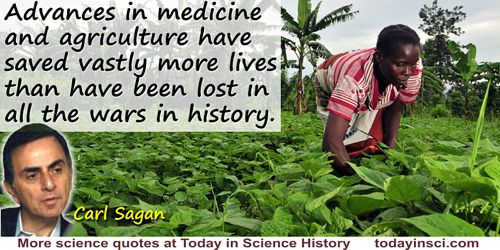
Advances in medicine and agriculture have saved vastly more lives than have been lost in all the wars in history.
The Demon-Haunted World: Science as a Candle in the Dark (1996), 11.
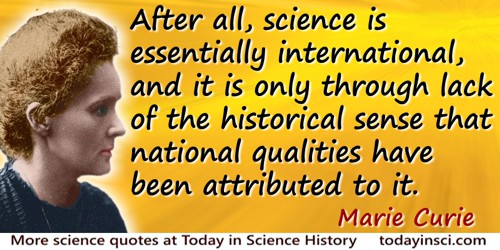
After all, science is essentially international, and it is only through lack of the historical sense that national qualities have been attributed to it.
'Memorandum by Madame Curie, Member of the Committee, on the Question of International Scholarships for the advancement of the Sciences and the Development of Laboratories', League of Nations, International Committee on Intellectual Co-operation: Sub-committee of Experts for the Instruction of Children and Youth in the Existence and Aims of the League of Nations. (Recommendations. Preamble): Issue 5, Issues 9-13 (1926), 12.
After an honest day’s work a mathematician goes off duty. Mathematics is very hard work, and dons tend to be above average in health and vigor. Below a certain threshold a man cracks up; but above it, hard mental work makes for health and vigor (also—on much historical evidence throughout the ages—for longevity). I have noticed lately that when I am working really hard I wake around 5.30 a.m. ready and eager to start; if I am slack, I sleep till I am called.
In 'The Mathematician’s Art of Work' (1967), collected in Béla Bollobás (ed.), Littlewood’s Miscellany (1986), 195.
After innumerable dynasties of giant creatures, after endless generations of fish and families of molluscs, man finally arrives, the degenerate product of a grandiose type, his mould perhaps broken by his Creator. Fired by his retrospection, these timid humans, born but yesterday, can now leap across chaos, sing an endless hymn, and configure the history of the universe in a sort of retrograde Apocalypse.
From 'La Peau de Chagrin' (1831). As translated as by Helen Constantine The Wild Ass’s Skin (2012), 19.
All fossil anthropoids found hitherto have been known only from mandibular or maxillary fragments, so far as crania are concerned, and so the general appearance of the types they represented had been unknown; consequently, a condition of affairs where virtually the whole face and lower jaw, replete with teeth, together with the major portion of the brain pattern, have been preserved, constitutes a specimen of unusual value in fossil anthropoid discovery. Here, as in Homo rhodesiensis, Southern Africa has provided documents of higher primate evolution that are amongst the most complete extant. Apart from this evidential completeness, the specimen is of importance because it exhibits an extinct race of apes intermediate between living anthropoids and man ... Whether our present fossil is to be correlated with the discoveries made in India is not yet apparent; that question can only be solved by a careful comparison of the permanent molar teeth from both localities. It is obvious, meanwhile, that it represents a fossil group distinctly advanced beyond living anthropoids in those two dominantly human characters of facial and dental recession on one hand, and improved quality of the brain on the other. Unlike Pithecanthropus, it does not represent an ape-like man, a caricature of precocious hominid failure, but a creature well advanced beyond modern anthropoids in just those characters, facial and cerebral, which are to be anticipated in an extinct link between man and his simian ancestor. At the same time, it is equally evident that a creature with anthropoid brain capacity and lacking the distinctive, localised temporal expansions which appear to be concomitant with and necessary to articulate man, is no true man. It is therefore logically regarded as a man-like ape. I propose tentatively, then, that a new family of Homo-simidæ be created for the reception of the group of individuals which it represents, and that the first known species of the group be designated Australopithecus africanus, in commemoration, first, of the extreme southern and unexpected horizon of its discovery, and secondly, of the continent in which so many new and important discoveries connected with the early history of man have recently been made, thus vindicating the Darwinian claim that Africa would prove to be the cradle of mankind.
'Australopithicus africanus: The Man-Ape of South Africa', Nature, 1925, 115, 195.
All geologic history is full of the beginning and the ends of species–of their first and last days; but it exhibits no genealogies of development.
Lecture to the Edinburgh Philosophical Institution, 'Geology in its Bearings on the Two Theologies, Part 1', collected in The Testimony of the Rocks: or, Geology in Its Bearings on the Two Theologies, Natural and Revealed (1857), 220.
All interesting issues in natural history are questions of relative frequency, not single examples. Everything happens once amidst the richness of nature. But when an unanticipated phenomenon occurs again and again–finally turning into an expectation–then theories are overturned.
…...
All of us are interested in our roots. Generally this interest is latent in youth, and grows with age. Until I reached fifty I thought that history of science was a refuge for old scientists whose creative juices had dried up. Now of course I know that I was wrong! As we grow older, we become more interested in the past, in family history, local history, etc. Astronomy is, or was when I started in it, almost a family.
In Organizations and Strategies in Astronomy (2002), Vol. 3, 206.
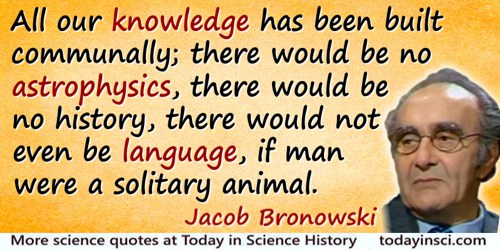
All our knowledge has been built communally; there would be no astrophysics, there would be no history, there would not even be language, if man were a solitary animal. What follows? It follows that we must be able to rely on other people; we must be able to trust their word. That is, it follows that there is a principle, which binds society together because without it the individual would be helpless to tell the truth from the false. This principle is truthfulness.
In Lecture at M.I.T. (19 Mar 1953), collected in 'The Sense of Human Dignity', Science and Human Values (1956, 1990), 57.
All that concerns the Mediterranean is of the deepest interest to civilized man, for the history of its progress is the history of the development of the world; the memory of the great men who have lived and died around its banks; the recollection of the undying works that have come thence to delight us for ever; the story of patient research and brilliant discoveries connected with every physical phenomenon presented by its waves and currents, and with every order of creatures dwelling in and around its waters.
From Literary Papers (1855), 106. As quoted in On Early Explorations in the Mediterranean.In George Wilson and Archibald Geikie, Memoir of Edward Forbes F.R.S. (1861), 279. Geike introduces the Forbes quote as “the recollection of these, his earliest explorations in the Mediterranean,” as written down years later.
All the different classes of beings which taken together make up the universe are, in the ideas of God who knows distinctly their essential gradations, only so many ordinates of a single curve so closely united that it would be impossible to place others between any two of them, since that would imply disorder and imperfection. Thus men are linked with the animals, these with the plants and these with the fossils which in turn merge with those bodies which our senses and our imagination represent to us as absolutely inanimate. And, since the law of continuity requires that when the essential attributes of one being approximate those of another all the properties of the one must likewise gradually approximate those of the other, it is necessary that all the orders of natural beings form but a single chain, in which the various classes, like so many rings, are so closely linked one to another that it is impossible for the senses or the imagination to determine precisely the point at which one ends and the next begins?all the species which, so to say, lie near the borderlands being equivocal, at endowed with characters which might equally well be assigned to either of the neighboring species. Thus there is nothing monstrous in the existence zoophytes, or plant-animals, as Budaeus calls them; on the contrary, it is wholly in keeping with the order of nature that they should exist. And so great is the force of the principle of continuity, to my thinking, that not only should I not be surprised to hear that such beings had been discovered?creatures which in some of their properties, such as nutrition or reproduction, might pass equally well for animals or for plants, and which thus overturn the current laws based upon the supposition of a perfect and absolute separation of the different orders of coexistent beings which fill the universe;?not only, I say, should I not be surprised to hear that they had been discovered, but, in fact, I am convinced that there must be such creatures, and that natural history will perhaps some day become acquainted with them, when it has further studied that infinity of living things whose small size conceals them for ordinary observation and which are hidden in the bowels of the earth and the depth of the sea.
Lettre Prétendue de M. De Leibnitz, à M. Hermann dont M. Koenig a Cité le Fragment (1753), cxi-cxii, trans. in A. O. Lovejoy, Great Chain of Being: A Study of the History of an Idea (1936), 144-5.
Almost everyone... seems to be quite sure that the differences between the methodologies of history and of the natural sciences are vast. For, we are assured, it is well known that in the natural sciences we start from observation and proceed by induction to theory. And is it not obvious that in history we proceed very differently? Yes, I agree that we proceed very differently. But we do so in the natural sciences as well.
In both we start from myths—from traditional prejudices, beset with error—and from these we proceed by criticism: by the critical elimination of errors. In both the role of evidence is, in the main, to correct our mistakes, our prejudices, our tentative theories—that is, to play a part in the critical discussion, in the elimination of error. By correcting our mistakes, we raise new problems. And in order to solve these problems, we invent conjectures, that is, tentative theories, which we submit to critical discussion, directed towards the elimination of error.
In both we start from myths—from traditional prejudices, beset with error—and from these we proceed by criticism: by the critical elimination of errors. In both the role of evidence is, in the main, to correct our mistakes, our prejudices, our tentative theories—that is, to play a part in the critical discussion, in the elimination of error. By correcting our mistakes, we raise new problems. And in order to solve these problems, we invent conjectures, that is, tentative theories, which we submit to critical discussion, directed towards the elimination of error.
The Myth of the Framework: In Defence of Science and Rationality (1993), 140.
America, so far as her physical history is concerned, has been falsely denominated the New World. Hers was the first dry land lifted out of the waters, hers the first shore washed by the ocean that enveloped all the earth beside; and while Europe was represented only by islands rising here and there above the sea, America already stretched an unbroken line of land from Nova Scotia to the Far West.
Geological Sketches (1866), I.
Among the current discussions, the impact of new and sophisticated methods in the study of the past occupies an important place. The new 'scientific' or 'cliometric' history—born of the marriage contracted between historical problems and advanced statistical analysis, with economic theory as bridesmaid and the computer as best man—has made tremendous advances in the last generation.
Co-author with Geoffrey Rudolph Elton (1921-94), British historian. Which Road to the Past? Two Views of History (1983), 2.
Among the older records, we find chapter after chapter of which we can read the characters, and make out their meaning: and as we approach the period of man’s creation, our book becomes more clear, and nature seems to speak to us in language so like our own, that we easily comprehend it. But just as we begin to enter on the history of physical changes going on before our eyes, and in which we ourselves bear a part, our chronicle seems to fail us—a leaf has been torn out from nature's record, and the succession of events is almost hidden from our eyes.
Letter 1 to William Wordsworth. Quoted in the appendix to W. Wordsworth, A Complete Guide to the Lakes, Comprising Minute Direction for the Tourist, with Mr Wordsworth's Description of the Scenery of the County and Three Letters upon the Geology of the Lake District (1842), 14.
An anecdote is an historical molecule…. The general form of history is a fusion of anecdotes.
In M.J. Hope (ed., trans.), Novalis: His Life, Thoughts, and Works (1891), 188.
An evolution is a series of events that in itself as series is purely physical, — a set of necessary occurrences in the world of space and time. An egg develops into a chick; … a planet condenses from the fluid state, and develops the life that for millions of years makes it so wondrous a place. Look upon all these things descriptively, and you shall see nothing but matter moving instant after instant, each instant containing in its full description the necessity of passing over into the next. … But look at the whole appreciatively, historically, synthetically, as a musician listens to a symphony, as a spectator watches a drama. Now you shall seem to have seen, in phenomenal form, a story.
In The Spirit of Modern Philosophy: An Essay in the Form of Lectures (1892), 425.
An evolutionary perspective of our place in the history of the earth reminds us that Homo sapiens sapiens has occupied the planet for the tiniest fraction of that planet's four and a half thousand million years of existence. In many ways we are a biological accident, the product of countless propitious circumstances. As we peer back through the fossil record, through layer upon layer of long-extinct species, many of which thrived far longer than the human species is ever likely to do, we are reminded of our mortality as a species. There is no law that declares the human animal to be different, as seen in this broad biological perspective, from any other animal. There is no law that declares the human species to be immortal.
Co-author with American science writer Roger Amos Lewin (1946), Origins: What New Discoveries Reveal about the Emergence of our Species and its Possible Future (1977), 256.
An extra-terrestrial philosopher, who had watched a single youth up to the age of twenty-one and had never come across any other human being, might conclude that it is the nature of human beings to grow continually taller and wiser in an indefinite progress towards perfection; and this generalization would be just as well founded as the generalization which evolutionists base upon the previous history of this planet.
Scientific Method in Philosophy (1914), 12.
Anatomy is to physiology as geography is to history; it describes the theatre of events.
De Naturali Parte Medicinae Libri Septem (1542), Ch. 1.
Anaximander son of Praxiades, of Miletus: he said that the principle and element is the Indefinite, not distinguishing air or water or anything else. … he was the first to discover a gnomon, and he set one up on the Sundials (?) in Sparta, according to Favorinus in his Universal History, to mark solstices and equinoxes; and he also constructed hour indicators. He was the first to draw an outline of earth and sea, but also constructed a [celestial] globe. Of his opinions he made a summary exposition, which I suppose Apollodorus the Athenian also encountered. Apollodorus says in his Chronicles that Anaximander was sixty-four years old in the year of the fifty-eighth Olympiad [547/6 B.C.], and that he died shortly afterwards (having been near his prime approximately during the time of Polycrates, tyrant of Samos).
Diogenes Laërtius II, 1-2. In G.S. Kirk, J.E. Raven and M. Schofield (eds), The Presocratic Philosophers: A Critical History with a Selection of Texts (1957), 99. The editors of this translation note that Anaximander may have introduced the gnomon into Greece, but he did not discover it—the Babylonians used it earlier, and the celestial sphere, and the twelve parts of the day.
And having thus passed the principles of arithmetic, geometry, astronomy, and geography, with a general compact of physics, they may descend in mathematics to the instrumental science of trigonometry, and from thence to fortification, architecture, engineering, or navigation. And in natural philosophy they may proceed leisurely from the history of meteors, minerals, plants, and living creatures, as far as anatomy. Then also in course might be read to them out of some not tedious writer the institution of physic. … To set forward all these proceedings in nature and mathematics, what hinders but that they may procure, as oft as shall be needful, the helpful experiences of hunters, fowlers, fishermen, shepherds, gardeners, apothecaries; and in other sciences, architects, engineers, mariners, anatomists.
In John Milton and Robert Fletcher (ed.), 'On Education', The Prose Works of John Milton: With an Introductory Review (1834), 100.
And what a science Natural History will be, when we are in our graves, when all the laws of change are thought one of the most important parts of Natural History.
From Letter (1856) to J.D. Hooker, collected in in Francis Darwin, The Life and Letters of Charles Darwin (1896), 439. [Darwin was contemplating natural history as the synthesis of evolution (change) and forces of the environment.]
Anthropology has reached that point of development where the careful investigation of facts shakes our firm belief in the far-reaching theories that have been built up. The complexity of each phenomenon dawns on our minds, and makes us desirous of proceeding more cautiously. Heretofore we have seen the features common to all human thought. Now we begin to see their differences. We recognize that these are no less important than their similarities, and the value of detailed studies becomes apparent. Our aim has not changed, but our method must change. We are still searching for the laws that govern the growth of human culture, of human thought; but we recognize the fact that before we seek for what is common to all culture, we must analyze each culture by careful and exact methods, as the geologist analyzes the succession and order of deposits, as the biologist examines the forms of living matter. We see that the growth of human culture manifests itself in the growth of each special culture. Thus we have come to understand that before we can build up the theory of the growth of all human culture, we must know the growth of cultures that we find here and there among the most primitive tribes of the Arctic, of the deserts of Australia, and of the impenetrable forests of South America; and the progress of the civilization of antiquity and of our own times. We must, so far as we can, reconstruct the actual history of mankind, before we can hope to discover the laws underlying that history.
The Jesup North Pacific Expedition: Memoir of the American Museum of Natural History (1898), Vol. 1, 4.
Any one who has studied the history of science knows that almost every great step therein has been made by the “anticipation of Nature,” that is, by the invention of hypotheses, which, though verifiable, often had very little foundation to start with; and, not unfrequently, in spite of a long career of usefulness, turned out to be wholly erroneous in the long run.
In 'The Progress of Science 1837-1887' (1887), Collected Essays (1901), Vol. 1, 62.
Anyone who has examined into the history of the theories of earth evolution must have been astounded to observe the manner in which the unique and the difficultly explainable has been made to take the place of the common and the natural in deriving the framework of these theories.
Earth Evolution and Facial Expression (1921), 174.
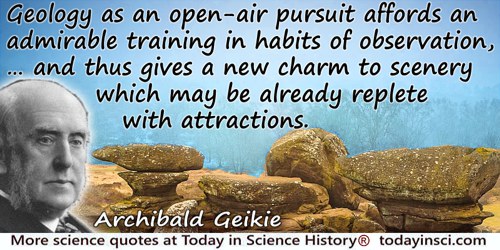
Apart from its healthful mental training as a branch of ordinary education, geology as an open-air pursuit affords an admirable training in habits of observation, furnishes a delightful relief from the cares and routine of everyday life, takes us into the open fields and the free fresh face of nature, leads us into all manner of sequestered nooks, whither hardly any other occupation or interest would be likely to send us, sets before us problems of the highest interest regarding the history of the ground beneath our feet, and thus gives a new charm to scenery which may be already replete with attractions.
Outlines of Field-Geology (1900), 251-2.
As history proves abundantly, mathematical achievement, whatever its intrinsic worth, is the most enduring of all.
In A Mathematician’s Apology (1940, 1967), 80.
As I strayed into the study of an eminent physicist, I observed hanging against the wall, framed like a choice engraving, several dingy, ribbon-like strips of, I knew not what... My curiosity was at once aroused. What were they? ... They might be shreds of mummy-wraps or bits of friable bark-cloth from the Pacific, ... [or] remnants from a grandmother’s wedding dress... They were none of these... He explained that they were carefully-prepared photographs of portions of the Solar Spectrum. I stood and mused, absorbed in the varying yet significant intensities of light and shade, bordered by mystic letters and symbolic numbers. As I mused, the pale legend began to glow with life. Every line became luminous with meaning. Every shadow was suffused with light shining from behind, suggesting some mighty achievement of knowledge; of knowledge growing more daring in proportion to the remoteness of the object known; of knowledge becoming more positive in its answers, as the questions which were asked seemed unanswerable. No Runic legend, no Babylonish arrowhead, no Egyptian hieroglyph, no Moabite stone, could present a history like this, or suggest thoughts of such weighty import or so stimulate and exalt the imagination.
The Sciences of Nature Versus the Science of Man: A Plea for the Science of Man (1871), 7-9.
As Karl Marx once noted: “Hegel remarks somewhere that all great, world-historical facts and personages occur, as it were, twice. He forgot to add: the first time as tragedy, the second as farce.” William Jennings Bryan and the Scopes trial was a tragedy. The creationists and intelligent design theorists are a farce.
In '75 Years and Still No Peace'. Humanist (Sep 2000)
Asian Homo erectus died without issue and does not enter our immediate ancestry (for we evolved from African populations); Neanderthal people were collateral cousins, perhaps already living in Europe while we emerged in Africa... In other words, we are an improbable and fragile entity, fortunately successful after precarious beginnings as a small population in Africa, not the predictable end result of a global tendency. We are a thing, an item of history, not an embodiment of general principles.
Wonderful Life (1989), 319.
Astronomers work always with the past; because light takes time to move from one place to another, they see things as they were, not as they are.
The Telescope Handbook and Star Atlas (1967), 33.
At the bidding of a Peter the Hermit many millions of men swarmed to the East; the words of an hallucinated person … have created the force necessary to triumph over the Graeco-Roman world; an obscure monk like Luther set Europe ablaze and bathed in blood. The voice of a Galileo or a Newton will never have the least echo among the masses. The inventors of genius transform a civilization. The fanatics and the hallucinated create history.
From Les Premières Civilisations (1889), 171. English in The Psychology of Peoples (1898), Book 1, Chap. 1, 204, tweaked by Webmaster. Original French text: “A la voix d'un Pierre l'Ermite, plusieurs millions d'hommes se sont précipités sur l'Orient; les paroles d'un halluciné … ont créé la force nécessaire pour triompher du vieux monde gréco-romain; un moine obscur, comme Luther, a mis l'Europe à feu et à sang. Ce n’est pas parmi les foules que la voix d’un Galilée ou d’un Newton aura jamais le plus faible écho. Les inventeurs de génie transforment une civilisation. Les fanatiques et les hallucinés créent l’histoire.”
At the sea shore you pick up a pebble, fashioned after a law of nature, in the exact form that best resists pressure, and worn as smooth as glass. It is so perfect that you take it as a keepsake. But could you know its history from the time when a rough fragment of rock fell from the overhanging cliff into the sea, to be taken possession of by the under currents, and dragged from one ocean to another, perhaps around the world, for a hundred years, until in reduced and perfect form it was cast upon the beach as you find it, you would have a fit illustration of what many principles, now in familiar use, have endured, thus tried, tortured and fashioned during the ages.
From Address (1 Aug 1875), 'The Growth of Principles' at Saratoga. Collected in William L. Snyder (ed.), Great Speeches by Great Lawyers: A Collection of Arguments and Speeches (1901), 246.
Basic research at universities comes in two varieties: research that requires big bucks and research that requires small bucks. Big bucks research is much like government research and in fact usually is government research but done for the government under contract. Like other government research, big bucks academic research is done to understand the nature and structure of the universe or to understand life, which really means that it is either for blowing up the world or extending life, whichever comes first. Again, that's the government's motivation. The universities' motivation for conducting big bucks research is to bring money in to support professors and graduate students and to wax the floors of ivy-covered buildings. While we think they are busy teaching and learning, these folks are mainly doing big bucks basic research for a living, all the while priding themselves on their terrific summer vacations and lack of a dress code.
Smalls bucks research is the sort of thing that requires paper and pencil, and maybe a blackboard, and is aimed primarily at increasing knowledge in areas of study that don't usually attract big bucks - that is, areas that don't extend life or end it, or both. History, political science, and romance languages are typically small bucks areas of basic research. The real purpose of small bucks research to the universities is to provide a means of deciding, by the quality of their small bucks research, which professors in these areas should get tenure.
Smalls bucks research is the sort of thing that requires paper and pencil, and maybe a blackboard, and is aimed primarily at increasing knowledge in areas of study that don't usually attract big bucks - that is, areas that don't extend life or end it, or both. History, political science, and romance languages are typically small bucks areas of basic research. The real purpose of small bucks research to the universities is to provide a means of deciding, by the quality of their small bucks research, which professors in these areas should get tenure.
Accidental Empires (1992), 78.
Between men of different studies and professions, may be observed a constant reciprocation of reproaches. The collector of shells and stones derides the folly of him who pastes leaves and flowers upon paper, pleases himself with colours that are perceptibly fading, and amasses with care what cannot be preserved. The hunter of insects stands amazed that any man can waste his short time upon lifeless matter, while many tribes of animals yet want their history. Every one is inclined not only to promote his own study, but to exclude all others from regard, and having heated his imagination with some favourite pursuit, wonders that the rest of mankind are not seized with the same passion.
From 'Numb. 83, Tuesday, January 1, 1750', The Rambler (1756), Vol. 2, 150.
Biographical history, as taught in our public schools, is still largely a history of boneheads: ridiculous kings and queens, paranoid political leaders, compulsive voyagers, ignorant generals—the flotsam and jetsam of historical currents. The men who radically altered history, the great creative scientists and mathematicians, are seldom mentioned if at all.
Opening paragraph of book review, 'Adventures Of a Mathematician: The Man Who Invented the H-Bomb', New York Times (9 May 1976), 201.
Biological evolution is a system of constant divergence without subsequent joining of branches. Lineages, once distinct, are separate forever. In human history, transmission across lineages is, perhaps, the major source of cultural change. Europeans learned about corn and potatoes from Native Americans and gave them smallpox in return.
…...
Biology as a discipline would benefit enormously if we could bring together the scientists working at the opposite ends of the biological spectrum. Students of organisms who know natural history have abundant questions to offer the students of molecules and cells. And molecular and cellular biologists with their armory of techniques and special insights have much to offer students of organisms and ecology.
In 'The role of natural history in contemporary biology', BioScience (1986), 36, 328-329.
Biology can be divided into the study of proximate causes, the study of the physiological sciences (broadly conceived), and into the study of ultimate (evolutionary) causes, the subject of natural history.
The Growth of Biological Thought: Diversity, Evolution and Inheritance (1982), 67.
Biology is a science of three dimensions. The first is the study of each species across all levels of biological organization, molecule to cell to organism to population to ecosystem. The second dimension is the diversity of all species in the biosphere. The third dimension is the history of each species in turn, comprising both its genetic evolution and the environmental change that drove the evolution. Biology, by growing in all three dimensions, is progressing toward unification and will continue to do so.
In 'Systematics and the Future of Biology', Systematics and the Origin of Species: on Ernst Mayr's 100th anniversary, Volume 102, Issues 22-26 (2005), 1.
Books are the carriers of civilization. Without books, history is silent, literature dumb, science crippled, thought and speculation at a standstill. Without books the development of civilization would have been impossible. They are engines of change, windows on the world, “lighthouses,” (as a poet said), “erected in the sea of time.”
In Authors League Bulletin (1979). As city in Charles Francis (ed.), Wisdom Well Said (2009), 48.
Books won’t stay banned. They won’t burn. Ideas won’t go to jail. In the long run of history, the censor and the inquisitor have always lost. The only sure weapon against bad ideas is better ideas. The source of better ideas is wisdom. The surest path to wisdom is a liberal education.
From Essays on Education. In Alfred Whitney Griswold, 1906-1963: In Memoriam (1964), 24.
Both history of nature and history of humanity are 'historical' and yet cannot dispense with uniformity. In both there is 'uniformity' ('science') as well as non-uniformity ('history'); in both 'history respects itself and 'history does not repeat itself. But, as even the history of humanity has its uniformitarian features, uniformity can still less be dispensed with in 'history' of nature, which, being one of the natural sciences, is less historical and, consequently, more uniformitarian.
Natural Law and Divine Miracle: The Principle of Uniformity in Geology, Biology and Theology (1963), 151.
But as a philosopher said, one day after mastering the winds, the waves, the tides and gravity, after all the scientific and technological achievements, we shall harness for God the energies of love. And then, for the second time in the history of the world, man will have discovered fire.
Speech accepting nomination as candidate for vice president, Democratic National Committee, Washington, D.C. (8 Aug 1972) as reported in New York Times (9 Aug 1972), 18. Shriver slightly paraphrased the similar sentiment written in 1934 by Pierre Teilhard de Chardin, translated by René Hague in 'The Evolution of Chastity', Toward the Future (1975), 86-87.
But as my conclusions have lately been much misrepresented, and it has been stated that I attribute the modification of species exclusively to natural selection, I may be permitted to remark that in the first edition of this work, and subsequently, I placed in a most conspicuous position—namely, at the close of the Introduction—the following words: “I am convinced that natural selection has been the main but not the exclusive means of modification.” This has been of no avail. Great is the power of steady misrepresentation; but the history of science shows that fortunately this power does not long endure.
In The Origin of Species by Means of Natural Selection with additions and corrections from sixth and last English edition (1899), Vol. 2, 293.
But for us, it’s different. Look again at that dot. That’s here. That’s home. That’s us. On it everyone you love, everyone you know, everyone you ever heard of, every human being who ever was, lived out their lives. The aggregate of our joy and suffering, thousands of confident religions, ideologies, and economic doctrines, every hunter and forager, every hero and coward, every creator and destroyer of civilization, every king and peasant, every young couple in love, every mother and father, hopeful child, inventor and explorer, every teacher of morals, every corrupt politician, every “superstar,” every “supreme leader,” every saint and sinner in the history of our species lived there - on a mote of dust suspended in a sunbeam.
…...
But if anyone, well seen in the knowledge, not onely of Sacred and exotick History, but of Astronomical Calculation, and the old Hebrew Kalendar, shall apply himself to these studies, I judge it indeed difficult, but not impossible for such a one to attain, not onely the number of years, but even, of dayes from the Creation of the World.
In 'Epistle to the Reader', The Annals of the World (1658). As excerpted in Wallen Yep, Man Before Adam: A Correction to Doctrinal Theology, "The Missing Link Found" (2002), 18.
But in nothing are swifts more singular than in their early retreat. They retire, as to the main body of them, by the tenth of August, and sometimes a few days sooner: and every straggler invariably withdraws by the twentieth, while their congeners, all of them, stay till the beginning of October; many of them all through that month, and some occasionally to the beginning of November. This early retreat is mysterious and wonderful, since that time is often the sweetest season in the year. But, what is more extraordinary, they begin to retire still earlier in the most southerly parts of Andalusia, where they can be no ways influenced by any defect of heat; or, as one might suppose, defect of food. Are they regulated in their motions with us by failure of food, or by a propensity to moulting, or by a disposition to rest after so rapid a life, or by what? This is one of those incidents in natural history that not only baffles our searches, but almost eludes our guesses!
In Letter to Daines Barrington, (28 Sep 1774), in The Natural History and Antiquities of Selborne (1789), 278.
By profession a biologist, [Thomas Henry Huxley] covered in fact the whole field of the exact sciences, and then bulged through its four fences. Absolutely nothing was uninteresting to him. His curiosity ranged from music to theology and from philosophy to history. He didn't simply know something about everything; he knew a great deal about everything.
'Thomas Henry Huxley.' In the Baltimore Evening Sun (4 May 1925). Reprinted in A Second Mencken Chrestomathy: A New Selection from the Writings of America's Legendary Editor, Critic, and Wit (2006), 157.
By the act of observation we have selected a ‘real’ history out of the many realities, and once someone has seen a tree in our world it stays there even when nobody is looking at it.
…...
By the death of Mr. O. Chanute the world has lost one whose labors had to an unusual degree influenced the course of human progress. If he had not lived the entire history of progress in flying would have been other than it has been.
Writing in Aeronautics in Jan 1911 about Chanute's death, collected in Wilbur Wright and Orville Wright, The Papers of Wilbur and Orville Wright: Volume Two 1906-1948 (1953), 1013.
Can I pay any higher tribute to a man [George Gaylord Simpson] than to state that his work both established a profession and sowed the seeds for its own revision? If Simpson had reached final truth, he either would have been a priest or would have chosen a dull profession. The history of life cannot be a dull profession.
From 'G.G. Simpson, Paleontology, and the Modern Synthesis', collected in Ernst Mayr, William B. Provine (eds.), The Evolutionary Synthesis: Perspectives on the Unification of Biology (1998), 171.
Celebrities are people who make news, but heroes are people who make history.
Quoted in Ponchitta Pierce, 'Who Are Our Heroes?', Parade Magazine (6 Aug 1995). As cited in Before I Pour This Over Your Head, Remember That I Love You (2011), 41 & 63.
Combining in our survey then, the whole range of deposits from the most recent to the most ancient group, how striking a succession do they present:– so various yet so uniform–so vast yet so connected. In thus tracing back to the most remote periods in the physical history of our continents, one system of operations, as the means by which many complex formations have been successively produced, the mind becomes impressed with the singleness of nature's laws; and in this respect, at least, geology is hardly inferior in simplicity to astronomy.
The Silurian System (1839), 574.
Commenting on Archimedes, for whom he also had a boundless admiration, Gauss remarked that he could not understand how Archimedes failed to invent the decimal system of numeration or its equivalent (with some base other than 10). … This oversight Gauss regarded as the greatest calamity in the history of science.
In Men of Mathematics (1937), 256.
Communism is at once a complete system of proletarian ideology and a new social system. It is different from any other ideological and social system, and is the most complete, progressive, revolutionary, and rational system in human history.
In Mao Tse-Tung: On New Democracy: Talks at the Yenan Forum on Literature and Art (1967), 32.
Concerned to reconstruct past ideas, historians must approach the generation that held them as the anthropologist approaches an alien culture. They must, that is, be prepared at the start to find that natives speak a different language and map experience into different categories from those they themselves bring from home. And they must take as their object the discovery of those categories and the assimilation of the corresponding language.
'Revisiting Planck', Historical Studies in the Physical Sciences (1984), 14, 246.
Connected by innumerable ties with abstract science, Physiology is yet in the most intimate relation with humanity; and by teaching us that law and order, and a definite scheme of development, regulate even the strangest and wildest manifestations of individual life, she prepares the student to look for a goal even amidst the erratic wanderings of mankind, and to believe that history offers something more than an entertaining chaos—a journal of a toilsome, tragi-comic march nowither.
In 'Educational Value of Natural History Sciences', Lay Sermons, Addresses, and Reviews (1870), 97.
Considered in its entirety, psychoanalysis won’t do. It is an end product, moreover, like a dinosaur or a zeppelin, no better theory can ever be erected on its ruins, which will remain for ever one of the saddest and strangest of all landmarks in the history of twentieth century thought.
From 'Further Comments on Psychoanalysis', The Hope of Progress: A Scientist Looks at Problems in Philosophy, Literature and Science (1973), 69.
Contingency is rich and fascinating; it embodies an exquisite tension between the power of individuals to modify history and the intelligible limits set by laws of nature. The details of individual and species’s lives are not mere frills, without power to shape the large-scale course of events, but particulars that can alter entire futures, profoundly and forever.
Reprinted from column, 'This View of Life',Natural History magazine, in Eight Little Piggies (1993), 77.
Darwin has interested us in the history of nature’s technology.
Capital, 1867
Darwin’s book is very important and serves me as a basis in natural science for the class struggle in history. One has to put up with the crude English method of development, of course. Despite all deficiencies not only is the death-blow dealt here for the first time to “teleology” in the natural sciences, but their rational meaning is empirically explained.
Marx to Lasalle, 16 Jan 1861. In Marx-Engels Selected Correspondence, 1846-95, trans. Donna Torr (1934), 125.
Deprived, therefore, as regards this period, of any assistance from history, but relieved at the same time from the embarrassing interference of tradition, the archaeologist is free to follow the methods which have been so successfully pursued in geology—the rude bone and stone implements of bygone ages being to the one what the remains of extinct animals are to the other. The analogy may be pursued even further than this. Many mammalia which are extinct in Europe have representatives still living in other countries. Our fossil pachyderms, for instance, would be almost unintelligible but for the species which still inhabit some parts of Asia and Africa; the secondary marsupials are illustrated by their existing representatives in Australia and South America; and in the same manner, if we wish clearly to understand the antiquities of Europe, we must compare them with the rude implements and weapons still, or until lately, used by the savage races in other parts of the world. In fact, the Van Diemaner and South American are to the antiquary what the opossum and the sloth are to the geologist.
Pre-historic Times, as Illustrated by Ancient Remains, and the Manners and Customs of Modern Savages, (2nd ed. 1869, 1890), 429-430.
Descartes is the completest type which history presents of the purely mathematical type of mind—that in which the tendencies produced by mathematical cultivation reign unbalanced and supreme.
In An Examination of Sir William Hamilton’s Philosophy (1878), 626.
Descriptive anatomy is to physiology what geography is to history, and just as it is not enough to know the typography of a country to understand its history, so also it is not enough to know the anatomy of organs to understand their functions.
Lectures on the Phenomena of Life Common to Animals and Plants (1878), trans. Hebbel E. Hoff, Roger Guillemin and Lucienne Guillemin (1974), 7.
Despite rapid progress in the right direction, the program of the average elementary school has been primarily devoted to teaching the fundamental subjects, the three R’s, and closely related disciplines… Artificial exercises, like drills on phonetics, multiplication tables, and formal writing movements, are used to a wasteful degree. Subjects such as arithmetic, language, and history include content that is intrinsically of little value. Nearly every subject is enlarged unwisely to satisfy the academic ideal of thoroughness… Elimination of the unessential by scientific study, then, is one step in improving the curriculum.
Despite the high long-term probability of extinction, every organism alive today, including every person reading this paper, is a link in an unbroken chain of parent-offspring relationships that extends back unbroken to the beginning of life on earth. Every living organism is a part of an enormously long success story—each of its direct ancestors has been sufficiently well adapted to its physical and biological environments to allow it to mature and reproduce successfully. Viewed thus, adaptation is not a trivial facet of natural history, but a biological attribute so central as to be inseparable from life itself.
In 'Integrative Biology: An Organismic Biologist’s Point of View', Integrative and Comparative Biology (2005), 45, 330.
Developmental Biology, in capitals, is the wave of the future. The creeping reductionism of biochemistry and molecular biology has taken over the cell and heredity, and looks covetously toward the heights of development and evolution. Recent literature is last year. Ancient literature is a decade ago. The rest is history, doubtfully alive. There is no time and often no opportunity to find and study the work of experimental biologists of 50 or 100 years ago, yet that was a time when the world was fresh.
Developmental biology was a lowercase phrase that graduated about 1950 and had previously lived under the cloak of Experimental Zoology
Developmental biology was a lowercase phrase that graduated about 1950 and had previously lived under the cloak of Experimental Zoology
In obituary by Charles R. Scriver, Biographical Memoirs of Fellows of the Royal Society (Nov 1999), 45, 33.
Dictators seek to control men’s thoughts as well as their bodies and so they attempt to dictate science, education and religion. But dictated education is usually propaganda, dictated history is often mythology, dictated science is pseudo-science.
From Address as retiring president before the American Association for the Advancement of Science, Indianapolis (27 Dec 1937). Published in 'Science and Ethics', Science (31 Dec 1937), 86, No. 2244, 601.
Direct observation of the testimony of the earth … is a matter of the laboratory, of the field naturalist, of indefatigable digging among the ancient archives of the earth’s history. If Mr. Bryan, with an open heart and mind, would drop all his books and all the disputations among the doctors and study first hand the simple archives of Nature, all his doubts would disappear; he would not lose his religion; he would become an evolutionist.
'Evolution and Religion', New York Times (5 Mar 1922), 91. Written in response to an article a few days earlier in which William Jennings Bryan challenged the theory of evolution as lacking proof.
Doubly galling was the fact that at the same time my roommate was taking a history course … filled with excitement over a class discussion. … I was busy with Ampere’s law. We never had any fascinating class discussions about this law. No one, teacher or student, ever asked me what I thought about it.
In Understanding the Universe: An Inquiry Approach to Astronomy and the Nature of Scientific Research (2013), ix.
During the half-century that has elapsed since the enunciation of the cell-theory by Schleiden and Schwann, in 1838-39, it has became ever more clearly apparent that the key to all ultimate biological problems must, in the last analysis, be sought in the cell. It was the cell-theory that first brought the structure of plants and animals under one point of view by revealing their common plan of organization. It was through the cell-theory that Kolliker and Remak opened the way to an understanding of the nature of embryological development, and the law of genetic continuity lying at the basis of inheritance. It was the cell-theory again which, in the hands of Virchaw and Max Schultze, inaugurated a new era in the history of physiology and pathology, by showing that all the various functions of the body, in health and in disease, are but the outward expression of cell-activities. And at a still later day it was through the cell-theory that Hertwig, Fol, Van Beneden, and Strasburger solved the long-standing riddle of the fertilization of the egg, and the mechanism of hereditary transmission. No other biological generalization, save only the theory of organic evolution, has brought so many apparently diverse phenomena under a common point of view or has accomplished more far the unification of knowledge. The cell-theory must therefore be placed beside the evolution-theory as one of the foundation stones of modern biology.
In The Cell in Development and Inheritance (1896), 1.
Each and every loss becomes an instance of ultimate tragedy–something that once was, but shall never be known to us. The hump of the giant deer–as a nonfossilizable item of soft anatomy–should have fallen into the maw of erased history. But our ancestors provided a wondrous rescue, and we should rejoice mightily. Every new item can instruct us; every unexpected object possesses beauty for its own sake; every rescue from history’s great shredding machine is–and I don’t know how else to say this–a holy act of salvation for a bit of totality.
…...
Earth bound history has ended. Universal history has begun.
…...
Earth’s history, which it is the object of Geology to teach, is the true introduction to human history.
In 'Concluding Remarks', A Text-book of Geology: Designed for Schools and Academies (1863), 339.
Einstein, twenty-six years old, only three years away from crude privation, still a patent examiner, published in the Annalen der Physik in 1905 five papers on entirely different subjects. Three of them were among the greatest in the history of physics. One, very simple, gave the quantum explanation of the photoelectric effect—it was this work for which, sixteen years later, he was awarded the Nobel prize. Another dealt with the phenomenon of Brownian motion, the apparently erratic movement of tiny particles suspended in a liquid: Einstein showed that these movements satisfied a clear statistical law. This was like a conjuring trick, easy when explained: before it, decent scientists could still doubt the concrete existence of atoms and molecules: this paper was as near to a direct proof of their concreteness as a theoretician could give. The third paper was the special theory of relativity, which quietly amalgamated space, time, and matter into one fundamental unity.
This last paper contains no references and quotes no authority. All of them are written in a style unlike any other theoretical physicist’s. They contain very little mathematics. There is a good deal of verbal commentary. The conclusions, the bizarre conclusions, emerge as though with the greatest of ease: the reasoning is unbreakable. It looks as though he had reached the conclusions by pure thought, unaided, without listening to the opinions of others. To a surprisingly large extent, that is precisely what he had done.
This last paper contains no references and quotes no authority. All of them are written in a style unlike any other theoretical physicist’s. They contain very little mathematics. There is a good deal of verbal commentary. The conclusions, the bizarre conclusions, emerge as though with the greatest of ease: the reasoning is unbreakable. It looks as though he had reached the conclusions by pure thought, unaided, without listening to the opinions of others. To a surprisingly large extent, that is precisely what he had done.
In Variety of Men (1966), 100-101. First published in Commentary magazine.
England was nothing, compared to continental nations until she had become commercial … until about the middle of the last century, when a number of ingenious and inventive men, without apparent relation to each other, arose in various parts of the kingdom, succeeded in giving an immense impulse to all the branches of the national industry; the result of which has been a harvest of wealth and prosperity, perhaps without a parallel in the history of the world.
In Lives of the Engineers (1862, 1874), xvii.
Essentially only one thing in life interests us: our psychical constitution, the mechanism of which was and is wrapped in darkness. All human resources, art, religion, literature, philosophy and historical sciences, all of them join in bringing lights in this darkness. But man has still another powerful resource: natural science with its strictly objective methods. This science, as we all know, is making huge progress every day. The facts and considerations which I have placed before you at the end of my lecture are one out of numerous attempts to employ a consistent, purely scientific method of thinking in the study of the mechanism of the highest manifestations of life in the dog, the representative of the animal kingdom that is man's best friend.
'Physiology of Digestion', Nobel Lecture (12 Dec 1904). In Nobel Lectures: Physiology or Medicine 1901-1921 (1967), 134
Etna presents us not merely with an image of the power of subterranean heat, but a record also of the vast period of time during which that power has been exerted. A majestic mountain has been produced by volcanic action, yet the time of which the volcanic forms the register, however vast, is found by the geologist to be of inconsiderable amount, even in the modern annals of the earth’s history. In like manner, the Falls of Niagara teach us not merely to appreciate the power of moving water, but furnish us at the same time with data for estimating the enormous lapse of ages during which that force has operated. A deep and long ravine has been excavated, and the river has required ages to accomplish the task, yet the same region affords evidence that the sum of these ages is as nothing, and as the work of yesterday, when compared to the antecedent periods, of which there are monuments in the same district.
Travels in North America (1845), Vol. 1, 28-9.
Even now there is a very wavering grasp of the true position of mathematics as an element in the history of thought. I will not go so far as to say that to construct a history of thought without profound study of the mathematical ideas of successive epochs is like omitting Hamlet from the play which is named after him That would be claiming too much. But it is certainly analogous to cutting out the part of Ophelia. This simile is singularly exact. For Ophelia is quite essential to the play, she is very charming—and a little mad. Let us grant that the pursuit of mathematics is a divine madness of the human spirit, a refuge from the goading urgency of contingent happenings.
From Lecture to the Mathematical Society, Brown University, 'Mathematics as an Element in the History of Thought', collected as Chap. 2 in Science and the Modern World: Lowell Lectures, 1925 (1925), 31.
Ever so often in the history of human endeavour, there comes a breakthrough that takes humankind across a frontier into a new era. ... today's announcement is such a breakthrough, a breakthrough that opens the way for massive advancement in the treatment of cancer and hereditary diseases. And that is only the beginning.
From White House Announcement of the Completion of the First Survey of the Entire Human Genome Project, broadcast on the day of the publication of the first draft of the human genome. Quoted in transcript on the National Archives, Clinton White House web site, 'Text of Remarks on the Completion of the First Survey of the Entire Human Genome Project' (26 Jun 2000).
Everything is theoretically impossible, until it is done. One could write a history of science in reverse by assembling the solemn pronouncements of highest authority about what could not be done and could never happen.
…...
Evolution has encountered no intellectual trouble; no new arguments have been offered. Creationism is a home-grown phenomenon of American sociocultural history—a splinter movement … who believe that every word in the Bible must be literally true, whatever such a claim might mean.
Leonardo's Mountain of Clams and the Diet of Worms: Essays on Natural History (1998), 270.
Evolution is the conviction that organisms developed their current forms by an extended history of continual transformation, and that ties of genealogy bind all living things into one nexus. Panselectionism is a denial of history, for perfection covers the tracks of time. A perfect wing may have evolved to its current state, but it may have been created just as we find it. We simply cannot tell if perfection be our only evidence. As Darwin himself understood so well, the primary proofs of evolution are oddities and imperfections that must record pathways of historical descent–the panda’s thumb and the flamingo’s smile of my book titles (chosen to illustrate this paramount principle of history).
…...
Evolution on the large scale unfolds, like much of human history, as a succession of dynasties.
In The Diversity of Life (1999), 94.
Extinguished theologians lie about the cradle of every science, as the strangled snakes beside that of Hercules; and history records that whenever science and orthodoxy have been fairly opposed, the latter has been forced to retire from the lists, bleeding and crushed if not annihilated; scotched, if not slain.
Darwiniana: essays (1896), 52.
Extremely hazardous is the desire to explain everything, and to supply whatever appears a gap in history—for in this propensity lies the first cause and germ of all those violent and arbitrary hypotheses which perplex and pervert the science of history far more than the open avowal of our ignorance, or the uncertainty of our knowledge: hypotheses which give an oblique direction, or an exaggerated and false extension, to a view of the subject originally not incorrect.
In Friedrich von Schlegel and James Burton Robertson (trans.), The Philosophy of History (1835), 12.
Facts may belong to the past history of mankind, to the social statistics of our great cities, to the atmosphere of the most distant stars, to the digestive organs of a worm, or to the life of a scarcely visible bacillus. It is not the facts themselves which form science, but the method in which they are dealt with.
From The Grammar of Science (1892), 15.
Factual assertions and fundamental principles are... merely parts of theories: they are given within the framework of a theory; they are chosen and valid within this framework; and subsequently they are dependent upon it. This holds for all empirical sciences—for the natural sciences as well as those pertaining to history.
Critique of Scientific Reason (1983), 106.
Fifty years from now if an understanding of man’s origins, his evolution, his history, his progress is not in the common place of the school books we shall not exist.
In Ch. 13, 'The Long Childhood', The Ascent of Man, (2011), 328
Focusing on the science-technology relationship may strike some as strange, because conventional wisdom views this relationship as an unproblematic given. … Technology is seen as being, at best, applied science … the conventional view perceives science as clearly preceding and founding technology. … Recent studies in the history of technology have begun to challenge this assumed dependency of technology on science. … But the conventional view of science is persistent.
In 'Technology and Science', Stephen V. Monsma (ed.), Responsible Technology: A Christian Perspective (1986), 78-79.
For a billion years the patient earth amassed documents and inscribed them with signs and pictures which lay unnoticed and unused. Today, at last, they are waking up, because man has come to rouse them. Stones have begun to speak, because an ear is there to hear them. Layers become history and, released from the enchanted sleep of eternity, life’s motley, never-ending dance rises out of the black depths of the past into the light of the present.
In 'Prologue', Conversation with the Earth (1954), 4. As translated by E.B. Garside from Gespräch mit der Erde (1947).
For a modern ruler the laws of conservation and transformation of energy, when the vivifing stream takes its source, the ways it wends its course in nature, and how, under wisdom and knowledge, it may be intertwined with human destiny, instead of careering headlong to the ocean, are a study at least as pregnant with consequences to life as any lesson taught by the long unscientific history of man.
Science and Life (1920), 5.
For all their wealth of content, for all the sum of history and social institution invested in them, music, mathematics, and chess are resplendently useless (applied mathematics is a higher plumbing, a kind of music for the police band). They are metaphysically trivial, irresponsible. They refuse to relate outward, to take reality for arbiter. This is the source of their witchery.
In 'A Death of Kings', George Steiner at The New Yorker (2009), 209.
For it is the duty of an astronomer to compose the history of the celestial motions or hypotheses about them. Since he cannot in any certain way attain to the true causes, he will adopt whatever suppositions enable the motions to be computed correctly from the principles of geometry for the future as well as for the past.
From unauthorized preface Osiander anonymously added when he was entrusted with arranging the printing of the original work by Copernicus. As translated in Nicolaus Copernicus and Jerzy Dobrzycki (ed.), Nicholas Copernicus on the Revolutions (1978), xvi.
For most of history, man has had to fight nature to survive; in this century he is beginning to realize that, in order to survive, he must protect it.
…...
For terrestrial vertebrates, the climate in the usual meteorological sense of the term would appear to be a reasonable approximation of the conditions of temperature, humidity, radiation, and air movement in which terrestrial vertebrates live. But, in fact, it would be difficult to find any other lay assumption about ecology and natural history which has less general validity. … Most vertebrates are much smaller than man and his domestic animals, and the universe of these small creatures is one of cracks and crevices, holes in logs, dense underbrush, tunnels, and nests—a world where distances are measured in yards rather than miles and where the difference between sunshine and shadow may be the difference between life and death. Actually, climate in the usual sense of the term is little more than a crude index to the physical conditions in which most terrestrial animals live.
From 'Interaction of physiology and behavior under natural conditions', collected in R.I. Bowman (ed.), The Galapagos (1966), 40.
For the first time in our national history the higher-education enterprise that we pass on to our children and grandchildren will be less healthy, less able to respond to national needs … than the enterprise that we ourselves inherited.
For the very first time the young are seeing history being made before it is censored by their elders.
…...
Fossil bones and footsteps and ruined homes are the solid facts of history, but the surest hints, the most enduring signs, lie in those miniscule genes. For a moment we protect them with our lives, then like relay runners with a baton, we pass them on to be carried by our descendents. There is a poetry in genetics which is more difficult to discern in broken bomes, and genes are the only unbroken living thread that weaves back and forth through all those boneyards.
The Self-Made Man: Human Evolution From Eden to Extinction (1996), 13.
From a long view of the history of mankind—seen from, say, ten thousand years from now—there can be little doubt that the most significant event of the 19th century will be judged as Maxwell’s discovery of the laws of electrodynamics. The American Civil War will pale into provincial insignificance in comparison with this important scientific event of the same decade.
In The Feynman Lectures on Physics (1964), Vol. 2, page 1-11.
From my earliest childhood I nourished and cherished the desire to make a creditable journey in a new country, and write such a respectable account of its natural history as should give me a niche amongst the scientific explorers of the globe I inhabit, and hand my name down as a useful contributor of original matter.
Letter to Charles Darwin (1854), in Francis Darwin, More Letters of Charles Darwin (1903).
From our best qualities come our worst. From our urge to pull together comes our tendency to pull apart. From our devotion to higher good comes our propensity to the foulest atrocities. From out commitment to ideals come our excuse to hate. Since the beginning of history, we have been blinded by evil’s ability to don a selfless disguise. We have failed to see that our finest qualities often lead us to the actions we most abhor—murder, torture, genocide, and war.
In 'Who is Lucifer?', The Lucifer Principle: A Scientific Expedition Into the Forces of History (1997), 3.
From our home on the Earth, we look out into the distances and strive to imagine the sort of world into which we were born. Today, we have reached far into space. Our immediate neighborhood we know rather intimately. But with increasing distance our knowledge fades … The search will continue. The urge is older than history. It is not satisfied and will not be suppressed.
In 'From Our Home On The Earth', The Land (1946), 5, 145. As cited on the webpage of the Edwin Powell Hubble Papers.
From the time of Aristotle it had been said that man is a social animal: that human beings naturally form communities. I couldn’t accept it. The whole of history and pre-history is against it. The two dreadful world wars we have recently been through, and the gearing of our entire economy today for defensive war belie it. Man's loathsome cruelty to man is his most outstanding characteristic; it is explicable only in terms of his carnivorous and cannibalistic origin. Robert Hartmann pointed out that both rude and civilised peoples show unspeakable cruelty to one another. We call it inhuman cruelty; but these dreadful things are unhappily truly human, because there is nothing like them in the animal world. A lion or tiger kills to eat, but the indiscriminate slaughter and calculated cruelty of human beings is quite unexampled in nature, especially among the apes. They display no hostility to man or other animals unless attacked. Even then their first reaction is to run away.
In Africa's Place In the Emergence of Civilisation (1959), 41.
From this time everything was copulated. Acetic, formic, butyric, margaric, &c., acids, alkaloids, ethers, amides, anilides, all became copulated bodies. So that to make acetanilide, for example, they no longer employed acetic acid and aniline, but they re-copulated a copulated oxalic acid with a copulated ammonia. I am inventing nothing—altering nothing. Is it my fault if, when writing history, I appear to be composing a romance?
Chemical Method (1855), 204.
From thus meditating on the great similarity of the structure of the warm-blooded animals, and at the same time of the great changes they undergo both before and after their nativity; and by considering in how minute a portion of time many of the changes of animals above described have been produced; would it be too bold to imagine that, in the great length of time since the earth began to exist, perhaps millions of ages before the commencement of the history of mankind would it be too bold to imagine that all warm-blooded animals have arisen from one living filament, which THE GREAT FIRST CAUSE endued with animality, with the power of acquiring new parts, attended with new propensities, directed by irritations, sensations, volitions and associations, and thus possessing the faculty of continuing to improve by its own inherent activity, and of delivering down these improvements by generation to its posterity, world without end!
Zoonomia, Or, The Laws of Organic Life, in three parts (1803), Vol. 1, 397.
Gas Lights - Without Oil, Tallow, Wicks or Smoke. It is not necessary to invite attention to the gas lights by which my salon of paintings is now illuminated; those who have seen the ring beset with gems of light are sufficiently disposed to spread their reputation; the purpose of this notice is merely to say that the Museum will be illuminated every evening until the public curiosity be gratified.
[Promoting the gas lights Peale installed to attract paying visitors to his museum of portraits and natural history exhibits.]
[Promoting the gas lights Peale installed to attract paying visitors to his museum of portraits and natural history exhibits.]
First advertisement for Peale's Baltimore Museum and Gallery of Fine Arts, American and Commercial Daily Advertiser (13 Jun 1816)
(source)
Genius and science have burst the limits of space, and few observations, explained by just reasoning, have unveiled the mechanism of the universe. Would it not also be glorious for man to burst the limits of time, and, by a few observations, to ascertain the history of this world, and the series of events which preceded the birth of the human race?
'Preliminary discourse', to Recherches sur les Ossemens Fossiles (1812), trans. R. Kerr Essay on the Theory of the Earth (1813), 3-4.
Genuine science, of course, is neutral. But its practical effects, when harnessed to the appetites of the market, are something less than neutral. Heartbeats are human, but when harnessed to a public-address system, they can be terrifying. Ordinary human appetites for comfort, prestige, or power have in history been troublesome enough, but when they are given exaggerated expression by means of applied science they promise swift destruction.
In The Mechanical Bride: Folklore of Industrial Man (1967), 93.
Geography is … only a branch of statistics, a knowledge of which is necessary to the well-understanding of the history of nations, as well as their situations relative to each other.
In The Statistical Breviary: Shewing, on a Principle Entirely New, the Resources of Every State and Kingdom in Europe (1801), 5.
Geological facts being of an historical nature, all attempts to deduce a complete knowledge of them merely from their still, subsisting consequences, to the exclusion of unexceptionable testimony, must be deemed as absurd as that of deducing the history of ancient Rome solely from the medals or other monuments of antiquity it still exhibits, or the scattered ruins of its empire, to the exclusion of a Livy, a Sallust, or a Tacitus.
Geological Essays (1799), 5.
Geologists have not been slow to admit that they were in error in assuming that they had an eternity of past time for the evolution of the earth’s history. They have frankly acknowledged the validity of the physical arguments which go to place more or less definite limits to the antiquity of the earth. They were, on the whole, disposed to acquiesce in the allowance of 100 millions of years granted to them by Lord Kelvin, for the transaction of the whole of the long cycles of geological history. But the physicists have been insatiable and inexorable. As remorseless as Lear’s daughters, they have cut down their grant of years by successive slices, until some of them have brought the number to something less than ten millions. In vain have the geologists protested that there must somewhere be a flaw in a line of argument which tends to results so entirely at variance with the strong evidence for a higher antiquity, furnished not only by the geological record, but by the existing races of plants and animals. They have insisted that this evidence is not mere theory or imagination, but is drawn from a multitude of facts which become hopelessly unintelligible unless sufficient time is admitted for the evolution of geological history. They have not been able to disapprove the arguments of the physicists, but they have contended that the physicists have simply ignored the geological arguments as of no account in the discussion.
'Twenty-five years of Geological Progress in Britain', Nature, 1895, 51, 369.
Geology differs as widely from cosmogony, as speculations concerning the creation of man differ from history.
Principles of Geology (1830-3), Vol. 1, 4.
Geology got into the hands of the theoreticians who were conditioned by the social and political history of their day more than by observations in the field. … We have allowed ourselves to be brainwashed into avoiding any interpretation of the past that involves extreme and what might be termed “catastrophic” processes. However, it seems to me that the stratigraphical record is full of examples of processes that are far from “normal” in the usual sense of the word. In particular we must conclude that sedimentation in the past has often been very rapid indeed and very spasmodic. This may be called the “Phenomenon of the Catastrophic Nature of the Stratigraphic Record.”
In The Nature of the Stratigraphical Record (3rd ed., 1993), 70.
Geology is intimately related to almost all the physical sciences, as is history to the moral. An historian should, if possible, be at once profoundly acquainted with ethics, politics, jurisprudence, the military art, theology; in a word, with all branches of knowledge, whereby any insight into human affairs, or into the moral and intellectual nature of man, can be obtained. It would be no less desirable that a geologist should be well versed in chemistry, natural philosophy, mineralogy, zoology, comparative anatomy, botany; in short, in every science relating to organic and inorganic nature. With these accomplishments the historian and geologist would rarely fail to draw correct and philosophical conclusions from the various monuments transmitted to them of former occurrences.
Principles of Geology (1830-3), Vol. 1, 2-3.
Geology is part of that remarkable dynamic process of the human mind which is generally called science and to which man is driven by an inquisitive urge. By noticing relationships in the results of his observations, he attempts to order and to explain the infinite variety of phenomena that at first sight may appear to be chaotic. In the history of civilization this type of progressive scientist has been characterized by Prometheus stealing the heavenly fire, by Adam eating from the tree of knowledge, by the Faustian ache for wisdom.
In 'The Scientific Character of Geology', The Journal of Geology (Jul 1961), 69, No. 4, 454.
Geology is rapidly taking its place as an introduction to the higher history of man. If the author has sought to exalt a favorite science, it has been with the desire that man—in whom geological history had its consummation, the prophecies of the successive ages their fulfilment—might better comprehend his own nobility and the true purpose of his existence.
Concluding remark in Preface (1 Nov 1862), in Manual of Geology, Treating of the Principles of the Science (1863), ix.
Great is the power of steady misrepresentation - but the history of science shows how, fortunately, this power does not endure long.
Origin of Species (1878), 421.
Great steps in human progress are made by things that don't work the way philosophy thought they should. If things always worked the way they should, you could write the history of the world from now on. But they don't, and it is those deviations from the normal that make human progress.
Had I been present at the Creation, I would have given some useful hints for the better ordering of the universe.
Remarking on the complexity of Ptolemaic model of the universe after it was explained to him.
Footnote: Carlyle says, in his History of Frederick the Great, book ii. chap. vii. that this saying of Alphonso about Ptolemy's astronomy, 'that it seemed a crank machine; that it was pity the Creator had not taken advice,' is still remembered by mankind, — this and no other of his many sayings.
Remarking on the complexity of Ptolemaic model of the universe after it was explained to him.
Footnote: Carlyle says, in his History of Frederick the Great, book ii. chap. vii. that this saying of Alphonso about Ptolemy's astronomy, 'that it seemed a crank machine; that it was pity the Creator had not taken advice,' is still remembered by mankind, — this and no other of his many sayings.
In John Bartlett and Nathan Haskell Dole (Ed.), Familiar Quotations: A Collection of Passages, Phrases, and Proverbs Traced to Their Sources (1914), 954.
Hardly a pure science, history is closer to animal husbandry than it is to mathematics, in that it involves selective breeding. The principal difference between the husbandryman and the historian is that the former breeds sheep or cows or such, and the latter breeds (assumed) facts. The husbandryman uses his skills to enrich the future; the historian uses his to enrich the past. Both are usually up to their ankles in bullshit.
Another Roadside Attraction (1990), 127.
He faced ridicule, they’d jest and jeer,
But Goddard, he showed no fear.
With propellant and flame,
He made his name,
In rocketry history, he’s a pioneer!
But Goddard, he showed no fear.
With propellant and flame,
He made his name,
In rocketry history, he’s a pioneer!
As generated by Artificial Intelligence, without any edits. Prompt by Webmaster: “Write a limerick about Robert Goddard.” (4 Oct 2023)
Heroes and scholars represent the opposite extremes... The scholar struggles for the benefit of all humanity, sometimes to reduce physical effort, sometimes to reduce pain, and sometimes to postpone death, or at least render it more bearable. In contrast, the patriot sacrifices a rather substantial part of humanity for the sake of his own prestige. His statue is always erected on a pedestal of ruins and corpses... In contrast, all humanity crowns a scholar, love forms the pedestal of his statues, and his triumphs defy the desecration of time and the judgment of history.
From Reglas y Consejos sobre Investigacíon Cientifica: Los tónicos de la voluntad. (1897), as translated by Neely and Larry W. Swanson, in Advice for a Young Investigator (1999) 41-42.
Historians constantly rewrite history, reinterpreting (reorganizing) the records of the past. So, too, when the brain's coherent responses become part of a memory, they are organized anew as part of the structure of consciousness. What makes them memories is that they become part of that structure and thus form part of the sense of self; my sense of self derives from a certainty that my experiences refer back to me, the individual who is having them. Hence the sense of the past, of history, of memory, is in part the creation of the self.
The Strange, Familiar, and Forgotten: An Anatomy of Consciousness (1995), 87.
Historical chronology, human or geological, depends... upon comparable impersonal principles. If one scribes with a stylus on a plate of wet clay two marks, the second crossing the first, another person on examining these marks can tell unambiguously which was made first and which second, because the latter event irreversibly disturbs its predecessor. In virtue of the fact that most of the rocks of the earth contain imprints of a succession of such irreversible events, an unambiguous working out of the chronological sequence of these events becomes possible.
'Critique of the Principle of Uniformity', in C. C. Albritton (ed.), Uniformity and Simplicity (1967), 31.
Historical science is not worse, more restricted, or less capable of achieving firm conclusions because experiment, prediction, and subsumption under invariant laws of nature do not represent its usual working methods. The sciences of history use a different mode of explanation, rooted in the comparative and observational richness in our data. We cannot see a past event directly, but science is usually based on inference, not unvarnished observation (you don’t see electrons, gravity, or black holes either).
…...
Historical theories are, after all, intellectual apple carts. They are quite likely to be upset. Nor should it be forgotten that they tend to attract, when they gain ascendancy, a fair number of apple-polishers
'Books of the Times'. New York Times (9 Dec 1965), 45.
Historically, science has pursued a premise that Nature can be understood fully, its future predicted precisely, and its behavior controlled at will. However, emerging knowledge indicates that the nature of Earth and biological systems transcends the limits of science, questioning the premise of knowing, prediction, and control. This knowledge has led to the recognition that, for civilized human survival, technological society has to adapt to the constraints of these systems.
As quoted in Chris Maser, Decision-Making for a Sustainable Environment: A Systemic Approach (2012), 4, citing N. Narasimhan, 'Limitations of Science and Adapting to Nature', Environmental Research Letters (Jul-Sep 2007), 2.
Historically, Statistics is no more than State Arithmetic, a system of computation by which differences between individuals are eliminated by the taking of an average. It has been used—indeed, still is used—to enable rulers to know just how far they may safely go in picking the pockets of their subjects.
In Facts from Figures (1951), 1.
History … celebrates the battlefields that kill us, but keeps silent on the crop fields that sustain us. It knows the bastards of kings, it doesn’t know the origin of wheat. This is the way of human folly.
From the original French, “L’histoire … célèbre les champs de bataille qui nous tuent, elle garde le silence sur les champs de culture qui nous font vivre; elle sait les bâtards des rois, elle ne sait pas l'origine du froment. Ainsi le veut la sottise humaine,” in Les Merveilles de l'Instinct Chez les Insectes: Morceaux Choisis (The Wonders of Instinct in Insects: Selected Pieces) (1913), 242. English version by Webmaster using Google to translate literally and indicate the context is lamenting that history has not preserved the origins of food cultivation. The translation usually seen is “History celebrates the battlefields whereon we meet our death but scorns to speak of the ploughed fields whereby we live. It knows the names of the kings’ bastards, but cannot tell us the origin of wheat,” for example, in Alan L. Mackay, A Dictionary of Scientific Quotations (1991), 88.
History employs evolution to structure biological events in time.
The Flamingo's Smile (1987), 18.
History in its broadest aspect is a record of man's migrations from one environment to another.
The Red Man's Continent: A Chronicle of Aboriginal America (1919), 2.

History is more or less bunk. It’s tradition. We want to live in the present and the only history that is worth a tinker’s damn is the history we make today.
As quoted in interview by Charles Wheeler, Chicago Tribune (25 May 1916). Often misquoted, and misunderstood out of context, as “History is bunk”. There is much important context needed to interpret what Ford really meant by it. Articles have been written on that subject, for example, Roger Butterfield, 'Henry Ford, the Wayside Inn, and the Problem of “History Is Bunk”', Proceedings of the Massachusetts Historical Society (1965), 3rd Series, 77, 53-66.
History is not a toboggan slide, but a road to be reconsidered and even retraced
In 'Three Notes: On Female Suffrage', The Essential Gilbert K. Chesterton (2008), Vol. 1, 353
History is primarily a socio-psychological science. In the conflict between the old and the new tendencies in historical investigation... we are at the turn of the stream, the parting of the ways in historical science.
Historical Development and Present Character of the Science of History (1906), 111.
History is the record of what one age finds worthy of note in another.
Judgements on History and Historians (1958), 11.
History of science is a relay race, my painter friend. Copernicus took over his flag from Aristarchus, from Cicero, from Plutarch; and Galileo took that flag over from Copernicus.
From the play Galileo Galilei (2001) .
History shows that the human animal has always learned but progress used to be very slow. This was because learning often depended on the chance coming together of a potentially informative event on the one hand and a perceptive observer on the other. Scientific method accelerated that process.
In article Total Quality: Its Origins and its Future (1995), published at the Center for Quality and Productivity Improvement.
History teaches us that men and nations behave wisely once they have exhausted all other alternatives.
Speech, London (16 Dec 1970), 'Israel's International Relations in an Era of Peace', (1979), 22.
History tells us that [leading minds] can’t do it alone. From landing on the moon, to sequencing the human genome, to inventing the Internet, America has been the first to cross that new frontier because we had leaders who paved the way: leaders like President Kennedy, who inspired us to push the boundaries of the known world and achieve the impossible; leaders who not only invested in our scientists, but who respected the integrity of the scientific process.
From weekly Democratic address as President-Elect, online video (20 Dec 2008), announcing his selection of science and technology advisers. C-Span video 282995-102.
History warns us … that it is the customary fate of new truths to begin as heresies and to end as superstitions; and, as matters now stand, it is hardly rash to anticipate that, in another twenty years, the new generation, educated under the influences of the present day, will be in danger of accepting the main doctrines of the “Origin of Species,” with as little reflection, and it may be with as little justification, as so many of our contemporaries, twenty years ago, rejected them.
'The Coming of Age of the Origin of Species' (1880). In Collected Essays, Vol. 2: Darwiniana (1893), 229.
History without the history of science, to alter slightly an apothegm of Lord Bacon, resembles a statue of Polyphemus without his eye—that very feature being left out which most marks the spirit and life of the person. My own thesis is complementary: science taught ... without a sense of history is robbed of those very qualities that make it worth teaching to the student of the humanities and the social sciences.
'The History of Science and the Teaching of Science', in I. Bernard Cohen and Fletcher G. Watson (eds.), General Education in Science (1952), 71.
History, as it lies at the root of all science, is also the first distinct product of man’s spiritual nature, his earliest expression of what may be called thought.
In James Wood, Dictionary of Quotations from Ancient and Modern, English and Foreign Sources (1893), 154:24.
History, human or geological, represents our hypothesis, couched in terms of past events, devised to explain our present-day observations.
'Critique of the Principle of Uniformity', in C. C. Albritton (ed.), Uniformity and Simplicity (1967), 30.
History, if viewed as a repository for more than anecdote or chronology, could produce a decisive transformation in the image of science by which we are now possessed.
The Structure of Scientific Revolutions (1962), 1.
How many and how curious problems concern the commonest of the sea-snails creeping over the wet sea-weed! In how many points of view may its history be considered! There are its origin and development, the mystery of its generation, the phenomena of its growth, all concerning each apparently insignificant individual; there is the history of the species, the value of its distinctive marks, the features which link it with the higher and lower creatures, the reason why it takes its stand where we place it in the scale of creation, the course of its distribution, the causes of its diffusion, its antiquity or novelty, the mystery (deepest of mysteries) of its first appearance, the changes of the outline of continents and of oceans which have taken place since its advent, and their influence on its own wanderings.
On the Natural History of European Seas. In George Wilson and Archibald Geikie, Memoir of Edward Forbes F.R.S. (1861), 547-8.
How strange it would be if the final theory were to be discovered in our lifetimes! The discovery of the final laws of nature will mark a discontinuity in human intellectual history, the sharpest that has occurred since the beginning of modern science in the seventeenth century. Can we now imagine what that would be like?
In Dreams of a Final Theory (1992), 235.
Human behaviour reveals uniformities which constitute natural laws. If these uniformities did not exist, then there would be neither social science nor political economy, and even the study of history would largely be useless. In effect, if the future actions of men having nothing in common with their past actions, our knowledge of them, although possibly satisfying our curiosity by way of an interesting story, would be entirely useless to us as a guide in life.
In Cours d’Economie Politique (1896-7), Vol. 2, 397.
Human evolution is nothing else but the natural continuation, at a collective level, of the perennial and cumulative process of “psychogenetic” arrangement of matter which we call life. … The whole history of mankind has been nothing else (and henceforth it will never be anything else) but an explosive outburst of ever-growing cerebration. … Life, if fully understood, is not a freak in the universe—nor man a freak in life. On the contrary, life physically culminates in man, just as energy physically culminates in life.
(1952). As quoted in Stephen Jay Gould, Hen's Teeth and Horse's Toes: Further Reflections in Natural History (1984, 1994), 246.
Human language is in some ways similar to, but in other ways vastly different from, other kinds of animal communication. We simply have no idea about its evolutionary history, though many people have speculated about its possible origins. There is, for instance, the “bow-bow” theory, that language started from attempts to imitate animal sounds. Or the “ding-dong” theory, that it arose from natural sound-producing responses. Or the “pooh-pooh” theory, that it began with violent outcries and exclamations.
We have no way of knowing whether the kinds of men represented by the earliest fossils could talk or not…
Language does not leave fossils, at least not until it has become written.
We have no way of knowing whether the kinds of men represented by the earliest fossils could talk or not…
Language does not leave fossils, at least not until it has become written.
Man in Nature (1961), 10.
Humans arose, rather, as a fortuitous and contingent outcome of thousands of linked events, any one of which could have occurred differently and sent history on an alternative pathway that would not have led to consciousness.
'The Evolution of Life on Earth' Scientific American (Oct 1994) reprinted in The Scientific American Book of the Cosmos (2000), 274.
I am here tracing the History of the Earth itself, from its own Monuments.
'Geological Letters Addressed to Professor Blumenbach, Letter 3', The British Critic, 1794, 598.
I am not insensible to natural beauty, but my emotional joys center on the improbable yet sometimes wondrous works of that tiny and accidental evolutionary twig called Homo sapiens. And I find, among these works, nothing more noble than the history of our struggle to understand nature—a majestic entity of such vast spatial and temporal scope that she cannot care much for a little mammalian afterthought with a curious evolutionary invention, even if that invention has, for the first time in so me four billion years of life on earth, produced recursion as a creature reflects back upon its own production and evolution. Thus, I love nature primarily for the puzzles and intellectual delights that she offers to the first organ capable of such curious contemplation.
…...
I am particularly fond of his [Emmanuel Mendes da Costa’s] Natural History of Fossils because this treatise, more than any other work written in English, records a short episode expressing one of the grand false starts in the history of natural science–and nothing can be quite so informative and instructive as a juicy mistake.
In Leonardo's Mountain of Clams and the Diet of Worms: Essays on Natural History (1998, 2011), 93. [Gould uses the spelling “Emmanuel”, but it is usually seen as “Emanuel”. —Webmaster]
I believe that natural history has lost much by the vague general treatment that is so common.
From 'Note to the Reader', introducing Wild Animals I Have Known (1898), 9. The author explains this is his motivation for writing true stories about individual animals as real characters.
I believe that the Binomial Theorem and a Bach Fugue are, in the long run, more important than all the battles of history.
In This Week Magazine (19 Dec 1937). As quoted and cited in John T. Moore, Fundamental Principles of Mathematics (1960), 470.
I believe that the useful methods of mathematics are easily to be learned by quite young persons, just as languages are easily learned in youth. What a wondrous philosophy and history underlie the use of almost every word in every language—yet the child learns to use the word unconsciously. No doubt when such a word was first invented it was studied over and lectured upon, just as one might lecture now upon the idea of a rate, or the use of Cartesian co-ordinates, and we may depend upon it that children of the future will use the idea of the calculus, and use squared paper as readily as they now cipher. … When Egyptian and Chaldean philosophers spent years in difficult calculations, which would now be thought easy by young children, doubtless they had the same notions of the depth of their knowledge that Sir William Thomson might now have of his. How is it, then, that Thomson gained his immense knowledge in the time taken by a Chaldean philosopher to acquire a simple knowledge of arithmetic? The reason is plain. Thomson, when a child, was taught in a few years more than all that was known three thousand years ago of the properties of numbers. When it is found essential to a boy’s future that machinery should be given to his brain, it is given to him; he is taught to use it, and his bright memory makes the use of it a second nature to him; but it is not till after-life that he makes a close investigation of what there actually is in his brain which has enabled him to do so much. It is taken because the child has much faith. In after years he will accept nothing without careful consideration. The machinery given to the brain of children is getting more and more complicated as time goes on; but there is really no reason why it should not be taken in as early, and used as readily, as were the axioms of childish education in ancient Chaldea.
In Teaching of Mathematics (1902), 14.
I came to realize that exaggerated concern about what others are doing can be foolish. It can paralyze effort, and stifle a good idea. One finds that in the history of science almost every problem has been worked out by someone else. This should not discourage anyone from pursuing his own path.
From Theodore von Karman and Lee Edson (ed.), The Wind and Beyond: Theodore von Karman, Pioneer in Aviation and Pathfinder in Science (1967).
I can no more explain why I like “natural history” than why I like California canned peaches; nor why I do not care for that enormous brand of natural history which deals with invertebrates any more than why I do not care for brandied peaches. All I can say is that almost as soon as I began to read at all I began to like to read about the natural history of beasts and birds and the more formidable or interesting reptiles and fishes.
In 'My Life as a Naturalist', American Museum Journal (May 1918), 18, 321. As cited in Maurice Garland Fulton (ed.) Roosevelt's Writings: Selections from the Writings of Theodore Roosevelt (1920), 247.
I cannot join the space program and restart my life as an astronaut, but this opportunity to connect my abilities as an educator with my interests in history and space is a unique opportunity to fulfill my early fantasies. I watched the space program being born and would like to participate.
From her application essay to the Teacher in Space Program. As quoted in Danielle Kovacs, 'Christa McAuliffe: Biography', record for Christa Corrigan McAuliffe Papers, Archives and Special Collections, Henry Whittemore Library on Framingham State College website.
I find more sure marks of the authenticity of the Bible than in any profane history whatever.
As written by Bishop Richard Watson, this anecdote was relayed to him by his former teacher, Dr. Robert Smith, late Master of Trinity College, who was told by Newton, while he was writing his Observations on Daniel and the Apocalypse of St. John. Quoted in Richard Watson, 'An Apology For Christianity', Bishop of Landaff’s Sermons on Public Occasions, and Tracts on Religious Subjects (1788), 286. At the time of publication, the author was Lord Bishop of Landaff and Regius Professor of Divinity, University of Cambridge. 'Apology' was one in a series of Letters addressed to Ed. Gibbon, Esq (author of the History of the Decline and Fall of the Roman Empire first printed in 1776). Dr. Robert Smith (1689-2 Feb 1768) was a mathematician who helped to spread Isaac Newton’s ideas in Europe.
I grew up in Leicestershire, in Leicester, which is on the Jurassic, and it’s full of lovely fossils. Ammonites, belemnites, brachiopods—very beautiful. How did they get there, in the middle of the rocks, in the middle of England, and so on? And I had the collecting bug, which I still have, actually, which is the basis of so much of natural history, really, and so much of science. And so collecting all these things, and discovering what they were, and how they lived, and when they had lived, and all that, was abiding fascination to me from the age of I suppose about eight. And I still feel that way, actually.
Speaking about fossils that first inspired his love of natural history. In video by Royal Society of Biology, 'Sir David Attenborough, Biology: Changing the World Interview,' published on YouTube (13 Feb 2015).
I happened to read recently a remark by American nuclear physicist W. Davidson, who noted that the explosion of one hydrogen bomb releases a greater amount of energy than the explosions set off by all countries in all wars known in the entire history of mankind. And he, apparently, is right.
[The quoted physicist was, in fact, William Davidon, Argonne National Laboratory.]
[The quoted physicist was, in fact, William Davidon, Argonne National Laboratory.]
Address to the United Nations, New York City, 18 Sep 1959. Quoted in 'Texts of Khrushchev's Address at United Nations and the Soviet Declaration', New York Times (19 Sep 1959), 8.
I have a vision of the world as a global village, a world without boundaries. Imagine a history teacher making history!
From an interview during her training. As quoted in Danielle Kovacs, 'Christa McAuliffe: Biography', record for Christa Corrigan McAuliffe Papers, Archives and Special Collections, Henry Whittemore Library on Framingham State College website.
I have long been interested in landscape history, and when younger and more robust I used to do much tramping of the English landscape in search of ancient field systems, drove roads, indications of prehistoric settlement. Towns and cities, too, which always retain the ghost of their earlier incarnations beneath today's concrete and glass.
From 'An Interview With Penelope Lively', in a Reading Guide to the book The Photograph on the publisher's Penguin website.
I have long recognized the theory and aesthetic of such comprehensive display: show everything and incite wonder by sheer variety. But I had never realized how power fully the decor of a cabinet museum can promote this goal until I saw the Dublin [Natural History Museum] fixtures redone right ... The exuberance is all of one piece–organic and architectural. I write this essay to offer my warmest congratulations to the Dublin Museum for choosing preservation–a decision not only scientifically right, but also ethically sound and decidedly courageous. The avant-garde is not an exclusive locus of courage; a principled stand within a reconstituted rear unit may call down just as much ridicule and demand equal fortitude. Crowds do not always rush off in admirable or defendable directions.
…...
I have presented the periodic table as a kind of travel guide to an imaginary country, of which the elements are the various regions. This kingdom has a geography: the elements lie in particular juxtaposition to one another, and they are used to produce goods, much as a prairie produces wheat and a lake produces fish. It also has a history. Indeed, it has three kinds of history: the elements were discovered much as the lands of the world were discovered; the kingdom was mapped, just as the world was mapped, and the relative positions of the elements came to take on a great significance; and the elements have their own cosmic history, which can be traced back to the stars.
In The Periodic Kingdom: A Journey Into the Land of the Chemical Elements (1995), Preface, viii.
I have read somewhere or other, — in Dionysius of Halicarnassus, I think, — that history is philosophy teaching by examples.
In On the Study and Use of History, Letter 2. As cited in John Bartlett, Familiar Quotations (1875, 10th ed., 1919), 304. Dionysius was quoting Thucydides.
I have said that mathematics is the oldest of the sciences; a glance at its more recent history will show that it has the energy of perpetual youth. The output of contributions to the advance of the science during the last century and more has been so enormous that it is difficult to say whether pride in the greatness of achievement in this subject, or despair at his inability to cope with the multiplicity of its detailed developments, should be the dominant feeling of the mathematician. Few people outside of the small circle of mathematical specialists have any idea of the vast growth of mathematical literature. The Royal Society Catalogue contains a list of nearly thirty- nine thousand papers on subjects of Pure Mathematics alone, which have appeared in seven hundred serials during the nineteenth century. This represents only a portion of the total output, the very large number of treatises, dissertations, and monographs published during the century being omitted.
In Presidential Address British Association for the Advancement of Science, Sheffield, Section A,
Nature (1 Sep 1910), 84, 285.
I have therefore tried to show the tendency displayed throughout history, by the most profound investigators, to pass from the world of the senses to a world where vision becomes spiritual, where principles are elaborated, and from which the explorer emerges with conceptions and conclusions, to be approved or rejected according as they coincide with sensible things.
Heat, A Mode of Motion (1880, 1915), 6th ed., viii.
I know no study which is so unutterably saddening as that of the evolution of humanity, as it is set forth in the annals of history. Out of the darkness of prehistoric ages man emerges with the marks of his lowly origin strong upon him. He is a brute, only more intelligent than the other brutes, a blind prey to impulses, which as often as not led him to destruction; a victim to endless illusions, which make his mental existence a terror and a burden, and fill his physical life with barren toil and battle.
'Agnosticism' (1889). In Collected Essays (1894), Vol. 5, 256.
I know too much; I have stuffed too many of the facts of History and Science into my intellectuals. My eyes have grown dim over books; believing in geological periods, cave-dwellers, Chinese Dynasties, and the fixed stars has prematurely aged me.
In 'The Burden', Trivia (1917,1921), 156.
I know well there are those who would have the Study of Nature restrained wholly to Observations; without ever proceeding further. But due Consideration, and a deeper Insight into Things, would soon have undeceived and made them sensible of their error. Assuredly, that man who should spend his whole life in amassing together stone, timber, and other materials for building, without ever at the making any use, or raising any fabrick out of them, might well be reputed very fantastic and extravagant. And a like censure would be his due, who should be perpetually heaping up of natural collections without design. building a structure of philosophy out of them, or advancing some propositions that might turn to the benefit and advantage of the world. This is in reality the true and only proper end of collections, of observations, and natural history: and they are of no manner of use or value without it.
In An Attempt Toward a Natural History of the Fossils of England (1729), xiii-xiv.
I presume that few who have paid any attention to the history of the Mathematical Analysis, will doubt that it has been developed in a certain order, or that that order has been, to a great extent, necessary—being determined, either by steps of logical deduction, or by the successive introduction of new ideas and conceptions, when the time for their evolution had arrived. And these are the causes that operate in perfect harmony. Each new scientific conception gives occasion to new applications of deductive reasoning; but those applications may be only possible through the methods and the processes which belong to an earlier stage.
Explaining his choice for the exposition in historical order of the topics in A Treatise on Differential Equations (1859), Preface, v-vi.
I purpose, in return for the honour you do us by coming to see what are our proceedings here, to bring before you, in the course of these lectures, the Chemical History of a Candle. I have taken this subject on a former occasion; and were it left to my own will, I should prefer to repeat it almost every year—so abundant is the interest that attaches itself to the subject, so wonderful are the varieties of outlet which it offers into the various departments of philosophy. There is not a law under which any part of this universe is governed which does not come into play, and is touched upon in these phenomena. There is no better, there is no more open door by which you can enter the study of natural philosophy, than by considering the physical phenomena of a candle.
Opening of the first lecture (27 Dec 1860) delivered to a juvenile audience at the Royal Institution, as published in A Course of Six Lectures on the Chemical History of a Candle (1861), 9-10.
I shall consider this paper an essay in geopoetry. In order not to travel any further into the realm of fantasy than is absolutely necessary I shall hold as closely as possibly to a uniformitarian approach; even so, at least one great catastrophe will be required early in the Earth's history.
'History of Ocean Basins', in A. E. J. Engel, H. L. James and B. F. Leonard (eds.), Petrologic Studies: A Volume to Honour F. Buddington (1962), 599-600.
I should feel it a grave sense of loss (as you would) if a hundred years from now Shakespeare and Newton are historical fossils in the ascent of man, in the way that Homer and Euclid are.
In The Ascent of Man (2011), 329. Although printed within single quote marks, these words are presumably not verbatim, but only a narrative recollection of a conversation with the author (during WWII, in a taxi, about von Neumann’s Theory of Games).
I suspect that the changes that have taken place during the last century in the average man's fundamental beliefs, in his philosophy, in his concept of religion. in his whole world outlook, are greater than the changes that occurred during the preceding four thousand years all put together. ... because of science and its applications to human life, for these have bloomed in my time as no one in history had had ever dreamed could be possible.
In The Autobiography of Robert A. Millikan (1951, 1980), xii.
I trust and believe that the time spent in this voyage … will produce its full worth in Natural History; and it appears to me the doing what little we can to increase the general stock of knowledge is as respectable an object of life, as one can in any likelihood pursue.
In Charles Darwin and Francis Darwin (ed.), The Life and Letters of Charles Darwin (1888), 245.
I understood that you would take the human race in the concrete, have exploded the absurd notion of Pope’s Essay on Man, [Erasmus] Darwin, and all the countless believers even (strange to say) among Christians of man’s having progressed from an ouran-outang state—so contrary to all History, to all religion, nay, to all possibility—to have affirmed a Fall in some sense as a fact….
Letter to William Wordsworth (30 May 1815). In William Knight, The Life of William Wordsworth (1889), Vol. 2, 259. [Note: “ouran” is as written. Erasmus identified in footnote.]
I was a reasonably good student in college ... My chief interests were scientific. When I entered college, I was devoted to out-of-doors natural history, and my ambition was to be a scientific man of the Audubon, or Wilson, or Baird, or Coues type—a man like Hart Merriam, or Frank Chapman, or Hornaday, to-day.
In Theodore Roosevelt: An Autobiography (1913), 23.
I wasn’t aware of Chargaff’s rules when he said them, but the effect on me was quite electric because I realized immediately that if you had this sort of scheme that John Griffith was proposing, of adenine being paired with thymine, and guanine being paired with cytosine, then you should get Chargaff’s rules.
I was very excited, but I didn’t actually tell Chargaff because it was something I was doing with John Griffith. There was a sort of musical comedy effect where I forgot what the bases were and I had to go to the library to check, and I went back to John Griffith to find out which places he said. Low and behold, it turned out that John Griffith’s ideas fitted in with Chargaff’s rules!
This was very exciting, and we thought “ah ha!” and we realized—I mean what anyone who is familiar with the history of science ought to realize—that when you have one-to-one ratios, it means things go to together. And how on Earth no one pointed out this simple fact in those years, I don’t know.
I was very excited, but I didn’t actually tell Chargaff because it was something I was doing with John Griffith. There was a sort of musical comedy effect where I forgot what the bases were and I had to go to the library to check, and I went back to John Griffith to find out which places he said. Low and behold, it turned out that John Griffith’s ideas fitted in with Chargaff’s rules!
This was very exciting, and we thought “ah ha!” and we realized—I mean what anyone who is familiar with the history of science ought to realize—that when you have one-to-one ratios, it means things go to together. And how on Earth no one pointed out this simple fact in those years, I don’t know.
From Transcript of documentary by VSM Productions, The DNA Story (1973). As excerpted on web page 'Chargaff’s Rules', Linus Pauling and the Race for DNA on website scarc.library.oregonstate.edu
I will not go so far as to say that to construct a history of thought without profound study of the mathematical ideas of successive epochs is like omitting Hamlet from the play which is named after him. That would be claiming too much. But it is certainly analogous to cutting out the part of Ophelia. This simile is singularly exact. For Ophelia is quite essential to the play, she is very charming-and a little mad. Let us grant that the pursuit of mathematics is a divine madness of the human spirit, a refuge from the goading urgency of contingent happenings.
In Science and the Modern World (1926), 31.
I would have my son mind and understand business, read little history, study the mathematics and cosmography; these are good, with subordination to the things of God. … These fit for public services for which man is born.
In Letters and Speeches of Oliver Cromwell (1899), Vol. 1, 371.
Iconography becomes even more revealing when processes or concepts, rather than objects, must be depicted–for the constraint of a definite ‘thing’ cedes directly to the imagination. How can we draw ‘evolution’ or ‘social organization,’ not to mention the more mundane ‘digestion’ or ‘self-interest,’ without portraying more of a mental structure than a physical reality? If we wish to trace the history of ideas, iconography becomes a candid camera trained upon the scholar’s mind.
…...
If a little less time was devoted to the translation of letters by Julius Caesar describing Britain 2000 years ago and a little more time was spent on teaching children how to describe (in simple modern English) the method whereby ethylene was converted into polythene in 1933 in the ICI laboratories at Northwich, and to discussing the enormous social changes which have resulted from this discovery, then I believe that we should be training future leaders in this country to face the world of tomorrow far more effectively than we are at the present time.
Quoted in an Obituary, D. P. Craig, Biographical Memoirs of Fellows of the Royal Society (1972), 18, 461.
If a superior alien civilisation sent us a message saying, “We’ll arrive in a few decades,” would we just reply, “OK, call us when you get here—we’ll leave the lights on”? Probably not—but this is more or less what is happening with AI. Although we are facing potentially the best or worst thing to happen to humanity in history, little serious research is devoted to these issues outside non-profit institutes such as the Cambridge Centre for the Study of Existential Risk, the Future of Humanity Institute, the Machine Intelligence Research Institute, and the Future of Life Institute. All of us should ask ourselves what we can do now to improve the chances of reaping the benefits and avoiding the risks.
From article with byline attributing several authors collectively, namely: Stephen Hawking, Stuart Russell, Max Tegmark, Frank Wilczek, 'Stephen Hawking: `Transcendence looks at the implications of artificial intelligence—but are we taking AI seriously enough?’', Independent. Posted on the newspaper site www.independent.co.uk (01 May 2014). The article does not given an individual attribution to the quoter, so it is not clear if Stephen Hawking contributed it, and it is easily possible he did not. Thus this entry is filed under his name only because he is the first-listed in the byline.
If all history is only an amplification of biography, the history of science may be most instructively read in the life and work of the men by whom the realms of Nature have been successively won.
The Founders of Geology (1905), 4.
If any archaeologist is to pass the bounds of his science into the domain of speculative history we had rather it were Sir Arthur Evans than another. He does it with an infectious enthusiasm, and his immense comparative knowledge tells us so many things by the way.
In Times Literary Supplement (29 Dec 1921), 869, as cited in J.A. Macgillivray, Minotaur: Sir Arthur Evans and the Archaeology of the Minoan Myth (2000), 271.
If history and science have taught us anything, it is that passion and desire are not the same as truth. The human mind evolved to believe in the gods. It did not evolve to believe in biology.
Consilience: The Unity of Knowledge (1998, 1999), 286
If history is any guide at all, it seems to me to suggest that there is a final theory. In this century we have seen a convergence of the arrows of explanation, like the convergence of meridians toward the North Pole.
In Dreams of a Final Theory: The Scientist's Search for the Ultimate Laws of Nature (1992), 232.
If I choose to impose individual blame for all past social ills, there will be no one left to like in some of the most fascinating periods of our history. For example ... if I place every Victorian anti-Semite beyond the pale of my attention, my compass of available music and literature will be pitifully small. Though I hold no shred of sympathy for active persecution, I cannot excoriate individuals who acquiesced passively in a standard societal judgment. Rail instead against the judgment, and try to understand what motivates men of decent will.
…...
If I were working in astrophysics I would find it quite hard to explain to people what I was doing. Natural history is a pretty easy thing to explain. It does have its complexities, but nowhere do you speak about things that are outside people’s experience. You might speak about a species that is outside their experience, but nothing as remote as astrophysics.
From interview with Michael Bond, 'It’s a Wonderful Life', New Scientist (14 Dec 2002), 176, No. 2373, 48.
If one looks with a cold eye at the mess man has made of history, it is difficult to avoid the conclusion that he has been afflicted by some built-in mental disorder which drives him towards self-destruction.
In The Ghost in the Machine (1967).
If our intention had been merely to bring back a handful of soil and rocks from the lunar gravel pit and then forget the whole thing, we would certainly be history's biggest fools. But that is not our intention now—it never will be. What we are seeking in tomorrow's [Apollo 11] trip is indeed that key to our future on earth. We are expanding the mind of man. We are extending this God-given brain and these God-given hands to their outermost limits and in so doing all mankind will benefit. All mankind will reap the harvest…. What we will have attained when Neil Armstrong steps down upon the moon is a completely new step in the evolution of man.
Banquet speech on the eve of the Apollo 11 launch, Royal Oaks Country Club, Titusville (15 Jul 1969). In "Of a Fire on the Moon", Life (29 Aug 1969), 67, No. 9, 34.
If physicists could not quote in the text, they would not feel that much was lost with respect to advancement of knowledge of the natural world. If historians could not quote, they would deem it a disastrous impediment to the communication of knowledge about the past. A luxury for physicists, quotation is a necessity for historians, indispensable to historiography.
Historiography (1968), 385.
If the universe is measurably curved today, cosmologists must accept the miraculous fact that this is so for the first time in the 1010-year history of the universe; if it had been measurably non-flat at much earlier times, it would be much more obviously curved today than it is. This line of reasoning suggests that the observable universe is essentially exactly flat: that it contains precisely the critical density of mass.
(1986). As quoted in Isaac Asimov's Book of Science and Nature Quotations.
If we are still here to witness the destruction of our planet some five billion years or more hence ..., then we will have achieved something so unprecedented in the history of life that we should be willing to sing our swan song with joy.
…...
If we drove an automobile the way we try to run civilization, I think we would face backwards, looking through the back window, admiring where we came from, and not caring where we are going. If you want a good life you must look to the future. … I think it is all right to have courses in history. But history is the “gonest” thing in the world. … Let’s keep history, but let’s take a small part of the time and study where we are going. … We can do something about the unmade history.
As quoted in book review, T.A. Boyd, 'Charles F. Kettering: Prophet of Progress', Science (30 Jan 1959), 256.
If we have learned one thing from the history of invention and discovery, it is that, in the long run—and often in the short one—the most daring prophecies seem laughably conservative.
In The Exploration of Space (1951), 111.
If we wish to foresee the future of mathematics, our proper course is to study the history and present condition of the science.
Science and Method (1914, 2003), 25.
Imagine the chaos that would arise if time machines were as common as automobiles, with tens of millions of them commercially available. Havoc would soon break loose, tearing at the fabric of our universe. Millions of people would go back in time to meddle with their own past and the past of others, rewriting history in the process. … It would thus be impossible to take a simple census to see how many people there were at any given time.
In Hyperspace: A Scientific Odyssey Through Parallel Universes, Time Warps, and The Tenth Dimension (1994, 1995), 234.
In a figurative sense, civilization marches up and down the valley-section: all the great historic cultures … have thriven through the movement of men and institutions and inventions and goods along the natural highway of a great river.
In Technics and Civilization (2010), 60-61. The ellipsis replaces: “with the partial exception of those secluded maritime cultures in which the seas sometimes served instead of a river.” The quote ends with examples of such rivers: “the Yellow River, the Tigris, the Nile, the Euphrates, the Rhine, the Danube, the Thames.” Note that a “valley section” diagrams a longitudinal survey of local characteristics changing along the river from its source in the hills and stretching to the sea (as coined by Patrick Geddes).
In a sense cosmology contains all subjects because it is the story of everything, including biology, psychology and human history. In that single sense it can be said to contain an explanation also of time's arrow. But this is not what is meant by those who advocate the cosmological explanation of irreversibility. They imply that in some way the time arrow of cosmology imposes its sense on the thermodynamic arrow. I wish to disagree with this view. The explanation assumes that the universe is expanding. While this is current orthodoxy, there is no certainty about it. The red-shifts might be due to quite different causes. For example, when light passes through the expanding clouds of gas it will be red-shifted. A large number of such clouds might one day be invoked to explain these red shifts. It seems an odd procedure to attempt to 'explain' everyday occurrences, such as the diffusion of milk into coffee, by means of theories of the universe which are themselves less firmly established than the phenomena to be explained. Most people believe in explaining one set of things in terms of others about which they are more certain, and the explanation of normal irreversible phenomena in terms of the cosmological expansion is not in this category.
'Thermodynamics, Cosmology) and the Physical Constants', in J. T. Fraser (ed.), The Study of Time III (1973), 117-8.
In all works on Natural History, we constantly find details of the marvellous adaptation of animals to their food, their habits, and the localities in which they are found. But naturalists are now beginning to look beyond this, and to see that there must be some other principle regulating the infinitely varied forms of animal life. It must strike every one, that the numbers of birds and insects of different groups having scarcely any resemblance to each other, which yet feed on the same food and inhabit the same localities, cannot have been so differently constructed and adorned for that purpose alone. Thus the goat-suckers, the swallows, the tyrant fly-catchers, and the jacamars, all use the same kind ‘Of food, and procure it in the same manner: they all capture insects on the wing, yet how entirely different is the structure and the whole appearance of these birds!
In A Narrative of Travels on the Amazon and Rio Negro (1853), 83-84.
In consequence of Darwin's reformed Theory of Descent, we are now in a position to establish scientifically the groundwork of a non-miraculous history of the development of the human race. ... If any person feels the necessity of conceiving the coming into existence of this matter as the work of a supernatural creative power, of the creative force of something outside of matter, we have nothing to say against it. But we must remark, that thereby not even the smallest advantage is gained for a scientific knowledge of nature. Such a conception of an immaterial force, which as the first creates matter, is an article of faith which has nothing whatever to do with human science.
In Ernst Haeckel and E. Ray Lankester (trans.), The History of Creation (1880), Vol. 1, 6-9.
In fact, the history of North America has been perhaps more profoundly influenced by man's inheritance from his past homes than by the physical features of his present home.
The Red Man's Continent: A Chronicle of Aboriginal America (1919), 3.
In history an additional result is commonly produced by human actions beyond that which they aim at and obtain—that which they immediately recognize and desire. They gratify their own interest; but something further is thereby accomplished, latent in the actions in question, though not present to their consciousness, and not included in their design. … This may be called the cunning of reason.
From Vorlesungen über die philosophie der weltgeschichte (1837), as translated from the Third German Edition by J. Sibree (1857), in The Philosophy of History (1857, 1861), 28-29 & 34. Hegel coined the expression List der Vernunft translated as the cunning of reason. In Hegel’s philosophical view, the expression represents a process by which a certain purpose is realized in the history of mankind that is not conscious to the acting man.
In its earliest development knowledge is self-sown. Impressions force themselves upon men’s senses whether they will or not, and often against their will. The amount of interest in which these impressions awaken is determined by the coarser pains and pleasures which they carry in their train or by mere curiosity; and reason deals with the materials supplied to it as far as that interest carries it, and no further. Such common knowledge is rather brought than sought; and such ratiocination is little more than the working of a blind intellectual instinct. It is only when the mind passes beyond this condition that it begins to evolve science. When simple curiosity passes into the love of knowledge as such, and the gratification of the æsthetic sense of the beauty of completeness and accuracy seems more desirable that the easy indolence of ignorance; when the finding out of the causes of things becomes a source of joy, and he is accounted happy who is successful in the search, common knowledge passes into what our forefathers called natural history, whence there is but a step to that which used to be termed natural philosophy, and now passes by the name of physical science.
In this final state of knowledge the phenomena of nature are regarded as one continuous series of causes and effects; and the ultimate object of science is to trace out that series, from the term which is nearest to us, to that which is at the farthest limit accessible to our means of investigation.
The course of nature as it is, as it has been, and as it will be, is the object of scientific inquiry; whatever lies beyond, above, or below this is outside science. But the philosopher need not despair at the limitation on his field of labor; in relation to the human mind Nature is boundless; and, though nowhere inaccessible, she is everywhere unfathomable.
In this final state of knowledge the phenomena of nature are regarded as one continuous series of causes and effects; and the ultimate object of science is to trace out that series, from the term which is nearest to us, to that which is at the farthest limit accessible to our means of investigation.
The course of nature as it is, as it has been, and as it will be, is the object of scientific inquiry; whatever lies beyond, above, or below this is outside science. But the philosopher need not despair at the limitation on his field of labor; in relation to the human mind Nature is boundless; and, though nowhere inaccessible, she is everywhere unfathomable.
The Crayfish: an Introduction to the Study of Zoölogy (1880), 2-3. Excerpted in Popular Science (Apr 1880), 16, 789-790.
In natural history, great discovery often requires a map to a hidden mine filled with gems then easily gathered by conventional tools, not a shiny new space-age machine for penetrating previously inaccessible worlds.
…...
In no subject is there a rule, compliance with which will lead to new knowledge or better understanding. Skilful observations, ingenious ideas, cunning tricks, daring suggestions, laborious calculations, all these may be required to advance a subject. Occasionally the conventional approach in a subject has to be studiously followed; on other occasions it has to be ruthlessly disregarded. Which of these methods, or in what order they should be employed is generally unpredictable. Analogies drawn from the history of science are frequently claimed to be a guide; but, as with forecasting the next game of roulette, the existence of the best analogy to the present is no guide whatever to the future. The most valuable lesson to be learnt from the history of scientific progress is how misleading and strangling such analogies have been, and how success has come to those who ignored them.
'Cosmology', in Arthur Beer (ed.), Vistas in Astronomy (1956), Vol. 2, 1722.
In order to turn natural history into a true science, one would have to devote oneself to investigations capable of telling us not the particular shape of such and such an animal, but the general procedures of nature in the animal's production and preservation.
'Lettre sur le progress des sciences' in Oeuvres de Mr. De Maupertuis (1756), Vol. 2, 386. Quoted in Jacques Roger, The Life Sciences in Eighteenth-Century French Thought, ed. Keith R. Benson and trans. Robert Ellrich (1997), 392.
In recent times, modern science has developed to give mankind, for the first time in the history of the human race, a way of securing a more abundant life which does not simply consist in taking away from someone else.
In a speech to the American Philosophical Society, 1938.
In recent years scientists have grown self-conscious, perhaps because they have only lately become of age. They realize that they are now part of the drama of human history, and they look to the professional historian for background and perspective.
(1932). Epigraph, without citation, in I. Bernard Cohen, Science, Servant of Man: A Layman's Primer for the Age of Science (1948), 1.
In some remote corner of the universe, poured out and glittering in innumerable solar systems, there once was a star on which clever animals invented knowledge. That was the haughtiest and most mendacious minute of ‘world history’—yet only a minute. After nature had drawn a few breaths the star grew cold, and the clever animals had to die. ... There have been eternities when [human intellect] did not exist; and when it is done for again, nothing will have happened.
…...
In terms of the way a geologist operates, there is no past until after the assumption of uniformity has been made.
'The Theory of Geology', in C. C. Albritton (ed.), The Fabric of Geology (1963), 63.
In the course of the history of the earth innumerable events have occurred one after another, causing changes of states, all with certain lasting consequences. This is the basis of our developmental law, which, in a nutshell, claims that the diversity of phenomena is a necessary consequence of the accumulation of the results of all individual occurrences happening one after another... The current state of the earth, thus, constitutes the as yet most diverse final result, which of course represents not a real but only a momentary end-point.
Ober das Entwicklung der Erde, (1867), 5-6.
In the course of this short tour, I became convinced that we must turn to the New World if we wish to see in perfection the oldest monuments of the earth’s history, so far at least as relates to its earliest inhabitants.
Travels in North America (1845), Vol. 1, 19.
In the distant future I see open fields for far more important researches. Psychology will be based on a new foundation, that of the necessary acquirement of each mental power and capacity by gradation. Light will be thrown on the origin of man and his history.
On The Origin of Species by Means of Natural Selection (1859, 1882), 428
.
In the expressions we adopt to prescribe physical phenomena we necessarily hover between two extremes. We either have to choose a word which implies more than we can prove, or we have to use vague and general terms which hide the essential point, instead of bringing it out. The history of electrical theories furnishes a good example.
Opening Address to the Annual Meeting of the British Association by Prof. Arthur Schuster, in Nature (4 Aug 1892), 46, 325.
In the field of thinking, the whole history of science from geocentrism to the Copernican revolution, from the false absolutes of Aristotle’s physics to the relativity of Galileo’s principle of inertia and to Einstein’s theory of relativity, shows that it has taken centuries to liberate us from the systematic errors, from the illusions caused by the immediate point of view as opposed to “decentered” systematic thinking.
As quoted in D. E. Berlyne, Structure and Direction in Thinking (1965), 232.
In the history of physics, there have been three great revolutions in thought that first seemed absurd yet proved to be true. The first proposed that the earth, instead of being stationary, was moving around at a great and variable speed in a universe that is much bigger than it appears to our immediate perception. That proposal, I believe, was first made by Aristarchos two millenia ago ... Remarkably enough, the name Aristarchos in Greek means best beginning.
[The next two revolutions occurred ... in the early part of the twentieth century: the theory of relativity and the science of quantum mechanics...]
[The next two revolutions occurred ... in the early part of the twentieth century: the theory of relativity and the science of quantum mechanics...]
Edward Teller with Judith L. Shoolery, Memoirs: A Twentieth-Century Journey in Science and Politics (2001), 562.
In the history of science and throughout the whole course of its progress we see certain epochs following one another more or less rapidly. Some important view is expressed, it may be original or only revived; sooner or later it receives recognition; fellow-Workers spring up; the outcome of it finds its way into the schools; it is taught and handed down; and we observe, unhappily, that it does not in the least matter whether the view be true or false. In either case its course is the same; in either case it comes in the end to he a mere phrase, a lifeless word stamped on the memory.
In The Maxims and Reflections of Goethe (1906), 184.
In the history of scientific development the personal aspects of the process are usually omitted or played down to emphasize that the thing discovered is independent of the discoverer and that the result can be checked. But, as Einstein has pointed out, scientific concepts are 'created in the minds of men,' and in some way the nonprofessional aspects of life and mind are inevitably related to the professional.
American Institute of Physics, Center for History of Physics Newsletter (Fall 2004).
In the history of the discovery of zero will always stand out as one of the greatest single achievements of the human race.
Number: the Language of Science (1930), 35.
In the index to the six hundred odd pages of Arnold Toynbee’s A Study of History, abridged version, the names of Copernicus, Galileo, Descartes and Newton do not occur … yet their cosmic quest destroyed the mediaeval vision of an immutable social order in a walled-in universe and transformed the European landscape, society, culture, habits and general outlook, as thoroughly as if a new species had arisen on this planet.
First lines of 'Preface', in The Sleepwalkers: A History of Man’s Changing Vision of the Universe (1959), 13.
In the index to the six hundred odd pages of Arnold Toynbee’s A Study of History, abridged version, the names of Copernicus, Galileo, Descartes and Newton do not occur yet their cosmic quest destroyed the medieval vision of an immutable social order in a walled-in universe and transformed the European landscape, society, culture, habits and general outlook, as thoroughly as if a new species had arisen on this planet.
In The Sleepwalkers: A History of Man's Changing Vision of the Universe (1959), Preface, 13.
In the last fifteen years we have witnessed an event that, I believe, is unique in the history of the natural sciences: their subjugation to and incorporation into the whirls and frenzies of disgusting publicity and propaganda. This is no doubt symptomatic of the precarious position assigned by present-day society to any form of intellectual activity. Such intellectual pursuits have at all times been both absurd and fragile; but they become ever more ludicrous when, as is now true of science, they become mass professions and must, as homeless pretentious parasites, justify their right to exist in a period devoted to nothing but the rapid consumption of goods and amusements. These sciences were always a divertissement in the sense in which Pascal used the word; but what is their function in a society living under the motto lunam et circenses? Are they only a band of court jesters in search of courts which, if they ever existed, have long lost their desire to be amused?
Voices in the Labyrinth: Nature, Man, and Science (1979), 27.
In the past, history has been devoted chiefly to the exploits of heroes and the story of wars; but history is now being speedily reorganized and rewritten upon a scientific basis, to exhibit the growth of culture in all its grand departments. History itself is now a science, and is no longer an art in which men exploit in rhetorical paragraphs.
From address (1 Oct 1884), at inauguration of the Corcoran School of Science and Arts, Columbian University, Washington, D.C. Published in 'The Larger Import of Scientific Education', Popular Science Monthly (Feb 1885), 26, 454.
In the preface to his great History of Europe, H. A. L. Fisher wrote: “Men wiser than and more learned than I have discerned in history a plot, a rhythm, a predetermined pattern. These harmonies are concealed from me. I can see only one emergency following upon another as wave follows upon wave …” It seems to me that the same is true of the much older [geological stratigraphical] history of Europe.
In The Nature of the Stratigraphical Record (1973), 79.
In the whole history of the world there was never a race with less liking for abstract reasoning than the Anglo-Saxon. … Common-sense and compromise are believed in, logical deductions from philosophical principles are looked upon with suspicion, not only by legislators, but by all our most learned professional men.
In Teaching of Mathematics (1902), 20-21.
In the world’s history certain inventions and discoveries occurred of peculiar value, on account of their great efficiency in facilitating all other inventions and discoveries. Of these were the art of writing and of printing, the discovery of America, and the introduction of patent laws. The date of the first … is unknown; but it certainly was as much as fifteen hundred years before the Christian era; the second—printing—came in 1436, or nearly three thousand years after the first. The others followed more rapidly—the discovery of America in 1492, and the first patent laws in 1624.
Lecture 'Discoveries, Inventions and Improvements' (22 Feb 1860) in John George Nicolay and John Hay (eds.), Complete Works of Abraham Lincoln (1894), Vol. 5, 109-10.
In this age of space flight, when we use the modern tools of science to advance into new regions of human activity, the Bible ... this grandiose, stirring history of the gradual revelation and unfolding of the moral law ... remains in every way an up-to-date book. Our knowledge and use of the laws of nature that enable us to fly to the Moon also enable us to destroy our home planet with the atom bomb. Science itself does not address the question whether we should use the power at our disposal for good or for evil. The guidelines of what we ought to do are furnished in the moral law of God. It is no longer enough that we pray that God may be with us on our side. We must learn again that we may be on God's side.
Quoted in Bob Phillips, Phillips' Book of Great Thoughts & Funny Sayings (1993), 42.
Indeed, nothing more beautifully simplifying has ever happened in the history of science than the whole series of discoveries culminating about 1914 which finally brought practically universal acceptance to the theory that the material world contains but two fundamental entities, namely, positive and negative electrons, exactly alike in charge, but differing widely in mass, the positive electron—now usually called a proton—being 1850 times heavier than the negative, now usually called simply the electron.
Time, Matter and Values (1932), 46. Cited in Karl Raimund Popper and William Warren Bartley (ed.), Quantum Theory and theSchism in Physics (1992), 37.
Inexact method of observation, as I believe, is one flaw in clinical pathology to-day. Prematurity of conclusion is another, and in part follows from the first; but in chief part an unusual craving and veneration for hypothesis, which besets the minds of most medical men, is responsible. Except in those sciences which deal with the intangible or with events of long past ages, no treatises are to be found in which hypothesis figures as it does in medical writings. The purity of a science is to be judged by the paucity of its recorded hypotheses. Hypothesis has its right place, it forms a working basis; but it is an acknowledged makeshift, and, at the best, of purpose unaccomplished. Hypothesis is the heart which no man with right purpose wears willingly upon his sleeve. He who vaunts his lady love, ere yet she is won, is apt to display himself as frivolous or his lady a wanton.
The Mechanism and Graphic Registration of the Heart Beat (1920), vii.
Instead of dismissing professors for finding something out, let us rather discharge those who do not. Let each teacher understand that investigation is not dangerous for him; that his bread is safe, no matter how much truth he may discover, and that his salary will not be reduced, simply because he finds that the ancient Jews did not know the entire history of the world.
In Some Mistakes of Moses (1879), 27.
Is the very mechanism for the universe to come into being meaningless or unworkable or both unless the universe is guaranteed to produce life, consciousness and observership somewhere and for some little time in its history-to-be?
Quoted in P.C.W. Davies, God and the New Physics (1984), 39, from J.A. Wheeler, 'Genesis and observership', Foundational Problems in the Special Science (1977), 39.
It has been a fortunate fact in the modern history of physical science that the scientist constructing a new theoretical system has nearly always found that the mathematics he required for his system had already been worked out by pure mathematicians for their own amusement. … The moral for statesmen would seem to be that, for proper scientific “planning”, pure mathematics should be endowed fifty years ahead of scientists.
In 'Scientific Deductive Systems and Their Representations', Scientific Explanation: A Study of the Function of Theory, Probability and Law in Science (1968), 48-49. This book is elaborated and developed from his series of Tarner lectures (Lent 1946).
It has been long considered possible to explain the more ancient revolutions on... [the Earth's] surface by means of these still existing causes; in the same manner as it is found easy to explain past events in political history, by an acquaintance with the passions and intrigues of the present day. But we shall presently see that unfortunately this is not the case in physical history:—the thread of operation is here broken, the march of nature is changed, and none of the agents that she now employs were sufficient for the production of her ancient works.
'Preliminary discourse', to Recherches sur les Ossemens Fossiles (1812), trans. R. Kerr Essay on the Theory of the Earth (1813), 24.
It has been said that science is opposed to, and in conflict with revelation. But the history of the former shown that the greater its progress, and the more accurate its investigations and results, the more plainly it is seen not only not to clash with the Latter, but in all things to confirm it. The very sciences from which objections have been brought against religion have, by their own progress, removed those objections, and in the end furnished fall confirmation of the inspired Word of God.
…...
It is … genius which has given motion and progress to society; prevented the ossification of the human heart and brain; and though, in its processes, it may not ever have followed the rules laid down in primers, it has, at least, saved history from being the region of geology, and our present society from being a collection of fossil remains.
In 'Genius', Wellman’s Miscellany (Dec 1871), 4, No. 6, 204.
It is ... indisputable that the orogenic movements which uplift the hills have been at the basis of geological history. To them the great accumulation of sediments which now form so large a part of continental land are mainly due. There can be no doubt of the fact that these movements have swayed the entire history, both inorganic and organic, of the world in which we live.
Radioactivity and Geology (1909), 115-6.
It is a curious and painful fact that almost all the completely futile treatments that have been believed in during the long history of medical folly have been such as caused acute suffering to the patient. When anesthetics were discovered, pious people considered them an attempt to evade the will of God. It was pointed out, however, that when God extracted Adam's rib He put him into a deep sleep. This proved that anesthetics are all right for men; women, however, ought to suffer, because of the curse of Eve.
In An Outline of Intellectual Rubbish (1943), 13.
It is a remarkable fact that the second law of thermodynamics has played in the history of science a fundamental role far beyond its original scope. Suffice it to mention Boltzmann’s work on kinetic theory, Planck’s discovery of quantum theory or Einstein’s theory of spontaneous emission, which were all based on the second law of thermodynamics.
From Nobel lecture, 'Time, Structure and Fluctuations', in Tore Frängsmyr and Sture Forsén (eds.), Nobel Lectures, Chemistry 1971-1980, (1993), 263.
It is admitted by all that a finished or even a competent reasoner is not the work of nature alone; the experience of every day makes it evident that education develops faculties which would otherwise never have manifested their existence. It is, therefore, as necessary to learn to reason before we can expect to be able to reason, as it is to learn to swim or fence, in order to attain either of those arts. Now, something must be reasoned upon, it matters not much what it is, provided it can be reasoned upon with certainty. The properties of mind or matter, or the study of languages, mathematics, or natural history, may be chosen for this purpose. Now of all these, it is desirable to choose the one which admits of the reasoning being verified, that is, in which we can find out by other means, such as measurement and ocular demonstration of all sorts, whether the results are true or not. When the guiding property of the loadstone was first ascertained, and it was necessary to learn how to use this new discovery, and to find out how far it might be relied on, it would have been thought advisable to make many passages between ports that were well known before attempting a voyage of discovery. So it is with our reasoning faculties: it is desirable that their powers should be exerted upon objects of such a nature, that we can tell by other means whether the results which we obtain are true or false, and this before it is safe to trust entirely to reason. Now the mathematics are peculiarly well adapted for this purpose, on the following grounds:
1. Every term is distinctly explained, and has but one meaning, and it is rarely that two words are employed to mean the same thing.
2. The first principles are self-evident, and, though derived from observation, do not require more of it than has been made by children in general.
3. The demonstration is strictly logical, taking nothing for granted except self-evident first principles, resting nothing upon probability, and entirely independent of authority and opinion.
4. When the conclusion is obtained by reasoning, its truth or falsehood can be ascertained, in geometry by actual measurement, in algebra by common arithmetical calculation. This gives confidence, and is absolutely necessary, if, as was said before, reason is not to be the instructor, but the pupil.
5. There are no words whose meanings are so much alike that the ideas which they stand for may be confounded. Between the meaning of terms there is no distinction, except a total distinction, and all adjectives and adverbs expressing difference of degrees are avoided.
1. Every term is distinctly explained, and has but one meaning, and it is rarely that two words are employed to mean the same thing.
2. The first principles are self-evident, and, though derived from observation, do not require more of it than has been made by children in general.
3. The demonstration is strictly logical, taking nothing for granted except self-evident first principles, resting nothing upon probability, and entirely independent of authority and opinion.
4. When the conclusion is obtained by reasoning, its truth or falsehood can be ascertained, in geometry by actual measurement, in algebra by common arithmetical calculation. This gives confidence, and is absolutely necessary, if, as was said before, reason is not to be the instructor, but the pupil.
5. There are no words whose meanings are so much alike that the ideas which they stand for may be confounded. Between the meaning of terms there is no distinction, except a total distinction, and all adjectives and adverbs expressing difference of degrees are avoided.
In On the Study and Difficulties of Mathematics (1898), chap. 1.
It is beyond all doubt that during the sixteenth century, and the years immediately preceding and following it, poisoning had been brought to a pitch of perfection which remains unknown to modern chemistry, but which is indisputably proved by history. Italy, the cradle of modern science, was at that time the inventor and mistress of these secrets, many of which are lost. Romancers have made such extravagant use of this fact, that whenever they introduce Italians they make them play the part of assassins and poisoners.
In Catherine De Medici (1842), 274-275.
It is both a sad and a happy fact of engineering history that disasters have been powerful instruments of change. Designers learn from failure. Industrial society did not invent grand works of engineering, and it was not the first to know design failure. What it did do was develop powerful techniques for learning from the experience of past disasters. It is extremely rare today for an apartment house in North America, Europe, or Japan to fall down. Ancient Rome had large apartment buildings too, but while its public baths, bridges and aqueducts have lasted for two thousand years, its big residential blocks collapsed with appalling regularity. Not one is left in modern Rome, even as ruin.
In Why Things Bite Back: Technology and the Revenge of Unintended Consequences (1997), 23.
It is clear, from these considerations, that the three methods of classifying mankind—that according to physical characters, according to language, and according to culture—all reflect the historical development of races from different standpoints; and that the results of the three classifications are not comparable, because the historical facts do not affect the three classes of phenomena equally. A consideration of all these classes of facts is needed when we endeavour to reconstruct the early history of the races of mankind.
'Summary of the Work of the Committee in British Columbia', Report of the Sixty-Eighth Meeting of the British Association for the Advancement of Science, 1899, 670.
It is clear, then, that the idea of a fixed method, or of a fixed theory of rationality, rests on too naive a view of man and his social surroundings. To those who look at the rich material provided by history, and who are not intent on impoverishing it in order to please their lower instincts, their craving for intellectual security in the form of clarity, precision, “objectivity”, “truth”, it will become clear that there is only one principle that can be defended under all circumstances and in all stages of human development. It is the principle: anything goes.
Against Method: Outline of an Anarchistic Theory of Knowledge (1975, 1993), 18-19.
It is curious to reflect on how history repeats itself the world over. Why, I remember the same thing was done when I was a boy on the Mississippi River. There was a proposition in a township there to discontinue public schools because they were too expensive. An old farmer spoke up and said if they stopped the schools they would not save anything, because every time a school was closed a jail had to be built.
It's like feeding a dog on his own tail. He'll never get fat. I believe it is better to support schools than jails.
It's like feeding a dog on his own tail. He'll never get fat. I believe it is better to support schools than jails.
Address at a meeting of the Berkeley Lyceum, New York (23 Nov 1900). Mark Twain's Speeches (2006), 69-70.
It is for such inquiries the modern naturalist collects his materials; it is for this that he still wants to add to the apparently boundless treasures of our national museums, and will never rest satisfied as long as the native country, the geographical distribution, and the amount of variation of any living thing remains imperfectly known. He looks upon every species of animal and plant now living as the individual letters which go to make up one of the volumes of our earth’s history; and, as a few lost letters may make a sentence unintelligible, so the extinction of the numerous forms of life which the progress of cultivation invariably entails will necessarily render obscure this invaluable record of the past. It is, therefore, an important object, which governments and scientific institutions should immediately take steps to secure, that in all tropical countries colonised by Europeans the most perfect collections possible in every branch of natural history should be made and deposited in national museums, where they may be available for study and interpretation. If this is not done, future ages will certainly look back upon us as a people so immersed in the pursuit of wealth as to be blind to higher considerations. They will charge us with having culpably allowed the destruction of some of those records of Creation which we had it in our power to preserve; and while professing to regard every living thing as the direct handiwork and best evidence of a Creator, yet, with a strange inconsistency, seeing many of them perish irrecoverably from the face of the earth, uncared for and unknown.
In 'On the Physical Geography of the Malay Archipelago', Journal of the Royal Geographical Society (1863), 33, 234.
It is given to but few men to achieve immortality, still less to achieve Olympian rank, during their own lifetime. In a generation that witnesses one of the greatest revolutions in the entire history of science [Ernest Rutherford] was universally acknowledged as the leading explorer of the vast infinitely complex universe within the atom, a universe that he was first to penetrate.
(Rutherford's death was front page news in the New York Times.)
(Rutherford's death was front page news in the New York Times.)
William L. Lawrence, New York Times (20 Oct 1937), 18.
It is good to recall that three centuries ago, around the year 1660, two of the greatest monuments of modern history were erected, one in the West and one in the East; St. Paul’s Cathedral in London and the Taj Mahal in Agra. Between them, the two symbolize, perhaps better than words can describe, the comparative level of architectural technology, the comparative level of craftsmanship and the comparative level of affluence and sophistication the two cultures had attained at that epoch of history. But about the same time there was also created—and this time only in the West—a third monument, a monument still greater in its eventual import for humanity. This was Newton’s Principia, published in 1687. Newton's work had no counterpart in the India of the Mughuls.
'Ideals and Realities' (1975). Reprinted in Ideals and Realities (1984), 48.
It is impossible for us adequately to conceive the boldness of the measure which aimed at universal education through the establishment of free schools. ... it had no precedent in the world's history ... But time has ratified its soundness. Two centuries proclaim it to be as wise as it was courageous, as beneficient as it was disinterested. ... The establishment of free schools was one of those grand mental and moral experiments whose effects could not be developed and made manifest in a single generation. ... The sincerity of our gratitude must be tested by our efforts to perpetuate and improve what they established. The gratitude of the lips only is an unholy offering.
Tenth Report of the Secretary of the Massachusetts Board of Education (1946). Life and Works of Horace Mann (1891), Vol. 4, 111-112.
It is impossible with our present knowledge to suppose that at any prior stage of the history of the heavens gravitation did not exist. It is impossible, from what we know now, to suppose that even the finest form of matter which entered our clearing in space was not endowed with motion. Given this matter, its motion and gravitation,… will give us a formation of centres;… rotation…; we shall… get condensing masses of this curdled substance.
In 'The History of a Star', The Nineteenth Century (Nov 1889), 26, No. 153, 787-788.
It is interesting to note how many fundamental terms which the social sciences are trying to adopt from physics have as a matter of historical fact originated in the social field. Take, for instance, the notion of cause. The Greek aitia or the Latin causa was originally a purely legal term. It was taken over into physics, developed there, and in the 18th century brought back as a foreign-born kind for the adoration of the social sciences. The same is true of the concept of law of nature. Originally a strict anthropomorphic conception, it was gradually depersonalized or dehumanized in the natural sciences and then taken over by the social sciences in an effort to eliminate final causes or purposes from the study of human affairs. It is therefore not anomalous to find similar transformations in the history of such fundamental concepts of statistics as average and probability. The concept of average was developed in the Rhodian laws as to the distribution of losses in maritime risks. After astronomers began to use it in correcting their observations, it spread to other physical sciences; and the prestige which it thus acquired has given it vogue in the social field. The term probability, as its etymology indicates, originates in practical and legal considerations of probing and proving.
The Statistical View of Nature (1936), 327-8.
It is my object, in the following work, to travel over ground which has as yet been little explored and to make my reader acquainted with a species of Remains, which, though absolutely necessary for understanding the history of the globe, have been hitherto almost uniformly neglected.
'Preliminary discourse', to Recherches sur les Ossemens Fossiles (1812), trans. R. Kerr Essay on the Theory of the Earth (1813), 1.
It is not clear to anyone, least of all the practitioners, how science and technology in their headlong course do or should influence ethics and law, education and government, art and social philosophy, religion and the life of the affections. Yet science is an all-pervasive energy, for it is at once a mode of thought, a source of strong emotion, and a faith as fanatical as any in history.
Science: The Glorious Entertainment (1964), 3.
It is not, indeed, strange that the Greeks and Romans should not have carried ... any ... experimental science, so far as it has been carried in our time; for the experimental sciences are generally in a state of progression. They were better understood in the seventeenth century than in the sixteenth, and in the eighteenth century than in the seventeenth. But this constant improvement, this natural growth of knowledge, will not altogether account for the immense superiority of the modern writers. The difference is a difference not in degree, but of kind. It is not merely that new principles have been discovered, but that new faculties seem to be exerted. It is not that at one time the human intellect should have made but small progress, and at another time have advanced far; but that at one time it should have been stationary, and at another time constantly proceeding. In taste and imagination, in the graces of style, in the arts of persuasion, in the magnificence of public works, the ancients were at least our equals. They reasoned as justly as ourselves on subjects which required pure demonstration.
History (May 1828). In Samuel Austin Allibone, Prose Quotations from Socrates to Macaulay (1880), 36.
It is often held that scientific hypotheses are constructed, and are to be constructed, only after a detailed weighing of all possible evidence bearing on the matter, and that then and only then may one consider, and still only tentatively, any hypotheses. This traditional view however, is largely incorrect, for not only is it absurdly impossible of application, but it is contradicted by the history of the development of any scientific theory. What happens in practice is that by intuitive insight, or other inexplicable inspiration, the theorist decides that certain features seem to him more important than others and capable of explanation by certain hypotheses. Then basing his study on these hypotheses the attempt is made to deduce their consequences. The successful pioneer of theoretical science is he whose intuitions yield hypotheses on which satisfactory theories can be built, and conversely for the unsuccessful (as judged from a purely scientific standpoint).
Co-author with Raymond Arthur Lyttleton, in 'The Internal Constitution of the Stars', Occasional Notes of the Royal Astronomical Society 1948, 12, 90.
It is only by historical analysis that we can discover what makes up man, since it is only in the course of history that he is formed.
'The Dualism of Human Nature and its Social Conditions' (1914), trans. Charles Blend, in Kurt H. Wolff (ed.), Emile Durkheim, 1858-1917 (1960), 325.
It is only necessary to check the comic books and Reader’s Digest to see the extent of the influence of applied science on the popular imagination. How much it is used to provide an atmosphere of endless thrill and excitement, quite apart from its accidental menace or utility, one can decide from such typical daily headlines as these:
London, March 10, 1947, Reuters: ROCKET TO MOON SEEN POSSIBLE BUT THOUSANDS TO DIE IN ATTEMPT
Cleveland, January 5, 1948.: LIFE SPAN OF 100, BE YOUNG AT 80, ATOM PREDICTION
Washington, June 11, 1947: SCIENTISTS AWAIT COW’S DEATH TO SOLVE MATHEMATICS PROBLEM
Needham Market, Suffolk, England. (U.P.): VICAR PROPOSES BABIES FOR YEARNING SPINSTERS, TEST-TUBE BABIES WILL PRODUCE ROBOTS
Washington, D.C., January 3, 1948. U.S. FLYER PASSING SONIC BARRIER OPENS NEW VISTAS OF DESTRUCTION ONE OF BRAVEST ACTS IN HISTORY
Those headlines represent “human interest” attempts to gear science to the human nervous system.
London, March 10, 1947, Reuters: ROCKET TO MOON SEEN POSSIBLE BUT THOUSANDS TO DIE IN ATTEMPT
Cleveland, January 5, 1948.: LIFE SPAN OF 100, BE YOUNG AT 80, ATOM PREDICTION
Washington, June 11, 1947: SCIENTISTS AWAIT COW’S DEATH TO SOLVE MATHEMATICS PROBLEM
Needham Market, Suffolk, England. (U.P.): VICAR PROPOSES BABIES FOR YEARNING SPINSTERS, TEST-TUBE BABIES WILL PRODUCE ROBOTS
Washington, D.C., January 3, 1948. U.S. FLYER PASSING SONIC BARRIER OPENS NEW VISTAS OF DESTRUCTION ONE OF BRAVEST ACTS IN HISTORY
Those headlines represent “human interest” attempts to gear science to the human nervous system.
In The Mechanical Bride: Folklore of Industrial Man (1967), 93.
It is possible to read books on Natural History with intelligence and profit, and even to make good observations, without a scientific groundwork of biological instruction; and it is possible to arrive at empirical facts of hygiene and medical treatment without any physiological instruction. But in all three cases the absence of a scientific basis will render the knowledge fragmentary and incomplete; and this ought to deter every one from offering an opinion on debatable questions which pass beyond the limit of subjective observations. The psychologist who has not prepared himself by a study of the organism has no more right to be heard on the genesis of the psychical states, or of the relations between body and mind, than one of the laity has a right to be heard on a question of medical treatment.
The Physical Basis of Mind (1877), 4.
It is tautological to say that an organism is adapted to its environment. It is even tautological to say that an organism is physiologically adapted to its environment. However, just as in the case of many morphological characters, it is unwarranted to conclude that all aspects of the physiology of an organism have evolved in reference to a specific milieu. It is equally gratuitous to assume that an organism will inevitably show physiological specializations in its adaptation to a particular set of conditions. All that can be concluded is that the functional capacities of an organism are sufficient to have allowed persistence within its environment. On one hand, the history of an evolutionary line may place serious constraints upon the types of further physiological changes that are readily feasible. Some changes might require excessive restructuring of the genome or might involve maladaptive changes in related functions. On the other hand, a taxon which is successful in occupying a variety of environments may be less impressive in individual physiological capacities than one with a far more limited distribution.
In W.R. Dawson, G.A. Bartholomew, and A.F. Bennett, 'A Reappraisal of the Aquatic Specializations of the Galapagos Marine Iguana (Amblyrhynchus cristatus)', Evolution (1977), 31, 891.
It is they who hold the secret of the mysterious property of the mind by which error ministers to truth, and truth slowly but irrevocably prevails. Theirs is the logic of discovery, the demonstration of the advance of knowledge and the development of ideas, which as the earthly wants and passions of men remain almost unchanged, are the charter of progress, and the vital spark in history.
Lecture, 'The Study of History' (11 Jun 1895) delivered at Cambridge, published as A Lecture on The Study of History (1895), 54-55.
It is very remarkable that while the words Eternal, Eternity, Forever, are constantly in our mouths, and applied without hesitation, we yet experience considerable difficulty in contemplating any definite term which bears a very large proportion to the brief cycles of our petty chronicles. There are many minds that would not for an instant doubt the God of Nature to have existed from all Eternity, and would yet reject as preposterous the idea of going back a million of years in the History of His Works. Yet what is a million, or a million million, of solar revolutions to an Eternity?
Memoir on the Geology of Central France (1827), 165.
It is, however, a most astonishing but incontestable fact, that the history of the evolution of man as yet constitutes no part of general education. Indeed, our so-called “educated classes” are to this day in total ignorance of the most important circumstances and the most remarkable phenomena which Anthropogeny has brought to light.
From Oliver Joseph Thatcher, The Library Of Original Sources (1907), 345.
It often seems to me as if History was like a child’s box of letters, with which we can spell any word we please. We have only to pick out such letters as we want, arrange them as we like, and say nothing about those which do not suit our purpose.
Lecture delivered to the Royal Institution (5 Feb 1864), 'On the Science of History'. Collected in Notices of the Proceedings at the Meetings of the Members of the Royal Institution of Great Britain with Abstracts of the Discourses (1866), Vol. 4, 180.
It seems to me that you are solving a problem which goes beyond the limits of physiology in too simple a way. Physiology has realized its problem with fortitude, breaking man down into endless actions and counteractions and reducing him to a crossing, a vortex of reflex acts. Let it now permit sociology to restore him as a whole. Sociology will wrest man from the anatomical theatre and return him to history.
Letter to his son, Alexander, July-Aug 1868. Trans. Roger Smith, Inhibition: History and Meaning in the Sciences of Mind and Brain (1992), 223.

It seems very strange … that in the course of the world’s history so obvious an improvement should never have been adopted. … The next generation of Britishers would be the better for having had this extra hour of daylight in their childhood.
In Report, and Special Report, from the Select Committee on the Daylight Saving Bill: Minutes of Evidence (1908), 116.
It was my good fortune to be linked with Mme. Curie through twenty years of sublime and unclouded friendship. I came to admire her human grandeur to an ever growing degree. Her strength, her purity of will, her austerity toward herself, her objectivity, her incorruptible judgement—all these were of a kind seldom found joined in a single individual… The greatest scientific deed of her life—proving the existence of radioactive elements and isolating them—owes its accomplishment not merely to bold intuition but to a devotion and tenacity in execution under the most extreme hardships imaginable, such as the history of experimental science has not often witnessed.
Out of My Later Years (1950), 227-8.
It was to Hofmeister, working as a young man, an amateur and enthusiast, in the early morning hours of summer months, before business, at Leipzig in the years before 1851, that the vision first appeared of a common type of Life-Cycle, running through Mosses and Ferns to Gymnosperms and Flowering Plants, linking the whole series in one scheme of reproduction and life-history.
(1919). As quoted in E.J.H. Corner, The Life of Plants (1964).
It would be foolish to give credit to Euclid for pangeometrical conceptions; the idea of geometry deifferent from the common-sense one never occurred to his mind. Yet, when he stated the fifth postulate, he stood at the parting of the ways. His subconscious prescience is astounding. There is nothing comperable to it in the whole history of science.
Ancient Science And Modern Civilization (1954, 1959), 28. In George Edward Martin, The Foundations of Geometry and the Non-Euclidean Plane (1982), 130.
It... [can] be easily shown:
1. That all present mountains did not exist from the beginning of things.
2. That there is no growing of mountains.
3. That the rocks or mountains have nothing in common with the bones of animals except a certain resemblance in hardness, since they agree in neither matter nor manner of production, nor in composition, nor in function, if one may be permitted to affirm aught about a subject otherwise so little known as are the functions of things.
4. That the extension of crests of mountains, or chains, as some prefer to call them, along the lines of certain definite zones of the earth, accords with neither reason nor experience.
5. That mountains can be overthrown, and fields carried over from one side of a high road across to the other; that peaks of mountains can be raised and lowered, that the earth can be opened and closed again, and that other things of this kind occur which those who in their reading of history wish to escape the name of credulous, consider myths.
1. That all present mountains did not exist from the beginning of things.
2. That there is no growing of mountains.
3. That the rocks or mountains have nothing in common with the bones of animals except a certain resemblance in hardness, since they agree in neither matter nor manner of production, nor in composition, nor in function, if one may be permitted to affirm aught about a subject otherwise so little known as are the functions of things.
4. That the extension of crests of mountains, or chains, as some prefer to call them, along the lines of certain definite zones of the earth, accords with neither reason nor experience.
5. That mountains can be overthrown, and fields carried over from one side of a high road across to the other; that peaks of mountains can be raised and lowered, that the earth can be opened and closed again, and that other things of this kind occur which those who in their reading of history wish to escape the name of credulous, consider myths.
The Prodromus of Nicolaus Steno's Dissertation Concerning a Solid Body enclosed by Process of Nature within a Solid (1669), trans. J. G. Winter (1916), 232-4.
It’s important natural history isn’t seen as something that is “out there”, which you have to travel to. It’s right there in your garden. Public awareness of the natural history of the world as a whole has never been as great. But it’s important to know about species close to home.
As reported by Adam Lusher in 'Sir David Attenborough', Daily Mail (28 Feb 2014).
Johnson said that he could repeat a complete chapter of The Natural History of Iceland from the Danish of Horrebow, the whole of which was exactly thus: “There are no snakes to meet with throughout the whole island.
Judging from our experience upon this planet, such a history, that begins with elementary particles, leads perhaps inevitably toward a strange and moving end: a creature that knows, a science-making animal, that turns back upon the process that generated him and attempts to understand it. Without his like, the universe could be, but not be known, and this is a poor thing. Surely this is a great part of our dignity as men, that we can know, and that through us matter can know itself; that beginning with protons and electrons, out of the womb of time and the vastnesses of space, we can begin to understand; that organized as in us, the hydrogen, the carbon, the nitrogen, the oxygen, those 16-21 elements, the water, the sunlight—all having become us, can begin to understand what they are, and how they came to be.
In 'The Origins of Life', Proceedings of the National Academy of Sciences of the United States of America (1964), 52, 609-110.
Just as Darwin discovered the law of evolution in organic nature, so Marx discovered the law of evolution in human history; he discovered the simple fact, hitherto concealed by an overgrowth of idealogy [sic], that mankind must first of all eat and drink, have shelter and clothing, before it can pursue politics, science, religion, art etc.
Engels' Speech over the Grave of Karl Marx, delivered at Highgate Cemetery, London, 17 Mar 1883. Quoted in Karl Marx 1818-1883, for the Anniversary of his Death (1942), 27.
Just as, in civil History, one consults title-deeds, one studies coins, one deciphers ancient inscriptions, in order to determine the epochs of human revolutions and to fix the dates of moral [i.e. human] events; so, in Natural History, one must excavate the archives of the world, recover ancient monuments from the depths of the earth, collect their remains, and assemble in one body of proofs all the evidence of physical changes that enable us to reach back to the different ages of Nature. This, then, is the order of the times indicated by facts and monuments: these are six epochs in the succession of the first ages of Nature; six spaces of duration, the limits of which although indeterminate are not less real; for these epochs are not like those of civil History ... that we can count and measure exactly; nevertheless we can compare them with each other and estimate their relative duration.
'Des Époques de la Nature', Histoire Naturelle, Générale et Particulière contenant les Époques de la Nature (1778), Supplement Vol. 9, 1-2, 41. Trans. Martin J. Rudwick.
Language is the archives of history… . Language is fossil poetry.
From 'The Poet', Essays: Second Series, Essays & Lectures (1983), 457.
Life through many long periods has been manifested in a countless host of varying structures, all circumscribed by one general plan, each appointed to a definite place, and limited to an appointed duration. On the whole the earth has been thus more and more covered by the associated life of plants and animals, filling all habitable space with beings capable of enjoying their own existence or ministering to the enjoyment of others; till finally, after long preparation, a being was created capable of the wonderful power of measuring and weighing all the world of matter and space which surrounds him, of treasuring up the past history of all the forms of life, and considering his own relation to the whole. When he surveys this vast and co-ordinated system, and inquires into its history and origin, can he be at a loss to decide whether it be a work of Divine thought and wisdom, or the fortunate offspring of a few atoms of matter, warmed by the anima mundi, a spark of electricity, or an accidental ray of sunshine?
Life on the Earth: Its Origin and Succession (1860), 216-7.
Literature stands related to Man as Science stands to Nature; it is his history.
Discourses on the Scope and Nature of University Education. Addressed to the Catholics of Dublin (1852), Discourse 10, 353.
Looking back across the long cycles of change through which the land has been shaped into its present form, let us realise that these geographical revolutions are not events wholly of the dim past, but that they are still in progress. So slow and measured has been their march, that even from the earliest times of human history they seem hardly to have advanced at all. But none the less are they surely and steadily transpiring around us. In the fall of rain and the flow of rivers, in the bubble of springs and the silence of frost, in the quiet creep of glaciers and the tumultuous rush of ocean waves, in the tremor of the earthquake and the outburst of the volcano, we may recognise the same play of terrestrial forces by which the framework of the continents has been step by step evolved.
Lecture at the Evening Meeting, Royal Geographical Society (24 Mar 1879), 'Discussion on Geographical Evolution', in Proceedings of the Royal Geographical Society and Monthly Record (1879), New Monthly Series, 1, 443.
Man carries the world in his head, the whole astronomy and chemistry suspended in a thought. Because the history of nature is charactered in his brain, therefore he is the prophet and discoverer of her secrets. Every known fact in natural science was divined by the presentiment of somebody, before it was actually verified.
Essay, 'Nature', in Ralph Waldo Emerson, Alfred Riggs Ferguson (ed.) and Jean Ferguson Carr (ed.), The Collected Works of Ralph Waldo Emerson, Volume III, Essays: Second Series (1984), 106-107.
Man is the highest product of his own history. The discoverer finds nothing so grand or tall as himself, nothing so valuable to him. The greatest star is at the small end of the telescope, the star that is looking, not looked after nor looked at.
In Theodore Parker and Rufus Leighton (ed.), Lessons from the World of Matter and the World of Man: Selected from Notes of Unpublished Sermons (1865), 70.
Man is the Reasoning Animal. Such is the claim. I think it is open to dispute. Indeed, my experiments have proven to me that he is the Unreasoning Animal. … It seems plain to me that whatever he is he is not a reasoning animal. His record is the fantastic record of a maniac. I consider that the strongest count against his intelligence is the fact that with that record back of him he blandly sets himself up as the head animal of the lot: whereas by his own standards he is the bottom one.
In truth, man is incurably foolish. Simple things which the other animals easily learn, he is incapable of learning. Among my experiments was this. In an hour I taught a cat and a dog to be friends. I put them in a cage. In another hour I taught them to be friends with a rabbit. In the course of two days I was able to add a fox, a goose, a squirrel and some doves. Finally a monkey. They lived together in peace; even affectionately.
Next, in another cage I confined an Irish Catholic from Tipperary, and as soon as he seemed tame I added a Scotch Presbyterian from Aberdeen. Next a Turk from Constantinople; a Greek Christian from Crete; an Armenian; a Methodist from the wilds of Arkansas; a Buddhist from China; a Brahman from Benares. Finally, a Salvation Army Colonel from Wapping. Then I stayed away two whole days. When I came back to note results, the cage of Higher Animals was all right, but in the other there was but a chaos of gory odds and ends of turbans and fezzes and plaids and bones and flesh—not a specimen left alive. These Reasoning Animals had disagreed on a theological detail and carried the matter to a Higher Court.
In truth, man is incurably foolish. Simple things which the other animals easily learn, he is incapable of learning. Among my experiments was this. In an hour I taught a cat and a dog to be friends. I put them in a cage. In another hour I taught them to be friends with a rabbit. In the course of two days I was able to add a fox, a goose, a squirrel and some doves. Finally a monkey. They lived together in peace; even affectionately.
Next, in another cage I confined an Irish Catholic from Tipperary, and as soon as he seemed tame I added a Scotch Presbyterian from Aberdeen. Next a Turk from Constantinople; a Greek Christian from Crete; an Armenian; a Methodist from the wilds of Arkansas; a Buddhist from China; a Brahman from Benares. Finally, a Salvation Army Colonel from Wapping. Then I stayed away two whole days. When I came back to note results, the cage of Higher Animals was all right, but in the other there was but a chaos of gory odds and ends of turbans and fezzes and plaids and bones and flesh—not a specimen left alive. These Reasoning Animals had disagreed on a theological detail and carried the matter to a Higher Court.
In Mark Twain and Bernard DeVoto (ed.), Letters from the Earth: Uncensored Writings (1962), 180-181. [Note: As a humorous, irreverent consideration of Man and Christianity, these essays (written c.1909) remained unpublished for over 50 years after Twain’s death (1910), because his daughter and literary executor (Clara Clemens Samossoud) felt that some of the pieces did not accurately represent her father’s beliefs, but eventually, she consented to their publication.]
Man’s history has been graven on the rock of Egypt, stamped on the brick of Assyria, enshrined in the marble of the Parthenon—it rises before us a majestic presence in the piled up arches of the Coliseum—it lurks an unsuspected treasure amid the oblivious dust of archives and monasteries—it is embodied in all the looms of religions, of races, of families.
In Lecture to the Oxford meeting of the Archaeological Institute (18 Jun 1850), printed in 'On the Study of Achaeology', Archaeological Journal (1851), 8, 1.
Many people are shrinking from the future and from participation in the movement toward a new, expanded reality. And, like homesick travelers abroad, they are focusing their anxieties on home. The reasons are not far to seek. We are at a turning point in human history. … We could turn our attention to the problems that going to the moon certainly will not solve … But I think this would be fatal to our future. … A society that no longer moves forward does not merely stagnate; it begins to die.
In 'Man On the Moon' (1969) collected in Margaret Mead and Robert B. Textor (ed.), The World Ahead: An Anthropologist Anticipates the Future (2005), 248. The original magazine article was written shortly before the first Moon landing for the lay public, in Redbook (Jun 1969). It was later reprinted in the Congressional Record—Senate (30 Jun 1969), 17725-17726.
Many quite nefarious ideologies pass for common sense. For decades of American history, it was common sense in some quarters for white people to own slaves and for women not to vote. … If common sense sometimes preserves the social status quo, and that status quo sometimes treats unjust social hierarchies as natural, it makes good sense on such occasions to find ways of challenging common sense.
In 'A “Bad Writer” Bites Back', The New York Times (20 Mar 1999), A15.
Mapping the human genome has been compared with putting a man on the moon, but I believe it is more than that. This is the outstanding achievement not only of our lifetime, but in terms of human history. A few months ago I compared the project to the invention of the wheel. On reflection, it is more than that. I can well imagine technology making the wheel obsolete. But this code is the essence of mankind, and as long as humans exists, this code is going to be important and will be used.
Quoted in the press release 'The first draft of the Book of Humankind has been read', 26 Jun 2000. On the Sanger Institute web site at www.sanger.ac.uk/HGP/draft2000/mainrelease.shtml
Marx founded a new science: the science of history. … The sciences we are familiar with have been installed in a number of great “continents”. Before Marx, two such continents had been opened up to scientific knowledge: the continent of Mathematics and the continent of Physics. The first by the Greeks (Thales), the second by Galileo. Marx opened up a third continent to scientific knowledge: the continent of History.
In Lenin and Philosophy, and Other Writings (1971), 4.
Marxism: The theory that all the important things in history are rooted in an economic motive, that history is a science, a science of the search for food.
From Daily News (31 Jul 1909). In Dale Ahlquist (ed.) The Universe According to G.K. Chesterton: A Dictionary of the Mad, Mundane and Metaphysical (2013), 71.
Mary Anning [is] probably the most important unsung (or inadequately sung) collecting force in the history of paleontology.
In Stephen Jay Gould and Rosamond Wolffe Purcell, Finders, Keepers: Eight Collectors (1992), 100.
Mathematics, from the earliest times to which the history of human reason can reach, has followed, among that wonderful people of the Greeks, the safe way of science. But it must not be supposed that it was as easy for mathematics as for logic, in which reason is concerned with itself alone, to find, or rather to make for itself that royal road. I believe, on the contrary, that there was a long period of tentative work (chiefly still among the Egyptians), and that the change is to be ascribed to a revolution, produced by the happy thought of a single man, whose experiments pointed unmistakably to the path that had to be followed, and opened and traced out for the most distant times the safe way of a science. The history of that intellectual revolution, which was far more important than the passage round the celebrated Cape of Good Hope, and the name of its fortunate author, have not been preserved to us. … A new light flashed on the first man who demonstrated the properties of the isosceles triangle (whether his name was Thales or any other name), for he found that he had not to investigate what he saw in the figure, or the mere concepts of that figure, and thus to learn its properties; but that he had to produce (by construction) what he had himself, according to concepts a priori, placed into that figure and represented in it, so that, in order to know anything with certainty a priori, he must not attribute to that figure anything beyond what necessarily follows from what he has himself placed into it, in accordance with the concept.
In Critique of Pure Reason, Preface to the Second Edition, (1900), 690.
Men make their own history, but not just as they please. They do not choose the circumstances for themselves, but have to work upon circumstances as they find them, have to fashion the material handed down by the past. The legacy of the dead generations weighs like an alp upon the brains of the living.
The Eighteenth Brumaire of Louis Bonaparte (1852).
Modern Science has along with the theory that the Earth dated its beginning with the advent of man, swept utterly away this beautiful imagining. We can, indeed, find no beginning of the world. We trace back events and come to barriers which close our vistabarriers which, for all we know, may for ever close it. They stand like the gates of ivory and of horn; portals from which only dreams proceed; and Science cannot as yet say of this or that dream if it proceeds from the gate of horn or from that of ivory.
In short, of the Earth's origin we have no certain knowledge; nor can we assign any date to it. Possibly its formation was an event so gradual that the beginning was spread over immense periods. We can only trace the history back to certain events which may with considerable certainty be regarded as ushering in our geological era.
In short, of the Earth's origin we have no certain knowledge; nor can we assign any date to it. Possibly its formation was an event so gradual that the beginning was spread over immense periods. We can only trace the history back to certain events which may with considerable certainty be regarded as ushering in our geological era.
Lecture at the Royal Dublin Society, 6 Feb 1914. Published in Science Progress, Vol. 9, 37. Republished in The Birth-Time of the World and Other Scientific Essays, (1915), 2.
Modern tree communities in Amazonia are structured to an important extent by a long history of plant domestication by Amazonian peoples.
As quoted in Robinson Meyer, 'The Amazon Rainforest Was Profoundly Changed by Ancient Humans', The Atlantic (2 Mar 2017).
More of cosmic history occurred in the first millisecond than has occurred in the ensuing 10 billion years.
As given in an epigraph, without citation, in David M. Harland (ed.), The Big Bang: A View from the 21st Century (2003), ix.
More than ever before in the history of science and invention, it is safe now to say what is possible and what is impossible. No one would claim for a moment that during the next five hundred years the accumulated stock of knowledge of geography will increase as it has during the last five hundred In the same way it may safely be affirmed that in electricity the past hundred years is not likely to be duplicated in the next, at least as to great, original, and far-reaching discoveries, or novel and almost revolutionary applications.
In A Century of Electricity (1890), 223.
Most Mens Learning is nothing but History duly taken up. If I quote Thomas Aquinas for some Tenet, and believe it, because the School-Men say so, that is but History. Few men make themselves Masters of the things they write or speak.
In John Selden, Richard Milward (ed.), 'Learning', Table-Talk of John Selden (1689, 1856), 85.
Most of the beds [of rock] contain shells, corals, and other related forms, called fossils,—so named because dug out of the earth, the word being from the Latin fossilis, meaning, that which is dug up. … The various species that have left their remains in any bed must have been in existence when that bed was in progress of formation…. The study of the fossils of the successive beds is the study of the succession of living species that have existed in the earth’s history.
In 'Introduction', A Text-book of Geology: Designed for Schools and Academies (1863), 3.
Mr Edison gave America just what was needed at that moment in history. They say that when people think of me, they think of my assembly line. Mr. Edison, you built an assembly line which brought together the genius of invention, science and industry.
Henry Ford in conversation Thomas Edison and Harvey Firestone (1931), quoted as a recollection of the author, in James Newton, Uncommon Friends: Life with Thomas Edison, Henry Ford, Harvey Firestone, Alexis Carrel & Charles Lindbergh (1987), 31. The quote is not cited from a print source. However, in the introduction the author said he “kept a diary in which I noted times and places, key phrases, and vivid impressions.” He also “relied on publications by and about my friends, which jogged my memory.&rdquo. Webmaster has found no earlier record of this quote, and thus suggests the author may have the gist of what Ford said, but is not quoting the exact words uttered by Ford, although quote marks are used to state Ford's remark.
My ideal man is Benjamin Franklin—the figure in American history most worthy of emulation ... Franklin is my ideal of a whole man. ... Where are the life-size—or even pint-size—Benjamin Franklins of today?
Describing his personal hero, in a lecture (1964). In Gerald James Holton, Victory and Vexation in Science: Einstein, Bohr, Heisenberg, and Others (2005), 92. In John S. Rigden,Science: The Center of Culture (1970), 111-112. In Rabi, Scientist and Citizen (2000), xxv, the author states that a portrait of Benjamin Franklin hung in Rabi's office.
My Lord said that he who knew men only in this way [from history] was like one who had got the theory of anatomy perfectly, but who in practice would find himself very awkward and liable to mistakes. That he again who knew men by observation was like one who picked up anatomy by practice, but who like all empirics would for a long time be liable to gross errors.
My visceral perception of brotherhood harmonizes with our best modern biological knowledge ... Many people think (or fear) that equality of human races represents a hope of liberal sentimentality probably squashed by the hard realities of history. They are wrong. This essay can be summarized in a single phrase, a motto if you will: Human equality is a contingent fact of history. Equality is not true by definition; it is neither an ethical principle (though equal treatment may be) nor a statement about norms of social action. It just worked out that way. A hundred different and plausible scenarios for human history would have yielded other results (and moral dilemmas of enormous magnitude). They didn’t happen.
…...
Mythology is wondrous, a balm for the soul. But its problems cannot be ignored. At worst, it buys inspiration at the price of physical impossibility ... At best, it purveys the same myopic view of history that made this most fascinating subject so boring and misleading in grade school as a sequential take of monarchs and battles.
…...
Natural historians tend to avoid tendentious preaching in this philosophical mode (although I often fall victim to such temptations in these essays). Our favored style of doubting is empirical: if I wish to question your proposed generality, I will search for a counterexample in flesh and blood. Such counterexamples exist in abundance, for the form a staple in a standard genre of writing in natural history–the “wonderment of oddity” or “strange ways of the beaver” tradition.
In 'Reversing Established Orders', Leonardo’s Mountain of Clams and the Diet of Worms (2011), 394.
Natural history is a matter of observation; it is a harvest which you gather when and where you find it growing. Birds and squirrels and flowers are not always in season, but philosophy we have always with us. It is a crop which we can grow and reap at all times and in all places and it has its own value and brings its own satisfaction.
From Under the Apple-Trees (1916), Preface.
Natural history is not equivalent to biology. Biology is the study of life. Natural history is the study of animals and plants—of organisms. Biology thus includes natural history, and much else besides.
In The Nature of Natural History (1961, 2014), 7.
Nature vibrates with rhythms, climatic and diastrophic, those finding stratigraphic expression ranging in period from the rapid oscillation of surface waters, recorded in ripple-mark, to those long-deferred stirrings of the deep imprisoned titans which have divided earth history into periods and eras. The flight of time is measured by the weaving of composite rhythms- day and night, calm and storm, summer and winter, birth and death such as these are sensed in the brief life of man. But the career of the earth recedes into a remoteness against which these lesser cycles are as unavailing for the measurement of that abyss of time as would be for human history the beating of an insect's wing. We must seek out, then, the nature of those longer rhythms whose very existence was unknown until man by the light of science sought to understand the earth. The larger of these must be measured in terms of the smaller, and the smaller must be measured in terms of years.
'Rhythm and the Measurement of Geologic Time', Bulletin of the Geological Society of America, 1917, 28,746.
Nature will be reported. Everything in nature is engaged in writing its own history; the planet and the pebble are attended by their shadows, the rolling rock leaves its furrows on the mountain-side, the river its channel in the soil; the animal, its bones in the stratum; the fern and leaf, their modest epitaph in the coal.
In The Prose Works of Ralph Waldo Emerson (1847, 1872), Vol. 2, 141.
No body can desire more ardently than myself to concur in whatever may promote useful science, and I view no science with more partiality than Natural history.
Letter (24 May 1807) from Jefferson in Washington to G.C. de la Coste.
No branches of historical inquiry have suffered more from fanciful speculation than those which relate to the origin and attributes of the races of mankind. The differentiation of these races began in prehistoric darkness, and the more obscure a subject is, so much the more fascinating. Hypotheses are tempting, because though it may be impossible to verify them, it is, in the paucity of data, almost equally impossible to refute them.
Creighton Lecture delivered before the University of London on 22 Feb 1915. Race Sentiment as a Factor in History (1915), 3.
No history of civilization can be tolerably complete which does not give considerable space to the explanation of scientific progress. If we had any doubts about this, it would suffice to ask ourselves what constitutes the essential difference between our and earlier civilizations. Throughout the course of history, in every period, and in almost every country, we find a small number of saints, of great artists, of men of science. The saints of to-day are not necessarily more saintly than those of a thousand years ago; our artists are not necessarily greater than those of early Greece; they are more likely to be inferior; and of course, our men of science are not necessarily more intelligent than those of old; yet one thing is certain, their knowledge is at once more extensive and more accurate. The acquisition and systematization of positive knowledge is the only human activity which is truly cumulative and progressive. Our civilization is essentially different from earlier ones, because our knowledge of the world and of ourselves is deeper, more precise, and more certain, because we have gradually learned to disentangle the forces of nature, and because we have contrived, by strict obedience to their laws, to capture them and to divert them to the gratification of our own needs.
Introduction to the History of Science (1927), Vol. 1, 3-4.
No one can read the history of astronomy without perceiving that Copernicus, Newton, Laplace, are not new men, or a new kind of men, but that Thales, Anaximenes, Hipparchus, Empodocles, Aristorchus, Pythagorus, Oenipodes, had anticipated them.
In The Conduct of Life (1904), 18.
No other animals have ever lighted fires as far as we can tell. In field archeology, a charcoal deposit found in such a location that it could not have been made by a forest fire is taken as conclusive evidence of man. A circular dark disk in the soil five or six feet in diameter is such a find. … With … modern radioactive dating methods, we can trace man’s history.
In 'Man’s Place in the Physical Universe', Bulletin of the Atomic Scientists (Sep 1965), 21, No. 7, 15.
No other explanation of living forms is allowed than heredity, and any which is founded on another basis must be rejected. The present fashion requires that even the smallest and most indifferent inquiry must be dressed in phylogenetic costume, and whilst in former centuries authors professed to read in every natural detail some intention of the creator mundi, modern scientists have the aspiration to pick out from every occasional observation a fragment of the ancestral history of the living world.
'On the Principles of Animal Morphology', Proceedings of the Royal Society of Edinburgh (2 Apr 1888), 15, 294. Original as Letter to Mr John Murray, communicated to the Society by Professor Sir William Turner. Page given as in collected volume published 1889.
No species … possesses a purpose beyond the imperatives created by genetic history … The human mind is a device for survival and reproduction, and reason is just one of its various techniques.
'Dilemma'. On Human Nature (1978, 1979), 2.
Nobody, certainly, will deny that the idea of the existence of an omnipotent, just, and omnibeneficent personal God is able to accord man solace, help, and guidance; also, by virtue of its simplicity it is accessible to the most undeveloped mind. But, on the other hand, there are decisive weaknesses attached to this idea in its elf, which have been painfully felt since the beginning of history. That is, if this being is omnipotent, then every occurrence, including every human action, every human thought, and every human feeling and aspiration is also His work; how is it possible to think of holding men responsible for their deeds and thoughts before such an almighty Being? In giving out punishment and rewards He would to a certain extent be passing judgment on Himself. How can this be combined with the goodness and righteousness ascribed to Him?
…...
Not to know what has been transacted in former times is to be always a child. If no use is made of the labors of past ages, the world must remain always in the infancy of knowledge.
In Samuel Johnson and Arthur Murphy, The works of Samuel Johnson (1837), 237.
Nothing could have been worse for the development of my mind than Dr. Butler's school, as it was strictly classical, nothing else being taught, except a little ancient geography and history. The school as a means of education to me was simply a blank. During my whole life I have been singularly incapable of mastering any language. Especial attention was paid to versemaking, and this I could never do well. I had many friends, and got together a good collection of old verses, which by patching together, sometimes aided by other boys, I could work into any subject.
In Charles Darwin and Francis Darwin (ed.), Charles Darwin: His Life Told in an Autobiographical Chapter, and in a Selected Series of His Published Letters (1892), 8.
Nowadays the clinical history too often weighs more than the man.
In Jess M. Brallier, Medical Wit & Wisdom (1993), 29.
Obvious facts are apt to be over-rated. System-makers see the gravitation of history, and fail to observe its chemistry, of greater though less evident power.
From chapter 'Jottings from a Note-book', in Canadian Stories (1918), 179.
Of all the forces of nature, I should think the wind contains the largest amount of motive power—that is, power to move things. Take any given space of the earth’s surface— for instance, Illinois; and all the power exerted by all the men, and beasts, and running-water, and steam, over and upon it, shall not equal the one hundredth part of what is exerted by the blowing of the wind over and upon the same space. And yet it has not, so far in the world’s history, become proportionably valuable as a motive power. It is applied extensively, and advantageously, to sail-vessels in navigation. Add to this a few windmills, and pumps, and you have about all. … As yet, the wind is an untamed, and unharnessed force; and quite possibly one of the greatest discoveries hereafter to be made, will be the taming, and harnessing of it.
Lecture 'Discoveries and Inventions', (1860) in Discoveries and Inventions (1915).
Of all the intellectual faculties, judgment is the last to arrive at maturity. The child should give its attention either to subjects where no error is possible at all, such as mathematics, or to those in which there is no particular danger in making a mistake, such as languages, natural science, history, and so on.
In Arthur Schopenhauer and T. Bailey (ed., trans.) Essays of Arthur Schopenhauer (1902), 67.
Of the nucleosides from deoxyribonucleic acids, all that was known with any certainty [in the 1940s] was that they were 2-deoxy-D-ribosides of the bases adenine, guanine, thymine and cytosine and it was assumed that they were structurally analogous to the ribonucleosides. The chemistry of the nucleotides—the phosphates of the nucleosides—was in a correspondingly primitive state. It may well be asked why the chemistry of these groups of compounds was not further advanced, particularly since we recognize today that they occupy a central place in the history of the living cell. True, their full significance was for a long time unrecognized and emerged only slowly as biochemical research got into its stride but I think a more important reason is to be found in the physical properties of compounds of the nucleotide group. As water-soluble polar compounds with no proper melting points they were extremely difficult to handle by the classic techniques of organic chemistry, and were accordingly very discouraging substances to early workers. It is surely no accident that the major advances in the field have coincided with the appearance of new experimental techniques such as paper and ion-exchange chromatography, paper electrophoresis, and countercurrent distribution, peculiarly appropriate to the compounds of this group.
In 'Synthesis in the Study of Nucleotides', Nobel Lecture, 11 December 1957. In Nobel Lectures: Chemistry 1942-1962 (1964), 524.
On the theory of natural selection we can clearly understand the full meaning of that old canon in natural history, “Natura non facit saltum.” This canon, if we look only to the present inhabitants of the world, is not strictly correct, but if we include all those of past times, it must by my theory be strictly true.
From On the Origin of Species by Means of Natural Selection; or, The Preservation of Favoured Races in the Struggle for Life (1861), 183.
One can argue that mathematics is a human activity deeply rooted in reality, and permanently returning to reality. From counting on one’s fingers to moon-landing to Google, we are doing mathematics in order to understand, create, and handle things, … Mathematicians are thus more or less responsible actors of human history, like Archimedes helping to defend Syracuse (and to save a local tyrant), Alan Turing cryptanalyzing Marshal Rommel’s intercepted military dispatches to Berlin, or John von Neumann suggesting high altitude detonation as an efficient tactic of bombing.
In 'Mathematical Knowledge: Internal, Social and Cultural Aspects', Mathematics As Metaphor: Selected Essays (2007), 3.
One can learn imitation history—kings and dates, but not the slightest idea of the motives behind it all; imitation literature—stacks of notes on Shakespeare’s phrases, and a complete destruction of the power to enjoy Shakespeare.
In Mathematician's Delight (1943), 8.
One cause of the error may be for want of a proper knowledge of the remote past. Here, as elsewhere, ’tis distance lends enchantment to the view. We fail to make due allowance for the refractive nature of the medium through which we are compelled to view the past. We naturally magnify the greatness of that which is remote. By this the imagination is addressed rather than the understanding. The dim and shadowing figures of the past are clothed in glorious light, and pigmies appear as giants.
From speech (20 Nov 1883) delivered to the Bethel Literary and Historical Association, Washington D.C.,'It Moves, or Philosophy of Reform' , collected in The Essential Douglass: Selected Writings and Speeches (2016), 288.
One dictionary that I consulted remarks that “natural history” now commonly means the study of animals and plants “in a popular and superficial way,” meaning popular and superficial to be equally damning adjectives. This is related to the current tendency in the biological sciences to label every subdivision of science with a name derived from the Greek. “Ecology” is erudite and profound; while “natural history” is popular and superficial. Though, as far as I can see, both labels apply to just about the same package of goods.
In The Nature of Natural History (1961, 2014), 7.
One hardly knows where, in the history of science, to look for an important movement that had its effective start in so pure and simple an accident as that which led to the building of the great Washington telescope, and went on to the discovery of the satellites of Mars.
In The Reminiscences of an Astronomer (1903), Vol. 3, 128.
One major problem with any science is that people who don't know the conceptual history of their field go round re-inventing the elliptical wheel.
Telephone conversation with Susan Abrams 1983.
One must be wary in attributing scientific discovery wholly to any one person. Almost every discovery has a long and precarious history. Someone finds a bit here, another a bit there. A third step succeeds later and thus onward till a genius pieces the bits together and makes the decisive contribution. Science, like the Mississippi, begins in a tiny rivulet in the distant forest. Gradually other streams swell its volume. And the roaring river that bursts the dikes is formed from countless sources.
In 'The Usefulness of Useless Knowledge', Harper’s (Jun/Nov 1939), No. 179, 549
One of the most striking results of modern investigation has been the way in which several different and quite independent lines of evidence indicate that a very great event occurred about two thousand million years ago. The radio-active evidence for the age of meteorites; and the estimated time for the tidal evolution of the Moon's orbit (though this is much rougher), all agree in their testimony, and, what is far more important, the red-shift in the nebulae indicates that this date is fundamental, not merely in the history of our system, but in that of the material universe as a whole.
The Solar System and its Origin (1935), 137.
One of the things I hope to bring back into the classroom is to make that connection with the students that they too are part of history, the space program belongs to them and to try to bring them up with the space age.
As quoted in BBC website article.
One of the things that makes the history of science so endlessly fascinating is to follow the slow education of our species in the sort of beauty to expect in nature.
In Dreams of a Final Theory: The Scientist's Search for the Ultimate Laws of Nature (1992), 158.
One would have to have completely forgotten the history of science so as not to remember that the desire to know nature has had the most constant and the happiest influence on the development of mathematics.
In Henri Poincaré and George Bruce Halsted (trans.), The Value of Science: Essential Writings of Henri Poincare (1907), 79.
Organisms are not billiard balls, propelled by simple and measurable external forces to predictable new positions on life’s pool table. Sufficiently complex systems have greater richness. Organisms have a history that constrains their future in myriad, subtle ways.
In The Panda’s Thumb: More Reflections in Natural History (1987, 2010), 16.
Our age is retrospective. It builds the sepulchres of the fathers. It writes biographies, histories, and criticism. The foregoing generations beheld God and nature face to face; we, through their eyes. Why should not we also enjoy an original relation to the universe.
Opening sentences of his first published book (at first, anonymously), 'Introduction', Nature (1836), 5.
Our appreciation of the crane grows with the slow unraveling of earthly history. His tribe, we now know, stems out of the remote Eocene. The other members of the fauna in which he originated are long since entombed within the hills.
In A Sand County Almanac, and Sketches Here and There (1949, 1987), 96.

Our children will enjoy in their homes electrical energy too cheap to meter. … Transmutation of the elements, unlimited power, ability to investigate the working of living cells by tracer atoms, the secret of photosynthesis about to be uncovered, these and a host of other results, all in about fifteen short years. It is not too much to expect that our children will know of great periodic regional famines in the world only as matters of history, will travel effortlessly over the seas and under the and through the air with a minimum of danger and at great speeds, and will experience a life span far longer than ours, as disease yields and man comes to understand what causes him to age.
Speech at the 20th anniversary of the National Association of Science Writers, New York City (16 Sep 1954), as quoted in 'Abundant Power From Atom Seen', New York Times (17 Sep 1954) 5.
Our problem is that the climate crisis hatched in our laps at a moment in history when political and social conditions were uniquely hostile to a problem of this nature and magnitude—that moment being the tail end of the go-go ’80s, the blastoff point for the crusade to spread deregulated capitalism around the world. Climate change is a collective problem demanding collective action the likes of which humanity has never actually accomplished. Yet it entered mainstream consciousness in the midst of an ideological war being waged on the very idea of the collective sphere.
In 'The Change Within: The Obstacles We Face Are Not Just External', The Nation (12 May 2014).
Our Science comes to be at once a history of the ideas, the customs, and the deeds of mankind. From these three we shall derive the principles of the history of human nature, which we shall show to be the principles of universal history, which principles it seems hitherto to have lacked.
From The New Science (1744), Chap. 2, para 368, as translated in Thomas Goddard Bergin and Max Harold Fisch (eds.), The New Science of Giambattista Vico (1970), 73.
Our science, in contrast with others, is not founded on a single period of human history, but has accompanied the development of culture through all its stages. Mathematics is as much interwoven with Greek culture as with the most modern problems in Engineering. She not only lends a hand to the progressive natural sciences but participates at the same time in the abstract investigations of logicians and philosophers.
In Klein und Riecke: Ueber angewandte Mathematik und Physik (1900), 228.
Our world is not an optimal place, fine tuned by omnipotent forces of selection. It is a quirky mass of imperfections, working well enough (often admirably); a jury-rigged set of adaptations built of curious parts made available by past histories in different contexts ... A world optimally adapted to current environments is a world without history, and a world without history might have been created as we find it. History matters; it confounds perfection and proves that current life transformed its own past.
…...
Permanence of instinct must go with permanence of form. … The history of the present must teach us the history of the past.
Referring to studying fossil remains of the weevil, largely unchanged to the present day. In Jean-Henri Fabre and Alexander Teixeira de Mattos (trans.), The Life and Love of the Insect, (1911, 1914), 183.
Pestilences of many sorts have brought death and misery to mankind throughout history. Over the last 100 years most of these plagues have been brought under control; the black death, cholera, yellow fever, typhus, and smallpox no longer rage unchecked every few years. But there is one disease that continues to flourish and cause pandemics that sweep around the world periodically without restraint by modern medical science: the last of the great plagues is influenza.
In Preface, Influenza: The Last Great Plague: An Unfinished Story of Discovery (1977), x.
Petr Beckmann has divided the men who made history into two classes, the thinkers and the thugs. The Greeks were the thinkers and the Romans were the thugs. The general law seems to be that the thugs always win, but the thinkers always outlive them.
In Mathematical Circles Squared (1972), 153. Petr Beckman wrote: “150 years saw the confrontation of Athens and Sparta, the thinkers against the thugs. The thugs always win, but the thinkers always outlast them”, in A History of Pi (1970), 34.
Philosophers no longer write for the intelligent, only for their fellow professionals. The few thousand academic philosophers in the world do not stint themselves: they maintain more than seventy learned journals. But in the handful that cover more than one subdivision of philosophy, any given philosopher can hardly follow more than one or two articles in each issue. This hermetic condition is attributed to “technical problems” in the subject. Since William James, Russell, and Whitehead, philosophy, like history, has been confiscated by scholarship and locked away from the contamination of general use.
In The Culture We Deserve (1989), 9.
Philosophy of science without history of science is empty; history of science without philosophy of science is blind.
In 'History of Science and Its Rational Reconstructions', PSA: Proceedings of the Biennial Meeting of the Philosophy of Science Association (1970), Vol. 1970, 91. (Compare Immanuel Kant, “Concepts without percepts are empty, percepts without concepts are blind,” on Immanuel Kant Quotes web page of this site.
Phylogeny and ontogeny are, therefore, the two coordinated branches of morphology. Phylogeny is the developmental history [Entwickelungsgeschichte] of the abstract, genealogical individual; ontogeny, on the other hand, is the developmental history of the concrete, morphological individual.
Allgemeine Entwickelungsgeschichte der Organismen (1866), Vol. 1, 60. Trans. Stephen Jay Gould, Ontogeny and Phylogeny (1977), 80.
Physical misery is great everywhere out here [Africa]. Are we justified in shutting our eyes and ignoring it because our European newspapers tell us nothing about it? We civilised people have been spoilt. If any one of us is ill the doctor comes at once. Is an operation necessary, the door of some hospital or other opens to us immediately. But let every one reflect on the meaning of the fact that out here millions and millions live without help or hope of it. Every day thousands and thousands endure the most terrible sufferings, though medical science could avert them. Every day there prevails in many and many a far-off hut a despair which we could banish. Will each of my readers think what the last ten years of his family history would have been if they had been passed without medical or surgical help of any sort? It is time that we should wake from slumber and face our responsibilities!
In On the Edge of the Primeval Forest, trans. C. T. Campion (1948, 1998), 126-127.
Pierre Curie, a brilliant scientist, happened to marry a still more brilliant one—Marie, the famous Madame Curie—and is the only great scientist in history who is consistently identified as the husband of someone else.
View from a Height (1963), 119.
Politicians, real-estate agents, used-car salesmen, and advertising copy-writers are expected to stretch facts in self-serving directions, but scientists who falsify their results are regarded by their peers as committing an inexcusable crime. Yet the sad fact is that the history of science swarms with cases of outright fakery and instances of scientists who unconsciously distorted their work by seeing it through lenses of passionately held beliefs.
Science Good, Bad and Bogus (1981), 123.
Politicians, real-estate agents, used-car salesmen, and advertising copy-writers are expected to stretch facts in self-serving directions, but scientists who falsify their results are regarded by their peers as committing an inexcusable crime. Yet the sad fact is that the history of science swarms with cases of outright fakery and instances of scientists who unconsciously distorted their work by seeing it through lenses of passionately held beliefs.
In 'Great Fakes Of Science', Science Good, Bad and Bogus (1983), 123. Excerpted in John Carey (ed.), Eyewitness to Science (1995), 451.
Professor Bethe … is a man who has this characteristic: If there’s a good experimental number you’ve got to figure it out from theory. So, he forced the quantum electrodynamics of the day to give him an answer [for the experimentally measured Lamb-shift of hydrogen], … and thus, made
the most important discovery in the history of the theory of quantum electrodynamics. He worked this out on the train from Ithaca, New York to Schenectady.
Bethe calculated, what Lamb had experimentally just measured, for the separation of the 2S½ and 2P½ of hydrogen. Both theory and measurement yielded about one thousand megacycles for the Lamb-shift. Feynman was at the time associated with Bethe at Cornell. In Feynman’s Nobel Prize Lecture (11 Dec 1965), 'The Development of the Space-Time View of Quantum Electrodynamics'. Collected in Stig Lundqvist, Nobel Lectures: Physics, 1963-1970 (1998), 170.
Professor von Pirquet has come to this country exactly at the right time to aid us. He has shown us how to detect tuberculosis before it has become so developed as to be contagious and has so taken hold of the individual as to be recognized by any other means. In thousands of cases I for my part am unable to detect tuberculosis in infancy or early childhood without the aid of the tuberculin test which Prof. von Pirquet has shown to be the best. He has taught us how by tubercular skin tests, to detect it. ... What Dr. von Pirquet has done already will make his name go down to posterity as one of the great reformers in tuberculin tests and as one who has done an immense amount of good to humanity. The skin test in twenty-four hours will show you whether the case is tubercular.
Discussion on 'The Relation of Tuberculosis to Infant Mortality', read at the third mid-year meeting of the American Academy of Medicine, New Haven, Conn, (4 Nov 1909). In Bulletin of the American Academy of Medicine (1910), 11, 78.
Prophetic of infidel times, and indicating the unsoundness of our general education, “The Vestiges of the Natural History of Creation,” has started into public favour with a fair chance of poisoning the fountains of science, and sapping the foundations of religion.
Review of the 4th edition of Chambers’ Book, 'Vestiges of the Natural History of Creation', The North British Review, 1845, 3, 471.
Psychoanalytic theory is the most stupendous intellectual confidence trick of the twentieth century and a terminal product as well—something akin to a dinosaur or zeppelin in the history of ideas, a vast structure of radically unsound design and with no posterity.
'Victims of Psychiatry', The New York Review of Books (23 Jan 1975), 21. Cited in David E. Stannard, Shrinking History: On Freud and the Failure of Psychohistory (1980), 150.
Psychology has a long past, yet its real history is short.
Psychology (1885), 3.
Quite distinct from the theoretical question of the manner in which mathematics will rescue itself from the perils to which it is exposed by its own prolific nature is the practical problem of finding means of rendering available for the student the results which have been already accumulated, and making it possible for the learner to obtain some idea of the present state of the various departments of mathematics. … The great mass of mathematical literature will be always contained in Journals and Transactions, but there is no reason why it should not be rendered far more useful and accessible than at present by means of treatises or higher text-books. The whole science suffers from want of avenues of approach, and many beautiful branches of mathematics are regarded as difficult and technical merely because they are not easily accessible. … I feel very strongly that any introduction to a new subject written by a competent person confers a real benefit on the whole science. The number of excellent text-books of an elementary kind that are published in this country makes it all the more to be regretted that we have so few that are intended for the advanced student. As an example of the higher kind of text-book, the want of which is so badly felt in many subjects, I may mention the second part of Prof. Chrystal’s Algebra published last year, which in a small compass gives a great mass of valuable and fundamental knowledge that has hitherto been beyond the reach of an ordinary student, though in reality lying so close at hand. I may add that in any treatise or higher text-book it is always desirable that references to the original memoirs should be given, and, if possible, short historic notices also. I am sure that no subject loses more than mathematics by any attempt to dissociate it from its history.
In Presidential Address British Association for the Advancement of Science, Section A (1890), Nature, 42, 466.
Racism is an ism to which everyone in the world today is exposed; for or against, we must take sides. And the history of the future will differ according to the decision which we make.
In Race: Science and Politics (1945), 5.
Really great figures in science cast long shadows. During the eighteenth century men said: ‘That’s not the way Newton looked at it!’ And to-day men may say: ‘That’s not how Einstein looked at it!’ Authority is built up, and history takes the place of thought.
From Lecture (28 Nov 1957) in the Queen’s University, Belfast, 'Is the Study of its History a Brake on the Progress of Science', printed in Hermethena (1958), 19, 22.
Religion cannot object to science on moral grounds. The history of religious intolerance forbids it.
Epigraph in Isaac Asimov’s Book of Science and Nature Quotations (1988), 273.
Rumour has it that the gardens of natural history museums are used for surreptitious burial of those intermediate forms between species which might disturb the orderly classifications of the taxonomist.
Darwin's Finches (1947), 23.
Savages have often been likened to children, and the comparison is not only correct but also highly instructive. Many naturalists consider that the early condition of the individual indicates that of the race,—that the best test of the affinities of a species are the stages through which it passes. So also it is in the case of man; the life of each individual is an epitome of the history of the race, and the gradual development of the child illustrates that of the species.
Pre-historic Times, as Illustrated by Ancient Remains, and the Manners and Customs of Modern Savages, (2nd. ed. 1869, 1878), 583.
Science and faith have discovered a common territory which they possess, not as rivals, but as allies. … Thus the most alarming intellectual conflict of the last generation has already become of merely historical interest to the thought of to-day.
In The Religion of an Educated Man (1903), 5.
Science and technology revolutionize our lives, but memory, tradition and myth frame our response. Expelled from individual consciousness by the rush of change, history finds its revenge by stamping the collective unconsciousness with habits, values, expectations, dreams. The dialectic between past and future will continue to form our lives.
…...
Science can be thought of as a large pool of knowledge, fed by a steady flow from the tap of basic research. Every now and then the water is dipped out and put to use, but one never knows which part of the water will be needed. This confuses the funding situation for basic science, because usually no specific piece of scientific work can be justified in advance; one cannot know which is going to be decisive. Yet history shows that keeping water flowing into the pool is a very worthwhile enterprise.
In 'Technology Development', Science (1983), 220, 576-580. As quoted and cited in H. Charles Romesburg, Best Research Practices (2009), 213.
Science fiction is the most important literature in the history of the world, because it’s the history of ideas, the history of our civilization birthing itself; Science fiction is central to everything we’ve ever done, and people who make fun of science fiction writers don’t know what they’’re talking about
…...
Science gives us the grounds of premises from which religious truths are to be inferred; but it does not set about inferring them, much less does it reach the inference; that is not its province. It brings before us phenomena, and it leaves us, if we will, to call them works of design, wisdom, or benevolence; and further still, if we will, to proceed to confess an Intelligent Creator. We have to take its facts, and to give them a meaning, and to draw our own conclusions from them. First comes Knowledge, then a view, then reasoning, then belief. This is why Science has so little of a religious tendency; deductions have no power of persuasion. The heart is commonly reached, not through the reason, but through the imagination, by means of direct impressions, by the testimony of facts and events, by history, by description. Persons influence us, voices melt us, looks subdue us, deeds inflame us. Many a man will live and die upon a dogma; no man will be a martyr for a conclusion.
Letter collected in Tamworth Reading Room: Letters on an Address Delivered by Sir Robert Peel, Bart., M.P. on the Establishment of a Reading Room at Tamworth (1841), 32. Excerpted in John Henry Newman, An Essay in Aid of a Grammar of Assent (1870), 89 & 94 footnote.
Science has blown to atoms, as she can rend and rive in the rocks themselves; but in those rocks she has found, and read aloud, the great stone book which is the history of the earth, even when darkness sat upon the face of the deep. Along their craggy sides she has traced the footprints of birds and beasts, whose shapes were never seen by man. From within them she has brought the bones, and pieced together the skeletons, of monsters that would have crushed the noted dragons of the fables at a blow.
Book review of Robert Hunt, Poetry of Science (1848), in the London Examiner (1848). Although uncredited in print, biographers identified his authorship from his original handwritten work. Collected in Charles Dickens and Frederic George Kitton (ed.) Old Lamps for New Ones: And Other Sketches and Essays (1897), 87.
Science has never shaken off the impress of its origin In the historical revolt of the later Renaissance, It has remained predominately an anti-rationalistic movement, based on a naive faith. What reasoning it has wanted it borrowed from mathematics, which is a surviving relic of Greek rationalism, following the deductive method. Science repudiated Philosophy. In other words, it never cared to justify its faith or explain its meaning; it has remained blandly indifferent to its refutation by Hume.
In Science and the Modern World: Lowell Lectures, 1925 (1926), 23-24.
Science has penetrated the constitution of nature, and unrolled the mysterious pages of its history, and started again many, as yet, unanswered questions in respect to the mutual relations of matter and spirit, of nature and of God.
Fifteen Years in the Chapel of Yale College (1887), 241.
Science is our century's art.
The Search for Solutions (1980), 10.
Science would not be what it is if there had not been a Galileo, a Newton or a Lavoisier, any more than music would be what it is if Bach, Beethoven and Wagner had never lived. The world as we know it is the product of its geniuses—and there may be evil as well as beneficent genius—and to deny that fact, is to stultify all history, whether it be that of the intellectual or the economic world.
What is Science? (1921), 73.
Science, history and politics are not suited for discussion except by experts. Others are simply in the position of requiring more information; and, till they have acquired all available information, cannot do anything but accept on authority the opinions of those better qualified.
The Foundations of Mathematics and Other Logical Essays (1931), Epilogue, 287-8.
Scientific education is a training in mental integrity. All along the history of culture from savagery to modern civilization men have imagined what ought to be, and then have tried to prove it true. This is the very spirit of metaphysic philosophy. When the imagination is not disciplined by unrelenting facts, it invents falsehood, and, when error has thus been invented, the heavens and the earth are ransacked for its proof.
From address (1 Oct 1884), at inauguration of the Corcoran School of Science and Arts, Columbian University, Washington, D.C. Published in 'The Larger Import of Scientific Education', Popular Science Monthly (Feb 1885), 26, 455.
Scientific practice is above all a story-telling practice. ... Biology is inherently historical, and its form of discourse is inherently narrative. ... Biology as a way of knowing the world is kin to Romantic literature, with its discourse about organic form and function. Biology is the fiction appropriate to objects called organisms; biology fashions the facts “discovered” about organic beings.
Primate Visions: Gender, Race and Nature in the World of Modern Science(1989), 4-5.
Scientific truth, like juristic truth, must come about by controversy. Personally this view is abhorrent to me. It seems to mean that scientific truth must transcend the individual, that the best hope of science lies in its greatest minds being often brilliantly and determinedly wrong, but in opposition, with some third, eclectically minded, middle-of-the-road nonentity seizing the prize while the great fight for it, running off with it, and sticking it into a textbook for sophomores written from no point of view and in defense of nothing whatsoever. I hate this view, for it is not dramatic and it is not fair; and yet I believe that it is the verdict of the history of science.
From Address of the President before the American Psychological Association at New York (28 Dec 1928) 'The Psychology of Controversy', Psychological Review (1929), 36, 98. Collected in Robert I. Watson and Donald T. Campbell (eds.), History, Psychology and Science: Selected Papers by Edwin Boring (1963), 68.
Selborne is the secret, private parish inside each one of us.
Alluding to the Hampshire village of Selborne about which curate Gilbert White wrote A Natural History of Selborne, one of the most frequently published books in the English language.
Alluding to the Hampshire village of Selborne about which curate Gilbert White wrote A Natural History of Selborne, one of the most frequently published books in the English language.
The Naturalist in Britain: A Social History (1976), 51.
Since the invention of the microprocessor, the cost of moving a byte of information around has fallen on the order of 10-million-fold. Never before in the human history has any product or service gotten 10 million times cheaper-much less in the course of a couple decades. That’s as if a 747 plane, once at $150 million a piece, could now be bought for about the price of a large pizza.
…...
Sir Adolph Abrams, the physician, in a lecture entitled Amanuensis, described a case history as an amalgam of false memories, rumour, innuendo and downright lies, and on these we are expected to make a diagnosis.
— Myre Sim
Quoted in book review by Myre Sim about 'Ending the Cycle of Abuse', The Canadian Journal of Psychiatry (May 1997), 42:4, 424-425. Webmaster believes the correct name should be Sir Adolphe Abrahams of Westminster Hospital.
So-called extraordinary events always split into two extremes naturalists who have not witnessed them: those who believe blindly and those who do not believe at all. The latter have always in mind the story of the golden goose; if the facts lie slightly beyond the limits of their knowledge, they relegate them immediately to fables. The former have a secret taste for marvels because they seem to expand Nature; they use their imagination with pleasure to find explanations. To remain doubtful is given to naturalists who keep a middle path between the two extremes. They calmly examine facts; they refer to logic for help; they discuss probabilities; they do not scoff at anything, not even errors, because they serve at least the history of the human mind; finally, they report rather than judge; they rarely decide unless they have good evidence.
Quoted in Albert V. Carozzi, Histoire des sciences de la terre entre 1790 et 1815 vue à travers les documents inédités de la Societé de Physique et d'Histoire Naturelle de Genève, trans. Albert V. and Marguerite Carozzi. (1990), 175.
Some years ago John Kenneth Galbraith wrote in an essay on his efforts at writing a history of economics: “As one approaches the present, one is filled with a sense of hopelessness; in a year and possibly even a month, there is now more economic comment in the supposedly serious literature than survives from the whole of the thousand years commonly denominated as the Middle Ages … anyone who claims to be familiar with it all is a confessing liar.” I believe that all physicists would subscribe to the same sentiments regarding their own professional literature. I do at any rate.
In H. Henry Stroke, 'The Physical Review Then and Now', Physical Review: The First Hundred Years: a Selection of Seminal Papers and Commentaries, Vol. 1, 1.
Somehow we believe it is normal and natural for us to be alone in the world. Yet in fact, if you look at the fossil record, you find that this is totally unusual—this may be the first time that we have ever had just one species of humans in the world. We have a history of diversity and competition among human species which began some five million years ago and came to an end with the emergence of modern humans. Two million years ago, for example, there were at least four human species on the same landscape.
In interview with Amy Otchet, 'The Humans We Left Behind', UNESCO Courier (Dec 2000), 53, No. 12, 47.
Sometimes I wonder whether there is any such thing as biology. The word was invented rather late—in 1809—and other words like botany, zoology, physiology, anatomy, have much longer histories and in general cover more coherent and unified subject matters. … I would like to see the words removed from dictionaries and college catalogues. I think they do more harm than good because they separate things that should not be separated…
In The Forest and the Sea (1960), 6-7.
Somewhere between 1900 and 1912 in this country, according to one sober medical scientist [Henderson] a random patient, with a random disease, consulting a doctor chosen at random had, for the first time in the history of mankind, a better than fifty-fifty chance of profiting from the encounter.
Quoted in New England Journal of Medicine (1964), 270, 449.
Spaceflights can’t be stopped. This isn't the work of any one man or even a group of men. It is a historical process which mankind is carrying out in accordance with the natural laws of human development.
As quoted in Space World (1974), 10.
Srinivasa Ramanujan was the strangest man in all of mathematics, probably in the entire history of science. He has been compared to a bursting supernova, illuminating the darkest, most profound corners of mathematics, before being tragically struck down by tuberculosis at the age of
33... Working in total isolation from the main currents of his field, he was able to rederive 100 years’ worth of Western mathematics on his own. The tragedy of his life is that much of his work was wasted rediscovering known mathematics.
In Hyperspace:A Scientific Odyssey through Parallel Universes, Time Warps, and the Tenth Dimension (1994), 172.
Surprisingly, history is much more difficult than chemistry.
Louis Hammett Symposium (31 Aug 1983), Advances in Physical Organic Chemistry (1985), 21, 2.
Tedious as it may appear to some to dwell on the discovery of odds and ends that have, no doubt, been thrown away by the owner as rubbish ... yet it is by the study of such trivial details that Archaeology is mainly dependent for determining the date of earthworks. ... Next to coins fragments of pottery afford the most reliable of all evidence ... In my judgement, a fragment of pottery, if it throws light on the history of our own country and people, is of more interest to the scientific collector of evidence in England, than even a work of art and merit that is associated only with races that we are remotely connected with.
On the importance of pottery to an archaeologist.
On the importance of pottery to an archaeologist.
Excavations in Bokerly and Wansdyke, vol. 3, ix-30. Quoted in Cambridge Antiquarian Society, Proceedings (1895), vol. 8, 180.
That alone is worthy to be called Natural History, which investigates and records the condition of living things, of things in a state of nature; if animals, of living animals:— which tells of their 'sayings and doings,' their varied notes and utterances, songs and cries; their actions, in ease and under the pressure of circumstances; their affections and passions, towards their young, towards each other, towards other animals, towards man: their various arts and devices, to protect their progeny, to procure food, to escape from their enemies, to defend themselves from attacks; their ingenious resources for concealment; their stratagems to overcome their victims; their modes of bringing forth, of feeding, and of training, their offspring; the relations of their structure to their wants and habits; the countries in which they dwell; their connexion with the intimate world around them, mountain or plain, forest or field, barren heath or bushy dell, open savanna or wild hidden glen, river, lake, or sea:— this would be indeed zoology, i.e. the science of living creatures.
A Naturalist's Sojourn in Jamaica (1851), vi-vii.
That radioactive elements created by us are found in nature is an astounding event in the history of the earth. And of the Human race. To fail to consider its importance and its consequences would be a folly for which humanity would have to pay a terrible price. When public opinion has been created in the countries concerned and among all the nations, an opinion informed of the dangers involved in going on with the tests and led by the reason which this information imposes, then the statesmen may reach an agreement to stop the experiments.
In 'Excerpts from Message by Schweitzer', New York Times (24 Apr 1957), 4, translated from a letter issued by Schweitzer through the Nobel Committee, asking that public opinion demand an end to nuclear tests.
The admirable perfection of the adaptations of organisms and of their parts to the functions they perform has detracted attention from the fact that adaptedness does not consist of perfect fit, but capacity to fit or to adapt in a variety of ways: only in this sense is adaptedness a guarantee of further survival and evolutionary progress, for too perfect a fit is fatal to the species if not to the individual. This, I think, sets phylogeny and ontogeny in the correct perspective. It is the genotype which bears the marks of past experience of the species and defines the range of possible fits. What fit is actually chosen, what phenotype is actually evolved, is determined by the ever renewed individual history.
'The Interplay of Heredity and Environment in the Synthesis of Respiratory Enzymes in Yeast', The Harvey Lectures: Delivered under the auspices of The Harvey Society of New York 1950-1951, 1951, 156, 45-6.
The advantage which science gained by Gauss’ long-lingering method of publication is this: What he put into print is as true and important today as when first published; his publications are statutes, superior to other human statutes in this, that nowhere and never has a single error been detected in them. This justifies and makes intelligible the pride with which Gauss said in the evening of his life of the first larger work of his youth: “The Disquisitiones arithmeticae belong to history.”
In Allgemeine Deutsche Biographie (1878, 8, 435. As cited and translated in Robert Édouard Moritz, Memorabilia Mathematica; Or, The Philomath’s Quotation-book (1914), 158.
The aim of science is to discover and illuminate truth. And that, I take it, is the aim of literature, whether biography or history or fiction. It seems to me, then, that there can be no separate literature of science.
Address upon receiving National Book Award at reception, Hotel Commodore, New York (27 Jan 1952). As cited in Linda Lear, Rachel Carson: Witness for Nature (1997), 219.
The alchemists of past centuries tried hard to make the elixir of life: ... Those efforts were in vain; it is not in our power to obtain the experiences and the views of the future by prolonging our lives forward in this direction. However, it is well possible in a certain sense to prolong our lives backwards by acquiring the experiences of those who existed before us and by learning to know their views as well as if we were their contemporaries. The means for doing this is also an elixir of life.
Foreword to Die Entwicklung der Chemie in der neueren Zeit (1873), trans. W. H. Brock.
The analytical geometry of Descartes and the calculus of Newton and Leibniz have expanded into the marvelous mathematical method—more daring than anything that the history of philosophy records—of Lobachevsky and Riemann, Gauss and Sylvester. Indeed, mathematics, the indispensable tool of the sciences, defying the senses to follow its splendid flights, is demonstrating today, as it never has been demonstrated before, the supremacy of the pure reason.
In 'What Knowledge is of Most Worth?', Presidential address to the National Education Association, Denver, Colorado (9 Jul 1895). In Educational Review (Sep 1895), 10, 109.
The ancients had a taste, let us say rather a passion, for the marvellous, which caused … grouping together the lofty deeds of a great number of heroes, whose names they have not even deigned to preserve, and investing the single personage of Hercules with them. … In our own time the public delight in blending fable with history. In every career of life, in the pursuit of science especially, they enjoy a pleasure in creating Herculeses.
In François Arago, trans. by William Henry Smyth, Baden Powell and Robert Grant, 'Fourier', Biographies of Distinguished Scientific Men (1859), Vol. 1, 408. This comment indicates that a single scientist or inventor may be held as the exemplar, such as James Watt and the steam-engine, although groundwork was laid by predecessors.
The Archetypal idea was manifested in the flesh, under divers such modifications, upon this planet, long prior to the existence of those animal species that actually exemplify it. To what natural laws or secondary causes the orderly succession and progression of such organic phaenomena may have been committed we as yet are ignorant. But if, without derogation of the Divine power, we may conceive the existence of such ministers, and personify them by the term 'Nature,' we learn from the past history of our globe that she has advanced with slow and stately steps, guided by the archetypal light, amidst the wreck of worlds, from the first embodiment of the Vertebrate idea under its old Ichthyic vestment, until it became arrayed in the glorious garb of the Human form.
On the Nature of Limbs (1849), 86.
The art of writing history is the art of emphasizing the significant facts at the expense of the insignificant. And it is the same in every field of knowledge. Knowledge is power only if a man knows what facts not to bother about.
In The Orange Tree: A Volume of Essays (1926), 60.
The beauty of natural history programmes is that you can be straightforward and fascinate the 7s and the 70s. If you just present it as it is, all kinds of people of all ages and all educational backgrounds love it. That’s the joy of natural history—it’s a godsend for blokes like me.
In Rowan Hooper, 'One Minute With… David Attenborough', New Scientist (2 Feb 2013), 217, No. 2902, 25.
The best education will not immunize a person against corruption by power. The best education does not automatically make people compassionate. We know this more clearly than any preceding generation. Our time has seen the best-educated society, situated in the heart of the most civilized part of the world, give birth to the most murderously vengeful government in history.
In Before the Sabbath (1979), 40-41.
The biggest danger we face is overfishing. We have too many boats out there. We literally could fish out our oceans, some scientists believe, in the next 40, 50, 60 years. We are trending in that direction. … Every year, for the first time in history, we catch fewer and fewer fish with more and more sophisticated boats going out trying to find them.
From transcript of PBS TV interview by Tavis Smiley (28 Mar 2011).
The century of biology upon which we are now well embarked is no matter of trivialities. It is a movement of really heroic dimensions, one of the great episodes in man’s intellectual history. The scientists who are carrying the movement forward talk in terms of nucleo-proteins, of ultracentrifuges, of biochemical genetics, of electrophoresis, of the electron microscope, of molecular morphology, of radioactive isotopes. But do not be misled by these horrendous terms, and above all do not be fooled into thinking this is mere gadgetry. This is the dependable way to seek a solution of the cancer and polio problems, the problems of rheumatism and of the heart. This is the knowledge on which we must base our solution of the population and food problems. This is the understanding of life.
Letter to H. M. H. Carsan (17 Jun 1949). Quoted in Raymond B. Fosdick, The Story of the Rockefeller Foundation (1952), 166.
The chemical differences among various species and genera of animals and plants are certainly as significant for the history of their origins as the differences in form. If we could define clearly the differences in molecular constitution and functions of different kinds of organisms, there would be possible a more illuminating and deeper understanding of question of the evolutionary reactions of organisms than could ever be expected from morphological considerations.
'Uber das Vorkommen von Haemoglobin in den Muskeln der Mollusken und die Verbreitung desselben in den lebenden Organismen', Pflügers Archiv für die gesamte Physiologie des Menschen und der Tiere, 1871, 4, 318-9. Trans. Joseph S. Fruton, Proteins, Enzymes, Genes: The Interplay of Chemistry and Biology (1999), 270.
The chief requisite for the making of a good chicken pie is chicken; nay, no amount of culinary legerdemain can make up for the lack of chicken. In the same way, the chief requisite for the history of science is intimate scientific knowledge; no amount of philosophic legerdemain can make up for its absence.
In 'The Teaching of the History of Science', The Scientific Monthly (Sep 1918), 194.
The Christians who engaged in infamous persecutions and shameful inquisitions were not evil men but misguided men. The churchmen who felt they had an edict from God to withstand the progress of science, whether in the form of a Copernican revolution or a Darwinian theory of natural selection, were not mischievous men but misinformed men. And so Christ’s words from the cross are written in sharp-edged terms across some of the most inexpressible tragedies of history: 'They know not what they do'.
'Love in Action', Strength To Love (1963, 1981), 43.
The combination in time and space of all these thoughtful conceptions [of Nature] exhibits not only thought, it shows also premeditation, power, wisdom, greatness, prescience, omniscience, providence. In one word, all these facts in their natural connection proclaim aloud the One God, whom man may know, adore, and love; and Natural History must in good time become the analysis of the thoughts of the Creator of the Universe….
In Essay on Classification (1851), 205.
The commonest forms of amateur natural history in the United States are probably gardening, bird watching, the maintenance of aquarium fish, and nature photography.
In The Nature of Natural History (1950, 1990), 265.
The constructions of the mathematical mind are at the same time free and necessary. The individual mathematician feels free to define his notions and set up his axioms as he pleases. But the question is will he get his fellow-mathematician interested in the constructs of his imagination. We cannot help the feeling that certain mathematical structures which have evolved through the combined efforts of the mathematical community bear the stamp of a necessity not affected by the accidents of their historical birth. Everybody who looks at the spectacle of modern algebra will be struck by this complementarity of freedom and necessity.
In 'A Half-Century of Mathematics',The American Mathematical Monthly (Oct 1951), 58, No. 8, 538-539.
The contingency of history (both for life in general and for the cultures of Homo sapiens) and human free will (in the factual rather than theological sense) are conjoined concepts, and no better evidence can be produced than the ‘experimental’ production of markedly different solutions in identical environments.
…...
The cosmogonist has finished his task when he has described to the best of his ability the inevitable sequence of changes which constitute the history of the material universe. But the picture which he draws opens questions of the widest interest not only to science, but also to humanity. What is the significance of the vast processes it portrays? What is the meaning, if any there be which is intelligible to us, of the vast accumulations of matter which appear, on our present interpretations of space and time, to have been created only in order that they may destroy themselves.
In Astronomy and Cosmogony (1961).
The creation of a science, like that of a world, demands more than a single day; but when our successors write the history of our science, I am convinced that they will say that the work of Suess marks the end of the first day, when there was light.
As translated to English, in Karl Alfred von Zittel, History of Geology and Palæontology to the End of the Nineteenth Century (1901), 321, from Bertrand’s Preface to the French translation by Emile de Margerie of Éduard Seuss, Das Antlitz der Erde (The Face of the Earth). The quote is the concluding sentence of La Face de la Terre (1897), Preface, xvi: “Il faut savoir attendre; la création d’une science, comme celle d’un monde, demande plus d’un jour; mais quand nos successeurs écriront l’histoire de la nôtre, ils diront, j’en suis persuadé, que l’œuvre de M. Suess marque dans cette histoire la fin du premier jour, celui où la lumière fut.”
The day will come when, after harnessing space, the winds, the tides, and gravitation, we shall harness for God the energies of love. And on that day, for the second time in the history of the world, we shall have discovered fire.
From 'The Evolution of Chastity' (Feb 1934), as translated by René Hague in Toward the Future (1975), 86-87.
The desire to preserve to future ages the memory of past achievements is a universal human instinct, as witness the clay tablets of old Chaldea, the hieroglyphs of the obelisks, our countless thousands of manuscripts and printed volumes, and the gossiping old story-teller of the village or the backwoods cabin. The reliability of the record depends chiefly on the truthfulness of the recorder and the adequacy of the method employed. In Asia, the cradle of civilization, authentic history goes back thousands of years; in Europe the record begins much later, while in America the aboriginal narrative, which may be considered as fairly authentic, is all comprised within a thousand years.
The first paragraph, 'Introduction: Age of American Aboriginal Records', Calendar History of the Kiowa Indians (1898).
The determination of the relationship and mutual dependence of the facts in particular cases must be the first goal of the Physicist; and for this purpose he requires that an exact measurement may be taken in an equally invariable manner anywhere in the world… Also, the history of electricity yields a well-known truth—that the physicist shirking measurement only plays, different from children only in the nature of his game and the construction of his toys.
In 'Mémoire sur la mesure de force de l'électricité', Journal de Physique (1782), 21, 191. English version by Google Translate tweaked by Webmaster. From the original French, “La determination de la relation & de la dépendance mutuelle de ces données dans certains cas particuliers, doit être le premier but du Physicien; & pour cet effet, il falloit one mesure exacte qui indiquât d’une manière invariable & égale dans tous les lieux de la terre, le degré de l'électricité au moyen duquel les expéiences ont été faites… Aussi, l’histoire de l'électricité prouve une vérité suffisamment reconnue; c’est que le Physicien sans mesure ne fait que jouer, & qu’il ne diffère en cela des enfans, que par la nature de son jeu & la construction de ses jouets.”
The development of statistics are causing history to be rewritten. Till recently the historian studied nations in the aggregate, and gave us only the story of princes, dynasties, sieges, and battles. Of the people themselves—the great social body with life, growth, sources, elements, and laws of its own—he told us nothing. Now statistical inquiry leads him into the hovels, homes, workshops, mines, fields, prisons, hospitals, and all places where human nature displays its weakness and strength. In these explorations he discovers the seeds of national growth and decay, and thus becomes the prophet of his generation.
Speech (16 Dec 1867) given while a member of the U.S. House of Representatives, introducing resolution for the appointment of a committee to examine the necessities for legislation upon the subject of the ninth census to be taken the following year. Quoted in John Clark Ridpath, The Life and Work of James A. Garfield (1881), 217.
The discovery of the conic sections, attributed to Plato, first threw open the higher species of form to the contemplation of geometers. But for this discovery, which was probably regarded in Plato’s tune and long after him, as the unprofitable amusement of a speculative brain, the whole course of practical philosophy of the present day, of the science of astronomy, of the theory of projectiles, of the art of navigation, might have run in a different channel; and the greatest discovery that has ever been made in the history of the world, the law of universal gravitation, with its innumerable direct and indirect consequences and applications to every department of human research and industry, might never to this hour have been elicited.
In 'A Probationary Lecture on Geometry, Collected Mathematical Papers, Vol. 2 (1908), 7.
The distinguishing of the strata, or layers, in the embryonic membrane was a turning-point in the study of the history of evolution, and placed later researches in their proper light. A division of the (disc-shaped) embryo into an animal and a plastic part first takes place. In the lower part (the plastic or vegetative layer) are a serous and a vascular layer, each of peculiar organization. In the upper part also (the animal or serous germ-layer) two layers are clearly distinguishable, a flesh-layer and a skin-layer. (1828)
Quoted in Ernst Heinrich Philipp August Haeckel, The Evolution of Man (1897), Vol 1, 185.
The diversity of life is extraordinary. There is said to be a million or so different kinds of living animals, and hundreds of thousands of kinds of plants. But we don’t need to think of the world at large. It is amazing enough to stop and look at a forest or at a meadow—at the grass and trees and caterpillars and hawks and deer. How did all these different kinds of things come about; what forces governed their evolution; what forces maintain their numbers and determine their survival or extinction; what are their relations to each other and to the physical environment in which they live? These are the problems of natural history.
In The Nature of Natural History (1950), 8.
The divine tape recorder holds a million scenarios, each perfectly sensible. Little quirks at the outset, occurring for no particular reason, unleash cascades of consequences that make a particular feature seem inevitable in retrospect. But the slightest early nudge contacts a different groove, and history veers into another plausible channel, diverging continually from its original pathway. The end results are so different, the initial perturbation so apparently trivial.
…...
The earth is a book in which we read not only its history, but the history of the living things it has borne.
Epigraph in Isaac Asimov’s Book of Science and Nature Quotations (1988), 108.
The Earth Speaks, clearly, distinctly, and, in many of the realms of Nature, loudly, to William Jennings Bryan, but he fails to hear a single sound. The earth speaks from the remotest periods in its wonderful life history in the Archaeozoic Age, when it reveals only a few tissues of its primitive plants. Fifty million years ago it begins to speak as “the waters bring forth abundantly the moving creatures that hath life.” In successive eons of time the various kinds of animals leave their remains in the rocks which compose the deeper layers of the earth, and when the rocks are laid bare by wind, frost, and storm we find wondrous lines of ascent invariably following the principles of creative evolution, whereby the simpler and more lowly forms always precede the higher and more specialized forms.
The earth speaks not of a succession of distinct creations but of a continuous ascent, in which, as the millions of years roll by, increasing perfection of structure and beauty of form are found; out of the water-breathing fish arises the air-breathing amphibian; out of the land-living amphibian arises the land-living, air-breathing reptile, these two kinds of creeping things resembling each other closely. The earth speaks loudly and clearly of the ascent of the bird from one kind of reptile and of the mammal from another kind of reptile.
This is not perhaps the way Bryan would have made the animals, but this is the way God made them!
The earth speaks not of a succession of distinct creations but of a continuous ascent, in which, as the millions of years roll by, increasing perfection of structure and beauty of form are found; out of the water-breathing fish arises the air-breathing amphibian; out of the land-living amphibian arises the land-living, air-breathing reptile, these two kinds of creeping things resembling each other closely. The earth speaks loudly and clearly of the ascent of the bird from one kind of reptile and of the mammal from another kind of reptile.
This is not perhaps the way Bryan would have made the animals, but this is the way God made them!
The Earth Speaks to Bryan (1925), 5-6. Osborn wrote this book in response to the Scopes Monkey Trial, where William Jennings Bryan spoke against the theory of evolution. They had previously been engaged in the controversy about the theory for several years. The title refers to a Biblical verse from the Book of Job (12:8), “Speak to the earth and it shall teach thee.”
The earth’s becoming at a particular period the residence of human beings, was an era in the moral, not in the physical world, that our study and contemplation of the earth, and the laws which govern its animate productions, ought no more to be considered in the light of a disturbance or deviation from the system, than the discovery of the satellites of Jupiter should be regarded as a physical event in the history of those heavenly bodies, however influential they may have become from that time in advancing the progress of sound philosophy among men.
In Principles of Geology, Being an Attempt to Explain the Former Changes of the of the Earth’s Surface, by Reference to Causes Now in Operation(1830), Vol. 1, 163.
The edge of the sea is a strange and beautiful place. All through the long history of Earth it has been an area of unrest where waves have broken heavily against the land, where the tides have pressed forward over the continents, receded, and then returned. For no two successive days is the shore line precisely the same. Not only do the tides advance and retreat in their eternal rhythms, but the level of the sea itself is never at rest. It rises or falls as the glaciers melt or grow, as the floor of the deep ocean basins shifts under its increasing load of sediments, or as the Earth’s crust along the continental margins warps up or down in adjustment to strain and tension. Today a little more land may belong to the sea, tomorrow a little less. Always the edge of the sea remains an elusive and indefinable boundary.
Opening paragraph in The Edge of the Sea (1955), 1.
The engineer has been, and is, a maker of history.
In The Story of Engineering (1960), xxvii.
The equation of evolution with progress represents our strongest cultural impediment to a proper understanding of this greatest biological revolution in the history of human thought.
Leonardo's Mountain of Clams and the Diet of Worms: Essays on Natural History (1998), 173.
The equations of dynamics completely express the laws of the historical method as applied to matter, but the application of these equations implies a perfect knowledge of all the data. But the smallest portion of matter which we can subject to experiment consists of millions of molecules, not one of which ever becomes individually sensible to us. We cannot, therefore, ascertain the actual motion of anyone of these molecules; so that we are obliged to abandon the strict historical method, and to adopt the statistical method of dealing with large groups of molecules … Thus molecular science teaches us that our experiments can never give us anything more than statistical information, and that no law derived from them can pretend to absolute precision. But when we pass from the contemplation of our experiments to that of the molecules themselves, we leave a world of chance and change, and enter a region where everything is certain and immutable.
'Molecules' (1873). In W. D. Niven (ed.), The Scientific Papers of James Clerk Maxwell (1890), Vol. 2, 374.
The expenditure [on building railways] of £286,000,000 by the people has secured to us the advantages of internal communication all but perfect,—of progress in science and arts unexampled at any period of the history of the world,—of national progress almost unchecked, and of prosperity and happiness increased beyond all precedent.
From 'Railway System and its Results' (Jan 1856) read to the Institution of Civil Engineers, reprinted in Samuel Smiles, Life of George Stephenson (1857), 512.
The extracellular genesis of cells in animals seemed to me, ever since the publication of the cell theory [of Schwann], just as unlikely as the spontaneous generation of organisms. These doubts produced my observations on the multiplication of blood cells by division in bird and mammalian embryos and on the division of muscle bundles in frog larvae. Since then I have continued these observations in frog larvae, where it is possible to follow the history of tissues back to segmentation.
'Ueber extracellulare Eutstehung thierischer Zelleu und üüber Vermehrung derselben durch Theilung', Archiv für Anatomie, Physiologie und Wissenschaftliche Medicin (1852), 1, 49-50. Quoted in Erwin H. Ackerknecht, Rudolf Virchow: Doctor Statesman Anthropologist (1953), 83-4.
The extraordinary development of mathematics in the last century is quite unparalleled in the long history of this most ancient of sciences. Not only have those branches of mathematics which were taken over from the eighteenth century steadily grown, but entirely new ones have sprung up in almost bewildering profusion, and many of them have promptly assumed proportions of vast extent.
In The History of Mathematics in the Nineteenth Century', Congress of Arts and Sciences (1905), Vol. 1, 474. As cited and wuoted in Robert Édouard Moritz, Memorabilia Mathematica; Or, The Philomath’s Quotation-book (1914), 110.
The forces which displace continents are the same as those which produce great fold-mountain ranges. Continental drift, faults and compressions, earthquakes, volcanicity, transgression cycles and polar wandering are undoubtedly connected causally on a grand scale. Their common intensification in certain periods of the earth’s history shows this to be true. However, what is cause and what effect, only the future will unveil.
In The Origins of Continents and Oceans (4th ed. 1929), trans. John Biram (1966), 179.
The fundamental hypothesis of genetic epistemology is that there is a parallelism between the progress made in the logical and rational organization of knowledge and the corresponding formative psychological processes. With that hypothesis, the most fruitful, most obvious field of study would be the reconstituting of human history—the history of human thinking in prehistoric man. Unfortunately, we are not very well informed in the psychology of primitive man, but there are children all around us, and it is in studying children that we have the best chance of studying the development of logical knowledge, physical knowledge, and so forth.
'Genetic Epistemology', Columbia Forum (1969), 12, 4.
The future of Thought, and therefore of History, lies in the hands of the physicists, and … the future historian must seek his education in the world of mathematical physics. A new generation must be brought up to think by new methods, and if our historical departments in the Universities cannot enter this next phase, the physical departments will have to assume this task alone.
In The Degradation of the Democratic Dogma (1920), 283.
The general knowledge of our author [Leonhard Euler] was more extensive than could well be expected, in one who had pursued, with such unremitting ardor, mathematics and astronomy as his favorite studies. He had made a very considerable progress in medical, botanical, and chemical science. What was still more extraordinary, he was an excellent scholar, and possessed in a high degree what is generally called erudition. He had attentively read the most eminent writers of ancient Rome; the civil and literary history of all ages and all nations was familiar to him; and foreigners, who were only acquainted with his works, were astonished to find in the conversation of a man, whose long life seemed solely occupied in mathematical and physical researches and discoveries, such an extensive acquaintance with the most interesting branches of literature. In this respect, no doubt, he was much indebted to an uncommon memory, which seemed to retain every idea that was conveyed to it, either from reading or from meditation.
In Philosophical and Mathematical Dictionary (1815), 493-494.
The genotypic constitution of a gamete or a zygote may be parallelized with a complicated chemico-physical structure. This reacts exclusively in consequence of its realized state, but not in consequence of the history of its creation. So it may be with the genotypical constitution of gametes and zygotes: its history is without influence upon its reactions, which are determined exclusively by its actual nature. The genotype-conception is thus an 'ahistoric' view of the reactions of living beings—of course only as far as true heredity is concerned. This view is an analog to the chemical view, as already pointed out; chemical compounds have no compromising ante-act, H2O is always H2O, and reacts always in the same manner, whatsoever may be the 'history' of its formation or the earlier states of its elements. I suggest that it is useful to emphasize this 'radical' ahistoric genotype-conception of heredity in its strict antagonism to the transmission—or phenotype-view.
'The Genotype Conception of Heredity', The American Naturalist (1911), 45, 129.
The gradual advance of Geology, during the last twenty years, to the dignity of a science, has arisen from the laborious and extensive collection of facts, and from the enlightened spirit in which the inductions founded on those facts have been deduced and discussed. To those who are unacquainted with this science, or indeed to any person not deeply versed in the history of this and kindred subjects, it is impossible to convey a just impression of the nature of that evidence by which a multitude of its conclusions are supported:—evidence in many cases so irresistible, that the records of the past ages, to which it refers, are traced in language more imperishable than that of the historian of any human transactions; the relics of those beings, entombed in the strata which myriads of centuries have heaped upon their graves, giving a present evidence of their past existence, with which no human testimony can compete.
The Ninth Bridgewater Treatise (1838), 47-8.
The great object, in trying to understand history, political, religious, literary, or scientific, is to get behind men, and to grasp ideas.
In Letters of Lord Acton to Mary Gladstone (1904), 99.
The great testimony of history shows how often in fact the development of science has emerged in response to technological and even economic needs, and how in the economy of social effort, science, even of the most abstract and recondite kind, pays for itself again and again in providing the basis for radically new technological developments. In fact, most people—when they think of science as a good thing, when they think of it as worthy of encouragement, when they are willing to see their governments spend substance upon it, when they greatly do honor to men who in science have attained some eminence—have in mind that the conditions of their life have been altered just by such technology, of which they may be reluctant to be deprived.
In 'Contemporary World', Bulletin of the Atomic Scientists (Feb 1948), 4, 67.
The great upheavals which precede changes of civilisation, such as the fall of the Roman Empire and the founding of the Arabian Empire, for example, seem to have been determined mainly by considerable political transformations, invasions, or the overthrow of dynasties. But … most often, the real cause is … a profound modification in the ideas of the peoples. … The memorable events of history are the visible effects of the invisible changes of human thought. … The present epoch is one of these critical moments in which the thought of mankind is undergoing a process of transformation.
From Psychologie des Foules (1895), Introduction, 1-2. English text in The Crowd: A Study of the Popular Mind (1897), Introduction, xiii-xiv, tweaked by Webmaster. Original French text: “Les grands bouleversements qui précèdent les changements de civilisations, tels que la chute de l’Empire romain et la fondation de l’Empire arabe par exemple semblent … déterminés surtout par des transformations politiques considérables: invasions de peuples ou renversements de dynasties. Mais … se trouve le plus souvent, comme cause réelle, une modification profonde dans les peuples. … Les événements mémorables de l’histoire sont les effets visibles des invisibles changements de la pensée des hommes. … L’époque actuelle constitue un de ces moments critiques où la pensée des hommes est en voie de se transformer.”
The greatest spiritual revolutionary Western history, Saint Francis, proposed what he thought was an alternative Christian view of nature and man’s relation to it: he tried to substitute the idea of the equality of creatures, including man, for the idea of man’s limitless rule of creation. He failed. Both our present science and our present technology are so tinctured with orthodox Christian arrogance toward nature that no solution for our ecologic crisis can be expected from them alone. Since the roots of our trouble are so largely religious, the remedy must also be essentially religious, whether we call it that or not. We must rethink and refeel our nature and destiny. The profoundly religious, but heretical, sense of the primitive Franciscans for the spiritual autonomy of all parts of nature may point a direction. I propose Francis as a patron saint for ecologists.
In The Historical Roots of our Ecologic Crisis (1967), 1207.
The Greeks in the first vigour of their pursuit of mathematical truth, at the time of Plato and soon after, had by no means confined themselves to those propositions which had a visible bearing on the phenomena of nature; but had followed out many beautiful trains of research concerning various kinds of figures, for the sake of their beauty alone; as for instance in their doctrine of Conic Sections, of which curves they had discovered all the principal properties. But it is curious to remark, that these investigations, thus pursued at first as mere matters of curiosity and intellectual gratification, were destined, two thousand years later, to play a very important part in establishing that system of celestial motions which succeeded the Platonic scheme of cycles and epicycles. If the properties of conic sections had not been demonstrated by the Greeks and thus rendered familiar to the mathematicians of succeeding ages, Kepler would probably not have been able to discover those laws respecting the orbits and motions of planets which were the occasion of the greatest revolution that ever happened in the history of science.
In History of Scientific Ideas, Bk. 9, chap. 14, sect. 3.
The history of a species, or any natural phenomenon that requires unbroken continuity in a world of trouble, works like a batting streak. All are games of a gambler playing with a limited stake against a house with infinite resources. The gambler must eventually go bust. His aim can only be to stick around as long as possible, to have some fun while he’s at it, and, if he happens to be a moral agent as well, to worry about staying the course with honor.
In Bully for Brontosaurus: Reflections in Natural History (1991), 471-472.
The history of acceptance of new theories frequently shows the following steps: At first the new idea is treated as pure nonsense, not worth looking at. Then comes a time when a multitude of contradictory objections are raised, such as: the new theory is too fancy, or merely a new terminology; it is not fruitful, or simply wrong. Finally a state is reached when everyone seems to claim that he had always followed this theory. This usually marks the last state before general acceptance.
In 'Field Theory and the Phase Space', collected in Melvin Herman Marx, Psychological Theory: Contemporary Readings (1951), 299.
The history of aëronautic adventure affords a curious illustration of the same [dip of the horizon] principle. The late Mr. Sadler, the celebrated aeronaut, ascended on one occasion in a balloon from Dublin, and was wafted across the Irish Channel, when, on his approach to the Welsh coast, the balloon descended nearly to the surface of the sea. By this time the sun was set, and the shades of evening began to close in. He threw out nearly all his ballast, and suddenly sprang upwards to a great height, and by so doing brought his horizon to dip below the sun, producing the whole phenomenon of a western sunrise. Subsequently descending in Wales, he of course witnessed a second sunset on the same evening.
This describes how a rapidly ascending balloonist can see more of a setting sun, from the top down, as the viewer gradually rises more and thus sees further, beyond the curvature of the earth. The sun gradually appears as if at sunrise. It is the reverse of the view of a ship sailing toward the horizon which disappears from its hull up to the tip of the mast. In Outlines of Astronomy (1849), 20. A similar description appeared earlier, in Astronomy (1833), 36, which also footnoted Herschel's comment that he had this anecdote from Dr. Lardner, who was present at the ascent
The history of astronomy is a history of receding horizons.
In The Realm of the Nebulae (1936), 21.
The history of chemistry is properly divided into the mythologic, the obscure, and the certain. The first period exhibits it from its infancy, deformed by fictions, until the destruction of the library of Alexandria by the Arabs. —The second, though freed in some measure from these absurdities, yet is still clothed in numberless enigmas and allegorical expressions.— The third period commences at the middle of the seventeenth century, with the first establishment of societies and academies of science; of which the wise associates, in many places uniting their efforts, determined to pursue the study of Natural Philosophy by observation and experiments, and candidly to publish their attempts in a general account of their transactions.
In Essays, Physical and Chemical (1791), 4, translated from the original Latin.
The history of civilization proves beyond doubt just how sterile the repeated attempts of metaphysics to guess at nature’s laws have been. Instead, there is every reason to believe that when the human intellect ignores reality and concentrates within, it can no longer explain the simplest inner workings of life’s machinery or of the world around us.
From Reglas y Consejos sobre Investigacíon Cientifica: Los tónicos de la voluntad. (1897), as translated by Neely and Larry W. Swanson, in Advice for a Young Investigator (1999), 2.
The history of Europe is the history of Rome curbing the Hebrew and the Greek, with their various impulses of religion, and of science, and of art, and of quest for material comfort, and of lust of domination, which are all at daggers drawn with each other. The vision of Rome is the vision of the unity of civilisation.
In 'The Place of Classics in Education', The Aims of Education and Other Essays (1929), 79.
The History of Evolution is the real source of light in the investigation of organic bodies. It is applicable at every step, and all our ideas of the correlation of organic bodies will be swayed by our knowledge of the history of evolution. To carry the proof of it into all branches of research would be an almost endless task. (1828)
Quoted as an epigraph to Chap. 3, in Ernst Haeckel, The Evolution of Man, (1886), Vol 1, 48.
The History of Evolution of Organisms consists of two kindred and closely connected parts: Ontogeny, which is the history of the evolution of individual organisms, and Phylogeny, which is the history of the evolution of organic tribes. Ontogency is a brief and rapid recapitulation of Phylogeny, dependent on the physiological functions of Heredity (reproduction) and Adaptation (nutrition). The individual organism reproduces in the rapid and short course of its own evolution the most important of the changes in form through which its ancestors, according to laws of Heredity and Adaptation, have passed in the slow and long course of their palaeontological evolution.
Translated from his Generelle Morphologie (1866) as an epigraph to Chap. 1, The Evolution of Man, (1886), Vol 1, 1-2.
The history of life is more adequately represented by a picture of 'punctuated equilibria' than by the notion of phyletic gradualism. The history of evolution is not one of stately unfolding, but a story of homeostatic equilibria, disturbed only 'rarely' (i.e. rather often in the fullness of time) by rapid and episodic events of speciation.
'Punctuated Equilibria: An Alternative to Phyletic Gradualism', in Thomas J. M. Schopf (ed.), Models in Paleobiology (1972), 84.
The history of life on earth has been a history of interaction between living things and their surroundings.
In Silent Spring (1962), 5.

The history of man is dominated by, and reflects, the amount of available energy.
In Science and Life (1920), 7.
The history of mathematics is exhilarating, because it unfolds before us the vision of an endless series of victories of the human mind, victories without counterbalancing failures, that is, without dishonorable and humiliating ones, and without atrocities.
In The Study of the History of Mathematics (1936), 13.
The history of mathematics is important also as a valuable contribution to the history of civilization. Human progress is closely identified with scientific thought. Mathematical and physical researches are a reliable record of intellectual progress.
In History of Mathematics (1897), 4.
The history of mathematics may be instructive as well as agreeable; it may not only remind us of what we have, but may also teach us to increase our store. Says De Morgan, “The early history of the mind of men with regards to mathematics leads us to point out our own errors; and in this respect it is well to pay attention to the history of mathematics.” It warns us against hasty conclusions; it points out the importance of a good notation upon the progress of the science; it discourages excessive specialization on the part of the investigator, by showing how apparently distinct branches have been found to possess unexpected connecting links; it saves the student from wasting time and energy upon problems which were, perhaps, solved long since; it discourages him from attacking an unsolved problem by the same method which has led other mathematicians to failure; it teaches that fortifications can be taken by other ways than by direct attack, that when repulsed from a direct assault it is well to reconnoiter and occupy the surrounding ground and to discover the secret paths by which the apparently unconquerable position can be taken.
In History of Mathematics (1897), 1-2.
The history of mathematics, as of any science, is to some extent the story of the continual replacement of one set of misconceptions by another. This is of course no cause for despair, for the newly instated assumptions very often possess the merit of being closer approximations to truth than those that they replace.
In 'Consistency and Completeness—A Résumé', The American Mathematical Monthly (May 1956), 63, No.5, 295.
The history of mathematics, lacking the guidance of philosophy, [is] blind, while the philosophy of mathematics, turning its back on the most intriguing phenomena in the history of mathematics, is empty.
In Proofs and Refutations: The Logic of Mathematical Discovery (1976), 2
The history of medicine is a story of amazing foolishness and amazing intelligence.
Quoted in: Barnes & Noble Book of Quotations.
The history of men of science has one peculiar advantage, as it shows the importance of little things in producing great results. Smeaton learned his principle of constructing a lighthouse, by noticing the trunk of a tree to be diminished from a curve to a cyclinder ... and Newton, turning an old box into a water-clock, or the yard of a house into a sundial, are examples of those habits of patient observation which scientific biography attractively recommends.
Pleasures, Objects, and Advantages of Literature (1855), 129.
The history of most fossil species includes two features particularly inconsistent with gradualism: 1. Stasis. Most species exhibit no directional change during their tenure on earth. They appear in the fossil record looking much the same as when they disappear; morphological change is usually limited and directionless. 2. Sudden appearance. In any local area, a species does not arise gradually by the steady transformation of its ancestors; it appears all at once and ‘fully formed.’
…...
The history of our enterprise…is one of evolution. We started by printing one letter at a time and justifying the sentences afterwards; then we impressed into papier maché one word at a time, justified it, and made a type from it by after process. Next we impressed a whole line and justified it, still leaving the production of the type as a second operation; but now we compose a line, justify and cast it all in one machine and by one operator.
From short Speech at the Chamberlain Hotel, Washington, D.C. (Feb 1885), concluding the exhibition of his own Linotype invention. As given in Carl Schlesinger (ed.), 'Mr. Mergenthaler’s Speech', The Biography of Ottmar Merganthaler: Inventor of the Linotype (1989), 20. [Describing the evolution of his Linotype invention. The word “justifying”, when used specifically for typesetting, refers to increasing the spaces between words to achieve a uniform overall line length for each row in a column. —Webmaster]
The history of penicillin is one of the disgraces of medical research. Fleming published his
classic paper in the British Journal of Experimental Pathology for June, 1929, but it was not until 1939 that Florey followed up the clue. An antiseptic which is almost ideal, inasmuch as it has no toxic effects, was allowed to slumber for ten years. Had it not been for the exigencies of the present war it might be slumbering still.
In book review, 'The Story of a Neglected Miracle', New York Times (25 Mar 1945), BR3. (The book being reviewed was J.D. Ratcliff, Yellow Magic: The Story of Penicillin.)
The history of philosophy is to a great extent that of a certain clash of human temperaments… I will write these traits down in two columns. I think you will practically recognize the two types of mental make-up that I mean if I head the columns by the titles “tender-minded” and “tough-minded” respectively.
THE TENDER-MINDED. Rationalistic (going by “principles”), Intellectualistic, Idealistic, Optimistic, Religious, Free-willist, Monistic, Dogmatical.
THE TOUGH-MINDED. Empiricist (going by “facts”), Sensationalistic, Materialistic, Pessimistic, Irreligious, Fatalistic, Pluralistic, Sceptical.
THE TENDER-MINDED. Rationalistic (going by “principles”), Intellectualistic, Idealistic, Optimistic, Religious, Free-willist, Monistic, Dogmatical.
THE TOUGH-MINDED. Empiricist (going by “facts”), Sensationalistic, Materialistic, Pessimistic, Irreligious, Fatalistic, Pluralistic, Sceptical.
'The Present Dilemma in Philosophy', in Pragmatism: A New Way for Some Old Ways of Thinking, Popular Lectures on Philosophy (1907), 6, 12.
The history of psychiatry to the present day is replete with examples of loose thinking and a failure to apply even the simplest rules of logic. “A Court of Statistical Appeal” has now been equated with scientific method.
— Myre Sim
Quoted in book review by Myre Sim about 'Ending the Cycle of Abuse', The Canadian Journal of Psychiatry (May 1997), 42:4, 425.
The history of science alone can keep the physicist from the mad ambitions of dogmatism as well as the despair of pyrrhonian scepticism.
The Aim and Structure of Physical Theory (1906), 2nd edition (1914), trans. Philip P. Wiener (1954), 270.
The history of science has proved that fundamental research is the lifeblood of individual progress and that the ideas that lead to spectacular advances spring from it.
In J. Edwin Holmström, Records and Research in Engineering and Industrial Science (1956), 7.
The history of science is a record of the transformations of contempts amd amusements.
Wild Talents (1932, 2004), 98.
The history of Science is not a mere record of isolated discoveries; it is a narrative of the conflict of two contending powers, the expansive force of the human intellect on one side, and the compression arising from traditionary faith and human interests on the other.
In History of the Conflict Between Religion and Science (1875), vi.
The history of science is the history of mankind’s unity, of its sublime purpose, of its gradual redemption.
In Introduction to the History of Science (1927), Vol. 1, 32.
The history of science is the real history of mankind.
As given, without source citation, as an epigraph opening W.T. Sedgwick, and H.W. Tyler, A Short History of Science (1917), ii. The quote is no doubt a translation from an original in German, which Webmaster has not yet been able to track down.
The history of science is the saga of nature defying common sense.
Quotations: Superultramodern Science and Philosophy (2005).
The history of science should be the leading thread in the history of civilization.
In 'The History of Science', The Monist (July 1916), 26, No. 3, 340.
The history of science shows so many examples of the 'irrational' notions and theories of to-day becoming the 'rational' notions and theories of to-morrow, that it seems largely a matter of being accustomed to them whether they are considered rational or not, natural or not.
Natural Law and Divine Miracle: The Principle of Uniformity in Geology, Biology and Theology (1963),167.
The history of science teaches only too plainly the lesson that no single method is absolutely to be relied upon, that sources of error lurk where they are least expected, and that they may escape the notice of the most experienced and conscientious worker.
Transactions of the Sections', Reports of the British Association for the Advancement of Science (1883), 438.
The history of science, like the history of all human ideas, is a history of irresponsible dreams, of obstinacy, and of error. But science is one of the very few human activities—perhaps the only one—in which errors are systematically criticized and fairly often, in time, corrected. This is why we can say that, in science, we often learn from our mistakes, and why we can speak clearly and sensibly about making progress there. In most other fields of human endeavour there is change, but rarely progress ... And in most fields we do not even know how to evaluate change.
From Conjectures and Refutations: The Growth of Scientific Knowledge (1963), 216. Reproduced in Karl Popper, Truth, Rationality and the Growth of Scientific Knowledge (1979), 9.
The history of semiconductor physics is not one of grand heroic theories, but one of painstaking intelligent labor. Not strokes of genius producing lofty edifices, but great ingenuity and endless undulation of hope and despair. Not sweeping generalizations, but careful judgment of the border between perseverance and obstinacy. Thus the history of solid-state physics in general, and of semiconductors in particular, is not so much about great men and women and their glorious deeds, as about the unsung heroes of thousands of clever ideas and skillful experiments—reflection of an age of organization rather than of individuality.
'Selected Topics from the History of Semiconductor Physics and Its Applications', in Lillian Hoddeson et al. (eds.), Out of the Crystal Maze (1992), 474.
The history of the cosmos
is the history of the struggle of becoming.
When the dim flux of unformed life
struggled, convulsed back and forth upon itself,
and broke at last into light and dark
came into existence as light,
came into existence as cold shadow
then every atom of the cosmos trembled with delight.
is the history of the struggle of becoming.
When the dim flux of unformed life
struggled, convulsed back and forth upon itself,
and broke at last into light and dark
came into existence as light,
came into existence as cold shadow
then every atom of the cosmos trembled with delight.
God is Born', David Herbert Lawrence, The Works of D.H. Lawrence (1994), 571.
The history of the knowledge of the phenomena of life and of the organized world can be divided into two main periods. For a long time anatomy, and particularly the anatomy of the human body, was the α and ω of scientific knowledge. Further progress only became possible with the discovery of the microscope. A long time had yet to pass until through Schwann the cell was established as the final biological unit. It would mean bringing coals to Newcastle were I to describe here the immeasurable progress which biology in all its branches owes to the introduction of this concept of the cell concept. For this concept is the axis around which the whole of the modern science of life revolves.
Nobel Lecture (11 Dec 1908) 'Partial Cell Functions.' Collected in Nobel Lectures: Physiology or Medicine 1901-1921 (1967), 304.
The history of the living world can be summarized as the elaboration of ever more perfect eyes within a cosmos in which there is always something more to be seen.
In The Phenomenon of Man (1955).
The history of the universe is in every one of us. Every particle in our bodies has a multibillion-year past, every cell and every bodily organ has a multimillion-year past, and many of our ways of thinking have multithousand-year pasts.
As co-author with Nancy Ellen Abrams, in The View from the Center of the Universe: Discovering Our Extraordinary Place in the Cosmos (2006), 151.
The history of the word sankhyā shows the intimate connection which has existed for more than 3000 years in the Indian mind between ‘adequate knowledge’ and ‘number.’ As we interpret it, the fundamental aim of statistics is to give determinate and adequate knowledge of reality with the help of numbers and numerical analysis. The ancient Indian word Sankhyā embodies the same idea, and this is why we have chosen this name for the Indian Journal of Statistics.
Editorial, Vol. 1, Part 1, in the new statistics journal of the Indian Statistical Institute, Sankhayā (1933). Also reprinted in Sankhyā: The Indian Journal of Statistics (Feb 2003), 65, No. 1, xii.
The History of the World is nothing but the development of the Idea of Freedom.
From Vorlesungen über die philosophie der weltgeschichte (1837), as translated from the Third German Edition by J. Sibree (1857), in The Philosophy of History (1857, 1861), 476.
The history of the world is replete with illustrations to the effect that the greater the ignorance the greater the abomination of unconforming opinion, and the greater the knowledge the greater the charity for dissenting opinions.
From address (1 Oct 1884), at inauguration of the Corcoran School of Science and Arts, Columbian University, Washington, D.C. Published in 'The Larger Import of Scientific Education', Popular Science Monthly (Feb 1885), 26, 456.
The history of thermodynamics is a story of people and concepts. The cast of characters is large. At least ten scientists played major roles in creating thermodynamics, and their work spanned more than a century. The list of concepts, on the other hand, is surprisingly small; there are just three leading concepts in thermodynamics: energy, entropy, and absolute temperature.
In Great Physicists (2001), 93.
The history of this country was made largely by people who wanted to be left alone. Those who could not thrive when left to themselves never felt at ease in America.
In Reflections on the Human Condition (1973), 34.
The history of this paper suggests that highly speculative investigations, especially by an unknown author, are best brought before the world through some other channel than a scientific society, which naturally hesitates to admit into its printed records matters of uncertain value. Perhaps one may go further and say that a young author who believes himself capable of great things would usually do well to secure the favourable recognition of the scientific world by work whose scope is limited and whose value is easily judged, before embarking upon higher flights.
'On the Physics of Media that are Composed of Free and Perfectly Elastic Molecules in a State of Motion', Philosophical Transactions (1892), 183, 560.
The history of thought should warn us against concluding that because the scientific theory of the world is the best that has yet been formulated, it is necessarily complete and final. We must remember that at bottom the generalizations of science or, in common parlance, the laws of nature are merely hypotheses devised to explain that ever-shifting phantasmagoria of thought which we dignify with the high-sounding names of the world and the universe. In the last analysis magic, religion, and science are nothing but theories of thought.
In The Golden Bough: A Study in Magic and Religion (1890, 1900), Vol. 3, 460.
The history of Western science confirms the aphorism that the great menace to progress is not ignorance but the illusion of knowledge.
In Cleopatra’s Nose: Essays on the Unexpected (1994), 7.
The hype, skepticism and bewilderment associated with the Internet—concerns about new forms of crime, adjustments in social mores, and redefinition of business practices— mirror the hopes, fears, and misunderstandings inspired by the telegraph. Indeed, they are only to be expected. They are the direct consequences of human nature, rather than technology.
Given a new invention, there will always be some people who see only its potential to do good, while others see new opportunities to commit crime or make money. We can expect the same reactions to whatever new inventions appear in the twenty-first century.
Such reactions are amplified by what might be termed chronocentricity—the egotism that one’s own generation is poised on the very cusp of history. Today, we are repeatedly told that we are in the midst of a communications revolution. But the electric telegraph was, in many ways, far more disconcerting for the inhabitants of the time than today’s advances are for us. If any generation has the right to claim that it bore the full bewildering, world-shrinking brunt of such a revolution, it is not us—it is our nineteenth- century forebears.
Given a new invention, there will always be some people who see only its potential to do good, while others see new opportunities to commit crime or make money. We can expect the same reactions to whatever new inventions appear in the twenty-first century.
Such reactions are amplified by what might be termed chronocentricity—the egotism that one’s own generation is poised on the very cusp of history. Today, we are repeatedly told that we are in the midst of a communications revolution. But the electric telegraph was, in many ways, far more disconcerting for the inhabitants of the time than today’s advances are for us. If any generation has the right to claim that it bore the full bewildering, world-shrinking brunt of such a revolution, it is not us—it is our nineteenth- century forebears.
In The Victorian Internet (1998).
The idea of a method that contains firm, unchanging, and absolutely binding principles for conducting the business of science meets considerable difficulty when confronted with the results of historical research. We find, then, that there is not a single rule, however plausible, and however firmly grounded in epistemology, that is not violated at some time or another.
Against Method: Outline of an Anarchistic Theory of Knowledge (1975, 1993), 14.
The instinct to command others, in its primitive essence, is a carnivorous, altogether bestial and savage instinct. Under the influence of the mental development of man, it takes on a somewhat more ideal form and becomes somewhat ennobled, presenting itself as the instrument of reason and the devoted servant of that abstraction, or political fiction, which is called the public good. But in its essence it remains just as baneful, and it becomes even more so when, with the application of science, it extends its scope and intensifies the power of its action. If there is a devil in history, it is this power principle.
In Mikhail Aleksandrovich Bakunin, Grigorii Petrovich Maksimov, Max Nettlau, The political philosophy of Bakunin (1953), 248.
The invention of the differential calculus marks a crisis in the history of mathematics. The progress of science is divided between periods characterized by a slow accumulation of ideas and periods, when, owing to the new material for thought thus patiently collected, some genius by the invention of a new method or a new point of view, suddenly transforms the whole subject on to a higher level.
In An Introduction to Mathematics (1911), 217. Whitehead continued by quoting the poet, Percy Shelley, who compared the slow accumulation of thoughts leading to an avalanche following the laying down of a great truth. See the poetic quote beginning, “The sun-awakened avalanche…” on the Percy Shelley Quotations page.
The key to SETI is to guess the type of communication that an alien society would use. The best guesses so far have been that they would use radio waves, and that they would choose a frequency based on 'universal' knowledge—for instance, the 1420 MHz hydrogen frequency. But these are assumptions formulated by the human brain. Who knows what sort of logic a superadvanced nonhuman life form might use? ... Just 150 years ago, an eyeblink in history, radio waves themselves were inconceivable, and we were thinking of lighting fires to signal the Martians.
Quoted on PBS web page related to Nova TV program episode on 'Origins: Do Aliens Exist in the Milky Way'.
The knowledge of Natural-History, being Observation of Matters of Fact, is more certain than most others, and in my slender Opinion, less subject to Mistakes than Reasonings, Hypotheses, and Deductions are; ... These are things we are sure of, so far as our Senses are not fallible; and which, in probability, have been ever since the Creation, and will remain to the End of the World, in the same Condition we now find them.
A Voyage to the Islands Madera, Barbados, Nieves, S. Christophers and Jamaica: With the Natural History of the Herbs and Trees, Four-footed Beasts, Fishes, Birds, Insects, Reptiles, &c. of the Last of those Islands (1707), Vol. 1, 1.
The known is finite, the unknown infinite; intellectually we stand on an islet in the midst of an illimitable ocean of inexplicability. Our business in every generation is to reclaim a little more land, to add something to the extent and the solidity of our possessions. And even a cursory glance at the history of the biological sciences during the last quarter of a century is sufficient to justify the assertion, that the most potent instrument for the extension of the realm of natural knowledge which has come into men’s hands, since the publication of Newton's ‘Principia’, is Darwin's ‘Origin of Species.’
From concluding remarks to a chapter by Thomas Huxley, 'On the Reception of the ‘Origin of Species’', the last chapter in Charles Darwin and Francis Darwin (ed.), The Life and Letters of Charles Darwin (1887), Vol. 1, 557.
The life history of the individual is first and foremost an accommodation to the patterns and standards traditionally handed down in his community. From the moment of birth the customs into which he is born shape his experience and behavior.
In 'The Science of Custom', Patterns of Culture (1934, 2005), 2-3.
The Lunar landing of the astronauts is more than a step in history; it is a step in evolution.
Editorial, New York Times (20 Jul 1969).
The meaning of geography is as much a sealed book to the person of ordinary intelligence and education as the meaning of a great cathedral would be to a backwoodsman, and yet no cathedral can be more suggestive of past history in its many architectural forms than is the land about us, with its innumerable and marvellously significant geographic forms. It makes one grieve to think of opportunity for mental enjoyment that is last because of the failure of education in this respect.
'Geographic Methods in Geologic Investigation', The National Geographic Magazine, 1889, 1, 23.
The methods of science aren’t foolproof, but they are indefinitely perfectible. Just as important: there is a tradition of criticism that enforces improvement whenever and wherever flaws are discovered. The methods of science, like everything else under the sun, are themselves objects of scientific scrutiny, as method becomes methodology, the analysis of methods. Methodology in turn falls under the gaze of epistemology, the investigation of investigation itself—nothing is off limits to scientific questioning. The irony is that these fruits of scientific reflection, showing us the ineliminable smudges of imperfection, are sometimes used by those who are suspicious of science as their grounds for denying it a privileged status in the truth-seeking department—as if the institutions and practices they see competing with it were no worse off in these regards. But where are the examples of religious orthodoxy being simply abandoned in the face of irresistible evidence? Again and again in science, yesterday’s heresies have become today’s new orthodoxies. No religion exhibits that pattern in its history.
…...
The more I study the things of the mind the more mathematical I find them. In them as in mathematics it is a question of quantities; they must be treated with precision. I have never had more satisfaction than in proving this in the realms of art, politics and history.
Notes made after the completion of the third chapter of Vol. 3 of La Rivolution, 22 April 1883. In E. Sparvel-Bayly (trans.), Life and Letters of H. Taine (1902-1908), Vol. 3, 239.
The most persistent sound which reverberates through men’s history is the beating of war drums.
In Prologue to Janus: A Summing Up (1978), 2.
The natural history of these islands is eminently curious, and well deserves attention. Most of the organic productions are aboriginal creations, found nowhere else; there is even a difference between the inhabitants of the different islands; yet all show a marked relationship with those of America, though separated from that continent by an open space of ocean, between 500 and 600 miles in width. The archipelago is a little world within itself, or rather a satellite attached to America, whence it has derived a few stray colonists, and has received the general character of its indigenous productions. Considering the small size of these islands, we feel the more astonished at the number of their aboriginal beings, and at their confined range. Seeing every height crowned with its crater, and the boundaries of most of the lava-streams still distinct, we are led to believe that within a period, geologically recent, the unbroken ocean was here spread out. Hence, both in space and time, we seem to be brought somewhere near to that great fact—that mystery of mysteries—the first appearance of new beings on this earth.
Journal of Researches into the Natural History and Geology of the Countries Visited During the Voyage of H.M.S. Beagle Round the World, 2nd edn. (1845), 377-8.
The naturalists, you know, distribute the history of nature into three kingdoms or departments: zoology, botany, mineralogy. Ideology, or mind, however, occupies so much space in the field of science, that we might perhaps erect it into a fourth kingdom or department. But inasmuch as it makes a part of the animal construction only, it would be more proper to subdivide zoology into physical and moral.
Letter (24 Mar 1824) to Mr. Woodward. Collected in The Writings of Thomas Jefferson: Correspondence (1854), 339.
The neutral zone of selective advantage in the neighbourhood of zero is thus so narrow that changes in the environment, and in the genetic constitution of species, must cause this zone to be crossed and perhaps recrossed relatively rapidly in the course of evolutionary change, so that many possible gene substitutions may have a fluctuating history of advance and regression before the final balance of selective advantage is determined.
'The Distribution of Gene Ratios for Rare Mutations', Proceedings of the Royal Society of Edinburgh, 1930, 50, 219.
The new naval treaty permits the United States to spend a billion dollars on warships—a sum greater than has been accumulated by all our endowed institutions of learning in their entire history. Unintelligence could go no further! … [In Great Britain, the situation is similar.] … Until the figures are reversed, … nations deceive themselves as to what they care about most.
Universities: American, English, German (1930), 302.
The nineteenth century is a turning point in history, simply on account of the work of two men, Darwin and Renan, the one the critic of the Book of Nature, the other the critic of the books of God. Not to recognise this is to miss the meaning of one of the most important eras in the progress of the world.
In Essay, 'The Critic as Artist With Some Remarks Upon the Importance of Doing Nothing and Discussing Everything', published in essay collection Intentions (1891), 174.
The notion that individualism came first runs against the very grain of cosmic history. … grouping has been inherent in evolution since the first quarks joined to form neutrons and protons. Similarly, replicators—RNA, DNA, and genes—have always worked in teams… The bacteria of 3.5 billion years ago were creatures of the crowd. So were the trilobites and echinoderms of the Cambrian age.
In 'The Embryonic Meme', Global Brain: The Evolution of Mass Mind from the Big Bang to the 21st Century (2000), 34.
The only important thing to realise about history is that it all took place in the last five minutes.
In The Decline and Fall of Science (1976), 3.
The order of ... successive generations is indeed much more clearly proved than many a legend which has assumed the character of history in the hands of man; for the geological record is the work of God.
Siluria (1872), 476.
The origin of a science is usually to be sought for not in any systematic treatise, but in the investigation and solution of some particular problem. This is especially the case in the ordinary history of the great improvements in any department of mathematical science. Some problem, mathematical or physical, is proposed, which is found to be insoluble by known methods. This condition of insolubility may arise from one of two causes: Either there exists no machinery powerful enough to effect the required reduction, or the workmen are not sufficiently expert to employ their tools in the performance of an entirely new piece of work. The problem proposed is, however, finally solved, and in its solution some new principle, or new application of old principles, is necessarily introduced. If a principle is brought to light it is soon found that in its application it is not necessarily limited to the particular question which occasioned its discovery, and it is then stated in an abstract form and applied to problems of gradually increasing generality.
Other principles, similar in their nature, are added, and the original principle itself receives such modifications and extensions as are from time to time deemed necessary. The same is true of new applications of old principles; the application is first thought to be merely confined to a particular problem, but it is soon recognized that this problem is but one, and generally a very simple one, out of a large class, to which the same process of investigation and solution are applicable. The result in both of these cases is the same. A time comes when these several problems, solutions, and principles are grouped together and found to produce an entirely new and consistent method; a nomenclature and uniform system of notation is adopted, and the principles of the new method become entitled to rank as a distinct science.
Other principles, similar in their nature, are added, and the original principle itself receives such modifications and extensions as are from time to time deemed necessary. The same is true of new applications of old principles; the application is first thought to be merely confined to a particular problem, but it is soon recognized that this problem is but one, and generally a very simple one, out of a large class, to which the same process of investigation and solution are applicable. The result in both of these cases is the same. A time comes when these several problems, solutions, and principles are grouped together and found to produce an entirely new and consistent method; a nomenclature and uniform system of notation is adopted, and the principles of the new method become entitled to rank as a distinct science.
In A Treatise on Projections (1880), Introduction, xi. Published as United States Coast and Geodetic Survey, Treasury Department Document, No. 61.
The persons who have been employed on these problems of applying the properties of matter and the laws of motion to the explanation of the phenomena of the world, and who have brought to them the high and admirable qualities which such an office requires, have justly excited in a very eminent degree the admiration which mankind feels for great intellectual powers. Their names occupy a distinguished place in literary history; and probably there are no scientific reputations of the last century higher, and none more merited, than those earned by great mathematicians who have laboured with such wonderful success in unfolding the mechanism of the heavens; such for instance as D ’Alembert, Clairaut, Euler, Lagrange, Laplace.
In Astronomy and General Physics (1833), Bk. 3, chap. 4, 327.
The philosophy that I have worked under most of my life is that the serious study of natural history is an activity which has far-reaching effects in every aspect of a person’s life. It ultimately makes people protective of the environment in a very committed way. It is my opinion that the study of natural history should be the primary avenue for creating environmentalists.
As quoted in William V. Mealy, Peter Friederici and Roger Tory Peterson Institute, Value in American Wildlife Art: Proceedings of the 1992 Forum (1992), 3.
The picture of the natural world we all take for granted today, has one remarkable feature, which cannot be ignored in any study of the ancestry of science: it is a historical picture.
[Co-author with June Coodfield]
[Co-author with June Coodfield]
In Stephen Toulmin and CoodfieldThe Discovery of Time (1965), Reissued in paperback (1967), 17. Coodfield is a British historian (1927-)
The primitive history of the species is all the more fully retained in its germ-history in proportion as the series of embryonic forms traversed is longer; and it is more accurately retained the less the mode of life of the recent forms differs from that of the earlier, and the less the peculiarities of the several embryonic states must be regarded as transferred from a later to an earlier period of life, or as acquired independently. (1864)
As translated and quoted in Ernst Haeckel and E. Ray Lankester (trans.) as epigraph for Chap. 13, The History of Creation (1886), Vol. 1, 406.
The Principle of Uncertainty is a bad name. In science or outside of it we are not uncertain; our knowledge is merely confined, within a certain tolerance. We should call it the Principle of Tolerance. And I propose that name in two senses: First, in the engineering sense, science has progressed, step by step, the most successful enterprise in the ascent of man, because it has understood that the exchange of information between man and nature, and man and man, can only take place with a certain tolerance. But second, I also use the word, passionately, about the real world. All knowledge, all information between human beings, can only be exchanged within a play of tolerance. And that is true whether the exchange is in science, or in literature, or in religion, or in politics, or in any form of thought that aspires to dogma. It’s a major tragedy of my lifetime and yours that scientists were refining, to the most exquisite precision, the Principle of Tolerance, and turning their backs on the fact that all around them, tolerance was crashing to the ground beyond repair. The Principle of Uncertainty or, in my phrase, the Principle of Tolerance, fixed once for all the realization that all knowledge is limited. It is an irony of history that at the very time when this was being worked out there should rise, under Hitler in Germany and other tyrants elsewhere, a counter-conception: a principle of monstrous certainty. When the future looks back on the 1930s it will think of them as a crucial confrontation of culture as I have been expounding it, the ascent of man, against the throwback to the despots’ belief that they have absolute certainty. It is said that science will dehumanize people and turn them into numbers. That is false: tragically false. Look for yourself. This is the concentration camp and crematorium at Auschwitz. This is where people were turned into numbers. Into this pond were flushed the ashes of four million people. And that was not done by gas. It was done by arrogance. It was done by dogma. It was done by ignorance. When people believe that they have absolute knowledge, with no test in reality this is how they behave. This is what men do when they aspire to the knowledge of gods. Science is a very human form of knowledge. We are always at the brink of the known; we always feel forward for what is to be hoped. Every judgment in science stands on the edge of error, and is personal. Science is a tribute to what we can know although we are fallible. In the end, the words were said by Oliver Cromwell: “I beseech you, in the bowels of Christ: Think it possible you may be mistaken.” We have to cure ourselves of the itch for absolute knowledge and power. We have to close the distance between the push-button order and the human act. We have to touch people. [Referring to Heisenberg’s Uncertainty Principle.]
'Knowledge or Certainty,' episode 11, The Ascent of Man (1972), BBC TV series.
The principles which constituted the triumph of the preceding stages of the science, may appear to be subverted and ejected by the later discoveries, but in fact they are, (so far as they were true), taken up into the subsequent doctrines and included in them. They continue to be an essential part of the science. The earlier truths are not expelled but absorbed, not contradicted but extended; and the history of each science, which may thus appear like a succession of revolutions, is, in reality, a series of developments.
In History of the Inductive Sciences (1837) Vol. 1, 10.
The problems of the infinite have challenged man’s mind and have fired his imagination as no other single problem in the history of thought. The infinite appears both strange and familiar, at times beyond our grasp, at times easy and natural to understand. In conquering it, man broke the fetters that bound him to earth. All his faculties were required for this conquest—his reasoning powers, his poetic fancy, his desire to know.
With co-author James R Newman, in 'Beyond the Google', Mathematics and the Imagination (1940), 35.
The profoundest facts in the earth’s history prove that the oceans have always been oceans.
In Corals and Coral Islands (1879), 371.
The progress of Science is generally regarded as a kind of clean, rational advance along a straight ascending line; in fact it has followed a zig-zag course, at times almost more bewildering than the evolution of political thought. The history of cosmic theories, in particular, may without exaggeration be called a history of collective obsessions and controlled schizophrenias; and the manner in which some of the most important individual discoveries were arrived at reminds one more of a sleepwalker’s performance than an electronic brain’s.
From 'Preface', in The Sleepwalkers: A History of Man’s Changing Vision of the Universe (1959), 15.
The progress of the individual mind is not only an illustration, but an indirect evidence of that of the general mind. The point of departure of the individual and of the race being the same, the phases of the mind of a man correspond to the epochs of the mind of the race. Now, each of us is aware, if he looks back upon his own history, that he was a theologian in his childhood, a metaphysician in his youth, and a natural philosopher in his manhood. All men who are up to their age can verify this for themselves.
The Positive Philosophy, trans. Harriet Martineau (1853), Vol. 1, 3.
The purpose of the history of science is to establish the genesis and the development of scientific facts and ideas, taking into account all intellectual exchanges and all influences brought into play by the very progress of civilization. It is indeed a history of civilization considered from its highest point of view. The center of interest is the evolution of science, but general history remains always in the background.
In 'The History of Science', The Monist (July 1916), 26, No. 3, 333.
The pursuit of mathematical science makes its votary appear singularly indifferent to the ordinary interests and cares of men. Seeking eternal truths, and finding his pleasures in the realities of form and number, he has little interest in the disputes and contentions of the passing hour. His views on social and political questions partake of the grandeur of his favorite contemplations, and, while careful to throw his mite of influence on the side of right and truth, he is content to abide the workings of those general laws by which he doubts not that the fluctuations of human history are as unerringly guided as are the perturbations of the planetary hosts.
In 'Imagination in Mathematics', North American Review, 85, 227.
The real tragedy of human existence is not that we are nasty by nature, but that a cruel structural asymmetry grants to rare events of meanness such power to shape our history.
…...
The Reason of making Experiments is, for the Discovery of the Method of Nature, in its Progress and Operations. Whosoever, therefore doth rightly make Experiments, doth design to enquire into some of these Operations; and, in order thereunto, doth consider what Circumstances and Effects, in the Experiment, will be material and instructive in that Enquiry, whether for the confirming or destroying of any preconceived Notion, or for the Limitation and Bounding thereof, either to this or that Part of the Hypothesis, by allowing a greater Latitude and Extent to one Part, and by diminishing or restraining another Part within narrower Bounds than were at first imagin'd, or hypothetically supposed. The Method therefore of making Experiments by the Royal Society I conceive should be this.
First, To propound the Design and Aim of the Curator in his present Enquiry.
Secondly, To make the Experiment, or Experiments, leisurely, and with Care and Exactness.
Thirdly, To be diligent, accurate, and curious, in taking Notice of, and shewing to the Assembly of Spectators, such Circumstances and Effects therein occurring, as are material, or at least, as he conceives such, in order to his Theory .
Fourthly, After finishing the Experiment, to discourse, argue, defend, and further explain, such Circumstances and Effects in the preceding Experiments, as may seem dubious or difficult: And to propound what new Difficulties and Queries do occur, that require other Trials and Experiments to be made, in order to their clearing and answering: And farther, to raise such Axioms and Propositions, as are thereby plainly demonstrated and proved.
Fifthly, To register the whole Process of the Proposal, Design, Experiment, Success, or Failure; the Objections and Objectors, the Explanation and Explainers, the Proposals and Propounders of new and farther Trials; the Theories and Axioms, and their Authors; and, in a Word the history of every Thing and Person, that is material and circumstantial in the whole Entertainment of the said Society; which shall be prepared and made ready, fairly written in a bound Book, to be read at the Beginning of the Sitting of the Society: The next Day of their Meeting, then to be read over and further discoursed, augmented or diminished, as the Matter shall require, and then to be sign'd by a certain Number of the Persons present, who have been present, and Witnesses of all the said Proceedings, who, by Subscribing their names, will prove undoubted testimony to Posterity of the whole History.
First, To propound the Design and Aim of the Curator in his present Enquiry.
Secondly, To make the Experiment, or Experiments, leisurely, and with Care and Exactness.
Thirdly, To be diligent, accurate, and curious, in taking Notice of, and shewing to the Assembly of Spectators, such Circumstances and Effects therein occurring, as are material, or at least, as he conceives such, in order to his Theory .
Fourthly, After finishing the Experiment, to discourse, argue, defend, and further explain, such Circumstances and Effects in the preceding Experiments, as may seem dubious or difficult: And to propound what new Difficulties and Queries do occur, that require other Trials and Experiments to be made, in order to their clearing and answering: And farther, to raise such Axioms and Propositions, as are thereby plainly demonstrated and proved.
Fifthly, To register the whole Process of the Proposal, Design, Experiment, Success, or Failure; the Objections and Objectors, the Explanation and Explainers, the Proposals and Propounders of new and farther Trials; the Theories and Axioms, and their Authors; and, in a Word the history of every Thing and Person, that is material and circumstantial in the whole Entertainment of the said Society; which shall be prepared and made ready, fairly written in a bound Book, to be read at the Beginning of the Sitting of the Society: The next Day of their Meeting, then to be read over and further discoursed, augmented or diminished, as the Matter shall require, and then to be sign'd by a certain Number of the Persons present, who have been present, and Witnesses of all the said Proceedings, who, by Subscribing their names, will prove undoubted testimony to Posterity of the whole History.
'Dr Hooke's Method of Making Experiments' (1664-5). In W. Derham (ed.), Philosophical Experiments and Observations Of the Late Eminent Dr. Robert Hooke, F.R.S. And Geom. Prof. Gresh. and Other Eminent Virtuoso's in his Time (1726), 26-8.
The recurrence of a phenomenon like Edison is not very likely. The profound change of conditions and the ever increasing necessity of theoretical training would seem to make it impossible. He will occupy a unique and exalted position in the history of his native land, which might well be proud of his great genius and undying achievements in the interest of humanity.
As quoted in 'Tesla Says Edison Was an Empiricist', The New York Times (19 Oct 1931), 25. In 1884, Tesla had moved to America to assist Edison in the designing of motors and generators.
The ridge of the Lammer-muir hills... consists of primary micaceous schistus, and extends from St Abb's head westward... The sea-coast affords a transverse section of this alpine tract at its eastern extremity, and exhibits the change from the primary to the secondary strata... Dr HUTTON wished particularly to examine the latter of these, and on this occasion Sir JAMES HALL and I had the pleasure to accompany him. We sailed in a boat from Dunglass ... We made for a high rocky point or head-land, the SICCAR ... On landing at this point, we found that we actually trode [sic] on the primeval rock... It is here a micaceous schistus, in beds nearly vertical, highly indurated, and stretching from S.E. to N. W. The surface of this rock... has thin covering of red horizontal sandstone laid over it, ... Here, therefore, the immediate contact of the two rocks is not only visible, but is curiously dissected and laid open by the action of the waves... On us who saw these phenomena for the first time, the impression will not easily be forgotten. The palpable evidence presented to us, of one of the most extraordinary and important facts in the natural history of the earth, gave a reality and substance to those theoretical speculations, which, however probable had never till now been directly authenticated by the testimony of the senses... What clearer evidence could we have had of the different formation of these rocks, and of the long interval which separated their formation, had we actually seen them emerging from the bosom of the deep? ... The mind seemed to grow giddy by looking so far into the abyss of time; and while we listened with earnestness and admiration to the philosopher who was now unfolding to us the order and series of these wonderful events, we became sensible how much farther reason may sometimes go than imagination can venture to follow.
'Biographical Account of the Late Dr James Hutton, F.R.S. Edin.' (read 1803), Transactions of the Royal Society of Edinburgh (1805), 5, 71-3.
The rocks have a history; gray and weatherworn, they are veterans of many battles; they have most of them marched in the ranks of vast stone brigades during the ice age; they have been torn from the hills, recruited from the mountaintops, and marshaled on the plains and in the valleys; and now the elemental war is over, there they lie waging a gentle but incessant warfare with time and slowly, oh, so slowly, yielding to its attacks!
In Under the Apple-Trees (1916), 42.
/AdamsJohn(1735-1826)-StudyThm.jpg)
The science of government is my duty. … I must study politics and war that my sons may have liberty to study mathematics and philosophy. My sons ought to study mathematics and philosophy, geography, natural history, naval architecture, navigation, commerce, and agriculture, in order to give their children a right to study painting, poetry, music, architecture, statuary, tapestry, and porcelain.
Letter to Abigail Adams, (1780). In John Adams and Charles Francis Adams, Letters of John Adams, Addressed to His Wife (1841), 68.
The sciences are taught in following order: morality, arithmetic, accounts, agriculture, geometry, longimetry, astronomy, geomancy, economics, the art of government, physic, logic, natural philosophy, abstract mathematics, divinity, and history.
From Ain-i-Akbery (c.1590). As translated from the original Persian, by Francis Gladwin in 'Akbar’s Conduct and Administrative Rules', 'Regulations For Teaching in the Public Schools', Ayeen Akbery: Or, The Institutes of the Emperor Akber (1783), Vol. 1, 290. Note: Akbar (Akber) was a great ruler; he was an enlightened statesman. He instituted a great system for general education.
The sciences of Natural History and Botany require so much time to be devoted to them that, however pleasing, they may be justly considered as improper objects for the man of business to pursue scientifically, so as to enter into the exact arrangement and classification of the different bodies of the animal, vegetable, and mineral kingdoms. But reading and personal observation will supply him with ample matter for reflection and admiration.
'On the Advantages of Literature and Philosophy in general and especially on the Consistency of Literary and Philosophical with Commercial Pursuits' (Read 3 Oct 1781). As quoted in Robert Angus Smith, A Centenary of Science in Manchester (1883), 79.
The search for historical laws is, I maintain, mistaken in principle.
'Historical Science', C. C. Albritton (ed.), The Fabric of Geology (1963), 29.
The six thousand years of human history form but a portion of the geologic day that is passing over us: they do not extend into the yesterday of the globe, far less touch the myriads of ages spread out beyond.
My Schools and Schoolmasters, Or, The Story of my Education (1854), 441.
The so-called “scientific revolution,” popularly associated with the sixteenth and seventeenth centuries, but reaching back in an unmistakably continuous line to a period much earlier still. Since that revolution overturned the authority in science not only of the middle ages but of the ancient world—since it ended not only in the eclipse of scholastic philosophy but in the destruction of Aristotelian physics—it outshines everything since the rise of Christianity and reduces the Renaissance and Reformation to the rank of mere episodes, mere internal displacements, within the system of medieval Christendom … It looms so large as the real origin of the modern world and of the modern mentality that our customary periodisation of European history has become an anachronism and an encumbrance.
The Origins of Modern Science (1949), viii.
The student of palaetiological sciences is a scientist and a historian. The former tries to be as uniformitarian as possible, the latter has to recognize the contingency of events which will ever be a 'skandalon' to the scientist. Verily, the geologist 'lives in a divided world'.
Natural Law and Divine Miracle: The Principle of Uniformity in Geology, Biology and Theology (1963), 151.
The study of taxonomy in its broadest sense is probably the oldest branch of biology or natural history as well as the basis for all the other branches, since the first step in obtaining any knowledge of things about us is to discriminate between them and to learn to recognize them.
From paper presented to New York Entomological Society (12 Dec 1939), 'Some Aspects of Modern Taxonomy', published in Journal of the New York Entomological Society (Sep 1940), 48, No. 3, 245.
The study of the history of mathematics will not make better mathematicians but gentler ones, it will enrich their minds, mellow their hearts, and bring out their finer qualities.
In The Study of the History of Mathematics (1936), 28.
The study of the past with one eye, so to speak, upon the present is the source of all sins and sophistries in history … It is the essence of what we mean by the word “unhistorical”.
In The Whig Interpretation of History (1931), 31-2.
The study of the serum of immunized animals forms a new chapter in the history of the struggle between the animal and infective agents, under which heading practical results of the highest importance are already inscribed. Any explanation of the phenomena is, however, still far from complete.
In Studies in Immunity (1909), 8.
The sublime can only be found in the great subjects. Poetry, history and philosophy all have the same object, and a very great object—Man and Nature. Philosophy describes and depicts Nature. Poetry paints and embellishes it. It also paints men, it aggrandizes them, it exaggerates them, it creates heroes and gods. History only depicts man, and paints him such as he is.
'Discours Prononcé a L' Académie française par M. De Buffon. Le Jour de sa Reception 25 Aout 1753'. Supplement a T.iv (1753), Histoire Naturelle, Générale et Particulière, Avec la Description du Cabinet du Roi (1777), 11. Trans. Phillip R. Sloan.
The succession of rocks in the earth’s crust is…like a series of historical volumes, and full of inscriptions. It is the endeavor of Geology to examine and interpret these inscriptions.
In 'Introduction', A Text-book of Geology: Designed for Schools and Academies (1863), 2.
The technologies which have had the most profound effects on human life are usually simple. A good example of a simple technology with profound historical consequences is hay. Nobody knows who invented hay, the idea of cutting grass in the autumn and storing it in large enough quantities to keep horses and cows alive through the winter. All we know is that the technology of hay was unknown to the Roman Empire but was known to every village of medieval Europe. Like many other crucially important technologies, hay emerged anonymously during the so-called Dark Ages. According to the Hay Theory of History, the invention of hay was the decisive event which moved the center of gravity of urban civilization from the Mediterranean basin to Northern and Western Europe. The Roman Empire did not need hay because in a Mediterranean climate the grass grows well enough in winter for animals to graze. North of the Alps, great cities dependent on horses and oxen for motive power could not exist without hay. So it was hay that allowed populations to grow and civilizations to flourish among the forests of Northern Europe. Hay moved the greatness of Rome to Paris and London, and later to Berlin and Moscow and New York. ... Great inventions like hay and printing, whatever their immediate social costs may be, result in a permanent expansion of our horizons, a lasting acquisition of new territory for human bodies and minds to cultivate.
Infinite In All Directions (1988, 2004), 135. The book is a revised version of a series of the Gifford Lectures under the title 'In Praise of Diversity', given at Aberdeen, Scotland.
The threads that archaeology has put in Sir Arthur Evans’ hands are of necessity tangled, faded and broken; yet his learning and intuition have enabled him to weave them into a coherent whole that is almost history.
From Bosanquet’s book review, 'The Realm of Minos', (of Sir Arthur Evans’, The Palace of Minos: A Comparative Account of the Successive Stages of the Early Cretan Civilization as Illustrated by the Discoveries at Knossos: Volume I), in Harold Cox, ed., The Edinburgh Review (Jul 1922), 236, No. 481, 70.
The totality of our so-called knowledge or beliefs, from the most casual matters of geography and history to the profoundest laws of atomic physics or even of pure mathematics and logic, is a man-made fabric which impinges on experience only along the edges. Or, to change the figure, total science is like a field of force whose boundary conditions are experience. A conflict with experience at the periphery occasions readjustments in the interior of the field. Truth values have to be redistributed over some of our statements. Reevaluation of some statements entails reevaluation of others, because of their logical interconnections—the logical laws being in turn simply certain further statements of the system, certain further elements of the field.
'Two Dogmas of Experience,' in Philosophical Review (1951). Reprinted in From a Logical Point of View (1953), 42.
The traditional disputes of philosophers are, for the most part, as unwarranted as they are unfruitful. The surest way to end them is to establish beyond question what should be the purpose and method of a philosophical enquiry. And this is by no means so difficult a task as the history of philosophy would lead one to suppose. For if there are any questions which science leaves it to philosophy to answer, a straightforward process of elimination must lead to their discovery.
Language, Truth and Logic (1960), 33.
The transition from sea-floor spreading to plate tectonics is largely a change of emphasis. Sea-floor spreading is a view about the method of production of new oceans floor on the ridge axis. The magnetic lineations give the history of this production back into the late Mesozoic and illuminate the history of the new aseismic parts of the ocean floor. This naturally directed attention to the relation of the sea-floor to the continents. There are two approaches: in the first, one looks back in time to earlier arrangements of the continents; in the second, one considers the current problem of the disposal of the rapidly growing sea floor.
'The Emergence of Plate Tectonics: A Personal View', Annual Review of Earth and Planetary Sciences, 1975, 3, 20.
The trees are man’s best friends; but man has treated them as his worst enemies. The history of our race may be said to be the history of warfare upon the tree world. But while man has seemed to be the victor, his victories have brought upon him inevitable disasters.
'What We Owe to the Trees', Harper's New Monthly Magazine (Apr 1882), 46, No. 383, 675.
The tropical rain forests of the world harbor the majority of the planet’s species, yet this wealth of species is being quickly spent. While the exact numbers of species involved and the rate of forest clearing are still under debate, the trend is unmistakable—the richest terrestrial biome is being altered at a scale unparalleled in geologic history.
In The Fragmented Forest: Island Biogeography Theory and the Preservation of Biotic Diversity (1984),
The true excellence and importance of those arts and sciences which exert and display themselves in writing, may be seen, in a more general point of view, in the great influence which they have exerted on the character and fate of nations, throughout the history of the world.
In Lectures on the History of Literature, Ancient and Modern (1841), 10.
The truly awesome intellectuals in our history have not merely made discoveries; they have woven variegated, but firm, tapestries of comprehensive coverage. The tapestries have various fates: Most burn or unravel in the foot steps of time and the fires of later discovery. But their glory lies in their integrity as unified structures of great complexity and broad implication.
…...
The University of Cambridge, in accordance with that law of its evolution, by which, while maintaining the strictest continuity between the successive phases of its history, it adapts itself with more or less promptness to the requirements of the times, has lately instituted a course of Experimental Physics.
'Introductory Lecture on Experimental Physics', (1871). In W. D. Niven (ed.), The Scientific Papers of James Clerk Maxwell (1890), Vol. 2, 241.Course;Experiment;Cambridge;History;Promptness;Adapt;Requirement
The value of history is, indeed, not scientific but moral: by liberalizing the mind, by deepening the sympathies, by fortifying the will, it enables us to control, not society, but ourselves—a much more important thing; it prepares us to live more humanely in the present and to meet rather than to foretell the future.
In 'A New Philosophy of History', The Dial (2 Sep 1915), 148. This is Becker’s concluding remark in his review of a book by L. Cecil Jane, The Interpretation of History. Becker refutes Jane’s idea that the value of history lies in whether it consists in furnishing “some clue as to what the future will bring.”
The velocity of light occupies an extraordinary place in modern physics. It is lèse-majesté to make any criticism of the velocity of light. It is a sacred cow within a sacred cow, and it is just about the Absolutest Absolute in the history of human thought.
In Science is a Sacred Cow (1950), 73.
The volumes, the surfaces, the lines—in one word, the structures that build a tectonic construction—do not represent the whole picture: there is also the movement that animated and still animates these bodies because the history continues and we live under no particular privileged conditions at any given time in this great process.
In Tectonics of Asia (1924, 1977), 2, trans. Albert V. and Marguerite Carozzi.
The Wegener hypothesis has been so stimulating and has such fundamental implications in geology as to merit respectful and sympathetic interest from every geologist. Some striking arguments in his favor have been advanced, and it would be foolhardy indeed to reject any concept that offers a possible key to the solution of profound problems in the Earth’s history.
Published while geologists remained sceptical of Alfred Wegener’s idea of Continental Drift, Though unconvinced, he published these thoughts suggesting that critics should be at least be open-minded. His patience was proven justified when two decades later, the theory of plate tectonics provided a mechanism for the motion of the continents.
Published while geologists remained sceptical of Alfred Wegener’s idea of Continental Drift, Though unconvinced, he published these thoughts suggesting that critics should be at least be open-minded. His patience was proven justified when two decades later, the theory of plate tectonics provided a mechanism for the motion of the continents.
Some Thoughts on the Evidence for Continental Drift (1944).
The whole history of life is a record of cycles.
Mainsprings of Civilization (1945), 453.
The whole history of physics proves that a new discovery is quite likely lurking at the next decimal place.
In 'The Romance of the Next Decimal Place', Science (1 Jan 1932), 75, No. 1931, 3.
The whole history of science has been the gradual realization that events do not happen in an arbitrary manner, but that they reflect a certain underlying order, which may or may not be divinely inspired.
A Brief History of Time (1998), 127.
The whole philosophy of medicine consists in working out the histories of diseases, and applying the remedies which may dispel them; and Experience is the sole guide. This we attain by … the suggestions of common sense rather than of speculation.
In The Works of Thomas Sydenham, (1850), Vol. 2, 182.
The working of mines has always exerted such a deep influence on the evolution of science and civilization that one might compare the importance of mines in the history of science with that of temples in the history of art.
In 'The History of Science', The Monist (July 1916), 26, No. 3, 337.
The works which this man [Joseph Banks] leaves behind him occupy a few pages only; their importance is not greatly superior to their extent; and yet his name will shine out with lustre in the history of the sciences.
Funeral oration at the Academy of Sciences, Paris (2 Apr 1821). Quoted in Hector Charles Cameron, Sir Joseph Banks, K.B., P.R.S.: the Autocrat of the Philosophers (1952) 209.
The world has been centuries in learning to use other metals; in learning to roll, draw, temper and polish them. Aluminum is new. but we are learning how to deal with it, how to secure the qualities of strength, hardness, ductility, lustre, etc., when required, much more rapidly than has occurred in the history of the other metals.
Conclusion of article, Chas. M. Hall, 'The Properties of Aluminum', Western Electrician (30 May 1891), 8, No. 22, 312.
The world has changed far more in the past 100 years than in any other century in history. The reason is not political or economic but technological—technologies that flowed directly from advances in basic science. Clearly, no scientist better represents those advances than Albert Einstein: TIME’s Person of the Century.
'A Brief History of Relativity'. Time (31 Dec 1999).
The world of organisms, of animals and plants, is built up of individuals. I like to think, then, of natural history as the study of life at the level of the individual—of what plants and animals do, how they react to each other and their environment, how they are organized into larger groupings like populations and communities.
In The Nature of Natural History (1961, 2014), 7.
The world probably being of much greater antiquity than physical science has thought to be possible, it is interesting and harmless to speculate whether man has shared with the world its more remote history. … Some of the beliefs and legends which have come down to us from antiquity are so universal and deep-rooted that we have are accustomed to consider them almost as old as the race itself. One is tempted to inquire how far the unsuspected aptness of some of these beliefs and sayings to the point of view so recently disclosed is the result of mere chance or coincidence, and how far it may be evidence of a wholly unknown and unsuspected ancient civilization of which all other relic has disappeared.
In 'The Elixir of Life', The Interpretation of Radium: Being the Substance of Six Free Popular Lectures Delivered at the University of Glasgow (1909, 1912), 248-250. The original lectures of early 1908, were greatly edited, rearranged and supplemented by the author for the book form.
The year 1896 … marked the beginning of what has been aptly termed the heroic age of Physical Science. Never before in the history of physics has there been witnessed such a period of intense activity when discoveries of fundamental importance have followed one another with such bewildering rapidity.
In 'The Electrical Structure of Matter', Reports of the British Association for the Advancement of Science (1924), C2.
Then I have more than an impression—it amounts to a certainty—that algebra is made repellent by the unwillingness or inability of teachers to explain why we suddenly start using a and b, what exponents mean apart from their handling, and how the paradoxical behavior of + and — came into being. There is no sense of history behind the teaching, so the feeling is given that the whole system dropped down readymade from the skies, to be used only by born jugglers. This is what paralyzes—with few exceptions—the infant, the adolescent, or the adult who is not a juggler himself.
In Teacher in America (1945), 82.
There are many points in the history of an invention which the inventor himself is apt to overlook as trifling, but in which posterity never fail to take a deep interest. The progress of the human mind is never traced with such a lively interest as through the steps by which it perfects a great invention; and there is certainly no invention respecting which this minute information will be more eagerly sought after, than in the case of the steam-engine.
Quoted in The Origin and Progress of the Mechanical Inventions of James Watt (1854), Vol.1, 4.
There are three stages in the development of science: First, there is the observation of things and facts—the scientists map out and inventory the objects in each department of Nature; secondly, the interrelations are investigated, and this leads to a knowledge of forces and influences which produce or modify those objects…. This is the dynamic stage, the discovery of forces and laws connecting each fact with all other facts, and each province of Nature with all other provinces of Nature. The goal of this second stage of science is to make each fact in Nature throw light on all the other facts, and thus to illuminate each by all. … Science in its third and final stage learns to know everything in Nature as a part of a process which it studies in the history of its development. When it comes to see each thing in the perspective of its evolution, it knows it and comprehends it.
In Psychologic Foundations of Education: An Attempt to Show the Genesis of the Higher Faculties of the Mind (1907), 378.
There has been no discovery like it in the history of man. It puts into man’s hands the key to using the fundamental energy of the universe.
Address to New Europe Group meeting on the third anniversary of the Hiroshima bomb. Quoted in New Europe Group, In Commemoration of Professor Frederick Soddy (1956), 7.
There is a moral or metaphysical part of nature as well as a physical. A man who denies this is deep in the mire of folly. ’Tis the crown and glory of organic science that it does through final cause, link material and moral; and yet does not allow us to mingle them in our first conception of laws, and our classification of such laws, whether we consider one side of nature or the other. You have ignored this link; and, if I do not mistake your meaning, you have done your best in one or two pregnant cases to break it. Were it possible (which, thank God, it is not) to break it, humanity, in my mind, would suffer a damage that might brutalize it, and sink the human race into a lower grade of degradation than any into which it has fallen since its written records tell us of its history.
Letter to Charles Darwin (Nov 1859). In Charles Darwin and Francis Darwin (ed.), Charles Darwin: His Life Told in an Autobiographical Chapter, and in a Selected Series of His Published Letters (1892), 217.
There is inherent in nature a hidden harmony that reflects itself in our minds under the image of simple mathematical laws. That then is the reason why events in nature are predictable by a combination of observation and mathematical analysis. Again and again in the history of physics this conviction, or should I say this dream, of harmony in nature has found fulfillments beyond our expectations.
…...
There is no counting the unsolved problems of Natural History.
In Riddles of Science (1932), 102.
There is no question in my mind that we live in one of the truly bestial centuries in human history. There are plenty of signposts for the future historian, and what do they say? They say ‘Auschwitz’ and ‘Dresden’ and ‘Hiroshima’ and ‘Vietnam’ and ‘Napalm.’ For many years we all woke up to the daily body count on the radio. And if there were a way to kill people with the B Minor Mass, the Pentagon—Madison Avenue axis would have found it.
In Voices in the Labyrinth: Nature, Man, and Science (1979), 2.
There is no reason why the history and philosophy of science should not be taught in such a way as to bring home to all pupils the grandeur of science and the scope of its discoveries.
New Perspectives in Physics (1962), 195.
There is no record in human history of a happy philosopher; they exist only in romantic legend. Many of them have committed suicide; many others have turned their children out of doors and beaten their wives. And no wonder. If you want to find out how a philosopher feels when he is engaged in the practise of his profession, go to the nearest zoo and watch a chimpanzee at the wearying and hopeless job of chasing fleas. Both suffer damnably, and neither can win.
From The Human Mind, Prejudices: Sixth Series (1927), 85. Collected in A Mencken Chrestomathy (1949, 1956), 16.

There is only one subject matter for education, and that is Life in all its manifestations. Instead of this single unity, we offer children—Algebra, from which nothing follows; Geometry, from which nothing follows; Science, from which nothing follows; History, from which nothing follows; a Couple of Languages, never mastered; and lastly, most dreary of all, Literature, represented by plays of Shakespeare, with philological notes and short analyses of plot and character to be in substance committed to memory.
In 'The Aims of Education', The Aims of Education: & Other Essays (1917), 10.
There is romance, the genuine glinting stuff, in typewriters, and not merely in their development from clumsy giants into agile dwarfs, but in the history of their manufacture, which is filled with raids, battles, lonely pioneers, great gambles, hope, fear, despair, triumph. If some of our novels could be written by the typewriters instead of on them, how much better they would be.
English Journey (1934), 123.
There’s probably 5000 times more solar energy than the humans will ever need. We could cover our highways with solar collectors to make ribbons of energy, and I think that it’s really the largest job creation program in the history of the planet that’s in front of us. It’s a celebration of the abundance of human creativity combined with the abundance of the natural world.
In audio segment, 'William McDonough: Godfather of Green', WNYC, Studio 360 broadcast on NPR radio (18 Mar 2008) and archived on the station website.
Therefore, these [geotectonic] models cannot be expected to assume that the deeper parts of the earth’s crust were put together and built in a simpler way. The myth about the increasing simplicity with depth results from a general pre-scientific trend according to which the unknown or little known has to be considered simpler than the known. Many examples of this myth occur in the history of geology as, for instance, the development of views on the nature of the seafloor from the past to the present.
In 'Stockwerktektonik und Madelle van Esteinsdifferentiation', in Geotektonisches Symposium zu Ehren von Hans Stille, als Festschrift zur Vollendung seines 80, Lebensjahres (1956), 17, trans. Albert V. and Marguerite Carozzi.
These microscopic organisms form an entire world composed of species, families and varieties whose history, which has barely begun to be written, is already fertile in prospects and findings of the highest importance. The names of these organisms are very numerous and will have to be defined and in part discarded. The word microbe which has the advantage of being shorter and carrying a more general meaning, and of having been approved by my illustrious friend, M. Littré, the most competent linguist in France, is one we will adopt.
In paper read to the Académie de Medecine (Mar 1878). In Charles-Emile Sedillot, 'Influence de M. Pasteur sur les progres de la chirurgie' [Influence of Pasteur on the progress of surgery].
This fundamental discovery that all bodies owe their origin to arrangements of single initial corpuscular type is the beacon that lights the history of the universe to our eyes. In its own way, matter obeyed from the beginning that great law of biology to which we shall have to recur time and time again, the law of “complexification.”
In Teilhard de Chardin and Bernard Wall (trans.), The Phenomenon of Man (1959, 2008), 48. Originally published in French as Le Phénomene Humain (1955).
This is a huge step toward unraveling Genesis Chapter 1, Verse 1—what happened in the beginning. This is a Genesis machine. It'll help to recreate the most glorious event in the history of the universe.
[Comment on a milestone experiment, the collision of two proton beams at higher energy than ever before, upon the restarting of the Large Hadron Collider after a major failure and shutdown for repair.]
[Comment on a milestone experiment, the collision of two proton beams at higher energy than ever before, upon the restarting of the Large Hadron Collider after a major failure and shutdown for repair.]
As quoted by Alexander G. Higgins and Seth Borenstein (AP) in 'Atom Smasher Will Help Reveal "The Beginning" ', Bloomberg Businessweek (30 Mar 2010).
This is the greatest week in the history of the world since the Creation, because as a result of what happened in this week, the world is bigger, infinitely, and also … as a result of what you have done, the world has never been closer together before.
Referring to their successful landing on the Moon, as he spoke to the returning Apollo 11 astronauts, through a window in their mobile quarantine unit, on the rescue ship USS Hornet (24 Jul 1969).
This planet is essentially a body of crystallized and uncrystallized igneous material. The final philosophy of earth history will therefore be founded on igneous-rock geology.
In Igneous Rocks and their Origin (1914), 1.
This relation logical implication is probably the most rigorous and powerful of all the intellectual enterprises of man. From a properly selected set of the vast number of prepositional functions a set can be selected from which an infinitude of prepositional functions can be implied. In this sense all postulational thinking is mathematics. It can be shown that doctrines in the sciences, natural and social, in history, in jurisprudence and in ethics are constructed on the postulational thinking scheme and to that extent are mathematical. Together the proper enterprise of Science and the enterprise of Mathematics embrace the whole knowledge-seeking activity of mankind, whereby “knowledge” is meant the kind of knowledge that admits of being made articulate in the form of propositions.
In Mathematics as a Culture Clue: And Other Essays (1947), 127.
Those who have handled sciences have been either men of experiment or men of dogmas. The men of experiment are like the ant; they only collect and use; the reasoners resemble spiders, who make cobwebs out of their own substance. But the bee takes a middle course; it gathers its material from the flowers of the garden and of the field, but transforms and digests it by a power of its own. Not unlike this is the true business of philosophy; for it neither relies solely or chiefly on the powers of the mind, nor does it take the matter which it gathers from natural history and mechanical experiments and lay it up in the memory whole, as it finds it; but lays it up in the understanding altered and digested. Therefore from a closer and purer league between these two faculties, the experimental and the rational (such as has never yet been made), much may be hoped.
From Novum Organum (1620), Book 1, Aphorism 95. Translated as The New Organon: Aphorisms Concerning the Interpretation of Nature and the Kingdom of Man), collected in James Spedding, Robert Ellis and Douglas Heath (eds.), The Works of Francis Bacon (1857), Vol. 4, 92-3.
Though the theories of plate tectonics now provide us with a modus operandi, they still seem to me to be a periodic phenomenon. Nothing is world-wide, but everything is episodic. In other words, the history of any one part of the earth, like the life of a soldier, consists of long periods of boredom and short periods of terror.
In The Nature of the Stratigraphical Record (1973), 100.
Through the discovery of Buchner, Biology was relieved of another fragment of mysticism. The splitting up of sugar into CO2 and alcohol is no more the effect of a 'vital principle' than the splitting up of cane sugar by invertase. The history of this problem is instructive, as it warns us against considering problems as beyond our reach because they have not yet found their solution.
The Dynamics of Living Matter (1906), 22.
Throughout all of human history, we have taken, taken, taken, from the natural world. All creatures, however large or small, do this as a way of making a living. Humans, though, have gone way beyond what elephants have done to the planet or what birds or what any fish in the sea is capable of doing.
In interview with Pierce Nahigyan, 'Dr. Sylvia Earle: “We’re Literally Destroying The Systems That Keep Us Alive”', Huffington Post (6 Jan 2016).
Throughout history, engineers have served their neighbours, their towns and their countries by making tools, machines and countless other things that improve every aspect of life. From information technology to medical science and mining, from building roads to space travel, engineers are working to make a difference to our standard of living, and with it our health, wealth and happiness.
From a speech by The Queen at The Queen Elizabeth Prize for Engineering (25 Jun 2013).
Throughout history, engineers have served their neighbours, their towns and their countries by making tools, machines and countless other things that improve every aspect of life. From information technology to medical science and mining, from building roads to space travel, engineers are working to make a difference to our standard of living, and with it our health, wealth and happiness. At its heart, engineering is about using science to find creative, practical solutions. It is a noble profession.
In Speech (25 Jun 2013), for the 2013 Queen Elizabeth Prize for Engineering.
Thucydides noted, presciently, as it turned out, that if Sparta and Athens were reduced to ruins, no one would believe that the two were comparable civilizations, for Sparta did not build great monuments. I would go further—Sparta did not fund great plays, it did not nourish great philosophy or science. Athens did. And so to us, Greece is Athens, and Sparta is a strange anomaly, an afterthought in history. That’s what happens when you stop funding the arts, humanities and sciences. History forgets you.
From @medievalhistory as quoted on webpage titled Whewell’s Gazette (22 Mar 2017), Year 3, Vol. #31, on Wordpress site of whewellsghost.
Time’s arrow of ‘just history’ marks each moment of time with a distinctive brand. But we cannot, in our quest to understand history, be satisfied only with a mark to recognize each moment and a guide to order events in temporal sequence. Uniqueness is the essence of history, but we also crave some underlying generality, some principles of order transcending the distinction of moments–lest we be driven mad by Borges’s vision of a new picture every two thousand pages in a book without end. We also need, in short, the immanence of time’s cycle.
…...
Timorous readers, however, need entertain no feverish fear, on, visiting the Isle of Sheppey, of encountering either wild elephants, crocodiles, sharks, serpents, or man-eating birds of huge dimensions, bearing strange names, and armed with sets of teeth for masticating and digestive purposes, as the author can assure them that they all died out a million or so of years ago, before he undertook to look up their records and write the history of this wonderful little island. Visitors may, however, honestly deplore the absence of the feathery palm trees bearing the luscious date and the lacteous cocoa-nut; but by prosecuting a diligent search they may, at least, be consoled by procuring some of these, rare fossil remains, reminiscent of an incalculable period of time when our particular portion of this hemisphere performed its diurnal revolutions in the immediate zone of the tropics.
Quoted in Augustus A. Daly, History of the Isle of Sheppey (1975), 250.
To a person uninstructed in natural history, his country or sea-side stroll is a walk through a gallery filled with wonderful works of art, nine-tenths of which have their faces turned to the wall. Teach him something of natural history, and you place in his hands a catalogue of those which are worth turning around. Surely our innocent pleasures are not so abundant in this life, that we can afford to despise this or any other source of them.
On the Educational Value of the Natural History Sciences' (1854). In Collected Essays (1893). Vol. 3, 63.
To be always poring over the same Object, dulls the Intellects and tires the Mind, which is delighted and improved by a Variety: and therefore it ought, at times, to be relaxed from the more severe mathematical Contemplations, and to be employed upon something more light and agreeable, as Poetry, Physic, History, &c
In Dr. Boerhaave's Academical Lectures on the Theory of Physic (1746), Vol. 6, 264.
To build a road is so much simpler than to think of what the country really needs. A roadless marsh is seemingly as worthless to the alphabetical conservationist as an undrained one was to the empire-builders. Solitude, the one natural resource still undowered of alphabets, is so far recognized as valuable only by ornithologists and cranes. Thus always does history, whether or marsh or market place, end in paradox. The ultimate value in these marshes is wildness, and the crane is wildness incarnate.
In 'Wisconsin', A Sand County Almanac, and Sketches Here and There (1949, 1987), 101.
To come very near to a true theory, and to grasp its precise application, are two different things, as the history of science teaches us. Everything of importance has been said before by someone who did not discover it.
In The Organisation of Thought (1917), 127. Collected in The Interpretation of Science: Selected Essays (1961), 33.
To complete a PhD[,] I took courses in the history of philosophy. … As a result of my studies, I concluded that the traditional philosophy of science had little if anything to do with biology. … I had no use for a philosophy based on such an occult force as the vis vitalis. … But I was equally disappointed by the traditional philosophy of science, which was all based on logic, mathematics, and the physical sciences, and had adopted Descartes’ conclusion that an organism was nothing but a machine. This Cartesianism left me completely dissatisfied.
In 'Introduction', What Makes Biology Unique?: Considerations on the Autonomy of a Scientific Discipline (2007), 2.
To complete a PhD[,] I took courses in the history of philosophy. … As a result of my studies, I concluded that the traditional philosophy of science had little if anything to do with biology. … I had no use for a philosophy based on such an occult force as the vis vitalis. … But I was equally disappointed by the traditional philosophy of science, which was all based on logic, mathematics, and the physical sciences, and had adopted Descartes’ conclusion that an organism was nothing but a machine. This Cartesianism left me completely dissatisfied.
In 'Introduction', What Makes Biology Unique?: Considerations on the Autonomy of a Scientific Discipline (2007), 2.
To know the history of science is to recognize the mortality of any claim to universal truth.
Reflections on Gender and Science, 1995
To present science in purely abstract terms as a collection of information or as a system of knowledge, thereby ignoring the place of science in the drama of human history, is simply to rob the students of their own heritage as human beings and to reduce one of the most exciting chapters in the history of mankind to the bare bones of observed fact and the skeletons of dry theories built of them.
From 'The History of Science and the Teaching of Science', collected in I.B. Cohen and F.G. Watson(eds.), General Education in Science (1952), 72.
To regard such a positive mental science [psychology] as rising above the sphere of history, and establishing the permanent and unchanging laws of human nature, is therefore possible only to a person who mistakes the transient conditions of a certain historical age for the permanent conditions of human life.
The Idea of History (1946), 224.
To seek in the great accumulation of the already-said the text that resembles "in advance" a later text, to ransack history in order to rediscover the play of anticipations or echoes, to go right back to the first seeds or to go forward to the last traces, to reveal in a work its fidelity to tradition or its irreducible uniqueness, to raise or lower its stock of originality, to say that the Port -Royal grammarians invented nothing, or to discover that Cuvier had more predecessors than one thought, these are harmless enough amusements for historians who refuse to grow up.
The Archaeology of Knowledge (1969), trans. M. Sheridan Smith (1972), 144.
To the scientist, nature is always and merely a 'phenomenon,' not in the sense of being defective in reality, but in the sense of being a spectacle presented to his intelligent observation; whereas the events of history are never mere phenomena, never mere spectacles for contemplation, but things which the historian looks, not at, but through, to discern the thought within them.
The Idea of History (1946), 214.
To understand a science it is necessary to know its history.
From Cours de Philosophie Positive (1830), Tome 1, 82, as often seen in English, by an unidentified translator. From the original French, “Je pense même qu’on ne connaît pas complétement une science tant qu’on n’eu sait pas l’histoire”, which translates more literally as, “I even think that one does not completely understand a science completely as long as one did not know the history”. Other translations include, for example, “A science can not be completely understood without a knowledge of how it arose”, in Auguste Comte and Harriet Martineau (trans.), A Course of Positive Philosophy (1832-1842), Vol. 1, 43.
To write about history or language is supposed to be within the reach of every man. To write about natural science is allowed to be within the reach only of those who have mastered the subjects on which they write.
The Methods of Historical Study (1886), 91.
To write the true natural history of the world, we should need to be able to follow it from within. It would thus appear no longer as an interlocking succession of structural types replacing one another, but as an ascension of inner sap spreading out in a forest of consolidated instincts. Right at its base, the living world is constituted by conscious clothes in flesh and bone.
In Teilhard de Chardin and Bernard Wall (trans.), The Phenomenon of Man (1959, 2008), 151. Originally published in French as Le Phénomene Humain (1955).
Truth is a totality, the sum of many overlapping partial images. History, on the other hand, sacrifices totality in the interest of continuity.
Unverified. Can you help?
Ultimately there can be no disagreement between history, science, philosophy, and theology. Where there is disagreement, there is either ignorance or error.
As quoted on title page of Max Weisman (ed.), Center for the Study of The Great Ideas, Philosphy is Everybody's Business, (Spring/Summer 2001), 8, No. 1, 1.
Under the... new hypothesis [of Continental Drift] certain geological concepts come to acquire a new significance amounting in a few cases to a complete inversion of principles, and the inquirer will find it necessary to re-orient his ideas. For the first time he will get glimpses... of a pulsating restless earth, all parts of which are in greater or less degree of movement in respect to the axis of rotation, having been so, moreover, throughout geological time. He will have to leave behind him—perhaps reluctantly—the dumbfounding spectacle of the present continental masses, firmly anchored to a plastic foundation yet remaining fixed in space; set thousands of kilometres apart, it may be, yet behaving in almost identical fashion from epoch to epoch and stage to stage like soldiers, at drill; widely stretched in some quarters at various times and astoundingly compressed in others, yet retaining their general shapes, positions and orientations; remote from one another through history, yet showing in their fossil remains common or allied forms of terrestrial life; possessed during certain epochs of climates that may have ranged from glacial to torrid or pluvial to arid, though contrary to meteorological principles when their existing geographical positions are considered -to mention but a few such paradoxes!
Our Wandering Continents: An Hypothesis of Continental Drifting (1937), 3.
Until its results have gone through the painful process of publication, preferably in a refereed journal of high standards, scientific research is just play. Publication is an indispensable part of science. “Publish or perish” is not an indictment of the system of academia; it is a partial prescription for creativity and innovation. Sustained and substantial publication favors creativity. Novelty of conception has a large component of unpredictability. ... One is often a poor judge of the relative value of his own creative efforts. An artist’s ranking of his own works is rarely the same as that of critics or of history. Most scientists have had similar experiences. One’s supply of reprints for a pot-boiler is rapidly exhausted, while a major monograph that is one’s pride and joy goes unnoticed. The strategy of choice is to increase the odds favoring creativity by being productive.
In 'Scientific innovation and creativity: a zoologist’s point of view', American Zoologist (1982), 22, 233-234.
Untruth naturally afflicts historical information. There are various reasons that make this unavoidable. One of them is partisanship for opinions and schools … Another reason making untruth unavoidable in historical information is reliance upon transmitters … Another reason is unawareness of the purpose of an event … Another reason is unfounded assumption as to the truth of a thing. … Another reason is ignorance of how conditions conform with reality … Another reason is the fact that people as a rule approach great and high-ranking persons with praise and encomiums … Another reason making untruth unavoidable—and this one is more powerful than all the reasons previously mentioned—is ignorance of the nature of the various conditions arising in civilization. Every event (or phenomenon), whether (it comes into being in connection with some) essence or (as the result of an) action, must inevitably possess a nature peculiar to its essence as well as to the accidental conditions that may attach themselves to it.
In Ibn Khaldûn, Franz Rosenthal (trans.) and N.J. Dawood (ed.), The Muqaddimah: An Introduction to History (1967, 1969), Vol. 1, 35-36.
Very few people, including authors willing to commit to paper, ever really read primary sources–certainly not in necessary depth and contemplation, and often not at all ... When writers close themselves off to the documents of scholarship, and then rely only on seeing or asking, they become conduits and sieves rather than thinkers. When, on the other hand, you study the great works of predecessors engaged in the same struggle, you enter a dialogue with human history and the rich variety of our own intellectual traditions. You insert yourself, and your own organizing powers, into this history–and you become an active agent, not merely a ‘reporter.’
…...
Very little comes easily to our poor, benighted species (the first creature, after all, to experiment with the novel evolutionary inventions of self-conscious philosophy and art). Even the most ‘obvious,’ ‘accurate,’ and ‘natural’ style of thinking or drawing must be regulated by history and won by struggle. Solutions must therefore arise within a social context and record the complex interactions of mind and environment that define the possibility of human improvement.
…...
We are at a unique stage in our history. Never before have we had such an awareness of what we are doing to the planet, and never before have we had the power to do something about that. Surely we all have a responsibility to care for our blue planet. The future of humanity and indeed, all life on earth, now depends on us.
As quoted, without source, in Kate Ng, 'David Attenborough turns 95: His best quotes on nature, sustainability and humankind', Independent (8 May 2021).
We are dealing with the best-educated generation in history. But they’ve got a brain dressed up with nowhere to go.
…...
We debase the richness of both nature and our own minds if we view the great pageant of our intellectual history as a compendium of new in formation leading from primal superstition to final exactitude. We know that the sun is hub of our little corner of the universe, and that ties of genealogy connect all living things on our planet, because these theories assemble and explain so much otherwise disparate and unrelated information–not because Galileo trained his telescope on the moons of Jupiter or because Darwin took a ride on a Galápagos tortoise.
…...
We find in the history of ideas mutations which do not seem to correspond to any obvious need, and at first sight appear as mere playful whimsies—such as Apollonius’ work on conic sections, or the non-Euclidean geometries, whose practical value became apparent only later.
In 'Epilogue', The Sleepwalkers: A History of Man’s Changing Vision of the Universe (1959), 515.
We have an extraordinary opportunity that has arisen only twice before in the history of Western civilization—the opportunity to see everything afresh through a new cosmological lens. We are the first humans privileged to see a face of the universe no earlier culture ever imagined.
As co-author with Nancy Ellen Abrams, in The View from the Center of the Universe: Discovering Our Extraordinary Place in the Cosmos (2006), 297.
We have been forced to admit for the first time in history not only the possibility of the fact of the growth and decay of the elements of matter. With radium and with uranium we do not see anything but the decay. And yet, somewhere, somehow, it is almost certain that these elements must be continuously forming. They are probably being put together now in the laboratory of the stars. ... Can we ever learn to control the process. Why not? Only research can tell.
'The Significance of Radium,' an address delivered (in connection with the presentation of a gram of radium to Madame Curie) at the National Museum, Washington, D.C. (25 May 1921). In Science (1921), 54, No. 1383, 1921. In Rodney P. Carlisle, Scientific American Inventions and Discoveries (2004), 375.
We have chosen to write the biography of our disease because we love it platonically — as Amy Lowell loved Keats — and have sought its acquaintance wherever we could find it. And in this growing intimacy we have become increasingly impressed with the influence that this and other infectious diseases, which span — in their protoplasmic continuities — the entire history of mankind, have had upon the fates of men.
Rats, Lice and History (1935)
We have little more personal stake in cosmic destiny than do sunflowers or butterflies. The transfiguration of the universe lies some 50 to 100 billion years in the future; snap your fingers twice and you will have consumed a greater fraction of your life than all human history is to such a span. ... We owe our lives to universal processes ... and as invited guests we might do better to learn about them than to complain about them. If the prospect of a dying universe causes us anguish, it does so only because we can forecast it, and we have as yet not the slightest idea why such forecasts are possible for us. ... Why should nature, whether hostile or benign, be in any way intelligible to us? All the mysteries of science are but palace guards to that mystery.
…...
We have simply arrived too late in the history of the universe to see this primordial simplicity easily ... But although the symmetries are hidden from us, we can sense that they are latent in nature, governing everything about us. That's the most exciting idea I know: that nature is much simpler than it looks. Nothing makes me more hopeful that our generation of human beings may actually hold the key to the universe in our hands—that perhaps in our lifetimes we may be able to tell why all of what we see in this immense universe of galaxies and particles is logically inevitable.
Quoted in Nigel Calder, The Key to the Universe: A Report on the New Physics (1978), 185.
We have the satisfaction to find, that in nature there is wisdom, system and consistency. For having, in the natural history of this earth, seen a succession of worlds, we may from this conclude that, there is a system in nature; in like manner as, from seeing revolutions of the planets, it is concluded, that there is a system by which they are intended to continue those revolutions. But if the succession of worlds is established in the system of nature, it is vain to look for anything higher in the origin of the earth. The result, therefore, of our present enquiry is, that we find no vestige of a beginning,-no prospect of an end.
'Theory of the Earth', Transactions of the Royal Society of Edinburgh, 1788, 1, 304.
We know only a single science, the science of history. History can be contemplated from two sides, it can be divided into the history of nature and the history of mankind. However, the two sides are not to be divided off; as long as men exist the history of nature and the history of men are mutually conditioned.
Karl Marx and Frederick Engels, The German Ideology (1845-6), Vol. 1, 28. English translation 1965.
We may affirm of Mr. Buffon, that which has been said of the chemists of old; though he may have failed in attaining his principal aim, of establishing a theory, yet he has brought together such a multitude of facts relative to the history of the earth, and the nature of its fossil productions, that curiosity finds ample compensation, even while it feels the want of conviction.
In History of the Earth and Animated Nature (1774, 1847), Vol. 1, 73.

We may observe in some of the abrupt grounds we meet with, sections of great masses of strata, where it is as easy to read the history of the sea, as it is to read the history of Man in the archives of any nation.
'Geological Letters, Addressed to Professor Blumenbach, Letter 2', The British Critic, 1794, 226.
We may therefore say in the future, strictly within the limits of observation, that in certain respects the fossil species of a class traverse in their historical succession metamorphoses similar to those which the embryos undergo in themselves. … The development of a class in the history of the earth offers, in many respects, the greatest analogy with the development of an individual at different periods of his life. The demonstration of this truth is one of the most beautiful results of modern paleontology.
From Embryologie des Salmones, collected in L. Agassiz, Poissons d'Eau Douce de l’Europe Centrale (1842), 260. Translated by Webmaster using Google Translate, from the original French, “On pourra donc dire à l'avenir, en restant rigoureusement dans les limites de l'observation, qu'à certains égards, les espèces fossiles d'une classe parcourent dans leur succession historique des métamorphoses semblables à celles que subissent les embryons en se développant … Le développement d’une classe dans l’histoire de la terre offre, à divers égards, la plus grande analogie avec le dévelopment d’un individu aux différentes époques de sa vie. La démonstration de cette vérité est un des plus beaux résultat de la paléontologie moderne.”
We might expect that as we come close upon living nature the characters of our old records would grow legible and clear; but just when we begin to enter on the history of the physical changes going on before our eyes, and in which we ourselves bear a part, our chronicle seems to fail us: a leaf has been torn out from Nature’s book, and the succession of events is almost hidden from our eyes. [On gaps in the Pleistocene fossil record.]
As quoted by Hugh Miller in Lecture First, collected in Popular Geology: A Series of Lectures Read Before the Philosophical Institution of Edinburgh, with Descriptive Sketches from a Geologist's Portfolio (1859), 82-83.
We must also teach science not as the bare body of fact, but more as human endeavor in its historic context—in the context of the effects of scientific thought on every kind of thought. We must teach it as an intellectual pursuit rather than as a body of tricks.
In Kermit Lansner, Second-Rate Brains: A Factual, Perceptive Report by Top Scientists, Educators, Journalists, and Their Urgent Recommendations (1958), 31. Note: Dr. I.I. Rabi was chairman of President Eisenhower's Science Advisory Committee.
We should be most careful about retreating from the specific challenge of our age. We should be reluctant to turn our back upon the frontier of this epoch… We cannot be indifferent to space, because the grand slow march of our intelligence has brought us, in our generation, to a point from which we can explore and understand and utilize it. To turn back now would be to deny our history, our capabilities.
At a 1979 U.S. Senate hearing. As quoted in House Congressional Record (21 Jun 1991), 13874. Also quoted in James E. Oberg, Mission to Mars: Plans and Concepts for the First Manned Landing (2017), 174.
We want to explore. We’re curious people. Look back over history, people have put their lives at stake to go out and explore... We believe in what we’re doing. Now it’s time to go.
…...
We were very privileged to leave on the Moon a plaque ... saying, ‘For all Mankind’. Perhaps in the third millennium a wayward stranger will read the plaque at Tranquility Base. We’ll let history mark that this was the age in which that became a fact. I was struck this morning in New York by a proudly waved but uncarefully scribbled sign. It said, ‘Through you we touched the Moon.’ It was our privilege today to touch America. I suspect perhaps the most warm, genuine feeling that all of us could receive came through the cheers and shouts and, most of all, the smiles of our fellow Americans. We hope and think that those people shared our belief that this is the beginning of a new era—the beginning of an era when man understands the universe around him, and the beginning of the era when man understands himself.
Acceptance speech (13 Aug 1969), upon receiving the Medal of Freedom as a member of the first manned moon-landing mission. In James R. Hansen, First Man: The Life of Neil A. Armstrong (2005), 569.
Were it my business to understand physic, would not the safe way be to consult nature herself in the history of diseases and their cures, than espouse the principles of the dogmatists, methodists, or chemists?
In Essay Concerning Human Understanding (1796, 20th ed.), Vol. 2, Book 4, 383.
What has been learned in physics stays learned. People talk about scientific revolutions. The social and political connotations of revolution evoke a picture of a body of doctrine being rejected, to be replaced by another equally vulnerable to refutation. It is not like that at all. The history of physics has seen profound changes indeed in the way that physicists have thought about fundamental questions. But each change was a widening of vision, an accession of insight and understanding. The introduction, one might say the recognition, by man (led by Einstein) of relativity in the first decade of this century and the formulation of quantum mechanics in the third decade are such landmarks. The only intellectual casualty attending the discovery of quantum mechanics was the unmourned demise of the patchwork quantum theory with which certain experimental facts had been stubbornly refusing to agree. As a scientist, or as any thinking person with curiosity about the basic workings of nature, the reaction to quantum mechanics would have to be: “Ah! So that’s the way it really is!” There is no good analogy to the advent of quantum mechanics, but if a political-social analogy is to be made, it is not a revolution but the discovery of the New World.
From Physics Survey Committee, U.S. National Academy of Sciences, National
Research Council, 'The Nature of Physics', in report Physics in Perspective (1973), 61-62. As cited in I. Bernard Cohen, Revolution in Science (1985), 554-555.
What is the use of this history, what the use of all this minute research? I well know that it will not produce a fall in the price of pepper, a rise in that of crates of rotten cabbages, or other serious events of this kind, which cause fleets to be manned and set people face to face intent upon one another's extermination. The insect does not aim at so much glory. It confines itself to showing us life in the inexhaustible variety of its manifestations; it helps us to decipher in some small measure the obscurest book of all, the book of ourselves.
Introducing the natural history and his study of the insect Minotaurus typhoeus. In Jean-Henri Fabre and Alexander Teixeira de Mattos (trans.), The Life and Love of the Insect (1918), 128.
What Pasteur and Langmuir believed—and what history has shown—is that both epidemiologists and laboratory scientists can make independent discoveries that have significant scientific impact, but collaboration across these disciplines has a synergistic effect, yielding public health data that are stronger than either discipline can provide alone
These words are not quoted directly from Walter R. Dowdle, but are a paraphrase of an explanation of an epigraph attributed to him: [“Alexander Langmuir was quoted in the early 1960s instructing incoming Epidemic Intelligence Service (EIS) officers that the only need for the laboratory in an outbreak investigation was to ‘prove their conclusions were right.’— Walter R. Dowdle (2011)”], to Chap. 9, M. Shannon Keckler, Reynolds M. Salerno, and Michael W. Shaw, 'Optimizing Epidemiology–Laboratory Collaborations' in Centers for Disease Control and Prevention, The CDC Field Epidemiology Manual (2018), 188. These authors paraphrased and expanded on a footnoted reference for which Dowdle was the corresponding author: “Langmuir’s point was not to denigrate the laboratory but to emphasize the power of an investigation based on a solid clinical case definition and established field epidemiologic principles,” in Walter R. Dowdle, Leonard W. Mayer, Karen K. Steinberg, Neelam D. Ghiya and Tanja Popovic (co-authors), 'CDC Laboratory Contributions to Public Health', Morbidity and Mortality Weekly Report, Supplements (7 Oct 2011), 60, 27. [This epigraph was complemented by another: “Sans laboratoires les savants sont des soldats sans armes.”. Without laboratories men of science are soldiers without arms. — Louis Pasteur (1923).]
What we see in history is not a transformation, a passing of one race into another, but entirely new and perfect creations, which the ever-youthful productivity of nature sends forth from the invisible realm of Hades.
Translated from Das Besdändige in den Menschenrassen und die Spielweite ihrer Veränderlichkeit (1868), 26. As cited, with quotation marks, in Houston Stewart Chamberlain, The Foundations of the Nineteenth Century (1911), Vol. 1, 272. Note: Webmaster cannot find and recognize the original quote in German in the Bastian source book, and especially cannot find it on page 26.
Whatever terrain the environmental historian chooses to investigate, he has to address the age-old predicament of how humankind can feed itself without degrading the primal source of life. Today as ever, that problem is the fundamental challenge in human ecology, and meeting it will require knowing the earth well—knowing its history and knowing its limits.
In 'Transformations of the Earth: toward an Agroecological Perspective in History', Journal of American History (Mar 1990), 76, No. 4, 1106.
When every fact, every present or past phenomenon of that universe, every phase of present or past life therein, has been examined, classified, and co-ordinated with the rest, then the mission of science will be completed. What is this but saying that the task of science can never end till man ceases to be, till history is no longer made, and development itself ceases?
From The Grammar of Science (1892), 15.
When I discuss intelligent life in the universe, I take this to include the human race, even though much of its behavior throughout history appears not to have been calculated to aid the survival of the species.
In 'A Step Backward For Civilization', The Washington Post (16 Feb 2014), Sec. A, 21.
When I was a little over eight years old,… I was sent to a day-school…. [By this time] my taste for natural history, and more especially for collecting, was well developed. I tried to make out the names of plants, and collected all sorts of things, shells, seals, franks, coins, and minerals. The passion for collecting which leads a man to be a systematic naturalist, a virtuoso, or a miser, was very strong in me.
In Charles Darwin and Francis Darwin (ed.), 'Autobiography', The Life and Letters of Charles Darwin (1887, 1896), Vol. 1, 26.
When silhouetted against historical background Maxwell’s electromagnetic theory and its remarkable experimental confirmation by Hertz loomed up as large to the physicist of 1895 as the de Broglie-Schrödinger wave theory of matter and its experimental confirmation by Davison and Germer does to the physicist of to-day. [1931]
In 'The Romance of the Next Decimal Place', Science (1 Jan 1932), 75, No. 1931, 2.
When the history of our galaxy is written, and for all any of us know it may already have been, if Earth gets mentioned at all it won’t be because its inhabitants visited their own moon. That first step, like a newborn’s cry, would be automatically assumed. What would be worth recording is what kind of civilization we earthlings created and whether or not we ventured out to other parts of the galaxy.
…...
When the uncultured man sees a stone in the road it tells him no story other than the fact that he sees a stone … The scientist looking at the same stone perhaps will stop, and with a hammer break it open, when the newly exposed faces of the rock will have written upon them a history that is as real to him as the printed page.
In Nature’s Miracles: Familiar Talks on Science (1899), Vol. 1, 2.
When the views entertained in this volume on the origin of species, or when analogous views are generally admitted, we can dimly forsee that there will be a considerable revolution in natural history.
The Origin of Species (1859), Penguin edn , J. W. Burrow (ed.) (1968), 455.
When we look back beyond one hundred years over the long trails of history, we see immediately why the age we live in differs from all other ages in human annals. … It remained stationary in India and in China for thousands of years. But now it is moving very fast. … A priest from Thebes would probably have felt more at home at the council of Trent, two thousand years after Thebes had vanished, than Sir Isaac Newton at a modern undergraduate physical society, or George Stephenson in the Institute of Electrical Engineers. The changes have have been so sudden and so gigantic, that no period in history can be compared with the last century. The past no longer enables us even dimly to measure the future.
From 'Fifty Years Hence', Strand Magazine (Dec 1931). Reprinted in Popular Mechanics (Mar 1932), 57, No. 3, 393.
When we no longer look at an organic being as a savage looks at a ship, as something wholly beyond his comprehension; when we regard every production of nature as one which has had a long history; when we contemplate every complex structure and instinct as the summing up of many contrivances, each useful to the possessor, in the same way as any great mechanical invention is the summing up of the labour, the experience, the reason, and even the blunders of numerous workmen; when we thus view each organic being, how far more interesting, I speak from experience, does the study of natural history become!
From the Conclusion of Origin of Species by Means of Natural Selection, Or the Preservation of Favoured Races in the Struggle for Life (3rd. ed., 1861), 521.
When we trace the history of psychology we are led into a labyrinth of fanciful opinions, contradictions, and absurdities intermixed with some truths.
In Francis Crick, The Astonishing Hypothesis: the Scientific Search for the Soul (1995), 35.
Where could the naturalist seek for more telling documents of the history of creation than in the fossils themselves?
Taschenbuch für Gesammte Mineralogie, 1813, 7, 2.
Whereas history, literature, art, and even religion, all have national characters and local attachments, science alone of man’s major intellectual interests has no frontiers and no national varieties; that science, like peace, is one and indivisible.
From Pilgrim Trust Lecture (22 Oct 1946) delivered at National Academy of Science Washington, DC. Published in 'The Freedom of Science', Proceedings of the American Philosophical Society (25 Feb 1947), 91, No. 1, 72.
Whether we like it or not, quantification in history is here to stay for reasons which the quantifiers themselves might not actively approve. We are becoming a numerate society: almost instinctively there seems now to be a greater degree of truth in evidence expressed numerically than in any literary evidence, no matter how shaky the statistical evidence, or acute the observing eye.
Is History Sick? (1973), 64.
Widely dispersed knowledge concerning the important role of basic cooperative processes among living beings may lead to the acceptance of cooperation as a guiding principle both in social theory and as a basis for human behavior. Such a development when it occurs will alter the course of human history.
In Cooperation Among Animals with Human Implications: A Revised and Amplified Edition of The Social Life of Animals (1951), 213.
With respect to those points, on which the declaration of Scripture is positive and decisive, as, for instance, in asserting the low antiquity of the human race; the evidence of all facts that have yet been established in Geology coincides with the records of Sacred History and Profane Tradition to confirm the conclusion that the existence of mankind can on no account be supposed to have taken its beginning before that time which is assigned to it in the Mosaic writings.
Vindiciae Geologicae (1820), 23.
With the unlocking of the atom, mankind crossed one of the great watersheds of history. We have entered uncharted lands. The maps of strategy and diplomacy by which we guided ourselves until yesterday no longer reveal the way. Fusion and fission revolutionized the whole foundation of human affairs.
In a speech to the General Federation of Women’s Clubs, Philadelphia, Pennsylvania, May 24, 1955.
Without preparing fluorine, without being able to separate it from the substances with which it is united, chemistry has been able to study and to analyze a great number of its compounds. The body was not isolated, and yet its place was marked in our classifications. This well demonstrates the usefulness of a scientific theory, a theory which is regarded as true during a certain time, which correlates facts and leads the mind to new hypotheses, the first causes of experimentation; which, little by little, destroy the theory itself, in order to replace it by another more in harmony with the progress of science.
[Describing the known history of fluorine compounds before his isolation of the element.]
[Describing the known history of fluorine compounds before his isolation of the element.]
'Fluorine', lecture at the Royal Institution (28 May 1897), translated from the French, in Proceedings of the Royal Institution (1897). In Annual Report of the Board of Regents of the Smithsonian Institution to July 1897 (1898), 262.
Yes, gentlemen, give me the map of any country, its configuration, its climate, its waters, its winds, and the whole of its physical geography; give me its natural productions, its flora, its zoology, &c., and I pledge myself to tell you, a priori, what will be the quality of man in history:—not accidentally, but necessarily; not at any particular epoch, but in all; in short, —what idea he is called to represent.
Introduction to the History of Philosophy (1832), trans. by Henning Gotfried Linberg, 240.
Yet man does recognise himself [as an animal]. But I ask you and the whole world for a generic differentia between man and ape which conforms to the principles of natural history, I certainly know of none... If I were to call man ape or vice versa, I should bring down all the theologians on my head. But perhaps I should still do it according to the rules of science.
Letter to Johann Gmelon (14 Jan 1747), quoted in Mary Gribbin, Flower Hunters (2008), 56.
You [the Mensheviks] are pitiful isolated individuals; you are bankrupts; your role is played out. Go where you belong from now on—into the dustbin of history!
In History of the Russian Revolution (1933), Vol. 3, Chap. 10.
You ask whether I am going over to the history of science... no, I am not as old as that.
Said on his retirement c.1969.
You cannot do without one specialty. You must have some base-line to measure the work and attainments of others. For a general view of the subject, study the history of the sciences. Broad knowledge of all Nature has been the possession of no naturalist except Humboldt, and general relations constituted his specialty.
Lecture at a teaching laboratory on Penikese Island, Buzzard's Bay. Quoted from the lecture notes by David Starr Jordan, Science Sketches (1911), 146.
You have chosen the most fascinating and dynamic profession there is, a profession with the highest potential for greatness, since the physician’s daily work is wrapped up in the subtle web of history. Your labors are linked with those of your colleagues who preceded you in history, and those who are now working all over the world. It is this spiritual unity with our colleagues of all periods and all countries that has made medicine so universal and eternal. For this reason we must study and try to imitate the lives of the “Great Doctors” of history.
epilogue to A Prelude to Medical History
You treat world history as a mathematician does mathematics, in which nothing but laws and formulae exist, no reality, no good and evil, no time, no yesterday, no tomorrow, nothing but an eternal, shallow, mathematical present.
From Das Glasperlemspeil (1943) translated as The Glass Bead Game (1969, 1990), 168.
ZOOLOGY, n. The science and history of the animal kingdom, including its king, the House Fly (Musca maledicta.) The father of Zoology was Aristotle, as is universally conceded, but the name of its mother has not come down to us.
The Collected Works of Ambrose Bierce (1911), Vol. 7, The Devil's Dictionary, 376.
 In science it often happens that scientists say, 'You know that's a really good argument; my position is mistaken,' and then they would actually change their minds and you never hear that old view from them again. They really do it. It doesn't happen as often as it should, because scientists are human and change is sometimes painful. But it happens every day. I cannot recall the last time something like that happened in politics or religion.
(1987) --
In science it often happens that scientists say, 'You know that's a really good argument; my position is mistaken,' and then they would actually change their minds and you never hear that old view from them again. They really do it. It doesn't happen as often as it should, because scientists are human and change is sometimes painful. But it happens every day. I cannot recall the last time something like that happened in politics or religion.
(1987) -- 





.jpg)