Higher Quotes (37 quotes)
[The ancient monuments] were all dwarfs in size and pigmies in spirit beside this mighty Statue of Liberty, and its inspiring thought. Higher than the monument in Trafalgar Square which commemorates the victories of Nelson on the sea; higher than the Column Vendome, which perpetuates the triumphs of Napoleon on the land; higher than the towers of the Brooklyn Bridge, which exhibit the latest and greatest results of science, invention, and industrial progress, this structure rises toward the heavens to illustrate an idea ... which inspired the charter in the cabin of the Mayflower and the Declaration of Independence from the Continental Congress.
Speech at unveiling of the Statue of Liberty, New York. In E.S. Werner (ed.), Werner's Readings and Recitations (1908), 107.
[Zoophytes (Protists, or simple life forms) are] the primitive types from which all the organisms of the higher classes had arisen by gradual development.
Entry for Gottfried Reinhold Treviranus in Encyclopedia Britannica (1911), Vol. 27, 255-256.
Archimedes was not free from the prevailing notion that geometry was degraded by being employed to produce anything useful. It was with difficulty that he was induced to stoop from speculation to practice. He was half ashamed of those inventions which were the wonder of hostile nations, and always spoke of them slightingly as mere amusements, as trifles in which a mathematician might be suffered to relax his mind after intense application to the higher parts of his science.
In Lord Bacon', Edinburgh Review (Jul 1887), in Critical and Miscellaneous Essays (1879), Vol. 1, 395.
As he [Clifford] spoke he appeared not to be working out a question, but simply telling what he saw. Without any diagram or symbolic aid he described the geometrical conditions on which the solution depended, and they seemed to stand out visibly in space. There were no longer consequences to be deduced, but real and evident facts which only required to be seen. … So whole and complete was his vision that for the time the only strange thing was that anybody should fail to see it in the same way. When one endeavored to call it up again, and not till then, it became clear that the magic of genius had been at work, and that the common sight had been raised to that higher perception by the power that makes and transforms ideas, the conquering and masterful quality of the human mind which Goethe called in one word das Dämonische.
In Leslie Stephen and Frederick Pollock (eds.), Lectures and Essays by William Kingdon Clifford(1879), Vol. 1, Introduction, 4-5.
Frost is but slender weeks away,
Tonight the sunset glow will stay,
Swing to the north and burn up higher
And Northern Lights wall earth with fire.
Nothing is lost yet, nothing broken,
And yet the cold blue word is spoken:
Say goodbye to the sun.
The days of love and leaves are done.
Tonight the sunset glow will stay,
Swing to the north and burn up higher
And Northern Lights wall earth with fire.
Nothing is lost yet, nothing broken,
And yet the cold blue word is spoken:
Say goodbye to the sun.
The days of love and leaves are done.
Apples by Ocean (1950), 10.
In a Dublin hospital, many years ago, it was noticed that the death-rate was markedly higher in the ground-floor wards than it was in the wards upstairs. This fact was commented on in an official report, and marked down as requiring investigation. Then it was discovered that, when new patients came in, the porter of the hospital was in the habit of putting them upstairs if they could walk by themselves, and downstairs if they could not.
From 'Figures Can Lie', Science Digest (Sep 1951), 30, No. 3, 53. (As condensed from The Listener). Excerpted in Meta Riley Emberger and Marian Ross Hall, Scientific Writing (1955), 407.
In every living being there exists a capacity for endless diversity of form; each possesses the power of adapting its organization to the variations of the external world, and it is this power, called into activity by cosmic changes, which has enabled the simple zoophytes of the primitive world to climb to higher and higher stages of organization, and has brought endless variety into nature.
From Gottfried Reinold Treviranus, Biologie, oder Philosophie der lebenden Natur [Biology, or Philosophy of Animate Nature], quoted in Lecture 1, August Weismann (1904, 2nd German ed.) as translated in August Weismann, Margaret R. Thomson (trans.), The Evolution Theory, Vol 1., 18-19.
In the distance tower still higher peaks which will yield to those who ascend them still wider prospects, and deepen the feeling whose truth is emphasized by every advance in science: that “Great are the Works of the Lord.”
From Inaugural Address to the Annual Meeting of the British Association for the Advancement of Science at Winnipeg. Collected in 'The British Association at Winnipeg',Nature (26 Aug 1909), 81. No. 2078, 257.
It is for such inquiries the modern naturalist collects his materials; it is for this that he still wants to add to the apparently boundless treasures of our national museums, and will never rest satisfied as long as the native country, the geographical distribution, and the amount of variation of any living thing remains imperfectly known. He looks upon every species of animal and plant now living as the individual letters which go to make up one of the volumes of our earth’s history; and, as a few lost letters may make a sentence unintelligible, so the extinction of the numerous forms of life which the progress of cultivation invariably entails will necessarily render obscure this invaluable record of the past. It is, therefore, an important object, which governments and scientific institutions should immediately take steps to secure, that in all tropical countries colonised by Europeans the most perfect collections possible in every branch of natural history should be made and deposited in national museums, where they may be available for study and interpretation. If this is not done, future ages will certainly look back upon us as a people so immersed in the pursuit of wealth as to be blind to higher considerations. They will charge us with having culpably allowed the destruction of some of those records of Creation which we had it in our power to preserve; and while professing to regard every living thing as the direct handiwork and best evidence of a Creator, yet, with a strange inconsistency, seeing many of them perish irrecoverably from the face of the earth, uncared for and unknown.
In 'On the Physical Geography of the Malay Archipelago', Journal of the Royal Geographical Society (1863), 33, 234.
It’s much more effective to allow solutions to problems to emerge from the people close to the problem rather than to impose them from higher up.
Interviewed in 'Simple, Yet Complex', CIO (15 Apr 1998), 64.
Mathematics is the study which forms the foundation of the course [at West Point Military Academy]. This is necessary, both to impart to the mind that combined strength and versatility, the peculiar vigor and rapidity of comparison necessary for military action, and to pave the way for progress in the higher military sciences.
In Congressional Committee on Military Affairs, 1834, United States Bureau of Education, Bulletin 1912, No. 2, 10.
Nature prefers the more probable states to the less probable because in nature processes take place in the direction of greater probability. Heat goes from a body at higher temperature to a body at lower temperature because the state of equal temperature distribution is more probable than a state of unequal temperature distribution.
'The Atomic Theory of Matter', third lecture at Columbia University (1909), in Max Planck and A. P. Wills (trans.), Eight Lectures on Theoretical Physics (1915), 44.
Nowhere would anyone grant that science and poetry can be united. They forgot that science arose from poetry, and did not see that when times change the two can meet again on a higher level as
friends.
On Morphology (Zur Morphologie) (1817). Quoted in Goethe’s Botanical Writings (1952), 171-172.
One can truly say that the irresistible progress of natural science since the time of Galileo has made its first halt before the study of the higher parts of the brain, the organ of the most complicated relations of the animal to the external world. And it seems, and not without reason, that now is the really critical moment for natural science; for the brain, in its highest complexity—the human brain—which created and creates natural science, itself becomes the object of this science.
Natural Science and Brain (1909), 120.
Pavlov’s data on the two fundamental antagonistic nervous processes—stimulation and inhibition—and his profound generalizations regarding them, in particular, that these processes are parts of a united whole, that they are in a state of constant conflict and constant transition of the one to the other, and his views on the dominant role they play in the formation of the higher nervous activity—all those belong to the most established natural—scientific validation of the Marxist dialectal method. They are in complete accord with the Leninist concepts on the role of the struggle between opposites in the evolution, the motion of matter.
In E. A. Asratyan, I. P. Pavlov: His Life and Work (1953), 153.
Psychogenesis has led to man. Now it effaces itself, relieved or absorbed by another and a higher function—the engendering and subsequent development of the mind, in one word noogenesis. When for the first time in a living creature instinct perceived itself in its own mirror, the whole world took a pace forward.
In Teilhard de Chardin and Bernard Wall (trans.), The Phenomenon of Man (1959, 2008), 181. Originally published in French as Le Phénomene Humain (1955).
Scientific research can reduce superstition by encouraging people to think and survey things in terms of cause and effect. Certain it is that a conviction, akin to religious feeling, of the rationality or intelligibility of the world lies behind all scientific work of a higher order.
From 'Scientific Truth' in Essays in Science (1934, 2004), 11.
See with what force yon river’s crystal stream
Resists the weight of many a massy beam.
To sink the wood the more we vainly toil,
The higher it rebounds, with swift recoil.
Yet that the beam would of itself ascend
No man will rashly venture to contend.
Thus too the flame has weight, though highly rare,
Nor mounts but when compelled by heavier air.
Resists the weight of many a massy beam.
To sink the wood the more we vainly toil,
The higher it rebounds, with swift recoil.
Yet that the beam would of itself ascend
No man will rashly venture to contend.
Thus too the flame has weight, though highly rare,
Nor mounts but when compelled by heavier air.
De Rerum Natura, second book, as quoted in translation in Thomas Young, A Course of Lectures on Natural Philosophy and the Mechanical Arts (1845), 12.
Strictly speaking, the observed death rate for the human condition is something like 93%—that is, around 93% of all humans have died. This means the death rate among humans who were not members of The Beatles is significantly higher than the 50% death rate among humans who were.
On website what-if.xkcd.com
Ten builders rear an arch, each in turn lifting it higher; but it is the tenth man, who drops in the keystone, who hears our huzzas.
From chapter 'Jottings from a Note-book', in Canadian Stories (1918), 167.
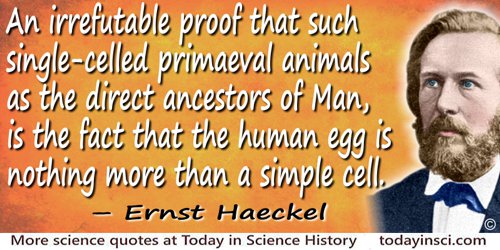
The ancestors of the higher animals must be regarded as one-celled beings, similar to the Amœbæ which at the present day occur in our rivers, pools, and lakes. The incontrovertible fact that each human individual develops from an egg, which, in common with those of all animals, is a simple cell, most clearly proves that the most remote ancestors of man were primordial animals of this sort, of a form equivalent to a simple cell. When, therefore, the theory of the animal descent of man is condemned as a “horrible, shocking, and immoral” doctrine, tho unalterable fact, which can be proved at any moment under the microscope, that the human egg is a simple cell, which is in no way different to those of other mammals, must equally be pronounced “horrible, shocking, and immoral.”
Translated from his Ueber die Entstehung und den Stammbaum des Menschengeschlechts, (1873), Vol. 2, as an epigraph to Chap. 6, The Evolution of Man, (1879), Vol 1, 120-121.
The earliest signs of living things, announcing as they do a high complexity of organization, entirely exclude the hypothesis of a transmutation from lower to higher grades of being. The first fiat of Creation which went forth, doubtlessly ensured the perfect adaptation of animals to the surrounding media; and thus, whilst the geologist recognizes a beginning, he can see in the innumerable facts of the eye of the earliest crustacean, the same evidences of Omniscience as in the completion of the vertebrate form.
Siluria (1854), 469.
The highest mathematical principles may be involved in the production of the simplest mechanical result.
In 'Academical Education', Orations and Speeches on Various Occasions (1870), Vol. 3, 513. This is seen misattributed to Eric Temple Bell, but he only quoted it, attributing it to Everett, in for example, Mathematics: Queen and Servant of Sciences (1938), 20.
The mathematics of cooperation of men and tools is interesting. Separated men trying their individual experiments contribute in proportion to their numbers and their work may be called mathematically additive. The effect of a single piece of apparatus given to one man is also additive only, but when a group of men are cooperating, as distinct from merely operating, their work raises with some higher power of the number than the first power. It approaches the square for two men and the cube for three. Two men cooperating with two different pieces of apparatus, say a special furnace and a pyrometer or a hydraulic press and new chemical substances, are more powerful than their arithmetical sum. These facts doubtless assist as assets of a research laboratory.
Quoted from a speech delivered at the fiftieth anniversary of granting of M.I.T's charter, in Guy Suits, 'Willis Rodney Whitney', National Academy of Sciences, Biographical Memoirs (1960), 352.
The perfection of the heavenly spheres does not depend upon the order of their relative position as to whether one is higher than another.
As quoted in Edward Grant, Planets, Stars, and Orbs: The Medieval Cosmos, 1200-1687 (1996), 231, citing Oresme, Le Livre du ciel, (1968), Book 2, 507.
https://books.google.com/books?isbn=052156509X
Edward Grant - 1996
The power that produced Man when the monkey was not up to the mark, can produce a higher creature than Man if Man does not come up to the mark. What it means is that if Man is to be saved, Man must save himself. There seems no compelling reason why he should be saved. He is by no means an ideal creature. At his present best many of his ways are so unpleasant that they are unmentionable in polite society, and so painful that he is compelled to pretend that pain is often a good. Nature holds no brief for the human experiment: it must stand or fall by its results. If Man will not serve, Nature will try another experiment.
Back to Methuselah: a Metabiological Pentateuch (1921), xvii.
The problem for a writer of a text-book has come now, in fact, to be this—to write a book so neatly trimmed and compacted that no coach, on looking through it, can mark a single passage which the candidate for a minimum pass can safely omit. Some of these text-books I have seen, where the scientific matter has been, like the lady’s waist in the nursery song, compressed “so gent and sma’,” that the thickness barely, if at all, surpasses what is devoted to the publisher’s advertisements. We shall return, I verily believe, to the Compendium of Martianus Capella. The result of all this is that science, in the hands of specialists, soars higher and higher into the light of day, while educators and the educated are left more and more to wander in primeval darkness.
In Presidential Address British Association for the Advancement of Science (1885), Nature, 32, 448. [Martianus Capella, who flourished c.410-320, wrote a compendium of the seven liberal arts. —Webmaster]
The solution of problems is one of the lowest forms of mathematical research, … yet its educational value cannot be overestimated. It is the ladder by which the mind ascends into higher fields of original research and investigation. Many dormant minds have been aroused into activity through the mastery of a single problem.
With co-editor J. M. Colaw, Editorial introducing the first issue of The American Mathematical Monthly (Jan 1894), 1, No. 1, 2.
The study of mathematics—from ordinary reckoning up to the higher processes—must be connected with knowledge of nature, and at the same time with experience, that it may enter the pupil’s circle of thought.
In Johann Friedrich Herbart, Henry M. Felkin (trans.) and Emmie Felkin (trans.), Letters and Lectures on Education [Felkin] (1898), 117.
The universe is governed by science. But science tells us that we can’t solve the equations, directly in the abstract. We need to use the effective theory of Darwinian natural selection of those societies most likely to survive. We assign them higher value.
[Answer to question: What is the value in knowing “Why are we here?”]
[Answer to question: What is the value in knowing “Why are we here?”]
'Stephen Hawking: "There is no heaven; it’s a fairy story"', interview in newspaper The Guardian (15 May 2011).
There is no higher life form than a librarian.
In Terry Pratchett, Ian Stewart and Jack Cohen, introductory section, 'The Story Starts Here', The Science of Discworld (1999), 10. The section is initialed by all three coauthors. Which of them wrote which lines, is not designated. [Webmaster recognizes the subject quote is, at least, characteristic of Pratchett; hence listed under his name.]
There is no study in the world which brings into more harmonious action all the faculties of the mind than [mathematics], … or, like this, seems to raise them, by successive steps of initiation, to higher and higher states of conscious intellectual being.
In Presidential Address to British Association (19 Aug 1869), 'A Plea for the Mathematician', published in Nature (6 Jan 1870), 1, 261.
To make the peaks higher.
[His reason to target philanthropic funding to only the best university science departments.]
[His reason to target philanthropic funding to only the best university science departments.]
As quoted by Stanley Coben in 'The Scientific Establishment and the Transmission of Quantum Mechanics to the United States, 1919-32', The American Historical Review (Apr 1971), 76, No. 2, 450. As president of the Rockerfeller Foundation's General Education Board in the 1920s, Rose explained the reason to narrow the board's financial focus. It would cease distributing funds to many university general endowment funds, and instead support only the few strongest university science departments. It became an unofficial motto for philanthropist John D. Rockefeller, Jr. It was also a favorite of George Ellery Hale. The quotation comes from Rose's private notebook as cited by Raymond B. Fosdick, Adventure in Giving, The Story of the General Education Board (1962), 230. Further details of the board's change in policy are in Annual Report of the General Education Board, 1924-1925 (1926), 6-8.
We are in a position similar to that of a mountaineer who is wandering over uncharted spaces, and never knows whether behind the peak which he sees in front of him and which he tries to scale there may not be another peak still beyond and higher up.
In Max Planck and James Vincent Murphy (trans.), Where is Science Going?, (1932), 200.
When we have amassed a great store of such general facts, they become the objects of another and higher species of classification, and are themselves included in laws which, as they dispose of groups, not individuals have a far superior degree of generality, till at length, by continuing the process, we arrive at axioms of the highest degree of generality of which science is capable. This process is what we mean by induction.
In A Preliminary Discourse on the Study of Natural Philosophy (1830), 102.
Who does not know Maxwell’s dynamic theory of gases? At first there is the majestic development of the variations of velocities, then enter from one side the equations of condition and from the other the equations of central motions, higher and higher surges the chaos of formulas, suddenly four words burst forth: “Put n = 5.” The evil demon V disappears like the sudden ceasing of the basso parts in music, which hitherto wildly permeated the piece; what before seemed beyond control is now ordered as by magic. There is no time to state why this or that substitution was made, he who cannot feel the reason may as well lay the book aside; Maxwell is no program-musician who explains the notes of his composition. Forthwith the formulas yield obediently result after result, until the temperature-equilibrium of a heavy gas is reached as a surprising final climax and the curtain drops.
In Ceremonial Speech (15 Nov 1887) celebrating the 301st anniversary of the Karl-Franzens-University Graz. Published as Gustav Robert Kirchhoff: Festrede zur Feier des 301. Gründungstages der Karl-Franzens-Universität zu Graz (1888), 29-30, as translated in Robert Édouard Moritz, Memorabilia Mathematica; Or, The Philomath’s Quotation-book (1914), 187. From the original German, “Wer kennt nicht seine dynamische Gastheorie? – Zuerst entwickeln sich majestätisch die Variationen der Geschwindigkeiten, dann setzen von der einen Seite die Zustands-Gleichungen, von der anderen die Gleichungen der Centralbewegung ein, immer höher wogt das Chaos der Formeln; plötzlich ertönen die vier Worte: „Put n=5.“Der böse Dämon V verschwindet, wie in der Musik eine wilde, bisher alles unterwühlende Figur der Bässe plötzlich verstummt; wie mit einem Zauberschlage ordnet sich, was früher unbezwingbar schien. Da ist keine Zeit zu sagen, warum diese oder jene Substitution gemacht wird; wer das nicht fühlt, lege das Buch weg; Maxwell ist kein Programmmusiker, der über die Noten deren Erklärung setzen muss. Gefügig speien nun die Formeln Resultat auf Resultat aus, bis überraschend als Schlusseffect noch das Wärme-Gleichgewicht eines schweren Gases gewonnen wird und der Vorhang sinkt.” A condensed alternate translation also appears on the Ludwig Boltzmann Quotes page of this website.
Whoever looks at the insect world, at flies, aphides, gnats and innumerable parasites, and even at the infant mammals, must have remarked the extreme content they take in suction, which constitutes the main business of their life. If we go into a library or newsroom, we see the same function on a higher plane, performed with like ardor, with equal impatience of interruption, indicating the sweetness of the act. In the highest civilization the book is still the highest delight.
In Lecture, second in a series given at Freeman Place Chapel, Boston (Mar 1859), 'Quotation and Originality', in Letters and Social Aims (1875, 1917), 177.
 In science it often happens that scientists say, 'You know that's a really good argument; my position is mistaken,' and then they would actually change their minds and you never hear that old view from them again. They really do it. It doesn't happen as often as it should, because scientists are human and change is sometimes painful. But it happens every day. I cannot recall the last time something like that happened in politics or religion.
(1987) --
In science it often happens that scientists say, 'You know that's a really good argument; my position is mistaken,' and then they would actually change their minds and you never hear that old view from them again. They really do it. It doesn't happen as often as it should, because scientists are human and change is sometimes painful. But it happens every day. I cannot recall the last time something like that happened in politics or religion.
(1987) -- 





