Heaven Quotes (267 quotes)
…at the stars,
Which are the brain of heaven, he look’d, and sank.
Around the ancient track marched, rank on rank,
The army of unalterable law.
Which are the brain of heaven, he look’d, and sank.
Around the ancient track marched, rank on rank,
The army of unalterable law.
In poem, 'Lucifer in Starlight', collected in Arthur Quiller-Couch (ed.), The Oxford Book of English Verse: 1250–1900 (1919), 942.
“Heaven helps those who help themselves” is a well-tried maxim, embodying in a small compass the results of vast human experience. The spirit of self-help is the root of all genuine growth in the individual; and, exhibited in the lives of many, it constitutes the true source of national vigour and strength. Help from without is often enfeebling in its effects, but help from within invariably invigorates. Whatever is done for men or classes, to a certain extent takes away the stimulus and necessity of doing for themselves; and where men are subjected to over-guidance and over-government, the inevitable tendency is to render them comparatively helpless.
In Self-help: With Illustrations of Character and Conduct (1859, 1861), 15.
“In the beginning God created the heaven and the earth…” Whatever our speculations may be in regard to a “beginning,” and when it was, it is written in the rocks that, like the animals and plants upon its surface, the earth itself grew.
In Nature's Miracles: Familiar Talks on Science (1899), Vol. 1, 1.
[I attach] little importance to physical size. I don’t feel the least humble before the vastness of the heavens. The stars may be large, but they cannot think or love; and these are qualities which impress me far more than size does.
From a paper read to the Apostles, a Cambridge discussion society (1925). In 'The Foundations of Mathematics' (1925), collected in Frank Plumpton Ramsey and D. H. Mellor (ed.), Philosophical Papers (1990), Epilogue, 249. Citation to the paper, in Nils-Eric Sahlin, The Philosophy of F.P. Ramsey (1990), 225.
[L]et us not overlook the further great fact, that not only does science underlie sculpture, painting, music, poetry, but that science is itself poetic. The current opinion that science and poetry are opposed is a delusion. … On the contrary science opens up realms of poetry where to the unscientific all is a blank. Those engaged in scientific researches constantly show us that they realize not less vividly, but more vividly, than others, the poetry of their subjects. Whoever will dip into Hugh Miller’s works on geology, or read Mr. Lewes's “Seaside Studies,” will perceive that science excites poetry rather than extinguishes it. And whoever will contemplate the life of Goethe will see that the poet and the man of science can co-exist in equal activity. Is it not, indeed, an absurd and almost a sacrilegious belief that the more a man studies Nature the less he reveres it? Think you that a drop of water, which to the vulgar eye is but a drop of water, loses anything in the eye of the physicist who knows that its elements are held together by a force which, if suddenly liberated, would produce a flash of lightning? Think you that what is carelessly looked upon by the uninitiated as a mere snow-flake, does not suggest higher associations to one who has seen through a microscope the wondrously varied and elegant forms of snow-crystals? Think you that the rounded rock marked with parallel scratches calls up as much poetry in an ignorant mind as in the mind of a geologist, who knows that over this rock a glacier slid a million years ago? The truth is, that those who have never entered upon scientific pursuits know not a tithe of the poetry by which they are surrounded. Whoever has not in youth collected plants and insects, knows not half the halo of interest which lanes and hedge-rows can assume. Whoever has not sought for fossils, has little idea of the poetical associations that surround the places where imbedded treasures were found. Whoever at the seaside has not had a microscope and aquarium, has yet to learn what the highest pleasures of the seaside are. Sad, indeed, is it to see how men occupy themselves with trivialities, and are indifferent to the grandest phenomena—care not to understand the architecture of the Heavens, but are deeply interested in some contemptible controversy about the intrigues of Mary Queen of Scots!—are learnedly critical over a Greek ode, and pass by without a glance that grand epic written by the finger of God upon the strata of the Earth!
In Education: Intellectual, Moral, and Physical (1889), 82-83.
[On the 11th day of November 1572], in the evening, after sunset, when, according to my habit, I was contemplating the stars in a clear sky, I noticed that a new and unusual star, surpassing all others in brilliancy, was shining almost directly over my head; and since I had, almost from boyhood, known all the stars of the heavens perfectly (there is no great difficulty in gaining that knowledge), it was quite evident to me that there had never before been any star in that place in the sky, even the smallest, to say nothing of a star so conspicuously bright as this. I was so astonished at this sight that I was not ashamed to doubt the trustworthiness of my own eyes. But when I observed that others, too, on having the place pointed out to them, could see that there was a star there, I had no further doubts. A miracle indeed, either the greatest of all that have occurred in the whole range of nature since the beginning of the world, or one certainly that is to be classed with those attested by the Holy Oracles.
De Stello. Nova (On the New Star) (1573). Quoted in H. Shapley and A. E. Howarth (eds.), Source Book in Astronomy (1929), 13.
[The ancient monuments] were all dwarfs in size and pigmies in spirit beside this mighty Statue of Liberty, and its inspiring thought. Higher than the monument in Trafalgar Square which commemorates the victories of Nelson on the sea; higher than the Column Vendome, which perpetuates the triumphs of Napoleon on the land; higher than the towers of the Brooklyn Bridge, which exhibit the latest and greatest results of science, invention, and industrial progress, this structure rises toward the heavens to illustrate an idea ... which inspired the charter in the cabin of the Mayflower and the Declaration of Independence from the Continental Congress.
Speech at unveiling of the Statue of Liberty, New York. In E.S. Werner (ed.), Werner's Readings and Recitations (1908), 107.
[Describing the effects of over-indulgence in wine:]
But most too passive, when the blood runs low
Too weakly indolent to strive with pain,
And bravely by resisting conquer fate,
Try Circe's arts; and in the tempting bowl
Of poisoned nectar sweet oblivion swill.
Struck by the powerful charm, the gloom dissolves
In empty air; Elysium opens round,
A pleasing frenzy buoys the lightened soul,
And sanguine hopes dispel your fleeting care;
And what was difficult, and what was dire,
Yields to your prowess and superior stars:
The happiest you of all that e'er were mad,
Or are, or shall be, could this folly last.
But soon your heaven is gone: a heavier gloom
Shuts o'er your head; and, as the thundering stream,
Swollen o'er its banks with sudden mountain rain,
Sinks from its tumult to a silent brook,
So, when the frantic raptures in your breast
Subside, you languish into mortal man;
You sleep, and waking find yourself undone,
For, prodigal of life, in one rash night
You lavished more than might support three days.
A heavy morning comes; your cares return
With tenfold rage. An anxious stomach well
May be endured; so may the throbbing head;
But such a dim delirium, such a dream,
Involves you; such a dastardly despair
Unmans your soul, as maddening Pentheus felt,
When, baited round Citheron's cruel sides,
He saw two suns, and double Thebes ascend.
But most too passive, when the blood runs low
Too weakly indolent to strive with pain,
And bravely by resisting conquer fate,
Try Circe's arts; and in the tempting bowl
Of poisoned nectar sweet oblivion swill.
Struck by the powerful charm, the gloom dissolves
In empty air; Elysium opens round,
A pleasing frenzy buoys the lightened soul,
And sanguine hopes dispel your fleeting care;
And what was difficult, and what was dire,
Yields to your prowess and superior stars:
The happiest you of all that e'er were mad,
Or are, or shall be, could this folly last.
But soon your heaven is gone: a heavier gloom
Shuts o'er your head; and, as the thundering stream,
Swollen o'er its banks with sudden mountain rain,
Sinks from its tumult to a silent brook,
So, when the frantic raptures in your breast
Subside, you languish into mortal man;
You sleep, and waking find yourself undone,
For, prodigal of life, in one rash night
You lavished more than might support three days.
A heavy morning comes; your cares return
With tenfold rage. An anxious stomach well
May be endured; so may the throbbing head;
But such a dim delirium, such a dream,
Involves you; such a dastardly despair
Unmans your soul, as maddening Pentheus felt,
When, baited round Citheron's cruel sides,
He saw two suns, and double Thebes ascend.
The Art of Preserving Health: a Poem in Four Books (2nd. ed., 1745), Book IV, 108-110.
Coelorum perrupit claustra.
(He broke through the barriers of the heavens.)
(He broke through the barriers of the heavens.)
Epitaph for William Herschel in Upton Church, where he is buried. Quoted in G. J. Whitrow, The Structure of the Universe: An Introduction to Cosmology (1959), 16. Also on memorial tile in Westminster Abbey.
Quod est ante pedes nemo spectat: coeli scrutantur plagas.
No one sees what is before his feet: they scan the tracks of heaven.
No one sees what is before his feet: they scan the tracks of heaven.
In Jon R. Stone, The Routledge Dictionary of Latin Quotations (2005), 101.
CALPURNIA: When beggars die there are no comets seen;
The heavens themselves blaze forth the death of princes.
CAESAR: Cowards die many times before their deaths;
The valiant never taste of death but once.
Of all the wonders that I have yet heard,
It seems to me most strange that men should fear,
Seeing that death, a necessary end,
Will come when it will come.
The heavens themselves blaze forth the death of princes.
CAESAR: Cowards die many times before their deaths;
The valiant never taste of death but once.
Of all the wonders that I have yet heard,
It seems to me most strange that men should fear,
Seeing that death, a necessary end,
Will come when it will come.
Julius Caesar (1599), II, ii.
~~[Unverified]~~ The strongest affection and utmost zeal should, I think, promote the studies concerned with the most beautiful objects. This is the discipline that deals with the universe’s divine revolutions, the stars’ motions, sizes, distances, risings and settings . . . for what is more beautiful than heaven?
Seen spreading across the web, only in recent years. As yet, Webmaster cannot identify a trustworthy primary source, is therefore presently skeptical, and meanwhile labels the quote as unverified.
1066. … At that time, throughout all England, a portent such as men had never seen before was seen in the heavens. Some declared that the star was a comet, which some call “the long-haired star”: it first appeared on the eve of the festival of Letania Maior, that is on 24 April, and shone every night for a week.
In George Norman Garmonsway (ed., trans.), 'The Parker Chronicle', The Anglo-Saxon Chronicle (1953), 195. This translation from the original Saxon, is a modern printing of an ancient anthology known as The Anglo-Saxon Chronicle. Manuscript copies were held at various English monasteries. These copies of the Chronicle include content first recorded in the late 9th century. The monasteries continued independently updating these annals. This quote comes from a copy once owned by Matthew Parker, Archbishop of Canterbury. Known as the Winchester (or Parker) Chronicle, it is the oldest surviving manuscript.
1095 … Then after Easter on the eve of St. Ambrose, which is on 4 April [recte 3 April], almost everywhere in this country and almost the whole night, stars in very large numbers were seen to fall from heaven, not by ones or twos, but in such quick succession that they could not be counted.
In The Anglo-Saxon Chronicle, as translated in The Anglo-Saxon Chronicle, Issue 1624 (1975), 230. The Chronicle is the work of many successive hands at several monasteries across England. For the date recorded, This meteor shower could have been a display of the Lyrids (according to The Starseeker, reprinted in O. Vrazell, 'Astronomical Observations in the Anglo Saxon Chronicle', Journal of the Royal Astronomical Society of Canada Newsletter (Aug 1984), 78, 57.
1122 … Thereafter there were many sailors on the sea and on inland water who said that they had seen a great and extensive fire near the ground in the northeast which continuously increased in width as it mounted to the sky. And the heavens opened into four parts and fought against it as if determined to put it out, and the fire stopped rising upwards. They saw that fire at the first streak of dawn, and it lasted until full daylight: this happened on 7 December.
From the 'Peterborough Chronicle (Laud Manuscript)', The Anglo-Saxon Chronicle, as translated in The Anglo-Saxon Chronicle, Issue 1624 (1975), 250. The Chronicle is the work of many successive hands at several monasteries across England.
A leg of mutton is better than nothing,
Nothing is better than Heaven,
Therefore a leg of mutton is better than Heaven.
Nothing is better than Heaven,
Therefore a leg of mutton is better than Heaven.
Aphorism 21 in Notebook C (1772-1773), as translated by R.J. Hollingdale in Aphorisms (1990). Reprinted as The Waste Books (2000), 35.
A monument to Newton! a monument to Shakespeare! Look up to Heaven—look into the Human Heart. Till the planets and the passions–the affections and the fixed stars are extinguished—their names cannot die.
In 'Noctes Ambrosianae: XXV' (Jun 1830), The Works of Professor Wilson of the University of Edinburgh: Noctes Ambrosianae (1865), Vol. 3, 55.
A thorough advocate in a just cause, a penetrating mathematician facing the starry heavens, both alike bear the semblance of divinity
In Wilhelm Meister, Wanderjahre, Zweites Buch, in 'Sprüche in Prosa' Natur, VI, 947.
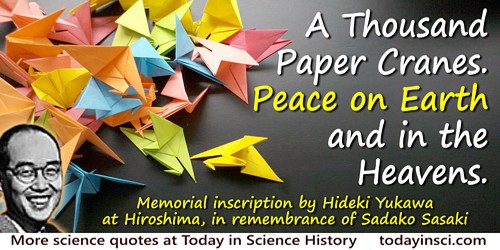
A Thousand Paper Cranes. Peace on Earth and in the Heavens.
Inscribed, in the handwriting of Yukawa, on the surface of the bell inside the Children’s Peace Monument at Hiroshima, Japan. The crane is a symbol of longevity and happiness in Japan. The monument to mourn all the children whose death was caused by the atomic bomb was inspired by 12-year-old Sadako Sasaki, who believed that if she could fold 1000 paper cranes she would be cured of the leukemia that resulted from her exposure to the radiation of the atomic bomb when two years old. She died before completing them.
Absolute space, of its own nature without reference to anything external, always remains homogenous and immovable. Relative space is any movable measure or dimension of this absolute space; such a measure or dimension is determined by our senses from the situation of the space with respect to bodies and is popularly used for immovable space, as in the case of space under the earth or in the air or in the heavens, where the dimension is determined from the situation of the space with respect to the earth. Absolute and relative space are the same in species and in magnitude, but they do not always remain the same numerically. For example, if the earth moves, the space of our air, which in a relative sense and with respect to the earth always remains the same, will now be one part of the absolute space into which the air passes, now another part of it, and thus will be changing continually in an absolute sense.
The Principia: Mathematical Principles of Natural Philosophy (1687), 3rd edition (1726), trans. I. Bernard Cohen and Anne Whitman (1999), Definitions, Scholium, 408-9.
After I had addressed myself to this very difficult and almost insoluble problem, the suggestion at length came to me how it could be solved with fewer and much simpler constructions than were formerly used, if some assumptions (which are called axioms) were granted me. They follow in this order.
There is no one center of all the celestial circles or spheres.
The center of the earth is not the center of the universe, but only of gravity and of the lunar sphere.
All the spheres revolve about the sun as their mid-point, and therefore the sun is the center of the universe.
The ratio of the earth’s distance from the sun to the height of the firmament is so much smaller than the ratio of the earth’s radius to its distance from the sun that the distance from the earth to the sun is imperceptible in comparison with the height of the firmament.
Whatever motion appears in the firmament arises not from any motion of the firmament, but from the earth’s motion. The earth together with its circumjacent elements performs a complete rotation on its fixed poles in a daily motion, while the firmament and highest heaven abide unchanged.
What appears to us as motions of the sun arise not from its motion but from the motion of the earth and our sphere, with which we revolve about the sun like any other planet. The earth has, then, more than one motion.
The apparent retrograde and direct motion of the planets arises not from their motion but from the earth’s. The motion of the earth alone, therefore, suffices to explain so many apparent inequalities in the heavens.
There is no one center of all the celestial circles or spheres.
The center of the earth is not the center of the universe, but only of gravity and of the lunar sphere.
All the spheres revolve about the sun as their mid-point, and therefore the sun is the center of the universe.
The ratio of the earth’s distance from the sun to the height of the firmament is so much smaller than the ratio of the earth’s radius to its distance from the sun that the distance from the earth to the sun is imperceptible in comparison with the height of the firmament.
Whatever motion appears in the firmament arises not from any motion of the firmament, but from the earth’s motion. The earth together with its circumjacent elements performs a complete rotation on its fixed poles in a daily motion, while the firmament and highest heaven abide unchanged.
What appears to us as motions of the sun arise not from its motion but from the motion of the earth and our sphere, with which we revolve about the sun like any other planet. The earth has, then, more than one motion.
The apparent retrograde and direct motion of the planets arises not from their motion but from the earth’s. The motion of the earth alone, therefore, suffices to explain so many apparent inequalities in the heavens.
'The Commentariolus', in Three Copernican Treatises (c.1510), trans. E. Rosen (1939), 58-9.
Against filling the Heavens with fluid Mediums, unless they be exceeding rare, a great Objection arises from the regular and very lasting Motions of the Planets and Comets in all manner of Courses through the Heavens.
From Opticks: Or, A Treatise of the Reflections, Refractions, Inflections and Colours of Light (1718), 339.
Alas, your dear friend and servant is totally blind. Henceforth this heaven, this universe, which by wonderful observations I had enlarged by a hundred and a thousand times beyond the conception of former ages, is shrunk for me into the narrow space which I myself fill in it. So it pleases God; it shall therefore please me also.
In Letter, as quoted in Sir Oliver Lodge, Pioneers of Science (1905), 133.
All over the world there lingers on the memory of a giant tree, the primal tree, rising up from the centre of the Earth to the heavens and ordering the universe around it. It united the three worlds: its roots plunged down into subterranean abysses, Its loftiest branches touched the empyrean. Thanks to the Tree, it became possible to breathe the air; to all the creatures that then appeared on Earth it dispensed its fruit, ripened by the sun and nourished by the water which it drew from the soil. From the sky it attracted the lightning from which man made fire and, beckoning skyward, where clouds gathered around its fall. The Tree was the source of all life, and of all regeneration. Small wonder then that tree-worship was so prevalent in ancient times.
From 'L'Arbre Sacre' ('The Sacred Tree'), UNESCO Courier (Jan 1989), 4. Epigraph to Chap 1, in Kenton Miller and Laura Tangley, Trees of Life: Saving Tropical Forests and Their Biological Wealt (1991), 1.
All things began in Order, so shall they end, and so shall they begin again, according to the Ordainer of Order, and the mystical mathematicks of the City of Heaven.
In 'Garden of Cyrus', Religio Medici and Other Writings (1909), 229.
Although the time of death is approaching me, I am not afraid of dying and going to Hell or (what would be considerably worse) going to the popularized version of Heaven. I expect death to be nothingness and, for removing me from all possible fears of death, I am thankful to atheism.
In John Altson, Patti Rae Miliotis, What Happened to Grandpa? (2009).
Although with the majority of those who study and practice in these capacities [engineers, builders, surveyors, geographers, navigators, hydrographers, astronomers], secondhand acquirements, trite formulas, and appropriate tables are sufficient for ordinary purposes, yet these trite formulas and familiar rules were originally or gradually deduced from the profound investigations of the most gifted minds, from the dawn of science to the present day. … The further developments of the science, with its possible applications to larger purposes of human utility and grander theoretical generalizations, is an achievement reserved for a few of the choicest spirits, touched from time to time by Heaven to these highest issues. The intellectual world is filled with latent and undiscovered truth as the material world is filled with latent electricity.
In Orations and Speeches, Vol. 3 (1870), 513.
An astronomer must be the wisest of men; his mind must be duly disciplined in youth; especially is mathematical study necessary; both an acquaintance with the doctrine of number, and also with that other branch of mathematics, which, closely connected as it is with the science of the heavens, we very absurdly call geometry, the measurement of the earth.
— Plato
From the 'Epilogue to the Laws' (Epinomis), 988-990. As quoted in William Whewell, History of the Inductive Sciences from the Earliest to the Present Time (1837), Vol. 1, 161. (Although referenced to Plato’s Laws, the Epinomis is regarded as a later addition, not by Plato himself.)
And God said, Let there be lights in the firmament of the heavens to separate the day from the night; and let them be for signs and for seasons and for days and years, and let them be lights in the firmament of the heavens to give light upon the earth.” And it was so. And God made the two great lights, the greater light to rule the day, and the lesser light to rule the night; he made the stars also.
— Bible
(circa 725 B.C.)
And shall an atom of this atom world
Mutter the theme of heaven?
Mutter the theme of heaven?
The Complaint: or, Night-Thoughts on Life, Death, and Immortality (1742, 1750), Night 4, 70.
And this is a miracle of nature in part known, namely, that iron follows the part of a magnet that touches it, and flies from the other part of the same magnet. And the iron turns itself after moving to the part of the heavens conformed to the part of the magnet which it touched.
Are the humanistic and scientific approaches different? Scientists can calculate the torsion of a skyscraper at the wing-beat of a bird, or 155 motions of the Moon and 500 smaller ones in addition. They move in academic garb and sing logarithms. They say, “The sky is ours”, like priests in charge of heaven. We poor humanists cannot even think clearly, or write a sentence without a blunder, commoners of “common sense”. We never take a step without stumbling; they move solemnly, ever unerringly, never a step back, and carry bell, book, and candle.
Quoting himself in Stargazers and Gravediggers: Memoirs to Worlds in Collision (2012), 212.
Aristotle ... imputed this symphony of the heavens ... this music of the spheres to Pythagorus. ... But Pythagoras alone of mortals is said to have heard this harmony ... If our hearts were as pure, as chaste, as snowy as Pythagoras' was, our ears would resound and be filled with that supremely lovely music of the wheeling stars.
'On the Music of the Spheres'. Second Prolusion. In John Milton and Merritt Yerkes Hughes (ed.), Complete Poems and Major Prose (1957, 2003), 603-604.
Arithmetic is seven eleven all good children go to heaven five six bundle of sticks.
From 'Arithmetic', Harvest Poems, 1910-1960 (1960), 115.
As Crystallography was born of a chance observation by Haüy of the cleavage-planes of a single fortunately fragile specimen, … so out of the slender study of the Norwich Spiral has sprung the vast and interminable Calculus of Cyclodes, which strikes such far-spreading and tenacious roots into the profoundest strata of denumeration, and, by this and the multitudinous and multifarious dependent theories which cluster around it, reminds one of the Scriptural comparison of the Kingdom of Heaven “to a grain of mustard-seed which a man took and cast into his garden, and it grew and waxed a great tree, and the fowls of the air lodged in the branches of it.”
From 'Outline Trace of the Theory of Reducible Cyclodes', Proceedings of the London Mathematical Society (1869), 2, 155, collected in Collected Mathematical Papers of James Joseph Sylvester (1908), Vol. 2, 683-684.
As soon as somebody demonstrates the art of flying, settlers from our species of man will not be lacking [on the moon and Jupiter]… Given ships or sails adapted to the breezes of heaven, there will be those who will not shrink from even that vast expanse.
(1610) As translated by Edward Rosen in Kepler’s Conversation with Galileo’s Sidereal Messenger (1965), 39.
Ask a follower of Bacon what [science] the new philosophy, as it was called in the time of Charles the Second, has effected for mankind, and his answer is ready; “It has lengthened life; it has mitigated pain; it has extinguished diseases; it has increased the fertility of the soil; it has given new securities to the mariner; it has furnished new arms to the warrior; it has spanned great rivers and estuaries with bridges of form unknown to our fathers; it has guided the thunderbolt innocuously from heaven to earth; it has lighted up the night with the splendour of the day; it has extended the range of the human vision; it has multiplied the power of the human muscles; it has accelerated motion; it has annihilated distance; it has facilitated intercourse, correspondence, all friendly offices, all dispatch of business; it has enabled man to descend to the depths of the sea, to soar into the air, to penetrate securely into the noxious recesses of the earth, to traverse the land in cars which whirl along without horses, to cross the ocean in ships which run ten knots an hour against the wind. These are but a part of its fruits, and of its first-fruits; for it is a philosophy which never rests, which has never attained, which is never perfect. Its law is progress. A point which yesterday was invisible is its goal to-day, and will be its starting-point to-morrow.”
From essay (Jul 1837) on 'Francis Bacon' in Edinburgh Review. In Baron Thomas Babington Macaulay and Lady Trevelyan (ed.) The Works of Lord Macaulay Complete (1871), Vol. 6, 222.
Astronomy affords the most extensive example of the connection of physical sciences. In it are combined the sciences of number and quantity, or rest and motion. In it we perceive the operation of a force which is mixed up with everything that exists in the heavens or on earth; which pervades every atom, rules the motion of animate and inanimate beings, and is a sensible in the descent of the rain-drop as in the falls of Niagara; in the weight of the air, as in the periods of the moon.
On the Connexion of the Physical Sciences (1858), 1.
Astronomy, as the science of cyclical motions, has nothing in common with Geology. But look at Astronomy where she has an analogy with Geology; consider our knowledge of the heavens as a palaetiological science;—as the study of a past condition, from which the present is derived by causes acting in time. Is there no evidence of a beginning, or of a progress?
In History of the Inductive Sciences (1857), Vol. 3, 516.
Astronomy, that micrography of heaven, is the most magnificent of the sciences. … Astronomy has its clear side and its luminous side; on its clear side it is tinctured with algebra, on its luminous side with poetry.
In Victor Hugo and Lorenzo O’Rourke (trans.) Victor Hugo’s Intellectual Autobiography: (Postscriptum de ma vie) (1907), 237-8. From the original French (1901): “L'astronomie, cette micrographie d'en haut, est la plus magnifique des sciences … L'astronomie a son côté clair et son côté lumineux ; par le côté clair elle trempe dans l'algèbre, par le côté lumineux dans la poésie.” [Note: The published translation had the typo “micography”, which is corrected herein. —Webmaster]
At first, the sea, the earth, and the heaven, which covers all things, were the only face of nature throughout the whole universe, which men have named Chaos; a rude and undigested mass, and nothing more than an inert weight, and the discordant atoms of things not harmonizing, heaped together in the same spot.
Describing the creation of the universe from chaos, at the beginning of Book I of Metamorphoses, lines 5-9. As translated by Henry T. Riley, The Metamorphoses of Ovid, Vol I: Books I-VII (1858), 1-2. Riley footnoted: “A rude and undigested mass.—Ver. 7. This is very similar to the words of the Scriptures, ‘And the earth was without form and void,’ Genesis, ch. i. ver. 2.”
At last gleams of light have come, and I am almost convinced (quite contrary to opinion I started with) that species are not (it is like confessing a murder) immutable. Heaven forfend me from Lamarck nonsense of a “tendency to progression”, “adaptations from the slow willing of animals”, &c! But the conclusions I am led to are not widely different from his; though the means of change are wholly so. I think I have found out (here’s presumption!) the simple way by which species become exquisitely adapted to various ends.
Letter to Sir Joseph Hooker (11 Jan 1844). In Charles Darwin and Francis Darwin (ed.), Charles Darwin: His Life Told in an Autobiographical Chapter, and in a Selected Series of His Published Letters (1892), 173-174.
At the entrance to the observatory Stjerneborg located underground, Tycho Brahe built a Ionic portal. On top of this were three sculptured lions. On both sides were inscriptions and on the backside was a longer inscription in gold letters on a porfyr stone: Consecrated to the all-good, great God and Posterity. Tycho Brahe, Son of Otto, who realized that Astronomy, the oldest and most distinguished of all sciences, had indeed been studied for a long time and to a great extent, but still had not obtained sufficient firmness or had been purified of errors, in order to reform it and raise it to perfection, invented and with incredible labour, industry, and expenditure constructed various exact instruments suitable for all kinds of observations of the celestial bodies, and placed them partly in the neighbouring castle of Uraniborg, which was built for the same purpose, partly in these subterranean rooms for a more constant and useful application, and recommending, hallowing, and consecrating this very rare and costly treasure to you, you glorious Posterity, who will live for ever and ever, he, who has both begun and finished everything on this island, after erecting this monument, beseeches and adjures you that in honour of the eternal God, creator of the wonderful clockwork of the heavens, and for the propagation of the divine science and for the celebrity of the fatherland, you will constantly preserve it and not let it decay with old age or any other injury or be removed to any other place or in any way be molested, if for no other reason, at any rate out of reverence to the creator’s eye, which watches over the universe. Greetings to you who read this and act accordingly. Farewell!
(Translated from the original in Latin)
Bacteria keeps us from heaven and puts us there.
Before the seas, and this terrestrial ball,
And Heav’n’s high canopy, that covers all,
One was the face of Nature; if a face:
Rather a rude and indigested mass:
A lifeless lump, unfashion’d, and unfram’d,
Of jarring seeds; and justly Chaos nam’d.
And Heav’n’s high canopy, that covers all,
One was the face of Nature; if a face:
Rather a rude and indigested mass:
A lifeless lump, unfashion’d, and unfram’d,
Of jarring seeds; and justly Chaos nam’d.
As translated by John Dryden, et al. and Sir Samuel Garth (ed.), Metamorphoses (1998), 3. Ovid started writing the 14 books of Metamorphoses in about 1 a.d.. Dryden died in 1700. He had translated about one-third of the full Metamorphoses. His work was finished by others, and the translation was published in 1717.
Between this body [the earth] and the heavens there are suspended, in this aerial spirit, seven stars, separated by determinate spaces, which, on account of their motion, we call wandering.
In The Natural History of Pliny (1855), Vol. 1, 19-20.
But for the persistence of a student of this university in urging upon me his desire to study with me the modern algebra I should never have been led into this investigation; and the new facts and principles which I have discovered in regard to it (important facts, I believe), would, so far as I am concerned, have remained still hidden in the womb of time. In vain I represented to this inquisitive student that he would do better to take up some other subject lying less off the beaten track of study, such as the higher parts of the calculus or elliptic functions, or the theory of substitutions, or I wot not what besides. He stuck with perfect respectfulness, but with invincible pertinacity, to his point. He would have the new algebra (Heaven knows where he had heard about it, for it is almost unknown in this continent), that or nothing. I was obliged to yield, and what was the consequence? In trying to throw light upon an obscure explanation in our text-book, my brain took fire, I plunged with re-quickened zeal into a subject which I had for years abandoned, and found food for thoughts which have engaged my attention for a considerable time past, and will probably occupy all my powers of contemplation advantageously for several months to come.
In Johns Hopkins Commemoration Day Address, Collected Mathematical Papers, Vol. 3, 76.
But having considered everything which has been said, one could by this believe that the earth and not the heavens is so moved, and there is no evidence to the contrary. Nevertheless, this seems prima facie as much, or more, against natural reason as are all or several articles of our faith. Thus, that which I have said by way of diversion (esbatement) in this manner can be valuable to refute and check those who would impugn our faith by argument.
On the Book of the Heavens and the World of Aristotle [1377], bk. II, ch. 25, sect. 10, trans. A. D. Menut and A. J. Denomy, quoted in Marshall Clagett, The Science of Mechanics in the Middle Ages (1959), 606.
But if the heavens are moved by a daily movement, it is necessary to assume in the principal bodies of the universe and in the heavens two ways of movement which are contrary to each other: one from east to west and the other from west to east, as has often been said. And with this, it is proper to assume an excessively great speed, for anyone who reckons and considers well the height of distance of the heavens and the magnitude of these and of their circuit, if such a circuit were made in a day, could not imagine or conceive how marvelously and excessively swift would be the movement of the heavens, and how unbelievable and unthinkable.
In Isaac Asimov and Jason A. Shulman (eds.), Isaac Asimov’s Book of Science and Nature Quotations (1988), 329. Webmaster so far has been unable to locate the primary source (can you help?)
But in the heavens we discover by their light, and by their light alone, stars so distant from each other that no material thing can ever have passed from one to another; and yet this light, which is to us the sole evidence of the existence of these distant worlds, tells us also that each of them is built up of molecules of the same kinds as those which we find on earth. A molecule of hydrogen, for example, whether in Sirius or in Arcturus, executes its vibrations in precisely the same time. Each molecule, therefore, throughout the universe, bears impressed on it the stamp of a metric system as distinctly as does the metre of the Archives at Paris, or the double royal cubit of the Temple of Karnac ... the exact quantity of each molecule to all others of same kind gives it, as Sir John Herschel has well said, the essential character of a manufactured article and precludes the idea of its being external and self-existent.
'Molecules', 1873. In W. D. Niven (ed.), The Scientific Papers of James Clerk Maxwell (1890), Vol. 2, 375-6.
But notwithstanding these Arguments are so convictive and demonstrative, its marvellous to see how some Popish Authors (Jesuites especially) strain their wits to defend their Pagan Master Aristotle his Principles. Bullialdus speaks of a Florentine Physitian, that all the Friends he had could ever perswade him once to view the Heavens through a Telescope, and he gave that reason for his refusal, because he was afraid that then his Eyes would make him stagger concerning the truth of Aristotle’s Principles, which he was resolved he would not call into question. It were well, if these Men had as great veneration for the Scripture as they have, for Aristotles (if indeed they be his) absurd Books de cælo Sed de his satis.
(Indicating a belief that the Roman Catholic church impeded the development of modern science.)
(Indicating a belief that the Roman Catholic church impeded the development of modern science.)
Kometographia, Or a Discourse Concerning Comets (Boston 1684). Quoted in Michael Garibaldi Hall, The Last American Puritan: The Life of Increase Mather, 1639-1723 (1988), 167.
By the fruit one judges the tree; the tree of science grows exceedingly slowly; centuries elapse before one can pluck the ripe fruits; even today it is hardly possible for us to shell and appraise the kernel of the teachings that blossomed in the seventeenth century. He who sows cannot therefore judge the worth of the corn. He must have faith in the fruitfulness of the seed in order that he may follow untiringly his chosen furrow when he casts his ideas to the four winds of heaven.
As quoted in Philipp Frank, Modern Science and its Philosophy (1949), 62, which cites Évolution de la Mécanique (1903).
Certainly, it is heaven upon earth, to have a man's mind move in charity, rest in providence, and turn upon the poles of truth.
'Essays or Counsels: Civil and Moral. I. Of Truth'. In Francis Bacon, James Spedding, The Works of Francis Bacon (1864), Vol. 6, 378.
Do not all charms fly
At the mere touch of cold philosophy?
There was an awful rainbow once in heaven:
We know her woof, her texture; she is given
In the dull catalogue of common things.
Philosophy will clip an Angel’s wings,
Conquer all mysteries by rule and line,
Empty the haunted air, and gnomed mine
Unweave a rainbow.
At the mere touch of cold philosophy?
There was an awful rainbow once in heaven:
We know her woof, her texture; she is given
In the dull catalogue of common things.
Philosophy will clip an Angel’s wings,
Conquer all mysteries by rule and line,
Empty the haunted air, and gnomed mine
Unweave a rainbow.
Lamia 1820, II, lines 229-37. In John Barnard (ed.), John Keats. The Complete Poems (1973), 431.
Don’t take your organs to heaven with you. Heaven knows we need them here.
[Slogan advocating organ donations.]
[Slogan advocating organ donations.]
Eratosthenes of Cyrene, employing mathematical theories and geometrical methods, discovered from the course of the sun, the shadows cast by an equinoctial gnomon, and the inclination of the heaven that the circumference of the earth is two hundred and fifty-two thousand stadia, that is, thirty-one million five hundred thousand paces.
In De Architectura, Book 1, Chap 6, Sec. 9. As translated in Morris Hicky Morgan (trans.), Vitruvius: The Ten Books on Architecture (1914), 27-28.
Even the facts of science may dust the mind by their dryness, unless they are … rendered fertile by the dews of fresh and living truth. Knowledge does not come to us by details, but in flashes of light from heaven.
Essay, first published as 'Life Without Principle', Atlantic Monthly (Oct 1863). Collected in Yankee in Canada, Etc., (1866) 267. Also excerpted in H.G.O. Blake (ed.), Thoreau's Thoughts: Selections From the Writings of Henry David Thoreau (1890, 2005), 102.
Every dew-drop and rain-drop had a whole heaven within it.
In 'Hyperion', The Prose Works of Henry Wadsworth Longfellow (1851), 137.
Every scientist, through personal study and research, completes himself and his own humanity. ... Scientific research constitutes for you, as it does for many, the way for the personal encounter with truth, and perhaps the privileged place for the encounter itself with God, the Creator of heaven and earth. Science shines forth in all its value as a good capable of motivating our existence, as a great experience of freedom for truth, as a fundamental work of service. Through research each scientist grows as a human being and helps others to do likewise.
Address to the members of the Pontifical Academy of Sciences (13 Nov 2000). In L’Osservatore Romano (29 Nov 2000), translated in English edition, 5.
FAUSTUS: How many heavens or spheres are there?
MEPHASTOPHILIS: Nine: the seven planets, the firmament, and the empyreal heaven.
FAUSTUS: But is there not coelum igneum, et crystallinum?
MEPH.: No Faustus, they be but fables.
FAUSTUS: Resolve me then in this one question: Why are not conjunctions, oppositions, aspects, eclipses all at one time, but in some years we have more, in some less?
MEPH.: Per inaequalem motum respectu totius.
FAUSTUS: Well, I am answered. Now tell me who made the world.
MEPH.: I will not.
FAUSTUS: Sweet Mephastophilis, tell me.
MEPH.: Move me not, Faustus.
FAUSTUS: Villain, have I not bound thee to tell me any thing?
MEPH.: Ay, that is not against our kingdom.
This is. Thou are damn'd, think thou of hell.
FAUSTUS: Think, Faustus, upon God that made the world!
MEPH.: Remember this.
MEPHASTOPHILIS: Nine: the seven planets, the firmament, and the empyreal heaven.
FAUSTUS: But is there not coelum igneum, et crystallinum?
MEPH.: No Faustus, they be but fables.
FAUSTUS: Resolve me then in this one question: Why are not conjunctions, oppositions, aspects, eclipses all at one time, but in some years we have more, in some less?
MEPH.: Per inaequalem motum respectu totius.
FAUSTUS: Well, I am answered. Now tell me who made the world.
MEPH.: I will not.
FAUSTUS: Sweet Mephastophilis, tell me.
MEPH.: Move me not, Faustus.
FAUSTUS: Villain, have I not bound thee to tell me any thing?
MEPH.: Ay, that is not against our kingdom.
This is. Thou are damn'd, think thou of hell.
FAUSTUS: Think, Faustus, upon God that made the world!
MEPH.: Remember this.
Doctor Faustus: A 1604-Version Edition, edited by Michael Keefer (1991), Act II, Scene iii, lines 60-77, 43-4.
For myself, I like a universe that, includes much that is unknown and, at the same time, much that is knowable. A universe in which everything is known would be static and dull, as boring as the heaven of some weak-minded theologians. A universe that is unknowable is no fit place for a thinking being. The ideal universe for us is one very much like the universe we inhabit. And I would guess that this is not really much of a coincidence.
Concluding paragraph, 'Can We know the Universe? Reflections on a Grain of Salt', Broca's Brain (1979, 1986), 21.
From astronomy we find the east, west, south, and north, as well as the theory of the heavens, the equinox, solstice, and courses of the stars. If one has no knowledge of these matters, he will not be able to have any comprehension of the theory of sundials.
In De Architectura, Book 1, Chap 1, Sec. 10. As translated in Morris Hicky Morgan (trans.), Vitruvius: The Ten Books on Architecture (1914), 10.
From man or angel the great Architect did wisely to conceal, and not divulge his secrets to be scanned by them who ought rather admire; or if they list to try conjecture, he his fabric of the heavens left to their disputes, perhaps to move his laughter at their quaint opinions wide hereafter, when they come to model heaven calculate the stars, how they will wield the mighty frame, how build, unbuild, contrive to save appearances, how gird the sphere with centric and eccentric scribbled o’er, and epicycle, orb in orb.
Paradise Lost (1674, 1754), Book 8, 231.
Geology does better in reclothing dry bones and revealing lost creations, than in tracing veins of lead and beds of iron; astronomy better in opening to us the houses of heaven than in teaching navigation; surgery better in investigating organiation than in setting limbs; only it is ordained that, for our encouragement, every step we make in science adds something to its practical applicabilities.
Modern Painters (1852), Part 3, 8-9.
Given angel’s wings, where might you fly?
In what sweet heaven might you find your love?
Unwilling to be bound, where might you move,
Lost between the wonder and the why?...
In what sweet heaven might you find your love?
Unwilling to be bound, where might you move,
Lost between the wonder and the why?...
…...
God said, “Let the earth produce vegetation… . Let the earth produce every kind of living creature. …” God said, “Let us make man in our image, in the likeness of ourselves, and let them be masters of the fish of the sea, the birds of heaven, the cattle, all the wild beasts, and all the reptiles that crawl upon the earth. “
— Bible
(circa 725 B.C.)
Good sense, which only is the gift of Heaven,
And though no science, fairly worth the seven.
And though no science, fairly worth the seven.
Moral Essays. Epistle iv. Line 43. In The Works of Alexander Pope (1824), Vol. 5, 385.
Gravity tells us why an apple doesn’t go to heaven.
In Cecil Hunt, The Best Howlers (1957).
Haldane could have made a success of any one of half a dozen careers—as mathematician, classical scholar, philosopher, scientist, journalist or imaginative writer. On his life’s showing he could not have been a politician, administrator (heavens, no!), jurist or, I think, a critic of any kind. In the outcome he became one of the three or four most influential biologists of his generation.
Essay, 'J.B.S.', in Pluto’s Republic: Incorporating The Art of the Soluble and Induction and Intuition in Scientific Thought (1982), collected in The Strange Case of the Spotted Mice and Other Classic Essays on Science (1996), 87.
Happy the men who made the first essay,
And to celestial regions found the way!
No earthly vices clogg’d their purer souls,
That they could soar so high as touch the poles:
Sublime their thoughts and from pollution clear,
Bacchus and Venus held no revels there;
From vain ambition free; no love of war
Possess’d their minds, nor wranglings at the bar;
No glaring grandeur captivates their eyes,
For such see greater glory in the skies:
Thus these to heaven attain.
And to celestial regions found the way!
No earthly vices clogg’d their purer souls,
That they could soar so high as touch the poles:
Sublime their thoughts and from pollution clear,
Bacchus and Venus held no revels there;
From vain ambition free; no love of war
Possess’d their minds, nor wranglings at the bar;
No glaring grandeur captivates their eyes,
For such see greater glory in the skies:
Thus these to heaven attain.
In Craufurd Tait Ramage (ed., trans.), Beautiful Thoughts From Latin Authors, with English Translations (1864),
He that knows the secrets of nature with Albertus Magnus, or the motions of the heavens with Galileo, or the cosmography of the moon with Hevelius, or the body of man with Galen, or the nature of diseases with Hippocrates, or the harmonies in melody with Orpheus, or of poesy with Homer, or of grammar with Lilly, or of whatever else with the greatest artist; he is nothing if he knows them merely for talk or idle speculation, or transient and external use. But he that knows them for value, and knows them his own, shall profit infinitely.
In Bertram Doben (ed.), Centuries of Meditations (1908), The Third Century, No. 41, 189-190.
He who knows what sweets and virtues are in the ground, the waters, the plants, the heavens, and how to come at these enchantments, is the rich and royal man.
From 'Nature', collected in Essays, Second Series (1844), 188.
Heaven defend me from a busy doctor.
Welsh Proverb. In Henry Louis Mencken, A New Dictionary of Quotations (1942), 299.
Heaven forming each on other to depend,
A master, or a servant, or a friend,
Bids each on other for assistance call,
Till one man’s weakness grows the strength of all.
A master, or a servant, or a friend,
Bids each on other for assistance call,
Till one man’s weakness grows the strength of all.
In 'Epistle II: Of the Nature and State of Man', collected in Samuel Johnson (ed.), The Works of the Poets of Great Britain and Ireland: Vol. 6: The Whole Poetical Works of Alexander Pope,
Esq. (1800), Vol. 6, 374.
Human interest in exploring the heavens goes back centuries. This is what human nature is all about.
…...
I am an old man now, and when I die and go to heaven, there are two matters on which I hope for enlightenment. One is quantum electrodynamics and the other is the turbulent motion of fluids. About the former, I am really rather optimistic.
In Address to the British Society for the Advancement of Science (1932). As cited by Tom Mullin in 'Turbulent Times For FLuids', New Science (11 Nov 1989), 52. Werner Heisenberg is also reported, sometimes called apocryphal, to have expressed a similar sentiment, but Webmaster has found no specific citation.
I am not yet so lost in lexicography, as to forget that words are the daughters of the earth, and that things are the sons of heaven. Language is only the instrument of science, and words are but the signs of ideas: I wish, however, that the instrument might be less apt to decay, and that signs might be permanent, like the things which they denote.
'Preface', A Dictionary of the English Language (1755), Vol. 1.
I am the daughter of earth and water, And the nursling of the sky;
I pass through the pores of the ocean and shores;
I change, but I cannot die.
For after the rain when with never a stain,
The pavilion of Heaven is bare,
And the winds and sunbeams with their convex gleams,
Build up the blue dome of air,
I silently laugh at my own cenotaph, And out of the caverns of rain,
Like a child from the womb, like a ghost from the tomb,
I arise and unbuild it again.
I pass through the pores of the ocean and shores;
I change, but I cannot die.
For after the rain when with never a stain,
The pavilion of Heaven is bare,
And the winds and sunbeams with their convex gleams,
Build up the blue dome of air,
I silently laugh at my own cenotaph, And out of the caverns of rain,
Like a child from the womb, like a ghost from the tomb,
I arise and unbuild it again.
The Cloud (1820). In K. Raine (ed.), Shelley (1974), 289.
I attained a triumph so complete that it is now rare to meet an American with marks of small pox on his face... Benefits are valuable according to their duration and extent, like the showers from heaven, but the benign remedy Vaccination saves millions of lives every century, like the blessing of the sun, universal and everlasting.
(Remark made near the end of his life.)
(Remark made near the end of his life.)
I can assure you, reader, that in a very few hours, even during the first day, you will learn more natural philosophy about things contained in this book, than you could learn in fifty years by reading the theories and opinions of the ancient philosophers. Enemies of science will scoff at the astrologers: saying, where is the ladder on which they have climbed to heaven, to know the foundation of the stars? But in this respect I am exempt from such scoffing; for in proving my written reason, I satisfy sight, hearing, and touch: for this reason, defamers will have no power over me: as you will see when you come to see me in my little Academy.
The Admirable Discourses (1580), trans. Aurele La Rocque (1957), 27.
I can't tell you if genius is hereditary, because heaven has granted me no offspring.
In Patricia Harris and David Lyon, 1001 Greatest Things Ever Said About Massachusetts (2007), 381
I could more easily believe that two Yankee professors would lie than that stones would fall from heaven.
on a report on a meteorite shower which fell in Weston, Connecticut in 1807, in Our Stone-pelted Planet by H. H. Nininger (1933).
I don't believe in an afterlife, so I don't have to spend my whole life fearing hell, or fearing heaven even more. For whatever the tortures of hell, I think the boredom of heaven would be even worse.
In Rosemarie Jarski, Words from the Wise (2007), 18.
I fear that the character of my knowledge is from year to year becoming more distinct and scientific; that, in exchange for vistas wide as heaven’s scope, I am being narrowed down to the field of the microscope. I see details, not wholes nor the shadow of the whole. I count some parts, and say, “I know.”
(19 Aug 1851). In Henry David Thoreau and Bradford Torrey (ed.), The Writings of Henry Thoreau: Journal: II: 1850-September 15, 1851 (1906), 406.
I have no doubt that certain learned men, now that the novelty of the hypotheses in this work has been widely reported—for it establishes that the Earth moves, and indeed that the Sun is motionless in the middle of the universe—are extremely shocked, and think that the scholarly disciplines, rightly established once and for all, should not be upset. But if they are willing to judge the matter thoroughly, they will find that the author of this work has committed nothing which deserves censure. For it is proper for an astronomer to establish a record of the motions of the heavens with diligent and skilful observations, and then to think out and construct laws for them, or rather hypotheses, whatever their nature may be, since the true laws cannot be reached by the use of reason; and from those assumptions the motions can be correctly calculated, both for the future and for the past. Our author has shown himself outstandingly skilful in both these respects. Nor is it necessary that these hypotheses should be true, nor indeed even probable, but it is sufficient if they merely produce calculations which agree with the observations. … For it is clear enough that this subject is completely and simply ignorant of the laws which produce apparently irregular motions. And if it does work out any laws—as certainly it does work out very many—it does not do so in any way with the aim of persuading anyone that they are valid, but only to provide a correct basis for calculation. Since different hypotheses are sometimes available to explain one and the same motion (for instance eccentricity or an epicycle for the motion of the Sun) an astronomer will prefer to seize on the one which is easiest to grasp; a philosopher will perhaps look more for probability; but neither will grasp or convey anything certain, unless it has been divinely revealed to him. Let us therefore allow these new hypotheses also to become known beside the older, which are no more probable, especially since they are remarkable and easy; and let them bring with them the vast treasury of highly learned observations. And let no one expect from astronomy, as far as hypotheses are concerned, anything certain, since it cannot produce any such thing, in case if he seizes on things constructed for another other purpose as true, he departs from this discipline more foolish than he came to it.
Although this preface would have been assumed by contemporary readers to be written by Copernicus, it was unsigned. It is now believed to have been written and added at press time by Andreas Osiander (who was then overseeing the printing of the book). It suggests the earth’s motion as described was merely a mathematical device, and not to be taken as absolute reality. Text as given in 'To the Reader on the Hypotheses in this Work', Copernicus: On the Revolutions of the Heavenly Spheres (1543), translated by Alistair Matheson Duncan (1976), 22-3. By adding this preface, Osiander wished to stave off criticism by theologians. See also the Andreas Osiander Quotes page of this website.
I hope when I get to Heaven I shall not find the women playing second fiddle.
(Shortly before her death)
(Shortly before her death)
I regard the brain as a computer which will stop working when its components fail. There is no heaven or afterlife for broken down computers; that is a fairy story for people afraid of the dark.
'Stephen Hawking: "There is no heaven; it's a fairy story"', interview in newspaper The Guardian (15 May 2011).
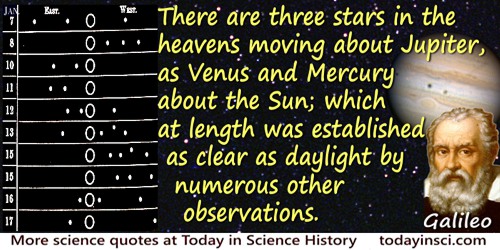
I therefore concluded, and decided unhesitatingly, that there are three stars in the heavens moving about Jupiter, as Venus and Mercury about the Sun; which at length was established as clear as daylight by numerous other observations.
Referring to his pioneering telescope observations.
Referring to his pioneering telescope observations.
The Starry Messenger (Mar 1610). Quoted in Edmund Blair Bolles, Galileo's Commandment (1999), 104.
I took him [Lawrence Bragg] to a young zoologist working on pattern formation in insect cuticles. The zoologist explained how disturbances introduced into these regular patterns pointed to their formation being governed by some kind of gradient. Bragg listened attentively and then exclaimed: “Your disturbed gradient behaves like a stream of sand running downhill and encountering an obstacle.” “Good heavens,” replied the zoologist, “I had been working on this problem for years before this simple analogy occurred to me and you think of it after twenty minutes.”
As quoted in David Phillips, Biographical Memoirs of Fellows of the Royal Society (Nov 1979), 25, 132, citing: Perutz, M.F. 1971 New Sci. & Sci. J. 8 July 1967.
I used to measure the Heavens, now I measure the shadows of Earth. The mind belonged to Heaven, the body’s shadow lies here.
Epitaph that Kepler wrote for himself, a few months before he died. As translated from the original Latin, “Mensus eram coelos, nunc Terrae metior umbras. Mens coelestis erat, corporis umbra jacet.” In M. Caspar et al. (eds.), Johannes Kepler Gesammelte Werke (1937), 19, 393.
I would beg the wise and learned fathers (of the church) to consider with all diligence the difference which exists between matters of mere opinion and matters of demonstration. ... [I]t is not in the power of professors of the demonstrative sciences to alter their opinions at will, so as to be now of one way of thinking and now of another. ... [D]emonstrated conclusions about things in nature of the heavens, do not admit of being altered with the same ease as opinions to what is permissible or not, under a contract, mortgage, or bill of exchange.
Letter to Cristina di Lorena, Grand Duchess of Tuscany (the mother of his patron Cosmo), 1615. Quoted in Sedley Taylor, 'Galileo and Papal Infallibility' (Dec 1873), in Macmillan's Magazine: November 1873 to April 1874 (1874) Vol 29, 94.
I would by all means have men beware, lest Æsop’s pretty fable of the fly that sate [sic] on the pole of a chariot at the Olympic races and said, “What a dust do I raise,” be verified in them. For so it is that some small observation, and that disturbed sometimes by the instrument, sometimes by the eye, sometimes by the calculation, and which may be owing to some real change in the heaven, raises new heavens and new spheres and circles.
'Of Vain Glory' (1625) in James Spedding, Robert Ellis and Douglas Heath (eds.), The Works of Francis Bacon (1887-1901), Vol. 6, 503.
I would say here something that was heard from an ecclesiastic of the most eminent degree [Cardinal Baronius (1538-1607)]: “That the intention of the holy ghost is to teach us how one goes to heaven, not how heaven goes.”
Letter to Madame Christina of Lorraine, Grand Duchess of Tuscany: concerning the Use of Biblical Quotations in Matters of Science (1611 5), trans. Stillman Drake, Discoveries and Opinions of Galileo (1957), 186.
I would say here something that was heard from an ecclesiastic of the most eminent degree: 'That the intention of the Holy Ghost is to teach us how one goes to heaven, not how heaven goes.
Letter to Cristina di Lorena, Grand Duchess of Tuscany (the mother of his patron Cosmo), 1615. Translation as given in the Galilean Library web page www.galilean-library.org/manuscript.php?postid=43841.
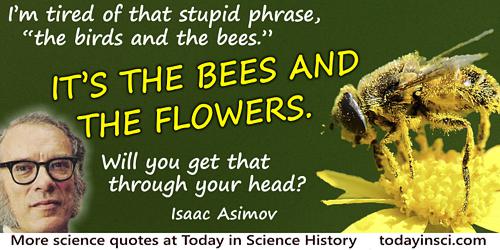
I’m tired of that stupid phrase, “the birds and the bees” which is supposed to represent “the facts of life” or the beginnings of the sex instruction of the young. … Well for heaven’s sake, has anyone ever tried to explain sex by talking about the birds and the bees? What have the birds and the bees to do with it? IT’S THE BEES AND THE FLOWERS. Will you get that through your head? IT’S THE BEES AND THE FLOWERS. The bee travels to one flower and picks up pollen from the stamens. The pollen contains the male sex cells of the plant. The bee then travels to another flower (of the same species) and the pollen brushes off onto the pistil, which contains the female sex cells of the plant. … Now in the human being … we don’t rely on bees to do it for us.
From Isaac Asimov’s letter in 'Hue and Cry' letter column in magazine, James L. Quinn (ed.), IF: Worlds of Science Fiction (Dec 1957), 7, No. 6, 119
If a photographic plate under the center of a lens focused on the heavens is exposed for hours, it comes to reveal stars so far away that even the most powerful telescopes fail to reveal them to the naked eye. In a similar way, time and concentration allow the intellect to perceive a ray of light in the darkness of the most complex problem.
From Reglas y Consejos sobre Investigacíon Cientifica: Los tónicos de la voluntad. (1897), as translated by Neely and Larry W. Swanson, in Advice for a Young Investigator (1999), 34.
If every man waz a genius, mankind would be az bad oph az the heavens would be, with every star a comet, things would git hurt badly, and noboddy tew blame.
In The Complete Works of Josh Billings (1876), 79.
If I am right, then (religious fundamentalists) will not go to Heaven, because there is no Heaven. If they are right, then they will not go to Heaven, because they are hypocrites.
…...
If in some madhouse there is a lunatic who still believes the old churchly tenet that heaven is up above, even this [the first manned landing on the moon] probably will not disabuse him. Surely those of us still sane enough to be at large realize that this event will have no more to so with theology, God, or self-knowledge than any flower we pluck or any hand we press—in fact, much less.
(13 Jul 1969). As given in Alan F. and Jason R. Pater (eds.), What They Said in 1969: The Yearbook of Spoken Opinion (1970), 402.
If we have not found heaven within, it is a certainty we will not find it without.
Quoted in Kim Lim (ed.), 1,001 Pearls of Spiritual Wisdom: Words to Enrich, Inspire, and Guide Your Life (2014), 250
If you ask me whether science has solved, or is likely to solve, the problem of this universe, I must shake my head in doubt. We have been talking of matter and force; but whence came matter, and whence came force? You remember the first Napoleon’s question, when the savans who accompanied him to Egypt discussed in his presence the problem of the universe, and solved it to their apparent satisfaction. He looked aloft to the starry heavens, and said—“It is all very well, gentlemen, but who made all these!” That question still remains unanswered, and science makes no attempt to answer it.
Lecture 'On Matter and Force', to nearly 3,000 working men, at the Dundee Meeting of the British Association for the Advancement of Science (Sep 1867), reported in 'Dundee Meeting, 1867', Chemical News and Journal of Physical Science (Nov 1867)
In Heaven there'll be no algebra,
No learning dates or names,
But only playing golden harps
And reading Henry James.
No learning dates or names,
But only playing golden harps
And reading Henry James.
Displayed at James’s home, Lambs House in Rye. Said to have been written by Henry James’s nephew in the guest book there, as stated in J.D. McClatchy, Sweet Theft: A Poet's Commonplace Book (2016), 212.
https://books.google.com/books?isbn=1619027607
J.D. McClatchy - 2016
In space there are countless constellations, suns and planets; we see only the suns because they give light; the planets remain invisible, for they are small and dark. There are also numberless earths circling around their suns, no worse and no less than this globe of ours. For no reasonable mind can assume that heavenly bodies that may be far more magnificent than ours would not bear upon them creatures similar or even superior to those upon our human earth.
As quoted in Dave Goldberg, The Universe in the Rearview Mirror: How Hidden Symmetries Shape Reality (2013), 74.
In the alternation between inhaling and exhaling, between heaven and earth, between Yin and Yang, holiness is forever being created.
From Das Glasperlemspeil (1943) translated as The Glass Bead Game (1969, 1990), 119.
In the beginning God created Heaven and Earth … Which beginning of time, according to our Cronologie, fell upon the entrance of the night preceding the twenty third day of Octob. in the year of the Julian Calendar, 710 [or 4004 B.C.]. Upon the first day therefore of the world, or Octob. 23. being our Sunday, God, together with the highest Heaven, created the Angels. Then having finished, as it were, the roofe of this building, he fell in hand with the foundation of this wonderfull Fabrick of the World, he fashioned this lowermost Globe, consisting of the Deep, and of the Earth; all the Quire of Angels singing together and magnifying his name therefore … And when the Earth was void and without forme, and darknesse covered the face of the Deepe, on the very middle of the first day, the light was created; which God severing from the darknesses, called the one day, and the other night.
In 'Annals of the Old Testament', The Annals of the World (1658), excerpted in Louis A. Ruprecht, God Gardened East: A Gardener's Meditation on the Dynamics of Genesis (2008), 53-54.
In the beginning God created the heaven and earth. And the earth was waste and void; and darkness was upon the face of the deep: and the spirit of God moved upon the face of the waters. … God said, “Let there be a vault in the waters to divide the waters in two.” And so it was. God made the vault, and it divided the waters above the vault from the waters under the vault. God called the vault “heaven.”
— Bible
Genesis 1:1 in The Holy Bible Containing the Old and New Testaments Translated Out of the Original Tongues. Printed for the Universities of Oxford and Cambridge (1895), 1.
In the heavens we discover [stars] by their light, and by their light alone ... the sole evidence of the existence of these distant worlds ... that each of them is built up of molecules of the same kinds we find on earth. A molecule of hydrogen, for example, whether in Sirius or in Arcturus, executes its vibrations in precisely the same time. Each molecule therefore throughout the universe bears impressed upon it the stamp of a metric system as distinctly as does the metre of the Archives at Paris, or the royal cubit of the Temple of Karnac.
[Footnote: Where Maxwell uses the term “molecule” we now use the term “atom.”]
[Footnote: Where Maxwell uses the term “molecule” we now use the term “atom.”]
Lecture to the British Association at Bradford (1873), 'Atoms and Molecules'. Quoted by Ernest Rutherford, in 'The Constitution of Matter and the Evolution of the Elements', The Popular Science Monthly (Aug 1915), 112.
In the mountains of Parma and Piacenza, multitudes of shells and corals filled with worm-holes may be seen still adhering to the rocks, and when I was making the great horse at Milan a large sack of those which had been found in these parts was brought to my workshop by some peasants... The red stone of the mountains of Verona is found with shells all intermingled, which have become part of this stone... And if you should say that these shells have been and still constantly are being created in such places as these by the nature of the locality or by potency of the heavens in these spots, such an opinion cannot exist in brains possessed of any extensive powers of reasoning because the years of their growth are numbered upon the outer coverings of their shells; and both small and large ones may be seen; and these would not have grown without feeding, or fed without movement, and here [embedded in rock] they would not have been able to move... The peaks of the Apennines once stood up in a sea, in the form of islands surrounded by salt water... and above the plains of Italy where flocks of birds are flying today, fishes were once moving in large shoals.
'Physical Geography', in The Notebooks of Leonardo da Vinci, trans. E. MacCurdy (1938), Vol. 1, 355-6, 359.
In the pure mathematics we contemplate absolute truths which existed in the divine mind before the morning stars sang together, and which will continue to exist there when the last of their radiant host shall have fallen from heaven.
From Address (22 Apr 1857) for Inauguration of Washington University, St. Louis, Missouri, collected in 'Academical Education', Orations and Speeches on Various Occasions (1870), Vol. 3, 514. This is seen misattributed to Eric Temple Bell, who only quoted it, attributing it to Everett, in for example, Mathematics: Queen and Servant of Sciences (1938), 20.
In the streets of a modern city the night sky is invisible; in rural districts, we move in cars with bright headlights. We have blotted out the heavens, and only a few scientists remain aware of stars and planets, meteorites and comets.
In 'On Comets', collected in In Praise of Idleness and Other Essays (1935), 224.
It [space travel] will free man from his remaining chains, the chains of gravity which still tie him to this planet. It will open to him the gates of heaven.
Attributed.
It has always irked me as improper that there are still so many people for whom the sky is no more than a mass of random points of light. I do not see why we should recognize a house, a tree, or a flower here below and not, for example, the red Arcturus up there in the heavens as it hangs from its constellation Bootes, like a basket hanging from a balloon.
As quoted in J. L. Locher, Escher: With a Complete Catalogue of the Graphic Works (1982), 113.
It is a good thing Heaven has not given us the power to change as much of our body as we would like to or as our theory would assert is necessary.
Aphorism 34 in Notebook D (1773-1775), as translated by R.J. Hollingdale in Aphorisms (1990). Reprinted as The Waste Books (2000), 48.
It is a vulgar belief that our astronomical knowledge dates only from the recent century when it was rescued from the monks who imprisoned Galileo; but Hipparchus…who among other achievements discovered the precession of the eqinoxes, ranks with the Newtons and the Keplers; and Copernicus, the modern father of our celestial science, avows himself, in his famous work, as only the champion of Pythagoras, whose system he enforces and illustrates. Even the most modish schemes of the day on the origin of things, which captivate as much by their novelty as their truth, may find their precursors in ancient sages, and after a careful analysis of the blended elements of imagination and induction which charaterise the new theories, they will be found mainly to rest on the atom of Epicurus and the monad of Thales. Scientific, like spiritual truth, has ever from the beginning been descending from heaven to man.
Lothair (1879), preface, xvii.
It is better to trust in the Rock of Ages, than to know the age of the rocks; it is better for one to know that he is close to the Heavenly Father, than to know how far the stars in the heavens are apart.
In chapter, 'The Origin of Man', In His Image (1922), 93.
It is impossible not to feel stirred at the thought of the emotions of man at certain historic moments of adventure and discovery—Columbus when he first saw the Western shore, Pizarro when he stared at the Pacific Ocean, Franklin when the electric spark came from the string of his kite, Galileo when he first turned his telescope to the heavens. Such moments are also granted to students in the abstract regions of thought, and high among them must be placed the morning when Descartes lay in bed and invented the method of co-ordinate geometry.
Quoted in James Roy Newman, The World of Mathematics (2000), Vol. 1, 239.
It is impossible with our present knowledge to suppose that at any prior stage of the history of the heavens gravitation did not exist. It is impossible, from what we know now, to suppose that even the finest form of matter which entered our clearing in space was not endowed with motion. Given this matter, its motion and gravitation,… will give us a formation of centres;… rotation…; we shall… get condensing masses of this curdled substance.
In 'The History of a Star', The Nineteenth Century (Nov 1889), 26, No. 153, 787-788.
It is in the name of Moses that Bellarmin thunderstrikes Galileo; and this great vulgarizer of the great seeker Copernicus, Galileo, the old man of truth, the magian of the heavens, was reduced to repeating on his knees word for word after the inquisitor this formula of shame: “Corde sincera et fide non ficta abjuro maledico et detestor supradictos errores et hereses.” Falsehood put an ass's hood on science.
[With a sincere heart, and of faith unfeigned, I deny by oath, condemn and detest the aforesaid errors and heresies.]
[With a sincere heart, and of faith unfeigned, I deny by oath, condemn and detest the aforesaid errors and heresies.]
In Victor Hugo and Lorenzo O'Rourke (trans.) Victor Hugo's Intellectual Autobiography: (Postscriptum de ma vie) (1907), 313.
It is no small comfort when I reflect that we should not so much marvel at the vast and almost infinite breadth of the most distant heavens but much more at the smallness of us manikins and the smallness of this our tiny ball of earth and also of all the planets.
From Letter to Johann Herwart (1598), as quoted in Murray Roston, Milton and the Baroque (1980), 17.
It is not for us to say whether Inspiration revealed to the Psalmist the wonders of the modern astronomy. But even though the mind be a perfect stranger to the science of these enlightened times, the heavens present a great and an elevating spectacle—an immense concave reposing on the circular boundary of the world, and the innumerable lights which are suspended from on high, moving with solemn regularity along its surface.
From Discourse, 'A Sketch of Modern Astronomy', in The Works of Thomas Chalmers (1830), 69.
It is not necessary to probe into the nature of things, as was done by those whom the Greeks call physici; nor need we be in alarm lest the Christian should be ignorant of the force and number of the elements—the motion, and order, and eclipses of the heavenly bodies; the form of the heavens; the species and the natures of animals, plants, stones, fountains, rivers, mountains; about chronology and distances; the signs of coming storms; and a thousand other things which those philosophers either have found out, or think they have found out. … It is enough for the Christian to believe that the only cause of all created things, whether heavenly or earthly … is the goodness of the Creator, the one true God.
In Marcus Dods (ed.), J.F. Shaw (trans.), The Enchiridion of Augustine, Chap. 9, collected in The Works of Aurelius Augustine, Bishop of Hippo: A new translation (1873), Vol. 9, 180-181. The physici are natural philosophers.
It is obvious that man dwells in a splendid universe, a magnificent expanse of earth and sky and heaven, which manifestly is built on a majestic plan, maintains some mighty design, though man himself cannot grasp it. Yet for him it is not a pleasant or satisfying world. In his few moments of respite from labor or from his enemies, he dreams that this very universe might indeed be perfect, its laws operating just as now they seem to do, and yet he and it somehow be in full accord. The very ease with which he can frame this image to himself makes the reality all the more mocking. ... It is only too clear that man is not at home in this universe, and yet he is not good enough to deserve a better.
In The New England Mind: The Seventeenth Century (1939, 1954), 7.
It is obvious that while science is struggling to bring Heaven to earth some men are using its materials in the construction of Hell.
Address delivered to Annual Meeting of the York Bible Class, Toronto, Canada (22 Nov 1938), 'The Imperative Need for Moral Re-armament', collected in America's Way Forward (1939), 51.
It is said that Thales of Miletus, who was the first of the Greeks to devote himself to the study of the stars, was on one occasion so intent upon observing the heavens that he fell into a well, whereupon a maidservant laughed and remarked, “In his zeal for things in the sky he does
not see what is at his feet.”
— Thales
Apocryphal story, as given in Richard A. Gregory, Discovery: Or, The Spirit and Service of Science (1916), 21.
It is time that science, having destroyed the religious basis for morality, accepted the obligation to provide a new and rational basis for human behavior—a code of ethics concerned with man’s needs on earth, not his rewards in heaven.
In 'Toward a New Morality,' IEEE Spectrum, 1972.
It seems as though no laws, not even fairly old ones, can safely be regarded as unassailable. The force of gravity, which we have always ascribed to the “pull of the earth,” was reinterpreted the other day by a scientist who says that when we fall it is not earth pulling us, it is heaven pushing us. This blasts the rock on which we sit. If science can do a rightabout-face on a thing as fundamental as gravity, maybe Newton was a sucker not to have just eaten the apple.
In 'Talk of the Town,', The New Yorker (3 Apr 1937). As cited in Martha White (ed.), In the Words of E.B. White (2011), 175.
It was an admirable reply of a converted astronomer, who, when interrogated concerning his comparative estimate of religion and the science he had formerly idolized, answered, 'I am now bound for heaven, and I take the stars in my way.'
In Tryon Edwards. A Dictionary of Thoughts (1908), 506.
It was the secrets of heaven and earth that I desired to learn.
In Frankenstein: Or, The Modern Prometheus (Rev. ed. 1831, 1839), 24. Webmaster note: This line does not appear before this edition, revised by Shelley for Colburn and Bentley’s Standard Novels Series, No. 9.
It’s that moment, that brief epiphany when the universe opens up and shows us something, and in that instant we get just a sense of an order greater than Heaven and, as yet at least, beyond the grasp of Stephen Hawking.
Quoted in Kim Lim (ed.), 1,001 Pearls of Spiritual Wisdom: Words to Enrich, Inspire, and Guide Your Life (2014), 109
Its [mathematical analysis] chief attribute is clearness; it has no means for expressing confused ideas. It compares the most diverse phenomena and discovers the secret analogies which unite them. If matter escapes us, as that of air and light because of its extreme tenuity, if bodies are placed far from us in the immensity of space, if man wishes to know the aspect of the heavens at successive periods separated by many centuries, if gravity and heat act in the interior of the solid earth at depths which will forever be inaccessible, mathematical analysis is still able to trace the laws of these phenomena. It renders them present and measurable, and appears to be the faculty of the human mind destined to supplement the brevity of life and the imperfection of the senses, and what is even more remarkable, it follows the same course in the study of all phenomena; it explains them in the same language, as if in witness to the unity and simplicity of the plan of the universe, and to make more manifest the unchangeable order which presides over all natural causes.
From Théorie Analytique de la Chaleur (1822), Discours Préliminaire, xiv, (Theory of Heat, Introduction), as translated by Alexander Freeman in The Analytical Theory of Heat (1878), 7.
Knock, And He’ll open the door
Vanish, And He’ll make you shine like the sun
Fall, And He’ll raise you to the heavens
Become nothing, And He’ll turn you into everything.
Vanish, And He’ll make you shine like the sun
Fall, And He’ll raise you to the heavens
Become nothing, And He’ll turn you into everything.
— Rumi
Quoted in Kim Lim (ed.), 1,001 Pearls of Spiritual Wisdom: Words to Enrich, Inspire, and Guide Your Life (2014), 164
Knowledge is the golden ladder over which we climb to heaven; knowledge is the light which illuminates our path through this life and leads to a future life of everlasting glory.
In his words, what he recalls his mother telling him as a boy, in From Immigrant to Inventor: An Example to Young Americans (1922, 1934), 12.
Learn to reverence night and to put away the vulgar fear of it, for, with the banishment of night from the experience of man, there vanishes as well a religious emotion, a poetic mood, which gives depth to the adventure of humanity. By day, space is one with the earth and with man - it is his sun that is shining, his clouds that are floating past; at night, space is his no more. When the great earth, abandoning day, rolls up the deeps of the heavens and the universe, a new door opens for the human spirit, and there are few so clownish that some awareness of the mystery of being does not touch them as they gaze. For a moment of night we have a glimpse of ourselves and of our world islanded in its stream of stars - pilgrims of mortality, voyaging between horizons across eternal seas of space and time. Fugitive though the instant be, the spirit of man is, during it, ennobled by a genuine moment of emotional dignity, and poetry makes its own both the human spirit and experience.
…...
Like buried treasures, the outposts of the universe have beckoned to the adventurous from immemorial times. Princes and potentates, political or industrial, equally with men of science, have felt the lure of the uncharted seas of space, and through their provision of instrumental means the sphere of exploration has made new discoveries and brought back permanent additions to our knowledge of the heavens.
From article by Hale in Harper's Magazine, 156, (1928), 639-646, in which he urged building a 200-inch optical telescope. Cited in Kenneth R. Lang, Parting the Cosmic Veil (2006), 82 and 210. Also in George Ellery Hale, Signals From the Stars (1931), 1.
M. Waldman … concluded with a panegyric upon modern chemistry…:— “The ancient teachers of this science” said he, “Promised impossibilities and performed nothing. The modern masters promise very little; they know that metals cannot be transmuted and that the elixir of life is a chimera. But these philosophers seem only made to dabble in dirt, and their eyes to pore over the microscope or crucible, have indeed performed miracles. They penetrate into the recesses of nature and show how she works in her hiding-places. They ascend into the heavens; they have discovered how the blood circulates, and the nature of the air we breathe. They can command the thunders of heaven, mimic the earthquake, and even mock the invisible world with its own shadows.”
In Frankenstein: Or, The Modern Prometheus (1823), Vol. 1, 73-74. Webmaster note: In the novel, when the fictional characters meet, M. Waldman, professor of chemistry, sparks Victor Frankenstein’s interest in science. Shelley was age 20 when the first edition of the novel was published anonymously (1818).
Man knows only these poor mathematical theories about the heavens, and only God knows the real motions of the heavens and their causes.
In Modern Science and Its Philosophy by Philip Frank (1950).
Man, so far as natural science by itself is able to teach us, is no longer the final cause of the universe, the heaven-descended heir of all the ages. His very existence is an accident, his story a brief and discreditable episode in the life of one of the meanest of the planets. Of the combination of causes which first converted a piece or pieces of unorganised jelly into the living progenitors of humanity, science indeed, as yet, knows nothing.
In 'The Religion of Humanity', Essays and Addresses by the Right Hon. Arthur J. Balfour (1893), 307.
Mankind is drawn to the heavens for the same reason we were once drawn into unknown lands and across the open sea. We choose to explore space because doing so improves our lives, and lifts our national spirit. So let us continue the journey.
Conclusion of speech, NASA Headquarters (14 Jan 2004). In Office of the Federal Register (U.S.) Staff (eds.), Public Papers of the Presidents of the United States, George W. Bush (2007), 59.
Mathematics accomplishes really nothing outside of the realm of magnitude; marvellous, however, is the skill with which it masters magnitude wherever it finds it. We recall at once the network of lines which it has spun about heavens and earth; the system of lines to which azimuth and altitude, declination and right ascension, longitude and latitude are referred; those abscissas and ordinates, tangents and normals, circles of curvature and evolutes; those trigonometric and logarithmic functions which have been prepared in advance and await application. A look at this apparatus is sufficient to show that mathematicians are not magicians, but that everything is accomplished by natural means; one is rather impressed by the multitude of skilful machines, numerous witnesses of a manifold and intensely active industry, admirably fitted for the acquisition of true and lasting treasures.
In Werke [Kehrbach] (1890), Bd. 5, 101. As quoted, cited and translated in Robert Édouard Moritz, Memorabilia Mathematica; Or, The Philomath’s Quotation-Book (1914), 13.
Men can construct a science with very few instruments, or with very plain instruments; but no one on earth could construct a science with unreliable instruments. A man might work out the whole of mathematics with a handful of pebbles, but not with a handful of clay which was always falling apart into new fragments, and falling together into new combinations. A man might measure heaven and earth with a reed, but not with a growing reed.
Heretics (1905), 146-7.
My aim is to say that the machinery of the heavens is not like a divine animal but like a clock (and anyone who believes a clock has a soul gives the work the honour due to its maker) and that in it almost all the variety of motions is from one very simple magnetic force acting on bodies, as in the clock all motions are from a very simple weight.
Letter to J. G. Herwart von Hohenburg (16 Feb 1605). Johannes Kepler Gesammelte Werke (1937- ), Vol. 15, letter 325, l. 57-61, p. 146.
Natural causes, as we know, are at work, which tend to modify, if they do not at length destroy, all the arrangements and dimensions of the earth and the whole solar system. But though in the course of ages catastrophes have occurred and may yet occur in the heavens, though ancient systems may be dissolved and new systems evolved out of their ruins, the molecules [i.e. atoms] out of which these systems are built—the foundation stones of the material universe—remain unbroken and unworn. They continue to this day as they were created—perfect in number and measure and weight.
Lecture to the British Association at Bradford, 'Molecules', Nature (1873), 8, 437-441. Reprinted in James Clerk Maxwell and W. D. Niven, editor, The Scientific Papers of James Clerk Maxwell (2003), 377.
By
Nature crying out and speaking to country people in these words: Clown, wherefore dost thou behold the heavens? Why dost thou seek after the stars? When thou art now werry with short sleep, the nights are troublesome to thee. So I scatter little stars in the grass, and I shew them in the evening when thy labour is ended, and thou art miraculously allured to look upon them when thous passest by: Dost thou not see how a light like fire is covered when she closeth her wings, and she carrieth both night and day with her.
In Thomas Moffett, 'Glow-Worms', The Theater of Insects.
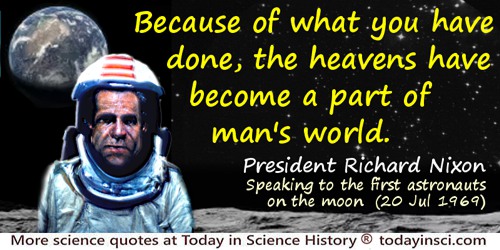
Neil and Buzz, I am talking to you by telephone from the Oval Office at the White House, and this certainly has to be the most historic telephone call ever made. Because of what you have done, the heavens have become a part of man’s world. As you talk to us from the Sea of Tranquility, it inspires us to redouble our efforts to bring peace and tranquility to Earth.
Speaking to the first astronauts while they were standing on the Moon (20 Jul 1969).
Now the whole earth had one language and few words… . Then they said, Come, let us build ourselves a city, and a tower with its top in the heavens, and let us make a name for ourselves, lest we be scattered abroad upon the face of the whole earth.” And the Lord came down to see the city and the tower, which the sons of men had built. And the Lord said, “Behold, they are one people, and they have all one language; and this is only the beginning of what they will do; and nothing that they propose to do will now be impossible for them. Come, let us go down, and there confuse their language, that they may not understand one another’s speech.” So the Lord scattered them abroad from there over the face of all the earth, and they left off building the city. Therefore its name was called Babel, because there the Lord confused the language of all the earth… .
— Bible
(circa 725 B.C.)
O for the Muse of fire, that would ascend
The brightest heaven of invention…
The brightest heaven of invention…
Henry V, Prologue. In Carl Sagan, Broca's Brain (1986), 262.
Objections … inspired Kronecker and others to attack Weierstrass’ “sequential” definition of irrationals. Nevertheless, right or wrong, Weierstrass and his school made the theory work. The most useful results they obtained have not yet been questioned, at least on the ground of their great utility in mathematical analysis and its implications, by any competent judge in his right mind. This does not mean that objections cannot be well taken: it merely calls attention to the fact that in mathematics, as in everything else, this earth is not yet to be confused with the Kingdom of Heaven, that perfection is a chimaera, and that, in the words of Crelle, we can only hope for closer and closer approximations to mathematical truth—whatever that may be, if anything—precisely as in the Weierstrassian theory of convergent sequences of rationals defining irrationals.
In Men of Mathematics (1937), 431-432.
Once you have learned to fly your plane, it is far less fatiguing to fly than it is to drive a car. You don’t have to watch every second for cats, dogs, children, lights, road signs, ladies with baby carriages and citizens who drive out in the middle of the block against the lights... Nobody who has not been up in the sky on a glorious morning can possibly imagine the way a pilot feels in free heaven.
…...
One could not by any experience whatsoever demonstrate that the heavens, and not the earth, are moved with a diurnal motion.
In Livre du ciel et du monde (On the Book of the Heavens and the World of Aristotle) (completed 1377), Book 2, Chap 25. Translated by Menut and Denomy (1968), as excerpted in Marshall Clagett, The Science of Mechanics in the Middle Ages, 600. Also found translated as, “No experience whatsoever could prove that the heavens rotate daily and not the earth.”
Order is Heaven’s first law.
From An Essay on Man, Epistle 4, collected in William Roscoe (ed.), The Works of Alexander Pope (1824), Vol. 5, 173.
Our remedies oft in ourselves do lie, which we ascribe to heaven.
In All's Well That Ends Well, Act 1, 1, 199-200. Collected in The Complete Works of William Shakespeare (1906), Vol. 1, 299.
People give ear to an upstart astrologer [Copernicus] who strove to show that the earth revolves, not the heavens or the firmament, the sun and the moon. Whoever wishes to appear clever must devise some new system, which of all systems is of course the very best. This fool wishes to reverse the entire science of astronomy.
c. 1543, in The Experts Speak by Christopher Cerf and Victor Navasky (1998).
Physio-philosophy has to show how, and in accordance indeed with what laws, the Material took its origin; and, therefore, how something derived its existence from nothing. It has to portray the first periods of the world's development from nothing; how the elements and heavenly bodies originated; in what method by self-evolution into higher and manifold forms, they separated into minerals, became finally organic, and in Man attained self-consciousness.
In Lorenz Oken, trans. by Alfred Tulk, Elements of Physiophilosophy (1847), 1.
Poets say science takes away from the beauty of the stars—mere globs of gas atoms. Nothing is “mere.” I too can see the stars on a desert night, and feel them. But do I see less or more? The vastness of the heavens stretches my imagination—stuck on this carousel my little eye can catch one-million-year-old light. A vast pattern—of which I am a part. … What is the pattern, or the meaning, or the “why?” It does not do harm to the mystery to know a little about it. For far more marvelous is the truth than any artists of the past imagined it. Why do the poets of the present not speak of it? What men are poets who can speak of Jupiter if he were a man, but if he is an immense spinning sphere of methane and ammonia must be silent?
In 'Astronomy', The Feynman Lectures on Physics (1961), Vol. 1, 3-6, footnote.
Reason may be employed in two ways to establish a point: first for the purpose of furnishing sufficient proof of some principle, as in natural science, where sufficient proof can be brought to show that the movement of the heavens is always of uniform velocity. Reason is employed in another way, not as furnishing a sufficient proof of a principle, but as confirming an already established principle, by showing the congruity of its results, as in astrology the theory of eccentrics and epicycles is considered as established because thereby the sensible appearances of the heavenly movements can be explained; not, however, as if this reason were sufficient, since some other theory might explain them.
Summa Theologica [1266-1273], Part I, question 32, article 2 (reply to objection 2), trans. Fathers of the English Dominican Province (i.e. L. Shapeote), revised D. J. Sullivan (1952), Vol. I, 177.
Rudenesse it selfe she doth refine,
Even like an Alchemist divine,
Grosse times of Iron turning
Into the purest forme of gold:
Not to corrupt, till heaven waxe old,
And be refin'd with burning.
Even like an Alchemist divine,
Grosse times of Iron turning
Into the purest forme of gold:
Not to corrupt, till heaven waxe old,
And be refin'd with burning.
From 'Hymnes of Astraea' (1599), Hymn 1 in Clare Howard (ed.), The Poems of John Davies (1941), 197.
Saturated with that speculative spirit then pervading the Greek mind, he [Pythagoras] endeavoured to discover some principle of homogeneity in the universe. Before him, the philosophers of the Ionic school had sought it in the matter of things; Pythagoras looked for it in the structure of things. He observed the various numerical relations or analogies between numbers and the phenomena of the universe. Being convinced that it was in numbers and their relations that he was to find the foundation to true philosophy, he proceeded to trace the origin of all things to numbers. Thus he observed that musical strings of equal lengths stretched by weights having the proportion of 1/2, 2/3, 3/4, produced intervals which were an octave, a fifth and a fourth. Harmony, therefore, depends on musical proportion; it is nothing but a mysterious numerical relation. Where harmony is, there are numbers. Hence the order and beauty of the universe have their origin in numbers. There are seven intervals in the musical scale, and also seven planets crossing the heavens. The same numerical relations which underlie the former must underlie the latter. But where number is, there is harmony. Hence his spiritual ear discerned in the planetary motions a wonderful “Harmony of spheres.”
In History of Mathematics (1893), 67.
Science boasts of the distance of its stars; of the terrific remoteness of the things of which it has to speak. But poetry and religion always insist upon the proximity, the almost menacing closeness of the things with which they are concerned. Always the Kingdom of Heaven is “At Hand.”
'A Glimpse of My Country', The Daily News. Collected in Tremendous Trifles (1920), 277.
Scientific education is a training in mental integrity. All along the history of culture from savagery to modern civilization men have imagined what ought to be, and then have tried to prove it true. This is the very spirit of metaphysic philosophy. When the imagination is not disciplined by unrelenting facts, it invents falsehood, and, when error has thus been invented, the heavens and the earth are ransacked for its proof.
From address (1 Oct 1884), at inauguration of the Corcoran School of Science and Arts, Columbian University, Washington, D.C. Published in 'The Larger Import of Scientific Education', Popular Science Monthly (Feb 1885), 26, 455.
Scientific, like spiritual truth, has ever from the beginning been descending from heaven to man.
In James Wood, Dictionary of Quotations from Ancient and Modern, English and Foreign Sources (1893), 383:6.
See skulking Truth to her old cavern fled,
Mountains of Casuistry heap’d o’er her head!
Philosophy, that lean’d on Heav’n before,
Shrinks to her second cause, and is no more.
Physic of Metaphysic begs defence,
And Metaphysic calls for aid on Sense!
See Mystery to Mathematics fly!
Mountains of Casuistry heap’d o’er her head!
Philosophy, that lean’d on Heav’n before,
Shrinks to her second cause, and is no more.
Physic of Metaphysic begs defence,
And Metaphysic calls for aid on Sense!
See Mystery to Mathematics fly!
In The Dunciad, collected in The Poetical Works of Alexander Pope (1828), Vol. 3, 211.
Silently, one by one, in the infinite meadows of heaven,
Blossomed the lovely stars, the forget-me-nots of the angels.
Blossomed the lovely stars, the forget-me-nots of the angels.
From poem, 'Evangeline' collected in The Poetical Works of H.W. Longfellow (1855), 14.
So numerous are the objects which meet our view in the heavens, that we cannot imagine a point of space where some light would not strike the eye;—innumerable stars, thousands of double and multiple systems, clusters in one blaze with their tens of thousands of stars, and the nebulae amazing us by the strangeness of their forms and the incomprehensibility of their nature, till at last, from the limit of our senses, even these thin and airy phantoms vanish in the distance.
On the Connexion of the Physical Sciences (1858), 420.
So when, by various turns of the Celestial Dance,
In many thousand years,
A Star, so long unknown, appears,
Tho’ Heaven itself more beauteous by it grow,
It troubles and alarms the World below,
Does to the Wise a Star, to Fools a Meteor show.
In many thousand years,
A Star, so long unknown, appears,
Tho’ Heaven itself more beauteous by it grow,
It troubles and alarms the World below,
Does to the Wise a Star, to Fools a Meteor show.
Sometimes too hot the eye of Heaven shines.
In Sonnet 18, The Dramatic Works of Shakespeare (1824), 62.
Starres by the Sun are not inlarg’d but showne.
Gentle love deeds, as blossomes on a bough,
From loves awaken’d root doe bud out now.
If, as in water stir’d more circles bee
Produc’d by one, love such additions take,
Those like to many spheares, but one heaven make,
For, they are all concentrique unto thee.
Gentle love deeds, as blossomes on a bough,
From loves awaken’d root doe bud out now.
If, as in water stir’d more circles bee
Produc’d by one, love such additions take,
Those like to many spheares, but one heaven make,
For, they are all concentrique unto thee.
From poem 'Loves Growth'in Poems on Several Occasions (1719), 23-24.
Strepsiades: But why do they look so fixedly on the ground?
Disciple of Socrates: They are seeking for what is below the ground. …
Strepsiades: And what is their rump looking at in the heavens?
Disciple: It is studying astronomy on its own account.
Disciple of Socrates: They are seeking for what is below the ground. …
Strepsiades: And what is their rump looking at in the heavens?
Disciple: It is studying astronomy on its own account.
In The Clouds, Aristophanes Five Comedies (2003), 129.
Students of the heavens are separable into astronomers and astrologers as readily as the minor domestic ruminants into sheep and goats, but the separation of philosophers into sages and cranks seems to be more sensitive to frames of reference.
Theories and Things (1981), 192.
Study is like the heaven’s glorious sun,
That will not be deep-search’d with saucy looks:
Small have continual plodders ever won,
Save base authority from others’ books.
That will not be deep-search’d with saucy looks:
Small have continual plodders ever won,
Save base authority from others’ books.
Dialog for Biron, written in Love’s Labour Lost (1598), Act 1, Scene 1, line 74-77.
Sunsets are so beautiful that they almost seem as if we were looking through the gates of Heaven.
The Use of Life (1895), 72.
Tears are often the telescope by which men see far into heaven.
Life Thoughts (1858), 178.
Tell me these things, Olympian Muses, tell
From the beginning, which first came to be?
Chaos was first of all, but next appeared
Broad-bosomed Earth, Sure standing-place for all
The gods who live on snowy Olympus' peak,
And misty Tartarus, in a recess
Of broad-pathed earth, and Love, most beautiful
Of all the deathless gods. He makes men weak,
He overpowers the clever mind, and tames
The spirit in the breasts of men and gods.
From Chaos came black Night and Erebos.
And Night in turn gave birth to Day and Space
Whom she conceived in love to Erebos.
And Earth bore starry Heaven, first, to be
An equal to herself, to cover her
All over, and to be a resting-place,
Always secure, for all the blessed gods.Theogony, I. 114-28.
From the beginning, which first came to be?
Chaos was first of all, but next appeared
Broad-bosomed Earth, Sure standing-place for all
The gods who live on snowy Olympus' peak,
And misty Tartarus, in a recess
Of broad-pathed earth, and Love, most beautiful
Of all the deathless gods. He makes men weak,
He overpowers the clever mind, and tames
The spirit in the breasts of men and gods.
From Chaos came black Night and Erebos.
And Night in turn gave birth to Day and Space
Whom she conceived in love to Erebos.
And Earth bore starry Heaven, first, to be
An equal to herself, to cover her
All over, and to be a resting-place,
Always secure, for all the blessed gods.Theogony, I. 114-28.
— Heslod
In Hesiod and Theognis, trans. Dorothea Wender (1973), 26-7.
That the machine of Heaven is not a hard and impervious body full of various real spheres, as up to now has been believed by most people. It will be proved that it extends everywhere, most fluid and simple, and nowhere presents obstacles as was formerly held, the circuits of the Planets being wholly free and without the labour and whirling round of any real spheres at all, being divinely governed under a given law.
De Mundi Aetherei Recentioribus Phaenomenis (On Recent Phenomena in the Aetherial World) (1588). Quoted in M. Boas Hall, The Scientific Renaissance 1450-1630 (1962), 117.
The Almighty lecturer, by displaying the principles of science in the structure of the universe, has invited man to study and to imitation. It is as if he had said to the inhabitants of this globe that we call ours, “I have made an earth for man to dwell upon, and I have rendered the starry heavens visible, to teach him science and the arts. He can now provide for his own comfort, and learn from my munificence to all, to be kind to all, to be kind to each other.”
In The Age of Reason: Being an Investigation of True and Fabulous Theology (27 Jan O.S. 1794), 44.
The astronomer who studies the motion of the stars is surely like a blind man who, with only a staff [mathematics] to guide him, must make a great, endless, hazardous journey that winds through innumerable desolate places. What will be the result? Proceeding anxiously for a while and groping his way with his staff, he will at some time, leaning upon it, cry out in despair to Heaven, Earth and all the Gods to aid him in his misery.
In The Sleepwalkers by Arthur Koestler (1968).
The Atoms or Particles, which now constitute Heaven and Earth, being once separate and diffused in the Mundane Space, like the supposed Chaos, could never without a God by their Mechanical affections have convened into this present Frame of Things or any other like it.
A Confutation of Atheism from the Origin and Frame of the World. (1693), Part II, 7.
The beauty and genius of a work of art may be reconceived, though its first material expression be destroyed; a vanished harmony may yet again inspire the composer, but when the last individual of a race of living things breathes no more, another heaven and another earth must pass before such a one can be again.
In The Bird: Its Form and Function (1906), Vol. 1, 18.
The believer has the whole world of wealth (Prov. 17: 6 LXX) and “possesses all things as if he had nothing” (2 Cor. 6: 10) by virtue of his attachment to you whom all things serve; yet he may know nothing about the circuits of the Great Bear. It is stupid to doubt that he is better than the person who measures the heaven and counts the stars and weighs the elements, but neglects you who have disposed everything “by measure and number and weight” (Wisd. 11: 21).
Confessions [c.397], Book V, chapter 4 (7), trans. H. Chadwick (1991), 76.
The blue distance, the mysterious Heavens, the example of birds and insects flying everywhere, are always beckoning Humanity to rise into the air.
In The Successes of Air Balloons in the 19th Century (1901), 1.
The Builder of this Universe was wise,
He plann’d all souls, all systems, planets, particles:
The Plan He shap'd all Worlds and Æons by,
Was—Heavens!—was thy small Nine-and-thirty Articles!
He plann’d all souls, all systems, planets, particles:
The Plan He shap'd all Worlds and Æons by,
Was—Heavens!—was thy small Nine-and-thirty Articles!
In 'Practical-Devotional', Past and Present, Book 2, Chap 15, collected in On Heroes, Hero-Worship and the Heroic in History (1840), 101. Note: “Nine-and-thirty Articles” of the Church of England.
The cold chaste Moon, the Queen of Heaven’s bright isles,
Who makes all beautiful on which she smiles!
That wandering shrine of soft, yet icy flame,
Which ever is transformed yet still the same,
And warms, but not illumines.
Who makes all beautiful on which she smiles!
That wandering shrine of soft, yet icy flame,
Which ever is transformed yet still the same,
And warms, but not illumines.
In Epipsychidion (1821), 16.
The discovery of the laws of definite proportions is one of the most important and wonderful among the great and brilliant achievements of modern chemistry. It is sufficient of itself to convince any reasoning mind, that order and system pervade the universe, and that the minutest atoms of matter, and the vast orbs that move round the heavens are equally under the control of the invariable laws of the creator.
Elements of Chemistry (1845), 84.
The domain, over which the language of analysis extends its sway, is, indeed, relatively limited, but within this domain it so infinitely excels ordinary language that its attempt to follow the former must be given up after a few steps. The mathematician, who knows how to think in this marvelously condensed language, is as different from the mechanical computer as heaven from earth.
In Jahresberichte der Deutschen Mathematiker Vereinigung, 13, 367. As translated in Robert Édouard Moritz, Memorabilia Mathematica; Or, The Philomath’s Quotation-Book (1914), 197.
The earth holds a silver treasure, cupped between ocean bed and tenting sky. Forever the heavens spend it, in the showers that refresh our temperate lands, the torrents that sluice the tropics. Every suckling root absorbs it, the very soil drains it down; the rivers run unceasing to the sea, the mountains yield it endlessly… Yet none is lost; in vast convection our water is returned, from soil to sky, and sky to soil, and back gain, to fall as pure as blessing. There was never less; there could never be more. A mighty mercy on which life depends, for all its glittering shifts, water is constant.
In A Cup of Sky (1950), 41.
The evolution of higher and of lower forms of life is as well and as soundly established as the eternal hills. It has long since ceased to be a theory; it is a law of Nature as universal in living things as is the law of gravitation in material things and in the motions of the heavenly spheres.
Evolution and Religion in Education (1926), 118.
The famous principle of indeterminacy is not as negative as it appears. It limits the applicability of classical concepts to atomic events in order to make room for new phenomena such as the wave-particle duality. The uncertainty principle has made our understanding richer, not poorer; it permits us to include atomic reality in the framework of classical concepts. To quote from Hamlet: “There are more things in heaven and earth, Horatio, than are dreamt of in your philosophy.”
In Scientific American as quoted in epigraph, in Barbara Lovett Cline, The Questioners: Physicists and the Quantum Theory (1965), 235. Weisskopf was replying to James R Newman’s statement beginning “In this century the professional philosophers…” on this site’s webpage of James R. Newman Quotations.
The first notions of law and order in the universe were found in the heavens. When the same ideas were dragged down from the skies to the earth, Physics was born.
The Nature of Science and Other Lectures (1954), 5.
The first telescope opened the heavens; the first microscope opened the world of the microbes; radioisotopic methodology, as examplified by RIA [radioimmunoassay], has shown the potential for opening new vistas in science and medicine
'Radioimmunoassay: A Probe for the Fine Structure of Biologic Systems', Nobel Lecture (8 Dec 1977). In Nobel Lectures: Physiology or Medicine 1971-1980 (1992), 465.
The genuine spirit of Mathesis is devout. No intellectual pursuit more truly leads to profound impressions of the existence and attributes of a Creator, and to a deep sense of our filial relations to him, than the study of these abstract sciences. Who can understand so well how feeble are our conceptions of Almighty Power, as he who has calculated the attraction of the sun and the planets, and weighed in his balance the irresistible force of the lightning? Who can so well understand how confused is our estimate of the Eternal Wisdom, as he who has traced out the secret laws which guide the hosts of heaven, and combine the atoms on earth? Who can so well understand that man is made in the image of his Creator, as he who has sought to frame new laws and conditions to govern imaginary worlds, and found his own thoughts similar to those on which his Creator has acted?
In 'The Imagination in Mathematics', North American Review, 85, 226.
The glorious lamp of heaven, the radiant sun,
Is Nature’s eye.
Is Nature’s eye.
From 'Ovid's Metamorphoses' (Thirteenth Book), as translated in The Works of the English Poets, Vol. 16: The Poems of Dryden, Vol. 4 (1779), 129.
The glorious lamp of heaven, the sun.
In 'Hesperides' (1648), The Works of Robert Herrick (1823), Vol. 1, 114.
The great truths with which it [mathematics] deals, are clothed with austere grandeur, far above all purposes of immediate convenience or profit. It is in them that our limited understandings approach nearest to the conception of that absolute and infinite, towards which in most other things they aspire in vain. In the pure mathematics we contemplate absolute truths, which existed in the divine mind before the morning stars sang together, and which will continue to exist there, when the last of their radiant host shall have fallen from heaven. They existed not merely in metaphysical possibility, but in the actual contemplation of the supreme reason. The pen of inspiration, ranging all nature and life for imagery to set forth the Creator’s power and wisdom, finds them best symbolized in the skill of the surveyor. "He meted out heaven as with a span;" and an ancient sage, neither falsely nor irreverently, ventured to say, that “God is a geometer”.
In Orations and Speeches (1870), Vol. 3, 614.
The heavens call to you, and circle about you, displaying to you their eternal splendors and your eye gazes only to earth.
…...
The heavens declare the glory of God; and the firmament sheweth his handy work. … In them hath he set a tabernacle for the sun, which is as a bridegroom coming out of his chamber, and rejoiceth as a strong man to run a race. His going forth is from the end of the heaven, and his circuit unto the ends of it: and there is nothing his from the heat thereof.
— Bible
Psalm 19, verse 1 from the King James Bible (translated 1611), as in The Holy Bible Containing the Old and New Testaments (1709), 347.
The heavens themselves, the planets, and this centre
Observe degree, priority, and place,
Insisture, course, proportion, season, form,
Office and custom, in all line of order:
And therefore is the glorious planet Sol
In noble eminence enthroned and sphered.
Observe degree, priority, and place,
Insisture, course, proportion, season, form,
Office and custom, in all line of order:
And therefore is the glorious planet Sol
In noble eminence enthroned and sphered.
From play Troilus and Cressida, Act 1, Scene 3, lines 85-90. In, for example, William Shakespeare edited by William George Clark and William Aldis Wright, The Complete Works of William Shakespeare (1880), 627. [Insisture means: steady continuance, regularity. —Webmaster]
The moon makes her circuit of the heaven in twenty-eight days plus about an hour, and with her return to the sign from which she set forth, completes a lunar month.
In De Architectura, Book 9, Chap 1, Sec. 5. As translated in Morris Hicky Morgan (trans.), Vitruvius: The Ten Books on Architecture (1914), 258.
The most beautiful things in the universe are the starry heavens above us and the feeling of duty within us.
Indian Proverb
The motions of the Comets are exceeding regular, are govern’d by the same laws with the motions of the Planets,… with very eccentric motions through all parts of the heavens indifferently.
In 'General Scholium' from The Mathematical Principles of Natural Philosophy (1729), Vol. 2, Book 3, 387.
The next care to be taken, in respect of the Senses, is a supplying of their infirmities with Instruments, and, as it were, the adding of artificial Organs to the natural; this in one of them has been of late years accomplisht with prodigious benefit to all sorts of useful knowledge, by the invention of Optical Glasses. By the means of Telescopes, there is nothing so far distant but may be represented to our view; and by the help of Microscopes, there is nothing so small, as to escape our inquiry; hence there is a new visible World discovered to the understanding. By this means the Heavens are open'd, and a vast number of new Stars, and new Motions, and new Productions appear in them, to which all the ancient Astronomers were utterly Strangers. By this the Earth it self, which lyes so neer us, under our feet, shews quite a new thing to us, and in every little particle of its matter, we now behold almost as great a variety of creatures as we were able before to reckon up on the whole Universe it self.
Micrographia, or some Physiological Descriptions of Minute Bodies made by Magnifying Glasses with Observations and Inquiries thereupon (1665), preface, sig. A2V.
The object of geometry in all its measuring and computing, is to ascertain with exactness the plan of the great Geometer, to penetrate the veil of material forms, and disclose the thoughts which lie beneath them? When our researches are successful, and when a generous and heaven-eyed inspiration has elevated us above humanity, and raised us triumphantly into the very presence, as it were, of the divine intellect, how instantly and entirely are human pride and vanity repressed, and, by a single glance at the glories of the infinite mind, are we humbled to the dust.
From 'Mathematical Investigation of the Fractions Which Occur in Phyllotaxis', Proceedings of the American Association for the Advancement of Science (1850), 2, 447, as quoted by R. C. Archibald in 'Benjamin Peirce: V. Biographical Sketch', The American Mathematical Monthly (Jan 1925), 32, No. 1, 12.
The One remains, the many change and pass;
Heaven's light forever shines, Earth's shadows fly;
Life, like a dome of many-coloured glass,
Stains the white radiance of Eternity,
Until Death tramples it to fragments.
Heaven's light forever shines, Earth's shadows fly;
Life, like a dome of many-coloured glass,
Stains the white radiance of Eternity,
Until Death tramples it to fragments.
Adonais (1821), St. 52. In K. Raine (ed.), Shelley (1974), 209.
The persons who have been employed on these problems of applying the properties of matter and the laws of motion to the explanation of the phenomena of the world, and who have brought to them the high and admirable qualities which such an office requires, have justly excited in a very eminent degree the admiration which mankind feels for great intellectual powers. Their names occupy a distinguished place in literary history; and probably there are no scientific reputations of the last century higher, and none more merited, than those earned by great mathematicians who have laboured with such wonderful success in unfolding the mechanism of the heavens; such for instance as D ’Alembert, Clairaut, Euler, Lagrange, Laplace.
In Astronomy and General Physics (1833), Bk. 3, chap. 4, 327.
The poet’s eye, in fine frenzy rolling,
Doth glance from heaven to earth, from earth to heaven;
And as imagination bodies forth
The forms of things unknown, the poet's pen
Turns them into shapes, and gives to airy nothing
A local habitation and a name.
Doth glance from heaven to earth, from earth to heaven;
And as imagination bodies forth
The forms of things unknown, the poet's pen
Turns them into shapes, and gives to airy nothing
A local habitation and a name.
A Midsummer Night's Dream, Act 5, Scene 1. In Carl Sagan, Broca's Brain (1986), 162.
The prohibition of science would be contrary to the Bible, which in hundreds of places teaches us how the greatness and the glory of God shine forth marvelously in all His works, and is to be read above all in the open book of the heavens. And let no one believe that the reading of the most exalted thoughts which are inscribed upon these pages is to be accomplished through merely staring up at the radiance of the stars. There are such profound secrets and such lofty conceptions that the night labors and the researches of hundreds and yet hundreds of the keenest minds, in investigations extending over thousands of years would not penetrate them, and the delight of the searching and finding endures forever.
As stated by William H. Hobbs, 'The Making of Scientific Theories,' Address of the president of Michigan Academy of Science at the Annual Meeting, Ann Arbor (28 Mar 1917) in Science (11 May 1917), N.S. 45, No. 1167, 443.
The rigid career path of a professor at a modern university is that One Must Build the Big Research Group, recruit doctoral students more vigorously than the head football coach, bombard the federal agencies with grant applications more numerous than the pollen falling from the heavens in spring, and leave the paper writing and the research to the postdocs, research associates, and students who do all the bench work and all the computer programming. A professor is chained to his previous topics by his Big Group, his network of contacts built up laboriously over decades, and the impossibility of large funding except in areas where the grantee has grown the group from a corner of the building to an entire floor. The senior tenure-track faculty at a research university–the “silverbacks” in anthropological jargon–are bound by invisible chains stronger than the strongest steel to a narrow range of what the Prevailing Consensus agrees are Very Important Problems. The aspiring scientist is confronted with the reality that his mentors are all business managers.
In his Foreword to Cornelius Lanczos, Discourse on Fourier Series, ix-x.
The sad and solemn night
Hath yet her multitude of cheerful fires;
The glorious host of light
Walk the dark hemisphere till she retires;
All through her silent watches, gliding slow,
Her constellations come, and climb the heavens, and go.
Hath yet her multitude of cheerful fires;
The glorious host of light
Walk the dark hemisphere till she retires;
All through her silent watches, gliding slow,
Her constellations come, and climb the heavens, and go.
Poem, 'Hymn to the North Star', collected in Poems by William Cullen Bryant: Collected and Arranged by Himself (1873), 84.
The sea from its extreme luminousness presented a wonderful and most beautiful appearance. Every part of the water which by day is seen as foam, glowed with a pale light. The vessel drove before her bows two billows of liquid phosphorus, and in her wake was a milky train. As far as the eye reached the crest of every wave was bright; and from the reflected light, the sky just above the horizon was not so utterly dark as the rest of the Heavens. It was impossible to behold this plane of matter, as if it were melted and consumed by heat, without being reminded of Milton’s description of the regions of Chaos and Anarchy.
The stone that Dr. Johnson once kicked to demonstrate the reality of matter has become dissipated in a diffuse distribution of mathematical probabilities. The ladder that Descartes, Galileo, Newton, and Leibniz erected in order to scale the heavens rests upon a continually shifting, unstable foundation.
Mathematics in Western Culture (1953), 382.
The sun … is a body of great size and power, the ruler, not only of the seasons and of the different climates, but also of the stars themselves and of the heavens. When we consider his operations, we must regard him as the life, or rather the mind of the universe, the chief regulator and the God of nature; he also lends his light to the other stars. He is the most illustrious and excellent, beholding all things and hearing all things.
In The Natural History of Pliny (1855), Vol. 1, 20.
The Sun is no lonelier than its neighbors; indeed, it is a very common-place star,—dwarfish, though not minute,—like hundreds, nay thousands, of others. By accident the brighter component of Alpha Centauri (which is double) is almost the Sun's twin in brightness, mass, and size. Could this Earth be transported to its vicinity by some supernatural power, and set revolving about it, at a little less than a hundred million miles' distance, the star would heat and light the world just as the Sun does, and life and civilization might go on with no radical change. The Milky Way would girdle the heavens as before; some of our familiar constellations, such as Orion, would be little changed, though others would be greatly altered by the shifting of the nearer stars. An unfamiliar brilliant star, between Cassiopeia and Perseus would be—the Sun. Looking back at it with our telescopes, we could photograph its spectrum, observe its motion among the stars, and convince ourselves that it was the same old Sun; but what had happened to the rest of our planetary system we would not know.
The Solar System and its Origin (1935), 2-3.
The sun-awakened avalanche! whose mass,
Thrice sifted by the storm, had gathered there
Flake after flake, in heaven-defying minds
As thought by thought is piled, till some great truth
Is loosened, and the nations echo round,
Shaken to their roots, as do the mountains now.
Thrice sifted by the storm, had gathered there
Flake after flake, in heaven-defying minds
As thought by thought is piled, till some great truth
Is loosened, and the nations echo round,
Shaken to their roots, as do the mountains now.
From Prometheus Unbound: A Lyrical Drama in Four Acts (1820), Act 2, Scene 3, 78.
The unquiet republic of the maze
Of Planets, struggling fierce towards heaven's free wilderness.
Of Planets, struggling fierce towards heaven's free wilderness.
Prometheus Unbound (1820). In Carl Sagan, Broca’s Brain: Reflections on the Romance of Science (1979, 1986), 240.
The whole value of solitude depends upon oneself; it may be a sanctuary or a prison, a haven of repose or a place of punishment, a heaven or a hell, as we ourselves make it.
On Peace and Happiness (1909), 188.
The word “universe” means the general assemblage of all nature, and it also means the heaven that is made up of the constellations and the courses of the stars.
In De Architectura, Book 9, Chap 1, Sec. 2. As translated in Morris Hicky Morgan (trans.), Vitruvius: The Ten Books on Architecture (1914), 257.
There are many arts and sciences of which a miner should not be ignorant. First there is Philosophy, that he may discern the origin, cause, and nature of subterranean things; for then he will be able to dig out the veins easily and advantageously, and to obtain more abundant results from his mining. Secondly there is Medicine, that he may be able to look after his diggers and other workman ... Thirdly follows astronomy, that he may know the divisions of the heavens and from them judge the directions of the veins. Fourthly, there is the science of Surveying that he may be able to estimate how deep a shaft should be sunk … Fifthly, his knowledge of Arithmetical Science should be such that he may calculate the cost to be incurred in the machinery and the working of the mine. Sixthly, his learning must comprise Architecture, that he himself may construct the various machines and timber work required underground … Next, he must have knowledge of Drawing, that he can draw plans of his machinery. Lastly, there is the Law, especially that dealing with metals, that he may claim his own rights, that he may undertake the duty of giving others his opinion on legal matters, that he may not take another man’s property and so make trouble for himself, and that he may fulfil his obligations to others according to the law.
In De Re Metallica (1556), trans. H.C. and L.H. Hoover (1950), 3-4.
There are more things in Heaven and Earth, Horatio, than are dreamt of in your philosophy.
Hamlet, Act 1, Scene 5.
There are two avenues from the little passions and the drear calamities of earth; both lead to the heaven and away from hell—Art and Science. But art is more godlike than science; science discovers, art creates.
Spoken by fictional character Zanoni in novel, Zanoni (1842), 6.
There has never been an age so full of humbug. Humbug everywhere, even in science. For years now the scientists have been promising us every morning a new miracle, a new element, a new metal, guaranteeing to warm us with copper discs immersed in water, to feed us with nothing, to kill us at no expense whatever on a grand scale, to keep us alive indefinitely, to make iron out of heaven knows what. And all this fantastic, scientific humbugging leads to membership of the Institut, to decorations, to influence, to stipends, to the respect of serious people. In the meantime the cost of living rises, doubles, trebles; there is a shortage of raw materials; even death makes no progress—as we saw at Sebastopol, where men cut each other to ribbons—and the cheapest goods are still the worst goods in the world.
With co-author Jules de Goncourt (French writer, 1830-70)
With co-author Jules de Goncourt (French writer, 1830-70)
Diary entry, 7 Jan 1857. In R. Baldick (ed. & trans.), Pages from the Goncourt Journal (1978), 24.
There is more danger of numerical sequences continued indefinitely than of trees growing up to heaven. Each will some time reach its greatest height.
Grundgesetz der Arithmetik(1893), Vol. 2, Section 60, In P. Greach and M. Black (eds., Translations from the Philosophical Writings of Gottlob Frege (1952), 204.
There is not perhaps another object in the heavens that presents us with such a variety of extraordinary phenomena as the planet Saturn: a magnificent globe, encompassed by a stupendous double ring: attended by seven satellites: ornamented with equatorial belts: compressed at the poles: turning upon its axis: mutually eclipsing its ring and satellites, and eclipsed by them: the most distant of the rings also turning upon its axis, and the same taking place with the farthest of the satellites: all the parts of the system of Saturn occasionally reflecting light to each other: the rings and moons illuminating the nights of the Saturnian: the globe and satellites enlightening the dark parts of the rings: and the planet and rings throwing back the sun's beams upon the moons, when they are deprived of them at the time of their conjunctions. (1805)
Quoted in John Vose, A System of Astronomy: On the Principles of Copernicus (1827), 66-67.
There is nothing frightening about an eternal dreamless sleep. Surely it is better than eternal torment in Hell and eternal boredom in Heaven.
…...
There really are not any spheres in the heavens ... Those which have been devised by the experts to save the appearances exist only in the imagination, for the purpose of enabling the mind to conceive the motion which the heavenly bodies trace in their course and, by the aid of geometry, to determine the motion numerically through the use of arithmetic.
J. L. E. Dreyer (ed.), Opera Omnia (1913-29), Vol. 4, 222. Trans. Edward Rosen, 'Nicholas Copernicus', in Charles C. Gillispie (ed.), Dictionary of Scientific Biography (1971), Vol. 3, 409.
There's nothing situate under heaven's eye
But hath his bond in earth, in sea, in sky.
The beasts, the fishes, and the winged fowls
Are their males' subjects and at their controls.
Man, more divine, the master of all these,
Lord of the wide world and wild wat'ry seas,
Indu'd with intellectual sense and souls,
Of more pre-eminence than fish and fowls,
Are masters to their females, and their lords;
Then let your will attend on their accords.
But hath his bond in earth, in sea, in sky.
The beasts, the fishes, and the winged fowls
Are their males' subjects and at their controls.
Man, more divine, the master of all these,
Lord of the wide world and wild wat'ry seas,
Indu'd with intellectual sense and souls,
Of more pre-eminence than fish and fowls,
Are masters to their females, and their lords;
Then let your will attend on their accords.
The Comedy of Errors (1594), II, i.
Therefore the solid body of the earth is reasonably considered as being the largest relative to those moving against it and as remaining unmoved in any direction by the force of the very small weights, and as it were absorbing their fall. And if it had some one common movement, the same as that of the other weights, it would clearly leave them all behind because of its much greater magnitude. And the animals and other weights would be left hanging in the air, and the earth would very quickly fallout of the heavens. Merely to conceive such things makes them appear ridiculous.
— Ptolemy
'The Almagest 1', in Ptolemy: the Almagest; Nicolaus Copernicus: On the Revolutions of the Heavenly Spheres; Johannes Kepler: Epitome of Copernican Astronomy: IV - V The Harmonies of the World: V, trans. R. Catesby Taliaferro (1952), 11.
These earthly godfathers of heaven’s lights
That give a name to every fixed star,
Have no more profit of their shining nights
Than those that walk and wot not what they are.
That give a name to every fixed star,
Have no more profit of their shining nights
Than those that walk and wot not what they are.
The Sonnets, (1906), 169.
These earthly godfathers of heaven’s lights
That give a name to every fixed star
Have no more profit of their shining nights
Than those that walk and wot not what they are.
That give a name to every fixed star
Have no more profit of their shining nights
Than those that walk and wot not what they are.
Dialog for Biron, written in Love’s Labour Lost (1598), Act 1, Scene 1, line 78-81.
This is the excellent foppery of the world: that when we are sick in fortune—often the surfeits of our own behaviour—we make guilty of our disasters the sun, the moon, and stars, as if we were villains on necessity, fools by heavenly compulsion, knaves, thieves, and treachers by spherical predominance, drunkards, liars, and adulterers, by an enforced obedience of planetary influence, and all that we are evil in, by a divine thrusting on. An admirable evasion of whoremaster man, to lay his goatish disposition on the charge of a star! My father compounded with my mother under the Dragon's tail and my nativity was under Ursa Major, so that it follows that I am rough and lecherous. Fut! I should have been that I am had the maidenliest star in the firmament twinkled on my bastardizing.
King Lear (1605-6), I, ii.
This shall be the test of innocence—if I can hear a taunt, and look out on this friendly moon, pacing the heavens in queenlike majesty, with the accustomed yearning.
In 'Sin Destroys the Perception of the Beautiful' (13 Nov 1837). In Henry David Thoreau and Bradford Torrey (ed.), The Writings of Henry Thoreau: Journal: I: 1837-1846 (1906), 9.
Those to whom the harmonious doors
Of Science have unbarred celestial stores,
To whom a burning energy has given
That other eye which darts thro’ earth and heaven,
Roams through all space and unconfined,
Explores the illimitable tracts of mind,
And piercing the profound of time can see
Whatever man has been and man can be.
Of Science have unbarred celestial stores,
To whom a burning energy has given
That other eye which darts thro’ earth and heaven,
Roams through all space and unconfined,
Explores the illimitable tracts of mind,
And piercing the profound of time can see
Whatever man has been and man can be.
In An Evening Walk (1793). In E. de Selincourt (ed.), The Poetical Works of William Wordsworth (1940), Vol. 1, 13.
Those who knew that the judgements of many centuries had reinforced the opinion that the Earth is placed motionless in the middle of heaven, as though at its centre, if I on the contrary asserted that the Earth moves, I hesitated for a long time whether to bring my treatise, written to demonstrate its motion, into the light of day, or whether it would not be better to follow the example of the Pythagoreans and certain others, who used to pass on the mysteries of their philosophy merely to their relatives and friends, not in writing but by personal contact, as the letter of Lysis to Hipparchus bears witness. And indeed they seem to me to have done so, not as some think from a certain jealousy of communicating their doctrines, but so that their greatest splendours, discovered by the devoted research of great men, should not be exposed to the contempt of those who either find it irksome to waste effort on anything learned, unless it is profitable, or if they are stirred by the exhortations and examples of others to a high-minded enthusiasm for philosophy, are nevertheless so dull-witted that among philosophers they are like drones among bees.
'To His Holiness Pope Paul III', in Copernicus: On the Revolutions of the Heavenly Spheres (1543), trans. A. M. Duncan (1976), 24.
Through countless dimensions, riding high the winds of intellectual adventure and filled with the zest of discovery, the mathematician tracks the heavens for harmony and eternal verity.
In The American Mathematical Monthly (1949), 56, 19. Excerpted in John Ewing (ed,), A Century of Mathematics: Through the Eyes of the Monthly (1996), 186.
Thus far I have explained the phenomena of the heavens and of our sea by the force of gravity, but I have not yet assigned a cause to gravity. Indeed, this force arises from some cause that penetrates as far as the centers of the sun and planets without any diminution of its power to act, and that acts not in proportion to the quantity of the surfaces of the particles on which it acts (as mechanical causes are wont to do) but in proportion to the quantity of solid matter, and whose action is extended everywhere to immense distances, always decreasing as the squares of the distances.
The Principia: Mathematical Principles of Natural Philosophy (1687), 3rd edition (1726), trans. I. Bernard Cohen and Anne Whitman (1999), General Scholium, 943.
Thus the system of the world only oscillates around a mean state from which it never departs except by a very small quantity. By virtue of its constitution and the law of gravity, it enjoys a stability that can be destroyed only by foreign causes, and we are certain that their action is undetectable from the time of the most ancient observations until our own day. This stability in the system of the world, which assures its duration, is one of the most notable among all phenomena, in that it exhibits in the heavens the same intention to maintain order in the universe that nature has so admirably observed on earth for the sake of preserving individuals and perpetuating species.
'Sur l'Équation Séculaire de la Lune' (1786, published 1788). In Oeuvres complètes de Laplace, 14 Vols. (1843-1912), Vol. 11, 248-9, trans. Charles Coulston Gillispie, Pierre-Simon Laplace 1749-1827: A Life in Exact Science (1997), 145.
To every Form of being is assigned’
Thus calmly spoke the venerable Sage,
An active Principle:—howe’er remove!
From sense and observation, it subsists.
In all things, in all natures; in the stars
Of azure heaven, the unenduring clouds,
In flower and tree, in every pebbly stone
That paves the brooks, the stationary rocks,
The moving waters, and the invisible air.’
Thus calmly spoke the venerable Sage,
An active Principle:—howe’er remove!
From sense and observation, it subsists.
In all things, in all natures; in the stars
Of azure heaven, the unenduring clouds,
In flower and tree, in every pebbly stone
That paves the brooks, the stationary rocks,
The moving waters, and the invisible air.’
In The Excursion (1814). In The Works of William Wordsworth (1994), Book 9, 884.
To every man is given the key to the gates of heaven; the same key opens the gates of hell.
— Buddhist
Quoted in Kim Lim (ed.), 1,001 Pearls of Spiritual Wisdom: Words to Enrich, Inspire, and Guide Your Life (2014), 238
To most people, I fancy, the stars are beautiful; but if you asked why, they would be at a loss to reply, until they remembered what they had heard about astronomy, and the great size and distance and possible habitation of those orbs. ... [We] persuade ourselves that the power of the starry heavens lies in the suggestion of astronomical facts.
In The Sense of Beauty: Being the Outlines of Aesthetic Theory (1896), 100-101.
To see a World in a grain of Sand,
And a Heaven in a Wild Flower,
Hold Infinity in the palm of your hand,
And Eternity in an hour.
And a Heaven in a Wild Flower,
Hold Infinity in the palm of your hand,
And Eternity in an hour.
William Blake and Alexander Gilchrist (ed.), Life of William Blake: with selections from his poems and other writings (1880), Vol. 2, 107.
To see a world in a grain of sand
And a heaven in a wild flower,
Hold infinity in the palm of your hand
And eternity in an hour.
And a heaven in a wild flower,
Hold infinity in the palm of your hand
And eternity in an hour.
'The Pickering Manuscript' - Auguries of Innocence (c.1805). In W. H. Stevenson (ed.), The Poems of William Blake (1971), 585.
True Agnosticism will not forget that existence, motion, and law-abiding operation in nature are more stupendous miracles than any recounted by the mythologies, and that there may be things, not only in the heavens and earth, but beyond the intelligible universe, which “are not dreamt of in our philosophy.” The theological “gnosis” would have us believe that the world is a conjurer’s house; the anti-theological “gnosis” talks as if it were a “dirt-pie,” made by the two blind children, Law and Force. Agnosticism simply says that we know nothing of what may be behind phenomena.
In Life and Letters of Thomas Henry Huxley (1913), Vol. 3, 98, footnote 3.
Truth is beautiful and divine, no matter how humble its origin; it is the same in the musty boiler-room as it is in the glorious stars of heaven.
In 'From Chaos to Cosmos', Scribner's Magazine (July 1924), 76, No. 1, 9. Reprinted in The New Reformation: From Physical to Spiritual Realities (1927), 205.
Twin sister of natural and revealed religion, and of heavenly birth, science will never belie her celestial origin, nor cease to sympathize with all that emanates from the same pure home. Human ignorance and prejudice may for a time seem to have divorced what God has joined together; but human ignorance and prejudice shall at length pass away, and then science and religion shall be seen blending their particolored rays into one beautiful bow of light, linking heaven to earth and earth to heaven.
…...
Two things fill the mind with ever new and increasing admiration and awe, the oftener and more steadily they are reflected on: the starry heavens above me and the moral law within me.
Critique of Practical Reason (1788). In L. W. Beck (ed. and trans.), Critique of Practical Reason and Other Writings in Moral Philosophy (1949), 258.
Very little of Roman literature will find its way into the kingdom of heaven, when the events of this world will have lost their importance. The languages of heaven will be Chinese, Greek, French, German, Italian, and English, and the blessed Saints will dwell with delight on these golden expressions of eternal life. They will be wearied with the moral fervour of Hebrew literature in its battle with a vanished evil, and with Roman authors who have mistaken the Forum for the footstool of the living God.
In 'The Place of Classics in Education', The Aims of Education: & Other Essays (1917), 104.
Vision, in my view, is the cause of the greatest benefit to us, inasmuch as none of the accounts now given concerning the Universe would ever have been given if men had not seen the stars or the sun or the heavens. But as it is, the vision of day and night and of months and circling years has created the art of number and has given us not only the notion of Time but also means of research into the nature of the Universe. From these we have procured Philosophy in all its range, than which no greater boon ever has come or will come, by divine bestowal, unto the race of mortals.
— Plato
…...
We are not to think that Jupiter has four satellites given him by nature, in order, by revolving round him, to immortalize the name of the Medici, who first had notice of the observation. These are the dreams of idle men, who love ludicrous ideas better than our laborious and industrious correction of the heavens.—Nature abhors so horrible a chaos, and to the truly wise, such vanity is detestable.
From Nodus Gordius, Appendix, as cited in John Elliot Drinkwater Bethune, Life of Galileo Galilei: With Illustrations of the Advancement of Experimental Philosophy (1832), 93.
We do not ask for what useful purpose the birds do sing, for song is their pleasure since they were created for singing. Similarly, we ought not to ask why the human mind troubles to fathom the secrets of the heavens ... The diversity of the phenomena of Nature is so great, and the treasures hidden in the heavens so rich, precisely in order that the human mind shall never be lacking in fresh nourishment.
From Mysterium Cosmographicum. Quote as translated in Carl Sagan, Cosmos (1980, 1985), 32.
We do not ask what hope of gain makes a little bird warble, since we know that it takes delight in singing because it is for that very singing that the bird was made, so there is no need to ask why the human mind undertakes such toil in seeking out these secrets of the heavens. ... And just as other animals, and the human body, are sustained by food and drink, so the very spirit of Man, which is something distinct from Man, is nourished, is increased, and in a sense grows up on this diet of knowledge, and is more like the dead than the living if it is touched by no desire for these things.
Mysterium Cosmographicum. Translated by A. M. Duncan in The Secret of the Universe (1981), 55.
We have now felled forest enough everywhere, in many districts far too much. Let us restore this one element of material life to its normal proportions, and devise means for maintaining the permanence of its relations to the fields, the meadows and the pastures, to the rain and the dews of heaven, to the springs and rivulets with which it waters down the earth.
From Man and Nature (1864), 328-329.
We may conclude, that the flux and reflux of the ocean have produced all the mountains, valleys, and other inequalities on the surface of the earth; that currents of the sea have scooped out the valleys, elevated the hills, and bestowed on them their corresponding directions; that that same waters of the ocean, by transporting and depositing earth, &c., have given rise to the parallel strata; that the waters from the heavens gradually destroy the effects of the sea, by continually diminishing the height of the mountains, filling up the valleys, and choking the mouths of rivers; and, by reducing every thing to its former level, they will, in time, restore the earth to the sea, which, by its natural operations, will again create new continents, interspersed with mountains and valleys, every way similar to those we inhabit.
'Second Discours: Histoire et Théorie de la Terre', Histoire Naturelle, Générale et Particulière, Avec la Description du Cabinet du Roi (1749), Vol. I, 124; Natural History, General and Particular (1785), Vol. I, Irans. W. Smellie, 57-8.
We must look to the heavens... for the measure of the earth.
Mesure de la terre (1671), 165. Trans. J. L. Heilbron, Weighing Imponderables and Other Quantitative Science around 1800 (1993), 37.
We need go back only a few centuries to find the great mass of people depending on religion for the satisfaction of practically all their wishes. From rain out of the sky to good health on earth, they sought their desires at the altars of their gods. Whether they wanted large families, good crops, freedom from pestilence, or peace of mind, they conceived themselves as dependent on the favor of heaven. Then science came with its alternative, competitive method of getting what we want. That is science’s most important attribute. As an intellectual influence it is powerful enough, but as a practical way of achieving man’s desires it is overwhelming.
In 'The Real Point of Conflict between Science and Religion', collected in Living Under Tension: Sermons On Christianity Today (1941), 140-141.
We stand by the river and admire the great body of water flowing so sweetly on; could you trace it back to its source, you might find a mere rivulet, but meandering on, joined by other streams and by secret springs, and fed by the rains and dews of heaven, it gathers volume and force, makes its way through the gorges of the mountains, plows, widens and deepens its channel through the provinces, and attains its present majesty.
From Address (1 Aug 1875), 'The Growth of Principles' at Saratoga. Collected in William L. Snyder (ed.), Great Speeches by Great Lawyers: A Collection of Arguments and Speeches (1901), 246.
We think the heavens enjoy their spherical
Their round proportion, embracing all;
But yet their various and perplexed course,
Observed in divers ages, doth enforce
Men to find out so many eccentric parts,
Such diverse downright lines, such overthwarts,
As disproportion that pure form.
Their round proportion, embracing all;
But yet their various and perplexed course,
Observed in divers ages, doth enforce
Men to find out so many eccentric parts,
Such diverse downright lines, such overthwarts,
As disproportion that pure form.
From poem, 'An Anatomy of the World: The First Anniversary', lines 251-257, as collected in The Poems of John Donne (1896), Vol. 2, 113.
We will be able to depart this life with the quiet peace-giving notion, that we were permitted to contribute to the happiness of many who will live after us. In our long lives we endeavored to unfold the collective consciousness. In our lives we have known hell and heaven; the final balance, however, is that we helped pave the way to dynamic harmony in this earthly house. That, I believe, is the meaning of this life.
Letter to old unnamed friend (Jul 1981), quoted in Willem J. M. van der Linden, 'In Memoriam: R. W. van Bemmelen', Netherlands Journal of Geosciences, Geologie en Mijnbouw (1984), 63, No. 1.
What a deep faith in the rationality of the structure of the world and what a longing to understand even a small glimpse of the reason revealed in the world there must have been in Kepler and Newton to enable them to unravel the mechanism of the heavens in long years of lonely work!
'Religion and Science', The New York Times (9 Nov 1930), Sunday Magazine, 1.
What astronomy has done for space, geology has done for time; the one gives us the idea of infinite distance and magnitude in the starry heavens—the other, of almost infinite duration of time in the immense cycles of changes which our own planet has undergone.
In The Geological Survey of California: An Address Delivered Before the Legislature of California … March 12th, 1861 by J.D. Whitney (1861), 8.
What makes the beauty of this flower which blows?
Not nourishing earth, nor air, nor heaven’s blue,
Nor sun, nor soil, nor the translucent dew;
But that which held in combination grows
Whole in each part, and perfect at the close.
Chemist nor botanist no more than you
Can see that pure necessity wherethrough
Beauty is born—a rose within the rose.
Not nourishing earth, nor air, nor heaven’s blue,
Nor sun, nor soil, nor the translucent dew;
But that which held in combination grows
Whole in each part, and perfect at the close.
Chemist nor botanist no more than you
Can see that pure necessity wherethrough
Beauty is born—a rose within the rose.
In 'A Rose', Memorial Volume: Selections from the Prose and Poetical Writings of the Late John Savary (1912), 41. The quoted lines begin the first stanza, which ends similarly: “Upon the shooting of a seed
Our world depends for daily bread.”
Our world depends for daily bread.”
What others strive to see dimly and blindly, like bats in twilight, he [Petrus Peregrinus] gazes at in the full light of day, because he is a master of experiment. Through experiment he gains knowledge of natural things, medical, chemical, and indeed of everything in the heavens or earth. … He has even taken note of the remedies, lot casting, and charms used by old women and by wizards and magicians, and of the deceptions and devices of conjurors, so that nothing which deserves inquiry should escape him, and that he may be able to expose the falsehoods of magicians.
When I consider Thy heavens, the work of Thy fingers, the moon and the stars, which Thou hast ordained; What is man, that Thou art mindful of him? and the son of man, that Thou visitest him?
— Bible
Psalms VIII, verses 3-4, in The Book of Psalms: Containing the Prayer Book Version, The Authorized Version and The Revised Version: in Parallel Columns (1899), 8, Authorized Version column.
When I consider Thy heavens, the work of thy fingers, the moon and the stars, which thou hast ordained; What is man, that Thou art mindful of him? and the son of man, that thou visitest him?
— Bible
Psalm VIII, 3-4. In George D'Oyly and Richard Mant (eds.), The Holy Bible According to the Authorized Version (1839).
When I investigate and when I discover that the forces of the heavens and the planets are within ourselves, then truly I seem to be living among the gods.
In Francesco De Sanctis, History of Italian literature (1959), Vol. 1, 418.
When I'm asked about the relevance to Black people of what I do, I take that as an affront. It presupposes that Black people have never been involved in exploring the heavens, but this is not so. Ancient African empires - Mali, Songhai, Egypt - had scientists, astronomers. The fact is that space and its resources belong to all of us, not to any one group.
In Current Biography Yearbook (1993), Vol. 54, 280.

When our thoughts—which bring actions—are filled with hate against anyone, Negro or white, we are in a living hell. That is as real as hell will ever be.
While hate for our fellow man puts us in a living hell, holding good thoughts for them brings us an opposite state of living, one of happiness, success, peace. We are then in heaven.
While hate for our fellow man puts us in a living hell, holding good thoughts for them brings us an opposite state of living, one of happiness, success, peace. We are then in heaven.
In Alvin D. Smith, George Washington Carver: Man of God (1954), 27-28. Cited in Linda O. McMurry, George Washington Carver, Scientist and Symbol (1982), 107. Smith's book is about his recollections of G.W. Carver's Sunday School classes at Tuskegee, some 40 years earlier. Webmaster, who has not yet been able to see the original book, cautions this quote may be the gist of Carver's words, rather than a verbatim quote.
When the Heavens were a little blue Arch, stuck with Stars, methought the Universe was too straight and close: I was almost stifled for want of Air: but now it is enlarged in height and breadth, and a thousand Vortex’s taken in. I begin to breathe with more freedom, and I think the Universe to be incomparably more magnificent than it was before.
In A Plurality of Worlds (1688), 126, as translated by Mr. Glanvill.
Where the untrained eye will see nothing but mire and dirt, Science will often reveal exquisite possibilities. The mud we tread under our feet in the street is a grimy mixture of clay and sand, soot and water. Separate the sand, however, as Ruskinn observes—let the atoms arrange themselves in peace according to their nature—and you have the opal. Separate the clay, and it becomes a white earth, fit for the finest porcelain; or if it still further purifies itself, you have a sapphire. Take the soot, and it properly treated it will give you a diamond. While lastly, the water, purified and distilled, will become a dew-drop, or crystallize into a lovely star. Or, again, you may see as you will in any shallow pool either the mud lying at the bottom, or the image of the heavens above.
The Pleasures of Life (1887, 2007), 63.
Whoever it was who searched the heavens with a telescope and found no God would not have found the human mind if he had searched the brain with a microscope.
…...
Winter opened its vaults last night, flinging fistfuls of crystalline diamonds into the darkening sky. Like white-tulled ballerinas dancing gracefully on heaven’s stage, silent stars stood entranced by their intricate beauty. Motionless, I watched each lacy gem drift softly by my upturned face, as winter’s icy hands guided them gently on their swirling lazy way, and blanketed the waiting earth in cold splendor. The shivering rustling of reeds, the restless fingers of the trees snapping in the frosty air, broke the silent stillness, as winter quietly pulled up its white coverlet over the sleepy earth.
…...
 In science it often happens that scientists say, 'You know that's a really good argument; my position is mistaken,' and then they would actually change their minds and you never hear that old view from them again. They really do it. It doesn't happen as often as it should, because scientists are human and change is sometimes painful. But it happens every day. I cannot recall the last time something like that happened in politics or religion.
(1987) --
In science it often happens that scientists say, 'You know that's a really good argument; my position is mistaken,' and then they would actually change their minds and you never hear that old view from them again. They really do it. It doesn't happen as often as it should, because scientists are human and change is sometimes painful. But it happens every day. I cannot recall the last time something like that happened in politics or religion.
(1987) -- 





