Heat Quotes (191 quotes)
... finding that in [the Moon] there is a provision of light and heat; also in appearance, a soil proper for habitation fully as good as ours, if not perhaps better who can say that it is not extremely probable, nay beyond doubt, that there must be inhabitants on the Moon of some kind or other?
Letter to Astronomer Royal, Nevil Maskelyne (1780). Quoted in Patrick Moore, Patrick Moore on the Moon (2006), 144.
…the Form or true definition of heat … is in few words as follows: Heat is a motion; expansive, restrained, and acting in its strife upon the smaller particles of bodies. But the expansion is thus modified; while it expands all ways, it has at the same time an inclination upward. And the struggle in the particles is modified also; it is not sluggish, but hurried and with violence.
Novum Organum (1620), Book 2, Aphorism 20. Translated as 'First Vintage Concerning the Form of Heat', The New Organon: Aphorisms Concerning the Interpretation of Nature and the Kingdom of Man), collected in James Spedding, Robert Ellis and Douglas Heath (eds.), The Works of Francis Bacon (1857), Vol. 4, 154-5.
[Blackett] came one morning, deep in thought, into the G (technical) Office at Stanmore. It was a bitterly cold day, and the staff were shivering in a garret warmed over only with an oil-stove. Without a word of greeting, Blackett stepped silently up on to the table and stood there pondering with his feet among the plans. After ten minutes somebody coughed uneasily and said, diffidently: “Wouldn’t you like a chair, sir … or something?” “No, thank you,” said Professor Blackett, “it is necessary to apply scientific methods. Hot air rises. The warmest spot in this room, therefore, will be near the ceiling.” At this, Colonel Krohn, my technical G.S.O., stepped up on the table beside the Professor, and for the next half-hour, the two stayed there in silence. At the end of this period Professor Blackett stepped down from the table saying: “Well! That’s that problem solved.” And so it was.
Anecdote as told by General Sir Frederick Pile, in Frederick Pile, Ack-Ack: Britain’s Defence Against Air Attack During Second World War (1949), 161. As cited by Maurice W. Kirby and Jonathan Rosenhead, 'Patrick Blackett (1897)' in Arjang A. Assad (ed.) and Saul I. Gass (ed.),Profiles in Operations Research: Pioneers and Innovators (2011), 7.
[Concerning] phosphorescent bodies, and in particular to uranium salts whose phosphorescence has a very brief duration. With the double sulfate of uranium and potassium ... I was able to perform the following experiment: One wraps a Lumière photographic plate with a bromide emulsion in two sheets of very thick black paper, such that the plate does not become clouded upon being exposed to the sun for a day. One places on the sheet of paper, on the outside, a slab of the phosphorescent substance, and one exposes the whole to the sun for several hours. When one then develops the photographic plate, one recognizes that the silhouette of the phosphorescent substance appears in black on the negative. If one places between the phosphorescent substance and the paper a piece of money or a metal screen pierced with a cut-out design, one sees the image of these objects appear on the negative. One can repeat the same experiments placing a thin pane of glass between the phosphorescent substance and the paper, which excludes the possibility of chemical action due to vapors which might emanate from the substance when heated by the sun's rays. One must conclude from these experiments that the phosphorescent substance in question emits rays which pass through the opaque paper and reduces silver salts.
[Although the sun is irrelevant, and he misinterprets the role of phosphorescence, he has discovered the effect of radioactivity.]
[Although the sun is irrelevant, and he misinterprets the role of phosphorescence, he has discovered the effect of radioactivity.]
Read at French Academy of Science (24 Feb 1896). In Comptes Rendus (1896), 122, 420. As translated by Carmen Giunta on the Classic Chemistry web site.
[Henry Cavendish] fixed the weight of the earth; he established the proportions of the constituents of the air; he occupied himself with the quantitative study of the laws of heat; and lastly, he demonstrated the nature of water and determined its volumetric composition. Earth, air, fire, and water—each and all came within the range of his observations.
Essays in Historical Chemistry (1894), 86.
[Referring to Fourier’s mathematical theory of the conduction of heat] … Fourier's great mathematical poem…
In W. Thomson and P. G. Tait, Treatise on Natural Philosophy. Reprinted as Principles of Mechanics and Dynamics (2000), 470.
[On the propulsive force of rockets] One part of fire takes up as much space as ten parts of air, and one part of air takes up the space of ten parts of water, and one part of water as much as ten parts of earth. Now powder is earth, consisting of the four elementary principles, and when the sulfur conducts the fire into the dryest part of the powder, fire, and air increase … the other elements also gird themselves for battle with each other and the rage of battle is changed by their heat and moisture into a strong wind.
In De La Pirotechnia (1540). From the 1943 English translation, as given in Willy Ley, Rockets: The Future of Travel Beyond the Stratosphere (1944), 64. Though Birinuccio provided the first insight into what propels a rocket, the “strong wind” blowing downward, he did not explain why that should cause the rocket to rise upward, as Issac Newton would do with his Third Law of Motion, nearly a century and a half later.
L’homme n’est qu’un roseau, le plus faible de la nature, mais c’est un roseau pensant. Il ne faut pas que l’univers entier s’arme pour l’écraser; une vapeur, une goutte d’eau suffit pour le tuer. Mais quand l’univers l’écraserait, l’homme serait encore plus noble que ce qui le tue, parce qu’il sait qu’il meurt et l’avantage que l’univers a sur lui; l’univers n'en sait rien.
Man is a reed, the feeblest thing in nature. But a reed that can think. The whole universe need not fly to arms to kill him ; for a little heat or a drop of water can slay a man. But, even then, man would be nobler than his destroyer, for he would know he died, while the whole universe would know nothing of its victory.
Man is a reed, the feeblest thing in nature. But a reed that can think. The whole universe need not fly to arms to kill him ; for a little heat or a drop of water can slay a man. But, even then, man would be nobler than his destroyer, for he would know he died, while the whole universe would know nothing of its victory.
Pensées. As given and translated in Hugh Percy Jones (ed.), Dictionary of Foreign Phrases and Classical Quotations (1908), 292.

La chaleur pénètre, comme la gravité, toutes les substances de l’univers, ses rayons occupent toutes les parties de l’espace. Le but de notre ouvrage est d’exposer les lois mathématiques que suit cet élément. Cette théorie formera désormais une des branches les plus importantes de la physique générale.
Heat, like gravity, penetrates every substance of the universe, its rays occupy all parts of space. The object of our work is to set forth the mathematical laws which this element obeys. The theory of heat will hereafter form one of the most important branches of general physics.
Heat, like gravity, penetrates every substance of the universe, its rays occupy all parts of space. The object of our work is to set forth the mathematical laws which this element obeys. The theory of heat will hereafter form one of the most important branches of general physics.
From 'Discours Préliminaire' to Théorie Analytique de la Chaleur (1822), i, translated by Alexander Freeman in The Analytical Theory of Heat (1878), 1.
Question: Explain why, in order to cook food by boiling, at the top of a high mountain, you must employ a different method from that used at the sea level.
Answer: It is easy to cook food at the sea level by boiling it, but once you get above the sea level the only plan is to fry it in its own fat. It is, in fact, impossible to boil water above the sea level by any amount of heat. A different method, therefore, would have to be employed to boil food at the top of a high mountain, but what that method is has not yet been discovered. The future may reveal it to a daring experimentalist.
Answer: It is easy to cook food at the sea level by boiling it, but once you get above the sea level the only plan is to fry it in its own fat. It is, in fact, impossible to boil water above the sea level by any amount of heat. A different method, therefore, would have to be employed to boil food at the top of a high mountain, but what that method is has not yet been discovered. The future may reveal it to a daring experimentalist.
Genuine student answer* to an Acoustics, Light and Heat paper (1880), Science and Art Department, South Kensington, London, collected by Prof. Oliver Lodge. Quoted in Henry B. Wheatley, Literary Blunders (1893), 178-9, Question 11. (*From a collection in which Answers are not given verbatim et literatim, and some instances may combine several students' blunders.)
Question: If you were to pour a pound of molten lead and a pound of molten iron, each at the temperature of its melting point, upon two blocks of ice, which would melt the most ice, and why?
Answer: This question relates to diathermancy. Iron is said to be a diathermanous body (from dia, through, and thermo, I heat), meaning that it gets heated through and through, and accordingly contains a large quantity of real heat. Lead is said to be an athermanous body (from a, privative, and thermo, I heat), meaning that it gets heated secretly or in a latent manner. Hence the answer to this question depends on which will get the best of it, the real heat of the iron or the latent heat of the lead. Probably the iron will smite furthest into the ice, as molten iron is white and glowing, while melted lead is dull.
Answer: This question relates to diathermancy. Iron is said to be a diathermanous body (from dia, through, and thermo, I heat), meaning that it gets heated through and through, and accordingly contains a large quantity of real heat. Lead is said to be an athermanous body (from a, privative, and thermo, I heat), meaning that it gets heated secretly or in a latent manner. Hence the answer to this question depends on which will get the best of it, the real heat of the iron or the latent heat of the lead. Probably the iron will smite furthest into the ice, as molten iron is white and glowing, while melted lead is dull.
Genuine student answer* to an Acoustics, Light and Heat paper (1880), Science and Art Department, South Kensington, London, collected by Prof. Oliver Lodge. Quoted in Henry B. Wheatley, Literary Blunders (1893), 180-1, Question 14. (*From a collection in which Answers are not given verbatim et literatim, and some instances may combine several students' blunders.)
Question: State what are the conditions favourable for the formation of dew. Describe an instrument for determining the dew point, and the method of using it.
Answer: This is easily proved from question 1. A body of gas as it ascends expands, cools, and deposits moisture; so if you walk up a hill the body of gas inside you expands, gives its heat to you, and deposits its moisture in the form of dew or common sweat. Hence these are the favourable conditions; and moreover it explains why you get warm by ascending a hill, in opposition to the well-known law of the Conservation of Energy.
Answer: This is easily proved from question 1. A body of gas as it ascends expands, cools, and deposits moisture; so if you walk up a hill the body of gas inside you expands, gives its heat to you, and deposits its moisture in the form of dew or common sweat. Hence these are the favourable conditions; and moreover it explains why you get warm by ascending a hill, in opposition to the well-known law of the Conservation of Energy.
Genuine student answer* to an Acoustics, Light and Heat paper (1880), Science and Art Department, South Kensington, London, collected by Prof. Oliver Lodge. Quoted in Henry B. Wheatley, Literary Blunders (1893), 179, Question 12. (*From a collection in which Answers are not given verbatim et literatim, and some instances may combine several students' blunders.)
Question: Why do the inhabitants of cold climates eat fat? How would you find experimentally the relative quantities of heat given off when equal weights of sulphur, phosphorus, and carbon are thoroughly burned?
Answer: An inhabitant of cold climates (called Frigid Zoans) eats fat principally because he can't get no lean, also because he wants to rise is temperature. But if equal weights of sulphur phosphorus and carbon are burned in his neighbourhood he will give off eating quite so much. The relative quantities of eat given off will depend upon how much sulphur etc. is burnt and how near it is burned to him. If I knew these facts it would be an easy sum to find the answer.
Answer: An inhabitant of cold climates (called Frigid Zoans) eats fat principally because he can't get no lean, also because he wants to rise is temperature. But if equal weights of sulphur phosphorus and carbon are burned in his neighbourhood he will give off eating quite so much. The relative quantities of eat given off will depend upon how much sulphur etc. is burnt and how near it is burned to him. If I knew these facts it would be an easy sum to find the answer.
Genuine student answer* to an Acoustics, Light and Heat paper (1880), Science and Art Department, South Kensington, London, collected by Prof. Oliver Lodge. Quoted in Henry B. Wheatley, Literary Blunders (1893), 183, Question 32. (*From a collection in which Answers are not given verbatim et literatim, and some instances may combine several students' blunders.)
Une même expression, dont les géomètres avaient considéré les propriétés abstraites, … représente'aussi le mouvement de la lumière dans l’atmosphère, quelle détermine les lois de la diffusion de la chaleur dans la matière solide, et quelle entre dans toutes les questions principales de la théorie des probabilités.
The same expression whose abstract properties geometers had considered … represents as well the motion of light in the atmosphere, as it determines the laws of diffusion of heat in solid matter, and enters into all the chief problems of the theory of probability.
The same expression whose abstract properties geometers had considered … represents as well the motion of light in the atmosphere, as it determines the laws of diffusion of heat in solid matter, and enters into all the chief problems of the theory of probability.
From Théorie Analytique de la Chaleur (1822), translated by Alexander Freeman in The Analytical Theory of Heat (1878), 7.
A bewildering assortment of (mostly microscopic) life-forms has been found thriving in what were once thought to be uninhabitable regions of our planet. These hardy creatures have turned up in deep, hot underground rocks, around scalding volcanic vents at the bottom of the ocean, in the desiccated, super-cold Dry Valleys of Antarctica, in places of high acid, alkaline, and salt content, and below many meters of polar ice. ... Some deep-dwelling, heat-loving microbes, genetic studies suggest, are among the oldest species known, hinting that not only can life thrive indefinitely in what appear to us totally alien environments, it may actually originate in such places.
In Life Everywhere: the Maverick Science of Astrobiology (2002), xi.
A number of years ago, when I was a freshly-appointed instructor, I met, for the first time, a certain eminent historian of science. At the time I could only regard him with tolerant condescension.
I was sorry of the man who, it seemed to me, was forced to hover about the edges of science. He was compelled to shiver endlessly in the outskirts, getting only feeble warmth from the distant sun of science-in-progress; while I, just beginning my research, was bathed in the heady liquid heat up at the very center of the glow.
In a lifetime of being wrong at many a point, I was never more wrong. It was I, not he, who was wandering in the periphery. It was he, not I, who lived in the blaze.
I had fallen victim to the fallacy of the “growing edge;” the belief that only the very frontier of scientific advance counted; that everything that had been left behind by that advance was faded and dead.
But is that true? Because a tree in spring buds and comes greenly into leaf, are those leaves therefore the tree? If the newborn twigs and their leaves were all that existed, they would form a vague halo of green suspended in mid-air, but surely that is not the tree. The leaves, by themselves, are no more than trivial fluttering decoration. It is the trunk and limbs that give the tree its grandeur and the leaves themselves their meaning.
There is not a discovery in science, however revolutionary, however sparkling with insight, that does not arise out of what went before. “If I have seen further than other men,” said Isaac Newton, “it is because I have stood on the shoulders of giants.”
I was sorry of the man who, it seemed to me, was forced to hover about the edges of science. He was compelled to shiver endlessly in the outskirts, getting only feeble warmth from the distant sun of science-in-progress; while I, just beginning my research, was bathed in the heady liquid heat up at the very center of the glow.
In a lifetime of being wrong at many a point, I was never more wrong. It was I, not he, who was wandering in the periphery. It was he, not I, who lived in the blaze.
I had fallen victim to the fallacy of the “growing edge;” the belief that only the very frontier of scientific advance counted; that everything that had been left behind by that advance was faded and dead.
But is that true? Because a tree in spring buds and comes greenly into leaf, are those leaves therefore the tree? If the newborn twigs and their leaves were all that existed, they would form a vague halo of green suspended in mid-air, but surely that is not the tree. The leaves, by themselves, are no more than trivial fluttering decoration. It is the trunk and limbs that give the tree its grandeur and the leaves themselves their meaning.
There is not a discovery in science, however revolutionary, however sparkling with insight, that does not arise out of what went before. “If I have seen further than other men,” said Isaac Newton, “it is because I have stood on the shoulders of giants.”
Adding A Dimension: Seventeen Essays on the History of Science (1964), Introduction.
A star is drawing on some vast reservoir of energy by means unknown to us. This reservoir can scarcely be other than the subatomic energy which, it is known exists abundantly in all matter; we sometimes dream that man will one day learn how to release it and use it for his service. The store is well nigh inexhaustible, if only it could be tapped. There is sufficient in the Sun to maintain its output of heat for 15 billion years.
Address to the British Association in Cardiff, (24 Aug 1920), in Observatory (1920), 43 353. Reprinted in Foreward to Arthur S. Eddington, The Internal Constitution of the Stars (1926, 1988), x.
A strict materialist believes that everything depends on the motion of matter. He knows the form of the laws of motion though he does not know all their consequences when applied to systems of unknown complexity.
Now one thing in which the materialist (fortified with dynamical knowledge) believes is that if every motion great & small were accurately reversed, and the world left to itself again, everything would happen backwards the fresh water would collect out of the sea and run up the rivers and finally fly up to the clouds in drops which would extract heat from the air and evaporate and afterwards in condensing would shoot out rays of light to the sun and so on. Of course all living things would regrede from the grave to the cradle and we should have a memory of the future but not of the past.
The reason why we do not expect anything of this kind to take place at any time is our experience of irreversible processes, all of one kind, and this leads to the doctrine of a beginning & an end instead of cyclical progression for ever.
Now one thing in which the materialist (fortified with dynamical knowledge) believes is that if every motion great & small were accurately reversed, and the world left to itself again, everything would happen backwards the fresh water would collect out of the sea and run up the rivers and finally fly up to the clouds in drops which would extract heat from the air and evaporate and afterwards in condensing would shoot out rays of light to the sun and so on. Of course all living things would regrede from the grave to the cradle and we should have a memory of the future but not of the past.
The reason why we do not expect anything of this kind to take place at any time is our experience of irreversible processes, all of one kind, and this leads to the doctrine of a beginning & an end instead of cyclical progression for ever.
Letter to Mark Pattison (7 Apr 1868). In P. M. Hannan (ed.), The Scientific Letters and Papers of James Clerk Maxwell (1995), Vol. 2, 1862-1873, 360-1.
A sufferer from angina, Hunter found that his attacks were often brought on by anger. He declared, 'My life is at the mercy of the scoundrel who chooses to put me in a passion.' This proved prophetic: at a meeting of the board of St. George's Hospital, London, of which he was a member, he became involved in a heated argument with other board members, walked out of the meeting and dropped dead in the next room.
As described in Clifton Fadiman (ed.), André Bernard (ed.), Bartlett's Book of Anecdotes (2000), 282, citing New Scientist (9 Nov 1981).
According to Democritus, atoms had lost the qualities like colour, taste, etc., they only occupied space, but geometrical assertions about atoms were admissible and required no further analysis. In modern physics, atoms lose this last property, they possess geometrical qualities in no higher degree than colour, taste, etc. The atom of modern physics can only be symbolized by a partial differential equation in an abstract multidimensional space. Only the experiment of an observer forces the atom to indicate a position, a colour and a quantity of heat. All the qualities of the atom of modern physics are derived, it has no immediate and direct physical properties at all, i.e. every type of visual conception we might wish to design is, eo ipso, faulty. An understanding of 'the first order' is, I would almost say by definition, impossible for the world of atoms.
Philosophic Problems of Nuclear Science, trans. F. C. Hayes (1952), 38.
Adam, the first man, didn’t know anything about the nucleus but Dr. George Gamow, visiting professor from George Washington University, pretends he does. He says for example that the nucleus is 0.00000000000003 feet in diameter. Nobody believes it, but that doesn't make any difference to him.
He also says that the nuclear energy contained in a pound of lithium is enough to run the United States Navy for a period of three years. But to get this energy you would have to heat a mixture of lithium and hydrogen up to 50,000,000 degrees Fahrenheit. If one has a little stove of this temperature installed at Stanford, it would burn everything alive within a radius of 10,000 miles and broil all the fish in the Pacific Ocean.
If you could go as fast as nuclear particles generally do, it wouldn’t take you more than one ten-thousandth of a second to go to Miller's where you could meet Gamow and get more details.
He also says that the nuclear energy contained in a pound of lithium is enough to run the United States Navy for a period of three years. But to get this energy you would have to heat a mixture of lithium and hydrogen up to 50,000,000 degrees Fahrenheit. If one has a little stove of this temperature installed at Stanford, it would burn everything alive within a radius of 10,000 miles and broil all the fish in the Pacific Ocean.
If you could go as fast as nuclear particles generally do, it wouldn’t take you more than one ten-thousandth of a second to go to Miller's where you could meet Gamow and get more details.
'Gamow interviews Gamow' Stanford Daily, 25 Jun 1936. In Helge Kragh, Cosmology and Controversy: The Historica1 Development of Two Theories of the Universe (1996), 90.
After some experiments made one day at my house upon the phosphorus, a little piece of it being left negligently upon the table in my chamber, the maid making the bed took it up in the bedclothes she had put on the table, not seeing the little piece. The person who lay afterwards in the bed, waking at night and feeling more than ordinary heat, perceived that the coverlet was on fire.
Quoted in John Emsley, The 13th Element: The Sordid Tale of Murder, Fire, and Phosphorus (2000), 11.
Alcmaeon maintains that the bond of health is the 'equal balance' of the powers, moist and dry, cold and hot, bitter and sweet, and the rest, while the 'supremacy' of one of them is the cause of disease; for the supremacy of either is destructive. Illness comes aboutdirectly through excess of heat or cold, indirectly through surfeit or deficiency of nourishment; and its centre is either the blood or the marrow or the brain. It sometimes arises in these centres from external causes, moisture of some sort or environment or exhaustion or hardship or similar causes. Health on the other hand is the proportionate admixture of the qualities.
About Alcmaeon of Croton. In Clarence J. Glacken, Traces on the Rhodian Shore: Nature and Culture in Western Thought from Ancient Times to the End of the Eighteenth Century (1976) 11.
Among those whom I could never pursuade to rank themselves with idlers, and who speak with indignation of my morning sleeps and nocturnal rambles, one passes the day in catching spiders, that he may count their eyes with a microscope; another exhibits the dust of a marigold separated from the flower with a dexterity worthy of Leuwenhoweck himself. Some turn the wheel of electricity; some suspend rings to a lodestone, and find that what they did yesterday, they can do again to-day.—Some register the changes of the wind, and die fully convinced that the wind is changeable.—There are men yet more profound, who have heard that two colorless liquors may produce a color by union, and that two cold bodies will grow hot of they are mingled: they mingle them, and produce the effect expected, say it is strange, and mingle them again.
In Tryon Edwards, A Dictionary of Thoughts (1908), 243.
An animal might be frozen to death in the midst of summer by repeatedly sprinkling ether upon him, for its evaporation would shortly carry off the whole of his vital heat.
From 'Water', The Artist & Tradesman’s Guide: Embracing Some Leading Facts & Principles of Science, and a Variety of Matter Adapted to the Wants of the Artist, Mechanic, Manufacturer, and Mercantile Community (1827), 12.
And by the influence of heat, light, and electrical powers, there is a constant series of changes [in animal and vegetal substances]; matter assumes new forms, the destruction of one order of beings tends to the conservation of another, solution and consolidation, decay and renovation, are connected, and whilst the parts of the system, continue in a state of fluctuation and change, the order and harmony of the whole remain unalterable.
The Elements of Agricultural Chemistry (1813), in J. Davy (ed.) The Collected Works of Sir Humphry Davy(1839-40), Vol 7, 182.
As white reflects more heat, as well as more light than any other colour, it ought always to be preferred for the inside of a Chimney Fire-place, and black, which reflects neither light nor heat, should be most avoided.
In Essays, Political, Economical, and Philosophical (1798), Vol. 1, 328.
As physicists have arranged an extensive series of effects under the general term of Heat, so they have named another series Light, and a third they have called Electricity. We find ... that all these principles are capable of being produced through the medium of living bodies, for nearly all animals have the power of evolving heat; many insects, moreover, can voluntarily emit light; and the property of producing electricity is well evinced in the terrible shock of the electric eel, as well as in that of some other creatures. We are indeed in the habit of talking of the Electric fluid, or the Galvanic fluid, but this in reality is nothing but a licence of expression suitable to our finite and material notions.
In the Third Edition of Elements of Electro-Metallurgy: or The Art of Working in Metals by the Galvanic Fluid (1851), 1.
As the ostensible effect of the heat … consists not in warming the surrounding bodies but in rendering the ice fluid, so, in the case of boiling, the heat absorbed does not warm surrounding bodies but converts the water into vapor. In both cases, considered as the cause of warmth, we do not perceive its presence: it is concealed, or latent, and I gave it the name of “latent heat.”
At present, light is generally regarded as the result of a vibratory movement of the ethereal fluid. Light produces heat, or at least accompanies the radiating heat, and moves with the same velocity as heat. Radiating heat is then a vibratory movement. It would be ridiculous to suppose that it is an emission of matter while the light which accompanies it could be only a movement.
Could a motion (that of radiating heat) produce matter (caloric)?
No, undoubtedly; it can only produce a motion. Heat is then the result of a motion.
Could a motion (that of radiating heat) produce matter (caloric)?
No, undoubtedly; it can only produce a motion. Heat is then the result of a motion.
From Appendix A, 'Extracts From the Unpublished Writings of Carnot', Reflections on the Motive Power of Heat (1890, 2nd ed. 1897), 222.
At the planet’s very heart lies a solid rocky core, at least five times larger than Earth, seething with the appalling heat generated by the inexorable contraction of the stupendous mass of material pressing down to its centre. For more than four billion years Jupiter’s immense gravitational power has been squeezing the planet slowly, relentlessly, steadily, converting gravitational energy into heat, raising the temperature of that rocky core to thirty thousand degrees, spawning the heat flow that warms the planet from within. That hot, rocky core is the original protoplanet seed from the solar system’s primeval time, the nucleus around which those awesome layers of hydrogen and helium and ammonia, methane, sulphur compounds and water have wrapped themselves.
— Ben Bova
Jupiter
Available energy is energy which we can direct into any desired channel. Dissipated energy is energy which we cannot lay hold of and direct at pleasure, such as the energy of the confused agitation of molecules which we call heat. Now, confusion, like the correlative term order, is not a property of material things in themselves, but only in relation to the mind which perceives them. A memorandum-book does not, provided it is neatly written, appear confused to an illiterate person, or to the owner who understands it thoroughly, but to any other person able to read it appears to be inextricably confused. Similarly the notion of dissipated energy could not occur to a being who could not turn any of the energies of nature to his own account, or to one who could trace the motion of every molecule and seize it at the right moment. It is only to a being in the intermediate stage, who can lay hold of some forms of energy while others elude his grasp, that energy appears to be passing inevitably from the available to the dissipated state.
'Diffusion', Encyclopaedia Britannica (1878). In W. D. Niven (ed.), The Scientific Papers of James Clerk Maxwell (1890), Vol. 2, 646.
Between men of different studies and professions, may be observed a constant reciprocation of reproaches. The collector of shells and stones derides the folly of him who pastes leaves and flowers upon paper, pleases himself with colours that are perceptibly fading, and amasses with care what cannot be preserved. The hunter of insects stands amazed that any man can waste his short time upon lifeless matter, while many tribes of animals yet want their history. Every one is inclined not only to promote his own study, but to exclude all others from regard, and having heated his imagination with some favourite pursuit, wonders that the rest of mankind are not seized with the same passion.
From 'Numb. 83, Tuesday, January 1, 1750', The Rambler (1756), Vol. 2, 150.
But in nothing are swifts more singular than in their early retreat. They retire, as to the main body of them, by the tenth of August, and sometimes a few days sooner: and every straggler invariably withdraws by the twentieth, while their congeners, all of them, stay till the beginning of October; many of them all through that month, and some occasionally to the beginning of November. This early retreat is mysterious and wonderful, since that time is often the sweetest season in the year. But, what is more extraordinary, they begin to retire still earlier in the most southerly parts of Andalusia, where they can be no ways influenced by any defect of heat; or, as one might suppose, defect of food. Are they regulated in their motions with us by failure of food, or by a propensity to moulting, or by a disposition to rest after so rapid a life, or by what? This is one of those incidents in natural history that not only baffles our searches, but almost eludes our guesses!
In Letter to Daines Barrington, (28 Sep 1774), in The Natural History and Antiquities of Selborne (1789), 278.

By blending water and minerals from below with sunlight and CO2 from above, green plants link the earth to the sky. We tend to believe that plants grow out of the soil, but in fact most of their substance comes from the air. The bulk of the cellulose and the other organic compounds produced through photosynthesis consists of heavy carbon and oxygen atoms, which plants take directly from the air in the form of CO2. Thus the weight of a wooden log comes almost entirely from the air. When we burn a log in a fireplace, oxygen and carbon combine once more into CO2, and in the light and heat of the fire we recover part of the solar energy that went into making the wood.
The Web of Life: A New Scientific Understanding of Living Systems (1997), 178.
Camels, unlike most animals, regulate their body temperatures at two different but stable states. During daytime in the desert, when it is unbearably hot, camels regulate close to 40°C, a close enough match to the air temperature to avoid having to cool by sweating precious water. At night the desert is cold, and even cold enough for frost; the camel would seriously lose heat if it tried to stay at 40°C, so it moves its regulation to a more suitable 34°C, which is warm.
In The Revenge of Gaia: Earth’s Climate Crisis & The Fate of Humanity (2006, 2007), 21.
Chemistry is one of those branches of human knowledge which has built itself upon methods and instruments by which truth can presumably be determined. It has survived and grown because all its precepts and principles can be re-tested at any time and anywhere. So long as it remained the mysterious alchemy by which a few devotees, by devious and dubious means, presumed to change baser metals into gold, it did not flourish, but when it dealt with the fact that 56 g. of fine iron, when heated with 32 g. of flowers of sulfur, generated extra heat and gave exactly 88 g. of an entirely new substance, then additional steps could be taken by anyone. Scientific research in chemistry, since the birth of the balance and the thermometer, has been a steady growth of test and observation. It has disclosed a finite number of elementary reagents composing an infinite universe, and it is devoted to their inter-reaction for the benefit of mankind.
Address upon receiving the Perkin Medal Award, 'The Big Things in Chemistry', The Journal of Industrial and Engineering Chemistry (Feb 1921), 13, No. 2, 163.
Chemistry is the science or study of those effects and qualities of matter which are discovered by mixing bodies variously together, or applying them to one another with a view to mixture, and by exposing them to different degrees of heat, alone, or in mixture with one another, in order to enlarge our knowledge of nature, and to promote the useful arts.
From the first of a series of lectures on chemistry, collected in John Robison (ed.), Lectures on the Elements of Chemistry: Delivered in the University of Edinburgh (1807), Vol. 1, 11.
Chemistry is the study of the effects of heat and mixture, with a view of discovering their general and subordinate laws, and of improving the useful arts.
This is an editor’s shorter restatement of the definition given by Black in the first of a series of lectures on chemistry, collected in John Robison (ed.), Lectures on the Elements of Chemistry: Delivered in the University of Edinburgh (1807), Vol. 1, 11, footnote. For the definitions as given by Black, see elsewhere on this web page.
COLD. Healthier than heat.
The Dictionary of Accepted Ideas (1881), trans. Jaques Barzun (1968), 25.
Considering it as thus established, that heat is not a substance, but a dynamical form of mechanical effect, we perceive that there must be an equivalence between mechanical work and heat, as between cause and effect.
In 'On the Dynamical Theory of Heat, with Numerical Results Deduced from Mr. Joule's Equivalent of a Thermal Unit, and M. Regnault's Observations on Steam' (1851). In Mathematical and Physical Papers (1882-1911), Vol. 1, 175.
Do not Bodies and Light act mutually upon one another; that is to say, Bodies upon Light in emitting, reflecting, refracting and inflecting it, and Light upon Bodies for heating them, and putting their parts into a vibrating motion wherein heat consists?
Opticks (1704), Book 3, Query 5, 133.
Do not great Bodies conserve their heat the longest, their parts heating one another, and may not great dense and fix'd Bodies, when heated beyond a certain degree, emit Light so copiously, as by the Emission and Re-action of its Light, and the Reflexions and Refractions of its Rays within its Pores to grow still hotter, till it comes to a certain period of heat, such as is that of the Sun?
Opticks (1704), Book 3, Query II, 135.
Etna presents us not merely with an image of the power of subterranean heat, but a record also of the vast period of time during which that power has been exerted. A majestic mountain has been produced by volcanic action, yet the time of which the volcanic forms the register, however vast, is found by the geologist to be of inconsiderable amount, even in the modern annals of the earth’s history. In like manner, the Falls of Niagara teach us not merely to appreciate the power of moving water, but furnish us at the same time with data for estimating the enormous lapse of ages during which that force has operated. A deep and long ravine has been excavated, and the river has required ages to accomplish the task, yet the same region affords evidence that the sum of these ages is as nothing, and as the work of yesterday, when compared to the antecedent periods, of which there are monuments in the same district.
Travels in North America (1845), Vol. 1, 28-9.
Every appearance in nature corresponds to some state of the mind, and that state of the mind can only be described by presenting that natural appearance as its picture. An enraged man is a lion, a cunning man is a fox, a firm man is a rock, a learned man is a torch. A lamb is innocence; a snake is subtle spite; flowers express to us the delicate affections. Light and darkness are our familiar expressions for knowledge and ignorance ; and heat for love. Visible distance behind and before us, is respectively our image of memory and hope.
In essay, 'Language', collected in Nature: An Essay ; And, Lectures on the Times (1844), 23-24.
Every man looks at his wood-pile with a kind of affection. … [T]hey warmed me twice, once while I was splitting them, and again when they were on the fire, so that no fuel could give out more heat.
In Walden: or, Life in the Woods (1854, 1899), 263.
Exits sun; enters moon.
This moon is never alone.
Stars are seen all around.
These twinklers do not make a sound.
The tiny ones shine from their place.
Mother moon watches with a smiling face.
Its light is soothing to the eyes.
Night’s darkness hides its face.
Cool and calm is its light.
Heat and sweat are never felt.
Some days, moon is not seen.
Makes kids wonder, where had it been?
Partial eclipse shades the moon.
In summers it does not arrive soon.
Beautiful is this milky ball.
It is the love of one and all.
This moon is never alone.
Stars are seen all around.
These twinklers do not make a sound.
The tiny ones shine from their place.
Mother moon watches with a smiling face.
Its light is soothing to the eyes.
Night’s darkness hides its face.
Cool and calm is its light.
Heat and sweat are never felt.
Some days, moon is not seen.
Makes kids wonder, where had it been?
Partial eclipse shades the moon.
In summers it does not arrive soon.
Beautiful is this milky ball.
It is the love of one and all.
…...
Firm support has been found for the assertion that electricity occurs at thousands of points where we at most conjectured that it was present. Innumerable electrical particles oscillate in every flame and light source. We can in fact assume that every heat source is filled with electrons which will continue to oscillate ceaselessly and indefinitely. All these electrons leave their impression on the emitted rays. We can hope that experimental study of the radiation phenomena, which are exposed to various influences, but in particular to the effect of magnetism, will provide us with useful data concerning a new field, that of atomistic astronomy, as Lodge called it, populated with atoms and electrons instead of planets and worlds.
'Light Radiation in a Magnetic Field', Nobel Lecture, 2 May 1903. In Nobel Lectures: Physics 1901-1921 (1967), 40.
For the first time there was constructed with this machine [locomotive engine] a self-acting mechanism in which the interplay of forces took shape transparently enough to discern the connection between the heat generated and the motion produced. The great puzzle of the vital force was also immediately solved for the physiologist in that it became evident that it is more than a mere poetic comparison when one conceives of the coal as the food of the locomotive and the combustion as the basis for its life.
'Leid und Freude in der Naturforschung', Die Gartenlaube (1870), 359. Trans. Kenneth L. Caneva, Robert Mayer and the Conservation of Energy (1993), 145.
For the sake of our children and our future, we must do more to combat climate change. Now, it’s true that no single event makes a trend. But the fact is the 12 hottest years on record have all come in the last 15. Heat waves, droughts, wildfires, floods—all are now more frequent and more intense. We can choose to believe that Superstorm Sandy, and the most severe drought in decades, and the worst wildfires some states have ever seen were all just a freak coincidence. Or we can choose to believe in the overwhelming judgment of science—and act before it’s too late.
From second State of the Union Address (12 Feb 2013) at the U.S. Capitol.
Fourier’s Theorem … is not only one of the most beautiful results of modern analysis, but it may be said to furnish an indispensable instrument in the treatment of nearly every recondite question in modern physics. To mention only sonorous vibrations, the propagation of electric signals along a telegraph wire, and the conduction of heat by the earth’s crust, as subjects in their generality intractable without it, is to give but a feeble idea of its importance.
In William Thomson and Peter Guthrie Tait, Treatise on Natural Philosophy (1867), Vol. 1, 28.
Gases are distinguished from other forms of matter, not only by their power of indefinite expansion so as to fill any vessel, however large, and by the great effect heat has in dilating them, but by the uniformity and simplicity of the laws which regulate these changes.
Theory of Heat (1904), 31.
Guido was as much enchanted by the rudiments of algebra as he would have been if I had given him an engine worked by steam, with a methylated spirit lamp to heat the boiler; more enchanted, perhaps for the engine would have got broken, and, remaining always itself, would in any case have lost its charm, while the rudiments of algebra continued to grow and blossom in his mind with an unfailing luxuriance. Every day he made the discovery of something which seemed to him exquisitely beautiful; the new toy was inexhaustible in its potentialities.
In Young Archimedes: And Other Stories (1924), 299. The fictional character, Guido, is a seven year old boy. Methylated spirit is an alcohol fuel.
Heat can evidently be a cause of motion only by virtue of the changes of volume or of form which it produces in bodies. These changes are not caused by uniform temperature but rather by alternations of heat and cold.
As translated in Reflections on the Motive Power of Heat and on Machines Fitted to Develop Power (1890, Rev. 1897), 49. Edited by R. H. Thurston, from the original French, Réflexions sur la Puissance Motrice du Feu (1824).
Heat can never pass from a colder to a warmer body without some other change, connected therewith, occurring at the same time.
'On a Modified Form of the Second Fundamental Theorem in the Mechanical Theory of Heat', Philosophical Magazine, 1856, 12, 86.
Heat energy of uniform temperature [is] the ultimate fate of all energy. The power of sunlight and coal, electric power, water power, winds and tides do the work of the world, and in the end all unite to hasten the merry molecular dance.
Matter and Energy (1911), 140.
Heat is a universal solvent, melting out of things their power of resistance, and sucking away and removing their natural strength with its fiery exhalations so that they grow soft, and hence weak, under its glow.
In De Architectura, Book 1, Chap 4, Sec. 3. As translated in Morris Hicky Morgan (trans.), Vitruvius: The Ten Books on Architecture (1914), 18.
Heat may be considered, either in respect of its quantity, or of its intensity. Thus two lbs. of water, equally heated, must contain double the quantity that one of them does, though the thermometer applied to them separately, or together, stands at precisely the same point, because it requires double the time to heat two lbs. as it does to heat one.
In Alexander Law, Notes of Black's Lectures, vol. 1, 5. Cited in Charles Coulston Gillispie, Dictionary of Scientific Biography: Volumes 1-2 (1981), 178.
Heraclitus son of Bloson (or, according to some, of Herakon) of Ephesus. This man was at his prime in the 69th Olympiad. He grew up to be exceptionally haughty and supercilious, as is clear also from his book, in which he says: “Learning of many things does not teach intelligence; if so it would have taught Hesiod and Pythagoras, and again Xenophanes and Hecataeus.” … Finally he became a misanthrope, withdrew from the world, and lived in the mountains feeding on grasses and plants. However, having fallen in this way into a dropsy he came down to town and asked the doctors in a riddle if they could make a drought out of rainy weather. When they did not understand he buried himself in a cow-stall, expecting that the dropsy would be evaporated off by the heat of the manure; but even so he failed to effect anything, and ended his life at the age of sixty.
Diogenes Laertius 9.1. In G. S. Kirk, E. Raven, and M. Schofield (eds.), The Presocratic philosophers: A Critical History with a Selection of Texts (1983), 181.
How did Biot arrive at the partial differential equation? [the heat conduction equation] … Perhaps Laplace gave Biot the equation and left him to sink or swim for a few years in trying to derive it. That would have been merely an instance of the way great mathematicians since the very beginnings of mathematical research have effortlessly maintained their superiority over ordinary mortals.
The Tragicomical History of Thermodynamics, 1822-1854 (1980), 51.
I have always fancied that the end of the world will be when some enormous boiler, heated to three thousand millions of atmospheric pressure, shall explode and blow up the globe. ... They [the Americans] are great boilermakers.
Five Weeks in a Balloon (1863, 1962), 100.
I read … that the celebrated Amontons, using a thermometer of his own invention, had discovered that water boils at a fixed degree of heat. I was at once inflamed with a great desire to make for myself a thermometer of the same sort, so that I might with my own eyes perceive this beautiful phenomenon of nature.
From 'Experimenta circa gradum caloris liquorum nonnullorum ebullientium instituta', Philosophical Transactions (1724), 33, 1, as translated in William Francis Magie, A Source Book in Physics (1935), 131.
I was then in Germany, where I had been drafted because of the wars that are still going on there, and as I was returning to the army from the emperor's coronation, the arrival of winter delayed me in quarters where, finding no company to distract me and, luckily, having no cares or passions to trouble me, I used to spend the whole day alone in a room, that was heated by a stove, where I had plenty of time to concentrate on my own thoughts.
Discourse on Method in Discourse, on Method and Related Writings (1637), trans. Desmond M. Clarke, Penguin edition (1999), Part 2, 11.
If it be urged that the action of the potato is chemical and mechanical only, and that it is due to the chemical and mechanical effects of light and heat, the answer would seem to lie in an enquiry whether every sensation is not chemical and mechanical in its operation? Whether those things which we deem most purely spiritual are anything but disturbances of equilibrium in an infinite series of levers, beginning with those that are too small for microscopic detection, and going up to the human arm and the appliances which it makes use of? Whether there be not a molecular action of thought, whence a dynamical theory of the passions shall be deducible?
In Erewhon, Or, Over the Range (1872), 192.
If one of these elements, heat, becomes predominant in any body whatsoever, it destroys and dissolves all the others with its violence. …Again if too much moisture enters the channels of a body, and thus introduces disproportion, the other elements, adulterated by the liquid, are impaired, and the virtues of the mixture dissolved. This defect, in turn, may arise from the cooling properties of moist winds and breezes blowing upon the body. In the same way, increase or diminution of the proportion of air or of the earthy which is natural to the body may enfeeble the other elements.
In De Architectura, Book 1, Chap 4, Sec. 6. As translated in Morris Hicky Morgan (trans.), Vitruvius: The Ten Books on Architecture (1914), 18-19.
If the observation of the amount of heat the sun sends the earth is among the most important and difficult in astronomical physics, it may also be termed the fundamental problem of meteorology, nearly all whose phenomena would become predictable, if we knew both the original quantity and kind of this heat.
In Report of the Mount Whitney Expedition, quoted in Charles Greeley Abbot, Adventures in the World of Science (1958), 17. Also quoted and cited in David H. Devorkin, 'Charles Greeley Abbot', Biographical Memoirs (1998), 4.
If this fire determined by the sun, be received on the blackest known bodies, its heat will be long retain'd therein; and hence such bodies are the soonest and the strongest heated by the flame fire, as also the quickest dried, after having been moisten'd with water; and it may be added, that they also burn by much the readiest: all which points are confirm'd by daily observations. Let a piece of cloth be hung in the air, open to the sun, one part of it dyed black, another part of a white colour, others of scarlet, and diverse other colours; the black part will always be found to heat the most, and the quickest of all; and the others will each be found to heat more slowly, by how much they reflect the rays more strongly to the eye; thus the white will warm the slowest of them all, and next to that the red, and so of the rest in proportion, as their colour is brighter or weaker.
A New Method of Chemistry, 2nd edition (1741), 262.
If you know how to make chemical or electrical energy out of solar energy the way plants do it—without going through a heat engine—that is certainly a trick. And I’m sure we can do it. It’s just a question of how long it will take to solve the technical question.
As quoted in 'Melvin Calvin and Photosynthesis', Science Matters@Berkeley, 2, No. 11.
If, again with the light of science, we trace forward into the future the condition of our globe, we are compelled to admit that it cannot always remain in its present condition; that in time, the store of potential energy which now exists in the sun and in the bodies of celestial space which may fall into it will be dissipated in radiant heat, and consequently the earth, from being the theatre of life, intelligence, of moral emotions, must become a barren waste.
Address (Jul 1874) at the grave of Joseph Priestley, in Joseph Henry and Arthur P. Molella, et al. (eds.), A Scientist in American Life: Essays and Lectures of Joseph Henry (1980), 120.
If, then, the motion of every particle of matter in the universe were precisely reversed at any instant, the course of nature would be simply reversed for ever after. The bursting bubble of foam at the foot of a waterfall would reunite and descend into the water; the thermal motions would reconcentrate their energy, and throw the mass up the fall in drops re-forming into a close column of ascending water. Heat which had been generated by the friction of solids and dissipated by conduction, and radiation, and radiation with absorption, would come again to the place of contact, and throw the moving body back against the force to which it had previously yielded. Boulders would recover from the mud materials required to rebuild them into their previous jagged forms, and would become reunited to the mountain peak from which they had formerly broken away. And if also the materialistic hypothesis of life were true, living creatures would grow backwards, with conscious knowledge of the future but no memory of the past, and would become again unborn.
In 'The Kinetic Theory of the Dissipation of Energy', Nature (1874), 9, 442.
In all cases where work is produced by heat, a quantity of heat proportional to the work done is expended; and inversely, by the expenditure of a like quantity of work, the same amount of heat may be produced.
'On the Moving Force of Heat, and the Laws regarding the Nature of Heat itself which are deducible therefrom', Philosophical Magazine, 1851, 2, 4.
In despair, I offer your readers their choice of the following definitions of entropy. My authorities are such books and journals as I have by me at the moment.
(a) Entropy is that portion of the intrinsic energy of a system which cannot be converted into work by even a perfect heat engine.—Clausius.
(b) Entropy is that portion of the intrinsic energy which can be converted into work by a perfect engine.—Maxwell, following Tait.
(c) Entropy is that portion of the intrinsic energy which is not converted into work by our imperfect engines.—Swinburne.
(d) Entropy (in a volume of gas) is that which remains constant when heat neither enters nor leaves the gas.—W. Robinson.
(e) Entropy may be called the ‘thermal weight’, temperature being called the ‘thermal height.’—Ibid.
(f) Entropy is one of the factors of heat, temperature being the other.—Engineering.
I set up these bald statement as so many Aunt Sallys, for any one to shy at.
[Lamenting a list of confused interpretations of the meaning of entropy, being hotly debated in journals at the time.]
(a) Entropy is that portion of the intrinsic energy of a system which cannot be converted into work by even a perfect heat engine.—Clausius.
(b) Entropy is that portion of the intrinsic energy which can be converted into work by a perfect engine.—Maxwell, following Tait.
(c) Entropy is that portion of the intrinsic energy which is not converted into work by our imperfect engines.—Swinburne.
(d) Entropy (in a volume of gas) is that which remains constant when heat neither enters nor leaves the gas.—W. Robinson.
(e) Entropy may be called the ‘thermal weight’, temperature being called the ‘thermal height.’—Ibid.
(f) Entropy is one of the factors of heat, temperature being the other.—Engineering.
I set up these bald statement as so many Aunt Sallys, for any one to shy at.
[Lamenting a list of confused interpretations of the meaning of entropy, being hotly debated in journals at the time.]
In The Electrician (9 Jan 1903).
In every combustion there is disengagement of the matter of fire or of light. A body can burn only in pure air [oxygen]. There is no destruction or decomposition of pure air and the increase in weight of the body burnt is exactly equal to the weight of air destroyed or decomposed. The body burnt changes into an acid by addition of the substance that increases its weight. Pure air is a compound of the matter of fire or of light with a base. In combustion the burning body removes the base, which it attracts more strongly than does the matter of heat, which appears as flame, heat and light.
'Memoire sur la combustion en général', Mémoires de l'Académie des Sciences, 1777, 592. Reprinted in Oeuvres de Lavoisier (1864), Vol. 2, 225-33, trans. M. P. Crosland.
In order to consider in the most general way the principle of the production of motion by heat, it must be considered independently of any mechanism or any particular agent. It is necessary to establish principles applicable not only to steam engines but to all imaginable heat-engines, whatever the working substance and whatever the method by which it is operated.
In Reflections on the Motive Power of Heat and on Machines Fitted to Develop Power (1890, Rev. 1897), 43-44. Edited by R. H. Thurston, from the original French, Réflexions sur la Puissance Motrice du Feu (1824).
In the heat of the sun, the ocean is the boiler and condenser of a gigantic steam engine, a weather engine that governs crops, floods, droughts, frosts, hurricanes.
In 'Ocean Policy and Reasonable Utopias', The Forum (Summer 1981), 16, No. 5, 900.
In using the present in order to reveal the past, we assume that the forces in the world are essentially the same through all time; for these forces are based on the very nature of matter, and could not have changed. The ocean has always had its waves, and those waves have always acted in the same manner. Running water on the land has ever had the same power of wear and transportation and mathematical value to its force. The laws of chemistry, heat, electricity, and mechanics have been the same through time. The plan of living structures has been fundamentally one, for the whole series belongs to one system, as much almost as the parts of an animal to the one body; and the relations of life to light and heat, and to the atmosphere, have ever been the same as now.
In 'Introduction', Manual of Geology: Treating of the Principles of the Science (1863), 7.
In your letter you apply the word imponderable to a molecule. Don’t do that again. It may also be worth knowing that the aether cannot be molecular. If it were, it would be a gas, and a pint of it would have the same properties as regards heat, etc., as a pint of air, except that it would not be so heavy.
Letter to Lewis Campbell (Sep 1874). In Lewis Campbell and William Garnett, The Life of James Clerk Maxwell (1882), 391.
Is not Fire a Body heated so hot as to emit Light copiously? For what else is a red hot Iron than Fire? And what else is a burning Coal than red hot Wood?
Opticks (1704), Book 3, Query 9, 134.
It costs … more than a million dollars to produce each gallon of petroleum when the amount of energy as heat and pressure used for the length of time necessary … is charged for at [1980 U.S. retail rates for electrical energy].
In Critical Path (1982), 200.
It has the property of detonating very violently in certain circumstances. On one occasion a small amount of ether solution of pyroglycerin condensed in a glass bowl. ... When the bowl was heated over a spirit lamp, an extremely violent explosion occurred, which shattered it into small fragments. On another occasion a drop was heated in a test-tube, and exploded with such violence that the glass splinters cut deep into my face and hands, and hurt other people who were standing some distance off in the room.
[Describing early experiments on his discovery of nitroglycerin.]
[Describing early experiments on his discovery of nitroglycerin.]
From speech to the Royal Academy of Turin (1847). In Robert Shaplen, 'Annals of Science, Adventures of a Pacifist,' The New Yorker (15 Mar 1958), 49.
It is difficult to discriminate the voice of truth from amid the clamour raised by heated partisans.
From Schillers Sammtliche Werke (1834), 934. Given with translation, in James Wood, Dictionary of Quotations from Ancient and Modern, English and Foreign Sources (1893), 382. The original German is: Schwer ist es, aus dem Geschrei erhitzter Parteien die Stimme der Wahrheit zu unterscheiden.
It is even harder to realize that this present universe has evolved from an unspeakably unfamiliar early condition, and faces a future extinction of endless cold or intolerable heat. The more the universe seems comprehensible, the more it seems pointless.
The First Three Minutes: A Modern View of the Origin of the Universe (1977, 1993), 154.
It is impossible for a self-acting machine, unaided by any external agency, to convey heat from one body to another at a higher temperature.
In 'On the Dynamical Theory of Heat, with Numerical Results Deduced from Mr Joule's Equivalent of a Thermal Unit, and M. Regnault's Observations on Steam' (1851). In Mathematical and Physical Papers (1882), Vol. 1, 181.
It is of priceless value to the human race to know that the sun will supply the needs of the earth, as to light and heat, for millions of years; that the stars are not lanterns hung out at night, but are suns like our own; and that numbers of them probably have planets revolving around them, perhaps in many cases with inhabitants adapted to the conditions existing there. In a sentence, the main purpose of the science is to learn the truth about the stellar universe; to increase human knowledge concerning our surroundings, and to widen the limits of intellectual life.
In 'The Nature of the Astronomer’s Work', North American Review (Jun 1908), 187, No. 631, 915.
It is often said that all the conditions for the first production of a living being are now present, which could ever have been present. But if (and oh what a big if) we could conceive in some warm little pond with all sort of ammonia and phosphoric salts—light, heat, electricity present, that a protein compound was chemically formed, ready to undergo still more complex changes, at the present such matter would be instantly devoured, or absorbed, which would not have been the case before living creatures were formed.
Letter (1 Feb 1871) to Joseph Dalton Hooker. In The Life and Letters of Charles Darwin (1888), Vol. 3, 18.
It is often said that all the conditions for the first production of a living organism are now present, which could have ever been present. But if (and oh! what a big if!) we could conceive in some warm pond, with all sorts of ammonia and phosphoric salts, light, heat, electricity, &c., present, that a proteine compound was chemically formed ready to undergo still more complex changes, at the present day such matter would be instantly devoured or absorbed, which would not have been the case before living creatures were formed.
Letter; as quoted in The Origin of Life by J.D. Bernal (1967) publ.Weidenfeld and Nicholson, London
It is tempting to wonder if our present universe, large as it is and complex though it seems, might not be merely the result of a very slight random increase in order over a very small portion of an unbelievably colossal universe which is virtually entirely in heat-death. Perhaps we are merely sliding down a gentle ripple that has been set up, accidently and very temporarily, in a quiet pond, and it is only the limitation of our own infinitesimal range of viewpoint in space and time that makes it seem to ourselves that we are hurtling down a cosmic waterfall of increasing entropy, a waterfall of colossal size and duration.
(1976). In Isaac Asimov’s Book of Science and Nature Quotations (1988), 331.
It is the destiny of wine to be drunk, and it is the destiny of glucose to be oxidized. But it was not oxidized immediately: its drinker kept it in his liver for more than a week, well curled up and tranquil, as a reserve aliment for a sudden effort; an effort that he was forced to make the following Sunday, pursuing a bolting horse. Farewell to the hexagonal structure: in the space of a few instants the skein was unwound and became glucose again, and this was dragged by the bloodstream all the way to a minute muscle fiber in the thigh, and here brutally split into two molecules of lactic acid, the grim harbinger of fatigue: only later, some minutes after, the panting of the lungs was able to supply the oxygen necessary to quietly oxidize the latter. So a new molecule of carbon dioxide returned to the atmosphere, and a parcel of the energy that the sun had handed to the vine-shoot passed from the state of chemical energy to that of mechanical energy, and thereafter settled down in the slothful condition of heat, warming up imperceptibly the air moved by the running and the blood of the runner. 'Such is life,' although rarely is it described in this manner: an inserting itself, a drawing off to its advantage, a parasitizing of the downward course of energy, from its noble solar form to the degraded one of low-temperature heat. In this downward course, which leads to equilibrium and thus death, life draws a bend and nests in it.
The Periodic Table (1975), trans. Raymond Rosenthal (1984), 192-3.
It is to heat that should be attributed the vast movements observed on the Earth; the disturbances of the atmosphere are due to heat, the arising of clouds, the fall of rains and other aspects of weather, the currents of water crisscrossing the globe’s surface of which man manages to harness a small fraction; finally, earthquakes and volcanic eruptions are also caused by heat.
As translated by Webmaster from the original French: “C’est à la chaleur que doivent être attribués les grands mouvements qui frappent nos regards sur la terre; c’est à elle que sont dues les agitations de l’atmosphère, l’ascension des nuages, la chute des pluies et des autres météores, les courants d’eau qui sillonnent la surface du globe et dont l’homme est parvenue à employer pour son usage une faible partie; enfin les tremblements de terre, les éruptions volcaniques reconnaissent aussi pour cause la chaleur.” From Réflexions sur la Puissance Motrice du Feu et sur les Machines Propres a Développer cette Puissance (1824, 1878), 1-2. Also in N.-L.-S. Carnot and R. H. Thurston (ed.), Reflections on the Motive Power of Heat and on Machines Fitted to Develop That Power (1890, 2nd ed. 1897), 11 (in French), and 37-38 (in English) as: “To heat also are due the vast movements which take place on the earth. It causes the agitations of the atmosphere, the ascension of clouds, the fall of rain and of meteors*, the currents of water which channel the surface of the globe, and of which man has thus far employed but a small portion. Even earthquakes and volcanic eruptions are the result of heat.” [*Note the obsolete term “meteors” meaning atmospheric or meteorological phenomena, and does not refer here to rocks falling from space. —Webmaster]
It is very desirable to have a word to express the Availability for work of the heat in a given magazine; a term for that possession, the waste of which is called Dissipation. Unfortunately the excellent word Entropy, which Clausius has introduced in this connexion, is applied by him to the negative of the idea we most naturally wish to express. It would only confuse the student if we were to endeavour to invent another term for our purpose. But the necessity for some such term will be obvious from the beautiful examples which follow. And we take the liberty of using the term Entropy in this altered sense ... The entropy of the universe tends continually to zero.
Sketch of Thermodynamics (1868), 100-2.
It is very different to make a practical system and to introduce it. A few experiments in the laboratory would prove the practicability of system long before it could be brought into general use. You can take a pipe and put a little coal in it, close it up, heat it and light the gas that comes out of the stem, but that is not introducing gas lighting. I'll bet that if it were discovered to-morrow in New York that gas could be made out of coal it would be at least five years before the system would be in general use.
From the New York Herald (30 Jan 1879), as cited in Leslie Tomory, 'Building the First Gas Network, 1812-1820', Technology and Culture (Jan 2011), 52, No. 1, 75-102.
Its [mathematical analysis] chief attribute is clearness; it has no means for expressing confused ideas. It compares the most diverse phenomena and discovers the secret analogies which unite them. If matter escapes us, as that of air and light because of its extreme tenuity, if bodies are placed far from us in the immensity of space, if man wishes to know the aspect of the heavens at successive periods separated by many centuries, if gravity and heat act in the interior of the solid earth at depths which will forever be inaccessible, mathematical analysis is still able to trace the laws of these phenomena. It renders them present and measurable, and appears to be the faculty of the human mind destined to supplement the brevity of life and the imperfection of the senses, and what is even more remarkable, it follows the same course in the study of all phenomena; it explains them in the same language, as if in witness to the unity and simplicity of the plan of the universe, and to make more manifest the unchangeable order which presides over all natural causes.
From Théorie Analytique de la Chaleur (1822), Discours Préliminaire, xiv, (Theory of Heat, Introduction), as translated by Alexander Freeman in The Analytical Theory of Heat (1878), 7.
Know, Nature’s Children all divide her care;
The Furr that warms a Monarch, warm’d a Bear.
The Furr that warms a Monarch, warm’d a Bear.
In 'Epistle III', Essay on Man,: Being the First Book of Ethic Epistles (1734), 40.
Let me describe briefly how a black hole might be created. Imagine a star with a mass 10 times that of the sun. During most of its lifetime of about a billion years the star will generate heat at its center by converting hydrogen into helium. The energy released will create sufficient pressure to support the star against its own gravity, giving rise to an object with a radius about five times the radius of the sun. The escape velocity from the surface of such a star would be about 1,000 kilometers per second. That is to say, an object fired vertically upward from the surface of the star with a velocity of less than 1,000 kilometers per second would be dragged back by the gravitational field of the star and would return to the surface, whereas an object with a velocity greater than that would escape to infinity.
When the star had exhausted its nuclear fuel, there would be nothing to maintain the outward pressure, and the star would begin to collapse because of its own gravity. As the star shrank, the gravitational field at the surface would become stronger and the escape velocity would increase. By the time the radius had got down to 10 kilometers the escape velocity would have increased to 100,000 kilometers per second, the velocity of light. After that time any light emitted from the star would not be able to escape to infinity but would be dragged back by the gravitational field. According to the special theory of relativity nothing can travel faster than light, so that if light cannot escape, nothing else can either. The result would be a black hole: a region of space-time from which it is not possible to escape to infinity.
When the star had exhausted its nuclear fuel, there would be nothing to maintain the outward pressure, and the star would begin to collapse because of its own gravity. As the star shrank, the gravitational field at the surface would become stronger and the escape velocity would increase. By the time the radius had got down to 10 kilometers the escape velocity would have increased to 100,000 kilometers per second, the velocity of light. After that time any light emitted from the star would not be able to escape to infinity but would be dragged back by the gravitational field. According to the special theory of relativity nothing can travel faster than light, so that if light cannot escape, nothing else can either. The result would be a black hole: a region of space-time from which it is not possible to escape to infinity.
'The Quantum Mechanics of Black Holes', Scientific American, 1977, 236, 34-40.
Let us now recapitulate all that has been said, and let us conclude that by hermetically sealing the vials, one is not always sure to prevent the birth of the animals in the infusions, boiled or done at room temperature, if the air inside has not felt the ravages of fire. If, on the contrary, this air has been powerfully heated, it will never allow the animals to be born, unless new air penetrates from outside into the vials. This means that it is indispensable for the production of the animals that they be provided with air which has not felt the action of fire. And as it would not be easy to prove that there were no tiny eggs disseminated and floating in the volume of air that the vials contain, it seems to me that suspicion regarding these eggs continues, and that trial by fire has not entirely done away with fears of their existence in the infusions. The partisans of the theory of ovaries will always have these fears and will not easily suffer anyone's undertaking to demolish them.
Nouvelles Recherches sur les Découvertes Microscopiques, et la Génération des Corps Organisés (1769), 134-5. Quoted in Jacques Roger, The Life Sciences in Eighteenth-Century French Thought, ed. Keith R. Benson and trans. Robert Ellrich (1997), 510-1.
Life has found ways to flourish in boiling hot springs and on icy mountain tops, to fly, glow in the dark, put forth leaves in a rainless desert, or plumb the ocean, reproducing and adapting, reincarnating itself in new forms in defiance of time and death.
…...
̈Machines which do not receive their motion from heat, those which have for a motor the force of men or of animal, a waterfall, an air current, etc., can be studied even to their smallest details by the mechanical theory. All cases are foreseen, all imaginable movements are referred to these general principles, firmly established, and applicable under all circumstances. This is the character of a complete theory. A similar theory is evidently needed for heat-engines. A similar theory is evidently needed for heat-engines. We shall have it only when the laws of Physics shall be extended enough, generalized enough, to make known beforehand all of the effects of heat acting in a determined manner on any body.
As translated in Reflections on the Motive Power of Heat and on Machines Fitted to Develop Power (1890, Rev. 1897), 44. Edited by R. H. Thurston, from the original French, Réflexions sur la Puissance Motrice du Feu (1824).
Man has mounted science, and is now run away with. I firmly believe that before many centuries more, science will be the master of men. The engines he will have invented will be beyond his strength to control. Someday science may have the existence of mankind in its power, and the human race commit suicide, by blowing up the world. Not only shall we be able to cruise in space, but I’ll be hanged if I see any reason why some future generation shouldn’t walk off like a beetle with the world on its back, or give it another rotary motion so that every zone should receive in turn its due portion of heat and light.
Letter to his brother, Charles Francis Adams Jr., London, (11 Apr 1862). In J. C. Levenson, E. Samuels, C. Vandersee and V. Hopkins Winner (eds.), The Letters of Henry Adams: 1858-1868 (1982), Vol. 1, 290.
Man is occupied and has been persistently occupied since his separate evolution, with three kinds of struggle: first with the massive unintelligent forces of nature, heat and cold, winds, rivers, matter and energy; secondly, with the things closer to him, animals and plants, his own body, its health and disease; and lastly, with his desires and fears, his imaginations and stupidities.
In The World, the Flesh and the Devil (1929).
Many animals even now spring out of the soil,
Coalescing from the rains and the heat of the sun.
Small wonder, then, if more and bigger creatures,
Full-formed, arose from the new young earth and sky.
The breed, for instance, of the dappled birds
Shucked off their eggshells in the springtime, as
Crickets in summer will slip their slight cocoons
All by themselves, and search for food and life.
Earth gave you, then, the first of mortal kinds,
For all the fields were soaked with warmth and moisture.
Coalescing from the rains and the heat of the sun.
Small wonder, then, if more and bigger creatures,
Full-formed, arose from the new young earth and sky.
The breed, for instance, of the dappled birds
Shucked off their eggshells in the springtime, as
Crickets in summer will slip their slight cocoons
All by themselves, and search for food and life.
Earth gave you, then, the first of mortal kinds,
For all the fields were soaked with warmth and moisture.
On the Nature of Things, trans. Anthony M. Esolen (1995), Book 5, lines 794-803, 181.
Mechanical action may be derived from heat, and heat may be generated by mechanical action, by means of forces either acting between contiguous parts of bodies, or due to electric excitation; but in no other way known, or even conceivable, in the present state of science. Hence thermo-dynamics falls naturally into two divisions, of which the subjects are respectively, the relation of heat to the forces acting between contiguous parts of bodies, and the relation of heat to electrical agency.
In 'On the Dynamical Theory of Heat, with Numerical Results Deduced from Mr Joule's Equivalent of a Thermal Unit, and M. Regnault's Observations on Steam' (1851). Part VI, 'Thermo Electric Currents' (1854). In Mathematical and Physical Papers (1882), Vol. 1, 232.
Millions and immortality are well within reach of the man who discovers or devises a practical substitute for coal. Never has a great chemical problem come so close to the lives of the people. Science asks for a fuel which will be cheap, accessible, and plentiful, from which light, heat, electricity, and motion in all its modes may he generated. Science so far finds no
answer. …
[N]atural gas has been found in limited areas and quantities only. Artificial gas is generated, like electricity—both admirable heating and lighting agents—from the coal pile. …
Air, earth, water, and fire—the elemental three are useless to humanity without the fourth. So far earth has furnished the source of heat and light. But the coal beds cannot last forever. What has earth to offer in place of coal?
[N]atural gas has been found in limited areas and quantities only. Artificial gas is generated, like electricity—both admirable heating and lighting agents—from the coal pile. …
Air, earth, water, and fire—the elemental three are useless to humanity without the fourth. So far earth has furnished the source of heat and light. But the coal beds cannot last forever. What has earth to offer in place of coal?
— Magazine
In 'A Fuel to Supplant Coal', Harper’s Weekly (18 Oct 1902), 46, No. 2391, 1490.
Modern physics has changed nothing in the great classical disciplines of, for instance, mechanics, optics, and heat. Only the conception of hitherto unexplored regions, formed prematurely from a knowledge of only certain parts of the world, has undergone a decisive transformation. This conception, however, is always decisive for the future course of research.
In Philosophical Problems of Nuclear Science: Eight Lectures (1952), 18.
My position is perfectly definite. Gravitation, motion, heat, light, electricity and chemical action are one and the same object in various forms of manifestation.
Annalen der Chemie und der Pharmacie (1842). Trans. A. S. Eve and C. H. Creasey, The Life and Work of John Tyndall (1945), 94.
Nature prefers the more probable states to the less probable because in nature processes take place in the direction of greater probability. Heat goes from a body at higher temperature to a body at lower temperature because the state of equal temperature distribution is more probable than a state of unequal temperature distribution.
'The Atomic Theory of Matter', third lecture at Columbia University (1909), in Max Planck and A. P. Wills (trans.), Eight Lectures on Theoretical Physics (1915), 44.
No one is unaware that heat can be the cause of movement, that it even has great driving power: steam engines, so widespread today, are a proof to all eyes.
As translated by Webmaster from the opening sentence, in the original French: “Personne n’ignore que la chaleur peut être la cause du mouvement, qu'elle possède même une grande puissance motrice : les machines à vapeur, aujourd’hui si répandues, en sont une preuve parlan à tous les yeux.” From Réflexions sur la Puissance Motrice du Feu et sur les Machines Propres a Développer cette Puissance (1824, 1878), 1. Also translated in N.-L.-S. Carnot and R. H. Thurston (ed.), Reflections on the Motive Power of Heat and on Machines Fitted to Develop That Power (1890, 2nd ed. 1897), 37 (in English) as: “Every one knows that heat can produce motion. That it possesses vast motive-power no one can doubt, in these days when the steam-engine is everywhere so well known.”
Nothing is sudden in nature: whereas the slightest storms are forecasted several days in advance, the destruction of the world must have been announced several years beforehand by heat waves, by winds, by meteorites, in short, by an infinity of phenomena.
L' Antiquité devoilée par ses usages ou Examen critique des principales Opinions, Cérémonies & Institutions religieuses & politiques des differens Peuples de la Terre (1766), 373-4.
Now, all causes of natural effects must be expressed by means of lines, angles and figures, for otherwise it is impossible to grasp their explanation. This is evident as follows. A natural agent multiplies its power from itself to the recipient, whether it acts on sense or on matter. This power is sometimes called species, sometimes a likeness, and it is the same thing whatever it may be called; and the agent sends the same power into sense and into matter, or into its own contrary, as heat sends the same thing into the sense of touch and into a cold body. For it does not act, by deliberation and choice, and therefore it acts in a single manner whatever it encounters, whether sense or something insensitive, whether something animate or inanimate. But the effects are diversified by the diversity of the recipient, for when this power is received by the senses, it produces an effect that is somehow spiritual and noble; on the other hand, when it is received by matter, it produces a material effect. Thus the sun produces different effects in different recipients by the same power, for it cakes mud and melts ice.
De Uneis, Angulis et Figuris seu Fractionibus Reflexionibus Radiorum (On Lines, Angles and Figures or On the Refraction and Reflection of Rays) [1230/31], trans. D. C. Lindberg, quoted in E. Grant (ed.), A Source Book in Medieval Science (1974), 385-6.
On one occasion committee members were asked by the chairman, who was also in charge of the project, to agree that a certain machine be run at a power which was ten percent lower than the design value. [Franz Eugen] Simon objected, arguing that “design value” should mean what it said. Thereupon the chairman remarked, “Professor Simon, don’t you see that we are not talking about science, but about engineering, which is an art.” Simon was persistent: “What would happen if the machine were run at full power?” “It might get too hot.” “But, Mr. Chairman,” came Simon’s rejoinder, “Can’t artists use thermometers?”
(1908). From N. Kurti, 'Franz Eugen Simon', Biographical Memoirs of Fellows of the Royal Society (Nov 1958), 4, 247.
One of the great triumphs of 20th Century astrophysics, was tracing the elements of your body, of all the elements around us, to the actions of stars—that crucible in the centers of stars that cooked basic elements into heavier elements, light elements into heavy elements. (I say “cooked”—I mean thermonuclear fusion.) The heat brings them together, gets you bigger atoms, that then do other interesting chemical things, fleshing out the contents of the Periodic Table.
From interview, The Science Studio video series of The Science Network website, episode 'The Moon, the Tides and why Neil DeGrasse Tyson is Colbert’s God' (20 Jan 2011), time 20:53-21:25.
RADIUM, n. A mineral that gives off heat and stimulates the organ that a scientist is a fool with.
The Collected Works of Ambrose Bierce (1911), Vol. 7, The Devil’s Dictionary, 273.
Science has thus, most unexpectedly, placed in our hands a new power of great but unknown energy. It does not wake the winds from their caverns; nor give wings to water by the urgency of heat; nor drive to exhaustion the muscular power of animals; nor operate by complicated mechanism; nor summon any other form of gravitating force, but, by the simplest means—the mere contact of metallic surfaces of small extent, with feeble chemical agents, a power everywhere diffused through nature, but generally concealed from our senses, is mysteriously evolved, and by circulation in insulated wires, it is still more mysteriously augmented, a thousand and a thousand fold, until it breaks forth with incredible energy.
Comment upon 'The Notice of the Electro-Magnetic Machine of Mr. Thomas Davenport, of Brandon, near Rutland, Vermont, U.S.', The Annals of Electricity, Magnetism, & Chemistry; and Guardian of Experimental Science (1838), 2, 263.
Seeing therefore the variety of Motion which we find in the World is always decreasing, there is a necessity of conserving and recruiting it by active Principles, such as are the cause of Gravity, by which Planets and Comets keep their Motions in their Orbs, and Bodies acquire great Motion in falling; and the cause of Fermentation, by which the Heart and Blood of Animals are kept in perpetual Motion and Heat; the inward Parts of the Earth are constantly warm'd, and in some places grow very hot; Bodies burn and shine, Mountains take fire, the Caverns of the Earth are blown up, and the Sun continues violently hot and lucid, and warms all things by his Light. For we meet with very little Motion in the World, besides what is owing to these active Principles.
From Opticks, (1704, 2nd ed. 1718), Book 3, Query 31, 375.
Sir Edward has calculated that quick-growing Indian eucalyptus trees have a yield of nine and one-quarter tons of wood an acre a year. As the wood contains 0.8 per cent of the solar energy reaching the ground in the tropics in the form of heat, Sir Edward has suggested that in theory eucalyptus forests could provide a perpetual source of fuel. He has said that by rotational tree planting and felling, a forest of twenty kilometers square would enable a wood consuming power station to provide 10,000 kilowatts of power.
In 'British Hope to Use Green Trees of Jungles As Source of Power for New Steam Engine,' New York Times (27 Jun 1953), 6.
Sir W. Ramsay has striven to show that radium is in process of transformation, that it contains a store of energy enormous but not inexhaustible. The transformation of radium then would produce a
million times more heat than all known transformations; radium would wear itself out in 1,250 years; this is quite short, and you see that we are at least certain to have this point settled some hundreds of years from now. While waiting, our doubts remain.
In La Valeur de la Science (1904), 199, as translated by George Bruce Halsted, in The Value of Science (1907), 105.
Something to remember. If you have remembered every word in this article, your memory will have recorded about 150 000 bits of information. Thus, the order in your brain will have increased by about 150 000 units. However, while you have been reading the article, you will have converted about 300 000 joules of ordered energy, in the form of food, into disordered energy, in the form of heat which you lose to the air around you by convection and sweat. This will increase the disorder of the Universe by about 3 x 1024 units, about 20 million million million times the increase in order because you remember my article.
An afterword to his three-page article discussing thermodynamics and entropy, in 'The Direction of Time', New Scientist (9 Jul 1987), 49.
Suddenly there was an enormous explosion, like a violent volcano. The nuclear reactions had led to overheating in the underground burial grounds. The explosion poured radioactive dust and materials high up into the sky. It was just the wrong weather for such a tragedy. Strong winds blew the radioactive clouds hundreds of miles away. It was difficult to gauge the extent of the disaster immediately, and no evacuation plan was put into operation right away. Many villages and towns were only ordered to evacuate when the symptoms of radiation sickness were already quite apparent. Tens of thousands of people were affected, hundreds dying, though the real figures have never been made public. The large area, where the accident happened, is still considered dangerous and is closed to the public.
'Two Decades of Dissidence', New Scientist (4 Nov 1976), 72, No. 72, 265.
Suppose we take a quantity of heat and change it into work. In doing so, we haven’t destroyed the heat, we have only transferred it to another place or perhaps changed it into another energy form.
From 'In the Game of Energy and Thermodynamics You Can’t Even Break Even', Smithsonian (Aug 1970), 1, No. 5, 6.
The ‘Doctrine of Uniformity’ in Geology, as held by many of the most eminent of British Geologists, assumes that the earth’s surface and upper crust have been nearly as they are at present in temperature, and other physical qualities, during millions of millions of years. But the heat which we know, by observation, to be now conducted out of the earth yearly is so great, that if this action has been going on with any approach to uniformity for 20,000 million years, the amount of heat lost out of the earth would have been about as much as would heat, by 100 Cent., a quantity of ordinary surface rock of 100 times the earth’s bulk. This would be more than enough to melt a mass of surface rock equal in bulk to the whole earth. No hypothesis as to chemical action, internal fluidity, effects of pressure at great depth, or possible character of substances in the interior of the earth, possessing the smallest vestige of probability, can justify the supposition that the earth’s upper crust has remained nearly as it is, while from the whole, or from any part, of the earth, so great a quantity of heat has been lost.
In 'The “Doctrine of Uniformity” in Geology Briefly Refuted' (1866), Popular Lectures and Addresses (1891), Vol. 2, 6-7.
The blood, the fountain whence the spirits flow,
The generous stream that waters every part,
And motion, vigour, and warm life conveys
To every Particle that moves or lives;
This vital fluid, thro' unnumber'd tubes
Pour'd by the heart, and to the heart again
Refunded; scourg'd forever round and round;
Enrag'd with heat and toil, at last forgets
Its balmy nature; virulent and thin
It grows; and now, but that a thousand gates
Are open to its flight, it would destroy
The parts it cherish' d and repair'd before.
Besides, the flexible and tender tubes
Melt in the mildest, most nectareous tide
That ripening Nature rolls; as in the stream
Its crumbling banks; but what the vital force
Of plastic fluids hourly batters down,
That very force, those plastic particles
Rebuild: so mutable the state of man.
For this the watchful appetite was given,
Daily with fresh materials to repair
This unavoidable expense of life,
This necessary waste of flesh and blood.
Hence the concoctive powers, with various art,
Subdue the cruder aliments to chyle;
The chyle to blood; the foamy purple tide
To liquors, which through finer arteries
To different parts their winding course pursue;
To try new changes, and new forms put on,
Or for the public, or some private use.
The generous stream that waters every part,
And motion, vigour, and warm life conveys
To every Particle that moves or lives;
This vital fluid, thro' unnumber'd tubes
Pour'd by the heart, and to the heart again
Refunded; scourg'd forever round and round;
Enrag'd with heat and toil, at last forgets
Its balmy nature; virulent and thin
It grows; and now, but that a thousand gates
Are open to its flight, it would destroy
The parts it cherish' d and repair'd before.
Besides, the flexible and tender tubes
Melt in the mildest, most nectareous tide
That ripening Nature rolls; as in the stream
Its crumbling banks; but what the vital force
Of plastic fluids hourly batters down,
That very force, those plastic particles
Rebuild: so mutable the state of man.
For this the watchful appetite was given,
Daily with fresh materials to repair
This unavoidable expense of life,
This necessary waste of flesh and blood.
Hence the concoctive powers, with various art,
Subdue the cruder aliments to chyle;
The chyle to blood; the foamy purple tide
To liquors, which through finer arteries
To different parts their winding course pursue;
To try new changes, and new forms put on,
Or for the public, or some private use.
The Art of Preserving Health (1744), book 2, I. 12-23, p.15-16.
The canyon country does not always inspire love. To many it appears barren, hostile, repellent—a fearsome, mostly waterless land of rock and heat, sand dunes and quicksand. cactus, thornbush, scorpion, rattlesnake, and agoraphobic distances. To those who see our land in that manner, the best reply is, yes, you are right, it is a dangerous and terrible place. Enter at your own risk. Carry water. Avoid the noon-day sun. Try to ignore the vultures. Pray frequently.
The Journey Home
The chemist studies the effects produced by heat and by mixture, in all bodies, or mixtures of bodies, natural or artificial, and studies them with a view to the improvement of arts, and the knowledge of nature.
Restating his own definition in fewer words, from the first of a series of lectures on chemistry, collected in John Robison (ed.), Lectures on the Elements of Chemistry: Delivered in the University of Edinburgh (1807), Vol. 1, 11.
The coal on your grate gives out in decomposing to-day exactly the same amount of light and heat which was taken from the sunshine in its formation in the leaves and boughs of the antediluvian tree.
In 'Perpetual Forces', North American Review (1877), No. 125. Collected in Ralph Waldo Emerson and James Elliot Cabot (ed.), Lectures and Biographical Sketches (1883), 60.
The degree 48 … in my thermometers holds the middle between between the limit of the most intense cold obtained artificially in a mixture of water, of ice and of sal-ammoniac or even of sea-salt, and the limit of heat which is found in the blood of a healthy man.
From 'Experimenta circa gradum caloris liquorum nonnullorum ebullientium instituta', Philosophical Transactions (1724), 33, 1, as translated in William Francis Magie, A Source Book in Physics (1935), 131. Hence, Fahrenheit specified the upper and lower fixed points of his temperature scale, ranging from 0 to 96.
The earth and its atmosphere constitute a vast distilling apparatus in which the equatorial ocean plays the part of the boiler, and the chill regions of the poles the part of the condenser. In this process of distillation heat plays quite as necessary a part as cold.
In Forms of Water in Clouds and Rivers, Ice and Glaciers (1872), 21.
The earth in its rapid motion round the sun possesses a degree of living force so vast that, if turned into the equivalent of heat, its temperature would be rendered at least one thousand times greater than that of red-hot iron, and the globe on which we tread would in all probability be rendered equal in brightness to the sun itself.
'On Matter, Living Force, and Heat' (1847). In The Scientific Papers of James Prescott Joule (1884), Vol. 1, 271.
The fact that this chain of life existed [at volcanic vents on the seafloor] in the black cold of the deep sea and was utterly independent of sunlight—previously thought to be the font of all Earth’s life—has startling ramifications. If life could flourish there, nurtured by a complex chemical process based on geothermal heat, then life could exist under similar conditions on planets far removed from the nurturing light of our parent star, the Sun.
Quoted in Peter Douglas Ward and Donald Brownlee, Rare Earth: Why Complex Life is Uncommon in the Universe (2000), 1, without citation.
The fall of a given weight from a height of around 365 meters corresponds to the heating of an equal weight of water from 0° to 1°.
'Bemerkungen über die Käfte der unbelebten Natur', Annalen der Chemie und Pharmacie (1842), 42:2, 29. Trans. Kenneth L. Caneva, Robert Mayer and the Conservation of Energy (1993), 25.
The fuel in the earth will be exhausted in a thousand or more years, and its mineral wealth, but man will find substitutes for these in the winds, the waves, the sun's heat, and so forth. (1916)
From Under the Apple-Trees (1916), 308.
The fundamental laws of the universe which correspond to the two fundamental theorems of the mechanical theory of heat.
1. The energy of the universe is constant.
2. The entropy of the universe tends to a maximum.
1. The energy of the universe is constant.
2. The entropy of the universe tends to a maximum.
The Mechanical Theory of Heat (1867), 365.
The heat produced in maximal muscular effort, continued for twenty minutes, would be so great that, if it were not promptly dissipated, it would cause some of the albuminous substances of the body to become stiff, like a hard-boiled egg.

The heavens declare the glory of God; and the firmament sheweth his handy work. … In them hath he set a tabernacle for the sun, which is as a bridegroom coming out of his chamber, and rejoiceth as a strong man to run a race. His going forth is from the end of the heaven, and his circuit unto the ends of it: and there is nothing his from the heat thereof.
— Bible
Psalm 19, verse 1 from the King James Bible (translated 1611), as in The Holy Bible Containing the Old and New Testaments (1709), 347.
The Himalayas are the crowning achievement of the Indo-Australian plate. India in the Oligocene crashed head on into Tibet, hit so hard that it not only folded and buckled the plate boundaries but also plowed into the newly created Tibetan plateau and drove the Himalayas five and a half miles into the sky. The mountains are in some trouble. India has not stopped pushing them, and they are still going up. Their height and volume are already so great they are beginning to melt in their own self-generated radioactive heat. When the climbers in 1953 planted their flags on the highest mountain, they set them in snow over the skeletons of creatures that had lived in a warm clear ocean that India, moving north, blanked out. Possibly as much as 20,000 feet below the sea floor, the skeletal remains had turned into rock. This one fact is a treatise in itself on the movements of the surface of the earth.
If by some fiat, I had to restrict all this writing to one sentence; this is the one I would choose: the summit of Mount Everest is marine limestone.
If by some fiat, I had to restrict all this writing to one sentence; this is the one I would choose: the summit of Mount Everest is marine limestone.
Annals of the Former World
The laws of light and of heat translate each other;—so do the laws of sound and colour; and so galvanism, electricity and magnetism are varied forms of this selfsame energy.
In 'Letters and Social Aims: Poetry and Imagination', Prose works of Ralph Waldo Emerson (1880), Vol. 3, 198.
The light and heat of the universe comes from the sun, and its cold and darkness from the withdrawal of the sun.
…...
The means by which I preserve my own health are, temperance, early rising, and spunging the body every morning with cold water, a practice I have pursued for thirty years ; and though I go from this heated theatre into the squares of the Hospital, in the severest winter nights, with merely silk stockings on my legs, yet I scarcely ever have a cold...
'Lecture 3, Treatment of Inflammation', The Lectures of Sir Astley Cooper (1825), Vol. 1, 58.Lectures on surgery, Lect. 3.
The most convincing proof of the conversion of heat into living force [vis viva] has been derived from my experiments with the electro-magnetic engine, a machine composed of magnets and bars of iron set in motion by an electrical battery. I have proved by actual experiment that, in exact proportion to the force with which this machine works, heat is abstracted from the electrical battery. You see, therefore, that living force may be converted into heat, and that heat may be converted into living force, or its equivalent attraction through space.
'On Matter, Living Force, and Heat' (1847). In The Scientific Papers of James Prescott Joule (1884), Vol. 1, 270-1.
The most heated defenders of a science, who cannot endure the slightest sneer at it, are commonly those who have not made very much progress in it and are secretly aware of this defect.
Aphorism 8 in Notebook F, as translated by R.J. Hollingdale in Aphorisms (1990), 82.
The most important distinction between the two qualities [talent and genius] is this: one, in conception, follows mechanical processes; the other, vital. Talent feebly conceives objects with the senses and understanding; genius, fusing all its powers together in the alembic of an impassioned imagination, clutches every thing in the concrete, conceives objects as living realities, gives body to spiritual abstractions, and spirit to bodily appearances, and like
“A gate of steel
Fronting the sun, receives and renders back
His figure and his heat!”
“A gate of steel
Fronting the sun, receives and renders back
His figure and his heat!”
In 'Genius', Wellman’s Miscellany (Dec 1871), 4, No. 6, 203. The quotation at the end is from Wiliam Shakespeare, Tr. & Cress. iii, 3.
The motive for the study of mathematics is insight into the nature of the universe. Stars and strata, heat and electricity, the laws and processes of becoming and being, incorporate mathematical truths. If language imitates the voice of the Creator, revealing His heart, mathematics discloses His intellect, repeating the story of how things came into being. And Value of Mathematics, appealing as it does to our energy and to our honor, to our desire to know the truth and thereby to live as of right in the household of God, is that it establishes us in larger and larger certainties. As literature develops emotion, understanding, and sympathy, so mathematics develops observation, imagination, and reason.
In A Theory of Motives, Ideals and Values in Education (1907), 406.
The opinion I formed from attentive observation of the facts and phenomena, is as follows. When ice, for example, or any other solid substance, is changing into a fluid by heat, I am of opinion that it receives a much greater quantity of heat than that what is perceptible in it immediately after by the thermometer. A great quantity of heat enters into it, on this occasion, without making it apparently warmer, when tried by that instrument. This heat, however, must be thrown into it, in order to give it the form of a fluid; and I affirm, that this great addition of heat is the principal, and most immediate cause of the fluidity induced. And, on the other hand, when we deprive such a body of its fluidity again, by a diminution of its heat, a very great quantity of heat comes out of it, while it is assuming a solid form, the loss of which heat is not to be perceived by the common manner of using the thermometer. The apparent heat of the body, as measured by that instrument, is not diminished, or not in proportion to the loss of heat which the body actually gives out on this occasion; and it appears from a number of facts, that the state of solidity cannot be induced without the abstraction of this great quantity of heat. And this confirms the opinion, that this quantity of heat, absorbed, and, as it were, concealed in the composition of fluids, is the most necessary and immediate cause of their fluidity.
Lectures on the Elements of Chemistry, delivered in the University of Edinburgh (1803), Vol. I, 116-7.
The physiological combustion theory takes as its starting point the fundamental principle that the amount of heat that arises from the combustion of a given substance is an invariable quantity–i.e., one independent of the circumstances accompanying the combustion–from which it is more specifically concluded that the chemical effect of the combustible materials undergoes no quantitative change even as a result of the vital process, or that the living organism, with all its mysteries and marvels, is not capable of generating heat out of nothing.
Bemerkungen über das mechanische Aequivalent der Wärme [Remarks on the Mechanical Equivalent of Heat] (1851), 17-9. Trans. Kenneth L. Caneva, Robert Mayer and the Conservation of Energy (1993), 240.
The primary rocks, … I regard as the deposits of a period in which the earth’s crust had sufficiently cooled down to permit the existence of a sea, with the necessary denuding agencies,—waves and currents,—and, in consequence, of deposition also; but in which the internal heat acted so near the surface, that whatever was deposited came, matter of course, to be metamorphosed into semi-plutonic forms, that retained only the stratification. I dare not speak of the scenery of the period. We may imagine, however, a dark atmosphere of steam and vapour, which for age after age conceals the face of the sun, and through which the light of moon or star never penetrates; oceans of thermal water heated in a thousand centres to the boiling point; low, half-molten islands, dim through the log, and scarce more fixed than the waves themselves, that heave and tremble under the impulsions of the igneous agencies; roaring geysers, that ever and anon throw up their intermittent jets of boiling fluid, vapour, and thick steam, from these tremulous lands; and, in the dim outskirts of the scene, the red gleam of fire, shot forth from yawning cracks and deep chasms, and that bears aloft fragments of molten rock and clouds of ashes. But should we continue to linger amid a scene so featureless and wild, or venture adown some yawning opening into the abyss beneath, where all is fiery and yet dark,—a solitary hell, without suffering or sin,—we would do well to commit ourselves to the guidance of a living poet of the true faculty,—Thomas Aird and see with his eyes.
Lecture Sixth, collected in Popular Geology: A Series of Lectures Read Before the Philosophical Institution of Edinburgh, with Descriptive Sketches from a Geologist's Portfolio (1859), 297-298.
The production of heat alone is not sufficient to give birth to the impelling power: it is necessary that there should also be cold; without it the heat would be useless. And in fact, if we should find about us only bodies as hot as our furnaces, how can we condense steam? What should we do with it if once produced? We should not presume that we might discharge it into the atmosphere, as is done in some engines; the atmosphere would not receive it. It does receive it under the actual condition of things only because…it is at a lower temperature, otherwise it…would be already saturated.
As translated in Reflections on the Motive Power of Heat and on Machines Fitted to Develop Power (1890, Rev. 1897), 46-47. Edited by R. H. Thurston, from the original French, Réflexions sur la Puissance Motrice du Feu (1824).
The production of motion in steam-engines is always accompanied by a circumstance on which we should fix our attention. This circumstance is the re-establishing of equilibrium in the caloric; that is, its passage from a body in which the temperature is more or less elevated, to another in which it is lower.
As translated in Reflections on the Motive Power of Heat and on Machines Fitted to Develop Power (1890, Rev. 1897), 44-45. Edited by R. H. Thurston, from the original French, Réflexions sur la Puissance Motrice du Feu (1824).
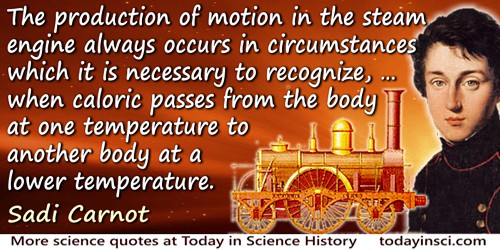
The production of motion in the steam engine always occurs in circumstances which it is necessary to recognize, namely when the equilibrium of caloric is restored, or (to express this differently) when caloric passes from the body at one temperature to another body at a lower temperature.
In 'Réflexions sur la Puissance Motrice du Feu et sur les Machines Propres a Développer cette Puissance' (1824). As translated by Robert Fox, Reflexions on the Motive Power of Fire (1986), 64.
The relationships of free and latent heat set forth in the language of the materialistic theory remain the same if in place of the quantity of matter we put the constant quantity of motion in accordance with the laws of mechanics. The only difference enters where it concerns the generations of heat through other motive forces and where it concerns the equivalent of heat that can be produced by a particular quantity of a mechanical or electrical force.
'Wärme, physiologisch', Handwörterbuch der medicinischen Wissenschaften (1845). In Timothy Lenoir, The Strategy of Life (1982), 203.
The result would inevitably be a state of universal rest and death, if the universe were finite and left to obey existing laws. But it is impossible to conceive a limit to the extent of matter in the universe; and therefore science points rather to an endless progress, through an endless space, of action involving the transformation of potential energy into palpable motion and thence into heat, than to a single finite mechanism, running down like a clock, and stopping for ever.
In 'On the Age of the Sun's Heat' (1862), Popular Lectures and Addresses (1891), Vol. 1, 349-50.
The School of Physics could give us no suitable premises, but for lack of anything better, the Director permitted us to use an abandoned shed which had been in service as a dissecting room of the School of Medicine. Its glass roof did not afford complete shelter against rain; the heat was suffocating in summer, and the bitter cold of winter was only a little lessened by the iron stove, except in its immediate vicinity. There was no question of obtaining the needed proper apparatus in common use by chemists. We simply had some old pine-wood tables with furnaces and gas burners. We had to use the adjoining yard for those of our chemical operations that involved producing irritating gases; even then the gas often filled our shed. With this equipment we entered on our exhausting work. Yet it was in this miserable old shed that we passed the best and happiest years of our life.
As translated by Charlotte and Vernon Kellogg in Marie Curie, 'Autobiographical Notes', Pierre Curie (1923), 186. [With her husband, Pierre Curie, it was in this poorly equipped facility that they worked on their discovery of polonium (announced Jul 1898) and radium (announced Dec 1898). —Webmaster]
The sea from its extreme luminousness presented a wonderful and most beautiful appearance. Every part of the water which by day is seen as foam, glowed with a pale light. The vessel drove before her bows two billows of liquid phosphorus, and in her wake was a milky train. As far as the eye reached the crest of every wave was bright; and from the reflected light, the sky just above the horizon was not so utterly dark as the rest of the Heavens. It was impossible to behold this plane of matter, as if it were melted and consumed by heat, without being reminded of Milton’s description of the regions of Chaos and Anarchy.
The serum, when subjected to heat, coagulates and hardens like egg. This property is one of its striking characteristics; it is attributed to a particular substance which is thereby readily recognizable, and which is called albumine, because it is the one present in egg white, termed albumen.
Système des Connaissances Chimiques (1801), Vol. 5, 117. Trans. Joseph S. Fmton, Proteins, Enzymes, Genes: The Interplay of Chemistry and Biology (1999), 161.
The soul seems to be a very tenuous substance … [and] seems to be made of a most subtle texture, extremely mobile or active corpuscles, not unlike those of flame or heat; indeed, whether they are spherical, as the authors of atoms propound, or pyramidical as Plato thought, or some other form, they seem from their own motion and penetration through bodies to create the heat which is in the animal.
As quoted in Margaret J. Osler and Paul Lawrence Farber (eds.), Religion, Science, and Worldview: Essays in Honor of Richard S. Westfall (2002), 169.
The sun has lost no beams, the earth no elements ; gravity is as adhesive, heat as expansive, light as joyful, air as virtuous, water as medicinal as on the first day. There is no loss, only transference. When the heat is less here it is not lost, but more heat is there.
In 'Perpetual Forces', North American Review (1877), No. 125. Collected in Ralph Waldo Emerson and James Elliot Cabot (ed.), Lectures and Biographical Sketches (1883), 61.
The sun is a mass of incandescent gas, a gigantic nuclear furnace,
Where hydrogen is built into helium at a temperature of millions of degrees.
Yo ho, it’s hot, the sun is not a place where we could live.
But here on earth there’d be no life without the light it gives.
We need its light, we need its heat, we need its energy.
Without the sun, without a doubt, there’d be no you and me.
Where hydrogen is built into helium at a temperature of millions of degrees.
Yo ho, it’s hot, the sun is not a place where we could live.
But here on earth there’d be no life without the light it gives.
We need its light, we need its heat, we need its energy.
Without the sun, without a doubt, there’d be no you and me.
— Hy Zaret
From song 'Why Does the Sun Shine? (The Sun Is A Mass Of Incandescent Gas)' on LP record album Space Songs (1961), in the series Ballads for the Age of Science. Music by Louis Singer, and sung by Tom Glazer. Also recorded by the group They Might Be Giants (1998) who followed up with 'Why Does The Sun Really Shine? (The Sun is a Miasma of Incandescent Plasma)' on CD album Here Comes Science (2009), which corrects several scientific inaccuracies in the lyrics
The Sun is no lonelier than its neighbors; indeed, it is a very common-place star,—dwarfish, though not minute,—like hundreds, nay thousands, of others. By accident the brighter component of Alpha Centauri (which is double) is almost the Sun's twin in brightness, mass, and size. Could this Earth be transported to its vicinity by some supernatural power, and set revolving about it, at a little less than a hundred million miles' distance, the star would heat and light the world just as the Sun does, and life and civilization might go on with no radical change. The Milky Way would girdle the heavens as before; some of our familiar constellations, such as Orion, would be little changed, though others would be greatly altered by the shifting of the nearer stars. An unfamiliar brilliant star, between Cassiopeia and Perseus would be—the Sun. Looking back at it with our telescopes, we could photograph its spectrum, observe its motion among the stars, and convince ourselves that it was the same old Sun; but what had happened to the rest of our planetary system we would not know.
The Solar System and its Origin (1935), 2-3.
The sun's rays are the ultimate source of almost every motion which takes place on the surface of the earth. By their heat are produced all winds, and those disturbances in the electric equilibrium of the atmosphere which give rise to the phenomena of terrestrial magnetism. By their vivifying action vegetables are elaborated from inorganic matter, and become in their turn the support of animals and of man, and the sources of those great deposits of dynamical efficiency which are laid up for human use in our coal strata. By them the waters of the sea are made to circulate in vapor through the air, and irrigate the land, producing springs and rivers. By them are produced all disturbances of the chemical equilibrium of the elements of nature which, by a series of compositions and decompositions, give rise to new products, and originate a transfer of materials. Even the slow degradation of the solid constituents of the surface, in which its chief geological changes consist, and their diffusion among the waters of the ocean, are entirely due to the abrasion of the wind, rain, and tides, which latter, however, are only in part the effect of solar influence and the alternate action of the seasons.
from Outlines of Astronomy (1849), 237.
The sun’s rays proceed from the sun along straight lines and are reflected from every polished object at equal angles, i.e. the reflected ray subtends, together with the line tangential to the polished object which is in the plane of the reflected ray, two equal angles. Hence it follows that the ray reflected from the spherical surface, together with the circumference of the circle which is in the plane of the ray, subtends two equal angles. From this it also follows that the reflected ray, together with the diameter of the circle, subtends two equal angles. And every ray which is reflected from a polished object to a point produces a certain heating at that point, so that if numerous rays are collected at one point, the heating at that point is multiplied: and if the number of rays increases, the effect of the heat increases accordingly.
— Alhazan
In H.J.J. Winter, 'A Discourse of the Concave Spherical Mirror by Ibn Al-Haitham', Journal of the Royal Asiatic Society of Bengal, 1950, 16, 2.
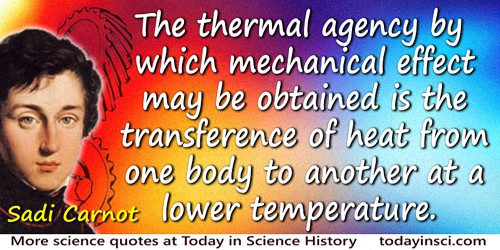
The thermal agency by which mechanical effect may be obtained is the transference of heat from one body to another at a lower temperature.
'Réflexions sur la puissance motrice du feu' (1824) translated by R.H. Thurston in Reflections on the Motive Power of Fire, and on Machines Fitted to Develop that Power (1890), 139.
The whole theory of the motive power of heat is founded on the two following propositions, due respectively to Joule, and to Carnot and Clausius.
PROP. I. Joule).—When equal quantities of mechanical effect are produced by any means whatever from purely thermal sources, or lost in purely thermal effects, equal quantities of heat are put out of existence or are generated.
PROP. II. (Carnot and Clausius).—If an engine be such that, when it is worked backwards, the physical and mechanical agencies in every part of its motions are all reversed, it produces as much mechanical effect as can be produced by any thermo-dynamic engine, with the same temperatures of source and refrigerator, from a given quantity of heat.
PROP. I. Joule).—When equal quantities of mechanical effect are produced by any means whatever from purely thermal sources, or lost in purely thermal effects, equal quantities of heat are put out of existence or are generated.
PROP. II. (Carnot and Clausius).—If an engine be such that, when it is worked backwards, the physical and mechanical agencies in every part of its motions are all reversed, it produces as much mechanical effect as can be produced by any thermo-dynamic engine, with the same temperatures of source and refrigerator, from a given quantity of heat.
In 'On the Dynamical Theory of Heat, with Numerical Results Deduced from Mr Joule's Equivalent of a Thermal Unit, and M. Regnault's Observations on Steam' (1851). In Mathematical and Physical Papers (1882), Vol. 1, 178.
The world looks so different after learning science. For example, trees are made of air, primarily. When they are burned, they go back to air, and in the flaming heat is released the flaming heat of the sun which was bound in to convert the air into tree, and in the ash is the small remnant of the part which did not come from air, that came from the solid earth, instead. These are beautiful things, and the content of science is wonderfully full of them. They are very inspiring, and they can be used to inspire others.
From address (1966) at the 14th Annual Convention of the National Science Teachers Association, New York City, printed in 'What is science?', The Physics Teacher (1969), 7, No. 6, 320.
There are no physicists in the hottest parts of hell, because the existence of a ‘‘hottest part’’ implies a temperature difference, and any marginally competent physicist would immediately use this to run a heat engine and make some other part of hell comfortably cool. This is obviously impossible.
…...
There are those who say that the human kidney was created to keep the blood pure, or more precisely, to keep our internal environment in an ideal balanced state. This I must deny. I grant that the human kidney is a marvelous organ, but I cannot grant that it was purposefully designed to excrete urine or to regulate the composition of the blood or to subserve the physiological welfare of Homo sapiens in any sense. Rather I contend that the human kidney manufactures the kind of urine that it does, and it maintains the blood in the composition which that fluid has, because this kidney has a certain functional architecture; and it owes that architecture not to design or foresight or to any plan, but to the fact that the earth is an unstable sphere with a fragile crust, to the geologic revolutions that for six hundred million years have raised and lowered continents and seas, to the predacious enemies, and heat and cold, and storms and droughts; to the unending succession of vicissitudes that have driven the mutant vertebrates from sea into fresh water, into desiccated swamps, out upon the dry land, from one habitation to another, perpetually in search of the free and independent life, perpetually failing, for one reason or another, to find it.
From Fish to Philosopher (1953), 210-1.
There is deposited in them [plants] an enormous quantity of potential energy [Spannkräfte], whose equivalent is provided to us as heat in the burning of plant substances. So far as we know at present, the only living energy [lebendige Kraft] absorbed during plant growth are the chemical rays of sunlight… Animals take up oxygen and complex oxidizable compounds made by plants, release largely as combustion products carbonic acid and water, partly as simpler reduced compounds, thus using a certain amount of chemical potential energy to produce heat and mechanical forces. Since the latter represent a relatively small amount of work in relation to the quantity of heat, the question of the conservation of energy reduces itself roughly to whether the combustion and transformation of the nutritional components yields the same amount of heat released by animals.
Wissenschaftliche Abhandlungen (1847), 66. Trans. Joseph S. Fruton, Proteins, Enzymes, Genes: The Interplay of Chemistry and Biology (1999), 247.
There was some doubt whether the heat shield had been damaged … This could have been a bad day all the way around if this had been the case.
From post-flight news conference at Cape Canaveral (24 Feb 1962). 'Transcript of Glenn's News Conference Relating His Experiences on Orbital Flight', New York Times (24 Feb 1962), 14.
They say,
The solid earth whereon we tread
In tracts of fluent heat began,
And grew to seeming-random forms,
The seeming prey of cyclic storms,
Till at the last arose the Man. …
The solid earth whereon we tread
In tracts of fluent heat began,
And grew to seeming-random forms,
The seeming prey of cyclic storms,
Till at the last arose the Man. …
From poem, 'In Memoriam A.H.H.' written between 1833-50, and first published anonymously in 1850. Collected in Poetical Works of Alfred Tennyson (1860), Vol.2, 147.
This leads us to ask for the reasons which call for this new theory of transmutation. The beginning of things must needs lie in obscurity, beyond the bounds of proof, though within those of conjecture or of analogical inference. Why not hold fast to the customary view, that all species were directly, instead of indirectly, created after their respective kinds, as we now behold them,--and that in a manner which, passing our comprehension, we intuitively refer to the supernatural? Why this continual striving after “the unattained and dim,”—these anxious endeavors, especially of late years, by naturalists and philosophers of various schools and different tendencies, to penetrate what one of them calls “the mystery of mysteries,” the origin of species? To this, in general, sufficient answer may be found in the activity of the human intellect, “the delirious yet divine desire to know,” stimulated as it has been by its own success in unveiling the laws and processes of inorganic Nature,—in the fact that the principal triumphs of our age in physical science have consisted in tracing connections where none were known before, in reducing heterogeneous phenomena to a common cause or origin, in a manner quite analogous to that of the reduction of supposed independently originated species to a common ultimate origin,—thus, and in various other ways, largely and legitimately extending the domain of secondary causes. Surely the scientific mind of an age which contemplates the solar system as evolved from a common, revolving, fluid mass,— which, through experimental research, has come to regard light, heat, electricity, magnetism, chemical affinity, and mechanical power as varieties or derivative and convertible forms of one force, instead of independent species,—which has brought the so-called elementary kinds of matter, such as the metals, into kindred groups, and raised the question, whether the members of each group may not be mere varieties of one species,—and which speculates steadily in the direction of the ultimate unity of matter, of a sort of prototype or simple element which may be to the ordinary species of matter what the protozoa or component cells of an organism are to the higher sorts of animals and plants,—the mind of such an age cannot be expected to let the old belief about species pass unquestioned.
— Asa Gray
'Darwin on the Origin of Species', The Atlantic Monthly (Jul 1860), 112-3. Also in 'Natural Selection Not Inconsistent With Natural Theology', Darwiniana: Essays and Reviews Pertaining to Darwinism (1876), 94-95.
Those who are unacquainted with the details of scientific investigation have no idea of the amount of labour expended in the determination of those numbers on which important calculations or inferences depend. They have no idea of the patience shown by a Berzelius in determining atomic weights; by a Regnault in determining coefficients of expansion; or by a Joule in determining the mechanical equivalent of heat.
In Sound: A Course of Eight Lectures Delivered at the Royal Institution of Great Britain (1867), 26.
Three ways have been taken to account for it [racial differences]: either that they are the posterity of Ham, who was cursed; or that God at first created two kinds of men, one black and another white; or that by the heat of the sun the skin is scorched, and so gets the sooty hue. This matter has been much canvassed among naturalists, but has never been brought to any certain issue.
In James Boswell, London Journal, 1762-1763, as First Published in 1950 from the Original Manuscript (1956), 251.
To day we made the grand experiment of burning the diamond and certainly the phenomena presented were extremely beautiful and interesting… The Duke’s burning glass was the instrument used to apply heat to the diamond. It consists of two double convex lenses … The instrument was placed in an upper room of the museum and having arranged it at the window the diamond was placed in the focus and anxiously watched. The heat was thus continued for 3/4 of an hour (it being necessary to cool the globe at times) and during that time it was thought that the diamond was slowly diminishing and becoming opaque … On a sudden Sir H Davy observed the diamond to burn visibly, and when removed from the focus it was found to be in a state of active and rapid combustion. The diamond glowed brilliantly with a scarlet light, inclining to purple and, when placed in the dark, continued to burn for about four minutes. After cooling the glass heat was again applied to the diamond and it burned again though not for nearly so long as before. This was repeated twice more and soon after the diamond became all consumed. This phenomenon of actual and vivid combustion, which has never been observed before, was attributed by Sir H Davy to be the free access of air; it became more dull as carbonic acid gas formed and did not last so long.
Entry (Florence, 27 Mar 1814) in his foreign journal kept whilst on a continental tour with Sir Humphry Davy. In Michael Faraday, Bence Jones (ed.), The Life and Letters of Faraday (1870), Vol. 1, 119. Silvanus Phillips Thompson identifies the Duke as the Grand Duke of Tuscany, in Michael Faraday, His Life and Work (1901), 21.
To engage in experiments on heat was always one of my most agreeable employments. This subject had already begun to excite my attention when, in my seventeenth year, I read Boerhave’s admirable Treatise on Fire. Subsequently, indeed, I was often prevented by other matters from devoting my attention to it, but whenever I could snatch a moment I returned to it anew, and always with increased interest.
In 'Historical Review of the Various Experiments of the Author on the Subject of Heat', The Complete Works of Count Rumford (1873), Vol. 2, 188. It is translated from the original German, in Vol. IV, of Rumford’s Kleine Schriften.
To pick a hole–say in the 2nd law of Ωcs, that if two things are in contact the hotter cannot take heat from the colder without external agency.
Now let A & B be two vessels divided by a diaphragm and let them contain elastic molecules in a state of agitation which strike each other and the sides. Let the number of particles be equal in A & B but let those in A have equal velocities, if oblique collisions occur between them their velocities will become unequal & I have shown that there will be velocities of all magnitudes in A and the same in B only the sum of the squares of the velocities is greater in A than in B.
When a molecule is reflected from the fixed diaphragm CD no work is lost or gained.
If the molecule instead of being reflected were allowed to go through a hole in CD no work would be lost or gained, only its energy would be transferred from the one vessel to the other.
Now conceive a finite being who knows the paths and velocities of all the molecules by simple inspection but who can do no work, except to open and close a hole in the diaphragm, by means of a slide without mass.
Let him first observe the molecules in A and when lie sees one coming the square of whose velocity is less than the mean sq. vel. of the molecules in B let him open a hole & let it go into B. Next let him watch for a molecule in B the square of whose velocity is greater than the mean sq. vel. in A and when it comes to the hole let him draw and slide & let it go into A, keeping the slide shut for all other molecules.
Then the number of molecules in A & B are the same as at first but the energy in A is increased and that in B diminished that is the hot system has got hotter and the cold colder & yet no work has been done, only the intelligence of a very observant and neat fingered being has been employed. Or in short if heat is the motion of finite portions of matter and if we can apply tools to such portions of matter so as to deal with them separately then we can take advantage of the different motion of different portions to restore a uniformly hot system to unequal temperatures or to motions of large masses. Only we can't, not being clever enough.
Now let A & B be two vessels divided by a diaphragm and let them contain elastic molecules in a state of agitation which strike each other and the sides. Let the number of particles be equal in A & B but let those in A have equal velocities, if oblique collisions occur between them their velocities will become unequal & I have shown that there will be velocities of all magnitudes in A and the same in B only the sum of the squares of the velocities is greater in A than in B.
When a molecule is reflected from the fixed diaphragm CD no work is lost or gained.
If the molecule instead of being reflected were allowed to go through a hole in CD no work would be lost or gained, only its energy would be transferred from the one vessel to the other.
Now conceive a finite being who knows the paths and velocities of all the molecules by simple inspection but who can do no work, except to open and close a hole in the diaphragm, by means of a slide without mass.
Let him first observe the molecules in A and when lie sees one coming the square of whose velocity is less than the mean sq. vel. of the molecules in B let him open a hole & let it go into B. Next let him watch for a molecule in B the square of whose velocity is greater than the mean sq. vel. in A and when it comes to the hole let him draw and slide & let it go into A, keeping the slide shut for all other molecules.
Then the number of molecules in A & B are the same as at first but the energy in A is increased and that in B diminished that is the hot system has got hotter and the cold colder & yet no work has been done, only the intelligence of a very observant and neat fingered being has been employed. Or in short if heat is the motion of finite portions of matter and if we can apply tools to such portions of matter so as to deal with them separately then we can take advantage of the different motion of different portions to restore a uniformly hot system to unequal temperatures or to motions of large masses. Only we can't, not being clever enough.
Letter to Peter Guthrie Tait (11 Dec 1867). In P. M. Harman (ed.), The Scientific Letters and Papers of James Clerk Maxwell (1995), Vol. 2, 331-2.
To take one of the simplest cases of the dissipation of energy, the conduction of heat through a solid—consider a bar of metal warmer at one end than the other and left to itself. To avoid all needless complication, of taking loss or gain of heat into account, imagine the bar to be varnished with a substance impermeable to heat. For the sake of definiteness, imagine the bar to be first given with one half of it at one uniform temperature, and the other half of it at another uniform temperature. Instantly a diffusing of heat commences, and the distribution of temperature becomes continuously less and less unequal, tending to perfect uniformity, but never in any finite time attaining perfectly to this ultimate condition. This process of diffusion could be perfectly prevented by an army of Maxwell’s ‘intelligent demons’* stationed at the surface, or interface as we may call it with Prof. James Thomson, separating the hot from the cold part of the bar.
* The definition of a ‘demon’, according to the use of this word by Maxwell, is an intelligent being endowed with free will, and fine enough tactile and perceptive organisation to give him the faculty of observing and influencing individual molecules of matter.
* The definition of a ‘demon’, according to the use of this word by Maxwell, is an intelligent being endowed with free will, and fine enough tactile and perceptive organisation to give him the faculty of observing and influencing individual molecules of matter.
In 'The Kinetic Theory of the Dissipation of Energy', Nature (1874), 9, 442.
Today we no longer ask what really goes on in an atom; we ask what is likely to be observed—and with what likelihood—when we subject atoms to any specified influences such as light or heat, magnetic fields or electric currents.
What Little I Remember (1979), 20.
Today, nothing is unusual about a scientific discovery's being followed soon after by a technical application: The discovery of electrons led to electronics; fission led to nuclear energy. But before the 1880's, science played almost no role in the advances of technology. For example, James Watt developed the first efficient steam engine long before science established the equivalence between mechanical heat and energy.
Edward Teller with Judith L. Shoolery, Memoirs: A Twentieth-Century Journey in Science and Politics (2001), 42.
Unconscious, perhaps, of the remote tendency of his own labours, he [Joseph Black] undermined that doctrine of material heat, which he seemed to support. For, by his advocacy of latent heat, he taught that its movements constantly battle, not only some of our senses, but all of them; and that, while our feelings make us believe that heat is lost, our intellect makes us believe that it is not lost. Here, we have apparent destructability, and real indestructibility. To assert that a body received heat without its temperature rising, was to make the understanding correct the touch, and defy its dictates. It was a bold and beautiful paradox, which required courage as well as insight to broach, and the reception of which marks an epoch in the human mind, because it was an immense step towards idealizing matter into force.
History of Civilization in England (1861), Vol. 2, 494.
Underneath his sweetness and gentleness was the heat of a volcano. [Michael Faraday] was a man of excitable and fiery nature; but through high self-discipline he had converted the fire into a central glow and motive power of life, instead of permitting it to waste itself in useless passion.
In Faraday as a Discoverer (1868), 37.
We are led to establish this proposition. The driving power of heat is independent of the agents used to realize it; its value is uniquely fixed by the temperatures of the bodies between which the transfer of caloric is made.
As translated in Reflections on the Motive Power of Heat and on Machines Fitted to Develop Power (1890, Rev. 1897), 68. Edited by R. H. Thurston, from the original French, Réflexions sur la Puissance Motrice du Feu (1824).
We are quite ignorant of the condition of energy in bodies generally. We know how much gas goes in, and how much comes out, and know whether at entrance and exit it is in the form of heat or of work. That is all.
Sketch of Thermodynamics (1877), 137.
We are redefining and we are restating our Socialism in terms of the scientific revolution … The Britain that is going to be forged in the white heat of this revolution will be no place for restrictive practices or outdated methods on either side of industry.
Speech (1 Oct 1963) at the Labour Party Conference, Scarborough. Quoted in David Rubinstein, The Labour Party and British Society (2006), 122.
We can see that there is only one substance in the universe and that man is the most perfect one. He is to the ape and the cleverest animals what Huygens's planetary clock is to one of Julien Leroy's watches. If it took more instruments, more cogs, more springs to show or tell the time, if it took Vaucanson more artistry to make his flautist than his duck, he would have needed even more to make a speaking machine, which can no longer be considered impossible, particularly at the hands of a new Prometheus. Thus, in the same way, nature needed more artistry and machinery to construct and maintain a machine which could continue for a whole century to tell all the beats of the heart and the mind; for we cannot tell the time from the pulse, it is at least the barometer of heat and liveliness, from which we can judge the nature of the soul.
Machine Man (1747), in Ann Thomson (ed.), Machine Man and Other Writings (1996), 33-4.
We maintain that there are two exhalations, one vaporous the other smoky, and these correspond to two kinds of bodies that originate in the earth, things quarried and things mined. The heat of the dry exhalation is the cause of all things quarried. Such are the kinds of stones that cannot be melted, and realgar, and ochre, and ruddle, and sulphur, and the other things of that kind, most things quarried being either coloured lye or, like cinnabar, a stone compounded of it. The vaporous exhalation is the cause of all things mined—things which are either fusible or malleable such as iron, copper, gold.
Meteorology, 378a, 19-28. In Jonathan Barnes (ed.), The Complete Works of Aristotle (1984), Vol. I, 607.
We say that, in very truth the productive cause is a mineralizing power which is active in forming stones… . This power, existing in the particular material of stones, has two instruments according to different natural conditions.
One of these is heat, which is active in drawing out moisture and digesting the material and bringing about its solidification into the form of stone, in Earth that has been acted upon by unctuous moisture… .
The other instrument is in watery moist material that has been acted upon by earthy dryness; and this [instrument] is cold, which … is active in expelling moisture.
One of these is heat, which is active in drawing out moisture and digesting the material and bringing about its solidification into the form of stone, in Earth that has been acted upon by unctuous moisture… .
The other instrument is in watery moist material that has been acted upon by earthy dryness; and this [instrument] is cold, which … is active in expelling moisture.
From De Mineralibus (c.1261-1263), as translated by Dorothy Wyckoff, Book of Minerals (1967), 22.
What I have related is sufficient for establishing the main principle, namely, that the heat which disappears in the conversion of water into vapour, is not lost, but is retained in vapour, and indicated by its expansive form, although it does not affect the thermometer. This heat emerges again from this vapour when it becomes water, and recovers its former quality of affecting the thermometer; in short, it appears again as the cause of heat and expansion.
Lectures on the Elements of Chemistry, delivered in the University of Edinburgh (1803), Vol. I, 173.
What signifies Philosophy that does not apply to some Use? May we not learn from hence, that black Clothes are not so fit to wear in a hot Sunny Climate or Season, as white ones; because in such Cloaths the Body is more heated by the Sun when we walk abroad, and are at the same time heated by the Exercise, which double Heat is apt to bring on putrid dangerous Fevers? The Soldiers and Seamen, who must march and labour in the Sun, should in the East or West Indies have an Uniform of white?
Letter to Miss Mary Stevenson, 20 Sep 1761. In Albert Henry Smyth (ed.), The Writings of Benjamin Franklin (1906), Vol. 4, 115.
When ‘thermal agency’ is thus spent in conducting heat through a solid, what becomes of the mechanical effect which it might produce? Nothing can be lost in the operations of nature—no energy can be destroyed.
In 'An Account of Carnot's Theory of the Motive Power of Heat; with Numerical Results Deduced from Regnault's Experiments on Steam' (1849). In Mathematical and Physical Papers (1882-1911), Vol. 1, 118.
When a [mercury] thermometer … was made (perhaps imperfect in many ways) the result answered to my prayer; and with great pleasure of mind I observed the truth [that water boils at a fixed degree of heat].
From 'Experimenta circa gradum caloris liquorum nonnullorum ebullientium instituta', Philosophical Transactions (1724), 33, 1, as translated in William Francis Magie, A Source Book in Physics (1935), 131.
When the great truth accidentally revealed and experimentally confirmed is fully recognized, that this planet, with all its appalling immensity, is to electric currents virtually no more than a small metal ball and that by this fact many possibilities, each baffling imagination and of incalculable consequence, are rendered absolutely sure of accomplishment; when the first plant is inaugurated and it is shown that a telegraphic message, almost as secret and non-interferable as a thought, can be transmitted to any terrestrial distance, the sound of the human voice, with all its intonations and inflections, faithfully and instantly reproduced at any other point of the globe, the energy of a waterfall made available for supplying light, heat or motive power, anywhere—on sea, or land, or high in the air—humanity will be like an ant heap stirred up with a stick: See the excitement coming!
In 'The Transmission of Electric Energy Without Wires', Electrical World and Engineer (5 Mar 1904), 43, No. 10, 431.
While all bodies are composed of the four elements, that is, of heat, moisture, the earthy, and air, yet there are mixtures according to natural temperament which make up the natures of all the different animals of the world, each after its kind.
In De Architectura, Book 1, Chap 4, Sec. 5. As translated in Morris Hicky Morgan (trans.), Vitruvius: The Ten Books on Architecture (1914), 16.
Who shall declare the time allotted to the human race, when the generations of the most insignificant insect also existed for unnumbered ages? Yet man is also to vanish in the ever-changing course of events. The earth is to be burnt up, and the elements are to melt with fervent heat—to be again reduced to chaos—possibly to be renovated and adorned for other races of beings. These stupendous changes may be but cycles in those great laws of the universe, where all is variable but the laws themselves and He who has ordained them.
Physical Geography (1848), Vol. 1, 2-3.
Why Become Extinct? Authors with varying competence have suggested that dinosaurs disappeared because the climate deteriorated (became suddenly or slowly too hot or cold or dry or wet), or that the diet did (with too much food or not enough of such substances as fern oil; from poisons in water or plants or ingested minerals; by bankruptcy of calcium or other necessary elements). Other writers have put the blame on disease, parasites, wars, anatomical or metabolic disorders (slipped vertebral discs, malfunction or imbalance of hormone and endocrine systems, dwindling brain and consequent stupidity, heat sterilization, effects of being warm-blooded in the Mesozoic world), racial old age, evolutionary drift into senescent overspecialization, changes in the pressure or composition of the atmosphere, poison gases, volcanic dust, excessive oxygen from plants, meteorites, comets, gene pool drainage by little mammalian egg-eaters, overkill capacity by predators, fluctuation of gravitational constants, development of psychotic suicidal factors, entropy, cosmic radiation, shift of Earth’s rotational poles, floods, continental drift, extraction of the moon from the Pacific Basin, draining of swamp and lake environments, sunspots, God’s will, mountain building, raids by little green hunters in flying saucers, lack of standing room in Noah’s Ark, and palaeoweltschmerz.
'Riddles of the Terrible Lizards', American Scientist (1964) 52, 231.
Why there is one Body in or System qualified to give Light and Heat to all ye rest, I know no reason, but because ye author of the Systeme thought it convenient.
Letter to Bentley (10 Dec 1692). In The Works of Richard Bentley (1838), Vol. 3, 204.
 In science it often happens that scientists say, 'You know that's a really good argument; my position is mistaken,' and then they would actually change their minds and you never hear that old view from them again. They really do it. It doesn't happen as often as it should, because scientists are human and change is sometimes painful. But it happens every day. I cannot recall the last time something like that happened in politics or religion.
(1987) --
In science it often happens that scientists say, 'You know that's a really good argument; my position is mistaken,' and then they would actually change their minds and you never hear that old view from them again. They really do it. It doesn't happen as often as it should, because scientists are human and change is sometimes painful. But it happens every day. I cannot recall the last time something like that happened in politics or religion.
(1987) -- 





