Heart Quotes (246 quotes)
'O tell me, when along the line
From my full heart the message flows,
What currents are induced in thine?
One click from thee will end my woes'.
Through many an Ohm the Weber flew,
And clicked the answer back to me,
'I am thy Farad, staunch and true,
Charged to a Volt with love for thee'.
From my full heart the message flows,
What currents are induced in thine?
One click from thee will end my woes'.
Through many an Ohm the Weber flew,
And clicked the answer back to me,
'I am thy Farad, staunch and true,
Charged to a Volt with love for thee'.
From 'Valentine from A Telegraph Clerk ♂ to a Telegraph Clerk ♀'. In Lewis Campbell and William Garnett, The Life of James Clerk Maxwell (1882), 631.
“True is it, my incorporate friends,” quoth he, “That I receive the general food at first, Which you do live upon; and fit it is, Because I am the storehouse and the shop Of the whole body. But, if you do remember, I send it through the rivers of your blood, Even to the court, the heart, to th’ seat o’ th’ brain; And, through the cranks and offices of man, The strongest nerves and small inferior veins From me receive that natural competency Whereby they live. And though that all at once”— You, good friends, this says the belly, mark me.
[Told as a fable, this is the belly’s answer to a complaint from the other members of the body that it received all the food but did no work.] In Coriolanus (1623), Act 1, Scene 1, line 130-141. Webmaster’s note: The Fable of the Belly has its roots in antiquity. William Harvey delivered a lecture in Apr 1616 on his discovery the circulation of blood in the body, but did not publish until 1628.
[1665-06-17] It stroke me very deep this afternoon, going with a hackney-coach from my Lord Treasurer's down Holborne - the coachman I found to drive easily and easily; at last stood still, and came down hardly able to stand; and told me that he was suddenly stroke very sick and almost blind. So I light and went into another coach, with a sad heart for the poor man and trouble for myself, lest he should have been stroke with the plague - being at that end of the town that I took him up. But God have mercy upon us all.
Diary of Samuel Pepys (17 Jun 1665)
[1665-09-14] ...my finding that although the Bill [total of dead] in general is abated, yet the City within the walls is encreasd and likely to continue so (and is close to our house there) - my meeting dead corps's of the plague, carried to be buried close to me at noonday through the City in Fanchurch-street - to see a person sick of the sores carried close by me by Grace-church in a hackney-coach - my finding the Angell tavern at the lower end of Tower-hill shut up; and more then that, the alehouse at the Tower-stairs; and more then that, that the person was then dying of the plague when I was last there, a little while ago at night, to write a short letter there, and I overheard the mistress of the house sadly saying to her husband somebody was very ill, but did not think it was of the plague - to hear that poor Payne my waterman hath buried a child and is dying himself - to hear that a labourer I sent but the other day to Dagenhams to know how they did there is dead of the plague and that one of my own watermen, that carried me daily, fell sick as soon as he had landed me on Friday morning last, when I had been all night upon the water ... is now dead of the plague - to hear ... that Mr Sidny Mountagu is sick of a desperate fever at my Lady Carteret's at Scott's hall - to hear that Mr. Lewes hath another daughter sick - and lastly, that both my servants, W Hewers and Tom Edwards, have lost their fathers, both in St. Sepulcher's parish, of the plague this week - doth put me into great apprehensions of melancholy, and with good reason. But I put off the thoughts of sadness as much as I can, and the rather to keep my wife in good heart and family also.
Diary of Samuel Pepys (14 Sep 1665)
[Apollo 7 was] an expedition of the mind, not of the heart.
Quoted by Don E. Wilhelms in To a Rocky Moon: a Geologist's Lunar Exploration (1993), 336.
[I] could see how nervous everybody was in the beginning and how silent it was when we had trouble with the artificial heart [during the surgery, but later in the operation, when it was working, there were moments] of loud and raucous humor.
[Commenting after reviewing the video tape of the world's first human implantation of an artificial heart.]
[Commenting after reviewing the video tape of the world's first human implantation of an artificial heart.]
Quoted by Lawrence K. Altman in “Clark's Surgeon Was ‘Worried To Death’&rdquo, New York Times (12 Apr 1983), C2.
[The body of law] has taxed the deliberative spirit of ages. The great minds of the earth have done it homage. It was the fruit of experience. Under it men prospered, all the arts flourished, and society stood firm. Every right and duty could be understood because the rules regulating each had their foundation in reason, in the nature and fitness of things; were adapted to the wants of our race, were addressed to the mind and to the heart; were like so many scraps of logic articulate with demonstration. Legislation, it is true occasionally lent its aid, but not in the pride of opinion, not by devising schemes inexpedient and untried, but in a deferential spirit, as a subordinate co-worker.
From biographical preface by T. Bigelow to Austin Abbott (ed.), Official Report of the Trial of Henry Ward Beecher (1875), Vol. 1, xii.
[The heart is] really a fascinating organ. It's about the only organ in the body that you can really witness its function. Doing things. And so on. Some of the other organs you can witness, like the intestines, will have this sort of peristaltic motion. But nothing that can compare with the activity of the human heart.
[When his physician father died of a heart attack:] It was then and there that I gave myself to medicine the way a monk gives himself to God. Not to have done so would have seemed an act of filial impiety. Since I could not find him in the flesh, I would find him in the work he did.
In Down From Troy: A Doctor Comes of Age (1992), 136.
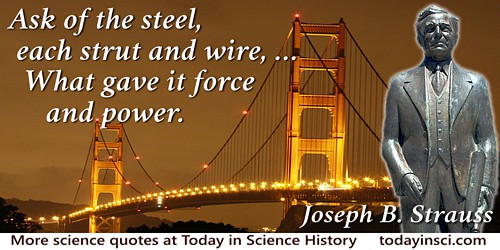
The Mighty Task is Done
At last the mighty task is done;
Resplendent in the western sun
The Bridge looms mountain high;
Its titan piers grip ocean floor,
Its great steel arms link shore with shore,
Its towers pierce the sky.
On its broad decks in rightful pride,
The world in swift parade shall ride,
Throughout all time to be;
Beneath, fleet ships from every port,
Vast landlocked bay, historic fort,
And dwarfing all the sea.
To north, the Redwood Empires gates;
To south, a happy playground waits,
In Rapturous appeal;
Here nature, free since time began,
Yields to the restless moods of man,
Accepts his bonds of steel.
Launched midst a thousand hopes and fears,
Damned by a thousand hostile sneers,
Yet Neer its course was stayed,
But ask of those who met the foe
Who stood alone when faith was low,
Ask them the price they paid.
Ask of the steel, each strut and wire,
Ask of the searching, purging fire,
That marked their natal hour;
Ask of the mind, the hand, the heart,
Ask of each single, stalwart part,
What gave it force and power.
An Honored cause and nobly fought
And that which they so bravely wrought,
Now glorifies their deed,
No selfish urge shall stain its life,
Nor envy, greed, intrigue, nor strife,
Nor false, ignoble creed.
High overhead its lights shall gleam,
Far, far below lifes restless stream,
Unceasingly shall flow;
For this was spun its lithe fine form,
To fear not war, nor time, nor storm,
For Fate had meant it so.
At last the mighty task is done;
Resplendent in the western sun
The Bridge looms mountain high;
Its titan piers grip ocean floor,
Its great steel arms link shore with shore,
Its towers pierce the sky.
On its broad decks in rightful pride,
The world in swift parade shall ride,
Throughout all time to be;
Beneath, fleet ships from every port,
Vast landlocked bay, historic fort,
And dwarfing all the sea.
To north, the Redwood Empires gates;
To south, a happy playground waits,
In Rapturous appeal;
Here nature, free since time began,
Yields to the restless moods of man,
Accepts his bonds of steel.
Launched midst a thousand hopes and fears,
Damned by a thousand hostile sneers,
Yet Neer its course was stayed,
But ask of those who met the foe
Who stood alone when faith was low,
Ask them the price they paid.
Ask of the steel, each strut and wire,
Ask of the searching, purging fire,
That marked their natal hour;
Ask of the mind, the hand, the heart,
Ask of each single, stalwart part,
What gave it force and power.
An Honored cause and nobly fought
And that which they so bravely wrought,
Now glorifies their deed,
No selfish urge shall stain its life,
Nor envy, greed, intrigue, nor strife,
Nor false, ignoble creed.
High overhead its lights shall gleam,
Far, far below lifes restless stream,
Unceasingly shall flow;
For this was spun its lithe fine form,
To fear not war, nor time, nor storm,
For Fate had meant it so.
Written upon completion of the building of the Golden Gate Bridge, May 1937. In Allen Brown, Golden Gate: biography of a Bridge (1965), 229.
“Ye, sire,” I seide,
“By so no man were greved,
Alle the sciences under sonne,
And alle sotile craftes,
Ich wolde ich knewe and kouthe
Kyndely in myn harte.”
“Yes, sir,” I said, “so long as no one minds. All science under the sun, and all subtle arts. Were it possible, I would know and hold naturally within my heart!”
“By so no man were greved,
Alle the sciences under sonne,
And alle sotile craftes,
Ich wolde ich knewe and kouthe
Kyndely in myn harte.”
“Yes, sir,” I said, “so long as no one minds. All science under the sun, and all subtle arts. Were it possible, I would know and hold naturally within my heart!”
In William Langland and B. Thomas Wright (ed.) The Vision and Creed of Piers Ploughman (1842), 297. Modern translation by Terrence Tiller in Piers Plowman (1981, 1999), 157.
Die Religion ist der Seufzer der bedrängten Kreatur, das Gemüt einer herzlosen Welt, wie sie der Geist geistloser Zustände ist. Sie ist das Opium des Volks. Die Aufhebung der Religion als des illusorischen Glücks des Volks ist die Forderung seines wirklichen Glücks.
Religion is the sigh of the oppressed creature, the heart of a heartless world, just as it is the spirit of spiritless conditions. It is the opium of the people. To abolish religion as the illusory happiness of the people is to demand their real happiness.
Religion is the sigh of the oppressed creature, the heart of a heartless world, just as it is the spirit of spiritless conditions. It is the opium of the people. To abolish religion as the illusory happiness of the people is to demand their real happiness.
'Zur Kritik der Hegelschen Rechtsphilosophie. Einleitung' (1844), Karl Marx Fredrich Engels (1964), 378-9.
L’oeuvre de Pasteur est admirable; elle montre son génie, mais it faut avoir vécu dans son intimité pour connaître toute la bonté de son coeur.
The work of Pasteur is admirable; it shows his genius, but it must have been experienced intimately to know all the goodness of his heart.
The work of Pasteur is admirable; it shows his genius, but it must have been experienced intimately to know all the goodness of his heart.
Epigraph in René Vallery-Radot, La Vie de Pasteur (1900), title page. English by Google translation, tweaked by Webmaster. Pierre Paul Émile Roux had indeed known Pasteur well, as one of his closest collaborators.
Neue Phaenomena zu erklären, dieses macht meine Sorgen aus, und wie froh ist der Forscher, wenn er das so fleissig Gesuche findet, eine Ergötzung wobei das Herz lacht.
To explain new phenomena, that is my task; and how happy is the scientist when he finds what he so diligently sought, a pleasure that gladdens the heart.
To explain new phenomena, that is my task; and how happy is the scientist when he finds what he so diligently sought, a pleasure that gladdens the heart.
Letter to Johan Gahn. Original German quote in Mary Elivira Weeks, The Discovery of the Elements (1934), 153, citing Nordenskiöld, Scheeles nachgelassene Briefe und Aufzeichnungen (1892), 151. Translation in Mary Elvira Weeks and Henry M. Leicester (ed.)The Discovery of the Elements (6th ed. 1956), 223.
Macbeth: How does your patient, doctor?
Doctor: Not so sick, my lord,
As she is troubled with thick-coming fancies,
That keep her from her rest.
Macbeth: Cure her of that.
Canst thou not minister to a mind diseased,
Pluck from the memory a rooted sorrow,
Raze out the written troubles of the brain,
And with some sweet oblivious antidote
Cleanse the stuffed bosom of that perilous stuff
Which weighs upon the heart?
Doctor: Therein the patient
Must minister to himself.
Macbeth: Throw physic to the dogs; I'll none of it.
Doctor: Not so sick, my lord,
As she is troubled with thick-coming fancies,
That keep her from her rest.
Macbeth: Cure her of that.
Canst thou not minister to a mind diseased,
Pluck from the memory a rooted sorrow,
Raze out the written troubles of the brain,
And with some sweet oblivious antidote
Cleanse the stuffed bosom of that perilous stuff
Which weighs upon the heart?
Doctor: Therein the patient
Must minister to himself.
Macbeth: Throw physic to the dogs; I'll none of it.
Macbeth (1606), V, iii.
A merry heart doeth good like a medicine: but a broken spirit drieth the bones.
— Bible
King James Bible, Old Testament, Proverbs 17:22.
A monument to Newton! a monument to Shakespeare! Look up to Heaven—look into the Human Heart. Till the planets and the passions–the affections and the fixed stars are extinguished—their names cannot die.
In 'Noctes Ambrosianae: XXV' (Jun 1830), The Works of Professor Wilson of the University of Edinburgh: Noctes Ambrosianae (1865), Vol. 3, 55.
A schoolteacher or professor cannot educate individuals, he educates only species. A thought that deserves taking to heart.
Aphorism 5 in Notebook J (1789-1793), as translated by R. J. Hollingdale in Aphorisms (1990). Reprinted as The Waste Books (2000), 129.
A scientific man ought to have no wishes, no affections, a mere heart of stone.
Letter to T. H. Huxley (9 Jul 1857). In Charles Darwin, Francis Darwin (ed.), Albert Charles Seward (ed.), More letters of Charles Darwin (1903), Vol. 1, 98.
A story about the Jack Spratts of medicine [was] told recently by Dr. Charles H. Best, co-discoverer of insulin. He had been invited to a conference of heart specialists in North America. On the eve of the meeting, out of respect for the fat-clogs-the-arteries theory, the delegates sat down to a special banquet served without fats. It was unpalatable but they all ate it as a duty. Next morning Best looked round the breakfast room and saw these same specialists—all in the 40-60 year old, coronary age group—happily tucking into eggs, bacon, buttered toast and coffee with cream.
'Objections To High-Fat Diets', Eat Fat And Grow Slim (1958), Ch. 3.
A torn jacket, is soon mended; but hard words bruise the heart of a child.
In 'Table-Talk', The Poetical Works of Henry Wadsworth Longfellow (1883), 1354.
A wise person is hungry for knowledge, while the fool feeds on trash.
— Bible
Proverbs 15:14, as given in The Swindoll Study Bible NLT (New Living Translation), 760. In the King James Version, this is given as: “The heart of him that hath understanding seeketh knowledge: But the mouth of fools feedeth on foolishness.”
And in acting thus he remains equally at ease whether the majority agree with him or he finds himself in a minority. For he has done what he could: he has expressed his convictions; and he is not master of the minds or hearts of others.
In The Maxims and Reflections of Goethe (1906), 190.
And so many think incorrectly that everything was created by the Creator in the beginning as it is seen, that not only the mountains, valleys, and waters, but also various types of minerals occurred together with the rest of the world, and therefore it is said that it is unnecessary to investigate the reasons why they differ in their internal properties and their locations. Such considerations are very dangerous for the growth of all the sciences, and hence for natural knowledge of the Earth, particularly the art of mining, though it is very easy for those clever people to be philosophers, having learnt by heart the three words 'God so created' and to give them in reply in place of all reasons.
About the Layers of the Earth and other Works on Geology (1757), trans. A. P. Lapov (1949), 55.
And this is the ultimate lesson that our knowledge of the mode of transmission of typhus has taught us: Man carries on his skin a parasite, the louse. Civilization rids him of it. Should man regress, should he allow himself to resemble a primitive beast, the louse begins to multiply again and treats man as he deserves, as a brute beast. This conclusion would have endeared itself to the warm heart of Alfred Nobel. My contribution to it makes me feel less unworthy of the honour which you have conferred upon me in his name.
'Investigations on Typhus', Nobel Lecture, 1928. In Nobel Lectures: Physiology or Medicine 1922-1941 (1965), 187.
Aristotle ... imputed this symphony of the heavens ... this music of the spheres to Pythagorus. ... But Pythagoras alone of mortals is said to have heard this harmony ... If our hearts were as pure, as chaste, as snowy as Pythagoras' was, our ears would resound and be filled with that supremely lovely music of the wheeling stars.
'On the Music of the Spheres'. Second Prolusion. In John Milton and Merritt Yerkes Hughes (ed.), Complete Poems and Major Prose (1957, 2003), 603-604.
As the arteries grow hard, the heart grows soft.
…...
At first men try with magic charms
To fertilize the earth,
To keep their flocks and herds from harm
And bring new young to birth.
Then to capricious gods they turn
To save from fire or flood;
Their smoking sacrifices burn
On altars red with blood.
Next bold philosopher and sage
A settled plan decree
And prove by thought or sacred page
What Nature ought to be.
But Nature smiles—a Sphinx-like smile
Watching their little day
She waits in patience for a while—
Their plans dissolve away.
Then come those humbler men of heart
With no completed scheme,
Content to play a modest part,
To test, observe, and dream.
Till out of chaos come in sight
Clear fragments of a Whole;
Man, learning Nature’s ways aright
Obeying, can control.
To fertilize the earth,
To keep their flocks and herds from harm
And bring new young to birth.
Then to capricious gods they turn
To save from fire or flood;
Their smoking sacrifices burn
On altars red with blood.
Next bold philosopher and sage
A settled plan decree
And prove by thought or sacred page
What Nature ought to be.
But Nature smiles—a Sphinx-like smile
Watching their little day
She waits in patience for a while—
Their plans dissolve away.
Then come those humbler men of heart
With no completed scheme,
Content to play a modest part,
To test, observe, and dream.
Till out of chaos come in sight
Clear fragments of a Whole;
Man, learning Nature’s ways aright
Obeying, can control.
Epigraph in A History of Science and Its Relation with Philosophy & Religion (1968), vi.
At the heart of science is an essential balance between two seemingly contradictory attitudes—an openness to new ideas, no matter how bizarre or counterintuitive they may be, and the most ruthless skeptical scrutiny of all ideas, old and new. This is how deep truths are winnowed from deep nonsense.
The Demon-Haunted World: Science as a Candle in the Dark (1997), 304.
At the planet’s very heart lies a solid rocky core, at least five times larger than Earth, seething with the appalling heat generated by the inexorable contraction of the stupendous mass of material pressing down to its centre. For more than four billion years Jupiter’s immense gravitational power has been squeezing the planet slowly, relentlessly, steadily, converting gravitational energy into heat, raising the temperature of that rocky core to thirty thousand degrees, spawning the heat flow that warms the planet from within. That hot, rocky core is the original protoplanet seed from the solar system’s primeval time, the nucleus around which those awesome layers of hydrogen and helium and ammonia, methane, sulphur compounds and water have wrapped themselves.
— Ben Bova
Jupiter
Atoms have a nucleus, made of protons and neutrons bound together. Around this nucleus shells of electrons spin, and each shell is either full or trying to get full, to balance with the number of protons—to balance the number of positive and negative charges. An atom is like a human heart, you see.
The Lunatics (1988). In Gary Westfahl, Science Fiction Quotations: From the Inner Mind to the Outer Limits (2006), 323.
Attitudes are more important than abilities
Motives are more important than methods
Character is more important than cleverness,
And the Heart takes precedence over the head.
Motives are more important than methods
Character is more important than cleverness,
And the Heart takes precedence over the head.
when asked to autograph his book
Australia, Australia, we love you from the heart. The kidneys, the liver & the giblets too. And every other part.
Stanza from song, Australia, (originally submitted as a new Australian National Anthem). Re-released in a CD compilation The Spike Milligan Collection, CD (2000).
Batter my heart, three-personed God …
Holy Sonnets, No. 14. Quoted in Kim Lim (ed.), 1,001 Pearls of Spiritual Wisdom: Words to Enrich, Inspire, and Guide Your Life (2014), 164
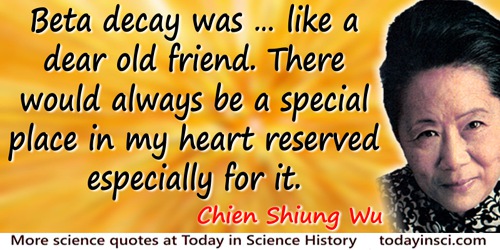
Beta decay was … like a dear old friend. There would always be a special place in my heart reserved especially for it.
In paper presented to the International Conference on the History of Original Ideas and Basic Discoveries, Erice, Sicily (27 Jul-4 Aug 1994), 'Parity Violation' collected in Harvey B. Newman, Thomas Ypsilantis History of Original Ideas and Basic Discoveries in Particle Physics (1996), 390-391.
Biology occupies a position among the sciences both marginal and central. Marginal because, the living world, constituting only a tiny and very “special” part of the universe, it does not seem likely that the study of living beings will ever uncover general laws applicable outside the biosphere. But if the ultimate aim of the whole of science is indeed, as I believe, to clarify man's relationship to the universe, then biology must be accorded a central position, since of all the disciplines it is the one that endeavours to go most directly to the heart of the problems that must be resolved before that of “human nature” can even be framed in other than metaphysical terms.
In Jacques Monod and Austryn Wainhouse (trans.), Chance and Necessity: An Essay on the Natural Philosophy of Modern Biology (1971), xi.
But the office of the Cerebral seems to be for the animal Spirits to supply some Nerves; by which involuntary actions (such as are the beating of the Heart, easie respiration, the Concoction of the Aliment, the protrusion of the Chyle, and many others) which are made after a constant manner unknown to us, or whether we will or no, are performed.
In Anatomy of the Brain and Nerves (1664), trans. Samuel Pordage (1681), reprinted in William Peindel (ed.), Thomas Willis: Anatomy of the Brain and Nerves (1965), Vol. 2, 111.
By firm immutable immortal laws Impress’d on Nature by the GREAT FIRST CAUSE,
Say, MUSE! how rose from elemental strife
Organic forms, and kindled into life;
How Love and Sympathy with potent charm
Warm the cold heart, the lifted hand disarm;
Allure with pleasures, and alarm with pains,
And bind Society in golden chains.
Say, MUSE! how rose from elemental strife
Organic forms, and kindled into life;
How Love and Sympathy with potent charm
Warm the cold heart, the lifted hand disarm;
Allure with pleasures, and alarm with pains,
And bind Society in golden chains.
From 'Production of Life', The Temple of Nature; or, The Origin of Society: A Poem, with Philosophical Notes (1803), 3, Canto I, lines 1-8.
By the year 2000 the commonest killers such as coronary heart disease, stroke, respiratory, diseases and many cancers will be wiped out.
Irish Times (24 Apr 1987).
Dam Hetch Hetchy! As well dam for water-tanks the people’s cathedrals and churches, for no holier temple has ever been consecrated by the heart of man.
[Muir was aghast that the Hetch Hetchy Valley in Yosemite was to be flooded by the O'Shaughnessy Dam to provide water for San Francisco. Muir lost this land conservation battle; the dam was completed in 1914.]
[Muir was aghast that the Hetch Hetchy Valley in Yosemite was to be flooded by the O'Shaughnessy Dam to provide water for San Francisco. Muir lost this land conservation battle; the dam was completed in 1914.]
Closing remark in The Yosemite (1912), 262.
Detail is the heart of realism, and the fatty degeneration of art.
In Art (1958), 149.
Direct observation of the testimony of the earth … is a matter of the laboratory, of the field naturalist, of indefatigable digging among the ancient archives of the earth’s history. If Mr. Bryan, with an open heart and mind, would drop all his books and all the disputations among the doctors and study first hand the simple archives of Nature, all his doubts would disappear; he would not lose his religion; he would become an evolutionist.
'Evolution and Religion', New York Times (5 Mar 1922), 91. Written in response to an article a few days earlier in which William Jennings Bryan challenged the theory of evolution as lacking proof.
Does it seem all but incredible to you that intelligence should travel for two thousand miles, along those slender copper lines, far down in the all but fathomless Atlantic; never before penetrated … save when some foundering vessel has plunged with her hapless company to the eternal silence and darkness of the abyss? Does it seem … but a miracle … that the thoughts of living men … should burn over the cold, green bones of men and women, whose hearts, once as warm as ours, burst as the eternal gulfs closed and roared over them centuries ago?
A tribute to the Atlantic telegraph cable by Edward Everett, one of the topics included in his inauguration address at the Washington University of St. Louis (22 Apr 1857). In Orations and Speeches on Various Occasions: Volume 3 (1870), 509-511.
Education has, thus, become the chief problem of the world, its one holy cause. The nations that see this will survive, and those that fail to do so will slowly perish. There must be re-education of the will and of the heart as well as of the intellect, and the ideals of service must supplant those of selfishness and greed. ... Never so much as now is education the one and chief hope of the world.
Confessions of a Psychologist (1923). Quoted in Bruce A. Kimball, The True Professional Ideal in America: A History (1996), 198.
EMOTION, n. A prostrating disease caused by a determination of the heart to the head. It is sometimes accompanied by a copious discharge of hydrated chloride of sodium from the eyes.
The Collected Works of Ambrose Bierce (1911), Vol. 7, The Devil's Dictionary, 84.
Enough for me the mystery of the eternity of life, and the inkling of the marvellous structure of reality, together with the single-hearted endeavour to comprehend a portion, be it never so tiny, of the reason that manifests itself in nature.
In Alan Harris (ed.), The World As I See It (1934), 242.
Every breath you draw, every accelerated beat of your heart in the emotional periods of your oratory depend upon highly elaborated physical and chemical reactions and mechanisms which nature has been building up through a million centuries. If one of these mechanisms, which you owe entirely to your animal ancestry, were to be stopped for a single instant, you would fall lifeless on the stage. Not only this, but some of your highest ideals of human fellowship and comradeship were not created in a moment, but represent the work of ages.
Quoted in Closing Address by Dr. Henry Sloane Coffin, president of the Union Theological Seminary, New York, at the Memorial Service for Osborn at St. Bartholomew's Church, N.Y. (18 Dec 1935). In 'Henry Fairfield Osborn', Supplement to Natural History (Feb 1936), 37:2, 133-34. Bound in Kofoid Collection of Pamphlets on Biography, University of California.
Everybody can be great. Because anybody can serve. You don’t have to have a college degree to serve … You only need a heart full of grace. A soul generated by love.
Quoted in Kim Lim (ed.), 1,001 Pearls of Spiritual Wisdom: Words to Enrich, Inspire, and Guide Your Life (2014), 253
Evolution: At the Mind's Cinema
I turn the handle and the story starts:
Reel after reel is all astronomy,
Till life, enkindled in a niche of sky,
Leaps on the stage to play a million parts.
Life leaves the slime and through all ocean darts;
She conquers earth, and raises wings to fly;
Then spirit blooms, and learns how not to die,-
Nesting beyond the grave in others' hearts.
I turn the handle: other men like me
Have made the film: and now I sit and look
In quiet, privileged like Divinity
To read the roaring world as in a book.
If this thy past, where shall they future climb,
O Spirit, built of Elements and Time?
I turn the handle and the story starts:
Reel after reel is all astronomy,
Till life, enkindled in a niche of sky,
Leaps on the stage to play a million parts.
Life leaves the slime and through all ocean darts;
She conquers earth, and raises wings to fly;
Then spirit blooms, and learns how not to die,-
Nesting beyond the grave in others' hearts.
I turn the handle: other men like me
Have made the film: and now I sit and look
In quiet, privileged like Divinity
To read the roaring world as in a book.
If this thy past, where shall they future climb,
O Spirit, built of Elements and Time?
'Evolution: At the Mind's Cinema' (1922), in The Captive Shrew and Other Poems of a Biologist (1932), 55.
Faith is a knowledge within the heart, beyond the reach of proof.
In The Kahlil Gibran Reader: Inspirational Writings (2006), 38.
Fear of something is at the root of hate for others and hate within will eventually destroy the hater. Keep your thoughts free from hate, and you will have no fear from those who hate you. ...
David, though small, was filled with truth, right thinking and good will for others. Goliath represents one who let fear into his heart, and it stayed there long enough to grow into hate for others.
David, though small, was filled with truth, right thinking and good will for others. Goliath represents one who let fear into his heart, and it stayed there long enough to grow into hate for others.
In Alvin D. Smith, George Washington Carver: Man of God (1954), 43. Cited in Linda O. McMurry, George Washington Carver, Scientist and Symbol (1982), 107. Smith's book is about his recollections of G.W. Carver's Sunday School classes at Tuskegee, some 40 years earlier. Webmaster, who has not yet been able to see the original book, cautions this quote may be the gist of Carver's words, rather than a verbatim quote.
Fed on the dry husks of facts, the human heart has a hidden want which science cannot supply.
Science and Immorality (1904), 76.
Few are those who see with their own eyes and feel with their own hearts.
…...
Fleets are not confined to the ocean, but now sail over the land. … All the power of the British Navy has not been able to prevent Zeppelins from reaching England and attacking London, the very heart of the British Empire. Navies do not protect against aerial attack. … Heavier-than-air flying machines of the aeroplane type have crossed right over the heads of armies, of million of men, armed with the most modern weapons of destruction, and have raided places in the rear. Armies do not protect against aerial war.
In 'Preparedness for Aerial Defense', Addresses Before the Eleventh Annual Convention of the Navy League of the United States, Washington, D.C., April 10-13, 1916 (1916), 70.
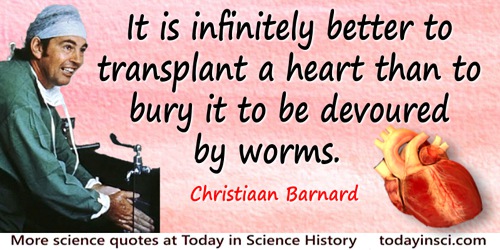
![Christiaan Barnard quote: For a dying man it is not a difficult decision [to agree to become the world’s first heart transplant]](https://todayinsci.com/B/Barnard_Christiaan/BarnardChristiaan-Decision500x250px.jpg)
For a dying man it is not a difficult decision [to agree to become the world's first heart transplant] … because he knows he is at the end. If a lion chases you to the bank of a river filled with crocodiles, you will leap into the water convinced you have a chance to swim to the other side. But you would not accept such odds if there were no lion.
In Janie B. Butts and Karen Rich, Nursing Ethics (2005), 59.
For science, in so far as it is a substitute for religion, and reason, in so far as it is a substitute for faith, have always foundered. Science will be able to satisfy in an increasing measure, and in fact does satisfy, our increasing logical and intellectual needs, our desire to know and understand the truth; but science does not satisfy the needs of our heart and our will, our hunger for immortality—far from satisfying it, it contradicts it.
From Miguel Unamuno and J. E. Crawford Flitch (trans.), Essays and Soliloquies (1926), 209.
For the harmony of the world is made manifest in Form and Number, and the heart and soul and all the poetry of Natural Philosophy are embodied in the concept of mathematical beauty.
In 'Epilogue', On Growth and Form (1917), 778-9.
For thousands of years men have striven and suffered and begotten and woman have brought forth in pain. A hundred years ago, perhaps, another man sat on this spot; like you he gazed with awe and yearning in his heart at the dying light on the glaciers. Like you he was begotten of man and born of woman. He felt pain and brief joy as you do. Was he someone else? Was it not you yourself? What is this Self of yours? What was the necessary condition for making the thing conceived this time into you, just you and not someone else?
In Seek for the Road (1925). Quoted in Ken Wilber, Quantum Questions (1984), 96-97.
For, however much we may clench our teeth in anger, we cannot but confess, in opposition to Galen’s teaching but in conformity with the might of Aristotle’s opinion, that the size of the orifice of the hollow vein at the right chamber of the heart is greater than that of the body of the hollow vein, no matter where you measure the latter. Then the following chapter will show the falsity of Galen’s view that the hollow vein is largest at the point where it joins the hump of the liver.
From De Humani Corporis Fabrica Libri Septem (1543), Book III, 275, as translated by William Frank Richardson and John Burd Carman, in 'The Arguments Advanced by Galen in Opposition to Aristotl’s Views about the Origin of the Hollow Vein Do Not Have Oracular Authority', On The Fabric of the Human Body: Book III: The Veins And Arteries; Book IV: The Nerves (1998), 45.
Genetics as a whole is the great over-hyped science, and geneticists know that even if they don't say it. All that genetics really is is anatomy plus an enormous research group grant. It's what anatomists did in the fifteenth century-looking at the heart and seeing how it worked. Now, we are doing the same with DNA
Quoted by Sean O'Hagan, in 'End of sperm report', The Observer (14 Sep 2002).
Genetics has enticed a great many explorers during the past two decades. They have labored with fruit-flies and guinea-pigs, with sweet peas and corn, with thousands of animals and plants in fact, and they have made heredity no longer a mystery but an exact science to be ranked close behind physics and chemistry in definiteness of conception. One is inclined to believe, however, that the unique magnetic attraction of genetics lies in the vision of potential good which it holds for mankind rather than a circumscribed interest in the hereditary mechanisms of the lowly species used as laboratory material. If man had been found to be sharply demarcated from the rest of the occupants of the world, so that his heritage of physical form, of physiological function, and of mental attributes came about in a superior manner setting him apart as lord of creation, interest in the genetics of the humbler organisms—if one admits the truth—would have flagged severely. Biologists would have turned their attention largely to the ways of human heredity, in spite of the fact that the difficulties encountered would have rendered progress slow and uncertain. Since this was not the case, since the laws ruling the inheritance of the denizens of the garden and the inmates of the stable were found to be applicable to prince and potentate as well, one could shut himself up in his laboratory and labor to his heart's content, feeling certain that any truth which it fell to his lot to discover had a real human interest, after all.
Mankind at the Crossroads (1923), v-vi.
Genuine religion has its root deep down in the heart of humanity and in the reality of things. It is not surprising that by our methods we fail to grasp it: the actions of the Deity make no appeal to any special sense, only a universal appeal; and our methods are, as we know, incompetent to detect complete uniformity. There is a principle of Relativity here, and unless we encounter flaw or jar or change, nothing in us responds; we are deaf and blind therefore to the Immanent Grandeur, unless we have insight enough to recognise in the woven fabric of existence, flowing steadily from the loom in an infinite progress towards perfection, the ever-growing garment of a transcendent God.
Continuity: The Presidential Address to the British Association (1913), 92-93.
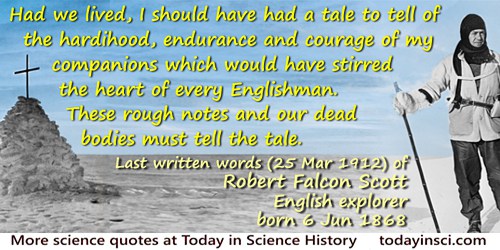
Had we lived, I should have had a tale to tell of the hardihood, endurance and courage of my companions which would have stirred the heart of every Englishman. These rough notes and our dead bodies must tell the tale, but surely, a great rich country like ours will see that those who are dependent on us are properly provided for.
[Final words in a 'Message to the Public' left written in his diary dated 25 March 1912, shortly before he died on the Ross Ice Barrier, Antarctica. When searchers found his body, on 12 Nov 1912, Scott was discovered sitting upright against the pole of the tent with the diary behind his head, as if for a pillow.]
[Final words in a 'Message to the Public' left written in his diary dated 25 March 1912, shortly before he died on the Ross Ice Barrier, Antarctica. When searchers found his body, on 12 Nov 1912, Scott was discovered sitting upright against the pole of the tent with the diary behind his head, as if for a pillow.]
Final words in a 'Message to the Public' left written in his diary dated 25 March 1912, shortly before he died on the Ross Ice Barrier, Antarctica. In Logan Marshall, The Story of Polar Conquest: The Complete History of Arctic and Antarctic (1913), 24-25.
by Logan Marshall - Polar regions - 1913
Half the joy of life is in little things taken on the run… but let us keep our hearts
young and our eyes open that nothing worth our while shall escape us. That nothing worth our while shall escape us. And everything is worth its while if we only grasp it and its significance.
Found quoted without source in The American Journal of Clinical Medicine (1907), 14, 150, and several other publications of that time period. Webmaster invites help pinpointing the primary text.
Happy Birthday Mrs Chown! Tell your son to stop trying to fill your head with science—for to fill your heart with love is enough. Richard P. Feynman (the man you watched on BBC Horizon).
Note to the mother of Marcus Chown. Reproduced in Christopher Simon Sykes, No Ordinary Genius: The Illustrated Richard Feynman (1996), 161. Chown's mother, though usually disinterested in science, had given close attention to a 1981 BBC Horizon science documentary that profiled Feynman. This was Feynman’s own choice of a birthday message, although Chown (then a physics graduate student at Caltech) had anticipated that the scientist would have helped him interest his mother in scientific things. Marcus Chown was a radio astronomer at Caltech and is now a writer and broadcaster.
Heart and Brain are the two lords of life. In the metaphors of ordinary speech and in the stricter language of science, we use these terms to indicate two central powers, from which all motives radiate, to which all influences converge.
From 'The Principles of Success in Literature', The Fortnightly (1865), 1, 66.
HEART, n. An automatic, muscular blood- pump. Figuratively, this useful organ is said to be the seat of emotions and sentiments—a very pretty fancy which, however, is nothing but a survival of a once universal belief. It is now known that the sentiments and emotions reside in the stomach, being evolved from food by chemical action of the gastric fluid. The exact process by which a beefsteak becomes a feeling—tender or not, according to the age of the animal from which it was cut; the successive stages of elaboration through which a caviar sandwich is transmuted to a quaint fancy and reappears as a pungent epigram; the marvelous functional methods of converting a hard-boiled egg into religious contrition, or a cream-puff into a sigh of sensibility—these things have been patiently ascertained by M. Pasteur, and by him expounded with convincing lucidity.
The Collected Works of Ambrose Bierce (1911), Vol. 7, The Devil's Dictionary, 133-134.
However much the pits may be apparent, yet none, as far as can be comprehended by the senses, passes through the septum of the heart from the right ventricle into the left. I have not seen even the most obscure passages by which the septum of the ventricles is pervious, although they are mentioned by professors of anatomy since they are convinced that blood is carried from the right ventricle into the left. As a result—as I shall declare more openly elsewhere—I am in no little doubt regarding the function of the heart in this part.
In De Humani Corporis Fabrica Libri Septem [Seven Books on the Structure of the Human Body] (revised ed. 1555), 734. Quoted and trans. in Charles Donald O'Malley, Andreas Vesalius of Brussels, 1514-1564 (1964), 281.
I am certain of nothing but the holiness of the Heart’s affections and the truth of Imagination—What the imagination seizes as Beauty must be truth—whether it existed before or not.
Letter to Benjamin Bailey (22 Nov 1817). In H. E. Rollins (ed.), Letters of John Keats (1958), Vol. 1, 184.
I am sure that one secret of a successful teacher is that he has formulated quite clearly in his mind what the pupil has got to know in precise fashion. He will then cease from half-hearted attempts to worry his pupils with memorising a lot of irrelevant stuff of inferior importance.
In 'The Rhythmic Claims of Freedom and Discipline', The Aims of Education and Other Essays (1929), 46.
I am truly a ‘lone traveler’ and have never belonged to my country, my home, my friends, or even my immediate family, with my whole heart; in the face of all these ties, I have never lost a sense of distance and a need for solitude.
…...
I am very astonished that the scientific picture of the real world around me is deficient. It gives a lot of factual information, puts all our experience in a magnificently consistent order, but it is ghastly silent about all and sundry that is really near to our heart, that really matters to us. It cannot tell us a word about red and blue, bitter and sweet, physical pain and physical delight; it knows nothing of beautiful and ugly, good or bad, God and eternity. Science sometimes pretends to answer questions in these domains, but the answers are very often so silly that we are not inclined to take them seriously.
…...
I appeal to the contemptible speech made lately by Sir Robert Peel to an applauding House of Commons. 'Orders of merit,' said he, 'were the proper rewards of the military' (the desolators of the world in all ages). 'Men of science are better left to the applause of their own hearts.' Most learned Legislator! Most liberal cotton-spinner! Was your title the proper reward of military prowess? Pity you hold not the dungeon-keys of an English Inquisition! Perhaps Science, like creeds, would flourish best under a little persecution.
Chemical Recreations (1834), 232.

I do not think there is any thrill that can go through the human heart like that felt by the inventor as he sees some creation of the brain unfolding to success... Such emotions make a man forget food, sleep, friends, love, everything.
Quoted by Cleveland Moffitt, 'A Talk With Tesla', Atlanta Constitution (7 Jun 1896)
I fancy that Dr. Sabin’s impulsive sincerity has helped greatly to open the way to the hearts of her pupils and friends.
As quoted in Vincent T. Andriole, 'Florence Rena Sabin—Teacher, Scientist, Citizen', Journal of the History of Medicine and Allied Sciences (Jul 1959), 14, No. 3, (July 1959), 325. Cited as from W. H. Howell, 'Presentation to the University of the Portrait of Dr. Florence Rena Sabin', Bulletin of Johns Hopkins Hospital (1920), 31, 151.
I feel like a white granular mass of amorphous crystals—my formula appears to be isomeric with Spasmotoxin. My aurochloride precipitates into beautiful prismatic needles. My Platinochloride develops octohedron crystals,—with fine blue florescence. My physiological action is not indifferent. One millionth of a grain injected under the skin of a frog produced instantaneous death accompanied by an orange blossom odor. The heart stopped in systole. A base—L3H9NG4—offers analogous reaction to phosmotinigstic acid.
In letter to George M. Gould (1889), collected in Elizabeth Bisland The Writings of Lafcadio Hearn (1922), Vol. 14, 89.
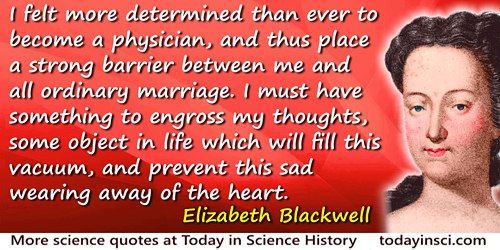
I felt more determined than ever to become a physician, and thus place a strong barrier between me and all ordinary marriage. I must have something to engross my thoughts, some object in life which will fill this vacuum, and prevent this sad wearing away of the heart.
Entry from her early journal, stated in Pioneer Work in Opening the Medical Profession to Women (1895), 28.
I gang my own gait and have never belonged to my country, my home, my friends, or even my immediate family, with my whole heart; in the face of all these ties I have never lost an obstinate sense of detachment, of the need for solitude–a feeling which increases with the years.
…...
I had at one time a very bad fever of which I almost died. In my fever I had a long consistent delirium. I dreamt that I was in Hell, and that Hell is a place full of all those happenings that are improbable but not impossible. The effects of this are curious. Some of the damned, when they first arrive below, imagine that they will beguile the tedium of eternity by games of cards. But they find this impossible, because, whenever a pack is shuffled, it comes out in perfect order, beginning with the Ace of Spades and ending with the King of Hearts. There is a special department of Hell for students of probability. In this department there are many typewriters and many monkeys. Every time that a monkey walks on a typewriter, it types by chance one of Shakespeare's sonnets. There is another place of torment for physicists. In this there are kettles and fires, but when the kettles are put on the fires, the water in them freezes. There are also stuffy rooms. But experience has taught the physicists never to open a window because, when they do, all the air rushes out and leaves the room a vacuum.
'The Metaphysician's Nightmare', Nightmares of Eminent Persons and Other Stories (1954), 38-9.
I hate and fear 'science' because of my conviction that, for long to come if not for ever, it will be the remorseless enemy of mankind. I see it destroying all simplicity and gentleness of life, all the beauty of the world; I see it restoring barbarism under a mask of civilization; I see it darkening men's minds and hardening their hearts.
The Private Papers of Henry Ryecroft (1903), 268-9.
I know with sure and certain knowledge that a man’s work is nothing but this slow trek to rediscover, through the detours of art, those two or three great and simple images in whose presence his heart first opened.
In Lyrical and Critical Essays (1967), 14.
I suppose that the first chemists seemed to be very hard-hearted and unpoetical persons when they scouted the glorious dream of the alchemists that there must be some process for turning base metals into gold. I suppose that the men who first said, in plain, cold assertion, there is no fountain of eternal youth, seemed to be the most cruel and cold-hearted adversaries of human happiness. I know that the economists who say that if we could transmute lead into gold, it would certainly do us no good and might do great harm, are still regarded as unworthy of belief. Do not the money articles of the newspapers yet ring with the doctrine that we are getting rich when we give cotton and wheat for gold rather than when we give cotton and wheat for iron?
'The Forgotten Man' (1883). In The Forgotten Man and Other Essays (1918), 468.
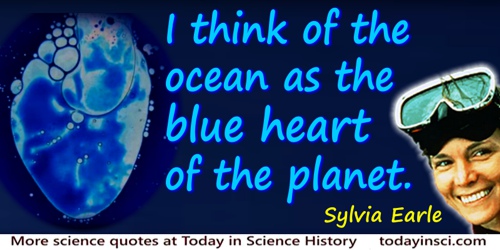
I think of the ocean as the blue heart of the planet. Well, how much of your heart do you want to protect?
From narration to the short, hand-drawn animated film for World Ocean’s Day 2013, Ideas For Change.
I value science—none can prize it more,
It gives ten thousand motives to adore;
Be it religious, as it ought to be,
The heart humbles, and it bows the knee.
It gives ten thousand motives to adore;
Be it religious, as it ought to be,
The heart humbles, and it bows the knee.
The Microcosm and Other Poems (1880), 21.
I wanted to preserve the spontaneity of thought in speech… [and to] guard the spontaneity of the argument. A spoken argument is informal and heuristic; it singles out the heart of the matter and shows in what way it is crucial and new; and it gives the direction and line of the solution so that, simplified as it is, still the logic is right. For me, this philosophic form of argument is the foundation of science, and nothing should be allowed to obscure it.
On his philosophy in presenting the TV series, from which the book followed. In 'Foreward', The Ascent of Man, (1973), 14-15.
I was often humiliated to see men disputing for a piece of bread, just as animals might have done. My feelings on this subject have very much altered since I have been personally exposed to the tortures of hunger. I have discovered, in fact, that a man, whatever may have been his origin, his education, and his habits, is governed, under certain circumstances, much more by his stomach than by his intelligence and his heart.
In François Arago, trans. by William Henry Smyth, Baden Powell and Robert Grant, 'The History of My Youth: An Autobiography of Francis Arago', Biographies of Distinguished Scientific Men (1859), Vol. 1, 55.
I wish I had my beta-blockers handy.
[Comment when told that he had won a Nobel prize, referring to the drug he discovered for the treatment of heart disease.]
[Comment when told that he had won a Nobel prize, referring to the drug he discovered for the treatment of heart disease.]
As quoted in Obituary, The Times (24 Mar 2010)
I would have picked up the artificial heart and thrown it on the floor and walked out and said he's dead if the press had not been there.
[Recalling moments of frustration caused by difficulties during the 7½-hour surgery on Barney Clark for the first human implant of an artificial heart.]
[Recalling moments of frustration caused by difficulties during the 7½-hour surgery on Barney Clark for the first human implant of an artificial heart.]
Quoted by Lawrence K. Altman in “Clark's Surgeon Was ‘Worried To Death’&rdquo, New York Times (12 Apr 1983), C1.
I, Galileo Galilei, son of the late Vincenzo Galilei, of Florence, aged seventy years, being brought personally to judgment, and kneeling before your Most Eminent and Most Reverend Lords Cardinals, General Inquisitors of the universal Christian republic against heretical depravity, having before my eyes the Holy Gospels, which I touch with my own hands, swear that I have always believed, and now believe, and with the help of God will in future believe, every article which the Holy Catholic and Apostolic Church of Rome holds, teaches, and preaches. But because I have been enjoined by this Holy Office altogether to abandon the false opinion which maintains that the sun is the centre and immovable, and forbidden to hold, defend, or teach the said false doctrine in any manner, and after it hath been signified to me that the said doctrine is repugnant with the Holy Scripture, I have written and printed a book, in which I treat of the same doctrine now condemned, and adduce reasons with great force in support of the same, without giving any solution, and therefore have been judged grievously suspected of heresy; that is to say, that I held and believed that the sun is the centre of the universe and is immovable, and that the earth is not the centre and is movable; willing, therefore, to remove from the minds of your Eminences, and of every Catholic Christian, this vehement suspicion rightfully entertained toward me, with a sincere heart and unfeigned faith, I abjure, curse, and detest the said errors and heresies, and generally every other error and sect contrary to Holy Church; and I swear that I will never more in future say or assert anything verbally, or in writing, which may give rise to a similar suspicion of me; but if I shall know any heretic, or anyone suspected of heresy, that I will denounce him to this Holy Office, or to the Inquisitor or Ordinary of the place where I may be; I swear, moreover, and promise, that I will fulfil and observe fully, all the penances which have been or shall be laid on me by this Holy Office. But if it shall happen that I violate any of my said promises, oaths, and protestations (which God avert!), I subject myself to all the pains and punishments which have been decreed and promulgated by the sacred canons, and other general and particular constitutions, against delinquents of this description. So may God help me, and his Holy Gospels which I touch with my own hands. I, the above-named Galileo Galilei, have abjured, sworn, promised, and bound myself as above, and in witness thereof with my own hand have subscribed this present writing of my abjuration, which I have recited word for word. At Rome, in the Convent of Minerva, June 22, 1633. I, Galileo Galilei, have abjured as above with my own hand.
Abjuration, 22 Jun 1633. In J.J. Fahie, Galileo, His Life and Work (1903), 319-321.
I’ve learned that whenever I decide something with an open heart, I usually make the right decision.
Seventh stanza of poem 'On Turning 70'. The poem is printed in Michigan Office of Services to the Aging, Annual Report 2004 (2005), no page number.
If ever there can be a cause worthy to be upheld by all toil or sacrifice that the human heart can endure, it is the cause of education.
Thoughts Selected from the Writings of Horace Mann (1872), 5.
If feeling be not a property of matter, but owing to a superior principle, it must follow, that the motions of the heart, and other muscles of animals, after being separated from their bodies, are to be ascribed to this principle; and that any difficulties which may appear in this matter are owing to our ignorance of the nature of the soul, of the manner of its existence, and of its wonderful union with, and action upon the body.
In An Essay on the Vital and Other Involuntary Motions of Animals (1751), 389-390.
If seeds in the black Earth can turn into such beautiful roses what might not the heart of man become in its long journey towards the stars?
As quoted in Maisie Ward, Return to Chesterton (1952), 161.
If we use resources productively and take to heart the lessons learned from coping with the energy crisis, we face a future confronted only, as Pogo, once said, by insurmountable opportunities. The many crises facing us should be seen, then, not as threats, but as chances to remake the future so it serves all beings.
Utne Reader (Nov-Dec 1989).
If you want to achieve conservation, the first thing you have to do is persuade people that the natural world is precious, beautiful, worth saving and complex. If people don’t understand that and don’t believe that in their hearts, conservation doesn't stand a chance. That’s the first step, and that is what I do.
From interview with Michael Bond, 'It’s a Wonderful Life', New Scientist (14 Dec 2002), 176, No. 2373, 48.
If you want to penetrate into the heart of physics, then let yourself be initiated into the mysteries of poetry.
Friedrich Schlegel's Lucinde and the Fragments, trans. Peter Firchow (1971), 250.
In attempting to discover how much blood passes from the veins into the arteries I made dissections of living animals, opened up arteries in them, and carried out various other investigations. I also considered the symmetry and size of the ventricles of the heart and of the vessels which enter and leave them (since Nature, who does nothing purposelessly, would not purposelessly have given these vessels such relatively large size). I also recalled the elegant and carefully contrived valves and fibres and other structural artistry of the heart; and many other points. I considered rather often and with care all this evidence, and took correspondingly long trying to assess how much blood was transmitted and in how short a time. I also noted that the juice of the ingested food could not supply this amount without our having the veins, on the one hand, completely emptied and the arteries, on the other hand, brought to bursting through excessive inthrust of blood, unless the blood somehow flowed back again from the arteries into the veins and returned to the right ventricle of the heart. In consequence, I began privately to consider that it had a movement, as it were, in a circle.
De Motu Cordis (1628), The Circulation of the Blood and Other Writings, trans. Kenneth j. Franklin (1957), Chapter 8, 57-8.
In man, then, let us take the amount that is extruded by the individual beats, and that cannot return into the heart because of the barrier set in its way by the valves, as half an ounce, or three drachms, or at least one drachm. In half an hour the heart makes over a thousand beats; indeed, in some individuals, and on occasion, two, three, or four thousand. If you multiply the drachms per beat by the number of beats you will see that in half an hour either a thousand times three drachms or times two drachms, or five hundred ounces, or other such proportionate quantity of blood has been passed through the heart into the arteries, that is, in all cases blood in greater amount than can be found in the whole of the body. Similarly in the sheep or the dog. Let us take it that one scruple passes in a single contraction of the heart; then in half an hour a thousand scruples, or three and a half pounds of blood, do so. In a body of this size, as I have found in the sheep, there is often not more than four pounds of blood.
In the above sort of way, by calculating the amount of blood transmitted [at each heart beat] and by making a count of the beats, let us convince ourselves that the whole amount of the blood mass goes through the heart from the veins to the arteries and similarly makes the pulmonary transit.
Even if this may take more than half an hour or an hour or a day for its accomplishment, it does nevertheless show that the beat of the heart is continuously driving through that organ more blood than the ingested food can supply, or all the veins together at any time contain.
In the above sort of way, by calculating the amount of blood transmitted [at each heart beat] and by making a count of the beats, let us convince ourselves that the whole amount of the blood mass goes through the heart from the veins to the arteries and similarly makes the pulmonary transit.
Even if this may take more than half an hour or an hour or a day for its accomplishment, it does nevertheless show that the beat of the heart is continuously driving through that organ more blood than the ingested food can supply, or all the veins together at any time contain.
De Motu Cordis (1628), The Circulation of the Blood and Other Writings, trans. Kenneth J. Franklin (1957), Chapter 9, 62-3.
In the arts of life main invents nothing; but in the arts of death he outdoes Nature herself, and produces by chemistry and machinery all the slaughter of plague, pestilence and famine. … There is nothing in Man's industrial machinery but his greed and sloth: his heart is in his weapons.
Play, Man and Superman: A Comedy and a Philosophy (1903)
In the deserts of the heart
Let the healing fountain start.
Let the healing fountain start.
From last stanza of poem, 'In Memory of W.B. Yeats', (Feb 1939). In Collected Shorter Poems, 1930-1944 (1950), 67. [Note: Psychologist Arthur Lerner ended each of the poetry therapy sessions he conducted with these lines, according to obituary by Myrna Oliver, 'Arthur Lerner; Promoted Use of Poetry in Therapy', Los Angeles Times (8 Apr 1998). —Webmaster]
In the moonlight
While drinking homemade wine
My sorrow hung heavy
And my heart felt like lead.
The moon was golden yellow
The night soft and mellow.
There was a smell of jasmine
All around.
And I felt the weight of the world
Upon my shoulders.
I looked at the twinkling stars in the sky
So far and wide
Here’s to you
I lifted my wine
And my eyes looked upon the brilliance
Of the moon and stars
From afar...
While drinking homemade wine
My sorrow hung heavy
And my heart felt like lead.
The moon was golden yellow
The night soft and mellow.
There was a smell of jasmine
All around.
And I felt the weight of the world
Upon my shoulders.
I looked at the twinkling stars in the sky
So far and wide
Here’s to you
I lifted my wine
And my eyes looked upon the brilliance
Of the moon and stars
From afar...
…...
In the school of political projectors, I was but ill entertained, the professors appearing, in my judgment, wholly out of their senses; which is a scene that never fails to make me melancholy. These unhappy people were proposing schemes for persuading monarchs to choose favourites upon the score of their wisdom, capacity, and virtue; of teaching ministers to consult the public good; of rewarding merit, great abilities, and eminent services; of instructing princes to know their true interest, by placing it on the same foundation with that of their people; of choosing for employment persons qualified to exercise them; with many other wild impossible chimeras, that never entered before into the heart of man to conceive, and confirmed in me the old observation, that there is nothing so extravagant and irrational which some philosophers have not maintained for truth.
Gulliver's Travels (1726, Penguin ed. 1967), Part III, Chap. 6, 232.
In your heart, keep one still secret spot where dreams may go and be sheltered so they may thrive and grow.
…...
Inexact method of observation, as I believe, is one flaw in clinical pathology to-day. Prematurity of conclusion is another, and in part follows from the first; but in chief part an unusual craving and veneration for hypothesis, which besets the minds of most medical men, is responsible. Except in those sciences which deal with the intangible or with events of long past ages, no treatises are to be found in which hypothesis figures as it does in medical writings. The purity of a science is to be judged by the paucity of its recorded hypotheses. Hypothesis has its right place, it forms a working basis; but it is an acknowledged makeshift, and, at the best, of purpose unaccomplished. Hypothesis is the heart which no man with right purpose wears willingly upon his sleeve. He who vaunts his lady love, ere yet she is won, is apt to display himself as frivolous or his lady a wanton.
The Mechanism and Graphic Registration of the Heart Beat (1920), vii.
Invention is an Heroic thing, and plac'd above the reach of a low, and vulgar Genius. It requires an active, a bold, a nimble, a restless mind: a thousand difficulties must be contemn'd with which a mean heart would be broken: many attempts must be made to no purpose: much Treasure must sometimes be scatter'd without any return: much violence, and vigour of thoughts must attend it: some irregularities, and excesses must be granted it, that would hardly be pardon'd by the severe Rules of Prudence.
The History of the Royal Society (1667), 392.
It is … genius which has given motion and progress to society; prevented the ossification of the human heart and brain; and though, in its processes, it may not ever have followed the rules laid down in primers, it has, at least, saved history from being the region of geology, and our present society from being a collection of fossil remains.
In 'Genius', Wellman’s Miscellany (Dec 1871), 4, No. 6, 204.
It is hard to imagine while strenuously walking in the heart of an equatorial rain forest, gasping for every breath in a stifling humid sauna, how people could have ever adapted to life under these conditions. It is not just the oppressive climate - the tall forest itself is dark, little light reaching the floor from the canopy, and you do not see any animals. It is a complete contrast to the herbivore-rich dry savannahs of tropical Africa. Yet there are many animals here, evident by the loud, continual noise of large cryptic insects and the constant threat of stepping on a deadly king cobra. This was my first impression of the rain forest in Borneo.
The Humans Who Went Extinct
It is in all cases unavoidable that the heart is afflicted when death occurs.
As quoted in Robert Taylor, White Coat Tales: Medicine's Heroes, Heritage, and Misadventures (2010), 125.
It is in man's heart that the life of nature's spectacle exists; to see it, one must feel it.
Emile (1762).
It is in the name of Moses that Bellarmin thunderstrikes Galileo; and this great vulgarizer of the great seeker Copernicus, Galileo, the old man of truth, the magian of the heavens, was reduced to repeating on his knees word for word after the inquisitor this formula of shame: “Corde sincera et fide non ficta abjuro maledico et detestor supradictos errores et hereses.” Falsehood put an ass's hood on science.
[With a sincere heart, and of faith unfeigned, I deny by oath, condemn and detest the aforesaid errors and heresies.]
[With a sincere heart, and of faith unfeigned, I deny by oath, condemn and detest the aforesaid errors and heresies.]
In Victor Hugo and Lorenzo O'Rourke (trans.) Victor Hugo's Intellectual Autobiography: (Postscriptum de ma vie) (1907), 313.
It is indeed an Opinion strangely prevailing amongst Men, that Houses, Mountains, Rivers, and in a word all sensible Objects have an Existence Natural or Real, distinct from their being perceived by the Understanding. But with how great an Assurance and Acquiescence soever this Principle may be entertained in the World; yet whoever shall find in his Heart to call it in Question, may, if I mistake not, perceive it to involve a manifest Contradiction. For what are the forementioned Objects but the things we perceive by Sense, and what do we perceive besides our own Ideas or Sensations; and is it not plainly repugnant that anyone of these or any Combination of them should exist unperceived?
A Treatise Concerning the Principles of Human Knowledge [first published 1710], (1734),38.
It is infinitely better to transplant a heart than to bury it to be devoured by worms.
In 'People', Time (31 Oct 1969).
It is only those who know a little of nature, who fancy they know much. I have heard a young man say, after hearing a few popular chemical lectures, and seeing a few bottle and squirt experiments: Oh, water—water is only oxygen and hydrogen!—as if he knew all about it. While the true chemist would smile sadly enough at the the youth's hasty conceit, and say in his heart: 'Well, he is a lucky fellow.'
'Thoughts in a Gravel Pit', a lecture delivered at the Mechanics' Institute, Odiham (1857). The Works of Charles Kingsley (1880), 284.
It is only with the heart that one can see rightly—what is essential is invisible to the eye.
In The Little Prince (1943), Chap 21. Translated from the original French, “On ne voit bien qu’avec le coeur—l’essentiel est invisible pour les yeux.”
It is reported of Margaret Fuller that she said she accepted the universe. “Gad, she'd better!” retorted Carlyle. Carlyle himself did not accept the universe in a very whole-hearted manner. Looking up at the midnight stars, he exclaimed: “A sad spectacle! If they be inhabited, what a scope for misery and folly; if they be na inhabited, what a waste of space!”
Opening paragraph of book of collected essays, Accepting the Universe (1920), 3. “‘I accept the universe’ is reported to have been a favorite utterance of our New England transcendentalist, Margaret Fuller…” was stated by William James in The Varieties of Religious Experience (1902), 41. James continues, “and when some one repeated this phrase to Thomas Carlyle, his sardonic comment is said to have been: ‘Gad! she'd better!’” Note that James does not here merge Carlyle's remark about the universe. Burroughs’ attribution of the “sad spectacle” quote is, so far, the earliest found by the Webmaster, who has not located it in a printed work by Carlisle himself. If you know a primary source, or earlier attribution, please contact Webmaster.
It is the heart which experiences God, and not the reason.
In Pensées (1670), Section 26, No. 5. From Blaise Pascal, W.F. Trotter (trans.), 'Thoughts', collected in Charles W. Eliot (ed.), The Harvard Classics (1910), Vol. 48, 99. Also seen translated as, “It is the heart which perceives God, and not the reason”. From the French, “C'est le cœur qui sent Dieu, et non la raison,” in Ernest Havet (ed.),Pensées de Pascal (1852), 296.
Laws, written, if not on stone tables, yet on the azure of infinitude, in the inner heart of God’s creation, certain as life, certain as death, are there, and thou shalt not disobey them.
In James Wood, Dictionary of Quotations from Ancient and Modern, English and Foreign Sources (1893), 232:11.
Lawyers have to make a living and can only do so by inducing people to believe that a straight line is crooked. This accounts for their penchant for politics, where they can usually find everything crooked enough to delight their hearts.
As quoted in Harry Black, Canada and the Nobel Prize: Biographies, Portraits and Fascinating Facts (2002), 19.
Let us, then, be up and doing,
With a heart for any fate;
Still achieving, still pursuing,
Learn to labor and to wait.
With a heart for any fate;
Still achieving, still pursuing,
Learn to labor and to wait.
Concluding stanza in 'A Psalm of Life', Poems (1856), 69.
Life is short and we have not too much time for gladdening the hearts of those who are traveling the dark way with us. Oh, be swift to love! Make haste to be kind.
Entry for 16 Dec 1868 in Amiel’s Journal: The Journal Intime (1896), Vol. 2, 15, as translated by Mrs. Humphry Ward.
LIVER, n. A large red organ thoughtfully provided by nature to be bilious with. The sentiments and emotions which every literary anatomist now knows to haunt the heart were anciently believed to infest the liver; and even Gascoygne, speaking of the emotional side of human nature, calls it "our hepaticall parte." It was at one time considered the seat of life; hence its name— liver, the thing we live with.
The Collected Works of Ambrose Bierce (1911), Vol. 7, The Devil's Dictionary, 195.
M.D.—Make Do.— Quaint idea! … Work for the handicapped … who is handicapped, your patients, or you? Both. Helping the survival of the unfit.… With more to come. What in the world was the solution. Where to find a formula for head and heart too?
Quoted in M.C. Winternitz, 'Alan Gregg, Physician', Science (20 Dec 1957), 1279.
Mammals in general seem to live, at best, as long as it takes their hearts to count a billion. To this general rule, man himself is the most astonishing exception.
(1965). In Isaac Asimov’s Book of Science and Nature Quotations (1988), 336.
Man has become a superman ... because he not only disposes of innate, physical forces, but because he is in command ... of latent forces in nature he can put them to his service. ... But the essential fact we must surely all feel in our hearts ... is that we are becoming inhuman in proportion as we become supermen.
Speech (4 Nov 1954) upon receiving the Nobel Peace Prize. In 'Excerpts From the Nobel Prize Address Dr. Schweitzer in Oslo', New York Times (5 Nov 1954), 4.
Mathematics and Poetry are … the utterance of the same power of imagination, only that in the one case it is addressed to the head, and in the other, to the heart.
From a review of William Rowan Hamilton’s, Lectures on Quaternions (1853), in 'The Imagination in Mathematics', The North American Review (Jul 1857), 85, No. 176, 230. Also in Robert Édouard Moritz, Memorabilia Mathematica; Or, The Philomath’s Quotation-book (1914), 189. The original text has “Mathematics…” but the latter text gives “Mathesis…”. The ellipsis is for the word “therefore”.
Most of us have had moments in childhood when we touched the divine presence. We did not think it extraordinary because it wasn’t; it was just a beautiful moment filled with love. In those simple moments our hearts were alive, and we saw the poignant beauty of life vividly with wonder and appreciation.
David McArthur and Bruce McArthur
My head lies at least a foot closer to my heart than is the case with other men: that is why I am so reasonable.
Aphorism 2 in Notebook C (1772-1773), as translated by R.J. Hollingdale in Aphorisms (1990). Reprinted as The Waste Books (2000), 31.
My heart rate wasn’t as high as his [Robert Crippen], because I’m so dang old and it just wouldn’t go any faster.
As quoted on the nmspacemuseum.org website of the New Mexico Museum of Space History.
My mother, my dad and I left Cuba when I was two [January, 1959]. Castro had taken control by then, and life for many ordinary people had become very difficult. My dad had worked [as a personal bodyguard for the wife of Cuban president Batista], so he was a marked man. We moved to Miami, which is about as close to Cuba as you can get without being there. It’s a Cuba-centric society. I think a lot of Cubans moved to the US thinking everything would be perfect. Personally, I have to say that those early years were not particularly happy. A lot of people didn’t want us around, and I can remember seeing signs that said: “No children. No pets. No Cubans.” Things were not made easier by the fact that Dad had begun working for the US government. At the time he couldn’t really tell us what he was doing, because it was some sort of top-secret operation. He just said he wanted to fight against what was happening back at home. [Estefan’s father was one of the many Cuban exiles taking part in the ill-fated, anti-Castro Bay of Pigs invasion to overthrow dictator Fidel Castro.] One night, Dad disappeared. I think he was so worried about telling my mother he was going that he just left her a note. There were rumors something was happening back home, but we didn’t really know where Dad had gone. It was a scary time for many Cubans. A lot of men were involved—lots of families were left without sons and fathers. By the time we found out what my dad had been doing, the attempted coup had taken place, on April 17, 1961. Initially he’d been training in Central America, but after the coup attempt he was captured and spent the next two years as a political prisoner in Cuba. That was probably the worst time for my mother and me. Not knowing what was going to happen to Dad. I was only a kid, but I had worked out where my dad was. My mother was trying to keep it a secret, so she used to tell me Dad was on a farm. Of course, I thought that she didn’t know what had really happened to him, so I used to keep up the pretense that Dad really was working on a farm. We used to do this whole pretending thing every day, trying to protect each other. Those two years had a terrible effect on my mother. She was very nervous, just going from church to church. Always carrying her rosary beads, praying her little heart out. She had her religion, and I had my music. Music was in our family. My mother was a singer, and on my father’s side there was a violinist and a pianist. My grandmother was a poet.
…...
My son, all my life I have loved this science so deeply that I can now hear my heart beat for joy.
Commenting about Pasteur's accomplishment of separating two asymmetric forms of tartaric acid crystals.
Commenting about Pasteur's accomplishment of separating two asymmetric forms of tartaric acid crystals.
Quoted in Ralph Oesper, The Human Side of Scientists (1975), 152.
Nature is man’s teacher. She unfolds her treasures to his search, unseals his eye, illumes his mind, and purifies his heart; an influence breathes from all the sights and sounds of her existence.
…...
No longer can we be satisfied with a life where the heart has its reasons which reason cannot know. Our hearts must know the world of reason, and reason must be guided by an informed heart.
In The Guardian, March 15, 1990.
No one thinks of concealing the truth from a cardiac patient: there is nothing shameful about a heart attack. Cancer patients are lied to, not just because the disease is (or is thought to be) a death sentence, but because it is felt to be obscene—in the original meaning of that word: ill-omened, abominable, repugnant to the senses.
In Illness as a Metaphor (1978), 8,
No useless discourse. All conversation which does not serve to enlighten ourselves or others, to interest the heart or amuse the mind, is hurtful.
From Appendix A, 'Extracts From the Unpublished Writings of Carnot', Reflections on the Motive Power of Heat (1890, 2nd ed. 1897), 207.
None but a naturalist can understand the intense excitement I experienced when I at length captured it [a hitherto unknown species of butterfly]. On taking it out of my net and opening the glorious wings, my heart began to beat, violently, the blood rushed to my head, and I felt much more like fainting than I have done when in apprehension of immediate death. I had a headache the rest of the day, so great was the excitement produced by what will appear to most people a very inadequate cause.
The Malay Archipelago (1890), 257-258.
Nowadays there is a pill for everything—to keep your nose from running, to keep you regular, to keep your heart beating, to keep your hair from falling out, to improve your muscle tone ... Why thanks to advances in medical science, every day people are dying who never looked better.
In Ashton Applewhite, William R. Evans and Andrew Frothingham, And I Quote (2003), 174-175.
Numbers written on restaurant checks [bills] within the confines of restaurants do not follow the same mathematical laws as numbers written on any other pieces of paper in any other parts of the Universe.
This single statement took the scientific world by storm. It completely revolutionized it. So many mathematical conferences got held in such good restaurants that many of the finest minds of a generation died of obesity and heart failure and the science of math was put back by years.
This single statement took the scientific world by storm. It completely revolutionized it. So many mathematical conferences got held in such good restaurants that many of the finest minds of a generation died of obesity and heart failure and the science of math was put back by years.
Life, the Universe and Everything (1982, 1995), 49.
O! what a noble heart was here undone,
When Science’s self destroyed her favorite son.
When Science’s self destroyed her favorite son.
Tributary verse eulogizing Henry Kirk White, whose death was attributed to fatigue caused by his long research work.
Observation by means of the microscope will reveal more wonderful things than those viewed in regard to mere structure and connection: for while the heart is still beating the contrary (i.e., in opposite directions in the different vessels) movement of the blood is observed in the vessels—though with difficulty—so that the circulation of the blood is clearly exposed.
De Pulmonibus (1661), trans. James Young, Proceedings of the Royal Society of Medicine (1929-30), 23, 8.
On May 7, a few weeks after the accident at Three-Mile Island, I was in Washington. I was there to refute some of that propaganda that Ralph Nader, Jane Fonda and their kind are spewing to the news media in their attempt to frighten people away from nuclear power. I am 71 years old, and I was working 20 hours a day. The strain was too much. The next day, I suffered a heart attack. You might say that I was the only one whose health was affected by that reactor near Harrisburg. No, that would be wrong. It was not the reactor. It was Jane Fonda. Reactors are not dangerous.
From statement, published as a two-page advertisement, 'I Was the Only Victim of Three-Mile Island', placed by Dresser Industries in The Wall Street Journal (31 Jul 1979), U.S. Representative Larry McDonald entered the entire content of the ad, as Extensions of Remarks, into the Congressional Record: Proceedings and Debates of the Congress (18 Dec 1979), 36876. [Note: The Three Mile Island accident happened on 28 Mar 1979. —Webmaster]
![Ernest Henry Starling quote: Only by following out the injunction of our great predecessor [William Harvey] to search out and st](https://todayinsci.com/S/Starling_Ernest/StarlingErnest-Mastery500x250px.jpg)
Only by following out the injunction of our great predecessor [William Harvey] to search out and study the secrets of Nature by way of experiment, can we hope to attain to a comprehension of 'the wisdom of the body and the understanding of the heart,' and thereby to the mastery of disease and pain, which will enable us to relieve the burden of mankind.
'The Wisdom of the Body', The Lancet (1923), 205, 870.
Our abiding belief is that just as the workmen in the tunnel of St. Gothard, working from either end, met at last to shake hands in the very central root of the mountain, so students of nature and students of Christianity will yet join hands in the unity of reason and faith, in the heart of their deepest mysteries.
…...
Our earth is very old, an old warrior that has lived through many battles. Nevertheless, the face of it is still changing, and science sees no certain limit of time for its stately evolution. Our solid earth, apparently so stable, inert, and finished, is changing, mobile, and still evolving. Its major quakings are largely the echoes of that divine far-off event, the building of our noble mountains. The lava floods and intriguing volcanoes tell us of the plasticity, mobility, of the deep interior of the globe. The slow coming and going of ancient shallow seas on the continental plateaus tell us of the rhythmic distortion of the deep interior-deep-seated flow and changes of volume. Mountain chains prove the earth’s solid crust itself to be mobile in high degree. And the secret of it all—the secret of the earthquake, the secret of the “temple of fire,” the secret of the ocean basin, the secret of the highland—is in the heart of the earth, forever invisible to human eyes.
In Our Mobile Earth (1926), 320.
Our treasure lies in the beehives of our knowledge. We are perpetually on our way thither, being by nature winged insects and honey gatherers of the mind. The only thing that lies close to our heart is the desire to bring something home to the hive.
The Genealogy of Morals (1887), as translated by Francis Golffing (1956), 149. In another translation, by Maudemarie Clark and Alan J. Swensen, it appears as: “It has rightly been said: ‘where your treasure is, there will your heart be also’; our treasure is where the beehives of our knowledge stand. We are forever underway towards them, as born winged animals and honey-gathers of the spirit, concerned will all our heart about only one thing—"bringing home" something.”
Reason is always a kind of brute force; those who appeal to the head rather than the heart, however pallid and polite, are necessarily men of violence. We speak of “touching” a man’s heart, but we can do nothing to his head but hit it.
From 'Charles II', Twelve Types (1906), 98.
Rheumatic fever licks at the joints, but bites at the heart.
Science can point out dangers, but science cannot turn the direction of minds and hearts. That is the province of spiritual powers within and without our very beings—powers that are the mysteries of life itself.
…...
Science can tell us what exists; but to compare the worths, both of what exists and of what does not exist, we must consult not science, but what Pascal calls our heart.
'The Will to Believe' (1896). In The Will to Believe and Other Essays in Popular Philosophy (1897), 22.
Science gives us the grounds of premises from which religious truths are to be inferred; but it does not set about inferring them, much less does it reach the inference; that is not its province. It brings before us phenomena, and it leaves us, if we will, to call them works of design, wisdom, or benevolence; and further still, if we will, to proceed to confess an Intelligent Creator. We have to take its facts, and to give them a meaning, and to draw our own conclusions from them. First comes Knowledge, then a view, then reasoning, then belief. This is why Science has so little of a religious tendency; deductions have no power of persuasion. The heart is commonly reached, not through the reason, but through the imagination, by means of direct impressions, by the testimony of facts and events, by history, by description. Persons influence us, voices melt us, looks subdue us, deeds inflame us. Many a man will live and die upon a dogma; no man will be a martyr for a conclusion.
Letter collected in Tamworth Reading Room: Letters on an Address Delivered by Sir Robert Peel, Bart., M.P. on the Establishment of a Reading Room at Tamworth (1841), 32. Excerpted in John Henry Newman, An Essay in Aid of a Grammar of Assent (1870), 89 & 94 footnote.
Science, which gave us this dread power, shows that it can be made a giant help to humanity, but science does not show us how to prevent its baleful use. So we have been appointed to obviate that peril by finding a meeting of the minds and the hearts of our people. Only in the will of mankind lies the answer.
In a plan presented to the U.N. Atomic Energy Commission, June 14, 1946.
Science! true daughter of Old Time thou art!
alterest all things with thy peering eyes.
preyest thou thus upon the poet’s heart,
Vulture, whose wings are dull realities?
How should he love thee? or how deem thee wise,
Who wouldst not leave him in his wandering .
To seek for treasure in the jewelled skies,
Albeit he soared with an undaunted wing?
Hast thou not dragged Diana from her car?
And driven the Hamadryad from the wood
To seek a shelter in some happier star?
Hast thou not torn the Naiad from her flood,
The Elfin from the green grass, and from me
The summer dread beneath the tamarind tree?
alterest all things with thy peering eyes.
preyest thou thus upon the poet’s heart,
Vulture, whose wings are dull realities?
How should he love thee? or how deem thee wise,
Who wouldst not leave him in his wandering .
To seek for treasure in the jewelled skies,
Albeit he soared with an undaunted wing?
Hast thou not dragged Diana from her car?
And driven the Hamadryad from the wood
To seek a shelter in some happier star?
Hast thou not torn the Naiad from her flood,
The Elfin from the green grass, and from me
The summer dread beneath the tamarind tree?
Sonnet, 'To Science' (1829), Saturday Evening Post (11 Sep 1830). In Poems of Edgar Allan Poe (1917), 33, and Notes, 169.
Scientists are attempting to come to God head-first. They must come to Him heart-first. Then let their heads interpret what they have found.
In Proverbs from Plymouth Pulpit (1887), 144.
Seeing therefore the variety of Motion which we find in the World is always decreasing, there is a necessity of conserving and recruiting it by active Principles, such as are the cause of Gravity, by which Planets and Comets keep their Motions in their Orbs, and Bodies acquire great Motion in falling; and the cause of Fermentation, by which the Heart and Blood of Animals are kept in perpetual Motion and Heat; the inward Parts of the Earth are constantly warm'd, and in some places grow very hot; Bodies burn and shine, Mountains take fire, the Caverns of the Earth are blown up, and the Sun continues violently hot and lucid, and warms all things by his Light. For we meet with very little Motion in the World, besides what is owing to these active Principles.
From Opticks, (1704, 2nd ed. 1718), Book 3, Query 31, 375.
So much goes into doing a transplant operation. All the way from preparing the patient, to procuring the donor. It’s like being an astronaut. The astronaut gets all the credit, he gets the trip to the moon, but he had nothing to do with the creation of the rocket, or navigating the ship. He's the privileged one who gets to drive to the moon. I feel that way in some of these more difficult operations, like the heart transplant.
Society itself, which should create Kindness, destroys what little we had got:
To feel for none is the true social art
Of the world’s stoics—men without a heart.
To feel for none is the true social art
Of the world’s stoics—men without a heart.
Somewhere in the arrangement of this world there seems to be a great concern about giving us delight, which shows that, in the universe, over and above the meaning of matter and forces, there is a message conveyed through the magic touch of personality. ...
Is it merely because the rose is round and pink that it gives me more satisfaction than the gold which could buy me the necessities of life, or any number of slaves. ... Somehow we feel that through a rose the language of love reached our hearts.
Is it merely because the rose is round and pink that it gives me more satisfaction than the gold which could buy me the necessities of life, or any number of slaves. ... Somehow we feel that through a rose the language of love reached our hearts.
The Religion of Man (1931), 102. Quoted in H. E. Hunter, The Divine Proportion (1970), 6.
Suppose an individual believes something with his whole heart; suppose further that he has a commitment to this belief and he has taken irrevocable actions because of it; finally, suppose that he is presented with evidence, unequivocal and undeniable evidence, that his belief is wrong: what will happen? The individual will frequently emerge, not only unshaken, but even more convinced of the truth of his beliefs than ever before. Indeed, he may even show a new fervor for convincing and converting other people to his view.
In When Prophecy Fails (1956), 3.
Sweet is the lore which Nature brings;
Our meddling intellect
Mis-shapes the beauteous forms of things
We murder to dissect.
Enough of Science and of Art;
Close up these barren leaves;
Come forth, and bring with you a heart
That watches and receives.
Our meddling intellect
Mis-shapes the beauteous forms of things
We murder to dissect.
Enough of Science and of Art;
Close up these barren leaves;
Come forth, and bring with you a heart
That watches and receives.
In poem, 'The Tables Turned: An Evening Scene, on the Same Subject', Lyrical Ballads: With a Few Other Poems (1798), 188.
Technique and ability alone do not get you to the top; it is the willpower that is the most important. This willpower you cannot buy with money or be given by others...it rises from your heart.
…...
That many very remarkable change and involuntary motions are sudden produced in the body by various affections of the mind, is undeniably evinced from a number of facts. Thus fear often causes a sudden and uncommon flow of pale urine. Looking much at one troubled with sore eyes, has sometimes affected the spectator with the same disease.—Certain sounds cause a shivering over the whole body.—The noise of a bagpipe has raised in some persons an inclination to make urine.—The sudden appearance of any frightful object, will, in delicate people, cause an uncommon palpitation of the heart.—The sight of an epileptic person agitated with convulsions, has brought on an epilepsy; and yawning is so very catching, as frequently to be propagated through whole companies.
In An Essay on the Vital and Other Involuntary Motions of Animals (1751), 253-254.
The Principia Mathematica developed an overall scheme of the universe, one far more elegant and enlightening than any the ancients had devised. And the Newtonian scheme was based on a set of assumptions, so few and so simple, developed through so clear and so enticing a line of mathematics that conservatives could scarcely find the heart and courage to fight it.
In Entry 231, 'Newton, Sir Isaac', Asimov’s Biographical Encyclopedia of Science and Technology (2nd rev ed., 1982), 152.
The animal's heart is the basis of its life, its chief member, the sun of its microcosm; on the heart all its activity depends, from the heart all its liveliness and strength arise. Equally is the king the basis of his kingdoms, the sun of his microcosm, the heart of the state; from him all power arises and all grace stems.
De Motu Cordis (1628), The Circulation of the Blood and Other Writings, trans. Kenneth j. Franklin (1957), Dedication to the King, 3.
The bell ringing for church, we went thither immediately, and with hearts full of gratitude, returned sincere thanks to God for the mercies we had received: were I a Roman Catholic, perhaps I should on this occasion vow to build a chapel to some saint, but as I am not, if I were to vow at all, it should be to build a light-house. [Upon narrowly missing a shipwreck on the Scilly rocks.]
[Frequently seen summarized as, though not Franklin's own wording: Lighthouses are more helpful than churches.
[Frequently seen summarized as, though not Franklin's own wording: Lighthouses are more helpful than churches.
Letter written at Falmouth, England (17 Jul 1757) to Deborah Read Franklin (common-law wife). Quoted in Benjamin Franklin and William Temple Franklin, The Works of Dr. Benjamin Franklin (1818), 175 footnote added by W.T. Franklin.
The best and most beautiful things in the world cannot be seen or even touched. They must be felt with the heart.
…...
The best education will not immunize a person against corruption by power. The best education does not automatically make people compassionate. We know this more clearly than any preceding generation. Our time has seen the best-educated society, situated in the heart of the most civilized part of the world, give birth to the most murderously vengeful government in history.
In Before the Sabbath (1979), 40-41.
The biggest animal that has ever lived on our planet: a blue whale. … It’s far bigger than even the biggest dinosaur. Its tongue weighs as much as an elephant. Its heart is the size of a car. And some of its blood vessels are so wide that you could swim down them.
Narration from 'Introduction' of the BBC TV series The Blue Planet (2001), Ep. 1. Text accompanies 'Blue whale breach', video clip on BBC website.
The blood in the animal body is impelled in a circle and is in a state of ceaseless motion … and that it is the sole and only end of the motion and contraction of the heart.
In On the Motion of the Heart and Blood (1628) as in edition based on the translation by Willis, Alex. Bowie (ed.), (1889), 71.
The blood, the fountain whence the spirits flow,
The generous stream that waters every part,
And motion, vigour, and warm life conveys
To every Particle that moves or lives;
This vital fluid, thro' unnumber'd tubes
Pour'd by the heart, and to the heart again
Refunded; scourg'd forever round and round;
Enrag'd with heat and toil, at last forgets
Its balmy nature; virulent and thin
It grows; and now, but that a thousand gates
Are open to its flight, it would destroy
The parts it cherish' d and repair'd before.
Besides, the flexible and tender tubes
Melt in the mildest, most nectareous tide
That ripening Nature rolls; as in the stream
Its crumbling banks; but what the vital force
Of plastic fluids hourly batters down,
That very force, those plastic particles
Rebuild: so mutable the state of man.
For this the watchful appetite was given,
Daily with fresh materials to repair
This unavoidable expense of life,
This necessary waste of flesh and blood.
Hence the concoctive powers, with various art,
Subdue the cruder aliments to chyle;
The chyle to blood; the foamy purple tide
To liquors, which through finer arteries
To different parts their winding course pursue;
To try new changes, and new forms put on,
Or for the public, or some private use.
The generous stream that waters every part,
And motion, vigour, and warm life conveys
To every Particle that moves or lives;
This vital fluid, thro' unnumber'd tubes
Pour'd by the heart, and to the heart again
Refunded; scourg'd forever round and round;
Enrag'd with heat and toil, at last forgets
Its balmy nature; virulent and thin
It grows; and now, but that a thousand gates
Are open to its flight, it would destroy
The parts it cherish' d and repair'd before.
Besides, the flexible and tender tubes
Melt in the mildest, most nectareous tide
That ripening Nature rolls; as in the stream
Its crumbling banks; but what the vital force
Of plastic fluids hourly batters down,
That very force, those plastic particles
Rebuild: so mutable the state of man.
For this the watchful appetite was given,
Daily with fresh materials to repair
This unavoidable expense of life,
This necessary waste of flesh and blood.
Hence the concoctive powers, with various art,
Subdue the cruder aliments to chyle;
The chyle to blood; the foamy purple tide
To liquors, which through finer arteries
To different parts their winding course pursue;
To try new changes, and new forms put on,
Or for the public, or some private use.
The Art of Preserving Health (1744), book 2, I. 12-23, p.15-16.
The century of biology upon which we are now well embarked is no matter of trivialities. It is a movement of really heroic dimensions, one of the great episodes in man’s intellectual history. The scientists who are carrying the movement forward talk in terms of nucleo-proteins, of ultracentrifuges, of biochemical genetics, of electrophoresis, of the electron microscope, of molecular morphology, of radioactive isotopes. But do not be misled by these horrendous terms, and above all do not be fooled into thinking this is mere gadgetry. This is the dependable way to seek a solution of the cancer and polio problems, the problems of rheumatism and of the heart. This is the knowledge on which we must base our solution of the population and food problems. This is the understanding of life.
Letter to H. M. H. Carsan (17 Jun 1949). Quoted in Raymond B. Fosdick, The Story of the Rockefeller Foundation (1952), 166.
The constant conditions which are maintained in the body might be termed equilibria. That word, however, has come to have fairly exact meaning as applied to relatively simple physico-chemical states, in closed systems, where known forces are balanced. The coordinated physiological processes which maintain most of the steady states in the organism are so complex and so peculiar to living beings—involving, as they may, the brain and nerves, the heart, lungs, kidneys and spleen, all working cooperatively—that I have suggested a special designation for these states, homeostasis. The word does not imply something set and immobile, a stagnation. It means a condition—a condition which may vary, but which is relatively constant.
In The Wisdom of the Body (1932), 24.
The day dawned grey and dreary
The sky made of silver
While the first snowflakes
Began to fall.
A lone bird chirped
In a tree bare of its leaves.
Standing on a lonely road
I stood watching as the world
Started changing.
And I embraced the winter
With memories of summer’s warmth
Still in my heart.
And soon the snowflakes
Began to dance about me
And I twirled around and around
As everything
Turned into a winter wonderland.
The sky made of silver
While the first snowflakes
Began to fall.
A lone bird chirped
In a tree bare of its leaves.
Standing on a lonely road
I stood watching as the world
Started changing.
And I embraced the winter
With memories of summer’s warmth
Still in my heart.
And soon the snowflakes
Began to dance about me
And I twirled around and around
As everything
Turned into a winter wonderland.
…...
The doctrine of foods is of great ethical and political significance. Food becomes blood, blood becomes heart and brain, thoughts and mind stuff. Human fare is the foundation of human culture and thought. Would you improve a nation? Give it, instead of declamations against sin, better food. Man is what he eats [Der Mensch ist, was er isst].
Advertisement to Moleschott, Lehre der Nahrungsmittel: Für das Volk (1850).
The feeling of understanding is as private as the feeling of pain. The act of understanding is at the heart of all scientific activity; without it any ostensibly scientific activity is as sterile as that of a high school student substituting numbers into a formula. For this reason, science, when I push the analysis back as far as I can, must be private.
Reflections of a Physicist (1950), 72.
The first pressure of sorrow crushes out from our hearts the best wine; afterwards the constant weight of it brings forth bitterness, — the taste and stain from the lees of the vat.
In 'Table-Talk', The Poetical Works of Henry Wadsworth Longfellow: Volume 3 (1883), 1355.
The future is uncertain… but this uncertainty is at the very heart of human creativity.
Quoted in Petruska Clarkson, The Transpersonal Relationship in Psychotherapy (2002), 87, cited in footnote as from “A (very) brief history of certainty. Network – The Scientific and Medical Network Review (Winter 1995), 7.
The heart has its reasons which reason does not know.
In Pensées (1670). As translated in Blaise Pascal and W.F. Trotter (trans.), 'Thoughts', collected in Charles W. Eliot (ed.), The Harvard Classics (1910), Vol. 48, 99. From the original French, “Le cœur a ses raisons, que la raison ne connaît point,” in Blaise Pascal and Armand-Prosper Faugère (ed.), Pensées, Fragments et Lettres de Blaise Pascal (1814), Vol. 2, 172.
The heart in all animals has cavities inside it… . The largest of all the three chambers is on the right and highest up; the least is on the left; and the medium one lies in between the other two.
In Historia Animalium, (The History of Animals), Book III, translated in William David Ross and John Alexander Smith (eds.), D’Arcy Wentwoth Thompson (trans.), Works Translated Into English (1910), Vol. 4, 512-513.
The heart is an exceedingly strong muscle. … It contains two separate cavities.
As translated by E.T. Withington in 'The Heart', Hippocratic Writings (1978), 348.
The heart is the only organ that takes no rest.
Martin H. Fischer, Howard Fabing (ed.) and Ray Marr (ed.), Fischerisms (1944).
The heart may give a lesson to the head,
And Learning wiser grow without his books.
And Learning wiser grow without his books.
In Hialmer Day Gould, New Practical Spelling (1905), 14.
The heart of the prudent getteth knowledge; and the ear of the wise seeketh knowledge.
— Bible
King James Version, Proverbs 18:15.
The heart transplant wasn’t such a big thing surgically. The point is I was prepared to take the risk. My philosophy is that the biggest risk in life is not to take the risk.
In conversation with Time magazine. As quoted in 'Christiaan Barnard', Encyclopedia of World Biography.
The human heart feels things the eyes cannot see, and knows what the mind cannot understand.
…...
The laboratory work was the province of Dr Searle, an explosive, bearded Nemesis who struck terror into my heart. If one made a blunder one was sent to ‘stand in the corner’ like a naughty child. He had no patience with the women students. He said they disturbed the magnetic equipment, and more than once I heard him shout ‘Go and take off your corsets!’ for most girls wore these garments then, and steel was beginning to replace whalebone as a stiffening agent. For all his eccentricities, he gave us excellent training in all types of precise measurement and in the correct handling of data.
In Cecilia Payne-Gaposchkin: An Autobiography and Other Recollections (1996), 116.
The last level of metaphor in the Alice books is this: that life, viewed rationally and without illusion, appears to be a nonsense tale told by an idiot mathematician. At the heart of things science finds only a mad, never-ending quadrille of Mock Turtle Waves and Gryphon Particles. For a moment the waves and particles dance in grotesque, inconceivably complex patterns capable of reflecting on their own absurdity.
In 'Introduction', The Annotated Alice (1974), viii.
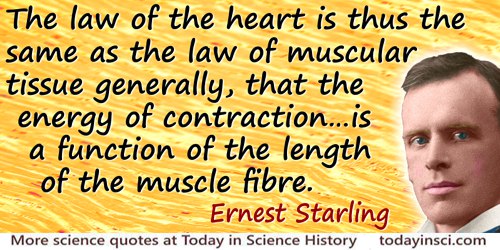
The law of the heart is thus the same as the law of muscular tissue generally, that the energy of contraction, however measured, is a function of the length of the muscle fibre.
The Linacre Lecture on the Law of the Heart (1918), 142.
The longing to behold this pre-established harmony [of phenomena and theoretical principles] is the source of the inexhaustible patience and perseverance with which Planck has devoted himself ... The state of mind which enables a man to do work of this kind is akin to that of the religious worshiper or the lover; the daily effort comes from no deliberate intention or program, but straight from the heart.
Address (1918) for Max Planck's 60th birthday, at Physical Society, Berlin, 'Principles of Research' in Essays in Science (1934), 4-5.
The motive for the study of mathematics is insight into the nature of the universe. Stars and strata, heat and electricity, the laws and processes of becoming and being, incorporate mathematical truths. If language imitates the voice of the Creator, revealing His heart, mathematics discloses His intellect, repeating the story of how things came into being. And Value of Mathematics, appealing as it does to our energy and to our honor, to our desire to know the truth and thereby to live as of right in the household of God, is that it establishes us in larger and larger certainties. As literature develops emotion, understanding, and sympathy, so mathematics develops observation, imagination, and reason.
In A Theory of Motives, Ideals and Values in Education (1907), 406.
The night before Easter Sunday of that year (1920) I awoke, turned on the light, and jotted down a few notes on a tiny slip of thin paper. Then I fell asleep again. It occurred to me at six o’clock in the morning that during the night I had written down something most important, but I was unable to decipher the scrawl. The next night, at three o’clock, the idea returned. It was the design of an experiment to determine whether the hypothesis of chemical transmission that I had uttered seventeen years ago was correct. I got up immediately, went to the laboratory, and performed a simple experiment on a frog heart according to the nocturnal design. I have to describe this experiment briefly since its results became the foundation of the theory of chemical transmission of the nervous impulse. The hearts of two frogs were isolated, the first with its nerves, the second without. Both hearts were attached to Straub cannulas filled with a little Ringer solution. The vagus nerve of the first heart was stimulated for a few minutes. Then the Ringer solution that had been in the first heart during the stimulation of the vagus was transferred to the second heart. It slowed and its beats diminished just as if its vagus had been stimulated. Similarly, when the accelerator nerve was stimulated and the Ringer from this period transferred, the second heart speeded up and its beats increased. These results unequivocally proved that the nerves do not influence the heart directly but liberate from their terminals specific chemical substances which, in their turn, cause the well-known modifications of the function of the heart characteristic of the stimulation of its nerves.
'An Autobiographic Sketch', Perspectives in Biology and Medicine (1960), 4, 17.
The other experiment (which I shall hardly, I confess, make again, because it was cruel) was with a dog, which, by means of a pair of bellows, wherewith I filled his lungs, and suffered them to empty again, I was able to preserve alive as long as I could desire, after I had wholly opened the thorax, and cut off all the ribs, and opened the belly. Nay, I kept him alive above an hour after I had cut off the pericardium and the mediastinum, and had handled and turned his lungs and heart and all the other parts of its body, as I pleased. My design was to make some enquiries into the nature of respiration. But though I made some considerable discovery of the necessity of fresh air, and the motion of the lungs for the continuance of the animal life, yet I could not make the least discovery in this of what I longed for, which was, to see, if I could by any means discover a passage of the air of the lungs into either the vessels or the heart; and I shall hardly be induced to make any further trials of this kind, because of the torture of this creature: but certainly the enquiry would be very noble, if we could any way find a way so to stupify the creature, as that it might not be sensible.
Letter from Robert Hooke to Robert Boyle (10 Nov 1664). In M. Hunter, A. Clericuzio and L. M. Principe (eds.), The Correspondence of Robert Boyle (2001), Vol. 2, 399.
The radical novelty of modern science lies precisely in the rejection of the belief, which is at the heart of all popular religion, that the forces which move the stars and atoms are contingent upon the preferences of the human heart.
In A Preface to Morals (1929, 1982), 127.
The skeletal striated muscle cell of amphibia therefore resembles the cardiac striated muscle cell in the property of “all or none” contraction. The difference which renders it possible to obtain 'submaximal' contractions from a whole skeletal muscle but not from a whole heart is not a difference in the functional capabilities of the two types of cell; it depends upon the fact that cardiac muscle cells are connected one with another, whereas skeletal muscle cells are isolated by their sarcolemma. The 'submaximal' contraction of a skeletal muscle is the maximal contraction of less than all its fibres.
'The “All or None” Contraction of the Amphibian Skeletal Muscle Fibre', Journal of Physiology (1909), 38, 133.
The source and origin of the nerves is the brain and spinal marrow, and hence some nerves originate from the brain and some from the spinal marrow. Some … experts set down the heart as the origin of the nerves and some the hard membrane that envelops the brain; none of them, however, thought it was the liver or any other viscus of that kind … Aristotle in particular, and quite a few others, thought that the nerves took origin from the heart.
From De Humani Corporis Fabrica Libri Septem (1543), Book IV, 315, as translated by William Frank Richardson and John Burd Carman, in 'The Nerves Originate From the Brain', On The Fabric of the Human Body: Book III: The Veins And Arteries; Book IV: The Nerves (1998), 160
The study of the history of mathematics will not make better mathematicians but gentler ones, it will enrich their minds, mellow their hearts, and bring out their finer qualities.
In The Study of the History of Mathematics (1936), 28.
The two fortresses which are the last to yield in the human heart, are hope and pride.
Quoted, without citation, in front matter to T. A. Edison Foundation, Lewis Howard Latimer: A Black Inventor: a Biography and Related Experiments You Can Do (1973). If you know the primary eource, please contact Webmaster.
The uncertain, unsettled condition of this science of Cetology is in the very vestibule attested by the fact, that in some quarters it still remains a moot point whether a whale be a fish. In his System of Nature, A.D. 1776, Linnæus declares, “I hereby separate the whales from the fish.” But of my own knowledge, I know that down to the year 1850, sharks and shads, alewives and herring, against Linnæus’s express edict, were still found dividing the possession of the same seas with the Leviathan.
The grounds upon which Linnæus would fain have banished the whales from the waters, he states as follows: “On account of their warm bilocular heart, their lungs, their movable eyelids, their hollow ears, penem intrantem feminam mammis lactantem,” and finally, “ex lege naturæ jure meritoque.” I submitted all this to my friends Simeon Macey and Charley Coffin, of Nantucket, both messmates of mine in a certain voyage, and they united in the opinion that the reasons set forth were altogether insufficient. Charley profanely hinted they were humbug.
The grounds upon which Linnæus would fain have banished the whales from the waters, he states as follows: “On account of their warm bilocular heart, their lungs, their movable eyelids, their hollow ears, penem intrantem feminam mammis lactantem,” and finally, “ex lege naturæ jure meritoque.” I submitted all this to my friends Simeon Macey and Charley Coffin, of Nantucket, both messmates of mine in a certain voyage, and they united in the opinion that the reasons set forth were altogether insufficient. Charley profanely hinted they were humbug.
In Moby Dick (1851, 1892), 128-129.
The United States pledges before you—and therefore before the world—its determination to help solve the fearful atomic dilemma—to devote its entire heart and mind to find the way by which the miraculous inventiveness of man shall not be dedicated to his death, but consecrated to his life.
From address to the General Assembly of the United Nations (8 Dec 1953).
There are two kinds of truth; the truth that lights the way and the truth that warms the heart. The first of these is science, and the second is art. Without art, science would be as useless as a pair of high forceps in the hands of a plumber. Without science, art would become a crude mess of folklore and emotional quackery.
In 'Great Thought' (19 Feb 1938), The Notebooks of Raymond Chandler and English Summer: A Gothic Romance, (1976), 7.
There is a road in the hearts of all of us, hidden and seldom traveled, which leads to an unknown, secret place.
Quoted in Kim Lim (ed.), 1,001 Pearls of Spiritual Wisdom: Words to Enrich, Inspire, and Guide Your Life (2014), 249
There is no arithmetician like him who hath learned to number his days, and to apply his heart unto wisdom.
In 'The Epistle Dedicatory, The Works of George Swinnock (1868), Vol. 1, 370.
There is no other article for individual use so universally known or widely distributed. In my travels I have found [the safety razor] in the most northern town in Norway and in the heart of the Sahara Desert.
In The Gillette Blade (1926), 1 No 2, 36. In Patricia Harris and David Lyon, 1001 Greatest Things Ever Said About Massachusetts (2007), 385.
There is no question but that man’s heart outperforms all other hearts in existence. (The tortoise’s heart may last longer but it lives nowhere near as intensely.) Why man should be so long-lived is not known, but man, being what he is, is far more interested in asking why he does not live still longer.
In The Human Body: Its Structure and Operation (1963), 321. Also in Isaac Asimov’s Book of Science and Nature Quotations (1988), 216.
There is one best path to the mountain crest; yet there are other paths, nearly as good. Let Youth be assured that the steeps of success have as many paths as there are stout-hearted climbers.
From chapter 'Jottings from a Note-book', in Canadian Stories (1918), 173-174.
There will still be things that machines cannot do. They will not produce great art or great literature or great philosophy; they will not be able to discover the secret springs of happiness in the human heart; they will know nothing of love and friendship.
…...
This compassion, or sympathy with the pains of others, ought also to extend to the brute creation, as far as our necessities will admit; for we cannot exist long without the destruction of other animal or vegetable beings either in their mature or embryon state. Such is the condition of mortality, that the first law of nature is “eat, or be eaten.” Hence for the preservation of our existence we may be supposed to have a natural right to kill those brute creatures, which we want to eat, or which want to eat us; but to destroy even insects wantonly shows an unreflecting mind, or a depraved heart.
In A Plan for the Conduct of Female Education in Boarding Schools (1797), 48.
This is the most beautiful place on Earth. There are many such places. Every man, every woman, carries in heart and mind the image of the ideal place, the right place, the one true home, known or unknown, actual or visionary.
Opening sentences in 'The First morning', Desert Solitaire (1968,1988), 1.
This is the right cavity of the two cavities of the heart. When the blood in this cavity has become thin, it must be transferred into the left cavity, where the pneuma is generated. But there is no passage between these two cavities, the substance of the heart there being impermeable. It neither contains a visible passage, as some people have thought, nor does it contain an invisible passage which would permit the passage of blood, as Galen thought. The pores of the heart there are compact and the substance of the heart is thick. It must, therefore, be that when the blood has become thin, it is passed into the arterial vein [pulmonary artery] to the lung, in order to be dispersed inside the substance of the lung, and to mix with the air. The finest parts of the blood are then strained, passing into the venous artery [pulmonary vein] reaching the left of the two cavities of the heart, after mixing with the air and becoming fit for the generation of pneuma.
Albert Z. Iskandar, 'Ibn al-Nafis', In Charles Coulston Gillispie (ed.), Dictionary of Scientific Biography (1974), Vol. 9, 603.
This organ deserves to be styled the starting point of life and the sun of our microcosm just as much as the sun deserves to be styled the heart of the world. For it is by the heart's vigorous beat that the blood is moved, perfected, activated, and protected from injury and coagulation. The heart is the tutelary deity of the body, the basis of life, the source of all things, carrying out its function of nourishing, warming, and activating body as a whole. But we shall more fittingly speak of these matters when we consider the final cause of this kind of movement.
De Motu Cordis (1628), The Circulation of the Blood and Other Writings, trans. Kenneth J. Franklin (1957), Chapter 8, 59. Alternate translation: “The heart is the beginning of life; the sun of the microcosm, even as the sun in his turn might well be designated the heart of the world; for it is the heart by whose virtue and pulse the blood is moved, perfected, made apt to nourish, and is preserved from corruption and coagulation; it is the household divinity which, discharging its function, nourishes, cherishes, quickens the whole body, and is indeed the foundation of life, the source of all action. … The heart, like the prince in a kingdom, in whose hands lie the chief highest authority, rules over all; it is the original and foundation from which all power is derived, on which all power depends in the animal body.” In translation by Geoffrey Keynes (1953), 59.
This, however, seems to be certain: the ichor, that is, the material I have mentioned that finally becomes red, exists before the heart begins to beat, but the heart exists and even beats before the blood reddens.
'On the Formation of the Chick in the Egg' (1673), in H. B. Adelmann (ed.), Marcello Malpighi and the Evolution of Embryology (1966), Vol. 2, 957.
Throughout history, engineers have served their neighbours, their towns and their countries by making tools, machines and countless other things that improve every aspect of life. From information technology to medical science and mining, from building roads to space travel, engineers are working to make a difference to our standard of living, and with it our health, wealth and happiness. At its heart, engineering is about using science to find creative, practical solutions. It is a noble profession.
In Speech (25 Jun 2013), for the 2013 Queen Elizabeth Prize for Engineering.
To appreciate a work of art we need bring with us nothing from life, no knowledge of its ideas and affairs, no familiarity with its emotions. Art transports us from the world of man’s activity to a world of æsthetic exaltation. For a moment we are shut off from human interests; our anticipations and memories are arrested; we are lifted above the stream of life. The pure mathematician rapt in his studies knows a state of mind which I take to be similar, if not identical. He feels an emotion for his speculations which arises from no perceived relation between them and the lives of men, but springs, inhuman or super-human, from the heart of an abstract science. I wonder, sometimes, whether the appreciators of art and of mathematical solutions are not even more closely allied.
In Art (1913), 25.
To judge in this [utilitarian] way demonstrates … how small, narrow and indolent our minds are; it shows a disposition always to calculate the reward before the work, a cold heart and a lack of feeling for everything that is great and honours mankind. Unfortunately one cannot deny that such a mode of thinking is common in our age, and I am convinced that this is closely connected with the catastrophes which have befallen many countries in recent times; do not mistake me, I do not talk of the general lack of concern for science, but of the source from which all this has come, of the tendency to look out everywhere for one’s advantage and to relate everything to one’s physical well being, of indifference towards great ideas, of aversion to any effort which derives from pure enthusiasm.
Epigraph before title page, T. W. Körner, The Pleasures of Counting (1996).
To the days of the aged it addeth length;
To the might of the strong it addeth strength;
It freshens the heart, It brightens the sight;
’Tis like quaffing a goblet of morning light.
So, water, I will drink nothing but thee,
Thou parent of health and energy!
To the might of the strong it addeth strength;
It freshens the heart, It brightens the sight;
’Tis like quaffing a goblet of morning light.
So, water, I will drink nothing but thee,
Thou parent of health and energy!
From 'Song of the Water Drinker', The Metropolitan Magazine (1835), 15, 283. Attributed to E. Johnson, but without a full name with which to find more biographical information, Webmaster is putting these lines under Anonymous.
Vanity is so anchored in the heart of man … and wishes to have his admirers. … Those who write against it want to have the glory of having written well, and those who read it desire the glory of having read it. I who write this have perhaps this desire, and perhaps those who will read it….
In Pensées (1670), Section 2, No. 3. As translated in Blaise Pascal and W.F. Trotter (trans.), 'Thoughts', No. 150, collected in Charles W. Eliot (ed.), The Harvard Classics (1910), Vol. 48, 60. A similar translation is in W.H. Auden and L. Kronenberger (eds.) The Viking Book of Aphorisms (1966), 40. From the original French, “La vanité est si ancrée dans le cœur de l’homme … et veut avoir ses admirateurs;… Ceux qui écrivent contre veulent avoir la gloire d’avoir bien écrit; et ceux qui le lisent veulent avoir la gloire de l’avoir lu; et moi qui écris ceci, ai peut-être cette envie; et peut-être que ceux qui le liront…” in Ernest Havet (ed.), Pensées de Pascal (1892), 122.
Veracity is the heart of morality.
Inaugural Address of the Lord Rector of the University of Aberdeen (27 Feb 1874), Contemporary Review (1874) , 'Universities Actual and Ideal', collected in Science and Culture, and Other Essays (1881), 38.
We all felt the majesty of the body. In a very short period of time we had seen something that was bigger than each of us. A lot of people, even those who were not religious, were reverent and attributed the success to God. As we saw the artificial heart beat in Dr. Clark, the feeling was not aren't we great, but aren't we small.
[Comment after surgery for the world's first human implant of a total artificial heart in the chest of dentist Dr. Barney Clark ]
[Comment after surgery for the world's first human implant of a total artificial heart in the chest of dentist Dr. Barney Clark ]
Quoted by Lawrence K. Altman in “Clark's Surgeon Was ‘Worried To Death’&rdquo, New York Times (12 Apr 1983), C2.
We are many small puppets moved by fate and fortune through strings unseen by us; therefore, if it is so as I think, one has to prepare oneself with a good heart and indifference to accept things coming towards us, because they cannot be avoided, and to oppose them requires a violence that tears our souls too deeply, and it seems that both fortune and men are always busy in affairs for our dislike because the former is blind and the latter only think of their interest.
'Letter to Bellini' (17 Oct 1689), in H. B. Adelmann (ed.), The Correspondence of Marcello Malpighi (1975), Vol. 4, 1534.
We are the children of chaos, and the deep structure of change is decay. At root, there is only corruption, and the unstemmable tide of chaos. Gone is purpose; all that is left is direction. This is the bleakness we have to accept as we peer deeply and dispassionately into the heart of the Universe.
In The Second Law (1984), 216.
We build our personalities laboriously and through many years, and we cannot order fundamental changes just because we might value their utility; no button reading ‘positive attitude’ protrudes from our hearts, and no finger can coerce positivity into immediate action by a single and painless pressing.
…...
We can see that there is only one substance in the universe and that man is the most perfect one. He is to the ape and the cleverest animals what Huygens's planetary clock is to one of Julien Leroy's watches. If it took more instruments, more cogs, more springs to show or tell the time, if it took Vaucanson more artistry to make his flautist than his duck, he would have needed even more to make a speaking machine, which can no longer be considered impossible, particularly at the hands of a new Prometheus. Thus, in the same way, nature needed more artistry and machinery to construct and maintain a machine which could continue for a whole century to tell all the beats of the heart and the mind; for we cannot tell the time from the pulse, it is at least the barometer of heat and liveliness, from which we can judge the nature of the soul.
Machine Man (1747), in Ann Thomson (ed.), Machine Man and Other Writings (1996), 33-4.
We do not know how the scientists of the next century will define energy or in what strange jargon they will discuss it. But no matter what language the physicists use they will not come into contradiction with Blake. Energy will remain in some sense the lord and giver of life, a reality transcending our mathematical descriptions. Its nature lies at the heart of the mystery of our existence as animate beings in an inanimate universe.
In 'Energy in the Universe,' Scientific American, September 1971 [See William Blake].
We don’t understand electricity. We use it. You can plug into it and light up a lamp, keep a heart pump going, light a cathedral, or you can electrocute a person with it. … I think talent is like that.
In Maya Angelo and Joanne M. Braxon (ed.), 'An interview with Claudia Tate', I Know why the Caged Bird Sings: A Casebook (1999), 154. Also seen paraphrased as, “Talent is like electricity. We don’t understand electricity. We use it.…”. [Many thanks to P.D. for locating the citation, previously unverified here.]
We have the hunger for eternity in our souls, the thought of eternity in our hearts, the destination for eternity written on our inmost being.
Quoted in Kim Lim (ed.), 1,001 Pearls of Spiritual Wisdom: Words to Enrich, Inspire, and Guide Your Life (2014), 5
We know the truth not only through our reason but also through our heart. It is through the latter that we know first principles, and reason, which has nothing to do with it, tries in vain to refute them.
Pensées (1670), trans. A.J. Krailsheimer (1966), Section 1, VI, aphorism 110, 58.
We know truth, not only by the reason, but also by the heart.
In Pensées (1670), Section 8, No. 6. As translated in Blaise Pascal and W.F. Trotter (trans.), 'Thoughts', No. 282, collected in Charles W. Eliot (ed.), The Harvard Classics (1910), Vol. 48, 99. Translated as “We arrive at truth, not by reason only, but also by the heart,” in W.H. Auden and L. Kronenberger (eds.) The Viking Book of Aphorisms (1966). From the original French, “Nous connaissons la vérité, non seulement par la raison, mais encore par le cœur,” in Ernest Havet (ed.), Pensées de Pascal (1892), 238.
We make a lot of mistakes in the environmental space. … We don’t do a good-enough job of asking, “What are the fundamentals of telling a good story?” And that is not statistics, it’s usually not science, or at least complex science. It’s people stories. … It’s got to have adventure, it’s got to be funny, it’s got to pull my heart strings, it’s got to have conflict, setting, character. It’s a story. And if it doesn’t have those things, it can be the best-meaning story in the world, and nobody’s going to buy it.
From interview with Dan Conover, 'A Conversation with Philippe Cousteau Jr.', Charleston City Paper (27 Jul 2012).
We speak of it [astrology] as an extinct science; yet let but an eclipse of the sun happen, or a comet visit the evening sky, and in a moment we all believe in astrology. In vain do you tell the gazers on such spectacles that a solar eclipse is only the moon acting for the time as a candle-extinguisher to the sun, and give them bits of smoked glass to look through, and draw diagrams on the blackboard to explain it all. They listen composedly, and seem convinced, but in their secret hearts they are saying—“What though you can see it through a glass darkly, and draw it on a blackboard, does that show that it has no moral significance? You can draw a gallows or a guillotine, or write the Ten Commandments on a blackboard, but does that deprive them of meaning?” And so with the comet. No man will believe that the splendid stranger is hurrying through the sky solely on a momentous errand of his own. No! he is plainly signalling, with that flashing sword of his, something of importance to men,—something at all events that, if we could make it out, would be found of huge concern to us.
From 'Introductory Lecture on Technology for 1858-59', published as The Progress of the Telegraph (1859), 19-20.
Were there no God, we would be in this glorious world with grateful hearts and no one to thank.
Quoted in Kim Lim (ed.), 1,001 Pearls of Spiritual Wisdom: Words to Enrich, Inspire, and Guide Your Life (2014), 179
What is it to see, in an Eagle glide
Which fills a human heart with so much pride?
Is it that it soars effortless above the Earth
That steals us from our own limits & dearth?
Trapped in our seas of befuddling sludge
We try and try but cannot budge.
And then to see a mortal; with such ease take wing
Up in a breeze that makes our failing spirits sing?
Do we, vicarious birds, search in it our childishness -
When we too were young & yearned in heart to fly?
Taking flights of fancy through adolescent nights
Listening little, heeding less, knowing not why?
From its highest perch in the forest of snow
Majestic - the Eagle soars alone.
Riding thermals, lording clouds
Till dropping silent from the sky as a stone
But we, so quick and ready to fold
Give up our wings at the whiff of age
Losing years, cursing time, wasting spirit
Living out entire lives in futile rage!
Which fills a human heart with so much pride?
Is it that it soars effortless above the Earth
That steals us from our own limits & dearth?
Trapped in our seas of befuddling sludge
We try and try but cannot budge.
And then to see a mortal; with such ease take wing
Up in a breeze that makes our failing spirits sing?
Do we, vicarious birds, search in it our childishness -
When we too were young & yearned in heart to fly?
Taking flights of fancy through adolescent nights
Listening little, heeding less, knowing not why?
From its highest perch in the forest of snow
Majestic - the Eagle soars alone.
Riding thermals, lording clouds
Till dropping silent from the sky as a stone
But we, so quick and ready to fold
Give up our wings at the whiff of age
Losing years, cursing time, wasting spirit
Living out entire lives in futile rage!
…...
What was at first merely by-the-way may become the very heart of a matter. Flints were long flaked into knives, arrowheads, spears. Incidentally it was found that they struck fire; to-day that is their one use.
From chapter 'Jottings from a Note-book', in Canadian Stories (1918), 178.
What’s near and dear to my heart is cooperative conservation.
…...
Whatever be the detail with which you cram your student, the chance of his meeting in after life exactly that detail is almost infinitesimal; and if he does meet it, he will probably have forgotten what you taught him about it. The really useful training yields a comprehension of a few general principles with a thorough grounding in the way they apply to a variety of concrete details. In subsequent practice the men will have forgotten your particular details; but they will remember by an unconscious common sense how to apply principles to immediate circumstances. Your learning is useless to you till you have lost your textbooks, burnt your lecture notes, and forgotten the minutiae which you learned by heart for the examination. What, in the way of detail, you continually require will stick in your memory as obvious facts like the sun and the moon; and what you casually require can be looked up in any work of reference. The function of a University is to enable you to shed details in favor of principles. When I speak of principles I am hardly even thinking of verbal formulations. A principle which has thoroughly soaked into you is rather a mental habit than a formal statement. It becomes the way the mind reacts to the appropriate stimulus in the form of illustrative circumstances. Nobody goes about with his knowledge clearly and consciously before him. Mental cultivation is nothing else than the satisfactory way in which the mind will function when it is poked up into activity.
In 'The Rhythm of Education', The Aims of Education: & Other Essays (1917), 41.
When I saw the alpha-helix and saw what a beautiful, elegant structure it was, I was thunderstruck and was furious with myself for not having built this, but on the other hand, I wondered, was it really right?
So I cycled home for lunch and was so preoccupied with the turmoil in my mind that didn’t respond to anything. Then I had an idea, so I cycled back to the lab. I realized that I had a horse hair in a drawer. I set it up on the X-ray camera and gave it a two hour exposure, then took the film to the dark room with my heart in my mouth, wondering what it showed, and when I developed it, there was the 1.5 angstrom reflection which I had predicted and which excluded all structures other than the alpha-helix.
So on Monday morning I stormed into my professor’s office, into Bragg’s office and showed him this, and Bragg said, 'Whatever made you think of that?' And I said, 'Because I was so furious with myself for having missed that beautiful structure.' To which Bragg replied coldly, 'I wish I had made you angry earlier.'
So I cycled home for lunch and was so preoccupied with the turmoil in my mind that didn’t respond to anything. Then I had an idea, so I cycled back to the lab. I realized that I had a horse hair in a drawer. I set it up on the X-ray camera and gave it a two hour exposure, then took the film to the dark room with my heart in my mouth, wondering what it showed, and when I developed it, there was the 1.5 angstrom reflection which I had predicted and which excluded all structures other than the alpha-helix.
So on Monday morning I stormed into my professor’s office, into Bragg’s office and showed him this, and Bragg said, 'Whatever made you think of that?' And I said, 'Because I was so furious with myself for having missed that beautiful structure.' To which Bragg replied coldly, 'I wish I had made you angry earlier.'
From transcript of audio of Max Perutz in BBC programme, 'Lifestory: Linus Pauling' (1997). On 'Linus Pauling and the Race for DNA' webpage 'I Wish I Had Made You Angry Earlier.'
When in many dissections, carried out as opportunity offered upon living animals, I first addressed my mind to seeing how I could discover the function and offices of the heart’s movement in animals through the use of my own eyes instead of through the books and writings of others, I kept finding the matter so truly hard and beset with difficulties that I all but thought, with Fracastoro, that the heart's movement had been understood by God alone.
De Motu Cordis (1628), The Circulation of the Blood and Other Writings, trans. Kenneth J. Franklin (1957), Chapter 1, author's motives for writing, 23.
When someone with an artificial heart dies, I think they should take out the heart, hook it up to an artificial body, and let it go at that.
In Napalm and Silly Putty (2001), 276.
When we react to life from the head without joining forces with the heart, it can lead us into childish, inelegant behavior that we don’t respect in ourselves. If we get the head in sync with the heart first, we have the power of their teamwork working for us and we can make the changes we know we need to make.
Doc Childre and Howard Martin
Whenever a textbook is written of real educational worth, you may be quite certain that some reviewer will say that it will be difficult to teach from it. Of course it will be difficult to teach from it. It it were easy, the book ought to be burned; for it cannot be educational. In education as elsewhere, the broad primrose path leads to a nasty place. This evil path is represented by a book or a set of lectures which will practically enable the student to learn by heart all the questions likely to be asked at the next external examination.
In 'The Aims of Education', The Aims of Education: & Other Essays (1917), 6-7.
Wherever you go, go with all your heart.
…...
Why do you so earnestly seek the truth in distant places?
Look for delusion and truth in the bottom of your own hearts.
Look for delusion and truth in the bottom of your own hearts.
Quoted in Kim Lim (ed.), 1,001 Pearls of Spiritual Wisdom: Words to Enrich, Inspire, and Guide Your Life (2014), 247
Why does a man want to be a scientist? There are many goals: fame, position, a thirst for understanding. The first two can be attained without intellectual integrity; the third cannot. … The thirst for knowledge, what Thomas Huxley called the ‘Divine dipsomania’, can only be satisfied by complete intellectual integrity. It seems to me the only one of the three goals that continues to reward the pursuer. He presses on, “knowing that Nature never did betray the heart that loved her”. Here is another kind of love, that has so many faces. Love is neither passion, nor pride, nor pity, nor blind adoration, but it can be any or all of these if they are transfigured by deep and unbiased understanding.
In Cecilia Payne-Gaposchkin: An Autobiography and Other Recollections (1996), 123.
Why may we not say, that all Automata (Engines that move themselves by springs and wheeles as doth a watch) have an artificiall life? For what is the Heart, but a Spring; and the Nerves, but so many Strings; and the Joynts, but so many Wheeles, giving motion to the whole Body, such as was intended by the Artificer? Art goes yet further, imitating the rationall and most excellent worke of Nature, Man. For by Art is created the great LEVIATHAN called a COMMON-WEALTH, or STATE, (in latine CIVITAS) which is but an Artificiall Man; though of greater stature and strength than the Naturall, for whose protection and defence it was intended; and in which, the Soveraignty is an Artificiall Soul, as giving life and motion to the whole body.
Leviathan (1651), ed. C. B. Macpherson (1968), Part I, Introduction, 81.
With equal passion I have sought knowledge. I have wished to understand the hearts of men. I have wished to know why the stars shine. And I have tried to apprehend the Pythagorean power by which numbers holds sway above the flux. A little of this, but not much, I have achieved.
In 'Prologue: What I Have Lived For', The Autobiography of Bertrand Russell (1969). 3-4.
Worry affects circulation, the heart, the glands, the whole nervous system, and profoundly affects the heart. I have never known a man who died from overwork, but many who died from doubt.
Leonard Louis Levinson, Bartlett's Unfamiliar Quotations (1972). Cited in Bill Swainson,
Encarta Book of Quotations (2000), 624.
Yet I also appreciate that we cannot win this battle to save species and environments without forging an emotional bond between ourselves and nature as well–for we will not fight to save what we do not love (but only appreciate in some abstract sense). So let them all continue–the films, the books, the television programs, the zoos, the little half acre of ecological preserve in any community, the primary school lessons, the museum demonstrations, even ... the 6:00 A.M. bird walks. Let them continue and expand because we must have visceral contact in order to love. We really must make room for nature in our hearts.
…...
You only have to bat 1.000 in two things—flying and heart transplants. Everything else, you can go four in five.
TV programme, SportsCenter (1987). In The Quotable ESPN? (1998), 28.
Your breathing. The beating of your heart. The expansion of your lungs. Your mere presence is all that is needed to establish your worth.
Quoted in Kim Lim (ed.), 1,001 Pearls of Spiritual Wisdom: Words to Enrich, Inspire, and Guide Your Life (2014), 247
 In science it often happens that scientists say, 'You know that's a really good argument; my position is mistaken,' and then they would actually change their minds and you never hear that old view from them again. They really do it. It doesn't happen as often as it should, because scientists are human and change is sometimes painful. But it happens every day. I cannot recall the last time something like that happened in politics or religion.
(1987) --
In science it often happens that scientists say, 'You know that's a really good argument; my position is mistaken,' and then they would actually change their minds and you never hear that old view from them again. They really do it. It doesn't happen as often as it should, because scientists are human and change is sometimes painful. But it happens every day. I cannot recall the last time something like that happened in politics or religion.
(1987) -- 





