Health Quotes (212 quotes)
Healthful Quotes
Healthful Quotes
...those who sit at their work and are therefore called 'chair workers,' such as cobblers and tailors, suffer from their own particular diseases ... [T]hese workers ... suffer from general ill-health and an excessive accumulation of unwholesome humors caused by their sedentary life ... so to some extent counteract the harm done by many days of sedentary life.
On the association between chronic inactivity and poor health. Ramazzini urged that workers should at least exercise on holidays
On the association between chronic inactivity and poor health. Ramazzini urged that workers should at least exercise on holidays
'Sedentary Workers and Their Diseases', Diseases of Workers (1713) Translated by WC Wright (1964),281-285). Quoted in Physical Activity and Health: a Report of the Surgeon General (1996).
[You are] A healthy man out of health.
Told to cheer and encourage an over-anxious patient, as stated by the Editor in Preface to Sir William Withey Gull and Theodore Dyke Acland (ed.), A Collection of the Published Writings of William Withey Gull (1896), xvii.
[Trousseau regarded as the chief aim of medicine:] Get that patient well.
As quoted by F.H. Garrison in editorial, 'The Evil Spoken of Physicians and the Answer Thereto', Bulletin of the New York Academy of Medicine (Feb 1929), 5, No. 2, 145.
[When questioned on his longevity] First of all, I selected my ancestors very wisely. ... They were long-lived, healthy people. Then, as a chemist, I know how to eat, how to exercise, keep my blood circulating. ... I don't worry. I don't get angry at people. I don't worry about things I can't help. I do what I can to make the world a better place to live, but I don't complain if things aren't right. As a scientist I take the world as I find it.
[About celebrating his 77th birthday by swimming a half mile in 22 minutes] I used swim fins and webbed gloves because a man of intelligence should apply his power efficiently, not just churn the water.
[About celebrating his 77th birthday by swimming a half mile in 22 minutes] I used swim fins and webbed gloves because a man of intelligence should apply his power efficiently, not just churn the water.
As quoted in obituary by Wallace Turner, 'Joel Hildebrand, 101', New York Times (3 May 1983), D27.
Hominem ad deos nulla re propius accedunt quam salutem hominibus dando,
In nothing do men more nearly approach the gods, than in giving health to men.
In nothing do men more nearly approach the gods, than in giving health to men.
Henry Thomas Riley, Dictionary of Latin Quotations, Proverbs, Maxims, and Mottos (1866), 152.
La santé est le trésor le plus précieux et le plus facile à perdre; c'est cependant le plus mal gardé.
Health is the most valuable and most easily lost treasure; yet it is the most poorly kept.
Health is the most valuable and most easily lost treasure; yet it is the most poorly kept.
Maxim No. 308 in Maximes, Réflexions et Pensées Diverses (1819), 242.
A doctor is the only man who can suffer from good health.
In Edward Jewitt Wheeler, et al., The Literary Digest (1931),13.
A healthy body is a guest-chamber for the soul; a sick body is a prison.
As quoted in a book review in The Royal Society of Health Journal (1955), 225.
A little science is something that they must have. I should like my nephews to know what air is, and water; why we breathe, and why wood burns; the nutritive elements essential to plant life, and the constituents of the soil. And it is no vague and imperfect knowledge from hearsay I would have them gain of these fundamental truths, on which depend agriculture and the industrial arts and our health itself; I would have them know these things thoroughly from their own observation and experience. Books here are insufficient, and can serve merely as aids to scientific experiment.
A nickel’s worth of goulash beats a five dollar can of vitamins.
A physician is an unfortunate gentleman who is every day required to perform a miracle; namely to reconcile health with intemperance.
In Great Thoughts from Master Minds (1887), 8, 49.
A sick man talks obsessively about his illness; a healthy man never talks about his health; for as Pirandello points out, we take happiness for granted, and only begin to question life when we are unhappy.
In Introduction to the New Existentialism (1966), 15.
According to the estimate of a prominent advertising firm, above 90 per cent, of the earning capacity of the prominent nostrums is represented by their advertising. And all this advertising is based on the well-proven theory of the public's pitiable ignorance and gullibility in the vitally important matter of health.
'The Fundamental Fakes', Collier's Weekly (17 Feb 1906). Reprinted in The Great American Fraud (1907), 55.
After an honest day’s work a mathematician goes off duty. Mathematics is very hard work, and dons tend to be above average in health and vigor. Below a certain threshold a man cracks up; but above it, hard mental work makes for health and vigor (also—on much historical evidence throughout the ages—for longevity). I have noticed lately that when I am working really hard I wake around 5.30 a.m. ready and eager to start; if I am slack, I sleep till I am called.
In 'The Mathematician’s Art of Work' (1967), collected in Béla Bollobás (ed.), Littlewood’s Miscellany (1986), 195.
Alcmaeon maintains that the bond of health is the 'equal balance' of the powers, moist and dry, cold and hot, bitter and sweet, and the rest, while the 'supremacy' of one of them is the cause of disease; for the supremacy of either is destructive. Illness comes aboutdirectly through excess of heat or cold, indirectly through surfeit or deficiency of nourishment; and its centre is either the blood or the marrow or the brain. It sometimes arises in these centres from external causes, moisture of some sort or environment or exhaustion or hardship or similar causes. Health on the other hand is the proportionate admixture of the qualities.
About Alcmaeon of Croton. In Clarence J. Glacken, Traces on the Rhodian Shore: Nature and Culture in Western Thought from Ancient Times to the End of the Eighteenth Century (1976) 11.
An acquaintance of mine, a notary by profession, who, by perpetual writing, began first to complain of an excessive wariness of his whole right arm which could be removed by no medicines, and which was at last succeeded by a perfect palsy of the whole arm. … He learned to write with his left hand, which was soon thereafter seized with the same disorder.
Concerning a notary, a scribe skilled in rapid writing, in a translation published by the University of Chicago Press (1940).
An evolutionary view of human health and disease is not surprising or new; it is merely inevitable in the face of evidence and time.
Epigraph, without citation, in Robert Perlman, Evolution and Medicine (2013), xiii. Webmaster has not yet found the primary source; can you help?
Any man who is intelligent must, on considering that health is of the utmost value to human beings, have the personal understanding necessary to help himself in diseases, and be able to understand and to judge what physicians say and what they administer to his body, being versed in each of these matters to a degree reasonable for a layman.
Affections, in Hippocrates, trans. P. Potter (1988), Vol. 5, 7.
Anyone of common mental and physical health can practice scientific research. … Anyone can try by patient experiment what happens if this or that substance be mixed in this or that proportion with some other under this or that condition. Anyone can vary the experiment in any number of ways. He that hits in this fashion on something novel and of use will have fame. … The fame will be the product of luck and industry. It will not be the product of special talent.
In Essays of a Catholic Layman in England (1931).
Arguably the greatest technological triumph of the century has been the public-health system, which is sophisticated preventive and investigative medicine organized around mostly low- and medium-tech equipment; ... fully half of us are alive today because of the improvements.
In Visions of Technology (1999), 22.
As never before, the work of the engineer is basic to the kind of society to which our best efforts are committed. Whether it be city planning, improved health care in modern facilities, safer and more efficient transportation, new techniques of communication, or better ways to control pollution and dispose of wastes, the role of the engineer—his initiative, creative ability, and hard work—is at the root of social progress.
Remarks for National Engineers Week (1971). As quoted in Consulting Engineer (1971), 36, 18.
Be careful about reading health books. You may die of a misprint.
In Mark Twain and Alex Ayres (ed.), The Wit & Wisdom of Mark Twain (1987), 97.
Be not sick too late, nor well too soon.
In Poor Richard's Almanack (1734).
Be temperate in wine, in eating, girls, & sloth;
Or the Gout will seize you and plague you both.
Or the Gout will seize you and plague you both.
In Poor Richard's Almanack (1734).
Becoming serious is a grievous fault in hobbyists. It is an axiom that no hobby should either seek or need rational justification. To wish to do it is reason enough. To find reasons why it is useful or beneficial converts it at once from an avocation into an industry–lowers it at once to the ignominious category of an 'exercise' undertaken for health, power, or profit. Lifting dumbbells is not a hobby. It is a confession of subservience, not an assertion of liberty.
From 'A Man’s Leisure Time' (1920), collected in Luna B. Leopold (ed.) Round River: From the Journals of Aldo Leopold (1953, 1972), 4.
Besides agreeing with the aims of vegetarianism for aesthetic and moral reasons, it is my view that a vegetarian manner of living by its purely physical effect on the human temperament would most beneficially influence the lot of mankind.
In letter to Harmann Huth (27 Dec 1930). Presumably published in Vegetarische Warte (Vegetarian Watch, some time before 1935), a German magazine published by the society Vegetarier-Bund of which Harmann Huth was vice-president. As cited by Alice Calaprice (ed.) in The Ultimate Quotable Einstein (2010), 453. This might be the inspiration for a much-circulated and much-elaborated version attributed, but apparently wrongly, to Einstein. The questionable quote appears as: “Nothing will benefit human health and increase the chances for survival of life on Earth as much as the evolution to a vegetarian diet,” but no reliable source has been found for this as Einstein’s own words. Calaprice included this quote in her earlier edition of The Quotable Einstein (1996) in a final section of “Attributed to Einstein,” but it was removed from the final edition (2010), presumably because after much effort, it remained unsubstantiated.
Better to hunt in fields, for health unbought, Than fee the doctor for a nauseous draught, The wise, for cure, on exercise depend; God never made his work for man to mend.
'To my Honoured Kinsman, John Dryden', The English Poets (1901), Vol. 2, 491.
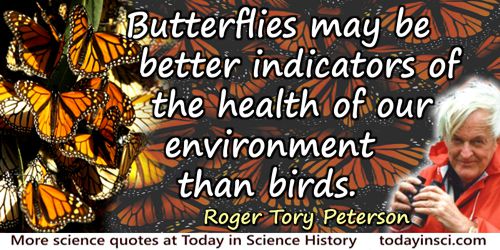
Butterflies may be better indicators of the health of our environment than birds.
In Roger Tory Peterson’s Dozen Birding Hot Spots (1976), 202.
Chagrined a little that we have been hitherto able to produce nothing in this way of use to mankind; and the hot weather coming on, when electrical experiments are not so agreeable, it is proposed to put an end to them for this season, somewhat humorously, in a party of pleasure, on the banks of Skuylkil. Spirits, at the same time, are to be fired by a spark sent from side to side through the river, without any other conductor that the water; an experiment which we some time since performed, to the amazement of many. A turkey is to be killed for our dinner by the electrified bottle: when the healths of all the famous electricians in England, Holland, France, and Germany are to be drank in electrified bumpers, under the discharge of guns from the electrical battery.
Letter to Peter Collinson, 29 Apr 1749. In I. Bernard Cohen (ed.), Benjamin Franklin's Experiments (1941), 199-200.
Cheese and salt meat, should be sparingly eat.
In Poor Richard's Almanack (1733).
City after city, state after state, had essentially failed in their efforts to protect their air and their water, the land, the health of their citizens. By 1970, our city’ skylines were so polluted that in many places it was all but impossible to see from one city skyscraper to another. … We had rivers that were fouled with raw sewage and toxic chemicals. One actually caught on fire. There was a very famous photograph from my teenage years of the Cuyahoga River
burning. In fact, it was memorialized in a song at the time.
In 'Environmental Protection: Meeting the Challenges of the Twenty-First Century', Harvard Environmental Law Review (2001), 25, 329, 330-331. [In fact, the Cuyahoga River had caught fire several times over a number of decades, and there had been fires on other rivers. Webmaster]
Climate change threatens every corner of our country, every sector of our economy and the health and future of every child. We are already seeing its impacts and we know the poorest and most vulnerable people in the United States and around the world will suffer most of all.
In Hillary Clinton, 'Hillary Clinton: America Must Lead at Paris Climate Talks', Time (29 Nov 2015).
Criticism is as often a trade as a science, requiring, as it does, more health than wit, more labour than capacity, more practice than genius.
In John Timbs (ed.), Laconics; or, The Best Words of the Best Authors (1929), 156.
Detest it as lewd intercourse, it can deprive you of all your leisure, your health, your rest, and the whole happiness of your life.
Having himself spent a lifetime unsuccessfully trying to prove Euclid’s postulate that parallel lines do not meet, Farkas discouraged his son János from any further attempt.
Having himself spent a lifetime unsuccessfully trying to prove Euclid’s postulate that parallel lines do not meet, Farkas discouraged his son János from any further attempt.
Letter (1820), to his son, János Bolyai. Translation as in Dirk Jan Struik, A concise history of mathematics (2nd Ed., 1948), 253.
Disease is an abnormal state of the body which primarily and independently produces a disturbance in the normal functions of the body. It may be an abnormality of temperament or form (structure). Symptom is a manifestation of some abnormal state in the body. It may be harmful as a colic pain or harmless as the flushing of cheeks in peripneumonia.
— Avicenna
'A Discussion of the Cause of Disease and Symptoms', in The Canon of Medicine, adapted by L. Bakhtiar (1999), 171.
Disease is largely a removable evil. It continues to afflict humanity, not only because of incomplete knowledge of its causes and lack of individual and public hygiene, but also because it is extensively fostered by harsh economic and industrial conditions and by wretched housing in congested communities. ... The reduction of the death rate is the principal statistical expression and index of human social progress. It means the saving and lengthening of lives of thousands of citizens, the extension of the vigorous working period well into old age, and the prevention of inefficiency, misery, and suffering. These advances can be made by organized social effort. Public health is purchasable. (1911)
Quoted in Evelynn Maxine Hammonds, Childhood's Deadly Scourge: The Campaign to Control Diphtheria in New York City, 1880-1930(1999), 221.
During the half-century that has elapsed since the enunciation of the cell-theory by Schleiden and Schwann, in 1838-39, it has became ever more clearly apparent that the key to all ultimate biological problems must, in the last analysis, be sought in the cell. It was the cell-theory that first brought the structure of plants and animals under one point of view by revealing their common plan of organization. It was through the cell-theory that Kolliker and Remak opened the way to an understanding of the nature of embryological development, and the law of genetic continuity lying at the basis of inheritance. It was the cell-theory again which, in the hands of Virchaw and Max Schultze, inaugurated a new era in the history of physiology and pathology, by showing that all the various functions of the body, in health and in disease, are but the outward expression of cell-activities. And at a still later day it was through the cell-theory that Hertwig, Fol, Van Beneden, and Strasburger solved the long-standing riddle of the fertilization of the egg, and the mechanism of hereditary transmission. No other biological generalization, save only the theory of organic evolution, has brought so many apparently diverse phenomena under a common point of view or has accomplished more far the unification of knowledge. The cell-theory must therefore be placed beside the evolution-theory as one of the foundation stones of modern biology.
In The Cell in Development and Inheritance (1896), 1.
Dust consisting of fine fibers of asbestos, which are insoluble and virtually indestructible, may become a public health problem in the near future. At a recent international conference on the biological effects of asbestos sponsored by the New York Academy of Sciences, participants pointed out on the one hand that workers exposed to asbestos dust are prone in later life to develop lung cancer, and on the other hand that the use of this family of fibrous silicate compounds has expanded enormously during the past few decades. A laboratory curiosity 100 years ago, asbestos today is a major component of building materials.
— Magazine
In Scientific American (Sep 1964). As cited in '50, 100 & 150 Years Ago', Scientific American (Dec 2014), 311, No. 6, 98.
Employment is Nature’s physician, and is essential to human happiness.
— Galen
In James Wood, Dictionary of Quotations from Ancient and Modern, English and Foreign Sources (1893), 81:44.
Engineers apply the theories and principles of science and mathematics to research and develop economical solutions to practical technical problems. Their work is the link between scientific discoveries and commercial applications. Engineers design products, the machinery to build those products, the factories in which those products are made, and the systems that ensure the quality of the product and efficiency of the workforce and manufacturing process. They design, plan, and supervise the construction of buildings, highways, and transit systems. They develop and implement improved ways to extract, process, and use raw materials, such as petroleum and natural gas. They develop new materials that both improve the performance of products, and make implementing advances in technology possible. They harness the power of the sun, the earth, atoms, and electricity for use in supplying the Nation’s power needs, and create millions of products using power. Their knowledge is applied to improving many things, including the
quality of health care, the safety of food products, and the efficient operation of financial systems.
Bureau of Labor Statistics, Occupational Outlook Handbook (2000) as quoted in Charles R. Lord. Guide to Information Sources in Engineering (2000), 5. This definition has been revised and expanded over time in different issues of the Handbook.
Even when all is known, the care of a man is not yet complete, because eating alone will not keep a man well; he must also take exercise. For food and exercise, while possessing opposite qualities, yet work together to produce health.
Regimen, in Hippocrates, trans. W. H. S. Jones (1931), Vol. 4, 229.
Every creature has its own food, and an appropriate alchemist with the task of dividing it ... The alchemist takes the food and changes it into a tincture which he sends through the body to become blood and flesh. This alchemist dwells in the stomach where he cooks and works. The man eats a piece of meat, in which is both bad and good. When the meat reaches the stomach, there is the alchemist who divides it. What does not belong to health he casts away to a special place, and sends the good wherever it is needed. That is the Creator's decree... That is the virtue and power of the alchemist in man.
Volumen Medicinae Paramirum (c. 1520), in Paracelsus: Essential Readings, edited by Nicholas Goodrick-Clarke (1990), 50-1.
Exercise is good for your health, but like everything else it can be overdone.
Arabic Proverb. In Shape Magazine. In Dr. Paul C. Bragg, Dr. Patricia Bragg, Super Power Breathing (1999), 62.
Experience, the only logic sure to convince a diseased imagination and restore it to rugged health.
Written in 1892. In The American Claimant (1896), 203. In Mark Twain and Brian Collins (ed.), When in Doubt, Tell the Truth: and Other Quotations from Mark Twain (1996), 48.
Facts are to the mind the same thing as food to the body. On the due digestion of facts depends the strength and wisdom of the one, just as vigor and health depend on the other. The wisest in council, the ablest in debate, and the most agreeable in the commerce of life is that man who has assimilated to his understanding the greatest number of facts.
For God’s sake, please give it up. Fear it no less than the sensual passion, because it, too, may take up all your time and deprive you of your health, peace of mind and happiness in life.
Having himself spent a lifetime unsuccessfully trying to prove Euclid's postulate that parallel lines do not meet, Farkas discouraged his son János from any further attempt.
Having himself spent a lifetime unsuccessfully trying to prove Euclid's postulate that parallel lines do not meet, Farkas discouraged his son János from any further attempt.
Letter (1820) to his son, János Bolyai. Translation as in Philip J. Davis and Reuben Hersh, The Mathematical Experience (1981), 220. In Bill Swainson, Encarta Book of Quotations (2000), 124.
For man also, in health and sickness, is not just the sum of his organs, but is indeed a human organism.
From 'The Central Control of the Activity of Internal Organs', Nobel Lecture (12 Dec 1949).
For what is that which we call evil but the absence of good? In the bodies of animals, disease and wounds mean nothing but the absence of health; for when a cure is effected, that does not mean that the evils which were present—namely, the diseases and wounds—go away from the body and dwell elsewhere: they altogether cease to exist; for the wound or disease is not a substance, but a defect in the fleshly substance,—the flesh itself being a substance, and therefore something good, of which those evils—that is, privations of the good which we call health—are accidents. Just in the same way, what are called vices in the soul are nothing but privations of natural good. And when they are cured, they are not transferred elsewhere: when they cease to exist in the healthy soul, they cannot exist anywhere else.
In Marcus Dods (ed.), J.F. Shaw (trans.), The Enchiridion of Augustine, Chap. 9, collected in The Works of Aurelius Augustine, Bishop of Hippo: A new translation (1873), Vol. 9, 181-182.
From packaging materials, through fibers, foams and surface coatings, to continuous extrusions and large-scale moldings, plastics have transformed almost every aspect of life. Without them, much of modern medicine would be impossible and the consumer electronics and computer industries would disappear. Plastic sewage and water pipes alone have made an immeasurable contribution to public health worldwide.
'Plastics—No Need To Apologize', Trends in Polymer Science (Jun 1996), 4, 172. In Paul C. Painter and Michael M. Coleman, Essentials of Polymer Science and Engineering (2008), 21.
Gluttony is the source of all our infirmities, and the fountain of all our diseases. As a lamp is choked by a superabundance of oil, a fire extinguished by excess of fuel, so is the natural health of the body destroyed by intemperate diet.
In Louis Klopsch, Many Thoughts of Many Minds (1896), 110.
Go into a room where the shutters are always shut (in a sick-room or a bed-room there should never be shutters shut), and though the room be uninhabited—though the air has never been polluted by the breathing of human beings, you will observe a close, musty smell of corrupt air—of air unpurified by the effect of the sun's rays.
Notes on Nursing: What it is and what it is not (1860), 120.
Good health is essential to happiness, and happiness is an essential to good citizenship.
Journal of the American Dental Association (1919).
He who has health has hope; and he who has hope has everything.
Arabic proverb.
Health and cheerfulness naturally beget each other.
The Spectator (24 May 1712), 5, No. 387. In The Works of Joseph Addison editted by George Washington Greene (1883), Vol. 6, 285.
Health is the first of all liberties, and happiness gives us the energy which is the basis of health.
Amiel's Journal The Journal Intime of Henri-Frederic Amiel, (3 Apr 1865), trans. By Mrs Humphry Ward (1889),104.
Hot things, sharp things, sweet things, cold things
All rot the teeth, and make them look like old things.
All rot the teeth, and make them look like old things.
In Poor Richard's Almanack (1734).
However, on many occasions, I examined normal blood and normal tissues and there was no possibility of overlooking bacteria or confusing them with granular masses of equal size. I never found organisms. Thus, I conclude that bacteria do not occur in healthy human or animal tissues.
'Investigations of the Etiology of Wound Infections' (1878), Essays of Robert Koch (1987), trans. K. Codell Carter, 27.
Hygiene is the corruption of medicine by morality. It is impossible to find a
hygienist who does not debase his theory of the healthful with a theory of the virtuous. 3. The aim of medicine is surely not to make men virtuous; it is to safeguard them from the consequences of their vices.
In 'The Physician', Prejudices: third series (1922), 269.
I believe that nursing is the compassionate, effective, and humane care given by one who is educated and trained in the art and science of nursing to someone who is in need of help because of problems in health or in activities of his daily life.
As quoted in American Nurses’ Association, Contemporary Minority Leaders in Nursing: Afro-American, Hispanic, Native American Perspectives (1983), 92.
I believe that women‐centred, physiologically accurate knowledge of what is normal related to our female bodies, menopause, menstrual cycles and many other aspects of our health does not exist.
Address to First Congress on Women, Health, and Work (Barcelona, 1996). As quoted in 'Aphorism of the Month', Journal of Epidemiology and Community Health (Dec 2007), 61, Suppl. 2, 932.
I have never yet met a healthy person who worried very much about his health, or a really good person who worried much about his own soul.
In Keeping Cool: And Other Essays (1940), 40.
I have noticed bakers with swelled hands, and painful, too; in fact the hands of all such workers become much thickened by the constant pressure of kneading the dough.
concerning repetitive hand motions translation published by the University of Chicago Press, 1940
I speak as a planetary physician whose patient, the living Earth, complains of fever; I see the Earth’s declining health as our most important concern, our very lives depending upon a healthy Earth. Our concern for it must come first, because the welfare of the burgeoning mass of humanity demands a healthy planet.
In The Revenge of Gaia: Earth’s Climate Crisis & The Fate of Humanity (2006, 2007), 2.
I suppose that Dr. [Florence] Sabin is the most eminent of living women scientists. The knowledge she has derived from her studies has led to better understanding of the anatomy, physiology, and pathology of the body in health and in disease, and has been not only of theoretical but of practical value. It is of the nature of conspicuous social service to have added to the knowledge of our bodies, well and ill, and thus to have helped make them better instruments for the fulfilment of the purposes of society as a whole.
In Genevieve Parkhurst, 'Dr. Sabin, Scientist: Winner Of Pictorial Review’s Achievement Award', Pictorial Review (Jan 1930), 2.
I think that I cannot preserve my health and spirits, unless I spend four hours a day at least—and it is commonly more than that—sauntering through the woods and over the hills and fields, absolutely free from all worldly engagements.
In 'Walking', The Atlantic (Jun 1862), 9, No. 56, 657-674. Collected in Walking (1841, 1914), 9.
I walked my way to good health.
Response when asked late in life about the secret for his health. As given in the chapter by R.K. Murfi, 'Visvesvaraya', collected in Remembering Our Leaders: Volume 2 (1989), 51.
I wished to show that Pythagoras, the first founder of the vegetable regimen, was at once a very great physicist and a very great physician; that there has been no one of a more cultured and discriminating humanity; that he was a man of wisdom and of experience; that his motive in commending and introducing the new mode of living was derived not from any extravagant superstition, but from the desire to improve the health and the manners of men.
From Dell Vitto Pitagorico (1743), (The Pythagorean Diet: for the Use of the Medical Faculty), as translated quotes in Howard Williams, The Ethics of Diet: A Catena of Authorities Deprecatory of the Practice of Flesh-Eating (1883), 158.
I’m sick of people thinking that efficiency is going to be sufficient. I’m sick of seeing people say, “I’m going to reduce my carbon footprint,” and think that being less bad is being good. … I want healthy, safe things in closed cycles, not just being less bad.
In interview with Kerry A. Dolan, 'William McDonough On Cradle-to-Cradle Design', Forbes (4 Aug 2010)
I’ve been very involved in science literacy because it’s critically important in our world today. … As a public, we’re asked to vote on issues, we’re asked to accept explanations, we’re asked to figure out what to do with our own health care, and you can’t do that unless you have some level of science literacy. Science literacy isn’t about figuring out how to solve equations like E=MC². Rather, it’s about being able to read an article in the newspaper about the environment, about health care and figuring out how to vote on it. It’s about being able to prepare nutritious meals. It’s about being able to think your way through the day.
As quoted in 'Then & Now: Dr. Mae Jemison' (19 Jun 2005) on CNN web site.
If more of our resources were invested in preventing sickness and accidents, fewer would have to be spent on costly cures. … In short, we should build a true “health” system—and not a “sickness” system alone.
'Special Message to the Congress Proposing a National Health Strategy' (18 Feb 1971), Public Papers of the Presidents of the United States: Richard M. Nixon (1972), 172.
If you confine yourself to this Skinnerian technique, you study nothing but the learning apparatus and you leave out everything that is different in octopi, crustaceans, insects and vertebrates. In other words, you leave out everything that makes a pigeon a pigeon, a rat a rat, a man a man, and, above all, a healthy man healthy and a sick man sick.
'Some Psychological Concepts and Issues. A Discussion between Konrad Lorenz and Richard I Evans'. In Richard I. Evans, Konrad Lorenz: The Man and his Ideas (1975), 60.
If you want to become a chemist, you will have to ruin your health. If you don’t ruin your health studying, you won’t accomplish anything these days in chemistry.
Liebig's advice to Kekulé. Quoted in Berichte der Deutschen Chemischen Gesellschaft, 23, 1890. Trans. W. H. Brock.
Imagine life as a game in which you are juggling five balls in the air. You name them - work, family, health, friends, and spirit - and you’re keeping all of these in the air. You will soon understand that work is a rubber ball. If you drop it, it will bounce back. But the other four balls - family, health, friends, and spirit are made of glass. If you drop one of these, they will be irrevocably scuffed, marked, nicked, damaged, or even shattered. They will never be the same. You must understand that and strive for balance in your life.
…...
In normal operation the health hazard from nuclear reactors is much less than from coal-fired power plants.
In address at City College, reported in Victor K. McElheny, 'Hans Bethe Urges U.S. Drive for Atom Power and Coal', The New York Times (14 Dec 1974), 58.
In the end, poverty, putridity and pestilence; work, wealth and worry; health, happiness and hell, all simmer down into village problems.
In the same sense that our judicial system presumes us to be innocent until proven guilty, a medical care system may work best if it starts with the presumption that most people are healthy. Left to themselves, computers may try to do it in the opposite way, taking it as given that some sort of direct, continual, professional intervention is required all the time, in order to maintain the health of each citizen, and we will end up spending all our money on nothing but this.
In 'Aspects of Biomedical Science Policy', The New England Journal of Medicine (12 Oct 1972), 4. Also published as Occasional Paper of the Institute of Medicine.
In the training and in the exercise of medicine a remoteness abides between the field of neurology and that of mental health, psychiatry. It is sometimes blamed to prejudice on the part of the one side or the other. It is both more grave and less grave than that. It has a reasonable basis. It is rooted in the energy-mind problem. Physiology has not enough to offer about the brain in relation to the mind to lend the psychiatrist much help.
In 'The Brain Collaborates With Psyche', Man On His Nature: The Gifford Lectures, Edinburgh 1937-8 (1940), 283.
Is pure science to be regarded as overall beneficial to society? Answer: It depends much on what you consider benefits. If you look at health, long life, transportation, communication, education, you might be tempted to say yes. If you look at the enormous social-economic dislocations, at the prospect of an immense famine in India, brought on by the advances of public health science and nutrition science, at strains on our psyches due to the imbalance between technical developments and our limited ability to adjust to the pace of change, you might be tempted to say no. Clearly, the present state of the world—to which science has contributed much—leaves a great deal to be desired, and much to be feared. So I write down … SCIENCE BENEFICIAL? DOUBTFUL.
In 'Homo Scientificus According to Beckett," collected in William Beranek, Jr. (ed.)Science, Scientists, and Society, (1972), 135. Excerpted in Ann E. Kammer, Science, Sex, and Society (1979), 276.
Isaac Newton was born at Woolsthorpe, near Grantham, in Lincolnshire, on Christmas Day, 1642: a weakly and diminutive infant, of whom it is related that, at his birth, he might have found room in a quart mug. He died on March the 20th, 1727, after more than eighty-four years of more than average bodily health and vigour; it is a proper pendant to the story of the quart mug to state that he never lost more than one of his second teeth.
In Essays on the life and work of Newton (), 4.
It is a fair question whether the results of these things have induced among us in a large class of well-to-do people, with little muscular activity, a habit of excessive eating [particularly fats and sweets] and may be responsible for great damage to health, to say nothing of the purse.
L.A. Maynard citing Wilbur O. Atwater in a biographical sketch, Journal of Nutrition (1962) 78, 3. Quoted in Ira Wolinsky, Nutrition in Exercise and Sport (1998), 36.
It is bad when the mind survives the body; and worse still when the body survives the mind; but, when both these survive our spirits, our hopes, and our health, this is worst of all.
Reflection 324, in Lacon: Or Many Things in Few Words, Addressed to Those who Think (1820), 152.
It is not failure but success that is forcing man off this earth. It is not sickness but the triumph of health... Our capacity to survive has expanded beyond the capacity of Earth to support us. The pains we are feeling are growing pains. We can solve growth problems in direct proportion to our capacity to find new worlds... If man stays on Earth, his extinction is sure even if he lasts till the sun expands and destroys him... It is no longer reasonable to assume that the meaning of life lies on this earth alone. If Earth is all there is for man, we are reaching the foreseeable end of man.
…...
It is steadily forgotten that health is a diathesis as much as is scrofula or syphilis and that each of these is a mode of growth.
In Fielding Hudson Garrison, An Introduction to the History of Medicine (1929), 15.
It is the unqualified result of all my experience with the sick that, second only to their need of fresh air, is their need of light; that, after a close room, what hurts them most is a dark room and that it is not only light but direct sunlight they want.
Notes on Nursing: What it is and what it is not (1860), 120.
It is well to be up before daybreak, for such habits contribute to health, wealth and wisdom.
Attributed.
It is when physicians are bogged down … when they lack a clear understanding of disease mechanisms, that the deficiencies of the health-care system are most conspicuous. If I were a policy-maker, interested in saving money for health care over the long haul, I would regard it as an act of high prudence to give high priority to a lot more basic research in biologic science.
In 'The Technology of Medicine', The Lives of a Cell: Notes of a Biology Watcher (1974), 41-42.
It must never be forgotten that education is not a process of packing articles in a trunk. Such a simile is entirely inapplicable. It is, of course, a process completely of its own peculiar genus. Its nearest analogue is the assimilation of food by a living organism: and we all know how necessary to health is palatable food under suitable conditions.
In 'The Rhythmic Claims of Freedom and Discipline', The Aims of Education and Other Essays (1929), 42.
Joy and Temperance and Repose
Slam the door on the doctor’s nose.
Slam the door on the doctor’s nose.
Translated by Longfellow as a poetic aphorism from the Sinngedichte of Frifjjrich von Logau (17th century), Poems (1856), 253.
Just as eating contrary to the inclination is injurious to the health, so study without desire sports the memory, and it retains nothing that it takes in.
…...
Laughter is a most healthful exercise; it is one of the greatest helps to digestion with which I am acquainted; and the custom prevalent among our forefathers, of exciting it at table by jesters and buffoons, was in accordance with true medical principles.
In George Moody, The English Journal of Education (1858), New Series, 12 , 411.
Let Nature do your bottling and your pickling and preserving. For all Nature is doing her best each moment to make us well. She exists for no other end. Do not resist her. With the least inclination to be well, we should not be sick. Men have discovered—or think they have discovered—the salutariness of a few wild things only, and not of all nature. Why, “nature” is but another name for health, and the seasons are but different states of health. Some men think that they are not well in spring, or summer, or autumn, or winter; it is only because they are not well in them.
(23 Aug 1853). In Henry David Thoreau and Bradford Torrey (ed.), The Writings of Henry Thoreau: Journal: V: March 5-November 30, 1853 (1906), 395.
Look around you: there is not a doctor who desires the health of his friends, not a soldier who desires peace for his country.
— Philemon
In Gustave Jules Witkowski, 'The Sicilian', The Evil that Has Been Said of Doctors (1889), 4-5.
Man is occupied and has been persistently occupied since his separate evolution, with three kinds of struggle: first with the massive unintelligent forces of nature, heat and cold, winds, rivers, matter and energy; secondly, with the things closer to him, animals and plants, his own body, its health and disease; and lastly, with his desires and fears, his imaginations and stupidities.
In The World, the Flesh and the Devil (1929).
Man's health and well-being depends upon, among many things, the proper functioning of the myriad proteins that participate in the intricate synergisms of living systems.
Nobel Prize Banquet Speech (10 Dec 1972).
Many dishes many diseases,
Many medicines few cures.
Many medicines few cures.
In Poor Richard’s Almanack (1734).
Medical education does not exist to provide student with a way of making a living, but to ensure the health of the community.
Epigraph, without citation, in Robert Perlman, Evolution and Medicine (2013), xiii. Webmaster has not yet found the primary source; can you help?
Medicine deals with the states of health and disease in the human body. It is a truism of philosophy that a complete knowledge of a thing can only be obtained by elucidating its causes and antecedents, provided, of course, such causes exist. In medicine it is, therefore, necessary that causes of both health and disease should be determined.
— Avicenna
'Concerning the Subject-Matter of Medicine', in The Canon of Medicine, adapted by L. Bakhtiar (1999), 11.
Medicine is the science by which we learn the various states of the human body in health and when not in health, and the means by which health is likely to be lost and, when lost, is likely to be restored back to health. In other words, it is the art whereby health is conserved and the art whereby it is restored after being lost. While some divide medicine into a theoretical and a practical [applied] science, others may assume that it is only theoretical because they see it as a pure science. But, in truth, every science has both a theoretical and a practical side.
— Avicenna
'The Definition of Medicine', in The Canon of Medicine, adapted by L. Bakhtiar (1999), 9.
Medicine sometimes snatches away health, sometimes gives it.
From 'Tristia' (9 A.D.), 2, 269. As quoted in Latin, cited and translated to English in W. Gurney Benham (ed.), A Book of Quotations, Proverbs and Household Words (1907), 527. From the original Latin, “Eripit interdum, modo de medicina saluterem”. Also translated as, “Medicine sometimes brings health, sometimes removes it,” in Ovid and A.D. Melville (trans.), Sorrows of an exile: Tristia (1992), 33.
Men of science, osteologists
And surgeons, beat some poets, in respect
For nature,—count nought common or unclean,
Spend raptures upon perfect specimens
Of indurated veins, distorted joints,
Or beautiful new cases of curved spine;
While we, we are shocked at nature’s falling off,
We dare to shrink back from her warts and blains.
And surgeons, beat some poets, in respect
For nature,—count nought common or unclean,
Spend raptures upon perfect specimens
Of indurated veins, distorted joints,
Or beautiful new cases of curved spine;
While we, we are shocked at nature’s falling off,
We dare to shrink back from her warts and blains.
From poem, 'Aurora Leigh' (1856), Book 6. In Elizabeth Barrett Browning and Harriet Waters Preston (ed.), The Complete Poetical Works of Mrs. Browning (1900), 344.
Men that looke no further than their outsides thinke health an appertinance unto life, and quarrell with their constitutions for being sick; but I that have examined the parts of man, and know upon what tender filaments that Fabrick hangs, doe wonder what we are not alwayes so; and considering the thousand dores that lead to death doe thanke my God that we can die but once.
Religio Medici (1642), Part I, Section 44. In L. C. Martin (ed.), Thomas Browne: Religio Medici and Other Works (1964), 42.
Men who are occupied in the restoration of health to other men, by the joint exertion of skill and humanity, are above all the great of the earth. They even partake of divinity, since to preserve and renew is almost as noble as to create.
A Philosophical Dictionary? (1764, 1843), Vol. 2, 317.
Money lost—nothing lost, Health lost—little lost, Spirit lost—everything lost.
In The Story of the Winged-S: The Autobiography of Igor I. Sikorsky (2011).
Mr. Thomas A. Edison recently came into this office, placed a little machine on our desk, turned a crank, and the machine enquired as to our health, asked how we liked the phonograph, informed us that it was well, and bid us a cordial good night. These remarks were not only perfectly audible to ourselves, but to a dozen or more persons gathered around.
Scientific American (22 Dec 1877). Quoted in By John Henry Pepper, The Boy's Playbook of Science, Revised (1881), 251.
Never, I believe, did a vessel leave England better provided, or fitted for the service she was destined to perform, and for the health and comfort of her crew, than the Beagle. If we did want any thing which could have been carried, it was our own fault; for all that was asked for, from the Dockyard, Victualling Department, Navy Board, or Admiralty, was granted.
In Narrative of the Surveying Voyages of His Majesty's Ships Adventure and Beagle between the Years 1826 and 1836 (1839), Vol. 2, 43.
Newton's health, and confusion to mathematics.
28 Dec 1817, in Tom Taylor (ed.), The Autobiography and Memoirs of Benjamin Robert Haydon (1786-1846), intro. Aldous Huxley (1926), Vol. 1, 269.
No matter how we twist and turn we shall always come back to the cell. The eternal merit of Schwann does not lie in his cell theory that has occupied the foreground for so long, and perhaps will soon be given up, but in his description of the development of the various tissues, and in his demonstration that this development (hence all physiological activity) is in the end traceable back to the cell. Now if pathology is nothing but physiology with obstacles, and diseased life nothing but healthy life interfered with by all manner of external and internal influences then pathology too must be referred back to the cell.
In 'Cellular-Pathologie', Archiv für pathologische Anatomie und Physiologie und fur klinische Medizin (1855), 8, 13-14, as translated in LellandJ. Rather, 'Cellular Pathology', Disease, Life, and Man: Selected Essays by Rudolf Virchow (1958), 81.
Not enough of our society is trained how to understand and interpret quantitative information. This activity is a centerpiece of science literacy to which we should all strive—the future health, wealth, and security of our democracy depend on it. Until that is achieved, we are at risk of making under-informed decisions that affect ourselves, our communities, our country, and even the world.
From email message, as published on Huffington Post website (5 Feb 2015).
Not only in antiquity but in our own times also laws have been passed...to secure good conditions for workers; so it is right that the art of medicine should contribute its portion for the benefit and relief of those for whom the law has shown such foresight...[We] ought to show peculiar zeal...in taking precautions for their safety. I for one have done all that lay in my power, and have not thought it beneath me to step into workshops of the meaner sort now and again and study the obscure operations of mechanical arts.
De Morbis Artificum Diatriba (1713). Translation by W.C.Wright, in A.L.Birmingham Classics of Medicine Library (1983). Quoted in Edward J. Huth, T. J. Murray (eds.), Medicine in Quotations: Views of Health and Disease Through the Ages
Nothing will benefit human health and increase chances for survival of life on Earth as much as the evolution to a vegetarian diet.
…...
Now having (I know not by what accident) engaged my thoughts upon the Bills of Mortality, and so far succeeded therein, as to have reduced several great confused Volumes into a few perspicuous Tables, and abridged such Observations as naturally flowed from them, into a few succinct Paragraphs, without any long Series of multiloquious Deductions, I have presumed to sacrifice these my small, but first publish'd, Labours unto your Lordship, as unto whose benign acceptance of some other of my Papers even the birth of these is due; hoping (if I may without vanity say it) they may be of as much use to persons in your Lordships place, as they are of none to me, which is no more than fairest Diamonds are to the Journeymen Jeweller that works them, or the poor Labourer that first digg'd them from Earth.
[An early account demonstrating the value of statistical analysis of public health data. Graunt lived in London at the time of the plague epidemics.]
[An early account demonstrating the value of statistical analysis of public health data. Graunt lived in London at the time of the plague epidemics.]
From Graunt's 'Epistle Dedicatory', for Natural and Political Observations Mentioned in a Following Index and Made upon Bills of Mortality (1662). Reproduced in Cornelius Walford, The Insurance Cyclopaedia (1871), Vol. 1, 286. (This text used abbreviations for “Mort.” and “vols.”) The italicized words are given as from other sources. Note: bills of mortality are abstracts from parish registers showing the numbers that have died in each week, month or year.
Nursing at its highest level encompasses the teaching of the individual to know his body and its functions for the maintenance and promotion of health and prevention of disease. Self-care can be, and is, very efficacious when people are encouraged and guided to learn to care for themselves, whenever possible.
As quoted in American Nurses’ Association, Contemporary Minority Leaders in Nursing: Afro-American, Hispanic, Native American Perspectives (1983), 92.
Oddly enough, eccentrics are happier and healthier than conformists. A study of 1,000 people found that eccentrics visit a doctor an average of just once every eight years, while conformists go twice a year. Eccentrics apparently enjoy better health because they feel less pressured to follow society’s rules, said the researcher who did the study at Royal Edinburgh Hospital in Scotland.
Eccentrics (1995).Study results in SELF magazine - 1992 National Enquirer.
On May 7, a few weeks after the accident at Three-Mile Island, I was in Washington. I was there to refute some of that propaganda that Ralph Nader, Jane Fonda and their kind are spewing to the news media in their attempt to frighten people away from nuclear power. I am 71 years old, and I was working 20 hours a day. The strain was too much. The next day, I suffered a heart attack. You might say that I was the only one whose health was affected by that reactor near Harrisburg. No, that would be wrong. It was not the reactor. It was Jane Fonda. Reactors are not dangerous.
From statement, published as a two-page advertisement, 'I Was the Only Victim of Three-Mile Island', placed by Dresser Industries in The Wall Street Journal (31 Jul 1979), U.S. Representative Larry McDonald entered the entire content of the ad, as Extensions of Remarks, into the Congressional Record: Proceedings and Debates of the Congress (18 Dec 1979), 36876. [Note: The Three Mile Island accident happened on 28 Mar 1979. —Webmaster]

Our school education ignores, in a thousand ways, the rules of healthy development; and the results … are gained very generally at the cost of physical and mental health.
Lecture (2 Dec 1959) delivered in Clinton Hall, New York City. Published in 'Medicine as a Profession for Women', The English Woman’s Journal (1 May 1860), 5, No. 27, 148. (Prepared together with Emily Blackwell.) The Blackwells recognized the connection between health and learning. They also wanted that teachers (of whom 90% were women) should “diffuse among women the physiological and sanitary knowledge which they will need.”
Over and over again, we must stress that a healthy ecology is the basis for a healthy economy.
Quoted in Glenn D. Paige, To Nonviolent Political Science (1993), 126.
Pain is a sensation produced by something contrary to the course of nature and this sensation is set up by one of two circumstances: either a very sudden change of the temperament (or the bad effect of a contrary temperament) or a solution of continuity.
— Avicenna
'A General Discussion of the Causes of Pain', in The Canon of Medicine, adapted by L. Bakhtiar (1999), 246.
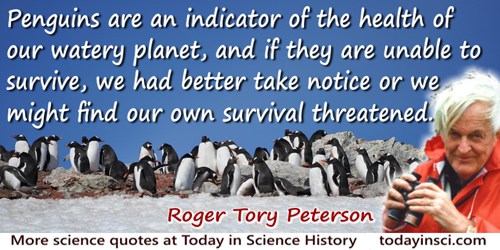
Penguins are an indicator of the health of our watery planet, and if they are unable to survive, we had better take notice or we might find our own survival threatened.
In Penguins (1998), 160.
People say the effect is only on the mind. It is no such thing. The effect is on the body, too. Little as we know about the way in which we are affected by form, by color, and light, we do know this, that they have an actual physical effect. Variety of form and brilliancy of color in the objects presented to patients, are actual means of recovery.
Notes on Nursing: What it is and what it is not (1860), 84.
Perfect health is above gold; a sound body before riches.
Ecclesiasticus
Physic is of little use to a temperate person, for a man's own observation on what he finds does him good or what hurts him, is the best physic to preserve health.
In James Wood, Dictionary of Quotations from Ancient and Modern, English and Foreign Sources (1893), 348:17.
Physic, for the most part, is nothing else but the substitute of exercise and temperance.
The Spectator (13 Oct 1711), 3, No. 195. In James Wood, Dictionary of Quotations from Ancient and Modern, English and Foreign Sources (1893), 348:16.
Population stabilization policies are a must for sustainable food, health, and livelihood security in many developing countries. If population policies go wrong, nothing else will have a chance to succeed.
In 'Malthus and Mendel: Children for Happiness', Politics and the Life Sciences (Sep 1997), 16, No. 2, 221.
Probably the simple facts about health are that all of us form bad dietary habits when we have young stomachs, and continue in them when our stomachs show the natural wear of long use. Stomachs weaken, as do eyes; but we cannot buy spectacles for our stomachs.
In Sinner Sermons: A Selection of the Best Paragraphs of E. W. Howe (1926), 12.
Psychoanalysis has changed American psychiatry from a diagnostic to a therapeutic science, not because so many patients are cured by the psychoanalytic technique, but because of the new understanding of psychiatric patients it has given us and the new and different concepts of illness and health.
News summaries 29 Apr 56
Public health is purchasable. Within a few natural and important limitations any community can determine its own health.
Restore a man to his health, his purse lies open to thee.
The Anatomy of Melancholy (1857), 431.
Rising before daylight is also to be commended; it is a healthy habit, and gives more time for the management of the household as well as for liberal studies.
Economics, I.
Sauntering silently among the healthful groves, concerning yourself about every thing worthy a wise and good man?
— Horace
Epistle IV, to Albius Tibullus, translated by Christopher Smart in The Works of Horace (1861), 237. Also seen translated as, “To linger silently among the healthful woods, musing on such things as are worthy of a wise and good man.”
Science is intimately integrated with the whole social structure and cultural tradition. They mutually support one other—only in certain types of society can science flourish, and conversely without a continuous and healthy development and application of science such a society cannot function properly.
The Social System (1951, 1977), Chap. 8, 111. As a functionalist, Parsons argued that social practices had to be studied in terms of their function in maintaining society.
Shoe leather epidemiology.
[Langmuir stressed that investigators go into the field to collect their own data and directly view the locale of a public health problem. His graduates wore lapel pins of a shoe with a hole in the sole.]
[Langmuir stressed that investigators go into the field to collect their own data and directly view the locale of a public health problem. His graduates wore lapel pins of a shoe with a hole in the sole.]
As stated in 'Alexander Langmuir Dies at 83', New York Times (24 Nov 1993), D19.
Signs and symptoms indicate the present, past and future states of the three states of the body (health, illness, neutrality). According to Galen, knowledge of the present state is of advantage only to the patient as it helps him to follow the proper course of management. Knowledge of the past state is useful only to the physician inasmuch as its disclosure by him to the patient brings him a greater respect for his professional advice. Knowledge of the future state is useful to both. It gives an opportunity to the patient to be forewarned to adopt necessary preventative measures and it enhances the reputation of the physician by correctly forecasting the future developments.
— Avicenna
'The Signs and Symptoms (Diagnosis): General Remarks,' in The Canon of Medicine, adapted by L. Bakhtiar (1999), 259.
Since 1957, influenza epidemics have continued to be a major, serious, and intractable health problem, as frustrating to an action and control orientated epidemiologist as poliomyelitis has been gratifying.
(1971). As quoted in Nancy J. Cox, 'Prevention and Control of Influenza', The Lancet 2000 (Dec 1999), 354.
Take care of your health. ... Imagine Hercules as oarsman in a rotten boat; what can he do there but by the very force of his stroke expedite the ruin of his craft. Take care of the timbers of your boat. ... The formation of right habits is essential to your permanent security. They diminish your chance of falling when assaulted, and they augment your chance of recovery when overthrown.
Concluding remark from 'An Address to Students of University College, London' (1869), in Fragments of Science for Unscientific People (1871), 105.
Technology, when misused, poisons air, soil, water and lives. But a world without technology would be prey to something worse: the impersonal ruthlessness of the natural order, in which the health of a species depends on relentless sacrifice of the weak.
Editorial, 'Nature As Demon', (29 Aug 1986), A26.
Testing the impact of public health interventions in response to the null hypothesis may help reduce avoidable hubris in expectations of benefits.
As quoted in 'Aphorism of the Month', Journal of Epidemiology and Community Health (Sep 2007), 61, No. 9, 796.
That physician will hardly be thought very careful of the health of others who neglects his own.
— Galen
From Lib. 5, De Sanitate tuenda (Of Protecting the Health). As quoted and cited in François Rabelais translated by Sir Thomas Urquhart and Motteux, The Works of Francis Rabelais (1849), Vol. 2, 191. Stated under 'Galen' in Peter McDonald, Oxford Dictionary of Medical Quotations (2004), 38. (Note by Webmaster: The quote appears in some 19th century quotation collections attributed to Rabelais himself—and this continues to the present (e.g. by Asimov)—but in the first book above, Rabelais clearly cites it to Galen.
The ability to play is one of the principal criteria of mental health.
In 'Childhood’s Promises', Television & Children (1980), 3, No. 3, 17.
The art of causing intemperance and health to exist in the same body is as chimerical as the philosopher’s stone, judicial astrology, and the theology of the magi.
From the original French, “L'art de faire subsister ensemble l'intempérance et la santé, est un art aussi chimérique que la pierre philosophale, l'astrologie judiciaire, et la théologie des magies”, in Zadig. Accompanied with the translation in Craufurd Tait Ramage, Beautiful Thoughts from French and Italian Authors (1866), 371.
The Atomic Age was born in secrecy, and for two decades after Hiroshima, the high priests of the cult of the atom concealed vital information about the risks to human health posed by radiation. Dr. Alice Stewart, an audacious and insightful medical researcher, was one of the first experts to alert the world to the dangers of low-level radiation.
(Udeall is a former U.S. Secretary of the Interior.)
(Udeall is a former U.S. Secretary of the Interior.)
Quoted in Gayle Jacoba Greene, The Woman Who Knew Too Much (1999), back cover.
The body of man has in itself blood, phlegm, yellow bile and black bile; these make up the nature of this body, and through these he feels pain or enjoys health. Now he enjoys the most perfect health when these elements are duly proportioned to one another in respect of compounding, power and bulk, and when they are perfectly mingled.
Nature of Man, in Hippocrates, trans. W. H. S. Jones (1931), Vol. 4, II.
The California climate makes the sick well and the well sick, the old young and the young old.
American saying
The challenge is for bioethicists to position themselves to be on panels, boards and other decision making bodies where public policy positions will be established—where the exploding changes in health care that are now underway will be addressed.
In Hugo Tristram Engelhardt and H. Tristram Engelhardt, Jr., Global Bioethics (2006), 359.
The climate of Colorado contains more of the essential elements which effectively promote health than that of any other country. These requisites are found in the chemical composition of the atmosphere; in the dry, pure, clean, soft, yet stimulating breezes which quicken circulation and multiply the corpuscles of the blood; in the tonic effect and exhilarating influence of the ozone; in the flood of its life-giving germ-destroying sunshine …
From F.H. Faus, 'Pike’s Peak Region Calls', Rock Island Magazine (Aug 1920), 15, No. 8, 4.
The first quality we know in matter is centrality,—we call it gravity,—which holds the universe together, which remains pure and indestructible in each mote, as in masses and planets, and from each atom rays out illimitable influence. To this material essence answers Truth, in the intellectual world,—Truth, whose centre is everywhere, and its circumference nowhere, whose existence we cannot disimagine,—the soundness and health of things, against which no blow can be struck but it recoils on the striker,—Truth, on whose side we always heartily are. And the first measure of a mind is its centrality, its capacity of truth, and its adhesion to it.
In 'Progress of Culture', an address read to the Phi Beta Kappa Society at Cambridge, 18 July 1867. Collected in Works of Ralph Waldo Emerson (1883), 477.
The health of society thus depends quite as much on the independence of the individuals composing it as on their close political cohesion.
…...
The health of the sea, no less than the health of the land, is ultimately responsible for every morsel we put in our mouths, every breath of air we take. We cannot create the land and sea, but we can destroy them.
In 'Introduction' contributed to Enric Sala, The Nature of Nature: Why We Need the Wild (2020).
The incessant driving of the pen over paper causes intense fatigue of the hand and the whole arm because of the continuous ... strain on the muscles and tendons.
The inclusion of lemon or lime juice in grog, made compulsory in 1795, therefore reduced the incidence of scurvy dramatically. And since beer contains no vitamin C, switching from beer to grog made British crews far healthier overall.
In A History of the World in 6 Glasses (2005, 2009), 110.
The links between ecosystem and human health are many and obvious: the value in wetlands of filtering pollutants out of groundwater aquifers; the potential future medical use of different plants’ genetic material; the human health effects of heavy metal accumulation in fish and shellfish. It is clear that healthy ecosystems provide the underpinnings for the long-term health of economics and societies.
…...
The maladies that affect the clerks aforesaid arise from three causes. First, constant sitting, secondly, the incessant movement of the the hand and always in the same direction, thirdly, the strain on the mind from the effort not to disfigure the books by errors or cause loss to their employers when they add, subtract, or do other sums in arithmetic. The diseases brought about by sitting constantly are easily understood; they are obstructions of the viscera, e.g. the liver and spleen, indigestion in the stomach, numbness of the legs, a considerable hindrance in the circulation of the blood, and an unhealthy habit.
De Morbis Artificum (1713), supplement, ch. 2, translated by W.C. Wright (1964).
The means by which I preserve my own health are, temperance, early rising, and spunging the body every morning with cold water, a practice I have pursued for thirty years ; and though I go from this heated theatre into the squares of the Hospital, in the severest winter nights, with merely silk stockings on my legs, yet I scarcely ever have a cold...
'Lecture 3, Treatment of Inflammation', The Lectures of Sir Astley Cooper (1825), Vol. 1, 58.Lectures on surgery, Lect. 3.
The mortality of those who dig minerals is very great, and women who marry men of this sort marry again and again. According to Agricola, at the mines in the Carpathian mountains, women have been known to marry seven times.
Diseases of Workers, translated by W. C. Wright, preface.
The most commonly used measure of biodiversity is species richness, which simply means the number of species in one place. But that measure alone does not tell us how healthy an ecosystem is. For example, think of a pristine coral reef and an overfished coral reef. The pristine reef might have dozens of gray reef sharks, whereas the overfished reef could have just one shark left.
From The Nature of Nature: Why We Need the Wild (2020), Ch. 9.
The most important object of Civil Engineering is to improve the means of production and of traffic in states, both for external and internal trade. It is applied in the construction and management of roads, bridges, railroads, aqueducts, canals, river navigation, docks and storehouses, for the convenience of internal intercourse and exchange; and in the construction of ports, harbours, moles, breakwaters and lighthouses; and in the navigation by artificial power for the purposes of commerce. It is applied to the protection of property where natural powers are the sources of injury, as by embankments forthe defence of tracts of country from the encroachments of the sea, or the overflowing of rivers; it also directs the means of applying streams and rivers to use, either as powers to work machines, or as supplies for the use of cities and towns, or for irrigation; as well as the means of removing noxious accumulations, as by the drainage of towns and districts to ... secure the public health.
1828
The name of medicine is thought to have been given from 'moderation', modus, that is, from a due proportion, which advises that things be done not to excess, but 'little by little', paulatim. For nature is pained by surfeit but rejoices in moderation. Whence also those who take drugs and antidotes constantly, or to the point of saturation, are sorely vexed, for every immoderation brings not health but danger.
Etymologies [c.600], Book IV, chapter 2, quoted in E. Grant (ed.), A Source Book in Medieval Science (1974), trans. W. D. Sharpe (1964), 701.
The National Health Service is rotting before our eyes, with a lack of political will to make the tough choices for a first-class service for an ever more demanding population.
The Times (Jul 2000), Leader.
THE OATH. I swear by Apollo [the healing God], the physician and Aesclepius [son of Apollo], and Health [Hygeia], and All-heal [Panacea], and all the gods and goddesses, that, according to my ability and judgment, I will keep this Oath and this stipulation—to reckon him who taught me this Art equally dear to me as my parents, to share my substance with him, and relieve his necessities if required; to look upon his offspring in the same footing as my own brothers, and to teach them this art, if they shall wish to learn it, without fee or stipulation; and that by precept, lecture, and every other mode of instruction, I will impart a knowledge of the Art to my own sons, and those of my teachers, and to disciples bound by a stipulation and oath according to the law of medicine, but to none others. I will follow that system of regimen which, according to my ability and judgment, I consider for the benefit of my patients, and abstain from whatever is deleterious and mischievous. I will give no deadly medicine to any one if asked, nor suggest any such counsel; and in like manner I will not give to a woman a pessary to produce abortion. With purity and with holiness I will pass my life and practice my Art. I will not cut persons laboring under the stone, but will leave this to be done by men who are practitioners of this work. Into whatever houses I enter, I will go into them for the benefit of the sick, and will abstain from every voluntary act of mischief and corruption; and, further, from the seduction of females or males, of freemen and slaves. Whatever, in connection with my professional practice or not, in connection with it, I see or hear, in the life of men, which ought not to be spoken of abroad, I will not divulge, as reckoning that all such should be kept secret. While I continue to keep this Oath unviolated, may it be granted to me to enjoy life and the practice of the art, respected by all men, in all times! But should I trespass and violate this Oath, may the reverse be my lot!
The Genuine Works of Hippocrates, trans. Francis Adams (1886), Vol. 2, 344-5.
The Ocean Health Index is like a thermometer of ocean health, which will allow us to determine how the patient is doing. The Index will be a measure of whether our policies are working, or whether we need new solutions.
As quoted in press release (14 Aug 2012), 'Ocean Health Index Provides First-Ever Global Benchmark of 171 Coastal Regions', on web page of Conservation International, conservation.org.
The ordinary patient goes to his doctor because he is in pain or some other discomfort and wants to be comfortable again; he is not in pursuit of the ideal of health in any direct sense. The doctor on the other hand wants to discover the pathological condition and control it if he can. The two are thus to some degree at cross purposes from the first, and unless the affair is brought to an early and happy conclusion this diversion of aims is likely to become more and more serious as the case goes on.
Address, opening of 1932-3 session of U.C.H. Medical School (4 Oct 1932), 'Art and Science in Medicine', The Collected Papers of Wilfred Trotter, FRS (1941), 98.
The poorest man would not part with health for money, but … the richest would gladly part with all their money for health.
Reflection 225, in Lacon: Or Many Things in Few Words, Addressed to Those who Think (1832), 118.
The practices we now call conservation are, to a large extent, local alleviations of biotic pain. They are necessary, but they must not be confused with cures. The art of land doctoring is being practiced with vigor, but the science of land health is yet to be born.
In 'Wilderness for Science', A Sand County Almanac, and Sketches Here and There (1949, 1987), 195-196.
The rapid growth of industry, the ever increasing population and the imperative need for more varied, wholesome and nourishing foodstuff makes it all the more necessary to exhaust every means at our command to fill the empty dinner pail, enrich our soils, bring greater wealth and influence to our beautiful South land, which is synonymous to a healthy, happy and contented people.
Letter to Marlin E. Penn (18 Jun 1927), Box 17, George Washington Carver Papers. Cited in Linda O. McMurry, George Washington Carver, Scientist and Symbol (1982), 264-5. Smith's book is about his recollections of G.W. Carver's Sunday School classes at Tuskegee, some 40 years earlier. Webmaster, who has not yet been able to see the original book, cautions this quote may be the gist of Carver's words, rather than an exact quote.
The sign which points to strong, unfailing health is a uniform pulse which is also totally regular.
As quoted in Fred Rosner, The Medical Legacy of Moses Maimonides (1998), 51.
The steam-engine in its manifold applications, the crime-decreasing gas-lamp, the lightning conductor, the electric telegraph, the law of storms and rules for the mariner's guidance in them, the power of rendering surgical operations painless, the measures for preserving public health, and for preventing or mitigating epidemics,—such are among the more important practical results of pure scientific research, with which mankind have been blessed and States enriched.
President's Address to the British Association, Leeds (1858). In Charles W. Vincent and James Mason (eds.), The Year-book of Facts in Science and Art (1859), title page.
The study of abstract science … offers unbounded fields of pleasurable, healthful, and ennobling exercise to the restless intellect of man, expanding his powers and enlarging his conceptions of the wisdom, the energy, and the beneficence of the Great Ruler of the universe
In 'Report of the Secretary', Annual Report of the Board of Regents of the Smithsonian Institution for 1859 (1860), 17.

The Superfund legislation set up a system of insurance premiums collected from the chemical industry to clean up toxic wastes. This new program may prove to be as far-reaching and important as any accomplishment of my administration. The reduction of the threat to America's health and safety from thousands of toxic-waste sites will continue to be an urgent but bitterly fought issue—another example for the conflict between the public welfare and the profits of a few private despoilers of our nation's environment.
Keeping Faith: Memoirs of a President (1980), 591.
The surest way to health, say what they will,
Is never to suppose we shall be ill;
Most of the ills which we poor mortals know
From doctors and imagination flow.
Is never to suppose we shall be ill;
Most of the ills which we poor mortals know
From doctors and imagination flow.
In 'Night: An Epistle to Robert Lloyd', Poems of Charles Churchill (1822), Vol. 1, 98.

The threat to America's health and safety from thousands of toxic-waste sites will continue to be an urgent but bitterly fought issue—another example for the conflict between the public welfare and the profits of a few private despoilers of our nation’s environment.
In Keeping Faith: Memoirs of a President (1980), 591.
The trouble about always trying to preserve the health of the body is that it is so difficult to do it without destroying the health of the mind.
In 'The Health of the Mind', Illustrated London News (10 Aug 1929), collected in Selected Essays (1955), 22.
The Truly Healthy environment is not merely safe but stimulating.
Environmental Science and Technology (Feb 1968).
The very elements of what constitutes good nursing are as little understood for the well as for the sick. The same laws of health, or of nursing, for they are in reality the same, obtain among the well as among the sick.
Notes on Nursing: What it is and what it is not (1860), 4.
The vulgar opinion, then, which, on health reasons, condemns vegetable food and so much praises animal food, being so ill-founded, I have always thought it well to oppose myself to it, moved both by experience and by that refined knowledge of natural things which some study and conversation with great men have given me. And perceiving now that such my constancy has been honoured by some learned and wise physicians with their authoritative adhesion (della autorevole sequela), I have thought it my duty publicly to diffuse the reasons of the Pythagorean diet, regarded as useful in medicine, and, at the same time, as full of innocence, of temperance, and of health. And it is none the less accompanied with a certain delicate pleasure, and also with a refined and splendid luxury (non è privo nemmeno d’una certa delicate voluttà e d’un lusso gentile e splendido ancora), if care and skill be applied in selection and proper supply of the best vegetable food, to which the fertility and the natural character of our beautiful country seem to invite us. For my part I have been so much the more induced to take up this subject, because I have persuaded myself that I might be of service to intending diet-reformers, there not being, to my knowledge, any book of which this is the sole subject, and which undertakes exactly to explain the origin and the reasons of it.
From Dell Vitto Pitagorico (1743), (The Pythagorean Diet: for the Use of the Medical Faculty), as translated quotes in Howard Williams, The Ethics of Diet: A Catena of Authorities Deprecatory of the Practice of Flesh-Eating (1883), 158.
There are about 3,000,000 people seriously ill in the United States…. More than half of this illness is preventable. If we count the value of each life lost at only $1700 and reckon the average earning lost by illness at $700 a year for grown men, we find that the economic gain from mitigation of preventable disease in the United States would exceed $1,500,000,000 a year. … This gain … can be secured through medical investigation and practice, school and factory hygiene, restriction of labor by women and children, the education of the people in both public and private hygiene, and through improving the efficiency of our health service, municipal, state, and national.
From 'National Efficiency', Report of the National Conservation Commission (Feb 1909), Vol. 1, 25. Collected in United States Congressional Serial Set (1909), Issue 5397, 60th Congress, 2nd Session, Senate, Document 676. In transmitting the report to Congress on 22 Jan 1909, President Theodore Roosevelt introduced this report as the “first inventory of natural resources,” which “presents a statement of our available capital in material resources, which are the means of progress.” [It is noteworthy that the above quoted commentary on “National Efficiency” was included with the inventory of mineral, lands, forest and lands of the United States. —Webmaster]
There are those who say we cannot afford to invest in science, that support for research is somehow a luxury at moments defined by necessities. I fundamentally disagree. Science is more essential for our prosperity, our security, our health, our environment, and our quality of life than it has ever been before. … we can't allow our nation to fall behind. Unfortunately, that's exactly what's happened. Federal funding in the physical sciences as a portion of our gross domestic product has fallen by nearly half over the past quarter century. Time and again we've allowed the research and experimentation tax credit, which helps businesses grow and innovate, to lapse.
Speech to the National Academy of Sciences Annual Meeting (27 Apr 2009).
There has never been just 'coach class' health care, but with these amenities you are seeing people get priorities according to your ability to pay. It's one thing to say you get perks; it's another to say you can buy your way to the head of the line.
Quoted in Nancy S. Tilghman, 'Southampton Hospital Drops V.I.P. Idea', New York Times (27 Jun 2004), L13.
There is no curing a sick man who believes himself to be in health.
Amiel's Journal The Journal Intime of Henri-Frederic Amiel, (6 Feb 1877), trans. By Mrs Humphry Ward (1889),131.
There is no short cut, nor “royal road” to the attainment of medical knowledge. The path which we have to pursue is long, difficult, and unsafe. In our progress, we must frequently take up our abode with death and corruption, we must adopt loathsome diseases for our familiar associates, or we shall never be acquainted with their nature and dispositions ; we must risk, nay, even injure our own health, in order to be able to preserve, or restore that of others.
Hunterian Oration (1819). Quoted in Clement Carlyon, Early Years and Late Reflections (1856), 110-111.
There is waste going on in the business life of our people in many ways—waste both of resources and of opportunities. There is waste of energy due to insufficient occupation, because agriculture gives full employment for only six or seven months in the year. There is waste due to illiteracy, because ninety-four persons out of every hundred are uneducated. There is waste through ignorance of the ways of the civilized people, because we fail to utilize their accumulated asset of wisdom and experience. Waste is also going on through our imperfect acquaintance with the commonplaces of civilization and lack of correct business ideals and business standards in daily life. Mental energy is wasted in caste disputes and village factions. Capital is wasted because money is hoarded instead of being made available for productive purposes. There is waste of health because, although leading moral lives normally, men and women grow prematurely old for want of pride of person and attention to the elementary laws of health. The largest waste of all is the lack of capacity for cooperation, the difficulty of ensuring harmony, sympathy and oneness of feeling, in matters affecting the larger interests of the State.
Speech (3 Jun 1914), 'Address to the Mycore Economic Conference'. Collected in Speeches: 1910-11 to 1916-17: by Sir Mokshagundam Visvesvaraya (1917), 152-153.
There is, in fact, no reason whatever for believing that such a game as, say, football improves the health of those who play it. On the contrary, there is every reason for believing that it is deleterious. The football player is not only exposed constantly to a risk of grave injury, often of an irremediable kind; he is also damaged in his normal physiological processes by the excessive strains of the game, and the exposure that goes with playing it. … The truth is that athletes, as a class, are not above the normal in health, but below it. … Some are crippled on the field, but more succumb to the mere wear and tear.
From American Mercury (Jun 1931). Collected in A Mencken Chrestomathy (1949, 1956), 370-371.
They hold that the function of universities is to make learning repellent and thus to prevent its becoming dangerously common. And they discharge this beneficent function all the more efficiently because they do it unconsciously and automatically. The professors think they are advancing healthy intellectual assimilation and digestion when they are in reality little better than cancer on the stomach.
Samuel Butler, Henry Festing Jones (ed.), The Note-Books of Samuel Butler (1917), 32.
This is the most exciting part of being human. It is using our brains in the highest way. Otherwise we are just healthy animals.
Quoted in Alix Kerr, 'What It Took: Intuition, Goo,' Life (25 Jan 1963), 54, No. 4, 86.
This is the question
Marry
Children—(if it Please God)—Constant companion (& friend in old age) who will feel interested in one—object to be beloved and played with—better than a dog anyhow. Home, & someone to take care of house—Charms of music and female chit-chat.—These things good for one’s health.—but terrible loss of time.—
My God, it is Intolerable to think of spending ones whole life, like a neuter bee, working, working—& nothing after all.—No, no, won’t do. Imagine living all one’s day solitary in smoky dirty London House.—Only picture to yourself a nice soft wife on a sofa with good fire, & books & music perhaps-—Compare this vision with the dingy reality of Grt. Marlbro’ Street.
Not Marry
Freedom to go where one liked—choice of Society and little of it. —Conversation of clever men at clubs—Not forced to visit relatives, & to bend in every trifle. —to have the expense and anxiety of children—perhaps quarreling—Loss of time. —cannot read in the Evenings—fatness & idleness—Anxiety & responsibility—less money for books &c—if many children forced to gain one’s bread. —(but then it is very bad for ones health to work too much)
Perhaps my wife won’t like London; then the sentence is banishment & degradation into indolent, idle fool.
Marry—Marry—Marry Q.E.D.
It being proved necessary to Marry When? Soon or late?
Marry
Children—(if it Please God)—Constant companion (& friend in old age) who will feel interested in one—object to be beloved and played with—better than a dog anyhow. Home, & someone to take care of house—Charms of music and female chit-chat.—These things good for one’s health.—but terrible loss of time.—
My God, it is Intolerable to think of spending ones whole life, like a neuter bee, working, working—& nothing after all.—No, no, won’t do. Imagine living all one’s day solitary in smoky dirty London House.—Only picture to yourself a nice soft wife on a sofa with good fire, & books & music perhaps-—Compare this vision with the dingy reality of Grt. Marlbro’ Street.
Not Marry
Freedom to go where one liked—choice of Society and little of it. —Conversation of clever men at clubs—Not forced to visit relatives, & to bend in every trifle. —to have the expense and anxiety of children—perhaps quarreling—Loss of time. —cannot read in the Evenings—fatness & idleness—Anxiety & responsibility—less money for books &c—if many children forced to gain one’s bread. —(but then it is very bad for ones health to work too much)
Perhaps my wife won’t like London; then the sentence is banishment & degradation into indolent, idle fool.
Marry—Marry—Marry Q.E.D.
It being proved necessary to Marry When? Soon or late?
Notes on Marriage, July 1838. In F. Burkhardt and S. Smith (eds.), The Correspondence of Charles Darwin 1837-1843 (1986), Vol. 2, 444.
This is the way physicians mend or end us
Secundum artem; but although we sneer
In health-when ill, we call them to attend us,
Without the least propensity to jeer;
While that hiatus maxime deplendus
To be fill’d by spade or mattock, ‘s nea
Secundum artem; but although we sneer
In health-when ill, we call them to attend us,
Without the least propensity to jeer;
While that hiatus maxime deplendus
To be fill’d by spade or mattock, ‘s nea
…...
Those who eat most, and who take the most exercise, are not in better health than they who eat just as much as is good for them; and in the same way it is not those who know a great many things, but they who know what is useful who are valuable men.
In Diogenes Laertius, translated by Charles Duke Yonge, 'Life of Aristippus', The Lives and Opinions of Eminent Philosophers (1853), 83.
Those who work standing ... carpenters, sawyers, carvers, blacksmiths, masons ... are liable to varicose veins ... [because] the strain on the muscles is such that the circulation of the blood is retarded. Standing even for a short time proves exhausting compared with walking and running though it be for a long time ... Nature delights and is restored by alternating and varied actions.
Though Hippocrates understood not the Circulation of the Blood, yet by accurately observing the Effects of the Disease, which he looked upon as an unknown Entity, and by remarking the Endeavours of Nature, by which the Disease tended to either Health or Recovery, did from thence deduce a proper Method of Cure, namely by assisting the salutary Endeavours of Nature, and by resisting those of the Disease; and thus Hippocrates, ignorant of the Causes, cured Disease as well as ourselves, stocked with so many Discoveries.
In Dr. Boerhaave's Academical Lectures on the Theory of Physic (1746), Vol. 6, 352.
Throughout history, engineers have served their neighbours, their towns and their countries by making tools, machines and countless other things that improve every aspect of life. From information technology to medical science and mining, from building roads to space travel, engineers are working to make a difference to our standard of living, and with it our health, wealth and happiness.
From a speech by The Queen at The Queen Elizabeth Prize for Engineering (25 Jun 2013).
Throughout history, engineers have served their neighbours, their towns and their countries by making tools, machines and countless other things that improve every aspect of life. From information technology to medical science and mining, from building roads to space travel, engineers are working to make a difference to our standard of living, and with it our health, wealth and happiness. At its heart, engineering is about using science to find creative, practical solutions. It is a noble profession.
In Speech (25 Jun 2013), for the 2013 Queen Elizabeth Prize for Engineering.
To be always poring over the same Object, dulls the Intellects and tires the Mind, which is delighted and improved by a Variety: and therefore it ought, at times, to be relaxed from the more severe mathematical Contemplations, and to be employed upon something more light and agreeable, as Poetry, Physic, History, &c
In Dr. Boerhaave's Academical Lectures on the Theory of Physic (1746), Vol. 6, 264.
To the days of the aged it addeth length;
To the might of the strong it addeth strength;
It freshens the heart, It brightens the sight;
’Tis like quaffing a goblet of morning light.
So, water, I will drink nothing but thee,
Thou parent of health and energy!
To the might of the strong it addeth strength;
It freshens the heart, It brightens the sight;
’Tis like quaffing a goblet of morning light.
So, water, I will drink nothing but thee,
Thou parent of health and energy!
From 'Song of the Water Drinker', The Metropolitan Magazine (1835), 15, 283. Attributed to E. Johnson, but without a full name with which to find more biographical information, Webmaster is putting these lines under Anonymous.
To those … engaged in the practice of medicine, the study of Physiology is indispensable; for it is evident that the nature of the disordered actions of parts or organs can never be understood, nor judiciously counteracted, unless the nature of their healthy actions be previously known.
In 'Lecture 1', Physiological Lectures, Exhibiting a General View of Mr. Hunter’s Physiology (1817), 3.
To wage war with Marchand or anyone else again will benefit nobody and bring little profit to science. You consume yourself in this way, you ruin your liver and eventually your nerves with Morrison pills. Imagine the year 1900 when we have disintegrated into carbonic acid, ammonia and water and our bone substance is perhaps once more a constituent of the bones of the dog who defiles our graves. Who will then worry his head as to whether we have lived in peace or anger, who then will know about your scientific disputes and of your sacrifice of health and peace of mind for science? Nobody. But your good ideas and the discoveries you have made, cleansed of all that is extraneous to the subject, will still be known and appreciated for many years to come. But why am I trying to advise the lion to eat sugar.
Letter from Wohler to Liebig (9 Mar 1843). In A. W. Hofmann (ed.), Aus Justus Liebigs und Friedrich Wohlers Briefwechsel (1888), Vol. 1, 224. Trans. Ralph Oesper, The Human Side of Scientists (1975), 205.
True and constant vigour of body is the effect of health, which is much better preserved with watery, herbaceous, frugal, and tender food, than with vinous, abundant, hard, and gross flesh (che col cameo vinoso ed unto abundante e duro). And in a sound body, a clear intelligence, and desire to suppress the mischievous inclinations (voglie dannose), and to conquer the irrational passions, produces true worth.
From Dell Vitto Pitagorico (1743), (The Pythagorean Diet: for the Use of the Medical Faculty), as translated quotes in Howard Williams, The Ethics of Diet: A Catena of Authorities Deprecatory of the Practice of Flesh-Eating (1883), 158.
Two contrary laws seem to be wrestling with each other nowadays: the one, a law of blood and of death, ever imagining new means of destruction and forcing nations to be constantly ready for the battlefield—the other, a law of peace, work and health, ever evolving new means for delivering man from he scourges which beset him. The one seeks violent conquests, the other the relief of humanity. The latter places one human life above any victory: while the former would sacrifice hundreds and thousands of lives to the ambition of one.
Address at the Inauguration of the Pasteur Institute. In René Vallery-Radot, The Life of Pasteur, translated by Mrs. R. L. Devonshire (1919), 444.
Use now and then a little Exercise a quarter of an Hour before Meals, as to swing a Weight, or swing your Arms about with a small Weight in each Hand; to leap, or the like, for that stirs the Muscles of the Breast.
In Poor Richard's Almanack (1742).
We are learning, too, that the love of beauty is one of Nature's greatest healers.
The Red Man's Continent: A Chronicle of Aboriginal America (1919), 86.
We are led to think of diseases as isolated disturbances in a healthy body, not as the phases of certain periods of bodily development.
The Significance of Skin Affections in the Classification of Disease', St. Georges Hospital Reports (1867), Vol. 2, 189.
We cannot rest and sit down lest we rust and decay. Health is maintained only through work. And as it is with all life so it is with science. We are always struggling from the relative to the absolute.
In Max Planck and James Vincent Murphy (trans.), Where is Science Going?, (1932), 200.
We may, I think, draw a yet higher and deeper teaching from the phenomena of degeneration. We seem to learn from it the absolute necessity of labour and effort, of struggle and difficulty, of discomfort and pain, as the condition of all progress, whether physical or mental, and that the lower the organism the more need there is of these ever-present stimuli, not only to effect progress, but to avoid retrogression. And if so, does not this afford us the nearest attainable solution of the great problem of the origin of evil? What we call evil is the essential condition of progress in the lower stages of the development of conscious organisms, and will only cease when the mind has become so thoroughly healthy, so well balanced, and so highly organised, that the happiness derived from mental activity, moral harmony, and the social affections, will itself be a sufficient stimulus to higher progress and to the attainment of a more perfect life.
In 'Two Darwinian Essays', Nature (1880), 22, 142.
We need go back only a few centuries to find the great mass of people depending on religion for the satisfaction of practically all their wishes. From rain out of the sky to good health on earth, they sought their desires at the altars of their gods. Whether they wanted large families, good crops, freedom from pestilence, or peace of mind, they conceived themselves as dependent on the favor of heaven. Then science came with its alternative, competitive method of getting what we want. That is science’s most important attribute. As an intellectual influence it is powerful enough, but as a practical way of achieving man’s desires it is overwhelming.
In 'The Real Point of Conflict between Science and Religion', collected in Living Under Tension: Sermons On Christianity Today (1941), 140-141.
We will build the roads and bridges, the electric grids and digital lines that feed our commerce and bind us together. We'll restore science to its rightful place, and wield technology's wonders to raise health care's quality and lower its cost. We will harness the sun and the winds and the soil to fuel our cars and run our factories. And we will transform our schools and colleges and universities to meet the demands of a new age. All this we can do. All this we will do.
From First Inaugural Address (20 Jan 2009)
When important decisions have to be taken, the natural anxiety to come to a right decision will often keep us awake. Nothing, however, is more conducive to healthful sleep than plenty of open air.
The Pleasures of Life (1887, 2007), 87.
Whoever would not remain in complete ignorance of the resources which cause him to act; whoever would seize, at a single philosophical glance, the nature of man and animals, and their relations to external objects; whoever would establish, on the intellectual and moral functions, a solid doctrine of mental diseases, of the general and governing influence of the brain in the states of health and disease, should know, that it is indispensable, that the study of the organization of the brain should march side by side with that of its functions.
On the Organ of the Moral Qualities and Intellectual Faculties, and the Plurality of the Cerebral Organs (1835), 45-6.

Wine is the most healthful and most hygienic of beverages.
Études sur le Vin (1866), Vol 1, xx.
With savages, the weak in body or mind are soon eliminated; and those that survive commonly exhibit a vigorous state of health. We civilised men, on the other hand, do our utmost to check the process of elimination; we build asylums for the imbecile, the maimed, and the sick; we institute poor-laws; and our medical men exert their utmost skill to save the life of every one to the last moment.
…...
With terminal illness, your fate is sealed. Morally, we're more comfortable with a situation where you don't cause death, but you hasten it. We think that's a bright line.
Comparing the U.S. with Switzerland, where assisted suicide is legal for patients suffering 'intolerable health problems.'
Comparing the U.S. with Switzerland, where assisted suicide is legal for patients suffering 'intolerable health problems.'
Quoted in Amanda Ripley, 'True Freedom', Time magazine (20 Apr 2003).
With your talents and industry, with science, and that steadfast honesty which eternally pursues right, regardless of consequences, you may promise yourself every thing—but health, without which there is no happiness. An attention to health then should take place of evey other object. The time necessary to secure this by active exercises, should be devoted to it in preference to every other pursuit.
Letter to Tomas Mann Randolph, Jr., (6 Jul 1787), In Thomas Jefferson and Paul Leicester Ford (ed.) The Works of Thomas Jefferson (1904), Vol. 5, 300.
Julian P. Boyd (Ed.), The Papers of Thomas Jefferson (1955), Vol. 11, 558.
Work is nature’s physician; it is essential to human health and happiness.
— Galen
…...
Wouldst thou enjoy a long Life, a healthy Body, and a vigorous Mind, and be acquainted also with the wonderful Works of God? labour in the first place to bring thy Appetite into Subjection to Reason.
In Poor Richard's Almanack (1742).
You ask me how, with so much study, I manage to retene my health. ... Morpheous is my last companion ; without 8 or 9 hours of him yr correspondent is not worth one scavenger's peruke. My practices did at ye first hurt my stomach, but now I eat heartily enou' as y’ will see when I come down beside you. [On the value of sleep, and harm of eating poorly while intent on study.]
Letter to Dr. Law (15 Dec 1716) as quoted in Norman Lockyer, (ed.), Nature (25 May 1881), 24, 39. The source refers to it as an unpublished letter.
You make me sick! You are offered meat and you choose a banana-split-with-nuts.
 In science it often happens that scientists say, 'You know that's a really good argument; my position is mistaken,' and then they would actually change their minds and you never hear that old view from them again. They really do it. It doesn't happen as often as it should, because scientists are human and change is sometimes painful. But it happens every day. I cannot recall the last time something like that happened in politics or religion.
(1987) --
In science it often happens that scientists say, 'You know that's a really good argument; my position is mistaken,' and then they would actually change their minds and you never hear that old view from them again. They really do it. It doesn't happen as often as it should, because scientists are human and change is sometimes painful. But it happens every day. I cannot recall the last time something like that happened in politics or religion.
(1987) -- 




