Happiness Quotes (129 quotes)
[Alchemists] finde out men so covetous of so much happiness, whom they easily perswade that they shall finde greater Riches in Hydargyrie [mercury], than Nature affords in Gold. Such, whom although they have twice or thrice already been deluded, yet they have still a new Device wherewith to deceive um again; there being no greater Madness…. So that the smells of Coles, Sulphur, Dung, Poyson, and Piss, are to them a greater pleasure than the taste of Honey; till their Farms, Goods, and Patrimonies being wasted, and converted into Ashes and Smoak, when they expect the rewards of their Labours, births of Gold, Youth, and Immortality, after all their Time and Expences; at length, old, ragged, famisht, with the continual use of Quicksilver [mercury] paralytick, onely rich in misery, … a laughing-stock to the people: … compell’d to live in the lowest degree of poverty, and … at length compell’d thereto by Penury, they fall to Ill Courses, as Counterfeiting of Money.
In The Vanity of the Arts and Sciences (1530), translation (1676), 313.
[Science] dissipates errors born of ignorance about our true relations with nature, errors the more damaging in that the social order should rest only on those relations. TRUTH! JUSTICE! Those are the immutable laws. Let us banish the dangerous maxim that it is sometimes useful to depart from them and to deceive or enslave mankind to assure its happiness.
Exposition du Système du Monde (1796), 2, 312, trans. Charles Coulston Gillispie, Pierre-Simon Laplace 1749-1827: A Life in Exact Science (1997), 175.
Bernard: Oh, you’re going to zap me with penicillin and pesticides. Spare me that and I’ll spare you the bomb and aerosols. But don’t confuse progress with perfectibility. A great poet is always timely. A great philosopher is an urgent need. There’s no rush for Isaac Newton. We were quite happy with Aristotle’s cosmos. Personally, I preferred it. Fifty-five crystal spheres geared to God’s crankshaft is my idea of a satisfying universe. I can’t think of anything more trivial than the speed of light. Quarks, quasars—big bangs, black holes—who [cares]? How did you people con us out of all that status? All that money? And why are you so pleased with yourselves?
Chloe: Are you against penicillin, Bernard?
Bernard: Don’t feed the animals.
Chloe: Are you against penicillin, Bernard?
Bernard: Don’t feed the animals.
In the play, Acadia (1993), Act 2, Scene 5, 61.
Die Religion ist der Seufzer der bedrängten Kreatur, das Gemüt einer herzlosen Welt, wie sie der Geist geistloser Zustände ist. Sie ist das Opium des Volks. Die Aufhebung der Religion als des illusorischen Glücks des Volks ist die Forderung seines wirklichen Glücks.
Religion is the sigh of the oppressed creature, the heart of a heartless world, just as it is the spirit of spiritless conditions. It is the opium of the people. To abolish religion as the illusory happiness of the people is to demand their real happiness.
Religion is the sigh of the oppressed creature, the heart of a heartless world, just as it is the spirit of spiritless conditions. It is the opium of the people. To abolish religion as the illusory happiness of the people is to demand their real happiness.
'Zur Kritik der Hegelschen Rechtsphilosophie. Einleitung' (1844), Karl Marx Fredrich Engels (1964), 378-9.
In primis, hominis est propria VERI inquisitio atque investigato. Itaque cum sumus negotiis necessariis, curisque vacui, tum avemus aliquid videre, audire, ac dicere, cognitionemque rerum, aut occultarum aut admirabilium, ad benè beatéque vivendum necessariam ducimus; —ex quo intelligitur, quod VERUM, simplex, sincerumque sit, id esse naturæ hominis aptissimum. Huic veri videndi cupiditati adjuncta est appetitio quædam principatûs, ut nemini parere animus benè a naturâ informatus velit, nisi præcipienti, aut docenti, aut utilitatis causâ justè et legitimè imperanti: ex quo animi magnitudo existit, et humanarum rerum contemtio.
Before all other things, man is distinguished by his pursuit and investigation of TRUTH. And hence, when free from needful business and cares, we delight to see, to hear, and to communicate, and consider a knowledge of many admirable and abstruse things necessary to the good conduct and happiness of our lives: whence it is clear that whatsoever is TRUE, simple, and direct, the same is most congenial to our nature as men. Closely allied with this earnest longing to see and know the truth, is a kind of dignified and princely sentiment which forbids a mind, naturally well constituted, to submit its faculties to any but those who announce it in precept or in doctrine, or to yield obedience to any orders but such as are at once just, lawful, and founded on utility. From this source spring greatness of mind and contempt of worldly advantages and troubles.
Before all other things, man is distinguished by his pursuit and investigation of TRUTH. And hence, when free from needful business and cares, we delight to see, to hear, and to communicate, and consider a knowledge of many admirable and abstruse things necessary to the good conduct and happiness of our lives: whence it is clear that whatsoever is TRUE, simple, and direct, the same is most congenial to our nature as men. Closely allied with this earnest longing to see and know the truth, is a kind of dignified and princely sentiment which forbids a mind, naturally well constituted, to submit its faculties to any but those who announce it in precept or in doctrine, or to yield obedience to any orders but such as are at once just, lawful, and founded on utility. From this source spring greatness of mind and contempt of worldly advantages and troubles.
In De Officiis, Book 1. Sect. 13. As given in epigraph to John Frederick William Herschel, A Preliminary Discourse on the Study of Natural Philosophy (1830), viii.
Neue Phaenomena zu erklären, dieses macht meine Sorgen aus, und wie froh ist der Forscher, wenn er das so fleissig Gesuche findet, eine Ergötzung wobei das Herz lacht.
To explain new phenomena, that is my task; and how happy is the scientist when he finds what he so diligently sought, a pleasure that gladdens the heart.
To explain new phenomena, that is my task; and how happy is the scientist when he finds what he so diligently sought, a pleasure that gladdens the heart.
Letter to Johan Gahn. Original German quote in Mary Elivira Weeks, The Discovery of the Elements (1934), 153, citing Nordenskiöld, Scheeles nachgelassene Briefe und Aufzeichnungen (1892), 151. Translation in Mary Elvira Weeks and Henry M. Leicester (ed.)The Discovery of the Elements (6th ed. 1956), 223.
~~[unverified]~~ Now and then it’s good to pause in our pursuit of happiness and just be happy.
Primary source needed. can you help? Seen for example, in Larry Chang, Wisdom for the Soul: Five Millennia of Prescriptions for Spiritual (2006), 353.
A game is on, at the other end of this infinite distance, and heads or tails will turn up. What will you wager? According to reason you cannot leave either; according to reason you cannot leave either undone... Yes, but wager you must; there is no option, you have embarked on it. So which will you have. Come. Since you must choose, let us see what concerns you least. You have two things to lose: truth and good, and two things to stake: your reason and your will, your knowledge and your happiness. And your nature has two things to shun: error and misery. Your reason does not suffer by your choosing one more than the other, for you must choose. That is one point cleared. But your happiness? Let us weigh gain and loss in calling heads that God is. Reckon these two chances: if you win, you win all; if you lose, you lose naught. Then do not hesitate, wager that He is.
Pensées (1670), Section I, aphorism 223. In H. F. Stewart (ed.), Pascal's Pensées (1950), 117-119.
A great man, [who] was convinced that the truths of political and moral science are capable of the same certainty as those that form the system of physical science, even in those branches like astronomy that seem to approximate mathematical certainty.
He cherished this belief, for it led to the consoling hope that humanity would inevitably make progress toward a state of happiness and improved character even as it has already done in its knowledge of the truth.
He cherished this belief, for it led to the consoling hope that humanity would inevitably make progress toward a state of happiness and improved character even as it has already done in its knowledge of the truth.
Describing administrator and economist Anne-Robert-Jacques Turgot in Essai sur l’application de l’analyse à la probabilité des décisions rendues à la pluralité des voix (1785), i. Cited epigraph in Charles Coulston Gillispie, Science and Polity in France: The End of the Old Regime (2004), 3
A harmless and a buoyant cheerfulness are not infrequent concomitants of genius; and we are never more deceived than when we mistake gravity for greatness, solemnity for science, and pomposity for erudition.
Lacon: Or, Many Things in Few Words (1865), 57.
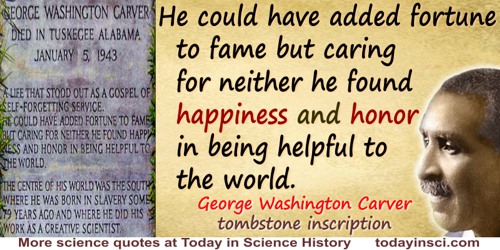
A life that stood out as a gospel of self-forgetting service.
He could have added fortune to fame but caring for neither he found happiness and honor in being helpful to the world.
The centre of his world was the south where he was born in slavery some 79 years ago and where he did his work as a creative scientist.
He could have added fortune to fame but caring for neither he found happiness and honor in being helpful to the world.
The centre of his world was the south where he was born in slavery some 79 years ago and where he did his work as a creative scientist.
Epitaph on tombstone at Tuskegee University Campus Cemetery, Alabama.
A merry heart doeth good like a medicine: but a broken spirit drieth the bones.
— Bible
King James Bible, Old Testament, Proverbs 17:22.
A science or an art may be said to be “useful” if its development increases, even indirectly, the material well-being and comfort of men, it promotes happiness, using that word in a crude and commonplace way.
In A Mathematician's Apology (1940, 2012), 115.
A scientist should be the happiest of men. Not that science isn't serious; but as everyone knows, being serious is one way of being happy, just as being gay is one way of being unhappy.
Nobel banquet speech (10 Dec 1967). In Ragnar Granit (ed.), Les Prix Nobel en 1967 (1968).
A sick man talks obsessively about his illness; a healthy man never talks about his health; for as Pirandello points out, we take happiness for granted, and only begin to question life when we are unhappy.
In Introduction to the New Existentialism (1966), 15.
A tree is beautiful, but what’s more, it has a right to life; like water, the sun and the stars, it is essential. Life on earth is inconceivable without trees. Forests create climate, climate influences peoples’ character, and so on and so forth. There can be neither civilization nor happiness if forests crash down under the axe, if the climate is harsh and severe, if people are also harsh and severe. ... What a terrible future!
In letter to A.S. Suvorin (18 Oct 1888).
All the conditions of happiness are realized in the life of the man of science.
The Conquest of Happiness (1930), 146.
Ardent desire for knowledge, in fact, is the one motive attracting and supporting investigators in their efforts; and just this knowledge, really grasped and yet always flying before them, becomes at once their sole torment and their sole happiness. Those who do not know the torment of the unknown cannot have the joy of discovery which is certainly the liveliest that the mind of man can ever feel.
From An Introduction to the Study of Experimental Medicine (1927, 1957), 221-222, as translated by Henry Copley Greene. From the original French by Claude Bernard: “Le désir ardent de la connaissance est l’unique mobile qui attire et soutient l’investigateur dans ses efforts; et c’est précisément cette connaissance qu’il saisit réellement et qui fuit cependant toujours devant lui, qui devient à la fois son seul tourment et son seul bonheur. Celui qui ne connaît pas les tourments de l’inconnu doit ignorer les joies de la découverte qui sont certainement les plus vives que l’esprit de l’homme puisse jamais ressentir.” (1865), 388. A Google translation gives: “The ardent desire for knowledge is the only motive which attracts and sustains the inquirer in his efforts; and it is precisely this knowledge which he really grasps and which nevertheless always flees before him, which becomes at the same time his only torment and his only happiness. He who does not know the torments of the unknown must ignore the joys of discovery which are certainly the most vivid that the mind of man can ever experience.”
Art is unquestionably one of the purest and highest elements in human happiness. It trains the mind through the eye, and the eye through the mind. As the sun colors flowers, so does art color life.
The Pleasures of Life (1887, 2007), 99.
As each bit of information is added to the sum of human knowledge it is evident that it is the little things that count; that give all the fertility and character; that give all the hope and happiness to human affairs. The concept of bigness is apt to be a delusion, and standardizing processes must not supplant creative impulses.
In Nobel Banquet speech (10 Dec 1934). Collected in Gustaf Santesson (ed.) Les Prix Nobel en 1934 (1935).
As I stood behind the coffin of my little son the other day, with my mind bent on anything but disputation, the officiating minister read, as part of his duty, the words, 'If the dead rise not again, let us eat and drink, for to-morrow we die.' I cannot tell you how inexpressibly they shocked me. Paul had neither wife nor child, or he must have known that his alternative involved a blasphemy against all that well best and noblest in human nature. I could have laughed with scorn. What! Because I am face to face with irreparable loss, because I have given back to the source from whence it came, the cause of a great happiness, still retaining through all my life the blessings which have sprung and will spring from that cause, I am to renounce my manhood, and, howling, grovel in bestiality? Why, the very apes know better, and if you shoot their young, the poor brutes grieve their grief out and do not immediately seek distraction in a gorge.
Letter to Charles Kingsley (23 Sep 1860). In L. Huxley, The Life and Letters of Thomas Henry Huxley (1903), Vol. 1, 318.
Beaconsfield said: “Action may not always bring happiness, but there is no happiness without action.” The first portion of this observation is just freighted down with truth. Take the action of sawing hard and dry wood, for instance. You wager it doesn’t bring happiness instead of backache.
Quoted from the Boston Post in Puck (9 Apr 1884), 15, No. 370, 95.
Chemical research conducts to the knowledge of philosophical truth, and forms the mind to philosophical enlargement and accuracy of thought, more happily than almost any other species of investigation in which the human intellect can be employed.
Quote following title page of Samuel Parkes, A Chemical Catechism With Notes, Illustrations and Experiments (8th ed. 1818).
Detest it as lewd intercourse, it can deprive you of all your leisure, your health, your rest, and the whole happiness of your life.
Having himself spent a lifetime unsuccessfully trying to prove Euclid’s postulate that parallel lines do not meet, Farkas discouraged his son János from any further attempt.
Having himself spent a lifetime unsuccessfully trying to prove Euclid’s postulate that parallel lines do not meet, Farkas discouraged his son János from any further attempt.
Letter (1820), to his son, János Bolyai. Translation as in Dirk Jan Struik, A concise history of mathematics (2nd Ed., 1948), 253.
Employment is Nature’s physician, and is essential to human happiness.
— Galen
In James Wood, Dictionary of Quotations from Ancient and Modern, English and Foreign Sources (1893), 81:44.
Employment, which Galen calls 'Nature's Physician,' is so essential to human happiness that indolence is justly considered as the mother of misery.
In Tryon Edwards, A Dictionary of Thoughts (1908), 243.
Even happiness itself may become habitual. There is a habit of looking at the bright side of things, and also of looking at the dark side. Dr. Johnson has said that the habit of looking at the best side of a thing is worth more to a man than a thousand pounds a year. And we possess the power, to a great extent, of so exercising the will as to direct the thoughts upon objects calculated to yield happiness and improvement rather than their opposites.
In Self-help: With Illustrations of Character and Conduct (1859, 1861), 405-406.
Every animal is sad after coitus except the human female and the rooster.
— Galen
Attributed.
For God’s sake, please give it up. Fear it no less than the sensual passion, because it, too, may take up all your time and deprive you of your health, peace of mind and happiness in life.
Having himself spent a lifetime unsuccessfully trying to prove Euclid's postulate that parallel lines do not meet, Farkas discouraged his son János from any further attempt.
Having himself spent a lifetime unsuccessfully trying to prove Euclid's postulate that parallel lines do not meet, Farkas discouraged his son János from any further attempt.
Letter (1820) to his son, János Bolyai. Translation as in Philip J. Davis and Reuben Hersh, The Mathematical Experience (1981), 220. In Bill Swainson, Encarta Book of Quotations (2000), 124.
Furnished as all Europe now is with Academies of Science, with nice instruments and the spirit of experiment, the progress of human knowledge will be rapid and discoveries made of which we have at present no conception. I begin to be almost sorry I was born so soon, since I cannot have the happiness of knowing what will be known a hundred years hence.
…...
G=A – W
Glück gleich Arbeit weniger Widerstand.
Happiness is equal to work minus resistance.
Glück gleich Arbeit weniger Widerstand.
Happiness is equal to work minus resistance.
Quoted by E. P. Hillpern (previously an assistant to Ostwald), 'Some Personal Qualities of Wilhehn Ostwald Recalled by a Former Student', Chymia (1949), 2, 59. (Hillpern had been an assistant to Ostwald)
Good health is essential to happiness, and happiness is an essential to good citizenship.
Journal of the American Dental Association (1919).
Happiness hates the timid. So does science.
Spoken by Darrell in play, Strange Interlude, Act 4. In Nine Plays by Eugene O'Neill (1932), 568.
Happiness is a thing to be practiced, like the violin.
The Use of Life (1895, 2005), 247.
Happiness lies in the absorption in some vocation which satisfies the soul.
From graduating address (4 Jun 1891) at Nurses Training School, Johns Hopkins Hospital, published as 'Doctor and Nurse', in Aequanimitas and Other Addresses (1904, 1906), 20.
Happy is the doctor who is called in at the decline of an illness.
In Richard Alan Krieger, Civilization's Quotations (2002), 313.
Health is the first of all liberties, and happiness gives us the energy which is the basis of health.
Amiel's Journal The Journal Intime of Henri-Frederic Amiel, (3 Apr 1865), trans. By Mrs Humphry Ward (1889),104.
How strange is the lot of us mortals! Each of us is here for a brief sojourn; for what purpose he knows not, though he sometimes thinks he senses it. But without deeper reflection one knows from daily life that one exists for other people–first of all for those upon whose smiles and well-being our own happiness is wholly dependent, and then for the many, unknown to us, to whose destinies we are bound by the ties of sympathy. A hundred times every day I remind myself that my inner and outer life are based on the labors of other men, living and dead, and that I must exert myself in order to give in the same measure as I have received and am still receiving.
…...
I am told that the wall paintings which we had the happiness of admiring in all their beauty and freshness [in the chapel she discovered at Abu Simbel] are already much injured. Such is the fate of every Egyptian monument, great or small. The tourist carves it over with names and dates, and in some instances with caricatures. The student of Egyptology, by taking wet paper “squeezes” sponges away every vestige of the original colour. The “Collector” buys and carries off everything of value that he can, and the Arab steals it for him. The work of destruction, meanwhile goes on apace. The Museums of Berlin, of Turin, of Florence are rich in spoils which tell their lamentable tale. When science leads the way, is it wonderful that ignorance should follow?
Quoted in Margaret S. Drower, The Early Years, in T.G.H. James, (ed.), Excavating in Egypt: The Egypt Exploration Society, 1882-1982 (1982), 10. As cited in Wendy M.K. Shaw, Possessors and Possessed: Museums, Archaeology, and the Visualization of History in the Late Ottoman Empire (2003), 37. Also quoted in Margaret S. Drower, Flinders Petrie: A Life in Archaeology (1995), 57.
I cannot, however, but think that the world would be better and brighter if our teachers would dwell on the Duty of Happiness as well as the Happiness of Duty; for we ought to be as cheerful as we can, if only because to be happy ourselves is a most effectual contribution to the happiness of others.
The Pleasures of Life (1887, 2007), 7.
I consider it extremely doubtful whether the happiness of the human race has been enhanced by the technical and industrial developments that followed in the wake of rapidly progressing natural science.
…...
I do not believe that science per se is an adequate source of happiness, nor do I think that my own scientific outlook has contributed very greatly to my own happiness, which I attribute to defecating twice a day with unfailing regularity. Science in itself appears to me neutral, that is to say, it increases men’s power whether for good or for evil. An appreciation of the ends of life is something which must be superadded to science if it is to bring happiness, but only the kind of society to which science is apt to give rise. I am afraid you may be disappointed that I am not more of an apostle of science, but as I grow older, and no doubt—as a result of the decay of my tissues, I begin to see the good life more and more as a matter of balance and to dread all over-emphasis upon anyone ingredient.
Letter to W. W. Norton, Publisher (27 Jan 1931). In The Autobiography of Bertrand Russell, 1914-1944 (1968), Vol. 2, 200.
I grew up in Brooklyn, New York … a city neighborhood that included houses, lampposts, walls, and bushes. But with an early bedtime in the winter, I could look out my window and see the stars, and the stars were not like anything else in my neighborhood. [At age 5] I didn’t know what they were.
[At age 9] my mother … said to me, “You have a library card now, and you know how to read. Take the streetcar to the library and get a book on stars.” … I stepped up to the big librarian and asked for a book on stars. … I sat down and found out the answer, which was something really stunning.I found out that the stars are glowing balls of gas. I also found out that the Sun is a star but really close and that the stars are all suns except really far away I didn’t know any physics or mathematics at that time, but I could imagine how far you’d have to move the Sun away from us till it was only as bright as a star. It was in that library, reading that book, that the scale of the universe opened up to me. There was something beautiful about it.
At that young age, I already knew that I’d be very happy if I could devote my life to finding out more about the stars and the planets that go around them. And it’s been my great good fortune to do just that.
[At age 9] my mother … said to me, “You have a library card now, and you know how to read. Take the streetcar to the library and get a book on stars.” … I stepped up to the big librarian and asked for a book on stars. … I sat down and found out the answer, which was something really stunning.I found out that the stars are glowing balls of gas. I also found out that the Sun is a star but really close and that the stars are all suns except really far away I didn’t know any physics or mathematics at that time, but I could imagine how far you’d have to move the Sun away from us till it was only as bright as a star. It was in that library, reading that book, that the scale of the universe opened up to me. There was something beautiful about it.
At that young age, I already knew that I’d be very happy if I could devote my life to finding out more about the stars and the planets that go around them. And it’s been my great good fortune to do just that.
Quoted in interview with Jack Rightmyer, in 'Stars in His Eyes', Highlights For Children (1 Jan 1997). Ages as given in Tom Head (ed.), Conversations with Carl Sagan (2006), x.
I have given up newspapers in exchange for Tacitus & Thucydides, for Newton & Euclid; & I find myself much the happier.
From Letter to John Adams, (21 Jan 1812). Collected in J. Jefferson Looney (ed.), The Papers of Thomas Jefferson, Retirement Series, Vol. 4. (2007), 429.
I have never looked upon ease and happiness as ends in themselves–this critical basis I call the ideal of a pigsty. The ideals that have lighted my way, and time after time have given me new courage to face life cheerfully, have been Kindness, Beauty, and Truth. Without the sense of kinship with men of like mind, without the occupation with the objective world, the eternally unattainable in the field of art and scientific endeavors, life would have seemed empty to me. The trite objects of human efforts–possessions, outward success, luxury–have always seemed to me contemptible.
In 'What I Believe,' Forum and Century (1930).
I suppose that the first chemists seemed to be very hard-hearted and unpoetical persons when they scouted the glorious dream of the alchemists that there must be some process for turning base metals into gold. I suppose that the men who first said, in plain, cold assertion, there is no fountain of eternal youth, seemed to be the most cruel and cold-hearted adversaries of human happiness. I know that the economists who say that if we could transmute lead into gold, it would certainly do us no good and might do great harm, are still regarded as unworthy of belief. Do not the money articles of the newspapers yet ring with the doctrine that we are getting rich when we give cotton and wheat for gold rather than when we give cotton and wheat for iron?
'The Forgotten Man' (1883). In The Forgotten Man and Other Essays (1918), 468.
I wish I were a glow-worm.
A glow-worm’s never glum.
How can you be unhappy,
When a light shines out your bum.
A glow-worm’s never glum.
How can you be unhappy,
When a light shines out your bum.
If one could continually satisfy his desires, he would never have time to desire. Happiness then is necessarily composed of alternatives. It could not exist at a constant level.
From Appendix A, 'Extracts From the Unpublished Writings of Carnot', Reflections on the Motive Power of Heat (1890, 2nd ed. 1897), 210.
If someday they say of me that in my work I have contributed something to the welfare and happiness of my fellow man, I shall be satisfied.
In Quentin R. Skrabec, Jr., George Westinghouse: Gentle Genius (2007), 237.
If we ought not to fear mortal truth, still less should we dread scientific truth. In the first place it can not conflict with ethics? But if science is feared, it is above all because it can give no happiness? Man, then, can not be happy through science but today he can much less be happy without it.
Henri Poincaré and George Bruce Halsted (trans.), The Value of Science (1907), 12.
In all times and epochs the greatest happiness for man has been to take part in new discoveries.
First;Enter;Cosmos;Single-Handed;Unprecedented;Duel;Nature;Dream
In an age of egoism, it is so difficult to persuade man that of all studies, the most important is that of himself. This is because egoism, like all passions, is blind. The attention of the egoist is directed to the immediate needs of which his senses give notice, and cannot be raised to those reflective needs that reason discloses to us; his aim is satisfaction, not perfection. He considers only his individual self; his species is nothing to him. Perhaps he fears that in penetrating the mysteries of his being he will ensure his own abasement, blush at his discoveries, and meet his conscience. True philosophy, always at one with moral science, tells a different tale. The source of useful illumination, we are told, is that of lasting content, is in ourselves. Our insight depends above all on the state of our faculties; but how can we bring our faculties to perfection if we do not know their nature and their laws! The elements of happiness are the moral sentiments; but how can we develop these sentiments without considering the principle of our affections, and the means of directing them? We become better by studying ourselves; the man who thoroughly knows himself is the wise man. Such reflection on the nature of his being brings a man to a better awareness of all the bonds that unite us to our fellows, to the re-discovery at the inner root of his existence of that identity of common life actuating us all, to feeling the full force of that fine maxim of the ancients: 'I am a man, and nothing human is alien to me.'
Considerations sur les diverses méthodes à suivre dans l'observation des peuples sauvages (1800) The Observation of Savage Peoples, trans. F. C. T. Moore (1969), 61.
In its earliest development knowledge is self-sown. Impressions force themselves upon men’s senses whether they will or not, and often against their will. The amount of interest in which these impressions awaken is determined by the coarser pains and pleasures which they carry in their train or by mere curiosity; and reason deals with the materials supplied to it as far as that interest carries it, and no further. Such common knowledge is rather brought than sought; and such ratiocination is little more than the working of a blind intellectual instinct. It is only when the mind passes beyond this condition that it begins to evolve science. When simple curiosity passes into the love of knowledge as such, and the gratification of the æsthetic sense of the beauty of completeness and accuracy seems more desirable that the easy indolence of ignorance; when the finding out of the causes of things becomes a source of joy, and he is accounted happy who is successful in the search, common knowledge passes into what our forefathers called natural history, whence there is but a step to that which used to be termed natural philosophy, and now passes by the name of physical science.
In this final state of knowledge the phenomena of nature are regarded as one continuous series of causes and effects; and the ultimate object of science is to trace out that series, from the term which is nearest to us, to that which is at the farthest limit accessible to our means of investigation.
The course of nature as it is, as it has been, and as it will be, is the object of scientific inquiry; whatever lies beyond, above, or below this is outside science. But the philosopher need not despair at the limitation on his field of labor; in relation to the human mind Nature is boundless; and, though nowhere inaccessible, she is everywhere unfathomable.
In this final state of knowledge the phenomena of nature are regarded as one continuous series of causes and effects; and the ultimate object of science is to trace out that series, from the term which is nearest to us, to that which is at the farthest limit accessible to our means of investigation.
The course of nature as it is, as it has been, and as it will be, is the object of scientific inquiry; whatever lies beyond, above, or below this is outside science. But the philosopher need not despair at the limitation on his field of labor; in relation to the human mind Nature is boundless; and, though nowhere inaccessible, she is everywhere unfathomable.
The Crayfish: an Introduction to the Study of Zoölogy (1880), 2-3. Excerpted in Popular Science (Apr 1880), 16, 789-790.
In many cases, mathematics is an escape from reality. The mathematician finds his own monastic niche and happiness in pursuits that are disconnected from external affairs. Some practice it as if using a drug. Chess sometimes plays a similar role. In their unhappiness over the events of this world, some immerse themselves in a kind of self-sufficiency in mathematics. (Some have engaged in it for this reason alone.)
In Adventures of a Mathematician (1976), 120.
In spite of what moralists say, the, animals are scarcely less wicked or less unhappy than we are ourselves. The arrogance of the strong, the servility of the weak, low rapacity, ephemeral pleasure purchased by great effort, death preceded by long suffering, all belong to the animals as they do to men.
Recueil des Éloges Historiques 1819-27, Vol. 1, 91.
In the end, poverty, putridity and pestilence; work, wealth and worry; health, happiness and hell, all simmer down into village problems.
In the years since man unlocked the power stored up within the atom, the world has made progress, halting, but effective, toward bringing that power under human control. The challenge may be our salvation. As we begin to master the destructive potentialities of modern science, we move toward a new era in which science can fulfill its creative promise and help bring into existence the happiest society the world has ever known.
From Address to the Centennial Convocation of the National Academy of Sciences (22 Oct 1963), 'A Century of Scientific Conquest.' Online at The American Presidency Project.
It follows from the supreme perfection of God, that in creating the universe has chosen the best possible plan, in which there is the greatest variety together with the greatest order; the best arranged ground, place, time; the most results produced in the most simple ways; the most of power, knowledge, happiness and goodness the creatures that the universe could permit. For since all the possibles in I understanding of God laid claim to existence in proportion to their perfections, the actual world, as the resultant of all these claims, must be the most perfect possible. And without this it would not be possible to give a reason why things have turned out so rather than otherwise.
The Principles of Nature and Grace (1714), The Philosophical Works of Leibnitz (1890), ed. G. M. Duncan, 213-4.
It is an important thing that people be happy in their work, and if work does not bring happiness there is something wrong
Quoted as the notations of an unnamed student in the auditorium when Councilman made impromptu biographical remarks at his last lecture as a teacher of undergraduates in medicine (19 Dec 1921). As quoted in obituary, 'William Thomas Councilman', by Harvey Cushing, Science (30 Jun 1933), 77, No. 2009, 613-618. Reprinted in National Academy Biographical Memoirs, Vol. 18, 159-160. The transcribed lecture was published privately in a 23-page booklet, A Lecture Delivered to the Second-Year Class of the Harvard Medical School at the Conclusion of the Course in Pathology, Dec. 19, 1921.
It is both a sad and a happy fact of engineering history that disasters have been powerful instruments of change. Designers learn from failure. Industrial society did not invent grand works of engineering, and it was not the first to know design failure. What it did do was develop powerful techniques for learning from the experience of past disasters. It is extremely rare today for an apartment house in North America, Europe, or Japan to fall down. Ancient Rome had large apartment buildings too, but while its public baths, bridges and aqueducts have lasted for two thousand years, its big residential blocks collapsed with appalling regularity. Not one is left in modern Rome, even as ruin.
In Why Things Bite Back: Technology and the Revenge of Unintended Consequences (1997), 23.
It is hard to exaggerate Mr Erdos’s passion. For 19 hours a day, seven days a week, stimulated by coffee, and later by amphetamines, he worked on mathematics. He might start a game of chess, but would probably doze off until the conversation returned to maths. To find another life this century as intensely devoted to abstraction, one must reach back to Ludwig Wittgenstein (1889-1951), who stripped his life bare for philosophy. But whereas Wittgenstein discarded his family fortune as a form of self-torture, Mr Erdos gave away most of the money he earned because he simply did not need it. “Private property is a nuisance,” he would say. And where Wittgenstein was driven by near suicidal compulsions, Mr Erdos simply constructed his life to extract from his magnificent obsession the maximum amount of happiness.
— Magazine
In obituary 'Paul Erdos', The Economist (5 Oct 1996), 83.
It is hard to think of fissionable materials when fashioned into bombs as being a source of happiness. However this may be, if with such destructive weapons men are to survive, they must grow rapidly in human greatness. A new level of human understanding is needed. The reward for using the atom’s power towards man’s welfare is great and sure. The punishment for its misuse would seem to be death and the destruction of the civilization that has been growing for a thousand years. These are the alternatives that atomic power, as the steel of Daedalus, presents to mankind. We are forced to grow to greater manhood.
Atomic Quest: A Personal Narrative (1956), xix.
It is not the possession of truth, but the success which attends the seeking after it, that enriches the seeker and brings happiness to him.
In Max Planck and James Vincent Murphy (trans.), Where is Science Going?, (1932), 200.
It is one of the laws of life that each acquisition has its cost. No organism can exercise power without yielding up part of its substance. The physiological law of Transfer of Energy is the basis of human success and happiness. There is no action without expenditure of energy and if energy be not expended the power to generate it is lost. This law shows itself in a thousand ways in the life of man. The arm which is not used becomes palsied. The wealth which comes by chance weakens and destroys. The good which is unused turns to evil. The charity which asks no effort cannot relieve the misery she creates.
In The Strength of Being Clean: A Study of the Quest for Unearned Happiness (1900), 6.
It is scientists, not sceptics, who are most willing to consider explanations that conflict with their own. And far from quashing dissent, it is the scientists, not the sceptics, who do most to acknowledge gaps in their studies and point out the limitations of their data—which is where sceptics get much of the mud they fling at the scientists. By contrast, the [sceptics] are not trying to build a theory of anything. They have set the bar much lower, and are happy muddying the waters.
Editorial, Nature (28 Jul 2011), 475, 423-424.
It is sometimes asserted that a surgical operation is or should be a work of art … fit to rank with those of the painter or sculptor. … That proposition does not admit of discussion. It is a product of the intellectual innocence which I think we surgeons may fairly claim to possess, and which is happily not inconsistent with a quite adequate worldly wisdom.
Address, opening of 1932-3 session of U.C.H. Medical School (4 Oct 1932), 'Art and Science in Medicine', The Collected Papers of Wilfred Trotter, FRS (1941), 93.
It’s pretty hard to tell what does bring happiness. Poverty and wealth have both failed.
Unverified. Need primary source. Can you help?
Knowledge is not happiness, and science
But an exchange of ignorance for that
Which is another kind of ignorance.
But an exchange of ignorance for that
Which is another kind of ignorance.
Manfred (1816), Act 2, Scene 4. In George Gordon Byron and Thomas Moore, The Works of Lord Byron (1837), 333.
Let the surgeon take care to regulate the whole regimen of the patient's life for joy and happiness by promising that he will soon be well, by allowing his relatives and special friends to cheer him and by having someone tell him jokes, and let him be solaced also by music on the viol or psaltery. The surgeon must forbid anger, hatred, and sadness in the patient, and remind him that the body grows fat from joy and thin from sadness.
In James Joseph Walsh, Old-Time Makers of Medicine (1911), 270.
Look round this universe. What an immense profusion of beings, animated and organized, sensible and active! You admire this prodigious variety and fecundity. But inspect a little more narrowly these living existences, the only beings worth regarding. How hostile and destructive to each other! How insufficient all of them for their own happiness! How contemptible or odious to the spectator! The whole presents nothing but the idea of a blind Nature, inpregnated by a great vivifying principle, and pouring forth from her lap, without discernment or parental care, her maimed and abortive children.
In Dialogues Concerning Natural Religion (1779), 219-220.
Misuse of reason might yet return the world to pre-technological night; plenty of religious zealots hunger for just such a result, and are happy to use the latest technology to effect it.
The Heart of Things: Applying Philosophy to the 21st Century (2006).
Money never made a man happy yet, nor will it. There is nothing in its nature to produce happiness. The more a man has, the more he wants. Instead of filling a vacuum, it makes one.
…...
More than any other the practitioner of medicine may illustrate … that we are here not to get all we can out of life for ourselves, but to try to make the lives of others happier.
From address 'The Master-Word in Medicine' written for a festival (Oct 1903) of inauguration of new laboratories at the University of Toronto. It was published as No. 18 in Aequanimitas and other Addresses (1904, 1906), 385.
One of the largest promises of science is, that the sum of human happiness will be increased, ignorance destroyed, and, with ignorance, prejudice and superstition, and that great truth taught to all, that this world and all it contains were meant for our use and service; and that where nature by her own laws has defined the limits of original unfitness, science may by extract so modify those limits as to render wholesome that which by natural wildness was hurtful, and nutritious that which by natural poverty was unnourishing. We do not yet know half that chemistry may do by way of increasing our food.
'Common Cookery'. Household Words (26 Jan 1856), 13, 45. An English weekly magazine edited by Charles Dickens.
Problems in human engineering will receive during the coming years the same genius and attention which the nineteenth century gave to the more material forms of engineering.
We have laid good foundations for industrial prosperity, now we want to assure the happiness and growth of the workers through vocational education, vocational guidance, and wisely managed employment departments. A great field for industrial experimentation and statemanship is opening up.
We have laid good foundations for industrial prosperity, now we want to assure the happiness and growth of the workers through vocational education, vocational guidance, and wisely managed employment departments. A great field for industrial experimentation and statemanship is opening up.
Letter printed in Engineering Magazine (Jan 1917), cover. Quoted in an article by Meyer Bloomfield, 'Relation of Foremen to the Working Force', reproduced in Daniel Bloomfield, Selected Articles on Employment Management (1919), 301.
Science has always promised two things not necessarily related—an increase first in our powers, second in our happiness and wisdom, and we have come to realize that it is the first and less important of the two promises which it has kept most abundantly.
In 'The Disillusion with the Laboratory,', The Modern Temper (1929).
Science has promised us truth. … It has never promised us either peace or happiness.
From the original French, “La science … nous a promis la vérité … ; elle ne nous a jamais promis ni la paix ni le bonheur,” in La Psychologie des Foules, 5. Translated in The Crowd: A Study of the Popular Mind (1897), xvii.
Science never cheered up anyone. The truth about the human situation is just too awful.
Timequake (1997), 105.
Standing now in diffused light, with the wind at my back, I experience suddenly a feeling of completeness–not a feeling of having achieved something or of being stronger than everyone who was ever here before, not a feeling of having arrived at the ultimate point, not a feeling of supremacy. Just a breath of happiness deep inside my mind and my breast. The summit seemed suddenly to me to be a refuge, and I had not expected to find any refuge up here. Looking at the steep, sharp ridges below us, I have the impression that to have come later would have been too late. Everything we now say to one another, we only say out of embarrassment. I don’t think anymore. As I pull the tape recorder, trancelike, from my rucksack, and switch it on wanting to record a few appropriate phrases, tears again well into my eyes. “Now we are on the summit of Everest,” I begin, “it is so cold that we cannot take photographs…” I cannot go on, I am immediately shaken with sobs. I can neither talk nor think, feeling only how this momentous experience changes everything. To reach only a few meters below the summit would have required the same amount of effort, the same anxiety and burden of sorrow, but a feeling like this, an eruption of feeling, is only possible on the summit itself.
In Everest: Expedition to the Ultimate (1979), 180.
Suppose it were perfectly certain that the life and fortune of every one of us would, one day or other, depend upon his winning or losing a game of chess. Don't you think that we should all consider it to be a primary duty to learn at least the names and the moves of the pieces; to have a notion of a gambit, and a keen eye for all the means of giving and getting out of check? Do you not think that we should look with a disapprobation amounting to scorn upon the father who allowed his son, or the state which allowed its members, to grow up without knowing a pawn from a knight?
Yet, it is a very plain and elementary truth that the life, the fortune, and the happiness of every one of us, and, more or less, of those who are connected with us, do depend upon our knowing something of the rules of a game infinitely more difficult and complicated than chess. It is a game which has been played for untold ages, every man and woman of us being one of the two players in a game of his or her own. The chess-board is the world, the pieces are the phenomena of the universe, the rules of the game are what we call the laws of nature. The player on the other side is hidden from us. We know that his play is always fair, just, and patient. But also we know, to our cost, that he never overlooks a mistake, or makes the smallest allowance for ignorance. To the man who plays well the highest stakes are paid with that sort of overflowing generosity with which the strong shows delight in strength. And one who plays ill is checkmated—without haste, but without remorse.
Yet, it is a very plain and elementary truth that the life, the fortune, and the happiness of every one of us, and, more or less, of those who are connected with us, do depend upon our knowing something of the rules of a game infinitely more difficult and complicated than chess. It is a game which has been played for untold ages, every man and woman of us being one of the two players in a game of his or her own. The chess-board is the world, the pieces are the phenomena of the universe, the rules of the game are what we call the laws of nature. The player on the other side is hidden from us. We know that his play is always fair, just, and patient. But also we know, to our cost, that he never overlooks a mistake, or makes the smallest allowance for ignorance. To the man who plays well the highest stakes are paid with that sort of overflowing generosity with which the strong shows delight in strength. And one who plays ill is checkmated—without haste, but without remorse.
Address to the South London Working Men’s College. 'A Liberal Education; and Where to Find It', in David Masson, (ed.), Macmillan’s Magazine (Mar 1868), 17, 369. Also in 'A Liberal Education and Where to Find it' (1868). In Collected Essays (1893), Vol. 3, 82.
That is the way of the scientist. He will spend thirty years in building up a mountain range of facts with the intent to prove a certain theory; then he is so happy with his achievement that as a rule he overlooks the main chief fact of all—that all his accumulation proves an entirely different thing.
'The Bee'. In What is Man? and Other Essays? (1917), 283.
The best physicians are Dr. Diet, Dr. Quiet and Dr. Merryman.
The discovery of a new dish does more for the happiness of mankind than the discovery of a star.
The Philosopher in the Kitchen (1825), Aphorism ix.
The expenditure [on building railways] of £286,000,000 by the people has secured to us the advantages of internal communication all but perfect,—of progress in science and arts unexampled at any period of the history of the world,—of national progress almost unchecked, and of prosperity and happiness increased beyond all precedent.
From 'Railway System and its Results' (Jan 1856) read to the Institution of Civil Engineers, reprinted in Samuel Smiles, Life of George Stephenson (1857), 512.
The fateful question for the human species seems to me to be whether and to what extent their cultural development will succeed in mastering the disturbance of their communal life by the human instinct of aggression and self-destruction … One thing only do I know for certain and that is that man's judgements of value follow directly from his wihes for happiness—that, accordingly, they are an attempt to support his illusions with arguments. (1930)
Civilization and its Discontents (2005), 154.
The great secret of happiness consists not in enjoying, but in renouncing. But it is hard, very hard.
From Book III, 'A Talk on the Stairs', Hyperion: A Romance (1853), 213.
The ideals which have always shone before me and filled me with the joy of living are goodness, beauty, and truth. To make a goal of comfort or happiness has never appealed to me.
…...
The main object of all science is the freedom and happiness of man.
Letter (26 Jan 1810) to General Kosciusko. Collected in Thomas Jefferson Randolph (ed.), Memoirs, Correspondence and Private Papers (1829), Vol. 4, 145.
The main objects of all science, the freedom and happiness of man. … [are] the sole objects of all legitimate government.
From Letter to General Thaddeus Kosciusko (26 Feb 1810), Andrew A. Lipscomb, The Writings of Thomas Jefferson (1904), Vol. 12, 369-70. A plaque with this quotation, with the first phrase omitted, is in the stairwell of the pedestal of the Statue of Liberty.
The most general survey shows us that the two foes of human happiness are pain and boredom.
In Arthur Schopenhauer and T. Bailey Saunders (ed., trans), The Wisdom of Life (1897), 23.
The one quality that seems to be so universal among eccentrics is … so subjective as to be incapable of being proved or disproved, yet … eccentrics appear to be happier than the rest of us.
From a summary his study of 1,000 people, done at Royal Edinburgh Hospital in Scotland. In David Weeks, David Joseph Weeks and Jamie James, Eccentrics (1995), 38.
The ordinary patient goes to his doctor because he is in pain or some other discomfort and wants to be comfortable again; he is not in pursuit of the ideal of health in any direct sense. The doctor on the other hand wants to discover the pathological condition and control it if he can. The two are thus to some degree at cross purposes from the first, and unless the affair is brought to an early and happy conclusion this diversion of aims is likely to become more and more serious as the case goes on.
Address, opening of 1932-3 session of U.C.H. Medical School (4 Oct 1932), 'Art and Science in Medicine', The Collected Papers of Wilfred Trotter, FRS (1941), 98.
The price we pay for our advance in civilization is a loss of happiness through the heightening of the sense of guilt.
Civillzation and Its Discontents (1930), in James Strachey (ed.), The Standard Edition of the Complete Psychological Works of Sigmund Freud (1978), Vol. 21, 134.
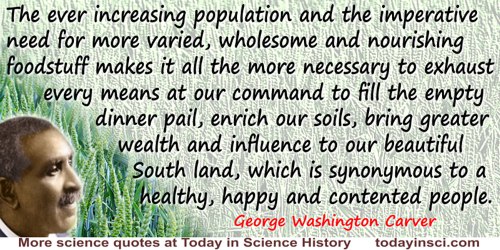
The rapid growth of industry, the ever increasing population and the imperative need for more varied, wholesome and nourishing foodstuff makes it all the more necessary to exhaust every means at our command to fill the empty dinner pail, enrich our soils, bring greater wealth and influence to our beautiful South land, which is synonymous to a healthy, happy and contented people.
Letter to Marlin E. Penn (18 Jun 1927), Box 17, George Washington Carver Papers. Cited in Linda O. McMurry, George Washington Carver, Scientist and Symbol (1982), 264-5. Smith's book is about his recollections of G.W. Carver's Sunday School classes at Tuskegee, some 40 years earlier. Webmaster, who has not yet been able to see the original book, cautions this quote may be the gist of Carver's words, rather than an exact quote.
The really important questions in human life are hardly touched upon by psychologists. Do liars come to believe their own lies? Is pleasure the same as happiness? Is it better to have loved and lost than never to have loved, or not to be able to love?
In Science is a Sacred Cow (1950), 137.
The road to happiness and prosperity lies in an organized diminution of work.
In Praise of Idleness and Other Essays (1935), 12.
The sum of human happiness would not necessarily be reduced if for ten years every physical and chemical laboratory were closed and the patient and resourceful energy displayed in them transferred to the lost art of getting on together and finding the formula for making both ends meet in the scale of human life.
In a speech to the British Association for the Advancement of Science, Leeds, September 4, 1927.
The trouble is not that we are never happy—it is that happiness is so episodical. … I cannot see what holds it together.
In An Anthropologist at Work (1959, 2011), 121.
The world is so full of a number of things,
I’m sure we should all be as happy as kings.
I’m sure we should all be as happy as kings.
In 'Happy Thought', in A Child's Garden of Verses (1885), 28.
The year that Rutherford died (1938 [sic]) there disappeared forever the happy days of free scientific work which gave us such delight in our youth. Science has lost her freedom. Science has become a productive force. She has become rich but she has become enslaved and part of her is veiled in secrecy. I do not know whether Rutherford would continue to joke and laugh as he used to.
'Notes from Here and There', Science Policy News (1969), 1, No 2, 33.
The young doctor should look about early for an avocation, a pastime, that will take him away from patients, pills and potions. … No man is really happy or safe without one, and it makes precious little difference what the outside interest may be—botany, beetles or butterflies, roses, tulips or irises, fishing, mountaineering or antiquities—anything will do so long as he straddles a hobby and rides it hard.
In 'The Medical Library in Post-Graduate Work', British Medical Journal (1909), 2, 927.
There are some modern practitioners, who declaim against medical theory in general, not considering that to think is to theorize; and that no one can direct a method of cure to a person labouring under disease, without thinking, that is, without theorizing; and happy therefore is the patient, whose physician possesses the best theory.
Zoonomia, or, The Laws Of Organic Life (1801), Vol. 2, ix.
There is no fundamental difference between man and the higher animals in their mental faculties ... The lower animals, like man, manifestly feel pleasure and pain, happiness, and misery.
…...
There is no way to happiness—happiness is the way.
In No Death, No Fear: Comforting Wisdom for Life (2003), 188.

There is nothing which can better deserve your patronage, than the promotion of Science and Literature. Knowledge is in every country the surest basis of publick happiness.
First Annual Message to Congress on the State of the Union (8 Jan 1790).
There will still be things that machines cannot do. They will not produce great art or great literature or great philosophy; they will not be able to discover the secret springs of happiness in the human heart; they will know nothing of love and friendship.
…...
This is a strange Christmas Eve. Almost the whole world is locked in deadly struggle, and, with the most terrible weapons which science can devise, the nations advance upon each other. Ill would it be for us this Christmastide if we were not sure that no greed for the land or wealth of any other people, no vulgar ambition, no morbid lust for material gain at the expense of others, had led us to the field. Here, in the midst of war, raging and roaring over all the lands and seas, creeping nearer to our hearts and homes, here, amid all the tumult, we have tonight the peace of the spirit in each cottage home and in every generous heart. Therefore we may cast aside for this night at least the cares and dangers which beset us, and make for the children an evening of happiness in a world of storm. Here, then, for one night only, each home throughout the English-speaking world should be a brightly-lighted island of happiness and peace.
Let the children have their night of fun and laughter. Let the gifts of Father Christmas delight their play. Let us grown-ups share to the full in their unstinted pleasures before we turn again to the stern task and the formidable years that lie before us, resolved that, by our sacrifice and daring, these same children shall not be robbed of their inheritance or denied their right to live in a free and decent world.
Let the children have their night of fun and laughter. Let the gifts of Father Christmas delight their play. Let us grown-ups share to the full in their unstinted pleasures before we turn again to the stern task and the formidable years that lie before us, resolved that, by our sacrifice and daring, these same children shall not be robbed of their inheritance or denied their right to live in a free and decent world.
Broadcast while he was in Washington D.C. (24 Dec 1941). As collected in Robert Rhodes James (ed.), Churchill Speaks in Peace and War: Collected Speeches 1897-1963 (), 780. In Hong Kong, the situation was hopeless, despite a valiant resistance, and the British forces surrendered the next day (25 Dec 1941). Churchill was in the U.S. visiting Pres. Roosevelt, to discuss coordinating strategy following the Pearl Harbor attack (7 Dec 1941).
Those whose lives are so filled with the romance of discovery, whose years are a holiday of exploration, … their work itself is adequate reward, they have more happiness already than their share.
In speech at Nobel Banquet, Stockholm (10 Dec 1923). Collected in Carl Gustaf Santesson (ed.), Les Prix Nobel en 1921-1922 (1923).
Throughout history, engineers have served their neighbours, their towns and their countries by making tools, machines and countless other things that improve every aspect of life. From information technology to medical science and mining, from building roads to space travel, engineers are working to make a difference to our standard of living, and with it our health, wealth and happiness.
From a speech by The Queen at The Queen Elizabeth Prize for Engineering (25 Jun 2013).
Throughout history, engineers have served their neighbours, their towns and their countries by making tools, machines and countless other things that improve every aspect of life. From information technology to medical science and mining, from building roads to space travel, engineers are working to make a difference to our standard of living, and with it our health, wealth and happiness. At its heart, engineering is about using science to find creative, practical solutions. It is a noble profession.
In Speech (25 Jun 2013), for the 2013 Queen Elizabeth Prize for Engineering.
Thus the great drama of universal life is perpetually sustained; and though the individual actors undergo continual change, the same parts are ever filled by another and another generation; renewing the face of the earth, and the bosom of the deep, with endless successions of life and happiness.
Geology and Mineralogy, Considered with Reference to Natural Theology (1836), Vol. I, 134.
To act with common sense according to the moment, is the best wisdom I know; and the best philosophy, to do one’s duties, take the world as it comes, submit respectfully to one’s lot, bless the Goodness that has given so much happiness with it, whatever it is, and despise affectation.
From Letter (27 May 1776) to Horace Mann, collected in Letters of Horace Walpole, Earl of Orford, to Sir Horace Mann (1843), Vol. 2, 378.
To be born, to live and to die is merely to change forms... And what does one form matter any more than another?... Each form has its own sort of happiness and unhappiness. From the elephant down to the flea... from the flea down to the sensitive and living molecule which is the origin of all, there is not a speck in the whole of nature that does not feel pain or pleasure.
D'Alembert's Dream (1769), in Rameau's Nephew and D' Alembert's Dream, trans. Leonard Tancock (Penguin edition 1966), 182.

To deny education to any people is one of the greatest crimes against human nature. It is to deny them the means of freedom and the rightful pursuit of happiness, and to defeat the very end of their being.
From speech (3 Sep 1894), at Manassas Industrial School, Manassas, Virginia, 'Blessings of Liberty and Education', Frederick Douglass Papers, Library of Congress. [The date, he said, was the 56th anniversary of his “escape from bondage.”]
To him who devotes his life to science, nothing can give more happiness than increasing the number of discoveries, but his cup of joy is full when the results of his studies immediately find practical applications.
As quoted in René J. Dubos, Louis Pasteur, Free Lance of Science (1960, 1986), 85.
To show, therefore, that we are capable of knowing, i.e. being certain that there is a God, and how we may come by this certainty, I think we need go no further than ourselves, and that undoubted knowledge we have of our own existence... For man knows that he himself exists... If any one pretends to be so sceptical as to deny his own existence, (for really to doubt of it is manifestly impossible,) let him for me enjoy his beloved happiness of being nothing, until hunger or some other pain convince him of the contrary... He knows also that nothing cannot produce a being; therefore something must have existed from eternity... Next, it is evident, that what had its being and beginning from another, must also have all that which is in and belongs to its being from another too. All the powers it has must be owing to and received from the same source. This eternal source, then, of all being must also be the source and original of all power; and so this eternal Being must be also the most powerful... And most knowing. Again, a man finds in himself perception and knowledge. We have then got one step further; and we are certain now that there is not only some being, but some knowing, intelligent being in the world. There was a time, then, when there was no knowing being, and when knowledge began to be; or else there has been also a knowing being from eternity...And therefore God.
Essay Concerning Human Understanding (1690), book 4, ch. 10, sec 19.
Tyndall declared that he saw in Matter the promise and potency of all forms of life, and with his Irish graphic lucidity made a picture of a world of magnetic atoms, each atom with a positive and a negative pole, arranging itself by attraction and repulsion in orderly crystalline structure. Such a picture is dangerously fascinating to thinkers oppressed by the bloody disorders of the living world. Craving for purer subjects of thought, they find in the contemplation of crystals and magnets a happiness more dramatic and less childish than the happiness found by mathematicians in abstract numbers, because they see in the crystals beauty and movement without the corrupting appetites of fleshly vitality.
In Back to Methuselah: A Metabiological Pentateuch (1921), lxi-lxii.
We are apt to think we know what time is because we can measure it, but no sooner do we reflect upon it than that illusion goes. So it appears that the range of the measureable is not the range of the knowable. There are things we can measure, like time, but yet our minds do not grasp their meaning. There are things we cannot measure, like happiness or pain, and yet their meaning is perfectly clear to us.
The Elements of Social Science (1921), 15-16
We may, I think, draw a yet higher and deeper teaching from the phenomena of degeneration. We seem to learn from it the absolute necessity of labour and effort, of struggle and difficulty, of discomfort and pain, as the condition of all progress, whether physical or mental, and that the lower the organism the more need there is of these ever-present stimuli, not only to effect progress, but to avoid retrogression. And if so, does not this afford us the nearest attainable solution of the great problem of the origin of evil? What we call evil is the essential condition of progress in the lower stages of the development of conscious organisms, and will only cease when the mind has become so thoroughly healthy, so well balanced, and so highly organised, that the happiness derived from mental activity, moral harmony, and the social affections, will itself be a sufficient stimulus to higher progress and to the attainment of a more perfect life.
In 'Two Darwinian Essays', Nature (1880), 22, 142.
We need a new vision for agriculture … to spread happiness among farm and rural families. Bio-happiness through the conversion of our bio-resources into wealth meaningful to our rural families should be the goal of our national policy for farmers.
In 'Science and Shaping the Future of Rice', collected in Pramod K. Aggarwal et al. (eds.), 206 International Rice Congress: Science, Technology, and Trade for Peace and Prosperity (2007), 8.
We will be able to depart this life with the quiet peace-giving notion, that we were permitted to contribute to the happiness of many who will live after us. In our long lives we endeavored to unfold the collective consciousness. In our lives we have known hell and heaven; the final balance, however, is that we helped pave the way to dynamic harmony in this earthly house. That, I believe, is the meaning of this life.
Letter to old unnamed friend (Jul 1981), quoted in Willem J. M. van der Linden, 'In Memoriam: R. W. van Bemmelen', Netherlands Journal of Geosciences, Geologie en Mijnbouw (1984), 63, No. 1.
When one door of happiness closes, another opens; but often we look so long at the closed door that we do not see the one which has been opened for us.
…...

When our thoughts—which bring actions—are filled with hate against anyone, Negro or white, we are in a living hell. That is as real as hell will ever be.
While hate for our fellow man puts us in a living hell, holding good thoughts for them brings us an opposite state of living, one of happiness, success, peace. We are then in heaven.
While hate for our fellow man puts us in a living hell, holding good thoughts for them brings us an opposite state of living, one of happiness, success, peace. We are then in heaven.
In Alvin D. Smith, George Washington Carver: Man of God (1954), 27-28. Cited in Linda O. McMurry, George Washington Carver, Scientist and Symbol (1982), 107. Smith's book is about his recollections of G.W. Carver's Sunday School classes at Tuskegee, some 40 years earlier. Webmaster, who has not yet been able to see the original book, cautions this quote may be the gist of Carver's words, rather than a verbatim quote.
While the vaccine discovery was progressive, the joy I felt at the prospect before me of being the instrument destined to take away from the world one of its greatest calamities [smallpox], blended with the fond hope of enjoying independence and domestic peace and happiness, was often so excessive that, in pursuing my favourite subject among the meadows, I have sometimes found myself in a kind of reverie.
John Baron, The Life of Dr. Jenner (1827), 140.
Why does this magnificent applied science which saves work and makes life easier bring us so little happiness? … The simple answer runs: “Because we have not yet learned to make sensible use of it.”
Address to students of the California Institute of Technology, Pasadena, California (16 Feb 1931). In New York Times (17 Feb 1931), p. 6.
Why had we come to the moon?
The thing presented itself to me as a perplexing problem. What is this spirit in man that urges him for ever to depart from happiness and security, to toil, to place himself in danger, to risk an even a reasonable certainty of death? It dawned upon me that there in the moon as a thing I ought always to have known, that man is not made to go about safe and comfortable and well fed and amused. ... against his interest, against his happiness, he is constantly being driven to do unreasonable things. Some force not himself impels him, and he must go.
The thing presented itself to me as a perplexing problem. What is this spirit in man that urges him for ever to depart from happiness and security, to toil, to place himself in danger, to risk an even a reasonable certainty of death? It dawned upon me that there in the moon as a thing I ought always to have known, that man is not made to go about safe and comfortable and well fed and amused. ... against his interest, against his happiness, he is constantly being driven to do unreasonable things. Some force not himself impels him, and he must go.
The First Men in the Moon (1901)
With your talents and industry, with science, and that steadfast honesty which eternally pursues right, regardless of consequences, you may promise yourself every thing—but health, without which there is no happiness. An attention to health then should take place of evey other object. The time necessary to secure this by active exercises, should be devoted to it in preference to every other pursuit.
Letter to Tomas Mann Randolph, Jr., (6 Jul 1787), In Thomas Jefferson and Paul Leicester Ford (ed.) The Works of Thomas Jefferson (1904), Vol. 5, 300.
Julian P. Boyd (Ed.), The Papers of Thomas Jefferson (1955), Vol. 11, 558.
Work is nature’s physician; it is essential to human health and happiness.
— Galen
…...
Young men, have confidence in those powerful and safe methods, of which we do not yet know all the secrets. And, whatever your career may be, do not let yourselves become tainted by a deprecating and barren skepticism … Live … until the time comes when you have the immense happiness of thinking that you have contributed in some way to the progress and to the good of humanity.
Acceptance speech (27 Dec 1892) when awarded a 70th birthday commemorative medal by the Academy of Sciences in the great theatre of the Sorbonne, as translated in René Vallery-Radot and Mrs R.L. Devonshire (trans.), The Life of Pasteur (1902), Vol. 2, 297-298. Pasteur addressed an audience that included “deep masses of students” and “boys from the lycées.”
 In science it often happens that scientists say, 'You know that's a really good argument; my position is mistaken,' and then they would actually change their minds and you never hear that old view from them again. They really do it. It doesn't happen as often as it should, because scientists are human and change is sometimes painful. But it happens every day. I cannot recall the last time something like that happened in politics or religion.
(1987) --
In science it often happens that scientists say, 'You know that's a really good argument; my position is mistaken,' and then they would actually change their minds and you never hear that old view from them again. They really do it. It doesn't happen as often as it should, because scientists are human and change is sometimes painful. But it happens every day. I cannot recall the last time something like that happened in politics or religion.
(1987) -- 





