Greatness Quotes (55 quotes)
[1665-08-31] Up, and after putting several things in order to my removal to Woolwich, the plague having a great increase this week beyond all expectation, of almost 2000 - making the general Bill 7000, odd 100 and the plague above 6000 .... Thus this month ends, with great sadness upon the public through the greateness of the plague, everywhere through the Kingdom almost. Every day sadder and sadder news of its increase. In the City died this week 7496; and all of them, 6102 of the plague. But it is feared that the true number of the dead this week is near 10000 - partly from the poor that cannot be taken notice of through the greatness of the number, and partly from the Quakers and others that will not have any bell ring for them. As to myself, I am very well; only, in fear of the plague, and as much of an Ague, by being forced to go early and late to Woolwich, and my family to lie there continually.
Diary of Samuel Pepys (31 August 1665)
[Fritz Haber's] greatness lies in his scientific ideas and in the depth of his searching. The thought, the plan, and the process are more important to him than the completion. The creative process gives him more pleasure than the yield, the finished piece. Success is immaterial. “Doing it was wonderful.” His work is nearly always uneconomical, with the wastefulness of the rich.
In Richard Willstätter, Arthur Stoll (ed. of the original German) and Lilli S. Hornig (trans.), From My Life: The Memoirs of Richard Willstätter (1958), 268.
[Great scientists] are men of bold ideas, but highly critical of their own ideas: they try to find whether their ideas are right by trying first to find whether they are not perhaps wrong. They work with bold conjectures and severe attempts at refuting their own conjectures.
'The Problem of Demarcation' (1974). Collected in David Miller (ed.) Popper Selections (1985), 118-119.
Bernard: Oh, you’re going to zap me with penicillin and pesticides. Spare me that and I’ll spare you the bomb and aerosols. But don’t confuse progress with perfectibility. A great poet is always timely. A great philosopher is an urgent need. There’s no rush for Isaac Newton. We were quite happy with Aristotle’s cosmos. Personally, I preferred it. Fifty-five crystal spheres geared to God’s crankshaft is my idea of a satisfying universe. I can’t think of anything more trivial than the speed of light. Quarks, quasars—big bangs, black holes—who [cares]? How did you people con us out of all that status? All that money? And why are you so pleased with yourselves?
Chloe: Are you against penicillin, Bernard?
Bernard: Don’t feed the animals.
Chloe: Are you against penicillin, Bernard?
Bernard: Don’t feed the animals.
In the play, Acadia (1993), Act 2, Scene 5, 61.
In primis, hominis est propria VERI inquisitio atque investigato. Itaque cum sumus negotiis necessariis, curisque vacui, tum avemus aliquid videre, audire, ac dicere, cognitionemque rerum, aut occultarum aut admirabilium, ad benè beatéque vivendum necessariam ducimus; —ex quo intelligitur, quod VERUM, simplex, sincerumque sit, id esse naturæ hominis aptissimum. Huic veri videndi cupiditati adjuncta est appetitio quædam principatûs, ut nemini parere animus benè a naturâ informatus velit, nisi præcipienti, aut docenti, aut utilitatis causâ justè et legitimè imperanti: ex quo animi magnitudo existit, et humanarum rerum contemtio.
Before all other things, man is distinguished by his pursuit and investigation of TRUTH. And hence, when free from needful business and cares, we delight to see, to hear, and to communicate, and consider a knowledge of many admirable and abstruse things necessary to the good conduct and happiness of our lives: whence it is clear that whatsoever is TRUE, simple, and direct, the same is most congenial to our nature as men. Closely allied with this earnest longing to see and know the truth, is a kind of dignified and princely sentiment which forbids a mind, naturally well constituted, to submit its faculties to any but those who announce it in precept or in doctrine, or to yield obedience to any orders but such as are at once just, lawful, and founded on utility. From this source spring greatness of mind and contempt of worldly advantages and troubles.
Before all other things, man is distinguished by his pursuit and investigation of TRUTH. And hence, when free from needful business and cares, we delight to see, to hear, and to communicate, and consider a knowledge of many admirable and abstruse things necessary to the good conduct and happiness of our lives: whence it is clear that whatsoever is TRUE, simple, and direct, the same is most congenial to our nature as men. Closely allied with this earnest longing to see and know the truth, is a kind of dignified and princely sentiment which forbids a mind, naturally well constituted, to submit its faculties to any but those who announce it in precept or in doctrine, or to yield obedience to any orders but such as are at once just, lawful, and founded on utility. From this source spring greatness of mind and contempt of worldly advantages and troubles.
In De Officiis, Book 1. Sect. 13. As given in epigraph to John Frederick William Herschel, A Preliminary Discourse on the Study of Natural Philosophy (1830), viii.
Pour accomplir de grandes choses il ne suffit pas d'agir il faut rêver; il ne suffit pas de calculer, il faut croire.
To accomplish great things, we must not only act but also dream, not only plan but also believe.
[Referring to the Suez Canal, initiated by Ferdinand de Lesseps.]
To accomplish great things, we must not only act but also dream, not only plan but also believe.
[Referring to the Suez Canal, initiated by Ferdinand de Lesseps.]
Speech (24 Dec 1896) upon election to the French Academy, in the vacant place of the late Ferdinand de Lesseps, Discours de Réception de M. Anatole France: Séance de l'Académie Française du 24 Décembre 1896 (1897), 21.
A harmless and a buoyant cheerfulness are not infrequent concomitants of genius; and we are never more deceived than when we mistake gravity for greatness, solemnity for science, and pomposity for erudition.
Lacon: Or, Many Things in Few Words (1865), 57.
A man’s dreams are an index to his greatness.
…...
A society grows great when old men plant trees whose shade they know they shall never sit in.
In recent years, this has been widely quoted and cited as an (ancient?) Greek proverb. Seen, for example in, Violence on Television: Hearings Before the House Committee on Energy and Commerce, Subcommittee on Telecommunications and Finance (1994), 340. Webmaster however has so far found no example of this wording in, say, 19th century quotation collections. Which leaves the authenticity of the citation in question. Variations exist (for example “The beginning of wisdom comes when a person plants trees, the shade under which they know they will never sit.” (1993) or “Thoughtless men might ask why an old man plants a tree when he may never hope to sit in its shade” (1954).) However, the general sentiment has indeed existed for a long time. For example, “He that plants Trees, loves others besides himself,” collected in Thomas Fuller, Gnomologia: Adagies and Proverbs (1731), 91, No. 2248.
All great scientists have, in a certain sense, been great artists; the man with no imagination may collect facts, but he cannot make great discoveries.
From The Grammar of Science (1892), 37.
America has always been greatest when we dared to be great. We can reach for greatness again. We can follow our dreams to distant stars, living and working in space for peaceful, economic, and scientific gain. Tonight, I am directing NASA to develop a permanently manned space station and to do it within a decade.
From State of the Union Address (25 Jan 1984).
Be not afraid of greatness: some are born great, some achieve greatness, and some have greatness thrust upon them.
…...
But at the same time, there must never be the least hesitation in giving up a position the moment it is shown to be untenable. It is not going too far to say that the greatness of a scientific investigator does not rest on the fact of his having never made a mistake, but rather on his readiness to admit that he has done so, whenever the contrary evidence is cogent enough.
Principles of General Physiology (1915), x.xi.
Consider now the Milky Way. Here also we see an innumerable dust, only the grains of this dust are no longer atoms but stars; these grains also move with great velocities, they act at a distance one upon another, but this action is so slight at great distances that their trajectories are rectilineal; nevertheless, from time to time, two of them may come near enough together to be deviated from their course, like a comet that passed too close to Jupiter. In a word, in the eyes of a giant, to whom our Suns were what our atoms are to us, the Milky Way would only look like a bubble of gas.
Science and Method (1908), trans. Francis Maitland (1914), 254-5.
Emil Fischer represents a symbol of Germany's greatness.
'Emil Fischer Wissenschaftliche Arbeiten', Naturwissenschaften, 1919, 7, 843. Trans. Joseph S. Froton, Contrasts in Scientific Style: Research Groups in the Chemical and Biomedical Sciences (1990), 167.
Every intellectual revolution which has ever stirred humanity into greatness has been a passionate protest against inert ideas. Then, alas, with pathetic ignorance of human psychology, it has proceeded by some educational scheme to, bind humanity afresh with inert ideas of its own fashioning.
In 'The Aims of Education', The Aims of Education and Other Essays (1929), 14.
Every work of science great enough to be well remembered for a few generations affords some exemplification of the defective state of the art of reasoning of the time when it was written; and each chief step in science has been a lesson in logic.
'The Fixation of Belief (1877). In Justus Buchler, The Philosophy of Pierce (1940), 6.
God is infinite, so His universe must be too. Thus is the excellence of God magnified and the greatness of His kingdom made manifest; He is glorified not in one, but in countless suns; not in a single earth, a single world, but in a thousand thousand, I say in an infinity of worlds.
…...
Great inventions are never, and great discoveries are seldom, the work of any one mind. Every great invention is really an aggregation of minor inventions, or the final step of a progression. It is not usually a creation, but a growth, as truly so as is the growth of the trees in the forest.
In 'The Growth of the Steam-Engine', The Popular Science Monthly (Nov 1877), 17.
Great men stand like solitary towers in the city of God, and secret passages running deep beneath external nature give their thoughts intercourse with higher intelligences, which strengthens and consoles them, and of which the labourers on the surface do not even dream!
Opening paragraph of his prose work, Kavanagh: A Tale (1849), 3.
I can see him now at the blackboard, chalk in one hand and rubber in the other, writing rapidly and erasing recklessly, pausing every few minutes to face the class and comment earnestly, perhaps on the results of an elaborate calculation, perhaps on the greatness of the Creator, perhaps on the beauty and grandeur of Mathematics, always with a capital M. To him mathematics was not the handmaid of philosophy. It was not a humanly devised instrument of investigation, it was Philosophy itself, the divine revealer of TRUTH.
Writing as a Professor Emeritus at Harvard University, a former student of Peirce, in 'Benjamin Peirce: II. Reminiscences', The American Mathematical Monthly (Jan 1925), 32, No. 1, 5.
I have a boundless admiration for the solitary genius which enabled [Hermann Oberth] to bring into focus all of the essential elements of a gigantic concept, together with the human greatness which allowed him, in shy reserve, to bear with equanimity the “crucify hims” as well as the “hosannas” of public opinion. I myself owe him a debt of gratitude not only for being the guiding light of my life, but also for my first contact with the theoretical and practical aspects of rocket technology and space travel.
Primary source needed for verification. (Can you help?)
I have said that mathematics is the oldest of the sciences; a glance at its more recent history will show that it has the energy of perpetual youth. The output of contributions to the advance of the science during the last century and more has been so enormous that it is difficult to say whether pride in the greatness of achievement in this subject, or despair at his inability to cope with the multiplicity of its detailed developments, should be the dominant feeling of the mathematician. Few people outside of the small circle of mathematical specialists have any idea of the vast growth of mathematical literature. The Royal Society Catalogue contains a list of nearly thirty- nine thousand papers on subjects of Pure Mathematics alone, which have appeared in seven hundred serials during the nineteenth century. This represents only a portion of the total output, the very large number of treatises, dissertations, and monographs published during the century being omitted.
In Presidential Address British Association for the Advancement of Science, Sheffield, Section A,
Nature (1 Sep 1910), 84, 285.
I saw [Linus Pauling] as a brilliant lecturer and a man with a fantastic memory, and a great, great showman. I think he was the century’s greatest chemist. No doubt about it.
From transcript of audio of Max Perutz in BBC programme, 'Lifestory: Linus Pauling' (1997). On 'Linus Pauling and the Race for DNA' webpage 'I Wish I Had Made You Angry Earlier.'
Imagine the world so greatly magnified that particles of light look like twenty-four-pound cannon balls.
As given, without source, in James Geary, Geary's Guide to the World's Great Aphorists (2008), 341.
In engineering, that only is great which achieves. It matters not what the intention is, he who in the day of battle is not victorious is not saved by his intention.
In Proverbs from Plymouth Pulpit (1887), 21.
Is it a fact—or have I dreamt it—that, by means of electricity, the world of matter has become a great nerve, vibrating thousands of miles in a breathless point of time?
In The House of the Seven Gables (1851), 203.
It is hard to think of fissionable materials when fashioned into bombs as being a source of happiness. However this may be, if with such destructive weapons men are to survive, they must grow rapidly in human greatness. A new level of human understanding is needed. The reward for using the atom’s power towards man’s welfare is great and sure. The punishment for its misuse would seem to be death and the destruction of the civilization that has been growing for a thousand years. These are the alternatives that atomic power, as the steel of Daedalus, presents to mankind. We are forced to grow to greater manhood.
Atomic Quest: A Personal Narrative (1956), xix.
It would appear... that moral phenomena, when observed on a great scale, are found to resemble physical phenomena; and we thus arrive, in inquiries of this kind, at the fundamental principle, that the greater the number of individuals observed, the more do individual peculiarities, whether physical or moral, become effaced, and leave in a prominent point of view the general facts, by virtue of which society exists and is preserved.
A Treatise on Man and the Development of his Faculties (1842). Reprinted with an introduction by Solomon Diamond (1969), 6.
It would be difficult to name a man more remarkable for the greatness and the universality of his intellectual powers than Leibnitz.
In System of Logic, Bk. 2, chap. 5, sect. 6.
Moral education is impossible apart from the habitual vision of greatness.
In 'The Place of Classics in Education', The Aims of Education: & Other Essays (1917), 106.
Most people like to believe something is or is not true. Great scientists tolerate ambiguity very well. They believe the theory enough to go ahead; they doubt it enough to notice the errors and faults so they can step forward and create the new replacement theory. If you believe too much you’ll never notice the flaws; if you doubt too much you won’t get started. It requires a lovely balance.
'You and Your Research', Bell Communications Research Colloquium Seminar, 7 Mar 1986.
Nature knows no political boundaries. She puts living creatures on this globe and watches the free play of forces. She then confers the master's right on her favourite child, the strongest in courage and industry ... The stronger must dominate and not blend with the weaker, thus sacrificing his own greatness. Only the born weakling can view this as cruel.
Mein Kampf (1925-26), American Edition (1943), 134-5. In William Lawrence Shirer, The Rise and Fall of the Third Reich (1990), 86.
Of all man’s works of art, a cathedral is greatest. A vast and majestic tree is greater than that.
In Proverbs from Plymouth Pulpit (1887), 8.
One cause of the error may be for want of a proper knowledge of the remote past. Here, as elsewhere, ’tis distance lends enchantment to the view. We fail to make due allowance for the refractive nature of the medium through which we are compelled to view the past. We naturally magnify the greatness of that which is remote. By this the imagination is addressed rather than the understanding. The dim and shadowing figures of the past are clothed in glorious light, and pigmies appear as giants.
From speech (20 Nov 1883) delivered to the Bethel Literary and Historical Association, Washington D.C.,'It Moves, or Philosophy of Reform' , collected in The Essential Douglass: Selected Writings and Speeches (2016), 288.
Some are born great, some achieve greatness, and some hire public relations officers.
As attributed, without citation, in Connie Robertson Book of Humorous Quotations (1993, 1998), 29. However, the same quote is attributed to Anthony Burgess in Joanne Feierman, Action Grammar: Fast, No-Hassle Answers on Everyday Usage and Punctuation (1995), 39.
Subtlety is not a proof of wisdom. Fools and even madmen are at times extraordinarily subtle. One can add that subtlety rarely combines with genius, which is usually ingenuous, or with greatness of character, which is always frank.
(1827). In Aleksandr Sergeevich Pushkin, John Bayley (ed.), Pushkin on Literature (1986), 211.
The combination in time and space of all these thoughtful conceptions [of Nature] exhibits not only thought, it shows also premeditation, power, wisdom, greatness, prescience, omniscience, providence. In one word, all these facts in their natural connection proclaim aloud the One God, whom man may know, adore, and love; and Natural History must in good time become the analysis of the thoughts of the Creator of the Universe….
In Essay on Classification (1851), 205.
The first [quality] to be named must always be the power of attention, of giving one's whole mind to the patient without the interposition of anything of oneself. It sounds simple but only the very greatest doctors ever fully attain it. … The second thing to be striven for is intuition. This sounds an impossibility, for who can control that small quiet monitor? But intuition is only interference from experience stored and not actively recalled. … The last aptitude I shall mention that must be attained by the good physician is that of handling the sick man's mind.
In 'Art and Science in Medicine', The Collected Papers of Wilfred Trotter, FRS (1941), 98.
The function of Latin literature is its expression of Rome. When to England and France your imagination can add Rome in the background, you have laid firm the foundations of culture. The understanding of Rome leads back to the Mediterranean civilisation of which Rome was the last phase, and it automatically exhibits the geography of Europe, and the functions of seas and rivers and mountains and plains. The merit of this study in the education of youth is its concreteness, its inspiration to action, and the uniform greatness of persons, in their characters and their staging. Their aims were great, their virtues were great, and their vices were great. They had the saving merit of sinning with cart ropes.
In 'The Place of Classics in Education', The Aims of Education: & Other Essays (1917), 106.
The main duty of the historian of mathematics, as well as his fondest privilege, is to explain the humanity of mathematics, to illustrate its greatness, beauty and dignity, and to describe how the incessant efforts and accumulated genius of many generations have built up that magnificent monument, the object of our most legitimate pride as men, and of our wonder, humility and thankfulness, as individuals.
In The Study of the History of Mathematics (1936), 28.
The prohibition of science would be contrary to the Bible, which in hundreds of places teaches us how the greatness and the glory of God shine forth marvelously in all His works, and is to be read above all in the open book of the heavens. And let no one believe that the reading of the most exalted thoughts which are inscribed upon these pages is to be accomplished through merely staring up at the radiance of the stars. There are such profound secrets and such lofty conceptions that the night labors and the researches of hundreds and yet hundreds of the keenest minds, in investigations extending over thousands of years would not penetrate them, and the delight of the searching and finding endures forever.
As stated by William H. Hobbs, 'The Making of Scientific Theories,' Address of the president of Michigan Academy of Science at the Annual Meeting, Ann Arbor (28 Mar 1917) in Science (11 May 1917), N.S. 45, No. 1167, 443.
The scientist, if he is to be more than a plodding gatherer of bits of information, needs to exercise an active imagination. The scientists of the past whom we now recognize as great are those who were gifted with transcendental imaginative powers, and the part played by the imaginative faculty of his daily life is as least as important for the scientist as it is for the worker in any other field—much more important than for most. A good scientist thinks logically and accurately when conditions call for logical and accurate thinking—but so does any other good worker when he has a sufficient number of well-founded facts to serve as the basis for the accurate, logical induction of generalizations and the subsequent deduction of consequences.
‘Imagination in Science’, Tomorrow (Dec 1943), 38-9. Quoted In Barbara Marinacci (ed.), Linus Pauling In His Own Words: Selected Writings, Speeches, and Interviews (1995), 82.
The soul and body rive not more in parting
Than greatness going off.
Than greatness going off.
Antony and Cleopatra (1606-7), IV, xiii.
The technologies which have had the most profound effects on human life are usually simple. A good example of a simple technology with profound historical consequences is hay. ... It was hay that allowed populations to grow and civilizations to flourish among the forests of Northern Europe. Hay moved the greatness of Rome to Paris and London, and later to Berlin and Moscow and New York.
[The year-round growth of green grass in the Mediterranean climate meant that hay was not needed by the Romans. North of the Alps, hay maintained horses and oxen and thus their motive power, and productivity.]
[The year-round growth of green grass in the Mediterranean climate meant that hay was not needed by the Romans. North of the Alps, hay maintained horses and oxen and thus their motive power, and productivity.]
In 'Quick is Beautiful', Infinite in All Directions: Gifford Lectures Given at Aberdeen, Scotland (1988, 2004), 135.
The technologies which have had the most profound effects on human life are usually simple. A good example of a simple technology with profound historical consequences is hay. Nobody knows who invented hay, the idea of cutting grass in the autumn and storing it in large enough quantities to keep horses and cows alive through the winter. All we know is that the technology of hay was unknown to the Roman Empire but was known to every village of medieval Europe. Like many other crucially important technologies, hay emerged anonymously during the so-called Dark Ages. According to the Hay Theory of History, the invention of hay was the decisive event which moved the center of gravity of urban civilization from the Mediterranean basin to Northern and Western Europe. The Roman Empire did not need hay because in a Mediterranean climate the grass grows well enough in winter for animals to graze. North of the Alps, great cities dependent on horses and oxen for motive power could not exist without hay. So it was hay that allowed populations to grow and civilizations to flourish among the forests of Northern Europe. Hay moved the greatness of Rome to Paris and London, and later to Berlin and Moscow and New York. ... Great inventions like hay and printing, whatever their immediate social costs may be, result in a permanent expansion of our horizons, a lasting acquisition of new territory for human bodies and minds to cultivate.
Infinite In All Directions (1988, 2004), 135. The book is a revised version of a series of the Gifford Lectures under the title 'In Praise of Diversity', given at Aberdeen, Scotland.
There are some men who are counted great because they represent the actuality of their own age, and mirror it as it is. Such an one was Voltaire, of whom it was epigrammatically said: “he expressed everybody's thoughts better than anyone.” But there are other men who attain greatness because they embody the potentiality of their own day and magically reflect the future. They express the thoughts which will be everybody's two or three centuries after them. Such as one was Descartes.
Quoted in James Roy Newman, The World of Mathematics (2000), Vol. 1, 239.
To what part of electrical science are we not indebted to Faraday? He has increased our knowledge of the hidden and unknown to such an extent, that all subsequent writers are compelled so frequently to mention his name and quote his papers, that the very repetition becomes monotonous. [How] humiliating it may be to acknowledge so great a share of successful investigation to one man...
In the Second Edition ofElements of Electro-Metallurgy: or The Art of Working in Metals by the Galvanic Fluid (143), 128.
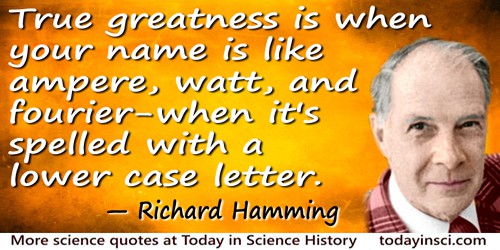
True greatness is when your name is like ampere, watt, and fourier—when it's spelled with a lower case letter.
'You and Your Research', Bell Communications Research Colloquium Seminar, 7 Mar 1986.
Unless you make yourself equal to God, you cannot understand God: for the like is not intelligible save to the like. Make yourself grow to a greatness beyond measure, by a bound free yourself from the body; raise yourself above all time, become Eternity; then you will understand God. Believe that nothing is impossible for you, think yourself immortal and capable of understanding all, all arts, all sciences, the nature of every living being. Mount higher than the highest height; descend lower than the lowest depth. Draw into yourself all sensations of everything created, fire and water, dry and moist, imagining that you are everywhere, on earth, in the sea, in the sky, that you are not yet born, in the maternal womb, adolescent, old, dead, beyond death. If you embrace in your thought all things at once, times, places, substances, qualities, quantities, you may understand God.
Quoted in F. A. Yales, Giordano Bruno and the Hermetic Tradition (1964), 198.
We affirm the neutrality of Science ... Science is of no country. ... But if Science has no country, the scientist must keep in mind all that may work towards the glory of his country. In every great scientist will be found a great patriot.
Address at the International Medical Congress, Palace of Industry, Copenhagen (10 Aug 1884). In René Vallery-Radot, The Life of Pasteur, translated by Mrs. R. L. Devonshire (1919), 399.
We all felt the majesty of the body. In a very short period of time we had seen something that was bigger than each of us. A lot of people, even those who were not religious, were reverent and attributed the success to God. As we saw the artificial heart beat in Dr. Clark, the feeling was not aren't we great, but aren't we small.
[Comment after surgery for the world's first human implant of a total artificial heart in the chest of dentist Dr. Barney Clark ]
[Comment after surgery for the world's first human implant of a total artificial heart in the chest of dentist Dr. Barney Clark ]
Quoted by Lawrence K. Altman in “Clark's Surgeon Was ‘Worried To Death’&rdquo, New York Times (12 Apr 1983), C2.
We should like Nature to go no further; we should like it to be finite, like our mind; but this is to ignore the greatness and majesty of the Author of things.
Letter to S. Clarke, 1715. Trans. M. Morris and G. H. R. Parkinson, Leibniz: PhilosophicalWritings (1973), 220.
Worship the spirit of criticism. If reduced to itself it is not an awakener of ideas or a stimulant to great things, but, without it, everything is fallible; it always has the last word.
Address at the Inauguration of the Pasteur Institute. In René Vallery-Radot, The Life of Pasteur, translated by Mrs. R. L. Devonshire (1919), 443.
You have chosen the most fascinating and dynamic profession there is, a profession with the highest potential for greatness, since the physician’s daily work is wrapped up in the subtle web of history. Your labors are linked with those of your colleagues who preceded you in history, and those who are now working all over the world. It is this spiritual unity with our colleagues of all periods and all countries that has made medicine so universal and eternal. For this reason we must study and try to imitate the lives of the “Great Doctors” of history.
epilogue to A Prelude to Medical History
 In science it often happens that scientists say, 'You know that's a really good argument; my position is mistaken,' and then they would actually change their minds and you never hear that old view from them again. They really do it. It doesn't happen as often as it should, because scientists are human and change is sometimes painful. But it happens every day. I cannot recall the last time something like that happened in politics or religion.
(1987) --
In science it often happens that scientists say, 'You know that's a really good argument; my position is mistaken,' and then they would actually change their minds and you never hear that old view from them again. They really do it. It doesn't happen as often as it should, because scientists are human and change is sometimes painful. But it happens every day. I cannot recall the last time something like that happened in politics or religion.
(1987) -- 




