Great Quotes (1628 quotes)
... all the great scientists have one thing in common: each snatched from the subtle motions of nature one irrevocable secret; each caught one feather of the plumage of the Great White Bird that symbolizes everlasting truth.
With co-author Justus J. Schifferes, in The Autobiography of Science (1945).
... If I let myself believe anything on insufficient evidence, there may be no great harm done by the mere belief; it may be true after all, or I may never have occasion to exhibit it in outward acts. But I cannot help doing this great wrong towards Man, that I make myself credulous. The danger to society is not merely that it should believe wrong things, though that is great enough; but that it should become credulous, and lose the habit of testing things and inquiring into them; for then it must sink back into savagery.
The Scientific Basis of Morals (1884), 28.
... in time of war, soldiers, however sensible, care a great deal more on some occasions about slaking their thirst than about the danger of enteric fever.
[Better known as typhoid, the disease is often spread by drinking contaminated water.]
[Better known as typhoid, the disease is often spread by drinking contaminated water.]
Parliamentaray Debate (21 Mar 1902). Quoted in Winston Churchill and Richard Langworth (ed.), Churchill by Himself: The Definitive Collection of Quotations (2008), 469.
… it may happen that small differences in the initial conditions produce very great ones in the final phenomena.
Science and Method (1908) translated by Francis Maitland (2003), 68.
… man-midwifery, with other “indecencies,” is a great system of fashionable prostitution; a primary school of infamy—as the fashionable hotel and parlor wine glass qualify candidates for the two-penny grog-shop and the gutter.
Man-midwifery Exposed and Corrected (1848)
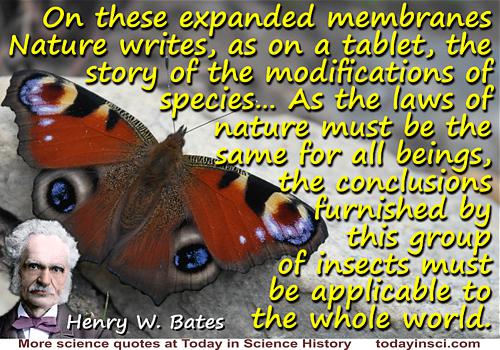
… on these expanded membranes [butterfly wings] Nature writes, as on a tablet, the story of the modifications of species, so truly do all changes of the organisation register themselves thereon. Moreover, the same colour-patterns of the wings generally show, with great regularity, the degrees of blood-relationship of the species. As the laws of nature must be the same for all beings, the conclusions furnished by this group of insects must be applicable to the whole world.
From The Naturalist on the River Amazons: A record of Adventures, Habits of Animals, Sketches of Brazilian and Indian life, and Aspects of Nature under the Equator, During Eleven Years of Travel (1864), 413.
… the reasoning process [employed in mathematics] is not different from that of any other branch of knowledge, … but there is required, and in a great degree, that attention of mind which is in some part necessary for the acquisition of all knowledge, and in this branch is indispensably necessary. This must be given in its fullest intensity; … the other elements especially characteristic of a mathematical mind are quickness in perceiving logical sequence, love of order, methodical arrangement and harmony, distinctness of conception.
In Treatise on Infinitesimal Calculus (1868), Vol. 8, 6.
… the truth is that the knowledge of external nature and of the sciences which that knowledge requires or includes, is not the great or the frequent business of the human mind. Whether we provide for action or conversation, whether we wish to be useful or pleasing, the first requisite is the religious and moral knowledge of right and wrong; the next is an acquaintance with the history of mankind, and with those examples which may be said to embody truth, and prove by events the reasonableness of opinions. Prudence and justice are virtues, and excellencies, of all times and of all places; we are perpetually moralists, but we are geometricians only by chance. Our intercourse with intellectual nature is necessary; our speculations upon matter are voluntary, and at leisure. Physical knowledge is of such rare emergence, that one man may know another half his life without being able to estimate his skill in hydrostatics or astronomy; but his moral and prudential character immediately appears.
In Lives of the Poets (1779-81).
... we ought to have saints' days to commemorate the great discoveries which have been made for all mankind, and perhaps for all time—or for whatever time may be left to us. Nature ... is a prodigal of pain. I should like to find a day when we can take a holiday, a day of jubilation when we can fête good Saint Anaesthesia and chaste and pure Saint Antiseptic. ... I should be bound to celebrate, among others, Saint Penicillin...
Speech at Guildhall, London (10 Sep 1947). Collected in Winston Churchill and Randolph Spencer Churchill (ed.), Europe Unite: Speeches, 1947 and 1948 (1950), 138.
...a man estimable for his learning, amiable for his life, and venerable for his piety. Arbuthnot was a man of great comprehension, skilful in his profession, versed in the sciences, acquainted with ancient literature, and able to animate his mass of knowledge by a bright and active imagination; a scholar with great brilliance of wit; a wit who, in the crowd of life, retained and discovered a noble ardour of religious zeal.
The Lives of the English Poets (1826), vol. 2, 257.
...great difficulties are felt at first and these cannot be overcome except by starting from experiments .. and then be conceiving certain hypotheses ... But even so, very much hard work remains to be done and one needs not only great perspicacity but often a degree of good fortune.
Letter to Tschirnhaus (1687). Quoted in Archana Srinivasan, Great Inventors (2007), 37-38.
...He cannot conclude however, without observing, that from the contemplation of so great a variety of extraneous fossils discovered in the cliffs which were evidently the produce of very different climates, he thinks himself rationally induced to believe that nothing short of an universal deluge could be a cause adequate to this effect.
Plantae Favershamiensis, Appendix, 'Establishing a short view of the fossil bodies of the adjacent island of Sheppey.' Quoted in David Beerling, The Emerald Planet: How Plants Changed Earth's History (2007), 145.
…I distinguish two parts of it, which I call respectively the brighter and the darker. The brighter seems to surround and pervade the whole hemisphere; but the darker part, like a sort of cloud, discolours the Moon’s surface and makes it appear covered with spots. Now these spots, as they are somewhat dark and of considerable size, are plain to everyone and every age has seen them, wherefore I will call them great or ancient spots, to distinguish them from other spots, smaller in size, but so thickly scattered that they sprinkle the whole surface of the Moon, but especially the brighter portion of it. These spots have never been observed by anyone before me; and from my observations of them, often repeated, I have been led to the opinion which I have expressed, namely, that I feel sure that the surface of the Moon is not perfectly smooth, free from inequalities and exactly spherical… but that, on the contrary, it is full of inequalities, uneven, full of hollows and protuberances, just like the surface of the Earth itself, which is varied everywhere by lofty mountains and deep valleys.
Describing his pioneering telescope observations of the Moon made from Jan 1610. In The Starry Messenger (Mar 1610). Quoted in Patrick Moore, Patrick Moore on the Moon (2006), 56.
…The present revolution of scientific thought follows in natural sequence on the great revolutions at earlier epochs in the history of science. Einstein’s special theory of relativity, which explains the indeterminateness of the frame of space and time, crowns the work of Copernicus who first led us to give up our insistence on a geocentric outlook on nature; Einstein's general theory of relativity, which reveals the curvature or non-Euclidean geometry of space and time, carries forward the rudimentary thought of those earlier astronomers who first contemplated the possibility that their existence lay on something which was not flat. These earlier revolutions are still a source of perplexity in childhood, which we soon outgrow; and a time will come when Einstein’s amazing revelations have likewise sunk into the commonplaces of educated thought.
In The Theory of Relativity and its Influence on Scientific Thought (1922), 31-32
...the source of all great mathematics is the special case, the concrete example. It is frequent in mathematics that every instance of a concept of seemingly generality is, in essence, the same as a small and concrete special case.
I Want to be a Mathematician: an Automathography in Three Parts (1985), 324.
“But in the binary system,” Dale points out, handing back the squeezable glass, “the alternative to one isn’t minus one, it’s zero. That’s the beauty of it, mechanically.” “O.K. Gotcha. You’re asking me, What’s this minus one? I’ll tell you. It’s a plus one moving backward in time. This is all in the space-time foam, inside the Planck duration, don’t forget. The dust of points gives birth to time, and time gives birth to the dust of points. Elegant, huh? It has to be. It’s blind chance, plus pure math. They’re proving it, every day. Astronomy, particle physics, it’s all coming together. Relax into it, young fella. It feels great. Space-time foam.”
In Roger's Version: A Novel (1986), 304.
“Normal” science, in Kuhn’s sense, exists. It is the activity of the non-revolutionary, or more precisely, the not-too-critical professional: of the science student who accepts the ruling dogma of the day… in my view the 'normal' scientist, as Kuhn describes him, is a person one ought to be sorry for… He has been taught in a dogmatic spirit: he is a victim of indoctrination… I can only say that I see a very great danger in it and in the possibility of its becoming normal… a danger to science and, indeed, to our civilization. And this shows why I regard Kuhn’s emphasis on the existence of this kind of science as so important.
In Imre Lakatos and A. Musgrave (eds.), 'Normal Science and its Dangers', Criticism and the Growth of Knowledge (1970), 52-53.
“On earth there is nothing great but man; and in man there is nothing great but mind.”
A favorite quote by Phavorinus which Hamilton used as a motto posted in his classroom.
A favorite quote by Phavorinus which Hamilton used as a motto posted in his classroom.
As translated from a reported quote by Phavorinus. Hamilton showed his fondness for this motto by having it painted in gold letters on a green board posted on his classroom wall, behind the chair. However, he did not originate it. He made this clear during a lecture, when he stated, “‘On earth’ says a forgotten philosopher, ‘there is nothing great but man; and in man there is nothing great but mind.’” This was in Lecture II, 'Philosophy—Its Absolute Utility (B) Objective' (1836), part of Hamilton’s Biennial Course while Chair of Logic and Mathematics, University of Edinburgh. The lectures were collected and annotated by editors Henry L. Mansel and John Veitch, in Lectures on Metaphysics and Logic (1858, 6th ed. 1877), 24. The epigraph following the title page of this book also reads, “On earth, there is nothing great but man, and in man there is nothing great but Mind.” Since the collection was published posthumously, Webmaster speculates this was the choice of the editors, as Hamilton’s motto. In the book, a footnote to the quote identifies the philosopher as “Phavorinus, quoted by Joannes Picus Mirandulanus, In Astrologiam, lib. iii p.351*, Basil, ed.” This information was found by an editor in Hamilton’s Commonplace-Book or fragmentary papers. An editor’s own addition to the footnote gives “For notice of Phavorinus, see Vossius, De Hist. Grœc, lib. ii c. 10.” Thus, although this quote is widely seen attributed to Sir William Hamilton, and although he may have been very fond of repeating it, his own notes reveal the original author was the ancient philosopher, Phavorinus. In the Latin written in Basil’s work, Mirandula stated that Phavorinus said “Nihil magnum in terra praeter hominem, nihil magnum in homine praeter mentem & animum.” A footnote points this out in Lester Frank Ward, Pure Sociology: A Treatise on the Origin and Spontaneous Development of Society (1921), 496. *Ward corrects the page number to 529, not 351, and notes the passage also occurs in an earlier 1498 edition.
“She can't do sums a bit!” the Queens said together, with great emphasis.
“Can you do sums?” Alice said, turning suddenly on the White Queen, for she didn't like being found fault with so much.
The Queen gasped and shut her eyes. “I can do Addition, if you give me time-but I can do Subtraction, under any circumstances!”
“Can you do sums?” Alice said, turning suddenly on the White Queen, for she didn't like being found fault with so much.
The Queen gasped and shut her eyes. “I can do Addition, if you give me time-but I can do Subtraction, under any circumstances!”
Through the Looking Glass and What Alice Found There (1871, 1897), 191.
“These changes in the body,” he wrote in the review paper he sent to the American Journal of Physiology late in 1913, “are, each one of them, directly serviceable in making the organism more efficient in the struggle which fear or rage or pain may involve; for fear and rage are organic preparations for action, and pain is the most powerful known stimulus to supreme exertion. The organism which with the aid of increased adrenal secretion can best muster its energies, can best call forth sugar to supply the labouring muscles, can best lessen fatigue, and can best send blood to the parts essential in the run or the fight for life, is most likely to survive. Such, according to the view here propounded, is the function of the adrenal medulla at times of great emergency.”
Quoted in S. Benison, A. C. Barger and E. L. Wolfe, Walter B Cannon: The Life and Times of a Young Scientist (1987), 311.
[1665-04-30] ...Great fear of the sicknesses here in the City, it being said that two or three houses are already shut up. God preserve us all.
Diary of Samuel Pepys (30 Apr 1665)
[1665-06-10] ...In the evening home to supper, and there to my great trouble hear that the plague is come into the City (though it hath these three or four weeks since its beginning been wholly out of the City); but where it begin but in my good friend and neighbour's, Dr Burnett in Fanchurch Street - which in both points troubles me mightily. To the office to finish my letters, and then home to bed, being troubled at the sickness ... and particularly how to put my things and estate in order, in case it should please God to call me away.
Diary of Samuel Pepys (10 Jun 1665)
[1665-08-16] ...Hence to the Exchange, which I have not been a great while. But Lord, how sad a sight it is to see the streets empty of people, and very few upon the Change - jealous of every door that one sees shut up, lest it should be the plague - and about us, two shops in three, if not more, generally shut up. ... It was dark before I could get home; and so land at church-yard stairs, where to my great trouble I met a dead Corps, of the plague, in the narrow ally, just bringing down a little pair of stairs - but I thank God I was not much disturbed at it. However, I shall beware of being late abroad again.
Diary of Samuel Pepys (16 Aug 1665)
[1665-08-31] Up, and after putting several things in order to my removal to Woolwich, the plague having a great increase this week beyond all expectation, of almost 2000 - making the general Bill 7000, odd 100 and the plague above 6000 .... Thus this month ends, with great sadness upon the public through the greateness of the plague, everywhere through the Kingdom almost. Every day sadder and sadder news of its increase. In the City died this week 7496; and all of them, 6102 of the plague. But it is feared that the true number of the dead this week is near 10000 - partly from the poor that cannot be taken notice of through the greatness of the number, and partly from the Quakers and others that will not have any bell ring for them. As to myself, I am very well; only, in fear of the plague, and as much of an Ague, by being forced to go early and late to Woolwich, and my family to lie there continually.
Diary of Samuel Pepys (31 August 1665)
[1665-09-14] ...my finding that although the Bill [total of dead] in general is abated, yet the City within the walls is encreasd and likely to continue so (and is close to our house there) - my meeting dead corps's of the plague, carried to be buried close to me at noonday through the City in Fanchurch-street - to see a person sick of the sores carried close by me by Grace-church in a hackney-coach - my finding the Angell tavern at the lower end of Tower-hill shut up; and more then that, the alehouse at the Tower-stairs; and more then that, that the person was then dying of the plague when I was last there, a little while ago at night, to write a short letter there, and I overheard the mistress of the house sadly saying to her husband somebody was very ill, but did not think it was of the plague - to hear that poor Payne my waterman hath buried a child and is dying himself - to hear that a labourer I sent but the other day to Dagenhams to know how they did there is dead of the plague and that one of my own watermen, that carried me daily, fell sick as soon as he had landed me on Friday morning last, when I had been all night upon the water ... is now dead of the plague - to hear ... that Mr Sidny Mountagu is sick of a desperate fever at my Lady Carteret's at Scott's hall - to hear that Mr. Lewes hath another daughter sick - and lastly, that both my servants, W Hewers and Tom Edwards, have lost their fathers, both in St. Sepulcher's parish, of the plague this week - doth put me into great apprehensions of melancholy, and with good reason. But I put off the thoughts of sadness as much as I can, and the rather to keep my wife in good heart and family also.
Diary of Samuel Pepys (14 Sep 1665)
[1665-10-16] But Lord, how empty the streets are, and melancholy, so many poor sick people in the streets, full of sores, and so many sad stories overheard as I walk, everybody talking of this dead, and that man sick, and so many in this place, and so many in that. And they tell me that in Westminster there is never a physitian, and but one apothecary left, all being dead - but that there are great hopes of a great decrease this week. God send it.
Diary of Samuel Pepys (16 Oct 1665)
[1665-11-22] I heard this day that the plague is come very low; that is 600 and odd - and great hopes of a further decrease, because of this day's being a very exceeding hard frost - and continues freezing. ...
Diary of Samuel Pepys (22 Nov 1665)
[1665-12-31] Thus ends this year ... It is true we have gone through great melancholy because of the great plague, and I put to great charges by it, by keeping my family long at Woolwich, and myself and another part of my family, my clerks, at my charge at Greenwich ... But now the plague is abated almost to nothing ... But many of such as I know very well, dead. Yet to our great joy, the town fills apace, and shops begin to open again. Pray God continue the plague's decrease - for that keeps the Court away from the place of business, and so all goes to wrack as to public matters, they at this distance not thinking of it.
Diary of Samuel Pepys (31 Dec 1665)
[About mathematicians’ writings] Extreme external elegance, sometimes a somewhat weak skeleton of conclusions characterizes the French; the English, above all Maxwell, are distinguished by the greatest dramatic bulk.
In Ceremonial Speech (15 Nov 1887) celebrating the 301st anniversary of the Karl-Franzens-University Graz. Published as Gustav Robert Kirchhoff: Festrede zur Feier des 301. Gründungstages der Karl-Franzens-Universität zy Graz (1888), 29, as translated in Robert Édouard Moritz, Memorabilia Mathematica; Or, The Philomath’s Quotation-book (1914), 187. From the original German, “Höchste äussere Eleganz, mitunter etwas schwaches Knochengerüste der Schlüsse charakterisirt die Franzosen, die grösste dramatische Wucht die Engländer, vor Allen Maxwell.”
[About the great synthesis of atomic physics in the 1920s:] It was a heroic time. It was not the doing of any one man; it involved the collaboration of scores of scientists from many different lands. But from the first to last the deeply creative, subtle and critical spirit of Niels Bohr guided, restrained, deepened and finally transmuted the enterprise.
Quoted in Bill Becker, 'Pioneer of the Atom', New York Times Sunday Magazine (20 Oct 1957), 54.
[Alexander the Great] was often extremely brutal to his captives, whom he sold into slavery, tortured to death, or forced to learn Greek.
In The Decline and Fall of Practically Everybody (1950), 42, footnote.
[At the end of the story, its main character, Tom] is now a great man of science, and can plan railroads, and steam-engines, and electric telegraphs, and rifled guns, and so forth; and knows everything about everything, except why a hen's egg don't turn into a crocodile, and two or three other little things that no one will know till the coming of the Cocqcigrues.
The Water-babies (1886), 368-9.
[Boundless curiosity.] That’s what being alive is about. I mean, it’s the fun of it all, making sense of it, understanding it. There’s a great pleasure in knowing why trees shed their leaves in winter. Everybody knows they do, but why? If you lose that, then you’ve lost pleasure.
From interview with Sophie Elmhirst, 'I Think the BBC Has Strayed From the Straight and Narrow', New Statesman (10 Jan 2011), 140, No. 5035, 32.
[Davy's] March of Glory, which he has run for the last six weeks—within which time by the aid and application of his own great discovery, of the identity of electricity and chemical attractions, he has placed all the elements and all their inanimate combinations in the power of man; having decomposed both the Alkalies, and three of the Earths, discovered as the base of the Alkalies a new metal... Davy supposes there is only one power in the world of the senses; which in particles acts as chemical attractions, in specific masses as electricity, & on matter in general, as planetary Gravitation... when this has been proved, it will then only remain to resolve this into some Law of vital Intellect—and all human knowledge will be Science and Metaphysics the only Science.
In November 1807 Davy gave his famous Second Bakerian Lecture at the Royal Society, in which he used Voltaic batteries to “decompose, isolate and name” several new chemical elements, notably sodium and potassium.
In November 1807 Davy gave his famous Second Bakerian Lecture at the Royal Society, in which he used Voltaic batteries to “decompose, isolate and name” several new chemical elements, notably sodium and potassium.
Letter to Dorothy Wordsworth, 24 November 1807. In Earl Leslie Griggs (ed.), The Collected Letters of Samuel Taylor Coleridge (1956), Vol. 3, 38.
[De Morgan relates that some person had made up 800 anagrams on his name, of which he had seen about 650. Commenting on these he says:]
Two of these I have joined in the title-page:
[Ut agendo surgamus arguendo gustamus.]
A few of the others are personal remarks.
Great gun! do us a sum!
is a sneer at my pursuit; but,
Go! great sum! [integral of a to the power u to the power n with respect to u] is more dignified. …
Adsum, nugator, suge!
is addressed to a student who continues talking after the lecture has commenced: …
Graduatus sum! nego
applies to one who declined to subscribe for an M.A. degree.
Two of these I have joined in the title-page:
[Ut agendo surgamus arguendo gustamus.]
A few of the others are personal remarks.
Great gun! do us a sum!
is a sneer at my pursuit; but,
Go! great sum! [integral of a to the power u to the power n with respect to u] is more dignified. …
Adsum, nugator, suge!
is addressed to a student who continues talking after the lecture has commenced: …
Graduatus sum! nego
applies to one who declined to subscribe for an M.A. degree.
In Budget of Paradoxes (1872), 82. [The Latin phrases translate as, respectively, “Such action will start arguing with taste”, “Here babbler suck!” and “I graduate! I reject.” —Webmaster]
[Decimal currency is desirable because] by that means all calculations of interest, exchange, insurance, and the like are rendered much more simple and accurate, and, of course, more within the power of the great mass of people. Whenever such things require much labor, time, and reflection, the greater number who do not know, are made the dupes of the lesser number who do.
Letter to Congress (15 Jan 1782). 'Coinage Scheme Proposed by Robert Morris, Superintendent of Finance', from MS. letters and reports of the Superintendent of Finance, No, 137, Vol. 1, 289-300. Reprinted as Appendix, in Executive Documents, Senate of the U.S., Third Session of the Forty-Fifth Congress, 1878-79 (1879), 430.
[Dubious attribution] We are all continually faced with great opportunities which are brilliantly disguised as unsolvable problems.
Attributed. (?) Note: So far, Webmaster has been unable to find a primary source for this quote. It can be found seen quoted in several books, but always without citation. The earliest found with attribution to Mead is in Brian E. Walsh, Unleashing Your Brilliance (2005). However, earlier books attribute differently, for example to Lee Iacocca (2000), and to John Gardner (1986). Also found without any attribution (“it has been said”), without any citation, in Christopher H. Lovelock and Charles B. Weinberg, Readings in Public and Nonprofit Marketing (1978), 152. If you know the primary source, please contact Webmaster.
[Engineering] is a great profession. There is the fascination of watching a figment of the imagination emerge through the aid of science to a plan on paper. Then it moves to realization in stone or metal or energy. Then it brings homes to men or women. Then it elevates the standards of living and adds to the comforts of life. That is the engineer’s high privilege.
Reprint of his 1916 statement in 'Engineering as a Profession', Engineer’s Week (1954).
[Euclid's Elements] has been for nearly twenty-two centuries the encouragement and guide of that scientific thought which is one thing with the progress of man from a worse to a better state. The encouragement; for it contained a body of knowledge that was really known and could be relied on, and that moreover was growing in extent and application. For even at the time this book was written—shortly after the foundation of the Alexandrian Museum—Mathematics was no longer the merely ideal science of the Platonic school, but had started on her career of conquest over the whole world of Phenomena. The guide; for the aim of every scientific student of every subject was to bring his knowledge of that subject into a form as perfect as that which geometry had attained. Far up on the great mountain of Truth, which all the sciences hope to scale, the foremost of that sacred sisterhood was seen, beckoning for the rest to follow her. And hence she was called, in the dialect of the Pythagoreans, ‘the purifier of the reasonable soul.’
From a lecture delivered at the Royal Institution (Mar 1873), collected postumously in W.K. Clifford, edited by Leslie Stephen and Frederick Pollock, Lectures and Essays, (1879), Vol. 1, 296.
[Florence Nightingale] was a great administrator, and to reach excellence here is impossible without being an ardent student of statistics. Florence Nightingale has been rightly termed the “Passionate Statistician.” Her statistics were more than a study, they were indeed her religion. For her, Quetelet was the hero as scientist, and the presentation copy of his Physique Sociale is annotated by her on every page. Florence Nightingale believed—and in all the actions of her life acted upon that belief—that the administrator could only be successful if he were guided by statistical knowledge. The legislator—to say nothing of the politician—too often failed for want of this knowledge. Nay, she went further: she held that the universe—including human communities—was evolving in accordance with a divine plan; that it was man's business to endeavour to understand this plan and guide his actions in sympathy with it. But to understand God's thoughts, she held we must study statistics, for these are the measure of his purpose. Thus the study of statistics was for her a religious duty.
In Karl Pearson, The Life, Letters and Labours of Francis Galton (1924), Vol. 2, 414-5.
[For] men to whom nothing seems great but reason ... nature ... is a cosmos, so admirable, that to penetrate to its ways seems to them the only thing that makes life worth living. These are the men whom we see possessed by a passion to learn ... Those are the natural scientific men; and they are the only men that have any real success in scientific research.
From 'Lessons from the History of Science: The Scientific Attitude' (c.1896), in Collected Papers (1931), Vol. 1, 19.
[Freud's] great strength, though sometimes also his weakness, was the quite extraordinary respect he had for the singular fact... When he got hold of a simple but significant fact he would feel, and know, that it was an example of something general or universal, and the idea of collecting statistics on the matter was quite alien to him.
The Life and Work of Sigmund Freud (1953), Vol 1, 96-7.
[Geology] may be looked upon as the history of the earth’s changes during preparation for the reception of organized beings, a history, which has all the character of a great epic.
Paper read to the Linnean Society, 7 Feb 1843. In George Wilson and Archibald Geikie, Memoir of Edward Forbes F.R.S. (1861), 343.
[Great scientists] are men of bold ideas, but highly critical of their own ideas: they try to find whether their ideas are right by trying first to find whether they are not perhaps wrong. They work with bold conjectures and severe attempts at refuting their own conjectures.
'The Problem of Demarcation' (1974). Collected in David Miller (ed.) Popper Selections (1985), 118-119.
[Heisenberg's seminal 1925 paper initiating quantum mechanics marked] one of the great jumps—perhaps the greatest—in the development of twentieth century physics.
In Abraham Pais, Niels Bohr's Times: in Physics, Philosophy, and Polity (1991), 276. Cited in Mauro Dardo, Nobel Laureates and Twentieth-Century Physics (2004), 179.
[Herbert Spencer] has discovered a great law of evolution in nature, which underlies all phenomena, & which is as important & more comprehensive than Newton’s law of gravitation.
In letter to his mother, after reading (Jul 1861) Herbert Spencer, The Principles of Psychology (1855). Fiske called the book, “the profoundest work I ever read”. It ignited his enthusiasm for Spencer’s philosophy of evolution. As quoted in Milton Berman, John Fiske: The Evolution of a Popularizer (1961), 36-37.
[I have a great] distaste for controversy…. I have often seen it do great harm, and yet remember few cases in natural knowledge where it has helped much either to pull down error or advance truth. Criticism, on the other hand, is of much value.
In letter (6 May 1841) to Robert Hare, an American Chemist, collected in Experimental Researches in Electricity (1844), Vol. 2, 275, as a footnote added to a reprint of 'On Dr. Hare’s Second Letter, and on the Chemical and Contact Theories of the Voltaic Battery', London and Edinburgh Philosophical Magazine (1843), 23.
[If I were to be reincarnated] I would come back as a sloth. Hanging from a tree, chewing leaves sounds great.
From interview with Belinda Luscombe, '10 Questions', Time (12 Dec 2011), 178, No. 23, 72.
[In early mill designs, from repeated handling, the flour was mixed with a] great quantity of dirt … from the dirty feet of every one who trampled in it, trailing it over the whole Mill and wasting much … [for] people did not even then like to eat dirt, if they could see it.
As quoted in Dave DeWitt, The Founding Foodies: How Washington, Jefferson, and Franklin Revolutionized American Cuisine (2010), 82. Shorter quote cited in Carroll Pursell, The Machine in America: A Social History of Technology (1995), Notes, 322, as being quoted from Greeville and Dorothy Bathe, Oliver Evans: A Chronicle of Early American Engineering (1935), 12.
[In mathematics] we behold the conscious logical activity of the human mind in its purest and most perfect form. Here we learn to realize the laborious nature of the process, the great care with which it must proceed, the accuracy which is necessary to determine the exact extent of the general propositions arrived at, the difficulty of forming and comprehending abstract concepts; but here we learn also to place confidence in the certainty, scope and fruitfulness of such intellectual activity.
In Ueber das Verhältnis der Naturwissenschaften zur Gesammtheit der Wissenschaft, Vorträge und Reden (1896), Bd. 1, 176. Also seen translated as “In mathematics we see the conscious logical activity of our mind in its purest and most perfect form; here is made manifest to us all the labor and the great care with which it progresses, the precision which is necessary to determine exactly the source of the established general theorems, and the difficulty with which we form and comprehend abstract conceptions; but we also learn here to have confidence in the certainty, breadth, and fruitfulness of such intellectual labor”, in Robert Édouard Moritz, Memorabilia Mathematica; Or, The Philomath’s Quotation-book (1914), 20. From the original German, “Hier sehen wir die bewusste logische Thätigkeit unseres Geistes in ihrer reinsten und vollendetsten Form; wir können hier die ganze Mühe derselben kennen lernen, die grosse Vorsicht, mit der sie vorschreiten muss, die Genauigkeit, welche nöthig ist, um den Umfang der gewonnenen allgemeinen Sätze genau zu bestimmen, die Schwierigkeit, abstracte Begriffe zu bilden und zu verstehen; aber ebenso auch Vertrauen fassen lernen in die Sicherheit, Tragweite und Fruchtbarkeit solcher Gedankenarbeit.”
[It] is not the nature of things for any one man to make a sudden, violent discovery; science goes step by step and every man depends on the work of his predecessors. When you hear of a sudden unexpected discovery—a bolt from the blue—you can always be sure that it has grown up by the influence of one man or another, and it is the mutual influence which makes the enormous possibility of scientific advance. Scientists are not dependent on the ideas of a single man, but on the combined wisdom of thousands of men, all thinking of the same problem and each doing his little bit to add to the great structure of knowledge which is gradually being erected.
Concluding remark in Lecture ii (1936) on 'Forty Years of Physics', revised and prepared for publication by J.A. Ratcliffe, collected in Needham and Pagel (eds.), Background to Modern Science: Ten Lectures at Cambridge Arranged by the History of Science Committee, (1938), 73-74. Note that the words as prepared for publication may not be verbatim as spoken in the original lecture by the then late Lord Rutherford.
[L]et us not overlook the further great fact, that not only does science underlie sculpture, painting, music, poetry, but that science is itself poetic. The current opinion that science and poetry are opposed is a delusion. … On the contrary science opens up realms of poetry where to the unscientific all is a blank. Those engaged in scientific researches constantly show us that they realize not less vividly, but more vividly, than others, the poetry of their subjects. Whoever will dip into Hugh Miller’s works on geology, or read Mr. Lewes's “Seaside Studies,” will perceive that science excites poetry rather than extinguishes it. And whoever will contemplate the life of Goethe will see that the poet and the man of science can co-exist in equal activity. Is it not, indeed, an absurd and almost a sacrilegious belief that the more a man studies Nature the less he reveres it? Think you that a drop of water, which to the vulgar eye is but a drop of water, loses anything in the eye of the physicist who knows that its elements are held together by a force which, if suddenly liberated, would produce a flash of lightning? Think you that what is carelessly looked upon by the uninitiated as a mere snow-flake, does not suggest higher associations to one who has seen through a microscope the wondrously varied and elegant forms of snow-crystals? Think you that the rounded rock marked with parallel scratches calls up as much poetry in an ignorant mind as in the mind of a geologist, who knows that over this rock a glacier slid a million years ago? The truth is, that those who have never entered upon scientific pursuits know not a tithe of the poetry by which they are surrounded. Whoever has not in youth collected plants and insects, knows not half the halo of interest which lanes and hedge-rows can assume. Whoever has not sought for fossils, has little idea of the poetical associations that surround the places where imbedded treasures were found. Whoever at the seaside has not had a microscope and aquarium, has yet to learn what the highest pleasures of the seaside are. Sad, indeed, is it to see how men occupy themselves with trivialities, and are indifferent to the grandest phenomena—care not to understand the architecture of the Heavens, but are deeply interested in some contemptible controversy about the intrigues of Mary Queen of Scots!—are learnedly critical over a Greek ode, and pass by without a glance that grand epic written by the finger of God upon the strata of the Earth!
In Education: Intellectual, Moral, and Physical (1889), 82-83.
[Mathematics] is security. Certainty. Truth. Beauty. Insight. Structure. Architecture. I see mathematics, the part of human knowledge that I call mathematics, as one thing—one great, glorious thing. Whether it is differential topology, or functional analysis, or homological algebra, it is all one thing. … They are intimately interconnected, they are all facets of the same thing. That interconnection, that architecture, is secure truth and is beauty. That’s what mathematics is to me.
From interview with Donald J. Albers. In John H. Ewing and Frederick W. Gehring, Paul Halmos Celebrating 50 Years of Mathematics (1991), 13.
[My] parents had steadily preached integrity and tolerance and independence of mind. Reading was always a pleasant pastime and that brought no conflict. In high school it opened new worlds for which I had been thirsting. How better can a boy develop an independent mind than by reading the great masters of the past and thinking over them?
Recalling his high school reading of library books. In John Scopes and James Presley, Center of the Storm: Memoirs of John T. Scopes (1967), 19.
[On the 11th day of November 1572], in the evening, after sunset, when, according to my habit, I was contemplating the stars in a clear sky, I noticed that a new and unusual star, surpassing all others in brilliancy, was shining almost directly over my head; and since I had, almost from boyhood, known all the stars of the heavens perfectly (there is no great difficulty in gaining that knowledge), it was quite evident to me that there had never before been any star in that place in the sky, even the smallest, to say nothing of a star so conspicuously bright as this. I was so astonished at this sight that I was not ashamed to doubt the trustworthiness of my own eyes. But when I observed that others, too, on having the place pointed out to them, could see that there was a star there, I had no further doubts. A miracle indeed, either the greatest of all that have occurred in the whole range of nature since the beginning of the world, or one certainly that is to be classed with those attested by the Holy Oracles.
De Stello. Nova (On the New Star) (1573). Quoted in H. Shapley and A. E. Howarth (eds.), Source Book in Astronomy (1929), 13.
[Other than fossils,] the most important of these other records of creation is, without doubt, ontogeny, that is, the history of the developmment of the organic individual (embryology and motamorphology). It briefly repeats in great and marked features the series of forms which the ancestors of the respective individuals have passed through from the beginning of their tribe. We have designated the palaeontological history of the development of the ancestors of a living form as the history of a tribe, or phylogeny, and we may therefore thus enunciate this exceedingly important biogenetic fundamental principle: “Ontogeny is a short and quick repetition, or recapitulation, of Phylogeny, determined by the laws of Inheritance and Adaptation.”
In Ernst Haeckel and E. Ray Lankester (trans.), The History of Creation (1876), Vol. 2, 33. Seen shortened to “Ontogeny recapitulates phylogeny.” This was Haeckel's (incorrect) answer to the vexing question of his time: what is the relationship between individual development (ontogeny) and the evolution of species and lineages (phylogeny)?
[Radium emits electrons with a velocity so great that] one gram is enough to lift the whole of the British fleet to the top of Ben Nevis; and I am not quite certain that we could not throw in the French fleet as well.
As quoted in 'Radium', New York Times (22 Feb 1903), 6. The reporter clarifies that this statement is “popular not scientific.” However, it is somewhat prescient, since only two years later (1905) Einstein published his E=mc² formula relating mass and energy. The top of Ben Nevis, the highest mountain in Britain, is 1344-m high. As energy, one gram mass would lift about 68 million tonnes there—over a thousand modern battleships.
[Referring to Fourier’s mathematical theory of the conduction of heat] … Fourier's great mathematical poem…
In W. Thomson and P. G. Tait, Treatise on Natural Philosophy. Reprinted as Principles of Mechanics and Dynamics (2000), 470.
[T]he small is great, the great is small; all is in equilibrium in necessity...
Victor Hugo and Charles E. Wilbour (trans.), Les Misérables (1862), 41.
[The body of law] has taxed the deliberative spirit of ages. The great minds of the earth have done it homage. It was the fruit of experience. Under it men prospered, all the arts flourished, and society stood firm. Every right and duty could be understood because the rules regulating each had their foundation in reason, in the nature and fitness of things; were adapted to the wants of our race, were addressed to the mind and to the heart; were like so many scraps of logic articulate with demonstration. Legislation, it is true occasionally lent its aid, but not in the pride of opinion, not by devising schemes inexpedient and untried, but in a deferential spirit, as a subordinate co-worker.
From biographical preface by T. Bigelow to Austin Abbott (ed.), Official Report of the Trial of Henry Ward Beecher (1875), Vol. 1, xii.
[The famous attack of Sir William Hamilton on the tendency of mathematical studies] affords the most express evidence of those fatal lacunae in the circle of his knowledge, which unfitted him for taking a comprehensive or even an accurate view of the processes of the human mind in the establishment of truth. If there is any pre-requisite which all must see to be indispensable in one who attempts to give laws to the human intellect, it is a thorough acquaintance with the modes by which human intellect has proceeded, in the case where, by universal acknowledgment, grounded on subsequent direct verification, it has succeeded in ascertaining the greatest number of important and recondite truths. This requisite Sir W. Hamilton had not, in any tolerable degree, fulfilled. Even of pure mathematics he apparently knew little but the rudiments. Of mathematics as applied to investigating the laws of physical nature; of the mode in which the properties of number, extension, and figure, are made instrumental to the ascertainment of truths other than arithmetical or geometrical—it is too much to say that he had even a superficial knowledge: there is not a line in his works which shows him to have had any knowledge at all.
In Examination of Sir William Hamilton's Philosophy (1878), 607.
[The steamboat] will answer for sea voyages as well as for inland navigation, in particular for packets, where there may be a great number of passengers. He is also of opinion, that fuel for a short voyage would not exceed the weight of water for a long one, and it would produce a constant supply of fresh water. ... [T]he boat would make head against the most violent tempests, and thereby escape the danger of a lee shore; and that the same force may be applied to a pump to free a leaky ship of her water. ... [T]he good effects of the machine, is the almost omnipotent force by which it is actuated, and the very simple, easy, and natural way by which the screws or paddles are turned to answer the purpose of oars.
[This letter was written in 1785, before the first steamboat carried a man (Fitch) on 27 Aug 1787.]
[This letter was written in 1785, before the first steamboat carried a man (Fitch) on 27 Aug 1787.]
Letter to Benjamin Franklin (12 Oct 1785), in The Works of Benjamin Franklin (1882), Vol. 10, 232.
[The teaching of Nature] is harsh and wasteful in its operation. Ignorance is visited as sharply as wilful disobedience—incapacity meets with the same punishment as crime. Nature’s discipline is not even a word and a blow, and the blow first; but the blow without the word. It is left to you to find out why your ears are boxed.
The object of what we commonly call education—that education in which man intervenes, and which I shall distinguish as artificial education—is to make good these defects in Nature’s methods; to prepare the child to receive Nature’s education, neither incapably, nor ignorantly, nor with wilful disobedience; and to understand the preliminary symptoms of her displeasure, without waiting for the box on the ear. In short, all artificial education ought to he an anticipation of natural education. And a liberal education is an artificial education, which has not only prepared a man to escape the great evils of disobedience to natural laws, but has trained him to appreciate and to seize upon the rewards, which Nature scatters with as free a hand as her penalties.
The object of what we commonly call education—that education in which man intervenes, and which I shall distinguish as artificial education—is to make good these defects in Nature’s methods; to prepare the child to receive Nature’s education, neither incapably, nor ignorantly, nor with wilful disobedience; and to understand the preliminary symptoms of her displeasure, without waiting for the box on the ear. In short, all artificial education ought to he an anticipation of natural education. And a liberal education is an artificial education, which has not only prepared a man to escape the great evils of disobedience to natural laws, but has trained him to appreciate and to seize upon the rewards, which Nature scatters with as free a hand as her penalties.
From Inaugural Address as Principal, South London Working Men’s College, in 'A Liberal Education; and Where to Find it', Macmillan's Magazine (Mar 1868), 17, 370.
[The toughest part of being in charge is] killing ideas that are great but poorly timed. And delivering tough feedback that’s difficult to hear but that I know will help people—and the team—in the long term.
In Issie Lapowsky, 'Scott Belsky', Inc. (Nov 2013), 140. Biography in Context,
[The] great fairy Science, who is likely to be queen of all the fairies for many a year to come, can only do you good, and never do you harm…
The Water-babies (1886), 98.
[There was] in some of the intellectual leaders a great aspiration to demonstrate that the universe ran like a piece of clock-work, but this was was itself initially a religious
aspiration. It was felt that there would be something defective in Creation itself—something not quite worthy of God—unless the whole system of the universe could be shown to be interlocking, so that it carried the pattern of reasonableness and orderliness. Kepler, inaugurating the scientist’s quest for a mechanistic universe in the seventeenth century, is significant here—his mysticism, his music of the spheres, his rational deity demand a system which has the beauty of a piece of mathematics.
In The Origins of Modern Science (1950), 105.
[There] are cases where there is no dishonesty involved but where people are tricked into false results by a lack of understanding about what human beings can do to themselves in the way of being led astray by subjective effects, wishful thinking or threshold interactions. These are examples of pathological science. These are things that attracted a great deal of attention. Usually hundreds of papers have been published upon them. Sometimes they have lasted for fifteen or twenty years and then they gradually die away.
[Coining the term “pathological science” for the self-deceiving application of science to a phenomenon that doesn't exist.]
[Coining the term “pathological science” for the self-deceiving application of science to a phenomenon that doesn't exist.]
From a Colloquium at The Knolls Research Laboratory (18 Dec 1953). Transcribed and edited by R. N. Hall. In General Electric Laboratories, Report No. 68-C-035 (April 1968).
[Thomas Jefferson] played a major role in one of the great tragedies of recent World history, a tragedy which he so elegantly mourned: the dispossession and decimation of the first Americans.
In 'Preface', Jefferson and the Indians: The Tragic Fate of the First Americans (1999), viii. In this book, Wallace writes about the (im-?)balance between Jefferson’s intention to be a benevolent leader, and having a great national appetite for expansion of the American nation.
[Watching natural history programs] brings a solace you can’t describe in words. It’s because we’re part of it fundamentally…. In moments of great grief, that’s where you look and immerse yourself. You realise you are not immortal, you are not a god, you are part of the natural world and you come to accept that.
Reflecting on the letters he received from newly bereaved people. While his series are running on TV, in dozens of letters daily (comprising the majority of the correspondence), they tell him that the only things they can face in their darkest moments are his natural-history programmes. From interview with Joe Shute, 'David Attenborough at 90: ‘I think about my mortality every day’', The Telegraph (29 Oct 2016).
[We need not think] that there is any Contradiction, when Philosophy teaches that to be done by Nature; which Religion, and the Sacred Scriptures, teach us to be done by God: no more, than to say, That the balance of a Watch is moved by the next Wheel, is to deny that Wheel, and the rest, to be moved by the Spring; and that both the Spring, and all the other Parts, are caused to move together by the Maker of them. So God may be truly the Cause of This Effect, although a Thousand other Causes should be supposed to intervene: For all Nature is as one Great Engine, made by, and held in His Hand.
'An Idea of a Philosophical History of Plants', in The Anatomy of Plants With an Idea of a Philosophical History of Plants and Several Other Lectures Read Before the Royal Society (1682),80.
[William Rushton was] a man with great personal magnetism and considerable charm… [although] There were those who misjudged all of this as arrogance.
In obituary, 'Some Recollections of William Rushton and his Contributions to Neurophysiology', Vision Research (1982), 22, 614.
[Young] was afterwards accustomed to say, that at no period of his life was he particularly fond of repeating experiments, or even of very frequently attempting to originate new ones; considering that, however necessary to the advancement of science, they demanded a great sacrifice of time, and that when the fact was once established, that time was better employed in considering the purposes to which it might be applied, or the principles which it might tend to elucidate.
Hudson Gurney, Memoir of the Life of Thomas Young, M.D. F.R.S. (1831), 12-3.
“The Universe repeats itself, with the possible exception of history.” Of all earthly studies history is the only one that does not repeat itself. ... Astronomy repeats itself; botany repeats itself; trigonometry repeats itself; mechanics repeats itself; compound long division repeats itself. Every sum if worked out in the same way at any time will bring out the same answer. ... A great many moderns say that history is a science; if so it occupies a solitary and splendid elevation among the sciences; it is the only science the conclusions of which are always wrong.
In 'A Much Repeated Repetition', Daily News (26 Mar 1904). Collected in G. K. Chesterton and Dale Ahlquist (ed.), In Defense of Sanity: The Best Essays of G.K. Chesterton (2011), 82.
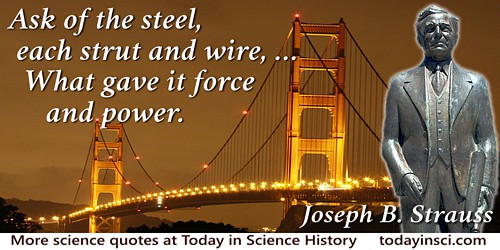
The Mighty Task is Done
At last the mighty task is done;
Resplendent in the western sun
The Bridge looms mountain high;
Its titan piers grip ocean floor,
Its great steel arms link shore with shore,
Its towers pierce the sky.
On its broad decks in rightful pride,
The world in swift parade shall ride,
Throughout all time to be;
Beneath, fleet ships from every port,
Vast landlocked bay, historic fort,
And dwarfing all the sea.
To north, the Redwood Empires gates;
To south, a happy playground waits,
In Rapturous appeal;
Here nature, free since time began,
Yields to the restless moods of man,
Accepts his bonds of steel.
Launched midst a thousand hopes and fears,
Damned by a thousand hostile sneers,
Yet Neer its course was stayed,
But ask of those who met the foe
Who stood alone when faith was low,
Ask them the price they paid.
Ask of the steel, each strut and wire,
Ask of the searching, purging fire,
That marked their natal hour;
Ask of the mind, the hand, the heart,
Ask of each single, stalwart part,
What gave it force and power.
An Honored cause and nobly fought
And that which they so bravely wrought,
Now glorifies their deed,
No selfish urge shall stain its life,
Nor envy, greed, intrigue, nor strife,
Nor false, ignoble creed.
High overhead its lights shall gleam,
Far, far below lifes restless stream,
Unceasingly shall flow;
For this was spun its lithe fine form,
To fear not war, nor time, nor storm,
For Fate had meant it so.
At last the mighty task is done;
Resplendent in the western sun
The Bridge looms mountain high;
Its titan piers grip ocean floor,
Its great steel arms link shore with shore,
Its towers pierce the sky.
On its broad decks in rightful pride,
The world in swift parade shall ride,
Throughout all time to be;
Beneath, fleet ships from every port,
Vast landlocked bay, historic fort,
And dwarfing all the sea.
To north, the Redwood Empires gates;
To south, a happy playground waits,
In Rapturous appeal;
Here nature, free since time began,
Yields to the restless moods of man,
Accepts his bonds of steel.
Launched midst a thousand hopes and fears,
Damned by a thousand hostile sneers,
Yet Neer its course was stayed,
But ask of those who met the foe
Who stood alone when faith was low,
Ask them the price they paid.
Ask of the steel, each strut and wire,
Ask of the searching, purging fire,
That marked their natal hour;
Ask of the mind, the hand, the heart,
Ask of each single, stalwart part,
What gave it force and power.
An Honored cause and nobly fought
And that which they so bravely wrought,
Now glorifies their deed,
No selfish urge shall stain its life,
Nor envy, greed, intrigue, nor strife,
Nor false, ignoble creed.
High overhead its lights shall gleam,
Far, far below lifes restless stream,
Unceasingly shall flow;
For this was spun its lithe fine form,
To fear not war, nor time, nor storm,
For Fate had meant it so.
Written upon completion of the building of the Golden Gate Bridge, May 1937. In Allen Brown, Golden Gate: biography of a Bridge (1965), 229.
[As Chief Scientific Adviser to the British Ministry of Defence] We persist in regarding ourselves as a Great Power, capable of everything and only temporarily handicapped by economic difficulties. We are not a great power and never will be again. We are a great nation, but if we continue to behave like a Great Power we shall soon cease to be a great nation. Let us take warning from the fate of the Great Powers of the past and not burst ourselves with pride (see Aesop’s fable of the frog). (1949)
As quoted by Peter Hennessy, Whitehall (1989), 155.
[Recalling Professor Ira Remsen's remarks (1895) to a group of his graduate students about to go out with their degrees into the world beyond the university:]
He talked to us for an hour on what was ahead of us; cautioned us against giving up the desire to push ahead by continued study and work. He warned us against allowing our present accomplishments to be the high spot in our lives. He urged us not to wait for a brilliant idea before beginning independent research, and emphasized the fact the Lavoisier's first contribution to chemistry was the analysis of a sample of gypsum. He told us that the fields in which the great masters had worked were still fruitful; the ground had only been scratched and the gleaner could be sure of ample reward.
He talked to us for an hour on what was ahead of us; cautioned us against giving up the desire to push ahead by continued study and work. He warned us against allowing our present accomplishments to be the high spot in our lives. He urged us not to wait for a brilliant idea before beginning independent research, and emphasized the fact the Lavoisier's first contribution to chemistry was the analysis of a sample of gypsum. He told us that the fields in which the great masters had worked were still fruitful; the ground had only been scratched and the gleaner could be sure of ample reward.
Quoted in Frederick Hutton Getman, The Life of Ira Remsen (1980), 73.
Astonishing how great the precautions that are needed in these delicate experiments. Patience. Patience.
In Thomas Martin (ed.) Faraday’s Diary: Sept. 6, 1847 - Oct. 17, 1851 (1934), 228. Concerning his efforts (1849), to duplicate certain of Weber’s experiments. In the quote above, italics are added for words underlined in sentence as given 'The Scientific Grammar of Michael Faraday’s Diaries', Part I, 'The Classic of Science', A Classic and a Founder (1937), collected in Rosenstock-Huessy Papers (1981), Vol. 1, 3.
Bernard: Oh, you’re going to zap me with penicillin and pesticides. Spare me that and I’ll spare you the bomb and aerosols. But don’t confuse progress with perfectibility. A great poet is always timely. A great philosopher is an urgent need. There’s no rush for Isaac Newton. We were quite happy with Aristotle’s cosmos. Personally, I preferred it. Fifty-five crystal spheres geared to God’s crankshaft is my idea of a satisfying universe. I can’t think of anything more trivial than the speed of light. Quarks, quasars—big bangs, black holes—who [cares]? How did you people con us out of all that status? All that money? And why are you so pleased with yourselves?
Chloe: Are you against penicillin, Bernard?
Bernard: Don’t feed the animals.
Chloe: Are you against penicillin, Bernard?
Bernard: Don’t feed the animals.
In the play, Acadia (1993), Act 2, Scene 5, 61.
Boss: Dilbert, You have been chosen to design the world’s safest nuclear power plant.
Dilbert: This is the great assignment that any engineer could hope for. I'm flattered by the trust you have in me.
Boss: By “safe” I mean “not near my house.”
Dilbert: This is the great assignment that any engineer could hope for. I'm flattered by the trust you have in me.
Boss: By “safe” I mean “not near my house.”
Dilbert comic strip (18 Feb 2002).
Ce grand ouvrage, toujours plus merveilleux à mesure qu’il est plus connu, nous donne une si grande idée de son ouvrier, que nous en sentons notre esprit accablé d’admiration et de respect.
[The Universe] This great work, always more amazing in proportion as it is better known, raises in us so grand an idea of its Maker, that we find our mind overwhelmed with feelings of wonder and adoration.
[The Universe] This great work, always more amazing in proportion as it is better known, raises in us so grand an idea of its Maker, that we find our mind overwhelmed with feelings of wonder and adoration.
Original French and translation in Craufurd Tait Ramage (ed.) Beautiful Thoughts from French and Italian Authors (1866), 119-120.
Clarke's First Law - Corollary: When, however, the lay public rallies round an idea that is denounced by distinguished but elderly scientists and supports that idea with great fervor and emotion—the distinguished but elderly scientists are then, after all, probably right.
'Asimov's Corollary', Fantasy & Science Fiction (Feb 1977). In collection Quasar, Quasar, Burning Bright (1978), 231.
Die Geschichte der Wissenschaften ist eine grosse Fuge, in der die Stimmen der Völker nach und nach zum Vorschein kommen.
The history of the sciences is a great fugue, in which the voices of the nations come one by one into notice.
The history of the sciences is a great fugue, in which the voices of the nations come one by one into notice.
In James Wood, Dictionary of Quotations from Ancient and Modern, English and Foreign Sources (1893), 64:23.
Drosophila melanogaster Meigen…has in recent years come to be widely used as a laboratory animal, especially in the study of heredity. Its short life-cycle, great productivity, and the ease with which it may be bred have been chiefly responsible for making it so popular for this purpose.
In The North American Species of Drosophila (1921), 1.
Hoc age ['do this'] is the great rule, whether you are serious or merry; whether ... learning science or duty from a folio, or floating on the Thames. Intentions must be gathered from acts.
In James Boswell, The Life of Samuel Johnson (1821), 139.
Ich weiss viel. Ich weiss zu viel. Ich bin ein Quantengreis
I know a great deal. I know too much. I am a quantum ancient.
I know a great deal. I know too much. I am a quantum ancient.
As quoted by Isidor Rabi in interview with Jeremy Bernstein for article, 'Physicist' The New Yorker (1970). Collected in Jeremy Bernstein, 'Rabi: The Modern Age', Experiencing Science (1978), 102. Both the original German and the translation come from Rabi.
Il n'y a qu'un demi-siècle, un orateur chrétien, se défiant des hommes de la science leur disait: 'Arrêtez-vous enfin, et ne creusez pas jusqu'aux enfers.' Aujourd'hui, Messieurs, rassurés sur l'inébranlable constance de notre foi, nous vous disons: creusez, creusez encore; plus vous descendrez, plus vous rapprocherez du grand mystère de l'impuissance de l'homme et de la vérité de la religion. Creusez donc, creusez toujours,mundum tradidit disputationibus eorum; et quand la science aura donné son dernier coup de marteau sur les fondements de la terre, vous pourrez à la lueur du feu qu'il fera jaillir, lire encore l'idée de Dieu et contempler l'empreinte de sa main.
Only a half-century ago, a Christian speaker, mistrustful of men of science told them: 'Stop finally, and do not dig to hell.' Today, gentlemen, reassured about the steadfastness of our unshakeable faith, we say: dig, dig again; the further down you, the closer you come to the great mystery of the impotence of man and truth of religion. So dig, always dig: and when science has stuck its final hammer blow on the bosom of the earth, you will be able to ignite a burst of light, read furthermore the mind of God and contemplate the imprint of His hand.
Only a half-century ago, a Christian speaker, mistrustful of men of science told them: 'Stop finally, and do not dig to hell.' Today, gentlemen, reassured about the steadfastness of our unshakeable faith, we say: dig, dig again; the further down you, the closer you come to the great mystery of the impotence of man and truth of religion. So dig, always dig: and when science has stuck its final hammer blow on the bosom of the earth, you will be able to ignite a burst of light, read furthermore the mind of God and contemplate the imprint of His hand.
As Monseigneur Rendu, Bishop of Annecy, Savoy, presiding at the closing session of a meeting of the Geological Society of France at Chambéry, Savoy (27 Aug 1844). In Bulletin de la Société Géologique de France 1843 à 1844, Tome 1, Ser. 2, 857. (1844), li. Google trans., edited by Webmaster.
L’Astronomie est utile, parce qu’elle nous élève au-dessus de nous-mêmes; elle est utile, parce qu’elle est grande; elle est utile, parce qu’elle est belle… C’est elle qui nous montre combien l’homme est petit par le corps et combien il est grand par l’esprit, puisque cette immensité éclatante où son corps n’est qu’un point obscur, son intelligence peut l’embrasser tout entière et en goûter la silencieuse harmonie.
Astronomy is useful because it raises us above ourselves; it is useful because it is grand[; it is useful because it is beautiful]… It shows us how small is man’s body, how great his mind, since his intelligence can embrace the whole of this dazzling immensity, where his body is only an obscure point, and enjoy its silent harmony.
Astronomy is useful because it raises us above ourselves; it is useful because it is grand[; it is useful because it is beautiful]… It shows us how small is man’s body, how great his mind, since his intelligence can embrace the whole of this dazzling immensity, where his body is only an obscure point, and enjoy its silent harmony.
In La Valeur de la Science (1904), 276, translated by George Bruce Halsted, in The Value of Science (1907), 84. Webmaster added the meaning of “elle est utile, parce qu’elle est belle,” in brackets, which was absent in Halsted’s translation.
Le grand architecte de l'univers l'a construite on bons matériaux.
The Great Architect of the universe built it of good firm stuff.
The Great Architect of the universe built it of good firm stuff.
Journey to the Centre of the Earth, translated by William Butcher (1992)
Les grands ponts étant … des monuments qui peuvent servir à faire connoître la magnificence et le génie d’une nation, on ne sauroit trop s’occuper des moyens d’en perfectionner l’architecture, qui peut d’ailleurs être susceptible de variété, en conservant toujours, dans les formes et la décoration, le caractere de solidité qui lui est propre.
Great bridges being monuments which serve to make known the grandeur and genius of a nation, we cannot pay too much attention to means for perfecting their architecture; this may be varied in treatment, but there must ever be conserved, in form and in decoration, the indispensable character of solidity.
Great bridges being monuments which serve to make known the grandeur and genius of a nation, we cannot pay too much attention to means for perfecting their architecture; this may be varied in treatment, but there must ever be conserved, in form and in decoration, the indispensable character of solidity.
In Description des projets et de la construction des ponts de Neuilli, de Mantes, d'Orléans, de Louis XVI, etc. (1777, New ed. 1788), 630. Translated by D. B. Steinman, as quoted in 'Some Reflections on the architecture of Bridges', Engineering and Contracting (26 Dec 1917), 48, No. 26, 536. Also seen translated as, “A great bridge is a great monument which should serve to make known the splendour and genius of a nation; one should not occupy oneself with efforts to perfect it architecturally, for taste is always susceptible to change, but to conserve always in its form and decoration the character of solidity which is proper.”
Les Leucocytes Et L'esprit De Sacrifice. — Il semble, d'après les recherches de De Bruyne (Phagocytose, 1895) et de ceux qui le citent, que les leucocytes des Lamellibranches — probablement lorsqu'ils ont phagocyté, qu'ils se sont chargés de résidus et de déchets, qu'ils ont, en un mot, accompli leur rôle et bien fait leur devoir — sortent du corps de l'animal et vont mourir dans le milieu ambiant. Ils se sacrifient. Après avoir si bien servi l'organisme par leur activité, ils le servent encore par leur mort en faisant place aux cellules nouvelles, plus jeunes.
N'est-ce pas la parfaite image du désintéressement le plus noble, et n'y a-t-il point là un exemple et un modèle? Il faut s'en inspirer: comme eux, nous sommes les unités d'un grand corps social; comme eux, nous pouvons le servir et envisager la mort avec sérénité, en subordonnant notre conscience individuelle à la conscience collective. (30 Jan 1896)
Leukocytes and The Spirit Of Sacrifice. - It seems, according to research by De Bruyne (Phagocytosis, 1885) and those who quote it, that leukocytes of Lamellibranches [bivalves] - likely when they have phagocytized [ingested bacteria], as they become residues and waste, they have, in short, performed their role well and done their duty - leave the body of the animal and will die in the environment. They sacrifice themselves. Having so well served the body by their activities, they still serve in their death by making room for new younger cells.
Isn't this the perfect image of the noblest selflessness, and thereby presents an example and a model? It should be inspiring: like them, we are the units of a great social body, like them, we can serve and contemplate death with equanimity, subordinating our individual consciousness to collective consciousness.
N'est-ce pas la parfaite image du désintéressement le plus noble, et n'y a-t-il point là un exemple et un modèle? Il faut s'en inspirer: comme eux, nous sommes les unités d'un grand corps social; comme eux, nous pouvons le servir et envisager la mort avec sérénité, en subordonnant notre conscience individuelle à la conscience collective. (30 Jan 1896)
Leukocytes and The Spirit Of Sacrifice. - It seems, according to research by De Bruyne (Phagocytosis, 1885) and those who quote it, that leukocytes of Lamellibranches [bivalves] - likely when they have phagocytized [ingested bacteria], as they become residues and waste, they have, in short, performed their role well and done their duty - leave the body of the animal and will die in the environment. They sacrifice themselves. Having so well served the body by their activities, they still serve in their death by making room for new younger cells.
Isn't this the perfect image of the noblest selflessness, and thereby presents an example and a model? It should be inspiring: like them, we are the units of a great social body, like them, we can serve and contemplate death with equanimity, subordinating our individual consciousness to collective consciousness.
In Recueil d'Œuvres de Léo Errera: Botanique Générale (1908), 194. Google translation by Webmaster. Please give feedback if you can improve it.
Magna opera Domini exquisita in omnes voluntates eius.
The works of the Lord are great; sought out of all those that have pleasure therein.
The works of the Lord are great; sought out of all those that have pleasure therein.
Over the entrance to the Cavendish Laboratory, Cambridge.
Omnes scientiae sunt connexae et fovent auxiliis sicut partes ejusdem totius, quarum quaelibet opus suum peragit non propter se sed pro aliis.
All sciences are connected; they lend each other material aid as parts of one great whole, each doing its own work, not for itself alone, but for the other parts; as the eye guides the body and the foot sustains it and leads it from place to place.
All sciences are connected; they lend each other material aid as parts of one great whole, each doing its own work, not for itself alone, but for the other parts; as the eye guides the body and the foot sustains it and leads it from place to place.
Opus Tertium [1266- 1268], chapter 4, Latin text quoted in J. B. Bury, The Idea of Progress (1920), 355 (footnote to page 25). In J. S. Brewer (ed.), Fr. Rogeri Bacon Opera ... inedita (1859), 18.
Pour accomplir de grandes choses il ne suffit pas d'agir il faut rêver; il ne suffit pas de calculer, il faut croire.
To accomplish great things, we must not only act but also dream, not only plan but also believe.
[Referring to the Suez Canal, initiated by Ferdinand de Lesseps.]
To accomplish great things, we must not only act but also dream, not only plan but also believe.
[Referring to the Suez Canal, initiated by Ferdinand de Lesseps.]
Speech (24 Dec 1896) upon election to the French Academy, in the vacant place of the late Ferdinand de Lesseps, Discours de Réception de M. Anatole France: Séance de l'Académie Française du 24 Décembre 1896 (1897), 21.
Qu. 31. Have not the small Particles of Bodies certain Powers, Virtues or Forces, by which they act at a distance, not only upon the Rays of Light for reflecting, refracting and reflecting them, but also upon one another for producing a great part of the Phænomena of Nature?
From Opticks, (1704, 2nd ed. 1718), Book 3, Query 31, 350.
Responding to the Bishop of Oxford, Samuel Wilberforce's question whether he traced his descent from an ape on his mother's or his father's side:
If then, said I, the question is put to me would I rather have a miserable ape for a grandfather or a man highly endowed by nature and possessing great means and influence and yet who employs those faculties for the mere purpose of introducing ridicule into a grave scientific discussion—I unhesitatingly affirm my preference for the ape.
If then, said I, the question is put to me would I rather have a miserable ape for a grandfather or a man highly endowed by nature and possessing great means and influence and yet who employs those faculties for the mere purpose of introducing ridicule into a grave scientific discussion—I unhesitatingly affirm my preference for the ape.
Letter to Dr. Dyster (9 Sep 1860), Huxley Papers, Imperial College of Science and Technology. Quoted in D.J. Foskett, 'Wilberforce and Huxley on Evolution' in a letter to Nature, 1953, 172, 920.
Third Fisherman: Master, I marvel how the fishes live in the sea.
First Fisherman: Why, as men do a-land; the great ones eat up the little ones: I can compare our rich misers to nothing so fitly as to a whale; a’ plays and tumbles, driving the poor fry before him, and at last devours them all at a mouthful: such whales have I heard on o’ the land, who never leave gaping till they’ve swallowed the whole parish, church, steeple, bells, and all.
First Fisherman: Why, as men do a-land; the great ones eat up the little ones: I can compare our rich misers to nothing so fitly as to a whale; a’ plays and tumbles, driving the poor fry before him, and at last devours them all at a mouthful: such whales have I heard on o’ the land, who never leave gaping till they’ve swallowed the whole parish, church, steeple, bells, and all.
In Pericles (1609), Act 2, Scene 1, line 29-38.
~~[Attributed without source]~~ All scientific men will be delighted to extend their warmest congratulations to Tesla and to express their appreciation of his great contributions to science.
Often seen, virally spread, but always without a source citation. If you can provide a primary source, please contact Webmaster. Until then the quote should be regarded as not authenticated.
~~[Attributed]~~ A great many people think they are thinking when they are merely rearranging their prejudices.
Attributed without citation in Clifton Fadiman, American Treasury, 1455-1955 (1955), 719.
~~[Misattributed - NOT by Jefferson]~~ I am a great believer in Luck. The harder I work, the more of it I seem to have.
This wording of the quote was written down by Coleman Cox in Listen to This (1922), VII. The quote is often seen, despite having no known source, attributed to Thomas Jefferson. Also seen as “I find that the harder I work, the more luck I seem to have.” Historians of Jefferson have stated that neither these words nor variants exist in his written works. Included here to provide it together the notice of misattribution. Also see the Coleman Cox Quotes page on this website.
~~[Misattributed]~~ The greatest enemy of progress is the illusion of knowledge.
This quote is a variant of one often used by author Daniel Boorstin. Seen misattributed to John Young, for example, in article 'International Space Hall of Fame: John W. Young', New Mexico Museum of Space History, nmspacemuseum.org website. See the Daniel Boorstin Quotes page on this website.
1122 … Thereafter there were many sailors on the sea and on inland water who said that they had seen a great and extensive fire near the ground in the northeast which continuously increased in width as it mounted to the sky. And the heavens opened into four parts and fought against it as if determined to put it out, and the fire stopped rising upwards. They saw that fire at the first streak of dawn, and it lasted until full daylight: this happened on 7 December.
From the 'Peterborough Chronicle (Laud Manuscript)', The Anglo-Saxon Chronicle, as translated in The Anglo-Saxon Chronicle, Issue 1624 (1975), 250. The Chronicle is the work of many successive hands at several monasteries across England.
A … difference between most system-building in the social sciences and systems of thought and classification of the natural sciences is to be seen in their evolution. In the natural sciences both theories and descriptive systems grow by adaptation to the increasing knowledge and experience of the scientists. In the social sciences, systems often issue fully formed from the mind of one man. Then they may be much discussed if they attract attention, but progressive adaptive modification as a result of the concerted efforts of great numbers of men is rare.
The Study of Man (1941), 19-20.
A ... hypothesis may be suggested, which supposes the word 'beginning' as applied by Moses in the first of the Book of Genesis, to express an undefined period of time which was antecedent to the last great change that affected the surface of the earth, and to the creation of its present animal and vegetable inhabitants; during which period a long series of operations and revolutions may have been going on, which, as they are wholly unconnected with the history of the human race, are passed over in silence by the sacred historian, whose only concern with them was largely to state, that the matter of the universe is not eternal and self-existent but was originally created by the power of the Almighty.
Vindiciae Geologicae (1820), 31-2.
A cell of a higher organism contains a thousand different substances, arranged in a complex system. This great organized system was not discovered by chemical or physical methods; they are inadequate to its refinement and delicacy and complexity.
'The Cell in Relation to its Environment', Journal of the Maryland Academy of Sciences (1931), 2, 25.
A desire to take medicine is, perhaps, the great feature which distinguishes man from other animals.
'Recent Advances in Medicine', Science (1891), 17, 170.
A discovery in science, or a new theory, even when it appears most unitary and most all-embracing, deals with some immediate element of novelty or paradox within the framework of far vaster, unanalysed, unarticulated reserves of knowledge, experience, faith, and presupposition. Our progress is narrow; it takes a vast world unchallenged and for granted. This is one reason why, however great the novelty or scope of new discovery, we neither can, nor need, rebuild the house of the mind very rapidly. This is one reason why science, for all its revolutions, is conservative. This is why we will have to accept the fact that no one of us really will ever know very much. This is why we shall have to find comfort in the fact that, taken together, we know more and more.
Science and the Common Understanding (1954), 53-4.
A fateful process is set in motion when the individual is released “to the freedom of his own impotence” and left to justify his existence by his own efforts. The autonomous individual, striving to realize himself and prove his worth, has created all that is great in literature, art, music, science and technology. The autonomous individual, also, when he can neither realize himself nor justify his existence by his own efforts, is a breeding call of frustration, and the seed of the convulsions which shake our world to its foundations.
In The Passionate State of Mind (1955), 18.
A few of the results of my activities as a scientist have become embedded in the very texture of the science I tried to serve—this is the immortality that every scientist hopes for. I have enjoyed the privilege, as a university teacher, of being in a position to influence the thought of many hundreds of young people and in them and in their lives I shall continue to live vicariously for a while. All the things I care for will continue for they will be served by those who come after me. I find great pleasure in the thought that those who stand on my shoulders will see much farther than I did in my time. What more could any man want?
In 'The Meaning of Death,' in The Humanist Outlook edited by A. J. Ayer (1968) [See Gerald Holton and Sir Isaac Newton].
A few yes men may be born, but mostly they are made. Fear is a great breeder of them.
In American Magazine (Mar 1920). As cited in The Big Book of Business Quotations (2003), 2.
A great advantage of X-ray analysis as a method of chemical structure analysis is its power to show some totally unexpected and surprising structure with, at the same time, complete certainty.
In 'X-ray Analysis of Complicated Molecules', Nobel Lecture (11 Dec 1964). In Nobel Lectures: Chemistry 1942-1962 (1964), 83.
A great ball of fire about a mile in diameter, changing colors as it kept shooting upward, from deep purple to orange, expanding, growing bigger, rising as it was expanding, an elemental force freed from its bonds after being chained for billions of years.
On the first atomic explosion in New Mexico, 16 Jul 1945.
On the first atomic explosion in New Mexico, 16 Jul 1945.
From 'Drama of the Atomic Bomb Found Climax in July 16 Test', in New York Times (26 Sep 1945). This was the first of a series of articles by Laurence, who was the only civilian witness of the first bomb test. He was on a flight to see the dropping of a bomb on Nagasaki. Laurence, science writer for the NYT, had been requested for service to the War Department to explain the atomic bomb to the lay public.
A great book is a mine as well as a mint: it suggests and excites as much thought as it presents in finished form.
From chapter 'Jottings from a Note-book', in Canadian Stories (1918), 182.
A great deal of my work is just playing with equations and seeing what they give.
Quoted in Frank Wilczek, ',The Dirac Equation'. Proceedings of the Dirac Centennial Symposium (2003), 45.
A great deal of the universe does not need any explanation. Elephants, for instance. Once molecules have learnt to compete and to create other molecules in their own image, elephants, and things resembling elephants, will in due course be found roaming around the countryside ... Some of the things resembling elephants will be men.
The Creation (1981), 3.
A great department of thought must have its own inner life, however transcendent may be the importance of its relations to the outside. No department of science, least of all one requiring so high a degree of mental concentration as Mathematics, can be developed entirely, or even mainly, with a view to applications outside its own range. The increased complexity and specialisation of all branches of knowledge makes it true in the present, however it may have been in former times, that important advances in such a department as Mathematics can be expected only from men who are interested in the subject for its own sake, and who, whilst keeping an open mind for suggestions from outside, allow their thought to range freely in those lines of advance which are indicated by the present state of their subject, untrammelled by any preoccupation as to applications to other departments of science. Even with a view to applications, if Mathematics is to be adequately equipped for the purpose of coping with the intricate problems which will be presented to it in the future by Physics, Chemistry and other branches of physical science, many of these problems probably of a character which we cannot at present forecast, it is essential that Mathematics should be allowed to develop freely on its own lines.
In Presidential Address British Association for the Advancement of Science, Sheffield, Section A,
Nature (1 Sep 1910), 84, 286.
A great discovery solves a great problem, but there is a grain of discovery in the solution of any problem. Your problem may be modest, but if it challenges your curiosity and brings into play your inventive faculties, and if you solve it by your own means, you may experience the tension and enjoy the triumph of discovery.
From Preface to the first printing, reprinted in How to Solve It: A New Aspect of Mathematical Method (2004), v.
A great invention for dieters would be a refrigerator which weighs you every time you open the door.
In E.C. McKenzie, 14,000 Quips and Quotes for Speakers, Writers, Editors, Preachers, and Teachers (1990), 546.
A great man quotes bravely, and will not draw on his invention when his memory serves him with a word as good.
In Lecture, second in a series given at Freeman Place Chapel, Boston (Mar 1859), 'Quotation and Originality', collected in Letters and Social Aims (1875, 1917), 183.
A great man, [who] was convinced that the truths of political and moral science are capable of the same certainty as those that form the system of physical science, even in those branches like astronomy that seem to approximate mathematical certainty.
He cherished this belief, for it led to the consoling hope that humanity would inevitably make progress toward a state of happiness and improved character even as it has already done in its knowledge of the truth.
He cherished this belief, for it led to the consoling hope that humanity would inevitably make progress toward a state of happiness and improved character even as it has already done in its knowledge of the truth.
Describing administrator and economist Anne-Robert-Jacques Turgot in Essai sur l’application de l’analyse à la probabilité des décisions rendues à la pluralité des voix (1785), i. Cited epigraph in Charles Coulston Gillispie, Science and Polity in France: The End of the Old Regime (2004), 3
A great nation is any mob of people which produces at least one honest man a century.
…...
A great part of its [higher arithmetic] theories derives an additional charm from the peculiarity that important propositions, with the impress of simplicity on them, are often easily discovered by induction, and yet are of so profound a character that we cannot find the demonstrations till after many vain attempts; and even then, when we do succeed, it is often by some tedious and artificial process, while the simple methods may long remain concealed.
Quoted in H. Eves, Mathematical Circles (1977) .
A great reform in geological speculation seems now to have become necessary. … It is quite certain that a great mistake has been made—that British popular geology at the present time is in direct opposition to the principles of Natural Philosophy.
From Sir W. Thomson, Address (27 Feb 1868), to the Geological Society of Glasgow, 'On Geological Time', Transactions of the Geological Society of Glasgow 3, collected in Popular Lectures and Addresses (1894), Vol. 2, 10 & 44. As Epigraph in Thomas Henry Huxley, 'Geological Reform' (1869), Collected Essays: Discourses, Biological and Geological (1894), 306.
A great surgeon performs operations for stone by a single method; later he makes a statistical summary of deaths and recoveries, and he concludes from these statistics that the mortality law for this operation is two out of five. Well, I say that this ratio means literally nothing scientifically and gives us no certainty in performing the next operation; for we do not know whether the next case will be among the recoveries or the deaths. What really should be done, instead of gathering facts empirically, is to study them more accurately, each in its special determinism. We must study cases of death with great care and try to discover in them the cause of mortal accidents so as to master the cause and avoid the accidents.
From An Introduction to the Study of Experimental Medicine (1865), as translated by Henry Copley Greene (1957), 137-138. (Note that Bernard overlooks how the statistical method can be useful: a surgeon announcing a mortality rate of 40% invites comparison. A surgeon with worse outcomes should adopt this method. If a surgeon has a better results, that method should be adopted.)
A great swindle of our time is the assumption that science has made religion obsolete. All science has damaged is the story of Adam and Eve and the story of Jonah and the Whale. Everything else holds up pretty well, particularly lessons about fairness and gentleness. People who find those lessons irrelevant in the twentieth century are simply using science as an excuse for greed and harshness. Science has nothing to do with it, friends.
Through the Looking Glass. In Carl Sagan, Broca's Brain (1986), 206.
A great truth is a truth whose opposite is also a great truth.
Essay on Freud (1937). Quoted in Charles W. Misner, Kip S. Thorne and John Archibald Wheeler, Gravitation (1973), 1208.
A grove of giant redwoods or sequoias should be kept just as we keep a great or beautiful cathedral. The extermination of the passenger pigeon meant that mankind was just so much poorer; exactly as in the case of the destruction of the cathedral at Rheims. And to lose the chance to see frigate-birds soaring in circles above the storm, or a file of pelicans winging their way homeward across the crimson afterglow of the sunset, or a myriad terns flashing in the bright light of midday as they hover in a shifting maze above the beach—why, the loss is like the loss of a gallery of the masterpieces of the artists of old time.
In A Book-Lover's Holidays in the Open (1916), 316-317.
A human without a cosmology is like a pebble lying near the top of a great mountain, in contact with its little indentation in the dirt and pebbles immediately surrounding it, but oblivious to its stupendous view.
As co-author with Nancy Ellen Abrams, in The View from the Center of the Universe: Discovering Our Extraordinary Place in the Cosmos (2006), 84.
A hundred years ago, Auguste Compte, … a great philosopher, said that humans will never be able to visit the stars, that we will never know what stars are made out of, that that's the one thing that science will never ever understand, because they're so far away. And then, just a few years later, scientists took starlight, ran it through a prism, looked at the rainbow coming from the starlight, and said: “Hydrogen!” Just a few years after this very rational, very reasonable, very scientific prediction was made, that we'll never know what stars are made of.
Quoted in Nina L. Diamond, Voices of Truth (2000), 332.
A Lady with a Lamp shall stand
In the great history of the land,
A noble type of good,
Heroic womanhood.
In the great history of the land,
A noble type of good,
Heroic womanhood.
'Santa Filomena' (1857), The Poetical Works of Henry Wadsworth Longfellow (1867), 333.
A large number of areas of the brain are involved when viewing equations, but when one looks at a formula rated as beautiful it activates the emotional brain—the medial orbito-frontal cortex—like looking at a great painting or listening to a piece of music. … Neuroscience can’t tell you what beauty is, but if you find it beautiful the medial orbito-frontal cortex is likely to be involved; you can find beauty in anything.
As quoted in James Gallagher, 'Mathematics: Why The Brain Sees Maths As Beauty,' BBC News (13 Feb 2014), on bbc.co.uk web site.
A library … is a great catalyser, accelerating the nutrition and rate of progress in a profession.
Address for the Dedication of the New Building of the Boston Medical Library (12 Jan 1901). Printed as 'Books and Men', The Boston Medical and Surgical Journal (17 Jan 1901), 144, No. 3, 60.
A man loses his fortune; he gains earnestness. His eyesight goes; it leads him to a spirituality... We think we are pushing our own way bravely, but there is a great Hand in ours all the time.
Quoted in Kim Lim (ed.), 1,001 Pearls of Spiritual Wisdom: Words to Enrich, Inspire, and Guide Your Life (2014), 20
A man who writes a great deal and says little that is new writes himself into a daily declining reputation. When he wrote less he stood higher in people’s estimation, even though there was nothing in what he wrote. The reason is that then they still expected better things of him in the future, whereas now they can view the whole progression.
Aphorism 43 in Notebook D (1773-1775), as translated by R.J. Hollingdale in Aphorisms (1990). Reprinted as The Waste Books (2000), 50.
A mathematical truth is timeless, it does not come into being when we discover it. Yet its discovery is a very real event, it may be an emotion like a great gift from a fairy.
In 'Science and Religion', Mind and Matter (1958), collected in What is Life?: With Mind and Matter and Autobiographical Sketches (2012), 142.
A moment’s consideration of this case shows what a really great advance in the theory and practise of breeding has been obtained through the discovery of Mendel’s law. What a puzzle this case would have presented to the biologist ten years ago! Agouti crossed with chocolate gives in the second filial generation (not in the first) four varieties, viz., agouti, chocolate, black and cinnamon. We could only have shaken our heads and looked wise (or skeptical).
Then we had no explanation to offer for such occurrences other than the “instability of color characters under domestication,” the “effects of inbreeding,” “maternal impressions.” Serious consideration would have been given to the proximity of cages containing both black and cinnamon-agouti mice.
Now we have a simple, rational explanation, which anyone can put to the test. We are able to predict the production of new varieties, and to produce them.
We must not, of course, in our exuberance, conclude that the powers of the hybridizer know no limits. The result under consideration consists, after all, only in the making of new combinations of unit characters, but it is much to know that these units exist and that all conceivable combinations of them are ordinarily capable of production. This valuable knowledge we owe to the discoverer and to the rediscoverers of Mendel’s law.
Then we had no explanation to offer for such occurrences other than the “instability of color characters under domestication,” the “effects of inbreeding,” “maternal impressions.” Serious consideration would have been given to the proximity of cages containing both black and cinnamon-agouti mice.
Now we have a simple, rational explanation, which anyone can put to the test. We are able to predict the production of new varieties, and to produce them.
We must not, of course, in our exuberance, conclude that the powers of the hybridizer know no limits. The result under consideration consists, after all, only in the making of new combinations of unit characters, but it is much to know that these units exist and that all conceivable combinations of them are ordinarily capable of production. This valuable knowledge we owe to the discoverer and to the rediscoverers of Mendel’s law.
'New Colour Variety of the Guinea Pig', Science, 1908, 28, 250-252.
A new era of ocean exploration can yield discoveries that will help inform everything from critical medical advances to sustainable forms of energy. Consider that AZT, an early treatment for HIV, is derived from a Caribbean reef sponge, or that a great deal of energy—from offshore wind, to OTEC (ocean thermal energy conservation), to wind and wave energy—is yet untapped in our oceans.
In 'Why Exploring the Ocean is Mankind’s Next Giant Leap', contributed to CNN 'Lightyears Blog' (13 Mar 2012).
A scientist worthy of the name, above all a mathematician, experiences in his work the same impression as an artist; his pleasure is as great and of the same Nature.
…...
A sense of the unknown has always lured mankind and the greatest of the unknowns of today is outer space. The terrors, the joys and the sense of accomplishment are epitomized in the space program.
…...
A society grows great when old men plant trees whose shade they know they shall never sit in.
In recent years, this has been widely quoted and cited as an (ancient?) Greek proverb. Seen, for example in, Violence on Television: Hearings Before the House Committee on Energy and Commerce, Subcommittee on Telecommunications and Finance (1994), 340. Webmaster however has so far found no example of this wording in, say, 19th century quotation collections. Which leaves the authenticity of the citation in question. Variations exist (for example “The beginning of wisdom comes when a person plants trees, the shade under which they know they will never sit.” (1993) or “Thoughtless men might ask why an old man plants a tree when he may never hope to sit in its shade” (1954).) However, the general sentiment has indeed existed for a long time. For example, “He that plants Trees, loves others besides himself,” collected in Thomas Fuller, Gnomologia: Adagies and Proverbs (1731), 91, No. 2248.
A strict materialist believes that everything depends on the motion of matter. He knows the form of the laws of motion though he does not know all their consequences when applied to systems of unknown complexity.
Now one thing in which the materialist (fortified with dynamical knowledge) believes is that if every motion great & small were accurately reversed, and the world left to itself again, everything would happen backwards the fresh water would collect out of the sea and run up the rivers and finally fly up to the clouds in drops which would extract heat from the air and evaporate and afterwards in condensing would shoot out rays of light to the sun and so on. Of course all living things would regrede from the grave to the cradle and we should have a memory of the future but not of the past.
The reason why we do not expect anything of this kind to take place at any time is our experience of irreversible processes, all of one kind, and this leads to the doctrine of a beginning & an end instead of cyclical progression for ever.
Now one thing in which the materialist (fortified with dynamical knowledge) believes is that if every motion great & small were accurately reversed, and the world left to itself again, everything would happen backwards the fresh water would collect out of the sea and run up the rivers and finally fly up to the clouds in drops which would extract heat from the air and evaporate and afterwards in condensing would shoot out rays of light to the sun and so on. Of course all living things would regrede from the grave to the cradle and we should have a memory of the future but not of the past.
The reason why we do not expect anything of this kind to take place at any time is our experience of irreversible processes, all of one kind, and this leads to the doctrine of a beginning & an end instead of cyclical progression for ever.
Letter to Mark Pattison (7 Apr 1868). In P. M. Hannan (ed.), The Scientific Letters and Papers of James Clerk Maxwell (1995), Vol. 2, 1862-1873, 360-1.
A strong feeling of adventure is animating those who are working on bacterial viruses, a feeling that they have a small part in the great drive towards a fundamental problem in biology.
From 'Experiments with Bacterial Viruses (Bacteriophages)', Harvey Lecture (1946), 41, 187. As cited in Robert Olby, The Path of the Double Helix: The Discovery of DNA (1974, 1994), 238.
A student who wishes now-a-days to study geometry by dividing it sharply from analysis, without taking account of the progress which the latter has made and is making, that student no matter how great his genius, will never be a whole geometer. He will not possess those powerful instruments of research which modern analysis puts into the hands of modern geometry. He will remain ignorant of many geometrical results which are to be found, perhaps implicitly, in the writings of the analyst. And not only will he be unable to use them in his own researches, but he will probably toil to discover them himself, and, as happens very often, he will publish them as new, when really he has only rediscovered them.
From 'On Some Recent Tendencies in Geometrical Investigations', Rivista di Matematica (1891), 43. In Bulletin American Mathematical Society (1904), 443.
A study of Disease—of Pestilences methodically prepared and deliberately launched upon man and beast—is certainly being pursued in the laboratories of more than one great country. Blight to destroy crops, Anthrax to slay horses and cattle, Plague to poison not armies but whole districts—such are the lines along which military science is remorselessly advancing.
'Shall We All Commit Suicide?'. Pall Mall (Sep 1924). Reprinted in Thoughts and Adventures (1932), 250.
A subtle thought that is in error may yet give rise to fruitful inquiry that can establish truths of great value.
In Steven D. Price, 1001 Smartest Things Ever Said (2005), 163.
A teacher of mathematics has a great opportunity. If he fills his allotted time with drilling his students in routine operations he kills their interest, hampers their intellectual development, and misuses his opportunity. But if he challenges the curiosity of his students by setting them problems proportionate to their knowledge, and helps them to solve their problems with stimulating questions, he may give them a taste for, and some means of, independent thinking.
In How to Solve It (1948), Preface.
A weak mind is like a microscope, which magnifies trifling things, but cannot receive great ones.
As given in Catherine Sinclair (ed.), The Kaleidoscope of Anecdotes and Aphorisms (1851), 93. More recently quoted as “A weak mind with no common sense magnifies trifling things and cannot receive great ones,” in Pano George Karkanis, Thoughts for Meaningful Life (2008), 96. Also seen with “telescope” instead of “microscope” in Richard Zera, Business Wit & Wisdom (2005), 131.
A weird happening has occurred in the case of a lansquenet named Daniel Burghammer, of the squadron of Captain Burkhard Laymann Zu Liebenau, of the honorable Madrucci Regiment in Piadena, in Italy. When the same was on the point of going to bed one night he complained to his wife, to whom he had been married by the Church seven years ago, that he had great pains in his belly and felt something stirring therein. An hour thereafter he gave birth to a child, a girl. When his wife was made aware of this, she notified the occurrence at once. Thereupon he was examined and questioned. … He confessed on the spot that he was half man and half woman and that for more than seven years he had served as a soldier in Hungary and the Netherlands… . When he was born he was christened as a boy and given in baptism the name of Daniel… . He also stated that while in the Netherlands he only slept once with a Spaniard, and he became pregnant therefrom. This, however, he kept a secret unto himself and also from his wife, with whom he had for seven years lived in wedlock, but he had never been able to get her with child… . The aforesaid soldier is able to suckle the child with his right breast only and not at all on the left side, where he is a man. He has also the natural organs of a man for passing water. Both are well, the child is beautiful, and many towns have already wished to adopt it, which, however, has not as yet been arranged. All this has been set down and described by notaries. It is considered in Italy to be a great miracle, and is to be recorded in the chronicles. The couple, however, are to be divorced by the clergy.
'From Piadena in Italy, the 26th day of May 1601'. As quoted in George Tennyson Matthews (ed.) The Fugger Newsletter (1970), 247-248. A handwritten collection of news reports (1568-1604) by the powerful banking and merchant house of Fugger in Ausburg. This was footnoted in The Story of the Secret Service (1937), 698.
https://books.google.com/books?id=YfssAAAAMAAJ
Richard Wilmer Rowan - 1937
A wrench is a great tool, but don’t try to drive a nail with it.
Above all things, good policy is to be used that the treasure and moneys in a state be not gathered into few hands. For otherwise a state may have a great stock, and yet starve. And money is like muck, not good except it be spread.
'Of Seditions and Troubles' (1625) in James Spedding, Robert Ellis and Douglas Heath (eds.), The Works of Francis Bacon (1887-1901), Vol. 6, 410.
According to the Boshongo people of central Africa, in the beginning, there was only darkness, water, and the great god Bumba. One day Bumba, in pain from a stomach ache, vomited up the sun. The sun dried up some of the water, leaving land. Still in pain, Bumba vomited up the moon, the stars, and then some animals. The leopard, the crocodile, the turtle, and finally, man. This creation myth, like many others, tries to answer the questions we all ask. Why are we here? Where did we come from?
Lecture (1987), 'The Origin of the Universe', collected in Black Holes And Baby Universes And Other Essays (1993), 99.
After … the general experimental knowledge has been acquired, accompanied with just a sufficient amount of theory to connect it together…, it becomes possible to consider the theory by itself, as theory. The experimental facts then go out of sight, in a great measure, not because they are unimportant, but because … they are fundamental, and the foundations are always hidden from view in well-constructed buildings.
In Electromagnetic Theory (1892), Vol. 2, 1.
After a certain high level of technical skill is achieved, science and art tend to coalesce in esthetics, plasticity, and form. The greatest scientists are always artists as well.
Remark (1923) as recalled in Archibald Henderson, Durham Morning Herald (21 Aug 1955) in Einstein Archive 33-257. Quoted in Alice Calaprice, The Quotable Einstein (1996), 171.
Again there is another great and powerful cause why the sciences have made but little progress; which is this. It is not possible to run a course aright when the goal itself has not been rightly placed.
Translation of Novum Organum, LXXXI. In Francis Bacon, James Spedding, The Works of Francis Bacon (1864), Vol. 8, 113.
Against filling the Heavens with fluid Mediums, unless they be exceeding rare, a great Objection arises from the regular and very lasting Motions of the Planets and Comets in all manner of Courses through the Heavens.
From Opticks: Or, A Treatise of the Reflections, Refractions, Inflections and Colours of Light (1718), 339.
Alexander the king of the Macedonians, began like a wretch to learn geometry, that he might know how little the earth was, whereof he had possessed very little. Thus, I say, like a wretch for this, because he was to understand that he did bear a false surname. For who can be great in so small a thing? Those things that were delivered were subtile, and to be learned by diligent attention: not which that mad man could perceive, who sent his thoughts beyond the ocean sea. Teach me, saith he, easy things. To whom his master said: These things be the same, and alike difficult unto all. Think thou that the nature of things saith this. These things whereof thou complainest, they are the same unto all: more easy things can be given unto none; but whosoever will, shall make those things more easy unto himself. How? With uprightness of mind.
In Thomas Lodge (trans.), 'Epistle 91', The Workes of Lucius Annaeus Seneca: Both Morrall and Naturall (1614), 383. Also in Robert Édouard Moritz, Memorabilia Mathematica (1914), 135.
All great achievements in science start from intuitive knowledge, namely, in axioms, from which deductions are then made. … Intuition is the necessary condition for the discovery of such axioms.
In Conversations with Einstein by Alexander Moszkowski (1970).
All great discoveries are made by men whose feelings run ahead of their thinking.
'Sermons. III. Coming to the Truth'. In Anna L. Ward, A Dictionary of Quotations in Prose from American and Foreign Authors (1889), 585, No. 1190
All great scientists have, in a certain sense, been great artists; the man with no imagination may collect facts, but he cannot make great discoveries.
From The Grammar of Science (1892), 37.
All great theorems were discovered after midnight.
In Howard W. Eves Return to Mathematical Circles, (1988), 157.
All great truths begin as blasphemies.
Spoken by the character the Grand Duchess in the play Annajanska, collected in Heartbreak House, Great Catherine, and Playlets of the War (1919), 262.
All human affairs follow nature's great analogue, the growth of vegetation. There are three periods of growth in every plant. The first, and slowest, is the invisible growth by the root; the second and much accelerated is the visible growth by the stem; but when root and stem have gathered their forces, there comes the third period, in which the plant quickly flashes into blossom and rushes into fruit.
The beginnings of moral enterprises in this world are never to be measured by any apparent growth. ... At length comes the sudden ripeness and the full success, and he who is called in at the final moment deems this success his own. He is but the reaper and not the labourer. Other men sowed and tilled and he but enters into their labours.
The beginnings of moral enterprises in this world are never to be measured by any apparent growth. ... At length comes the sudden ripeness and the full success, and he who is called in at the final moment deems this success his own. He is but the reaper and not the labourer. Other men sowed and tilled and he but enters into their labours.
Life Thoughts (1858), 20.
All interpretations made by a scientist are hypotheses, and all hypotheses are tentative. They must forever be tested and they must be revised if found to be unsatisfactory. Hence, a change of mind in a scientist, and particularly in a great scientist, is not only not a sign of weakness but rather evidence for continuing attention to the respective problem and an ability to test the hypothesis again and again.
The Growth of Biological Thought: Diversity, Evolution and Inheritance (1982), 831.
All knowledge attains its ethical value and its human significance only by the human sense with which it is employed. Only a good man can be a great physician.
Inaugural address (1882), quoted in Johann Hermann Baas, Henry Ebenezer Handerson (trans.), Outlines of the History of Medicine and the Medical Profession (1889), 966.
All life is linked together in such a way that no part of the chain is unimportant. Frequently, upon the action of some of these minute beings depends the material success or failure of a great commonwealth.
Insect Life: An Introduction To Nature-Study And A Guide For Teachers (1897), 1.
All living organisms are but leaves on the same tree of life. The various functions of plants and animals and their specialized organs are manifestations of the same living matter. This adapts itself to different jobs and circumstances, but operates on the same basic principles. Muscle contraction is only one of these adaptations. In principle it would not matter whether we studied nerve, kidney or muscle to understand the basic principles of life. In practice, however, it matters a great deal.
'Muscle Research', Scientific American, 1949, 180 (6), 22.
All men who have achieved great things have been great dreamers.
…...
All of us Hellenes tell lies … about those great Gods, the Sun and the Moon… . We say that they, and diverse other stars, do not keep the same path, and we call them planets or wanderers. … Each of them moves in the same path-not in many paths, but in one only, which is circular, and the varieties are only apparent.
— Plato
In Plato and B. Jowett (trans.), The Dialogues of Plato: Laws (3rd ed., 1892), Vol. 5, 204-205.
All revolutionary advances in science may consist less of sudden and dramatic revelations than a series of transformations, of which the revolutionary significance may not be seen (except afterwards, by historians) until the last great step. In many cases the full potentiality and force of a most radical step in such a sequence of transformations may not even be manifest to its author.
The Newtonian Revolution (1980), 162.
All schools, all colleges have two great functions: to confer, and to conceal valuable knowledge.
(5 Nov 1908). 'More Maxims of Mark,' Mark Twain Collected Tales, Sketches, Speeches, & Essays, 1891-1910 (1992), 941. In Mark Twain and Brian Collins (ed.), When in Doubt, Tell the Truth: and Other Quotations from Mark Twain (1996), 43.
All that concerns the Mediterranean is of the deepest interest to civilized man, for the history of its progress is the history of the development of the world; the memory of the great men who have lived and died around its banks; the recollection of the undying works that have come thence to delight us for ever; the story of patient research and brilliant discoveries connected with every physical phenomenon presented by its waves and currents, and with every order of creatures dwelling in and around its waters.
From Literary Papers (1855), 106. As quoted in On Early Explorations in the Mediterranean.In George Wilson and Archibald Geikie, Memoir of Edward Forbes F.R.S. (1861), 279. Geike introduces the Forbes quote as “the recollection of these, his earliest explorations in the Mediterranean,” as written down years later.
All that we can do, is to keep steadily in mind that each organic being is striving to increase at a geometrical ratio; that each at some period of its life, during some season of the year, during each generation or at intervals, has to struggle for life, and to suffer great destruction. When we reflect on this struggle, we may console ourselves with the full belief, that the war of nature is not incessant, that no fear is felt, that death is generally prompt, and that the vigorous, the healthy, and the happy survive and multiply.
From On the Origin of Species by Means of Natural Selection; or, The Preservation of Favoured Races in the Struggle for Life (1861), 76.
All the different classes of beings which taken together make up the universe are, in the ideas of God who knows distinctly their essential gradations, only so many ordinates of a single curve so closely united that it would be impossible to place others between any two of them, since that would imply disorder and imperfection. Thus men are linked with the animals, these with the plants and these with the fossils which in turn merge with those bodies which our senses and our imagination represent to us as absolutely inanimate. And, since the law of continuity requires that when the essential attributes of one being approximate those of another all the properties of the one must likewise gradually approximate those of the other, it is necessary that all the orders of natural beings form but a single chain, in which the various classes, like so many rings, are so closely linked one to another that it is impossible for the senses or the imagination to determine precisely the point at which one ends and the next begins?all the species which, so to say, lie near the borderlands being equivocal, at endowed with characters which might equally well be assigned to either of the neighboring species. Thus there is nothing monstrous in the existence zoophytes, or plant-animals, as Budaeus calls them; on the contrary, it is wholly in keeping with the order of nature that they should exist. And so great is the force of the principle of continuity, to my thinking, that not only should I not be surprised to hear that such beings had been discovered?creatures which in some of their properties, such as nutrition or reproduction, might pass equally well for animals or for plants, and which thus overturn the current laws based upon the supposition of a perfect and absolute separation of the different orders of coexistent beings which fill the universe;?not only, I say, should I not be surprised to hear that they had been discovered, but, in fact, I am convinced that there must be such creatures, and that natural history will perhaps some day become acquainted with them, when it has further studied that infinity of living things whose small size conceals them for ordinary observation and which are hidden in the bowels of the earth and the depth of the sea.
Lettre Prétendue de M. De Leibnitz, à M. Hermann dont M. Koenig a Cité le Fragment (1753), cxi-cxii, trans. in A. O. Lovejoy, Great Chain of Being: A Study of the History of an Idea (1936), 144-5.
All the human culture, all the results of art, science and technology that we see before us today, are almost exclusively the creative product of the Aryan. This very fact admits of the not unfounded inference that he alone was the founder of all higher humanity, therefore representing the prototype of all that we understand by the word 'man.' He is the Prometheus of mankind from whose shining brow the divine spark of genius has sprung at all times, forever kindling anew that fire of knowledge which illuminated the night of silent mysteries and thus caused man to climb the path to mastery over the other beings of the earth ... It was he who laid the foundations and erected the walls of every great structure in human culture.
Mein Kampf (1925-26), American Edition (1943), 290. In William Lawrence Shirer, The Rise and Fall of the Third Reich (1990), 86-87.
All those who think it paradoxical that so great a weight as the earth should not waver or move anywhere seem to me to go astray by making their judgment with an eye to their own affects and not to the property of the whole. For it would not still appear so extraordinary to them, I believe, if they stopped to think that the earth’s magnitude compared to the whole body surrounding it is in the ratio of a point to it. For thus it seems possible for that which is relatively least to be supported and pressed against from all sides equally and at the same angle by that which is absolutely greatest and homogeneous.
— Ptolemy
'The Almagest 1', in Ptolemy: the Almagest; Nicolaus Copernicus: On the Revolutions of the Heavenly Spheres; Johannes Kepler: Epitome of Copernican Astronomy: IV - V The Harmonies of the World: V, trans. R. Catesby Taliaferro (1952), 11.
Always preoccupied with his profound researches, the great Newton showed in the ordinary-affairs of life an absence of mind which has become proverbial. It is related that one day, wishing to find the number of seconds necessary for the boiling of an egg, he perceived, after waiting a minute, that he held the egg in his hand, and had placed his seconds watch (an instrument of great value on account of its mathematical precision) to boil!
This absence of mind reminds one of the mathematician Ampere, who one day, as he was going to his course of lectures, noticed a little pebble on the road; he picked it up, and examined with admiration the mottled veins. All at once the lecture which he ought to be attending to returned to his mind; he drew out his watch; perceiving that the hour approached, he hastily doubled his pace, carefully placed the pebble in his pocket, and threw his watch over the parapet of the Pont des Arts.
This absence of mind reminds one of the mathematician Ampere, who one day, as he was going to his course of lectures, noticed a little pebble on the road; he picked it up, and examined with admiration the mottled veins. All at once the lecture which he ought to be attending to returned to his mind; he drew out his watch; perceiving that the hour approached, he hastily doubled his pace, carefully placed the pebble in his pocket, and threw his watch over the parapet of the Pont des Arts.
Popular Astronomy: a General Description of the Heavens (1884), translated by J. Ellard Gore, (1907), 93.
America has always been greatest when we dared to be great. We can reach for greatness again. We can follow our dreams to distant stars, living and working in space for peaceful, economic, and scientific gain. Tonight, I am directing NASA to develop a permanently manned space station and to do it within a decade.
From State of the Union Address (25 Jan 1984).
Among people I have met, the few whom I would term “great” all share a kind of unquestioned, fierce dedication; an utter lack of doubt about the value of their activities (or at least an internal impulse that drives through any such angst); and above all, a capacity to work (or at least to be mentally alert for unexpected insights) at every available moment of every day of their lives.
From The Lying Stones of Marrakech: Penultimate Reflections in Natural History (2000), 76.
Among the multitude of animals which scamper, fly, burrow and swim around us, man is the only one who is not locked into his environment. His imagination, his reason, his emotional subtlety and toughness, make it possible for him not to accept the environment, but to change it. And that series of inventions, by which man from age to age has remade his environment, is a different kind of evolution—not biological, but cultural evolution. I call that brilliant sequence of cultural peaks The Ascent of Man. I use the word ascent with a precise meaning. Man is distinguished from other animals by his imaginative gifts. He makes plans, inventions, new discoveries, by putting different talents together; and his discoveries become more subtle and penetrating, as he learns to combine his talents in more complex and intimate ways. So the great discoveries of different ages and different cultures, in technique, in science, in the arts, express in their progression a richer and more intricate conjunction of human faculties, an ascending trellis of his gifts.
The Ascent of Man (1973), 19-20.
An author has always great difficulty in avoiding unnecessary and tedious detail on the one hand; while, on the other, he must notice such a number of facts as may convince a student, that he is not wandering in a wilderness of crude hypotheses or unsupported assumptions.
In A Geological Manual (1832), Preface, iii.
An important fact, an ingenious aperçu, occupies a very great number of men, at first only to make acquaintance with it; then to understand it; and afterwards to work it out and carry it further.
In The Maxims and Reflections of Goethe (1906), 189.
An inducement must be offered to those who are engaged in the industrial exploitation of natural sources of power, as waterfalls, by guaranteeing greater returns on the capital invested than they can secure by local development of the property.
In 'The Problem of Increasing Human Energy', Century Illustrated Monthly Magazine (Jun 1900), 210. Collected in My Inventions: And Other Writings (2016), 125.
An old Scotch physician, for whom I had a great respect, and whom I frequently met professionally in the city, used to say, as we were entering the patient's room together, 'Weel, Mister Cooper, we ha' only twa things to keep in meend, and they'll searve us for here and herea'ter; one is always to have the fear of the Laird before our ees; that 'ill do for herea'ter; and t'other is to keep your booels open, and that will do for here.'
'Lecture 3, Treatment of Inflammation', The Lectures of Sir Astley Cooper (1825), Vol. 1, 58.Lectures on surgery, Lect. 3.
An old writer says that there are four sorts of readers: “Sponges which attract all without distinguishing; Howre-glasses which receive and powre out as fast; Bagges which only retain the dregges of the spices and let the wine escape, and Sives which retaine the best onely.” A man wastes a great many years before he reaches the ‘sive’ stage.
Address for the Dedication of the New Building of the Boston Medical Library (12 Jan 1901). Printed as 'Books and Men', The Boston Medical and Surgical Journal (17 Jan 1901), 144, No. 3, 60. [Presumably “Howre-glasses” refers to Hour-glasses. -Webmaster]
An undertaking of great magnitude and importance, the successful accomplishment of which, in so comparatively short a period, notwithstanding the unheard of unestimable difficulties and impediments which had to be encountered and surmounted, in an almost unexplored and uninhabited wilderness … evinced on your part a moral courage and an undaunted spirit and combination of science and management equally exciting our admiration and deserving our praise.
(In recognition of his achievement building the Rideau Canal.)
(In recognition of his achievement building the Rideau Canal.)
— John By
Address by the Montreal Committee of Trade. Quoted in 'John By', University of Toronto Press, Dictionary of Canadian Biography (1966), vol.7, 130.
Analogy is a wonderful, useful and most important form of thinking, and biology is saturated with it. Nothing is worse than a horrible mass of undigested facts, and facts are indigestible unless there is some rhyme or reason to them. The physicist, with his facts, seeks reason; the biologist seeks something very much like rhyme, and rhyme is a kind of analogy.... This analogizing, this fine sweeping ability to see likenesses in the midst of differences is the great glory of biology, but biologists don't know it.... They have always been so fascinated and overawed by the superior prestige of exact physical science that they feel they have to imitate it.... In its central content, biology is not accurate thinking, but accurate observation and imaginative thinking, with great sweeping generalizations.
In Science is a Sacred Cow (1950), 98-100.
Anatomy is the great ocean of intelligence upon which the true physician must sail. Bacteriology is but one little harbor.
In 'Advancement of Surgery', Journal of the American Medical Association (25 Feb 1893), 20, No. 8, 199.
And from this such small difference of eight minutes [of arc] it is clear why Ptolemy, since he was working with bisection [of the linear eccentricity], accepted a fixed equant point… . For Ptolemy set out that he actually did not get below ten minutes [of arc], that is a sixth of a degree, in making observations. To us, on whom Divine benevolence has bestowed the most diligent of observers, Tycho Brahe, from whose observations this eight-minute error of Ptolemy’s in regard to Mars is deduced, it is fitting that we accept with grateful minds this gift from God, and both acknowledge and build upon it. So let us work upon it so as to at last track down the real form of celestial motions (these arguments giving support to our belief that the assumptions are incorrect). This is the path I shall, in my own way, strike out in what follows. For if I thought the eight minutes in [ecliptic] longitude were unimportant, I could make a sufficient correction (by bisecting the [linear] eccentricity) to the hypothesis found in Chapter 16. Now, because they could not be disregarded, these eight minutes alone will lead us along a path to the reform of the whole of Astronomy, and they are the matter for a great part of this work.
Astronomia Nova, New Astronomy (1609), ch. 19, 113-4, Johannes Kepler Gesammelte Werke (1937-), Vol. 3, 177-8.
And God made two great lights, great for their use
To man, the greater to have rule by day, The less by night…
To man, the greater to have rule by day, The less by night…
Paradise Lost: A poem, in Twelve Books (1750), Book 7, 36-37.
And God said, Let there be lights in the firmament of the heavens to separate the day from the night; and let them be for signs and for seasons and for days and years, and let them be lights in the firmament of the heavens to give light upon the earth.” And it was so. And God made the two great lights, the greater light to rule the day, and the lesser light to rule the night; he made the stars also.
— Bible
(circa 725 B.C.)
And since the portions of the great and the small are equal in number, so too all things would be in everything. Nor is it possible that they should exist apart, but all things have a portion of everything.
Simplicius, Commentary on Aristotle’s Physics, 164, 26-8. In G. S. Kirk, J. E. Raven and M. Schofield (eds.), The Presocratic Philosophers: A Critical History with a Selection of Texts (1983) , p. 365-6.
And so the great truth, now a paradox, may become a commonplace, that man is greater than his surroundings, and that the production of a breed of men and women, even in our great cities, less prone to disease, and pain, more noble in aspect, more rational in habits, more exultant in the pure joy of living, is not only scientifically possible, but that even the partial fulfillment of this dream, if dream it be, is the most worthy object towards which the lover of his kind can devote the best energies of his life.
In 'The Breed of Man', The Nineteenth Century, (Oct 1900), 669, as collected in Martin Polley (ed.), The History of Sport in Britain, 1880-1914: Sport, Education, and Improvement (2004), Vol. 2, 181.
And thus Nature will be very conformable to her self and very simple, performing all the great Motions of the heavenly Bodies by the Attraction of Gravity which intercedes those Bodies, and almost all the small ones of their Particles by some other attractive and repelling Powers which intercede the Particles. The Vis inertiae is a passive Principle by which Bodies persist in their Motion or Rest, receive Motion in proportion to the Force impressing it, and resist as much as they are resisted. By this Principle alone there never could have been any Motion in the World. Some other Principle was necessary for putting Bodies into Motion; and now they are in Motion, some other Principle is necessary for conserving the Motion.
From Opticks, (1704, 2nd ed. 1718), Book 3, Query 31, 372-3.
And yet surely to alchemy this right is due, that it may be compared to the husbandman whereof Æsop makes the fable, that when he died he told his sons that he had left unto them gold buried under the ground in his vineyard: and they digged over the ground, gold they found none, but by reason of their stirring and digging the mould about the roots of their vines, they had a great vintage the year following: so assuredly the search and stir to make gold hath brought to light a great number of good and fruitful inventions and experiments, as well for the disclosing of nature as for the use of man's life.
The Advancement of Learning (1605, 1712), Vol. 1, 15.
Another diversity of Methods is according to the subject or matter which is handled; for there is a great difference in delivery of the Mathematics, which are the most abstracted of knowledges, and Policy, which is the most immersed…, yet we see how that opinion, besides the weakness of it, hath been of ill desert towards learning, as that which taketh the way to reduce learning to certain empty and barren generalities; being but the very husks and shells of sciences, all the kernel being forced out and expulsed with the torture and press of the method.
Advancement of Learning, Book 2. In James Spedding, The Works of Francis Bacon (1863), Vol. 6, 292-293. Peter Pešić, explains that 'By Mathematics, he had in mind a sterile and rigid scheme of logical classifications, called dichotomies in his time,' inLabyrinth: A Search for the Hidden Meaning of Science (2001), 73.
Another great and special excellence of mathematics is that it demands earnest voluntary exertion. It is simply impossible for a person to become a good mathematician by the happy accident of having been sent to a good school; this may give him a preparation and a start, but by his own individual efforts alone can he reach an eminent position.
In Conflict of Studies (1873), 2.
Anthropology has been compared to a great region, marked out indeed as within the sphere of influence of science, but unsettled and for the most part unsubdued. Like all such hinterland sciences, it is a happy hunting-ground for adventurers.
Mankind in the Making (1903), 52.
Anton Chekhov wrote that ‘one must not put a loaded rifle on stage if no one is thinking of firing it.’ Good drama requires spare and purposive action, sensible linking of potential causes with realized effects. Life is much messier; nothing happens most of the time. Millions of Americans (many hotheaded) own rifles (many loaded), but the great majority, thank God, do not go off most of the time. We spend most of real life waiting for Godot, not charging once more unto the breach.
…...
Any experiment may be regarded as forming an individual of a 'population' of experiments which might be performed under the same conditions. A series of experiments is a sample drawn from this population.
Now any series of experiments is only of value in so far as it enables us to form a judgment as to the statistical constants of the population to which the experiments belong. In a great number of cases the question finally turns on the value of a mean, either directly, or as the mean difference between the two qualities.
If the number of experiments be very large, we may have precise information as to the value of the mean, but if our sample be small, we have two sources of uncertainty:— (I) owing to the 'error of random sampling' the mean of our series of experiments deviates more or less widely from the mean of the population, and (2) the sample is not sufficiently large to determine what is the law of distribution of individuals.
Now any series of experiments is only of value in so far as it enables us to form a judgment as to the statistical constants of the population to which the experiments belong. In a great number of cases the question finally turns on the value of a mean, either directly, or as the mean difference between the two qualities.
If the number of experiments be very large, we may have precise information as to the value of the mean, but if our sample be small, we have two sources of uncertainty:— (I) owing to the 'error of random sampling' the mean of our series of experiments deviates more or less widely from the mean of the population, and (2) the sample is not sufficiently large to determine what is the law of distribution of individuals.
'The Probable Error of a Mean', Biometrika, 1908, 6, 1.
Any one who has studied the history of science knows that almost every great step therein has been made by the “anticipation of Nature,” that is, by the invention of hypotheses, which, though verifiable, often had very little foundation to start with; and, not unfrequently, in spite of a long career of usefulness, turned out to be wholly erroneous in the long run.
In 'The Progress of Science 1837-1887' (1887), Collected Essays (1901), Vol. 1, 62.
Any opinion as to the form in which the energy of gravitation exists in space is of great importance, and whoever can make his opinion probable will have, made an enormous stride in physical speculation. The apparent universality of gravitation, and the equality of its effects on matter of all kinds are most remarkable facts, hitherto without exception; but they are purely experimental facts, liable to be corrected by a single observed exception. We cannot conceive of matter with negative inertia or mass; but we see no way of accounting for the proportionality of gravitation to mass by any legitimate method of demonstration. If we can see the tails of comets fly off in the direction opposed to the sun with an accelerated velocity, and if we believe these tails to be matter and not optical illusions or mere tracks of vibrating disturbance, then we must admit a force in that direction, and we may establish that it is caused by the sun if it always depends upon his position and distance.
Letter to William Huggins (13 Oct 1868). In P. M. Hannan (ed.), The Scientific Letters and Papers of James Clerk Maxwell (1995), Vol. 2, 1862-1873, 451-2.
Anyone who understands algebraic notation, reads at a glance in an equation results reached arithmetically only with great labour and pains.
From Recherches sur les Principes Mathématiques de la Théorie des Richesses (1838), as translated by Nathaniel T. Bacon in 'Preface', Researches Into Mathematical Principles of the Theory of Wealth (1897), 4. From the original French, “Quiconque connaît la notation algébrique, lit d'un clin-d'œil dans une équation le résultat auquel on parvient péniblement par des règles de fausse position, dans l'arithmétique de Banque.”
Applied research generates improvements, not breakthroughs. Great scientific advances spring from pure research. Even scientists renowned for their “useful” applied discoveries often achieved success only when they abandoned their ostensible applied-science goal and allowed their minds to soar—as when Alexander Fleming, “just playing about,” refrained from throwing away green molds that had ruined his experiment, studied them, and discovered penicillin. Or when C. A. Clarke, a physician affiliated with the University of Liverpool, became intrigued in the 1950s by genetically created color patterns that emerged when he cross-bred butterflies as a hobby. His fascination led him—“by the pleasant route of pursuing idle curiosity”—to the successful idea for preventing the sometimes fatal anemia that threatened babies born of a positive-Rhesus-factor father and a negative-Rhesus-factor mother.
In Jacques Cousteau and Susan Schiefelbein, The Human, the Orchid, and the Octopus: Exploring and Conserving Our Natural World (2007), 214-215.
Applied science, purposeful and determined, and pure science, playful and freely curious, continuously support and stimulate each other. The great nation of the future will be the one which protects the freedom of pure science as much as it encourages applied science.
From a radio talk, collected in Warren Weaver (ed.), The Scientists Speak (1946)
Archimedes … had stated that given the force, any given weight might be moved, and even boasted, we are told, relying on the strength of demonstration, that if there were another earth, by going into it he could remove this. Hiero being struck with amazement at this, and entreating him to make good this problem by actual experiment, and show some great weight moved by a small engine, he fixed accordingly upon a ship of burden out of the king’s arsenal, which could not be drawn out of the dock without great labor and many men; and, loading her with many passengers and a full freight, sitting himself the while far off with no great endeavor, but only holding the head of the pulley in his hand and drawing the cords by degrees, he drew the ship in a straight line, as smoothly and evenly, as if she had been in the sea. The king, astonished at this, and convinced of the power of the art, prevailed upon Archimedes to make him engines accommodated to all the purposes, offensive and defensive, of a siege. … the apparatus was, in most opportune time, ready at hand for the Syracusans, and with it also the engineer himself.
— Plutarch
In John Dryden (trans.), Life of Marcellus.
Architecture has its political Use; publick Buildings being the Ornament of a Country; it establishes a Nation, draws People and Commerce; makes the People love their native Country, which Passion is the Original of all great Actions in a Common-wealth…. Architecture aims at Eternity.
In Charles Henry Bellenden Ker, Sir Christopher Wren (1828), 1.
Aristotle, in spite of his reputation, is full of absurdities. He says that children should be conceived in the Winter, when the wind is in the North, and that if people marry too young the children will be female. He tells us that the blood of females is blacker then that of males; that the pig is the only animal liable to measles; that an elephant suffering from insomnia should have its shoulders rubbed with salt, olive-oil, and warm water; that women have fewer teeth than men, and so on. Nevertheless, he is considered by the great majority of philosophers a paragon of wisdom.
From An Outline of Intellectual Rubbish (1937, 1943), 19. Collected in The Basic Writings of Bertrand Russell (2009), 63.
Art and religion first; then philosophy; lastly science. That is the order of the great subjects of life, that’s their order of importance.
Dialog by the character Miss Brodie, in The Prime of Miss Jean Brodie (1961, 2004), 23-24.
Art and science work in quite different ways: agreed. But, bad as it may sound, I have to admit that I cannot get along as an artist without the use of one or two sciences. ... In my view, the great and complicated things that go on in the world cannot be adequately recognized by people who do not use every possible aid to understanding.
Bertolt Brecht, John Willett (trans.), Brecht on Theatre (1964), 73.
Artificial intelligence is based on the assumption that the mind can be described as some kind of formal system manipulating symbols that stand for things in the world. Thus it doesn't matter what the brain is made of, or what it uses for tokens in the great game of thinking. Using an equivalent set of tokens and rules, we can do thinking with a digital computer, just as we can play chess using cups, salt and pepper shakers, knives, forks, and spoons. Using the right software, one system (the mind) can be mapped onto the other (the computer).
Machinery of the Mind: Inside the New Science of Artificial Intelligence (1986), 250.
Arts and sciences in one and the same century have arrived at great perfection; and no wonder, since every age has a kind of universal genius, which inclines those that live in it to some particular studies; the work then, being pushed on by many hands, must go forward.
In Samuel Austin Allibone, Prose Quotations from Socrates to Macaulay (1880), 45.
As a result of the phenomenally rapid change and growth of physics, the men and women who did their great work one or two generations ago may be our distant predecessors in terms of the state of the field, but they are our close neighbors in terms of time and tastes. This may be an unprecedented state of affairs among professionals; one can perhaps be forgiven if one characterizes it epigrammatically with a disastrously mixed metaphor; in the sciences, we are now uniquely privileged to sit side-by-side with the giants on whose shoulders we stand.
In 'On the Recent Past of Physics', American Journal of Physics (1961), 29, 807.
As an eminent pioneer in the realm of high frequency currents … I congratulate you [Nikola Tesla] on the great successes of your life’s work.
…...
As an investigator [Robert Bunsen] was great, as a teacher he was greater, as a man and friend he was greatest.
Concluding remark in obituary, "Professor Bunsen', Nature, (31 Aug 1899), 60, No. 1557, 425.
As arithmetic and algebra are sciences of great clearness, certainty, and extent, which are immediately conversant about signs, upon the skilful use whereof they entirely depend, so a little attention to them may possibly help us to judge of the progress of the mind in other sciences, which, though differing in nature, design, and object, may yet agree in the general methods of proof and inquiry.
In Alciphron: or the Minute Philosopher, Dialogue 7, collected in The Works of George Berkeley D.D. (1784), Vol. 1, 621.
As buds give rise by growth to fresh buds, and these, if vigorous, branch out and overtop on all sides many a feebler branch, so by generation I believe it has been with the great Tree of Life, which fills with its dead and broken branches the crust of the earth, and covers the surface with its ever branching and beautiful ramifications.
From On the Origin of Species by Means of Natural Selection; or, The Preservation of Favoured Races in the Struggle for Life (1861), 119.
As Crystallography was born of a chance observation by Haüy of the cleavage-planes of a single fortunately fragile specimen, … so out of the slender study of the Norwich Spiral has sprung the vast and interminable Calculus of Cyclodes, which strikes such far-spreading and tenacious roots into the profoundest strata of denumeration, and, by this and the multitudinous and multifarious dependent theories which cluster around it, reminds one of the Scriptural comparison of the Kingdom of Heaven “to a grain of mustard-seed which a man took and cast into his garden, and it grew and waxed a great tree, and the fowls of the air lodged in the branches of it.”
From 'Outline Trace of the Theory of Reducible Cyclodes', Proceedings of the London Mathematical Society (1869), 2, 155, collected in Collected Mathematical Papers of James Joseph Sylvester (1908), Vol. 2, 683-684.
As great Pythagoras of yore,
Standing beside the blacksmith’s door,
And hearing the hammers, as they smote
The anvils with a different note,
Stole from the varying tones, that hung
Vibrant on every iron tongue,
The secret of the sounding wire.
And formed the seven-chorded lyre.
Standing beside the blacksmith’s door,
And hearing the hammers, as they smote
The anvils with a different note,
Stole from the varying tones, that hung
Vibrant on every iron tongue,
The secret of the sounding wire.
And formed the seven-chorded lyre.
From poem 'To A Child' (1847), as collected in The Poetical Works of H.W. Longfellow (1855), 132.
As I stood behind the coffin of my little son the other day, with my mind bent on anything but disputation, the officiating minister read, as part of his duty, the words, 'If the dead rise not again, let us eat and drink, for to-morrow we die.' I cannot tell you how inexpressibly they shocked me. Paul had neither wife nor child, or he must have known that his alternative involved a blasphemy against all that well best and noblest in human nature. I could have laughed with scorn. What! Because I am face to face with irreparable loss, because I have given back to the source from whence it came, the cause of a great happiness, still retaining through all my life the blessings which have sprung and will spring from that cause, I am to renounce my manhood, and, howling, grovel in bestiality? Why, the very apes know better, and if you shoot their young, the poor brutes grieve their grief out and do not immediately seek distraction in a gorge.
Letter to Charles Kingsley (23 Sep 1860). In L. Huxley, The Life and Letters of Thomas Henry Huxley (1903), Vol. 1, 318.
As Karl Marx once noted: “Hegel remarks somewhere that all great, world-historical facts and personages occur, as it were, twice. He forgot to add: the first time as tragedy, the second as farce.” William Jennings Bryan and the Scopes trial was a tragedy. The creationists and intelligent design theorists are a farce.
In '75 Years and Still No Peace'. Humanist (Sep 2000)
As pilgrimages to the shrines of saints draw thousands of English Catholics to the Continent, there may be some persons in the British Islands sufficiently in love with science, not only to revere the memory of its founders, but to wish for a description of the locality and birth-place of a great master of knowledge—John Dalton—who did more for the world’s civilisation than all the reputed saints in Christendom.
In The Worthies of Cumberland (1874), 25.
As pure truth is the polar star of our science [mathematics], so it is the great advantage of our science over others that it awakens more easily the love of truth in our pupils. … If Hegel justly said, “Whoever does not know the works of the ancients, has lived without knowing beauty,” Schellbach responds with equal right, “Who does not know mathematics, and the results of recent scientific investigation, dies without knowing truth.”
From Didaktik und Methodik des Rechnens und der Mathematik (1908), 37. As quoted and translated in J.W.A. Young, Teaching of Mathematics in the Elementary and the Secondary School (1907), 44. From the original German, “Wenn Hegel mit Recht sagt: ‘Wer die Werke der Alten nicht kennt, der hat gelebt, ohne die Schönheit gekannt zu haben’, so erwidert Schellbach mit nicht minderem Recht: ‘Wer die Math. und die Resultate der neueren Naturforschung nicht gekannt hat, der stirbt, ohne die Wahrheit zu kennen.’”
As science is more and more subject to grave misuse as well as to use for human benefit it has also become the scientist's responsibility to become aware of the social relations and applications of his subject, and to exert his influence in such a direction as will result in the best applications of the findings in his own and related fields. Thus he must help in educating the public, in the broad sense, and this means first educating himself, not only in science but in regard to the great issues confronting mankind today.
Message to University Students Studying Science', Kagaku Asahi 11, no. 6 (1951), 28-29. Quoted in Elof Axel Carlson, Genes, Radiation, and Society: The Life and Work of H. J. Muller (1981), 371.
As the issues are greater than men ever sought to realize before, the recriminations will be fiercer and pride more desperately hurt. It may help to recall that many recognized before the bomb ever feel that the time had already come when we must learn to live in One World.
…...
As to the Christian religion, Sir, … there is a balance in its favor from the number of great men who have been convinced of its truth after a serious consideration of the question. Grotius was an acute man, a lawyer, a man accustomed to examine evidence, and he was convinced. Grotius was not a recluse, but a man of the world, who surely had no bias on the side of religion. Sir Isaac Newton set out an infidel, and came to be a very firm believer.
(1763). In George Birkbeck Hill (ed.), Boswell’s Life of Johnson (1799), Vol. 1, 524.
As we conquer peak after peak we see in front of us regions full of interest and beauty, but we do not see our goal, we do not see the horizon; in the distance tower still higher peaks, which will yield to those who ascend them still wider prospects, and deepen the feeling, the truth of which is emphasised by every advance in science, that “Great are the Works of the Lord.”
In Presidential Address to the British Association, as quoted in Arthur L. Foley, 'Recent Developments in Physical Science, The Popular Science Monthly (1910), 456.
As you sit on the hillside, or lie prone under the trees of the forest, or sprawl wet-legged on the
shingly beach of a mountain stream, the great door, that does not look like a door, opens.
The Gentle Art of Tramping (1926), 95.
Ask a follower of Bacon what [science] the new philosophy, as it was called in the time of Charles the Second, has effected for mankind, and his answer is ready; “It has lengthened life; it has mitigated pain; it has extinguished diseases; it has increased the fertility of the soil; it has given new securities to the mariner; it has furnished new arms to the warrior; it has spanned great rivers and estuaries with bridges of form unknown to our fathers; it has guided the thunderbolt innocuously from heaven to earth; it has lighted up the night with the splendour of the day; it has extended the range of the human vision; it has multiplied the power of the human muscles; it has accelerated motion; it has annihilated distance; it has facilitated intercourse, correspondence, all friendly offices, all dispatch of business; it has enabled man to descend to the depths of the sea, to soar into the air, to penetrate securely into the noxious recesses of the earth, to traverse the land in cars which whirl along without horses, to cross the ocean in ships which run ten knots an hour against the wind. These are but a part of its fruits, and of its first-fruits; for it is a philosophy which never rests, which has never attained, which is never perfect. Its law is progress. A point which yesterday was invisible is its goal to-day, and will be its starting-point to-morrow.”
From essay (Jul 1837) on 'Francis Bacon' in Edinburgh Review. In Baron Thomas Babington Macaulay and Lady Trevelyan (ed.) The Works of Lord Macaulay Complete (1871), Vol. 6, 222.
Astronomy has revealed the great truth that the whole universe is bound together by one all-pervading influence.
God's Glory in the Heavens (1862, 3rd Ed. 1867) 327.
At moments of great enthusiasm it seems to me that no one in the world has ever made something this beautiful and important.
As quoted on the website mcescher.com, without citation.
At the Egyptian city of Naucratis there was a famous old god whose name was Theuth; the bird which is called the Ibis was sacred to him, and he was the inventor of many arts, such as arithmetic and calculation and geometry and astronomy and draughts and dice, but his great discovery was the use of letters.
— Plato
In the Phaedrus. Collected in Plato the Teacher (1897), 171. A footnote gives that Naucratis was a city in the Delta of Egypt, on a branch of the Nile.
At the end of 1854 … the aggregate length of railways opened in Great Britain and Ireland at that time measured about 8,054 miles,—about the diameter of the globe, and nearly 500 miles more than
the united lengths of the Thames, the Seine, the Rhone, the Ebro, the Tagus, the Rhine, the Elbe, the Vistula, the Dnieper, and the Danube, or the ten chief rivers of Europe. … the work of only twenty-five years.
From 'Railway System and its Results' (Jan 1856) read to the Institution of Civil Engineers, reprinted in Samuel Smiles, Life of George Stephenson (1857), 511-512.
At the end of the book [Zoonomia] he sums up his [Erasmus Darwin] views in the following sentences: “The world has been evolved, not created: it has arisen little by little from a small beginning, and has increased through the activity of the elemental forces embodied in itself, and so has rather grown than come into being at an almighty word.” “What a sublime idea of the infinite might of the great Architect, the Cause of all causes, the Father of all fathers, the Ens Entium! For if we would compare the Infinite, it would surely require a greater Infinite to cause the causes of effects than to produce the effects themselves.”
[This is a restatement, not a verbatim quote of the original words of Erasmus Darwin, who attributed the idea he summarized to David Hume.]
[This is a restatement, not a verbatim quote of the original words of Erasmus Darwin, who attributed the idea he summarized to David Hume.]
In August Weismann, John Arthur Thomson (trans.), Margaret R. Thomson (trans.) The Evolution Theory (1904), Vol. 1, 17-18. The verbatim form of the quote from Zoonomia, in context, can be seen on the webpage here for Erasmus Darwin. Later authors have quoted from Weismann's translated book, and given the reworded passage as a direct quote by Erasmus Darwin. Webmaster has found a verbatim form in Zoonomia (1794), but has been unable to find the wording used by Weismann in any primary source by Erasmus Darwin. The rewording is perhaps due to the translation of the quote into German for Weismann's original book, Vorträge über Descendenztheorie (1902) followed by another translation for the English edition.
At the entrance to the observatory Stjerneborg located underground, Tycho Brahe built a Ionic portal. On top of this were three sculptured lions. On both sides were inscriptions and on the backside was a longer inscription in gold letters on a porfyr stone: Consecrated to the all-good, great God and Posterity. Tycho Brahe, Son of Otto, who realized that Astronomy, the oldest and most distinguished of all sciences, had indeed been studied for a long time and to a great extent, but still had not obtained sufficient firmness or had been purified of errors, in order to reform it and raise it to perfection, invented and with incredible labour, industry, and expenditure constructed various exact instruments suitable for all kinds of observations of the celestial bodies, and placed them partly in the neighbouring castle of Uraniborg, which was built for the same purpose, partly in these subterranean rooms for a more constant and useful application, and recommending, hallowing, and consecrating this very rare and costly treasure to you, you glorious Posterity, who will live for ever and ever, he, who has both begun and finished everything on this island, after erecting this monument, beseeches and adjures you that in honour of the eternal God, creator of the wonderful clockwork of the heavens, and for the propagation of the divine science and for the celebrity of the fatherland, you will constantly preserve it and not let it decay with old age or any other injury or be removed to any other place or in any way be molested, if for no other reason, at any rate out of reverence to the creator’s eye, which watches over the universe. Greetings to you who read this and act accordingly. Farewell!
(Translated from the original in Latin)
Authority—the fact, namely, that something has already happened or been said or decided, is of great value; but it is only a pedant who demands authority for everything.
In The Maxims and Reflections of Goethe (1906), 188.
Authors have a greater right than any copyright, though it is generally unacknowledged or disregarded. They have a right to the reader’s civility. There are favorable hours for reading a book, as for writing it, and to these the author has a claim. Yet many people think that when they buy a book they buy with it the right to abuse the author.
In 'Table-Talk', The Poetical Works of Henry Wadsworth Longfellow: Volume 3 (1883), 1355.
Babylon the great is fallen, is fallen.
— Bible
(circa 325 A.D.)
Bacon himself was very ignorant of all that had been done by mathematics; and, strange to say, he especially objected to astronomy being handed over to the mathematicians. Leverrier and Adams, calculating an unknown planet into a visible existence by enormous heaps of algebra, furnish the last comment of note on this specimen of the goodness of Bacon’s view… . Mathematics was beginning to be the great instrument of exact inquiry: Bacon threw the science aside, from ignorance, just at the time when his enormous sagacity, applied to knowledge, would have made him see the part it was to play. If Newton had taken Bacon for his master, not he, but somebody else, would have been Newton.
In Budget of Paradoxes (1872), 53-54.
Bacteria represent the world’s greatest success story. They are today and have always been the modal organisms on earth; they cannot be nuked to oblivion and will outlive us all. This time is their time, not the ‘age of mammals’ as our textbooks chauvinistically proclaim. But their price for such success is permanent relegation to a microworld, and they cannot know the joy and pain of consciousness. We live in a universe of trade-offs; complexity and persistence do not work well as partners.
…...
Be not afraid of greatness: some are born great, some achieve greatness, and some have greatness thrust upon them.
…...
Because science flourishes, must poesy decline? The complaint serves but to betray the weakness of the class who urge it. True, in an age like the present,—considerably more scientific than poetical,—science substitutes for the smaller poetry of fiction, the great poetry of truth.
Lecture Second, collected in Popular Geology: A Series of Lectures Read Before the Philosophical Institution of Edinburgh, with Descriptive Sketches from a Geologist's Portfolio (1859), 123.
Because the region of the Celestial World is of so great and such incredible magnitude as aforesaid, and since in what has gone before it was at least generally demonstrated that this comet continued within the limits of the space of the Aether, it seems that the complete explanation of the whole matter is not given unless we are also informed within narrower limits in what part of the widest Aether, and next to which orbs of the Planets [the comet] traces its path, and by what course it accomplishes this.
De Mundi Aetherei Recentioribus Phaenomenis (On Recent Phenomena in the Aetherial World) (1588). Quoted in M. Boas Hall, The Scientific Renaissance 1450-1630 (1962), 115.
Before any great scientific principle receives distinct enunciation by individuals, it dwells more or less clearly in the general scientific mind. The intellectual plateau is already high, and our discoverers are those who, like peaks above the plateau, rise a little above the general level of thought at the time.
In 'Faraday as a Discoverer', The American Journal of Science (Jul 1868), 2nd series,
46, No. 136, 194.
Before his [Sir Astley Cooper’s] time, operations were too often frightful alternatives or hazardous compromises; and they were not seldom considered rather as the resource of despair than as a means of remedy; he always made them follow, as it were, in the natural course of treatment; he gave them a scientific character; and he moreover, succeeded, in a great degree, in divesting them of their terrors, by performing them unostentatiously, simply, confidently, and cheerfully, and thereby inspiring the patient with hope of relief, where previously resignation under misfortune had too often been all that could be expected from the sufferer.
In John Forbes (ed.), British and Foreign Medical Review (Jul 1840), 10, No. 19, 104. In Bransby Blake Cooper, The Life of Sir Astley Cooper (1843), Vol. 2, 37.
Behind every great fortune there is a crime.
The popularized form of a longer original quote. This simplified wording appeared, without quotation marks, tentatively ascribed to Balzac in an essay by James Henry Yoxall,'Regarding a Surcoat', collected in Live and Learn (1925), 116. The quote appears to have evolved over decades from the original statement in French by Balzac, “Le secret des grandes fortunes sans cause apparente est un crime oublié, parce qu’il a été proprement fait,” in 'Le Père Goriot', Revue de Paris (1834), 12, 258. Later translated by Ellen Marriage, as “The secret of a great success for which you are at a loss to account is a crime that has never been found out, because it was properly executed,” in 'Old Goriot' (Le Père Goriot), collected in George Saintsbury (ed.), Comédie Humaine (1896), 124. The website quoteinvestigator.com provides this original, and an extensive description of how the quote evolved over the years after that.
Being perpetually charmed by his familiar siren, that is, by his geometry, he [Archimedes] neglected to eat and drink and took no care of his person; that he was often carried by force to the baths, and when there he would trace geometrical figures in the ashes of the fire, and with his finger draws lines upon his body when it was anointed with oil, being in a state of great ecstasy and divinely possessed by his science.
— Plutarch
As translated in George Finlay Simmons, Calculus Gems: Brief Lives and Memorable Mathematics, (1992), 39.
Bernard Bolzano dispelled the clouds that throughout all the foregone centuries had enveloped the notion of Infinitude in darkness, completely sheared the great term of its vagueness without shearing it of its strength, and thus rendered it forever available for the purposes of logical discourse.
In Lectures on Science, Philosophy and Art (1908), 42.
Beware when the great God lets loose a thinker on this planet. Then all things are at risk. ... There is not a piece of science, but its flank may be turned to-morrow.
From 'Circles', collected in The Complete Works of Ralph Waldo Emerson (1903), 308.
Biographical history, as taught in our public schools, is still largely a history of boneheads: ridiculous kings and queens, paranoid political leaders, compulsive voyagers, ignorant generals—the flotsam and jetsam of historical currents. The men who radically altered history, the great creative scientists and mathematicians, are seldom mentioned if at all.
Opening paragraph of book review, 'Adventures Of a Mathematician: The Man Who Invented the H-Bomb', New York Times (9 May 1976), 201.
Books are fatal: they are the curse of the human race. Nine-tenths of existing books are nonsense, and the clever books are the refutation of that nonsense. The greatest misfortune that ever befell man was the invention of printing.
In Lothair (1879), Chap. 29, 137.
Botany here is but an object of amusement, a great one indeed and in which all our family mingles more or less. mr Randolph is our leader, and a good one. my mind has been so long ingrossed by other objects, that those I loved most have escaped from it, and none more than botany.
Letter (22 Oct 1810) from Jefferson at Monticello to Benjamin Smith Barton.
BRAIN, n. An apparatus with which we think that we think. That which distinguishes the man who is content to be something from the man who wishes to do something. A man of great wealth, or one who has been pitchforked into high station, has commonly such a headful of brain that his neighbors cannot keep their hats on. In our civilization, and under our republican form of government, brain is so highly honored that it is rewarded by exemption from the cares of office.
The Collected Works of Ambrose Bierce (1911), Vol. 7, The Devil's Dictionary, 41.
Büchsel in his reminiscences from the life of a country parson relates that he sought his recreation in Lacroix’s Differential Calculus and thus found intellectual refreshment for his calling. Instances like this make manifest the great advantage which occupation with mathematics affords to one who lives remote from the city and is compelled to forego the pleasures of art. The entrancing charm of mathematics, which captivates every one who devotes himself to it, and which is comparable to the fine frenzy under whose ban the poet completes his work, has ever been incomprehensible to the spectator and has often caused the enthusiastic mathematician to be held in derision. A classic illustration is the example of Archimedes….
From Die Entwickelung der Mathematik im Zusammenhange mit der Ausbreitung der Kultur (1893), 22. As translated in Robert Édouard Moritz, Memorabilia Mathematica; Or, The Philomath’s Quotation-Book (1914), 186. From the original German, “Wenn Büchsel in seinen Erinnerungen aus dem Leben eines Landgeistlichen erzählt, dass er in der Differentialrechnung von Lacroix Erholung gesucht und geistige Erfrischung ftir seinen Beruf gefunden habe, so erkennen wir darin den grossen Vorzug, den die Beschaftigung mit der Mathematik für jemanden hat, der fern von einer Stadt lebt und auf ihre Kunstgenüsse verzichten muss. Der berückende Zauber der
Mathematik, dem jeder unterliegt, der sich ihr ergiebt, und der dem holden Wahnsinn vergleichbar ist, unter dessen Bann der Dichter sein Work vollendet, ist dem betrachtenden Mitmenschen immer unbegreiflich gewesen und hat den begeisterten Mathematiker oft zum Gespött werden lassen. Als klassisches Beispiel wird jedem Schüler Archimedes…”
But among all these many departments of research, these many branches of industry, new and old, which are being rapidly expanded, there is one dominating all others in importance—one which is of the greatest significance for the comfort and welfare, not to say for the existence, of mankind, and that is the electrical transmission of power.
Speech (12 Jan 1897) at a gala inaugurating power service from Niagara Falls to Buffalo, NY. Printed in 'Tesla on Electricity', The Electrical Review (27 Jan 1897), 30, No. 3, 47.
But as my conclusions have lately been much misrepresented, and it has been stated that I attribute the modification of species exclusively to natural selection, I may be permitted to remark that in the first edition of this work, and subsequently, I placed in a most conspicuous position—namely, at the close of the Introduction—the following words: “I am convinced that natural selection has been the main but not the exclusive means of modification.” This has been of no avail. Great is the power of steady misrepresentation; but the history of science shows that fortunately this power does not long endure.
In The Origin of Species by Means of Natural Selection with additions and corrections from sixth and last English edition (1899), Vol. 2, 293.
But I think that in the repeated and almost entire changes of organic types in the successive formations of the earth—in the absence of mammalia in the older, and their very rare appearance (and then in forms entirely. unknown to us) in the newer secondary groups—in the diffusion of warm-blooded quadrupeds (frequently of unknown genera) through the older tertiary systems—in their great abundance (and frequently of known genera) in the upper portions of the same series—and, lastly, in the recent appearance of man on the surface of the earth (now universally admitted—in one word, from all these facts combined, we have a series of proofs the most emphatic and convincing,—that the existing order of nature is not the last of an uninterrupted succession of mere physical events derived from laws now in daily operation: but on the contrary, that the approach to the present system of things has been gradual, and that there has been a progressive development of organic structure subservient to the purposes of life.
'Address to the Geological Society, delivered on the Evening of the 18th of February 1831', Proceedings of the Geological Society (1834), 1, 305-6.
But if the heavens are moved by a daily movement, it is necessary to assume in the principal bodies of the universe and in the heavens two ways of movement which are contrary to each other: one from east to west and the other from west to east, as has often been said. And with this, it is proper to assume an excessively great speed, for anyone who reckons and considers well the height of distance of the heavens and the magnitude of these and of their circuit, if such a circuit were made in a day, could not imagine or conceive how marvelously and excessively swift would be the movement of the heavens, and how unbelievable and unthinkable.
In Isaac Asimov and Jason A. Shulman (eds.), Isaac Asimov’s Book of Science and Nature Quotations (1988), 329. Webmaster so far has been unable to locate the primary source (can you help?)
But it is precisely mathematics, and the pure science generally, from which the general educated public and independent students have been debarred, and into which they have only rarely attained more than a very meagre insight. The reason of this is twofold. In the first place, the ascendant and consecutive character of mathematical knowledge renders its results absolutely insusceptible of presentation to persons who are unacquainted with what has gone before, and so necessitates on the part of its devotees a thorough and patient exploration of the field from the very beginning, as distinguished from those sciences which may, so to speak, be begun at the end, and which are consequently cultivated with the greatest zeal. The second reason is that, partly through the exigencies of academic instruction, but mainly through the martinet traditions of antiquity and the influence of mediaeval logic-mongers, the great bulk of the elementary text-books of mathematics have unconsciously assumed a very repellant form,—something similar to what is termed in the theory of protective mimicry in biology “the terrifying form.” And it is mainly to this formidableness and touch-me-not character of exterior, concealing withal a harmless body, that the undue neglect of typical mathematical studies is to be attributed.
In Editor’s Preface to Augustus De Morgan and Thomas J. McCormack (ed.), Elementary Illustrations of the Differential and Integral Calculus (1899), v.
But notwithstanding these Arguments are so convictive and demonstrative, its marvellous to see how some Popish Authors (Jesuites especially) strain their wits to defend their Pagan Master Aristotle his Principles. Bullialdus speaks of a Florentine Physitian, that all the Friends he had could ever perswade him once to view the Heavens through a Telescope, and he gave that reason for his refusal, because he was afraid that then his Eyes would make him stagger concerning the truth of Aristotle’s Principles, which he was resolved he would not call into question. It were well, if these Men had as great veneration for the Scripture as they have, for Aristotles (if indeed they be his) absurd Books de cælo Sed de his satis.
(Indicating a belief that the Roman Catholic church impeded the development of modern science.)
(Indicating a belief that the Roman Catholic church impeded the development of modern science.)
Kometographia, Or a Discourse Concerning Comets (Boston 1684). Quoted in Michael Garibaldi Hall, The Last American Puritan: The Life of Increase Mather, 1639-1723 (1988), 167.
But science is the great instrument of social change, all the greater because its object is not change but knowledge, and its silent appropriation of this dominant function, amid the din of political and religious strife, is the most vital of all the revolutions which have marked the development of modern civilisation.
Decadence: Henry Sidgwick Memorial Lecture (1908), 55-6.
But that which will excite the greatest astonishment by far, and which indeed especially moved me to call the attention of all astronomers and philosophers, is this: namely, that I have observed four planets, neither known nor observed by any one of the astronomers before my time, which have their orbits round a certain bright star [Jupiter], one of those previously known, like Venus or Mercury round the sun, and are sometimes in front of it, sometimes behind it, though they never depart from it beyond certain limits. All of which facts were discovered and observed a few days ago by the help of a telescope devised by me, through God’s grace first enlightening my mind.
In pamphlet, The Sidereal Messenger (1610), reprinted in The Sidereal Messenger of Galileo Galilei: And a Part of the Preface to the Preface to Kepler's Dioptrics Containing the Original Account of Galileo's Astronomical Discoveries (1880), 9.
But the idea of science and systematic knowledge is wanting to our whole instruction alike, and not only to that of our business class ... In nothing do England and the Continent at the present moment more strikingly differ than in the prominence which is now given to the idea of science there, and the neglect in which this idea still lies here; a neglect so great that we hardly even know the use of the word science in its strict sense, and only employ it in a secondary and incorrect sense.
Schools and Universities on the Continent (1868),278-9.
But we shall not satisfy ourselves simply with improving steam and explosive engines or inventing new batteries; we have something much better to work for, a greater task to fulfill. We have to evolve means for obtaining energy from stores which are forever inexhaustible, to perfect methods which do not imply consumption and waste of any material whatever.
Speech (12 Jan 1897) at a gala inaugurating power service from Niagara Falls to Buffalo, NY. Printed in 'Tesla on Electricity', The Electrical Review (27 Jan 1897), 30, No. 3, 47.
But when great and ingenious artists behold their so inept performances, not undeservedly do they ridicule the blindness of such men; since sane judgment abhors nothing so much as a picture perpetrated with no technical knowledge, although with plenty of care and diligence. Now the sole reason why painters of this sort are not aware of their own error is that they have not learnt Geometry, without which no one can either be or become an absolute artist; but the blame for this should be laid upon their masters, who are themselves ignorant of this art.
In The Art of Measurement (1525). As quoted in Albrecht Dürer and R.T. Nichol (trans.), 'Preface', Of the Just Shaping of Letters (1965), Book 3, 1-2.
But when we face the great questions about gravitation Does it require time? Is it polar to the 'outside of the universe' or to anything? Has it any reference to electricity? or does it stand on the very foundation of matter–mass or inertia? then we feel the need of tests, whether they be comets or nebulae or laboratory experiments or bold questions as to the truth of received opinions.
Letter to Michael Faraday, 9 Nov 1857. In P. M. Harman (ed.), The Scientific Letters and Papers of James Clerk Maxwell (1990), Vol. 1, 1846-1862, 551-2.
But, because my private lectures and domestic pupils are a great hinderance and interruption of my studies, I wish to live entirely exempt from the former, and in great measure from the latter. … in short, I should wish to gain my bread from my writings.
Reply upon being offered a professorship. Quoted in John Elliot Drinkwater Bethune, Life of Galileo Galilei (1832), 63.
By destroying the biological character of phenomena, the use of averages in physiology and medicine usually gives only apparent accuracy to the results. From our point of view, we may distinguish between several kinds of averages: physical averages, chemical averages and physiological and pathological averages. If, for instance, we observe the number of pulsations and the degree of blood pressure by means of the oscillations of a manometer throughout one day, and if we take the average of all our figures to get the true or average blood pressure and to learn the true or average number of pulsations, we shall simply have wrong numbers. In fact, the pulse decreases in number and intensity when we are fasting and increases during digestion or under different influences of movement and rest; all the biological characteristics of the phenomenon disappear in the average. Chemical averages are also often used. If we collect a man's urine during twenty-four hours and mix all this urine to analyze the average, we get an analysis of a urine which simply does not exist; for urine, when fasting, is different from urine during digestion. A startling instance of this kind was invented by a physiologist who took urine from a railroad station urinal where people of all nations passed, and who believed he could thus present an analysis of average European urine! Aside from physical and chemical, there are physiological averages, or what we might call average descriptions of phenomena, which are even more false. Let me assume that a physician collects a great many individual observations of a disease and that he makes an average description of symptoms observed in the individual cases; he will thus have a description that will never be matched in nature. So in physiology, we must never make average descriptions of experiments, because the true relations of phenomena disappear in the average; when dealing with complex and variable experiments, we must study their various circumstances, and then present our most perfect experiment as a type, which, however, still stands for true facts. In the cases just considered, averages must therefore be rejected, because they confuse, while aiming to unify, and distort while aiming to simplify. Averages are applicable only to reducing very slightly varying numerical data about clearly defined and absolutely simple cases.
From An Introduction to the Study of Experimental Medicine (1865), as translated by Henry Copley Greene (1957), 134-135.
By firm immutable immortal laws Impress’d on Nature by the GREAT FIRST CAUSE,
Say, MUSE! how rose from elemental strife
Organic forms, and kindled into life;
How Love and Sympathy with potent charm
Warm the cold heart, the lifted hand disarm;
Allure with pleasures, and alarm with pains,
And bind Society in golden chains.
Say, MUSE! how rose from elemental strife
Organic forms, and kindled into life;
How Love and Sympathy with potent charm
Warm the cold heart, the lifted hand disarm;
Allure with pleasures, and alarm with pains,
And bind Society in golden chains.
From 'Production of Life', The Temple of Nature; or, The Origin of Society: A Poem, with Philosophical Notes (1803), 3, Canto I, lines 1-8.
By profession a biologist, [Thomas Henry Huxley] covered in fact the whole field of the exact sciences, and then bulged through its four fences. Absolutely nothing was uninteresting to him. His curiosity ranged from music to theology and from philosophy to history. He didn't simply know something about everything; he knew a great deal about everything.
'Thomas Henry Huxley.' In the Baltimore Evening Sun (4 May 1925). Reprinted in A Second Mencken Chrestomathy: A New Selection from the Writings of America's Legendary Editor, Critic, and Wit (2006), 157.
By research in pure science I mean research made without any idea of application to industrial matters but solely with the view of extending our knowledge of the Laws of Nature. I will give just one example of the ‘utility’ of this kind of research, one that has been brought into great prominence by the War—I mean the use of X-rays in surgery. Now, not to speak of what is beyond money value, the saving of pain, or, it may be, the life of the wounded, and of bitter grief to those who loved them, the benefit which the state has derived from the restoration of so many to life and limb, able to render services which would otherwise have been lost, is almost incalculable. Now, how was this method discovered? It was not the result of a research in applied science starting to find an improved method of locating bullet wounds. This might have led to improved probes, but we cannot imagine it leading to the discovery of X-rays. No, this method is due to an investigation in pure science, made with the object of discovering what is the nature of Electricity. The experiments which led to this discovery seemed to be as remote from ‘humanistic interest’ —to use a much misappropriated word—as anything that could well be imagined. The apparatus consisted of glass vessels from which the last drops of air had been sucked, and which emitted a weird greenish light when stimulated by formidable looking instruments called induction coils. Near by, perhaps, were great coils of wire and iron built up into electro-magnets. I know well the impression it made on the average spectator, for I have been occupied in experiments of this kind nearly all my life, notwithstanding the advice, given in perfect good faith, by non-scientific visitors to the laboratory, to put that aside and spend my time on something useful.
In Speech made on behalf of a delegation from the Conjoint Board of Scientific Studies in 1916 to Lord Crewe, then Lord President of the Council. In George Paget Thomson, J. J. Thomson and the Cavendish Laboratory in His Day (1965), 167-8.
By these pleasures it is permitted to relax the mind with play, in turmoils of the mind, or when our labors are light, or in great tension, or as a method of passing the time. A reliable witness is Cicero, when he says (De Oratore, 2): 'men who are accustomed to hard daily toil, when by reason of the weather they are kept from their work, betake themselves to playing with a ball, or with knucklebones or with dice, or they may also contrive for themselves some new game at their leisure.'
The Book of Games of Chance (1663), final sentences, trans. Sydney Henry Gould. In Oysten Ore, The Gambling Scholar (1953), 241.
Can it be that all great scientists of the past were really playing a game, a game in which the rules are written not by man but by God? . . . When we play we do not ask why we are playing—we just play. Play serves no moral code except that strange code which for some unknown reason, imposes itself on the play. . . . You will search in vain through scientific literature for hints of motivation. And as for the strange moral code observed by scientists, what could be stranger than an abstract regard for truth in a world which is full of concealment, deception, and taboos…? . . . In submitting to your consideration the idea that the human is at its best when playing, I am myself playing, and that makes me feel that what I am saying may have in it an element of truth.
From Lecture (28 Nov 1957) in the Queen’s University, Belfast, 'Is the Study of its History a Brake on the Progress of Science', printed in Hermethena (1958), 19, 40-41.
Cavendish was a great Man with extraordinary singularities—His voice was squeaking his manner nervous He was afraid of strangers & seemed when embarrassed to articulate with difficulty—He wore the costume of our grandfathers. Was enormously rich but made no use of his wealth... He Cavendish lived latterly the life of a solitary, came to the Club dinner & to the Royal Society: but received nobody at his home. He was acute sagacious & profound & I think the most accomplished British Philosopher of his time.
Quoted in J. Z. Fullmer, 'Davy's Sketches of his Contemporaries', Chymia, 1967, 12, 133.
Cayley was singularly learned in the work of other men, and catholic in his range of knowledge. Yet he did not read a memoir completely through: his custom was to read only so much as would enable him to grasp the meaning of the symbols and understand its scope. The main result would then become to him a subject of investigation: he would establish it (or test it) by algebraic analysis and, not infrequently, develop it so to obtain other results. This faculty of grasping and testing rapidly the work of others, together with his great knowledge, made him an invaluable referee; his services in this capacity were used through a long series of years by a number of societies to which he was almost in the position of standing mathematical advisor.
In Proceedings of London Royal Society (1895), 58, 11-12.
Changes That Have Occurred in the Globe: When we have seen with our own eyes a mountain progressing into a plain; that is to say, an immense boulder separating from this mountain and covering the fields; an entire castle broken into pieces over the ground; a river swallowed up which then bursts out from its abyss; clear marks of a vast amount of water having once flooded regions now inhabited, and a hundred vestiges of other transformations, then we are much more willing to believe that great changes altered the face of the earth, than a Parisian lady who knows only that the place where her house was built was once a cultivated field. However, a lady from Naples who has seen the buried ruins of Herculaneum, is much less subject to the bias which leads us to believe that everything has always been as it is today.
From article 'Changements arrivées dans le globe', in Dictionnaire philosophique (1764), collected in Œuvres Complètes de Voltaire (1878), Vol. 2, 427-428. Translated by Ian Ellis, from the original French: “Changements arrivées dans le globe: Quand on a vu de ses yeux une montagne s’avancer dans une plaine, c’est-à-dire un immense rocher de cette montagne se détacher et couvrir des champs, un château tout entier enfoncé dans la terre, un fleuve englouti qui sort ensuite de son abîme, des marques indubitables qu’un vaste amas d’eau inondait autrefois un pays habité aujourd’hui, et cent vestiges d’autres révolutions, on est alors plus disposé à croire les grands changements qui ont altéré la face du monde, que ne l’est une dame de Paris qui sait seulement que la place où est bâtie sa maison était autrefois un champ labourable. Mais une dame de Naples, qui a vu sous terre les ruines d’Herculanum, est encore moins asservie au préjugé qui nous fait croire que tout a toujours été comme il est aujourd’hui.”
Chemistry is an art that has furnished the world with a great number of useful facts, and has thereby contributed to the improvement of many arts; but these facts lie scattered in many different books, involved in obscure terms, mixed with many falsehoods, and joined to a great deal of false philosophy; so that it is not great wonder that chemistry has not been so much studied as might have been expected with regard to so useful a branch of knowledge, and that many professors are themselves but very superficially acquainted with it. But it was particularly to be expected, that, since it has been taught in universities, the difficulties in this study should have been in some measure removed, that the art should have been put into form, and a system of it attempted—the scattered facts collected and arranged in a proper order. But this has not yet been done; chemistry has not yet been taught but upon a very narrow plan. The teachers of it have still confined themselves to the purposes of pharmacy and medicine, and that comprehends a small branch of chemistry; and even that, by being a single branch, could not by itself be tolerably explained.
John Thomson, An Account of the Life, Lectures and Writings of William Cullen, M.D. (1832), Vol. 1, 40.
Chemistry works with an enormous number of substances, but cares only for some few of their properties; it is an extensive science. Physics on the other hand works with rather few substances, such as mercury, water, alcohol, glass, air, but analyses the experimental results very thoroughly; it is an intensive science. Physical chemistry is the child of these two sciences; it has inherited the extensive character from chemistry. Upon this depends its all-embracing feature, which has attracted so great admiration. But on the other hand it has its profound quantitative character from the science of physics.
In Theories of Solutions (1912), xix.
CHESS. Symbol of military tactics. All great generals good at chess. Too serious as a game, too pointless as a science.
In The Dictionary of Accepted Ideas (1881), trans. Jaques Barzun (1968), 23.
Chief Seattle, of the Indians that inhabited the Seattle area, wrote a wonderful paper that has to do with putting oneself in tune with the universe. He said, “Why should I lament the disappearance of my people! All things end, and the white man will find this out also.” And this goes for the universe. One can be at peace with that. This doesn’t mean that one shouldn’t participate in efforts to correct the situation. But underlying the effort to change must be an “at peace.” To win a dog sled race is great. To lose is okay too.
In Diane K. Osbon (ed.), A Joseph Campbell Companion: Reflections on the Art of Living (Collected Works of Joseph Campbell) (1991, 1995), 98-99.
Civilized people can talk about anything. For them no subject is taboo…. In civilized societies there will be no intellectual bogeys at sight of which great grown-up babies are expected to hide their eyes
In Civilization: An Essay (1928), 138.
Clarity about the aims and problems of socialism is of greatest significance in our age of transition. Since, under present circumstances, free and unhindered discussion of these problems has come under a powerful taboo, I consider the foundation of this magazine to be an important public service.
…...
Clean water is a great example of something that depends on energy. And if you solve the water problem, you solve the food problem.
In Lecture (2003) at the National Renewable Energy Laboratories in Golden, Colorado, as quoted in obituary, Barnaby J. Feder, 'Richard E. Smalley, 62, Dies; Chemistry Nobel Winner:', New York Times (29 Oct 2005), Late Edition (East Coast), C16.
Computers are fantastic. In a few moments they can make a mistake so great that it would take many men many months to equal it.
As quoted, without citation, in Laurence J. Peter, The Peter Prescription: How to be Creative, Confident & Competent (1972).
Concerning the alchemist, Mamugnano, no one harbors doubts any longer about his daily experiments in changing quicksilver into gold. It was realized that his craft did not go beyond one pound of quicksilver… . Thus the belief is now held that his allegations to produce a number of millions have been a great fraud.
'Further Successes by Bragadini. From Vienna on the 26th day of January 1590'. As quoted in George Tennyson Matthews (ed.) News and Rumor in Renaissance Europe: The Fugger Newsletters (1959), 179. A handwritten collection of news reports (1568-1604) by the powerful banking and merchant house of Fugger in Ausburg.
Conservation is the foresighted utilization, preservation. And/or renewal of forest, waters, lands and minerals, for the greatest good of the greatest number for the longest time.
In Breaking New Ground (1947, 1998), 505.
Consider now the Milky Way. Here also we see an innumerable dust, only the grains of this dust are no longer atoms but stars; these grains also move with great velocities, they act at a distance one upon another, but this action is so slight at great distances that their trajectories are rectilineal; nevertheless, from time to time, two of them may come near enough together to be deviated from their course, like a comet that passed too close to Jupiter. In a word, in the eyes of a giant, to whom our Suns were what our atoms are to us, the Milky Way would only look like a bubble of gas.
Science and Method (1908), trans. Francis Maitland (1914), 254-5.
Could the waters of the Atlantic be drawn off so as to expose to view this great seagash which separates continents, and extends from the Arctic to the Antarctic, it would present a scene the most rugged, grand and imposing. The very ribs of the solid earth, with the foundations of the sea, would be brought to light.
(1860)
Cuvier had even in his address & manner the character of a superior Man, much general power & eloquence in conversation & great variety of information on scientific as well as popular subjects. I should say of him that he is the most distinguished man of talents I have ever known on the continent: but I doubt if He be entitled to the appellation of a Man of Genius.
J. Z. Fullmer, 'Davy's Sketches of his Contemporaries', Chymia, 1967, 12, 132.
Da Vinci was as great a mechanic and inventor as were Newton and his friends. Yet a glance at his notebooks shows us that what fascinated him about nature was its variety, its infinite adaptability, the fitness and the individuality of all its parts. By contrast what made astronomy a pleasure to Newton was its unity, its singleness, its model of a nature in which the diversified parts were mere disguises for the same blank atoms.
From The Common Sense of Science (1951), 25.
Daniel Bernoulli used to tell two little adventures, which he said had given him more pleasure than all the other honours he had received. Travelling with a learned stranger, who, being pleased with his conversation, asked his name; “I am Daniel Bernoulli,” answered he with great modesty; “and I,” said the stranger (who thought he meant to laugh at him) “am Isaac Newton.” Another time, having to dine with the celebrated Koenig, the mathematician, who boasted, with some degree of self-complacency, of a difficult problem he had solved with much trouble, Bernoulli went on doing the honours of his table, and when they went to drink coffee he presented Koenig with a solution of the problem more elegant than his own.
In A Philosophical and Mathematical Dictionary (1815), 1, 226.
Dear Mr. Bell: … Sir Wm. Thomson … speaks with much enthusiasm of your achievement. What yesterday he would have declared impossible he has today seen realized, and he declares it the most wonderful thing he has seen in America. You speak of it as an embryo invention, but to him it seems already complete, and he declares that, before long, friends will whisper their secrets over the electric wire. Your undulating current he declares a great and happy conception.
Letter to Alexander Graham Bell (25 Jun 1876). Quoted in Alexander Graham Bell, The Bell Telephone: The Deposition of Alexander Graham Bell, in the Suit Brought by the United States to Annul the Bell Patents (1908), 101. Note: William Thomson is better known as Lord Kelvin.
Deaths, births, and marriages, considering how much they are separately dependent on the freedom of the human will, should seem to be subject to no law according to which any calculation could be made beforehand of their amount; and yet the yearly registers of these events in great countries prove that they go on with as much conformity to the laws of nature as the oscillations of the weather.
'Idea of a Universal history on a Cosmo-Political Plan' (1784). As translated by Thomas De Quinsey in The London Magazine (Oct 1824), 10, 385. Reprinted in 1859 by De Quincey in Vol. 8 of his Collective Edition of his writings.
Despite the dazzling successes of modern technology and the unprecedented power of modern military systems, they suffer from a common and catastrophic fault. While providing us with a bountiful supply of food, with great industrial plants, with high-speed transportation, and with military weapons of unprecedented power, they threaten our very survival.
In Science and Survival (1966).
Development of Western science is based on two great achievements: the invention of the formal logical system (in Euclidean geometry) by the Greek philosophers, and the discovery of the possibility to find out causal relationships by systematic experiment (during the Renaissance). In my opinion, one has not to be astonished that the Chinese sages have not made these steps. The astonishing thing is that these discoveries were made at all.
Letter to J. S. Switzer, 23 Apr 1953, Einstein Archive 61-381. Quoted in Alice Calaprice, The Quotable Einstein (1996), 180.
Diamond, for all its great beauty, is not nearly as interesting as the hexagonal plane of graphite. It is not nearly as interesting because we live in a three-dimensional space, and in diamond each atom is surrounded in all three directions in space by a full coordination. Consequently, it is very difficult for an atom inside the diamond lattice to be confronted with anything else in this 3D world because all directions are already taken up.
From Nobel Lecture (7 Dec 1996), 'Discovering the Fullerenes', collected in Ingmar Grenthe (ed.), Nobel Lectures, Chemistry 1996-2000 (2003).
Disinterestedness is as great a puzzle and paradox as ever. Indeed, strictly speaking, it is a species of irrationality, or insanity, as regards the individual’s self; a contradiction of the most essential nature of a sentient being, which is to move to pleasure and from pain.
In On the Study of Character: Including an Estimate of Phrenology (1861), 202.
Do not expect to be hailed as a hero when you make your great discovery. More likely you will be a ratbag—maybe failed by your examiners. Your statistics, or your observations, or your literature study, or your something else will be patently deficient. Do not doubt that in our enlightened age the really important advances are and will be rejected more often than acclaimed. Nor should we doubt that in our own professional lifetime we too will repudiate with like pontifical finality the most significant insight ever to reach our desk.
Theories of the Earth and Universe (1988), 365.
Do not great Bodies conserve their heat the longest, their parts heating one another, and may not great dense and fix'd Bodies, when heated beyond a certain degree, emit Light so copiously, as by the Emission and Re-action of its Light, and the Reflexions and Refractions of its Rays within its Pores to grow still hotter, till it comes to a certain period of heat, such as is that of the Sun?
Opticks (1704), Book 3, Query II, 135.
Do not worry about your problems in mathematics. I assure you, my problems with mathematics are much greater than yours.
…...
Does not human decency demand that we study with respect and admiration the great men whose labours laid the foundations of modern science? … Commonsense and emotion, hand in hand, shout derision on anyone so foolish as to raise objections against the study of the history of science.
From Lecture (28 Nov 1957) in the Queen’s University, Belfast, 'Is the Study of its History a Brake on the Progress of Science', printed in Hermethena (1958), 19, 20.
Domesticated biotechnology, once it gets into the hands of housewives and children, will give us an explosion of diversity of new living creatures … New lineages will proliferate to replace those that monoculture farming and deforestation have destroyed. Designing genomes will be a personal thing, a new art form as creative as painting or sculpture. Few of the new creations will be masterpieces, but a great many will bring joy to their creators and variety to our fauna and flora.
In 'Our Biotech Future', The New York Review of Books (2007). As quoted and cited in Kenneth Brower, 'The Danger of Cosmic Genius', The Atlantic (Dec 2010).
Dr. Wallace, in his Darwinism, declares that he can find no ground for the existence of pure scientists, especially mathematicians, on the hypothesis of natural selection. If we put aside the fact that great power in theoretical science is correlated with other developments of increasing brain-activity, we may, I think, still account for the existence of pure scientists as Dr. Wallace would himself account for that of worker-bees. Their function may not fit them individually to survive in the struggle for existence, but they are a source of strength and efficiency to the society which produces them.
In Grammar of Science (1911), Part, 1, 221.
During seasons of great pestilence men have often believed the prophecies of crazed fanatics, that the end of the world was come. Credulity is always greatest in times of calamity. Prophecies of all sorts are rife on such occasions, and are readily believed, whether for good or evil.
From Memoirs of Extraordinary Popular Delusions (1841), Vol. 1, 170.
During the 1930s, Nazi oppression drove numerous scientists to Great Britain and the United States, and they were a key factor in the development of the nuclear bomb—a development widely touted in the United States as based on “Yankee know-how.” Except that virtually all the Yankees had foreign accents.
In 'Combatting U.S. Scientific Illiteracy', Los Angeles Times (31 Mar 1989).
During the time of the Deluge, whilst the Water was out upon, and covered the Terrestrial Globe, … all Fossils whatever that had before obtained any Solidity, were totally dissolved, and their constituent Corpuscles all disjoyned, their Cohesion perfectly ceasing … [A]nd, to be short, all Bodies whatsoever that were either upon the Earth, or that constituted the Mass of it, if not quite down to the Abyss, yet at least to the greatest depth we ever dig: I say all these were assumed up promiscuously into the Water, and sustained in it, in such a manner that the Water, and Bodies in it, together made up one common confused Mass. That at length all the Mass that was thus borne up in the Water, was again precipitated and subsided towards the bottom. That this subsidence happened generally, and as near as possibly could be expected in so great a Confusion, according to the laws of Gravity.
In An Essay Toward A Natural History of the Earth (1695), 74-75.
Each and every loss becomes an instance of ultimate tragedy–something that once was, but shall never be known to us. The hump of the giant deer–as a nonfossilizable item of soft anatomy–should have fallen into the maw of erased history. But our ancestors provided a wondrous rescue, and we should rejoice mightily. Every new item can instruct us; every unexpected object possesses beauty for its own sake; every rescue from history’s great shredding machine is–and I don’t know how else to say this–a holy act of salvation for a bit of totality.
…...
Each generation has its few great mathematicians, and mathematics would not even notice the absence of the others. They are useful as teachers, and their research harms no one, but it is of no importance at all. A mathematician is great or he is nothing.
Reflections: Mathematics and Creativity', New Yorker (1972), 47, No. 53, 39-45. In Douglas M. Campbell, John C. Higgins (eds.), Mathematics: People, Problems, Results (1984), Vol. 2, 3.
Each worldview was a cultural product, but evolution is true and separate creation is not ... Worldviews are social constructions, and they channel the search for facts. But facts are found and knowledge progresses, however fitfully. Fact and theory are intertwined, and all great scientists understand the interaction.
…...
Early in my school career, I turned out to be an incorrigible disciplinary problem. I could understand what the teacher was saying as fast as she could say it, I found time hanging heavy, so I would occasionally talk to my neighbor. That was my great crime, I talked in school.
In In Memory Yet Green: the Autobiography of Isaac Asimov, 1920-1954 (1979), 73.
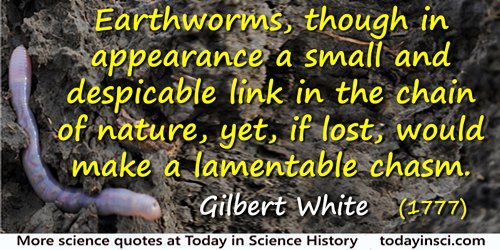
Earthworms, though in appearance a small and despicable link in the chain of nature, yet, if lost, would make a lamentable chasm … worms seem to be the great promoters of vegetation, which would proceed but lamely without them.
[Showing an early awareness in ecology.]
[Showing an early awareness in ecology.]
Letter XXXV, to Daines Barrington, (20 May 1777) in The Natural History of Selborne (1789), 216 and (1899), 174.
Education, then, beyond all other devices of human origin, is the great equalizer of the conditions of men–the balance-wheel of the social machinery.
Twelfth Report of the Secretary of the Massachusetts Board of Education (1948). Life and Works of Horace Mann (1891), Vol. 4, 251.
ELECTRICITY, n. The power that causes all natural phenomena not known to be caused by something else. It is the same thing as lightning, and its famous attempt to strike Dr. Franklin is one of the most picturesque incidents in that great and good man's career. The memory of Dr. Franklin is justly held in great reverence, particularly in France, where a waxen effigy of him was recently on exhibition, bearing the following touching account of his life and services to science:
Monsieur Franqulin, inventor of electricity. This illustrious savant, after having made several voyages around the world, died on the Sandwich Islands and was devoured by savages, of whom not a single fragment was ever recovered.
Electricity seems destined to play a most important part in the arts and industries. The question of its economical application to some purposes is still unsettled, but experiment has already proved that it will propel a street car better than a gas jet and give more light than a horse.
Monsieur Franqulin, inventor of electricity. This illustrious savant, after having made several voyages around the world, died on the Sandwich Islands and was devoured by savages, of whom not a single fragment was ever recovered.
Electricity seems destined to play a most important part in the arts and industries. The question of its economical application to some purposes is still unsettled, but experiment has already proved that it will propel a street car better than a gas jet and give more light than a horse.
The Cynic's Word Book (1906), 87. Also published later as The Devil's Dictionary.
Embryology will often reveal to us the structure, in some degree obscured, of the prototype of each great class.
Engineering is the art of directing the great sources of power in nature for the use and convenience of man.
(1828) At a meeting of the Council of the Institution of Civil Engineers of Great Britain (29 Dec 1827), by resolution, Honorary Member Thomas Tredgold was asked for a description of what a Civil Engineer is, in order that it could be put in the petition for a charter. (As cited by F.R. Hutton, in 'The Field of the Mechanical Engineer', The Engineering Digest (1908), Vol. 3 , 10.) The wording was repeated in the Charter of the Institution. (Reported in 'Society of Civil Engineers', The Gentleman's Magazine (1828), 143, 628.) The quote is excerpted from the longer definition therein.
Engineering is the art of directing the great sources of power in nature for the use and the convenience of people. In its modern form engineering involves people, money, materials, machines, and energy. It is differentiated from science because it is primarily concerned with how to direct to useful and economical ends the natural phenomena which scientists discover and formulate into acceptable theories. Engineering therefore requires above all the creative imagination to innovate useful applications of natural phenomena. It seeks newer, cheaper, better means of using natural sources of energy and materials.
In McGraw Hill, Science and Technology Encyclopedia
England and all civilised nations stand in deadly peril of not having enough to eat. As mouths multiply, food resources dwindle. Land is a limited quantity, and the land that will grow wheat is absolutely dependent on difficult and capricious natural phenomena... I hope to point a way out of the colossal dilemma. It is the chemist who must come to the rescue of the threatened communities. It is through the laboratory that starvation may ultimately be turned into plenty... The fixation of atmospheric nitrogen is one of the great discoveries, awaiting the genius of chemists.
Presidential Address to the British Association for the Advancement of Science 1898. Published in Chemical News, 1898, 78, 125.
Enlist a great mathematician and a distinguished Grecian; your problem will be solved. Such men can teach in a dwelling-house as well as in a palace. Part of the apparatus they will bring; part we will furnish.
Advice given to the Trustees of Johns Hopkins University on the choice of a professorial staff. In Report of the President of Johns Hopkins University (1888), 29. As quoted and cited in Robert Édouard Moritz, Memorabilia Mathematica; Or, The Philomath’s Quotation-book (1914), 122.
Environment counts for a great deal. A man’s particular idea may have no chance for growth or encouragement in his community. Real success is denied that man, until he finds a proper environment.
In Orison Swett Marden, 'Bell Telephone Talk: Hints on Success by Alexander G. Bell', How They Succeeded: Life Stories of Successful Men Told by Themselves (1901), 39.
Euler’s Tentamen novae theorae musicae had no great success, as it contained too much geometry for musicians, and too much music for geometers.
Paraphrase by Brewster to describe Fuss’ opinion of Euler’s 'Attempt at a New Theory of Music' (1739). In David Brewster, Letters of Euler on Different Subjects in Natural Philosophy (1872), Vol. 1, 26. The remark by Fuss appears in his eulogy, read at the Imperial Academy of Sciences of Saint Petersburg (23 Oct 1783). Published in the original French in 'Éloge de Léonard Euler, Prononcé en Français par Nicolas Fuss'. Collected in Leonard Euler, Oeuvres Complètes en Français de L. Euler (1839), Vol. 1, xii.
Even a wise experiment when made by a fool generally leads to a false conclusion, but that fools’ experiments conducted by a genius often prove to be leaps through the dark into great discoveries.
Commenting on Charles Darwin’s “fool’s experiments”, in 'Charles Robert Darwin', collected in C.D. Warner (ed.), Library of the World’s Best Literature Ancient and Modern (1896), Vol. 2, 4391-4392.
Even bigger machines, entailing even bigger concentrations of economic power and exerting ever greater violence against the environment, do not represent progress: they are a denial of wisdom. Wisdom demands a new orientation of science and technology towards the organic, the gentle, the non-violent, the elegant and beautiful.
In Small is Beautiful: Economics as if People Mattered (1973).
Even happiness itself may become habitual. There is a habit of looking at the bright side of things, and also of looking at the dark side. Dr. Johnson has said that the habit of looking at the best side of a thing is worth more to a man than a thousand pounds a year. And we possess the power, to a great extent, of so exercising the will as to direct the thoughts upon objects calculated to yield happiness and improvement rather than their opposites.
In Self-help: With Illustrations of Character and Conduct (1859, 1861), 405-406.
Even if the open windows of science at first make us shiver after the cozy indoor warmth of traditional humanizing myths, in the end the fresh air brings vigor, and the great spaces have a splendor of their own.
What I Believe (1925). In The Basic Writings of Bertrand Russell, 1903-1959 (1992), 370.
Even mistaken hypotheses and theories are of use in leading to discoveries. This remark is true in all the sciences. The alchemists founded chemistry by pursuing chimerical problems and theories which are false. In physical science, which is more advanced than biology, we might still cite men of science who make great discoveries by relying on false theories. It seems, indeed, a necessary weakness of our mind to be able to reach truth only across a multitude of errors and obstacles.
An Introduction to the Study of Experimental Medicine (1865, translation 1927, 1957), 170.
Even the taking of medicine serves to make time go on with less heaviness. I have a sort of genius for physic and always had great entertainment in observing the changes of the human body and the effects produced by diet, labor, rest, and physical operations.
Every great advance in natural knowledge has involved the absolute rejection of authority.
'On the Advisableness of Improving Natural Knowledge', a lay sermon at St. Martin's Hall (Sunday 7 Jan 1866), The Fortnightly Review. In The Journal of Mental Science (1867), Vol. 12, No. 58, (Jul 1866), 279.
Every great advance in science has issued from a new audacity of imagination. What are now working conceptions, employed as a matter of course because they have withstood the tests of experiment and have emerged triumphant, were once speculative hypotheses.
'The Copernican Revolution', in The Quest for Certainty: A Study of the Relation of Knowledge and Action (1929), 294. Collected in John Dewey. Volume 4: The Later Works, 1925-1953: 1929 The Quest for Certainty (1984), 247. The first sentence is used as the motto of The Bronx High School of Science, New York.
Every great advance of science opens our eyes to facts which we had failed before to observe, and makes new demands on our powers of interpretation.
From The Grammar of Science (1892), 17.
Every great anthropologic and paleontologic discovery fits into its proper place, enabling us gradually to fill out, one after another, the great branching lines of human ascent and to connect with the branches definite phases of industry and art. This gives us a double means of interpretation, archaeological and anatomical. While many branches and links in the chain remain to be discovered, we are now in a position to predict with great confidence not only what the various branches will be like but where they are most like to be found.
In Henry Fairfield Osborn, 'Osborn States the Case For Evolution', New York Times (12 Jul 1925), XX1
Every great improvement has come after repeated failures. Virtually nothing comes out right the first time. Failures, repeated failures, are finger posts on the road to achievement. One fails forward toward success.
Every great scientific truth goes through three states: first, people say it conflicts with the Bible; next, they say it has been discovered before; lastly, they say they always believed it.
Attributed; it does not appear directly in this form in any writings by Agassiz. This version of the quote comes from the Saturday Evening Post (1890), as cited in Ralph Keyes, The Quote Verifier (2006), 226. Since the quote was not printed within quotation marks, it is unlikely that this is a verbatim statement. Keyes discusses variations of the “three stages of truth” that have been attributed to a various other authors, but provides some substantiation with examples of similar quotes linked to Agassiz as related in second-person accounts.
Every great scientist becomes a great scientist because of the inner self-abnegation with which he stands before truth, saying: “Not my will, but thine, be done.” What, then, does a man mean by saying, Science displaces religion, when in this deep sense science itself springs from religion?
In 'The Real Point of Conflict between Science and Religion', collected in Living Under Tension: Sermons On Christianity Today (1941), 148.
Every one is fond of comparing himself to something great and grandiose, as Louis XIV likened himself to the sun, and others have had like similes. I am more humble. I am a mere street scavenger (chiffonier) of science. With my hook in my hand and my basket on my back, I go about the streets of science, collecting what I find.
Quoted in Michael Foster, Claude Bernard (1899), 40.
Every scientist, through personal study and research, completes himself and his own humanity. ... Scientific research constitutes for you, as it does for many, the way for the personal encounter with truth, and perhaps the privileged place for the encounter itself with God, the Creator of heaven and earth. Science shines forth in all its value as a good capable of motivating our existence, as a great experience of freedom for truth, as a fundamental work of service. Through research each scientist grows as a human being and helps others to do likewise.
Address to the members of the Pontifical Academy of Sciences (13 Nov 2000). In L’Osservatore Romano (29 Nov 2000), translated in English edition, 5.
Every technological success is hailed as a great scientific achievement; every technological disaster is deemed an engineering failure.
Every work of science great enough to be well remembered for a few generations affords some exemplification of the defective state of the art of reasoning of the time when it was written; and each chief step in science has been a lesson in logic.
'The Fixation of Belief (1877). In Justus Buchler, The Philosophy of Pierce (1940), 6.
Everybody can be great. Because anybody can serve. You don’t have to have a college degree to serve … You only need a heart full of grace. A soul generated by love.
Quoted in Kim Lim (ed.), 1,001 Pearls of Spiritual Wisdom: Words to Enrich, Inspire, and Guide Your Life (2014), 253
Everything on this earth iz bought and sold, except air and water, and they would be if a kind Creator had not made the supply too grate for the demand.
In The Complete Works of Josh Billings (1876), 277.
Everything that is really great and inspiring is created by the individual who can labor in freedom.
…...
Everything that the greatest minds of all times have accomplished toward the comprehension of forms by means of concepts is gathered into one great science, mathematics.
In 'Pestalozzi's Idee eines A B C der Anschauung', Werke[Kehrbach] (1890), Bd.l, 163. As quoted, cited and translated in Robert Édouard Moritz, Memorabilia Mathematica; Or, The Philomath’s Quotation-Book (1914), 5.
Experience is the great teacher; unfortunately, experience leaves mental scars, and scar tissue contracts.
From speech 'In the Time of Henry Jacob Bigelow', given to the Boston Surgical Society, Medalist Meeting (6 Jun 1921). Printed in Journal of the Medical Association (1921), 77, 599.
Experimental investigation, to borrow a phrase employed by Kepler respecting the testing of hypotheses, is “a very great thief of time.” Sometimes it costs many days to determine a fact that can be stated in a line.
In preface to Scientific Memoirs (1878), xi.
Experiments on ornamental plants undertaken in previous years had proven that, as a rule, hybrids do not represent the form exactly intermediate between the parental strains. Although the intermediate form of some of the more striking traits, such as those relating to shape and size of leaves, pubescence of individual parts, and so forth, is indeed nearly always seen, in other cases one of the two parental traits is so preponderant that it is difficult or quite impossible, to detect the other in the hybrid. The same is true for Pisum hybrids. Each of the seven hybrid traits either resembles so closely one of the two parental traits that the other escapes detection, or is so similar to it that no certain distinction can be made. This is of great importance to the definition and classification of the forms in which the offspring of hybrids appear. In the following discussion those traits that pass into hybrid association entirely or almost entirely unchanged, thus themselves representing the traits of the hybrid, are termed dominating and those that become latent in the association, recessive. The word 'recessive' was chosen because the traits so designated recede or disappear entirely in the hybrids, but reappear unchanged in their progeny, as will be demonstrated later.
'Experiments on Plant Hybrids' (1865). In Curt Stern and Eva R. Sherwood (eds.), The Origin of Genetics: A Mendel Source Book (1966), 9.
Facts may belong to the past history of mankind, to the social statistics of our great cities, to the atmosphere of the most distant stars, to the digestive organs of a worm, or to the life of a scarcely visible bacillus. It is not the facts themselves which form science, but the method in which they are dealt with.
From The Grammar of Science (1892), 15.
Famine seems to be the last, the most dreadful resource of nature. The power of population is so superior to the power in the earth to produce subsistence for man, that premature death must in some shape or other visit the human race. The vices of mankind are active and able ministers of depopulation. They are the precursors in the great army of destruction; and often finish the dreadful work themselves. But should they fail in this war of extermination, sickly seasons, epidemics, pestilence, and plague, advance in terrific array, and sweep off their thousands and ten thousands. Should success be still incomplete, gigantic inevitable famine stalks in the rear, and with one mighty blow, levels the population with the food of the world.
In An Essay on the Principle of Population (1798), 140, and in new enlarged edition (1803), 350.
Finally one should add that in spite of the great complexity of protein synthesis and in spite of the considerable technical difficulties in synthesizing polynucleotides with defined sequences it is not unreasonable to hope that all these points will be clarified in the near future, and that the genetic code will be completely established on a sound experimental basis within a few years.
From Nobel Lecture (11 Dec 1962), 'On the Genetic Code'. Collected in Nobel Lectures: Physiology or Medicine 1942-1962 (1964), 808.
Finally, I aim at giving denominations to things, as agreeable to truth as possible. I am not ignorant that words, like money, possess an ideal value, and that great danger of confusion may be apprehended from a change of names; in the mean time it cannot be denied that chemistry, like the other sciences, was formerly filled with improper names. In different branches of knowledge, we see those matters long since reformed: why then should chemistry, which examines the real nature of things, still adopt vague names, which suggest false ideas, and favour strongly of ignorance and imposition? Besides, there is little doubt but that many corrections may be made without any inconvenience.
Physical and Chemical Essays (1784), Vol. I, xxxvii.
Finally, to the theme of the respiratory chain, it is especially noteworthy that David Kellin's chemically simple view of the respiratory chain appears now to have been right all along–and he deserves great credit for having been so reluctant to become involved when the energy-rich chemical intermediates began to be so fashionable. This reminds me of the aphorism: 'The obscure we see eventually, the completely apparent takes longer'.
'David Kellin's Respiratory Chain Concept and Its Chemiosmotic Consequences', Nobel Lecture (8 Dec 1978). In Nobel Lectures: Chemistry 1971-1980 (1993), 325.
For a stone, when it is examined, will be found a mountain in miniature. The fineness of Nature’s work is so great, that, into a single block, a foot or two in diameter, she can compress as many changes of form and structure, on a small scale, as she needs for her mountains on a large one; and, taking moss for forests, and grains of crystal for crags, the surface of a stone, in by far the plurality of instances, is more interesting than the surface of an ordinary hill; more fantastic in form and incomparably richer in colour—the last quality being, in fact, so noble in most stones of good birth (that is to say, fallen from the crystalline mountain ranges).
Modern Painters, 4, Containing part 5 of Mountain Beauty (1860), 311.
For all these years you were merely
A smear of light through our telescopes
On the clearest, coldest night; a hint
Of a glint, just a few pixels wide
On even your most perfectly-framed portraits.
But now, now we see you!
Swimming out of the dark - a great
Stone shark, your star-tanned skin pitted
And pocked, scarred after eons of drifting
Silently through the endless ocean of space.
Here on Earth our faces lit up as we saw
You clearly for the first time; eyes wide
With wonder we traced the strangely familiar
Grooves raked across your sides,
Wondering if Rosetta had doubled back to Mars
And raced past Phobos by mistake –
Then you were gone, falling back into the black,
Not to be seen by human eyes again for a thousand
Blue Moons or more. But we know you now,
We know you; you’ll never be just a speck of light again.
A smear of light through our telescopes
On the clearest, coldest night; a hint
Of a glint, just a few pixels wide
On even your most perfectly-framed portraits.
But now, now we see you!
Swimming out of the dark - a great
Stone shark, your star-tanned skin pitted
And pocked, scarred after eons of drifting
Silently through the endless ocean of space.
Here on Earth our faces lit up as we saw
You clearly for the first time; eyes wide
With wonder we traced the strangely familiar
Grooves raked across your sides,
Wondering if Rosetta had doubled back to Mars
And raced past Phobos by mistake –
Then you were gone, falling back into the black,
Not to be seen by human eyes again for a thousand
Blue Moons or more. But we know you now,
We know you; you’ll never be just a speck of light again.
…...
For any two portions of fire, small or great, will exhibit the same ratio of solid to void; but the upward movement of the greater is quicker than that of the less, just as the downward movement of a mass of gold or lead, or of any other body endowed with weight, is quicker in proportion to its size.
On the Heavens, 309b, 11-5. In Jonathan Barnes (ed.), The Complete Works of Aristotle (1984), Vol. I, 505.
For forty-nine months between 1968 and 1972, two dozen Americans had the great good fortune to briefly visit the Moon. Half of us became the first emissaries from Earth to tread its dusty surface. We who did so were privileged to represent the hopes and dreams of all humanity. For mankind it was a giant leap for a species that evolved from the Stone Age to create sophisticated rockets and spacecraft that made a Moon landing possible. For one crowning moment, we were creatures of the cosmic ocean, an epoch that a thousand years hence may be seen as the signature of our century.
…...
For if medicine is really to accomplish its great task, it must intervene in political and social life. It must point out the hindrances that impede the normal social functioning of vital processes, and effect their removal.
In Die einheitsrebungen in der wissenschaftlichen medicin (1849), 48. As quoted and citefd in Paul Farmer, Pathologies of Power (2004), 323.
For if there is any truth in the dynamical theory of gases the different molecules in a gas at uniform temperature are moving with very different velocities. Put such a gas into a vessel with two compartments [A and B] and make a small hole in the wall about the right size to let one molecule through. Provide a lid or stopper for this hole and appoint a doorkeeper, very intelligent and exceedingly quick, with microscopic eyes but still an essentially finite being.
Whenever he sees a molecule of great velocity coming against the door from A into B he is to let it through, but if the molecule happens to be going slow he is to keep the door shut. He is also to let slow molecules pass from B to A but not fast ones ... In this way the temperature of B may be raised and that of A lowered without any expenditure of work, but only by the intelligent action of a mere guiding agent (like a pointsman on a railway with perfectly acting switches who should send the express along one line and the goods along another).
I do not see why even intelligence might not be dispensed with and the thing be made self-acting.
Moral The 2nd law of Thermodynamics has the same degree of truth as the statement that if you throw a tumblerful of water into the sea you cannot get the same tumblerful of water out again.
Whenever he sees a molecule of great velocity coming against the door from A into B he is to let it through, but if the molecule happens to be going slow he is to keep the door shut. He is also to let slow molecules pass from B to A but not fast ones ... In this way the temperature of B may be raised and that of A lowered without any expenditure of work, but only by the intelligent action of a mere guiding agent (like a pointsman on a railway with perfectly acting switches who should send the express along one line and the goods along another).
I do not see why even intelligence might not be dispensed with and the thing be made self-acting.
Moral The 2nd law of Thermodynamics has the same degree of truth as the statement that if you throw a tumblerful of water into the sea you cannot get the same tumblerful of water out again.
Letter to John William Strutt (6 Dec 1870). In P. M. Hannan (ed.), The Scientific Letters and Papers of James Clerk Maxwell (1995), Vol. 2, 582-3.
For man being the minister and interpreter of nature, acts and understands so far as he has observed of the order, the works and mind of nature, and can proceed no further; for no power is able to loose or break the chain of causes, nor is nature to be conquered but by submission: whence those twin intentions, human knowledge and human power, are really coincident; and the greatest hindrance to works is the ignorance of causes.
In The Great lnstauration.
For many planet hunters, though, the ultimate goal is still greater (or actually, smaller) prey: terrestrial planets, like Earth, circling a star like the Sun. Astronomers already know that three such planets orbit at least one pulsar. But planet hunters will not rest until they are in sight of a small blue world, warm and wet, in whose azure skies and upon whose wind-whipped oceans shines a bright yellow star like our own.
…...
For nearly twelve years I travelled and lived mostly among uncivilised or completely savage races, and I became convinced that they all possessed good qualities, some of them in a very remarkable degree, and that in all the great characteristics of humanity they are wonderfully like ourselves. Some, indeed, among the brown Polynesians especially, are declared by numerous independent and unprejudiced observers, to be physically, mentally, and intellectually our equals, if not our superiors; and it has always seemed to me one of the disgraces of our civilisation that these fine people have not in a single case been protected from contamination by the vices and follies of our more degraded classes, and allowed to develope their own social and political organislll under the advice of some of our best and wisest men and the protection of our world-wide power. That would have been indeed a worthy trophy of our civilisation. What we have actually done, and left undone, resulting in the degradation and lingering extermination of so fine a people, is one of the most pathetic of its tragedies.
In 'The Native Problem in South Africa and Elsewhere', Independent Review (1906), 11, 182.
For other great mathematicians or philosophers, he [Gauss] used the epithets magnus, or clarus, or clarissimus; for Newton alone he kept the prefix summus.
In History of Mathematics (3rd Ed., 1901), 362.
For science is … like virtue, its own exceeding great reward.
'Science', a lecture delivered at the Royal Institution, published in Fraser's Magazine (Jul 1866), 74, 26. Also collected in The Works of Charles Kingsley (1880), 254.
For several years this great man [Isaac Newton] was intensely occupied in endeavoring to discover a way of changing the base metals into gold. … There were periods when his furnace fires were not allowed to go out for six weeks; he and his secretary sitting up alternate nights to replenish them.
In 'Sir Isaac Newton', People’s Book of Biography: Or, Short Lives of the Most Interesting Persons of All Ages and Countries (1868), 256.
For the first time there was constructed with this machine [locomotive engine] a self-acting mechanism in which the interplay of forces took shape transparently enough to discern the connection between the heat generated and the motion produced. The great puzzle of the vital force was also immediately solved for the physiologist in that it became evident that it is more than a mere poetic comparison when one conceives of the coal as the food of the locomotive and the combustion as the basis for its life.
'Leid und Freude in der Naturforschung', Die Gartenlaube (1870), 359. Trans. Kenneth L. Caneva, Robert Mayer and the Conservation of Energy (1993), 145.
For those of us who make only a brief study of chemistry, the benefits to be expected are of an indirect nature. Increased capacity for enjoyment, a livelier interest in the world in which we live, a more intelligent attitude toward the great questions of the day—these are the by-products of a well-balanced education, including chemistry in its proper relation to other studies.
In 'Introduction', General Chemistry: An Elementary Survey Emphasizing Industrial Applications of Fundamental Principles (1923), 4.
For, the great enemy of knowledge is not error, but inertness. All that we want is discussion, and then we are sure to do well, no matter what our blunders may be. One error conflicts with another; each destroys its opponent, and truth is evolved.
In History of Civilization in England (1861), Vol. 2, 408.
Forward, forward let us range,
Let the great world spin for ever down the ringing grooves of change.
Let the great world spin for ever down the ringing grooves of change.
'Locksley Hall' (1842), collected in Alfred Tennyson and William James Rolfe (ed.) The Poetic and Dramatic Works of Alfred, Lord Tennyson (1898), 94.
Fractal is a word invented by Mandelbrot to bring together under one heading a large class of objects that have [played] … an historical role … in the development of pure mathematics. A great revolution of ideas separates the classical mathematics of the 19th century from the modern mathematics of the 20th. Classical mathematics had its roots in the regular geometric structures of Euclid and the continuously evolving dynamics of Newton. Modern mathematics began with Cantor’s set theory and Peano’s space-filling curve. Historically, the revolution was forced by the discovery of mathematical structures that did not fit the patterns of Euclid and Newton. These new structures were regarded … as “pathological,” .… as a “gallery of monsters,” akin to the cubist paintings and atonal music that were upsetting established standards of taste in the arts at about the same time. The mathematicians who created the monsters regarded them as important in showing that the world of pure mathematics contains a richness of possibilities going far beyond the simple structures that they saw in Nature. Twentieth-century mathematics flowered in the belief that it had transcended completely the limitations imposed by its natural origins.
Now, as Mandelbrot points out, … Nature has played a joke on the mathematicians. The 19th-century mathematicians may not have been lacking in imagination, but Nature was not. The same pathological structures that the mathematicians invented to break loose from 19th-century naturalism turn out to be inherent in familiar objects all around us.
Now, as Mandelbrot points out, … Nature has played a joke on the mathematicians. The 19th-century mathematicians may not have been lacking in imagination, but Nature was not. The same pathological structures that the mathematicians invented to break loose from 19th-century naturalism turn out to be inherent in familiar objects all around us.
From 'Characterizing Irregularity', Science (12 May 1978), 200, No. 4342, 677-678. Quoted in Benoit Mandelbrot, The Fractal Geometry of Nature (1977, 1983), 3-4.
Freud becomes one of the dramatis personae, in fact, as discoverer of the great and beautiful modern myth of psychoanalysis. By myth, I mean a poetic, dramatic expression of a hidden truth; and in placing this emphasis, I do not intend to put into question the scientific validity of psychoanalysis.
The White Hotel (1981,1993), vii.
Frogs will eat red-flannel worms fed to them by biologists; this proves a great deal about both parties concerned.
Quoted in Joseph Wood Krutch, The Best of Two Worlds (1953), 105.
From a drop of water a logician could predict an Atlantic or a Niagara without having seen or heard of one or the other. So all life is a great chain, the nature of which is known whenever we are shown a single link of it.
In A Study in Scarlet (1887, 1892), 27.
From man or angel the great Architect did wisely to conceal, and not divulge his secrets to be scanned by them who ought rather admire; or if they list to try conjecture, he his fabric of the heavens left to their disputes, perhaps to move his laughter at their quaint opinions wide hereafter, when they come to model heaven calculate the stars, how they will wield the mighty frame, how build, unbuild, contrive to save appearances, how gird the sphere with centric and eccentric scribbled o’er, and epicycle, orb in orb.
Paradise Lost (1674, 1754), Book 8, 231.
From that night on, the electron—up to that time largely the plaything of the scientist—had clearly entered the field as a potent agent in the supplying of man's commercial and industrial needs… The electronic amplifier tube now underlies the whole art of communications, and this in turn is at least in part what has made possible its application to a dozen other arts. It was a great day for both science and industry when they became wedded through the development of the electronic amplifier tube.
The Autobiography of Robert A. Millikan (1951), 136.
From the infinitely great down to the infinitely small, all things are subject to [the laws of nature]. The sun and the planets follow the laws discovered by Newton and Laplace, just as the atoms in their combinations follow the laws of chemistry, as living creatures follow the laws of biology. It is only the imperfections of the human mind which multiply the divisions of the sciences, separating astronomy from physics or chemistry, the natural sciences from the social sciences. In essence, science is one. It is none other than the truth.
From Cours d’Economie Politique (1896-97), as given in Archives Internationales d’Histoire des Sciences (1993), Issues 131-133, 67.
From thus meditating on the great similarity of the structure of the warm-blooded animals, and at the same time of the great changes they undergo both before and after their nativity; and by considering in how minute a portion of time many of the changes of animals above described have been produced; would it be too bold to imagine that, in the great length of time since the earth began to exist, perhaps millions of ages before the commencement of the history of mankind would it be too bold to imagine that all warm-blooded animals have arisen from one living filament, which THE GREAT FIRST CAUSE endued with animality, with the power of acquiring new parts, attended with new propensities, directed by irritations, sensations, volitions and associations, and thus possessing the faculty of continuing to improve by its own inherent activity, and of delivering down these improvements by generation to its posterity, world without end!
Zoonomia, Or, The Laws of Organic Life, in three parts (1803), Vol. 1, 397.
From whence it is obvious to conclude that, since our Faculties are not fitted to penetrate into the internal Fabrick and real Essences of Bodies; but yet plainly discover to us the Being of a GOD, and the Knowledge of our selves, enough to lead us into a full and clear discovery of our Duty, and great Concernment, it will become us, as rational Creatures, to imploy those Faculties we have about what they are most adapted to, and follow the direction of Nature, where it seems to point us out the way.
An Essay Concerning Human Understanding (1690). Edited by Peter Nidditch (1975), Book 4, Chapter 12, Section 11, 646.
Gases are distinguished from other forms of matter, not only by their power of indefinite expansion so as to fill any vessel, however large, and by the great effect heat has in dilating them, but by the uniformity and simplicity of the laws which regulate these changes.
Theory of Heat (1904), 31.
Gay-Lussac was quick, lively, ingenious and profound, with great activity of mind and great facility of manipulation. I should place him at the head of all the living chemists in France.
In Mary Elvira Weeks, Discovery of the Elements (1934), 161, citing J. Davy, Memoirs of the Life of Sir Humphry Davy, Bart. (1836) Vol. 1, 469.
Genetics as a whole is the great over-hyped science, and geneticists know that even if they don't say it. All that genetics really is is anatomy plus an enormous research group grant. It's what anatomists did in the fifteenth century-looking at the heart and seeing how it worked. Now, we are doing the same with DNA
Quoted by Sean O'Hagan, in 'End of sperm report', The Observer (14 Sep 2002).
Genetics has enticed a great many explorers during the past two decades. They have labored with fruit-flies and guinea-pigs, with sweet peas and corn, with thousands of animals and plants in fact, and they have made heredity no longer a mystery but an exact science to be ranked close behind physics and chemistry in definiteness of conception. One is inclined to believe, however, that the unique magnetic attraction of genetics lies in the vision of potential good which it holds for mankind rather than a circumscribed interest in the hereditary mechanisms of the lowly species used as laboratory material. If man had been found to be sharply demarcated from the rest of the occupants of the world, so that his heritage of physical form, of physiological function, and of mental attributes came about in a superior manner setting him apart as lord of creation, interest in the genetics of the humbler organisms—if one admits the truth—would have flagged severely. Biologists would have turned their attention largely to the ways of human heredity, in spite of the fact that the difficulties encountered would have rendered progress slow and uncertain. Since this was not the case, since the laws ruling the inheritance of the denizens of the garden and the inmates of the stable were found to be applicable to prince and potentate as well, one could shut himself up in his laboratory and labor to his heart's content, feeling certain that any truth which it fell to his lot to discover had a real human interest, after all.
Mankind at the Crossroads (1923), v-vi.
Genius is nothing but a great aptitude for patience.
Inaugural speech at the French Academy (1753). Quoted in Hans Theodore David, Arthur Mendel and Christoph Wolff, The New Bach Reader (1998), 20. Also seen translated as “Genius is simply patience carried to the extreme,” or shortened as “Genius is patience.” The latter is also sometimes seen attributed (incorrectly?) to Isaac Newton, for example, in Lady Isabel Burton, The Life of Captain Sir Richd F. Burton (1893), Vol. 1, 577. Webmaster has found no primary source from Newton. Also seen attributed to Santiago Ramon y Cajal, but he was only quoting Buffon, translated as “Genius is simply patience carried to the extreme,” in Advice for a Young Investigator (1999), 39. Translated from the original French, “Le génie n'est qu'une grande aptitude à la patience.”
Geologists are rapidly becoming convinced that the mammals spread from their central Asian point of origin largely because of great variations in climate.
The Red Man's Continent: A Chronicle of Aboriginal America (1919), 13.
Gifford Pinchot is the man to whom the nation owes most for what has been accomplished as regards the preservation of the natural resources of our country. He led, and indeed during its most vital period embodied, the fight for the preservation through use of our forests … He was the foremost leader in the great struggle to coordinate all our social and governmental forces in the effort to secure the adoption of a rational and far-seeing policy for securing the conservation of all our national resources. … I believe it is but just to say that among the many, many public officials who under my administration rendered literally invaluable service to the people of the United States, he, on the whole, stood first.
'The Natural Resources of the Nation' Autobiography (1913), ch. 11. Quoted in Douglas M. Johnston, The International Law of Fisheries (1987), 44
Gifford Pinchot points out that in colonial and pioneer days the forest was a foe and an obstacle to the settler. It had to be cleared away... But [now] as a nation we have not yet come to have a proper respect for the forest and to regard it as an indispensable part of our resources—one which is easily destroyed but difficult to replace; one which confers great benefits while it endures, but whose disappearance is accompanied by a train of evil consequences not readily foreseen and positively irreparable.
Concluding remark, in 'A Country that has Used up its Trees', The Outlook (24 Mar 1906), 82, 700. The topic of the article is the extensive deforestation in China, its consequences, and that America must avoid such massive problems.
God having designed man for a sociable creature, furnished him with language, which was to be the great instrument and tie of society.
In An Essay Concerning Human Understanding (1849), Book 3, Chap 1, Sec. 1, 288.
Gold and iron at the present day, as in ancient times, are the rulers of the world; and the great events in the world of mineral art are not the discovery of new substances, but of new and rich localities of old ones.
Lecture (26 Npv 1851), to the London Society of Arts, 'The General Bearing of the Great Exhibition on the Progress of Art and Science', collected in Lectures on the Results of the Great Exhibition of 1851' (1852), 3.
Good teachers deserve apples; great teachers deserve chocolate.
A favorite quotation, written in calligraphy on his office door.
A favorite quotation, written in calligraphy on his office door.
As quoted in obituary for Richard Hamming, by Herschel H. Loomis and David S. Potter, in National Academy of Engineering, Memorial Tributes (2002), 123.
Good writers indulge their audience; great writers know better.
In The Well-Spoken Thesaurus (2011), 117.
GOOSE, n. A bird that supplies quills for writing. These, by some occult process of nature, are penetrated and suffused with various degrees of the bird's intellectual energies and emotional character, so that when inked and drawn mechanically across paper by a person called an "author," there results a very fair and accurate transcript of the fowl's thought and feeling. The difference in geese, as discovered by this ingenious method, is considerable: many are found to have only trivial and insignificant powers, but some are seen to be very great geese indeed.
The Collected Works of Ambrose Bierce (1911), Vol. 7, The Devil's Dictionary, 119-120.
Gradually, at various points in our childhoods, we discover different forms of conviction. There’s the rock-hard certainty of personal experience (“I put my finger in the fire and it hurt,”), which is probably the earliest kind we learn. Then there’s the logically convincing, which we probably come to first through maths, in the context of Pythagoras’s theorem or something similar, and which, if we first encounter it at exactly the right moment, bursts on our minds like sunrise with the whole universe playing a great chord of C Major.
In short essay, 'Dawkins, Fairy Tales, and Evidence', 2.
Great capitalists could not themselves cultivate vast extents of land, and not wanting to diminish their revenues by renting them, would be induced to sell portions suitable for cultivation by their new owners, and would then carry their money into new industrial and commercial enterprises.
From Appendix A, 'Extracts From the Unpublished Writings of Carnot', Reflections on the Motive Power of Heat (1890, 2nd ed. 1897), 213.
Great discoveries and improvements invariably involve the cooperation of many minds. I may be given credit for having blazed the trail but when I look at the subsequent developments I feel the credit is due to others rather than to myself
Great discoveries are made accidentally less often than the populace likes to think.
Referring to the accidental discovery of X-rays, in A History of Science and Its Relations with Philosophy and Religion (1931), 382.
Great Empedocles, that ardent soul,
Leapt into Etna and was roasted whole.
Leapt into Etna and was roasted whole.
As quoted, from an unknown poet, in Bertrand Russell, A History of Western Philosophy (1946), 60.
Great fleas have little fleas upon their backs to bite 'em,
And little fleas have lesser fleas, and so ad infinitum.
And the great fleas themselves, in turn have, greater fleas to go on;
While these again have greater still, and greater still, and so on.
[He was imitating: 'So, naturalists observe, a flea Has smaller fleas that on him prey; And these have smaller still to bite 'em; And so proceed ad infinitum.' Poetry, a Rhapsody, by Jonathan Swift.]
And little fleas have lesser fleas, and so ad infinitum.
And the great fleas themselves, in turn have, greater fleas to go on;
While these again have greater still, and greater still, and so on.
[He was imitating: 'So, naturalists observe, a flea Has smaller fleas that on him prey; And these have smaller still to bite 'em; And so proceed ad infinitum.' Poetry, a Rhapsody, by Jonathan Swift.]
A Budget of Paradoxes (1915), first published 1872, Vol. 2, 191.
Great God, how can we possibly be always right and the others always wrong?
As quoted in Norman Hampson, Will & Circumstance: Montesquieu, Rousseau, and the French Revolution (1983), 11.
Great healers, people of divine realization, do not cure by chance but by exact knowledge.
In Richard Alan Krieger, Civilization's Quotations (2002), 313.
Great ideas are not charitable.
Le maître de Santiago
Great innovations, whether in art or literature, in science or in nature, seldom take the world by storm. They must be understood before they can be estimated, and must be cultivated before they can be understood.
In Tertiary History of the Grand Cañon District: With Atlas (1882), 142.
Great inventions are never, and great discoveries are seldom, the work of any one mind. Every great invention is really an aggregation of minor inventions, or the final step of a progression. It is not usually a creation, but a growth, as truly so as is the growth of the trees in the forest.
In 'The Growth of the Steam-Engine', The Popular Science Monthly (Nov 1877), 17.
Great is the faith of the flush of knowledge and of the investigation of the depths of qualities and things.
In Walt Whitman and William Michael Rossetti (ed.), 'Preface to the First Edition of Leaves of Grass', Poems By Walt Whitman (1868), 46.
Great is the power of steady misrepresentation - but the history of science shows how, fortunately, this power does not endure long.
Origin of Species (1878), 421.
Great knowledge embraces the whole: small knowledge, a part only. [Great knowledge encompasses everything. The little one divides everything.]
As translated from the Chinese original by Herbert A. Giles in Chuang Tzŭ: Mystic, Moralist, and Social Reformer (1889), 13. The brackets contain a translation from a version written in Spanish on the website frasesypensamientos.com.ar
Great men are they who see that spiritual is stronger than any material force—that thoughts rule the world.
In James Elliot Cabot (ed.), Emerson's Complete Works: Letters and Social Aims (1883), Vol. 8, 217.
Great minds don't think alike. If they did, the Patent Office would only have about fifty inventions.
From Dilbert comic strip (10 Mar 2005).
Great science is an art.
In Leonard and Thelma Spinrad, Speaker's Lifetime Library (1979), 220.
Great scientific discoveries have been made by men seeking to verify quite erroneous theories about the nature of things.
From 'Wordsworth in the Tropics', in Life and Letters and the London Mercury (1928), Vol. 1, 349.
Great spirits have always encountered violent opposition from mediocre minds.
…...
Great spirits have always found violent opposition from mediocrities. The latter cannot understand it when a man does not thoughtlessly submit to hereditary prejudices but honestly and courageously uses his intelligence and fulfills the duty to express the results of his thoughts in clear form.
…...
Great steps in human progress are made by things that don't work the way philosophy thought they should. If things always worked the way they should, you could write the history of the world from now on. But they don't, and it is those deviations from the normal that make human progress.
Great theories are expansive; failures mire us in dogmatism and tunnel vision.
…...
Great things are only possible with outrageous requests.
As quoted, without citation in Jack Canfield and Mark Victor Hansen, The Aladdin Factor (1995), 212.
Great thinkers build their edifices with subtle consistency. We do our intellectual forebears an enormous disservice when we dismember their visions and scan their systems in order to extract a few disembodied ‘gems’–thoughts or claims still accepted as true. These disarticulated pieces then become the entire legacy of our ancestors, and we lose the beauty and coherence of older systems that might enlighten us by their unfamiliarity–and their consequent challenge in our fallible (and complacent) modern world.
…...
Great triumphs of engineering genius—the locomotive, the truss bridge, the steel rail— ... are rather invention than engineering proper.
From The Economic Theory of the Location of Railways (1887, 1914), 1.
Great truths can only be forgotten and can never be falsified.
From Illustrated London News (30 Sep 1933). In 'The Idolatry of the Clock', The Collected Works of G.K. Chesterton (2011), Vol. 36, 349.
Great works are performed, not by strength, but by perserverance. He that shall walk, with vigour, three hours a day, will pass, in seven years, a space equal to the circumference of the globe.
As quoted, without citation, in John Walker, A Fork in the Road: Answers to Daily Dilemmas from the Teachings of Jesus Christ (2005), 179.
Had I been present at the Creation, I would have given some useful hints for the better ordering of the universe.
Remarking on the complexity of Ptolemaic model of the universe after it was explained to him.
Footnote: Carlyle says, in his History of Frederick the Great, book ii. chap. vii. that this saying of Alphonso about Ptolemy's astronomy, 'that it seemed a crank machine; that it was pity the Creator had not taken advice,' is still remembered by mankind, — this and no other of his many sayings.
Remarking on the complexity of Ptolemaic model of the universe after it was explained to him.
Footnote: Carlyle says, in his History of Frederick the Great, book ii. chap. vii. that this saying of Alphonso about Ptolemy's astronomy, 'that it seemed a crank machine; that it was pity the Creator had not taken advice,' is still remembered by mankind, — this and no other of his many sayings.
In John Bartlett and Nathan Haskell Dole (Ed.), Familiar Quotations: A Collection of Passages, Phrases, and Proverbs Traced to Their Sources (1914), 954.
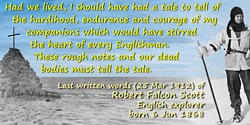
Had we lived, I should have had a tale to tell of the hardihood, endurance and courage of my companions which would have stirred the heart of every Englishman. These rough notes and our dead bodies must tell the tale, but surely, a great rich country like ours will see that those who are dependent on us are properly provided for.
[Final words in a 'Message to the Public' left written in his diary dated 25 March 1912, shortly before he died on the Ross Ice Barrier, Antarctica. When searchers found his body, on 12 Nov 1912, Scott was discovered sitting upright against the pole of the tent with the diary behind his head, as if for a pillow.]
[Final words in a 'Message to the Public' left written in his diary dated 25 March 1912, shortly before he died on the Ross Ice Barrier, Antarctica. When searchers found his body, on 12 Nov 1912, Scott was discovered sitting upright against the pole of the tent with the diary behind his head, as if for a pillow.]
Final words in a 'Message to the Public' left written in his diary dated 25 March 1912, shortly before he died on the Ross Ice Barrier, Antarctica. In Logan Marshall, The Story of Polar Conquest: The Complete History of Arctic and Antarctic (1913), 24-25.
by Logan Marshall - Polar regions - 1913
Hail, Gastronome, Apostle of Excess,
Well skilled to overeat without distress!
Thy great invention, the unfatal feast,
Shows Man’s superiority to Beast.
Well skilled to overeat without distress!
Thy great invention, the unfatal feast,
Shows Man’s superiority to Beast.
Half a century ago Oswald (1910) distinguished classicists and romanticists among the scientific investigators: the former being inclined to design schemes and to use consistently the deductions from working hypotheses; the latter being more fit for intuitive discoveries of functional relations between phenomena and therefore more able to open up new fields of study. Examples of both character types are Werner and Hutton. Werner was a real classicist. At the end of the eighteenth century he postulated the theory of “neptunism,” according to which all rocks including granites, were deposited in primeval seas. It was an artificial scheme, but, as a classification system, it worked quite satisfactorily at the time. Hutton, his contemporary and opponent, was more a romanticist. His concept of “plutonism” supposed continually recurrent circuits of matter, which like gigantic paddle wheels raise material from various depths of the earth and carry it off again. This is a very flexible system which opens the mind to accept the possible occurrence in the course of time of a great variety of interrelated plutonic and tectonic processes.
In 'The Scientific Character of Geology', The Journal of Geology (Jul 1961), 69, No. 4, 456-7.
Happy is he who bears a god within himself, an ideal of beauty, and obeys him: an ideal of art, an ideal of the virtues of the Gospel. These are the living springs of great thoughts and great actions. All are illuminated by reflections of the sublime.
Speech (27 Apr 1882) on his reception into the Académie Française, as translated in Maurice Benjamin Strauss, Familiar Medical Quotations (1968), 490.
Harvard never produced anyone of great originality.
Quoted in Ralph Oesper, The Human Side of Scientists (1975), 107.
He [Robert Hooke] is but of midling stature, something crooked, pale faced, and his face but little belowe, but his head is lardge; his eie full and popping, and not quick; a grey eie. He haz a delicate head of haire, browne, and of an excellent moist curle. He is and ever was very temperate, and moderate in dyet, etc. As he is of prodigious inventive head, so is a person of great vertue and goodnes. Now when I have sayd his Inventive faculty is so great, you cannot imagine his Memory to be excellent, for they are like two Bucketts, as one goes up, the other goes downe. He is certainly the greatest Mechanick this day in the World.
Brief Lives (1680), edited by Oliver Lawson Dick (1949), 165.
He had seen too much of the cosmos to have any great faith in man's ability to understand it.
Ghetto (1954)
He neither drank, smoked, nor rode a bicycle. Living frugally, saving his money, he died early, surrounded by greedy relatives. It was a great lesson to me.
The Stage (Jan 1941).
He should avail himself of their resources in such ways as to advance the expression of the spirit in the life of mankind. He should use them so as to afford to every human being the greatest possible opportunity for developing and expressing his distinctively human capacity as an instrument of the spirit, as a centre of sensitive and intelligent awareness of the objective universe, as a centre of love of all lovely things, and of creative action for the spirit.
…...
He was an admirable marksman, an expert swimmer, a clever rider, possessed of great activity [and] prodigious strength, and was notable for the elegance of his figure and the beauty of his features, and he aided nature by a careful attendance to his dress. Besides other accomplishments he was musical, a good fencer, danced well, and had some acquaintance with legerdemain tricks, worked in hair, and could plait willow baskets.
In Richard Rhodes, John James Audubon: The Making of an American (2004), 36.
He who finds a thought that lets us even a little deeper into the eternal mystery of nature has been granted great peace.
…...
He who makes two blades of grass grow where one grew before is the benefactor of mankind, but he who obscurely worked to find the laws of such growth is the intellectual superior as well as the greater benefactor of mankind.
Presidential Address (28 Oct 1899) to the Physical Society of America Meeting, New York. Printed in American Journal of Science (Dec 1899). Reprinted in the The Johns Hopkins University Circular (Mar 1900), 19, No. 143, 17. Compare earlier remark by Jonathan Swift, beginning “whoever could make two ears of corn…” on the Jonathan Swift Quotes page of this website.
He who would lead a Christ-like life is he who is perfectly and absolutely himself. He may be a great poet, or a great man of science, or a young student at the University, or one who watches sheep upon a moor, or a maker of dramas like Shakespeare, or a thinker about God, like Spinoza. or a child who plays in a garden, or a fisherman who throws his nets into the sea. It does not matter what he is as long as he realises the perfection of the soul that is within him.
In 'The Critic As Artist', Oscariana: Epigrams (1907), 27-28
Hence when a person is in great pain, the cause of which he cannot remove, he sets his teeth firmly together, or bites some substance between them with great vehemence, as another mode of violent exertion to produce a temporary relief. Thus we have the proverb where no help can be has in pain, 'to grin and abide;' and the tortures of hell are said to be attended with 'gnashing of teeth.'Describing a suggestion of the origin of the grin in the present form of a proverb, 'to grin and bear it.'
Zoonomia, Or, The Laws of Organic Life, in three parts (1803), Vol. 1, 330.
Here I most violently want you to
Avoid one fearful error, a vicious flaw.
Don’t think that our bright eyes were made that we
Might look ahead; that hips and knees and ankles
So intricately bend that we might take
Big strides, and the arms are strapped to the sturdy shoulders
And hands are given for servants to each side
That we might use them to support our lives.
All other explanations of this sort
Are twisted, topsy-turvy logic, for
Nothing what is born produces its own use.
Sight was not born before the light of the eyes,
Nor were words and pleas created before the tongue
Rather the tongue’s appearance long preceded
Speech, and the ears were formed far earlier than
The sound first heard. To sum up, all the members
Existed, I should think, before their use,
So use has not caused them to have grown.
Avoid one fearful error, a vicious flaw.
Don’t think that our bright eyes were made that we
Might look ahead; that hips and knees and ankles
So intricately bend that we might take
Big strides, and the arms are strapped to the sturdy shoulders
And hands are given for servants to each side
That we might use them to support our lives.
All other explanations of this sort
Are twisted, topsy-turvy logic, for
Nothing what is born produces its own use.
Sight was not born before the light of the eyes,
Nor were words and pleas created before the tongue
Rather the tongue’s appearance long preceded
Speech, and the ears were formed far earlier than
The sound first heard. To sum up, all the members
Existed, I should think, before their use,
So use has not caused them to have grown.
In On the Nature of Things (1995), Book IV, lines 823-842, 145 as translated by Anthony M. Esolen.
Here lies Sir Isaac Newton, Knight, who by a vigour of mind almost supernatural, first demonstrated, the motions and Figures of the Planets, the Paths of the comets, and the Tides of the Ocean. He diligently investigated the different refrangibilities to the rays of light, … Let Mortals rejoice that there has existed such and so great an ornament of Nature. Born, 25th Dec., 1642; died, 20th March, 1727.
— Epitaph
Translated from the Latin inscription on the tomb of Isaac Newton in Westminster Abbey. As quoted in John Stoughton, Worthies of Science (1879), 232-233.
High technology has done us one great service: It has retaught us the delight of performing simple and primordial tasks—chopping wood, building a fire, drawing water from a spring.
In 'Science and Technology', A Voice Crying in the Wilderness (Vox Clamantis in Deserto) (1989), 91.
His [Edison’s] greatest invention was that of the industrial research laboratory, turning out inventions as a business.
In The Human Use of Human Beings: Cybernetics and Society (1950), 127.
His [Faraday’s] third great discovery is the Magnetization of Light, which I should liken to the Weisshorn among mountains—high, beautiful, and alone.
In Faraday as a Discoverer (1868), 146.
His [Henry Cavendish’s] Theory of the Universe seems to have been, that it consisted solely of a multitude of objects which could be weighed, numbered, and measured; and the vocation to which he considered himself called was, to weigh, number and measure as many of those objects as his allotted three-score years and ten would permit. This conviction biased all his doings, alike his great scientific enterprises, and the petty details of his daily life.
In George Wilson, The Life of the Honourable Henry Cavendish: Including the Abstracts of his Important Scientific Papers (1851), 186.
His [Isaac Newton’s] observations of the colours of thin films [were] the origin of the next great theoretical advance, which had to await, over a hundred years, the coming of Thomas Young.
In 'Foreword' to Isaac Newton, Opticks: Or, A Treatise of the Reflections, Refractions, Inflections & Colours of Light. Based on the 4th Ed., London, 1730 (1952), lix-lx.
His [J.J. Sylvester’s] lectures were generally the result of his thought for the preceding day or two, and often were suggested by ideas that came to him while talking. The one great advantage that this method had for his students was that everything was fresh, and we saw, as it were, the very genesis of his ideas. One could not help being inspired by such teaching.
As quoted by Florian Cajori, in Teaching and History of Mathematics in the United States (1890), 267-268.
His Majesty has, with great skill, constructed a cart, containing a corn mill, which is worked by the motion of the carriage. He has also contrived a carriage of such a magnitude as to contain several apartments, with a hot bath; and it is drawn by a single elephant. This movable bath is extremely useful, and refreshing on a journey. … He has also invented several hydraulic machines, which are worked by oxen. The pulleys and wheels of some of them are so adjusted that a single ox will at once draw water out of two wells, and at the same time turn a millstone.
From Ain-i-Akbery (c.1590). As translated from the original Persian, by Francis Gladwin in 'Akbar’s Conduct and Administrative Rules', 'Of Machines', Ayeen Akbery: Or, The Institutes of the Emperor Akber (1783), Vol. 1, 284. Note: Akbar (Akber) was a great ruler and enlightened statesman.
His work was so great that it cannot be compassed in a few words. His death is one of the greatest losses ever to occur to British science.
Describing Ernest Rutherford upon his death at age 66. Thomson, then 80 years old, was once his teacher.
Describing Ernest Rutherford upon his death at age 66. Thomson, then 80 years old, was once his teacher.
Quoted in Time Magazine (1 Nov 1937).
Holding then to science with one hand—the left hand—we give the right hand to religion, and cry: ‘Open Thou mine eyes, that I may behold wondrous things, more wondrous than the shining worlds can tell.’ Obedient to the promise, religion does awaken faculties within us, does teach our eyes to the beholding of more wonderful things. Those great worlds blazing like suns die like feeble stars in the glory of the morning, in the presence of this new light. The soul knows that an infinite sea of love is all about it, throbbing through it, everlasting arms of affection lift it, and it bathes itself in the clear consciousness of a Father’s love.
…...
Hope being the greatest of all blessings, it is necessary, in order to be happy, to sacrifice the present to the future.
From Appendix A, 'Extracts From the Unpublished Writings of Carnot', Reflections on the Motive Power of Heat (1890, 2nd ed. 1897), 209.
Houses were knocked down... enormous heaps of earth and clay thrown up; buildings that were undermined and shaking, propped up by great beams of wood... The yet unfinished and unopened Railway was in progress.
In Dealings with the Firm of Dombey and Son: Wholesale, Retail, and for Exportation (1847), Vol. 1, 78.
How can one really know a great moment unless one has first felt a great disappointment?
Jewish saying. As quoted in Harry Gilbert and Diana Gilbert Smith, Gravity, the Glue of the Universe: History and Activities (1997), 43.
How did Biot arrive at the partial differential equation? [the heat conduction equation] … Perhaps Laplace gave Biot the equation and left him to sink or swim for a few years in trying to derive it. That would have been merely an instance of the way great mathematicians since the very beginnings of mathematical research have effortlessly maintained their superiority over ordinary mortals.
The Tragicomical History of Thermodynamics, 1822-1854 (1980), 51.
How often might a man, after he had jumbled a set of letters in a bag, fling them out upon the ground before they would fall into an exact poem, yea, or so much as make a good discourse in prose. And may not a little book be as easily made by chance as this great volume of the world.
In The Works of the Most Reverend Dr. John Tillotson (1714), 15.
How was your flight? Well, aeronautically it was a great success. Socially, it left quite a bit to be desired.
…...
However, the small probability of a similar encounter [of the earth with a comet], can become very great in adding up over a huge sequence of centuries. It is easy to picture to oneself the effects of this impact upon the Earth. The axis and the motion of rotation changed; the seas abandoning their old position to throw themselves toward the new equator; a large part of men and animals drowned in this universal deluge, or destroyed by the violent tremor imparted to the terrestrial globe.
Exposition du Système du Monde, 2nd edition (1799), 208, trans. Ivor Grattan-Guinness.
Human consciousness is just about the last surviving mystery. A mystery is a phenomenon that people don’t know how to think about—yet. There have been other great mysteries: the mystery of the origin of the universe, the mystery of life and reproduction, the mystery of the design to be found in nature, the mysteries of time, space, and gravity. These were not just areas of scientific ignorance, but of utter bafflement and wonder. We do not yet have the final answers to any of the questions of cosmology and particle physics, molecular genetics and evolutionary theory, but we do know how to think about them. The mysteries haven't vanished, but they have been tamed. They no longer overwhelm our efforts to think about the phenomena, because now we know how to tell the misbegotten questions from the right questions, and even if we turn out to be dead wrong about some of the currently accepted answers, we know how to go about looking for better answers. With consciousness, however, we are still in a terrible muddle. Consciousness stands alone today as a topic that often leaves even the most sophisticated thinkers tongue-tied and confused. And, as with all the earlier mysteries, there are many who insist—and hope—that there will never be a demystification of consciousness.
Consciousness Explained (1991), 21-22.
Humanity has but three great enemies: fever, famine and war; of these by far the greatest, by far the most terrible, is fever.
General Address on Medicine (6 May 1896), 'The Study of the Fevers of the South' In Harvey Cushing, The Life of Sir William Osler (1925), Vol. 1, 435. Cited as in Journal of the American Medical Association (1896), xxvi, 999-1004.
Humanity stands ... before a great problem of finding new raw materials and new sources of energy that shall never become exhausted. In the meantime we must not waste what we have, but must leave as much as possible for coming generations.
Chemistry in Modern Life (1925), trans. Clifford Shattuck-Leonard, vii.
Humanity, in the course of time, had to endure from the hands of science two great outrages against its naive self-love. The first was when humanity discovered that our earth was not the center of the universe…. The second occurred when biological research robbed man of his apparent superiority under special creation, and rebuked him with his descent from the animal kingdom, and his ineradicable animal nature.
From a series of 28 lectures for laymen, Part Three, 'General Theory of the Neurons', Lecture 18, 'Traumatic Fixation—the Unconscious' collected in Sigmund Freud and G. Stanley Hall (trans.), A General Introduction to Psychoanalysis (1920), 246-247.
Humpty Dumpty sate on a wall,
Humpti dumpti had a great fall;
Threescore men and threescore more,
Cannot place Humpty dumpty as he was before.
Humpti dumpti had a great fall;
Threescore men and threescore more,
Cannot place Humpty dumpty as he was before.
Nursery rhyme. In Joseph Ritson, Gammer Gurton's Garland: or, the Nursery Parnassus; a Choice Collection of Pretty Songs and Verses For the Amusement of All Little Good Children (1810), 36.
Husserl has shown that man’s prejudices go a great deal deeper than his intellect or his emotions. Consciousness itself is “prejudiced”—that is to say, intentional.
In Introduction to the New Existentialism (1966), 54.
I … began my career as a wireless amateur. After 43 years in radio, I do not mind confessing that I am still an amateur. Despite many great achievements in the science of radio and electronics, what we know today is far less than what we have still to learn.
Address at Banquet of the International Congress on Rheumatic Diseases, printed in 'Man and Science', Radio Age: Research, Manufacturing, Communications, Broadcasting, Television (Jul 1949), 8, No. 4, 3.
I … share an excitement and a certain pride in the wonders opened up by scientific investigation …, and also a recognition of the value in scientific method of keeping the hypotheses as simple as possible—my Oxford tutor gave me a great respect for Occam’s razor.
In Letter to periodical, Chemistry and Industry (17 Feb 1997).
I accepted the Copernican position several years ago and discovered from thence the causes of many natural effects which are doubtless inexplicable by the current theories. I have written up many reasons and refutations on the subject, but I have not dared until now to bring them into the open, being warned by the fortunes of Copernicus himself, our master, who procured for himself immortal fame among a few but stepped down among the great crowd (for this is how foolish people are to be numbered), only to be derided and dishonoured. I would dare publish my thoughts if there were many like you; but since there are not, I shall forbear.
Letter to Johannes Kepler, 4 Aug 1597. Quoted in G. de Santillana, Crime of Galileo (1955), 11.
I always love geology. In winter, particularly, it is pleasant to listen to theories about the great mountains one visited in the summer; or about the Flood or volcanoes; about great catastrophes or about blisters; above all about fossils … Everywhere there are hypotheses, but nowhere truths; many workmen, but no experts; priests, but no God. In these circumstances each man can bring his hypothesis like a candle to a burning altar, and on seeing his candle lit declare ‘Smoke for smoke, sir, mine is better than yours’. It is precisely for this reason that I love geology.
In Nouvelles Genevoises (1910), 306. First edition, 1841.
I am a Christian which means that I believe in the deity of Christ, like Tycho de Brahe, Copernicus, Descartes, Newton, Leibnitz, Pascal ... like all great astronomers mathematicians of the past.
…...
I am a great believer in Luck. The harder I work, the more of it I seem to have.
In Listen to This (1922), VII. The quote is often seen, despite having no known source, attributed to Thomas Jefferson. Historians of Jefferson have stated that neither these words nor variants exist in his written works. The proverbial relation between diligence and good luck dates back to the late 16th century.
I am a great believer in the simplicity of things and as you probably know I am inclined to hang on to broad & simple ideas like grim death until evidence is too strong for my tenacity.
Letter to Irving Langmuir (10 Jun 1919). Quoted in Nathan Reingold and Ida H. Reingold, Science in America: A Documentary History 1900-1939 (1981), 354.
I am absolutely convinced that no wealth in the world can help humanity forward, even in the hands of the most devoted worker. The example of great and pure individuals is the only thing that can lead us to noble thoughts and deeds. Money only appeals to selfishness and irresistibly invites abuse. Can anyone imagine Moses, Jesus or Gandhi armed with the moneybags of Carnegie?
…...
I am among those who think that science has great beauty. A scientist in his laboratory is not only a technician: he is also a child placed before natural phenomena which impress him like a fairy tale. We should not allow it to be believed that all scientific progress can be reduced to mechanisms, machines, gearings, even though such machinery has its own beauty.
During a debate in Madrid, ',The Future of Culture' (1933). In Eve Curie Labouisse, Eve Curie and Vincent Sheean, Madame Curie (1937), 341
I am an organic chemist, albeit one who adheres to the definition of organic chemistry given by the great Swedish chemist Berzelius, namely, the chemistry of substances found in living matter, and my science is one of the more abstruse insofar as it rests on concepts and employs a jargon neither of which is a part of everyday experience. Nevertheless, organic chemistry deals with matters of truly vital Importance and in some of its aspects with which I myself have been particularly concerned it may prove to hold the keys to Life itself.
In 'Synthesis in the Study of Nucleotides', Nobel Lecture, 11 December 1957. In Nobel Lectures: Chemistry 1942-1962 (1964), 522.
I am not, personally, a believer or a religious man in any sense of institutional commitment or practice. But I have a great respect for religion, and the subject has always fascinated me, beyond almost all others (with a few exceptions, like evolution and paleontology).
Leonardo's Mountain of Clams and the Diet of Worms: Essays on Natural History (1998), 281.
I am of opinion, then, ... that, if there is any circumstance thoroughly established in geology, it is, that the crust of our globe has been subjected to a great and sudden revolution, the epoch of which cannot be dated much farther back than five or six thousand years ago; that this revolution had buried all the countries which were before inhabited by men and by the other animals that are now best known; that the same revolution had laid dry the bed of the last ocean, which now forms all the countries at present inhabited; that the small number of individuals of men and other animals that escaped from the effects of that great revolution, have since propagated and spread over the lands then newly laid dry; and consequently, that the human race has only resumed a progressive state of improvement since that epoch, by forming established societies, raising monuments, collecting natural facts, and constructing systems of science and of learning.
'Preliminary discourse', to Recherches sur les Ossemens Fossiles (1812), trans. R. Kerr Essay on the Theory of the Earth (1813), 171-2.
I am reminded of the great French Marshal Lyautey, who once asked his gardener to plant a tree. The gardener objected that the tree was slow-growing and would not reach maturity for a hundred years. The Marshal replied, “In that case, there is no time to lose, plant it this afternoon.”
Address at the University of California, Berkeley, California (23 March 1962), in Public Papers of the Presidents of the United States: John F. Kennedy (1962), 266. Kennedy used this story several times. The indicated source, Marshal Lyautey, has not been verified. Contact Webmaster if you know a primary source.
I am sorry the infernal Divinities, who visit mankind with diseases, and are therefore at perpetual war with Doctors, should have prevented my seeing all you great Men at Soho to-day-Lord! what inventions, what wit, what rhetoric, metaphysical, mechanical and pyrotecnical, will be on the wing, bandy'd like a shuttlecock from one to another of your troop of philosophers! while poor I, I by myself I, imprizon'd in a post chaise, am joggled, and jostled, and bump'd, and bruised along the King's high road, to make war upon a pox or a fever!
Letter to Matthew Boulton, 5 April 1778. Quoted in Desmond King-Hele (ed.), The Letters of Erasmus Darwin (1981), 84.
I am told that the wall paintings which we had the happiness of admiring in all their beauty and freshness [in the chapel she discovered at Abu Simbel] are already much injured. Such is the fate of every Egyptian monument, great or small. The tourist carves it over with names and dates, and in some instances with caricatures. The student of Egyptology, by taking wet paper “squeezes” sponges away every vestige of the original colour. The “Collector” buys and carries off everything of value that he can, and the Arab steals it for him. The work of destruction, meanwhile goes on apace. The Museums of Berlin, of Turin, of Florence are rich in spoils which tell their lamentable tale. When science leads the way, is it wonderful that ignorance should follow?
Quoted in Margaret S. Drower, The Early Years, in T.G.H. James, (ed.), Excavating in Egypt: The Egypt Exploration Society, 1882-1982 (1982), 10. As cited in Wendy M.K. Shaw, Possessors and Possessed: Museums, Archaeology, and the Visualization of History in the Late Ottoman Empire (2003), 37. Also quoted in Margaret S. Drower, Flinders Petrie: A Life in Archaeology (1995), 57.
I believe sustainable use is the greatest propaganda in wildlife conservation at the moment.
…...
I built the solenoid and with great expectations late one evening I pressed the switch which sent a current of 40 amperes through the coil. The result was spectacular—a deafening explosion, the apparatus disappeared, all windows were blown in or out, a wall caved in, and thus ended my pioneering experiment on liquid hydrogen cooled coils! [Recalling the result of his experiment, on 31 Mar 1930, to maximize the magnetic field by cooling the coils of an electromagnet in liquid hydrogen to reduce their resistance.]
'Magnets I have Known', Lecture Notes in Physics (1983), 177, 542-548. Quoted from his memoirs in M.J.M. Leask, 'Obituary: Professor Nicholas Kurti', The Independent (27 Nov 1998).
I call upon the scientific community in our country, those who gave us nuclear weapons, to turn their great talents now to the cause of mankind and world peace, to give us the means of rendering those nuclear weapons impotent and obsolete.
About his proposed Strategic Defense Initiative, later to be known as 'Star Wars.')
About his proposed Strategic Defense Initiative, later to be known as 'Star Wars.')
National address (23 Mar 1983)
I came from Paris in the Spring of 1884, and was brought in intimate contact with him [Thomas Edison]. We experimented day and night, holidays not excepted. His existence was made up of alternate periods of work and sleep in the laboratory. He had no hobby, cared for no sport or amusement of any kind and lived in utter disregard of the most elementary rules of hygiene. There can be no doubt that, if he had not married later a woman of exceptional intelligence, who made it the one object of her life to preserve him, he would have died many years ago from consequences of sheer neglect. So great and uncontrollable was his passion for work.
As quoted in 'Tesla Says Edison Was an Empiricist', The New York Times (19 Oct 1931), 25.
I came to biochemistry through chemistry; I came to chemistry, partly by the labyrinthine routes that I have related, and partly through the youthful romantic notion that the natural sciences had something to do with nature. What I liked about chemistry was its clarity surrounded by darkness; what attracted me, slowly and hesitatingly, to biology was its darkness surrounded by the brightness of the givenness of nature, the holiness of life. And so I have always oscillated between the brightness of reality and the darkness of the unknowable. When Pascal speaks of God in hiding, Deus absconditus, we hear not only the profound existential thinker, but also the great searcher for the reality of the world. I consider this unquenchable resonance as the greatest gift that can be bestowed on a naturalist.
Heraclitean Fire: Sketches from a Life before Nature (1978), 55.
I can remember … starting to gather all sorts of things like rocks and beetles when I was about nine years old. There was no parental encouragement—nor discouragement either—nor any outside influence that I can remember in these early stages. By about the age of twelve, I had settled pretty definitely on butterflies, largely I think because the rocks around my home were limited to limestone, while the butterflies were varied, exciting, and fairly easy to preserve with household moth-balls. … I was fourteen, I remember, when … I decided to be scientific, caught in some net of emulation, and resolutely threw away all of my “childish” specimens, mounted haphazard on “common pins” and without “proper labels.” The purge cost me a great inward struggle, still one of my most vivid memories, and must have been forced by a conflict between a love of my specimens and a love for orderliness, for having everything just exactly right according to what happened to be my current standards.
In The Nature of Natural History (1950, 1990), 255.
I can testify that she [Emmy Noether] is a great mathematician, but that she is a woman, I cannot swear.
As recalled by John Edensor Littlewood in his A Mathematician’s Miscellany (1953), reissued as Béla Bollobás (ed.), Littlewood’s Miscellany (1986), 125. Littlewood identified this as Landau’s response, when “asked for a testimony to the effect that Emmy Noether was a great woman mathematician.” Littlewood also notes for context, “(She was very plain)”.
I can’t think of any definition of the words mathematician or scientist that would apply to me. I think of myself as a journalist who knows just enough about mathematics to be able to take low-level math and make it clear and interesting to nonmathematicians. Let me say that I think not knowing too much about a subject is an asset for a journalist, not a liability. The great secret of my column is that I know so little about mathematics that I have to work hard to understand the subject myself. Maybe I can explain things more clearly than a professional mathematician can.
In Scot Morris, 'Interview: Martin Gardner', Omni, 4, No. 4 (Jan 1982), 68.
I cannot judge my work while I am doing it. I have to do as painters do, stand back and view it from a distance, but not too great a distance. How great? Guess.
Quoted without citation in W.H. Auden and L. Kronenberger (eds.) The Viking Book of Aphorisms (1966), 291. Webmaster has tried without success to locate a primary source. Can you help?
I cannot shut my eyes to the fact that the production of wealth is not the work of any one man, and the acquisition of great fortunes is not possible without the co-operation of multitudes of men.
Address (31 May 1871) to the 12th annual commencement at the Cooper Union, honoring his 80th birthday, in New York City Mission and Tract Society, Annual report of the New York City Mission and Tract Society (1872), 69.
I complained to Mr. Johnson that I was much afflicted with melancholy, which was hereditary in our family. He said that he himself had been greatly distressed with it, and for that reason had been obliged to fly from study and meditation to the dissipating variety of life. He advised me to have constant occupation of mind, to take a great deal of exercise, and to live moderately; especially to shun drinking at night. “Melancholy people,” said he, are apt to fly to intemperance, which gives a momentary relief but sinks the soul much lower in misery.” He observed that laboring men who work much and live sparingly are seldom or never troubled with low spirits.
I completed my formal education having been one of the first students in geophysics at three great universities. By today’s standards my studies were extremely casual, but I had learned to work hard, taking courses which it turned out were often irrelevant, old-fashioned, and frequently wrong. Nevertheless, the very casualness encouraged independence in thought and action.
In 'Early Days in University Geophysics', Annual Review of Earth and Planetary Sciences (1982), 10, 7.
I confess that Fermat’s Theorem as an isolated proposition has very little interest for me, for a multitude of such theorems can easily be set up, which one could neither prove nor disprove. But I have been stimulated by it to bring our again several old ideas for a great extension of the theory of numbers. Of course, this theory belongs to the things where one cannot predict to what extent one will succeed in reaching obscurely hovering distant goals. A happy star must also rule, and my situation and so manifold distracting affairs of course do not permit me to pursue such meditations as in the happy years 1796-1798 when I created the principal topics of my Disquisitiones arithmeticae. But I am convinced that if good fortune should do more than I expect, and make me successful in some advances in that theory, even the Fermat theorem will appear in it only as one of the least interesting corollaries.
In reply to Olbers' attempt in 1816 to entice him to work on Fermat's Theorem. The hope Gauss expressed for his success was never realised.
In reply to Olbers' attempt in 1816 to entice him to work on Fermat's Theorem. The hope Gauss expressed for his success was never realised.
Letter to Heinrich Olbers (21 Mar 1816). Quoted in G. Waldo Dunnington, Carl Friedrich Gauss: Titan of Science (2004), 413.
I count Maxwell and Einstein, Eddington and Dirac, among “real” mathematicians. The great modern achievements of applied mathematics have been in relativity and quantum mechanics, and these subjects are at present at any rate, almost as “useless” as the theory of numbers.
In A Mathematician's Apology (1940, 2012), 131.
I did not expect to find the electric cable in its primitive state, such as it was on leaving the manufactory. The long serpent, covered with the remains of shells, bristling with foraminiferae, was encrusted with a strong coating which served as a protection against all boring mollusks. It lay quietly sheltered from the motions of the sea, and under a favorable pressure for the transmission of the electric spark which passes from Europe to America in .32 of a second. Doubtless this cable will last for a great length of time, for they find that the gutta-percha covering is improved by the sea water.
[Referring to the Transatlantic telegraph cable laid in 1866, as viewed from the fictional submarine Nautilus.]
[Referring to the Transatlantic telegraph cable laid in 1866, as viewed from the fictional submarine Nautilus.]
Twenty Thousand Leagues Under The Seas, (1874), 285. Translated from the original French edition, Vingt Mille Lieues Sous Les Mers (1870).
![Isaac Newton Quote: like a boy playing on the seashore [pebbles]…whilst the great ocean of truth lay all undiscovered before me](https://todayinsci.com/N/Newton_Isaac/NewtonIsaac-SeashoreQuoteThm.jpg)
I do not know what I may appear to the world, but to myself I seem to have been only like a boy playing on the seashore, and diverting myself in now and then finding a smoother pebble or a prettier shell than ordinary, whilst the great ocean of truth lay all undiscovered before me.
First reported in Joseph Spence, Anecdotes, Observations and Characters, of Books and Men (1820), Vol. 1 of 1966 edn, sect. 1259, p. 462. Purported to have been addressed by Newton in the final year of his life (1727) to Chevalier Andrew Michael Ramsey (which conflicts with the Dictionary of National Biography article giving that he was in France at the time). Quoted in David Brewster, Memoirs of the Life, Writings, and Discoveries of Sir Isaac Newton (1855), Vol. 2, 407.
I do not think words alone will solve humanity’s present problems. The sound of bombs drowns out
men’s voices. In times of peace I have great faith in the communication of ideas among thinking men, but today, with brute force dominating so many millions of lives, I fear that the appeal to
man’s intellect is fast becoming virtually meaningless.
In 'I Am an American' (22 Jun 1940), Einstein Archives 29-092. Excerpted in David E. Rowe and Robert J. Schulmann, Einstein on Politics: His Private Thoughts and Public Stands on Nationalism, Zionism, War, Peace, and the Bomb (2007), 470. It was during a radio broadcast for the Immigration and Naturalization Service, interviewed by a State Department Official. Einstein spoke following an examination on his application for American citizenship in Trenton, New Jersey. The attack on Pearl Harbor and America’s declaration of war on Japan was still over a year in the future.
I do not want to write beyond this point, because those days when I studied relentlessly are nostalgic to me; and on the other hand, I am sad when I think how I have become increasingly preoccupied with matters other than study.
Explaining why he went no further in his autobiography than 1934, the year he published his paper describing his great discovery, the meson theory. From the original Japanese autobiography Tabibito, translated as The Traveler (1982), 207.
I don’t know what your Company is feeling as of today about the work of Dr. Alice Hamilton on benzol [benzene] poisoning. I know that back in the old days some of your boys used to think that she was a plain nuisance and just picking on you for luck. But I have a hunch that as you have learned more about the subject, men like your good self have grown to realize the debt that society owes her for her crusade. I am pretty sure that she has saved the lives of a great many girls in can-making plants and I would hate to think that you didn’t agree with me.
Letter to S. P. Miller, technical director of a company that sold solvents, 9 Feb 1933. Alice Hamilton papers, no. 40, Schlesinger Library, Radcliffe College. Quoted in Barbara Sicherman, Alice Hamilton: A Life in Letters (1984).
I don’t pretend to understand the Universe—it’s a great deal bigger than I am. … People ought to be modester.
Quoted in William Allingham's diary entry for 28 Dec 1868, from a conversation with Carlyle that day. In Helen Allingham and D. Radford (eds.), William Allingham: A Diary (1907), 196.
I feel that I have at last struck the solution of a great problem—and the day is coming when telegraph wires will be laid on to houses just like water or gas—and friends converse with each other without leaving home.
Letter (10 Mar 1876) to his father on the day his first words were sent by wire to Mr. Watson. As quoted in Robert V. Bruce, Bell: Alexander Graham Bell and the Conquest of Solitude (1973, 1990), 181.
I find four great classes of students: The dumb who stay dumb. The dumb who become wise. The wise who go dumb. The wise who remain wise.
I fully agree with all that you say on the advantages of H. Spencer's excellent expression of 'the survival of the fittest.' This, however, had not occurred to me till reading your letter. It is, however, a great objection to this term that it cannot be used as a substantive governing a verb; and that this is a real objection I infer from H. Spencer continually using the words, natural selection.
Letter to A. R. Wallace July 1866. In Francis Darwin (ed.), The Life and Letters of Charles Darwin, Including an Autobiographical Chapter (1887), Vol. 3, 45-6.
I grew up in Brooklyn, New York … a city neighborhood that included houses, lampposts, walls, and bushes. But with an early bedtime in the winter, I could look out my window and see the stars, and the stars were not like anything else in my neighborhood. [At age 5] I didn’t know what they were.
[At age 9] my mother … said to me, “You have a library card now, and you know how to read. Take the streetcar to the library and get a book on stars.” … I stepped up to the big librarian and asked for a book on stars. … I sat down and found out the answer, which was something really stunning.I found out that the stars are glowing balls of gas. I also found out that the Sun is a star but really close and that the stars are all suns except really far away I didn’t know any physics or mathematics at that time, but I could imagine how far you’d have to move the Sun away from us till it was only as bright as a star. It was in that library, reading that book, that the scale of the universe opened up to me. There was something beautiful about it.
At that young age, I already knew that I’d be very happy if I could devote my life to finding out more about the stars and the planets that go around them. And it’s been my great good fortune to do just that.
[At age 9] my mother … said to me, “You have a library card now, and you know how to read. Take the streetcar to the library and get a book on stars.” … I stepped up to the big librarian and asked for a book on stars. … I sat down and found out the answer, which was something really stunning.I found out that the stars are glowing balls of gas. I also found out that the Sun is a star but really close and that the stars are all suns except really far away I didn’t know any physics or mathematics at that time, but I could imagine how far you’d have to move the Sun away from us till it was only as bright as a star. It was in that library, reading that book, that the scale of the universe opened up to me. There was something beautiful about it.
At that young age, I already knew that I’d be very happy if I could devote my life to finding out more about the stars and the planets that go around them. And it’s been my great good fortune to do just that.
Quoted in interview with Jack Rightmyer, in 'Stars in His Eyes', Highlights For Children (1 Jan 1997). Ages as given in Tom Head (ed.), Conversations with Carl Sagan (2006), x.
I had come to the conclusion, that the principal alimentary matters might be reduced to the three great classes, namely the saccharine, the oily and the albuminous.
'On the Ultimate Composition of Simple Alimentary Substances; with some Preliminary Remarks on the Analysis of Organised Bodies in General', Philosophical Transactions of the Royal Society (1827), 117, 357.
I had formally advanced, in my first Memoirs upon the formation of water, that it was decomposed in a great number of chemical experiments, and particularly during the vinous fermentation. I then supposed that water exists ready formed in sugar, though I am now convinced that sugar only contains the elements proper for composing it. It may be readily conceived, that it must have cost me a good deal to abandon my first notions, but by several years reflection, and after a great number of experiments and observations upon vegetable substances, I have fixed my ideas as above.
In The Elements of Chemistry (1790), Pt. 1, Chap. 13, 139-140.
I hardly know of a great physical truth whose universal reception has not been preceded by an epoch in which the most estimable persons have maintained that the phenomena investigated were directly dependent on the Divine Will, and that the attempt to investigate them was not only futile but blasphemous. And there is a wonderful tenacity of life about this sort of opposition to physical science. Crushed and maimed in every battle, it yet seems never to be slain; and after a hundred defeats it is at this day as rampant, though happily not so mischievous, as in the time of Galileo.
In Address (10 Feb 1860) to weekly evening meeting, 'On Species and Races, and their Origin', Notices of the Proceedings at the Meetings of the Members of the Royal Institution: Vol. III: 1858-1862 (1862), 199.
I have always attached great importance to the manner in which an experiment is set up and conducted ... the experiment should be set up to open as many windows as possible on the unforeseen.
(1954). In Charles Coulston Gillespie (ed.), Dictionary of Scientific Biography (1973), Vol. 7, 153.
I have always considered my work a joint effort. I was fortunate to have worked on great ideas and with very intelligent people. I may have developed a few equations no one had thought of before but that was nothing unusual—everybody did that.
In interview with Laurel M. Sheppard, 'An Interview with Mary Ross: First Native American Woman Engineer Aerospace Pioneer Returns to her Native American Roots', on website of Lash Publications.
I have always fancied that the end of the world will be when some enormous boiler, heated to three thousand millions of atmospheric pressure, shall explode and blow up the globe. ... They [the Americans] are great boilermakers.
Five Weeks in a Balloon (1863, 1962), 100.
I have been arranging certain experiments in reference to the notion that Gravity itself may be practically and directly related by experiment to the other powers of matter and this morning proceeded to make them. It was almost with a feeling of awe that I went to work, for if the hope should prove well founded, how great and mighty and sublime in its hitherto unchangeable character is the force I am trying to deal with, and how large may be the new domain of knowledge that may be opened up to the mind of man.
In Thomas Martin (ed.) Faraday’s Diary: Sept. 6, 1847 - Oct. 17, 1851 (1934), 156.
I have been asked whether I would agree that the tragedy of the scientist is that he is able to bring about great advances in our knowledge, which mankind may then proceed to use for purposes of destruction. My answer is that this is not the tragedy of the scientist; it is the tragedy of mankind.
S. R. Weart and G. W. Sallard (eds.), Leo Szilard: His Version of the Facts (1978), 229.
I have been branded with folly and madness for attempting what the world calls impossibilities, and even from the great engineer, the late James Watt, who said ... that I deserved hanging for bringing into use the high-pressure engine. This has so far been my reward from the public; but should this be all, I shall be satisfied by the great secret pleasure and laudable pride that I feel in my own breast from having been the instrument of bringing forward new principles and new arrangements of boundless value to my country, and however much I may be straitened in pecuniary circumstances, the great honour of being a useful subject can never be taken from me, which far exceeds riches.
From letter to Davies Gilbert, written a few months before Trevithick's last illness. Quoted in Francis Trevithick, Life of Richard Trevithick: With an Account of his Inventions (1872), Vol. 2, 395-6.
I have deeply regretted that I did not proceed far enough [as a Cambridge undergraduate] at least to understand something of the great leading principles of mathematics; for men thus endowed seem to have an extra sense.
In Charles Darwin and Francis Darwin (ed.), 'Autobiography', The Life and Letters of Charles Darwin (1887, 1896), Vol. 1, 40.
I have destroyed almost the whole race of frogs, which does not happen in that savage Batrachomyomachia of Homer. For in the anatomy of frogs, which, by favour of my very excellent colleague D. Carolo Fracassato, I had set on foot in order to become more certain about the membranous substance of the lungs, it happened to me to see such things that not undeservedly I can better make use of that [saying] of Homer for the present matter—
“I see with my eyes a work trusty and great.”
For in this (frog anatomy) owing to the simplicity of the structure, and the almost complete transparency of the vessels which admits the eye into the interior, things are more clearly shown so that they will bring the light to other more obscure matters.
“I see with my eyes a work trusty and great.”
For in this (frog anatomy) owing to the simplicity of the structure, and the almost complete transparency of the vessels which admits the eye into the interior, things are more clearly shown so that they will bring the light to other more obscure matters.
De Pulmonibus (1661), trans. James Young, Proceedings of the Royal Society of Medicine (1929-30), 23, 7.
I have divers times examined the same matter (human semen) from a healthy man... not from a sick man... nor spoiled by keeping... for a long time and not liquefied after the lapse of some time... but immediately after ejaculation before six beats of the pulse had intervened; and I have seen so great a number of living animalcules... in it, that sometimes more than a thousand were moving about in an amount of material the size of a grain of sand... I saw this vast number of animalcules not all through the semen, but only in the liquid matter adhering to the thicker part.
Letter to W. Brouncker, President of the Royal Society, undated, Nov 1677. In The Collected Letters of Antoni van Leeuwenhoek (1957), Vol. 2, 283-4.
I have learned to use the word “impossible” with the greatest caution.
…...
I have little patience with scientists who take a board of wood, look for its thinnest part and drill a great number of holes where drilling is easy.
P. Frank in 'Einstein's Philosophy of Science', Reviews of Modern Physics (1949).
I have never done anything “useful.” No discovery of mine has made, or is likely to make, directly or indirectly, for good or ill, the least difference to the amenity of the world... Judged by all practical standards, the value of my mathematical life is nil; and outside mathematics it is trivial anyhow. I have just one chance of escaping a verdict of complete triviality, that I may be judged to have created something worth creating. And that I have created something is undeniable: the question is about its value. [The things I have added to knowledge do not differ from] the creations of the other artists, great or small, who have left some kind of memorial beind them.
Concluding remarks in A Mathmatician's Apology (1940, 2012), 150-151.
I have no doubt but that my engines will propel boats against the current of the Mississippi, and wagons on turnpike roads, with great profit.
Address to Lancaster turnpike company (25 Sep 1804). As cited in 'On the Origin of Steam Boats and Steam Wagons', Thomas Cooper (ed.), The Emporium of Arts and Sciences (Feb 1814), 2, No. 2, 213.
I have no doubt that many small strikes of a hammer will finally have as much effect as one very heavy blow: I say as much in quantity, although they may be different in mode, but in my opinion, everything happens in nature in a mathematical way, and there is no quantity that is not divisible into an infinity of parts; and Force, Movement, Impact etc. are types of quantities.
From the original French, “Ie ne doute point que plusieurs petits coups de Marteau ne fassent enfin autant d’effet qu’vn fort grand coup, ie dis autant en quantité, bien qu’ils puissent estre différents, in modo; mais apud me omnia fiunt Mathematicè in Natura, & il n’y a point de quantité qui ne soit divisible en une infinité de parties; Or la Force, le Mouuement, la Percussion, &c. sont des Especes de quantitez,” in letter (11 Mar 1640) to Père Marin Mersenne (AT III 36), collected in Lettres de Mr Descartes (1659), Vol. 2, 211-212. English version by Webmaster using online resources.
I have no great faith in political arithmetic.
In An inquiry into the nature and causes of the wealth of nations (1789), 310.
I have not chosen a career that will lead me to a great fortune, but not my principal ambition.
In fact, later in life he enjoyed comfortable income from his science discoveries.
In fact, later in life he enjoyed comfortable income from his science discoveries.
Letter to his father, 1803. In Maurice Crosland, Gay-Lussac, Scientist and Bourgeois (1978), 1.
I have not yet lost a feeling of wonder, and of delight, that this delicate motion should reside in all the things around us, revealing itself only to him who looks for it. I remember, in the winter of our first experiments, just seven years ago, looking on snow with new eyes. There the snow lay around my doorstep—great heaps of protons quietly precessing in the earth’s magnetic field. To see the world for a moment as something rich and strange is the private reward of many a discovery.
Opening remark, Nobel Lecture (11 Dec 1952).
I have presented the periodic table as a kind of travel guide to an imaginary country, of which the elements are the various regions. This kingdom has a geography: the elements lie in particular juxtaposition to one another, and they are used to produce goods, much as a prairie produces wheat and a lake produces fish. It also has a history. Indeed, it has three kinds of history: the elements were discovered much as the lands of the world were discovered; the kingdom was mapped, just as the world was mapped, and the relative positions of the elements came to take on a great significance; and the elements have their own cosmic history, which can be traced back to the stars.
In The Periodic Kingdom: A Journey Into the Land of the Chemical Elements (1995), Preface, viii.
I have very often reflected on what it is that really distinguishes the great genius from the common crowd. Here are a few observations I have made. The common individual always conforms to the prevailing opinion and the prevailing fashion; he regards the State in which everything now exists as the only possible one and passively accepts it ail. It does not occur to him that everything, from the shape of the furniture up to the subtlest hypothesis, is decided by the great council of mankind of which he is a member. He wears thin-soled shoes even though the sharp stones of the Street hurt his feet, he allows fashion to dictate to him that the buckles of his shoes must extend as far as the toes even though that means the shoe is often hard to get on. He does not reflect that the form of the shoe depends as much upon him as it does upon the fool who first wore thin shoes on a cracked pavement. To the great genius it always occurs to ask: Could this too not be false! He never gives his vote without first reflecting.
Aphorism 24 in Notebook C (1772-1773), as translated by R.J. Hollingdale in Aphorisms (1990). Reprinted as The Waste Books (2000), 36.
I hear the scream of a great hawk, sailing with a ragged wing against the high wood-side, apparently to scare his prey and so detect it—shrill, harsh, fitted to excite terror in sparrows and to issue from his split and curved bill. I see his open bill the while against the sky. Spit with force from his mouth with an undulatory quaver imparted to it from his wings or motion as he flies.
(15 Jun 1852). In Henry David Thoreau and Bradford Torrey (ed.), The Writings of Henry Thoreau: Journal: IV: May 1, 1852-February 27,, 1853 (1906), 103.
I imagined in the beginning, that a few experiments would determine the problem; but experience soon convinced me, that a very great number indeed were necessary before such an art could be brought to any tolerable degree of perfection.
Upon pursuing the ''
Upon pursuing the ''
Preface to An Essay on Combustion with a View to a New Art of Dyeing and Painting (1794), iii. In Marilyn Bailey Ogilvie and Joy Dorothy Harvey, The Biographical Dictionary of Women in Science (2000), 478.
I just want to say one word to you—just one word ...“plastics!” ... There's a great future in plastics.
Advice by Mr. McGuire, a Los Angeles businessman to Ben Braddock (acted by Dustin Hoffman) in movie The Graduate (1967), based on the book by Charles Webb. In Graydon Carter, Vanity Fair's Tales of Hollywood: Rebels, Reds, and Graduates and the Wild Stories of 13 Iconic Films
the scene is attributed solely to Buck Henry (it did not appear in the original book) who added it when he took over the script writing from Calder Willingham.
I know a good many men of great learning—that is, men born with an extraordinary eagerness and capacity to acquire knowledge. One and all, they tell me that they can't recall learning anything of any value in school. All that schoolmasters managed to accomplish with them was to test and determine the amount of knowledge that they had already acquired independently—and not infrequently the determination was made clumsily and inaccurately.
In Prejudices: third series (1922), 261.
For a longer excerpt, see H. L. Mencken's Recollections of School Algebra.
For a longer excerpt, see H. L. Mencken's Recollections of School Algebra.
I know of no department of natural science more likely to reward a man who goes into it thoroughly than anthropology. There is an immense deal to be done in the science pure and simple, and it is one of those branches of inquiry which brings one into contact with the great problems of humanity in every direction.
…...
I know with sure and certain knowledge that a man’s work is nothing but this slow trek to rediscover, through the detours of art, those two or three great and simple images in whose presence his heart first opened.
In Lyrical and Critical Essays (1967), 14.

I long to speak out the intense inspiration that comes to me from the lives of strong women. They have made of their lives a great adventure.
In a Journal Fragment (Jan 1917), collected in Margaret Mead, An Anthropologist at Work: Writings of Ruth Benedict (1959, 1966), 140.
I much prefer the sharpest criticism of a single intelligent man to the thoughtless approval of the great masses.
Letter (13 Oct 1597) to Galileo, who had just replied with thanks for the book Kepler sent him. As quoted in translation in Jackson J. Spielvogel, Western Civilization: Alternate Volume: Since 1300 (2010), Vol. 2, 494.
I never got tired of watching the radar echo from an aircraft as it first appeared as a tiny blip in the noise on the cathode-ray tube, and then grew slowly into a big deflection as the aircraft came nearer. This strange new power to “see” things at great distances, through clouds or darkness, was a magical extension of our senses. It gave me the same thrill that I felt in the early days of radio when I first heard a voice coming out of a horn...
In Boffin: A Personal Story of the Early Days of Radar, Radio Astronomy and Quantum Optics (1991), 9.
I observed on most collected stones the imprints of innumerable plant fragments which were so different from those which are growing in the Lyonnais, in the nearby provinces, and even in the rest of France, that I felt like collecting plants in a new world… The number of these leaves, the way they separated easily, and the great variety of plants whose imprints I saw, appeared to me just as many volumes of botany representing in the same quarry the oldest library of the world.
In 'Examen des causes des Impressions des Plantes marquees sur certaines Pierres des environs de Saint-Chaumont dans le Lionnais', Memoires de l’ Academie Royale des Sciences (1718), 364, as trans. by Albert V. and Marguerite Carozzi.
I presume that few who have paid any attention to the history of the Mathematical Analysis, will doubt that it has been developed in a certain order, or that that order has been, to a great extent, necessary—being determined, either by steps of logical deduction, or by the successive introduction of new ideas and conceptions, when the time for their evolution had arrived. And these are the causes that operate in perfect harmony. Each new scientific conception gives occasion to new applications of deductive reasoning; but those applications may be only possible through the methods and the processes which belong to an earlier stage.
Explaining his choice for the exposition in historical order of the topics in A Treatise on Differential Equations (1859), Preface, v-vi.
I ran into the gigantic and gigantically wasteful lumbering of great Sequoias, many of whose trunks were so huge they had to be blown apart before they could be handled. I resented then, and I still resent, the practice of making vine stakes hardly bigger than walking sticks out of these greatest of living things.
In Breaking New Ground (1947, 1998), 102-3.
I read … that the celebrated Amontons, using a thermometer of his own invention, had discovered that water boils at a fixed degree of heat. I was at once inflamed with a great desire to make for myself a thermometer of the same sort, so that I might with my own eyes perceive this beautiful phenomenon of nature.
From 'Experimenta circa gradum caloris liquorum nonnullorum ebullientium instituta', Philosophical Transactions (1724), 33, 1, as translated in William Francis Magie, A Source Book in Physics (1935), 131.
I recognize nothing that is not material. In physics, chemistry and biology I see only mechanics. The Universe is nothing but an infinite and complex mechanism. Its complexity is so great that it borders on willfulness, suddenness, and randomness; it gives the illusion of free will possessed by conscious beings.
In Monism of the Universe (1931).
I remember my first look at the great treatise of Maxwell’s when I was a young man… I saw that it was great, greater and greatest, with prodigious possibilities in its power… I was determined to master the book and set to work. I was very ignorant. I had no knowledge of mathematical analysis (having learned only school algebra and trigonometry which I had largely forgotten) and thus my work was laid out for me. It took me several years before I could understand as much as I possibly could. Then I set Maxwell aside and followed my own course. And I progressed much more quickly… It will be understood that I preach the gospel according to my interpretation of Maxwell.
From translations of a letter (24 Feb 1918), cited in Paul J. Nahin, Oliver Heaviside: The Life, Work, and Times of an Electrical Genius of the Victorian Age (2002), 24. Nahin footnotes that the words are not verbatim, but are the result of two translations. Heaviside's original letter in English was quoted, translated in to French by J. Bethenode, for the obituary he wrote, "Oliver Heaviside", in Annales des Posies Telegraphs (1925), 14, 521-538. The quote was retranslated back to English in Nadin's book. Bethenode footnoted that he made the original translation "as literally as possible in order not to change the meaning." Nadin assures that the retranslation was done likewise. Heaviside studyied Maxwell's two-volume Treatise on Electricity and Magnetism.
I require a term to express those bodies which can pass to the electrodes, or, as they are usually called, the poles. Substances are frequently spoken of as being electro-negative, or electro-positive, according as they go under the supposed influence of a direct attraction to the positive or negative pole. But these terms are much too significant for the use to which I should have to put them; for though the meanings are perhaps right, they are only hypothetical, and may be wrong; and then, through a very imperceptible, but still very dangerous, because continual, influence, they do great injury to science, by contracting and limiting the habitual view of those engaged in pursuing it. I propose to distinguish these bodies by calling those anions which go to the anode of the decomposing body; and those passing to the cathode, cations; and when I have occasion to speak of these together, I shall call them ions.
Philosophical Transactions of the Royal Society of London, 1834, 124, 79.
I saw [Linus Pauling] as a brilliant lecturer and a man with a fantastic memory, and a great, great showman. I think he was the century’s greatest chemist. No doubt about it.
From transcript of audio of Max Perutz in BBC programme, 'Lifestory: Linus Pauling' (1997). On 'Linus Pauling and the Race for DNA' webpage 'I Wish I Had Made You Angry Earlier.'
I saw Eternity the other night,
Like a great Ring of pure and endless light,
All calm, as it was bright;
And round beneath it,
Time, in hours, days, years,
Driv’n by the spheres
Like a vast shadow mov’d; in which the world
And all her train were hurl’d.
Like a great Ring of pure and endless light,
All calm, as it was bright;
And round beneath it,
Time, in hours, days, years,
Driv’n by the spheres
Like a vast shadow mov’d; in which the world
And all her train were hurl’d.
In 'The World', in Silex Scintillans (1650), 91.
I shall conclude, for the time being, by saying that until Philosophers make observations (especially of mountains) that are longer, more attentive, orderly, and interconnected, and while they fail to recognize the two great agents, fire and water, in their distinct affects, they will not be able to understand the causes of the great natural variety in the disposition, structure, and other matter that can be observed in the terrestrial globe in a manner that truly corresponds to the facts and to the phenomena of Nature.
'Aleune Osservazioni Orittologiche fatte nei Monti del Vicentino', Giomale d’Italia, 1769, 5, 411, trans. Ezio Vaccari.
I shall consider this paper an essay in geopoetry. In order not to travel any further into the realm of fantasy than is absolutely necessary I shall hold as closely as possibly to a uniformitarian approach; even so, at least one great catastrophe will be required early in the Earth's history.
'History of Ocean Basins', in A. E. J. Engel, H. L. James and B. F. Leonard (eds.), Petrologic Studies: A Volume to Honour F. Buddington (1962), 599-600.
I shall explain a System of the World differing in many particulars from any yet known, answering in all things to the common Rules of Mechanical Motions: This depends upon three Suppositions. First, That all Cœlestial Bodies whatsoever, have an attraction or gravitating power towards their own Centers, whereby they attract not only their own parts, and keep them from flying from them, as we may observe the Earth to do, but that they do also attract all the other Cœlestial bodies that are within the sphere of their activity; and consequently that not only the Sun and Moon have an influence upon the body and motion the Earth, and the Earth upon them, but that Mercury also Venus, Mars, Saturn and Jupiter by their attractive powers, have a considerable influence upon its motion in the same manner the corresponding attractive power of the Earth hath a considerable influence upon every one of their motions also. The second supposition is this, That all bodies whatsoever that are put into a direct and simple motion, will continue to move forward in a streight line, till they are by some other effectual powers deflected and bent into a Motion, describing a Circle, Ellipse, or some other more compounded Curve Line. The third supposition is, That these attractive powers are so much the more powerful in operating, by how much the nearer the body wrought upon is to their own Centers. Now what these several degrees are I have not yet experimentally verified; but it is a notion, which if fully prosecuted as it ought to be, will mightily assist the Astronomer to reduce all the Cœlestial Motions to a certain rule, which I doubt will never be done true without it. He that understands the nature of the Circular Pendulum and Circular Motion, will easily understand the whole ground of this Principle, and will know where to find direction in Nature for the true stating thereof. This I only hint at present to such as have ability and opportunity of prosecuting this Inquiry, and are not wanting of Industry for observing and calculating, wishing heartily such may be found, having myself many other things in hand which I would first compleat and therefore cannot so well attend it. But this I durst promise the Undertaker, that he will find all the Great Motions of the World to be influenced by this Principle, and that the true understanding thereof will be the true perfection of Astronomy.
An Attempt to Prove the Motion of the Earth from Observations (1674), 27-8. Based on a Cutlerian Lecture delivered by Hooke at the Royal Society four years earlier.
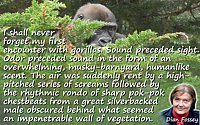
I shall never forget my first encounter with gorillas. Sound preceded sight. Odor preceded sound in the form of an overwhelming, musky-barnyard, humanlike scent. The air was suddenly rent by a high-pitched series of screams followed by the rhythmic rondo of sharp pok-pok chestbeats from a great silverbacked male obscured behind what seemed an impenetrable wall of vegetation.
Describing her 1963 trip to Kabara in Gorillas in the Mist (1983), 3. (The screams and chest-beating were of alarm, not ferocity.)
I shall tell you a great secret, my friend. Do not wait for the last judgment. It takes place every day.
…...
I should like to compare this rearrangement which the proteins undergo in the animal or vegetable organism to the making up of a railroad train. In their passage through the body parts of the whole may be left behind, and here and there new parts added on. In order to understand fully the change we must remember that the proteins are composed of Bausteine united in very different ways. Some of them contain Bausteine of many kinds. The multiplicity of the proteins is determined by many causes, first through the differences in the nature of the constituent Bausteine; and secondly, through differences in the arrangement of them. The number of Bausteine which may take part in the formation of the proteins is about as large as the number of letters in the alphabet. When we consider that through the combination of letters an infinitely large number of thoughts may be expressed, we can understand how vast a number of the properties of the organism may be recorded in the small space which is occupied by the protein molecules. It enables us to understand how it is possible for the proteins of the sex-cells to contain, to a certain extent, a complete description of the species and even of the individual. We may also comprehend how great and important the task is to determine the structure of the proteins, and why the biochemist has devoted himself with so much industry to their analysis.
'The Chemical Composition of the Cell', The Harvey Lectures (1911), 7, 45.
I should like to draw attention to the inexhaustible variety of the problems and exercises which it [mathematics] furnishes; these may be graduated to precisely the amount of attainment which may be possessed, while yet retaining an interest and value. It seems to me that no other branch of study at all compares with mathematics in this. When we propose a deduction to a beginner we give him an exercise in many cases that would have been admired in the vigorous days of Greek geometry. Although grammatical exercises are well suited to insure the great benefits connected with the study of languages, yet these exercises seem to me stiff and artificial in comparison with the problems of mathematics. It is not absurd to maintain that Euclid and Apollonius would have regarded with interest many of the elegant deductions which are invented for the use of our students in geometry; but it seems scarcely conceivable that the great masters in any other line of study could condescend to give a moment’s attention to the elementary books of the beginner.
In Conflict of Studies (1873), 10-11.
I spend a great deal of the hours that I’m awake within myself. You never want to stop doing it, especially when it’s a pleasure. It’s vital to my existence and I couldn’t live if I wasn’t an inventor.
Quoted in Timothy L. O’Brien, 'Not Invented here: Are U.S. Innovators Losing Their Competitive Edge?', New York Times (13 Nov 2005), B6.
I suppose that the first chemists seemed to be very hard-hearted and unpoetical persons when they scouted the glorious dream of the alchemists that there must be some process for turning base metals into gold. I suppose that the men who first said, in plain, cold assertion, there is no fountain of eternal youth, seemed to be the most cruel and cold-hearted adversaries of human happiness. I know that the economists who say that if we could transmute lead into gold, it would certainly do us no good and might do great harm, are still regarded as unworthy of belief. Do not the money articles of the newspapers yet ring with the doctrine that we are getting rich when we give cotton and wheat for gold rather than when we give cotton and wheat for iron?
'The Forgotten Man' (1883). In The Forgotten Man and Other Essays (1918), 468.
I then began to study arithmetical questions without any great apparent result, and without suspecting that they could have the least connexion with my previous researches. Disgusted at my want of success, I went away to spend a few days at the seaside, and thought of entirely different things. One day, as I was walking on the cliff, the idea came to me, again with the same characteristics of conciseness, suddenness, and immediate certainty, that arithmetical transformations of indefinite ternary quadratic forms are identical with those of non-Euclidian geometry.
Science and Method (1908), trans. Francis Maitland (1914), 53-4.
I think it’s going to be great if people can buy a ticket to fly up and see black sky and the stars. I’d like to do it myself - but probably after it has flown a serious number of times first!
…...
I think my greatest achievement will be my discovery that black holes are not entirely black, [because that is critical to] understanding how paradoxes between quantum mechanics and general relativity can be resolved.
As quoted, without citation, by Karma Allen, 'Famed Physicist Stephen Hawking Dies 55 Years After Being Given 2 Years to Live' (14 Mar 2018), on abcnews.go.com webpage.
I think that the unity we can seek lies really in two things. One is that the knowledge which comes to us at such a terrifyingly, inhumanly rapid rate has some order in it. We are allowed to forget a great deal, as well as to learn. This order is never adequate. The mass of ununderstood things, which cannot be summarized, or wholly ordered, always grows greater; but a great deal does get understood.
The second is simply this: we can have each other to dinner. We ourselves, and with each other by our converse, can create, not an architecture of global scope, but an immense, intricate network of intimacy, illumination, and understanding. Everything cannot be connected with everything in the world we live in. Everything can be connected with anything.
The second is simply this: we can have each other to dinner. We ourselves, and with each other by our converse, can create, not an architecture of global scope, but an immense, intricate network of intimacy, illumination, and understanding. Everything cannot be connected with everything in the world we live in. Everything can be connected with anything.
Concluding paragraphs of 'The Growth of Science and the Structure of Culture', Daedalus (Winter 1958), 87, No. 1, 76.
I think the name atomic theory was an unfortunate one. We talk fluently about atoms as the smallest particles that exist, and chemists regard them as indivisible … To my mind the infinitely small is as incomprehensible as the infinitely great. … we cannot comprehend it, we cannot take it in. And so with the atom. Therefore I think that it would have been better to have taken a different word—say minim—which would have been a safer term than atom.
Address, in 'Report to the Chemical Society's Jubilee', Nature (26 Mar 1891), 43, 493.
I think understanding animals enriches your pleasure, finding out how to understand them is the great pleasure. I never stop reading books about man and animals; they’re always full of interesting stuff. I’ll turn the page and my eyes will be popping out.
Speaking at the launch of “David Attenborough’s Natural Curiosities” on Watch, the BBC TV channel (2 Feb 2015). As quoted in 'Sir David Attenborough Shocked By Rat on the Toilet' on femalefirst.co.uk website.
I took a good clear piece of Cork and with a Pen-knife sharpen'd as keen as a Razor, I cut a piece of it off, and thereby left the surface of it exceeding smooth, then examining it very diligently with a Microscope, me thought I could perceive it to appear a little porous; but I could not so plainly distinguish them, as to be sure that they were pores, much less what Figure they were of: But judging from the lightness and yielding quality of the Cork, that certainly the texture could not be so curious, but that possibly, if I could use some further diligence, I might find it to be discernable with a Microscope, I with the same sharp Penknife, cut off from the former smooth surface an exceeding thin piece of it with a deep plano-convex Glass, I could exceedingly plainly perceive it to be all perforated and porous, much like a Honey-comb, but that the pores of it were not regular; yet it was not unlike a Honey-comb in these particulars.
First, in that it had a very little solid substance, in comparison of the empty cavity that was contain'd between, ... for the Interstitia or walls (as I may so call them) or partitions of those pores were neer as thin in proportion to their pores as those thin films of Wax in a Honey-comb (which enclose and constitute the sexangular cells) are to theirs.
Next, in that these pores, or cells, were not very deep, but constituted of a great many little Boxes, separated out of one continued long pore, by certain Diaphragms...
I no sooner discerned these (which were indeed the first microscopical pores I ever saw, and perhaps, that were ever seen, for I had not met with any Writer or Person, that had made any mention of them before this) but me thought I had with the discovery of them, presently hinted to me the true and intelligible reason of all the Phænomena of Cork.
First, in that it had a very little solid substance, in comparison of the empty cavity that was contain'd between, ... for the Interstitia or walls (as I may so call them) or partitions of those pores were neer as thin in proportion to their pores as those thin films of Wax in a Honey-comb (which enclose and constitute the sexangular cells) are to theirs.
Next, in that these pores, or cells, were not very deep, but constituted of a great many little Boxes, separated out of one continued long pore, by certain Diaphragms...
I no sooner discerned these (which were indeed the first microscopical pores I ever saw, and perhaps, that were ever seen, for I had not met with any Writer or Person, that had made any mention of them before this) but me thought I had with the discovery of them, presently hinted to me the true and intelligible reason of all the Phænomena of Cork.
Micrographia, or some Physiological Descriptions of Minute Bodies made by Magnifying Glasses with Observations and Inquiries thereupon (1665), 112-6.
I trust ... I have succeeded in convincing you that modern chemistry is not, as it has so long appeared, an ever-growing accumulation of isolated facts, as impossible for a single intellect to co-ordinate as for a single memory to grasp.
The intricate formulae that hang upon these walls, and the boundless variety of phenomena they illustrate, are beginning to be for us as a labyrinth once impassable, but to which we have at length discovered the clue. A sense of mastery and power succeeds in our minds to the sort of weary despair with which we at first contemplated their formidable array. For now, by the aid of a few general principles, we find ourselves able to unravel the complexities of these formulae, to marshal the compounds which they represent in orderly series; nay, even to multiply their numbers at our will, and in a great measure to forecast their nature ere we have called them into existence. It is the great movement of modern chemistry that we have thus, for an hour, seen passing before us. It is a movement as of light spreading itself over a waste of obscurity, as of law diffusing order throughout a wilderness of confusion, and there is surely in its contemplation something of the pleasure which attends the spectacle of a beautiful daybreak, something of the grandeur belonging to the conception of a world created out of chaos.
The intricate formulae that hang upon these walls, and the boundless variety of phenomena they illustrate, are beginning to be for us as a labyrinth once impassable, but to which we have at length discovered the clue. A sense of mastery and power succeeds in our minds to the sort of weary despair with which we at first contemplated their formidable array. For now, by the aid of a few general principles, we find ourselves able to unravel the complexities of these formulae, to marshal the compounds which they represent in orderly series; nay, even to multiply their numbers at our will, and in a great measure to forecast their nature ere we have called them into existence. It is the great movement of modern chemistry that we have thus, for an hour, seen passing before us. It is a movement as of light spreading itself over a waste of obscurity, as of law diffusing order throughout a wilderness of confusion, and there is surely in its contemplation something of the pleasure which attends the spectacle of a beautiful daybreak, something of the grandeur belonging to the conception of a world created out of chaos.
Concluding remark for paper presented at the Friday Discourse of the the Royal Institution (7 Apr 1865). 'On the Combining Power of Atoms', Proceedings of the Royal Institution (1865), 4, No. 42, 416.
I want to know why the universe exists, why there is something greater than nothing.
From Interview with Diane Sawyer, answering about the biggest mystery he’d like solved. As quoted in ABC News, 'Stephen Hawking on Religion: “Science Will Win”' (4 Jun 2010), on abcnews.go.com website.
I was always afraid of things that worked the first time. Long experience proved that there were great drawbacks found generally before they could be got commercial; but here was something there was no doubt of.
[Recalling astonishment when his tin-foil cylinder phonograph first played back his voice recording of “Mary had a little lamb.”]
[Recalling astonishment when his tin-foil cylinder phonograph first played back his voice recording of “Mary had a little lamb.”]
Quoted in Frank Lewis Dyer, Thomas Commerford Martin, Edison: His Life and Inventions (1910), 208.
I well know what a spendidly great difference there is [between] a man and a bestia when I look at them from a point of view of morality. Man is the animal which the Creator has seen fit to honor with such a magnificent mind and has condescended to adopt as his favorite and for which he has prepared a nobler life; indeed, sent out for its salvation his only son; but all this belongs to another forum; it behooves me like a cobbler to stick to my last, in my own workshop, and as a naturalist to consider man and his body, for I know scarcely one feature by which man can be distinguished from apes, if it be not that all the apes have a gap between their fangs and their other teeth, which will be shown by the results of further investigation.
T. Fredbärj (ed.), Menniskans Cousiner (Valda Avhandlingar av Carl von Linné nr, 21) (1955), 4. Trans. Gunnar Broberg, 'Linnaeus's Classification of Man', in Tore Frängsmyr (ed.), Linnaeus: The Man and his Work (1983), 167.
I will build a motor car for the great multitude … constructed of the best materials, by the best men to be hired, after the simplest designs that modern engineering can devise … so low in price that no man making a good salary will be unable to own one—and enjoy with his family the blessing of pleasure in God’s great open spaces.
(1909). In My Life and Work (1922), 73.
I will insist particularly upon the following fact, which seems to me quite important and beyond the phenomena which one could expect to observe: The same [double sulfate of uranium and potassium] crystalline crusts, arranged the same way [as reported to the French academy on 24 Feb 1896] with respect to the photographic plates, in the same conditions and through the same screens, but sheltered from the excitation of incident rays and kept in darkness, still produce the same photographic images … [when kept from 26 Feb 1896] in the darkness of a bureau drawer. … I developed the photographic plates on the 1st of March, expecting to find the images very weak. Instead the silhouettes appeared with great intensity.
It is important to observe that it appears this phenomenon must not be attributed to the luminous radiation emitted by phosphorescence … One hypothesis which presents itself to the mind naturally enough would be to suppose that these rays, whose effects have a great similarity to the effects produced by the rays studied by M. Lenard and M. Röntgen, are invisible rays …
[Having eliminated phosphorescence as a cause, he has further revealed the effect of the as yet unknown radioactivity.]
It is important to observe that it appears this phenomenon must not be attributed to the luminous radiation emitted by phosphorescence … One hypothesis which presents itself to the mind naturally enough would be to suppose that these rays, whose effects have a great similarity to the effects produced by the rays studied by M. Lenard and M. Röntgen, are invisible rays …
[Having eliminated phosphorescence as a cause, he has further revealed the effect of the as yet unknown radioactivity.]
Read at French Academy of Science (2 Mar 1896). In Comptes Rendus (1896), 122, 501. As translated by Carmen Giunta on the Classic Chemistry web site.
I will not now discuss the Controversie betwixt some of the Modern Atomists, and the Cartesians; the former of whom think, that betwixt the Earth and the Stars, and betwixt these themselves there are vast Tracts of Space that are empty, save where the beams of Light do pass through them; and the later of whom tell us, that the Intervals betwixt the Stars and Planets (among which the Earth may perhaps be reckon'd) are perfectly fill'd, but by a Matter far subtiler than our Air, which some call Celestial, and others Æther. I shall not, I say, engage in this controversie, but thus much seems evident, That If there be such a Celestial Matter, it must ' make up far the Greatest part of the Universe known to us. For the Interstellar part of the world (If I may so stile it) bears so very great a proportion to the Globes, and their Atmospheres too, (If other Stars have any as well as the Earth,) that It Is almost incomparably Greater in respect of them, than all our Atmosphere is in respect of the Clouds, not to make the comparison between the Sea and the Fishes that swim in it.
A Continuation of New Experiments Physico-Mechanical, Touching the Spring and Weight of the Air, and their Effects (1669), 127.
I wished to show that Pythagoras, the first founder of the vegetable regimen, was at once a very great physicist and a very great physician; that there has been no one of a more cultured and discriminating humanity; that he was a man of wisdom and of experience; that his motive in commending and introducing the new mode of living was derived not from any extravagant superstition, but from the desire to improve the health and the manners of men.
From Dell Vitto Pitagorico (1743), (The Pythagorean Diet: for the Use of the Medical Faculty), as translated quotes in Howard Williams, The Ethics of Diet: A Catena of Authorities Deprecatory of the Practice of Flesh-Eating (1883), 158.
I wrote a great deal during the next ten [early] years,but very little of any importance; there are not more than four or five papers which I can still remember with some satisfaction.
In A Mathematician’s Apology (1940, reprint with Foreward by C.P. Snow 1992), 147.
I, Galileo Galilei, son of the late Vincenzo Galilei, of Florence, aged seventy years, being brought personally to judgment, and kneeling before your Most Eminent and Most Reverend Lords Cardinals, General Inquisitors of the universal Christian republic against heretical depravity, having before my eyes the Holy Gospels, which I touch with my own hands, swear that I have always believed, and now believe, and with the help of God will in future believe, every article which the Holy Catholic and Apostolic Church of Rome holds, teaches, and preaches. But because I have been enjoined by this Holy Office altogether to abandon the false opinion which maintains that the sun is the centre and immovable, and forbidden to hold, defend, or teach the said false doctrine in any manner, and after it hath been signified to me that the said doctrine is repugnant with the Holy Scripture, I have written and printed a book, in which I treat of the same doctrine now condemned, and adduce reasons with great force in support of the same, without giving any solution, and therefore have been judged grievously suspected of heresy; that is to say, that I held and believed that the sun is the centre of the universe and is immovable, and that the earth is not the centre and is movable; willing, therefore, to remove from the minds of your Eminences, and of every Catholic Christian, this vehement suspicion rightfully entertained toward me, with a sincere heart and unfeigned faith, I abjure, curse, and detest the said errors and heresies, and generally every other error and sect contrary to Holy Church; and I swear that I will never more in future say or assert anything verbally, or in writing, which may give rise to a similar suspicion of me; but if I shall know any heretic, or anyone suspected of heresy, that I will denounce him to this Holy Office, or to the Inquisitor or Ordinary of the place where I may be; I swear, moreover, and promise, that I will fulfil and observe fully, all the penances which have been or shall be laid on me by this Holy Office. But if it shall happen that I violate any of my said promises, oaths, and protestations (which God avert!), I subject myself to all the pains and punishments which have been decreed and promulgated by the sacred canons, and other general and particular constitutions, against delinquents of this description. So may God help me, and his Holy Gospels which I touch with my own hands. I, the above-named Galileo Galilei, have abjured, sworn, promised, and bound myself as above, and in witness thereof with my own hand have subscribed this present writing of my abjuration, which I have recited word for word. At Rome, in the Convent of Minerva, June 22, 1633. I, Galileo Galilei, have abjured as above with my own hand.
Abjuration, 22 Jun 1633. In J.J. Fahie, Galileo, His Life and Work (1903), 319-321.
I’m trying to assemble pieces of this great jigsaw puzzle of the origin of the solar system, to see if we can illuminate our own processes on the Earth more fundamentally.
In interview, Rushworth M. Kidder, 'Grounded in Space Science', Christian Science Monitor (22 Dec 1989).
I’ve always thought that my exposure to competitive sports helped me a great deal in the operating room. It teaches you endurance, and it teaches you how to cope with defeat, and with complications of all sort. I think I’m a well-coordinated person, more than average, and I think that came through my interest in sports, and athletics. … [Playing basketball] You have to make decisions promptly, and that’s true in the operating room as well.
If a given scientist had not made a given discovery, someone else would have done so a little later. Johann Mendel dies unknown after having discovered the laws of heredity: thirty-five years later, three men rediscover them. But the book that is not written will never be written. The premature death of a great scientist delays humanity; that of a great writer deprives it.
Pensées d'un Biologiste (1939). Translated in The Substance of Man (1962), 89.
If experiments are performed thousands of times at all seasons and in every place without once producing the effects mentioned by your philosophers, poets, and historians, this will mean nothing and we must believe their words rather our own eyes? But what if I find for you a state of the air that has all the conditions you say are required, and still the egg is not cooked nor the lead ball destroyed? Alas! I should be wasting my efforts... for all too prudently you have secured your position by saying that 'there is needed for this effect violent motion, a great quantity of exhalations, a highly attenuated material and whatever else conduces to it.' This 'whatever else' is what beats me, and gives you a blessed harbor, a sanctuary completely secure.
'The Assayer' (1623), trans. Stillman Drake, Discoveries and Opinions of Galileo (1957), 273.
If God is as real as the shadow of the Great War on Armistice Day, need we seek further reason for making a place for God in our thoughts and lives? We shall not be concerned if the scientific explorer reports that he is perfectly satisfied that he has got to the bottom of things without having come across either.
Swarthmore Lecture (1929) at Friends’ House, London, printed in Science and the Unseen World (1929), 67.
If I dared to say just what I think, I should add that it is chiefly in the service where the medication is the most active and heroic that the mortality is the greatest. Gentlemen, medicine is charlatanism.
…...
If it is possible to have a linear unit that depends on no other quantity, it would seem natural to prefer it. Moreover, a mensural unit taken from the earth itself offers another advantage, that of being perfectly analogous to all the real measurements that in ordinary usage are also made upon the earth, such as the distance between two places or the area of some tract, for example. It is far more natural in practice to refer geographical distances to a quadrant of a great circle than to the length of a pendulum.
'Histoire'. Histoire et Memoires de l’Academie Royale des Science de Paris (1788/1791), 9-10. In Charles Coulston Gillispie, Pierre-Simon Laplace, 1749-1827: A Life in Exact Science (2nd Ed., 2000), 151.
If it were possible for us to have so deep an insight into a man's character as shown both in inner and in outer actions, that every, even the least, incentive to these actions and all external occasions which affect them were so known to us that his future conduct could be predicted with as great a certainty as the occurrence of a solar or lunar eclipse, we could nevertheless still assert that the man is free.
Critique of Practical Reason (1788). In L. W. Beck (ed. & trans.), Critique of Practical Reason and Other Writings in Moral Philosophy (1949), 204-5.
If Melancholy increases so far, that from the great motion of the Liquid of the Brain the Patient be thrown into a wild Fury, it is call’d Madness.… The greatest Remedy for it is to throw the Patient unwarily into the Sea, and to keep him under Water as long as he can possibly bear without being quite stifled.
Aphorism No. 1118 and 1123 in Boerhaave’s Aphorisms: Concerning The Knowledge and Cure of Diseases (1715), 302-303.
If new species arise very rapidly in small, peripherally isolated local populations, then the great expectation of insensibly graded fossil sequences is a chimera. A new species does not evolve in the area of its ancestors; it does not arise from the slow transformation of all its forbears.
co-author with Niles Eldridge (palaeontologist, 1943- )
co-author with Niles Eldridge (palaeontologist, 1943- )
'Punctuated Equilibria: An Alternative to Phyletic Gradualism', in Thomas J. M. Schopf (ed.), Models in Paleobiology (1972), 84.
If physics leads us today to a world view which is essentially mystical, it returns, in a way, to its beginning, 2,500 years ago. ... This time, however, it is not only based on intuition, but also on experiments of great precision and sophistication, and on a rigorous and consistent mathematical formalism.
In The Tao of Physics (1975), 19.
If Russia is to be a great power, it will be, not because of its nuclear potential, faith in God or the president, or Western investment, but thanks to the labor of the nation, faith in knowledge and science and the maintenance and development of scientific potential and education.
Quoted in Darryl J. Leiter, Sharon Leiter, A to Z of physicists (2003), 3.
If some great Power would agree to make me always think what is true and do what is right, on condition of being turned into a sort of clock and wound up every morning before I got out of bed, I should instantly close with the offer.
'On Descartes' "Discourse Touching the Method of Using One's Reason Rightly and of Seeking Scientific Truth'" (1870). In Collected Essays (1893), Vol. 1, 192-3.
If that's how it all started, then we might as well face the fact that what's left out there is a great deal of shrapnel and a whole bunch of cinders (one of which is, fortunately, still hot enough and close enough to be good for tanning). Trying to find some sense and order in this mess may be as futile as trying to … reconstruct the economy of Iowa from a bowl of popcorn. [On searching for evidence of the Big Bang.]
From essay 'First Person Secular: Blocking the Gates to Heaven', Mother Jones Magazine (Jun 1986), 48. Collected in The Worst Years of our Lives: Irreverent Notes from a Decade of Greed (1995), 267.
If the 'Principle of Relativity' in an extreme sense establishes itself, it seems as if even Time would become discontinuous and be supplied in atoms, as money is doled out in pence or centimes instead of continuously;—in which case our customary existence will turn out to be no more really continuous than the events on a kinematograph screen;—while that great agent of continuity, the Ether of Space, will be relegated to the museum of historical curiosities.
Continuity: The Presidential Address to the British Association (1913), 40-41.
If the average man in the street were asked to name the benefits derived from sunshine, he would probably say “light and warmth” and there he would stop. But, if we analyse the matter a little more deeply, we will soon realize that sunshine is the one great source of all forms of life and activity on this old planet of ours. … [M]athematics underlies present-day civilization in much the same far-reaching manner as sunshine underlies all forms of life, and that we unconsciously share the benefits conferred by the mathematical achievements of the race just as we unconsciously enjoy the blessings of the sunshine.
From Address (25 Feb 1928) to National Council of Teachers of Mathematics, Boston. Abstract published in 'Mathematics and Sunshine', The Mathematics Teacher (May 1928), 21, No. 5, 245.
If the great story of the last century was the conflict among various political ideologies—communism, fascism and democracy—then the great narrative of this century will be the changes wrought by astonishing scientific breakthroughs
Atlanta Journal-Constitution, column also distributed by United Press Syndicate, American Know-How Hobbled by Know-Nothings (9 Aug 2005). In Eve Herold, George Daley, Stem Cell Wars (2007), 21.
If the Humours of the Eye by old Age decay, so as by shrinking to make the Cornea and Coat of the Crystalline Humour grow flatter than before, the Light will not be refracted enough, and for want of a sufficient Refraction will not converge to the bottom of the Eye but to some place beyond it, and by consequence paint in the bottom of the Eye a confused Picture, and according to the Indistinctuess of this Picture the Object will appear confused. This is the reason of the decay of sight in old Men, and shews why their Sight is mended by Spectacles. For those Convex glasses supply the defect of plumpness in the Eye, and by increasing the Refraction make the rays converge sooner, so as to convene distinctly at the bottom of the Eye if the Glass have a due degree of convexity. And the contrary happens in short-sighted Men whose Eyes are too plump. For the Refraction being now too great, the Rays converge and convene in the Eyes before they come at the bottom; and therefore the Picture made in the bottom and the Vision caused thereby will not be distinct, unless the Object be brought so near the Eye as that the place where the converging Rays convene may be removed to the bottom, or that the plumpness of the Eye be taken off and the Refractions diminished by a Concave-glass of a due degree of Concavity, or lastly that by Age the Eye grow flatter till it come to a due Figure: For short-sighted Men see remote Objects best in Old Age, and therefore they are accounted to have the most lasting Eyes.
Opticks (1704), Book 1, Part 1, Axiom VII, 10-11.
If the misery of our poor be caused not by the laws of nature, but by our institutions, great is our sin.
Journal of Researches
If the present arrangements of society will not admit of woman’s free development, then society must be remodelled, and adapted to the great wants of humanity.
From letter (12 Aug 1848) to Emily Collins, reproduced in Elizabeth Cady Stanton, Susan Brownell Anthony, Matilda Joslyn Gage, History of Woman Suffrage (1881), Vol. 1, 91.
If the term education may be understood in so large a sense as to include all that belongs to the improvement of the mind, either by the acquisition of the knowledge of others or by increase of it through its own exertions, we learn by them what is the kind of education science offers to man. It teaches us to be neglectful of nothing — not to despise the small beginnings, for they precede of necessity all great things in the knowledge of science, either pure or applied.
'Science as a Branch of Education', lecture to the Royal Institution, 11 Jun 1858. Reprinted in The Mechanics Magazine (1858), 49, 11.
If the world may be thought of as a certain definite quantity of force and as a certain definite number of centers of force—and every other representation remains indefinite and therefore useless—it follows that, in the great dice game of existence, it must pass through calculable number of combinations. In infinite time, every possible combination would at some time or another be realized; more: it would be realized an infinite number of times. And since between every combination and its next recurrence all other possible combinations would have to take place, and each of these combination conditions of the entire sequence of combinations in the same series, a circular movement of absolutely identical series is thus demonstrated: the world as a circular movement that has already repeated itself infinitely often and plays its game in infinitum. This conception is not simply a mechanistic conception; for if it were that, it would not condition an infinite recurrence of identical cases, but a final state. Because the world has not reached this, mechanistic theory must be considered an imperfect and merely provisional hypothesis.
The Will to Power (Notes written 1883-1888), book 4, no. 1066. Trans. W. Kaufmann and R. J. Hollingdale and ed. W. Kaufmann (1968), 549.
If time is treated in modern physics as a dimension on a par with the dimensions of space, why should we a priori exclude the possibility that we are pulled as well as pushed along its axis? The future has, after all, as much or as little reality as the past, and there is nothing logically inconceivable in introducing, as a working hypothesis, an element of finality, supplementary to the element of causality, into our equations. It betrays a great lack of imagination to believe that the concept of “purpose” must necessarily be associated with some anthropomorphic deity.
In 'Epilogue', The Sleepwalkers: A History of Man’s Changing Vision of the Universe (1959, 1968), 537.
If we can get kids talking about conservation and doing it, they can have a great influence on their parents by lecturing them and pointing the finger.
…...
If we had had more time for discussing we should probably have made a great many more mistakes.
In My Life (1930).
If we knew all the laws of Nature, we should need only one fact or the description of one actual phenomenon to infer all the particular results at that point. Now we know only a few laws, and our result is vitiated, not, of course, by any confusion or irregularity in Nature, but by our ignorance of essential elements in the calculation. Our notions of law and harmony are commonly confined to those instances which we detect, but the harmony which results from a far greater number of seemingly conflicting, but really concurring, laws which we have not detected, is still more wonderful. The particular laws are as our points of view, as to the traveler, a mountain outline varies with every step, and it has an infinite number of profiles, though absolutely but one form. Even when cleft or bored through, it is not comprehended in its entireness.
In Walden (1878), 311.
If we peep into Dom Claude’s cell, we are introduced to a typical alchemist’s laboratory—a gloomy, dimly-lighted place, full of strange vessels, and furnaces, and melting-pots, spheres, and portions of skeletons hanging from the ceiling; the floor littered with stone bottles, pans, charcoal, aludels, and alembics, great parchment books covered with hieroglyphics; the bellows with its motto Spira, Spera; the hour-glass, the astrolabe, and over all cobwebs, and dust, and ashes. The walls covered with various aphorisms of the brotherhood; legends and memorials in many tongues; passages from the Smaragdine Table of Hermes Trismegistus; and looming out from all in great capitals, ’ANAΓKH.
In The Birth of Chemistry (1874), 100.
If we sink to the biochemical level, then the human being has lost a great many synthetic abilities possessed by other species and, in particular, by plants and microorganisms. Our loss of ability to manufacture a variety of vitamins makes us dependent on our diet and, therefore, on the greater synthetic versatility of other creatures. This is as much a “degenerative” change as the tapeworm’s abandonment of a stomach it no longer needs, but since we are prejudiced in our own favor, we don’t mention it.
In 'The Modern Demonology' (Jan 1962). Collected in Asimov on Physics (1976), 150.
If we thus go very far back to the source of the Mammalian type of organisation; it is extremely improbable that any of [his relatives shall likewise] the successors of his relations now exist,—In same manner, if we take [a man from] any large family of 12 brothers & sisters [in a state which does not increase] it will be chances against anyone [of them] having progeny living ten thousand years hence; because at present day many are relatives so that tracing back the [descen] fathers would be reduced to small percentage.—& [in] therefore the chances are excessively great against, any two of the 12, having progeny, after that distant period.
P. H. Barrett et al. (eds.), Charles Darwin's Notebooks, 1836-1844: Geology, Transmutation of the Species and Metaphysical Enquiries (1987), Notebook B, 40-1.
If we view mathematical speculations with reference to their use, it appears that they should be divided into two classes. To the first belong those which furnish some marked advantage either to common life or to some art, and the value of such is usually determined by the magnitude of this advantage. The other class embraces those speculations which, though offering no direct advantage, are nevertheless valuable in that they extend the boundaries of analysis and increase our resources and skill. Now since many investigations, from which great advantage may be expected, must be abandoned solely because of the imperfection of analysis, no small value should be assigned to those speculations which promise to enlarge the field of anaylsis.
In Novi Comm. Petr., Vol. 4, Preface.
If we would indicate an idea … striving to remove the barriers which prejudice and limited views of every kind have erected among men, and to treat all mankind, without reference to religion, nation, or color, as one fraternity, one great community, fitted for the attainment of one object, the unrestrained development of the physical powers. This is the ultimate and highest aim of society.
In Ueber die Kawi-Sprache, Vol. 3, 426. As quoted in Alexander von Humboldt, Cosmos: A Sketch of a Physical Description of the Universe (1850), Vol. 1, 358, as translated by Elise C. Otté.
If you have great talents, industry will improve them; if moderate abilities, industry will supply their deficiencies. Nothing is denied to well-directed labour; nothing is ever to be attained without it.
From 'A Discourse Delivered to the Students of the Royal Academy, on the Distribution of Prizes' (11 Dec 1769), in Seven Discourses Delivered in the Royal Academy (1778), 57.
If your new theorem can be stated with great simplicity, then there will exist a pathological exception.
In Howard W. Eves Return to Mathematical Circles, (1988), 157.
Imagine that … the world is something like a great chess game being played by the gods, and we are observers of the game. … If we watch long enough, we may eventually catch on to a few of the rules…. However, we might not be able to understand why a particular move is made in the game, merely because it is too complicated and our minds are limited…. We must limit ourselves to the more basic question of the rules of the game.
If we know the rules, we consider that we “understand” the world.
If we know the rules, we consider that we “understand” the world.
In 'Basic Physics', The Feynman Lectures on Physics (1964, 2013), Vol. 1, 2-1.
In [David] Douglas's success in life ... his great activity, undaunted courage, singular abstemiousness, and energetic zeal, at once pointed him out as an individual eminently calculated to do himself credit as a scientific traveler.
In 'Extracts from A Brief Memoir of the Life of David Douglas' (1834), in W.F. Wilson (ed.), David Douglas, Botanist at Hawaii (1919), 12.
In [great mathematics] there is a very high degree of unexpectedness, combined with inevitability and economy.
In A Mathematician’s Apology (1940, reprint with Foreward by C.P. Snow 1992), 113.
In 1847 I gave an address at Newton, Mass., before a Teachers’ Institute conducted by Horace Mann. My subject was grasshoppers. I passed around a large jar of these insects, and made every teacher take one and hold it while I was speaking. If any one dropped the insect, I stopped till he picked it up. This was at that time a great innovation, and excited much laughter and derision. There can be no true progress in the teaching of natural science until such methods become general.
In a few minutes a computer can make a mistake so great that it would have taken many men many months to equal.
In Civilization's Quotations: Life's Ideal (2002), 315.
In a great number of programmes I’m not a scientist—I’m simply a commentator. So I should claim no virtue for the fact that [people] seem to trust me, if that is indeed the case. It’s simply that I very seldom talk about something they can’t see. If I say a lion is attacking a wildebeest, they can see it is; if I were to say something about a proton, it might be different.
As quoted in Bill Parry, 'Sir David Attenborough in Conversation', The Biologist (Jun 2010), 57, No. 2, 93.
In a great number of the cosmogonic myths the world is said to have developed from a great water, which was the prime matter. In many cases, as for instance in an Indian myth, this prime matter is indicated as a solution, out of which the solid earth crystallized out.
In Theories of Solutions (1912), 1.
In a lot of scientists, the ratio of wonder to skepticism declines in time. That may be connected with the fact that in some fields—mathematics, physics, some others—the great discoveries are almost entirely made by youngsters.
Quoted in interview with magazine staff, Psychology Today (Jan 1996).
In a purely technical sense, each species of higher organism—beetle, moss, and so forth, is richer in information than a Caravaggio painting, Mozart symphony, or any other great work of art. Consider the typical case of the house mouse, Mus musculus. Each of its cells contains four strings of DNA, each of which comprises about a billion nucleotide pairs organized into a hundred thousand structural nucleotide pairs, organized into a hundred thousand structural genes. … The full information therein, if translated into ordinary-sized printed letters, would just about fill all 15 editions of the Encyclopaedia Britannica published since 1768.
'The Biological Diversity Crisis: A Challenge to Science', Issues in Science and Technology (Fall 1985), 2:1, 22. Reprinted in Nature Revealed: Selected Writings, 1949-2006 (2006), 622.
In all chemical investigations, it has justly been considered an important object to ascertain the relative weights of the simples which constitute a compound. But unfortunately the enquiry has terminated here; whereas from the relative weights in the mass, the relative weights of the ultimate particles or atoms of the bodies might have been inferred, from which their number and weight in various other compounds would appear, in order to assist and to guide future investigations, and to correct their results. Now it is one great object of this work, to shew the importance and advantage of ascertaining the relative weights of the ultimate particles, both of simple and compound bodies, the number of simple elementary particles which constitute one compound particle, and the number of less compound particles which enter into the formation of one more compound particle.
If there are two bodies, A and B, which are disposed to combine, the following is the order in which the combinations may take place, beginning with the most simple: namely,
1 atom of A + 1 atom of B = 1 atom of C, binary
1 atom of A + 2 atoms of B = 1 atom of D, ternary
2 atoms of A + 1 atom of B = 1 atom of E, ternary
1 atom of A + 3 atoms of B = 1 atom of F, quaternary
3 atoms of A and 1 atom of B = 1 atom of G, quaternary
If there are two bodies, A and B, which are disposed to combine, the following is the order in which the combinations may take place, beginning with the most simple: namely,
1 atom of A + 1 atom of B = 1 atom of C, binary
1 atom of A + 2 atoms of B = 1 atom of D, ternary
2 atoms of A + 1 atom of B = 1 atom of E, ternary
1 atom of A + 3 atoms of B = 1 atom of F, quaternary
3 atoms of A and 1 atom of B = 1 atom of G, quaternary
A New System of Chemical Philosophy (1808), Vol. 1, 212-3.
In all speculations on the origin, or agents that have produced the changes on this globe, it is probable that we ought to keep within the boundaries of the probable effects resulting from the regular operations of the great laws of nature which our experience and observation have brought within the sphere of our knowledge. When we overleap those limits, and suppose a total change in nature's laws, we embark on the sea of uncertainty, where one conjecture is perhaps as probable as another; for none of them can have any support, or derive any authority from the practical facts wherewith our experience has brought us acquainted.
Observations on the Geology of the United States of America (1817), iv-v.
In America, radio has grown rapidly as a great public servant—not only because of freedom to speak and freedom to listen but because of the freedom of science to advance.
In address (Fall 1946) at a dinner in New York to commemorate the 40 years of Sarnoff’s service in the radio field, 'Institute News and Radio Notes: The Past and Future of Radio', Proceedings of the Institute of Radio Engineers (I.R.E.), (May 1947), 35, No. 5, 498.
In assessing Audubon, whose firm grip on the popular imagination has scarcely lessened since 1826, we must as historians of science seriously ask who would remember him if he had not been an artist of great imagination and flair. ... The chances seem to be very poor that had he not been an artist, he would be an unlikely candidate for a dictionary of scientific biography, if remembered to science at all.
In Charles Coulston Gillespie (ed.), Dictionary of Scientific Biography (1972), Vol. 1, 331.
In cold countries the aqueous particles of the blood is exhaled slightly by perspiration; it remains in great abundance. One can therefore make use of spirituous liquors without the blood coagulating. It is full of humours. Strong liquors, which give movement to the blood, may be suitable there.
From De l’Esprit, xiv., Chap 10. In Craufurd Tait Ramage (ed.), Beautiful Thoughts from French and Italian Authors (1866), 210.
In comparison with the great size of the earth the protrusion of mountains is not sufficient to deprive it of its spherical shape or to invalidate measurements based on its spherical shape. For Eratosthenes shows that the perpendicular distance from the highest mountain tops to the lowest regions is ten stades [c.5,000-5,500 feet]. This he shows with the help of dioptras which measure magnitudes at a distance.
Simplicius, Commentary On Aristotle's De Caelo, pp. 549.32-550.4 (Heiberg). Quoted in Morris R. Cohen and I. E. Drabkin, A Sourcebook in Greek Science (1948), 160 n.2.
In engineering, that only is great which achieves. It matters not what the intention is, he who in the day of battle is not victorious is not saved by his intention.
In Proverbs from Plymouth Pulpit (1887), 21.
In Euclid each proposition stands by itself; its connection with others is never indicated; the leading ideas contained in its proof are not stated; general principles do not exist. In modern methods, on the other hand, the greatest importance is attached to the leading thoughts which pervade the whole; and general principles, which bring whole groups of theorems under one aspect, are given rather than separate propositions. The whole tendency is toward generalization. A straight line is considered as given in its entirety, extending both ways to infinity, while Euclid is very careful never to admit anything but finite quantities. The treatment of the infinite is in fact another fundamental difference between the two methods. Euclid avoids it, in modern mathematics it is systematically introduced, for only thus is generality obtained.
In 'Geometry', Encyclopedia Britannica (9th edition).
In formal logic a contradiction is the signal of a defeat, but in the evolution of real knowledge it marks the first step in progress toward a victory. This is one great reason for the utmost toleration of variety of opinion. Once and forever, this duty of toleration has been summed up in the words, “Let both grow together until the harvest.”
In 'Religion and Science', The Atlantic (Aug 1925).
In general, art has preceded science. Men have executed great, and curious, and beautiful works before they had a scientific insight into the principles on which the success of their labours was founded. There were good artificers in brass and iron before the principles of the chemistry of metals were known; there was wine among men before there was a philosophy of vinous fermentation; there were mighty masses raised into the air, cyclopean walls and cromlechs, obelisks and pyramids—probably gigantic Doric pillars and entablatures—before there was a theory of the mechanical powers. … Art was the mother of Science.
Lecture (26 Nov 1851), to the London Society of Arts, 'The General Bearing of the Great Exhibition on the Progress of Art and Science', collected in Lectures on the Results of the Great Exhibition of 1851' (1852), 7-8.
In mathematical analysis we call x the undetermined part of line a: the rest we don’t call y, as we do in common life, but a-x. Hence mathematical language has great advantages over the common language.
Lichtenberg: A Doctrine of Scattered Occasions: Reconstructed From: Reconstructed From His Aphorisms and Reflections (1959), 158.
In my youth scarcely anyone mentioned Wegener’s ideas of a mobile earth and moving continents. … The great impediment was that geologists only studied that one quarter of the earth’s surface not covered by ice or water; at that time no one had any means for exploring the great interior or the ocean floors.
In 'Early Days in University Geophysics', Annual Review of Earth and Planetary Sciences (1982), 10, 6.
In natural history, great discovery often requires a map to a hidden mine filled with gems then easily gathered by conventional tools, not a shiny new space-age machine for penetrating previously inaccessible worlds.
…...
In order to pursue chemotherapy successfully we must look for substances which possess a high affinity and high lethal potency in relation to the parasites, but have a low toxicity in relation to the body, so that it becomes possible to kill the parasites without damaging the body to any great extent. We want to hit the parasites as selectively as possible. In other words, we must learn to aim and to aim in a chemical sense. The way to do this is to synthesize by chemical means as many derivatives as possible of relevant substances.
'Ueber den jetzigen Stand der Chemotherapie'. Berichte der Deutschen Chemischen Gesellschagt, 1909, 42, 17-47. Translated in B. Holmstedt and G. Liljestrand (eds.), Readings in Pharmacology (1963), 286.
In physics we have dealt hitherto only with periodic crystals. To a humble physicist’s mind, these are very interesting and complicated objects; they constitute one of the most fascinating and complex material structures by which inanimate nature puzzles his wits. Yet, compared with the aperiodic crystal, they are rather plain and dull. The difference in structure is of the same kind as that between an ordinary wallpaper in which the same pattern is repeated again and again in regular periodicity and a masterpiece of embroidery, say a Raphael tapestry, which shows no dull repetition, but an elaborate, coherent, meaningful design traced by the great master.
…...
In presenting a mathematical argument the great thing is to give the educated reader the chance to catch on at once to the momentary point and take details for granted: his successive mouthfuls should be such as can be swallowed at sight; in case of accidents, or in case he wishes for once to check in detail, he should have only a clearly circumscribed little problem to solve (e.g. to check an identity: two trivialities omitted can add up to an impasse). The unpractised writer, even after the dawn of a conscience, gives him no such chance; before he can spot the point he has to tease his way through a maze of symbols of which not the tiniest suffix can be skipped.
In A Mathematician's Miscellany (1953). Reissued as Béla Bollobás (ed.), Littlewood’s Miscellany (1986), 49.
In pure mathematics we have a great structure of logically perfect deductions which constitutes an integral part of that great and enduring human heritage which is and should be largely independent of the perhaps temporary existence of any particular geographical location at any particular time. … The enduring value of mathematics, like that of the other sciences and arts, far transcends the daily flux of a changing world. In fact, the apparent stability of mathematics may well be one of the reasons for its attractiveness and for the respect accorded it.
In Fundamentals of Mathematics (1941), 463.
In reality, all Arguments from Experience are founded on the Similarity which we discover among natural Objects, and by which we are induc'd to expect effects similar to those which we have found to follow from such Objects. And tho' none but a Fool or Madman will ever pretend to dispute the Authority of Experience, or to reject that great Guide of human Life, it may surely be allow'd a Philosopher to have so much Curiosity at least as to examine the Principle of human Nature, which gives this mighty Authority to Experience, and makes us draw Advantage from that Similarity which Nature has plac'd among different Objects. From Causes which appear similar we expect similar Effects. This is the Sum of our experimental Conclusions.
An Enquiry Concerning Human Understanding (1748), 63.
In reality, I have sometimes thought that we do not go on sufficiently slowly in the removal of diseases, and that it would he better if we proceeded with less haste, and if more were often left, to Nature than is the practice now-a-days. It is a great mistake to suppose that Nature always stands in need of the assistance of Art. If that were the case, site would have made less provision for the safety of mankind than the preservation of the species demands; seeing that there is not the least proportion between the host of existing diseases and the powers possessed by man for their removal, even in those ages wherein the healing art was at the highest pitch, and most extensively cultivated.
As quoted by Gavin Milroy in 'On the Writings of Sydenham', The Lancet (14 Nov 1846), 524.
In science its main worth is temporary, as a stepping-stone to something beyond. Even the Principia, as Newton with characteristic modesty entitled his great work, is truly but the beginning of a natural philosophy, and no more an ultimate work, than Watt’s steam-engine, or Arkwright's spinning-machine.
Co-author with his brother Augustus William Hare Guesses At Truth, By Two Brothers: Second Edition: With Large Additions (1848), Second Series, 46. (The volume is introduced as “more than three fourths new.” This quote is identified as by Julius; Augustus had died in 1833.)
In Science, it is when we take some interest in the great discoverers and their lives that it becomes endurable, and only when we begin to trace the development of ideas that it becomes fascinating.
Quoted in Robert J. Scully, The Demon and the Quantum (2007), 5.
In scientific investigations it is grievously wrong to pander to the public’s impatience for results, or to let them think that for discovery it is necessary only to set up a great manufactory and a system of mass production. If in treatment team work is effective, in research it is the individual who counts first and above all. No great thought has ever sprung from anything but a single mind, suddenly conceiving. Throughout the whole world there has been too violent a forcing of the growth of ideas; too feverish a rush to perform experiments and publish conclusions. A year of vacation for calm detachment with all the individual workers thinking it all over in a desert should be proclaimed.
In Viewless Winds: Being the Recollections and Digressions of an Australian Surgeon (1939), 286.
In scientific matters ... the greatest discoverer differs from the most arduous imitator and apprentice only in degree, whereas he differs in kind from someone whom nature has endowed for fine art. But saying this does not disparage those great men to whom the human race owes so much in contrast to those whom nature has endowed for fine art. For the scientists' talent lies in continuing to increase the perfection of our cognitions and on all the dependent benefits, as well as in imparting that same knowledge to others; and in these respects they are far superior to those who merit the honour of being called geniuses. For the latter's art stops at some point, because a boundary is set for it beyond which it cannot go and which has probably long since been reached and cannot be extended further.
The Critique of Judgement (1790), trans. J. C. Meredith (1991), 72.
In spite of what moralists say, the, animals are scarcely less wicked or less unhappy than we are ourselves. The arrogance of the strong, the servility of the weak, low rapacity, ephemeral pleasure purchased by great effort, death preceded by long suffering, all belong to the animals as they do to men.
Recueil des Éloges Historiques 1819-27, Vol. 1, 91.
In summary, all great work is the fruit of patience and perseverance, combined with tenacious concentration on a subject over a period of months or years.
From Reglas y Consejos sobre Investigacíon Cientifica: Los tónicos de la voluntad. (1897), as translated by Neely and Larry W. Swanson, in Advice for a Young Investigator (1999), 38.
In the animal world, on the other hand, the process of evolution is characterised by the progressive discrimination of the animal and vegetative functions, and a consequent differentiation of these two great provinces into their separate departments.
In the beginning the Universe was created. This has made a lot of people very angry and been widely regarded as a bad move. Many races believe it was created by some sort of god, though the Jatravartid people of Viltvodle VI believe that the entire Universe was in fact sneezed out of the nose of a being called the Great Green Arkleseizure.
In The Restaurant at the End of the Universe (1980, 1981), 1
In the case of elements, as in that of individuals, the determination of character is often attended with very great difficulty, a true estimate being only slowly arrived at, and when at last such an estimate is found, it can only be very partially expressed in words.
In The Encyclopaedia Britannica: Ninth Edition (1877), Vol. 5, 714.
In the distance tower still higher peaks which will yield to those who ascend them still wider prospects, and deepen the feeling whose truth is emphasized by every advance in science: that “Great are the Works of the Lord.”
From Inaugural Address to the Annual Meeting of the British Association for the Advancement of Science at Winnipeg. Collected in 'The British Association at Winnipeg',Nature (26 Aug 1909), 81. No. 2078, 257.
In the great debates of early-nineteenth century geology, catastrophists followed the stereotypical method of objective science-empirical literalism. They believed what they saw, interpolated nothing, and read the record of the rocks directly.
'The Stinkstones of Oeningen', In Hen's Teeth and Horse's Toes (1983), 105.
In the history of physics, there have been three great revolutions in thought that first seemed absurd yet proved to be true. The first proposed that the earth, instead of being stationary, was moving around at a great and variable speed in a universe that is much bigger than it appears to our immediate perception. That proposal, I believe, was first made by Aristarchos two millenia ago ... Remarkably enough, the name Aristarchos in Greek means best beginning.
[The next two revolutions occurred ... in the early part of the twentieth century: the theory of relativity and the science of quantum mechanics...]
[The next two revolutions occurred ... in the early part of the twentieth century: the theory of relativity and the science of quantum mechanics...]
Edward Teller with Judith L. Shoolery, Memoirs: A Twentieth-Century Journey in Science and Politics (2001), 562.
In the history of the discovery of zero will always stand out as one of the greatest single achievements of the human race.
Number: the Language of Science (1930), 35.
In the Life of Darwin by his son, there is related an incident of how the great naturalist once studied long as to just what a certain spore was. Finally he said, “It is this, for if it isn’t, then what is it?” And all during his life he was never able to forget that he had been guilty of this unscientific attitude, for science is founded on certitude, not assumption.
In Elbert Hubbard (ed. and publ.), The Philistine (May 1908), 26, No. 6, 172.
In the mathematics I can report no deficience, except that it be that men do not sufficiently understand the excellent use of the pure mathematics, in that they do remedy and cure many defects in the wit and faculties intellectual. For if the wit be too dull, they sharpen it; if too wandering, they fix it; if too inherent in the sense, they abstract it. So that as tennis is a game of no use in itself, but of great use in respect it maketh a quick eye and a body ready to put itself into all postures; so in the mathematics, that use which is collateral and intervenient is no less worthy than that which is principal and intended.
As translated in John Fauvel and Jeremy Gray (eds.) A History of Mathematics: A Reader (1987), 290-291. From De Augmentis, Book 3, The Advancement of Learning (1605), Book 2. Reprinted in The Two Books of Francis Bacon: Of the Proficience and Advancement of Learning, Divine and Human (2009), 97.
In the mountains of Parma and Piacenza, multitudes of shells and corals filled with worm-holes may be seen still adhering to the rocks, and when I was making the great horse at Milan a large sack of those which had been found in these parts was brought to my workshop by some peasants... The red stone of the mountains of Verona is found with shells all intermingled, which have become part of this stone... And if you should say that these shells have been and still constantly are being created in such places as these by the nature of the locality or by potency of the heavens in these spots, such an opinion cannot exist in brains possessed of any extensive powers of reasoning because the years of their growth are numbered upon the outer coverings of their shells; and both small and large ones may be seen; and these would not have grown without feeding, or fed without movement, and here [embedded in rock] they would not have been able to move... The peaks of the Apennines once stood up in a sea, in the form of islands surrounded by salt water... and above the plains of Italy where flocks of birds are flying today, fishes were once moving in large shoals.
'Physical Geography', in The Notebooks of Leonardo da Vinci, trans. E. MacCurdy (1938), Vol. 1, 355-6, 359.
In the next twenty centuries … humanity may begin to understand its most baffling mystery—where are we going? The earth is, in fact, traveling many thousands of miles per hour in the direction of the constellation Hercules—to some unknown destination in the cosmos. Man must understand his universe in order to understand his destiny. Mystery, however, is a very necessary ingredient in our lives. Mystery creates wonder and wonder is the basis for man’s desire to understand. Who knows what mysteries will be solved in our lifetime, and what new riddles will become the challenge of the new generation? Science has not mastered prophesy. We predict too much for the next year yet far too little for the next ten. Responding to challenges is one of democracy’s great strengths. Our successes in space can be used in the next decade in the solution of many of our planet’s problems.
In a speech to a Joint Meeting of the Two Houses of Congress to Receive the Apollo 11 Astronauts (16 Sep 1969), in the Congressional Record.
In the past we see that periods of great intellectual activity have followed certain events which have acted by freeing the mind from dogma, extending the domain in which knowledge can be sought, and stimulating the imagination. … [For example,] the development of the cell theory and the theory of evolution.
From address, 'A Medical Retrospect'. Published in Yale Medical Journal (Oct 1910), 17, No. 2, 59.
In the preface to his great History of Europe, H. A. L. Fisher wrote: “Men wiser than and more learned than I have discerned in history a plot, a rhythm, a predetermined pattern. These harmonies are concealed from me. I can see only one emergency following upon another as wave follows upon wave …” It seems to me that the same is true of the much older [geological stratigraphical] history of Europe.
In The Nature of the Stratigraphical Record (1973), 79.
In the school of political projectors, I was but ill entertained, the professors appearing, in my judgment, wholly out of their senses; which is a scene that never fails to make me melancholy. These unhappy people were proposing schemes for persuading monarchs to choose favourites upon the score of their wisdom, capacity, and virtue; of teaching ministers to consult the public good; of rewarding merit, great abilities, and eminent services; of instructing princes to know their true interest, by placing it on the same foundation with that of their people; of choosing for employment persons qualified to exercise them; with many other wild impossible chimeras, that never entered before into the heart of man to conceive, and confirmed in me the old observation, that there is nothing so extravagant and irrational which some philosophers have not maintained for truth.
Gulliver's Travels (1726, Penguin ed. 1967), Part III, Chap. 6, 232.
In the spring of 1760, [I] went to William and Mary college, where I continued two years. It was my great good fortune, and what probably fixed the destinies of my life, that Dr. William Small of Scotland, was then Professor of Mathematics, a man profound in most of the useful branches of science, with a happy talent of communication, correct and gentlemanly manners, and an enlarged and liberal mind. He, most happily for me, became soon attached to me, and made me his daily companion when not engaged in the school; and from his conversation I got my first views of the expansion of science, and of the system of things in which we are placed.
In Thomas Jefferson and Andrew Adgate Lipscomb (ed.), The Writings of Thomas Jefferson (1904), Vol. 1, 3.
In the universe great acts are made up of small deeds.
— Lao Tzu
In Lao Tsu and Jane English (trans.), Tao Te Ching (1989), sec. 63, 66.
In the world’s history certain inventions and discoveries occurred of peculiar value, on account of their great efficiency in facilitating all other inventions and discoveries. Of these were the art of writing and of printing, the discovery of America, and the introduction of patent laws. The date of the first … is unknown; but it certainly was as much as fifteen hundred years before the Christian era; the second—printing—came in 1436, or nearly three thousand years after the first. The others followed more rapidly—the discovery of America in 1492, and the first patent laws in 1624.
Lecture 'Discoveries, Inventions and Improvements' (22 Feb 1860) in John George Nicolay and John Hay (eds.), Complete Works of Abraham Lincoln (1894), Vol. 5, 109-10.
In the year of our Lord’s incarnation 729, two comets appeared about the sun, to the great terror of the beholders. One of them went before the rising sun in the morning, the other followed him when he set at night, as it were presaging much destruction to the east and west; one was the forerunner of the day, and the other of the night, to signify that mortals were threatened with calamities at both times. They carried their flaming tails towards the north, as it were ready to set the world on fire. They appeared in January, and continued nearly a fortnight. At which time a dreadful plague of Saracens ravaged France with miserable slaughter; … the beginning
and progress of Ceolwulf’s reign were so filled with commotions, that it cannot yet be known what is to be said concerning them, or what end they will have.
— Bede
From Historia Ecclesiastica Gentis Anglorum, Book V, Chap. XXIII, as translated in J.A. Giles (ed.), The Venerable Bede’s Ecclesiastical History of England. Also the Anglo-Saxon Chronicle (1894), 291-292. The editor reprinted the translation based on the 1723 work of John Stevens into modern English. Note: The observation likely was on a single comet seen twice each day. The event is also in both the Laud and Parker manuscripts of The Anglo-Saxon Chronicle.
In things to be seen at once, much variety makes confusion, another vice of beauty. In things that are not seen at once, and have no respect one to another, great variety is commendable, provided this variety transgress not the rules of optics and geometry.
Quoted from the Parentalia in Charles Henry Bellenden Ker, Sir Christopher Wren (1828), 30. Published as a booklet in the series Lives of Eminent Persons (1833) by the Society for the Diffusion of Useful Knowledge. Also in W.H. Auden and L. Kronenberger (eds.) The Viking Book of Aphorisms (1966).
In this country all a man need to do is to attain a little eminence and immediately he begins to talk. Usually his eminence is financial, and the greater this eminence the more he talks and the further his voice reaches. I don't blame the rich people for talking; many of them don’t know what else to do with themselves. The fault is with these who listen. If no one would listen
no harm would he done. But the American people are willing to listen to any one who has attained prominence. The main fact is that we've heard a man's name a great many times; that makes us ready to accept whatever he says. … We listen to the one who talks the most and loudest.
As quoted in 'Electricity Will Keep The World From Freezing Up', New York Times (12 Nov 1911), SM4.
In this great celestial creation, the catastrophy of a world, such as ours, or even the total dissolution of a system of worlds, may possibly be no more to the great Author of Nature, than the most common accident in life with us, and in all probability such final and general Doomsdays may be as frequent there, as even Birthdays or mortality with us upon the earth. This idea has something so cheerful in it, that I know I can never look upon the stars without wondering why the whole world does not become astronomers; and that men endowed with sense and reason should neglect a science they are naturally so much interested in, and so capable of enlarging their understanding, as next to a demonstration must convince them of their immortality, and reconcile them to all those little difficulties incident to human nature, without the least anxiety. All this the vast apparent provision in the starry mansions seem to promise: What ought we then not to do, to preserve our natural birthright to it and to merit such inheritance, which alas we think created all to gratify alone a race of vain-glorious gigantic beings, while they are confined to this world, chained like so many atoms to a grain of sand.
In The Universe and the Stars: Being an Original Theory on the Visible Creation, Founded on the Laws of Nature (1750, 1837), 132.
In this great society wide lying around us, a critical analysis would find very few spontaneous actions. It is almost all custom and gross sense.
In time, manufacturing will to a great extent follow the sun.
[Speculating that with development of solar power the deserts would become great industrial areas.]
[Speculating that with development of solar power the deserts would become great industrial areas.]
As quoted in Rene Bache, 'Harnessing the Sun', Popular Mechanics (Apr 1928), 602.
In working out physical problems there should be, in the first place, no pretence of rigorous formalism. The physics will guide the physicist along somehow to useful and important results, by the constant union of physical and geometrical or analytical ideas. The practice of eliminating the physics by reducing a problem to a purely mathematical exercise should be avoided as much as possible. The physics should be carried on right through, to give life and reality to the problem, and to obtain the great assistance which the physics gives to the mathematics.
In Electromagnetic Theory (1892), Vol. 2, 5.
Indeed the modern developments of mathematics constitute not only one of the most impressive, but one of the most characteristic, phenomena of our age. It is a phenomenon, however, of which the boasted intelligence of a “universalized” daily press seems strangely unaware; and there is no other great human interest, whether of science or of art, regarding which the mind of the educated public is permitted to hold so many fallacious opinions and inferior estimates.
In Lectures on Science, Philosophy and Arts (1908), 8.
Indeed, we need not look back half a century to times which many now living remember well, and see the wonderful advances in the sciences and arts which have been made within that period. Some of these have rendered the elements themselves subservient to the purposes of man, have harnessed them to the yoke of his labors and effected the great blessings of moderating his own, of accomplishing what was beyond his feeble force, and extending the comforts of life to a much enlarged circle, to those who had before known its necessaries only.
From paper 'Report of the Commissioners Appointed to Fix the Site of the University of Virginia' (Dec 1818), reprinted in Annual Report of the Board of Visitors of the University of Virginia for the Fiscal Year Ending May 31, 1879 (1879), 10. Collected in Commonwealth of Virginia, Annual Reports of Officers, Boards, and Institutions of the Commonwealth of Virginia, for the Year Ending September 30, 1879 (1879).
IODINE
It was Courtois discover'd Iodine
(In the commencement of this century),
Which, with its sisters, bromine and chlorine,
Enjoys a common parentage - the sea;
Although sometimes 'tis found, with other things,
In minerals and many saline springs.
But yet the quantity is so minute
In the great ocean, that a chemist might,
With sensibilities the most acute,
Have never brought this element to light,
Had he not thought it were as well to try
Where ocean's treasures concentrated lie.
And Courtois found that several plants marine,
Sponges, et cetera, exercise the art
Of drawing from the sea its iodine
In quantities sufficient to impart
Its properties; and he devised a plan
Of bringing it before us - clever man!
It was Courtois discover'd Iodine
(In the commencement of this century),
Which, with its sisters, bromine and chlorine,
Enjoys a common parentage - the sea;
Although sometimes 'tis found, with other things,
In minerals and many saline springs.
But yet the quantity is so minute
In the great ocean, that a chemist might,
With sensibilities the most acute,
Have never brought this element to light,
Had he not thought it were as well to try
Where ocean's treasures concentrated lie.
And Courtois found that several plants marine,
Sponges, et cetera, exercise the art
Of drawing from the sea its iodine
In quantities sufficient to impart
Its properties; and he devised a plan
Of bringing it before us - clever man!
Discursive Chemical Notes in Rhyme (1876) by the Author of the Chemical Review, a B.
Is it a fact—or have I dreamt it—that, by means of electricity, the world of matter has become a great nerve, vibrating thousands of miles in a breathless point of time?
In The House of the Seven Gables (1851), 203.
Is not Cuvier the great poet of our era? Byron has given admirable expression to certain moral conflicts, but our immortal naturalist has reconstructed past worlds from a few bleached bones; has rebuilt cities, like Cadmus, with monsters’ teeth; has animated forests with all the secrets of zoology gleaned from a piece of coal; has discovered a giant population from the footprints of a mammoth.
From 'La Peau de Chagrin' (1831). As translated by Ellen Marriage in The Wild Ass’s Skin (1906), 21-22.
Is not Cuvier the greatest poet of our age? Of course Lord Byron has set down in fine words certain of our souls’ longings; but our immortal naturalist has reconstructed whole worlds out of bleached bones. Like Cadmus, he has rebuilt great cities from teeth, repopulated thousands of forests with all the mysteries of zoology from a few pieces of coal, discovered races of giants in the foot of a mammoth.
From 'La Peau de Chagrin' (1831). As translated as by Helen Constantine The Wild Ass’s Skin (2012), 19.
Isolated facts and experiments have in themselves no value, however great their number may be. They only become valuable in a theoretical or practical point of view when they make us acquainted with the law of a series of uniformly recurring phenomena, or, it may be, only give a negative result showing an incompleteness in our knowledge of such a law, till then held to be perfect.
'The Aim and Progress of Physical Science' (1869). Trans. E. Atkinson, Popular Lectures on Scientific Subjects (1873), 369.
It [the value of building Fermilab’s first accelerator] only has to do with the respect with which we regard one another, the dignity of men, our love of culture. It has to do with those things. It has nothing to do with the military, I am sorry. … It has to do with: Are we good painters, good sculptors, great poets? I mean all the things that we really venerate and honor in our country and are patriotic about. In that sense, this new knowledge has all to do with honor and country but it has nothing to do directly with defending our country except to help make it worth defending.
In testimony to a Congressional Committee, answering a question on how the new accelerator will affect the nation’s security (17 Apr 1968). On record in AEC Authorizing Legislation, Fiscal Year 1970: Part 1.
It behooves us always to remember that in physics it has taken great men to discover simple things. They are very great names indeed which we couple with the explanation of the path of a stone, the droop of a chain, the tints of a bubble, the shadows of a cup.
In On Growth and Form (1917).
It can even be thought that radium could become very dangerous in criminal hands, and here the question can be raised whether mankind benefits from knowing the secrets of Nature, whether it is ready to profit from it or whether this knowledge will not be harmful for it. The example of the discoveries of Nobel is characteristic, as powerful explosives have enabled man to do wonderful work. They are also a terrible means of destruction in the hands of great criminals who lead the peoples towards war. I am one of those who believe with Nobel that mankind will derive more good than harm from the new discoveries.
Nobel Lecture (6 June 1905), 'Radioactive Substances, Especially Radium', collected in Stig Lundqvist (ed.), Nobel Lectures: Physics 1901-1921 (1998), 78.
It gave me great pleasure to tell you about the mysteries with which physics confronts us. As a human being, one has been endowed with just enough intelligence to be able to see clearly how utterly inadequate that intelligence is when confronted with what exists. If such humility could be conveyed to everybody, the world of human activities would be more appealing.
Letter (19 Sep 1932) replying to Queen Elizabeth of Belgium, in which she had complimented his lucid explanation of the casual and probabilistic theories in physics during a wander with her, in a park. As quoted in Albert Einstein, edited by Helen Dukas and Banesh Hoffman, Albert Einstein, The Human Side: Glimpses from His Archives (1979, 2013), 48.
It has been asserted … that the power of observation is not developed by mathematical studies; while the truth is, that; from the most elementary mathematical notion that arises in the mind of a child to the farthest verge to which mathematical investigation has been pushed and applied, this power is in constant exercise. By observation, as here used, can only be meant the fixing of the attention upon objects (physical or mental) so as to note distinctive peculiarities—to recognize resemblances, differences, and other relations. Now the first mental act of the child recognizing the distinction between one and more than one, between one and two, two and three, etc., is exactly this. So, again, the first geometrical notions are as pure an exercise of this power as can be given. To know a straight line, to distinguish it from a curve; to recognize a triangle and distinguish the several forms—what are these, and all perception of form, but a series of observations? Nor is it alone in securing these fundamental conceptions of number and form that observation plays so important a part. The very genius of the common geometry as a method of reasoning—a system of investigation—is, that it is but a series of observations. The figure being before the eye in actual representation, or before the mind in conception, is so closely scrutinized, that all its distinctive features are perceived; auxiliary lines are drawn (the imagination leading in this), and a new series of inspections is made; and thus, by means of direct, simple observations, the investigation proceeds. So characteristic of common geometry is this method of investigation, that Comte, perhaps the ablest of all writers upon the philosophy of mathematics, is disposed to class geometry, as to its method, with the natural sciences, being based upon observation. Moreover, when we consider applied mathematics, we need only to notice that the exercise of this faculty is so essential, that the basis of all such reasoning, the very material with which we build, have received the name observations. Thus we might proceed to consider the whole range of the human faculties, and find for the most of them ample scope for exercise in mathematical studies. Certainly, the memory will not be found to be neglected. The very first steps in number—counting, the multiplication table, etc., make heavy demands on this power; while the higher branches require the memorizing of formulas which are simply appalling to the uninitiated. So the imagination, the creative faculty of the mind, has constant exercise in all original mathematical investigations, from the solution of the simplest problems to the discovery of the most recondite principle; for it is not by sure, consecutive steps, as many suppose, that we advance from the known to the unknown. The imagination, not the logical faculty, leads in this advance. In fact, practical observation is often in advance of logical exposition. Thus, in the discovery of truth, the imagination habitually presents hypotheses, and observation supplies facts, which it may require ages for the tardy reason to connect logically with the known. Of this truth, mathematics, as well as all other sciences, affords abundant illustrations. So remarkably true is this, that today it is seriously questioned by the majority of thinkers, whether the sublimest branch of mathematics,—the infinitesimal calculus—has anything more than an empirical foundation, mathematicians themselves not being agreed as to its logical basis. That the imagination, and not the logical faculty, leads in all original investigation, no one who has ever succeeded in producing an original demonstration of one of the simpler propositions of geometry, can have any doubt. Nor are induction, analogy, the scrutinization of premises or the search for them, or the balancing of probabilities, spheres of mental operations foreign to mathematics. No one, indeed, can claim preeminence for mathematical studies in all these departments of intellectual culture, but it may, perhaps, be claimed that scarcely any department of science affords discipline to so great a number of faculties, and that none presents so complete a gradation in the exercise of these faculties, from the first principles of the science to the farthest extent of its applications, as mathematics.
In 'Mathematics', in Henry Kiddle and Alexander J. Schem, The Cyclopedia of Education, (1877.) As quoted and cited in Robert Édouard Moritz, Memorabilia Mathematica; Or, The Philomath’s Quotation-book (1914), 27-29.
It has been said that science is opposed to, and in conflict with revelation. But the history of the former shown that the greater its progress, and the more accurate its investigations and results, the more plainly it is seen not only not to clash with the Latter, but in all things to confirm it. The very sciences from which objections have been brought against religion have, by their own progress, removed those objections, and in the end furnished fall confirmation of the inspired Word of God.
…...
It has just occurred to me to ask if you are familiar with Lissajous’ experiments. I know nothing about them except what I found in Flammarion’s great “Astronomie Populaire.” One extraordinary chapter on numbers gives diagrams of the vibrations of harmonics—showing their singular relation to the geometrical designs of crystal-formation;—and the chapter is aptly closed by the Pythagorian quotation: Ἀεὶ ὁ θεὸς ὁ μέγας γεωμετρεῖ—“God geometrizes everywhere.” … I should imagine that the geometry of a fine opera would—were the vibrations outlined in similar fashion—offer a network of designs which for intricate beauty would double discount the arabesque of the Alhambra.
In letter to H.E. Krehbiel (1887), collected in Elizabeth Bisland The Writings of Lafcadio Hearn (1922), Vol. 14, 8.
It has long been a complaint against mathematicians that they are hard to convince: but it is a far greater disqualification both for philosophy, and for the affairs of life, to be too easily convinced; to have too low a standard of proof. The only sound intellects are those which, in the first instance, set their standards of proof high. Practice in concrete affairs soon teaches them to make the necessary abatement: but they retain the consciousness, without which there is no sound practical reasoning, that in accepting inferior evidence because there is no better to be had, they do not by that acceptance raise it to completeness.
In An Examination of Sir William Hamilton’s Philosophy (1878), 611.
It is ... indisputable that the orogenic movements which uplift the hills have been at the basis of geological history. To them the great accumulation of sediments which now form so large a part of continental land are mainly due. There can be no doubt of the fact that these movements have swayed the entire history, both inorganic and organic, of the world in which we live.
Radioactivity and Geology (1909), 115-6.
It is a custom often practiced by seafaring people to throw a bottle overboard, with a paper, stating the time and place at which it is done. In the absence of other information as to currents, that afforded by these mute little navigators is of great value.
In The Physical Geography of the Sea (1855), 28.
It is a fair question whether the results of these things have induced among us in a large class of well-to-do people, with little muscular activity, a habit of excessive eating [particularly fats and sweets] and may be responsible for great damage to health, to say nothing of the purse.
L.A. Maynard citing Wilbur O. Atwater in a biographical sketch, Journal of Nutrition (1962) 78, 3. Quoted in Ira Wolinsky, Nutrition in Exercise and Sport (1998), 36.
It is a great deal easier to believe in the existence of parapsychological phenomena, if one is ignorant of, or indifferent to, the nature of scientific evidence.
Epigraph in Isaac Asimov’s Book of Science and Nature Quotations (1988), 207.
It is a great folly to wish to be exclusively wise.
In Moral Reflections, Sentences and Maxims (1851), 72.
It is a great pity Aristotle had not understood mathematics as well as Mr. Newton, and made use of it in his natural philosophy with good success: his example had then authorized the accommodating of it to material things.
In Second Reply to the Bishop of Worcester.
It is a great thing to start life with a small number of really good books which are your very own.
In Through the Magic Door (1908), Chap. 2, 24.
It is a lovely and terrible wilderness, such as wilderness as Christ and the prophets went out into; harshly and beautifully colored, broken and worn until its bones are exposed, its great sky without a smudge of taint from Technocracy, and in hidden corners and pockets under its cliffs the sudden poetry of springs.
Letter (3 Dec 1960) written to David E. Pesonen of the Outdoor Recreation Resources Review Commission. Collected in 'Coda: Wilderness Letter', The Sound of Mountain Water: The Changing American West (1969), 153.
It is a strange feeling which comes over one as he stands in the centre of the tunnel, and knows that a mighty river is rolling on over his head, and that great ships with their thousands of tons burthen, sail over him. ... There is no single work of Art in London (with the exception of St. Paul's Cathedral) which excites so much curiosity and admiration among foreigners as the Tunnel. Great buildings are common to all parts of Europe, but the world has not such another Tunnel as this. There is something grand in the idea of walking under a broad river—making a pathway dry and secure beneath ships and navies!
[About visiting Brunel's Thames Tunnel, the first in the world under a navigable waterway.]
[About visiting Brunel's Thames Tunnel, the first in the world under a navigable waterway.]
What I Saw in London: or, Men and Things in the Great Metropolis (1853), 168-169.
It is a temptation for philosophers that they should weave a fairy tale of the adjustment of factors; and then as an appendix introduce the notion of frustration, as a secondary aspect. I suggest to you that this is the criticism to be made on the monistic idealisms of the nineteenth century, and even of the great Spinoza. It is quite incredible that the Absolute, as conceived in monistic philosophy, should evolve confusion about its own details.
In Modes of Thought (1938), 69-70.
It is another aphorism that no one knows everything about anything. That need not dull the pleasure and fascination of the fact that a great deal is known about some things.
In Splendid Isolation (1980), 38.
It is as great a mistake to maintain that a high development of the imagination is not essential to progress in mathematical studies as to hold with Ruskin and others that science and poetry are antagonistic pursuits.
In Sphere of Science (1898), 107.
It is certain that as a nation we are all smoking a great deal too much ... Smoking among boys—to whom it cannot possibly do any kind of good, while it may do a vast amount of active harm—is becoming prevalent to a most pernicious extent. ... It would be an excellent thing for the morality of the people could the use of “intoxicants and tobacco” be forbidden to all persons under twenty years of age. (1878)
In London Daily Telegraph (22 Jan 1878). Reprinted in English Anti-Tobacco Society and Anti-Narcotic League, Monthly letters of the Committee of the English Anti-Tobacco Society and Anti-Narcotic League 1878, 1879, 1880, (1 Feb 1878), 85.
It is contrary to the usual order of things, that events so harmonious as those of the system of the world, should depend on such diversified agents as are supposed to exist in our artificial arrangements; and there is reason to anticipate a great reduction in the number of undecompounded bodies, and to expect that the analogies of nature will be found conformable to the refined operations of art. The more the phenomena of the universe are studied, the more distinct their connection appears, and the more simple their causes, the more magnificent their design, and the more wonderful the wisdom and power of their Author.
Elements of Chemical Philosophy (1812), in J. Davy (ed.), The Collected Works of Sir Humphry Davy(1839-40), Vol. 4, 42.
It is curious to observe how differently these great men [Plato and Bacon] estimated the value of every kind of knowledge. Take Arithmetic for example. Plato, after speaking slightly of the convenience of being able to reckon and compute in the ordinary transactions of life, passes to what he considers as a far more important advantage. The study of the properties of numbers, he tells us, habituates the mind to the contemplation of pure truth, and raises us above the material universe. He would have his disciples apply themselves to this study, not that they may be able to buy or sell, not that they may qualify themselves to be shop-keepers or travelling merchants, but that they may learn to withdraw their minds from the ever-shifting spectacle of this visible and tangible world, and to fix them on the immutable essences of things.
Bacon, on the other hand, valued this branch of knowledge only on account of its uses with reference to that visible and tangible world which Plato so much despised. He speaks with scorn of the mystical arithmetic of the later Platonists, and laments the propensity of mankind to employ, on mere matters of curiosity, powers the whole exertion of which is required for purposes of solid advantage. He advises arithmeticians to leave these trifles, and employ themselves in framing convenient expressions which may be of use in physical researches.
Bacon, on the other hand, valued this branch of knowledge only on account of its uses with reference to that visible and tangible world which Plato so much despised. He speaks with scorn of the mystical arithmetic of the later Platonists, and laments the propensity of mankind to employ, on mere matters of curiosity, powers the whole exertion of which is required for purposes of solid advantage. He advises arithmeticians to leave these trifles, and employ themselves in framing convenient expressions which may be of use in physical researches.
In 'Lord Bacon', Edinburgh Review (Jul 1837). Collected in Critical and Miscellaneous Essays: Contributed to the Edinburgh Review (1857), Vol. 1, 394.
It is difficult to conceive a grander mass of vegetation:—the straight shafts of the timber-trees shooting aloft, some naked and clean, with grey, pale, or brown bark; others literally clothed for yards with a continuous garment of epiphytes, one mass of blossoms, especially the white Orchids Caelogynes, which bloom in a profuse manner, whitening their trunks like snow. More bulky trunks were masses of interlacing climbers, Araliaceae, Leguminosae, Vines, and Menispermeae, Hydrangea, and Peppers, enclosing a hollow, once filled by the now strangled supporting tree, which has long ago decayed away. From the sides and summit of these, supple branches hung forth, either leafy or naked; the latter resembling cables flung from one tree to another, swinging in the breeze, their rocking motion increased by the weight of great bunches of ferns or Orchids, which were perched aloft in the loops. Perpetual moisture nourishes this dripping forest: and pendulous mosses and lichens are met with in profusion.
Himalayan Journals (1854), vol. 1, 110-1.
It is frequently the tragedy of the great artist, as it is of the great scientist, that he frightens the ordinary man.
In The Night Country (1971, 1997), 208.
It is from this absolute indifference and tranquility of the mind, that mathematical speculations derive some of their most considerable advantages; because there is nothing to interest the imagination; because the judgment sits free and unbiased to examine the point. All proportions, every arrangement of quantity, is alike to the understanding, because the same truths result to it from all; from greater from lesser, from equality and inequality.
In On the Sublime and Beautiful, Part 3, sect. 2.
It is going to be necessary that everything that happens in a finite volume of space and time would have to be analyzable with a finite number of logical operations. The present theory of physics is not that way, apparently. It allows space to go down into infinitesimal distances, wavelengths to get infinitely great, terms to be summed in infinite order, and so forth; and therefore, if this proposition [that physics is computer-simulatable] is right, physical law is wrong.
International Journal of Theoretical Physics (1982), 21 Nos. 6-7, 468. Quoted in Brian Rotman, Mathematics as Sign (2000), 82.
It is hard to think of fissionable materials when fashioned into bombs as being a source of happiness. However this may be, if with such destructive weapons men are to survive, they must grow rapidly in human greatness. A new level of human understanding is needed. The reward for using the atom’s power towards man’s welfare is great and sure. The punishment for its misuse would seem to be death and the destruction of the civilization that has been growing for a thousand years. These are the alternatives that atomic power, as the steel of Daedalus, presents to mankind. We are forced to grow to greater manhood.
Atomic Quest: A Personal Narrative (1956), xix.
It is his intuition, his mystical insight into the nature of things, rather than his reasoning which makes a great scientist.
In The Open Society and Its Enemies (1945).
It is idle to expect any great advancement in science from the superinducing and engrafting of new things upon old. We must begin anew from the very foundations, unless we would revolve for ever in a circle with mean and contemptible progress.
From Novum Organum (1620), Book 1, Aphorism 31. Translated as The New Organon: Aphorisms Concerning the Interpretation of Nature and the Kingdom of Man), collected in James Spedding, Robert Ellis and Douglas Heath (eds.), The Works of Francis Bacon (1857), Vol. 4, 52.
It is important to realize that life on this planet has spent about three-quarters of its existence in single-celled form, and even today the majority of organisms still exist as single cells. The evolutionary pressure to become complex is evidently not very great.
and Robert Shapiro
It is impossible for the strength of an elderly person to be great. Some physicians think that
children also do not have great strength, but they are mistaken in their opinion.
As quoted in Robert Taylor, White Coat Tales: Medicine's Heroes, Heritage, and Misadventures (2010), 125.
It is in the name of Moses that Bellarmin thunderstrikes Galileo; and this great vulgarizer of the great seeker Copernicus, Galileo, the old man of truth, the magian of the heavens, was reduced to repeating on his knees word for word after the inquisitor this formula of shame: “Corde sincera et fide non ficta abjuro maledico et detestor supradictos errores et hereses.” Falsehood put an ass's hood on science.
[With a sincere heart, and of faith unfeigned, I deny by oath, condemn and detest the aforesaid errors and heresies.]
[With a sincere heart, and of faith unfeigned, I deny by oath, condemn and detest the aforesaid errors and heresies.]
In Victor Hugo and Lorenzo O'Rourke (trans.) Victor Hugo's Intellectual Autobiography: (Postscriptum de ma vie) (1907), 313.
It is inconceivable, that inanimate brute matter should, without the mediation of something else, which is not material, operate upon and affect other matter without mutual contact … That gravity should be innate, inherent, and essential to matter, so that one body may act upon another at a distance, through a vacuum, without the mediation of anything else, by and through which their action and force may be conveyed from one to another, is to me so great an absurdity, that I believe no man who has in philosophical matters a competent faculty of thinking, can ever fall into it. Gravity must be caused by an agent, acting constantly according to certain laws; but whether this agent be material or immaterial, I have left to the consideration of my readers.
Third letter to Bentley, 25 Feb 1693. Quoted in The Works of Richard Bentley, D.D. (1838), Vol. 3, 212-3.
It is indeed an Opinion strangely prevailing amongst Men, that Houses, Mountains, Rivers, and in a word all sensible Objects have an Existence Natural or Real, distinct from their being perceived by the Understanding. But with how great an Assurance and Acquiescence soever this Principle may be entertained in the World; yet whoever shall find in his Heart to call it in Question, may, if I mistake not, perceive it to involve a manifest Contradiction. For what are the forementioned Objects but the things we perceive by Sense, and what do we perceive besides our own Ideas or Sensations; and is it not plainly repugnant that anyone of these or any Combination of them should exist unperceived?
A Treatise Concerning the Principles of Human Knowledge [first published 1710], (1734),38.
It is India that gave us the ingenious method of expressing all numbers by means of ten symbols, each symbol receiving a value of position as well as an absolute value; a profound and important idea which appears so simple to us now that we ignore its true merit. But its very simplicity and the great ease which it has lent to computations put our arithmetic in the first rank of useful inventions; and we shall appreciate the grandeur of the achievement the more when we remember that it escaped the genius of Archimedes and Apollonius, two of the greatest men produced by antiquity.
Quoted in Return to Mathematical Circles H. Eves (Boston 1988).
It is most interesting to observe into how small a field the whole of the mysteries of nature thus ultimately resolve themselves. The inorganic has one final comprehensive law, GRAVITATION. The organic, the other great department of mundane things, rests in like manner on one law, and that is,—DEVELOPMENT. Nor may even these be after all twain, but only branches of one still more comprehensive law, the expression of that unity which man's wit can scarcely separate from Deity itself.
Vestiges of the Natural History of Creation (1844), 360.
It is not enough to say that we cannot know or judge because all the information is not in. The process of gathering knowledge does not lead to knowing. A child's world spreads only a little beyond his understanding while that of a great scientist thrusts outward immeasurably. An answer is invariably the parent of a great family of new questions. So we draw worlds and fit them like tracings against the world about us, and crumple them when we find they do not fit and draw new ones.
In John Steinbeck and Edward Flanders Ricketts, Sea of Cortez: a Leisurely Journal of Travel and Research (1941), 165-66.
It is not for us to say whether Inspiration revealed to the Psalmist the wonders of the modern astronomy. But even though the mind be a perfect stranger to the science of these enlightened times, the heavens present a great and an elevating spectacle—an immense concave reposing on the circular boundary of the world, and the innumerable lights which are suspended from on high, moving with solemn regularity along its surface.
From Discourse, 'A Sketch of Modern Astronomy', in The Works of Thomas Chalmers (1830), 69.
It is not I who seek to base Man's dignity upon his great toe, or insinuate that we are lost if an Ape has a hippocampus minor. On the contrary, I have done my best to sweep away this vanity. I have endeavoured to show that no absolute structural line of demarcation, wider than that between the animals which immediately succeed us in the scale, can be drawn between the animal world and ourselves; and I may add the expression of my belief that the attempt to draw a physical distinction is equally futile, and that even the highest facuities of feeling and of intellect begin to germinate in lower forms of life. At the same time, no one is more strongly convinced than I am of the vastness of the gulf between civilized man and the brutes; or is more certain that whether from them or not, he is assuredly not of them.
'On the Relations of Man to the Lower Animals' (1863). In Collected Essays (1894), Vol. 7. 152-3.
It is not necessary for all men to be great in action. The greatest and sublimest power is often simple patience.
From 'The Efficiency of the Passive Virtues', New Life, Sermons for the New Life (1869), 412.
It is not surprising, in view of the polydynamic constitution of the genuinely mathematical mind, that many of the major heros of the science, men like Desargues and Pascal, Descartes and Leibnitz, Newton, Gauss and Bolzano, Helmholtz and Clifford, Riemann and Salmon and Plücker and Poincaré, have attained to high distinction in other fields not only of science but of philosophy and letters too. And when we reflect that the very greatest mathematical achievements have been due, not alone to the peering, microscopic, histologic vision of men like Weierstrass, illuminating the hidden recesses, the minute and intimate structure of logical reality, but to the larger vision also of men like Klein who survey the kingdoms of geometry and analysis for the endless variety of things that flourish there, as the eye of Darwin ranged over the flora and fauna of the world, or as a commercial monarch contemplates its industry, or as a statesman beholds an empire; when we reflect not only that the Calculus of Probability is a creation of mathematics but that the master mathematician is constantly required to exercise judgment—judgment, that is, in matters not admitting of certainty—balancing probabilities not yet reduced nor even reducible perhaps to calculation; when we reflect that he is called upon to exercise a function analogous to that of the comparative anatomist like Cuvier, comparing theories and doctrines of every degree of similarity and dissimilarity of structure; when, finally, we reflect that he seldom deals with a single idea at a tune, but is for the most part engaged in wielding organized hosts of them, as a general wields at once the division of an army or as a great civil administrator directs from his central office diverse and scattered but related groups of interests and operations; then, I say, the current opinion that devotion to mathematics unfits the devotee for practical affairs should be known for false on a priori grounds. And one should be thus prepared to find that as a fact Gaspard Monge, creator of descriptive geometry, author of the classic Applications de l’analyse à la géométrie; Lazare Carnot, author of the celebrated works, Géométrie de position, and Réflections sur la Métaphysique du Calcul infinitesimal; Fourier, immortal creator of the Théorie analytique de la chaleur; Arago, rightful inheritor of Monge’s chair of geometry; Poncelet, creator of pure projective geometry; one should not be surprised, I say, to find that these and other mathematicians in a land sagacious enough to invoke their aid, rendered, alike in peace and in war, eminent public service.
In Lectures on Science, Philosophy and Art (1908), 32-33.
It is not therefore the business of philosophy, in our present situation in the universe, to attempt to take in at once, in one view, the whole scheme of nature; but to extend, with great care and circumspection, our knowledge, by just steps, from sensible things, as far as our observations or reasonings from them will carry us, in our enquiries concerning either the greater motions and operations of nature, or her more subtile and hidden works. In this way Sir Isaac Newton proceeded in his discoveries.
An Account of Sir Isaac Newton's Philosophical Discoveries, in Four Books (1748), 19.
It is now necessary to indicate more definitely the reason why mathematics not only carries conviction in itself, but also transmits conviction to the objects to which it is applied. The reason is found, first of all, in the perfect precision with which the elementary mathematical concepts are determined; in this respect each science must look to its own salvation .... But this is not all. As soon as human thought attempts long chains of conclusions, or difficult matters generally, there arises not only the danger of error but also the suspicion of error, because since all details cannot be surveyed with clearness at the same instant one must in the end be satisfied with a belief that nothing has been overlooked from the beginning. Every one knows how much this is the case even in arithmetic, the most elementary use of mathematics. No one would imagine that the higher parts of mathematics fare better in this respect; on the contrary, in more complicated conclusions the uncertainty and suspicion of hidden errors increases in rapid progression. How does mathematics manage to rid itself of this inconvenience which attaches to it in the highest degree? By making proofs more rigorous? By giving new rules according to which the old rules shall be applied? Not in the least. A very great uncertainty continues to attach to the result of each single computation. But there are checks. In the realm of mathematics each point may be reached by a hundred different ways; and if each of a hundred ways leads to the same point, one may be sure that the right point has been reached. A calculation without a check is as good as none. Just so it is with every isolated proof in any speculative science whatever; the proof may be ever so ingenious, and ever so perfectly true and correct, it will still fail to convince permanently. He will therefore be much deceived, who, in metaphysics, or in psychology which depends on metaphysics, hopes to see his greatest care in the precise determination of the concepts and in the logical conclusions rewarded by conviction, much less by success in transmitting conviction to others. Not only must the conclusions support each other, without coercion or suspicion of subreption, but in all matters originating in experience, or judging concerning experience, the results of speculation must be verified by experience, not only superficially, but in countless special cases.
In Werke [Kehrbach] (1890), Bd. 5, 105. As quoted, cited and translated in Robert Édouard Moritz, Memorabilia Mathematica; Or, The Philomath’s Quotation-Book (1914), 19.
It is of great advantage to the student of any subject to read the original memoirs on that subject, for science is always most completely assimilated when it is in the nascent state.
A Treatise on Electricity and Magnetism (1873), Vol. 1, Preface, xiii-xiv.
It is often more convenient to possess the ashes of great men than to possess the men themselves during their lifetime.
Commenting on the return of Descartes’ remains to France. Quoted, without citation, in Eric Temple Bell Men of Mathematics (1937), 52.
It is one of the triumphs of human wit ... to conquer by humility and submissiveness ... to make oneself small in order to appear great ... such ... are often the expedients of the neurotic.
In The Neurotic Constitution (1917), 81-82.
It is only by introducing the young to great literature, drama and music, and to the excitement of great science that we open to them the possibilities that lie within the human spirit—enable them to see visions and dream dreams.
Quoted, without citation in Reader's Digest Quotable Quotes (1997), 144. This quote, usually seen attributed as 'Eric Anderson' is here tentatively linked to Sir Eric Anderson. If you can confirm this with a primary source, please contact Webmaster.
It is our great collective misfortune that the scientific community made its decisive diagnosis of the climate threat at the precise moment when an elite minority was enjoying more unfettered political, cultural, and intellectual power than at any point since the 1920s.
From This Changes Everything: Capitalism vs. the Climate (2014), 18.
It is perhaps a law of nature that when a species (or group) fits itself to a place not previously occupied, and in which it is subject to no opposition from beings of its own class, or where it attains so great a perfection as to be able easily to overcome all opposition, the character eventually loses its original plasticity, or tendency to vary, since improvement in such a case would be superfluous, and becomes, so to speak, crystallized in that form which continues thereafter unaltered. … [Such as] the humming-bird.
In The Naturalist in La Plata (1895), 40.
It is popular to believe that the age of the individual and, above all, of the free individual, is past in science. There are many administrators of science and a large component of the general population who believe that mass attacks can do anything, and even that ideas are obsolete. Behind this drive to the mass attack there are a number of strong psychological motives. Neither the public or the big administrator has too good an understanding of the inner continuity of science, but they both have seen its world-shaking consequences, and they are afraid of it. Both of them wish to decerebrate the scientist, even as the Byzantine State emasculated its civil servants. Moreover, the great administrator who is not sure of his own intellectual level can aggrandize himself only by cutting his scientific employees down to size.
In I am a Mathematician (1956), Epilogue, 363-364.
It is presumed that there exists a great unity in nature, in respect of the adequacy of a single cause to account for many different kinds of consequences.
In Theoretical Philosophy, 1755-1770, trans. and ed. By David Walford (2003), 155.
It is remarkable that when great discoveries are effected, their simplicity always seems to detract from their originality: on these occasions we are reminded of the egg of Columbus!
Curiosities of Literature (1824), Vol. 3, 277-278.
It is safe to say that the little pamphlet which was left to find its way through the slow mails to the English scientist outweighed in importance and interest for the human race all the press dispatches which have been flashed under the channel since the delivery of the address—March 24. The rapid growth of the Continental capitals, the movements of princely noodles and fat, vulgar Duchesses, the debates in the Servian Skupschina, and the progress or receding of sundry royal gouts are given to the wings of lightning; a lumbering mail-coach is swift enough for the news of one of the great scientific discoveries of the age. Similarly, the gifted gentlemen who daily sift out for the American public the pith and kernel of the Old World's news; leave Dr. KOCH and his bacilli to chance it in the ocean mails, while they challenge the admiration of every gambler and jockey in this Republic by the fullness and accuracy of their cable reports of horse-races.
New York Times (3 May 1882). Quoted in Thomas D. Brock, Robert Koch (1988), 131.
It is said of Jacobi, that he attracted the particular attention and friendship of Böckh, the director of the philological seminary at Berlin, by the great talent he displayed for philology, and only at the end of two years’ study at the University, and after a severe mental struggle, was able to make his final choice in favor of mathematics.
In Collected Mathematical Papers, Vol. 2 (1908), 661.
It is the great beauty of our science that advancement in it, whether in a degree great or small, instead of exhausting the subject of research, opens the doors to further and more abundant knowledge, overflowing with beauty and utility.
From 'Experimental Researches in Electricity: Series VII: § 13. On the absolute quantity of Electricity associated with the particles or atoms of Matter', Philosophic Transactions, (text dated 31 Dec 1833, received 9 Jan 1834, read 13 Feb 1834). Collected in Experimental Researches in Electricity (1839), Vol. 1, 257.
It is the invaluable merit of the great Basle mathematician Leonhard Euler, to have freed the analytical calculus from all geometric bounds, and thus to have established analysis as an independent science, which from his time on has maintained an unchallenged leadership in the field of mathematics.
In Die Entwickelung der Mathematik in den letzten Jahrhunderten (1884), 12. As quoted and cited in Robert Édouard Moritz, Memorabilia Mathematica; Or, The Philomath’s Quotation-Book (1914), 153. Seen incorrectly attributed to Thomas Reid in N. Rose, Mathematical and Maxims and Minims (1988).
It is the mark of great art that its appeal is universal and eternal.
In Art (1913), 36.
It is to them [fossils] alone that we owe the commencement of even a Theory of the Earth ... By them we are enabled to ascertain, with the utmost certainty, that our earth has not always been covered over by the same external crust, because we are thoroughly assured that the organized bodies to which these fossil remains belong must have lived upon the surface before they came to be buried, as they now are, at a great depth.
'Preliminary discourse', to Recherches sur les Ossemens Fossiles (1812), trans. R. Kerr Essay on the Theory of the Earth (1813), 54-55.
It is to Titian we must turn our eyes to find excellence with regard to color, and light and shade, in the highest degree. He was both the first and the greatest master of this art. By a few strokes he knew how to mark the general image and character of whatever object he attempted.
In Discourse XI, Discourses on Painting and the Fine Arts: Delivered at the Royal Academy (1826), 209
It is well known, that on the Ohio, and in many parts of America further north, tusks, grinders, and skeletons of unparalleled magnitude are found in great numbers, some lying on the surface of the earth, and some a little below it ... But to whatever animal we ascribe these remains, it is certain that such a one has existed in America, and that it has been the largest of all terrestrial beings.
Notes on the State of Virginia (1782), 71, 77.
It just so happens that during the 1950s, the first great age of molecular biology, the English schools of Oxford and particularly of Cambridge produced more than a score of graduates of quite outstanding ability—much more brilliant, inventive, articulate and dialectically skillful than most young scientists; right up in the Jim Watson class. But Watson had one towering advantage over all of them: in addition to being extremely clever he had something important to be clever about.
From the postscript to 'Lucky Jim', New York Review of Books (28 Mar 1968). Also collected in 'Lucky Jim', Pluto’s Republic (1982), 275. Also excerpted in Richard Dawkins (ed.), The Oxford Book of Modern Science Writing (2008), 186.
It often happens that men, even of the best understandings and greatest circumspection, are guilty of that fault in reasoning which the writers on logick call the insufficient, or imperfect enumeration of parts, or cases: insomuch that I will venture to assert, that this is the chief, and almost the only, source of the vast number of erroneous opinions, and those too very often in matters of great importance, which we are apt to form on all the subjects we reflect upon, whether they relate to the knowledge of nature, or the merits and motives of human actions. It must therefore be acknowledged, that the art which affords a cure to this weakness, or defect, of our understandings, and teaches us to enumerate all the possible ways in which a given number of things may be mixed and combined together, that we may be certain that we have not omitted anyone arrangement of them that can lead to the object of our inquiry, deserves to be considered as most eminently useful and worthy of our highest esteem and attention. And this is the business of the art, or doctrine of combinations ... It proceeds indeed upon mathematical principles in calculating the number of the combinations of the things proposed: but by the conclusions that are obtained by it, the sagacity of the natural philosopher, the exactness of the historian, the skill and judgement of the physician, and the prudence and foresight of the politician, may be assisted; because the business of all these important professions is but to form reasonable conjectures concerning the several objects which engage their attention, and all wise conjectures are the results of a just and careful examination of the several different effects that may possibly arise from the causes that are capable of producing them.
Ars conjectandi (1713). In F. Maseres, The Doctrine of Permutations and Combinations (1795), 36.
It seems to me what is called for is an exquisite balance between two conflicting needs: the most skeptical scrutiny of all hypotheses that are served up to us and at the same time a great openness to new ideas … If you are only skeptical, then no new ideas make it through to you … On the other hand, if you are open to the point of gullibility and have not an ounce of skeptical sense in you, then you cannot distinguish the useful ideas from the worthless ones.
In 'The Burden of Skepticism', Skeptical Inquirer (Fall 1987), 12, No. 1.
It was a great step in science when men became convinced that, in order to understand the nature of things, they must begin by asking, not whether a thing is good or bad, noxious or beneficial, but of what kind it is? And how much is there of it? Quality and Quantity were then first recognised as the primary features to be observed in scientific inquiry.
'Address to the Mathematical and Physical Sections of the British Association, Liverpool, 15 Sep 1870', The Scientific Papers of James Clerk Maxwell (1890 edition, reprint 2003), Vol. 2, 217.
It was a great thing to open the eyes of a blind man, but it is a greater thing to open the eyes of a blind soul.
Quoted in Kim Lim (ed.), 1,001 Pearls of Spiritual Wisdom: Words to Enrich, Inspire, and Guide Your Life (2014), 17
It was not alone the striving for universal culture which attracted the great masters of the Renaissance, such as Brunellesco, Leonardo da Vinci, Raphael, Michelangelo and especially Albrecht Dürer, with irresistible power to the mathematical sciences. They were conscious that, with all the freedom of the individual fantasy, art is subject to necessary laws, and conversely, with all its rigor of logical structure, mathematics follows aesthetic laws.
From Lecture (5 Feb 1891) held at the Rathhaus, Zürich, printed as Ueber den Antheil der mathematischen Wissenschaft an der Kultur der Renaissance (1892), 19. (The Contribution of the Mathematical Sciences to the Culture of the Renaissance.) As translated in Robert Édouard Moritz, Memorabilia Mathematica; Or, The Philomath’s Quotation-Book (1914), 183.
It was their individuality combined with the shyness of their behavior that remained the most captivating impression of this first encounter with the greatest of the great apes.
In Gorillas in the Mist (1983), 4
It wasn’t the finches that put the idea [of natural selection] in Darwin’s head, it was the tortoises. The reason he didn’t use the tortoises [in writing On the Origin of Species] was that, when he got back, he found he didn’t have localities on the tortoise specimens. Here the great god, the greatest naturalist we have records of, made a mistake. His fieldwork wasn’t absolutely perfect.
From interview with Brian Cox and Robert Ince, in 'A Life Measured in Heartbeats', New Statesman (21 Dec 2012), 141, No. 5138, 33.
It will, perhaps appear probable, that one of the great laboratories of nature for cleaning and purifying the air of our atmosphere is placed in the substance of the leaves, and put in action by the influence of the light.
In Tobias George Smollett (ed.), 'Experiments Upon Vegetables', The Critical Review, Or, Annals of Literature (1779), 48, 336.
It would appear... that moral phenomena, when observed on a great scale, are found to resemble physical phenomena; and we thus arrive, in inquiries of this kind, at the fundamental principle, that the greater the number of individuals observed, the more do individual peculiarities, whether physical or moral, become effaced, and leave in a prominent point of view the general facts, by virtue of which society exists and is preserved.
A Treatise on Man and the Development of his Faculties (1842). Reprinted with an introduction by Solomon Diamond (1969), 6.
It would be our worst enemy who would wish us to live only on the glories of the past and die off from the face of the earth in sheer passivity. By continuous achievement alone we can justify our great ancestry. We do not honour our ancestors by the false claim that they are omniscient and had nothing more to learn.
From 'Sir J.C. Bose’s Address', Benares Hindu University 1905-1935 (1936), 423. Collected in J. Lourdusamy, Science and National Consciousness in Bengal: 1870-1930 (2004), 106.
It would indeed be a great delusion, if we stated that those sports of Nature [we find] enclosed in rocks are there by chance or by some vague creative power. Ah, that would be superficial indeed! In reality, those shells, which once were alive in water and are now dead and decomposed, were made thus by time not Nature; and what we now find as very hard, figured stone, was once soft mud and which received the impression of the shape of a shell, as I have frequently demonstrated.
La vana speculazione disingannata del senso (1670), trans. Ezio Vaccari, 83-4.
It would seem at first sight as if the rapid expansion of the region of mathematics must be a source of danger to its future progress. Not only does the area widen but the subjects of study increase rapidly in number, and the work of the mathematician tends to become more and more specialized. It is, of course, merely a brilliant exaggeration to say that no mathematician is able to understand the work of any other mathematician, but it is certainly true that it is daily becoming more and more difficult for a mathematician to keep himself acquainted, even in a general way, with the progress of any of the branches of mathematics except those which form the field of his own labours. I believe, however, that the increasing extent of the territory of mathematics will always be counteracted by increased facilities in the means of communication. Additional knowledge opens to us new principles and methods which may conduct us with the greatest ease to results which previously were most difficult of access; and improvements in notation may exercise the most powerful effects both in the simplification and accessibility of a subject. It rests with the worker in mathematics not only to explore new truths, but to devise the language by which they may be discovered and expressed; and the genius of a great mathematician displays itself no less in the notation he invents for deciphering his subject than in the results attained. … I have great faith in the power of well-chosen notation to simplify complicated theories and to bring remote ones near and I think it is safe to predict that the increased knowledge of principles and the resulting improvements in the symbolic language of mathematics will always enable us to grapple satisfactorily with the difficulties arising from the mere extent of the subject.
In Presidential Address British Association for the Advancement of Science, Section A., (1890), Nature, 42, 466.
It’s important natural history isn’t seen as something that is “out there”, which you have to travel to. It’s right there in your garden. Public awareness of the natural history of the world as a whole has never been as great. But it’s important to know about species close to home.
As reported by Adam Lusher in 'Sir David Attenborough', Daily Mail (28 Feb 2014).
It’s not the critic who counts; not the man which points out how the strong man stumbles or where the doer of deeds could have done them better. The credit belongs to the man who is actually in the arena, whose face is marred by dust and sweat and blood; who strives valiantly; who errs, who comes short again and again … who knows great enthusiasms, the great devotions; who spends himself in a worthy cause; who at the best knows in the end the triumph of high achievement, and who at the worst, if he fails, at least fails while daring greatly, so that his place shall never be with those cold and timid souls who neither know victory nor defeat.
In Joseph A. Califano, Jr., Inside: A Public and Private Life (2005), 356.
It’s that moment, that brief epiphany when the universe opens up and shows us something, and in that instant we get just a sense of an order greater than Heaven and, as yet at least, beyond the grasp of Stephen Hawking.
Quoted in Kim Lim (ed.), 1,001 Pearls of Spiritual Wisdom: Words to Enrich, Inspire, and Guide Your Life (2014), 109
Jefferson refused to pin his hopes on the occasional success of honest and unambitious men; on the contrary, the great danger was that philosophers would be lulled into complacence by the accidental rise of a Franklin or a Washington. Any government which made the welfare of men depend on the character of their governors was an illusion.
In The Lost World of Thomas Jefferson (1948, 1993), 178.
John [H.] Van Vleck, who was a leading young theoretical physicist when I was also a leading young theoretical physicist, said to me one day, “I never have made a contribution to physics that I didn’t get by fiddling with the equations,” and I said, “I’ve never made a contribution that I didn’t get by just having a new idea. Then I would fiddle with the equations to help support the new idea.” Van Vleck was essentially a mathematical physicist, you might say, and I was essentially a person of ideas. I don’t think I’m primarily mathematical. … I have a great curiosity about the nature of the world as a whole, and most of my ideas are qualitative rather than quantitative.
Interview with George B. Kauffman and Laurie M. Kauffman, in 'Linus Pauling: Reflections', American Scientist (Nov-Dec 1994), 82, No. 6, 523.
Judging from our experience upon this planet, such a history, that begins with elementary particles, leads perhaps inevitably toward a strange and moving end: a creature that knows, a science-making animal, that turns back upon the process that generated him and attempts to understand it. Without his like, the universe could be, but not be known, and this is a poor thing. Surely this is a great part of our dignity as men, that we can know, and that through us matter can know itself; that beginning with protons and electrons, out of the womb of time and the vastnesses of space, we can begin to understand; that organized as in us, the hydrogen, the carbon, the nitrogen, the oxygen, those 16-21 elements, the water, the sunlight—all having become us, can begin to understand what they are, and how they came to be.
In 'The Origins of Life', Proceedings of the National Academy of Sciences of the United States of America (1964), 52, 609-110.
July 11, 1656. Came home by Greenwich ferry, where I saw Sir J. Winter’s project of charring sea-coal to burn out the sulphur and render it sweet [coke]. He did it by burning the coals in such earthen pots as the glassmen melt their metal, so firing them without consuming them, using a bar of iron in each crucible, or pot, which bar has a hook at one end, that so the coals being melted in a furnace with other crude sea-coals under them, may be drawn out of the pots sticking to the iron, whence they are beaten off in great half-exhausted cinders, which being rekindled make a clear pleasant chamber-fire deprived of their sulphur and arsenic malignity. What success it may have, time will discover.
Jupiter is the largest of all the solar system’s planets, more than ten times bigger and three hundred times as massive as Earth. Jupiter is so immense it could swallow all the other planets easily. Its Great Red Spot, a storm that has raged for centuries, is itself wider than Earth. And the Spot is merely one feature visible among the innumerable vortexes and streams of Jupiter’s frenetically racing cloud tops. Yet Jupiter is composed mainly of the lightest elements, hydrogen and helium, more like a star than a planet. All that size and mass, yet Jupiter spins on its axis in less than ten hours, so fast that the planet is clearly not spherical: Its poles are noticeably flattened. Jupiter looks like a big, colorfully striped beach ball that’s squashed down as if some invisible child were sitting on it. Spinning that fast, Jupiter’s deep, deep atmosphere is swirled into bands and ribbons of multihued clouds: pale yellow, saffron orange, white, tawny yellow-brown, dark brown, bluish, pink and red. Titanic winds push the clouds across the face of Jupiter at hundreds of kilometers per hour.
— Ben Bova
Jupiter
Just as the spectroscope opened up a new astronomy by enabling the astronomer to determine some of the constituents of which distant stars are composed, so the seismograph, recording the unfelt motion of distant earthquakes, enables us to see into the earth and determine its nature with as great a certainty, up to a certain point, as if we could drive a tunnel through it and take samples of the matter passed through.
'The Constitution of the Interior of the Earth, as Revealed by Earthquakes', Quarterly Journal of the Geological Society (1906), 62, 456.
Just now nuclear physicists are writing a great deal about hypothetical particles called neutrinos supposed to account for certain peculiar facts observed in β-ray disintegration. We can perhaps best describe the neutrinos as little bits of spin-energy that have got detached. I am not much impressed by the neutrino theory. In an ordinary way I might say that I do not believe in neutrinos… But I have to reflect that a physicist may be an artist, and you never know where you are with artists. My old-fashioned kind of disbelief in neutrinos is scarcely enough. Dare I say that experimental physicists will not have sufficient ingenuity to make neutrinos? Whatever I may think, I am not going to be lured into a wager against the skill of experimenters under the impression that it is a wager against the truth of a theory. If they succeed in making neutrinos, perhaps even in developing industrial applications of them, I suppose I shall have to believe—though I may feel that they have not been playing quite fair.
From Tarner Lecture, 'Discovery or Manufacture?' (1938), in The Philosophy of Physical Science (1939, 2012), 112.
Keep away from people who try to belittle your ambitions. Small people always do that, but the really great make you feel that you, too, can become great.
…...
Know then thyself, presume not God to scan;
The proper study of Mankind is Man.
Plac'd on this isthmus of a middle state,
A being darkly wise, and rudely great:
With too much knowledge for the Sceptic side,
With too much weakness for the Stoic's pride,
He hangs between; in doubt to act, or rest;
In doubt to deem himself a God, or Beast;
In doubt his Mind or Body to prefer,
Born but to die, and reas'ning but to err;
Alike in ignorance, his reason such,
Whether he thinks too little, or too much:
Chaos of Thought and Passion, all confus'd;
Still by himself abus'd, or disabus'd;
Created half to rise, and half to fall;
Great lord of all things, yet a prey to all;
Sole judge of Truth, in endless Error hurl'd:
The glory, jest, and riddle of the world!
... Superior beings, when of late they saw
A mortal Man unfold all Nature's law,
Admir'd such wisdom in an earthly shape,
And shew'd a NEWTON as we shew an Ape.
The proper study of Mankind is Man.
Plac'd on this isthmus of a middle state,
A being darkly wise, and rudely great:
With too much knowledge for the Sceptic side,
With too much weakness for the Stoic's pride,
He hangs between; in doubt to act, or rest;
In doubt to deem himself a God, or Beast;
In doubt his Mind or Body to prefer,
Born but to die, and reas'ning but to err;
Alike in ignorance, his reason such,
Whether he thinks too little, or too much:
Chaos of Thought and Passion, all confus'd;
Still by himself abus'd, or disabus'd;
Created half to rise, and half to fall;
Great lord of all things, yet a prey to all;
Sole judge of Truth, in endless Error hurl'd:
The glory, jest, and riddle of the world!
... Superior beings, when of late they saw
A mortal Man unfold all Nature's law,
Admir'd such wisdom in an earthly shape,
And shew'd a NEWTON as we shew an Ape.
'An Essay on Man' (1733-4), Epistle II. In John Butt (ed.), The Poems of Alexander Pope (1965), 516-7.
Know thyself! This is the source of all wisdom, said the great thinkers of the past, and the sentence was written in golden letters on the temple of the gods. To know himself, Linnæus declared to be the essential indisputable distinction of man above all other creatures. I know, indeed, in study nothing more worthy of free and thoughtful man than the study of himself. For if we look for the purpose of our existence, we cannot possibly find it outside ourselves. We are here for our own sake.
As translated and quoted in Ernst Haeckel and E. Ray Lankester (trans.) as epigraph for Chap. 9, The History of Creation (1886), Vol. 1, 244.
Knowing is not understanding. There is a great difference between knowing and understanding: you can know a lot about something and not really understand it.
Knowledge and ability must be combined with ambition as well as with a sense of honesty and a severe conscience. Every analyst occasionally has doubts about the accuracy of his results, and also there are times when he knows his results to be incorrect. Sometimes a few drops of the solution were spilt, or some other slight mistake made. In these cases it requires a strong conscience to repeat the analysis and to make a rough estimate of the loss or apply a correction. Anyone not having sufficient will-power to do this is unsuited to analysis no matter how great his technical ability or knowledge. A chemist who would not take an oath guaranteeing the authenticity, as well as the accuracy of his work, should never publish his results, for if he were to do so, then the result would be detrimental not only to himself, but to the whole of science.
Anleitung zur Quantitativen Analyse (1847), preface. F. Szabadvary, History of Analytical Chemistry (1966), trans. Gyula Svehla, 176.
Knowledge is necessary too. A child with great intuition could not grow up to become something worthwhile in life without some knowledge. However there comes a point in everyone’s life where only intuition can make the leap ahead, without knowing precisely how.
As recollected from a visit some months earlier, and quoted in William Miller, 'Old Man’s Advice to Youth: “Never Lose a Holy Curiosity”', Life (2 May 1955), 64.
Language is simply alive, like an organism. We all tell each other this, in fact, when we speak of living languages, and I think we mean something more than an abstract metaphor. We mean alive. Words are the cells of language, moving the great body, on legs. Language grows and evolves, leaving fossils behind. The individual words are like different species of animals. Mutations occur. Words fuse, and then mate. Hybrid words and wild varieties or compound words are the progeny. Some mixed words are dominated by one parent while the other is recessive. The way a word is used this year is its phenotype, but it has deeply immutable meanings, often hidden, which is its genotype.... The separate languages of the Indo-European family were at one time, perhaps five thousand years ago, maybe much longer, a single language. The separation of the speakers by migrations had effects on language comparable to the speciation observed by Darwin on various islands of the Galapagos. Languages became different species, retaining enough resemblance to an original ancestor so that the family resemblance can still be seen.
in 'Living Language,' The Lives of a Cell: Notes of a Biology Watcher, (1974, 1984), 106.
LEAD, n. A heavy blue-gray metal much used ... as a counterpoise to an argument of such weight that it turns the scale of debate the wrong way. An interesting fact in the chemistry of international controversy is that at the point of contact of two patriotisms lead is precipitated in great quantities.
[Referring to bullets.]
[Referring to bullets.]
The Collected Works of Ambrose Bierce (1911), Vol. 7, The Devil's Dictionary, 187.
Leakey’s work on the Olduvai Canyon man has depended a great deal on the observance of a notched break in the shinbones of good-sized animals, which is assumed to have been made by striking a bone with a sharp rock before breaking it over the knee to expose the bone marrow which is edible and nourishing. When he found broken bones with the tell-tale notch, he knew that man must have been there and so began his search.
In 'Man’s Place in the Physical Universe', Bulletin of the Atomic Scientists (Sep 1965), 21, No. 7, 15.
Learn to reverence night and to put away the vulgar fear of it, for, with the banishment of night from the experience of man, there vanishes as well a religious emotion, a poetic mood, which gives depth to the adventure of humanity. By day, space is one with the earth and with man - it is his sun that is shining, his clouds that are floating past; at night, space is his no more. When the great earth, abandoning day, rolls up the deeps of the heavens and the universe, a new door opens for the human spirit, and there are few so clownish that some awareness of the mystery of being does not touch them as they gaze. For a moment of night we have a glimpse of ourselves and of our world islanded in its stream of stars - pilgrims of mortality, voyaging between horizons across eternal seas of space and time. Fugitive though the instant be, the spirit of man is, during it, ennobled by a genuine moment of emotional dignity, and poetry makes its own both the human spirit and experience.
…...
Leibnitz’s discoveries lay in the direction in which all modern progress in science lies, in establishing order, symmetry, and harmony, i.e., comprehensiveness and perspicuity,—rather than in dealing with single problems, in the solution of which followers soon attained greater dexterity than himself.
In Leibnitz (1884), 112.
Let us not, in the pride of our superior knowledge, turn with contempt from the follies of our predecessors. The study of the errors into which great minds have fallen in the pursuit of truth can never be uninstructive.
From Memoirs of Extraordinary Popular Delusions (1841), Vol. 3, 3.
Let us now declare the means whereby our understanding can rise to knowledge without fear of error. There are two such means: intuition and deduction. By intuition I mean not the varying testimony of the senses, nor the deductive judgment of imagination naturally extravagant, but the conception of an attentive mind so distinct and so clear that no doubt remains to it with regard to that which it comprehends; or, what amounts to the same thing, the self-evidencing conception of a sound and attentive mind, a conception which springs from the light of reason alone, and is more certain, because more simple, than deduction itself. …
It may perhaps be asked why to intuition we add this other mode of knowing, by deduction, that is to say, the process which, from something of which we have certain knowledge, draws consequences which necessarily follow therefrom. But we are obliged to admit this second step; for there are a great many things which, without being evident of themselves, nevertheless bear the marks of certainty if only they are deduced from true and incontestable principles by a continuous and uninterrupted movement of thought, with distinct intuition of each thing; just as we know that the last link of a long chain holds to the first, although we can not take in with one glance of the eye the intermediate links, provided that, after having run over them in succession, we can recall them all, each as being joined to its fellows, from the first up to the last. Thus we distinguish intuition from deduction, inasmuch as in the latter case there is conceived a certain progress or succession, while it is not so in the former; … whence it follows that primary propositions, derived immediately from principles, may be said to be known, according to the way we view them, now by intuition, now by deduction; although the principles themselves can be known only by intuition, the remote consequences only by deduction.
It may perhaps be asked why to intuition we add this other mode of knowing, by deduction, that is to say, the process which, from something of which we have certain knowledge, draws consequences which necessarily follow therefrom. But we are obliged to admit this second step; for there are a great many things which, without being evident of themselves, nevertheless bear the marks of certainty if only they are deduced from true and incontestable principles by a continuous and uninterrupted movement of thought, with distinct intuition of each thing; just as we know that the last link of a long chain holds to the first, although we can not take in with one glance of the eye the intermediate links, provided that, after having run over them in succession, we can recall them all, each as being joined to its fellows, from the first up to the last. Thus we distinguish intuition from deduction, inasmuch as in the latter case there is conceived a certain progress or succession, while it is not so in the former; … whence it follows that primary propositions, derived immediately from principles, may be said to be known, according to the way we view them, now by intuition, now by deduction; although the principles themselves can be known only by intuition, the remote consequences only by deduction.
In Rules for the Direction of the Mind, Philosophy of Descartes. [Torrey] (1892), 64-65.
Liebig taught the world two great lessons. The first was that in order to teach chemistry it was necessary that students should be taken into a laboratory. The second lesson was that he who is to apply scientific thought and method to industrial problems must have a thorough knowledge of the sciences. The world learned the first lesson more readily than it learned the second.
Ira Remsen, Address to the Industrial Chemistry Society, Glasgow (1910). Quoted in Frederick Hutton Getman, The Life of Ira Remsen (1980), 121-122.
Life arose as a living molecule or protogene, the progression from this stage to that of the ameba is at least as great as from ameba to man. All the essential problems of living organisms are already solved in the one-celled (or, as many now prefer to say, noncellular) protozoan and these are only elaborated in man or the other multicellular animals. The step from nonlife to life may not have been so complex, after all, and that from cell to multicellular organism is readily comprehensible. The change from protogene to protozoan was probably the most complex that has occurred in evolution, and it may well have taken as long as the change from protozoan to man.
The Meaning of Evolution: A Study of the History of Life and of its Significance for Man (1949), 16
Life, therefore, has been often disturbed on this earth by terrible events—calamities which, at their commencement, have perhaps moved and overturned to a great depth the entire outer crust of the globe, but which, since these first commotions, have uniformly acted at a less depth and less generally. Numberless living beings have been the victims of these catastrophes; some have been destroyed by sudden inundations, others have been laid dry in consequence of the bottom of the seas being instantaneously elevated. Their races even have become extinct, and have left no memorial of them except some small fragments which the naturalist can scarcely recognise.
'Preliminary discourse', to Recherches sur les Ossemens Fossiles (1812), trans. R. Kerr Essay on the Theory of the Earth (1813), 16-7.
Life’s greatest tragedy is to lose God and not to miss him.
Quoted in Kim Lim (ed.), 1,001 Pearls of Spiritual Wisdom: Words to Enrich, Inspire, and Guide Your Life (2014), 153
Like all great travellers, I have seen more than I have remembered, and remembered more than I have seen.
By character Essper, in Vivian Grey (1827), Vol. 5, 311.
Like teeth husbands are hard to get and while we have them they give us a great deal of pain and trouble. But once we lose them they leave a wide gap.
Attributed (per W. H. Brock).
Lives of great men remind us
We can make our lives sublime,
And departing leave behind us
Footprints on the sands of time.
We can make our lives sublime,
And departing leave behind us
Footprints on the sands of time.
From poem, 'A Psalm of Life', collected in Poetical Works of Henry Wadsworth Longfellow (1855), 42.
Logic it is called [referring to Whitehead and Russell’s Principia Mathematica] and logic it is, the logic of propositions and functions and classes and relations, by far the greatest (not merely the biggest) logic that our planet has produced, so much that is new in matter and in manner; but it is also mathematics, a prolegomenon to the science, yet itself mathematics in its most genuine sense, differing from other parts of the science only in the respects that it surpasses these in fundamentally, generality and precision, and lacks traditionality. Few will read it, but all will feel its effect, for behind it is the urgence and push of a magnificent past: two thousand five hundred years of record and yet longer tradition of human endeavor to think aright.
In Science (1912), 35, 110, from his book review on Alfred North Whitehead and Bertrand Russell, Principia Mathematica.
Look round the world, contemplate the whole and every part of it: you will find it to be nothing but one great machine, subdivided into an infinite number of lesser machines, which again admit of subdivisions to a degree beyond what human senses and faculties can trace and explain. All these various machines, and even their most minute parts, are adjusted to each other with an accuracy which ravishes into admiration all men who have ever contemplated them. The curious adapting of means to ends, throughout all nature, resembles exactly, though it much exceeds, the productions of human contrivance-of human design, thought, wisdom, and intelligence.
Dialogues Concerning Natural Religion (1779), 47-48.
Look round this universe. What an immense profusion of beings, animated and organized, sensible and active! You admire this prodigious variety and fecundity. But inspect a little more narrowly these living existences, the only beings worth regarding. How hostile and destructive to each other! How insufficient all of them for their own happiness! How contemptible or odious to the spectator! The whole presents nothing but the idea of a blind Nature, inpregnated by a great vivifying principle, and pouring forth from her lap, without discernment or parental care, her maimed and abortive children.
In Dialogues Concerning Natural Religion (1779), 219-220.
Looking back over the geological record it would seem that Nature made nearly every possible mistake before she reached her greatest achievement Man—or perhaps some would say her worst mistake of all. ... At last she tried a being of no great size, almost defenseless, defective in at least one of the more important sense organs; one gift she bestowed to save him from threatened extinction—a certain stirring, a restlessness, in the organ called the brain.
…...
Looking down on this great metropolis, the ingenuity with which we continue to reshape our planet is very striking. It’s also sobering. It reminds me of just how easy it is for us to lose our connection with the natural world. Yet it is on this connection that the future of both humanity and the natural world will depend.
From BBC TV series Planet Earth II, while at London from the top of a skyscraper. As quoted in interview with Joe Shute, 'David Attenborough at 90: ‘I think about my mortality every day’', The Telegraph (29 Oct 2016).
MAGNET, n. Something acted upon by magnetism.
MAGNETISM, n. Something acting upon a magnet.
The two definitions immediately foregoing are condensed from the works of one thousand eminent scientists, who have illuminated the subject with a great white light, to the inexpressible advancement of human knowledge.
MAGNETISM, n. Something acting upon a magnet.
The two definitions immediately foregoing are condensed from the works of one thousand eminent scientists, who have illuminated the subject with a great white light, to the inexpressible advancement of human knowledge.
The Collected Works of Ambrose Bierce (1911), Vol. 7, The Devil's Dictionary, 208.
Malaria which is almost unknown in the north of Europe is however of great importance in the south of the Continent particularly in Greece and Italy; these fevers in many of the localities become the dominant disease and the forms become more grave.
From Nobel Lecture (11 Dec 1907), 'Protozoa as Causes of Diseases', collected in Nobel Lectures, Physiology or Medicine 1901-1921 (1967, 1999), 264.
Man must at all costs overcome the Earth’s gravity and have, in reserve, the space at least of the Solar System. All kinds of danger wait for him on the Earth… We are talking of disaster that can destroy the whole of mankind or a large part of it… For instance, a cloud of bolides [meteors] or a small planet a few dozen kilometers in diameter could fall on the Earth, with such an impact that the solid, liquid or gaseous blast produced by it could wipe off the face of the Earth all traces of man and his buildings. The rise of temperature accompanying it could alone scorch or kill all living beings… We are further compelled to take up the struggle against gravity, and for the utilization of celestial space and all its wealth, because of the overpopulation of our planet. Numerous other terrible dangers await mankind on the Earth, all of which suggest that man should look for a way into the Cosmos. We have said a great deal about the advantages of migration into space, but not all can be said or even imagined.
Man, in his quest for knowledge and progress, is determined and cannot be deterred. The exploration of space will go ahead, whether we join in or not, and it is one of the great adventures of all time, and no nation which expects to be the leader of other nations can expect to stay behind in this race for space.
Address at Rice University in Houston (12 Sep 1962). On website of John F. Kennedy Presidential Library and Museum.
Many of the nobles and senators, although of great age, mounted more than once to the top of the highest church in Venice, in order to see sails and shipping … so far off that it was two hours before they were seen without my spy-glass …, for the effect of my instrument is such that it makes an object fifty miles off appear as large as if it were only five miles away. ... The Senate, knowing the way in which I had served it for seventeen years at Padua, ... ordered my election to the professorship for life.
Quoted in Will Durant, Ariel Duran, The Age of Reason Begins (1961), 604. From Charles Singer, Studies in the History and Method of Science (1917), Vol. 1, 228.
Many small make a great.
Quoting a proverb, in The Canterbury Tales (1860), 215.
Many small strikes of a hammer will finally have as much effect as one very heavy blow.
From the original French, “Plusieurs petits coups de Marteau ne fassent enfin autant d’effet qu’vn fort grand coup,” in letter (11 Mar 1640) to Père Marin Mersenne (AT III 36), collected in Lettres de Mr Descartes (1659), Vol. 2, 211-212. English version by Webmaster using online resources. See context in longer quote that begins, “I have no doubt….” on the René Descartes Quotes page of this website.
Many who have never had an opportunity of knowing any more about mathematics confound it with arithmetic, and consider it an arid science. In reality, however, it is a science which requires a great amount of imagination.
In a letter to Madame Schabelskoy, quoted in Sónya Kovalévsky: Her Recollections of Childhood, translated by Isabel F. Hapgood (1895), 316.
Many years ago the great British explorer George Mallory, who was to die on Mount Everest, was asked why did he want to climb it. He said, “Because it is there.” Well, space is there, and we’re going to climb it, and the moon and the planets are there, and new hopes for knowledge and peace are there. And, therefore, as we set sail we ask God’s blessing on the most hazardous and dangerous and greatest adventure on which man has ever embarked.
From Address at Rice Stadium (12 Sep 1962). On website of John F. Kennedy Presidential Library and Museum. [This go-to-the-moon speech was largely written by presidential advisor and speechwriter Ted Sorensen.]
Marx founded a new science: the science of history. … The sciences we are familiar with have been installed in a number of great “continents”. Before Marx, two such continents had been opened up to scientific knowledge: the continent of Mathematics and the continent of Physics. The first by the Greeks (Thales), the second by Galileo. Marx opened up a third continent to scientific knowledge: the continent of History.
In Lenin and Philosophy, and Other Writings (1971), 4.
Mathematical discoveries, small or great … are never born of spontaneous generation. They always presuppose a soil seeded with preliminary knowledge and well prepared by labour, both conscious and subconscious.
As given, without citation, in Eric Temple Bell, Men of Mathematics (1937), 548.
Mathematicians … believed that prediction was just a function of keeping track of things. If you knew enough, you could predict anything. … Chaos theory throws it right out the window because …
in fact there are great categories of phenomena that are inherently unpredictable.
In novel, Jurassic Park (1990, 1991), 158.
Mathematicians attach great importance to the elegance of their methods and their results. This is not pure dilettantism. What is it indeed that gives us the feeling of elegance in a solution, in a demonstration? It is the harmony of the diverse parts, their symmetry, their happy balance; in a word it is all that introduces order, all that gives unity, that permits us to see clearly and to comprehend at once both the ensemble and the details. But this is exactly what yields great results, in fact the more we see this aggregate clearly and at a single glance, the better we perceive its analogies with other neighboring objects, consequently the more chances we have of divining the possible generalizations. Elegance may produce the feeling of the unforeseen by the unexpected meeting of objects we are not accustomed to bring together; there again it is fruitful, since it thus unveils for us kinships before unrecognized. It is fruitful even when it results only from the contrast between the simplicity of the means and the complexity of the problem set; it makes us then think of the reason for this contrast and very often makes us see that chance is not the reason; that it is to be found in some unexpected law. In a word, the feeling of mathematical elegance is only the satisfaction due to any adaptation of the solution to the needs of our mind, and it is because of this very adaptation that this solution can be for us an instrument. Consequently this esthetic satisfaction is bound up with the economy of thought.
In 'The Future of Mathematics', Monist, 20, 80. Translated from the French by George Bruce Halsted.
Mathematics as a science commenced when first someone, probably a Greek, proved propositions about any things or about some things, without specification of definite particular things. These propositions were first enunciated by the Greeks for geometry; and, accordingly, geometry was the great Greek mathematical science.
In An Introduction to Mathematics (1911), 15.
Mathematics contain a great number of premises, and there is perhaps a kind of intellect that can search with ease a few premises to the bottom, and cannot in the least penetrate those matters in which there are many premises.
In Pascal’s Pensées (1958), 3.
Mathematics has beauties of its own—a symmetry and proportion in its results, a lack of superfluity, an exact adaptation of means to ends, which is exceedingly remarkable and to be found only in the works of the greatest beauty. … When this subject is properly and concretely presented, the mental emotion should be that of enjoyment of beauty, not that of repulsion from the ugly and the unpleasant.
In The Teaching of Mathematics in the Elementary and the Secondary School (1906), 44-45.
Mathematics in gross, it is plain, are a grievance in natural philosophy, and with reason…Mathematical proofs are out of the reach of topical arguments, and are not to be attacked by the equivocal use of words or declamation, that make so great a part of other discourses; nay, even of controversies.
In 'Mr Locke’s Reply to the Bishop of Worcester’s Answer to his Second Letter', collected in The Works of John Locke (1824), Vol. 3, 428.
Mathematics is the language of languages, the best school for sharpening thought and expression, is applicable to all processes in nature; and Germany needs mathematical gymnasia. Mathematics is God’s form of speech, and simplifies all things organic and inorganic. As knowledge becomes real, complete and great it approximates mathematical forms. It mediates between the worlds of mind and of matter.
Summarizing the ideas presented by Christian Heinrich Dillmann in Die Mathematik die Fackelträgerin einer neuen Zeit (1889). From book review, 'Recent Literature on Arithmetic and Arithmetical Teaching', in Granville Stanley Hall (ed.), The Pedagogical Seminary (1892), 2, 168. Dillmann’s book title translates as “Mathematics the Torchbearer of a New Era”. (However, Conant concluded that it was a “loosely-written, vague and incoherent book, which belies every anticipation awakened by its attractive title.”)
Mathematics make the mind attentive to the objects which it considers. This they do by entertaining it with a great variety of truths, which are delightful and evident, but not obvious. Truth is the same thing to the understanding as music to the ear and beauty to the eye. The pursuit of it does really as much gratify a natural faculty implanted in us by our wise Creator as the pleasing of our senses: only in the former case, as the object and faculty are more spiritual, the delight is more pure, free from regret, turpitude, lassitude, and intemperance that commonly attend sensual pleasures.
In An Essay on the Usefulness of Mathematical Learning (1701), 3-4.
May not subterraneous fire be considered as the great plough (if I may be allowed the expression) which Nature makes use of to turn up the bowels of the earth?
Observations on Mount Vesuvius, Mount Etna, and other Volcanoes (1774),161.
Measured objectively, what a man can wrest from Truth by passionate striving is utterly infinitesimal. But the striving frees us from the bonds of the self and makes us comrades of those who are the best and the greatest.
…...
Medals are great encouragement to young men and lead them to feel their work is of value, I remember how keenly I felt this when in the 1890s. I received the Darwin Medal and the Huxley Medal. When one is old, one wants no encouragement and one goes on with one's work to the extent of one’s power, because it has become habitual.
Letter to Major Greenwood (8 Dec 1933). Quoted in M. E. Magnello, 'Karl Pearson', in P. Armitage and T. Colton (eds.), The Encyclopedia of Biostatistics (1998), Vol. 4, 3314.
Medical science has proven time and again that when the resources are provided, great progress in the treatment, cure and prevention of disease can occur.
Commencement Address, Medical School Convocation, University of Miami (10 May 2003). Previously on website michaeljfox.org. Quoted as epigraph, in The Edmond J. Safra Fellowship in Movement Disorders: Bridging the Gap in Parkinson’s Research and Care, pdf on same site, page 2.
Mediocre men often have the most acquired knowledge. It is in the darker. It is in the darker regions of science that great men are recognized; they are marked by ideas which light up phenomena hitherto obscure and carry science forward.
From An Introduction to the Study of Experimental Medicine (1865), as translated by Henry Copley Greene (reprint 1999), 42.
Men fear thought as they fear nothing else on earth more than ruin more even than death. Thought is subversive and revolutionary, destructive and terrible, thought is merciless to privilege, established institutions, and comfortable habit. Thought looks into the pit of hell and is not afraid. Thought is great and swift and free, the light of the world, and the chief glory of man.
…...
Men have been talking now for a week at the post office about the age of the great elm, as a matter interesting but impossible to be determined. The very choppers and travelers have stood upon its prostrate trunk and speculated upon its age, as if it were a profound mystery. I stooped and read its years to them (127 at nine and a half feet), but they heard me as the wind that once sighed through its branches. They still surmised that it might be two hundred years old, but they never stooped to read the inscription. Truly they love darkness rather than light. One said it was probably one hundred and fifty, for he had heard somebody say that for fifty years the elm grew, for fifty it stood still, and for fifty it was dying. (Wonder what portion of his career he stood still!) Truly all men are not men of science. They dwell within an integument of prejudice thicker than the bark of the cork-tree, but it is valuable chiefly to stop bottles with. Tied to their buoyant prejudices, they keep themselves afloat when honest swimmers sink.
(26 Jan 1856). In Henry David Thoreau and Bradford Torrey (ed.), The Writings of Henry Thoreau: Journal: VIII: November 1, 1855-August 15, 1856 (1906), 145-146.
Men in general are very slow to enter into what is reckoned a new thing; and there seems to be a very universal as well as great reluctance to undergo the drudgery of acquiring information that seems not to be absolutely necessary.
In The Commercial and Political Atlas: Representing, by Means of Stained Copper Charts, the Progress of the Commerce, Revenues, Expenditure and Debts of England During the Whole of the Eighteenth Century (1786, 1801), 29.
Men today who have had an irreproachable training in the art are seen to abstain from the use of the hand as from the plague, and for this very reason, lest they should be slandered by the masters of the profession as barbers… . For it is indeed above all things the wide prevalence of this hateful error that prevents us even in our age from taking up the healing art as a whole, makes us confine ourselves merely to the treatment of internal complaints, and, if I may utter the blunt truth once for all, causes us, to the great detriment of mankind, to study to be healers only in a very limited degree.
As given in George I. Schwartz and Philip W. Bishop, 'Andreas Vesalius', Moments of Discovery: The Development of Modern Science (1958), Vol. 1, 521.
Men who are occupied in the restoration of health to other men, by the joint exertion of skill and humanity, are above all the great of the earth. They even partake of divinity, since to preserve and renew is almost as noble as to create.
A Philosophical Dictionary? (1764, 1843), Vol. 2, 317.
Men who have had a great deal of experience learn not to lose their tempers.
Quoted without citation in Tryon Edwards, A Dictionary of Thoughts: Being a Cyclopedia of Laconic Quotations (1891), 565. Webmaster invites help pinpointing the primary source.
Metals are the great agents by which we can examine the recesses of nature; and their uses are so multiplied, that they have become of the greatest importance in every occupation of life. They are the instruments of all our improvements, of civilization itself, and are even subservient to the progress of the human mind towards perfection. They differ so much from each other, that nature seems to have had in view all the necessities of man, in order that she might suit every possible purpose his ingenuity can invent or his wants require.
From 'Classification of Simple Bodies', The Artist & Tradesman’s Guide: Embracing Some Leading Facts & Principles of Science, and a Variety of Matter Adapted to the Wants of the Artist, Mechanic, Manufacturer, and Mercantile Community (1827), 16.
Mineral substances vary greatly in color, transparency, luster, brilliance, odor, taste, and other properties which are shown by their strength and weakness, shape, and form. They do not have the variety of origins that we find not only in living matter but also in original matter. Moreover they have not been classified like the latter on the basis of the place where they pass their life since mineral substances lack life and with rare exceptions are found only within the earth. They do not have the differences in characters and actions which nature has given to living things alone. Great differences are not the essential features of minerals as they are of living and original matter.
De Natura Fossilium (1546), trans. M. C. and J. A. Bandy (1955), 1.
Modern physics has changed nothing in the great classical disciplines of, for instance, mechanics, optics, and heat. Only the conception of hitherto unexplored regions, formed prematurely from a knowledge of only certain parts of the world, has undergone a decisive transformation. This conception, however, is always decisive for the future course of research.
In Philosophical Problems of Nuclear Science: Eight Lectures (1952), 18.
Modern theories did not arise from revolutionary ideas which have been, so to speak, introduced into the exact sciences from without. On the contrary they have forced their way into research which was attempting consistently to carry out the programme of classical physics—they arise out of its very nature. It is for this reason that the beginnings of modern physics cannot be compared with the great upheavals of previous periods like the achievements of Copernicus. Copernicus’s idea was much more an import from outside into the concepts of the science of his time, and therefore caused far more telling changes in science than the ideas of modern physics are creating to-day.
In Philosophical Problems of Nuclear Science: Eight Lectures (1952), 13.
Modern war, even from the consideration of physical welfare, is not creative. Soldiers and civilians alike are supposed to put on mental khaki. … War means the death of that fertile war which consists of the free, restless conflict of ideas. The war which matters is that of the scientist with nature; of the farmer with the tawny desert; of … philosopher against … mob stupidity. Such war is creative. … Inventions that further life and joy; freedom; new knowledge, whether Luther Burbank’s about the breeding of fruits or Einstein's about relativity; great cathedrals and Beethoven's music: these modern mechanical war can destroy but never produce. At its most inventive height, war creates the Maxim gun, the submarine, disseminable germs of disease, life-blasting gases. Spiritually and intellectually, modern war is not creative.
From ‘The Stagnation of War’, in Allen D. Hole (ed.) The Messenger of Peace (Nov 1924), 49, No. 11, 162-163.
MOLECULE, n. The ultimate, indivisible unit of matter. It is distinguished from the corpuscle, also the ultimate, indivisible unit of matter, by a closer resemblance to the atom, also the ultimate, indivisible unit of matter. Three great scientific theories of the structure of the universe are the molecular, the corpuscular and the atomic. A fourth affirms, with Haeckel, the condensation or precipitation of matter from ether—whose existence is proved by the condensation or precipitation. The present trend of scientific thought is toward the theory of ions. The ion differs from the molecule, the corpuscle and the atom in that it is an ion. A fifth theory is held by idiots, but it is doubtful if they know any more about the matter than the others.
The Collected Works of Ambrose Bierce (1911), Vol. 7, The Devil's Dictionary, 220-221.
More than ever before in the history of science and invention, it is safe now to say what is possible and what is impossible. No one would claim for a moment that during the next five hundred years the accumulated stock of knowledge of geography will increase as it has during the last five hundred In the same way it may safely be affirmed that in electricity the past hundred years is not likely to be duplicated in the next, at least as to great, original, and far-reaching discoveries, or novel and almost revolutionary applications.
In A Century of Electricity (1890), 223.
Moreover, within the hollows of the earth,
When from one quarter the wind builds up, lunges,
Muscles the deep caves with its headstrong power,
The earth leans hard where the force of wind has pressed it;
Then above ground, the higher the house is built,
The nearer it rises to the sky, the worse
Will it lean that way and jut out perilously,
The beams wrenched loose and hanging ready to fall.
And to think, men can't believe that for this world
Some time of death and ruin lies in wait,
Yet they see so great a mass of earth collapse!
And the winds pause for breath—that's lucky, for else
No force could rein things galloping to destruction.
But since they pause for breath, to rally their force,
Come building up and then fall driven back,
More often the earth will threaten ruin than
Perform it. The earth will lean and then sway back,
Its wavering mass restored to the right poise.
That explains why all houses reel, top floor
Most then the middle, and ground floor hardly at all.
When from one quarter the wind builds up, lunges,
Muscles the deep caves with its headstrong power,
The earth leans hard where the force of wind has pressed it;
Then above ground, the higher the house is built,
The nearer it rises to the sky, the worse
Will it lean that way and jut out perilously,
The beams wrenched loose and hanging ready to fall.
And to think, men can't believe that for this world
Some time of death and ruin lies in wait,
Yet they see so great a mass of earth collapse!
And the winds pause for breath—that's lucky, for else
No force could rein things galloping to destruction.
But since they pause for breath, to rally their force,
Come building up and then fall driven back,
More often the earth will threaten ruin than
Perform it. The earth will lean and then sway back,
Its wavering mass restored to the right poise.
That explains why all houses reel, top floor
Most then the middle, and ground floor hardly at all.
On the Nature of Things, trans. Anthony M. Esolen (1995), Book 6, lines 558-77, 216.
Most great national observatories, like Greenwich or Washington, are the perfected development of that kind of astronomy of which the builders of Stonehenge represent the infancy.
In The New Astronomy (1888), 2.
Most of the crackpot papers which are submitted to The Physical Review are rejected, not because it is impossible to understand them, but because it is possible. Those which are impossible to understand are usually published. When the great innovation appears, it will almost certainly be in a muddled, incomplete and confusing form. To the discoverer himself it will be only half-understood; to everybody else it will be a mystery. For any speculation which does not at first glance look crazy, there is no hope.
In 'Innovation in Physics', Scientific American (Sep 1958), 199. Collected in From Eros to Gaia (1993).
Most of these Mountains and Inland places whereon these kind of Petrify’d Bodies and Shells are found at present, or have been heretofore, were formerly under the Water, and that either by the descending of the Waters to another part of the Earth by the alteration of the Centre of Gravity of the whole bulk, or rather by the Eruption of some kind of Subterraneous Fires or Earthquakes, great quantities of Earth have been deserted by the Water and laid bare and dry.
Lectures and Discourses of Earthquakes (1668). In The Posthumous Works of Robert Hooke, containing his Cutlerian Lectures and other Discourses read at the Meetings of the Illustrious Royal Society (1705), 320-1.
Most people like to believe something is or is not true. Great scientists tolerate ambiguity very well. They believe the theory enough to go ahead; they doubt it enough to notice the errors and faults so they can step forward and create the new replacement theory. If you believe too much you’ll never notice the flaws; if you doubt too much you won’t get started. It requires a lovely balance.
'You and Your Research', Bell Communications Research Colloquium Seminar, 7 Mar 1986.
Most people would succeed in small things, if they were not troubled with great ambitions.
In 'Table-Talk', The Poetical Works of Henry Wadsworth Longfellow: Volume 3 (1883), 1354.
Most, if not all, of the great ideas of modern mathematics have had their origin in observation. Take, for instance, the arithmetical theory of forms, of which the foundation was laid in the diophantine theorems of Fermat, left without proof by their author, which resisted all efforts of the myriad-minded Euler to reduce to demonstration, and only yielded up their cause of being when turned over in the blow-pipe flame of Gauss’s transcendent genius; or the doctrine of double periodicity, which resulted from the observation of Jacobi of a purely analytical fact of transformation; or Legendre’s law of reciprocity; or Sturm’s theorem about the roots of equations, which, as he informed me with his own lips, stared him in the face in the midst of some mechanical investigations connected (if my memory serves me right) with the motion of compound pendulums; or Huyghen’s method of continued fractions, characterized by Lagrange as one of the principal discoveries of that great mathematician, and to which he appears to have been led by the construction of his Planetary Automaton; or the new algebra, speaking of which one of my predecessors (Mr. Spottiswoode) has said, not without just reason and authority, from this chair, “that it reaches out and indissolubly connects itself each year with fresh branches of mathematics, that the theory of equations has become almost new through it, algebraic geometry transfigured in its light, that the calculus of variations, molecular physics, and mechanics” (he might, if speaking at the present moment, go on to add the theory of elasticity and the development of the integral calculus) “have all felt its influence”.
In 'A Plea for the Mathematician', Nature, 1, 238 in Collected Mathematical Papers, Vol. 2, 655-56.
Mr. [Granville T.] Woods says that he has been frequently refused work because of the previous condition of his race, but he has had great determination and will and never despaired because of disappointments. He always carried his point by persistent efforts. He says the day is past when colored boys will be refused work only because of race prejudice. There are other causes. First, the boy has not the nerve to apply for work after being refused at two or three places. Second, the boy should have some knowledge of mechanics. The latter could be gained at technical schools, which should be founded for the purpose. And these schools must sooner or later be established, and thereby, we should be enabled to put into the hands of our boys and girls the actual means of livelihood.
From William J. Simmons, Men of Mark: Eminent, Progressive and Rising (1887), 108.
Mr. Bertrand Russell tells us that it can be shown that a mathematical web of some kind can be woven about any universe containing several objects. If this be so, then the fact that our universe lends itself to mathematical treatment is not a fact of any great philosophical significance.
In The Limitations of Science (1933), 229. [Notice that there are no quotation marks in the narrative statement by Sullivan. Therefore, Webmaster believes they are not necessarily, and likely not, the verbatim words from Russell. The first sentence is more likely to be Sullivan expressing in his own words an idea from Russell, and most likely the second sentence is Sullivan’s comment on that idea. (Be cautioned that quotation marks, perhaps spurious, have appeared when re-stated in later publications by other authors.) Webmaster has so far been unable to identify a primary source for these words in a text by Russell. If you know the primary source, please contact Webmaster.]
Mr. Cayley, of whom it may be so truly said, whether the matter he takes in hand be great or small, "nihil tetigit quod non ornavit," …
In Philosophic Transactions of the Royal Society (1864), 17, 605. [“Nihil tetigit quod non ornavit” translates as “He touched nothing without embellishing it”. —Webmaster]
Mr. Lyell’s system of geology is just half the truth, and no more. He affirms a great deal that is true, and he denies a great deal which is equally true; which is the general characteristic of all systems not embracing the whole truth. .
29 June 1833. Table Talk (1836). In The Collected Works of Samuel Taylor Coleridge: Table Talk (1990), Vol. 14, 2, Carl Woodring (ed.), 235.
My concern is not whether God is on our side; my greatest concern is to be on God’s side, for God is always right.
Quoted in Kim Lim (ed.), 1,001 Pearls of Spiritual Wisdom: Words to Enrich, Inspire, and Guide Your Life (2014), 155
My eureka moment was in the dead of night, the early hours of the morning, on a cold, cold night, and my feet were so cold, they were aching. But when the result poured out of the charts, you just forget all that. You realize instantly how significant this is—what it is you’ve really landed on—and it’s great!
[About her discovery of the first pulsar radio signals.]
[About her discovery of the first pulsar radio signals.]
From BBC TV program, Journeys in Time and Space: Invisible Universe (28 Feb 2001).
My father, the practicing physician, … was a passionate collector of natural objects (amber, shells, minerals, beetles, etc.) and a great friend of the natural sciences. … To my energetic and intellectually vigorous mother I owe an infinite debt.
As quoted in Paul Forman and Armin Hermann, 'Sommerfeld, Arnold (Johannes Wilhelm)', Biography in Dictionary of Scientific Biography (1975), Vol. 12, 525. Cited from 'Autobiographische Skizze', Gesammelte Schriften, Vol 4, 673–682.
My first view - a panorama of brilliant deep blue ocean, shot with shades of green and gray and white - was of atolls and clouds. Close to the window I could see that this Pacific scene in motion was rimmed by the great curved limb of the Earth. It had a thin halo of blue held close, and beyond, black space. I held my breath, but something was missing - I felt strangely unfulfilled. Here was a tremendous visual spectacle, but viewed in silence. There was no grand musical accompaniment; no triumphant, inspired sonata or symphony. Each one of us must write the music of this sphere for ourselves.
…...
My impression about the Panama Canal is that the great revolution it is going to introduce in the trade of the world is in the trade between the east and the west coast of the United States.
Speech at a banquet in San Francisco (5 Oct 1909). Collected in Presidential addresses and state papers, from March 4, 1909 to March 4, 1910 (1910), 330.
My own thinking (and that of many of my colleagues) is based on two general principles, which I shall call the Sequence Hypothesis and the Central Dogma. The direct evidence for both of them is negligible, but I have found them to be of great help in getting to grips with these very complex problems. I present them here in the hope that others can make similar use of them. Their speculative nature is emphasized by their names. It is an instructive exercise to attempt to build a useful theory without using them. One generally ends in the wilderness.
The Sequence Hypothesis
This has already been referred to a number of times. In its simplest form it assumes that the specificity of a piece of nucleic acid is expressed solely by the sequence of its bases, and that this sequence is a (simple) code for the amino acid sequence of a particular protein...
The Central Dogma
This states that once 'information' has passed into protein it cannot get out again. In more detail, the transfer of information from nucleic acid to nucleic acid, or from nucleic acid to protein may be possible, but transfer from protein to protein, or from protein to nucleic acid is impossible. Information means here the precise determination of sequence, either of bases in the nucleic acid or of amino acid residues in the protein. This is by no means universally held—Sir Macfarlane Burnet, for example, does not subscribe to it—but many workers now think along these lines. As far as I know it has not been explicitly stated before.
The Sequence Hypothesis
This has already been referred to a number of times. In its simplest form it assumes that the specificity of a piece of nucleic acid is expressed solely by the sequence of its bases, and that this sequence is a (simple) code for the amino acid sequence of a particular protein...
The Central Dogma
This states that once 'information' has passed into protein it cannot get out again. In more detail, the transfer of information from nucleic acid to nucleic acid, or from nucleic acid to protein may be possible, but transfer from protein to protein, or from protein to nucleic acid is impossible. Information means here the precise determination of sequence, either of bases in the nucleic acid or of amino acid residues in the protein. This is by no means universally held—Sir Macfarlane Burnet, for example, does not subscribe to it—but many workers now think along these lines. As far as I know it has not been explicitly stated before.
'On Protein Synthesis', Symposia of the Society for Experimental Biology: The Biological Replication of Macromolecules, 1958, 12, 152-3.
My whole life is devoted unreservedly to the service of my sex. The study and practice of medicine is in my thought but one means to a great end, for which my very soul yearns with intensest passionate emotion, of which I have dreamed day and night, from my earliest childhood, for which I would offer up my life with triumphant thanksgiving, if martyrdom could secure that glorious end:— the true ennoblement of woman, the full harmonious development of her unknown nature, and the consequent redemption of the whole human race.
From letter (12 Aug 1848) replying to Emily Collins, reproduced in Elizabeth Cady Stanton, Susan Brownell Anthony and Matilda Joslyn Gage, History of Woman Suffrage (1881), Vol. 1, 91. Blackwell was at the time a student at the medical college of Geneva, N.Y.
Napoleon and other great men were makers of empires, but these eight men whom I am about to mention were makers of universes and their hands were not stained with the blood of their fellow men. I go back 2,500 years and how many can I count in that period? I can count them on the fingers of my two hands. Pythagoras, Ptolemy, Kepler, Copernicus, Aristotle, Galileo, Newton and Einstein—and I still have two fingers left vacant.
Speech (28 Oct 1930) at the Savoy Hotel, London in Einstein’s honor sponsored by a committee to help needy Jews in Eastern Europe. In Albert Einstein, Cosmic Religion: With Other Opinions and Aphorisms (1931), 31.
Natural Magick therefore is that, which considering well the strength and force of Natural and Celestial beings, and with great curiosity labouring to discover their affections, produces into open Act the hidden and concealed powers of Nature.
In The Vanity of the Arts and Sciences (1530), translation (1676), 111.
Nature has provided two great gifts: life and then the diversity of living things, jellyfish and humans, worms and crocodiles. I don’t undervalue the investigation of commonalities but can’t avoid the conclusion that diversity has been relatively neglected, especially as concerns the brain.
From his autobiographical chapter, 'Theodore H. Bullock', in Larry R. Squire (ed.), The History of Science in Autobiography (1996), Vol. 1, 144.
Nature is no great mother who has borne us. She is our creation. It is our brain that she quickens to life. Things are because we see them, and what we see, and how we see it, depends on the Arts that have influenced us. To look at a thing is very different from seeing a thing. One does not see anything until one sees its beauty.
In 'Decay of Lying', The Writings of Oscar Wilde: Epigrams, Phrases and Philosophies For the Use of the Young (1907), 7.
Nature is the great ocean of intelligence in which we are bathed.
In 'Nature's Supreme Desire', Cosmopolitan Magazine (Oct 1912), 53, No. 5, 579.
Nature progresses by unknown gradations and consequently does not submit to our absolute division when passing by imperceptible nuances, from one species to another and often from one genus to another. Inevitably there are a great number of equivocal species and in-between specimens that one does not know where to place and which throw our general systems into turmoil.
Jean Piveteau (ed.), Oeuvres Philosophiques de Buffon (1965), 10. Trans. in Paul Farber, 'Buffon and the Concept of Species', in Journal of the History of Biology, 1972, 5, 260.
Nature, the parent of all things, designed the human backbone to be like a keel or foundation. It is because we have a backbone that we can walk upright and stand erect. But this was not the only purpose for which Nature provided it; here, as elsewhere, she displayed great skill in turning the construction of a single member to a variety of different uses.
It Provides a Path for the Spinal Marrow, Yet is Flexible.
Firstly, she bored a hole through the posterior region of the bodies of all the vertebrae, thus fashioning a suitable pathway for the spinal marrow which would descend through them.
Secondly, she did not make the backbone out of one single bone with no joints. Such a unified construction would have afforded greater stability and a safer seat for the spinal marrow since, not having joints, the column could not have suffered dislocations, displacements, or distortions. If the Creator of the world had paid such attention to resistance to injury and had subordinated the value and importance of all other aims in the fabric of parts of the body to this one, he would certainly have made a single backbone with no joints, as when someone constructing an animal of wood or stone forms the backbone of one single and continuous component. Even if man were destined only to bend and straighten his back, it would not have been appropriate to construct the whole from one single bone. And in fact, since it was necessary that man, by virtue of his backbone, be able to perform a great variety of movements, it was better that it be constructed from many bones, even though as a result of this it was rendered more liable to injury.
It Provides a Path for the Spinal Marrow, Yet is Flexible.
Firstly, she bored a hole through the posterior region of the bodies of all the vertebrae, thus fashioning a suitable pathway for the spinal marrow which would descend through them.
Secondly, she did not make the backbone out of one single bone with no joints. Such a unified construction would have afforded greater stability and a safer seat for the spinal marrow since, not having joints, the column could not have suffered dislocations, displacements, or distortions. If the Creator of the world had paid such attention to resistance to injury and had subordinated the value and importance of all other aims in the fabric of parts of the body to this one, he would certainly have made a single backbone with no joints, as when someone constructing an animal of wood or stone forms the backbone of one single and continuous component. Even if man were destined only to bend and straighten his back, it would not have been appropriate to construct the whole from one single bone. And in fact, since it was necessary that man, by virtue of his backbone, be able to perform a great variety of movements, it was better that it be constructed from many bones, even though as a result of this it was rendered more liable to injury.
From De Humani Corporis Fabrica Libri Septem: (1543), Book I, 57-58, as translated by William Frank Richardson, in 'Nature’s Skill in Creating a Backbone to Hold Us Erect', On The Fabric of the Human Body: Book I: The Bones and Cartilages (1998), 138.
Nature, who is a great economist, converts the recreation of one animal to the support of another.
In Letter VII, to Thomas Pennant, in The Natural History of Selborne (1789), 35.
Nature’s great and wonderful power is more demonstrated in the sea than on the land.
As quoted in Isaac Asimov and Jason A. Shulman (eds.), Isaac Asimov’s Book of Science and Nature Quotations (1988), 186. Webmaster has not yet found another source with this wording. (Can you help?)
Nearly all the great inventions which distinguish the present century are the results, immediately or remotely, of the application of scientific principles to practical purposes, and in most cases these applications have been suggested by the student of nature, whose primary object was the discovery of abstract truth.
In 'Report of the Secretary', Annual Report of the Board of Regents of the Smithsonian Institution for 1859 (1860), 15.
Neither the natives of Munsa [chief of the Mangbetu] nor the people of Kifan who came to me knew anything of the existence of a great lake, even though I undertook a positively detective investigation in order to discover any possible political intrigues. All of the statements of different people were noted and then compared; they agree as to names etc., which put my mind at rest.
On the necessity of compiling map data by comparisons between interviews with locals. In August Petermann, Petermann’s Geographische Mittheilungen (1871), 13. As quoted and cited in Kathrin Fritsch, '"You Have Everything Confused And Mixed Up…!" Georg Schweinfurth, Knowledge And Cartography Of Africa In The 19th Century', History in Africa (2009), 36, 93.
Nernst was a great admirer of Shakespeare, and it is said that in a conference concerned with naming units after appropriate persons, he proposed that the unit of rate of liquid flow should be called the falstaff.
'The Nemst Memorial Lecture', Journal of the Chemical Society (1953), Part 3, 2855.
Never to have seen anything but the temperate zone is to have lived on the fringe of the world. Between the Tropic of Capricorn and the Tropic of Cancer live the majority of all the plant species, the vast majority of the insects, most of the strange ... quadrupeds, all of the great and most of the poisonous snakes and large lizards, most of the brilliantly colored sea fishes, and the strangest and most gorgeously plumaged of the birds.
Exploring For Plants (1930), 329.
Nevertheless most of the evergreen forests of the north must always remain the home of wild animals and trappers, a backward region in which it is easy for a great fur company to maintain a practical monopoly.
The Red Man's Continent: A Chronicle of Aboriginal America (1919), 94.
Newton was not the first of the age of reason. He was the last of the magicians, the last of the Babylonians and Sumerians, the last great mind which looked out on the visible and intellectual world with the same eyes as those who began to build our intellectual inheritance rather less than 10,000 years ago. Isaac Newton, a posthumous child born with no father on Christmas Day, 1642, was the last wonder child to whom the Magi could do sincere and appropriate homage.
In 'Newton, the Man' (1946). In Geoffrey Keynes (ed.), Essays in Biography, 2nd edition (1951), 311.
Newton was the greatest genius that ever existed, and the most fortunate, for we cannot find more than once a system of the world to establish.
Quoted by F. R. Moulton, in Introduction to Astronomy (1906), 199.
Next to enjoying ourselves, the next greatest pleasure consists in preventing others from enjoying themselves, or, more generally, in the acquisition of power.
In Sceptical Essays (1928), 130.
Next to the word 'Nature,' 'the Great Chain of Being' was the sacred phrase of the eighteenth century, playing a part somewhat analogous to that of the blessed word 'evolution' in the late nineteenth.
The Great Chain of Being (1936), 184.
No force however great can stretch a cord however fine into an horizontal line which is accurately straight: there will always be a bending downward.
In 'The Equilibrium of Forces on a Point', Elementary Treatise on Mechanics (1819), Vol. 1, 44. Note by Webmaster: …bending downward, however small.
No great advance has ever been made in science, politics, or religion, without controversy.
From'The Faith Once Delivered to the Saints', Sermon VII collected in Sermons Delivered on Various Occasions (1828), 259.
No great man ever complains of want of opportunity.
…...
No history of civilization can be tolerably complete which does not give considerable space to the explanation of scientific progress. If we had any doubts about this, it would suffice to ask ourselves what constitutes the essential difference between our and earlier civilizations. Throughout the course of history, in every period, and in almost every country, we find a small number of saints, of great artists, of men of science. The saints of to-day are not necessarily more saintly than those of a thousand years ago; our artists are not necessarily greater than those of early Greece; they are more likely to be inferior; and of course, our men of science are not necessarily more intelligent than those of old; yet one thing is certain, their knowledge is at once more extensive and more accurate. The acquisition and systematization of positive knowledge is the only human activity which is truly cumulative and progressive. Our civilization is essentially different from earlier ones, because our knowledge of the world and of ourselves is deeper, more precise, and more certain, because we have gradually learned to disentangle the forces of nature, and because we have contrived, by strict obedience to their laws, to capture them and to divert them to the gratification of our own needs.
Introduction to the History of Science (1927), Vol. 1, 3-4.
No human being, however great or powerful, was ever so free as a fish.
In Mrs. L. C. Tuthill (ed.), Precious Thoughts: Moral and Religious. Gathered from the Works of John Ruskin (1867), 72.
No mathematician should ever allow him to forget that mathematics, more than any other art or science, is a young man's game. … Galois died at twenty-one, Abel at twenty-seven, Ramanujan at thirty-three, Riemann at forty. There have been men who have done great work later; … [but] I do not know of a single instance of a major mathematical advance initiated by a man past fifty. … A mathematician may still be competent enough at sixty, but it is useless to expect him to have original ideas.
In A Mathematician's Apology (1941, reprint with Foreward by C.P. Snow 1992), 70-71.
No more harmful nonsense exists than the common supposition that deepest insight into great questions about the meaning of life or the structure of reality emerges most readily when a free, undisciplined, and uncluttered (read, rather, ignorant and uneducated) mind soars above mere earthly knowledge and concern.
…...
No nation can be really great unless it is great in peace, in industry, integrity, honesty. Skilled intelligence in civic affairs and industrial enterprises alike; the special ability of the artist, the man of letters, the man of science, and the man of business; the rigid determination to wrong no man, and to stand for righteousness—all these are necessary in a great nation.
Address (2 Jun 1897) at U.S. Naval War College, Newport, Rhode Island. In 'Washington's Forgotten Maxim', United States Naval Institute Proceedings (1897), 23, 450.
No one for a moment can pretend that printing is so great a discovery as writing, or algebra as a language.
Lothair (1879), preface, xvii.
No one is unaware that heat can be the cause of movement, that it even has great driving power: steam engines, so widespread today, are a proof to all eyes.
As translated by Webmaster from the opening sentence, in the original French: “Personne n’ignore que la chaleur peut être la cause du mouvement, qu'elle possède même une grande puissance motrice : les machines à vapeur, aujourd’hui si répandues, en sont une preuve parlan à tous les yeux.” From Réflexions sur la Puissance Motrice du Feu et sur les Machines Propres a Développer cette Puissance (1824, 1878), 1. Also translated in N.-L.-S. Carnot and R. H. Thurston (ed.), Reflections on the Motive Power of Heat and on Machines Fitted to Develop That Power (1890, 2nd ed. 1897), 37 (in English) as: “Every one knows that heat can produce motion. That it possesses vast motive-power no one can doubt, in these days when the steam-engine is everywhere so well known.”
No one must think that Newton’s great creation can be overthrown in any real sense by this [Theory of Relativity] or by any other theory. His clear and wide ideas will for ever retain their significance as the foundation on which our modern conceptions of physics have been built.
In 'Time, Space, and Gravitation', The Times (28 Nov 1919). Excerpted in David E. Rowe and Robert J. Schulmann, Einstein on Politics: His Private Thoughts and Public Stands on Nationalism, Zionism, War, Peace, and the Bomb (2007), 104.
No part of Mathematics suffers more from the triviality of its initial presentation to beginners than the great subject of series. Two minor examples of series, namely arithmetic and geometric series, are considered; these examples are important because they are the simplest examples of an important general theory. But the general ideas are never disclosed; and thus the examples, which exemplify nothing, are reduced to silly trivialities.
In An Introduction to Mathematics (1911), 194.
No sooner than I had begun to read this great work [Frasier, The Golden Bough], than I became immersed in it and enslaved by it. I realized then that anthropology, as presented by Sir James Frasier, is a great science, worthy of as much devotion as any of her elder and more exact sister studies, and I became bound to the service of Frazerian anthropology.
In A. Kuper, Anthropologists and Anthropology: The Modern British School (1973), 23. Quoted in Michael W. Young, Malinowski: Odyssey of an Anthropologist, 1881-1920 (2004), 4.
Nominally a great age of scientific inquiry, ours has become an age of superstition about the infallibility of science; of almost mystical faith in its non-mystical methods; above all—which perhaps most explains the expert's sovereignty—of external verities; of traffic-cop morality and rabbit-test truth.
In Company Manners: A Cultural Inquiry into American Life (1954), 94.
None but a naturalist can understand the intense excitement I experienced when I at length captured it [a hitherto unknown species of butterfly]. On taking it out of my net and opening the glorious wings, my heart began to beat, violently, the blood rushed to my head, and I felt much more like fainting than I have done when in apprehension of immediate death. I had a headache the rest of the day, so great was the excitement produced by what will appear to most people a very inadequate cause.
The Malay Archipelago (1890), 257-258.
None of the great discoveries was made by a “specialist” or a “researcher.”
Martin H. Fischer, Howard Fabing (ed.) and Ray Marr (ed.), Fischerisms (1944).
Not only is science fiction an idea of tremendous import, but it is to be an important factor in making the world a better place to live in, through educating the public to the possibilities of science and the influence of science on life which, even today, are not appreciated by the man on the street. … If every man, woman, boy and girl, could be induced to read science fiction right along, there would certainly be a great resulting benefit to the community, in that the educational standards of its people would be raised tremendously. Science fiction would make people happier, give them a broader understanding of the world, make than more tolerant.
Editorial, Science Fiction Week (1930). In Gary Westfahl, Hugo Gernsback and the Century of Science Fiction (2007), 166.
Not that we may not, to explain any Phenomena of Nature, make use of any probable Hypothesis whatsoever: Hypotheses, if they are well made, are at least great helps to the Memory, and often direct us to new discoveries. But my Meaning is, that we should not take up anyone too hastily, (which the Mind, that would always penetrate into the Causes of Things, and have Principles to rest on, is very apt to do,) till we have very well examined Particulars, and made several Experiments, in that thing which we would explain by our Hypothesis, and see whether it will agree to them all; whether our Principles will carry us quite through, and not be as inconsistent with one Phenomenon of Nature, as they seem to accommodate and explain another.
An Essay Concerning Human Understanding (1690). Edited by Peter Nidditch (1975), Book 4, Chapter 12, Section 13, 648.
Nothing great was ever achieved without enthusiasm
…...
Nothing is accomplished all at once, and it is one of my great maxims, and one of the most completely verified, that Nature makes no leaps: a maxim which I have called the law of continuity.
[Referring to the gradual nature of all change from an initial state, through a continuous series of intermediate stages, to a final state.]
[Referring to the gradual nature of all change from an initial state, through a continuous series of intermediate stages, to a final state.]
Letter to de Volder, in Nouveaux Essais, New Essays (1703) translated by A. G. Langley (3rd ed. 1949). In Frederick Copleston, A History of Philosophy (1999), 292.
Nothing is more symptomatic of the enervation, of the decompression of the Western imagination, than our incapacity to respond to the landings on the Moon. Not a single great poem, picture, metaphor has come of this breathtaking act, of Prometheus’ rescue of Icarus or of Phaeton in flight towards the stars.
…...
Now and then, in the course of the century, a great man of science, like Darwin; a great poet, like Keats; a fine critical spirit, like M. Renan; a supreme artist, like Flaubert, has been able to isolate himself, to keep himself out of reach of the clamorous claims of others, to stand “under the shelter of the wall,” as Plato puts it, and so to realise the perfection of what was in him, to his own incomparable gain, and to the incomparable and lasting gain of the whole world.
In Sebastian Melmoth (1908), 133-134.
Now having (I know not by what accident) engaged my thoughts upon the Bills of Mortality, and so far succeeded therein, as to have reduced several great confused Volumes into a few perspicuous Tables, and abridged such Observations as naturally flowed from them, into a few succinct Paragraphs, without any long Series of multiloquious Deductions, I have presumed to sacrifice these my small, but first publish'd, Labours unto your Lordship, as unto whose benign acceptance of some other of my Papers even the birth of these is due; hoping (if I may without vanity say it) they may be of as much use to persons in your Lordships place, as they are of none to me, which is no more than fairest Diamonds are to the Journeymen Jeweller that works them, or the poor Labourer that first digg'd them from Earth.
[An early account demonstrating the value of statistical analysis of public health data. Graunt lived in London at the time of the plague epidemics.]
[An early account demonstrating the value of statistical analysis of public health data. Graunt lived in London at the time of the plague epidemics.]
From Graunt's 'Epistle Dedicatory', for Natural and Political Observations Mentioned in a Following Index and Made upon Bills of Mortality (1662). Reproduced in Cornelius Walford, The Insurance Cyclopaedia (1871), Vol. 1, 286. (This text used abbreviations for “Mort.” and “vols.”) The italicized words are given as from other sources. Note: bills of mortality are abstracts from parish registers showing the numbers that have died in each week, month or year.
Now that we know nature thoroughly, a child can see that in making experiments we are simply paying nature compliments. It is no more than a ceremonial ritual. We know the answers in advance. We consult nature in the same way as great rulers consult their parliaments.
Aphorism 67 in Notebook E (1775-1776), as translated by R.J. Hollingdale in Aphorisms (1990). Reprinted as The Waste Books (2000), 73.
O’ Great Spirit, help me always to speak the truth quietly, to listen with an open mind when others speak, and to remember the peace that may be found in silence.
— Cherokee
Quoted in Kim Lim (ed.), 1,001 Pearls of Spiritual Wisdom: Words to Enrich, Inspire, and Guide Your Life (2014), 180
Objections … inspired Kronecker and others to attack Weierstrass’ “sequential” definition of irrationals. Nevertheless, right or wrong, Weierstrass and his school made the theory work. The most useful results they obtained have not yet been questioned, at least on the ground of their great utility in mathematical analysis and its implications, by any competent judge in his right mind. This does not mean that objections cannot be well taken: it merely calls attention to the fact that in mathematics, as in everything else, this earth is not yet to be confused with the Kingdom of Heaven, that perfection is a chimaera, and that, in the words of Crelle, we can only hope for closer and closer approximations to mathematical truth—whatever that may be, if anything—precisely as in the Weierstrassian theory of convergent sequences of rationals defining irrationals.
In Men of Mathematics (1937), 431-432.
Occasionally and frequently the exercise of the judgment ought to end in absolute reservation. It may be very distasteful, and great fatigue, to suspend a conclusion; but as we are not infallible, so we ought to be cautious; we shall eventually find our advantage, for the man who rests in his position is not so far from right as he who, proceeding in a wrong direction, is ever increasing his distance.
Lecture at the Royal Institution, 'Observations on the Education of the Judgment'. Collected in Edward Livingston Youmans (ed)., Modern Culture (1867), 219.
October 9, 1863
Always, however great the height of the balloon, when I have seen the horizon it has roughly appeared to be on the level of the car though of course the dip of the horizon is a very appreciable quantity or the same height as the eye. From this one might infer that, could the earth be seen without a cloud or anything to obscure it, and the boundary line of the plane approximately the same height as the eye, the general appearance would be that of a slight concavity; but I have never seen any part of the surface of the earth other than as a plane.
Towns and cities, when viewed from the balloon are like models in motion. I shall always remember the ascent of 9th October, 1863, when we passed over London about sunset. At the time when we were 7,000 feet high, and directly over London Bridge, the scene around was one that cannot probably be equalled in the world. We were still so low as not to have lost sight of the details of the spectacle which presented itself to our eyes; and with one glance the homes of 3,000,000 people could be seen, and so distinct was the view, that every large building was easily distinguishable. In fact, the whole of London was visible, and some parts most clearly. All round, the suburbs were also very distinct, with their lines of detached villas, imbedded as it were in a mass of shrubs; beyond, the country was like a garden, its fields, well marked, becoming smaller and smaller as the eye wandered farther and farther away.
Again looking down, there was the Thames, throughout its whole length, without the slightest mist, dotted over its winding course with innumerable ships and steamboats, like moving toys. Gravesend was visible, also the mouth of the Thames, and the coast around as far as Norfolk. The southern shore of the mouth of the Thames was not so clear, but the sea beyond was seen for many miles; when at a higher elevation, I looked for the coast of France, but was unable to see it. On looking round, the eye was arrested by the garden-like appearance of the county of Kent, till again London claimed yet more careful attention.
Smoke, thin and blue, was curling from it, and slowly moving away in beautiful curves, from all except one part, south of the Thames, where it was less blue and seemed more dense, till the cause became evident; it was mixed with mist rising from the ground, the southern limit of which was bounded by an even line, doubtless indicating the meeting of the subsoils of gravel and clay. The whole scene was surmounted by a canopy of blue, everywhere free from cloud, except near the horizon, where a band of cumulus and stratus extended all round, forming a fitting boundary to such a glorious view.
As seen from the earth, the sunset this evening was described as fine, the air being clear and the shadows well defined; but, as we rose to view it and its effects, the golden hues increased in intensity; their richness decreased as the distance from the sun increased, both right and left; but still as far as 90º from the sun, rose-coloured clouds extended. The remainder of the circle was completed, for the most part, by pure white cumulus of well-rounded and symmetrical forms.
I have seen London by night. I have crossed it during the day at the height of four miles. I have often admired the splendour of sky scenery, but never have I seen anything which surpassed this spectacle. The roar of the town heard at this elevation was a deep, rich, continuous sound the voice of labour. At four miles above London, all was hushed; no sound reached our ears.
Always, however great the height of the balloon, when I have seen the horizon it has roughly appeared to be on the level of the car though of course the dip of the horizon is a very appreciable quantity or the same height as the eye. From this one might infer that, could the earth be seen without a cloud or anything to obscure it, and the boundary line of the plane approximately the same height as the eye, the general appearance would be that of a slight concavity; but I have never seen any part of the surface of the earth other than as a plane.
Towns and cities, when viewed from the balloon are like models in motion. I shall always remember the ascent of 9th October, 1863, when we passed over London about sunset. At the time when we were 7,000 feet high, and directly over London Bridge, the scene around was one that cannot probably be equalled in the world. We were still so low as not to have lost sight of the details of the spectacle which presented itself to our eyes; and with one glance the homes of 3,000,000 people could be seen, and so distinct was the view, that every large building was easily distinguishable. In fact, the whole of London was visible, and some parts most clearly. All round, the suburbs were also very distinct, with their lines of detached villas, imbedded as it were in a mass of shrubs; beyond, the country was like a garden, its fields, well marked, becoming smaller and smaller as the eye wandered farther and farther away.
Again looking down, there was the Thames, throughout its whole length, without the slightest mist, dotted over its winding course with innumerable ships and steamboats, like moving toys. Gravesend was visible, also the mouth of the Thames, and the coast around as far as Norfolk. The southern shore of the mouth of the Thames was not so clear, but the sea beyond was seen for many miles; when at a higher elevation, I looked for the coast of France, but was unable to see it. On looking round, the eye was arrested by the garden-like appearance of the county of Kent, till again London claimed yet more careful attention.
Smoke, thin and blue, was curling from it, and slowly moving away in beautiful curves, from all except one part, south of the Thames, where it was less blue and seemed more dense, till the cause became evident; it was mixed with mist rising from the ground, the southern limit of which was bounded by an even line, doubtless indicating the meeting of the subsoils of gravel and clay. The whole scene was surmounted by a canopy of blue, everywhere free from cloud, except near the horizon, where a band of cumulus and stratus extended all round, forming a fitting boundary to such a glorious view.
As seen from the earth, the sunset this evening was described as fine, the air being clear and the shadows well defined; but, as we rose to view it and its effects, the golden hues increased in intensity; their richness decreased as the distance from the sun increased, both right and left; but still as far as 90º from the sun, rose-coloured clouds extended. The remainder of the circle was completed, for the most part, by pure white cumulus of well-rounded and symmetrical forms.
I have seen London by night. I have crossed it during the day at the height of four miles. I have often admired the splendour of sky scenery, but never have I seen anything which surpassed this spectacle. The roar of the town heard at this elevation was a deep, rich, continuous sound the voice of labour. At four miles above London, all was hushed; no sound reached our ears.
Travels in the Air (1871), 99-100.
Oersted would never have made his great discovery of the action of galvanic currents on magnets had he stopped in his researches to consider in what manner they could possibly be turned to practical account; and so we would not now be able to boast of the wonders done by the electric telegraphs. Indeed, no great law in Natural Philosophy has ever been discovered for its practical implications, but the instances are innumerable of investigations apparently quite useless in this narrow sense of the word which have led to the most valuable results.
From Silvanus Phillips Thompson, 'Introductory Lecture to the Course on Natural Philosophy', The Life of Lord Kelvin (1910), Vol. 1, Appendix to Chap. 5, 249.
Of all heroes, Spinoza was Einstein’s greatest. No one expressed more strongly than he a belief in the harmony, the beauty, and most of all the ultimate comprehensibility of nature.
In obituary 'Albert Einstein', National Academy of Sciences, Biographical Memoirs, Vol. 51, (1980), 101
Of all investments into the future, the conquest of space demands the greatest efforts and the longest-term commitment… but it also offers the greatest reward: none less than a universe.
As quoted, without citation, in David William English, The Air Up There (2003), 128.
Of all the constituents of the human body, bone is the hardest, the driest, the earthiest, and the coldest; and, excepting only the teeth, it is devoid of sensation. God, the great Creator of all things, formed its substance to this specification with good reason, intending it to be like a foundation for the whole body; for in the fabric of the human body bones perform the same function as do walls and beams in houses, poles in tents, and keels and ribs in boats.
Bones Differentiated by Function
Some bones, by reason of their strength, form as it were props for the body; these include the tibia, the femur, the spinal vertebrae, and most of the bony framework. Others are like bastions, defense walls, and ramparts, affording natural protection to other parts; examples are the skull, the spines and transverse processes of the vertebrae, the breast bone, the ribs. Others stand in front of the joints between certain bones, to ensure that the joint does not move too loosely or bend to too acute an angle. This is the function of the tiny bones, likened by the professors of anatomy to the size of a sesame seed, which are attached to the second internode of the thumb, the first internode of the other four fingers and the first internodes of the five toes. The teeth, on the other hand, serve specifically to cut, crush, pound and grind our food, and similarly the two ossicles in the organ of hearing perform a specifically auditory function.
Bones Differentiated by Function
Some bones, by reason of their strength, form as it were props for the body; these include the tibia, the femur, the spinal vertebrae, and most of the bony framework. Others are like bastions, defense walls, and ramparts, affording natural protection to other parts; examples are the skull, the spines and transverse processes of the vertebrae, the breast bone, the ribs. Others stand in front of the joints between certain bones, to ensure that the joint does not move too loosely or bend to too acute an angle. This is the function of the tiny bones, likened by the professors of anatomy to the size of a sesame seed, which are attached to the second internode of the thumb, the first internode of the other four fingers and the first internodes of the five toes. The teeth, on the other hand, serve specifically to cut, crush, pound and grind our food, and similarly the two ossicles in the organ of hearing perform a specifically auditory function.
From De Humani Corporis Fabrica Libri Septem: (1543), Book I, 1, as translated by William Frank Richardson, in 'Nature of Bone; Function of Bones', On The Fabric of the Human Body: Book I: The Bones and Cartilages (1998), 1.
Of all the sciences that pertain to reason, Metaphysics and Geometry are those in which imagination plays the greatest part. … Imagination acts no less in a geometer who creates than in a poet who invents. It is true that they operate differently on their object. The first shears it down and analyzes it, the second puts it together and embellishes it. … Of all the great men of antiquity, Archimedes is perhaps the one who most deserves to be placed beside Homer.
From the original French: “La Métaphysique & la Géométrie sont de toutes les Sciences qui appartiennent à la raison, celles où l’imagination à le plus de part. … L’imagination dans un Géometre qui crée, n’agit pas moins que dans un Poëte qui invente. Il est vrai qu’ils operent différemment sur leur objet; le premier le dépouille & l’analyse, le second le compose & l’embellit. … De tous les grands hommes de l’antiquité, Archimede est peut-être celui qui mérite le plus d’être placé à côté d’Homere.” In Discours Preliminaire de L'Encyclopedie (1751), xvi. As translated by Richard N. Schwab and Walter E. Rex, Preliminary Discourse to the Encyclopedia of Diderot (1963, 1995), xxxvi. A footnote states “Note that ‘geometer’ in d’Alembert’s definition is a term that includes all mathematicians and is not strictly limited to practitioners of geometry alone.” Also seen in a variant extract and translation: “Thus metaphysics and mathematics are, among all the sciences that belong to reason, those in which imagination has the greatest role. I beg pardon of those delicate spirits who are detractors of mathematics for saying this …. The imagination in a mathematician who creates makes no less difference than in a poet who invents…. Of all the great men of antiquity, Archimedes may be the one who most deserves to be placed beside Homer.” This latter translation may be from The Plan of the French Encyclopædia: Or Universal Dictionary of Arts, Sciences, Trades and Manufactures (1751). Webmaster has not yet been able to check for a verified citation for this translation. Can you help?
Of these austerer virtues the love of truth is the chief, and in mathematics, more than elsewhere, the love of truth may find encouragement for waning faith. Every great study is not only an end in itself, but also a means of creating and sustaining a lofty habit of mind; and this purpose should be kept always in view throughout the teaching and learning of mathematics.
Essay, 'The Study of Mathematics' (1902), collected in Philosophical Essays (1910), 73-74. Also collected in Mysticism and Logic: And Other Essays (1919), 73.
Of what use are the great number of petrifactions, of different species, shape and form which are dug up by naturalists? Perhaps the collection of such specimens is sheer vanity and inquisitiveness. I do not presume to say; but we find in our mountains the rarest animals, shells, mussels, and corals embalmed in stone, as it were, living specimens of which are now being sought in vain throughout Europe. These stones alone whisper in the midst of general silence.
Philosophia Botanica (1751), aphorism 132. Trans. Frans A. Stafleu, Linnaeus and the Linnaeans: The Spreading of their Ideas in Systematic Botany, 1735-1789 (1971), 56.
Often the great scientists, by turning the problem around a bit, changed a defect to an asset. For example, many scientists when they found they couldn't do a problem finally began to study why not. They then turned it around the other way and said, “But of course, this is what it is” and got an important result.
'You and Your Research', Bell Communications Research Colloquium Seminar, 7 Mar 1986.
Old King Coal was a merry old soul:
“I’ll move the world,” quoth he;
“My England’s high, and rich, and great,
But greater she shall be !”
And he call’d for the pick, and he call’d for the spade,
And he call’d for his miners bold;
“ And it’s dig,” he said, “in the deep, deep earth;
You’ll find my treasures better worth
Than mines of Indian gold!”
Old King Coal was a merry old soul,
Yet not content was he;
And he said, “I’ve found what I’ve desired,
Though ’tis but one of three.”
And he call’d for water, he call’d for fire,
For smiths and workmen true:
“Come, build me engines great and strong ;
We’ll have,” quoth he, “a change ere long;
We’ll try what Steam can do.”
Old King Coal was a merry old soul:
“’Tis fairly done,” quoth he,
When he saw the myriad wheels at work
O’er all the land and sea.
They spared the bones and strength of men,
They hammer’d, wove, and spun;
There was nought too great, too mean, or small,
The giant Steam had power for all;—
His task was never done.
“I’ll move the world,” quoth he;
“My England’s high, and rich, and great,
But greater she shall be !”
And he call’d for the pick, and he call’d for the spade,
And he call’d for his miners bold;
“ And it’s dig,” he said, “in the deep, deep earth;
You’ll find my treasures better worth
Than mines of Indian gold!”
Old King Coal was a merry old soul,
Yet not content was he;
And he said, “I’ve found what I’ve desired,
Though ’tis but one of three.”
And he call’d for water, he call’d for fire,
For smiths and workmen true:
“Come, build me engines great and strong ;
We’ll have,” quoth he, “a change ere long;
We’ll try what Steam can do.”
Old King Coal was a merry old soul:
“’Tis fairly done,” quoth he,
When he saw the myriad wheels at work
O’er all the land and sea.
They spared the bones and strength of men,
They hammer’d, wove, and spun;
There was nought too great, too mean, or small,
The giant Steam had power for all;—
His task was never done.
From song, 'Old King Coal' (1846), collected in The Poetical Works of Charles Mackay: Now for the First Time Collected Complete in One Volume (1876), 565. To the melody of 'Old King Cole'.
On earth there is nothing great but man… in man there is nothing great but mind.
In 'Appendix', Lectures on Metaphysics and Logic (1860), Vol. 2, 261. Attributed in a Latin form to Favorinus in Pico di Mirandola (1463–94) Disputationes Adversus Astrologiam Divinatricem.
On one occasion, when he was giving a dinner to some friends at the university, he left the table to get them a bottle of wine; but, on his way to the cellar, he fell into reflection, forgot his errand and his company, went to his chamber, put on his surplice, and proceeded to the chapel. Sometimes he would go into the street half dressed, and on discovering his condition, run back in great haste, much abashed. Often, while strolling in his garden, he would suddenly stop, and then run rapidly to his room, and begin to write, standing, on the first piece of paper that presented itself. Intending to dine in the public hall, he would go out in a brown study, take the wrong turn, walk a while, and then return to his room, having totally forgotten the dinner. Once having dismounted from his horse to lead him up a hill, the horse slipped his head out of the bridle; but Newton, oblivious, never discovered it till, on reaching a tollgate at the top of the hill, he turned to remount and perceived that the bridle which he held in his hand had no horse attached to it. His secretary records that his forgetfulness of his dinner was an excellent thing for his old housekeeper, who “sometimes found both dinner and supper scarcely tasted of, which the old woman has very pleasantly and mumpingly gone away with”. On getting out of bed in the morning, he has been discovered to sit on his bedside for hours without dressing himself, utterly absorbed in thought.
In 'Sir Isaac Newton', People’s Book of Biography: Or, Short Lives of the Most Interesting Persons of All Ages and Countries (1868), 257.
On the day of Cromwell’s death, when Newton was sixteen, a great storm raged all over England. He used to say, in his old age, that on that day he made his first purely scientific experiment. To ascertain the force of the wind, he first jumped with the wind and then against it; and, by comparing these distances with the extent of his own jump on a calm day, he was enabled to compute the force of the storm. When the wind blew thereafter, he used to say it was so many feet strong.
In 'Sir Isaac Newton', People’s Book of Biography: Or, Short Lives of the Most Interesting Persons of All Ages and Countries (1868), 248.
Once early in the morning, at two or three in the morning, when the master was asleep, the books in the library began to quarrel with each other as to which was the king of the library. The dictionary contended quite angrily that he was the master of the library because without words there would be no communication at all. The book of science argued stridently that he was the master of the library for without science there would have been no printing press or any of the other wonders of the world. The book of poetry claimed that he was the king, the master of the library, because he gave surcease and calm to his master when he was troubled. The books of philosophy, the economic books, all put in their claims, and the clamor was great and the noise at its height when a small low voice was heard from an old brown book lying in the center of the table and the voice said, “The Lord is my shepherd, I shall not want.” And all of the noise and the clamor in the library ceased, and there was a hush in the library, for all of the books knew who the real master of the library was.
'Ministers of Justice', address delivered to the Eighty-Second Annual Convention of the Tennessee Bar Association at Gatlinburg (5 Jun 1963). In Tennessee Law Review (Fall 1963), 31, No. 1, 19.
One can say, looking at the papers in this symposium, that the elucidation of the genetic code is indeed a great achievement. It is, in a sense, the key to molecular biology because it shows how the great polymer languages, the nucleic acid language and the protein language, are linked together.
'The Genetic Code: Yesterday, Today, Tomorrow', Cold Spring Harbour Symposium on Quantitative Biology, 1966, 31, 9.
One feature which will probably most impress the mathematician accustomed to the rapidity and directness secured by the generality of modern methods is the deliberation with which Archimedes approaches the solution of any one of his main problems. Yet this very characteristic, with its incidental effects, is calculated to excite the more admiration because the method suggests the tactics of some great strategist who foresees everything, eliminates everything not immediately conducive to the execution of his plan, masters every position in its order, and then suddenly (when the very elaboration of the scheme has almost obscured, in the mind of the spectator, its ultimate object) strikes the final blow. Thus we read in Archimedes proposition after proposition the bearing of which is not immediately obvious but which we find infallibly used later on; and we are led by such easy stages that the difficulties of the original problem, as presented at the outset, are scarcely appreciated. As Plutarch says: “It is not possible to find in geometry more difficult and troublesome questions, or more simple and lucid explanations.” But it is decidedly a rhetorical exaggeration when Plutarch goes on to say that we are deceived by the easiness of the successive steps into the belief that anyone could have discovered them for himself. On the contrary, the studied simplicity and the perfect finish of the treatises involve at the same time an element of mystery. Though each step depends on the preceding ones, we are left in the dark as to how they were suggested to Archimedes. There is, in fact, much truth in a remark by Wallis to the effect that he seems “as it were of set purpose to have covered up the traces of his investigation as if he had grudged posterity the secret of his method of inquiry while he wished to extort from them assent to his results.” Wallis adds with equal reason that not only Archimedes but nearly all the ancients so hid away from posterity their method of Analysis (though it is certain that they had one) that more modern mathematicians found it easier to invent a new Analysis than to seek out the old.
In The Works of Archimedes (1897), Preface, vi.
One Form of Failure. From a worldly point of view there is no mistake so great as that of being always right.
Samuel Butler, Henry Festing Jones (ed.), The Note-Books of Samuel Butler (1917), 224.
One hardly knows where, in the history of science, to look for an important movement that had its effective start in so pure and simple an accident as that which led to the building of the great Washington telescope, and went on to the discovery of the satellites of Mars.
In The Reminiscences of an Astronomer (1903), Vol. 3, 128.
One may be a mathematician of the first rank without being able to compute. It is possible to be a great computer without having the slightest idea of mathematics.
In Schriften, Zweiter Teil (1901), 223.
One morning a great noise proceeded from one of the classrooms [of the Braunsberger gymnasium] and on investigation it was found that Weierstrass, who was to give the recitation, had not appeared. The director went in person to Weierstrass’ dwelling and on knocking was told to come in. There sat Weierstrass by a glimmering lamp in a darkened room though it was daylight outside. He had worked the night through and had not noticed the approach of daylight. When the director reminded him of the noisy throng of students who were waiting for him, his only reply was that he could impossibly interrupt his work; that he was about to make an important discovery which would attract attention in scientific circles.
In Karl Weierstrass: Jahrbuch der Deutschen Mathematiker Vereinigung (1897), 6), 88-89. As quoted, cited and translated in Robert Édouard Moritz, Memorabilia Mathematica; Or, The Philomath’s Quotation-Book (1914), 180.
One naturally asks, what was the use of this great engine set at work ages ago to grind, furrow, and knead over, as it were, the surface of the earth? We have our answer in the fertile soil which spreads over the temperate regions of the globe. The glacier was God’s great plough.
In 'Ice-Period in America', Geological Sketches (1875), 99.
One never finds fossil bones bearing no resemblance to human bones. Egyptian mummies, which are at least three thousand years old, show that men were the same then. The same applies to other mummified animals such as cats, dogs, crocodiles, falcons, vultures, oxen, ibises, etc. Species, therefore, do not change by degrees, but emerged after the new world was formed. Nor do we find intermediate species between those of the earlier world and those of today's. For example, there is no intermediate bear between our bear and the very different cave bear. To our knowledge, no spontaneous generation occurs in the present-day world. All organized beings owe their life to their fathers. Thus all records corroborate the globe's modernity. Negative proof: the barbaritY of the human species four thousand years ago. Positive proof: the great revolutions and the floods preserved in the traditions of all peoples.
'Note prese al Corso di Cuvier. Corso di Geologia all'Ateneo nel 1805', quoted in Pietro Corsi, The Age of Lamarck, trans. J. Mandelbaum (1988), 183.
One of Euler’s main recreations was music, and by cultivating it he brought with it all his geometrical spirit; … he rested his serious researches and composed his Essay of a New Theory of Music, published in 1739; a book full of new ideas presented in a new point of view, but that did not have a great success, apparently for the sole reason that it contains too much of geometry for the musician and too much music for the geometer.
From his Eulogy of Leonhard Euler, read at the Imperial Academy of Sciences of Saint Petersburg (23 Oct 1783). Published in 'Éloge de Léonard Euler, Prononcé en Français par Nicolas Fuss'. Collected in Leonard Euler, Oeuvres Complètes en Français de L. Euler (1839), Vol. 1, xii. From the original French, “Un des principaux délassements d'Euler était la musique, et en la cultivant il y apporta tout son esprit géométrique; … il accordait à ses recherches profondes, il composa son Essai d'une nouvelle théorie de la musique, publié en 1739; ouvrage rempli d'idées neuves ou présentées sous un nouveau point de vue, mais qui n’eut pas un grand succès, apparemment par la seule raison qu’il renferme trop de géométrie pour le musicien et trop de musique pour le géomètre.” English version by Webmaster using Google translate.
One of the great achievements of the 1950s and 1960s was a [TV] series called Your Life in Their Hands, which dealt with medical science. It presented the scientific evidence for the connection between tobacco and cancer, against the entrenched opposition, all of which you can quite easily imagine. … The “television doctor” … presented the evidence of the connection between the two over and over again on television. A lot of people tried to stop it, but he carried on. It ruined his career, I suspect, in the medical sense, but he stuck to his guns. It’s one of early television’s badges of honour.
From interview with Brian Cox and Robert Ince, in 'A Life Measured in Heartbeats', New Statesman (21 Dec 2012), 141, No. 5138, 32.
One of the great commandments of science is, 'Mistrust arguments from authority'. (Scientists, being primates, and thus given to dominance hierarchies, of course do not always follow this commandment.)
The Demon-Haunted World: Science as a Candle in the Dark (1996), 31.
One of the great joys of science is to understand something for the first time — to really understand, which is very different from, and far more satisfying than, knowing the facts.
In Universal: A Guide to the Cosmos (2017), 2.
One of the great problems of philosophy, is the relationship between the realm of knowledge and the realm of values. Knowledge is what is; values are what ought to be. I would say that all traditional philosophies up to and including Marxism have tried to derive the “ought” from the “is.” My point of view is that this is impossible, this is a farce.
Quoted in John C. Hess, 'French Nobel Biologist Says World Based On Chance', New York Times (15 Mar 1971), 6. Cited in Barbara Bennett, Linda Amster, Who Said what (and When, and Where, and How) in 1971 (1972, 168.
One of the great problems of the world today is undoubtedly this problem of not being able to talk to scientists, because we don’t understand science; they can’t talk to us because they don’t understand anything else, poor dears.
From dialogue in At the Drop of a Hat, revue performed by Michael Flanders and Donald Swann (1959).
One of the great triumphs of 20th Century astrophysics, was tracing the elements of your body, of all the elements around us, to the actions of stars—that crucible in the centers of stars that cooked basic elements into heavier elements, light elements into heavy elements. (I say “cooked”—I mean thermonuclear fusion.) The heat brings them together, gets you bigger atoms, that then do other interesting chemical things, fleshing out the contents of the Periodic Table.
From interview, The Science Studio video series of The Science Network website, episode 'The Moon, the Tides and why Neil DeGrasse Tyson is Colbert’s God' (20 Jan 2011), time 20:53-21:25.
One of the greatest discoveries a man makes, one of his great surprises, is to find he can do what he was afraid he couldn’t do.
…...
One of the greatest experimental scientists of the time who was really doing something, William Harvey, said that what Bacon said science was, was the science that a lord-chancellor would do. He [Bacon] spoke of making observations, but omitted the vital factor of judgment about what to observe and what to pay attention to.
From address (1966) at the 14th Annual Convention of the National Science Teachers Association, New York City, printed in 'What is science?', The Physics Teacher (1969), 7, No. 6, 321.
One of the greatest gifts science has brought to the world is continuing elimination of the supernatural, and it was a lesson that my father passed on to me, that knowledge liberates mankind from superstition. We can live our lives without the constant fear that we have offended this or that deity who must be placated by incantation or sacrifice, or that we are at the mercy of devils or the Fates. With increasing knowledge, the intellectual darkness that surrounds us is illuminated and we learn more of the beauty and wonder of the natural world.
…...
One of the greatest superstitions of our time is the belief that it has none.
In The Decline and Fall of Science (1976).
One of the largest promises of science is, that the sum of human happiness will be increased, ignorance destroyed, and, with ignorance, prejudice and superstition, and that great truth taught to all, that this world and all it contains were meant for our use and service; and that where nature by her own laws has defined the limits of original unfitness, science may by extract so modify those limits as to render wholesome that which by natural wildness was hurtful, and nutritious that which by natural poverty was unnourishing. We do not yet know half that chemistry may do by way of increasing our food.
'Common Cookery'. Household Words (26 Jan 1856), 13, 45. An English weekly magazine edited by Charles Dickens.
One of the major goals when studying specific genetic diseases is to find the primary gene product, which in turn leads to a better understanding of the biochemical basis of the disorder. The bottom line often reads, 'This may lead to effective prenatal diagnosis and eventual eradication of the disease.' But we now have the ironic situation of being able to jump right to the bottom line without reading the rest of the page, that is, without needing to identify the primary gene product or the basic biochemical mechanism of the disease. The technical capability of doing this is now available. Since the degree of departure from our previous approaches and the potential of this procedure are so great, one will not be guilty of hyperbole in calling it the 'New Genetics'.
'Prenatal Diagnosis and the New Genetics', The American Journal of Human Genetics, 1980, 32:3, 453.
One of the most striking results of modern investigation has been the way in which several different and quite independent lines of evidence indicate that a very great event occurred about two thousand million years ago. The radio-active evidence for the age of meteorites; and the estimated time for the tidal evolution of the Moon's orbit (though this is much rougher), all agree in their testimony, and, what is far more important, the red-shift in the nebulae indicates that this date is fundamental, not merely in the history of our system, but in that of the material universe as a whole.
The Solar System and its Origin (1935), 137.
One of the principal objects of theoretical research in my department of knowledge is to find the point of view from which the subject appears in its greatest simplicity.
In letter published in Proceedings of the American Academy of Arts and Sciences (1881), 420.
One of the principal results of civilization is to reduce more and more the limits within which the different elements of society fluctuate. The more intelligence increases the more these limits are reduced, and the nearer we approach the beautiful and the good. The perfectibility of the human species results as a necessary consequence of all our researches. Physical defects and monstrosities are gradually disappearing; the frequency and severity of diseases are resisted more successfully by the progress of modern science; the moral qualities of man are proving themselves not less capable of improvement; and the more we advance, the less we shall have need to fear those great political convulsions and wars and their attendant results, which are the scourges of mankind.
…...
One should guard against inculcating a young man with the idea that success is the aim of life, for a successful man normally receives from his peers an incomparably greater portion than the services he has been able to render them deserve. The value of a man resides in what he gives and not in what he is capable of receiving. The most important motive for study at school, at the university, and in life is the pleasure of working and thereby obtaining results which will serve the community. The most important task for our educators is to awaken and encourage these psychological forces in a young man {or woman}. Such a basis alone can lead to the joy of possessing one of the most precious assets in the world - knowledge or artistic skill.
…...
One thing was clear: I’d had a great life in research. It wasn’t broken, so why fix it? So I set up interviews with 10 universities, and Johns Hopkins came out on top.
Quoted in Johns Hopkins University News Release (9 Jan 2003) after he retired from Bell Labs in 2001 and joined the faculty in Fall 2002. On jh.edu web site.
One way of dealing with errors is to have friends who are willing to spend the time necessary to carry out a critical examination of the experimental design beforehand and the results after the experiments have been completed. An even better way is to have an enemy. An enemy is willing to devote a vast amount of time and brain power to ferreting out errors both large and small, and this without any compensation. The trouble is that really capable enemies are scarce; most of them are only ordinary. Another trouble with enemies is that they sometimes develop into friends and lose a great deal of their zeal. It was in this way the writer lost his three best enemies. Everyone, not just scientists, needs a good few enemies.
Quoted in George A. Olah, A Life of Magic Chemistry (2001), 146.
One-story intellects, two-story intellects, three-story intellects with skylights. All fact-collectors, who have no aim beyond their facts, are one-story men. Two-story men compare, reason, generalize, using the labors of the fact-collectors as well as their own. Three-story men idealize, imagine, predict; their best illumination comes from above, through the skylight. There are minds with large ground-floors, that can store an infinite amount of knowledge; some librarians, for instance, who know enough of books to help other people, without being able to make much other use of their knowledge, have intellects of this class. Your great working lawyer has two spacious stories; his mind is clear, because his mental floors are large, and he has room to arrange his thoughts so that lie can get at them,—facts below, principles above, and all in ordered series; poets are often narrow below, incapable of clear statement, and with small power of consecutive reasoning, but full of light, if sometimes rather bare of furniture, in the attics.
The Poet at the Breakfast Table (1883), 50.
![Ernest Henry Starling quote: Only by following out the injunction of our great predecessor [William Harvey] to search out and st](https://todayinsci.com/S/Starling_Ernest/StarlingErnest-MasteryThm.jpg)
Only by following out the injunction of our great predecessor [William Harvey] to search out and study the secrets of Nature by way of experiment, can we hope to attain to a comprehension of 'the wisdom of the body and the understanding of the heart,' and thereby to the mastery of disease and pain, which will enable us to relieve the burden of mankind.
'The Wisdom of the Body', The Lancet (1923), 205, 870.
Only passions, great passions, can elevate the soul to great things.
…...
Only puny secrets need protection. Great discoveries are protected by public incredulity.
In Take Today: The Executive as Dropout (1972), 92.
Only the mathematically minded can really teach mathematics; and it takes a great deal of mathematics to teach any mathematics well.
In A Preface to Mathematics (1938), 75.
Organisms are not billiard balls, propelled by simple and measurable external forces to predictable new positions on life’s pool table. Sufficiently complex systems have greater richness. Organisms have a history that constrains their future in myriad, subtle ways.
In The Panda’s Thumb: More Reflections in Natural History (1987, 2010), 16.
Orthodoxy can be as stubborn in science as in religion. I do not know how to shake it except by vigorous imagination that inspires unconventional work and contains within itself an elevated potential for inspired error. As the great Italian economist Vilfredo Pareto wrote: ‘Give me a fruitful error any time, full of seeds, bursting with its own corrections. You can keep your sterile truth for yourself.’ Not to mention a man named Thomas Henry Huxley who, when not in the throes of grief or the wars of parson hunting, argued that ‘irrationally held truths may be more harmful than reasoned errors.’
…...
Ostwald was a great protagonist and an inspiring teacher. He had the gift of saying the right thing in the right way. When we consider the development of chemistry as a whole, Ostwald's name like Abou ben Adhem's leads all the rest ... Ostwald was absolutely the right man in the right place. He was loved and followed by more people than any chemist of our time.
'Ostwald', Journal of Chemical Education, 1933, 10, 612, as cited by Erwin N. Hiebert and Hans-Gunther Korber in article on Ostwald in Charles Coulston Gillespie (ed.), Dictionary of Scientific Biography Supplement 1, Vol 15-16, 466, which also says Wilder Bancroft "received his doctorate under Ostwald in 1892."
Others consider us superior because of our cultured ways and intellectual tendencies; our technology lets us drive cars, use word processors and travel great distances by air. Some of us live in air-conditioned houses and we are entertained by the media. We think that we are more intelligent than stone-agers, yet how many modern humans could live successfully in caves, or would know how to light wood fires for cooking, or make clothes and shoes from animal skins or bows and arrows good enough to keep their families fed?
In The Revenge of Gaia: Earth’s Climate Crisis & The Fate of Humanity (2006, 2007), 185
Our ancestor was an animal which breathed water, had a swim-bladder, a great swimming tail, an imperfect skull & undoubtedly was an hermaphrodite! Here is a pleasant genealogy for mankind.
Letter to C. Lyell, 10 January 1860. In F. Burkhardt and S. Smith (eds.), The Correspondence of Charles Darwin 1860 (1993), Vol. 8, 29.

Our children will enjoy in their homes electrical energy too cheap to meter. … Transmutation of the elements, unlimited power, ability to investigate the working of living cells by tracer atoms, the secret of photosynthesis about to be uncovered, these and a host of other results, all in about fifteen short years. It is not too much to expect that our children will know of great periodic regional famines in the world only as matters of history, will travel effortlessly over the seas and under the and through the air with a minimum of danger and at great speeds, and will experience a life span far longer than ours, as disease yields and man comes to understand what causes him to age.
Speech at the 20th anniversary of the National Association of Science Writers, New York City (16 Sep 1954), as quoted in 'Abundant Power From Atom Seen', New York Times (17 Sep 1954) 5.
Our country will never be filled with great institutions of learning until there is an absolute divorce between Church and School.
In Some Mistakes of Moses (1879), 27.
Our credulity is greatest concerning the things we know least about. And since we know least about ourselves, we are ready to believe all that is said about us. Hence the mysterious power of both flattery and calumny.... It is thus with most of us: we are what other people say we are. We know ourselves chiefly by hearsay.
In The Passionate State of Mind (1955), 80.
Our Generation has had no Great war, no Great Depression. Our war is spiritual. Our depression is our lives.
Quoted in Kim Lim (ed.), 1,001 Pearls of Spiritual Wisdom: Words to Enrich, Inspire, and Guide Your Life (2014), 30
Our great mistake in education is ... the worship of book-learning—the confusion of instruction and education. We strain the memory instead of cultivating the mind. … We ought to follow exactly the opposite course with children—to give them a wholesome variety of mental food, and endeavour to cultivate their tastes, rather than to fill their minds with dry facts.
The Pleasures of Life (Appleton, 1887), 183-184, or (2007), 71.
Our greatest glory is not in never falling, but in rising every time we fall.
…...
Our greatest weariness comes from work not done.
In Reflections on the Human Condition (1973), 96.
Our highest claim to respect, as a nation, rests not in the gold, nor in the iron and the coal, nor in inventions and discoveries, nor in agricultural productions, nor in our wealth, grown so great that a war debt of billions fades out under ministrations of the revenue collector without fretting the people; nor, indeed, in all these combined. That claim finds its true elements in our systems of education and of unconstrained religious worship; in our wise and just laws, and the purity of their administration; in the conservative spirit with which the minority submits to defeat in a hotly-contested election; in a free press; in that broad humanity which builds hospitals and asylums for the poor, sick, and insane on the confines of every city; in the robust, manly, buoyant spirit of a people competent to admonish others and to rule themselves; and in the achievements of that people in every department of thought and learning.
From his opening address at an annual exhibition of the Brooklyn Industrial Institute. As quoted in biographical preface by T. Bigelow to Austin Abbott (ed.), Official Report of the Trial of Henry Ward Beecher (1875), Vol. 1, xiv.
Our job in physics is to see things simply, to understand a great many complicated phenomena in a unified way, in terms of a few simple principles.
In Nobel Lecture (8 Dec 1989), 'Conceptual Foundations of the Unified Theory of Weak and Electromagnetic Interactions.'
Our knowledge must always be limited, but the knowable is limitless. The greater the sphere of our knowledge the greater the surface of contact with our infinite ignorance.
Conclusion of the James Forrest Lecture (3 May 1894) at an Extra Meeting of the Institution of Civil Engineers, 'The Relation of Mathematics to Engineering', collected in Minutes of Proceedings of the Institution of Civil Engineers (1894), 347.
Our papers have been making a great deal of American “know-how” ever since we had the misfortune to discover the atomic bomb. There is one quality more important than know-how” and we cannot accuse the United States of any undue amount of it. This is “know-what,” by which we determine not only how to accomplish our purposes, but what our purposes are to be.
In The Human Use of Human Beings: Cybernetics and Society (1950), 210.
Our posturing, our imagined self-importance, the delusion that we have some privileged position in the Universe, are challenged by this point of pale light. Our planet is a lonely speck in the great enveloping cosmic dark. In our obscurity, in all this vastness, there is no hint that help will come from elsewhere to save us from ourselves.
…...
Our reasonings are grounded upon two great principles, that of contradiction, in virtue of which we judge false that which involves a contradiction, and true that which is opposed or contradictory to the false.
The Monadology and Other Philosophical Writings (1714), trans. Robert Latta (1898) 235.
Our revels are now ended. These our actors,
As I foretold you, were all spirits, and Are melted into air, into thin air;
And like the baseless fabric of this vision,
The cloud-capp'd towers, the gorgeous palaces,
The solemn temples, the great globe itself,
Yea, all which it inherit, shall dissolve.
And like this insubstantial pageant faded,
Leave not a rack behind. We are such stuff
As dreams are made on; and our little life
Is rounded with a sleep.
As I foretold you, were all spirits, and Are melted into air, into thin air;
And like the baseless fabric of this vision,
The cloud-capp'd towers, the gorgeous palaces,
The solemn temples, the great globe itself,
Yea, all which it inherit, shall dissolve.
And like this insubstantial pageant faded,
Leave not a rack behind. We are such stuff
As dreams are made on; and our little life
Is rounded with a sleep.
The Tempest (1611), IV, i.
Our situation on this earth seems strange. Every one of us appears here involuntarily and uninvited for a short stay, without knowing the whys and the wherefore. In our daily lives we only feel that man is here for the sake of others, for those whom we love and for many other beings whose fate is connected with our own. I am often worried at the thought that my life is based to such a large extent on the work of my fellow human beings and I am aware of my great indebtedness to them.
…...
Our world faces a crisis as yet unperceived by those possessing power to make great decisions for good or evil. The unleashed power of the atom has changed everything save our modes of thinking and we thus drift toward unparalleled catastrophe. We scientists who released this immense power have an overwhelming responsibility in this world life-and-death struggle to harness the atom for the benefit of mankind and not for humanity’s destruction. … We need two hundred thousand dollars at once for a nation-wide campaign to let people know that a new type of thinking is essential if mankind is to survive and move toward higher levels. This appeal is sent to you only after long consideration of the immense crisis we face. … We ask your help at this fateful moment as a sign that we scientists do not stand alone.
In 'Atomic Education Urged by Einstein', New York Times (25 May 1946), 13. Extract from a telegram (24 May 1946) to “several hundred prominent Americans”, signed by Albert Einstein as Chairman, with other members, of the Emergency Committee of Atomic Scientists. It was also signed by the Federation of American Scientists.
Owing to their [minor planets or asteroids] small size; … The force of gravity on their surfaces must be very small. A man placed on one of them would spring with ease 60 feet high, and sustain no greater shock in his descent than he does on the Earth from leaping a yard. On such planets giants may exist; and those enormous animals which here require the buoyant power of water to counteract their weight, may there inhabit the land.
In Elements of Astronomy (1870), 153. The ellipsis reads “the largest minor planet is but 228 miles in diameter, and many of the smaller ones are less than 50.”
Pathology, probably more than any other branch of science, suffers from heroes and hero-worship. Rudolf Virchow has been its archangel and William Welch its John the Baptist, while Paracelsus and Cohnheim have been relegated to the roles of Lucifer and Beelzebub. … Actually, there are no heroes in Pathology—all of the great thoughts permitting advance have been borrowed from other fields, and the renaissance of pathology stems not from pathology itself but from the philosophers Kant and Goethe.
Quoted from an address to a second year class, in Levin L. Waters, obituary for Harry S. N. Greene, M.D., in Yale Journal of Biology and Medicine (Feb-Apr 1971), 43:4-5, 207.
Peer reviewers go for orthodoxy ... Many of the great 19th-century discoveries were made by men who had independent wealth—Charles Darwin is the prototype. They trusted themselves.
[Commenting that the anonymous peer review process is the enemy of scientific creativity]
[Commenting that the anonymous peer review process is the enemy of scientific creativity]
Quoted in Andrew Jack, "An Acute Talent for Innovation", Financial Times (1 Feb 2009).
People like you and I, though mortal of course like everyone else, do not grow old no matter how long we live...[We] never cease to stand like curious children before the great mystery into which we were born.
…...
People who have read a great deal seldom make great discoveries. I do not say this to excuse laziness, for invention presupposes an extensive contemplation of things on one's own account; one must see for oneself more than let oneself be told.
Aphorism 85 in Notebook E (1775-1776), as translated by R.J. Hollingdale in Aphorisms (1990). Reprinted as The Waste Books (2000), 77.
Perhaps it is better in this present world of ours that a revolutionary idea or invention instead of being helped and patted be hampered and ill-treated in its adolescence—by want of means, by selfish interest, pedantry, stupidity and ignorance; that it be attacked and stifled; that it pass through bitter trials and tribulations, through the heartless strife of commercial existence. ... So all that was great in the past was ridiculed, condemned, combatted, suppressed—only to emerge all the more powerfully, all the more triumphantly from the struggle.
'The Transmission of Electrical Energy Without Wires As a Means for Furthering Peace', Electrical World and Engineer (7 Jan 1905), 24. Reproduced in John T. Ratzlaff, editor, Tesla Said (1984), 86. Also reprinted in Nikola Tesla, Miscellaneous Writings (2007), 58.
Perhaps our and Gaia’s greatest error was the conscious abuse of fire. Cooking meat over a wood fire may have been acceptable, but the deliberate destruction of whole ecosystems by fire merely to drive out the animals within was surely our first great sin against the living Earth. It has haunted us ever since and combustion could now be our auto da fé, and the cause of our extinction.
In The Revenge of Gaia: Earth’s Climate Crisis & The Fate of Humanity (2006, 2007), 186.
Perhaps the most surprising thing about mathematics is that it is so surprising. The rules which we make up at the beginning seem ordinary and inevitable, but it is impossible to foresee their consequences. These have only been found out by long study, extending over many centuries. Much of our knowledge is due to a comparatively few great mathematicians such as Newton, Euler, Gauss, or Riemann; few careers can have been more satisfying than theirs. They have contributed something to human thought even more lasting than great literature, since it is independent of language.
Quoted in a space filler, without citation, in The Pentagon: A Mathematics Magazine for Students (Fall 1951), 11, No. 1, 12. Primary source needed (can you help).
Persons possessing great intellect and a capacity for excelling in the creative arts and also in the sciences are generally likely to have heavier brains than the ordinary individual. Arguing from this we might expect to find a corresponding lightness in the brain of the criminal, but this is not always the case ... Many criminals show not a single anomaly in their physical or mental make-up, while many persons with marked evidences of morphological aberration have never exhibited the criminal tendency.
Every attempt to prove crime to be due to a constitution peculiar only to criminals has failed signally. It is because most criminals are drawn from the ranks of the low, the degraded, the outcast, that investigators were ever deceived into attempting to set up a 'type' of criminal. The social conditions which foster the great majority of crimes are more needful of study and improvement.
From study of known normal brains we have learned that there is a certain range of variation. No two brains are exactly alike, and the greatest source of error in the assertions of Benedict and Lombroso has been the finding of this or that variation in a criminal’s brains, and maintaining such to be characteristic of the 'criminal constitution,' unmindful of the fact that like variations of structure may and do exist in the brains of normal, moral persons.
Every attempt to prove crime to be due to a constitution peculiar only to criminals has failed signally. It is because most criminals are drawn from the ranks of the low, the degraded, the outcast, that investigators were ever deceived into attempting to set up a 'type' of criminal. The social conditions which foster the great majority of crimes are more needful of study and improvement.
From study of known normal brains we have learned that there is a certain range of variation. No two brains are exactly alike, and the greatest source of error in the assertions of Benedict and Lombroso has been the finding of this or that variation in a criminal’s brains, and maintaining such to be characteristic of the 'criminal constitution,' unmindful of the fact that like variations of structure may and do exist in the brains of normal, moral persons.
Address to the American Association for the Advancement of Science in Philadelphia (28 Dec 1904), as quoted in 'Americans of Future Will Have Best Brains', New York Times (29 Dec 1904), 6.
Philosophers have said that if the same circumstances don't always produce the same results, predictions are impossible and science will collapse. Here is a circumstance—identical photons are always coming down in the same direction to the piece of glass—that produces different results. We cannot predict whether a given photon will arrive at A or B. All we can predict is that out of 100 photons that come down, an average of 4 will be reflected by the front surface. Does this mean that physics, a science of great exactitude, has been reduced to calculating only the probability of an event, and not predicting exactly what will happen? Yes. That's a retreat, but that's the way it is: Nature permits us to calculate only probabilities. Yet science has not collapsed.
QED: The Strange Theory of Light and Matter (1985), 19.
Philosophers say a great deal about what is absolutely necessary for science, and it is always, so far as one can see, rather naive, and probably wrong.
…...
Philosophers say, that Man is a Microcosm, or little World, resembling in Miniature every Part of the Great: And, in my Opinion, the Body Natural may be compared to the Body Politic: and if this be so, how can the Epicureans Opinion be true, that the Universe was formed by a fortuitous Concourse of Atoms; which I will no more believe, than that the accidental Jumbling of the Letters of the Alphabet, could fall by Chance into a most ingenious and learned Treatise of Philosophy. Risum teneatis Amici, Hor.
In 'A Tritical Essay Upon the Faculties of the Mind' (6 Aug 1707), collected in various volumes and editions, for example, The Works of J.S, D.D, D.S.P.D.: Volume 1: Miscellanies in Prose (1739), 173. An earlier, undated, fourth volume of Miscellanies gives the 6 Aug 1707 date the essay was written. The final Latin phrase can be translated as, “Can you help laughing, friends?” attributed to Horace. In Jonathan Swift and Temple Scott (ed.), The Prose Works of Jonathan Swift: A Tale of a Tub: the Battle of the Books, and Other Early Works (1897, reprint 1907), Vol. 1, 291, the editor footnotes that “this essay is a parody on the pseudo-philosophical essays of the time, in which all sense was lost in the maze of inconsequential quotations.” Indeed, the rest of the essay is, by design, a jumble of disjointed thoughts and makes next to no sense.
Philosophy [the universe] is written in that great book which ever lies before our eyes ... We cannot understand it if we do not first learn the language and grasp the symbols in which it is written. The book is written in the mathematical language ... without whose help it is humanly impossible to comprehend a single word of it, and without which one wanders in vain through a dark labyrinth.
…...
Philosophy is written in that great book that lies before our gaze—I mean the universe—but we cannot understand it if we do not first learn the language and grasp the symbols in which it is written.
In Francis Crick, The Astonishing Hypothesis: the Scientific Search for the Soul (1995), 203.
Physical misery is great everywhere out here [Africa]. Are we justified in shutting our eyes and ignoring it because our European newspapers tell us nothing about it? We civilised people have been spoilt. If any one of us is ill the doctor comes at once. Is an operation necessary, the door of some hospital or other opens to us immediately. But let every one reflect on the meaning of the fact that out here millions and millions live without help or hope of it. Every day thousands and thousands endure the most terrible sufferings, though medical science could avert them. Every day there prevails in many and many a far-off hut a despair which we could banish. Will each of my readers think what the last ten years of his family history would have been if they had been passed without medical or surgical help of any sort? It is time that we should wake from slumber and face our responsibilities!
In On the Edge of the Primeval Forest, trans. C. T. Campion (1948, 1998), 126-127.
Physicians get neither name nor fame by the pricking of wheals or the picking out thistles,
or by laying of plaisters to the scratch of a pin; every old woman can do this. But if they would have a name and a fame, if they will have it quickly, they must do some great and desperate cures. Let them fetch one to life that was dead; let them recover one to his wits that was mad; let them make one that was born blind to see; or let them give ripe wits to a fool: these are notable cures, and he that can do thus, if he doth thus first, he shall have the name and fame he deserves; he may lie abed till noon.
In John Bunyan and Robert Philip (ed.), The Works of John Bunyan (1850), Vol. 1, 75.
Physics does not endeavour to explain nature. In fact, the great success of physics is due to a restriction of its objectives: it only endeavours to explain the regularities in the behavior of objects.
In 'Events, Laws of Nature, and Invariance Principles', Nobel Lecture (12 Dec 1963). in Nobel Lectures: Physics 1963-1970 (1972), 6.
Pierre Curie, a brilliant scientist, happened to marry a still more brilliant one—Marie, the famous Madame Curie—and is the only great scientist in history who is consistently identified as the husband of someone else.
View from a Height (1963), 119.
Plants, again, inasmuch as they are without locomotion, present no great variety in their heterogeneous pacts. For, when the functions are but few, few also are the organs required to effect them. ... Animals, however, that not only live but perceive, present a great multiformity of pacts, and this diversity is greater in some animals than in others, being most varied in those to whose share has fallen not mere life but life of high degree. Now such an animal is man.
Parts of Animals, 655b, 37-656a, 7. In Jonathan Barnes (ed.), The Complete Works of Aristotle (1984), Vol. I, 1021-2.
Poets are always ahead of science; all the great discoveries of science have been stated before in poetry.
In Epigrams of Oscar Wilde (2007), 71.
Positive, objective knowledge is public property. It can be transmitted directly from one person to another, it can be pooled, and it can be passed on from one generation to the next. Consequently, knowledge accumulates through the ages, each generation adding its contribution. Values are quite different. By values, I mean the standards by which we judge the significance of life. The meaning of good and evil, of joy and sorrow, of beauty, justice, success-all these are purely private convictions, and they constitute our store of wisdom. They are peculiar to the individual, and no methods exist by which universal agreement can be obtained. Therefore, wisdom cannot be readily transmitted from person to person, and there is no great accumulation through the ages. Each man starts from scratch and acquires his own wisdom from his own experience. About all that can be done in the way of communication is to expose others to vicarious experience in the hope of a favorable response.
The Nature of Science and Other Lectures (1954), 7.
POTABLE, n. Suitable for drinking. Water is said to be potable; indeed, some declare it our natural beverage, although even they find it palatable only when suffering from the recurrent disorder known as thirst, for which it is a medicine. Upon nothing has so great and diligent ingenuity been brought to bear in all ages and in all countries, except the most uncivilized, as upon the invention of substitutes for water. To hold that this general aversion to that liquid has no basis in the preservative instinct of the race is to be unscientific—and without science we are as the snakes and toads.
The Collected Works of Ambrose Bierce (1911), Vol. 7, The Devil's Dictionary, 260-261.
Prayer does not fit us for the greater work; prayer is the greater work.
Quoted in Kim Lim (ed.), 1,001 Pearls of Spiritual Wisdom: Words to Enrich, Inspire, and Guide Your Life (2014), 179
Problems in human engineering will receive during the coming years the same genius and attention which the nineteenth century gave to the more material forms of engineering.
We have laid good foundations for industrial prosperity, now we want to assure the happiness and growth of the workers through vocational education, vocational guidance, and wisely managed employment departments. A great field for industrial experimentation and statemanship is opening up.
We have laid good foundations for industrial prosperity, now we want to assure the happiness and growth of the workers through vocational education, vocational guidance, and wisely managed employment departments. A great field for industrial experimentation and statemanship is opening up.
Letter printed in Engineering Magazine (Jan 1917), cover. Quoted in an article by Meyer Bloomfield, 'Relation of Foremen to the Working Force', reproduced in Daniel Bloomfield, Selected Articles on Employment Management (1919), 301.
Professor Tyndall once said the finest inspiration he ever received was from an old man who could scarcely read. This man acted as his servant. Each morning the old man would knock on the door of the scientist and call, “Arise, Sir: it is near seven o'clock and you have great work to do today.”
A Thousand & One Epigrams: Selected from the Writings of Elbert Hubbard (1911), 72.
Professor von Pirquet has come to this country exactly at the right time to aid us. He has shown us how to detect tuberculosis before it has become so developed as to be contagious and has so taken hold of the individual as to be recognized by any other means. In thousands of cases I for my part am unable to detect tuberculosis in infancy or early childhood without the aid of the tuberculin test which Prof. von Pirquet has shown to be the best. He has taught us how by tubercular skin tests, to detect it. ... What Dr. von Pirquet has done already will make his name go down to posterity as one of the great reformers in tuberculin tests and as one who has done an immense amount of good to humanity. The skin test in twenty-four hours will show you whether the case is tubercular.
Discussion on 'The Relation of Tuberculosis to Infant Mortality', read at the third mid-year meeting of the American Academy of Medicine, New Haven, Conn, (4 Nov 1909). In Bulletin of the American Academy of Medicine (1910), 11, 78.
Qualified scientists in Washington believe that the atom-blasting of Japan is the start toward heating plants the size of telephone booths for great factories, and motor-car trips of 1,000 hours on one gram of fuel. One expert estimated that with a few grams of uranium it might be possible to power the Queen Mary from Europe to the U.S. and back again. One of America’s leading scientists, Doctor Vollrath, said that the new discovery brings man’s attempt to reach the moon within bounds of possibility.
The Maple Leaf (8 Aug 1945), 4.
Quantum mechanics and relativity, taken together, are extraordinarily restrictive, and they therefore provide us with a great logical machine. We can explore with our minds any number of possible universes consisting of all kinds of mythical particles and interactions, but all except a very few can be rejected on a priori grounds because they are not simultaneously consistent with special relativity and quantum mechanics. Hopefully in the end we will find that only one theory is consistent with both and that theory will determine the nature of our particular universe.
As quoted in John D. Barrow, The Universe that Discovered Itself (2000), 360.
Quite distinct from the theoretical question of the manner in which mathematics will rescue itself from the perils to which it is exposed by its own prolific nature is the practical problem of finding means of rendering available for the student the results which have been already accumulated, and making it possible for the learner to obtain some idea of the present state of the various departments of mathematics. … The great mass of mathematical literature will be always contained in Journals and Transactions, but there is no reason why it should not be rendered far more useful and accessible than at present by means of treatises or higher text-books. The whole science suffers from want of avenues of approach, and many beautiful branches of mathematics are regarded as difficult and technical merely because they are not easily accessible. … I feel very strongly that any introduction to a new subject written by a competent person confers a real benefit on the whole science. The number of excellent text-books of an elementary kind that are published in this country makes it all the more to be regretted that we have so few that are intended for the advanced student. As an example of the higher kind of text-book, the want of which is so badly felt in many subjects, I may mention the second part of Prof. Chrystal’s Algebra published last year, which in a small compass gives a great mass of valuable and fundamental knowledge that has hitherto been beyond the reach of an ordinary student, though in reality lying so close at hand. I may add that in any treatise or higher text-book it is always desirable that references to the original memoirs should be given, and, if possible, short historic notices also. I am sure that no subject loses more than mathematics by any attempt to dissociate it from its history.
In Presidential Address British Association for the Advancement of Science, Section A (1890), Nature, 42, 466.
RAILROAD, n. The chief of many mechanical devices enabling us to get away from where we are to where we are no better off. For this purpose the railroad is held in highest favor by the optimist, for it permits him to make the transit with great expedition.
The Collected Works of Ambrose Bierce (1911), Vol. 7, The Devil’s Dictionary, 273.
Reality is a fabrication slapped together by an often bumbling inner team. ...The proclamation that "there can be no such thing as an objective fact" has a great deal of validity.
In 'A Trip Through the Perception Factory', Global Brain: The Evolution of Mass Mind from the Big Bang to the 21st Century (2000),70.
Really great figures in science cast long shadows. During the eighteenth century men said: ‘That’s not the way Newton looked at it!’ And to-day men may say: ‘That’s not how Einstein looked at it!’ Authority is built up, and history takes the place of thought.
From Lecture (28 Nov 1957) in the Queen’s University, Belfast, 'Is the Study of its History a Brake on the Progress of Science', printed in Hermethena (1958), 19, 22.
Religion is so great a thing that it is right that those who will not take the trouble to seek it if it be obscure, should be deprived of it.
In Pensées (1670), Section 24, No. 10. As translated in Blaise Pascal and W.F. Trotter (trans.), 'Thoughts', No. 574, collected in Charles W. Eliot (ed.), The Harvard Classics (1910), Vol. 48, 92. From the original French, “La religion est une chose si grande, qu’il est juste que ceux qui ne voudraient pas prendre la peine de la chercher, si elle est obscure, en soient privés,” in Ernest Havet (ed.), Pensées de Pascal (1892), 422.
Religion, in contrast to science, deploys the repugnant view that the world is too big for our understanding. Science, in contrast to religion, opens up the great questions of being to rational discussion, to discussion with the prospect of resolution and elucidation.
Essay collected in John Cornwell (ed.), 'The Limitless Power of Science', Nature's Imagination: The Frontiers of Scientific Vision (1995), 125.
Religious creeds are a great obstacle to any full sympathy between the outlook of the scientist and the outlook which religion is so often supposed to require … The spirit of seeking which animates us refuses to regard any kind of creed as its goal. It would be a shock to come across a university where it was the practice of the students to recite adherence to Newton's laws of motion, to Maxwell's equations and to the electromagnetic theory of light. We should not deplore it the less if our own pet theory happened to be included, or if the list were brought up to date every few years. We should say that the students cannot possibly realise the intention of scientific training if they are taught to look on these results as things to be recited and subscribed to. Science may fall short of its ideal, and although the peril scarcely takes this extreme form, it is not always easy, particularly in popular science, to maintain our stand against creed and dogma.
Swarthmore Lecture (1929), Science and the Unseen World (1929), 54-56.
Religious leaders and men of science have the same ideals; they want to understand and explain the universe of which they are part; they both earnestly desire to solve, if a solution be ever possible, that great riddle: Why are we here?
Concerning Man's Origin (1927), viii.
Research is industrial prospecting. The oil prospectors use every scientific means to find new paying wells. Oil is found by each one of a number of methods. My own group of men are prospecting in a different field, using every possible scientific means. We believe there are still things left to be discovered. We have only stumbled upon a few barrels of physical laws from the great pool of knowledge. Some day we are going to hit a gusher.
'Industrial Prospecting', an address to the Founder Societies of Engineers (20 May 1935). In National Research Council, Reprint and Circular Series of the National Research Council (1933), No. 107, 1.
Research lifts teaching to a high plane. No one can be a really great educator unless he himself is an investigator.
As quoted in Vincent T. Andriole, 'Florence Rena Sabin—Teacher, Scientist, Citizen', Journal of the History of Medicine and Allied Sciences (Jul 1959), 14, No. 3, (July 1959), 325. Cited as from 'F. R. Sabin', Current Biography (Apr 1945).
Research may start from definite problems whose importance it recognizes and whose solution is sought more or less directly by all forces. But equally legitimate is the other method of research which only selects the field of its activity and, contrary to the first method, freely reconnoitres in the search for problems which are capable of solution. Different individuals will hold different views as to the relative value of these two methods. If the first method leads to greater penetration it is also easily exposed to the danger of unproductivity. To the second method we owe the acquisition of large and new fields, in which the details of many things remain to be determined and explored by the first method.
In Zum Gedächtniss an Julius Plucker', Göttinger Abhandlungen (1871), 16, Mathematische Classe, 6.
Researchers, with science as their authority, will be able to cut [animals] up, alive, into small pieces, drop them from a great height to see if they are shattered by the fall, or deprive them of sleep for sixteen days and nights continuously for the purposes of an iniquitous monograph... Animal trust, undeserved faith, when at last will you turn away from us? Shall we never tire of deceiving, betraying, tormenting animals before they cease to trust us?
…...
Returning now to the Malay Archipelago, we find that all the wide expanse of sea which divides Java, Sumatra, and Borneo from each other, and from Malacca and Siam, is so shallow that ships can anchor in any part of it, since it rarely exceeds forty fathoms in depth; and if we go as far as the line of a hundred fathoms, we shall include the Philippine Islands and Bali, east of Java. If, therefore, these islands have been separated from each other and the continent by subsidence of the intervening tracts of land, we should conclude that the separation has been comparatively recent, since the depth to which the land has subsided is so small. It is also to be remarked that the great chain of active volcanoes in Sumatra and Java furnishes us with a sufficient cause for such subsidence, since the enormous masses of matter they have thrown out would take away the foundations of the surrounding district; and this may be the true explanation of the often-noticed fact that volcanoes and volcanic chains are always near the sea. The subsidence they produce around them will, in time, make a sea, if one does not already exist.
Malay Archipelago
Rome did not create a great empire by having meetings. They did it by killing all those who opposed them.
Round about what is, lies a whole mysterious world of might be, — a psychological romance of possibilities and things that do not happen. By going out a few minutes sooner or later, by stopping to speak with a friend at a corner, by meeting this man or that, or by turning down this street instead of the other, we may let slip some great occasion good, or avoid some impending evil, by which the whole current of our lives would have been changed. There is no possible solution to the dark enigma but the one word, “Providence.”
In 'Table-Talk', The Poetical Works of Henry Wadsworth Longfellow: Volume 3 (1883), 1354.
Science and technology have freed humanity from many burdens and given us this new perspective and great power. This power can be used for the good of all. If wisdom governs our actions; but if the world is mad or foolish, it can destroy itself just when great advances and triumphs are almost without its grasp.
As quoted in Suranjan Das 'The Nehru Years in Indian politics', Edinburgh Papers on South Asian Studies (16 Nov 2001), 16, 230. As cited in M.J. Vinod and Meena Deshpande, Contemporary Political Theory (2013), 507. Vinod and Deshpande introduce the quote by writing “Nehru was largely instrumental for building a scientific temper and culture in India” and “emphasized the need for building national laboratories and research institutes.”
Science by itself produces a very badly deformed man who becomes rounded out into a useful creative being only with great difficulty and large expenditure of time. … It is a much smaller matter to both teach and learn pure science than it is to intelligently apply this science to the solution of problems as they arise in daily life.
As quoted in Gary W. Matkin, Technology Transfer and the University (1990), 24.
Science cannot solve the ultimate mystery of nature. And that is because, in the last analysis, we ourselves are part of nature and therefore part of the mystery that we are trying to solve. Music and art are, to an extent, also attempts to solve or at least express the mystery. But to my mind the more we progress with either the more we are brought into harmony with all nature itself. And that is one of the great services of science to the individual.
In Max Planck and James Vincent Murphy (trans.), Where is Science Going?, (1932), Epilogue, 217.
Science demands great linguistic austerity and discipline, and the canons of good style in scientific writing are different from those in other kinds of literature.
In Biology and Language: An Introduction to the Methodology of the (1952), 8.
Science has been arranging, classifying, methodizing, simplifying, everything except itself. It has made possible the tremendous modern development of power of organization which has so multiplied the effective power of human effort as to make the differences from the past seem to be of kind rather than of degree. It has organized itself very imperfectly. Scientific men are only recently realizing that the principles which apply to success on a large scale in transportation and manufacture and general staff work to apply them; that the difference between a mob and an army does not depend upon occupation or purpose but upon human nature; that the effective power of a great number of scientific men may be increased by organization just as the effective power of a great number of laborers may be increased by military discipline.
'The Need for Organization in Scientific Research', in Bulletin of the National Research Council: The National Importance of Scientific and Industrial Research (Oct 1919), Col 1, Part 1, No. 1, 8.
Science has blown to atoms, as she can rend and rive in the rocks themselves; but in those rocks she has found, and read aloud, the great stone book which is the history of the earth, even when darkness sat upon the face of the deep. Along their craggy sides she has traced the footprints of birds and beasts, whose shapes were never seen by man. From within them she has brought the bones, and pieced together the skeletons, of monsters that would have crushed the noted dragons of the fables at a blow.
Book review of Robert Hunt, Poetry of Science (1848), in the London Examiner (1848). Although uncredited in print, biographers identified his authorship from his original handwritten work. Collected in Charles Dickens and Frederic George Kitton (ed.) Old Lamps for New Ones: And Other Sketches and Essays (1897), 87.
Science has done much for us; but it is a poor science that would hide from us the great deep sacred infinitude of Nescience, on which all science swims as a mere superficial film.
In James Wood, Dictionary of Quotations from Ancient and Modern, English and Foreign Sources (1893), 382:31 .
Science has explored the microcosmos and the macrocosmos; we have a good sense of the lay of the land. The great unexplored frontier is complexity.
In The Dreams of Reason: The Computer and the Rise of the Sciences of Complexity (1988), 12.
Science has thus, most unexpectedly, placed in our hands a new power of great but unknown energy. It does not wake the winds from their caverns; nor give wings to water by the urgency of heat; nor drive to exhaustion the muscular power of animals; nor operate by complicated mechanism; nor summon any other form of gravitating force, but, by the simplest means—the mere contact of metallic surfaces of small extent, with feeble chemical agents, a power everywhere diffused through nature, but generally concealed from our senses, is mysteriously evolved, and by circulation in insulated wires, it is still more mysteriously augmented, a thousand and a thousand fold, until it breaks forth with incredible energy.
Comment upon 'The Notice of the Electro-Magnetic Machine of Mr. Thomas Davenport, of Brandon, near Rutland, Vermont, U.S.', The Annals of Electricity, Magnetism, & Chemistry; and Guardian of Experimental Science (1838), 2, 263.
Science is a great game. It is inspiring and refreshing. The playing field is the universe itself.
In 'Humanistic Scientist: Isidor Isaac Rabi', New York Times (28 Oct 1964), 38.
Science is a great many things, … but in the end they all return to this: Science is the acceptance of what works and the rejection of what does not. That needs more courage than we might think.
From The Common Sense of Science (1951), 148.
Science is a human activity, and the best way to understand it is to understand the individual human beings who practise it. Science is an art form and not a philosophical method. The great advances in science usually result from new tools rather than from new doctrines. ... Every time we introduce a new tool, it always leads to new and unexpected discoveries, because Nature's imagination is richer
than ours.
Concluding remark from 'The Scientist As Rebel' American Mathemtical Monthly (1996), 103, 805. Reprinted in The Scientist as Rebel (2006), 17-18, identified as originally written for a lecture (1992), then published as an essay in the New York Review.
Science is Christian, not when it condemns itself to the letter of things, but when, in the infinitely little, it discovers as many mysteries and as much depth and power as in the infinitely great.
In Fourth Lecture, 'The Roman Church and Science: Galileo', (7 May 1844). Collected in Edgar Quinet and C. Cocks (trans.), Ultramontanism: Or, The Roman Church and Modern Society (1845), 73.
Science is the great antidote to the poison of enthusiasm and superstition.
An Inquiry into the Nature And Causes of the Wealth of Nations (1776, 1801), Vol. 2, 314.
Science is the only truth and it is the great lie. It knows nothing, and people think it knows everything. It is misrepresented. People think that science is electricity, automobilism, and dirigible balloons. It is something very different. It is life devouring itself. It is the sensibility transformed into intelligence. It is the need to know stifling the need to live. It is the genius of knowledge vivisecting the vital genius.
repr. In Selected Writings, ed. and trans. by Glen S. Burne (1966). 'Art and Science,' Promenades Philosophiques (1905-1909).
Science only means knowledge; and for [Greek] ancients it did only mean knowledge. Thus the favorite science of the Greeks was Astronomy, because it was as abstract as Algebra. ... We may say that the great Greek ideal was to have no use for useful things. The Slave was he who learned useful things; the Freeman was he who learned useless things. This still remains the ideal of many noble men of science, in the sense they do desire truth as the great Greeks desired it; and their attitude is an external protest against vulgarity of utilitarianism.
'About Beliefs', in As I was Saying: A Book of Essays (1936), 65-66. Collected in G. K. Chesterton and Dale Ahlquist (ed.), In Defense of Sanity: The Best Essays of G.K. Chesterton (2011), 318.
Science seems to me to teach in the highest and strongest manner the great truth which is embodied in the Christian conception of entire surrender to the will of God. Sit down before fact as a little child, be prepared to give up every preconceived notion, follow humbly wherever and to whatever abysses nature leads, or you shall learn nothing. I have only begun to learn content and peace of mind since I have resolved at all risks to do this.
Letter to Charles Kingsley (23 Sep 1860). In L. Huxley, The Life and Letters of Thomas Henry Huxley (1903), Vol. 1, 316.
Science would have us believe that such accuracy, leading to certainty, is the only criterion of knowledge, would make the trial of Galileo the paradigm of the two points of view which aspire to truth, would suggest, that is, that the cardinals represent only superstition and repression, while Galileo represents freedom. But there is another criterion which is systematically neglected in this elevation of science. Man does not now—and will not ever—live by the bread of scientific method alone. He must deal with life and death, with love and cruelty and despair, and so must make conjectures of great importance which may or may not be true and which do not lend themselves to experimentation: It is better to give than to receive; Love thy neighbor as thyself; Better to risk slavery through non-violence than to defend freedom with murder. We must deal with such propositions, must decide whether they are true, whether to believe them, whether to act on them—and scientific method is no help for by their nature these matters lie forever beyond the realm of science.
In The End of the Modern Age (1973), 89.
Science, being human enquiry, can hear no answer except an answer couched somehow in human tones. Primitive man stood in the mountains and shouted against a cliff; the echo brought back his own voice, and he believed in a disembodied spirit. The scientist of today stands counting out loud in the face of the unknown. Numbers come back to him—and he believes in the Great Mathematician.
Concluding paragraph of chapter, 'Physics, Astronomy, and Mathematics: Or Beyond Common-Sense', contributed to Naomi Mitchison (ed.), An Outline For Boys And Girls And Their Parents (1932), 357.
SCIENCE! thou fair effusive ray
From the great source of mental Day,
Free, generous, and refin'd!
Descend with all thy treasures fraught,
Illumine each bewilder'd thought,
And bless my labour'g mind.
From the great source of mental Day,
Free, generous, and refin'd!
Descend with all thy treasures fraught,
Illumine each bewilder'd thought,
And bless my labour'g mind.
'Hymn to Science' (1739). In Robin Dix (ed.), The Poetical Works of Mark Akenside (1996), 406.
SCIENCE. A little science takes your religion from you; a great deal brings you back to it.
In The Dictionary of Accepted Ideas (1881), trans. Jaques Barzun (1968), 79.
Scientific observation has established that education is not what the teacher gives; education is a natural process spontaneously carried out by the human individual, and is acquired not by listening to words but by experiences upon the environment. The task of the teacher becomes that of preparing a series of motives of cultural activity, spread over a specially prepared environment, and then refraining from obtrusive interference. Human teachers can only help the great work that is being done, as servants help the master. Doing so, they will be witnesses to the unfolding of the human soul and to the rising of a New Man who will not be a victim of events, but will have the clarity of vision to direct and shape the future of human society.
In Education For a New World (1946), 4.
Scientific truth, like juristic truth, must come about by controversy. Personally this view is abhorrent to me. It seems to mean that scientific truth must transcend the individual, that the best hope of science lies in its greatest minds being often brilliantly and determinedly wrong, but in opposition, with some third, eclectically minded, middle-of-the-road nonentity seizing the prize while the great fight for it, running off with it, and sticking it into a textbook for sophomores written from no point of view and in defense of nothing whatsoever. I hate this view, for it is not dramatic and it is not fair; and yet I believe that it is the verdict of the history of science.
From Address of the President before the American Psychological Association at New York (28 Dec 1928) 'The Psychology of Controversy', Psychological Review (1929), 36, 98. Collected in Robert I. Watson and Donald T. Campbell (eds.), History, Psychology and Science: Selected Papers by Edwin Boring (1963), 68.
Scientific wealth tends to accumulate according to the law of compound interest. Every addition to knowledge of the properties of matter supplies the physical scientist with new instrumental means for discovering and interpreting phenomena of nature, which in their turn afford foundations of fresh generalisations, bringing gains of permanent value into the great storehouse of natural philosophy.
From Inaugural Address of the President to British Association for the Advancement of Science, Edinburgh (2 Aug 1871). Printed in The Chemical News (4 Aug 1871), 24, No. 610., 53.
Scientists and Drapers. Why should the botanist, geologist or other-ist give himself such airs over the draper’s assistant? Is it because he names his plants or specimens with Latin names and divides them into genera and species, whereas the draper does not formulate his classifications, or at any rate only uses his mother tongue when he does? Yet how like the sub-divisions of textile life are to those of the animal and vegetable kingdoms! A few great families—cotton, linen, hempen, woollen, silk, mohair, alpaca—into what an infinite variety of genera and species do not these great families subdivide themselves? And does it take less labour, with less intelligence, to master all these and to acquire familiarity with their various habits, habitats and prices than it does to master the details of any other great branch of science? I do not know. But when I think of Shoolbred’s on the one hand and, say, the ornithological collections of the British Museum upon the other, I feel as though it would take me less trouble to master the second than the first.
Samuel Butler, Henry Festing Jones (ed.), The Note-Books of Samuel Butler (1917), 218.
Scientists are human—they're as biased as any other group. But they do have one great advantage in that science is a self-correcting process.
In Pamela Weintraub (Ed.), The OMNI Interviews (1984), 14.
Scientists come in two varieties, hedgehogs and foxes. I borrow this terminology from Isaiah Berlin (1953), who borrowed it from the ancient Greek poet Archilochus. Archilochus told us that foxes know many tricks, hedgehogs only one. Foxes are broad, hedgehogs are deep. Foxes are interested in everything and move easily from one problem to another. Hedgehogs are only interested in a few problems that they consider fundamental, and stick with the same problems for years or decades. Most of the great discoveries are made by hedgehogs, most of the little discoveries by foxes. Science needs both hedgehogs and foxes for its healthy growth, hedgehogs to dig deep into the nature of things, foxes to explore the complicated details of our marvelous universe. Albert Einstein and Edwin Hubble were hedgehogs. Charley Townes, who invented the laser, and Enrico Fermi, who built the first nuclear reactor in Chicago, were foxes.
In 'The Future of Biotechnology', A Many-Colored Glass: Reflections on the Place of Life in the Universe (2007), 1.
Scientists don’t really ever grow up. I read, as a 10-or-so-year-old, a book for kids by Einstein. I think it was The Meaning of Relativity. It was exciting! Science was compared to a detective story, replete with clues, and the solution was the search for a coherent account of all the known events. Then I remember some very entrapping biographies: Crucibles, by Bernard Jaffe, was the story of chemistry told through the lives of great chemists; Microbe Hunters, by Paul de Kruif, did the same for biologists. Also, the novel Arrowsmith, by Sinclair Lewis, about a medical researcher. These books were a crucial component of getting hooked into science.
When asked by Discover magazine what books helped inspire his passion as a scientist.
When asked by Discover magazine what books helped inspire his passion as a scientist.
In 'The 1998 Discover Science Gift Guide: Fantastic Voyages Children's Books That Mattered', Discover (Dec 1998).
Scientists dream about doing great things. Engineers do them.
In Space: A Novel (1982), 173.
Scientists have long been baffled by the existence of spontaneous order in the universe. The laws of thermodynamics seem to dictate the opposite, that nature should inexorably degenerate toward a state of greater disorder, greater entropy. Yet all around
John Mitchinson and John Lloyd, If Ignorance Is Bliss, Why Aren't There More Happy People?: Smart Quotes for Dumb Times (2009), 274.
Scientists like myself merely use their gifts to show up that which already exists, and we look small compared to the artists who create works of beauty out of themselves. If a good fairy came and offered me back my youth, asking me which gifts I would rather have, those to make visible a thing which exists but which no man has ever seen before, or the genius needed to create, in a style of architecture never imagined before, the great Town Hall in which we are dining tonight, I might be tempted to choose the latter.
Nobel Banquet Speech (10 Dec 1962).
Scientists were rated as great heretics by the church, but they were truly religious men because of their faith in the orderliness of the universe.
…...
Scientists who dislike constraints on research like to remark that a truly great research worker needs only three pieces of equipment: a pencil, a piece of paper and a brain. But they quote this maxim more often at academic banquets than at budget hearings.
In Dr. N Sreedharan, Quotations of Wit and Wisdom (2007), 68.
See, thro' this air, this ocean, and this earth,
All matter quick, and bursting into birth.
Above, how high progressive life may go!
Around, how wide! how deep extend below!
Vast chain of being, which from God began,
Natures ethereal, human, angel, man,
Beast, bird, fish, insect! what no eye can see,
No glass can reach! from Infinite to thee,
From thee to Nothing—On superior pow'rs
Were we to press, inferior might on ours:
Or in the full creation leave a void,
Where, one step broken, the great scale's destroy'd:
From Nature's chain whatever link you strike,
Tenth or ten thousandth, breaks the chain alike.
All matter quick, and bursting into birth.
Above, how high progressive life may go!
Around, how wide! how deep extend below!
Vast chain of being, which from God began,
Natures ethereal, human, angel, man,
Beast, bird, fish, insect! what no eye can see,
No glass can reach! from Infinite to thee,
From thee to Nothing—On superior pow'rs
Were we to press, inferior might on ours:
Or in the full creation leave a void,
Where, one step broken, the great scale's destroy'd:
From Nature's chain whatever link you strike,
Tenth or ten thousandth, breaks the chain alike.
'An Essay on Man' (1733-4), Epistle I. In John Butt (ed.), The Poems of Alexander Pope (1965), 513.
Seeing therefore the variety of Motion which we find in the World is always decreasing, there is a necessity of conserving and recruiting it by active Principles, such as are the cause of Gravity, by which Planets and Comets keep their Motions in their Orbs, and Bodies acquire great Motion in falling; and the cause of Fermentation, by which the Heart and Blood of Animals are kept in perpetual Motion and Heat; the inward Parts of the Earth are constantly warm'd, and in some places grow very hot; Bodies burn and shine, Mountains take fire, the Caverns of the Earth are blown up, and the Sun continues violently hot and lucid, and warms all things by his Light. For we meet with very little Motion in the World, besides what is owing to these active Principles.
From Opticks, (1704, 2nd ed. 1718), Book 3, Query 31, 375.
Segregationalists will even argue that God was the first segregationalist. “Red birds and blue birds don't fly together”, they contend. … They turn to some pseudo-scientific writing and argue that the Negro’s brain is smaller than the white man’s brain. They do not know, or they refuse to know that the idea of an inferior or superior race has been refuted by the best evidence of the science of anthropology. Great anthropologists, like Ruth Benedict, Margaret Mead, and Melville J. Herskovits, agree that, although there may be inferior and superior individuals within all races, there is no superior or inferior race. And segregationalists refuse to acknowledge that there are four types of blood, and these four types are found within every racial group.
'Love in Action', Strength To Love (1963, 1981), 45-46.
Shakespeare was pursuing two Methods at once; and besides the Psychological Method, he had also to attend to the Poetical. (Note) we beg pardon for the use of this insolent verbum: but it is one of which our Language stands in great need. We have no single term to express the Philosophy of the Human Mind.
Sheppey hath long been noted for producing large quantities of Sheep (whence probably its name is derived) as well as Corn; and exhibits to the Curious Naturalist a most desirable Spot, by affording many rare Plants, and more especially in the of its Northern Cliffs, so great a Quantity and Variety of Fossils, both native and extraneous are scarcely to be paralleled. These Cliffs length about six miles; Minster, Shurland and Warden are the Manors to which they appertain, the more elevated parts whereof reach about thirds of their extension, and are at the very highest of them not less than fifty yards perpendicular height above the Beach and Shore.
Quoted in Augustus A. Daly, History of the Isle of Sheppey (1975), 247.
Silence is one great art of conversation.
Characteristics: In the Manner of Rochefoucault's Maxims (1837), 24.
Simple as the law of gravity now appears, and beautifully in accordance with all the observations of past and of present times, consider what it has cost of intellectual study. Copernicus, Galileo, Kepler, Euler, Lagrange, Laplace, all the great names which have exalted the character of man, by carrying out trains of reasoning unparalleled in every other science; these, and a host of others, each of whom might have been the Newton of another field, have all labored to work out, the consequences which resulted from that single law which he discovered. All that the human mind has produced—the brightest in genius, the most persevering in application, has been lavished on the details of the law of gravity.
in The Ninth Bridgewater Treatise: A Fragment (1838), 57.
Since the discovery of secret things and in the investigation of hidden causes, stronger reasons are obtained from sure experiments and demonstrated arguments than from probable conjectures and the opinions of philosophical speculators of the common sort; therefore to the end that the noble substance of that great loadstone, our common mother (the earth), still quite unknown, and also the forces extraordinary and exalted of this globe may the better be understood, we have decided first to begin with the common stony and ferruginous matter, and magnetic bodies, and the parts of the earth that we may handle and may perceive with the senses; then to proceed with plain magnetic experiments, and to penetrate to the inner parts of the earth.
On the Loadstone and Magnetic Bodies and on the Great Magnet the Earth: A New Physiology, Demonstrated with many Arguments and Experiments (1600), trans. P. Fleury Mottelay (1893), Author’s Preface, xlvii.
So God created the great sea monsters and every living creature that moves, with which the waters swarm, according to their kinds.
— Bible
(circa 725 B.C.)
So great is the effect of cleanliness upon man, that it extends even to his moral character. Virtue never dwelt long with filth and nastiness; nor do I believe there ever was a person scrupulously attentive to cleanliness, who was a consummate villain.
In Essays, Political, Economical, and Philosophical (1798), Vol. 1, 35.
So I travelled, stopping ever and again, in great strides of a thousand years or more, drawn on by the mystery of the earth’s fate, watching with a strange fascination the sun grow larger and duller in the westward sky, and the life of the old earth ebbing out.
In The Time Machine (1898), 160.
So why fret and care that the actual version of the destined deed was done by an upper class English gentleman who had circumnavigated the globe as a vigorous youth, lost his dearest daughter and his waning faith at the same time, wrote the greatest treatise ever composed on the taxonomy of barnacles, and eventually grew a white beard, lived as a country squire just south of London, and never again traveled far enough even to cross the English Channel? We care for the same reason that we love okapis, delight in the fossil evidence of trilobites, and mourn the passage of the dodo. We care because the broad events that had to happen, happened to happen in a certain particular way. And something unspeakably holy –I don’t know how else to say this–underlies our discovery and confirmation of the actual details that made our world and also, in realms of contingency, assured the minutiae of its construction in the manner we know, and not in any one of a trillion other ways, nearly all of which would not have included the evolution of a scribe to record the beauty, the cruelty, the fascination, and the mystery.
…...
Sociology is the science with the greatest number of methods and the least results.
…...
Socrates said, our only knowledge was
“To know that nothing could be known;” a pleasant
Science enough, which levels to an ass
Each Man of Wisdom, future, past, or present.
Newton, (that Proverb of the Mind,) alas!
Declared, with all his grand discoveries recent,
That he himself felt only “like a youth
Picking up shells by the great Ocean—Truth.”
“To know that nothing could be known;” a pleasant
Science enough, which levels to an ass
Each Man of Wisdom, future, past, or present.
Newton, (that Proverb of the Mind,) alas!
Declared, with all his grand discoveries recent,
That he himself felt only “like a youth
Picking up shells by the great Ocean—Truth.”
From poem, 'Don Juan,' (1822), canto 7, verse V. In Lord Byron, Don Juan: Cantos VI, VII and VIII (1823), 67.
Some are born great, some achieve greatness, and some hire public relations officers.
As attributed, without citation, in Connie Robertson Book of Humorous Quotations (1993, 1998), 29. However, the same quote is attributed to Anthony Burgess in Joanne Feierman, Action Grammar: Fast, No-Hassle Answers on Everyday Usage and Punctuation (1995), 39.
Some books are to be tasted, others to be swallowed, and some few to be chewed and digested; that is, some books are to be read only in parts; other to be read, but not curiously; and some few to be read wholly, and with diligence and attention. Some books also may be read by deputy, and extracts made of them by others; but that would be only in the less important arguments, and the meaner sort of books; else distilled books are like common distilled waters, flashy things. Reading maketh a full man; conference a ready man; and writing an exact man. And therefore, if a man write little, he had need have a great memory; if he confer little, he had need have a present wit: and if he read little, he had need have much cunning, to seem to know that he doth not. Histories make men wise; poets witty; the mathematics subtile; natural philosophy deep; moral grave; logic and rhetoric able to contend. Abeunt studia in mores. [The studies pass into the manners.]
'Of Studies' (1625) in James Spedding, Robert Ellis and Douglas Heath (eds.), The Works of Francis Bacon (1887-1901), Vol. 6, 498.
Some few, & I am one, even wish to God, though at the loss of millions of lives, that the North would proclaim a crusade against Slavery. In the long run, a million horrid deaths would be amply repaid in the cause of humanity. ... Great God how I shd like to see that greatest curse on Earth Slavery abolished.
Letter to Asa Gray (5 Jun 1861). In Charles Darwin, Frederick Burkhardt, Sydney Smith, The Correspondence of Charles Darwin: Vol. 9, 1861 (1994), xx. An attack by Confederate forces at Fort Sumter on 12 Apr 1861 marked the beginning of the American Civil war. In Sep 1862, President Lincoln's Emancipation Proclamation made ending slavery in the South a goal of the war. (Lincoln and Darwin were born on the same day.)
Some guns were fired to give notice that the departure of the balloon was near. ... Means were used, I am told, to prevent the great balloon's rising so high as might endanger its bursting. Several bags of sand were taken on board before the cord that held it down was cut, and the whole weight being then too much to be lifted, such a quantity was discharged as would permit its rising slowly. Thus it would sooner arrive at that region where it would be in equilibrio with the surrounding air, and by discharging more sand afterwards, it might go higher if desired. Between one and two o’clock, all eyes were gratified with seeing it rise majestically from above the trees, and ascend gradually above the buildings, a most beautiful spectacle. When it was about two hundred feet high, the brave adventurers held out and waved a little white pennant, on both sides of their car, to salute the spectators, who returned loud claps of applause. The wind was very little, so that the object though moving to the northward, continued long in view; and it was a great while before the admiring people began to disperse. The persons embarked were Mr. Charles, professor of experimental philosophy, and a zealous promoter of that science; and one of the Messrs Robert, the very ingenious constructors of the machine.
While U.S. ambassador to France, writing about witnessing, from his carriage outside the garden of Tuileries, Paris, the first manned balloon ascent using hydrogen gas on the afternoon of 1 Dec 1783. A few days earlier, he had watched the first manned ascent in Montgolfier's hot-air balloon, on 21 Nov 1783.
While U.S. ambassador to France, writing about witnessing, from his carriage outside the garden of Tuileries, Paris, the first manned balloon ascent using hydrogen gas on the afternoon of 1 Dec 1783. A few days earlier, he had watched the first manned ascent in Montgolfier's hot-air balloon, on 21 Nov 1783.
Letter to Sir Charles Banks (1 Dec 1783). In The Writings of Benjamin Franklin: 1783-1788 (1906), Vol. 9, 119-120.
Some of my cousins who had the great advantage of University education used to tease me with arguments to prove that nothing has any existence except what we think of it. … These amusing mental acrobatics are all right to play with. They are perfectly harmless and perfectly useless. ... I always rested on the following argument. … We look up to the sky and see the sun. Our eyes are dazzled and our senses record the fact. So here is this great sun standing apparently on no better foundation than our physical senses. But happily there is a method, apart altogether from our physical senses, of testing the reality of the sun. It is by mathematics. By means of prolonged processes of mathematics, entirely separate from the senses, astronomers are able to calculate when an eclipse will occur. They predict by pure reason that a black spot will pass across the sun on a certain day. You go and look, and your sense of sight immediately tells you that their calculations are vindicated. So here you have the evidence of the senses reinforced by the entirely separate evidence of a vast independent process of mathematical reasoning. We have taken what is called in military map-making “a cross bearing.” When my metaphysical friends tell me that the data on which the astronomers made their calculations, were necessarily obtained originally through the evidence of the senses, I say, “no.” They might, in theory at any rate, be obtained by automatic calculating-machines set in motion by the light falling upon them without admixture of the human senses at any stage. When it is persisted that we should have to be told about the calculations and use our ears for that purpose, I reply that the mathematical process has a reality and virtue in itself, and that onie discovered it constitutes a new and independent factor. I am also at this point accustomed to reaffirm with emphasis my conviction that the sun is real, and also that it is hot— in fact hot as Hell, and that if the metaphysicians doubt it they should go there and see.
In My Early Life (1930).
Some say the world will end in fire,
Some say in ice.
From what I've tasted of desire
I hold with those who favor fire
But if I had to perish twice,
I think I know enough of hate
To say that for destruction ice
Is also great
And would suffice. - Robert Frost
Some say in ice.
From what I've tasted of desire
I hold with those who favor fire
But if I had to perish twice,
I think I know enough of hate
To say that for destruction ice
Is also great
And would suffice. - Robert Frost
Poem, 'Fire and Ice', collected in New Hampshire (1923). First published in Harper’s Magazine (Dec 1920).
Somewhere in the arrangement of this world there seems to be a great concern about giving us delight, which shows that, in the universe, over and above the meaning of matter and forces, there is a message conveyed through the magic touch of personality. ...
Is it merely because the rose is round and pink that it gives me more satisfaction than the gold which could buy me the necessities of life, or any number of slaves. ... Somehow we feel that through a rose the language of love reached our hearts.
Is it merely because the rose is round and pink that it gives me more satisfaction than the gold which could buy me the necessities of life, or any number of slaves. ... Somehow we feel that through a rose the language of love reached our hearts.
The Religion of Man (1931), 102. Quoted in H. E. Hunter, The Divine Proportion (1970), 6.
Sophus Lie, great comparative anatomist of geometric theories.
In Lectures on Science, Philosophy and Art (1908), 31.
Species do not grow more perfect: the weaker dominate the strong, again and again— the reason being that they are the great majority, and they are also cleverer. Darwin forgot the mind (—that is English!): the weak possess more mind. … To acquire mind, one must need mind—one loses it when one no longer needs it.
[Criticism of Darwin’s Origin of Species.]
[Criticism of Darwin’s Origin of Species.]
The Twilight of the Idols (1888), translated by R. J. Hollingdale, Twilight of the Idols and the Anti Christ (1990), 67. Also see alternate translations.
Standing beside each other, we feasted our eyes. Above us the cerulean sky deepened to an inky black as the remnants of the atmosphere gave way to the depths of space. The mighty Himalaya were now a sparkling relief map spread out before us and garnished with a gleaming lattice work of swirling glaciers. Even Cho Oyu, Lhotse and Makalu, all 8,000-meter giants, were dwarfed. To the east and west, Kanchenjunga and Shishapangma, two more great sentinels of the Himalaya, stood crystal clear over 100 kilometers away. To the north were the burnished plains of Tibet, and to the south the majestic peaks and lush foothills of Nepal. We stood on the crown jewel of the earth, the curved horizon spinning endlessly around us.
— Jo Gambi
…...
Statistical science is indispensable to modern statesmanship. In legislation as in physical science it is beginning to be understood that we can control terrestrial forces only by obeying their laws. The legislator must formulate in his statutes not only the national will, but also those great laws of social life revealed by statistics.
Speech (16 Dec 1867) given while a member of the U.S. House of Representatives, introducing resolution for the appointment of a committee to examine the necessities for legislation upon the subject of the ninth census to be taken the following year. Quoted in John Clark Ridpath, The Life and Work of James A. Garfield (1881), 217.
Steam, that great civilizer.
Lecture, Providence, Rhode Island (4 Sep 1849), The Merchant: An Oration Before the Rhode Island Alpha of Phi Beta Kappa (1849), 39. Reprinted in three parts in Hunt's Merchants' Magazine and Commercial Review (May-Jul 1851), 24. The quote appears on page 689. A sketch of Russell’s life is on page 531. The quote is in a compilation by Charles Noel Douglas, Forty Thousand Quotations, Prose and Poetical (1917), 1535 (also online at Bartleby.com) where it is incorrectly attributed to Freeman Hunt. Russell is introduced as the author in the May 1851 issue of Hunt’s magazine, of which Freeman Hunt was the publisher.
Stem cells are probably going to be extremely useful. But it isn’t a given, and even if it were, I don’t think the end justifies the means. I am not against stem cells, I think it’s great. Blanket objection is not very reasonable to me—any effort to control scientific advances is doomed to fail. You cannot stop the human mind from working.
From Cornelia Dean, 'A Conversation with Joseph E. Murray', New York Times (25 Sep 2001), F5.
Step by step we cross great eras in the development of thought: there is no sudden gigantic stride; a theory proceeds by slow evolution until it dominates or is destroyed.
In 'Theory of Phlogiston', The London, Edinburgh, and Dublin Philosophical Magazine and Journal of Science (Jan 1868), 35, 28-29.
Students should learn to study at an early stage the great works of the great masters instead of making their minds sterile through the everlasting exercises of college, which are of no use whatever, except to produce a new Arcadia where indolence is veiled under the form of useless activity. … Hard study on the great models has ever brought out the strong; and of such must be our new scientific generation if it is to be worthy of the era to which it is born and of the struggles to which it is destined.
In Giornale di matematiche, Vol. 11, 153.
Success in the solution of a problem generally depends in a great measure on the selection of the most appropriate method of approaching it; many properties of conic sections (for instance) being demonstrable by a few steps of pure geometry which would involve the most laborious operations with trilinear co-ordinates, while other properties are almost self-evident under the method of trilinear co-ordinates, which it would perhaps be actually impossible to prove by the old geometry.
In Trilinear Coordinates and Other Methods of Modern Analytical Geometry of Two Dimensions (1866), 154.
Such is the condition of organic nature! whose first law might be expressed in the words 'Eat or be eaten!' and which would seem to be one great slaughter-house, one universal scene of rapacity and injustice!
Phytologia (1800), 556.
Superstrings are totally lacking in empirical support, yet they offer an elegant theory with great explanatory power. I wish I could be around fifty years from now to know whether superstrings turn out to be a fruitful theory or whether they are just another blind alley in the search for a “theory of everything.”
As quoted in Kendrick Frazier, 'A Mind at Play: An Interview with Martin Gardner', Skeptical Inquirer (Mar/Apr 1998), 22, No. 2, 37.
Sylvester was incapable of reading mathematics in a purely receptive way. Apparently a subject either fired in his brain a train of active and restless thought, or it would not retain his attention at all. To a man of such a temperament, it would have been peculiarly helpful to live in an atmosphere in which his human associations would have supplied the stimulus which he could not find in mere reading. The great modern work in the theory of functions and in allied disciplines, he never became acquainted with …
What would have been the effect if, in the prime of his powers, he had been surrounded by the influences which prevail in Berlin or in Gottingen? It may be confidently taken for granted that he would have done splendid work in those domains of analysis, which have furnished the laurels of the great mathematicians of Germany and France in the second half of the present century.
What would have been the effect if, in the prime of his powers, he had been surrounded by the influences which prevail in Berlin or in Gottingen? It may be confidently taken for granted that he would have done splendid work in those domains of analysis, which have furnished the laurels of the great mathematicians of Germany and France in the second half of the present century.
In Address delivered at a memorial meeting at the Johns Hopkins University (2 May 1897), published in Bulletin of the American Mathematical Society (Jun 1897), 303. Also in Johns Hopkins University Circulars, 16 (1897), 54.
Take an arrow, and hold it in flame for the space of ten pulses, and when it cometh forth you shall find those parts of the arrow which were on the outsides of the flame more burned, blacked, and turned almost to coal, whereas the midst of the flame will be as if the fire had scarce touched it. This is an instance of great consequence for the discovery of the nature of flame; and sheweth manifestly, that flame burneth more violently towards the sides than in the midst.
Observing, but not with the knowledge, that a flame burns at its outside in contact with air, and there is no combustion within the flame which is not mixed with air. In Sylva Sylvarum; or a Natural History in Ten Centuries (1627), Century 1, Experiment 32. Collected in The Works of Francis Bacon (1740), Vol 3, 9.
Take the sum of human achievement in action, in science, in art, in literature—subtract the work of the men above forty, and while we should miss great treasures, even priceless treasures, we would practically be where we are today. … The effective, moving, vitalizing work of the world is done between the ages of twenty-five and forty.
In farewell address, Johns Hopkins University, 'The Fixed Period', as quoted in Harvey Cushing, The Life of Sir William Osier (1925), vol. 1, 666.
Taken as a story of human achievement, and human blindness, the discoveries in the sciences are among the great epics.
Epigraph in Richard Rhodes, The Making of the Atomic Bomb (1986), 8.
Taking … the mathematical faculty, probably fewer than one in a hundred really possess it, the great bulk of the population having no natural ability for the study, or feeling the slightest interest in it*. And if we attempt to measure the amount of variation in the faculty itself between a first-class mathematician and the ordinary run of people who find any kind of calculation confusing and altogether devoid of interest, it is probable that the former could not be estimated at less than a hundred times the latter, and perhaps a thousand times would more nearly measure the difference between them.
[* This is the estimate furnished me by two mathematical masters in one of our great public schools of the proportion of boys who have any special taste or capacity for mathematical studies. Many more, of course, can be drilled into a fair knowledge of elementary mathematics, but only this small proportion possess the natural faculty which renders it possible for them ever to rank high as mathematicians, to take any pleasure in it, or to do any original mathematical work.]
[* This is the estimate furnished me by two mathematical masters in one of our great public schools of the proportion of boys who have any special taste or capacity for mathematical studies. Many more, of course, can be drilled into a fair knowledge of elementary mathematics, but only this small proportion possess the natural faculty which renders it possible for them ever to rank high as mathematicians, to take any pleasure in it, or to do any original mathematical work.]
In Darwinism, chap. 15.
Teachers can only help the great work that is being done, as servants help the master.
In Education For a New World (1946), 4. Part of a longer quote on the Maria Montessori page that begins “Scientific observation has established…”.
Technology and production can be great benefactors of man, but they are mindless instruments, and if undirected they careen along with a momentum of their own. In our country, they pulverize everything in their path—the landscape, the natural environment,
The Greening of America (1970).
Technology, remember…is a queer thing. It brings you great gifts with one hand, and it stabs you in the back with the other.
As quoted by Anthony Lewis, 'Dear Scoop Jackson', New York Times (15 Mar 1971). Lewis presents the quote as, “C.P. Snow said last month.” Lewis interprets, adding in his own words: “We all know that now. One of the phenomena of the age is the feeling that technology has betrayed us, that it has dehumanized life and left us at the mercy of things beyond our control.”
Thanks to the freedom of our press and the electronic media, the voices of cranks are often louder and clearer than the voices of genuine scientists. Crank books—on how to lose weight without cutting down on calories, on how to talk to plants, on how to cure your ailments by rubbing your feet, on how to apply horoscopes to your pets, on how to use ESP in making business decisions, on how to sharpen razor blades by putting them under little models of the great Pyramid of Egypt—far outsell many books… I reserve the right of moral indignation.
As quoted, without citation, in obituary by Morton Schatzman, 'Martin Gardner: Scientific and Philosophical Writer Celebrated for his Ingenious Mathematical Puzzles and Games', Independent (28 May 2010).
That great, growling engine of change—technology.
Future Shock (1970).
That mathematics “do not cultivate the power of generalization,”; … will be admitted by no person of competent knowledge, except in a very qualified sense. The generalizations of mathematics, are, no doubt, a different thing from the generalizations of physical science; but in the difficulty of seizing them, and the mental tension they require, they are no contemptible preparation for the most arduous efforts of the scientific mind. Even the fundamental notions of the higher mathematics, from those of the differential calculus upwards are products of a very high abstraction. … To perceive the mathematical laws common to the results of many mathematical operations, even in so simple a case as that of the binomial theorem, involves a vigorous exercise of the same faculty which gave us Kepler’s laws, and rose through those laws to the theory of universal gravitation. Every process of what has been called Universal Geometry—the great creation of Descartes and his successors, in which a single train of reasoning solves whole classes of problems at once, and others common to large groups of them—is a practical lesson in the management of wide generalizations, and abstraction of the points of agreement from those of difference among objects of great and confusing diversity, to which the purely inductive sciences cannot furnish many superior. Even so elementary an operation as that of abstracting from the particular configuration of the triangles or other figures, and the relative situation of the particular lines or points, in the diagram which aids the apprehension of a common geometrical demonstration, is a very useful, and far from being always an easy, exercise of the faculty of generalization so strangely imagined to have no place or part in the processes of mathematics.
In An Examination of Sir William Hamilton’s Philosophy (1878), 612-13.
That no real Species of Living Creatures is so utterly extinct, as to be lost entirely out of the World, since it was first Created, is the Opinion of many Naturalists; and 'tis grounded on so good a Principle of Providence taking Care in general of all its Animal Productions, that it deserves our Assent. However great Vicissitudes may be observed to attend the Works of Nature, as well as Humane Affairs; so that some entire Species of Animals, which have been formerly Common, nay even numerous in certain Countries; have, in Process of time, been so perfectly soft, as to become there utterly unknown; tho' at the same time it cannot be denyed, but the kind has been carefully preserved in some other part of the World.
'A Discourse concerning the Large Horns frequently found under Ground in Ireland, Concluding from them that the great American Deer, call'd a Moose, was formerly common in that Island: With Remarks on some other things Natural to that Country', Philosophical Transactions of the Royal Society of London (1697), 19, 489.
That our knowledge only illuminates a small corner of the Universe, that it is incomplete, approximate, tentative and merely probable need not concert us. It is genuine nevertheless. Physical science stands as one of the great achievements of the human spirit.
Scientific Method: An Inquiry into the Character and Validy of Natural Law (1923), 201-202.
That the great majority of those who leave school should have some idea of the kind of evidence required to substantiate given types of belief does not seem unreasonable. Nor is it absurd to expect that they should go forth with a lively interest in the ways in which knowledge is improved and a marked distaste for all conclusions reached in disharmony with the methods of scientific inquiry.
Address to Section L, Education, of the American Association for the Advancement of Science, at Boston (1909), 'Science as Subject-Matter and as Method'. Published in Science (28 Jan 1910), N.S. Vol. 31, No. 787, 126.
The ‘Doctrine of Uniformity’ in Geology, as held by many of the most eminent of British Geologists, assumes that the earth’s surface and upper crust have been nearly as they are at present in temperature, and other physical qualities, during millions of millions of years. But the heat which we know, by observation, to be now conducted out of the earth yearly is so great, that if this action has been going on with any approach to uniformity for 20,000 million years, the amount of heat lost out of the earth would have been about as much as would heat, by 100 Cent., a quantity of ordinary surface rock of 100 times the earth’s bulk. This would be more than enough to melt a mass of surface rock equal in bulk to the whole earth. No hypothesis as to chemical action, internal fluidity, effects of pressure at great depth, or possible character of substances in the interior of the earth, possessing the smallest vestige of probability, can justify the supposition that the earth’s upper crust has remained nearly as it is, while from the whole, or from any part, of the earth, so great a quantity of heat has been lost.
In 'The “Doctrine of Uniformity” in Geology Briefly Refuted' (1866), Popular Lectures and Addresses (1891), Vol. 2, 6-7.
The [mechanical] bird I have described ought to be able by the help of the wind to rise to a great height, and this will prove to be its safety; since even if… revolutions [of the winds] were to befall it, it would still have time to regain a condition of equilibrium; provided that its various parts have a great power of resistance, so that they can safely withstand the fury and violence of the descent, by the aid of the defenses which I have mentioned; and its joints should be made of strong tanned hide, and sewn with cords of strong raw silk. And let no one encumber himself with iron bands, for these are very soon broken at the joints or else they become worn out, and consequently it is well not to encumber oneself with them.
'Of the Bird’s Movement' from Sul Voio degli Uccelli, 8 [7] r. in Leonardo da Vinci's Notebooks, trans. E. MacCurdy (1906), 153-4.
The absolute extent of land in the Archipelago is not greater than that contained by Western Europe from Hungary to Spain; but, owing to the manner in which the land is broken up and divided, the variety of its productions is rather in proportion to the immense surface over which the islands are spread, than to the quantity of land which they contain.
Malay Archipelago
The actions of bad men produce only temporary evil, the actions of good men only temporary good ; and eventually the good and the evil altogether subside, are neutralized by subsequent generations, absorbed by the incessant movements of future ages. But the discoveries of great men never leave us; they are immortal; they contain those eternal truths which survive the shock of empires, outlive the struggles of rival creeds, and witness the decay of successive religions.
In History of Civilization in England (1858), Vol. 1, 206.
The American, by nature, is optimistic. He is experimental, an inventor and a builder who builds best when called upon to build greatly. Arouse his will to believe in himself, give him a great goal to believe in, and he will create the means to reach it.
Given with date 1 Jan 1960 in Brian M. Thomsen, The Dream That Will Not Die: Inspiring Words of John, Robert, and Edward Kennedy (2010), 79. Webmaster has not seen a primary document for this quote. Although it is widely circulated, the origin is usually never cited. If you know the primary source, please contact Webmaster.
The amount of knowledge which we can justify from evidence directly available to us can never be large. The overwhelming proportion of our factual beliefs continue therefore to be held at second hand through trusting others, and in the great majority of cases our trust is placed in the authority of comparatively few people of widely acknowledged standing.
Personal Knowledge (1958), 208.
The ancients had a taste, let us say rather a passion, for the marvellous, which caused … grouping together the lofty deeds of a great number of heroes, whose names they have not even deigned to preserve, and investing the single personage of Hercules with them. … In our own time the public delight in blending fable with history. In every career of life, in the pursuit of science especially, they enjoy a pleasure in creating Herculeses.
In François Arago, trans. by William Henry Smyth, Baden Powell and Robert Grant, 'Fourier', Biographies of Distinguished Scientific Men (1859), Vol. 1, 408. This comment indicates that a single scientist or inventor may be held as the exemplar, such as James Watt and the steam-engine, although groundwork was laid by predecessors.
The ancients thought as clearly as we do, had greater skills in the arts and in architecture, but they had never learned the use of the great instrument which has given man control over nature—experiment.
Address at the opening of the new Pathological Institute of the Royal Infirmary, Glasgow (4 Oct 1911). Printed in 'The Pathological Institute of a General Hospital', Glasgow Medical Journal (1911), 76, 327.
The Animal and Vegetable Kingdoms are to nearly join’d, that if you will take the lowest of one, and the highest of the other, there will scarce be perceived any great difference between them.
In An Essay Concerning Humane Understanding (1689, 1706, 5th ed.), 381.
The answer to the Great Question of … Life, the Universe and Everything … is Forty-two
The Hitch Hiker’s Guide to the Galaxy (1979), Chapter 27.
The architect does not demand things which cannot be found or made ready without great expense. For example: it is not everywhere that there is plenty of pitsand, rubble, fir, clear fir, and marble… Where there is no pitsand, we must use the kinds washed up by rivers or by the sea… and other problems we must solve in similar ways.
In De Architectura, Book 1, Chap 2, Sec. 8. As translated in Morris Hicky Morgan (trans.), Vitruvius: The Ten Books on Architecture (1914), 16.
The art of drawing conclusions from experiments and observations consists in evaluating probabilities and in estimating whether they are sufficiently great or numerous enough to constitute proofs. This kind of calculation is more complicated and more difficult than it is commonly thought to be. … It is above all in medicine that the difficulty of evaluating the probabilities is greater.
Translated by I.M.L. Donaldson, from an undated document collected in Mémoires de Lavoisier, Oeuvres (1865), Tome III, 509. From the original French, “L’art de conclure d’après des expériences et des observations consiste à évaluer des probabilités, et à estimer si elles sont assez grandes ou assez multipliées pour constituer des preuves. Ce genre de calcul est plus compliqué et plus difficile qu’on ne pense. … C’est surtout en médecine que la difficulté d’évaluer les probabilités est plus grande.”
The astronomer who studies the motion of the stars is surely like a blind man who, with only a staff [mathematics] to guide him, must make a great, endless, hazardous journey that winds through innumerable desolate places. What will be the result? Proceeding anxiously for a while and groping his way with his staff, he will at some time, leaning upon it, cry out in despair to Heaven, Earth and all the Gods to aid him in his misery.
In The Sleepwalkers by Arthur Koestler (1968).
The atom bomb was no “great decision.” It was used in the war, and for your information, there were more people killed by fire bombs in Tokyo than dropping of the atomic bombs accounted for. It was merely another powerful weapon in the arsenal of righteousness. The dropping of the bombs stopped the war, save millions of lives.
In reply to a question at a symposium, Columbia University, NYC (28 Apr 1959). In Truman Speaks (1960), 67.
The atomic explosion of August 6, 1945, shook me seismically. Thenceforth, the atom was my favorite food for thought. Many of the landscapes painted in this period express the great fear inspired in me by the announcement of that explosion.
In Salvador Dali and Harold J. Salemson, (trans.), 'How to Pray to God Without Believing in Him', The Unspeakable Confessions of Salvador Dalí: as Told to André Parinaud (1976), 216. Quoted and cited in Michael R. Taylor, 'God and the Atom: Salvador Dalí’s Mystical Manifesto and the Contested Origins of Nuclear Painting', Avant-garde Studies (Fall 2016), No. 2, 10.
The Author of nature has not given laws to the universe, which, like the institutions of men, carry in themselves the elements of their own destruction; he has not permitted in his works any symptom of infancy or of old age, or any sign by which we may estimate either their future or their past duration. He may put an end, as he no doubt gave a beginning, to the present system at some determinate period of time; but we may rest assured, that this great catastrophe will not be brought about by the laws now existing, and that it is not indicated by any thing which we perceive.
'Biographical Account of the Late Dr James Hutton, F.R.S. Edin.' (read 1803), Transactions of the Royal Society of Edinburgh (1805), 5, 55.
The average English author [of mathematical texts] leaves one under the impression that he has made a bargain with his reader to put before him the truth, the greater part of the truth, and nothing but the truth; and that if he has put the facts of his subject into his book, however difficult it may be to unearth them, he has fulfilled his contract with his reader. This is a very much mistaken view, because effective teaching requires a great deal more than a bare recitation of facts, even if these are duly set forth in logical order—as in English books they often are not. The probable difficulties which will occur to the student, the objections which the intelligent student will naturally and necessarily raise to some statement of fact or theory—these things our authors seldom or never notice, and yet a recognition and anticipation of them by the author would be often of priceless value to the student. Again, a touch of humour (strange as the contention may seem) in mathematical works is not only possible with perfect propriety, but very helpful; and I could give instances of this even from the pure mathematics of Salmon and the physics of Clerk Maxwell.
In Perry, Teaching of Mathematics (1902), 59-61.
The belief in an all-powerful Being, who loves us and watches over us, gives to the mind great strength to endure misfortune.
From Appendix A, 'Extracts From the Unpublished Writings of Carnot', Reflections on the Motive Power of Heat (1890, 2nd ed. 1897), 217.
The belief that mathematics, because it is abstract, because it is static and cold and gray, is detached from life, is a mistaken belief. Mathematics, even in its purest and most abstract estate, is not detached from life. It is just the ideal handling of the problems of life, as sculpture may idealize a human figure or as poetry or painting may idealize a figure or a scene. Mathematics is precisely the ideal handling of the problems of life, and the central ideas of the science, the great concepts about which its stately doctrines have been built up, are precisely the chief ideas with which life must always deal and which, as it tumbles and rolls about them through time and space, give it its interests and problems, and its order and rationality. That such is the case a few indications will suffice to show. The mathematical concepts of constant and variable are represented familiarly in life by the notions of fixedness and change. The concept of equation or that of an equational system, imposing restriction upon variability, is matched in life by the concept of natural and spiritual law, giving order to what were else chaotic change and providing partial freedom in lieu of none at all. What is known in mathematics under the name of limit is everywhere present in life in the guise of some ideal, some excellence high-dwelling among the rocks, an “ever flying perfect” as Emerson calls it, unto which we may approximate nearer and nearer, but which we can never quite attain, save in aspiration. The supreme concept of functionality finds its correlate in life in the all-pervasive sense of interdependence and mutual determination among the elements of the world. What is known in mathematics as transformation—that is, lawful transfer of attention, serving to match in orderly fashion the things of one system with those of another—is conceived in life as a process of transmutation by which, in the flux of the world, the content of the present has come out of the past and in its turn, in ceasing to be, gives birth to its successor, as the boy is father to the man and as things, in general, become what they are not. The mathematical concept of invariance and that of infinitude, especially the imposing doctrines that explain their meanings and bear their names—What are they but mathematicizations of that which has ever been the chief of life’s hopes and dreams, of that which has ever been the object of its deepest passion and of its dominant enterprise, I mean the finding of the worth that abides, the finding of permanence in the midst of change, and the discovery of a presence, in what has seemed to be a finite world, of being that is infinite? It is needless further to multiply examples of a correlation that is so abounding and complete as indeed to suggest a doubt whether it be juster to view mathematics as the abstract idealization of life than to regard life as the concrete realization of mathematics.
In 'The Humanization of Teaching of Mathematics', Science, New Series, 35, 645-46.
The believer has the whole world of wealth (Prov. 17: 6 LXX) and “possesses all things as if he had nothing” (2 Cor. 6: 10) by virtue of his attachment to you whom all things serve; yet he may know nothing about the circuits of the Great Bear. It is stupid to doubt that he is better than the person who measures the heaven and counts the stars and weighs the elements, but neglects you who have disposed everything “by measure and number and weight” (Wisd. 11: 21).
Confessions [c.397], Book V, chapter 4 (7), trans. H. Chadwick (1991), 76.
The best class of scientific mind is the same as the best class of business mind. The great desideratum in either case is to know how much evidence is enough to warrant action. It is as unbusiness-like to want too much evidence before buying or selling as to be content with too little. The same kind of qualities are wanted in either case. The difference is that if the business man makes a mistake, he commonly has to suffer for it, whereas it is rarely that scientific blundering, so long as it is confined to theory, entails loss on the blunderer. On the contrary it very often brings him fame, money and a pension. Hence the business man, if he is a good one, will take greater care not to overdo or underdo things than the scientific man can reasonably be expected to take.
Samuel Butler, Henry Festing Jones (ed.), The Note-Books of Samuel Butler (1917), 217.
The better educated we are and the more acquired information we have, the better prepared shall we find our minds for making great and fruitful discoveries.
In An Introduction to the Study of Experimental Medicine (1927, 1957), 38, as translated by Henry Copley Greene. From the original French by Claude Bernard: “Plus on est instruit, plus on possède de connaissances antérieures, mieux on aura l’esprit disposé pour faire des découvertes grandes et fécondes.” (1865), 67. A Google translation gives: “The more educated one is, the more prior knowledge one possesses, the better disposed one’s mind will be to make great and fruitful discoveries.”
The books of the great scientists are gathering dust on the shelves of learned libraries. ... While the artist's communication is linked forever with its original form, that of the scientist is modified, amplified, fused with the ideas and results of others and melts into the stream of knowledge and ideas which forms our culture. The scientist has in common with the artist only this: that he can find no better retreat from the world than his work and also no stronger link with the world than his work.
From Nobel Lecture (10 Dec 1969), 'A Physicist's Renewed Look at Biology – Twenty Years Later.' in Nobel Lectures, Physiology or Medicine 1963-1970 (1972), 409.
The bottom of the sea is the great laboratory, where loose materials are mineralized and formed into stone, the atmosphere is the region where stones are decomposed, and again resolved into earth.
In The Works of John Playfair: Vol. 1: Illustrations of the Huttonian Theory of the Earth (1822), 109.
The breaking up of the terrestrial globe, this it is we witness. It doubtless began a long time ago, and the brevity of human life enables us to contemplate it without dismay. It is not only in the great mountain ranges that the traces of this process are found. Great segments of the earth's crust have sunk hundreds, in some cases, even thousands, of feet deep, and not the slightest inequality of the surface remains to indicate the fracture; the different nature of the rocks and the discoveries made in mining alone reveal its presence. Time has levelled all.
The Face of the Earth (1904), Vol. 1, 604.
The calculus is the greatest aid we have to the appreciation of physical truth in the broadest sense of the word.
Conclusion of Presidential Address (27 Apr 1907) to the American Mathematical Society, 'The Calculus in Colleges and Technical Schools', published in Bulletin of the American Mathematical Society (Jun 1907), 13, 467.
The century of biology upon which we are now well embarked is no matter of trivialities. It is a movement of really heroic dimensions, one of the great episodes in man’s intellectual history. The scientists who are carrying the movement forward talk in terms of nucleo-proteins, of ultracentrifuges, of biochemical genetics, of electrophoresis, of the electron microscope, of molecular morphology, of radioactive isotopes. But do not be misled by these horrendous terms, and above all do not be fooled into thinking this is mere gadgetry. This is the dependable way to seek a solution of the cancer and polio problems, the problems of rheumatism and of the heart. This is the knowledge on which we must base our solution of the population and food problems. This is the understanding of life.
Letter to H. M. H. Carsan (17 Jun 1949). Quoted in Raymond B. Fosdick, The Story of the Rockefeller Foundation (1952), 166.
The chemical or physical inventor is always a Prometheus. There is no great invention, from fire to flying, which has not been hailed as an insult to some god. But if every physical and chemical invention is a blasphemy, every biological invention is a perversion. There is hardly one which, on first being brought to the notice of an observer from any nation which had not previously heard of their existence, would not appear to him as indecent and unnatural.
Lecture (4 Feb 1923) to the Heretics Society, Cambridge University, published in Daedalus; or, Science and the Future (1924), 44.
The colleges of Edinburgh and Geneva as seminaries of science, are considered as the two eyes of Europe. While Great Britain and America give the preference to the former, all other countries give it to the latter.
Letter to Wilson Nicholas (Monticello, Nov 1794). In Thomas Jefferson and John P. Foley (ed.), The Jeffersonian Cyclopedia (1900), 5. From Paul Leicester Ford (ed.), The Writings of Thomas Jefferson (1892-99). Vol 6, 513.
The Commonwealth of Learning is not at this time without Master-Builders, whose mighty Designs, in advancing the Sciences, will leave lasting Monuments to the Admiration of Posterity; But every one must not hope to be a Boyle, or a Sydenham; and in an Age that produces such Masters, as the Great-Huygenius, and the incomparable Mr. Newton, with some other of that Strain; 'tis Ambition enough to be employed as an Under-Labourer in clearing Ground a little, and removing some of the Rubbish, that lies in the way to Knowledge.
An Essay Concerning Human Understanding (1690). Edited by Peter Nidditch (1975), The Epistle to the Reader, 9-10.
The computer is a great invention. There are as many mistakes as ever, but now they're nobody's fault.
In E.C. McKenzie, 14,000 Quips and Quotes for Speakers, Writers, Editors, Preachers, and Teachers (1990), 338.
The conception of correspondence plays a great part in modern mathematics. It is the fundamental notion in the science of order as distinguished from the science of magnitude. If the older mathematics were mostly dominated by the needs of mensuration, modern mathematics are dominated by the conception of order and arrangement. It may be that this tendency of thought or direction of reasoning goes hand in hand with the modern discovery in physics, that the changes in nature depend not only or not so much on the quantity of mass and energy as on their distribution or arrangement.
In History of European Thought in the Nineteenth Century (1903), Vol. 2, 736.
The creative element in the mind of man … emerges in as mysterious a fashion as those elementary particles which leap into momentary existence in great cyclotrons, only to vanish again like infinitesimal ghosts.
In The Night Country (1971, 1997), 215.
The cult of individual personalities is always, in my view, unjustified. To be sure, nature distributes her gifts variously among her children. But there are plenty of the well-endowed ones too, thank God, and I am firmly convinced that most of them live quiet, unregarded lives. It strikes me as unfair, and even in bad taste, to select a few of them for boundless admiration, attributing superhuman powers of mind and character to them. This has been my fate, and the contrast between the popular estimate of my powers and achievements and the reality is simply grotesque. The consciousness of this extraordinary state of affairs would be unbearable but for one great consoling thought: it is a welcome symptom in an age which is commonly denounced as materialistic, that it makes heroes of men whose ambitions lie wholly in the intellectual and moral sphere. This proves that knowledge and justice are ranked above wealth and power by a large section of the human race. My experience teaches me that this idealistic outlook is particularly prevalent in America, which is usually decried as a particularly materialistic country.
From Mein Weltbild, as translated by Alan Harris (trans.), 'Some Notes on my American Impressions', The World as I See It (1956, 1993), 37-38.
The day when the scientist, no matter how devoted, may make significant progress alone and without material help is past. This fact is most self-evident in our work. Instead of an attic with a few test tubes, bits of wire and odds and ends, the attack on the atomic nucleus has required the development and construction of great instruments on an engineering scale.
Nobel Prize banquet speech (29 Feb 1940)
The days of my youth extend backward to the dark ages, for I was born when the rush-light, the tallow-dip or the solitary blaze of the hearth were common means of indoor lighting, and an infrequent glass bowl, raised 8 or 10 feet on a wooden post, and containing a cup full of evil-smelling train-oil with a crude cotton wick stuck in it, served to make the darkness visible out of doors. In the chambers of the great, the wax candle or, exceptionally, a multiplicity of them, relieved the gloom on state occasions, but as a rule, the common people, wanting the inducement of indoor brightness such as we enjoy, went to bed soon after sunset.
Reminiscence written by Swan “in his old age”, as quoted in Kenneth Raydon Swan, Sir Joseph Swan (1946), 1-2.
The Designe of the Royall Society being the Improvement of Naturall knowledge all ways and meanes that tend thereunto ought to be made use of in the prosecution thereof. Naturall knowledge then being the thing sought for, we are to consider by what meanes it may soonest easiest and most certainly attaind. These meanes we shall the sooner find if we consider where tis to be had to wit in three places. first in bookes, 2dly in men. 3ly in the things themselves. and these three point us out the search of books. the converse & correspondence with men the Experimenting and Examining the things themselves under each of these there is a multitude of businesse to be done but the first hath the Least [and is] the most easily attained, the 2d hath a great Deal and requires much en[deavour] and Industry; and the 3d is infinite and the difficultest of all.
'Proposals for advancement of the R[oyal] S[ociety]' (c.1700), quoted in Michael Hunter, Establishing the New Science: The Experience of the Early Royal Society (1989), 232.
The desire to understand the world and the desire to reform it are the two great engines of progress.
In Marriage and Morals (1929), 301.
The development of statistics are causing history to be rewritten. Till recently the historian studied nations in the aggregate, and gave us only the story of princes, dynasties, sieges, and battles. Of the people themselves—the great social body with life, growth, sources, elements, and laws of its own—he told us nothing. Now statistical inquiry leads him into the hovels, homes, workshops, mines, fields, prisons, hospitals, and all places where human nature displays its weakness and strength. In these explorations he discovers the seeds of national growth and decay, and thus becomes the prophet of his generation.
Speech (16 Dec 1867) given while a member of the U.S. House of Representatives, introducing resolution for the appointment of a committee to examine the necessities for legislation upon the subject of the ninth census to be taken the following year. Quoted in John Clark Ridpath, The Life and Work of James A. Garfield (1881), 217.
The dexterous management of terms and being able to fend and prove with them, I know has and does pass in the world for a great part of learning; but it is learning distinct from knowledge, for knowledge consists only in perceiving the habitudes and relations of ideas one to another, which is done without words; the intervention of sounds helps nothing to it. And hence we see that there is least use of distinction where there is most knowledge: I mean in mathematics, where men have determined ideas with known names to them; and so, there being no room for equivocations, there is no need of distinctions.
In Conduct of the Understanding, Sect. 31.
The dimmed outlines of phenomenal things all merge into one another unless we put on the focusing-glass of theory, and screw it up sometimes to one pitch of definition and sometimes to another, so as to see down into different depths through the great millstone of the world.
Are There Real Analogies in Nature?' (Feb 1856). Quoted in Lewis Campbell and William GarnettThe Life of James Clerk Maxwell (1882), 237.
The discoveries of Newton have done more for England and for the race, than has been done by whole dynasties of British monarchs; and we doubt not that in the great mathematical birth of 1853, the Quaternions of Hamilton, there is as much real promise of benefit to mankind as in any event of Victoria’s reign.
In 'Imagination in Mathematics', North American Review, 85, 228.
The discovery of the conic sections, attributed to Plato, first threw open the higher species of form to the contemplation of geometers. But for this discovery, which was probably regarded in Plato’s tune and long after him, as the unprofitable amusement of a speculative brain, the whole course of practical philosophy of the present day, of the science of astronomy, of the theory of projectiles, of the art of navigation, might have run in a different channel; and the greatest discovery that has ever been made in the history of the world, the law of universal gravitation, with its innumerable direct and indirect consequences and applications to every department of human research and industry, might never to this hour have been elicited.
In 'A Probationary Lecture on Geometry, Collected Mathematical Papers, Vol. 2 (1908), 7.
The discovery of the laws of definite proportions is one of the most important and wonderful among the great and brilliant achievements of modern chemistry. It is sufficient of itself to convince any reasoning mind, that order and system pervade the universe, and that the minutest atoms of matter, and the vast orbs that move round the heavens are equally under the control of the invariable laws of the creator.
Elements of Chemistry (1845), 84.
The discovery of the steam-engine owed its birth, like most human inventions, to rude attempts which have been attributed to different persons, while the real author is not certainly known. … There is almost as great a distance between the first apparatus in which the expansive force of steam was displayed and the existing machine, as between the first raft that man ever made and the modern vessel.
As translated in Reflections on the Motive Power of Heat and on Machines Fitted to Develop Power (1890, Rev. 1897), 41. Edited by R. H. Thurston, from the original French, Réflexions sur la Puissance Motrice du Feu (1824).
The discovery of the telephone has made us acquainted with many strange phenomena. It has enabled us, amongst other things, to establish beyond a doubt the fact that electric currents actually traverse the earth’s crust. The theory that the earth acts as a great reservoir for electricity may be placed in the physicist's waste-paper basket, with phlogiston, the materiality of light, and other old-time hypotheses.
From Recent Progress in Telephony: British Association Report (1882). Excerpted in John Joseph Fahie, A History of Wireless Telegraphy (1902), 136.
The doctrine of foods is of great ethical and political significance. Food becomes blood, blood becomes heart and brain, thoughts and mind stuff. Human fare is the foundation of human culture and thought. Would you improve a nation? Give it, instead of declamations against sin, better food. Man is what he eats [Der Mensch ist, was er isst].
Advertisement to Moleschott, Lehre der Nahrungsmittel: Für das Volk (1850).
The earth itself assures us it is a living entity. Deep below surface one can hear its slow pulse, feel its vibrant rhythm. The great breathing mountains expand and contract. The vast sage desert undulates with almost imperceptible tides like the oceans. From the very beginning, throughout all its cataclysmic upthrusts and deep sea submergences, the planet Earth seems to have maintained an ordered rhythm.
…...
The education of the intellect is a great business, but an unconsecrated intellect is a sight than which the sun in all his daily course can see no sadder.
From a book review giving the quote in an extract from John W. Chadwick’s book, The Education of Conscience in Herald of Health (Mar 1876), 27, 135. Note that this is clearly identified as the work of JOHN Chadwick. IMPORTANT NOTE: It is thus apparently NOT a quote by Edwin Chadwick, to whom it is attributed in 19th century quote collections, and now virally spread across the web. John Chadwick writes sermons; Edwin Chadwick writes on public health and clearly this quote is typical of lines from a sermon. The error traces back at least as early as Tryon Edwards, A Dictionary of Thoughts: Being a Cyclopedia of Laconic Quotations (1891), 266. Edwards gives the quote in the body of the text, attributed with the single word, “Chadwick,” then, in the prefatory material, the 'Index of Authors' lists only “Chadwick, Erwin”. Since the book review cited above makes clear the quote was written in a book by John W. Chadwick, Tryon Edwards must be in error.
The efforts of the great philosopher [Newton] were always superhuman; the questions which he did not solve were incapable of solution in his time
In 'Eulogy on Laplace', Smithsonian Report (1874), 133.
The errors of great men are venerable because they are more fruitful than the truths of little men.
Friedrich Wilhelm Nietzsche and Walter Kaufmann (ed. & trans.), The Portable Nietzsche (1954), 30.
The establishment of the periodic law may truly be said to mark a line in chemical science, and we anticipate that its application and and extension will be fraught With the most important consequences. It reminds us how important above all things is the correct determination of the fundamental constants of our science—the atomic weights of the elements, about which in many cases great uncertainty prevails; it is much to be desired that this may not long remain the case. It also affords the strongest encouragement to the chemist to persevere in the search for new elements.
In The Encyclopaedia Britannica: Ninth Edition (1877), Vol. 5, 714.
The evening was calm, the calmest we had known above the North Col. The smooth, outward dipping slabs glowed in the fast setting sun and, at an immense distance beneath, clouds concealed the valleys and lesser peaks. There was nothing to obstruct the tremendous prospect. Seen from Everest, great peaks that dominate the climber as he toils along the East Rongbuk Glacier, and up the slopes of the North Col, show like insignificant ripples at the base of a great ocean roller. Even the North Peak was but a stepping-stone to quick-footed vision.
…...
The excremental is all too intimately and inseparably bound up with the sexual; the position of the genitals—inter urinas et faeces—remains the decisive and unchangeable factor. One might say here, varying a well-known saying of the great Napoleon: 'Anatomy is destiny'.
On the Universal Tendency to Debasement in the Sphere of Love (Contributions to the Psychology of Love) (1912), In James Strachey (ed.), The Standard Edition of the Complete Psychological Works of Sigmund Freud (1957), Vol 11, 189.
The explosion of the Alamogordo bomb ended the initial phase of the MED project: the major technical goal had been achieved …. The feat will stand as a great monument of human endeavor for a long time to come.
In Enrico Fermi: Physicist (1970), 148-149. (MED = Manhattan Engineering District, code name for the atomic bomb development project.)
The extinctions ongoing worldwide promise to be at least as great as the mass extinction that occurred at the end of the age of dinosaurs.
Quoted in Jamie Murphy and Andrea Dorfman, 'The Quiet Apocalypse,' Time (13 Oct 1986).
The fact that all normal children acquire essentially comparable grammars of great complexity with remarkable rapidity suggests that human beings are somehow specially designed to do this, with data-handling or 'hypothesis-formulating' ability of unknown character and complexity.
A review of B. F. Skinner, Verbal Behavior (1957). In Language: Journal of the Linguistic Society of America, 1959, 35, 57.
The fact that Science walks forward on two feet, namely theory and experiment, is nowhere better illustrated than in the two fields for slight contributions to which you have done me the great honour of awarding the the Nobel Prize in Physics for the year 1923. Sometimes it is one foot that is put forward first, sometimes the other, but continuous progress is only made by the use of both—by theorizing and then testing, or by finding new relations in the process of experimenting and then bringing the theoretical foot up and pushing it on beyond, and so on in unending alterations.
'The Electron and the Light-quant from the Experimental Point of View', Nobel Lecture (23 May 1924). In Nobel Lectures: Physics 1922-1941 (1998), 54.
The farther researches we make into this admirable scene of things, the more beauty and harmony we see in them: And the stronger and clearer convictions they give us, of the being, power and wisdom of the divine Architect, who has made all things to concur with a wonderful conformity, in carrying on, by various and innumerable combinations of matter, such a circulation of causes, and effects, as was necessary to the great ends of nature. And since we are assured that the all-wise Creator has observed the most exact proportions, of number, weight and measure, in the make of all things; the most likely way therefore, to get any insight into the nature of those parts of the creation, which come within our observation, must in all reason be to number, weigh and measure. And we have much encouragement to pursue this method, of searching into the nature of things, from the great success that has attended any attempts of this kind.
Vegetable Staticks (1727), xxxi.
The first step in all physical investigations, even in those which admit of the application of mathematical reasoning and the deductive method afterwards, is the observation of natural phenomena; and the smallest error in such observation in the beginning is sufficient to vitiate the whole investigation afterwards. The necessity of strict and minute observation, then, is the first thing which the student of the physical sciences has to learn; and it is easy to see with what great advantage the habit thus acquired may be carried into everything else afterwards.
Presidential Address to Anniversary meeting of the Royal Society (30 Nov 1859), Proceedings of the Royal Society of London (1860), 10, 164-165.
The first thing the reasonable man must do is to be content with a very little knowledge and a very great deal of ignorance. The second thing he must do is to make the utmost possible use of the knowledge he has and not waste his energy crying for the moon. The third thing he must do is try and see clearly where his knowledge ends and his ignorance begins.
Scientific Method: An Inquiry into the Character and Validy of Natural Law (1923), 177.
The following lesson is of great and important significance, worthy of committing to memory, namely, in arranging the composition of medications one should pay careful attention and direct one’s willpower, because many times antagonistic medicines become mixed in which are useless and inappropriate for their intended use.
As quoted in Fred Rosner, The Medical Legacy of Moses Maimonides (1998), 51.
The forces which displace continents are the same as those which produce great fold-mountain ranges. Continental drift, faults and compressions, earthquakes, volcanicity, transgression cycles and polar wandering are undoubtedly connected causally on a grand scale. Their common intensification in certain periods of the earth’s history shows this to be true. However, what is cause and what effect, only the future will unveil.
In The Origins of Continents and Oceans (4th ed. 1929), trans. John Biram (1966), 179.

The forests of America, however slighted by man, must have been a great delight to God; for they were the best he ever planted.
Opening sentence in magazine article, 'The American Forests', The Atlantic (Aug 1897), 80, No. 478, 145.
The form of society has a very great effect on the rate of inventions and a form of society which in its young days encourages technical progress can, as a result of the very inventions it engenders, eventually come to retard further progress until a new social structure replaces it. The converse is also true. Technical progress affects the structure of society.
In Men, Machines and History (1948).
The frequent allegation that the selective processes in the human species are no longer 'natural' is due to persistence of the obsolete nineteenth-century concept of 'natural' selection. The error of this view is made clear when we ask its proponents such questions as, why should the 'surviving fittest' be able to withstand cold and inclement weather without the benefit of fire and clothing? Is it not ludicrous to expect selection to make us good at defending ourselves against wild beasts when wild beasts are getting to be so rare that it is a privilege to see one outside of a zoo? Is it necessary to eliminate everyone who has poor teeth when our dentists stand ready to provide us with artificial ones? Is it a great virtue to be able to endure pain when anaesthetics are available?
[Co-author with American statistician Gordon Allen]
[Co-author with American statistician Gordon Allen]
Theodosius Dobzhansky and Gordon Allen, 'Does Natural Selection Continue to Operate in Modern Mankind?', American Anthropologist, 1956, 58, 595.
The function of Latin literature is its expression of Rome. When to England and France your imagination can add Rome in the background, you have laid firm the foundations of culture. The understanding of Rome leads back to the Mediterranean civilisation of which Rome was the last phase, and it automatically exhibits the geography of Europe, and the functions of seas and rivers and mountains and plains. The merit of this study in the education of youth is its concreteness, its inspiration to action, and the uniform greatness of persons, in their characters and their staging. Their aims were great, their virtues were great, and their vices were great. They had the saving merit of sinning with cart ropes.
In 'The Place of Classics in Education', The Aims of Education: & Other Essays (1917), 106.
The fundamental idea of these pylons, or great archways, is based on a method of construction peculiar to me, of which the principle consists in giving to the edges of the pyramid a curve of such a nature that this pyramid shall be capable of resisting the force of the wind without necessitating the junction of the edges by diagonals as is usually done.
Writing of his tower after its completion in 1889. As quoted (translated) in 'Eiffel’s Monument His Famous Tower', New York Times (6 Jan 1924), X8.
The future does not belong to those who are content with today, apathetic toward common problems and their fellow man alike, timid and fearful in the face of bold projects and new ideas. Rather, it will belong to those who can blend passion, reason and courage in a personal commitment to the great enterprises and ideals of American society.
…...
The game of chess has always fascinated mathematicians, and there is reason to suppose that the possession of great powers of playing that game is in many features very much like the possession of great mathematical ability. There are the different pieces to learn, the pawns, the knights, the bishops, the castles, and the queen and king. The board possesses certain possible combinations of squares, as in rows, diagonals, etc. The pieces are subject to certain rules by which their motions are governed, and there are other rules governing the players. … One has only to increase the number of pieces, to enlarge the field of the board, and to produce new rules which are to govern either the pieces or the player, to have a pretty good idea of what mathematics consists.
In Book review, 'What is Mathematics?', Bulletin American Mathematical Society (May 1912), 18, 386-387.
The game of status seeking, organized around committees, is played in roughly the same fashion in Africa and in America and in the Soviet Union. Perhaps the aptitude for this game is a part of our genetic inheritance, like the aptitude for speech and for music. The game has had profound consequences for science. In science, as in the quest for a village water supply, big projects bring enhanced status; small projects do not. In the competition for status, big projects usually win, whether or not they are scientifically justified. As the committees of academic professionals compete for power and influence, big science becomes more and more preponderant over small science. The large and fashionable squeezes out the small and unfashionable. The space shuttle squeezes out the modest and scientifically more useful expendable launcher. The Great Observatory squeezes out the Explorer. The centralized adduction system squeezes out the village well. Fortunately, the American academic system is pluralistic and chaotic enough that first-rate small science can still be done in spite of the committees. In odd corners, in out-of the-way universities, and in obscure industrial laboratories, our Fulanis are still at work.
From a Danz lecture at University of Washington, 'Six Cautionary Tales for Scientists' (1988), collected in From Eros to Gaia (1992), Vol. 5, 19.
The generalized theory of relativity has furnished still more remarkable results. This considers not only uniform but also accelerated motion. In particular, it is based on the impossibility of distinguishing an acceleration from the gravitation or other force which produces it. Three consequences of the theory may be mentioned of which two have been confirmed while the third is still on trial: (1) It gives a correct explanation of the residual motion of forty-three seconds of arc per century of the perihelion of Mercury. (2) It predicts the deviation which a ray of light from a star should experience on passing near a large gravitating body, the sun, namely, 1".7. On Newton's corpuscular theory this should be only half as great. As a result of the measurements of the photographs of the eclipse of 1921 the number found was much nearer to the prediction of Einstein, and was inversely proportional to the distance from the center of the sun, in further confirmation of the theory. (3) The theory predicts a displacement of the solar spectral lines, and it seems that this prediction is also verified.
Studies in Optics (1927), 160-1.
The gentleman [Mr. Taber] from New York says [agricultural research] is all foolish. Yes; it was foolish when Burbank was experimenting with wild cactus. It was foolish when the Wright boys went down to Kitty Hawk and had a contraption there that they were going to fly like birds. It was foolish when Robert Fulton tried to put a boiler into a sail boat and steam it up the Hudson. It was foolish when one of my ancestors thought the world was round and discovered this country so that the gentleman from New York could become a Congressman. (Laughter.) ... Do not seek to stop progress; do not seek to put the hand of politics on these scientific men who are doing a great work. As the gentleman from Texas points out, it is not the discharge of these particular employees that is at stake, it is all the work of investigation, of research, of experimentation that has been going on for years that will be stopped and lost.
Speaking (28 Dec 1932) as a member of the 72nd Congress, early in the Great Depression, in opposition to an attempt to eliminate a small amount from the agricultural appropriation bill. As quoted in 'Mayor-Elect La Guardia on Research', Science (1933), New Series, 78, No. 2031, 511.
The golden age of mathematics—that was not the age of Euclid, it is ours. Ours is the age when no less than six international congresses have been held in the course of nine years. It is in our day that more than a dozen mathematical societies contain a growing membership of more than two thousand men representing the centers of scientific light throughout the great culture nations of the world. It is in our time that over five hundred scientific journals are each devoted in part, while more than two score others are devoted exclusively, to the publication of mathematics. It is in our time that the Jahrbuch über die Fortschritte der Mathematik, though admitting only condensed abstracts with titles, and not reporting on all the journals, has, nevertheless, grown to nearly forty huge volumes in as many years. It is in our time that as many as two thousand books and memoirs drop from the mathematical press of the world in a single year, the estimated number mounting up to fifty thousand in the last generation. Finally, to adduce yet another evidence of a similar kind, it requires not less than seven ponderous tomes of the forthcoming Encyclopaedie der Mathematischen Wissenschaften to contain, not expositions, not demonstrations, but merely compact reports and bibliographic notices sketching developments that have taken place since the beginning of the nineteenth century.
In Lectures on Science, Philosophy and Art (1908), 8.
The Grand Cañon of the Colorado is a great innovation in modern ideas of scenery, and in our conceptions of the grandeur, beauty, and power of nature. As with all great innovations it is not to be comprehended in a day or a week, nor even in a month. It must be dwelt upon and studied, and the study must comprise the slow acquisition of the meaning and spirit of that marvelous scenery which characterizes the Plateau Country, and of which the great chasm is the superlative manifestation.
In Tertiary History of the Grand Cañon District: With Atlas (1882), Vol. 2, 141.
The great age of the earth will appear greater to man when he understands the origin of living organisms and the reasons for the gradual development and improvement of their organization. This antiquity will appear even greater when he realizes the length of time and the particular conditions which were necessary to bring all the living species into existence. This is particularly true since man is the latest result and present climax of this development, the ultimate limit of which, if it is ever reached, cannot be known.
Hydrogéologie (1802), trans. A. V. Carozzi (1964), 77.
The great art consists in devising décisive experiments, leaving no place to the imagination of the observer. Imagination is needed to give wings to thought at the beginning of experimental investigations on any given subject. When, however, the time has come to conclude, and to interpret the facts derived from observations, imagination must submit to the factual results of the experiments.
Speech (8 Jul 1876), to the French Academy of Medicine. As translated in René J. Dubos, Louis Pasteur, Free Lance of Science (1950, 1986), 376. Date of speech identified in Maurice B. Strauss, Familiar Medical Quotations (1968), 502.
The great art of learning is to undertake but little at a time
In Hialmer Day Gould, New Practical Spelling (1905), 14.
The great art of life is sensation, to feel that we exist, even in pain.
…...
The great artifice of regarding small deviations from the truth as being the truth itself is at the same time the foundation of wit, where the whole thing would often collapse if we were to regard these deviations in a spirit of philosophical rigor.
Aphorism from Georg Christoph Lichtenberg and R.J. Hollingdale (trans.) 'Notebook A: 1765-1770', The Waste Books (1990), 4. Also seen translated as, “The great trick of regarding small departures from the truth as the truth itself—on which is founded the entire integral calculus—is also the basis of our witty speculations, where the whole thing would often collapse if we considered the departures with philosophical rigour,” for example, as quoted in FractalVision: Put Fractals to Work For You (1992), 5, citing Aphorisms: 1764-1799.
The great basic thought that the world is not to be comprehended as a complex of ready-made things, but as a complex of processes, in which the things apparently stable no less than their mind-images in our heads, the concepts, go through an uninterrupted change of coming into being and passing away, in which, in spite of all seeming accidents and of all temporary retrogression, a progressive development asserts itself in the end—this great fundamental thought has, especially since the time of Hegel, so thoroughly permeated ordinary consciousness that in this generality it is scarcely ever contradicted.
Ludwig Feuerbach and the Outcome of Classical German Philosophy (1886). C. P. Dutt (ed.) (1934), 54.
The great beauty of Darwin’s theory of evolution is that it explains how complex, difficult to understand things could have arisen step by plausible step, from simple, easy to understand beginnings. We start our explanation from almost infinitely simple beginnings: pure hydrogen and a huge amount of energy. Our scientific, Darwinian explanations carry us through a series of well-understood gradual steps to all the spectacular beauty and complexity of life.
From speech at the Edinburgh International Science Festival (15 Apr 1992), published in the Independent newspaper. Included in excerpt in Alec Fisher, The Logic of Real Arguments (2004), 84-85. The full speech was reprinted in The Nullifidian, (Dec 1994). Transcribed online in the Richard Dawkins archive, article 89, titled: Lecture from 'The Nullifidian' (Dec 94).
The great CREATOR of all things has infinitely diversified the works of his hands, but has at the same time stamped a certain similitude on the features of nature, that demonstrates to us, that the whole is one family of one parent.
Zoonomia (1794), Vol. 1, 1.
The great difference between science and technology is a difference of initial attitude. The scientific man follows his method whithersoever it may take him. He seeks acquaintance with his subjectmatter, and he does not at all care about what he shall find, what shall be the content of his knowledge when acquaintance-with is transformed into knowledge-about. The technologist moves in another universe; he seeks the attainment of some determinate end, which is his sole and obsessing care; and he therefore takes no heed of anything that he cannot put to use as means toward that end.
Systematic Psychology: Prolegomena (1929), 66.
The great doctors all got their education off dirt pavements and poverty—not marble floors and foundations.
Martin H. Fischer, Howard Fabing (ed.) and Ray Marr (ed.), Fischerisms (1944).
The great end of life is not knowledge, but action. What men need is as much knowledge as they can organize for action; give them more and it may become injurious. Some men are heavy and stupid from undigested learning.
'Technical Education' (1877). In Collected Essays (1893), Vol. 3, 422. [A similar statement was made in the same time period by Karl Marx.]
The great enemy of communication, we find, is the illusion of it. We have talked enough; but we have not listened. And by not listening we have failed to concede the immense complexity of our society–and thus the great gaps between ourselves and those with whom we seek understanding.
In magazine article, 'Is Anybody Listening?', Fortune magazine (Sep 1950), 174.
The great error of the 19th century, in morality as well as in science and art, has been to mingle and confound man and nature without pausing to consider that in art as in science and morality he is a man only in so far as he distinguishes himself from nature and makes himself an exception to it.
As quoted in Working and Thinking on the Waterfront: A Journal, June 1958-May 1959 (1969), 122.
The great experimental principle, then, is doubt, that philosophic doubt which leaves to the mind its freedom and initiative, and from which the virtues most valuable to investigators in physiology and medicine are derived.
From An Introduction to the Study of Experimental Medicine (1865), as translated by Henry Copley Greene (1957), 37.
The great heroes and heroines of our society are of course the teachers, and in particular the teachers of kids in their first years. Once a child has been shown what the natural world is, it will live with them forever.
As quoted in Alexandra Pope, 'Attenborough Awarded RCGS Gold', Canadian Geographic, (May 2017), 137, No. 3, 73.
The great horde of physicians are always servile imitators, who can neither perceive nor correct the faults of their system, and are always ready to growl at and even to worry the ingenious person that could attempt it. Thus was the system of Galen secured in the possession of the schools of physic.
In Lectures Introductory to the Practice of Physic, Collected in The Works of William Cullen: Containing his Physiology, Nosology, and first lines of the practice of physic (1827), Vol. 1, 386.
The great liability of the engineer compared to men of other professions is that his works are out in the open where all can see them. … He cannot, like the architects, cover his failures with trees and vines. … If his works do not work, he is damned. That is the phantasmagoria that haunts his nights and dogs his days. He comes from the job at the end of the day resolved to calculate it again.
Reprint of his 1916 statement in 'Engineering as a Profession', Engineer’s Week (1954).
The great masters of modern analysis are Lagrange, Laplace, and Gauss, who were contemporaries. It is interesting to note the marked contrast in their styles. Lagrange is perfect both in form and matter, he is careful to explain his procedure, and though his arguments are general they are easy to follow. Laplace on the other hand explains nothing, is indifferent to style, and, if satisfied that his results are correct, is content to leave them either with no proof or with a faulty one. Gauss is as exact and elegant as Lagrange, but even more difficult to follow than Laplace, for he removes every trace of the analysis by which he reached his results, and studies to give a proof which while rigorous shall be as concise and synthetical as possible.
In History of Mathematics (3rd Ed., 1901), 468.
The great mathematician fully, almost ruthlessly, exploits the domain of permissible reasoning and skirts the impermissible. … [I]t is hard to believe that our reasoning power was brought, by Darwin’s process of natural selection, to the perfection which it seems to possess.
In 'The Unreasonable Effectiveness of Mathematics in the Natural Sciences,' Communications in Pure and Applied Mathematics (Feb 1960), 13, No. 1 (February 1960). Collected in Eugene Paul Wigner, A.S. Wightman (ed.), Jagdish Mehra (ed.), The Collected Works of Eugene Paul Wigner (1955), Vol. 6, 536.
The great mathematician, like the great poet or naturalist or great administrator, is born. My contention shall be that where the mathematic endowment is found, there will usually be found associated with it, as essential implications in it, other endowments in generous measure, and that the appeal of the science is to the whole mind, direct no doubt to the central powers of thought, but indirectly through sympathy of all, rousing, enlarging, developing, emancipating all, so that the faculties of will, of intellect and feeling learn to respond, each in its appropriate order and degree, like the parts of an orchestra to the “urge and ardor” of its leader and lord.
In Lectures on Science, Philosophy and Art (1908), 22.
The great mathematicians have acted on the principle “Divinez avant de demontrer”, and it is certainly true that almost all important discoveries are made in this fashion.
In 'The Present Problems in Geometry', Bulletin American Mathematical Society, 11, 285. [The French phrase has the sense of “Guess before proving”. —Webmaster]
The great men of science are supreme artists.
The great moral teachers of humanity were, in a way, artistic geniuses in the art of living.
In 'Science and Religion: Irreconcilable?', Ideas and Opinions (1954), 51.
The great object I desire to accomplish by this institution [the Cooper Institute], is to open the avenues of scientific knowledge to the youth of our country, so unfolding the volume of Nature, that the young may see the beauties of creation.
Speech (17 Sep 1853), laying the foundation stone of the Cooper Institute, in New York Times (19 Sep 1853), 3. The article clarifies that although the ceremony was spoken of as the laying of the corner-stone, the basement stories were already completed at that time.
The great object is to find the theory of the matter [of X-rays] before anyone else, for nearly every professor in Europe is now on the warpath.
In Letter to Mary Newton (28 Jan 1896), collected in Arthur Stewart Eve, Rutherford: Being the Life and Letters of the Rt. Hon. Lord Rutherford, O.M. (1939), 25.
The great object of all knowledge is to enlarge and purify the soul, to fill the mind with noble contemplations, to furnish a refined pleasure, and to lead our feeble reason from the works of nature up to its great Author and Sustainer. Considering this as the ultimate end of science, no branch of it can surely claim precedence of Astronomy. No other science furnishes such a palpable embodiment of the abstractions which lie at the foundation of our intellectual system; the great ideas of time, and space, and extension, and magnitude, and number, and motion, and power. How grand the conception of the ages on ages required for several of the secular equations of the solar system; of distances from which the light of a fixed star would not reach us in twenty millions of years, of magnitudes compared with which the earth is but a foot-ball; of starry hosts—suns like our own—numberless as the sands on the shore; of worlds and systems shooting through the infinite spaces.
Oration at Inauguration of the Dudley Astronomical Observatory, Albany (28 Jul 1856). Text published as The Uses of Astronomy (1856), 36.
The great object of human thought is the discovery of truth or, in other words, to arrive at conceptions and expressions of things which shall agree with the nature of things.
Lecture (c. 1840s) on 'Geology and Revelation', in Joseph Henry and Arthur P. Molella et al. (eds.), A Scientist in American Life: Essays and Lectures of Joseph Henry (1980), 24.
The great object, in trying to understand history, political, religious, literary, or scientific, is to get behind men, and to grasp ideas.
In Letters of Lord Acton to Mary Gladstone (1904), 99.
The great obstacle to discovering the shape of the earth, the continents, and the oceans was not ignorance, but the illusion of knowledge.
The Discoverers (1985), 86.
The great physicist von Laue said … a pendulum clock is not the Box you buy in a shop; a pendulum clock is the box you buy in a shop together with the Earth.
From Assumption and Myth in Physical Theory (1967), 12.
The great pleasure of a dog is that you may make a fool of yourself with him and not only will he not scold you, but he will make a fool of himself too.
Samuel Butler, Henry Festing Jones (ed.), The Note-Books of Samuel Butler (1917), 220.
The great problem of today is, how to subject all physical phenomena to dynamical laws. With all the experimental devices, and all the mathematical appliances of this generation, the human mind has been baffled in its attempts to construct a universal science of physics.
'President's Address', Proceedings of the American Association for the Advancement of Science (1874), 23, 34-5.
The great purpose of school can be realized better in dark, airless, ugly places … It is to master the physical self, to transcend the beauty of nature. School should develop the power to withdraw from the external world.
As quoted in various 21st century books, each time cited only as from the The Philosophy of Education (1906), with no page number. For example, in John Taylor Gatto, A Different Kind of Teacher: Solving the Crisis of American Schooling (2000), 61. Note: Webmaster is suspicious of the attribution of this quote. The Library of Congress lists no such title by Harris in 1906. The LOC does catalog this title by Harris for 1893, which is a 9-page pamphlet printing the text of a series of five lectures. These lectures do not contain this quote. William Torrey Harris was editor of the International Education Series of books, of which Vol. 1 was the translation by Anna Callender Bracket of The Philosophy of Education by Johann Karl Friedrich Rosenkranz (2nd ed. rev. 1886). The translation was previously published in The Journal of Speculative Philosophy (1872, -73, -74), Vols vi-viii. Webmaster does not find the quote in that book, either. Webmaster has so far been unable to verify this quote, in these words, or even find the quote in any 19th or 20th century publication (which causes more suspicion). If you have access to the primary source for this quote, please contact Webmaster.
The great question of the seventies is, shall we surrender to our surroundings, or shall we make our peace with nature and begin to make reparations for the damage we have done to our air, our land, our water? Restoring nature to its natural state is a cause beyond party and beyond factions. It has become a common cause of all the people of this country [America].
In State of the Union Address (22 Jan 1970).
The great question that has never been answered and which I have not been able to answer, despite my thirty years of research into the feminine soul, is 'What does a woman want?'
Freud once said to Marie Bonaparte.
Freud once said to Marie Bonaparte.
Quoted in Ernest Jones (ed.), Sigmund Freud: Life and Work (1955), Vol. 2, 468.
The great question, whether man is of nature or above her.
Man and Nature, (1864), 549.
The great revelation of the quantum theory was that features of discreteness were discovered in the Book of Nature, in a context in which anything other than continuity seemed to be absurd according to the views held until then.
What is Life? (1944), 48.
The great rule: If the little bit you have is nothing special in itself, at least find a way of saying it that is a little bit special.
Aphorism 55 in Notebook E, as translated by R.J. Hollingdale in Aphorisms (1990).
The great science [mathematics] occupies itself at least just as much with the power of imagination as with the power of logical conclusion.
In 'Pestalozzi's Idee eines A B C der Anschauung', Werke[Kehrbach] (1890), Bd.l, 174. As quoted, cited and translated in Robert Édouard Moritz, Memorabilia Mathematica; Or, The Philomath’s Quotation-Book (1914), 31.
The great scientists have been occupied with values—it is only their vulgar followers who think they are not. If scientists like Descartes, Newton, Einstein, Darwin, and Freud don’t “look deeply into experience,” what do they do? They have imaginations as powerful as any poet’s and some of them were first-rate writers as well. How do you draw the line between Walden and The Voyage of the Beagle? The product of the scientific imagination is a new vision of relations—like that of the artistic imagination.
In a letter to Allen Tate, July 20, 1931.
The great secret of happiness consists not in enjoying, but in renouncing. But it is hard, very hard.
From Book III, 'A Talk on the Stairs', Hyperion: A Romance (1853), 213.
The great secret, known to internists…, but still hidden from the general public, is that most things get better by themselves. Most things, in fact, are better by morning.
In 'Aspects of Biomedical Science Policy', The New England Journal of Medicine (12 Oct 1972), 3. Also published as Occasional Paper of the Institute of Medicine.
The great Sir Isaac Newton,
He once made a valid proclamation,
That the forces equal to a nominated mass,
when multiplied by acceleration
That was the law of motion.
He once made a valid proclamation,
That the forces equal to a nominated mass,
when multiplied by acceleration
That was the law of motion.
From lyrics of song Sod’s Law.
The great testimony of history shows how often in fact the development of science has emerged in response to technological and even economic needs, and how in the economy of social effort, science, even of the most abstract and recondite kind, pays for itself again and again in providing the basis for radically new technological developments. In fact, most people—when they think of science as a good thing, when they think of it as worthy of encouragement, when they are willing to see their governments spend substance upon it, when they greatly do honor to men who in science have attained some eminence—have in mind that the conditions of their life have been altered just by such technology, of which they may be reluctant to be deprived.
In 'Contemporary World', Bulletin of the Atomic Scientists (Feb 1948), 4, 67.
The great thing [about Kant’s philosophy] was to form the idea that this one thing—mind or world—may well be capable of other forms of appearance that we cannot grasp and that do not imply the notions of space and time. This means an imposing liberation from our inveterate prejudice.
…...
The great thing about being an astronaut is you kind of get to do a little bit of everything. I mean, we’re going to ride a rocket uphill.
…...
The great tragedy of science—the slaying of a beautiful hypothesis by an ugly fact.
President's Address to the British Association for the Advancement of Science, Liverpool Meeting, 14 Sep 1870. The Scientific Memoirs of Thomas Henry Huxley (1901), Vol. 3, 580.
The great truths with which it [mathematics] deals, are clothed with austere grandeur, far above all purposes of immediate convenience or profit. It is in them that our limited understandings approach nearest to the conception of that absolute and infinite, towards which in most other things they aspire in vain. In the pure mathematics we contemplate absolute truths, which existed in the divine mind before the morning stars sang together, and which will continue to exist there, when the last of their radiant host shall have fallen from heaven. They existed not merely in metaphysical possibility, but in the actual contemplation of the supreme reason. The pen of inspiration, ranging all nature and life for imagery to set forth the Creator’s power and wisdom, finds them best symbolized in the skill of the surveyor. "He meted out heaven as with a span;" and an ancient sage, neither falsely nor irreverently, ventured to say, that “God is a geometer”.
In Orations and Speeches (1870), Vol. 3, 614.
The great upheavals which precede changes of civilisation, such as the fall of the Roman Empire and the founding of the Arabian Empire, for example, seem to have been determined mainly by considerable political transformations, invasions, or the overthrow of dynasties. But … most often, the real cause is … a profound modification in the ideas of the peoples. … The memorable events of history are the visible effects of the invisible changes of human thought. … The present epoch is one of these critical moments in which the thought of mankind is undergoing a process of transformation.
From Psychologie des Foules (1895), Introduction, 1-2. English text in The Crowd: A Study of the Popular Mind (1897), Introduction, xiii-xiv, tweaked by Webmaster. Original French text: “Les grands bouleversements qui précèdent les changements de civilisations, tels que la chute de l’Empire romain et la fondation de l’Empire arabe par exemple semblent … déterminés surtout par des transformations politiques considérables: invasions de peuples ou renversements de dynasties. Mais … se trouve le plus souvent, comme cause réelle, une modification profonde dans les peuples. … Les événements mémorables de l’histoire sont les effets visibles des invisibles changements de la pensée des hommes. … L’époque actuelle constitue un de ces moments critiques où la pensée des hommes est en voie de se transformer.”
The great use of a life is to spend it for something that outlasts it.
In Letter to W. Lutoslawski (13 Nov 1900). Collected in Ralph Barton Perry (ed.), The Thought and Character of William James: As Revealed in Unpublished Correspondence and Notes, Together with His Published Writings Vol.2 (1935), 289. Footnote for cite of Letter from The Thought and Character of William James: Briefer Version (1948, 1964), 247.

The great workman of nature is time.
'Les Animaux Sauvages', Histoire Naturelle, Générale et Particulière, Avec la Description du Cabinet du Roi (1756), Vol. 6, 60. Quoted in Jacques Roger, The Life Sciences in Eighteenth -Century French Thought, ed. Keith R. Benson and trans. Robert Ellrich (1997), 468.
The greater part of it, I shall show, is nonsense, tricked out with a variety of tedious metaphysical conceits, and its author can be excused of dishonesty only on the grounds that before deceiving others he has taken great pains to deceive himself. … it is the style that creates the illusion of content, and which is a cause as well as merely a symptom of Teilhard's alarming apocalyptic seizures.
Medawar’s acerbic book review of The Phenomenon of Man by Teilhard de Chardin first appeared as 'Critical Notice' in the journal Mind (1961), 70, No. 277, 99. The book review was reprinted in The Art of the Soluble: Creativity and Originality in Science (1967), 71. Medawar thus strongly contradicted other reviewers of the book, which he said was “widely held to be of the utmost profundity and significance; it created something like a sensation upon its publication in France, and some reviewers hereabouts called it the Book of the Year—one, the Book of the Century.”
The greater the tension, the greater the potential. Great energy springs from a correspondingly great tension of opposites.
In 'Paracelsus as a Spiritual Phenomenon,' Alchemical Studies (1967).
The greatest advantage to be derived from the study of geometry of more than three dimensions is a real understanding of the great science of geometry. Our plane and solid geometries are but the beginning of this science. The four-dimensional geometry is far more extensive than the three-dimensional, and all the higher geometries are more extensive than the lower.
Geometry of Four Dimensions (1914), 13.
The greatest and noblest pleasure which we can have in this world is to discover new truths; and the next is to shake off old prejudices.
Epigraph, without citation, in Sir Richard Gregory, Discovery: Or, The Spirit and Service of Science (1916), 23.
The greatest challenge facing mankind is the challenge of distinguishing reality from fantasy, truth from propaganda. We must daily decide whether the threats we face are real, whether the solutions we are offered will do any good, whether the problems we’re told exist are in fact real problems, or non-problems.
…...
The greatest delight which the fields and woods minister, is the suggestion of an occult relation between man and the vegetable. I am not alone and unacknowledged. They nod to me, and I to them. The waving of the boughs in the storm, is new to me and old. It takes me by surprise, and yet is not unknown. Its effect is like that of a higher thought or a better emotion coming over me, when I deemed I was thinking justly or doing right.
In Nature: An Essay, to Which is Added, Orations, Lectures, and Addresses (1845), 5.
The greatest gift of the essayistic mind: to extract a momentous truth from the most seemingly trivial event or artifact.
In a review of E.B. White’s collected essays
The greatest good you can do for another is not just share your riches, but reveal to them their own.
…...
The greatest inventions are those inquiries which tend to increase the power of man over matter.
Unverified. If you know a primary source for this quote, please contact Webmaster who searched and, as yet, found none.
The greatest inventors are unknown to us. Someone invented the wheel—but who?
Epigraph in Isaac Asimov’s Book of Science and Nature Quotations (1988), 117.
The greatest mathematicians, as Archimedes, Newton, and Gauss, always united theory and applications in equal measure.
In Elementarmathematik von höheren Standpunkte aus (1909), Bd. 2, 392.
The greatest of all spectral classifiers, Antonia Maury had two strikes on her: the biggest one was, she was a woman. A woman had no chance at anything in astronomy except at Harvard in the 1880’s and 1890’s. And even there, things were rough. It now turns out that her director, E.C. Pickering, did not like the way she classified; she then refused to change to suit him; and after her great publication in Harvard Annals 28 (1897), she left Harvard—and in a sense, astronomy. ... I would say the most remarkable phenomenological investigation in modern astronomy is Miss Maury’s work in Harvard Annals 28. She didn’t have anything astrophysical to go on. Investigations between 1890 and 1900 were the origin of astrophysics. But these were solar, mostly. And there Miss Maury was on the periphery. I’ve seen pictures of groups, where she’d be standing away a little bit to one side of the other people, a little bit in the background. It was a very sad thing. When Hertzsprung wrote Pickering to congratulate him on Miss Maury’s work that had led to Hertzsprung’s discovery of super giants, Pickering is supposed to have replied that Miss Maury’s work was wrong — could not possibly be correct.
'Oral History Transcript: Dr. William Wilson Morgan' (8 Aug 1978) in the Niels Bohr Library & Archives.
The greatest problem of communication is the illusion that it has been achieved.
…...
The greatest productive force is human selfishness.
In Time Enough for Love: The Lives of Lazarus Long (1973), 366.
The greatest reward lies in making the discovery; recognition can add little or nothing to that.
As quoted, without citation, in Howard Whitley Eves, Mathematical Circles Squared (1972), 148.
The greatest scandal of the century in American psychiatry … is the growing mania among thousands of inept therapists, family counselors, and social workers for arousing false memories of childhood sexual abuse.
In 'Notes of a Fringe-Watcher: The Tragedies of False Memories', Skeptical Inquirer (Fall 1994), 18, 464.
The greatest scientists have always looked on scientific materialism as a kind of religion, as a mythology. They are impelled by a great desire to explore mystery, to celebrate mystery in the universe, to open it up, to read the stars, to find the deeper meaning.
In Pamela Weintraub (ed.), 'E. O. Wilson', The Omni Interviews (1984), 231.
The greatest service which can be rendered any country is to add an useful plant to its culture; especially, a bread grain; next in value to bread is oil.
In Memoir, Correspondence, and Miscellanies from the Papers of T. Jefferson (1829), Vol. 1, 144.
The greatest slave is not he who is ruled by a despot, great though that evil be, but he who is in the thrall of his own moral ignorance, selfishness, and vice.
In Self-help: With Illustrations of Character and Conduct (1859, 1861), 17.
The greatest unsolved theorem in mathematics is why some people are better at it than others.
In Howard W. Eves Return to Mathematical Circles, (1988), 158.
The Greeks in the first vigour of their pursuit of mathematical truth, at the time of Plato and soon after, had by no means confined themselves to those propositions which had a visible bearing on the phenomena of nature; but had followed out many beautiful trains of research concerning various kinds of figures, for the sake of their beauty alone; as for instance in their doctrine of Conic Sections, of which curves they had discovered all the principal properties. But it is curious to remark, that these investigations, thus pursued at first as mere matters of curiosity and intellectual gratification, were destined, two thousand years later, to play a very important part in establishing that system of celestial motions which succeeded the Platonic scheme of cycles and epicycles. If the properties of conic sections had not been demonstrated by the Greeks and thus rendered familiar to the mathematicians of succeeding ages, Kepler would probably not have been able to discover those laws respecting the orbits and motions of planets which were the occasion of the greatest revolution that ever happened in the history of science.
In History of Scientific Ideas, Bk. 9, chap. 14, sect. 3.
The heat produced in maximal muscular effort, continued for twenty minutes, would be so great that, if it were not promptly dissipated, it would cause some of the albuminous substances of the body to become stiff, like a hard-boiled egg.
The Himalayas are the crowning achievement of the Indo-Australian plate. India in the Oligocene crashed head on into Tibet, hit so hard that it not only folded and buckled the plate boundaries but also plowed into the newly created Tibetan plateau and drove the Himalayas five and a half miles into the sky. The mountains are in some trouble. India has not stopped pushing them, and they are still going up. Their height and volume are already so great they are beginning to melt in their own self-generated radioactive heat. When the climbers in 1953 planted their flags on the highest mountain, they set them in snow over the skeletons of creatures that had lived in a warm clear ocean that India, moving north, blanked out. Possibly as much as 20,000 feet below the sea floor, the skeletal remains had turned into rock. This one fact is a treatise in itself on the movements of the surface of the earth.
If by some fiat, I had to restrict all this writing to one sentence; this is the one I would choose: the summit of Mount Everest is marine limestone.
If by some fiat, I had to restrict all this writing to one sentence; this is the one I would choose: the summit of Mount Everest is marine limestone.
Annals of the Former World
The history of aëronautic adventure affords a curious illustration of the same [dip of the horizon] principle. The late Mr. Sadler, the celebrated aeronaut, ascended on one occasion in a balloon from Dublin, and was wafted across the Irish Channel, when, on his approach to the Welsh coast, the balloon descended nearly to the surface of the sea. By this time the sun was set, and the shades of evening began to close in. He threw out nearly all his ballast, and suddenly sprang upwards to a great height, and by so doing brought his horizon to dip below the sun, producing the whole phenomenon of a western sunrise. Subsequently descending in Wales, he of course witnessed a second sunset on the same evening.
This describes how a rapidly ascending balloonist can see more of a setting sun, from the top down, as the viewer gradually rises more and thus sees further, beyond the curvature of the earth. The sun gradually appears as if at sunrise. It is the reverse of the view of a ship sailing toward the horizon which disappears from its hull up to the tip of the mast. In Outlines of Astronomy (1849), 20. A similar description appeared earlier, in Astronomy (1833), 36, which also footnoted Herschel's comment that he had this anecdote from Dr. Lardner, who was present at the ascent
The history of men of science has one peculiar advantage, as it shows the importance of little things in producing great results. Smeaton learned his principle of constructing a lighthouse, by noticing the trunk of a tree to be diminished from a curve to a cyclinder ... and Newton, turning an old box into a water-clock, or the yard of a house into a sundial, are examples of those habits of patient observation which scientific biography attractively recommends.
Pleasures, Objects, and Advantages of Literature (1855), 129.
The history of philosophy is to a great extent that of a certain clash of human temperaments… I will write these traits down in two columns. I think you will practically recognize the two types of mental make-up that I mean if I head the columns by the titles “tender-minded” and “tough-minded” respectively.
THE TENDER-MINDED. Rationalistic (going by “principles”), Intellectualistic, Idealistic, Optimistic, Religious, Free-willist, Monistic, Dogmatical.
THE TOUGH-MINDED. Empiricist (going by “facts”), Sensationalistic, Materialistic, Pessimistic, Irreligious, Fatalistic, Pluralistic, Sceptical.
THE TENDER-MINDED. Rationalistic (going by “principles”), Intellectualistic, Idealistic, Optimistic, Religious, Free-willist, Monistic, Dogmatical.
THE TOUGH-MINDED. Empiricist (going by “facts”), Sensationalistic, Materialistic, Pessimistic, Irreligious, Fatalistic, Pluralistic, Sceptical.
'The Present Dilemma in Philosophy', in Pragmatism: A New Way for Some Old Ways of Thinking, Popular Lectures on Philosophy (1907), 6, 12.
The history of semiconductor physics is not one of grand heroic theories, but one of painstaking intelligent labor. Not strokes of genius producing lofty edifices, but great ingenuity and endless undulation of hope and despair. Not sweeping generalizations, but careful judgment of the border between perseverance and obstinacy. Thus the history of solid-state physics in general, and of semiconductors in particular, is not so much about great men and women and their glorious deeds, as about the unsung heroes of thousands of clever ideas and skillful experiments—reflection of an age of organization rather than of individuality.
'Selected Topics from the History of Semiconductor Physics and Its Applications', in Lillian Hoddeson et al. (eds.), Out of the Crystal Maze (1992), 474.
The history of this paper suggests that highly speculative investigations, especially by an unknown author, are best brought before the world through some other channel than a scientific society, which naturally hesitates to admit into its printed records matters of uncertain value. Perhaps one may go further and say that a young author who believes himself capable of great things would usually do well to secure the favourable recognition of the scientific world by work whose scope is limited and whose value is easily judged, before embarking upon higher flights.
'On the Physics of Media that are Composed of Free and Perfectly Elastic Molecules in a State of Motion', Philosophical Transactions (1892), 183, 560.
The history of Western science confirms the aphorism that the great menace to progress is not ignorance but the illusion of knowledge.
In Cleopatra’s Nose: Essays on the Unexpected (1994), 7.
The human understanding when it has once adopted an opinion (either as being the received opinion or as being agreeable to itself) draws all things else to support and agree with it. And though there be a greater number and weight of instances to be found on the other side, yet these it either neglects and despises, or else by some distinction sets aside and rejects, in order that by this great and pernicious predetermination the authority of its former conclusions may remain inviolate.
From Aphorism 46, Novum Organum, Book I (1620). Collected in James Spedding (ed.), The Works of Francis Bacon (1858), Vol. 4, 56.
The Humorless Person: I have a friend who has about as much sense of humor as the wooden Indian of commerce. Some time ago he made a trip through the Mammoth Cave of Kentucky. … He did his sight-seeing very thoroughly. He didn’t miss a single ramification in that great crack in the face of Mother Nature. … I asked him what he thought of the Mammoth Cave. “Well,” said he, “taking it as a hole, it is all right.”
In A Sample Case of Humor (1919), 15.
The idea of winning a doctor’s degree gradually assumed the aspect of a great moral struggle, and the moral fight possessed immense attraction for me.
In Pioneer Work in Opening the Medical Profession to Women (1895), 29.
The ideal chemist of the future will be an investigator, one who dares to think and work with an independent freedom not permissible heretofore, unfolding before our very eyes a veritable mystic maze of new and useful products from material almost or quite beneath our feet and now considered of little or no value. This is the work of the creative research chemist, and it is to this group of workers that the whole civilized world must look for its greatest development.
From opening of Address at Third Session on 'Chemistry and Peace', New York (1939). Excerpted in Glenn Clarke, The Man Who Talks With the Flowers: The Intimate Life Story of Dr. George Washington Carver (1939), 62.
The importance of a result is largely relative, is judged differently by different men, and changes with the times and circumstances. It has often happened that great importance has been attached to a problem merely on account of the difficulties which it presented; and indeed if for its solution it has been necessary to invent new methods, noteworthy artifices, etc., the science has gained more perhaps through these than through the final result. In general we may call important all investigations relating to things which in themselves are important; all those which have a large degree of generality, or which unite under a single point of view subjects apparently distinct, simplifying and elucidating them; all those which lead to results that promise to be the source of numerous consequences; etc.
From 'On Some Recent Tendencies in Geometric Investigations', Rivista di Matematica (1891), 44. In Bulletin American Mathematical Society (1904), 444.
The individual on his own is stable only so long as he is possessed of self-esteem. The maintenance of self-esteem is a continuous task which taxes all of the individual’s powers and inner resources. We have to prove our worth and justify our existence anew each day. When, for whatever reason, self-esteem is unattainable, the autonomous individual becomes a highly explosive entity. He turns away from an unpromising self and plunges into the pursuit of pride—the explosive substitute for self-esteem. All social disturbances and upheavals have their roots in crises of individual self-esteem, and the great endeavor in which the masses most readily unite is basically a search for pride.
In The Passionate State of Mind (1955), 18
The individual, if left alone from birth would remain primitive and beast-like in his thoughts and feelings to a degree that we can hardly conceive. The individual is what he is and has the significance that he has not so much in virtue of his individuality, but rather as a member of a great human society, which directs his material and spiritual existence from the cradle to the grave.
In 'Society and Personality', The World As I See It (1935, 2007), 8.
The Industrial Revolution as a whole was not designed. It took shape gradually as industrialists and engineers figured out how to make things. The result is that we put billions of pounds of toxic materials in the air, water and soil every year and generate gigantic amounts of waste. If our goal is to destroy the world—to produce global warming and toxicity and endocrine disruption—we're doing great.
In interview article, 'Designing For The Future', Newsweek (15 May 2005).
The influence of his [Leibnitz’s] genius in forming that peculiar taste both in pure and in mixed mathematics which has prevailed in France, as well as in Germany, for a century past, will be found, upon examination, to have been incomparably greater than that of any other individual.
In Elements of the Philosophy of the Human Mind (1827), Vol. 3, Chap. 1, Sec. 3, 187.
The inner circle of creative mathematicians have the well-kept trade secret that in a great many cases theorems come first and axioms second.
In 'The Narrow Mathematician', The American Mathematical Monthly (Jun-Jul 1962), 69, No. 6, 464.
The interior parts of the earth and its internal depths are a region totally impervious to the eye of mortal man, and can least of all be approached by those ordinary paths of hypothesis adopted by naturalists and geologists. The region designed for the existence of man, and of every other creature endowed with organic life, as well as the sphere opened to the perception of man's senses, is confined to a limited space between the upper and lower parts of the earth, exceedingly small in proportion to the diameter, or even semi-diameter of the earth, and forming only the exterior surface, or outer skin, of the great body of the earth.
In Friedrich von Schlegel and James Burton Robertson (trans.), The Philosophy of History (1835), 20.
The Internet’s been so great, and it’s so nice to have fans do nice, elaborate websites, but I think the downside is some of the things... for real fans to go on and see that 90 percent of the information isn’t true or to see pictures that aren’t really me, or for them to be able to sell these things, that’s one of the downsides, I think.
…...
The invention of IQ did a great disservice to creativity in education. ... Individuality, personality, originality, are too precious to be meddled with by amateur psychiatrists whose patterns for a “wholesome personality” are inevitably their own.
In speech, 'Education for Creativity in the Sciences', Conference at New York University, Washington Square. As quoted by Gene Currivan in 'I.Q. Tests Called Harmful to Pupil', New York Times (16 Jun 1963), 66.
The iron labor of conscious logical reasoning demands great perseverance and great caution; it moves on but slowly, and is rarely illuminated by brilliant flashes of genius. It knows little of that facility with which the most varied instances come thronging into the memory of the philologist or historian. Rather is it an essential condition of the methodical progress of mathematical reasoning that the mind should remain concentrated on a single point, undisturbed alike by collateral ideas on the one hand, and by wishes and hopes on the other, and moving on steadily in the direction it has deliberately chosen.
In Ueber das Verhältniss der Naturwissenschaften zur Gesammtheit der Wissenschaft, Vorträge und Reden (1896), Bd. 1, 178.
The Jewish scriptures admirably illustrate the development from the religion of fear to moral religion, a development continued in the New Testament. The religions of all civilized peoples, especially the peoples of the Orient, are primarily moral religions. The development from a religion of fear to moral religion is a great step in peoples’ lives. And yet, that primitive religions are based entirely on fear and the religions of civilized peoples purely on morality is a prejudice against which we must be on our guard. The truth is that all religions are a varying blend of both types, with this differentiation: that on the higher levels of social life the religion of morality predominates.
…...
The knowledge we have aquired ought not to resemble a great shop without order, and without inventory; we ought to know what we possess, and be able to make it serve us in our need.
In Hialmer Day Gould, New Practical Spelling (1905), 27
The laboratory routine, which involves a great deal of measurement, filing, and tabulation, is either my lifeline or my chief handicap, I hardly know which.
(1949). Epigraph in Susan Elizabeth Hough, Richter's Scale: Measure of an Earthquake, Measure of a Man (2007), 62.
The larger our great cities grow, the more irresistible becomes the attraction which they exert on the children of the country, who are fascinated by them, as the birds are fascinated by the lighthouse or the moths by the candle.
In The Task of Social Hygiene (1912), 178.
The last few meters up to the summit no longer seem so hard. On reaching the top, I sit down and let my legs dangle into space. I don’t have to climb anymore. I pull my camera from my rucksack and, in my down mittens, fumble a long time with the batteries before I have it working properly. Then I film Peter. Now, after the hours of torment, which indeed I didn’t recognize as torment, now, when the monotonous motion of plodding upwards is at an end, and I have nothing more to do than breathe, a great peace floods my whole being. I breathe like someone who has run the race of his life and knows that he may now rest forever. I keep looking all around, because the first time I didn’t see anything of the panorama I had expected from Everest, neither indeed did I notice how the wind was continually chasing snow across the summit. In my state of spiritual abstraction, I no longer belong to myself and to my eyesight. I am nothing more than a single, narrow, gasping lung, floating over the mists and the summits.
In Everest: Expedition to the Ultimate (1979), 180.
The late James McNeil Whistler had a French poodle of which he was extravagantly fond. This poodle was seized with an affection of the throat, and Whistler had the audacity to send for the great throat specialist, Mackenzie. Sir Morell, when he saw that he had been called to treat a dog, didn't like it much, it was plain. But he said nothing. He prescribed, pocketed a big fee, and drove away.
The next day he sent posthaste for Whistler. And Whistler, thinking he was summoned on some matter connected with his beloved dog, dropped his work and rushed like the wind to Mackenzie's. On his arrival Sir Morell said, gravely: “How do you do, Mr. Whistler? I wanted to see you about having my front door painted.”
The next day he sent posthaste for Whistler. And Whistler, thinking he was summoned on some matter connected with his beloved dog, dropped his work and rushed like the wind to Mackenzie's. On his arrival Sir Morell said, gravely: “How do you do, Mr. Whistler? I wanted to see you about having my front door painted.”
Attributed or merely a legend. This anecdote wording is from 'Turn About Is Fair Play', Collier's (26 Mar 1904), 32, No. 26, 24, the earliest version the Webmaster has found so far. It has been variously reworded and printed in a number of books and magazines over the decades since, and is still circulated in the present day. The wording of Mackenzie's remark changes from one version to another, but remains true to the sense of it. In Medical Record (4 Jan 1913), 83, No. 1, 46, a reprinted column from The Universal Medical Record says: “‘X’ relates that he ‘has recently been watching through the weekly papers, of a story anent the artist Whistler and Sir mrell Mackenzie, which, curiously enough, starting in Paris, has now reached the American medical Journals and seems embarked on a long and active career. ... Mr. Ben Trovato, the eminent raconteur, seems for the moment at fault. Still, the natural history of such legends as this leads us to suppose that the story of the laryngologist and the poodle will continue to circulate, till after having served its day it ‘falls on sleep,’ later to be revived by the journalists of the next generation about some heroes of to-day.” Examples of other versions are in La Vulgarisation scientifique: revue mensuelle illustrée (1906); Don C. Seitz Whistler Stories (1913); Lewis C. Henry, Humorous Anecdotes About Famous People (1948); Graeme Garden The Best Medicine (1984); The Reader's Digest (1986), 128, Nos. 765-769, 40. So, in fact, this anecdote has, indeed, been revived for over a century, but is still narrated about Whistler and Mackenzie. Meanwhile, the column in the Medical Record mentioned above comments: “Why Whistler—whose brother, by-the-bye, was almost equally celebrated in the same department of medicine—should have desired the services of a laryngologist for his poodle, heaven only knows.” So, whether to regard this as entirely legend, or perhaps having some foundation of truth, the Webmaster cannot say, but would like to hear from anyone with more historical background to add.
The law of gravitation is indisputably and incomparably the greatest scientific discovery ever made, whether we look at the advance which it involved, the extent of truth disclosed, or the fundamental and satisfactory nature of this truth.
In History of the Inductive Sciences, Bk. 7, chap. 8, sect. 6.
The laws of thermodynamics, as empirically determined, express the approximate and probable behavior of systems of a great number of particles, or, more precisely, they express the laws of mechanics for such systems as they appear to beings who have not the fineness of perception to enable them to appreciate quantities of the order of magnitude of those which relate to single particles, and who cannot repeat their experiments often enough to obtain any but the most probable results.
Elementary Principles in Statististical Mechanics (1902), Preface, viii.
The life and soul of science is its practical application, and just as the great advances in mathematics have been made through the desire of discovering the solution of problems which were of a highly practical kind in mathematical science, so in physical science many of the greatest advances that have been made from the beginning of the world to the present time have been made in the earnest desire to turn the knowledge of the properties of matter to some purpose useful to mankind.
From 'Electrical Units of Measurement', a lecture delivered at the Institution of Civil Engineers, London (3 May 1883), Popular Lectures and Addresses Vol. 1 (1891), 86-87.
The long summer was over. For ages a tropical climate had prevailed over a great part of the earth, and animals whose home is now beneath the Equator roamed over the world from the far South to the very borders of the Arctics ... But their reign was over. A sudden intense winter, that was also to last for ages, fell upon our globe.
Geological Sketches (1866), 208.
The long-range trend toward federal regulation, which found its beginnings in the Interstate Commerce Act of 1887 and the Sherman Act of 1890, which was quickened by a large number of measures in the Progressive era, and which has found its consummation in our time, was thus at first the response of a predominantly individualistic public to the uncontrolled and starkly original collectivism of big business. In America the growth of the national state and its regulative power has never been accepted with complacency by any large part of the middle-class public, which has not relaxed its suspicion of authority, and which even now gives repeated evidence of its intense dislike of statism. In our time this growth has been possible only under the stress of great national emergencies, domestic or military, and even then only in the face of continuous resistance from a substantial part of the public. In the Progressive era it was possible only because of widespread and urgent fear of business consolidation and private business authority. Since it has become common in recent years for ideologists of the extreme right to portray the growth of statism as the result of a sinister conspiracy of collectivists inspired by foreign ideologies, it is perhaps worth emphasizing that the first important steps toward the modern organization of society were taken by arch-individualists—the tycoons of the Gilded Age—and that the primitive beginning of modern statism was largely the work of men who were trying to save what they could of the eminently native Yankee values of individualism and enterprise.
In The Age of Reform: From Bryan to F.D.R. (1955, 2011), 233-234.
The machine does not isolate man from the great problems of nature but plunges him more deeply into them.
Wind, Sand, and Stars (1939).
The majority of mathematical truths now possessed by us presuppose the intellectual toil of many centuries. A mathematician, therefore, who wishes today to acquire a thorough understanding of modern research in this department, must think over again in quickened tempo the mathematical labors of several centuries. This constant dependence of new truths on old ones stamps mathematics as a science of uncommon exclusiveness and renders it generally impossible to lay open to uninitiated readers a speedy path to the apprehension of the higher mathematical truths. For this reason, too, the theories and results of mathematics are rarely adapted for popular presentation … This same inaccessibility of mathematics, although it secures for it a lofty and aristocratic place among the sciences, also renders it odious to those who have never learned it, and who dread the great labor involved in acquiring an understanding of the questions of modern mathematics. Neither in the languages nor in the natural sciences are the investigations and results so closely interdependent as to make it impossible to acquaint the uninitiated student with single branches or with particular results of these sciences, without causing him to go through a long course of preliminary study.
In Mathematical Essays and Recreations (1898), 32.
The marriage of reason and nightmare which has dominated the 20th century has given birth to an ever more ambiguous world. Across the communications landscape move the specters of sinister technologies and the dreams that money can buy. Thermonuclear weapons systems and soft drink commercials coexist in an overlit realm ruled by advertising and pseudoevents, science and pornography. Over our lives preside the great twin leitmotifs of the 20th century—sex and paranoia.
Crash (1973, 1995), catalogue notes. In J. G. Ballard, The Kindness of Women (2007), 221.
The mathematic, then, is an art. As such it has its styles and style periods. It is not, as the layman and the philosopher (who is in this matter a layman too) imagine, substantially unalterable, but subject like every art to unnoticed changes form epoch to epoch. The development of the great arts ought never to be treated without an (assuredly not unprofitable) side-glance at contemporary mathematics.
In Oswald Spengler and Charles Francis Atkinson (trans.), The Decline of the West (1926), 62.
The mathematical sciences particularly exhibit order, symmetry, and limitation; and these are the greatest forms of the beautiful.
In Metaphysica, 3-1078b.
The mathematician of to-day admits that he can neither square the circle, duplicate the cube or trisect the angle. May not our mechanicians, in like manner, be ultimately forced to admit that aerial flight is one of that great class of problems with which men can never cope… I do not claim that this is a necessary conclusion from any past experience. But I do think that success must await progress of a different kind from that of invention.
[Written following Samuel Pierpoint Langley's failed attempt to launch his flying machine from a catapult device mounted on a barge in Oct 1903. The Wright Brother's success came on 17 Dec 1903.]
[Written following Samuel Pierpoint Langley's failed attempt to launch his flying machine from a catapult device mounted on a barge in Oct 1903. The Wright Brother's success came on 17 Dec 1903.]
'The Outlook for the Flying Machine'. The Independent: A Weekly Magazine (22 Oct 1903), 2509.
The meaning of geography is as much a sealed book to the person of ordinary intelligence and education as the meaning of a great cathedral would be to a backwoodsman, and yet no cathedral can be more suggestive of past history in its many architectural forms than is the land about us, with its innumerable and marvellously significant geographic forms. It makes one grieve to think of opportunity for mental enjoyment that is last because of the failure of education in this respect.
'Geographic Methods in Geologic Investigation', The National Geographic Magazine, 1889, 1, 23.
The mediocre teacher tells. The good teacher explains. The superior teacher demonstrates. The great teacher inspires.
In Thoughts of a Christian Optimist: The Words of William Arthur Ward (1968), 16
The mind can proceed only so far upon what it knows and can prove. There comes a point where the mind takes a higher plane of knowledge, but can never prove how it got there. All great discoveries have involved such a leap
As recollected from a visit some months earlier, and quoted in William Miller, 'Old Man’s Advice to Youth: “Never Lose a Holy Curiosity”', Life (2 May 1955), 64.
The minds that rise and become really great are never self-satisfied, but still continue to strive.
From An Introduction to the Study of Experimental Medicine (1865), as translated by Henry Copley Greene (1957), 222.
The Moon is a white strange world, great, white, soft-seeming globe in the night sky, and what she actually communicates to me across space I shall never fully know. But the Moon that pulls the tides, and the Moon that controls the menstrual periods of women, and the Moon that touches the lunatics, she is not the mere dead lump of the astronomist.... When we describe the Moon as dead, we are describing the deadness in ourselves. When we find space so hideously void, we are describing our own unbearable emptiness.
…...
The more I find life to be a great design, the more I suspect it to be singular in existence; the more I suspect it to be singular, the more I feel it to be specific and personal; the more I feel it to be personal, the more I think of it to be a mere question; And the more I think of it to be a question, the less I understand the questioner.
Quotations: Superultramodern Science and Philosophy (2005).
The more we resist the steam the greater is the effect of the engine. On these principles, very light, but powerful engines, can be made, suitable for propelling boats and land-carriages, without the great incumbrance of their own weight
From 'On the Origin of Steam Boats and Steam Wagons', Thomas Cooper (ed.), The Emporium of Arts and Sciences (Feb 1814), 2, No. 2, 212.
The morning stars sang together.
And a person of delicate ear and nice judgment discussed the singing at length, and showed how and wherein one star differed from another, and which was great and which was not.
And still the morning stars sang together.
And a person of delicate ear and nice judgment discussed the singing at length, and showed how and wherein one star differed from another, and which was great and which was not.
And still the morning stars sang together.
'Classification' in Little Stings (1907, 1908), 83.
The mortal enemies of man are not his fellows of another continent or race; they are the aspects of the physical world which limit or challenge his control, the disease germs that attack him and his domesticated plants and animals, and the insects that carry many of these germs as well as working notable direct injury. This is not even the age of man, however great his superiority in size and intelligence; it is literally the age of insects.
In Chap. 7, 'Some Human Implications', The Social Life of Animals (1938), 240-241. [Books that cite a source of The Social Life of Insects are incorrect. There is no such title in the Library of Congress catalog. —Webmaster]
The mortality of those who dig minerals is very great, and women who marry men of this sort marry again and again. According to Agricola, at the mines in the Carpathian mountains, women have been known to marry seven times.
Diseases of Workers, translated by W. C. Wright, preface.
The most remarkable thing was his [Clifford’s] great strength as compared with his weight, as shown in some exercises. At one time he could pull up on the bar with either hand, which is well known to be one of the greatest feats of strength. His nerve at dangerous heights was extraordinary. I am appalled now to think that he climbed up and sat on the cross bars of the weathercock on a church tower, and when by way of doing something worse I went up and hung by my toes to the bars he did the same.
Quoted from a letter by one of Clifford’s friends to F. Pollock, in Clifford’s Lectures and Essays (1901), Vol. 1, Introduction, 8.
The name of Sir Isaac Newton has by general consent been placed at the head of those great men who have been the ornaments of their species. … The philosopher [Laplace], indeed, to whom posterity will probably assign a place next to Newton, has characterized the Principia as pre-eminent above all the productions of human intellect.
In Life of Sir Isaac Newton (1831), 1, 2.
The National Science Foundation asked the great “breakthrough” scientists what they felt to be the most dominantly favorable factor in their educational experience. The answer was almost uniformly, “Intimate association with a great, inspiring teacher.”
In "How Little I Know", in Saturday Review (12 Nov 1966), 152. Excerpted in Buckminster Fuller and Answar Dil, Humans in Universe (1983), 70.
The natural history of these islands is eminently curious, and well deserves attention. Most of the organic productions are aboriginal creations, found nowhere else; there is even a difference between the inhabitants of the different islands; yet all show a marked relationship with those of America, though separated from that continent by an open space of ocean, between 500 and 600 miles in width. The archipelago is a little world within itself, or rather a satellite attached to America, whence it has derived a few stray colonists, and has received the general character of its indigenous productions. Considering the small size of these islands, we feel the more astonished at the number of their aboriginal beings, and at their confined range. Seeing every height crowned with its crater, and the boundaries of most of the lava-streams still distinct, we are led to believe that within a period, geologically recent, the unbroken ocean was here spread out. Hence, both in space and time, we seem to be brought somewhere near to that great fact—that mystery of mysteries—the first appearance of new beings on this earth.
Journal of Researches into the Natural History and Geology of the Countries Visited During the Voyage of H.M.S. Beagle Round the World, 2nd edn. (1845), 377-8.
The natural sciences are sometimes said to have no concern with values, nor to seek morality and goodness, and therefore belong to an inferior order of things. Counter-claims are made that they are the only living and dynamic studies... Both contentions are wrong. Language, Literature and Philosophy express, reflect and contemplate the world. But it is a world in which men will never be content to stay at rest, and so these disciplines cannot be cut off from the great searching into the nature of things without being deprived of life-blood.
Presidential Address to Classical Association, 1959. In E. J. Bowen's obituary of Hinshelwood, Chemistry in Britain (1967), Vol. 3, 536.
The natural scientists of the previous age knew less than we do and believed they were very close to the goal: we have taken very great steps in its direction and now discover we are still very far away from it. With the most rational philosophers an increase in their knowledge is always attended by an increased conviction of their ignorance.
Aphorisms, trans. R. J. Hollingdale (1990), 89.
The natural world in which we live is nothing short of entrancing—wondrous really. Personally, I take great joy in sharing a world with the shimmering variety of life on earth. Nor can I believe any of us really want a planet which is a lonely wasteland.
In Reith Lecture, 'Biodiversity', BBC Radio 4 (19 Apr 2000). Audio on BBC website.
The new mathematics is a sort of supplement to language, affording a means of thought about form and quantity and a means of expression, more exact, compact, and ready than ordinary language. The great body of physical science, a great deal of the essential facts of financial science, and endless social and political problems are only accessible and only thinkable to those who have had a sound training in mathematical analysis, and the time may not be very remote when it will be understood that for complete initiation as an efficient citizen of the great complex world-wide States that are now developing, it is as necessary to be able to compute, to think in averages and maxima and minima, as it is now to be able to read and write.
Mankind in the Making (1903), 204. This is seen in a shorter form, somewhat misquoted in a paraphrase as: “Statistical thinking will one day be as necessary for efficient citizenship as the ability to read and write.” However, note that in fact, Wells refers only to “mathematical analysis” such as “averages and maxima and minima” — and did not specify (more complex) “statistics” at all! For citation of the paraphrase, see Samuel Wilks Quotations on this site.
The new naval treaty permits the United States to spend a billion dollars on warships—a sum greater than has been accumulated by all our endowed institutions of learning in their entire history. Unintelligence could go no further! … [In Great Britain, the situation is similar.] … Until the figures are reversed, … nations deceive themselves as to what they care about most.
Universities: American, English, German (1930), 302.
The next care to be taken, in respect of the Senses, is a supplying of their infirmities with Instruments, and, as it were, the adding of artificial Organs to the natural; this in one of them has been of late years accomplisht with prodigious benefit to all sorts of useful knowledge, by the invention of Optical Glasses. By the means of Telescopes, there is nothing so far distant but may be represented to our view; and by the help of Microscopes, there is nothing so small, as to escape our inquiry; hence there is a new visible World discovered to the understanding. By this means the Heavens are open'd, and a vast number of new Stars, and new Motions, and new Productions appear in them, to which all the ancient Astronomers were utterly Strangers. By this the Earth it self, which lyes so neer us, under our feet, shews quite a new thing to us, and in every little particle of its matter, we now behold almost as great a variety of creatures as we were able before to reckon up on the whole Universe it self.
Micrographia, or some Physiological Descriptions of Minute Bodies made by Magnifying Glasses with Observations and Inquiries thereupon (1665), preface, sig. A2V.
The next great task of science is to create a religion for humanity.
Quoted in Julian Huxley, Essays of a Biologist (1928), 235.
The night spread out of the east in a great flood, quenching the red sunlight in a single minute. We wriggled by breathless degrees deep into our sleeping bags. Our sole thought was of comfort; we were not alive to the beauty or the grandeur of our position; we did not reflect on the splendor of our elevation. A regret I shall always have is that I did not muster up the energy to spend a minute or two stargazing. One peep I did make between the tent flaps into the night, and I remember dimly an appalling wealth of stars, not pale and remote as they appear when viewed through the moisture-laden air of lower levels, but brilliant points of electric blue fire standing out almost stereoscopically. It was a sight an astronomer would have given much to see, and here were we lying dully in our sleeping bags concerned only with the importance of keeping warm and comfortable.
…...
The Nihilists do not believe in nothing; they only believe in nothing that does not commend itself to themselves; that is, they will not allow that anything may be beyond their comprehension. As their comprehension is not great their creed is, after all, very nearly nihil.
Samuel Butler, Henry Festing Jones (ed.), The Note-Books of Samuel Butler (1917), 216.
The number of fixed stars which observers have been able to see without artificial powers of sight up to this day can be counted. It is therefore decidedly a great feat to add to their number, and to set distinctly before the eyes other stars in myriads, which have never been seen before, and which surpass the old, previously known stars in number more than ten times.
In pamphlet, The Sidereal Messenger (1610), reprinted in The Sidereal Messenger of Galileo Galilei: And a Part of the Preface to the Preface to Kepler's Dioptrics Containing the Original Account of Galileo's Astronomical Discoveries (1880), 7-8.
The number of humble-bees in any district depends in a great degree on the number of field-mice, which destroy their combs and nests; and Mr. H. Newman, who has long attended to the habits of humble-bees, ... says “Near villages and small towns I have found the nests of humble-bees more numerous than elsewhere, which I attribute to the number of cats that destroy the mice.” Hence it is quite credible that the presence of a feline animal in large numbers in a district might determine, through the intervention first of mice and then of bees, the frequency of certain flowers in that district!
From On the Origin of Species by Means of Natural Selection; or, The Preservation of Favoured Races in the Struggle for Life (1861), 72.
The object of geometry in all its measuring and computing, is to ascertain with exactness the plan of the great Geometer, to penetrate the veil of material forms, and disclose the thoughts which lie beneath them? When our researches are successful, and when a generous and heaven-eyed inspiration has elevated us above humanity, and raised us triumphantly into the very presence, as it were, of the divine intellect, how instantly and entirely are human pride and vanity repressed, and, by a single glance at the glories of the infinite mind, are we humbled to the dust.
From 'Mathematical Investigation of the Fractions Which Occur in Phyllotaxis', Proceedings of the American Association for the Advancement of Science (1850), 2, 447, as quoted by R. C. Archibald in 'Benjamin Peirce: V. Biographical Sketch', The American Mathematical Monthly (Jan 1925), 32, No. 1, 12.
The oceans are the planet’s last great living wilderness, man’s only remaining frontier on Earth, and perhaps his last chance to prove himself as a rational species.
The Forests of the Sea
The operations of the universe are unlimited, and in the great book of nature, man has scarcely read more than the title page or the preface.
Address (2 Jun 1874) at the Laying of the Cornerstone of the American Museum of Natural History, in Fifth and Sixth Annual Reports of the American Museum of Natural History (1 Dec 1874), 49.
The opinion I formed from attentive observation of the facts and phenomena, is as follows. When ice, for example, or any other solid substance, is changing into a fluid by heat, I am of opinion that it receives a much greater quantity of heat than that what is perceptible in it immediately after by the thermometer. A great quantity of heat enters into it, on this occasion, without making it apparently warmer, when tried by that instrument. This heat, however, must be thrown into it, in order to give it the form of a fluid; and I affirm, that this great addition of heat is the principal, and most immediate cause of the fluidity induced. And, on the other hand, when we deprive such a body of its fluidity again, by a diminution of its heat, a very great quantity of heat comes out of it, while it is assuming a solid form, the loss of which heat is not to be perceived by the common manner of using the thermometer. The apparent heat of the body, as measured by that instrument, is not diminished, or not in proportion to the loss of heat which the body actually gives out on this occasion; and it appears from a number of facts, that the state of solidity cannot be induced without the abstraction of this great quantity of heat. And this confirms the opinion, that this quantity of heat, absorbed, and, as it were, concealed in the composition of fluids, is the most necessary and immediate cause of their fluidity.
Lectures on the Elements of Chemistry, delivered in the University of Edinburgh (1803), Vol. I, 116-7.
The ordinary naturalist is not sufficiently aware that when dogmatizing on what species are, he is grappling with the whole question of the organic world & its connection with the time past & with Man; that it involves the question of Man & his relation to the brutes, of instinct, intelligence & reason, of Creation, transmutation & progressive improvement or development. Each set of geological questions & of ethnological & zool. & botan. are parts of the great problem which is always assuming a new aspect.
Leonard G. Wilson (ed.), Sir Charles Lyell's Scientific Journals on the Species Question (1970), 164.
The organism, as we have long been saying, is a little world (microcosm) in the great universe (macrocosm).
The origin of a science is usually to be sought for not in any systematic treatise, but in the investigation and solution of some particular problem. This is especially the case in the ordinary history of the great improvements in any department of mathematical science. Some problem, mathematical or physical, is proposed, which is found to be insoluble by known methods. This condition of insolubility may arise from one of two causes: Either there exists no machinery powerful enough to effect the required reduction, or the workmen are not sufficiently expert to employ their tools in the performance of an entirely new piece of work. The problem proposed is, however, finally solved, and in its solution some new principle, or new application of old principles, is necessarily introduced. If a principle is brought to light it is soon found that in its application it is not necessarily limited to the particular question which occasioned its discovery, and it is then stated in an abstract form and applied to problems of gradually increasing generality.
Other principles, similar in their nature, are added, and the original principle itself receives such modifications and extensions as are from time to time deemed necessary. The same is true of new applications of old principles; the application is first thought to be merely confined to a particular problem, but it is soon recognized that this problem is but one, and generally a very simple one, out of a large class, to which the same process of investigation and solution are applicable. The result in both of these cases is the same. A time comes when these several problems, solutions, and principles are grouped together and found to produce an entirely new and consistent method; a nomenclature and uniform system of notation is adopted, and the principles of the new method become entitled to rank as a distinct science.
Other principles, similar in their nature, are added, and the original principle itself receives such modifications and extensions as are from time to time deemed necessary. The same is true of new applications of old principles; the application is first thought to be merely confined to a particular problem, but it is soon recognized that this problem is but one, and generally a very simple one, out of a large class, to which the same process of investigation and solution are applicable. The result in both of these cases is the same. A time comes when these several problems, solutions, and principles are grouped together and found to produce an entirely new and consistent method; a nomenclature and uniform system of notation is adopted, and the principles of the new method become entitled to rank as a distinct science.
In A Treatise on Projections (1880), Introduction, xi. Published as United States Coast and Geodetic Survey, Treasury Department Document, No. 61.
The original Greek is of great use in elucidating Browning’s translation of Agamemnon.
As quoted, without citation, in William Reville, 'The Science of Writing a Good Joke', The Irish Times (5 Jun 2000). Webmaster has not yet found a primary source. Can you help?
The outlook seems grim. Natural selection under civilized conditions may lead mankind to evolve towards a state of genetic overspecialization for living in gadget-ridden environments. It is certainly up to man to decide whether this direction of his evolution is or is not desirable. If it is not, man has, or soon will have, the knowledge requisite to redirect the evolution of his species pretty much as he sees fit. Perhaps we should not be too dogmatic about this choice of direction. We may be awfully soft compared to paleolithic men when it comes to struggling, unaided by gadgets, with climatic difficulties and wild beasts. Most of us feel most of the time that this is not a very great loss. If our remote descendants grow to be even more effete than we are, they may conceivably be compensated by acquiring genotypes conducive to kindlier dispositions and greater intellectual capacities than those prevalent in mankind today.
[Co-author with American statistician Gordon Allen.]
[Co-author with American statistician Gordon Allen.]
Theodosius Dobzhansky and Gordon Allen, 'Does Natural Selection Continue to Operate in Modern Mankind?', American Anthropologist, 1956, 58 599.
The ovary of an ancestress will contain not only her daughter, but also her granddaughter, her great-grand-daughter, and her great-great-granddaughter, and if it is once proved that an ovary can contain many generations, there is no absurdity in saying that it contains them all.
Attributed.
The personal adventures of a geologist would form an amusing narrative. He is trudging along, dusty and weatherbeaten, with his wallet at his back, and his hammer on his shoulder, and he is taken for a stone-mason travelling in search of work. In mining-countries, he is supposed to be in quest of mines, and receives many tempting offers of shares in the ‘Wheel Dream’, or the ‘Golden Venture’;—he has been watched as a smuggler; it is well if he has not been committed as a vagrant, or apprehended as a spy, for he has been refused admittance to an inn, or has been ushered into the room appropriated to ostlers and postilions. When his fame has spread among the more enlightened part of the community of a district which he has been exploring, and inquiries are made of the peasantry as to the habits and pursuits of the great philosopher who has been among them, and with whom they have become familiar, it is found that the importance attached by him to shells and stones, and such like trumpery, is looked upon as a species of derangement, but they speak with delight of his affability, sprightliness, and good-humour. They respect the strength of his arm, and the weight of his hammer, as they point to marks which he inflicted on the rocks, and they recount with wonder his pedestrian performances, and the voracious appetite with which, at the close of a long day’s work he would devour the coarsest food that was set before him.
In Practical Geology and Mineralogy: With Instructions for the Qualitative Analysis of Minerals (1841), 31-2.
The persons who have been employed on these problems of applying the properties of matter and the laws of motion to the explanation of the phenomena of the world, and who have brought to them the high and admirable qualities which such an office requires, have justly excited in a very eminent degree the admiration which mankind feels for great intellectual powers. Their names occupy a distinguished place in literary history; and probably there are no scientific reputations of the last century higher, and none more merited, than those earned by great mathematicians who have laboured with such wonderful success in unfolding the mechanism of the heavens; such for instance as D ’Alembert, Clairaut, Euler, Lagrange, Laplace.
In Astronomy and General Physics (1833), Bk. 3, chap. 4, 327.
The politician … is sometimes tempted to encroach on the normal territory of the scientific estate. Sometimes he interferes directly with the scientist’s pursuit of basic science; but he is more likely to interfere when the scientist proposes to publish findings that upset the established political or economic order, or when he joins with the engineering or medical profession in proposing to translate the findings of science into new policies. … Who decides when the apparent consensus of scientific opinion on the relation of cigarettes to lung cancer is great enough to justify governmental regulatory action, and of what kind? In such issues the problem is less often whether politics will presume to dictate to science than it is how much politics is to be influenced by the new findings of science.
In The Scientific Estate (1965), 201.
The popularisation of scientific doctrines is producing as great an alteration in the mental state of society as the material applications of science are effecting in its outward life. Such indeed is the respect paid to science, that the most absurd opinions may become current, provided they are expressed in language, the sound of which recals [sic] some well-known scientific phrase.
'Introductory Lecture on Experimental Physics' (1871). In W. D. Niven (ed.), The Scientific Papers of James Clerk Maxwell (1890), Vol. 2, 242.
The power of the eye could not be extended further in the opened living animal, hence I had believed that this body of the blood breaks into the empty space, and is collected again by a gaping vessel and by the structure of the walls. The tortuous and diffused motion of the blood in divers directions, and its union at a determinate place offered a handle to this. But the dried lung of the frog made my belief dubious. This lung had, by chance, preserved the redness of the blood in (what afterwards proved to be) the smallest vessels, where by means of a more perfect lens, no more there met the eye the points forming the skin called Sagrino, but vessels mingled annularly. And, so great is the divarication of these vessels as they go out, here from a vein, there from an artery, that order is no longer preserved, but a network appears made up of the prolongations of both vessels. This network occupies not only the whole floor, but extends also to the walls, and is attached to the outgoing vessel, as I could see with greater difficulty but more abundantly in the oblong lung of a tortoise, which is similarly membranous and transparent. Here it was clear to sense that the blood flows away through the tortuous vessels, that it is not poured into spaces but always works through tubules, and is dispersed by the multiplex winding of the vessels.
De Pulmonibus (1661), trans. James Young, Proceedings of the Royal Society of Medicine (1929-30), 23, 8.
The precise moment at which a great belief is doomed is easily recognizable; it is the moment when its value begins to be called into question.
From Psychologie des Foules (1895), 130. English text in The Crowd: A Study of the Popular Mind (1897), Book 2, Chap. 4, 143. Original French text: “Le jour précis où une grande croyance est marquée pour mourir est facile à reconnaître; c’est celui où sa valeur commence à être discutée.”
The present state of the system of nature is evidently a consequence of what it was in the preceding moment, and if we conceive of an intelligence that at a given instant comprehends all the relations of the entities of this universe, it could state the respective position, motions, and general affects of all these entities at any time in the past or future. Physical astronomy, the branch of knowledge that does the greatest honor to the human mind, gives us an idea, albeit imperfect, of what such an intelligence would be. The simplicity of the law by which the celestial bodies move, and the relations of their masses and distances, permit analysis to follow their motions up to a certain point; and in order to determine the state of the system of these great bodies in past or future centuries, it suffices for the mathematician that their position and their velocity be given by observation for any moment in time. Man owes that advantage to the power of the instrument he employs, and to the small number of relations that it embraces in its calculations. But ignorance of the different causes involved in the production of events, as well as their complexity, taken together with the imperfection of analysis, prevents our reaching the same certainty about the vast majority of phenomena. Thus there are things that are uncertain for us, things more or less probable, and we seek to compensate for the impossibility of knowing them by determining their different degrees of likelihood. So it was that we owe to the weakness of the human mind one of the most delicate and ingenious of mathematical theories, the science of chance or probability.
'Recherches, 1º, sur l'Intégration des Équations Différentielles aux Différences Finies, et sur leur Usage dans la Théorie des Hasards' (1773, published 1776). In Oeuvres complètes de Laplace, 14 Vols. (1843-1912), Vol. 8, 144-5, trans. Charles Coulston Gillispie, Pierre-Simon Laplace 1749-1827: A Life in Exact Science (1997), 26.
The problems of analyzing war operations are … rather nearer, in general, to many problems, say of biology or of economics, than to most problems of physics, where usually a great deal of numerical data are ascertainable about relatively simple phenomena.
In report at the British Association Annual Meeting, Dundee (30 Aug 1947), published in 'Operational Research in War and Peace', The Advancement of Science (1948), 17, 320-332. Collected in P.M.S. Blackett, Studies of War: Nuclear and Conventional (1962), 177.
The process of natural selection has been summed up in the phrase “survival of the fittest.” This, however, tells only part of the story. “Survival of the existing” in many cases covers more of the truth. For in hosts of cases the survival of characters rests not on any special usefulness or fitness, but on the fact that individuals possessing these characters have inhabited or invaded a certain area. The principle of utility explains survivals among competing structures. It rarely accounts for qualities associated with geographic distribution.
The nature of animals which first colonize a district must determine what the future fauna will be. From their specific characters, which are neither useful nor harmful, will be derived for the most part the specific characters of their successors.
It is not essential to the meadow lark that he should have a black blotch on the breast or the outer tail-feather white. Yet all meadow larks have these characters just as all shore larks have the tiny plume behind the ear. Those characters of the parent stock, which may be harmful in the new relations, will be eliminated by natural selection. Those especially helpful will be intensified and modified, but the great body of characters, the marks by which we know the species, will be neither helpful nor hurtful. These will be meaningless streaks and spots, variations in size of parts, peculiar relations of scales or hair or feathers, little matters which can neither help nor hurt, but which have all the persistence heredity can give.
The nature of animals which first colonize a district must determine what the future fauna will be. From their specific characters, which are neither useful nor harmful, will be derived for the most part the specific characters of their successors.
It is not essential to the meadow lark that he should have a black blotch on the breast or the outer tail-feather white. Yet all meadow larks have these characters just as all shore larks have the tiny plume behind the ear. Those characters of the parent stock, which may be harmful in the new relations, will be eliminated by natural selection. Those especially helpful will be intensified and modified, but the great body of characters, the marks by which we know the species, will be neither helpful nor hurtful. These will be meaningless streaks and spots, variations in size of parts, peculiar relations of scales or hair or feathers, little matters which can neither help nor hurt, but which have all the persistence heredity can give.
Foot-notes to Evolution. A Series of Popular Addresses on the Evolution of Life (1898), 218.
The progress of science depends less than is usually believed on the efforts and performance of the individual genius ... many important discoveries have been made by men of ordinary talents, simply because chance had made them, at the proper time and in the proper place and circumstances, recipients of a body of doctrines, facts and techniques that rendered almost inevitable the recognition of an important phenomenon. It is surprising that some historian has not taken malicious pleasure in writing an anthology of 'one discovery' scientists. Many exciting facts have been discovered as a result of loose thinking and unimaginative experimentation, and described in wrappings of empty words. One great discovery does not betoken a great scientist; science now and then selects insignificant standard bearers to display its banners.
Louis Pasteur, Free Lance of Science (1986), 368
The progress of synthesis, or the building up of natural materials from their constituent elements, proceeds apace. Even some of the simpler albuminoids, a class of substances of great importance in the life process, have recently been artificially prepared. ... Innumerable entirely new compounds have been produced in the last century. The artificial dye-stuffs, prepared from materials occurring in coal-tar, make the natural colours blush. Saccharin, which is hundreds of times sweeter than sugar, is a purely artificial substance. New explosives, drugs, alloys, photographic substances, essences, scents, solvents, and detergents are being poured out in a continuous stream.
In Matter and Energy (1912), 45-46.
The progression of physical science is much more connected with your prosperity than is usually imagined. You owe to experimental philosophy some of the most important and peculiar of your advantages. It is not by foreign conquests chiefly that you are become great, but by a conquest of nature in your own country.
From an introductory lecture to a course on electro-chemical science in 1809, quoted in 'Extracts' in J. Davy (ed.), The Collected Works of Sir Humphry Davy (1839-40), Vol. 8, 358.
The question of a possible physiological significance, in the resemblance between the action of choline esters and the effects of certain divisions of the involuntary nervous system, is one of great interest, but one for the discussion of which little evidence is available. Acetyl-choline is, of all the substances examined, the one whose action is most suggestive in this direction. The fact that its action surpasses even that of adrenaline, both in intensity and evanescence, when considered in conjunction with the fact that each of these two bases reproduces those effects of involuntary nerves which are absent from the action of the other, so that the two actions are in many directions at once complementary and antagonistic, gives plenty of scope for speculation.
In 'The Action of Certain Esters and Ethers of Choline, and Their Relation to Muscarine', The Journal of Pharmacology and Experimental Therapeutics, 1914-15, 6, 188.
The rage for railroads is so great that many will be laid in parts where they will not pay.
Letter to Mr. Sanders, one of the founders of the Liverpool and Manchester Railway (12 Dec 1824). As quoted in 'Beginnings of Railway Enterprise', The Railway News (8 Dec 1866), 6, 579.
The rate of extinction is now about 400 times that recorded through recent geological time and is accelerating rapidly. If we continue on this path, the reduction of diversity seems destined to approach that of the great natural catastrophes at the end of the Paleozoic and Mesozoic Eras, in other words, the most extreme for 65 million years. And in at least one respect, this human-made hecatomb is worse than any time in the geological past. In the earlier mass extinctions… most of the plant diversity survived even though animal diversity was severely reduced. Now, for the first time ever, plant diversity too is declining sharply.
In 'Edward O. Wilson: The Biological Diversity Crisis: A Challenge to Science', Issues in Science and Technology (Fall 1985), 2, No. 1, 25.
The ravages committed by man subvert the relations and destroy the balance which nature had established between her organized and her inorganic creations; and she avenges herself upon the intruder, by letting loose upon her defaced provinces destructive energies hitherto kept in check by organic forces destined to be his best auxiliaries, but which he has unwisely dispersed and driven from the field of action. When the forest is gone, the great reservoir of moisture stored up in its vegetable mould is evaporated, and returns only in deluges of rain to wash away the parched dust into which that mould has been converted. The well-wooded and humid hills are turned to ridges of dry rock, which encumbers the low grounds and chokes the watercourses with its debris, and–except in countries favored with an equable distribution of rain through the seasons, and a moderate and regular inclination of surface–the whole earth, unless rescued by human art from the physical degradation to which it tends, becomes an assemblage of bald mountains, of barren, turfless hills, and of swampy and malarious plains. There are parts of Asia Minor, of Northern Africa, of Greece, and even of Alpine Europe, where the operation of causes set in action by man has brought the face of the earth to a desolation almost as complete as that of the moon; and though, within that brief space of time which we call “the historical period,” they are known to have been covered with luxuriant woods, verdant pastures, and fertile meadows, they are now too far deteriorated to be reclaimable by man, nor can they become again fitted for human use, except through great geological changes, or other mysterious influences or agencies of which we have no present knowledge, and over which we have no prospective control. The earth is fast becoming an unfit home for its noblest inhabitant, and another era of equal human crime and human improvidence, and of like duration with that through which traces of that crime and that improvidence extend, would reduce it to such a condition of impoverished productiveness, of shattered surface, of climatic excess, as to threaten the depravation, barbarism, and perhaps even extinction of the species.
Man and Nature, (1864), 42-3.
The Reader may here observe the Force of Numbers, which can be successfully applied, even to those things, which one would imagine are subject to no Rules. There are very few things which we know, which are not capable of being reduc’d to a Mathematical Reasoning, and when they cannot, it’s a sign our Knowledge of them is very small and confus’d; and where a mathematical reasoning can be had, it’s as great folly to make use of any other, as to grope for a thing in the dark when you have a Candle standing by you.
From 'Preface' to Of the Laws of Chance, or, a Method of the Hazards of Game (1692), The book was Arbuthnot’s translation of Christiaan Huygen, Tractatus de Rationciniis in Aleae Ludo, in which Huygen expanded on the work of Blaise Pascal in probability and statistics.
The recurrence of a phenomenon like Edison is not very likely. The profound change of conditions and the ever increasing necessity of theoretical training would seem to make it impossible. He will occupy a unique and exalted position in the history of his native land, which might well be proud of his great genius and undying achievements in the interest of humanity.
As quoted in 'Tesla Says Edison Was an Empiricist', The New York Times (19 Oct 1931), 25. In 1884, Tesla had moved to America to assist Edison in the designing of motors and generators.
The reproaches against science for not having yet solved the problems of the universe are exaggerated in an unjust and malicious manner; it has truly not had time enough yet for these great achievements. Science is very young—a human activity which developed late.
The Question of a Weltanschauung? (1932), in James Strachey (ed.), The Standard Edition of the Complete Psychological Works of Sigmund Freud (1964), Vol. 22, 173.
The reproduction of mankind is a great marvel and mystery. Had God consulted me in the matter, I should have advised him to continue the generation of the species by fashioning them of clay.
Martin Luther and William Hazlitt (trans.), Alexander Chalmers, The Table Talk of Martin Luther (1872), 307.
The requirement for great success is great ambition ... for triumph over other men, not merely over nature.
In Patenting the Sun: Polio and the Salk Vaccine by Jane S. Smith (1990).
The results have exhibited one striking feature which has been frequently emphasized, namely that at high pressures all twelve liquids become more nearly like each other. This suggests that it might be useful in developing a theory of liquids to arbitrarily construct a 'perfect liquid' and to discuss its properties. Certainly the conception of a 'perfect gas' has been of great service in the kinetic theory of gases; and the reason is that all actual gases approximate closely to the 'perfect gas.' In the same way, at high pressures all liquids approximate to one and the same thing, which may be called by analogy the 'perfect liquid.' It seems to offer at least a promising line of attack to discuss the properties of this 'perfect liquid,' and then to invent the simplest possible mechanism to explain them.
'Thermodynamic Properties of Twelve Liquids Between 200 and 800 and up to 1200 KGM. Per Sq. Cm.', Memoirs of the American Academy of Arts and Sciences, 1913, 49, 113.
The role of hypothesis in research can be discussed more effectively if we consider first some examples of discoveries which originated from hypotheses. One of the best illustrations of such a discovery is provided by the story of Christopher Columbus’ voyage; it has many of the features of a classic discovery in science. (a) He was obsessed with an idea—that since the world is round he could reach the Orient by sailing West, (b) the idea was by no means original, but evidently he had obtained some additional evidence from a sailor blown off his course who claimed to have reached land in the west and returned, (c) he met great difficulties in getting someone to provide the money to enable him to test his idea as well as in the actual carrying out of the experimental voyage, (d) when finally he succeeded he did not find the expected new route, but instead found a whole new world, (e) despite all evidence to the contrary he clung to the bitter end to his hypothesis and believed that he had found the route to the Orient, (f) he got little credit or reward during his lifetime and neither he nor others realised the full implications of his discovery, (g) since his time evidence has been brought forward showing that he was by no means the first European to reach America.
The Art of Scientific Investigation (1950), 41.
The rule for life in the sea can be summed up in the well known expression “big fish eat little fish”. … Research shows that great losses occur in the fish cycle because small fish are eaten by larger ones, and in many cases the larger fish are not fit for human consumption.
In 'Man Explores the Sea', Journal of the Royal Society of Arts (Sep 1963), 111, No. 5086, 787-789.
The ruthless destruction of their forests by the Chinese is one of the reasons why famine and plague today hold this nation in their sinister grasp. Denudation, wherever practiced, leaves naked soil; floods and erosion follow, and when the soil is gone men must also go—and the process does not take long. The great plains of Eastern China were centuries ago transformed from forest into agricultural land. The mountain plateau of Central China have also within a few hundred years been utterly devastated of tree growth, and no attempt made at either natural or artificial reforestation. As a result, the water rushes off the naked slopes in veritable floods, gullying away the mountain sides, causing rivers to run muddy with yellow soil, and carrying enormous masses of fertile earth to the sea. Water courses have also changed; rivers become uncontrollable, and the water level of the country is lowered perceptibly. In consequence, the unfortunate people see their crops wither and die for lack of water when it is most needed.
Statement (11 May 1921) by United States Department of Agriculture (USDA) concerning the famine in China in seven out of every ten years. Reported in 'Blames Deforestation: Department of Agriculture Ascribes Chinese Famine to it', New York Times (12 May 1921), 12.
The sciences are monuments devoted to the public good; each citizen owes to them a tribute proportional to his talents. While the great men, carried to the summit of the edifice, draw and put up the higher floors, the ordinary artists scattered in the lower floors, or hidden in the obscurity of the foundations, must only seek to improve what cleverer hands have created.
From Mémoires présentés par divers Savants à l'Académie des Sciences (1776), Introduction, 4. As translated in Ivor Grattan-Guinness, Convolutions in French Mathematics, 1800-1840: From the Calculus and Mechanics to Mathematical Analysis and Mathematical Physics (1990), Vol. 1, 533.
The Scientific Revolution turns us away from the older sayings to discover the lost authorization in Nature. What we have been through in these last four millennia is the slow inexorable profaning of our species. And in the last part of the second millennium A.D., that process is apparently becoming complete. It is the Great Human Irony of our noblest and greatest endeavor on this planet that in the quest for authorization, in our reading of the language of God in Nature, we should read there so clearly that we have been so mistaken.
…...
The scientific theorist is not to be envied. For Nature, or more precisely experiment, is an inexorable and not very friendly judge of his work. It never says “Yes” to a theory. In the most favorable cases it says “Maybe,” and in the great majority of cases simply “No.” If an experiment agrees with a theory it means for the latter “Maybe,” and if it does not agree it means “No.” Probably every theory will someday experience its “No”—most theories, soon after conception.
In Albert Einstein: The Human Side by Helen Dukas and Banesh Hoffmann (1979).
The scientist, if he is to be more than a plodding gatherer of bits of information, needs to exercise an active imagination. The scientists of the past whom we now recognize as great are those who were gifted with transcendental imaginative powers, and the part played by the imaginative faculty of his daily life is as least as important for the scientist as it is for the worker in any other field—much more important than for most. A good scientist thinks logically and accurately when conditions call for logical and accurate thinking—but so does any other good worker when he has a sufficient number of well-founded facts to serve as the basis for the accurate, logical induction of generalizations and the subsequent deduction of consequences.
‘Imagination in Science’, Tomorrow (Dec 1943), 38-9. Quoted In Barbara Marinacci (ed.), Linus Pauling In His Own Words: Selected Writings, Speeches, and Interviews (1995), 82.
The sea is the source of water and the source of wind; for neither would blasts of wind arise in the clouds and blow out from within them, except for the great sea, nor would the streams of rivers nor the rain-water in the sky exist but for the sea ; but the great sea is the begetter of clouds and winds and rivers.
Quoted in Arthur Fairbanks (ed. And trans.), The First Philosophers of Greece (1898), 69, fragment 11.
The second great channel through which the impulse towards the control of procreation for the elevation of the race is entering into practical life is by the general adoption, by the educated—of methods for the prevention of conception except when conception is deliberately desired.
Studies in the Psychology of Sex (1913), Vol. 4, 588.
The second great product of industry should be the rewarding life for every person
In Alan R. Earls and Nasrin Rohani, Polaroid (2005), 19.
The second law of thermodynamics is, without a doubt, one of the most perfect laws in physics. Any reproducible violation of it, however small, would bring the discoverer great riches as well as a trip to Stockholm. The world’s energy problems would be solved at one stroke… . Not even Maxwell’s laws of electricity or Newton’s law of gravitation are so sacrosanct, for each has measurable corrections coming from quantum effects or general relativity. The law has caught the attention of poets and philosophers and has been called the greatest scientific achievement of the nineteenth century.
In Thermodynamics (1964). As cited in The Mathematics Devotional: Celebrating the Wisdom and Beauty of Physics (2015), 82.
The seeds of great discoveries are constantly floating around us, but they only take root in minds well-prepared to receive them.
From presidential address (24 Nov 1877) to the Philosophical Society of Washington. As cited by L.A. Bauer in his retiring president address (5 Dec 1908), 'The Instruments and Methods of Research', published in Philosophical Society of Washington Bulletin, 15, 103. Reprinted in William Crookes (ed.) The Chemical News and Journal of Industrial Science (30 Jul 1909), 59.
The Simiadae then branched off into two great stems, the New World and Old World monkeys; and from the latter at a remote period, Man, the wonder and the glory of the universe, proceeded.
In The Descent of Man, and Selection in Relation to Sex (1871), 213.
The simplicity of nature is not to be measured by that of our conceptions. Infinitely varied in its effects, nature is simple only in its causes, and its economy consists in producing a great number of phenomena, often very complicated, by means of a small number of general laws.
Philosophical Essay on Probabilities (1825), trans. Andrew I. Dale (1995), book 1, chap. 14.
The skein of human continuity must often become this tenuous across the centuries (hanging by a thread, in the old cliché), but the circle remains unbroken if I can touch the ink of Lavoisier’s own name, written by his own hand. A candle of light, nurtured by the oxygen of his greatest discovery, never burns out if we cherish the intellectual heritage of such unfractured filiation across the ages. We may also wish to contemplate the genuine physical thread of nucleic acid that ties each of us to the common bacterial ancestor of all living creatures, born on Lavoisier’s ancienne terre more than 3.5 billion years ago—and never since disrupted, not for one moment, not for one generation. Such a legacy must be worth preserving from all the guillotines of our folly.
From The Lying Stones of Marrakech (2000, 2011), 114, previously published in an article in Natural History Magazine. Gould was writing about tangibly having Lavoisier’s signature on proof plates bought at an auction. (The plates were made to accompany Lavoisier’s sole geological article of 1789.)
The soft minded man always fears change. He feels security in the status quo and he has an almost morbid fear of the new. For him, the greatest pain is the pain of a new idea.
In Strength to Love (1963, 1977), 15. Compare the earlier quote by Walter Bagehot, “One of the greatest pains to human nature is the pain of a new idea,” in 'The Age of Discussion', Physics and Politics (1869, 1916), 163.
The solution of the difficulties which formerly surrounded the mathematical infinite is probably the greatest achievement of which our age has to boast.
In 'The Study of Mathematics', Philosophical Essays (1910), 77.
The Spacious Firmament on high,
With all the blue Etherial Sky,
And spangled Heav’ns, a Shining Frame, Their great Original proclaim:
Th’unwearied Sun, from day to day
Does his Creator’s Pow’r display,
And publishes to every Land
The Work of an Almighty Hand.
Soon as the Evening Shades prevail,
The Moon takes up the wondrous Tale,
And nightly to the listning Earth Repeats the Story of her Birth:
Whilst all the Stars that round her burn,
And all the Planets, in their turn,
Confirm the Tidings as they rowl,
And spread the Truth from Pole to Pole.
What though, in solemn Silence, all
Move round the dark terrestrial Ball?
What tho’ nor real Voice nor Sound
Amid their radiant Orbs be found?
In Reason’s Ear they all rejoice,
And utter forth a glorious Voice,
For ever singing, as they shine,
“The Hand that made us is Divine”.
With all the blue Etherial Sky,
And spangled Heav’ns, a Shining Frame, Their great Original proclaim:
Th’unwearied Sun, from day to day
Does his Creator’s Pow’r display,
And publishes to every Land
The Work of an Almighty Hand.
Soon as the Evening Shades prevail,
The Moon takes up the wondrous Tale,
And nightly to the listning Earth Repeats the Story of her Birth:
Whilst all the Stars that round her burn,
And all the Planets, in their turn,
Confirm the Tidings as they rowl,
And spread the Truth from Pole to Pole.
What though, in solemn Silence, all
Move round the dark terrestrial Ball?
What tho’ nor real Voice nor Sound
Amid their radiant Orbs be found?
In Reason’s Ear they all rejoice,
And utter forth a glorious Voice,
For ever singing, as they shine,
“The Hand that made us is Divine”.
The Spectator, no. 465, Saturday 23 August 1712. In D. F. Bond (ed.) The Spectator (1965), Vol. 4, 144-5.
The spectacular thing about Johnny [von Neumann] was not his power as a mathematician, which was great, or his insight and his clarity, but his rapidity; he was very, very fast. And like the modern computer, which no longer bothers to retrieve the logarithm of 11 from its memory (but, instead, computes the logarithm of 11 each time it is needed), Johnny didn’t bother to remember things. He computed them. You asked him a question, and if he didn’t know the answer, he thought for three seconds and would produce and answer.
From interview with Donald J. Albers. In John H. Ewing and Frederick W. Gehring, Paul Halmos Celebrating 50 Years of Mathematics (1991), 9.
The steam-engine I call fire-demon and great; but it is nothing to the invention of fire.
From Chartism, collected in James Wood (ed.) The Carlyle Reader (1894), 74.
The story of scientific discovery has its own epic unity—a unity of purpose and endeavour—the single torch passing from hand to hand through the centuries; and the great moments of science when, after long labour, the pioneers saw their accumulated facts falling into a significant order—sometimes in the form of a law that revolutionised the whole world of thought—have an intense human interest, and belong essentially to the creative imagination of poetry.
In Prefactory Note, Watchers of the Sky (1922), v.
The strata of the earth are frequently very much bent, being raised in some places, and depressed in others, and this sometimes with a very quick ascent or descent; but as these ascents and descents, in a great measure, compensate one another, if we take a large extent of country together, we may look upon the whole set of strata, as lying nearly horizontally. What is very remarkable, however, in their situation, is, that from most, if not all, large tracts of high and mountainous countries, the strata lie in a situation more inclined to the horizon, than the country itself, the mountainous countries being generally, if not always, formed out of the lower strata of earth. This situation of the strata may be not unaptly represented in the following manner. Let a number of leaves of paper, of several different sorts or colours, be pasted upon one another; then bending them up together into a ridge in the middle, conceive them to be reduced again to a level surface, by a plane so passing through them, as to cut off all the part that had been raised; let the middle now be again raised a little, and this will be a good general representation of most, if not of all, large tracts of mountainous countries, together with the parts adjacent, throughout the whole world.
'Conjectures Concerning the Cause, and Observations upon the Phenomena of Earthquakes', Philosophical Transactions of the Royal Society of London (1760), 51, 584-5.
The stream of human knowledge is heading towards a non-mechanical reality. The universe begins to look more like a great thought than a great machine. Mind no longer appears to be an accidental intruder into the realm of matter. We are beginning to suspect that we ought rather to hail it as the creator and governor of this realm.
The Mysterious Universe (1930), 137.
The strength of all sciences is, as the strength of the old man’s faggot, in the band. For the harmony of a science, supporting each part the other, is and ought to be the true and brief confutation and suppression of all the smaller sort of objections; but, on the other side, if you take out every axiom, as the sticks of the faggot, one by one, you may quarrel with them and bend them and break them at your pleasure: so that, as was said of Seneca, Verborum minutiis rerum frangit pondera [that he broke up the weight and mass of the matter by verbal points and niceties], so a man may truly say of the schoolmen, Quaestionum minutiis scientiarum frangunt soliditatem [they broke up the solidarity and coherency of the sciences by the minuteness and nicety of their questions]. For were it not better for a man in fair room to set up one great light, or branching candlestick of lights, than to go about with a small watch-candle into every corner?
The Works of Francis Bacon (1864), Vol. 6, 123
The student of mathematics often finds it hard to throw off the uncomfortable feeling that his science, in the person of his pencil, surpasses him in intelligence,—an impression which the great Euler confessed he often could not get rid of. This feeling finds a sort of justification when we reflect that the majority of the ideas we deal with were conceived by others, often centuries ago. In a great measure it is really the intelligence of other people that confronts us in science.
In Popular Scientific Lectures (1910), 196.
The study of abstract science … offers unbounded fields of pleasurable, healthful, and ennobling exercise to the restless intellect of man, expanding his powers and enlarging his conceptions of the wisdom, the energy, and the beneficence of the Great Ruler of the universe
In 'Report of the Secretary', Annual Report of the Board of Regents of the Smithsonian Institution for 1859 (1860), 17.
The study of mathematics is apt to commence in disappointment. The important applications of the science, the theoretical interest of its ideas, and the logical rigour of its methods all generate the expectation of a speedy introduction to processes of interest. We are told that by its aid the stars are weighed and the billions of molecules in a drop of water are counted. Yet, like the ghost of Hamlet's father, this great science eludes the efforts of our mental weapons to grasp it.
Opening to An Introduction to Mathematics (1911), 7.
The sublime can only be found in the great subjects. Poetry, history and philosophy all have the same object, and a very great object—Man and Nature. Philosophy describes and depicts Nature. Poetry paints and embellishes it. It also paints men, it aggrandizes them, it exaggerates them, it creates heroes and gods. History only depicts man, and paints him such as he is.
'Discours Prononcé a L' Académie française par M. De Buffon. Le Jour de sa Reception 25 Aout 1753'. Supplement a T.iv (1753), Histoire Naturelle, Générale et Particulière, Avec la Description du Cabinet du Roi (1777), 11. Trans. Phillip R. Sloan.
The success of Apollo was mainly due to the fact that the project was conceived and honestly presented to the public as an international sporting event and not as a contribution to science. The order of priorities in Apollo was accurately reflected by the first item to be unloaded after each landing on the Moon's surface, the television camera. The landing, the coming and going of the astronauts, the exploring of the moon's surface, the gathering of Moon rocks and the earthward departure, all were expertly choreographed with the cameras placed in the right positions to make a dramatic show on television. This was to me the great surprise of the Apollo missions. There was nothing surprising in the fact that astronauts could walk on the Moon and bring home Moon rocks. There were no big scientific surprises in the chemistry of the Moon rocks or in the results of magnetic and seismic observations that the astronauts carried out. The big surprise was the quality of the public entertainment that the missions provided. I had never expected that we would see in real time astronauts hopping around in lunar gravity and driving their Rover down the Lincoln- Lee scarp to claim a lunar speed record of eleven miles per hour. Intensive television coverage was the driving force of Apollo. Von Braun had not imagined the possibilities of television when he decided that one kilohertz would be an adequate communication bandwidth for his Mars Project.
From a Danz lecture at University of Washington, 'Sixty Years of Space Science 1958-2018' (1988), collected in From Eros to Gaia (1992), Vol. 5, 52.
The sun … is a body of great size and power, the ruler, not only of the seasons and of the different climates, but also of the stars themselves and of the heavens. When we consider his operations, we must regard him as the life, or rather the mind of the universe, the chief regulator and the God of nature; he also lends his light to the other stars. He is the most illustrious and excellent, beholding all things and hearing all things.
In The Natural History of Pliny (1855), Vol. 1, 20.
The sun-awakened avalanche! whose mass,
Thrice sifted by the storm, had gathered there
Flake after flake, in heaven-defying minds
As thought by thought is piled, till some great truth
Is loosened, and the nations echo round,
Shaken to their roots, as do the mountains now.
Thrice sifted by the storm, had gathered there
Flake after flake, in heaven-defying minds
As thought by thought is piled, till some great truth
Is loosened, and the nations echo round,
Shaken to their roots, as do the mountains now.
From Prometheus Unbound: A Lyrical Drama in Four Acts (1820), Act 2, Scene 3, 78.
The sun's rays are the ultimate source of almost every motion which takes place on the surface of the earth. By their heat are produced all winds, and those disturbances in the electric equilibrium of the atmosphere which give rise to the phenomena of terrestrial magnetism. By their vivifying action vegetables are elaborated from inorganic matter, and become in their turn the support of animals and of man, and the sources of those great deposits of dynamical efficiency which are laid up for human use in our coal strata. By them the waters of the sea are made to circulate in vapor through the air, and irrigate the land, producing springs and rivers. By them are produced all disturbances of the chemical equilibrium of the elements of nature which, by a series of compositions and decompositions, give rise to new products, and originate a transfer of materials. Even the slow degradation of the solid constituents of the surface, in which its chief geological changes consist, and their diffusion among the waters of the ocean, are entirely due to the abrasion of the wind, rain, and tides, which latter, however, are only in part the effect of solar influence and the alternate action of the seasons.
from Outlines of Astronomy (1849), 237.
The technologies which have had the most profound effects on human life are usually simple. A good example of a simple technology with profound historical consequences is hay. Nobody knows who invented hay, the idea of cutting grass in the autumn and storing it in large enough quantities to keep horses and cows alive through the winter. All we know is that the technology of hay was unknown to the Roman Empire but was known to every village of medieval Europe. Like many other crucially important technologies, hay emerged anonymously during the so-called Dark Ages. According to the Hay Theory of History, the invention of hay was the decisive event which moved the center of gravity of urban civilization from the Mediterranean basin to Northern and Western Europe. The Roman Empire did not need hay because in a Mediterranean climate the grass grows well enough in winter for animals to graze. North of the Alps, great cities dependent on horses and oxen for motive power could not exist without hay. So it was hay that allowed populations to grow and civilizations to flourish among the forests of Northern Europe. Hay moved the greatness of Rome to Paris and London, and later to Berlin and Moscow and New York. ... Great inventions like hay and printing, whatever their immediate social costs may be, result in a permanent expansion of our horizons, a lasting acquisition of new territory for human bodies and minds to cultivate.
Infinite In All Directions (1988, 2004), 135. The book is a revised version of a series of the Gifford Lectures under the title 'In Praise of Diversity', given at Aberdeen, Scotland.
The test of science is not whether you are reasonable—there would not be much of physics if that was the case—the test is whether it works. And the great point about Newton’s theory of gravitation was that it worked, that you could actually say something about the motion of the moon without knowing very much about the constitution of the Earth.
From Assumption and Myth in Physical Theory (1967), 10.
The theoretical side of physical chemistry is and will probably remain the dominant one; it is by this peculiarity that it has exerted such a great influence upon the neighboring sciences, pure and applied, and on this ground physical chemistry may be regarded as an excellent school of exact reasoning for all students of the natural sciences.
In Theories of Solutions (1912), xx.
The theoretical understanding of the world, which is the aim of philosophy, is not a matter of great practical importance to animals, or to savages, or even to most civilized men.
…...
The thinker makes a great mistake when he asks after cause and effect. They both together make up the invisible phenomenon.
…...
The thirteen books of Euclid must have been a tremendous advance, probably even greater than that contained in the Principia of Newton.
In Article 'Eucleides', in Smith, Dictionary of Greek and Roman Biology and Mythology (1902).
The three of us have worked on the development of the small and totally harmless fruit fly, Drosophila. This animal has been extremely cooperative in our hands - and has revealed to us some of its innermost secrets and tricks for developing from a single celled egg to a complex living being of great beauty and harmony. ... None of us expected that our work would be so successful or that our findings would ever have relevance to medicine.
Nobel Banquet Speech, 10 Dec 1995
The traditional boundaries between various fields of science are rapidly disappearing and what is more important science does not know any national borders. The scientists of the world are forming an invisible network with a very free flow of scientific information - a freedom accepted by the countries of the world irrespective of political systems or religions. ... Great care must be taken that the scientific network is utilized only for scientific purposes - if it gets involved in political questions it loses its special status and utility as a nonpolitical force for development.
Banquet speech accepting Nobel Prize in Physiology or Medicine (10 Dec 1982). In Wilhelm Odelberg (editor) Les Prix Nobel. The Nobel Prizes 1982 (1983)
The trouble with human progress is that it tends to go too fast—that is, too fast for the great majority of comfortable and incurious men.
From Baltimore Evening Sun (6 Apr 1931). Collected in A Mencken Chrestomathy (1949, 1956), 329-330.
The true excellence and importance of those arts and sciences which exert and display themselves in writing, may be seen, in a more general point of view, in the great influence which they have exerted on the character and fate of nations, throughout the history of the world.
In Lectures on the History of Literature, Ancient and Modern (1841), 10.
The truly awesome intellectuals in our history have not merely made discoveries; they have woven variegated, but firm, tapestries of comprehensive coverage. The tapestries have various fates: Most burn or unravel in the foot steps of time and the fires of later discovery. But their glory lies in their integrity as unified structures of great complexity and broad implication.
…...
The two great components of the critical movement, though distinct in origin and following separate paths, are found to converge at last in the thesis: Symbolic Logic is Mathematics, Mathematics is Symbolic Logic, the twain are one.
In Lecture delivered at Columbia University (16 Oct 1907), 'Mathematics', the first of a series published as Lectures on Science, Philosophy and Art (1908), 19.
The union of the political and scientific estates is not like a partnership, but a marriage. It will not be improved if the two become like each other, but only if they respect each other's quite different needs and purposes. No great harm is done if in the meantime they quarrel a bit.
The Scientific Estate (1965), 71.
The United States is the most powerful technically advanced country in the world to-day. Its influence on the shaping of international relations is absolutely incalculable. But America is a large country and its people have so far not shown much interest in great international problems, among which the problem of disarmament occupies first place today. This must be changed, if only in the essential interests of the Americans. The last war has shown that there are no longer any barriers between the continents and that the destinies of all countries are closely interwoven. The people of this country must realize that they have a great responsibility in the sphere of international politics. The part of passive spectator is unworthy of this country and is bound in the end to lead to disaster all round.
…...
The universe flows, carrying with it milky ways and worlds, Gondwanas and Eurasias, inconsistent visions and clumsy systems. But the good conceptual models, these serena templa of intelligence on which several masters have worked, never disappear entirely. They are the great legacy of the past. They linger under more and more harmonious forms and actually never cease to grow. They bring solace by the great art that is inseparable from them. Their permanence relies on the immortal poetry of truth, of the truth that is given to us in minute amounts, foretelling an order whose majesty dominates time.
In Tectonics of Asia (1924, 1977), 164, trans. Albert V. and Marguerite Carozzi.
The universe is of the nature of a thought or sensation in a universal Mind… To put the conclusion crudely—the stuff of the world is mind-stuff. As is often the way with crude statements, I shall have to explain that by “mind” I do not exactly mean mind and by “stuff” I do not at all mean stuff. Still that is about as near as we can get to the idea in a simple phrase. The mind-stuff of the world is something more general than our individual conscious minds; but we may think of its nature as not altogether foreign to feelings in our consciousness… Having granted this, the mental activity of the part of world constituting ourselves occasions no great surprise; it is known to us by direct self-knowledge, and we do not explain it away as something other than we know it to be—or rather, it knows itself to be.
From Gifford Lecture, Edinburgh, (1927), 'Reality', collected in The Nature of the Physical World (1928), 276.
The universe is one great kindergarten for man. Everything that exists has brought with it its own peculiar lesson. The mountain teaches stability and grandeur; the ocean immensity and change. Forests, lakes, and rivers, clouds and winds, stars and flowers, stupendous glaciers and crystal snowflakes—every form of animate or inanimate existence, leaves its impress upon the soul of man.
…...
The usual designation of the magnitude scale to my name does less than justice to the great part that Dr. Gutenberg played in extending the scale to apply to earthquakes in all parts of the world.
From interview with Henry Spall, as in an abridged version of Earthquake Information Bulletin (Jan-Feb 1980), 12, No. 1, that is on the USGS website.
The valuable properties of this cement depend in a great measure on the mode of preparing it for use. The mixing should therefore be conducted with care in order to form a perfect union of the powdered cement, sand and water. This can be best accomplished by the use of the New England corn hoe on a board floor or by beating with a hand stamper; not much labour is required if properly applied. Mechanics can judge when the mixture is perfect by the appearance of the mortar, which, when properly prepared, very much resembles putty.
Directions for Using White's Patent Hydraulic Cement.
The value the world sets upon motives is often grossly unjust and inaccurate. Consider, for example, two of them: mere insatiable curiosity and the desire to do good. The latter is put high above the former, and yet it is the former that moves some of the greatest men the human race has yet produced: the scientific investigators. What animates a great pathologist? Is it the desire to cure disease, to save life? Surely not, save perhaps as an afterthought. He is too intelligent, deep down in his soul, to see anything praiseworthy in such a desire. He knows by life-long observation that his discoveries will do quite as much harm as good, that a thousand scoundrels will profit to every honest man, that the folks who most deserve to be saved will probably be the last to be saved. No man of self-respect could devote himself to pathology on such terms. What actually moves him is his unquenchable curiosity–his boundless, almost pathological thirst to penetrate the unknown, to uncover the secret, to find out what has not been found out before. His prototype is not the liberator releasing slaves, the good Samaritan lifting up the fallen, but the dog sniffing tremendously at an infinite series of rat-holes.
In 'Types of Men: The Scientist', Prejudices (1923), 269-70.
The various systems of doctrine that have held dominion over man have been demonstrated to be true beyond all question by rationalists of such power—to name only a few—as Aquinas and Calvin and Hegel and Marx. Guided by these master hands the intellect has shown itself more deadly than cholera or bubonic plague and far more cruel. The incompatibility with one another of all the great systems of doctrine might surely be have expected to provoke some curiosity about their nature.
In 'Has the Intellect A Function?', The Collected Papers of Wilfred Trotter, FRS (1941), 167.
The vast possibilities of our great future will become realities only if we make ourselves, in a sense, responsible for that future.
In 'The Conservation of Natural Resources', The Outlook (12 Oct 1907), 87, 294.
The volumes, the surfaces, the lines—in one word, the structures that build a tectonic construction—do not represent the whole picture: there is also the movement that animated and still animates these bodies because the history continues and we live under no particular privileged conditions at any given time in this great process.
In Tectonics of Asia (1924, 1977), 2, trans. Albert V. and Marguerite Carozzi.
The vulgar opinion, then, which, on health reasons, condemns vegetable food and so much praises animal food, being so ill-founded, I have always thought it well to oppose myself to it, moved both by experience and by that refined knowledge of natural things which some study and conversation with great men have given me. And perceiving now that such my constancy has been honoured by some learned and wise physicians with their authoritative adhesion (della autorevole sequela), I have thought it my duty publicly to diffuse the reasons of the Pythagorean diet, regarded as useful in medicine, and, at the same time, as full of innocence, of temperance, and of health. And it is none the less accompanied with a certain delicate pleasure, and also with a refined and splendid luxury (non è privo nemmeno d’una certa delicate voluttà e d’un lusso gentile e splendido ancora), if care and skill be applied in selection and proper supply of the best vegetable food, to which the fertility and the natural character of our beautiful country seem to invite us. For my part I have been so much the more induced to take up this subject, because I have persuaded myself that I might be of service to intending diet-reformers, there not being, to my knowledge, any book of which this is the sole subject, and which undertakes exactly to explain the origin and the reasons of it.
From Dell Vitto Pitagorico (1743), (The Pythagorean Diet: for the Use of the Medical Faculty), as translated quotes in Howard Williams, The Ethics of Diet: A Catena of Authorities Deprecatory of the Practice of Flesh-Eating (1883), 158.
The way in which the persecution of Galileo has been remembered is a tribute to the quiet commencement of the most intimate change in outlook which the human race had yet encountered. Since a babe was born in a manger, it may be doubted whether so great a thing has happened with so little stir
In Science and the Modern World (1925), 2.
The way to do research is to attack the facts at the point of greatest astonishment.
In The Decline and Fall of Science (1976), 1.
The weakness of men in comparison with women lies in the great intensity of their sexual desires. Man becomes dependent upon woman, and the more, the weaker and more sensual he becomes; and this just in proportion as he becomes neuropathic.
Psychopathia Sexualis: With Special Reference to Contrary Sexual Instinct: A Medico-Legal Study (1886), trans. Charles Gilbert Chaddock (1892), 14.
The weight of our civilization has become so great, it now ranks as a global force and a significant wild card in the human future along with the Ice Ages and other vicissitudes of a volatile and changeable planetary system
Rethinking Environmentalism (13 Dec 1998).
The wise man looks into space and does not regard the small as too little, nor the great as too much, for he knows that there is no limit to dimension.
As translated from the Chinese original by Herbert A. Giles in Chuang Tzŭ: Mystic, Moralist, and Social Reformer (1889), 202-203.
The wisest man could ask no more of fate
Than to be simple, modest, manly, true,
Safe from the many, honored by the few;
Nothing to count in world, or church, or state,
But inwardly in secret to be great;
To feel mysterious nature ever new,
To touch, if not to grasp, her endless clue,
And learn by each discovery how to wait,
To widen knowledge and escape the praise;
Wisely to teach because more wise to learn;
To toil for science, not to draw men’s gate,
But for her love of self denial stern;
That such a man could spring from our decays
Fans the soul’s nobler faith until it burn.
Than to be simple, modest, manly, true,
Safe from the many, honored by the few;
Nothing to count in world, or church, or state,
But inwardly in secret to be great;
To feel mysterious nature ever new,
To touch, if not to grasp, her endless clue,
And learn by each discovery how to wait,
To widen knowledge and escape the praise;
Wisely to teach because more wise to learn;
To toil for science, not to draw men’s gate,
But for her love of self denial stern;
That such a man could spring from our decays
Fans the soul’s nobler faith until it burn.
Elegy to Dr. Leidy for introduction to the inauguration of the Joseph Leidy Memorial Lectureship. As published in 'The Joseph Leidy Lecture: Introduction by the Provost of the University of Pennsylvania', Science (30 May 1913), 37, No. 961, 809.
The wonderful arrangement and harmony of the cosmos would only originate in the plan of an almighty omniscient being. This is and remains my greatest comprehension.
…...
The works of the great poets have only been read for most part as the multitude read the stars, at most, astrologically, not astronomically.
In James Wood, Dictionary of Quotations from Ancient and Modern, English and Foreign Sources (1893), 464:3.
The world has arisen in some way or another. How it originated is the great question, and Darwin's theory, like all other attempts, to explain the origin of life, is thus far merely conjectural. I believe he has not even made the best conjecture possible in the present state of our knowledge.
In Evolution and Permanence of Type (1874), 12.
The world is not as it was when it came from its Maker’s hands. It has been modified by many great revolutions, brought about by an inner mechanism of which we very imperfectly comprehend the movements; but of which we gain a glimpse by studying their effects: and their many causes still acting on the surface of our globe with undiminished power, which are changing, and will continue to change it, as long as it shall last.
Letter 1 to William Wordsworth. Quoted in the appendix to W. Wordsworth, A Complete Guide to the Lakes, Comprising Minute Direction for the Tourist, with Mr Wordsworth's Description of the Scenery of the County and Three Letters upon the Geology of the Lake District (1841), 6.
The world is the geologist’s great puzzle-box; he stands before it like the child to whom the separate pieces of his puzzle remain a mystery till he detects their relation and sees where they fit, and then his fragments grow at once into a connected picture beneath his hand.
Geological Sketches (1866), II.
The Wright Brothers created the single greatest cultural force since the invention of writing. The airplane became the first World Wide Web, bringing people, languages, ideas, and values together.
…...
The year 1918 was the time of the great influenza epidemic, the schools were closed. And this was when, as far as I can remember, the first explicitly strong interest in astronomy developed ... I took a piece of bamboo, and sawed a piece in the middle of each end, to put a couple of spectacle lenses in it. Well, the Pleiades looked nice because the stars were big. I thought I was looking at stars magnified. Well, they weren’t. It was a little thing with two lenses at random on each end, and all you got were extra focal images, big things, but I thought I was looking at star surfaces. I was 12 years old.
'Oral History Transcript: Dr. William Wilson Morgan' (8 Aug 1978) in the Niels Bohr Library & Archives.
The young specialist in English Lit, having quoted me, went on to lecture me severely on the fact that in every century people have thought they understood the Universe at last, and in every century they were proved to be wrong. It follows that the one thing we can say about our modern “knowledge” is that it is wrong.
The young man then quoted with approval what Socrates had said on learning that the Delphic oracle had proclaimed him the wisest man in Greece. “If I am the wisest man,” said Socrates, “it is because I alone know that I know nothing.” The implication was that I was very foolish because I was under the impression I knew a great deal.
Alas, none of this was new to me. (There is very little that is new to me; I wish my correspondents would realize this.) This particular theme was addressed to me a quarter of a century ago by John Campbell, who specialized in irritating me. He also told me that all theories are proven wrong in time.
My answer to him was, “John, when people thought the Earth was flat, they were wrong. When people thought the Earth was spherical, they were wrong. But if you think that thinking the Earth is spherical is just as wrong as thinking the Earth is flat, then your view is wronger than both of them put together.”
The young man then quoted with approval what Socrates had said on learning that the Delphic oracle had proclaimed him the wisest man in Greece. “If I am the wisest man,” said Socrates, “it is because I alone know that I know nothing.” The implication was that I was very foolish because I was under the impression I knew a great deal.
Alas, none of this was new to me. (There is very little that is new to me; I wish my correspondents would realize this.) This particular theme was addressed to me a quarter of a century ago by John Campbell, who specialized in irritating me. He also told me that all theories are proven wrong in time.
My answer to him was, “John, when people thought the Earth was flat, they were wrong. When people thought the Earth was spherical, they were wrong. But if you think that thinking the Earth is spherical is just as wrong as thinking the Earth is flat, then your view is wronger than both of them put together.”
In The Relativity of Wrong (1989), 214.
Their specific effect on the glucosides might thus be explained by assuming that the intimate contact between the molecules necessary for the release of the chemical reaction is possible only with similar geometrical configurations. To give an illustration I will say that enzyme and glucoside must fit together like lock and key in order to be able to exercise a chemical action on each other. This concept has undoubtedly gained in probability and value for stereochemical research, after the phenomenon itself was transferred from the biological to the purely chemical field. It is an extension of the theory of asymmetry without being a direct consequence of it: for the conviction that the geometrical structure of the molecule even for optical isomers exercises such a great influence on the chemical affinities, in my opinion could only be gained by new actual observations.
'Einfluss der Configuration auf die wirkung der Enzyme', Berichte der deutschen Chemischen Gesellschaft, 1894, 27, 2985-93. Trans. B. Holmstedt and G. Liljestrand (eds.) Readings in Pharmacology (1963), 251.
Theories rarely arise as patient inferences forced by accumulated facts. Theories are mental constructs potentiated by complex external prods (including, in idealized cases, a commanding push from empirical reality) . But the prods often in clude dreams, quirks, and errors–just as we may obtain crucial bursts of energy from foodstuffs or pharmaceuticals of no objective or enduring value. Great truth can emerge from small error. Evolution is thrilling, liberating, and correct. And Macrauchenia is a litoptern.
…...
There are … two fields for human thought and action—the actual and the possible, the realized and the real. In the actual, the tangible, the realized, the vast proportion of mankind abide. The great, region of the possible, whence all discovery, invention, creation proceed, and which is to the actual as a universe to a planet, is the chosen region of genius. As almost every thing which is now actual was once only possible, as our present facts and axioms were originally inventions or discoveries, it is, under God, to genius that we owe our present blessings. In the past, it created the present; in the present, it is creating the future.
In 'Genius', Wellman’s Miscellany (Dec 1871), 4, No. 6, 202.
There are four great sciences, without which the other sciences cannot be known nor a knowledge of things secured … Of these sciences the gate and key is mathematics … He who is ignorant of this [mathematics] cannot know the other sciences nor the affairs of this world.
Opus Majus [1266-1268], Part IV, distinction I, chapter I, trans. R. B. Burke, The Opus Majus of Roger Bacon (1928), Vol. I, 116.
There are many points in the history of an invention which the inventor himself is apt to overlook as trifling, but in which posterity never fail to take a deep interest. The progress of the human mind is never traced with such a lively interest as through the steps by which it perfects a great invention; and there is certainly no invention respecting which this minute information will be more eagerly sought after, than in the case of the steam-engine.
Quoted in The Origin and Progress of the Mechanical Inventions of James Watt (1854), Vol.1, 4.
There are some men who are counted great because they represent the actuality of their own age, and mirror it as it is. Such an one was Voltaire, of whom it was epigrammatically said: “he expressed everybody's thoughts better than anyone.” But there are other men who attain greatness because they embody the potentiality of their own day and magically reflect the future. They express the thoughts which will be everybody's two or three centuries after them. Such as one was Descartes.
Quoted in James Roy Newman, The World of Mathematics (2000), Vol. 1, 239.
There are then two kinds of intellect: the one able to penetrate acutely and deeply into the conclusions of given premises, and this is the precise intellect; the other able to comprehend a great number of premises without confusing them, and this is the mathematical intellect. The one has force and exactness, the other comprehension. Now the one quality can exist without the other; the intellect can be strong and narrow, and can also be comprehensive and weak.
In Pascal’s Pensées (1958), 3.
There are three great things in the world: there is religion, there is science, and there is gossip.
1963, in The Timeline Book of Science by George Ochoa and Melinda Corey (1995).
There are, as we have seen, a number of different modes of technological innovation. Before the seventeenth century inventions (empirical or scientific) were diffused by imitation and adaption while improvement was established by the survival of the fittest. Now, technology has become a complex but consciously directed group of social activities involving a wide range of skills, exemplified by scientific research, managerial expertise, and practical and inventive abilities. The powers of technology appear to be unlimited. If some of the dangers may be great, the potential rewards are greater still. This is not simply a matter of material benefits for, as we have seen, major changes in thought have, in the past, occurred as consequences of technological advances.
Concluding paragraph of "Technology," in Dictionary of the History of Ideas (1973), Vol. 4, 364.
There are, at present, fundamental problems in theoretical physics … the solution of which … will presumably require a more drastic revision of our fundmental concepts than any that have gone before. Quite likely, these changes will be so great that it will be beyond the power of human intelligence to get the necessary new ideas by direct attempts to formulate the experimental data in mathematical terms. The theoretical worker in the future will, therefore, have to proceed in a more direct way. The most powerful method of advance that can be suggested at present is to employ all the resources of pure mathematics in attempts to perfect and generalize the mathematical formalism that forms the existing basis of theoretical physics, and after each success in this direction, to try to interpret the new mathematical features in terms of physical entities.
At age 28.
At age 28.
Proceedings of the Royal Society (1931), A133, 60. In A. Pais, 'Playing With Equations, the Dirac Way'. Behram N. Kursunoglu (Ed.) and Eugene Paul Wigner (Ed.), Paul Adrien Maurice Dirac: Reminiscences about a Great Physicist (1990), 109.
There can be no greater ignominy for an enlightened rationalist than to perish in consequence of some incident involving spirits.
Notebooks from New Guinea
There can be no greater issue than that of conservation in this country. Just as we must conserve our men, women and children, so we must conserve the resources of the land on which they live. We must conserve the soil so that our children shall have a land that is more and not less fertile than our fathers dwelt in. We must conserve the forests, not by disuse, but by use, making them more valuable at the same time that we use them. We must conserve the mines. Moreover, we must insure so far as possible the use of certain types of great natural resources for the benefit of the people as a whole.
Confession of Faith Speech, Progressive National Convention, Chicago, Illinois, 6 Aug 1912. In Marion Mills Miller (Ed.) Great Debates in American History (1913), Vol. 10, 111-112.
There can be no real conflict between the two Books of the Great Author. Both are revelations made by Him to man,—the earlier telling of God-made harmonies coming up from the deep past, and rising to their height when man appeared, the later teaching man's relations to his Maker, and speaking of loftier harmonies in the eternal future.
Conclusion of 'Cosmogony', the last chapter in Manual of Geology, Treating of the Principles of the Science (1863), 746.
There could be whole antiworlds and antipeople made out of antiparticles. However, if you ever meet your antiself, don’t shake hands! You would both vanish in a great flash of light.
…...
There has not been any science so much esteemed and honored as this of mathematics, nor with so much industry and vigilance become the care of great men, and labored in by the potentates of the world, viz. emperors, kings, princes, etc.
In 'On the Usefulness of Mathematics', in Works (1840), Vol. 2, 28.
There have been great men with little of what we call education. There have been many small men with a great deal of learning. There has never been a great people who did not possess great learning.
Quoted in Charles W. Thompson, Presidents I've Known and Two Near Presidents (1929), 374.
There is a finite number of species of plants and animals—even of insects—upon the earth. … Moreover, the universality of the genetic code, the common character of proteins in different species, the generality of cellular structure and cellular reproduction, the basic similarity of energy metabolism in all species and of photosynthesis in green plants and bacteria, and the universal evolution of living forms through mutation and natural selection all lead inescapably to a conclusion that, although diversity may be great, the laws of life, based on similarities, are finite in number and comprehensible to us in the main even now.
Presidential Address (28 Dec 1970) to the American Association for the Advancement of Science. 'Science: Endless Horizons or Golden Age?', Science (8 Jan 1971), 171, No. 3866, 24.
There is a great deal of emotional satisfaction in the elegant demonstration, in the elegant ordering of facts into theories, and in the still more satisfactory, still more emotionally exciting discovery that the theory is not quite right and has to be worked over again, very much as any other work of art—a painting, a sculpture has to be worked over in the interests of aesthetic perfection. So there is no scientist who is not to some extent worthy of being described as artist or poet.
'Scientist and Citizen', Speech to the Empire Club of Canada (29 Jan 1948), The Empire Club of Canada Speeches (29 Jan 1948), 209-221.
There is a huge disconnect. Those living in the most urbanised areas don’t see a wild thing from one day to the next—unless it’s a pigeon or a rat. If you lose the connection with nature, you lose a source of great pleasure.
Lamenting Britain’s urbanized population is increasingly separated from the natural world. As reported by Adam Lusher in 'Sir David Attenborough', Daily Mail (28 Feb 2014).
There is a noble vision of the great Castle of Mathematics, towering somewhere in the Platonic World of Ideas, which we humbly and devotedly discover (rather than invent). The greatest mathematicians manage to grasp outlines of the Grand Design, but even those to whom only a pattern on a small kitchen tile is revealed, can be blissfully happy. … Mathematics is a proto-text whose existence is only postulated but which nevertheless underlies all corrupted and fragmentary copies we are bound to deal with. The identity of the writer of this proto-text (or of the builder of the Castle) is anybody’s guess. …
In 'Mathematical Knowledge: Internal, Social, and Cultural Aspects', Mathematics As Metaphor: Selected Essays (2007), 4.
There is an insistent tendency among serious social scientists to think of any institution which features rhymed and singing commercials, intense and lachrymose voices urging highly improbable enjoyment, caricatures of the human esophagus in normal and impaired operation, and which hints implausibly at opportunities for antiseptic seduction as inherently trivial. This is a great mistake. The industrial system is profoundly dependent on commercial television and could not exist in its present form without it.
In The New Industrial State (1967), 208.
There is another passage from the Old Testament that comes nearer to my own sympathies—“And behold the Lord passed by, and a great and strong wind rent the mountains, and brake in pieces the rocks before the Lord; but the Lord was not in the wind: and after the wind an earthquake; but the Lord was not in the earthquake: and after the earthquake a fire; but the Lord was not in the fire: and after the fire a still small voice. …And behold there came a voice unto him, and said. What doest thou here, Elijah?”
Swarthmore Lecture (1929) at Friends’ House, London, printed in Science and the Unseen World (1929), 25-26.
There is great exhilaration in breaking one of these things. … Ramanujan gives no hints, no proof of his formulas, so everything you do you feel is your own.
[About verifying Ramanujan’s equations in a newly found manuscript.]
[About verifying Ramanujan’s equations in a newly found manuscript.]
Quoted in John Noble Wilford, 'Mathematician's Final Equations Praised', New York Times (9 Jun 1981), C1.
There is much that is true which does not admit of being calculated; just as there are a great many things that cannot be brought to the test of a decisive experiment.
In The Maxims and Reflections of Goethe (1906), 191.
There is no absolute scale of size in the Universe, for it is boundless towards the great and also boundless towards the small.
As restated by D'Arcy Wentworth Thompson, in On Growth and Form (1917, 1959), 24. Note that Thompson does not uses quotation marks when he gives this as what “Oliver Heaviside used to say.”
There is no absurdity in theology so great that you cannot parallel it by a greater absurdity in Nature.
Letter to Charles Kingsley (5 May 1863). In L. Huxley, The Life and Letters of Thomas Henry Huxley (1903), Vol. 1, 347.
There is no field of biological inquiry in which the influence of the Origin of Species is not traceable; the foremost men of science in every country are either avowed champions of its leading doctrines, or at any rate abstain from opposing them; a host of young and ardent investigators seek for and find inspiration and guidance in Mr. Darwin’s great work; and the general doctrine of Evolution, to one side of which it gives expression, finds in the phenomena of biology a firm base of operations whence it may conduct its conquest of the whole realm of nature.
From Lecture (19 Mar 1880) delivered at the Royal Institute 'The Coming of Age of The Origin of Species', printed in John Michels (ed.), Science (3 Jul 1880), 1, 15.
There is no great harm in the theorist who makes up a new theory to fit a new event. But the theorist who starts with a false theory and then sees everything as making it come true is the most dangerous enemy of human reason.
In The Flying Inn (1914), 103.
There is no more wild, free, vigorous growth of the forest, but everything is in pots or rows like a rococo garden... The pupil is in the age of spontaneous variation which at no period of life is so great. He does not want a standardized, overpeptonized mental diet. It palls on his appetite.
Hall, GS (1904b). Adolescence: Its psychology and its relations to physiology, anthropology, sociology, sex, crime, religion and education (1904), Vol. 2, 509.
There is not, we believe, a single example of a medicine having been received permanently into the Materia Medica upon the sole ground of its physical, chemical, or physiological properties. Nearly every one has become a popular remedy before being adopted or even tried by physicians; by far the greater number were first employed in countries which were and are now in a state of scientific ignorance....
Therapeutics and Materia Medica (2006), 31
There is one great difficulty with a good hypothesis. When it is completed and rounded, the corners smooth and the content cohesive and coherent, it is likely to become a thing in itself, a work of art. It is then like a finished sonnet or a painting completed. One hates to disturb it. Even if subsequent information should shoot a hole in it, one hates to tear it down because it once was beautiful and whole. One of our leading scientists, having reasoned a reef in the Pacific, was unable for a long time to reconcile the lack of a reef, indicated by soundings, with the reef his mind told him was there.
In John Steinbeck and Edward Flanders Ricketts Sea of Cortez: a Leisurely Journal of Travel and Research (1941), 179-80.
There is romance, the genuine glinting stuff, in typewriters, and not merely in their development from clumsy giants into agile dwarfs, but in the history of their manufacture, which is filled with raids, battles, lonely pioneers, great gambles, hope, fear, despair, triumph. If some of our novels could be written by the typewriters instead of on them, how much better they would be.
English Journey (1934), 123.
There is something sublime in the secrecy in which the really great deeds of the mathematician are done. No popular applause follows the act; neither contemporary nor succeeding generations of the people understand it. The geometer must be tried by his peers, and those who truly deserve the title of geometer or analyst have usually been unable to find so many as twelve living peers to form a jury. Archimedes so far outstripped his competitors in the race, that more than a thousand years elapsed before any man appeared, able to sit in judgment on his work, and to say how far he had really gone. And in judging of those men whose names are worthy of being mentioned in connection with his,—Galileo, Descartes, Leibnitz, Newton, and the mathematicians created by Leibnitz and Newton’s calculus,—we are forced to depend upon their testimony of one another. They are too far above our reach for us to judge of them.
In 'Imagination in Mathematics', North American Review, 86, 223.
There is, then, one great purpose for man and for us today, and that is to try to discover man’s purpose by every means in our power. That is the ultimate relevance of science, and not only of science, but of every branch of learning which can improve our understanding. In the words of Tolstoy, “The highest wisdom has but one science, the science of the whole, the science explaining the Creation and man’s place in it.”
In The Times, June 21,1975.
There may be instances of mere accidental discovery; but, setting these aside, the great advances made in the inductive sciences are, for the most part, preceded by a more or less probable hypothesis. The imagination, having some small light to guide it, goes first. Further observation, experiment, and reason follow.
Presidential Address to Anniversary meeting of the Royal Society (30 Nov 1859), Proceedings of the Royal Society of London (1860), 10, 166.
There was a golden period that I look back upon with great regret, in which the cheapest of experimental animals were medical students. Graduate students were even better. In the old days, if you offered a graduate student a thiamine-deficient diet, he gladly went on it, for that was the only way he could eat. Science is getting to be more and more difficult.
In talk, 'Origin of Death' (1970).
There was this huge world out there, independent of us human beings and standing before us like a great, eternal riddle, at least partly accessible to our inspection and thought. The contemplation of that world beckoned like a liberation.
…...
There will still be things that machines cannot do. They will not produce great art or great literature or great philosophy; they will not be able to discover the secret springs of happiness in the human heart; they will know nothing of love and friendship.
…...
There’s a touch of the priesthood in the academic world, a sense that a scholar should not be distracted by the mundane tasks of day-to-day living. I used to have great stretches of time to work. Now I have research thoughts while making peanut butter and jelly sandwiches. Sure it’s impossible to write down ideas while reading “Curious George” to a two-year-old. On the other hand, as my husband was leaving graduate school for his first job, his thesis advisor told him, “You may wonder how a professor gets any research done when one has to teach, advise students, serve on committees, referee papers, write letters of recommendation, interview prospective faculty. Well, I take long showers.”
In 'In Her Own Words: Six Mathematicians Comment on Their Lives and Careers: Susan Landau', Notices of the AMS (Sep 1991), 38, No. 7, 704.
There’s religion; and then there’s science; and … there’s friendly gossip. Those are … the three great things. … And … the biggest of all, is gossip-our interest in each other .
From interview with Cecil Day Lewis on BBC (13 Sep 1957). Transcribed in Claremont Quarterly (Spring 1958). Collected in Interviews with Robert Frost (1967), 176.
These specimens, which I could easily multiply, may suffice to justify a profound distrust of Auguste Comte, wherever he may venture to speak as a mathematician. But his vast general ability, and that personal intimacy with the great Fourier, which I most willingly take his own word for having enjoyed, must always give an interest to his views on any subject of pure or applied mathematics.
In R. Graves, Life of W. R. Hamilton (1882-89), Vol. 3, 475.
They are the best physicians, who being great in learning most incline to the traditions of experience, or being distinguished in practice do not reflect the methods and generalities of art.
The Advancement of Learning, Bk IV, Ch. II.
Thinking is merely the comparing of ideas, discerning relations of likeness and of difference between ideas, and drawing inferences. It is seizing general truths on the basis of clearly apprehended particulars. It is but generalizing and particularizing. Who will deny that a child can deal profitably with sequences of ideas like: How many marbles are 2 marbles and 3 marbles? 2 pencils and 3 pencils? 2 balls and 3 balls? 2 children and 3 children? 2 inches and 3 inches? 2 feet and 3 feet? 2 and 3? Who has not seen the countenance of some little learner light up at the end of such a series of questions with the exclamation, “Why it’s always that way. Isn’t it?” This is the glow of pleasure that the generalizing step always affords him who takes the step himself. This is the genuine life-giving joy which comes from feeling that one can successfully take this step. The reality of such a discovery is as great, and the lasting effect upon the mind of him that makes it is as sure as was that by which the great Newton hit upon the generalization of the law of gravitation. It is through these thrills of discovery that love to learn and intellectual pleasure are begotten and fostered. Good arithmetic teaching abounds in such opportunities.
In Arithmetic in Public Education (1909), 13. As quoted and cited in Robert Édouard Moritz, Memorabilia Mathematica; Or, The Philomath’s Quotation-book (1914), 68.
This [the fact that the pursuit of mathematics brings into harmonious action all the faculties of the human mind] accounts for the extraordinary longevity of all the greatest masters of the Analytic art, the Dii Majores of the mathematical Pantheon. Leibnitz lived to the age of 70; Euler to 76; Lagrange to 77; Laplace to 78; Gauss to 78; Plato, the supposed inventor of the conic sections, who made mathematics his study and delight, who called them the handles or aids to philosophy, the medicine of the soul, and is said never to have let a day go by without inventing some new theorems, lived to 82; Newton, the crown and glory of his race, to 85; Archimedes, the nearest akin, probably, to Newton in genius, was 75, and might have lived on to be 100, for aught we can guess to the contrary, when he was slain by the impatient and ill mannered sergeant, sent to bring him before the Roman general, in the full vigour of his faculties, and in the very act of working out a problem; Pythagoras, in whose school, I believe, the word mathematician (used, however, in a somewhat wider than its present sense) originated, the second founder of geometry, the inventor of the matchless theorem which goes by his name, the pre-cognizer of the undoubtedly mis-called Copernican theory, the discoverer of the regular solids and the musical canon who stands at the very apex of this pyramid of fame, (if we may credit the tradition) after spending 22 years studying in Egypt, and 12 in Babylon, opened school when 56 or 57 years old in Magna Græcia, married a young wife when past 60, and died, carrying on his work with energy unspent to the last, at the age of 99. The mathematician lives long and lives young; the wings of his soul do not early drop off, nor do its pores become clogged with the earthy particles blown from the dusty highways of vulgar life.
In Presidential Address to the British Association, Collected Mathematical Papers, Vol. 2 (1908), 658.
This Academy [at Lagado] is not an entire single Building, but a Continuation of several Houses on both Sides of a Street; which growing waste, was purchased and applied to that Use.
I was received very kindly by the Warden, and went for many Days to the Academy. Every Room hath in it ' one or more Projectors; and I believe I could not be in fewer than five Hundred Rooms.
The first Man I saw was of a meagre Aspect, with sooty Hands and Face, his Hair and Beard long, ragged and singed in several Places. His Clothes, Shirt, and Skin were all of the same Colour. He had been Eight Years upon a Project for extracting Sun-Beams out of Cucumbers, which were to be put into Vials hermetically sealed, and let out to warm the Air in raw inclement Summers. He told me, he did not doubt in Eight Years more, that he should be able to supply the Governor's Gardens with Sunshine at a reasonable Rate; but he complained that his Stock was low, and interested me to give him something as an Encouragement to Ingenuity, especially since this had been a very dear Season for Cucumbers. I made him a small Present, for my Lord had furnished me with Money on purpose, because he knew their Practice of begging from all who go to see them.
I saw another at work to calcine Ice into Gunpowder; who likewise shewed me a Treatise he had written concerning the Malleability of Fire, which he intended to publish.
There was a most ingenious Architect who had contrived a new Method for building Houses, by beginning at the Roof, and working downwards to the Foundation; which he justified to me by the life Practice of those two prudent Insects the Bee and the Spider.
In another Apartment I was highly pleased with a Projector, who had found a device of plowing the Ground with Hogs, to save the Charges of Plows, Cattle, and Labour. The Method is this: In an Acre of Ground you bury at six Inches Distance, and eight deep, a quantity of Acorns, Dates, Chestnuts, and other Masts or Vegetables whereof these Animals are fondest; then you drive six Hundred or more of them into the Field, where in a few Days they will root up the whole Ground in search of their Food, and make it fit for sowing, at the same time manuring it with their Dung. It is true, upon Experiment they found the Charge and Trouble very great, and they had little or no Crop. However, it is not doubted that this Invention may be capable of great Improvement.
I had hitherto seen only one Side of the Academy, the other being appropriated to the Advancers of speculative Learning.
Some were condensing Air into a dry tangible Substance, by extracting the Nitre, and letting the acqueous or fluid Particles percolate: Others softening Marble for Pillows and Pin-cushions. Another was, by a certain Composition of Gums, Minerals, and Vegetables outwardly applied, to prevent the Growth of Wool upon two young lambs; and he hoped in a reasonable Time to propagate the Breed of naked Sheep all over the Kingdom.
I was received very kindly by the Warden, and went for many Days to the Academy. Every Room hath in it ' one or more Projectors; and I believe I could not be in fewer than five Hundred Rooms.
The first Man I saw was of a meagre Aspect, with sooty Hands and Face, his Hair and Beard long, ragged and singed in several Places. His Clothes, Shirt, and Skin were all of the same Colour. He had been Eight Years upon a Project for extracting Sun-Beams out of Cucumbers, which were to be put into Vials hermetically sealed, and let out to warm the Air in raw inclement Summers. He told me, he did not doubt in Eight Years more, that he should be able to supply the Governor's Gardens with Sunshine at a reasonable Rate; but he complained that his Stock was low, and interested me to give him something as an Encouragement to Ingenuity, especially since this had been a very dear Season for Cucumbers. I made him a small Present, for my Lord had furnished me with Money on purpose, because he knew their Practice of begging from all who go to see them.
I saw another at work to calcine Ice into Gunpowder; who likewise shewed me a Treatise he had written concerning the Malleability of Fire, which he intended to publish.
There was a most ingenious Architect who had contrived a new Method for building Houses, by beginning at the Roof, and working downwards to the Foundation; which he justified to me by the life Practice of those two prudent Insects the Bee and the Spider.
In another Apartment I was highly pleased with a Projector, who had found a device of plowing the Ground with Hogs, to save the Charges of Plows, Cattle, and Labour. The Method is this: In an Acre of Ground you bury at six Inches Distance, and eight deep, a quantity of Acorns, Dates, Chestnuts, and other Masts or Vegetables whereof these Animals are fondest; then you drive six Hundred or more of them into the Field, where in a few Days they will root up the whole Ground in search of their Food, and make it fit for sowing, at the same time manuring it with their Dung. It is true, upon Experiment they found the Charge and Trouble very great, and they had little or no Crop. However, it is not doubted that this Invention may be capable of great Improvement.
I had hitherto seen only one Side of the Academy, the other being appropriated to the Advancers of speculative Learning.
Some were condensing Air into a dry tangible Substance, by extracting the Nitre, and letting the acqueous or fluid Particles percolate: Others softening Marble for Pillows and Pin-cushions. Another was, by a certain Composition of Gums, Minerals, and Vegetables outwardly applied, to prevent the Growth of Wool upon two young lambs; and he hoped in a reasonable Time to propagate the Breed of naked Sheep all over the Kingdom.
Gulliver's Travels (1726, Penguin ed. 1967), Part III, Chap. 5, 223.
This characteristic of modern experiments–that they consist principally of measurements,–is so prominent, that the opinion seems to have got abroad, that in a few years all the great physical constants will have been approximately estimated, and that the only occupation which will then be left to men of science will be to carry these measurements to another place of decimals … But we have no right to think thus of the unsearchable riches of creation, or of the untried fertility of those fresh minds into which these riches will continue to be poured.
Maxwell strongly disagreed with the prominent opinion, and was attacking it. Thus, he was saying he did not believe in such a future of merely making “measurements to another place of decimals.” In 'Introductory Lecture on Experimental Physics', (Oct 1871). In W.D. Niven (ed.), The Scientific Papers of James Clerk Maxwell (1890), Vol. 2, 244. Note that his reference to making measurements to another place of decimals is often seen extracted as a short quote without the context showing - obscuring the fact that he actually despised that opinion.
This fundamental discovery that all bodies owe their origin to arrangements of single initial corpuscular type is the beacon that lights the history of the universe to our eyes. In its own way, matter obeyed from the beginning that great law of biology to which we shall have to recur time and time again, the law of “complexification.”
In Teilhard de Chardin and Bernard Wall (trans.), The Phenomenon of Man (1959, 2008), 48. Originally published in French as Le Phénomene Humain (1955).
This irrelevance of molecular arrangements for macroscopic results has given rise to the tendency to confine physics and chemistry to the study of homogeneous systems as well as homogeneous classes. In statistical mechanics a great deal of labor is in fact spent on showing that homogeneous systems and homogeneous classes are closely related and to a considerable extent interchangeable concepts of theoretical analysis (Gibbs theory). Naturally, this is not an accident. The methods of physics and chemistry are ideally suited for dealing with homogeneous classes with their interchangeable components. But experience shows that the objects of biology are radically inhomogeneous both as systems (structurally) and as classes (generically). Therefore, the method of biology and, consequently, its results will differ widely from the method and results of physical science.
Atom and Organism: A New Approach to Theoretical Biology (1966), 34.
This is one of the greatest advantages of modern geometry over the ancient, to be able, through the consideration of positive and negative quantities, to include in a single enunciation the several cases which the same theorem may present by a change in the relative position of the different parts of a figure. Thus in our day the nine principal problems and the numerous particular cases, which form the object of eighty-three theorems in the two books De sectione determinata of Appolonius constitute only one problem which is resolved by a single equation.
In Histoire de la Géométrie, chap. 1, sect. 35.
This is the greatest week in the history of the world since the Creation, because as a result of what happened in this week, the world is bigger, infinitely, and also … as a result of what you have done, the world has never been closer together before.
Referring to their successful landing on the Moon, as he spoke to the returning Apollo 11 astronauts, through a window in their mobile quarantine unit, on the rescue ship USS Hornet (24 Jul 1969).
This is the reason why all attempts to obtain a deeper knowledge of the foundations of physics seem doomed to me unless the basic concepts are in accordance with general relativity from the beginning. This situation makes it difficult to use our empirical knowledge, however comprehensive, in looking for the fundamental concepts and relations of physics, and it forces us to apply free speculation to a much greater extent than is presently assumed by most physicists.
…...
This isn’t just about today, this about generations to come. And you’ve got a chance to be the greatest conservation President since Theodore Roosevelt, and I think he’s done it.
From transcript, 'Exit Interview: Bruce Babbit', PBS Newshour (5 Jan 2001). On pbs.org website.
This man, one of the chief architects of the atomic bomb, so the story runs, was out wandering in the woods one day with a friend when he came upon a small tortoise. Overcome with pleasurable excitement, he took up the tortoise and started home, thinking to surprise his children with it. After a few steps he paused and surveyed the tortoise doubtfully.
“What's the matter?” asked his friend.
Without responding, the great scientist slowly retraced his steps as precisely as possible, and gently set the turtle down on the exact spot from which he had taken him.
Then he turned solemnly to his friend. “It just struck me,” he said, “that, perhaps for one man, I have tampered enough with the universe.” He turned, and left the turtle to wander on its way.
“What's the matter?” asked his friend.
Without responding, the great scientist slowly retraced his steps as precisely as possible, and gently set the turtle down on the exact spot from which he had taken him.
Then he turned solemnly to his friend. “It just struck me,” he said, “that, perhaps for one man, I have tampered enough with the universe.” He turned, and left the turtle to wander on its way.
From Benjamin Franklin Lecture (1958) at the University of Pennsylvania, printed as 'The Ethic of the Group', in Robert Ernest Spiller, Social Control in a Free Society (1958), 37. Also in The Firmament of Time (1960), 148. Eiseley states that because he cannot vouch for the authenticity of the story, he would not name the scientist, though he hopes “with all his heart that it is true. If it is not, then it ought to be, for it illustrates well what I mean by a growing self-awareness, as sense of responsibility about the universe.”
This morning’s messages announce the death oF Thomas Alva Edison, the great American inventor who for two generations has been an almost legendary figure. … He seemed to belong to a past which was already becoming remote, a past, without the incandescent electric light, and without the phonograph, and without other gifts with which his ingenuity and persistence endowed the world. … In the philosophical, theoretical sense he [Thomas Edison] was not a scientific man. To the understanding of electricity, with the use of which most of his inventions are concerned, he contributed little or nothing. Yet no man discovered more, or more ingenious, ways of using electricity for practical purposes.
In 'Thomas Edison', The Times (19 Oct 1931), 13.
This property of human languages—their resistance to algorithmic processing— is perhaps the ultimate reason why only mathematics can furnish an adequate language for physics. It is not that we lack words for expressing all this E = mc² and ∫eiS(Φ)DΦ … stuff … , the point is that we still would not be able to do anything with these great discoveries if we had only words for them. … Miraculously, it turns out that even very high level abstractions can somehow reflect reality: knowledge of the world discovered by physicists can be expressed only in the language of mathematics.
In 'Mathematical Knowledge: Internal, Social, And Cultural Aspects', Mathematics As Metaphor: Selected Essays (2007), 5.
This science, Geometry, is one of indispensable use and constant reference, for every student of the laws of nature; for the relations of space and number are the alphabet in which those laws are written. But besides the interest and importance of this kind which geometry possesses, it has a great and peculiar value for all who wish to understand the foundations of human knowledge, and the methods by which it is acquired. For the student of geometry acquires, with a degree of insight and clearness which the unmathematical reader can but feebly imagine, a conviction that there are necessary truths, many of them of a very complex and striking character; and that a few of the most simple and self-evident truths which it is possible for the mind of man to apprehend, may, by systematic deduction, lead to the most remote and unexpected results.
In The Philosophy of the Inductive Sciences Part 1, Bk. 2, chap. 4, sect. 8 (1868).
This universe whose chief miracle is that it exists,… [is] a great garden in which life is trying to obtain a foothold.
In The Philosopher’s Stone (1969), 232.
Those people who think they know everything are a great annoyance to those of us who do.
Sometimes seen on the web attributed to Isaac Asimov, but without citation. Webmaster has not yet found a reliable source. Meanwhile, consider it uncertain. Please contact Webmaster if you know a primary print source.
Those who consider James Watt only as a great practical mechanic form a very erroneous idea of his character: he was equally distinguished as a natural philosopher and a chemist, and his inventions demonstrate his profound knowledge of those sciences, and that peculiar characteristic of genius, the union of them for practical application.
As reported in Proceedings of the Public Meeting held at Preemasons' Hall, on the 18th June, 1824, for Erecting a Monument to the Late James Watt (1824), 8.
Those who eat most, and who take the most exercise, are not in better health than they who eat just as much as is good for them; and in the same way it is not those who know a great many things, but they who know what is useful who are valuable men.
In Diogenes Laertius, translated by Charles Duke Yonge, 'Life of Aristippus', The Lives and Opinions of Eminent Philosophers (1853), 83.
Those who have few affairs to attend to are great speakers: the less men think, the more they talk.
As quoted, without citation, in Day's Collacon: an Encyclopaedia of Prose Quotations (1884), 923.
Those who have taken upon them to lay down the law of nature as a thing already searched out and understood, whether they have spoken in simple assurance or professional affectation, have therein done philosophy and the sciences great injury. For as they have been successful in inducing belief, so they have been effective in quenching and stopping inquiry; and have done more harm by spoiling and putting an end to other men's efforts than good by their own. Those on the other hand who have taken a contrary course, and asserted that absolutely nothing can be known — whether it were from hatred of the ancient sophists, or from uncertainty and fluctuation of mind, or even from a kind of fullness of learning, that they fell upon this opinion — have certainly advanced reasons for it that are not to be despised; but yet they have neither started from true principles nor rested in the just conclusion, zeal and affectation having carried them much too far...
Now my method, though hard to practice, is easy to explain; and it is this. I propose to establish progressive stages of certainty. The evidence of the sense, helped and guarded by a certain process of correction, I retain. But the mental operation which follows the act of sense I for the most part reject; and instead of it I open and lay out a new and certain path for the mind to proceed in, starting directly from the simple sensuous perception.
Now my method, though hard to practice, is easy to explain; and it is this. I propose to establish progressive stages of certainty. The evidence of the sense, helped and guarded by a certain process of correction, I retain. But the mental operation which follows the act of sense I for the most part reject; and instead of it I open and lay out a new and certain path for the mind to proceed in, starting directly from the simple sensuous perception.
Novum Organum (1620)
Those who knew that the judgements of many centuries had reinforced the opinion that the Earth is placed motionless in the middle of heaven, as though at its centre, if I on the contrary asserted that the Earth moves, I hesitated for a long time whether to bring my treatise, written to demonstrate its motion, into the light of day, or whether it would not be better to follow the example of the Pythagoreans and certain others, who used to pass on the mysteries of their philosophy merely to their relatives and friends, not in writing but by personal contact, as the letter of Lysis to Hipparchus bears witness. And indeed they seem to me to have done so, not as some think from a certain jealousy of communicating their doctrines, but so that their greatest splendours, discovered by the devoted research of great men, should not be exposed to the contempt of those who either find it irksome to waste effort on anything learned, unless it is profitable, or if they are stirred by the exhortations and examples of others to a high-minded enthusiasm for philosophy, are nevertheless so dull-witted that among philosophers they are like drones among bees.
'To His Holiness Pope Paul III', in Copernicus: On the Revolutions of the Heavenly Spheres (1543), trans. A. M. Duncan (1976), 24.
Those who take refuge behind theological barbed wire fences, quite often wish they could have more freedom of thought, but fear the change to the great ocean of truth as they would a cold bath.
Quoted in Dr. D. M. Brooks, The Necessity of Atheism (1933), 341.
Thou shalt not have in thy bag divers weights, a great and a small. Thou shalt not have in thine house divers measures, a great and a small. But thou shalt have a perfect and just weight, a perfect and just measure shalt thou have.
— Bible
Book of Deuteronomy.
Though a little one, the master-word looms large in meaning. It is the open sesame to every portal, the great equalizer in the world, the true philosopher’s stone which transmutes all the base metal of humanity into gold. … The master-word is Work.
In Harvey Cushing, The Life of Sir William Osler (1926), Vol. 1, 617. 'The Master-Word in Medicine' was written for a festival (1903) for inauguration of new laboratories at the University of Toronto. It was published as No. 18 in Aequanimitas and other Addresses (1904, 1906), 373-374.
Though much new light is shed by ... studies in radioactivity, the nucleus of the atom, with its hoard of energy, thus continues to present us with a fascinating mystery. ... Our assault on atoms has broken down the outer fortifications. We feel that we know the fundamental rules according to which the outer part of the atom is built. The appearance and properties of the electron atmosphere are rather familiar. Yet that inner citadel, the atomic nucleus, remains unconquered, and we have reason to believe that within this citadel is secreted a great treasure. Its capture may form the main objective of the physicists’ next great drive.
'Assault on Atoms' (Read 23 Apr 1931 at Symposium—The Changing World) Proceedings of the American Philosophical Society (1931), 70, No. 3, 229.
Though we must not without further consideration condemn a body of reasoning merely because it is easy, nevertheless we must not allow ourselves to be lured on merely by easiness; and we should take care that every problem which we choose for attack, whether it be easy or difficult, shall have a useful purpose, that it shall contribute in some measure to the up-building of the great edifice.
From 'On Some Recent Tendencies in Geometric Investigation', Rivista di Matematica (1891), 63. In Bulletin American Mathematical Society (1904), 465.
Through the animal and vegetable kingdoms, Nature has scattered the seeds of life abroad with the most profuse and liberal hand; but has been comparatively sparing in the room and the nourishment necessary to rear them. The germs of existence contained in this spot of earth, if they could freely develop themselves, would fill millions of worlds in the course of a few thousand years. Necessity, that imperious all-pervading law of nature, restrains them within the prescribed bounds. The race of plants and the race of animals shrink under this great restrictive law; and man cannot by any efforts of reason escape from it.
In An Essay on the Principle of Population (1798), 14-15.
Through the Middle Ages and down to the late eighteenth century, many philosophers, most men of science, and, indeed, most educated men, were to accept without question—the conception of the universe as a Great Chain of Being, composed of an immense, or—by the strict but seldom rigorously applied logic of the principle of continuity—of an infinite number of links ranging in hierarchical order from the meagerest kind of existents, which barely escape non-existence, through 'every possible' grade up to the ens perfectissimum—or, in a somewhat more orthodox version, to the highest possible kind of creature, between which and the Absolute Being the disparity was assumed to be infinite—every one of them differing from that immediately above and that immediately below it by the 'least possible' degree of difference.
The Great Chain of Being (1936), 59.
Throughout the 1960s and 1970s devoted Beckett readers greeted each successively shorter volume from the master with a mixture of awe and apprehensiveness; it was like watching a great mathematician wielding an infinitesimal calculus, his equations approaching nearer and still nearer to the null point.
Quoted in a review of Samuel Beckett’s Nohow On: Ill Seen Ill Said, Worstward Ho, in 'The Last Word', The New York Review of Books (13 Aug 1992).
Thucydides noted, presciently, as it turned out, that if Sparta and Athens were reduced to ruins, no one would believe that the two were comparable civilizations, for Sparta did not build great monuments. I would go further—Sparta did not fund great plays, it did not nourish great philosophy or science. Athens did. And so to us, Greece is Athens, and Sparta is a strange anomaly, an afterthought in history. That’s what happens when you stop funding the arts, humanities and sciences. History forgets you.
From @medievalhistory as quoted on webpage titled Whewell’s Gazette (22 Mar 2017), Year 3, Vol. #31, on Wordpress site of whewellsghost.
Thus identified with astronomy, in proclaiming truths supposed to be hostile to Scripture, Geology has been denounced as the enemy of religion. The twin sisters of terrestrial and celestial physics have thus been joint-heirs of intolerance and persecution—unresisting victims in the crusade which ignorance and fanaticism are ever waging against science. When great truths are driven to make an appeal to reason, knowledge becomes criminal, and philosophers martyrs. Truth, however, like all moral powers, can neither be checked nor extinguished. When compressed, it but reacts the more. It crushes where it cannot expand—it burns where it is not allowed to shine. Human when originally divulged, it becomes divine when finally established. At first, the breath of a rage—at last it is the edict of a god. Endowed with such vital energy, astronomical truth has cut its way through the thick darkness of superstitious times, and, cheered by its conquests, Geology will find the same open path when it has triumphed over the less formidable obstacles of a civilized age.
More Worlds than One: The Creed of the Philosopher and the Hope of the Christian (1854), 42.
Thus the great drama of universal life is perpetually sustained; and though the individual actors undergo continual change, the same parts are ever filled by another and another generation; renewing the face of the earth, and the bosom of the deep, with endless successions of life and happiness.
Geology and Mineralogy, Considered with Reference to Natural Theology (1836), Vol. I, 134.
Thus will the fondest dream of Phallic science be realized: a pristine new planet populated entirely by little boy clones of great scientific entrepreneurs free to smash atoms, accelerate particles, or, if they are so moved, build pyramids—without any social relevance or human responsibility at all.
…...
Till Algebra, that great Instrument and Instance of Humane Sagacity, was discovered, Men, with amazement, looked on several of the Demonstrations of ancient Mathematicians, and could scarce forbear to think the finding some of those Proofs, more than humane.
In 'Of Reason', Essay Concerning Humane Understanding (1690), Book 4, Ch. 17, Sec. 11, 345. Note: humane (obsolete) = human.
Till the fifteenth century little progress appears to have been made in the science or practice of music; but since that era it has advanced with marvelous rapidity, its progress being curiously parallel with that of mathematics, inasmuch as great musical geniuses appeared suddenly among different nations, equal in their possession of this special faculty to any that have since arisen. As with the mathematical so with the musical faculty it is impossible to trace any connection between its possession and survival in the struggle for existence.
In 'Darwinism Applied to Man', Darwinism: An Exposition of the Theory of Natural Selection with Some of Its Applications (1901), Chap. 15, 468.
To a body of infinite size there can be ascribed neither center nor boundary ... Just as we regard ourselves as at the center of that universally equidistant circle, which is the great horizon and the limit of our own encircling ethereal region, so doubtless the inhabitants of the moon believe themselves to be at the center (of a great horizon) that embraces this earth, the sun, and the stars, and is the boundary of the radii of their own horizon. Thus the earth no more than any other world is at the center; moreover no points constitute determined celestial poles for our earth, just as she herself is not a definite and determined pole to any other point of the ether, or of the world-space; and the same is true for all other bodies. From various points of view these may all be regarded either as centers, or as points on the circumference, as poles, or zeniths and so forth. Thus the earth is not in the center of the universe; it is central only to our own surrounding space.
Irving Louis Horowitz, The Renaissance Philosophy of Giordano Bruno (1952), 60.
To Avogadro and Cannizzaro, as to Couper and Kekulé, the molecules and atoms considered in this great theory were real objects: they were thought of the same way as one thinks of tables and chairs.
On the Operational Interpretation of Classical Chemistry', British Journal for the Philosophy of Science (1955), 6, 32. In Mary Jo Nye, From Chemical Philosophy to Theoretical Chemistry (1993), 58
To be great is to be misunderstood
…...
To be great, a surgeon must have a fierce determination to be the leader in his field. He must have a driving ego, a hunger beyond money. He must have a passion for perfectionism. He is like the actor who wants his name in lights.
Quoted in 'The Best Hope of All', Time (3 May 1963)
To be saved from the jaws of a wolf by a hungry bear is no great cause for gratitude.
Aphorism as given by the fictional character Dezhnev Senior, in Fantastic Voyage II: Destination Brain (1987), 227.
To derive two or three general Principles of Motion from Phænomena, and afterwards to tell us how the Properties and Actions of all corporeal Things follow from those manifest Principles, would be a very great step in Philosophy.
From 'Query 31', Opticks (1704, 2nd ed., 1718), 377.
To Descartes, the great philosopher of the 17th century, is due the undying credit of having removed the bann which until then rested upon geometry. The analytical geometry, as Descartes’ method was called, soon led to an abundance of new theorems and principles, which far transcended everything that ever could have been reached upon the path pursued by the ancients.
In Die Entwickelung der Mathematik in den letzten Jahrhunderten (1884), 10.
To extract these small plums of information it was necessary to dig through a great pudding of cliché and jargon…
In Archangel (1998, 2000), 62.
To get your name well enough known that you can run for a public office, some people do it by being great lawyers or philanthropists or business people or work their way up the political ladder. I happened to become known from a different route.
…...
To her friends said the Bright one in chatter,
“I have learned something new about matter:
My speed was so great,
Much increased was my weight,
Yet I failed to become any fatter!”
“I have learned something new about matter:
My speed was so great,
Much increased was my weight,
Yet I failed to become any fatter!”
Collected in Baring-Gould, The Lure of the Limerick: An Uninhibited History (1967), 6. As cited in John de Pillis, 777 Mathematical Conversation Starters, 277.
To judge in this [utilitarian] way demonstrates … how small, narrow and indolent our minds are; it shows a disposition always to calculate the reward before the work, a cold heart and a lack of feeling for everything that is great and honours mankind. Unfortunately one cannot deny that such a mode of thinking is common in our age, and I am convinced that this is closely connected with the catastrophes which have befallen many countries in recent times; do not mistake me, I do not talk of the general lack of concern for science, but of the source from which all this has come, of the tendency to look out everywhere for one’s advantage and to relate everything to one’s physical well being, of indifference towards great ideas, of aversion to any effort which derives from pure enthusiasm.
Epigraph before title page, T. W. Körner, The Pleasures of Counting (1996).
To know how to grow old is the master-work of wisdom, and one of the most difficult chapters in the great art of living.
Amiel's Journal The Journal Intime of Henri-Frederic Amiel, (21 Sep 1874), trans. By Mrs Humphry Ward (1889),177.
To live for a time close to great minds is the best kind of education.
…...
To Monsieur Eiffel the Engineer, the brave builder of so gigantic and original a specimen of modern Engineering from one who has the greatest respect and admiration for all Engineers including the Great Engineer the Bon Dieu.
As stated by Joseph Harriss in The Tallest Tower (2004), 95. The author wrote that Edison was displaying his phonograph at the Paris World's Fair for which the Eiffel Tower was built as a centrepiece. On one of his visits to ascend the tower, Edison presented to Eiffel a phograph and a recording of “The Marseillaise.” On that occasion, Edison signed the guest book with the quoted remark.
To most people, I fancy, the stars are beautiful; but if you asked why, they would be at a loss to reply, until they remembered what they had heard about astronomy, and the great size and distance and possible habitation of those orbs. ... [We] persuade ourselves that the power of the starry heavens lies in the suggestion of astronomical facts.
In The Sense of Beauty: Being the Outlines of Aesthetic Theory (1896), 100-101.
To our senses, the elements are four
and have ever been, and will ever be
for they are the elements of life, of poetry, and of perception,
the four Great Ones, the Four Roots, the First Four
of Fire and the Wet, Earth and the wide Air of the World.
To find the other many elements, you must go to the laboratory
and hunt them down.
But the four we have always with us, they are our world.
Or rather, they have us with them.
and have ever been, and will ever be
for they are the elements of life, of poetry, and of perception,
the four Great Ones, the Four Roots, the First Four
of Fire and the Wet, Earth and the wide Air of the World.
To find the other many elements, you must go to the laboratory
and hunt them down.
But the four we have always with us, they are our world.
Or rather, they have us with them.
'The Four', David Herbert Lawrence, The Works of D.H. Lawrence (1994), 593.
To seek in the great accumulation of the already-said the text that resembles "in advance" a later text, to ransack history in order to rediscover the play of anticipations or echoes, to go right back to the first seeds or to go forward to the last traces, to reveal in a work its fidelity to tradition or its irreducible uniqueness, to raise or lower its stock of originality, to say that the Port -Royal grammarians invented nothing, or to discover that Cuvier had more predecessors than one thought, these are harmless enough amusements for historians who refuse to grow up.
The Archaeology of Knowledge (1969), trans. M. Sheridan Smith (1972), 144.
To set foot on the soil of the asteroids, to lift by hand a rock from the Moon, to observe Mars from a distance of several tens of kilometers, to land on its satellite or even on its surface, what can be more fantastic? From the moment of using rocket devices a new great era will begin in astronomy: the epoch of the more intensive study of the firmament.
(1896). As quoted in Firmin Joseph Krieger, Behind the Sputniks: A Survey of Soviet Space Science (1958), 23.
To the east was our giant neighbor Makalu, unexplored and unclimbed, and even on top of Everest the mountaineering instinct was sufficient strong to cause me to spend some moments conjecturing as to whether a route up that mountain might not exist. Far away across the clouds the great bulk of Kangchenjunga loomed on the horizon. To the west, Cho Oyu, our old adversary from 1952, dominated the scene and we could see the great unexplored ranges of Nepal stretching off into the distance. The most important photograph, I felt, was a shot down the north ridge, showing the North Col and the old route that had been made famous by the struggles of those great climbers of the 1920s and 1930s. I had little hope of the results being particularly successful, as I had a lot of difficulty in holding the camera steady in my clumsy gloves, but I felt that they would at least serve as a record. After some ten minutes of this, I realized that I was becoming rather clumsy-fingered and slow-moving, so I quickly replaced my oxygen set and experience once more the stimulating effect of even a few liters of oxygen. Meanwhile, Tenzing had made a little hole in the snow and in it he placed small articles of food – a bar of chocolate, a packet of biscuits and a handful of lollies. Small offerings, indeed, but at least a token gifts to the gods that all devoted Buddhists believe have their home on this lofty summit. While we were together on the South Col two days before, Hunt had given me a small crucifix that he had asked me to take to the top. I, too, made a hole in the snow and placed the crucifix beside Tenzing’s gifts.
As quoted in Whit Burnett, The Spirit of Adventure: The Challenge (1955), 349.
To the mind which looks not to general results in the economy of Nature, the earth may seem to present a scene of perpetual warfare, and incessant carnage: but the more enlarged view, while it regards individuals in their conjoint relations to the general benefit of their own species, and that of other species with which they are associated in the great family of Nature, resolves each apparent case of individual evil, into an example of subserviency to universal good.
Geology and Mineralogy, Considered with Reference to Natural Theology (1836), Vol. I, 131-2.
To the north [of Armenia] lies Zorzania [Georgia], near the confines of which there is a fountain of oil which discharges so great a quantity as to furnish loading for many camels. The use made of it is not for the purpose of food, but as an unguent for the cure of cutaneous distempers in men and cattle, as well as other complaints, and it is also good for burning. In the surrounding country no other [oil] is used in their lamps, and people come from distant parts to procure it.
[An early Western report of petroleum seepage. He visited the city of Baku, Azerbaijan in 1264.]
[An early Western report of petroleum seepage. He visited the city of Baku, Azerbaijan in 1264.]
In The Travels of Marco Polo (c.1300, trans. reprint 2007), 21-22. Eastern records of petroleum use date back many centuries earlier.
To throw in a fair game at Hazards only three-spots, when something great is at stake, or some business is the hazard, is a natural occurrence and deserves to be so deemed; and even when they come up the same way for a second time if the throw be repeated. If the third and fourth plays are the same, surely there is occasion for suspicion on the part of a prudent man.
from De Vita Propria Liber
To undertake a great work, and especially a work of a novel type, means carrying out an experiment. It means taking up a struggle with the forces of nature without the assurance of emerging as the victor of the first attack.
As quoted in Hans Straub and Erwin Rockwell (trans.), A History of Civil Engineering: An Outline From Ancient to Modern Times (1952), 157-158. Translated from Die Geschickte
der Bauingenieurkunst (1949).
To what part of electrical science are we not indebted to Faraday? He has increased our knowledge of the hidden and unknown to such an extent, that all subsequent writers are compelled so frequently to mention his name and quote his papers, that the very repetition becomes monotonous. [How] humiliating it may be to acknowledge so great a share of successful investigation to one man...
In the Second Edition ofElements of Electro-Metallurgy: or The Art of Working in Metals by the Galvanic Fluid (143), 128.
Today scientists describe the universe in terms of two basic partial theories—the general theory of relativity and quantum mechanics. They are the great intellectual achievements of the first half of this century. The general theory of relativity describes the force of gravity and the large-scale structure of the universe, that is, the structure on scales from only a few miles to as large as a million million million million (1 with twenty-four zeros after it) miles, the size of the observable universe. Quantum mechanics, on the other hand, deals with phenomena on extremely small scales, such as a millionth of a millionth of an inch. Unfortunately, however, these two theories are known to be inconsistent with each other—they cannot both be correct.
A Brief History of Time: From the Big Bang to Black Holes (1988), 11-2.
Today the greatest single source of wealth is between your ears.
…...
Today there is a wide measure of agreement, which on the physical side of science approaches almost to unanimity, that the stream of knowledge is heading towards a non-mechanical reality; the universe begins to look more like a great thought than like a great machine. Mind no longer appears as an accidental intruder into the realm of matter; we are beginning to suspect that we ought rather to hail it as a creator and governor of the realm of matter. …
In The Mysterious Universe (1930, 1932), 181.
Traditions may be very important, but they can be extremely hampering as well, and whether or not tradition is of really much value I have never been certain. Of course when they are very fine, they do good, but it is very difficult of course ever to repeat the conditions under which good traditions are formed, so they may be and are often injurious and I think the greatest progress is made outside of traditions.
Quoted as the notations of an unnamed student in the auditorium when Councilman made impromptu biographical remarks at his last lecture as a teacher of undergraduates in medicine (19 Dec 1921). As quoted in obituary, 'William Thomas Councilman', by Harvey Cushing, Science (30 Jun 1933), 77, No. 2009, 613-618. Reprinted in National Academy Biographical Memoirs, Vol. 18, 159-160. The transcribed lecture was published privately in a 23-page booklet, A Lecture Delivered to the Second-Year Class of the Harvard Medical School at the Conclusion of the Course in Pathology, Dec. 19, 1921.
Trees are great promoters of lakes and rivers…; for, since the woods and forests have been grubbed and cleared, all bodies of water are much diminished; so that some streams, that were very considerable a century ago, will not now drive a common mill.
Letter (7 Feb 1776) to Daines Barrington, collected in The Natural History of Selborne (1813), Vol. 1, 348.
Two extreme views have always been held as to the use of mathematics. To some, mathematics is only measuring and calculating instruments, and their interest ceases as soon as discussions arise which cannot benefit those who use the instruments for the purposes of application in mechanics, astronomy, physics, statistics, and other sciences. At the other extreme we have those who are animated exclusively by the love of pure science. To them pure mathematics, with the theory of numbers at the head, is the only real and genuine science, and the applications have only an interest in so far as they contain or suggest problems in pure mathematics.
Of the two greatest mathematicians of modern tunes, Newton and Gauss, the former can be considered as a representative of the first, the latter of the second class; neither of them was exclusively so, and Newton’s inventions in the science of pure mathematics were probably equal to Gauss’s work in applied mathematics. Newton’s reluctance to publish the method of fluxions invented and used by him may perhaps be attributed to the fact that he was not satisfied with the logical foundations of the Calculus; and Gauss is known to have abandoned his electro-dynamic speculations, as he could not find a satisfying physical basis. …
Newton’s greatest work, the Principia, laid the foundation of mathematical physics; Gauss’s greatest work, the Disquisitiones Arithmeticae, that of higher arithmetic as distinguished from algebra. Both works, written in the synthetic style of the ancients, are difficult, if not deterrent, in their form, neither of them leading the reader by easy steps to the results. It took twenty or more years before either of these works received due recognition; neither found favour at once before that great tribunal of mathematical thought, the Paris Academy of Sciences. …
The country of Newton is still pre-eminent for its culture of mathematical physics, that of Gauss for the most abstract work in mathematics.
Of the two greatest mathematicians of modern tunes, Newton and Gauss, the former can be considered as a representative of the first, the latter of the second class; neither of them was exclusively so, and Newton’s inventions in the science of pure mathematics were probably equal to Gauss’s work in applied mathematics. Newton’s reluctance to publish the method of fluxions invented and used by him may perhaps be attributed to the fact that he was not satisfied with the logical foundations of the Calculus; and Gauss is known to have abandoned his electro-dynamic speculations, as he could not find a satisfying physical basis. …
Newton’s greatest work, the Principia, laid the foundation of mathematical physics; Gauss’s greatest work, the Disquisitiones Arithmeticae, that of higher arithmetic as distinguished from algebra. Both works, written in the synthetic style of the ancients, are difficult, if not deterrent, in their form, neither of them leading the reader by easy steps to the results. It took twenty or more years before either of these works received due recognition; neither found favour at once before that great tribunal of mathematical thought, the Paris Academy of Sciences. …
The country of Newton is still pre-eminent for its culture of mathematical physics, that of Gauss for the most abstract work in mathematics.
In History of European Thought in the Nineteenth Century (1903), 630.
Tycho [Brahe] is a man with whom no one can live without exposing himself to the greatest indignities. The pay is splendid, but one can only extract the half of it. I have thought of turning to medicine.
As quoted in Willy Ley, Watchers of the Skies (1969) 92.
Typhoons are a sort of violent whirlwinds. Before these whirlwinds come on... there appears a heavy cloud to the northeast which is very black near the horizon, but toward the upper part is a dull reddish color. The tempest came with great violence, but after a while, the winds ceased all at once and a calm succeeded. This lasted... an hour, more or less, then the gales were turned around, blowing with great fury from the southwest.
from A New Voyage Round the World (1697)
Under the Providence of God, our means of education are the grand machinery by which the 'raw material' of human nature can be worked up into inventors and discoverers, into skilled artisans and scientific farmers, into scholars and jurists, into the founders of benevolent institutions, and the great expounders of ethical and theological science.
Annual Reports of the Secretary of the Board of Education of Massachusetts for the years 1845-1848, Life and Works of Horace Mann (1891), Vol. 4, 228.
Undeveloped though the science [of chemistry] is, it already has great power to bring benefits. Those accruing to physical welfare are readily recognized, as in providing cures, improving the materials needed for everyday living, moving to ameliorate the harm which mankind by its sheer numbers does to the environment, to say nothing of that which even today attends industrial development. And as we continue to improve our understanding of the basic science on which applications increasingly depend, material benefits of this and other kinds are secured for the future.
Speech at the Nobel Banquet (10 Dec 1983) for his Nobel Prize in Chemistry. In Wilhelm Odelberg (ed.), Les Prix Nobel: The Nobel Prizes (1984), 43.
Unfortunately, the study of organic remains is beset with two evils, which, though of an opposite character, do not neutralize each other so much as at first sight might be anticipated: the one consisting of a strong desire to find similar organic remains in supposed equivalent deposits, even at great distances; the other being an equally strong inclination to discover new species, often as it would seem for the sole purpose of appending the apparently magical word nobis.
In Geological Manual (1832), Preface, iii.
Uniformity in the currency, weights, and measures of the United States is an object of great importance, and will, I am persuaded, be duly attended to.
First Annual Message to Congress on the State of the Union (8 Jan 1790).
Unthinking respect for authority is the greatest enemy of truth.
…...
Untruth naturally afflicts historical information. There are various reasons that make this unavoidable. One of them is partisanship for opinions and schools … Another reason making untruth unavoidable in historical information is reliance upon transmitters … Another reason is unawareness of the purpose of an event … Another reason is unfounded assumption as to the truth of a thing. … Another reason is ignorance of how conditions conform with reality … Another reason is the fact that people as a rule approach great and high-ranking persons with praise and encomiums … Another reason making untruth unavoidable—and this one is more powerful than all the reasons previously mentioned—is ignorance of the nature of the various conditions arising in civilization. Every event (or phenomenon), whether (it comes into being in connection with some) essence or (as the result of an) action, must inevitably possess a nature peculiar to its essence as well as to the accidental conditions that may attach themselves to it.
In Ibn Khaldûn, Franz Rosenthal (trans.) and N.J. Dawood (ed.), The Muqaddimah: An Introduction to History (1967, 1969), Vol. 1, 35-36.
Upon the whole, Chymistry is as yet but an opening science, closely connected with the usefull and ornamental arts, and worthy the attention of the liberal mind. And it must always become more and more so: for though it is only of late, that it has been looked upon in that light, the great progress already made in Chymical knowledge, gives us a pleasant prospect of rich additions to it. The Science is now studied on solid and rational grounds. While our knowledge is imperfect, it is apt to run into error: but Experiment is the thread that will lead us out of the labyrinth.
In Alexander Law, Notes of Black's Lectures, vol. 3, 88. Cited in Charles Coulston Gillispie, Dictionary of Scientific Biography: Volumes 1-2 (1981), 181.
Vary the mental and bodily exercises with dancing, horsemanship, swimming, fencing with sword and with sabre, shooting with gun and pistol, skating, the sling, stilts, tennis, bowls; hop on one foot, cross the arms, jump high and far, turn on one foot propped against the wall, exercise in shirt in the evening to get up a perspiration before going to bed; turning, joinery, gardening, reading while walking, declamation, singing, violin, versification, musical composition; eight hours of sleep; a walk on awakening, before and after eating; great sobriety; eat slowly, little, and often; avoid idleness and useless meditation.
From Appendix A, 'Extracts From the Unpublished Writings of Carnot', Reflections on the Motive Power of Heat (1890, 2nd ed. 1897), 205-206.
Very few of us can now place ourselves in the mental condition in which even such philosophers as the great Descartes were involved in the days before Newton had announced the true laws of the motion of bodies.
'Introductory Lecture on Experimental Physics', 1871. In W. D. Niven (ed.), The Scientific Papers of James Clerk Maxwell (1890), Vol. 2, 241.
Very few people, including authors willing to commit to paper, ever really read primary sources–certainly not in necessary depth and contemplation, and often not at all ... When writers close themselves off to the documents of scholarship, and then rely only on seeing or asking, they become conduits and sieves rather than thinkers. When, on the other hand, you study the great works of predecessors engaged in the same struggle, you enter a dialogue with human history and the rich variety of our own intellectual traditions. You insert yourself, and your own organizing powers, into this history–and you become an active agent, not merely a ‘reporter.’
…...
Very few, even among those who have taken the keenest interest in the progress of the revolution in natural knowledge set afoot by the publication of the “Origin of Species”; and who have watched, not without astonishment, the rapid and complete change which has been effected both inside and outside the boundaries of the scientific world in the attitude of men’s minds towards the doctrines which are expounded in that great work, can have been prepared for the extraordinary manifestation of affectionate regard for the man, and of profound reverence for the philosopher, which followed the announcement, on Thursday last, of the death of Mr Darwin.
'Obituary [of Charles Darwin]' (1882). In Collected Essays (1893), Vol. 2, 244.
Very great charm of shadow and light is to be found in the faces of those who sit in the doors of dark houses. The eye of the spectator sees that part of the face which is in shadow lost in the darkness of the house, and that part of the face which is lit draws its brilliancy from the splendor of the sky. From this intensification of light and shade the face gains greatly in relief and beauty by showing the subtlest shadows in the light part and the subtlest lights in the dark part.
…...
Vision, in my view, is the cause of the greatest benefit to us, inasmuch as none of the accounts now given concerning the Universe would ever have been given if men had not seen the stars or the sun or the heavens. But as it is, the vision of day and night and of months and circling years has created the art of number and has given us not only the notion of Time but also means of research into the nature of the Universe. From these we have procured Philosophy in all its range, than which no greater boon ever has come or will come, by divine bestowal, unto the race of mortals.
— Plato
…...
Walking the streets of Tokyo with Hawking in his wheelchair ... I felt as if I were taking a walk through Galilee with Jesus Christ [as] crowds of Japanese silently streamed after us, stretching out their hands to touch Hawking's wheelchair. ... The crowds had streamed after Einstein [on Einstein's visit to Japan in 1922] as they streamed after Hawking seventy years later. ... They showed exquisite choice in their heroes. ... Somehow they understood that Einstein and Hawking were not just great scientists, but great human beings.
Foreward to Alice Calaprice, The Quotable Einstein (1996), xiii-xiv.
Was it not the great philosopher and mathematician Leibnitz who said that the more knowledge advances the more it becomes possible to condense it into little books?
Opening remark in 'Introductory Note', Outline of Science: A Plain Story Simply Told (1922), Vol. 1, iii. Webmaster has not yet identified the quote in Leibnitz's original words (translated). If you know the primary source, please contact Webmaster.
We affirm the neutrality of Science ... Science is of no country. ... But if Science has no country, the scientist must keep in mind all that may work towards the glory of his country. In every great scientist will be found a great patriot.
Address at the International Medical Congress, Palace of Industry, Copenhagen (10 Aug 1884). In René Vallery-Radot, The Life of Pasteur, translated by Mrs. R. L. Devonshire (1919), 399.
We all felt the majesty of the body. In a very short period of time we had seen something that was bigger than each of us. A lot of people, even those who were not religious, were reverent and attributed the success to God. As we saw the artificial heart beat in Dr. Clark, the feeling was not aren't we great, but aren't we small.
[Comment after surgery for the world's first human implant of a total artificial heart in the chest of dentist Dr. Barney Clark ]
[Comment after surgery for the world's first human implant of a total artificial heart in the chest of dentist Dr. Barney Clark ]
Quoted by Lawrence K. Altman in “Clark's Surgeon Was ‘Worried To Death’&rdquo, New York Times (12 Apr 1983), C2.
We all pay an involuntary homage to antiquity – a “blind homage,” as Bacon calls it in his “Novum Organum,” which tends greatly to the obstruction of truth. To the great majority of mortal eyes, Time sanctifies everything that he does not destroy. The mere fact of anything being spared by the great foe makes it a favourite with us, who are sure to fall his victims.
From Memoirs of Extraordinary Popular Delusions (1841), Vol. 1, 314.
We already know the physical laws that govern everything we experience in everyday life … It is a tribute to how far we have come in theoretical physics that it now takes enormous machines and a great deal of money to perform an experiment whose results we cannot predict.
From Inaugural Lecture (29 Apr 1980) as Lucasian Professor at Cambridge University, 'Is the End in Sight for Theoretical Physics?', collected in Black Holes and Baby Universes and Other Essays (1993), 50 & 64.
We are in great haste to construct a magnetic telegraph from Maine to Texas; but Maine and Texas, it may be, have nothing important to communicate.
In Walden: or, Life in the Woods (1854, 1899), 84.
We are like the explorers of a great continent, who have penetrated its margins in most points of the compass and have mapped the major mountain chains and rivers. There are still innumerable details to fill in, but the endless horizons no longer exist.
Stating his belief that within a generation or two, scientific progress was likely to halt. In Presidential Address (28 Dec 1970) to the American Association for the Advancement of Science. 'Science: Endless Horizons or Golden Age?', Science (8 Jan 1971), 171, No. 3866, 24. Quoted in obituary by Douglas Martin, New York Times (20 Jan 2005).
We are not at the end of our progress but at the beginning. We have but reached the shores of a great unexplored continent. We cannot turn back. … It is man’s destiny to ponder on the riddle
of existence and, as a by-product of his wonderment, to create a new life on this earth.
As quoted in book review, T.A. Boyd, 'Charles F. Kettering: Prophet of Progress', Science (30 Jan 1959), 255.
We are not to suppose, that there is any violent exertion of power, such as is required in order to produce a great event in little time; in nature, we find no deficiency in respect of time, nor any limitation with regard to power. But time is not made to flow in vain; nor does there ever appear the exertion of superfluous power, or the manifestation of design, not calculated in wisdom to effect some general end.
'Theory of the Earth', Transactions of the Royal Society of Edinburgh, 1788, 1, 294.
We are the inheritors of a great scientific tradition and of a beautiful structure of knowledge. It is the duty of our generation to add to the perfection of this structure and to pass on to the next generation the best traditions of our science for the edification and entertainment of all mankind.
Concluding sentences of 'The Physicist Returns from the War', The Atlantic Monthly (Oct 1945), 176, No. 4, 114. Collected in 'Physics: A Physicist Surveys the Scene', American Thought 1947 (1947), 342.
We belong to the family of Gaia and are like a revolting teenager, intelligent and with great potential, but far too greedy and selfish for our own good.
In The Revenge of Gaia: Earth’s Climate Crisis & The Fate of Humanity (2006, 2007), 197.
We can distinguish three groups of scientific men. In the first and very small group we have the men who discover fundamental relations. Among these are van’t Hoff, Arrhenius and Nernst. In the second group we have the men who do not make the great discovery but who see the importance and bearing of it, and who preach the gospel to the heathen. Ostwald stands absolutely at the head of this group. The last group contains the rest of us, the men who have to have things explained to us.
'Ostwald', Journal of Chemical Education, 1933, 10, 612, as cited by Erwin N. Hiebert and Hans-Gunther Korber in article on Ostwald in Charles Coulston Gillespie (ed.), Dictionary of Scientific Biography Supplement 1, Vol 15-16, 466, which also says Wilder Bancroft "received his doctorate under Ostwald in 1892."
We can learn a lot from living organisms. An organism is a pretty complicated thing, which can tolerate surgery, which can tolerate injury, which can tolerate all kinds of perturbation provided they are not too great and do not come too suddenly. There’s something we call trauma, however. We don’t really understand what it is—but organisations can suffer from it too.
From interview with Graham Chedd, 'The Lady Gets Her Way', New Scientist (5 Jul 1973), 59, No. 853, 16.
We debase the richness of both nature and our own minds if we view the great pageant of our intellectual history as a compendium of new in formation leading from primal superstition to final exactitude. We know that the sun is hub of our little corner of the universe, and that ties of genealogy connect all living things on our planet, because these theories assemble and explain so much otherwise disparate and unrelated information–not because Galileo trained his telescope on the moons of Jupiter or because Darwin took a ride on a Galápagos tortoise.
…...
We do not ask for what useful purpose the birds do sing, for song is their pleasure since they were created for singing. Similarly, we ought not to ask why the human mind troubles to fathom the secrets of the heavens ... The diversity of the phenomena of Nature is so great, and the treasures hidden in the heavens so rich, precisely in order that the human mind shall never be lacking in fresh nourishment.
From Mysterium Cosmographicum. Quote as translated in Carl Sagan, Cosmos (1980, 1985), 32.
We fondly imagine that evolution drives toward higher intelligence. But eagles would think evolution favored flight, elephants would naturally prefer the importance of great strength. Sharks would feel that swimming was the ultimate desirable trait, and eminent Victorians would be quite convinced that evolution preferred Victorians.
Eater (2000). In Gary Westfahl, Science Fiction Quotations: From the Inner Mind to the Outer Limits (2006), 116.
We grow great by dreams. All big men are dreamers. They see things in the soft haze of a spring day or in the red fire of a long winter’s evening. Some of us let these great dreams die, but others nourish and protect them; nurse them through bad days till they bring them to the sunshine and light which comes always to those who sincerely hope that their dreams will come true.
Quoted, for example, in The American Exporter (1930), Vol. 106, 158. Webmaster has found this quote in numerous texts, but as yet has not identified the original. (Can you help?)
We have a right to expect that the best trained, the best educated men on the Pacific slope, the Rocky Mountains, and great plains States will take the lead in the preservation and right use of forests, in securing the right use of waters, and in seeing that our land policy is not twisted from its original purpose, but is perpetuated by amendment, by change when such change is necessary in the life of that purpose, the purpose being to turn the public domain into farms each to be the property of the man who actually tills it and makes his home in it.
Address at Leland Stanford, Jr., University, Palo Alto, California, 12 May 1903. Addresses and Presidential Messages of Theodore Roosevelt, 1902-1904 (1904), 198.
We have already considered with disfavour the possibility of the universe having been planned by a biologist or an engineer; from the intrinsic evidence of his creation, the Great Architect of the Universe now begins to appear as a pure mathematician.
The Mysterious Universe (1930), 134.
We have also here an acting cause to account for that balance so often observed in nature,—a deficiency in one set of organs always being compensated by an increased development of some others—powerful wings accompanying weak feet, or great velocity making up for the absence of defensive weapons; for it has been shown that all varieties in which an unbalanced deficiency occurred could not long continue their existen The action of this principle is exactly like that of the centrifugal governor of the steam engine, which checks and corrects any irregularities almost before they become evident; and in like manner no unbalanced deficiency in the animal kingdom can ever reach any conspicuous magnitude, because it would make itself felt at the very first step, by rendering existence difficult and extinction almost sure soon to follow.
In 'On the Tendency of Varieties to Depart Indefinitely from the Original Type', Journal of the Proceedings of the Linnean Society, Zoology (1858), 3, 61-62.
We have little more personal stake in cosmic destiny than do sunflowers or butterflies. The transfiguration of the universe lies some 50 to 100 billion years in the future; snap your fingers twice and you will have consumed a greater fraction of your life than all human history is to such a span. ... We owe our lives to universal processes ... and as invited guests we might do better to learn about them than to complain about them. If the prospect of a dying universe causes us anguish, it does so only because we can forecast it, and we have as yet not the slightest idea why such forecasts are possible for us. ... Why should nature, whether hostile or benign, be in any way intelligible to us? All the mysteries of science are but palace guards to that mystery.
…...
We have not known a single great scientist who could not discourse freely and interestingly with a child. Can it be that haters of clarity have nothing to say, have observed nothing, have no clear picture of even their own fields?
In John Steinbeck and Edward Flanders Ricketts, Sea of Cortez: a Leisurely Journal of Travel and Research (1941), 73.
We have one great guiding principle which, like the pillar of cloud by day, and the pillar of fire by night, will conduct us, as Moses and the Israelites were once conducted, to an eminence from which we can survey the promised scientific future. That principle is the conservation of energy.
In 'What is Electricity?', Popular Science Monthly (Nov 1884), 26, 77.
We have passed midnight in the great struggle between Fact and Faith, between Science and
Superstition.
In 'The Great Infidels', The Works of Robert G. Ingersoll (1902), Vol. 3, 308.
We have seen so many, and those of his [Leeuwenhoek] most surprising discoveries, so perfectly confirmed by great numbers of the most curious and judicious Observers, that there can surely be no reason to distrust his accuracy in those others which have not yet been so frequently or carefully examined.
In 'Account of Mr. Leeuwenhoek’s Microscopes', Philosophical Transactions (Nov-Dec 1723), No. 380, Sec. 6, 453. At the time of writing, Folkes was the Royal Society vice-president.
We have seen that a proton of energy corresponding to 30,000 volts can effect the transformation of lithium into two fast α-particles, which together have an energy equivalent of more than 16 million volts. Considering the individual process, the output of energy in the transmutation is more than 500 times greater than the energy carried by the proton. There is thus a great gain of energy in the single transmutation, but we must not forget that on an average more than 1000 million protons of equal energy must be fired into the lithium before one happens to hit and enter the lithium nucleus. It is clear in this case that on the whole the energy derived from transmutation of the atom is small compared with the energy of the bombarding particles. There thus seems to be little prospect that we can hope to obtain a new source of power by these processes. It has sometimes been suggested, from analogy with ordinary explosives, that the transmutation of one atom might cause the transmutation of a neighbouring nucleus, so that the explosion would spread throughout all the material. If this were true, we should long ago have had a gigantic explosion in our laboratories with no one remaining to tell the tale. The absence of these accidents indicates, as we should expect, that the explosion is confined to the individual nucleus and does not spread to the neighbouring nuclei, which may be regarded as relatively far removed from the centre of the explosion.
The Transmutation of the Atom (1933), 23-4
We just want to have great people working for us.
As quoted, without citation, in Can Akdeniz, Fast MBA (2014), 281.
We knew the world would not be the same. A few people laughed, a few people cried. Most people were silent. I remembered the line from the Hindu scripture, the Bhagavad Gita: Vishnu is trying to pursue the Prince that he should do his duty and to impress him takes on his multi-armed form and says, “Now I am become Death, destroyer of worlds.” I suppose we all thought that one
way or another. There was a great deal of solemn talk that this was the end of the great wars of the century.
At the first atomic bomb test (16 Jul 1945), in Len Giovanitti and Fred Freed, The Decision to Drop the Bomb (1965), 197
We know that the probability of well-established induction is great, but, when we are asked to name its degree we cannot. Common sense tells us that some inductive arguments are stronger than others, and that some are very strong. But how much stronger or how strong we cannot express.
In A Treatise on Probability (1921), Chap. 22, 259.
We live in an age of science and of abounding accumulation of material things. These did not create the Declaration. Our Declaration created them. … If we are to maintain the great heritage which has been bequeathed to us, we must be like-minded as the fathers who created it.
Address at a Celebration of the 150th Anniversary of the Declaration of Independence, Philadelphia (5 Jul 1926). In William J. Federer, A Treasury of Presidential Quotations (2004), 252.
We may be sure, that if Lyell were now living he would frankly recognize new facts, as soon as they were established, and would not shrink from any modification of his theory which these might demand. Great as were his services to geology, this, perhaps, is even greater—for the lesson applies to all sciences and to all seekers alter knowledge—that his career, from first to lost, was the manifestation of a judicial mind, of a noble spirit, raised far above all party passions and petty considerations, of an intellect great in itself, but greater still in its grand humility; that he was a man to whom truth was as the “pearl of price,” worthy of the devotion and, if need be, the sacrifice of a life.
Conclusion in Charles Lyell and Modern Geology (1895), 213.

We may observe in some of the abrupt grounds we meet with, sections of great masses of strata, where it is as easy to read the history of the sea, as it is to read the history of Man in the archives of any nation.
'Geological Letters, Addressed to Professor Blumenbach, Letter 2', The British Critic, 1794, 226.
We may, I think, draw a yet higher and deeper teaching from the phenomena of degeneration. We seem to learn from it the absolute necessity of labour and effort, of struggle and difficulty, of discomfort and pain, as the condition of all progress, whether physical or mental, and that the lower the organism the more need there is of these ever-present stimuli, not only to effect progress, but to avoid retrogression. And if so, does not this afford us the nearest attainable solution of the great problem of the origin of evil? What we call evil is the essential condition of progress in the lower stages of the development of conscious organisms, and will only cease when the mind has become so thoroughly healthy, so well balanced, and so highly organised, that the happiness derived from mental activity, moral harmony, and the social affections, will itself be a sufficient stimulus to higher progress and to the attainment of a more perfect life.
In 'Two Darwinian Essays', Nature (1880), 22, 142.
We might expect … in the summer of the “great year,” which we are now considering, that there would be a great predominance of tree-ferns and plants allied to the palms and arborescent grasses in the isles of the wide ocean, while the dicotyledenous plants and other forms now most common in temperate regions would almost disappear from the earth. Then might these genera of animals return, of which the memorials are preserved in the ancient rocks of our continents. The huge iguanodon might reappear in the woods, and the ichthyosaur in the sea, while the pterodactyle might flit again through umbrageous groves of tree-ferns. Coral reefs might be prolonged beyond the arctic circle, where the whale and narwal [sic] now abound. Turtles might deposit their eggs in the sand of the sea beach, where now the walrus sleeps, and where the seal is drifted on the ice-floe.
In Principles of Geology (1830-3), Vol. 1, 123.
We must painfully acknowledge that, precisely because of its great intellectual developments, the best of man's domesticated animals—the dog—most often becomes the victim of physiological experiments. Only dire necessity can lead one to experiment on cats—on such impatient, loud, malicious animals. During chronic experiments, when the animal, having recovered from its operation, is under lengthy observation, the dog is irreplaceable; moreover, it is extremely touching. It is almost a participant in the experiments conducted upon it, greatly facilitating the success of the research by its understanding and compliance.
'Vivisection' (1893), as translated in Daniel P. Todes, Pavlov’s Physiology Factory: Experiment, Interpretation, Laboratory Enterprise (2002), 123.
We must really agree with Bamberger, who thinks that the greater part of patients who die, of endocarditis even, have succumbed not to the disease, but to the remedy.
…...
We need go back only a few centuries to find the great mass of people depending on religion for the satisfaction of practically all their wishes. From rain out of the sky to good health on earth, they sought their desires at the altars of their gods. Whether they wanted large families, good crops, freedom from pestilence, or peace of mind, they conceived themselves as dependent on the favor of heaven. Then science came with its alternative, competitive method of getting what we want. That is science’s most important attribute. As an intellectual influence it is powerful enough, but as a practical way of achieving man’s desires it is overwhelming.
In 'The Real Point of Conflict between Science and Religion', collected in Living Under Tension: Sermons On Christianity Today (1941), 140-141.
We need to think of “blue carbon” and other services provided by healthy marine ecosystems. Mangroves, seagrasses and coastal marshes are great sinks for atmospheric carbon.
From interview with Terry Waghorn, 'Can We Eat Our Fish and Protect Them Too?', Forbes (21 Feb 2012)
We no more deny the essential value of religion because we hold most religions false, and most professors of religion liars, than we deny that of science because we can see no great difference between men of science and theologians.
Geoffrey Keynes and Brian Hill (eds.), Samuel Butler’s Notebooks (1951), 194.
We pass with admiration along the great series of mathematicians, by whom the science of theoretical mechanics has been cultivated, from the time of Newton to our own. There is no group of men of science whose fame is higher or brighter. The great discoveries of Copernicus, Galileo, Newton, had fixed all eyes on those portions of human knowledge on which their successors employed their labors. The certainty belonging to this line of speculation seemed to elevate mathematicians above the students of other subjects; and the beauty of mathematical relations and the subtlety of intellect which may be shown in dealing with them, were fitted to win unbounded applause. The successors of Newton and the Bernoullis, as Euler, Clairaut, D’Alembert, Lagrange, Laplace, not to introduce living names, have been some of the most remarkable men of talent which the world has seen.
In History of the Inductive Sciences, Vol. 1, Bk. 4, chap. 6, sect. 6.
We regard as 'scientific' a method based on deep analysis of facts, theories, and views, presupposing unprejudiced, unfearing open discussion and conclusions. The complexity and diversity of all the phenomena of modern life, the great possibilities and dangers linked with the scientific-technical revolution and with a number of social tendencies demand precisely such an approach, as has been acknowledged in a number of official statements.
Progress, Coexistence and Intellectual Freedom (1968), 25.
We shall find everywhere, that the several Species are linked together, and differ but in almost insensible degrees. And when we consider the infinite Power and Wisdom of the Maker, we have reason to think, that it is suitable to the magnificent Harmony of the Universe, and the great Design and infinite Goodness of the Architect, that the Species of Creatures should also, by gentle degrees, ascend upward from us toward his infinite Perfection, as we see they gradually descend from us downwards.
In An Essay Concerning Humane Understanding (1689, 1706, 5th ed.), 381.
We spend long hours discussing the curious situation that the two great bodies of biological knowledge, genetics and embryology, which were obviously intimately interrelated in development, had never been brought together in any revealing way. An obvious difficulty was that the most favorable organisms for genetics, Drosophila as a prime example, were not well suited for embryological study, and the classical objects of embryological study, sea urchins and frogs as examples, were not easily investigated genetically. What might we do about it? There were two obvious approaches: one to learn more about the genetics of an embryologically favourable organism, the other to better understand the development of Drosophila. We resolved to gamble up to a year of our lives on the latter approach, this in Ephrussi’s laboratory in Paris which was admirably equipped for tissue culture, tissue or organ transplantation, and related techniques.
In 'Recollections', Annual Review of Biochemistry, 1974, 43, 6.
We stand by the river and admire the great body of water flowing so sweetly on; could you trace it back to its source, you might find a mere rivulet, but meandering on, joined by other streams and by secret springs, and fed by the rains and dews of heaven, it gathers volume and force, makes its way through the gorges of the mountains, plows, widens and deepens its channel through the provinces, and attains its present majesty.
From Address (1 Aug 1875), 'The Growth of Principles' at Saratoga. Collected in William L. Snyder (ed.), Great Speeches by Great Lawyers: A Collection of Arguments and Speeches (1901), 246.
We take for granted the need to escape the self. Yet the self can also be a refuge. In totalitarian countries the great hunger is for private life. Absorption in the minutiae of an individual existence is the only refuge from the apocalyptic madhouse staged by maniacal saviors of humanity.
In Reflections on the Human Condition (1973), 35.
We used to think that if we knew one, we knew two, because one and one are two. We are finding that we must learn a great deal more about “and”.
As quoted in John Michael Cohen and Mark J. Cohen (eds.), The Penguin Dictionary of Modern Quotations (1971), 106.
Wedges of gold, great anchors, heaps of pearl,
Inestimable stones, unvalued jewels,
All scattered in the bottom of the sea.
Inestimable stones, unvalued jewels,
All scattered in the bottom of the sea.
From Richard III (Nov 1633), Act 1, Scene 4. In The Plays of William Shakespeare (1804), Vol. 5, 33.
Well, I think the curves of the four pillars of the monument, as the calculations have provided them,… give it a great sense of force and beauty.
From the original French, “Eh bien! je prétends que les courbes des quatre arêtes du monument, telles que le calcul les a fournies,… donneront une grand impression de force et de beauté,” in interview with Paul Bourde, in the newspaper Le Temps (14 Feb 1887), rebutting the protestations of many artists against the tower. Reprinted in 'Au Jour le Jour: Les Artistes Contre la Tour Eiffel', Gazette Anecdotique, Littéraire, Artistique et Bibliographique (Feb 1887), 126, and in Gustave Eiffel, Travaux Scientifiques Exécutés à la Tour de 300 Mètres de 1889 à 1900 (1900), 13-14. Also an epigraph, in French and with English translation, in Horst Hamann, Paris Vertical, (2004, 2006), 26.
Well, in the first place, it leads to great anxiety as to whether it’s going to be correct or not … I expect that’s the dominating feeling. It gets to be rather a fever…
At age 60, when asked about his feelings on discovering the Dirac equation.
At age 60, when asked about his feelings on discovering the Dirac equation.
"Interview with T. Kuhn (7 May 1963), Niels Bohr Library, American Intitute of Physics, New York. In A. Pais, 'Playing With Equations, the Dirac Way'. Behram N. Kursunoglu (Ed.) and Eugene Paul Wigner (Ed.), Paul Adrien Maurice Dirac: Reminiscences about a Great Physicist (1990), 110.
Were I to make the announcement and to run, the reasons I would run is because I have a great belief in this country [America]. … There’s more natural resources than any nation in the world; the greatest education population in the world; the greatest technology of any country in the world; the greatest capacity for innovation in the world; and the greatest political system in the world.
Answer to “Why do you want to be President,” interview with Roger Mudd, CBS TV documentary (12 Oct 1979). In Jim Lehrer and James Lehrer, Tension City: Inside the Presidential Debates (2011), 184.
What an amateur is, is a lover of a subject. I’m a lover of facts. The fact is the savior, as long as you don’t jam it into some preconceived pattern.
From interview, Carol Krucoff, 'The 6 O’Clock Scholar: Librarian of Congress Daniel Boorstin And His Love Affair With Books', The Washington Post (29 Jan 1984), K8.
What animates a great pathologist? Is it the desire to cure disease, to save life? Surely not, save perhaps as an afterthought. He is too intelligent, deep in his soul, to see anything praiseworthy in such a desire. He knows from life-long observation that his discoveries will do quite as much harm as good, that a thousand scoundrels will profit to every honest man, that the folks who most deserve to be saved will probably be the last to be saved. ... What actually moves him is his unquenchable curiosity—his boundless, almost pathological thirst to penetrate the unknown, to uncover the secret, to find out what has not been found out before. ... [like] the dog sniffing tremendously at an infinite series of rat-holes. ... And yet he stands in the very front rank of the race
In 'The Scientist', Prejudices: third series (1922), 269-70.
What Art was to the ancient world, Science is to the modern: the distinctive faculty. In the minds of men the useful has succeeded to the beautiful. … There are great truths to tell, if we had either the courage to announce them or the temper to receive them.
In Coningsby: or the New Generation (1844), Vol. 2, Book 4, Chap. 1, 2.
What Art was to the ancient world, Science is to the modern: the distinctive faculty. In the minds of men the useful has succeeded to the beautiful. Instead of the city of the Violet Crown, a Lancashire village has expanded into a mighty region of factories and warehouses. Yet, rightly understood, Manchester is as great a human exploit; as Athens.
In Coningsby: Or The New Generation (1844), Vol. 2, Book 4, Ch.1, 2.
What caused me to undertake the catalog was the nebula I discovered above the southern horn of Taurus on September 12, 1758, while observing the comet of that year. ... This nebula had such a resemblance to a comet in its form and brightness that I endeavored to find others, so that astronomers would not confuse these same nebulae with comets just beginning to shine. I observed further with suitable refractors for the discovery of comets, and this is the purpose I had in mind in compiling the catalog.
After me, the celebrated Herschel published a catalog of 2000 which he has observed. This unveiling the sky, made with instruments of great aperture, does not help in the perusal of the sky for faint comets. Thus my object is different from his, and I need only nebulae visible in a telescope of two feet [focal length].
After me, the celebrated Herschel published a catalog of 2000 which he has observed. This unveiling the sky, made with instruments of great aperture, does not help in the perusal of the sky for faint comets. Thus my object is different from his, and I need only nebulae visible in a telescope of two feet [focal length].
Connaissance des Temps for 1800/1801. In Charles Coulston Gillespie (ed.), Dictionary of Scientific Biography (1974), Vol. 9, 330.
What I especially admire about you [Arnold Sommerfeld] is the way, at a stamp of your foot, a great number of talented young theorists spring up out of the ground.
As quoted in Paul Forman and Armin Hermann, 'Sommerfeld, Arnold (Johannes Wilhelm)', Biography in Dictionary of Scientific Biography (1975), Vol. 12, 529. Cited from Armin Herman (ed.), Albert Einstein/Arnold Sommerfeld. Briefwechsel: Sechzig Briefe aus dem goldenen Zeitalter der modernen Physik (1968, German), 98.
What is peculiar and new to the [19th] century, differentiating it from all its predecessors, is its technology. It was not merely the introduction of some great isolated inventions. It is impossible not to feel that something more than that was involved. … The process of change was slow, unconscious, and unexpected. In the nineteeth century, the process became quick, conscious, and expected. … The whole change has arisen from the new scientific information. Science, conceived not so much in its principles as in its results, is an obvious storehouse of ideas for utilisation. … Also, it is a great mistake to think that the bare scientific idea is the required invention, so that it has only to be picked up and used. An intense period of imaginative design lies between. One element in the new method is just the discovery of how to set about bridging the gap between the scientific ideas, and the ultimate product. It is a process of disciplined attack upon one difficulty after another This discipline of knowledge applies beyond technology to pure science, and beyond science to general scholarship. It represents the change from amateurs to professionals. … But the full self-conscious realisation of the power of professionalism in knowledge in all its departments, and of the way to produce the professionals, and of the importance of knowledge to the advance of technology, and of the methods by which abstract knowledge can be connected with technology, and of the boundless possibilities of technological advance,—the realisation of all these things was first completely attained in the nineteeth century.
In Science and the Modern World (1925, 1997), 96.
What is wanted in architecture, as in so many things, is a man. ... One suggestion might be made—no profession in England has done its duty until it has furnished a victim. ... Even our boasted navy never achieved a great victory until we shot an admiral. Suppose an architect were hanged? Terror has its inspiration, as well as competition.
Tancred: Or, The New Crusade (1907), 112.
What makes the theory of relativity so acceptable to physicists in spite of its going against the principle of simplicity is its great mathematical beauty. This is a quality which cannot be defined, any more than beauty in art can be defined, but which people who study mathematics usually have no difficulty in appreciating. … The restricted theory changed our ideas of space and time in a way that may be summarised by stating that the group of transformations to which the space-time continuum is subject must be changed from the Galilean group to the Lorentz group.
From Lecture delivered on presentation of the James Scott prize, (6 Feb 1939), 'The Relation Between Mathematics And Physics', printed in Proceedings of the Royal Society of Edinburgh (1938-1939), 59, Part 2, 123.
What of the future of this adventure? What will happen ultimately? We are going along guessing the laws; how many laws are we going to have to guess? I do not know. Some of my colleagues say that this fundamental aspect of our science will go on; but I think there will certainly not be perpetual novelty, say for a thousand years. This thing cannot keep on going so that we are always going to discover more and more new laws … It is like the discovery of America—you only discover it once. The age in which we live is the age in which we are discovering the fundamental laws of nature, and that day will never come again. Of course in the future there will be other interests … but there will not be the same things that we are doing now … There will be a degeneration of ideas, just like the degeneration that great explorers feel is occurring when tourists begin moving in on a territory.
In The Character of Physical Law (1965, 1994), 166.
What was really great about 'Star Trek' when I was growing up as a little girl is not only did they have Lt. Uhura played by Nichelle Nichols as a technical officer—she was African. ... At the same time, they had this crew that was composed of people from all around the world and they were working together to learn more about the universe. ... So that helped to fuel my whole idea that I could be involved in space exploration as well as in the sciences.
As quoted in 'Then & Now: Dr. Mae Jemison' (19 Jun 2005) on CNN web site.
What we call man is a mechanism made up of … uncrystallized matter … all the colloid matter of his mechanism is concentrated in a countless number of small cells. … [T]hese cells [are] dwelling places, communes, a walled town within which are many citizens. ... [T]hese are the units of life and when they pass out into space man as we think we know him is dead, a mere machine from which the crew have left,so to speak. ... [T]hese units are endowed with great intelligence. They have memories, they must be divided into countless thousands of groups, most are workers, there are directing groups. Some are chemists, they manufacture the most complicated chemicals that are secreted by the glands.
Diary and Sundry Observations of Thomas Alva Edison (1948), 203-44. In Mark Seltzer, Serial Killers (1998), 215-6.
Whatever a man prays for, he prays for a miracle. Every prayer reduces itself to this: “Great God, grant that twice two be not four”.
First lines of 'Prayer' (Jul 1881), collected in Constance Garnett (trans.), 'Poems in Prose', Novels of Ivan Turgenev: Dream Tales and Prose Poems (1906), Vol. 10, 323.
Whatever compass of mind one may have, he is capable of only one great passion.
From Blaise Pascal, O.W. Wright (trans.), 'Discourse on the Passion of Love', collected in Charles W. Eliot (ed.), The Harvard Classics (1910), Vol. 48, 418. Also widely found translated as, “However vast a man’s spiritual resources, he is capable of but one great passion.” (Webmaster has not yet found a primary source for the translator of this wording. Can you help?) From the original French, “Quelque étendue d’esprit que l’on ait, l’on n’est capable que d’une grande passion,” Discours sur les passions de l'amour (1653) collected in Œuvres Complètes de Blaise Pascal (1866), Vol. 2, 50.
Whatever plan of classification, founded on the natural relations of the elements, be adopted, in the practical study of chemistry, it will always be found most advantageous to commence with the consideration of the great constituents of the ocean and the atmosphere.
Introducing sections on oxygen and hydrogen, in Elementary Chemistry, Theoretical and Practical (1854), 104.
Whatsoever accidents Or qualities our sense make us think there be in the world, they are not there, but are seemings and apparitions only. The things that really are in the world without us, are those motions by which these seemings are caused. And this is the great deception of sense, which also is by sense to be corrected. For as sense telleth me, when I see directly, that the colour seemeth to be in the object; so also sense telleth me, when I see by reflection, that colour is not in the object.
The Elements of Law: Natural and Politic (1640), Ferdinand Tonnies edn. (1928), Part 1, Chapter 2, 6.
When [alchemist] Augurello applied to him [Pope Leo X] for a reward, the pope, with great ceremony and much apparent kindness and cordiality, drew an empty purse from his pocket, and presented it to the alchymist, saying, that since he was able to make gold, the most appropriate present that could be made him, was a purse to put it in.
When [Erwin Schrödinger] went to the Solvay conferences in Brussels, he would walk from the station to the hotel where the delegates stayed, carrying all his luggage in a rucksack and looking so like a tramp that it needed a great deal of argument at the reception desk before he could claim a room.
Quoted in Robert L. Weber, Pioneers of Science: Nobel Prize Winners in Physics (1980), 100.
When a [mercury] thermometer … was made (perhaps imperfect in many ways) the result answered to my prayer; and with great pleasure of mind I observed the truth [that water boils at a fixed degree of heat].
From 'Experimenta circa gradum caloris liquorum nonnullorum ebullientium instituta', Philosophical Transactions (1724), 33, 1, as translated in William Francis Magie, A Source Book in Physics (1935), 131.
When a believing person prays, great things happen.
— Bible
James 5:13-16. Quoted in Kim Lim (ed.), 1,001 Pearls of Spiritual Wisdom: Words to Enrich, Inspire, and Guide Your Life (2014), 177
When a conjecture inspires new hopes or creates new fears, action is indicated. There is an important asymmetry between hope, which leads to actions that will test its basis, and fear, which leads to restriction of options frequently restricting testing of the basis for the fear. As we know only too well, many of our hopes do not survive their tests. However, fears accumulate untested. Our inventory of untested fears has always made humanity disastrously vulnerable to thought control. While science was independent of politics, its greatest triumph was the reduction of that vulnerability.
Dartmouth College (1994)
When a learner, in the fullness of his powers, comes to great truths unstaled by premature familiarity, he rejoices in the lateness of his lessons.
From chapter 'Jottings from a Note-Book', in Canadian Stories (1918), 168.
When experimental results are found to be in conflict with those of an earlier investigator, the matter is often taken too easily and disposed of for an instance by pointing out a possible source of error in the experiments of the predessessor, but without enquiring whether the error, if present, would be quantitatively sufficient to explain the discrepancy. I think that disagreement with former results should never be taken easily, but every effort should be made to find a true explanation. This can be done in many more cases than it actually is; and as a result, it can be done more easily by the man “on the spot” who is already familiar with the essential details. But it may require a great deal of imagination, and very often it will require supplementary experiments.
From 'August Krogh' in Festkrift Københavns Universitet 1950 (1950), 18, as cited by E. Snorrason, 'Krogh, Schack August Steenberg', in Charles Coulton Gillispie (ed.), Dictionary of Scientific Biography (1973), Vol 7, 501. The DSB quote is introduced, “All his life Krogh was more interested in physical than in chemiical problems in biology, and he explained his critical attitude thus.”
When first I applied my mind to Mathematics I read straight away most of what is usually given by the mathematical writers, and I paid special attention to Arithmetic and Geometry because they were said to be the simplest and so to speak the way to all the rest. But in neither case did I then meet with authors who fully satisfied me. I did indeed learn in their works many propositions about numbers which I found on calculation to be true. As to figures, they in a sense exhibited to my eyes a great number of truths and drew conclusions from certain consequences. But they did not seem to make it sufficiently plain to the mind itself why these things are so, and how they discovered them. Consequently I was not surprised that many people, even of talent and scholarship, should, after glancing at these sciences, have either given them up as being empty and childish or, taking them to be very difficult and intricate, been deterred at the very outset from learning them. … But when I afterwards bethought myself how it could be that the earliest pioneers of Philosophy in bygone ages refused to admit to the study of wisdom any one who was not versed in Mathematics … I was confirmed in my suspicion that they had knowledge of a species of Mathematics very different from that which passes current in our time.
In Elizabeth S. Haldane (trans.) and G.R.T. Ross (trans.), 'Rules for the Direction of the Mind', The Philosophical Works of Descartes (1911, 1973), Vol. 1, Rule 4, 11.
When I first read Plato and came upon this gradation of beings which rises from the lightest atom to the Supreme Being, I was struck with admiration. But when I looked at it more closely, the great phantom vanished. … At first the imagination takes a pleasure in seeing the imperceptible transition from inanimate to organic matter, from plants to zoophytes, from these to animals, from these to genii, … and finally angels.
As quoted in Arthur O. Lovejoy, The Great Chain of Being: A Study of the History of an Idea (2011), 252.
When I was … a teenager … like, 14, … the space program was getting started, and I wanted to be an astronaut. I wrote to NASA and I said, “What do I have to do to be prepared to be an astronaut?” And they wrote back and said, “Thank you very much but we’re not taking girls.” … That thankfully changed with Sally Ride and a lot of the other great women astronauts.
At Town Hall Meeting, Dover, New Hampshire (16 Jul 2015). As quoted in Clare Foran, 'Hillary Clinton: I Wanted to Be an Astronaut', National Journal (16 Jul 2015).
When I was a boy, I read with great interest but skepticism about a magic lamp which was used with success by a certain Aladdin. Today I have no skepticism whatsoever about the magic of the xenon flash lamp which we use so effectively for many purposes.
In Electronic Flash, Strobe (1970), v.
When it is considered that this light, when obtained with mercury gas, has an efficiency at least eight times as great as that obtained by an ordinary incandescent lamp, it will be appreciated that it has its use in places where lack of red is not important, for the economy of operation will much more than compensate for the somewhat unnatural color given to illuminated objects.
'Electric Gas Lamps and Gas Electrical Resistance Phenomena', a paper read at the 150th AIEE meeting 3 Jan 1902. In Transactions of the American Institute of Electrical Engineers (1902), 61.
When not protected by law, by popular favor or superstition, or by other special circumstances, [birds] yield very readily to the influences of civilization, and, though the first operations of the settler are favorable to the increase of many species, the great extension of rural and of mechanical industry is, in a variety of ways, destructive even to tribes not directly warred upon by man.
In Man and Nature, (1864), 93-93.
When science makes minor mysteries disappear, greater mysteries stand confessed. For one object of delight whose emotional value science has inevitably lessened—as Newton damaged the rainbow for Keats—science gives back double. To the grand primary impressions of the worldpower, the immensities, the pervading order, and the universal flux, with which the man of feeling has been nurtured from of old, modern science has added thrilling impressions of manifoldness, intricacy, uniformity, inter-relatedness, and evolution. Science widens and clears the emotional window. There are great vistas to which science alone can lead, and they make for elevation of mind. The opposition between science and feeling is largely a misunderstanding. As one of our philosophers has remarked, science is in a true sense 'one of the humanities.'
J. Arthur Thomson (ed.), The Outline of Science: A Plain Story Simply Told (1921/2), Vol. 2, Science and Modern Thought, 787.
When scientists discovered that liquid water, which brought forth life on Earth, exists nowhere else in great quantities in the solar system, the most significant lesson they taught was not that water, or the life that depends on it, is necessarily the result of some chemical accident in space; their most important revelation was that water is rare in infinity, that we should prize it, preserve it, conserve it.
In Jacques Cousteau and Susan Schiefelbein, The Human, the Orchid, and the Octopus: Exploring and Conserving Our Natural World (2007), 201-202.
When the disease is stronger than the patient, the physician will not be able to help him at all, and if the strength of the patient is greater than the strength of the disease, he does not need a physician at all. But when both are equal, he needs a physician who will support the patient’s strength and help him against the disease.
— Rhazes
…...
When the great truth accidentally revealed and experimentally confirmed is fully recognized, that this planet, with all its appalling immensity, is to electric currents virtually no more than a small metal ball and that by this fact many possibilities, each baffling imagination and of incalculable consequence, are rendered absolutely sure of accomplishment; when the first plant is inaugurated and it is shown that a telegraphic message, almost as secret and non-interferable as a thought, can be transmitted to any terrestrial distance, the sound of the human voice, with all its intonations and inflections, faithfully and instantly reproduced at any other point of the globe, the energy of a waterfall made available for supplying light, heat or motive power, anywhere—on sea, or land, or high in the air—humanity will be like an ant heap stirred up with a stick: See the excitement coming!
In 'The Transmission of Electric Energy Without Wires', Electrical World and Engineer (5 Mar 1904), 43, No. 10, 431.
When the greatest of American logicians, speaking of the powers that constitute the born geometrician, had named Conception, Imagination, and Generalization, he paused. Thereupon from one of the audience there came the challenge, “What of reason?” The instant response, not less just than brilliant, was: “Ratiocination—that is but the smooth pavement on which the chariot rolls.”
In Lectures on Science, Philosophy and Art (1908), 31.
When the interval between the intellectual classes and the practical classes is too great, the former will possess no influence, the latter will reap no benefit.
In History of Civilization (1857), Vol. 1, 244. As quoted and cited in Blackwood’s Edinburgh Magazine (1858), 84, No. 517, 532.
When we contemplate the whole globe as one great dewdrop, striped and dotted with continents and islands, flying through space with other stars all singing and shining together as one, the whole universe appears as an infinite storm of beauty.
In The Writings of John Muir: Travels in Alaska (1915), 6.
When we have amassed a great store of such general facts, they become the objects of another and higher species of classification, and are themselves included in laws which, as they dispose of groups, not individuals have a far superior degree of generality, till at length, by continuing the process, we arrive at axioms of the highest degree of generality of which science is capable. This process is what we mean by induction.
In A Preliminary Discourse on the Study of Natural Philosophy (1830), 102.
When we meet a fact which contradicts a prevailing theory, we must accept the fact and abandon the theory, even when the theory is supported by great names and generally accepted.
From An Introduction to the Study of Experimental Medicine (1927, 1957), 164, as translated by Henry Copley Greene. From the original French by Claude Bernard: “Quand le fait qu’on rencontre est en opposition avec une théorie régnante, il faut accepter le fait et abandonner la théorie, lors même que celle-ci, soutenue par de grands noms, est généralement adoptée.” (1865), 287-288. A Google translation gives: “When the fact one encounters is in opposition to a reigning theory, one must accept the fact and abandon the theory, even when the latter, supported by great names, is generally adopted.”
When we no longer look at an organic being as a savage looks at a ship, as something wholly beyond his comprehension; when we regard every production of nature as one which has had a long history; when we contemplate every complex structure and instinct as the summing up of many contrivances, each useful to the possessor, in the same way as any great mechanical invention is the summing up of the labour, the experience, the reason, and even the blunders of numerous workmen; when we thus view each organic being, how far more interesting, I speak from experience, does the study of natural history become!
From the Conclusion of Origin of Species by Means of Natural Selection, Or the Preservation of Favoured Races in the Struggle for Life (3rd. ed., 1861), 521.
When we say “science” we can either mean any manipulation of the inventive and organizing power of the human intellect: or we can mean such an extremely different thing as the religion of science, the vulgarized derivative from this pure activity manipulated by a sort of priestcraft into a great religious and political weapon.
'The Art of Being Ruled'. Revolution and Progress (1926), 4.
When we survey our lives and endeavours we soon observe that almost the whole of our actions and desires are bound up with the existence of other human beings. We see that our whole nature resembles that of the social animals. We eat food that others have grown, wear clothes that others have made, live in houses that others have built. The greater part of our knowledge and beliefs has been communicated to us by other people through the medium of a language which others have created. Without language our mental capacities would be poor indeed, comparable to those of the higher animals; we have, therefore, to admit that we owe our principal advantage over the beasts to the fact of living in human society. The individual, if left alone from birth would remain primitive and beast-like in his thoughts and feelings to a degree that we can hardly conceive. The individual is what he is and has the significance that he has not so much in virtue of his individuality, but rather as a member of a great human society, which directs his material and spiritual existence from the cradle to the grave.
In 'Society and Personality', The World As I See It (1935, 2007), 8.
When we think how narrow and devious this path of nature is, how dimly we can trace it, for all our lamps of science, and how from the darkness which girds it round great and terrible possibilities loom ever shadowly upwards, it is a bold and a confident man who will put a limit to the strange by-oaths into which the human spirit may wander.
Lot No. 249 (1892)
When you are called to a sick man, be sure you know what the matter is—if you do not know, nature can do a great deal better than you can guess.
…...
When you are famous it is hard to work on small problems. This is what did [Claude Elwood] Shannon in. After information theory, what do you do for an encore? The great scientists often make this error. They fail to continue to plant the little acorns from which the mighty oak trees grow. They try to get the big thing right off. And that isn’t the way things go. So that is another reason why you find that when you get early recognition it seems to sterilize you.
'You and Your Research', Bell Communications Research Colloquium Seminar, 7 Mar 1986.
Whenever Nature's bounty is in danger of exhaustion, the chemist has sought for a substitute. The conquest of disease has made great progress as a result of your efforts. Wherever we look, the work of the chemist has raised the level of our civilization and has increased the productive capacity of the nation. Waste materials, formerly cast aside, are now being utilized.
Speech to American Chemical Society, White House lawn (Apr 1924). Quoted in American Druggist (1925), 73, 19.
Whenever there is a great deal of energy in one region and very little in a neighboring region, energy tends to travel from the one region to the other, until equality is established. This whole process may be described as a tendency towards democracy.
In 'Science and Religion', collected in Al Seckel (ed.), >Bertrand Russell on God and Religion (1986), 175.
Where the flow carries a large quantity of water, the speed of the flow is greater and vice versa.
As quoted in G.A. Tokaty, A History and Philosophy of Fluid Mechanics (1994), 39. This is a precursor of the continuity equation.
While it is true that scientific results are entirely independent from religious and moral considerations, those individuals to whom we owe the great creative achievements of science were all of them imbued with the truly religious conviction that this universe of ours is something perfect and susceptible to the rational striving for knowledge. If this conviction had not been a strongly emotional one and if those searching for knowledge had not been inspired by Spinoza's Amor Dei Intellectualis, they would hardly have been capable of that untiring devotion which alone enables man to attain his greatest achievements.
In response to a greeting sent by the Liberal Ministers’ Club of New York City, published in 'Religion and Science: Irreconcilable?' The Christian Register (Jun 1948). Collected in Albert Einstein, Cal Seelig (ed.) and Sonja Bargmann (trans., ed.), Ideas and Options (1954), 52.
While natural science up to the end of the last century was predominantly a collecting science, a science of finished things, in our century it is essentially a classifying science, a science of processes, of the origin and development of these things and of the interconnection which binds these processes into one great whole.
Speaking of the 18th (last) and 19th (our) centuries, in Ludwig Feuerbach and the Outcome of Classical German Philosophy (1886, 1941).
While reading in a textbook of chemistry, … I came across the statement, “nitric acid acts upon copper.” I was getting tired of reading such absurd stuff and I determined to see what this meant. Copper was more or less familiar to me, for copper cents were then in use. I had seen a bottle marked “nitric acid” on a table in the doctor’s office where I was then “doing time.” I did not know its peculiarities, but I was getting on and likely to learn. The spirit of adventure was upon me. Having nitric acid and copper, I had only to learn what the words “act upon” meant … I put one of them [cent] on the table, opened the bottle marked “nitric acid”; poured some of the liquid on the copper; and prepared to make an observation. But what was this wonderful thing which I beheld? The cent was already changed, and it was no small change either. A greenish blue liquid foamed and fumed over the cent and over the table. The air in the neighborhood of the performance became colored dark red. A great colored cloud arose. This was disagreeable and suffocating—how should I stop this? I tried to get rid of the objectionable mess by picking it up and throwing it out of the window, which I had meanwhile opened. I learned another fact—nitric acid not only acts upon copper but it acts upon fingers. The pain led to another unpremeditated experiment. I drew my fingers across my trousers and another fact was discovered. Nitric acid acts upon trousers. Taking everything into consideration, that was the most impressive experiment, and, relatively, probably the most costly experiment I have ever performed.
In F.H. Getman, The Life of Ira Remsen (1940), 9.
While the biological properties of deoxypentose nucleic acid suggest a molecular structure containing great complexity, X-ray diffraction studies described here … show the basic molecular configuration has great simplicity. [Co-author with A.R. Stokes, H.R. Wilson. Thanks include to “… our colleagues R.E. Franklin, R.G. Gosling … for discussion.”]
From 'Molecular Structure of Deoxypentose Nucleic Acids', Nature (25 Apr 1953), 171, No. 4356, 738. (Note: in W.F. Bynum and Roy Porter (eds.), Oxford Dictionary of Scientific Quotations (2005), 226, this quote is listed under Rosalind Elsie Franklin and cited, incorrectly, as from “Rosalind Franklin and R. G. Gosling, 'Molecular Structures of Nucleic Acids: A Structure for Deoxyribose Nucleic Acid', Nature, 1953, 171, 741.” However, the Franklin and Gosling article on p.741 is the second of two pages titled 'Molecular Configuration in Sodium Thymonucleate'.)
While the law [of competition] may be sometimes hard for the individual, it is best for the race, because it insures the survival of the fittest in every department. We accept and welcome, therefore, as conditions to which we must accommodate ourselves, great inequality of environment, the concentration of business, industrial and commercial, in the hands of a few, and the law of competition between these, as being not only beneficial, but essential for the future progress of the race.
Wealth (1899), 655.
While we keep an open mind on this question of vitalism, or while we lean, as so many of us now do, or even cling with a great yearning, to the belief that something other than the physical forces animates the dust of which we are made, it is rather the business of the philosopher than of the biologist, or of the biologist only when he has served his humble and severe apprenticeship to philosophy, to deal with the ultimate problem. It is the plain bounden duty of the biologist to pursue his course unprejudiced by vitalistic hypotheses, along the road of observation and experiment, according to the accepted discipline of the natural and physical sciences. … It is an elementary scientific duty, it is a rule that Kant himself laid down, that we should explain, just as far as we possibly can, all that is capable of such explanation, in the light of the properties of matter and of the forms of energy with which we are already acquainted.
From Presidential Address to Zoological Section of the British Association for the Advancement of Science. As quoted in H.V. Neal, 'The Basis of Individuality in Organisms: A Defense of Vitalism', Science (21 Jul 1916), 44 N.S., No. 1125, 82.
Who has studied the works of such men as Euler, Lagrange, Cauchy, Riemann, Sophus Lie, and Weierstrass, can doubt that a great mathematician is a great artist? The faculties possessed by such men, varying greatly in kind and degree with the individual, are analogous with those requisite for constructive art. Not every mathematician possesses in a specially high degree that critical faculty which finds its employment in the perfection of form, in conformity with the ideal of logical completeness; but every great mathematician possesses the rarer faculty of constructive imagination.
In Presidential Address British Association for the Advancement of Science, Sheffield, Section A,
Nature (1 Sep 1910), 84, 290.
Who runs may read the scroll which reason has placed as a warning over the human menageries: “chained, not tamed.” And yet who can doubt that the leaven of science, working in the individual, leavens in some slight degree the whole social fabric. Reason is at least free, or nearly so; the shackles of dogma have been removed, and faith herself, freed from a morganatic alliance, finds in the release great gain.
Address to the Wistar Institute of Anatomy and Biology of the University of Pennsylvania (1894). Collected in 'The Leaven of Science', Aequanimitas (1904), 100. A “morganatic” alliance is one between persons of unequal rank, the noble and the common.
Who shall declare the time allotted to the human race, when the generations of the most insignificant insect also existed for unnumbered ages? Yet man is also to vanish in the ever-changing course of events. The earth is to be burnt up, and the elements are to melt with fervent heat—to be again reduced to chaos—possibly to be renovated and adorned for other races of beings. These stupendous changes may be but cycles in those great laws of the universe, where all is variable but the laws themselves and He who has ordained them.
Physical Geography (1848), Vol. 1, 2-3.
Who then understands the reciprocal flux and reflux of the infinitely great and the infinitely small, the echoing of causes in the abysses of being, and the avalanches of creation?
Victor Hugo and Charles E. Wilbour (trans.), Les Misérables (1862), 41.
Whoever wins to a great scientific truth will find a poet before him in the quest.
…...
Why are the bones of great fishes, and oysters and corals and various other shells and sea-snails, found on the high tops of mountains that border the sea, in the same way in which they are found in the depths of the sea?
'Physical Geography', in The Notebooks of Leonardo da Vinci, trans. E. MacCurdy (1938), Vol. 1, 361.
Why do we study insects? Because, together with man, hummingbirds and the bristlecone pine, they are among the great achievements of organic evolution.
In The Insect Societies (1971), 1.
Why is it that the self-aggrandizements of Cicero, the lecheries and whining of Ovid and the blatherings of that debauched old goose Seneca made it onto the Net before the works that give us solid technical information about what Rome was really good at, viz. the construction of her great buildings and works of engineering?
From headnotes written by Bill Thayer to his online transcription of Vitruvius: On Architecture.
Why may we not say, that all Automata (Engines that move themselves by springs and wheeles as doth a watch) have an artificiall life? For what is the Heart, but a Spring; and the Nerves, but so many Strings; and the Joynts, but so many Wheeles, giving motion to the whole Body, such as was intended by the Artificer? Art goes yet further, imitating the rationall and most excellent worke of Nature, Man. For by Art is created the great LEVIATHAN called a COMMON-WEALTH, or STATE, (in latine CIVITAS) which is but an Artificiall Man; though of greater stature and strength than the Naturall, for whose protection and defence it was intended; and in which, the Soveraignty is an Artificiall Soul, as giving life and motion to the whole body.
Leviathan (1651), ed. C. B. Macpherson (1968), Part I, Introduction, 81.
Why should we limit by dogma or otherwise man’s liberty to select his food and drink? … the great practical rule of life in regard of human diet will not be found in enforcing limitation of the sources of food which Nature has abundantly provided.
In Eating and Living: Diet in Relation to Age and Activity (1885), 16-17.
Why, in God's name, in our days, is there such a great difference between a physician and a surgeon? The physicians have abandoned operative procedures and the laity, either, as some say, because they disdain to operate with their hands, or rather, as I think, because they do not know how to perform operation. Indeed, this abuse is so inveterate that the common people look upon it as impossible for the same person to understand both surgery and medicine.
Chirurgia Magna (1296, printed 1479). In Henry Ebenezer Handerson, Gilbertus Anglicus (1918), 77.
William Blake called division the sin of man; Faraday was a great man because he was utterly undivided. His whole, very harmonious, very well balanced, … and used the brain in the limited
way in which it is useful…. [H]e built up his few but precious speculations. Their simplicity rivals with their forcefulness.
In 'The Scientific Grammar of Michael Faraday’s Diaries', Part I, 'The Classic of Science', A Classic and a Founder (1937), collected in Rosenstock-Huessy Papers (1981), Vol. 1, 7.
Willis Rodney Whitney ... once compared scientific research to a bridge being constructed by a builder who was fascinated by the construction problems involved. Basic research, he suggested, is such a bridge built wherever it strikes the builder's fancy—wherever the construction problems seem to him to be most challenging. Applied research, on the other hand, is a
bridge built where people are waiting to get across the river. The challenge to the builder's ingenuity and skill, Whitney pointed out, can be as great in one case as the other.
'Willis Rodney Whitney', National Academy of Sciences, Biographical Memoirs (1960), 351.
With fame I become more and more stupid, which, of course, is a very common phenomenon. There is far too great a disproportion between what one is and what others think one is, or at least what they say they think one is. But one has to take it all with good humor.
From Letter (Christmas 1919) to his friend Heinrich Zangger, in Einstein archives. Quoted by Helen Dukas and Banesh Hoffman, Albert Einstein: The Human Side (1979, 2013), 8.
With the nervous system intact the reactions of the various parts of that system, the 'simple reflexes', are ever combined into great unitary harmonies, actions which in their sequence one upon another constitute in their continuity what may be termed the 'behaviour'.
The Integrative Action of the Nervous System (1906), 237.
With the unlocking of the atom, mankind crossed one of the great watersheds of history. We have entered uncharted lands. The maps of strategy and diplomacy by which we guided ourselves until yesterday no longer reveal the way. Fusion and fission revolutionized the whole foundation of human affairs.
In a speech to the General Federation of Women’s Clubs, Philadelphia, Pennsylvania, May 24, 1955.
With whom [do] the adherents of historicism actually empathize[?] The answer is inevitable: with the victor. And all rulers are the heirs of those who conquered before them. Hence, empathy with the victor invariably benefits the rulers. Historical materialists know what that means. Whoever has emerged victorious participates to this day in the triumphal procession in which the present rulers step over those who are lying prostrate. According to traditional practice, the spoils are carried along in the procession. They are called cultural treasures, and a historical materialist views them with cautious detachment. For without exception the cultural treasures he surveys have an origin which he cannot contemplate without horror. They owe their existence not only to the efforts of the great minds and talents who have created them, but also to the anonymous toil of their contemporaries. There is no document of civilization which is not at the same time a document of barbarism.
'Theses on the Philosophy of History' (completed 1940, first published 1950). In Illuminations, ed. Hannah Arendt and trans. Harry Zohn (1970), 258.
Without adventure civilization is in full decay. ... The great fact [is] that in their day the great achievements of the past were the adventures of the past.
In Adventures of Ideas (1933), 36.
Without doubt one of the most characteristic features of mathematics in the last century is the systematic and universal use of the complex variable. Most of its great theories received invaluable aid from it, and many owe their very existence to it.
In 'History of Mathematics in the Nineteenth Century', Congress of Arts and Sciences (1905), Vol. 1, 474. As quoted and cited in Robert Édouard Moritz, Memorabilia Mathematica; Or, The Philomath’s Quotation-book (1914), 115.
Without preparing fluorine, without being able to separate it from the substances with which it is united, chemistry has been able to study and to analyze a great number of its compounds. The body was not isolated, and yet its place was marked in our classifications. This well demonstrates the usefulness of a scientific theory, a theory which is regarded as true during a certain time, which correlates facts and leads the mind to new hypotheses, the first causes of experimentation; which, little by little, destroy the theory itself, in order to replace it by another more in harmony with the progress of science.
[Describing the known history of fluorine compounds before his isolation of the element.]
[Describing the known history of fluorine compounds before his isolation of the element.]
'Fluorine', lecture at the Royal Institution (28 May 1897), translated from the French, in Proceedings of the Royal Institution (1897). In Annual Report of the Board of Regents of the Smithsonian Institution to July 1897 (1898), 262.
Worship the spirit of criticism. If reduced to itself it is not an awakener of ideas or a stimulant to great things, but, without it, everything is fallible; it always has the last word.
Address at the Inauguration of the Pasteur Institute. In René Vallery-Radot, The Life of Pasteur, translated by Mrs. R. L. Devonshire (1919), 443.
Yet is it possible in terms of the motion of atoms to explain how men can invent an electric motor, or design and build a great cathedral? If such achievements represent anything more than the requirements of physical law, it means that science must investigate the additional controlling factors, whatever they may be, in order that the world of nature may be adequately understood. For a science which describes only the motions of inanimate things but fails to include the actions of living organisms cannot claim universality.
The Human Meaning of Science (1940), 31.
You believe in the God who plays dice, and I in complete law and order in a world that objectively exists, and which I, in a wildly speculative way, am trying to capture. … Even the great initial success of the quantum theory does not make me believe in the fundamental dice-game, although I am well aware that our younger colleagues interpret this as a consequence of senility. No doubt the day will come when we will see whose instinctive attitude was the correct one.
Letter to Max Born (7 Sep 1944). In Born-Einstein Letters, 146. Einstein Archives 8-207. In Albert Einstein, Alice Calaprice, Freeman Dyson, The Ultimate Quotable Einstein (2011), 393-394. Often seen paraphrased as “I cannot believe that God plays dice with the cosmos.” Also see a related quote about God playing dice on the Stephen W. Hawking Quotes page of this website.
You bring me the deepest joy that can be felt by a man [Pasteur himself] whose invincible belief is that Science and Peace will triumph over Ignorance and War, that nations will unite, not to destroy, but to build, and that the future will belong to those who will have done most for suffering humanity. But whether our efforts are or are not favored by life, let us be able to say, when we come near to the great goal, “I have done what I could.”
Speech at the Sorbonne, Paris, France (27 Dec 1892) where his 70th birth was recognized. His son presented the speech due to the weakness of Pastuer's voice. In René Vallery-Radot, The Life of Pasteur, R. L. Devonshire (trans.) (1902), Vol. 2, 297.
You can be sure you are acting in accordance with the designs of nature if what you do is calculated to promote nature's great final purpose: grow and make grow. I am firmly convinced of the universality of this law.
Aphorism 44 in Notebook D (1773-1775), as translated by R.J. Hollingdale in Aphorisms (1990). Reprinted as The Waste Books (2000), 50.
You can certainly destroy enough of humanity so that only the greatest act of faith can persuade you that what’s left will be human.
…...
You can never be too cautious in your prognosis, in the view of the great uncertainty of the course of any disease not long watched, and the many unexpected turns it may take.
In Valedictory Address Delivered to the Medical Graduates at Harvard University, at the Annual Commencement, Wednesday, March 10, 1858) (1858), 14. Reprinted, as published in The Boston Medical and Surgical Journal (25 Mar 1858), 58, No. 8, 158.
You can prepare yourself for work. The paintings of the great masters, the compositions of great musicians, the sermons of great preachers, the policies of great statesmen, and the campaigns of great generals, do not spring full bloom from barren rock. … If you are a true student you will be more dissatisfied with yourself when you graduate than you are now.
From Cameron Prize Lecture (1928), delivered before the University of Edinburgh. As quoted in J.B. Collip 'Frederick Grant Banting, Discoverer of Insulin', The Scientific Monthly (May 1941), 52, No. 5, 473-474.
You can’t [have pets], when you go away filming for weeks, [but] I have great crested newts in the pond, and a darling robin that comes in the kitchen.
As quoted in interview by Alison George, in 'David Attenborough on Our Crowded Planet', New Scientist (16 May 2009), 202, No. 2708, 28.
You can’t have a big ego and be a great inventor. You constantly have to be listening and evaluating.
Quoted in Timothy L. O’Brien, 'Not Invented here: Are U.S. Innovators Losing Their Competitive Edge?', New York Times (13 Nov 2005), B6.
You don’t concentrate on risks. You concentrate on results. No risk is too great to prevent the necessary job from getting done.
You have chosen the most fascinating and dynamic profession there is, a profession with the highest potential for greatness, since the physician’s daily work is wrapped up in the subtle web of history. Your labors are linked with those of your colleagues who preceded you in history, and those who are now working all over the world. It is this spiritual unity with our colleagues of all periods and all countries that has made medicine so universal and eternal. For this reason we must study and try to imitate the lives of the “Great Doctors” of history.
epilogue to A Prelude to Medical History
You must not say that this cannot be, or that that is contrary to nature. You do not know what Nature is, or what she can do; and nobody knows; not even Sir Roderick Murchison, or Professor Huxley, or Mr. Darwin, or Professor Faraday, or Mr. Grove, or any other of the great men whom good boys are taught to respect. They are very wise men; and you must listen respectfully to all they say: but even if they should say, which I am sure they never would, “That cannot exist. That is contrary to nature,” you must wait a little, and see; for perhaps even they may be wrong.
The Water-babies (1886), 81.
You must not talk about “ain’t and can’t” when you speak of this great wonderful world round you, of which the wisest man knows only the very smallest corner, and is, as the great Sir Isaac Newton said, only a child picking up pebbles on the shore of a boundless ocean.
In The Water-babies (1886), 80.
You must remember that nothing happens quite by chance. It’s a question of accretion of information and experience … it’s just chance that I happened to be here at this particular time when there was available and at my disposal the great experience of all the investigators who plodded along for a number of years.
on his discovery of the polio vaccine, in Breakthrough: The Saga of Jonas Salk by Richard Carter (1965).
Your admission of the late appearance of the great intellectual crown of the whole animal race [man] strikes me as perfectly fatal to the analogy of your system of a continually recurring series of identical terms.
Letter to Charles Lyell February 1841. In M.J.S. Rudwick, 'A Critique of Uniformitarian Geology: A Letter from W. D. Conybeare to Charles Lyell', Proceedings of the American Philosophical Society, 1967, 111, 282.
Your printers have made but one blunder,
Correct it instanter, and then for the thunder!
We’ll see in a jiffy if this Mr S[pencer]
Has the ghost of a claim to be thought a good fencer.
To my vision his merits have still seemed to dwindle,
Since I have found him allied with the great Dr T[yndall]
While I have, for my part, grown cockier and cockier,
Since I found an ally in yourself, Mr L[ockyer]
And am always, in consequence, thoroughly willin’,
To perform in the pages of Nature's M[acmillan].
Correct it instanter, and then for the thunder!
We’ll see in a jiffy if this Mr S[pencer]
Has the ghost of a claim to be thought a good fencer.
To my vision his merits have still seemed to dwindle,
Since I have found him allied with the great Dr T[yndall]
While I have, for my part, grown cockier and cockier,
Since I found an ally in yourself, Mr L[ockyer]
And am always, in consequence, thoroughly willin’,
To perform in the pages of Nature's M[acmillan].
Postcard from Tait to Lockyer, editor of Nature, cited by H. Dingle, Nature (1969), 224, 829.
 In science it often happens that scientists say, 'You know that's a really good argument; my position is mistaken,' and then they would actually change their minds and you never hear that old view from them again. They really do it. It doesn't happen as often as it should, because scientists are human and change is sometimes painful. But it happens every day. I cannot recall the last time something like that happened in politics or religion.
(1987) --
In science it often happens that scientists say, 'You know that's a really good argument; my position is mistaken,' and then they would actually change their minds and you never hear that old view from them again. They really do it. It doesn't happen as often as it should, because scientists are human and change is sometimes painful. But it happens every day. I cannot recall the last time something like that happened in politics or religion.
(1987) -- 





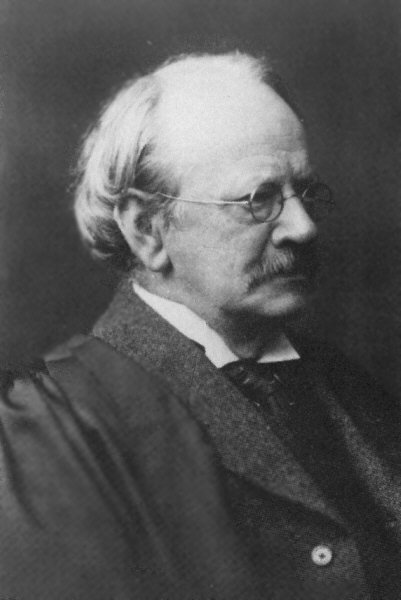
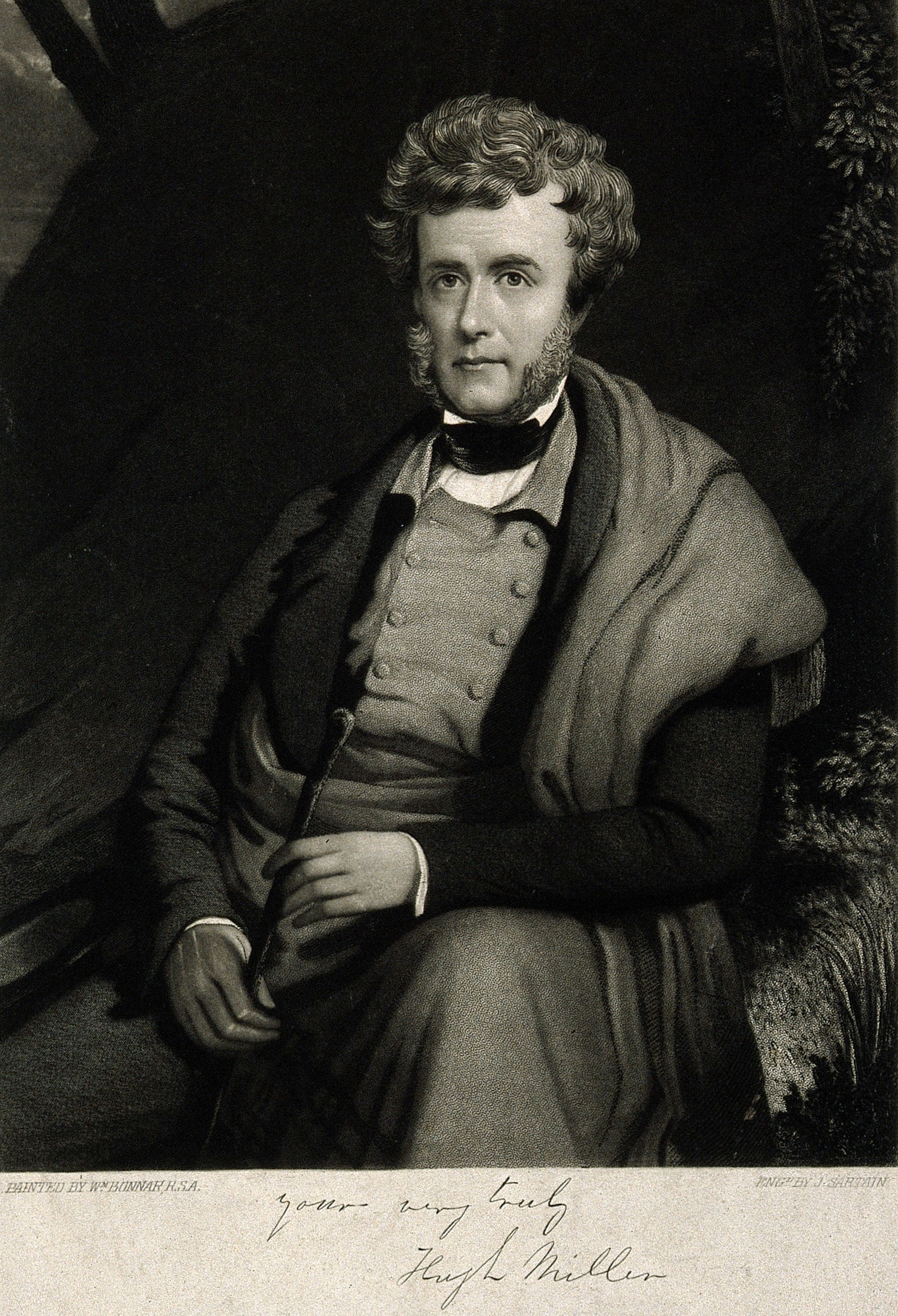




.jpg)

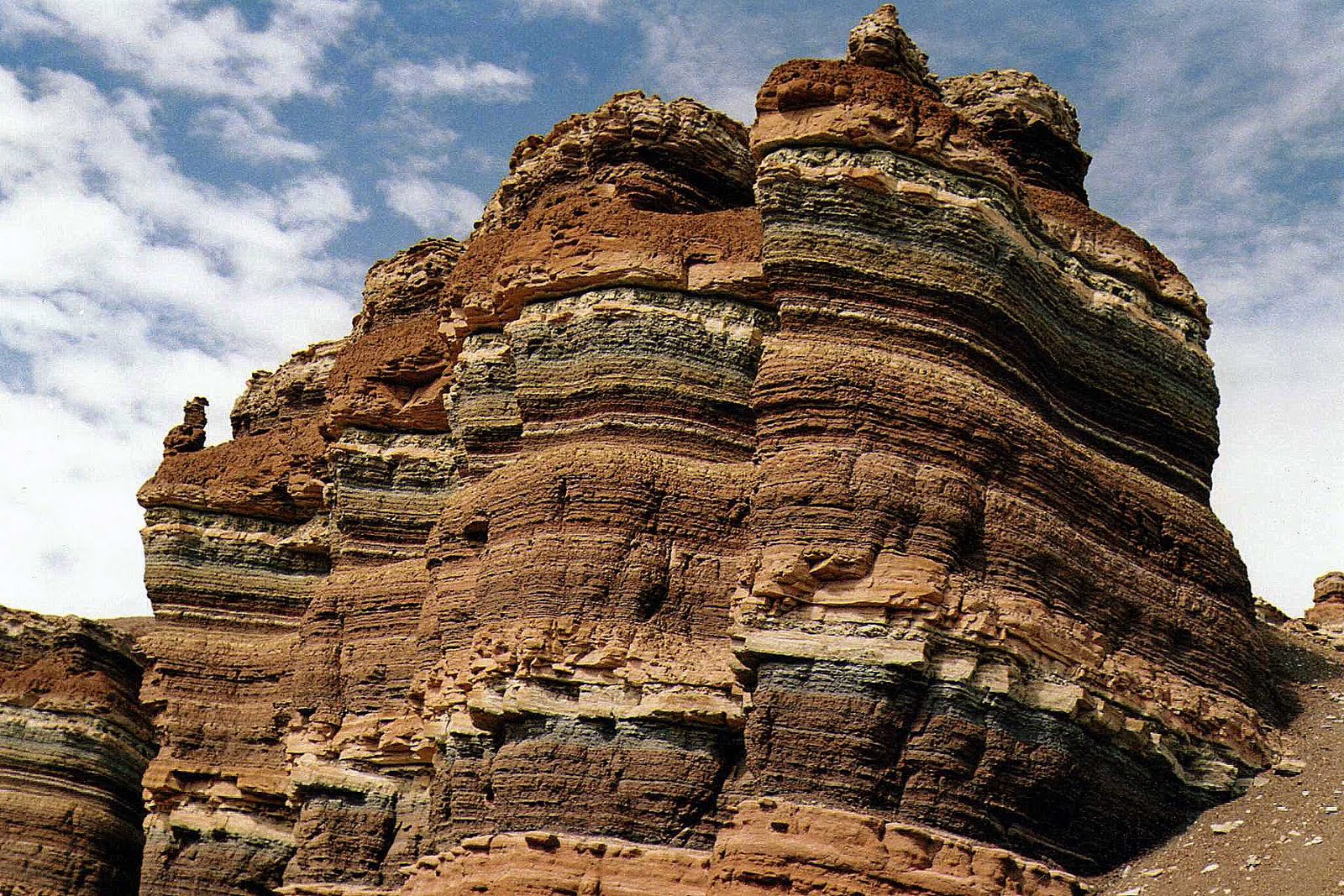
.jpg)


