Government Quotes (119 quotes)
“Heaven helps those who help themselves” is a well-tried maxim, embodying in a small compass the results of vast human experience. The spirit of self-help is the root of all genuine growth in the individual; and, exhibited in the lives of many, it constitutes the true source of national vigour and strength. Help from without is often enfeebling in its effects, but help from within invariably invigorates. Whatever is done for men or classes, to a certain extent takes away the stimulus and necessity of doing for themselves; and where men are subjected to over-guidance and over-government, the inevitable tendency is to render them comparatively helpless.
In Self-help: With Illustrations of Character and Conduct (1859, 1861), 15.
[Among the books he chooses, a statesman] ought to read interesting books on history and government, and books of science and philosophy; and really good books on these subjects are as enthralling as any fiction ever written in prose or verse.
In Theodore Roosevelt: An Autobiography (1913), 333.
[Smoking is] a dirty habit that should be banned from America by the Government, instead of moderate alcoholic drinking.
As quoted by Gobind Behari Lal, Universal Service Science Editor, as printed in Syracuse Journal (13 Jan 1933), 4. At the time, there was Prohibition of alcoholic drinks in America. Piccard was interviewed in New York on his arrival from Brussels onboard the Champlain by newspaper and motion picture men. Because he was so vigorously opposed to smoking, he required that nobody smoked during the interview in the children’s dining room.
[The surplus of basic knowledge of the atomic nucleus was] largely used up [during the war with the atomic bomb as the dividend.] We must, without further delay restore this surplus in preparation for the important peacetime job for the nucleus - power production. ... Many of the proposed applications of atomic power - even for interplanetary rockets - seem to be within the realm of possibility provided the economic factor is ruled out completely, and the doubtful physical and chemical factors are weighted heavily on the optimistic side. ... The development of economic atomic power is not a simple extrapolation of knowledge gained during the bomb work. It is a new and difficult project to reach a satisfactory answer. Needless to say, it is vital that the atomic policy legislation now being considered by the congress recognizes the essential nature of this peacetime job, and that it not only permits but encourages the cooperative research-engineering effort of industrial, government and university laboratories for the task. ... We must learn how to generate the still higher energy particles of the cosmic rays - up to 1,000,000,000 volts, for they will unlock new domains in the nucleus.
Addressing the American Institute of Electrical Engineering, in New York (24 Jan 1946). In Schenectady Gazette (25 Jan 1946),
[Criticizing as “appalingly complacent” a Conservative Government report that by the '60s, Britain would be producing all the scientists needed] Of course we shall, if we don't give science its proper place in our national life. We shall no doubt be training all the bullfighters we need, because we don't use many.
Address at the Imperial College of Science and Technology, London (28 Feb 1963). In 'Hailsham Chided on Science's Role', New York Times (1 Mar 1963), 2. Also in 'The Manhunters: British Minister Blames American Recruiters for Emigration of Scientists',Science Magazine (8 Mar 1963), 893.
A formative influence on my undergraduate self was the response of a respected elder statesmen of the Oxford Zoology Department when an American visitor had just publicly disproved his favourite theory. The old man strode to the front of the lecture hall, shook the American warmly by the hand and declared in ringing, emotional tones: “My dear fellow, I wish to thank you. I have been wrong these fifteen years.” And we clapped our hands red. Can you imagine a Government Minister being cheered in the House of Commons for a similar admission? “Resign, Resign” is a much more likely response!
From a talk, 'Science, Delusion and the Appetite for Wonder', (21 Dec 1996), published on edge.org website.
A general State education is a mere contrivance for moulding people to be exactly like one another: and as the mould in which it casts them is that which pleases the predominant power in the government, whether this be a monarch, a priesthood, an aristocracy, or the majority of the existing generation in proportion as it is efficient and successful, it establishes a despotism over the mind, leading by a natural tendency to one over the body.
In On Liberty (1859), 190-191.
A government, at bottom, is nothing more than a gang of men, and as a practical matter most of them are inferior men ... Government is actually the worst failure of civilized man. There has never been a really good one, and even those that are most tolerable are arbitrary, cruel, grasping and unintelligent. Indeed, it would not be far wrong to describe the best as the common enemy of all decent citizens.
…...
A large part of the training of the engineer, civil and military, as far as preparatory studies are concerned; of the builder of every fabric of wood or stone or metal designed to stand upon the earth, or bridge the stream, or resist or float upon the wave; of the surveyor who lays out a building lot in a city, or runs a boundary line between powerful governments across a continent; of the geographer, navigator, hydrographer, and astronomer,—must be derived from the mathematics.
In 'Academical Education', Orations and Speeches on Various Occasions (1870), Vol. 3, 513.
About the year 1821, I undertook to superintend, for the Government, the construction of an engine for calculating and printing mathematical and astronomical tables. Early in the year 1833, a small portion of the machine was put together, and was found to perform its work with all the precision which had been anticipated. At that period circumstances, which I could not control, caused what I then considered a temporary suspension of its progress; and the Government, on whose decision the continuance or discontinuance of the work depended, have not yet communicated to me their wishes on the question.
In The Ninth Bridgewater Treatise: A Fragment (1838), 186.
According to the system of modern economists, it would be desirable that the government should interfere as little as possible in the commerce and industry of the country. Nevertheless we cannot deny that in certain circumstances this intervention is very useful.
From Appendix A, 'Extracts From the Unpublished Writings of Carnot', Reflections on the Motive Power of Heat (1890, 2nd ed. 1897), 211.
Accountants and second-rate business school jargon are in the ascendant. Costs, which rise rapidly, and are easily ascertained and comprehensible, now weigh more heavily in the scales than the unquantifiable and unpredictable values and future material progress. Perhaps science will only regain its lost primacy as peoples and government begin to recognize that sound scientific work is the only secure basis for the construction of policies to ensure the survival of Mankind without irreversible damage to Planet Earth.
In New Scientist, March 3, 1990.
After all, most men are incapable of deciding for themselves, and have got to have a leader somewhere. If the new discoveries in mass suggestion enable us to make government easier, not only political, but moral and aesthetic, why not welcome them like other useful inventions? Why should science be limited to improvements in our control over nature, and exclude the most important part of our environment, our fellows? Get on the inside, join, as I used to be told, some party, and learn where the ropes come down within your reach. Adopt the high calling of Manipulator and save the State.
Such Machiavellis are not confined to Russia and Italy; one may find them all about even in this Land of the Free. … Still there remains in me a strange misgiving about making use of one’s fellows through an appeal to their weaknesses, even when all you do is to select their objects for them. In the elegant diction of Mr. Mencken, and in spite of the great weight of his authority, a government of the boobs, for the boobs and by the boobs to me still has its morbid charms.
Such Machiavellis are not confined to Russia and Italy; one may find them all about even in this Land of the Free. … Still there remains in me a strange misgiving about making use of one’s fellows through an appeal to their weaknesses, even when all you do is to select their objects for them. In the elegant diction of Mr. Mencken, and in spite of the great weight of his authority, a government of the boobs, for the boobs and by the boobs to me still has its morbid charms.
In Learned Hand and Irving Dilliard (ed.), The Spirit of Liberty: Papers and Addresses of Learned Hand (1952), 36.
All government, in its essence, is organized exploitation, and in virtually all its existing forms it is the implacable enemy of every industrious and well-disposed man ... The typical politician is not only a rascal but also a jackass, so he greatly values the puerile notoriety and adulation that sensible men try to avoid.
…...
All palaetiological sciences, all speculations which attempt to ascend from the present to the remote past, by the chain of causation, do also, by an inevitable consequence, urge us to look for the beginning of the state of things which we thus contemplate; but in none of these cases have men been able, by the aid of science, to arrive at a beginning which is homogeneous with the known course of events. The first origin of language, of civilization, of law and government, cannot be clearly made out by reasoning and research; and just as little, we may expect, will a knowledge of the origin of the existing and extinct species of plants and animals, be the result of physiological and geological investigation.
In History of the Inductive Sciences (1837), Vol. 3, 581.
Any country that wants to make full use of all its potential scientists and technologists … must not expect to get the women quite so simply as it gets the men. It seems to me that marriage and motherhood are at least as socially important as military service. Government regulations are framed to ensure (in the United Kingdom) that a man returning to work from military service is not penalized by his absence. Is it utopian, then, to suggest that any country that really wants a woman to return to a scientific career when her children no longer need her physical presence should make special arrangements to encourage her to do so?
In Impact of Science on Society (1970), 20 58. Commenting how for men who went to war, their jobs were held for them pending their return.
Anything that the private sector can do, the government can do worse.
In Raymond Mungo, 'Dixy Lee Ray: How Madame Nuke Took Over Washington', Mother Jones (May 1977), 2, No. 4, 31.
Basic research at universities comes in two varieties: research that requires big bucks and research that requires small bucks. Big bucks research is much like government research and in fact usually is government research but done for the government under contract. Like other government research, big bucks academic research is done to understand the nature and structure of the universe or to understand life, which really means that it is either for blowing up the world or extending life, whichever comes first. Again, that's the government's motivation. The universities' motivation for conducting big bucks research is to bring money in to support professors and graduate students and to wax the floors of ivy-covered buildings. While we think they are busy teaching and learning, these folks are mainly doing big bucks basic research for a living, all the while priding themselves on their terrific summer vacations and lack of a dress code.
Smalls bucks research is the sort of thing that requires paper and pencil, and maybe a blackboard, and is aimed primarily at increasing knowledge in areas of study that don't usually attract big bucks - that is, areas that don't extend life or end it, or both. History, political science, and romance languages are typically small bucks areas of basic research. The real purpose of small bucks research to the universities is to provide a means of deciding, by the quality of their small bucks research, which professors in these areas should get tenure.
Smalls bucks research is the sort of thing that requires paper and pencil, and maybe a blackboard, and is aimed primarily at increasing knowledge in areas of study that don't usually attract big bucks - that is, areas that don't extend life or end it, or both. History, political science, and romance languages are typically small bucks areas of basic research. The real purpose of small bucks research to the universities is to provide a means of deciding, by the quality of their small bucks research, which professors in these areas should get tenure.
Accidental Empires (1992), 78.
BRAIN, n. An apparatus with which we think that we think. That which distinguishes the man who is content to be something from the man who wishes to do something. A man of great wealth, or one who has been pitchforked into high station, has commonly such a headful of brain that his neighbors cannot keep their hats on. In our civilization, and under our republican form of government, brain is so highly honored that it is rewarded by exemption from the cares of office.
The Collected Works of Ambrose Bierce (1911), Vol. 7, The Devil's Dictionary, 41.
But if the two countries or governments are at war, the men of science are not. That would, indeed be a civil war of the worst description: we should rather, through the instrumentality of the men of science soften the asperities of national hostility.
Davy's remarks to Thomas Poole on accepting Napoleon's prize for the best experiment on Galvanism.
Davy's remarks to Thomas Poole on accepting Napoleon's prize for the best experiment on Galvanism.
Quoted in Gavin de Beer, The Sciences were Never at War (1960), 204.
By a recent estimate, nearly half the bills before the U.S. Congress have a substantial science-technology component and some two-thirds of the District of Columbia Circuit Court’s case load now involves review of action by federal administrative agencies; and more and more of such cases relate to matters on the frontiers of technology.
If the layman cannot participate in decision making, he will have to turn himself over, essentially blind, to a hermetic elite. … [The fundamental question becomes] are we still capable of self-government and therefore freedom?
Margaret Mead wrote in a 1959 issue of Daedalus about scientists elevated to the status of priests. Now there is a name for this elevation, when you are in the hands of—one hopes—a benevolent elite, when you have no control over your political decisions. From the point of view of John Locke, the name for this is slavery.
If the layman cannot participate in decision making, he will have to turn himself over, essentially blind, to a hermetic elite. … [The fundamental question becomes] are we still capable of self-government and therefore freedom?
Margaret Mead wrote in a 1959 issue of Daedalus about scientists elevated to the status of priests. Now there is a name for this elevation, when you are in the hands of—one hopes—a benevolent elite, when you have no control over your political decisions. From the point of view of John Locke, the name for this is slavery.
Quoted in 'Where is Science Taking Us? Gerald Holton Maps the Possible Routes', The Chronicle of Higher Education (18 May 1981). In Francis A. Schaeffer, A Christian Manifesto (1982), 80.
By the nineteenth century … new circumstances called for new conformity enforcers… The government locked you in a house of penitence—a penitentiary—where your feelings of remorse would theoretically pummel you without cease.
In 'The Conformity Police', Global Brain: The Evolution of Mass Mind from the Big Bang to the 21st Century (2000), 89.
By virtue of the way it has organized its technological base, contemporary industrial society tends to be totalitarian. For 'totalitarian' is not only a terroristic political coordination of society, but also a non-terroristic economic-technical coordination which operates through the manipulation of needs by vested interests. It thus precludes the emergence of an effective opposition against the whole. Not only a specific form of government or party rule makes for totalitarianism, but also a specific system of production and distribution which may well be compatible with a 'pluralism' of parties, newspapers, 'countervailing powers,' etc.
One Dimensional Man (1964), 3.
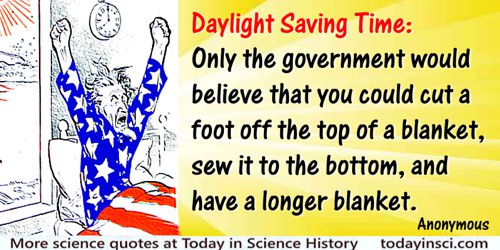
Daylight Saving Time: Only the government would believe that you could cut a foot off the top of a blanket, sew it to the bottom, and have a longer blanket.
Electronic calculators can solve problems which the man who made them cannot solve but no government-subsidized commission of engineers and physicists could create a worm.
In 'March', The Twelve Seasons: A Perpetual Calendar for the Country (1949), 184.
Encryption...is a powerful defensive weapon for free people. It offers a technical guarantee of privacy, regardless of who is running the government... It’s hard to think of a more powerful, less dangerous tool for liberty.
…...
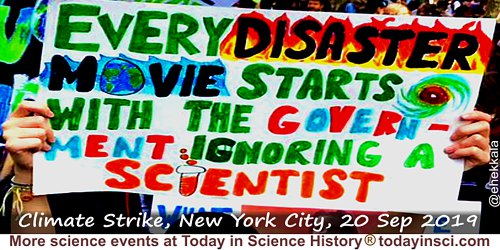
Every disaster movie starts with the Government ignoring a scientist.
From Twitter photo by @ehekkala, of Poster at New York City Climate Strike (20 Sep 2019).
Every movement in the skies or upon the earth proclaims to us that the universe is under government.
In A History of the Intellectual Development of Europe (1864), 4.
Every utterance from government - from justifying 90-day detention to invading other countries [and] to curtailing civil liberties - is about the dangers of religious division and fundamentalism. Yet New Labour is approving new faith schools hand over fist. We have had the grotesque spectacle of a British prime minister, on the floor of the House of Commons, defending - like some medieval crusader - the teaching of creationism in the science curriculum at a sponsor-run school whose running costs are wholly met from the public purse.
In The Guardian (10 Apr 2006).
Faced with the admitted difficulty of managing the creative process, we are doubling our efforts to do so. Is this because science has failed to deliver, having given us nothing more than nuclear power, penicillin, space travel, genetic engineering, transistors, and superconductors? Or is it because governments everywhere regard as a reproach activities they cannot advantageously control? They felt that way about the marketplace for goods, but trillions of wasted dollars later, they have come to recognize the efficiency of this self-regulating system. Not so, however, with the marketplace for ideas.
Quoted in Martin Moskovits (ed.), Science and Society, the John C. Polanyi Nobel Lareates Lectures (1995), 8.
Forty years ago the philosopher Alfred North Whitehead thought it self-evident that you would get a good government if you took power out of the hands of the acquisitive and gave it to the learned and the cultivated. At present, a child in kindergarten knows better than that.
In Before the Sabbath (1979), 40-41.
Governments and parliaments must find that astronomy is one of the sciences which cost most dear: the least instrument costs hundreds of thousands of dollars, the least observatory costs millions; each eclipse carries with it supplementary appropriations. And all that for stars which are so far away, which are complete strangers to our electoral contests, and in all probability will never take any part in them. It must be that our politicians have retained a remnant of idealism, a vague instinct for what is grand; truly, I think they have been calumniated; they should be encouraged and shown that this instinct does not deceive them, that they are not dupes of that idealism.
In Henri Poincaré and George Bruce Halsted (trans.), The Value of Science: Essential Writings of Henri Poincare (1907), 84.
Governments are trying to achieve unanimity by stifling any scientist who disagrees. Einstein could not have got funding under the present system.
Quoted in Tom Harper, 'Scientists threatened for "climate denial",' The Telegraph (11 Mar 2007).
Governments derive their just powers from the consent of the governed. You have neither solicited nor received ours. We did not invite you. You do not know us, nor do you know our world. Cyberspace does not lie within your borders. Do not think that you can build it, as though it were a public construction project. You cannot. It is an act of nature and it grows itself through our collective actions.
In 'A Declaration of the Independence of Cyberspace' (8 Feb 1996). Published on Electronic Frontier Foundation website. Reproduced in Lawrence Lessig, Code: Version 2.0) (2008), 303.
Governments of the Industrial World, you weary giants of flesh and steel, I come from Cyberspace, the new home of Mind. On behalf of the future, I ask you of the past to leave us alone. You are not welcome among us. You have no sovereignty where we gather.
Opening statement of 'A Declaration of the Independence of Cyberspace' (8 Feb 1996). Published on Electronic Frontier Foundation website. Reproduced in Lawrence Lessig, Code: Version 2.0) (2008), 302.

Governments, universities and industry must put their faith in science and tell their people to study what they want to study.
From speech at the University of Saskatchewan, as quoted in Sean Trembath, 'Chemist Henry Taube Was Saskatchewan's First Nobel Laureate', Saskatoon StarPhoenix (5 Jan 2017).
How much has happened in these fifty years—a period more remarkable than any, I will venture to say, in the annals of mankind. I am not thinking of the rise and fall of Empires, the change of dynasties, the establishment of Governments. I am thinking of those revolutions of science which have had much more effect than any political causes, which have changed the position and prospects of mankind more than all the conquests and all the codes and all the legislators that ever lived.
Banquet speech, Glasgow. In Nature (27 Nov 1873), 9, 71.
I am an adherent of the ideal of democracy, although I well know the weaknesses of the democratic form of government. Social equality and economic protection of the individual appeared to me always as the important communal aims of the state.
…...
I am happy to report to you that the assignment of the Central Committee of the Communist party of the Soviet Union and the Soviet Government has been carried out. The world's first space flight has been accomplished in the Soviet space ship Vostok. All systems and equipment worked impeccably, I feel very well and am prepared to carry out any assignment of the party and the government.
Speech beside Khrushchev, at the tomb of Lenin and Stalin, Red Square, Moscow (14 Apr 1961). As quoted in Osgood Caruthers, 'Krushchev Leads Russian Tribute to Astronaut', New York Times (15 Apr 1961), 2.
I am particularly concerned to determine the probability of causes and results, as exhibited in events that occur in large numbers, and to investigate the laws according to which that probability approaches a limit in proportion to the repetition of events. That investigation deserves the attention of mathematicians because of the analysis required. It is primarily there that the approximation of formulas that are functions of large numbers has its most important applications. The investigation will benefit observers in identifying the mean to be chosen among the results of their observations and the probability of the errors still to be apprehended. Lastly, the investigation is one that deserves the attention of philosophers in showing how in the final analysis there is a regularity underlying the very things that seem to us to pertain entirely to chance, and in unveiling the hidden but constant causes on which that regularity depends. It is on the regularity of the main outcomes of events taken in large numbers that various institutions depend, such as annuities, tontines, and insurance policies. Questions about those subjects, as well as about inoculation with vaccine and decisions of electoral assemblies, present no further difficulty in the light of my theory. I limit myself here to resolving the most general of them, but the importance of these concerns in civil life, the moral considerations that complicate them, and the voluminous data that they presuppose require a separate work.
Philosophical Essay on Probabilities (1825), trans. Andrew I. Dale (1995), Introduction.
I distinguish two kinds of "applied" research: problem-solving research — government or commercially initiated, centrally managed and institutionally coupled to a plan for application of the results, useful science—investigator-initiated, competitively evaluated and widely communicated. Then we have basic science—useful also, also investigator-initiated, competitively evaluated and widely communicated.
In Confessions of a Technophile (1994), 31.
I felt exactly how you would feel if you were getting ready to launch and knew you were sitting on top of two million parts—all built by the lowest bidder on a government contract.
His reply to the question, often asked, “When you were sitting in that capsule listening to the count-down, how did you feel?” From speech announcing his Senate retirement (20 Feb 1997). As recorded in 'A Genuine American Hero Says He'll Retire', Tributes Delivered in Congress: John Glenn (1998) in U.S. Government Printing Office, U.S. Congress: Senate, Vol 105, Issue 34, 52. (A similar reference to “the lowest bidder on a government contract” has also been attributed to Alan Shepard.)
I must confess, I am dreading today’s elections, … because no matter what the outcome, our government will still be a giant bonfire of partisanship. It is ironic since whenever I have met with our elected officials they are invariably thoughtful, well-meaning people. And yet collectively 90% of their effort seems to be focused on how to stick it to the other party.
On Sergey Brin’s Google+ page (6 Nov 2012).
I’m doing my part, building plants at a record rate, having historic conservation levels. The only people not doing their part is the federal government that is siding with the energy companies against the interests of the people of California.
…...
If the NSF had never existed, if the government had never funded American mathematics, we would have half as many mathematicians as we now have, and I don’t see anything wrong with that.
From interview (1981) with Donald J. Albers. In John H. Ewing and Frederick W. Gehring, Paul Halmos Celebrating 50 Years of Mathematics (1991), 3.
If to be the Author of new things, be a crime; how will the first Civilizers of Men, and makers of Laws, and Founders of Governments escape? Whatever now delights us in the Works of Nature, that excells the rudeness of the first Creation, is New. Whatever we see in Cities, or Houses, above the first wildness of Fields, and meaness of Cottages, and nakedness of Men, had its time, when this imputation of Novelty, might as well have bin laid to its charge. It is not therefore an offence, to profess the introduction of New things, unless that which is introduc'd prove pernicious in itself; or cannot be brought in, without the extirpation of others, that are better.
The History of the Royal Society (1667), 322.
In addition, the oil royalties the Federal Government does not collect from big oil will starve the Land and Water Conservation Fund of critical financial resources.
— Ron Kind
…...
In my opinion it is not right to bring politics into scientific matters, nor should individuals be held responsible for the government of the country to which they happen to belong.
In Einstein: A Centenary Volume edited by A. P. French (1979).
In my opinion there is no other salvation for civilization and even for the human race than the creation of a world government with security on the basis of law. As long as there are sovereign states with their separate armaments and armament secrets, new world wars cannot be avoided.
Interview comment reported in 'For a World Government: Einstein Says This is Only Way to Save Mankind', New York Times (15 Sep 1945), 11.
In studying the fate of our forest king, we have thus far considered the action of purely natural causes only; but, unfortunately, man is in the woods, and waste and pure destruction are making rapid headway. If the importance of the forests were even vaguely understood, even from an economic standpoint, their preservation would call forth the most watchful attention of government
In The Mountains of California (1894), 198.
In the year 2000, the solar water heater behind me, which is being dedicated today, will still be here supplying cheap, efficient energy. A generation from now, this solar heater can either be a curiosity, a museum piece, an example of a road not taken, or it can be just a small part of one of the greatest and most exciting adventures ever undertaken by the American people: harnessing the power of the Sun to enrich our lives as we move away from our crippling dependence on foreign oil.
[The next President, Republican Ronald Reagan, removed the solar panels and gutted renewable energy research budgets. The road was not taken, nationally, in the eight years of his presidency. Several of the panels are, indeed, now in museums. Most were bought as government surplus and put to good use on a college roof.]
[The next President, Republican Ronald Reagan, removed the solar panels and gutted renewable energy research budgets. The road was not taken, nationally, in the eight years of his presidency. Several of the panels are, indeed, now in museums. Most were bought as government surplus and put to good use on a college roof.]
Speech, at dedication of solar panels on the White House roof, 'Solar Energy Remarks Announcing Administration Proposals' (20 Jun 1979).
In years gone by, we would just take, take, take from the oceans but today we realize this is not an option, that the oceans keep us alive, and that we need to tread more carefully. This is now both a governance issue and a choice issue.
In 'Can We Stop Killing Our Oceans Now, Please?', Huffington Post (14 Aug 2013).
It is for such inquiries the modern naturalist collects his materials; it is for this that he still wants to add to the apparently boundless treasures of our national museums, and will never rest satisfied as long as the native country, the geographical distribution, and the amount of variation of any living thing remains imperfectly known. He looks upon every species of animal and plant now living as the individual letters which go to make up one of the volumes of our earth’s history; and, as a few lost letters may make a sentence unintelligible, so the extinction of the numerous forms of life which the progress of cultivation invariably entails will necessarily render obscure this invaluable record of the past. It is, therefore, an important object, which governments and scientific institutions should immediately take steps to secure, that in all tropical countries colonised by Europeans the most perfect collections possible in every branch of natural history should be made and deposited in national museums, where they may be available for study and interpretation. If this is not done, future ages will certainly look back upon us as a people so immersed in the pursuit of wealth as to be blind to higher considerations. They will charge us with having culpably allowed the destruction of some of those records of Creation which we had it in our power to preserve; and while professing to regard every living thing as the direct handiwork and best evidence of a Creator, yet, with a strange inconsistency, seeing many of them perish irrecoverably from the face of the earth, uncared for and unknown.
In 'On the Physical Geography of the Malay Archipelago', Journal of the Royal Geographical Society (1863), 33, 234.
It is not clear to anyone, least of all the practitioners, how science and technology in their headlong course do or should influence ethics and law, education and government, art and social philosophy, religion and the life of the affections. Yet science is an all-pervasive energy, for it is at once a mode of thought, a source of strong emotion, and a faith as fanatical as any in history.
Science: The Glorious Entertainment (1964), 3.
Jefferson refused to pin his hopes on the occasional success of honest and unambitious men; on the contrary, the great danger was that philosophers would be lulled into complacence by the accidental rise of a Franklin or a Washington. Any government which made the welfare of men depend on the character of their governors was an illusion.
In The Lost World of Thomas Jefferson (1948, 1993), 178.
Let us sum up the three possible explanations of the decision to drop the bomb and its timing. The first that it was a clever and highly successful move in the field of power politics, is almost certainly correct; the second, that the timing was coincidental, convicts the American government of a hardly credible tactlessness [towards the Soviet Union]; and the third, the Roman
holiday theory [a spectacular event to justify the cost of the Manhattan Project], convicts them of an equally incredible irresponsibility.
In The Political and Military Consequences of Atomic Energy (1948), 126. As cited by Maurice W. Kirby and Jonathan Rosenhead, 'Patrick Blackett (1897)' in Arjang A. Assad (ed.) and Saul I. Gass (ed.),Profiles in Operations Research: Pioneers and Innovators (2011), 17. Blackett regarded the dropping of the atomic bombs on Japan as unnecessary because a Japanese surrender was inevitable.
My colleagues in elementary particle theory in many lands [and I] are driven by the usual insatiable curiosity of the scientist, and our work is a delightful game. I am frequently astonished that it so often results in correct predictions of experimental results. How can it be that writing down a few simple and elegant formulae, like short poems governed by strict rules such as those of the sonnet or the waka, can predict universal regularities of Nature?
Nobel Banquet Speech (10 Dec 1969), in Wilhelm Odelberg (ed.),Les Prix Nobel en 1969 (1970).
My mother, my dad and I left Cuba when I was two [January, 1959]. Castro had taken control by then, and life for many ordinary people had become very difficult. My dad had worked [as a personal bodyguard for the wife of Cuban president Batista], so he was a marked man. We moved to Miami, which is about as close to Cuba as you can get without being there. It’s a Cuba-centric society. I think a lot of Cubans moved to the US thinking everything would be perfect. Personally, I have to say that those early years were not particularly happy. A lot of people didn’t want us around, and I can remember seeing signs that said: “No children. No pets. No Cubans.” Things were not made easier by the fact that Dad had begun working for the US government. At the time he couldn’t really tell us what he was doing, because it was some sort of top-secret operation. He just said he wanted to fight against what was happening back at home. [Estefan’s father was one of the many Cuban exiles taking part in the ill-fated, anti-Castro Bay of Pigs invasion to overthrow dictator Fidel Castro.] One night, Dad disappeared. I think he was so worried about telling my mother he was going that he just left her a note. There were rumors something was happening back home, but we didn’t really know where Dad had gone. It was a scary time for many Cubans. A lot of men were involved—lots of families were left without sons and fathers. By the time we found out what my dad had been doing, the attempted coup had taken place, on April 17, 1961. Initially he’d been training in Central America, but after the coup attempt he was captured and spent the next two years as a political prisoner in Cuba. That was probably the worst time for my mother and me. Not knowing what was going to happen to Dad. I was only a kid, but I had worked out where my dad was. My mother was trying to keep it a secret, so she used to tell me Dad was on a farm. Of course, I thought that she didn’t know what had really happened to him, so I used to keep up the pretense that Dad really was working on a farm. We used to do this whole pretending thing every day, trying to protect each other. Those two years had a terrible effect on my mother. She was very nervous, just going from church to church. Always carrying her rosary beads, praying her little heart out. She had her religion, and I had my music. Music was in our family. My mother was a singer, and on my father’s side there was a violinist and a pianist. My grandmother was a poet.
…...

Nations have recently been led to borrow billions for war; no nation has ever borrowed largely for education… no nation is rich enough to pay for both war and civilization. We must make our choice; we cannot have both.
Universities: American, English, German (1930), 302.
Never depend upon institutions or government to solve any problem. All social movements are founded by, guided by, motivated and seen through by the passion of individuals.
As quoted, without citation, in David Suzuki and Holly Dressel , From Naked Ape to Superspecies: Humanity and the Global Eco-Crisis (1999, 2009), 347.
No science is immune to the infection of politics and the corruption of power. … The time has come to consider how we might bring about a separation, as complete as possible, between Science and Government in all countries. I call this the disestablishment of science, in the same sense in which the churches have been disestablished and have become independent of the state.
In 'The Disestablishment of Science', Encounter (Jul 1971), 15.
Now, we propose in the first place to show, that this law of organic progress is the law of all progress. Whether it be in the development of the Earth, in the development in Life upon its surface, in the development of Society, of Government, of Manufactures, of Commerce, of Language, Literature, Science, Art, this same evolution of the simple into the complex, through a process of continuous differentiation, holds throughout. From the earliest traceable cosmical changes down to the latest results of civilization, we shall find that the transformation of the homogeneous into the heterogeneous is that in which Progress essentially consists.
'Progress: Its Law and Cause', Westminster Review (1857), 67, 446-7.
Nowadays everyone knows that the US is the world’s biggest polluter, and that with only one 20th of the world’s population it produces a quarter of its greenhouse gas emissions. But the US government, in an abdication of leadership of epic proportions, is refusing to take the problem seriously. … Emissions from the US are up 14% on those in 1990 and are projected to rise by a further 12% over the next decade.
In 'Global Warming is Now a Weapon of Mass Destruction', The Guardian (28 Jul 2003).
Nuclear energy and foreign policy cannot coexist on the planet. The more deep the secret, the greater the determination of every nation to discover and exploit it. Nuclear energy insists on global government, on law, on order, and on the willingness of the community to take the responsibility for the acts of the individual. And to what end? Why, for liberty, first of blessings. Soldier, we await you, and if the
In 'The Talk of the Town', The New Yorker (18 Aug 1945), 13.
Of all the American scientists whose concern about the use of atomic weapons at Hiroshima and Nagasaki led them to devote themselves to the cause of peace, none was more dedicated nor more effective than [Edward] Condon. His efforts as Science Adviser to the Select Committee on Atomic Energy of the United States Senate after the war had much to do with the decision by the Congress to place government responsibility for atomic energy in a civilian rather than a military agency.
From 'Edward Uhler Condon, A Personal Recollection', presented at the Fourth International Conference on Atomic Physics, published in the Proceedings of this conference by G. zu Pulitz et al. (eds.), Atomic Physics (1975), Vol. 4, as collected in Asim O. Barut, Halis Odabasi and Alwyn van der Merwe (eds.), Selected Popular Writings of E.U. Condon (1991), 2. Branscomb added that there was a “price he paid for his relentless pursuit of this goal.”
Our ignorance is God; what we know is science. When we abandon the doctrine that some infinite being created matter and force, and enacted a code of laws for their government ... the real priest will then be, not the mouth-piece of some pretended deity, but the interpreter of nature.
In The Gods, and Other Lectures, (1874), 56.
Over the years, many Americans have made sacrifices in order to promote freedom and human rights around the globe: the heroic actions of our veterans, the lifesaving work of our scientists and physicians, and generosity of countless individuals who voluntarily give of their time, talents, and energy to help others—all have enriched humankind and affirmed the importance of our Judeo-Christian heritage in shaping our government and values.
Message on the observance of Christmas (8 Dec 1992). In William J. Federer, A Treasury of Presidential Quotations (2004), 300.
People are usually surprised to discover that I hate the phrase “constitutional rights.” I hate the phrase because it is terribly misleading. Most of the people who say it or hear it have the impression that the Constitution “grants” them their rights. Nothing could be further from the truth. Strictly speaking it is the Bill of Rights that enumerates our rights, but none of our founding documents bestow anything on you at all [...] The government can burn the Constitution and shred the Bill of Rights, but those actions wouldn’t have the slightest effect on the rights you’ve always had.
…...
Perhaps scientists have been the most international of all professions in their outlook... Every time you scientists make a major invention, we politicians have to invent a new institution to cope with it—and almost invariably, these days, it must be an international institution.
From Address to the Centennial Convocation of the National Academy of Sciences (22 Oct 1963), 'A Century of Scientific Conquest'. Online at The American Presidency Project.
Personally, I feel sorry for those who seem to measure their patriotism by how often and how viciously they can criticise our government.
As recorded in United States Congressional Serial Set (2000), 51.
Procrustes in modern dress, the nuclear scientist will prepare the bed on which mankind must lie; and if mankind doesn’t fit—well, that will be just too bad for mankind. There will have to be some stretching and a bit of amputation—the same sort of stretching and amputations as have been going on ever since applied science really got going into its stride, only this time they will be a good deal more drastic than in the past. These far from painless operations will be directed by highly centralized totalitarian governments.
Brave New World (1932, 1998), Preface, xiii.
Science and technology have freed humanity from many burdens and given us this new perspective and great power. This power can be used for the good of all. If wisdom governs our actions; but if the world is mad or foolish, it can destroy itself just when great advances and triumphs are almost without its grasp.
As quoted in Suranjan Das 'The Nehru Years in Indian politics', Edinburgh Papers on South Asian Studies (16 Nov 2001), 16, 230. As cited in M.J. Vinod and Meena Deshpande, Contemporary Political Theory (2013), 507. Vinod and Deshpande introduce the quote by writing “Nehru was largely instrumental for building a scientific temper and culture in India” and “emphasized the need for building national laboratories and research institutes.”
Scientific knowledge scarcely exists amongst the higher classes of society. The discussion in the Houses of Lords or of Commons, which arise on the occurrence of any subjects connected with science, sufficiently prove this fact…
In Reflections on the Decline of Science in England (1830), 8.
Scientists have reaped rich rewards, they have sat high in government councils and have been blinded by the attractiveness of public life—all this because they happen to have been good killers.
'Science in the Age of Aquarius', EOS—Transactions of the American Geophysical Union (1974), 55, 1026.
Statistical science is indispensable to modern statesmanship. In legislation as in physical science it is beginning to be understood that we can control terrestrial forces only by obeying their laws. The legislator must formulate in his statutes not only the national will, but also those great laws of social life revealed by statistics.
Speech (16 Dec 1867) given while a member of the U.S. House of Representatives, introducing resolution for the appointment of a committee to examine the necessities for legislation upon the subject of the ninth census to be taken the following year. Quoted in John Clark Ridpath, The Life and Work of James A. Garfield (1881), 217.
Taxes are regarded by economists as an evil, but as a necessary evil, since they provide for public expenses. Consequently, economists think that if the government possessed sufficient revenues, in domains for example, the suppression of all taxes would be a desirable measure.
From Appendix A, 'Extracts From the Unpublished Writings of Carnot', Reflections on the Motive Power of Heat (1890, 2nd ed. 1897), 212.
The ants and the bees are, in many ways, far more intelligent and ingenious; they manage their government with vastly less quarreling, wastefulness and imbecility.
From The Smart Set (Aug 1919), 61. Collected in 'Man’s Place in Nature', A Mencken Chrestomathy (1949, 1956), 4.
The Arts & Sciences are the Destruction of Tyrannies or Bad Governments. Why should a good government endeavour to depress what is its chief and only support.
Marginal note (c. 1808) written in his copy of The Works of Sir Joshua Reynolds (1798), on table of contents. As given in William Blake, Edwin John Ellis (ed.) and William Butler Yeats (ed.), The Works of William Blake (1893), Vol. 2, 319.
The best education will not immunize a person against corruption by power. The best education does not automatically make people compassionate. We know this more clearly than any preceding generation. Our time has seen the best-educated society, situated in the heart of the most civilized part of the world, give birth to the most murderously vengeful government in history.
In Before the Sabbath (1979), 40-41.
The Congress shall have power to ... promote the progress of science and useful arts, by securing for limited times to authors and inventors the exclusive right to their respective writings and discoveries.
Founding U.S. Patents.
Founding U.S. Patents.
Constitution of the United States, Art. 1, Sec.8, Par. 8. In George Sewall Boutwell, The Constitution of the United States at the End of the First Century (1895), 219.
The doctrine of evolution implies the passage from the most organised to the least organised, or, in other terms, from the most general to the most special. Roughly, we say that there is a gradual 'adding on' of the more and more special, a continual adding on of new organisations. But this 'adding on' is at the same time a 'keeping down'. The higher nervous arrangements evolved out of the lower keep down those lower, just as a government evolved out of a nation controls as well as directs that nation.
'Evolution and Dissolution of the Nervous System', British Medical Journal (1884), I, 662.
The footprints at Tranquility base belong to more than the crew of Apollo 11. They were put there by hundreds of thousands of people across this country, people in government, industry and universities, the teams and crews that preceded us, all who strived throughout the years with Mercury, Gemini and Apollo. Those footprints belong to the American people.
In Address to Joint Session of Congress (16 Sep 1969). Printed in 'Transcript of Astronauts’ Addresses to Congress', New York Times (17 Sep 1969), 30.
The future science of government should be called “la cybernétique”.
In Essai sur la philosophie des sciences, ou Exposition analytique d'une classification naturelle de toutes les connaissances humaines (1834). Coining the French word to mean “the art of governing,” from the Greek (Kybernetes = navigator or steersman), subsequently adopted as cybernetics by Norbert Weiner for the field of control and communication theory (see Oxford English Dictionary).
The gentleman [Mr. Taber] from New York says [agricultural research] is all foolish. Yes; it was foolish when Burbank was experimenting with wild cactus. It was foolish when the Wright boys went down to Kitty Hawk and had a contraption there that they were going to fly like birds. It was foolish when Robert Fulton tried to put a boiler into a sail boat and steam it up the Hudson. It was foolish when one of my ancestors thought the world was round and discovered this country so that the gentleman from New York could become a Congressman. (Laughter.) ... Do not seek to stop progress; do not seek to put the hand of politics on these scientific men who are doing a great work. As the gentleman from Texas points out, it is not the discharge of these particular employees that is at stake, it is all the work of investigation, of research, of experimentation that has been going on for years that will be stopped and lost.
Speaking (28 Dec 1932) as a member of the 72nd Congress, early in the Great Depression, in opposition to an attempt to eliminate a small amount from the agricultural appropriation bill. As quoted in 'Mayor-Elect La Guardia on Research', Science (1933), New Series, 78, No. 2031, 511.
The great testimony of history shows how often in fact the development of science has emerged in response to technological and even economic needs, and how in the economy of social effort, science, even of the most abstract and recondite kind, pays for itself again and again in providing the basis for radically new technological developments. In fact, most people—when they think of science as a good thing, when they think of it as worthy of encouragement, when they are willing to see their governments spend substance upon it, when they greatly do honor to men who in science have attained some eminence—have in mind that the conditions of their life have been altered just by such technology, of which they may be reluctant to be deprived.
In 'Contemporary World', Bulletin of the Atomic Scientists (Feb 1948), 4, 67.
The House is composed of very good men, not shining, but honest and reasonably well-informed, and in time will be found to improve, and not much inferior in eloquence, science, and dignity, to the British Commons. They are patriotic enough, and I believe there are more stupid (as well as more shining) people in the latter, in proportion.
Letter to George Richard Minot (27 May 1789). Quoted in Set Ames (Ed.) Works of Fisher Ames (1854), Vol. 1, 45.
The idea that our natural resources were inexhaustible still obtained, and there was as yet no real knowledge of their extent and condition. The relation of the conservation of natural resources to the problems of National welfare and National efficiency had not yet dawned on the public mind. The reclamation of arid public lands in the West was still a matter for private enterprise alone; and our magnificent river system, with its superb possibilities for public usefulness, was dealt with by the National Government not as a unit, but as a disconnected series of pork-barrel problems, whose only real interest was in their effect on the re-election or defeat of a Congressman here and there —a theory which, I regret to say, still obtains.
The Works of Theodore Roosevelt. Vol. 20: Theodore Roosevelt, An Autobiography (1926), 386.
The ideal government of all reflective men, from Aristotle onward, is one which lets the individual alone–one which barely escapes being no government at all. This ideal, I believe, will be realized in the world twenty or thirty centuries after I have passed from these scenes and taken up my public duties in Hell.
…...
The main objects of all science, the freedom and happiness of man. … [are] the sole objects of all legitimate government.
From Letter to General Thaddeus Kosciusko (26 Feb 1810), Andrew A. Lipscomb, The Writings of Thomas Jefferson (1904), Vol. 12, 369-70. A plaque with this quotation, with the first phrase omitted, is in the stairwell of the pedestal of the Statue of Liberty.
The mighty edifice of Government science dominated the scene in the middle of the 20th century as a Gothic cathedral dominated a 13th century landscape. The work of many hands over many years, it universally inspired admiration, wonder and fear.
In Science in the Federal Government: A History of Policies and Activities (1957, 1964), 375.
The most humble research scientist in the Department of Agriculture is at this time contributing more to this country than the most useful member of Congress.
Speaking (29 Dec 1932) as a member of the 72nd Congress, early in the Great Depression, in opposition to curtailing the agricultural appropriation. As quoted in 'Mayor-Elect La Guardia on Research', Science (1933), New Series, 78, No. 2031, 511. Also in A. Hunter Dupree, under subtitle 'Impact of the Great Depression' in Science in the Federal Government: A History of Policies and Activities to 1940, 344.
The new naval treaty permits the United States to spend a billion dollars on warships—a sum greater than has been accumulated by all our endowed institutions of learning in their entire history. Unintelligence could go no further! … [In Great Britain, the situation is similar.] … Until the figures are reversed, … nations deceive themselves as to what they care about most.
Universities: American, English, German (1930), 302.
The nicest constitutions of government are often like the finest pieces of clock-work, which, depending on so many motions, are therefore more subject to be out of order.
'Thoughts On Various Subjects', The Works of Alexander Pope (1806), Vol. 6, 406.
The only condition more appalling, less practical, than world government is the lack of it in this atomic age. Most of the scientists who produced the bomb admit that. Nationalism and the split atom cannot coexist in the planet.
In 'Talk of the Town', The New Yorker (1 Jun 1946), 17.
The politician … is sometimes tempted to encroach on the normal territory of the scientific estate. Sometimes he interferes directly with the scientist’s pursuit of basic science; but he is more likely to interfere when the scientist proposes to publish findings that upset the established political or economic order, or when he joins with the engineering or medical profession in proposing to translate the findings of science into new policies. … Who decides when the apparent consensus of scientific opinion on the relation of cigarettes to lung cancer is great enough to justify governmental regulatory action, and of what kind? In such issues the problem is less often whether politics will presume to dictate to science than it is how much politics is to be influenced by the new findings of science.
In The Scientific Estate (1965), 201.
The prestige of government has undoubtedly been lowered considerably by the prohibition law. For nothing is more destructive of respect for the government and the law of the land than passing laws which cannot be enforced. It is an open secret that the dangerous increase of crime in the United States is closely connected with this.
…...
/AdamsJohn(1735-1826)-Study500x250px.jpg)
The science of government is my duty. … I must study politics and war that my sons may have liberty to study mathematics and philosophy. My sons ought to study mathematics and philosophy, geography, natural history, naval architecture, navigation, commerce, and agriculture, in order to give their children a right to study painting, poetry, music, architecture, statuary, tapestry, and porcelain.
Letter to Abigail Adams, (1780). In John Adams and Charles Francis Adams, Letters of John Adams, Addressed to His Wife (1841), 68.
The sciences are taught in following order: morality, arithmetic, accounts, agriculture, geometry, longimetry, astronomy, geomancy, economics, the art of government, physic, logic, natural philosophy, abstract mathematics, divinity, and history.
From Ain-i-Akbery (c.1590). As translated from the original Persian, by Francis Gladwin in 'Akbar’s Conduct and Administrative Rules', 'Regulations For Teaching in the Public Schools', Ayeen Akbery: Or, The Institutes of the Emperor Akber (1783), Vol. 1, 290. Note: Akbar (Akber) was a great ruler; he was an enlightened statesman. He instituted a great system for general education.
The separation of state and church must be complemented by the separation of state and science, that most recent, most aggressive, and most dogmatic religious institution.
Against Method: Outline of an Anarchistic Theory of Knowledge (1975), 295.
The worst thing that will probably happen—in fact is already well underway—is not energy depletion, economic collapse, conventional war, or the expansion of totalitarian governments. As terrible as these catastrophes would be for us, they can be repaired in a few generations. The one process now going on that will take millions of years to correct is loss of genetic and species diversity by the destruction of natural habitats. This is the folly our descendants are least likely to forgive us.
Biophilia (1984), 121.(1990), 182.
There are two kinds of equality, one potential and the other actual, one theoretical and the other practical. We should not be satisfied by merely quoting the doctrine of equality as laid down in the Declaration of Independence, but we should give it practical illustration. We have to do as well as to be. If we had built great ships, sailed around the world, taught the science of navigation, discovered far-off islands, capes, and continents, enlarged the boundaries of human knowledge, improved the conditions of man’s existence, brought valuable contributions of art, science, and literature, revealed great truths, organized great states, administered great governments, defined the laws of the universe, formulated systems of mental and moral philosophy, invented railroads, steam engines, mowing machines, sewing machines, taught the sun to take pictures, the lightning to carry messages, we then might claim, not only potential and theoretical equality, but actual and practical equality.
From Speech (16 Apr 1889) delivered to the Bethel Literary and Historical Society, Washington D.C., 'The Nation’s Problem'. Collected in Philip S. Foner, Yuval Taylor (eds.), Frederick Douglass: Selected Speeches and Writings (2000), 731.
There is a story which shows his ready wit, dating from the meeting of the British Association in Canada before the war. Tizard and a colleague inadvertently crossed over into the United States, near Niagara. When challenged by a policeman, and not having their passports with them, they produced their British Association membership cards. When the policeman told them that “The American Government doesn't recognise British Science,” the lightning reply came from Tizard, “Oh, that's all right, neither does the British Government.”
In Studies of War, Nuclear and Conventional (1962), 119.
There is no doubt that many expensive national projects may add to our prestige or serve science. But none of them must take precedence over human needs. As long as Congress does not revise its priorities, our crisis is not just material, it is a crisis of the spirit.
Considering the city of New York's financial shortfall.
Considering the city of New York's financial shortfall.
Letter as governor of New York to Mayor John V. Lindsay (24 Apr 1971), New York Times (25 Apr 1971), 69
These Disciplines [mathematics] serve to inure and corroborate the Mind to a constant Diligence in Study; to undergo the Trouble of an attentive Meditation, and cheerfully contend with such Difficulties as lie in the Way. They wholly deliver us from a credulous Simplicity, most strongly fortify us against the Vanity of Scepticism, effectually restrain from a rash Presumption, most easily incline us to a due Assent, perfectly subject us to the Government of right Reason, and inspire us with Resolution to wrestle against the unjust Tyranny of false Prejudices. If the Fancy be unstable and fluctuating, it is to be poized by this Ballast, and steadied by this Anchor, if the Wit be blunt it is sharpened upon this Whetstone; if luxuriant it is pared by this Knife; if headstrong it is restrained by this Bridle; and if dull it is rouzed by this Spur. The Steps are guided by no Lamp more clearly through the dark Mazes of Nature, by no Thread more surely through the intricate Labyrinths of Philosophy, nor lastly is the Bottom of Truth sounded more happily by any other Line. I will not mention how plentiful a Stock of Knowledge the Mind is furnished from these, with what wholesome Food it is nourished, and what sincere Pleasure it enjoys. But if I speak farther, I shall neither be the only Person, nor the first, who affirms it; that while the Mind is abstracted and elevated from sensible Matter, distinctly views pure Forms, conceives the Beauty of Ideas, and investigates the Harmony of Proportions; the Manners themselves are sensibly corrected and improved, the Affections composed and rectified, the Fancy calmed and settled, and the Understanding raised and excited to more divine Contemplations. All which I might defend by Authority, and confirm by the Suffrages of the greatest Philosophers.
Prefatory Oration in Mathematical Lectures (1734), xxxi.
This has been far more than three men on a mission to the Moon; more still than the efforts of a government and industry team; more, even, than the efforts of one nation. We feel this stands as a symbol of the insatiable curiosity of all mankind to explore the unknown.
…...
This Universe never did make sense; I suspect that it was built on government contract.
The Number of the Beast (1980), 14. In Carl C. Gaither, Physically Speaking (1997), 340.
Today's water institutions—the policies and laws, government agencies and planning and engineering practices that shape patterns of water use—are steeped in a supply-side management philosophy no longer appropriate to solving today's water problems.
From a study Postel wrote for Worldwatch Institute, quoted in New York Times (22 Sep 1985), 19.
Unless there exist peculiar institutions for the support of such inquirers, or unless the Government directly interfere, the contriver of a thaumatrope may derive profit from his ingenuity, whilst he who unravels the laws of light and vision, on which multitudes of phenomena depend, shall descend unrewarded to the tomb.
Reflections on the Decline of Science in England (1830), 19.
Very old and wide-spread is the opinion that forests have an important impact on rainfall. ... If forests enhance the amount and frequency of precipitation simply by being there, deforestation as part of agricultural expansion everywhere, must necessarily result in less rainfall and more frequent droughts. This view is most poignantly expressed by the saying: Man walks the earth and desert follows his steps! ... It is not surprising that under such circumstances the issue of a link between forests and climate has ... been addressed by governments. Lately, the Italian government has been paying special attention to reforestation in Italy and its expected improvement of the climate. ... It must be prevented that periods of heavy rainfall alternate with droughts. ...In the Unites States deforestation plays an important role as well and is seen as the cause for a reduction in rainfall. ... committee chairman of the American Association for Advancement of Science demands decisive steps to extend woodland in order to counteract the increasing drought. ... some serious concerns. In 1873, in Vienna, the congress for agriculture and forestry discussed the problem in detail; and when the Prussian house of representatives ordered a special commission to examine a proposed law pertaining to the preservation and implementation of forests for safeguarding, it pointed out that the steady decrease in the water levels of Prussian rivers was one of the most serious consequences of deforestation only to be rectified by reforestation programs. It is worth mentioning that ... the same concerns were raised in Russia as well and governmental circles reconsidered the issue of deforestation.
as quoted in Eduard Brückner - The Sources and Consequences of Climate Change and Climate Variability in Historical Times editted by N. Stehr and H. von Storch (2000)
Water is the most precious, limited natural resource we have in this country… But because water belongs to no one—except the people—special interests, including government polluters, use it as their private sewers.
In Nader’s Foreword to David Zwick, Marcy Benstock and Ralph Nader, Water wasteland: Ralph Nader's Study Group Report on Water Pollution (1971), xiii.
We are in the presence of a recruiting drive systematically and deliberately undertaken by American business, by American universities, and to a lesser extent, American government, often initiated by talent scouts specially sent over here to buy British brains and preempt them for service of the U.S.A. … I look forward earnestly to the day when some reform of the American system of school education enables them to produce their own scientists so that, in an amiable free trade of talent, there may be adequate interchange between our country and theirs, and not a one-way traffic.
Speaking as Britain's Minister of Science in the House of Lords (27 Feb 1963). In 'The Manhunters: British Minister Blames American Recruiters for Emigration of Scientists', Science Magazine (8 Mar 1963), 893. See also the reply from the leader of the Labour Party, Harold Wilson, by using the link below.
We claim to be more moral than other nations, and to conquer and govern and tax and plunder weaker peoples for their good! While robbing them we actually claim to be benefactors! And then we wonder, or profess to wonder, why other Governments hate us! Are they not fully justified in hating us? Is it surprising that they seek every means to annoy us, that they struggle to get navies to compete with us, and look forward to a time when some two or three of them may combine together and thoroughly humble and cripple us? And who can deny that any just Being, looking at all the nations of the earth with impartiality and thorough knowledge, would decide that we deserve to be humbled, and that it might do us good?
In 'Practical Politics', The Clarion (30 Sep 1904), 1.
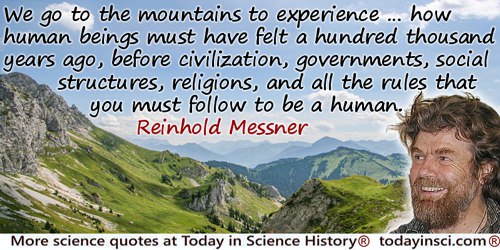
We go to the mountains to experience … how human beings must have felt a hundred thousand years ago, before civilization, governments, social structures, religions, and all the rules that you must follow to be a human.
From interview with Rudraneil Sengupta, 'Reinhold Messner: When You’re Alone, Fear is All on You', Mint (1 Mar 2014). A business newspaper in India, also online at livemint.com website.
We had the full backing of our government, combined with the nearly infinite potential of American science, engineering and industry, and an almost unlimited supply of people endowed with ingenuity and determination.
In And Now It Can Be Told: The Story Of The Manhattan Project (1962), 415.
We tried to transform Tarmac playgrounds into places with pools, and earth where children could grow things. Now the Government is saying we need more classroom space so the schools are building them on the very nature habitats we’ve been working to provide.
Despairing at the loss of green spaces at schools. He was patron of the charity Learning Through Landscapes which worked to create green spaces. As reported by Adam Lusher in 'Sir David Attenborough', Daily Mail (28 Feb 2014).
WEATHER, n. The climate of an hour. A permanent topic of conversation among persons whom it does not interest, but who have inherited the tendency to chatter about it from naked arboreal ancestors whom it keenly concerned. The setting up of official weather bureaus and their maintenance in mendacity prove that even governments are accessible to suasion by the rude forefathers of the jungle.
The Collected Works of Ambrose Bierce (1911), Vol. 7, The Devil's Dictionary, 362-363.
When a machine begins to run without human aid, it is time to scrap it - whether it be a factory or a government.
In Rhoda Thomas Tripp, The International Thesaurus of Quotations (1970).
When I came home not a single acre of Government, state, or private timberland was under systematic forest management anywhere on the most richly timbered of all continents. … When the Gay Nineties began, the common word for our forests was 'inexhaustible.' To waste timber was a virtue and not a crime. There would always be plenty of timber. … The lumbermen … regarded forest devastation as normal and second growth as a delusion of fools. … And as for sustained yield, no such idea had ever entered their heads. The few friends the forest had were spoken of, when they were spoken of at all, as impractical theorists, fanatics, or ‘denudatics,’ more or less touched in the head. What talk there was about forest protection was no more to the average American that the buzzing of a mosquito, and just about as irritating.
In Breaking New Ground (1947, 1998), 27.
While government and laws provide for the safety and well-being of assembled men, the sciences, letters and arts, less despotic and perhaps more powerful, spread garlands of flowers over the iron chains with which men are burdened, stifle in them the sense of that original liberty for which they seemed to have been born, make them love their slavery, and turn them into what is called civilized peoples.
In Discourse on the Sciences and Arts (1750).
 In science it often happens that scientists say, 'You know that's a really good argument; my position is mistaken,' and then they would actually change their minds and you never hear that old view from them again. They really do it. It doesn't happen as often as it should, because scientists are human and change is sometimes painful. But it happens every day. I cannot recall the last time something like that happened in politics or religion.
(1987) --
In science it often happens that scientists say, 'You know that's a really good argument; my position is mistaken,' and then they would actually change their minds and you never hear that old view from them again. They really do it. It doesn't happen as often as it should, because scientists are human and change is sometimes painful. But it happens every day. I cannot recall the last time something like that happened in politics or religion.
(1987) -- 





