Glory Quotes (67 quotes)
“It's absolutely clear that the function of the world is to declare the glory of God.” I thought, what does that sentence mean?!
Quoting and reacting to a letter he saw in a newspaper about Stephen Hawking’s comments on the nonexistence of God. From 'Interview: Of Mind and Matter: David Attenborough Meets Richard Dawkins', The Guardian (11 Sep 2010).
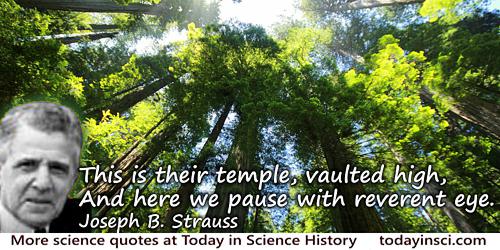
The Redwoods
Here, sown by the Creator's hand,
In serried ranks, the Redwoods stand;
No other clime is honored so,
No other lands their glory know.
The greatest of Earth's living forms,
Tall conquerors that laugh at storms;
Their challenge still unanswered rings,
Through fifty centuries of kings.
The nations that with them were young,
Rich empires, with their forts far-flung,
Lie buried now—their splendor gone;
But these proud monarchs still live on.
So shall they live, when ends our day,
When our crude citadels decay;
For brief the years allotted man,
But infinite perennials' span.
This is their temple, vaulted high,
And here we pause with reverent eye,
With silent tongue and awe-struck soul;
For here we sense life's proper goal;
To be like these, straight, true and fine,
To make our world, like theirs, a shrine;
Sink down, oh traveler, on your knees,
God stands before you in these trees.
Here, sown by the Creator's hand,
In serried ranks, the Redwoods stand;
No other clime is honored so,
No other lands their glory know.
The greatest of Earth's living forms,
Tall conquerors that laugh at storms;
Their challenge still unanswered rings,
Through fifty centuries of kings.
The nations that with them were young,
Rich empires, with their forts far-flung,
Lie buried now—their splendor gone;
But these proud monarchs still live on.
So shall they live, when ends our day,
When our crude citadels decay;
For brief the years allotted man,
But infinite perennials' span.
This is their temple, vaulted high,
And here we pause with reverent eye,
With silent tongue and awe-struck soul;
For here we sense life's proper goal;
To be like these, straight, true and fine,
To make our world, like theirs, a shrine;
Sink down, oh traveler, on your knees,
God stands before you in these trees.
In The Record: Volumes 60-61 (1938), 39.
Nisi utile est quod facias, stulta est gloria.
All useless science is an empty boast.
All useless science is an empty boast.
Original Latin from 'Arbores in deorum tutela', Fabulae Aesopiae, Book 3, Poem 17, line 12. Translation by Samuel Johnson, used as an epigraph for an article on the thirst for collecting scientific curiosities, 'Numb. 83, Tuesday, January 1, 1755', The Rambler (1756), Vol. 2, 149. A mechanical translation of the Latin gives “Unless it is useful for what we do, it is the glory of the foolish.” In an 1874 collection by unnamed editor J.B.R., it is given as “nothing is truly valuable that is not useful.” It is given as “Unless what we do is useful, our pride is foolish,” in The Routledge Dictionary of Latin Quotations (2013), 74. Briefly summarizing, the fable is about the gods who choose trees to protect, but the wise Minerva alone picks a tree, the olive, that bears fruit which can be put to good use; moral, do what is useful. ( Webmaster found sources attributing the line in English to Shakespeare, but it cannot be found.)
Tantus amor florum, et generandi gloria mellis.
Ardent is their love of flowers, and such their glory in making honey.
Ardent is their love of flowers, and such their glory in making honey.
— Virgil
About bees. As given in Latin and in The Works of Virgil: Translated Into English Prose (1821), Vol. 1, 160.
To the Memory of Fourier
Fourier! with solemn and profound delight,
Joy born of awe, but kindling momently
To an intense and thrilling ecstacy,
I gaze upon thy glory and grow bright:
As if irradiate with beholden light;
As if the immortal that remains of thee
Attuned me to thy spirit’s harmony,
Breathing serene resolve and tranquil might.
Revealed appear thy silent thoughts of youth,
As if to consciousness, and all that view
Prophetic, of the heritage of truth
To thy majestic years of manhood due:
Darkness and error fleeing far away,
And the pure mind enthroned in perfect day.
Fourier! with solemn and profound delight,
Joy born of awe, but kindling momently
To an intense and thrilling ecstacy,
I gaze upon thy glory and grow bright:
As if irradiate with beholden light;
As if the immortal that remains of thee
Attuned me to thy spirit’s harmony,
Breathing serene resolve and tranquil might.
Revealed appear thy silent thoughts of youth,
As if to consciousness, and all that view
Prophetic, of the heritage of truth
To thy majestic years of manhood due:
Darkness and error fleeing far away,
And the pure mind enthroned in perfect day.
In R. Graves, Life of W. R. Hamilton (1882), Vol. l, 696.
Abstractness, sometimes hurled as a reproach at mathematics, is its chief glory and its surest title to practical usefulness. It is also the source of such beauty as may spring from mathematics.
In 'General Prospectus', The Development of Mathematics (1940, 2017), Chap. 1, 9.
Almighty God, to whose efficacious Word all things owe their original, abounding in his own glorious Essence with infinite goodness and fecundity, did in the beginning Create Man after his own likeness, Male and Female, created he them; the true distinction of which Sexes, consists merely in the different site of those parts of the body, wherein Generation necessarily requires a Diversity: for both Male and Female he impartially endued with the same, and altogether indifferent form of Soul, the Woman being possess’d of no less excellent Faculties of Mind, Reason, and Speech, than the Man, and equally with him aspiring to those Regions of Bliss and Glory, where there shall be no exception of Sex.
In Female Pre-eminence: Or, The Dignity and Excellency of that Sex above the Male, translation (1670).
Analogy is a wonderful, useful and most important form of thinking, and biology is saturated with it. Nothing is worse than a horrible mass of undigested facts, and facts are indigestible unless there is some rhyme or reason to them. The physicist, with his facts, seeks reason; the biologist seeks something very much like rhyme, and rhyme is a kind of analogy.... This analogizing, this fine sweeping ability to see likenesses in the midst of differences is the great glory of biology, but biologists don't know it.... They have always been so fascinated and overawed by the superior prestige of exact physical science that they feel they have to imitate it.... In its central content, biology is not accurate thinking, but accurate observation and imaginative thinking, with great sweeping generalizations.
In Science is a Sacred Cow (1950), 98-100.
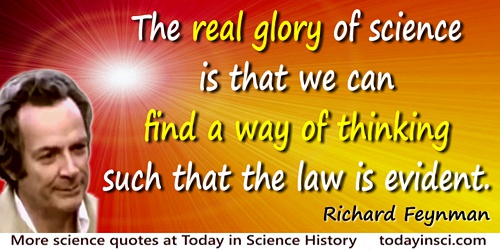
But the real glory of science is that we can find a way of thinking such that the law is evident.
The Feynman Lectures on Physics (1965), Vol. 1, 26-3. In Carver A. Mead, Collective Electrodynamics: Quantum Foundations of Electromagnetism (2002), 1.
Confucius once said: “our greatest glory is not in never falling, but in getting up every time we do”. Scholars believe he was referring to roller coasters.
The anonymous quote includes an embedded quote misattributed to Confucius; it is not in his writings. It is first seen written (… but in rising every time we fall) by Oliver Goldmith, in The Citizen of the World: or, Letters from a Chinese Philosopher, Residing in London, to His Friends in the East (1762). The imaginary letters are from an invented character, Lien Chi Altangi, and include Goldsmith’s probably fictional reference to Confucius for verisimilitude. See the quoteinvestigator.com website for more details.
Einstein’s space is no closer to reality than Van Gogh’s sky. The glory of science is not in a truth more absolute than the truth of Bach or Tolstoy, but in the act of creation itself. The scientist’s discoveries impose his own order on chaos, as the composer or painter imposes his; an order that always refers to limited aspects of reality, and is based on the observer's frame of reference, which differs from period to period as a Rembrandt nude differs from a nude by Manet.
In The Act of Creation (1964), 252.
Happy the men who made the first essay,
And to celestial regions found the way!
No earthly vices clogg’d their purer souls,
That they could soar so high as touch the poles:
Sublime their thoughts and from pollution clear,
Bacchus and Venus held no revels there;
From vain ambition free; no love of war
Possess’d their minds, nor wranglings at the bar;
No glaring grandeur captivates their eyes,
For such see greater glory in the skies:
Thus these to heaven attain.
And to celestial regions found the way!
No earthly vices clogg’d their purer souls,
That they could soar so high as touch the poles:
Sublime their thoughts and from pollution clear,
Bacchus and Venus held no revels there;
From vain ambition free; no love of war
Possess’d their minds, nor wranglings at the bar;
No glaring grandeur captivates their eyes,
For such see greater glory in the skies:
Thus these to heaven attain.
In Craufurd Tait Ramage (ed., trans.), Beautiful Thoughts From Latin Authors, with English Translations (1864),
Holding then to science with one hand—the left hand—we give the right hand to religion, and cry: ‘Open Thou mine eyes, that I may behold wondrous things, more wondrous than the shining worlds can tell.’ Obedient to the promise, religion does awaken faculties within us, does teach our eyes to the beholding of more wonderful things. Those great worlds blazing like suns die like feeble stars in the glory of the morning, in the presence of this new light. The soul knows that an infinite sea of love is all about it, throbbing through it, everlasting arms of affection lift it, and it bathes itself in the clear consciousness of a Father’s love.
…...
I suppose that the first chemists seemed to be very hard-hearted and unpoetical persons when they scouted the glorious dream of the alchemists that there must be some process for turning base metals into gold. I suppose that the men who first said, in plain, cold assertion, there is no fountain of eternal youth, seemed to be the most cruel and cold-hearted adversaries of human happiness. I know that the economists who say that if we could transmute lead into gold, it would certainly do us no good and might do great harm, are still regarded as unworthy of belief. Do not the money articles of the newspapers yet ring with the doctrine that we are getting rich when we give cotton and wheat for gold rather than when we give cotton and wheat for iron?
'The Forgotten Man' (1883). In The Forgotten Man and Other Essays (1918), 468.
I thank thee, O Lord, our Creator, that thou hast permitted me to look at the beauty in thy work of creation; I exult in the works of thy hands. See, I have completed the work to which I felt called; I have earned interest from the talent that thou hast given me. I have proclaimed the glory of thy works to the people who will read these demonstrations, to the extent that the limitations of my spirit would allow.
From Harmonia Mundi (1619), as cited in Philip Davis with Reuben Hersh, in The Mathematical Experience (1981), 111.
If there really is God who created the entire universe with all of its glories, and He decides to deliver a message to humanity, He will not use, as His messenger, a person on cable TV with a bad hairstyle.
From newspaper column '25 Things I Have Learned in 50 Years' (Oct 1998), collected in Dave Barry Turns Fifty (2010), 185.
If thou art able, O stranger, to find out all these things and gather them together in your mind, giving all the relations, thou shalt depart crowned with glory and knowing that thou hast been adjudged perfect in this species of wisdom.
From a letter to Eratosthenes, the chief librarian at Alexandria, containing the Cattle Problem, an exceedingly difficult calculation involving huge numbers (which was not solved exactly until the use of a supercomputer in 1981). In David J. Darling, The Universal Book of Mathematics (2004), 23. The debate by scholars regarding whether Archimedes is the true author is in T. L. Heath (ed.), The Works of Archimedes (1897), xxxiv.
It is no way derogatory to Newton, or Kepler, or Galileo, that Science in these days should have advanced far beyond them. Rather is this itself their crown of glory. Their works are still bearing fruit, and will continue to do so. The truths which they discovered are still living in our knowledge, pregnant with infinite consequences.
Co-author with his brother Augustus William Hare Guesses At Truth, By Two Brothers: Second Edition: With Large Additions (1848), Second Series, 251. (The volume is introduced as “more than three fourths new.” This quote is identified as by Julius; Augustus had died in 1833.)
It is Surgery that, long after it has passed into obsolescence, will be remembered as the glory of Medicine.
In Letters to a Young Doctor (1982), 51.
It is the glory of God to conceal a thing, but the glory of a king to search it out.
— Bible
Prov. c. xxv. v. 2. As quoted by Francis Bacon and Basil Montagu (ed.) in The Works of Francis Bacon, (1834), Vol. 13, 89.
It would be our worst enemy who would wish us to live only on the glories of the past and die off from the face of the earth in sheer passivity. By continuous achievement alone we can justify our great ancestry. We do not honour our ancestors by the false claim that they are omniscient and had nothing more to learn.
From 'Sir J.C. Bose’s Address', Benares Hindu University 1905-1935 (1936), 423. Collected in J. Lourdusamy, Science and National Consciousness in Bengal: 1870-1930 (2004), 106.
It’s not for glory that Soviet cosmonauts are in this assault on the cosmos; they are motivated by a limitless love for and devotion to their country, the Party and the people, and by a desire to help Soviet scientists to discover the secrets of the universe.
In First Man in Space: The Life and Achievement of Yuri Gagarin: a Collection (1984), 104. Cited as written as a foreword of a book at the request of the author.
Know then thyself, presume not God to scan;
The proper study of Mankind is Man.
Plac'd on this isthmus of a middle state,
A being darkly wise, and rudely great:
With too much knowledge for the Sceptic side,
With too much weakness for the Stoic's pride,
He hangs between; in doubt to act, or rest;
In doubt to deem himself a God, or Beast;
In doubt his Mind or Body to prefer,
Born but to die, and reas'ning but to err;
Alike in ignorance, his reason such,
Whether he thinks too little, or too much:
Chaos of Thought and Passion, all confus'd;
Still by himself abus'd, or disabus'd;
Created half to rise, and half to fall;
Great lord of all things, yet a prey to all;
Sole judge of Truth, in endless Error hurl'd:
The glory, jest, and riddle of the world!
... Superior beings, when of late they saw
A mortal Man unfold all Nature's law,
Admir'd such wisdom in an earthly shape,
And shew'd a NEWTON as we shew an Ape.
The proper study of Mankind is Man.
Plac'd on this isthmus of a middle state,
A being darkly wise, and rudely great:
With too much knowledge for the Sceptic side,
With too much weakness for the Stoic's pride,
He hangs between; in doubt to act, or rest;
In doubt to deem himself a God, or Beast;
In doubt his Mind or Body to prefer,
Born but to die, and reas'ning but to err;
Alike in ignorance, his reason such,
Whether he thinks too little, or too much:
Chaos of Thought and Passion, all confus'd;
Still by himself abus'd, or disabus'd;
Created half to rise, and half to fall;
Great lord of all things, yet a prey to all;
Sole judge of Truth, in endless Error hurl'd:
The glory, jest, and riddle of the world!
... Superior beings, when of late they saw
A mortal Man unfold all Nature's law,
Admir'd such wisdom in an earthly shape,
And shew'd a NEWTON as we shew an Ape.
'An Essay on Man' (1733-4), Epistle II. In John Butt (ed.), The Poems of Alexander Pope (1965), 516-7.
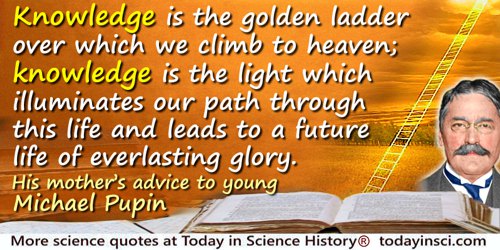
Knowledge is the golden ladder over which we climb to heaven; knowledge is the light which illuminates our path through this life and leads to a future life of everlasting glory.
In his words, what he recalls his mother telling him as a boy, in From Immigrant to Inventor: An Example to Young Americans (1922, 1934), 12.
Looking outward to the blackness of space, sprinkled with the glory of a universe of lights, I saw majesty—but no welcome. Below was a welcoming planet. There, contained in the thin, moving, incredibly fragile shell of the biosphere is everything that is dear to you, all the human drama and comedy. That’s where life is; that’s where all the good stuff is.
Observation as payload specialist on the Challenger Eight space shuttle mission. As quoted in Kevin W. Kelley (ed.), The Home Planet (1988), 8.
Men fear thought as they fear nothing else on earth more than ruin more even than death. Thought is subversive and revolutionary, destructive and terrible, thought is merciless to privilege, established institutions, and comfortable habit. Thought looks into the pit of hell and is not afraid. Thought is great and swift and free, the light of the world, and the chief glory of man.
…...
Natural ability without education has more often attained to glory and virtue than education without natural ability.
In M. P. Singh, Quote Unquote (2005), 1.
Nature abhors a vacuum. It is quite certain that in the bounds of nature, a vacuum, which is nothing, can find no place. There is no power in Nature from which nothing could have made the universe, and none which could reduce the universe to nothing: that requires the same virtue. Now the matter would be otherwise if there could be a vacuum. For if it could be here, it could also be there; and being here and there, why not elsewhere? and why not everywhere? Thus the universe could reach annihilation by its own forces; but to Him alone who could make it is due the glory of compassing its destruction.
— Jean Rey
From On an Inquiry wherefore Tin and Lead increase in Weight on Calcination (1630), collected in Essays of Jean Rey, Doctor of Medicine (1895), 11. As quoted in William Ramsay, [Ramsay adds his comment, “Nature abhors a vacuum,” was a favourite thesis in former days.]
Newton advanced, with one gigantic stride, from the regions of twilight into the noon day of science. A Boyle and a Hooke, who would otherwise have been deservedly the boast of their century, served but as obscure forerunners of Newton's glories.
A Course of Lectures on Natural Philosophy and the Mechanical Arts (1845), 5.
October is the opal month of the year. It is the month of glory, of ripeness. It is the picture-month.
In Proverbs from Plymouth Pulpit (1887), 10.
On my return from the first exploration of the canyons of the Colorado, I found that our journey had been the theme of much newspaper writing. A story of disaster had been circulated, with many particulars of hardship and tragedy, so that it was currently believed throughout the United States that all the members of the party were lost save one. A good friend of mine had gathered a great number of obituary notices, and it was interesting and rather flattering to me to discover the high esteem in which I had been held by the people of the United States. In my supposed death I had attained to a glory which I fear my continued life has not fully vindicated.
First paragraph in 'Preface' to Canyons of the Colorado (1895), iii.
One thought I cannot forbear suggesting: we have long known that “one star differeth from another star in glory;” we have now the strongest evidence that they also differ in constituent materials,—some of them perhaps having no elements to be found in some other. What then becomes of that homogeneity of original diffuse matter which is almost a logical necessity of the nebular hypothesis?
L.M. Rutherfurd, 'Astronomical Observations with the Spectroscope' (4 Dec 1862), American Journal of Science and Arts (May 1863), 2nd Series, 35, No. 103, 77. His obituarist, John K. Rees, wrote (1892) “This paper was the first published work on star spectra.”
Our greatest glory is not in never falling, but in rising every time we fall.
…...
Science is an integral part of culture. It’s not this foreign thing, done by an arcane priesthood. It’s one of the glories of the human intellectual tradition.
Independent (London, Jan. 24, 1990).
Scientific rationalism is the crowning glory of the human spirit.
The Guardian (17 May 2000)
Scientific theories can always be improved and are improved. That is one of the glories of science. It is the authoritarian view of the Universe that is frozen in stone and cannot be changed, so that once it is wrong, it is wrong forever.
Essay, 'The Nearest Star', The Magazine of Fantasy and Science Fiction (Oct 1989), collected in The Secret of the Universe (1991), 82.
So that in the nature of man, we find three principal causes of quarrel. First, competition; secondly, diffidence; thirdly, glory.
In Leviathan: Or, The Matter, Form and Power of a Commonwealth, Ecclesiastical and Civil (1886), 64.
The Archetypal idea was manifested in the flesh, under divers such modifications, upon this planet, long prior to the existence of those animal species that actually exemplify it. To what natural laws or secondary causes the orderly succession and progression of such organic phaenomena may have been committed we as yet are ignorant. But if, without derogation of the Divine power, we may conceive the existence of such ministers, and personify them by the term 'Nature,' we learn from the past history of our globe that she has advanced with slow and stately steps, guided by the archetypal light, amidst the wreck of worlds, from the first embodiment of the Vertebrate idea under its old Ichthyic vestment, until it became arrayed in the glorious garb of the Human form.
On the Nature of Limbs (1849), 86.
The candor of science is the glory of the modern. It does not hide and repress; it confronts, turns on the light.
In Specimen Days & Collect (1882), 302.
The crown and glory of life is Character. It is the noblest possession of a man, constituting a rank in itself, and an estate in the general goodwill; dignifying every station, and exalting every position in society. It exercises a greater power than wealth, and secures all the honour without the jealousies of fame. It carries with it an influence which always tells; for it is the result of proved honour, rectitude, and consistency—qualities which, perhaps more than any other, command the general confidence and respect of mankind.
In Self-help: With Illustrations of Character and Conduct (1859, 1861), 396.
The Earth is a very small stage in a vast cosmic arena. Think of the rivers of blood spilled by all those generals and emperors, so that, in glory and triumph, they could become the momentary masters of a fraction of a dot. Think of the endless cruelties visited by the inhabitants of one corner of this pixel on the scarcely distinguishable inhabitants of some other corner, how frequent their misunderstandings, how eager they are to kill one another, how fervent their hatreds.
…...
The elms of New England! They are as much a part of her beauty as the columns of the Parthenon were the glory of its architecture.
In Proverbs from Plymouth Pulpit (1887), 11.
The flights of the imagination which occur to the pure mathematician are in general so much better described in his formulas than in words, that it is not remarkable to find the subject treated by outsiders as something essentially cold and uninteresting— … the only successful attempt to invest mathematical reasoning with a halo of glory—that made in this section by Prof. Sylvester—is known to a comparative few, …
In Presidential Address British Association for the Advancement of Science (1871), Nature Vol. 4, 271,
The glories and the beauties of form, color, and sound unite in the Grand Canyon—forms unrivaled even by the mountains, colors that vie with sunsets, and sounds that span the diapason from tempest to tinkling raindrop, from cataract to bubbling fountain.
In Canyons of the Colorado (1895), 397.
The glory of medicine is that it is constantly moving forward, that there is always more to learn. The ills of today do not cloud the horizon of tomorrow, but act as a spur to greater effort.
Address 'The Aims and Ideals of the American Medical Association', collected in Proceedings of the 66th Annual Meeting of the National Education Association of the United States (1928), 163. As cited in epigraph to Thomas M. Habermann (ed.), Mayo Clinic Internal Medicine Review (2006), Foreward.
The glory of science is not that it discovers “truth”; rather it advances inexorably by discovering and correcting error.
In Francis Bello, Lawrence Lessing and George A.W. Boehm, Great American Scientists (1960, 1961), 116.
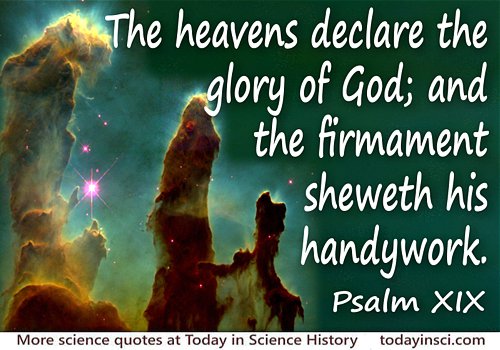
The heavens declare the glory of God; and the firmament sheweth his handy work. … In them hath he set a tabernacle for the sun, which is as a bridegroom coming out of his chamber, and rejoiceth as a strong man to run a race. His going forth is from the end of the heaven, and his circuit unto the ends of it: and there is nothing his from the heat thereof.
— Bible
Psalm 19, verse 1 from the King James Bible (translated 1611), as in The Holy Bible Containing the Old and New Testaments (1709), 347.
The intricate edifice of verifiable fact and tested theory that has been patiently created in just a brief few hundred years is man’s most solid achievement on earth.
In Francis Bello, Lawrence Lessing and George A.W. Boehm, Great American Scientists (1960, 1961), 117.
The noble science of Geology loses glory from the extreme imperfection of the record. The crust of the earth with its embedded remains must not be looked at as a well-filled museum, but as a poor collection made at hazard and at rare intervals.
From On the Origin of Species by Means of Natural Selection; or, The Preservation of Favoured Races in the Struggle for Life (1861), 423.
The path of a cosmonaut is not an easy, triumphant march to glory, as some people make it out to be. You have to put in a lot of work, a lot of sweat, and have to get to know the meaning not just of joy but also of grief, before being allowed in the spacecraft cabin.
In First Man in Space: The Life and Achievement of Yuri Gagarin: a Collection (1984), 104. Cited as written as a foreword of a book at the request of the author.
The proving power of the intellect or the senses was questioned by the skeptics more than two thousand years ago; but they were browbeaten into confusion by the glory of Newtonian physics.
In Radio Lecture (30 Jun 1973) broadcast by the Open University, collected in Imre Lakatos, John Worrall (ed.) and Gregory Currie (ed.), 'Introduction: Science and Pseudoscience', The Methodology of Scientific Research Programmes (1978, 1980), Vol. 1, 8.
The Simiadae then branched off into two great stems, the New World and Old World monkeys; and from the latter at a remote period, Man, the wonder and the glory of the universe, proceeded.
In The Descent of Man, and Selection in Relation to Sex (1871), 213.
The sky seems to be a pure, a cooler blue, the trees a deeper green. The whole world is charged with the glory of God and I feel fire and music under my feet.
On reading the scriptures. Quoted in Kim Lim (ed.), 1,001 Pearls of Spiritual Wisdom: Words to Enrich, Inspire, and Guide Your Life (2014), 166
The truly awesome intellectuals in our history have not merely made discoveries; they have woven variegated, but firm, tapestries of comprehensive coverage. The tapestries have various fates: Most burn or unravel in the foot steps of time and the fires of later discovery. But their glory lies in their integrity as unified structures of great complexity and broad implication.
…...
The word science … is a prestige word of great potency. It is therefore attached to all manner of social programs, in order that they may shine by the reflected glory of the neon light and the radio tube. Indeed, a great many accredited social scientists, in the sense of practicing economists, sociologists, psychologists, anthropologists, and above all “political” scientists.
In Ch. 1, 'Prescientific Thoughtways in a Technological Age', Can Science Save Us? (1947, 2nd ed. 1961), 4.
There is a moral or metaphysical part of nature as well as a physical. A man who denies this is deep in the mire of folly. ’Tis the crown and glory of organic science that it does through final cause, link material and moral; and yet does not allow us to mingle them in our first conception of laws, and our classification of such laws, whether we consider one side of nature or the other. You have ignored this link; and, if I do not mistake your meaning, you have done your best in one or two pregnant cases to break it. Were it possible (which, thank God, it is not) to break it, humanity, in my mind, would suffer a damage that might brutalize it, and sink the human race into a lower grade of degradation than any into which it has fallen since its written records tell us of its history.
Letter to Charles Darwin (Nov 1859). In Charles Darwin and Francis Darwin (ed.), Charles Darwin: His Life Told in an Autobiographical Chapter, and in a Selected Series of His Published Letters (1892), 217.
This [the fact that the pursuit of mathematics brings into harmonious action all the faculties of the human mind] accounts for the extraordinary longevity of all the greatest masters of the Analytic art, the Dii Majores of the mathematical Pantheon. Leibnitz lived to the age of 70; Euler to 76; Lagrange to 77; Laplace to 78; Gauss to 78; Plato, the supposed inventor of the conic sections, who made mathematics his study and delight, who called them the handles or aids to philosophy, the medicine of the soul, and is said never to have let a day go by without inventing some new theorems, lived to 82; Newton, the crown and glory of his race, to 85; Archimedes, the nearest akin, probably, to Newton in genius, was 75, and might have lived on to be 100, for aught we can guess to the contrary, when he was slain by the impatient and ill mannered sergeant, sent to bring him before the Roman general, in the full vigour of his faculties, and in the very act of working out a problem; Pythagoras, in whose school, I believe, the word mathematician (used, however, in a somewhat wider than its present sense) originated, the second founder of geometry, the inventor of the matchless theorem which goes by his name, the pre-cognizer of the undoubtedly mis-called Copernican theory, the discoverer of the regular solids and the musical canon who stands at the very apex of this pyramid of fame, (if we may credit the tradition) after spending 22 years studying in Egypt, and 12 in Babylon, opened school when 56 or 57 years old in Magna Græcia, married a young wife when past 60, and died, carrying on his work with energy unspent to the last, at the age of 99. The mathematician lives long and lives young; the wings of his soul do not early drop off, nor do its pores become clogged with the earthy particles blown from the dusty highways of vulgar life.
In Presidential Address to the British Association, Collected Mathematical Papers, Vol. 2 (1908), 658.
This is a huge step toward unraveling Genesis Chapter 1, Verse 1—what happened in the beginning. This is a Genesis machine. It'll help to recreate the most glorious event in the history of the universe.
[Comment on a milestone experiment, the collision of two proton beams at higher energy than ever before, upon the restarting of the Large Hadron Collider after a major failure and shutdown for repair.]
[Comment on a milestone experiment, the collision of two proton beams at higher energy than ever before, upon the restarting of the Large Hadron Collider after a major failure and shutdown for repair.]
As quoted by Alexander G. Higgins and Seth Borenstein (AP) in 'Atom Smasher Will Help Reveal "The Beginning" ', Bloomberg Businessweek (30 Mar 2010).
Time’s glory is to calm contending kings,
To unmask falsehood and bring truth to light.
To unmask falsehood and bring truth to light.
In 'Rape of Lucrece', The Plays and Poems of William Shakspeare (1821), Vol. 20, 159.
Two kinds of symbol must surely be distinguished. The algebraic symbol comes naked into the world of mathematics and is clothed with value by its masters. A poetic symbol—like the Rose, for Love, in Guillaume de Lorris—comes trailing clouds of glory from the real world, clouds whose shape and colour largely determine and explain its poetic use. In an equation, x and y will do as well as a and b; but the Romance of the Rose could not, without loss, be re-written as the Romance of the Onion, and if a man did not see why, we could only send him back to the real world to study roses, onions, and love, all of them still untouched by poetry, still raw.
C.S. Lewis and E.M. Tillyard, The Personal Heresy: A Controversy (1936), 97.
Vanity is so anchored in the heart of man … and wishes to have his admirers. … Those who write against it want to have the glory of having written well, and those who read it desire the glory of having read it. I who write this have perhaps this desire, and perhaps those who will read it….
In Pensées (1670), Section 2, No. 3. As translated in Blaise Pascal and W.F. Trotter (trans.), 'Thoughts', No. 150, collected in Charles W. Eliot (ed.), The Harvard Classics (1910), Vol. 48, 60. A similar translation is in W.H. Auden and L. Kronenberger (eds.) The Viking Book of Aphorisms (1966), 40. From the original French, “La vanité est si ancrée dans le cœur de l’homme … et veut avoir ses admirateurs;… Ceux qui écrivent contre veulent avoir la gloire d’avoir bien écrit; et ceux qui le lisent veulent avoir la gloire de l’avoir lu; et moi qui écris ceci, ai peut-être cette envie; et peut-être que ceux qui le liront…” in Ernest Havet (ed.), Pensées de Pascal (1892), 122.
We affirm the neutrality of Science ... Science is of no country. ... But if Science has no country, the scientist must keep in mind all that may work towards the glory of his country. In every great scientist will be found a great patriot.
Address at the International Medical Congress, Palace of Industry, Copenhagen (10 Aug 1884). In René Vallery-Radot, The Life of Pasteur, translated by Mrs. R. L. Devonshire (1919), 399.
We must go beyond textbooks, go out into the bypaths and untrodden depths of the wilderness and travel and explore and tell the world the glories of our journey.
From speech (late spring semester 1896), delivered in Nashville, Tennessee, 'The Need of a Liberal Education for Us, and That, Too, in the South', excerpted in Ridgely Torrence, The Story of John Hope (1948), 116. [Note: The quote is often seen misattributed to John Hope Franklin.]
We must protect each other against the attacks of those self-appointed watchdogs of patriotism now abroad in the land who irresponsibly pin red labels on anyone whom they wish to destroy. ... [Academic professionals are the only person competant to differentiate between honest independents and the Communists.] This is our responsibility. It is not a pleasant task. But if it is left to outsiders, the distinction is not likely to be made and those independent critics of social institutions among us who are one of the glories of a true university could be silenced.
As quoted by William L. Laurence in 'Professors Urged to Guard Freedom', New York Times (19 Sep 1952), 17.
We think of Euclid as of fine ice; we admire Newton as we admire the peak of Teneriffe. Even the intensest labors, the most remote triumphs of the abstract intellect, seem to carry us into a region different from our own—to be in a terra incognita of pure reasoning, to cast a chill on human glory.
In Estimates of Some Englishmen and Scotchmen (1856), 411-412
What a chimera ... is man ! What a novelty, what a monster, what a chaos, what a subject of contradiction, what a prodigy! A judge of all things, feeble worm of the earth, depository of the truth, cloacae of uncertainty and error, the glory and the shame of the universe!
…...
What can you conceive more silly and extravagant than to suppose a man racking his brains, and studying night and day how to fly? ... wearying himself with climbing upon every ascent, ... bruising himself with continual falls, and at last breaking his neck? And all this, from an imagination that it would be glorious to have the eyes of people looking up at him, and mighty happy to eat, and drink, and sleep, at the top of the highest trees in the kingdom.
In A Serious Call to a Devout and Holy Life (1732), 168. This was written before Montgolfier brothers, pioneer balloonists, were born.
 In science it often happens that scientists say, 'You know that's a really good argument; my position is mistaken,' and then they would actually change their minds and you never hear that old view from them again. They really do it. It doesn't happen as often as it should, because scientists are human and change is sometimes painful. But it happens every day. I cannot recall the last time something like that happened in politics or religion.
(1987) --
In science it often happens that scientists say, 'You know that's a really good argument; my position is mistaken,' and then they would actually change their minds and you never hear that old view from them again. They really do it. It doesn't happen as often as it should, because scientists are human and change is sometimes painful. But it happens every day. I cannot recall the last time something like that happened in politics or religion.
(1987) -- 





.jpg)
