Glass Quotes (94 quotes)
… man-midwifery, with other “indecencies,” is a great system of fashionable prostitution; a primary school of infamy—as the fashionable hotel and parlor wine glass qualify candidates for the two-penny grog-shop and the gutter.
Man-midwifery Exposed and Corrected (1848)
“But in the binary system,” Dale points out, handing back the squeezable glass, “the alternative to one isn’t minus one, it’s zero. That’s the beauty of it, mechanically.” “O.K. Gotcha. You’re asking me, What’s this minus one? I’ll tell you. It’s a plus one moving backward in time. This is all in the space-time foam, inside the Planck duration, don’t forget. The dust of points gives birth to time, and time gives birth to the dust of points. Elegant, huh? It has to be. It’s blind chance, plus pure math. They’re proving it, every day. Astronomy, particle physics, it’s all coming together. Relax into it, young fella. It feels great. Space-time foam.”
In Roger's Version: A Novel (1986), 304.
[Concerning] phosphorescent bodies, and in particular to uranium salts whose phosphorescence has a very brief duration. With the double sulfate of uranium and potassium ... I was able to perform the following experiment: One wraps a Lumière photographic plate with a bromide emulsion in two sheets of very thick black paper, such that the plate does not become clouded upon being exposed to the sun for a day. One places on the sheet of paper, on the outside, a slab of the phosphorescent substance, and one exposes the whole to the sun for several hours. When one then develops the photographic plate, one recognizes that the silhouette of the phosphorescent substance appears in black on the negative. If one places between the phosphorescent substance and the paper a piece of money or a metal screen pierced with a cut-out design, one sees the image of these objects appear on the negative. One can repeat the same experiments placing a thin pane of glass between the phosphorescent substance and the paper, which excludes the possibility of chemical action due to vapors which might emanate from the substance when heated by the sun's rays. One must conclude from these experiments that the phosphorescent substance in question emits rays which pass through the opaque paper and reduces silver salts.
[Although the sun is irrelevant, and he misinterprets the role of phosphorescence, he has discovered the effect of radioactivity.]
[Although the sun is irrelevant, and he misinterprets the role of phosphorescence, he has discovered the effect of radioactivity.]
Read at French Academy of Science (24 Feb 1896). In Comptes Rendus (1896), 122, 420. As translated by Carmen Giunta on the Classic Chemistry web site.
Qu'une goutee de vin tombe dans un verre d'eau; quelle que soit la loi du movement interne du liquide, nous verrons bientôt se colorer d'une teinte rose uniforme et à partir de ce moment on aura beau agiter le vase, le vin et l'eau ne partaîtront plus pouvoir se séparer. Tout cela, Maxwell et Boltzmann l'ont expliqué, mais celui qui l'a vu plus nettement, dans un livre trop peu lu parce qu'il est difficile à lire, c'est Gibbs dans ses principes de la Mécanique Statistique.
Let a drop of wine fall into a glass of water; whatever be the law that governs the internal movement of the liquid, we will soon see it tint itself uniformly pink and from th at moment on, however we may agitate the vessel, it appears that the wine and water can separate no more. All this, Maxwell and Boltzmann have explained, but the one who saw it in the cleanest way, in a book that is too little read because it is difficult to read, is Gibbs, in his Principles of Statistical Mechanics.
Let a drop of wine fall into a glass of water; whatever be the law that governs the internal movement of the liquid, we will soon see it tint itself uniformly pink and from th at moment on, however we may agitate the vessel, it appears that the wine and water can separate no more. All this, Maxwell and Boltzmann have explained, but the one who saw it in the cleanest way, in a book that is too little read because it is difficult to read, is Gibbs, in his Principles of Statistical Mechanics.
La valeur de la science. In Anton Bovier, Statistical Mechanics of Disordered Systems (2006), 3.
Question: Account for the delicate shades of colour sometimes seen on the inside of an oyster shell. State and explain the appearance presented when a beam of light falls upon a sheet of glass on which very fine equi-distant parallel lines have been scratched very close to one another.
Answer: The delicate shades are due to putrefaction; the colours always show best when the oyster has been a bad one. Hence they are considered a defect and are called chromatic aberration.
The scratches on the glass will arrange themselves in rings round the light, as any one may see at night in a tram car.
Answer: The delicate shades are due to putrefaction; the colours always show best when the oyster has been a bad one. Hence they are considered a defect and are called chromatic aberration.
The scratches on the glass will arrange themselves in rings round the light, as any one may see at night in a tram car.
Genuine student answer* to an Acoustics, Light and Heat paper (1880), Science and Art Department, South Kensington, London, collected by Prof. Oliver Lodge. Quoted in Henry B. Wheatley, Literary Blunders (1893), 182, Question 27. (*From a collection in which Answers are not given verbatim et literatim, and some instances may combine several students' blunders.)
Question: How would you disprove, experimentally, the assertion that white light passing through a piece of coloured glass acquires colour from the glass? What is it that really happens?
Answer: To disprove the assertion (so repeatedly made) that “white light passing through a piece of coloured glass acquires colour from the glass,” I would ask the gentleman to observe that the glass has just as much colour after the light has gone through it as it had before. That is what would really happen.
Answer: To disprove the assertion (so repeatedly made) that “white light passing through a piece of coloured glass acquires colour from the glass,” I would ask the gentleman to observe that the glass has just as much colour after the light has gone through it as it had before. That is what would really happen.
Genuine student answer* to an Acoustics, Light and Heat paper (1880), Science and Art Department, South Kensington, London, collected by Prof. Oliver Lodge. Quoted in Henry B. Wheatley, Literary Blunders (1893), 178, Question 8. (*From a collection in which Answers are not given verbatim et literatim, and some instances may combine several students' blunders.)
Question: On freezing water in a glass tube, the tube sometimes breaks. Why is this? An iceberg floats with 1,000,000 tons of ice above the water line. About how many tons are below the water line?
Answer: The water breaks the tube because of capallarity. The iceberg floats on the top because it is lighter, hence no tons are below the water line. Another reason is that an iceberg cannot exceed 1,000,000 tons in weight: hence if this much is above water, none is below. Ice is exceptional to all other bodies except bismuth. All other bodies have 1090 feet below the surface and 2 feet extra for every degree centigrade. If it were not for this, all fish would die, and the earth be held in an iron grip.
P.S.—When I say 1090 feet, I mean 1090 feet per second.
Answer: The water breaks the tube because of capallarity. The iceberg floats on the top because it is lighter, hence no tons are below the water line. Another reason is that an iceberg cannot exceed 1,000,000 tons in weight: hence if this much is above water, none is below. Ice is exceptional to all other bodies except bismuth. All other bodies have 1090 feet below the surface and 2 feet extra for every degree centigrade. If it were not for this, all fish would die, and the earth be held in an iron grip.
P.S.—When I say 1090 feet, I mean 1090 feet per second.
Genuine student answer* to an Acoustics, Light and Heat paper (1880), Science and Art Department, South Kensington, London, collected by Prof. Oliver Lodge. Quoted in Henry B. Wheatley, Literary Blunders (1893), 179-80, Question 13. (*From a collection in which Answers are not given verbatim et literatim, and some instances may combine several students' blunders.)

A time will come, when fields will be manured with a solution of glass (silicate of potash), with the ashes of burnt straw, and with the salts of phosphoric acid, prepared in chemical manufactories, exactly as at present medicines are given for fever and goitre.
Agricultural Chemistry (1847), 4th edn., 186.
About ten months ago [1609] a report reached my ears that a certain Fleming [Hans Lippershey] had constructed a spyglass, by means of which visible objects, though very distant from the eye of the observer, were distinctly seen as if nearby... Of this truly remarkable effect several experiences were related, to which some persons gave credence while others denied them. A few days later the report was confirmed to me in a letter from a noble Frenchman at Paris, Jacques Badovere, which caused me to apply myself wholeheartedly to enquire into the means by which I might arrive at the invention of a similar instrument. This I did shortly afterwards, my basis being the theory of refraction. First I prepared a tube of lead, at the ends of which I fitted two glass lenses, both plane on one side while on the other side one was spherically convex and the other concave.
The Starry Messenger (1610), trans. Stillman Drake, Discoveries and Opinions of Galileo (1957), 28-9.
Aluminum is at once as white as silver, as incorrodible as gold, as tenacious as iron, as fusible as copper, and as light as glass. It is easily worked; it is widely spread in nature, alumina forming the bases of most rocks; it is three times lighter than iron; in short, it seems to have been created expressly to furnish material for our projectile!
Planning a spacecraft to be fired from a cannon to the moon. In From the Earth to the Moon (1865, 1890), 38.
An optical unit has been devised which will convey optical images along a flexible axis. The unit comprises a bundle of fibres of glass, or other transparent material, and it therefore appears appropriate to introduce the term 'fibrescope' to denote it.
Co-author with Indian-American physicist Narinder Singh Kapany..
Co-author with Indian-American physicist Narinder Singh Kapany..
'A Flexible Fibrescope, using Static Scanning', Nature (1954), 173, 39.
As plants convert the minerals into food for animals, so each man converts some raw material in nature to human use. The inventors of fire, electricity, magnetism, iron, lead, glass, linen, silk, cotton; the makers of tools; the inventor of decimal notation, the geometer, the engineer, the musician, severally make an easy way for all, through unknown and impossible confusions.
In 'Uses of Great Men', Representative Men (1850), 5-6.
Astronomy is a cold, desert science, with all its pompous figures,—depends a little too much on the glass-grinder, too little on the mind. ’Tis of no use to show us more planets and systems. We know already what matter is, and more or less of it does not signify.
In 'Country Life', collected in The Complete Works of Ralph Waldo Emerson (1904), Vol. 12, 166.
At Gabriel College there was a very holy object on the high altar of the Oratory, covered with a black velvet cloth... At the height of the invocation the Intercessor lifted the cloth to reveal in the dimness a glass dome inside which there was something too distant to see, until he pulled a string attached to a shutter above, letting a ray of sunlight through to strike the dome exactly. Then it became clear: a little thing like a weathervane, with four sails black on one side and white on the other, began to whirl around as the light struck it. It illustrated a moral lesson, the Intercessor explained, for the black of ignorance fled from the light, whereas the wisdom of white rushed to embrace it.
[Alluding to Crookes's radiometer.]
[Alluding to Crookes's radiometer.]
Northern Lights (2001), 149.
At length being at Clapham where there is, on the common, a large pond which, I observed to be one day very rough with the wind, I fetched out a cruet of oil and dropt a little of it on the water. I saw it spread itself with surprising swiftness upon the surface; but the effect of smoothing the waves was not produced; for I had applied it first on the leeward side of the pond, where the waves were largest, and the wind drove my oil back upon the shore. I then went to the windward side, where they began to form; and there the oil, though not more than a tea-spoonful, produced an instant calm over a space several yards square, which spread amazingly, and extended itself gradually till it reached the leeside, making all that quarter of the pond, perhaps half an acre, as smooth as a looking-glass.
[Experiment to test an observation made at sea in 1757, when he had seen the wake of a ship smoothed, explained by the captain as presumably due to cooks emptying greasy water in to the sea through the scuppers.]
[Experiment to test an observation made at sea in 1757, when he had seen the wake of a ship smoothed, explained by the captain as presumably due to cooks emptying greasy water in to the sea through the scuppers.]
Letter, extract in 'Of the still of Waves by Means of Oil The Gentleman's Magazine (1775), Vol. 45, 82.
At the sea shore you pick up a pebble, fashioned after a law of nature, in the exact form that best resists pressure, and worn as smooth as glass. It is so perfect that you take it as a keepsake. But could you know its history from the time when a rough fragment of rock fell from the overhanging cliff into the sea, to be taken possession of by the under currents, and dragged from one ocean to another, perhaps around the world, for a hundred years, until in reduced and perfect form it was cast upon the beach as you find it, you would have a fit illustration of what many principles, now in familiar use, have endured, thus tried, tortured and fashioned during the ages.
From Address (1 Aug 1875), 'The Growth of Principles' at Saratoga. Collected in William L. Snyder (ed.), Great Speeches by Great Lawyers: A Collection of Arguments and Speeches (1901), 246.
But it must not be forgotten that ... glass and porcelain were manufactured, stuffs dyed and metals separated from their ores by mere empirical processes of art, and without the guidance of correct scientific principles.
Familiar Letters on Chemistry (1851), 2.
By night the Glass
Of Galileo … observes
Imagin’d Land and Regions in the Moon.
Of Galileo … observes
Imagin’d Land and Regions in the Moon.
Paradise Lost, Book 5, lines 261-263. In Books V and VI, edited by A. W. Verity,(1910), 11.
By research in pure science I mean research made without any idea of application to industrial matters but solely with the view of extending our knowledge of the Laws of Nature. I will give just one example of the ‘utility’ of this kind of research, one that has been brought into great prominence by the War—I mean the use of X-rays in surgery. Now, not to speak of what is beyond money value, the saving of pain, or, it may be, the life of the wounded, and of bitter grief to those who loved them, the benefit which the state has derived from the restoration of so many to life and limb, able to render services which would otherwise have been lost, is almost incalculable. Now, how was this method discovered? It was not the result of a research in applied science starting to find an improved method of locating bullet wounds. This might have led to improved probes, but we cannot imagine it leading to the discovery of X-rays. No, this method is due to an investigation in pure science, made with the object of discovering what is the nature of Electricity. The experiments which led to this discovery seemed to be as remote from ‘humanistic interest’ —to use a much misappropriated word—as anything that could well be imagined. The apparatus consisted of glass vessels from which the last drops of air had been sucked, and which emitted a weird greenish light when stimulated by formidable looking instruments called induction coils. Near by, perhaps, were great coils of wire and iron built up into electro-magnets. I know well the impression it made on the average spectator, for I have been occupied in experiments of this kind nearly all my life, notwithstanding the advice, given in perfect good faith, by non-scientific visitors to the laboratory, to put that aside and spend my time on something useful.
In Speech made on behalf of a delegation from the Conjoint Board of Scientific Studies in 1916 to Lord Crewe, then Lord President of the Council. In George Paget Thomson, J. J. Thomson and the Cavendish Laboratory in His Day (1965), 167-8.
Chemistry works with an enormous number of substances, but cares only for some few of their properties; it is an extensive science. Physics on the other hand works with rather few substances, such as mercury, water, alcohol, glass, air, but analyses the experimental results very thoroughly; it is an intensive science. Physical chemistry is the child of these two sciences; it has inherited the extensive character from chemistry. Upon this depends its all-embracing feature, which has attracted so great admiration. But on the other hand it has its profound quantitative character from the science of physics.
In Theories of Solutions (1912), xix.
Chemistry... is like the maid occupied with daily civilisation; she is busy with fertilisers, medicines, glass, insecticides ... for she dispenses the recipes.
Les Confessions d'un Chimiste Ordinaire (1981), 5. Trans. W. H. Brock.
Curves that have no tangents are the rule. … Those who hear of curves without tangents, or of functions without derivatives, often think at first that Nature presents no such complications. … The contrary however is true. … Consider, for instance, one of the white flakes that are obtained by salting a solution of soap. At a distance its contour may appear sharply defined, but as we draw nearer its sharpness disappears. The eye can no longer draw a tangent at any point. … The use of a magnifying glass or microscope leaves us just as uncertain, for fresh irregularities appear every time we increase the magnification. … An essential characteristic of our flake … is that we suspect … that any scale involves details that absolutely prohibit the fixing of a tangent.
(1906). As quoted “in free translation” in Benoit B. Mandelbrot, The Fractal Geometry of Nature (1977, 1983), 7.
Exper. I. I made a small hole in a window-shutter, and covered it with a piece of thick paper, which I perforated with a fine needle. For greater convenience of observation I placed a small looking-glass without the window-shutter, in such a position as to reflect the sun's light, in a direction nearly horizontal, upon the opposite wall, and to cause the cone of diverging light to pass over a table on which were several little screens of card-paper. I brought into the sunbeam a slip of card, about one-thirtieth of an inch in breadth, and observed its shadow, either on the wall or on other cards held at different distances. Besides the fringes of colour on each side of the shadow, the shadow itself was divided by similar parallel fringes, of smaller dimensions, differing in number, according to the distance at which the shadow was observed, but leaving the middle of the shadow always white. Now these fringes were the joint effects of the portions of light passing on each side of the slip of card and inflected, or rather diffracted, into the shadow. For, a little screen being placed a few inches from the card, so as to receive either edge of the shadow on its margin, all the fringes which had before been observed in the shadow on the wall, immediately disappeared, although the light inflected on the other side was allowed to retain its course, and although this light must have undergone any modification that the proximity of the other edge of the slip of card might have been capable of occasioning... Nor was it for want of a sufficient intensity of light that one of the two portions was incapable of producing the fringes alone; for when they were both uninterrupted, the lines appeared, even if the intensity was reduced to one-tenth or one-twentieth.
'Experiments and Calculations Relative to Physical Optics' (read in 1803), Philosophical Transactions (1804), 94, 2-3.
For now we see through a glass, darkly; but then face to face: now I know in part; but then shall I know…
— Bible
In The Bible, King James Version, 1 Corinthians 13:12.
He scarce had ceased when the superior fiend
Was moving toward the shore; his ponderous shield
Ethereal temper, massy, large and round,
Behind him cast; the broad circumference
Hung on his shoulders like the moon, whose orb
Through optic glass the Tuscan artist views
At evening from the top of Fésolè,
Or in Valdarno, to descry new lands,
Rivers or mountains in her spotty globe.
Was moving toward the shore; his ponderous shield
Ethereal temper, massy, large and round,
Behind him cast; the broad circumference
Hung on his shoulders like the moon, whose orb
Through optic glass the Tuscan artist views
At evening from the top of Fésolè,
Or in Valdarno, to descry new lands,
Rivers or mountains in her spotty globe.
Paradise Lost, Books I and II (1667), edited by Anna Baldwin (1998), lines 283-91, p. 9.
I can never look now at the Milky Way without wondering from which of those banked clouds of stars the emissaries are coming. If you will pardon so commonplace a simile, we have broken the glass of the fire-alarm and have nothing to do but to wait. I do not think we will have to wait for long.
Concluding sentences of short story, 'The Sentinel', collected in Avon 10 Story Fantasy (Spring 1951), 1, No. 1, 47.
I could almost wish, at this point, that I were in the habit of expressing myself in theological terms, for if I were, I might be able to compress my entire thesis into a sentence. All knowledge of every variety (I might say) is in the mind of God—and the human intellect, even the best, in trying to pluck it forth can but “see through a glass, darkly.”
In Asimov on Physics (1976), 146. Also in Isaac Asimov’s Book of Science and Nature Quotations (1988), 279.
I have long been interested in landscape history, and when younger and more robust I used to do much tramping of the English landscape in search of ancient field systems, drove roads, indications of prehistoric settlement. Towns and cities, too, which always retain the ghost of their earlier incarnations beneath today's concrete and glass.
From 'An Interview With Penelope Lively', in a Reading Guide to the book The Photograph on the publisher's Penguin website.
I pull a flower from the woods,
A monster with a glass
Computes the stamens in a breath,
And has her in a class.
A monster with a glass
Computes the stamens in a breath,
And has her in a class.
I shall never forget the sight. The vessel of crystallization was three quarters full of slightly muddy water—that is, dilute water-glass—and from the sandy bottom there strove upwards a grotesque little landscape of variously colored growths: a confused vegetation of blue, green, and brown shoots which reminded one of algae, mushrooms, attached polyps, also moss, then mussels, fruit pods, little trees or twigs from trees, here, and there of limbs. It was the most remarkable sight I ever saw, and remarkable not so much for its profoundly melancholy nature. For when Father Leverkühn asked us what we thought of it and we timidly answered him that they might be plants: “No,” he replied, “they are not, they only act that way. But do not think the less of them. Precisely because they do, because they try as hard as they can, they are worthy of all respect.”
It turned out that these growths were entirely unorganic in their origin; they existed by virtue of chemicals from the apothecary's shop.
It turned out that these growths were entirely unorganic in their origin; they existed by virtue of chemicals from the apothecary's shop.
Description of a “chemical garden” in Doktor Faustus: The Life of the German Composer Adrian Leverkühn, as Told by a Friend, (1947), 19.
I took a glass retort, capable of containing eight ounces of water, and distilled fuming spirit of nitre according to the usual method. In the beginning the acid passed over red, then it became colourless, and lastly again all red: no sooner did this happen, than I took away the receiver; and tied to the mouth of the retort a bladder emptied of air, which I had moistened in its inside with milk of lime lac calcis, (i.e. lime-water, containing more quicklime than water can dissolve) to prevent its being corroded by the acid. Then I continued the distillation, and the bladder gradually expanded. Here-upon I left every thing to cool, tied up the bladder, and took it off from the mouth of the retort.— I filled a ten-ounce glass with this air and put a small burning candle into it; when immediately the candle burnt with a large flame, of so vivid a light that it dazzled the eyes. I mixed one part of this air with three parts of air, wherein fire would not burn; and this mixture afforded air, in every respect familiar to the common sort. Since this air is absolutely necessary for the generation of fire, and makes about one-third of our common air, I shall henceforth, for shortness sake call it empyreal air, [literally fire-air] the air which is unserviceable for the fiery phenomenon, and which makes abut two-thirds of common air, I shall for the future call foul air [literally corrupted air].
Chemische Abhandlung von der Luft und dem Feuer (1777), Chemical Observations and Experiments on Air and Fire (1780), trans. J. R. Forster, 34-5.
I took a good clear piece of Cork and with a Pen-knife sharpen'd as keen as a Razor, I cut a piece of it off, and thereby left the surface of it exceeding smooth, then examining it very diligently with a Microscope, me thought I could perceive it to appear a little porous; but I could not so plainly distinguish them, as to be sure that they were pores, much less what Figure they were of: But judging from the lightness and yielding quality of the Cork, that certainly the texture could not be so curious, but that possibly, if I could use some further diligence, I might find it to be discernable with a Microscope, I with the same sharp Penknife, cut off from the former smooth surface an exceeding thin piece of it with a deep plano-convex Glass, I could exceedingly plainly perceive it to be all perforated and porous, much like a Honey-comb, but that the pores of it were not regular; yet it was not unlike a Honey-comb in these particulars.
First, in that it had a very little solid substance, in comparison of the empty cavity that was contain'd between, ... for the Interstitia or walls (as I may so call them) or partitions of those pores were neer as thin in proportion to their pores as those thin films of Wax in a Honey-comb (which enclose and constitute the sexangular cells) are to theirs.
Next, in that these pores, or cells, were not very deep, but constituted of a great many little Boxes, separated out of one continued long pore, by certain Diaphragms...
I no sooner discerned these (which were indeed the first microscopical pores I ever saw, and perhaps, that were ever seen, for I had not met with any Writer or Person, that had made any mention of them before this) but me thought I had with the discovery of them, presently hinted to me the true and intelligible reason of all the Phænomena of Cork.
First, in that it had a very little solid substance, in comparison of the empty cavity that was contain'd between, ... for the Interstitia or walls (as I may so call them) or partitions of those pores were neer as thin in proportion to their pores as those thin films of Wax in a Honey-comb (which enclose and constitute the sexangular cells) are to theirs.
Next, in that these pores, or cells, were not very deep, but constituted of a great many little Boxes, separated out of one continued long pore, by certain Diaphragms...
I no sooner discerned these (which were indeed the first microscopical pores I ever saw, and perhaps, that were ever seen, for I had not met with any Writer or Person, that had made any mention of them before this) but me thought I had with the discovery of them, presently hinted to me the true and intelligible reason of all the Phænomena of Cork.
Micrographia, or some Physiological Descriptions of Minute Bodies made by Magnifying Glasses with Observations and Inquiries thereupon (1665), 112-6.
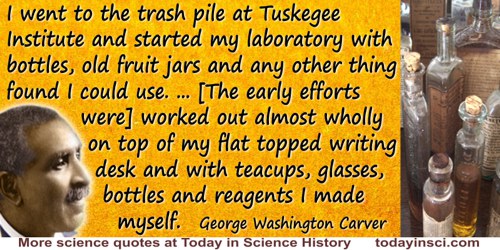
I went to the trash pile at Tuskegee Institute and started my laboratory with bottles, old fruit jars and any other thing I found I could use. … [The early efforts were] worked out almost wholly on top of my flat topped writing desk and with teacups, glasses, bottles and reagents I made myself.
Manuscript fragment, no date, Box 1, George Washington Carver Papers. Cited in Linda O. McMurry, George Washington Carver, Scientist and Symbol (1982), 130.
I wish, my dear Kepler, that we could have a good laugh together at the extraordinary stupidity of the mob. What do you think of the foremost philosophers of this University? In spite of my oft-repeated efforts and invitations, they have refused, with the obstinacy of a glutted adder, to look at the planets or the Moon or my glass [telescope].
Opere ed Nas. X, 423. As cited in Alan Mackay, A Dictionary of Scientific Quotations (1991), 99. Galileo wished others to use his telescope to see for themselves the moons of Jupiter which he had himself first seen in Jan 1610. If you have a primary source for this letter giving the date it was written, please contact Webmaster.
I… formerly had two pair of spectacles, which I shifted occasionally, as in travelling I sometimes read, and often wanted to regard the prospects. Finding this change troublesome, and not always sufficiently ready, I had the glasses cut, and half of each kind associated in the same circle. … By this means, as I wear my spectacles constantly, I have only to move my eyes up or down, as I want to see distinctly far or near, the proper glasses being always ready.
Letter (23 May 1785) to George Wheatley). Collected in William Temple Franklin (ed.), The Works of Dr. Benjamin Franklin (1809), Vol. 6, 168.
If the Humours of the Eye by old Age decay, so as by shrinking to make the Cornea and Coat of the Crystalline Humour grow flatter than before, the Light will not be refracted enough, and for want of a sufficient Refraction will not converge to the bottom of the Eye but to some place beyond it, and by consequence paint in the bottom of the Eye a confused Picture, and according to the Indistinctuess of this Picture the Object will appear confused. This is the reason of the decay of sight in old Men, and shews why their Sight is mended by Spectacles. For those Convex glasses supply the defect of plumpness in the Eye, and by increasing the Refraction make the rays converge sooner, so as to convene distinctly at the bottom of the Eye if the Glass have a due degree of convexity. And the contrary happens in short-sighted Men whose Eyes are too plump. For the Refraction being now too great, the Rays converge and convene in the Eyes before they come at the bottom; and therefore the Picture made in the bottom and the Vision caused thereby will not be distinct, unless the Object be brought so near the Eye as that the place where the converging Rays convene may be removed to the bottom, or that the plumpness of the Eye be taken off and the Refractions diminished by a Concave-glass of a due degree of Concavity, or lastly that by Age the Eye grow flatter till it come to a due Figure: For short-sighted Men see remote Objects best in Old Age, and therefore they are accounted to have the most lasting Eyes.
Opticks (1704), Book 1, Part 1, Axiom VII, 10-11.
If we peep into Dom Claude’s cell, we are introduced to a typical alchemist’s laboratory—a gloomy, dimly-lighted place, full of strange vessels, and furnaces, and melting-pots, spheres, and portions of skeletons hanging from the ceiling; the floor littered with stone bottles, pans, charcoal, aludels, and alembics, great parchment books covered with hieroglyphics; the bellows with its motto Spira, Spera; the hour-glass, the astrolabe, and over all cobwebs, and dust, and ashes. The walls covered with various aphorisms of the brotherhood; legends and memorials in many tongues; passages from the Smaragdine Table of Hermes Trismegistus; and looming out from all in great capitals, ’ANAΓKH.
In The Birth of Chemistry (1874), 100.
Imagine life as a game in which you are juggling five balls in the air. You name them - work, family, health, friends, and spirit - and you’re keeping all of these in the air. You will soon understand that work is a rubber ball. If you drop it, it will bounce back. But the other four balls - family, health, friends, and spirit are made of glass. If you drop one of these, they will be irrevocably scuffed, marked, nicked, damaged, or even shattered. They will never be the same. You must understand that and strive for balance in your life.
…...
In 1963, when I assigned the name “quark” to the fundamental constituents of the nucleon, I had the sound first, without the spelling, which could have been “kwork.” Then, in one of my occasional perusals of Finnegans Wake, by James Joyce, I came across the word “quark” in the phrase “Three quarks for Muster Mark.” Since “quark” (meaning, for one thing, the cry of a gull) was clearly intended to rhyme with “Mark,” as well as “bark” and other such words, I had to find an excuse to pronounce it as “kwork.” But the book represents the dreams of a publican named Humphrey Chimpden Earwicker. Words in the text are typically drawn from several sources at once, like the “portmanteau words” in Through the Looking Glass. From time to time, phrases occur in the book that are partially determined by calls for drinks at the bar. I argued, therefore, that perhaps one of the multiple sources of the cry “Three quarks for Muster Mark” might be pronunciation for “Three quarts for Mister Mark,” in which case the pronunciation “kwork” would not be totally unjustified. In any case, the number three fitted perfectly the way quarks occur in nature.
The Quark and the Jaguar (1994), 180.
In early life I had felt a strong desire to devote myself to the experimental study of nature; and, happening to see a glass containing some camphor, portions of which had been caused to condense in very beautiful crystals on the illuminated side, I was induced to read everything I could obtain respecting the chemical and mechanical influences of light, adhesion, and capillary attraction.
In preface to Scientific Memoirs (1878), xii.
In modern Europe, the Middle Ages were called the Dark Ages. Who dares to call them so now? … Their Dante and Alfred and Wickliffe and Abelard and Bacon; their Magna Charta, decimal numbers, mariner’s compass, gunpowder, glass, paper, and clocks; chemistry, algebra, astronomy; their Gothic architecture, their painting,—are the delight and tuition of ours. Six hundred years ago Roger Bacon explained the precession of the equinoxes, and the necessity of reform in the calendar; looking over how many horizons as far as into Liverpool and New York, he announced that machines can be constructed to drive ships more rapidly than a whole galley of rowers could do, nor would they need anything but a pilot to steer; carriages, to move with incredible speed, without aid of animals; and machines to fly into the air like birds.
In 'Progress of Culture', an address read to the Phi Beta Kappa Society at Cambridge, 18 July 1867. Collected in Works of Ralph Waldo Emerson (1883), 475.
It has the property of detonating very violently in certain circumstances. On one occasion a small amount of ether solution of pyroglycerin condensed in a glass bowl. ... When the bowl was heated over a spirit lamp, an extremely violent explosion occurred, which shattered it into small fragments. On another occasion a drop was heated in a test-tube, and exploded with such violence that the glass splinters cut deep into my face and hands, and hurt other people who were standing some distance off in the room.
[Describing early experiments on his discovery of nitroglycerin.]
[Describing early experiments on his discovery of nitroglycerin.]
From speech to the Royal Academy of Turin (1847). In Robert Shaplen, 'Annals of Science, Adventures of a Pacifist,' The New Yorker (15 Mar 1958), 49.
It must be admitted that science has its castes. The man whose chief apparatus is the differential equation looks down upon one who uses a galvanometer, and he in turn upon those who putter about with sticky and smelly things in test tubes. But all of these, and most biologists too, join together in their contempt for the pariah who, not through a glass darkly, but with keen unaided vision, observes the massing of a thundercloud on the horizon, the petal as it unfolds, or the swarming of a hive of bees. And yet sometimes I think that our laboratories are but little earthworks which men build about themselves, and whose puny tops too often conceal from view the Olympian heights; that we who work in these laboratories are but skilled artisans compared with the man who is able to observe, and to draw accurate deductions from the world about him.
The Anatomy of Science (1926), 170- 1.
It was on the 25th November 1740 that I cut the first polyp. I put the two parts in a flat glass, which only contained water to the height of four to five lignes. It was thus easy for me to observe these portions of the polyp with a fairly powerful lens.
I shall indicate farther on the precautions I took in making my experiments on these cut polyps and the technique I adopted to cut them. It will suffice to say here that I cut the polyp concerned transversely, a little nearer the anterior than the posterior end. The first part was thus a little shorter than the second.
The instant that I cut the polyp, the two parts contracted so that at first they only appeared like two little grains of green matter at the bottom of the glass in which I put them—for green, as I have already said, is the colour of the first polyps that I possessed. The two parts expanded on the same day on which I separated them. They were very easy to distinguish from one another. The first had its anterior end adorned with the fine threads that serve the polyp as legs and arms, which the second had none.
The extensions of the first part was not the only sign of life that it gave on the same day that it was separated from the other. I saw it move its arms; and the next day, the first time I came to observe it, I found that it had changed its position; and shortly afterwards I saw it take a step. The second part was extended as on the previous day and in the same place. I shook the glass a little to see if it were still alive. This movement made it contract, from which I judged that it was alive. Shortly afterwards it extended again. On the following days I saw the same thing.
I shall indicate farther on the precautions I took in making my experiments on these cut polyps and the technique I adopted to cut them. It will suffice to say here that I cut the polyp concerned transversely, a little nearer the anterior than the posterior end. The first part was thus a little shorter than the second.
The instant that I cut the polyp, the two parts contracted so that at first they only appeared like two little grains of green matter at the bottom of the glass in which I put them—for green, as I have already said, is the colour of the first polyps that I possessed. The two parts expanded on the same day on which I separated them. They were very easy to distinguish from one another. The first had its anterior end adorned with the fine threads that serve the polyp as legs and arms, which the second had none.
The extensions of the first part was not the only sign of life that it gave on the same day that it was separated from the other. I saw it move its arms; and the next day, the first time I came to observe it, I found that it had changed its position; and shortly afterwards I saw it take a step. The second part was extended as on the previous day and in the same place. I shook the glass a little to see if it were still alive. This movement made it contract, from which I judged that it was alive. Shortly afterwards it extended again. On the following days I saw the same thing.
In Mémoires, pour servir à l'histoire d'un genre de polyps d'eau douce à bras en forme de cornes (1744), 7-16. Trans. John R. Baker, in Abraham Trembley of Geneva: Scientist and Philosopher 1710-1784 (1952), 31.
It’s a good thing to turn your mind upside down now and then, like an hour-glass, to let the particles run the other way.
The Haunted Bookshop (1919), 13.
Let any man reflect on the revolution produced in society by two simple and common things, glass and gunpowder.
Reflection 328, in Lacon: or Many things in Few Words; Addressed to Those Who Think (1820), 155.
Let us suppose that we have laid on the table... [a] piece of glass... and let us homologize this glass to a whole order of plants or birds. Let us hit this glass a blow in such a manner as but to crack it up. The sectors circumscribed by cracks following the first blow may here be understood to represent families. Continuing, we may crack the glass into genera, species and subspecies to the point of finally having the upper right hand corner a piece about 4 inches square representing a sub-species.
Space, Time, Form: The Biological Synthesis (1962, issued 1964), 209.
Many of the nobles and senators, although of great age, mounted more than once to the top of the highest church in Venice, in order to see sails and shipping … so far off that it was two hours before they were seen without my spy-glass …, for the effect of my instrument is such that it makes an object fifty miles off appear as large as if it were only five miles away. ... The Senate, knowing the way in which I had served it for seventeen years at Padua, ... ordered my election to the professorship for life.
Quoted in Will Durant, Ariel Duran, The Age of Reason Begins (1961), 604. From Charles Singer, Studies in the History and Method of Science (1917), Vol. 1, 228.
Nature is objective, and nature is knowable, but we can only view her through a glass darkly–and many clouds upon our vision are of our own making: social and cultural biases, psychological preferences, and mental limitations (in universal modes of thought, not just individualized stupidity).
In Chap. 1, 'Huxley’s Chessboard', Full House: The Spread of Excellence From Plato to Darwin (1996, 2011), 8.
Neutrinos, they are very small
They have no charge and have no mass
And do not interact at all.
The earth is just a silly ball
To them, through which they simply pass,Like dustmaids down a drafty hall
Or photons through a sheet of glass.
They snub the most exquisite gas,
Ignore the most substantial wall,
Cold-shoulder steel and sounding brass,
Insult the stallion in his stall,
And, scorning barriers of class,
Infiltrate you and me! Like tall
And painless guillotines, they fall
Down through our heads into the grass.
At night, they enter at Nepal
And pierce the lover and his lass
From underneath the bed—you call
It wonderful; I call it crass.
They have no charge and have no mass
And do not interact at all.
The earth is just a silly ball
To them, through which they simply pass,Like dustmaids down a drafty hall
Or photons through a sheet of glass.
They snub the most exquisite gas,
Ignore the most substantial wall,
Cold-shoulder steel and sounding brass,
Insult the stallion in his stall,
And, scorning barriers of class,
Infiltrate you and me! Like tall
And painless guillotines, they fall
Down through our heads into the grass.
At night, they enter at Nepal
And pierce the lover and his lass
From underneath the bed—you call
It wonderful; I call it crass.
In poem 'Cosmic Gall', The New Yorker (17 Dec 1960). Collected in Telephone Poles and Other Poems (1964), 5. Note: In fact, about 1014 neutrinos from the Sun and 103 neutrinos in cosmic rays pass through our bodies each second. Neutrinos are now known to have a very small amount of mass, and they do interact (through the weak force). Thus line 3 is better expressed as: “And scarcely interact at all,” which Murray Gell-Mann substitutes, claiming “scientific license, in his 'The Elementary particles of Matter', Engineering and Science (Jan 1967), 21.
Newton found that a star, examined through a glass tarnished by smoke, was diminished into a speck of light. But no smoke ever breathed so thick a mist as envy or detraction.
Pleasures, Objects, and Advantages of Literature (1855), 67.
Nothing is more humbling than to look with a strong magnifying glass at an insect so tiny that the naked eye sees only the barest speck and to discover that nevertheless it is sculpted and articulated and striped with the same care and imagination as a zebra. Apparently it does not occur to nature whether or not a creature is within our range of vision, and the suspicion arises that even the zebra was not designed for our benefit.
…...
Observation is like a piece of glass, which, as a mirror, must be very smooth, and must be very carefully polished, in order that it may reflect the image pure and undistorted.
'The Study of the Natural Sciences: An Introductory Lecture to the Course of Experimental Chemistry in the University of Munich, for the Winter Session of 1852-53,' as translated and republished in The Medical Times and Gazette (22 Jan 1853), N.S. Vol. 6, 82.
Oh, my dear Kepler, how I wish that we could have one hearty laugh together. Here, at Padua, is the principal professor of philosophy, whom I have repeatedly and urgently requested to look at the moon and planets through my glass, [telescope] which he pertinaciously refuses to do. Why are you not here? what shouts of laughter we should have at this glorious folly! and to hear the professor of philosophy at Pisa laboring before the grand duke with logical arguments, as if with magical incantations, to charm the new planets out of the sky.
From Letter to Johannes Kepler. As translated in John Elliot Drinkwater Bethune, Life of Galileo Galilei: With Illustrations of the Advancement of Experimental Philosophy (1832), 92-93.
ORGANIC LIFE beneath the shoreless waves
Was born and nurs'd in Ocean's pearly caves;
First, forms minute, unseen by spheric glass,
Move on the mud, or pierce the watery mass;
These, as successive generations bloom,
New powers acquire, and larger limbs assume;
Whence countless groups of vegetation spring,
And breathing realms of fin, and feet, and wing.
Thus the tall Oak, the giant of the wood,
Which bears Britannia's thunders on the flood;
The Whale, unmeasured monster of the main,
The lordly Lion, monarch of the plain,
The Eagle soaring in the realms of air,
Whose eye undazzled drinks the solar glare,
Imperious man, who rules the bestial crowd,
Of language, reason, and reflection proud,
With brow erect, who scorns this earthy sod,
And styles himself the image of his God;
Arose from rudiments of form and sense,
An embryon point, or microscopic ens!
Was born and nurs'd in Ocean's pearly caves;
First, forms minute, unseen by spheric glass,
Move on the mud, or pierce the watery mass;
These, as successive generations bloom,
New powers acquire, and larger limbs assume;
Whence countless groups of vegetation spring,
And breathing realms of fin, and feet, and wing.
Thus the tall Oak, the giant of the wood,
Which bears Britannia's thunders on the flood;
The Whale, unmeasured monster of the main,
The lordly Lion, monarch of the plain,
The Eagle soaring in the realms of air,
Whose eye undazzled drinks the solar glare,
Imperious man, who rules the bestial crowd,
Of language, reason, and reflection proud,
With brow erect, who scorns this earthy sod,
And styles himself the image of his God;
Arose from rudiments of form and sense,
An embryon point, or microscopic ens!
The Temple of Nature (1803), canto 1, lines 295-314, pages 26-8.
People are like stained glass windows: they sparkle and shine when the sun is out, but when the darkness sets in their true beauty is revealed only if there is a light within.
…...
Philosophers have said that if the same circumstances don't always produce the same results, predictions are impossible and science will collapse. Here is a circumstance—identical photons are always coming down in the same direction to the piece of glass—that produces different results. We cannot predict whether a given photon will arrive at A or B. All we can predict is that out of 100 photons that come down, an average of 4 will be reflected by the front surface. Does this mean that physics, a science of great exactitude, has been reduced to calculating only the probability of an event, and not predicting exactly what will happen? Yes. That's a retreat, but that's the way it is: Nature permits us to calculate only probabilities. Yet science has not collapsed.
QED: The Strange Theory of Light and Matter (1985), 19.
Religion shows a pattern of heredity which I think is similar to genetic heredity. ... There are hundreds of different religious sects, and every religious person is loyal to just one of these. ... The overwhelming majority just happen to choose the one their parents belonged to. Not the sect that has the best evidence in its favour, the best miracles, the best moral code, the best cathedral, the best stained-glass, the best music when it comes to choosing from the smorgasbord of available religions, their potential virtues seem to count for nothing compared to the matter of heredity.
From edited version of a speech, at the Edinburgh International Science Festival (15 Apr 1992), as reprinted from the Independent newspaper in Alec Fisher, The Logic of Real Arguments (2004), 82-83.
Science too proceeds by lantern-flashes; it explores nature’s inexhaustible mosaic piece by piece. Too often the wick lacks oil; the glass panes of the lantern may not be clean. No matter: his work is not in vain who first recognizes and shows to others one speck of the vast unknown.
SEA. Bottomless. Symbol of infinity. Induces deep thoughts. At the shore one should always have a good glass. While contemplating the sea, always exclaim: “Water, water everywhere.”
In The Dictionary of Accepted Ideas (1881), trans. Jaques Barzun (1968), 79.
See, thro' this air, this ocean, and this earth,
All matter quick, and bursting into birth.
Above, how high progressive life may go!
Around, how wide! how deep extend below!
Vast chain of being, which from God began,
Natures ethereal, human, angel, man,
Beast, bird, fish, insect! what no eye can see,
No glass can reach! from Infinite to thee,
From thee to Nothing—On superior pow'rs
Were we to press, inferior might on ours:
Or in the full creation leave a void,
Where, one step broken, the great scale's destroy'd:
From Nature's chain whatever link you strike,
Tenth or ten thousandth, breaks the chain alike.
All matter quick, and bursting into birth.
Above, how high progressive life may go!
Around, how wide! how deep extend below!
Vast chain of being, which from God began,
Natures ethereal, human, angel, man,
Beast, bird, fish, insect! what no eye can see,
No glass can reach! from Infinite to thee,
From thee to Nothing—On superior pow'rs
Were we to press, inferior might on ours:
Or in the full creation leave a void,
Where, one step broken, the great scale's destroy'd:
From Nature's chain whatever link you strike,
Tenth or ten thousandth, breaks the chain alike.
'An Essay on Man' (1733-4), Epistle I. In John Butt (ed.), The Poems of Alexander Pope (1965), 513.
Several times every day I observed the portions of the polyp with a magnifying glass. On the 4th December, that is to say on the ninth day after having cut the polyp, I seemed in the morning to be able to perceive, on the edges of the anterior end of the second part (the part that had neither head nor arms), three little points arising from those edges. They immediately made me think of the horns that serve as the legs and arms of the polyp. Nevertheless I did not want to decide at once that these were actually arms that were beginning to grow. Throughout the next day I continually observed these points: this excited me extremely, and awaited with impatience the moment when I should know with certainty what they were. At last, on the following day, they were so big that there was no longer any room for doubt that they were actually arms growing at the anterior extremity of this second part. The next day two more arms started to grow out, and a few days later three more. The second part thus had eight of them, and they were all in a short time as long as those of the first part, that is to say as long as those the polyp possessed before it was cut. I then no longer found any difference between the second part and a polyp that had never been cut. I had remarked the same thing about the first part since the day after the operation. When I observed them with the magnifying glass with all the attention of which I was capable, each of the two appeared perceptibly to be a complete polyp, and they performed all the functions that were known to me: they extended, contracted, and walked.
Mémoires, pour servir à l'histoire d'un genre de polyps d'eau douce à bras en forme de cornes (1744), 7-16. Trans. John R. Baker, in Abraham Trembley of Geneva: Scientist and Philosopher 1710-1784 (1952), 32.
The days of my youth extend backward to the dark ages, for I was born when the rush-light, the tallow-dip or the solitary blaze of the hearth were common means of indoor lighting, and an infrequent glass bowl, raised 8 or 10 feet on a wooden post, and containing a cup full of evil-smelling train-oil with a crude cotton wick stuck in it, served to make the darkness visible out of doors. In the chambers of the great, the wax candle or, exceptionally, a multiplicity of them, relieved the gloom on state occasions, but as a rule, the common people, wanting the inducement of indoor brightness such as we enjoy, went to bed soon after sunset.
Reminiscence written by Swan “in his old age”, as quoted in Kenneth Raydon Swan, Sir Joseph Swan (1946), 1-2.
The dimmed outlines of phenomenal things all merge into one another unless we put on the focusing-glass of theory, and screw it up sometimes to one pitch of definition and sometimes to another, so as to see down into different depths through the great millstone of the world.
Are There Real Analogies in Nature?' (Feb 1856). Quoted in Lewis Campbell and William GarnettThe Life of James Clerk Maxwell (1882), 237.
The electrical matter consists of particles extremely subtile, since it can permeate common matter, even the densest metals, with such ease and freedom as not to receive any perceptible resistance.
If anyone should doubt whether the electrical matter passes through the substance of bodies, or only over along their surfaces, a shock from an electrified large glass jar, taken through his own body, will probably convince him.
Electrical matter differs from common matter in this, that the parts of the latter mutually attract, those of the former mutually repel each other.
If anyone should doubt whether the electrical matter passes through the substance of bodies, or only over along their surfaces, a shock from an electrified large glass jar, taken through his own body, will probably convince him.
Electrical matter differs from common matter in this, that the parts of the latter mutually attract, those of the former mutually repel each other.
'Opinions and Conjectures, Concerning the Properties and Effects of the Electrical Matter, arising from Experiments and Observations, made at Philadelphia, 1749.' In I. Bernard Cohen (ed.), Benjamin Franklin's Experiments (1941), 213.
The first time the appearance of the liquid had really escaped our observation. … [L]ater on we clearly saw the liquid level get hollow by the blowing of the gas from the valve … The surface of the liquid was soon made clearly visible by reflection of light from below and that unmistakably, because it was clearly pierced by the two wires of the thermoelement. … After the surface had once been seen, the sight of it was no more lost. It stood out sharply defined like the edge of a knife against the glass wall.
In 'The Liquefaction of Helium', Communication No. 108 from the Physical Laboratory at Leiden, Proceedings of the Royal Academy of Amsterdam (1909), 11, Part 1, 181.
The glimpses of chemical industry's services to man afforded by this book could be presented only by utilizing innumerable chemical products. The first outline of its plan began to take shape on chemically produced notepaper with the aid of a chemically-treated graphite held in a synthetic resin pencil. Early corrections were made with erasers of chemically compounded rubber. In its ultimate haven on the shelves of your bookcase, it will rest on a coating of chemical varnish behind a pane of chemically produced glass. Nowhere has it been separated from that industry's products.
Man in a Chemical World (1937), L'Envoi, 284.
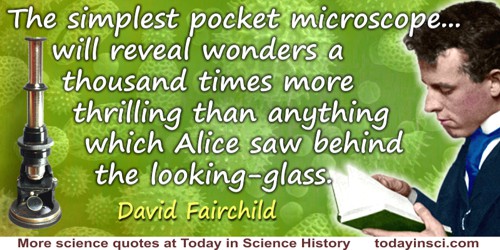
The human mind prefers something which it can recognize to something for which it has no name, and, whereas thousands of persons carry field glasses to bring horses, ships, or steeples close to them, only a few carry even the simplest pocket microscope. Yet a small microscope will reveal wonders a thousand times more thrilling than anything which Alice saw behind the looking-glass.
In The World Was My Garden (1938, 1941), 11.
The laboratory was an unattractive half basement and low ceilinged room with an inner dark room for the galvanometer and experimental animals. It was dark, crowded with equipment and uninviting. Into it came patients for electrocardiography, dogs for experiments, trays with coffee and buns for lunch. It was hot and dusty in summer and cold in winter. True a large fire burnt brightly in the winter but anyone who found time to warm his backside at it was not beloved by [Sir Thomas] Lewis. It was no good to try and look out of the window for relaxation, for it was glazed with opaque glass. The scientific peaks were our only scenery, and it was our job to try and find the pathways to the top.
— Magazine
'Tribute to Sir Thomas Lewis', University College Hospital Magazine (1955), 40, 71.
The native intellectual powers of men in different times, are not so much the causes of the different success of their labours, as the peculiar nature of the means and artificial resources in their possession. Independent of vessels of glass, there could have been no accurate manipulations in common chemistry: the air pump was necessary for live investigation of the properties of gaseous matter; and without the Voltaic apparatus, there was no possibility of examining the relations of electrical polarities to chemical attractions.
In Elements of Chemical Philosophy (1812), Vol. 1, Part 1, 28-29.
The oldest empires,—what we called venerable antiquity, now that we have true measures of duration, show like creations of yesterday. … The old six thousand years of chronology become a kitchen clock,—no more a measure of time than an hour-glass or an egg-glass,—since the duration of geologic periods has come into view.
In 'Progress of Culture', an address read to the Phi Beta Kappa Society at Cambridge, 18 July 1867. Collected in Works of Ralph Waldo Emerson (1883), 475.
The One remains, the many change and pass;
Heaven's light forever shines, Earth's shadows fly;
Life, like a dome of many-coloured glass,
Stains the white radiance of Eternity,
Until Death tramples it to fragments.
Heaven's light forever shines, Earth's shadows fly;
Life, like a dome of many-coloured glass,
Stains the white radiance of Eternity,
Until Death tramples it to fragments.
Adonais (1821), St. 52. In K. Raine (ed.), Shelley (1974), 209.
The Patent-Office Commissioner knows that all machines in use have been invented and re-invented over and over; that the mariner’s compass, the boat, the pendulum, glass, movable types, the kaleidoscope, the railway, the power-loom, etc., have been many times found and lost, from Egypt, China and Pompeii down; and if we have arts which Rome wanted, so also Rome had arts which we have lost; that the invention of yesterday of making wood indestructible by means of vapor of coal-oil or paraffine was suggested by the Egyptian method which has preserved its mummy-cases four thousand years.
In Lecture, second in a series given at Freeman Place Chapel, Boston (Mar 1859), 'Quotation and Originality', Letters and Social Aims (1875, 1917), 178-179.
The vital act is the act of participation. “Participator” is the incontrovertible new concept given by quantum mechanics. It strikes down the term “observer” of classical theory, the man who stands safely behind the thick glass wall and watches what goes on without taking part. It can’t be done, quantum mechanics says.
In Charles W. Misner, Kip S. Thorne, John Archibald Wheeler, 'Beyond the Edge of Time', Gravitation (1973), Part 3, 1217.
The work … was … so blinding that I could scarcely see afterwards, and the difficulty was increased by the fact that my microscope was almost worn out, the screws being rusted with sweat
from my hands and forehead, and my only remaining eye-piece being cracked… Fortunately my
invaluable oil-immersion object-glass remained good.
From 'Researches on Malaria', Journal of the Royal Army Medical Corps (May 1905), 4, No. 5, 549.
There is scarce a single Humour in the Body of a Man, or of any other Animal, in which our Glasses do not discover Myriads of living Creatures.
In The Spectator (25 Oct 1712), No. 519, as collected in Vol. 7 (1729, 10th ed.), 84.
To day we made the grand experiment of burning the diamond and certainly the phenomena presented were extremely beautiful and interesting… The Duke’s burning glass was the instrument used to apply heat to the diamond. It consists of two double convex lenses … The instrument was placed in an upper room of the museum and having arranged it at the window the diamond was placed in the focus and anxiously watched. The heat was thus continued for 3/4 of an hour (it being necessary to cool the globe at times) and during that time it was thought that the diamond was slowly diminishing and becoming opaque … On a sudden Sir H Davy observed the diamond to burn visibly, and when removed from the focus it was found to be in a state of active and rapid combustion. The diamond glowed brilliantly with a scarlet light, inclining to purple and, when placed in the dark, continued to burn for about four minutes. After cooling the glass heat was again applied to the diamond and it burned again though not for nearly so long as before. This was repeated twice more and soon after the diamond became all consumed. This phenomenon of actual and vivid combustion, which has never been observed before, was attributed by Sir H Davy to be the free access of air; it became more dull as carbonic acid gas formed and did not last so long.
Entry (Florence, 27 Mar 1814) in his foreign journal kept whilst on a continental tour with Sir Humphry Davy. In Michael Faraday, Bence Jones (ed.), The Life and Letters of Faraday (1870), Vol. 1, 119. Silvanus Phillips Thompson identifies the Duke as the Grand Duke of Tuscany, in Michael Faraday, His Life and Work (1901), 21.
To the manufacturer, chemistry has lately become fruitful of instruction and assistance. In the arts of brewing, tanning, dying, and bleaching, its doctrines are important guides. In making soap, glass, pottery, and all metallic wares, its principles are daily applied, and are capable of a still more useful application, as they become better understood.
From 'Chemistry', The Artist & Tradesman’s Guide: Embracing Some Leading Facts & Principles of Science, and a Variety of Matter Adapted to the Wants of the Artist, Mechanic, Manufacturer, and Mercantile Community (1827), 9.
To the optimist, the glass is half full. To the pessimist, the glass is half empty. To the engineer, the glass is twice as big as it needs to be.
True science thrives best in glass houses where everyone can look in. When the windows are blacked out, as in war, the weeds take over; when secrecy muffles criticism, charlatans and cranks flourish.
In Is Science Necessary?: Essays on Science and Scientists (1989), xvi.
We call that fire of the black thunder-cloud “electricity,” and lecture learnedly about it, and grind the like of it out of glass and silk: but what is it? What made it? Whence comes it? Whither goes it?
The Carlyle Anthology (1876), 230.

We are now in the mountains and they are in us, kindling enthusiasm, making every nerve quiver, filling every pore and cell of us. Our flesh-and-bone tabernacle seems transparent as glass to the beauty about us, as if truly an inseparable part of it, thrilling with the air and trees, streams and rocks, in the waves of the sun,—a part of all nature, neither old nor young, sick nor well, but immortal.
In My First Summer in the Sierra (1911), 20. Based on Muir’s original journals and sketches of his 1869 stay in the Sierra.
We did also at night see Jupiter and his girdle and satellites, very fine, with my twelve-foot glass, but could not Saturn, he being very dark.
Entry for 19 Aug 1666. In Samuel Pepys and Henry B. Wheatley (ed.), The Diary of Samuel Pepys (1895, 1900), Vol. 5, 382. He spent the day with Mr Reeves and Mr Spong.
We have made many glass vessels... with tubes two cubits long. These were filled with mercury, the open end was closed with the finger, and the tubes were then inverted in a vessel where there was mercury. We saw that an empty space was formed and that nothing happened in the vessel where this space was formed ... I claim that the force which keeps the mercury from falling is external and that the force comes from outside the tube. On the surface of the mercury which is in the bowl rests the weight of a column of fifty miles of air. Is it a surprise that into the vessel, in which the mercury has no inclination and no repugnance, not even the slightest, to being there, it should enter and should rise in a column high enough to make equilibrium with the weight of the external air which forces it up?
Quoted in Archana Srinivasan, Great Inventors (2007), 27-28.
We have one of his [Newton’s] college memorandum-books, which is highly interesting. The following are some of the entries: “Drills, gravers, a hone, a hammer, and a mandril, 5s.;” “a magnet, 16s.;” “compasses, 2s.;” “glass bubbles, 4s.;” “at the tavern several other times, £1;” “spent on my cousin, 12s.;” “on other acquaintances, 10s.;” “Philosophical Intelligences, 9s. 6d.;” “lost at cards twice, 15s.;” “at the tavern twice, 3s. 6d.;” “to three prisms, £3;” “four ounces of putty, 1s. 4d.;” “Bacon’s Miscellanies, 1s. 6d.;” “a bible binding, 3s.;” “for oranges to my sister, 4s. 2d.;” “for aquafortis, sublimate, oyle pink, fine silver, antimony, vinegar, spirit of wine, white lead, salt of tartar, £2;” “Theatrum chemicum, £1 8s.”
In 'Sir Isaac Newton', People’s Book of Biography: Or, Short Lives of the Most Interesting Persons of All Ages and Countries (1868), 255.
We live in a glass-soaked civilization, but as for the bird in the Chinese proverb who finds it so difficult to discover air, the substance is almost invisible to us. To use a metaphor drawn from glass, it may be revealing for us to re-focus, to stop looking through glass, and let our eyes dwell on it for a moment to contemplate its wonder. [Co-author with Gerry Martin.]
Glass: A World History (2002), 4.
We need another and a wiser and perhaps a more mystical concept of animals. Remote from universal nature, and living by complicated artifice, man in civilization surveys the creature through the glass of his knowledge and sees thereby a feather magnified and the whole image in distortion. We patronize them for their incompleteness, for their tragic fate of having taken form so far below ourselves. And therein we err, and greatly err. For the animal shall not be measured by man. In a world older and more complete than ours they move finished and complete, gifted with extensions of the senses we have lost or never attained, living by voices we shall never hear. They are not brethren, they are not underlings; they are other nations, caught with ourselves in the net of life and time, fellow prisoners of the splendour and travail of the earth.
The Outermost House (1928), 25.
We speak of it [astrology] as an extinct science; yet let but an eclipse of the sun happen, or a comet visit the evening sky, and in a moment we all believe in astrology. In vain do you tell the gazers on such spectacles that a solar eclipse is only the moon acting for the time as a candle-extinguisher to the sun, and give them bits of smoked glass to look through, and draw diagrams on the blackboard to explain it all. They listen composedly, and seem convinced, but in their secret hearts they are saying—“What though you can see it through a glass darkly, and draw it on a blackboard, does that show that it has no moral significance? You can draw a gallows or a guillotine, or write the Ten Commandments on a blackboard, but does that deprive them of meaning?” And so with the comet. No man will believe that the splendid stranger is hurrying through the sky solely on a momentous errand of his own. No! he is plainly signalling, with that flashing sword of his, something of importance to men,—something at all events that, if we could make it out, would be found of huge concern to us.
From 'Introductory Lecture on Technology for 1858-59', published as The Progress of the Telegraph (1859), 19-20.
Well do I remember that dark hot little office in the hospital at Begumpett, with the necessary gleam of light coming in from under the eaves of the veranda. I did not allow the punka to be used because it blew about my dissected mosquitoes, which were partly examined without a cover-glass; and the result was that swarms of flies and of 'eye-flies' - minute little insects which try to get into one's ears and eyelids - tormented me at their pleasure
In Memoirs, With a Full Account of the Great Malaria Problem and its Solution (1923), 221.
What, then, shall we say about the receipts of alchemy, and about the diversity of its vessels and instruments? These are furnaces, glasses, jars, waters, oils, limes, sulphurs, salts, saltpeters, alums, vitriols, chrysocollae, copper greens, atraments, auripigments, fel vitri, ceruse, red earth, thucia, wax, lutum sapientiae, pounded glass, verdigris, soot, crocus of Mars, soap, crystal, arsenic, antimony, minium, elixir, lazarium, gold leaf salt niter, sal ammoniac, calamine stone, magnesia, bolus armenus, and many other things. Then, again, concerning herbs, roots, seeds, woods, stones, animals, worms, bone dust, snail shells, other shells, and pitch. These and the like, whereof there are some very farfetched in alchemy, are mere incumbrances of work; since even if Sol and Luna [gold and silver] could be made by them they rather hinder and delay than further one’s purpose.
In Paracelsus and Arthur Edward Waite (ed.), The Hermetic and Alchemical Writings of Paracelsus (1894), Vol. 1, 13.
When air has been freshly and strongly tainted with putrefaction, so as to smell through the water, sprigs of mint have presently died, upon being put into it, their leaves turning black; but if they do not die presently, they thrive in a most surprizing manner. In no other circumstances have I ever seen vegetation so vigorous as in this kind of air, which is immediately fatal to animal life. Though these plants have been crouded in jars filled with this air, every leaf has been full of life; fresh shoots have branched out in various , and have grown much faster than other similiar plants, growing in the same exposure in common air.
This observation led me to conclude that plants, instead of affecting the air in the same manner with animal respiration, reverse the effects of breathing, and tend to keep the atmosphere sweet and wholesome, when it is become noxious, in consequence on animals living and breathing, or dying and putrefying in it.
In order to ascertain this, I took a quantity of air, made thoroughly noxious, by mice breathing and dying in it, and divided it into two parts; one of which I put into a phial immersed in water; and to the other (which was contained in a glass jar, standing in water) I put a sprig of mint. This was about the beginning of August 1771, and after eight or nine days, I found that a mouse lived perfectly well in that part of the air, in which the sprig of mint had grown, but died the moment it was put into the other part of the same original quantity of air; and which I had kept in the very same exposure, but without any plant growing in it.
This observation led me to conclude that plants, instead of affecting the air in the same manner with animal respiration, reverse the effects of breathing, and tend to keep the atmosphere sweet and wholesome, when it is become noxious, in consequence on animals living and breathing, or dying and putrefying in it.
In order to ascertain this, I took a quantity of air, made thoroughly noxious, by mice breathing and dying in it, and divided it into two parts; one of which I put into a phial immersed in water; and to the other (which was contained in a glass jar, standing in water) I put a sprig of mint. This was about the beginning of August 1771, and after eight or nine days, I found that a mouse lived perfectly well in that part of the air, in which the sprig of mint had grown, but died the moment it was put into the other part of the same original quantity of air; and which I had kept in the very same exposure, but without any plant growing in it.
'Observations on Different Kinds of Air', Philosophical Transactions (1772), 62, 193-4.
When one longs for a drink, it seems as though one could drink a whole ocean—that is faith; but when one begins to drink, one can only drink altogether two glasses—that is science.
In Anton Chekhov, S. S. Koteliansky (trans.) and Leonard Woolf (trans.), Note-Book of Anton Chekhov (1921), 104.
Wherever man has left the stamp of mind on brute-matter; whether we designate his work as structure, texture, or mixture, mechanical or chymical; whether the result be a house, a ship, a garment, a piece of glass, or a metallic implement, these memorials of economy and invention will always be worthy of the attention of the Archaeologist.
In Lecture to the Oxford meeting of the Archaeological Institute (18 Jun 1850), printed in 'On the Study of Achaeology', Archaeological Journal (1851), 8, No. 29, 25.
Why are atoms so small? ... Many examples have been devised to bring this fact home to an audience, none of them more impressive than the one used by Lord Kelvin: Suppose that you could mark the molecules in a glass of water, then pour the contents of the glass into the ocean and stir the latter thoroughly so as to distribute the marked molecules uniformly throughout the seven seas; if you then took a glass of water anywhere out of the ocean, you would find in it about a hundred of your marked molecules.
What is life?: the Physical Aspect of the Living Cell (1944). Collected in What is Life? with Mind And Matter & Autobiographical Sketches (1967, 1992), 6-7.
 In science it often happens that scientists say, 'You know that's a really good argument; my position is mistaken,' and then they would actually change their minds and you never hear that old view from them again. They really do it. It doesn't happen as often as it should, because scientists are human and change is sometimes painful. But it happens every day. I cannot recall the last time something like that happened in politics or religion.
(1987) --
In science it often happens that scientists say, 'You know that's a really good argument; my position is mistaken,' and then they would actually change their minds and you never hear that old view from them again. They really do it. It doesn't happen as often as it should, because scientists are human and change is sometimes painful. But it happens every day. I cannot recall the last time something like that happened in politics or religion.
(1987) -- 




