Geography Quotes (40 quotes)
L’astronomie … est l’arbitre de la division civile du temps, l'ame de la chronologie et de la géographie, et l’unique guide des navigateurs.
Astronomy is the governor of the civil division of time, the soul of chronology and geography, and the only guide of the navigator.
Astronomy is the governor of the civil division of time, the soul of chronology and geography, and the only guide of the navigator.
Original French in Leçons Élémentaires d’Astronomie Géométrique et Physique (1764), iii. English as quoted in Preface to Hannah Mary Bouvier Peterson, Bouvier’s Familiar Astronomy; Or, An Introduction to the Study of the Heavens (1855), Preface, 5.
A first step in the study of civilization is to dissect it into details, and to classify these in their proper groups. Thus, in examining weapons, they are to be classed under spear, club, sling, bow and arrow, and so forth; among textile arts are to be ranged matting, netting, and several grades of making and weaving threads; myths are divided under such headings as myths of sunrise and sunset, eclipse-myths, earthquake-myths, local myths which account for the names of places by some fanciful tale, eponymic myths which account for the parentage of a tribe by turning its name into the name of an imaginary ancestor; under rites and ceremonies occur such practices as the various kinds of sacrifice to the ghosts of the dead and to other spiritual beings, the turning to the east in worship, the purification of ceremonial or moral uncleanness by means of water or fire. Such are a few miscellaneous examples from a list of hundreds … To the ethnographer, the bow and arrow is the species, the habit of flattening children’s skulls is a species, the practice of reckoning numbers by tens is a species. The geographical distribution of these things, and their transmission from region to region, have to be studied as the naturalist studies the geography of his botanical and zoological species.
In Primitive Culture (1871), Vol. 1, 7.
A new species develops if a population which has become geographically isolated from its parental species acquires during this period of isolation characters which promote or guarantee reproductive isolation when the external barriers break down.
Systematics and the Origin of Species: From the Viewpoint of a Zoologist (1942), 155.
A species consists of a group of populations which replace each other geographically or ecologically and of which the neighboring ones integrate or hybridise wherever they are in contact or which are potentially capable of doing so (with one or more of the populations) in those cases where contact is prevented by geographical or ecological barriers.
'Speciation Phenomena in Birds', The American Naturalist (1940), 74, 256.
![Charles Lapworth quote: All that comes above the surface [of the globe] lies within the province of Geography; all that comes be](https://todayinsci.com/L/Lapworth_Charles/LapworthCharles-Geography500x250px.jpg)
All that comes above that surface [of the globe] lies within the province of Geography. All that comes below that surface lies inside the realm of Geology. The surface of the earth is that which, so to speak, divides them and at the same time “binds them together in indissoluble union.” We may, perhaps, put the case metaphorically. The relationships of the two are rather like that of man and wife. Geography, like a prudent woman, has followed the sage advice of Shakespeare and taken unto her “an elder than herself;” but she does not trespass on the domain of her consort, nor could she possibly maintain the respect of her children were she to flaunt before the world the assertion that she is “a woman with a past.”
From Anniversary Address to Geological Society of London (20 Feb 1903), 'The Relations of Geology', published in Quarterly Journal of the Geological Society of London (22 May 1903), 59, Part 2, lxxviii. As reprinted in Annual Report of the Board of Regents of the Smithsonian Institution (1904), 373.
Anatomy is to physiology as geography is to history; it describes the theatre of events.
De Naturali Parte Medicinae Libri Septem (1542), Ch. 1.
And having thus passed the principles of arithmetic, geometry, astronomy, and geography, with a general compact of physics, they may descend in mathematics to the instrumental science of trigonometry, and from thence to fortification, architecture, engineering, or navigation. And in natural philosophy they may proceed leisurely from the history of meteors, minerals, plants, and living creatures, as far as anatomy. Then also in course might be read to them out of some not tedious writer the institution of physic. … To set forward all these proceedings in nature and mathematics, what hinders but that they may procure, as oft as shall be needful, the helpful experiences of hunters, fowlers, fishermen, shepherds, gardeners, apothecaries; and in other sciences, architects, engineers, mariners, anatomists.
In John Milton and Robert Fletcher (ed.), 'On Education', The Prose Works of John Milton: With an Introductory Review (1834), 100.
Descriptive anatomy is to physiology what geography is to history, and just as it is not enough to know the typography of a country to understand its history, so also it is not enough to know the anatomy of organs to understand their functions.
Lectures on the Phenomena of Life Common to Animals and Plants (1878), trans. Hebbel E. Hoff, Roger Guillemin and Lucienne Guillemin (1974), 7.
Geographical concepts of the Nubians … differ from our own…. Amongst other things,… the Nubians refer to the … country between the lower course of two rivers that flow together … always … as an island.
In August Petermann, Petermann’s Geographische Mittheilungen (1871), 135. As quoted and cited in Kathrin Fritsch, '"You Have Everything Confused And Mixed Up…!" Georg Schweinfurth, Knowledge And Cartography Of Africa In The 19th Century', History in Africa (2009), 36, 91.
Geography is … only a branch of statistics, a knowledge of which is necessary to the well-understanding of the history of nations, as well as their situations relative to each other.
In The Statistical Breviary: Shewing, on a Principle Entirely New, the Resources of Every State and Kingdom in Europe (1801), 5.
I found the invention was applicable to painting, and would also contribute to facilitate the study of geography: for I have applied it to some maps, the rivers of which I represented in silver, and in the cities in gold. The rivers appearing, as it were, in silver streams, have a most pleasing effect on the sight, and relieve the eye of that painful search for the course, and origin, of rivers, the minutest branches of which can be splendidly represented this way.
Description of an outcome of her experiments originally investigating 'the possibility of making cloths of gold, silver and other metals by chemical processes.'
Description of an outcome of her experiments originally investigating 'the possibility of making cloths of gold, silver and other metals by chemical processes.'
Preface to An Essay on Combustion with a View to a New Art of Dyeing and Painting (1794), iii-iv. In Marilyn Bailey
Ogilvie and Joy Dorothy
Harvey, The Biographical Dictionary of Women in Science (2000), 478.
I have presented the periodic table as a kind of travel guide to an imaginary country, of which the elements are the various regions. This kingdom has a geography: the elements lie in particular juxtaposition to one another, and they are used to produce goods, much as a prairie produces wheat and a lake produces fish. It also has a history. Indeed, it has three kinds of history: the elements were discovered much as the lands of the world were discovered; the kingdom was mapped, just as the world was mapped, and the relative positions of the elements came to take on a great significance; and the elements have their own cosmic history, which can be traced back to the stars.
In The Periodic Kingdom: A Journey Into the Land of the Chemical Elements (1995), Preface, viii.
I shall collect plants and fossils, and with the best of instruments make astronomic observations. Yet this is not the main purpose of my journey. I shall endeavor to find out how nature's forces act upon one another, and in what manner the geographic environment exerts its influence on animals and plants. In short, I must find out about the harmony in nature.
Letter to Karl Freiesleben (Jun 1799). In Helmut de Terra, Humboldt: The Life and Times of Alexander van Humboldt 1769-1859 (1955), 87.
I shall take as a starting point for our flight into space two contrasted statements about geography. The first is that of a boy who said that the earth is a ball filled inside with dirt and worms and covered all over on the outside with geography.
'Genetic Geography: The Development of the Geographic Sense and Concept', Annals of the Association of American Geographers, 1920, 10, 4.
It is somewhat remarkable, that, at a time when knowledge is so generally diffused, when the geography of the world is so well understood—when time and space, in the intercourse of nations, are almost annihilated—when oceans have become bridges—the earth a magnificent hall—the hollow sky a dome—under which a common humanity can meet in friendly conclave—when nationalities are being swallowed up and the ends of the earth brought together—I say it is remarkable—nay, it is strange that there should arise a phalanx of learned men—speaking in the name of science—to forbid the magnificent reunion of mankind in one brotherhood. A mortifying proof is here given, that the moral growth of a nation, or an age, does not always keep pace with the increase of knowledge, and suggests the necessity of means to increase human love with human learning.
From Speech (12 Jul 1854), delivered At Western Reserve College, 'The Claims Of The Negro Ethnologically Considered', collected in Philip S. Foner, Yuval Taylor (eds.), Frederick Douglass: Selected Speeches and Writings (2000), 285.
It is the relationship between the physical environment and the environed organism, between physiography and ontography (to coin a term), that constitutes the essential principles of geography today.
'Systematic Geography', read 3 April 1902. Proceedings of the American Philosophical Society for Promoting Useful Knowledge, 1902, 41, 240.
It need scarcely be pointed out that with such a mechanism complete isolation of portion of a species should result relatively rapidly in specific differentiation, and one that is not necessarily adaptive. The effective intergroup competition leading to adaptive advance may be between species rather than races. Such isolation is doubtless usually geographic in character at the outset but may be clinched by the development of hybrid sterility. The usual difference of the chromosome complements of related species puts the importance of chromosome aberration as an evolutionary process beyond question, but, as I see it, this importance is not in the character differences which they bring (slight in balanced types), but rather in leading to the sterility of hybrids and thus making permanent the isolation of two groups.
How far do the observations of actual species and their subdivisions conform to this picture? This is naturally too large a subject for more than a few suggestions.
That evolution involves non-adaptive differentiation to a large extent at the subspecies and even the species level is indicated by the kinds of differences by which such groups are actually distinguished by systematics. It is only at the subfamily and family levels that clear-cut adaptive differences become the rule. The principal evolutionary mechanism in the origin of species must thus be an essentially nonadaptive one.
How far do the observations of actual species and their subdivisions conform to this picture? This is naturally too large a subject for more than a few suggestions.
That evolution involves non-adaptive differentiation to a large extent at the subspecies and even the species level is indicated by the kinds of differences by which such groups are actually distinguished by systematics. It is only at the subfamily and family levels that clear-cut adaptive differences become the rule. The principal evolutionary mechanism in the origin of species must thus be an essentially nonadaptive one.
In Proceedings of the Sixth International Congress of Genetics: Ithaca, New York, 1932 (1932) Vol. 1, 363-364.
More than ever before in the history of science and invention, it is safe now to say what is possible and what is impossible. No one would claim for a moment that during the next five hundred years the accumulated stock of knowledge of geography will increase as it has during the last five hundred In the same way it may safely be affirmed that in electricity the past hundred years is not likely to be duplicated in the next, at least as to great, original, and far-reaching discoveries, or novel and almost revolutionary applications.
In A Century of Electricity (1890), 223.
Much of the geographical work of the past hundred years... has either explicitly or implicitly taken its inspiration from biology, and in particular Darwin. Many of the original Darwinians, such as Hooker, Wallace, Huxley, Bates, and Darwin himself, were actively concerned with geographical exploration, and it was largely facts of geographical distribution in a spatial setting which provided Darwin with the germ of his theory.
'Darwin's Impact on Geography', Annals of the Association of American Geographers (1966), 56, 683.
Next to ignorance of the grammar of one’s native language, nothing betrays want of information so soon as ignorance in matters of geography, without which it is almost impossible to carry on conversation long on any general subject.
In The Statistical Breviary: Shewing, on a Principle Entirely New, the Resources of Every State and Kingdom in Europe (1801), 5.
Nothing could have been worse for the development of my mind than Dr. Butler's school, as it was strictly classical, nothing else being taught, except a little ancient geography and history. The school as a means of education to me was simply a blank. During my whole life I have been singularly incapable of mastering any language. Especial attention was paid to versemaking, and this I could never do well. I had many friends, and got together a good collection of old verses, which by patching together, sometimes aided by other boys, I could work into any subject.
In Charles Darwin and Francis Darwin (ed.), Charles Darwin: His Life Told in an Autobiographical Chapter, and in a Selected Series of His Published Letters (1892), 8.
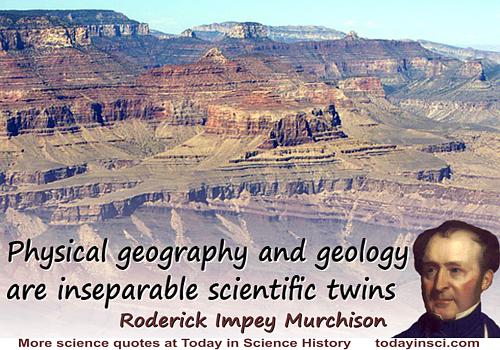
Physical geography and geology are inseparable scientific twins.
Presidential address at the Anniversary Meeting of the Royal Geographical Society (25 May 1857). Printed in Proceedings of the Royal Geographical Society (1857), 1, 417.
Physical science is thus approaching the stage when it will be complete, and therefore uninteresting. Given the laws governing the motions of electrons and protons, the rest is merely geography—a collection of particular facts.
In What I Believe (1925), 2.
Scientific inquiry would thus he conceived of as analogous to terrestrial exploration, whose product—geography—yields results of continually smaller significance which fill in ever more minute gaps in our information. In such a view, later investigations yield findings of ever smaller importance, with each successive accretion making a relatively smaller contribution to what has already come to hand. The advance of science leads, step by diminished step, toward a fixed and final view of things.
In The Limits Of Science (1984, Rev. 1999), 67.
Since biological change occurs slowly and cultural changes occur in every generation, it is futile to try to explain the fleeting phenomena of culture by a racial constant. We can often explain them—in terms of contact with other peoples, of individual genius, of geography—but not by racial differences.
An Introduction to Cultural Anthropology (1934), 9.
So long as the fur of the beaver was extensively employed as a material for fine hats, it bore a very high price, and the chase of this quadruped was so keen that naturalists feared its speedy consideration. When a Parisian manufacturer invented the silk hat, which soon came into almost universal use, the demand for beavers' fur fell off, and this animal–whose habits, as we have seen, are an important agency in the formation of bogs and other modifications of forest nature–immediately began to increase, reappeared in haunts which we had long abandoned, and can no longer be regarded as rare enough to be in immediate danger of extirpation. Thus the convenience or the caprice of Parisian fashion has unconsciously exercised an influence which may sensibly affect the physical geography of a distant continent.
In Man and Nature, (1864), 84.
The cell, too, has a geography, and its reactions occur in colloidal apparatus, of which the form, and the catalytic activity of its manifold surfaces, must efficiently contribute to the due guidance of chemical reactions.
'Some Aspects of Biochemistry', The Irish Journal of Medical Science (1932), 79, 344.
The course of the line we indicated as forming our grandest terrestrial fold [along the shores of Japan] returns upon itself. It is an endless fold, an endless band, the common possession of two sciences. It is geological in origin, geographical in effect. It is the wedding ring of geology and geography, uniting them at once and for ever in indissoluble union.
Presidential Address to the Geology Section, Report of the British Association for the Advancement of Science (1892), 705.
The function of Latin literature is its expression of Rome. When to England and France your imagination can add Rome in the background, you have laid firm the foundations of culture. The understanding of Rome leads back to the Mediterranean civilisation of which Rome was the last phase, and it automatically exhibits the geography of Europe, and the functions of seas and rivers and mountains and plains. The merit of this study in the education of youth is its concreteness, its inspiration to action, and the uniform greatness of persons, in their characters and their staging. Their aims were great, their virtues were great, and their vices were great. They had the saving merit of sinning with cart ropes.
In 'The Place of Classics in Education', The Aims of Education: & Other Essays (1917), 106.
The meaning of geography is as much a sealed book to the person of ordinary intelligence and education as the meaning of a great cathedral would be to a backwoodsman, and yet no cathedral can be more suggestive of past history in its many architectural forms than is the land about us, with its innumerable and marvellously significant geographic forms. It makes one grieve to think of opportunity for mental enjoyment that is last because of the failure of education in this respect.
'Geographic Methods in Geologic Investigation', The National Geographic Magazine, 1889, 1, 23.
The Nubians never remember the native name for a river; thus their statements are of little value to geographical criticism. Hence they never speak of the River Bah or Ibba, for example, but always say the “Penio’s river,” because this is the name of the district head whose seat is on this river. In other places they are quite helpless…. This is a dreadful fact. Were the well-traveled and well-informed Arab leaders able to remember the names of the rivers, it would be wonderfully easy to draw a map of the entire country.
In August Petermann, Petermann’s Geographische Mittheilungen (1871), 137. As quoted and cited in Kathrin Fritsch, '"You Have Everything Confused And Mixed Up…!" Georg Schweinfurth, Knowledge And Cartography Of Africa In The 19th Century', History in Africa (2009), 36, 92.
The principles of Geology like those of geometry must begin at a point, through two or more of which the Geometrician draws a line and by thus proceeding from point to point, and from line to line, he constructs a map, and so proceeding from local to gen maps, and finally to a map of the world. Geometricians founded the science of Geography, on which is based that of Geology.
Abstract View of Geology, page proofs of unpublished work, Department of Geology, University of Oxford, 1.
/AdamsJohn(1735-1826)-Study500x250px.jpg)
The science of government is my duty. … I must study politics and war that my sons may have liberty to study mathematics and philosophy. My sons ought to study mathematics and philosophy, geography, natural history, naval architecture, navigation, commerce, and agriculture, in order to give their children a right to study painting, poetry, music, architecture, statuary, tapestry, and porcelain.
Letter to Abigail Adams, (1780). In John Adams and Charles Francis Adams, Letters of John Adams, Addressed to His Wife (1841), 68.
The totality of our so-called knowledge or beliefs, from the most casual matters of geography and history to the profoundest laws of atomic physics or even of pure mathematics and logic, is a man-made fabric which impinges on experience only along the edges. Or, to change the figure, total science is like a field of force whose boundary conditions are experience. A conflict with experience at the periphery occasions readjustments in the interior of the field. Truth values have to be redistributed over some of our statements. Reevaluation of some statements entails reevaluation of others, because of their logical interconnections—the logical laws being in turn simply certain further statements of the system, certain further elements of the field.
'Two Dogmas of Experience,' in Philosophical Review (1951). Reprinted in From a Logical Point of View (1953), 42.
The vernal equinox is a cosmic event that transcends geographical boundaries and cultural differences. It’s a reminder of the universal principles of physics and astronomy that govern our planet’s journey through space.
A fictional quote imagined in the style of a theoretical physicist and cosmologist (19 Mar 2024).
These are some of the things wilderness can do for us. That is the reason we need to put into effect, for its preservation, some other principle that the principles of exploitation or “usefulness” or even recreation. We simply need that wild country available to us, even if we never do more than drive to its edge and look in. For it can be a means of reassuring ourselves of our sanity as creatures, a part of the geography of hope.
Letter (3 Dec 1960) written to David E. Pesonen of the Outdoor Recreation Resources Review Commission. Collected in 'Coda: Wilderness Letter', The Sound of Mountain Water: The Changing American West (1969), 153.
To produce any given motion, to spin a certain weight of cotton, or weave any quantity of linen, there is required steam; to produce the steam, fuel; and thus the price of fuel regulates effectively the cost of mechanical power. Abundance and cheapness of fuel are hence main ingredients in industrial success. It is for this reason that in England the active manufacturing districts mark, almost with geological accuracy, the limits of the coal fields.
In The Industrial Resources of Ireland (1844), 2.
Two forms or species are sympatric, if they occur together, that is if their areas of distribution overlap or coincide. Two forms (or species) are allapatric, if they do not occur together, that is if they exclude each other geographically. The term allopatric is primarily useful in denoting geographic representatives.
Systematics and the Origin of Species: From the Viewpoint of a Zoologist (1942), 148-9.
We simply need that wild country available to us, even if we never do more than drive to its edge and look in. For it can be a means of reassuring ourselves of our sanity as creatures, a part of the geography of hope.
Conclusion of Letter (3 Dec 1960) written to David E. Pesonen of the Outdoor Recreation Resources Review Commission. Collected in 'Coda: Wilderness Letter', The Sound of Mountain Water: The Changing American West (1969), 153.
Yes, gentlemen, give me the map of any country, its configuration, its climate, its waters, its winds, and the whole of its physical geography; give me its natural productions, its flora, its zoology, &c., and I pledge myself to tell you, a priori, what will be the quality of man in history:—not accidentally, but necessarily; not at any particular epoch, but in all; in short, —what idea he is called to represent.
Introduction to the History of Philosophy (1832), trans. by Henning Gotfried Linberg, 240.
 In science it often happens that scientists say, 'You know that's a really good argument; my position is mistaken,' and then they would actually change their minds and you never hear that old view from them again. They really do it. It doesn't happen as often as it should, because scientists are human and change is sometimes painful. But it happens every day. I cannot recall the last time something like that happened in politics or religion.
(1987) --
In science it often happens that scientists say, 'You know that's a really good argument; my position is mistaken,' and then they would actually change their minds and you never hear that old view from them again. They really do it. It doesn't happen as often as it should, because scientists are human and change is sometimes painful. But it happens every day. I cannot recall the last time something like that happened in politics or religion.
(1987) -- 





