Genius Quotes (302 quotes)
“Half genius and half buffoon,” Freeman Dyson ... wrote. ... [Richard] Feynman struck him as uproariously American—unbuttoned and burning with physical energy. It took him a while to realize how obsessively his new friend was tunneling into the very bedrock of modern science.
In Genius: The Life and Science of Richard Feynman (1992), Prologue, 4.
“On doit etre etonné ([Abbé Raynal]says) que l'Amerique n’ait pas encore produit un bon poëte, un habile mathematicien, un homme de génie dans un seul art, ou une seule science.” …“America has not yet produced one good poet.” When we shall have existed as a people as long as the Greeks did before they produced a Homer, the Romans a Virgil, the French a Racine and Voltaire, the English a Shakespeare and Milton, should this reproach be still true, we will enquire from what unfriendly causes it has proceeded, that the other countries of Europe and quarters of the earth shall not have inscribed any name in the roll of poets. But neither has America produced “one able mathematician, one man of genius in a single art or a single science.” … In physics we have produced a [Benjamin] Franklin, than whom no one of the present age has made more important discoveries, nor has enriched philosophy with more, or more ingenious solutions of the phaenomena, of nature. … [The quadrant invented by Godfrey, an American also, and with the aid of which the European nations traverse the globe, is called Hadley’s quadrant.] … We have supposed Mr. [David] Rittenhouse second to no astronomer living: that in genius he must be the first, because he is self-taught. As an artist he has exhibited as great a proof of mechanical genius as the world has ever produced. … We therefore suppose, that this reproach is as unjust as it is unkind; and that, of the geniuses which adorn the present age, America contributes its full share. [Compared to the much larger populations of European countries.]
The reference given by Jefferson for the original reproach by Abbé Raynal, an ellipsis above, is “7. Hist. Philos. p. 92. ed. Maestricht. 1774”. The original remark written in French, translates as: “One must be amazed that America has not yet produced a good poet, an able mathematician, one man of genius in a single art, or a single science.” Jefferson uses parts of it in English, to introduce his rebuttal. From Thomas Jefferson, Notes on the State of Virginia (1787), 107-110. A footnote adds that: “In a later edition of the Abbé Raynal’s work, he has withdrawn his censure…”
[about Fourier] It was, no doubt, partially because of his very disregard for rigor that he was able to take conceptual steps which were inherently impossible to men of more critical genius.
As quoted in P. Davis and R. Hersh The Mathematical Experience (1981).
[Cantor’s set theory is] The finest product of mathematical genius and one of the supreme achievements of purely intellectual human activity.
As quoted in Constance Reid, Hilbert (1970), 176.
[Man] … his origin, his growth, his hopes and fears, his loves and his beliefs are but the outcome of accidental collocations of atoms; that no fire, no heroism, no intensity of thought and feeling can preserve an individual life beyond the grave; that all the labour of the ages, all the devotion, all the inspiration, all the noonday brightness of human genius are destined to extinction in the vast death of the solar system, and that the whole temple of Man's achievement must inevitably be buried beneath the debris of a universe in ruins…
From 'A Free Man's Worship', Independent Review (Dec 1903). Collected in Mysticism and Logic: And Other Essays (1918), 47-48.
[The word] genius is derived from gignere, gigno; I bring forth, I produce; it always supposes invention, and this quality, is the only one which belongs to all the different kinds of genius.
From the original French, “Celui de génie dérive de gignere, gigno; j’enfante, je
produis; il suppose toujours invention: & cette qualité est la seule qui appartienne à tous les génies différents,” in 'Du Génie', L’Esprit (1758), Discourse 4, 476. English version from Claude Adrien Helvétius and William Mudford (trans.), 'Of Genius', De l’Esprit or, Essays on the Mind and its several Faculties (1759), Essay 4, Chap. 1, 241.
“Le génie n'est qu'une longue patience”, a dit Buffon. Cela est bien incomplet. Le génie, c'est l'impatience dans les idées et la patience dans les faits : une imagination vive et un jugement calme; quelque chose comme un liquide en ébullition dans un vase qui reste toujours froid.
“Genius is just enduring patience,” said Buffon. This is far from complete. Genius is impatience in ideas and patience with the facts: a lively imagination and a calm judgment, rather like a liquid boiling in a cup that remains cold.
“Genius is just enduring patience,” said Buffon. This is far from complete. Genius is impatience in ideas and patience with the facts: a lively imagination and a calm judgment, rather like a liquid boiling in a cup that remains cold.
In Recueil d'Œuvres de Léo Errera: Botanique Générale (1908), 198. Google translation by Webmaster.
Aristoteles quidem ait: 'Omnes ingeniosos melancholicos esse.'
Aristotle says that all men of genius are melancholy.
Aristotle says that all men of genius are melancholy.
From Tusculanae Disputationes, book 1, chap. 33, line 80. As quoted in Hannis Taylor and Mary Lillie Taylor Hunt, Cicero: a Sketch of His Life and Works (2nd Ed., 1918), 597.
Dans les sciences physiques en général, on ait souvent supposé au lieu de conclure; que les suppositions transmises d’âge en âge, soient devenues de plus en plus imposantes par le poids des autorités qu'elles ont acquises , & qu'elles ayent enfin été adoptées & regardées comme des vérités fondamentales, même par de très-bons esprits.
In the science of physics in general, men have so often formed suppositions, instead of drawing conclusions. These suppositions, handed down from one age to another, acquire additional weight from the authorities by which they are supported, till at last they are received, even by men of genius, as fundamental truths.
In the science of physics in general, men have so often formed suppositions, instead of drawing conclusions. These suppositions, handed down from one age to another, acquire additional weight from the authorities by which they are supported, till at last they are received, even by men of genius, as fundamental truths.
From the original French in Traité élémentaire de chimie (1789, 1793), discours préliminaire, x; and from edition translated into English by Robert Kerr, as Elements of Chemistry (1790), Preface, xvi.
Epitaph of John Hunter
The Royal College of Surgeons of England have placed this tablet over the grave of Hunter, to record their admiration of his genius as a gifted interpreter of the Divine Power and Wisdom at work in the Laws of Organic Life, and their grateful veneration for his services to mankind as the Founder of Scientific Surgery.
The Royal College of Surgeons of England have placed this tablet over the grave of Hunter, to record their admiration of his genius as a gifted interpreter of the Divine Power and Wisdom at work in the Laws of Organic Life, and their grateful veneration for his services to mankind as the Founder of Scientific Surgery.
— Epitaph
Memorial brass in the floor of north aisle of Westminster Abbey, placed when Hunter's remains were reinterred there (28 Mar 1859). In Charles Coulston Gillespie (ed.), Dictionary of Scientific Biography (1972), Vol. 6, 568.
L’oeuvre de Pasteur est admirable; elle montre son génie, mais it faut avoir vécu dans son intimité pour connaître toute la bonté de son coeur.
The work of Pasteur is admirable; it shows his genius, but it must have been experienced intimately to know all the goodness of his heart.
The work of Pasteur is admirable; it shows his genius, but it must have been experienced intimately to know all the goodness of his heart.
Epigraph in René Vallery-Radot, La Vie de Pasteur (1900), title page. English by Google translation, tweaked by Webmaster. Pierre Paul Émile Roux had indeed known Pasteur well, as one of his closest collaborators.
La Patience cherche et le Génie trouve.
Patience seeks; Genius finds.
Patience seeks; Genius finds.
Quoted as from an unnamed “French writer” in Thomas Moore, Memoirs of the life of the Right Honorable Richard Brinsley Sheridan (1825), Vol. 1, 209. Translation by Webmaster.
Le génie crée, le talent reproduit.
Genius creates, talent repeats.
Genius creates, talent repeats.
In Pailles et Poutres (1877), collected in La Pensées Française: Anthologie des Auteurs de Maximes du XVie Siècle a nos Jours (1921), 295. Alternative translations could be "talent reproduces" or "talent copies."
Les grands ponts étant … des monuments qui peuvent servir à faire connoître la magnificence et le génie d’une nation, on ne sauroit trop s’occuper des moyens d’en perfectionner l’architecture, qui peut d’ailleurs être susceptible de variété, en conservant toujours, dans les formes et la décoration, le caractere de solidité qui lui est propre.
Great bridges being monuments which serve to make known the grandeur and genius of a nation, we cannot pay too much attention to means for perfecting their architecture; this may be varied in treatment, but there must ever be conserved, in form and in decoration, the indispensable character of solidity.
Great bridges being monuments which serve to make known the grandeur and genius of a nation, we cannot pay too much attention to means for perfecting their architecture; this may be varied in treatment, but there must ever be conserved, in form and in decoration, the indispensable character of solidity.
In Description des projets et de la construction des ponts de Neuilli, de Mantes, d'Orléans, de Louis XVI, etc. (1777, New ed. 1788), 630. Translated by D. B. Steinman, as quoted in 'Some Reflections on the architecture of Bridges', Engineering and Contracting (26 Dec 1917), 48, No. 26, 536. Also seen translated as, “A great bridge is a great monument which should serve to make known the splendour and genius of a nation; one should not occupy oneself with efforts to perfect it architecturally, for taste is always susceptible to change, but to conserve always in its form and decoration the character of solidity which is proper.”
Majestatis naturæ by ingenium
Genius equal to the majesty of nature.
Genius equal to the majesty of nature.
Inscribed ordered by King Louis XV for the base of a statue of Buffon placed at Muséum National d’Histoire Naturelle de Paris. In M. Guizot, trans. by Robert Black, A Popular History of France from the Earliest Times, Vol. 6.
Nemo mathematicus genium indemnatus habebit.
No mathematician is esteemed a genius until condemned.
No mathematician is esteemed a genius until condemned.
— Juvenal
“Mathematician” as used here, is in the sense of astrologer, or soothsayer. In Liberii, Satura VI, 562.
… the really fundamental things have a way of appearing to be simple once they have been stated by a genius. ...
In 'Analytical Function and Mathematical Physics,' Bulletin of the American Mathematical Society, October 1931.
A few months after a devastating defeat at Fredericksburg,… President Abraham Lincoln signed into law an act creating the National Academy of Sciences—in the midst of civil war. Lincoln refused to accept that our nation’s sole purpose was mere survival. He created this academy, founded the land grant colleges, and began the work of the transcontinental railroad, believing that we must add—and I quote—“the fuel of interest to the fire of genius in the discovery … of new and useful things.”
Speech to the National Academy of Sciences Annual Meeting (27 Apr 2009).
A genius is one who is endowed with an excess of nervous energy and sensibility.
Quoted, without citation, in James Wood, Dictionary of Quotations from Ancient and Modern, English and Foreign Sources (1893), 6.
A genius is one who shoots at something no one else can see—and hits it.
In M. P. Singh, Quote Unquote (2007), 148.
A harmless and a buoyant cheerfulness are not infrequent concomitants of genius; and we are never more deceived than when we mistake gravity for greatness, solemnity for science, and pomposity for erudition.
Lacon: Or, Many Things in Few Words (1865), 57.
A man of genius makes no mistakes. His errors are volitional and are the portals of discovery.
In Ulysses (1920), 190.
A science is any discipline in which the fool of this generation can go beyond the point reached by the genius of the last generation.
In Politics, Law and Ritual in Tribal Society (1965), 32.
A student who wishes now-a-days to study geometry by dividing it sharply from analysis, without taking account of the progress which the latter has made and is making, that student no matter how great his genius, will never be a whole geometer. He will not possess those powerful instruments of research which modern analysis puts into the hands of modern geometry. He will remain ignorant of many geometrical results which are to be found, perhaps implicitly, in the writings of the analyst. And not only will he be unable to use them in his own researches, but he will probably toil to discover them himself, and, as happens very often, he will publish them as new, when really he has only rediscovered them.
From 'On Some Recent Tendencies in Geometrical Investigations', Rivista di Matematica (1891), 43. In Bulletin American Mathematical Society (1904), 443.
A work of genius is something like the pie in the nursery song, in which the four and twenty blackbirds are baked. When the pie is opened, the birds begin to sing. Hereupon three fourths of the company run away in a fright; and then after a time, feeling ashamed, they would fain excuse themselves by declaring, the pie stank so, they could not sit near it. Those who stay behind, the men of taste and epicures, say one to another, We came here to eat. What business have birds, after they have been baked, to be alive and singing? This will never do. We must put a stop to so dangerous an innovation: for who will send a pie to an oven, if the birds come to life there? We must stand up to defend the rights of all the ovens in England. Let us have dead birds..dead birds for our money. So each sticks his fork into a bird, and hacks and mangles it a while, and then holds it up and cries, Who will dare assert that there is any music in this bird’s song?
Co-author with his brother Augustus William Hare Guesses At Truth, By Two Brothers: Second Edition: With Large Additions (1848), Second Series, 86. (The volume is introduced as “more than three fourths new.” This quote is identified as by Julius; Augustus had died in 1833.)
All frescoes are as high finished as miniatures or enamels, and they are known to be unchangeable; but oil, being a body itself, will drink or absorb very little colour, and changing yellow, and at length brown, destroys every colour it is mixed with, especially every delicate colour. It turns every permanent white to a yellow and brown putty, and has compelled the use of that destroyer of colour, white lead, which, when its protecting oil is evaporated, will become lead again. This is an awful thing to say to oil painters ; they may call it madness, but it is true. All the genuine old little pictures, called cabinet pictures, are in fresco and not in oil. Oil was not used except by blundering ignorance till after Vandyke’s time ; but the art of fresco painting being lost, oil became a fetter to genius and a dungeon to art.
In 'Opinions', The Poems: With Specimens of the Prose Writings of William Blake (1885), 276-277.
All the human culture, all the results of art, science and technology that we see before us today, are almost exclusively the creative product of the Aryan. This very fact admits of the not unfounded inference that he alone was the founder of all higher humanity, therefore representing the prototype of all that we understand by the word 'man.' He is the Prometheus of mankind from whose shining brow the divine spark of genius has sprung at all times, forever kindling anew that fire of knowledge which illuminated the night of silent mysteries and thus caused man to climb the path to mastery over the other beings of the earth ... It was he who laid the foundations and erected the walls of every great structure in human culture.
Mein Kampf (1925-26), American Edition (1943), 290. In William Lawrence Shirer, The Rise and Fall of the Third Reich (1990), 86-87.
Among your pupils, sooner or later, there must be one. who has a genius for geometry. He will be Sylvester’s special pupil—the one pupil who will derive from his master, knowledge and enthusiasm—and that one pupil will give more reputation to your institution than the ten thousand, who will complain of the obscurity of Sylvester, and for whom you will provide another class of teachers.
Letter (18 Sep 1875) recommending the appointment of J.J. Sylvester to Daniel C. Gilman. In Daniel C. Gilman Papers, Ms. 1, Special Collections Division, Milton S. Eisenhower Library, Johns Hopkins University. As quoted in Karen Hunger Parshall, 'America’s First School of Mathematical Research: James Joseph Sylvester at The Johns Hopkins University 1876—1883', Archive for History of Exact Sciences (1988), 38, No. 2, 167.
An autocratic system of coercion, in my opinion, soon degenerates. For force always attracts men of low morality, and I believe it to be an invariable rule that tyrants of genius are succeeded by scoundrels. For this reason I have always been passionately opposed to systems such as we see in Italy and Russia to-day.
In The World As I See It (1934), 240.
And genius hath electric power,
Which earth can never tame;
Bright suns may scorch, and dark clouds lower,
Its flash is still the same.
Which earth can never tame;
Bright suns may scorch, and dark clouds lower,
Its flash is still the same.
Louis Klopsch, Many Thoughts of Many Minds (1896), 106.
And, notwithstanding a few exceptions, we do undoubtedly find that the most truly eminent men have had not only their affections, but also their intellect, greatly influenced by women. I will go even farther; and I will venture to say that those who have not undergone that influence betray a something incomplete and mutilated. We detect, even in their genius, a certain frigidity of tone; and we look in vain for that burning fire, that gushing and spontaneous nature with which our ideas of genius are indissolubly associated. Therefore, it is, that those who are most anxious that the boundaries of knowledge should be enlarged, ought to be most eager that the influence of women should be increased, in order that every resource of the human mind may be at once and quickly brought into play.
Lecture (19 Mar 1858) at the Royal Institution, 'The Influence Of Women On The Progress Of Knowledge', collected in The Miscellaneous and Posthumous Works of Henry Thomas Buckle (1872), Vol. 1, 17. Published in Frazier’s Magazine (Apr 1858).
Any intelligent fool can make things bigger, more complex, and more violent. It takes a touch of genius - and a lot of courage - to move in the opposite direction.
…...
Archimedes, who combined a genius for mathematics with a physical insight, must rank with Newton, who lived nearly two thousand years later, as one of the founders of mathematical physics. … The day (when having discovered his famous principle of hydrostatics he ran through the streets shouting Eureka! Eureka!) ought to be celebrated as the birthday of mathematical physics; the science came of age when Newton sat in his orchard.
In An Introduction to Mathematics (1911), 37.
Arts and sciences in one and the same century have arrived at great perfection; and no wonder, since every age has a kind of universal genius, which inclines those that live in it to some particular studies; the work then, being pushed on by many hands, must go forward.
In Samuel Austin Allibone, Prose Quotations from Socrates to Macaulay (1880), 45.
As he [Clifford] spoke he appeared not to be working out a question, but simply telling what he saw. Without any diagram or symbolic aid he described the geometrical conditions on which the solution depended, and they seemed to stand out visibly in space. There were no longer consequences to be deduced, but real and evident facts which only required to be seen. … So whole and complete was his vision that for the time the only strange thing was that anybody should fail to see it in the same way. When one endeavored to call it up again, and not till then, it became clear that the magic of genius had been at work, and that the common sight had been raised to that higher perception by the power that makes and transforms ideas, the conquering and masterful quality of the human mind which Goethe called in one word das Dämonische.
In Leslie Stephen and Frederick Pollock (eds.), Lectures and Essays by William Kingdon Clifford(1879), Vol. 1, Introduction, 4-5.
As Love is too young to know what conscience is, so Truth and Genius are too old to know what definition is.
Samuel Butler, Henry Festing Jones (ed.), The Note-Books of Samuel Butler (1917), 221.
As scientists the two men were contrasting types—Einstein all calculation, Rutherford all experiment ... There was no doubt that as an experimenter Rutherford was a genius, one of the greatest. He worked by intuition and everything he touched turned to gold. He had a sixth sense.
(Reminiscence comparing his friend, Ernest Rutherford, with Albert Einstein, whom he also knew.)
(Reminiscence comparing his friend, Ernest Rutherford, with Albert Einstein, whom he also knew.)
Trial and Error: The Autobiography of Chaim Weizman (1949), 118. Quoted in A Force of Nature: The Frontier Genius of Ernest Rutherford (2007), 65-66.
As we discern a fine line between crank and genius, so also (and unfortunately) we must acknowledge an equally graded trajectory from crank to demagogue. When people learn no tools of judgment and merely follow their hopes, the seeds of political manipulation are sown.
…...
At the bidding of a Peter the Hermit many millions of men swarmed to the East; the words of an hallucinated person … have created the force necessary to triumph over the Graeco-Roman world; an obscure monk like Luther set Europe ablaze and bathed in blood. The voice of a Galileo or a Newton will never have the least echo among the masses. The inventors of genius transform a civilization. The fanatics and the hallucinated create history.
From Les Premières Civilisations (1889), 171. English in The Psychology of Peoples (1898), Book 1, Chap. 1, 204, tweaked by Webmaster. Original French text: “A la voix d'un Pierre l'Ermite, plusieurs millions d'hommes se sont précipités sur l'Orient; les paroles d'un halluciné … ont créé la force nécessaire pour triompher du vieux monde gréco-romain; un moine obscur, comme Luther, a mis l'Europe à feu et à sang. Ce n’est pas parmi les foules que la voix d’un Galilée ou d’un Newton aura jamais le plus faible écho. Les inventeurs de génie transforment une civilisation. Les fanatiques et les hallucinés créent l’histoire.”
At the origin, the [space travel] pioneers of the greatest adventure of all times were motivated by the drive to explore, by the pure spirit of conquest, by the lofty desire to open up new fields to human genius. … From their exceptional journeys, they all came back with the revelation of beauty. Beauty of the black sky, beauty and variety of our planet, beauty of the Earth seen from the Moon, girdled by a scintillating belt of equatorial thunderstorms. They all emphasize that our planet is one, that borderlines are artificial, that humankind is one single community on board spaceship Earth. They all insist that this fragile gem is at our mercy and that we must all endeavor to protect it.
Written for 'Foreword' to Kevin W. Kelley (ed.), The Home Planet (1988), paragraphs 6-7 (unpaginated).
Attention makes the genius; all learning, fancy, and science depend on it. Newton traced back his discoveries to its unwearied employment. It builds bridges, opens new worlds, and heals diseases; without it Taste is useless, and the beauties of literature are unobserved; as the rarest flowers bloom in vain, if the eye be not fixed upon the bed.
Pleasures, Objects, and Advantages of Literature (1855), 37.
Be you in what line of life you may, it will be amongst your misfortunes if you have not time properly to attend to [money management]; for. ... want of attention to pecuniary matters … has impeded the progress of science and of genius itself.
Advice to Young Men (1833), 50.
Being the most striking manifestation of the art of metal structures by which our engineers have shown in Europe, it [the Eiffel Tower] is one of the most striking of our modern national genius.
English version by Webmaster using Google Translate, from the original French, “Étant la plus saisissante manifestation de l’art des constructions métalliques par lesquelles nos ingénieurs se sont illustrés en Europe, elle est une des formes les plus frappantes de notre génie national moderne.” From interview of Eiffel by Paul Bourde, in the newspaper Le Temps (14 Feb 1887). Reprinted in 'Au Jour le Jour: Les Artistes Contre la Tour Eiffel', Gazette Anecdotique, Littéraire, Artistique et Bibliographique (Feb 1887), 126, and in Gustave Eiffel, Travaux Scientifiques Exécutés à la Tour de 300 Mètres de 1889 à 1900 (1900), 14. Also quoted in review of the Gustave Eiffel’s book La Tour Eiffel (1902), in Nature (30 Jan 1902), 65, 292.
Break the chains of your prejudices and take up the torch of experience, and you will honour nature in the way she deserves, instead of drawing derogatory conclusions from the ignorance in which she has left you. Simply open your eyes and ignore what you cannot understand, and you will see that a labourer whose mind and knowledge extend no further than the edges of his furrow is no different essentially from the greatest genius, as would have been proved by dissecting the brains of Descartes and Newton; you will be convinced that the imbecile or the idiot are animals in human form, in the same way as the clever ape is a little man in another form; and that, since everything depends absolutely on differences in organisation, a well-constructed animal who has learnt astronomy can predict an eclipse, as he can predict recovery or death when his genius and good eyesight have benefited from some time at the school of Hippocrates and at patients' bedsides.
Machine Man (1747), in Ann Thomson (ed.), Machine Man and Other Writings (1996), 38.
Buffon said unreservedly, "Genius is simply patience carried to the extreme." To those who asked how he achieved fame he replied: "By spending forty years of my life bent over my writing desk.”
From Reglas y Consejos sobre Investigacíon Cientifica: Los tónicos de la voluntad. (1897), as translated by Neely and Larry W. Swanson, in Advice for a Young Investigator (1999), 39.
Carbon has this genius of making a chemically stable two-dimensional, one-atom-thick membrane in a three-dimensional world. And that, I believe, is going to be very important in the future of chemistry and technology in general.
From Nobel Lecture (7 Dec 1996), 'Discovering the Fullerenes', collected in Ingmar Grenthe (ed.), Nobel Lectures, Chemistry 1996-2000 (2003).
Chance … in the accommodation peculiar to sensorimotor intelligence, plays the same role as in scientific discovery. It is only useful to the genius and its revelations remain meaningless to the unskilled.
In The Origin of Intelligence in the Child (1936), trans. Margaret Cook (1953), 303.
Common sense … is to the judgment what genius is to the understanding.
In Igerne and Other Writings of Arthur Handly Marks (1897), 349.
Common sense is as rare as genius—is the basis of genius and experience is the hands and feet to every enterprise.
In essay, 'Experience', Essays: Second Series (1844), collected in Works of Ralph Waldo Emerson: Essays First and Second Series (1883), 97. A half-century later, Arthur Handly Marks incorporated the quote (without attribution) as “a first-rate article of common sense is as rare as genius”, in his Address (6 Jun 1892), 'Common Sense' at the Commencement of Prior Institute, Jasper, Tennessee, collected in Igerne and Other Writings of Arthur Handly Marks (1897), 348.
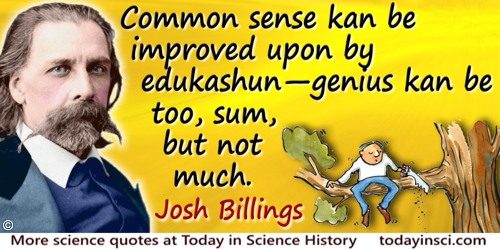
Common sense kan be improved upon by edukashun—genius kan be too, sum, but not much.
In The Complete Works of Josh Billings (1876), 79.
Creative geniuses are a slap-happy lot. Treat Them with respect.
In The Novel (1991), 53.
Criticism is as often a trade as a science, requiring, as it does, more health than wit, more labour than capacity, more practice than genius.
In John Timbs (ed.), Laconics; or, The Best Words of the Best Authors (1929), 156.
Cuvier had even in his address & manner the character of a superior Man, much general power & eloquence in conversation & great variety of information on scientific as well as popular subjects. I should say of him that he is the most distinguished man of talents I have ever known on the continent: but I doubt if He be entitled to the appellation of a Man of Genius.
J. Z. Fullmer, 'Davy's Sketches of his Contemporaries', Chymia, 1967, 12, 132.
Edukashun gauls genius like a bad setting harness.
In The Complete Works of Josh Billings (1876), 79.
Endow the already established with money. Endow the woman who shows genius with time.
In Phebe Mitchell Kendall (ed.), Maria Mitchell: Life, Letters, and Journals (1896), 182.
England and all civilised nations stand in deadly peril of not having enough to eat. As mouths multiply, food resources dwindle. Land is a limited quantity, and the land that will grow wheat is absolutely dependent on difficult and capricious natural phenomena... I hope to point a way out of the colossal dilemma. It is the chemist who must come to the rescue of the threatened communities. It is through the laboratory that starvation may ultimately be turned into plenty... The fixation of atmospheric nitrogen is one of the great discoveries, awaiting the genius of chemists.
Presidential Address to the British Association for the Advancement of Science 1898. Published in Chemical News, 1898, 78, 125.
Enthusiasm is the genius of sincerity, and truth accomplishes no victories without it.
In The Last Days of Pompeii (1834), Vol. 1, 78.
Error has indeed long darkened the horizon of medical science; and albeit there have been lightnings like coruscations of genius from time to time, still they have passed away, and left the atmosphere as dark as before.
Memoirs of John Abernethy (1854), 293.
Even a wise experiment when made by a fool generally leads to a false conclusion, but that fools’ experiments conducted by a genius often prove to be leaps through the dark into great discoveries.
Commenting on Charles Darwin’s “fool’s experiments”, in 'Charles Robert Darwin', collected in C.D. Warner (ed.), Library of the World’s Best Literature Ancient and Modern (1896), Vol. 2, 4391-4392.
Even the taking of medicine serves to make time go on with less heaviness. I have a sort of genius for physic and always had great entertainment in observing the changes of the human body and the effects produced by diet, labor, rest, and physical operations.
Even with men of genius, with whom the birth rate of hypotheses is very high, it only just manages to exceed the death rate.
Stated in narrative form, without quotation marks, in W.I.B. Beveridge, The Art of Scientific Investigation (1957), 60.
Everyone is a genius at least once a year. The real geniuses simply have their bright ideas closer together.
Aphorisms (1775-1779) trans. Franz H. Mautner and Henry Hatfield. In Fred R. Shapiro and Joseph Epstein, The Yale Book of Quotations (2006), 459:3.
Execution is the chariot of genius.
Marginal note he wrote in his copy of the 'Discourses' of Sir Joshua Reynolds (1798). In The Real Blake (1908), 378. On page 371, the editor explains in a footnote that these marginalia of Blake date to either 1820 or perhaps 1810. In William Blake, David V. Erdman (ed.), The Complete Poetry and Prose of William Blake (2008), 643, Blake's note is identified as being written on page 15 and is a comment to Reynold's text, “...frivolous ambition of being thought masters of execution,...”
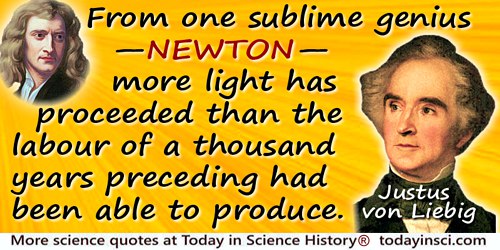
From one sublime genius—NEWTON—more light has proceeded than the labour of a thousand years preceding had been able to produce.
Familiar Letters on Chemistry in Its Relations to Physiology, Dietetics, Agriculture, Commerce and Political Economy (3rd ed., 1851), 3.
Generalisations which are fruitful because they reveal in a single general principle the rationale of a great many particular truths, the connections and common origins of which had not previously been seen, are found in all the sciences, and particularly in mathematics. Such generalisations are the most important of all, and their discovery is the work of genius.
From Essai sur les Fondements de nos Connaissances et sur les Caractères de la Critique Philosophique (1851), 28, as translated by Merritt H Moore in An Essay on the Foundations of Our Knowledge (1956), 24. From the original French: “Il y a dans toutes les sciences, et en mathématiques particulièrement, des généralisations fécondes, parce qu’elles nous montrent dans une vérité générale la raison d’une multitude de vérités particulières dont les liens et la commune origine n’étaient point aperçus. De telles généralisations sont des découvertes du génie, et les plus importantes de toutes.”
Genius … has been defined as a supreme capacity for taking trouble… It more fitly could be described as a supreme capacity for getting its possessors into trouble of all kinds and keeping them there so long as the genius remains.
In Samuel Butler and Henry Festing Jones (ed.), The Note-Books of Samuel Butler (1913), 174-175.
Genius always gives its best at first, prudence at last.
Louis Klopsch, Many Thoughts of Many Minds (1896), 105.
Genius and science have burst the limits of space, and few observations, explained by just reasoning, have unveiled the mechanism of the universe. Would it not also be glorious for man to burst the limits of time, and, by a few observations, to ascertain the history of this world, and the series of events which preceded the birth of the human race?
'Preliminary discourse', to Recherches sur les Ossemens Fossiles (1812), trans. R. Kerr Essay on the Theory of the Earth (1813), 3-4.
Genius can never despise labor.
Louis Klopsch, Many Thoughts of Many Minds (1896), 106.
Genius can only breathe freely in an atmosphere of freedom. Persons of genius are, ex vi termini, more individual than any other people—less capable, consequently, of fitting themselves, without hurtful compression, into any of the small number of moulds which society provides in order to save its members the trouble of forming their own character.
In On Liberty (1859), 116. The Latin expression, “Ex vi terminii,” means “by definition”, though a literal translation is “from the strength of the border.”
Genius finds its own road and carries its own lamp.
In James Wood, Dictionary of Quotations from Ancient and Modern, English and Foreign Sources (1893), 120:22.
Genius is an immense capacity for taking trouble.
Louis Klopsch, Many Thoughts of Many Minds (1896), 105.
Genius is less rare than the touchstone by which to test it.
Maxim 319 in Maxims for a Modern Man (1965), 47.
Genius is more often found in a cracked pot than a whole one.
In M. P. Singh, Quote Unquote (2007), 148.
Genius is not inspired. Inspiration is perspiration.
As quoted in 'The Anecdotal Side of Edison', Ladies Home Journal (Apr 1898), 8.
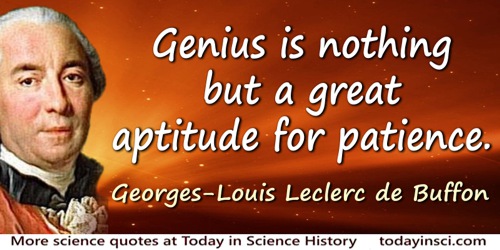
Genius is nothing but a great aptitude for patience.
Inaugural speech at the French Academy (1753). Quoted in Hans Theodore David, Arthur Mendel and Christoph Wolff, The New Bach Reader (1998), 20. Also seen translated as “Genius is simply patience carried to the extreme,” or shortened as “Genius is patience.” The latter is also sometimes seen attributed (incorrectly?) to Isaac Newton, for example, in Lady Isabel Burton, The Life of Captain Sir Richd F. Burton (1893), Vol. 1, 577. Webmaster has found no primary source from Newton. Also seen attributed to Santiago Ramon y Cajal, but he was only quoting Buffon, translated as “Genius is simply patience carried to the extreme,” in Advice for a Young Investigator (1999), 39. Translated from the original French, “Le génie n'est qu'une grande aptitude à la patience.”
Genius is nourished from within and without.
In James Wood, Dictionary of Quotations from Ancient and Modern, English and Foreign Sources (1893), 120:45.
Genius is one per cent inspiration and ninety-nine per cent perspiration.
In Life (1932).
Genius is rarely able to give any account of its own processes.
From The Fortnightly Review (1865). Reprinted in The Principles of Success in Literature (1901), 98.
Genius is supposed to be a power of producing excellences which are put of the reach of the rules of art: a power which no precepts can teach, and which no industry can acquire.
From 'A Discourse Delivered to the Students of the Royal Academy, on the Distribution of Prizes' (10 Dec 1774), in Seven Discourses Delivered in the Royal Academy (1778), 202-203.
Genius is the gold in the mine, talent is the miner who works and brings it out.
Louis Klopsch, Many Thoughts of Many Minds (1896), 106.
Genius is the whistle of the locomotive, which with steaming shrieks indicates its progress, but common sense is the driving-wheel which moves the train.
In Igerne and Other Writings of Arthur Handly Marks (1897), 348.
Genius is two percent inspiration, ninety-eight percent perspiration.
Francis Arthur Jones, The Life of Thomas Alva Edison: Sixty Years of an Inventor’s Life (1932), 371.
Genius itself has been analyzed by the shrewdest observers into a higher capacity of attention. “Genius,” says Helvetius … “is nothing but a continued attention,” (une attention suivie). “Genius,” says Buffon, “is only a protracted patience,” (une longue patience). “In the exact sciences, at least,” says Cuvier, “it is the patience of a sound intellect, when invincible, which truly constitutes genius.” And Chesterfield has also observed, that “the power of applying an attention, steady and undissipated, to a single object, is the sure mark of a superior genius.”
In Lectures on Metaphysics and Logic (1860), Vol. 1, 179.
Genius iz always in advance ov the times, and makes sum magnificent hits, but the world owes most ov its tributes to good hoss sense.
In The Complete Works of Josh Billings (1876), 79.
Genius knows where the questions are hidden
City Aphorisms, Fourth Selection (1987).
Genius may have its limitations, but stupidity is not thus handicapped.
Philistine: A Periodical of Protest (Sep 1906), 23, No. 4, 97.
Genius must be born, and never can be taught.
Louis Klopsch, Many Thoughts of Many Minds (1896), 106.
Genius unexerted is no more genius than a bushel of acorns is a forest of oaks.
Louis Klopsch, Many Thoughts of Many Minds (1896), 106.
Genius-worship is the infallible sign of an uncreative age.
In Art (1928), 161.
Genius, in truth, means little more than the faculty of perceiving in an unhabitual way.
In Psychology (1904), 328.
Genius, like the inhabitants of the depths of the sea, moves by its own light.
…...
Genius, without religion, is only a lamp on the outer gate of a palace. It may serve to cast a gleam of light on those that are without while the inhabitant sits in darkness.
Louis Klopsch, Many Thoughts of Many Minds (1896), 106.
God help the teacher, if a man of sensibility and genius, when a booby father presents him with his booby son, and insists on lighting up the rays of science in a fellow's head whose skull is impervious and inaccessible by any other way than a positive fracture with a cudgel.
In a letter to Mr. Cunningham, 11 Jun 1791. Quoted in James Wood Dictionary of Quotations from Ancient and Modern, English and Foreign Sources (1893), 126:18.
Good methods can teach us to develop and use to better purpose the faculties with which nature has endowed us, while poor methods may prevent us from turning them to good account. Thus the genius of inventiveness, so precious in the sciences, may be diminished or even smothered by a poor method, while a good method may increase and develop it.
Great triumphs of engineering genius—the locomotive, the truss bridge, the steel rail— ... are rather invention than engineering proper.
From The Economic Theory of the Location of Railways (1887, 1914), 1.
Has Matter more than Motion? Has it Thought,
Judgment, and Genius? Is it deeply learn’d
In Mathematics? Has it fram’d such Laws,
Which, but to guess, a Newton made immortal?—
If so, how each sage Atom laughs at me,
Who think a Clod inferior to a Man!
Judgment, and Genius? Is it deeply learn’d
In Mathematics? Has it fram’d such Laws,
Which, but to guess, a Newton made immortal?—
If so, how each sage Atom laughs at me,
Who think a Clod inferior to a Man!
The Complaint: or, Night-Thoughts on Life, Death, and Immortality (1742, 1750), Night 9, 279.
Have you ever plunged into the immensity of space and time by reading the geological treatises of Cuvier? Borne away on the wings of his genius, have you hovered over the illimitable abyss of the past as if a magician’s hand were holding you aloft?
From 'La Peau de Chagrin' (1831). As translated by Herbert J. Hunt in The Wild Ass’s Skin (1977), 40-41.
Have you ever plunged into the immensity of time and space by reading the geological tracts of Cuvier? Transported by his genius, have you hovered over the limitless abyss of the past, as if held aloft by a magician’s hand?
From 'La Peau de Chagrin' (1831). As translated as by Helen Constantine The Wild Ass’s Skin (2012), 19.
He [General Nathan Bedford Forrest] possessed a remarkable genius for mathematics, a subject in which he had absolutely no training. He could with surprising facility solve the most difficult problems in algebra, geometry, and trigonometry, only requiring that the theorem or rule be carefully read aloud to him.
In Life of General Nathan Bedford Forrest (1899), 627.
Here too all Forms of social Union find,
And hence let Reason, late, instruct mankind:
Here subterranean Works and Cities see,
There Towns aerial on the waving Tree.
Learn each small people’s Genius, Policies;
The Ants Republick, and the Realm of Bees;
How those in common all their stores bestow,
And Anarchy without confusion know.
And hence let Reason, late, instruct mankind:
Here subterranean Works and Cities see,
There Towns aerial on the waving Tree.
Learn each small people’s Genius, Policies;
The Ants Republick, and the Realm of Bees;
How those in common all their stores bestow,
And Anarchy without confusion know.
In 'Epistle III', Essay on Man,: Being the First Book of Ethic Epistles (1734), 47.
Here’s to the crazy ones. The misfits. The rebels. The troublemakers. The round heads in the square holes. The ones who see things differently. They’re not fond of rules. You can quote them. Disagree with them. Glorify or vilify them. But the only thing you can’t do is ignore them. Because they change things. They push the human race forward. And while some may see them as the crazy ones, we see genius. Because the people who are crazy enough to think they can change the world, are the ones who do.
In Apple Computer newspaper advertisement (1997) as quoted and cited in Tad Lathrop and Jim Pettigrew, This Business of Music Marketing and Promotion (1999), 55.
His genius now began to mount upwards apace & shine out with more strength, & as he told me himself, he excelled particularly in making verses... In everything he undertook he discovered an application equal to the pregnancy of his parts & exceeded the most sanguine expectations his master had conceived of him.
[About Newton's recollection of being a schoolboy at Grantham, written by Conduitt about 65 years after that time.]
[About Newton's recollection of being a schoolboy at Grantham, written by Conduitt about 65 years after that time.]
Quoted in Richard Westfall, Never at Rest: A Biography of Isaac Newton (1980), 65. Footnoted Keynes MS 130.2, p. 32-3, in the collection at King's College, Cambridge.
His genius was in asking the right questions and seeing explanations that did not readily occur to others. He loved and lived science and was an inspiration to all who came in contact with him.
Co-author with Marilyn Taylor and Robert E. Connick, obituary, 'Melvin Calvin', Proceedings of the American Philosophical Society (Dec 2000), 144, No. 4, 457.
His mind illumined the Past and the Future and wrought greatly for the present. By his genius distant lands converse and men sail unafraid upon the deep.
— Epitaph
Inscription on the tomb of Reginald and Helen Fessenden in Bermuda. In Frederick Seitz, The Cosmic Inventor: Reginald Aubrey Fessenden (1866-1932) (1999), 61, being Transactions of the American Philosophical Society, Held at Philadelphia For Promoting Useful Knowledge, Vol. 86, Pt. 6.
Honest investigation is but the application of common sense to the solution of the unknown. Science does not wait on Genius, but is the companion of Industry.
From address (1 Oct 1884), at inauguration of the Corcoran School of Science and Arts, Columbian University, Washington, D.C. Published in 'The Larger Import of Scientific Education', Popular Science Monthly (Feb 1885), 26, 453.
I am convinced all of humanity is born with more gifts than we know. Most are born geniuses and just get de-geniused rapidly.
Statement made in 1974, quoted in People magazine. In Thomas T. K. Zung, Buckminster Fuller: Anthology for the New Millenium (2002), 174.
I can see him [Sylvester] now, with his white beard and few locks of gray hair, his forehead wrinkled o’er with thoughts, writing rapidly his figures and formulae on the board, sometimes explaining as he wrote, while we, his listeners, caught the reflected sounds from the board. But stop, something is not right, he pauses, his hand goes to his forehead to help his thought, he goes over the work again, emphasizes the leading points, and finally discovers his difficulty. Perhaps it is some error in his figures, perhaps an oversight in the reasoning. Sometimes, however, the difficulty is not elucidated, and then there is not much to the rest of the lecture. But at the next lecture we would hear of some new discovery that was the outcome of that difficulty, and of some article for the Journal, which he had begun. If a text-book had been taken up at the beginning, with the intention of following it, that text-book was most likely doomed to oblivion for the rest of the term, or until the class had been made listeners to every new thought and principle that had sprung from the laboratory of his mind, in consequence of that first difficulty. Other difficulties would soon appear, so that no text-book could last more than half of the term. In this way his class listened to almost all of the work that subsequently appeared in the Journal. It seemed to be the quality of his mind that he must adhere to one subject. He would think about it, talk about it to his class, and finally write about it for the Journal. The merest accident might start him, but once started, every moment, every thought was given to it, and, as much as possible, he read what others had done in the same direction; but this last seemed to be his real point; he could not read without finding difficulties in the way of understanding the author. Thus, often his own work reproduced what had been done by others, and he did not find it out until too late.
A notable example of this is in his theory of cyclotomic functions, which he had reproduced in several foreign journals, only to find that he had been greatly anticipated by foreign authors. It was manifest, one of the critics said, that the learned professor had not read Rummer’s elementary results in the theory of ideal primes. Yet Professor Smith’s report on the theory of numbers, which contained a full synopsis of Kummer’s theory, was Professor Sylvester’s constant companion.
This weakness of Professor Sylvester, in not being able to read what others had done, is perhaps a concomitant of his peculiar genius. Other minds could pass over little difficulties and not be troubled by them, and so go on to a final understanding of the results of the author. But not so with him. A difficulty, however small, worried him, and he was sure to have difficulties until the subject had been worked over in his own way, to correspond with his own mode of thought. To read the work of others, meant therefore to him an almost independent development of it. Like the man whose pleasure in life is to pioneer the way for society into the forests, his rugged mind could derive satisfaction only in hewing out its own paths; and only when his efforts brought him into the uncleared fields of mathematics did he find his place in the Universe.
A notable example of this is in his theory of cyclotomic functions, which he had reproduced in several foreign journals, only to find that he had been greatly anticipated by foreign authors. It was manifest, one of the critics said, that the learned professor had not read Rummer’s elementary results in the theory of ideal primes. Yet Professor Smith’s report on the theory of numbers, which contained a full synopsis of Kummer’s theory, was Professor Sylvester’s constant companion.
This weakness of Professor Sylvester, in not being able to read what others had done, is perhaps a concomitant of his peculiar genius. Other minds could pass over little difficulties and not be troubled by them, and so go on to a final understanding of the results of the author. But not so with him. A difficulty, however small, worried him, and he was sure to have difficulties until the subject had been worked over in his own way, to correspond with his own mode of thought. To read the work of others, meant therefore to him an almost independent development of it. Like the man whose pleasure in life is to pioneer the way for society into the forests, his rugged mind could derive satisfaction only in hewing out its own paths; and only when his efforts brought him into the uncleared fields of mathematics did he find his place in the Universe.
In Florian Cajori, Teaching and History of Mathematics in the United States (1890), 266-267.
I can't tell you if genius is hereditary, because heaven has granted me no offspring.
In Patricia Harris and David Lyon, 1001 Greatest Things Ever Said About Massachusetts (2007), 381
I do not intend to go deeply into the question how far mathematical studies, as the representatives of conscious logical reasoning, should take a more important place in school education. But it is, in reality, one of the questions of the day. In proportion as the range of science extends, its system and organization must be improved, and it must inevitably come about that individual students will find themselves compelled to go through a stricter course of training than grammar is in a position to supply. What strikes me in my own experience with students who pass from our classical schools to scientific and medical studies, is first, a certain laxity in the application of strictly universal laws. The grammatical rules, in which they have been exercised, are for the most part followed by long lists of exceptions; accordingly they are not in the habit of relying implicitly on the certainty of a legitimate deduction from a strictly universal law. Secondly, I find them for the most part too much inclined to trust to authority, even in cases where they might form an independent judgment. In fact, in philological studies, inasmuch as it is seldom possible to take in the whole of the premises at a glance, and inasmuch as the decision of disputed questions often depends on an aesthetic feeling for beauty of expression, or for the genius of the language, attainable only by long training, it must often happen that the student is referred to authorities even by the best teachers. Both faults are traceable to certain indolence and vagueness of thought, the sad effects of which are not confined to subsequent scientific studies. But certainly the best remedy for both is to be found in mathematics, where there is absolute certainty in the reasoning, and no authority is recognized but that of one’s own intelligence.
In 'On the Relation of Natural Science to Science in general', Popular Lectures on Scientific Subjects, translated by E. Atkinson (1900), 25-26.
I have a boundless admiration for the solitary genius which enabled [Hermann Oberth] to bring into focus all of the essential elements of a gigantic concept, together with the human greatness which allowed him, in shy reserve, to bear with equanimity the “crucify hims” as well as the “hosannas” of public opinion. I myself owe him a debt of gratitude not only for being the guiding light of my life, but also for my first contact with the theoretical and practical aspects of rocket technology and space travel.
Primary source needed for verification. (Can you help?)
I have often thought that an interesting essay might be written on the influence of race on the selection of mathematical methods. methods. The Semitic races had a special genius for arithmetic
and algebra, but as far as I know have never produced a single geometrician of any eminence. The Greeks on the other hand adopted a geometrical procedure wherever it was possible, and they even treated arithmetic as a branch of geometry by means of the device of representing numbers by lines.
In A History of the Study of Mathematics at Cambridge (1889), 123
I have taken the stand that nobody can be always wrong, but it does seem to me that I have approximated so highly that I am nothing short of a negative genius.
Wild Talents (1932). In The Complete Books of Charles Fort (1975), 1037.
I have very often reflected on what it is that really distinguishes the great genius from the common crowd. Here are a few observations I have made. The common individual always conforms to the prevailing opinion and the prevailing fashion; he regards the State in which everything now exists as the only possible one and passively accepts it ail. It does not occur to him that everything, from the shape of the furniture up to the subtlest hypothesis, is decided by the great council of mankind of which he is a member. He wears thin-soled shoes even though the sharp stones of the Street hurt his feet, he allows fashion to dictate to him that the buckles of his shoes must extend as far as the toes even though that means the shoe is often hard to get on. He does not reflect that the form of the shoe depends as much upon him as it does upon the fool who first wore thin shoes on a cracked pavement. To the great genius it always occurs to ask: Could this too not be false! He never gives his vote without first reflecting.
Aphorism 24 in Notebook C (1772-1773), as translated by R.J. Hollingdale in Aphorisms (1990). Reprinted as The Waste Books (2000), 36.
I know no such thing as genius,—genius is nothing but labor and diligence.
Louis Klopsch, Many Thoughts of Many Minds (1896), 106.
I picture the vast realm of the sciences as an immense landscape scattered with patches of dark and light. The goal towards which we must work is either to extend the boundaries of the patches of light, or to increase their number. One of these tasks falls to the creative genius; the other requires a sort of sagacity combined with perfectionism.
Thoughts on the Interpretation of Nature and Other Philosophical Works (1753/4), ed. D. Adams (1999), Section XIV, 42.
I think Dr. Arbuthnot the first man among the wits of the age. He was the most universal genius, being an excellent physician, a man of deep learning, and a man of much humour.
As quoted, without citation in John Dennis, The Age of Pope (1894, 1926), 176. In James Boswell’s Life of Johnson, “the wits of the age” is written as “them” meaning, from the context, the wits of the age of Queen Anne (1702-1714).
I’ve known a lot of famous scientists. But the only one I thought was really a genius was McClintock.
Quoted in Evelyn Fox Keller, A Feeling for the Organism: The Life and Work of Barbara McClintock (1984), 50
If a man can have only one kind of sense, let him have common sense. If he has that an uncommon sense too, he is not far from genius.
In Hialmer Day Gould, New Practical Spelling (1905), 13.
If a man will comprehend the richness and variety of the universe, and inspire his mind with a due measure of wonder and awe, he must contemplate the human intellect not only on its heights of genius but in its abysses of ineptitude...
M. Manilii Astronomicon. Liber Primus Recensuit et enarravit A.E. Housman. Editio Altera (1937), i, xix. Quoted in David Womersley, 'Dulness and Pope', British Academy, 2004 Lectures, (2005), 233.
If every man waz a genius, mankind would be az bad oph az the heavens would be, with every star a comet, things would git hurt badly, and noboddy tew blame.
In The Complete Works of Josh Billings (1876), 79.
If my impressions are correct, our educational planing mill cuts down all the knots of genius, and reduces the best of the men who go through it to much the same standard.
The Reminiscences of an Astronomer (1903), 75.
If there ever was a misnomer, it is “exact science.” Science has always been full of mistakes. The present day is no exception. And our mistakes are good mistakes; they require a genius to correct. Of course, we do not see our own mistakes.
In Edward Teller, Wendy Teller and Wilson Talley, Conversations on the Dark Secrets of Physics (1991, 2013), 37.
If you enquire about him [J.J. Sylvester], you will hear his genius universally recognized but his power of teaching will probably be said to be quite deficient. Now there is no man living who is more luminary in his language, to those who have the capacity to comprehend him than Sylvester, provided the hearer is in a lucid interval. But as the barn yard fowl cannot understand the flight of the eagle, so it is the eaglet only who will be nourished by his instruction.
Letter (18 Sep 1875) to Daniel C. Gilman. In Daniel C. Gilman Papers, Ms. 1, Special Collections Division, Milton S. Eisenhower Library, Johns Hopkins University. As quoted in Karen Hunger Parshall, 'America’s First School of Mathematical Research: James Joseph Sylvester at The Johns Hopkins University 1876—1883', Archive for History of Exact Sciences (1988), 38, No. 2, 167.
Improvement makes straight road, but the crooked roads without improvement are roads of genius.
In 'Proverbs', The Poems: With Specimens of the Prose Writings of William Blake (1885), 281.
In departing from any settled opinion or belief, the variation, the change, the break with custom may come gradually; and the way is usually prepared; but the final break is made, as a rule, by some one individual, … who sees with his own eyes, and with an instinct or genius for truth, escapes from the routine in which his fellows live. But he often pays dearly for his boldness.
In The Harveian Oration, delivered before the Royal College of Physicians of London (18 Oct 1906). Printed in 'The Growth of Truth, as Illustrated in the Discovery of the Circulation of Blood', The Lancet (27 Oct 1906), Vol. 2, Pt. 2, 1114.
In every work of genius we recognize our own rejected thoughts; they come back to us with a certain alienated majesty.
In 'Self-Reliance', The Prose Works of Ralph Waldo Emerson (1870), Vol. 1, 241.
In general the position as regards all such new calculi is this That one cannot accomplish by them anything that could not be accomplished without them. However, the advantage is, that, provided such a calculus corresponds to the inmost nature of frequent needs, anyone who masters it thoroughly is able—without the unconscious inspiration of genius which no one can command—to solve the respective problems, yea, to solve them mechanically in complicated cases in which, without such aid, even genius becomes powerless. Such is the case with the invention of general algebra, with the differential calculus, and in a more limited region with Lagrange’s calculus of variations, with my calculus of congruences, and with Möbius’s calculus. Such conceptions unite, as it were, into an organic whole countless problems which otherwise would remain isolated and require for their separate solution more or less application of inventive genius.
Letter (15 May 1843) to Schumacher, collected in Carl Friedrich Gauss Werke (1866), Vol. 8, 298, as translated in Robert Édouard Moritz, Memorabilia Mathematica; Or, The Philomath's Quotation-book (1914), 197-198. From the original German, “Überhaupt verhält es sich mit allen solchen neuen Calculs so, dass man durch sie nichts leisten kann, was nicht auch ohne sie zu leisten wäre; der Vortheil ist aber der, dass, wenn ein solcher Calcul dem innersten Wesen vielfach vorkommender Bedürfnisse correspondirt, jeder, der sich ihn ganz angeeignet hat, auch ohne die gleichsam unbewussten Inspirationen des Genies, die niemand erzwingen kann, die dahin gehörigen Aufgaben lösen, ja selbst in so verwickelten Fällen gleichsam mechanisch lösen kann, wo ohne eine solche Hülfe auch das Genie ohnmächtig wird. So ist es mit der Erfindung der Buchstabenrechnung überhaupt; so mit der Differentialrechnung gewesen; so ist es auch (wenn auch in partielleren Sphären) mit Lagranges Variationsrechnung, mit meiner Congruenzenrechnung und mit Möbius' Calcul. Es werden durch solche Conceptionen unzählige Aufgaben, die sonst vereinzelt stehen, und jedesmal neue Efforts (kleinere oder grössere) des Erfindungsgeistes erfordern, gleichsam zu einem organischen Reiche.”
In physical science the discovery of new facts is open to every blockhead with patience, manual dexterity, and acute senses; it is less effectually promoted by genius than by co-operation, and more frequently the result of accident than of design.
In Review of 'An Account of the Life, Lectures, and Writings of William Cullen, M.D. Professor of the Practice of Physic in the University of Edinburgh', The Edinburgh Review (1832), 55, 461.
In science men have discovered an activity of the very highest value in which they are no longer, as in art, dependent for progress upon the appearance of continually greater genius, for in science the successors stand upon the shoulders of their predecessors; where one man of supreme genius has invented a method, a thousand lesser men can apply it. … In art nothing worth doing can be done without genius; in science even a very moderate capacity can contribute to a supreme achievement.
Essay, 'The Place Of Science In A Liberal Education.' In Mysticism and Logic: and Other Essays (1919), 41.
In scientific matters ... the greatest discoverer differs from the most arduous imitator and apprentice only in degree, whereas he differs in kind from someone whom nature has endowed for fine art. But saying this does not disparage those great men to whom the human race owes so much in contrast to those whom nature has endowed for fine art. For the scientists' talent lies in continuing to increase the perfection of our cognitions and on all the dependent benefits, as well as in imparting that same knowledge to others; and in these respects they are far superior to those who merit the honour of being called geniuses. For the latter's art stops at some point, because a boundary is set for it beyond which it cannot go and which has probably long since been reached and cannot be extended further.
The Critique of Judgement (1790), trans. J. C. Meredith (1991), 72.
In the judgment of the most competent living mathematicians, Fraulein Noether was the most significant mathematical genius thus far produced since the higher education of women began.
In letter (1 May 1935), Letters to the Editor, 'The Late Emmy Noether: Professor Einstein Writes in Appreciation of a Fellow-Mathematician', New York Times (4 May 1935), 12.
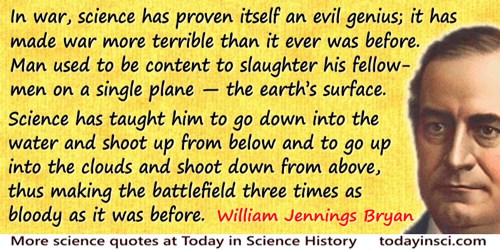
In war, science has proven itself an evil genius; it has made war more terrible than it ever was before. Man used to be content to slaughter his fellowmen on a single plane—the earth’s surface. Science has taught him to go down into the water and shoot up from below and to go up into the clouds and shoot down from above, thus making the battlefield three times as bloody as it was before; but science does not teach brotherly love. Science has made war so hellish that civilization was about to commit suicide; and now we are told that newly discovered instruments of destruction will make the cruelties of the late war seem trivial in comparison with the cruelties of wars that may come in the future.
Proposed summation written for the Scopes Monkey Trial (1925), in Genevieve Forbes Herrick and John Origen Herrick, The Life of William Jennings Bryan (1925), 405. This speech was prepared for delivery at the trial, but was never heard there, as both sides mutually agreed to forego arguments to the jury.
Intellectuals solve problems, geniuses prevent them.
Widely found on the web as an Einstein quote, but Webmaster has not yet found a primary source. Can you help? It is probably yet another example of a “wise” quote to which Einstein’s name has been falsely attributed. For authentic quotes see Albert Einstein Quotes on Problem.
Intelligence is not creative; judgment is not creative. If a sculptor is nothing but skill and mind, his hands will be without genius.
Translation by Lewis Galantière of Pilote de Guerre (1941) as Flight to Arras (1942, 2008), 130. A different translation is found in Jason Merchey, Values of the Wise: Humanity's Highest Aspirations (2004), 240: “Neither intelligence nor judgment are creative. If a scupltor is nothing but science and intelligence, his hands will have no talent.”
Invention is an Heroic thing, and plac'd above the reach of a low, and vulgar Genius. It requires an active, a bold, a nimble, a restless mind: a thousand difficulties must be contemn'd with which a mean heart would be broken: many attempts must be made to no purpose: much Treasure must sometimes be scatter'd without any return: much violence, and vigour of thoughts must attend it: some irregularities, and excesses must be granted it, that would hardly be pardon'd by the severe Rules of Prudence.
The History of the Royal Society (1667), 392.
Inventions and discoveries are of two kinds. The one which we owe to chance, such as those of the mariner’s compass, gunpowder, and in general almost all the discoveries we have made in the arts. The other which we owe to genius: and here we ought to understand by the word discovery, a new combination, or a new relation perceived between certain objects or ideas. A person obtains the title of a man of genius, if the ideas which result from this combination form one grand whole, are fruitful in truths, and are of importance with respect to mankind.
From the original French, “Les inventions ou les découvertes sont de deux espèces. Il en est que nous devons au hazard; telles sont la boussole, la poudre à canon, & généralement presque toutes les découvertes que nous avons faites dans les arts. Il en est d'autres que nous devons au génie: &, par ce mot de découverte, on doit alors entendre une nouvelle combinaison, un rapport nouveau aperçu entre certains objets ou certaines idées. On obtient le titre d'homme de génie, si les idées qui résultent de ce rapport forment un grand ensemble, sont fécondes en vérités & intéressantes pour l'humanité,” in 'Du Génie', L’Esprit (1758), Discourse 4, 476. English version from Claude Adrien Helvétius and William Mudford (trans.), 'Of Genius', De l’Esprit or, Essays on the Mind and its several Faculties (1759), Essay 4, Chap. 1, 241-242.
Inventive genius requires pleasurable mental activity as a condition for its vigorous exercise. “Necessity is the mother of invention” is a silly proverb. “Necessity is the mother of futile dodges” is much closer to the truth. The basis of growth of modern invention is science, and science is almost wholly the outgrowth of pleasurable intellectual curiosity.
In 'Technical Education and Its Relation to Science and Literature', The Aims of Education and Other Essays (1917), 69.
It has been asserted … that the power of observation is not developed by mathematical studies; while the truth is, that; from the most elementary mathematical notion that arises in the mind of a child to the farthest verge to which mathematical investigation has been pushed and applied, this power is in constant exercise. By observation, as here used, can only be meant the fixing of the attention upon objects (physical or mental) so as to note distinctive peculiarities—to recognize resemblances, differences, and other relations. Now the first mental act of the child recognizing the distinction between one and more than one, between one and two, two and three, etc., is exactly this. So, again, the first geometrical notions are as pure an exercise of this power as can be given. To know a straight line, to distinguish it from a curve; to recognize a triangle and distinguish the several forms—what are these, and all perception of form, but a series of observations? Nor is it alone in securing these fundamental conceptions of number and form that observation plays so important a part. The very genius of the common geometry as a method of reasoning—a system of investigation—is, that it is but a series of observations. The figure being before the eye in actual representation, or before the mind in conception, is so closely scrutinized, that all its distinctive features are perceived; auxiliary lines are drawn (the imagination leading in this), and a new series of inspections is made; and thus, by means of direct, simple observations, the investigation proceeds. So characteristic of common geometry is this method of investigation, that Comte, perhaps the ablest of all writers upon the philosophy of mathematics, is disposed to class geometry, as to its method, with the natural sciences, being based upon observation. Moreover, when we consider applied mathematics, we need only to notice that the exercise of this faculty is so essential, that the basis of all such reasoning, the very material with which we build, have received the name observations. Thus we might proceed to consider the whole range of the human faculties, and find for the most of them ample scope for exercise in mathematical studies. Certainly, the memory will not be found to be neglected. The very first steps in number—counting, the multiplication table, etc., make heavy demands on this power; while the higher branches require the memorizing of formulas which are simply appalling to the uninitiated. So the imagination, the creative faculty of the mind, has constant exercise in all original mathematical investigations, from the solution of the simplest problems to the discovery of the most recondite principle; for it is not by sure, consecutive steps, as many suppose, that we advance from the known to the unknown. The imagination, not the logical faculty, leads in this advance. In fact, practical observation is often in advance of logical exposition. Thus, in the discovery of truth, the imagination habitually presents hypotheses, and observation supplies facts, which it may require ages for the tardy reason to connect logically with the known. Of this truth, mathematics, as well as all other sciences, affords abundant illustrations. So remarkably true is this, that today it is seriously questioned by the majority of thinkers, whether the sublimest branch of mathematics,—the infinitesimal calculus—has anything more than an empirical foundation, mathematicians themselves not being agreed as to its logical basis. That the imagination, and not the logical faculty, leads in all original investigation, no one who has ever succeeded in producing an original demonstration of one of the simpler propositions of geometry, can have any doubt. Nor are induction, analogy, the scrutinization of premises or the search for them, or the balancing of probabilities, spheres of mental operations foreign to mathematics. No one, indeed, can claim preeminence for mathematical studies in all these departments of intellectual culture, but it may, perhaps, be claimed that scarcely any department of science affords discipline to so great a number of faculties, and that none presents so complete a gradation in the exercise of these faculties, from the first principles of the science to the farthest extent of its applications, as mathematics.
In 'Mathematics', in Henry Kiddle and Alexander J. Schem, The Cyclopedia of Education, (1877.) As quoted and cited in Robert Édouard Moritz, Memorabilia Mathematica; Or, The Philomath’s Quotation-book (1914), 27-29.
It is … genius which has given motion and progress to society; prevented the ossification of the human heart and brain; and though, in its processes, it may not ever have followed the rules laid down in primers, it has, at least, saved history from being the region of geology, and our present society from being a collection of fossil remains.
In 'Genius', Wellman’s Miscellany (Dec 1871), 4, No. 6, 204.
It is India that gave us the ingenious method of expressing all numbers by means of ten symbols, each symbol receiving a value of position as well as an absolute value; a profound and important idea which appears so simple to us now that we ignore its true merit. But its very simplicity and the great ease which it has lent to computations put our arithmetic in the first rank of useful inventions; and we shall appreciate the grandeur of the achievement the more when we remember that it escaped the genius of Archimedes and Apollonius, two of the greatest men produced by antiquity.
Quoted in Return to Mathematical Circles H. Eves (Boston 1988).
It is not possible to find in all geometry more difficult and more intricate questions or more simple and lucid explanations [than those given by Archimedes]. Some ascribe this to his natural genius; while others think that incredible effort and toil produced these, to all appearance, easy and unlaboured results. No amount of investigation of yours would succeed in attaining the proof, and yet, once seen, you immediately believe you would have discovered it; by so smooth and so rapid a path he leads you to the conclusion required.
— Plutarch
In John Dryden (trans.), Life of Marcellus.
It is rare enough that a scientist sheds light on an area which nature has kept secret and then during his lifetime, sees that area illuminate in turn every corner of physiology and medicine. It is rarer still that one man can contribute concurrently almost as much to several other biological fields as well. That meanwhile he [August Krogh] should develop in addition a large school of devoted students who loved the man even more, if possible, than they venerated the scientist, spells the highest form of genius.
Commemorative words presented to the American Physiological Society (1950), describing Eugene Landis, his friend and colleague at Harvard University. As quoted and cited in Bodil Schmidt-Nielsen, August and Marie Krogh: Lives in Science (2013), 4.
It is the destiny of the sciences, which must necessarily be in the hands of a few, that the utility of their progress should be invisible to the greater part of mankind, especially if those sciences are associated with unobtrusive pursuits. Let a greater facility in using our navigable waters and opening new lines of communication but once exist, simply because at present we know vastly better how to level the ground and construct locks and flood-gates—what does it amount to? The workmen have had their labors lightened, but they themselves have not the least idea of the skill of the geometer who directed them; they have been put in motion nearly as the body is by a soul of which it knows nothing; the rest of the world has even less perception of the genius which presided over the enterprise, and enjoys the success it has attained only with a species of ingratitude.
As quoted in Joseph Henry, 'Report of the Secretary', Annual Report of the Board of Regents of the Smithsonian Institution for 1859 (1860), 16-17. Webmaster has not yet been able to locate a primary source for this quote.
It is the geniuses who, as pioneers, create the highways, and the cultivated who level and beautify them. Highway improvement would be a good thing in the sciences, so that we could get from one of them to another more easily.
Aphorism 39 in Notebook D (1773-1775), as translated by R.J. Hollingdale in Aphorisms (1990). Reprinted as The Waste Books (2000), 49.
It is this ideal of progress through cumulative effort rather than through genius—progress by organised effort, progress which does not wait for some brilliant stroke, some lucky discovery, or the advent of some superman, has been the chief gift of science to social philosophy.
Address to 48th annual summer convention of the American Institute of Electriccal Engineers, Cleveland (21 Jun 1932), abridged in 'The Rôle of the Engineer', The Electrical Journal (1932), 109, 223.
It must never be forgotten that education is not a process of packing articles in a trunk. Such a simile is entirely inapplicable. It is, of course, a process completely of its own peculiar genus. Its nearest analogue is the assimilation of food by a living organism: and we all know how necessary to health is palatable food under suitable conditions.
In 'The Rhythmic Claims of Freedom and Discipline', The Aims of Education and Other Essays (1929), 42.
It took Galileo 16 years to master the universe. You have one night. It seems unfair. The genius had all that time. While you have a few short hours to learn sun spots from your satellites before the dreaded astronomy exam. On the other hand, Vivarin [caffeine tablets] help you keep awake and mentally alert… So even when the subject matter’s dull, your mind will remain razor sharp. If Galileo had used Vivarin, maybe he could have mastered the solar system faster, too.
Advertisement by Beecham for Vivarin, student newspaper, Columbia Daily Spectator (1 Dec 1988), Vol. 112, No. 186, 5.
It would seem at first sight as if the rapid expansion of the region of mathematics must be a source of danger to its future progress. Not only does the area widen but the subjects of study increase rapidly in number, and the work of the mathematician tends to become more and more specialized. It is, of course, merely a brilliant exaggeration to say that no mathematician is able to understand the work of any other mathematician, but it is certainly true that it is daily becoming more and more difficult for a mathematician to keep himself acquainted, even in a general way, with the progress of any of the branches of mathematics except those which form the field of his own labours. I believe, however, that the increasing extent of the territory of mathematics will always be counteracted by increased facilities in the means of communication. Additional knowledge opens to us new principles and methods which may conduct us with the greatest ease to results which previously were most difficult of access; and improvements in notation may exercise the most powerful effects both in the simplification and accessibility of a subject. It rests with the worker in mathematics not only to explore new truths, but to devise the language by which they may be discovered and expressed; and the genius of a great mathematician displays itself no less in the notation he invents for deciphering his subject than in the results attained. … I have great faith in the power of well-chosen notation to simplify complicated theories and to bring remote ones near and I think it is safe to predict that the increased knowledge of principles and the resulting improvements in the symbolic language of mathematics will always enable us to grapple satisfactorily with the difficulties arising from the mere extent of the subject.
In Presidential Address British Association for the Advancement of Science, Section A., (1890), Nature, 42, 466.
Let him who so wishes take pleasure in boring us with all the wonders of nature: let one spend his life observing insects, another counting the tiny bones in the hearing membrane of certain fish, even in measuring, if you will, how far a flea can jump, not to mention so many other wretched objects of study; for myself, who am curious only about philosophy, who am sorry only not to be able to extend its horizons, active nature will always be my sole point of view; I love to see it from afar, in its breadth and its entirety, and not in specifics or in little details, which, although to some extent necessary in all the sciences, are generally the mark of little genius among those who devote themselves to them.
'L'Homme Plante', in Oeuvres Philosophiques de La Mettrie (1796), Vol. 2, 70-1. Jacques Roger, The Life Sciences in Eighteenth-Century French Thought, edited by Keith R. Benson and trans. Robert Ellrich (1997), 377.
Literature has her quacks no less than medicine, and they are divided into two classes; those who have erudition without genius, and those who have volubility, without depth; we shall get second-hand sense from the one, and original nonsense from the other.
Reflection 552, in Lacon: or Many things in Few Words; Addressed to Those Who Think (1820), 232.
Love of liberty means the guarding of every resource that makes freedom possible—from the sanctity of our families and the wealth of our soil to the genius [of] our scientists…
Inaugural Address, the first such address to be televised (20 Jan 1953). In William J. Federer, A Treasury of Presidential Quotations (2004), 300.
Many a genius has been slow of growth. Oaks that flourish for a thousand years do not spring up into beauty like a reed.
In The Spanish Drama: Lope de Vega and Calderon (1846), 60.
Mathematics and music, the most sharply contrasted fields of scientific activity which can be found, and yet related, supporting each other, as if to show forth the secret connection which ties together all the activities of our mind, and which leads us to surmise that the manifestations of the artist’s genius are but the unconscious expressions of a mysteriously acting rationality.
In Vorträge und Reden (1884, 1896), Vol 1, 122. As translated in Robert Édouard Moritz, Memorabilia Mathematica; Or, The Philomath’s Quotation-book (1914), 191. From the original German, “Mathematik und Musik, der schärfste Gegensatz geistiger Thätigkeit, den man auffinden kann, und doch verbunden, sich unterstützend, als wollten sie die geheime Consequenz nachweisen, die sich durch alle Thätigkeiten unseres Geistes hinzieht, und die auch in den Offenbarungen des künstlerischen Genius uns unbewusste Aeusserungen geheimnissvoll wirkender Vernunftmässigkeit ahnen lässt.”
May not Music be described as the Mathematic of sense, Mathematic as Music of the reason? the soul of each the same! Thus the musician feels Mathematic, the mathematician thinks Music, Music the dream, Mathematic the working life each to receive its consummation from the other when the human intelligence, elevated to its perfect type, shall shine forth glorified in some future Mozart-Dirichlet or Beethoven-Gauss a union already not indistinctly foreshadowed in the genius and labours of a Helmholtz!
In paper read 7 Apr 1864, printed in 'Algebraical Researches Containing a Disquisition On Newton’s Rule for the Discovery of Imaginary Roots', Philosophical Transactions of the Royal Society of London (1865), 154, 613, footnote. Also in Collected Mathematical Papers, Vol. 2, 419.
Men give me some credit for genius. All the genius I have lies in this: When I have a subject in hand, I study it profoundly. Day and night it is before me. I explore it in all its bearings. My mind becomes pervaded with it. Then the effort which I have made is what people are pleased to call the fruit of genius. It is the fruit of labor and thought.
Attributed as a comment to a friend. In J. C. Thomas, Manual of Useful Information (1893), 108.
Men of genius are often dull and inert in society; as the blazing meteor, when it descends to earth, is only a stone.
From Kavanagh: A Tale (1849), 49.
Menny people are limiting after uncommon sense, but they never find it a good deal; uncommon sense iz ov the nature of genius, and all genius iz the gift of God, and kant be had, like hens eggs, for the hunting.
In The Complete Works of Josh Billings (1876), 78.
Most of the knowledge and much of the genius of the research worker lie behind his selection of what is worth observing. It is a crucial choice, often determining the success or failure of months of work, often differentiating the brilliant discoverer from an otherwise admirable but entirely unproductive plodder.
The Furtherance of Medical Research (1941), 8.
Most, if not all, of the great ideas of modern mathematics have had their origin in observation. Take, for instance, the arithmetical theory of forms, of which the foundation was laid in the diophantine theorems of Fermat, left without proof by their author, which resisted all efforts of the myriad-minded Euler to reduce to demonstration, and only yielded up their cause of being when turned over in the blow-pipe flame of Gauss’s transcendent genius; or the doctrine of double periodicity, which resulted from the observation of Jacobi of a purely analytical fact of transformation; or Legendre’s law of reciprocity; or Sturm’s theorem about the roots of equations, which, as he informed me with his own lips, stared him in the face in the midst of some mechanical investigations connected (if my memory serves me right) with the motion of compound pendulums; or Huyghen’s method of continued fractions, characterized by Lagrange as one of the principal discoveries of that great mathematician, and to which he appears to have been led by the construction of his Planetary Automaton; or the new algebra, speaking of which one of my predecessors (Mr. Spottiswoode) has said, not without just reason and authority, from this chair, “that it reaches out and indissolubly connects itself each year with fresh branches of mathematics, that the theory of equations has become almost new through it, algebraic geometry transfigured in its light, that the calculus of variations, molecular physics, and mechanics” (he might, if speaking at the present moment, go on to add the theory of elasticity and the development of the integral calculus) “have all felt its influence”.
In 'A Plea for the Mathematician', Nature, 1, 238 in Collected Mathematical Papers, Vol. 2, 655-56.
Mr Edison gave America just what was needed at that moment in history. They say that when people think of me, they think of my assembly line. Mr. Edison, you built an assembly line which brought together the genius of invention, science and industry.
Henry Ford in conversation Thomas Edison and Harvey Firestone (1931), quoted as a recollection of the author, in James Newton, Uncommon Friends: Life with Thomas Edison, Henry Ford, Harvey Firestone, Alexis Carrel & Charles Lindbergh (1987), 31. The quote is not cited from a print source. However, in the introduction the author said he “kept a diary in which I noted times and places, key phrases, and vivid impressions.” He also “relied on publications by and about my friends, which jogged my memory.&rdquo. Webmaster has found no earlier record of this quote, and thus suggests the author may have the gist of what Ford said, but is not quoting the exact words uttered by Ford, although quote marks are used to state Ford's remark.
My view, the skeptical one, holds that we may be as far away from an understanding of elementary particles as Newton's successors were from quantum mechanics. Like them, we have two tremendous tasks ahead of us. One is to study and explore the mathematics of the existing theories. The existing quantum field-theories may or may not be correct, but they certainly conceal mathematical depths which will take the genius of an Euler or a Hamilton to plumb. Our second task is to press on with the exploration of the wide range of physical phenomena of which the existing theories take no account. This means pressing on with experiments in the fashionable area of particle physics. Outstanding among the areas of physics which have been left out of recent theories of elementary particles are gravitation and cosmology
In Scientific American (Sep 1958). As cited in '50, 100 & 150 years ago', Scientific American (Sep 2008), 299, No. 3, 14.
Nature is full of genius, full of the divinity; so that not a snowflake escapes its fashioning hand.
In Journal, (5 Jan 1856). In Henry David Thoreau and Odell Shepard (ed.), The Heart of Thoreau’s Journals (1927), 227.
Nature is genius without common sense.
In On Love & Psychological Exercises: With Some Aphorisms & Other Essays (1998), 57.
Neurosis has an abosolute genius for malingering. There is no illness which cannot counterfeit perfectly … If it is capable of deceiving the doctor, how should it fail to deceive the patient.
'Le Côté de Guermantes', À la recherche du temps perdu (1913-27).
Newton was the greatest creative genius physics has ever seen. None of the other candidates for the superlative (Einstein, Maxwell, Boltzmann, Gibbs, and Feynman) has matched Newton’s combined achievements as theoretician, experimentalist, and mathematician. … If you were to become a time traveler and meet Newton on a trip back to the seventeenth century, you might find him something like the performer who first exasperates everyone in sight and then goes on stage and sings like an angel.
In Great Physicists (2001), 39.
Newton was the greatest creative genius physics has ever seen. None of the other candidates for the superlative (Einstein, Maxwell, Boltzmann, Gibbs, and Feynman) has matched Newton’s combined achievements as theoretician, experimentalist, and mathematician. … If you were to become a time traveler and meet Newton on a trip back to the seventeenth century, you might find him something like the performer who first exasperates everyone in sight and then goes on stage and sings like an angel.
In Great Physicists (2001), 39.
Newton was the greatest genius that ever existed, and the most fortunate, for we cannot find more than once a system of the world to establish.
Quoted by F. R. Moulton, in Introduction to Astronomy (1906), 199.
Next came the patent laws. These began in England in 1624, and in this country with the adoption of our Constitution. Before then any man [might] instantly use what another man had invented, so that the inventor had no special advantage from his own invention. The patent system changed this, secured to the inventor for a limited time exclusive use of his inventions, and thereby added the fuel of interest to the fire of genius in the discovery and production of new and useful things.
Lecture 'Discoveries, Inventions and Improvements' (22 Feb 1860) in John George Nicolay and John Hay (eds.), Complete Works of Abraham Lincoln (1894), Vol. 5, 113. In Eugene C. Gerhart, Quote it Completely! (1998), 802.
No degree of genius will ever make one a proficient in the science of man, without accurate observation of human nature in all its varieties.
In 'On the Study of Human Nature' collected in Beauties Selected from the Writings of James Beattie (1809), 229.
No place affords a more striking conviction of the vanity of human hopes than a publick library; for who can see the wall crouded on every side by mighty volumes, the works of laborious meditation, and accurate inquiry, now scarcely known but by the catalogue, and preserved only to encrease the pomp of learning, without considering how many hours have been wasted in vain endeavours, how often imagination has anticipated the praises of futurity, how many statues have risen to the eye of vanity, how many ideal converts have elevated zeal, how often wit has exulted in the eternal infamy of his antagonists, and dogmatism has delighted in the gradual advances of his authority, the immutability of his decrees, and the perpetuity of his power.
Non unquam dedit
Documenta fors majora, quam fragili loco
Starent superbi.
Seneca, Troades, II, 4-6
Insulting chance ne'er call'd with louder voice,
On swelling mortals to be proud no more.
Of the innumerable authors whose performances are thus treasured up in magnificent obscurity, most are forgotten, because they never deserved to be remembered, and owed the honours which they have once obtained, not to judgment or to genius, to labour or to art, but to the prejudice of faction, the stratagem of intrigue, or the servility of adulation.
Nothing is more common than to find men whose works are now totally neglected, mentioned with praises by their contemporaries, as the oracles of their age, and the legislators of science. Curiosity is naturally excited, their volumes after long enquiry are found, but seldom reward the labour of the search. Every period of time has produced these bubbles of artificial fame, which are kept up a while by the breath of fashion and then break at once and are annihilated. The learned often bewail the loss of ancient writers whose characters have survived their works; but perhaps if we could now retrieve them we should find them only the Granvilles, Montagus, Stepneys, and Sheffields of their time, and wonder by what infatuation or caprice they could be raised to notice.
It cannot, however, be denied, that many have sunk into oblivion, whom it were unjust to number with this despicable class. Various kinds of literary fame seem destined to various measures of duration. Some spread into exuberance with a very speedy growth, but soon wither and decay; some rise more slowly, but last long. Parnassus has its flowers of transient fragrance as well as its oaks of towering height, and its laurels of eternal verdure.
Non unquam dedit
Documenta fors majora, quam fragili loco
Starent superbi.
Seneca, Troades, II, 4-6
Insulting chance ne'er call'd with louder voice,
On swelling mortals to be proud no more.
Of the innumerable authors whose performances are thus treasured up in magnificent obscurity, most are forgotten, because they never deserved to be remembered, and owed the honours which they have once obtained, not to judgment or to genius, to labour or to art, but to the prejudice of faction, the stratagem of intrigue, or the servility of adulation.
Nothing is more common than to find men whose works are now totally neglected, mentioned with praises by their contemporaries, as the oracles of their age, and the legislators of science. Curiosity is naturally excited, their volumes after long enquiry are found, but seldom reward the labour of the search. Every period of time has produced these bubbles of artificial fame, which are kept up a while by the breath of fashion and then break at once and are annihilated. The learned often bewail the loss of ancient writers whose characters have survived their works; but perhaps if we could now retrieve them we should find them only the Granvilles, Montagus, Stepneys, and Sheffields of their time, and wonder by what infatuation or caprice they could be raised to notice.
It cannot, however, be denied, that many have sunk into oblivion, whom it were unjust to number with this despicable class. Various kinds of literary fame seem destined to various measures of duration. Some spread into exuberance with a very speedy growth, but soon wither and decay; some rise more slowly, but last long. Parnassus has its flowers of transient fragrance as well as its oaks of towering height, and its laurels of eternal verdure.
The Rambler, Number 106, 23 Mar 1751. In W. J. Bate and Albrecht B. Strauss (eds.), The Rambler (1969), Vol. 2, 200-1.
No science is speedily learned by the noblest genius without tuition.
Isaac Watts. Quoted in Adam Wooléver (ed.), Encyclopædia of Quotations: A Treasury of Wisdom, Wit and Humor, Odd Comparisons and Proverbs (6th ed, 1876), 128.
Not in the ground of need, not in bent and painful toil, but in the deep-centred play-instinct of the world, in the joyous mood of the eternal Being, which is always young, science has her origin and root; and her spirit, which is the spirit of genius in moments of elevation, is but a sublimated form of play, the austere and lofty analogue of the kitten playing with the entangled skein or of the eaglet sporting with the mountain winds.
In Mathematics (1907), 44.
Nothing in our experience suggests the introduction of [complex numbers]. Indeed, if a mathematician is asked to justify his interest in complex numbers, he will point, with some indignation, to the many beautiful theorems in the theory of equations, of power series, and of analytic functions in general, which owe their origin to the introduction of complex numbers. The mathematician is not willing to give up his interest in these most beautiful accomplishments of his genius.
In 'The Unreasonable Effectiveness of Mathematics in the Natural Sciences,' Communications in Pure and Applied Mathematics (Feb 1960), 13, No. 1 (February 1960). Collected in Eugene Paul Wigner, A.S. Wightman (ed.), Jagdish Mehra (ed.), The Collected Works of Eugene Paul Wigner (1955), Vol. 6, 537.
Nothing in the whole system of nature is isolated or unimportant. The fall of a leaf and the motion of a planet are governed by the same laws. … It is in the study of objects considered trivial and unworthy of notice by the casual observer that genius finds the most important and interesting phenomena. It was in the investigation of the varying colors of the soap-bubble that Newton detected the remarkable fact of the fits of easy reflection and easy refraction presented by a ray of light in its passage through space, and upon which he established the fundamental principle of the present generalization of the undulatory theory of light. … The microscopic organization of animals and plants is replete with the highest instruction; and, surely, in the language of one of the fathers of modern physical science, “nothing can be unworthy of being investigated by man which was thought worthy of being created by GOD.”
In 'Report of the Secretary', Seventh Annual Report of the Board of Regents of the Smithsonian Institution for 1852 (1853), 15.
Ohm (a distinguished mathematician, be it noted) brought into order a host of puzzling facts connecting electromotive force and electric current in conductors, which all previous electricians had only succeeded in loosely binding together qualitatively under some rather vague statements. Even as late as 20 years ago, “quantity” and “tension” were much used by men who did not fully appreciate Ohm's law. (Is it not rather remarkable that some of Germany's best men of genius should have been, perhaps, unfairly treated? Ohm; Mayer; Reis; even von Helmholtz has mentioned the difficulty he had in getting recognised. But perhaps it is the same all the world over.)

One must be wary in attributing scientific discovery wholly to any one person. Almost every discovery has a long and precarious history. Someone finds a bit here, another a bit there. A third step succeeds later and thus onward till a genius pieces the bits together and makes the decisive contribution. Science, like the Mississippi, begins in a tiny rivulet in the distant forest. Gradually other streams swell its volume. And the roaring river that bursts the dikes is formed from countless sources.
In 'The Usefulness of Useless Knowledge', Harper’s (Jun/Nov 1939), No. 179, 549
One Science only will one Genius fit;
So vast is Art, so narrow Human Wit.
So vast is Art, so narrow Human Wit.
An Essay on Criticism (1709), 6.
Only geniuses and idiots are mentally self-sufficient.
Unkempt Thoughts (1962), 73.
Only mediocrity can be trusted to be always at its best. Genius must always have lapses proportionate to its triumphs.
In 'Dan Leno', The Saturday Review of Politics, Literature, Science and Art (5 Nov 1904), 98, 574. Variations of this quote, lacking any primary source, have been spuriously attributed to W. Somerset Maugham and Jean Giraudoux, respectively as “Only a mediocre person is always at his best” (referring to writers); and “Only the mediocre are always at their best.”
Only when Genius is married to Science can the highest results be produced.
Education: Intellectual, Moral, and Physical (1889), 81.
Organization is simply the means by which the acts of ordinary men can be made to add up to extraordinary results. To this idea of progress that does not wait on some lucky break, some chance discovery, or some rare stroke of genius, but instead is achieved through systematic, cumulative effort, the engineer has contributed brilliantly.
In A Professional Guide for Young Engineers (1949, 1967), 36.
Painting is but one single small mode of expressing my own cosmology, which enables me, through my genius and paranoia, to create a synthesis of nature impossible even for the scientist, because the scientist is too much involved in his specialization.
As quoted in 'Playboy Interview: Salvador Dalí, a candid conversation with the flamboyantly eccentric grand vizier of surrealism', Playboy Magazine (Jul 1964), 46, 48. Quoted and cited in Michael R. Taylor, 'God and the Atom: Salvador Dalí’s Mystical Manifesto and the Contested Origins of Nuclear Painting', Avant-garde Studies (Fall 2016), No. 2, 10.
Papyra, throned upon the banks of Nile,
Spread her smooth leaf, and waved her silver style.
The storied pyramid, the laurel’d bust,
The trophy’d arch had crumbled into dust;
The sacred symbol, and the epic song (Unknown the character, forgot the tongue,)
With each unconquer’d chief, or sainted maid,
Sunk undistinguish’d in Oblivion’s shade.
Sad o’er the scatter’d ruins Genius sigh’d,
And infant Arts but learn’d to lisp, and died.
Till to astonish’d realms Papyra taught To paint in mystic colours Sound and Thought,
With Wisdom’s voice to print the page sublime,
And mark in adamant the steps of Time.
Spread her smooth leaf, and waved her silver style.
The storied pyramid, the laurel’d bust,
The trophy’d arch had crumbled into dust;
The sacred symbol, and the epic song (Unknown the character, forgot the tongue,)
With each unconquer’d chief, or sainted maid,
Sunk undistinguish’d in Oblivion’s shade.
Sad o’er the scatter’d ruins Genius sigh’d,
And infant Arts but learn’d to lisp, and died.
Till to astonish’d realms Papyra taught To paint in mystic colours Sound and Thought,
With Wisdom’s voice to print the page sublime,
And mark in adamant the steps of Time.
Patience must first explore the depths where the pearl lies hid, before Genius boldly dives and brings it up full into light.
In Memoirs of the life of the Right Honorable Richard Brinsley Sheridan (1825), Vol. 1, 209.
Philosophy becomes poetry, and science imagination, in the enthusiasm of genius.
Literary Character of Men of Genius, Chap. 12. In In Jehiel Keeler Hoyt, The Cyclopedia of Practical Quotations (1996), 270.
Physical investigation, more than anything besides, helps to teach us the actual value and right use of the Imagination—of that wondrous faculty, which, left to ramble uncontrolled, leads us astray into a wilderness of perplexities and errors, a land of mists and shadows; but which, properly controlled by experience and reflection, becomes the noblest attribute of man; the source of poetic genius, the instrument of discovery in Science, without the aid of which Newton would never have invented fluxions, nor Davy have decomposed the earths and alkalies, nor would Columbus have found another Continent.
Presidential Address to Anniversary meeting of the Royal Society (30 Nov 1859), Proceedings of the Royal Society of London (1860), 10, 165.
Problems in human engineering will receive during the coming years the same genius and attention which the nineteenth century gave to the more material forms of engineering.
We have laid good foundations for industrial prosperity, now we want to assure the happiness and growth of the workers through vocational education, vocational guidance, and wisely managed employment departments. A great field for industrial experimentation and statemanship is opening up.
We have laid good foundations for industrial prosperity, now we want to assure the happiness and growth of the workers through vocational education, vocational guidance, and wisely managed employment departments. A great field for industrial experimentation and statemanship is opening up.
Letter printed in Engineering Magazine (Jan 1917), cover. Quoted in an article by Meyer Bloomfield, 'Relation of Foremen to the Working Force', reproduced in Daniel Bloomfield, Selected Articles on Employment Management (1919), 301.
Reflexion is careful and laborious thought, and watchful attention directed to the agreeable effect of one’s plan. Invention, on the other hand, is the solving of intricate problems and the discovery of new principles by means of brilliancy and versatility.
In De Architectura, Book 1, Chap 2, Sec. 2. As translated in Morris Hicky Morgan (trans.), Vitruvius: The Ten Books on Architecture (1914), 14.
Richard Feynman was fond of giving the following advice on how to be a genius. You have to keep a dozen of your favorite problems constantly present in your mind, although by and large they will lay in a dormant state. Every time you hear or read a new trick or a new result, test it against each of your twelve problems to see whether it helps. Every once in a while there will be a hit, and people will say, “How did he do it? He must be a genius!”
In 'Ten Lessons I Wish I Had Been Taught', Indiscrete Thoughts (2008), 202.
Science has gone down into the mines and coal-pits, and before the safety-lamp the Gnomes and Genii of those dark regions have disappeared… Sirens, mermaids, shining cities glittering at the bottom of quiet seas and in deep lakes, exist no longer; but in their place, Science, their destroyer, shows us whole coasts of coral reef constructed by the labours of minute creatures; points to our own chalk cliffs and limestone rocks as made of the dust of myriads of generations of infinitesimal beings that have passed away; reduces the very element of water into its constituent airs, and re-creates it at her pleasure.
Book review of Robert Hunt, Poetry of Science (1848), in the London Examiner (1848). Although uncredited in print, biographers identified his authorship from his original handwritten work. Collected in Charles Dickens and Frederic George Kitton (ed.) Old Lamps for New Ones: And Other Sketches and Essays (1897), 86-87.
Science is no longer what one man says. The likes of Newton, Pascal and Einstein may live again. But the need for intense specialization has combined with the need for huge facilities to make group work imperative. Los Alamos, Brookhaven, and the Institute for Advanced Studies are symbols of the change. The world of science is no longer a world of lonely geniuses. It is a collection of communities.
From Draft of Science Speech for Presidential Campaign (1960), held by the John F. Kennedy Presidential Library and Museum. Digital Identifier: JFKCAMP1960-0993-005.
Science is the only truth and it is the great lie. It knows nothing, and people think it knows everything. It is misrepresented. People think that science is electricity, automobilism, and dirigible balloons. It is something very different. It is life devouring itself. It is the sensibility transformed into intelligence. It is the need to know stifling the need to live. It is the genius of knowledge vivisecting the vital genius.
repr. In Selected Writings, ed. and trans. by Glen S. Burne (1966). 'Art and Science,' Promenades Philosophiques (1905-1909).
Science would not be what it is if there had not been a Galileo, a Newton or a Lavoisier, any more than music would be what it is if Bach, Beethoven and Wagner had never lived. The world as we know it is the product of its geniuses—and there may be evil as well as beneficent genius—and to deny that fact, is to stultify all history, whether it be that of the intellectual or the economic world.
What is Science? (1921), 73.
Science, which now offers us a golden age with one hand, offers at the same time with the other the doom of all that we have built up inch by inch since the Stone Age and the dawn of any human annals. My faith is in the high progressive destiny of man. I do not believe we are to be flung back into abysmal darkness by those fiercesome discoveries which human genius has made. Let us make sure that they are servants, but not our masters.
In The Wit & Wisdom of Winston Churchill by James C. Humes (1994).
Scientists like myself merely use their gifts to show up that which already exists, and we look small compared to the artists who create works of beauty out of themselves. If a good fairy came and offered me back my youth, asking me which gifts I would rather have, those to make visible a thing which exists but which no man has ever seen before, or the genius needed to create, in a style of architecture never imagined before, the great Town Hall in which we are dining tonight, I might be tempted to choose the latter.
Nobel Banquet Speech (10 Dec 1962).
Scientists who dislike constraints on research like to remark that a truly great research worker needs only three pieces of equipment: a pencil, a piece of paper and a brain. But they quote this maxim more often at academic banquets than at budget hearings.
In Dr. N Sreedharan, Quotations of Wit and Wisdom (2007), 68.
Significant inventions are not mere accidents. The erroneous view [that they are] is widely held, and it is one that the scientific and technical community, unfortunately, has done little to dispel. Happenstance usually plays a part, to be sure, but there is much more to invention than the popular notion of a bolt out of the blue. Knowledge in depth and in breadth are virtual prerequisites. Unless the mind is thoroughly charged beforehand, the proverbial spark of genius, if it should manifest itself, probably will find nothing to ignite.
Speech, at award of Perkin Medal. As quoted in 'Introduction', Royston M. Roberts, Serendipity (1989), x.
Simple as the law of gravity now appears, and beautifully in accordance with all the observations of past and of present times, consider what it has cost of intellectual study. Copernicus, Galileo, Kepler, Euler, Lagrange, Laplace, all the great names which have exalted the character of man, by carrying out trains of reasoning unparalleled in every other science; these, and a host of others, each of whom might have been the Newton of another field, have all labored to work out, the consequences which resulted from that single law which he discovered. All that the human mind has produced—the brightest in genius, the most persevering in application, has been lavished on the details of the law of gravity.
in The Ninth Bridgewater Treatise: A Fragment (1838), 57.
Since biological change occurs slowly and cultural changes occur in every generation, it is futile to try to explain the fleeting phenomena of culture by a racial constant. We can often explain them—in terms of contact with other peoples, of individual genius, of geography—but not by racial differences.
An Introduction to Cultural Anthropology (1934), 9.
Sir Isaac Newton, the supreme representative of Anglo-Saxon genius.
In Study of British Genius (1904), 49.
So much is human genius limited, by the limits of human nature, that we just know what our five senses teach.
In The Works of Thomas Sydenham, (1850), Vol. 2, 182.
Society expresses its sympathy for the geniuses of the past to distract attention from the fact that it has no intention of being sympathetic to the geniuses of the present.
In The Decline and Fall of Science (1976), 4.
Society is a republic. When an individual endeavors to lift himself above his fellows, he is dragged down by the mass, either by means of ridicule or of calumny. No one shall be more virtuous or more intellectually gifted than others. Whoever, by the irresistible force of genius, rises above the common herd is certain to be ostracized by society, which will pursue him with such merciless derision and detraction that at last he will be compelled to retreat into the solitude of his thoughts.
In Heinrich Heine: His Wit, Wisdom, Poetry (1892), 26.
Society will pardon much to genius and special gifts; but, being in its nature conventional, it loves what is conventional, or what belongs to coming together.
Speculative genius should from time to time arise, inflamed by the love of truth alone. Such a one, we may be sure, would dive into the deepest mysteries of nature, whatever be the spirit of his country or his age.
In Alexis de Tocqueville and Henry Reeve (trans.), Democracy in America (1840, 1899), Vol. 2, 47.
Subtlety is not a proof of wisdom. Fools and even madmen are at times extraordinarily subtle. One can add that subtlety rarely combines with genius, which is usually ingenuous, or with greatness of character, which is always frank.
(1827). In Aleksandr Sergeevich Pushkin, John Bayley (ed.), Pushkin on Literature (1986), 211.

Such is the privilege of genius; it perceives, it seizes relations where vulgar eyes see only isolated facts.
In François Arago, trans. by William Henry Smyth, Baden Powell and Robert Grant, 'Fourier', Biographies of Distinguished Scientific Men (1859), Vol. 1, 412. From the original French, “Tel est le privilége du génie: il aperçoit, il saisit des rapports, là où des yeux vulgaires lie voient que des faits isolés.”
Talent accumulates knowledge, and has it packed up in the memory; genius assimilates it with its own substance, grows with every new accession, and converts knowledge into power.
In 'Genius', Wellman’s Miscellany (Dec 1871), 4, No. 6, 203.
Talent deals with the actual, with discovered and realized truths, any analyzing, arranging, combining, applying positive knowledge, and, in action, looking to precedents. Genius deals with the possible, creates new combinations, discovers new laws, and acts from an insight into new principles.
In 'Genius', Wellman’s Miscellany (Dec 1871), 4, No. 6, 203.
Talent gives out what it has taken in ; genius, what has risen from its unsounded wells of living thought.
In 'Genius', Wellman’s Miscellany (Dec 1871), 4, No. 6, 203.
Talent is a cistern; genius a fountain.
In 'Genius', Wellman’s Miscellany (Dec 1871), 4, No. 6, 203.
Talent is full of thoughts; genius, of thought. One has definite acquisitions; the other, indefinite power.
In 'Genius', Wellman’s Miscellany (Dec 1871), 4, No. 6, 203.
Talent jogs to conclusions to which genius takes giant leaps.
In 'Genius', Wellman’s Miscellany (Dec 1871), 4, No. 6, 203.
Talent repeats; genius creates.
In 'Genius', Wellman’s Miscellany (Dec 1871), 4, No. 6, 203.
Talent wears well, genius wears itself out; talent drives a snug brougham in fact; genius, a sun-chariot in fancy.
In Marie Louise De la Ramée, Chandos (1866), 38. Ramée used the pen-name 'Ouida.'
Talent, in difficult situations, strives to untie knots, which genius instantly cuts with one swift decision.
In 'Genius', Wellman’s Miscellany (Dec 1871), 4, No. 6, 203.
The advancement of agriculture, commerce and manufactures, by all proper means, will not, I trust, need recommendation. But I cannot forbear intimating to you the expediency of giving effectual encouragement as well to the introduction of new and useful inventions from abroad, as to the exertions of skill and genius in producing them at home.
Early suggestion for awarding patent protection. In First Annual Message to Congress on the State of the Union (8 Jan 1790).
The appearance of Professor Benjamin Peirce, whose long gray hair, straggling grizzled beard and unusually bright eyes sparkling under a soft felt hat, as he walked briskly but rather ungracefully across the college yard, fitted very well with the opinion current among us that we were looking upon a real live genius, who had a touch of the prophet in his make-up.
Writing as a Professor Emeritus at Harvard University, a former student of Peirce, in 'Benjamin Peirce: II. Reminiscences', The American Mathematical Monthly (Jan 1925), 32, No. 1, 5.
The beauty and genius of a work of art may be reconceived, though its first material expression be destroyed; a vanished harmony may yet again inspire the composer, but when the last individual of a race of living things breathes no more, another heaven and another earth must pass before such a one can be again.
In The Bird: Its Form and Function (1906), Vol. 1, 18.
The book [Future of an Illusion] testifies to the fact that the genius of experimental science is not necessarily joined with the genius of logic or generalizing power.
…...
The difference between genius and stupidity is that genius has its limits.
In Lily Splane, Quantum Consciousness (2004), 310
The discovery of truth by slow, progressive meditation is talent. Intuition of the truth, not preceded by perceptible meditation, is genius.
Aphorism 93 (1787), in Aphorisms on Man. Translated from the original manuscript of the Rev. John Caspar Lavater (3rd ed. 1790), 36.
The enchanting charms of this sublime science reveal only to those who have the courage to go deeply into it. But when a woman, who because of her sex and our prejudices encounters infinitely more obstacles that an man in familiarizing herself with complicated problems, succeeds nevertheless in surmounting these obstacles and penetrating the most obscure parts of them, without doubt she must have the noblest courage, quite extraordinary talents and superior genius.
in a letter to Sophie Germain (c.April 1807)
The enthusiasm of Sylvester for his own work, which manifests itself here as always, indicates one of his characteristic qualities: a high degree of subjectivity in his productions and publications. Sylvester was so fully possessed by the matter which for the time being engaged his attention, that it appeared to him and was designated by him as the summit of all that is important, remarkable and full of future promise. It would excite his phantasy and power of imagination in even a greater measure than his power of reflection, so much so that he could never marshal the ability to master his subject-matter, much less to present it in an orderly manner.
Considering that he was also somewhat of a poet, it will be easier to overlook the poetic flights which pervade his writing, often bombastic, sometimes furnishing apt illustrations; more damaging is the complete lack of form and orderliness of his publications and their sketchlike character, … which must be accredited at least as much to lack of objectivity as to a superfluity of ideas. Again, the text is permeated with associated emotional expressions, bizarre utterances and paradoxes and is everywhere accompanied by notes, which constitute an essential part of Sylvester’s method of presentation, embodying relations, whether proximate or remote, which momentarily suggested themselves. These notes, full of inspiration and occasional flashes of genius, are the more stimulating owing to their incompleteness. But none of his works manifest a desire to penetrate the subject from all sides and to allow it to mature; each mere surmise, conceptions which arose during publication, immature thoughts and even errors were ushered into publicity at the moment of their inception, with utmost carelessness, and always with complete unfamiliarity of the literature of the subject. Nowhere is there the least trace of self-criticism. No one can be expected to read the treatises entire, for in the form in which they are available they fail to give a clear view of the matter under contemplation.
Sylvester’s was not a harmoniously gifted or well-balanced mind, but rather an instinctively active and creative mind, free from egotism. His reasoning moved in generalizations, was frequently influenced by analysis and at times was guided even by mystical numerical relations. His reasoning consists less frequently of pure intelligible conclusions than of inductions, or rather conjectures incited by individual observations and verifications. In this he was guided by an algebraic sense, developed through long occupation with processes of forms, and this led him luckily to general fundamental truths which in some instances remain veiled. His lack of system is here offset by the advantage of freedom from purely mechanical logical activity.
The exponents of his essential characteristics are an intuitive talent and a faculty of invention to which we owe a series of ideas of lasting value and bearing the germs of fruitful methods. To no one more fittingly than to Sylvester can be applied one of the mottos of the Philosophic Magazine:
“Admiratio generat quaestionem, quaestio investigationem investigatio inventionem.”
Considering that he was also somewhat of a poet, it will be easier to overlook the poetic flights which pervade his writing, often bombastic, sometimes furnishing apt illustrations; more damaging is the complete lack of form and orderliness of his publications and their sketchlike character, … which must be accredited at least as much to lack of objectivity as to a superfluity of ideas. Again, the text is permeated with associated emotional expressions, bizarre utterances and paradoxes and is everywhere accompanied by notes, which constitute an essential part of Sylvester’s method of presentation, embodying relations, whether proximate or remote, which momentarily suggested themselves. These notes, full of inspiration and occasional flashes of genius, are the more stimulating owing to their incompleteness. But none of his works manifest a desire to penetrate the subject from all sides and to allow it to mature; each mere surmise, conceptions which arose during publication, immature thoughts and even errors were ushered into publicity at the moment of their inception, with utmost carelessness, and always with complete unfamiliarity of the literature of the subject. Nowhere is there the least trace of self-criticism. No one can be expected to read the treatises entire, for in the form in which they are available they fail to give a clear view of the matter under contemplation.
Sylvester’s was not a harmoniously gifted or well-balanced mind, but rather an instinctively active and creative mind, free from egotism. His reasoning moved in generalizations, was frequently influenced by analysis and at times was guided even by mystical numerical relations. His reasoning consists less frequently of pure intelligible conclusions than of inductions, or rather conjectures incited by individual observations and verifications. In this he was guided by an algebraic sense, developed through long occupation with processes of forms, and this led him luckily to general fundamental truths which in some instances remain veiled. His lack of system is here offset by the advantage of freedom from purely mechanical logical activity.
The exponents of his essential characteristics are an intuitive talent and a faculty of invention to which we owe a series of ideas of lasting value and bearing the germs of fruitful methods. To no one more fittingly than to Sylvester can be applied one of the mottos of the Philosophic Magazine:
“Admiratio generat quaestionem, quaestio investigationem investigatio inventionem.”
In Mathematische Annalen (1898), 50, 155-160. As translated in Robert Édouard Moritz, Memorabilia Mathematica; Or, The Philomath’s Quotation-book (1914), 176-178.
The essence of modernity is that progress no longer waits on genius; instead we have learned to put our faith in the organized efforts of ordinary men. Science is as old as the race, but the effective organization of science is new. Ancient science, like placer mining, was a pursuit of solitary prospectors. Nuggets of truth were found, but the total wealth of knowledge increased slowly. Modern man began to transform this world when he began to mine the hidden veins of knowledge systematically.
In School and Society (1930), 31, 581.
The estimate we form of the intellectual capacity of our race, is founded on an examination of those productions which have resulted from the loftiest flights of individual genius, or from the accumulated labors of generations of men, by whose long-continued exertions a body of science has been raised up, surpassing in its extent the creative powers of any individual, and demanding for its development a length of time, to which no single life extends.
In The Ninth Bridgewater Treatise: A Fragment (1838), 30.
The existence of an extensive Science of Mathematics, requiring the highest scientific genius in those who contributed to its creation, and calling for the most continued and vigorous exertion of intellect in order to appreciate it when created, etc.
In System of Logic, Bk. 2, chap. 4, sect. 4.
The fact that some geniuses were laughed at does not imply that all who are laughed at are geniuses. They laughed at Columbus, they laughed at Fulton, they laughed at the Wright brothers. But they also laughed at Bozo the clown.
In Broca’s Brain: Reflections on the Romance of Science (1980), 34.
The first and last thing demanded of Genius is love of truth.
In George Henry Lewes, Life of J.W. von Goethe (1902), 75.
The genius of Laplace was a perfect sledge hammer in bursting purely mathematical obstacles; but, like that useful instrument, it gave neither finish nor beauty to the results. In truth, in truism if the reader please, Laplace was neither Lagrange nor Euler, as every student is made to feel. The second is power and symmetry, the third power and simplicity; the first is power without either symmetry or simplicity. But, nevertheless, Laplace never attempted investigation of a subject without leaving upon it the marks of difficulties conquered: sometimes clumsily, sometimes indirectly, always without minuteness of design or arrangement of detail; but still, his end is obtained and the difficulty is conquered.
In 'Review of “Théorie Analytique des Probabilites” par M. le Marquis de Laplace, 3eme edition. Paris. 1820', Dublin Review (1837), 2, 348.
The genius of Leonardo da Vinci imagined a flying machine, but it took the methodical application of science by those two American bicycle mechanics to create it.
In Time/CBS News, 'The Wright Brothers, People of the Century (1999), 42.
The genius of Man in our time has gone into jet-propulsion, atom-splitting, penicillin-curing, etc. There is left none over for works of imagination; of spiritual insight or mystical enlightenment. I asked for bread and was given a tranquilizer. It is important to recognize that in our time man has not written one word, thought one thought, put two notes or two bricks together, splashed color on to canvas or concrete into space, in a manner which will be of any conceivable imaginative interest to posterity.
The Most of Malcolm Muggeridge (1966), 70.
The great moral teachers of humanity were, in a way, artistic geniuses in the art of living.
In 'Science and Religion: Irreconcilable?', Ideas and Opinions (1954), 51.
The highest reach of science is, one may say, an inventive power, a faculty of divination, akin to the highest power exercised in poetry; therefore, a nation whose spirit is characterised by energy may well be eminent in science; and we have Newton. Shakspeare [sic] and Newton: in the intellectual sphere there can be no higher names. And what that energy, which is the life of genius, above everything demands and insists upon, is freedom; entire independence of all authority, prescription and routine, the fullest room to expand as it will.
'The Literary Influence of Acadennes' Essays in Criticism (1865), in R.H. Super (ed.) The Complete Prose Works of Matthew Arnold: Lectures and Essays in Criticism (1962), Vol. 3, 238.
The history of semiconductor physics is not one of grand heroic theories, but one of painstaking intelligent labor. Not strokes of genius producing lofty edifices, but great ingenuity and endless undulation of hope and despair. Not sweeping generalizations, but careful judgment of the border between perseverance and obstinacy. Thus the history of solid-state physics in general, and of semiconductors in particular, is not so much about great men and women and their glorious deeds, as about the unsung heroes of thousands of clever ideas and skillful experiments—reflection of an age of organization rather than of individuality.
'Selected Topics from the History of Semiconductor Physics and Its Applications', in Lillian Hoddeson et al. (eds.), Out of the Crystal Maze (1992), 474.
The individual feels the futility of human desires and aims and the sublimity and marvelous order which reveal themselves both in nature and in the world of thought. Individual existence impresses him as a sort of prison and he wants to experience the universe as a single significant whole. The beginnings of cosmic religious feeling already appear at an early stage of development, e.g., in many of the Psalms of David and in some of the Prophets. Buddhism, as we have learned especially from the wonderful writings of Schopenhauer, contains a much stronger element of this. The religious geniuses of all ages have been distinguished by this kind of religious feeling, which knows no dogma and no God conceived in man’s image; so that there can be no church whose central teachings are based on it. Hence it is precisely among the heretics of every age that we find men who were filled with this highest kind of religious feeling and were in many cases regarded by their contemporaries as atheists, sometimes also as saints. Looked at in this light, men like Democritus, Francis of Assisi, and Spinoza are closely akin to one another.
In 'Religion and Science', New York Times Magazine (9 Nov 1930), 136. Collected in Cal Seelig (ed.), Ideas and Opinions (1954, 1982), 38.
The influence of electricity in producing decompositions, although of inestimable value as an instrument of discovery in chemical inquiries, can hardly be said to have been applied to the practical purposes of life, until the same powerful genius [Davy] which detected the principle, applied it, by a singular felicity of reasoning, to arrest the corrosion of the copper-sheathing of vessels. … this was regarded as by Laplace as the greatest of Sir Humphry's discoveries.
Reflections on the Decline of Science in England (1830), 16.
The influence of his [Leibnitz’s] genius in forming that peculiar taste both in pure and in mixed mathematics which has prevailed in France, as well as in Germany, for a century past, will be found, upon examination, to have been incomparably greater than that of any other individual.
In Elements of the Philosophy of the Human Mind (1827), Vol. 3, Chap. 1, Sec. 3, 187.
The interpretation of messages from the earth’s interior demands all the resources of ordinary physics and of extraordinary mathematics. The geophysicist is of a noble company, all of whom are reading messages from the untouchable reality of things. The inwardness of things—atoms, crystals, mountains, planets, stars, nebulas, universes—is the quarry of these hunters of genius and Promethean boldness.
The invention of the differential calculus marks a crisis in the history of mathematics. The progress of science is divided between periods characterized by a slow accumulation of ideas and periods, when, owing to the new material for thought thus patiently collected, some genius by the invention of a new method or a new point of view, suddenly transforms the whole subject on to a higher level.
In An Introduction to Mathematics (1911), 217. Whitehead continued by quoting the poet, Percy Shelley, who compared the slow accumulation of thoughts leading to an avalanche following the laying down of a great truth. See the poetic quote beginning, “The sun-awakened avalanche…” on the Percy Shelley Quotations page.
The iron labor of conscious logical reasoning demands great perseverance and great caution; it moves on but slowly, and is rarely illuminated by brilliant flashes of genius. It knows little of that facility with which the most varied instances come thronging into the memory of the philologist or historian. Rather is it an essential condition of the methodical progress of mathematical reasoning that the mind should remain concentrated on a single point, undisturbed alike by collateral ideas on the one hand, and by wishes and hopes on the other, and moving on steadily in the direction it has deliberately chosen.
In Ueber das Verhältniss der Naturwissenschaften zur Gesammtheit der Wissenschaft, Vorträge und Reden (1896), Bd. 1, 178.
The knowledge whose content makes up astronomy is the gain from more than 2,000 years’ work on one of the most abundant objects of human knowledge, in which the foremost minds of all times have summoned up all the resources of genius and diligence.
From 'Inaugural Lecture on Astronomy', collected in G. Waldo Dunnington (ed.), Carl Friedrich Gauss: Inaugural Lecture on Astronomy and Papers on the Foundations of Mathematics (1937), 49.
The main duty of the historian of mathematics, as well as his fondest privilege, is to explain the humanity of mathematics, to illustrate its greatness, beauty and dignity, and to describe how the incessant efforts and accumulated genius of many generations have built up that magnificent monument, the object of our most legitimate pride as men, and of our wonder, humility and thankfulness, as individuals.
In The Study of the History of Mathematics (1936), 28.
The man of true genius never lives before his time, he never undertakes impossibilities, and always embarks on his enterprise at the suitable place and period. Though he may catch a glimpse of the coming light as it gilds the mountain top long before it reaches the eyes of his contemporaries, and he may hazard a prediction as to the future, he acts with the present.
Closing Address (19 Mar 1858) at the Exhibition of the Metropolitan Mechanics' Institute, of Washington. Published as a pamphlet by the M.M. Institute (1853). Collected in Smithsonian Miscellaneous Collections, Vol. 30.
The mathematician’s best work is art, a high and perfect art, as daring as the most secret dreams of imagination, clear, and limpid. Mathematical genius and artistic genius touch each other.
As quoted in Havelock Ellis, The Dance of Life (1923), 139.
The mathematician’s best work is art, a high perfect art, as daring as the most secret dreams of imagination, clear and limpid. Mathematical genius and artistic genius touch one another.
As quoted, without citation, in Havelock Ellis, The Dance of Life (1923), 139.
The most important distinction between the two qualities [talent and genius] is this: one, in conception, follows mechanical processes; the other, vital. Talent feebly conceives objects with the senses and understanding; genius, fusing all its powers together in the alembic of an impassioned imagination, clutches every thing in the concrete, conceives objects as living realities, gives body to spiritual abstractions, and spirit to bodily appearances, and like
“A gate of steel
Fronting the sun, receives and renders back
His figure and his heat!”
“A gate of steel
Fronting the sun, receives and renders back
His figure and his heat!”
In 'Genius', Wellman’s Miscellany (Dec 1871), 4, No. 6, 203. The quotation at the end is from Wiliam Shakespeare, Tr. & Cress. iii, 3.
The philosophic spirit of inquiry may be traced to brute curiosity, and that to the habit of examining all things in search of food. Artistic genius is an expansion of monkey imitativeness.
In The Martyrdom of Man (14th ed., 1892), 392.
The principal mark of genius is not perfection but originality, the opening of new frontiers.
In The Act of Creation (1964), 402.
The privilege is not allowed even to genius in this world to inspect its own elements, and read its own destiny, and it is perhaps well for mankid that it is so. Could we lift the curtain which hides our future lives, and glance hastily at the misfortunes, the vexations, and the disappointments which await us, we should be discouraged from attempting the performance of even of such deeds as are destined eventually to crown us with honor.
In a book of his reminiscenses, Oliver Hampton Smith, years after his first meeting with Morse, described the inventor - who had by then overcome the initial scepticism over his invention, but instead needed to vigorously defend his exclusive right of property in the magnetic telegraph.
In a book of his reminiscenses, Oliver Hampton Smith, years after his first meeting with Morse, described the inventor - who had by then overcome the initial scepticism over his invention, but instead needed to vigorously defend his exclusive right of property in the magnetic telegraph.
Early Indiana Trials and Sketches (1858), 414.
The progress of science depends less than is usually believed on the efforts and performance of the individual genius ... many important discoveries have been made by men of ordinary talents, simply because chance had made them, at the proper time and in the proper place and circumstances, recipients of a body of doctrines, facts and techniques that rendered almost inevitable the recognition of an important phenomenon. It is surprising that some historian has not taken malicious pleasure in writing an anthology of 'one discovery' scientists. Many exciting facts have been discovered as a result of loose thinking and unimaginative experimentation, and described in wrappings of empty words. One great discovery does not betoken a great scientist; science now and then selects insignificant standard bearers to display its banners.
Louis Pasteur, Free Lance of Science (1986), 368
The progress of science requires more than new data; it needs novel frameworks and contexts. And where do these fundamentally new views of the world arise? They are not simply discovered by pure observation; they require new modes of thought. And where can we find them, if old modes do not even include the right metaphors? The nature of true genius must lie in the elusive capacity to construct these new modes from apparent darkness. The basic chanciness and unpredictability of science must also reside in the inherent difficulty of such a task.
…...
The real accomplishment of modern science and technology consists in taking ordinary men, informing them narrowly and deeply and then, through appropriate organization, arranging to have their knowledge combined with that of other specialized but equally ordinary men. This dispenses with the need for genius. The resulting performance, though less inspiring, is far more predictable.
In The New Industrial State (1967), 62.
The recurrence of a phenomenon like Edison is not very likely. The profound change of conditions and the ever increasing necessity of theoretical training would seem to make it impossible. He will occupy a unique and exalted position in the history of his native land, which might well be proud of his great genius and undying achievements in the interest of humanity.
As quoted in 'Tesla Says Edison Was an Empiricist', The New York Times (19 Oct 1931), 25. In 1884, Tesla had moved to America to assist Edison in the designing of motors and generators.
The secret of science is to ask the right question, and it is the choice of problem more than anything else that marks the man of genius in the scientific world.
As quoted in the Inaugural Sir Henry Tizard Memorial Lecture at Westminster School (21 Feb 1963) by Sir George Thomson 'Research in Theory and Practice'. As cited Ray Corrigan, Digital Decision Making: Back to the Future (2007), 142.
The spark of a genius exists in the brain of the truly creative man from the hour of his birth. True genius is always inborn and never cultivated, let alone learned.
Mein Kampf (1925-26), American Edition (1943), 212-13. In William Lawrence Shirer, The Rise and Fall of the Third Reich (1990), 110.
The stakes are immense, the task colossal, the time is short. But we may hope–we must hope–that man’s own creation, man’s own genius, will not destroy him. Scholars, indeed all men, must move forward in the faith of that philosopher who held that there is no problem the human reason can propound which the human reason cannot reason out.
From 'Is Einstein Right?', in William Allison Shimer (ed.), The American Scholar (1946), 15, 476. Reprinted in American Thought 1947 (1947), 196. Gauss is commenting on an article by Einstein about the challenges following the creation of the atomic bomb, 'The Real Problem Is in the Hearts of Men', New York Times Magazine (23 Jun 1946), SM4.
The technical genius which could find answers … was not cooped up in military or civilian bureaucracy, but was to be found in universities and in the people at large.
Quoted by Theodore von Karman, The Wind and Beyond: Theodore von Karman, Pioneer in Aviation and Pathfinder in Science (1967), 268. As cited in Office of Air Force History, Harnessing the Genie: Science and Technology Forecasting for the Air Force 1944-1986 (1988), 186.
Arnold was expressing the value of a balance between independent and government science.
The young genius early exults in the contemplation of power and beauty. During Scott’s childhood, a frightful thunder-storm raged at Edinburgh, which made his brothers and the domestics huddle together in one room, shivering with fear at every peal. Young Walter was found lying on his back in the garden, the rain pitilessly pelting his face, while he, almost convulsed with delight, shouted, at every flash, “bonnie! bonnie!” Schiller was found by his father, on a similar occasion, perched upon a tree, and, on being harshly questioned as to his object, whimpered out that he wanted to see where the thunder came from.
In 'Genius', Wellman’s Miscellany (Dec 1871), 4, No. 6, 204. A variation of the anecdote about Walter Scott is given in George Gilfillan (ed.), 'Memoir of Sir Walter Scott', The Poetical Works of Sir Walter Scott: With memoir and critical dissertation (1857), viii. The anecdote about Schiller is of dubious authenticity, according to Charles Follen (ed.), The Life of Friedrich Schiller: Comprehending an Examination of His Works (1837), 7
There are … two fields for human thought and action—the actual and the possible, the realized and the real. In the actual, the tangible, the realized, the vast proportion of mankind abide. The great, region of the possible, whence all discovery, invention, creation proceed, and which is to the actual as a universe to a planet, is the chosen region of genius. As almost every thing which is now actual was once only possible, as our present facts and axioms were originally inventions or discoveries, it is, under God, to genius that we owe our present blessings. In the past, it created the present; in the present, it is creating the future.
In 'Genius', Wellman’s Miscellany (Dec 1871), 4, No. 6, 202.
There are people who possess not so much genius as a certain talent for perceiving the desires of the century, or even of the decade, before it has done so itself.
Aphorism 70 in Notebook D (1773-1775), as translated by R.J. Hollingdale in Aphorisms (1990). Reprinted as The Waste Books (2000), 55.
There are still people among us who believe that the golden age was in the past. We are devoted to past ideals … There is a yearning for the old ideals and a half-hearted acquiescence in the new and, on the whole, the genius of the people is for standing still.
Speech (3 Jun 1914), 'Address to the Mycore Economic Conference'. Collected in Speeches: 1910-11 to 1916-17: by Sir Mokshagundam Visvesvaraya (1917), 149.
There is a fine line between genius and madness—and you can achieve a lot when people are never quite sure which side of the line you’re on today.
From 'Quotable Spaf' on his faculty webpage at purdue.com with note that it is his own original aphorism.
There is hardly a more common error than that of taking the man who has but one talent for a genius.
Louis Klopsch, Many Thoughts of Many Minds (1896), 105.
There is no doubt but men of genius and leisure may carry our method to greater perfection, but, having had long experience, we have found none equal to it for the commodiousness it affords in working with the Understanding.
In 'Scala Intellectus', The Works of Francis Bacon (1815), Vol. 11, 13.
There is only one proved method of assisting the advancement of pure science—that of picking men of genius, backing them heavily, and leaving them to direct themselves.
In a letter to The New York Times, August 13, 1945.
There is, however, no genius so gifted as not to need control and verification. ... [T]he brightest flashes in the world of thought are incomplete until they have been proved to have their counterparts in the world of fact. Thus the vocation of the true experimentalist may be defined as the continued exercise of spiritual insight, and its incessant correction and realisation. His experiments constitute a body, of which his purified intuitions are, as it were, the soul.
In 'Vitality', Scientific Use of the Imagination and Other Essays (1872), 43.
There iz this difference between genius and common sense in a fox: Common sense iz governed bi circumstances, but circumstances iz governed by genius.
In The Complete Works of Josh Billings (1876), 116.
This [the fact that the pursuit of mathematics brings into harmonious action all the faculties of the human mind] accounts for the extraordinary longevity of all the greatest masters of the Analytic art, the Dii Majores of the mathematical Pantheon. Leibnitz lived to the age of 70; Euler to 76; Lagrange to 77; Laplace to 78; Gauss to 78; Plato, the supposed inventor of the conic sections, who made mathematics his study and delight, who called them the handles or aids to philosophy, the medicine of the soul, and is said never to have let a day go by without inventing some new theorems, lived to 82; Newton, the crown and glory of his race, to 85; Archimedes, the nearest akin, probably, to Newton in genius, was 75, and might have lived on to be 100, for aught we can guess to the contrary, when he was slain by the impatient and ill mannered sergeant, sent to bring him before the Roman general, in the full vigour of his faculties, and in the very act of working out a problem; Pythagoras, in whose school, I believe, the word mathematician (used, however, in a somewhat wider than its present sense) originated, the second founder of geometry, the inventor of the matchless theorem which goes by his name, the pre-cognizer of the undoubtedly mis-called Copernican theory, the discoverer of the regular solids and the musical canon who stands at the very apex of this pyramid of fame, (if we may credit the tradition) after spending 22 years studying in Egypt, and 12 in Babylon, opened school when 56 or 57 years old in Magna Græcia, married a young wife when past 60, and died, carrying on his work with energy unspent to the last, at the age of 99. The mathematician lives long and lives young; the wings of his soul do not early drop off, nor do its pores become clogged with the earthy particles blown from the dusty highways of vulgar life.
In Presidential Address to the British Association, Collected Mathematical Papers, Vol. 2 (1908), 658.
This discovery [of fullerenes] is principally about the way that carbon condenses, it’s genius for forming clusters.
From Nobel Lecture (7 Dec 1996), 'Discovering the Fullerenes', collected in Ingmar Grenthe (ed.), Nobel Lectures, Chemistry 1996-2000 (2003).
This is the most extraordinary collection of talent, of human knowledge, that has ever been gathered together at the White House, with the possible exception of when Thomas Jefferson dined alone.
[Welcoming Nobel Prize winners as his guests at a White House dinner.]
[Welcoming Nobel Prize winners as his guests at a White House dinner.]
Remarks at a dinner honoring Nobel Prize Winners of the Western Hemisphere (29 Apr 1962).
This quality of genius is, sometimes, difficult to be distinguished from talent, because high genius includes talent. It is talent, and something more. The usual distinction between genius and talent is, that one represents creative thought, the other practical skill: one invents, the other applies. But the truth is, that high genius applies its own inventions better than talent alone can do. A man who has mastered the higher mathematics, does not, on that account, lose his knowledge of arithmetic. Hannibal, Napoleon, Shakespeare, Newton, Scott, Burke, Arkwright, were
they not men of talent as well as men of genius?
In 'Genius', Wellman’s Miscellany (Dec 1871), 4, No. 6, 203.
This whole theory of electrostatics constitutes a group of abstract ideas and general propositions, formulated in the clear and precise language of geometry and algebra, and connected with one another by the rules of strict logic. This whole fully satisfies the reason of a French physicist and his taste for clarity, simplicity and order. The same does not hold for the Englishman. These abstract notions of material points, force, line of force, and equipotential surface do not satisfy his need to imagine concrete, material, visible, and tangible things. 'So long as we cling to this mode of representation,' says an English physicist, 'we cannot form a mental representation of the phenomena which are really happening.' It is to satisfy the need that he goes and creates a model.
The French or German physicist conceives, in the space separating two conductors, abstract lines of force having no thickness or real existence; the English physicist materializes these lines and thickens them to the dimensions of a tube which he will fill with vulcanised rubber. In place of a family of lines of ideal forces, conceivable only by reason, he will have a bundle of elastic strings, visible and tangible, firmly glued at both ends to the surfaces of the two conductors, and, when stretched, trying both to contact and to expand. When the two conductors approach each other, he sees the elastic strings drawing closer together; then he sees each of them bunch up and grow large. Such is the famous model of electrostatic action imagined by Faraday and admired as a work of genius by Maxwell and the whole English school.
The employment of similar mechanical models, recalling by certain more or less rough analogies the particular features of the theory being expounded, is a regular feature of the English treatises on physics. Here is a book* [by Oliver Lodge] intended to expound the modern theories of electricity and to expound a new theory. In it are nothing but strings which move around pulleys, which roll around drums, which go through pearl beads, which carry weights; and tubes which pump water while others swell and contract; toothed wheels which are geared to one another and engage hooks. We thought we were entering the tranquil and neatly ordered abode of reason, but we find ourselves in a factory.
*Footnote: O. Lodge, Les Théories Modernes (Modern Views on Electricity) (1889), 16.
The French or German physicist conceives, in the space separating two conductors, abstract lines of force having no thickness or real existence; the English physicist materializes these lines and thickens them to the dimensions of a tube which he will fill with vulcanised rubber. In place of a family of lines of ideal forces, conceivable only by reason, he will have a bundle of elastic strings, visible and tangible, firmly glued at both ends to the surfaces of the two conductors, and, when stretched, trying both to contact and to expand. When the two conductors approach each other, he sees the elastic strings drawing closer together; then he sees each of them bunch up and grow large. Such is the famous model of electrostatic action imagined by Faraday and admired as a work of genius by Maxwell and the whole English school.
The employment of similar mechanical models, recalling by certain more or less rough analogies the particular features of the theory being expounded, is a regular feature of the English treatises on physics. Here is a book* [by Oliver Lodge] intended to expound the modern theories of electricity and to expound a new theory. In it are nothing but strings which move around pulleys, which roll around drums, which go through pearl beads, which carry weights; and tubes which pump water while others swell and contract; toothed wheels which are geared to one another and engage hooks. We thought we were entering the tranquil and neatly ordered abode of reason, but we find ourselves in a factory.
*Footnote: O. Lodge, Les Théories Modernes (Modern Views on Electricity) (1889), 16.
The Aim and Structure of Physical Theory (1906), 2nd edition (1914), trans. Philip P. Wiener (1954), 70-1.
Those who consider James Watt only as a great practical mechanic form a very erroneous idea of his character: he was equally distinguished as a natural philosopher and a chemist, and his inventions demonstrate his profound knowledge of those sciences, and that peculiar characteristic of genius, the union of them for practical application.
As reported in Proceedings of the Public Meeting held at Preemasons' Hall, on the 18th June, 1824, for Erecting a Monument to the Late James Watt (1824), 8.
Though genius isn't something that can be produced arbitrarily, it is freely willed—like wit, love, and faith, which one day will have to become arts and sciences. You should demand genius from everyone, but not expect it. A Kantian would call this the categorical imperative of genius.
Critical Fragment 16 in Friedrich Schlegel's Lucinde and the Fragments (1971), 144.

Through our scientific and technological genius we’ve made of this world a neighborhood. And now through our moral and ethical commitment we must make of it a brotherhood. We must all learn to live together as brothers—or we will all perish together as fools.
Commencement Address for Oberlin College, Ohio, 'Remaining Awake Through a Great Revolution' ,(Jun 1965). Oberlin College website.
Through science or an artform—through creativity—the individual genius seems to live at the exhilarating edge of what it means to have our human mind.
In Fire in the Crucible: Understanding the Process of Creative Genius (2002), Prologue, xiii.
Till the fifteenth century little progress appears to have been made in the science or practice of music; but since that era it has advanced with marvelous rapidity, its progress being curiously parallel with that of mathematics, inasmuch as great musical geniuses appeared suddenly among different nations, equal in their possession of this special faculty to any that have since arisen. As with the mathematical so with the musical faculty it is impossible to trace any connection between its possession and survival in the struggle for existence.
In 'Darwinism Applied to Man', Darwinism: An Exposition of the Theory of Natural Selection with Some of Its Applications (1901), Chap. 15, 468.
To do easily what is difficult for others is the mark of talent. To do what is impossible for talent is the mark of genius.
Entry for 17 Dec 1856 in Amiel’s Journal: The Journal Intime of Henri-Frédéric Amiel, trans. Humphry Ward (1893), 60.
To eliminate the discrepancy between men's plans and the results achieved, a new approach is necessary. Morphological thinking suggests that this new approach cannot be realized through increased teaching of specialized knowledge. This morphological analysis suggests that the essential fact has been overlooked that every human is potentially a genius. Education and dissemination of knowledge must assume a form which allows each student to absorb whatever develops his own genius, lest he become frustrated. The same outlook applies to the genius of the peoples as a whole.
Halley Lecture for 1948, delivered at Oxford (12 May 1948). In "Morphological Astronomy", The Observatory (1948), 68, 143.
To fully understand the mathematical genius of Sophus Lie, one must not turn to books recently published by him in collaboration with Dr. Engel, but to his earlier memoirs, written during the first years of his scientific career. There Lie shows himself the true geometer that he is, while in his later publications, finding that he was but imperfectly understood by the mathematicians accustomed to the analytic point of view, he adopted a very general analytic form of treatment that is not always easy to follow.
In Lectures on Mathematics (1911), 9.
To know him [Sylvester] was to know one of the historic figures of all time, one of the immortals; and when he was really moved to speak, his eloquence equalled his genius.
In Florian Cajori, Teaching and History of Mathematics in the United States (1890), 265. [Halsted was J.J. Sylvester’s first student at Johns Hopkins University.]
To mean understandings, it is sufficient honour to be numbered amongst the lowest labourers of learning; but different abilities must find different tasks. To hew stone, would have been unworthy of Palladio; and to have rambled in search of shells and flowers, had but ill suited with the capacity of Newton.
From 'Numb. 83, Tuesday, January 1, 1750', The Rambler (1756), Vol. 2, 154. (Italian architect Palladio, 1509-80, is widely considered the most influential in the history of Western architecture.)
To see every day how people get the name “genius” just as the wood-lice in the
cellar the name “millipede”—not because they have that many feet, but because most people don't want to count to 14—this has had the result that I don't believe anyone any more without checking.
Lichtenberg: Aphorisms & Letters (1969), 48, translated by Franz H. Mautner and Henry Hatfield.
Too many scientists seem to be ignorant of the most rudimentary spiritual concepts. And they tend to be suspicious, bristly, paranoid-type people with huge egos they push around like some elephantiasis victim with his distended testicles in a wheelbarrow terrified no doubt that some skulking ingrate of a clone student will sneak into his very brain and steal his genius work.
From essay, Immortality (1976). Collected in William S. Burroughs, James Grauerholtz (ed.) and Ira Silverberg (ed.), Word Virus: The William S. Burroughs Reader (2007), 348.
True majorities, in a TV-dominated and anti-intellectual age, may need sound bites and flashing lights–and I am not against supplying such lures if they draw children into even a transient concern with science. But every classroom has one [Oliver] Sacks, one [Eric] Korn, or one [Jonathan] Miller, usually a lonely child with a passionate curiosity about nature, and a zeal that overcomes pressures for conformity. Do not the one in fifty deserve their institutions as well–magic places, like cabinet museums, that can spark the rare flames of genius?
…...
True science is distinctively the study of useless things. For the useful things will get studied without the aid of scientific men. To employ these rare minds on such work is like running a steam engine by burning diamonds.
From 'Lessons from the History of Science: The Scientific Attitude' (c.1896), in Collected Papers (1931), Vol. 1, 32.
Truth travels down from the heights of philosophy to the humblest walks of life, and up from the simplest perceptions of an awakened intellect to the discoveries which almost change the face of the world. At every stage of its progress it is genial, luminous, creative. When first struck out by some distinguished and fortunate genius, it may address itself only to a few minds of kindred power. It exists then only in the highest forms of science; it corrects former systems, and authorizes new generalizations. Discussion, controversy begins; more truth is elicited, more errors exploded, more doubts cleared up, more phenomena drawn into the circle, unexpected connexions of kindred sciences are traced, and in each step of the progress, the number rapidly grows of those who are prepared to comprehend and carry on some branches of the investigation,— till, in the lapse of time, every order of intellect has been kindled, from that of the sublime discoverer to the practical machinist; and every department of knowledge been enlarged, from the most abstruse and transcendental theory to the daily arts of life.
In An Address Delivered Before the Literary Societies of Amherst College (25 Aug 1835), 16-17.
Two per cent. is genius, and ninety-eight per cent. is hard work.
As quoted in 'The Anecdotal Side of Edison', Ladies Home Journal (Apr 1898), 8.
Unless one is a genius, it is best to aim at being intelligible.
The narrator (Mr. Carter), in The Dolly Dialogues, no. 15 (1894). (Full name: Anthony Hope Hawkins.).
We are all either fools or undiscovered geniuses.
…...
We are apt to consider that invention is the result of spontaneous action of some heavenborn genius, whose advent we must patiently wait for, but cannot artificially produce. It is unquestionable, however, that education, legal enactments, and general social conditions have a stupendous influence on the development of the originative faculty present in a nation and determine whether it shall be a fountain of new ideas or become simply a purchaser from others of ready-made inventions.
Epigraph, without citation, in Roger Cullisin, Patents, Inventions and the Dynamics of Innovation: A Multidisciplinary Study (2007), ix.
We are having wool pulled over our eyes if we let ourselves be convinced that scientists, taken as a group, are anything special in the way of brains. They are very ordinary professional men, and all they know is their own trade, just like all other professional men. There are some geniuses among them, just as there are mental giants in any other field of endeavor.
In Science is a Sacred Cow (1950), 23-24.
What a glorious title, Nature, a veritable stroke of genius to have hit upon. It is more than a cosmos, more than a universe. It includes the seen as well as the unseen, the possible as well as the actual, Nature and Nature's God, mind and matter. I am lost in admiration of the effulgent blaze of ideas it calls forth.
[Commenting on the title of the journal.]
[Commenting on the title of the journal.]
From 'History' web page of NPG, Nature Publishing Group, www.nature.com.
What opposite discoveries we have seen!
(Signs of true genius, and of empty pockets.)
One makes new noses, one a guillotine,
One breaks your bones, one sets them in their sockets;
But vaccination certainly has been
A kind antithesis to Congreve's rockets, ...
(Signs of true genius, and of empty pockets.)
One makes new noses, one a guillotine,
One breaks your bones, one sets them in their sockets;
But vaccination certainly has been
A kind antithesis to Congreve's rockets, ...
Don Juan (1819, 1858), Canto I, CCXXIX, 35. Referring to Edward Jenner's work on vaccination (started 14 May 1796), later applied by Napoleon who caused his soldiers to be vaccinated. Sir William Congreve's shells, invented in 1804, proved very effective at the battle of Leipzig (1813).
Whatever you can do or dream you can, begin it. Boldness has genius, power, and magic in it.
…...
When a true genius appears in the world you may know him by this sign: that all the dunces are in confederacy against him.
…...
When Nature has work to be done, she creates a genius to do it
…...
When two minds of a high order, interested in kindred subjects, come together, their conversation is chiefly remarkable for the summariness of its allusions and the rapidity of its transitions. Before one of them is half through a sentence the other knows his meaning and replies. ... His mental lungs breathe more deeply, in an atmosphere more broad and vast...
In The Principles of Psychology (1918), Vol. 2, 370.
Whether one show one's self a man of genius in science or compose a song, the only point is, whether the thought, the discovery, the deed, is living and can live on.
In James Wood, Dictionary of Quotations from Ancient and Modern, English and Foreign Sources (1893), 549:41.
Who in the same given time can produce more than others has vigour; who can produce more and better, has talents; who can produce what none else can, has genius.
Aphorism 23 (1787), in Aphorisms on Man. Translated from the original manuscript of the Rev. John Caspar Lavater (3rd ed. 1790), 11-12.
 In science it often happens that scientists say, 'You know that's a really good argument; my position is mistaken,' and then they would actually change their minds and you never hear that old view from them again. They really do it. It doesn't happen as often as it should, because scientists are human and change is sometimes painful. But it happens every day. I cannot recall the last time something like that happened in politics or religion.
(1987) --
In science it often happens that scientists say, 'You know that's a really good argument; my position is mistaken,' and then they would actually change their minds and you never hear that old view from them again. They really do it. It doesn't happen as often as it should, because scientists are human and change is sometimes painful. But it happens every day. I cannot recall the last time something like that happened in politics or religion.
(1987) -- 





