Form Quotes (985 quotes)
...after my first feeling of revulsion had passed, I spent three of the most entertaining and instructive weeks of my life studying the fascinating molds which appeared one by one on the slowly disintegrating mass of horse-dung. Microscopic molds are both very beautiful and absorbingly interesting. The rapid growth of their spores, the way they live on each other, the manner in which the different forms come and go, is so amazing and varied that I believe a man could spend his life and not exhaust the forms or problems contained in one plate of manure.
The World Was My Garden (1938, 1941), 55.
…continental blocks can join and rift at random.… The fact that two provinces of the Canadian Shield have been together during post-Cambrian time does not necessarily mean that they were formed close together or that the sediments lying in one province were derived from the province now beside it.
In 'The Effect of New Orogenetic Theories Upon Ideas of the Tectonics of the Canadian Shield', collected in Royal Society of Canada, Special Publication No. 4, The Tectonics of the Canadian Shield (1962), 135-138. As quoted and cited in Biographical Memoirs of Fellows of the Royal Society (Nov 1995), 41, 544. This quote’s relevance is to show that after some years of reluctance, Wilson did eventually accept the idea of continental drift.
...I may perhaps venture a short word on the question much discussed in certain quarters, whether in the work of excavation it is a good thing to have cooperation between men and women ... Of a mixed dig ... I have seen something, and it is an experiment that I would be reluctant to try again. I would grant if need be that women are admirable fitted for the work, yet I would uphold that they should undertake it by themselves ... the work of an excavator on the dig and off it lays on those who share it a bond of closer daily intercourse than is conceivable ... between men and women, except in chance cases, I do not believe that such close and unavoidable companionship can ever be other than a source of irritation; at any rate, I believe that however it may affect women, the ordinary male at least cannot stand it ... A minor ... objection lies in one particular form of contraint ... moments will occur on the best regulated dig when you want to say just what you think without translation, which before the ladies, whatever their feelings about it, cannot be done.
Archaeological Excavation (1915), 63-64. In Getzel M. Cohen and Martha Sharp Joukowsky Breaking Ground (2006), 557-558.
By (), 163-164.
…the Form or true definition of heat … is in few words as follows: Heat is a motion; expansive, restrained, and acting in its strife upon the smaller particles of bodies. But the expansion is thus modified; while it expands all ways, it has at the same time an inclination upward. And the struggle in the particles is modified also; it is not sluggish, but hurried and with violence.
Novum Organum (1620), Book 2, Aphorism 20. Translated as 'First Vintage Concerning the Form of Heat', The New Organon: Aphorisms Concerning the Interpretation of Nature and the Kingdom of Man), collected in James Spedding, Robert Ellis and Douglas Heath (eds.), The Works of Francis Bacon (1857), Vol. 4, 154-5.
...the need for a garden of rare palms and vines and ornamental trees and shrubs which would be near enough to a growing city to form a quiet place where children with their elders could peer, as it were, into those fascinating jungles and palm glades of the tropics which have for generations stimulated the imaginations of American youth.
…with common water. Its substance reaches everywhere; it touches the past and prepares the future; it moves under the poles and wanders thinly in the heights of air. It can assume forms of exquisite perfection in a snowflake, or strip the living to a single shining bone cast up by the sea.
From essay 'The Flow of the River', collected in The Immense Journey: An Imaginative Naturalist Explores the Mysteries of Man and Nature (1957, 1959), 16.
’T is education forms the common mind:
Just as the twig is bent the tree’s inclined.
Just as the twig is bent the tree’s inclined.
'Epistle I: Of the Knowledge and Character of Man', The Works of Alexander Pope (1881), Vol. 3, 64.
“Science studies everything,” say the scientists. But, really, everything is too much. Everything is an infinite quantity of objects; it is impossible at one and the same time to study all. As a lantern cannot light up everything, but only lights up the place on which it is turned or the direction in which the man carrying it is walking, so also science cannot study everything, but inevitably only studies that to which its attention is directed. And as a lantern lights up most strongly the place nearest to it, and less and less strongly objects that are more and more remote from it, and does not at all light up those things its light does not reach, so also human science, of whatever kind, has always studied and still studies most carefully what seems most important to the investigators, less carefully what seems to them less important, and quite neglects the whole remaining infinite quantity of objects. ... But men of science to-day ... have formed for themselves a theory of “science for science's sake,” according to which science is to study not what mankind needs, but everything.
In 'Modern Science', Essays and Letters (1903), 223.
[A plant] does not change itself gradually, but remains unaffected during all succeeding generations. It only throws off new forms, which are sharply contrasted with the parent, and which are from the very beginning as perfect and as constant, as narrowly defined, and as pure of type as might be expected of any species.
In Species and Varieties: Their Origin and Mutation (1905), 28-9.
[A]s you know, scientific education is fabulously neglected … This is an evil that is inherited, passed on from generation to generation. The majority of educated persons are not interested in science, and are not aware that scientific knowledge forms part of the idealistic background of human life. Many believe—in their complete ignorance of what science really is—that it has mainly the ancillary task of inventing new machinery, or helping to invent it, for improving our conditions of life. They are prepared to leave this task to the specialists, as they leave the repairing of their pipes to the plumber. If persons with this outlook decide upon the curriculum of our children, the result is necessarily such as I have just described it.
Opening remarks of the second of four public lectures for the Dublin Institute for Advanced Studies at University College, Dublin (Feb 1950), The Practical Achievements of Science Tending to Obliterate its True Import', collected in Science and Humanism: Physics in Our Time (1951). Reprinted in 'Nature and the Greeks' and 'Science and Humanism' (1996), 113.
[Culture] denotes an historically transmitted pattern of meanings embodied in symbols, a system of inherited conceptions expressed in symbolic forms, by means of which men communicate, perpetuate, and develop their knowledge about and attitudes toward life.
The Interpretation of Cultures (1977), 89.
[Euclid's Elements] has been for nearly twenty-two centuries the encouragement and guide of that scientific thought which is one thing with the progress of man from a worse to a better state. The encouragement; for it contained a body of knowledge that was really known and could be relied on, and that moreover was growing in extent and application. For even at the time this book was written—shortly after the foundation of the Alexandrian Museum—Mathematics was no longer the merely ideal science of the Platonic school, but had started on her career of conquest over the whole world of Phenomena. The guide; for the aim of every scientific student of every subject was to bring his knowledge of that subject into a form as perfect as that which geometry had attained. Far up on the great mountain of Truth, which all the sciences hope to scale, the foremost of that sacred sisterhood was seen, beckoning for the rest to follow her. And hence she was called, in the dialect of the Pythagoreans, ‘the purifier of the reasonable soul.’
From a lecture delivered at the Royal Institution (Mar 1873), collected postumously in W.K. Clifford, edited by Leslie Stephen and Frederick Pollock, Lectures and Essays, (1879), Vol. 1, 296.
[Experimental Physicist] Phys. I know that it is often a help to represent pressure and volume as height and width on paper; and so geometry may have applications to the theory of gases. But is it not going rather far to say that geometry can deal directly with these things and is not necessarily concerned with lengths in space?
[Mathematician] Math. No. Geometry is nowadays largely analytical, so that in form as well as in effect, it deals with variables of an unknown nature. …It is literally true that I do not want to know the significance of the variables x, y, z, t that I am discussing. …
Phys. Yours is a strange subject. You told us at the beginning that you are not concerned as to whether your propositions are true, and now you tell us you do not even care to know what you are talking about.
Math. That is an excellent description of Pure Mathematics, which has already been given by an eminent mathematician [Bertrand Russell].
[Mathematician] Math. No. Geometry is nowadays largely analytical, so that in form as well as in effect, it deals with variables of an unknown nature. …It is literally true that I do not want to know the significance of the variables x, y, z, t that I am discussing. …
Phys. Yours is a strange subject. You told us at the beginning that you are not concerned as to whether your propositions are true, and now you tell us you do not even care to know what you are talking about.
Math. That is an excellent description of Pure Mathematics, which has already been given by an eminent mathematician [Bertrand Russell].
In Space, Time and Gravitation: An Outline of the General Relativity Theory (1920, 1921), 14.
[Godfrey H. Hardy] personified the popular idea of the absent-minded professor. But those who formed the idea that he was merely an absent-minded professor would receive a shock in conversation, where he displayed amazing vitality on every subject under the sun. ... He was interested in the game of chess, but was frankly puzzled by something in its nature which seemed to come into conflict with his mathematical principles.
In 'Prof. G. H. Hardy: A Mathematician of Genius,' Obituary The Times.
[Helmholtz] is not a philosopher in the exclusive sense, as Kant, Hegel, Mansel are philosophers, but one who prosecutes physics and physiology, and acquires therein not only skill in developing any desideratum, but wisdom to know what are the desiderata, e.g., he was one of the first, and is one of the most active, preachers of the doctrine that since all kinds of energy are convertible, the first aim of science at this time. should be to ascertain in what way particular forms of energy can be converted into each other, and what are the equivalent quantities of the two forms of energy.
Letter to Lewis Campbell (21 Apr 1862). In P.M. Harman (ed.), The Scientific Letters and Papers of James Clerk Maxwell (1990), Vol. 1, 711.
[In mathematics] we behold the conscious logical activity of the human mind in its purest and most perfect form. Here we learn to realize the laborious nature of the process, the great care with which it must proceed, the accuracy which is necessary to determine the exact extent of the general propositions arrived at, the difficulty of forming and comprehending abstract concepts; but here we learn also to place confidence in the certainty, scope and fruitfulness of such intellectual activity.
In Ueber das Verhältnis der Naturwissenschaften zur Gesammtheit der Wissenschaft, Vorträge und Reden (1896), Bd. 1, 176. Also seen translated as “In mathematics we see the conscious logical activity of our mind in its purest and most perfect form; here is made manifest to us all the labor and the great care with which it progresses, the precision which is necessary to determine exactly the source of the established general theorems, and the difficulty with which we form and comprehend abstract conceptions; but we also learn here to have confidence in the certainty, breadth, and fruitfulness of such intellectual labor”, in Robert Édouard Moritz, Memorabilia Mathematica; Or, The Philomath’s Quotation-book (1914), 20. From the original German, “Hier sehen wir die bewusste logische Thätigkeit unseres Geistes in ihrer reinsten und vollendetsten Form; wir können hier die ganze Mühe derselben kennen lernen, die grosse Vorsicht, mit der sie vorschreiten muss, die Genauigkeit, welche nöthig ist, um den Umfang der gewonnenen allgemeinen Sätze genau zu bestimmen, die Schwierigkeit, abstracte Begriffe zu bilden und zu verstehen; aber ebenso auch Vertrauen fassen lernen in die Sicherheit, Tragweite und Fruchtbarkeit solcher Gedankenarbeit.”
[L]et us not overlook the further great fact, that not only does science underlie sculpture, painting, music, poetry, but that science is itself poetic. The current opinion that science and poetry are opposed is a delusion. … On the contrary science opens up realms of poetry where to the unscientific all is a blank. Those engaged in scientific researches constantly show us that they realize not less vividly, but more vividly, than others, the poetry of their subjects. Whoever will dip into Hugh Miller’s works on geology, or read Mr. Lewes's “Seaside Studies,” will perceive that science excites poetry rather than extinguishes it. And whoever will contemplate the life of Goethe will see that the poet and the man of science can co-exist in equal activity. Is it not, indeed, an absurd and almost a sacrilegious belief that the more a man studies Nature the less he reveres it? Think you that a drop of water, which to the vulgar eye is but a drop of water, loses anything in the eye of the physicist who knows that its elements are held together by a force which, if suddenly liberated, would produce a flash of lightning? Think you that what is carelessly looked upon by the uninitiated as a mere snow-flake, does not suggest higher associations to one who has seen through a microscope the wondrously varied and elegant forms of snow-crystals? Think you that the rounded rock marked with parallel scratches calls up as much poetry in an ignorant mind as in the mind of a geologist, who knows that over this rock a glacier slid a million years ago? The truth is, that those who have never entered upon scientific pursuits know not a tithe of the poetry by which they are surrounded. Whoever has not in youth collected plants and insects, knows not half the halo of interest which lanes and hedge-rows can assume. Whoever has not sought for fossils, has little idea of the poetical associations that surround the places where imbedded treasures were found. Whoever at the seaside has not had a microscope and aquarium, has yet to learn what the highest pleasures of the seaside are. Sad, indeed, is it to see how men occupy themselves with trivialities, and are indifferent to the grandest phenomena—care not to understand the architecture of the Heavens, but are deeply interested in some contemptible controversy about the intrigues of Mary Queen of Scots!—are learnedly critical over a Greek ode, and pass by without a glance that grand epic written by the finger of God upon the strata of the Earth!
In Education: Intellectual, Moral, and Physical (1889), 82-83.
[Mitscherlich Law of Isomerism] An equal number of atoms, combined in the same way produce the same crystal forms, and the same crystal form does not depend on the nature of the atoms, but only on their number and mode of combination.
Originally published in 'Om Förhållandet emellan chemiska sammansättningen och krystallformen hos Arseniksyrade och Phosphorsyrade Salter', (On the Relation between the Chemical Composition and Crystal Form of Salts of Arsenic and Phosphoric Acids), Kungliga Svenska vetenskapsakademiens handlingar (1821), 4. This alternate translation of the law appears is given by F. Szabadváry article on 'Eilhard Mitscherlich' in Charles Coulston Gillispie (ed.), Dictionary of Scientific Biography (1974), Vol. 9, 424; perhaps from J.R. Partington, A History of Chemistry, Vol. 4 (1964), 210.
[Molecular biology] is concerned particularly with the forms of biological molecules and with the evolution, exploitation and ramification of these forms in the ascent to higher and higher levels of organisation. Molecular biology is predominantly three-dimensional and structural—which does not mean, however, that it is merely a refinement of morphology. It must at the same time inquire into genesis and function.
From Harvey lecture (1951). As cited by John Law in 'The Case of X-ray Protein Crystallography', collected in Gerard Lemaine (ed.), Perspectives on the Emergence of Scientific Disciplines, 1976, 141.
[My study of the universe] leaves little doubt that life has occurred on other planets. I doubt if the human race is the most intelligent form of life.
Speech to University of Miami students. Quoted in article, 'Notions in Motion,' Time (24 Nov 1952).
[No one will be able to] deter the scientific mind from probing into the unknown any more than Canute could command the tides.
Comment upon the U.S. Supreme Court's 1980 decision permitting the patenting of life forms.
Comment upon the U.S. Supreme Court's 1980 decision permitting the patenting of life forms.
'Shaping Life in the Lab'. In Time (9 Mar 1981).
![John Houghton quote: [O]ur long-term security is threatened by a problem at least as dangerous as chemical, nuclear or biologica](https://todayinsci.com/H/Houghton_John/HoughtonJohn-GlobalWarming500x250px.jpg)
[O]ur long-term security is threatened by a problem at least as dangerous as chemical, nuclear or biological weapons, or indeed international terrorism: human-induced climate change. … The impacts of global warming are such that I have no hesitation in describing it as a “weapon of mass destruction.” Like terrorism, this weapon knows no boundaries. It can strike anywhere, in any form…
London Guardian (28 Jul 2003)
[On common water.] Its substance reaches everywhere; it touches the past and prepares the future; it moves under the poles and wanders thinly in the heights of air. It can assume forms of exquisite perfection in a snowflake, or strip the living to a single shining bone cast up by the sea.
From essay 'The Flow of the River', collected in The Immense Journey: An Imaginative Naturalist Explores the Mysteries of Man and Nature (1957, 1959), 16.
[Other than fossils,] the most important of these other records of creation is, without doubt, ontogeny, that is, the history of the developmment of the organic individual (embryology and motamorphology). It briefly repeats in great and marked features the series of forms which the ancestors of the respective individuals have passed through from the beginning of their tribe. We have designated the palaeontological history of the development of the ancestors of a living form as the history of a tribe, or phylogeny, and we may therefore thus enunciate this exceedingly important biogenetic fundamental principle: “Ontogeny is a short and quick repetition, or recapitulation, of Phylogeny, determined by the laws of Inheritance and Adaptation.”
In Ernst Haeckel and E. Ray Lankester (trans.), The History of Creation (1876), Vol. 2, 33. Seen shortened to “Ontogeny recapitulates phylogeny.” This was Haeckel's (incorrect) answer to the vexing question of his time: what is the relationship between individual development (ontogeny) and the evolution of species and lineages (phylogeny)?
[Reporting after the now infamous 22 Jun 1969 burning of the Cuyahoga River:] Some River! Chocolate-brown, oily, bubbling with subsurface gases, it oozes rather than flows. “Anyone who falls into the Cuyahoga does not drown,” Cleveland’s citizens joke grimly. “He decays” … The Federal Water Pollution Control Administration dryly notes: “The lower Cuyahoga has no visible signs of life, not even low forms such as leeches and sludge worms that usually thrive on wastes.” It is also—literally—a fire hazard.
— Magazine
As reported in Time magazine (1 Aug 1969).
[Some] philosophers have been of opinion that our immortal part acquires during this life certain habits of action or of sentiment, which become forever indissoluble, continuing after death in a future state of existence ... I would apply this ingenious idea to the generation, or production of the embryon, or new animal, which partakes so much of the form and propensities of the parent.
Zoonomia (1794), Vol. 1, 483-4.
[T]he human desire to escape the flesh, which took one form in asceticism, might take another form in the creation of machines. Thus, the wish to rise above the bestial body manifested itself not only in angels but in mechanical creatures. Certainly, once machines existed, humans clearly attached to them feelings of escape from the flesh.
The Fourth Discontinuity: The Co-Evolution of Humans and Machines (1993), 218.
[The attitude of the Renaissance towards the antique world was that] Archaeology to them was not a mere science for the antiquarian; it was a means by which they could touch the dry dust of antiquity into the very breath and beauty of life, and fill with the new wine of romanticism forms that else had been old and out-worn.
In his essay 'The Truth of Masks', collected in Intentions (1904), 213.
[The chemical bond] First, it is related to the disposition of two electrons (remember, no one has ever seen an electron!): next, these electrons have their spins pointing in opposite directions (remember, no one can ever measure the spin of a particular electron!): then, the spatial distribution of these electrons is described analytically with some degree of precision (remember, there is no way of distinguishing experimentally the density distribution of one electron from another!): concepts like hybridization, covalent and ionic structures, resonance, all appear, not one of which corresponds to anything that is directly measurable. These concepts make a chemical bond seem so real, so life-like, that I can almost see it. Then I wake with a shock to the realization that a chemical bond does not exist; it is a figment of the imagination that we have invented, and no more real than the square root of - 1. I will not say that the known is explained in terms of the unknown, for that is to misconstrue the sense of intellectual adventure. There is no explanation: there is form: there is structure: there is symmetry: there is growth: and there is therefore change and life.
Quoted in his obituary, Biographical Memoirs of the Fellows of the Royal Society 1974, 20, 96.
[The parasite that causes malaria] edges through the cells of the stomach wall of the mosquito and forms a cyst which grows and eventually bursts to release hundreds of “sporozoites” into the body cavity of the mosquito … As far as we can tell, the parasite does not harm the mosquito … It has always seemed to me, though, that these growing cysts … must at least give the mosquito something corresponding to a stomach-ache.
In The Prevalence of People (1955, 1962), 165.
[The] structural theory is of extreme simplicity. It assumes that the molecule is held together by links between one atom and the next: that every kind of atom can form a definite small number of such links: that these can be single, double or triple: that the groups may take up any position possible by rotation round the line of a single but not round that of a double link: finally that with all the elements of the first short period [of the periodic table], and with many others as well, the angles between the valencies are approximately those formed by joining the centre of a regular tetrahedron to its angular points. No assumption whatever is made as to the mechanism of the linkage. Through the whole development of organic chemistry this theory has always proved capable of providing a different structure for every different compound that can be isolated. Among the hundreds of thousands of known substances, there are never more isomeric forms than the theory permits.
Presidential Address to the Chemical Society (16 Apr 1936), Journal of the Chemical Society (1936), 533.
[Theodore Roosevelt] was a naturalist on the broadest grounds, uniting much technical knowledge with knowledge of the daily lives and habits of all forms of wild life. He probably knew tenfold more natural history than all the presidents who had preceded him, and, I think one is safe in saying, more human history also.
In 'Theodore Roosevelt', Natural History (Jan 1919), 19, No.1, 5.
[When combustion occurs,] one body, at least, is oxygenated, and another restored, at the same time, to its combustible state... This view of combustion may serve to show how nature is always the same, and maintains her equilibrium by preserving the same quantities of air and water on the surface of our globe: for as fast as these are consumed in the various processes of combustion, equal quantities are formed, and rise regenerated like the Phoenix from her ashes.
Fulhame believed 'that water was the only source of oxygen, which oxygenates combustible bodies' and that 'the hydrogen of water is the only substance that restores bodies to their combustible state.'
Fulhame believed 'that water was the only source of oxygen, which oxygenates combustible bodies' and that 'the hydrogen of water is the only substance that restores bodies to their combustible state.'
An Essay on Combustion with a View to a New Art of Dyeing and Painting (1794), 179-180. In Marilyn Bailey Ogilvie and Joy Dorothy Harvey, The Biographical Dictionary of Women in Science (2000), 478.
[Zoophytes (Protists, or simple life forms) are] the primitive types from which all the organisms of the higher classes had arisen by gradual development.
Entry for Gottfried Reinhold Treviranus in Encyclopedia Britannica (1911), Vol. 27, 255-256.
Πάντα ῥεῖ : all things are in flux. It is inevitable that you are indebted to the past. You are fed and formed by it. The old forest is decomposed for the composition of the new forest. The old animals have given their bodies to the earth to furnish through chemistry the forming race, and every individual is only a momentary fixation of what was yesterday another’s, is today his and will belong to a third to-morrow. So it is in thought.
In Lecture, second in a series given at Freeman Place Chapel, Boston (Mar 1859), 'Quotation and Originality', collected in Letters and Social Aims (1875, 1917), 200. The Greek expression, “panta rei” is a quote from Heraclitus.
δος μοι που στω και κινω την γην — Dos moi pou sto kai kino taen gaen (in epigram form, as given by Pappus, classical Greek).
δος μοι πα στω και τα γαν κινάσω — Dos moi pa sto kai tan gan kinaso (Doric Greek).
Give me a place to stand on and I can move the Earth.
About four centuries before Pappas, but about three centuries after Archimedes lived, Plutarch had written of Archimedes' understanding of the lever:
Archimedes, a kinsman and friend of King Hiero, wrote to him that with a given force, it was possible to move any given weight; and emboldened, as it is said, by the strength of the proof, he asserted that, if there were another world and he could go to it, he would move this one.
A commonly-seen expanded variation of the aphorism is:
Give me a lever long enough and a place to stand, and I can move the earth.
δος μοι πα στω και τα γαν κινάσω — Dos moi pa sto kai tan gan kinaso (Doric Greek).
Give me a place to stand on and I can move the Earth.
About four centuries before Pappas, but about three centuries after Archimedes lived, Plutarch had written of Archimedes' understanding of the lever:
Archimedes, a kinsman and friend of King Hiero, wrote to him that with a given force, it was possible to move any given weight; and emboldened, as it is said, by the strength of the proof, he asserted that, if there were another world and he could go to it, he would move this one.
A commonly-seen expanded variation of the aphorism is:
Give me a lever long enough and a place to stand, and I can move the earth.
As attributed to Pappus (4th century A.D.) and Plutarch (c. 46-120 A.D.), in Sherman K. Stein, Archimedes: What Did He Do Besides Cry Eureka? (1999), 5, where it is also stated that Archimedes knew that ropes and pulley exploit “the principle of the lever, where distance is traded for force.” Eduard Jan Dijksterhuis, in his book, Archimedes (1956), Vol. 12., 15. writes that Hiero invited Archimedes to demonstrate his claim on a ship from the royal fleet, drawn up onto land and there loaded with a large crew and freight, and Archimedes easily succeeded. Thomas Little Heath in The Works of Archimedes (1897), xix-xx, states according to Athenaeus, the mechanical contrivance used was not pulleys as given by Plutarch, but a helix., Heath provides cites for Pappus Synagoge, Book VIII, 1060; Plutarch, Marcellus, 14; and Athenaeus v. 207 a-b. What all this boils down to, in the opinion of the Webmaster, is the last-stated aphorism would seem to be not the actual words of Archimedes (c. 287 – 212 B.C.), but restatements of the principle attributed to him, formed by other writers centuries after his lifetime.
The Mighty Task is Done
At last the mighty task is done;
Resplendent in the western sun
The Bridge looms mountain high;
Its titan piers grip ocean floor,
Its great steel arms link shore with shore,
Its towers pierce the sky.
On its broad decks in rightful pride,
The world in swift parade shall ride,
Throughout all time to be;
Beneath, fleet ships from every port,
Vast landlocked bay, historic fort,
And dwarfing all the sea.
To north, the Redwood Empires gates;
To south, a happy playground waits,
In Rapturous appeal;
Here nature, free since time began,
Yields to the restless moods of man,
Accepts his bonds of steel.
Launched midst a thousand hopes and fears,
Damned by a thousand hostile sneers,
Yet Neer its course was stayed,
But ask of those who met the foe
Who stood alone when faith was low,
Ask them the price they paid.
Ask of the steel, each strut and wire,
Ask of the searching, purging fire,
That marked their natal hour;
Ask of the mind, the hand, the heart,
Ask of each single, stalwart part,
What gave it force and power.
An Honored cause and nobly fought
And that which they so bravely wrought,
Now glorifies their deed,
No selfish urge shall stain its life,
Nor envy, greed, intrigue, nor strife,
Nor false, ignoble creed.
High overhead its lights shall gleam,
Far, far below lifes restless stream,
Unceasingly shall flow;
For this was spun its lithe fine form,
To fear not war, nor time, nor storm,
For Fate had meant it so.
At last the mighty task is done;
Resplendent in the western sun
The Bridge looms mountain high;
Its titan piers grip ocean floor,
Its great steel arms link shore with shore,
Its towers pierce the sky.
On its broad decks in rightful pride,
The world in swift parade shall ride,
Throughout all time to be;
Beneath, fleet ships from every port,
Vast landlocked bay, historic fort,
And dwarfing all the sea.
To north, the Redwood Empires gates;
To south, a happy playground waits,
In Rapturous appeal;
Here nature, free since time began,
Yields to the restless moods of man,
Accepts his bonds of steel.
Launched midst a thousand hopes and fears,
Damned by a thousand hostile sneers,
Yet Neer its course was stayed,
But ask of those who met the foe
Who stood alone when faith was low,
Ask them the price they paid.
Ask of the steel, each strut and wire,
Ask of the searching, purging fire,
That marked their natal hour;
Ask of the mind, the hand, the heart,
Ask of each single, stalwart part,
What gave it force and power.
An Honored cause and nobly fought
And that which they so bravely wrought,
Now glorifies their deed,
No selfish urge shall stain its life,
Nor envy, greed, intrigue, nor strife,
Nor false, ignoble creed.
High overhead its lights shall gleam,
Far, far below lifes restless stream,
Unceasingly shall flow;
For this was spun its lithe fine form,
To fear not war, nor time, nor storm,
For Fate had meant it so.
Written upon completion of the building of the Golden Gate Bridge, May 1937. In Allen Brown, Golden Gate: biography of a Bridge (1965), 229.
The Redwoods
Here, sown by the Creator's hand,
In serried ranks, the Redwoods stand;
No other clime is honored so,
No other lands their glory know.
The greatest of Earth's living forms,
Tall conquerors that laugh at storms;
Their challenge still unanswered rings,
Through fifty centuries of kings.
The nations that with them were young,
Rich empires, with their forts far-flung,
Lie buried now—their splendor gone;
But these proud monarchs still live on.
So shall they live, when ends our day,
When our crude citadels decay;
For brief the years allotted man,
But infinite perennials' span.
This is their temple, vaulted high,
And here we pause with reverent eye,
With silent tongue and awe-struck soul;
For here we sense life's proper goal;
To be like these, straight, true and fine,
To make our world, like theirs, a shrine;
Sink down, oh traveler, on your knees,
God stands before you in these trees.
Here, sown by the Creator's hand,
In serried ranks, the Redwoods stand;
No other clime is honored so,
No other lands their glory know.
The greatest of Earth's living forms,
Tall conquerors that laugh at storms;
Their challenge still unanswered rings,
Through fifty centuries of kings.
The nations that with them were young,
Rich empires, with their forts far-flung,
Lie buried now—their splendor gone;
But these proud monarchs still live on.
So shall they live, when ends our day,
When our crude citadels decay;
For brief the years allotted man,
But infinite perennials' span.
This is their temple, vaulted high,
And here we pause with reverent eye,
With silent tongue and awe-struck soul;
For here we sense life's proper goal;
To be like these, straight, true and fine,
To make our world, like theirs, a shrine;
Sink down, oh traveler, on your knees,
God stands before you in these trees.
In The Record: Volumes 60-61 (1938), 39.
![Arthur Conan Doyle quote: [Sherlock Holmes:] The temptation to form premature theories upon insufficient data is the bane of our](https://todayinsci.com/D/Doyle_Arthur/DoyleArthur-Bane500x250px.jpg)
[Sherlock Holmes:] The temptation to form premature theories upon insufficient data is the bane of our profession.
In The Valley of Fear (1914), 43.
Branches or types are characterized by the plan of their structure,
Classes, by the manner in which that plan is executed, as far as ways and means are concerned,
Orders, by the degrees of complication of that structure,
Families, by their form, as far as determined by structure,
Genera, by the details of the execution in special parts, and
Species, by the relations of individuals to one another and to the world in which they live, as well as by the proportions of their parts, their ornamentation, etc.
Classes, by the manner in which that plan is executed, as far as ways and means are concerned,
Orders, by the degrees of complication of that structure,
Families, by their form, as far as determined by structure,
Genera, by the details of the execution in special parts, and
Species, by the relations of individuals to one another and to the world in which they live, as well as by the proportions of their parts, their ornamentation, etc.
Essay on Classification (1857). Contributions to the Natural History of the United States of America (1857), Vol. I, 170.
Compounds formed by chemical attraction, possess new properties different from those of their component parts... chemists have long believed that the contrary took place in their combination. They thought, in fact, that the compounds possessed properties intermediate between those of their component parts; so that two bodies, very coloured, very sapid, or insapid, soluble or insoluble, fusible or infusible, fixed or volatile, assumed in chemical combination, a shade or colour, or taste, solubility or volatility, intermediate between, and in some sort composed of, the same properties which were considered in their principles. This is an illusion or error which modern chemistry is highly interested to overthrow.
Quoted in A General System of Chemical Knowledge (1804), Vol. I, trans. W. Nicholson, 102-3.
Copernicus, who rightly did condemn
This eldest systeme, form’d a wiser scheme;
In which he leaves the Sun at Rest, and rolls
The Orb Terrestial on its proper Poles;
Which makes the Night and Day by this Career,
And by its slow and crooked Course the Year.
The famous Dane, who oft the Modern guides,
To Earth and Sun their Provinces divides:
The Earth’s Rotation makes the Night and Day,
The Sun revolving through th’ Eccliptic Way
Effects the various seasons of the Year,
Which in their Turn for happy Ends appear.
This Scheme or that, which pleases best, embrace,
Still we the Fountain of their Motion trace.
Kepler asserts these Wonders may be done
By the Magnetic Vertue of the Sun,
Which he, to gain his End, thinks fit to place
Full in the Center of that mighty Space,
Which does the Spheres, where Planets roll, include,
And leaves him with Attractive Force endu’d.
The Sun, thus seated, by Mechanic Laws,
The Earth, and every distant Planet draws;
By which Attraction all the Planets found
Within his reach, are turn'd in Ether round.
This eldest systeme, form’d a wiser scheme;
In which he leaves the Sun at Rest, and rolls
The Orb Terrestial on its proper Poles;
Which makes the Night and Day by this Career,
And by its slow and crooked Course the Year.
The famous Dane, who oft the Modern guides,
To Earth and Sun their Provinces divides:
The Earth’s Rotation makes the Night and Day,
The Sun revolving through th’ Eccliptic Way
Effects the various seasons of the Year,
Which in their Turn for happy Ends appear.
This Scheme or that, which pleases best, embrace,
Still we the Fountain of their Motion trace.
Kepler asserts these Wonders may be done
By the Magnetic Vertue of the Sun,
Which he, to gain his End, thinks fit to place
Full in the Center of that mighty Space,
Which does the Spheres, where Planets roll, include,
And leaves him with Attractive Force endu’d.
The Sun, thus seated, by Mechanic Laws,
The Earth, and every distant Planet draws;
By which Attraction all the Planets found
Within his reach, are turn'd in Ether round.
In Creation: A Philosophical Poem in Seven Books (1712), book 2, l. 430-53, p.78-9.
Dans les sciences physiques en général, on ait souvent supposé au lieu de conclure; que les suppositions transmises d’âge en âge, soient devenues de plus en plus imposantes par le poids des autorités qu'elles ont acquises , & qu'elles ayent enfin été adoptées & regardées comme des vérités fondamentales, même par de très-bons esprits.
In the science of physics in general, men have so often formed suppositions, instead of drawing conclusions. These suppositions, handed down from one age to another, acquire additional weight from the authorities by which they are supported, till at last they are received, even by men of genius, as fundamental truths.
In the science of physics in general, men have so often formed suppositions, instead of drawing conclusions. These suppositions, handed down from one age to another, acquire additional weight from the authorities by which they are supported, till at last they are received, even by men of genius, as fundamental truths.
From the original French in Traité élémentaire de chimie (1789, 1793), discours préliminaire, x; and from edition translated into English by Robert Kerr, as Elements of Chemistry (1790), Preface, xvi.
Den förslags-mening: att olika element förenade med ett lika antal atomer af ett eller flere andra gemensamma element … och att likheten i krystallformen bestämmes helt och hållet af antalet af atomer, och icke af elementens.
[Mitscherlich Law of Isomerism] The same number of atoms combined in the same way produces the same crystalline form, and the same crystalline form is independent of the chemical nature of the atoms, and is determined only by their number and relative position.
[Mitscherlich Law of Isomerism] The same number of atoms combined in the same way produces the same crystalline form, and the same crystalline form is independent of the chemical nature of the atoms, and is determined only by their number and relative position.
Original Swedish from 'Om Förhållandet emellan chemiska sammansättningen och krystallformen hos Arseniksyrade och Phosphorsyrade Salter', Kungl. Svenska vetenskapsakademiens handlingar (1821), 4. In English as expressed later by James F.W. Johnston, 'Report on the Recent Progress and present State of Chemical Science', to Annual Meeting at Oxford (1832), collected in Report of the First and Second Meetings of the British Association for the Advancement of Science (1833), 422. A Google raw translation of the Swedish is: “The present proposal-sense: that various elements associated with an equal number of atoms of one or several other common elements … and that the similarity in: crystal shape is determined entirely by the number of atoms, and not by the elements.”
Dilbert: Wow! According to my computer simulation, it should be possible to create new life forms from common household chemicals
Dogbert: This raises some thorny issues.
Dilbert: You mean legal, ethical and religious issues?
Dogbert: I was thinking about parking spaces.
Dogbert: This raises some thorny issues.
Dilbert: You mean legal, ethical and religious issues?
Dogbert: I was thinking about parking spaces.
Dilbert comic strip (31 May 1989).
Every teacher certainly should know something of non-euclidean geometry. Thus, it forms one of the few parts of mathematics which, at least in scattered catch-words, is talked about in wide circles, so that any teacher may be asked about it at any moment. … Imagine a teacher of physics who is unable to say anything about Röntgen rays, or about radium. A teacher of mathematics who could give no answer to questions about non-euclidean geometry would not make a better impression.
On the other hand, I should like to advise emphatically against bringing non-euclidean into regular school instruction (i.e., beyond occasional suggestions, upon inquiry by interested pupils), as enthusiasts are always recommending. Let us be satisfied if the preceding advice is followed and if the pupils learn to really understand euclidean geometry. After all, it is in order for the teacher to know a little more than the average pupil.
On the other hand, I should like to advise emphatically against bringing non-euclidean into regular school instruction (i.e., beyond occasional suggestions, upon inquiry by interested pupils), as enthusiasts are always recommending. Let us be satisfied if the preceding advice is followed and if the pupils learn to really understand euclidean geometry. After all, it is in order for the teacher to know a little more than the average pupil.
In George Edward Martin, The Foundations of Geometry and the Non-Euclidean Plane (1982), 72.
Il est impossible de contempler le spectacle de l’univers étoilé sans se demander comment il s’est formé: nous devions peut-être attendre pour chercher une solution que nous ayons patiemment rassemblé les éléments …mais si nous étions si raisonnables, si nous étions curieux sans impatience, il est probable que nous n’avions jamais créé la Science et que nous nous serions toujours contentés de vivre notre petite vie. Notre esprit a donc reclamé impérieusement cette solution bien avant qu’elle fut mûre, et alors qu’il ne possédait que de vagues lueurs, lui permettant de la deviner plutôt que de l’attendre.
It is impossible to contemplate the spectacle of the starry universe without wondering how it was formed: perhaps we ought to wait, and not look for a solution until have patiently assembled the elements … but if we were so reasonable, if we were curious without impatience, it is probable we would never have created Science and we would always have been content with a trivial existence. Thus the mind has imperiously laid claim to this solution long before it was ripe, even while perceived in only faint glimmers—allowing us to guess a solution rather than wait for it.
It is impossible to contemplate the spectacle of the starry universe without wondering how it was formed: perhaps we ought to wait, and not look for a solution until have patiently assembled the elements … but if we were so reasonable, if we were curious without impatience, it is probable we would never have created Science and we would always have been content with a trivial existence. Thus the mind has imperiously laid claim to this solution long before it was ripe, even while perceived in only faint glimmers—allowing us to guess a solution rather than wait for it.
From Leçons sur les Hypothèses Consmogoniques (1913) as cited in D. Ter Haar and A.G.W. Cameron, 'Historical Review of Theories of the Origin of the Solar System', collected in Robert Jastrow and A. G. W. Cameron (eds.), Origin of the Solar System: Proceedings of a Conference Held at the Goddard Institute for Space Studies, New York, January 23-24, 1962, (1963), 3.
'Cosmogonical Hypotheses' (1913), collected in Harlow Shapley, Source Book in Astronomy, 1900-1950 (1960), 347.

La chaleur pénètre, comme la gravité, toutes les substances de l’univers, ses rayons occupent toutes les parties de l’espace. Le but de notre ouvrage est d’exposer les lois mathématiques que suit cet élément. Cette théorie formera désormais une des branches les plus importantes de la physique générale.
Heat, like gravity, penetrates every substance of the universe, its rays occupy all parts of space. The object of our work is to set forth the mathematical laws which this element obeys. The theory of heat will hereafter form one of the most important branches of general physics.
Heat, like gravity, penetrates every substance of the universe, its rays occupy all parts of space. The object of our work is to set forth the mathematical laws which this element obeys. The theory of heat will hereafter form one of the most important branches of general physics.
From 'Discours Préliminaire' to Théorie Analytique de la Chaleur (1822), i, translated by Alexander Freeman in The Analytical Theory of Heat (1878), 1.
Le seul véritable voyage ... ce ne serait pas d’aller vers de nouveaux paysages, mais d’avoir d’autres yeux, de voir l’univers avec les yeux d’un autre, de cent autres, de voir les cent univers que chacun d’eux voit …
The only true voyage of discovery … would be not to visit new landscapes, but to possess other eyes, to see the universe through the eyes of another, of a hundred others, to see the hundred universes that each of them sees.
[Also often seen translated in the shortened form: 'The only real voyage of discovery consists not in seeing new landscapes, but in having new eyes.']
The only true voyage of discovery … would be not to visit new landscapes, but to possess other eyes, to see the universe through the eyes of another, of a hundred others, to see the hundred universes that each of them sees.
[Also often seen translated in the shortened form: 'The only real voyage of discovery consists not in seeing new landscapes, but in having new eyes.']
'La Prisonnière', À la recherche du temps perdu (1913-27). In Roger Shattuck, Proust (1974), 131.
Lehre von den Ursachen der organischen Gestaltungen.
Developmental mechanics... is the doctrine of the causes of organic forms.
Developmental mechanics... is the doctrine of the causes of organic forms.
Archiv fur Entwickelungsmechanik der Organismen (1895), 1.
Les grands ponts étant … des monuments qui peuvent servir à faire connoître la magnificence et le génie d’une nation, on ne sauroit trop s’occuper des moyens d’en perfectionner l’architecture, qui peut d’ailleurs être susceptible de variété, en conservant toujours, dans les formes et la décoration, le caractere de solidité qui lui est propre.
Great bridges being monuments which serve to make known the grandeur and genius of a nation, we cannot pay too much attention to means for perfecting their architecture; this may be varied in treatment, but there must ever be conserved, in form and in decoration, the indispensable character of solidity.
Great bridges being monuments which serve to make known the grandeur and genius of a nation, we cannot pay too much attention to means for perfecting their architecture; this may be varied in treatment, but there must ever be conserved, in form and in decoration, the indispensable character of solidity.
In Description des projets et de la construction des ponts de Neuilli, de Mantes, d'Orléans, de Louis XVI, etc. (1777, New ed. 1788), 630. Translated by D. B. Steinman, as quoted in 'Some Reflections on the architecture of Bridges', Engineering and Contracting (26 Dec 1917), 48, No. 26, 536. Also seen translated as, “A great bridge is a great monument which should serve to make known the splendour and genius of a nation; one should not occupy oneself with efforts to perfect it architecturally, for taste is always susceptible to change, but to conserve always in its form and decoration the character of solidity which is proper.”
Nous avons l’obligation aux Anciens de nous avoir épuisé la plus grande partie des idées fausses qu’on le pouvait faire
We are under obligation to the ancients for having exhausted all the false theories that could be formed.
We are under obligation to the ancients for having exhausted all the false theories that could be formed.
In Digression sur les Anciens et les Modernes (1688), 165. Collected in Oeuvres Diverses (1727), Vol. 3, 139. English version as quoted in John Bagnell Bury, The Idea of Progress: An Inquiry Into Its Origin and Growth (1920), 104.
Of Cooking. This is an art of various forms, the object of which is to give ordinary observations the appearance and character of those of the highest degree of accuracy. One of its numerous processes is to make multitudes of observations, and out of these to select only those which agree, or very nearly agree. If a hundred observations are made, the cook must be very unhappy if he cannot pick out fifteen or twenty which will do for serving up.
Reflections on the Decline of Science in England (1830). In Calyampudi Radhakrishna Rao, Statistics and Truth (1997), 84.
Question: State what are the conditions favourable for the formation of dew. Describe an instrument for determining the dew point, and the method of using it.
Answer: This is easily proved from question 1. A body of gas as it ascends expands, cools, and deposits moisture; so if you walk up a hill the body of gas inside you expands, gives its heat to you, and deposits its moisture in the form of dew or common sweat. Hence these are the favourable conditions; and moreover it explains why you get warm by ascending a hill, in opposition to the well-known law of the Conservation of Energy.
Answer: This is easily proved from question 1. A body of gas as it ascends expands, cools, and deposits moisture; so if you walk up a hill the body of gas inside you expands, gives its heat to you, and deposits its moisture in the form of dew or common sweat. Hence these are the favourable conditions; and moreover it explains why you get warm by ascending a hill, in opposition to the well-known law of the Conservation of Energy.
Genuine student answer* to an Acoustics, Light and Heat paper (1880), Science and Art Department, South Kensington, London, collected by Prof. Oliver Lodge. Quoted in Henry B. Wheatley, Literary Blunders (1893), 179, Question 12. (*From a collection in which Answers are not given verbatim et literatim, and some instances may combine several students' blunders.)
That the general characters of the big group to which the embryo belongs appear in development earlier than the special characters. In agreement with this is the fact that the vesicular form is the most general form of all; for what is common in a greater degree to all animals than the opposition of an internal and an external surface?
The less general structural relations are formed after the more general, and so on until the most special appear.
The embryo of any given form, instead of passing through the state of other definite forms, on the contrary separates itself from them.
Fundamentally the embryo of a higher animal form never resembles the adult of another animal form, but only its embryo.
The less general structural relations are formed after the more general, and so on until the most special appear.
The embryo of any given form, instead of passing through the state of other definite forms, on the contrary separates itself from them.
Fundamentally the embryo of a higher animal form never resembles the adult of another animal form, but only its embryo.
Über Entwicklungsgeschichte der Thiere: Beobachtung und Reflexion (1828), 224. Trans. E. S. Russell, Form and Function: A Contribution to the History of Animal Morphology (1916), 125-6.
The Annotated Alice, of course, does tie in with math, because Lewis Carroll was, as you know, a professional mathematician. So it wasn’t really too far afield from recreational math, because the two books are filled with all kinds of mathematical jokes. I was lucky there in that I really didn’t have anything new to say in The Annotated Alice because I just looked over the literature and pulled together everything in the form of footnotes. But it was a lucky idea because that’s been the best seller of all my books.
In Anthony Barcellos, 'A Conversation with Martin Gardner', The Two-Year College Mathematics Journal (Sep 1979), 10, No. 4, 241.
Thomasina: Every week I plot your equations dot for dot, x’s against y’s in all manner of algebraical relation, and every week they draw themselves as commonplace geometry, as if the world of forms were nothing but arcs and angles. God’s truth, Septimus, if there is an equation for a curve like a bell, there must be an equation for one like a bluebell, and if a bluebell, why not a rose? Do we believe nature is written in numbers?
Septimus: We do.
Thomasina: Then why do your shapes describe only the shapes of manufacture?
Septimus: I do not know.
Thomasina: Armed thus, God could only make a cabinet.
Septimus: We do.
Thomasina: Then why do your shapes describe only the shapes of manufacture?
Septimus: I do not know.
Thomasina: Armed thus, God could only make a cabinet.
In the play, Acadia (1993), Scene 3, 37.
~~[Unverified]~~ [Louis Pasteur’s] … theory of germs is a ridiculous fiction. How do you think that these germs in the air can be numerous enough to develop into all these organic infusions? If that were true, they would be numerous enough to form a thick fog, as dense as iron.
Webmaster has not yet been able to verify this quote - and is very suspicious of it - but includes it to provide this cautionary note. It appears in several books, such as Rob Kaplan, Science Says (2001), 201-202, which cites “Professor of Physiology at Toulouse, The Universe: The Infinitely Great and the Infinitely Small (1872).” Webmaster has not yet found any information on Pierre Pochet as a 19th-century scientist, anywhere. A similar book title was found as The Universe: The Infinitely Great and the Infinitely Little (1870) but that author is Félix-Archimède Pochet, Director of the Natural History Museum at Rouen. This book, translated from the French, presents germs in the normal way, with no trace of the subject quote to be found in it. The Preface (dated 1867) begins, “My sole object in writing this work was…” implying it was totally authored by F.A. Pochet with no reference to taking over from earlier work by another person. It does, however, have this curious statement: “One of my learned colleagues at the Academy of Sciences lately brought out a similar work, but under a fictitious name,” which F.A. Pochet thought was a questionable practice, and did not provide any name of the individual involved. If you find more definitive information, please contact Webmaster.
1839—The fermentation satire
THE MYSTERY OF ALCOHOLIC FERMENTATION RESOLVED
(Preliminary Report by Letter) Schwindler
I am about to develop a new theory of wine fermentation … Depending on the weight, these seeds carry fermentation to completion somewhat less than as in the beginning, which is understandable … I shall develop a new theory of wine fermentation [showing] what simple means Nature employs in creating the most amazing phenomena. I owe it to the use of an excellent microscope designed by Pistorius.
When brewer’s yeast is mixed with water the microscope reveals that the yeast dissolves into endless small balls, which are scarcely 1/800th of a line in diameter … If these small balls are placed in sugar water, it can be seen that they consist of the eggs of animals. As they expand, they burst, and from them develop small creatures that multiply with unbelievable rapidity in a most unheard of way. The form of these animals differs from all of the 600 types described up until now. They possess the shape of a Beinsdorff still (without the cooling apparatus). The head of the tube is a sort of proboscis, the inside of which is filled with fine bristles 1/2000th of a line long. Teeth and eyes are not discernible; however, a stomach, intestinal canal, anus (a rose red dot), and organs for secretion of urine are plainly discernible. From the moment they are released from the egg one can see these animals swallow the sugar from the solution and pass it to the stomach. It is digested immediately, a process recognized easily by the resultant evacuation of excrements. In a word, these infusors eat sugar, evacuate ethyl alcohol from the intestinal canal, and carbon dioxide from the urinary organs. The bladder, in the filled state, has the form of a champagne bottle; when empty, it is a small button … As soon as the animals find no more sugar present, they eat each other up, which occurs through a peculiar manipulation; everything is digested down to the eggs which pass unchanged through the intestinal canal. Finally, one again fermentable yeast, namely the seed of the animals, which remain over.
THE MYSTERY OF ALCOHOLIC FERMENTATION RESOLVED
(Preliminary Report by Letter) Schwindler
I am about to develop a new theory of wine fermentation … Depending on the weight, these seeds carry fermentation to completion somewhat less than as in the beginning, which is understandable … I shall develop a new theory of wine fermentation [showing] what simple means Nature employs in creating the most amazing phenomena. I owe it to the use of an excellent microscope designed by Pistorius.
When brewer’s yeast is mixed with water the microscope reveals that the yeast dissolves into endless small balls, which are scarcely 1/800th of a line in diameter … If these small balls are placed in sugar water, it can be seen that they consist of the eggs of animals. As they expand, they burst, and from them develop small creatures that multiply with unbelievable rapidity in a most unheard of way. The form of these animals differs from all of the 600 types described up until now. They possess the shape of a Beinsdorff still (without the cooling apparatus). The head of the tube is a sort of proboscis, the inside of which is filled with fine bristles 1/2000th of a line long. Teeth and eyes are not discernible; however, a stomach, intestinal canal, anus (a rose red dot), and organs for secretion of urine are plainly discernible. From the moment they are released from the egg one can see these animals swallow the sugar from the solution and pass it to the stomach. It is digested immediately, a process recognized easily by the resultant evacuation of excrements. In a word, these infusors eat sugar, evacuate ethyl alcohol from the intestinal canal, and carbon dioxide from the urinary organs. The bladder, in the filled state, has the form of a champagne bottle; when empty, it is a small button … As soon as the animals find no more sugar present, they eat each other up, which occurs through a peculiar manipulation; everything is digested down to the eggs which pass unchanged through the intestinal canal. Finally, one again fermentable yeast, namely the seed of the animals, which remain over.
In 'Das entriithselle Geheimiss der geisligen Giihrung', Annalen der Pharmacie und Chemie (1839), 29, 100-104; adapted from English translalion by Ralph E. Oesper, The Human Side of Scientists (1975), 203-205.
A … difference between most system-building in the social sciences and systems of thought and classification of the natural sciences is to be seen in their evolution. In the natural sciences both theories and descriptive systems grow by adaptation to the increasing knowledge and experience of the scientists. In the social sciences, systems often issue fully formed from the mind of one man. Then they may be much discussed if they attract attention, but progressive adaptive modification as a result of the concerted efforts of great numbers of men is rare.
The Study of Man (1941), 19-20.
A general course in mathematics should be required of all officers for its practical value, but no less for its educational value in training the mind to logical forms of thought, in developing the sense of absolute truthfulness, together with a confidence in the accomplishment of definite results by definite means.
In 'Mathematics at West Point and Annapolis', United States Bureau of Education, Bulletin 1912, No. 2, 11.
A bewildering assortment of (mostly microscopic) life-forms has been found thriving in what were once thought to be uninhabitable regions of our planet. These hardy creatures have turned up in deep, hot underground rocks, around scalding volcanic vents at the bottom of the ocean, in the desiccated, super-cold Dry Valleys of Antarctica, in places of high acid, alkaline, and salt content, and below many meters of polar ice. ... Some deep-dwelling, heat-loving microbes, genetic studies suggest, are among the oldest species known, hinting that not only can life thrive indefinitely in what appear to us totally alien environments, it may actually originate in such places.
In Life Everywhere: the Maverick Science of Astrobiology (2002), xi.
A calculating engine is one of the most intricate forms of mechanism, a telegraph key one of the simplest. But compare their value.
From chapter 'Jottings from a Note-Book', in Canadian Stories (1918), 174.
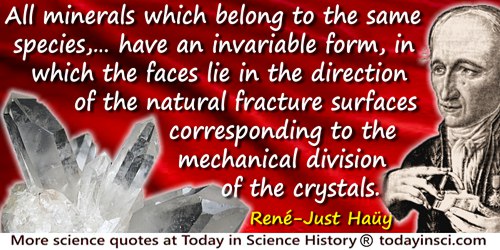
A casual glance at crystals may lead to the idea that they were pure sports of nature, but this is simply an elegant way of declaring one’s ignorance. With a thoughtful examination of them, we discover laws of arrangement. With the help of these, calculation portrays and links up the observed results. How variable and at the same time how precise and regular are these laws! How simple they are ordinarily, without losing anything of their significance! The theory which has served to develop these laws is based entirely on a fact, whose existence has hitherto been vaguely discerned rather than demonstrated. This fact is that in all minerals which belong to the same species, these little solids, which are the crystal elements and which I call their integrant molecules, have an invariable form, in which the faces lie in the direction of the natural fracture surfaces corresponding to the mechanical division of the crystals. Their angles and dimensions are derived from calculations combined with observation.
Traité de mineralogie … Publié par le conseil des mines (1801), Vol. 1, xiii-iv, trans. Albert V. and Marguerite Carozzi.
A celebrated author and divine has written to me that “he has gradually learnt to see that it is just as noble a conception of the Deity to believe that He created a few original forms capable of self-development into other and needful forms, as to believe that He required a fresh act of creation to supply the voids caused by the action of His laws.”
In Origin of Species (1860), 417.
A century ago astronomers, geologists, chemists, physicists, each had an island of his own, separate and distinct from that of every other student of Nature; the whole field of research was then an archipelago of unconnected units. To-day all the provinces of study have risen together to form a continent without either a ferry or a bridge.
From chapter 'Jottings from a Note-book', in Canadian Stories (1918), 182-183.
A chemical compound once formed would persist for ever, if no alteration took place in surrounding conditions. But to the student of Life the aspect of nature is reversed. Here, incessant, and, so far as we know, spontaneous change is the rule, rest the exception—the anomaly to be accounted for. Living things have no inertia and tend to no equilibrium.
From Address (22 Jul 1854) delivered at St. Martin’s Hall, published as a pamphlet (1854), 7, and collected in 'Educational Value of Natural History Sciences', Lay Sermons, Addresses, and Reviews (1870), 75.
A chemical name should not be a phrase, it ought not to require circumlocutions to become definite; it should not be of the type “Glauber’s salt”, which conveys nothing about the composition of the substance; it should recall the constituents of a compound; it should be non-committal if nothing is known about the substance; the names should preferably be coined from Latin or Greek, so that their meaning can be more widely and easily understood; the form of the words should be such that they fit easily into the language into which they are to be incorporated.
(1782) As quoted in Archibald Clow, Chemical Revolution: A Contribution to Social Technology (1952, 1992), 618.
A complete theory of evolution must acknowledge a balance between ‘external’ forces of environment imposing selection for local adaptation and ‘internal’ forces representing constraints of inheritance and development. Vavilov placed too much emphasis on internal constraints and downgraded the power of selection. But Western Darwinians have erred equally in practically ignoring (while acknowledging in theory) the limits placed on selection by structure and development–what Vavilov and the older biologists would have called ‘laws of form.’
…...
A great book is a mine as well as a mint: it suggests and excites as much thought as it presents in finished form.
From chapter 'Jottings from a Note-book', in Canadian Stories (1918), 182.
A great man, [who] was convinced that the truths of political and moral science are capable of the same certainty as those that form the system of physical science, even in those branches like astronomy that seem to approximate mathematical certainty.
He cherished this belief, for it led to the consoling hope that humanity would inevitably make progress toward a state of happiness and improved character even as it has already done in its knowledge of the truth.
He cherished this belief, for it led to the consoling hope that humanity would inevitably make progress toward a state of happiness and improved character even as it has already done in its knowledge of the truth.
Describing administrator and economist Anne-Robert-Jacques Turgot in Essai sur l’application de l’analyse à la probabilité des décisions rendues à la pluralité des voix (1785), i. Cited epigraph in Charles Coulston Gillispie, Science and Polity in France: The End of the Old Regime (2004), 3
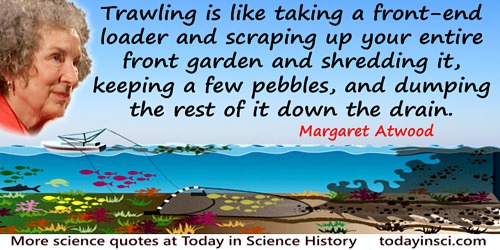
A huge net is being dragged across the sea floor, destroying everything in its path. Ahead of it bloom undersea forests and their hundreds and thousands of living creatures, both plant and animal; behind it is a desert. The net is pulled to the surface and most of the dead and dying life forms in it are thrown out. A few marketable species are retained. [Trawling] is like taking a front-end loader and scraping up your entire front garden and shredding it, keeping a few pebbles, and dumping the rest of it down the drain.
In Payback: Debt and the Shadow Side of Wealth (2008), 191.
A new era of ocean exploration can yield discoveries that will help inform everything from critical medical advances to sustainable forms of energy. Consider that AZT, an early treatment for HIV, is derived from a Caribbean reef sponge, or that a great deal of energy—from offshore wind, to OTEC (ocean thermal energy conservation), to wind and wave energy—is yet untapped in our oceans.
In 'Why Exploring the Ocean is Mankind’s Next Giant Leap', contributed to CNN 'Lightyears Blog' (13 Mar 2012).
A noteworthy and often-remarked similarity exists between the facts and methods of geology and those of linguistic study. The science of language is, as it were, the geology of the most modern period, the Age of the Man, having for its task to construct the history of development of the earth and its inhabitants from the time when the proper geological record remains silent … The remains of ancient speech are like strata deposited in bygone ages, telling of the forms of life then existing, and of the circumstances which determined or affected them; while words are as rolled pebbles, relics of yet more ancient formations, or as fossils, whose grade indicates the progress of organic life, and whose resemblances and relations show the correspondence or sequence of the different strata; while, everywhere, extensive denudation has marred the completeness of the record, and rendered impossible a detailed exhibition of the whole course of development.
In Language and the Study of Language (1867), 47.
A number of years ago, when I was a freshly-appointed instructor, I met, for the first time, a certain eminent historian of science. At the time I could only regard him with tolerant condescension.
I was sorry of the man who, it seemed to me, was forced to hover about the edges of science. He was compelled to shiver endlessly in the outskirts, getting only feeble warmth from the distant sun of science-in-progress; while I, just beginning my research, was bathed in the heady liquid heat up at the very center of the glow.
In a lifetime of being wrong at many a point, I was never more wrong. It was I, not he, who was wandering in the periphery. It was he, not I, who lived in the blaze.
I had fallen victim to the fallacy of the “growing edge;” the belief that only the very frontier of scientific advance counted; that everything that had been left behind by that advance was faded and dead.
But is that true? Because a tree in spring buds and comes greenly into leaf, are those leaves therefore the tree? If the newborn twigs and their leaves were all that existed, they would form a vague halo of green suspended in mid-air, but surely that is not the tree. The leaves, by themselves, are no more than trivial fluttering decoration. It is the trunk and limbs that give the tree its grandeur and the leaves themselves their meaning.
There is not a discovery in science, however revolutionary, however sparkling with insight, that does not arise out of what went before. “If I have seen further than other men,” said Isaac Newton, “it is because I have stood on the shoulders of giants.”
I was sorry of the man who, it seemed to me, was forced to hover about the edges of science. He was compelled to shiver endlessly in the outskirts, getting only feeble warmth from the distant sun of science-in-progress; while I, just beginning my research, was bathed in the heady liquid heat up at the very center of the glow.
In a lifetime of being wrong at many a point, I was never more wrong. It was I, not he, who was wandering in the periphery. It was he, not I, who lived in the blaze.
I had fallen victim to the fallacy of the “growing edge;” the belief that only the very frontier of scientific advance counted; that everything that had been left behind by that advance was faded and dead.
But is that true? Because a tree in spring buds and comes greenly into leaf, are those leaves therefore the tree? If the newborn twigs and their leaves were all that existed, they would form a vague halo of green suspended in mid-air, but surely that is not the tree. The leaves, by themselves, are no more than trivial fluttering decoration. It is the trunk and limbs that give the tree its grandeur and the leaves themselves their meaning.
There is not a discovery in science, however revolutionary, however sparkling with insight, that does not arise out of what went before. “If I have seen further than other men,” said Isaac Newton, “it is because I have stood on the shoulders of giants.”
Adding A Dimension: Seventeen Essays on the History of Science (1964), Introduction.
A nutritive centre, anatomically considered, is merely a cell, the nucleus of which is the permanent source of successive broods of young cells, which from time to time fill the cavity of their parent, and carrying with them the cell wall of the parent, pass off in certain directions, and under various forms, according to the texture or organ of which their parent forms a part.
Anatomical and Pathological Observations (1845), 2.
A physician’s subject of study is necessarily the patient, and his first field for observation is the hospital. But if clinical observation teaches him to know the form and course of diseases, it cannot suffice to make him understand their nature; to this end he must penetrate into the body to find which of the internal parts are injured in their functions. That is why dissection of cadavers and microscopic study of diseases were soon added to clinical observation. But to-day these various methods no longer suffice; we must push investigation further and, in analyzing the elementary phenomena of organic bodies, must compare normal with abnormal states. We showed elsewhere how incapable is anatomy alone to take account of vital phenenoma, and we saw that we must add study of all physico-chemical conditions which contribute necessary elements to normal or pathological manifestations of life. This simple suggestion already makes us feel that the laboratory of a physiologist-physician must be the most complicated of all laboratories, because he has to experiment with phenomena of life which are the most complex of all natural phenomena.
From An Introduction to the Study of Experimental Medicine (1865), as translated by Henry Copley Greene (1957), 140-141.
A principle of induction would be a statement with the help of which we could put inductive inferences into a logically acceptable form. In the eyes of the upholders of inductive logic, a principle of induction is of supreme importance for scientific method: “... this principle”, says Reichenbach, “determines the truth of scientific theories. To eliminate it from science would mean nothing less than to deprive science of the power to decide the truth or falsity of its theories. Without it, clearly, science would no longer have the right to distinguish its theories from the fanciful and arbitrary creations of the poet’s mind.” Now this principle of induction cannot be a purely logical truth like a tautology or an analytic statement. Indeed, if there were such a thing as a purely logical principle of induction, there would be no problem of induction; for in this case, all inductive inferences would have to be regarded as purely logical or tautological transformations, just like inferences in inductive logic. Thus the principle of induction must be a synthetic statement; that is, a statement whose negation is not self-contradictory but logically possible. So the question arises why such a principle should be accepted at all, and how we can justify its acceptance on rational grounds.
…...
A science calling itself “psychology” and professing to be a science of the human mind (not merely the sick mind), ought to form its estimate of human beings by taking into account healthy minds as well as sick ones.
In Introduction to the New Existentialism (1966), 15.
A strict materialist believes that everything depends on the motion of matter. He knows the form of the laws of motion though he does not know all their consequences when applied to systems of unknown complexity.
Now one thing in which the materialist (fortified with dynamical knowledge) believes is that if every motion great & small were accurately reversed, and the world left to itself again, everything would happen backwards the fresh water would collect out of the sea and run up the rivers and finally fly up to the clouds in drops which would extract heat from the air and evaporate and afterwards in condensing would shoot out rays of light to the sun and so on. Of course all living things would regrede from the grave to the cradle and we should have a memory of the future but not of the past.
The reason why we do not expect anything of this kind to take place at any time is our experience of irreversible processes, all of one kind, and this leads to the doctrine of a beginning & an end instead of cyclical progression for ever.
Now one thing in which the materialist (fortified with dynamical knowledge) believes is that if every motion great & small were accurately reversed, and the world left to itself again, everything would happen backwards the fresh water would collect out of the sea and run up the rivers and finally fly up to the clouds in drops which would extract heat from the air and evaporate and afterwards in condensing would shoot out rays of light to the sun and so on. Of course all living things would regrede from the grave to the cradle and we should have a memory of the future but not of the past.
The reason why we do not expect anything of this kind to take place at any time is our experience of irreversible processes, all of one kind, and this leads to the doctrine of a beginning & an end instead of cyclical progression for ever.
Letter to Mark Pattison (7 Apr 1868). In P. M. Hannan (ed.), The Scientific Letters and Papers of James Clerk Maxwell (1995), Vol. 2, 1862-1873, 360-1.
A vast number, perhaps the numerical majority, of animal forms cannot be shown unequivocally to possess mind.
In 'The Brain Collaborates With Psyche', Man On His Nature: The Gifford Lectures, Edinburgh 1937-8 (1940), 284.
About two-thirds of the oxygen in our atmosphere is produced in the surface waters of the sea by phytoplankton, the minute forms of algae that give the sea its slightly green hue, and which initiate the entire food web of the ocean.
In 'Ocean Policy and Reasonable Utopias', The Forum (Summer 1981), 16, No. 5, 899-900.
According to our ancient Buddhist texts, a thousand million solar systems make up a galaxy. … A thousand million of such galaxies form a supergalaxy. … A thousand million supergalaxies is collectively known as supergalaxy Number One. Again, a thousand million supergalaxy Number
Ones form a Supergalaxy Number Two. A thousand million supergalaxy Number Twos make up a supergalaxy Number Three, and of these, it is stated in the texts that there are a countless number in the universe.
In 'Reactions to Man’s Landing on the Moon Show Broad Variations in Opinions', The New York Times (21 Jul 1969), 6.
Active experimentation must force the apparent facts of nature into forms different to those in which they familiarly present themselves; and thus make them tell the truth about themselves, as torture may compel an unwilling witness to reveal what he has been concealing.
In Reconstruction in Philosophy (1920), 32.
After a certain high level of technical skill is achieved, science and art tend to coalesce in esthetics, plasticity, and form. The greatest scientists are always artists as well.
Remark (1923) as recalled in Archibald Henderson, Durham Morning Herald (21 Aug 1955) in Einstein Archive 33-257. Quoted in Alice Calaprice, The Quotable Einstein (1996), 171.
After an orange cloud—formed as a result of a dust storm over the Sahara and caught up by air currents—reached the Philippines and settled there with rain, I understood that we are all sailing in the same boat.
In Jack Hassard and Julie Weisberg , Environmental Science on the Net: The Global Thinking Project (1999), 40.
After death, life reappears in a different form and with different laws. It is inscribed in the laws of the permanence of life on the surface of the earth and everything that has been a plant and an animal will be destroyed and transformed into a gaseous, volatile and mineral substance.
Quoted in Patrice Debré, Louis Pasteur, trans. Elborg Forster (1994), 110.
Again and again in reading even his [William Thomson] most abstract writings one is struck by the tenacity with which physical ideas control in him the mathematical form in which he expressed them. An instance of this is afforded by … an example of a mathematical result that is, in his own words, “not instantly obvious from the analytical form of my solution, but which we immediately see must be the case by thinking of the physical meaning of the result.”
As given in Life of Lord Kelvin (1910), Vol. 2, 1136. The ellipsis gives the reference to the quoted footnote, to a passage in his Mathematical and Physical Papers, Vol. 1, 457. [Note: William Thomson, later became Lord Kelvin. —Webmaster]
All appearances to the contrary, the only watchmaker in nature is the blind forces of physics, albeit deployed in very special way. A true watchmaker has foresight: he designs his cogs springs, and plans their interconnections, with a future purpose in his mind's eye. Natural selection, the blind, unconscious, automatic process which Darwin discovered, and which we now know is the explanation for the existence and apparently purposeful form of all life, has no purpose in mind. It has no mind and no mind's eye. It does not plan for the future. It has no vision, no foresight, no sight at all. If it can be said to play the role of watchmaker in nature, it is the blind watchmaker.
The Blind Watchmaker (1986), 5.
All government, in its essence, is organized exploitation, and in virtually all its existing forms it is the implacable enemy of every industrious and well-disposed man ... The typical politician is not only a rascal but also a jackass, so he greatly values the puerile notoriety and adulation that sensible men try to avoid.
…...
All knowledge resolves itself into probability. ... In every judgment, which we can form concerning probability, as well as concerning knowledge, we ought always to correct the first judgment deriv’d from the nature of the object, by another judgment, deriv’d from the nature of the understanding.
In A treatise of Human Nature (1888), 181-182.
All living forms are the results of physical influences which are still in operation, and vary only in degree and direction
Entry for Gottfried Reinhold Treviranus in Encyclopedia Britannica (1911), Vol. 27, 256.
All Nature is linked together by invisible bonds and every organic creature, however low, however feeble, however dependent, is necessary to the well-being of some other among the myriad forms of life.
From Man and Nature (1864), 109.
All of our experience indicates that life can manifest itself only in a concrete form, and that it is bound to certain substantial loci. These loci are cells and cell formations. But we are far from seeking the last and highest level of understanding in the morphology of these loci of life. Anatomy does not exclude physiology, but physiology certainly presupposes anatomy. The phenomena that the physiologist investigates occur in special organs with quite characteristic anatomical arrangements; the various morphological parts disclosed by the anatomist are the bearers of properties or, if you will, of forces probed by the physiologist; when the physiologist has established a law, whether through physical or chemical investigation, the anatomist can still proudly state: This is the structure in which the law becomes manifest.
In 'Cellular-Pathologie', Archiv für pathologische Anatomie und Physiologie und fur klinische Medizin (1855), 8, 19, as translated in LellandJ. Rather, 'Cellular Pathology', Disease, Life, and Man: Selected Essays by Rudolf Virchow (1958), 84.
All organs of an animal form a single system, the parts of which hang together, and act and re-act upon one another; and no modifications can appear in one part without bringing about corresponding modifications in all the rest.
Histoire des Progrès des Sciences naturelles depuis (1789), Vol. I, 310. Quoted in E. S. Russell, Form and Function(1916), 35.
All the different classes of beings which taken together make up the universe are, in the ideas of God who knows distinctly their essential gradations, only so many ordinates of a single curve so closely united that it would be impossible to place others between any two of them, since that would imply disorder and imperfection. Thus men are linked with the animals, these with the plants and these with the fossils which in turn merge with those bodies which our senses and our imagination represent to us as absolutely inanimate. And, since the law of continuity requires that when the essential attributes of one being approximate those of another all the properties of the one must likewise gradually approximate those of the other, it is necessary that all the orders of natural beings form but a single chain, in which the various classes, like so many rings, are so closely linked one to another that it is impossible for the senses or the imagination to determine precisely the point at which one ends and the next begins?all the species which, so to say, lie near the borderlands being equivocal, at endowed with characters which might equally well be assigned to either of the neighboring species. Thus there is nothing monstrous in the existence zoophytes, or plant-animals, as Budaeus calls them; on the contrary, it is wholly in keeping with the order of nature that they should exist. And so great is the force of the principle of continuity, to my thinking, that not only should I not be surprised to hear that such beings had been discovered?creatures which in some of their properties, such as nutrition or reproduction, might pass equally well for animals or for plants, and which thus overturn the current laws based upon the supposition of a perfect and absolute separation of the different orders of coexistent beings which fill the universe;?not only, I say, should I not be surprised to hear that they had been discovered, but, in fact, I am convinced that there must be such creatures, and that natural history will perhaps some day become acquainted with them, when it has further studied that infinity of living things whose small size conceals them for ordinary observation and which are hidden in the bowels of the earth and the depth of the sea.
Lettre Prétendue de M. De Leibnitz, à M. Hermann dont M. Koenig a Cité le Fragment (1753), cxi-cxii, trans. in A. O. Lovejoy, Great Chain of Being: A Study of the History of an Idea (1936), 144-5.
All the life of the universe may be regarded as manifestations of energy masquerading in various forms, and all the changes in the universe as energy running about from one of these forms to the other, but always without altering the total amount.
In The Universe Around Us (1929, 1934), 114-115. Also in David Dietz, 'Cultural Values of Physics', Annual Report of the Report of the Board of Regents of The Smithsonian Institution: 1940 (1941), quoted on p.149 and cited in footnote 10 on p.154.
All the species recognized by Botanists came forth from the Almighty Creator’s hand, and the number of these is now and always will be exactly the same, while every day new and different florists’ species arise from the true species so-called by Botanists, and when they have arisen they finally revert to the original forms. Accordingly to the former have been assigned by Nature fixed limits, beyond which they cannot go: while the latter display without end the infinite sport of Nature.
In Philosophia Botanica (1751), aphorism 310. Trans. Frans A. Stafleu, Linnaeus and the Linnaeans: The Spreading of their Ideas in Systematic Botany, 1735-1789 (1971), 90.
All tissues are formed from cells and every cell from a cell. [? Misquoted]
Although apparently misquoted and misattributed, Webmaster includes this as an interesting variant, presumably, of Raspail’s Omnis cellula e cellula dictum (also popularized by Rudolf Virchow). The above quote was given as an aphorism apparently misattributed as “Schwann’s Law,” in by J.W. Young, in 'Causation of Tumors', Western Medical Review (15 Jul 1898), 3, 262. Webmaster has not yet found another source either with this wording, or as “Schwann’s Law.” Webmaster suspects J.W. Young misquoted and misattributed the quote.
Almighty God, to whose efficacious Word all things owe their original, abounding in his own glorious Essence with infinite goodness and fecundity, did in the beginning Create Man after his own likeness, Male and Female, created he them; the true distinction of which Sexes, consists merely in the different site of those parts of the body, wherein Generation necessarily requires a Diversity: for both Male and Female he impartially endued with the same, and altogether indifferent form of Soul, the Woman being possess’d of no less excellent Faculties of Mind, Reason, and Speech, than the Man, and equally with him aspiring to those Regions of Bliss and Glory, where there shall be no exception of Sex.
In Female Pre-eminence: Or, The Dignity and Excellency of that Sex above the Male, translation (1670).
Also the earth is not spherical, as some have said, although it tends toward sphericity, for the shape of the universe is limited in its parts as well as its movement… . The movement which is more perfect than others is, therefore, circular, and the corporeal form which is the most perfect is the sphere.
Aluminum is at once as white as silver, as incorrodible as gold, as tenacious as iron, as fusible as copper, and as light as glass. It is easily worked; it is widely spread in nature, alumina forming the bases of most rocks; it is three times lighter than iron; in short, it seems to have been created expressly to furnish material for our projectile!
Planning a spacecraft to be fired from a cannon to the moon. In From the Earth to the Moon (1865, 1890), 38.
America forms the longest and straightest bone in the earth's skeleton.
The Red Man's Continent: A Chronicle of Aboriginal America (1919), 36.
America’s technology has turned in upon itself; its corporate form makes it the servant of profits, not the servant of human needs.
quoted in Robin Morgan, Sisterhood is Powerful (1970).
Among natural bodies some have, and some have not, life; and by life we mean the faculties of self-nourishment, self-growth and self-decay. Thus every natural body partaking of life may be regarded as an essential existence; … but then it is an existence only in combination. … And since the organism is such a combination, being possessed of life, it cannot be the Vital Principle. Therefore it follows that the Vital Principle most be an essence, as being the form of a natural body, holding life in potentiality; but essence is a reality (entetechie). The Vital Principle is the original reality of a natural body endowed with potential life; this, however, is to be understood only of a body which may be organized. Thus the parts even of plants are organs, but they are organs that are altogether simple; as the leaf which is the covering of the pericarp, the pericarp of the fruit. If, then, there be any general formula for every kind of Vital Principle, it is—tthe primary reality of an organism.
In George Henry Lewes, Aristotle (1864), 231.
An anecdote is an historical molecule…. The general form of history is a fusion of anecdotes.
In M.J. Hope (ed., trans.), Novalis: His Life, Thoughts, and Works (1891), 188.
An evolution is a series of events that in itself as series is purely physical, — a set of necessary occurrences in the world of space and time. An egg develops into a chick; … a planet condenses from the fluid state, and develops the life that for millions of years makes it so wondrous a place. Look upon all these things descriptively, and you shall see nothing but matter moving instant after instant, each instant containing in its full description the necessity of passing over into the next. … But look at the whole appreciatively, historically, synthetically, as a musician listens to a symphony, as a spectator watches a drama. Now you shall seem to have seen, in phenomenal form, a story.
In The Spirit of Modern Philosophy: An Essay in the Form of Lectures (1892), 425.
An inventor is simply a fellow who doesn’t take his education too seriously. You see, from the time a person is six years old until he graduates form college he has to take three or four examinations a year. If he flunks once, he is out. But an inventor is almost always failing. He tries and fails maybe a thousand times. It he succeeds once then he’s in. These two things are diametrically opposite. We often say that the biggest job we have is to teach a newly hired employee how to fail intelligently. We have to train him to experiment over and over and to keep on trying and failing until he learns what will work.
In 'How Can We Develop Inventors?' presented to the Annual meeting of the American Society of Society Engineers. Reprinted in Mechanical Engineering (Apr 1944). Collected in Prophet of Progress: Selections from the Speeches of Charles F. Kettering (1961), 108.
An iron rod being placed on the outside of a building from the highest part continued down into the moist earth, in any direction strait or crooked, following the form of the roof or other parts of the building, will receive the lightning at its upper end, attracting it so as to prevent it's striking any other part; and, affording it a good conveyance into the earth, will prevent its damaging any part of the building.
Of Lightning, and the Method (now used in America) of securing Buildings and Persons from its mischievous Effects', Paris 1767. In I. Bernard Cohen (ed.), Benjamin Franklin's Experiments (1941), 390.
Analogy is a wonderful, useful and most important form of thinking, and biology is saturated with it. Nothing is worse than a horrible mass of undigested facts, and facts are indigestible unless there is some rhyme or reason to them. The physicist, with his facts, seeks reason; the biologist seeks something very much like rhyme, and rhyme is a kind of analogy.... This analogizing, this fine sweeping ability to see likenesses in the midst of differences is the great glory of biology, but biologists don't know it.... They have always been so fascinated and overawed by the superior prestige of exact physical science that they feel they have to imitate it.... In its central content, biology is not accurate thinking, but accurate observation and imaginative thinking, with great sweeping generalizations.
In Science is a Sacred Cow (1950), 98-100.
Anaximenes ... said that infinite air was the principle, from which the things that are becoming, and that are, and that shall be, and gods and things divine, all come into being, and the rest from its products. The form of air is of this kind: whenever it is most equable it is invisible to sight, but is revealed by the cold and the hot and the damp and by movement. It is always in motion; for things that change do not change unless there be movement. Through becoming denser or finer it has different appearances; for when it is dissolved into what is finer it becomes fire, while winds, again, are air that is becoming condensed, and cloud is produced from air by felting. When it is condensed still more, water is produced; with a further degree of condensation earth is produced, and when condensed as far as possible, stones. The result is that the most influential components of the generation are opposites, hot and cold.
Hippolytus, Refutation, 1.7.1. In G. S. Kirk, J. E. Raven and M. Schofield (eds.), The Presocratic Philosophers: A Critical History with a Selection of Texts (1983), p. 145.
And by the influence of heat, light, and electrical powers, there is a constant series of changes [in animal and vegetal substances]; matter assumes new forms, the destruction of one order of beings tends to the conservation of another, solution and consolidation, decay and renovation, are connected, and whilst the parts of the system, continue in a state of fluctuation and change, the order and harmony of the whole remain unalterable.
The Elements of Agricultural Chemistry (1813), in J. Davy (ed.) The Collected Works of Sir Humphry Davy(1839-40), Vol 7, 182.
And do you know what “the world” is to me? Shall I show it to you in my mirror? This world: a monster of energy, without beginning, without end; a firm, iron magnitude of force that does not grow bigger or smaller, that does not expend itself but only transforms itself; as a whole, of unalterable size, a household without expenses or losses, but likewise without increase or income; enclosed by “nothingness”' as by a boundary; not by something blurry or wasted, not something endlessly extended, but set in a definite space as a definite force, and not a space that might be “empty” here or there, but rather as force throughout, as a play of forces and waves of forces, at the same time one and many, increasing here and at the same time decreasing there; a sea of forces flowing and rushing together, eternally changing, eternally flooding back, with tremendous years of recurrence, with an ebb and a flood of its forms; out of the simplest forms striving toward the most complex, out of the stillest, most rigid, coldest forms toward the hottest, most turbulent, most self-contradictory, and then again returning home to the simple out of this abundance, out of the play of contradictions back to the joy of concord, still affirming itself in this uniformity of its courses and its years, blessing itself as that which must return eternally, as a becoming that knows no satiety, no disgust, no weariness: this, my Dionysian world of the eternally self-creating, the eternally self-destroying, this mystery world of the twofold voluptuous delight, my “beyond good and evil,” without goal, unless the joy of the circle itself is a goal; without will, unless a ring feels good will toward itself-do you want a name for this world? A solution for all its riddles? A light for you, too, you best-concealed, strongest, most intrepid, most midnightly men?—This world is the will to power—and nothing besides! And you yourselves are also this will to power—and nothing besides!
The Will to Power (Notes written 1883-1888), book 4, no. 1067. Trans. W. Kaufmann and R. J. Hollingdale and ed. W. Kaufmann (1968), 549-50.
And from this such small difference of eight minutes [of arc] it is clear why Ptolemy, since he was working with bisection [of the linear eccentricity], accepted a fixed equant point… . For Ptolemy set out that he actually did not get below ten minutes [of arc], that is a sixth of a degree, in making observations. To us, on whom Divine benevolence has bestowed the most diligent of observers, Tycho Brahe, from whose observations this eight-minute error of Ptolemy’s in regard to Mars is deduced, it is fitting that we accept with grateful minds this gift from God, and both acknowledge and build upon it. So let us work upon it so as to at last track down the real form of celestial motions (these arguments giving support to our belief that the assumptions are incorrect). This is the path I shall, in my own way, strike out in what follows. For if I thought the eight minutes in [ecliptic] longitude were unimportant, I could make a sufficient correction (by bisecting the [linear] eccentricity) to the hypothesis found in Chapter 16. Now, because they could not be disregarded, these eight minutes alone will lead us along a path to the reform of the whole of Astronomy, and they are the matter for a great part of this work.
Astronomia Nova, New Astronomy (1609), ch. 19, 113-4, Johannes Kepler Gesammelte Werke (1937-), Vol. 3, 177-8.
And ye who wish to represent by words the form of man and all the aspects of his membrification, get away from that idea. For the more minutely you describe, the more you will confuse the mind of the reader and the more you will prevent him from a knowledge of the thing described. And so it is necessary to draw and describe.
From Notebooks (AnA, 14v; Cf. QII, 1), as translated by J. Playfair McMurrich, in Leonardo da Vinci the Anatomist (1930), 76, (Institution Publication 411, Carnegie Institution of Washington).
And yet the books which then I valued most
Are dearest to me now; for, having scanned,
Not heedlessly, the laws, and watched the forms
Of Nature, in that knowledge I possessed
A standard, often usefully applied,
Even when unconsciously, to things removed
From a familiar sympathy.
Are dearest to me now; for, having scanned,
Not heedlessly, the laws, and watched the forms
Of Nature, in that knowledge I possessed
A standard, often usefully applied,
Even when unconsciously, to things removed
From a familiar sympathy.
From 'The Prelude' in Book 5, collected in Henry Reed (ed.), The Complete Poetical Works of William Wordsworth (1851), 503.
Anthropology has reached that point of development where the careful investigation of facts shakes our firm belief in the far-reaching theories that have been built up. The complexity of each phenomenon dawns on our minds, and makes us desirous of proceeding more cautiously. Heretofore we have seen the features common to all human thought. Now we begin to see their differences. We recognize that these are no less important than their similarities, and the value of detailed studies becomes apparent. Our aim has not changed, but our method must change. We are still searching for the laws that govern the growth of human culture, of human thought; but we recognize the fact that before we seek for what is common to all culture, we must analyze each culture by careful and exact methods, as the geologist analyzes the succession and order of deposits, as the biologist examines the forms of living matter. We see that the growth of human culture manifests itself in the growth of each special culture. Thus we have come to understand that before we can build up the theory of the growth of all human culture, we must know the growth of cultures that we find here and there among the most primitive tribes of the Arctic, of the deserts of Australia, and of the impenetrable forests of South America; and the progress of the civilization of antiquity and of our own times. We must, so far as we can, reconstruct the actual history of mankind, before we can hope to discover the laws underlying that history.
The Jesup North Pacific Expedition: Memoir of the American Museum of Natural History (1898), Vol. 1, 4.
Any experiment may be regarded as forming an individual of a 'population' of experiments which might be performed under the same conditions. A series of experiments is a sample drawn from this population.
Now any series of experiments is only of value in so far as it enables us to form a judgment as to the statistical constants of the population to which the experiments belong. In a great number of cases the question finally turns on the value of a mean, either directly, or as the mean difference between the two qualities.
If the number of experiments be very large, we may have precise information as to the value of the mean, but if our sample be small, we have two sources of uncertainty:— (I) owing to the 'error of random sampling' the mean of our series of experiments deviates more or less widely from the mean of the population, and (2) the sample is not sufficiently large to determine what is the law of distribution of individuals.
Now any series of experiments is only of value in so far as it enables us to form a judgment as to the statistical constants of the population to which the experiments belong. In a great number of cases the question finally turns on the value of a mean, either directly, or as the mean difference between the two qualities.
If the number of experiments be very large, we may have precise information as to the value of the mean, but if our sample be small, we have two sources of uncertainty:— (I) owing to the 'error of random sampling' the mean of our series of experiments deviates more or less widely from the mean of the population, and (2) the sample is not sufficiently large to determine what is the law of distribution of individuals.
'The Probable Error of a Mean', Biometrika, 1908, 6, 1.
Any opinion as to the form in which the energy of gravitation exists in space is of great importance, and whoever can make his opinion probable will have, made an enormous stride in physical speculation. The apparent universality of gravitation, and the equality of its effects on matter of all kinds are most remarkable facts, hitherto without exception; but they are purely experimental facts, liable to be corrected by a single observed exception. We cannot conceive of matter with negative inertia or mass; but we see no way of accounting for the proportionality of gravitation to mass by any legitimate method of demonstration. If we can see the tails of comets fly off in the direction opposed to the sun with an accelerated velocity, and if we believe these tails to be matter and not optical illusions or mere tracks of vibrating disturbance, then we must admit a force in that direction, and we may establish that it is caused by the sun if it always depends upon his position and distance.
Letter to William Huggins (13 Oct 1868). In P. M. Hannan (ed.), The Scientific Letters and Papers of James Clerk Maxwell (1995), Vol. 2, 1862-1873, 451-2.
Archimedes [indicates] that there can be no true levelling by means of water, because he holds that water has not a level surface, but is of a spherical form, having its centre at the centre of the earth.
In De Architectura, Book 8, Chap 5, Sec. 3. As translated in Morris Hicky Morgan (trans.), Vitruvius: The Ten Books on Architecture (1914), 243.
Art arises in those strange complexities of action that are called human beings. It is a kind of human behavior. As such it is not magic, except as human beings are magical. Nor is it concerned in absolutes, eternities, “forms,” beyond those that may reside in the context of the human being and be subject to his vicissitudes. Art is not an inner state of consciousness, whatever that may mean. Neither is it essentially a supreme form of communication. Art is human behavior, and its values are contained in human behavior.
In Art Is Action: A Discussion of Nine Arts in a Modern World (1939), 1.
Art creates an incomparable and unique effect, and, having done so, passes on to other things. Nature, upon the other hand, forgetting that imitation can be made the sincerest form of insult, keeps on repeating the effect until we all become absolutely wearied of it.
In 'Decay of Lying', The Writings of Oscar Wilde: Epigrams, Phrases and Philosophies For the Use of the Young (1907), 8.
As an antiquary of a new order, I have been obliged to learn the art of deciphering and restoring these remains, of discovering and bringing together, in their primitive arrangement, the scattered and mutilated fragments of which they are composed, of reproducing in all their original proportions and characters, the animals to which these fragments formerly belonged, and then of comparing them with those animals which still live on the surface of the earth; an art which is almost unknown, and which presupposes, what had scarcely been obtained before, an acquaintance with those laws which regulate the coexistence of the forms by which the different parts of organized being are distinguished.
'Preliminary discourse', to Recherches sur les Ossemens Fossiles (1812), trans. R. Kerr Essay on the Theory of the Earth (1813), 1-2.
As far as the meaning of life in general, or in the abstract, as far as I can see, there is none. If all of life were suddenly to disappear from earth and anywhere else it may exist, or if none had ever formed in the first place, I think the Universe would continue to exist without perceptible change. However, it is always possible for an individual to invest his own life with meaning that he can find significant. He can so order his life that he may find as much beauty and wisdom in it as he can, and spread as much of that to others as possible.
In a book proposal for The Meaning of Life edited by Hugh S. Moorhead, 1989.
As far as we know in the universe, man is unique. He happens to represent the highest form of organization of matter and energy that has ever appeared.
In The Meaning of Evolution (Rev.Ed. 1967), 345.
As great Pythagoras of yore,
Standing beside the blacksmith’s door,
And hearing the hammers, as they smote
The anvils with a different note,
Stole from the varying tones, that hung
Vibrant on every iron tongue,
The secret of the sounding wire.
And formed the seven-chorded lyre.
Standing beside the blacksmith’s door,
And hearing the hammers, as they smote
The anvils with a different note,
Stole from the varying tones, that hung
Vibrant on every iron tongue,
The secret of the sounding wire.
And formed the seven-chorded lyre.
From poem 'To A Child' (1847), as collected in The Poetical Works of H.W. Longfellow (1855), 132.
As I have already mentioned, wherever cells are formed, this tough fluid precedes the first solid structures that indicate the presence of future cells. Moreover, we must assume that this substance furnishes the material for the formation of the nucleus and of the primitive sac, not only because these structures are closely apposed to it, but also because,they react to iodine in the same way. We must assume also that the organization of this substance is the process that inaugurates the formation of new cells. It therefore seems justifiable for me to propose a name that refers to its physiological function: I propose the word protoplasma.
H. Mohl, Botanisch Zeitung (1846), 4, col. 73, trans. Henry Harris, The Birth of the Cell (1999), 75.
As long as museums and universities send out expeditions to bring to light new forms of living and extinct animals and new data illustrating the interrelations of organisms and their environments, as long as anatomists desire a broad comparative basis human for anatomy, as long as even a few students feel a strong curiosity to learn about the course of evolution and relationships of animals, the old problems of taxonomy, phylogeny and evolution will gradually reassert themselves even in competition with brilliant and highly fruitful laboratory studies in cytology, genetics and physiological chemistry.
'Genetics Versus Paleontology', The American Naturalist, 1917, 51, 623.
As one penetrates from seam to seam, from stratum to stratum and discovers, under the quarries of Montmartre or in the schists of the Urals, those animals whose fossilized remains belong to antediluvian civilizations, the mind is startled to catch a vista of the milliards of years and the millions of peoples which the feeble memory of man and an indestructible divine tradition have forgotten and whose ashes heaped on the surface of our globe, form the two feet of earth which furnish us with bread and flowers.
From 'La Peau de Chagrin' (1831). As translated as The Wild Ass’s Skin (1906) trans. Herbert J. Hunt, The Wild Ass's Skin (1977), 40-1.
As science has supplanted its predecessors, so it may hereafter be superseded by some more perfect hypothesis, perhaps by some totally different way of looking at the phenomena—of registering the shadows on the screen—of which we in this generation can form no idea. The advance of knowledge is an infinite progression towards a goal that for ever recedes.
In The Golden Bough: A Study in Magic and Religion (1890, 1900), Vol. 3, 460.
As systematic unity is what first raises ordinary knowledge to the rank of science, that is, makes a system out of a mere aggregate of knowledge, architectonic is the doctrine of the scientific in our knowledge, and therefore necessarily forms part of the doctrine of method.
In'The Transcendental Doctrine of Method', Critique of Pure Reason (2016), 653. Note: architectonic = the art of constructing systems.
As the human fetus develops, its changing form seems to retrace the whole of human evolution from the time we were cosmic dust to the time we were single-celled organisms in the primordial sea to the time we were four-legged, land-dwelling reptiles and beyond, to our current status as largebrained, bipedal mammals. Thus, humans seem to be the sum total of experience since the beginning of the cosmos.
From interview with James Reston, Jr., in Pamela Weintraub (ed.), The Omni Interviews (1984), 99. Previously published in magazine, Omni (May 1982).
As they discover, from strata to strata and from layer to layer, deep in the quarries of Montmartre or the schists of the Urals, these creatures whose fossilized remains belong to antediluvian civilizations, it will strike terror into your soul to see many millions of years, many thousands of races forgotten by the feeble memory of mankind and by the indestructible divine tradition, and whose piles of ashes on the surface of our globe form the two feet of soil which gives us our bread and our flowers.
From 'La Peau de Chagrin' (1831). As translated as by Helen Constantine The Wild Ass’s Skin (2012), 19.
Ask a follower of Bacon what [science] the new philosophy, as it was called in the time of Charles the Second, has effected for mankind, and his answer is ready; “It has lengthened life; it has mitigated pain; it has extinguished diseases; it has increased the fertility of the soil; it has given new securities to the mariner; it has furnished new arms to the warrior; it has spanned great rivers and estuaries with bridges of form unknown to our fathers; it has guided the thunderbolt innocuously from heaven to earth; it has lighted up the night with the splendour of the day; it has extended the range of the human vision; it has multiplied the power of the human muscles; it has accelerated motion; it has annihilated distance; it has facilitated intercourse, correspondence, all friendly offices, all dispatch of business; it has enabled man to descend to the depths of the sea, to soar into the air, to penetrate securely into the noxious recesses of the earth, to traverse the land in cars which whirl along without horses, to cross the ocean in ships which run ten knots an hour against the wind. These are but a part of its fruits, and of its first-fruits; for it is a philosophy which never rests, which has never attained, which is never perfect. Its law is progress. A point which yesterday was invisible is its goal to-day, and will be its starting-point to-morrow.”
From essay (Jul 1837) on 'Francis Bacon' in Edinburgh Review. In Baron Thomas Babington Macaulay and Lady Trevelyan (ed.) The Works of Lord Macaulay Complete (1871), Vol. 6, 222.
Astronomy concerns itself with the whole of the visible universe, of which our earth forms but a relatively insignificant part; while Geology deals with that earth regarded as an individual. Astronomy is the oldest of the sciences, while Geology is one of the newest. But the two sciences have this in common, that to both are granted a magnificence of outlook, and an immensity of grasp denied to all the rest.
Proceedings of the Geological Society of London (1903), 59, lxviii.
Astronomy was not studied by Kepler, Galileo, or Newton for the practical applications which might result from it, but to enlarge the bounds of knowledge, to furnish new objects of thought and contemplation in regard to the universe of which we form a part; yet how remarkable the influence which this science, apparently so far removed from the sphere of our material interests, has exerted on the destinies of the world!
In 'Report of the Secretary', Annual Report of the Board of Regents of the Smithsonian Institution for 1859 (1860), 15.
At length being at Clapham where there is, on the common, a large pond which, I observed to be one day very rough with the wind, I fetched out a cruet of oil and dropt a little of it on the water. I saw it spread itself with surprising swiftness upon the surface; but the effect of smoothing the waves was not produced; for I had applied it first on the leeward side of the pond, where the waves were largest, and the wind drove my oil back upon the shore. I then went to the windward side, where they began to form; and there the oil, though not more than a tea-spoonful, produced an instant calm over a space several yards square, which spread amazingly, and extended itself gradually till it reached the leeside, making all that quarter of the pond, perhaps half an acre, as smooth as a looking-glass.
[Experiment to test an observation made at sea in 1757, when he had seen the wake of a ship smoothed, explained by the captain as presumably due to cooks emptying greasy water in to the sea through the scuppers.]
[Experiment to test an observation made at sea in 1757, when he had seen the wake of a ship smoothed, explained by the captain as presumably due to cooks emptying greasy water in to the sea through the scuppers.]
Letter, extract in 'Of the still of Waves by Means of Oil The Gentleman's Magazine (1775), Vol. 45, 82.
At quite uncertain times and places,
The atoms left their heavenly path,
And by fortuitous embraces,
Engendered all that being hath.
And though they seem to cling together,
And form 'associations' here,
Yet, soon or late, they burst their tether,
And through the depths of space career.
The atoms left their heavenly path,
And by fortuitous embraces,
Engendered all that being hath.
And though they seem to cling together,
And form 'associations' here,
Yet, soon or late, they burst their tether,
And through the depths of space career.
From 'Molecular Evolution', Nature, 8, 1873. In Lewis Campbell and William Garnett, The Life of James Clerk Maxwell (1882), 637.
At the sea shore you pick up a pebble, fashioned after a law of nature, in the exact form that best resists pressure, and worn as smooth as glass. It is so perfect that you take it as a keepsake. But could you know its history from the time when a rough fragment of rock fell from the overhanging cliff into the sea, to be taken possession of by the under currents, and dragged from one ocean to another, perhaps around the world, for a hundred years, until in reduced and perfect form it was cast upon the beach as you find it, you would have a fit illustration of what many principles, now in familiar use, have endured, thus tried, tortured and fashioned during the ages.
From Address (1 Aug 1875), 'The Growth of Principles' at Saratoga. Collected in William L. Snyder (ed.), Great Speeches by Great Lawyers: A Collection of Arguments and Speeches (1901), 246.
Attaching significance to invariants is an effort to recognize what, because of its form or colour or meaning or otherwise, is important or significant in what is only trivial or ephemeral. A simple instance of failing in this is provided by the poll-man at Cambridge, who learned perfectly how to factorize a²-b² but was floored because the examiner unkindly asked for the factors of p²–q².
In 'Recent Developments in Invariant Theory', The Mathematical Gazette (Dec 1926), 13, No. 185, 217. [Note: A poll-man is a student who takes the ordinary university degree, without honours. -Webmaster]
Available energy is energy which we can direct into any desired channel. Dissipated energy is energy which we cannot lay hold of and direct at pleasure, such as the energy of the confused agitation of molecules which we call heat. Now, confusion, like the correlative term order, is not a property of material things in themselves, but only in relation to the mind which perceives them. A memorandum-book does not, provided it is neatly written, appear confused to an illiterate person, or to the owner who understands it thoroughly, but to any other person able to read it appears to be inextricably confused. Similarly the notion of dissipated energy could not occur to a being who could not turn any of the energies of nature to his own account, or to one who could trace the motion of every molecule and seize it at the right moment. It is only to a being in the intermediate stage, who can lay hold of some forms of energy while others elude his grasp, that energy appears to be passing inevitably from the available to the dissipated state.
'Diffusion', Encyclopaedia Britannica (1878). In W. D. Niven (ed.), The Scientific Papers of James Clerk Maxwell (1890), Vol. 2, 646.
Babbage … gave the name to the [Cambridge] Analytical Society, which he stated was formed to advocate “the principles of pure d-ism as opposed to the dot-age of the university.”
In History of Mathematics (3rd Ed., 1901), 451.
Because words pass away as soon as they strike upon the air, and last no longer than their sound, men have by means of letters formed signs of words. Thus the sounds of the voice are made visible to the eye, not of course as sounds, but by means of certain signs.
In 'Origin of Writing', Christian Doctrine, Book 2, as translated by J.F. Shaw, collected in A Select Library of the Nicene and Post-Nicene Fathers of the Christian Church: Volume II: St. Augustin’s City of God and Christian Doctrine (1907), 536.
Before delivering your lectures, the manuscript should be in such a perfect form that, if need be, it could be set in type. Whether you follow the manuscript during the delivery of the lecture is purely incidental. The essential point is that you are thus master of the subject matter.
Advice to his son. As quoted in Ralph Oesper, The Human Side Of Scientists (1975), 185.
Being in love with the one parent and hating the other are among the essential constituents of the stock of psychical impulses which is formed at that time and which is of such importance in determining the symptoms of the later neurosis... This discovery is confirmed by a legend that has come down to us from classical antiquity: a legend whose profound and universal power to move can only be understood if the hypothesis I have put forward in regard to the psychology of children has an equally universal validity. What I have in mind is the legend of King Oedipus and Sophocles' drama which bears his name.
The Interpretation of Dreams (1900), In James Strachey (ed.) The Standard Edition of the Complete Psychological Works of Sigmund Freud (1953), Vol. 4, 260-1.
Besides accustoming the student to demand, complete proof, and to know when he has not obtained it, mathematical studies are of immense benefit to his education by habituating him to precision. It is one of the peculiar excellencies of mathematical discipline, that the mathematician is never satisfied with à peu près. He requires the exact truth. Hardly any of the non-mathematical sciences, except chemistry, has this advantage. One of the commonest modes of loose thought, and sources of error both in opinion and in practice, is to overlook the importance of quantities. Mathematicians and chemists are taught by the whole course of their studies, that the most fundamental difference of quality depends on some very slight difference in proportional quantity; and that from the qualities of the influencing elements, without careful attention to their quantities, false expectation would constantly be formed as to the very nature and essential character of the result produced.
In An Examination of Sir William Hamilton’s Philosophy (1878), 611. [The French phrase, à peu près means “approximately”. —Webmaster]
BRAIN, n. An apparatus with which we think that we think. That which distinguishes the man who is content to be something from the man who wishes to do something. A man of great wealth, or one who has been pitchforked into high station, has commonly such a headful of brain that his neighbors cannot keep their hats on. In our civilization, and under our republican form of government, brain is so highly honored that it is rewarded by exemption from the cares of office.
The Collected Works of Ambrose Bierce (1911), Vol. 7, The Devil's Dictionary, 41.
Break the chains of your prejudices and take up the torch of experience, and you will honour nature in the way she deserves, instead of drawing derogatory conclusions from the ignorance in which she has left you. Simply open your eyes and ignore what you cannot understand, and you will see that a labourer whose mind and knowledge extend no further than the edges of his furrow is no different essentially from the greatest genius, as would have been proved by dissecting the brains of Descartes and Newton; you will be convinced that the imbecile or the idiot are animals in human form, in the same way as the clever ape is a little man in another form; and that, since everything depends absolutely on differences in organisation, a well-constructed animal who has learnt astronomy can predict an eclipse, as he can predict recovery or death when his genius and good eyesight have benefited from some time at the school of Hippocrates and at patients' bedsides.
Machine Man (1747), in Ann Thomson (ed.), Machine Man and Other Writings (1996), 38.
But concerning vision alone is a separate science formed among philosophers, namely, optics, and not concerning any other sense ... It is possible that some other science may be more useful, but no other science has so much sweetness and beauty of utility. Therefore it is the flower of the whole of philosophy and through it, and not without it, can the other sciences be known.
Opus Majus [1266-1268], Part V, distinction I, chapter I, trans. R. B. Burke, The Opus Maius of Roger Bacon (1928), Vol. 2, 420.
But I must confess I am jealous of the term atom; for though it is very easy to talk of atoms, it is very difficult to form a clear idea of their nature, especially when compounded bodies are under consideration.
'On the Absolute Quantity of Electricity Associated with the Particles or Atoms of Matter,' (31 Dec 1833), published in Philosophical Transactions (Jan 1834) as part of Series VII. Collected in Experimental Researches in Electricity: Reprinted from the Philosophical Transactions of 1831-1838 (1839), 256.
But I shall certainly admit a system as empirical or scientific only if it is capable of being tested by experience. These considerations suggest that not the verifiability but the falsifiability of a system is to be taken as a criterion of demarcation. In other words: I shall not require of a scientific system that it shall be capable of being singled out, once and for all, in a positive sense; but I shall require that its logical form shall be such that it can be singled out, by means of empirical tests, in a negative sense: it must be possible for an empirical scientific system to be refuted by experience. (1959)
The Logic of Scientific Discovery: Logik Der Forschung (1959, 2002), 18.
But I think that in the repeated and almost entire changes of organic types in the successive formations of the earth—in the absence of mammalia in the older, and their very rare appearance (and then in forms entirely. unknown to us) in the newer secondary groups—in the diffusion of warm-blooded quadrupeds (frequently of unknown genera) through the older tertiary systems—in their great abundance (and frequently of known genera) in the upper portions of the same series—and, lastly, in the recent appearance of man on the surface of the earth (now universally admitted—in one word, from all these facts combined, we have a series of proofs the most emphatic and convincing,—that the existing order of nature is not the last of an uninterrupted succession of mere physical events derived from laws now in daily operation: but on the contrary, that the approach to the present system of things has been gradual, and that there has been a progressive development of organic structure subservient to the purposes of life.
'Address to the Geological Society, delivered on the Evening of the 18th of February 1831', Proceedings of the Geological Society (1834), 1, 305-6.
But it is precisely mathematics, and the pure science generally, from which the general educated public and independent students have been debarred, and into which they have only rarely attained more than a very meagre insight. The reason of this is twofold. In the first place, the ascendant and consecutive character of mathematical knowledge renders its results absolutely insusceptible of presentation to persons who are unacquainted with what has gone before, and so necessitates on the part of its devotees a thorough and patient exploration of the field from the very beginning, as distinguished from those sciences which may, so to speak, be begun at the end, and which are consequently cultivated with the greatest zeal. The second reason is that, partly through the exigencies of academic instruction, but mainly through the martinet traditions of antiquity and the influence of mediaeval logic-mongers, the great bulk of the elementary text-books of mathematics have unconsciously assumed a very repellant form,—something similar to what is termed in the theory of protective mimicry in biology “the terrifying form.” And it is mainly to this formidableness and touch-me-not character of exterior, concealing withal a harmless body, that the undue neglect of typical mathematical studies is to be attributed.
In Editor’s Preface to Augustus De Morgan and Thomas J. McCormack (ed.), Elementary Illustrations of the Differential and Integral Calculus (1899), v.
But of all environments, that produced by man’s complex technology is perhaps the most unstable and rickety. In its present form, our society is not two centuries old, and a few nuclear bombs will do it in.
To be sure, evolution works over long periods of time and two centuries is far from sufficient to breed Homo technikos… .
The destruction of our technological society in a fit of nuclear peevishness would become disastrous even if there were many millions of immediate survivors.
The environment toward which they were fitted would be gone, and Darwin’s demon would wipe them out remorselessly and without a backward glance.
To be sure, evolution works over long periods of time and two centuries is far from sufficient to breed Homo technikos… .
The destruction of our technological society in a fit of nuclear peevishness would become disastrous even if there were many millions of immediate survivors.
The environment toward which they were fitted would be gone, and Darwin’s demon would wipe them out remorselessly and without a backward glance.
Asimov on Physics (1976), 151. Also in Isaac Asimov’s Book of Science and Nature Quotations (1988), 181.
But of this I can assure you that there is not a movement of any body of Men however small whether on Horse-back or on foot, nor an operation or March of any description nor any Service in the field that is not formed upon some mathematical principle, and in the performance of which the knowledge and practical application of the mathematicks will be found not only useful but necessary. The application of the Mathematicks to Gunnery, Fortification, Tactics, the survey and knowledge of formal Castrenantion etc. cannot be acquired without study.
Duke of Wellington to his son Douro (1826). Quoted in A Selection of the Private Correspondence of the First Duke of Wellington (1952), 44.
But the dreams about the modes of creation, enquiries whether our globe has been formed by the agency of fire or water, how many millions of years it has cost Vulcan or Neptune to produce what the fiat of the Creator would effect by a single act of will, is too idle to be worth a single hour of any man’s life.
Letter (2 May 1826) to Doctor John P. Emmet. Collected in The Writings of Thomas Jefferson (1854), Vol. 7, 443.
But the nature of our civilized minds is so detached from the senses, even in the vulgar, by abstractions corresponding to all the abstract terms our languages abound in, and so refined by the art of writing, and as it were spiritualized by the use of numbers, because even the vulgar know how to count and reckon, that it is naturally beyond our power to form the vast image of this mistress called ‘Sympathetic Nature.’
The New Science, bk. 2, para. 378 (1744, trans. 1984).
But Truth is that besides which there is nothing: nothing to modify it, nothing to question it, nothing to form an exception: the all-inclusive, the complete — By Truth, I mean the Universal.
The Book of the Damned (1932). In The Complete Books of Charles Fort (1975), 9.
By blending water and minerals from below with sunlight and CO2 from above, green plants link the earth to the sky. We tend to believe that plants grow out of the soil, but in fact most of their substance comes from the air. The bulk of the cellulose and the other organic compounds produced through photosynthesis consists of heavy carbon and oxygen atoms, which plants take directly from the air in the form of CO2. Thus the weight of a wooden log comes almost entirely from the air. When we burn a log in a fireplace, oxygen and carbon combine once more into CO2, and in the light and heat of the fire we recover part of the solar energy that went into making the wood.
The Web of Life: A New Scientific Understanding of Living Systems (1997), 178.
By firm immutable immortal laws Impress’d on Nature by the GREAT FIRST CAUSE,
Say, MUSE! how rose from elemental strife
Organic forms, and kindled into life;
How Love and Sympathy with potent charm
Warm the cold heart, the lifted hand disarm;
Allure with pleasures, and alarm with pains,
And bind Society in golden chains.
Say, MUSE! how rose from elemental strife
Organic forms, and kindled into life;
How Love and Sympathy with potent charm
Warm the cold heart, the lifted hand disarm;
Allure with pleasures, and alarm with pains,
And bind Society in golden chains.
From 'Production of Life', The Temple of Nature; or, The Origin of Society: A Poem, with Philosophical Notes (1803), 3, Canto I, lines 1-8.
By the agitation of water and silt, and their gradual accumulation and consolidation... the rocks were formed gradually by the evolution of sediments in water.
— Ye Zi-qi
Cao Mu Zi (1959), trans. Yang, Jing-Yi, 1.
By virtue of the way it has organized its technological base, contemporary industrial society tends to be totalitarian. For 'totalitarian' is not only a terroristic political coordination of society, but also a non-terroristic economic-technical coordination which operates through the manipulation of needs by vested interests. It thus precludes the emergence of an effective opposition against the whole. Not only a specific form of government or party rule makes for totalitarianism, but also a specific system of production and distribution which may well be compatible with a 'pluralism' of parties, newspapers, 'countervailing powers,' etc.
One Dimensional Man (1964), 3.
Catastrophe Theory is a new mathematical method for describing the evolution of forms in nature. … It is particularly applicable where gradually changing forces produce sudden effects. We often call such effects catastrophes, because our intuition about the underlying continuity of the forces makes the very discontinuity of the effects so unexpected, and this has given rise to the name.
From Catastrophe Theory: Selected Papers, 1972-1977 (1977), 1. As quoted and cited in a Review by: Hector J. Sussmann, SIAM Review (Apr 1979), 21, No. 2, 269.
Cell and tissue, shell and bone, leaf and flower, are so many portions of matter, and it is in obedience to the laws of physics that their particles have been moved, moulded and confirmed. They are no exception to the rule that God always geometrizes. Their problems of form are in the first instance mathematical problems, their problems of growth are essentially physical problems, and the morphologist is, ipso facto, a student of physical science.
On Growth and Form (1917), 7-8.
Certain elements have the property of producing the same crystal form when in combination with an equal number of atoms of one or more common elements, and the elements, from his point of view, can be arranged in certain groups. For convenience I have called the elements belonging to the same group … isomorphous.
Originally published in 'Om Förhållandet emellan chemiska sammansättningen och krystallformen hos Arseniksyrade och Phosphorsyrade Salter', (On the Relation between the Chemical Composition and Crystal Form of Salts of Arsenic and Phosphoric Acids), Kungliga Svenska vetenskapsakademiens handlingar (1821), 4. In F. Szabadváry article on 'Eilhard Mitscherlich' in Charles Coulston Gillispie (ed.), Dictionary of Scientific Biography (1974), Vol. 9, 424; perhaps from J.R. Partington, A History of Chemistry, Vol. 4 (1964), 210.
Cezanne is the Christopher Columbus of a new continent of form.
In Art (1958), 139.
Chemical research conducts to the knowledge of philosophical truth, and forms the mind to philosophical enlargement and accuracy of thought, more happily than almost any other species of investigation in which the human intellect can be employed.
Quote following title page of Samuel Parkes, A Chemical Catechism With Notes, Illustrations and Experiments (8th ed. 1818).
Chemistry affords two general methods of determining the constituent principles of bodies, the method of analysis, and that of synthesis. When, for instance, by combining water with alkohol, we form the species of liquor called, in commercial language, brandy or spirit of wine, we certainly have a right to conclude, that brandy, or spirit of wine, is composed of alkohol combined with water. We can produce the same result by the analytical method; and in general it ought to be considered as a principle in chemical science, never to rest satisfied without both these species of proofs. We have this advantage in the analysis of atmospherical air, being able both to decompound it, and to form it a new in the most satisfactory manner.
Elements of Chemistry (1790), trans. R. Kerr, 33.
Chemistry and physics are experimental sciences; and those who are engaged in attempting to enlarge the boundaries of science by experiment are generally unwilling to publish speculations; for they have learned, by long experience, that it is unsafe to anticipate events. It is true, they must make certain theories and hypotheses. They must form some kind of mental picture of the relations between the phenomena which they are trying to investigate, else their experiments would be made at random, and without connection.
From 'Radium and Its Products', Harper’s Magazine (Dec 1904), 52.
Chemistry is an art that has furnished the world with a great number of useful facts, and has thereby contributed to the improvement of many arts; but these facts lie scattered in many different books, involved in obscure terms, mixed with many falsehoods, and joined to a great deal of false philosophy; so that it is not great wonder that chemistry has not been so much studied as might have been expected with regard to so useful a branch of knowledge, and that many professors are themselves but very superficially acquainted with it. But it was particularly to be expected, that, since it has been taught in universities, the difficulties in this study should have been in some measure removed, that the art should have been put into form, and a system of it attempted—the scattered facts collected and arranged in a proper order. But this has not yet been done; chemistry has not yet been taught but upon a very narrow plan. The teachers of it have still confined themselves to the purposes of pharmacy and medicine, and that comprehends a small branch of chemistry; and even that, by being a single branch, could not by itself be tolerably explained.
John Thomson, An Account of the Life, Lectures and Writings of William Cullen, M.D. (1832), Vol. 1, 40.
Chemists have made of phlogiston a vague principle which is not at all rigorously defined, and which, in consequence, adapts itself to all explanations in which it is wished it shall enter; sometimes it is free fire, sometimes it is fire combined with the earthy element; sometimes it passes through the pores of vessels, sometimes they are impenetrable to it; it explains both the causticity and non-causticity, transparency and opacity, colours and absence of colours. It is a veritable Proteus which changes its form every instant. It is time to conduct chemistry to a more rigorous mode of reasoning ... to distinguish fact and observation from what is systematic and hypothetical.
'Réflexions sur le phlogistique', Mémoires de l'Académie des Sciences, 1783, 505-38. Reprinted in Oeuvres de Lavoisier (1864), Vol. 2, 640, trans. M. P. Crosland.
Chess is not a game. Chess is a well-defined form of computation. You may not be able to work out the answers, but in theory there must be a solution, a right procedure in any position. Now real games are not like that at all. Real life is not like that. Real life consists of bluffing, of little tactics of deception, of asking yourself what is the other man going to think I mean to do.
In Jacob Bronowski, The Ascent of Man (2011), 324. Although printed within single quote marks, these words are presumably not verbatim, but only a narrative recollection of a conversation with the author (during WWII, in a taxi, about von Neumann’s Theory of Games).
Civilization has made the peasantry its pack animal. The bourgeoisie in the long run only changed the form of the pack.
In History of the Russian Revolution (1933), Vol. 3, Chap. 1.
Common to all these types is the anthropomorphic character of their conception of God. In general, only individuals of exceptional endowments, and exceptionally high-minded communities, rise to any considerable extent above this level. But there is a third stage of religious experience which belongs to all of them, even though it is rarely found in a pure form: I shall call it cosmic religious feeling. It is very difficult to elucidate this feeling to anyone who is entirely without it, especially as there is no anthropomorphic conception of God corresponding to it.
…...
Compounds of gaseous substances with each other are always formed in very simple ratios, so that representing one of the terms by unity, the other is 1, 2, or at most 3 ... The apparent contraction of volume suffered by gas on combination is also very simply related to the volume of one of them.
Mémoires de la Société d' Arcueil, 1809, 2, 233-4. Trans. Foundations of the Molecular Theory, Alembic Club Reprint, no. 4 (1950), 24.
Concerning the gods, I have no means of knowing either that they exist or that they do not exist, nor what sort of form they may have; there are many reasons why knowledge on this subject is not possible, owing to the lack of evidence and the shortness of human life.
Protagoras, fr. 1, quoted in E. Hussey, The Pre-Socratics (1972), 109.
Considering it as thus established, that heat is not a substance, but a dynamical form of mechanical effect, we perceive that there must be an equivalence between mechanical work and heat, as between cause and effect.
In 'On the Dynamical Theory of Heat, with Numerical Results Deduced from Mr. Joule's Equivalent of a Thermal Unit, and M. Regnault's Observations on Steam' (1851). In Mathematical and Physical Papers (1882-1911), Vol. 1, 175.
Considering the difficulties represented by the lack of water, by extremes of temperature, by the full force of gravity unmitigated by the buoyancy of water, it must be understood that the spread to land of life forms that evolved to meet the conditions of the ocean represented the greatest single victory won by life over the inanimate environment.
(1965). In Isaac Asimov’s Book of Science and Nature Quotations (1988), 194.
Constant, or free, life is the third form of life; it belongs to the most highly organized animals. In it, life is not suspended in any circumstance, it unrolls along a constant course, apparently indifferent to the variations in the cosmic environment, or to the changes in the material conditions that surround the animal. Organs, apparatus, and tissues function in an apparently uniform manner, without their activity undergoing those considerable variations exhibited by animals with an oscillating life. This because in reality the internal environment that envelops the organs, the tissues, and the elements of the tissues does not change; the variations in the atmosphere stop there, so that it is true to say that physical conditions of the environment are constant in the higher animals; it is enveloped in an invariable medium, which acts as an atmosphere of its own in the constantly changing cosmic environment. It is an organism that has placed itself in a hot-house. Thus the perpetual changes in the cosmic environment do not touch it; it is not chained to them, it is free and independent.
Lectures on the Phenomena of Life Common to Animals and Plants (1878), trans. Hebbel E. Hoff, Roger Guillemin and Lucienne Guillemin (1974), 83.
Creating a new theory is not like destroying an old barn and erecting a skyscraper in its place. It is rather like climbing a mountain, gaining new and wider views, discovering unexpected connections between our starting point and its rich environment. But the point from which we started out still exists and can be seen, although it appears smaller and forms a tiny part of our broad view gained by the mastery of the obstacles on our adventurous way up.
Crystallographic science does not consist in the scrupulous description of all the accidents of crystalline form, but in specifying, by the description of these forms, the more or less close relationship they have with each other.
Cristallographie (1793), 1, 91
Culture in its higher forms is a delicate plant which depends on a complicated set of conditions and is wont to flourish only in a few places at any given time.
From Mein Weltbild, as translated by Alan Harris (trans.), 'Politics and Pacifism: Culture and Prosperity', The World as I See It (1956, 1993), 74.
Dalton transformed the atomic concept from a philosophical speculation into a scientific theory—framed to explain quantitative observations, suggesting new tests and experiments, and capable of being given quantitative form through the establishment of relative masses of atomic particles.
Development of Concepts of Physics. In Clifford A. Pickover, Archimedes to Hawking: Laws of Science and the Great Minds Behind Them (2008), 175.
Darwinian evolution is the cornerstone of modern biology. But if we accept Darwin’s mechanism for changes in living things, we must postulate another prebiotic form of evolution, which may be described as chemical evolution.
In 'Cosmochemistry The Earliest Evolution', The Science Teacher (Oct 1983), 50, No. 7, 34.
Debate is an art form. It is about the winning of arguments. It is not about the discovery of truth. There are certain rules and procedures to debate that really have nothing to do with establishing fact–which creationists have mastered. Some of those rules are: never say anything positive about your own position because it can be attacked, but chip away at what appear to be the weaknesses in your opponent’s position. They are good at that. I don’t think I could beat the creationists at debate. I can tie them. But in courtrooms they are terrible, because in courtrooms you cannot give speeches. In a courtroom you have to answer direct questions about the positive status of your belief. We destroyed them in Arkansas. On the second day of the two-week trial we had our victory party!
…...
Decades spent in contact with science and its vehicles have directed my mind and senses to areas beyond their reach. I now see scientific accomplishments as a path, not an end; a path leading to and disappearing in mystery. Science, in fact, forms many paths branching from the trunk of human progress; and on every periphery they end in the miraculous. Following these paths far enough, one must eventually conclude that science itself is a miracle—like the awareness of man arising from and then disappearing in the apparent nothingness of space. Rather than nullifying religion and proving that “God is dead,” science enhances spiritual values by revealing the magnitudes and minitudes—from cosmos to atom—through which man extends and of which he is composed.
A Letter From Lindbergh', Life (4 Jul 1969), 60B. In Eugene C. Gerhart, Quote it Completely! (1998), 409.
Defenders of the short-sighted men who in their greed and selfishness will, if permitted, rob our country of half its charm by their reckless extermination of all useful and beautiful wild things sometimes seek to champion them by saying the “the game belongs to the people.” So it does; and not merely to the people now alive, but to the unborn people. The “greatest good for the greatest number” applies to the number within the womb of time, compared to which those now alive form but an insignificant fraction. Our duty to the whole, including the unborn generations, bids us restrain an unprincipled present-day minority from wasting the heritage of these unborn generations. The movement for the conservation of wild life and the larger movement for the conservation of all our natural resources are essentially democratic in spirit, purpose, and method.
'Bird Reserves at the Mouth of the Mississippi', A Book-Lover's Holidays in the Open (1920), 300-301.
Descriptive geometry has two objects: the first is to establish methods to represent on drawing paper which has only two dimensions,—namely, length and width,—all solids of nature which have three dimensions,—length, width, and depth,—provided, however, that these solids are capable of rigorous definition.
The second object is to furnish means to recognize accordingly an exact description of the forms of solids and to derive thereby all truths which result from their forms and their respective positions.
The second object is to furnish means to recognize accordingly an exact description of the forms of solids and to derive thereby all truths which result from their forms and their respective positions.
From On the Purpose of Descriptive Geometry as translated by Arnold Emch in David Eugene Smith, A Source Book in Mathematics (1929), 426.
Disease is an abnormal state of the body which primarily and independently produces a disturbance in the normal functions of the body. It may be an abnormality of temperament or form (structure). Symptom is a manifestation of some abnormal state in the body. It may be harmful as a colic pain or harmless as the flushing of cheeks in peripneumonia.
— Avicenna
'A Discussion of the Cause of Disease and Symptoms', in The Canon of Medicine, adapted by L. Bakhtiar (1999), 171.
Domesticated biotechnology, once it gets into the hands of housewives and children, will give us an explosion of diversity of new living creatures … New lineages will proliferate to replace those that monoculture farming and deforestation have destroyed. Designing genomes will be a personal thing, a new art form as creative as painting or sculpture. Few of the new creations will be masterpieces, but a great many will bring joy to their creators and variety to our fauna and flora.
In 'Our Biotech Future', The New York Review of Books (2007). As quoted and cited in Kenneth Brower, 'The Danger of Cosmic Genius', The Atlantic (Dec 2010).
Doubtless the reasoning faculty, the mind, is the leading and characteristic attribute of the human race. By the exercise of this, man arrives at the properties of the natural bodies. This is science, properly and emphatically so called. It is the science of pure mathematics; and in the high branches of this science lies the truly sublime of human acquisition. If any attainment deserves that epithet, it is the knowledge, which, from the mensuration of the minutest dust of the balance, proceeds on the rising scale of material bodies, everywhere weighing, everywhere measuring, everywhere detecting and explaining the laws of force and motion, penetrating into the secret principles which hold the universe of God together, and balancing worlds against worlds, and system against system. When we seek to accompany those who pursue studies at once so high, so vast, and so exact; when we arrive at the discoveries of Newton, which pour in day on the works of God, as if a second fiat had gone forth from his own mouth; when, further, we attempt to follow those who set out where Newton paused, making his goal their starting-place, and, proceeding with demonstration upon demonstration, and discovery upon discovery, bring new worlds and new systems of worlds within the limits of the known universe, failing to learn all only because all is infinite; however we may say of man, in admiration of his physical structure, that “in form and moving he is express and admirable,” it is here, and here without irreverence, we may exclaim, “In apprehension how like a god!” The study of the pure mathematics will of course not be extensively pursued in an institution, which, like this [Boston Mechanics’ Institute], has a direct practical tendency and aim. But it is still to be remembered, that pure mathematics lie at the foundation of mechanical philosophy, and that it is ignorance only which can speak or think of that sublime science as useless research or barren speculation.
In Works (1872), Vol. 1, 180.
During my stay in London I resided for a considerable time in Clapham Road in the neighbourhood of Clapham Common... One fine summer evening I was returning by the last bus 'outside' as usual, through the deserted streets of the city, which are at other times so full of life. I fell into a reverie (Träumerei), and 10, the atoms were gambolling before my eyes! Whenever, hitherto, these diminutive beings had appeared to me, they had always been in motion: but up to that time I had never been able to discern the nature of their motion. Now, however, I saw how, frequently, two smaller atoms united to form a pair: how the larger one embraced the two smaller ones: how still larger ones kept hold of three or even four of the smaller: whilst the whole kept whirling in a giddy dance. I saw how the larger ones formed a chain, dragging the smaller ones after them but only at the ends of the chain. I saw what our past master, Kopp, my highly honoured teacher and friend has depicted with such charm in his Molekular-Welt: but I saw it long before him. The cry of the conductor 'Clapham Road', awakened me from my dreaming: but I spent part of the night in putting on paper at least sketches of these dream forms. This was the origin of the 'Structural Theory'.
Kekule at Benzolfest in Berichte (1890), 23, 1302.
During the long ages of class rule, which are just beginning to cease, only one form of sovereignty has been assigned to all men—that, namely, over all women. Upon these feeble and inferior companions all men were permitted to avenge the indignities they suffered from so many men to whom they were forced to submit.
In “Common Sense” Applied to Woman Suffrage (1894), 180.
Each pregnant Oak ten thousand acorns forms
Profusely scatter’d by autumnal storms;
Ten thousand seeds each pregnant poppy sheds
Profusely scatter’d from its waving heads;
The countless Aphides, prolific tribe,
With greedy trunks the honey’d sap imbibe;
Swarm on each leaf with eggs or embryons big,
And pendent nations tenant every twig ...
—All these, increasing by successive birth,
Would each o’erpeople ocean, air, and earth.
So human progenies, if unrestrain’d,
By climate friended, and by food sustain’d,
O’er seas and soils, prolific hordes! would spread
Erelong, and deluge their terraqueous bed;
But war, and pestilence, disease, and dearth,
Sweep the superfluous myriads from the earth...
The births and deaths contend with equal strife,
And every pore of Nature teems with Life;
Which buds or breathes from Indus to the Poles,
And Earth’s vast surface kindles, as it rolls!
Profusely scatter’d by autumnal storms;
Ten thousand seeds each pregnant poppy sheds
Profusely scatter’d from its waving heads;
The countless Aphides, prolific tribe,
With greedy trunks the honey’d sap imbibe;
Swarm on each leaf with eggs or embryons big,
And pendent nations tenant every twig ...
—All these, increasing by successive birth,
Would each o’erpeople ocean, air, and earth.
So human progenies, if unrestrain’d,
By climate friended, and by food sustain’d,
O’er seas and soils, prolific hordes! would spread
Erelong, and deluge their terraqueous bed;
But war, and pestilence, disease, and dearth,
Sweep the superfluous myriads from the earth...
The births and deaths contend with equal strife,
And every pore of Nature teems with Life;
Which buds or breathes from Indus to the Poles,
And Earth’s vast surface kindles, as it rolls!
The Temple of Nature (1803), canto 4, lines 347-54, 367-74, 379-82, pages 156-60.
Education should form right ideas and right habits.
As quoted, without citation, in 'What Is Education?', The Journal of Education (28 Sep 1905), 62, No. 13, 354.
Engineering is the art of directing the great sources of power in nature for the use and the convenience of people. In its modern form engineering involves people, money, materials, machines, and energy. It is differentiated from science because it is primarily concerned with how to direct to useful and economical ends the natural phenomena which scientists discover and formulate into acceptable theories. Engineering therefore requires above all the creative imagination to innovate useful applications of natural phenomena. It seeks newer, cheaper, better means of using natural sources of energy and materials.
In McGraw Hill, Science and Technology Encyclopedia
Engineers participate in the activities which make the resources of nature available in a form beneficial to man and provide systems which will perform optimally and economically.
1957
Entropy theory is indeed a first attempt to deal with global form; but it has not been dealing with structure. All it says is that a large sum of elements may have properties not found in a smaller sample of them.
In Entropy and Art: An Essay on Disorder and Order (1974), 21.
Essentially all civilizations that rose to the level of possessing an urban culture had need for two forms of science-related technology, namely, mathematics for land measurements and commerce and astronomy for time-keeping in agriculture and aspects of religious rituals.
From The Science Matrix: The Journey, Travails, Triumphs (1992, 1998), Preface, x.
Etna presents us not merely with an image of the power of subterranean heat, but a record also of the vast period of time during which that power has been exerted. A majestic mountain has been produced by volcanic action, yet the time of which the volcanic forms the register, however vast, is found by the geologist to be of inconsiderable amount, even in the modern annals of the earth’s history. In like manner, the Falls of Niagara teach us not merely to appreciate the power of moving water, but furnish us at the same time with data for estimating the enormous lapse of ages during which that force has operated. A deep and long ravine has been excavated, and the river has required ages to accomplish the task, yet the same region affords evidence that the sum of these ages is as nothing, and as the work of yesterday, when compared to the antecedent periods, of which there are monuments in the same district.
Travels in North America (1845), Vol. 1, 28-9.
Euclidean mathematics assumes the completeness and invariability of mathematical forms; these forms it describes with appropriate accuracy and enumerates their inherent and related properties with perfect clearness, order, and completeness, that is, Euclidean mathematics operates on forms after the manner that anatomy operates on the dead body and its members. On the other hand, the mathematics of variable magnitudes—function theory or analysis—considers mathematical forms in their genesis. By writing the equation of the parabola, we express its law of generation, the law according to which the variable point moves. The path, produced before the eyes of the student by a point moving in accordance to this law, is the parabola.
If, then, Euclidean mathematics treats space and number forms after the manner in which anatomy treats the dead body, modern mathematics deals, as it were, with the living body, with growing and changing forms, and thus furnishes an insight, not only into nature as she is and appears, but also into nature as she generates and creates,—reveals her transition steps and in so doing creates a mind for and understanding of the laws of becoming. Thus modern mathematics bears the same relation to Euclidean mathematics that physiology or biology … bears to anatomy.
If, then, Euclidean mathematics treats space and number forms after the manner in which anatomy treats the dead body, modern mathematics deals, as it were, with the living body, with growing and changing forms, and thus furnishes an insight, not only into nature as she is and appears, but also into nature as she generates and creates,—reveals her transition steps and in so doing creates a mind for and understanding of the laws of becoming. Thus modern mathematics bears the same relation to Euclidean mathematics that physiology or biology … bears to anatomy.
In Die Mathematik die Fackelträgerin einer neuen Zeit (1889), 38. As translated in Robert Édouard Moritz, Memorabilia Mathematica; Or, The Philomath’s Quotation-book (1914), 112-113.
Even more difficult to explain, than the breaking-up of a single mass into fragments, and the drifting apart of these blocks to form the foundations of the present-day continents, is the explanation of the original production of the single mass, or PANGAEA, by the concentration of the former holosphere of granitic sial into a hemisphere of compressed and crushed gneisses and schists. Creep and the effects of compression, due to shrinking or other causes, have been appealed to but this is hardly a satisfactory explanation. The earth could no more shrug itself out of its outer rock-shell unaided, than an animal could shrug itself out of its hide, or a man wriggle out of his skin, or even out of his closely buttoned coat, without assistance either of his own hands or those of others.
The Rhythm of Ages (1940), 9-10.
Eventually the process of aging, which is unlikely to be simple, should be understandable. Hopefully some of its processes can be slowed down or avoided. In fact, in the next century, we shall have to tackle the question of the preferred form of death.
(1986).
Every new body of discovery is mathematical in form, because there is no other guidance we can have.
(1931). As quoted, without citation, in Eric Temple Bell, 'They Say, What They Say, Let Them Say', Men of Mathematics (1937, 2014), Vol. 2, xvii. Webmaster has searched, but not yet found a primary source. Can you help?
Every chemical substance, whether natural or artificial, falls into one of two major categories, according to the spatial characteristic of its form. The distinction is between those substances that have a plane of symmetry and those that do not. The former belong to the mineral, the latter to the living world.
Pasteur Vallery-Radot (ed.), Oeuvres de Pasteur (1922-1939), Vol. I, 331. Quoted in Patrice Debré, Louis Pasteur, trans. Elborg Forster (1994), 261.
Every complete set of chromosomes contains the full code; so there are, as a rule, two copies of the latter in the fertilized egg cell, which forms the earliest stage of the future individual. In calling the structure of the chromosome fibres a code-script we mean that the all-penetrating mind, once conceived by Laplace, to which every causal connection lay immediately open, could tell from their structure whether the egg would develop, under suitable conditions, into a black cock or into a speckled hen, into a fly or a maize plant, a rhododendron, a beetle, a mouse or a woman. To which we may add, that the appearances of the egg cells are very often remarkably similar; and even when they are not, as in the case of the comparatively gigantic eggs of birds and reptiles, the difference is not so much in the relevant structures as in the nutritive material which in these cases is added for obvious reasons.
But the term code-script is, of course, too narrow. The chromosome structures are at the same time instrumental in bringing about the development they foreshadow. They are law-code and executive power?or, to use another simile, they are architect's plan and builder’s craft-in one.
But the term code-script is, of course, too narrow. The chromosome structures are at the same time instrumental in bringing about the development they foreshadow. They are law-code and executive power?or, to use another simile, they are architect's plan and builder’s craft-in one.
In What is Life? : The Physical Aspect of the Living Cell (1944), 20-21.
Every detection of what is false directs us towards what is true: every trial exhausts some tempting form of error.
In 'Lecture 7', Lectures on the History of Moral Philosophy in England (1852), 101.
Every form of life can be produced by physical forces in one of two ways: either by coming into being out of formless matter, or by the modification of an already existing form by a continued process of shaping. In the latter case the cause of this modification may lie either in the influence of a dissimilar male generative matter upon the female germ, or in the influence of other powers which operate only after procreation.
From Gottfried Reinhold Treviranus, The Biology or Philosophy of Animate Nature, as quoted in translation of Ernst Heinrich Philipp August Haeckel's 8th German edition with E. Ray Lankester (ed.), The History of Creation, or, the Development of the Earth and its Inhabitants by the Action of Natural Causes (1892), 95.
Every form of nonsense is promoted under the name of science.
In Jon R. Stone, The Routledge Book of World Proverbs (2006), 226.
Every individual alive today, even the very highest, is to be derived in an unbroken line from the first and lowest forms.
In Heredity (1892), Vol. 1, 161. As cited in James C. Fernald Scientific Side-lights: Illustrating Thousands of Topics by Selections from Standard Works of the Masters of Science Throughout the World (1903), 394.
Every man has his little weakness. It often takes the form of a desire to get something for nothing.
Aphorism in The Philistine (Apr 1905), 20, No. 5, 160.
Every new theory as it arises believes in the flush of youth that it has the long sought goal; it sees no limits to its applicability, and believes that at last it is the fortunate theory to achieve the 'right' answer. This was true of electron theory—perhaps some readers will remember a book called The Electrical Theory of the Universe by de Tunzelman. It is true of general relativity theory with its belief that we can formulate a mathematical scheme that will extrapolate to all past and future time and the unfathomed depths of space. It has been true of wave mechanics, with its first enthusiastic claim a brief ten years ago that no problem had successfully resisted its attack provided the attack was properly made, and now the disillusionment of age when confronted by the problems of the proton and the neutron. When will we learn that logic, mathematics, physical theory, are all only inventions for formulating in compact and manageable form what we already know, like all inventions do not achieve complete success in accomplishing what they were designed to do, much less complete success in fields beyond the scope of the original design, and that our only justification for hoping to penetrate at all into the unknown with these inventions is our past experience that sometimes we have been fortunate enough to be able to push on a short distance by acquired momentum.
The Nature of Physical Theory (1936), 136.
Everyone admits that the male is the primary efficient cause in generation, as being that in whom the species or form resides, and they further assert that his genitures emitted in coitus causes the egg both to exist and to be fertile. But how the semen of the cock produces the chick from the egg, neither the philosophers nor the physicians of yesterday or today have satisfactorily explained, or solved the problem formulated by Aristotle.
Disputations Touching the Generation of Animals (1651), trans. Gweneth Whitteridge (1981), Chapter 47, 214.
Everything that the greatest minds of all times have accomplished toward the comprehension of forms by means of concepts is gathered into one great science, mathematics.
In 'Pestalozzi's Idee eines A B C der Anschauung', Werke[Kehrbach] (1890), Bd.l, 163. As quoted, cited and translated in Robert Édouard Moritz, Memorabilia Mathematica; Or, The Philomath’s Quotation-Book (1914), 5.
Evolution is the conviction that organisms developed their current forms by an extended history of continual transformation, and that ties of genealogy bind all living things into one nexus. Panselectionism is a denial of history, for perfection covers the tracks of time. A perfect wing may have evolved to its current state, but it may have been created just as we find it. We simply cannot tell if perfection be our only evidence. As Darwin himself understood so well, the primary proofs of evolution are oddities and imperfections that must record pathways of historical descent–the panda’s thumb and the flamingo’s smile of my book titles (chosen to illustrate this paramount principle of history).
…...
Experimental observations are only experience carefully planned in advance, and designed to form a secure basis of new knowledge.
In The Design of Experiments (1935, 1970), 7.
Experiments on ornamental plants undertaken in previous years had proven that, as a rule, hybrids do not represent the form exactly intermediate between the parental strains. Although the intermediate form of some of the more striking traits, such as those relating to shape and size of leaves, pubescence of individual parts, and so forth, is indeed nearly always seen, in other cases one of the two parental traits is so preponderant that it is difficult or quite impossible, to detect the other in the hybrid. The same is true for Pisum hybrids. Each of the seven hybrid traits either resembles so closely one of the two parental traits that the other escapes detection, or is so similar to it that no certain distinction can be made. This is of great importance to the definition and classification of the forms in which the offspring of hybrids appear. In the following discussion those traits that pass into hybrid association entirely or almost entirely unchanged, thus themselves representing the traits of the hybrid, are termed dominating and those that become latent in the association, recessive. The word 'recessive' was chosen because the traits so designated recede or disappear entirely in the hybrids, but reappear unchanged in their progeny, as will be demonstrated later.
'Experiments on Plant Hybrids' (1865). In Curt Stern and Eva R. Sherwood (eds.), The Origin of Genetics: A Mendel Source Book (1966), 9.
Extinction has only separated groups: it has by no means made them; for if every form which has ever lived on this earth were suddenly to reappear, though it would be quite impossible to give definitions by which each group could be distinguished from other groups, as all would blend together by steps as fine as those between the finest existing varieties, nevertheless a natural classification, or at least a natural arrangement, would be possible.
From On the Origin of Species by Means of Natural Selection; or, The Preservation of Favoured Races in the Struggle for Life (1860), 431.
Extrasensory perception is a scientifically inept term. By suggesting that forms of human perception exist beyond the senses, it prejudges the question.
In Margaret Mead and Rhoda Bubendey Métraux (ed.), Margaret Mead, Some Personal Views (1979), 220.
Facts may belong to the past history of mankind, to the social statistics of our great cities, to the atmosphere of the most distant stars, to the digestive organs of a worm, or to the life of a scarcely visible bacillus. It is not the facts themselves which form science, but the method in which they are dealt with.
From The Grammar of Science (1892), 15.
First, by what means it is that a Plant, or any Part of it, comes to Grow, a Seed to put forth a Root and Trunk... How the Aliment by which a Plant is fed, is duly prepared in its several Parts ... How not only their Sizes, but also their Shapes are so exceedingly various ... Then to inquire, What should be the reason of their various Motions; that the Root should descend; that its descent should sometimes be perpendicular, sometimes more level: That the Trunk doth ascend, and that the ascent thereof, as to the space of Time wherein it is made, is of different measures... Further, what may be the Causes as of the Seasons of their Growth; so of the Periods of their Lives; some being Annual, others Biennial, others Perennial ... what manner the Seed is prepared, formed and fitted for Propagation.
'An Idea of a Philosophical History of Plants', in The Anatomy of Plants With an Idea of a Philosophical History of Plants and Several Other Lectures Read Before the Royal Society (1682), 3-4.
Food may be defined as material which, when taken into the body, serves to either form tissue or yield energy, or both. This definition includes all the ordinary food materials, since they both build tissue and yield energy. It includes sugar and starch, because they yield energy and form fatty tissue. It includes alcohol, because the latter is burned to yield energy, though it does not build tissue. It excludes creatin, creatininin, and other so-called nitrogeneous extractives of meat, and likewise thein or caffein of tea and coffee, because they neither build tissue nor yield energy, although they may, at times, be useful aids to nutrition.
Methods and Results of Investigations on the Chemistry and Economy of Food, Bulletin 21, US Department of Agriculture (1895). Quoted in Ira Wolinsky, Nutrition in Exercise and Sport (1998), 36.
For a stone, when it is examined, will be found a mountain in miniature. The fineness of Nature’s work is so great, that, into a single block, a foot or two in diameter, she can compress as many changes of form and structure, on a small scale, as she needs for her mountains on a large one; and, taking moss for forests, and grains of crystal for crags, the surface of a stone, in by far the plurality of instances, is more interesting than the surface of an ordinary hill; more fantastic in form and incomparably richer in colour—the last quality being, in fact, so noble in most stones of good birth (that is to say, fallen from the crystalline mountain ranges).
Modern Painters, 4, Containing part 5 of Mountain Beauty (1860), 311.
For chemistry is no science form’d à priori; ’tis no production of the human mind, framed by reasoning and deduction: it took its rise from a number of experiments casually made, without any expectation of what follow’d; and was only reduced into an art or system, by collecting and comparing the effects of such unpremeditated experiments, and observing the uniform tendency thereof. So far, then, as a number of experimenters agree to establish any undoubted truth; so far they may be consider'd as constituting the theory of chemistry.
From 'The Author's Preface', in A New Method of Chemistry (1727), vi.
For it is not cell nuclei, not even individual chromosomes, but certain parts of certain chromosomes from certain cells that must be isolated and collected in enormous quantities for analysis; that would be the precondition for placing the chemist in such a position as would allow him to analyse [the hereditary material] more minutely than [can] the morphologists ... For the morphology of the nucleus has reference at the very least to the gearing of the clock, but at best the chemistry of the nucleus refers only to the metal from which the gears are formed.
Ergebnisse über die Konstitution der chromatischen Substam des Zellkems (1904), 123. Translated in Robert Olby, The Path to the Double Helix: The Discovery of DNA (1994), xx.
For some months the astronomer Halley and other friends of Newton had been discussing the problem in the following precise form: what is the path of a body attracted by a force directed toward a fixed point, the force varying in intensity as the inverse of the distance? Newton answered instantly, “An ellipse.” “How do you know?” he was asked. “Why, I have calculated it.” Thus originated the imperishable Principia, which Newton later wrote out for Halley. It contained a complete treatise on motion.
In The Handmaiden of the Sciences (1937), 37.
For that which can shewn only in a certain Light is questionable. Truth, ’tis suppos’d, may bear all Lights: and one of those principal Lights or natural Mediums, by which Things are to be view’d, in order to a thorow Recognition, is Ridicule it-self.
Also seen in short form: “Ridicule is the test of truth.”
Also seen in short form: “Ridicule is the test of truth.”
In 'An Essay on the Freedom of Wit and Humour', Characteristicks of Men, Manners, Opinions, Times (1723), Vol. 1, 61.
For the harmony of the world is made manifest in Form and Number, and the heart and soul and all the poetry of Natural Philosophy are embodied in the concept of mathematical beauty.
In 'Epilogue', On Growth and Form (1917), 778-9.
For the philosopher, order is the entirety of repetitions manifested, in the form of types or of laws, by perceived objects. Order is an intelligible relation. For the biologist, order is a sequence in space and time. However, according to Plato, all things arise out of their opposites. Order was born of the original disorder, and the long evolution responsible for the present biological order necessarily had to engender disorder.
An organism is a molecular society, and biological order is a kind of social order. Social order is opposed to revolution, which is an abrupt change of order, and to anarchy, which is the absence of order.
I am presenting here today both revolution and anarchy, for which I am fortunately not the only one responsible. However, anarchy cannot survive and prosper except in an ordered society, and revolution becomes sooner or later the new order. Viruses have not failed to follow the general law. They are strict parasites which, born of disorder, have created a very remarkable new order to ensure their own perpetuation.
An organism is a molecular society, and biological order is a kind of social order. Social order is opposed to revolution, which is an abrupt change of order, and to anarchy, which is the absence of order.
I am presenting here today both revolution and anarchy, for which I am fortunately not the only one responsible. However, anarchy cannot survive and prosper except in an ordered society, and revolution becomes sooner or later the new order. Viruses have not failed to follow the general law. They are strict parasites which, born of disorder, have created a very remarkable new order to ensure their own perpetuation.
'Interaction Among Virus, Cell, and Organism', Nobel Lecture (11 Dec 1965). In Nobel Lectures: Physiology or Medicine 1963-1970 (1972), 174.
For the sake of persons of ... different types, scientific truth should be presented in different forms, and should be regarded as equally scientific, whether it appears in the robust form and the vivid coloring of a physical illustration, or in the tenuity and paleness of a symbolic expression.
…...
For the truth of the conclusions of physical science, observation is the supreme Court of Appeal. It does not follow that every item which we confidently accept as physical knowledge has actually been certified by the Court; our confidence is that it would be certified by the Court if it were submitted. But it does follow that every item of physical knowledge is of a form which might be submitted to the Court. It must be such that we can specify (although it may be impracticable to carry out) an observational procedure which would decide whether it is true or not. Clearly a statement cannot be tested by observation unless it is an assertion about the results of observation. Every item of physical knowledge must therefore be an assertion of what has been or would be the result of carrying out a specified observational procedure.
In ’Scientific Epistemology', The Philosophy of Physical Science (1938, 2012), 9.
Form may be of more account than substance. A lens of ice will focus a solar beam to a blaze.
From chapter 'Jottings from a Note-book', in Canadian Stories (1918), 167.
Form resolutions in advance in order not to reflect during action. Then obey thyself blindly.
From Appendix A, 'Extracts From the Unpublished Writings of Carnot', Reflections on the Motive Power of Heat (1890, 2nd ed. 1897), 206.
Form your life humanly, and you have done enough: but you will never reach the height of art and the depth of science without something divine.
Idea 68. In Friedrich Schlegel, translated by Ernst Behler and Roman Struc, Dialogue on Poetry and Literary Aphorisms (trans. 1968), 155.
Former arbiters of taste must have felt (as so many apostles of ‘traditional values’ and other highminded tags for restriction and conformity do today) that maintaining the social order required a concept of unalloyed heroism. Human beings so designated as role models had to embody all virtues of the paragon–which meant, of course, that they could not be described in their truly human and ineluctably faulted form.
…...
Forms of most grace have least of the straight line in them.
From The Analysis of Beauty, collected in Thomas Cook, Anecdotes of Mr. Hogarth, and Explanatory Descriptions of the Plates of Hogarth Restored (1803), 125.
Fortunately Nature herself seems to have prepared for us the means of supplying that want which arises from the impossibility of making certain experiments on living bodies. The different classes of animals exhibit almost all the possible combinations of organs: we find them united, two and two, three and three, and in all proportions; while at the same time it may be said that there is no organ of which some class or some genus is not deprived. A careful examination of the effects which result from these unions and privations is therefore sufficient to enable us to form probable conclusions respecting the nature and use of each organ, or form of organ. In the same manner we may proceed to ascertain the use of the different parts of the same organ, and to discover those which are essential, and separate them from those which are only accessory. It is sufficient to trace the organ through all the classes which possess it, and to examine what parts constantly exist, and what change is produced in the respective functions of the organ, by the absence of those parts which are wanting in certain classes.
Letter to Jean Claude Mertrud. In Lectures on Comparative Anatomy (1802), Vol. I, xxiii--xxiv.
Fractals are patterns which occur on many levels. This concept can be applied to any musical parameter. I make melodic fractals, where the pitches of a theme I dream up are used to determine a melodic shape on several levels, in space and time. I make rhythmic fractals, where a set of durations associated with a motive get stretched and compressed and maybe layered on top of each other. I make loudness fractals, where the characteristic loudness of a sound, its envelope shape, is found on several time scales. I even make fractals with the form of a piece, its instrumentation, density, range, and so on. Here I’ve separated the parameters of music, but in a real piece, all of these things are combined, so you might call it a fractal of fractals.
Interview (1999) on The Discovery Channel. As quoted by Benoit B. Manelbrot and Richard Hudson in The (Mis)Behaviour of Markets: A Fractal View of Risk, Ruin and Reward (2010), 133.
Freud expressed the opinion—not quite in earnest, though, it seeemed to me—that philosophy was the most decent form of sublimation of repressed sexuality, nothing more. In response I put the question, 'What then is science, particularly psychoanalytic psychology?' Whereupon he, visibly a bit surprised, answered evasively: 'At least psychology has a social purpose.'
Recollection by Binswanger of conversation during his third visit to Vienna to see Freud (17-18 May 1913), in Gerhard Fichtner (ed.) and Arnold J. Pomerans (trans.), The Sigmund Freud-Ludwig Binswanger Correspondence 1908-1938 (2003), 237.
From the aspect of energy, renewed by radio-active phenomena, material corpuscles may now be treated as transient reservoirs of concentrated power. Though never found in a state of purity, but always more or less granulated (even in light) energy nowadays represents for science the most primitive form of universal stuff.
In Teilhard de Chardin and Bernard Wall (trans.), The Phenomenon of Man (1959, 2008), 42. Originally published in French as Le Phénomene Humain (1955).
From the time of Aristotle it had been said that man is a social animal: that human beings naturally form communities. I couldn’t accept it. The whole of history and pre-history is against it. The two dreadful world wars we have recently been through, and the gearing of our entire economy today for defensive war belie it. Man's loathsome cruelty to man is his most outstanding characteristic; it is explicable only in terms of his carnivorous and cannibalistic origin. Robert Hartmann pointed out that both rude and civilised peoples show unspeakable cruelty to one another. We call it inhuman cruelty; but these dreadful things are unhappily truly human, because there is nothing like them in the animal world. A lion or tiger kills to eat, but the indiscriminate slaughter and calculated cruelty of human beings is quite unexampled in nature, especially among the apes. They display no hostility to man or other animals unless attacked. Even then their first reaction is to run away.
In Africa's Place In the Emergence of Civilisation (1959), 41.
From the womb of darkness and cocoon of indifference is emerging a form of treatment that will eventually be added to the armamentarium of the alert and concerned physician.
Let's Live (Apr 1976). In Morton Walker and Hitendra H. Shah, Everything You Should Know About Chelation Therapy (1998), 15.
From whatever I have been able to observe up to this time the series of strata which form the visible crust of the earth appear to me classified in four general and successive orders. These four orders can be conceived to be four very large strata, as they really are, so that wherever they are exposed, they are disposed one above the other, always in the same order.
Quoted in Francesco Rodolico, 'Arduino', In Charles Coulston Gillispie (ed.), Dictionary of Scientific Biography (1970), Vol. 1, 234.
Gaia is a thin spherical shell of matter that surrounds the incandescent interior; it begins where the crustal rocks meet the magma of the Earth’s hot interior, about 100 miles below the surface, and proceeds another 100 miles outwards through the ocean and air to the even hotter thermosphere at the edge of space. It includes the biosphere and is a dynamic physiological system that has kept our planet fit for life for over three billion years. I call Gaia a physiological system because it appears to have the unconscious goal of regulating the climate and the chemistry at a comfortable state for life. Its goals are not set points but adjustable for whatever is the current environment and adaptable to whatever forms of life it carries.
In The Revenge of Gaia: Earth’s Climate Crisis & The Fate of Humanity (2006, 2007), 19.
Gases are distinguished from other forms of matter, not only by their power of indefinite expansion so as to fill any vessel, however large, and by the great effect heat has in dilating them, but by the uniformity and simplicity of the laws which regulate these changes.
Theory of Heat (1904), 31.
Generality of points of view and of methods, precision and elegance in presentation, have become, since Lagrange, the common property of all who would lay claim to the rank of scientific mathematicians. And, even if this generality leads at times to abstruseness at the expense of intuition and applicability, so that general theorems are formulated which fail to apply to a single special case, if furthermore precision at times degenerates into a studied brevity which makes it more difficult to read an article than it was to write it; if, finally, elegance of form has well-nigh become in our day the criterion of the worth or worthlessness of a proposition,—yet are these conditions of the highest importance to a wholesome development, in that they keep the scientific material within the limits which are necessary both intrinsically and extrinsically if mathematics is not to spend itself in trivialities or smother in profusion.
In Die Entwickdung der Mathematik in den letzten Jahrhunderten (1884), 14-15.
Genetics has enticed a great many explorers during the past two decades. They have labored with fruit-flies and guinea-pigs, with sweet peas and corn, with thousands of animals and plants in fact, and they have made heredity no longer a mystery but an exact science to be ranked close behind physics and chemistry in definiteness of conception. One is inclined to believe, however, that the unique magnetic attraction of genetics lies in the vision of potential good which it holds for mankind rather than a circumscribed interest in the hereditary mechanisms of the lowly species used as laboratory material. If man had been found to be sharply demarcated from the rest of the occupants of the world, so that his heritage of physical form, of physiological function, and of mental attributes came about in a superior manner setting him apart as lord of creation, interest in the genetics of the humbler organisms—if one admits the truth—would have flagged severely. Biologists would have turned their attention largely to the ways of human heredity, in spite of the fact that the difficulties encountered would have rendered progress slow and uncertain. Since this was not the case, since the laws ruling the inheritance of the denizens of the garden and the inmates of the stable were found to be applicable to prince and potentate as well, one could shut himself up in his laboratory and labor to his heart's content, feeling certain that any truth which it fell to his lot to discover had a real human interest, after all.
Mankind at the Crossroads (1923), v-vi.
Geology fully proves that organic creation passed through a series of stages before the highest vegetable and animal forms appeared.
Explanations (1845), 31
Geometric writings are not rare in which one would seek in vain for an idea at all novel, for a result which sooner or later might be of service, for anything in fact which might be destined to survive in the science; and one finds instead treatises on trivial problems or investigations on special forms which have absolutely no use, no importance, which have their origin not in the science itself but in the caprice of the author; or one finds applications of known methods which have already been made thousands of times; or generalizations from known results which are so easily made that the knowledge of the latter suffices to give at once the former. Now such work is not merely useless; it is actually harmful because it produces a real incumbrance in the science and an embarrassment for the more serious investigators; and because often it crowds out certain lines of thought which might well have deserved to be studied.
From 'On Some Recent Tendencies in Geometric Investigations', Rivista di Matematica (1891), 43. In Bulletin American Mathematical Society (1904), 443.

Give me a dozen healthy infants, well-formed, and my own specified world to bring them up in and I’ll guarantee to take any one at random and train him to become any type of specialist I might select—doctor, lawyer, artist, merchant-chief and, yes, even beggar-man and thief, regardless of his talents, penchants, tendencies, abilities, vocations, and race of his ancestors. (1930)
Behaviorism (1998), 82.
Given any domain of thought in which the fundamental objective is a knowledge that transcends mere induction or mere empiricism, it seems quite inevitable that its processes should be made to conform closely to the pattern of a system free of ambiguous terms, symbols, operations, deductions; a system whose implications and assumptions are unique and consistent; a system whose logic confounds not the necessary with the sufficient where these are distinct; a system whose materials are abstract elements interpretable as reality or unreality in any forms whatsoever provided only that these forms mirror a thought that is pure. To such a system is universally given the name MATHEMATICS.
In 'Mathematics', National Mathematics Magazine (Nov 1937), 12, No. 2, 62.
Go on, fair Science; soon to thee
Shall Nature yield her idle boast;
Her vulgar lingers formed a tree,
But thou hast trained it to a post.
Shall Nature yield her idle boast;
Her vulgar lingers formed a tree,
But thou hast trained it to a post.
'The meeting of the Dryads' (1830), Poems (1891), 152.
Gold is found in our own part of the world; not to mention the gold extracted from the earth in India by the ants, and in Scythia by the Griffins. Among us it is procured in three different ways; the first of which is in the shape of dust, found in running streams. … A second mode of obtaining gold is by sinking shafts or seeking among the debris of mountains …. The third method of obtaining gold surpasses the labors of the giants even: by the aid of galleries driven to a long distance, mountains are excavated by the light of torches, the duration of which forms the set times for work, the workmen never seeing the light of day for many months together.
In Pliny and John Bostock (trans.), The Natural History of Pliny (1857), Vol. 6, 99-101.
Gradually, at various points in our childhoods, we discover different forms of conviction. There’s the rock-hard certainty of personal experience (“I put my finger in the fire and it hurt,”), which is probably the earliest kind we learn. Then there’s the logically convincing, which we probably come to first through maths, in the context of Pythagoras’s theorem or something similar, and which, if we first encounter it at exactly the right moment, bursts on our minds like sunrise with the whole universe playing a great chord of C Major.
In short essay, 'Dawkins, Fairy Tales, and Evidence', 2.
Great spirits have always found violent opposition from mediocrities. The latter cannot understand it when a man does not thoughtlessly submit to hereditary prejudices but honestly and courageously uses his intelligence and fulfills the duty to express the results of his thoughts in clear form.
…...
Has Matter innate Motion? Then each Atom,
Asserting its indisputable Right
To dance, would form an Universe of Dust.
Asserting its indisputable Right
To dance, would form an Universe of Dust.
The Complaint: or, Night-Thoughts on Life, Death, and Immortality (1742, 1750), Night 9, 278.
Hast thou ever raised thy mind to the consideration of existence, in and by itself, as the mere act of existing?
Hast thou ever said to thyself thoughtfully it is! heedless, in that moment, whether it were a man before thee, or a flower, or a grain of sand;—without reference, in short, to this or that particular mode or form of existence? If thou hast, indeed, attained to this, thou wilt have felt the presence of a mystery, which must have fixed thy spirit in awe and wonder.
Hast thou ever said to thyself thoughtfully it is! heedless, in that moment, whether it were a man before thee, or a flower, or a grain of sand;—without reference, in short, to this or that particular mode or form of existence? If thou hast, indeed, attained to this, thou wilt have felt the presence of a mystery, which must have fixed thy spirit in awe and wonder.
In 'Essay IX', The Friend: A Series of Essays (1818), Vol. 3, 250.
Have you ever observed a humming-bird moving about in an aerial dance among the flowers—a living prismatic gem that changes its colour with every change of position— … its exquisite form, its changeful splendour, its swift motions and intervals of aërial suspension, it is a creature of such fairy-like loveliness as to mock all description.
In Green Mansions: A Romance of the Tropical Forest (1916),
He [Lord Bacon] appears to have been utterly ignorant of the discoveries which had just been made by Kepler’s calculations … he does not say a word about Napier’s Logarithms, which had been published only nine years before and reprinted more than once in the interval. He complained that no considerable advance had been made in Geometry beyond Euclid, without taking any notice of what had been done by Archimedes and Apollonius. He saw the importance of determining accurately the specific gravities of different substances, and himself attempted to form a table of them by a rude process of his own, without knowing of the more scientific though still imperfect methods previously employed by Archimedes, Ghetaldus and Porta. He speaks of the εὕρηκα of Archimedes in a manner which implies that he did not clearly appreciate either the problem to be solved or the principles upon which the solution depended. In reviewing the progress of Mechanics, he makes no mention either of Archimedes, or Stevinus, Galileo, Guldinus, or Ghetaldus. He makes no allusion to the theory of Equilibrium. He observes that a ball of one pound weight will fall nearly as fast through the air as a ball of two, without alluding to the theory of acceleration of falling bodies, which had been made known by Galileo more than thirty years before. He proposed an inquiry with regard to the lever,—namely, whether in a balance with arms of different length but equal weight the distance from the fulcrum has any effect upon the inclination—though the theory of the lever was as well understood in his own time as it is now. … He speaks of the poles of the earth as fixed, in a manner which seems to imply that he was not acquainted with the precession of the equinoxes; and in another place, of the north pole being above and the south pole below, as a reason why in our hemisphere the north winds predominate over the south.
From Spedding’s 'Preface' to De Interpretations Naturae Proœmium, in The Works of Francis Bacon (1857), Vol. 3, 511-512. [Note: the Greek word “εὕρηκα” is “Eureka” —Webmaster.]
He saw virus particles shaped like snakes, in negative images. They were white cobras tangled among themselves, like the hair of Medusa. They were the face of nature herself, the obscene goddess revealed naked. This life form thing was breathtakingly beautiful. As he stared at it, he found himself being pulled out of the human world into a world where moral boundaries blur and finally dissolve completely. He was lost in wonder and admiration, even though he knew that he was the prey.
The Hot Zone
Heat can evidently be a cause of motion only by virtue of the changes of volume or of form which it produces in bodies. These changes are not caused by uniform temperature but rather by alternations of heat and cold.
As translated in Reflections on the Motive Power of Heat and on Machines Fitted to Develop Power (1890, Rev. 1897), 49. Edited by R. H. Thurston, from the original French, Réflexions sur la Puissance Motrice du Feu (1824).
Hence when a person is in great pain, the cause of which he cannot remove, he sets his teeth firmly together, or bites some substance between them with great vehemence, as another mode of violent exertion to produce a temporary relief. Thus we have the proverb where no help can be has in pain, 'to grin and abide;' and the tortures of hell are said to be attended with 'gnashing of teeth.'Describing a suggestion of the origin of the grin in the present form of a proverb, 'to grin and bear it.'
Zoonomia, Or, The Laws of Organic Life, in three parts (1803), Vol. 1, 330.
Hence, a traveller should be a botanist, for in all views plants form the chief embellishment.
Journal of Researches: into the Natural History and Geology of the Countries Visited During the Voyage of H.M.S. Beagle Round the World (1839), ch. XXIII, 604.
Here I most violently want you to
Avoid one fearful error, a vicious flaw.
Don’t think that our bright eyes were made that we
Might look ahead; that hips and knees and ankles
So intricately bend that we might take
Big strides, and the arms are strapped to the sturdy shoulders
And hands are given for servants to each side
That we might use them to support our lives.
All other explanations of this sort
Are twisted, topsy-turvy logic, for
Nothing what is born produces its own use.
Sight was not born before the light of the eyes,
Nor were words and pleas created before the tongue
Rather the tongue's appearance long preceded
Speech, and the ears were formed far earlier than
The sound first heard. To sum up, all the members
Existed, I should think, before their use,
So use has not caused them to have grown.
Avoid one fearful error, a vicious flaw.
Don’t think that our bright eyes were made that we
Might look ahead; that hips and knees and ankles
So intricately bend that we might take
Big strides, and the arms are strapped to the sturdy shoulders
And hands are given for servants to each side
That we might use them to support our lives.
All other explanations of this sort
Are twisted, topsy-turvy logic, for
Nothing what is born produces its own use.
Sight was not born before the light of the eyes,
Nor were words and pleas created before the tongue
Rather the tongue's appearance long preceded
Speech, and the ears were formed far earlier than
The sound first heard. To sum up, all the members
Existed, I should think, before their use,
So use has not caused them to have grown.
On the Nature of Things, trans. Anthony M. Esolen (1995), Book 4, lines 820-8, 145.
Heredity, to our understanding is not capable of giving to this illness (paraphilia) its characteristic form ... Heredity invents nothing, creates nothing anew; it has no imagination.
Études de psychologie expérimentale: Le fétichisme dans l’amour (1888), 42.
Heroes and scholars represent the opposite extremes... The scholar struggles for the benefit of all humanity, sometimes to reduce physical effort, sometimes to reduce pain, and sometimes to postpone death, or at least render it more bearable. In contrast, the patriot sacrifices a rather substantial part of humanity for the sake of his own prestige. His statue is always erected on a pedestal of ruins and corpses... In contrast, all humanity crowns a scholar, love forms the pedestal of his statues, and his triumphs defy the desecration of time and the judgment of history.
From Reglas y Consejos sobre Investigacíon Cientifica: Los tónicos de la voluntad. (1897), as translated by Neely and Larry W. Swanson, in Advice for a Young Investigator (1999) 41-42.
Historians constantly rewrite history, reinterpreting (reorganizing) the records of the past. So, too, when the brain's coherent responses become part of a memory, they are organized anew as part of the structure of consciousness. What makes them memories is that they become part of that structure and thus form part of the sense of self; my sense of self derives from a certainty that my experiences refer back to me, the individual who is having them. Hence the sense of the past, of history, of memory, is in part the creation of the self.
The Strange, Familiar, and Forgotten: An Anatomy of Consciousness (1995), 87.
Homologue. The same organ in different animals under every variety of form and function.
'Glossary', Lectures on the Comparative Anatomy and Physiology of the Invertebrate Animals Delivered at the Royal College of Surgeons in 1843 (1843), 379.
How greatly would the heroes and statesmen of antiquity have despised the labours of that man who devoted his life to investigate the properties of the magnet! Little could they anticipate that this humble mineral was destined to change the very form and condition of human society in every quarter of the globe.
In 'Observations on the Study of Mineralogy', The Philosophical Magazine and Journal (Jul 1819), 54, 46. Slightly edited and used by Joseph Henry in 'Introductory Lecture on Chemistry' (Jan-Mar 1832), The Papers of Joseph Henry, Vol. 1, 396.
How twins are born my discourse will explain thus. The cause is chiefly the nature of the womb in woman. For if it has grown equally on either side of its mouth, and if it opens equally, and also dries equally after menstruation, it can give nourishment, if it conceive the secretion of the man so that it immediately divides into both parts of the womb equally. Now if the seed secreted from both parents be abundant and strong, it can grow in both places, as it masters the nourishment that reaches it. In all other cases twins are not formed. Now when the secretion from both parents is male, of necessity boys are begotten in both places; but when from both it is female, girls are begotten. But when one secretion is female and the other male, whichever masters the other gives the embryo its sex. Twins are like one another for the following reasons. First, the places are alike in which they grow; then they were secreted together; then they grow by the same nourishment, and at birth they reach together the light of day.
Regimen, in Hippocrates, trans. W. H. S. Jones (1931), Vol. 4, 273.
However dangerous might be the shock of a comet, it might be so slight, that it would only do damage at the part of the Earth where it actually struck; perhaps even we might cry quits if while one kingdom were devastated, the rest of the Earth were to enjoy the rarities which a body which came from so far might bring it. Perhaps we should be very surprised to find that the debris of these masses that we despised were formed of gold and diamonds; but who would be the most astonished, we, or the comet-dwellers, who would be cast on our Earth? What strange being each would find the other!
From 'Lettre sur la comète', Œuvres de M. Maupertuis (1752), 203. As quoted in Carl Sagan, Broca's Brain: Reflections on the Romance of Science (1979), 95-96.
However far the calculating reason of the mathematician may seem separated from the bold flight of the artist’s phantasy, it must be remembered that these expressions are but momentary images snatched arbitrarily from among the activities of both. In the projection of new theories the mathematician needs as bold and creative a phantasy as the productive artist, and in the execution of the details of a composition the artist too must calculate dispassionately the means which are necessary for the successful consummation of the parts. Common to both is the creation, the generation, of forms out of mind.
From Die Entwickelung der Mathematik im Zusammenhange mit der Ausbreitung der Kultur (1893), 4. As translated in Robert Édouard Moritz, Memorabilia Mathematica; Or, The Philomath’s Quotation-Book (1914), 185. From the original German, “Wie weit auch der rechnende Verstand des Mathematikers von dem kühnen Fluge der Phantasie des Künstlers getrennt zu sein scheint, so bezeichnen diese Ausdrücke doch blosse Augenblicksbilder, die willkürlich aus der Thätigkeit Beider herausgerissen sind. Bei dem Entwurfe neuer Theorieen bedarf der Mathematiker einer ebenso kühnen und schöpferischen Phantasie wie der schaffende Künstler, und bei der Ausführung der Einzelheiten eines Werkes muss auch der Künstler kühl alle Mittel berechnen, welche zum Gelingen der Theile erforderlich sind. Gemeinsam ist Beiden die Hervorbringung, die Erzeugung der Gebilde aus dem Geiste.”
Huts they made then, and fire, and skins for clothing,
And a woman yielded to one man in wedlock...
… Common, to see the offspring they had made;
The human race began to mellow then.
Because of fire their shivering forms no longer
Could bear the cold beneath the covering sky.
And a woman yielded to one man in wedlock...
… Common, to see the offspring they had made;
The human race began to mellow then.
Because of fire their shivering forms no longer
Could bear the cold beneath the covering sky.
On the Nature of Things, trans. Authony M. Esolen (1995), Book 5, lines 1008-13, 187.
I … was therefore enforced, as a bear doth her whelps, to bring forth this confused lump; I had not time to lick it into form, as she doth her young ones, but even so to publish it.
The Anatomy of Melancholy (1857), 24.
I am an adherent of the ideal of democracy, although I well know the weaknesses of the democratic form of government. Social equality and economic protection of the individual appeared to me always as the important communal aims of the state.
…...
I am of opinion, then, ... that, if there is any circumstance thoroughly established in geology, it is, that the crust of our globe has been subjected to a great and sudden revolution, the epoch of which cannot be dated much farther back than five or six thousand years ago; that this revolution had buried all the countries which were before inhabited by men and by the other animals that are now best known; that the same revolution had laid dry the bed of the last ocean, which now forms all the countries at present inhabited; that the small number of individuals of men and other animals that escaped from the effects of that great revolution, have since propagated and spread over the lands then newly laid dry; and consequently, that the human race has only resumed a progressive state of improvement since that epoch, by forming established societies, raising monuments, collecting natural facts, and constructing systems of science and of learning.
'Preliminary discourse', to Recherches sur les Ossemens Fossiles (1812), trans. R. Kerr Essay on the Theory of the Earth (1813), 171-2.
I am very fond of the oyster shell. It is humble and awkward and ugly. It is slate-colored and unsymmetrical. Its form is not primarily beautiful but functional. I make fun of its knobbiness. Sometimes I resent its burdens and excrescences. But its tireless adaptability and tenacity draw my astonished admiration and sometimes even my tears. And it is comfortable in its familiarity, its homeliness, like old garden gloves when have molded themselves perfectly to the shape of the hand.
In 'Oyster Bed', Gift From the Sea (1955), 77.
I am well convinced that Aerial Navigation will form a most prominent feature in the progress of civilization. (1804)
In Aeronautical and Miscellaneous Note-book (ca. 1799-1826): of Sir George Cayley (1933), 80.
I assume that each organism which the Creator educed was stamped with an indelible specific character, which made it what it was, and distinguished it from everything else, however near or like. I assume that such character has been, and is, indelible and immutable; that the characters which distinguish species now, were as definite at the first instant of their creation as now and are as distinct now as they were then. If any choose to maintain... that species were gradually bought to their present maturity from humbler forms... he is welcome to his hypothesis, but I have nothing to do with it.
Omphalos: An Attempt to Untie the Geological Knot (1857), 111.
I believe that life can go on forever. It takes a million years to evolve a new species, ten million for a new genus, one hundred million for a class, a billion for a phylum—and that’s usually as far as your imagination goes. In a billion years, it seems, intelligent life might be as different from humans as humans are from insects. But what would happen in another ten billion years? It’s utterly impossible to conceive of ourselves changing as drastically as that, over and over again. All you can say is, on that kind of time scale the material form that life would take is completely open. To change from a human being to a cloud may seem a big order, but it’s the kind of change you’d expect over billions of years.
Quoted in Omni (1986), 8, 38.
I claim that many patterns of Nature are so irregular and fragmented, that, compared with Euclid—a term used in this work to denote all of standard geometry—Nature exhibits not simply a higher degree but an altogether different level of complexity … The existence of these patterns challenges us to study these forms that Euclid leaves aside as being “formless,” to investigate the morphology of the “amorphous.”
Cited as from Fractals: Form, Chance, and Dimension (1977), by J.W. Cannon, in review of The Fractal Geometry of Nature (1982) in The American Mathematical Monthly (Nov 1984), 91, No. 9, 594.
I contend that the continued racial classification of Homo sapiens represents an outmoded approach to the general problem of differentiation within a species. In other words, I reject a racial classification of humans for the same reasons that I prefer not to divide into subspecies the prodigiously variable West Indian land snails that form the subject of my own research.
…...
I definitely deny that any pathological process, i.e. any life-process taking place under unfavourable circumstances, is able to call forth qualitatively new formations lying beyond the customary range of forms characteristic of the species. All pathological formations are either degenerations, transformations, or repetitions of typical physiological structures.
In 'Cellular-Pathologie', Archiv für pathologische Anatomie und Physiologie und fur klinische Medizin (1855), 8, 13-14, as translated in LellandJ. Rather, 'Cellular Pathology', Disease, Life, and Man: Selected Essays by Rudolf Virchow (1958), 81.
I do not intend to go deeply into the question how far mathematical studies, as the representatives of conscious logical reasoning, should take a more important place in school education. But it is, in reality, one of the questions of the day. In proportion as the range of science extends, its system and organization must be improved, and it must inevitably come about that individual students will find themselves compelled to go through a stricter course of training than grammar is in a position to supply. What strikes me in my own experience with students who pass from our classical schools to scientific and medical studies, is first, a certain laxity in the application of strictly universal laws. The grammatical rules, in which they have been exercised, are for the most part followed by long lists of exceptions; accordingly they are not in the habit of relying implicitly on the certainty of a legitimate deduction from a strictly universal law. Secondly, I find them for the most part too much inclined to trust to authority, even in cases where they might form an independent judgment. In fact, in philological studies, inasmuch as it is seldom possible to take in the whole of the premises at a glance, and inasmuch as the decision of disputed questions often depends on an aesthetic feeling for beauty of expression, or for the genius of the language, attainable only by long training, it must often happen that the student is referred to authorities even by the best teachers. Both faults are traceable to certain indolence and vagueness of thought, the sad effects of which are not confined to subsequent scientific studies. But certainly the best remedy for both is to be found in mathematics, where there is absolute certainty in the reasoning, and no authority is recognized but that of one’s own intelligence.
In 'On the Relation of Natural Science to Science in general', Popular Lectures on Scientific Subjects, translated by E. Atkinson (1900), 25-26.
I do not maintain that the chief value of the study of arithmetic consists in the lessons of morality that arise from this study. I claim only that, to be impressed from day to day, that there is something that is right as an answer to the questions with which one is able to grapple, and that there is a wrong answer—that there are ways in which the right answer can be established as right, that these ways automatically reject error and slovenliness, and that the learner is able himself to manipulate these ways and to arrive at the establishment of the true as opposed to the untrue, this relentless hewing to the line and stopping at the line, must color distinctly the thought life of the pupil with more than a tinge of morality. … To be neighborly with truth, to feel one’s self somewhat facile in ways of recognizing and establishing what is right, what is correct, to find the wrong persistently and unfailingly rejected as of no value, to feel that one can apply these ways for himself, that one can think and work independently, have a real, a positive, and a purifying effect upon moral character. They are the quiet, steady undertones of the work that always appeal to the learner for the sanction of his best judgment, and these are the really significant matters in school work. It is not the noise and bluster, not even the dramatics or the polemics from the teacher’s desk, that abide longest and leave the deepest and stablest imprint upon character. It is these still, small voices that speak unmistakably for the right and against the wrong and the erroneous that really form human character. When the school subjects are arranged on the basis of the degree to which they contribute to the moral upbuilding of human character good arithmetic will be well up the list.
In Arithmetic in Public Education (1909), 18. As quoted and cited in Robert Édouard Moritz, Memorabilia Mathematica; Or, The Philomath’s Quotation-book (1914), 69.
I do not think we can impose limits on research. Through hundreds of thousands of years, man’s intellectual curiosity has been essential to all the gains we have made. Although in recent times we have progressed from chance and hit-or-miss methods to consciously directed research, we still cannot know in advance what the results may be. It would be regressive and dangerous to trammel the free search for new forms of truth.
In Margaret Mead and Rhoda Bubendey Métraux (ed.), Margaret Mead, Some Personal Views (1979), 89.
I don’t think it is proper at all to take the position that C. P. Snow has: namely, that the science—the knowledge, the mathematical side of life—runs in an opposite direction to the life of spontaneous humanistic action. They supplement each other. In literature, for instance, writing sonnets: it takes a lot of practice to make that kind of structure become something that just pours out, but when it does pour out, it is possible to say things that cannot be said without the sonnet form. Form and expression are very close together.
In Diane K. Osbon (ed.), A Joseph Campbell Companion: Reflections on the Art of Living (Collected Works of Joseph Campbell) (1991, 1995), 261.
I finally saw that the blood, forced by the action of the left ventricle into the arteries, was distributed to the body at large, and its several parts, in the same manner as it is sent through the lungs, impelled by the right ventricle into the pulmonary artery, and that it then passed through the veins and along the vena cava, and so round to the left ventricle in the manner already indicated. Which motion we may be allowed to call circular, in the same way as Aristotle says that the air and the rain emulate the circular motion of the superior bodies; for the moist earth, warmed by the sun, evaporates; the vapours drawn upwards are condensed, and descending in the form of rain, moisten the earth again; and by this arrangement are generations of living things produced.
From William Harvey and Robert Willis (trans.), The Works of William Harvey, M.D. (1847), 46.
I had formally advanced, in my first Memoirs upon the formation of water, that it was decomposed in a great number of chemical experiments, and particularly during the vinous fermentation. I then supposed that water exists ready formed in sugar, though I am now convinced that sugar only contains the elements proper for composing it. It may be readily conceived, that it must have cost me a good deal to abandon my first notions, but by several years reflection, and after a great number of experiments and observations upon vegetable substances, I have fixed my ideas as above.
In The Elements of Chemistry (1790), Pt. 1, Chap. 13, 139-140.
I had observed that there were different lines exhibited in the spectra of different metals when ignited in the voltaic arc; and if I had had any reasonable amount of wit I ought to have seen the converse, viz., that by ignition different bodies show in their spectral lines the materials of which they are formed. If that thought had occured to my mind, I should have discovered the spectroscope before Kirchoff; but it didn’t.
Address, in 'Report to the Chemical Society's Jubilee', Nature (26 Mar 1891), 43, 493. Words as in original text, occured and Kirchoff are sic.
I have always been very fond of mathematics—for one short period, I even toyed with the possibility of abandoning chemistry in its favour. I enjoyed immensely both its conceptual and formal beauties, and the precision and elegance of its relationships and transformations. Why then did I not succumb to its charms? … because by and large, mathematics lacks the sensuous elements which play so large a role in my attraction to chemistry.I love crystals, the beauty of their forms and formation; liquids, dormant, distilling, sloshing! The fumes, the odors—good or bad, the rainbow of colors; the gleaming vessels of every size, shape and purpose.
In Arthur Clay Cope Address, Chicago (28 Aug 1973). In O. T. Benfey and P. J. T. Morris (eds.), Robert Burns Woodward. Architect and Artist in the World of Molecules (2001), 427.
I have always liked horticulturists, people who make their living from orchards and gardens, whose hands are familiar with the feel of the bark, whose eyes are trained to distinguish the different varieties, who have a form memory. Their brains are not forever dealing with vague abstractions; they are satisfied with the romance which the seasons bring with them, and have the patience and fortitude to gamble their lives and fortunes in an industry which requires infinite patience, which raise hopes each spring and too often dashes them to pieces in fall. They are always conscious of sun and wind and rain; must always be alert lest they lose the chance of ploughing at the right moment, pruning at the right time, circumventing the attacks of insects and fungus diseases by quick decision and prompt action. They are manufacturers of a high order, whose business requires not only intelligence of a practical character, but necessitates an instinct for industry which is different from that required by the city dweller always within sight of other people and the sound of their voices. The successful horticulturist spends much time alone among his trees, away from the constant chatter of human beings.
I have attempted to form a judgment as to the conditions for evolution based on the statistical consequences of Mendelian heredity. The most general conclusion is that evolution depends on a certain balance among its factors. There must be a gene mutation, but an excessive rate gives an array of freaks, not evolution; there must be selection, but too severe a process destroys the field of variability, and thus the basis for further advance; prevalence of local inbreeding within a species has extremely important evolutionary consequences, but too close inbreeding leads merely to extinction. A certain amount of crossbreeding is favorable but not too much. In this dependence on balance the species is like a living organism. At all levels of organization life depends on the maintenance of a certain balance among its factors.
In Proceedings of the Sixth International Congress of Genetics: Ithaca, New York, 1932 (1932) Vol. 1, 365.
I have long held an opinion, almost amounting to conviction, in common I believe with many other lovers of natural knowledge, that the various forms under which the forces of matter are made manifest have one common origin; or, in other words, are so directly related and mutually dependent, that they are convertible, as it were, one into another, and possess equivalents of power in their action.
Paper read to the Royal Institution (20 Nov 1845). 'On the Magnetization of Light and the Illumination of Magnetic Lines of Force', Series 19. In Experimental Researches in Electricity (1855), Vol. 3, 1. Reprinted from Philosophical Transactions (1846), 1.
I have very often reflected on what it is that really distinguishes the great genius from the common crowd. Here are a few observations I have made. The common individual always conforms to the prevailing opinion and the prevailing fashion; he regards the State in which everything now exists as the only possible one and passively accepts it ail. It does not occur to him that everything, from the shape of the furniture up to the subtlest hypothesis, is decided by the great council of mankind of which he is a member. He wears thin-soled shoes even though the sharp stones of the Street hurt his feet, he allows fashion to dictate to him that the buckles of his shoes must extend as far as the toes even though that means the shoe is often hard to get on. He does not reflect that the form of the shoe depends as much upon him as it does upon the fool who first wore thin shoes on a cracked pavement. To the great genius it always occurs to ask: Could this too not be false! He never gives his vote without first reflecting.
Aphorism 24 in Notebook C (1772-1773), as translated by R.J. Hollingdale in Aphorisms (1990). Reprinted as The Waste Books (2000), 36.
I heard … xenon was a good anesthesia. … I thought, “How can xenon, which doesn’t form any chemical compounds, serve as a general anesthetic? … I lay awake at night for a few minutes before going to sleep, and during the next couple of weeks each night I would think, “…how do anesthetic agents work?" Then I forgot to do it after a while, but I’d trained my unconscious mind to keep this question alive and to call [it] to my consciousness whenever a new idea turned up…. So seven years went by. [One day I] put my feet up on the desk and started reading my mail, and here was a letter from George Jeffrey … an x-ray crystallographer, on his determination of the structure of a hydrate crystal. Immediately I sat up, took my feet off the desk, and said, “I understand anesthesia!” … I spent a year [and] determined the structure of chloroform hydrate, and then I wrote my paper published in June of 1961.
Interview with George B. Kauffman and Laurie M. Kauffman, in 'Linus Pauling: Reflections', American Scientist (Nov-Dec 1994), 82, No. 6, 522-523.
I here present the reader with a new sign which I have discovered for detecting diseases of the chest. This consists in percussion of the human thorax, whereby, according to the character of the particular sounds then elicited, an opinion is formed of the internal state of that cavity.
New Invention by Means of Percussing the Human Thorax for Detecting Signs of Obscure Disease of the Interior of the Chest, Inventum novum ex percussione (31 Dec 1761).
I know of scarcely anything so apt to impress the imagination as the wonderful form of cosmic order expressed by the “Law of Frequency of Error.” The law would have been personified by the Greeks and deified, if they had known of it. It reigns with serenity and in complete self-effacement, amidst the wildest confusion. The huger the mob, and the greater the apparent anarchy, the more perfect is its sway. It is the supreme law of Unreason. Whenever a large sample of chaotic elements are taken in hand and marshaled in the order of their magnitude, an unsuspected and most beautiful form of regularity proves to have been latent all along.
In Natural Inheritance (1894), 66.
I must … explain how I was led to concern myself with the pathogenic protozoa. … I was sent to Algeria and put in charge of a department of the hospital at Bone. A large number of my patients had malarial fevers and I was naturally led to study these fevers of which I had only seen rare and benign forms in France.
From Nobel Lecture (11 Dec 1907), 'Protozoa as Causes of Diseases', collected in Nobel Lectures, Physiology or Medicine 1901-1921 (1967, 1999), 264.
I myself consider that gravity is merely a certain natural inclination with which parts are imbued by the architect of all things for gathering themselves together into a unity and completeness by assembling into the form of a globe. It is easy to believe that the Sun, Moon and other luminaries among the wandering stars have this tendency also, so that by its agency they retain the rounded shape in which they reveal themselves, but nevertheless go round their orbits in various ways. If then the Earth also performs other motions, as for example the one about the centre, they must necessarily be like those which are similarly apparent in many external bodies in which we find an annual orbit.
'Book One. Chapter IX. Whether several motions can be attributed to the Earth, and on the centre of the universe', in Copernicus: On the Revolutions of the Heavenly Spheres (1543), trans. A. M. Duncan (1976), 46.
I never really paused for a moment to question the idea that the progressive Spiritualization of Matter—so clearly demonstrated to me by Paleontology—could be anything other, or anything less, than an irreversible process. By its gravitational nature, the Universe, I saw, was falling—falling forwards—in the direction of spirit as upon its stable form. In other words, Matter was not ultra-materialized as I would at first have believed, but was instead metamorphosed in Psyche.
In The Heart of Matter (1978), 27-28.
I once lodged in Hanover in a room whose window gave on to a narrow Street which formed a communicating link between two bigger streets. It was very pleasant to see how people's faces changed when they entered the little Street, where they thought they were less observed; how here one pissed, there another fixed her garter, one gave way to private laughter and another shook his head. Girls thought with a smile of the night before and adjusted their ribbons for conquests in the big Street ahead.
Aphorism 19 in Notebook C (1772-1773), as translated by R.J. Hollingdale in Aphorisms (1990). Reprinted as The Waste Books (2000), 34.
I shall never forget my first encounter with gorillas. Sound preceded sight. Odor preceded sound in the form of an overwhelming, musky-barnyard, humanlike scent. The air was suddenly rent by a high-pitched series of screams followed by the rhythmic rondo of sharp pok-pok chestbeats from a great silverbacked male obscured behind what seemed an impenetrable wall of vegetation.
Describing her 1963 trip to Kabara in Gorillas in the Mist (1983), 3. (The screams and chest-beating were of alarm, not ferocity.)
I should like to call the number of atom groups, with which an elementary atom coordinates … to form a complex radical, the coordination number of the atom in question … We must differentiate between valence number and coordination number. The valence number indicates the maximum number of monovalent atoms which can be bound directly to the atom in question without the participation of other elementary atoms … Perhaps this concept [of coordination number] is destined to serve as a basis for the theory of the constitution of inorganic compounds, just as valence theory formed the basis for the constitutional theory of carbon compounds.
In 'Beitrag zur Konstitution anorganischer Verbindungen', Zeitschrift fur anorganische Chemie, (1893), 3, 267-330. Translated in George G. Kauffman (ed.), Classics in Coordination Chemistry: Part I: The Selected Papers of Alfred Werner (1968), 84-87.
I shuddered when I saw a crimson flame through the porthole instead of the usual starry sky at the night horizon of the planet. Vast pillars of light were bursting into the sky, melting into it, and flooding over with all the colors of the rainbow. An area of red luminescence merged smoothly into the black of the cosmos. The intense and dynamic changes in the colors and forms of the pillars and garlands made me think of visual music. Finally, we saw that we had entered directly into the aurora borealis.
…...
I suspect there could be life and intelligence out there in forms that we can't conceive. And there could, of course, be forms of intelligence beyond human capacity—beyond as much as we are beyond a chimpanzee.
As quoted by Robin McKie in 'Aliens Can't Hear Us, Says Astronomer', The Guardian (27 Jan 2010), reporting on “a special meeting on the search for extraterrestrial intelligence” on 26 Jan 2010.
I tell my students, with a feeling of pride that I hope they will share, that the carbon, nitrogen, and oxygen that make up ninety-nine per cent of our living substance were cooked in the deep interiors of earlier generations of dying stars. Gathered up from the ends of the universe, over billions of years, eventually they came to form, in part, the substance of our sun, its planets, and ourselves. Three billion years ago, life arose upon the earth. It is the only life in the solar system.
From speech given at an anti-war teach-in at the Massachusetts Institute of Technology, (4 Mar 1969) 'A Generation in Search of a Future', as edited by Ron Dorfman for Chicago Journalism Review, (May 1969).
I then began to study arithmetical questions without any great apparent result, and without suspecting that they could have the least connexion with my previous researches. Disgusted at my want of success, I went away to spend a few days at the seaside, and thought of entirely different things. One day, as I was walking on the cliff, the idea came to me, again with the same characteristics of conciseness, suddenness, and immediate certainty, that arithmetical transformations of indefinite ternary quadratic forms are identical with those of non-Euclidian geometry.
Science and Method (1908), trans. Francis Maitland (1914), 53-4.
I think a strong claim can be made that the process of scientific discovery may be regarded as a form of art. This is best seen in the theoretical aspects of Physical Science. The mathematical theorist builds up on certain assumptions and according to well understood logical rules, step by step, a stately edifice, while his imaginative power brings out clearly the hidden relations between its parts. A well constructed theory is in some respects undoubtedly an artistic production. A fine example is the famous Kinetic Theory of Maxwell. ... The theory of relativity by Einstein, quite apart from any question of its validity, cannot but be regarded as a magnificent work of art.
Responding to the toast, 'Science!' at the Royal Academy of the Arts in 1932.)
Responding to the toast, 'Science!' at the Royal Academy of the Arts in 1932.)
Quoted in Lawrence Badash, 'Ernest Rutherford and Theoretical Physics,' in Robert Kargon and Peter Achinstein (eds.) Kelvin's Baltimore Lectures and Modern Theoretical Physics: Historical and Philosophical Perspectives (1987), 352.
I think it would be desirable that this form of word [mathematics] should be reserved for the applications of the science, and that we should use mathematic in the singular to denote the science itself, in the same way as we speak of logic, rhetoric, or (own sister to algebra) music.
In Presidential Address to the British Association, Exeter British Association Report (1869); Collected Mathematical Papers, Vol. 2, 669.
I venture to assert that the feelings one has when the beautiful symbolism of the infinitesimal calculus first gets a meaning, or when the delicate analysis of Fourier has been mastered, or while one follows Clerk Maxwell or Thomson into the strange world of electricity, now growing so rapidly in form and being, or can almost feel with Stokes the pulsations of light that gives nature to our eyes, or track with Clausius the courses of molecules we can measure, even if we know with certainty that we can never see them I venture to assert that these feelings are altogether comparable to those aroused in us by an exquisite poem or a lofty thought.
In paper (May 1891) read before Bath Branch of the Teachers’ Guild, published in The Practical Teacher (July 1891), reprinted as 'Geometry', in Frederic Spencer, Chapters on the Aims and Practice of Teaching (1897), 194.
I wanted to preserve the spontaneity of thought in speech… [and to] guard the spontaneity of the argument. A spoken argument is informal and heuristic; it singles out the heart of the matter and shows in what way it is crucial and new; and it gives the direction and line of the solution so that, simplified as it is, still the logic is right. For me, this philosophic form of argument is the foundation of science, and nothing should be allowed to obscure it.
On his philosophy in presenting the TV series, from which the book followed. In 'Foreward', The Ascent of Man, (1973), 14-15.
I was sitting writing at my textbook but the work did not progress; my thoughts were elsewhere. I turned my chair to the fire and dozed. Again the atoms were gambolling before my eyes. This time the smaller groups kept modestly in the background. My mental eye, rendered more acute by the repeated visions of the kind, could now distinguish larger structures of manifold confirmation: long rows, sometimes more closely fitted together all twining and twisting in snake like motion. But look! What was that? One of the snakes had seized hold of its own tail, and the form whirled mockingly before my eyes. As if by a flash of lightning I awoke; and this time also I spent the rest of the night in working out the rest of the hypothesis. Let us learn to dream, gentlemen, then perhaps we shall find the truth... But let us beware of publishing our dreams till they have been tested by waking understanding.
Kekule at Benzolfest in Berichte (1890), 23, 1302.
Idealism is the highest form of reason.
If [in a rain forest] the traveler notices a particular species and wishes to find more like it, he must often turn his eyes in vain in every direction. Trees of varied forms, dimensions, and colors are around him, but he rarely sees any of them repeated. Time after time he goes towards a tree which looks like the one he seeks, but a closer examination proves it to be distinct.
In 'Equitorial Vegetation', Natural Selection and Tropical Nature Essays on Descriptive and Theoretical Biology (1891), 267.
If a body releases the energy L in the form of radiation, its mass is decreased by L/V2.
[Now expressed as E= mc2 where E=energy, m=mass, c=velocity of light. This relationship of mass and energy initiated the atomic era.]
[Now expressed as E= mc2 where E=energy, m=mass, c=velocity of light. This relationship of mass and energy initiated the atomic era.]
Annalen der Physik, 1905, 18, 639-641. Quoted in Alice Calaprice, The Quotable Einstein (1996), 165.
If A denotes one of the two constant traits, for example, the dominating one, a the recessive, and the Aa the hybrid form in which both are united, then the expression:
A + 2Aa + a
gives the series for the progeny of plants hybrid in a pair of differing traits.
A + 2Aa + a
gives the series for the progeny of plants hybrid in a pair of differing traits.
'Experiments on Plant Hybrids' (1865). In Curt Stem and Eva R. Sherwood (eds.), The Origin of Genetics: A Mendel Source Book (1966), 16.
If any person thinks the examination of the rest of the animal kingdom an unworthy task, he must hold in like disesteem the study of man. For no one can look at the primordia of the human frame—blood, flesh, bones, vessels, and the like—without much repugnance. Moreover, in every inquiry, the examination of material elements and instruments is not to be regarded as final, but as ancillary to the conception of the total form. Thus, the true object of architecture is not bricks, mortar or timber, but the house; and so the principal object of natural philosophy is not the material elements, but their composition, and the totality of the form to which they are subservient, and independently of which they have no existence.
On Parts of Animals, Book 1, Chap 5, 645a, 26-36. In W. Ogle (trans.), Aristotle on the Parts of Animals (1882), 17. Alternate translations: “primodia” = “elements”; “Moreover ... Thus” = “Moreover, when anyone of the parts or structures, be it which it may, is under discussion, it must not be supposed that it is its material composition to which attention is being directed or which is the object of the discussion, but rather the total form. Similarly”; “form ... subservient, and” = “totality of the substance.” See alternate translation in Jonathan Barnes (ed.), The Complete Works of Aristotle (1984), Vol. 1, 1004.
If atoms do, by chance, happen to combine themselves into so many shapes, why have they never combined together to form a house or a slipper? By the same token, why do we not believe that if innumerable letters of the Greek alphabet were poured all over the market-place they would eventually happen to form the text of the Iliad?
The Essays of Michel de Montaigne, Book 2, Chapter 12, 'Apology for Raymond Sebond', trans. M. A. Screech (1991), 612.
If diphtheria is a disease caused by a microorganism, it is essential that three postulates be fulfilled. The fulfilment of these postulates is necessary in order to demonstrate strictly the parasitic nature of a disease:
1) The organism must be shown to be constantly present in characteristic form and arrangement in the diseased tissue.
2) The organism which, from its behaviour appears to be responsible for the disease, must be isolated and grown in pure culture.
3) The pure culture must be shown to induce the disease experimentally.
An early statement of Koch's postulates.
1) The organism must be shown to be constantly present in characteristic form and arrangement in the diseased tissue.
2) The organism which, from its behaviour appears to be responsible for the disease, must be isolated and grown in pure culture.
3) The pure culture must be shown to induce the disease experimentally.
An early statement of Koch's postulates.
Mittheilungen aus den Kaiserliche Gesundheitsamt (1884) Vol. 2. Trans. T. D. Brock, Robert Koch: A Life in Medicine and Bacteriology (1988), 180.
If I were asked to name the most needed of all reforms in the spirit of education, I should say: “Cease conceiving of education as mere preparation for later life, and make it the full meaning of the present life.”
[This is widely seen quoted in a paraphrased form: Education is not preparation for life; education is life itself.]
[This is widely seen quoted in a paraphrased form: Education is not preparation for life; education is life itself.]
In essay, 'Self-Realization as the Moral Ideal', collected in John Dewey and Jo Ann Boydston (ed.), The Early Works, 1882-1898: Volume 4: 1893-1894: Early Essays and The Study of Ethics (1967, 2008), 50.
If it could be demonstrated that any complex organ existed which could not possibly have been formed by numerous, successive slight modifications, my theory would absolutely break down.
From On the Origin of Species by Means of Natural Selection; or, The Preservation of Favoured Races in the Struggle for Life (1861), 171.
If matter is not eternal, its first emergence into being is a miracle beside which all others dwindle into absolute insignificance. But, as has often been pointed out, the process is unthinkable; the sudden apocalypse of a material world out of blank nonentity cannot be imagined; its emergence into order out of chaos when “without form and void” of life, is merely a poetic rendering of the doctrine of its slow evolution.
In Nineteenth Century (Sep c.1879?). Quoted in John Tyndall, 'Professor Virchow and Evolution', Fragments of Science (1879), Vol. 2, 377.
If one of these people, in whom the chance-worship of our remoter ancestors thus strangely survives, should be within reach of the sea when a heavy gale is blowing, let him betake himself to the shore and watch the scene. Let him note the infinite variety of form and size of the tossing waves out at sea; or against the curves of their foam-crested breakers, as they dash against the rocks; let him listen to the roar and scream of the shingle as it is cast up and torn down the beach; or look at the flakes of foam as they drive hither and thither before the wind: or note the play of colours, which answers a gleam of sunshine as it falls upon their myriad bubbles. Surely here, if anywhere, he will say that chance is supreme, and bend the knee as one who has entered the very penetralia of his divinity. But the man of science knows that here, as everywhere, perfect order is manifested; that there is not a curve of the waves, not a note in the howling chorus, not a rainbow-glint on a bubble, which is other than a necessary consequence of the ascertained laws of nature; and that with a sufficient knowledge of the conditions, competent physico-mathematical skill could account for, and indeed predict, every one of these 'chance' events.
In 'On the Reception of the Origin of Species'. In Francis Darwin (ed.), The Life and Letters of Charles Darwin, Including an Autobiographical Chapter (1888), Vol. 2, 200-1.
If the atoms in [a] decimetre cube of lead were all put into a chain side by side the same distance apart as they are in the normal lead, the strings of atoms so formed would reach over six million million miles.
In Lecture (1936) on 'Forty Years of Atomic Theory', collected in Needham and Pagel (eds.) in Background to Modern Science: Ten Lectures at Cambridge Arranged by the History of Science Committee, (1938), 99.
If the average man in the street were asked to name the benefits derived from sunshine, he would probably say “light and warmth” and there he would stop. But, if we analyse the matter a little more deeply, we will soon realize that sunshine is the one great source of all forms of life and activity on this old planet of ours. … [M]athematics underlies present-day civilization in much the same far-reaching manner as sunshine underlies all forms of life, and that we unconsciously share the benefits conferred by the mathematical achievements of the race just as we unconsciously enjoy the blessings of the sunshine.
From Address (25 Feb 1928) to National Council of Teachers of Mathematics, Boston. Abstract published in 'Mathematics and Sunshine', The Mathematics Teacher (May 1928), 21, No. 5, 245.
If the world has begun with a single quantum, the notions of space and would altogether fail to have any meaning at the beginning; they would only begin to have a sensible meaning when the original quantum had been divided into a sufficient number of quanta. If this suggestion is correct, the beginning of the world happened a little before the beginning of space and time. I think that such a beginning of the world is far enough from the present order of Nature to be not at all repugnant. It may be difficult to follow up the idea in detail as we are not yet able to count the quantum packets in every case. For example, it may be that an atomic nucleus must be counted as a unique quantum, the atomic number acting as a kind of quantum number. If the future development of quantum theory happens to turn in that direction, we could conceive the beginning of the universe in the form of a unique atom, the atomic weight of which is the total mass of the universe. This highly unstable atom would divide in smaller and smaller atoms by a kind of super-radioactive process.
In a seminal short letter (457 words), 'The Beginning of the World from the Point of View of Quantum Theory', Nature (9 May 1931), 127, 706.
If this is what the McCarran Act means in practice, it seems to us a form of organized cultural suicide.
In a letter co-signed with his Princeton University physics professor colleagues, Walker Bleakney and Milton G. White, protesting that Nobel Prize-winning, Cambridge professor, Dirac having been invited for a year's visit to Princeton, had been denied a visa by the U.S. State Department under section 212A of the Immigration and Naturalization Act (McCarran Act). Quoting a report in Physics Today, this regulation includes 'categories of undesireables ranging from vagrants to stowaways.' The real reason remains unclear, but was perhaps related to Dirac's prior science-related visits to Russia. Robert Oppenheimer's security clearance had recently been revoked, and this was the era of McCarthy's rabid anti-Communism hearings.
In a letter co-signed with his Princeton University physics professor colleagues, Walker Bleakney and Milton G. White, protesting that Nobel Prize-winning, Cambridge professor, Dirac having been invited for a year's visit to Princeton, had been denied a visa by the U.S. State Department under section 212A of the Immigration and Naturalization Act (McCarran Act). Quoting a report in Physics Today, this regulation includes 'categories of undesireables ranging from vagrants to stowaways.' The real reason remains unclear, but was perhaps related to Dirac's prior science-related visits to Russia. Robert Oppenheimer's security clearance had recently been revoked, and this was the era of McCarthy's rabid anti-Communism hearings.
'Letters to the Times: Denial of Visa to Physicist Seen as Loss to American Science'. New York Times (3 Jun 1954), 26. In A. Pais, 'Playing With Equations, the Dirac Way'. Behram N. Kursunoglu (Ed.) and Eugene Paul Wigner (Ed.), Paul Adrien Maurice Dirac: Reminiscences about a Great Physicist (1990), 108.
If we assist the highest forms of education–in whatever field–we secure the widest influence in enlarging the boundaries of human knowledge.
In 'Some Random Reminiscences of Men and Events', collected in The World’s Work (1909), Vol. 17, 11104.
If we consider what science already has enabled men to know—the immensity of space, the fantastic philosophy of the stars, the infinite smallness of the composition of atoms, the macrocosm whereby we succeed only in creating outlines and translating a measure into numbers without our minds being able to form any concrete idea of it—we remain astounded by the enormous machinery of the universe.
Address (10 Sep 1934) to the International Congress of Electro-Radio Biology, Venice. In Associated Press, 'Life a Closed Book, Declares Marconi', New York Times (11 Sep 1934), 15.
If we knew all the laws of Nature, we should need only one fact or the description of one actual phenomenon to infer all the particular results at that point. Now we know only a few laws, and our result is vitiated, not, of course, by any confusion or irregularity in Nature, but by our ignorance of essential elements in the calculation. Our notions of law and harmony are commonly confined to those instances which we detect, but the harmony which results from a far greater number of seemingly conflicting, but really concurring, laws which we have not detected, is still more wonderful. The particular laws are as our points of view, as to the traveler, a mountain outline varies with every step, and it has an infinite number of profiles, though absolutely but one form. Even when cleft or bored through, it is not comprehended in its entireness.
In Walden (1878), 311.
If we look into ourselves we discover propensities which declare that our intellects have arisen from a lower form; could our minds be made visible we should find them tailed.
In The Martyrdom of Man (1876), 242.
If we were capable of following the progress of increase of the number of the parts of the most perfect animal, as they first formed in succession, from the very first to its state of full perfection, we should probably be able to compare it with some one of the incomplete animals themselves, of every order of animals in the Creation, being at no stage different from some of the inferior orders; or, in other words, if we were to take a series of animals, from the more imperfect to the perfect, we should probably find an imperfect animal, corresponding with some stage of the most perfect.
R. Owen (ed.), John Hunter's Observations on Animal Development (1841), 14.
If we wish to imitate the physical sciences, we must not imitate them in their contemporary, most developed form; we must imitate them in their historical youth, when their state of development was comparable to our own at the present time. Otherwise we should behave like boys who try to copy the imposing manners of full-grown men without understanding their raison d’être, also without seeing that in development one cannot jump over intermediate and preliminary phases.
Gestalt Psychology (1929), 32.
If you have an idea that you wish your audience to carry away, turn it upside down and inside out, rephrasing it from different angles. Remember that the form in which the thing may appear best to you may not impress half your audience.
Advice to the writer of his first paper for presentation at a scientific meeting. As expressed in quotation marks by Charles Thom in 'Robert Almer Harper', National Academy Biographical Memoirs (1948), 25, 233-234. Also, in Thom's words, “[Harper] added that a miscellaneous audience can not he expected to carry away a lot of separate facts but one good idea, well pictured out, will be remembered by some of them.”
If, then, the motion of every particle of matter in the universe were precisely reversed at any instant, the course of nature would be simply reversed for ever after. The bursting bubble of foam at the foot of a waterfall would reunite and descend into the water; the thermal motions would reconcentrate their energy, and throw the mass up the fall in drops re-forming into a close column of ascending water. Heat which had been generated by the friction of solids and dissipated by conduction, and radiation, and radiation with absorption, would come again to the place of contact, and throw the moving body back against the force to which it had previously yielded. Boulders would recover from the mud materials required to rebuild them into their previous jagged forms, and would become reunited to the mountain peak from which they had formerly broken away. And if also the materialistic hypothesis of life were true, living creatures would grow backwards, with conscious knowledge of the future but no memory of the past, and would become again unborn.
In 'The Kinetic Theory of the Dissipation of Energy', Nature (1874), 9, 442.
In a sense, of course, probability theory in the form of the simple laws of chance is the key to the analysis of warfare;… My own experience of actual operational research work, has however, shown that its is generally possible to avoid using anything more sophisticated. … In fact the wise operational research worker attempts to concentrate his efforts in finding results which are so obvious as not to need elaborate statistical methods to demonstrate their truth. In this sense advanced probability theory is something one has to know about in order to avoid having to use it.
In 'Operations Research', Physics Today (Nov 1951), 19. As cited by Maurice W. Kirby and Jonathan Rosenhead, 'Patrick Blackett (1897)' in Arjang A. Assad (ed.) and Saul I. Gass (ed.),Profiles in Operations Research: Pioneers and Innovators (2011), 25.
In addition to this it [mathematics] provides its disciples with pleasures similar to painting and music. They admire the delicate harmony of the numbers and the forms; they marvel when a new discovery opens up to them an unexpected vista; and does the joy that they feel not have an aesthetic character even if the senses are not involved at all? … For this reason I do not hesitate to say that mathematics deserves to be cultivated for its own sake, and I mean the theories which cannot be applied to physics just as much as the others.
(1897) From the original French, “Et surtout, leurs adeptes y trouvent des jouissances analogues á celles que donnent la peinture et la musique. Ils admirent la délicate harmonie des nombres et des formes; ils s’émerveillent quand une découverte nouvelle leur ouvre une perspective inattendue; et la joie qu’ils éprouvent ainsi n’a-t-elle pas le caractère esthétique, bien que les sens n’y prennent aucune part?...C’est pourquoi je n’hésite pas à dire que les mathématiques méritent d’être cultivées pour elles-mêmes et que les théories qui ne peuvent être appliquées á la physique doivent l’être comme les autres.” Address read for him at the First International Congress of Mathematicians in Zurich: '‘Sur les rapports de l’analyse pure et de la physique', in Proceedings of that Congress 81-90, (1898). Also published as 'L’Analyse et la Physique', in La Valeur de la Science (1905), 137-151. As translated in Armand Borel, 'On the Place of Mathematics in Culture', in Armand Borel: Œvres: Collected Papers (1983), Vol. 4, 420-421.
In all cases of the motion of free material points under the influence of their attractive and repulsive forces, whose intensity depends solely upon distance, the loss in tension is always equal to the gain in vis viva, and the gain in the former equal to the loss in the latter. Hence the sum of the existing tensions and vires vivae is always constant. In this most general form we can distinguish our law as the principle of the conservation of force.
'On the Conservation of Force; a Physical Memoir'. In John Tyndall and William Francis (eds.), Scientific Memoirs: Natural Philosophy (1853), 121.
In all likelihood, it is the local conditions of society, which determine the form of the disease, and we can so far think of it as a fairly general result, that the simplest form is the more common, the more paltry and unbalanced the food, and the worse the dwellings are.
From the original German, “Aller Wahrscheinlichkeit nach sind es die lokalen Verhältnisse der Gesellschaft, welche die Form der Krankheit bestimmen, und wir können bis jetzt als ein ziemlich allgemeines Resultathinstellen, daß die einfache Form umso häufiger ist, je armseliger und einseitiger die Nahrungsmittel und je schlechter die Wohnungen sind,” in 'Mittheilungen über die in Oberschlesien herrschende Typhus-Epidemie', R. Virchow and B. Reinhardt, Archiv für pathologische Anatomie und Physiologie und für klinische Medicin (1848), 2, No. 2, 248. English version by Webmaster with Google translate.
In all works on Natural History, we constantly find details of the marvellous adaptation of animals to their food, their habits, and the localities in which they are found. But naturalists are now beginning to look beyond this, and to see that there must be some other principle regulating the infinitely varied forms of animal life. It must strike every one, that the numbers of birds and insects of different groups having scarcely any resemblance to each other, which yet feed on the same food and inhabit the same localities, cannot have been so differently constructed and adorned for that purpose alone. Thus the goat-suckers, the swallows, the tyrant fly-catchers, and the jacamars, all use the same kind ‘Of food, and procure it in the same manner: they all capture insects on the wing, yet how entirely different is the structure and the whole appearance of these birds!
In A Narrative of Travels on the Amazon and Rio Negro (1853), 83-84.
In arranging the bodies in order of their electrical nature, there is formed an electro-chemical system which, in my opinion, is more fit than any other to give an idea of chemistry.
Essai sur le théorie des proportions chimiques (1819). Translated in Henry M. Leicester and Herbert S. Klickstein, A Source Book in Chemistry 1400-1900 (1952), 260.
In describing a protein it is now common to distinguish the primary, secondary and tertiary structures. The primary structure is simply the order, or sequence, of the amino-acid residues along the polypeptide chains. This was first determined by Sanger using chemical techniques for the protein insulin, and has since been elucidated for a number of peptides and, in part, for one or two other small proteins. The secondary structure is the type of folding, coiling or puckering adopted by the polypeptide chain: the a-helix structure and the pleated sheet are examples. Secondary structure has been assigned in broad outline to a number of librous proteins such as silk, keratin and collagen; but we are ignorant of the nature of the secondary structure of any globular protein. True, there is suggestive evidence, though as yet no proof, that a-helices occur in globular proteins, to an extent which is difficult to gauge quantitatively in any particular case. The tertiary structure is the way in which the folded or coiled polypeptide chains are disposed to form the protein molecule as a three-dimensional object, in space. The chemical and physical properties of a protein cannot be fully interpreted until all three levels of structure are understood, for these properties depend on the spatial relationships between the amino-acids, and these in turn depend on the tertiary and secondary structures as much as on the primary. Only X-ray diffraction methods seem capable, even in principle, of unravelling the tertiary and secondary structures.
Co-author with G. Bodo, H. M. Dintzis, R. G. Parrish, H. Wyckoff, and D. C. Phillips
Co-author with G. Bodo, H. M. Dintzis, R. G. Parrish, H. Wyckoff, and D. C. Phillips
'A Three-Dimensional Model of the Myoglobin Molecule Obtained by X-ray Analysis', Nature (1958) 181, 662.
In every case the awakening touch has been the mathematical spirit, the attempt to count, to measure, or to calculate. What to the poet or the seer may appear to be the very death of all his poetry and all his visions—the cold touch of the calculating mind,—this has proved to be the spell by which knowledge has been born, by which new sciences have been created, and hundreds of definite problems put before the minds and into the hands of diligent students. It is the geometrical figure, the dry algebraical formula, which transforms the vague reasoning of the philosopher into a tangible and manageable conception; which represents, though it does not fully describe, which corresponds to, though it does not explain, the things and processes of nature: this clothes the fruitful, but otherwise indefinite, ideas in such a form that the strict logical methods of thought can be applied, that the human mind can in its inner chamber evolve a train of reasoning the result of which corresponds to the phenomena of the outer world.
In A History of European Thought in the Nineteenth Century (1896), Vol. 1, 314.
In every living being there exists a capacity for endless diversity of form; each possesses the power of adapting its organization to the variations of the external world, and it is this power, called into activity by cosmic changes, which has enabled the simple zoophytes of the primitive world to climb to higher and higher stages of organization, and has brought endless variety into nature.
From Gottfried Reinold Treviranus, Biologie, oder Philosophie der lebenden Natur [Biology, or Philosophy of Animate Nature], quoted in Lecture 1, August Weismann (1904, 2nd German ed.) as translated in August Weismann, Margaret R. Thomson (trans.), The Evolution Theory, Vol 1., 18-19.
In experimenting on the arc, my aim was not so much to add to the large number of isolated facts that had already been discovered, as to form some idea of the bearing of these upon one another, and thus to arrive at a clear conception of what takes place in each part of the arc and carbons at every moment. The attempt to correlate all the known phenomena, and to bind them together into one consistent whole, led to the deduction of new facts, which, when duly tested by experiment, became parts of the growing body, and, themselves, opened up fresh questions, to be answered in their turn by experiment.
In The Electric Arc (1902), Preface, iii. Ayrton described the growth of her published work on the electric arc, from a series of articles in The Electrician in 1895-6, to the full book, which “has attained to its present proportions almost with the growth of an organic body.”
In fact, Gentlemen, no geometry without arithmetic, no mechanics without geometry... you cannot count upon success, if your mind is not sufficiently exercised on the forms and demonstrations of geometry, on the theories and calculations of arithmetic ... In a word, the theory of proportions is for industrial teaching, what algebra is for the most elevated mathematical teaching.
... a l'ouverture du cours de mechanique industrielle á Metz (1827), 2-3, trans. Ivor Grattan-Guinness.
In geology we cannot dispense with conjectures: [but] because we are condemned to dream let us ensure that our dreams are like those of sane men—e.g. that they have their foundations in truth—and are not like the dreams of the sick, formed by strange combinations of phantasms, contrary to nature and therefore incredible.
Introducione alla Geologia, Part I (1811), trans. Ezio Vaccari, 81.
In geometry, as in most sciences, it is very rare that an isolated proposition is of immediate utility. But the theories most powerful in practice are formed of propositions which curiosity alone brought to light, and which long remained useless without its being able to divine in what way they should one day cease to be so. In this sense it may be said, that in real science, no theory, no research, is in effect useless.
In 'Geometry', A Philosophical Dictionary, (1881), Vol. l, 374.
In its most primitive form, life is, therefore, no longer bound to the cell, the cell which possesses structure and which can be compared to a complex wheel-work, such as a watch which ceases to exist if it is stamped down in a mortar. No, in its primitive form life is like fire, like a flame borne by the living substance;—like a flame which appears in endless diversity and yet has specificity within it;—which can adopt the form of the organic world, of the lank grass-leaf and of the stem of the tree.
Address given at the 1913 meeting of the Koninklijke Akademie van Wetenschappen in Amsterdam. Trans. in G. Van Iterson, Jr, L. E. Den Dooren De Jong and A. J. Kluyver, Martinus Willem Beilerinck: His Life and Work (1940), 120.
In Man the brain presents an ascensive step in development, higher and more strongly marked than that by which the preceding subclass was distinguished from the one below it. Not only do the cerebral hemispheres overlap the olfactory lobes and cerebellum, but they extend in advance of the one, and further back than the other. Their posterior development is so marked, that anatomists have assigned to that part the character of a third lobe; it is peculiar to the genus Homo, and equally peculiar is the 'posterior horn of the lateral ventricle,' and the 'hippocampus minor,' which characterize the hind lobe of each hemisphere. The superficial grey matter of the cerebrum, through the number and depth of the convolutions, attains its maximum of extent in Man. Peculiar mental powers are associated with this highest form of brain, and their consequences wonderfully illustrate the value of the cerebral character; according to my estimate of which, I am led to regard the genus Homo, as not merely a representative of a distinct order, but of a distinct subclass of the Mammalia, for which I propose a name of 'ARCHENCEPHALA.'
'On the Characters, Principles of Division, and Primary Groups of the Class MAMMALIA' (1857), Journal of the Proceedings of the Linnean Society of London (1858), 2, 19-20.
In man’s brain the impressions from outside are not merely registered; they produce concepts and ideas. They are the imprint of the external world upon the human brain. Therefore, it is not surprising that, after a long period of searching and erring, some of the concepts and ideas in human thinking should have come gradually closer to the fundamental laws of the world, that some of our thinking should reveal the true structure of atoms and the true movements of the stars. Nature, in the form of man, begins to recognize itself.
In Knowledge and Wonder (1962).
In my work on Fossil Bones, I set myself the task of recognizing to which animals the fossilized remains which fill the surface strata of the earth belong. ... As a new sort of antiquarian, I had to learn to restore these memorials to past upheavals and, at the same time, to decipher their meaning. I had to collect and put together in their original order the fragments which made up these animals, to reconstruct the ancient creatures to which these fragments belonged, to create them once more with their proportions and characteristics, and finally to compare them to those alive today on the surface of the earth. This was an almost unknown art, which assumed a science hardly touched upon up until now, that of the laws which govern the coexistence of forms
of the various parts in organic beings.
Discours sur les révolutions du globe, (Discourse on the Revolutions of the Surface of the Globe), originally the introduction to Recherches sur les ossemens fossiles des quadrupèdes (1812). Translated by Ian Johnston from the 1825 edition. Online at Vancouver Island University website.
In order to form an immaculate member of a flock of sheep one must, above all, be a sheep.
…...
In order to form for one's self a just notion of the operations which result in the production of thought, it is necessary to conceive of the brain as a peculiar organ, specially designed for the production thereof, just as the stomach is designed to effect digestion, the liver to filter the bile, the parotids and the maxillary and sublingual glands to prepare the salivary juices.
Rapports du Physique et du Moral de l'Homme (1805), 2nd edition, Vol. 1, 152-3. Translated in Robert M. Young, Mind, Brain and Adaptation in the Nineteenth Century (1970), 20.
In order to translate a sentence from English into French two things are necessary. First, we must understand thoroughly the English sentence. Second, we must be familiar with the forms of expression peculiar to the French language. The situation is very similar when we attempt to express in mathematical symbols a condition proposed in words. First, we must understand thoroughly the condition. Second, we must be familiar with the forms of mathematical expression.
In How to Solve It: A New Aspect of Mathematical Method (2004), 174.
In other branches of science, where quick publication seems to be so much desired, there may possibly be some excuse for giving to the world slovenly or ill-digested work, but there is no such excuse in mathematics. The form ought to be as perfect as the substance, and the demonstrations as rigorous as those of Euclid. The mathematician has to deal with the most exact facts of Nature, and he should spare no effort to render his interpretation worthy of his subject, and to give to his work its highest degree of perfection. “Pauca sed matura” was Gauss’s motto.
In Presidential Address British Association for the Advancement of Science, Section A, (1890), Nature, 42, 467. [The Latin motto translates as “Few, but ripe”. —Webmaster]
In physical science … whatever knowledge is once gained forms a lasting fund for afterages to inherit and trade with.
Co-author with his brother Augustus William Hare Guesses At Truth, By Two Brothers: Second Edition: With Large Additions (1848), Second Series, 13. (The volume is introduced as “more than three fourths new.” This quote is identified as by Julius; Augustus had died in 1833.)
In physical science a first essential step in the direction of learning any subject is to find principles of numerical reckoning and practicable methods for measuring some quality connected with it. I often say that when you can measure what you are speaking about, and express it in numbers, you know something about it; but when you cannot measure it, when you cannot express it in numbers, your knowledge is of a meagre and unsatisfactory kind; it may be the beginning of knowledge, but you have scarcely in your thoughts advanced to the stage of science, whatever the matter may be.
Often seen quoted in a condensed form: If you cannot measure it, then it is not science.
Often seen quoted in a condensed form: If you cannot measure it, then it is not science.
From lecture to the Institution of Civil Engineers, London (3 May 1883), 'Electrical Units of Measurement', Popular Lectures and Addresses (1889), Vol. 1, 80-81.
In primitive art you will find no accurate representation: you will find only significant form. Yet no other art moves us so profoundly.
In Art (1913), 22.
In some respects medicine is directly opposed to the will of nature, which tends to perpetuate the strongest and best of the species, and to abandon the delicate to a thousand forms of destruction. This is what occurs among animals and savage men. Only the most robust attain the adult age, and these only reproduce the species. Medicine and the aids of the social state prolong the lives of feeble creatures whose posterity is usually equally feeble. Among the Spartans, barbarous regulations put an end to the existence of mal-formed infants, that the strength and beauty of the race might be preserved. Such regulations are antipathetic to our customs; nevertheless it might be desirable that we should devote ourselves to the preservation of the human race from the causes of weakness and degeneracy
From Appendix A, 'Extracts From the Unpublished Writings of Carnot', Reflections on the Motive Power of Heat (1890, 2nd ed. 1897), 210-211.
In the Anthropocene, the time of humans[,] … rocks … are forming today. Not only will they contain fewer species than the rocks that preceded them but they will contain markers that are completely new—fragments of plastic, plutonium from nuclear activity, and a worldwide distribution of the bones of domesticated chickens.
In 'Conclusion', A Life on Our Planet: My Witness Statement and a Vision for the Future (2020), 215.
In the beginning God created Heaven and Earth … Which beginning of time, according to our Cronologie, fell upon the entrance of the night preceding the twenty third day of Octob. in the year of the Julian Calendar, 710 [or 4004 B.C.]. Upon the first day therefore of the world, or Octob. 23. being our Sunday, God, together with the highest Heaven, created the Angels. Then having finished, as it were, the roofe of this building, he fell in hand with the foundation of this wonderfull Fabrick of the World, he fashioned this lowermost Globe, consisting of the Deep, and of the Earth; all the Quire of Angels singing together and magnifying his name therefore … And when the Earth was void and without forme, and darknesse covered the face of the Deepe, on the very middle of the first day, the light was created; which God severing from the darknesses, called the one day, and the other night.
In 'Annals of the Old Testament', The Annals of the World (1658), excerpted in Louis A. Ruprecht, God Gardened East: A Gardener's Meditation on the Dynamics of Genesis (2008), 53-54.
In the case of the Sun, we have a new understanding of the cosmological meaning of sacrifice. The Sun is, with each second, transforming four million tons of itself into light—giving itself over to become energy that we, with every meal, partake of. The Sun converts itself into a flow of energy that photosynthesis changes into plants that are consumed by animals. Humans have been feasting on the Sun’s energy stored in the form of wheat or maize or reindeer as each day the Sun dies as Sun and is reborn as the vitality of Earth. These solar flares are in fact the very power of the vast human enterprise. Every child of ours needs to learn the simple truth: she is the energy of the Sun. And we adults should organize things so her face shines with the same radiant joy.
In The Hidden Heart of the Cosmos: Humanity and the New Story (1996), 40-41.
In the context of biological research one can reasonably identify creativity with the capacity 1 to ask new and incisive questions, 2 to form new hypotheses, 3 to examine old questions in new ways or with new techniques, and 4 to perceive previously unnoticed relationships.
In 'Scientific innovation and creativity: a zoologist’s point of view', American Zoologist (1982), 22, 231.
In the discussion of the. energies involved in the deformation of nuclei, the concept of surface tension of nuclear matter has been used and its value had been estimated from simple considerations regarding nuclear forces. It must be remembered, however, that the surface tension of a charged droplet is diminished by its charge, and a rough estimate shows that the surface tension of nuclei, decreasing with increasing nuclear charge, may become zero for atomic numbers of the order of 100. It seems therefore possible that the uranium nucleus has only small stability of form, and may, after neutron capture, divide itself into two nuclei of roughly equal size (the precise ratio of sizes depending on liner structural features and perhaps partly on chance). These two nuclei will repel each other and should gain a total kinetic energy of c. 200 Mev., as calculated from nuclear radius and charge. This amount of energy may actually be expected to be available from the difference in packing fraction between uranium and the elements in the middle of the periodic system. The whole 'fission' process can thus be described in an essentially classical way, without having to consider quantum-mechanical 'tunnel effects', which would actually be extremely small, on account of the large masses involved.
[Co-author with Otto Robert Frisch]
[Co-author with Otto Robert Frisch]
Lise Meitner and O. R. Frisch, 'Disintegration of Uranium by Neutrons: a New Type of Nuclear Reaction', Nature (1939), 143, 239.
In the field one has to face a chaos of facts, some of which are so small that they seem insignificant; others loom so large that they are hard to encompass with one synthetic glance. But in this crude form they are not scientific facts at all; they are absolutely elusive, and can be fixed only by interpretation, by seeing them sub specie aeternitatis, by grasping what is essential in them and fixing this. Only laws and gerneralizations are scientific facts, and field work consists only and exclusively in the interpretation of the chaotic social reality, in subordinating it to general rules.
Baloma (1954), 238.
In the last fifteen years we have witnessed an event that, I believe, is unique in the history of the natural sciences: their subjugation to and incorporation into the whirls and frenzies of disgusting publicity and propaganda. This is no doubt symptomatic of the precarious position assigned by present-day society to any form of intellectual activity. Such intellectual pursuits have at all times been both absurd and fragile; but they become ever more ludicrous when, as is now true of science, they become mass professions and must, as homeless pretentious parasites, justify their right to exist in a period devoted to nothing but the rapid consumption of goods and amusements. These sciences were always a divertissement in the sense in which Pascal used the word; but what is their function in a society living under the motto lunam et circenses? Are they only a band of court jesters in search of courts which, if they ever existed, have long lost their desire to be amused?
Voices in the Labyrinth: Nature, Man, and Science (1979), 27.
In the mountains of Parma and Piacenza, multitudes of shells and corals filled with worm-holes may be seen still adhering to the rocks, and when I was making the great horse at Milan a large sack of those which had been found in these parts was brought to my workshop by some peasants... The red stone of the mountains of Verona is found with shells all intermingled, which have become part of this stone... And if you should say that these shells have been and still constantly are being created in such places as these by the nature of the locality or by potency of the heavens in these spots, such an opinion cannot exist in brains possessed of any extensive powers of reasoning because the years of their growth are numbered upon the outer coverings of their shells; and both small and large ones may be seen; and these would not have grown without feeding, or fed without movement, and here [embedded in rock] they would not have been able to move... The peaks of the Apennines once stood up in a sea, in the form of islands surrounded by salt water... and above the plains of Italy where flocks of birds are flying today, fishes were once moving in large shoals.
'Physical Geography', in The Notebooks of Leonardo da Vinci, trans. E. MacCurdy (1938), Vol. 1, 355-6, 359.
In the real changes which animals undergo during their embryonic growth, in those external transformations as well as in those structural modifications within the body, we have a natural scale to measure the degree or the gradation of those full grown animals which corresponds in their external form and in their structure, to those various degrees in the metamorphoses of animals, as illustrated by embryonic changes, a real foundation for zoological classification.
From Lecture 4, collected in Twelve Lectures on Comparative Embryology: Delivered Before the Lowell Institute in Boston: December and January 1848-9 (1849), 29.
In the year 1902 (while I was attempting to explain to an elementary class in chemistry some of the ideas involved in the periodic law) becoming interested in the new theory of the electron, and combining this idea with those which are implied in the periodic classification, I formed an idea of the inner structure of the atom which, although it contained certain crudities, I have ever since regarded as representing essentially the arrangement of electrons in the atom ... In accordance with the idea of Mendeleef, that hydrogen is the first member of a full period, I erroneously assumed helium to have a shell of eight electrons. Regarding the disposition in the positive charge which balanced the electrons in the neutral atom, my ideas were very vague; I believed I inclined at that time toward the idea that the positive charge was also made up of discrete particles, the localization of which determined the localization of the electrons.
Valence and the Structure of Atoms and Molecules (1923), 29-30.
In trying to evaluate Hopkins' unique contribution to biochemistry it may perhaps be said that he alone amongst his contemporaries succeeded in formulating the subject. Among others whose several achievements in their own fields may have surpassed his, no one has ever attempted to unify and correlate biochemical knowledge so as to form a comprehensible picture of the cell and its relation to life, reproduction and function.
'Sir F. G. Hopkins' Teaching and Scientific Influence'. In J. Needham and E. Baldwin (eds.), Hopkins and Biochemistry, 1861-1947 (1949), 36.
Incandescent carbon particles, by the tens of millions, leap free of the log and wave like banners, as flame. Several hundred significantly different chemical reactions are now going on. For example, a carbon atom and four hydrogen atoms, coming out of the breaking cellulose, may lock together and form methane, natural gas. The methane, burning (combining with oxygen), turns into carbon dioxide and water, which also go up the flue. If two carbon atoms happen to come out of the wood with six hydrogen atoms, they are, agglomerately, ethane, which bums to become, also, carbon dioxide and water. Three carbons and eight hydrogens form propane, and propane is there, too, in the fire. Four carbons and ten hydrogens—butane. Five carbons … pentane. Six … hexane. Seven … heptane. Eight carbons and eighteen hydrogens—octane. All these compounds come away in the breaking of the cellulose molecule, and burn, and go up the chimney as carbon dioxide and water. Pentane, hexane, heptane, and octane have a collective name. Logs burning in a fireplace are making and burning gasoline.
In 'Firewood', Pieces of the Frame (1975), 205-206.
Individual events. Events beyond law. Events so numerous and so uncoordinated that, flaunting their freedom from formula, they yet fabricate firm form.
'Frontiers of Time', cited in At Home in the Universe (1994), 283. Quoted in James Gleick, Genius: the Life and Science of Richard Feynman (1993), 93.
Industrial Society is not merely one containing 'industry,' large-scale productive units capable of supplying man's material needs in a way which can eliminate poverty: it is also a society in which knowledge plays a part wholly different from that which it played in earlier social forms, and which indeed possesses a quite different type of knowledge. Modern science is inconceivable outside an industrial society: but modern industrial society is equally inconceivable without modern science. Roughly, science is the mode of cognition of industrial society, and industry is the ecology of science.
Thought and Change (1965), 179.
Inexact method of observation, as I believe, is one flaw in clinical pathology to-day. Prematurity of conclusion is another, and in part follows from the first; but in chief part an unusual craving and veneration for hypothesis, which besets the minds of most medical men, is responsible. Except in those sciences which deal with the intangible or with events of long past ages, no treatises are to be found in which hypothesis figures as it does in medical writings. The purity of a science is to be judged by the paucity of its recorded hypotheses. Hypothesis has its right place, it forms a working basis; but it is an acknowledged makeshift, and, at the best, of purpose unaccomplished. Hypothesis is the heart which no man with right purpose wears willingly upon his sleeve. He who vaunts his lady love, ere yet she is won, is apt to display himself as frivolous or his lady a wanton.
The Mechanism and Graphic Registration of the Heart Beat (1920), vii.
Inventions and discoveries are of two kinds. The one which we owe to chance, such as those of the mariner’s compass, gunpowder, and in general almost all the discoveries we have made in the arts. The other which we owe to genius: and here we ought to understand by the word discovery, a new combination, or a new relation perceived between certain objects or ideas. A person obtains the title of a man of genius, if the ideas which result from this combination form one grand whole, are fruitful in truths, and are of importance with respect to mankind.
From the original French, “Les inventions ou les découvertes sont de deux espèces. Il en est que nous devons au hazard; telles sont la boussole, la poudre à canon, & généralement presque toutes les découvertes que nous avons faites dans les arts. Il en est d'autres que nous devons au génie: &, par ce mot de découverte, on doit alors entendre une nouvelle combinaison, un rapport nouveau aperçu entre certains objets ou certaines idées. On obtient le titre d'homme de génie, si les idées qui résultent de ce rapport forment un grand ensemble, sont fécondes en vérités & intéressantes pour l'humanité,” in 'Du Génie', L’Esprit (1758), Discourse 4, 476. English version from Claude Adrien Helvétius and William Mudford (trans.), 'Of Genius', De l’Esprit or, Essays on the Mind and its several Faculties (1759), Essay 4, Chap. 1, 241-242.
Is it not evident, that if the child is at any epoch of his long period of helplessness inured into any habit or fixed form of activity belonging to a lower stage of development, the tendency will be to arrest growth at that standpoint and make it difficult or next to impossible to continue the growth of the child?
In 'The Old Psychology vs. the New', Journal of Pedagogy (1894), 8, 76.
It [imagination] is a form of seeing.
In His Dark Materials, Book 3: The Amber Spyglass (1995, 2003), 494.
It [mathematics] is in the inner world of pure thought, where all entia dwell, where is every type of order and manner of correlation and variety of relationship, it is in this infinite ensemble of eternal verities whence, if there be one cosmos or many of them, each derives its character and mode of being,—it is there that the spirit of mathesis has its home and its life.
Is it a restricted home, a narrow life, static and cold and grey with logic, without artistic interest, devoid of emotion and mood and sentiment? That world, it is true, is not a world of solar light, not clad in the colours that liven and glorify the things of sense, but it is an illuminated world, and over it all and everywhere throughout are hues and tints transcending sense, painted there by radiant pencils of psychic light, the light in which it lies. It is a silent world, and, nevertheless, in respect to the highest principle of art—the interpenetration of content and form, the perfect fusion of mode and meaning—it even surpasses music. In a sense, it is a static world, but so, too, are the worlds of the sculptor and the architect. The figures, however, which reason constructs and the mathematic vision beholds, transcend the temple and the statue, alike in simplicity and in intricacy, in delicacy and in grace, in symmetry and in poise. Not only are this home and this life thus rich in aesthetic interests, really controlled and sustained by motives of a sublimed and supersensuous art, but the religious aspiration, too, finds there, especially in the beautiful doctrine of invariants, the most perfect symbols of what it seeks—the changeless in the midst of change, abiding things hi a world of flux, configurations that remain the same despite the swirl and stress of countless hosts of curious transformations.
Is it a restricted home, a narrow life, static and cold and grey with logic, without artistic interest, devoid of emotion and mood and sentiment? That world, it is true, is not a world of solar light, not clad in the colours that liven and glorify the things of sense, but it is an illuminated world, and over it all and everywhere throughout are hues and tints transcending sense, painted there by radiant pencils of psychic light, the light in which it lies. It is a silent world, and, nevertheless, in respect to the highest principle of art—the interpenetration of content and form, the perfect fusion of mode and meaning—it even surpasses music. In a sense, it is a static world, but so, too, are the worlds of the sculptor and the architect. The figures, however, which reason constructs and the mathematic vision beholds, transcend the temple and the statue, alike in simplicity and in intricacy, in delicacy and in grace, in symmetry and in poise. Not only are this home and this life thus rich in aesthetic interests, really controlled and sustained by motives of a sublimed and supersensuous art, but the religious aspiration, too, finds there, especially in the beautiful doctrine of invariants, the most perfect symbols of what it seeks—the changeless in the midst of change, abiding things hi a world of flux, configurations that remain the same despite the swirl and stress of countless hosts of curious transformations.
In 'The Universe and Beyond', Hibbert Journal (1904-1906), 3, 314.
It all began with utter, indeed addictive, fascination with other forms of life. That led me through concern about what humanity is doing to the biology of the planet, to consideration of ecosystems and global cycles. That in turn has led to very practical concerns about how people should relate to nature. Yet the original fascination with jewel-like bits of natural science is always there.
Giving his own reason, in 'Seventy-Five Reasons to Become a Scientist', American Scientist (Sep-Oct 1988), 76, No. 5, 450.
It appears, according to the reported facts, that the electric conflict is not restricted to the conducting wire, but that it has a rather extended sphere of activity around it … the nature of the circular action is such that movements that it produces take place in directions precisely contrary to the two extremities of a given diameter. Furthermore, it seems that the circular movement, combined with the progressive movement in the direction of the length of the conjunctive wire, should form a mode of action which is exerted as a helix around this wire as an axis.
Recherches sur l’identité des forces chimiques et électriques (1813), 248. In James R. Hofmann, André-Marie Ampère (1996), 231.
It appears, nevertheless, that all such simple solutions of the problem of vertebrate ancestry are without warrant. They arise from a very common tendency of the mind, against which the naturalist has to guard himself,—a tendency which finds expression in the very widespread notion that the existing anthropoid apes, and more especially the gorilla, must be looked upon as the ancestors of mankind, if once the doctrine of the descent of man from ape-like forefathers is admitted. A little reflexion suffices to show that any given living form, such as the gorilla, cannot possibly be the ancestral form from which man was derived, since ex-hypothesi that ancestral form underwent modification and development, and in so doing, ceased to exist.
'Vertebrata', entry in Encyclopaedia Britannica, 9th edition (1899), Vol. 24, 180.
It cannot be that axioms established by argumentation should avail for the discovery of new works, since the subtlety of nature is greater many times over than the subtlety of argument. But axioms duly and orderly formed from particulars easily discover the way to new particulars, and thus render sciences active.
From Novum Organum (1620), Book 1, Aphorism 24. Translated as The New Organon: Aphorisms Concerning the Interpretation of Nature and the Kingdom of Man), collected in James Spedding, Robert Ellis and Douglas Heath (eds.), The Works of Francis Bacon (1857), Vol. 4, 51.
It cannot, of course, be stated with absolute certainty that no elements can combine with argon; but it appears at least improbable that any compounds will be formed.
As surmised in Gases of the Atmosphere (1896, 1905), 193. [The first argon compound was finally made a century later (Aug 2000), argon fluorohydride, HArF, but unstable above 40 K (–233 °C). —Webmaster]
It goes so heavily with my disposition that this goodly frame, the earth, seems to me a sterile promontory. This most excellent canopy the air, look you, this brave o'erhanging, this majestic roof fretted with golden fire—why, it appears no other thing to me than a foul and pestilent congregation of vapours. What a piece of work is a man. How noble in reason, how infinite in faculty, in form and moving, how express and admirable, in action, how like an angel! in apprehension, how like a god—the beauty of the world, the paragon of animals! And yet to me, what is this quintessence of dust? Man delights not me—no, nor woman neither, though by your smiling you seem to say so.
Hamlet (1601), II, ii.
It has been asserted … that the power of observation is not developed by mathematical studies; while the truth is, that; from the most elementary mathematical notion that arises in the mind of a child to the farthest verge to which mathematical investigation has been pushed and applied, this power is in constant exercise. By observation, as here used, can only be meant the fixing of the attention upon objects (physical or mental) so as to note distinctive peculiarities—to recognize resemblances, differences, and other relations. Now the first mental act of the child recognizing the distinction between one and more than one, between one and two, two and three, etc., is exactly this. So, again, the first geometrical notions are as pure an exercise of this power as can be given. To know a straight line, to distinguish it from a curve; to recognize a triangle and distinguish the several forms—what are these, and all perception of form, but a series of observations? Nor is it alone in securing these fundamental conceptions of number and form that observation plays so important a part. The very genius of the common geometry as a method of reasoning—a system of investigation—is, that it is but a series of observations. The figure being before the eye in actual representation, or before the mind in conception, is so closely scrutinized, that all its distinctive features are perceived; auxiliary lines are drawn (the imagination leading in this), and a new series of inspections is made; and thus, by means of direct, simple observations, the investigation proceeds. So characteristic of common geometry is this method of investigation, that Comte, perhaps the ablest of all writers upon the philosophy of mathematics, is disposed to class geometry, as to its method, with the natural sciences, being based upon observation. Moreover, when we consider applied mathematics, we need only to notice that the exercise of this faculty is so essential, that the basis of all such reasoning, the very material with which we build, have received the name observations. Thus we might proceed to consider the whole range of the human faculties, and find for the most of them ample scope for exercise in mathematical studies. Certainly, the memory will not be found to be neglected. The very first steps in number—counting, the multiplication table, etc., make heavy demands on this power; while the higher branches require the memorizing of formulas which are simply appalling to the uninitiated. So the imagination, the creative faculty of the mind, has constant exercise in all original mathematical investigations, from the solution of the simplest problems to the discovery of the most recondite principle; for it is not by sure, consecutive steps, as many suppose, that we advance from the known to the unknown. The imagination, not the logical faculty, leads in this advance. In fact, practical observation is often in advance of logical exposition. Thus, in the discovery of truth, the imagination habitually presents hypotheses, and observation supplies facts, which it may require ages for the tardy reason to connect logically with the known. Of this truth, mathematics, as well as all other sciences, affords abundant illustrations. So remarkably true is this, that today it is seriously questioned by the majority of thinkers, whether the sublimest branch of mathematics,—the infinitesimal calculus—has anything more than an empirical foundation, mathematicians themselves not being agreed as to its logical basis. That the imagination, and not the logical faculty, leads in all original investigation, no one who has ever succeeded in producing an original demonstration of one of the simpler propositions of geometry, can have any doubt. Nor are induction, analogy, the scrutinization of premises or the search for them, or the balancing of probabilities, spheres of mental operations foreign to mathematics. No one, indeed, can claim preeminence for mathematical studies in all these departments of intellectual culture, but it may, perhaps, be claimed that scarcely any department of science affords discipline to so great a number of faculties, and that none presents so complete a gradation in the exercise of these faculties, from the first principles of the science to the farthest extent of its applications, as mathematics.
In 'Mathematics', in Henry Kiddle and Alexander J. Schem, The Cyclopedia of Education, (1877.) As quoted and cited in Robert Édouard Moritz, Memorabilia Mathematica; Or, The Philomath’s Quotation-book (1914), 27-29.
It is ... indisputable that the orogenic movements which uplift the hills have been at the basis of geological history. To them the great accumulation of sediments which now form so large a part of continental land are mainly due. There can be no doubt of the fact that these movements have swayed the entire history, both inorganic and organic, of the world in which we live.
Radioactivity and Geology (1909), 115-6.
It is a curious situation that the sea, from which life first arose should now be threatened by the activities of one form of that life. But the sea, though changed in a sinister way, will continue to exist; the threat is rather to life itself.
The Sea Around Us (1951).
It is a substance called Chlorophyll, the most wonderful substance in our world. A world without chlorophyll would be a world without the higher forms of life, and in such a world no life, save perhaps that of the lowest bacteria, could possibly endure. In fact, without this remarkable pigment the living world as at present constituted could not exist.
In Life: A Book for Elementary Students (1925, 2013), 28.
It is agreed that all sound which is the material of music is of three sorts. First is harmonica, which consists of vocal music; second is organica, which is formed from the breath; third is rhythmica, which receives its numbers from the beat of the fingers. For sound is produced either by the voice, coming through the throat; or by the breath, coming through the trumpet or tibia, for example; or by touch, as in the case of the cithara or anything else that gives a tuneful sound on being struck.
Etymologies [c.600], Book III, chapter 19, quoted in E. Grant (ed.), A Source Book in Medieval Science (1974), trans. E. Brehaut (1912), revised by E. Grant, 10.
It is an old saying, abundantly justified, that where sciences meet there growth occurs. It is true moreover to say that in scientific borderlands not only are facts gathered that [are] often new in kind, but it is in these regions that wholly new concepts arise. It is my own faith that just as the older biology from its faithful studies of external forms provided a new concept in the doctrine of evolution, so the new biology is yet fated to furnish entirely new fundamental concepts of science, at which physics and chemistry when concerned with the non-living alone could never arrive.
'Biological Thought and Chemical Thought: A Plea for Unification', Linacre Lecture, Cambridge (6 May 1938), published in Lancet (1938),2, 1204.
It is another property of the human mind that whenever men can form no idea of distant and unknown things, they judge them by what is familiar and at hand.
In The New Science (3rd ed., 1744), Book 1, Para. 122, as translated by Thomas Goddard Bergin and Max Harold Fisch, The New Science of Giambattista Vico (1948, 1984), 60.
It is better to have a few forms well known than to teach a little about many hundred species. Better a dozen specimens thoroughly studied as the result of the first year’s work, than to have two thousand dollars’ worth of shells and corals bought from a curiosity-shop. The dozen animals would be your own.
Lecture at a teaching laboratory on Penikese Island, Buzzard's Bay. Quoted from the lecture notes by David Starr Jordan, Science Sketches (1911), 147.
It is by mathematical formulation of its observations and measurements that a science is able to form mathematically expressed hypotheses, and it is through its hypotheses that a natural science is able to make predictions.
The Nature of Science, and Other Essays (1971), 14.
It is clear, then, that the idea of a fixed method, or of a fixed theory of rationality, rests on too naive a view of man and his social surroundings. To those who look at the rich material provided by history, and who are not intent on impoverishing it in order to please their lower instincts, their craving for intellectual security in the form of clarity, precision, “objectivity”, “truth”, it will become clear that there is only one principle that can be defended under all circumstances and in all stages of human development. It is the principle: anything goes.
Against Method: Outline of an Anarchistic Theory of Knowledge (1975, 1993), 18-19.
It is customary to connect Medicine with Botany, yet scientific treatment demands that we should consider each separately. For the fact is that in every art, theory must be disconnected and separated from practice, and the two must be dealt with singly and individually in their proper order before they are united. And for that reason, in order that Botany, which is, as it were, a special branch of Natural Philosophy [Physica], may form a unit by itself before it can be brought into connection with other sciences, it must be divided and unyoked from Medicine.
Methodi herbariae libri tres (1592), translated in Agnes Arber, Herbals: Their Origin and Evolution, 2nd edition (1938), 144.
It is essential for genetic material to be able to make exact copies of itself; otherwise growth would produce disorder, life could not originate, and favourable forms would not be perpetuated by natural selection.
Nobel Lecture (11 Dec 1962). In Nobel Lectures, Physiology or Medicine, 1942-1962 (1999, 762.
It is for such inquiries the modern naturalist collects his materials; it is for this that he still wants to add to the apparently boundless treasures of our national museums, and will never rest satisfied as long as the native country, the geographical distribution, and the amount of variation of any living thing remains imperfectly known. He looks upon every species of animal and plant now living as the individual letters which go to make up one of the volumes of our earth’s history; and, as a few lost letters may make a sentence unintelligible, so the extinction of the numerous forms of life which the progress of cultivation invariably entails will necessarily render obscure this invaluable record of the past. It is, therefore, an important object, which governments and scientific institutions should immediately take steps to secure, that in all tropical countries colonised by Europeans the most perfect collections possible in every branch of natural history should be made and deposited in national museums, where they may be available for study and interpretation. If this is not done, future ages will certainly look back upon us as a people so immersed in the pursuit of wealth as to be blind to higher considerations. They will charge us with having culpably allowed the destruction of some of those records of Creation which we had it in our power to preserve; and while professing to regard every living thing as the direct handiwork and best evidence of a Creator, yet, with a strange inconsistency, seeing many of them perish irrecoverably from the face of the earth, uncared for and unknown.
In 'On the Physical Geography of the Malay Archipelago', Journal of the Royal Geographical Society (1863), 33, 234.
It is important to realize that life on this planet has spent about three-quarters of its existence in single-celled form, and even today the majority of organisms still exist as single cells. The evolutionary pressure to become complex is evidently not very great.
and Robert Shapiro
It is impossible with our present knowledge to suppose that at any prior stage of the history of the heavens gravitation did not exist. It is impossible, from what we know now, to suppose that even the finest form of matter which entered our clearing in space was not endowed with motion. Given this matter, its motion and gravitation,… will give us a formation of centres;… rotation…; we shall… get condensing masses of this curdled substance.
In 'The History of a Star', The Nineteenth Century (Nov 1889), 26, No. 153, 787-788.
It is interesting to contemplate an entangled bank, clothed with many plants of many kinds, with birds singing on the bushes, with various insects flitting about, and with worms crawling through the damp earth, and to reflect that these elaborately constructed forms, so different from each other, and dependent on each other in so complex a manner, have all been produced by laws acting around us. These laws, taken in the largest sense, being Growth with Reproduction; Inheritance which is almost implied by reproduction; Variability from the indirect and direct action of the external conditions of life, and from use and disuse; a Ratio of Increase so high as to lead to a Struggle for Life, and as a consequence to Natural Selection, entailing Divergence of Character and the Extinction of less-improved forms.
Concluding remarks in final chapter, The Origin of Species (1859), 490.
It is my thesis that the physical functioning of the living individual and the operation of some of the newer communication machines are precisely parallel in their analogous attempts to control entropy through feedback. Both of them have sensory receptors as one stage in their cycle of operation: that is, in both of them there exists a special apparatus for collecting information from the outer world at low energy levels, and for making it available in the operation of the individual or of the machine. In both cases these external messages are not taken neat, but through the internal transforming powers of the apparatus, whether it be alive or dead. The information is then turned into a new form available for the further stages of performance. In both the animal and the machine this performance is made to be effective on the outer world. In both of them, their performed action on the outer world, and not merely their intended aetion, is reported back to the central regulatory apparatus.
In The Human Use of Human Beings: Cybernetics and Society (1954), 26-27.
It is necessary that a surgeon should have a temperate and moderate disposition. That he should have well-formed hands, long slender fingers, a strong body, not inclined to tremble and with all his members trained to the capable fulfilment of the wishes of his mind. He should be of deep intelligence and of a simple, humble, brave, but not audacious disposition. He should be well grounded in natural science, and should know not only medicine but every part of philosophy; should know logic well, so as to be able to understand what is written, to talk properly, and to support what he has to say by good reasons.
Chirurgia Magna (1296, printed 1479), as translated by James Joseph Walsh in Old-Time Makers of Medicine (1911), 261.
It is not Cayley’s way to analyze concepts into their ultimate elements. … But he is master of the empirical utilization of the material: in the way he combines it to form a single abstract concept which he generalizes and then subjects to computative tests, in the way the newly acquired data are made to yield at a single stroke the general comprehensive idea to the subsequent numerical verification of which years of labor are devoted. Cayley is thus the natural philosopher among mathematicians.
In Mathematische Annalen, Bd. 46 (1895), 479. As quoted and cited in Robert Édouard Moritz, Memorabilia Mathematica; Or, The Philomath’s Quotation-book (1914), 146.
It is not by his mixing and choosing, but by the shapes of his colors, and the combination of those shapes, that we recognize the colorist. Color becomes significant only when it becomes form.
In Art (1958), 156.
It is not enough that you should understand about applied science in order that your work may increase man's blessings. Concern for man himself and his fate must always form the chief interest of all technical endeavours... in order that the creations of our minds shall be a blessing and not a curse to mankind. Never forget this in the midst of your diagrams and equations.
Address to students of the California Institute of Technology, Pasadena, California (16 Feb 1931). In New York Times (17 Feb 1931), p. 6.
It is not I who seek to base Man's dignity upon his great toe, or insinuate that we are lost if an Ape has a hippocampus minor. On the contrary, I have done my best to sweep away this vanity. I have endeavoured to show that no absolute structural line of demarcation, wider than that between the animals which immediately succeed us in the scale, can be drawn between the animal world and ourselves; and I may add the expression of my belief that the attempt to draw a physical distinction is equally futile, and that even the highest facuities of feeling and of intellect begin to germinate in lower forms of life. At the same time, no one is more strongly convinced than I am of the vastness of the gulf between civilized man and the brutes; or is more certain that whether from them or not, he is assuredly not of them.
'On the Relations of Man to the Lower Animals' (1863). In Collected Essays (1894), Vol. 7. 152-3.
It is not necessary to probe into the nature of things, as was done by those whom the Greeks call physici; nor need we be in alarm lest the Christian should be ignorant of the force and number of the elements—the motion, and order, and eclipses of the heavenly bodies; the form of the heavens; the species and the natures of animals, plants, stones, fountains, rivers, mountains; about chronology and distances; the signs of coming storms; and a thousand other things which those philosophers either have found out, or think they have found out. … It is enough for the Christian to believe that the only cause of all created things, whether heavenly or earthly … is the goodness of the Creator, the one true God.
In Marcus Dods (ed.), J.F. Shaw (trans.), The Enchiridion of Augustine, Chap. 9, collected in The Works of Aurelius Augustine, Bishop of Hippo: A new translation (1873), Vol. 9, 180-181. The physici are natural philosophers.
It is not possible for form to do without matter because it is not separable, nor can matter itself be purged of form.
De Luce seu De Inchoatione Formarum (On Light or On The Beginning of Forms) [1220], trans. A. C. Crombie, quoted in A. C. Crombie, Robert Grosseteste and the Origins of Experimental Science, 1100-1700 (1953), 106.
It is not surprising that our language should be incapable of describing the processes occurring within the atoms, for, as has been remarked, it was invented to describe the experiences of daily life, and these consists only of processes involving exceedingly large numbers of atoms. Furthermore, it is very difficult to modify our language so that it will be able to describe these atomic processes, for words can only describe things of which we can form mental pictures, and this ability, too, is a result of daily experience. Fortunately, mathematics is not subject to this limitation, and it has been possible to invent a mathematical scheme—the quantum theory—which seems entirely adequate for the treatment of atomic processes; for visualization, however, we must content ourselves with two incomplete analogies—the wave picture and the corpuscular picture.
The Physical Principles of the Quantum Theory, trans. Carl Eckart and Frank C. Hoyt (1949), 11.
It is not the organs—that is, the character and form of the animal’s bodily parts—that have given rise to its habits and particular structures. It is the habits and manner of life and the conditions in which its ancestors lived that have in the course of time fashioned its bodily form, its organs and qualities.
In Jean Lamarck and Hugh Elliot (trans.) Zoological Philosophy: An Exposition with Regard to the Natural History of Animals (1914), 114.
It is obvious that we know with certainty, that the Flütz [layered] and primitive mountains have been produced by a series of precipitations and depositions formed in succession; that they took place from water which covered the globe, existing always more or less generally, and containing the different substances which have been produced from them.
In New Theory of the Formation of Veins (1809), 110-1.
It is often said that all the conditions for the first production of a living being are now present, which could ever have been present. But if (and oh what a big if) we could conceive in some warm little pond with all sort of ammonia and phosphoric salts—light, heat, electricity present, that a protein compound was chemically formed, ready to undergo still more complex changes, at the present such matter would be instantly devoured, or absorbed, which would not have been the case before living creatures were formed.
Letter (1 Feb 1871) to Joseph Dalton Hooker. In The Life and Letters of Charles Darwin (1888), Vol. 3, 18.
It is often said that all the conditions for the first production of a living organism are now present, which could have ever been present. But if (and oh! what a big if!) we could conceive in some warm pond, with all sorts of ammonia and phosphoric salts, light, heat, electricity, &c., present, that a proteine compound was chemically formed ready to undergo still more complex changes, at the present day such matter would be instantly devoured or absorbed, which would not have been the case before living creatures were formed.
Letter; as quoted in The Origin of Life by J.D. Bernal (1967) publ.Weidenfeld and Nicholson, London
It is only by historical analysis that we can discover what makes up man, since it is only in the course of history that he is formed.
'The Dualism of Human Nature and its Social Conditions' (1914), trans. Charles Blend, in Kurt H. Wolff (ed.), Emile Durkheim, 1858-1917 (1960), 325.
It is perhaps a law of nature that when a species (or group) fits itself to a place not previously occupied, and in which it is subject to no opposition from beings of its own class, or where it attains so great a perfection as to be able easily to overcome all opposition, the character eventually loses its original plasticity, or tendency to vary, since improvement in such a case would be superfluous, and becomes, so to speak, crystallized in that form which continues thereafter unaltered. … [Such as] the humming-bird.
In The Naturalist in La Plata (1895), 40.
It is possible with … carbon … to form very large molecules that are stable. This results from the stability of the carbon-to-carbon bond. You must have complexity in order to achieve the versatility characteristic of living organisms. You can achieve this complexity with carbon forming the molecular backbone.
From interview with Neil A. Campbell, in 'Crossing the Boundaries of Science', BioScience (Dec 1986), 36, No. 11, 739.
It is probable that all organisms now alive are descended from one ancestor, for the following reason. Most of our structural molecules are asymmetrical, as shown by the fact that they rotate the plane of polarized light, and often form asymmetrical crystals. But of the two possible types of any such molecule, related to one another like a right and left boot, only one is found throughout living nature. The apparent exceptions to this rule are all small molecules which are not used in the building of the large structures which display the phenomena of life.
In 'The Origin of Life', The Inequality of Man: And Other Essays (1932), 157.
It is profitable nevertheless to permit ourselves to talk about 'meaningless' terms in the narrow sense if the preconditions to which all profitable operations are subject are so intuitive and so universally accepted as to form an almost unconscious part of the background of the public using the term. Physicists of the present day do constitute a homogenous public of this character; it is in the air that certain sorts of operation are valueless for achieving certain sorts of result. If one wants to know how many planets there are one counts them but does not ask a philosopher what is the perfect number.
Reflections of a Physicist (1950), 6.
It is sages and grey-haired philosophers who ought to sit up all night reading Alice in Wonderland in order to study that darkest problem of metaphysics, the borderland between reason and unreason, and the nature of the most erratic of spiritual forces, humour, which eternally dances between the two. That we do find a pleasure in certain long and elaborate stories, in certain complicated and curious forms of diction, which have no intelligible meaning whatever, is not a subject for children to play with; it is a subject for psychologists to go mad over.
In 'The Library of the Nursery', in Lunacy and Letters (1958), 26.

It is sunlight in modified form which turns all the windmills and water wheels and the machinery which they drive. It is the energy derived from coal and petroleum (fossil sunlight) which propels our steam and gas engines, our locomotives and automobiles. ... Food is simply sunlight in cold storage.
In New Dietetics: What to Eat and How (1921), 29.
It is the destiny of wine to be drunk, and it is the destiny of glucose to be oxidized. But it was not oxidized immediately: its drinker kept it in his liver for more than a week, well curled up and tranquil, as a reserve aliment for a sudden effort; an effort that he was forced to make the following Sunday, pursuing a bolting horse. Farewell to the hexagonal structure: in the space of a few instants the skein was unwound and became glucose again, and this was dragged by the bloodstream all the way to a minute muscle fiber in the thigh, and here brutally split into two molecules of lactic acid, the grim harbinger of fatigue: only later, some minutes after, the panting of the lungs was able to supply the oxygen necessary to quietly oxidize the latter. So a new molecule of carbon dioxide returned to the atmosphere, and a parcel of the energy that the sun had handed to the vine-shoot passed from the state of chemical energy to that of mechanical energy, and thereafter settled down in the slothful condition of heat, warming up imperceptibly the air moved by the running and the blood of the runner. 'Such is life,' although rarely is it described in this manner: an inserting itself, a drawing off to its advantage, a parasitizing of the downward course of energy, from its noble solar form to the degraded one of low-temperature heat. In this downward course, which leads to equilibrium and thus death, life draws a bend and nests in it.
The Periodic Table (1975), trans. Raymond Rosenthal (1984), 192-3.
It is the triumph of civilization that at last communities have obtained such a mastery over natural laws that they drive and control them. The winds, the water, electricity, all aliens that in their wild form were dangerous, are now controlled by human will, and are made useful servants.
In Tryon Edwards, A Dictionary of Thoughts (1908), 75.
It is therefore through the study of mathematics, and only by it, that one can form a fair and comprehensive idea of what science is. … Any scientific education which does not begin with such a study, necessarily is fundamentally flawed.
From Cours de Philosophie Positive (1830), Vol. 1, 132. Comte believed in a hierarchy of the sciences, ordered by degree of generality and simplicity of their ideas. Mathematics he placed first, followed by astronomy, physics, chemistry, biology, and sociology in the sixth and last place. This quote was included by T.H. Huxley, in 'The Scientific Aspects of Positivism', Fortnightly Review (1869), 11, 666-667, in which Huxley strongly disagreed with ranking the abstract discipline of mathematics at the top, since education should begin with the concrete based on investigation by observation, “from the easy to the difficult.” English translation by Webmaster using online resources, from the original French, “C’est donc par l’étude des mathématiques, et seulement par elle, que l’on peut se faire une idée juste et approfondie de ce que c’est qu’une science. … Toute éducation scientifique qui ne commence point par une telle étude pèche donc nécessairement par sa base.”
It is usually not recognized that for every injurious or parasitic microbe there are dozens of beneficial ones. Without the latter, there would be no bread to eat nor wine to drink, no fertile soils and no potable waters, no clothing and no sanitation. One can visualize no form of higher life without the existence of the microbes. They are the universal scavengers. They keep in constant circulation the chemical elements which are so essential to the continuation of plant and animal life.
In My Life With the Microbes (1954), 4.
It may very properly be asked whether the attempt to define distinct species, of a more or less permanent nature, such as we are accustomed to deal with amongst the higher plants and animals, is not altogether illusory amongst such lowly organised forms of life as the bacteria. No biologist nowadays believes in the absolute fixity of species … but there are two circumstances which here render the problem of specificity even more difficult of solution. The bacteriologist is deprived of the test of mutual fertility or sterility, so valuable in determining specific limits amongst organisms in which sexual reproduction prevails. Further, the extreme rapidity with which generation succeeds generation amongst bacteria offers to the forces of variation and natural selection a field for their operation wholly unparalleled amongst higher forms of life.
'The Evolution of the Streptococci', The Lancet, 1906, 2, 1415-6.
It might be said that all knowledge is linked to the essential forms of cruelty.
Mental Illness and Psychology (1976), trans. Alan Sheridan, 73.
It must … be admitted that very simple relations … exist between the volumes of gaseous substances and the numbers of simple or compound molecules which form them. The first hypothesis to present itself in this connection, and apparently even the only admissible one, is the supposition that the number of integral molecules in any gases is always the same for equal volumes, or always proportional to the volumes. Indeed, if we were to suppose that the number of molecules contained in a given volume were different for different gases, it would scarcely be possible to conceive that the law regulating the distance of molecules could give in all cases relations so simple as those which the facts just detailed compel us to acknowledge between the volume and the number of molecules.
In 'Essay on a Manner of Determining the Relative Masses of the Elementary Molecules of Bodies, and the Proportions in which they enter into these Compounds', Journal de Physique, 1811, 73, 58-76. In Foundations of the Molecular Theory; Alembic Club Reprints, Number 4 (1923), 28-9.
It must be understood that prime matter, and form as well, is neither generated nor corrupted, because every generation is from something to something. Now that from which generation proceeds is matter, and that to which it proceeds is form. So that, if matter or form were generated, there would be a matter for matter and a form for form, endlessly. Whence, there is generation only of the composite, properly speaking.
De Principiis Naturae (On the Principles of Nature) [before 1256], Chap. 2, Sec. 12, trans. J. Bobik, Aquinas on Nature and Form and the Elements: A Translation and Interpretation of the de Principiis Naturae and the De Mixtione Elementorum of St. Thomas Aquinas (1998), 29. Alternate translation: “We should note that prime matter, and even form, are neither generated nor corrupted, inasmuch as every generation is from something to something. That from which generation arises is matter; that to which it proceeds is form. If, therefore, matter and form were generated, there would have to be a matter of matter and a form of form ad infinitum. Hence, properly speaking, only composites are generated.” In Forrest E. Baird and Walter Arnold Kaufmann, Philosophic Classics: Volume II: Medieval Philosophy (1997), 398.
It often happens that men, even of the best understandings and greatest circumspection, are guilty of that fault in reasoning which the writers on logick call the insufficient, or imperfect enumeration of parts, or cases: insomuch that I will venture to assert, that this is the chief, and almost the only, source of the vast number of erroneous opinions, and those too very often in matters of great importance, which we are apt to form on all the subjects we reflect upon, whether they relate to the knowledge of nature, or the merits and motives of human actions. It must therefore be acknowledged, that the art which affords a cure to this weakness, or defect, of our understandings, and teaches us to enumerate all the possible ways in which a given number of things may be mixed and combined together, that we may be certain that we have not omitted anyone arrangement of them that can lead to the object of our inquiry, deserves to be considered as most eminently useful and worthy of our highest esteem and attention. And this is the business of the art, or doctrine of combinations ... It proceeds indeed upon mathematical principles in calculating the number of the combinations of the things proposed: but by the conclusions that are obtained by it, the sagacity of the natural philosopher, the exactness of the historian, the skill and judgement of the physician, and the prudence and foresight of the politician, may be assisted; because the business of all these important professions is but to form reasonable conjectures concerning the several objects which engage their attention, and all wise conjectures are the results of a just and careful examination of the several different effects that may possibly arise from the causes that are capable of producing them.
Ars conjectandi (1713). In F. Maseres, The Doctrine of Permutations and Combinations (1795), 36.
It seems perfectly clear that Economy, if it is to be a science at all, must be a mathematical science. There exists much prejudice against attempts to introduce the methods and language of mathematics into any branch of the moral sciences. Most persons appear to hold that the physical sciences form the proper sphere of mathematical method, and that the moral sciences demand some other method—I know not what.
The Theory of Political Economy (1871), 3.
It seems probable to me that God, in the beginning, formed matter in solid, massy, hard, impenetrable, moveable particles, of such sizes and figures, and with such other properties, and in such proportions to space, as most conduced to the end for which He formed them; and that these primitive particles, being solids, are incomparably harder than any porous bodies compounded of them, even so very hard as never to wear or break in pieces; no ordinary power being able to divide what God had made one in the first creation.
From Opticks (1704, 2nd ed., 1718), 375-376.
It seems to me farther, that these Particles have not only a Vis inertiae, accompanied with such passive Laws of Motion as naturally result from that Force, but also that they are moved by certain active Principles, such as that of Gravity, and that which causes Fermentation, and the Cohesion of Bodies. These Principles I consider, not as occult Qualities, supposed to result from the specifick Forms of Things, but as general Laws of Nature, by which the Things themselves are form'd; their Truth appearing to us by Phaenomena, though their Causes be not yet discover'd. For these are manifest Qualities, and their Causes only are occult.
From Opticks, (1704, 2nd ed. 1718), Book 3, Query 31, 376-377.
It was found after many troublesome experiments that when the vacuum within the lamp globe was good, and the contact between the carbon and the conductor which supported it sufficient, there was no blackening of the globes, and no appreciable wasting away of the carbons. Thus was swept away a pernicious error, which, like a misleading finger post proclaiming “No road this way,” tended to bar progress along a good thoroughfare. It only remained to perfect the details of the lamp, to find the best material from which to form the carbon, and to fix this material in the lamp in the best manner. These points, I think, I have now satisfactorily settled, and you see the result in the lamp before me on the table.
In Lecture (20 Oct 1880) at Newcastle-Upon-Tyne, as quoted in United States Courts of Appeals Reports: Cases Adjudged in the United States Circuit Court of Appeals (1894), Vol. 11, 419-420.
It was his [Leibnitz’s] love of method and order, and the conviction that such order and harmony existed in the real world, and that our success in understanding it depended upon the degree and order which we could attain in our own thoughts, that originally was probably nothing more than a habit which by degrees grew into a formal rule. This habit was acquired by early occupation with legal and mathematical questions. We have seen how the theory of combinations and arrangements of elements had a special interest for him. We also saw how mathematical calculations served him as a type and model of clear and orderly reasoning, and how he tried to introduce method and system into logical discussions, by reducing to a small number of terms the multitude of compound notions he had to deal with. This tendency increased in strength, and even in those early years he elaborated the idea of a general arithmetic, with a universal language of symbols, or a characteristic which would be applicable to all reasoning processes, and reduce philosophical investigations to that simplicity and certainty which the use of algebraic symbols had introduced into mathematics.
A mental attitude such as this is always highly favorable for mathematical as well as for philosophical investigations. Wherever progress depends upon precision and clearness of thought, and wherever such can be gained by reducing a variety of investigations to a general method, by bringing a multitude of notions under a common term or symbol, it proves inestimable. It necessarily imports the special qualities of number—viz., their continuity, infinity and infinite divisibility—like mathematical quantities—and destroys the notion that irreconcilable contrasts exist in nature, or gaps which cannot be bridged over. Thus, in his letter to Arnaud, Leibnitz expresses it as his opinion that geometry, or the philosophy of space, forms a step to the philosophy of motion—i.e., of corporeal things—and the philosophy of motion a step to the philosophy of mind.
A mental attitude such as this is always highly favorable for mathematical as well as for philosophical investigations. Wherever progress depends upon precision and clearness of thought, and wherever such can be gained by reducing a variety of investigations to a general method, by bringing a multitude of notions under a common term or symbol, it proves inestimable. It necessarily imports the special qualities of number—viz., their continuity, infinity and infinite divisibility—like mathematical quantities—and destroys the notion that irreconcilable contrasts exist in nature, or gaps which cannot be bridged over. Thus, in his letter to Arnaud, Leibnitz expresses it as his opinion that geometry, or the philosophy of space, forms a step to the philosophy of motion—i.e., of corporeal things—and the philosophy of motion a step to the philosophy of mind.
In Leibnitz (1884), 44-45. [The first sentence is reworded to better introduce the quotation. —Webmaster]
It will be noticed that the fundamental theorem proved above bears some remarkable resemblances to the second law of thermodynamics. Both are properties of populations, or aggregates, true irrespective of the nature of the units which compose them; both are statistical laws; each requires the constant increase of a measurable quantity, in the one case the entropy of a physical system and in the other the fitness, measured by m, of a biological population. As in the physical world we can conceive the theoretical systems in which dissipative forces are wholly absent, and in which the entropy consequently remains constant, so we can conceive, though we need not expect to find, biological populations in which the genetic variance is absolutely zero, and in which fitness does not increase. Professor Eddington has recently remarked that “The law that entropy always increases—the second law of thermodynamics—holds, I think, the supreme position among the laws of nature.” It is not a little instructive that so similar a law should hold the supreme position among the biological sciences. While it is possible that both may ultimately be absorbed by some more general principle, for the present we should note that the laws as they stand present profound differences—-(1) The systems considered in thermodynamics are permanent; species on the contrary are liable to extinction, although biological improvement must be expected to occur up to the end of their existence. (2) Fitness, although measured by a uniform method, is qualitatively different for every different organism, whereas entropy, like temperature, is taken to have the same meaning for all physical systems. (3) Fitness may be increased or decreased by changes in the environment, without reacting quantitatively upon that environment. (4) Entropy changes are exceptional in the physical world in being irreversible, while irreversible evolutionary changes form no exception among biological phenomena. Finally, (5) entropy changes lead to a progressive disorganization of the physical world, at least from the human standpoint of the utilization of energy, while evolutionary changes are generally recognized as producing progressively higher organization in the organic world.
The Genetical Theory of Natural Selection (1930), 36.
It would follow that “significant form” was form behind which we catch a sense of ultimate reality.
In Art (1913), 54.
It would seem at first sight as if the rapid expansion of the region of mathematics must be a source of danger to its future progress. Not only does the area widen but the subjects of study increase rapidly in number, and the work of the mathematician tends to become more and more specialized. It is, of course, merely a brilliant exaggeration to say that no mathematician is able to understand the work of any other mathematician, but it is certainly true that it is daily becoming more and more difficult for a mathematician to keep himself acquainted, even in a general way, with the progress of any of the branches of mathematics except those which form the field of his own labours. I believe, however, that the increasing extent of the territory of mathematics will always be counteracted by increased facilities in the means of communication. Additional knowledge opens to us new principles and methods which may conduct us with the greatest ease to results which previously were most difficult of access; and improvements in notation may exercise the most powerful effects both in the simplification and accessibility of a subject. It rests with the worker in mathematics not only to explore new truths, but to devise the language by which they may be discovered and expressed; and the genius of a great mathematician displays itself no less in the notation he invents for deciphering his subject than in the results attained. … I have great faith in the power of well-chosen notation to simplify complicated theories and to bring remote ones near and I think it is safe to predict that the increased knowledge of principles and the resulting improvements in the symbolic language of mathematics will always enable us to grapple satisfactorily with the difficulties arising from the mere extent of the subject.
In Presidential Address British Association for the Advancement of Science, Section A., (1890), Nature, 42, 466.
Its [the anthropological method] power to make us understand the roots from which our civilization has sprung, that it impresses us with the relative value of all forms of culture, and thus serves as a check to an exaggerated valuation of the standpoint of our own period, which we are only too liable to consider the ultimate goal of human evolution, thus depriving ourselves of the benefits to be gained from the teachings of other cultures and hindering an objective criticism of our own work.
'The History of Anthropology', Science, 1904, 20, 524.
Just as a tree constitutes a mass arranged in a definite manner, in which, in every single part, in the leaves as in the root, in the trunk as in the blossom, cells are discovered to be the ultimate elements, so is it also with the forms of animal life. Every animal presents itself as a sum of vital unities, every one of which manifests all the characteristics of life. The characteristics and unity of life cannot be limited to anyone particular spot in a highly developed organism (for example, to the brain of man), but are to be found only in the definite, constantly recurring structure, which every individual element displays. Hence it follows that the structural composition of a body of considerable size, a so-called individual, always represents a kind of social arrangement of parts, an arrangement of a social kind, in which a number of individual existences are mutually dependent, but in such a way, that every element has its own special action, and, even though it derive its stimulus to activity from other parts, yet alone effects the actual performance of its duties.
In Lecture I, 'Cells and the Cellular Theory' (1858), Rudolf Virchow and Frank Chance (trans.) ,Cellular Pathology (1860), 13-14.
Just as in the animal and vegetable kingdoms, an individual comes into being, so to speak, grows, remains in being, declines and passes on, will it not be the same for entire species? If our faith did not teach us that animals left the Creator's hands just as they now appear and, if it were permitted to entertain the slightest doubt as to their beginning and their end, may not a philosopher, left to his own conjectures, suspect that, from time immemorial, animal life had its own constituent elements, scattered and intermingled with the general body of matter, and that it happened when these constituent elements came together because it was possible for them to do so; that the embryo formed from these elements went through innumerable arrangements and developments, successively acquiring movement, feeling, ideas, thought, reflection, consciousness, feelings, emotions, signs, gestures, sounds, articulate sounds, language, laws, arts and sciences; that millions of years passed between each of these developments, and there may be other developments or kinds of growth still to come of which we know nothing; that a stationary point either has been or will be reached; that the embryo either is, or will be, moving away from this point through a process of everlasting decay, during which its faculties will leave it in the same way as they arrived; that it will disappear for ever from nature-or rather, that it will continue to exist there, but in a form and with faculties very different from those it displays at this present point in time? Religion saves us from many deviations, and a good deal of work. Had religion not enlightened us on the origin of the world and the universal system of being, what a multitude of different hypotheses we would have been tempted to take as nature's secret! Since these hypotheses are all equally wrong, they would all have seemed almost equally plausible. The question of why anything exists is the most awkward that philosophy can raise- and Revelation alone provides the answer.
Thoughts on the Interpretation of Nature and Other Philosophical Works (1753/4), ed. D. Adams (1999), Section LVIII, 75-6.
Just as the musician is able to form an acoustic image of a composition which he has never heard played by merely looking at its score, so the equation of a curve, which he has never seen, furnishes the mathematician with a complete picture of its course. Yea, even more: as the score frequently reveals to the musician niceties which would escape his ear because of the complication and rapid change of the auditory impressions, so the insight which the mathematician gains from the equation of a curve is much deeper than that which is brought about by a mere inspection of the curve.
In Jahresbericht der Deutschen Mathematiker Vereiningung, 13, 864. As translated in Robert Édouard Moritz, Memorabilia Mathematica; Or, The Philomath’s Quotation-book (1914), 190
Kirchhoff’s whole tendency, and its true counterpart, the form of his presentation, was different [from Maxwell’s “dramatic bulk”]. … He is characterized by the extreme precision of his hypotheses, minute execution, a quiet rather than epic development with utmost rigor, never concealing a difficulty, always dispelling the faintest obscurity. … he resembled Beethoven, the thinker in tones. — He who doubts that mathematical compositions can be beautiful, let him read his memoir on Absorption and Emission … or the chapter of his mechanics devoted to Hydrodynamics.
In Ceremonial Speech (15 Nov 1887) celebrating the 301st anniversary of the Karl-Franzens-University Graz. Published as Gustav Robert Kirchhoff: Festrede zur Feier des 301. Gründungstages der Karl-Franzens-Universität zu Graz (1888), 30, as translated in Robert Édouard Moritz, Memorabilia Mathematica; Or, The Philomath’s Quotation-book (1914), 187. From the original German, “Kirchhoff … seine ganze Richtung war eine andere, und ebenso auch deren treues Abbild, die Form seiner Darstellung. … Ihn charakterisirt die schärfste Präcisirung der Hypothesen, feine Durchfeilung, ruhige mehr epische Fortentwicklung mit eiserner Consequenz ohne Verschweigung irgend einer Schwierigkeit, unter Aufhellung des leisesten Schattens. … er glich dem Denker in Tönen: Beethoven. – Wer in Zweifel zieht, dass mathematische Werke künstlerisch schön sein können, der lese seine Abhandlung über Absorption und Emission oder den der Hydrodynamik gewidmeten Abschnitt seiner Mechanik.” The memoir reference is Gesammelte Abhandlungen (1882), 571-598.
Knowing what we know from X-ray and related studies of the fibrous proteins, how they are built from long polypeptide chains with linear patterns drawn to a grand scale, how these chains can contract and take up different configurations by intramolecular folding, how the chain- groups are penetrated by, and their sidechains react with, smaller co-operating molecules, and finally how they can combine so readily with nucleic acid molecules and still maintain the fibrous configuration, it is but natural to assume, as a first working hypothesis at least, that they form the long scroll on which is written the pattern of life. No other molecules satisfy so many requirements.
William Thomas Astbury and Florence O. Bell. 'Some Recent Developments in the X-Ray Study of Proteins and Related Structures', Cold Spring Harbor Symposia on Quantitative Biology, 1938, 6, 1144.
Krill, a vital food sources for sea life, is being snatched in vast quantities, with trawlers traveling halfway around the globe, generating ruinous carbon emissions in the form of global supply chains.
In 'Can We Stop Killing Our Oceans Now, Please?', Huffington Post (14 Aug 2013).
Language is a form of human reason and has its reasons which are unknown to man.
In La Pensée Sauvage (1962), translated as The Savage Mind (1966), Ch. 9.
Leaving aside genetic surgery applied humans, I foresee that the coming century will place in our hands two other forms of biological technology which are less dangerous but still revolutionary enough to transform the conditions of our existence. I count these new technologies as powerful allies in the attack on Bernal's three enemies. I give them the names “biological engineering” and “self-reproducing machinery.” Biological engineering means the artificial synthesis of living organisms designed to fulfil human purposes. Self-reproducing machinery means the imitation of the function and reproduction of a living organism with non-living materials, a computer-program imitating the function of DNA and a miniature factory imitating the functions of protein molecules. After we have attained a complete understanding of the principles of organization and development of a simple multicellular organism, both of these avenues of technological exploitation should be open to us.
From 3rd J.D. Bernal Lecture, Birkbeck College London (16 May 1972), The World, the Flesh and the Devil (1972), 6. Collected in The Scientist as Rebel (2006), 292. (The World, the Flesh & the Devil: An Enquiry into the Future of the Three Enemies of the Rational Soul is the title of a book by J. D Bernal, a scientist who pioneered X-ray crystallography.)
Lecturing after a fashion is easy enough ; teaching is a very different affair. ... The transmission of ideas from one mind to another, in a simple unequivocal form, is not always easy ; but in teaching, the object is not merely to convey the idea, but to give a lively and lasting impression; something that should not merely cause the retention of the image, but in such connection as to excite another process, ' thought.'
Memoirs of John Abernethy (1854), 253.
Let him look at that dazzling light hung aloft as an eternal lamp to lighten the universe; let him behold the earth, a mere dot compared with the vast circuit which that orb describes, and stand amazed to find that the vast circuit itself is but a very fine point compared with the orbit traced by the stars as they roll their course on high. But if our vision halts there, let imagination pass beyond; it will fail to form a conception long before Nature fails to supply material. The whole visible world is but an imperceptible speck in the ample bosom of Nature. No notion comes near it. Though we may extend our thought beyond imaginable space, yet compared with reality we bring to birth mere atoms. Nature is an infinite sphere whereof the centre is everywhere, the circumference nowhere. In short, imagination is brought to silence at the thought, and that is the most perceptible sign of the all-power of God.
Let man reawake and consider what he is compared with the reality of things; regard himself lost in this remote corner of Nature; and from the tiny cell where he lodges, to wit the Universe, weigh at their true worth earth, kingdoms, towns, himself. What is a man face to face with infinity?
Let man reawake and consider what he is compared with the reality of things; regard himself lost in this remote corner of Nature; and from the tiny cell where he lodges, to wit the Universe, weigh at their true worth earth, kingdoms, towns, himself. What is a man face to face with infinity?
Pensées (1670), Section 1, aphorism 43. In H. F. Stewart (ed.), Pascal’s Pensées (1950), 19.
Let us be cautious in making assertions and critical in examining them, but tolerant in permitting linguistic forms.
[Carnap’s famous plea for tolerance to which W.V. Quine took exception.]
[Carnap’s famous plea for tolerance to which W.V. Quine took exception.]
Concluding sentence in article, 'Empiricism, Semantics, and Ontology,' Revue International de Philosophie (1950), 11. Article reprinted in Richard Boyd, Philip Gasper and J.D. Trout (editors)The Philosophy of Science (1950), 96.
Let us suppose, that the Old and New worlds were formerly but one continent, and that, by a violent earthquake, the ancient Atalantis [sic] of Plato was sunk ... The sea would necessarily rush in from all quarters, and form what is now called the Atlantic ocean.
'Second Discours: Histoire et Théorie de la Terre', Histoire Naturelle, Générale et Particulière, Avec la Description du Cabinet du Roi (1749), Vol. I, 96; Natural History, General and Particular (1785), Vol. I, trans. W. Smellie, 31.
Life has found ways to flourish in boiling hot springs and on icy mountain tops, to fly, glow in the dark, put forth leaves in a rainless desert, or plumb the ocean, reproducing and adapting, reincarnating itself in new forms in defiance of time and death.
…...
Life is order, death is disorder. A fundamental law of Nature states that spontaneous chemical changes in the universe tend toward chaos. But life has, during milliards of years of evolution, seemingly contradicted this law. With the aid of energy derived from the sun it has built up the most complicated systems to be found in the universe—living organisms. Living matter is characterized by a high degree of chemical organisation on all levels, from the organs of large organisms to the smallest constituents of the cell. The beauty we experience when we enjoy the exquisite form of a flower or a bird is a reflection of a microscopic beauty in the architecture of molecules.
The Nobel Prize for Chemistry: Introductory Address'. Nobel Lectures: Chemistry 1981-1990 (1992), 69.
Life through many long periods has been manifested in a countless host of varying structures, all circumscribed by one general plan, each appointed to a definite place, and limited to an appointed duration. On the whole the earth has been thus more and more covered by the associated life of plants and animals, filling all habitable space with beings capable of enjoying their own existence or ministering to the enjoyment of others; till finally, after long preparation, a being was created capable of the wonderful power of measuring and weighing all the world of matter and space which surrounds him, of treasuring up the past history of all the forms of life, and considering his own relation to the whole. When he surveys this vast and co-ordinated system, and inquires into its history and origin, can he be at a loss to decide whether it be a work of Divine thought and wisdom, or the fortunate offspring of a few atoms of matter, warmed by the anima mundi, a spark of electricity, or an accidental ray of sunshine?
Life on the Earth: Its Origin and Succession (1860), 216-7.

Life thus forms a long, unbroken chain of generations, in which the child becomes the mother, and the effect becomes the cause.
In 'On the Mechanistic Interpretation of Life' (1858), Rudolf Virchow and Lelland J. Rather (trans.) , Disease, Life, and Man: Selected Essays by Rudolf Virchow (1958), 116.
Looking back across the long cycles of change through which the land has been shaped into its present form, let us realise that these geographical revolutions are not events wholly of the dim past, but that they are still in progress. So slow and measured has been their march, that even from the earliest times of human history they seem hardly to have advanced at all. But none the less are they surely and steadily transpiring around us. In the fall of rain and the flow of rivers, in the bubble of springs and the silence of frost, in the quiet creep of glaciers and the tumultuous rush of ocean waves, in the tremor of the earthquake and the outburst of the volcano, we may recognise the same play of terrestrial forces by which the framework of the continents has been step by step evolved.
Lecture at the Evening Meeting, Royal Geographical Society (24 Mar 1879), 'Discussion on Geographical Evolution', in Proceedings of the Royal Geographical Society and Monthly Record (1879), New Monthly Series, 1, 443.
Magnetism, galvanism, electricity, are “one form of many names.” Without magnetism we should never have discovered America; to which we are indebted for nothing but evil; diseases in the worst forms that can afflict humanity, and slavery in the worst form in which slavery can exist. The Old World had the sugar-cane and the cotton-plant, though it did not so misuse them.
Written for fictional character, the Rev. Dr. Opimian, in Gryll Grange (1861), collected in Sir Henry Cole (ed.) The Works of Thomas Love Peacock(1875), Vol. 2, 382. [Hans Øersted discovered electromagnetism in 1820. Presumably the next reference to magnetism refers to a compass needle for navigation. —Webmaster]
Malaria which is almost unknown in the north of Europe is however of great importance in the south of the Continent particularly in Greece and Italy; these fevers in many of the localities become the dominant disease and the forms become more grave.
From Nobel Lecture (11 Dec 1907), 'Protozoa as Causes of Diseases', collected in Nobel Lectures, Physiology or Medicine 1901-1921 (1967, 1999), 264.
Man … begins life as an ambiguous speck of matter which can in no way be distinguished from the original form of the lowest animal or plant. He next becomes a cell; his life is precisely that of the animalcule. Cells cluster round this primordial cell, and the man is so far advanced that he might be mistaken for an undeveloped oyster; he grows still more, and it is clear that he might even be a fish; he then passes into a stage which is common to all quadrupeds, and next assumes a form which can only belong to quadrupeds of the higher type. At last the hour of birth approaches; coiled within the dark womb he sits, the image of an ape; a caricature of the man that is to be. He is born, and for some time he walks only on all fours; he utters only inarticulate sounds; and even in his boyhood his fondness for climbing trees would seem to be a relic of the old arboreal life.
In The Martyrdom of Man (1876), 393.
Man has two conditions of existence in the body. Hardly two creatures can be less alike than an infant and a man. The whole fetal state is a preparation for birth ... The human brain, in its earlier stage, resembles that of a fish: as it is developed, it resembles more the cerebral mass of a reptile; in its increase, it is like that of a bird, and slowly, and only after birth, does it assume the proper form and consistence of the human encephalon.
Attributed.
Man is a social animal formed to please in society.
In Day's Collacon: An Encyclopaedia of Prose Quotations (1884), 875.
Mankind have been slow to believe that order reigns in the universe—that the world is a cosmos and a chaos.
… The divinities of heathen superstition still linger in one form or another in the faith of the ignorant, and even intelligent men shrink from the contemplation of one supreme will acting regularly, not fortuitously, through laws beautiful and simple rather than through a fitful and capricious system of intervention.
... The scientific spirit has cast out the demons, and presented us with nature clothed in her right mind and living under the reign of law. It has given us, for the sorceries of the alchemist, the beautiful laws of chemistry; for the dreams of the astrologer, the sublime truths of astronomy; for the wild visions of cosmogony, the monumental records of geology; for the anarchy of diabolism, the laws of God.
… The divinities of heathen superstition still linger in one form or another in the faith of the ignorant, and even intelligent men shrink from the contemplation of one supreme will acting regularly, not fortuitously, through laws beautiful and simple rather than through a fitful and capricious system of intervention.
... The scientific spirit has cast out the demons, and presented us with nature clothed in her right mind and living under the reign of law. It has given us, for the sorceries of the alchemist, the beautiful laws of chemistry; for the dreams of the astrologer, the sublime truths of astronomy; for the wild visions of cosmogony, the monumental records of geology; for the anarchy of diabolism, the laws of God.
Speech (16 Dec 1867) given while a member of the U.S. House of Representatives, introducing resolution for the appointment of a committee to examine the necessities for legislation upon the subject of the ninth census to be taken the following year. Quoted in John Clark Ridpath, The Life and Work of James A. Garfield (1881), 216.
Many animals even now spring out of the soil,
Coalescing from the rains and the heat of the sun.
Small wonder, then, if more and bigger creatures,
Full-formed, arose from the new young earth and sky.
The breed, for instance, of the dappled birds
Shucked off their eggshells in the springtime, as
Crickets in summer will slip their slight cocoons
All by themselves, and search for food and life.
Earth gave you, then, the first of mortal kinds,
For all the fields were soaked with warmth and moisture.
Coalescing from the rains and the heat of the sun.
Small wonder, then, if more and bigger creatures,
Full-formed, arose from the new young earth and sky.
The breed, for instance, of the dappled birds
Shucked off their eggshells in the springtime, as
Crickets in summer will slip their slight cocoons
All by themselves, and search for food and life.
Earth gave you, then, the first of mortal kinds,
For all the fields were soaked with warmth and moisture.
On the Nature of Things, trans. Anthony M. Esolen (1995), Book 5, lines 794-803, 181.
Many professional mathematicians regard their work as a form of play, in the same way professional golfers or basketball stars might.
In his final retrospective article, 'A Quarter-Century of Recreational Mathematics', Scientific American (Aug 1998).
Many the forms of life,
Fearful and strange to see,
But man supreme stands out
For strangeness and for fear.
Fearful and strange to see,
But man supreme stands out
For strangeness and for fear.
First line of a choral ode in Antigone, line 332, as translated in Harvard Classics. One of several variations given in Bernard Stiegler, Technics and Time, 3, (2010), 237.
Mathematical analysis is as extensive as nature itself; it defines all perceptible relations, measures times, spaces, forces, temperatures; this difficult science is formed slowly, but it preserves every principle which it has once acquired; it grows and strengthens itself incessantly in the midst of the many variations and errors of the human mind.
From Théorie Analytique de la Chaleur (1822), Discours Préliminaire, xiv, (Theory of Heat, Introduction), as translated by Alexander Freeman in The Analytical Theory of Heat (1878), 7. From the original French, “L’analyse mathématique est aussi étendue que la nature elle-même; elle définit tous les rapports sensibles, mesure les temps y les espaces, les forces, les températures; cette science difficile se forme avec lenteur, mais elle conserve tous les principes quelle a une fois acquis; elle s’accroît et s’affermit sans cesse au milieu de tant de variations et d’erreurs de l’esprit humain.”
Mathematical knowledge is not—as all Cambridge men are surely aware—the result of any special gift. It is merely the development of those conceptions of form and number which every human being possesses; and any person of average intellect can make himself a fair mathematician if he will only pay continuous attention; in plain English, think enough about the subject.
'Science', a lecture delivered at the Royal Institution. The Works of Charles Kingsley (1880), 241.
Mathematicians do not study objects, but the relations between objects; to them it is a matter of indifference if these objects are replaced by others, provided that the relations do not change. Matter does not engage their attention, they are interested in form alone.
In Science and Hypothesis (1901, 1907). Translated by W.J.G. from the original French, “Les mathématiciens n'étudient pas des objets, mais des relations entre les objets ; il leur est donc indifférent de remplacer ces objets par d'autres, pourvu que les relations ne changent pas. La matière ne leur importe pas, la forme seule les intéresse.”
Mathematics … belongs to every inquiry, moral as well as physical. Even the rules of logic, by which it is rigidly bound, could not be deduced without its aid. The laws of argument admit of simple statement, but they must be curiously transposed before they can be applied to the living speech and verified by observation. In its pure and simple form the syllogism cannot be directly compared with all experience, or it would not have required an Aristotle to discover it. It must be transmuted into all the possible shapes in which reasoning loves to clothe itself. The transmutation is the mathematical process in the establishment of the law.
From Memoir (1870) read before the National Academy of Sciences, Washington, printed in 'Linear Associative Algebra', American Journal of Mathematics (1881), 4, 97-98.
Mathematics … engages, it fructifies, it quickens, compels attention, is as circumspect as inventive, induces courage and self-confidence as well as modesty and submission to truth. It yields the essence and kernel of all things, is brief in form and overflows with its wealth of content. It discloses the depth and breadth of the law and spiritual element behind the surface of phenomena; it impels from point to point and carries within itself the incentive toward progress; it stimulates the artistic perception, good taste in judgment and execution, as well as the scientific comprehension of things.
In Die Mathematik die Fackelträgerin einer neuen Zeit (1889), 40. As translated in Robert Édouard Moritz, Memorabilia Mathematica; Or, The Philomath’s Quotation-book (1914), 49.
Mathematics gives the young man a clear idea of demonstration and habituates him to form long trains of thought and reasoning methodically connected and sustained by the final certainty of the result; and it has the further advantage, from a purely moral point of view, of inspiring an absolute and fanatical respect for truth. In addition to all this, mathematics, and chiefly algebra and infinitesimal calculus, excite to a high degree the conception of the signs and symbols—necessary instruments to extend the power and reach of the human mind by summarizing an aggregate of relations in a condensed form and in a kind of mechanical way. These auxiliaries are of special value in mathematics because they are there adequate to their definitions, a characteristic which they do not possess to the same degree in the physical and mathematical [natural?] sciences.
There are, in fact, a mass of mental and moral faculties that can be put in full play only by instruction in mathematics; and they would be made still more available if the teaching was directed so as to leave free play to the personal work of the student.
There are, in fact, a mass of mental and moral faculties that can be put in full play only by instruction in mathematics; and they would be made still more available if the teaching was directed so as to leave free play to the personal work of the student.
In 'Science as an Instrument of Education', Popular Science Monthly (1897), 253.
Mathematics in its pure form, as arithmetic, algebra, geometry, and the applications of the analytic method, as well as mathematics applied to matter and force, or statics and dynamics, furnishes the peculiar study that gives to us, whether as children or as men, the command of nature in this its quantitative aspect; mathematics furnishes the instrument, the tool of thought, which we wield in this realm.
In Psychologic Foundations of Education (1898), 325.
Mathematics is a form of poetry which transcends poetry in that it proclaims a truth; a form of reasoning which transcends reasoning in that it wants to bring about the truth it proclaims; a form of action, of ritual behavior, which does not find fulfilment in the act but must proclaim and elaborate a poetic form of truth.
'Why Mathematics Grows', Journal of the History of Ideas (Jan-Mar 1965), 26, No. 1, 3. In Salomon Bochner and Robert Clifford Gunning (ed.) Collected Papers of Salomon Bochner (1992), Vol. 4, 191. Footnoted as restating about Mathematics what was written about Myth by Henri Frankfort, et al., in The Intellectual Adventures of Ancient Man (1946), 8.
Mathematics is not a book confined within a cover and bound between brazen clasps, whose contents it needs only patience to ransack; it is not a mine, whose treasures may take long to reduce into possession, but which fill only a limited number of veins and lodes; it is not a soil, whose fertility can be exhausted by the yield of successive harvests; it is not a continent or an ocean, whose area can be mapped out and its contour defined: it is limitless as that space which it finds too narrow for its aspirations; its possibilities are as infinite as the worlds which are forever crowding in and multiplying upon the astronomer’s gaze; it is as incapable of being restricted within assigned boundaries or being reduced to definitions of permanent validity, as the consciousness of life, which seems to slumber in each monad, in every atom of matter, in each leaf and bud cell, and is forever ready to burst forth into new forms of vegetable and animal existence.
From Commemoration Day Address (22 Feb 1877) at Johns Hopkins University, Baltimore, collected in The Collected Mathematical Papers: (1870-1883) (1909), 77-78.
Mathematics is that form of intelligence in which we bring the objects of the phenomenal world under the control of the conception of quantity.
Offered as a provision definition, in 'The Departments of Mathematics, and their Mutual Relations', Journal of Speculative Philosophy (Apr 1871), 5, No. 2, 164.
Mathematics is the language of languages, the best school for sharpening thought and expression, is applicable to all processes in nature; and Germany needs mathematical gymnasia. Mathematics is God’s form of speech, and simplifies all things organic and inorganic. As knowledge becomes real, complete and great it approximates mathematical forms. It mediates between the worlds of mind and of matter.
Summarizing the ideas presented by Christian Heinrich Dillmann in Die Mathematik die Fackelträgerin einer neuen Zeit (1889). From book review, 'Recent Literature on Arithmetic and Arithmetical Teaching', in Granville Stanley Hall (ed.), The Pedagogical Seminary (1892), 2, 168. Dillmann’s book title translates as “Mathematics the Torchbearer of a New Era”. (However, Conant concluded that it was a “loosely-written, vague and incoherent book, which belies every anticipation awakened by its attractive title.”)
Mathematics is the study which forms the foundation of the course [at West Point Military Academy]. This is necessary, both to impart to the mind that combined strength and versatility, the peculiar vigor and rapidity of comparison necessary for military action, and to pave the way for progress in the higher military sciences.
In Congressional Committee on Military Affairs, 1834, United States Bureau of Education, Bulletin 1912, No. 2, 10.
Mathematics will not be properly esteemed in wider circles until more than the a b c of it is taught in the schools, and until the unfortunate impression is gotten rid of that mathematics serves no other purpose in instruction than the formal training of the mind. The aim of mathematics is its content, its form is a secondary consideration and need not necessarily be that historic form which is due to the circumstance that mathematics took permanent shape under the influence of Greek logic.
In Die Entivickelung der Mathematik in den letzten Jahrhunderten (1884), 6.
Mathematics, among all school subjects, is especially adapted to further clearness, definite brevity and precision in expression, although it offers no exercise in flights of rhetoric. This is due in the first place to the logical rigour with which it develops thought, avoiding every departure from the shortest, most direct way, never allowing empty phrases to enter. Other subjects excel in the development of expression in other respects: translation from foreign languages into the mother tongue gives exercise in finding the proper word for the given foreign word and gives knowledge of laws of syntax, the study of poetry and prose furnish fit patterns for connected presentation and elegant form of expression, composition is to exercise the pupil in a like presentation of his own or borrowed thoughtsand their development, the natural sciences teach description of natural objects, apparatus and processes, as well as the statement of laws on the grounds of immediate sense-perception. But all these aids for exercise in the use of the mother tongue, each in its way valuable and indispensable, do not guarantee, in the same manner as mathematical training, the exclusion of words whose concepts, if not entirely wanting, are not sufficiently clear. They do not furnish in the same measure that which the mathematician demands particularly as regards precision of expression.
In Anleitung zum mathematischen Unterricht in höheren Schulen (1906), 17.
Mathematics, including not merely Arithmetic, Algebra, Geometry, and the higher Calculus, but also the applied Mathematics of Natural Philosophy, has a marked and peculiar method or character; it is by preeminence deductive or demonstrative, and exhibits in a
nearly perfect form all the machinery belonging to this mode of obtaining truth. Laying down a very small number of first principles, either self-evident or requiring very little effort to prove them, it evolves a vast number of deductive truths and applications, by a procedure in the highest degree mathematical and systematic.
In Education as a Science (1879), 148.
Mathematics, like dialectics, is an organ of the inner higher sense; in its execution it is an art like eloquence. Both alike care nothing for the content, to both nothing is of value but the form. It is immaterial to mathematics whether it computes pennies or guineas, to rhetoric whether it defends truth or error.
From Wilhelm Meislers Wanderjahre (1829), Zweites Buch. Collected in Goethe’s Werke (1830), Vol. 22, 252. As translated in Robert Édouard Moritz, Memorabilia Mathematica; Or, The Philomath’s Quotation-Book (1914), 36-37. The same book has another translation on p.202: “Mathematics, like dialectics, is an organ of the higher sense, in its execution it is an art like eloquence. To both nothing but the form is of value; neither cares anything for content. Whether mathematics considers pennies or guineas, whether rhetoric defends truth or error, is perfectly immaterial to either.” From the original German, “Die Mathematik ist, wie die Dialektik, ein Organ des inneren höheren Sinnes, in der Ausübung ist sie eine Kunst wie die Beredsamkeit. Für beide hat nichts Wert als die Form; der Gehalt ist ihnen gleichgültig. Ob die Mathematik Pfennige oder oder Guineen berechne, die Rhetorik Wahres oder Falsches verteidige, ist beiden vollkommen gleich.”
Maxwell's equations… originally consisted of eight equations. These equations are not “beautiful.” They do not possess much symmetry. In their original form, they are ugly. …However, when rewritten using time as the fourth dimension, this rather awkward set of eight equations collapses into a single tensor equation. This is what a physicist calls “beauty.”
In 'Quantum Heresy', Hyperspace: A Scientific Odyssey Through Parallel Universes, Time Warps, and the Tenth Dimension (1995), 130. Note: For two “beauty” criteria, unifying symmetry and economy of expression, see quote on this page beginning “When physicists…”
Maybe the situation is hopeless. Television is just the wrong medium, at least in prime time, to teach science. I think it is hopeless if it insists on behaving like television… The people who produce these programs always respond to such complaints by insisting that no one would watch a program consisting of real scientists giving real lectures to real students. If they are right, then this sort of program is just another form of entertainment.
(1986).
Medicine is of all the Arts the most noble; but, owing to the ignorance of those who practice it, and of those who, inconsiderately, form a judgment of them, it is at present behind all the arts.
The Genuine Works of Hippocrates, trans. Francis Adams (1886), Vol. 2, 283.
Men cannot help feeling a little ashamed of their cousin-german the Ape. His close yet grotesque and clumsy semblance of the human form is accompanied by no gleams of higher instinct. Our humble friend the dog, our patient fellow-labourer the horse, are nearer to us in this respect. The magnanimous and sagacious elephant, doomed though he be to all fours, is godlike compared with this spitefully ferocious creature. Strangely enough, too, the most repulsive and ferocious of all apekind, the recently discovered Gorilla is, the comparative anatomist assures us, nearest to us all: the most closely allied in structure to the human form.
In 'Our Nearest Relation', All Year Round (28 May 1859), 1, No. 5, 112. Charles Dickens was both the editor and publisher of this magazine. The author of the article remains unknown. The articles were by custom printed without crediting the author. Biographers have been able to use extant office records to identify various authors of other articles, but not this specific one. Dickens and Richard Owen were friends; they read each other’s work. Owen is known to have found at least a little time to write a few articles for Dickens’ magazines. Owen had given a talk at the Royal Institution (4 Feb 1859) titled 'On the Gorilla.' This would suggest why Dickens may have had a definite interest in publishing on this subject, regardless of who in fact wrote the article.
Men of science belong to two different types—the logical and the intuitive. Science owes its progress to both forms of minds. Mathematics, although a purely logical structure, nevertheless makes use of intuition. Among the mathematicians there are intuitives and logicians, analysts and geometricians. Hermite and Weierstrass were intuitives. Riemann and Bertrand, logicians. The discoveries of intuition have always to be developed by logic.
In Man the Unknown (1935), 123.
MIND, n. A mysterious form of matter secreted by the brain. Its chief activity consists in the endeavor to ascertain its own nature, the futility of the attempt being due to the fact that it has nothing but itself to know itself with.
The Collected Works of Ambrose Bierce (1911), Vol. 7, The Devil's Dictionary, 217.
Mineral substances vary greatly in color, transparency, luster, brilliance, odor, taste, and other properties which are shown by their strength and weakness, shape, and form. They do not have the variety of origins that we find not only in living matter but also in original matter. Moreover they have not been classified like the latter on the basis of the place where they pass their life since mineral substances lack life and with rare exceptions are found only within the earth. They do not have the differences in characters and actions which nature has given to living things alone. Great differences are not the essential features of minerals as they are of living and original matter.
De Natura Fossilium (1546), trans. M. C. and J. A. Bandy (1955), 1.
Mitochondria seem to be able to exist, in the form of free-living bacteria, without our help. But without them, we die in a matter of seconds.
In Lifetide: A Biology of the Unconscious (1979), 78.
Modern physics has changed nothing in the great classical disciplines of, for instance, mechanics, optics, and heat. Only the conception of hitherto unexplored regions, formed prematurely from a knowledge of only certain parts of the world, has undergone a decisive transformation. This conception, however, is always decisive for the future course of research.
In Philosophical Problems of Nuclear Science: Eight Lectures (1952), 18.
Morphological information has provided the greatest single source of data in the formulation and development of the theory of evolution and that even now, when the preponderance of work is experimental, the basis for interpretation in many areas of study remains the form and relationships of structures.
'Morphology, Paleontology, and Evolution', in Sol Tax (ed.), Evolution After Darwin, Vol. 1, The Evolution of Life (1960), 524.
Most of the crackpot papers which are submitted to The Physical Review are rejected, not because it is impossible to understand them, but because it is possible. Those which are impossible to understand are usually published. When the great innovation appears, it will almost certainly be in a muddled, incomplete and confusing form. To the discoverer himself it will be only half-understood; to everybody else it will be a mystery. For any speculation which does not at first glance look crazy, there is no hope.
In 'Innovation in Physics', Scientific American (Sep 1958), 199. Collected in From Eros to Gaia (1993).
Most writing online is devolving toward SMS and tweets that involve quick, throwaway notes with abbreviations and threaded references. This is not a form of lasting communication. In 2020 there is unlikely to be a list of classic tweets and blog posts that every student and educated citizen should have read.
Written response to the Pew Research Center and Elon University's 'Imagining the Internet' research initiative asking their survey question (2010), “Share your view of the Internet’s influence on the future of knowledge-sharing in 2020.” From 'Imagining the Internet' on elon.edu website.
Most, if not all, of the great ideas of modern mathematics have had their origin in observation. Take, for instance, the arithmetical theory of forms, of which the foundation was laid in the diophantine theorems of Fermat, left without proof by their author, which resisted all efforts of the myriad-minded Euler to reduce to demonstration, and only yielded up their cause of being when turned over in the blow-pipe flame of Gauss’s transcendent genius; or the doctrine of double periodicity, which resulted from the observation of Jacobi of a purely analytical fact of transformation; or Legendre’s law of reciprocity; or Sturm’s theorem about the roots of equations, which, as he informed me with his own lips, stared him in the face in the midst of some mechanical investigations connected (if my memory serves me right) with the motion of compound pendulums; or Huyghen’s method of continued fractions, characterized by Lagrange as one of the principal discoveries of that great mathematician, and to which he appears to have been led by the construction of his Planetary Automaton; or the new algebra, speaking of which one of my predecessors (Mr. Spottiswoode) has said, not without just reason and authority, from this chair, “that it reaches out and indissolubly connects itself each year with fresh branches of mathematics, that the theory of equations has become almost new through it, algebraic geometry transfigured in its light, that the calculus of variations, molecular physics, and mechanics” (he might, if speaking at the present moment, go on to add the theory of elasticity and the development of the integral calculus) “have all felt its influence”.
In 'A Plea for the Mathematician', Nature, 1, 238 in Collected Mathematical Papers, Vol. 2, 655-56.
Motion with respect to the universal ocean of aether eludes us. We say, “Let V be the velocity of a body through the aether”, and form the various electromagnetic equations in which V is scattered liberally. Then we insert the observed values, and try to eliminate everything which is unknown except V. The solution goes on famously; but just as we have got rid of all the other unknowns, behold! V disappears as well, and we are left with the indisputable but irritating conclusion —
0 = 0
This is a favourite device that mathematical equations resort to, when we propound stupid questions.
0 = 0
This is a favourite device that mathematical equations resort to, when we propound stupid questions.
From Gifford Lecture, Edinburgh, (1927), 'Relativity', collected in The Nature of the Physical World (1928), 30.
Mountains have been formed by one [or other] of the causes of the formation of stone, most probably from agglutinative clay which slowly dried and petrified during ages of which we have no record. It seems likely that this habitable world was in former days uninhabitable and, indeed, submerged beneath the ocean. Then, becoming exposed little by little, it petrified in the course of ages.
— Avicenna
Congelatione et Conglutinatione Lapidium (1021-23), trans. E. J. Hohnyard and D. C. Mandeville (1927), 28.
Mr. Dalton's aspect and manner were repulsive. There was no gracefulness belonging to him. His voice was harsh and brawling; his gait stiff and awkward; his style of writing and conversation dry and almost crabbed. In person he was tall, bony, and slender. He never could learn to swim: on investigating this circumstance he found that his spec. grav. as a mass was greater than that of water; and he mentioned this in his lectures on natural philosophy in illustration of the capability of different persons for attaining the art of swimming. Independence and simplicity of manner and originality were his best qualities. Though in comparatively humble circumstances he maintained the dignity of the philosophical character. As the first distinct promulgator of the doctrine that the elements of bodies unite in definite proportions to form chemical compounds, he has acquired an undying fame.
Dr John Davy's (brother of Humphry Davy) impressions of Dalton written in c.1830-31 in Malta.
Dr John Davy's (brother of Humphry Davy) impressions of Dalton written in c.1830-31 in Malta.
Quoted in W. C. Henry, Memoirs of the Life and Scientific Researches of John Dalton (1854), 217-8.
My earliest impressions of wildlife and its pursuit retain a vivid sharpness of form, color, and atmosphere that half a century of professional wildlife experience has failed to obliterate or improve on.
In 'Red Legs Kicking', A Sand County Almanac, and Sketches Here and There (1949, 1987), 120.
My own thinking (and that of many of my colleagues) is based on two general principles, which I shall call the Sequence Hypothesis and the Central Dogma. The direct evidence for both of them is negligible, but I have found them to be of great help in getting to grips with these very complex problems. I present them here in the hope that others can make similar use of them. Their speculative nature is emphasized by their names. It is an instructive exercise to attempt to build a useful theory without using them. One generally ends in the wilderness.
The Sequence Hypothesis
This has already been referred to a number of times. In its simplest form it assumes that the specificity of a piece of nucleic acid is expressed solely by the sequence of its bases, and that this sequence is a (simple) code for the amino acid sequence of a particular protein...
The Central Dogma
This states that once 'information' has passed into protein it cannot get out again. In more detail, the transfer of information from nucleic acid to nucleic acid, or from nucleic acid to protein may be possible, but transfer from protein to protein, or from protein to nucleic acid is impossible. Information means here the precise determination of sequence, either of bases in the nucleic acid or of amino acid residues in the protein. This is by no means universally held—Sir Macfarlane Burnet, for example, does not subscribe to it—but many workers now think along these lines. As far as I know it has not been explicitly stated before.
The Sequence Hypothesis
This has already been referred to a number of times. In its simplest form it assumes that the specificity of a piece of nucleic acid is expressed solely by the sequence of its bases, and that this sequence is a (simple) code for the amino acid sequence of a particular protein...
The Central Dogma
This states that once 'information' has passed into protein it cannot get out again. In more detail, the transfer of information from nucleic acid to nucleic acid, or from nucleic acid to protein may be possible, but transfer from protein to protein, or from protein to nucleic acid is impossible. Information means here the precise determination of sequence, either of bases in the nucleic acid or of amino acid residues in the protein. This is by no means universally held—Sir Macfarlane Burnet, for example, does not subscribe to it—but many workers now think along these lines. As far as I know it has not been explicitly stated before.
'On Protein Synthesis', Symposia of the Society for Experimental Biology: The Biological Replication of Macromolecules, 1958, 12, 152-3.
My position is perfectly definite. Gravitation, motion, heat, light, electricity and chemical action are one and the same object in various forms of manifestation.
Annalen der Chemie und der Pharmacie (1842). Trans. A. S. Eve and C. H. Creasey, The Life and Work of John Tyndall (1945), 94.
My present and most fixed opinion regarding the nature of alcoholic fermentation is this: The chemical act of fermentation is essentially a phenomenon correlative with a vital act, beginning and ending with the latter. I believe that there is never any alcoholic fermentation without their being simultaneously the organization, development, multiplication of the globules, or the pursued, continued life of globules which are already formed.
In 'Memoire sur la fermentation alcoolique', Annales de Chemie et de Physique (1860), 58:3, 359-360, as translated in Joseph S. Fruton, Proteins, Enzymes, Genes: The Interplay of Chemistry and Biology (1999), 137.
My religion consists of a humble admiration of the illimitable superior spirit who reveals himself in the slight details we are able to perceive with our frail and feeble minds. That deeply emotional conviction of the presence of a superior reasoning power, which is revealed in the incomprehensible universe, forms my idea of God.
As quoted in obituary, 'Einstein Noted as an Iconoclast In Research, Politics and Religion', The New York Times (19 Apr 1955), 25.
My son, all my life I have loved this science so deeply that I can now hear my heart beat for joy.
Commenting about Pasteur's accomplishment of separating two asymmetric forms of tartaric acid crystals.
Commenting about Pasteur's accomplishment of separating two asymmetric forms of tartaric acid crystals.
Quoted in Ralph Oesper, The Human Side of Scientists (1975), 152.
Natural historians tend to avoid tendentious preaching in this philosophical mode (although I often fall victim to such temptations in these essays). Our favored style of doubting is empirical: if I wish to question your proposed generality, I will search for a counterexample in flesh and blood. Such counterexamples exist in abundance, for the form a staple in a standard genre of writing in natural history–the “wonderment of oddity” or “strange ways of the beaver” tradition.
In 'Reversing Established Orders', Leonardo’s Mountain of Clams and the Diet of Worms (2011), 394.
Nature ... tends to repeat the same organs in the same number and in the same relations, and varies to infinity only their form. In accordance with this principle I shall have to draw my conclusions, in the determining the bones of the fish's skull, not from a consideration of their form, but from a consideration of their connections.
'Considérations sur les pieces de la tête osseuse des animaux vertebras, et particulièrement sur celle du crane des oiseaux', Annales du Museum d'Histoire Naturelle, 1807, 10, 344. Trans. E. S. Russell, Form and Function (1916), 71.
Nature becomes fertile only by virtue of laws that oblige matter to organize itself into one of a number of necessarily very simple primitive forms. Because of their very simplicity, these are capable of constituting the basis for increasingly complex bodies, by the addition of organs calculated according to identical laws of possibility.
'Matiere', Dictionnaire Classique d' Histoire Naturelle (1822-31), Vol. 10, 277, trans. J. Mandelbaum. Quoted in Pietro Corsi, The Age of Lamarck (1988), 225.
Nature being capricious and taking pleasure in creating and producing a continuous sucession of lives and forms because she knows that they serve to increase her terrestrial substance, is more ready and swift in her creating than time is in destroying, and therefore she has ordained that many animals shall serve as food one for the other; and as this does not satisfy her desire she sends forth frequently certain noisome and pestilential vapours and continual plagues upon the vast accumulations and herds of animals and especially upon human beings who increase very rapidly because other animals do not feed upon them.
'Philosophy', in The Notebooks of Leonardo da Vinci, trans. E. MacCurdy (1938), Vol. 1 80.
Nature has put itself the problem how to catch in flight light streaming to the earth and to store the most elusive of all powers in rigid form. To achieve this aim, it has covered the crust of earth with organisms which in their life processes absorb the light of the sun and use this power to produce a continuously accumulating chemical difference. ... The plants take in one form of power, light; and produce another power, chemical difference.
In pamphlet, The Organic Motion in its Relation to Metabolism (1845), as translated in Eugene Rabinowitch, Govindjee, Photosynthesis (1969), 9.
Nature is nowhere accustomed more openly to display her secret mysteries than in cases where she shows tracings of her workings apart from the beaten paths; nor is there any better way to advance the proper practice of medicine than to give our minds to the discovery of the usual law of nature, by careful investigation of cases of rarer forms of disease.
Letter IX, to John Vlackveld (24 Apr 1657), in The Circulation of the Blood (2006), 200.
Nature proceeds little by little from things lifeless to animal life in such a way that it is impossible to determine the exact line of demarcation, nor on which side thereof an intermediate form should lie. Thus, next after lifeless things comes the plant, and of plants one will differ from another as to its amount of apparent vitality; and, in a word, the whole genus of plants, whilst it is devoid of life as compared with an animal, is endowed with life as compared with other corporeal entities. Indeed, as we just remarked, there is observed in plants a continuous scale of ascent towards the animal. So, in the sea, there are certain objects concerning which one would be at a loss to determine whether they be animal or vegetable. For instance, certain of these objects are fairly rooted, and in several cases perish if detached.
History of Animals, 588b, 4-14. In Jonathan Barnes (ed.) The Complete Works of Aristotle (1984), Vol. 1, 922.
Nature, … in order to carry out the marvelous operations [that occur] in animals and plants has been pleased to construct their organized bodies with a very large number of machines, which are of necessity made up of extremely minute parts so shaped and situated as to form a marvelous organ, the structure and composition of which are usually invisible to the naked eye without the aid of a microscope. … Just as Nature deserves praise and admiration for making machines so small, so too the physician who observes them to the best of his ability is worthy of praise, not blame, for he must also correct and repair these machines as well as he can every time they get out of order.
'Reply to Doctor Sbaraglia' in Opera Posthuma (1697), in H. B. Adelmann (ed.), Marcello Malpighi and the Evolution of Embryology (1966), Vol. 1, 568.
Nature, everywhere the most amazingly and outstandingly remarkable producer of living bodies, being most carefully arranged according to physical, mechanical, and chemical laws, does not give even the smallest hint of its extraordinary and tireless workings and quite clearly points to its work as being alone worthy of a benign and omnipotent God; and it carries this bright quality in all of its traces, in that, just as all of its general mechanisms rejoice, so also do all of their various smallest component parts rejoice in the depth of wisdom, in the height of perfection, and in the lofty arrangement of forms and qualities, which lie far beyond every investigation of the human mind.
'Inaugural Physico-Medical Dissertation on the Blood and the Circulation of the Microcosm' (1749). Trans. Arthur Donovan and Joseph Prentiss, James Hutton's Medical Dissertation (1980), 29.
Nature, the parent of all things, designed the human backbone to be like a keel or foundation. It is because we have a backbone that we can walk upright and stand erect. But this was not the only purpose for which Nature provided it; here, as elsewhere, she displayed great skill in turning the construction of a single member to a variety of different uses.
It Provides a Path for the Spinal Marrow, Yet is Flexible.
Firstly, she bored a hole through the posterior region of the bodies of all the vertebrae, thus fashioning a suitable pathway for the spinal marrow which would descend through them.
Secondly, she did not make the backbone out of one single bone with no joints. Such a unified construction would have afforded greater stability and a safer seat for the spinal marrow since, not having joints, the column could not have suffered dislocations, displacements, or distortions. If the Creator of the world had paid such attention to resistance to injury and had subordinated the value and importance of all other aims in the fabric of parts of the body to this one, he would certainly have made a single backbone with no joints, as when someone constructing an animal of wood or stone forms the backbone of one single and continuous component. Even if man were destined only to bend and straighten his back, it would not have been appropriate to construct the whole from one single bone. And in fact, since it was necessary that man, by virtue of his backbone, be able to perform a great variety of movements, it was better that it be constructed from many bones, even though as a result of this it was rendered more liable to injury.
It Provides a Path for the Spinal Marrow, Yet is Flexible.
Firstly, she bored a hole through the posterior region of the bodies of all the vertebrae, thus fashioning a suitable pathway for the spinal marrow which would descend through them.
Secondly, she did not make the backbone out of one single bone with no joints. Such a unified construction would have afforded greater stability and a safer seat for the spinal marrow since, not having joints, the column could not have suffered dislocations, displacements, or distortions. If the Creator of the world had paid such attention to resistance to injury and had subordinated the value and importance of all other aims in the fabric of parts of the body to this one, he would certainly have made a single backbone with no joints, as when someone constructing an animal of wood or stone forms the backbone of one single and continuous component. Even if man were destined only to bend and straighten his back, it would not have been appropriate to construct the whole from one single bone. And in fact, since it was necessary that man, by virtue of his backbone, be able to perform a great variety of movements, it was better that it be constructed from many bones, even though as a result of this it was rendered more liable to injury.
From De Humani Corporis Fabrica Libri Septem: (1543), Book I, 57-58, as translated by William Frank Richardson, in 'Nature’s Skill in Creating a Backbone to Hold Us Erect', On The Fabric of the Human Body: Book I: The Bones and Cartilages (1998), 138.
Nature! … She is ever shaping new forms: what is, has never yet been; what has been, comes not again. Everything is new, and yet nought but the old.
As quoted by T.H. Huxley, in Norman Lockyer (ed.), 'Nature: Aphorisms by Goethe', Nature (1870), 1, 9.
New sources of power … will surely be discovered. Nuclear energy is incomparably greater than the molecular energy we use today. The coal a man can get in a day can easily do five hundred times as much work as himself. Nuclear energy is at least one million times more powerful still. If the hydrogen atoms in a pound of water could be prevailed upon to combine and form helium, they would suffice to drive a thousand-horsepower engine for a whole year. If the electrons, those tiny planets of the atomic systems, were induced to combine with the nuclei in hydrogen, the horsepower would be 120 times greater still. There is no question among scientists that this gigantic source of energy exists. What is lacking is the match to set the bonfire alight, or it may be the detonator to cause the dynamite to explode. The scientists are looking for this.
[In his last major speech to the House of Commons on 1 Mar 1955, Churchill quoted from his original printed article, nearly 25 years earlier.]
[In his last major speech to the House of Commons on 1 Mar 1955, Churchill quoted from his original printed article, nearly 25 years earlier.]
'Fifty Years Hence'. Strand Magazine (Dec 1931). Reprinted in Popular Mechanics (Mar 1932), 57:3, 395.
No anatomist ever discovered a system of organization, calculated to produce pain and disease; or, in explaining the parts of the human body, ever said, this is to irritate; this is to inflame; this duct is to convey the gravel to the kidneys; this gland to secrete the humour which forms the gout: if by chance he come at a part of which he knows not the use, the most he can say is, that it is useless; no one ever suspects that it is put there to incommode, to annoy, or torment.
The Principles of Moral and Political Philosophy (1785), Vol. 1, 79.
No existing form of anthropoid ape is even remotely related to the stock which has given rise to man.
In Henry Fairfield Osborn, 'Osborn States the Case For Evolution', New York Times (12 Jul 1925), XX1. Written in rebuttal to the anti-evolution publicity by William Jennings Bryan at the time of the Scopes Monkey Trial.
No other explanation of living forms is allowed than heredity, and any which is founded on another basis must be rejected. The present fashion requires that even the smallest and most indifferent inquiry must be dressed in phylogenetic costume, and whilst in former centuries authors professed to read in every natural detail some intention of the creator mundi, modern scientists have the aspiration to pick out from every occasional observation a fragment of the ancestral history of the living world.
'On the Principles of Animal Morphology', Proceedings of the Royal Society of Edinburgh (2 Apr 1888), 15, 294. Original as Letter to Mr John Murray, communicated to the Society by Professor Sir William Turner. Page given as in collected volume published 1889.
No problem can be solved until it is reduced to some simple form. The changing of a vague difficulty into a specific, concrete form is a very essential element in thinking.
Seen, for example, in The Grain and Feed Review (1931), 21, 34.
Nobody knows more than a tiny fragment of science well enough to judge its validity and value at first hand. For the rest he has to rely on views accepted at second hand on the authority of a community of people accredited as scientists. But this accrediting depends in its turn on a complex organization. For each member of the community can judge at first hand only a small number of his fellow members, and yet eventually each is accredited by all. What happens is that each recognizes as scientists a number of others by whom he is recognized as such in return, and these relations form chains which transmit these mutual recognitions at second hand through the whole community. This is how each member becomes directly or indirectly accredited by all. The system extends into the past. Its members recognize the same set of persons as their masters and derive from this allegiance a common tradition, of which each carries on a particular strand.
Personal Knowledge (1958), 163.
Not in the ground of need, not in bent and painful toil, but in the deep-centred play-instinct of the world, in the joyous mood of the eternal Being, which is always young, science has her origin and root; and her spirit, which is the spirit of genius in moments of elevation, is but a sublimated form of play, the austere and lofty analogue of the kitten playing with the entangled skein or of the eaglet sporting with the mountain winds.
In Mathematics (1907), 44.
Not only do the various components of the cells form a living system, in which the capacity to live, react, and reproduce is dependent on the interactions of all the members of the system; but this living system is identical with the genetic system. The form of life is determined not only by the specific nature of the hereditary units but also by the structure and arrangement of the system. The whole system is more than the sum of its parts, and the effect of each of the components depends on and is influenced by all previous reactions, whose sequence is in turn determined by the whole idiotype.
'Cytoplasmic Inheritance in Epilobium and Its Theoretical Significance', Advances in Genetics (1954), 6, 320.
Not only is the state of nature hostile to the state of art of the garden; but the principle of the horticultural process, by which the latter is created and maintained, is antithetic to that of the cosmic process. The characteristic feature of the latter is the intense and unceasing competition of the struggle for existence. The characteristic of the former is the elimination of that struggle, by the removal of the conditions which give rise to it. The tendency of the cosmic process is to bring about the adjustment of the forms of plant life to the current conditions; the tendency of the horticultural process is the adjustment of the conditions to the needs of the forms of plant life which the gardener desires to raise.
'Evolution and Ethics-Prolegomena' (1894). In Collected Essays (1894), Vol. 9, 13.
Nothing in education is so astonishing as the amount of ignorance it accumulates in the form of inert facts.
The Education of Henry Adams (1907, 1918), 379.
Nothing in the entire universe ever perishes, believe me, but things vary, and adopt a new form. The phrase “being born” is used for beginning to be something different from what one was before, while “dying” means ceasing to be the same. Though this thing may pass into that, and that into this, yet the sums of things remains unchanged.
…...
Now when naturalists observe a close agreement in numerous small details of habits, tastes, and dispositions between two or more domestic races, or between nearly-allied natural forms, they use this fact as an argument that they are descended from a common progenitor who was thus endowed; and consequently that all should be classed under the same species. The same argument may be applied with much force to the races of man.
…...
Now, the causes being four, it is the business of the student of nature to know about them all, and if he refers his problems back to all of them, he will assign the “why” in the way proper to his science—the matter, the form, the mover, that for the sake of which.
Physics, 198a, 22-4. In Jonathan Barnes (ed.), The Complete Works of Aristotle (1984), Vol. I, 338.
Now, what I want is, Facts. Teach these boys and girls nothing but Facts. Facts alone are wanted in life. Plant nothing else. And root out everything else. You can only form the minds of reasoning animals upon Facts: nothing else will ever be of any service to them. This is the principle on which I bring up my own children, and this is the principle on which I bring up these children. Stick to Facts, sir! ... In this life, we want nothing but Facts, sir: nothing but Facts!
Spoken by fictional character Thomas Gringrind, first paragraph, chap. 1, Hard Times, published in Household Words (1 Apr 1854), Vol. 36, 1.
October 9, 1863
Always, however great the height of the balloon, when I have seen the horizon it has roughly appeared to be on the level of the car though of course the dip of the horizon is a very appreciable quantity or the same height as the eye. From this one might infer that, could the earth be seen without a cloud or anything to obscure it, and the boundary line of the plane approximately the same height as the eye, the general appearance would be that of a slight concavity; but I have never seen any part of the surface of the earth other than as a plane.
Towns and cities, when viewed from the balloon are like models in motion. I shall always remember the ascent of 9th October, 1863, when we passed over London about sunset. At the time when we were 7,000 feet high, and directly over London Bridge, the scene around was one that cannot probably be equalled in the world. We were still so low as not to have lost sight of the details of the spectacle which presented itself to our eyes; and with one glance the homes of 3,000,000 people could be seen, and so distinct was the view, that every large building was easily distinguishable. In fact, the whole of London was visible, and some parts most clearly. All round, the suburbs were also very distinct, with their lines of detached villas, imbedded as it were in a mass of shrubs; beyond, the country was like a garden, its fields, well marked, becoming smaller and smaller as the eye wandered farther and farther away.
Again looking down, there was the Thames, throughout its whole length, without the slightest mist, dotted over its winding course with innumerable ships and steamboats, like moving toys. Gravesend was visible, also the mouth of the Thames, and the coast around as far as Norfolk. The southern shore of the mouth of the Thames was not so clear, but the sea beyond was seen for many miles; when at a higher elevation, I looked for the coast of France, but was unable to see it. On looking round, the eye was arrested by the garden-like appearance of the county of Kent, till again London claimed yet more careful attention.
Smoke, thin and blue, was curling from it, and slowly moving away in beautiful curves, from all except one part, south of the Thames, where it was less blue and seemed more dense, till the cause became evident; it was mixed with mist rising from the ground, the southern limit of which was bounded by an even line, doubtless indicating the meeting of the subsoils of gravel and clay. The whole scene was surmounted by a canopy of blue, everywhere free from cloud, except near the horizon, where a band of cumulus and stratus extended all round, forming a fitting boundary to such a glorious view.
As seen from the earth, the sunset this evening was described as fine, the air being clear and the shadows well defined; but, as we rose to view it and its effects, the golden hues increased in intensity; their richness decreased as the distance from the sun increased, both right and left; but still as far as 90º from the sun, rose-coloured clouds extended. The remainder of the circle was completed, for the most part, by pure white cumulus of well-rounded and symmetrical forms.
I have seen London by night. I have crossed it during the day at the height of four miles. I have often admired the splendour of sky scenery, but never have I seen anything which surpassed this spectacle. The roar of the town heard at this elevation was a deep, rich, continuous sound the voice of labour. At four miles above London, all was hushed; no sound reached our ears.
Always, however great the height of the balloon, when I have seen the horizon it has roughly appeared to be on the level of the car though of course the dip of the horizon is a very appreciable quantity or the same height as the eye. From this one might infer that, could the earth be seen without a cloud or anything to obscure it, and the boundary line of the plane approximately the same height as the eye, the general appearance would be that of a slight concavity; but I have never seen any part of the surface of the earth other than as a plane.
Towns and cities, when viewed from the balloon are like models in motion. I shall always remember the ascent of 9th October, 1863, when we passed over London about sunset. At the time when we were 7,000 feet high, and directly over London Bridge, the scene around was one that cannot probably be equalled in the world. We were still so low as not to have lost sight of the details of the spectacle which presented itself to our eyes; and with one glance the homes of 3,000,000 people could be seen, and so distinct was the view, that every large building was easily distinguishable. In fact, the whole of London was visible, and some parts most clearly. All round, the suburbs were also very distinct, with their lines of detached villas, imbedded as it were in a mass of shrubs; beyond, the country was like a garden, its fields, well marked, becoming smaller and smaller as the eye wandered farther and farther away.
Again looking down, there was the Thames, throughout its whole length, without the slightest mist, dotted over its winding course with innumerable ships and steamboats, like moving toys. Gravesend was visible, also the mouth of the Thames, and the coast around as far as Norfolk. The southern shore of the mouth of the Thames was not so clear, but the sea beyond was seen for many miles; when at a higher elevation, I looked for the coast of France, but was unable to see it. On looking round, the eye was arrested by the garden-like appearance of the county of Kent, till again London claimed yet more careful attention.
Smoke, thin and blue, was curling from it, and slowly moving away in beautiful curves, from all except one part, south of the Thames, where it was less blue and seemed more dense, till the cause became evident; it was mixed with mist rising from the ground, the southern limit of which was bounded by an even line, doubtless indicating the meeting of the subsoils of gravel and clay. The whole scene was surmounted by a canopy of blue, everywhere free from cloud, except near the horizon, where a band of cumulus and stratus extended all round, forming a fitting boundary to such a glorious view.
As seen from the earth, the sunset this evening was described as fine, the air being clear and the shadows well defined; but, as we rose to view it and its effects, the golden hues increased in intensity; their richness decreased as the distance from the sun increased, both right and left; but still as far as 90º from the sun, rose-coloured clouds extended. The remainder of the circle was completed, for the most part, by pure white cumulus of well-rounded and symmetrical forms.
I have seen London by night. I have crossed it during the day at the height of four miles. I have often admired the splendour of sky scenery, but never have I seen anything which surpassed this spectacle. The roar of the town heard at this elevation was a deep, rich, continuous sound the voice of labour. At four miles above London, all was hushed; no sound reached our ears.
Travels in the Air (1871), 99-100.
Of all extinct life-forms, dinosaurs are the most popular. Why that should be is not clear.
Epigraph in Isaac Asimov’s Book of Science and Nature Quotations (1988), 202.
Of all the constituents of the human body, bone is the hardest, the driest, the earthiest, and the coldest; and, excepting only the teeth, it is devoid of sensation. God, the great Creator of all things, formed its substance to this specification with good reason, intending it to be like a foundation for the whole body; for in the fabric of the human body bones perform the same function as do walls and beams in houses, poles in tents, and keels and ribs in boats.
Bones Differentiated by Function
Some bones, by reason of their strength, form as it were props for the body; these include the tibia, the femur, the spinal vertebrae, and most of the bony framework. Others are like bastions, defense walls, and ramparts, affording natural protection to other parts; examples are the skull, the spines and transverse processes of the vertebrae, the breast bone, the ribs. Others stand in front of the joints between certain bones, to ensure that the joint does not move too loosely or bend to too acute an angle. This is the function of the tiny bones, likened by the professors of anatomy to the size of a sesame seed, which are attached to the second internode of the thumb, the first internode of the other four fingers and the first internodes of the five toes. The teeth, on the other hand, serve specifically to cut, crush, pound and grind our food, and similarly the two ossicles in the organ of hearing perform a specifically auditory function.
Bones Differentiated by Function
Some bones, by reason of their strength, form as it were props for the body; these include the tibia, the femur, the spinal vertebrae, and most of the bony framework. Others are like bastions, defense walls, and ramparts, affording natural protection to other parts; examples are the skull, the spines and transverse processes of the vertebrae, the breast bone, the ribs. Others stand in front of the joints between certain bones, to ensure that the joint does not move too loosely or bend to too acute an angle. This is the function of the tiny bones, likened by the professors of anatomy to the size of a sesame seed, which are attached to the second internode of the thumb, the first internode of the other four fingers and the first internodes of the five toes. The teeth, on the other hand, serve specifically to cut, crush, pound and grind our food, and similarly the two ossicles in the organ of hearing perform a specifically auditory function.
From De Humani Corporis Fabrica Libri Septem: (1543), Book I, 1, as translated by William Frank Richardson, in 'Nature of Bone; Function of Bones', On The Fabric of the Human Body: Book I: The Bones and Cartilages (1998), 1.
Of the many forms of false culture, a premature converse with abstractions is perhaps the most likely to prove fatal to the growth of a masculine vigour of intellect.
In A Treatise on Differential Equations (1859), Preface, vi.
Of these three essential factors, space might be said to be one with which biogeography is primarily concerned. However space necessarily interplays with time and form, therefore the three factors are as one of biogeographic concern.
Space, Time Form: The Biological Synthesis (1962, issued 1964)
Of what use are the great number of petrifactions, of different species, shape and form which are dug up by naturalists? Perhaps the collection of such specimens is sheer vanity and inquisitiveness. I do not presume to say; but we find in our mountains the rarest animals, shells, mussels, and corals embalmed in stone, as it were, living specimens of which are now being sought in vain throughout Europe. These stones alone whisper in the midst of general silence.
Philosophia Botanica (1751), aphorism 132. Trans. Frans A. Stafleu, Linnaeus and the Linnaeans: The Spreading of their Ideas in Systematic Botany, 1735-1789 (1971), 56.
Old and new put their stamp to everything in Nature. The snowflake that is now falling is marked by both. The present moment gives the motion and the color of the flake, Antiquity its form and properties. All things wear a lustre which is the gift of the present, and a tarnish of time.
Epigraph for chapter 'Quotation and Originality', in Letters and Social Aims (1875, 1917), 175.
On the basis of the results recorded in this review, it can be claimed that the average sand grain has taken many hundreds of millions of years to lose 10 per cent. of its weight by abrasion and become subangular. It is a platitude to point to the slowness of geological processes. But much depends on the way things are put. For it can also be said that a sand grain travelling on the bottom of a river loses 10 million molecules each time it rolls over on its side and that representation impresses us with the high rate of this loss. The properties of quartz have led to the concentration of its grains on the continents, where they could now form a layer averaging several hundred metres thick. But to my mind the most astounding numerical estimate that follows from the present evaluations, is that during each and every second of the incredibly long geological past the number of quartz grains on earth has increased by 1,000 million.
'Sand-its Origin, Transportation, Abrasion and Accumulation', The Geological Society of South Africa (1959), Annexure to Volume 62, 31.
On the most usual assumption, the universe is homogeneous on the large scale, i.e. down to regions containing each an appreciable number of nebulae. The homogeneity assumption may then be put in the form: An observer situated in a nebula and moving with the nebula will observe the same properties of the universe as any other similarly situated observer at any time.
From 'Review of Cosmology,', Monthly Notices of the Royal Astronomical Society (1948), 107-8; as quoted and cited in Hermann Friedmann, Wissenschaft und Symbol, Biederstein (1949), 472.
On the other hand, ethnic psychology must always come to the assistance of individual psychology, when the developmental forms of the complex mental processes are in question.
One day when the whole family had gone to a circus to see some extraordinary performing apes, I remained alone with my microscope, observing the life in the mobile cells of a transparent star-fish larva, when a new thought suddenly flashed across my brain. It struck me that similar cells might serve in the defence of the organism against intruders. Feeling that there was in this something of surpassing interest, I felt so excited that I began striding up and down the room and even went to the seashore in order to collect my thoughts.
I said to myself that, if my supposition was true, a splinter introduced into the body of a star-fish larva, devoid of blood-vessels or of a nervous system, should soon be surrounded by mobile cells as is to be observed in a man who runs a splinter into his finger. This was no sooner said than done.
There was a small garden to our dwelling, in which we had a few days previously organised a 'Christmas tree' for the children on a little tangerine tree; I fetched from it a few rose thorns and introduced them at once under the skin of some beautiful star-fish larvae as transparent as water.
I was too excited to sleep that night in the expectation of the result of my experiment, and very early the next morning I ascertained that it had fully succeeded.
That experiment formed the basis of the phagocyte theory, to the development of which I devoted the next twenty-five years of my life.
I said to myself that, if my supposition was true, a splinter introduced into the body of a star-fish larva, devoid of blood-vessels or of a nervous system, should soon be surrounded by mobile cells as is to be observed in a man who runs a splinter into his finger. This was no sooner said than done.
There was a small garden to our dwelling, in which we had a few days previously organised a 'Christmas tree' for the children on a little tangerine tree; I fetched from it a few rose thorns and introduced them at once under the skin of some beautiful star-fish larvae as transparent as water.
I was too excited to sleep that night in the expectation of the result of my experiment, and very early the next morning I ascertained that it had fully succeeded.
That experiment formed the basis of the phagocyte theory, to the development of which I devoted the next twenty-five years of my life.
In Olga Metchnikoff, Life of Elie Metchnikoff 1845-1916 (1921), 116-7.
One Form of Failure. From a worldly point of view there is no mistake so great as that of being always right.
Samuel Butler, Henry Festing Jones (ed.), The Note-Books of Samuel Butler (1917), 224.
One must be wary in attributing scientific discovery wholly to any one person. Almost every discovery has a long and precarious history. Someone finds a bit here, another a bit there. A third step succeeds later and thus onward till a genius pieces the bits together and makes the decisive contribution. Science, like the Mississippi, begins in a tiny rivulet in the distant forest. Gradually other streams swell its volume. And the roaring river that bursts the dikes is formed from countless sources.
In 'The Usefulness of Useless Knowledge', Harper’s (Jun/Nov 1939), No. 179, 549
One must believe that every living thing whatsoever must change insensibly in its organization and in its form... One must therefore never expect to find among living species all those which are found in the fossil state, and yet one may not assume that any species has really been lost or rendered extinct.
Système des Animaux sans Vertébres, (1801) trans. D. R. Newth, in Annals of Science (1952), 5, 253-4.
One never finds fossil bones bearing no resemblance to human bones. Egyptian mummies, which are at least three thousand years old, show that men were the same then. The same applies to other mummified animals such as cats, dogs, crocodiles, falcons, vultures, oxen, ibises, etc. Species, therefore, do not change by degrees, but emerged after the new world was formed. Nor do we find intermediate species between those of the earlier world and those of today's. For example, there is no intermediate bear between our bear and the very different cave bear. To our knowledge, no spontaneous generation occurs in the present-day world. All organized beings owe their life to their fathers. Thus all records corroborate the globe's modernity. Negative proof: the barbaritY of the human species four thousand years ago. Positive proof: the great revolutions and the floods preserved in the traditions of all peoples.
'Note prese al Corso di Cuvier. Corso di Geologia all'Ateneo nel 1805', quoted in Pietro Corsi, The Age of Lamarck, trans. J. Mandelbaum (1988), 183.
One of the grandest generalizations formulated by modern biological science is that of the continuity of life; the protoplasmic activity within each living body now on earth has continued without cessation from the remote beginnings of life on our planet, and from that period until the present no single organism has ever arisen save in the form of a bit of living protoplasm detached from a pre-existing portion; the eternal flame of life once kindled upon this earth has passed from organism to organism, and is still, going on existing and propagating, incarnated within the myriad animal and plant forms of everyday life.
In History of the Human Body (1919), 1.
One of the main purposes of scientific inference is to justify beliefs which we entertain already; but as a rule they are justified with a difference. Our pre-scientific general beliefs are hardly ever without exceptions; in science, a law with exceptions can only be tolerated as a makeshift. Scientific laws, when we have reason to think them accurate, are different in form from the common-sense rules which have exceptions: they are always, at least in physics, either differential equations, or statistical averages. It might be thought that a statistical average is not very different from a rule with exceptions, but this would be a mistake. Statistics, ideally, are accurate laws about large groups; they differ from other laws only in being about groups, not about individuals. Statistical laws are inferred by induction from particular statistics, just as other laws are inferred from particular single occurrences.
The Analysis of Matter (1927), 191.
One of the most immediate consequences of the electrochemical theory is the necessity of regarding all chemical compounds as binary substances. It is necessary to discover in each of them the positive and negative constituents... No view was ever more fitted to retard the progress of organic chemistry. Where the theory of substitution and the theory of types assume similar molecules, in which some of the elements can be replaced by others without the edifice becoming modified either in form or outward behaviour, the electrochemical theory divides these same molecules, simply and solely, it may be said, in order to find in them two opposite groups, which it then supposes to be combined with each other in virtue of their mutual electrical activity... I have tried to show that in organic chemistry there exist types which are capable, without destruction, of undergoing the most singular transformations according to the nature of the elements.
Traité de Chemie Appliquée aux Arts, Vol. I (1828), 53. Trans. J. R. Partington, A History of Chemistry, Vol. 4, 366.
One should not understand this compulsion to construct concepts, species, forms, purposes, laws ('a world of identical cases') as if they enabled us to fix the real world; but as a compulsion to arrange a world for ourselves in which our existence is made possible:—we thereby create a world which is calculable, simplified, comprehensible, etc., for us.
The Will to Power (Notes written 1883-1888), book 3, no. 521. Trans. W. Kaufmann and R. J. Hollingdale and ed. W. Kaufmann (1968), 282.
Organic chemistry has literally placed a new nature beside the old. And not only for the delectation and information of its devotees; the whole face and manner of society has been altered by its products. We are clothed, ornamented and protected by forms of matter foreign to Nature; we travel and are propelled, in, on and by them. Their conquest of our powerful insect enemies, their capacity to modify the soil and control its microscopic flora, their ability to purify and protect our water, have increased the habitable surface of the earth and multiplied our food supply; and the dramatic advances in synthetic medicinal chemistry comfort and maintain us, and create unparalleled social opportunities (and problems).
In 'Synthesis', in A. Todd (ed.), Perspectives in Organic Chemistry (1956), 180.
ORGANIC LIFE beneath the shoreless waves
Was born and nurs'd in Ocean's pearly caves;
First, forms minute, unseen by spheric glass,
Move on the mud, or pierce the watery mass;
These, as successive generations bloom,
New powers acquire, and larger limbs assume;
Whence countless groups of vegetation spring,
And breathing realms of fin, and feet, and wing.
Thus the tall Oak, the giant of the wood,
Which bears Britannia's thunders on the flood;
The Whale, unmeasured monster of the main,
The lordly Lion, monarch of the plain,
The Eagle soaring in the realms of air,
Whose eye undazzled drinks the solar glare,
Imperious man, who rules the bestial crowd,
Of language, reason, and reflection proud,
With brow erect, who scorns this earthy sod,
And styles himself the image of his God;
Arose from rudiments of form and sense,
An embryon point, or microscopic ens!
Was born and nurs'd in Ocean's pearly caves;
First, forms minute, unseen by spheric glass,
Move on the mud, or pierce the watery mass;
These, as successive generations bloom,
New powers acquire, and larger limbs assume;
Whence countless groups of vegetation spring,
And breathing realms of fin, and feet, and wing.
Thus the tall Oak, the giant of the wood,
Which bears Britannia's thunders on the flood;
The Whale, unmeasured monster of the main,
The lordly Lion, monarch of the plain,
The Eagle soaring in the realms of air,
Whose eye undazzled drinks the solar glare,
Imperious man, who rules the bestial crowd,
Of language, reason, and reflection proud,
With brow erect, who scorns this earthy sod,
And styles himself the image of his God;
Arose from rudiments of form and sense,
An embryon point, or microscopic ens!
The Temple of Nature (1803), canto 1, lines 295-314, pages 26-8.
Organisms ... are directed and limited by their past. They must remain imperfect in their form and function, and to that extent unpredictable since they are not optimal machines. We cannot know their future with certainty, if only because a myriad of quirky functional shifts lie within the capacity of any feature, however well adapted to a present role.
…...
Our atom of carbon enters the leaf, colliding with other innumerable (but here useless) molecules of nitrogen and oxygen. It adheres to a large and complicated molecule that activates it, and simultaneously receives the decisive message from the sky, in the flashing form of a packet of solar light; in an instant, like an insect caught by a spider, it is separated from its oxygen, combined with hydrogen and (one thinks) phosphorus, and finally inserted in a chain, whether long or short does not matter, but it is the chain of life. All this happens swiftly, in silence, at the temperature and pressure of the atmosphere, and gratis: dear colleagues, when we learn to do likewise we will be sicut Deus [like God], and we will have also solved the problem of hunger in the world.
Levi Primo and Raymond Rosenthal (trans.), The Periodic Table (1975, 1984), 227-228. In this final section of his book, Levi imagines the life of a carbon atom. He calls this his first “literary dream”. It came to him at Auschwitz.
Our commercial and mercantile law was no sudden invention. It was not the work of a day, or of one set of minds… In the incipient, the early existence of this system, a single maxim obtained force, others succeeded; one rule of right formed a nucleus around which other kindred rules might cling; the necessities of trade originated customs, customs ripened into law; a few feeble decisions of courts laid the foundation for others; the wisdom and experience of each succeeding generation improved upon the wisdom and experience of generations that were past; and thus the edifice arose, perfect in its parts, beautiful in its proportions.
From biographical preface by T. Bigelow to Austin Abbott (ed.), Official Report of the Trial of Henry Ward Beecher (1875), Vol. 1, xi-xii.
Our knowledge of the external world must always consist of numbers, and our picture of the universe—the synthesis of our knowledge—must necessarily be mathematical in form. All the concrete details of the picture, the apples, the pears and bananas, the ether and atoms and electrons, are mere clothing that we ourselves drape over our mathematical symbols— they do not belong to Nature, but to the parables by which we try to make Nature comprehensible. It was, I think, Kronecker who said that in arithmetic God made the integers and man made the rest; in the same spirit, we may add that in physics God made the mathematics and man made the rest.
From Address (1934) to the British Association for the Advancement of Science, Aberdeen, 'The New World—Picture of Modern Physics'. Printed in Nature (Sep 1934) 134, No. 3384, 356. As quoted and cited in Wilbur Marshall Urban, Language and Reality: The Philosophy of Language and the Principles of Symbolism (2004), Vol. 15, 542.
Our methods of communication with our fellow men take many forms. We share with other animals the ability to transmit information by such diverse means as the posture of our bodies, by the movements of our eyes, head, arms, and hands, and by our utterances of non-specific sounds. But we go far beyond any other species on earth in that we have evolved sophisticated forms of pictorial representation, elaborate spoken and written languages, ingenious methods of recording music and language on discs, on magnetic tape and in a variety of other kinds of code.
As quoted in epigraph before title page in John Wolfenden, Hermann Bondi, et al., The Languages of Science: A Survey of Techniques of Communication (1963), i.
Our natural way of thinking about these coarser emotions is that the mental perception of some fact excites the mental affection called the emotion, and that this latter state of mind gives rise to the bodily expression. My theory, on the contrary, is that the bodily changes follow directly the perception of the exciting fact, and that our feeling of the same changes as they occur IS the emotion. Common-sense says, we lose our fortune, are sorry and weep; we meet a bear, are frightened and run; we are insulted by a rival, are angry and strike. The hypothesis here to be defended says that this order of sequence is incorrect, that the one mental state is not immediately induced by the other, that the bodily manifestations must first be interposed between, and that the more rational statement is that we feel sorry because we cry, angry because we strike, afraid because we tremble, and not that we cry, strike, or tremble, because we are sorry, angry, or fearful, as the case may be. Without the bodily states following on the perception, the latter would be purely cognitive in form, pale, colorless, destitute of emotional warmth. We might then see the bear, and judge it best to run, receive the insult and deem it right to strike, but we should not actually feel afraid or angry.
The Principles or Psychology (1890), Vol. 2, 449-50.
Our notion of symmetry is derived from the human face. Hence, we demand symmetry horizontally and in breadth only, not vertically nor in depth.
In Pensées (1670), Section 1, No. 28. As paraphrased in W.H. Auden and L. Kronenberger (eds.) The Viking Book of Aphorisms (1966). From the more complete translation, “Symmetry is what we see at a glance; based on the fact that there is no reason for any difference, and based also on the face of man; whence it happens that symmetry is only wanted in breadth, not in height or depth,” in Blaise Pascal and W.F. Trotter (trans.), 'Thoughts', collected in Charles W. Eliot (ed.), The Harvard Classics (1910), Vol. 48, 15. From the French, “Symétrie, en ce qu’on voit d’une vue, fondée sur ce qu’il n’y a pas de raison de faire autrement: et fondée aussi sur la figure de l’homme, d’où il arrive qu’on ne veut la symétrie qu’en largeur, non en hauteur ni profondeur,” in Blaise Pascal and Léon Brunschvicg (ed.), Pensées de Blaise Pascal (1904), Vol. 1, 37-38.
Out of the interaction of form and content in mathematics grows an acquaintance with methods which enable the student to produce independently within certain though moderate limits, and to extend his knowledge through his own reflection. The deepening of the consciousness of the intellectual powers connected with this kind of activity, and the gradual awakening of the feeling of intellectual self-reliance may well be considered as the most beautiful and highest result of mathematical training.
In 'Ueber Wert und angeblichen Unwert der Mathematik', Jahresbericht der Deutschen Mathematiker Vereinigung (1904), 374.
People complain that our generation has no philosophers. They are wrong. They now sit in another faculty. Their names are Max Planck and Albert Einstein.
Upon appointment as the first president of the Kaiser Wilhelm Society, Berlin, formed for the advancement of science (1911).
Upon appointment as the first president of the Kaiser Wilhelm Society, Berlin, formed for the advancement of science (1911).
Upon Harnack’s appointment to be the first president of the Kaiser Wilhelm Society, Berlin, formed for the advancement of science (1911). As Quoted in Carl Seelig, Albert Einstein: A Documentary Biography (1956), 45.
People say the effect is only on the mind. It is no such thing. The effect is on the body, too. Little as we know about the way in which we are affected by form, by color, and light, we do know this, that they have an actual physical effect. Variety of form and brilliancy of color in the objects presented to patients, are actual means of recovery.
Notes on Nursing: What it is and what it is not (1860), 84.
People wonder why the novel is the most popular form of literature; people wonder why it is read more than books of science or books of metaphysics. The reason is very simple; it is merely that the novel is more true than they are. … In the fiery alphabet of every sunset is written “to be continued in our next.”
'On Certain Modern Writers and the institution of the Family' Heretics (1903). Collected in G. K. Chesterton and Dale Ahlquist (ed.), In Defense of Sanity: The Best Essays of G.K. Chesterton (2011), 82.
Perhaps bacteria may tentatively be regarded as biochemical experiments; owing to their relatively small size and rapid growth, variations must arise much more frequently than in more differentiated forms of life, and they can in addition afford to occupy more precarious positions in natural economy than larger organisms with more exacting requirements.
Bacterial Metabolism (1930). In 'Obituary Notice: Marjory Stephenson, 1885–1948', Biochemistry Journal (1950), 46:4, 377.
Perhaps the least inadequate description of the general scope of modern Pure Mathematics—I will not call it a definition—would be to say that it deals with form, in a very general sense of the term; this would include algebraic form, functional relationship, the relations of order in any ordered set of entities such as numbers, and the analysis of the peculiarities of form of groups of operations.
In Presidential Address British Association for the Advancement of Science, Sheffield, Section A,
Nature (1 Sep 1910), 84, 287.
Permanence of instinct must go with permanence of form. … The history of the present must teach us the history of the past.
Referring to studying fossil remains of the weevil, largely unchanged to the present day. In Jean-Henri Fabre and Alexander Teixeira de Mattos (trans.), The Life and Love of the Insect, (1911, 1914), 183.
Philosophers say, that Man is a Microcosm, or little World, resembling in Miniature every Part of the Great: And, in my Opinion, the Body Natural may be compared to the Body Politic: and if this be so, how can the Epicureans Opinion be true, that the Universe was formed by a fortuitous Concourse of Atoms; which I will no more believe, than that the accidental Jumbling of the Letters of the Alphabet, could fall by Chance into a most ingenious and learned Treatise of Philosophy. Risum teneatis Amici, Hor.
In 'A Tritical Essay Upon the Faculties of the Mind' (6 Aug 1707), collected in various volumes and editions, for example, The Works of J.S, D.D, D.S.P.D.: Volume 1: Miscellanies in Prose (1739), 173. An earlier, undated, fourth volume of Miscellanies gives the 6 Aug 1707 date the essay was written. The final Latin phrase can be translated as, “Can you help laughing, friends?” attributed to Horace. In Jonathan Swift and Temple Scott (ed.), The Prose Works of Jonathan Swift: A Tale of a Tub: the Battle of the Books, and Other Early Works (1897, reprint 1907), Vol. 1, 291, the editor footnotes that “this essay is a parody on the pseudo-philosophical essays of the time, in which all sense was lost in the maze of inconsequential quotations.” Indeed, the rest of the essay is, by design, a jumble of disjointed thoughts and makes next to no sense.
Physical concepts are free creations of the human mind, and are not, however it may seem, uniquely determined by the external world. In our endeavour to understand reality we are somewhat like a man trying to understand the mechanism of a closed watch. He sees the face and the moving hands, even hears its ticking, but he has no way of opening the case. If he is ingenious he may form some picture of a mechanism which could be responsible for all the things he observes, but he may never be quite sure his picture is the only one which could explain his observations. He will never be able to compare his picture with the real mechanism and he cannot even imagine the possibility or the meaning of such a comparison. But he certainly believes that, as his knowledge increases, his picture of reality will become simpler and simpler and will explain a wider and wider range of his sensuous impressions. He may also believe in the existence of the ideal limit of knowledge and that it is approached by the human mind. He may call this ideal limit the objective truth.
Albert Einstein and Leopold Infeld, The Evolution of Physics (1938), 33.
Physio-philosophy has to show how, and in accordance indeed with what laws, the Material took its origin; and, therefore, how something derived its existence from nothing. It has to portray the first periods of the world's development from nothing; how the elements and heavenly bodies originated; in what method by self-evolution into higher and manifold forms, they separated into minerals, became finally organic, and in Man attained self-consciousness.
In Lorenz Oken, trans. by Alfred Tulk, Elements of Physiophilosophy (1847), 1.
Physiology is concerned with all those phenomena of life that present them selves to us in sense perception as bodily processes, and accordingly form part of that total environment which we name the external world.
Plainly, then, these are the causes, and this is how many they are. They are four, and the student of nature should know them all, and it will be his method, when stating on account of what, to get back to them all: the matter, the form, the thing which effects the change, and what the thing is for.
From Physics, Book II, Part 7, 198a21-26. As quoted in Stephen Everson, 'Aristotle on the Foundations of the State', Political Studies (1988), 36, 89-101. Reprinted in Lloyd P. Gerson (ed.), Aristotle: Politics, Rhetoric and Aesthetics (1999), 74.
Political science without biography is a form of taxidermy.
Psychopathology and Politics (1930), 1.
Pope has elegantly said a perfect woman's but a softer man. And if we take in the consideration, that there can be but one rule of moral excellence for beings made of the same materials, organized after the same manner, and subjected to similar laws of Nature, we must either agree with Mr. Pope, or we must reverse the proposition, and say, that a perfect man is a woman formed after a coarser mold.
Letter XXII. 'No Characteristic Difference in Sex'. In Letters on Education with Observations on Religious and Metaphysical Subjects (1790), 128.
Populations of bacteria live in the spumes of volcanic thermal vents on the ocean floor, multiplying in water above the boiling point. And far beneath Earth’s surface, to a depth of 2 miles (3.2 km) or more, dwell the SLIMES (subsurface lithoautotrophic microbial ecosystems), unique assemblages of bacteria and fungi that occupy pores in the interlocking mineral grains of igneous rock and derive their energy from inorganic chemicals. The SLIMES are independent of the world above, so even if all of it were burned to a cinder, they would carry on and, given enough time, probably evolve new life-forms able to re-enter the world of air and sunlight.
In 'Vanishing Before Our Eyes', Time (26 Apr 2000).
Probably the simple facts about health are that all of us form bad dietary habits when we have young stomachs, and continue in them when our stomachs show the natural wear of long use. Stomachs weaken, as do eyes; but we cannot buy spectacles for our stomachs.
In Sinner Sermons: A Selection of the Best Paragraphs of E. W. Howe (1926), 12.
Problems in human engineering will receive during the coming years the same genius and attention which the nineteenth century gave to the more material forms of engineering.
We have laid good foundations for industrial prosperity, now we want to assure the happiness and growth of the workers through vocational education, vocational guidance, and wisely managed employment departments. A great field for industrial experimentation and statemanship is opening up.
We have laid good foundations for industrial prosperity, now we want to assure the happiness and growth of the workers through vocational education, vocational guidance, and wisely managed employment departments. A great field for industrial experimentation and statemanship is opening up.
Letter printed in Engineering Magazine (Jan 1917), cover. Quoted in an article by Meyer Bloomfield, 'Relation of Foremen to the Working Force', reproduced in Daniel Bloomfield, Selected Articles on Employment Management (1919), 301.
Professor [Max] Planck, of Berlin, the famous originator of the Quantum Theory, once remarked to me that in early life he had thought of studying economics, but had found it too difficult! Professor Planck could easily master the whole corpus of mathematical economics in a few days. He did not mean that! But the amalgam of logic and intuition and the wide knowledge of facts, most of which are not precise, which is required for economic interpretation in its highest form is, quite truly, overwhelmingly difficult for those whose gift mainly consists in the power to imagine and pursue to their furthest points the implications and prior conditions of comparatively simple facts which are known with a high degree of precision.
'Alfred Marshall: 1842-1924' (1924). In Geoffrey Keynes (ed.), Essays in Biography (1933), 191-2
Pure earth does not petrify, because the predominance of dryness over [i.e. in] the earth endows it not with coherence but rather with crumbliness. In general, stone is formed in two ways only (a) through the hardening of clay, and (b) by the congelation [of waters].
— Avicenna
Congelatione et Conglutinatione Lapidium (1021-23), trans. E. J. Holmyard and D. C. Mandeville (1927), 18.
Pure Mathematics is the class of all propositions of the form “p implies q,” where p and q are propositions containing one or more variables, the same in the two propositions, and neither p nor q contains any constants except logical constants. And logical constants are all notions definable in terms of the following: Implication, the relation of a term to a class of which it is a member, the notion of such that, the notion of relation, and such further notions as may be involved in the general notion of propositions of the above form. In addition to these, mathematics uses a notion which is not a constituent of the propositions which it considers, namely the notion of truth.
In 'Definition of Pure Mathematics', Principles of Mathematics (1903), 3.
Pure mathematics is, in its way, the poetry of logical ideas. One seeks the most general ideas of operation which will bring together in simple, logical and unified form the largest possible circle of formal relationships. In this effort toward logical beauty spiritual formulas are discovered necessary for the deeper penetration into the laws of nature.
In letter (1 May 1935), Letters to the Editor, 'The Late Emmy Noether: Professor Einstein Writes in Appreciation of a Fellow-Mathematician', New York Times (4 May 1935), 12.
Pure mathematics proves itself a royal science both through its content and form, which contains within itself the cause of its being and its methods of proof. For in complete independence mathematics creates for itself the object of which it treats, its magnitudes and laws, its formulas and symbols.
In Die Mathematik die Fackelträgerin einer neuen Zeit (1889), 94. As translated in Robert Édouard Moritz, Memorabilia Mathematica; Or, The Philomath’s Quotation-book (1914), 11.
Reality is what kicks back when you kick it. This is just what physicists do with their particle accelerators. We kick reality and feel it kick back. From the intensity and duration of thousands of those kicks over many years, we have formed a coherent theory of matter and forces, called the standard model, that currently agrees with all observations.
In Has Science Found God?: The Latest Results in the Search for Purpose in the Universe (2003), 41.
Reason has so many forms that we do not know which to choose—Experiment has no fewer.
Quoted in René Dugas, A History of Mechanics (1988), 320. The author writes that in the frontispiece of one of his papers, Coulomb quotes this saying of Montaigne (Essais, Book 3, Chap. 8).
Religion has been compelled by science to give up one after another of its dogmas—of those assumed cognitions which it could not substantiate. In the mean time, Science substituted for the personalities to which Religion ascribed phenomena certain metaphysical entities; and in doing this it trespassed on the province of religion; since it classed among the things which it comprehended certain forms of the incomprehensible.
In First Principles (1864), 109.
Religious creeds are a great obstacle to any full sympathy between the outlook of the scientist and the outlook which religion is so often supposed to require … The spirit of seeking which animates us refuses to regard any kind of creed as its goal. It would be a shock to come across a university where it was the practice of the students to recite adherence to Newton's laws of motion, to Maxwell's equations and to the electromagnetic theory of light. We should not deplore it the less if our own pet theory happened to be included, or if the list were brought up to date every few years. We should say that the students cannot possibly realise the intention of scientific training if they are taught to look on these results as things to be recited and subscribed to. Science may fall short of its ideal, and although the peril scarcely takes this extreme form, it is not always easy, particularly in popular science, to maintain our stand against creed and dogma.
Swarthmore Lecture (1929), Science and the Unseen World (1929), 54-56.
Repetition is the only form of permanence that Nature can achieve.
Soliloquies in England (1937), 18.
Research is the name given the crystal formed when the night’s worry is added to the day's sweat.
Rumour has it that the gardens of natural history museums are used for surreptitious burial of those intermediate forms between species which might disturb the orderly classifications of the taxonomist.
Darwin's Finches (1947), 23.
Run the tape again, and let the tiny twig of Homo sapiens expire in Africa. Other hominids may have stood on the threshold of what we know as human possibilities, but many sensible scenarios would never generate our level of mentality. Run the tape again, and this time Neanderthal perishes in Europe and Homo erectus in Asia (as they did in our world). The sole surviving human stock, Homo erectus in Africa, stumbles along for a while, even prospers, but does not speciate and therefore remains stable. A mutated virus then wipes Homo erectus out, or a change in climate reconverts Africa into inhospitable forest. One little twig on the mammalian branch, a lineage with interesting possibilities that were never realized, joins the vast majority of species in extinction. So what? Most possibilities are never realized, and who will ever know the difference? Arguments of this form lead me to the conclusion that biology's most profound insight into human nature, status, and potential lies in the simple phrase, the embodiment of contingency: Homo sapiens is an entity, not a tendency.
Wonderful Life (1989), 320.
Salt water when it turns into vapour becomes sweet, and the vapour does not form salt water when it condenses again. This I know by experiment. The same thing is true in every case of the kind: wine and all fluids that evaporate and condense back into a liquid state become water. They all are water modified by a certain admixture, the nature of which determines their flavour.
[Aristotle describing his distillation experiment.]
[Aristotle describing his distillation experiment.]
Meteorology (350 B.C.), Book II, translated by E. W. Webster. Internet Classics Archive, (classics.mit.edu).
Scarcely any attempt is entirely a failure; scarcely any theory, the result of steady thought, is altogether false; no tempting form of Error is without some latent charm derived from Truth.
In 'Lecture 7', Lectures on the History of Moral Philosophy in England (1852), 101.
Science and technology revolutionize our lives, but memory, tradition and myth frame our response. Expelled from individual consciousness by the rush of change, history finds its revenge by stamping the collective unconsciousness with habits, values, expectations, dreams. The dialectic between past and future will continue to form our lives.
…...
Science and technology, and the various forms of art, all unite humanity in a single and interconnected system. As science progresses, the worldwide cooperation of scientists and technologists becomes more and more of a special and distinct intellectual community of friendship, in which, in place of antagonism, there is growing up a mutually advantageous sharing of work, a coordination of efforts, a common language for the exchange of information, and a solidarity, which are in many cases independent of the social and political differences of individual states.
In The Medvedev Papers (1970).
Science derives its conclusions by the laws of logic from our sense perceptions, Thus it does not deal with the real world, of which we know nothing, but with the world as it appears to our senses. … All our sense perceptions are limited by and attached to the conceptions of time and space. … Modern physics has come to the same conclusion in the relativity theory, that absolute space and absolute time have no existence, but, time and space exist only as far as things or events fill them, that is, are forms of sense perception.
In 'Religion and Modern Science', The Christian Register (16 Nov 1922), 101, 1089. The article is introduced as “the substance of an address to the Laymen’s League in All Soul’s Church (5 Nov 1922).
Science has a simple faith, which transcends utility. Nearly all men of science, all men of learning for that matter, and men of simple ways too, have it in some form and in some degree. It is the faith that it is the privilege of man to learn to understand, and that this is his mission. If we abandon that mission under stress we shall abandon it forever, for stress will not cease. Knowledge for the sake of understanding, not merely to prevail, that is the essence of our being. None can define its limits, or set its ultimate boundaries.
Science is Not Enough (1967), 191.
Science has taught us to think the unthinkable. Because when nature is the guide—rather than a priori prejudices, hopes, fears or desires—we are forced out of our comfort zone. One by one, pillars of classical logic have fallen by the wayside as science progressed in the 20th century, from Einstein's realization that measurements of space and time were not absolute but observer-dependent, to quantum mechanics, which not only put fundamental limits on what we can empirically know but also demonstrated that elementary particles and the atoms they form are doing a million seemingly impossible things at once.
In op-ed, 'A Universe Without Purpose', Los Angeles Times (1 Apr 2012).
Science has thus, most unexpectedly, placed in our hands a new power of great but unknown energy. It does not wake the winds from their caverns; nor give wings to water by the urgency of heat; nor drive to exhaustion the muscular power of animals; nor operate by complicated mechanism; nor summon any other form of gravitating force, but, by the simplest means—the mere contact of metallic surfaces of small extent, with feeble chemical agents, a power everywhere diffused through nature, but generally concealed from our senses, is mysteriously evolved, and by circulation in insulated wires, it is still more mysteriously augmented, a thousand and a thousand fold, until it breaks forth with incredible energy.
Comment upon 'The Notice of the Electro-Magnetic Machine of Mr. Thomas Davenport, of Brandon, near Rutland, Vermont, U.S.', The Annals of Electricity, Magnetism, & Chemistry; and Guardian of Experimental Science (1838), 2, 263.
Science is a human activity, and the best way to understand it is to understand the individual human beings who practise it. Science is an art form and not a philosophical method. The great advances in science usually result from new tools rather than from new doctrines. ... Every time we introduce a new tool, it always leads to new and unexpected discoveries, because Nature's imagination is richer
than ours.
Concluding remark from 'The Scientist As Rebel' American Mathemtical Monthly (1996), 103, 805. Reprinted in The Scientist as Rebel (2006), 17-18, identified as originally written for a lecture (1992), then published as an essay in the New York Review.
Science is really about describing the way the universe works in one aspect or another in all branches of science—how a life-form works, how this works, how that works. ... You have to have a natural curiosity for that.
Quoted in press release 'Steven Chu Named Sixth Lab Director' (2004) on Lawrence Berkeley National Laboratory websire.
Science is vastly more stimulating to the imagination than are the classics, but the products of this stimulus do not normally see the light because scientific men as a class are devoid of any perception of literary form.
In Daedalus or Science and the Future (1924). Reprinted in Haldane's Daedalus Revisited (1995), 31.
Science, also, is most largely indebted to these beauty-loving Greeks, for truth is one form of loveliness.
In The Collected Works of Theodore Parker: Discourses of Politics (1863), 78.
Science, philosophy, religion and art are forms of knowledge. The method of science is experiment; the method of philosophy is speculation; the method of religion and art is moral or esthetic emotional inspiration.
In 'Forms of Knowledge', Tertium Organum: The Third Canon of Thought; a Key to the Enigmas of the World (1922), 231.
Scientific discovery, or the formulation of scientific theory, starts in with the unvarnished and unembroidered evidence of the senses. It starts with simple observation—simple, unbiased, unprejudiced, naive, or innocent observation—and out of this sensory evidence, embodied in the form of simple propositions or declarations of fact, generalizations will grow up and take shape, almost as if some process of crystallization or condensation were taking place. Out of a disorderly array of facts, an orderly theory, an orderly general statement, will somehow emerge.
In 'Is the Scientific Paper Fraudulent?', The Saturday Review (1 Aug 1964), 42.
Scientific method, although in its more refined forms it may seem complicated, is in essence remarkably simply. It consists in observing such facts as will enable the observer to discover general laws governing facts of the kind in question. The two stages, first of observation, and second of inference to a law, are both essential, and each is susceptible of almost indefinite refinement. (1931)
In The Scientific Outlook (1931, 2009), 3.
Scientific practice is above all a story-telling practice. ... Biology is inherently historical, and its form of discourse is inherently narrative. ... Biology as a way of knowing the world is kin to Romantic literature, with its discourse about organic form and function. Biology is the fiction appropriate to objects called organisms; biology fashions the facts “discovered” about organic beings.
Primate Visions: Gender, Race and Nature in the World of Modern Science(1989), 4-5.
Scripture and Nature agree in this, that all things were covered with water; how and when this aspect began, and how long it lasted, Nature says not, Scripture relates. That there was a watery fluid, however, at a time when animals and plants were not yet to be found, and that the fluid covered all things, is proved by the strata of the higher mountains, free from all heterogeneous material. And the form of these strata bears witness to the presence of a fluid, while the substance bears witness to the absence of heterogeneous bodies. But the similarity of matter and form in the strata of mountains which are different and distant from each other, proves that the fluid was universal.
The Prodromus of Nicolaus Steno's Dissertation Concerning a Solid Body enclosed by Process of Nature within a Solid (1669), trans. J. G. Winter (1916), 263-4.
Sex is the best form of fusion at room temperature.
Saying.
Should the research worker of the future discover some means of releasing this [atomic] energy in a form which could be employed, the human race will have at its command powers beyond the dream of scientific fiction, but the remotest possibility must always be considered that the energy once liberated will be completely uncontrollable and by its intense violence detonate all neighbouring substances. In this event, the whole of the hydrogen on earth might be transformed at once and the success of the experiment published at large to the universe as a new star.
'Mass Spectra and Isotopes', Nobel Lecture, 12 December 1922. In Nobel Lectures, Chemistry, 1922-1941 (1966), 20.
Simple molecules combine to make powerful chemicals. Simple cells combine to make powerful life-forms. Simple electronics combine to make powerful computers. Logically, all things are created by a combination of simpler, less capable components. Therefore, a supreme being must be in our future, not our origin. What if “God” is the consciousness that will be created when enough of us are connected by the Internet?!!
Thoughts by character Dogbert in Dilbert cartoon strip (11 Feb 1996).
Since we proposed punctuated equilibria to explain trends, it is infuriating to be quoted again and again by creationists–whether through design or stupidity, I do not know–as admitting that the fossil record includes no transitional forms. Transitional forms are generally lacking at the species level, but they are abundant between larger groups.
…...
Sir Edward has calculated that quick-growing Indian eucalyptus trees have a yield of nine and one-quarter tons of wood an acre a year. As the wood contains 0.8 per cent of the solar energy reaching the ground in the tropics in the form of heat, Sir Edward has suggested that in theory eucalyptus forests could provide a perpetual source of fuel. He has said that by rotational tree planting and felling, a forest of twenty kilometers square would enable a wood consuming power station to provide 10,000 kilowatts of power.
In 'British Hope to Use Green Trees of Jungles As Source of Power for New Steam Engine,' New York Times (27 Jun 1953), 6.
So erst the Sage [Pythagoras] with scientific truth
In Grecian temples taught the attentive youth;
With ceaseless change how restless atoms pass
From life to life, a transmigrating mass;
How the same organs, which to-day compose
The poisonous henbane, or the fragrant rose,
May with to-morrow's sun new forms compile,
Frown in the Hero, in the Beauty smile.
Whence drew the enlighten'd Sage the moral plan,
That man should ever be the friend of man;
Should eye with tenderness all living forms,
His brother-emmets, and his sister-worms.
In Grecian temples taught the attentive youth;
With ceaseless change how restless atoms pass
From life to life, a transmigrating mass;
How the same organs, which to-day compose
The poisonous henbane, or the fragrant rose,
May with to-morrow's sun new forms compile,
Frown in the Hero, in the Beauty smile.
Whence drew the enlighten'd Sage the moral plan,
That man should ever be the friend of man;
Should eye with tenderness all living forms,
His brother-emmets, and his sister-worms.
The Temple of Nature (1803), canto 4, lines 417-28, page 163.
So far, the clumsily long name 'quasi-stellar radio sources' is used to describe these objects. Because the nature of these objects is entirely unknown, it is hard to prepare a short, appropriate nomenclature for them so that their essential properties are obvious from their name. For convenience, the abbreviated form 'quasar' will be used throughout this paper.
'Gravitational Collapse', Physics Today, 1964, 17, 21.
So many of the properties of matter, especially when in the gaseous form, can be deduced from the hypothesis that their minute parts are in rapid motion, the velocity increasing with the temperature, that the precise nature of this motion becomes a subject of rational curiosity. Daniel Bernoulli, Herapath, Joule, Kronig, Clausius, &c., have shewn that the relations between pressure, temperature and density in a perfect gas can be explained by supposing the particles move with uniform velocity in straight lines, striking against the sides of the containing vessel and thus producing pressure. (1860)
In W.D. Niven (ed.) 'Illustrations of the Dynamical Theory of Gases,' The Scientific Papers of James Clerk Maxwell, Vol 1, 377. Quoted in John David Anderson, Jr., Hypersonic and High Temperature Gas Dynamics (2000), 468.
So numerous are the objects which meet our view in the heavens, that we cannot imagine a point of space where some light would not strike the eye;—innumerable stars, thousands of double and multiple systems, clusters in one blaze with their tens of thousands of stars, and the nebulae amazing us by the strangeness of their forms and the incomprehensibility of their nature, till at last, from the limit of our senses, even these thin and airy phantoms vanish in the distance.
On the Connexion of the Physical Sciences (1858), 420.
So out of the ground the Lord God formed every beast of the field and every bird of the air, and brought them to the man to see what he would call them; and whatever the man called every living creature, that was its name. The man gave names to all cattle, and to the birds of the air, and to every beast of the field… .
— Bible
(circa 725 B.C.)
So the horns of the stag are sharp to offend his adversary, but are branched for the purpose of parrying or receiving the thrusts of horns similar to his own, and have therefore been formed for the purpose of combating other stags for the exclusive possession of the females; who are observed, like the ladies in the times of chivalry, to attend to the car of the victor... The final cause of this contest amongst the males seems to be, that the strongest and most active animal should propagate the species, which should thence become improved.
Zoonomia (1794), Vol. 1, 507.
Society is not a mere sum of individuals. Rather, the system formed by their association represents a specific reality which has its own characteristics... The group thinks, feels, and acts quite differently from the way in which its members would were they isolated. If, then, we begin with the individual, we shall be able to understand nothing of what takes place in the group.
The Rules of Sociological Method (1895), 8th edition, trans. Sarah A. Solovay and John M. Mueller, ed. George E. G. Catlin (1938,1964 edition), 103-4.
Sociobiology is not just any statement that biology, genetics, and evolutionary theory have something to do with human behavior. Sociobiology is a specific theory about the nature of genetic and evolutionary input into human behavior. It rests upon the view that natural selection is a virtually omnipotent architect, constructing organisms part by part as best solutions to problems of life in local environments. It fragments organisms into “traits,” explains their existence as a set of best solutions, and argues that each trait is a product of natural selection operating “for” the form or behavior in question. Applied to humans, it must view specific behaviors (not just general potentials) as adaptations built by natural selection and rooted in genetic determinants, for natural selection is a theory of genetic change. Thus, we are presented with unproved and unprovable speculations about the adaptive and genetic basis of specific human behaviors: why some (or all) people are aggressive, xenophobic, religious, acquisitive, or homosexual.
In Hen's Teeth and Horses Toes (1983, 2010), 242-243.
Some of the men stood talking in this room, and at the right of the door a little knot had formed round a small table, the center of which was the mathematics student, who was eagerly talking. He had made the assertion that one could draw through a given point more than one parallel to a straight line; Frau Hagenström had cried out that this was impossible, and he had gone on to prove it so conclusively that his hearers were constrained to behave as though they understood.
In Little Herr Friedemann (1961), 25.
Something to remember. If you have remembered every word in this article, your memory will have recorded about 150 000 bits of information. Thus, the order in your brain will have increased by about 150 000 units. However, while you have been reading the article, you will have converted about 300 000 joules of ordered energy, in the form of food, into disordered energy, in the form of heat which you lose to the air around you by convection and sweat. This will increase the disorder of the Universe by about 3 x 1024 units, about 20 million million million times the increase in order because you remember my article.
An afterword to his three-page article discussing thermodynamics and entropy, in 'The Direction of Time', New Scientist (9 Jul 1987), 49.
Sound travels farthest as music; the most telling form of truth is poetry.
From chapter 'Jottings from a Note-book', in Canadian Stories (1918), 167.
South America must have lain alongside Africa and formed a unified block which was split in two in the Cretaceous; the two parts must then have become increasingly separated over a period of millions of years like pieces of a cracked ice floe in water.
In The Origins of Continents and Oceans (4th ed. 1929), trans. John Biram (1966), 17.
Students should learn to study at an early stage the great works of the great masters instead of making their minds sterile through the everlasting exercises of college, which are of no use whatever, except to produce a new Arcadia where indolence is veiled under the form of useless activity. … Hard study on the great models has ever brought out the strong; and of such must be our new scientific generation if it is to be worthy of the era to which it is born and of the struggles to which it is destined.
In Giornale di matematiche, Vol. 11, 153.
Such is the character of mathematics in its profounder depths and in its higher and remoter zones that it is well nigh impossible to convey to one who has not devoted years to its exploration a just impression of the scope and magnitude of the existing body of the science. An imagination formed by other disciplines and accustomed to the interests of another field may scarcely receive suddenly an apocalyptic vision of that infinite interior world. But how amazing and how edifying were such a revelation, if it only could be made.
In Lectures on Science, Philosophy and Art (1908), 6.
Such propositions are therefore called Eternal Truths, not because they are Eternal Truths, not because they are External Propositions actually formed, and antecedent to the Understanding, that at any time makes them; nor because they are imprinted on the Mind from any patterns, that are any where out of the mind, and existed before: But because, being once made, about abstract Ideas, so as to be true, they will, whenever they can be supposed to be made again at any time, past or to come, by a Mind having those Ideas, always actually be true. For names being supposed to stand perpetually for the same ideas, and the same ideas having immutably the same habitudes one to another, Propositions concerning any abstract Ideas that are once true, must needs be eternal Verities.
An Essay Concerning Human Understanding (1690). Edited by Peter Nidditch (1975), Book 4, Chapter 11, Section 14, 638-9.
Suppose we take a quantity of heat and change it into work. In doing so, we haven’t destroyed the heat, we have only transferred it to another place or perhaps changed it into another energy form.
From 'In the Game of Energy and Thermodynamics You Can’t Even Break Even', Smithsonian (Aug 1970), 1, No. 5, 6.
Surely something is wanting in our conception of the universe. We know positive and negative electricity, north and south magnetism, and why not some extra terrestrial matter related to terrestrial matter, as the source is to the sink. … Worlds may have formed of this stuff, with element and compounds possessing identical properties with our own, indistinguishable from them until they are brought into each other’s vicinity. … Astronomy, the oldest and most juvenile of the sciences, may still have some surprises in store. May anti-matter be commended to its care! … Do dreams ever come true?
[Purely whimsical prediction long before the 1932 discovery of the positron, the antiparticle of the electron.]
[Purely whimsical prediction long before the 1932 discovery of the positron, the antiparticle of the electron.]
'Potential Matter—A Holiday Dream', Letter to the Editor, Nature (18 Aug 1898), 58, No. 1503, 367. Quoted in Edward Robert Harrison, Cosmology: the Science of the Universe (2000), 433.
Sweet is the lore which Nature brings;
Our meddling intellect
Mis-shapes the beauteous forms of things
We murder to dissect.
Enough of Science and of Art;
Close up these barren leaves;
Come forth, and bring with you a heart
That watches and receives.
Our meddling intellect
Mis-shapes the beauteous forms of things
We murder to dissect.
Enough of Science and of Art;
Close up these barren leaves;
Come forth, and bring with you a heart
That watches and receives.
In poem, 'The Tables Turned: An Evening Scene, on the Same Subject', Lyrical Ballads: With a Few Other Poems (1798), 188.
Taxonomy (the science of classification) is often undervalued as a glorified form of filing—with each species in its folder, like a stamp in its prescribed place in an album; but taxonomy is a fundamental and dynamic science, dedicated to exploring the causes of relationships and similarities among organisms. Classifications are theories about the basis of natural order, not dull catalogues compiled only to avoid chaos.
Wonderful Life (1989), 98.
Telescopes are in some ways like time machines. They reveal galaxies so far away that their light has taken billions of years to reach us. We in astronomy have an advantage in studying the universe, in that we can actually see the past.
We owe our existence to stars, because they make the atoms of which we are formed. So if you are romantic you can say we are literally starstuff. If you’re less romantic you can say we’re the nuclear waste from the fuel that makes stars shine.
We’ve made so many advances in our understanding. A few centuries ago, the pioneer navigators learnt the size and shape of our Earth, and the layout of the continents. We are now just learning the dimensions and ingredients of our entire cosmos, and can at last make some sense of our cosmic habitat.
We owe our existence to stars, because they make the atoms of which we are formed. So if you are romantic you can say we are literally starstuff. If you’re less romantic you can say we’re the nuclear waste from the fuel that makes stars shine.
We’ve made so many advances in our understanding. A few centuries ago, the pioneer navigators learnt the size and shape of our Earth, and the layout of the continents. We are now just learning the dimensions and ingredients of our entire cosmos, and can at last make some sense of our cosmic habitat.
…...
That a country, [England], eminently distinguished for its mechanical and manufacturing ingenuity, should be indifferent to the progress of inquiries which form the highest departments of that knowledge on whose more elementary truths its wealth and rank depend, is a fact which is well deserving the attention of those who shall inquire into the causes that influence the progress of nations.
Reflections on the Decline of Science in England and on Some of its Causes (1830), 1.
That deeply emotional conviction of the presence of a superior reasoning power, which is revealed in the incomprehensible universe, forms my idea of God.
…...
That form of popular science which merely recites the results of investigations, which merely communicates useful knowledge, is from this standpoint bad science, or no science at all. … Apply this test to every work professing to give a popular account of any branch of science. If any such work gives a description of phenomena that appeals to his imagination rather than to his reason, then it is bad science.
From The Grammar of Science (1892), 12.
That the Universe was formed by a fortuitous Concourse of Atoms, I will no more believe than that the accidental Jumbling of the Letters of the Alphabet would fall by Chance into a most ingenious and learned Treatise of Philosophy, Risum teneatis Amici, Hor.
In 'A Tritical Essay Upon the Faculties of the Mind' (6 Aug 1707), collected in various volumes and editions, for example, The Works of J.S, D.D, D.S.P.D.: Volume 1: Miscellanies in Prose (1739), 173. An earlier, undated, fourth volume of Miscellanies gives the 6 Aug 1707 date the essay was written. The final Latin phrase can be translated as, “Can you help laughing, friends?” attributed to Horace.
That which we call the Atlantic Ocean is only a valley excavated by the force of the waters; the form of the seacoast, the salient and re-entrant angles of America, of Africa, and of Europe proclaim this catastrophe.
'Esquisse d'un tableau geologique de L'amerique maridonale', Journal de Physique, de Chemie, d'Histoire Naturelle (1801), 53, 33.
The … publicity is always the same; only the blanks need to be filled in: “It was announced today by scientists at [Harvard, Vanderbilt, Stanford] Medical School that a gene responsible for [some, many, a common form of] [schizophrenia, Alzheimer’s, arterio-sclerosis, prostate cancer] has been located and its DNA sequence determined. This exciting research, say scientists, is the first step in what may eventually turn out to be a possible cure for this disease.”
From review, 'Billions and Billions of Demons', of the book, The Demon-Haunted World: Science as a Candle in the Dark, by Carl Sagan, in New York Review of Books (9 Jan 1997).
The ‘mad idea’ which will lie at the basis of a future fundamental physical theory will come from a realization that physical meaning has some mathematical form not previously associated with reality. From this point of view the problem of the ‘mad idea’ is the problem of choosing, not of generating, the right idea. One should not understand that too literally. In the 1960s it was said (in a certain connection) that the most important discovery of recent years in physics was the complex numbers. The author [Yuri Manin] has something like that in mind.
Mathematics and Physics (1981), Foreward. Reprinted in Mathematics as Metaphor: Selected Essays of Yuri I. Manin (2007), 90.
The ability of the genes to vary and, when they vary (mutate), to reproduce themselves in their new form, confers on these cell elements, as Muller has so convincingly pointed out, the properties of the building blocks required by the process of evolution. Thus, the cell, robbed of its noblest prerogative, was no longer the ultimate unit of life. This title was now conferred on the genes, subcellular elements, of which the cell nucleus contained many thousands and, more precisely, like Noah’s ark, two of each kind.
Nucleo-cytoplasmic Relations in Micro-Organisms: Their Bearing on Cell Heredity and Differentiation (1953), 2-3.
The actual evolution of mathematical theories proceeds by a process of induction strictly analogous to the method of induction employed in building up the physical sciences; observation, comparison, classification, trial, and generalisation are essential in both cases. Not only are special results, obtained independently of one another, frequently seen to be really included in some generalisation, but branches of the subject which have been developed quite independently of one another are sometimes found to have connections which enable them to be synthesised in one single body of doctrine. The essential nature of mathematical thought manifests itself in the discernment of fundamental identity in the mathematical aspects of what are superficially very different domains. A striking example of this species of immanent identity of mathematical form was exhibited by the discovery of that distinguished mathematician … Major MacMahon, that all possible Latin squares are capable of enumeration by the consideration of certain differential operators. Here we have a case in which an enumeration, which appears to be not amenable to direct treatment, can actually be carried out in a simple manner when the underlying identity of the operation is recognised with that involved in certain operations due to differential operators, the calculus of which belongs superficially to a wholly different region of thought from that relating to Latin squares.
In Presidential Address British Association for the Advancement of Science, Sheffield, Section A,
Nature (1 Sep 1910), 84, 290.
The analysis of Nature into its individual parts, the grouping of the different natural processes and natural objects in definite classes, the study of the internal anatomy of organic bodies in their manifold forms—these were the fundamental conditions of the gigantic strides in our knowledge of Nature which have been made during the last four hundred years. But this method of investigation has also left us as a legacy the habit of observing natural objects and natural processes in their isolation, detached from the whole vast interconnection of things; and therefore not in their motion, but in their repose; not as essentially changing, but fixed constants; not in their life, but in their death.
Herr Eugen Dühring's Revolution in Science (Anti-Dühring), First Publication (1878). Trans. Emile Burns and ed. C.P. Dutt (1935), 27-8.
The ancestors of the higher animals must be regarded as one-celled beings, similar to the Amœbæ which at the present day occur in our rivers, pools, and lakes. The incontrovertible fact that each human individual develops from an egg, which, in common with those of all animals, is a simple cell, most clearly proves that the most remote ancestors of man were primordial animals of this sort, of a form equivalent to a simple cell. When, therefore, the theory of the animal descent of man is condemned as a “horrible, shocking, and immoral” doctrine, tho unalterable fact, which can be proved at any moment under the microscope, that the human egg is a simple cell, which is in no way different to those of other mammals, must equally be pronounced “horrible, shocking, and immoral.”
Translated from his Ueber die Entstehung und den Stammbaum des Menschengeschlechts, (1873), Vol. 2, as an epigraph to Chap. 6, The Evolution of Man, (1879), Vol 1, 120-121.
The Archetypal idea was manifested in the flesh, under divers such modifications, upon this planet, long prior to the existence of those animal species that actually exemplify it. To what natural laws or secondary causes the orderly succession and progression of such organic phaenomena may have been committed we as yet are ignorant. But if, without derogation of the Divine power, we may conceive the existence of such ministers, and personify them by the term 'Nature,' we learn from the past history of our globe that she has advanced with slow and stately steps, guided by the archetypal light, amidst the wreck of worlds, from the first embodiment of the Vertebrate idea under its old Ichthyic vestment, until it became arrayed in the glorious garb of the Human form.
On the Nature of Limbs (1849), 86.
The assumptions of population thinking are diametrically opposed to those of the typologist. The populationist stresses the uniqueness of everything in the organic world. What is true for the human species,–that no two individuals are alike, is equally true for all other species of animals and plants ... All organisms and organic phenomena are composed of unique features and can be described collectively only in statistical terms. Individuals, or any kind of organic entities, form populations of which we can determine the arithmetic mean and the statistics of variation. Averages are merely statistical abstractions, only the individuals of which the populations are composed have reality. The ultimate conclusions of the population thinker and of the typologist are precisely the opposite. For the typologist, the type (eidos) is real and the variation. an illusion, while for the populationist the type (average) is an abstraction and only the variation is real. No two ways of looking at nature could be more different.
Darwin and the Evolutionary Theory in Biology (1959), 2.
The beautiful has its place in mathematics as elsewhere. The prose of ordinary intercourse and of business correspondence might be held to be the most practical use to which language is put, but we should be poor indeed without the literature of imagination. Mathematics too has its triumphs of the Creative imagination, its beautiful theorems, its proofs and processes whose perfection of form has made them classic. He must be a “practical” man who can see no poetry in mathematics.
In A Scrap-book of Elementary Mathematics: Notes, Recreations, Essays (1908), 208.
The bird which is drawn to the water by its need of finding there the prey on which it lives, separates the digits of its feet in trying to strike the water and move about on the surface. The skin which unites these digits at their base acquires the habit of being stretched by these continually repeated separations of the digits; thus in course of time there are formed large webs which unite the digits of ducks, geese, etc., as we actually find them. In the same way efforts to swim, that is to push against the water so as to move about in it, have stretched the membranes between the digits of frogs, sea-tortoises, the otter, beaver, etc.
On the other hand, a bird which is accustomed to perch on trees and which springs from individuals all of whom had acquired this habit, necessarily has longer digits on its feet and differently shaped from those of the aquatic animals that I have just named. Its claws in time become lengthened, sharpened and curved into hooks, to clasp the branches on which the animal so often rests.
We find in the same way that the bird of the water-side which does not like swimming and yet is in need of going to the water's edge to secure its prey, is continually liable to sink into the mud. Now this bird tries to act in such a way that its body should not be immersed in the liquid, and hence makes its best efforts to stretch and lengthen its legs. The long-established habit acquired by this bird and all its race of continually stretching and lengthening its legs, results in the individuals of this race becoming raised as though on stilts, and gradually obtaining long, bare legs, denuded of feathers up to the thighs and often higher still.
On the other hand, a bird which is accustomed to perch on trees and which springs from individuals all of whom had acquired this habit, necessarily has longer digits on its feet and differently shaped from those of the aquatic animals that I have just named. Its claws in time become lengthened, sharpened and curved into hooks, to clasp the branches on which the animal so often rests.
We find in the same way that the bird of the water-side which does not like swimming and yet is in need of going to the water's edge to secure its prey, is continually liable to sink into the mud. Now this bird tries to act in such a way that its body should not be immersed in the liquid, and hence makes its best efforts to stretch and lengthen its legs. The long-established habit acquired by this bird and all its race of continually stretching and lengthening its legs, results in the individuals of this race becoming raised as though on stilts, and gradually obtaining long, bare legs, denuded of feathers up to the thighs and often higher still.
Philosophie Zoologique (1809), Vol. 1, 249-50, trans. Hugh Elliot (1914), 119-20.
The blood corpuscles take up the atmospheric oxygen in the lungs, and the vital chemical process accordingly depends essentially on the combination of oxygen absorbed by blood corpuscles with the combustible constituents of the blood to form carbonic acid and water.
Quoted in Joseph Stewart Fruton Proteins, Enzymes, Genes: The Interplay of Chemistry and Biology (1999), 240.
The blood, the fountain whence the spirits flow,
The generous stream that waters every part,
And motion, vigour, and warm life conveys
To every Particle that moves or lives;
This vital fluid, thro' unnumber'd tubes
Pour'd by the heart, and to the heart again
Refunded; scourg'd forever round and round;
Enrag'd with heat and toil, at last forgets
Its balmy nature; virulent and thin
It grows; and now, but that a thousand gates
Are open to its flight, it would destroy
The parts it cherish' d and repair'd before.
Besides, the flexible and tender tubes
Melt in the mildest, most nectareous tide
That ripening Nature rolls; as in the stream
Its crumbling banks; but what the vital force
Of plastic fluids hourly batters down,
That very force, those plastic particles
Rebuild: so mutable the state of man.
For this the watchful appetite was given,
Daily with fresh materials to repair
This unavoidable expense of life,
This necessary waste of flesh and blood.
Hence the concoctive powers, with various art,
Subdue the cruder aliments to chyle;
The chyle to blood; the foamy purple tide
To liquors, which through finer arteries
To different parts their winding course pursue;
To try new changes, and new forms put on,
Or for the public, or some private use.
The generous stream that waters every part,
And motion, vigour, and warm life conveys
To every Particle that moves or lives;
This vital fluid, thro' unnumber'd tubes
Pour'd by the heart, and to the heart again
Refunded; scourg'd forever round and round;
Enrag'd with heat and toil, at last forgets
Its balmy nature; virulent and thin
It grows; and now, but that a thousand gates
Are open to its flight, it would destroy
The parts it cherish' d and repair'd before.
Besides, the flexible and tender tubes
Melt in the mildest, most nectareous tide
That ripening Nature rolls; as in the stream
Its crumbling banks; but what the vital force
Of plastic fluids hourly batters down,
That very force, those plastic particles
Rebuild: so mutable the state of man.
For this the watchful appetite was given,
Daily with fresh materials to repair
This unavoidable expense of life,
This necessary waste of flesh and blood.
Hence the concoctive powers, with various art,
Subdue the cruder aliments to chyle;
The chyle to blood; the foamy purple tide
To liquors, which through finer arteries
To different parts their winding course pursue;
To try new changes, and new forms put on,
Or for the public, or some private use.
The Art of Preserving Health (1744), book 2, I. 12-23, p.15-16.
The book of Nature is the book of Fate. She turns the gigantic pages,—leaf after leaf,—never re-turning one. One leaf she lays down, a floor of granite; then a thousand ages, and a bed of slate; a thousand ages, and a measure of coal; a thousand ages, and a layer of marl and mud: vegetable forms appear; her first misshapen animals, zoophyte, trilobium, fish; then, saurians,—rude forms, in which she has only blocked her future statue, concealing under these unwieldy monsters the fine type of her coming king. The face of the planet cools and dries, the races meliorate, and man is born. But when a race has lived its term, it comes no more again.
From 'Fate', collected in The Complete Works of Ralph Waldo Emerson, Volume 6: The Conduct of Life (1860), 15. This paragraph is the prose version of his poem, 'Song of Nature'.
The books of the great scientists are gathering dust on the shelves of learned libraries. ... While the artist's communication is linked forever with its original form, that of the scientist is modified, amplified, fused with the ideas and results of others and melts into the stream of knowledge and ideas which forms our culture. The scientist has in common with the artist only this: that he can find no better retreat from the world than his work and also no stronger link with the world than his work.
From Nobel Lecture (10 Dec 1969), 'A Physicist's Renewed Look at Biology – Twenty Years Later.' in Nobel Lectures, Physiology or Medicine 1963-1970 (1972), 409.
The bottom of the sea is the great laboratory, where loose materials are mineralized and formed into stone, the atmosphere is the region where stones are decomposed, and again resolved into earth.
In The Works of John Playfair: Vol. 1: Illustrations of the Huttonian Theory of the Earth (1822), 109.
The burgeoning field of computer science has shifted our view of the physical world from that of a collection of interacting material particles to one of a seething network of information. In this way of looking at nature, the laws of physics are a form of software, or algorithm, while the material world—the hardware—plays the role of a gigantic computer.
'Laying Down the Laws', New Scientist. In Clifford A. Pickover, Archimedes to Hawking: Laws of Science and the Great Minds Behind Them (2008), 183.
The capital ... shall form a fund, the interest of which shall be distributed annually as prizes to those persons who shall have rendered humanity the best services during the past year. ... One-fifth to the person having made the most important discovery or invention in the science of physics, one-fifth to the person who has made the most eminent discovery or improvement in chemistry, one-fifth to the one having made the most important discovery with regard to physiology or medicine, one-fifth to the person who has produced the most distinguished idealistic work of literature, and one-fifth to the person who has worked the most or best for advancing the fraternization of all nations and for abolishing or diminishing the standing armies as well as for the forming or propagation of committees of peace.
From will (27 Nov 1895), in which he established the Nobel Prizes, as translated in U.S. Dept. of Commerce, Consular Reports, Issues 156-159 (1897), 331.
The cell was the first invention of the animal kingdom, and all higher animals are and must be cellular in structure. Our tissues were formed ages on ages ago; they have all persisted. Most of our organs are as old as worms. All these are very old, older than the mountains.
In The Whence and Whither of Man; a Brief History of his Origin and Development through Conformity to Environment; being the Morse Lectures of 1895. (1896), 173. The Morse lectureship was founded by Prof. Samuel F.B. Morse in 1865 at Union Theological Seminary, the lectures to deal with “the relation of the Bible to any of the sciences.”
The cell, too, has a geography, and its reactions occur in colloidal apparatus, of which the form, and the catalytic activity of its manifold surfaces, must efficiently contribute to the due guidance of chemical reactions.
'Some Aspects of Biochemistry', The Irish Journal of Medical Science (1932), 79, 344.
The chemical differences among various species and genera of animals and plants are certainly as significant for the history of their origins as the differences in form. If we could define clearly the differences in molecular constitution and functions of different kinds of organisms, there would be possible a more illuminating and deeper understanding of question of the evolutionary reactions of organisms than could ever be expected from morphological considerations.
'Uber das Vorkommen von Haemoglobin in den Muskeln der Mollusken und die Verbreitung desselben in den lebenden Organismen', Pflügers Archiv für die gesamte Physiologie des Menschen und der Tiere, 1871, 4, 318-9. Trans. Joseph S. Fruton, Proteins, Enzymes, Genes: The Interplay of Chemistry and Biology (1999), 270.
The chief art of learning, as Locke has observed, is to attempt but little at a time. The widest excursions of the mind are made by short flights frequently repeated; the most lofty fabrics of science are formed by the continued accumulation of single propositions.
'The Need For General Knowledge,' Rambler No. 137 (9 Jul 1751). In Samuel Johnson, Donald Greene (ed.), Samuel Johnson (1984), 223.
The chief forms of beauty are order and symmetry and definiteness, which the mathematical sciences demonstrate in a special degree.
As translated in Book 13, 1078.a3, Aristotle’s Metaphysics, a Revised Text with Introduction and Commentary by W. D. Ross (1924), Vol. 2, 416.
The Christians who engaged in infamous persecutions and shameful inquisitions were not evil men but misguided men. The churchmen who felt they had an edict from God to withstand the progress of science, whether in the form of a Copernican revolution or a Darwinian theory of natural selection, were not mischievous men but misinformed men. And so Christ’s words from the cross are written in sharp-edged terms across some of the most inexpressible tragedies of history: 'They know not what they do'.
'Love in Action', Strength To Love (1963, 1981), 43.
The commonest forms of amateur natural history in the United States are probably gardening, bird watching, the maintenance of aquarium fish, and nature photography.
In The Nature of Natural History (1950, 1990), 265.
The computational formalism of mathematics is a thought process that is externalised to such a degree that for a time it becomes alien and is turned into a technological process. A mathematical concept is formed when this thought process, temporarily removed from its human vessel, is transplanted back into a human mold. To think ... means to calculate with critical awareness.
Mathematics and Physics (1981), Foreward. Reprinted in Mathematics as Metaphor: Selected Essays of Yuri I. Manin (2007), 90.
The concept of an independent system is a pure creation of the imagination. For no material system is or can ever be perfectly isolated from the rest of the world. Nevertheless it completes the mathematician’s “blank form of a universe” without which his investigations are impossible. It enables him to introduce into his geometrical space, not only masses and configurations, but also physical structure and chemical composition. Just as Newton first conclusively showed that this is a world of masses, so Willard Gibbs first revealed it as a world of systems.
The Order of Nature: An Essay (1917), 126.
The conception that antibodies, which should protect against disease, are also responsible for the disease, sounds at first absurd. This has as its basis the fact that we are accustomed to see in disease only the harm done to the organism and to see in the antibodies solely antitoxic [protective] substances. One forgets too easily that the disease represents only a stage in the development of immunity, and that the organism often attains the advantage of immunity only by means of disease. ... Serum sickness represents, so to speak, an unnatural (artificial) form of disease.
C. von Pirquet and B. Schick, Die Serumkrankheit (1906), trans B. Schick, Serum Sickness (1951), 119-20.
The concepts of ‘soul’ or ‘life’ do not occur in atomic physics, and they could not, even indirectly, be derived as complicated consequences of some natural law. Their existence certainly does not indicate the presence of any fundamental substance other than energy, but it shows only the action of other kinds of forms which we cannot match with the mathematical forms of modern atomic physics ... If we want to describe living or mental processes, we shall have to broaden these structures. It may be that we shall have to introduce yet other concepts.
In 'Fundamental Problems of Atomic Physics', collected in Philip P. Wiener (Ed.), Readings in Philosophy of Science: Introduction to the Foundations and Cultural Aspects of the Sciences (1953), 96. From a Lecture delivered at the Eidgenössische Technische Hochschule, Zürich (9 Jul 1948). Published Wandlungen in den Grundlagen der Naturwissenschaft, as translated by F. C. Hayes in Philosophic Problems of Nuclear Science (1952).
The confirmation of theories relies on the compact adaption of their parts, by which, like those of an arch or dome, they mutually sustain each other, and form a coherent whole.
As quoted in J.F.W. Herschel, A Treatise on Astronomy (1833), 4. With the original Latin, “Theoriarum vires, arcta et quasi se mutuo sustinente partium adaptatione, quâ, quasi in orbem cohaerent, firmantur.”
The demonstration that no possible combination of known substances, known forms of machinery and known forms of force, can be united in a practical machine by which men shall fly along distances through the air, seems to the writer as complete as it is possible for the demonstration to be.
Side-lights on Astronomy and Kindred Fields of Popular Science (1906), 345.
The desire for guidance, love, and support prompts men to form the social or moral conception of God. This is the God of Providence, who protects, disposes, rewards, and punishes; the God who, according to the limits of the believer’s outlook, loves and cherishes the life of the tribe or of the human race, or even or life itself; the comforter in sorrow and unsatisfied longing; he who preserves the souls of the dead. This is the social or moral conception of God.
…...
The development of the nucleoplasm during ontogeny may be to some extent compared to an army composed of corps, which are made up of divisions, and these of brigades, and so on. The whole army may be taken to represent the nucleoplasm of the germ-cell: the earliest cell-division … may be represented by the separation of the two corps, similarly formed but with different duties: and the following celldivisions by the successive detachment of divisions, brigades, regiments, battalions, companies, etc.; and as the groups become simpler so does their sphere of action become limited.
In 'The Continuity of the Germ-plasm as the Foundation of a Theory of Heredity' (1885), Essays upon Heredity and Kindred Biological Problems (1891), Vol. 1, 195.
The development of the Vertebrate proceeds from an axis upward, in two layers, which coalesce at the edges, and also downward, in two layers, which likewise coalesce at the edges. Thus two main tubes are formed, one above the other. During the formation of these, the embryo separates into strata, so that the two main tubes are composed of subordinate tubes which enclose each other as fundamental organs, and are capable of developing into all the organs.
As translated and quoted in Ernst Haeckel and E. Ray Lankester (trans.) as epigraph for Chap. 10, The History of Creation (1886), Vol. 1, 244. Alternate translation: “Vertebrate development consists in the formation, in the median plane, of four leaflets two of which are above the axis and two below. During this evolution the germ subdivides in layers, and this has the effect of dividing the primordial tubes into secondary masses. The latter, included in the other masses, are the fundamental organs with the faculty of forming all the other organs.” in François Jacob, The Logic of Life (1993), 121-122.
The difficulties connected with my criterion of demarcation (D) are important, but must not be exaggerated. It is vague, since it is a methodological rule, and since the demarcation between science and nonscience is vague. But it is more than sharp enough to make a distinction between many physical theories on the one hand, and metaphysical theories, such as psychoanalysis, or Marxism (in its present form), on the other. This is, of course, one of my main theses; and nobody who has not understood it can be said to have understood my theory.
The situation with Marxism is, incidentally, very different from that with psychoanalysis. Marxism was once a scientific theory: it predicted that capitalism would lead to increasing misery and, through a more or less mild revolution, to socialism; it predicted that this would happen first in the technically highest developed countries; and it predicted that the technical evolution of the 'means of production' would lead to social, political, and ideological developments, rather than the other way round.
But the (so-called) socialist revolution came first in one of the technically backward countries. And instead of the means of production producing a new ideology, it was Lenin's and Stalin's ideology that Russia must push forward with its industrialization ('Socialism is dictatorship of the proletariat plus electrification') which promoted the new development of the means of production.
Thus one might say that Marxism was once a science, but one which was refuted by some of the facts which happened to clash with its predictions (I have here mentioned just a few of these facts).
However, Marxism is no longer a science; for it broke the methodological rule that we must accept falsification, and it immunized itself against the most blatant refutations of its predictions. Ever since then, it can be described only as nonscience—as a metaphysical dream, if you like, married to a cruel reality.
Psychoanalysis is a very different case. It is an interesting psychological metaphysics (and no doubt there is some truth in it, as there is so often in metaphysical ideas), but it never was a science. There may be lots of people who are Freudian or Adlerian cases: Freud himself was clearly a Freudian case, and Adler an Adlerian case. But what prevents their theories from being scientific in the sense here described is, very simply, that they do not exclude any physically possible human behaviour. Whatever anybody may do is, in principle, explicable in Freudian or Adlerian terms. (Adler's break with Freud was more Adlerian than Freudian, but Freud never looked on it as a refutation of his theory.)
The point is very clear. Neither Freud nor Adler excludes any particular person's acting in any particular way, whatever the outward circumstances. Whether a man sacrificed his life to rescue a drowning, child (a case of sublimation) or whether he murdered the child by drowning him (a case of repression) could not possibly be predicted or excluded by Freud's theory; the theory was compatible with everything that could happen—even without any special immunization treatment.
Thus while Marxism became non-scientific by its adoption of an immunizing strategy, psychoanalysis was immune to start with, and remained so. In contrast, most physical theories are pretty free of immunizing tactics and highly falsifiable to start with. As a rule, they exclude an infinity of conceivable possibilities.
The situation with Marxism is, incidentally, very different from that with psychoanalysis. Marxism was once a scientific theory: it predicted that capitalism would lead to increasing misery and, through a more or less mild revolution, to socialism; it predicted that this would happen first in the technically highest developed countries; and it predicted that the technical evolution of the 'means of production' would lead to social, political, and ideological developments, rather than the other way round.
But the (so-called) socialist revolution came first in one of the technically backward countries. And instead of the means of production producing a new ideology, it was Lenin's and Stalin's ideology that Russia must push forward with its industrialization ('Socialism is dictatorship of the proletariat plus electrification') which promoted the new development of the means of production.
Thus one might say that Marxism was once a science, but one which was refuted by some of the facts which happened to clash with its predictions (I have here mentioned just a few of these facts).
However, Marxism is no longer a science; for it broke the methodological rule that we must accept falsification, and it immunized itself against the most blatant refutations of its predictions. Ever since then, it can be described only as nonscience—as a metaphysical dream, if you like, married to a cruel reality.
Psychoanalysis is a very different case. It is an interesting psychological metaphysics (and no doubt there is some truth in it, as there is so often in metaphysical ideas), but it never was a science. There may be lots of people who are Freudian or Adlerian cases: Freud himself was clearly a Freudian case, and Adler an Adlerian case. But what prevents their theories from being scientific in the sense here described is, very simply, that they do not exclude any physically possible human behaviour. Whatever anybody may do is, in principle, explicable in Freudian or Adlerian terms. (Adler's break with Freud was more Adlerian than Freudian, but Freud never looked on it as a refutation of his theory.)
The point is very clear. Neither Freud nor Adler excludes any particular person's acting in any particular way, whatever the outward circumstances. Whether a man sacrificed his life to rescue a drowning, child (a case of sublimation) or whether he murdered the child by drowning him (a case of repression) could not possibly be predicted or excluded by Freud's theory; the theory was compatible with everything that could happen—even without any special immunization treatment.
Thus while Marxism became non-scientific by its adoption of an immunizing strategy, psychoanalysis was immune to start with, and remained so. In contrast, most physical theories are pretty free of immunizing tactics and highly falsifiable to start with. As a rule, they exclude an infinity of conceivable possibilities.
'The Problem of Demarcation' (1974). Collected in David Miller (ed.) Popper Selections (1985), 127-128.
The discovery of the conic sections, attributed to Plato, first threw open the higher species of form to the contemplation of geometers. But for this discovery, which was probably regarded in Plato’s tune and long after him, as the unprofitable amusement of a speculative brain, the whole course of practical philosophy of the present day, of the science of astronomy, of the theory of projectiles, of the art of navigation, might have run in a different channel; and the greatest discovery that has ever been made in the history of the world, the law of universal gravitation, with its innumerable direct and indirect consequences and applications to every department of human research and industry, might never to this hour have been elicited.
In 'A Probationary Lecture on Geometry, Collected Mathematical Papers, Vol. 2 (1908), 7.
The earliest form of natural selection was simply a selection of stable forms and a rejection of unstable ones.
In The Selfish Gene: 30th Anniversary Edition (1976, 2006), 14.
The earliest signs of living things, announcing as they do a high complexity of organization, entirely exclude the hypothesis of a transmutation from lower to higher grades of being. The first fiat of Creation which went forth, doubtlessly ensured the perfect adaptation of animals to the surrounding media; and thus, whilst the geologist recognizes a beginning, he can see in the innumerable facts of the eye of the earliest crustacean, the same evidences of Omniscience as in the completion of the vertebrate form.
Siluria (1854), 469.
The Earth obey’d and straight
Op’ning her fertile womb, teem’d at a birth Innumerous living creatures, perfect forms,
Limb’d and full grown.
Op’ning her fertile womb, teem’d at a birth Innumerous living creatures, perfect forms,
Limb’d and full grown.
From 'Paradise Lost', Book 7, collected in Edward Hawkins (ed.), The Poetical Works of John Milton (1824), Vol. 2, 43.
The Earth Speaks, clearly, distinctly, and, in many of the realms of Nature, loudly, to William Jennings Bryan, but he fails to hear a single sound. The earth speaks from the remotest periods in its wonderful life history in the Archaeozoic Age, when it reveals only a few tissues of its primitive plants. Fifty million years ago it begins to speak as “the waters bring forth abundantly the moving creatures that hath life.” In successive eons of time the various kinds of animals leave their remains in the rocks which compose the deeper layers of the earth, and when the rocks are laid bare by wind, frost, and storm we find wondrous lines of ascent invariably following the principles of creative evolution, whereby the simpler and more lowly forms always precede the higher and more specialized forms.
The earth speaks not of a succession of distinct creations but of a continuous ascent, in which, as the millions of years roll by, increasing perfection of structure and beauty of form are found; out of the water-breathing fish arises the air-breathing amphibian; out of the land-living amphibian arises the land-living, air-breathing reptile, these two kinds of creeping things resembling each other closely. The earth speaks loudly and clearly of the ascent of the bird from one kind of reptile and of the mammal from another kind of reptile.
This is not perhaps the way Bryan would have made the animals, but this is the way God made them!
The earth speaks not of a succession of distinct creations but of a continuous ascent, in which, as the millions of years roll by, increasing perfection of structure and beauty of form are found; out of the water-breathing fish arises the air-breathing amphibian; out of the land-living amphibian arises the land-living, air-breathing reptile, these two kinds of creeping things resembling each other closely. The earth speaks loudly and clearly of the ascent of the bird from one kind of reptile and of the mammal from another kind of reptile.
This is not perhaps the way Bryan would have made the animals, but this is the way God made them!
The Earth Speaks to Bryan (1925), 5-6. Osborn wrote this book in response to the Scopes Monkey Trial, where William Jennings Bryan spoke against the theory of evolution. They had previously been engaged in the controversy about the theory for several years. The title refers to a Biblical verse from the Book of Job (12:8), “Speak to the earth and it shall teach thee.”
The earth, formed out of the same debris of which the sun was born, is extraordinarily rich in iron—iron which once may have existed at the center of a star that exploded many billions of years ago.
(1965). In Isaac Asimov’s Book of Science and Nature Quotations (1988), 220.
The elementary parts of all tissues are formed of cells in an analogous, though very diversified manner, so that it may be asserted, that there is one universal principle of development for the elementary parts of organisms, however different, and that this principle is the formation of cells.
Mikroskopische Untersuchungen über die Uebereinstimmung in der Struktur und dem Wachsthum der Thiere und Pflanzen (1839). Microscopic Researches into the Accordance in the Structure and Growth of Animals and Plants, trans. Henry Smith (1847), 165.
The ends of scientific classification are best answered, when the objects are formed into groups respecting which a greater number of general propositions can be made, and those propositions more important, than could be made respecting any other groups into which the same things could be distributed. ... A classification thus formed is properly scientific or philosophical, and is commonly called a Natural, in contradistinction to a Technical or Artificial, classification or arrangement.
A System of Logic, Ratiocinative and Inductive (1843), Vol. 2, Book 4, Chapter 7, 302-3.
The energy of a covalent bond is largely the energy of resonance of two electrons between two atoms. The examination of the form of the resonance integral shows that the resonance energy increases in magnitude with increase in the overlapping of the two atomic orbitals involved in the formation of the bond, the word ‘overlapping” signifying the extent to which regions in space in which the two orbital wave functions have large values coincide... Consequently it is expected that of two orbitals in an atom the one which can overlap more with an orbital of another atom will form the stronger bond with that atom, and, moreover, the bond formed by a given orbital will tend to lie in that direction in which the orbital is concentrated.
Nature of the Chemical Bond and the Structure of Molecules and Crystals (1939), 76.
The enthusiasm of Sylvester for his own work, which manifests itself here as always, indicates one of his characteristic qualities: a high degree of subjectivity in his productions and publications. Sylvester was so fully possessed by the matter which for the time being engaged his attention, that it appeared to him and was designated by him as the summit of all that is important, remarkable and full of future promise. It would excite his phantasy and power of imagination in even a greater measure than his power of reflection, so much so that he could never marshal the ability to master his subject-matter, much less to present it in an orderly manner.
Considering that he was also somewhat of a poet, it will be easier to overlook the poetic flights which pervade his writing, often bombastic, sometimes furnishing apt illustrations; more damaging is the complete lack of form and orderliness of his publications and their sketchlike character, … which must be accredited at least as much to lack of objectivity as to a superfluity of ideas. Again, the text is permeated with associated emotional expressions, bizarre utterances and paradoxes and is everywhere accompanied by notes, which constitute an essential part of Sylvester’s method of presentation, embodying relations, whether proximate or remote, which momentarily suggested themselves. These notes, full of inspiration and occasional flashes of genius, are the more stimulating owing to their incompleteness. But none of his works manifest a desire to penetrate the subject from all sides and to allow it to mature; each mere surmise, conceptions which arose during publication, immature thoughts and even errors were ushered into publicity at the moment of their inception, with utmost carelessness, and always with complete unfamiliarity of the literature of the subject. Nowhere is there the least trace of self-criticism. No one can be expected to read the treatises entire, for in the form in which they are available they fail to give a clear view of the matter under contemplation.
Sylvester’s was not a harmoniously gifted or well-balanced mind, but rather an instinctively active and creative mind, free from egotism. His reasoning moved in generalizations, was frequently influenced by analysis and at times was guided even by mystical numerical relations. His reasoning consists less frequently of pure intelligible conclusions than of inductions, or rather conjectures incited by individual observations and verifications. In this he was guided by an algebraic sense, developed through long occupation with processes of forms, and this led him luckily to general fundamental truths which in some instances remain veiled. His lack of system is here offset by the advantage of freedom from purely mechanical logical activity.
The exponents of his essential characteristics are an intuitive talent and a faculty of invention to which we owe a series of ideas of lasting value and bearing the germs of fruitful methods. To no one more fittingly than to Sylvester can be applied one of the mottos of the Philosophic Magazine:
“Admiratio generat quaestionem, quaestio investigationem investigatio inventionem.”
Considering that he was also somewhat of a poet, it will be easier to overlook the poetic flights which pervade his writing, often bombastic, sometimes furnishing apt illustrations; more damaging is the complete lack of form and orderliness of his publications and their sketchlike character, … which must be accredited at least as much to lack of objectivity as to a superfluity of ideas. Again, the text is permeated with associated emotional expressions, bizarre utterances and paradoxes and is everywhere accompanied by notes, which constitute an essential part of Sylvester’s method of presentation, embodying relations, whether proximate or remote, which momentarily suggested themselves. These notes, full of inspiration and occasional flashes of genius, are the more stimulating owing to their incompleteness. But none of his works manifest a desire to penetrate the subject from all sides and to allow it to mature; each mere surmise, conceptions which arose during publication, immature thoughts and even errors were ushered into publicity at the moment of their inception, with utmost carelessness, and always with complete unfamiliarity of the literature of the subject. Nowhere is there the least trace of self-criticism. No one can be expected to read the treatises entire, for in the form in which they are available they fail to give a clear view of the matter under contemplation.
Sylvester’s was not a harmoniously gifted or well-balanced mind, but rather an instinctively active and creative mind, free from egotism. His reasoning moved in generalizations, was frequently influenced by analysis and at times was guided even by mystical numerical relations. His reasoning consists less frequently of pure intelligible conclusions than of inductions, or rather conjectures incited by individual observations and verifications. In this he was guided by an algebraic sense, developed through long occupation with processes of forms, and this led him luckily to general fundamental truths which in some instances remain veiled. His lack of system is here offset by the advantage of freedom from purely mechanical logical activity.
The exponents of his essential characteristics are an intuitive talent and a faculty of invention to which we owe a series of ideas of lasting value and bearing the germs of fruitful methods. To no one more fittingly than to Sylvester can be applied one of the mottos of the Philosophic Magazine:
“Admiratio generat quaestionem, quaestio investigationem investigatio inventionem.”
In Mathematische Annalen (1898), 50, 155-160. As translated in Robert Édouard Moritz, Memorabilia Mathematica; Or, The Philomath’s Quotation-book (1914), 176-178.
The Epicureans, according to whom animals had no creation, doe suppose that by mutation of one into
another, they were first made; for they are the substantial part of the world; like as Anaxagoras and
Euripides affirme in these tearmes: nothing dieth, but in changing as they doe one for another they show sundry formes.
— Plutarch
Fom Morals, translated by Philemon Holland, The Philosophie, Commonlie Called, the Moral Written by the Learned Philosopher Plutarch of Chæronea (1603), 846. As cited in Harris Hawthorne Wilder, History of the Human Body (1909), 26.
The establishment of such a tax would certainly find many opponents among proprietors, landed non-cultivators who form in fact the influential personnel in the state, for it is they who usually make the laws
From Appendix A, 'Extracts From the Unpublished Writings of Carnot', Reflections on the Motive Power of Heat (1890, 2nd ed. 1897), 213-214.
The estimate we form of the intellectual capacity of our race, is founded on an examination of those productions which have resulted from the loftiest flights of individual genius, or from the accumulated labors of generations of men, by whose long-continued exertions a body of science has been raised up, surpassing in its extent the creative powers of any individual, and demanding for its development a length of time, to which no single life extends.
In The Ninth Bridgewater Treatise: A Fragment (1838), 30.
The evolution of higher and of lower forms of life is as well and as soundly established as the eternal hills. It has long since ceased to be a theory; it is a law of Nature as universal in living things as is the law of gravitation in material things and in the motions of the heavenly spheres.
Evolution and Religion in Education (1926), 118.
The existence of life must be considered as an elementary fact that can not be explained, but must be taken as a starting point in biology, in a similar way as the quantum of action, which appears as an irrational element from the point of view of classical mechanical physics, taken together with the existence of elementary particles, forms the foundation of atomic physics. The asserted impossibility of a physical or chemical explanation of the function peculiar to life would in this sense be analogous to the insufficiency of the mechanical analysis for the understanding of the stability of atoms.
'Light and Life', Nature, 1933, 131, 458.
The existence of these patterns [fractals] challenges us to study forms that Euclid leaves aside as being formless, to investigate the morphology of the amorphous. Mathematicians have disdained this challenge, however, and have increasingly chosen to flee from nature by devising theories unrelated to anything we can see or feel.
The Fractal Geometry of Nature (1977, 1983), Introduction, xiii.
The experimental investigation by which Ampere established the law of the mechanical action between electric currents is one of the most brilliant achievements in science. The whole theory and experiment, seems as if it had leaped, full grown and full armed, from the brain of the 'Newton of Electricity'. It is perfect in form, and unassailable in accuracy, and it is summed up in a formula from which all the phenomena may be deduced, and which must always remain the cardinal formula of electro-dynamics.
A Treatise on Electricity and Magnetism (1873), Vol. 2, 162.
The experimental investigation by which Ampère established the law of the mechanical action between electric currents is one of the most brilliant achievements in science. The whole, theory and experiment, seems as if it had leaped, full grown and full armed, from the brain of the “Newton of Electricity”. It is perfect in form, and unassailable in accuracy, and it is summed up in a formula from which all the phenomena may be deduced, and which must always remain the cardinal formula of electro-dynamics.
In James Clerk Maxwell, Electricity and Magnetism (1881), Vol. 2, 163
The explosions [of dying stars] scattered the heavy elements as a fine dust through space. By the time it made the Sun, the primordial gas of the Milky Way was sufficiently enriched with heavier elements for rocky planets like the Earth to form. And from the rocks atoms escaped for eventual incorporation in living things: carbon, nitrogen, oxygen, phosphorus and sulphur for all living tissue; calcium for bones and teeth; sodium and potassium for the workings of nerves and brains; the iron colouring blood red… and so on.
No other conclusion of modern research testifies more clearly to mankind’s intimate connections with the universe at large and with the cosmic forces at work among the stars.
In The Key to the Universe: A Report on the New Physics (1977), 33.
The exterior form and the chemical composition are each other's image.
Traité de mineralogie ... Publié par le conseil des mines (1801), Vol. 1, xxxi, trans. Albert V. and Marguerite Carozzi.
The external resistance may also be varied. For instance, let mercury or some other liquid form part of a voltaic circuit, then the more deeply the conducting wire is immersed in the mercury or other liquid the less resistance does the liquid offer to the passage of the current Hence the vibration of the conducting wire in mercury or other liquid included in the circuit occasions undulations in the current…
Specification of Patent (filed 14 Feb 1876), United States Patent Office, 'Improvement in Telegraphy', No. 174, 465. Also quoted in George Bartlett Prescott, 'The Speaking Telephone, Talking Phonograph, and Other Novelties', Electric Engineering (1878), 212.
The fact is generally known that nearly all liquids contain a variety of minute living animals, though in some they are too small for observation, even with a microscope. In others, especially in water that has been long stagnant, these animals appear not only in hideous forms, but with malignant and voracious propensities. … we cheerfully and heartily recommend the adoption of filters by all who use this water, from either the public or private hydrants.
In 'Animalculae in Water', Scientific American (10 Oct 1846), 2, No. 3, 22.
The facts proved by geology are briefly these: that during an immense, but unknown period, the surface of the earth has undergone successive changes; land has sunk beneath the ocean, while fresh land has risen up from it; mountain chains have been elevated; islands have been formed into continents, and continents submerged till they have become islands; and these changes have taken place, not once merely, but perhaps hundreds, perhaps thousands of times.
In 'On the Law which has regulated the Introduction of New Species', The Annals and Magazine of Natural History (1855), 16, No. 93, 184.
The fairest thing we can experience is the mysterious. It is the fundamental emotion which stands at the cradle of true art and true science. He who knows it not and can no longer wonder, no longer feel amazement, is as good as dead, a snuffed-out candle. It was the experience of mystery–even if mixed with fear–that engendered religion. A knowledge of the existence of something we cannot penetrate, of the manifestations of the profoundest reason and the most radiant beauty, which are only accessible to our reason in their most elementary forms–it is this knowledge and this emotion that constitute the truly religious attitude; in this sense, and in this alone, I am a deeply religious man.
From 'What I Believe: Living Philosophies XIII', Forum and Century (Oct 1930), 84, No. 4, 193-194. Alan Harris (trans.), The World as I See It (1956, 1993), 5.
The faith of scientists in the power and truth of mathematics is so implicit that their work has gradually become less and less observation, and more and more calculation. The promiscuous collection and tabulation of data have given way to a process of assigning possible meanings, merely supposed real entities, to mathematical terms, working out the logical results, and then staging certain crucial experiments to check the hypothesis against the actual empirical results. But the facts which are accepted by virtue of these tests are not actually observed at all. With the advance of mathematical technique in physics, the tangible results of experiment have become less and less spectacular; on the other hand, their significance has grown in inverse proportion. The men in the laboratory have departed so far from the old forms of experimentation—typified by Galileo's weights and Franklin's kite—that they cannot be said to observe the actual objects of their curiosity at all; instead, they are watching index needles, revolving drums, and sensitive plates. No psychology of 'association' of sense-experiences can relate these data to the objects they signify, for in most cases the objects have never been experienced. Observation has become almost entirely indirect; and readings take the place of genuine witness.
Philosophy in a New Key; A Study in Inverse the Symbolism of Reason, Rite, and Art (1942), 19-20.
The first nonabsolute number is the number of people for whom the table is reserved. This will vary during the course of the first three telephone calls to the restaurant, and then bear no apparent relation to the number of people who actually turn up, or to the number of people who subsequently join them after the show/match/party/gig, or to the number of people who leave when they see who else has turned up.
The second nonabsolute number is the given time of arrival, which is now known to be one of the most bizarre of mathematical concepts, a recipriversexcluson, a number whose existence can only be defined as being anything other than itself. In other words, the given time of arrival is the one moment of time at which it is impossible that any member of the party will arrive. Recipriversexclusons now play a vital part in many branches of math, including statistics and accountancy and also form the basic equations used to engineer the Somebody Else’s Problem field.
The third and most mysterious piece of nonabsoluteness of all lies in the relationship between the number of items on the check [bill], the cost of each item, the number of people at the table and what they are each prepared to pay for. (The number of people who have actually brought any money is only a subphenomenon of this field.)
The second nonabsolute number is the given time of arrival, which is now known to be one of the most bizarre of mathematical concepts, a recipriversexcluson, a number whose existence can only be defined as being anything other than itself. In other words, the given time of arrival is the one moment of time at which it is impossible that any member of the party will arrive. Recipriversexclusons now play a vital part in many branches of math, including statistics and accountancy and also form the basic equations used to engineer the Somebody Else’s Problem field.
The third and most mysterious piece of nonabsoluteness of all lies in the relationship between the number of items on the check [bill], the cost of each item, the number of people at the table and what they are each prepared to pay for. (The number of people who have actually brought any money is only a subphenomenon of this field.)
Life, the Universe and Everything (1982, 1995), 47-48.
The form of society has a very great effect on the rate of inventions and a form of society which in its young days encourages technical progress can, as a result of the very inventions it engenders, eventually come to retard further progress until a new social structure replaces it. The converse is also true. Technical progress affects the structure of society.
In Men, Machines and History (1948).
The forms of art are inexhaustible; but all lead by the same road of aesthetic emotion to the same world of aesthetic ecstasy.
In Art (1913), 37.
The forms of diseases are many and the healing of them is manifold.
Nature of Man, in Hippocrates, trans. W. H. S. Jones (1931), Vol. 4, 7.
The fundamental problem in the origin of species is not the origin of differences in appearance, since these arise at the level of the geographical race, but the origin of genetic segregation. The test of species-formation is whether, when two forms meet, they interbreed and merge, or whether they keep distinct.
Darwin's Finches (1947), 129.
The geologist, in those tables of stone which form his records, finds no examples of dynasties once passed away again returning. There has no repetition of the dynasty of the fish, of the reptile, of the mammal. The dynasty of the future is to have glorified man for its inhabitant; but it is to be the dynasty—“the kingdom”—not of glorified man made in the image of God, but of God himself in the form man.
The Testimony of the Rocks: or, Geology in Its Bearings on the Two Theologies, Natural and Revealed (1857), 178.
The geometrical problems and theorems of the Greeks always refer to definite, oftentimes to rather complicated figures. Now frequently the points and lines of such a figure may assume very many different relative positions; each of these possible cases is then considered separately. On the contrary, present day mathematicians generate their figures one from another, and are accustomed to consider them subject to variation; in this manner they unite the various cases and combine them as much as possible by employing negative and imaginary magnitudes. For example, the problems which Apollonius treats in his two books De sectione rationis, are solved today by means of a single, universally applicable construction; Apollonius, on the contrary, separates it into more than eighty different cases varying only in position. Thus, as Hermann Hankel has fittingly remarked, the ancient geometry sacrifices to a seeming simplicity the true simplicity which consists in the unity of principles; it attained a trivial sensual presentability at the cost of the recognition of the relations of geometric forms in all their changes and in all the variations of their sensually presentable positions.
In 'Die Synthetische Geometrie im Altertum und in der Neuzeit', Jahresbericht der Deutschen Mathematiker Vereinigung (1902), 2, 346-347. As translated in Robert Édouard Moritz, Memorabilia Mathematica; Or, The Philomath’s Quotation-book (1914), 112. The spelling of the first “Apollonius” has been corrected from “Appolonius” in the original English text. From the original German, “Die geometrischen Probleme und Sätze der Griechen beziehen sich allemal auf bestimmte, oft recht komplizierte Figuren. Nun können aber die Punkte und Linien einer solchen Figur häufig sehr verschiedene Lagen zu einander annehmen; jeder dieser möglichen Fälle wird alsdann für sich besonders erörtert. Dagegen lassen die heutigen Mathematiker ihre Figuren aus einander entstehen und sind gewohnt, sie als veränderlich zu betrachten; sie vereinigen so die speziellen Fälle und fassen sie möglichst zusammen unter Benutzung auch negativer und imaginärer Gröfsen. Das Problem z. B., welches Apollonius in seinen zwei Büchern de sectione rationis behandelt, löst man heutzutage durch eine einzige, allgemein anwendbare Konstruktion; Apollonius selber dagegen zerlegt es in mehr als 80 nur durch die Lage verschiedene Fälle. So opfert, wie Hermann Hankel treffend bemerkt, die antike Geometrie einer scheinbaren Einfachheit die wahre, in der Einheit der Prinzipien bestehende; sie erreicht eine triviale sinnliche Anschaulichkeit auf Kosten der Erkenntnis vom Zusammenhang geometrischer Gestalten in aller Wechsel und in aller Veränderlichkeit ihrer sinnlich vorstellbaren Lage.”
The glories and the beauties of form, color, and sound unite in the Grand Canyon—forms unrivaled even by the mountains, colors that vie with sunsets, and sounds that span the diapason from tempest to tinkling raindrop, from cataract to bubbling fountain.
In Canyons of the Colorado (1895), 397.
The goddess of learning is fabled to have sprung full-grown from the brain of Zeus, but it is seldom that a scientific conception is born in its final form, or owns a single parent. More often it is the product of a series of minds, each in turn modifying the ideas of those that came before, and providing material for those that came after. The electron is no exception.
'Electronic Waves', Nobel Lecture (7 Jun 1938). Nobel Lectures: Physics 1922-1941 (1998), 397.
The great masters of modern analysis are Lagrange, Laplace, and Gauss, who were contemporaries. It is interesting to note the marked contrast in their styles. Lagrange is perfect both in form and matter, he is careful to explain his procedure, and though his arguments are general they are easy to follow. Laplace on the other hand explains nothing, is indifferent to style, and, if satisfied that his results are correct, is content to leave them either with no proof or with a faulty one. Gauss is as exact and elegant as Lagrange, but even more difficult to follow than Laplace, for he removes every trace of the analysis by which he reached his results, and studies to give a proof which while rigorous shall be as concise and synthetical as possible.
In History of Mathematics (3rd Ed., 1901), 468.
The great thing [about Kant’s philosophy] was to form the idea that this one thing—mind or world—may well be capable of other forms of appearance that we cannot grasp and that do not imply the notions of space and time. This means an imposing liberation from our inveterate prejudice.
…...
The greatest marvel is not in the individual. It is in the succession, in the renewal and in the duration of the species that Nature would seem quite inconceivable. This power of producing its likeness that resides in animals and plants, this form of unity, always subsisting and appearing eternal, this procreative virtue which is perpetually expressed without ever being destroyed, is for us a mystery which, it seems, we will never be able to fathom.
'Histoire des Animaux', Histoire Naturelle, Générale et Particulière, avec la Description du Cabinet du Roi (1749), Vol. 2, 3. Trans. Phillip R. Sloan.
The harmony of the universe knows only one musical form - the legato; while the symphony of number knows only its opposite - the staccato. All attempts to reconcile this discrepancy are based on the hope that an accelerated staccato may appear to our senses as a legato.
…...
The heavens themselves, the planets, and this centre
Observe degree, priority, and place,
Insisture, course, proportion, season, form,
Office and custom, in all line of order:
And therefore is the glorious planet Sol
In noble eminence enthroned and sphered.
Observe degree, priority, and place,
Insisture, course, proportion, season, form,
Office and custom, in all line of order:
And therefore is the glorious planet Sol
In noble eminence enthroned and sphered.
From play Troilus and Cressida, Act 1, Scene 3, lines 85-90. In, for example, William Shakespeare edited by William George Clark and William Aldis Wright, The Complete Works of William Shakespeare (1880), 627. [Insisture means: steady continuance, regularity. —Webmaster]
The highest and best form of efficiency is the spontaneous cooperation of a free people.
…...
The Historic Method may be described as the comparison of the forms of an idea, or a usage, or a belief, at any given time, with the earlier forms from which they were evolved, or the later forms into which they were developed and the establishment from such a comparison, of an ascending and descending order among the facts. It consists in the explanation of existing parts in the frame of society by connecting them with corresponding parts in some earlier frame; in the identification of present forms in the past, and past forms in the present. Its main process is the detection of corresponding customs, opinions, laws, beliefs, among different communities, and a grouping of them into general classes with reference to some one common feature. It is a certain way of seeking answers to various questions of origin, resting on the same general doctrine of evolution, applied to moral and social forms, as that which is being applied with so much ingenuity to the series of organic matter.
On Compromise (1874), 22-3.
The History of Evolution of Organisms consists of two kindred and closely connected parts: Ontogeny, which is the history of the evolution of individual organisms, and Phylogeny, which is the history of the evolution of organic tribes. Ontogency is a brief and rapid recapitulation of Phylogeny, dependent on the physiological functions of Heredity (reproduction) and Adaptation (nutrition). The individual organism reproduces in the rapid and short course of its own evolution the most important of the changes in form through which its ancestors, according to laws of Heredity and Adaptation, have passed in the slow and long course of their palaeontological evolution.
Translated from his Generelle Morphologie (1866) as an epigraph to Chap. 1, The Evolution of Man, (1886), Vol 1, 1-2.
The history of most fossil species includes two features particularly inconsistent with gradualism: 1. Stasis. Most species exhibit no directional change during their tenure on earth. They appear in the fossil record looking much the same as when they disappear; morphological change is usually limited and directionless. 2. Sudden appearance. In any local area, a species does not arise gradually by the steady transformation of its ancestors; it appears all at once and ‘fully formed.’
…...
The human mind has first to construct forms, independently, before we can find them in things.
Essays in Science (1934), 27.
The hype, skepticism and bewilderment associated with the Internet—concerns about new forms of crime, adjustments in social mores, and redefinition of business practices— mirror the hopes, fears, and misunderstandings inspired by the telegraph. Indeed, they are only to be expected. They are the direct consequences of human nature, rather than technology.
Given a new invention, there will always be some people who see only its potential to do good, while others see new opportunities to commit crime or make money. We can expect the same reactions to whatever new inventions appear in the twenty-first century.
Such reactions are amplified by what might be termed chronocentricity—the egotism that one’s own generation is poised on the very cusp of history. Today, we are repeatedly told that we are in the midst of a communications revolution. But the electric telegraph was, in many ways, far more disconcerting for the inhabitants of the time than today’s advances are for us. If any generation has the right to claim that it bore the full bewildering, world-shrinking brunt of such a revolution, it is not us—it is our nineteenth- century forebears.
Given a new invention, there will always be some people who see only its potential to do good, while others see new opportunities to commit crime or make money. We can expect the same reactions to whatever new inventions appear in the twenty-first century.
Such reactions are amplified by what might be termed chronocentricity—the egotism that one’s own generation is poised on the very cusp of history. Today, we are repeatedly told that we are in the midst of a communications revolution. But the electric telegraph was, in many ways, far more disconcerting for the inhabitants of the time than today’s advances are for us. If any generation has the right to claim that it bore the full bewildering, world-shrinking brunt of such a revolution, it is not us—it is our nineteenth- century forebears.
In The Victorian Internet (1998).
The ideas which these sciences, Geometry, Theoretical Arithmetic and Algebra involve extend to all objects and changes which we observe in the external world; and hence the consideration of mathematical relations forms a large portion of many of the sciences which treat of the phenomena and laws of external nature, as Astronomy, Optics, and Mechanics. Such sciences are hence often termed Mixed Mathematics, the relations of space and number being, in these branches of knowledge, combined with principles collected from special observation; while Geometry, Algebra, and the like subjects, which involve no result of experience, are called Pure Mathematics.
In The Philosophy of the Inductive Sciences (1868), Part 1, Bk. 2, chap. 1, sect. 4.
The inducing substance, on the basis of its chemical and physical properties, appears to be a highly polymerized and viscous form of sodium desoxyribonucleate. On the other hand, the Type m capsular substance, the synthesis of which is evoked by this transforming agent, consists chiefly of a non-nitrogenous polysaccharide constituted of glucose-glucuronic acid units linked in glycosidic union. The presence of the newly formed capsule containing this type-specific polysaccharide confers on the transformed cells all the distinguishing characteristics of Pneumococcus Type III. Thus, it is evident that the inducing substance and the substance produced in turn are chemically distinct and biologically specific in their action and that both are requisite in determining the type of specificity of the cell of which they form a part. The experimental data presented in this paper strongly suggest that nucleic acids, at least those of the desoxyribose type, possess different specificities as evidenced by the selective action of the transforming principle.
Oswald T. Avery (1877-1955), Colin Macleod (1909-72) and Maclyn McCarty (1911-2005), ‘Studies in the Chemical Nature of the Substance Inducing Transformation of Pneumococcal Types', Journal of Experimental Medicine 1944, 79, 152.
The information reported in this section [about the two different forms, A and B, of DNA] was very kindly reported to us prior to its publication by Drs Wilkins and Franklin. We are most heavily indebted in this respect to the Kings College Group, and we wish to point out that without this data the formation of the picture would have been most unlikely, if not impossible.
[Co-author with Francis Crick]
[Co-author with Francis Crick]
In 'The Complementary Structure of Deoxyribonucleic Acid', Proceedings of the Royal Society of London, Series A (1954), 223, 82, footnote.
The ingenious but nevertheless somewhat artificial assumptions of [Bohr’s model of the atom], …
are replaced by a much more natural assumption in de Broglie’s wave phenomena. The wave phenomenon forms the real “body” of the atom. It replaces the individual punctiform electrons, which in Bohr’s model swarm around the nucleus.
From 'Our Image of Matter', collected in Werner Heisenberg, Max Born, Erwin Schrödinger, Pierre Auger, On Modern Physics (1961), 50. Webmaster note: “punctiform” means composed of points.
The inhibitory nerves are of as fundamental importance in the economy of the body as the motor nerves. No evidence exists that the same nerve fibre is sometimes capable of acting as a motor nerve, sometimes as a nerve of inhibition, but on the contrary the latter nerves form a separate and complete nervous system subject to as definite anatomical and histological laws as the former.
'On the Structure, Distribution and Function of the Nerves which Innervate the Visceral and Vascular Systems', The Journal of Physiology, 1886, 7, 40.
The injurious agent in cigarettes comes principally from the burning paper wrapper. The substance thereby formed is called “acrolein.” It has a violent action on the nerve centers, producing degeneration of the cells of the brain, which is quite rapid among boys. Unlike most narcotics, this degeneration is permanent and uncontrollable. I employ no person who smokes cigarettes.
[From the Laboratory of Thomas A. Edison, Orange, N.J., April 26, 1914.]
[From the Laboratory of Thomas A. Edison, Orange, N.J., April 26, 1914.]
Quoted in Henry Ford, The Case Against the Little White Slaver (1914), Vol. 1, 5.
The instinct for collecting, which began as in other animals as an adaptive property, could always in man spread beyond reason; it could become a hoarding mania. But in its normal form it provides a means of livelihood at the hunting and collecting stage of human evolution. It is then attached to a variety of rational aptitudes, above all in observing, classifying, and naming plants, animals and minerals, skills diversely displayed by primitive peoples. These skills with an instinctive beginning were the foundation of most of the civilised arts and sciences. Attached to other skills in advanced societies they promote the formation of museums and libraries; detached, they lead to acquisition and classification by eccentric individuals, often without any purpose or value at all.
As quoted in Richard Fifield, 'Cytologist Supreme', New Scientist (16 Apr 1981), 90, No. 1249, 179; citing C.D. Darlington, The Little Universe of Man (1978).
The instinct to command others, in its primitive essence, is a carnivorous, altogether bestial and savage instinct. Under the influence of the mental development of man, it takes on a somewhat more ideal form and becomes somewhat ennobled, presenting itself as the instrument of reason and the devoted servant of that abstraction, or political fiction, which is called the public good. But in its essence it remains just as baneful, and it becomes even more so when, with the application of science, it extends its scope and intensifies the power of its action. If there is a devil in history, it is this power principle.
In Mikhail Aleksandrovich Bakunin, Grigorii Petrovich Maksimov, Max Nettlau, The political philosophy of Bakunin (1953), 248.
The integrals which we have obtained are not only general expressions which satisfy the differential equation, they represent in the most distinct manner the natural effect which is the object of the phenomenon… when this condition is fulfilled, the integral is, properly speaking, the equation of the phenomenon; it expresses clearly the character and progress of it, in the same manner as the finite equation of a line or curved surface makes known all the properties of those forms.
Théorie Analytique de la Chaleur (1822), Art. 428, trans. Ivor Grattan-Guinness.
The intensity and quantity of polemical literature on scientific problems frequently varies inversely as the number of direct observations on which the discussions are based: the number and variety of theories concerning a subject thus often form a coefficient of our ignorance. Beyond the superficial observations, direct and indirect, made by geologists, not extending below about one two-hundredth of the Earth's radius, we have to trust to the deductions of mathematicians for our ideas regarding the interior of the Earth; and they have provided us successively with every permutation and combination possible of the three physical states of matter—solid, liquid, and gaseous.
'Address delivered by the President of Section [Geology] at Sydney (Friday, Aug 21), Report of the Eighty-Fourth Meeting of the British Association for the Advancement of Science: Australia 1914, 1915, 345.
The invertebrated classes include the most numerous and diversified forms of the Animal Kingdom. At the very beginning of our inquiries into their vital powers and acts we are impressed with their important relations to the maintenance of life and organization on this planet, and their influence in purifying the sea and augmenting and enriching the land—relations of which the physiologist conversant only with the vertebrated animals must have remained ignorant.
In Lecture, delivered at the Royal College of Surgeons, collected in Lecture 24, 'Cephalopoda', Lectures on the Comparative Anatomy and Physiology of the Invertebrate Animals (1843), Vol. 1, 362.
The key to SETI is to guess the type of communication that an alien society would use. The best guesses so far have been that they would use radio waves, and that they would choose a frequency based on 'universal' knowledge—for instance, the 1420 MHz hydrogen frequency. But these are assumptions formulated by the human brain. Who knows what sort of logic a superadvanced nonhuman life form might use? ... Just 150 years ago, an eyeblink in history, radio waves themselves were inconceivable, and we were thinking of lighting fires to signal the Martians.
Quoted on PBS web page related to Nova TV program episode on 'Origins: Do Aliens Exist in the Milky Way'.
The kind of lecture which I have been so kindly invited to give, and which now appears in book form, gives one a rare opportunity to allow the bees in one's bonnet to buzz even more noisily than usual.
From Assumption and Myth in Physical Theory (1967), v.
The laws of light and of heat translate each other;—so do the laws of sound and colour; and so galvanism, electricity and magnetism are varied forms of this selfsame energy.
In 'Letters and Social Aims: Poetry and Imagination', Prose works of Ralph Waldo Emerson (1880), Vol. 3, 198.
The laws of science are the permanent contributions to knowledge—the individual pieces that are fitted together in an attempt to form a picture of the physical universe in action. As the pieces
fall into place, we often catch glimpses of emerging patterns, called theories; they set us searching for the missing pieces that will fill in the gaps and complete the patterns. These theories, these provisional interpretations of the data in hand, are mere working hypotheses, and they are treated with scant respect until they can be tested by new pieces of the puzzle.
In Commencement Address, California Institute of Technology (10 Jun 1938), 'Experiment and Experience'. Collected in abridged form in The Huntington Library Quarterly (Apr 1939), 2, No. 3, 244.
The light is a messenger, carrying a story about the form of the object.
From Mackenzie Davidson Memorial Lecture (14 Nov 1928), as quoted and cited in Graeme K. Hunter, Light is a Messenger: The Life of William Lawrence Bragg (2004), epigraph in front matter.
The magnitude of the railway works undertaken in this country will be still more clearly exhibited, if you consider the extent of the Earth-Works. Taking them at an average of 70,000 cubic yards to a mile, they will measure 550,000,000 cubic yards. What does this represent? We are accustomed to regard St. Paul’s as a test for height and space; but by the side of the pyramid of earth these works would rear, St. Paul’s would be but as a pigmy by a giant. Imagine a mountain half a mile in diameter at its base, and soaring into the clouds one mile and a half in height;—that would be the size of the mountain of earth which these earth-works would form.
From 'Railway System and its Results' (Jan 1856) read to the Institution of Civil Engineers, reprinted in Samuel Smiles, Life of George Stephenson (1857), 512.
The main conclusion arrived at in this work, namely that man is descended from some lowly-organised form, will, I regret to think, be highly distasteful to many persons. But there can hardly be a doubt that we are descended from barbarians.
The Descent of Man (1871), Vol. 2, 404.
The mathematic, then, is an art. As such it has its styles and style periods. It is not, as the layman and the philosopher (who is in this matter a layman too) imagine, substantially unalterable, but subject like every art to unnoticed changes form epoch to epoch. The development of the great arts ought never to be treated without an (assuredly not unprofitable) side-glance at contemporary mathematics.
In Oswald Spengler and Charles Francis Atkinson (trans.), The Decline of the West (1926), 62.
The mathematical intellectualism is henceforth a positive doctrine, but one that inverts the usual doctrines of positivism: in place of originating progress in order, dynamics in statics, its goal is to make logical order the product of intellectual progress. The science of the future is not enwombed, as Comte would have had it, as Kant had wished it, in the forms of the science already existing; the structure of these forms reveals an original dynamism whose onward sweep is prolonged by the synthetic generation of more and more complicated forms. No speculation on number considered as a category a priori enables one to account for the questions set by modern mathematics … space affirms only the possibility of applying to a multiplicity of any elements whatever, relations whose type the intellect does not undertake to determine in advance, but, on the contrary, it asserts their existence and nourishes their unlimited development.
As translated in James Byrnie Shaw, Lectures on the Philosophy of Mathematics (1918), 193. From Léon Brunschvicg, Les Étapes de La Philosophie Mathématique (1912), 567-568, “L’intellectualisme mathématique est désormais une doctrine positive, mais qui intervertira les formules habituelles du positivisme: au lieu de faire sortir le progrès de l’ordre, ou le dynamique du statique, il tend à faire de l'ordre logique le produit du progrès intellectuel. La science à venir n'est pas enfermée, comme l’aurait voulu Comte, comme le voulait déjà Kant, dans les formes de la science déjà faite; la constitution de ces formes révèle un dynamisme originel dont l’élan se prolonge par la génération synthétique de notions de plus en plus compliquées. Aucune spéculation sur le nombre, considéré comme catégorie a priori, ne permet de rendre compte des questions qui se sont posées pour la mathématique moderne … … l’espace ne fait qu'affirmer la possibilité d'appliquer sur une multiplicité d’éléments quelconques des relations dont l’intelligence ne cherche pas à déterminer d’avance le type, dont elle constate, au contraire, dont elle suscite le développement illimité.”
The mathematical sciences particularly exhibit order, symmetry, and limitation; and these are the greatest forms of the beautiful.
In Metaphysica, 3-1078b.
The mathematical talent of Cayley was characterized by clearness and extreme elegance of analytical form; it was re-enforced by an incomparable capacity for work which has caused the distinguished scholar to be compared with Cauchy.
In Comptes Rendus (1895), 120, 234.
The Mathematician deals with two properties of objects only, number and extension, and all the inductions he wants have been formed and finished ages ago. He is now occupied with nothing but deduction and verification.
In 'On the Educational Value of the Natural History Sciences', Lay Sermons, Addresses and Reviews (1872), 87.
The mathematician is fascinated with the marvelous beauty of the forms he constructs, and in their beauty he finds everlasting truth.
In Lectures on the Philosophy of Mathematics (1918), 194. This quote by J.B. Shaw is also seen incorrectly attributed to G.B. Shaw, or George Bernard Shaw.
The meaning of geography is as much a sealed book to the person of ordinary intelligence and education as the meaning of a great cathedral would be to a backwoodsman, and yet no cathedral can be more suggestive of past history in its many architectural forms than is the land about us, with its innumerable and marvellously significant geographic forms. It makes one grieve to think of opportunity for mental enjoyment that is last because of the failure of education in this respect.
'Geographic Methods in Geologic Investigation', The National Geographic Magazine, 1889, 1, 23.
The meaning of life is contained in every single expression of life. It is present in the infinity of forms and phenomena that exist in all of creation.
…...
The method of inquiry which all our ingenious Theorists of the Earth have pursued is certainly erroneous. They first form an hypothesis to solve the phenomena, but in fact the Phenomena are always used as a prop to the hypothesis.
Instead therefore of attempting to cut the gordian knot by Hypothetical analysis, we shall follow the synthetic method of inquiry and content ourselves with endeavouring to establish facts rather than attempt solutions and try by experiments how far that method may leave us thro' the mazes of this subject
Instead therefore of attempting to cut the gordian knot by Hypothetical analysis, we shall follow the synthetic method of inquiry and content ourselves with endeavouring to establish facts rather than attempt solutions and try by experiments how far that method may leave us thro' the mazes of this subject
Introduction to his lecture course. In Robert Jameson, edited by H. W. Scott, Lectures on Geology, (1966), 27. In Patrick Wyse Jackson, Four Centuries of Geological Travel (2007), 33.
The microscope has shown me that all the varied forms in the animal tissues are nothing but transformed cells. … All my work has authorized me to apply to animals as to plants the doctrine of the individuality of the cells.
From his preliminary announcement (1838). As quoted in William Dobinson Halliburton, A Textbook of Chemical Physiology and Pathology (1891) 186.
The mighty steam-engine has its germ in the simple boiler in which the peasant prepares his food. The huge ship is but the expansion of the floating leaf freighted with its cargo of atmospheric dust; and the flying balloon is but the infant's soap-bubble lightly laden and overgrown. But the Telescope, even in its most elementary form, embodies a novel and gigantic idea, without an analogue in nature, and without a prototype in experience
Stories of Inventors and Discoverers in Science and the Useful Arts (1860), 145.
The modern, and to my mind true, theory is that mathematics is the abstract form of the natural sciences; and that it is valuable as a training of the reasoning powers not because it is abstract, but because it is a representation of actual things.
From 'Introduction', Mathematical Teaching and its Modern Methods (1886), 9-10.
The modesty of women, which, in its most primitive form among animals, is based on sexual periodicity, is, with that periodicity, an essential condition of courtship.
Psychology of Sex (1933), 30.
The moment a person forms a theory, his imagination sees, in every object, only the traits which favor that theory.
In Letter (20 Sep 1787) to Charles Thompson. Collected in Thomas Jefferson Randolph, Memoirs, Correspondence, and Private Papers of Thomas Jefferson (1829), Vol. 2, 223.
The moment one has offered an original explanation for a phenomenon which seems satisfactory, that moment affection for his intellectual child springs into existence, and as the explanation grows into a definite theory his parental affections cluster about his offspring and it grows more and more dear to him. ... There springs up also unwittingly a pressing of the theory to make it fit the facts and a pressing of the facts to make them fit the theory... To avoid this grave danger, the method of multiple working hypotheses is urged. It differs from the simple working hypothesis in that it distributes the effort and divides the affections... In developing the multiple hypotheses, the effort is to bring up into view every rational exploration of the phenomenon in hand and to develop every tenable hypothesis relative to its nature, cause or origin, and to give to all of these as impartially as possible a working form and a due place in the investigation. The investigator thus becomes the parent of a family of hypotheses; and by his parental relations to all is morally forbidden to fasten his affections unduly upon anyone. ... Each hypothesis suggests its own criteria, its own method of proof, its own method of developing the truth, and if a group of hypotheses encompass the subject on all sides, the total outcome of means and of methods is full and rich.
'Studies for Students. The Method of Multiple Working Hypotheses', Journal of Geology (1897), 5, 840-6.
The more man inquires into the laws which regulate the material universe, the more he is convinced that all its varied forms arise from the action of a few simple principles. These principles themselves converge, with accelerating force, towards some still more comprehensive law to which all matter seems to be submitted. Simple as that law may possibly be, it must be remembered that it is only one amongst an infinite number of simple laws: that each of these laws has consequences at least as extensive as the existing one, and therefore that the Creator who selected the present law must have foreseen the consequences of all other laws.
In Passages from the Life of a Philosopher (1864), 402.
The morphological characteristics of plant and animal species form the chief subject of the descriptive natural sciences and are the criteria for their classification. But not until recently has it been recognized that in living organisms, as in the realm of crystals, chemical differences parallel the variation in structure.
The Specificity of Serological Reactions (1936), 3.
The most beautiful emotion we can experience is the mystical. It is the power of all true art and science. He to whom this emotion is a stranger, who can no longer wonder and stand rapt in awe, is as good as dead. To know that what is impenetrable to us really exists, manifesting itself as the highest wisdom and the most radiant beauty, which our dull faculties can comprehend only in their most primitive forms — this knowledge, this feeling, is at the center of true religiousness. In this sense, and in this sense only, I belong to the rank of devoutly religious men.
As quoted in Philip Frank, Einstein: His Life and Times (1947), chap. 12, sec. 5 - “Einstein’s Attitude Toward Religion.”
The most distinct and beautiful statement of any truth [in science] must take at last the mathematical form.
A Week on the Concord and Merrimack Rivers (1862), 381.
The most striking characteristic of the written language of algebra and of the higher forms of the calculus is the sharpness of definition, by which we are enabled to reason upon the symbols by the mere laws of verbal logic, discharging our minds entirely of the meaning of the symbols, until we have reached a stage of the process where we desire to interpret our results. The ability to attend to the symbols, and to perform the verbal, visible changes in the position of them permitted by the logical rules of the science, without allowing the mind to be perplexed with the meaning of the symbols until the result is reached which you wish to interpret, is a fundamental part of what is called analytical power. Many students find themselves perplexed by a perpetual attempt to interpret not only the result, but each step of the process. They thus lose much of the benefit of the labor-saving machinery of the calculus and are, indeed, frequently incapacitated for using it.
In 'Uses of Mathesis', Bibliotheca Sacra (Jul 1875), 32, 505.
The name chronic alcoholism applies to the collective symptoms of a disordered condition of the mental, motor, and sensory functions of the nervous system, these symptoms assuming a chronic form, and without their being immediately connected with any of those (organic) modifications of the central or peripheric portions of the nervous system which may be detected during life, or discovered after death by ocular inspection; such symptoms, moreover, affecting individuals who have persisted for a considerable length of time in the abuse of alcoholic liquors.
Published in Swedish in 1849. Translation quoted in William Marcet On Chronic Alcoholic Intoxication (1868), 21.
The necessary has never been man’s top priority. The passionate pursuit of the nonessential and the extravagant is one of the chief traits of human uniqueness. Unlike other forms of life, man’s greatest exertions are made in the pursuit not of necessities but of superfluities. Man is the only creature that strives to surpass himself, and yearns for the impossible.
Commenting on the first moon landing. In 'Reactions to Man’s Landing on the Moon Show Broad Variations in Opinions', The New York Times (21 Jul 1969), 6.
The new mathematics is a sort of supplement to language, affording a means of thought about form and quantity and a means of expression, more exact, compact, and ready than ordinary language. The great body of physical science, a great deal of the essential facts of financial science, and endless social and political problems are only accessible and only thinkable to those who have had a sound training in mathematical analysis, and the time may not be very remote when it will be understood that for complete initiation as an efficient citizen of the great complex world-wide States that are now developing, it is as necessary to be able to compute, to think in averages and maxima and minima, as it is now to be able to read and write.
Mankind in the Making (1903), 204. This is seen in a shorter form, somewhat misquoted in a paraphrase as: “Statistical thinking will one day be as necessary for efficient citizenship as the ability to read and write.” However, note that in fact, Wells refers only to “mathematical analysis” such as “averages and maxima and minima” — and did not specify (more complex) “statistics” at all! For citation of the paraphrase, see Samuel Wilks Quotations on this site.
The notion that individualism came first runs against the very grain of cosmic history. … grouping has been inherent in evolution since the first quarks joined to form neutrons and protons. Similarly, replicators—RNA, DNA, and genes—have always worked in teams… The bacteria of 3.5 billion years ago were creatures of the crowd. So were the trilobites and echinoderms of the Cambrian age.
In 'The Embryonic Meme', Global Brain: The Evolution of Mass Mind from the Big Bang to the 21st Century (2000), 34.
The number of travellers by gigs, the outside of coaches, and on horseback, have, since the introduction of railways, been prodigiously diminished; and as, in addition, the members of the medical faculty having lent their aid to run down the use of water-proof (apparently having found it decided enemy against their best friends colds and catarrhs), the use of the article [the Macintosh] in the form of cloaks, etc., has of late become comparatively extinct.
A Biographical Memoir of the late Charles Macintosh Esq FRS (1847), 89.
The object of geometry in all its measuring and computing, is to ascertain with exactness the plan of the great Geometer, to penetrate the veil of material forms, and disclose the thoughts which lie beneath them? When our researches are successful, and when a generous and heaven-eyed inspiration has elevated us above humanity, and raised us triumphantly into the very presence, as it were, of the divine intellect, how instantly and entirely are human pride and vanity repressed, and, by a single glance at the glories of the infinite mind, are we humbled to the dust.
From 'Mathematical Investigation of the Fractions Which Occur in Phyllotaxis', Proceedings of the American Association for the Advancement of Science (1850), 2, 447, as quoted by R. C. Archibald in 'Benjamin Peirce: V. Biographical Sketch', The American Mathematical Monthly (Jan 1925), 32, No. 1, 12.
The only part of evolution in which any considerable interest is felt is evolution applied to man. A hypothesis in regard to the rocks and plant life does not affect the philosophy upon which one's life is built. Evolution applied to fish, birds and beasts would not materially affect man's view of his own responsibilities except as the acceptance of an unsupported hypothesis as to these would be used to support a similar hypothesis as to man. The evolution that is harmful—distinctly so—is the evolution that destroys man’s family tree as taught by the Bible and makes him a descendant of the lower forms of life. This … is a very vital matter.
'God and Evolution', New York Times (26 Feb 1922), 84. Rebuttals were printed a few days later from Henry Fairfield Osborn and Edwin Grant Conklin.
The only sure foundations of medicine are, an intimate knowledge of the human body, and observation on the effects of medicinal substances on that. The anatomical and clinical schools, therefore, are those in which the young physician should be formed. If he enters with innocence that of the theory of medicine, it is scarcely possible he should come out untainted with error. His mind must be strong indeed, if, rising above juvenile credulity, it can maintain a wise infidelity against the authority of his instructors, and the bewitching delusions of their theories.
In letter to Caspar Wistar (21 Jun 1807), collected in Thomas Jefferson Randolph (ed.), Memoir, Correspondence, And Miscellanies, From The Papers Of Thomas Jefferson (1829), Vol. 4, 93.
The opinion I formed from attentive observation of the facts and phenomena, is as follows. When ice, for example, or any other solid substance, is changing into a fluid by heat, I am of opinion that it receives a much greater quantity of heat than that what is perceptible in it immediately after by the thermometer. A great quantity of heat enters into it, on this occasion, without making it apparently warmer, when tried by that instrument. This heat, however, must be thrown into it, in order to give it the form of a fluid; and I affirm, that this great addition of heat is the principal, and most immediate cause of the fluidity induced. And, on the other hand, when we deprive such a body of its fluidity again, by a diminution of its heat, a very great quantity of heat comes out of it, while it is assuming a solid form, the loss of which heat is not to be perceived by the common manner of using the thermometer. The apparent heat of the body, as measured by that instrument, is not diminished, or not in proportion to the loss of heat which the body actually gives out on this occasion; and it appears from a number of facts, that the state of solidity cannot be induced without the abstraction of this great quantity of heat. And this confirms the opinion, that this quantity of heat, absorbed, and, as it were, concealed in the composition of fluids, is the most necessary and immediate cause of their fluidity.
Lectures on the Elements of Chemistry, delivered in the University of Edinburgh (1803), Vol. I, 116-7.
The origin of a science is usually to be sought for not in any systematic treatise, but in the investigation and solution of some particular problem. This is especially the case in the ordinary history of the great improvements in any department of mathematical science. Some problem, mathematical or physical, is proposed, which is found to be insoluble by known methods. This condition of insolubility may arise from one of two causes: Either there exists no machinery powerful enough to effect the required reduction, or the workmen are not sufficiently expert to employ their tools in the performance of an entirely new piece of work. The problem proposed is, however, finally solved, and in its solution some new principle, or new application of old principles, is necessarily introduced. If a principle is brought to light it is soon found that in its application it is not necessarily limited to the particular question which occasioned its discovery, and it is then stated in an abstract form and applied to problems of gradually increasing generality.
Other principles, similar in their nature, are added, and the original principle itself receives such modifications and extensions as are from time to time deemed necessary. The same is true of new applications of old principles; the application is first thought to be merely confined to a particular problem, but it is soon recognized that this problem is but one, and generally a very simple one, out of a large class, to which the same process of investigation and solution are applicable. The result in both of these cases is the same. A time comes when these several problems, solutions, and principles are grouped together and found to produce an entirely new and consistent method; a nomenclature and uniform system of notation is adopted, and the principles of the new method become entitled to rank as a distinct science.
Other principles, similar in their nature, are added, and the original principle itself receives such modifications and extensions as are from time to time deemed necessary. The same is true of new applications of old principles; the application is first thought to be merely confined to a particular problem, but it is soon recognized that this problem is but one, and generally a very simple one, out of a large class, to which the same process of investigation and solution are applicable. The result in both of these cases is the same. A time comes when these several problems, solutions, and principles are grouped together and found to produce an entirely new and consistent method; a nomenclature and uniform system of notation is adopted, and the principles of the new method become entitled to rank as a distinct science.
In A Treatise on Projections (1880), Introduction, xi. Published as United States Coast and Geodetic Survey, Treasury Department Document, No. 61.
The other book you may have heard of and perhaps read, but it is not one perusal which will enable any man to appreciate it. I have read it through five or six times, each time with increasing admiration. It will live as long as the ‘Principia’ of Newton. It shows that nature is, as I before remarked to you, a study that yields to none in grandeur and immensity. The cycles of astronomy or even the periods of geology will alone enable us to appreciate the vast depths of time we have to contemplate in the endeavour to understand the slow growth of life upon the earth. The most intricate effects of the law of gravitation, the mutual disturbances of all the bodies of the solar system, are simplicity itself compared with the intricate relations and complicated struggle which have determined what forms of life shall exist and in what proportions. Mr. Darwin has given the world a new science, and his name should, in my opinion, stand above that of every philosopher of ancient or modem times. The force of admiration can no further go!!!
Letter to George Silk (1 Sep 1860), in My Life (1905), Vol. I, 372-373.
The overwhelming astonishment, the queerest structure we know about so far in the whole universe, the greatest of all cosmological scientific puzzles, confounding all our efforts to comprehend it, is the earth. We are only now beginning to appreciate how strange and splendid it is, how it catches the breath, the loveliest object afloat around the sun, enclosed in its own blue bubble of atmosphere, manufacturing and breathing its own oxygen, fixing its own nitrogen from the air into its own soil, generating its own weather at the surface of its rain forests, constructing its own carapace from living parts: chalk cliffs, coral reefs, old fossils from earlier forms of life now covered by layers of new life meshed together around the globe, Troy upon Troy.
In Late Night Thoughts on Listening to Mahler’s Ninth Symphony (1984), 22-23.
The peculiar character of mathematical truth is, that it is necessarily and inevitably true; and one of the most important lessons which we learn from our mathematical studies is a knowledge that there are such truths, and a familiarity with their form and character.
This lesson is not only lost, but read backward, if the student is taught that there is no such difference, and that mathematical truths themselves are learned by experience.
This lesson is not only lost, but read backward, if the student is taught that there is no such difference, and that mathematical truths themselves are learned by experience.
In Thoughts on the Study of Mathematics. Principles of English University Education (1838).
The personal adventures of a geologist would form an amusing narrative. He is trudging along, dusty and weatherbeaten, with his wallet at his back, and his hammer on his shoulder, and he is taken for a stone-mason travelling in search of work. In mining-countries, he is supposed to be in quest of mines, and receives many tempting offers of shares in the ‘Wheel Dream’, or the ‘Golden Venture’;—he has been watched as a smuggler; it is well if he has not been committed as a vagrant, or apprehended as a spy, for he has been refused admittance to an inn, or has been ushered into the room appropriated to ostlers and postilions. When his fame has spread among the more enlightened part of the community of a district which he has been exploring, and inquiries are made of the peasantry as to the habits and pursuits of the great philosopher who has been among them, and with whom they have become familiar, it is found that the importance attached by him to shells and stones, and such like trumpery, is looked upon as a species of derangement, but they speak with delight of his affability, sprightliness, and good-humour. They respect the strength of his arm, and the weight of his hammer, as they point to marks which he inflicted on the rocks, and they recount with wonder his pedestrian performances, and the voracious appetite with which, at the close of a long day’s work he would devour the coarsest food that was set before him.
In Practical Geology and Mineralogy: With Instructions for the Qualitative Analysis of Minerals (1841), 31-2.
The philosopher has no objections to a physicist’s beliefs, so long as they are not advanced in the form of a philosophy.
From 'Philosophie der Raum-Zeit-Lehre' (1927). English version in 'The Philosophical Significance of Relativity' in P.A. Schilpp (ed.), Albert Einstein, Philosopher-Scientist (1949), 293.
Readings in Philosophy of Science: Introduction to the Foundations ...
https://books.google.com/books?id=BnwGAQAAIAAJ
Philip Paul Wiener - 1953
The plain fact is that education is itself a form of propaganda–a deliberate scheme to outfit the pupil, not with the capacity to weigh ideas, but with a simple appetite for gulping ideas readymade. The aim is to make ‘good’ citizens, which is to say, docile and uninquisitive citizens.
…...
The plan followed by nature in producing animals clearly comprises a predominant prime cause. This endows animal life with the power to make organization gradually more complex, and to bring increasing complexity and perfection not only to the total organization but also to each individual apparatus when it comes to be established by animal life. This progressive complication of organisms was in effect accomplished by the said principal cause in all existing animals. Occasionally a foreign, accidental, and therefore variable cause has interfered with the execution of the plan, without, however, destroying it. This has created gaps in the series, in the form either of terminal branches that depart from the series in several points and alter its simplicity, or of anomalies observable in specific apparatuses of various organisms.
Histoire Naturelle des Animaux sans Vertèbres (1815-22), Vol. 1, 133. In Pietro Corsi, The Age of Lamarck: Evolutionary Theories in France 1790-1830, trans. J. Mandelbaum (1988), 189.
The planned and orderly development and conservation of our natural resources is the first duty of the United States. It is the only form of insurance that will certainly protect us against disasters that lack of foresight has repeatedly brought down on nations since passed away.
In 'The Conservation of Natural Resources', The Outlook (12 Oct 1907), 87, 294.
The poet’s eye, in fine frenzy rolling,
Doth glance from heaven to earth, from earth to heaven;
And as imagination bodies forth
The forms of things unknown, the poet's pen
Turns them into shapes, and gives to airy nothing
A local habitation and a name.
Doth glance from heaven to earth, from earth to heaven;
And as imagination bodies forth
The forms of things unknown, the poet's pen
Turns them into shapes, and gives to airy nothing
A local habitation and a name.
A Midsummer Night's Dream, Act 5, Scene 1. In Carl Sagan, Broca's Brain (1986), 162.
The present state of electrical science seems peculiarly unfavorable to speculation … to appreciate the requirements of the science, the student must make himself familiar with a considerable body of most intricate mathematics, the mere retention of which in the memory materially interferes with further progress. The first process therefore in the effectual study of the science, must be one of simplification and reduction of the results of previous investigation to a form in which the mind can grasp them.
First sentence of Maxwell’s first paper (read 10 Dec 1855), 'On Faraday’s Lines of Force', Transactions of the Cambridge Philosophical Society (1857), Vol. X, part I. Collected in William Davidson Niven (ed.), The Scientific Papers of James Clerk Maxwell (1890), Vol. 1, 155.
The primary rocks, … I regard as the deposits of a period in which the earth’s crust had sufficiently cooled down to permit the existence of a sea, with the necessary denuding agencies,—waves and currents,—and, in consequence, of deposition also; but in which the internal heat acted so near the surface, that whatever was deposited came, matter of course, to be metamorphosed into semi-plutonic forms, that retained only the stratification. I dare not speak of the scenery of the period. We may imagine, however, a dark atmosphere of steam and vapour, which for age after age conceals the face of the sun, and through which the light of moon or star never penetrates; oceans of thermal water heated in a thousand centres to the boiling point; low, half-molten islands, dim through the log, and scarce more fixed than the waves themselves, that heave and tremble under the impulsions of the igneous agencies; roaring geysers, that ever and anon throw up their intermittent jets of boiling fluid, vapour, and thick steam, from these tremulous lands; and, in the dim outskirts of the scene, the red gleam of fire, shot forth from yawning cracks and deep chasms, and that bears aloft fragments of molten rock and clouds of ashes. But should we continue to linger amid a scene so featureless and wild, or venture adown some yawning opening into the abyss beneath, where all is fiery and yet dark,—a solitary hell, without suffering or sin,—we would do well to commit ourselves to the guidance of a living poet of the true faculty,—Thomas Aird and see with his eyes.
Lecture Sixth, collected in Popular Geology: A Series of Lectures Read Before the Philosophical Institution of Edinburgh, with Descriptive Sketches from a Geologist's Portfolio (1859), 297-298.
The primitive history of the species is all the more fully retained in its germ-history in proportion as the series of embryonic forms traversed is longer; and it is more accurately retained the less the mode of life of the recent forms differs from that of the earlier, and the less the peculiarities of the several embryonic states must be regarded as transferred from a later to an earlier period of life, or as acquired independently. (1864)
As translated and quoted in Ernst Haeckel and E. Ray Lankester (trans.) as epigraph for Chap. 13, The History of Creation (1886), Vol. 1, 406.
The principal goal of education is to create men who are capable of doing new things, not simply of repeating what other generations have done—men who are creative, inventive, and discovers. The second goal of education is to form minds which can be critical, can verify, and not accept everything they are offered.
From remarks at a conference on cognitive development, Cornell University (1964). In Philip Hampson Taylor, New Directions in Curriculum Studies (1979), 90.
The principal result of my investigation is that a uniform developmental principle controls the individual elementary units of all organisms, analogous to the finding that crystals are formed by the same laws in spite of the diversity of their forms.
Mikroskopische Untersuchungen über die Uebereinstimmung in der Struktur und dem Wachsthum der Thiue und Pflanzen (1839). Microscopic Researches into the Accordance in the Structure and Growth of Animals and Plants, trans. Henry Smith (1847), 1.
The Principle of Uncertainty is a bad name. In science or outside of it we are not uncertain; our knowledge is merely confined, within a certain tolerance. We should call it the Principle of Tolerance. And I propose that name in two senses: First, in the engineering sense, science has progressed, step by step, the most successful enterprise in the ascent of man, because it has understood that the exchange of information between man and nature, and man and man, can only take place with a certain tolerance. But second, I also use the word, passionately, about the real world. All knowledge, all information between human beings, can only be exchanged within a play of tolerance. And that is true whether the exchange is in science, or in literature, or in religion, or in politics, or in any form of thought that aspires to dogma. It’s a major tragedy of my lifetime and yours that scientists were refining, to the most exquisite precision, the Principle of Tolerance, and turning their backs on the fact that all around them, tolerance was crashing to the ground beyond repair. The Principle of Uncertainty or, in my phrase, the Principle of Tolerance, fixed once for all the realization that all knowledge is limited. It is an irony of history that at the very time when this was being worked out there should rise, under Hitler in Germany and other tyrants elsewhere, a counter-conception: a principle of monstrous certainty. When the future looks back on the 1930s it will think of them as a crucial confrontation of culture as I have been expounding it, the ascent of man, against the throwback to the despots’ belief that they have absolute certainty. It is said that science will dehumanize people and turn them into numbers. That is false: tragically false. Look for yourself. This is the concentration camp and crematorium at Auschwitz. This is where people were turned into numbers. Into this pond were flushed the ashes of four million people. And that was not done by gas. It was done by arrogance. It was done by dogma. It was done by ignorance. When people believe that they have absolute knowledge, with no test in reality this is how they behave. This is what men do when they aspire to the knowledge of gods. Science is a very human form of knowledge. We are always at the brink of the known; we always feel forward for what is to be hoped. Every judgment in science stands on the edge of error, and is personal. Science is a tribute to what we can know although we are fallible. In the end, the words were said by Oliver Cromwell: “I beseech you, in the bowels of Christ: Think it possible you may be mistaken.” We have to cure ourselves of the itch for absolute knowledge and power. We have to close the distance between the push-button order and the human act. We have to touch people. [Referring to Heisenberg’s Uncertainty Principle.]
'Knowledge or Certainty,' episode 11, The Ascent of Man (1972), BBC TV series.
The problem [with genetic research] is, we're just starting down this path, feeling our way in the dark. We have a small lantern in the form of a gene, but the lantern doesn't penetrate more than a couple of hundred feet. We don't know whether we're going to encounter chasms, rock walls or mountain ranges along the way. We don't even know how long the path is.
Quoted in J. Madeleine Nash, et al., 'Tracking Down Killer Genes', Time magazine (17 Sep 1990).
The products of the senses, especially those of sight, hearing, and touch, form the basis of all the higher thought processes. Hence the importance of developing accurate sense concepts. … The purpose of objective thinking is to enable the mind to think without the help of objects.
As quoted in William W. Speer, Primary Arithmetic (1896), 1.
The prominent reason why a mathematician can be judged by none but mathematicians, is that he uses a peculiar language. The language of mathesis is special and untranslatable. In its simplest forms it can be translated, as, for instance, we say a right angle to mean a square corner. But you go a little higher in the science of mathematics, and it is impossible to dispense with a peculiar language. It would defy all the power of Mercury himself to explain to a person ignorant of the science what is meant by the single phrase “functional exponent.” How much more impossible, if we may say so, would it be to explain a whole treatise like Hamilton’s Quaternions, in such a wise as to make it possible to judge of its value! But to one who has learned this language, it is the most precise and clear of all modes of expression. It discloses the thought exactly as conceived by the writer, with more or less beauty of form, but never with obscurity. It may be prolix, as it often is among French writers; may delight in mere verbal metamorphoses, as in the Cambridge University of England; or adopt the briefest and clearest forms, as under the pens of the geometers of our Cambridge; but it always reveals to us precisely the writer’s thought.
In North American Review (Jul 1857), 85, 224-225.
The proof given by Wright, that non-adaptive differentiation will occur in small populations owing to “drift,” or the chance fixation of some new mutation or recombination, is one of the most important results of mathematical analysis applied to the facts of neo-mendelism. It gives accident as well as adaptation a place in evolution, and at one stroke explains many facts which puzzled earlier selectionists, notably the much greater degree of divergence shown by island than mainland forms, by forms in isolated lakes than in continuous river-systems.
Evolution: The Modern Synthesis (1942), 199-200.
The psychoanalysis of individual human beings, however, teaches us with quite special insistence that the god of each of them is formed in the likeness of his father, that his personal relation to God depends on his relation to his father in the flesh and oscillates and changes along with that relation, and that at bottom God is nothing other than an exalted father.
(Originally published 1913). Totem and Taboo, vol. 13, pt. 4, sct. 6, Complete Works, Standard Edition, eds. James Strachey and Anna Freud (1953).
The publication of the Darwin and Wallace papers in 1858, and still more that of the 'Origin' in 1859, had the effect upon them of the flash of light, which to a man who has lost himself in a dark night, suddenly reveals a road which, whether it takes him straight home or not, certainly goes his way. That which we were looking for, and could not find, was a hypothesis respecting the origin of known organic forms, which assumed the operation of no causes but such as could be proved to be actually at work. We wanted, not to pin our faith to that or any other speculation, but to get hold of clear and definite conceptions which could be brought face to face with facts and have their validity tested. The 'Origin' provided us with the working hypothesis we sought.
'On the Reception of the Origin of Species'. In F. Darwin (ed.), The Life and Letters of Charles Darwin, Including an Autobiographical Chapter (1888), Vol 2, 197.
The pursuit of mathematical science makes its votary appear singularly indifferent to the ordinary interests and cares of men. Seeking eternal truths, and finding his pleasures in the realities of form and number, he has little interest in the disputes and contentions of the passing hour. His views on social and political questions partake of the grandeur of his favorite contemplations, and, while careful to throw his mite of influence on the side of right and truth, he is content to abide the workings of those general laws by which he doubts not that the fluctuations of human history are as unerringly guided as are the perturbations of the planetary hosts.
In 'Imagination in Mathematics', North American Review, 85, 227.
The question of relevance comes before that of truth, because to ask whether a statement is true or false presupposes that it is relevant (so that to try to assert the truth or falsity of an irrelevant statement is a form of confusion)...
From Wholeness and the Implicate Order (1980, 2002), 42.
The question of the origin of life is essentially speculative. We have to construct, by straightforward thinking on the basis of very few factual observations, a plausible and self-consistent picture of a process which must have occurred before any of the forms which are known to us in the fossil record could have existed.
The Origin of Life (1967), 2.
The real achievement in discoveries … is seeing an analogy where no one saw one before. … The essence of discovery is that unlikely marriage of … previously unrelated forms of reference or universes of discourse, whose union will solve the previously insoluble problem.
In Act of Creation (1964), 201.
The reason that iron filings placed in a magnetic field exhibit a pattern—or have form, as we say—is that the field they are in is not homogeneous. If the world were totally regular and homogeneous, there would be no forces, and no forms. Everything would be amorphous. But an irregular world tries to compensate for its own irregularities by fitting itself to them, and thereby takes on form.
In Notes on the Synthesis of Form (1964), 15.
The required techniques of effective reasoning are pretty formal, but as long as programming is done by people that don’t master them, the software crisis will remain with us and will be considered an incurable disease. And you know what incurable diseases do: they invite the quacks and charlatans in, who in this case take the form of Software Engineering gurus.
…...
The research worker, in his efforts to express the fundamental laws of Nature in mathematical form, should strive mainly for mathematical beauty. He should take simplicity into consideration in a subordinate way to beauty. It often happens that the requirements of simplicity and beauty are the same, but where they clash, the latter must take precedence.
From Proceedings of the Royal Society of Edinburgh (1939), 59 122. In A. Pais, 'Playing With Equations, the Dirac Way'. Behram N. Kursunoglu (Ed.) and Eugene Paul Wigner (Ed.), Paul Adrien Maurice Dirac: Reminiscences about a Great Physicist (1990), 110.
The results of science, in the form of mechanism, poison gas, and the yellow press, bid fair to lead to the total downfall of our civilization.
In Conway Memorial Lecture (24 Mar 1922) at South Place Institute, published as Free Thought and Official Propaganda (1922), 55.
The rudest numerical scales, such as that by which the mineralogists distinguish different degrees of hardness, are found useful. The mere counting of pistils and stamens sufficed to bring botany out of total chaos into some kind of form. It is not, however, so much from counting as from measuring, not so much from the conception of number as from that of continuous quantity, that the advantage of mathematical treatment comes. Number, after all, only serves to pin us down to a precision in our thoughts which, however beneficial, can seldom lead to lofty conceptions, and frequently descend to pettiness.
On the Doctrine of Chances, with Later Reflections (1878), 61-2.
The same thing may have all the kinds of causes, e.g. the moving cause of a house is the art or the builder, the final cause is the function it fulfils, the matter is earth and stones, and the form is the definitory formula.
Metaphysics, 996b, 5-8. In Jonathan Barnes (ed.), The Complete Works of Aristotle (1984), Vol. 2, 1574.
The sciences and arts are not cast in a mold, but formed and shaped little by little, by repeated handling and polishing, as bears lick their cubs into shape at leisure.
In Donald M. Frame (trans.), The Complete Essays of Montaigne (1958), 421.
The scope of Medicine is so wide as to give exercise to all the faculties of the mind, and it borrows from the stores of almost every form of human knowledge—it is an epitome of science.
From Address (Oct 1874) delivered at Guy’s Hospital, 'On The Study of Medicine', printed in British Medical journal (1874), 2, 425. Collected in Sir William Withey Gull and Theodore Dyke Acland (ed.), A Collection of the Published Writings of William Withey Gull (1896), 4.
The Secretary of the Navy [Josephus Daniels] has decided that the science of aerial navigation has reached that point where aircraft must form a large part of our naval force for offensive and defensive operations. Nearly all countries having a Navy are giving attention to this subject. This country has not fully realized the value of aeronautics in preparation for war, but it is believed we should take our proper place.
Statement on the future of U.S. Naval Aviation made on the eve of World War I.
Statement on the future of U.S. Naval Aviation made on the eve of World War I.
News release, U.S. Navy Department, 10 Jan 1914. In Aviation in the United States Navy (1965), 5. In Kevin L. Falk, Why Nations Put to Sea (2000), 48.
The self-same atoms which, chaotically dispersed, made the nebula, now, jammed and temporarily caught in peculiar positions, form our brains; and the “evolution” of brains, if understood, would be simply the account of how the atoms came to be so caught and jammed.
Principles of Psychology (1918), 146.
The six thousand years of human history form but a portion of the geologic day that is passing over us: they do not extend into the yesterday of the globe, far less touch the myriads of ages spread out beyond.
My Schools and Schoolmasters, Or, The Story of my Education (1854), 441.
The smallest particles of matter were said [by Plato] to be right-angled triangles which, after combining in pairs, ... joined together into the regular bodies of solid geometry; cubes, tetrahedrons, octahedrons and icosahedrons. These four bodies were said to be the building blocks of the four elements, earth, fire, air and water ... [The] whole thing seemed to be wild speculation. ... Even so, I was enthralled by the idea that the smallest particles of matter must reduce to some mathematical form ... The most important result of it all, perhaps, was the conviction that, in order to interpret the material world we need to know something about its smallest parts.
[Recalling how as a teenager at school, he found Plato's Timaeus to be a memorable poetic and beautiful view of atoms.]
[Recalling how as a teenager at school, he found Plato's Timaeus to be a memorable poetic and beautiful view of atoms.]
In Werner Heisenberg and A.J. Pomerans (trans.) The Physicist's Conception of Nature (1958), 58-59. Quoted in Jagdish Mehra and Helmut Rechenberg, The Historical Development of Quantum Theory (2001), Vol. 2, 12. Cited in Mauro Dardo, Nobel Laureates and Twentieth-Century Physics (2004), 178.
The solution of problems is one of the lowest forms of mathematical research, … yet its educational value cannot be overestimated. It is the ladder by which the mind ascends into higher fields of original research and investigation. Many dormant minds have been aroused into activity through the mastery of a single problem.
With co-editor J. M. Colaw, Editorial introducing the first issue of The American Mathematical Monthly (Jan 1894), 1, No. 1, 2.
The solution, as all thoughtful people recognize, must lie in properly melding the themes of inborn predisposition and shaping through life’s experiences. This fruitful joining cannot take the false form of percentages adding to 100–as in ‘intelligence is 80 percent nature and 20 percent nurture,’ or ‘homosexuality is 50 percent inborn and 50 percent learned,’ and a hundred other harmful statements in this foolish format. When two ends of such a spectrum are commingled, the result is not a separable amalgam (like shuffling two decks of cards with different backs), but an entirely new and higher entity that cannot be decomposed (just as adults cannot be separated into maternal and paternal contributions to their totality).
…...
The soul seems to be a very tenuous substance … [and] seems to be made of a most subtle texture, extremely mobile or active corpuscles, not unlike those of flame or heat; indeed, whether they are spherical, as the authors of atoms propound, or pyramidical as Plato thought, or some other form, they seem from their own motion and penetration through bodies to create the heat which is in the animal.
As quoted in Margaret J. Osler and Paul Lawrence Farber (eds.), Religion, Science, and Worldview: Essays in Honor of Richard S. Westfall (2002), 169.
The spectral density of black body radiation ... represents something absolute, and since the search for the absolutes has always appeared to me to be the highest form of research, I applied myself vigorously to its solution.
In Michael Dudley Sturge , Statistical and Thermal Physics (2003), 201.
The speculative propositions of mathematics do not relate to facts; … all that we are convinced of by any demonstration in the science, is of a necessary connection subsisting between certain suppositions and certain conclusions. When we find these suppositions actually take place in a particular instance, the demonstration forces us to apply the conclusion. Thus, if I could form a triangle, the three sides of which were accurately mathematical lines, I might affirm of this individual figure, that its three angles are equal to two right angles; but, as the imperfection of my senses puts it out of my power to be, in any case, certain of the exact correspondence of the diagram which I delineate, with the definitions given in the elements of geometry, I never can apply with confidence to a particular figure, a mathematical theorem. On the other hand, it appears from the daily testimony of our senses that the speculative truths of geometry may be applied to material objects with a degree of accuracy sufficient for the purposes of life; and from such applications of them, advantages of the most important kind have been gained to society.
In Elements of the Philosophy of the Human Mind (1827), Vol. 3, Chap. 1, Sec. 3, 180.
The starting point of Darwin’s theory of evolution is precisely the existence of those differences between individual members of a race or species which morphologists for the most part rightly neglect. The first condition necessary, in order that any process of Natural Selection may begin among a race, or species, is the existence of differences among its members; and the first step in an enquiry into the possible effect of a selective process upon any character of a race must be an estimate of the frequency with which individuals, exhibiting any given degree of abnormality with respect to that, character, occur. The unit, with which such an enquiry must deal, is not an individual but a race, or a statistically representative sample of a race; and the result must take the form of a numerical statement, showing the relative frequency with which the various kinds of individuals composing the race occur.
Biometrika: A Joumal for the Statistical Study of Biological Problems (1901), 1, 1-2.
The statistics of nihilism … “No matter how many times something new has been observed, it cannot be believed until it has been observed again.” I have also reduced my attitude toward this form of statistics to an axiom: “No matter how bad a thing you say about it, it is not bad enough.”
In Seeing Red: Redshifts, Cosmology and Academic Science (1998), 75.
The story of scientific discovery has its own epic unity—a unity of purpose and endeavour—the single torch passing from hand to hand through the centuries; and the great moments of science when, after long labour, the pioneers saw their accumulated facts falling into a significant order—sometimes in the form of a law that revolutionised the whole world of thought—have an intense human interest, and belong essentially to the creative imagination of poetry.
In Prefactory Note, Watchers of the Sky (1922), v.
The strata of the earth are frequently very much bent, being raised in some places, and depressed in others, and this sometimes with a very quick ascent or descent; but as these ascents and descents, in a great measure, compensate one another, if we take a large extent of country together, we may look upon the whole set of strata, as lying nearly horizontally. What is very remarkable, however, in their situation, is, that from most, if not all, large tracts of high and mountainous countries, the strata lie in a situation more inclined to the horizon, than the country itself, the mountainous countries being generally, if not always, formed out of the lower strata of earth. This situation of the strata may be not unaptly represented in the following manner. Let a number of leaves of paper, of several different sorts or colours, be pasted upon one another; then bending them up together into a ridge in the middle, conceive them to be reduced again to a level surface, by a plane so passing through them, as to cut off all the part that had been raised; let the middle now be again raised a little, and this will be a good general representation of most, if not of all, large tracts of mountainous countries, together with the parts adjacent, throughout the whole world.
'Conjectures Concerning the Cause, and Observations upon the Phenomena of Earthquakes', Philosophical Transactions of the Royal Society of London (1760), 51, 584-5.
The struggle between the unitary and dualistic theories of chemical affinity, which raged for nearly a century, was a form of civil war between inorganic and organic chemists.
Comment made on a postcard sent to Robin O. Gandy. Reproduced in Andrew Hodges, Alan Turing: The Enigma (1983), 513.
The Struggle for Existence amongst all organic beings throughout the world, which inevitably follows from their high geometrical powers of increase ... This is the doctrine of Malthus, applied to the whole animal and vegetable kingdoms. As many more individuals of each species are born than can possibly survive; and as, consequently, there is a frequently recurring struggle for existence, it follows that any being, if it vary however slightly in any manner profitable to itself, under the complex and sometimes varying conditions of life, will have a better chance of surviving, and thus be naturally selected. From the strong principle of inheritance, any selected variety will tend to propagate its new and modified form.
From On the Origin of Species by Means of Natural Selection; or, The Preservation of Favoured Races in the Struggle for Life (1861), 12.
The study of the serum of immunized animals forms a new chapter in the history of the struggle between the animal and infective agents, under which heading practical results of the highest importance are already inscribed. Any explanation of the phenomena is, however, still far from complete.
In Studies in Immunity (1909), 8.
The succession of individuals, connected by reproduction and belonging to a species, makes it possible for the specific form itself to last for ages. In the end, however, the species is temporary; it has no “eternal life.” After existing for a certain period, it either dies or is converted by modification into other forms.
As translated by Joseph McCabe in Haeckel's The Wonders of Life: a Popular Study of Biological Philosophy (1904), 248.
The tendency of the sciences has long been an increasing proclivity of separation and dismemberment … The mathematician turns away from the chemist; the chemist from the naturalist; the mathematician, left to himself divides himself into a pure mathematician and a mixed mathematician, who soon part company … And thus science, even mere physical science, loses all traces of unity. A curious illustration of this result may be observed in the want of any name by which we can designate the students of the knowledge of the material world collectively. We are informed that this difficulty was felt very oppressively by the members of the British Association for the Advancement of Science, at their meetings at York, Oxford and Cambridge, in the last three summers. There was no general term by which these gentlemen could describe themselves with reference to their pursuits … some ingenious gentleman [William Whewell] proposed that, by analogy with artist, they might form Scientist, and added that there could be no scruple … when we have words such as sciolist, economist, and atheist—but this was not generally palatable.
In Review of Mrs Somerville, 'On the Connexion of the Physical Sciences', The Quarterly Review (1834), 51, 58-61.
The term ‘community’ implies a diversity but at the same time a certain organized uniformity in the units. The units are the many individual plants that occur in every community, whether this be a beech-forest, a meadow, or a heath. Uniformity is established when certain atmospheric, terrestrial, and any of the other factors discussed in Section I are co-operating, and appears either because a certain, defined economy makes its impress on the community as a whole, or because a number of different growth-forms are combined to form a single aggregate which has a definite and constant guise.
Oecology of Plants: An Introduction to the Study of Plant Communities (1909), 91-92.
The term element is applied in chemistry to those forms of matter which have hitherto resisted all attempts to decompose them. Nothing is ever meant to be affirmed concerning their real nature; they are simply elements to us at the present time; hereafter, by new methods of research, or by new combinations of those already possessed by science, many of the substances which now figure as elements may possibly be shown to be compounds; this has already happened, and may again take place.
In Elementary Chemistry, Theoretical and Practical (1854), 103. There follows on this page, 62 listed elements, some indicated as “of recent discovery and yet imperfectly known”. Two of the later names were Norium and Pelopium.
The theory is confirmed that pea hybrids form egg and pollen cells, which, in their constitution, represent in equal numbers all constant forms which result for the combination of the characters united in fertilization.
As collected in Forest Ray Moulton (ed.), The Autobiography of Science (1945), 586.
The theory of medicine, therefore, presents what is useful in thought, but does not indicate how it is to be applied in practice—the mode of operation of these principles. The theory, when mastered, gives us a certain kind of knowledge. Thus we say, for example, there are three forms of fevers and nine constitutions. The practice of medicine is not the work which the physician carries out, but is that branch of medical knowledge which, when acquired, enables one to form an opinion upon which to base the proper plan of treatment.
— Avicenna
'The Definition of Medicine', in The Canon of Medicine, adapted by L. Bakhtiar (1999), 10.
The tool which serves as intermediary between theory and practice, between thought and observation, is mathematics; it is mathematics which builds the linking bridges and gives the ever more reliable forms. From this it has come about that our entire contemporary culture, inasmuch as it is based on the intellectual penetration and the exploitation of nature, has its foundations in mathematics. Already Galileo said: one can understand nature only when one has learned the language and the signs in which it speaks to us; but this language is mathematics and these signs are mathematical figures.
Radio broadcast (8 Sep 1930). As quoted in Michael Fitzgerald and Ioan James, The Mind of the Mathematician (2007), 6-7.
The total quantity of all the forces capable of work in the whole universe remains eternal and unchanged throughout all their changes. All change in nature amounts to this, that force can change its form and locality, without its quantity being changed. The universe possesses, once for all, a store of force which is not altered by any change of phenomena, can neither be increased nor diminished, and which maintains any change which takes place on it.
The Conservation of Energy, from a Lecture, 1863. Trans. Edmund Blair Bolles (ed.), Galileo's Commandment: An Anthology of Science Writing (2000), 407.
The traditional psychology talks like one who should say a river consists of nothing but pailsful, spoonsful, quartpotsful, barrelsful, and other moulded forms of water. Even were the pails and the pots all actually standing in the stream, still between them the free water would continue to flow. It is just this free water of consciousness that psychologists resolutely overlook. Every definite image in the mind is steeped and dyed in the free water that flows round it. With it goes the sense of its relations, near and remote, the dying echo of whence it came to us, the dawning sense of whither it is to lead.
'On Some Omissions of Introspective Psychology', Mind (1884), 9, 16.
The trend of mathematics and physics towards unification provides the physicist with a powerful new method of research into the foundations of his subject. … The method is to begin by choosing that branch of mathematics which one thinks will form the basis of the new theory. One should be influenced very much in this choice by considerations of mathematical beauty. It would probably be a good thing also to give a preference to those branches of mathematics that have an interesting group of transformations underlying them, since transformations play an important role in modern physical theory, both relativity and quantum theory seeming to show that transformations are of more fundamental importance than equations.
From Lecture delivered on presentation of the James Scott prize, (6 Feb 1939), 'The Relation Between Mathematics And Physics', printed in Proceedings of the Royal Society of Edinburgh (1938-1939), 59, Part 2, 122.
The ultimate object of design is form.
In Notes on the Synthesis of Form (1964), 15.
The universe flows, carrying with it milky ways and worlds, Gondwanas and Eurasias, inconsistent visions and clumsy systems. But the good conceptual models, these serena templa of intelligence on which several masters have worked, never disappear entirely. They are the great legacy of the past. They linger under more and more harmonious forms and actually never cease to grow. They bring solace by the great art that is inseparable from them. Their permanence relies on the immortal poetry of truth, of the truth that is given to us in minute amounts, foretelling an order whose majesty dominates time.
In Tectonics of Asia (1924, 1977), 164, trans. Albert V. and Marguerite Carozzi.
The universe is asymmetric and I am persuaded that life, as it is known to us, is a direct result of the asymmetry of the universe or of its indirect consequences. The universe is asymmetric.
Acknowledging the role of molecules that have stereoisomers, some the mirror image of the others, and microorganisms whose chemistry prefers only one of those forms.
Acknowledging the role of molecules that have stereoisomers, some the mirror image of the others, and microorganisms whose chemistry prefers only one of those forms.
Comptes Rendus de l'Académie des Science (1 Jun 1874). Reprinted in Oeuvres, Vol. 1, 361. In J.B.S. Haldane, Nature, 185, 87. As cited in Alan L. Mackay,The Harvest of a Quiet Eye (1977), 117. Pasteur's application of a microorganism with a chemical behaviour preferring a specific stereoisomer is in Sven Klussmann, The Aptamer Handbook (2006), 420.
The universe is one great kindergarten for man. Everything that exists has brought with it its own peculiar lesson. The mountain teaches stability and grandeur; the ocean immensity and change. Forests, lakes, and rivers, clouds and winds, stars and flowers, stupendous glaciers and crystal snowflakes—every form of animate or inanimate existence, leaves its impress upon the soul of man.
…...
The vacuum-apparatus requires that its manipulators constantly handle considerable amounts of mercury. Mercury is a strong poison, particularly dangerous because of its liquid form and noticeable volatility even at room temperature. Its poisonous character has been rather lost sight of during the present generation. My co-workers and myself found from personal experience-confirmed on many sides when published—that protracted stay in an atmosphere charged with only 1/100 of the amount of mercury required for its saturation, sufficed to induce chronic mercury poisoning. This first reveals itself as an affection of the nerves, causing headaches, numbness, mental lassitude, depression, and loss of memory; such are very disturbing to one engaged in intellectual occupations.
Hydrides of Boron and Silicon (1933), 203.
The valuable properties of this cement depend in a great measure on the mode of preparing it for use. The mixing should therefore be conducted with care in order to form a perfect union of the powdered cement, sand and water. This can be best accomplished by the use of the New England corn hoe on a board floor or by beating with a hand stamper; not much labour is required if properly applied. Mechanics can judge when the mixture is perfect by the appearance of the mortar, which, when properly prepared, very much resembles putty.
Directions for Using White's Patent Hydraulic Cement.
The various elements had different places before they were arranged so as to form the universe. At first, they were all without reason and measure. But when the world began to get into order, fire and water and earth and air had only certain faint traces of themselves, and were altogether such as everything might be expected in the absence of God; this, I say, was their nature at that time, and God fashioned them by form and number.
— Plato
In Plato and B. Jowett (trans.), The Dialogues of Plato: Republic (3rd ed., 1892), Vol. 3, 473.
The vast spread
Of darkness
That speaks of mystery
The darkness that reveals
The beauty that lies beneath
In the form of glittering
Stars, a countless beauty
That seemed to conceal
A million stories
That can make the mankind
Take a new look at life
And the majestic moon
That silently looks at mankind
Wondering how its serenity
Was disturbed by the little steps
Of a man from the beautiful earth
Yet softly smiling back
And let the world sleep
In its magical glow
A glow that soothes
The world’s senses
And forget the pain of reality
Of darkness
That speaks of mystery
The darkness that reveals
The beauty that lies beneath
In the form of glittering
Stars, a countless beauty
That seemed to conceal
A million stories
That can make the mankind
Take a new look at life
And the majestic moon
That silently looks at mankind
Wondering how its serenity
Was disturbed by the little steps
Of a man from the beautiful earth
Yet softly smiling back
And let the world sleep
In its magical glow
A glow that soothes
The world’s senses
And forget the pain of reality
…...
The whole Terrestrial Globe was taken all to Pieces and dissolved at the Deluge, the Particles of Stone, Marble, and all other solid Fossils being dissevered, taken up into the Water, and there sustained with Sea-Shells and other Animal and Vegetable Bodyes: and that the present Earth consists, and was formed out of that promiscuous Mass of Sand, Earth, Shells, and the rest, falling down again, and subsiding from the Water.
In An Essay Towards a Natural History of the Earth (3rd ed., 1723), Preface.
The words are strung together, with their own special grammar—the laws of quantum theory—to form sentences, which are molecules. Soon we have books, entire libraries, made out of molecular “sentences.” The universe is like a library in which the words are atoms. Just look at what has been written with these hundred words! Our own bodies are books in that library, specified by the organization of molecules—but the universe and literature are organizations of identical, interchangeable objects; they are information systems.
In The Cosmic Code: Quantum Physics as the Language of Nature (1983), 255.
The world is a very different one now. For man holds in his mortal hands the power to abolish all forms of human poverty, and all forms of human life.
Inaugural address (1961). Robert G. Torricelli and Andrew Carroll, In Our Own words: Extraordinary Speeches of the American Century (1999), 222.
The world of mathematics, which you condemn, is really a beautiful world; it has nothing to do with life and death and human sordidness, but is eternal, cold and passionless. To me, pure, mathematics is one of the highest forms of art; it has a sublimity quite special to itself, and an immense dignity derived, from the fact that its world is exempt I, from change and time. I am quite serious in this. The only difficulty is that none but mathematicians can enter this enchanted region, and they hardly ever have a sense of beauty. And mathematics is the only thing we know of that is capable of perfection; in thinking about it we become Gods.
Letter to Helen Thomas (30 Dec 1901). Quoted in Nicholas Griffin (ed.), The Selected Letters of Bertrand Russell (1992), Vol. 1, 224.
The wound is granulating well, the matter formed is diminishing in quantity and is laudable. But the wound is still deep and must be dressed from the bottom to ensure sound healing. … In view of the fact that sinister stories continue to be manufactured and to be printed, it may again be stated, as emphatically as possible, that during the operation no trace of malignant disease was observed, … His Majesty will leave Buckingham Palace for change of air shortly, and the date of the Coronation will be announced almost immediately.
In 'The King’s Progress Towards Recovery', British Medical Journal (1902), 144. The appendectomy caused the coronation of King Edward VII to be postponed.
There are as many species as the infinite being created diverse forms in the beginning, which, following the laws of generation, produced many others, but always similar to them: therefore there are as many species as we have different structures before us today.
Philosophia Botanica (1751), aphorism 157. Trans. Frans A. Stafleu, Linnaeus and the Linneans: The Spreading of their Ideas in Systematic Botany, 1735-1789 (1971), 63.
There are diverse views as to what makes a science, but three constituents will be judged essential by most, viz: (1) intellectual content, (2) organization into an understandable form, (3) reliance upon the test of experience as the ultimate standard of validity. By these tests, mathematics is not a science, since its ultimate standard of validity is an agreed-upon sort of logical consistency and provability.
In 'The Future of Data Analysis', Annals of Mathematical Statistics (1962), 33, No. 1, 5-6.
There are four classes of Idols which beset men’s minds. To these for distinction’s sake I have assigned names,—calling the first class Idols of the Tribe; the second, Idols of the Cave; the third, Idols of the Market Place; the fourth, Idols of the Theatre …
The Idols of the Tribe have their foundation in human nature itself, and in the tribe or race of men. For it is a false assertion that the sense of man is the measure of things. On the contrary, all perceptions as well of the sense as of the mind are according to the measure of the individual and not according to the measure of the universe. And the human understanding is like a false mirror, which, receiving rays irregularly, distorts and discolours the nature of things by mingling its own nature with it.
The Idols of the Cave are the idols of the individual man. For every one (besides the errors common to human nature in general) has a cave or den of his own, which refracts and discolours the light of nature; owing either to his own proper and peculiar nature; or to his education and conversation with others; or to the reading of books, and the authority of those whom he esteems and admires; or to the differences of impressions, accordingly as they take place in a mind preoccupied and predisposed or in a mind indifferent and settled; or the like.
There are also Idols formed by the intercourse and association of men with each other, which I call Idols of the Market-place, on account of the commerce and consort of men there. For it is by discourse that men associate; and words are imposed according to the apprehension of the vulgar, and therefore the ill and unfit choice of words wonderfully obstructs the understanding. Nor do the definitions or explanations where with in some things learned men are wont to guard and defend themselves, by any means set the matter right. But words plainly force and overrule the understanding, and throw all into confusion, and lead men away into numberless empty controversies and idle fancies.
Lastly, there are Idols which have immigrated into men’s minds from the various dogmas of philosophies, and also from wrong laws of demonstration. These I call Idols of the Theatre; because in my judgment all the received systems are but so many stage-plays, representing worlds of their own creation after an unreal and scenic fashion.
The Idols of the Tribe have their foundation in human nature itself, and in the tribe or race of men. For it is a false assertion that the sense of man is the measure of things. On the contrary, all perceptions as well of the sense as of the mind are according to the measure of the individual and not according to the measure of the universe. And the human understanding is like a false mirror, which, receiving rays irregularly, distorts and discolours the nature of things by mingling its own nature with it.
The Idols of the Cave are the idols of the individual man. For every one (besides the errors common to human nature in general) has a cave or den of his own, which refracts and discolours the light of nature; owing either to his own proper and peculiar nature; or to his education and conversation with others; or to the reading of books, and the authority of those whom he esteems and admires; or to the differences of impressions, accordingly as they take place in a mind preoccupied and predisposed or in a mind indifferent and settled; or the like.
There are also Idols formed by the intercourse and association of men with each other, which I call Idols of the Market-place, on account of the commerce and consort of men there. For it is by discourse that men associate; and words are imposed according to the apprehension of the vulgar, and therefore the ill and unfit choice of words wonderfully obstructs the understanding. Nor do the definitions or explanations where with in some things learned men are wont to guard and defend themselves, by any means set the matter right. But words plainly force and overrule the understanding, and throw all into confusion, and lead men away into numberless empty controversies and idle fancies.
Lastly, there are Idols which have immigrated into men’s minds from the various dogmas of philosophies, and also from wrong laws of demonstration. These I call Idols of the Theatre; because in my judgment all the received systems are but so many stage-plays, representing worlds of their own creation after an unreal and scenic fashion.
From Novum Organum (1620), Book 1, Aphorisms 39, 41-44. Translated as The New Organon: Aphorisms Concerning the Interpretation of Nature and the Kingdom of Man), collected in James Spedding, Robert Ellis and Douglas Heath (eds.), The Works of Francis Bacon (1857), Vol. 4, 53-55.
There are many occasions when the muscles that form the lips of the mouth move the lateral muscles that are joined to them, and there are an equal number of occasions when these lateral muscles move the lips of this mouth, replacing it where it cannot return of itself, because the function of muscle is to pull and not to push except in the case of the genitals and the tongue.
'Anatomy', in The Notebooks of Leonardoda Vinci, trans. E. MacCurdy (1938), Vol. 1, 152.
There are something like ten million million million million million million million million million million million million million million (1 with eighty zeroes after it) particles in the region of the universe that we can observe. Where did they all come from? The answer is that, in quantum theory, particles can be created out of energy in the form of particle/antiparticle pairs. But that just raises the question of where the energy came from. The answer is that the total energy of the universe is exactly zero. The matter in the universe is made out of positive energy. However, the matter is all attracting itself by gravity. Two pieces of matter that are close to each other have less energy than the same two pieces a long way apart, because you have to expend energy to separate them against the gravitational force that is pulling them together. Thus, in a sense, the gravitational field has negative energy. In the case of a universe that is approximately uniform in space, one can show that this negative gravitational energy exactly cancels the positive energy represented by the matter. So the total energy of the universe is zero.
A Brief History of Time: From the Big Bang to Black Holes (1988), 129.
There are, at present, fundamental problems in theoretical physics … the solution of which … will presumably require a more drastic revision of our fundmental concepts than any that have gone before. Quite likely, these changes will be so great that it will be beyond the power of human intelligence to get the necessary new ideas by direct attempts to formulate the experimental data in mathematical terms. The theoretical worker in the future will, therefore, have to proceed in a more direct way. The most powerful method of advance that can be suggested at present is to employ all the resources of pure mathematics in attempts to perfect and generalize the mathematical formalism that forms the existing basis of theoretical physics, and after each success in this direction, to try to interpret the new mathematical features in terms of physical entities.
At age 28.
At age 28.
Proceedings of the Royal Society (1931), A133, 60. In A. Pais, 'Playing With Equations, the Dirac Way'. Behram N. Kursunoglu (Ed.) and Eugene Paul Wigner (Ed.), Paul Adrien Maurice Dirac: Reminiscences about a Great Physicist (1990), 109.
There could not be a language more universal and more simple, more exempt from errors and obscurities, that is to say, more worthy of expressing the invariable relations of natural objects. Considered from this point of view, it is coextensive with nature itself; it defines all the sensible relations, measures the times, the spaces, the forces, the temperatures; this difficult science is formed slowly, but it retains all the principles it has once acquired. It grows and becomes more certain without limit in the midst of so many errors of the human mind.
From Théorie Analytique de la Chaleur, Discours Préliminaire (Theory of Heat, Introduction), quoted as translated in F.R. Moulton, 'The Influence of Astronomy on Mathematics', Science (10 Mar 1911), N.S. Vol. 33, No. 845, 359.
There exists for every liquid a temperature at which no amount of pressure is sufficient to retain it in the liquid form.
[These words are NOT by Thomas Andrews. See below.]
[These words are NOT by Thomas Andrews. See below.]
This is NOT a quote by Andrews. It is only included here to provide this caution, because at least one book attributes it incorrectly to Andrews, as in John Daintith, Biographical Encyclopedia of Scientists (3rd. ed., 2008), 19. Webmaster has determined that these words are those of William Allen Miller, in Elements of Chemistry (1855), Vol. 1, 257. In the article on Thomas Andrews in Charles Coulston Gillespie (ed.), Dictionary of Scientific Biography (1970), Vol. 1, 161, the later, third edition (1863) of Miller's textbook is named as the first printed account of Andrews' work. (Andrews had furnished his experimental results to Miller by letter.) After stating Miller's description of Andrews' results, the article in DSB refers ambiguously to “his” summary and gives the quote above. No quotation marks are present in Miller's book. Specifically, in fact, the words in the summary are by Miller. This is seen in the original textbook, because Miller prefaced the quote with “From these experiments it is obvious that...” and is summarizing the related work of several scientists, not just Andrews. Miller described the earlier experiments of those other researchers in the immediately preceding pages. It is clear that the quote does not come from Andrews when comparing Miller's first edition (1855), which had not yet included the work by Andrews. Thus, the same summary words (as quoted above) in the earliest edition refer to the experiments of only the other researchers, not including Andrews. Furthermore, the quote is not present in the Bakerian Lecture by Andrews on his work, later published in Philosophical Transactions of the Royal Society (1869). Webmaster speculates Daintith's book was written relying on a misreading of the ambiguous sentence in DSB.
There is a finite number of species of plants and animals—even of insects—upon the earth. … Moreover, the universality of the genetic code, the common character of proteins in different species, the generality of cellular structure and cellular reproduction, the basic similarity of energy metabolism in all species and of photosynthesis in green plants and bacteria, and the universal evolution of living forms through mutation and natural selection all lead inescapably to a conclusion that, although diversity may be great, the laws of life, based on similarities, are finite in number and comprehensible to us in the main even now.
Presidential Address (28 Dec 1970) to the American Association for the Advancement of Science. 'Science: Endless Horizons or Golden Age?', Science (8 Jan 1971), 171, No. 3866, 24.
There is an insistent tendency among serious social scientists to think of any institution which features rhymed and singing commercials, intense and lachrymose voices urging highly improbable enjoyment, caricatures of the human esophagus in normal and impaired operation, and which hints implausibly at opportunities for antiseptic seduction as inherently trivial. This is a great mistake. The industrial system is profoundly dependent on commercial television and could not exist in its present form without it.
In The New Industrial State (1967), 208.
There is another form of temptation even more fraught with danger. This is the disease of curiosity. ... It is this which drives us on to try to discover the secrets of nature, those secrets which are beyond our understanding, which can avail us nothing and which men should not wish to learn.
In Dragons of Eden by Carl Sagan (1977).
There is beauty in discovery. There is mathematics in music, a kinship of science and poetry in the description of nature, and exquisite form in a molecule. Attempts to place different disciplines in different camps are revealed as artificial in the face of the unity of knowledge. All illiterate men are sustained by the philosopher, the historian, the political analyst, the economist, the scientist, the poet, the artisan, and the musician.
From address (1958), upon being appointed Chancellor of the University of California.
There is in Nature a general prototype in each species on which each individual is modeled, but which seems, in realizing itself, to alter itself or perfect itself according to circumstances. So that, relative to certain qualities, this is an extraordinary appearing variation in the succession of these individuals, and at the same time a constancy which appears wonderful in the entire species. The first animal, the first horse, for example, has been the external model and the interieur mold on which all horses which have been born, all those which now exist, and all those which will be born have been formed.
'Le Cheval', Histoire Naturelle, Générale et Particulière, Avec la Description du Cabinet du Roi (1753), Vol. 4, 215-6. Trans. Phillip R. Sloan.
There is in the chemist a form of thought by which all ideas become visible in the mind as strains of an imagined piece of music. This form of thought is developed in Faraday in the highest degree, whence it arises that to one who is not acquainted with this method of thinking, his scientific works seem barren and dry, and merely a series of researches strung together, while his oral discourse when he teaches or explains is intellectual, elegant, and of wonderful clearness.
Autobiography, 257-358. Quoted in William H. Brock, Justus Von Liebig (2002), 9.
There is no form of prose more difficult to understand and more tedious to read than the average scientific paper.
The Astonishing Hypothesis: The Scientific Search for the Soul (1995), xiii.
There is no foundation in geological facts, for the popular theory of the successive development of the animal and vegetable world, from the simplest to the most perfect forms.
Principles of Geology (1830-3), Vol. 1, 153.
There is no higher life form than a librarian.
In Terry Pratchett, Ian Stewart and Jack Cohen, introductory section, 'The Story Starts Here', The Science of Discworld (1999), 10. The section is initialed by all three coauthors. Which of them wrote which lines, is not designated. [Webmaster recognizes the subject quote is, at least, characteristic of Pratchett; hence listed under his name.]
There is plenty of room left for exact experiment in art, and the gate has been opened for some time. What had been accomplished in music by the end of the eighteenth century has only begun in the fine arts. Mathematics and physics have given us a clue in the form of rules to be strictly observed or departed from, as the case may be. Here salutary discipline is come to grips first of all with the function of forms, and not with form as the final result … in this way we learn how to look beyond the surface and get to the root of things.
Quoted in The Bulletin of the Atomic Scientists (Feb 1959), 59, citing Bauhaus-Zeitschrijt (1928).
There is something sublime in the secrecy in which the really great deeds of the mathematician are done. No popular applause follows the act; neither contemporary nor succeeding generations of the people understand it. The geometer must be tried by his peers, and those who truly deserve the title of geometer or analyst have usually been unable to find so many as twelve living peers to form a jury. Archimedes so far outstripped his competitors in the race, that more than a thousand years elapsed before any man appeared, able to sit in judgment on his work, and to say how far he had really gone. And in judging of those men whose names are worthy of being mentioned in connection with his,—Galileo, Descartes, Leibnitz, Newton, and the mathematicians created by Leibnitz and Newton’s calculus,—we are forced to depend upon their testimony of one another. They are too far above our reach for us to judge of them.
In 'Imagination in Mathematics', North American Review, 86, 223.
There is, I think, no more wonderful and illuminating spectacle than that of an osmotic growth,—a crude lump of brute inanimate matter germinating before our very eyes, putting forth bud and stem and root and branch and leaf and fruit, with no stimulus from germ or seed, without even the presence of organic matter. For these mineral growths are not mere crystallizations as many suppose … They imitate the forms, the colour, the texture, and even the microscopical structure of organic growth so closely as to deceive the very elect.
In the 'Translator’s Preface' of his translation of Stéphane Leduc, The Mechanism of Life (1911), vii-viii. Butcher is drawing attention to the remarkable discussion of “Organic Growth” in Leduc’s book. Must-see illustrations of various inorganic growths are shown on the M.I.T. web page Osmotic Morphogenesis. Also note that “to deceive the very elect” is a Biblical reference, where the “elect” are the chosen ones faithful to their divine call.See, for example, Matthew 24:24.
There rolls the deep where grew the tree.
O earth, what changes hast thou seen!
There where the long street roars, hath been
The stillness of the central sea.
The hills are shadows, and they flow
From form to form, and nothing stands;
They melt like mist, the solid lands,
Like clouds they shape themselves and go.
O earth, what changes hast thou seen!
There where the long street roars, hath been
The stillness of the central sea.
The hills are shadows, and they flow
From form to form, and nothing stands;
They melt like mist, the solid lands,
Like clouds they shape themselves and go.
In Memoriam A. H. H. (1850), canto 123. Collected in Alfred Tennyson and William James Rolfe (ed.) The Poetic and Dramatic works of Alfred, Lord Tennyson (1898), 194.
These Disciplines [mathematics] serve to inure and corroborate the Mind to a constant Diligence in Study; to undergo the Trouble of an attentive Meditation, and cheerfully contend with such Difficulties as lie in the Way. They wholly deliver us from a credulous Simplicity, most strongly fortify us against the Vanity of Scepticism, effectually restrain from a rash Presumption, most easily incline us to a due Assent, perfectly subject us to the Government of right Reason, and inspire us with Resolution to wrestle against the unjust Tyranny of false Prejudices. If the Fancy be unstable and fluctuating, it is to be poized by this Ballast, and steadied by this Anchor, if the Wit be blunt it is sharpened upon this Whetstone; if luxuriant it is pared by this Knife; if headstrong it is restrained by this Bridle; and if dull it is rouzed by this Spur. The Steps are guided by no Lamp more clearly through the dark Mazes of Nature, by no Thread more surely through the intricate Labyrinths of Philosophy, nor lastly is the Bottom of Truth sounded more happily by any other Line. I will not mention how plentiful a Stock of Knowledge the Mind is furnished from these, with what wholesome Food it is nourished, and what sincere Pleasure it enjoys. But if I speak farther, I shall neither be the only Person, nor the first, who affirms it; that while the Mind is abstracted and elevated from sensible Matter, distinctly views pure Forms, conceives the Beauty of Ideas, and investigates the Harmony of Proportions; the Manners themselves are sensibly corrected and improved, the Affections composed and rectified, the Fancy calmed and settled, and the Understanding raised and excited to more divine Contemplations. All which I might defend by Authority, and confirm by the Suffrages of the greatest Philosophers.
Prefatory Oration in Mathematical Lectures (1734), xxxi.
These microscopic organisms form an entire world composed of species, families and varieties whose history, which has barely begun to be written, is already fertile in prospects and findings of the highest importance. The names of these organisms are very numerous and will have to be defined and in part discarded. The word microbe which has the advantage of being shorter and carrying a more general meaning, and of having been approved by my illustrious friend, M. Littré, the most competent linguist in France, is one we will adopt.
In paper read to the Académie de Medecine (Mar 1878). In Charles-Emile Sedillot, 'Influence de M. Pasteur sur les progres de la chirurgie' [Influence of Pasteur on the progress of surgery].
These rocks, these bones, these fossil forms and shells
Shall yet be touched with beauty and reveal
The secrets if the book of earth to man.
Shall yet be touched with beauty and reveal
The secrets if the book of earth to man.
In The Book of Earth (1925), 157.
These symptoms are formed in such a particular way that they form a disease group in themselves and thus merit being designated and described as a definite disease ... It is this group of symptoms which I wish to designate by the name Alcoholismus chronicus.
Alcoholismus chronicus: Chronisk alcoholisjudkom: Ett bidrag till dyskrasiarnas känndom (1849). Trans. quoted in John William Crowley, William L. White, Drunkard's Refuge (2004), 5.
They say,
The solid earth whereon we tread
In tracts of fluent heat began,
And grew to seeming-random forms,
The seeming prey of cyclic storms,
Till at the last arose the Man. …
The solid earth whereon we tread
In tracts of fluent heat began,
And grew to seeming-random forms,
The seeming prey of cyclic storms,
Till at the last arose the Man. …
From poem, 'In Memoriam A.H.H.' written between 1833-50, and first published anonymously in 1850. Collected in Poetical Works of Alfred Tennyson (1860), Vol.2, 147.
This discovery [of fullerenes] is principally about the way that carbon condenses, it’s genius for forming clusters.
From Nobel Lecture (7 Dec 1996), 'Discovering the Fullerenes', collected in Ingmar Grenthe (ed.), Nobel Lectures, Chemistry 1996-2000 (2003).
This is one of the greatest advantages of modern geometry over the ancient, to be able, through the consideration of positive and negative quantities, to include in a single enunciation the several cases which the same theorem may present by a change in the relative position of the different parts of a figure. Thus in our day the nine principal problems and the numerous particular cases, which form the object of eighty-three theorems in the two books De sectione determinata of Appolonius constitute only one problem which is resolved by a single equation.
In Histoire de la Géométrie, chap. 1, sect. 35.
This leads us to ask for the reasons which call for this new theory of transmutation. The beginning of things must needs lie in obscurity, beyond the bounds of proof, though within those of conjecture or of analogical inference. Why not hold fast to the customary view, that all species were directly, instead of indirectly, created after their respective kinds, as we now behold them,--and that in a manner which, passing our comprehension, we intuitively refer to the supernatural? Why this continual striving after “the unattained and dim,”—these anxious endeavors, especially of late years, by naturalists and philosophers of various schools and different tendencies, to penetrate what one of them calls “the mystery of mysteries,” the origin of species? To this, in general, sufficient answer may be found in the activity of the human intellect, “the delirious yet divine desire to know,” stimulated as it has been by its own success in unveiling the laws and processes of inorganic Nature,—in the fact that the principal triumphs of our age in physical science have consisted in tracing connections where none were known before, in reducing heterogeneous phenomena to a common cause or origin, in a manner quite analogous to that of the reduction of supposed independently originated species to a common ultimate origin,—thus, and in various other ways, largely and legitimately extending the domain of secondary causes. Surely the scientific mind of an age which contemplates the solar system as evolved from a common, revolving, fluid mass,— which, through experimental research, has come to regard light, heat, electricity, magnetism, chemical affinity, and mechanical power as varieties or derivative and convertible forms of one force, instead of independent species,—which has brought the so-called elementary kinds of matter, such as the metals, into kindred groups, and raised the question, whether the members of each group may not be mere varieties of one species,—and which speculates steadily in the direction of the ultimate unity of matter, of a sort of prototype or simple element which may be to the ordinary species of matter what the protozoa or component cells of an organism are to the higher sorts of animals and plants,—the mind of such an age cannot be expected to let the old belief about species pass unquestioned.
— Asa Gray
'Darwin on the Origin of Species', The Atlantic Monthly (Jul 1860), 112-3. Also in 'Natural Selection Not Inconsistent With Natural Theology', Darwiniana: Essays and Reviews Pertaining to Darwinism (1876), 94-95.
This prime matter which is proper for the form of the Elixir is taken from a single tree which grows in the lands of the West. It has two branches, which are too high for whoso seeks to eat the fruit thereof to reach them without labour and trouble; and two other branches, but the fruit of these is drier and more tanned than that of the two preceding. The blossom of one of the two is red [corresponding to gold], and the blossom of the second is between white and black [corresponding to silver]. Then there are two other branches weaker and softer than the four preceding, and the blossom of one of them is black [referring to iron] and the other between white and yellow [probably tin]. And this tree grows on the surface of the ocean [the material prima from which all metals are formed] as plants grow on the surface of the earth. This is the tree of which whosoever eats, man and jinn obey him; it is also the tree of which Adam (peace be upon him!) was forbidden to eat, and when he ate thereof he was transformed from his angelic form to human form. And this tree may be changed into every animal shape.
'Cultivation of Gold', trans. E. J. Holmyard (1923), 23. Quoted and annotated in Seyyed Hossein Nasr, Science and Civilization in Islam (1968), 279.
This relation logical implication is probably the most rigorous and powerful of all the intellectual enterprises of man. From a properly selected set of the vast number of prepositional functions a set can be selected from which an infinitude of prepositional functions can be implied. In this sense all postulational thinking is mathematics. It can be shown that doctrines in the sciences, natural and social, in history, in jurisprudence and in ethics are constructed on the postulational thinking scheme and to that extent are mathematical. Together the proper enterprise of Science and the enterprise of Mathematics embrace the whole knowledge-seeking activity of mankind, whereby “knowledge” is meant the kind of knowledge that admits of being made articulate in the form of propositions.
In Mathematics as a Culture Clue: And Other Essays (1947), 127.
This spontaneous emergence of order at critical points of instability, which is often referred to simply as “emergence,” is one of the hallmarks of life. It has been recognized as the dynamic origin of development, learning, and evolution. In other words, creativity—the generation of new forms—is a key property of all living systems.
From 'Complexity and Life', in Fritjof Capra, Alicia Juarrero, Pedro Sotolongo (eds.) Reframing Complexity: Perspectives From the North and South (2007), 16.
This therefore is Mathematics:
She reminds you of the invisible forms of the soul;
She gives life to her own discoveries;
She awakens the mind and purifies the intellect;
She brings light to our intrinsic ideas;
She abolishes oblivion and ignorance which are ours by birth...
She reminds you of the invisible forms of the soul;
She gives life to her own discoveries;
She awakens the mind and purifies the intellect;
She brings light to our intrinsic ideas;
She abolishes oblivion and ignorance which are ours by birth...
— Proclus
Quoted in Benjamin Franklin Finkel, Mathematical Association of America, The American Mathematical Monthly (1947), Vol. 54, 425.
This whole theory of electrostatics constitutes a group of abstract ideas and general propositions, formulated in the clear and precise language of geometry and algebra, and connected with one another by the rules of strict logic. This whole fully satisfies the reason of a French physicist and his taste for clarity, simplicity and order. The same does not hold for the Englishman. These abstract notions of material points, force, line of force, and equipotential surface do not satisfy his need to imagine concrete, material, visible, and tangible things. 'So long as we cling to this mode of representation,' says an English physicist, 'we cannot form a mental representation of the phenomena which are really happening.' It is to satisfy the need that he goes and creates a model.
The French or German physicist conceives, in the space separating two conductors, abstract lines of force having no thickness or real existence; the English physicist materializes these lines and thickens them to the dimensions of a tube which he will fill with vulcanised rubber. In place of a family of lines of ideal forces, conceivable only by reason, he will have a bundle of elastic strings, visible and tangible, firmly glued at both ends to the surfaces of the two conductors, and, when stretched, trying both to contact and to expand. When the two conductors approach each other, he sees the elastic strings drawing closer together; then he sees each of them bunch up and grow large. Such is the famous model of electrostatic action imagined by Faraday and admired as a work of genius by Maxwell and the whole English school.
The employment of similar mechanical models, recalling by certain more or less rough analogies the particular features of the theory being expounded, is a regular feature of the English treatises on physics. Here is a book* [by Oliver Lodge] intended to expound the modern theories of electricity and to expound a new theory. In it are nothing but strings which move around pulleys, which roll around drums, which go through pearl beads, which carry weights; and tubes which pump water while others swell and contract; toothed wheels which are geared to one another and engage hooks. We thought we were entering the tranquil and neatly ordered abode of reason, but we find ourselves in a factory.
*Footnote: O. Lodge, Les Théories Modernes (Modern Views on Electricity) (1889), 16.
The French or German physicist conceives, in the space separating two conductors, abstract lines of force having no thickness or real existence; the English physicist materializes these lines and thickens them to the dimensions of a tube which he will fill with vulcanised rubber. In place of a family of lines of ideal forces, conceivable only by reason, he will have a bundle of elastic strings, visible and tangible, firmly glued at both ends to the surfaces of the two conductors, and, when stretched, trying both to contact and to expand. When the two conductors approach each other, he sees the elastic strings drawing closer together; then he sees each of them bunch up and grow large. Such is the famous model of electrostatic action imagined by Faraday and admired as a work of genius by Maxwell and the whole English school.
The employment of similar mechanical models, recalling by certain more or less rough analogies the particular features of the theory being expounded, is a regular feature of the English treatises on physics. Here is a book* [by Oliver Lodge] intended to expound the modern theories of electricity and to expound a new theory. In it are nothing but strings which move around pulleys, which roll around drums, which go through pearl beads, which carry weights; and tubes which pump water while others swell and contract; toothed wheels which are geared to one another and engage hooks. We thought we were entering the tranquil and neatly ordered abode of reason, but we find ourselves in a factory.
*Footnote: O. Lodge, Les Théories Modernes (Modern Views on Electricity) (1889), 16.
The Aim and Structure of Physical Theory (1906), 2nd edition (1914), trans. Philip P. Wiener (1954), 70-1.
Those who consider James Watt only as a great practical mechanic form a very erroneous idea of his character: he was equally distinguished as a natural philosopher and a chemist, and his inventions demonstrate his profound knowledge of those sciences, and that peculiar characteristic of genius, the union of them for practical application.
As reported in Proceedings of the Public Meeting held at Preemasons' Hall, on the 18th June, 1824, for Erecting a Monument to the Late James Watt (1824), 8.
Those who have occasion to enter into the depths of what is oddly, if generously, called the literature of a scientific subject, alone know the difficulty of emerging with an unsoured disposition. The multitudinous facts presented by each corner of Nature form in large part the scientific man's burden to-day, and restrict him more and more, willy-nilly, to a narrower and narrower specialism. But that is not the whole of his burden. Much that he is forced to read consists of records of defective experiments, confused statement of results, wearisome description of detail, and unnecessarily protracted discussion of unnecessary hypotheses. The publication of such matter is a serious injury to the man of science; it absorbs the scanty funds of his libraries, and steals away his poor hours of leisure.
'Physiology, including Experimental Pathology and Experimental Physiology', Reports of the British Association for the Advancement of Science, 1899, 891-2.
Though much new light is shed by ... studies in radioactivity, the nucleus of the atom, with its hoard of energy, thus continues to present us with a fascinating mystery. ... Our assault on atoms has broken down the outer fortifications. We feel that we know the fundamental rules according to which the outer part of the atom is built. The appearance and properties of the electron atmosphere are rather familiar. Yet that inner citadel, the atomic nucleus, remains unconquered, and we have reason to believe that within this citadel is secreted a great treasure. Its capture may form the main objective of the physicists’ next great drive.
'Assault on Atoms' (Read 23 Apr 1931 at Symposium—The Changing World) Proceedings of the American Philosophical Society (1931), 70, No. 3, 229.
Though the parallel is not complete, it is safe to say that science will never touch them unaided by its practical applications. Its wonders may be catalogued for purposes of education, they may be illustrated by arresting experiments, by numbers and magnitudes which startle or fatigue the imagination but they will form no familiar portion of the intellectual furniture of ordinary men unless they be connected, however remotely, with the conduct of ordinary life.
Decadence (1908), 53.
Thought isn’t a form of energy. So how on Earth can it change material processes? That question has still not been answered.
As quoted in Eric Roston, The Carbon Age: How Life’s Core Element Has Become Civilization’s Gratest Threat (2009), 117.
Thought-economy is most highly developed in mathematics, that science which has reached the highest formal development, and on which natural science so frequently calls for assistance. Strange as it may seem, the strength of mathematics lies in the avoidance of all unnecessary thoughts, in the utmost economy of thought-operations. The symbols of order, which we call numbers, form already a system of wonderful simplicity and economy. When in the multiplication of a number with several digits we employ the multiplication table and thus make use of previously accomplished results rather than to repeat them each time, when by the use of tables of logarithms we avoid new numerical calculations by replacing them by others long since performed, when we employ determinants instead of carrying through from the beginning the solution of a system of equations, when we decompose new integral expressions into others that are familiar,—we see in all this but a faint reflection of the intellectual activity of a Lagrange or Cauchy, who with the keen discernment of a military commander marshalls a whole troop of completed operations in the execution of a new one.
In Populär-wissenschafliche Vorlesungen (1903), 224-225.
Thus science strips off, one after the other, the more or less gross materialisations by which we endeavour to form an objective image of the soul, till men of science, speculating, in their non-scientific intervals, like other men on what science may possibly lead to, have prophesied that we shall soon have to confess that the soul is nothing else than a function of certain complex material systems.
Review of B. Stewart and P. G. Tait's book on Paradoxical Philosophy, in Nature, 19, 1878. In W. D. Niven (ed.), The Scientific Papers of James Clerk Maxwell (1890), Vol. 2, 760.
Thus the radio elements formed strange and cruel families in which each member was created by spontaneous transformation of the mother substance: radium was a “descendant” of uranium, polonium a descendant of radium.
In Eve Curie, Madame Curie: a Biography by Eve Curie (1937, 2007), 197.
Thy shadow, Earth, from Pole to Central Sea,
Now steals along upon the Moon's meek shine
In even monochrome and curving line Of imperturbable serenity.
How shall I link such sun-cast symmetry
With the torn troubled form I know as thine,
That profile, placid as a brow divine,
With continents of moil and misery?
Now steals along upon the Moon's meek shine
In even monochrome and curving line Of imperturbable serenity.
How shall I link such sun-cast symmetry
With the torn troubled form I know as thine,
That profile, placid as a brow divine,
With continents of moil and misery?
'At a Lunar Eclipse'. In James Gibson (ed.), The Complete Poems of Thomas Hardy (1976), 116.
Time was when all the parts of the subject were dissevered, when algebra, geometry, and arithmetic either lived apart or kept up cold relations of acquaintance confined to occasional calls upon one another; but that is now at an end; they are drawn together and are constantly becoming more and more intimately related and connected by a thousand fresh ties, and we may confidently look forward to a time when they shall form but one body with one soul.
In Presidential Address to British Association (19 Aug 1869), 'A Plea for the Mathematician', published in Nature (6 Jan 1870), 1, 262.
To appreciate a work of art we need bring with us nothing but a sense of form and colour and a knowledge of three-dimensional space.
In Art (1913), 27.
To be born, to live and to die is merely to change forms... And what does one form matter any more than another?... Each form has its own sort of happiness and unhappiness. From the elephant down to the flea... from the flea down to the sensitive and living molecule which is the origin of all, there is not a speck in the whole of nature that does not feel pain or pleasure.
D'Alembert's Dream (1769), in Rameau's Nephew and D' Alembert's Dream, trans. Leonard Tancock (Penguin edition 1966), 182.
To characterize the import of pure geometry, we might use the standard form of a movie-disclaimer: No portrayal of the characteristics of geometrical figures or of the spatial properties of relationships of actual bodies is intended, and any similarities between the primitive concepts and their customary geometrical connotations are purely coincidental.
From 'Geometry and Empirical Science', collected in Carl Hempel and James H. Fetzer (ed.), The Philosophy of Carl G. Hempel: Studies in Science, Explanation, and Rationality (2001), Chap. 2, 24. Also Carl Hempel, 'Geometry and Empirical Science', collected in J.R. Newman (ed.), The World of Mathematics (1956), Vol. 3, 1641.
To day we made the grand experiment of burning the diamond and certainly the phenomena presented were extremely beautiful and interesting… The Duke’s burning glass was the instrument used to apply heat to the diamond. It consists of two double convex lenses … The instrument was placed in an upper room of the museum and having arranged it at the window the diamond was placed in the focus and anxiously watched. The heat was thus continued for 3/4 of an hour (it being necessary to cool the globe at times) and during that time it was thought that the diamond was slowly diminishing and becoming opaque … On a sudden Sir H Davy observed the diamond to burn visibly, and when removed from the focus it was found to be in a state of active and rapid combustion. The diamond glowed brilliantly with a scarlet light, inclining to purple and, when placed in the dark, continued to burn for about four minutes. After cooling the glass heat was again applied to the diamond and it burned again though not for nearly so long as before. This was repeated twice more and soon after the diamond became all consumed. This phenomenon of actual and vivid combustion, which has never been observed before, was attributed by Sir H Davy to be the free access of air; it became more dull as carbonic acid gas formed and did not last so long.
Entry (Florence, 27 Mar 1814) in his foreign journal kept whilst on a continental tour with Sir Humphry Davy. In Michael Faraday, Bence Jones (ed.), The Life and Letters of Faraday (1870), Vol. 1, 119. Silvanus Phillips Thompson identifies the Duke as the Grand Duke of Tuscany, in Michael Faraday, His Life and Work (1901), 21.
To discover the laws of operative power in material productions, whether formed by man or brought into being by Nature herself, is the work of a science, and is indeed what we more especially term Science.
Lecture (26 Nov 1851), to the London Society of Arts, 'The General Bearing of the Great Exhibition on the Progress of Art and Science', collected in Lectures on the Results of the Great Exhibition of 1851' (1852), 7.
To do just the opposite is also a form of imitation.
Aphorisms (1775-1779) trans. Franz H. Mautner and Henry Hatfield. In Fred R. Shapiro and Joseph Epstein, The Yale Book of Quotations (2006), 459:1.
To eliminate the discrepancy between men's plans and the results achieved, a new approach is necessary. Morphological thinking suggests that this new approach cannot be realized through increased teaching of specialized knowledge. This morphological analysis suggests that the essential fact has been overlooked that every human is potentially a genius. Education and dissemination of knowledge must assume a form which allows each student to absorb whatever develops his own genius, lest he become frustrated. The same outlook applies to the genius of the peoples as a whole.
Halley Lecture for 1948, delivered at Oxford (12 May 1948). In "Morphological Astronomy", The Observatory (1948), 68, 143.
To every Form of being is assigned’
Thus calmly spoke the venerable Sage,
An active Principle:—howe’er remove!
From sense and observation, it subsists.
In all things, in all natures; in the stars
Of azure heaven, the unenduring clouds,
In flower and tree, in every pebbly stone
That paves the brooks, the stationary rocks,
The moving waters, and the invisible air.’
Thus calmly spoke the venerable Sage,
An active Principle:—howe’er remove!
From sense and observation, it subsists.
In all things, in all natures; in the stars
Of azure heaven, the unenduring clouds,
In flower and tree, in every pebbly stone
That paves the brooks, the stationary rocks,
The moving waters, and the invisible air.’
In The Excursion (1814). In The Works of William Wordsworth (1994), Book 9, 884.
To fully understand the mathematical genius of Sophus Lie, one must not turn to books recently published by him in collaboration with Dr. Engel, but to his earlier memoirs, written during the first years of his scientific career. There Lie shows himself the true geometer that he is, while in his later publications, finding that he was but imperfectly understood by the mathematicians accustomed to the analytic point of view, he adopted a very general analytic form of treatment that is not always easy to follow.
In Lectures on Mathematics (1911), 9.
To him who in the love of Nature holds
Communion with her visible forms, she speaks
A various language.
Communion with her visible forms, she speaks
A various language.
From poem 'Thanatopsis', Thanatopsis and Other Poems (1884), 10.
To say that mind is a product or function of protoplasm, or of its molecular changes, is to use words to which we can attach no clear conception. You cannot have, in the whole, what does not exist in any of the parts; and those who argue thus should put forth a definite conception of matter, with clearly enunciated properties, and show, that the necessary result of a certain complex arrangement of the elements or atoms of that matter, will be the production of self-consciousness. There is no escape from this dilemma—either all matter is conscious, or consciousness is something distinct from matter, and in the latter case, its presence in material forms is a proof of the existence of conscious beings, outside of, and independent of, what we term matter. The foregoing considerations lead us to the very important conclusion, that matter is essentially force, and nothing but force; that matter, as popularly understood, does not exist, and is, in fact, philosophically inconceivable. When we touch matter, we only really experience sensations of resistance, implying repulsive force; and no other sense can give us such apparently solid proofs of the reality of matter, as touch does. This conclusion, if kept constantly present in the mind, will be found to have a most important bearing on almost every high scientific and philosophical problem, and especially on such as relate to our own conscious existence.
In 'The Limits of Natural Selection as Applied to Man', last chapter of Contributions to the Theory of Natural Selection (1870), 365-366.
To show that Science, truly expounding nature, can, like nature herself, restore in some new form whatever she destroys; that, instead of binding us, as some would have it, in stern utilitarian chains, when she has freed us from a harmless superstition, she offers to our contemplation something better and more beautiful, something which, rightly considered, is more elevating to the soul, nobler and more stimulating to the soaring fancy; is a sound, wise, wholesome object.
In 'The Poetry of Science', Examiner 2132 (9 Dec 1848), 787. Collected in The Works of Charles Dickens: Vol. 19 (1911), 135-136.
To suppose that the eye, with all its inimitable contrivances for adjusting the focus to different distances, for admitting different amounts of light, and for the correction of spherical and chromatic aberration, could have been formed by natural selection, seems, I freely confess, absurd in the highest possible degree. When it was first said that the sun stood still and the world turned round, the common sense of mankind declared the doctrine false; but the old saying of Vox populi, vox Dei, as every philosopher knows, cannot be trusted in science. Reason tells me, that if numerous gradations from a perfect and complex eye to one very imperfect and simple, each grade being useful to its possessor, can be shown to exist; if further, the eye does vary ever so slightly, and the variations be inherited, which is certainly the case; and if any variation or modification in the organ be ever useful to an animal under changing conditions of life, then the difficulty of believing that a perfect and complex eye could be formed by natural selection, though insuperable by our imagination, can hardly be considered real.
On The Origin of Species by Means of Natural Selection (1859, 1882), 143-144.
To the exact descriptions he gave of the crystalline forms, he added the measure of their angles, and, which was essential, showed that these angles were constant for each variety. In one word, his crystallography was the fruit of an immense work, almost entirely new and most precious in its usefulness.<[About Jean-Baptiste Romé de l’Isle.]
(1795). As quoted in André Authier, Early Days of X-ray Crystallography (2013), 313.
To this I may add another form of temptation, manifold in its dangers … There exists in the soul … a cupidity which does not take delight in the carnal pleasure but in perceptions acquired through the flesh. It is a vain inquisitiveness dignified with the title of knowledge and science. As this is rooted in the appetite for knowing, and as among the senses the eyes play a leading role in acquiring knowledge, the divine word calls it “the lust of the eyes” (I John, 2: 16) … To satisfy this diseased craving … people study the operations of nature, which lie beyond our grasp when there is no advantage in knowing and the investigators simply desire knowledge for its own sake. This motive is again at work if, using a perverted science for the same end, people try to achieve things by magical arts.
From Confessions (c.397), Book X, Chap. 35 (54-55), as given in Henry Chadwick, Confessions: A New Translation by Henry Chadwick (1991), 210-212.
Tobacco, in its various forms, is one of the most mischievous of all drugs. There is perhaps no other drug which injures the body in so many ways and so universally as does tobacco. Some drugs offer a small degree of compensation for the evil effects which they produce; but tobacco has not a single redeeming feature and gives nothing in return.
In Tobaccoism: or, How Tobacco Kills (1922), Preface, 7.
Today it is no longer questioned that the principles of the analysts are the more far-reaching. Indeed, the synthesists lack two things in order to engage in a general theory of algebraic configurations: these are on the one hand a definition of imaginary elements, on the other an interpretation of general algebraic concepts. Both of these have subsequently been developed in synthetic form, but to do this the essential principle of synthetic geometry had to be set aside. This principle which manifests itself so brilliantly in the theory of linear forms and the forms of the second degree, is the possibility of immediate proof by means of visualized constructions.
In Riemannsche Flächen (1906), Bd. 1, 234.
Traditions may be very important, but they can be extremely hampering as well, and whether or not tradition is of really much value I have never been certain. Of course when they are very fine, they do good, but it is very difficult of course ever to repeat the conditions under which good traditions are formed, so they may be and are often injurious and I think the greatest progress is made outside of traditions.
Quoted as the notations of an unnamed student in the auditorium when Councilman made impromptu biographical remarks at his last lecture as a teacher of undergraduates in medicine (19 Dec 1921). As quoted in obituary, 'William Thomas Councilman', by Harvey Cushing, Science (30 Jun 1933), 77, No. 2009, 613-618. Reprinted in National Academy Biographical Memoirs, Vol. 18, 159-160. The transcribed lecture was published privately in a 23-page booklet, A Lecture Delivered to the Second-Year Class of the Harvard Medical School at the Conclusion of the Course in Pathology, Dec. 19, 1921.
Treading the soil of the moon, palpating its pebbles, tasting the panic and splendor of the event, feeling in the pit of one’s stomach the separation from terra … these form the most romantic sensation an explorer has ever known … this is the only thing I can say about the matter. … The utilitarian results do not interest me.
In 'Reactions to Man’s Landing on the Moon Show Broad Variations in Opinions', The New York Times (21 Jul 1969), 6.
True physics was founded the day when Galileo, rejecting fruitless speculations, conceived the idea … of defining the general form to give to experiments, by assigning for their immediate purpose the measure of all that can be measurable in natural phenomena.
From the original French, “La vraie physique a été fondée le jour où Galilée, rejetant des spéculations depuis si longtemps stériles, a conçu l’idée … de préciser la forme générale à donner aux expériences, en leur assignant pour objet immédiat la mesure de tout ce qui peut être mesurable dans les phénomènes naturels,” in De l’origine et des limites de la correspondance entre l’algèbre et la géométrie (1847), 375. English version by Webmaster using Google translate. This may be the basis of Thomas-Henri Martin describing Galileo’s experimental method , often translated as Measure what is measurable, and make measurable what is not so, from the original French in Galilée: Les droits de la science et la méthode des sciences physiques (1868), 289. Note that in both cases, the words were narrative by the authors, not quoting actual words by Galileo. What the authors wrote was in their own words, and should not be attributed to Galileo with quotation marks.
Truth travels down from the heights of philosophy to the humblest walks of life, and up from the simplest perceptions of an awakened intellect to the discoveries which almost change the face of the world. At every stage of its progress it is genial, luminous, creative. When first struck out by some distinguished and fortunate genius, it may address itself only to a few minds of kindred power. It exists then only in the highest forms of science; it corrects former systems, and authorizes new generalizations. Discussion, controversy begins; more truth is elicited, more errors exploded, more doubts cleared up, more phenomena drawn into the circle, unexpected connexions of kindred sciences are traced, and in each step of the progress, the number rapidly grows of those who are prepared to comprehend and carry on some branches of the investigation,— till, in the lapse of time, every order of intellect has been kindled, from that of the sublime discoverer to the practical machinist; and every department of knowledge been enlarged, from the most abstruse and transcendental theory to the daily arts of life.
In An Address Delivered Before the Literary Societies of Amherst College (25 Aug 1835), 16-17.
Tungsten, X-rays, and Coolidge form a trinity that has left an indelible impression upon our life and times. The key word in this triad is Coolidge, for his work brought the element tungsten from laboratory obscurity to the central role of the industrial stage and gave the X-ray a central role in the progress of medicine throughout the world.
In National Academy of Sciences, Biographical Memoirs, Vol. 53, 141.
Two extreme views have always been held as to the use of mathematics. To some, mathematics is only measuring and calculating instruments, and their interest ceases as soon as discussions arise which cannot benefit those who use the instruments for the purposes of application in mechanics, astronomy, physics, statistics, and other sciences. At the other extreme we have those who are animated exclusively by the love of pure science. To them pure mathematics, with the theory of numbers at the head, is the only real and genuine science, and the applications have only an interest in so far as they contain or suggest problems in pure mathematics.
Of the two greatest mathematicians of modern tunes, Newton and Gauss, the former can be considered as a representative of the first, the latter of the second class; neither of them was exclusively so, and Newton’s inventions in the science of pure mathematics were probably equal to Gauss’s work in applied mathematics. Newton’s reluctance to publish the method of fluxions invented and used by him may perhaps be attributed to the fact that he was not satisfied with the logical foundations of the Calculus; and Gauss is known to have abandoned his electro-dynamic speculations, as he could not find a satisfying physical basis. …
Newton’s greatest work, the Principia, laid the foundation of mathematical physics; Gauss’s greatest work, the Disquisitiones Arithmeticae, that of higher arithmetic as distinguished from algebra. Both works, written in the synthetic style of the ancients, are difficult, if not deterrent, in their form, neither of them leading the reader by easy steps to the results. It took twenty or more years before either of these works received due recognition; neither found favour at once before that great tribunal of mathematical thought, the Paris Academy of Sciences. …
The country of Newton is still pre-eminent for its culture of mathematical physics, that of Gauss for the most abstract work in mathematics.
Of the two greatest mathematicians of modern tunes, Newton and Gauss, the former can be considered as a representative of the first, the latter of the second class; neither of them was exclusively so, and Newton’s inventions in the science of pure mathematics were probably equal to Gauss’s work in applied mathematics. Newton’s reluctance to publish the method of fluxions invented and used by him may perhaps be attributed to the fact that he was not satisfied with the logical foundations of the Calculus; and Gauss is known to have abandoned his electro-dynamic speculations, as he could not find a satisfying physical basis. …
Newton’s greatest work, the Principia, laid the foundation of mathematical physics; Gauss’s greatest work, the Disquisitiones Arithmeticae, that of higher arithmetic as distinguished from algebra. Both works, written in the synthetic style of the ancients, are difficult, if not deterrent, in their form, neither of them leading the reader by easy steps to the results. It took twenty or more years before either of these works received due recognition; neither found favour at once before that great tribunal of mathematical thought, the Paris Academy of Sciences. …
The country of Newton is still pre-eminent for its culture of mathematical physics, that of Gauss for the most abstract work in mathematics.
In History of European Thought in the Nineteenth Century (1903), 630.
Two forms or species are sympatric, if they occur together, that is if their areas of distribution overlap or coincide. Two forms (or species) are allapatric, if they do not occur together, that is if they exclude each other geographically. The term allopatric is primarily useful in denoting geographic representatives.
Systematics and the Origin of Species: From the Viewpoint of a Zoologist (1942), 148-9.
Tyndall declared that he saw in Matter the promise and potency of all forms of life, and with his Irish graphic lucidity made a picture of a world of magnetic atoms, each atom with a positive and a negative pole, arranging itself by attraction and repulsion in orderly crystalline structure. Such a picture is dangerously fascinating to thinkers oppressed by the bloody disorders of the living world. Craving for purer subjects of thought, they find in the contemplation of crystals and magnets a happiness more dramatic and less childish than the happiness found by mathematicians in abstract numbers, because they see in the crystals beauty and movement without the corrupting appetites of fleshly vitality.
In Back to Methuselah: A Metabiological Pentateuch (1921), lxi-lxii.
Under certain given circumstances, and only under those circumstances, an agglomeration of men presents new characteristics very different from those of the individuals composing it. The sentiments and ideas of all the persons in the gathering take one and the same direction, and their conscious personality vanishes. A collective mind is formed, doubtless transitory, but presenting very clearly defined characteristics. The gathering has thus become what, in the absence of a better expression, I will call an organized crowd, or, if the term is considered preferable, a psychological crowd. It forms a single being and is subject to the law of the mental unity of crowds.
From Psychologie des Foules (1895), 12. English text in The Crowd: A Study of the Popular Mind (1897), Book 1, Chap. 1, 1-2. The original French text is, “Dans certaines circonstances données, et seulement dans ces circonstances, une agglomération d’hommes possède des caractères nouveaux fort différents de ceux des individus composant cette agglomération. La personnalité consciente s’évanouit, les sentiments et les idées de toutes les unités sont orientés dans une même direction. Il se forme une âme collective, transitoire sans doute, mais présentant des caractères très nets. La collectivité est alors devenue ce que, faute d’une expression meilleure, j’appellerai une foule organisée, ou, si l’on préfère, une foule psychologique. Elle forme un seul être et se trouve soumise à la loi de l'unité mentale des foules.”
Under the... new hypothesis [of Continental Drift] certain geological concepts come to acquire a new significance amounting in a few cases to a complete inversion of principles, and the inquirer will find it necessary to re-orient his ideas. For the first time he will get glimpses... of a pulsating restless earth, all parts of which are in greater or less degree of movement in respect to the axis of rotation, having been so, moreover, throughout geological time. He will have to leave behind him—perhaps reluctantly—the dumbfounding spectacle of the present continental masses, firmly anchored to a plastic foundation yet remaining fixed in space; set thousands of kilometres apart, it may be, yet behaving in almost identical fashion from epoch to epoch and stage to stage like soldiers, at drill; widely stretched in some quarters at various times and astoundingly compressed in others, yet retaining their general shapes, positions and orientations; remote from one another through history, yet showing in their fossil remains common or allied forms of terrestrial life; possessed during certain epochs of climates that may have ranged from glacial to torrid or pluvial to arid, though contrary to meteorological principles when their existing geographical positions are considered -to mention but a few such paradoxes!
Our Wandering Continents: An Hypothesis of Continental Drifting (1937), 3.
War and the steam engine joined forces and forged what was to become one of the most delicate of concepts. Sadi Carnot … formed the opinion that one cause of France’s defeat had been her industrial inferiority. … Carnot saw steam power as a universal motor. … Carnot was a visionary and sharp analyst of what was needed to improve the steam engine. … Carnot’s work … laid the foundations of [thermodynamics].
In The Second Law (1984), 1-2.
We [may] answer the question: “Why is snow white?” by saying, “For the same reason that soap-suds or whipped eggs are white”—in other words, instead of giving the reason for a fact, we give another example of the same fact. This offering a similar instance, instead of a reason, has often been criticised as one of the forms of logical depravity in men. But manifestly it is not a perverse act of thought, but only an incomplete one. Furnishing parallel cases is the necessary first step towards abstracting the reason imbedded in them all.
In The Principles of Psychology (1918), Vol. 2, 363-364.
We are quite ignorant of the condition of energy in bodies generally. We know how much gas goes in, and how much comes out, and know whether at entrance and exit it is in the form of heat or of work. That is all.
Sketch of Thermodynamics (1877), 137.
We are told that “Mathematics is that study which knows nothing of observation, nothing of experiment, nothing of induction, nothing of causation.” I think no statement could have been made more opposite to the facts of the case; that mathematical analysis is constantly invoking the aid of new principles, new ideas, and new methods, not capable of being defined by any form of words, but springing direct from the inherent powers and activities of the human mind, and from continually renewed introspection of that inner world of thought of which the phenomena are as varied and require as close attention to discern as those of the outer physical world (to which the inner one in each individual man may, I think, be conceived to stand somewhat in the same relation of correspondence as a shadow to the object from which it is projected, or as the hollow palm of one hand to the closed fist which it grasps of the other), that it is unceasingly calling forth the faculties of observation and comparison, that one of its principal weapons is induction, that it has frequent recourse to experimental trial and verification, and that it affords a boundless scope for the exercise of the highest efforts of the imagination and invention.
In Presidential Address to British Association, Exeter British Association Report (1869), pp. 1-9, in Collected Mathematical Papers, Vol. 2, 654.
We begin with the hypothesis that any subject can be taught effectively in some intellectually honest form to any child at any stage of development.
The Process of Education (1960), 31.
We cannot conceive how the Foetus is form'd in the Womb, nor as much as how a Plant springs from the Earth we tread on ... And if we are ignorant of the most obvious things about us, and the most considerable within our selves, 'tis then no wonder that we know not the constitution and powers of the creatures, to whom we are such strangers.
Saducismus Triumphatus or Full and Plain Evidence Concerning Witches and Apparitions (1689),72-3.
We cannot get more out of the mathematical mill than we put into it, though we may get it in a form infinitely more useful for our purpose.
From James Forrest Lecture (3 May 1894) at an Extra Meeting of the Institution of Civil Engineers, 'The Relation of Mathematics to Engineering', collected in Minutes of Proceedings of the Institution of Civil Engineers (1894), 346.
We come back then to our records of nervous messages with a reasonable assurance that they do tell us what the message is like. It is a succession of brief waves of surface breakdown, each allowing a momentary leakage of ions from the nerve fibre. The waves can be set up so that they follow one another in rapid or in slow succession, and this is the only form of gradation of which the message is capable. Essentially the same kind of activity is found in all sorts of nerve fibres from all sorts of animals and there is no evidence to suggest that any other kind of nervous transmission is possible. In fact we may conclude that the electrical method can tell us how the nerve fibre carries out its function as the conducting unit of the nervous system, and that it does so by reactions of a fairly simple type.
The Mechanism of Nervous Action (1932), 21.
We do not inhabit a perfected world where natural selection ruthlessly scrutinizes all organic structures and then molds them for optimal utility. Organisms inherit a body form and a style of embryonic development; these impose constraint s upon future change and adaptation. In many cases, evolutionary pathways reflect inherited patterns more than current environmental demands. These inheritances constrain, but they also provide opportunity. A potentially minor genetic change ... entails a host of complex, nonadaptive consequences ... What ‘play’ would evolution have if each structure were built for a restricted purpose and could be used for nothing else? How could humans learn to write if our brain had not evolved for hunting, social cohesion, or whatever, and could not transcend the adaptive boundaries of its original purpose?
…...
We do not know of any enzymes or other chemical defined organic substances having specifically acting auto-catalytic properties such as to enable them to construct replicas of themselves. Neither was there a general principle known that would result in pattern-copying; if there were, the basis of life would be easier to come by. Moreover, there was no evidence to show that the enzymes were not products of hereditary determiners or genes, rather than these genes themselves, and they might even be products removed by several or many steps from the genes, just as many other known substances in the cell must be. However, the determiners or genes themselves must conduct, or at least guide, their own replication, so as to lead to the formation of genes just like themselves, in such wise that even their own mutations become .incorporated in the replicas. And this would probably take place by some kind of copying of pattern similar to that postulated by Troland for the enzymes, but requiring some distinctive chemical structure to make it possible. By virtue of this ability of theirs to replicate, these genes–or, if you prefer, genetic material–contained in the nuclear chromosomes and in whatever other portion of the cell manifests this property, such as the chloroplastids of plants, must form the basis of all the complexities of living matter that have arisen subsequent to their own appearance on the scene, in the whole course of biological evolution. That is, this genetic material must underlie all evolution based on mutation and selective multiplication.
'Genetic Nucleic Acid', Perspectives in Biology and Medicine (1961), 5, 6-7.
We have decided to call the entire field of control and communication theory, whether in the machine or in the animal, by the name Cybernetics, which we form from the Greek … for steersman. In choosing this term, we wish to recognize that the first significant paper on feedback mechanisms is an article on governors, which was published by Clerk Maxwell in 1868, and that governor is derived from a Latin corruption … We also wish to refer to the fact that the steering engines of a ship are indeed one of the earliest and best-developed forms of feedback mechanisms.
In Cybernetics (1948), 19.
We have enslaved the rest of the animal creation, and have treated our distant cousins in fur and feathers so badly that beyond doubt, if they were able to formulate a religion, they would depict the Devil in human form.
From Romanes Lecture (27 May 1920), 'The Idea of Progress', collected in Outspoken Essays: Second Series (1922), 167.
We have heard much about the poetry of mathematics, but very little of it has yet been sung. The ancients had a juster notion of their poetic value than we. The most distinct and beautiful statements of any truth must take at last the mathematical form.
In A Week on the Concord and Merrimack Rivers (1862), 381.
We have made many glass vessels... with tubes two cubits long. These were filled with mercury, the open end was closed with the finger, and the tubes were then inverted in a vessel where there was mercury. We saw that an empty space was formed and that nothing happened in the vessel where this space was formed ... I claim that the force which keeps the mercury from falling is external and that the force comes from outside the tube. On the surface of the mercury which is in the bowl rests the weight of a column of fifty miles of air. Is it a surprise that into the vessel, in which the mercury has no inclination and no repugnance, not even the slightest, to being there, it should enter and should rise in a column high enough to make equilibrium with the weight of the external air which forces it up?
Quoted in Archana Srinivasan, Great Inventors (2007), 27-28.
We have now got what seems to be definite proof that an X ray which spreads out in a spherical form from a source as a wave through the aether can when it meets an atom collect up all its energy from all round and concentrate it on the atom. It is as if when a circular wave on water met an obstacle, the wave were all suddenly to travel round the circle and disappear all round and concentrate its energy on attacking the obstacle. Mechanically of course this is absurd, but mechanics have in this direction been for some time a broken reed.
Letter to Margery Moseley (2 Feb 1913). In J. L. Heilbron (ed.), H. G. J. Moseley: The Life and Letters of an English Physicist 1887-1915 (1974), 201.
We have seen that the cytoplasm of nerve has a fluid consistency. Hence its molecules are free to move. According to the thermodynamic principle known as the Gibbs-Thompson rule, any substance in the interior of a liquid which will reduce the free energy of the surface of the liquid, will be concentrated in the surface. The composition of the surface is, therefore, determined by the composition of the fluid from which it is formed; and as the rule is one having universal application, it must hold also for the cytoplasm of nerve. We must think of the surface membrane, then, as a structure which is in equilibrium with the interior of the axon, or at least as one which deviates from equilibrium only because, for dynamic reasons, equilibrium cannot be attained.
With Joseph Erlanger (1874-1965), American physiologist.
With Joseph Erlanger (1874-1965), American physiologist.
Joseph Erlanger and Herbert S. Gasser (eds.), Electrical Signs of Nervous Activity (1937), 136.
We knew the world would not be the same. A few people laughed, a few people cried. Most people were silent. I remembered the line from the Hindu scripture, the Bhagavad Gita: Vishnu is trying to pursue the Prince that he should do his duty and to impress him takes on his multi-armed form and says, “Now I am become Death, destroyer of worlds.” I suppose we all thought that one
way or another. There was a great deal of solemn talk that this was the end of the great wars of the century.
At the first atomic bomb test (16 Jul 1945), in Len Giovanitti and Fred Freed, The Decision to Drop the Bomb (1965), 197
We know that nature invariably uses the same materials in its operations. Its ingeniousness is displayed only in the variation of form. Indeed, as if nature had voluntarily confined itself to using only a few basic units, we observe that it generally causes the same elements to reappear, in the same number, in the same circumstances, and in the same relationships to one another. If an organ happens to grow in an unusual manner, it exerts a considerable influence on adjacent parts, which as a result fail to reach their standard degree of development.
'Considérations sur les pieces de la tête osseuse des animaux vertebras, et particulièrement sur celle du crane des oiseaux', Annales du Museum d'Histoire Naturelle, 1807, 10, 343. Trans. J. Mandelbaum. Quoted in Pietro Corsi, The Age of Lamarck (1988), 232.
We live in a capitalist economy, and I have no particular objection to honorable self-interest. We cannot hope to make the needed, drastic improvement in primary and secondary education without a dramatic restructuring of salaries. In my opinion, you cannot pay a good teacher enough money to recompense the value of talent applied to the education of young children. I teach an hour or two a day to tolerably well-behaved near-adults–and I come home exhausted. By what possible argument are my services worth more in salary than those of a secondary-school teacher with six classes a day, little prestige, less support, massive problems of discipline, and a fundamental role in shaping minds. (In comparison, I only tinker with intellects already largely formed.)
…...
We live only to discover beauty. All else is a form of waiting.
In Kahlil Gibran, Kahlil Gibran - The Collected Works (2007), 178.
We love to discover in the cosmos the geometrical forms that exist in the depths of our consciousness. The exactitude of the proportions of our monuments and the precision of our machines express a fundamental character of our mind. Geometry does not exist in the earthly world. It has originated in ourselves. The methods of nature are never so precise as those of man. We do not find in the universe the clearness and accuracy of our thought. We attempt, therefore, to abstract from the complexity of phenomena some simple systems whose components bear to one another certain relations susceptible of being described mathematically.
In Man the Unknown (1935), 8.
We may consequently state the fundamental theorem of Natural Selection in the form: The rate of increase in fitness of any organism at any time is equal to its genetic variance in fitness at that time.
The Genetical Theory of Natural Selection (1930), 35.
We may safely say, that the whole form of modern mathematical thinking was created by Euler. It is only with the greatest difficulty that one is able to follow the writings of any author immediately preceding Euler, because it was not yet known how to let the formulas speak for themselves. This art Euler was the first one to teach.
As quoted in W. Ahrens Scherz und Ernst in der Mathematik (1904), 251. As translated in Robert Édouard Moritz, Memorabilia Mathematica; Or, The Philomath’s Quotation-Book (1914), 183.
We might call it the transformational content of the body … But as I hold it better to borrow terms for important magnitudes from the ancient languages, so that they may be adopted unchanged in all modern languages, I propose to call [it] the entropy of the body, from the Greek word “trope” for “transformation” I have intentionally formed the word “entropy” to be as similar as possible to the word “energy”; for the two magnitudes to be denoted by these words are so nearly allied in their physical meanings, that a certain similarity in designation appears to be desirable.
In 'The Bulldog: A Profile of Ludwig Boltzmann', The American Scholar (1 Jan 1999), 99.
We might expect … in the summer of the “great year,” which we are now considering, that there would be a great predominance of tree-ferns and plants allied to the palms and arborescent grasses in the isles of the wide ocean, while the dicotyledenous plants and other forms now most common in temperate regions would almost disappear from the earth. Then might these genera of animals return, of which the memorials are preserved in the ancient rocks of our continents. The huge iguanodon might reappear in the woods, and the ichthyosaur in the sea, while the pterodactyle might flit again through umbrageous groves of tree-ferns. Coral reefs might be prolonged beyond the arctic circle, where the whale and narwal [sic] now abound. Turtles might deposit their eggs in the sand of the sea beach, where now the walrus sleeps, and where the seal is drifted on the ice-floe.
In Principles of Geology (1830-3), Vol. 1, 123.
We must infer that a plant or animal of any species, is made up of special units, in all of which there dwells the intrinsic aptitude to aggregate into the form of that species: just as in the atoms of a salt, there dwells the intrinsic aptitude to crystallize in a particular way.
In The Principles of Biology (1872), Vol. 1, 181.
We need another and a wiser and perhaps a more mystical concept of animals. Remote from universal nature, and living by complicated artifice, man in civilization surveys the creature through the glass of his knowledge and sees thereby a feather magnified and the whole image in distortion. We patronize them for their incompleteness, for their tragic fate of having taken form so far below ourselves. And therein we err, and greatly err. For the animal shall not be measured by man. In a world older and more complete than ours they move finished and complete, gifted with extensions of the senses we have lost or never attained, living by voices we shall never hear. They are not brethren, they are not underlings; they are other nations, caught with ourselves in the net of life and time, fellow prisoners of the splendour and travail of the earth.
The Outermost House (1928), 25.
We receive it as a fact, that some minds are so constituted as absolutely to require for their nurture the severe logic of the abstract sciences; that rigorous sequence of ideas which leads from the premises to the conclusion, by a path, arduous and narrow, it may be, and which the youthful reason may find it hard to mount, but where it cannot stray; and on which, if it move at all, it must move onward and upward… . Even for intellects of a different character, whose natural aptitude is for moral evidence and those relations of ideas which are perceived and appreciated by taste, the study of the exact sciences may be recommended as the best protection against the errors into which they are most likely to fall. Although the study of language is in many respects no mean exercise in logic, yet it must be admitted that an eminently practical mind is hardly to be formed without mathematical training.
In Orations and Speeches (1870), Vol. 8, 510.
We say in general that the material of all stone is either some form of Earth or some form of Water. For one or the other of these elements predominates in stones; and even in stones in which some form of Water seems to predominate, something of Earth is also important. Evidence of this is that nearly all kinds of stones sink in water.
From De Mineralibus (c.1261-1263), as translated by Dorothy Wyckoff, Book of Minerals (1967), 12.
We say that, in very truth the productive cause is a mineralizing power which is active in forming stones… . This power, existing in the particular material of stones, has two instruments according to different natural conditions.
One of these is heat, which is active in drawing out moisture and digesting the material and bringing about its solidification into the form of stone, in Earth that has been acted upon by unctuous moisture… .
The other instrument is in watery moist material that has been acted upon by earthy dryness; and this [instrument] is cold, which … is active in expelling moisture.
One of these is heat, which is active in drawing out moisture and digesting the material and bringing about its solidification into the form of stone, in Earth that has been acted upon by unctuous moisture… .
The other instrument is in watery moist material that has been acted upon by earthy dryness; and this [instrument] is cold, which … is active in expelling moisture.
From De Mineralibus (c.1261-1263), as translated by Dorothy Wyckoff, Book of Minerals (1967), 22.
We see, then, that the elements of the scientific method are interrelated. Facts are necessary materials; but their working up by experimental reasoning, i.e., by theory, is what establishes and really builds up science. Ideas, given form by facts, embody science. A scientific hypothesis is merely a scientific idea, preconceived or previsioned. A theory is merely a scientific idea controlled by experiment. Reasoning merely gives a form to our ideas, so that everything, first and last, leads back to an idea. The idea is what establishes, as we shall see, the starting point or the primum movens of all scientific reasoning, and it is also the goal in the mind's aspiration toward the unknown.
From An Introduction to the Study of Experimental Medicine (1865), as translated by Henry Copley Greene (1957), 26.
We set out, therefore, with the supposition that an organised body is not produced by a fundamental power which is guided in its operation by a definite idea, but is developed, according to blind laws of necessity, by powers which, like those of inorganic nature, are established by the very existence of matter. As the elementary materials of organic nature are not different from those of the inorganic kingdom, the source of the organic phenomena can only reside in another combination of these materials, whether it be in a peculiar mode of union of the elementary atoms to form atoms of the second order, or in the arrangement of these conglomerate molecules when forming either the separate morphological elementary parts of organisms, or an entire organism.
Mikroskopische Untersuchungen über die Uebereinstimmung in der Struktur und dem Wachsthum der Thiere und Pflanzen (1839). Microscopic Researches into the Accordance in the Structure and Growth of Animals and Plants, trans. Henry Smith (1847), 190-1.
We should admit in theory what is already very largely a case in practice, that the main currency of scientific information is the secondary sources in the forms of abstracts, reports, tables, &c., and that the primary sources are only for detailed reference by very few people. It is possible that the fate of most scientific papers will be not to be read by anyone who uses them, but with luck they will furnish an item, a number, some facts or data to such reports which may, but usually will not, lead to the original paper being consulted. This is very sad but it is the inevitable consequence of the growth of science. The number of papers that can be consulted is absolutely limited, no more time can be spent in looking up papers, by and large, than in the past. As the number of papers increase the chance of any one paper being looked at is correspondingly diminished. This of course is only an average, some papers may be looked at by thousands of people and may become a regular and fixed part of science but most will perish unseen.
'The Supply of Information to the Scientist: Some Problems of the Present Day', The Journal of Documentation, 1957, 13, 195.
We should scarcely be excused in concluding this essay without calling the reader's attention to the beneficent and wise laws established by the author of nature to provide for the various exigencies of the sublunary creation, and to make the several parts dependent upon each other, so as to form one well-regulated system or whole.
'Experiments and Observations to Determine whether the Quantity of Rain and Dew is Equal to the Quantity of Water carried off by the Rivers and Raised by Evaporation', Memoirs Manchester Literary and Philosophical Society, 1803, 5, part 2, 372.
We should therefore, with grace and optimism, embrace NOMA’s tough-minded demand: Acknowledge the personal character of these human struggles about morals and meanings, and stop looking for definite answers in nature’s construction. But many people cannot bear to surrender nature as a ‘transitional object’–a baby’s warm blanket for our adult comfort. But when we do (for we must) , nature can finally emerge in her true form: not as a distorted mirror of our needs, but as our most fascinating companion. Only then can we unite the patches built by our separate magisteria into a beautiful and coherent quilt called wisdom.
From essay, 'Non-overlapping Magisteria', Natural History magazine (Mar 1997), 106, 16–22 and 60–62. Collected in Rocks of Ages: Science and Religion in the Fullness of Life (1999), 178. [NOMA or Non-overlapping magisteria, is viewpoint advocated by Gould, that science and religion each represent different areas of inquiry, fact vs. values, and thus he aims to resolve the supposed conflict between science and religion. He draws the term “magisterium” from an encyclical of Pope Pius XII.
about science and religion. —Webmaster]
We sleep, and at length awake to the still reality of a winter morning. The snow lies warm as cotton or down upon the window-sill; the broadened sash and frosted panes admit a dim and private light, which enhances the snug cheer within. The stillness of the morning is impressive... From the eaves and fences hang stalactites of snow, and in the yard stand stalagmites covering some concealed core. The trees and shrubs rear white arms to the sky on every side; and where were walls and fences we see fantastic forms stretching in the frolic gambols across the dusky landscape, as if nature had strewn her fresh designs over the fields by night as models for man’s art.
…...
We starve the rats, creosote the ticks, swat the flies, step on the cockroaches and poison the scales. Yet when these pests appear in human form we go paralytic.
We suppose ... that the constituent molecules of any simple gas whatever (i.e., the molecules which are at such a distance from each other that they cannot exercise their mutual action) are not formed of a solitary elementary molecule, but are made up of a certain number of these molecules united by attraction to form a single one.
'Essay on a Manner of Determining the Relative Masses of the Elementary Molecules of Bodies, and the Proportions in which they enter into these Compounds', Journal de Physique, 1811, 73, 58-76. In Foundations of the Molecular Theory: Alembic Club Reprints, Number 4 (1923), 31.
We think the heavens enjoy their spherical
Their round proportion, embracing all;
But yet their various and perplexed course,
Observed in divers ages, doth enforce
Men to find out so many eccentric parts,
Such diverse downright lines, such overthwarts,
As disproportion that pure form.
Their round proportion, embracing all;
But yet their various and perplexed course,
Observed in divers ages, doth enforce
Men to find out so many eccentric parts,
Such diverse downright lines, such overthwarts,
As disproportion that pure form.
From poem, 'An Anatomy of the World: The First Anniversary', lines 251-257, as collected in The Poems of John Donne (1896), Vol. 2, 113.
We…know…that the smallest units of many materials are not atoms but molecules, which are groups of atoms, closely bound to each other. If we are to understand the structure of matter, we must understand not only the structure of atoms but also the reason atoms join and form molecules. We must understand what is called the chemical bond, which keeps the atoms together within the molecule, and we must get acquainted with a few typical molecules and their properties. The chemical bond and the properties of molecules are the subjects of chemistry.
In 'The Chemical Bond', Knowledge and Wonder (1962, Rev. ed. 1966), 142.
Weierstrass related … that he followed Sylvester’s papers on the theory of algebraic forms very attentively until Sylvester began to employ Hebrew characters. That was more than he could stand and after that he quit him.
From Naturwissenschaftliche Rundschau (1897), 12 (1897), 361. As cited in Robert Édouard Moritz, Memorabilia Mathematica; Or, The Philomath’s Quotation-Book (1914), 180.
Well, basically, there was this little dot, right? And the dot went bang and the bang expanded. Energy formed into matter, matter cooled, matter lived, the amoeba to fish, to fish to fowl, to fowl to frog, to frog to mammal, the mammal to monkey, to monkey to man, amo amas amat, quid pro quo, memento mori, ad infinitum, sprinkle on a little bit of grated cheese and leave under the grill till Doomsday.
— Movie
Fictional characters, Johnny, replying to Louise’s question “How did you get here?” in the movie Naked (1993), written and directed by Mike Leigh. As quoted in Wendy Ellen Everett and Axel Goodbody (eds.), Revisiting Space: Space and Place in European Cinema (2005), 51.
What can be more curious than that the hand of a man, formed for grasping, that of a mole for digging, the leg of the horse, the paddle of the porpoise, and the wing of the bat, should all be constructed on the same pattern?
In Origin of Species (1869), 516.
What caused me to undertake the catalog was the nebula I discovered above the southern horn of Taurus on September 12, 1758, while observing the comet of that year. ... This nebula had such a resemblance to a comet in its form and brightness that I endeavored to find others, so that astronomers would not confuse these same nebulae with comets just beginning to shine. I observed further with suitable refractors for the discovery of comets, and this is the purpose I had in mind in compiling the catalog.
After me, the celebrated Herschel published a catalog of 2000 which he has observed. This unveiling the sky, made with instruments of great aperture, does not help in the perusal of the sky for faint comets. Thus my object is different from his, and I need only nebulae visible in a telescope of two feet [focal length].
After me, the celebrated Herschel published a catalog of 2000 which he has observed. This unveiling the sky, made with instruments of great aperture, does not help in the perusal of the sky for faint comets. Thus my object is different from his, and I need only nebulae visible in a telescope of two feet [focal length].
Connaissance des Temps for 1800/1801. In Charles Coulston Gillespie (ed.), Dictionary of Scientific Biography (1974), Vol. 9, 330.
What I give form to in daylight is only one per cent of what I have seen in darkness.
As quoted, without citation, on the mcescher.com website.
What I have related is sufficient for establishing the main principle, namely, that the heat which disappears in the conversion of water into vapour, is not lost, but is retained in vapour, and indicated by its expansive form, although it does not affect the thermometer. This heat emerges again from this vapour when it becomes water, and recovers its former quality of affecting the thermometer; in short, it appears again as the cause of heat and expansion.
Lectures on the Elements of Chemistry, delivered in the University of Edinburgh (1803), Vol. I, 173.
What if angry vectors veer
Round your sleeping head, and form.
There’s never need to fear
Violence of the poor world’s abstract storm.
Round your sleeping head, and form.
There’s never need to fear
Violence of the poor world’s abstract storm.
Poem, 'Lullaby: Smile in Sleep' (1957). In John D. Burt (ed.), The Collected Poems of Robert Penn Warren (1998), 128.
What more powerful form of study of mankind could there be than to read our own instruction book?
From White House Announcement of the Completion of the First Survey of the Entire Human Genome Project, broadcast on the day of the publication of the first draft of the human genome. Quoted in transcript on the National Archives, Clinton White House web site, 'Text of Remarks on the Completion of the First Survey of the Entire Human Genome Project' (26 Jun 2000).
What quality is shared by all objects that provoke our aesthetic emotions? Only one answer seems possible—significant form. In each, lines and colors combined in a particular way; certain forms and relations of forms, stir our aesthetic emotions. These relations and combinations of lines and colours, these æsthetically moving forms, I call “Significant Form”; and “Significant Form” is the one quality common to all works of visual art.
In Art (1913), 8.
What remains to be learned may indeed dwarf imagination. Nevertheless, the universe itself is closed and finite. … The uniformity of nature and the general applicability of natural laws set limits to knowledge. If there are just 100, or 105, or 110 ways in which atoms may form, then when one has identified the full range of properties of these, singly and in combination, chemical knowledge will be complete.
Presidential Address (28 Dec 1970) to the American Association for the Advancement of Science. 'Science: Endless Horizons or Golden Age?', Science (8 Jan 1971), 171, No. 3866, 24.
What, in fact, is mathematical discovery? It does not consist in making new combinations with mathematical entities that are already known. That can be done by anyone, and the combinations that could be so formed would be infinite in number, and the greater part of them would be absolutely devoid of interest. Discovery consists precisely in not constructing useless combinations, but in constructing those that are useful, which are an infinitely small minority. Discovery is discernment, selection.
In Science et Méthode (1920), 48, as translated by Francis Maitland, in Science and Method (1908, 1952), 50-51. Also seen elsewhere translated with “invention” in place of “discovery”.
Whatever be the detail with which you cram your student, the chance of his meeting in after life exactly that detail is almost infinitesimal; and if he does meet it, he will probably have forgotten what you taught him about it. The really useful training yields a comprehension of a few general principles with a thorough grounding in the way they apply to a variety of concrete details. In subsequent practice the men will have forgotten your particular details; but they will remember by an unconscious common sense how to apply principles to immediate circumstances. Your learning is useless to you till you have lost your textbooks, burnt your lecture notes, and forgotten the minutiae which you learned by heart for the examination. What, in the way of detail, you continually require will stick in your memory as obvious facts like the sun and the moon; and what you casually require can be looked up in any work of reference. The function of a University is to enable you to shed details in favor of principles. When I speak of principles I am hardly even thinking of verbal formulations. A principle which has thoroughly soaked into you is rather a mental habit than a formal statement. It becomes the way the mind reacts to the appropriate stimulus in the form of illustrative circumstances. Nobody goes about with his knowledge clearly and consciously before him. Mental cultivation is nothing else than the satisfactory way in which the mind will function when it is poked up into activity.
In 'The Rhythm of Education', The Aims of Education: & Other Essays (1917), 41.
When adults first become conscious of something new, they usually either attack or try to escape from it ... Attack includes such mild forms as ridicule, and escape includes merely putting out of mind.
The Art of Scientific Investigation (1950), 65.
When an element A has an affinity for another substance B, I see no mechanical reason why it should not take as many atoms of B as are presented to it, and can possibly come into contact with it (which may probably be 12 in general), except so far as the repulsion of the atoms of B among themselves are more than a match for the attraction of an atom of A. Now this repulsion begins with 2 atoms of B to 1 atom of A, in which case the 2 atoms of B are diametrically opposed; it increases with 3 atoms of B to 1 of A, in which case the atoms are only 120° asunder; with 4 atoms of B it is still greater as the distance is then only 90; and so on in proportion to the number of atoms. It is evident from these positions, that, as far as powers of attraction and repulsion are concerned (and we know of no other in chemistry), binary compounds must first be formed in the ordinary course of things, then ternary and so on, till the repulsion of the atoms of B (or A, whichever happens to be on the surface of the other), refuse to admit any more.
Observations on Dr. Bostock's Review of the Atomic Principles of Chemistry', Nicholson's Journal, 1811, 29, 147.
When Bonner writes that ‘natural selection for optimal feeding is then presumed to be the cause of non-motility in all forms,’ I can’t help suspecting that some plants might do even better if they could walk from shade to sun–but the inherited constraints of design never permitted a trial of this intriguing option.
…...
When carbon (C), Oxygen (o) and hydrogen (H) atoms bond in a certain way to form sugar, the resulting compound has a sweet taste. The sweetness resides neither in the C, nor in the O, nor in the H; it resides in the pattern that emerges from their interaction. It is an emergent property. Moreover, strictly speaking, is not a property of the chemical bonds. It is a sensory experience that arises when the sugar molecules interact with the chemistry of our taste buds, which in turns causes a set of neurons to fire in a certain way. The experience of sweetness emerges from that neural activity.
In The Hidden Connections (2002), 116-117.
When the formulae of inorganic chemical compounds are considered, even a superficial observer is struck with the general symmetry of their construction; the compounds of nitrogen, phosphorus, antimony and arsenic especially exhibit the tendency of the elements to form compounds containing 3 or 5 equivs. of other elements, and it is in these proportions that their affinities are best satisfied; thus in the ternal group we have NO3, NH3, NI3, NS3, PO3, PH3, PCl3, SbO3, SbH3, SbCl3, AsO3, AsH3, AsCl3 &c; and in the five-atom group NO4, NH4O, NH4I, PO5, PH4I, &c. Without offering any hypothesis regarding the cause of this symmetrical grouping of atoms, it is sufficiently evident, from the examples just given, that such a tendency or law prevails, and that, no matter what the character of the uniting atoms may be, the combining power of the attracting element, if I may be allowed the term, is always satisfied by the same number of these atoms.
'On a New Series of Organic Bodies Containing Metals', Philosophical Transactions of the Royal Society of London, 1852, 14:2, 440.
When there is publicity about [UFO] sightings that turn out to be explainable, the percentage of unexplained sightings goes up, suggesting that these, too, are caused by something in people’s psychology rather than by something that is actually out there. The UFO evidence forms no coherent residue; it never gets better.
(1984).
When two plants, constantly different in one or several traits, are crossed, the traits they have in common are transmitted unchanged to the hybrids and their progeny, as numerous experiments have proven; a pair of differing traits, on the other hand, are united in the hybrid to form a new trait, which usually is subject to changes in the hybrids' progeny.
'Experiments on Plant Hybrids' (1865). In Curt Stern and Eva R. Sherwood (eds.), The Origin of Genetics: A Mendel Source Book (1966), 5.
Where the world ceases to be the scene of our personal hopes and wishes, where we face it as free beings admiring, asking and observing, there we enter the realm of Art and Science. If what is seen is seen and experienced is portrayed in the language of logic, we are engaged in science. If it is communicated through forms whose connections are not accessible to the conscious mind but are recognized intuitively as meaningful, then we are engaged in art.
'What Artistic and Scientific Experience Have in Common', Menschen (27 Jan 1921). In Albert Einstein, Helen Dukas, Banesh Hoffmann, Albert Einstein, The Human Side (1981), 37-38. The article was published in a German magazine on modern art, upon a request from the editor, Walter Hasenclever, for a few paragraphs on the idea that there was a close connection between the artistic developments and the scientific results belonging to a given epoch. (The magazine name, and editor's name are given by Ze'ev Rosenkranz, The Einstein Scrapbook (2002), 27.
Wherefore also these Kinds [elements] occupied different places even before the universe was organised and generated out of them. Before that time, in truth, all these were in a state devoid of reason or measure, but when the work of setting in order this Universe was being undertaken, fire and water and earth and air, although possessing some traces of their known nature, were yet disposed as everything is likely to be in the absence of God; and inasmuch as this was then their natural condition, God began by first marking them out into shapes by means of forms and numbers.
— Plato
Timaeus 53ab, trans. R. G. Bury, in Plato: Timaeus, Critias, Cleitophon, Menexenus, Epistles (1929), 125-7.
Wherever we seek to find constancy we discover change. Having looked at the old woodlands in Hutcheson Forest, at Isle Royale, and in the wilderness of the boundary waters, in the land of the moose and the wolf, and having uncovered the histories hidden within the trees and within the muds, we find that nature undisturbed is not constant in form, structure, or proportion, but changes at every scale of time and space. The old idea of a static landscape, like a single musical chord sounded forever, must be abandoned, for such a landscape never existed except in our imagination. Nature undisturbed by human influence seems more like a symphony whose harmonies arise from variation and change over many scales of time and space, changing with individual births and deaths, local disruptions and recoveries, larger scale responses to climate from one glacial age to another, and to the slower alterations of soils, and yet larger variations between glacial ages.
Discordant Harmonies (1990), 62.
While the artist’s communication is linked forever with its original form, that of the scientist is modified, amplified, fused with the ideas and results of others.
In The Eighth Day of Creation by Horace Freeland Judson (1979).
While the method of the natural sciences is... analytic, the method of the social sciences is better described as compositive or synthetic. It is the so-called wholes, the groups of elements which are structurally connected, which we learn to single out from the totality of observed phenomena... Insofar as we analyze individual thought in the social sciences the purpose is not to explain that thought, but merely to distinguish the possible types of elements with which we shall have to reckon in the construction of different patterns of social relationships. It is a mistake... to believe that their aim is to explain conscious action ... The problems which they try to answer arise only insofar as the conscious action of many men produce undesigned results... If social phenomena showed no order except insofar as they were consciously designed, there would indeed be no room for theoretical sciences of society and there would be, as is often argued, only problems of psychology. It is only insofar as some sort of order arises as a result of individual action but without being designed by any individual that a problem is raised which demands a theoretical explanation... people dominated by the scientistic prejudice are often inclined to deny the existence of any such order... it can be shown briefly and without any technical apparatus how the independent actions of individuals will produce an order which is no part of their intentions... The way in which footpaths are formed in a wild broken country is such an instance. At first everyone will seek for himself what seems to him the best path. But the fact that such a path has been used once is likely to make it easier to traverse and therefore more likely to be used again; and thus gradually more and more clearly defined tracks arise and come to be used to the exclusion of other possible ways. Human movements through the region come to conform to a definite pattern which, although the result of deliberate decision of many people, has yet not be consciously designed by anyone.
…...
While we keep an open mind on this question of vitalism, or while we lean, as so many of us now do, or even cling with a great yearning, to the belief that something other than the physical forces animates the dust of which we are made, it is rather the business of the philosopher than of the biologist, or of the biologist only when he has served his humble and severe apprenticeship to philosophy, to deal with the ultimate problem. It is the plain bounden duty of the biologist to pursue his course unprejudiced by vitalistic hypotheses, along the road of observation and experiment, according to the accepted discipline of the natural and physical sciences. … It is an elementary scientific duty, it is a rule that Kant himself laid down, that we should explain, just as far as we possibly can, all that is capable of such explanation, in the light of the properties of matter and of the forms of energy with which we are already acquainted.
From Presidential Address to Zoological Section of the British Association for the Advancement of Science. As quoted in H.V. Neal, 'The Basis of Individuality in Organisms: A Defense of Vitalism', Science (21 Jul 1916), 44 N.S., No. 1125, 82.
While working with staphylococcus variants a number of culture-plates were set aside on the laboratory bench and examined from time to time. In the examinations these plates were necessarily exposed to the air and they became contaminated with various micro-organisms. It was noticed that around a large colony of a contaminating mould the staphylococcus colonies became transparent and were obviously undergoing lysis. Subcultures of this mould were made and experiments conducted with a view to ascertaining something of the properties of the bacteriolytic substance which had evidently been formed in the mould culture and which had diffused into the surrounding medium. It was found that broth in which the mould had been grown at room temperature for one or two weeks had acquired marked inhibitory, bacteriocidal and bacteriolytic properties to many of the more common pathogenic bacteria.
'On the Antibacterial Action of Cultures of a Penicillium, with Special Reference to their Use in the Isolation of B. Influenzae', British Journal of Experimental Pathology, 1929, 10, 226.
Who has studied the works of such men as Euler, Lagrange, Cauchy, Riemann, Sophus Lie, and Weierstrass, can doubt that a great mathematician is a great artist? The faculties possessed by such men, varying greatly in kind and degree with the individual, are analogous with those requisite for constructive art. Not every mathematician possesses in a specially high degree that critical faculty which finds its employment in the perfection of form, in conformity with the ideal of logical completeness; but every great mathematician possesses the rarer faculty of constructive imagination.
In Presidential Address British Association for the Advancement of Science, Sheffield, Section A,
Nature (1 Sep 1910), 84, 290.
Why can the chemist not take the requisite numbers of atoms and simply put them together? The answer is that the chemist never has atoms at his disposal, and if he had, the direct combination of the appropriate numbers of atoms would lead only to a Brobdingnagian potpourri of different kinds of molecules, having a vast array of different structures. What the chemist has at hand always consists of substances, themselves made up of molecules, containing defined numbers of atoms in ordered arrangements. Consequently, in order to synthesize anyone substance, his task is that of combining, modifying, transforming, and tailoring known substances, until the total effect of his manipulations is the conversion of one or more forms of matter into another.
In 'Art and Science in the Synthesis of Organic Compounds: Retrospect and Prospect', in Maeve O'Connor (ed.), Pointers and Pathways in Research (1963), 28.
Why should one say that the machine does not live? It breathes, for its breath forms the atmosphere of some towns.
In Coningsby: Or The New Generation (1844), Vol. 2, Book 4, Ch.1, 7.
Will it be possible to solve these problems? It is certain that nobody has thus far observed the transformation of dead into living matter, and for this reason we cannot form a definite plan for the solution of this problem of transformation. But we see that plants and animals during their growth continually transform dead into living matter, and that the chemical processes in living matter do not differ in principle from those in dead matter. There is, therefore, no reason to predict that abiogenesis is impossible, and I believe that it can only help science if the younger investigators realize that experimental abiogenesis is the goal of biology.
The Dynamics of Living Matter (1906), 223.
With highly civilised nations continued progress depends in a subordinate degree on natural selection; for such nations do not supplant and exterminate one another as do savage tribes. Nevertheless the more intelligent members within the same community will succeed better in the long run than the inferior, and leave a more numerous progeny, and this is a form of natural selection.
…...
With respect to those who may ask why Nature does not produce new beings? We may enquire of them in turn, upon what foundation they suppose this fact? What it is that authorizes them to believe this sterility in Nature? Know they if, in the various combinations which she is every instant forming, Nature be not occupied in producing new beings, without the cognizance of these observers? Who has informed them that this Nature is not actually assembling, in her immense elaboratory, the elements suitable to bring to light, generations entirely new, that will have nothing in common with those of the species at present existing? What absurdity then, or what want of just inference would there be, to imagine that the man, the horse, the fish, the bird will be no more? Are these animals so indispensably requisite to Nature, that without them she cannot continue her eternal course? Does not all change around us? Do we not ourselves change? ... Nature contains no one constant form.
The System of Nature (1770), trans. Samuel Wilkinson (1820), Vol. 1, 94-95.
Without any remaining wilderness we are committed wholly, without chance for even momentary reflection and rest, to a headlong drive into our technological termite-life, the Brave New World of a completely man-controlled environment. We need wilderness preserved—as much of it as is still left, and as many kinds—because it was the challenge against which our character as a people was formed.
Letter (3 Dec 1960) written to David E. Pesonen of the Outdoor Recreation Resources Review Commission. Collected in 'Coda: Wilderness Letter', The Sound of Mountain Water: The Changing American West (1969), 147.
Without undervaluing any other human agency, it may be safely affirmed that the Common School, improved and energized, as it can easily be, may become the most effective and benignant of all the forces of civilization. Two reasons sustain this position. In the first place, there is a universality in its operation, which can be affirmed of no other institution whatever... And, in the second place, the materials upon which it operates are so pliant and ductile as to be susceptible of assuming a greater variety of forms than any other earthly work of the Creator.
Twelfth Report of the Secretary of the Massachusetts Board of Education (1948). Life and Works of Horace Mann (1891), Vol. 4, 232-233.
Without writing, the literate mind would not and could not think as it does, not only when engaged in writing but normally even when it is composing its thoughts in oral form. More than any other single invention writing has transformed human consciousness.
Orality and Literacy: The Technologizing of the Word (1982), 78.
Wollaston may be compared to Dalton for originality of view & was far his superior in accuracy. He was an admirable manipulator, steady, cautious & sure. His judgement was cool.—His views sagacious.—His inductions made with care, slowly formed & seldom renounced. He had much of the same spirit of Philosophy as Cavendish, he applied science to purposes of profit & for many years sold manufactured platinum. He died very rich.
In J. Z. Fullmer, 'Davy's Sketches of his Contemporaries', Chymia (1967), 12, 134.
Xenophanes of Kolophon ... says that ... [t]he sun is formed each day from small fiery particles which are gathered together: the earth is infinite, and is not surrounded by air or by sky; an infinite number of suns and moons exist, and all things come from earth. The sea, he said, is salt because so many things flow together and become mixed in it...
Doxographists, Epiph. adv. Haer. iii. 9; Dox. 590. Quoted in Arthur Fairbanks (ed. And trans.), The First Philosophers of Greece (1898), 83.
You can stop splitting the atom; you can stop visiting the moon; you can stop using aerosols; you may even decide not to kill entire populations by the use of a few bombs. But you cannot recall a new form of life.
Letter to the editor of Science (1976). Quoted in Rose M. Morgan, The Genetics Revolution (2006), 3.
You know the formula m over naught equals infinity, m being any positive number? [m/0 = ∞]. Well, why not reduce the equation to a simpler form by multiplying both sides by naught? In which case you have m equals infinity times naught [m = ∞ × 0]. That is to say, a positive number is the product of zero and infinity. Doesn't that demonstrate the creation of the Universe by an infinite power out of nothing? Doesn't it?
In Point Counter Point (1928), 162.
Young writers find out what kinds of writers they are by experiment. If they choose from the outset to practice exclusively a form of writing because it is praised in the classroom or otherwise carries appealing prestige, they are vastly increasing the risk inherent in taking up writing in the first place.
…...
Your remarks upon chemical notation with the variety of systems which have arisen, &c., &c., had almost stirred me up to regret publicly that such hindrances to the progress of science should exist. I cannot help thinking it a most unfortunate thing that men who as experimentalists & philosophers are the most fitted to advance the general cause of science & knowledge should by promulgation of their own theoretical views under the form of nomenclature, notation, or scale, actually retard its progress.
Letter to William Whewell (21 Feb 1831). In Isaac Todhunter, William Whewell, An Account of his Writings (1876), Vol. 1., 307. Faraday may have been referring to a paper by Whewell published in the Journal of the Royal Institution of England (1831), 437-453.
 In science it often happens that scientists say, 'You know that's a really good argument; my position is mistaken,' and then they would actually change their minds and you never hear that old view from them again. They really do it. It doesn't happen as often as it should, because scientists are human and change is sometimes painful. But it happens every day. I cannot recall the last time something like that happened in politics or religion.
(1987) --
In science it often happens that scientists say, 'You know that's a really good argument; my position is mistaken,' and then they would actually change their minds and you never hear that old view from them again. They really do it. It doesn't happen as often as it should, because scientists are human and change is sometimes painful. But it happens every day. I cannot recall the last time something like that happened in politics or religion.
(1987) -- 





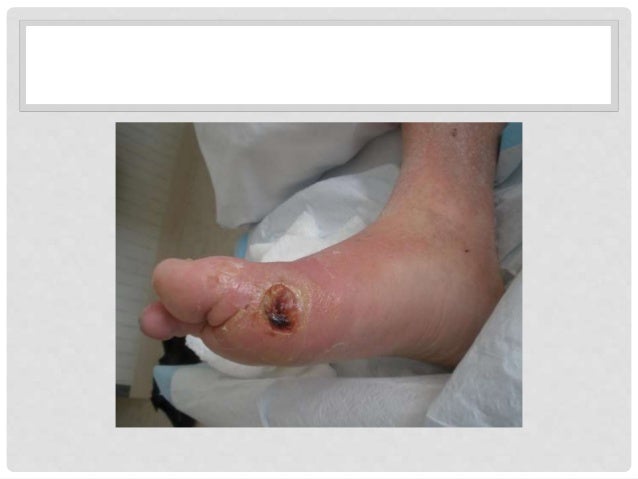



.jpg)


