Forestry Quotes (17 quotes)
Come forth into the light of things,
Let Nature be your teacher. …
One impulse from a vernal wood
May teach you more of man,
Of moral evil and of good,
Than all the sages can.
Let Nature be your teacher. …
One impulse from a vernal wood
May teach you more of man,
Of moral evil and of good,
Than all the sages can.
From poem, 'The Tables Turned', collected in Lyrical Ballads, With a Few Other Poems (1798), 187.
Even the gods dwelt in the woods.
— Virgil
From the original Latin, “Habitarunt di quoque silvas”, in Eclogues (37 BC), book II, line 60, in Johannes Christianus Jahn (ed.), P. Virgilii Maronis: Opera Omnia (1825), 7. As translated in Henry Rushton Fairclough, Virgil (1956), Vol. 1, 15. Eclogues is also known as Bucolica.
Every farm woodland, in addition to yielding lumber, fuel, and posts, should provide its owner a liberal education. This crop of wisdom never fails, but it is not always harvested.
In A Sand County Almanac: and Sketches Here and There (1949, 1989), 73.
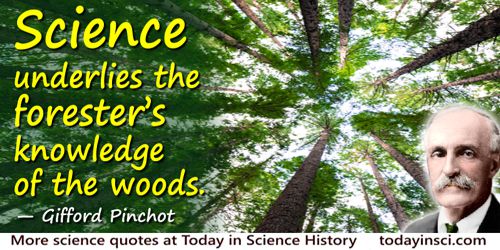
How to start on my adventure—how to become a forester—was not so simple. There were no schools of Forestry in America. … Whoever turned his mind toward Forestry in those days thought little about the forest itself and more about its influences, and about its influence on rainfall first of all. So I took a course in meteorology, which has to do with weather and climate. and another in botany, which has to do with the vegetable kingdom—trees are unquestionably vegetable. And another in geology, for forests grow out of the earth. Also I took a course in astronomy, for it is the sun which makes trees grow. All of which is as it should be, because science underlies the forester’s knowledge of the woods. So far I was headed right. But as for Forestry itself, there wasn’t even a suspicion of it at Yale. The time for teaching Forestry as a profession was years away.
In Breaking New Ground (1947, 1998), 3.
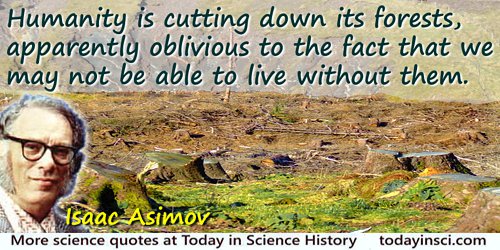
Humanity is cutting down its forests, apparently oblivious to the fact that we may not be able to live without them.
Epigraph in Isaac Asimov’s Book of Science and Nature Quotations (1988), 101.
I had no more conception of what it meant to be a forester than the man in the moon. ... But at least a forester worked in the woods and with the woods - and I loved the woods and everything about them.
Gifford's thoughts, when upon entering Yale (1885) his father asked 'How would you like to be a forester?'
Gifford's thoughts, when upon entering Yale (1885) his father asked 'How would you like to be a forester?'
In Breaking New Ground (1947, 1998), 2.
If [in a rain forest] the traveler notices a particular species and wishes to find more like it, he must often turn his eyes in vain in every direction. Trees of varied forms, dimensions, and colors are around him, but he rarely sees any of them repeated. Time after time he goes towards a tree which looks like the one he seeks, but a closer examination proves it to be distinct.
In 'Equitorial Vegetation', Natural Selection and Tropical Nature Essays on Descriptive and Theoretical Biology (1891), 267.
If a man walked in the woods for love of them half of each day, he is in danger of being regarded as a loafer, but if he spends his whole day as a speculator shearing of those woods and making earth bald before her time, he is estimated as an industrious and enterprising citizen—as if a town had no interest in forests but to cut them down.
Walden. Quoted in Dr. N Sreedharan, Quotations of Wit and Wisdom (2007), 19.
It is estimated that thirty-five to fifty acres of rain forest are chopped down every minute.
From interview collected in Pamela Weintraub (ed.), The Omni Interviews (1984), 80.
Men have been talking now for a week at the post office about the age of the great elm, as a matter interesting but impossible to be determined. The very choppers and travelers have stood upon its prostrate trunk and speculated upon its age, as if it were a profound mystery. I stooped and read its years to them (127 at nine and a half feet), but they heard me as the wind that once sighed through its branches. They still surmised that it might be two hundred years old, but they never stooped to read the inscription. Truly they love darkness rather than light. One said it was probably one hundred and fifty, for he had heard somebody say that for fifty years the elm grew, for fifty it stood still, and for fifty it was dying. (Wonder what portion of his career he stood still!) Truly all men are not men of science. They dwell within an integument of prejudice thicker than the bark of the cork-tree, but it is valuable chiefly to stop bottles with. Tied to their buoyant prejudices, they keep themselves afloat when honest swimmers sink.
(26 Jan 1856). In Henry David Thoreau and Bradford Torrey (ed.), The Writings of Henry Thoreau: Journal: VIII: November 1, 1855-August 15, 1856 (1906), 145-146.
Sauntering silently among the healthful groves, concerning yourself about every thing worthy a wise and good man?
— Horace
Epistle IV, to Albius Tibullus, translated by Christopher Smart in The Works of Horace (1861), 237. Also seen translated as, “To linger silently among the healthful woods, musing on such things as are worthy of a wise and good man.”
Tests conducted before I graduated predicted a future for me in journalism, forestry or the teaching of music.
In 'J. Michael Bishop: Biographical', website of nobelprize.org.
The monarch oak, the patriarch of the trees,
Shoots rising up, and spreads by slow degrees:
Three centuries he grows, and three he stays
Supreme in state; and in three more decays.
Shoots rising up, and spreads by slow degrees:
Three centuries he grows, and three he stays
Supreme in state; and in three more decays.
Trees perspire profusely, condense largely, and check evaporation so much that woods are always moist: no wonder, therefore, that they contribute much to pools and streams.
Letter (7 Feb 1776) to Daines Barrington, collected in The Natural History of Selborne (1813), Vol. 1, 348.
Very old and wide-spread is the opinion that forests have an important impact on rainfall. ... If forests enhance the amount and frequency of precipitation simply by being there, deforestation as part of agricultural expansion everywhere, must necessarily result in less rainfall and more frequent droughts. This view is most poignantly expressed by the saying: Man walks the earth and desert follows his steps! ... It is not surprising that under such circumstances the issue of a link between forests and climate has ... been addressed by governments. Lately, the Italian government has been paying special attention to reforestation in Italy and its expected improvement of the climate. ... It must be prevented that periods of heavy rainfall alternate with droughts. ...In the Unites States deforestation plays an important role as well and is seen as the cause for a reduction in rainfall. ... committee chairman of the American Association for Advancement of Science demands decisive steps to extend woodland in order to counteract the increasing drought. ... some serious concerns. In 1873, in Vienna, the congress for agriculture and forestry discussed the problem in detail; and when the Prussian house of representatives ordered a special commission to examine a proposed law pertaining to the preservation and implementation of forests for safeguarding, it pointed out that the steady decrease in the water levels of Prussian rivers was one of the most serious consequences of deforestation only to be rectified by reforestation programs. It is worth mentioning that ... the same concerns were raised in Russia as well and governmental circles reconsidered the issue of deforestation.
as quoted in Eduard Brückner - The Sources and Consequences of Climate Change and Climate Variability in Historical Times editted by N. Stehr and H. von Storch (2000)
What do we plant when we plant the tree?
We plant the ship, which will cross the sea.
We plant the mast to carry the sails;
We plant the planks to withstand the gales—
The keel, the keelson, and beam and knee;
We plant the ship when we plant the tree.
What do we plant when we plant the tree?
We plant the houses for you and me.
We plant the rafters, the shingles, the floors,
We plant the studding, the lath, the doors,
The beams and siding, all parts that be;
We plant the house when we plant the tree.
What do we plant when we plant the tree?
A thousand things that we daily see;
We plant the spire that out-towers the crag,
We plant the staff for our country's flag,
We plant the shade, from the hot sun free;
We plant all these when we plant the tree.
We plant the ship, which will cross the sea.
We plant the mast to carry the sails;
We plant the planks to withstand the gales—
The keel, the keelson, and beam and knee;
We plant the ship when we plant the tree.
What do we plant when we plant the tree?
We plant the houses for you and me.
We plant the rafters, the shingles, the floors,
We plant the studding, the lath, the doors,
The beams and siding, all parts that be;
We plant the house when we plant the tree.
What do we plant when we plant the tree?
A thousand things that we daily see;
We plant the spire that out-towers the crag,
We plant the staff for our country's flag,
We plant the shade, from the hot sun free;
We plant all these when we plant the tree.
(Feb 1890) In The Poems of Henry Abbey (1895), 262.
When I came home not a single acre of Government, state, or private timberland was under systematic forest management anywhere on the most richly timbered of all continents. … When the Gay Nineties began, the common word for our forests was 'inexhaustible.' To waste timber was a virtue and not a crime. There would always be plenty of timber. … The lumbermen … regarded forest devastation as normal and second growth as a delusion of fools. … And as for sustained yield, no such idea had ever entered their heads. The few friends the forest had were spoken of, when they were spoken of at all, as impractical theorists, fanatics, or ‘denudatics,’ more or less touched in the head. What talk there was about forest protection was no more to the average American that the buzzing of a mosquito, and just about as irritating.
In Breaking New Ground (1947, 1998), 27.
 In science it often happens that scientists say, 'You know that's a really good argument; my position is mistaken,' and then they would actually change their minds and you never hear that old view from them again. They really do it. It doesn't happen as often as it should, because scientists are human and change is sometimes painful. But it happens every day. I cannot recall the last time something like that happened in politics or religion.
(1987) --
In science it often happens that scientists say, 'You know that's a really good argument; my position is mistaken,' and then they would actually change their minds and you never hear that old view from them again. They really do it. It doesn't happen as often as it should, because scientists are human and change is sometimes painful. But it happens every day. I cannot recall the last time something like that happened in politics or religion.
(1987) -- 




