Forest Quotes (161 quotes)
[A contemporary study] predicted the loss of two-thirds of all tropical forests by the turn of the century. Hundreds of thousands of species will perish, and this reduction of 10 to 20 percent of the earth’s biota will occur in about half a human life span. … This reduction of the biological diversity of the planet is the most basic issue of our time.
Foreword, written for Michael Soulé and Bruce Wilcox (eds.), papers from the 1978 International Conference on Conservation Biology, collected as Conservation Biology (1980), ix. As quoted and cited in Timothy J. Farnham, Saving Nature's Legacy: Origins of the Idea of Biological Diversity (2007), 208.
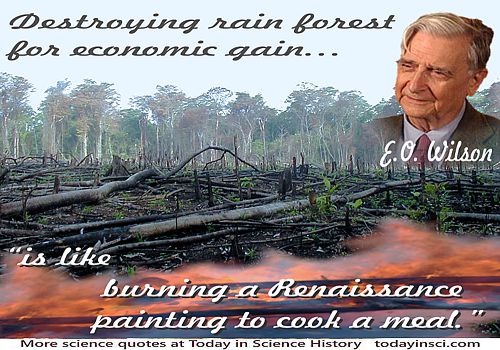
[Destroying rain forest for economic gain] is like burning a Renaissance painting to cook a meal.
Quoted in R.Z. Sheppard, 'Nature: Splendor in The Grass', Time (3 Sep 1990)
Πάντα ῥεῖ : all things are in flux. It is inevitable that you are indebted to the past. You are fed and formed by it. The old forest is decomposed for the composition of the new forest. The old animals have given their bodies to the earth to furnish through chemistry the forming race, and every individual is only a momentary fixation of what was yesterday another’s, is today his and will belong to a third to-morrow. So it is in thought.
In Lecture, second in a series given at Freeman Place Chapel, Boston (Mar 1859), 'Quotation and Originality', collected in Letters and Social Aims (1875, 1917), 200. The Greek expression, “panta rei” is a quote from Heraclitus.
A depressing number of people seem to process everything literally. They are to wit as a blind man is to a forest, able to find every tree, but each one coming as a surprise.
Quoted in Kim Lim (ed.), 1,001 Pearls of Spiritual Wisdom: Words to Enrich, Inspire, and Guide Your Life (2014), 32
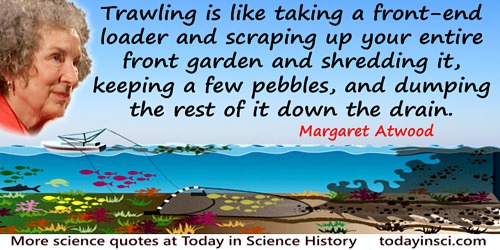
A huge net is being dragged across the sea floor, destroying everything in its path. Ahead of it bloom undersea forests and their hundreds and thousands of living creatures, both plant and animal; behind it is a desert. The net is pulled to the surface and most of the dead and dying life forms in it are thrown out. A few marketable species are retained. [Trawling] is like taking a front-end loader and scraping up your entire front garden and shredding it, keeping a few pebbles, and dumping the rest of it down the drain.
In Payback: Debt and the Shadow Side of Wealth (2008), 191.
A lot of people ask, “Do you think humans are parasites?” It’s an interesting idea and one worth thinking about. People casually refer to humanity as a virus spreading across the earth. In fact, we do look like some strange kind of bio-film spreading across the landscape. A good metaphor? If the biosphere is our host, we do use it up for our own benefit. We do manipulate it. We alter the flows and fluxes of elements like carbon and nitrogen to benefit ourselves—often at the expense of the biosphere as a whole. If you look at how coral reefs or tropical forests are faring these days, you’ll notice that our host is not doing that well right now. Parasites are very sophisticated; parasites are highly evolved; parasites are very successful, as reflected in their diversity. Humans are not very good parasites. Successful parasites do a very good job of balancing—using up their hosts and keeping them alive. It’s all a question of tuning the adaptation to your particular host. In our case, we have only one host, so we have to be particularly careful.
Talk at Columbia University, 'The Power of Parasites'.
A mile and a half from town, I came to a grove of tall cocoanut trees, with clean, branchless stems reaching straight up sixty or seventy feet and topped with a spray of green foliage sheltering clusters of cocoanuts—not more picturesque than a forest of colossal ragged parasols, with bunches of magnified grapes under them, would be. I once heard a grouty northern invalid say that a cocoanut tree might be poetical, possibly it was; but it looked like a feather-duster struck by lightning. I think that describes it better than a picture—and yet, without any question, there is something fascinating about a cocoanut tree—and graceful, too.
In Roughing It (1913), 184-85.
A single tree by itself is dependent upon all the adverse chances of shifting circumstances. The wind stunts it: the variations in temperature check its foliage: the rains denude its soil: its leaves are blown away and are lost for the purpose of fertilisation. You may obtain individual specimens of line trees either in exceptional circumstances, or where human cultivation had intervened. But in nature the normal way in which trees flourish is by their association in a forest. Each tree may lose something of its individual perfection of growth, but they mutually assist each other in preserving the conditions of survival. The soil is preserved and shaded; and the microbes necessary for its fertility are neither scorched, nor frozen, nor washed away. A forest is the triumph of the organisation of mutually dependent species.
In Science and the Modern World (1926), 296-7.
A small cabin stands in the Glacier Peak Wilderness, about a hundred yards off a trail that crosses the Cascade Range. In midsummer, the cabin looked strange in the forest. It was only twelve feet square, but it rose fully two stories and then had a high and steeply peaked roof. From the ridge of the roof, moreover, a ten-foot pole stuck straight up. Tied to the top of the pole was a shovel. To hikers shedding their backpacks at the door of the cabin on a cold summer evening—as the five of us did—it was somewhat unnerving to look up and think of people walking around in snow perhaps thirty-five feet above, hunting for that shovel, then digging their way down to the threshold.
In Encounters with the Archdruid (1971), 3.
A tree is beautiful, but what’s more, it has a right to life; like water, the sun and the stars, it is essential. Life on earth is inconceivable without trees. Forests create climate, climate influences peoples’ character, and so on and so forth. There can be neither civilization nor happiness if forests crash down under the axe, if the climate is harsh and severe, if people are also harsh and severe. ... What a terrible future!
In letter to A.S. Suvorin (18 Oct 1888).
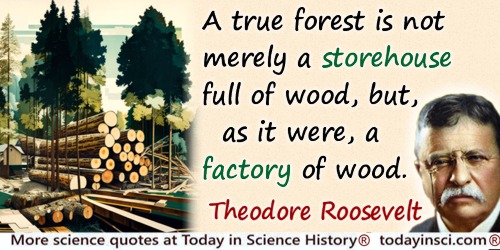
A true forest is not merely a storehouse full of wood, but, as it were, a factory of wood, and at the same time a reservoir of water.
Letter to the School Children of the United States, Arbor Day (15 Apr 1907), in Presidential Addresses and State Papers (1910), Vol. 6, 1208.
Across the road from my cabin was a huge clear-cut—hundreds of acres of massive spruce stumps interspersed with tiny Douglas firs—products of what they call “Reforestation,” which I guess makes the spindly firs en masse a “Reforest,” which makes an individual spindly fir a “Refir,” which means you could say that Weyerhauser, who owns the joint, has Refir Madness, since they think that sawing down 200-foot-tall spruces and replacing them with puling 2-foot Refirs is no different from farming beans or corn or alfalfa. They even call the towering spires they wipe from the Earth’s face forever a “crop”--as if they’d planted the virgin forest! But I'm just a fisherman and may be missing some deeper significance in their nomenclature and stranger treatment of primordial trees.
In David James Duncan, The River Why (1983), 71.
Active conservation [of gorillas] involves simply going out into the forest, on foot, day after day after day, attempting to capture poachers, killing—regretfully—poacher dogs, which spread rabies within the park, and cutting down traps.
Interview at her camp in Rwanda (May 1985). As quoted in article from Times Wire Services, 'Naturalist Dian Fossey Slain at Camp in Rwanda: American Was Expert on Mountain Gorillas; Assailants Hunted', Los Angeles Times (29 Dec 1985). The newspaper states the interview was one of the last she gave, and the report said using “continuous anti-poaching surveillance…only her patrols adequately protected the apes.”
Almost daily we shudder as prophets of doom announce the impending end of civilization and universe. We are being asphyxiated, they say, by the smoke of the industry; we are suffocating in the ever growing mountain of rubbish. Every new project depicts its measureable effects and is denounced by protesters screaming about catastrophe, the upsetting of the land, the assault on nature. If we accepted this new mythology we would have to stop pushing roads through the forest, harnessing rivers to produce the electricity, breaking grounds to extract metals, enriching the soil with chemicals, killing insects, combating viruses … But progress—basically, an effort to organise a corner of land and make it more favourable for human life—cannot be baited. Without the science of pomiculture, for example, trees will bear fruits that are small, bitter, hard, indigestible, and sour. Progress is desirable.
Uncredited. In Lachman Mehta, Stolen Treasure (2012), 117.
Among the scenes which are deeply impressed on my mind, none exceed in sublimity the primeval [tropical] forests, ... temples filled with the varied productions of the God of Nature. No one can stand in these solitudes unmoved, and not feel that there is more in man than the mere breath of his body.
In What Mr. Darwin Saw in His Voyage Round the World in the Ship “Beagle” 1879, 170.
Among the scenes which are deeply impressed on my mind, none exceed in sublimity the primeval forests undefaced by the hand of man; whether those of Brazil, where the powers of Life are predominant, or those of Tierra del Fuego, where Death and Decay prevail. Both are temples filled with the varied productions of the God of Nature: no one can stand in these solitudes unmoved, and not feel that there is more in man than the mere breath of his body.
Journal of Researches: into the Natural History and Geology of the Countries Visited During the Voyage of H.M.S. Beagle Round the World (1839), ch. XXIII, 604-5.
Anthropology has reached that point of development where the careful investigation of facts shakes our firm belief in the far-reaching theories that have been built up. The complexity of each phenomenon dawns on our minds, and makes us desirous of proceeding more cautiously. Heretofore we have seen the features common to all human thought. Now we begin to see their differences. We recognize that these are no less important than their similarities, and the value of detailed studies becomes apparent. Our aim has not changed, but our method must change. We are still searching for the laws that govern the growth of human culture, of human thought; but we recognize the fact that before we seek for what is common to all culture, we must analyze each culture by careful and exact methods, as the geologist analyzes the succession and order of deposits, as the biologist examines the forms of living matter. We see that the growth of human culture manifests itself in the growth of each special culture. Thus we have come to understand that before we can build up the theory of the growth of all human culture, we must know the growth of cultures that we find here and there among the most primitive tribes of the Arctic, of the deserts of Australia, and of the impenetrable forests of South America; and the progress of the civilization of antiquity and of our own times. We must, so far as we can, reconstruct the actual history of mankind, before we can hope to discover the laws underlying that history.
The Jesup North Pacific Expedition: Memoir of the American Museum of Natural History (1898), Vol. 1, 4.
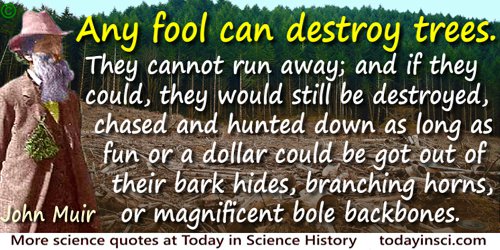
Any fool can destroy trees. They cannot run away; and if they could, they would still be destroyed,—chased and hunted down as long as fun or a dollar could be got out of their bark hides, branching horns, or magnificent bole backbones. Few that fell trees plant them; nor would planting avail much towards getting back anything like the noble primeval forests. During a man’s life only saplings can be grown, in the place of the old trees—tens of centuries old—that have been destroyed.
In 'The American Forests', Atlantic Monthly (Aug 1897), Vol. 80, 157.
As a matter of fact, an ordinary desert supports a much greater variety of plants than does either a forest or a prairie.
The Red Man's Continent: A Chronicle of Aboriginal America (1919), 115.
As I looked down, I saw a large river meandering slowly along for miles, passing from one country to another without stopping. I also saw huge forests, extending along several borders. And I watched the extent of one ocean touch the shores of separate continents. Two words leaped to mind as I looked down on all this: commonality and interdependence. We are one world.
…...
As you sit on the hillside, or lie prone under the trees of the forest, or sprawl wet-legged on the
shingly beach of a mountain stream, the great door, that does not look like a door, opens.
The Gentle Art of Tramping (1926), 95.
At first, the people talking about ecology were only defending the fishes, the animals, the forest, and the river. They didn’t realize that human beings were in the forest—and that these humans were the real ecologists, because they couldn’t live without the forest and the forest couldn’t be saved without them.
Quoted in Andrew Revkin, The Burning Season
At the elementary school, for instance, I spent an hour a week on “botany,” which was an excuse for wandering through Epping Forest in charge of a master who, in his turn, regarded the hour as an excuse for a pleasant smoke in the open air. The result is that Botany to me to-day stands for just a few words like “calyx,” “stamen,” and “capillary attraction,” plus the memory of lovely hours amidst trees and bracken. I do not complain.
In To You, Mr. Chips (1938), in Goodbye, Mr. Chips; and, To You, Mr. Chips (1995), 118.
Become as fast as the wind, yet as sturdy as the forest. Raid and plunder like fire, yet be as impassive as mountains. Let your plans be dark as night, and when you move, strike like lightning.
— Sun Tzu
In Sun Tzu and Jeff Mcneill (trans.), The Art of War by Sun Tzu: New Modern Edition (2012), Chap. 7, 17.
Broccoli salad is a forest in a bowl.
Seen on the internet with various attributions.
But when on shore, and wandering in the sublime forests, surrounded by views more gorgeous than even Claude ever imagined, I enjoy a delight which none but those who have experienced it can understand. If it is to be done, it must be by studying Humboldt.
From letter to W.D. Fox (May 1832), in Charles Darwin and Francis Darwin (ed.), The Life and Letters of Charles Darwin: Including an Autobiographical Chapter (1887), Vol. 1, 207.
Conservation is the foresighted utilization, preservation. And/or renewal of forest, waters, lands and minerals, for the greatest good of the greatest number for the longest time.
In Breaking New Ground (1947, 1998), 505.
Different kinds of animals and plants live together in different places: camels in deserts, whales in the seas, gorillas in tropical forests. The totality of this diversity from the genetic level, through organisms to ecosystems and landscapes is termed collectively biological diversity.
From Reith Lecture, 'Biodiversity', on BBC Radio 4 (19 Apr 2000). Transcript and audio on BBC website.
Each generation of humanity takes the earth as trustees… We ought to bequeath to posterity as many forests and orchards as we have exhausted and consumed.
From address (22 Apr 1885), as reported in 'An Address by J. Sterling Morton on Arbor Day 1885', Nebraska City News. Also appears in J. Sterling Morton, 'Arbor Day', Proceedings of the American Forestry Congress at its Meeting Held in Boston, September 1885 (1886), 51.
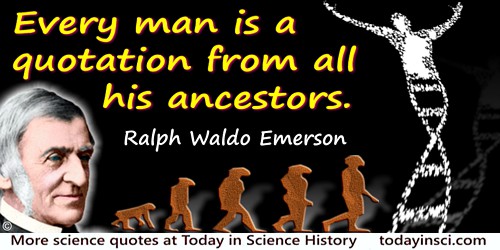
Every book is a quotation; and every house is a quotation out of all forests and mines and stone-quarries; and every man is a quotation from all his ancestors.
Epigraph for chapter 'Quotation and Originality', in Letters and Social Aims (1875, 1917), 176.
For a stone, when it is examined, will be found a mountain in miniature. The fineness of Nature’s work is so great, that, into a single block, a foot or two in diameter, she can compress as many changes of form and structure, on a small scale, as she needs for her mountains on a large one; and, taking moss for forests, and grains of crystal for crags, the surface of a stone, in by far the plurality of instances, is more interesting than the surface of an ordinary hill; more fantastic in form and incomparably richer in colour—the last quality being, in fact, so noble in most stones of good birth (that is to say, fallen from the crystalline mountain ranges).
Modern Painters, 4, Containing part 5 of Mountain Beauty (1860), 311.
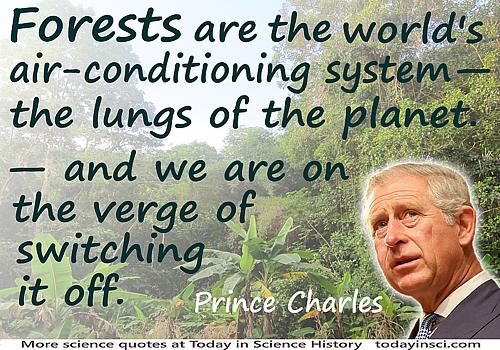
Forests … are in fact the world’s air-conditioning system—the very lungs of the planet—and help to store the largest body of freshwater on the planet … essential to produce food for our planet’s growing population. The rainforests of the world also provide the livelihoods of more than a billion of the poorest people on this Earth… In simple terms, the rainforests, which encircle the world, are our very life-support system—and we are on the verge of switching it off.
Presidential Lecture (3 Nov 2008) at the Presidential Palace, Jakarta, Indonesia. On the Prince of Wales website.
Forests and trees make significant direct contributions to the nutrition of poor households ... [as] rural communities in Central Africa obtained a critical portion of protein and fat in their diets through hunting wildlife from in and around forests. The five to six million tonnes of bushmeat eaten yearly in the Congo Basin is roughly equal to the total amount of beef produced annually in Brazil – without the accompanying need to clear huge swathes of forest for cattle.
In 'Forests and food security: What we know and need to know', Forest News online blog by the Center for International Forestry Research (20 Apr 2011).
Forests are a fundamental component of our planet’s recovery. They are the best technology nature has for locking away carbon. And they are centers of biodiversity. Again, the two features work together. The wilder and more diverse forests are, the more effective they are at absorbing carbon from the atmosphere
From narration to Netflix TV program, A Life on Our Planet: My Witness Statement and a Vision for the Future (4 Oct 2020).
Forests were the first temples of the Divinity, and it is in the forests that men have grasped the first idea of architecture.
F.A. de Chateaubriand and Frederic Shoberl (trans.) The Beauties of Christianity (1813), Vol. 1, 251.
Fractal geometry will make you see everything differently. There is a danger in reading further. You risk the loss of your childhood vision of clouds, forests, flowers, galaxies, leaves, feathers, rocks, mountains, torrents of water, carpet, bricks, and much else besides. Never again will your interpretation of these things be quite the same.
Fractals Everywhere (2000), 1.
Genius unexerted is no more genius than a bushel of acorns is a forest of oaks.
Louis Klopsch, Many Thoughts of Many Minds (1896), 106.
George Sears, called Nessmuk, whose “Woodcraft,” published in 1884, was the first American book on forest camping, and is written with so much wisdom, wit, and insight that it makes Henry David Thoreau seem alien, humorless, and French.
Coming into the Country
Gifford Pinchot is the man to whom the nation owes most for what has been accomplished as regards the preservation of the natural resources of our country. He led, and indeed during its most vital period embodied, the fight for the preservation through use of our forests … He was the foremost leader in the great struggle to coordinate all our social and governmental forces in the effort to secure the adoption of a rational and far-seeing policy for securing the conservation of all our national resources. … I believe it is but just to say that among the many, many public officials who under my administration rendered literally invaluable service to the people of the United States, he, on the whole, stood first.
'The Natural Resources of the Nation' Autobiography (1913), ch. 11. Quoted in Douglas M. Johnston, The International Law of Fisheries (1987), 44
Gifford Pinchot points out that in colonial and pioneer days the forest was a foe and an obstacle to the settler. It had to be cleared away... But [now] as a nation we have not yet come to have a proper respect for the forest and to regard it as an indispensable part of our resources—one which is easily destroyed but difficult to replace; one which confers great benefits while it endures, but whose disappearance is accompanied by a train of evil consequences not readily foreseen and positively irreparable.
Concluding remark, in 'A Country that has Used up its Trees', The Outlook (24 Mar 1906), 82, 700. The topic of the article is the extensive deforestation in China, its consequences, and that America must avoid such massive problems.
Great inventions are never, and great discoveries are seldom, the work of any one mind. Every great invention is really an aggregation of minor inventions, or the final step of a progression. It is not usually a creation, but a growth, as truly so as is the growth of the trees in the forest.
In 'The Growth of the Steam-Engine', The Popular Science Monthly (Nov 1877), 17.
Groves were God’s first Temples.
In 'A Forest Hymn', The Poetical Works of William Cullen Bryant (1853), 75.
Here man is no longer the center of the world, only a witness, but a witness who is also a partner in the silent life of nature, bound by secret affinities to the trees.
From Presidential Address (20 Dec 1957), to the Annual Meeting of the Swedish Academy, 'The Linnaeus Tradition and Our Time', collected in Servant of Peace: A Selection of the Speeches and Statements of Dag Hammarskjöld, Secretary-General of the United Nations, 1953-1961 (1962), 153. Also in Public Papers of the Secretaries-General of the United Nations (1973), Vol. 3, 703.
How indispensable to a correct study of Nature is a perception of her true meaning. The fact will one day flower out into a truth. The season will mature and fructify what the understanding had cultivated. Mere accumulators of facts—collectors of materials for the master-workmen—are like those plants growing in dark forests, which “put forth only leaves instead of blossoms.”
(16 Dec 1837). In Henry David Thoreau and Bradford Torrey (ed.), The Writings of Henry Thoreau: Journal: I: 1837-1846 (1906), 18.
How many times did the sun shine, how many times did the wind howl over the desolate tundras, over the bleak immensity of the Siberian taigas, over the brown deserts where the Earth’s salt shines, over the high peaks capped with silver, over the shivering jungles, over the undulating forests of the tropics! Day after day, through infinite time, the scenery has changed in imperceptible features. Let us smile at the illusion of eternity that appears in these things, and while so many temporary aspects fade away, let us listen to the ancient hymn, the spectacular song of the seas, that has saluted so many chains rising to the light.
In Tectonics of Asia (1924, 1977), 165, trans. Albert V. and Marguerite Carozzi.
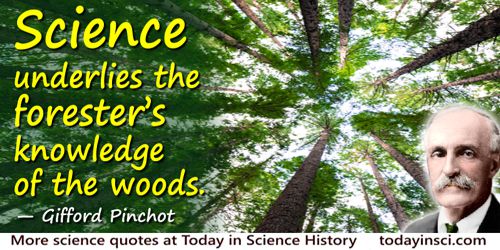
How to start on my adventure—how to become a forester—was not so simple. There were no schools of Forestry in America. … Whoever turned his mind toward Forestry in those days thought little about the forest itself and more about its influences, and about its influence on rainfall first of all. So I took a course in meteorology, which has to do with weather and climate. and another in botany, which has to do with the vegetable kingdom—trees are unquestionably vegetable. And another in geology, for forests grow out of the earth. Also I took a course in astronomy, for it is the sun which makes trees grow. All of which is as it should be, because science underlies the forester’s knowledge of the woods. So far I was headed right. But as for Forestry itself, there wasn’t even a suspicion of it at Yale. The time for teaching Forestry as a profession was years away.
In Breaking New Ground (1947, 1998), 3.
Human societies increased the abundance and distribution of useful species. This can also be used to preserve the forest, I think. We can use this as an opportunity to reduce the impacts of deforestation. Now we have huge plantations of soybeans that are destroying the Amazon—while in the forest we have lots of plants that can be used while maintaining the forest as it is.
As quoted in Robinson Meyer, 'The Amazon Rainforest Was Profoundly Changed by Ancient Humans', The Atlantic (2 Mar 2017).
Humanity is cutting down its forests, apparently oblivious to the fact that we may not be able to live without them.
Epigraph in Isaac Asimov’s Book of Science and Nature Quotations (1988), 101.
I am above the forest region, amongst grand rocks & such a torrent as you see in Salvator Rosa's paintings vegetation all a scrub of rhodods. with Pines below me as thick & bad to get through as our Fuegian Fagi on the hill tops, & except the towering peaks of P. S. [perpetual snow] that, here shoot up on all hands there is little difference in the mt scenery—here however the blaze of Rhod. flowers and various colored jungle proclaims a differently constituted region in a naturalists eye & twenty species here, to one there, always are asking me the vexed question, where do we come from?
Letter to Charles Darwin (24 Jun 1849). Quoted in The Correspondence of Charles Darwin (1988), Vol. 4, 1847-1850, 242.
I am not unmindful of the journalist’s quip that yesterday’s paper wraps today’s garbage. I am also not unmindful of the outrages visited upon our forests to publish redundant and incoherent collections of essays; for, like Dr. Seuss’ Lorax, I like to think that I speak for the trees. Beyond vanity, my only excuses for a collection of these essays lie in the observation that many people like (and as many people despise) them, and that they seem to cohere about a common theme–Darwin’s evolutionary perspective as an antidote to our cosmic arrogance.
…...
I am quite aware that we have just now lightheartedly expelled in imagination many excellent men who are largely, perhaps chiefly, responsible for the buildings of the temple of science; and in many cases our angel would find it a pretty ticklish job to decide. But of one thing I feel sure: if the types we have just expelled were the only types there were, the temple would never have come to be, any more than a forest can grow which consists of nothing but creepers. For these people any sphere of human activity will do, if it comes to a point; whether they become engineers, officers, tradesmen, or scientists depends on circumstances.
…...
I can conceive few human states more enviable than that of the man to whom, panting in the foul laboratory, or watching for his life under the tropic forest, Isis shall for a moment lift her sacred veil, and show him, once and for ever, the thing he dreamed not of; some law, or even mere hint of a law, explaining one fact; but explaining with it a thousand more, connecting them all with each other and with the mighty whole, till order and meaning shoots through some old Chaos of scattered observations.
Health and Education (1874), 289.
I can see him [Sylvester] now, with his white beard and few locks of gray hair, his forehead wrinkled o’er with thoughts, writing rapidly his figures and formulae on the board, sometimes explaining as he wrote, while we, his listeners, caught the reflected sounds from the board. But stop, something is not right, he pauses, his hand goes to his forehead to help his thought, he goes over the work again, emphasizes the leading points, and finally discovers his difficulty. Perhaps it is some error in his figures, perhaps an oversight in the reasoning. Sometimes, however, the difficulty is not elucidated, and then there is not much to the rest of the lecture. But at the next lecture we would hear of some new discovery that was the outcome of that difficulty, and of some article for the Journal, which he had begun. If a text-book had been taken up at the beginning, with the intention of following it, that text-book was most likely doomed to oblivion for the rest of the term, or until the class had been made listeners to every new thought and principle that had sprung from the laboratory of his mind, in consequence of that first difficulty. Other difficulties would soon appear, so that no text-book could last more than half of the term. In this way his class listened to almost all of the work that subsequently appeared in the Journal. It seemed to be the quality of his mind that he must adhere to one subject. He would think about it, talk about it to his class, and finally write about it for the Journal. The merest accident might start him, but once started, every moment, every thought was given to it, and, as much as possible, he read what others had done in the same direction; but this last seemed to be his real point; he could not read without finding difficulties in the way of understanding the author. Thus, often his own work reproduced what had been done by others, and he did not find it out until too late.
A notable example of this is in his theory of cyclotomic functions, which he had reproduced in several foreign journals, only to find that he had been greatly anticipated by foreign authors. It was manifest, one of the critics said, that the learned professor had not read Rummer’s elementary results in the theory of ideal primes. Yet Professor Smith’s report on the theory of numbers, which contained a full synopsis of Kummer’s theory, was Professor Sylvester’s constant companion.
This weakness of Professor Sylvester, in not being able to read what others had done, is perhaps a concomitant of his peculiar genius. Other minds could pass over little difficulties and not be troubled by them, and so go on to a final understanding of the results of the author. But not so with him. A difficulty, however small, worried him, and he was sure to have difficulties until the subject had been worked over in his own way, to correspond with his own mode of thought. To read the work of others, meant therefore to him an almost independent development of it. Like the man whose pleasure in life is to pioneer the way for society into the forests, his rugged mind could derive satisfaction only in hewing out its own paths; and only when his efforts brought him into the uncleared fields of mathematics did he find his place in the Universe.
A notable example of this is in his theory of cyclotomic functions, which he had reproduced in several foreign journals, only to find that he had been greatly anticipated by foreign authors. It was manifest, one of the critics said, that the learned professor had not read Rummer’s elementary results in the theory of ideal primes. Yet Professor Smith’s report on the theory of numbers, which contained a full synopsis of Kummer’s theory, was Professor Sylvester’s constant companion.
This weakness of Professor Sylvester, in not being able to read what others had done, is perhaps a concomitant of his peculiar genius. Other minds could pass over little difficulties and not be troubled by them, and so go on to a final understanding of the results of the author. But not so with him. A difficulty, however small, worried him, and he was sure to have difficulties until the subject had been worked over in his own way, to correspond with his own mode of thought. To read the work of others, meant therefore to him an almost independent development of it. Like the man whose pleasure in life is to pioneer the way for society into the forests, his rugged mind could derive satisfaction only in hewing out its own paths; and only when his efforts brought him into the uncleared fields of mathematics did he find his place in the Universe.
In Florian Cajori, Teaching and History of Mathematics in the United States (1890), 266-267.
I feel a desperation to make people see what we are doing to the environment, what a mess we are making of our world. At this point, the more people I reach, the more I accomplish. … I miss Gombe and my wonderful years in the forest But if I were to go back to that, I wouldn’t feel I was doing what I should be doing.
Answering the question, “Why have you transferred your energies from animal research to activism?” From interview by Tamar Lewin, 'Wildlife to Tireless Crusader, See Jane Run', New York Times (20 Nov 2000), F35.
I have been battering away at Saturn, returning to the charge every now and then. I have effected several breaches in the solid ring, and now I am splash into the fluid one, amid a clash of symbols truly astounding. When I reappear it will be in the dusky ring, which is something like the state of the air supposing the siege of Sebastopol conducted from a forest of guns 100 miles one way, and 30,000 miles the other, and the shot never to stop, but go spinning away round a circle, radius 170,000 miles.
Letter to Lewis Campbell (28 Aug 1857). In P. M. Harman (ed.), The Scientific Letters and Papers of James Clerk Maxwell (1990), Vol. 1, 1846-1862, 538.
I have known silence: the cold earthy silence at the bottom of a newly dug well; the implacable stony silence of a deep cave; the hot, drugged midday silence when everything is hypnotised and stilled into silence by the eye of the sun;… I have heard summer cicadas cry so that the sound seems stitched into your bones. I have heard tree frogs in an orchestration as complicated as Bach singing in a forest lit by a million emerald fireflies. I have heard the Keas calling over grey glaciers that groaned to themselves like old people as they inched their way to the sea. I have heard the hoarse street vendor cries of the mating Fur seals as they sang to their sleek golden wives, the crisp staccato admonishment of the Rattlesnake, the cobweb squeak of the Bat and the belling roar of the Red deer knee-deep in purple heather.
Letter to Lee McGeorge (31 Jul 1978). Collected in Letters of Note: Volume 2: An Eclectic Collection of Correspondence (2016), 76.
I have seen a thousand sunsets and sunrises, on land where it floods forest and mountains with honey coloured light, at sea where it rises and sets like a blood orange in a multicoloured nest of cloud, slipping in and out of the vast ocean. I have seen a thousand moons: harvest moons like gold coins, winter moons as white as ice chips, new moons like baby swans’ feathers.
Letter to Lee McGeorge (31 Jul 1978). Collected in Letters of Note: Volume 2: An Eclectic Collection of Correspondence (2016), 76.
I think that each town should have a park, or rather a primitive forest, of five hundred or a thousand acres, either in one body or several, where a stick should never be cut for fuel, nor for the navy, nor to make wagons, but stand and decay for higher uses—a common possession forever, for instruction and recreation. All Walden Wood might have been reserved, with Walden in the midst of it.
In Wild Fruits: Thoreau’s Rediscovered Last Manuscript (2000), 238. Also appears as an epigraph after the title page.
I used to get so depressed about the environment. … But I feel much better since I joined my Environmental Grief Counseling Group, which is a wonderful New Age approach to gaining the personal serenity you need in a world of melting ice caps, shrinking rain forests, and toxic lakes.
In 'Stop Beaching, Think Positive', Mother Jones Magazine (Oct 1988), 14, No. 8, 8.
If [in a rain forest] the traveler notices a particular species and wishes to find more like it, he must often turn his eyes in vain in every direction. Trees of varied forms, dimensions, and colors are around him, but he rarely sees any of them repeated. Time after time he goes towards a tree which looks like the one he seeks, but a closer examination proves it to be distinct.
In 'Equitorial Vegetation', Natural Selection and Tropical Nature Essays on Descriptive and Theoretical Biology (1891), 267.
If a man walked in the woods for love of them half of each day, he is in danger of being regarded as a loafer, but if he spends his whole day as a speculator shearing of those woods and making earth bald before her time, he is estimated as an industrious and enterprising citizen—as if a town had no interest in forests but to cut them down.
Walden. Quoted in Dr. N Sreedharan, Quotations of Wit and Wisdom (2007), 19.
If in a given community unchecked popular rule means unlimited waste and destruction of the natural resources—soil, fertility, waterpower, forests, game, wild-life generally—which by right belong as much to subsequent generations as to the present generation, then it is sure proof that the present generation is not yet really fit for self-control, that it is not yet really fit to exercise the high and responsible privilege of a rule which shall be both by the people and for the people. The term “for the people” must always include the people unborn as well as the people now alive, or the democratic ideal is not realized.
In A Book-Lover's Holidays in the Open (1916), 319.
In a moment the ashes are made, but a forest is a long time growing.
Momento fit cinis: diu sylva.
Momento fit cinis: diu sylva.
Cited as from Quæstionum Naturalium, Book III. 27 in Kate Louise Roberts (ed.) Hoyt’s New Cyclopedia of Practical Quotations (1922), 798.
In discussing the state of the atmosphere following a nuclear exchange, we point especially to the effects of the many fires that would be ignited by the thousands of nuclear explosions in cities, forests, agricultural fields, and oil and gas fields. As a result of these fires, the loading of the atmosphere with strongly light absorbing particles in the submicron size range (1 micron = 10-6 m) would increase so much that at noon solar radiation at the ground would be reduced by at least a factor of two and possibly a factor of greater than one hundred.
Paul J. Crutzen -and John W. Birks (1946-, American chemist), 'The Atmosphere after a Nuclear War: Twilight at Noon', Ambio, 1982, 11, 115.
In India we have clear evidence that administrative statistics had reached a high state of organization before 300 B.C. In the Arthasastra of Kautilya … the duties of the Gopa, the village accountant, [include] “by setting up boundaries to villages, by numbering plots of grounds as cultivated, uncultivated, plains, wet lands, gardens, vegetable gardens, fences (váta), forests altars, temples of gods, irrigation works, cremation grounds, feeding houses (sattra), places where water is freely supplied to travellers (prapá), places of pilgrimage, pasture grounds and roads, and thereby fixing the boundaries of various villages, of fields, of forests, and of roads, he shall register gifts, sales, charities, and remission of taxes regarding fields.”
Editorial, introducing the new statistics journal of the Indian Statistical Institute, Sankhayā (1933), 1, No. 1. Also reprinted in Sankhyā: The Indian Journal of Statistics (Feb 2003), 65, No. 1, viii.
In studying the fate of our forest king, we have thus far considered the action of purely natural causes only; but, unfortunately, man is in the woods, and waste and pure destruction are making rapid headway. If the importance of the forests were even vaguely understood, even from an economic standpoint, their preservation would call forth the most watchful attention of government
In The Mountains of California (1894), 198.
Indians walk softly and hurt the landscape hardly more than the birds and squirrels, and their brush and bark huts last hardly longer than those of wood rats, while their more enduring monuments, excepting those wrought on the forests by the fires they made to improve their hunting grounds, vanish in a few centuries.
In My First Summer in the Sierra (1911), 73. Based on Muir’s original journals and sketches of his 1869 stay in the Sierra.
Is not Cuvier the great poet of our era? Byron has given admirable expression to certain moral conflicts, but our immortal naturalist has reconstructed past worlds from a few bleached bones; has rebuilt cities, like Cadmus, with monsters’ teeth; has animated forests with all the secrets of zoology gleaned from a piece of coal; has discovered a giant population from the footprints of a mammoth.
From 'La Peau de Chagrin' (1831). As translated by Ellen Marriage in The Wild Ass’s Skin (1906), 21-22.
Is not Cuvier the greatest poet of our age? Of course Lord Byron has set down in fine words certain of our souls’ longings; but our immortal naturalist has reconstructed whole worlds out of bleached bones. Like Cadmus, he has rebuilt great cities from teeth, repopulated thousands of forests with all the mysteries of zoology from a few pieces of coal, discovered races of giants in the foot of a mammoth.
From 'La Peau de Chagrin' (1831). As translated as by Helen Constantine The Wild Ass’s Skin (2012), 19.
It is difficult to conceive a grander mass of vegetation:—the straight shafts of the timber-trees shooting aloft, some naked and clean, with grey, pale, or brown bark; others literally clothed for yards with a continuous garment of epiphytes, one mass of blossoms, especially the white Orchids Caelogynes, which bloom in a profuse manner, whitening their trunks like snow. More bulky trunks were masses of interlacing climbers, Araliaceae, Leguminosae, Vines, and Menispermeae, Hydrangea, and Peppers, enclosing a hollow, once filled by the now strangled supporting tree, which has long ago decayed away. From the sides and summit of these, supple branches hung forth, either leafy or naked; the latter resembling cables flung from one tree to another, swinging in the breeze, their rocking motion increased by the weight of great bunches of ferns or Orchids, which were perched aloft in the loops. Perpetual moisture nourishes this dripping forest: and pendulous mosses and lichens are met with in profusion.
Himalayan Journals (1854), vol. 1, 110-1.
It is estimated that thirty-five to fifty acres of rain forest are chopped down every minute.
From interview collected in Pamela Weintraub (ed.), The Omni Interviews (1984), 80.
It is hard to imagine while strenuously walking in the heart of an equatorial rain forest, gasping for every breath in a stifling humid sauna, how people could have ever adapted to life under these conditions. It is not just the oppressive climate - the tall forest itself is dark, little light reaching the floor from the canopy, and you do not see any animals. It is a complete contrast to the herbivore-rich dry savannahs of tropical Africa. Yet there are many animals here, evident by the loud, continual noise of large cryptic insects and the constant threat of stepping on a deadly king cobra. This was my first impression of the rain forest in Borneo.
The Humans Who Went Extinct
It isn’t important in which sea or lake you observe a slick of pollution, or in the forests of which country a fire breaks out, or on which continent a hurricane arises. You are standing guard over the whole of our Earth.
In Jack Hassard and Julie Weisberg, Environmental Science on the Net: The Global Thinking Project (1999), 23.
It was strangely like war. They attacked the forest as if it were an enemy to be pushed back from the beachheads, driven into the hills, broken into patches, and wiped out. Many operators thought they were not only making lumber but liberating the land from the trees...
[On the first logging of the U.S. Olympic Peninsula.]
[On the first logging of the U.S. Olympic Peninsula.]
The Last Wilderness (1955). In William Dietrich, The Final Forest: the Battle for the Last Great Trees of the Pacific Northwest (1992), 21.
It’s like seeing a light at the end of the tunnel and the tunnel has leaves on it.
About rain forest destruction and species extinction.
About rain forest destruction and species extinction.
Quoted in Douglas Martin, 'A Brief Walk Through Time', New York Times (4 Jan 2002), E39.
Let us get rid immediately of the notion that all you have to do is keep a little patch of the old growth somewhere, and then you can do whatever you want with the rest. That is a very dangerous and false notion.
From On Human Nature (2000). As quoted in John H. Morgan, Naturally Good: A Behavioral History of Moral Development (2005), 252.
Microbes and fungi change a forest just as surely as a ranging fire, only inconspicuously and more slowly.
From Forest Primeval: The Natural History of an Ancient Forest (1989), 89.
Millions of our race are now supported by lands situated where deep seas once prevailed in earlier ages. In many districts not yet occupied by man, land animals and forests now abound where the anchor once sank into the oozy bottom.
Principles of Geology (1837), Vol. 1, 237.
More than 90 percent of the forests of western Ecuador have been destroyed during the past four decades.The loss is estimated to have extinguished or doomed over half of the species of the area’s plants and animals. Many other biologically diverse areas of the world are under similar assault.
In The Diversity of Life (1992), 265.
My sense is that the most under-appreciated–and perhaps most under-researched–linkages between forests and food security are the roles that forest-based ecosystem services play in underpinning sustainable agricultural production. Forests regulate hydrological services including the quantity, quality, and timing of water available for irrigation. Forest-based bats and bees pollinate crops. Forests mitigate impacts of climate change and extreme weather events at the landscape scale.
In 'Forests and food security: What we know and need to know', Forest News online blog by the Center for International Forestry Research (20 Apr 2011).
Nature uncovers the inner secrets of nature in two ways: one by the force of bodies operating outside it; the other by the very movements of its innards. The external actions are strong winds, rains, river currents, sea waves, ice, forest fires, floods; there is only one internal force—earthquake.
About the Layers of the Earth and other Works on Geology (1757), trans. A. P. Lapov (1949), 45.
Nevertheless most of the evergreen forests of the north must always remain the home of wild animals and trappers, a backward region in which it is easy for a great fur company to maintain a practical monopoly.
The Red Man's Continent: A Chronicle of Aboriginal America (1919), 94.
No other animals have ever lighted fires as far as we can tell. In field archeology, a charcoal deposit found in such a location that it could not have been made by a forest fire is taken as conclusive evidence of man. A circular dark disk in the soil five or six feet in diameter is such a find. … With … modern radioactive dating methods, we can trace man’s history.
In 'Man’s Place in the Physical Universe', Bulletin of the Atomic Scientists (Sep 1965), 21, No. 7, 15.
Now when you cut a forest, an ancient forest in particular, you are not just removing a lot of big trees and a few birds fluttering around in the canopy. You are drastically imperiling a vast array of species within a few square miles of you. The number of these species may go to tens of thousands. … Many of them are still unknown to science, and science has not yet discovered the key role undoubtedly played in the maintenance of that ecosystem, as in the case of fungi, microorganisms, and many of the insects.
From On Human Nature (2000). As quoted in John H. Morgan, Naturally Good: A Behavioral History of Moral Development (2005), 251-252.
Once the forest has been removed and the swamp starts being drained, that organic matter begins to oxidise and give off continuing emissions. It’s sort of like the goose that keeps on giving.
From interview with Inter Press Service (IPS), with Stephen de Tarczynski, 'Environment—Indonesia: Deforestation Causing More Than Landslides' (9 Mar 2008).
One gram of moss from the forest floor, a piece about the size of a muffin, would harbor 150,000 protozoa, 132,000 tardigrades, 3,000 springtails, 800 rotifers, 500 nematodes, 400 mites, and 200 fly larvae. These numbers tell us something about the astounding quantity of life in a handful of moss.
In 'In the Forest of the Waterbear', Gathering Moss: A Natural and Cultural History of Mosses (2003), 55.
One must be wary in attributing scientific discovery wholly to any one person. Almost every discovery has a long and precarious history. Someone finds a bit here, another a bit there. A third step succeeds later and thus onward till a genius pieces the bits together and makes the decisive contribution. Science, like the Mississippi, begins in a tiny rivulet in the distant forest. Gradually other streams swell its volume. And the roaring river that bursts the dikes is formed from countless sources.
In 'The Usefulness of Useless Knowledge', Harper’s (Jun/Nov 1939), No. 179, 549
One of the commonest dietary superstitions of the day is a belief in instinct as a guide to dietary excellence ... with a corollary that the diets of primitive people are superior to diets approved by science ... [and even] that light might be thrown on the problems of human nutrition by study of what chimpanzees eat in their native forests. ... Such notions are derivative of the eighteenth-century fiction of the happy and noble savage.
Nutrition and Public Health', League of Nations Health Organization Quarterly Bulletin (1935) 4, 323–474. In Kenneth J. Carpenter, 'The Work of Wallace Aykroyd: International Nutritionist and Author', The Journal of Nutrition (2007), 137, 873-878.
One tragic example of the loss of forests and then water is found in Ethiopia. The amount of its forested land has decreased from 40 to 1 percent in the last four decades. Concurrently, the amount of rainfall has declined to the point where the country is rapidly becoming a wasteland.
— Al Gore
Earth in the Balance: Ecology and the Human Spirit (2006), 107.
Organic chemistry just now is enough to drive one mad. It gives me the impression of a primeval forest full of the most remarkable things, a monstrous and boundless thicket, with no way of escape, into which one may well dread to enter.
Letter to J.J. Berzelius (28 Jan 1835). In Bulletin of the Atomic Scientists (Nov 1949), 310. Date of letter as given in Alan L. Mackay, A Dictionary of Scientific Quotations (1991), 267. An alternate translation is “Organic chemistry nowadays almost drives one mad to me it appears like a primeval tropical forest full of the most remarkable things a dreadful endless jungle into which one dare not enter for there seems no way out.” as given in J.R. Partington, A History of Chemistry (1901), Vol. 4, 327.
Run the tape again, and let the tiny twig of Homo sapiens expire in Africa. Other hominids may have stood on the threshold of what we know as human possibilities, but many sensible scenarios would never generate our level of mentality. Run the tape again, and this time Neanderthal perishes in Europe and Homo erectus in Asia (as they did in our world). The sole surviving human stock, Homo erectus in Africa, stumbles along for a while, even prospers, but does not speciate and therefore remains stable. A mutated virus then wipes Homo erectus out, or a change in climate reconverts Africa into inhospitable forest. One little twig on the mammalian branch, a lineage with interesting possibilities that were never realized, joins the vast majority of species in extinction. So what? Most possibilities are never realized, and who will ever know the difference? Arguments of this form lead me to the conclusion that biology's most profound insight into human nature, status, and potential lies in the simple phrase, the embodiment of contingency: Homo sapiens is an entity, not a tendency.
Wonderful Life (1989), 320.
Science … is perpetually advancing. It is like a torch in the sombre forest of mystery. Man enlarges every day the circle of light which spreads round him, but at the same time, and in virtue of his very advance, he finds himself confronting, at an increasing number of points, the darkness of the Unknown.
In Einstein and the Universe; A Popular Exposition of the Famous Theory (1922), xvi.
Science, like the Mississippi, begins in a tiny rivulet in the distant forest.
In 'The Usefulness of Useless Knowledge', Harper’s (Jun/Nov 1939), No. 179, 549. Part of a longer quote beginning, “One must be wary in attributing scientific discovery…”, on the Abraham Flexner Quotes page of this website.
Scientists alone can establish the objectives of their research, but society, in extending support to science, must take account of its own needs. As a layman, I can suggest only with diffidence what some of the major tasks might be on your scientific agenda, but … First, I would suggest the question of the conservation and development of our natural resources. In a recent speech to the General Assembly of the United Nations, I proposed a world-wide program to protect land and water, forests and wildlife, to combat exhaustion and erosion, to stop the contamination of water and air by industrial as well as nuclear pollution, and to provide for the steady renewal and expansion of the natural bases of life.
From Address to the Centennial Convocation of the National Academy of Sciences (22 Oct 1963), 'A Century of Scientific Conquest'. Online at The American Presidency Project.
Sir Edward has calculated that quick-growing Indian eucalyptus trees have a yield of nine and one-quarter tons of wood an acre a year. As the wood contains 0.8 per cent of the solar energy reaching the ground in the tropics in the form of heat, Sir Edward has suggested that in theory eucalyptus forests could provide a perpetual source of fuel. He has said that by rotational tree planting and felling, a forest of twenty kilometers square would enable a wood consuming power station to provide 10,000 kilowatts of power.
In 'British Hope to Use Green Trees of Jungles As Source of Power for New Steam Engine,' New York Times (27 Jun 1953), 6.
So long as the fur of the beaver was extensively employed as a material for fine hats, it bore a very high price, and the chase of this quadruped was so keen that naturalists feared its speedy consideration. When a Parisian manufacturer invented the silk hat, which soon came into almost universal use, the demand for beavers' fur fell off, and this animal–whose habits, as we have seen, are an important agency in the formation of bogs and other modifications of forest nature–immediately began to increase, reappeared in haunts which we had long abandoned, and can no longer be regarded as rare enough to be in immediate danger of extirpation. Thus the convenience or the caprice of Parisian fashion has unconsciously exercised an influence which may sensibly affect the physical geography of a distant continent.
In Man and Nature, (1864), 84.
So many people today–and even professional scientists–seem to me like someone who has seen thousands of trees but has never seen a forest . A knowledge of the historic and philosophical background gives that kind of independence from prejudices of his generation from which most scientists are suffering. This independence created by philosophical insight is–in my opinion–the mark of distinction between a mere artisan or specialist and a real seeker after truth.
In unpublished Letter (7 Dec 1944) to R.A. Thornton, Einstein Archive, EA 6-574, Hebrew University, Jerusalem, Israel. As quoted and cited in Don A. Howard, 'Albert Einstein as a Philosopher of Science', Physics Today (Dec 2006), 34.
Something will have gone out of us as a people if we ever let the remaining wilderness be destroyed; if we permit the last virgin forests to be turned into comic books and plastic cigarette cases; if we drive the few remaining members of the wild species into zoos or to extinction; if we pollute the last clean air and dirty the last clean streams and push our paved roads through the last of the silence, so that never again will Americans be free in their own country from the noise, the exhausts, the stinks of human and automotive waste.
Letter (3 Dec 1960) written to David E. Pesonen of the Outdoor Recreation Resources Review Commission. Collected in 'Coda: Wilderness Letter', The Sound of Mountain Water: The Changing American West (1969), 146.
That alone is worthy to be called Natural History, which investigates and records the condition of living things, of things in a state of nature; if animals, of living animals:— which tells of their 'sayings and doings,' their varied notes and utterances, songs and cries; their actions, in ease and under the pressure of circumstances; their affections and passions, towards their young, towards each other, towards other animals, towards man: their various arts and devices, to protect their progeny, to procure food, to escape from their enemies, to defend themselves from attacks; their ingenious resources for concealment; their stratagems to overcome their victims; their modes of bringing forth, of feeding, and of training, their offspring; the relations of their structure to their wants and habits; the countries in which they dwell; their connexion with the intimate world around them, mountain or plain, forest or field, barren heath or bushy dell, open savanna or wild hidden glen, river, lake, or sea:— this would be indeed zoology, i.e. the science of living creatures.
A Naturalist's Sojourn in Jamaica (1851), vi-vii.
The axe and saw are insanely busy, chips are flying thick as snowflakes, and every summer thousands of acres of priceless forests, with their underbrush, soil, springs, climate, scenery, and religion, are vanishing away in clouds of smoke, while, except in the national parks, not one forest guard is employed.
From 'The American Forests', The Atlantic (Aug 1897), 80, No. 478, 157.
The clearest way into the Universe is through a forest wilderness.
In Linnie Marsh Wolfe (ed.), John of the Mountains: The Unpublished Journals of John Muir (1938 1979), 313. Entered in journal while on sled trip exploring Muir Glacier, its boundaries and tributaries; Hemlock Mountain (11-21 Jul 1890).
The commissioners of the treasury moved the king, for the relief of his estate, to disafforest some forests of his, explaining themselves of such forests as lay out of the way, not near any of the king’s houses, nor in the course of his progress; whereof he should never have use nor pleasure. “Why,” saith the king, “do you think that Solomon had use and pleasure of all his three hundred concubines?”
In 'A Collection of Apophthegms, New and Old' (1625). As given in Essays, Moral, Economical, and Political: A New Edition, With the Latin Quotations Translated (1813), No. 9, 262. King James I was named in the preceding Apophthegm No. 3.
The creation of a thousand forests is in one acorn.
From 'History', collected in Essays (1838, 1876), First Series, Essay 1, 11.
The cutting of primeval forest and other disasters, fueled by the demands of growing human populations, are the overriding threat to biological diversity everywhere. (1992)
The Diversity of Life (1999), 259
The development of civilization and industry in general has always shown itself so active in the destruction of forests that everything that has been done for their conservation and production is completely insignificant in comparison.
…...
The diversity of life is extraordinary. There is said to be a million or so different kinds of living animals, and hundreds of thousands of kinds of plants. But we don’t need to think of the world at large. It is amazing enough to stop and look at a forest or at a meadow—at the grass and trees and caterpillars and hawks and deer. How did all these different kinds of things come about; what forces governed their evolution; what forces maintain their numbers and determine their survival or extinction; what are their relations to each other and to the physical environment in which they live? These are the problems of natural history.
In The Nature of Natural History (1950), 8.
The forest doctors of the Amazon say each plant has its “song”, and that to know how to use the plant you must listen to its voice.
In 'Fifty Years On, the Silence of Rachel Carson’s Spring Consumes Us', The Guardian (25 Sep 2012).
The forest is a peculiar organism of unlimited kindness and benevolence that makes no demands for its sustenance and extends generously the products of its life activity; it provides protection to all beings, offering shade even to the axeman who destroys it.
In Sergius Alexander Wilde, Forest Soils and Forest Growth (1946), 6.
The forest is my loyal friend
A Delphic shrine to me.
A Delphic shrine to me.
'Waldeinsamkeit', Works of Ralph Waldo Emerson (1876), Vol. 4, 157.
The forests are the “lungs” of our land, purifying the air and giving fresh strength to our people.
From 'A Presidential Statement on Receipt of the Award of the Schlich Forestry Medal' (29 Jan 1935) in Public Papers of the Presidents of the United States: F.D. Roosevelt, 1935, Volume 4 (1938), 65. Roosevelt was awarded the medal by the Society of American Foresters. This is seen in a number of sources incorrectly joined with Roosevelt’s quote about the nation destroying is soil (q.v.), but Webmaster has only been able to find primary sources for these as separate quotes.
The forests in his strength rejoice;
Hark! on the evening breeze,
As once of old, the Lord God's voice
Is heard among the trees.
Hark! on the evening breeze,
As once of old, the Lord God's voice
Is heard among the trees.
In Greenland and Other Poems (1819), 175.
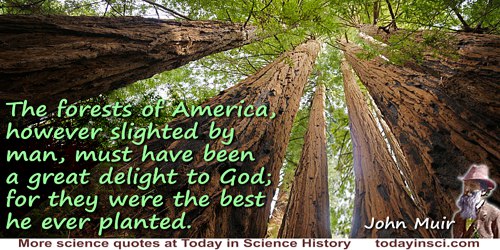
The forests of America, however slighted by man, must have been a great delight to God; for they were the best he ever planted.
Opening sentence in magazine article, 'The American Forests', The Atlantic (Aug 1897), 80, No. 478, 145.
The gold rush in Madre de Dios, Peru, exceeds the combined effects of all other causes of forest loss in the region, including from logging, ranching and agriculture. This is really important because we’re talking about a global biodiversity hotspot. The region’s incredible flora and fauna is being lost to gold fever.
As quoted by Rhett A. Butler in article 'Gold mining in the Amazon rainforest surges 400%' on monabay.com website (28 Oct 2013).
The handling of our forests as a continuous, renewable resource means permanent employment and stability to our country life. The forests are also needed for mitigating extreme climatic fluctuations, holding the soil on the slopes, retaining the moisture in the ground, and controlling the equable flow of water in our streams.
From 'A Presidential Statement on Receipt of the Award of the Schlich Forestry Medal' (29 Jan 1935) in Public Papers of the Presidents of the United States: F.D. Roosevelt, 1935, Volume 4 (1938), 65. Roosevelt was awarded the medal by the Society of American Foresters. This quote continues with the line “The forests are the ‘lungs’ of our land….”
The improvement of forest trees is the work of centuries. So much more the reason for beginning now.
Letter to C. S. Sargent, 12 Jun 1879. In David Lowenthal, George Perkins Marsh: Versatile Vermonter (1958), 255.
The mountain slopes … are covered with dense forests of pines and firs. The lakes are often fringed with beautiful aspens, and when the autumn winds come their golden leaves are carried over the landscape in clouds of resplendent sheen.
In Canyons of the Colorado (1895), 68.
The overwhelming astonishment, the queerest structure we know about so far in the whole universe, the greatest of all cosmological scientific puzzles, confounding all our efforts to comprehend it, is the earth. We are only now beginning to appreciate how strange and splendid it is, how it catches the breath, the loveliest object afloat around the sun, enclosed in its own blue bubble of atmosphere, manufacturing and breathing its own oxygen, fixing its own nitrogen from the air into its own soil, generating its own weather at the surface of its rain forests, constructing its own carapace from living parts: chalk cliffs, coral reefs, old fossils from earlier forms of life now covered by layers of new life meshed together around the globe, Troy upon Troy.
In Late Night Thoughts on Listening to Mahler’s Ninth Symphony (1984), 22-23.
The path towards sustainable energy sources will be long and sometimes difficult. But America cannot resist this transition, we must lead it. We cannot cede to other nations the technology that will power new jobs and new industries, we must claim its promise. That’s how we will maintain our economic vitality and our national treasure—our forests and waterways, our crop lands and snow-capped peaks. That is how we will preserve our planet, commanded to our care by God. That’s what will lend meaning to the creed our fathers once declared.
In Second Inaugural Address (21 Jan 2013) at the United States Capitol.
The ravages committed by man subvert the relations and destroy the balance which nature had established between her organized and her inorganic creations; and she avenges herself upon the intruder, by letting loose upon her defaced provinces destructive energies hitherto kept in check by organic forces destined to be his best auxiliaries, but which he has unwisely dispersed and driven from the field of action. When the forest is gone, the great reservoir of moisture stored up in its vegetable mould is evaporated, and returns only in deluges of rain to wash away the parched dust into which that mould has been converted. The well-wooded and humid hills are turned to ridges of dry rock, which encumbers the low grounds and chokes the watercourses with its debris, and–except in countries favored with an equable distribution of rain through the seasons, and a moderate and regular inclination of surface–the whole earth, unless rescued by human art from the physical degradation to which it tends, becomes an assemblage of bald mountains, of barren, turfless hills, and of swampy and malarious plains. There are parts of Asia Minor, of Northern Africa, of Greece, and even of Alpine Europe, where the operation of causes set in action by man has brought the face of the earth to a desolation almost as complete as that of the moon; and though, within that brief space of time which we call “the historical period,” they are known to have been covered with luxuriant woods, verdant pastures, and fertile meadows, they are now too far deteriorated to be reclaimable by man, nor can they become again fitted for human use, except through great geological changes, or other mysterious influences or agencies of which we have no present knowledge, and over which we have no prospective control. The earth is fast becoming an unfit home for its noblest inhabitant, and another era of equal human crime and human improvidence, and of like duration with that through which traces of that crime and that improvidence extend, would reduce it to such a condition of impoverished productiveness, of shattered surface, of climatic excess, as to threaten the depravation, barbarism, and perhaps even extinction of the species.
Man and Nature, (1864), 42-3.
The ruthless destruction of their forests by the Chinese is one of the reasons why famine and plague today hold this nation in their sinister grasp. Denudation, wherever practiced, leaves naked soil; floods and erosion follow, and when the soil is gone men must also go—and the process does not take long. The great plains of Eastern China were centuries ago transformed from forest into agricultural land. The mountain plateau of Central China have also within a few hundred years been utterly devastated of tree growth, and no attempt made at either natural or artificial reforestation. As a result, the water rushes off the naked slopes in veritable floods, gullying away the mountain sides, causing rivers to run muddy with yellow soil, and carrying enormous masses of fertile earth to the sea. Water courses have also changed; rivers become uncontrollable, and the water level of the country is lowered perceptibly. In consequence, the unfortunate people see their crops wither and die for lack of water when it is most needed.
Statement (11 May 1921) by United States Department of Agriculture (USDA) concerning the famine in China in seven out of every ten years. Reported in 'Blames Deforestation: Department of Agriculture Ascribes Chinese Famine to it', New York Times (12 May 1921), 12.
The simple fact is that the world is not paying for the services the forests provide. At the moment, they are worth more dead than alive–for soya, for beef, for palm oil and for logging, feeding the demand from other countries. … I think we need to be clear that the drivers of rainforest destruction do not originate in the rainforest nations, but in the more developed countries which, unwittingly or not, have caused climate change.
Presidential Lecture (3 Nov 2008) at the Presidential Palace, Jakarta, Indonesia. On the Prince of Wales website.
The technologies which have had the most profound effects on human life are usually simple. A good example of a simple technology with profound historical consequences is hay. ... It was hay that allowed populations to grow and civilizations to flourish among the forests of Northern Europe. Hay moved the greatness of Rome to Paris and London, and later to Berlin and Moscow and New York.
[The year-round growth of green grass in the Mediterranean climate meant that hay was not needed by the Romans. North of the Alps, hay maintained horses and oxen and thus their motive power, and productivity.]
[The year-round growth of green grass in the Mediterranean climate meant that hay was not needed by the Romans. North of the Alps, hay maintained horses and oxen and thus their motive power, and productivity.]
In 'Quick is Beautiful', Infinite in All Directions: Gifford Lectures Given at Aberdeen, Scotland (1988, 2004), 135.
The technologies which have had the most profound effects on human life are usually simple. A good example of a simple technology with profound historical consequences is hay. Nobody knows who invented hay, the idea of cutting grass in the autumn and storing it in large enough quantities to keep horses and cows alive through the winter. All we know is that the technology of hay was unknown to the Roman Empire but was known to every village of medieval Europe. Like many other crucially important technologies, hay emerged anonymously during the so-called Dark Ages. According to the Hay Theory of History, the invention of hay was the decisive event which moved the center of gravity of urban civilization from the Mediterranean basin to Northern and Western Europe. The Roman Empire did not need hay because in a Mediterranean climate the grass grows well enough in winter for animals to graze. North of the Alps, great cities dependent on horses and oxen for motive power could not exist without hay. So it was hay that allowed populations to grow and civilizations to flourish among the forests of Northern Europe. Hay moved the greatness of Rome to Paris and London, and later to Berlin and Moscow and New York. ... Great inventions like hay and printing, whatever their immediate social costs may be, result in a permanent expansion of our horizons, a lasting acquisition of new territory for human bodies and minds to cultivate.
Infinite In All Directions (1988, 2004), 135. The book is a revised version of a series of the Gifford Lectures under the title 'In Praise of Diversity', given at Aberdeen, Scotland.
The term ‘community’ implies a diversity but at the same time a certain organized uniformity in the units. The units are the many individual plants that occur in every community, whether this be a beech-forest, a meadow, or a heath. Uniformity is established when certain atmospheric, terrestrial, and any of the other factors discussed in Section I are co-operating, and appears either because a certain, defined economy makes its impress on the community as a whole, or because a number of different growth-forms are combined to form a single aggregate which has a definite and constant guise.
Oecology of Plants: An Introduction to the Study of Plant Communities (1909), 91-92.
The time has come to link ecology to economic and human development. When you have seen one ant, one bird, one tree, you have not seen them all. What is happening to the rain forests of Madagascar and Brazil will affect us all.
Quoted in Jamie Murphy and Andrea Dorfman, 'The Quiet Apocalypse,' Time (13 Oct 1986).
The tropical rain forests of the world harbor the majority of the planet’s species, yet this wealth of species is being quickly spent. While the exact numbers of species involved and the rate of forest clearing are still under debate, the trend is unmistakable—the richest terrestrial biome is being altered at a scale unparalleled in geologic history.
In The Fragmented Forest: Island Biogeography Theory and the Preservation of Biotic Diversity (1984),
The United States at this moment occupies a lamentable position as being perhaps the chief offender among civilized nations in permitting the destruction and pollution of nature. Our whole modern civilization is at fault in the matter. But we in America are probably most at fault ... We treasure pictures and sculpture. We regard Attic temples and Roman triumphal arches and Gothic cathedrals as of priceless value. But we are, as a whole, still in that low state of civilization where we do not understand that it is also vandalism wantonly to destroy or permit the destruction of what is beautiful in nature, whether it be a cliff, a forest, or a species of mammal or bird. Here in the United States we turn our rivers and streams into sewers and dumping-grounds, we pollute the air, we destroy forests and exterminate fishes, birds and mammals'not to speak of vulgarizing charming landscapes with hideous advertisements.
'Our Vanishing Wild Life', The Outlook, 25 Jan 1913. In Donald Davidson (Ed.) The Wisdom of Theodore Roosevelt (2003), 19.
The universe is one great kindergarten for man. Everything that exists has brought with it its own peculiar lesson. The mountain teaches stability and grandeur; the ocean immensity and change. Forests, lakes, and rivers, clouds and winds, stars and flowers, stupendous glaciers and crystal snowflakes—every form of animate or inanimate existence, leaves its impress upon the soul of man.
…...
The virgin fertility of our soils, and the vast amount of unskilled labor, have been more of a curse than a blessing to agriculture. This exhaustive system for cultivation, the destruction of forests, the rapid and almost constant decomposition of organic matter, together with the problems of nitrification and denitrification, the multitudinous insects and fungus diseases which are ever increasing with marvelous rapidity year by year, make our agricultural problem one requiring more brains than of the North, East or West.
In Farmer’s Leaflet 7: The Need of Scientific Agriculture in the South (1902). Reprinted in The Review of Reviews (1902), 25, 322.
The world over which early man wandered was to him the theatre of a never-ending conflict, in which were arrayed against him impassable seas, unscalable mountains, gloomy forests peopled by deadly beasts of prey, raging streams and foaming torrents, each and all the haunts of spirits luring him to doom.
In 'The Relations of Geology', Scottish Geographical Magazine (Aug 1902), 19, No. 8, 395-396.
The world's forests need to be seen for what they are—giant global utilities, providing essential public services to humanity on a vast scale. They store carbon, which is lost to the atmosphere when they burn, increasing global warming. The life they support cleans the atmosphere of pollutants and feeds it with moisture. They act as a natural thermostat, helping to regulate our climate and sustain the lives of 1.4 billion of the poorest people on this Earth. And they do these things to a degree that is all but impossible to imagine.
Speech (25 Oct 2007) at the World Wildlife Fund gala dinner, Hampton Court Palace, announcing the Prince's Rainforests Project. On the Prince of Wales website.
There can be no greater issue than that of conservation in this country. Just as we must conserve our men, women and children, so we must conserve the resources of the land on which they live. We must conserve the soil so that our children shall have a land that is more and not less fertile than our fathers dwelt in. We must conserve the forests, not by disuse, but by use, making them more valuable at the same time that we use them. We must conserve the mines. Moreover, we must insure so far as possible the use of certain types of great natural resources for the benefit of the people as a whole.
Confession of Faith Speech, Progressive National Convention, Chicago, Illinois, 6 Aug 1912. In Marion Mills Miller (Ed.) Great Debates in American History (1913), Vol. 10, 111-112.
There is a strange disparity between the sciences of inert matter and those of life. Astronomy, mechanics, and physics are based on concepts which can be expressed, tersely and elegantly, in mathematical language. They have built up a universe as harmonious as the monuments of ancient Greece. They weave about it a magnificent texture of calculations and hypotheses. They search for reality beyond the realm of common thought up to unutterable abstractions consisting only of equations of symbols. Such is not the position of biological sciences. Those who investigate the phenomena of life are as if lost in an inextricable jungle, in the midst of a magic forest, whose countless trees unceasingly change their place and their shape. They are crushed under a mass of facts, which they can describe but are incapable of defining in algebraic equations.
Man the Unknown (1935), 1.
There is no more wild, free, vigorous growth of the forest, but everything is in pots or rows like a rococo garden... The pupil is in the age of spontaneous variation which at no period of life is so great. He does not want a standardized, overpeptonized mental diet. It palls on his appetite.
Hall, GS (1904b). Adolescence: Its psychology and its relations to physiology, anthropology, sociology, sex, crime, religion and education (1904), Vol. 2, 509.
They [the Haida] are a doomed race. Wars, smallpox, gross immorality, a change from old ways to new ways their fate is the common fate of the American, whether he sails the sea in the North, gallops over the plain in the West, or sleeps in his hammock in the forests of Brazil.
From Lecture on the Haida Indian Nation, delivered at the Field Columbian Museum (6 Nov 1897). Reproduced in 'A Cruise among Haida and Tlingit Villages About Dixon’s Entrance', Popular Science Monthly (Jun 1898), 164.
This is the forest primeval. The murmuring pines and the hemlocks,
Bearded with moss, and in garments green, indistinct in the twilight,
Stand like Druids of eld, with voices sad and prophetic,
Stand like harpers hoar, with beards that rest on their bosoms.
Loud from its rocky caverns, the deep-voiced neighboring ocean
Speaks, and in accents disconsolate answers the wail of the forest.
Bearded with moss, and in garments green, indistinct in the twilight,
Stand like Druids of eld, with voices sad and prophetic,
Stand like harpers hoar, with beards that rest on their bosoms.
Loud from its rocky caverns, the deep-voiced neighboring ocean
Speaks, and in accents disconsolate answers the wail of the forest.
From poem 'Evangeline: A Tale of Acadie' (1847), as collected in The Poetical Works of H.W. Longfellow (1855), 7.
This single Stick, which you now behold ingloriously lying in that neglected Corner, I once knew in a flourishing State in a Forest: It was full of Sap, full of Leaves, and full of Boughs: But now, in vain does the busy Art of Man pretend to vie with Nature, by tying that withered Bundle of Twigs to its sapless Trunk: It is at best but the Reverse of what it was; a Tree turned upside down, the Branches on the Earth, and the Root in the Air.
'A Meditation Upon a Broom-stick: According to The Style and Manner of the Honorable Robert Boyle's Meditations' (1703), collected in 'Thoughts On Various Subjects', The Works of Jonathan Swift (1746), Vol. 1, 55-56.
Time has a different quality in a forest, a different kind of flow. Time moves in circles, and events are linked, even if it’s not obvious that they are linked. Events in a forest occur with precision in the flow of tree time, like the motions of an endless dance.
The Wild Trees: A Story of Passion and Daring
To the extent that remaining old-growth Douglas fir ecosystems possess unique structural and functional characteristics distinct from surrounding managed forests, the analogy between forest habitat islands and oceanic islands applies. Forest planning decision variables such as total acreage to be maintained, patch size frequency distribution, spatial distribution of patches, specific locations, and protective measures all need to be addressed.
In The Fragmented Forest: Island Biogeography Theory and the Preservation of Biotic Diversity (1984), 6.
To write the true natural history of the world, we should need to be able to follow it from within. It would thus appear no longer as an interlocking succession of structural types replacing one another, but as an ascension of inner sap spreading out in a forest of consolidated instincts. Right at its base, the living world is constituted by conscious clothes in flesh and bone.
In Teilhard de Chardin and Bernard Wall (trans.), The Phenomenon of Man (1959, 2008), 151. Originally published in French as Le Phénomene Humain (1955).
Trees are great promoters of lakes and rivers…; for, since the woods and forests have been grubbed and cleared, all bodies of water are much diminished; so that some streams, that were very considerable a century ago, will not now drive a common mill.
Letter (7 Feb 1776) to Daines Barrington, collected in The Natural History of Selborne (1813), Vol. 1, 348.
Unless his mind soars above his daily pursuits, it is different techniques. In the same spirit, the woodsman might claim that there are only trees but no forest.
…...
Upon the rivers which are tributary to the Mississippi and also upon those which empty themselves into Lake Michigan, there are interminable forests of pine, sufficient to supply all the wants of the citizens ... for all time to come.
Speech to the U.S. House of Representatives (22 Jul 1852), Congressional Globe (1851-52). In Susan Flader, The Great Lakes Forest: an Environmental and Social History (1983), 124.
Very old and wide-spread is the opinion that forests have an important impact on rainfall. ... If forests enhance the amount and frequency of precipitation simply by being there, deforestation as part of agricultural expansion everywhere, must necessarily result in less rainfall and more frequent droughts. This view is most poignantly expressed by the saying: Man walks the earth and desert follows his steps! ... It is not surprising that under such circumstances the issue of a link between forests and climate has ... been addressed by governments. Lately, the Italian government has been paying special attention to reforestation in Italy and its expected improvement of the climate. ... It must be prevented that periods of heavy rainfall alternate with droughts. ...In the Unites States deforestation plays an important role as well and is seen as the cause for a reduction in rainfall. ... committee chairman of the American Association for Advancement of Science demands decisive steps to extend woodland in order to counteract the increasing drought. ... some serious concerns. In 1873, in Vienna, the congress for agriculture and forestry discussed the problem in detail; and when the Prussian house of representatives ordered a special commission to examine a proposed law pertaining to the preservation and implementation of forests for safeguarding, it pointed out that the steady decrease in the water levels of Prussian rivers was one of the most serious consequences of deforestation only to be rectified by reforestation programs. It is worth mentioning that ... the same concerns were raised in Russia as well and governmental circles reconsidered the issue of deforestation.
as quoted in Eduard Brückner - The Sources and Consequences of Climate Change and Climate Variability in Historical Times editted by N. Stehr and H. von Storch (2000)
Visible from Earth orbit … tropical rain forests of equatorial regions are huge expanses of monotonous, mottled dark green. During the day they are frequently covered with enormous thunderstorms that extend for hundreds of miles. The view has an air of fantasy about it, and you grope for words to describe what you see. My personal reaction was one of feeling humble, awed, and privileged to be witness to such a scene.
In How Do You Go To The Bathroom In Space?: All the Answers to All the Questions You Have About Living in Space (1999), 107.
We are consuming our forests three times faster than they are being reproduced. Some of the richest timber lands of this continent have already been destroyed, and not replaced, and other vast areas are on the verge of destruction. Yet forests, unlike mines, can be so handled as to yield the best results of use, without exhaustion, just like grain fields.
Address to the Deep Waterway Convention, Memphis, Tennessee (4 Oct 1907), 'Our National Inland Waterways Policy'. In American Waterways (1908), 9.
We can see our forests vanishing, our water-powers going to waste, our soil being carried by floods into the sea; and the end of our coal and our iron is in sight. But our larger wastes of human effort, which go on every day through such of our acts as are blundering, ill-directed, or inefficient, … are less visible, less tangible, and are but vaguely appreciated.
In The Principles of Scientific Management (1911), 5.
We do not live in a time when knowledge can be extended along a pathway smooth and free from obstacles, as at the time of the discovery of the infinitesimal calculus, and in a measure also when in the development of projective geometry obstacles were suddenly removed which, having hemmed progress for a long time, permitted a stream of investigators to pour in upon virgin soil. There is no longer any browsing along the beaten paths; and into the primeval forest only those may venture who are equipped with the sharpest tools.
In 'Mathematisches und wissenschaftliches Denken', Jahresbericht der Deutschen Mathematiker Vereinigung, Bd. 11, 55. In Robert Édouard Moritz, Memorabilia Mathematica; Or, The Philomath’s Quotation-book (1914), 91.
We have a right to expect that the best trained, the best educated men on the Pacific slope, the Rocky Mountains, and great plains States will take the lead in the preservation and right use of forests, in securing the right use of waters, and in seeing that our land policy is not twisted from its original purpose, but is perpetuated by amendment, by change when such change is necessary in the life of that purpose, the purpose being to turn the public domain into farms each to be the property of the man who actually tills it and makes his home in it.
Address at Leland Stanford, Jr., University, Palo Alto, California, 12 May 1903. Addresses and Presidential Messages of Theodore Roosevelt, 1902-1904 (1904), 198.
We have now felled forest enough everywhere, in many districts far too much. Let us restore this one element of material life to its normal proportions, and devise means for maintaining the permanence of its relations to the fields, the meadows and the pastures, to the rain and the dews of heaven, to the springs and rivulets with which it waters down the earth.
From Man and Nature (1864), 328-329.
We need to be realistic. There is very little we can do now to stop the ice from disappearing from the North Pole in the Summer. And we probably cannot prevent the melting of the permafrost and the resulting release of methane. In addition, I fear that we may be too late to help the oceans maintain their ability to absorb carbon dioxide. But there is something we can do—and it could make the whole difference and buy us time to develop the necessary low carbon economies. We can halt the destruction of the world’s rainforests—and even restore parts of them—in order to ensure that the forests do what they are so good at—in other words storing carbon naturally. This is a far easier, cheaper and quicker option than imagining we can rely on as yet unproven technology to capture carbon at a cost of some $50 per tonne or, for that matter, imagining we can achieve what is necessary through plantation timber.
Presidential Lecture (3 Nov 2008) at the Presidential Palace, Jakarta, Indonesia. On the Prince of Wales website.
What is it to see, in an Eagle glide
Which fills a human heart with so much pride?
Is it that it soars effortless above the Earth
That steals us from our own limits & dearth?
Trapped in our seas of befuddling sludge
We try and try but cannot budge.
And then to see a mortal; with such ease take wing
Up in a breeze that makes our failing spirits sing?
Do we, vicarious birds, search in it our childishness -
When we too were young & yearned in heart to fly?
Taking flights of fancy through adolescent nights
Listening little, heeding less, knowing not why?
From its highest perch in the forest of snow
Majestic - the Eagle soars alone.
Riding thermals, lording clouds
Till dropping silent from the sky as a stone
But we, so quick and ready to fold
Give up our wings at the whiff of age
Losing years, cursing time, wasting spirit
Living out entire lives in futile rage!
Which fills a human heart with so much pride?
Is it that it soars effortless above the Earth
That steals us from our own limits & dearth?
Trapped in our seas of befuddling sludge
We try and try but cannot budge.
And then to see a mortal; with such ease take wing
Up in a breeze that makes our failing spirits sing?
Do we, vicarious birds, search in it our childishness -
When we too were young & yearned in heart to fly?
Taking flights of fancy through adolescent nights
Listening little, heeding less, knowing not why?
From its highest perch in the forest of snow
Majestic - the Eagle soars alone.
Riding thermals, lording clouds
Till dropping silent from the sky as a stone
But we, so quick and ready to fold
Give up our wings at the whiff of age
Losing years, cursing time, wasting spirit
Living out entire lives in futile rage!
…...
What we are doing to the forests of the world is but a mirror reflection of what we are doing to ourselves and to one another.
From Forest Primeval: The Natural History of an Ancient Forest (1989), 230. Seen in various sources erroneously attributed to Mahatma Gandhi. The context in Maser’s book is: What we are doing to the forests … to one another, and as Gandhi said, “An eye for an eye only makes the whole world blind.” Since the subject quote is stated without quotation marks, but the other is in quotation marks and specifically attributed to Gandhi, Webmaster believes the subject quote (the former) is original to Maser. Furthermore, Webmaster has, as yet, found no earlier instance of the quote. If indeed made by Gandhi (died 1948), one would surely expect to find the quote at an earlier date. Contact Webmaster if you find an earlier primary source.
When I came home not a single acre of Government, state, or private timberland was under systematic forest management anywhere on the most richly timbered of all continents. … When the Gay Nineties began, the common word for our forests was 'inexhaustible.' To waste timber was a virtue and not a crime. There would always be plenty of timber. … The lumbermen … regarded forest devastation as normal and second growth as a delusion of fools. … And as for sustained yield, no such idea had ever entered their heads. The few friends the forest had were spoken of, when they were spoken of at all, as impractical theorists, fanatics, or ‘denudatics,’ more or less touched in the head. What talk there was about forest protection was no more to the average American that the buzzing of a mosquito, and just about as irritating.
In Breaking New Ground (1947, 1998), 27.
When I first ventured into the Gulf of Mexico in the 1950s, the sea appeared to be a blue infinity too large, too wild to be harmed by anything that people could do. I explored powder white beaches, dense marshes, mangrove forests, and miles of sea grass meadows alive with pink sea urchins, tiny shrimps, and seahorses half the size of my little finger. … Then, in mere decades, not millennia, the blue wilderness of my childhood disappeared: biologic change in the space of a lifetime.
From 'My Blue Wilderness', National Geographic Magazine (Oct 2010), 76.
When there are too many deer in the forest or too many cats in the barn, nature restores the balance by the introduction of a communicable disease or virus.
When you leave intact as many species as possible, in a major habitat, whether it’s a pond or a bay or a forest somewhere, the better it functions. And the better it functions, the better it serves.
From interview with National Geographic, in Andrew Revkin, 'Conservation Legend Has Big Plans For Future', on nationalgeographic.com website.
Wherever we seek to find constancy we discover change. Having looked at the old woodlands in Hutcheson Forest, at Isle Royale, and in the wilderness of the boundary waters, in the land of the moose and the wolf, and having uncovered the histories hidden within the trees and within the muds, we find that nature undisturbed is not constant in form, structure, or proportion, but changes at every scale of time and space. The old idea of a static landscape, like a single musical chord sounded forever, must be abandoned, for such a landscape never existed except in our imagination. Nature undisturbed by human influence seems more like a symphony whose harmonies arise from variation and change over many scales of time and space, changing with individual births and deaths, local disruptions and recoveries, larger scale responses to climate from one glacial age to another, and to the slower alterations of soils, and yet larger variations between glacial ages.
Discordant Harmonies (1990), 62.
Who would be a better source of information about the forests than aborigines themselves because they have lived off the forest for most of their lives. The forests have provided the aborigines with food, medicine and shelter among other things and yet, the aborigines have never abused or ravaged the forest the way others have.
Keynote address yesterday at the 21st IUFRO World Congress (International Union of Forestry Research Organisations), Kuala Lumpur, Malaysia. As quoted in Lee Shi-lan 'Utilise Knowledge of Aborigines for the Conservation of Forests', New Straits Times (14 Aug 2000), 8.
Without the death of forests by Ice Age advance, there would be no northern lakes.
Without the death of mountains, there would be no sand or soil.
Without the death of mountains, there would be no sand or soil.
In 'The Nested Emergent Nature of Divine Creativity', Thank God for Evolution: How the Marriage of Science and Religion Will Transform Your Life and Our World (2007), 99.
You can’t see oxygen being generated by trees, carbon dioxide being taken up by trees, but we get that. We’re beginning to understand the importance of forests. But the ocean has its forests, too. They just happen to be very small. They’re very small in size but they’re very large in numbers.
In interview with Pierce Nahigyan, 'Dr. Sylvia Earle: “We’re Literally Destroying The Systems That Keep Us Alive”', Huffington Post (6 Jan 2016).
 In science it often happens that scientists say, 'You know that's a really good argument; my position is mistaken,' and then they would actually change their minds and you never hear that old view from them again. They really do it. It doesn't happen as often as it should, because scientists are human and change is sometimes painful. But it happens every day. I cannot recall the last time something like that happened in politics or religion.
(1987) --
In science it often happens that scientists say, 'You know that's a really good argument; my position is mistaken,' and then they would actually change their minds and you never hear that old view from them again. They really do it. It doesn't happen as often as it should, because scientists are human and change is sometimes painful. But it happens every day. I cannot recall the last time something like that happened in politics or religion.
(1987) --