Fool Quotes (123 quotes)
… There can be no doubt about faith and not reason being the ultima ratio. Even Euclid, who has laid himself as little open to the charge of credulity as any writer who ever lived, cannot get beyond this. He has no demonstrable first premise. He requires postulates and axioms which transcend demonstration, and without which he can do nothing. His superstructure indeed is demonstration, but his ground his faith. Nor again can he get further than telling a man he is a fool if he persists in differing from him. He says “which is absurd,” and declines to discuss the matter further. Faith and authority, therefore, prove to be as necessary for him as for anyone else.
In The Way of All Flesh (1917), 319-320.
...I have always maintained that, excepting fools, men did not differ much in intellect, only in zeal and hard work; and I still think there is an eminently important difference.
letter cit. R. Pearson (1914-1930) in The Life, Letters and Labours of Francis Galton
[William Gull] endeavoured, above all things, to study the natural history of disease, uncomplicated by the action of unnecessary drugs, and he resented all useless interference with the course of nature. He would say of meddlesome poly-pharmacy—“Fools rush in, where angels fear to tread.”
Stated in Sir William Withey Gull and Theodore Dyke Acland (ed.), A Collection of the Published Writings of William Withey Gull (1896), xxv-xxvi.
A common mistake that people make when trying to design something completely foolproof is to underestimate the ingenuity of complete fools.
In Mostly Harmless (1992), 135.
A doctor who doesn’t say too many foolish things is a patient half-cured. (1921)
'Le Côté de Guermantes', À la recherche du temps perdu (1913-27).
A fool must now and then be right, by chance
In 'Conversation' (published 1782). In William Cowper and Humphrey Sumner Milford (ed.), The Complete Poetical Works of William Cowper (1905), 92.
A fool sees not the same tree that a wise man sees.
In 'Proverbs', The Poems: With Specimens of the Prose Writings of William Blake (1885), 279.
A fool who, after plain warning, persists in dosing himself with dangerous drugs should be free to do so, for his death is a benefit to the race in general.
…...
A fool will not only pay for a “cure” that does him no good, but will write a testimonial to the effect that he was cured.
In Sinner Sermons: A Selection of the Best Paragraphs of E. W. Howe (1926), 33.
A fool, Mr, Edgeworth, is one who has never made an experiment.
Remark to Richard Lovell Edgeworth, as quoted by W. Stanley Jevons in ‘Experimental Legislation’, Popular Science (Apr 1880), 16, 754.
A fool’s brain digests philosophy into folly, science into superstition, and art into pedantry. Hence University education.
In 'Maxims for Revolutionists: Education', in Man and Superman (1903), 230.
A philosopher is a fool who torments himself while he is alive, to be talked of after he is dead.
As translated, without citation, in Familiar Short Sayings of Great Men: With Historical and Explanatory Notes (1887), 6.
A science is any discipline in which the fool of this generation can go beyond the point reached by the genius of the last generation.
In Politics, Law and Ritual in Tribal Society (1965), 32.
A wise man’s day is worth a fool’s life
Arabic proverb. In Hialmer Day Gould, New Practical Spelling (1905), 27
A wise person is hungry for knowledge, while the fool feeds on trash.
— Bible
Proverbs 15:14, as given in The Swindoll Study Bible NLT (New Living Translation), 760. In the King James Version, this is given as: “The heart of him that hath understanding seeketh knowledge: But the mouth of fools feedeth on foolishness.”
And an ingenious Spaniard says, that “rivers and the inhabitants of the watery element were made for wise men to contemplate, and fools to pass by without consideration.”
In Izaak Walton and Charles Cotton, The Complete Angler (1653, 1859), 31.
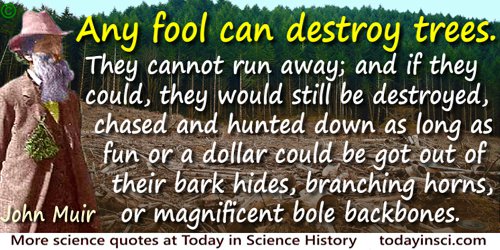
Any fool can destroy trees. They cannot run away; and if they could, they would still be destroyed,—chased and hunted down as long as fun or a dollar could be got out of their bark hides, branching horns, or magnificent bole backbones. Few that fell trees plant them; nor would planting avail much towards getting back anything like the noble primeval forests. During a man’s life only saplings can be grown, in the place of the old trees—tens of centuries old—that have been destroyed.
In 'The American Forests', Atlantic Monthly (Aug 1897), Vol. 80, 157.
Any fool can know. The point is to understand.
…...
Any intelligent fool can make things bigger, more complex, and more violent. It takes a touch of genius - and a lot of courage - to move in the opposite direction.
…...
Any man who does not make himself proficient in at least two languages other than his own is a fool.
Martin H. Fischer, Howard Fabing (ed.) and Ray Marr (ed.), Fischerisms (1944).
Any man who says he doesn’t like applause and recognition is either a fool or a liar. You learn from mistakes, but success gives you the courage to go on and do even more.
As quoted in Lawrence K. Altman, 'Christiaan Barnard, 78, Surgeon For First Heart Transplant, Dies', New York Times (3 Sep 2001)
Astrology is a disease, not a science... It is a tree under the shadow of which all sorts of superstitions thrive. ... Only fools and charlatans lend value to it.
Letter to Marseilles, 1195. Responsa, ii. 25b. In Philip Birnbaum (ed.), Mishneh Torah: Maimonides' Code of Law and Ethics (1974), 35.
Classification is now a pejorative statement. You know, these classifiers look like “dumb fools.” I’m a classifier. But I’d like to use a word that includes more than what people consider is encompassed by classification. It is more than that, and it’s something which can be called phenomenology.
'Oral History Transcript: Dr. William Wilson Morgan' (8 Aug 1978) in the Niels Bohr Library & Archives.
Common sense is a fool when it expects fools to act with common sense.
In Letters of Horace Walpole, Earl of Orford, to Sir Horace Mann (31 Jul 1767), Vol. 1, 356.
Erasmus Darwin held that every so often you should try a damn-fool experiment. He played the trombone to his tulips. This particular result was, in fact, negative.
In 'The Mathematician’s Art of Work' (1967), collected in Béla Bollobás (ed.), Littlewood’s Miscellany (1986), 194. Webmaster has looked for a primary source to verify this statement and so far has found none. Can you help?
Error is often nourished by good sense. … The meaning is, that the powers of the understanding are frequently employed to defend favourite errors; and that a man of sense frequently fortifies himself in his prejudices, or in false opinions which he received without examination, by such arguments as would not have occurred to a fool.
In Maxims, Characters, and Reflections, Critical, Satyrical and Moral (2nd ed., 1757), 9. The meaning is given as a footnote.
Even a wise experiment when made by a fool generally leads to a false conclusion, but that fools’ experiments conducted by a genius often prove to be leaps through the dark into great discoveries.
Commenting on Charles Darwin’s “fool’s experiments”, in 'Charles Robert Darwin', collected in C.D. Warner (ed.), Library of the World’s Best Literature Ancient and Modern (1896), Vol. 2, 4391-4392.
Every discovery in science is a tacit criticism of things as they are. That is why the wise man is invariably called a fool.
Martin H. Fischer, Howard Fabing (ed.) and Ray Marr (ed.), Fischerisms (1944).
Every fool believes what his teachers tell him, and calls his credulity science or morality as confidently as his father called it divine revelation.
In 'Maxims for Revolutionists: Education', in Man and Superman (1905), 230.
Examinations are formidable even to the best prepared, for the greatest fool may ask more than the wisest man can answer.
Lacon: Or, Many Things in Few Words (1865), 97.
Experience of actual fact either teaches fools or abolishes them.
The Homiletic Review, Vol. 83-84 (1922), Vol. 84, 380.
Fools and savages explain ; wise men investigate.
One of Gull’s favorite sayings, as given by the Editor in Preface to Sir William Withey Gull and Theodore Dyke Acland (ed.), A Collection of the Published Writings of William Withey Gull (1896), xvi.
Fools make researches and wise men exploit them.
repr. In The Works of H.G. Wells, vol. 9 (1925). A Modern Utopia, ch. 2, sct. 5 (1905).
For a successful technology, reality must take precedence over public relations, for nature cannot be fooled.
Upon identifying the reason for the explosion of the space shuttle Challenger with his demonstration showing that O-rings grow brittle when cold by immersing a sample in iced water. Concluding remark in Feynman's Appendix to the Rogers Commission Report on the Space Shuttle Challenger Accident. In (Jan 1987). In James B. Simpson, Simpson’s Contemporary Quotations (1988).
For between true Science, and erroneous Doctrines, Ignorance is in the middle. Naturall sense and imagination, are not subject to absurdity. Nature it selfe cannot erre: and as men abound in copiousnesses of language; so they become more wise, or more mad than ordinary. Nor is it possible without Letters for any man to become either excellently wise, or (unless his memory be hurt by disease, or ill constitution of organs) excellently foolish. For words are wise men's counters, they do but reckon by them; but they are the money of fools that value them by the authority of an Aristotle, a Cicero, or a Thomas, or any other Doctor whatsoever, if but a man.
Leviathan (1651), ed. C. B. Macpherson (1968), Part 1, Chapter 4, 106.
GEOLOGY, n. The science of the earth's crust —to which, doubtless, will be added that of its interior whenever a man shall come up garrulous out of a well. The geological formations of the globe already noted are catalogued thus: The Primary, or lower one, consists of rocks, bones of mired mules, gas-pipes, miners' tools, antique statues minus the nose, Spanish doubloons and ancestors. The Secondary is largely made up of red worms and moles. The Tertiary comprises railway tracks, patent pavements, grass, snakes, mouldy boots, beer bottles, tomato cans, intoxicated citizens, garbage, anarchists, snap-dogs and fools.
The Collected Works of Ambrose Bierce (1911), Vol. 7, The Devil's Dictionary, 115.
Go, wondrous creature, mount where science guides.
Go, measure earth, weigh air, and state the tides;
Instruct the planets in what orbs to run,
Correct old Time, and regulate the sun;
Go, teach Eternal Wisdom how to rule,
Then drop into thyself and be a fool.
Go, measure earth, weigh air, and state the tides;
Instruct the planets in what orbs to run,
Correct old Time, and regulate the sun;
Go, teach Eternal Wisdom how to rule,
Then drop into thyself and be a fool.
Quoted in James Wood Dictionary of Quotations from Ancient and Modern, English and Foreign Sources (1893), 125.
He is a fool who lets slip a bird in the hand for a bird in the bush.
— Plutarch
In 'Of Garrulity, or Talkativeness', Plutarch's Lives (1874), Vol. 4, 229. Plutarch refers to this as a common “saying”, so, he did not originate it but the saying dates back to at least his era.
He who does not believe that God is above all is either a fool or has no experience of life.
From the original Latin, “Deum qui non summum putet, Aut stultum aut rerum esse imperitum existumem,” in Incert. Fragment XV. As translated in Thomas Benfield Harbottle, Dictionary of Quotations (Classical) (1897), 44.
He who knows not, and knows not he knows not, he is a fool—shun him;
He who knows not, and knows he knows not, he is simple—teach him;
He who knows, and knows not he knows, he is asleep—wake him;
He who knows, and knows he knows, he is wise—follow him.
He who knows not, and knows he knows not, he is simple—teach him;
He who knows, and knows not he knows, he is asleep—wake him;
He who knows, and knows he knows, he is wise—follow him.
Hesiod, 'Works and Days,' 293-7. In William White, Notes and Queries (1904), Series 10, Vol. 1, 235, the correspondent H.A. Strong says that the origin of these lines is to be found in Hesiod [Greek, 8th Century B.C.], Works and Days, 293-7; that the passage was very celebrated in antiquity, and is quoted by Aristotle, Nic. Eth., i. 4; and that both Livy (xxii. 29) and Cicero (Pro Cluent., 31) refer to it. Another correspondent (J.H.K.) said it was stated to be an Arab proverb in Lady [Isabel] Burton, Life of [Captain] Sir Richard [F.] Burton (1893), Vol. 1, 548, footnote, which prepends to the quote, “Men are four.”
He’s a Fool that makes his Doctor his Heir.
In Poor Richard's Almanack (1733). See the Francis Bacon page for: Male secum agit æger, medicum qui hæredem ficit. That sick man does ill for himself, who makes his physician his heir. (1625)
Heraldry has been contemptuously termed “the science of fools with long memories.”
The Pursuivant of Arms: Or, Heraldry Founded Upon Facts (1873), 3.
Hippocrates is an excellent geometer but a complete fool in everyday affairs.
…...
I consider that a man’s brain originally is like a little empty attic, and you have to stock it with such furniture as you choose. A fool takes in all the lumber of every sort that he comes across, so that the knowledge which might be useful to him gets crowded out, or at best is jumbled up with a lot of other things so that he has a difficulty in laying his hands upon it. Now the skilful workman is very careful indeed as to what he takes into his brain-attic. He will have nothing but the tools which may help him in doing his work, but of these he has a large assortment, and all in the most perfect order. It is a mistake to think that that little room has elastic walls and can distend to any extent. Depend upon it there comes a time when for every addition of knowledge you forget something that you knew before. It is of the highest importance, therefore, not to have useless facts elbowing out the useful ones.
In 'The Science Of Deduction', A Study In Scarlet (1887, 1904), 15-16.
I happen to be a kind of monkey. I have a monkeylike curiosity that makes me want to feel, smell, and taste things which arouse my curiosity, then to take them apart. It was born in me. Not everybody is like that, but a scientific researchist should be. Any fool can show me an experiment is useless. I want a man who will try it and get something out of it.
Quoted in Guy Suits, ''Willis Rodney Whitney', National Academy of Sciences, Biographical Memoirs (1960), 357.
I have very often reflected on what it is that really distinguishes the great genius from the common crowd. Here are a few observations I have made. The common individual always conforms to the prevailing opinion and the prevailing fashion; he regards the State in which everything now exists as the only possible one and passively accepts it ail. It does not occur to him that everything, from the shape of the furniture up to the subtlest hypothesis, is decided by the great council of mankind of which he is a member. He wears thin-soled shoes even though the sharp stones of the Street hurt his feet, he allows fashion to dictate to him that the buckles of his shoes must extend as far as the toes even though that means the shoe is often hard to get on. He does not reflect that the form of the shoe depends as much upon him as it does upon the fool who first wore thin shoes on a cracked pavement. To the great genius it always occurs to ask: Could this too not be false! He never gives his vote without first reflecting.
Aphorism 24 in Notebook C (1772-1773), as translated by R.J. Hollingdale in Aphorisms (1990). Reprinted as The Waste Books (2000), 36.
I have written many direct and indirect arguments for the Copernican view, but until now I have not dared to publish them, alarmed by the fate of Copernicus himself, our master. He has won for himself undying fame in the eyes of a few, but he has been mocked and hooted at by an infinite multitude (for so large is the number of fools). I would dare to come forward publicly with my ideas if there were more people of your [Johannes Kepler’s] way of thinking. As this is not the case, I shall refrain.
Letter to Kepler (4 Aug 1597). In James Bruce Ross (ed.) and Mary Martin (ed., trans.), 'Comrades in the Pursuit of Truth', The Portable Renaissance Reader (1953, 1981), 597-599. As quoted and cited in Merry E. Wiesner, Early Modern Europe, 1450-1789 (2013), 377.
I love fools’ experiments. I am always making them.
Lankester gives this wording as his own recollection in E. Ray Lankester, 'Charles Robert Darwin', collected in C.D. Warner (ed.), Library of the World’s Best Literature Ancient and Modern (1896), Vol. 2, 4391. As a recollection, the quote may not be verbatim, but the sense is correct. Compare Francis Darwin (ed.), The Life and Letters of Charles Darwin (1902), 126. “These rather wild trials he called ‘fool’s experiments,’ and enjoyed extremely.”
I suspect that the most important effect of World War II on physical science lay in the change in the attitude of people to science. The politicians and the public were convinced that science was useful and were in no position to argue about the details. A professor of physics might be more sinister than he was in the 1930s, but he was no longer an old fool with a beard in a comic-strip. The scientists or at any rate the physicists, had changed their attitude. They not only believed in the interest of science for themselves, they had acquired also a belief that the tax-payer should and would pay for it and would, in some unspecified length of run, benefit by it.
'The Effect of World War II on the Development of Knowledge in the Physical Sciences', Proceedings of the Royal Society of London, 1975, Series A, 342, 532.
I think that I shall never see
A poem as lovely as a tree.
A tree whose hungry mouth is prest
Against the earth’s sweet flowing breast;
A tree that looks at God all day,
And lifts her leafy arms to pray;
A tree that may in Summer wear
A nest of robins in her hair;
Upon whose bosom snow has lain;
Who intimately lives with rain.
Poems are made by fools like me,
But only God can make a tree.
A poem as lovely as a tree.
A tree whose hungry mouth is prest
Against the earth’s sweet flowing breast;
A tree that looks at God all day,
And lifts her leafy arms to pray;
A tree that may in Summer wear
A nest of robins in her hair;
Upon whose bosom snow has lain;
Who intimately lives with rain.
Poems are made by fools like me,
But only God can make a tree.
Trees and Other Poems (1914), 19.
I was unable to devote myself to the learning of this al-jabr [algebra] and the continued concentration upon it, because of obstacles in the vagaries of Time which hindered me; for we have been deprived of all the people of knowledge save for a group, small in number, with many troubles, whose concern in life is to snatch the opportunity, when Time is asleep, to devote themselves meanwhile to the investigation and perfection of a science; for the majority of people who imitate philosophers confuse the true with the false, and they do nothing but deceive and pretend knowledge, and they do not use what they know of the sciences except for base and material purposes; and if they see a certain person seeking for the right and preferring the truth, doing his best to refute the false and untrue and leaving aside hypocrisy and deceit, they make a fool of him and mock him.
A. P. Youschkevitch and B. A. Rosenfeld, 'Al-Khayyami', in C. C. Gillispie (ed.), Dictionary of Scientific Biography (1973), Vol. 7, 324.
I’ve never made a discovery myself, unless by accident. If you write glibly, you fool people. When I first met Asimov, I asked him if he was a professor at Boston University. He said no and … asked me where I got my Ph.D. I said I didn’t have one and he looked startled. “You mean you’re in the same racket I am,” he said, “you just read books by the professors and rewrite them?” That’s really what I do.
Quoted in Sally Helgeson, 'Every Day', Bookletter (6 Dec 1976), 3, No. 8, 3. As quoted and cited in Dana Richards, 'Martin Gardner: A “Documentary”', collected in Elwyn R. Berlekamp and Tom Rodgers (ed.) The Mathemagician and Pied Puzzler: A Collection in Tribute to Martin Gardner (1999), 8-9.
If all boys could be made to know that with every breath of cigarette smoke they inhale imbecility and exhale manhood … and that the cigarette is a maker of invalids, criminals and fools—not men—it ought to deter them some. The yellow finger stain is an emblem of deeper degradation and enslavement than the ball and chain.
In Hudson Maxim and Clifton Johnson, 'Smoking, Swearing, and Perfumery', Hudson Maxim: Reminiscences and Comments (1924), 234. The quote is as reported by Clifton Johnson, based on interviews with Hudson Maxim.
If I want to stop a research program I can always do it by getting a few experts to sit in on the subject, because they know right away that it was a fool thing to try in the first place.
If our intention had been merely to bring back a handful of soil and rocks from the lunar gravel pit and then forget the whole thing, we would certainly be history's biggest fools. But that is not our intention now—it never will be. What we are seeking in tomorrow's [Apollo 11] trip is indeed that key to our future on earth. We are expanding the mind of man. We are extending this God-given brain and these God-given hands to their outermost limits and in so doing all mankind will benefit. All mankind will reap the harvest…. What we will have attained when Neil Armstrong steps down upon the moon is a completely new step in the evolution of man.
Banquet speech on the eve of the Apollo 11 launch, Royal Oaks Country Club, Titusville (15 Jul 1969). In "Of a Fire on the Moon", Life (29 Aug 1969), 67, No. 9, 34.
If there’s one thing in physics I feel more responsible for than any other, it’s this perception of how everything fits together. I like to think of myself as having a sense of judgment. I’m willing to go anywhere, talk to anybody, ask any question that will make headway. I confess to being an optimist about things, especially about someday being able to understand how things are put together. So many young people are forced to specialize in one line or another that a young person can’t afford to try and cover this waterfront — only an old fogy who can afford to make a fool of himself. If I don't, who will?
Stated during a 1983 interview. Quoted in Dennis Overbye, 'John A. Wheeler, Physicist Who Coined the Term Black Hole, Is Dead at 96', New York Times (14 Apr 2008).
In 1906 I indulged my temper by hurling invectives at Neo-Darwinians in the following terms. “I really do not wish to be abusive [to Neo-Darwinians]; but when I think of these poor little dullards, with their precarious hold of just that corner of evolution that a blackbeetle can understand—with their retinue of twopenny-halfpenny Torquemadas wallowing in the infamies of the vivisector’s laboratory, and solemnly offering us as epoch-making discoveries their demonstrations that dogs get weaker and die if you give them no food; that intense pain makes mice sweat; and that if you cut off a dog’s leg the three-legged dog will have a four-legged puppy, I ask myself what spell has fallen on intelligent and humane men that they allow themselves to be imposed on by this rabble of dolts, blackguards, imposters, quacks, liars, and, worst of all, credulous conscientious fools.”
In Back to Methuselah: A Metabiological Pentateuch (1921), lxi
In 1945, therefore, I proved a sentimental fool; and Mr. Truman could safely have classified me among the whimpering idiots he did not wish admitted to the presidential office. For I felt that no man has the right to decree so much suffering, and that science, in providing and sharpening the knife and in upholding the ram, had incurred a guilt of which it will never get rid. It was at that time that the nexus between science and murder became clear to me. For several years after the somber event, between 1947 and 1952, I tried desperately to find a position in what then appeared to me as a bucolic Switzerland,—but I had no success.
Heraclitean Fire: Sketches from a Life before Nature (1978), 4.
In reality, all Arguments from Experience are founded on the Similarity which we discover among natural Objects, and by which we are induc'd to expect effects similar to those which we have found to follow from such Objects. And tho' none but a Fool or Madman will ever pretend to dispute the Authority of Experience, or to reject that great Guide of human Life, it may surely be allow'd a Philosopher to have so much Curiosity at least as to examine the Principle of human Nature, which gives this mighty Authority to Experience, and makes us draw Advantage from that Similarity which Nature has plac'd among different Objects. From Causes which appear similar we expect similar Effects. This is the Sum of our experimental Conclusions.
An Enquiry Concerning Human Understanding (1748), 63.
Intelligence is an extremely subtle concept. It’s a kind of understanding that flourishes if it’s combined with a good memory, but exists anyway even in the absence of good memory. It’s the ability to draw consequences from causes, to make correct inferences, to foresee what might be the result, to work out logical problems, to be reasonable, rational, to have the ability to understand the solution from perhaps insufficient information. You know when a person is intelligent, but you can be easily fooled if you are not yourself intelligent.
In Irv Broughton (ed.), The Writer's Mind: Interviews with American Authors (1990), Vol. 2, 57.
It is better to be a human being dissatisfied than a pig satisfied; better to be Socrates dissatisfied than a fool satisfied.
Utilitarianism (1861), 212.
It seems to be saying perpetually; 'I am the end of the nineteenth century; I am glad they built me of iron; let me rust.' ... It is like a passing fool in a crowd of the University, a buffoon in the hall; for all the things in Paris has made, it alone has neither wits nor soul.
About the Eiffel Tower.
About the Eiffel Tower.
Paris (1900). In Peter Yapp, The Travellers' Dictionary of Quotation: Who Said What, About Where? (1983), 183.
It took more than three thousand years to make some of the trees in these western woods ... Through all the wonderful, eventful centuries since Christ's time—and long before that—God has cared for these trees, saved them from drought, disease, avalanches, and a thousand straining, leveling tempests and floods; but he cannot save them from fools.
In 'The American Forests', Atlantic Monthly (Aug 1897), Vol. 80, 157.
Logical consequences are the scarecrows of fools and the beacons of wise men.
'On the Hypothesis that Animals are Automata', The Fortnightly (1874), 22, 577.
Man is an eating animal, a drinking animal, and a sleeping animal, and one placed in a material world, which alone furnishes all the human animal can desire. He is gifted besides with knowing faculties, practically to explore and to apply the resources of this world to his use. These are realities. All else is nothing; conscience and sentiment are mere figments of the imagination. Man has but five gates of knowledge, the five senses; he can know nothing but through them; all else is a vain fancy, and as for the being of a God, the existence of a soul, or a world to come, who can know anything about them? Depend upon it, my dear madam, these are only the bugbears by which men of sense govern fools.
Attributed to Darwin by Mary Anne Schimmelpennick. Quoted in Christiana C. Hankin (ed.) Life of Mary Anne Schimmelpenninck (1858), Vol. I, 241-2.
Man is the Reasoning Animal. Such is the claim. I think it is open to dispute. Indeed, my experiments have proven to me that he is the Unreasoning Animal. … It seems plain to me that whatever he is he is not a reasoning animal. His record is the fantastic record of a maniac. I consider that the strongest count against his intelligence is the fact that with that record back of him he blandly sets himself up as the head animal of the lot: whereas by his own standards he is the bottom one.
In truth, man is incurably foolish. Simple things which the other animals easily learn, he is incapable of learning. Among my experiments was this. In an hour I taught a cat and a dog to be friends. I put them in a cage. In another hour I taught them to be friends with a rabbit. In the course of two days I was able to add a fox, a goose, a squirrel and some doves. Finally a monkey. They lived together in peace; even affectionately.
Next, in another cage I confined an Irish Catholic from Tipperary, and as soon as he seemed tame I added a Scotch Presbyterian from Aberdeen. Next a Turk from Constantinople; a Greek Christian from Crete; an Armenian; a Methodist from the wilds of Arkansas; a Buddhist from China; a Brahman from Benares. Finally, a Salvation Army Colonel from Wapping. Then I stayed away two whole days. When I came back to note results, the cage of Higher Animals was all right, but in the other there was but a chaos of gory odds and ends of turbans and fezzes and plaids and bones and flesh—not a specimen left alive. These Reasoning Animals had disagreed on a theological detail and carried the matter to a Higher Court.
In truth, man is incurably foolish. Simple things which the other animals easily learn, he is incapable of learning. Among my experiments was this. In an hour I taught a cat and a dog to be friends. I put them in a cage. In another hour I taught them to be friends with a rabbit. In the course of two days I was able to add a fox, a goose, a squirrel and some doves. Finally a monkey. They lived together in peace; even affectionately.
Next, in another cage I confined an Irish Catholic from Tipperary, and as soon as he seemed tame I added a Scotch Presbyterian from Aberdeen. Next a Turk from Constantinople; a Greek Christian from Crete; an Armenian; a Methodist from the wilds of Arkansas; a Buddhist from China; a Brahman from Benares. Finally, a Salvation Army Colonel from Wapping. Then I stayed away two whole days. When I came back to note results, the cage of Higher Animals was all right, but in the other there was but a chaos of gory odds and ends of turbans and fezzes and plaids and bones and flesh—not a specimen left alive. These Reasoning Animals had disagreed on a theological detail and carried the matter to a Higher Court.
In Mark Twain and Bernard DeVoto (ed.), Letters from the Earth: Uncensored Writings (1962), 180-181. [Note: As a humorous, irreverent consideration of Man and Christianity, these essays (written c.1909) remained unpublished for over 50 years after Twain’s death (1910), because his daughter and literary executor (Clara Clemens Samossoud) felt that some of the pieces did not accurately represent her father’s beliefs, but eventually, she consented to their publication.]
Many inventions are not suitable for the people at large because of their carelessness. Before a thing can be marketed to the masses, it must be made practically fool-proof. Its operation must be made extremely simple. That is one reason, I think, why the phonograph has been so universally adopted. Even a child can operate it. … Another reason is that people are far more willing to pay for being amused than for anything else.
As quoted from an interview by B.C. Forbes in The American Magazine (Jan 1921), 86.
Men always fool themselves when they give up experience for systems born of the imagination. Man is the work of nature, he exists in nature, he is subject to its laws, he can not break free, he can not leave even in thought; it is in vain that his spirit wants to soar beyond the bounds of the visible world, he is always forced to return.
Opening statement of first chapter of Système de la Nature (1770), Vol. 1, 1. Translation by Webmaster using Google Translate. From the original French, “Les hommes se tromperont toujours, quand ils abandonneront l'expérience pour des systèmes enfantés par l’imagination. L’homme est l’ouvrage de la nature, il existe dans la nature, il est soumis à ses lois, il ne peut s’en affranchir, il ne peut même par la pensée en sortir; c’est en vain que son esprit veut s’élancer au delà des bornes du monde visible, il est toujours forcé d’y rentrer.” In the English edition (1820-21), Samuel Wilkinson gives this as “Man has always deceived himself when he abandoned experience to follow imaginary systems.—He is the work of nature.—He exists in Nature.—He is submitted to the laws of Nature.—He cannot deliver himself from them:—cannot step beyond them even in thought. It is in vain his mind would spring forward beyond the visible world: direful and imperious necessity ever compels his return.”
Never confuse a fool’s gold opportunity with a silver bullet solution.
Never fear big long words.
Big long words name little things.
All big things have little names.
Such as life and death, peace and war.
Or dawn, day, night, hope, love, home.
Learn to use little words in a big way.
It is hard to do,
But they say what you mean.
When you don't know what you mean, use big words.
That often fools little people.
Big long words name little things.
All big things have little names.
Such as life and death, peace and war.
Or dawn, day, night, hope, love, home.
Learn to use little words in a big way.
It is hard to do,
But they say what you mean.
When you don't know what you mean, use big words.
That often fools little people.
Quoted in Saturday Review (1962), 45, No. 2. It was written (1936) for his son, as advice for young copy writers.
- 1995
No man treats a motorcar as foolishly as he treats another human being. When the car will not go, he does not attribute its annoying behavior to sin; he does not say, “You are a wicked motorcar, and I shall not give you any more petrol until you go.” He attempts to find out what is wrong and to set it right. An analogous way of treating human beings is, however, considered to be contrary to the truths of our holy religion.
In 'Has Religion Made Useful Contributions to Civilization?' (1930). Collected in The Collected Papers of Bertrand Russell: A Fresh Look at Empiricism 1927-42 (1996) 224.
Now come the minstrels of the swamp and pool,
The peeping frogs who make the marshes ring
At sundown like some myriad-squeaking thing!
Thus with our senses Nature plays the fool.
The peeping frogs who make the marshes ring
At sundown like some myriad-squeaking thing!
Thus with our senses Nature plays the fool.
In 'Peeping Frogs', Memorial Volume: Selections from the Prose and Poetical Writings of the Late John Savary (1912), 57.
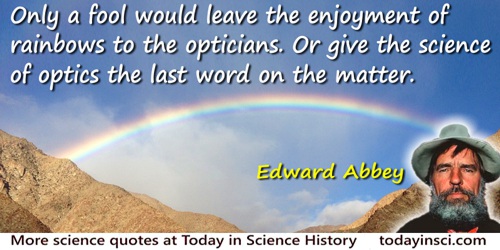
Only a fool would leave the enjoyment of rainbows to the opticians. Or give the science of optics the last word on the matter.
In 'Philosophy, Religion, and So Forth', A Voice Crying in the Wilderness (1989), 12.
People give ear to an upstart astrologer [Copernicus] who strove to show that the earth revolves, not the heavens or the firmament, the sun and the moon. Whoever wishes to appear clever must devise some new system, which of all systems is of course the very best. This fool wishes to reverse the entire science of astronomy.
c. 1543, in The Experts Speak by Christopher Cerf and Victor Navasky (1998).
People who look for the first time through a microscope say now I see this and then I see that—and even a skilled observer can be fooled. On these observations I have spent more time than many will believe, but I have done them with joy, and I have taken no notice of those who have said why take so much trouble and what good is it?—but I do not write for such people but only for the philosophical!
As quoted, without citation, by Dugald Caleb Jackson and Walter Paul Jones, in This Scientific Age: Essays in Modern Thought and Achievement (1930), 132.
People will work every bit as hard to fool themselves as they will to fool others—which makes it very difficult to tell just where the line between foolishness and fraud is located.
Voodoo Science. In Marc J. Madou, Fundamentals of Microfabrication: the Science of Miniaturization (2nd ed., 2002), 77.
Phony psychics like Uri Geller have had particular success in bamboozling scientists with ordinary stage magic, because only scientists are arrogant enough to think that they always observe with rigorous and objective scrutiny, and therefore could never be so fooled–while ordinary mortals know perfectly well that good performers can always find a way to trick people.
…...
Physicians get neither name nor fame by the pricking of wheals or the picking out thistles,
or by laying of plaisters to the scratch of a pin; every old woman can do this. But if they would have a name and a fame, if they will have it quickly, they must do some great and desperate cures. Let them fetch one to life that was dead; let them recover one to his wits that was mad; let them make one that was born blind to see; or let them give ripe wits to a fool: these are notable cures, and he that can do thus, if he doth thus first, he shall have the name and fame he deserves; he may lie abed till noon.
In John Bunyan and Robert Philip (ed.), The Works of John Bunyan (1850), Vol. 1, 75.
Psychotherapy–the theory that the patient will probably get well anyhow, and is certainly a damn fool.
In A Mencken Chrestomathy (1949, 1956), 626.
Quoth she: “I’ve heard old cunning stagers
Say fools for arguments use wagers.”
Say fools for arguments use wagers.”
From poem 'Hudibras' (1684), Part 2, Canto 1, Line 297. In Hudibras: In Three Parts, Written in the Time of the Late Wars (1806), 369.
RADIUM, n. A mineral that gives off heat and stimulates the organ that a scientist is a fool with.
The Collected Works of Ambrose Bierce (1911), Vol. 7, The Devil’s Dictionary, 273.
Science is a way to not fool ourselves.
Frequently seen attributed to Sagan, but always without any citation. Webmaster has found no proof that Sagan ever said, wrote or originated this. Also seen as, “Science is a way of trying not to fool yourself.” Contact webmaster if you know a primary verbatim source for either of these attributed quotes. Likely a paraphrase from a known quote by Richard Feynman, that begins, “The first principle is that you must not fool yourself…”, on the Richard Feynman Quotes page of this website.
Scientists are the easiest to fool. ... They think in straight, predictable, directable, and therefore misdirectable, lines. The only world they know is the one where everything has a logical explanation and things are what they appear to be. Children and conjurors—they terrify me. Scientists are no problem; against them I feel quite confident.
Code of the Lifemaker (1983, 2000),Chapter 1.
Signor Malipiero … said with good sense, “medicine in the hands of the foolhardy is poison, as poison becomes medicine in the hands of the wise.”
In History of My Life (1997), Vol. 1, 159, as translated from French by Willard R. Trask. Alternate forms include, for example, “In wise hands, poison is medicine; in foolish hands, medicine is poison.” The latter is used as an epigraph in Thomas Szasz, Our Right to Drugs: The Case for a Free Market (1996), 145.
So when, by various turns of the Celestial Dance,
In many thousand years,
A Star, so long unknown, appears,
Tho’ Heaven itself more beauteous by it grow,
It troubles and alarms the World below,
Does to the Wise a Star, to Fools a Meteor show.
In many thousand years,
A Star, so long unknown, appears,
Tho’ Heaven itself more beauteous by it grow,
It troubles and alarms the World below,
Does to the Wise a Star, to Fools a Meteor show.
Subtlety is not a proof of wisdom. Fools and even madmen are at times extraordinarily subtle. One can add that subtlety rarely combines with genius, which is usually ingenuous, or with greatness of character, which is always frank.
(1827). In Aleksandr Sergeevich Pushkin, John Bayley (ed.), Pushkin on Literature (1986), 211.
That is the biggest fool thing we have ever done. The [atomic] bomb will never go off, and I speak as an expert in explosives.
[A skeptical comment on the U.S. Atomic Bomb Project, to President Harry S. Truman in 1945.]
[A skeptical comment on the U.S. Atomic Bomb Project, to President Harry S. Truman in 1945.]
Memoirs: Year of Decisions (1955), Vol. 1, 11.
The alternating current will kill people, of course. So will gunpowder, and dynamite, and whisky, and lots of other things; but we have a system whereby the deadly electricity of the alternating current can do no harm unless a man is fool enough to swallow a whole dynamo.
(1884). As quoted in Francis Ellington Leupp, George Westinghouse: His Life and Achievements (1918), 149.
The average gambler will say “The player who stakes his whole fortune on a single play is a fool, and the science of mathematics can not prove him to be otherwise.” The reply is obvious: “The science of mathematics never attempts the impossible, it merely shows that other players are greater fools.”
Concluding remarks to his mathematical proof, with certain assumptions, that the best betting strategy for “Gambler’s Ruin” would be to always make his largest stake on his first play. In 'Gambler’s Ruin', Annals of Mathematics (Jul 1909), 2nd Series, 10, No. 4, 189. This is also seen, without primary source, quoted as “It is true that a man who does this is a fool. I have only proved that a man who does anything else is an even bigger fool,” in Harold Eves, Return to Mathematical Circles (1988), 39.
The century of biology upon which we are now well embarked is no matter of trivialities. It is a movement of really heroic dimensions, one of the great episodes in man’s intellectual history. The scientists who are carrying the movement forward talk in terms of nucleo-proteins, of ultracentrifuges, of biochemical genetics, of electrophoresis, of the electron microscope, of molecular morphology, of radioactive isotopes. But do not be misled by these horrendous terms, and above all do not be fooled into thinking this is mere gadgetry. This is the dependable way to seek a solution of the cancer and polio problems, the problems of rheumatism and of the heart. This is the knowledge on which we must base our solution of the population and food problems. This is the understanding of life.
Letter to H. M. H. Carsan (17 Jun 1949). Quoted in Raymond B. Fosdick, The Story of the Rockefeller Foundation (1952), 166.
The errors of a wise man are literally more instructive than the truths of a fool. The wise man travels in lofty, far-seeing regions; the fool in low-lying, high-fenced lanes; retracing the footsteps of the former, to discover where he diviated, whole provinces of the universe are laid open to us; in the path of the latter, granting even that he has not deviated at all, little is laid open to us but two wheel-ruts and two hedges.
In James Wood, Dictionary of Quotations from Ancient and Modern, English and Foreign Sources (1893), 425:26.
The fact that human life can be prolonged with fewer physical problems requires that we give increasing attention to improving the quality of life. As the poet Edwin Markham stated: “We are all fools until we know that in the common plan, nothing is worth the building if it does not build the man; why build these temples glorious, if man unbuilded goes?”
In 'Millenial Musings', Chemical & Engineering News (6 Dec 1999), 77, No. 49, 48.
The fear of the Lord is the beginning of knowledge: but fools despise wisdom and instruction.
— Bible
King James Version, Proverbs 1:7.
The first principle is that you must not fool yourself—and you are the easiest person to fool. So you have to be very careful about that. After you’ve not fooled yourself, it’s easy not to fool other scientists. You just have to be honest in a conventional way after that.
From Commencement Address, Caltech (1974), 'Cargo Cult Science'. On Caltech library website. This quote may be the origin of a paraphrase (which by itself seems to have no verbatim source): “Science is a way of trying not to fool yourself.” Also seen as, “Science is a way to not fool ourselves,” or “Science is a long history of learning how not to fool ourselves.”
The fool rushed to certain conclusions.
The middling man approached them warily, and with circumspection.
And the wise man, perceiving them from afar, decided to go round another way.
The middling man approached them warily, and with circumspection.
And the wise man, perceiving them from afar, decided to go round another way.
'Discretion' in Little Stings (1907, 1908), 140.
The great pleasure of a dog is that you may make a fool of yourself with him and not only will he not scold you, but he will make a fool of himself too.
Samuel Butler, Henry Festing Jones (ed.), The Note-Books of Samuel Butler (1917), 220.
The Nobel Prize gives you an opportunity to make a fool of yourself in public.
Attributed.
The real purpose of scientific method is to make sure Nature hasn’t misled you into thinking you know something you don’t actually know. There’s not a mechanic or scientist or technician alive who hasn’t suffered from that one so much that he’s not instinctively on guard. … If you get careless or go romanticizing scientific information, giving it a flourish here and there, Nature will soon make a complete fool out of you.
In Zen and the Art of Motorcycle Maintenance: An inquiry into Values (1974), 100-101.
The tragedy of the world is that those who are imaginative have but slight experience, and those who are experienced have feeble imaginations. Fools act on imagination without knowledge, pedants act on knowledge without imagination.
In 'Universities and Their Function', Aims of Education: & Other Essays (1917), 140.
The whole problem with the world is that fools and fanatics are always so certain of themselves, but wiser people so full of doubts.
Apparently apocryphal. Although found widely quoted, Webmaster has as yet not found when or where he is purported to have uttered these exact words. Webmaster believes the idea may have existed as an aphorism that predates Russell. (If you know the primary source, please make contact.)
The wise man learns from the experience of others, the fool only from his own.
Attributed. It was probably proverbial before Bismarck's name was associated with it. As yet, Webmaster has found no primary source. Can you help?
The wise man’s eyes are in his head; but the fool walketh in darkness.
— Bible
Ecclesiastes 2:14. Quoted as his reason to become a scientist, by Rudolf Arnheim, Professor Emeritus, Psychology of Art, Harvard University. In 'Seventy-Five Reasons to Become a Scientist', American Scientist (Sep-Oct 1988), 76, No. 5, 450.
There are many questions which fools can ask that wise men cannot answer.
As quoted, without citation, in Howard W. Eves Return to Mathematical Circles, (1988), 84.
There are no foolish questions and no man becomes a fool until he has stopped asking questions.
Quoted, without citation, in Frank Crane, American Magazine (May 1923), 95, 41.
There are two kinds of fools: one says, “This is old, therefore it is good”; the other says, “This is new, therefore it is better.”
In William Ralph Inge, More Lay Thoughts of a Dean (1931), 201.
This is the excellent foppery of the world: that when we are sick in fortune—often the surfeits of our own behaviour—we make guilty of our disasters the sun, the moon, and stars, as if we were villains on necessity, fools by heavenly compulsion, knaves, thieves, and treachers by spherical predominance, drunkards, liars, and adulterers, by an enforced obedience of planetary influence, and all that we are evil in, by a divine thrusting on. An admirable evasion of whoremaster man, to lay his goatish disposition on the charge of a star! My father compounded with my mother under the Dragon's tail and my nativity was under Ursa Major, so that it follows that I am rough and lecherous. Fut! I should have been that I am had the maidenliest star in the firmament twinkled on my bastardizing.
King Lear (1605-6), I, ii.
This is the question
Marry
Children—(if it Please God)—Constant companion (& friend in old age) who will feel interested in one—object to be beloved and played with—better than a dog anyhow. Home, & someone to take care of house—Charms of music and female chit-chat.—These things good for one’s health.—but terrible loss of time.—
My God, it is Intolerable to think of spending ones whole life, like a neuter bee, working, working—& nothing after all.—No, no, won’t do. Imagine living all one’s day solitary in smoky dirty London House.—Only picture to yourself a nice soft wife on a sofa with good fire, & books & music perhaps-—Compare this vision with the dingy reality of Grt. Marlbro’ Street.
Not Marry
Freedom to go where one liked—choice of Society and little of it. —Conversation of clever men at clubs—Not forced to visit relatives, & to bend in every trifle. —to have the expense and anxiety of children—perhaps quarreling—Loss of time. —cannot read in the Evenings—fatness & idleness—Anxiety & responsibility—less money for books &c—if many children forced to gain one’s bread. —(but then it is very bad for ones health to work too much)
Perhaps my wife won’t like London; then the sentence is banishment & degradation into indolent, idle fool.
Marry—Marry—Marry Q.E.D.
It being proved necessary to Marry When? Soon or late?
Marry
Children—(if it Please God)—Constant companion (& friend in old age) who will feel interested in one—object to be beloved and played with—better than a dog anyhow. Home, & someone to take care of house—Charms of music and female chit-chat.—These things good for one’s health.—but terrible loss of time.—
My God, it is Intolerable to think of spending ones whole life, like a neuter bee, working, working—& nothing after all.—No, no, won’t do. Imagine living all one’s day solitary in smoky dirty London House.—Only picture to yourself a nice soft wife on a sofa with good fire, & books & music perhaps-—Compare this vision with the dingy reality of Grt. Marlbro’ Street.
Not Marry
Freedom to go where one liked—choice of Society and little of it. —Conversation of clever men at clubs—Not forced to visit relatives, & to bend in every trifle. —to have the expense and anxiety of children—perhaps quarreling—Loss of time. —cannot read in the Evenings—fatness & idleness—Anxiety & responsibility—less money for books &c—if many children forced to gain one’s bread. —(but then it is very bad for ones health to work too much)
Perhaps my wife won’t like London; then the sentence is banishment & degradation into indolent, idle fool.
Marry—Marry—Marry Q.E.D.
It being proved necessary to Marry When? Soon or late?
Notes on Marriage, July 1838. In F. Burkhardt and S. Smith (eds.), The Correspondence of Charles Darwin 1837-1843 (1986), Vol. 2, 444.

Through our scientific and technological genius we’ve made of this world a neighborhood. And now through our moral and ethical commitment we must make of it a brotherhood. We must all learn to live together as brothers—or we will all perish together as fools.
Commencement Address for Oberlin College, Ohio, 'Remaining Awake Through a Great Revolution' ,(Jun 1965). Oberlin College website.
To limit the press is to insult a nation; to prohibit reading of certain books is to declare the inhabitants to be either fools or slaves: such a prohibition ought to fill them with disdain.
From the original French, “Les semences des découvertes présentées à tous par le hazard, sont stériles, si l’attention ne les séconde,” in 'Notes', De l'Homme, de ses Facultés Intellectuelles, et de son Éducation (1773), Tome 1, 383. English version from Claude Adrien Helvétius and W. Hooper (trans.), 'Notes', A Treatise on Man, His Intellectual Faculties and His Education: A Posthumous Work of M. Helvetius (1777), Note 53, 375.
To take those fools in clerical garb seriously is to show them too much honor.
Letter to Joseph Levy (20 Jun 1945), declining invitation to join a Jewish Citizens Committee to protest the excommunication of Dr. Mordecai Kaplan by the Union of Orthodox Rabbis because of his disbelief in God as a personal entity. As reproduced in Fred Jerome, Einstein on Israel and Zionism: His Provocative Ideas About the Middle East (2009).
We are all either fools or undiscovered geniuses.
…...
We fooled ourselves into thinking this thing wouldn’t crash. When I was in astronaut training I asked, “what is the likelihood of another accident?” The answer I got was: one in 10,000, with an asterisk. The asterisk meant, “we don’t know.”
…...
What intellectual phenomenon can be older, or more oft repeated, than the story of a large research program that impaled itself upon a false central assumption accepted by all practitioners? Do we regard all people who worked within such traditions as dishonorable fools? What of the scientists who assumed that the continents were stable, that the hereditary material was protein, or that all other galaxies lay within the Milky Way? These false and abandoned efforts were pursued with passion by brilliant and honorable scientists. How many current efforts, now commanding millions of research dollars and the full attention of many of our best scientists, will later be exposed as full failures based on false premises?
…...
When fate arrives the physician becomes a fool.
Arabic Proverb. In James Long, Eastern Proverbs and Emblems (2001), 84.
When I came home not a single acre of Government, state, or private timberland was under systematic forest management anywhere on the most richly timbered of all continents. … When the Gay Nineties began, the common word for our forests was 'inexhaustible.' To waste timber was a virtue and not a crime. There would always be plenty of timber. … The lumbermen … regarded forest devastation as normal and second growth as a delusion of fools. … And as for sustained yield, no such idea had ever entered their heads. The few friends the forest had were spoken of, when they were spoken of at all, as impractical theorists, fanatics, or ‘denudatics,’ more or less touched in the head. What talk there was about forest protection was no more to the average American that the buzzing of a mosquito, and just about as irritating.
In Breaking New Ground (1947, 1998), 27.
When in doubt, make a fool of yourself. There is a microscopically thin line between being brilliantly creative and acting like the most gigantic idiot on earth. So what the hell, leap.
…...
Wise [persons] learn by others’ mistakes, fools by their own.
…...
Wise men talk because they have something to say; fools, because they have to say something.
Often seen attributed to Plato. Please contact Webmaster, who has so far found none, if you know a primary source from Plato's writing. Seen without citation in Tryon Edwards (ed.), A Dictionary of Thoughts: Being a Cyclopedia of Laconic Quotations (1891), 560.
Without birds to feed on them, the insects would multiply catastrophically. ... The insects, not man or other proud species, are really the only ones fitted for survival in the nuclear age. ... The cockroach, a venerable and hardy species, will take over the habitats of the foolish humans, and compete only with other insects or bacteria.
As quoted in obituary by Douglas Martin, New York Times (20 Jan 2005).
You can be a thorough-going Neo-Darwinian without imagination, metaphysics, poetry, conscience, or decency. For “Natural Selection” has no moral significance: it deals with that part of evolution which has no purpose, no intelligence, and might more appropriately be called accidental selection, or better still, Unnatural Selection, since nothing is more unnatural than an accident. If it could be proved that the whole universe had been produced by such Selection, only fools and rascals could bear to live.
Back to Methuselah: A Metabiological Pentateuch (1921), lxi-lxii.
You can fool all of the people some of the time, and some of the people all of the time, but you can’t fool all of the people all of the time.
No evidence exists that this quote originated with Abraham Lincoln. A closely matching quote appears in French by Jacques Abbadie in 1684. See details at http://quoteinvestigator.com.
You can fool too many of the people too much of the time.
In 'The Owl Who Was God', The New Yorker (25 Apr 1949).
You can't possibly be a scientist if you mind people thinking that you're a fool.
Character Wonko the Sane in So Long And Thanks For All The Fish (1985), collected in The Ultimate Hitchhiker's Guide to the Galaxy (2002), 587.
 In science it often happens that scientists say, 'You know that's a really good argument; my position is mistaken,' and then they would actually change their minds and you never hear that old view from them again. They really do it. It doesn't happen as often as it should, because scientists are human and change is sometimes painful. But it happens every day. I cannot recall the last time something like that happened in politics or religion.
(1987) --
In science it often happens that scientists say, 'You know that's a really good argument; my position is mistaken,' and then they would actually change their minds and you never hear that old view from them again. They really do it. It doesn't happen as often as it should, because scientists are human and change is sometimes painful. But it happens every day. I cannot recall the last time something like that happened in politics or religion.
(1987) -- 





