Fly Quotes (154 quotes)
“I think I’d like to learn to fly”, I told the family casually … “Not a bad idea”, said my father just as casually. “When do you start?”
But a few days later, he said, “You really weren’t serious, were you?” In The Fun of It (1932), 25.
“Logic” proved that airplanes can’t fly and that H-bombs won’t work and that stones don’t fall out of the sky. Logic is a way of saying that anything which didn't happen yesterday won't happen tomorrow.
In Glory Road (1963, 1981), 54.
[The Elements] are mutually bound together, the lighter being restrained by the heavier, so that they cannot fly off; while, on the contrary, from the lighter tending upwards, the heavier are so suspended, that they cannot fall down. Thus, by an equal tendency in an opposite direction, each of them remains in its appropriate place, bound together by the never-ceasing revolution of the world.
In The Natural History of Pliny (1855), Vol. 1, 19.
Drosophila melanogaster has been more extensively used in the study of genetics than any other organism, and the theory of heredity that is now generally accepted is based chiefly on the results obtained with this fly. … Not only has Drosophila been the most productive material for research in the subject, but it is now the standard object for laboratory instruction, and is used as such in many colleges and universities.
In The North American Species of Drosophila (1921), 12.
L’homme n’est qu’un roseau, le plus faible de la nature, mais c’est un roseau pensant. Il ne faut pas que l’univers entier s’arme pour l’écraser; une vapeur, une goutte d’eau suffit pour le tuer. Mais quand l’univers l’écraserait, l’homme serait encore plus noble que ce qui le tue, parce qu’il sait qu’il meurt et l’avantage que l’univers a sur lui; l’univers n'en sait rien.
Man is a reed, the feeblest thing in nature. But a reed that can think. The whole universe need not fly to arms to kill him ; for a little heat or a drop of water can slay a man. But, even then, man would be nobler than his destroyer, for he would know he died, while the whole universe would know nothing of its victory.
Man is a reed, the feeblest thing in nature. But a reed that can think. The whole universe need not fly to arms to kill him ; for a little heat or a drop of water can slay a man. But, even then, man would be nobler than his destroyer, for he would know he died, while the whole universe would know nothing of its victory.
Pensées. As given and translated in Hugh Percy Jones (ed.), Dictionary of Foreign Phrases and Classical Quotations (1908), 292.
La puissance des mouches. Elles gagnent des batailles, empêchent notre âme d’agir, mangent notre corps.
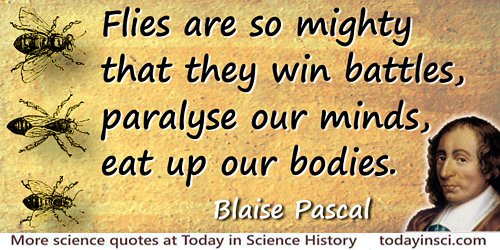
Flies are so mighty that they win battles, paralyse our minds, eat up our bodies.
Flies are so mighty that they win battles, paralyse our minds, eat up our bodies.
Pensées (1670), No. 367, translated by A. J. Krailsheimer (1995), 6. Original French text in Pensées de Pascal: publiées dans leur texte authentique (1866), Vol. 1, 176, No. 120.
Lepidoptera are for children to play with, pretty to look at, so some think. Give me the Coleoptera, and the kings of the Coleoptera are the beetles! Lepidoptera and Neuroptera for little folks; Coleoptera for men, sir!
In 'The Poet at the Breakfast Table: III', The Atlantic Monthly (Mar 1872), 29, 344.
~~[No known source]~~ Once you have flown, you will walk the earth with your eyes turned skyward, for there you have been, there you long return.
Best attributed simply to “Anonymous” because there seems to be no known reliable primary source. Another example of a feral quote that is almost certainly not authentic, yet spreads virally like a lexicographic plague. It must be centuries old, but does not show up in major 19th-century quote collections. It is simply too good to be true. Included here to attach this caution.
A Bat meeting any one running away, signifies an evasion: for although she have no wings, yet she flies.
In De Occulta Philosophia (1533), Vol. 1. Translation by J.F. (1651) reprinted as The Philosophy of Natural Magic (1913), 169.
A man is flying in a hot air balloon and realizes he is lost. He reduces height, spots a man down below and asks,“Excuse me, can you help me? I promised to return the balloon to its owner, but I don’t know where I am.”
The man below says: “You are in a hot air balloon, hovering approximately 350 feet above mean sea level and 30 feet above this field. You are between 40 and 42 degrees north latitude, and between 58 and 60 degrees west longitude.”
“You must be an engineer,” says the balloonist.
“I am,” replies the man.“How did you know?”
“Well,” says the balloonist, “everything you have told me is technically correct, but I have no idea what to make of your information, and the fact is I am still lost.”
The man below says, “You must be a manager.”
“I am,” replies the balloonist,“but how did you know?”
“Well,” says the engineer,“you don’t know where you are, or where you are going. You have made a promise which you have no idea how to keep, and you expect me to solve your problem.The fact is you are in the exact same position you were in before we met, but now it is somehow my fault.”
The man below says: “You are in a hot air balloon, hovering approximately 350 feet above mean sea level and 30 feet above this field. You are between 40 and 42 degrees north latitude, and between 58 and 60 degrees west longitude.”
“You must be an engineer,” says the balloonist.
“I am,” replies the man.“How did you know?”
“Well,” says the balloonist, “everything you have told me is technically correct, but I have no idea what to make of your information, and the fact is I am still lost.”
The man below says, “You must be a manager.”
“I am,” replies the balloonist,“but how did you know?”
“Well,” says the engineer,“you don’t know where you are, or where you are going. You have made a promise which you have no idea how to keep, and you expect me to solve your problem.The fact is you are in the exact same position you were in before we met, but now it is somehow my fault.”
In Jon Fripp, Michael Fripp and Deborah Fripp, Speaking of Science (2000), 199.
A strict materialist believes that everything depends on the motion of matter. He knows the form of the laws of motion though he does not know all their consequences when applied to systems of unknown complexity.
Now one thing in which the materialist (fortified with dynamical knowledge) believes is that if every motion great & small were accurately reversed, and the world left to itself again, everything would happen backwards the fresh water would collect out of the sea and run up the rivers and finally fly up to the clouds in drops which would extract heat from the air and evaporate and afterwards in condensing would shoot out rays of light to the sun and so on. Of course all living things would regrede from the grave to the cradle and we should have a memory of the future but not of the past.
The reason why we do not expect anything of this kind to take place at any time is our experience of irreversible processes, all of one kind, and this leads to the doctrine of a beginning & an end instead of cyclical progression for ever.
Now one thing in which the materialist (fortified with dynamical knowledge) believes is that if every motion great & small were accurately reversed, and the world left to itself again, everything would happen backwards the fresh water would collect out of the sea and run up the rivers and finally fly up to the clouds in drops which would extract heat from the air and evaporate and afterwards in condensing would shoot out rays of light to the sun and so on. Of course all living things would regrede from the grave to the cradle and we should have a memory of the future but not of the past.
The reason why we do not expect anything of this kind to take place at any time is our experience of irreversible processes, all of one kind, and this leads to the doctrine of a beginning & an end instead of cyclical progression for ever.
Letter to Mark Pattison (7 Apr 1868). In P. M. Hannan (ed.), The Scientific Letters and Papers of James Clerk Maxwell (1995), Vol. 2, 1862-1873, 360-1.
According to the theory of aerodynamics, as may be readily demonstrated through wind tunnel experiments, the bumblebee is unable to fly. This is because the size, weight and shape of his body in relation to the total wingspread make flying impossible. But the bumblebee, being ignorant of these scientific truths, goes ahead and flies anyway—and makes a little honey every day.
Sign in a General Motors Corporation factory. As quoted in Ralph L. Woods, The Businessman's
Book of Quotations (1951), 249-50. Cited in Suzy Platt (ed)., Respectfully Quoted: A Dictionary of Quotations (1989), 118.
Adam is fading out. It is on account of Darwin and that crowd. I can see that he is not going to last much longer. There's a plenty of signs. He is getting belittled to a germ—a little bit of a speck that you can't see without a microscope powerful enough to raise a gnat to the size of a church. They take that speck and breed from it: first a flea; then a fly, then a bug, then cross these and get a fish, then a raft of fishes, all kinds, then cross the whole lot and get a reptile, then work up the reptiles till you've got a supply of lizards and spiders and toads and alligators and Congressmen and so on, then cross the entire lot again and get a plant of amphibiums, which are half-breeds and do business both wet and dry, such as turtles and frogs and ornithorhyncuses and so on, and cross-up again and get a mongrel bird, sired by a snake and dam'd by a bat, resulting in a pterodactyl, then they develop him, and water his stock till they've got the air filled with a million things that wear feathers, then they cross-up all the accumulated animal life to date and fetch out a mammal, and start-in diluting again till there's cows and tigers and rats and elephants and monkeys and everything you want down to the Missing Link, and out of him and a mermaid they propagate Man, and there you are! Everything ship-shape and finished-up, and nothing to do but lay low and wait and see if it was worth the time and expense.
'The Refuge of the Derelicts' collected in Mark Twain and John Sutton Tuckey, The Devil's Race-Track: Mark Twain's Great Dark Writings (1980), 340-41.
- 1980
Aerodynamically the bumblebee shouldn’t be able to fly, but the bumblebee doesn’t know that so it goes on flying anyway.
…...
All animals whatsoever, whether they fly or swim or walk upon dry land, whether they bring forth their young alive or in the egg, develop in the same way.
In The Works of Aristotle: Historia Animalium (350 BC), (The History of Animals), Book VII, Part 7, 586a21 translated in William David Ross and John Alexander Smith (eds.), D’Arcy Wentworth Thompson (trans.), (1910), Vol. 4, 27.
All fresh meat is eaten in a state of decay. The process may not have proceeded so far that the dull human nose can discover it, but a carrion bird or a carrion fly can smell it from afar.
In New Dietetics: What to Eat and How (1921), 384.
All the summer long is the swallow a most instructive pattern of unwearied industry and affection; for, from morning to night, while there is a family to be supported, she spends the whole day in skimming close to the ground, and exerting the most sudden turns and quick evolutions. Avenues, and long walks under hedges, and pasture-fields, and mown meadows where cattle graze, are her delight, especially if there are trees interspersed; because in such spots insects most abound. When a fly is taken a smart snap from her bill is heard, resembling the noise at the shutting of a watch case; but the motion of the mandibles are too quick for the eye.
In Letter to Daines Barrington (29 Jan 1774), in In The Natural History and Antiquities of Selborne (1789), 169-170.
All versions written for nonscientists speak of fused males as the curious tale of the anglerfish–just as we so often hear about the monkey swinging through the trees, or the worm burrowing through soil. But if nature teaches us any lesson, it loudly proclaims life’s diversity. There ain’t no such abstraction as the clam, the fly, or the anglerfish. Ceratioid anglerfishes come in nearly 100 species, and each has its own peculiarity.
…...
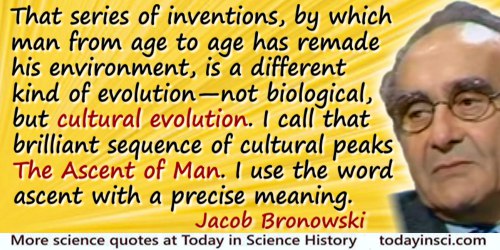
Among the multitude of animals which scamper, fly, burrow and swim around us, man is the only one who is not locked into his environment. His imagination, his reason, his emotional subtlety and toughness, make it possible for him not to accept the environment, but to change it. And that series of inventions, by which man from age to age has remade his environment, is a different kind of evolution—not biological, but cultural evolution. I call that brilliant sequence of cultural peaks The Ascent of Man. I use the word ascent with a precise meaning. Man is distinguished from other animals by his imaginative gifts. He makes plans, inventions, new discoveries, by putting different talents together; and his discoveries become more subtle and penetrating, as he learns to combine his talents in more complex and intimate ways. So the great discoveries of different ages and different cultures, in technique, in science, in the arts, express in their progression a richer and more intricate conjunction of human faculties, an ascending trellis of his gifts.
The Ascent of Man (1973), 19-20.
And somewhere there are engineers
Helping others fly faster than sound.
But, where are the engineers
Helping those who must live on the ground?
Helping others fly faster than sound.
But, where are the engineers
Helping those who must live on the ground?
Oxfam poster, as quoted on various websites.
Antoine Magnan, a French zoologist, in 1934 made some very careful studies of bumblebee flight and came to the conclusion that bumblebees cannot fly at all! Fortunately, the bumblebees never heard this bit of news and so went on flying as usual.
Insects (1968, 1972), 68. Referring to Antoine Magnan Le Vol des Insectes (1934), Vol. 1 of Locomotion Chez les Animaux. Cited
Any opinion as to the form in which the energy of gravitation exists in space is of great importance, and whoever can make his opinion probable will have, made an enormous stride in physical speculation. The apparent universality of gravitation, and the equality of its effects on matter of all kinds are most remarkable facts, hitherto without exception; but they are purely experimental facts, liable to be corrected by a single observed exception. We cannot conceive of matter with negative inertia or mass; but we see no way of accounting for the proportionality of gravitation to mass by any legitimate method of demonstration. If we can see the tails of comets fly off in the direction opposed to the sun with an accelerated velocity, and if we believe these tails to be matter and not optical illusions or mere tracks of vibrating disturbance, then we must admit a force in that direction, and we may establish that it is caused by the sun if it always depends upon his position and distance.
Letter to William Huggins (13 Oct 1868). In P. M. Hannan (ed.), The Scientific Letters and Papers of James Clerk Maxwell (1995), Vol. 2, 1862-1873, 451-2.
Arithmetic is where numbers fly like pigeons in and out of your head.
From 'Arithmetic', Harvest Poems, 1910-1960 (1960), 115.
As soon as somebody demonstrates the art of flying, settlers from our species of man will not be lacking [on the moon and Jupiter]… Given ships or sails adapted to the breezes of heaven, there will be those who will not shrink from even that vast expanse.
(1610) As translated by Edward Rosen in Kepler’s Conversation with Galileo’s Sidereal Messenger (1965), 39.
As the proverb says, “You cannot fly like an eagle with the wings of a wren.”
In Afoot in England (1909, 1922), 80. He might have originated this specific wording, but as this full sentence shows, Hudson was quoting a proverb. Many sources simply attribute the quote to him. Yet, in fact, the expression goes back to at least 1607, for it appears in Thomas Walkington, 'To the Reader', The Optick Glasse of Humors as “I have soared also above my pitch, attempting an Eagles flight with the wing of a Wrenne.”
As we were flying over the Mozambique Channel, which separates the island of Madagascar from the continent of Africa, we could clearly see the transverse sand bars at its bottom. It was just like a brook one waded in childhood.
…...
Before I flew I was already aware of how small and vulnerable our planet is; but only when I saw it from space, in all its ineffable beauty and fragility, did I realize that humankind’s most urgent task is to cherish and preserve it for future generations.
In Jack Hassard and Julie Weisberg , Environmental Science on the Net: The Global Thinking Project (1999), 40.
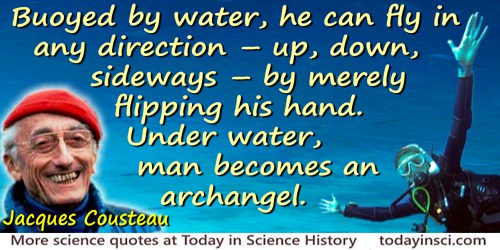
Buoyed by water, he can fly in any direction—up, down, sideways—by merely flipping his hand. Under water, man becomes an archangel.
Quoted in 'Sport: Poet of the Depths', Time (28 Mar 1960)
But why, some say, the moon? Why choose this as our goal? And they may well ask; why climb the highest mountain? Why, 35 years ago, fly the Atlantic? Why does Rice play Texas?
From Address at Rice Stadium (12 Sep 1962). On website of John F. Kennedy Presidential Library and Museum. [This go-to-the-moon speech was largely written by presidential advisor and speechwriter Ted Sorensen.]
Conservation is a bird that flies faster than the shot we aim at it.
In Aldo Leopold and Luna B. Leopold, Round River (1972), 145.
Current manned space flights are complex missions that involve thousands of people. Someday, however, space vehicles will fly in and out of earth orbit in a more routine manner, and the usefulness of space to science and, in fact, to all persons will have reached a highly desirable plateau.
In 'After Apollo, What?', Science Teacher (Sep 1969), 36, No. 6. 22.
Dick Drew took a bunch of misfits—people who wouldn’t fly in formation—and he put together a lab that created technologies that account for 20 percent of 3M's sales in 2000.
— Art Fry
As quoted in W. James McNerney Jr., A Century of Innovation: The 3M Story (2002), 26.
Do not all charms fly
At the mere touch of cold philosophy?
There was an awful rainbow once in heaven:
We know her woof, her texture; she is given
In the dull catalogue of common things.
Philosophy will clip an Angel’s wings,
Conquer all mysteries by rule and line,
Empty the haunted air, and gnomed mine
Unweave a rainbow.
At the mere touch of cold philosophy?
There was an awful rainbow once in heaven:
We know her woof, her texture; she is given
In the dull catalogue of common things.
Philosophy will clip an Angel’s wings,
Conquer all mysteries by rule and line,
Empty the haunted air, and gnomed mine
Unweave a rainbow.
Lamia 1820, II, lines 229-37. In John Barnard (ed.), John Keats. The Complete Poems (1973), 431.
Do what we can, summer will have its flies.
…...
Does anyone believe that the difference between the Lebesgue and Riemann integrals can have physical significance, and that whether say, an airplane would or would not fly could depend on this difference? If such were claimed, I should not care to fly in that plane.
Paraphrased from American Mathematics Monthly (1998) 105, 640-50. Quoted in John De Pillis, 777 Mathematical Conversation Starters (2004), 136.
Every complete set of chromosomes contains the full code; so there are, as a rule, two copies of the latter in the fertilized egg cell, which forms the earliest stage of the future individual. In calling the structure of the chromosome fibres a code-script we mean that the all-penetrating mind, once conceived by Laplace, to which every causal connection lay immediately open, could tell from their structure whether the egg would develop, under suitable conditions, into a black cock or into a speckled hen, into a fly or a maize plant, a rhododendron, a beetle, a mouse or a woman. To which we may add, that the appearances of the egg cells are very often remarkably similar; and even when they are not, as in the case of the comparatively gigantic eggs of birds and reptiles, the difference is not so much in the relevant structures as in the nutritive material which in these cases is added for obvious reasons.
But the term code-script is, of course, too narrow. The chromosome structures are at the same time instrumental in bringing about the development they foreshadow. They are law-code and executive power?or, to use another simile, they are architect's plan and builder’s craft-in one.
But the term code-script is, of course, too narrow. The chromosome structures are at the same time instrumental in bringing about the development they foreshadow. They are law-code and executive power?or, to use another simile, they are architect's plan and builder’s craft-in one.
In What is Life? : The Physical Aspect of the Living Cell (1944), 20-21.
Evolution: At the Mind's Cinema
I turn the handle and the story starts:
Reel after reel is all astronomy,
Till life, enkindled in a niche of sky,
Leaps on the stage to play a million parts.
Life leaves the slime and through all ocean darts;
She conquers earth, and raises wings to fly;
Then spirit blooms, and learns how not to die,-
Nesting beyond the grave in others' hearts.
I turn the handle: other men like me
Have made the film: and now I sit and look
In quiet, privileged like Divinity
To read the roaring world as in a book.
If this thy past, where shall they future climb,
O Spirit, built of Elements and Time?
I turn the handle and the story starts:
Reel after reel is all astronomy,
Till life, enkindled in a niche of sky,
Leaps on the stage to play a million parts.
Life leaves the slime and through all ocean darts;
She conquers earth, and raises wings to fly;
Then spirit blooms, and learns how not to die,-
Nesting beyond the grave in others' hearts.
I turn the handle: other men like me
Have made the film: and now I sit and look
In quiet, privileged like Divinity
To read the roaring world as in a book.
If this thy past, where shall they future climb,
O Spirit, built of Elements and Time?
'Evolution: At the Mind's Cinema' (1922), in The Captive Shrew and Other Poems of a Biologist (1932), 55.
Facts are certainly the solid and true foundation of all sectors of nature study ... Reasoning must never find itself contradicting definite facts; but reasoning must allow us to distinguish, among facts that have been reported, those that we can fully believe, those that are questionable, and those that are false. It will not allow us to lend faith to those that are directly contrary to others whose certainty is known to us; it will not allow us to accept as true those that fly in the face of unquestionable principles.
Memoires pour Servir a l'Histoire des Insectes (1736), Vol. 2, xxxiv. Quoted in Jacques Roger, The Life Sciences in Eighteenth-Century French Thought, ed. Keith R. Benson and trans. Robert Ellrich (1997), 165.
Facts are the air of scientists. Without them you can never fly.
…...
Given angel’s wings, where might you fly?
In what sweet heaven might you find your love?
Unwilling to be bound, where might you move,
Lost between the wonder and the why?...
In what sweet heaven might you find your love?
Unwilling to be bound, where might you move,
Lost between the wonder and the why?...
…...
God in His wisdom made the fly
And then forgot to tell us why.
And then forgot to tell us why.
'The Fly' (1942), Good Intentions (1943), 220.
Habit is thus the enormous fly-wheel of society, its most precious conservative agent. It alone is what keeps us all within the bounds of ordinance, and saves the children of fortune from the envious uprisings of the poor. It alone prevents the hardest and most repulsive walks of life from being deserted by those brought up to tread therein.
'The Laws of Habit', The Popular Science Monthly (Feb 1887), 447.
Have you ever watched an eagle held captive in a zoo, fat and plump and full of food and safe from danger too?
Then have you seen another wheeling high up in the sky, thin and hard and battle-scarred, but free to soar and fly?
Well, which have you pitied the caged one or his brother? Though safe and warm from foe or storm, the captive, not the other!
There’s something of the eagle in climbers, don’t you see; a secret thing, perhaps the soul, that clamors to be free.
It’s a different sort of freedom from the kind we often mean, not free to work and eat and sleep and live in peace serene.
But freedom like a wild thing to leap and soar and strive, to struggle with the icy blast, to really be alive.
That’s why we climb the mountain’s peak from which the cloud-veils flow, to stand and watch the eagle fly, and soar, and wheel... below...
Then have you seen another wheeling high up in the sky, thin and hard and battle-scarred, but free to soar and fly?
Well, which have you pitied the caged one or his brother? Though safe and warm from foe or storm, the captive, not the other!
There’s something of the eagle in climbers, don’t you see; a secret thing, perhaps the soul, that clamors to be free.
It’s a different sort of freedom from the kind we often mean, not free to work and eat and sleep and live in peace serene.
But freedom like a wild thing to leap and soar and strive, to struggle with the icy blast, to really be alive.
That’s why we climb the mountain’s peak from which the cloud-veils flow, to stand and watch the eagle fly, and soar, and wheel... below...
…...
Hold fast to dreams for if dreams die, life is a broken winged bird that cannot fly.
…...
Hold fast to dreams,
Let them stay with you forever.
Don’t let them die.
You might fly up in the sky
On a silver unicorn’s back,
Dreaming of the ocean,
Listening to the dolphins sing.
Dreams, hold on to them forever.
Let them stay with you forever.
Don’t let them die.
You might fly up in the sky
On a silver unicorn’s back,
Dreaming of the ocean,
Listening to the dolphins sing.
Dreams, hold on to them forever.
…...
Houston, that may have seemed like a very long final phase. The autotargeting was taking us right into a... crater, with a large number of big boulders and rocks ... and it required... flying manually over the rock field to find a reasonably good area.
…...
How bright and beautiful a comet is as it flies past our planet—provided it does fly past it.
Epigraph in Isaac Asimov’s Book of Science and Nature Quotations (1988), 47.
How near one Species to the next is join'd,
The due Gradations please a thinking Mind;
and there are Creatures which no eye can see,
That for a Moment live and breathe like me:
Whom a small Fly in bulk as far exceeds,
As yon tall Cedar does the waving Reeds:
These we can reach—and may we not suppose
There still are Creatures more minute than those.
The due Gradations please a thinking Mind;
and there are Creatures which no eye can see,
That for a Moment live and breathe like me:
Whom a small Fly in bulk as far exceeds,
As yon tall Cedar does the waving Reeds:
These we can reach—and may we not suppose
There still are Creatures more minute than those.
'The Enquiry'. In Poems Upon Several Occasions (1748), 198.
I complained to Mr. Johnson that I was much afflicted with melancholy, which was hereditary in our family. He said that he himself had been greatly distressed with it, and for that reason had been obliged to fly from study and meditation to the dissipating variety of life. He advised me to have constant occupation of mind, to take a great deal of exercise, and to live moderately; especially to shun drinking at night. “Melancholy people,” said he, are apt to fly to intemperance, which gives a momentary relief but sinks the soul much lower in misery.” He observed that laboring men who work much and live sparingly are seldom or never troubled with low spirits.
I confess that in 1901, I said to my brother Orville that man would not fly for fifty years...Ever since, I have distrusted myself and avoided all predictions.
…...
I could have gone on flying through space forever.
As quoted in The New York Times (14 Apr 1958). Given and cited in Dave English, Slipping The Surly Bonds: Great Quotations on Flight (1998), 11.
I find in the domestic duck that the bones of the wing weigh less and the bones of the leg more, in proportion to the whole skeleton, than do the same bones in the wild duck; and this change may be safely attributed to the domestic duck flying much less, and walking more, than its wild parents.
From On the Origin of Species by Means of Natural Selection; or, The Preservation of Favoured Races in the Struggle for Life (1861), 17.
I have flown twice over Mount St. Helens out on our West Coast. I'm not a scientist and I don't know the figures, but I have a suspicion that that one little mountain has probably released more sulfur dioxide into the atmosphere of the world than has been released in the last ten years of automobile driving or things of that kind that people are so concerned about.
Address in Steubenville, Ohio (7 Oct 1980). As quoted in Douglas E. Kneeland, 'Teamsters Back Republican', New York Times (10 Oct 1980), D14. The article also stated that according to an E.P.A. spokesman, “all American manmade emissions of sulfur dioxide amounted to 81,000 tons a day, and the emissions from the volcano ranged from 500 to 2,000 tons a day.”
I hear the scream of a great hawk, sailing with a ragged wing against the high wood-side, apparently to scare his prey and so detect it—shrill, harsh, fitted to excite terror in sparrows and to issue from his split and curved bill. I see his open bill the while against the sky. Spit with force from his mouth with an undulatory quaver imparted to it from his wings or motion as he flies.
(15 Jun 1852). In Henry David Thoreau and Bradford Torrey (ed.), The Writings of Henry Thoreau: Journal: IV: May 1, 1852-February 27,, 1853 (1906), 103.
I think it’s going to be great if people can buy a ticket to fly up and see black sky and the stars. I’d like to do it myself - but probably after it has flown a serious number of times first!
…...
I was always afraid of dying. Always. It was my fear that made me learn everything I could about my airplane and my emergency equipment, and kept me flying respectful of my machine and always alert in the cockpit.
I was interested in flying beginning at age 7, when a close family friend took me in his little airplane. And I remember looking at the wheel of the airplane as we rolled down the runway, because I wanted to remember the exact moment that I first went flying... the other thing growing up is that I was always interested in science.
…...
I will write peace on your wings and you will fly all over the world.
As given in United States Committee for Cooperation with the Japan Council Against A and H Bombs, Report from Hiroshima (1961), 48. The report says Sadako murmured these (translated) words while on her deathbed, holding one of the paper cranes she had folded.
I would by all means have men beware, lest Æsop’s pretty fable of the fly that sate [sic] on the pole of a chariot at the Olympic races and said, “What a dust do I raise,” be verified in them. For so it is that some small observation, and that disturbed sometimes by the instrument, sometimes by the eye, sometimes by the calculation, and which may be owing to some real change in the heaven, raises new heavens and new spheres and circles.
'Of Vain Glory' (1625) in James Spedding, Robert Ellis and Douglas Heath (eds.), The Works of Francis Bacon (1887-1901), Vol. 6, 503.
I would trade all the advantages of humanity to be a fly on the wall when Franklin and Jefferson discussed liberty, Lenin and Trotsky revolution, Newton and Halley the shape of the universe, or when Darwin entertained Huxley and Lyell at Down.
…...
If God meant for us to fly he would have given us propellers on our noses.
on The Dick Cavett Show, February 24, 1971.
If the germ plasm wants to swim in the ocean, it makes itself a fish; if the germ plasm wants to fly in the air, it makes itself a bird. If it wants to go to Harvard, it makes itself a man. The strangest thing of all is that the germ plasm that we carry around within us has done all those things. There was a time, hundreds of millions of years ago, when it was making fish. Then … amphibia … reptiles … mammals, and now it’s making men.
In talk, 'Origin of Death' (1970). Wald gave the context whereby the most one-celled organisms continued to reproduce by cell division.
If the world goes crazy for a lovely fossil, that's fine with me. But if that fossil releases some kind of mysterious brain ray that makes people say crazy things and write lazy articles, a serious swarm of flies ends up in my ointment.
Criticism of excessive media hype about a fossil discovery, from blog 'The Loom' (19 May 2009) on Discover magazine website.
If to-day you ask a physicist what he has finally made out the æther or the electron to be, the answer will not be a description in terms of billiard balls or fly-wheels or anything concrete; he will point instead to a number of symbols and a set of mathematical equations which they satisfy. What do the symbols stand for? The mysterious reply is given that physics is indifferent to that; it has no means of probing beneath the symbolism. To understand the phenomena of the physical world it is necessary to know the equations which the symbols obey but not the nature of that which is being symbolised. …this newer outlook has modified the challenge from the material to the spiritual world.
Swarthmore Lecture (1929) at Friends’ House, London, printed in Science and the Unseen World (1929), 30.
Imagination is the highest kite one can fly.
…...
In all works on Natural History, we constantly find details of the marvellous adaptation of animals to their food, their habits, and the localities in which they are found. But naturalists are now beginning to look beyond this, and to see that there must be some other principle regulating the infinitely varied forms of animal life. It must strike every one, that the numbers of birds and insects of different groups having scarcely any resemblance to each other, which yet feed on the same food and inhabit the same localities, cannot have been so differently constructed and adorned for that purpose alone. Thus the goat-suckers, the swallows, the tyrant fly-catchers, and the jacamars, all use the same kind ‘Of food, and procure it in the same manner: they all capture insects on the wing, yet how entirely different is the structure and the whole appearance of these birds!
In A Narrative of Travels on the Amazon and Rio Negro (1853), 83-84.
In ancient days two aviators procured to themselves wings. Daedalus flew safely through the middle air and was duly honored on his landing. Icarus soared upwards to the sun till the wax melted which bound his wings and his flight ended in fiasco. In weighing their achievements, there is something to be said for Icarus. The classical authorities tell us that he was only “doing a stunt,” but I prefer to think of him as the man who brought to light a serious constructional defect in the flying machines of his day.
In modern Europe, the Middle Ages were called the Dark Ages. Who dares to call them so now? … Their Dante and Alfred and Wickliffe and Abelard and Bacon; their Magna Charta, decimal numbers, mariner’s compass, gunpowder, glass, paper, and clocks; chemistry, algebra, astronomy; their Gothic architecture, their painting,—are the delight and tuition of ours. Six hundred years ago Roger Bacon explained the precession of the equinoxes, and the necessity of reform in the calendar; looking over how many horizons as far as into Liverpool and New York, he announced that machines can be constructed to drive ships more rapidly than a whole galley of rowers could do, nor would they need anything but a pilot to steer; carriages, to move with incredible speed, without aid of animals; and machines to fly into the air like birds.
In 'Progress of Culture', an address read to the Phi Beta Kappa Society at Cambridge, 18 July 1867. Collected in Works of Ralph Waldo Emerson (1883), 475.
In the wilderness, people think of danger from Indians, alligators, and jaguars. They are not the things you mind. It is the mosquitoes, the poisonous ants, the maribondo wasps that are perfectly awful. It is the borrachudos and plum flies—like the black flies of the north woods,
only worse … The day after I threw away my spare clothing ants ate up all my underwear. These were white ants. The driver ants try to eat the man instead of his clothes.
In National Geographic, Great Adventures with National Geographic: Exploring Land, Sea, and Sk (1963), 109. The last sentences about the white and driver ants, with slightly different wording, also appear in Theodore Roosevelt, 'A Journey in Central Brazil', The Geographical Journey (Feb 1915), 45, No. 2, 104, previously read to the Royal Geographic Society (16 Jun 1914).
In this age of space flight, when we use the modern tools of science to advance into new regions of human activity, the Bible ... this grandiose, stirring history of the gradual revelation and unfolding of the moral law ... remains in every way an up-to-date book. Our knowledge and use of the laws of nature that enable us to fly to the Moon also enable us to destroy our home planet with the atom bomb. Science itself does not address the question whether we should use the power at our disposal for good or for evil. The guidelines of what we ought to do are furnished in the moral law of God. It is no longer enough that we pray that God may be with us on our side. We must learn again that we may be on God's side.
Quoted in Bob Phillips, Phillips' Book of Great Thoughts & Funny Sayings (1993), 42.
Infectious disease is one of the few genuine adventures left in the world. The dragons are all dead and the lance grows rusty in the chimney corner. ... About the only sporting proposition that remains unimpaired by the relentless domestication of a once free-living human species is the war against those ferocious little fellow creatures, which lurk in dark corners and stalk us in the bodies of rats, mice and all kinds of domestic animals; which fly and crawl with the insects, and waylay us in our food and drink and even in our love
Rats, Lice and History (1935)
Intelligence, in diapers, is invisible. And when it matures, out the window it flies. We have to pounce on it earlier.
…...
It is a happy world after all. The air, the earth, the water teem with delighted existence. In a spring noon, or a summer evening, on whichever side I turn my eyes, myriads of happy beings crowd upon my view. “The insect youth are on the wing.” Swarms of new-born flies are trying their pinions in the air. Their sportive motions, their wanton mazes, their gratuitous activity testify their joy and the exultation they feel in their lately discovered faculties … The whole winged insect tribe, it is probable, are equally intent upon their proper employments, and under every variety of constitution, gratified, and perhaps equally gratified, by the offices which the author of their nature has assigned to them.
Natural Theology: or, Evidences of the Existence and Attributes of The Deity, Collected from the Appearances of Nature (1802), 490-1.
It is by the aid of iron that we construct houses, cleave rocks, and perform so many other useful offices of life. But it is with iron also that wars, murders, and robberies are effected, and this, not only hand to hand, but from a distance even, by the aid of missiles and winged weapons, now launched from engines, now hurled by the human arm, and now furnished with feathery wings. This last I regard as the most criminal artifice that has been devised by the human mind; for, as if to bring death upon man with still greater rapidity, we have given wings to iron and taught it to fly. ... Nature, in conformity with her usual benevolence, has limited the power of iron, by inflicting upon it the punishment of rust; and has thus displayed her usual foresight in rendering nothing in existence more perishable, than the substance which brings the greatest dangers upon perishable mortality.
Natural History of Pliny, translation (1857, 1898) by John Bostock and H. T. Riley, 205-6.
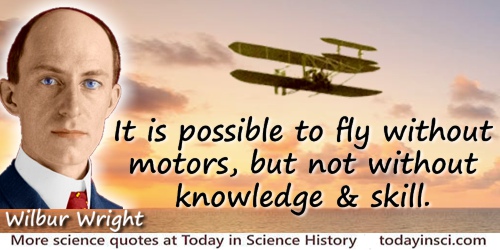
It is possible to fly without motors, but not without knowledge & skill.
From his first letter (13 May 1900) to Octave Chanute. In Marvin W. McFarland (ed.) The Papers of Wilbur and Orville Wright: 1899-1905 (1953), Vol. 1, 13.
It is the anvil that makes the hammer fly back
From the original French, “C’est l’enclume qui repousse le marteau,” in 'Des Confeils', L’Esprit (1758), Discourse 4, Chap. 11, 576. English version from Claude Adrien Helvétius and William Mudford (trans.), 'Of Advice', De l’Esprit or, Essays on the Mind and its Several Faculties (1759), Essay 4, Chap. 11, 295.
Journalism must find the facts, it must not prejudge things in terms of conservatism or liberalism or radicalism; it must not decide in advance that it is to be conformist or non-conformist; it cannot fly in the face of facts without courting ultimate disaster.
Journalism must focus the facts; facts are not important for their own sake; they are important only as a basis for action; journalism must focus the facts it finds upon the issues its readers face.
Journalism must filter the facts; it must with conscientious care separate the facts from admixtures of prejudice, passion, partisanship, and selfish interest; facts that are diluted, colored, or perverted are valueless as a basis for action.
Journalism must face the facts; it must learn that the energy spent in trying to find ways to get around, under, or over the facts is wasted energy; facts have a ruthless way of winning the day sooner or later.
Journalism must follow the facts; journalism must say of facts as Job said, of God: though they slay us, yet shall we trust them; if the facts threaten to upset a paper's cherished policy, it always pays the journalist to re-examine his policy; that way lies realism, and realism is the ultimate good.
Journalism must focus the facts; facts are not important for their own sake; they are important only as a basis for action; journalism must focus the facts it finds upon the issues its readers face.
Journalism must filter the facts; it must with conscientious care separate the facts from admixtures of prejudice, passion, partisanship, and selfish interest; facts that are diluted, colored, or perverted are valueless as a basis for action.
Journalism must face the facts; it must learn that the energy spent in trying to find ways to get around, under, or over the facts is wasted energy; facts have a ruthless way of winning the day sooner or later.
Journalism must follow the facts; journalism must say of facts as Job said, of God: though they slay us, yet shall we trust them; if the facts threaten to upset a paper's cherished policy, it always pays the journalist to re-examine his policy; that way lies realism, and realism is the ultimate good.
From address as president of the Wisconsin local chapter of Theta Sigma Phi, at its first annual Matrix Table (9 Jan 1926). quoted in 'Journalism News and Notes', in Robert S. Crawford (ed.), The Wisconsin Alumni Magazine (Feb 1926), 27, No. 4, 101. If you know any other example of Glenn Frank speaking about his five themes on facts, please contact Webmaster.
Laws are like Cobwebs, which may catch small Flies, but let Wasps and Hornets break through.
In 'A Tritical Essay Upon the Faculties of the Mind' (6 Aug 1707), collected in various volumes and editions, for example, The Works of J.S, D.D, D.S.P.D.: Volume 1: Miscellanies in Prose (1739), 173. An earlier, undated, fourth volume of Miscellanies gives the 6 Aug 1707 date the essay was written. The final Latin phrase can be translated as, “Can you help laughing, friends?” attributed to Horace.
Let us see how high we can fly before the sun melts the wax in our wings.
About the ambitious pursuit of knowledge, alluding to Icarus of the Greek myth.
About the ambitious pursuit of knowledge, alluding to Icarus of the Greek myth.
Consilience: The Unity of Knowledge (1999), 7.
Life has found ways to flourish in boiling hot springs and on icy mountain tops, to fly, glow in the dark, put forth leaves in a rainless desert, or plumb the ocean, reproducing and adapting, reincarnating itself in new forms in defiance of time and death.
…...
Man studied birds for centuries, trying to learn how to make a machine to fly like them. He never did do the trick; his final success came when he broke away entirely and tried new methods.
Published under the name Don A. Stuart, 'Who Goes There?', Astounding Stories (Aug 1938). In Robert Silverberg, Ben Bova and Science Fiction Writers of America, The Science Fiction Hall of Fame (1973), Vol. 2, 62.
Men will never fly, because flying is reserved for angels.
Attributed. As seen, for example, in Michael Blow, Men of Science and Invention (1961), 74. The subject quote can be found in several other books, and it is amusing to see how some writers’ imaginations create different contexts for it.
Nature when more shy in one, hath more freely confest and shewn herself in another; and a Fly sometimes hath given greater light towards the true knowledge of the structure and the uses of the Parts in Humane Bodies, than an often repeated dissection of the same might have done … We must not therefore think the meanest of the Creation vile or useless, since that in them in lively Characters (if we can but read) we may find the knowledge of a Deity and ourselves … In every Animal there is a world of wonders; each is a Microcosme or a world in it self.
Phocrena, or the Anatomy of a Porpess, dissected at Gresham College: With a Prreliminary Discourse Concerning Anatomy, and a Natural History of Animals (1680), 2-3.
None. I don’t drink and fly.
Reply to a Tweeted question: How many UFOs have you seen? (18 Aug 2016).
O. Hahn and F. Strassmann have discovered a new type of nuclear reaction, the splitting into two smaller nuclei of the nuclei of uranium and thorium under neutron bombardment. Thus they demonstrated the production of nuclei of barium, lanthanum, strontium, yttrium, and, more recently, of xenon and caesium. It can be shown by simple considerations that this type of nuclear reaction may be described in an essentially classical way like the fission of a liquid drop, and that the fission products must fly apart with kinetic energies of the order of hundred million electron-volts each.
'Products of the Fission of the Urarium Nucleus', Nature (1939), 143, 471.
Oh that I had wings like a dove! for then would I fly away, and be at rest.
— Bible
Psalm 55:6, The Holy Bible (1815), 475.
Oh, I have slipped the surly bonds of earth
and danced the skies on laughter-silvered wings;
Sunward I’ve climbed, and joined the tumbling mirth
of sun-split clouds and done a hundred things
you have not dreamed of wheeled and soared and swung
high in the sunlit silence. Hovering there,
I’ve chased the shouting wind along, and flung
my eager craft through footless halls of air.
Up, up the long, delirious, burning blue
I’ve topped the windswept heights with easy grace
where never lark, or even eagle flew
and, while with silent, lifting mind I’ve trod
the high untrespassed sanctity of space,
put out my hand, and touched the face of God.
and danced the skies on laughter-silvered wings;
Sunward I’ve climbed, and joined the tumbling mirth
of sun-split clouds and done a hundred things
you have not dreamed of wheeled and soared and swung
high in the sunlit silence. Hovering there,
I’ve chased the shouting wind along, and flung
my eager craft through footless halls of air.
Up, up the long, delirious, burning blue
I’ve topped the windswept heights with easy grace
where never lark, or even eagle flew
and, while with silent, lifting mind I’ve trod
the high untrespassed sanctity of space,
put out my hand, and touched the face of God.
…...
Once the hatch was opened, I turned the lock handle and bright rays of sunlight burst through it. I opened the hatch and dust from the station flew in like little sparklets, looking like tiny snowflakes on a frosty day. Space, like a giant vacuum cleaner, began to suck everything out. Flying out together with the dust were some little washers and nuts that dad got stuck somewhere; a pencil flew by.
My first impression when I opened the hatch was of a huge Earth and of the sense of unreality concerning everything that was going on. Space is very beautiful. There was the dark velvet of the sky, the blue halo of the Earth and fast-moving lakes, rivers, fields and clouds clusters. It was dead silence all around, nothing whatever to indicate the velocity of the flight… no wind whistling in your ears, no pressure on you. The panorama was very serene and majestic.
My first impression when I opened the hatch was of a huge Earth and of the sense of unreality concerning everything that was going on. Space is very beautiful. There was the dark velvet of the sky, the blue halo of the Earth and fast-moving lakes, rivers, fields and clouds clusters. It was dead silence all around, nothing whatever to indicate the velocity of the flight… no wind whistling in your ears, no pressure on you. The panorama was very serene and majestic.
…...
Once you have learned to fly your plane, it is far less fatiguing to fly than it is to drive a car. You don’t have to watch every second for cats, dogs, children, lights, road signs, ladies with baby carriages and citizens who drive out in the middle of the block against the lights... Nobody who has not been up in the sky on a glorious morning can possibly imagine the way a pilot feels in free heaven.
…...
One gram of moss from the forest floor, a piece about the size of a muffin, would harbor 150,000 protozoa, 132,000 tardigrades, 3,000 springtails, 800 rotifers, 500 nematodes, 400 mites, and 200 fly larvae. These numbers tell us something about the astounding quantity of life in a handful of moss.
In 'In the Forest of the Waterbear', Gathering Moss: A Natural and Cultural History of Mosses (2003), 55.
One of the most curious and interesting reptiles which I met with in Borneo was a large tree-frog, which was brought me by one of the Chinese workmen. He assured me that he had seen it come down in a slanting direction from a high tree, as if it flew. On examining it, I found the toes very long and fully webbed to their very extremity, so that when expanded they offered a surface much larger than the body. The forelegs were also bordered by a membrane, and the body was capable of considerable inflation. The back and limbs were of a very deep shining green colour, the undersurface and the inner toes yellow, while the webs were black, rayed with yellow. The body was about four inches long, while the webs of each hind foot, when fully expanded, covered a surface of four square inches, and the webs of all the feet together about twelve square inches. As the extremities of the toes have dilated discs for adhesion, showing the creature to be a true tree frog, it is difficult to imagine that this immense membrane of the toes can be for the purpose of swimming only, and the account of the Chinaman, that it flew down from the tree, becomes more credible. This is, I believe, the first instance known of a “flying frog,” and it is very interesting to Darwinians as showing that the variability of the toes which have been already modified for purposes of swimming and adhesive climbing, have been taken advantage of to enable an allied species to pass through the air like the flying lizard. It would appear to be a new species of the genus Rhacophorus, which consists of several frogs of a much smaller size than this, and having the webs of the toes less developed.
Malay Archipelago
OSTRICH, n. A large bird to which (for its sins, doubtless) nature has denied that hinder toe in which so many pious naturalists have seen a conspicuous evidence of design. The absence of a good working pair of wings is no defect, for, as has been ingeniously pointed out, the ostrich does not fly.
The Collected Works of Ambrose Bierce (1911), Vol. 7, The Devil's Dictionary, 241.
Perfect as the wing of a bird may be, it will never enable the bird to fly if unsupported by the air. Facts are the air of science. Without them a man of science can never rise. Without them your theories are vain surmises. But while you are studying, observing, experimenting, do not remain content with the surface of things. Do not become a mere recorder of facts, but try to penetrate the mystery of their origin. Seek obstinately for the laws that govern them.
Translation of a note, 'Bequest of Pavlov to the Academic Youth of his Country', written a few days before his death for a student magazine, The Generation of the Victors. As published in 'Pavlov and the Spirit of Science', Nature (4 Apr 1936), 137, 572.
Quite likely the twentieth century is destined to see the natural forces which will enable us to fly from continent to continent with a speed far exceeding that of a bird.
'The Outlook for the Flying Machine'. The Independent: A Weekly Magazine (22 Oct 1903), 2510.
Samuel Pierpoint Langley, at that time regarded as one of the most distinguished scientists in the United States … evidently believed that a full sized airplane could be built and flown largely from theory alone. This resulted in two successive disastrous plunges into the Potomac River, the second of which almost drowned his pilot. This experience contrasts with that of two bicycle mechanics Orville and Wilbur Wright who designed, built and flew the first successful airplane. But they did this after hundreds of experiments extending over a number of years.
In article Total Quality: Its Origins and its Future (1995), published at the Center for Quality and Productivity Improvement.
Science surpasses the old miracles of mythology, to fly with them over the sea, and to send their messages under it.
In 'Progress of Culture', an address read to the Phi Beta Kappa Society at Cambridge, 18 July 1867. Collected in Works of Ralph Waldo Emerson (1883), 473.
Science tries to answer the question: ‘How?’ How do cells act in the body? How do you design an airplane that will fly faster than sound? How is a molecule of insulin constructed? Religion, by contrast, tries to answer the question: ‘Why?’ Why was man created? Why ought I to tell the truth? Why must there be sorrow or pain or death? Science attempts to analyze how things and people and animals behave; it has no concern whether this behavior is good or bad, is purposeful or not. But religion is precisely the quest for such answers: whether an act is right or wrong, good or bad, and why.
Science and Imagination, ch. 4, Basic Books (1967).
See skulking Truth to her old cavern fled,
Mountains of Casuistry heap’d o’er her head!
Philosophy, that lean’d on Heav’n before,
Shrinks to her second cause, and is no more.
Physic of Metaphysic begs defence,
And Metaphysic calls for aid on Sense!
See Mystery to Mathematics fly!
Mountains of Casuistry heap’d o’er her head!
Philosophy, that lean’d on Heav’n before,
Shrinks to her second cause, and is no more.
Physic of Metaphysic begs defence,
And Metaphysic calls for aid on Sense!
See Mystery to Mathematics fly!
In The Dunciad, collected in The Poetical Works of Alexander Pope (1828), Vol. 3, 211.

Segregationalists will even argue that God was the first segregationalist. “Red birds and blue birds don't fly together”, they contend. … They turn to some pseudo-scientific writing and argue that the Negro’s brain is smaller than the white man’s brain. They do not know, or they refuse to know that the idea of an inferior or superior race has been refuted by the best evidence of the science of anthropology. Great anthropologists, like Ruth Benedict, Margaret Mead, and Melville J. Herskovits, agree that, although there may be inferior and superior individuals within all races, there is no superior or inferior race. And segregationalists refuse to acknowledge that there are four types of blood, and these four types are found within every racial group.
'Love in Action', Strength To Love (1963, 1981), 45-46.
Select such subjects that your pupils cannot walk out without seeing them. Train your pupils to be observers, and have them provided with the specimens about which you speak. If you can find nothing better, take a house-fly or a cricket, and let each one hold a specimen and examine it as you talk.
Lecture at a teaching laboratory on Penikese Island, Buzzard's Bay. Quoted from the lecture notes by David Starr Jordan, Science Sketches (1911), 146.
Some say that science dictates, or at least its old rules said, that it is impossible for bumblebees to fly. This may be a myth, but wouldn't you like to think that every time you look at the bees, you are seeing that there is no such thing as the impossible?
Look at the Bees (2006).
The adults of Drosophila react positively to light, i.e., they go toward a source of light … whether the animals walk or fly. Removal of the wings causes the flies to become less responsive to light, … roughly proportional to the amount of the wing that is cut off. As was to be expected from this fact, mutant races with parts of the wings gone or deformed show the same relations—the smaller the amount of normal wing present, the less marked is the reaction to light.
In The North American Species of Drosophila (1921), 4.
The attempted synthesis of paleontology and genetics, an essential part of the present study, may be particularly surprising and possibly hazardous. Not long ago, paleontologists felt that a geneticist was a person who shut himself in a room, pulled down the shades, watched small flies disporting themselves in milk bottles, and thought that he was studying nature. A pursuit so removed from the realities of life, they said, had no significance for the true biologist. On the other hand, the geneticists said that paleontology had no further contributions to make to biology, that its only point had been the completed demonstration of the truth of evolution, and that it was a subject too purely descriptive to merit the name 'science'. The paleontologist, they believed, is like a man who undertakes to study the principles of the internal combustion engine by standing on a street corner and watching the motor cars whiz by.
Tempo and Mode in Evolution (1944), 1.
The belief that mathematics, because it is abstract, because it is static and cold and gray, is detached from life, is a mistaken belief. Mathematics, even in its purest and most abstract estate, is not detached from life. It is just the ideal handling of the problems of life, as sculpture may idealize a human figure or as poetry or painting may idealize a figure or a scene. Mathematics is precisely the ideal handling of the problems of life, and the central ideas of the science, the great concepts about which its stately doctrines have been built up, are precisely the chief ideas with which life must always deal and which, as it tumbles and rolls about them through time and space, give it its interests and problems, and its order and rationality. That such is the case a few indications will suffice to show. The mathematical concepts of constant and variable are represented familiarly in life by the notions of fixedness and change. The concept of equation or that of an equational system, imposing restriction upon variability, is matched in life by the concept of natural and spiritual law, giving order to what were else chaotic change and providing partial freedom in lieu of none at all. What is known in mathematics under the name of limit is everywhere present in life in the guise of some ideal, some excellence high-dwelling among the rocks, an “ever flying perfect” as Emerson calls it, unto which we may approximate nearer and nearer, but which we can never quite attain, save in aspiration. The supreme concept of functionality finds its correlate in life in the all-pervasive sense of interdependence and mutual determination among the elements of the world. What is known in mathematics as transformation—that is, lawful transfer of attention, serving to match in orderly fashion the things of one system with those of another—is conceived in life as a process of transmutation by which, in the flux of the world, the content of the present has come out of the past and in its turn, in ceasing to be, gives birth to its successor, as the boy is father to the man and as things, in general, become what they are not. The mathematical concept of invariance and that of infinitude, especially the imposing doctrines that explain their meanings and bear their names—What are they but mathematicizations of that which has ever been the chief of life’s hopes and dreams, of that which has ever been the object of its deepest passion and of its dominant enterprise, I mean the finding of the worth that abides, the finding of permanence in the midst of change, and the discovery of a presence, in what has seemed to be a finite world, of being that is infinite? It is needless further to multiply examples of a correlation that is so abounding and complete as indeed to suggest a doubt whether it be juster to view mathematics as the abstract idealization of life than to regard life as the concrete realization of mathematics.
In 'The Humanization of Teaching of Mathematics', Science, New Series, 35, 645-46.
The birds can fly,
An’ why can’t I?
An’ why can’t I?
In poem, 'Darius Green and his Flying-Machine', Vagabonds: And Other Poems (1869), 115.

The construction of the universe is certainly very much easier to explain than is that of the plant.
Aphorism 4 in Notebook J (1789-1793), as translated by R. J. Hollingdale in Aphorisms (1990), 119. Reprinted as The Waste Books (2000), 128.
The demonstration that no possible combination of known substances, known forms of machinery and known forms of force, can be united in a practical machine by which men shall fly along distances through the air, seems to the writer as complete as it is possible for the demonstration to be.
Side-lights on Astronomy and Kindred Fields of Popular Science (1906), 345.
The desire to fly after the fashion of the birds is an idea handed down to us by our ancestors who, in their grueling travels across trackless lands in prehistoric times, looked enviously on the birds soaring freely through space, at full speed, above all obstacles, on the infinite highway of the air.
In The Papers of Wilbur and Orville Wright: Including the Chanute-Wright Letters (1953), 934.
The fate of all explanation is to close one door only to have another fly wide open.
The Book of the Damned (1932). In The Complete Books of Charles Fort (1975), 30.
The gentleman [Mr. Taber] from New York says [agricultural research] is all foolish. Yes; it was foolish when Burbank was experimenting with wild cactus. It was foolish when the Wright boys went down to Kitty Hawk and had a contraption there that they were going to fly like birds. It was foolish when Robert Fulton tried to put a boiler into a sail boat and steam it up the Hudson. It was foolish when one of my ancestors thought the world was round and discovered this country so that the gentleman from New York could become a Congressman. (Laughter.) ... Do not seek to stop progress; do not seek to put the hand of politics on these scientific men who are doing a great work. As the gentleman from Texas points out, it is not the discharge of these particular employees that is at stake, it is all the work of investigation, of research, of experimentation that has been going on for years that will be stopped and lost.
Speaking (28 Dec 1932) as a member of the 72nd Congress, early in the Great Depression, in opposition to an attempt to eliminate a small amount from the agricultural appropriation bill. As quoted in 'Mayor-Elect La Guardia on Research', Science (1933), New Series, 78, No. 2031, 511.
The important thing in any science is to do the things that can be done. Scientists naturally have a right and a duty to have opinions. But their science gives them no special insight into public affairs. There is a time for scientists and movie stars and people who have flown the Atlantic to restrain their opinions lest they be taken more seriously than they should be.
As quoted in Robert Coughlan, 'Dr. Edward Teller’s Magnificent Obsession', Life (6 Sep 1954), 69.
The infinite variations in the ways creatures fulfill the same requirement—to fuel energy needs—constantly astound me. Booby birds and pelicans … actually performed underwater dives, descending some twenty feet below the surface and then flapping their wings to fly through water. Totally encrusted with tiny diamond bubbles—like the jeweled nightingales of Asian emperors—they soared around below for nearly half a minute.
In Jacques Cousteau and Susan Schiefelbein, The Human, the Orchid, and the Octopus: Exploring and Conserving Our Natural World (2007), 282.
The legends of fieldwork locate all important sites deep in inaccessible jungles inhabited by fierce beasts and restless natives, and surrounded by miasmas of putrefaction and swarms of tsetse flies. (Alternative models include the hundredth dune after the death of all camels, or the thousandth crevasse following the demise of all sled dogs.)
In Wonderful Life: The Burgess Shale and the Nature of History (1990), 65.
The lower you fall, the higher you’ll fly.
In Fight Club: A Novel (1996, 1997), 141.
The One remains, the many change and pass;
Heaven's light forever shines, Earth's shadows fly;
Life, like a dome of many-coloured glass,
Stains the white radiance of Eternity,
Until Death tramples it to fragments.
Heaven's light forever shines, Earth's shadows fly;
Life, like a dome of many-coloured glass,
Stains the white radiance of Eternity,
Until Death tramples it to fragments.
Adonais (1821), St. 52. In K. Raine (ed.), Shelley (1974), 209.
The stories of Whitney’s love for experimenting are legion. At one time he received a letter asking if insects could live in a vacuum. Whitney took the letter to one of the members of his staff and asked the man if he cared to run an experiment on the subject. The man replied that there was no point in it, since it was well established that life could not exist without a supply of oxygen. Whitney, who was an inveterate student of wild life, replied that on his farm he had seen turtles bury themselves in mud each fall, and, although the mud was covered with ice and snow for months, emerge again in the spring. The man exclaimed, “Oh, you mean hibernation!” Whitney answered, “I don’t know what I mean, but I want to know if bugs can live in a vacuum.”
He proceeded down the hall and broached the subject to another member of the staff. Faced with the same lack of enthusiasm for pursuing the matter further, Whitney tried another illustration. “I’ve been told that you can freeze a goldfish solidly in a cake of ice, where he certainly can’t get much oxygen, and can keep him there for a month or two. But if you thaw him out carefully he seems none the worse for his experience.” The second scientist replied, “Oh, you mean suspended animation.” Whitney once again explained that his interest was not in the terms but in finding an answer to the question.
Finally Whitney returned to his own laboratory and set to work. He placed a fly and a cockroach in a bell jar and removed the air. The two insects promptly keeled over. After approximately two hours, however, when he gradually admitted air again, the cockroach waved its feelers and staggered to its feet. Before long, both the cockroach and the fly were back in action.
He proceeded down the hall and broached the subject to another member of the staff. Faced with the same lack of enthusiasm for pursuing the matter further, Whitney tried another illustration. “I’ve been told that you can freeze a goldfish solidly in a cake of ice, where he certainly can’t get much oxygen, and can keep him there for a month or two. But if you thaw him out carefully he seems none the worse for his experience.” The second scientist replied, “Oh, you mean suspended animation.” Whitney once again explained that his interest was not in the terms but in finding an answer to the question.
Finally Whitney returned to his own laboratory and set to work. He placed a fly and a cockroach in a bell jar and removed the air. The two insects promptly keeled over. After approximately two hours, however, when he gradually admitted air again, the cockroach waved its feelers and staggered to its feet. Before long, both the cockroach and the fly were back in action.
'Willis Rodney Whitney', National Academy of Sciences, Biographical Memoirs (1960), 357-358.
The suppression of crime is not entirely a legal question. It is a problem for the physician, the economist and the lawyer. We, as physicians, should encourage the criminologist by lending to him the surgeon, the internist and all of the rest of the resources of medicine, just as we have done in the case of the flea man, the fly man, the mosquito man, the bed-bug man and all the other ologists.
From paper read at the Section on State Medicine and Public Hygiene of the State Medical Association of Texas at El Paso (11 May 1922), 'The Use Of Scopolamine In Criminology', published in Texas State Journal of Medicine (Sep 1922). Reprinted in The American Journal of Police Science (Jul-Aug 1931), 2, No. 4, 328.
The three of us have worked on the development of the small and totally harmless fruit fly, Drosophila. This animal has been extremely cooperative in our hands - and has revealed to us some of its innermost secrets and tricks for developing from a single celled egg to a complex living being of great beauty and harmony. ... None of us expected that our work would be so successful or that our findings would ever have relevance to medicine.
Nobel Banquet Speech, 10 Dec 1995
The time will come when people will travel in stages moved by steam engines, from city to city, almost as fast as birds fly,—fifteen or twenty miles an hour. Passing through the air with such velocity, changing the scene in such rapid succession, will be the most exhilarating exercise.
(about 1804). As quoted in Henry Howe, 'Oliver Evans', Memoirs of the Most Eminent American Mechanics: (1840), 80.
The understanding must not however be allowed to jump and fly from particulars to axioms remote and of almost the highest generality (such as the first principles, as they are called, of arts and things), and taking stand upon them as truths that cannot be shaken, proceed to prove and frame the middle axioms by reference to them; which has been the practice hitherto, the understanding being not only carried that way by a natural impulse, but also by the use of syllogistic demonstration trained and inured to it. But then, and then only, may we hope well of the sciences when in a just scale of ascent, and by successive steps not interrupted or broken, we rise from particulars to lesser axioms; and then to middle axioms, one above the other; and last of all to the most general. For the lowest axioms differ but slightly from bare experience, while the highest and most general (which we now have) are notional and abstract and without solidity. But the middle are the true and solid and living axioms, on which depend the affairs and fortunes of men; and above them again, last of all, those which are indeed the most general; such, I mean, as are not abstract, but of which those intermediate axioms are really limitations.
The understanding must not therefore be supplied with wings, but rather hung with weights, to keep it from leaping and flying. Now this has never yet been done; when it is done, we may entertain better hopes of science.
The understanding must not therefore be supplied with wings, but rather hung with weights, to keep it from leaping and flying. Now this has never yet been done; when it is done, we may entertain better hopes of science.
From Novum Organum (1620), Book 1, Aphorism 104. Translated as The New Organon: Aphorisms Concerning the Interpretation of Nature and the Kingdom of Man), collected in James Spedding, Robert Ellis and Douglas Heath (eds.), The Works of Francis Bacon (1857), Vol. 4, 97.
The weather is warm
The sun is out
There are people all around
The waves come flowing
And hits the shore
But makes so little sound
The wind is blowing
Oh so softly
The sand between my feet
The dolphins jump
The people watch
They even take a seat
I fly around
Watching from above
Today is like everyday
That is something I love
The sun is out
There are people all around
The waves come flowing
And hits the shore
But makes so little sound
The wind is blowing
Oh so softly
The sand between my feet
The dolphins jump
The people watch
They even take a seat
I fly around
Watching from above
Today is like everyday
That is something I love
…...
There are some viviparous flies, which bring forth 2,000 young. These in a little time would fill the air, and like clouds intercept the rays of the sun, unless they were devoured by birds, spiders, and many other animals.
Oeconomia Naturae, The Oeconomy of Nature. Trans Benjamin Stillingfleet, Miscellaneous Tracts Relating to Natural History (1775), revised edition, 1777, 119.
There is a kind of plant that eats organic food with its flowers: when a fly settles upon the blossom, the petals close upon it and hold it fast till the plant has absorbed the insect into its system; but they will close on nothing but what is good to eat; of a drop of rain or a piece of stick they will take no notice. Curious! that so unconscious a thing should have such a keen eye to its own interest.
In Erewhon: Or Over the Range (1880), 190.
These insecticides are not selective poisons; they do not single out the one species of which we desire to be rid. … Scientific observers at Sheldon described the symptoms of a meadowlark found near death: “Although it lacked muscular coordination and could not fly or stand, it continued to beat its wings and clutch with its toes while lying on its side. Its beak was held open and breathing was labored.”
In 'Needless Havoc', Silent Spring (1962), 99. [Note: Summarizing Carson (pp 92-93), for several years from 1954, Sheldon, in eastern Illinois, was subjected to extensive spraying of dieldrin (50 times more poisonous than DDT) by the Agriculture Departments of the U.S. and Illinois, to attempt to eradicate the Japanese beetle along the line of its invasive advance into Illinois. The dieldrin used was roughly equivalent to 150 pounds of DDT per acre. —Webmaster]
They said I’d never build it, that if I built it, it wouldn’t fly; that if it flew, I
couldn’t sell it. Well, I did, and it did, and I could.
About critics of his Learjet airplane announced in 1963. As quoted by C.P. Gilmore, 'Hard-Nosed Gambler in the Plane Game', (1966). Collected in Max Gunther, The Very, Very Rich and How They Got That Way: The Spectacular Success (1972, 2010) 170.
This minding of other people’s business expresses itself in gossip, snooping and meddling, and also in feverish interest in communal, national and racial affairs. In running away from ourselves we either fall on our neighbor’s shoulder or fly at his throat.
In The True Believer: Thoughts on the Nature of Mass Movements (1951), 14.
This theme of mutually invisible life at widely differing scales bears an important implication for the ‘culture wars’ that supposedly now envelop our universities and our intellectual discourse in general ... One side of this false dichotomy features the postmodern relativists who argue that all culturally bound modes of perception must be equally valid, and that no factual truth therefore exists. The other side includes the benighted, old-fashioned realists who insist that flies truly have two wings, and that Shakespeare really did mean what he thought he was saying. The principle of scaling provides a resolution for the false parts of this silly dichotomy. Facts are facts and cannot be denied by any rational being. (Often, facts are also not at all easy to determine or specify–but this question raises different issues for another time.) Facts, however, may also be highly scale dependent–and the perceptions of one world may have no validity or expression in the domain of another. The one-page map of Maine cannot recognize the separate boulders of Acadia, but both provide equally valid representations of a factual coastline.
The World as I See It (1999)
Through and through the world is infected with quantity: To talk sense is to talk quantities. It is not use saying the nation is large—How large? It is no use saying the radium is scarce—How scarce? You cannot evade quantity. You may fly to poetry and music, and quantity and number will face you in your rhythms and your octaves.
In 'The Aims of Education', The Aims of Education: & Other Essays (1917), 11.
To fly in space is to see the reality of Earth, alone. The experience changed my life and my attitude toward life itself. I am one of the lucky ones.
…...
To fly, we have to have resistance. It’s all about turbulence.
Reacting to images of wave patterns in fluid motion.
Reacting to images of wave patterns in fluid motion.
In Maya Ying Lin, Jeff Fleming, Michael Brenson and Terri Dowell-Dennis, Topologies (1998), 38.
To invent an airplane is nothing. To build one is something. But to fly is everything.
Quoted in Mark Eppler The Wright Way (2003), 13.
To sum up:
1. The cosmos is a gigantic fly-wheel making 10,000 revolutions a minute.
2. Man is a sick fly taking a dizzy ride on it.
3. Religion is the theory that the wheel was designed and set spinning to give him the ride.
1. The cosmos is a gigantic fly-wheel making 10,000 revolutions a minute.
2. Man is a sick fly taking a dizzy ride on it.
3. Religion is the theory that the wheel was designed and set spinning to give him the ride.
From The Smart Set (Dec 1920), 45. Collected in 'Coda', A Mencken Chrestomathy (1949, 1956), 9.
TZETZE, (or TSETSE) FLY, n. An African insect (Glossina morsitans) whose bite is commonly regarded as nature's most efficacious remedy for insomnia, though some patients prefer that of the American novelist (Mendax interminabilis.)
The Collected Works of Ambrose Bierce (1911), Vol. 7, The Devil's Dictionary, 353.
Visualize yourself confronted with the task of killing, one after the other, a cabbage, a fly, a fish, a lizard, a guinea pig, a cat, a dog, a monkey and a baby chimpanzee. In the unlikely case that you should experience no greater inhibitions in killing the chimpanzee than in destroying the cabbage or the fly, my advice to you is to commit suicide at your earliest possible convenience, because you are a weird monstrosity and a public danger.
'The Enmity Between Generations and Its Probable Ethological Causes'. In Richard I. Evans, Konrad Lorenz: The Man and his Ideas (1975), 227.
We have to believe that everything has a cause, as the spider spins its web in order to catch flies. But it does this before it knows there are such things as flies.
Aphorisms, trans. R. J. Hollingdale (1990), 112.
We must conquer [the atmosphere] in our struggle for existence. Now that our aeronauts Orville and Wilbur Wright have learned to fly, we must learn to utilize the air just as the mariners have learned to utilize the winds and avoid the storms.
From Address (16 Mar 1909) at Columbia University, printed in 'Meteorology of the Future', Popular Science Monthly (Dec 1910), 78, 22.
We starve the rats, creosote the ticks, swat the flies, step on the cockroaches and poison the scales. Yet when these pests appear in human form we go paralytic.
We wanted to fly. We also had such big egos that we felt that we could fly the crates they shipped these things in. We honestly felt that, with things that were wrong, we always had a mental workaround on them.
Rejecting concern about Apollo spacecraft safety. From interview with Ron Stone (24 May 1999) for NASA Johnson Space Center Oral History Project.
We were flying over America and suddenly I saw snow, the first snow we ever saw from orbit. I have never visited America, but I imagined that the arrival of autumn and winter is the same there as in other places, and the process of getting ready for them is the same. And then it struck me that we are all children of our Earth.
As quoted in Kevin W. Kelley (ed.), The Home Planet (1988). Source cited as “submitted by Lev Demin”.
We will build a machine that will fly.
As written in quotation marks by Pierre Lecomte du Noüy in Between Knowing and Believing (1967), 160, as a remark made to his brother, Jacques Montgolfier, in Spring 1783. The quote is also included in Isaac Asimov and Jason A. Shulman, Isaac Asimov’s Book of Science and Nature Quotations (1988), 4. Neither gives a citation. Because the quote is not more widely published, Webmaster doubts its authenticity, and has been unable to verify from an original source. Please contact Webmaster if you know a primary source.
Well do I remember that dark hot little office in the hospital at Begumpett, with the necessary gleam of light coming in from under the eaves of the veranda. I did not allow the punka to be used because it blew about my dissected mosquitoes, which were partly examined without a cover-glass; and the result was that swarms of flies and of 'eye-flies' - minute little insects which try to get into one's ears and eyelids - tormented me at their pleasure
In Memoirs, With a Full Account of the Great Malaria Problem and its Solution (1923), 221.
What can you conceive more silly and extravagant than to suppose a man racking his brains, and studying night and day how to fly? ... wearying himself with climbing upon every ascent, ... bruising himself with continual falls, and at last breaking his neck? And all this, from an imagination that it would be glorious to have the eyes of people looking up at him, and mighty happy to eat, and drink, and sleep, at the top of the highest trees in the kingdom.
In A Serious Call to a Devout and Holy Life (1732), 168. This was written before Montgolfier brothers, pioneer balloonists, were born.
What is it to see, in an Eagle glide
Which fills a human heart with so much pride?
Is it that it soars effortless above the Earth
That steals us from our own limits & dearth?
Trapped in our seas of befuddling sludge
We try and try but cannot budge.
And then to see a mortal; with such ease take wing
Up in a breeze that makes our failing spirits sing?
Do we, vicarious birds, search in it our childishness -
When we too were young & yearned in heart to fly?
Taking flights of fancy through adolescent nights
Listening little, heeding less, knowing not why?
From its highest perch in the forest of snow
Majestic - the Eagle soars alone.
Riding thermals, lording clouds
Till dropping silent from the sky as a stone
But we, so quick and ready to fold
Give up our wings at the whiff of age
Losing years, cursing time, wasting spirit
Living out entire lives in futile rage!
Which fills a human heart with so much pride?
Is it that it soars effortless above the Earth
That steals us from our own limits & dearth?
Trapped in our seas of befuddling sludge
We try and try but cannot budge.
And then to see a mortal; with such ease take wing
Up in a breeze that makes our failing spirits sing?
Do we, vicarious birds, search in it our childishness -
When we too were young & yearned in heart to fly?
Taking flights of fancy through adolescent nights
Listening little, heeding less, knowing not why?
From its highest perch in the forest of snow
Majestic - the Eagle soars alone.
Riding thermals, lording clouds
Till dropping silent from the sky as a stone
But we, so quick and ready to fold
Give up our wings at the whiff of age
Losing years, cursing time, wasting spirit
Living out entire lives in futile rage!
…...
Whatever is Natural doth by that appear, adorned with all imaginable Elegance and Beauty. There are such inimitable gildings and embroideries in the smallest seeds of Plants, but especially in the parts of Animals, in the head or eye of a small Fly: such accurate order and symmetry in the frame of the most minute creatures, a Lowse or a Mite, as no man were able to conceive without seeing of them. Whereas the most curious works of Art, the sharpest finest Needle, doth appear as a blunt rough bar of iron, coming from the furnace or the forge. The most accurate engravings or embossments, seem such rude bungling deformed works, as if they had been done with a Mattock or a Trowel.
In Of the Principles and Duties of Natural Religion (1675, 1699), 80.
When the difficulty of a problem lies only in finding out what follows from certain fixed premises, mathematical methods furnish invaluable wings for flying over intermediate obstructions.
From The Economic Theory of the Location of Railways (1887, 1914), viii.
When we contemplate the whole globe as one great dewdrop, striped and dotted with continents and islands, flying through space with other stars all singing and shining together as one, the whole universe appears as an infinite storm of beauty.
In The Writings of John Muir: Travels in Alaska (1915), 6.
When you think about flying, it’s nuts really. Here you are at about 40,000 feet, screaming along at 700 miles an hour and you’re sitting there drinking Diet Pepsi and eating peanuts. It just doesn’t make any sense.
…...
Whoever looks at the insect world, at flies, aphides, gnats and innumerable parasites, and even at the infant mammals, must have remarked the extreme content they take in suction, which constitutes the main business of their life. If we go into a library or newsroom, we see the same function on a higher plane, performed with like ardor, with equal impatience of interruption, indicating the sweetness of the act. In the highest civilization the book is still the highest delight.
In Lecture, second in a series given at Freeman Place Chapel, Boston (Mar 1859), 'Quotation and Originality', in Letters and Social Aims (1875, 1917), 177.
Why has not Man a microscopic eye?
For this plain reason, Man is not a Fly.
For this plain reason, Man is not a Fly.
An Essay on Man' (1733-4), Epistle I. In John Butt (ed.), The Poems of Alexander Pope (1965), 511.
Within the last five or six years [from 1916], from a common wild species of fly, the fruit fly, Drosophila ampelophila, which we have brought into the laboratory, have arisen over a hundred and twenty-five new types whose origin is completely known.
In A Critique of the Theory of Evolution (1916), 60.
Workers must root out the idea that by keeping the results of their labors to themselves a fortune will be assured to them. Patent fees are so much wasted money. The flying machine of the future will not be born fully fledged and capable of a flight for 1,000 miles or so. Like everything else it must be evolved gradually. The first difficulty is to get a thing that will fly at all. When this is made, a full description should be published as an aid to others. Excellence of design and workmanship will always defy competition.
As quoted in Octave Chanute, Progress in Flying Machines (1894), 218.
Yeah. I can fly.
…...
You geneticists may know something about the hereditary mechanisms that distinguish a red-eyed from a white-eyed fruit fly but you haven’t the slightest inkling about the hereditary mechanism that distinguishes fruit flies from elephants.
1925, in Corn, Its Origin, Evolution and Improvement by P. C. Mangelsdorf (1974).
ZOOLOGY, n. The science and history of the animal kingdom, including its king, the House Fly (Musca maledicta.) The father of Zoology was Aristotle, as is universally conceded, but the name of its mother has not come down to us.
The Collected Works of Ambrose Bierce (1911), Vol. 7, The Devil's Dictionary, 376.
 In science it often happens that scientists say, 'You know that's a really good argument; my position is mistaken,' and then they would actually change their minds and you never hear that old view from them again. They really do it. It doesn't happen as often as it should, because scientists are human and change is sometimes painful. But it happens every day. I cannot recall the last time something like that happened in politics or religion.
(1987) --
In science it often happens that scientists say, 'You know that's a really good argument; my position is mistaken,' and then they would actually change their minds and you never hear that old view from them again. They really do it. It doesn't happen as often as it should, because scientists are human and change is sometimes painful. But it happens every day. I cannot recall the last time something like that happened in politics or religion.
(1987) -- 




