Flight Quotes (102 quotes)
[In 1909,] Paris was the center of the aviation world. Aeronautics was neither an industry nor even a science; both were yet to come. It was an “art” and I might say a “passion”. Indeed, at that time it was a miracle. It meant the realization of legends and dreams that had existed for thousands of years and had been pronounced again and again as impossible by scientific authorities. Therefore, even the brief and unsteady flights of that period were deeply impressive. Many times I observed expressions of joy and tears in the eyes of witnesses who for the first time watched a flying machine carrying a man in the air.
In address (16 Nov 1964) presented to the Wings Club, New York City, Recollections and Thoughts of a Pioneer (1964), 5.
[The purpose of flight research] is to separate the real from the imagined problems and to make known the overlooked and the unexpected.
Description of the purpose of the X-15 program given in a meeting at the Langley Research Center (Oct 1956). Quoted in Michael H. Gorn, Expanding the Envelope (2001), 3.
A bird is an instrument working according to mathematical law, which instrument it is within the capacity of man to reproduce with all its movements, but not with a corresponding degree of strength, though it is deficient only in the power of maintaining equilibrium. We may therefore say that such an instrument constructed by man is lacking in nothing except the life of the bird, and this life must needs be supplied from that of man.
'Of the Bird's Movement' from Codice Atlantico 161 r.a., in Leonardo da Vinci's Notebooks, trans. E. MacCurdy (1906), Vol. 1, 153.
A bird maintains itself in the air by imperceptible balancing, when near to the mountains or lofty ocean crags; it does this by means of the curves of the winds which as they strike against these projections, being forced to preserve their first impetus bend their straight course towards the sky with divers revolutions, at the beginning of which the birds come to a stop with their wings open, receiving underneath themselves the continual buffetings of the reflex courses of the winds.
'Flight', in The Notebooks of Leonardo da Vinci, trans. E. MacCurdy (1938), Vol. 1, 471.
A frequent misunderstanding of my vision of Gaia is that I champion complacence, that I claim feedback will always protect the environment from any serious harm that humans might do. It is sometimes more crudely put as “Lovelock’s Gaia gives industry the green light to pollute at will.” The truth is almost diametrically opposite. Gaia, as I see her, is no doting mother tolerant of misdemeanors, nor is she some fragile and delicate damsel in danger from brutal mankind. She is stern and tough, always keeping the world warm and comfortable for those who obey the rules, but ruthless in her destruction of those who transgress. Her unconscious goal is a planet fit for life. If humans stand in the way of this, we shall be eliminated with as little pity as would be shown by the micro-brain of an intercontinental ballistic nuclear missile in full flight to its target.
In The Ages of Gaia: A Biography of Our Living Earth (1999), 199.
Although man is not armed by nature nor is naturally swiftest in flight, yet he has something better by far—reason. For by the possession of this function he exceeds the beasts to such a degree that he subdues. … You see, therefore, how much the gift of reason surpasses mere physical equipment.
As given in Toby E. Huff, The Rise of Early Modern Science: Islam, China and the West (2003), 102, citing Tina Stiefel, Science, Reason, and Faith in the Twelfth Century (1976), 3.
Although the ocean’s surface seems at first to be completely homogeneous, after half a month we began to differentiate various seas and even different parts of oceans by their characteristic shades. We were astonished to discover that, during an flight, you have to learn anew not only to look, but also to see. At first the finest nuances of color elude you, but gradually your vision sharpens and your color perception becomes richer, and the planet spreads out before you with all its indescribable beauty.
…...
And many kinds of creatures must have died,
Unable to plant out new sprouts of life.
For whatever you see that lives and breathes and thrives
Has been, from the very beginning, guarded, saved
By it's trickery for its swiftness or brute strength.
And many have been entrusted to our care,
Commended by their usefulness to us.
For instance, strength supports a savage lion;
Foxes rely on their cunning; deer their flight.
Unable to plant out new sprouts of life.
For whatever you see that lives and breathes and thrives
Has been, from the very beginning, guarded, saved
By it's trickery for its swiftness or brute strength.
And many have been entrusted to our care,
Commended by their usefulness to us.
For instance, strength supports a savage lion;
Foxes rely on their cunning; deer their flight.
On the Nature of Things, trans. Anthony M. Esolen (1995), Book 5, lines 852-60, 183.
And somewhere there are engineers
Helping others fly faster than sound.
But, where are the engineers
Helping those who must live on the ground?
Helping others fly faster than sound.
But, where are the engineers
Helping those who must live on the ground?
Oxfam poster, as quoted on various websites.
Antoine Magnan, a French zoologist, in 1934 made some very careful studies of bumblebee flight and came to the conclusion that bumblebees cannot fly at all! Fortunately, the bumblebees never heard this bit of news and so went on flying as usual.
Insects (1968, 1972), 68. Referring to Antoine Magnan Le Vol des Insectes (1934), Vol. 1 of Locomotion Chez les Animaux. Cited
As for Lindbergh, another eminent servant of science, all he proved by his gaudy flight across the Atlantic was that God takes care of those who have been so fortunate as to come into the world foolish.
Expressing skepticism that adventure does not necessarily contribute to scientific knowledge.
Expressing skepticism that adventure does not necessarily contribute to scientific knowledge.
'Penguin's Eggs'. From the American Mercury (Sep 1930), 123-24. Reprinted in A Second Mencken Chrestomathy: A New Selection from the Writings of America's Legendary Editor, Critic, and Wit (2006), 167.
As to how far in advance of the first flight the man should know he’s going. I’m not in agreement with the argument that says word should be delayed until the last possible moment to save the pilot from developing a bad case of the jitters. If we don’t have the confidence to keep from getting clutched at that time, we have no business going at all. If I’m the guy going, I’ll be glad to get the dope as soon as possible. As for keeping this a big secret from us and having us all suited up and then saying to one man “you go” and stuffing him in and putting the lid on that thing and away he goes, well, we’re all big boys now.
As he wrote in an article for Life (14 Sep 1959), 38. In fact, he was the first to fly in Earth orbit on 20 Feb 1962, though Alan Shepard was picked for the earlier first suborbital flight.
As to rocket ships flying between America and Europe, I believe it is worth seriously trying for. Thirty years ago persons who were developing flying were laughed at as mad, and that scorn hindered aviation. Now we heap similar ridicule upon stratoplane or rocket ships for trans-Atlantic flights.
Predicting high-altitude jet aircraft for routine long-distance travel. As quoted by Gobind Behari Lal, Universal Service Science Editor, as printed in 'Prof. Piccard Reaches U.S.', Syracuse Journal (13 Jan 1933), 4.
Every bird which flies has the thread of the infinite in its claw. Germination includes the hatching of a meteor and the tap of a swallow's bill breaking the egg, and it leads forward the birth of an earth-worm and the advent of Socrates.
Victor Hugo and Charles E. Wilbour (trans.), Les Misérables (1862), 41.
Five per cent vision is better than no vision at all. Five per cent hearing is better than no hearing at all. Five per cent flight efficiency is better than no flight at all. It is thoroughly believable that every organ or apparatus that we actually see is the product of a smooth trajectory through animal space, a trajectory in which every intermediate stage assisted survival and reproduction.
[Rebutting the Creationist assertion that fully developed organs could not have arisen 'by chance.']
[Rebutting the Creationist assertion that fully developed organs could not have arisen 'by chance.']
The Blind Watchmaker (1986, 1996) 90-91.
Flight by machines heavier than air is unpractical and insignificant, if not utterly impossible.
(1902). Widely quoted, though always without a source, for example in Laura Ward and Robert Allen, Foolish Words: The Most Stupid Words Ever Spoken (2003), 68. If you know a primary print source to authenticate this quote, please contact Webmaster.
For some years I have been afflicted with the belief that flight is possible to man. My disease has increased in severity and I feel that it will soon cost me an increased amount of money if not my life.
Opening line his first letter (13 May 1900) to Octave Chanute. In Marvin W. McFarland (ed.) The Papers of Wilbur and Orville Wright: 1899-1905 (1953), Vol. 1, 13.
How was your flight? Well, aeronautically it was a great success. Socially, it left quite a bit to be desired.
…...
However far the calculating reason of the mathematician may seem separated from the bold flight of the artist’s phantasy, it must be remembered that these expressions are but momentary images snatched arbitrarily from among the activities of both. In the projection of new theories the mathematician needs as bold and creative a phantasy as the productive artist, and in the execution of the details of a composition the artist too must calculate dispassionately the means which are necessary for the successful consummation of the parts. Common to both is the creation, the generation, of forms out of mind.
From Die Entwickelung der Mathematik im Zusammenhange mit der Ausbreitung der Kultur (1893), 4. As translated in Robert Édouard Moritz, Memorabilia Mathematica; Or, The Philomath’s Quotation-Book (1914), 185. From the original German, “Wie weit auch der rechnende Verstand des Mathematikers von dem kühnen Fluge der Phantasie des Künstlers getrennt zu sein scheint, so bezeichnen diese Ausdrücke doch blosse Augenblicksbilder, die willkürlich aus der Thätigkeit Beider herausgerissen sind. Bei dem Entwurfe neuer Theorieen bedarf der Mathematiker einer ebenso kühnen und schöpferischen Phantasie wie der schaffende Künstler, und bei der Ausführung der Einzelheiten eines Werkes muss auch der Künstler kühl alle Mittel berechnen, welche zum Gelingen der Theile erforderlich sind. Gemeinsam ist Beiden die Hervorbringung, die Erzeugung der Gebilde aus dem Geiste.”
However far the mathematician’s calculating senses seem to be separated from the audacious flight of the artist’s imagination, these manifestations refer to mere instantaneous images, which have been arbitrarily torn from the operation of both. In designing new theories, the mathematician needs an equally bold and inspired imagination as creative as the artist, and in carrying out the details of a work the artist must unemotionally reckon all the resources necessary for the success of the parts. Common to both is the fabrication, the creation of the structure from the intellect.
From Die Entwickelung der Mathematik im Zusammenhange mit der Ausbreitung der Kultur (1893), 4. Translated by Webmaster using online resources. From the original German, “Wie weit auch der rechnende Verstand des Mathematikers von dem kühnen Fluge der Phantasie des Künstlers getrennt zu sein scheint, so bezeichnen diese Ausdrücke doch blosse Augenblicksbilder, die willkürlich aus der Thätigkeit Beider herausgerissen sind. Bei dem Entwurfe neuer Theorieen bedarf der Mathematiker einer ebenso kühnen und schöpferischen Phantasie wie der schaffende Künstler, und bei der Ausführung der Einzelheiten eines Werkes muss auch der Künstler kühl alle Mittel berechnen, welche zum Gelingen der Theile erforderlich sind. Gemeinsam ist Beiden die Hervorbringung, die Erzeugung der Gebilde aus dem Geiste.”
I am afraid I am not in the flight for “aerial navigation”. I was greatly interested in your work with kites; but I have not the smallest molecule of faith in aerial navigation other than ballooning or of expectation of good results from any of the trials we hear of. So you will understand that I would not care to be a member of the aëronautical Society.
Letter (8 Dec 1896) to Baden Powell. This is the full text of the letter. An image of the handwritten original is on the zapatopi.net website
I am happy to report to you that the assignment of the Central Committee of the Communist party of the Soviet Union and the Soviet Government has been carried out. The world's first space flight has been accomplished in the Soviet space ship Vostok. All systems and equipment worked impeccably, I feel very well and am prepared to carry out any assignment of the party and the government.
Speech beside Khrushchev, at the tomb of Lenin and Stalin, Red Square, Moscow (14 Apr 1961). As quoted in Osgood Caruthers, 'Krushchev Leads Russian Tribute to Astronaut', New York Times (15 Apr 1961), 2.
I have not the smallest molecule of faith in aerial navigation other than ballooning.
From letter (8 Dec 1896) to Baden Powell. The full text of the letter, which begins “I am afraid I am not in the flight for “aerial navigation.”…, is on the Lord Kelvin Quotes page of this website.
I have often pondered over the roles of knowledge or experience, on the one hand, and imagination or intuition, on the other, in the process of discovery. I believe that there is a certain fundamental conflict between the two, and knowledge, by advocating caution, tends to inhibit the flight of imagination. Therefore, a certain naivete, unburdened by conventional wisdom, can sometimes be a positive asset.
In R. Langlands, 'Harish-Chandra', Biographical Memoirs of Fellows of the Royal Society (1985), Vol. 31, 206.
I have soared also above my pitch, attempting an Eagles flight with the wings of a Wrenne.
In 'To the Reader', The Optick Glass of Humors (1607), 10-11. This is quoted by William Henry Hudson: “As the proverb says, ‘You cannot fly like an Eagle with the wings of a wren.’” in Afoot in England (1909, 1922), 80.
I searched along the changing edge
Where, sky-pierced now the cloud had broken.
I saw no bird, no blade of wing,
No song was spoken.
I stood, my eyes turned upward still
And drank the air and breathed the light.
Then, like a hawk upon the wind,
I climbed the sky, I made the flight.
Where, sky-pierced now the cloud had broken.
I saw no bird, no blade of wing,
No song was spoken.
I stood, my eyes turned upward still
And drank the air and breathed the light.
Then, like a hawk upon the wind,
I climbed the sky, I made the flight.
…...
I shall take as a starting point for our flight into space two contrasted statements about geography. The first is that of a boy who said that the earth is a ball filled inside with dirt and worms and covered all over on the outside with geography.
'Genetic Geography: The Development of the Geographic Sense and Concept', Annals of the Association of American Geographers, 1920, 10, 4.
I still find it hard to believe how far we have come, from the time I first flew on Friendship 7 and the Discovery flight. I go from being crammed into a capsule the size of a telephone booth to a place where I could live and work in space. … Amazing.
As quoted by Howard Wilkinson in 'John Glenn Had the Stuff U.S. Heroes are Made of', The Cincinnati Enquirer (20 Feb 2002).
I think a future flight should include a poet, a priest and a philosopher… we might get a much better idea of what we saw.
…...
I think that space flight is a condition of Nature that comes into effect when an intelligent species reaches the saturation point of its planetary habitat combined with a certain level of technological ability... I think it is a built-in gene-directed drive for the spreading of the species and its continuation.
…...
If somebody’d said before the flight, “Are you going to get carried away looking at the earth from the moon?” I would have say, “No, no way.” But yet when I first looked back at the earth, standing on the moon, I cried.
…...
If the germ plasm wants to swim in the ocean, it makes itself a fish; if the germ plasm wants to fly in the air, it makes itself a bird. If it wants to go to Harvard, it makes itself a man. The strangest thing of all is that the germ plasm that we carry around within us has done all those things. There was a time, hundreds of millions of years ago, when it was making fish. Then … amphibia … reptiles … mammals, and now it’s making men.
In talk, 'Origin of Death' (1970). Wald gave the context whereby the most one-celled organisms continued to reproduce by cell division.
If this plane were to crash, we could get a new start on this quasar problem.
Said to colleagues, dramatically cupping his hand over his brow, shortly after the take-off of a propeller plane leaving Austin, Texas, after the Second Texas Symposium for Relativistic Astrophysics in Dec 1964. Various different theories had been presented at the conference. The flight passengers included many of the major scientists in quasar research, including Margaret and Geoffrey Burbridge, Subrahmanyan Chandrasekhar, John Wheeler and Maarten Schmidt.
Said to colleagues, dramatically cupping his hand over his brow, shortly after the take-off of a propeller plane leaving Austin, Texas, after the Second Texas Symposium for Relativistic Astrophysics in Dec 1964. Various different theories had been presented at the conference. The flight passengers included many of the major scientists in quasar research, including Margaret and Geoffrey Burbridge, Subrahmanyan Chandrasekhar, John Wheeler and Maarten Schmidt.
As quoted by Arthur I. Miller, Empire of the Stars (2005), 226.
If you enquire about him [J.J. Sylvester], you will hear his genius universally recognized but his power of teaching will probably be said to be quite deficient. Now there is no man living who is more luminary in his language, to those who have the capacity to comprehend him than Sylvester, provided the hearer is in a lucid interval. But as the barn yard fowl cannot understand the flight of the eagle, so it is the eaglet only who will be nourished by his instruction.
Letter (18 Sep 1875) to Daniel C. Gilman. In Daniel C. Gilman Papers, Ms. 1, Special Collections Division, Milton S. Eisenhower Library, Johns Hopkins University. As quoted in Karen Hunger Parshall, 'America’s First School of Mathematical Research: James Joseph Sylvester at The Johns Hopkins University 1876—1883', Archive for History of Exact Sciences (1988), 38, No. 2, 167.
In ancient days two aviators procured to themselves wings. Daedalus flew safely through the middle air and was duly honored on his landing. Icarus soared upwards to the sun till the wax melted which bound his wings and his flight ended in fiasco. In weighing their achievements, there is something to be said for Icarus. The classical authorities tell us that he was only “doing a stunt,” but I prefer to think of him as the man who brought to light a serious constructional defect in the flying machines of his day.
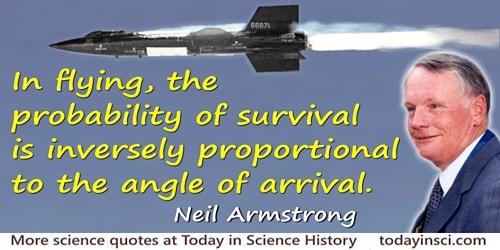
In flying, the probability of survival is inversely proportional to the angle of arrival.
Quoted in Richard H. Enns, George McGuire, Computer Algebra Recipes for Classical Mechanics (2003), 37.
In soloing—as in other activities—it is far easier to start something than it is to finish it. Almost every beginner hops off with a whoop of joy, though he is likely to end his flight with something akin to the D.T.’s.
In 20 Hrs., 40 Min. (1928), 55.
In the vast cosmical changes, the universal life comes and goes in unknown quantities ... sowing an animalcule here, crumbling a star there, oscillating and winding, ... entangling, from the highest to the lowest, all activities in the obscurity of a dizzying mechanism, hanging the flight of an insect upon the movement of the earth... Enormous gearing, whose first motor is the gnat, and whose last wheel is the zodiac.
Victor Hugo and Charles E. Wilbour (trans.), Les Misérables (1862), 41.
In this age of space flight, when we use the modern tools of science to advance into new regions of human activity, the Bible ... this grandiose, stirring history of the gradual revelation and unfolding of the moral law ... remains in every way an up-to-date book. Our knowledge and use of the laws of nature that enable us to fly to the Moon also enable us to destroy our home planet with the atom bomb. Science itself does not address the question whether we should use the power at our disposal for good or for evil. The guidelines of what we ought to do are furnished in the moral law of God. It is no longer enough that we pray that God may be with us on our side. We must learn again that we may be on God's side.
Quoted in Bob Phillips, Phillips' Book of Great Thoughts & Funny Sayings (1993), 42.
It is by the aid of iron that we construct houses, cleave rocks, and perform so many other useful offices of life. But it is with iron also that wars, murders, and robberies are effected, and this, not only hand to hand, but from a distance even, by the aid of missiles and winged weapons, now launched from engines, now hurled by the human arm, and now furnished with feathery wings. This last I regard as the most criminal artifice that has been devised by the human mind; for, as if to bring death upon man with still greater rapidity, we have given wings to iron and taught it to fly. ... Nature, in conformity with her usual benevolence, has limited the power of iron, by inflicting upon it the punishment of rust; and has thus displayed her usual foresight in rendering nothing in existence more perishable, than the substance which brings the greatest dangers upon perishable mortality.
Natural History of Pliny, translation (1857, 1898) by John Bostock and H. T. Riley, 205-6.
It is of interest to inquire what happens when the aviator’s speed… approximates to the velocity of light. Lengths in the direction of flight become smaller and smaller, until for the speed of light they shrink to zero. The aviator and the objects accompanying him shrink to two dimensions. We are saved the difficulty of imagining how the processes of life can go on in two dimensions, because nothing goes on. Time is arrested altogether. This is the description according to the terrestrial observer. The aviator himself detects nothing unusual; he does not perceive that he has stopped moving. He is merely waiting for the next instant to come before making the next movement; and the mere fact that time is arrested means that he does not perceive that the next instant is a long time coming.
In Space, Time and Gravitation: An Outline of the General Relativity Theory (1920, 1921), 26.
It will be possible in a few more years to build radio controlled rockets which can be steered into such orbits beyond the limits of the atmosphere and left to broadcast scientific information back to the Earth. A little later, manned rockets will be able to make similar flights with sufficient excess power to break the orbit and return to Earth. (1945) [Predicting communications satellites.]
In 'Can Rocket Stations Give Worldwide Coverage?', Wireless World (Oct 1945). Quoted and cited in Arthur C. Clarke, Greetings, Carbon-Based Bipeds!: Collected Essays, 1934-1998, 21.
Kidney transplants seem so routine now. But the first one was like Lindbergh’s flight across the ocean.
In interview with reporter Gina Kolata, '2 American Transplant Pioneers Win Nobel Prize in Medicine', New York Times (9 Oct 1990).
Later, I realized that the mission had to end in a let-down because the real barrier wasn’t in the sky but in our knowledge and experience of supersonic flight.
Life has found ways to flourish in boiling hot springs and on icy mountain tops, to fly, glow in the dark, put forth leaves in a rainless desert, or plumb the ocean, reproducing and adapting, reincarnating itself in new forms in defiance of time and death.
…...
Man studied birds for centuries, trying to learn how to make a machine to fly like them. He never did do the trick; his final success came when he broke away entirely and tried new methods.
Published under the name Don A. Stuart, 'Who Goes There?', Astounding Stories (Aug 1938). In Robert Silverberg, Ben Bova and Science Fiction Writers of America, The Science Fiction Hall of Fame (1973), Vol. 2, 62.
Mathematics must subdue the flights of our reason; they are the staff of the blind; no one can take a step without them; and to them and experience is due all that is certain in physics.
In Oeuvres Completes (1880), t. 35, 219.
Mathematics, among all school subjects, is especially adapted to further clearness, definite brevity and precision in expression, although it offers no exercise in flights of rhetoric. This is due in the first place to the logical rigour with which it develops thought, avoiding every departure from the shortest, most direct way, never allowing empty phrases to enter. Other subjects excel in the development of expression in other respects: translation from foreign languages into the mother tongue gives exercise in finding the proper word for the given foreign word and gives knowledge of laws of syntax, the study of poetry and prose furnish fit patterns for connected presentation and elegant form of expression, composition is to exercise the pupil in a like presentation of his own or borrowed thoughtsand their development, the natural sciences teach description of natural objects, apparatus and processes, as well as the statement of laws on the grounds of immediate sense-perception. But all these aids for exercise in the use of the mother tongue, each in its way valuable and indispensable, do not guarantee, in the same manner as mathematical training, the exclusion of words whose concepts, if not entirely wanting, are not sufficiently clear. They do not furnish in the same measure that which the mathematician demands particularly as regards precision of expression.
In Anleitung zum mathematischen Unterricht in höheren Schulen (1906), 17.
My own lifetime spans the Wright Brothers' Kitty Hawk flight and manned-satellite orbiting.
In 'The Wisdom of Wilderness', Life (22 Dec 1967), 63, No. 25, 8.
Nature has put itself the problem how to catch in flight light streaming to the earth and to store the most elusive of all powers in rigid form. To achieve this aim, it has covered the crust of earth with organisms which in their life processes absorb the light of the sun and use this power to produce a continuously accumulating chemical difference. ... The plants take in one form of power, light; and produce another power, chemical difference.
In pamphlet, The Organic Motion in its Relation to Metabolism (1845), as translated in Eugene Rabinowitch, Govindjee, Photosynthesis (1969), 9.
Nature vibrates with rhythms, climatic and diastrophic, those finding stratigraphic expression ranging in period from the rapid oscillation of surface waters, recorded in ripple-mark, to those long-deferred stirrings of the deep imprisoned titans which have divided earth history into periods and eras. The flight of time is measured by the weaving of composite rhythms- day and night, calm and storm, summer and winter, birth and death such as these are sensed in the brief life of man. But the career of the earth recedes into a remoteness against which these lesser cycles are as unavailing for the measurement of that abyss of time as would be for human history the beating of an insect's wing. We must seek out, then, the nature of those longer rhythms whose very existence was unknown until man by the light of science sought to understand the earth. The larger of these must be measured in terms of the smaller, and the smaller must be measured in terms of years.
'Rhythm and the Measurement of Geologic Time', Bulletin of the Geological Society of America, 1917, 28,746.
Nevertheless, scientific method is not the same as the scientific spirit. The scientific spirit does not rest content with applying that which is already known, but is a restless spirit, ever pressing forward towards the regions of the unknown, and endeavouring to lay under contribution for the special purpose in hand the knowledge acquired in all portions of the wide field of exact science. Lastly, it acts as a check, as well as a stimulus, sifting the value of the evidence, and rejecting that which is worthless, and restraining too eager flights of the imagination and too hasty conclusions.
'The Scientific Spirit in Medicine: Inaugural Sessional Address to the Abernethian Society', St. Bartholomew's Hospital Journal, 1912, 20, 19.
Nothing is more symptomatic of the enervation, of the decompression of the Western imagination, than our incapacity to respond to the landings on the Moon. Not a single great poem, picture, metaphor has come of this breathtaking act, of Prometheus’ rescue of Icarus or of Phaeton in flight towards the stars.
…...
October 9, 1863
Always, however great the height of the balloon, when I have seen the horizon it has roughly appeared to be on the level of the car though of course the dip of the horizon is a very appreciable quantity or the same height as the eye. From this one might infer that, could the earth be seen without a cloud or anything to obscure it, and the boundary line of the plane approximately the same height as the eye, the general appearance would be that of a slight concavity; but I have never seen any part of the surface of the earth other than as a plane.
Towns and cities, when viewed from the balloon are like models in motion. I shall always remember the ascent of 9th October, 1863, when we passed over London about sunset. At the time when we were 7,000 feet high, and directly over London Bridge, the scene around was one that cannot probably be equalled in the world. We were still so low as not to have lost sight of the details of the spectacle which presented itself to our eyes; and with one glance the homes of 3,000,000 people could be seen, and so distinct was the view, that every large building was easily distinguishable. In fact, the whole of London was visible, and some parts most clearly. All round, the suburbs were also very distinct, with their lines of detached villas, imbedded as it were in a mass of shrubs; beyond, the country was like a garden, its fields, well marked, becoming smaller and smaller as the eye wandered farther and farther away.
Again looking down, there was the Thames, throughout its whole length, without the slightest mist, dotted over its winding course with innumerable ships and steamboats, like moving toys. Gravesend was visible, also the mouth of the Thames, and the coast around as far as Norfolk. The southern shore of the mouth of the Thames was not so clear, but the sea beyond was seen for many miles; when at a higher elevation, I looked for the coast of France, but was unable to see it. On looking round, the eye was arrested by the garden-like appearance of the county of Kent, till again London claimed yet more careful attention.
Smoke, thin and blue, was curling from it, and slowly moving away in beautiful curves, from all except one part, south of the Thames, where it was less blue and seemed more dense, till the cause became evident; it was mixed with mist rising from the ground, the southern limit of which was bounded by an even line, doubtless indicating the meeting of the subsoils of gravel and clay. The whole scene was surmounted by a canopy of blue, everywhere free from cloud, except near the horizon, where a band of cumulus and stratus extended all round, forming a fitting boundary to such a glorious view.
As seen from the earth, the sunset this evening was described as fine, the air being clear and the shadows well defined; but, as we rose to view it and its effects, the golden hues increased in intensity; their richness decreased as the distance from the sun increased, both right and left; but still as far as 90º from the sun, rose-coloured clouds extended. The remainder of the circle was completed, for the most part, by pure white cumulus of well-rounded and symmetrical forms.
I have seen London by night. I have crossed it during the day at the height of four miles. I have often admired the splendour of sky scenery, but never have I seen anything which surpassed this spectacle. The roar of the town heard at this elevation was a deep, rich, continuous sound the voice of labour. At four miles above London, all was hushed; no sound reached our ears.
Always, however great the height of the balloon, when I have seen the horizon it has roughly appeared to be on the level of the car though of course the dip of the horizon is a very appreciable quantity or the same height as the eye. From this one might infer that, could the earth be seen without a cloud or anything to obscure it, and the boundary line of the plane approximately the same height as the eye, the general appearance would be that of a slight concavity; but I have never seen any part of the surface of the earth other than as a plane.
Towns and cities, when viewed from the balloon are like models in motion. I shall always remember the ascent of 9th October, 1863, when we passed over London about sunset. At the time when we were 7,000 feet high, and directly over London Bridge, the scene around was one that cannot probably be equalled in the world. We were still so low as not to have lost sight of the details of the spectacle which presented itself to our eyes; and with one glance the homes of 3,000,000 people could be seen, and so distinct was the view, that every large building was easily distinguishable. In fact, the whole of London was visible, and some parts most clearly. All round, the suburbs were also very distinct, with their lines of detached villas, imbedded as it were in a mass of shrubs; beyond, the country was like a garden, its fields, well marked, becoming smaller and smaller as the eye wandered farther and farther away.
Again looking down, there was the Thames, throughout its whole length, without the slightest mist, dotted over its winding course with innumerable ships and steamboats, like moving toys. Gravesend was visible, also the mouth of the Thames, and the coast around as far as Norfolk. The southern shore of the mouth of the Thames was not so clear, but the sea beyond was seen for many miles; when at a higher elevation, I looked for the coast of France, but was unable to see it. On looking round, the eye was arrested by the garden-like appearance of the county of Kent, till again London claimed yet more careful attention.
Smoke, thin and blue, was curling from it, and slowly moving away in beautiful curves, from all except one part, south of the Thames, where it was less blue and seemed more dense, till the cause became evident; it was mixed with mist rising from the ground, the southern limit of which was bounded by an even line, doubtless indicating the meeting of the subsoils of gravel and clay. The whole scene was surmounted by a canopy of blue, everywhere free from cloud, except near the horizon, where a band of cumulus and stratus extended all round, forming a fitting boundary to such a glorious view.
As seen from the earth, the sunset this evening was described as fine, the air being clear and the shadows well defined; but, as we rose to view it and its effects, the golden hues increased in intensity; their richness decreased as the distance from the sun increased, both right and left; but still as far as 90º from the sun, rose-coloured clouds extended. The remainder of the circle was completed, for the most part, by pure white cumulus of well-rounded and symmetrical forms.
I have seen London by night. I have crossed it during the day at the height of four miles. I have often admired the splendour of sky scenery, but never have I seen anything which surpassed this spectacle. The roar of the town heard at this elevation was a deep, rich, continuous sound the voice of labour. At four miles above London, all was hushed; no sound reached our ears.
Travels in the Air (1871), 99-100.
Once the hatch was opened, I turned the lock handle and bright rays of sunlight burst through it. I opened the hatch and dust from the station flew in like little sparklets, looking like tiny snowflakes on a frosty day. Space, like a giant vacuum cleaner, began to suck everything out. Flying out together with the dust were some little washers and nuts that dad got stuck somewhere; a pencil flew by.
My first impression when I opened the hatch was of a huge Earth and of the sense of unreality concerning everything that was going on. Space is very beautiful. There was the dark velvet of the sky, the blue halo of the Earth and fast-moving lakes, rivers, fields and clouds clusters. It was dead silence all around, nothing whatever to indicate the velocity of the flight… no wind whistling in your ears, no pressure on you. The panorama was very serene and majestic.
My first impression when I opened the hatch was of a huge Earth and of the sense of unreality concerning everything that was going on. Space is very beautiful. There was the dark velvet of the sky, the blue halo of the Earth and fast-moving lakes, rivers, fields and clouds clusters. It was dead silence all around, nothing whatever to indicate the velocity of the flight… no wind whistling in your ears, no pressure on you. The panorama was very serene and majestic.
…...
One of the greatest goals of the manned space flight program is that earth orbital flight will eventually become safe enough and low enough in cost to facilitate a firsthand scientific investigation from that vantage point.
In 'After Apollo, What?', Science Teacher (Sep 1969), 36, No. 6. 22.
Poised for flight,
Wings spread bright,
Spring from night into the Sun.
Wings spread bright,
Spring from night into the Sun.
Help on the Way
Quite likely the twentieth century is destined to see the natural forces which will enable us to fly from continent to continent with a speed far exceeding that of a bird.
'The Outlook for the Flying Machine'. The Independent: A Weekly Magazine (22 Oct 1903), 2510.
Science flies you to the moon. Religion flies you into buildings.
In The New Atheism: Taking a Stand for Science and Reason (2009), 59.
As attributed on a web page using the quote as a title at web site of Richard Dawkins Foundation.
Science is continually correcting what it has said. Fertile corrections... science is a ladder... poetry is a winged flight... An artistic masterpiece exists for all time... Dante does not efface Homer.
Quoted in Pierre Biquard, Frederic Joliot-Curie: The Man and his Theories (1961), trans. Geoffrey Strachan (1965), 168.
Science, then, is the attentive consideration of common experience; it is common knowledge extended and refined. Its validity is of the same order as that of ordinary perception; memory, and understanding. Its test is found, like theirs, in actual intuition, which sometimes consists in perception and sometimes in intent. The flight of science is merely longer from perception to perception, and its deduction more accurate of meaning from meaning and purpose from purpose. It generates in the mind, for each vulgar observation, a whole brood of suggestions, hypotheses, and inferences. The sciences bestow, as is right and fitting, infinite pains upon that experience which in their absence would drift by unchallenged or misunderstood. They take note, infer, and prophesy. They compare prophesy with event, and altogether they supply—so intent are they on reality—every imaginable background and extension for the present dream.
The Life of Reason, or the Phases of Human Progress (1954), 393.
Scientists constantly get clobbered with the idea that we spent 27 billion dollars on the Apollo programs, and are asked “What more do you want?” We didn't spend it; it was done for political reasons. ... Apollo was a response to the Bay of Pigs fiasco and to the successful orbital flight of Yuri Gagarin. President Kennedy's objective was not to find out the origin of the moon by the end of the decade; rather it was to put a man on the moon and bring him back, and we did that.
Quoted by Dennis Meredith, in 'Carl Sagan's Cosmic Connection and Extraterrestrial Life-Wish', Science Digest (Jun 1979), 85, 38 & 89. Reproduced in Carl Sagan and Tom Head, Conversations With Sagan (2006), 55-56.
Some people say there is a God out there. ... but in my travels around the earth all day long, I looked around and didn't see Him ... I saw no God or angels. The rocket was made by our own people. I don't believe in God. I believe in man, in his strength, his possibilities, and his reason.[After his return from a space flight orbitting the earth.]
As quoted, without citation, in H. T. Spence, Confronting Contemporary Christian Music: A Plain Account of Its History, Philosophy, and Future (2002), 7.
Successful—four flights on Thursday morning—took off with motors from level ground—average speed thirty miles an hour—longest flight 59 seconds—inform press—home for Christmas—Orville.
Telegram (17 Dec 1903) to his father, Bishop Wright, about the first flight in an airplane, at Kitty Hawk, N.C. As quoted in Heinz Gartmann, Rings Around the World: Man’s Progress From Steam Engine to Satellite (1959), 78.
Surely no child, and few adults, have ever watched a bird in flight without envy.
Isaac Asimov and Jason A. Shulman, Isaac Asimov’s Book of Science and Nature Quotations (1988), 3.
The [mechanical] bird I have described ought to be able by the help of the wind to rise to a great height, and this will prove to be its safety; since even if… revolutions [of the winds] were to befall it, it would still have time to regain a condition of equilibrium; provided that its various parts have a great power of resistance, so that they can safely withstand the fury and violence of the descent, by the aid of the defenses which I have mentioned; and its joints should be made of strong tanned hide, and sewn with cords of strong raw silk. And let no one encumber himself with iron bands, for these are very soon broken at the joints or else they become worn out, and consequently it is well not to encumber oneself with them.
'Of the Bird’s Movement' from Sul Voio degli Uccelli, 8 [7] r. in Leonardo da Vinci's Notebooks, trans. E. MacCurdy (1906), 153-4.
The analytical geometry of Descartes and the calculus of Newton and Leibniz have expanded into the marvelous mathematical method—more daring than anything that the history of philosophy records—of Lobachevsky and Riemann, Gauss and Sylvester. Indeed, mathematics, the indispensable tool of the sciences, defying the senses to follow its splendid flights, is demonstrating today, as it never has been demonstrated before, the supremacy of the pure reason.
In 'What Knowledge is of Most Worth?', Presidential address to the National Education Association, Denver, Colorado (9 Jul 1895). In Educational Review (Sep 1895), 10, 109.
The blood, the fountain whence the spirits flow,
The generous stream that waters every part,
And motion, vigour, and warm life conveys
To every Particle that moves or lives;
This vital fluid, thro' unnumber'd tubes
Pour'd by the heart, and to the heart again
Refunded; scourg'd forever round and round;
Enrag'd with heat and toil, at last forgets
Its balmy nature; virulent and thin
It grows; and now, but that a thousand gates
Are open to its flight, it would destroy
The parts it cherish' d and repair'd before.
Besides, the flexible and tender tubes
Melt in the mildest, most nectareous tide
That ripening Nature rolls; as in the stream
Its crumbling banks; but what the vital force
Of plastic fluids hourly batters down,
That very force, those plastic particles
Rebuild: so mutable the state of man.
For this the watchful appetite was given,
Daily with fresh materials to repair
This unavoidable expense of life,
This necessary waste of flesh and blood.
Hence the concoctive powers, with various art,
Subdue the cruder aliments to chyle;
The chyle to blood; the foamy purple tide
To liquors, which through finer arteries
To different parts their winding course pursue;
To try new changes, and new forms put on,
Or for the public, or some private use.
The generous stream that waters every part,
And motion, vigour, and warm life conveys
To every Particle that moves or lives;
This vital fluid, thro' unnumber'd tubes
Pour'd by the heart, and to the heart again
Refunded; scourg'd forever round and round;
Enrag'd with heat and toil, at last forgets
Its balmy nature; virulent and thin
It grows; and now, but that a thousand gates
Are open to its flight, it would destroy
The parts it cherish' d and repair'd before.
Besides, the flexible and tender tubes
Melt in the mildest, most nectareous tide
That ripening Nature rolls; as in the stream
Its crumbling banks; but what the vital force
Of plastic fluids hourly batters down,
That very force, those plastic particles
Rebuild: so mutable the state of man.
For this the watchful appetite was given,
Daily with fresh materials to repair
This unavoidable expense of life,
This necessary waste of flesh and blood.
Hence the concoctive powers, with various art,
Subdue the cruder aliments to chyle;
The chyle to blood; the foamy purple tide
To liquors, which through finer arteries
To different parts their winding course pursue;
To try new changes, and new forms put on,
Or for the public, or some private use.
The Art of Preserving Health (1744), book 2, I. 12-23, p.15-16.
The chemical or physical inventor is always a Prometheus. There is no great invention, from fire to flying, which has not been hailed as an insult to some god. But if every physical and chemical invention is a blasphemy, every biological invention is a perversion. There is hardly one which, on first being brought to the notice of an observer from any nation which had not previously heard of their existence, would not appear to him as indecent and unnatural.
Lecture (4 Feb 1923) to the Heretics Society, Cambridge University, published in Daedalus; or, Science and the Future (1924), 44.
The chief art of learning, as Locke has observed, is to attempt but little at a time. The widest excursions of the mind are made by short flights frequently repeated; the most lofty fabrics of science are formed by the continued accumulation of single propositions.
'The Need For General Knowledge,' Rambler No. 137 (9 Jul 1751). In Samuel Johnson, Donald Greene (ed.), Samuel Johnson (1984), 223.
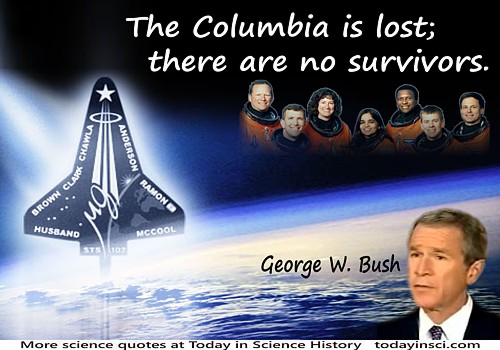
The Columbia is lost; there are no survivors. … In an age when space flight has come to seem almost routine, it is easy to overlook the dangers of travel by rocket, and the difficulties of navigating the fierce outer atmosphere of the Earth. These astronauts knew the dangers, and they faced them willingly, knowing they had a high and noble purpose in life. Because of their courage and daring idealism, we will miss them all the more. … The cause in which they died will continue. Mankind is led into the darkness beyond our world by the inspiration of discovery and the longing to understand. Our journey into space will go on.
Address to the Nation on the Space Shuttle Columbia tragedy, from the Cabinet Room (1 Feb 2003). In William J. Federer, A Treasury of Presidential Quotations (2004), 437.
The demonstration that no possible combination of known substances, known forms of machinery and known forms of force, can be united in a practical machine by which men shall fly along distances through the air, seems to the writer as complete as it is possible for the demonstration to be.
Side-lights on Astronomy and Kindred Fields of Popular Science (1906), 345.
The enthusiasm of Sylvester for his own work, which manifests itself here as always, indicates one of his characteristic qualities: a high degree of subjectivity in his productions and publications. Sylvester was so fully possessed by the matter which for the time being engaged his attention, that it appeared to him and was designated by him as the summit of all that is important, remarkable and full of future promise. It would excite his phantasy and power of imagination in even a greater measure than his power of reflection, so much so that he could never marshal the ability to master his subject-matter, much less to present it in an orderly manner.
Considering that he was also somewhat of a poet, it will be easier to overlook the poetic flights which pervade his writing, often bombastic, sometimes furnishing apt illustrations; more damaging is the complete lack of form and orderliness of his publications and their sketchlike character, … which must be accredited at least as much to lack of objectivity as to a superfluity of ideas. Again, the text is permeated with associated emotional expressions, bizarre utterances and paradoxes and is everywhere accompanied by notes, which constitute an essential part of Sylvester’s method of presentation, embodying relations, whether proximate or remote, which momentarily suggested themselves. These notes, full of inspiration and occasional flashes of genius, are the more stimulating owing to their incompleteness. But none of his works manifest a desire to penetrate the subject from all sides and to allow it to mature; each mere surmise, conceptions which arose during publication, immature thoughts and even errors were ushered into publicity at the moment of their inception, with utmost carelessness, and always with complete unfamiliarity of the literature of the subject. Nowhere is there the least trace of self-criticism. No one can be expected to read the treatises entire, for in the form in which they are available they fail to give a clear view of the matter under contemplation.
Sylvester’s was not a harmoniously gifted or well-balanced mind, but rather an instinctively active and creative mind, free from egotism. His reasoning moved in generalizations, was frequently influenced by analysis and at times was guided even by mystical numerical relations. His reasoning consists less frequently of pure intelligible conclusions than of inductions, or rather conjectures incited by individual observations and verifications. In this he was guided by an algebraic sense, developed through long occupation with processes of forms, and this led him luckily to general fundamental truths which in some instances remain veiled. His lack of system is here offset by the advantage of freedom from purely mechanical logical activity.
The exponents of his essential characteristics are an intuitive talent and a faculty of invention to which we owe a series of ideas of lasting value and bearing the germs of fruitful methods. To no one more fittingly than to Sylvester can be applied one of the mottos of the Philosophic Magazine:
“Admiratio generat quaestionem, quaestio investigationem investigatio inventionem.”
Considering that he was also somewhat of a poet, it will be easier to overlook the poetic flights which pervade his writing, often bombastic, sometimes furnishing apt illustrations; more damaging is the complete lack of form and orderliness of his publications and their sketchlike character, … which must be accredited at least as much to lack of objectivity as to a superfluity of ideas. Again, the text is permeated with associated emotional expressions, bizarre utterances and paradoxes and is everywhere accompanied by notes, which constitute an essential part of Sylvester’s method of presentation, embodying relations, whether proximate or remote, which momentarily suggested themselves. These notes, full of inspiration and occasional flashes of genius, are the more stimulating owing to their incompleteness. But none of his works manifest a desire to penetrate the subject from all sides and to allow it to mature; each mere surmise, conceptions which arose during publication, immature thoughts and even errors were ushered into publicity at the moment of their inception, with utmost carelessness, and always with complete unfamiliarity of the literature of the subject. Nowhere is there the least trace of self-criticism. No one can be expected to read the treatises entire, for in the form in which they are available they fail to give a clear view of the matter under contemplation.
Sylvester’s was not a harmoniously gifted or well-balanced mind, but rather an instinctively active and creative mind, free from egotism. His reasoning moved in generalizations, was frequently influenced by analysis and at times was guided even by mystical numerical relations. His reasoning consists less frequently of pure intelligible conclusions than of inductions, or rather conjectures incited by individual observations and verifications. In this he was guided by an algebraic sense, developed through long occupation with processes of forms, and this led him luckily to general fundamental truths which in some instances remain veiled. His lack of system is here offset by the advantage of freedom from purely mechanical logical activity.
The exponents of his essential characteristics are an intuitive talent and a faculty of invention to which we owe a series of ideas of lasting value and bearing the germs of fruitful methods. To no one more fittingly than to Sylvester can be applied one of the mottos of the Philosophic Magazine:
“Admiratio generat quaestionem, quaestio investigationem investigatio inventionem.”
In Mathematische Annalen (1898), 50, 155-160. As translated in Robert Édouard Moritz, Memorabilia Mathematica; Or, The Philomath’s Quotation-book (1914), 176-178.
The estimate we form of the intellectual capacity of our race, is founded on an examination of those productions which have resulted from the loftiest flights of individual genius, or from the accumulated labors of generations of men, by whose long-continued exertions a body of science has been raised up, surpassing in its extent the creative powers of any individual, and demanding for its development a length of time, to which no single life extends.
In The Ninth Bridgewater Treatise: A Fragment (1838), 30.
The flight of most members of a profession to the high empyrean, where they can work peacefully on purely scientific problems, isolated from the turmoil of real life, was perhaps quite appropriate at an earlier stage of science; but in today's world it is a luxury we cannot afford.
The Scientific Imagination: Case Studies (1978), 250.
The flight was extremely normal ... for the first 36 seconds then after that got very interesting.
About the Apollo 12 launch, during which two electrical discharges almost ended the mission.
About the Apollo 12 launch, during which two electrical discharges almost ended the mission.
Quoted in Air & Space Smithsonian (2000), 15, 74.
The flights of the imagination which occur to the pure mathematician are in general so much better described in his formulas than in words, that it is not remarkable to find the subject treated by outsiders as something essentially cold and uninteresting— … the only successful attempt to invest mathematical reasoning with a halo of glory—that made in this section by Prof. Sylvester—is known to a comparative few, …
In Presidential Address British Association for the Advancement of Science (1871), Nature Vol. 4, 271,
The generalizations of science sweep on in ever-widening circles, and more aspiring flights, through a limitless creation.
In 'The Darwinian Hypothesis: Darwin on the Origin of Species', Man's Place in Nature and Other Essays (1910), 337.
The gentleman [Mr. Taber] from New York says [agricultural research] is all foolish. Yes; it was foolish when Burbank was experimenting with wild cactus. It was foolish when the Wright boys went down to Kitty Hawk and had a contraption there that they were going to fly like birds. It was foolish when Robert Fulton tried to put a boiler into a sail boat and steam it up the Hudson. It was foolish when one of my ancestors thought the world was round and discovered this country so that the gentleman from New York could become a Congressman. (Laughter.) ... Do not seek to stop progress; do not seek to put the hand of politics on these scientific men who are doing a great work. As the gentleman from Texas points out, it is not the discharge of these particular employees that is at stake, it is all the work of investigation, of research, of experimentation that has been going on for years that will be stopped and lost.
Speaking (28 Dec 1932) as a member of the 72nd Congress, early in the Great Depression, in opposition to an attempt to eliminate a small amount from the agricultural appropriation bill. As quoted in 'Mayor-Elect La Guardia on Research', Science (1933), New Series, 78, No. 2031, 511.
The history of this paper suggests that highly speculative investigations, especially by an unknown author, are best brought before the world through some other channel than a scientific society, which naturally hesitates to admit into its printed records matters of uncertain value. Perhaps one may go further and say that a young author who believes himself capable of great things would usually do well to secure the favourable recognition of the scientific world by work whose scope is limited and whose value is easily judged, before embarking upon higher flights.
'On the Physics of Media that are Composed of Free and Perfectly Elastic Molecules in a State of Motion', Philosophical Transactions (1892), 183, 560.
The mathematician of to-day admits that he can neither square the circle, duplicate the cube or trisect the angle. May not our mechanicians, in like manner, be ultimately forced to admit that aerial flight is one of that great class of problems with which men can never cope… I do not claim that this is a necessary conclusion from any past experience. But I do think that success must await progress of a different kind from that of invention.
[Written following Samuel Pierpoint Langley's failed attempt to launch his flying machine from a catapult device mounted on a barge in Oct 1903. The Wright Brother's success came on 17 Dec 1903.]
[Written following Samuel Pierpoint Langley's failed attempt to launch his flying machine from a catapult device mounted on a barge in Oct 1903. The Wright Brother's success came on 17 Dec 1903.]
'The Outlook for the Flying Machine'. The Independent: A Weekly Magazine (22 Oct 1903), 2509.
The process of scientific discovery is, in effect, a continual flight from wonder.
…...
The so-called science of poll-taking is not a science at all but mere necromancy. People are unpredictable by nature, and although you can take a nation's pulse, you can't be sure that the nation hasn't just run up a flight of stairs, and although you can take a nation's blood pressure, you can’t be sure that if you came back in twenty minutes you’d get the same reading. This is a damn fine thing.
.
In 'Polling' (13 Nov 1948), collected in Writings from The New Yorker, 1925-1976 (1976, 2006), 60.
The study of economics does not seem to require any specialised gifts of an unusually high order. Is it not, intellectually regarded, a very easy subject compared with the higher branches of philosophy and pure science? Yet good, or even competent, economists are the rarest of birds. An easy subject, at which very few excel! The paradox finds its explanation, perhaps, in that the master-economist must possess a rare combination of gifts. He must reach a high standard in several different directions and must combine talents not often found together. He must be mathematician, historian, statesman, philosopher—in some degree. He must understand symbols and speak in words. He must contemplate the particular in terms of the general, and touch abstract and concrete in the same flight of thought. He must study the present in the light of the past for the purposes of the future. No part of man's nature or his institutions must lie entirely outside his regard. He must be purposeful and disinterested in a simultaneous mood; as aloof and incorruptible as an artist, yet sometimes as near the earth as a politician.
'Alfred Marshall: 1842-1924' (1924). In Geoffrey Keynes (ed.), Essays in Biography (1933), 170.
The true method of discovery is like the flight of an aeroplane. It starts from the ground of particular observation; it makes a flight in the thin air of imaginative generalization; and it again lands for renewed observation rendered acute by rational interpretation.
Gifford lectures delivered in the University of Edinburgh during the session 1927-28. Process and Reality: An Essay in Cosmology (1929, 1979), 5.
The world’s first spaceship, Vostok (East), with a man on board was launched into orbit from the Soviet Union on April 12, 1961. The pilot space-navigator of the satellite-spaceship Vostok is a citizen of the U.S.S.R., Flight Major Yuri Gagarin.
The launching of the multistage space rocket was successful and, after attaining the first escape velocity and the separation of the last stage of the carrier rocket, the spaceship went in to free flight on around-the-earth orbit. According to preliminary data, the period of revolution of the satellite spaceship around the earth is 89.1 min. The minimum distance from the earth at perigee is 175 km (108.7 miles) and the maximum at apogee is 302 km (187.6 miles), and the angle of inclination of the orbit plane to the equator is 65º 4’. The spaceship with the navigator weighs 4725 kg (10,418.6 lb), excluding the weight of the final stage of the carrier rocket.
The first man in space was announced by the Soviet newsagency Tass on 12 April 1961, 9:59 a.m. Moscow time.
The launching of the multistage space rocket was successful and, after attaining the first escape velocity and the separation of the last stage of the carrier rocket, the spaceship went in to free flight on around-the-earth orbit. According to preliminary data, the period of revolution of the satellite spaceship around the earth is 89.1 min. The minimum distance from the earth at perigee is 175 km (108.7 miles) and the maximum at apogee is 302 km (187.6 miles), and the angle of inclination of the orbit plane to the equator is 65º 4’. The spaceship with the navigator weighs 4725 kg (10,418.6 lb), excluding the weight of the final stage of the carrier rocket.
The first man in space was announced by the Soviet newsagency Tass on 12 April 1961, 9:59 a.m. Moscow time.
— Tass
Quoted in John David Anderson, Jr., Hypersonic and High Temperature Gas Dynamics (2000), 2.
These changes—the more rapid pulse, the deeper breathing, the increase of sugar in the blood, the secretion from the adrenal glands—were very diverse and seemed unrelated. Then, one wakeful night, after a considerable collection of these changes had been disclosed, the idea flashed through my mind that they could be nicely integrated if conceived as bodily preparations for supreme effort in flight or in fighting. Further investigation added to the collection and confirmed the general scheme suggested by the hunch.
The Way of an Investigator: A Scientist's Experiences in Medical Research (1945), 59-60.
Thursday, December 17 [1903]. In the afternoon about 5:30 we received the following telegram from Orvill[e], dated Kitty Hawk, N.C., Dec. 17. “Bishop M. Wright: “Success four flights Thursday morning all against a twenty-one mile wind started from level with engine power alone average speed through the air thirty one miles—longest 57 seconds. XXX home Christmas. Orville Wright.”
From Milton’s handwritten Diary entry for Thur, 17 Dec 1903. Milton is now age 75.
To fly, we have to have resistance. It’s all about turbulence.
Reacting to images of wave patterns in fluid motion.
Reacting to images of wave patterns in fluid motion.
In Maya Ying Lin, Jeff Fleming, Michael Brenson and Terri Dowell-Dennis, Topologies (1998), 38.
To me there never has been a higher source of earthly honour or distinction than that connected with advances in science. I have not possessed enough of the eagle in my character to make a direct flight to the loftiest altitudes in the social world; and I certainly never endeavored to reach those heights by using the creeping powers of the reptile, who, in ascending, generally chooses the dirtiest path, because it is the easiest.
In Maturin Murray Ballou, Treasury of Thought (1894), 459.
To me there never has been a higher source of honour or distinction than that connected with advances in science. I have not possessed enough of the eagle in my character to make a direct flight to the loftiest altitudes in the social world; and I certainly never endeavored to reach those heights by using the creeping powers of the reptile, who in ascending, generally chooses the dirtiest path, because it is the easiest.
Consolations in Travel (1830), Dialogue 5, The Chemical Philosopher, 225.
To me, it [the 1962 space flight of Friendship 7] is not something that happened a long time ago. It seems like a couple of days ago, really. It’s a rare day I don’t think about it, relive it in my mind. I can remember every switch I flipped, every move I made, every word I spoke and every word spoken to me. Clear as a bell.
As reported by Howard Wilkinson in 'John Glenn Had the Stuff U.S. Heroes are Made of', The Cincinnati Enquirer (20 Feb 2002).
Trying to determine the structure of a protein by UV spectroscopy was like trying to determine the structure of a piano by listening to the sound it made while being dropped down a flight of stairs.
…...
We fondly imagine that evolution drives toward higher intelligence. But eagles would think evolution favored flight, elephants would naturally prefer the importance of great strength. Sharks would feel that swimming was the ultimate desirable trait, and eminent Victorians would be quite convinced that evolution preferred Victorians.
Eater (2000). In Gary Westfahl, Science Fiction Quotations: From the Inner Mind to the Outer Limits (2006), 116.
We had various kinds of tape-recorded concerts and popular music. But by the end of the flight what we listened to most was Russian folk songs. We also had recordings of nature sounds: thunder, rain, the singing of birds. We switched them on most frequently of all, and we never grew tired of them. It was as if they returned us to Earth.
…...
We will build a machine that will fly.
As written in quotation marks by Pierre Lecomte du Noüy in Between Knowing and Believing (1967), 160, as a remark made to his brother, Jacques Montgolfier, in Spring 1783. The quote is also included in Isaac Asimov and Jason A. Shulman, Isaac Asimov’s Book of Science and Nature Quotations (1988), 4. Neither gives a citation. Because the quote is not more widely published, Webmaster doubts its authenticity, and has been unable to verify from an original source. Please contact Webmaster if you know a primary source.
What can you conceive more silly and extravagant than to suppose a man racking his brains, and studying night and day how to fly? ... wearying himself with climbing upon every ascent, ... bruising himself with continual falls, and at last breaking his neck? And all this, from an imagination that it would be glorious to have the eyes of people looking up at him, and mighty happy to eat, and drink, and sleep, at the top of the highest trees in the kingdom.
In A Serious Call to a Devout and Holy Life (1732), 168. This was written before Montgolfier brothers, pioneer balloonists, were born.
What is it to see, in an Eagle glide
Which fills a human heart with so much pride?
Is it that it soars effortless above the Earth
That steals us from our own limits & dearth?
Trapped in our seas of befuddling sludge
We try and try but cannot budge.
And then to see a mortal; with such ease take wing
Up in a breeze that makes our failing spirits sing?
Do we, vicarious birds, search in it our childishness -
When we too were young & yearned in heart to fly?
Taking flights of fancy through adolescent nights
Listening little, heeding less, knowing not why?
From its highest perch in the forest of snow
Majestic - the Eagle soars alone.
Riding thermals, lording clouds
Till dropping silent from the sky as a stone
But we, so quick and ready to fold
Give up our wings at the whiff of age
Losing years, cursing time, wasting spirit
Living out entire lives in futile rage!
Which fills a human heart with so much pride?
Is it that it soars effortless above the Earth
That steals us from our own limits & dearth?
Trapped in our seas of befuddling sludge
We try and try but cannot budge.
And then to see a mortal; with such ease take wing
Up in a breeze that makes our failing spirits sing?
Do we, vicarious birds, search in it our childishness -
When we too were young & yearned in heart to fly?
Taking flights of fancy through adolescent nights
Listening little, heeding less, knowing not why?
From its highest perch in the forest of snow
Majestic - the Eagle soars alone.
Riding thermals, lording clouds
Till dropping silent from the sky as a stone
But we, so quick and ready to fold
Give up our wings at the whiff of age
Losing years, cursing time, wasting spirit
Living out entire lives in futile rage!
…...
When I started my work in 1909 there was about one fatality for every 2000 miles of flight and probably a few crashes for every 100 miles. Much of the design and flight knowledge that is now taken for granted was then unknown and … had to be learned through failures and tragedies.
In address (16 Nov 1964) presented to the Wings Club, New York City, published as Recollections and Thoughts of a Pioneer (1964), 6.
When they [radio astronomers] grew weary at their electronic listening posts. When their eyes grew dim with looking at unrevealing dials and studying uneventful graphs, they could step outside their concrete cells and renew their dull spirits in communion with the giant mechanism they commanded, the silent, sensing instrument in which the smallest packets of energy, the smallest waves of matter, were detected in their headlong, eternal flight across the universe. It was the stethoscope with which they took the pulse of the all and noted the birth and death of stars, the probe which, here on an insignificant planet of an undistinguishable star on the edge of its galaxy, they explored the infinite.
The Listeners (1968, 1972), 12.
Why does such and such animal feed only on flesh, while another on plants? Where does one get the finesse of its sense of smell, or that of its hearing? What is the source of the prodigious strength of the muscles of birds? How is this force used to produce this amazing movement of flight? How does it come about that the bird sees equally well at quite different distances? What is the cause of the range and variety of its voice? Why is a reptile so lethargic? Why does a worm stay alive long after being divided? Why can a zoophyte live equally well with some parts of its body cut off? Is it presumed there could be natural history without these questions, and thousands of others like them, and do we think we can answer without a thorough comparative anatomy?
From 'Lettre à M. de la Cépède', collected in G. L. Duvernpy (ed.) Leçons d’Anatomie Comparée de Georges Cuvier: Tome IV, Première Partie: Corrigée et Augmentée (2nd ed. 1833), xxij. As translated and tweaked by Webmaster using online translation sites from the original French: “Pourquoi tel animal ne se nourrit-il que de chair, tel autre que de végétaux? D’où celui-ci tire-t-il la finesse de son odorat, ou celle de son ouïe? Quelle est la source de la force prodigieux des muscles des oiseaux? Comment cette force est-elle employée à produire ce mouvement si étonnant du vol? D’où viens que l’oiseau voit également bien à des distances si differentes? Quelles sont les causes de l’etendue, et de la variété de sa voix? Pourquoi tel reptile, est-il si engourdie? Pourquoi tel ver, conserve-t-il de la vie long-temps après être divisé? Pourquoi tel zoophyte peut-il vivre égalment bien, quelque partie de son corps que l’on en retranche. Suppose-t-on qu’il puisse exister une histoire naturelle sans ces questions, et des millieurs d’autres semblables, et des milliers d’autres semblables, y soient traitées, et croit-on pouvoir y répondre sans une anatomie compárée profonde?” [John Abernethy used this quote in a lecture to illustrate what animating motive caused Cuvier to strive so hard to find answers.]
Workers must root out the idea that by keeping the results of their labors to themselves a fortune will be assured to them. Patent fees are so much wasted money. The flying machine of the future will not be born fully fledged and capable of a flight for 1,000 miles or so. Like everything else it must be evolved gradually. The first difficulty is to get a thing that will fly at all. When this is made, a full description should be published as an aid to others. Excellence of design and workmanship will always defy competition.
As quoted in Octave Chanute, Progress in Flying Machines (1894), 218.
 In science it often happens that scientists say, 'You know that's a really good argument; my position is mistaken,' and then they would actually change their minds and you never hear that old view from them again. They really do it. It doesn't happen as often as it should, because scientists are human and change is sometimes painful. But it happens every day. I cannot recall the last time something like that happened in politics or religion.
(1987) --
In science it often happens that scientists say, 'You know that's a really good argument; my position is mistaken,' and then they would actually change their minds and you never hear that old view from them again. They really do it. It doesn't happen as often as it should, because scientists are human and change is sometimes painful. But it happens every day. I cannot recall the last time something like that happened in politics or religion.
(1987) -- 





