Fish Quotes (130 quotes)
… and the thousands of fishes moved as a huge beast piercing the water. They appear united, inexorably bound by common fate. How comes this unity?
Seventeenth century. In Gary William Flake, The Computational Beauty of Nature (2000), 261.
“Going fishing!” How often the question has been asked by acquaintances, as they have met me, with rod and basket, on an excursion after materials for microscopic study. “Yes!” has been the invariable answer, for it saved much detention and explanation; and now, behold! I offer them the results of that fishing. No fish for the stomach, but, as the old French microscopist Joblet observed, “some of the most remarkable fishes that have ever been seen”; and food-fishes for the intellect.
From 'Concluding Remarks', Fresh-Water Rhizopods of North America (1879), 295. Leidy explains how actively he pursued his interest in finding new microscopic life forms to examine by frequent exploration of suitable habitats in the neighborhood of Philadelphia, where he lived and taught.
“Life on Earth” [a 12-part TV series on evolution] was easier than “The Living Planet” because you have 2,000 years of narrative thrust built in. … You begin, say, with a giant jellyfish, then a fish with lungs which then became a frog. And all you have to do is say, “If you want to know what happens next, tune in next week.”
Comparing two of his famed BBC TV natural history series, in Justine de Lacy, 'Around the World With Attenborough', New York Times (27 Jan 1985), Sec. 2, 25.
[Overfishing—] it’s not just that we’re taking too many out, it’s how we’re doing it. We are wiping out their nurseries, … [because some huge boats] … bottom trawl … [with] nets that 50 years ago you’d have to lift when you came to coral reefs or rocks or nooks and crannies. Now they’re so sophisticated and so heavy, the equipment, and the boat’s so powerful they can just drag right over the coral reefs and the rocks and the nooks and crannies, and turn them into a gravel pit. … The trouble is those are the nurseries. That’s where the little fish hide and get bigger and get big enough for us to eat.
From transcript of PBS TV interview by Tavis Smiley (28 Mar 2011).
[The old red sandstone of the Orkneys] furnished more fossil fishes than every other geological system in England, Scotland, and Wales, from the coal measures to the chalk, inclusive. It is, in short, the “land of fish,” and could supply with ichthyolites, by the ton or ship-load, the museums of the world.
As quoted, without citation, by Samuel Kneeland, in Travels in Iceland: An Account of Its Scenery, People and History (1875), 23.
[Wind power is] for the birds, [tidal power] is for the fish, [and solar power makes sense chiefly in tropical places where the sun shines regularly and where there is plenty of human labor to dust off the mirrors that focus the sun’s rays in solar furnaces].
In address at City College, reported in Victor K. McElheny, 'Hans Bethe Urges U.S. Drive for Atom Power and Coal', The New York Times (14 Dec 1974), 58. Notice that almost all the statement above is in the the reporter’s own words, summarizing what Bethe said. The article context shows Bethe strongly supporting nuclear fission power plants. Bethe also stated—quoting in the reporter’s own words in the article—that: “solar power is three times as expensive as nuclear, while wind power could deliver only a tenth as much as solar, and tidal power can be harnessed in only a few places.” [The quote is from 1974, and of course, the situation for alternative power has very much improved decades later. —Webmaster]
Q: What did the fish say when he hit a concrete wall?
A: Dam!
Question: Explain why pipes burst in cold weather.
Answer: People who have not studied acoustics think that Thor bursts the pipes, but we know that is nothing of the kind for Professor Tyndall has burst the mythologies and has taught us that it is the natural behaviour of water (and bismuth) without which all fish would die and the earth be held in an iron grip. (1881)
Answer: People who have not studied acoustics think that Thor bursts the pipes, but we know that is nothing of the kind for Professor Tyndall has burst the mythologies and has taught us that it is the natural behaviour of water (and bismuth) without which all fish would die and the earth be held in an iron grip. (1881)
Genuine student answer* to an Acoustics, Light and Heat paper (1881), Science and Art Department, South Kensington, London, collected by Prof. Oliver Lodge. Quoted in Henry B. Wheatley, Literary Blunders (1893), 186-7, Question 10. (*From a collection in which Answers are not given verbatim et literatim, and some instances may combine several students' blunders.) Webmaster notes that “fish would die” may refer to being taught that water's greatest density is at 4°C, and sinks below a frozen surface, so bodies of water can remain liquid underneath, to the benefit of the fish. The student was likely taught that bismuth, like water, expands when it freezes.
Question: On freezing water in a glass tube, the tube sometimes breaks. Why is this? An iceberg floats with 1,000,000 tons of ice above the water line. About how many tons are below the water line?
Answer: The water breaks the tube because of capallarity. The iceberg floats on the top because it is lighter, hence no tons are below the water line. Another reason is that an iceberg cannot exceed 1,000,000 tons in weight: hence if this much is above water, none is below. Ice is exceptional to all other bodies except bismuth. All other bodies have 1090 feet below the surface and 2 feet extra for every degree centigrade. If it were not for this, all fish would die, and the earth be held in an iron grip.
P.S.—When I say 1090 feet, I mean 1090 feet per second.
Answer: The water breaks the tube because of capallarity. The iceberg floats on the top because it is lighter, hence no tons are below the water line. Another reason is that an iceberg cannot exceed 1,000,000 tons in weight: hence if this much is above water, none is below. Ice is exceptional to all other bodies except bismuth. All other bodies have 1090 feet below the surface and 2 feet extra for every degree centigrade. If it were not for this, all fish would die, and the earth be held in an iron grip.
P.S.—When I say 1090 feet, I mean 1090 feet per second.
Genuine student answer* to an Acoustics, Light and Heat paper (1880), Science and Art Department, South Kensington, London, collected by Prof. Oliver Lodge. Quoted in Henry B. Wheatley, Literary Blunders (1893), 179-80, Question 13. (*From a collection in which Answers are not given verbatim et literatim, and some instances may combine several students' blunders.)
Third Fisherman: Master, I marvel how the fishes live in the sea.
First Fisherman: Why, as men do a-land; the great ones eat up the little ones: I can compare our rich misers to nothing so fitly as to a whale; a’ plays and tumbles, driving the poor fry before him, and at last devours them all at a mouthful: such whales have I heard on o’ the land, who never leave gaping till they’ve swallowed the whole parish, church, steeple, bells, and all.
First Fisherman: Why, as men do a-land; the great ones eat up the little ones: I can compare our rich misers to nothing so fitly as to a whale; a’ plays and tumbles, driving the poor fry before him, and at last devours them all at a mouthful: such whales have I heard on o’ the land, who never leave gaping till they’ve swallowed the whole parish, church, steeple, bells, and all.
In Pericles (1609), Act 2, Scene 1, line 29-38.
A fish rots from the head down.
A multitude of words doth rather obscure than illustrate, they being a burden to the memory, and the first apt to be forgotten, before we come to the last. So that he that uses many words for the explaining of any subject, doth, like the cuttle-fish, hide himself, for the most part, in his own ink.
— John Ray
The Wisdom of God Manifested in the Works of the Creation (1691).
Adam is fading out. It is on account of Darwin and that crowd. I can see that he is not going to last much longer. There's a plenty of signs. He is getting belittled to a germ—a little bit of a speck that you can't see without a microscope powerful enough to raise a gnat to the size of a church. They take that speck and breed from it: first a flea; then a fly, then a bug, then cross these and get a fish, then a raft of fishes, all kinds, then cross the whole lot and get a reptile, then work up the reptiles till you've got a supply of lizards and spiders and toads and alligators and Congressmen and so on, then cross the entire lot again and get a plant of amphibiums, which are half-breeds and do business both wet and dry, such as turtles and frogs and ornithorhyncuses and so on, and cross-up again and get a mongrel bird, sired by a snake and dam'd by a bat, resulting in a pterodactyl, then they develop him, and water his stock till they've got the air filled with a million things that wear feathers, then they cross-up all the accumulated animal life to date and fetch out a mammal, and start-in diluting again till there's cows and tigers and rats and elephants and monkeys and everything you want down to the Missing Link, and out of him and a mermaid they propagate Man, and there you are! Everything ship-shape and finished-up, and nothing to do but lay low and wait and see if it was worth the time and expense.
'The Refuge of the Derelicts' collected in Mark Twain and John Sutton Tuckey, The Devil's Race-Track: Mark Twain's Great Dark Writings (1980), 340-41.
- 1980
Adam, the first man, didn’t know anything about the nucleus but Dr. George Gamow, visiting professor from George Washington University, pretends he does. He says for example that the nucleus is 0.00000000000003 feet in diameter. Nobody believes it, but that doesn't make any difference to him.
He also says that the nuclear energy contained in a pound of lithium is enough to run the United States Navy for a period of three years. But to get this energy you would have to heat a mixture of lithium and hydrogen up to 50,000,000 degrees Fahrenheit. If one has a little stove of this temperature installed at Stanford, it would burn everything alive within a radius of 10,000 miles and broil all the fish in the Pacific Ocean.
If you could go as fast as nuclear particles generally do, it wouldn’t take you more than one ten-thousandth of a second to go to Miller's where you could meet Gamow and get more details.
He also says that the nuclear energy contained in a pound of lithium is enough to run the United States Navy for a period of three years. But to get this energy you would have to heat a mixture of lithium and hydrogen up to 50,000,000 degrees Fahrenheit. If one has a little stove of this temperature installed at Stanford, it would burn everything alive within a radius of 10,000 miles and broil all the fish in the Pacific Ocean.
If you could go as fast as nuclear particles generally do, it wouldn’t take you more than one ten-thousandth of a second to go to Miller's where you could meet Gamow and get more details.
'Gamow interviews Gamow' Stanford Daily, 25 Jun 1936. In Helge Kragh, Cosmology and Controversy: The Historica1 Development of Two Theories of the Universe (1996), 90.
After innumerable dynasties of giant creatures, after endless generations of fish and families of molluscs, man finally arrives, the degenerate product of a grandiose type, his mould perhaps broken by his Creator. Fired by his retrospection, these timid humans, born but yesterday, can now leap across chaos, sing an endless hymn, and configure the history of the universe in a sort of retrograde Apocalypse.
From 'La Peau de Chagrin' (1831). As translated as by Helen Constantine The Wild Ass’s Skin (2012), 19.
Amoeba has her picture in the book,
Proud Protozoon!—Yet beware of pride,
All she can do is fatten and divide;
She cannot even read, or sew, or cook…
The Worm can crawl
But has no eyes to look.
The Jelly-fish can swim
But lacks a bride.
Proud Protozoon!—Yet beware of pride,
All she can do is fatten and divide;
She cannot even read, or sew, or cook…
The Worm can crawl
But has no eyes to look.
The Jelly-fish can swim
But lacks a bride.
Essay read at the Heretics Club, Cambridge (May 1922), 'Philosophic Ants', collected in Essays of a Biologist (1923), 176.
Among the sea-fishes many stories are told about the dolphin, indicative of his gentle and kindly nature…. It appears to be the fleetest of all animals, marine and terrestrial, and it can leap over the masts of large vessels.
In 'The History of Animals' (350 BC), Great Books of the Western World (1952), Vol. 9, 156.
And an ingenious Spaniard says, that “rivers and the inhabitants of the watery element were made for wise men to contemplate, and fools to pass by without consideration.”
In Izaak Walton and Charles Cotton, The Complete Angler (1653, 1859), 31.
And as for other men, who worked in tank-rooms full of steam, and in some of which there were open vats near the level of the floor, their peculiar trouble was that they fell into the vats; and when they were fished out, there was never enough of them left to be worth exhibiting,—sometimes they would be overlooked for days, till all but the bones of them had gone out into the world as Durham's Pure Leaf Lard! This contributed to the passing of the Pure Food Act of 1906.
The Jungle (1906), 117.
As a teenage fisherman, I watched and followed terns to find fish. Later I studied terns for my Ph.D. During those studies I came to see and love other seabirds. Albatrosses are the biggest, so they get your attention.
In 'Field Notes', National Geographic (Dec 2007).
As our researches have made clear, an animal high in the organic scale only reaches this rank by passing through all the intermediate states which separate it from the animals placed below it. Man only becomes man after traversing transitional organisatory states which assimilate him first to fish, then to reptiles, then to birds and mammals.
Annales des Sciences Naturelles (1834), 2 (ii), 248. Trans. in E. S. Russell, Form and Function (1916), 82.
As scientific men we have all, no doubt, felt that our fellow men have become more and more satisfying as fish have taken up their work which has been put often to base uses, which must lead to disaster. But what sin is to the moralist and crime to the jurist so to the scientific man is ignorance. On our plane, knowledge and ignorance are the immemorial adversaries. Scientific men can hardly escape the charge of ignorance with regard to the precise effect of the impact of modern science upon the mode of living of the people and upon their civilisation. For them, such a charge is worse than that of crime.
From Banquet Speech (10 Dec 1922), Nobel Prize in Chemistry, collected in Carl Gustaf Santesson (ed.), Les Prix Nobel en 1921-1922 (1923).
As the air to a bird, or the sea to a fish, so is contempt to the contemptible.
In 'Proverbs', The Poems: With Specimens of the Prose Writings of William Blake (1885), 281.
At first, the people talking about ecology were only defending the fishes, the animals, the forest, and the river. They didn’t realize that human beings were in the forest—and that these humans were the real ecologists, because they couldn’t live without the forest and the forest couldn’t be saved without them.
Quoted in Andrew Revkin, The Burning Season
At the present time the fishing industry is, in some ways, at the stage at which primitive man was many centuries ago—we hunt the fish that Nature provides, just as our ancestors hunted animals for food. We have not yet begun to herd fish or to improve their quality—but one day we shall be forced to farm the seas as we do the land.
In 'Man Explores the Sea', Journal of the Royal Society of Arts (Sep 1963), 111, No. 5086, 787.
Beautiful soup!
Who cares for fish
Game, or any other dish?
Who would not give all else for two
Pennyworth only of beautiful soup?
Who cares for fish
Game, or any other dish?
Who would not give all else for two
Pennyworth only of beautiful soup?
Being a fish out of water is tough, but that’s how you evolve. I think that’s scientifically accurate—I don’t know, I had a liberal arts education.
From Commencement Speech (22 May 2017) at Grinnell College, Iowa. As quoted in Jeff Charis-Carlson, 'Comedian Kumail Nanjiani offers advice for Grinnell grads, takes on Steve King', Des Moines Register (22 May 2017).
Chuang Tzu and Hui Tzu were standing on the bridge across the Hao River. Chuang Tzu said, “Look how the minnows are shooting to and fro! How joyful they are!”
“You are not a fish,” said Hui Tzu. “How can you know that the fishes are joyful?”
“You are not I,” answered Chuang Tzu, “How can you know I do not know about the joy of fishes? ... I know it from my own joy of the water.”
An ancient Chinese story
“You are not a fish,” said Hui Tzu. “How can you know that the fishes are joyful?”
“You are not I,” answered Chuang Tzu, “How can you know I do not know about the joy of fishes? ... I know it from my own joy of the water.”
An ancient Chinese story
As related in ‘Evolution of the Mind’, Scientific American (Jun 1957). Cited in Jo Carr, Beyond Fact: Nonfiction for Children and Young People (1982), 64.
Consider the eighth category, which deals with stones. Wilkins divides them into the following classifications: ordinary (flint, gravel, slate); intermediate (marble, amber, coral); precious (pearl, opal); transparent (amethyst, sapphire); and insoluble (coal, clay, and arsenic). The ninth category is almost as alarming as the eighth. It reveals that metals can be imperfect (vermilion, quicksilver); artificial (bronze, brass); recremental (filings, rust); and natural (gold, tin, copper). The whale appears in the sixteenth category: it is a viviparous, oblong fish. These ambiguities, redundances, and deficiencies recall those attributed by Dr. Franz Kuhn to a certain Chinese encyclopedia entitled Celestial Emporium of Benevolent Knowledge. On those remote pages it is written that animals are divided into (a) those that belong to the Emperor, (b) embalmed ones, (c) those that are trained, (d) suckling pigs, (e) mermaids, (f) fabulous ones, (g) stray dogs, (h) those that are included in this classification, (i) those that tremble as if they were mad, (j) innumerable ones, (k) those drawn with a very fine camel's hair brush, (l) others, (m) those that have just broken a flower vase, (n) those that resemble flies from a distance.
Other Inquisitions 1937-1952 (1964), trans. Ruth L. C. Simms, 103.
Domesticated salmon, after several generations, are fat, listless things that are good at putting on weight, not swimming up fast-moving rivers. When they get into a river and breed with wild fish, they can damage the wild fish's prospects of surviving to reproduce.
In The End of the Line: How Overfishing is Changing the World and what We Eat (2004), 312.
Fish does not now—nor can it ever—feed the world. … Many developed, wealthy nations … dine on seafood more for taste than for necessity. … not one would on average incur any protein deficiency even if fish were completely removed from its dinner tables.
In Jacques Cousteau and Susan Schiefelbein, The Human, the Orchid, and the Octopus: Exploring and Conserving Our Natural World (2007), 153.
Fish farming, even with conventional techniques, changes fish within a few generations from an animal like a wild buffalo or a wildebeest to the equivalent of a domestic cow.
In The End of the Line: How Overfishing is Changing the World and what We Eat (2004), 312.
God said, “Let the earth produce vegetation… . Let the earth produce every kind of living creature. …” God said, “Let us make man in our image, in the likeness of ourselves, and let them be masters of the fish of the sea, the birds of heaven, the cattle, all the wild beasts, and all the reptiles that crawl upon the earth. “
— Bible
(circa 725 B.C.)
Hop in a bathysphere, take in the atmosphere, it’s like New York, but with more fish.
How I hate the man who talks about the “brute creation”, with an ugly emphasis on Brute. Only Christians are capable of it. As for me, I am proud of my close kinship with other animals. I take a jealous pride in my Simian ancestry. I like to think that I was once a magnificent hairy fellow living in the trees and that my frame has come down through geological time via sea jelly and worms and Amphioxus, Fish, Dinosaurs, and Apes. Who would exchange these for the pallid couple in the Garden of Eden?
In W.N.P. Barbellion, The Journal of a Disappointed Man (1919), 27-28.
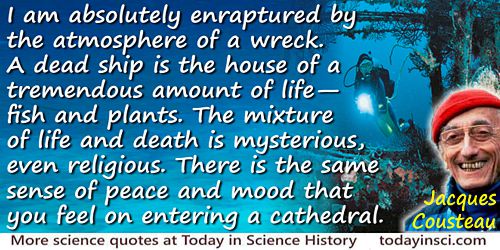
I am absolutely enraptured by the atmosphere of a wreck. A dead ship is the house of a tremendous amount of life—fish and plants. The mixture of life and death is mysterious, even religious. There is the same sense of peace and mood that you feel on entering a cathedral.
Quoted in 'Sport: Poet of the Depths', Time (28 Mar 1960)
I am busy just now again on Electro-Magnetism and think I have got hold of a good thing but can't say; it may be a weed instead of a fish that after all my labour I may at last pull up.
Letter to Richard Phillips, 23 Sep 1831. In Michael Faraday, Bence Jones (ed.), The Life and Letters of Faraday (1870), Vol. 2, 3.
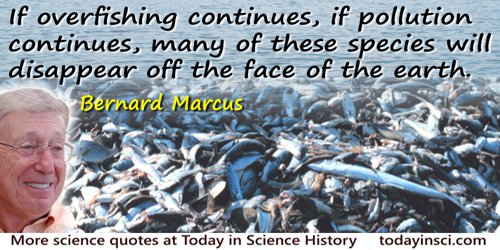
I am concerned about the air we breathe and the water we drink. If overfishing continues, if pollution continues, many of these species will disappear off the face of the earth.
I can no more explain why I like “natural history” than why I like California canned peaches; nor why I do not care for that enormous brand of natural history which deals with invertebrates any more than why I do not care for brandied peaches. All I can say is that almost as soon as I began to read at all I began to like to read about the natural history of beasts and birds and the more formidable or interesting reptiles and fishes.
In 'My Life as a Naturalist', American Museum Journal (May 1918), 18, 321. As cited in Maurice Garland Fulton (ed.) Roosevelt's Writings: Selections from the Writings of Theodore Roosevelt (1920), 247.
I fully support the goal of species protection and conservation and believe that recovery and ultimately delisting of species should be the U.S. Fish and Wildlife Service’s top priority under ESA.
…...
I have presented the periodic table as a kind of travel guide to an imaginary country, of which the elements are the various regions. This kingdom has a geography: the elements lie in particular juxtaposition to one another, and they are used to produce goods, much as a prairie produces wheat and a lake produces fish. It also has a history. Indeed, it has three kinds of history: the elements were discovered much as the lands of the world were discovered; the kingdom was mapped, just as the world was mapped, and the relative positions of the elements came to take on a great significance; and the elements have their own cosmic history, which can be traced back to the stars.
In The Periodic Kingdom: A Journey Into the Land of the Chemical Elements (1995), Preface, viii.
I know, indeed, and can conceive of no pursuit so antagonistic to the cultivation of the oratorical faculty … as the study of Mathematics. An eloquent mathematician must, from the nature of things, ever remain as rare a phenomenon as a talking fish, and it is certain that the more anyone gives himself up to the study of oratorical effect the less will he find himself in a fit state to mathematicize.
In Address (22 Feb 1877) for Commemoration Day at Johns Hopkins University. Published as a pamphlet, and reprinted in The Collected Mathematical Papers of James Joseph Sylvester: (1870-1883) (1909), Vol. 3, 72.
https://books.google.com/books?id=wgVbAAAAQAAJ
James Joseph Sylvester - 1877
I want to get out in the water. I want to see fish, real fish, not fish in a laboratory.
Interview (27 Jan 1991), on Academy of Achievement website.
If the germ plasm wants to swim in the ocean, it makes itself a fish; if the germ plasm wants to fly in the air, it makes itself a bird. If it wants to go to Harvard, it makes itself a man. The strangest thing of all is that the germ plasm that we carry around within us has done all those things. There was a time, hundreds of millions of years ago, when it was making fish. Then … amphibia … reptiles … mammals, and now it’s making men.
In talk, 'Origin of Death' (1970). Wald gave the context whereby the most one-celled organisms continued to reproduce by cell division.
If you ask the fish whether they’d rather have an oil spill or a season of fishing, I wouldn’t be surprised if they’d vote for another blowout.
As quoted by Mark Bittman in 'What's Worse Than an Oil Spill?', New York Times (20 Apr 2011), A23.
If you were to make little fishes talk, they would talk like whales.
Commenting how the animals in fables should talk in character. As quoted in James Boswell, The Life of Johnson (1785), 229.
In 1946 [we visited] a rock called Le Veyron, around which sea life swarmed … an undersea paradise.… About thirty years later I returned … to the same depth, to the same caves, at the same time of year. The grotto was empty. Not one single fish lived among the rocks. The verdant gardens were gone.…
When I saw Le Veyron, I believed that the sea’s most monstrous force doesn’t live in Loch Ness. It lives in us.
When I saw Le Veyron, I believed that the sea’s most monstrous force doesn’t live in Loch Ness. It lives in us.
In Jacques Cousteau and Susan Schiefelbein, The Human, the Orchid, and the Octopus: Exploring and Conserving Our Natural World (2007), 40-41.
In my opinion the separation of the c- and ac-stars is the most important advancement in stellar classification since the trials by Vogel and Secchi ... To neglect the c-properties in classifying stellar spectra, I think, is nearly the same thing as if a zoologist, who has detected the deciding differences between a whale and a fish, would continue classifying them together.
Letter to Edward Pickering (22 Jul 1908). In Charles Coulston Gillespie (ed.), Dictionary of Scientific Biography (1974), Vol. 9, 194.
In the mountains of Parma and Piacenza, multitudes of shells and corals filled with worm-holes may be seen still adhering to the rocks, and when I was making the great horse at Milan a large sack of those which had been found in these parts was brought to my workshop by some peasants... The red stone of the mountains of Verona is found with shells all intermingled, which have become part of this stone... And if you should say that these shells have been and still constantly are being created in such places as these by the nature of the locality or by potency of the heavens in these spots, such an opinion cannot exist in brains possessed of any extensive powers of reasoning because the years of their growth are numbered upon the outer coverings of their shells; and both small and large ones may be seen; and these would not have grown without feeding, or fed without movement, and here [embedded in rock] they would not have been able to move... The peaks of the Apennines once stood up in a sea, in the form of islands surrounded by salt water... and above the plains of Italy where flocks of birds are flying today, fishes were once moving in large shoals.
'Physical Geography', in The Notebooks of Leonardo da Vinci, trans. E. MacCurdy (1938), Vol. 1, 355-6, 359.
Is man a peculiar organism? Does he originate in a wholly different way from a dog, bird, frog, or fish? and does he thereby justify those who assert that he has no place in nature, and no real relationship with the lower world of animal life? Or does he develop from a similar embryo, and undergo the same slow and gradual progressive modifications? The answer is not for an instant doubtful, and has not been doubtful for the last thirty years. The mode of man’s origin and the earlier stages of his development are undoubtedly identical with those of the animals standing directly below him in the scale; without the slightest doubt, he stands in this respect nearer the ape than the ape does to the dog. (1863)
As quoted in Ernst Haeckel and E. Ray Lankester (trans.) as epigraph for Chap. 12, The History of Creation (1886), Vol. 1, 364.
It is said that such inedible animals as star-fish take up about 80 per cent of the nutrients in the North Sea.
In 'Man Explores the Sea', Journal of the Royal Society of Arts (Sep 1963), 111, No. 5086, 789.
It’s a case of many oceans around the world being degraded by negligence. The ocean is the lifeblood of our world. If we were to lose our fish that we appreciate so much by overfishing; or if we were to lose some of our favorite beaches to overbuilding and pollution, then how would we feel? It’s become a case of not knowing what you’ve got until it’s gone. But by no means is it too late.
From transcript of interview, 'Olympic Swimmer: Oceans Need Our help', NBC News Today web site (14 Nov 2008).
Japan’s only natural resources are water, fish, sunlight and brains. We must create or die.
As quoted by Franz Lidz in 'Dr. NakaMats, the Man With 3300 Patents to His Name', Smithsonian Magazine (Dec 2012).
Knowledge does not keep any better than fish. You may be dealing with knowledge of the old species, with some old truth; but somehow or other it must come to the students, as it were, just drawn out of the sea and with the freshness of its immediate importance.
In 'Universities and Their Function', The Aims of Education and Other Essays (1929), 98.
Let him who so wishes take pleasure in boring us with all the wonders of nature: let one spend his life observing insects, another counting the tiny bones in the hearing membrane of certain fish, even in measuring, if you will, how far a flea can jump, not to mention so many other wretched objects of study; for myself, who am curious only about philosophy, who am sorry only not to be able to extend its horizons, active nature will always be my sole point of view; I love to see it from afar, in its breadth and its entirety, and not in specifics or in little details, which, although to some extent necessary in all the sciences, are generally the mark of little genius among those who devote themselves to them.
'L'Homme Plante', in Oeuvres Philosophiques de La Mettrie (1796), Vol. 2, 70-1. Jacques Roger, The Life Sciences in Eighteenth-Century French Thought, edited by Keith R. Benson and trans. Robert Ellrich (1997), 377.
Let us suppose that an ichthyologist is exploring the life of the ocean. He casts a net into the water and brings up a fishy assortment. Surveying his catch, he proceeds in the usual manner of a scientist to systematise what it reveals. He arrives at two generalisations:
(1) No sea-creature is less than two inches long.
(2) All sea-creatures have gills.
These are both true of his catch, and he assumes tentatively that they will remain true however often he repeats it.
In applying this analogy, the catch stands for the body of knowledge which constitutes physical science, and the net for the sensory and intellectual equipment which we use in obtaining it. The casting of the net corresponds to observation; for knowledge which has not been or could not be obtained by observation is not admitted into physical science.
An onlooker may object that the first generalisation is wrong. “There are plenty of sea-creatures under two inches long, only your net is not adapted to catch them.” The icthyologist dismisses this objection contemptuously. “Anything uncatchable by my net is ipso facto outside the scope of icthyological knowledge. In short, what my net can't catch isn't fish.” Or—to translate the analogy—“If you are not simply guessing, you are claiming a knowledge of the physical universe discovered in some other way than by the methods of physical science, and admittedly unverifiable by such methods. You are a metaphysician. Bah!”
(1) No sea-creature is less than two inches long.
(2) All sea-creatures have gills.
These are both true of his catch, and he assumes tentatively that they will remain true however often he repeats it.
In applying this analogy, the catch stands for the body of knowledge which constitutes physical science, and the net for the sensory and intellectual equipment which we use in obtaining it. The casting of the net corresponds to observation; for knowledge which has not been or could not be obtained by observation is not admitted into physical science.
An onlooker may object that the first generalisation is wrong. “There are plenty of sea-creatures under two inches long, only your net is not adapted to catch them.” The icthyologist dismisses this objection contemptuously. “Anything uncatchable by my net is ipso facto outside the scope of icthyological knowledge. In short, what my net can't catch isn't fish.” Or—to translate the analogy—“If you are not simply guessing, you are claiming a knowledge of the physical universe discovered in some other way than by the methods of physical science, and admittedly unverifiable by such methods. You are a metaphysician. Bah!”
In 'Selective Subjectivism', The Philosophy of Physical Science (1938, 2012), 16.
Man … begins life as an ambiguous speck of matter which can in no way be distinguished from the original form of the lowest animal or plant. He next becomes a cell; his life is precisely that of the animalcule. Cells cluster round this primordial cell, and the man is so far advanced that he might be mistaken for an undeveloped oyster; he grows still more, and it is clear that he might even be a fish; he then passes into a stage which is common to all quadrupeds, and next assumes a form which can only belong to quadrupeds of the higher type. At last the hour of birth approaches; coiled within the dark womb he sits, the image of an ape; a caricature of the man that is to be. He is born, and for some time he walks only on all fours; he utters only inarticulate sounds; and even in his boyhood his fondness for climbing trees would seem to be a relic of the old arboreal life.
In The Martyrdom of Man (1876), 393.
Man has two conditions of existence in the body. Hardly two creatures can be less alike than an infant and a man. The whole fetal state is a preparation for birth ... The human brain, in its earlier stage, resembles that of a fish: as it is developed, it resembles more the cerebral mass of a reptile; in its increase, it is like that of a bird, and slowly, and only after birth, does it assume the proper form and consistence of the human encephalon.
Attributed.
Many Species of Animals have been lost out of the World, which Philosophers and Divines are unwilling to admit, esteeming the Destruction of anyone Species a Dismembring of the Universe, and rendring the World imperfect; whereas they think the Divine Providence is especially concerned, and solicitous to secure and preserve the Works of the Creation. And truly so it is, as appears, in that it was so careful to lodge all Land Animals in the Ark at the Time of the general Deluge; and in that, of all Animals recorded in Natural Histories, we cannot say that there hath been anyone Species lost, no not of the most infirm, and most exposed to Injury and Ravine. Moreover, it is likely, that as there neither is nor can be any new Species of Animals produced, all proceeding from Seeds at first created; so Providence, without which one individual Sparrow falls not to the ground, doth in that manner watch over all that are created, that an entire Species shall not be lost or destroyed by any Accident. Now, I say, if these Bodies were sometimes the Shells and Bones of Fish, it will thence follow, that many Species have been lost out of the World... To which I have nothing to reply, but that there may be some of them remaining some where or other in the Seas, though as yet they have not come to my Knowledge. Far though they may have perished, or by some Accident been destroyed out of our Seas, yet the Race of them may be preserved and continued still in others.
— John Ray
Three Physico-Theological Discourses (1713), Discourse II, 'Of the General Deluge, in the Days of Noah; its Causes and Effects', 172-3.
Men first appeared as fish. When they were able to help themselves they took to land.
These are certainly not exact words from Anaximander, though it summarizes Plutarch’s version of what Anaximander believed. Although the subject quote is widely seen, no original of Anaximander’s writings survived on this hypothesis. What we know of Anaximander is what other, later, ancient Greek writers handed down in a kind of ancient Greek telephone game. These include Hippolytus, Aetius and Plutarch. Their expressions of what Anaximander believed relate by a general theme, but notably differ in specifics. For the fragmentary evidence, see Felix M. Cleve, The Giants of Pre-Sophistic Greek Philosophy: An Attempt to Reconstruct Their Thoughts (2012), 145-148. An example of the subject quote is given by David M. Neuberger, without quotation marks: Anaximander said men were produced first in fishes and, that when they were able to help themselves, they were thrown up on the land. Opening sentence 'A Call to the Chemist to Purge Industry of its Contamination of Our Coast and Inland Waters', Chemical Age (Oct 1923), 31, No. 10, 431.
Methods of fishing are becoming more and more efficient, but the whole fishing industry is based on the exploitation of a wild population. This is almost a prehistoric concept on land, but it has never been questioned at sea.
In Men, Machines, and Sacred Cows (1984), 162.
Much scientific truth proved to be as hypothetical as poetic allegory. The relationshiip of those rod-connected blue and red balls to an actual atomic structure was about the same as the relationship of Christianity to the fish or the Lamb.
Another Roadside Attraction (1990), 240.
Nature ... tends to repeat the same organs in the same number and in the same relations, and varies to infinity only their form. In accordance with this principle I shall have to draw my conclusions, in the determining the bones of the fish's skull, not from a consideration of their form, but from a consideration of their connections.
'Considérations sur les pieces de la tête osseuse des animaux vertebras, et particulièrement sur celle du crane des oiseaux', Annales du Museum d'Histoire Naturelle, 1807, 10, 344. Trans. E. S. Russell, Form and Function (1916), 71.
Never to have seen anything but the temperate zone is to have lived on the fringe of the world. Between the Tropic of Capricorn and the Tropic of Cancer live the majority of all the plant species, the vast majority of the insects, most of the strange ... quadrupeds, all of the great and most of the poisonous snakes and large lizards, most of the brilliantly colored sea fishes, and the strangest and most gorgeously plumaged of the birds.
Exploring For Plants (1930), 329.
Nine out of the 10 big fish that were around when I was growing up–the swordfish, the tuna, the marlin, the shark–90 percent of them are gone. If there was that many sharks when I was a kid, there are now this many.
pbs.org/wnet/tavissmiley/interviews/actor-ted-danson/
No human being, however great or powerful, was ever so free as a fish.
In Mrs. L. C. Tuthill (ed.), Precious Thoughts: Moral and Religious. Gathered from the Works of John Ruskin (1867), 72.
Nobody in the world of policy appears to be asking what is best for society, wild fish or farmed fish. And what sort of farmed fish, anyway? Were this question to be asked, and answered honestly, we might find that our interests lay in prioritizing wild fish and making their ecosystems more productive by leaving them alone enough of the time.
In The End of the Line: How Overfishing Is Changing the World and What We Eat (2008), 313.
Nobody is calling for an end to fishing on the high seas but some techniques, for example bottom trawling, must be banned.
In 'Can We Stop Killing Our Oceans Now, Please?', Huffington Post (14 Aug 2013).
Of what significance is one’s one existence, one is basically unaware. What does a fish know about the water in which he swims all his life? The bitter and the sweet come from outside. The hard from within, from one’s own efforts. For the most part I do what my own nature drives me to do. It is embarrassing to earn such respect and love for it.
…...
On entering his [John James Audubon] room, I was astonished and delighted to find that it was turned into a museum. The walls were festooned with all kinds of birds’ eggs, carefully blown out and strung on a thread. The chimney-piece was covered with stuffed squirrels, raccoons, and opossums; and the shelves around were likewise crowded with specimens, among which were fishes, frogs, snakes, lizards, and other reptiles. Besides these stuffed varieties, many paintings were arrayed on the walls, chiefly of birds.
In Richard Rhodes, John James Audubon: The Making of an American (2004), 36.
One day when the whole family had gone to a circus to see some extraordinary performing apes, I remained alone with my microscope, observing the life in the mobile cells of a transparent star-fish larva, when a new thought suddenly flashed across my brain. It struck me that similar cells might serve in the defence of the organism against intruders. Feeling that there was in this something of surpassing interest, I felt so excited that I began striding up and down the room and even went to the seashore in order to collect my thoughts.
I said to myself that, if my supposition was true, a splinter introduced into the body of a star-fish larva, devoid of blood-vessels or of a nervous system, should soon be surrounded by mobile cells as is to be observed in a man who runs a splinter into his finger. This was no sooner said than done.
There was a small garden to our dwelling, in which we had a few days previously organised a 'Christmas tree' for the children on a little tangerine tree; I fetched from it a few rose thorns and introduced them at once under the skin of some beautiful star-fish larvae as transparent as water.
I was too excited to sleep that night in the expectation of the result of my experiment, and very early the next morning I ascertained that it had fully succeeded.
That experiment formed the basis of the phagocyte theory, to the development of which I devoted the next twenty-five years of my life.
I said to myself that, if my supposition was true, a splinter introduced into the body of a star-fish larva, devoid of blood-vessels or of a nervous system, should soon be surrounded by mobile cells as is to be observed in a man who runs a splinter into his finger. This was no sooner said than done.
There was a small garden to our dwelling, in which we had a few days previously organised a 'Christmas tree' for the children on a little tangerine tree; I fetched from it a few rose thorns and introduced them at once under the skin of some beautiful star-fish larvae as transparent as water.
I was too excited to sleep that night in the expectation of the result of my experiment, and very early the next morning I ascertained that it had fully succeeded.
That experiment formed the basis of the phagocyte theory, to the development of which I devoted the next twenty-five years of my life.
In Olga Metchnikoff, Life of Elie Metchnikoff 1845-1916 (1921), 116-7.
Only after the last tree has been cut down. Only after the last river has been poisoned. Only after the last fish has been caught. Only then will you find that money cannot be eaten.
— Cree
Cree Indian prophecy. Quoted by the United Nations Director for the Environment at a conference in Geneva. Recalled by a writer in Ann: Zoologische wetenschappen Issues 275-276 (1984), 16.
Our ancestor was an animal which breathed water, had a swim-bladder, a great swimming tail, an imperfect skull & undoubtedly was an hermaphrodite! Here is a pleasant genealogy for mankind.
Letter to C. Lyell, 10 January 1860. In F. Burkhardt and S. Smith (eds.), The Correspondence of Charles Darwin 1860 (1993), Vol. 8, 29.
Overfishing—really easy to do with megaships equipped with sonar for fast fish finding—and the eventual result is no fish. When smaller boats were still in use, fisheries were sustainable, more or less. But in the past forty years, hyper-efficient hi-tech practices have put paid to a third of the productive ocean. … Now you've got bigger and bigger boats chasing smaller and fewer fish.
In Payback: Debt and the Shadow Side of Wealth (2008), 191.
People still do not understand that a live fish is more valuable than a dead one, and that destructive fishing techniques are taking a wrecking ball to biodiversity.
In 'Can We Stop Killing Our Oceans Now, Please?', Huffington Post (14 Aug 2013).
Science is a progressive activity. The outstanding peculiarity of man is that he stumbled onto the possibility of progressive activities. Such progress, the accumulation of experience from generation to generation, depended first on the development of language, then of writing and finally of printing. These allowed the accumulation of tradition and of knowledge, of the whole aura of cultural inheritance that surrounds us. This has so conditioned our existence that it is almost impossible for us to stop and examine the nature of our culture. We accept it as we accept the air we breathe; we are as unconscious of our culture as a fish, presumably, is of water.
In The Nature of Natural History (1950, 1961), 4.
Science is an ocean. It is as open to the cockboat as the frigate. One man carries across it a freightage of ingots, another may fish there for herrings.
In James Wood, Dictionary of Quotations from Ancient and Modern, English and Foreign Sources (1893), 382:34.
Science, which cuts its way through the muddy pond of daily life without mingling with it, casts its wealth to right and left, but the puny boatmen do not know how to fish for it.
My Past and Thoughts: the Memoirs of Alexander Herzen (revised translation 1968, 1982), 594.
Scientific studies on marine reserves around the world show that if you close a place to fishing, the number of species increases 20 percent, the average size of a fish increases by a third, and the total weight of fish per hectare increases almost five times—in less than a decade.
From interview with Terry Waghorn, 'Can We Eat Our Fish and Protect Them Too?', Forbes (21 Feb 2012)
See, thro' this air, this ocean, and this earth,
All matter quick, and bursting into birth.
Above, how high progressive life may go!
Around, how wide! how deep extend below!
Vast chain of being, which from God began,
Natures ethereal, human, angel, man,
Beast, bird, fish, insect! what no eye can see,
No glass can reach! from Infinite to thee,
From thee to Nothing—On superior pow'rs
Were we to press, inferior might on ours:
Or in the full creation leave a void,
Where, one step broken, the great scale's destroy'd:
From Nature's chain whatever link you strike,
Tenth or ten thousandth, breaks the chain alike.
All matter quick, and bursting into birth.
Above, how high progressive life may go!
Around, how wide! how deep extend below!
Vast chain of being, which from God began,
Natures ethereal, human, angel, man,
Beast, bird, fish, insect! what no eye can see,
No glass can reach! from Infinite to thee,
From thee to Nothing—On superior pow'rs
Were we to press, inferior might on ours:
Or in the full creation leave a void,
Where, one step broken, the great scale's destroy'd:
From Nature's chain whatever link you strike,
Tenth or ten thousandth, breaks the chain alike.
'An Essay on Man' (1733-4), Epistle I. In John Butt (ed.), The Poems of Alexander Pope (1965), 513.
Surrealists … are not exactly artists and we are not exactly men of science; … we are carnivorous fish … swimming between two kinds of water, the cold water of art and the warm water of science.
In Conquest of the Irrational (1935), 10.
The acquired [space exploration] technology has immediately been aimed at practical and profitable applications: worldwide communications, global positioning systems for ships and aircraft, and remote sensing to better know our planet and monitor its resources and to trace migrations of whales, fish, and birds. Unfortunately, it is now almost monopolized by the military.
Written for 'Foreword' to Kevin W. Kelley (ed.), The Home Planet (1988), paragraph 5 (unpaginated).
The biggest danger we face is overfishing. We have too many boats out there. We literally could fish out our oceans, some scientists believe, in the next 40, 50, 60 years. We are trending in that direction. … Every year, for the first time in history, we catch fewer and fewer fish with more and more sophisticated boats going out trying to find them.
From transcript of PBS TV interview by Tavis Smiley (28 Mar 2011).
The bird is a creature of the air, the fish is a creature of the water, and man is a creature of the mind.
In From Atlantis to the Sphinx (1996), 347.
The body of the earth is of the nature of a fish... because it draws water as its breath instead of air.
'Philosophy', in The Notebooks of Leonardo da Vinci, trans. E. MacCurdy (1938), Vol. 1 70.
The book of Nature is the book of Fate. She turns the gigantic pages,—leaf after leaf,—never re-turning one. One leaf she lays down, a floor of granite; then a thousand ages, and a bed of slate; a thousand ages, and a measure of coal; a thousand ages, and a layer of marl and mud: vegetable forms appear; her first misshapen animals, zoophyte, trilobium, fish; then, saurians,—rude forms, in which she has only blocked her future statue, concealing under these unwieldy monsters the fine type of her coming king. The face of the planet cools and dries, the races meliorate, and man is born. But when a race has lived its term, it comes no more again.
From 'Fate', collected in The Complete Works of Ralph Waldo Emerson, Volume 6: The Conduct of Life (1860), 15. This paragraph is the prose version of his poem, 'Song of Nature'.
The commonest forms of amateur natural history in the United States are probably gardening, bird watching, the maintenance of aquarium fish, and nature photography.
In The Nature of Natural History (1950, 1990), 265.
The Earth Speaks, clearly, distinctly, and, in many of the realms of Nature, loudly, to William Jennings Bryan, but he fails to hear a single sound. The earth speaks from the remotest periods in its wonderful life history in the Archaeozoic Age, when it reveals only a few tissues of its primitive plants. Fifty million years ago it begins to speak as “the waters bring forth abundantly the moving creatures that hath life.” In successive eons of time the various kinds of animals leave their remains in the rocks which compose the deeper layers of the earth, and when the rocks are laid bare by wind, frost, and storm we find wondrous lines of ascent invariably following the principles of creative evolution, whereby the simpler and more lowly forms always precede the higher and more specialized forms.
The earth speaks not of a succession of distinct creations but of a continuous ascent, in which, as the millions of years roll by, increasing perfection of structure and beauty of form are found; out of the water-breathing fish arises the air-breathing amphibian; out of the land-living amphibian arises the land-living, air-breathing reptile, these two kinds of creeping things resembling each other closely. The earth speaks loudly and clearly of the ascent of the bird from one kind of reptile and of the mammal from another kind of reptile.
This is not perhaps the way Bryan would have made the animals, but this is the way God made them!
The earth speaks not of a succession of distinct creations but of a continuous ascent, in which, as the millions of years roll by, increasing perfection of structure and beauty of form are found; out of the water-breathing fish arises the air-breathing amphibian; out of the land-living amphibian arises the land-living, air-breathing reptile, these two kinds of creeping things resembling each other closely. The earth speaks loudly and clearly of the ascent of the bird from one kind of reptile and of the mammal from another kind of reptile.
This is not perhaps the way Bryan would have made the animals, but this is the way God made them!
The Earth Speaks to Bryan (1925), 5-6. Osborn wrote this book in response to the Scopes Monkey Trial, where William Jennings Bryan spoke against the theory of evolution. They had previously been engaged in the controversy about the theory for several years. The title refers to a Biblical verse from the Book of Job (12:8), “Speak to the earth and it shall teach thee.”
The fish trap exists because of the fish; once you’ve gotten the fish, you can forget the trap. The rabbit snare exists because of the rabbit; once you’ve gotten the rabbit, you can forget the snare. Words exist because of meaning; once you’ve gotten the meaning, you can forget the words.
As translated from the Chinese original by Burton Watson in The Complete Works Of Chuang Tzu (1968, 2013), 233.
The geologist, in those tables of stone which form his records, finds no examples of dynasties once passed away again returning. There has no repetition of the dynasty of the fish, of the reptile, of the mammal. The dynasty of the future is to have glorified man for its inhabitant; but it is to be the dynasty—“the kingdom”—not of glorified man made in the image of God, but of God himself in the form man.
The Testimony of the Rocks: or, Geology in Its Bearings on the Two Theologies, Natural and Revealed (1857), 178.
The King saw them with no common satisfaction, expressing his desire in no particular to have yt Stellar fish engraven and printed. We wish very much, Sir, yt you could procure for us a particular description of yesd Fish, viz. whether it be common there; what is observable in it when alive; what colour it then hath; what kind of motion in the water; what use it maketh of all that curious workmanship, wch Nature hath adorn'd it with?
Letter to John Winthrop, Jr. (26 Mar 1670), concerning specimens provided by Winthrop to the Society. In A. Rupert Hall & Marie Boas Hall (eds.), The Correspondence of Henry Oldenburg (1969), Vol. 6, 594.
The links between ecosystem and human health are many and obvious: the value in wetlands of filtering pollutants out of groundwater aquifers; the potential future medical use of different plants’ genetic material; the human health effects of heavy metal accumulation in fish and shellfish. It is clear that healthy ecosystems provide the underpinnings for the long-term health of economics and societies.
…...
The novelties in the fish line this week are two—brook trout and California salmon. … Long Island cultivated trout, alive, sell for $1.50 a pound; killed $1 a pound; trout from other portions of the state, 75 cents; wild trout from the Adirondacks, 50 cents; Canada trout 25 to 35 cents. … Certainly ten times as many trout are eaten in New-York as in former years. California salmon … brought 45 cents a pound. … This is rather a high price for California fish, but the catch is very light, caused by overfishing. (1879)
In 'Features of the Markets', New York Times (6 Apr 1879), 9.
The ocean is like a checking account where everybody withdraws but nobody makes a deposit. This is what's happening because of overfishing. Many fisheries have collapsed, and 90 percent of the large fish, sharks and tuna and cod, are gone.
From interview with Terry Waghorn, 'Can We Eat Our Fish and Protect Them Too?', Forbes (21 Feb 2012)
The only part of evolution in which any considerable interest is felt is evolution applied to man. A hypothesis in regard to the rocks and plant life does not affect the philosophy upon which one's life is built. Evolution applied to fish, birds and beasts would not materially affect man's view of his own responsibilities except as the acceptance of an unsupported hypothesis as to these would be used to support a similar hypothesis as to man. The evolution that is harmful—distinctly so—is the evolution that destroys man’s family tree as taught by the Bible and makes him a descendant of the lower forms of life. This … is a very vital matter.
'God and Evolution', New York Times (26 Feb 1922), 84. Rebuttals were printed a few days later from Henry Fairfield Osborn and Edwin Grant Conklin.
The pleasant’st angling is to see the fish
Cut with her golden oars the silver stream,
And greedily devour the treacherous bait.
Cut with her golden oars the silver stream,
And greedily devour the treacherous bait.
In Much Ado About Nothing (1600), Act 3, Scene 1, line 26
The point about zero is that we do not need to use it in the operations of daily life. No one goes out to buy zero fish. It is the most civilized of all the cardinals, and its use is only forced on us by the needs of cultivated modes of thought.
In An Introduction to Mathematics (1911), 63.
The point of mathematics is that in it we have always got rid of the particular instance, and even of any particular sorts of entities. So that for example, no mathematical truths apply merely to fish, or merely to stones, or merely to colours. … Mathematics is thought moving in the sphere of complete abstraction from any particular instance of what it is talking about.
In 'Mathematics', Science and the Modern World (1926, 2011), 27.

The point of mathematics is that in it we have always got rid of the particular instance, and even of any particular sorts of entities. So that for example, no mathematical truths apply merely to fish, or merely to stones, or merely to colours. So long as you are dealing with pure mathematics, you are in the realm of complete and absolute abstraction. … Mathematics is thought moving in the sphere of complete abstraction from any particular instance of what it is talking about.
In Science and the Modern World: Lowell Lectures, 1925 (1925), 31.
The quality of Mersey is not strained. A century ago the river of that name, in England, afforded not less than sixty varieties of fish; now it affords none. (1876)
Description of the turbid, polluted River Mersey, Liverpool, England in the nineteenth century. In Daily Alta California (21 Aug 1876), 28, No. 9633, 2. The expression “The quality of Mersey is not strained” is seen repeated in various sources through the years to the present. The pun refers a line in Shakespeare's Merchant of Venice that “The quality of mercy is not strained.” An earlier mention appears in Harper's New Monthly Magazine (Dec 1870), 42, No. 247, 158.
The rule for life in the sea can be summed up in the well known expression “big fish eat little fish”. … Research shows that great losses occur in the fish cycle because small fish are eaten by larger ones, and in many cases the larger fish are not fit for human consumption.
In 'Man Explores the Sea', Journal of the Royal Society of Arts (Sep 1963), 111, No. 5086, 787-789.
The study of fish in the sea may be the most necessary of all our oceanographic researches because we shall increasingly be made to turn to the sea as a vast food producer by the increase in the population of the world.
In 'Man Explores the Sea', Journal of the Royal Society of Arts (Sep 1963), 111, No. 5086, 787.
The uncertain, unsettled condition of this science of Cetology is in the very vestibule attested by the fact, that in some quarters it still remains a moot point whether a whale be a fish. In his System of Nature, A.D. 1776, Linnæus declares, “I hereby separate the whales from the fish.” But of my own knowledge, I know that down to the year 1850, sharks and shads, alewives and herring, against Linnæus’s express edict, were still found dividing the possession of the same seas with the Leviathan.
The grounds upon which Linnæus would fain have banished the whales from the waters, he states as follows: “On account of their warm bilocular heart, their lungs, their movable eyelids, their hollow ears, penem intrantem feminam mammis lactantem,” and finally, “ex lege naturæ jure meritoque.” I submitted all this to my friends Simeon Macey and Charley Coffin, of Nantucket, both messmates of mine in a certain voyage, and they united in the opinion that the reasons set forth were altogether insufficient. Charley profanely hinted they were humbug.
The grounds upon which Linnæus would fain have banished the whales from the waters, he states as follows: “On account of their warm bilocular heart, their lungs, their movable eyelids, their hollow ears, penem intrantem feminam mammis lactantem,” and finally, “ex lege naturæ jure meritoque.” I submitted all this to my friends Simeon Macey and Charley Coffin, of Nantucket, both messmates of mine in a certain voyage, and they united in the opinion that the reasons set forth were altogether insufficient. Charley profanely hinted they were humbug.
In Moby Dick (1851, 1892), 128-129.
The whale that wanders round the Pole
Is not a table fish.
You cannot bake or boil him whole
Nor serve him in a dish.
Is not a table fish.
You cannot bake or boil him whole
Nor serve him in a dish.
The young doctor should look about early for an avocation, a pastime, that will take him away from patients, pills and potions. … No man is really happy or safe without one, and it makes precious little difference what the outside interest may be—botany, beetles or butterflies, roses, tulips or irises, fishing, mountaineering or antiquities—anything will do so long as he straddles a hobby and rides it hard.
In 'The Medical Library in Post-Graduate Work', British Medical Journal (1909), 2, 927.
There is no instrument for measuring the pressure of the Ether, which is probably millions of times greater: it is altogether too uniform for direct apprehension. A deep-sea fish has probably no means of apprehending the existence of water, it is too uniformly immersed in it: and that is our condition in regard to the Ether.
Ether and Reality: A Series of Discourses on the Many Functions of the Ether of Space (1925), 28.
There’s little use in commercial and recreational fishers pointing fingers at each other. Commercial fishing is not all bad and recreational fishing is not all good. A fish doesn’t care if you are a commercial or a recreational fishermen. It only cares if it is surrounded by water—or on ice.
As quoted in Charles Clover, The End of the Line: How Overfishing is Changing the World and what We Eat (2004, 2008), 275.
There's nothing situate under heaven's eye
But hath his bond in earth, in sea, in sky.
The beasts, the fishes, and the winged fowls
Are their males' subjects and at their controls.
Man, more divine, the master of all these,
Lord of the wide world and wild wat'ry seas,
Indu'd with intellectual sense and souls,
Of more pre-eminence than fish and fowls,
Are masters to their females, and their lords;
Then let your will attend on their accords.
But hath his bond in earth, in sea, in sky.
The beasts, the fishes, and the winged fowls
Are their males' subjects and at their controls.
Man, more divine, the master of all these,
Lord of the wide world and wild wat'ry seas,
Indu'd with intellectual sense and souls,
Of more pre-eminence than fish and fowls,
Are masters to their females, and their lords;
Then let your will attend on their accords.
The Comedy of Errors (1594), II, i.
Throughout all of human history, we have taken, taken, taken, from the natural world. All creatures, however large or small, do this as a way of making a living. Humans, though, have gone way beyond what elephants have done to the planet or what birds or what any fish in the sea is capable of doing.
In interview with Pierce Nahigyan, 'Dr. Sylvia Earle: “We’re Literally Destroying The Systems That Keep Us Alive”', Huffington Post (6 Jan 2016).
Time is but a stream I go a-fishing in. I drink at it; but while I drink I see the sandy bottom, and detect how shallow it is. Its thin current slides away, but eternity remains. I would drink deeper; fish in the sky, whose bottom is pebby with stars.
Walden (1882), Vol. 1, 155.
To a man who has not eaten a globe fish, we cannot speak of its flavour.
— Taibai
…...
To me the sea is a continual miracle,
The fishes that swim—the rocks—the motion of the waves— the ships with men in them,
What stranger miracles are there?
The fishes that swim—the rocks—the motion of the waves— the ships with men in them,
What stranger miracles are there?
In poem, 'Miracles', Leaves of Grass (1867), 336.
Upon viewing the milt or semen Masculinum of a living Codfish with a Microscope, such Numbers of Animalcules with long Tails were found therein, that at least ten thousand of them were supposed to exist in the quantity of a Grain of Sand.
Visualize yourself confronted with the task of killing, one after the other, a cabbage, a fly, a fish, a lizard, a guinea pig, a cat, a dog, a monkey and a baby chimpanzee. In the unlikely case that you should experience no greater inhibitions in killing the chimpanzee than in destroying the cabbage or the fly, my advice to you is to commit suicide at your earliest possible convenience, because you are a weird monstrosity and a public danger.
'The Enmity Between Generations and Its Probable Ethological Causes'. In Richard I. Evans, Konrad Lorenz: The Man and his Ideas (1975), 227.
We are fishing out the top of the food chain, and it’s pretty crucial because about 200 million people depend on fish and fishing for their livelihood, and about a billion people, mostly in poorer countries, depend on fish for their protein. So this is a big problem. Good news is, it’s fixable.
From transcript of PBS TV interview by Tavis Smiley (28 Mar 2011).
We have here other fish to fry.
From the original French, in Gargantua et Pantagruel, Book 5, as translated by Peter Anthony Motteaux, Master François Rabelais: Five Books of the Lives, Heroic Deeds, and Sayings of Gargantua and His Son Pantagruel (1708, 1904), Vol 3, Book 5, Chap 12, 212.
We urgently need [the landmark National Ocean Policy] initiative, as we use our oceans heavily: Cargo ships crisscross the sea, carrying goods between continents. Commercial and recreational fishing boats chase fish just offshore. Cruise ships cruise. Oil and gas drilling continues, but hopefully we will add renewable energy projects as well. Without planning, however, these various industrial activities amount to what we call “ocean sprawl,” steamrolling the resources we rely upon for our livelihoods, food, fun, and even the air we breathe. While humankind relies on many of these industries, we also need to keep the natural riches that support them healthy and thriving. As an explorer, I know firsthand there are many places in the ocean so full of life that they should be protected.
In 'A Blueprint for Our Blue Home', Huffington Post (18 Jul 2011).
We were able to see the plankton blooms resulting from the upwelling off the coast of Chile. The plankton itself extended along the coastline and had some long tenuous arms reaching out to sea. The arms or lines of plankton were pushed around in a random direction, fairly well-defined yet somewhat weak in color, in contrast with the dark blue ocean. The fishing ought to be good down there.
…...
Well, basically, there was this little dot, right? And the dot went bang and the bang expanded. Energy formed into matter, matter cooled, matter lived, the amoeba to fish, to fish to fowl, to fowl to frog, to frog to mammal, the mammal to monkey, to monkey to man, amo amas amat, quid pro quo, memento mori, ad infinitum, sprinkle on a little bit of grated cheese and leave under the grill till Doomsday.
— Movie
Fictional characters, Johnny, replying to Louise’s question “How did you get here?” in the movie Naked (1993), written and directed by Mike Leigh. As quoted in Wendy Ellen Everett and Axel Goodbody (eds.), Revisiting Space: Space and Place in European Cinema (2005), 51.
What does a fish know about the water in which it swims all its life?
Webmaster has not yet been able to find a primary source. Seen with Einstein’s name, but Webmaster suspects that is misattributed.
What shall we say of the intelligence, not to say religion, of those who are so particular to distinguish between fishes and reptiles and birds, but put a man with an immortal soul in the same circle with the wolf, the hyena, and the skunk? What must be the impression made upon children by such a degradation of man?
When I behold a fashionable table set out in all its magnificence, I fancy that I see gouts and dropsies, fevers and lethargies, with other innumerable distempers lying in ambuscade among the dishes. Nature delights in the most plain and simple diet. Every animal but man keeps to one dish. Herbs are the food of this species, fish of that, and flesh of a third. Man falls upon everything that comes in his way; not the smallest fruit or excrescence of the earth, scarce a berry or a mushroom can escape him.
Spectator, No. 195. In Samuel Austin Allibone, Prose Quotations from Socrates to Macaulay (1880), 363.
When I read an Italian letter [Saggio by Voltaire] on changes which had occurred on the surface of the earth, published in Paris this year (1746), I believed that these facts were reported by La Loubère. Indeed, they correspond perfectly with the author’s ideas. Petrified fish are according to him merely rare fish thrown away by Roman cooks because they were spoiled; and with respect to shells, he said that they were from the sea of the Levant and brought back by pilgrims from Syria at the time of the crusades. These shells are found today petrified in France, in Italy and in other Christian states. Why did he not add that monkeys transported shells on top of high mountains and to every place where humans cannot live? It would not have harmed his story but made his explanation even more plausible.
In 'Preuves de la Théorie de la Terre', Histoire Naturelle, Générale et Particuliere, Avec la Description du Cabinet du Roi (1749), Vol. I, 281. Trans. Albert V. and Marguerite Carozzi.
Who, of men, can tell
That flowers would bloom, or that green fruit would swell
To melting pulp, that fish would have bright mail,
The earth its dower of river, wood, and vale,
The meadows runnels, runnels pebble-stones,
The seed its harvest, or the lute its tones,
Tones ravishment, or ravishment its sweet,
If human souls did never kiss and greet?
That flowers would bloom, or that green fruit would swell
To melting pulp, that fish would have bright mail,
The earth its dower of river, wood, and vale,
The meadows runnels, runnels pebble-stones,
The seed its harvest, or the lute its tones,
Tones ravishment, or ravishment its sweet,
If human souls did never kiss and greet?
Endymion (1818), bk. 1, l. 835-842. In John Barnard (ed.), John Keats. The Complete Poems (1973), 129.
Why are the bones of great fishes, and oysters and corals and various other shells and sea-snails, found on the high tops of mountains that border the sea, in the same way in which they are found in the depths of the sea?
'Physical Geography', in The Notebooks of Leonardo da Vinci, trans. E. MacCurdy (1938), Vol. 1, 361.
Why it is that animals, instead of developing in a simple and straightforward way, undergo in the course of their growth a series of complicated changes, during which they often acquire organs which have no function, and which, after remaining visible for a short time, disappear without leaving a trace ... To the Darwinian, the explanation of such facts is obvious. The stage when the tadpole breathes by gills is a repetition of the stage when the ancestors of the frog had not advanced in the scale of development beyond a fish.
In The Works of Francis Maitland Balfour (1885), Vol. 1, 702.
Why should the leaders of chemical businesses be held responsible for polluting the marine environment with a few grams of effluent, which is sublethal to marine species, while celebrity chefs are turning out endangered fish at several dozen tables a night without enduring a syllable of criticism?
In The End of the Line: How Overfishing is Changing the World and what We Eat (2004), 189.

With respect to those who may ask why Nature does not produce new beings? We may enquire of them in turn, upon what foundation they suppose this fact? What it is that authorizes them to believe this sterility in Nature? Know they if, in the various combinations which she is every instant forming, Nature be not occupied in producing new beings, without the cognizance of these observers? Who has informed them that this Nature is not actually assembling, in her immense elaboratory, the elements suitable to bring to light, generations entirely new, that will have nothing in common with those of the species at present existing? What absurdity then, or what want of just inference would there be, to imagine that the man, the horse, the fish, the bird will be no more? Are these animals so indispensably requisite to Nature, that without them she cannot continue her eternal course? Does not all change around us? Do we not ourselves change? ... Nature contains no one constant form.
The System of Nature (1770), trans. Samuel Wilkinson (1820), Vol. 1, 94-95.
Xenophanes of Kolophon ... believes that once the earth was mingled with the sea, but in the course of time it became freed from moisture; and his proofs are such as these: that shells are found in the midst of the land and among the mountains, that in the quarries of Syracuse the imprints of a fish and of seals had been found, and in Paros the imprint of an anchovy at some depth in the stone, and in Melite shallow impressions of all sorts of sea products. He says that these imprints were made when everything long ago was covered with mud, and then the imprint dried in the mud.
Doxographists, Zeller, Vorsokr. Phil. 543, n. 1. Quoted in Arthur Fairbanks (ed. And trans.), The First Philosophers of Greece (1898), 83.
Yes, Agassiz does recommend authors to eat fish, because the phosphorous in it makes brains. So far you are correct. But I cannot help you to a decision about the amount you need to eat—at least, not with certainty. If the specimen composition you send is about your fair usual average, I should judge that perhaps a couple of whales would be all you would want for the present. Not the largest kind, but simply good middling-sized whales.
A fallacy expressed in advice to an aspiring author. 'Answer To An Inquiry From The Coming Man', The Galaxy (Jan 1871), 11, 159. Collected in Sketches New and Old (), 25. Also seen shortened as, “Agassiz does recommend authors to eat fish, because the phosphorus in it makes brains. But I cannot help you to a decision about the amount you need to eat. Perhaps a couple of whales would be enough.” [Presumably Twain refers to Alexander Agassiz, marine zoologist (1835-1910) —Webmaster]
 In science it often happens that scientists say, 'You know that's a really good argument; my position is mistaken,' and then they would actually change their minds and you never hear that old view from them again. They really do it. It doesn't happen as often as it should, because scientists are human and change is sometimes painful. But it happens every day. I cannot recall the last time something like that happened in politics or religion.
(1987) --
In science it often happens that scientists say, 'You know that's a really good argument; my position is mistaken,' and then they would actually change their minds and you never hear that old view from them again. They really do it. It doesn't happen as often as it should, because scientists are human and change is sometimes painful. But it happens every day. I cannot recall the last time something like that happened in politics or religion.
(1987) --