First Quotes (1309 quotes)
-------------- are like snowmen, fun at first, but not much future.
In Jon Fripp, Michael Fripp and Deborah Fripp, Speaking of Science (2000), 211.
… the three positive characteristics that distinguish mathematical knowledge from other knowledge … may be briefly expressed as follows: first, mathematical knowledge bears more distinctly the imprint of truth on all its results than any other kind of knowledge; secondly, it is always a sure preliminary step to the attainment of other correct knowledge; thirdly, it has no need of other knowledge.
In Mathematical Essays and Recreations (1898), 35.
… the truth is that the knowledge of external nature and of the sciences which that knowledge requires or includes, is not the great or the frequent business of the human mind. Whether we provide for action or conversation, whether we wish to be useful or pleasing, the first requisite is the religious and moral knowledge of right and wrong; the next is an acquaintance with the history of mankind, and with those examples which may be said to embody truth, and prove by events the reasonableness of opinions. Prudence and justice are virtues, and excellencies, of all times and of all places; we are perpetually moralists, but we are geometricians only by chance. Our intercourse with intellectual nature is necessary; our speculations upon matter are voluntary, and at leisure. Physical knowledge is of such rare emergence, that one man may know another half his life without being able to estimate his skill in hydrostatics or astronomy; but his moral and prudential character immediately appears.
In Lives of the Poets (1779-81).
… There can be no doubt about faith and not reason being the ultima ratio. Even Euclid, who has laid himself as little open to the charge of credulity as any writer who ever lived, cannot get beyond this. He has no demonstrable first premise. He requires postulates and axioms which transcend demonstration, and without which he can do nothing. His superstructure indeed is demonstration, but his ground his faith. Nor again can he get further than telling a man he is a fool if he persists in differing from him. He says “which is absurd,” and declines to discuss the matter further. Faith and authority, therefore, prove to be as necessary for him as for anyone else.
In The Way of All Flesh (1917), 319-320.
... we must first base such words as “between” upon clear concepts, a thing which is quite feasible but which I have not seen done.
In George Edward Martin, The Foundations of Geometry and the Non-Euclidean Plane (1982), 83.
...after my first feeling of revulsion had passed, I spent three of the most entertaining and instructive weeks of my life studying the fascinating molds which appeared one by one on the slowly disintegrating mass of horse-dung. Microscopic molds are both very beautiful and absorbingly interesting. The rapid growth of their spores, the way they live on each other, the manner in which the different forms come and go, is so amazing and varied that I believe a man could spend his life and not exhaust the forms or problems contained in one plate of manure.
The World Was My Garden (1938, 1941), 55.
...great difficulties are felt at first and these cannot be overcome except by starting from experiments .. and then be conceiving certain hypotheses ... But even so, very much hard work remains to be done and one needs not only great perspicacity but often a degree of good fortune.
Letter to Tschirnhaus (1687). Quoted in Archana Srinivasan, Great Inventors (2007), 37-38.
…reality is a system, completely ordered and fully intelligible, with which thought in its advance is more and more identifying itself. We may look at the growth of knowledge … as an attempt by our mind to return to union with things as they are in their ordered wholeness…. and if we take this view, our notion of truth is marked out for us. Truth is the approximation of thought to reality … Its measure is the distance thought has travelled … toward that intelligible system … The degree of truth of a particular proposition is to be judged in the first instance by its coherence with experience as a whole, ultimately by its coherence with that further whole, all comprehensive and fully articulated, in which thought can come to rest.
In The Nature of Thought (1921), Vol II, 264.
…The present revolution of scientific thought follows in natural sequence on the great revolutions at earlier epochs in the history of science. Einstein’s special theory of relativity, which explains the indeterminateness of the frame of space and time, crowns the work of Copernicus who first led us to give up our insistence on a geocentric outlook on nature; Einstein's general theory of relativity, which reveals the curvature or non-Euclidean geometry of space and time, carries forward the rudimentary thought of those earlier astronomers who first contemplated the possibility that their existence lay on something which was not flat. These earlier revolutions are still a source of perplexity in childhood, which we soon outgrow; and a time will come when Einstein’s amazing revelations have likewise sunk into the commonplaces of educated thought.
In The Theory of Relativity and its Influence on Scientific Thought (1922), 31-32
‘I was reading an article about “Mathematics”. Perfectly pure mathematics. My own knowledge of mathematics stops at “twelve times twelve,” but I enjoyed that article immensely. I didn’t understand a word of it; but facts, or what a man believes to be facts, are always delightful. That mathematical fellow believed in his facts. So do I. Get your facts first, and’—the voice dies away to an almost inaudible drone—’then you can distort ‘em as much as you please.’
In 'An Interview with Mark Twain', in Rudyard Kipling, From Sea to Sea (1899), Vol. 2, 180.
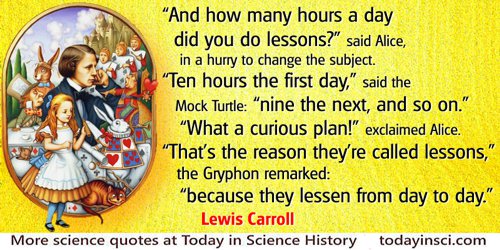
“And how many hours a day did you do lessons?” said Alice, in a hurry to change the subject.
“Ten hours the first day,” said the Mock Turtle: “nine the next, and so on.”
“What a curious plan!” exclaimed Alice.
“That's the reason they’re called lessons,” the Gryphon remarked: “because they lessen from day to day.”
“Ten hours the first day,” said the Mock Turtle: “nine the next, and so on.”
“What a curious plan!” exclaimed Alice.
“That's the reason they’re called lessons,” the Gryphon remarked: “because they lessen from day to day.”
Alice's Adventures in Wonderland (1865, 1869), 145.
“Daddy,” she says, “which came first, the chicken or the egg?”
Steadfastly, even desperately, we have been refusing to commit ourselves. But our questioner is insistent. The truth alone will satisfy her. Nothing less. At long last we gather up courage and issue our solemn pronouncement on the subject: “Yes!”
So it is here.
“Daddy, is it a wave or a particle?”
“Yes.”
“Daddy, is the electron here or is it there?”
“Yes.”
“Daddy, do scientists really know what they are talking about?”
“Yes!”
Steadfastly, even desperately, we have been refusing to commit ourselves. But our questioner is insistent. The truth alone will satisfy her. Nothing less. At long last we gather up courage and issue our solemn pronouncement on the subject: “Yes!”
So it is here.
“Daddy, is it a wave or a particle?”
“Yes.”
“Daddy, is the electron here or is it there?”
“Yes.”
“Daddy, do scientists really know what they are talking about?”
“Yes!”
The Strange Story of the Quantum (1947), 156-7.
“If there are two theories, one simpler man the other, the simpler one is to be preferred.” At first sight this does not seem quite so bad, but a little thought shows that our tendency to prefer the simpler possibility is psychological rather than scientific. It is less trouble to think that way. Experience invariably shows that the more correct a theory becomes, the more complex does it seem. … So this … interpretation of [Ockham’s Razor] is … worthless.
With co-author Nalin Chandra Wickramasinghe, Evolution from Space (1981), 135.
“True is it, my incorporate friends,” quoth he, “That I receive the general food at first, Which you do live upon; and fit it is, Because I am the storehouse and the shop Of the whole body. But, if you do remember, I send it through the rivers of your blood, Even to the court, the heart, to th’ seat o’ th’ brain; And, through the cranks and offices of man, The strongest nerves and small inferior veins From me receive that natural competency Whereby they live. And though that all at once”— You, good friends, this says the belly, mark me.
[Told as a fable, this is the belly’s answer to a complaint from the other members of the body that it received all the food but did no work.] In Coriolanus (1623), Act 1, Scene 1, line 130-141. Webmaster’s note: The Fable of the Belly has its roots in antiquity. William Harvey delivered a lecture in Apr 1616 on his discovery the circulation of blood in the body, but did not publish until 1628.
“Yes,” he said. “But these things (the solutions to problems in solid geometry such as the duplication of the cube) do not seem to have been discovered yet.” “There are two reasons for this,” I said. “Because no city holds these things in honour, they are investigated in a feeble way, since they are difficult; and the investigators need an overseer, since they will not find the solutions without one. First, it is hard to get such an overseer, and second, even if one did, as things are now those who investigate these things would not obey him, because of their arrogance. If however a whole city, which did hold these things in honour, were to oversee them communally, the investigators would be obedient, and when these problems were investigated continually and with eagerness, their solutions would become apparent.”
— Plato
In The Republic 7 528bc, trans. R.W. Sharples.
(1) A robot may not injure a human being, or, through inaction, allow a human being to come to harm.
(2) A robot must obey the orders given it by human beings except where such orders would conflict with the first law.
(3) A robot must protect its own existence as long as such protection does not conflict with the First or Second Law.
(2) A robot must obey the orders given it by human beings except where such orders would conflict with the first law.
(3) A robot must protect its own existence as long as such protection does not conflict with the First or Second Law.
'The Three Laws of Robotics', in I, Robot (1950), Frontispiece.
[1.] And first I suppose that there is diffused through all places an aethereal substance capable of contraction & dilatation, strongly elastick, & in a word, much like air in all respects, but far more subtile.
2. I suppose this aether pervades all gross bodies, but yet so as to stand rarer in their pores then in free spaces, & so much ye rarer as their pores are less ...
3. I suppose ye rarer aether within bodies & ye denser without them, not to be terminated in a mathematical superficies, but to grow gradually into one another.
2. I suppose this aether pervades all gross bodies, but yet so as to stand rarer in their pores then in free spaces, & so much ye rarer as their pores are less ...
3. I suppose ye rarer aether within bodies & ye denser without them, not to be terminated in a mathematical superficies, but to grow gradually into one another.
Letter to Robert Boyle (28 Feb 1678/9). In H. W. Turnbull (ed.), The Correspondence of Isaac Newton, 1676-1687 (1960), Vol. 2, 289.
[1665-06-07] ...This day, much against my will, I did in Drury Lane see two or three houses marked with a red cross upon the doors, and 'Lord have mercy upon us' writ there - which was a sad sight to me, being the first of that kind that to my remembrance I ever saw. It put me into an ill conception of myself and my smell, so that I was forced to buy some roll-tobacco to smell to and chaw - which took away the apprehension.
Diary of Samuel Pepys (7 Jun 1665)
[1665-06-11] I out of doors a little to show forsooth my new suit, and back again; and in going, saw poor Dr Burnets door shut. But he hath, I hear, gained goodwill among his neighbours; for he discovered it himself first, and caused himself to be shut up of his own accord - which was very handsome.
Diary of Samuel Pepys (11 Jun 1665)
[A crowd] thinks in images, and the image itself calls up a series of other images, having no logical connection with the first … A crowd scarcely distinguishes between the subjective and the objective. It accepts as real the images invoked in its mind, though they most often have only a very distant relation with the observed facts. * * * Crowds being only capable of thinking in images are only to be impressed by images. It is only images that terrify or attract them and become motives of action.
From Psychologie des Foules (1895), 29 & 56. English text in The Crowd: A Study of the Popular Mind (1897), Book 1, Chap 2, 22 & last sentence, 55. Original French text: “[La foule] pense par images, et l’image évoquée en évoque elle-même une série d’autres n’ayant aucun lien logique avec la première. … La foule ne sépare guère le subjectif de l’objectif. Elle admet comme réelles les images évoquées dans son esprit, et qui le plus souvent n’ont qu’une parenté lointaine avec le fait observé. * * * Les foules, ne pouvant penser que par images,ne se laissent impressionner que par des images. Seules les images les terrifient ou les séduisent, et deviennent des mobiles d’action.”
[A woman waiting for him in the Kremlin asked Gobachev] “Was communism invented by a politician or a scientist?” [He replied] “Well, a politician.” She said, “That explains it. The scientist would have tried it on mice first.”
A story concluding his 'Remarks to Jewish Leaders During a White House Briefing on United States Assistance for the Nicaraguan Democratic Resistance', (5 Mar 1986). He said was “told in the Communist countries among themselves, which reveals the cynicism of their own people,” and it was brought to him by George Shultz returning from the Soviet Union. Collected in Public Papers of the Presidents of the United States: Ronald Reagan, 1986 (1988), 297. He repeated this joke during 'Remarks to Elected Officials During a White House Briefing on United States Assistance for the Nicaraguan Democratic Resistance' (14 Mar 1986), ibid. 340.
[About the great synthesis of atomic physics in the 1920s:] It was a heroic time. It was not the doing of any one man; it involved the collaboration of scores of scientists from many different lands. But from the first to last the deeply creative, subtle and critical spirit of Niels Bohr guided, restrained, deepened and finally transmuted the enterprise.
Quoted in Bill Becker, 'Pioneer of the Atom', New York Times Sunday Magazine (20 Oct 1957), 54.
[Barbara McClintock's] burning curiosity, enthusiasm, and uncompromising honesty serve as a constant reminder of what drew us all to science in the first place
Obituary, 'Barbara McClintock (1902-1992)' Nature (24 Sep 1992), 272.
[Chemistry] laboratory work was my first challenge. ... I still carry the scars of my first discovery—that test-tubes are fragile.
Edward Teller with Judith L. Shoolery, Memoirs: A Twentieth-Century Journey in Science and Politics (2001), 42.
[First use of the term science fiction:] We hope it will not be long before we may have other works of Science-Fiction [like Richard Henry Horne's The Poor Artist], as we believe such books likely to fulfil a good purpose, and create an interest, where, unhappily, science alone might fail.
[Thomas] Campbell says, that “Fiction in Poetry is not the reverse of truth, but her soft and enchanting resemblance.” Now this applies especially to Science-Fiction, in which the revealed truths of Science may be given interwoven with a pleasing story which may itself be poetical and true—thus circulating a knowledge of Poetry of Science, clothed in a garb of the Poetry of life.
[Thomas] Campbell says, that “Fiction in Poetry is not the reverse of truth, but her soft and enchanting resemblance.” Now this applies especially to Science-Fiction, in which the revealed truths of Science may be given interwoven with a pleasing story which may itself be poetical and true—thus circulating a knowledge of Poetry of Science, clothed in a garb of the Poetry of life.
In A Little Earnest Book Upon a Great Old Subject (1851), 137.
[Gauss calculated the elements of the planet Ceres] and his analysis proved him to be the first of theoretical astronomers no less than the greatest of “arithmeticians.”
In History of Mathematics (3rd Ed., 1901), 458.
[Great scientists] are men of bold ideas, but highly critical of their own ideas: they try to find whether their ideas are right by trying first to find whether they are not perhaps wrong. They work with bold conjectures and severe attempts at refuting their own conjectures.
'The Problem of Demarcation' (1974). Collected in David Miller (ed.) Popper Selections (1985), 118-119.
[Helmholtz] is not a philosopher in the exclusive sense, as Kant, Hegel, Mansel are philosophers, but one who prosecutes physics and physiology, and acquires therein not only skill in developing any desideratum, but wisdom to know what are the desiderata, e.g., he was one of the first, and is one of the most active, preachers of the doctrine that since all kinds of energy are convertible, the first aim of science at this time. should be to ascertain in what way particular forms of energy can be converted into each other, and what are the equivalent quantities of the two forms of energy.
Letter to Lewis Campbell (21 Apr 1862). In P.M. Harman (ed.), The Scientific Letters and Papers of James Clerk Maxwell (1990), Vol. 1, 711.
[I was advised] to read Jordan's 'Cours d'analyse'; and I shall never forget the astonishment with which I read that remarkable work, the first inspiration for so many mathematicians of my generation, and learnt for the first time as I read it what mathematics really meant.
In A Mathematician’s Apology (1940, reprint with Foreward by C.P. Snow 1992), 23.
[I] could see how nervous everybody was in the beginning and how silent it was when we had trouble with the artificial heart [during the surgery, but later in the operation, when it was working, there were moments] of loud and raucous humor.
[Commenting after reviewing the video tape of the world's first human implantation of an artificial heart.]
[Commenting after reviewing the video tape of the world's first human implantation of an artificial heart.]
Quoted by Lawrence K. Altman in “Clark's Surgeon Was ‘Worried To Death’&rdquo, New York Times (12 Apr 1983), C2.
[I] learnt, for the first time, the joys of substituting hard, disciplined study for the indulgence of day-dreaming.
[Comment on his successful undergraduate studies at the University of St. Andrews.]
[Comment on his successful undergraduate studies at the University of St. Andrews.]
As quoted in Obituary, The Times (24 Mar 2010)

[Ignorance] of the principle of conservation of energy … does not prevent inventors without background from continually putting forward perpetual motion machines… Also, such persons undoubtedly have their exact counterparts in the fields of art, finance, education, and all other departments of human activity… persons who are unwilling to take the time and to make the effort required to find what the known facts are before they become the champions of unsupported opinions—people who take sides first and look up facts afterward when the tendency to distort the facts to conform to the opinions has become well-nigh irresistible.
From Evolution in Science and Religion (1927), 58-59. An excerpt from the book including this quote appears in 'New Truth and Old', Christian Education (Apr 1927), 10, No. 7, 394-395.
[In 1909,] Paris was the center of the aviation world. Aeronautics was neither an industry nor even a science; both were yet to come. It was an “art” and I might say a “passion”. Indeed, at that time it was a miracle. It meant the realization of legends and dreams that had existed for thousands of years and had been pronounced again and again as impossible by scientific authorities. Therefore, even the brief and unsteady flights of that period were deeply impressive. Many times I observed expressions of joy and tears in the eyes of witnesses who for the first time watched a flying machine carrying a man in the air.
In address (16 Nov 1964) presented to the Wings Club, New York City, Recollections and Thoughts of a Pioneer (1964), 5.
[In treating the sick], the first thing to consider is the provision of fresh air, clean water, and a healthy diet.
As quoted in Robert Taylor, White Coat Tales: Medicine's Heroes, Heritage, and Misadventures (2010), 124.
[Jethro Tull] was the first Englishman—perhaps the first writer, ancient and modern—who has attempted, with any tolerable degree of success, to reduce the art of agriculture to certain and uniform principles; and it must be acknowledged that he has done more towards establishing a rational and practical method of husbandry than all the writers who have gone before him.
In Letter (18 Oct 1764), signed only “D.Y.” from Hungerford, in Sylvanus Urban (ed.), 'Observations on the late Improvements in Agriculture', The Gentleman’s Magazine (Nov 1764), 525.
[Lifting off into space] I wasn’t really scared. I was very excited, and I was very anxious. When you’re getting ready to launch into space, you’re sitting on a big explosion waiting to happen. So most astronauts getting ready to lift off are excited and very anxious and worried about that explosion—because if something goes wrong in the first seconds of launch, there's not very much you can do.
Interview conducted on Scholastic website (20 Nov 1998).
[Lockyer]... sometimes forgets he is only the editor and not the author of Nature.
[Lockyer was the first editor of Nature.]
[Lockyer was the first editor of Nature.]
J. W. L. Glaisher (ed.), The Collected Mathematical Papers of Henry John Stephen Smith (1894), Vol. 1, xliv.
[My advice] will one day be found
With other relics of 'a former world,'
When this world shall be former, underground,
Thrown topsy-turvy, twisted, crisped, and curled,
Baked, fried or burnt, turned inside-out, or drowned,
Like all the worlds before, which have been hurled
First out of, and then back again to Chaos,
The Superstratum which will overlay us.
With other relics of 'a former world,'
When this world shall be former, underground,
Thrown topsy-turvy, twisted, crisped, and curled,
Baked, fried or burnt, turned inside-out, or drowned,
Like all the worlds before, which have been hurled
First out of, and then back again to Chaos,
The Superstratum which will overlay us.
Don Juan (1821), Canto 9, Verse 37. In Jerome J. McGann (ed.), Lord Byron: The Complete Poetical Works (1986), Vol. 5, 420.
[O]ur own existence once presented the greatest of all mysteries, but … it is a mystery no longer because it is solved. Darwin and Wallace solved it … I was surprised that so many people seemed not only unaware of the elegant and beautiful solution to this deepest of problems but, incredibly, in many cases actually unaware that there was a problem in the first place!
The Blind Watchmaker (1996), front matter.
[On Oxygen, Chlorine, Iodine, Fluorine:] The most important division of ponderable substances seems to be that which represents their electrical energies or their respective inherent states. When the poles of a voltaic apparatus are introduced into a mixture of the simple substances, it is found that four of them go to the positive, while the rest evince their state by passing to the negative pole. As this division coincides with one resulting from a consideration of their most important properties, it is that which I shall adopt as the first.
From 5th Lecture in 1816, in Bence Jones, The Life and Letters of Faraday (1870), Vol. 1, 217-218.
[On solving problems:] The first thing you do is scream.
As quoted in interview with Frances Glennon, 'Student and Teacher of Human Ways', Life (14 Sep 1959), 147.
[On the first moon landing:] It means nothing to me. I have no opinion about it, and I don’t care.
In 'Reactions to Man’s Landing on the Moon Show Broad Variations in Opinions', The New York Times (21 Jul 1969), 6.
[Plato] was the first to envisage the idea of timeless existence and to emphasize it—against reason—as a reality, more [real] than our actual experience…
Quoted in Robert J. Scully, The Demon and the Quantum (2007), 3.
![Carl Sagan quote: [Science] is not perfect. It can be misused. It is only a tool. But it is by far the best tool we have, self-c](https://todayinsci.com/S/Sagan_Carl/SaganCarl-Misused500x250px.jpg)
[Science] is not perfect. It can be misused. It is only a tool. But it is by far the best tool we have, self-correcting, ongoing, applicable to everything. It has two rules. First: there are no sacred truths; all assumptions must be critically examined; arguments from authority are worthless. Second: whatever is inconsistent with the facts must be discarded or revised. ... The obvious is sometimes false; the unexpected is sometimes true.
Cosmos (1985), 277.
[Shawn Lawrence Otto describes the damaging] strategy used to undermine science in the interest of those industries where science has pointed out the dangers of their products to individuals and human life in general … [It was] used a generation ago by the tobacco industry… First they manufacture uncertainty by raising doubts about even the most indisputable scientific evidence. Then they launder information by using seemingly independent front organizations to promote their desired message and thereby confuse the public. And finally they recruit unscrupulous scientific spokespeople to misrepresent peer-reviewed scientific findings and cherry-pick facts in an attempt to persuade the media and the public that there is still serious debate among scientists on the issue at hand.
In 'Science Is Politics', Huffington Post (28 May 2014).
[The chemical bond] First, it is related to the disposition of two electrons (remember, no one has ever seen an electron!): next, these electrons have their spins pointing in opposite directions (remember, no one can ever measure the spin of a particular electron!): then, the spatial distribution of these electrons is described analytically with some degree of precision (remember, there is no way of distinguishing experimentally the density distribution of one electron from another!): concepts like hybridization, covalent and ionic structures, resonance, all appear, not one of which corresponds to anything that is directly measurable. These concepts make a chemical bond seem so real, so life-like, that I can almost see it. Then I wake with a shock to the realization that a chemical bond does not exist; it is a figment of the imagination that we have invented, and no more real than the square root of - 1. I will not say that the known is explained in terms of the unknown, for that is to misconstrue the sense of intellectual adventure. There is no explanation: there is form: there is structure: there is symmetry: there is growth: and there is therefore change and life.
Quoted in his obituary, Biographical Memoirs of the Fellows of the Royal Society 1974, 20, 96.
[The enigmatical motto of Marischal College, Aberdeen: They say; what say they; let them say.] It expresses the three stages of an undergraduate’s career. “They say”—in his first year he accepts everything he is told as if it were inspired. “What say they”—in his second year he is skeptical and asks that question. “Let them say” expresses the attitude of contempt characteristic of his third year.
As quoted, without citation, in Alexander Macfarlane, 'Henry John Stephen Smith', Lectures on Ten British Mathematicians of the Nineteenth Century (1916), 100-101.
[The launch of Nautilus, the world's first atomic submarine] marked a transition in naval warfare—a transition as sudden as that associated with the Monitor.
In 'Science in Review: Atomic-Powered Submarine Marks a Great Transition in Ships and Land Plants', New York Times (24 Jan 1954), E11.
[The steamboat] will answer for sea voyages as well as for inland navigation, in particular for packets, where there may be a great number of passengers. He is also of opinion, that fuel for a short voyage would not exceed the weight of water for a long one, and it would produce a constant supply of fresh water. ... [T]he boat would make head against the most violent tempests, and thereby escape the danger of a lee shore; and that the same force may be applied to a pump to free a leaky ship of her water. ... [T]he good effects of the machine, is the almost omnipotent force by which it is actuated, and the very simple, easy, and natural way by which the screws or paddles are turned to answer the purpose of oars.
[This letter was written in 1785, before the first steamboat carried a man (Fitch) on 27 Aug 1787.]
[This letter was written in 1785, before the first steamboat carried a man (Fitch) on 27 Aug 1787.]
Letter to Benjamin Franklin (12 Oct 1785), in The Works of Benjamin Franklin (1882), Vol. 10, 232.
[The teaching of Nature] is harsh and wasteful in its operation. Ignorance is visited as sharply as wilful disobedience—incapacity meets with the same punishment as crime. Nature’s discipline is not even a word and a blow, and the blow first; but the blow without the word. It is left to you to find out why your ears are boxed.
The object of what we commonly call education—that education in which man intervenes, and which I shall distinguish as artificial education—is to make good these defects in Nature’s methods; to prepare the child to receive Nature’s education, neither incapably, nor ignorantly, nor with wilful disobedience; and to understand the preliminary symptoms of her displeasure, without waiting for the box on the ear. In short, all artificial education ought to he an anticipation of natural education. And a liberal education is an artificial education, which has not only prepared a man to escape the great evils of disobedience to natural laws, but has trained him to appreciate and to seize upon the rewards, which Nature scatters with as free a hand as her penalties.
The object of what we commonly call education—that education in which man intervenes, and which I shall distinguish as artificial education—is to make good these defects in Nature’s methods; to prepare the child to receive Nature’s education, neither incapably, nor ignorantly, nor with wilful disobedience; and to understand the preliminary symptoms of her displeasure, without waiting for the box on the ear. In short, all artificial education ought to he an anticipation of natural education. And a liberal education is an artificial education, which has not only prepared a man to escape the great evils of disobedience to natural laws, but has trained him to appreciate and to seize upon the rewards, which Nature scatters with as free a hand as her penalties.
From Inaugural Address as Principal, South London Working Men’s College, in 'A Liberal Education; and Where to Find it', Macmillan's Magazine (Mar 1868), 17, 370.
[The] first postulate of the Principle of Uniformity, namely, that the laws of nature are invariant with time, is not peculiar to that principle or to geology, but is a common denominator of all science. In fact, instead of being an assumption or an ad hoc hypothesis, it is simply a succinct summation of the totality of all experimental and observational evidence.
'Critique of the Principle of Uniformity', in C. C. Albritton (ed.), Uniformity and Simplicity (1967), 29.
[The] structural theory is of extreme simplicity. It assumes that the molecule is held together by links between one atom and the next: that every kind of atom can form a definite small number of such links: that these can be single, double or triple: that the groups may take up any position possible by rotation round the line of a single but not round that of a double link: finally that with all the elements of the first short period [of the periodic table], and with many others as well, the angles between the valencies are approximately those formed by joining the centre of a regular tetrahedron to its angular points. No assumption whatever is made as to the mechanism of the linkage. Through the whole development of organic chemistry this theory has always proved capable of providing a different structure for every different compound that can be isolated. Among the hundreds of thousands of known substances, there are never more isomeric forms than the theory permits.
Presidential Address to the Chemical Society (16 Apr 1936), Journal of the Chemical Society (1936), 533.
[The] weakness of biological balance studies has aptly been illustrated by comparison with the working of a slot machine. A penny brings forth one package of chewing gum; two pennies bring forth two. Interpreted according to the reasoning of balance physiology, the first observation is an indication of the conversion of copper into gum; the second constitutes proof.
[Co-author with David Rittenberg (1906-70).]
[Co-author with David Rittenberg (1906-70).]
'The Application of Isotopes to the Study of Intermediary Metabolism', Science (1938), 87, 222.
Ode to The Amoeba
Recall from Time's abysmal chasm
That piece of primal protoplasm
The First Amoeba, strangely splendid,
From whom we're all of us descended.
That First Amoeba, weirdly clever,
Exists today and shall forever,
Because he reproduced by fission;
He split himself, and each division
And subdivision deemed it fitting
To keep on splitting, splitting, splitting;
So, whatsoe'er their billions be,
All, all amoebas still are he.
Zoologists discern his features
In every sort of breathing creatures,
Since all of every living species,
No matter how their breed increases
Or how their ranks have been recruited,
From him alone were evoluted.
King Solomon, the Queen of Sheba
And Hoover sprang from that amoeba;
Columbus, Shakespeare, Darwin, Shelley
Derived from that same bit of jelly.
So famed is he and well-connected,
His statue ought to be erected,
For you and I and William Beebe
Are undeniably amoebae!
Recall from Time's abysmal chasm
That piece of primal protoplasm
The First Amoeba, strangely splendid,
From whom we're all of us descended.
That First Amoeba, weirdly clever,
Exists today and shall forever,
Because he reproduced by fission;
He split himself, and each division
And subdivision deemed it fitting
To keep on splitting, splitting, splitting;
So, whatsoe'er their billions be,
All, all amoebas still are he.
Zoologists discern his features
In every sort of breathing creatures,
Since all of every living species,
No matter how their breed increases
Or how their ranks have been recruited,
From him alone were evoluted.
King Solomon, the Queen of Sheba
And Hoover sprang from that amoeba;
Columbus, Shakespeare, Darwin, Shelley
Derived from that same bit of jelly.
So famed is he and well-connected,
His statue ought to be erected,
For you and I and William Beebe
Are undeniably amoebae!
(1922). Collected in Gaily the Troubadour (1936), 18.
[On seeing the marsupials in Australia for the first time and comparing them to placental mammals:] An unbeliever … might exclaim “Surely two distinct Creators must have been at work.”
In Diary (19 Jan 1836). In Richard D. Keynes (ed.), The Beagle Record: Selections from the Original Pictorial Records and Written Accounts of the Voyage of HMS Beagle (1979), 345.
[Recalling Professor Ira Remsen's remarks (1895) to a group of his graduate students about to go out with their degrees into the world beyond the university:]
He talked to us for an hour on what was ahead of us; cautioned us against giving up the desire to push ahead by continued study and work. He warned us against allowing our present accomplishments to be the high spot in our lives. He urged us not to wait for a brilliant idea before beginning independent research, and emphasized the fact the Lavoisier's first contribution to chemistry was the analysis of a sample of gypsum. He told us that the fields in which the great masters had worked were still fruitful; the ground had only been scratched and the gleaner could be sure of ample reward.
He talked to us for an hour on what was ahead of us; cautioned us against giving up the desire to push ahead by continued study and work. He warned us against allowing our present accomplishments to be the high spot in our lives. He urged us not to wait for a brilliant idea before beginning independent research, and emphasized the fact the Lavoisier's first contribution to chemistry was the analysis of a sample of gypsum. He told us that the fields in which the great masters had worked were still fruitful; the ground had only been scratched and the gleaner could be sure of ample reward.
Quoted in Frederick Hutton Getman, The Life of Ira Remsen (1980), 73.
[When questioned on his longevity] First of all, I selected my ancestors very wisely. ... They were long-lived, healthy people. Then, as a chemist, I know how to eat, how to exercise, keep my blood circulating. ... I don't worry. I don't get angry at people. I don't worry about things I can't help. I do what I can to make the world a better place to live, but I don't complain if things aren't right. As a scientist I take the world as I find it.
[About celebrating his 77th birthday by swimming a half mile in 22 minutes] I used swim fins and webbed gloves because a man of intelligence should apply his power efficiently, not just churn the water.
[About celebrating his 77th birthday by swimming a half mile in 22 minutes] I used swim fins and webbed gloves because a man of intelligence should apply his power efficiently, not just churn the water.
As quoted in obituary by Wallace Turner, 'Joel Hildebrand, 101', New York Times (3 May 1983), D27.
Clarke's First Law - Corollary: When, however, the lay public rallies round an idea that is denounced by distinguished but elderly scientists and supports that idea with great fervor and emotion—the distinguished but elderly scientists are then, after all, probably right.
'Asimov's Corollary', Fantasy & Science Fiction (Feb 1977). In collection Quasar, Quasar, Burning Bright (1978), 231.
Clarke's First Law: When a distinguished but elderly scientist states that something is possible, he is almost certainly right. When he states that something is impossible, he is very probably wrong.
'Hazards of Prophecy: The Failure of Imagination'. In the collection. Profiles of the Future: An Enquiry into the Limits of the Possible (1962, rev. 1973), 14.
Das ist nicht Mathematik, das ist Theologie!
This is not mathematics; this is theology.
[Remark about David Hilbert's first proof of his finite basis theorem.]
This is not mathematics; this is theology.
[Remark about David Hilbert's first proof of his finite basis theorem.]
Attributed. It does not seem to appear in Gordan’s written work. According to Colin McClarty, in 'Theology and its Discontents: the Origin of the Myth of Modern Mathematics' (2008), “The quote first appeared a quarter of a century after the event, as an unexplained side comment in a eulogy to Gordan by his long-time colleague Max Noether. Noether was a reliable witness, but he says little about what Gordan meant.” See Noether's obituary of Gordan in Mathematische Annalen (1914), 75, 18. It is still debated if the quote is pejorative, complimentary or merely a joke.
Energie is the operation, efflux or activity of any being: as the light of the Sunne is the energie of the Sunne, and every phantasm of the soul is the energie of the soul.
[The first recorded definition of the term energy in English]
[The first recorded definition of the term energy in English]
In Platonica: A Platonicall Song of the Soul (1642). In this book of poems, More uses the word energie many times, and in the opening section, 'To the Reader'. The definition quoted appears at the end of the book in 'The interpretation of the more unusual names or words that occurre in the foregoing Poems.'
Haec quippe prima sapientiae clavis definitur, assidua scilicet seu frequens interrogatio … Dubitando enim ad inquisitionem venimus; inquirendo veritatem percipimus.
For this is the first key to wisdom, assiduous and frequent questioning. ... By doubting we come to inquiry; by inquiry we perceive the truth.
For this is the first key to wisdom, assiduous and frequent questioning. ... By doubting we come to inquiry; by inquiry we perceive the truth.
Sic et Non (c. 1120). Latin text in Peter Abelard, E.L.T. Henke and G.S. Lindenkohl (eds.), Sic et Non (1851), 16-17. Title translates as Yes or No. As translated in Frederick Denison Maurice, Mediaeval Philosophy; Or, A Treatise of Moral and Metaphysical Philosophy (1870), 138.
He who doth with the greatest exactness imaginable, weigh every individual thing that shall or hath hapned to his Patient, and may be known from the Observations of his own, or of others, and who afterwards compareth all these with one another, and puts them in an opposite view to such Things as happen in a healthy State; and lastly, from all this with the nicest and severest bridle upon his reasoning faculty riseth to the knowledge of the very first Cause of the Disease, and of the Remedies fit to remove them; He, and only He deserveth the Name of a true Physician.
Aphorism No. 13 in Boerhaave’s Aphorisms: Concerning The Knowledge and Cure of Diseases (1715), 3.
If the Indians hadn’t spent the $24. In 1626 Peter Minuit, first governor of New Netherland, purchased Manhattan Island from the Indians for about $24. … Assume for simplicity a uniform rate of 7% from 1626 to the present, and suppose that the Indians had put their $24 at [compound] interest at that rate …. What would be the amount now, after 280 years? 24 x 1.07²⁸⁰ = more than 4,042,000,000.
The latest tax assessment available at the time of writing gives the realty for the borough of Manhattan as $3,820,754,181. This is estimated to be 78% of the actual value, making the actual value a little more than $4,898,400,000.
The amount of the Indians’ money would therefore be more than the present assessed valuation but less than the actual valuation.
The latest tax assessment available at the time of writing gives the realty for the borough of Manhattan as $3,820,754,181. This is estimated to be 78% of the actual value, making the actual value a little more than $4,898,400,000.
The amount of the Indians’ money would therefore be more than the present assessed valuation but less than the actual valuation.
In A Scrap-book of Elementary Mathematics: Notes, Recreations, Essays (1908), 47-48.
Imprimisque hominis est propria veri inquisitio atque investigatio.
The first duty of man is the seeking after and the investigation of truth.
The first duty of man is the seeking after and the investigation of truth.
De Officiis I., 4, 18. In Thomas Benfield Harbottle, Dictionary of Quotations (classical) (3rd Ed., 1906), 98.
Is mihi semper dicendus est inventor, qui primus evuIgaverit, vel saltem cum amicis communicaverit.
I should always call inventor him who first publishes, or at least communicates [the idea] to his friends.
I should always call inventor him who first publishes, or at least communicates [the idea] to his friends.
Meditationes Analyticae (1785), ii-iii.
L’art du chercheur c’est d’abord de se trouver un bon patron.
The researcher’s art is first of all to find himself a good boss.
The researcher’s art is first of all to find himself a good boss.
Cited in Review of Advice to a Young Scientist by P. B. Medawar. In Max Perutz, Is Science Necessary?: Essays on Science and Scientists (1991), 194.
Le premier regard de l’homme jeté sur l’univers n’y découvre que variété, diversité, multiplicité des phénomènes. Que ce regard soit illuminé par la science,—par la science qui rapproche l’homme de Dieu,—et la simplicité et l’unité brillent de toutes parts.
Man’s first glance at the universe discovers only variety, diversity, multiplicity of phenomena. Let that glance be illuminated by science—by the science which brings man closer to God,—and simplicity and unity shine on all sides.
Man’s first glance at the universe discovers only variety, diversity, multiplicity of phenomena. Let that glance be illuminated by science—by the science which brings man closer to God,—and simplicity and unity shine on all sides.
Original French quoted in René Vallery-Radot, La Vie de Pasteur (1901), 209. Translation by Google translate, tweaked by Webmaster. The English version of the book, omits this passage, except for “Science, which brings man nearer to God.” In The Life of Pasteur (1902), Vol. 1, 194.
Meine Herren, der Senat ist doch keine Badeanstalt.
The faculty is not a pool changing room.
Indignant reply to the blatent sex discrimination expressed in a colleague’s opposition when Hilbert proposed appointing Emmy Noether as the first woman professor at their university.
The faculty is not a pool changing room.
Indignant reply to the blatent sex discrimination expressed in a colleague’s opposition when Hilbert proposed appointing Emmy Noether as the first woman professor at their university.
Quoted in A L Mackay, Dictionary of Scientific Quotations (1994).
Parkinson's First Law: Work expands so as to fill the time available for its completion.
Parkinson's Law or the Pursuit of Progress1 (1958), 4.
Primo enim paranda est Historia Naturalis et Experimentalis, suffidens et bona; quod fundamentum rei est: neque enim fingendum, aut excogitandum, sed inveniendum, quid natura faciat aut ferat.
For first of all we must prepare a Natural and Experimental History, sufficient and good; and this is the foundation of all; for we are not to imagine or suppose, but to discover, what nature does or may be made to do.
For first of all we must prepare a Natural and Experimental History, sufficient and good; and this is the foundation of all; for we are not to imagine or suppose, but to discover, what nature does or may be made to do.
In Novum Organum, Book 2, Aphorism 10. As translated in Francis Bacon and James Spedding with Robert Leslie Ellis (eds.), 'The New Organon', The Works of Francis Bacon: Translations of the Philosophical Works (1858), Vol. 4, 127. Also seen in epigraphs as a shorter quote, “Non fingendum, aut excogitandum, sed inveniendum, quid natura faciat aut ferat,” which can also be translated as “We have not to imagine or to think out, but to find out what Nature does or produces.”
Quelquefois, par exemple, je me figure que je suis suspendu en l’air, et que j’y demeure sans mouvement, pendant que la Terre tourne sous moi en vingt-quatre heures. Je vois passer sous mes yeux tous ces visages différents, les uns blancs, les autres noirs, les autres basanés, les autres olivâtres. D’abord ce sont des chapeaux et puis des turbans, et puis des têtes chevelues, et puis des têtes rasées; tantôt des villes à clochers, tantôt des villes à longues aiguilles qui ont des croissants, tantôt des villes à tours de porcelaine, tantôt de grands pays qui n’ont que des cabanes; ici de vastes mers, là des déserts épouvantables; enfin, toute cette variété infinie qui est sur la surface de la Terre.
Sometimes, for instance, I imagine that I am suspended in the air, and remain there motionless, while the earth turns under me in four-and-twenty hours. I see pass beneath me all these different countenances, some white, others black, others tawny, others olive-colored. At first they wear hats, and then turbans, then heads with long hair, then heads shaven; sometimes towns with steeples, sometimes towns with long spires, which have crescents, sometimes towns with porcelain towers, sometimes extensive countries that have only huts; here wide seas; there frightful deserts; in short, all this infinite variety on the surface of the earth.
Sometimes, for instance, I imagine that I am suspended in the air, and remain there motionless, while the earth turns under me in four-and-twenty hours. I see pass beneath me all these different countenances, some white, others black, others tawny, others olive-colored. At first they wear hats, and then turbans, then heads with long hair, then heads shaven; sometimes towns with steeples, sometimes towns with long spires, which have crescents, sometimes towns with porcelain towers, sometimes extensive countries that have only huts; here wide seas; there frightful deserts; in short, all this infinite variety on the surface of the earth.
In 'Premier Soir', Entretiens Sur La Pluralité Des Mondes (1686, 1863), 43. French and translation in Craufurd Tait Ramage, Beautiful Thoughts from French and Italian Authors (1866), 117-118.
Question: State the relations existing between the pressure, temperature, and density of a given gas. How is it proved that when a gas expands its temperature is diminished?
Answer: Now the answer to the first part of this question is, that the square root of the pressure increases, the square root of the density decreases, and the absolute temperature remains about the same; but as to the last part of the question about a gas expanding when its temperature is diminished, I expect I am intended to say I don't believe a word of it, for a bladder in front of a fire expands, but its temperature is not at all diminished.
Answer: Now the answer to the first part of this question is, that the square root of the pressure increases, the square root of the density decreases, and the absolute temperature remains about the same; but as to the last part of the question about a gas expanding when its temperature is diminished, I expect I am intended to say I don't believe a word of it, for a bladder in front of a fire expands, but its temperature is not at all diminished.
Genuine student answer* to an Acoustics, Light and Heat paper (1880), Science and Art Department, South Kensington, London, collected by Prof. Oliver Lodge. Quoted in Henry B. Wheatley, Literary Blunders (1893), 175, Question 1. (*From a collection in which Answers are not given verbatim et literatim, and some instances may combine several students' blunders.)
Ratbert (as lab rat, to scientist): Doc, we have to talk. Every day you feed me over a hundred pounds of macaroni and cheese. At first I thought you were just being a good host. But lately I’ve been thinking it could be something far more sinister.
Scientist (thinking): Macaroni and cheese causes paranoia.
Scientist (thinking): Macaroni and cheese causes paranoia.
Dilbert cartoon strip (24 Jul 1990).
Ron Hutcheson, a Knight-Ridder reporter: [Mr. President, what are your] personal views [about the theory of] intelligent design?
President George W. Bush: [Laughing. You're] doing a fine job of dragging me back to the past [days as governor of Texas]. ... Then, I said that, first of all, that decision should be made to local school districts, but I felt like both sides ought to be properly taught...”
Hutcheson: Both sides ought to be properly taught?
President: Yes ... so people can understand what the debate is about.
Hutcheson: So the answer accepts the validity of “intelligent design” as an alternative to evolution?
President: I think that part of education is to expose people to different schools of thought, and I'm not suggesting—you're asking me whether or not people ought to be exposed to different ideas, and the answer is yes.
Hutcheson: So we've got to give these groups—...
President: [interrupting] Very interesting question, Hutch. [Laughter from other reporters]
President George W. Bush: [Laughing. You're] doing a fine job of dragging me back to the past [days as governor of Texas]. ... Then, I said that, first of all, that decision should be made to local school districts, but I felt like both sides ought to be properly taught...”
Hutcheson: Both sides ought to be properly taught?
President: Yes ... so people can understand what the debate is about.
Hutcheson: So the answer accepts the validity of “intelligent design” as an alternative to evolution?
President: I think that part of education is to expose people to different schools of thought, and I'm not suggesting—you're asking me whether or not people ought to be exposed to different ideas, and the answer is yes.
Hutcheson: So we've got to give these groups—...
President: [interrupting] Very interesting question, Hutch. [Laughter from other reporters]
From conversation with reporters at the White House (1 Aug 2005), as quoted by Matthew Cooper in 'Fanning the Controversy Over “Intelligent Design”', Time (3 Aug 2005). The Time writer stated, “The president has gone farther in questioning the widely-taught theories of evolution and natural selection than any president since Ronald Reagan, who advocated teaching creationism in public schools alongside evolution.” Just a few months later, in the nation's first case on that point, on 20 Dec 2005, “a federal judge [John E. Jones] ruled it was unconstitutional for a Pennsylvania school district to present intelligent design as an alternative in high school biology courses, because it is a religious viewpoint,” as reported by Laurie Goodstein in 'Judge Rejects Teaching Intelligent Design', New York Times (21 Dec 2005). Goodstein also wrote “Judge Jones, a Republican appointed by President Bush, concluded that intelligent design was not science,” and that “the evidence in the trial proved that intelligent design was 'creationism relabeled.' The Supreme Court has already ruled that creationism ... cannot be taught as science in a public school.”
Science for the Citizen is ... also written for the large and growing number of adolescents, who realize that they will be the first victims of the new destructive powers of science misapplied.
Science for the Citizen: A Self-Educator based on the Social Background of Scientific Discovery (1938), Author's Confessions, 9.
The Devil: Reformers … will thrust you first into religion, where you will sprinkle water on babies to save their souls from me ; then it will drive you from religion into science, where you will snatch the babies from the water sprinkling and inoculate them with disease to save them from catching it accidentally.
In Man and Superman: A Comedy and a Philosophy (1903), 135.
Third Fisherman: Master, I marvel how the fishes live in the sea.
First Fisherman: Why, as men do a-land; the great ones eat up the little ones: I can compare our rich misers to nothing so fitly as to a whale; a’ plays and tumbles, driving the poor fry before him, and at last devours them all at a mouthful: such whales have I heard on o’ the land, who never leave gaping till they’ve swallowed the whole parish, church, steeple, bells, and all.
First Fisherman: Why, as men do a-land; the great ones eat up the little ones: I can compare our rich misers to nothing so fitly as to a whale; a’ plays and tumbles, driving the poor fry before him, and at last devours them all at a mouthful: such whales have I heard on o’ the land, who never leave gaping till they’ve swallowed the whole parish, church, steeple, bells, and all.
In Pericles (1609), Act 2, Scene 1, line 29-38.
To Laplace, on receiving a copy of the Mécanique Céleste:
The first six months, which I can spare will be employed in reading it.
The first six months, which I can spare will be employed in reading it.
Correspondance de Napoléon ler, 27 vendémiaire an VIII [19 October 1799] no. 4384 (1861), Vol. 6, I. Trans. Charles Coulston Gillispie, Pierre-Simon Laplace 1749-1827: A Life in Exact Science (1997), 176.
Ultima se tangunt. How expressive, how nicely characterizing withal is mathematics! As the musician recognizes Mozart, Beethoven, Schubert in the first chords, so the mathematician would distinguish his Cauchy, Gauss, Jacobi, Helmholtz in a few pages.
In Ceremonial Speech (15 Nov 1887) celebrating the 301st anniversary of the Karl-Franzens-University Graz. Published as Gustav Robert Kirchhoff: Festrede zur Feier des 301. Gründungstages der Karl-Franzens-Universität zu Graz (1888), 29, as translated in Robert Édouard Moritz, Memorabilia Mathematica; Or, The Philomath’s Quotation-book (1914), 186-187. From the original German, “Ultima se tangunt. Und wie ausdrucksfähig, wie fein charakterisirend ist dabei die Mathematik. Wie der Musiker bei den ersten Tacten Mozart, Beethoven, Schubert erkennt, so würde der Mathematiker nach wenig Seiten, seinen Cauchy, Gauss, Jacobi, Helmholtz unterscheiden.” [The Latin words translate as “the final touch”. —Webmaster]
Wenn sich für ein neues Fossil kein, auf eigenthümliche Eigenschaften desselben hinweisender, Name auffinden lassen Will; als in welchem Falle ich mich bei dem gegenwärtigen zu befinden gestehe; so halte ich es für besser, eine solche Benennung auszuwählen, die an sich gar nichts sagt, und folglich auch zu keinen unrichtigen Begriffen Anlass geben kann. Diesem zufolge will ich den Namen für die gegenwärtige metallische Substanz, gleichergestalt wie bei dem Uranium geschehen, aus der Mythologie, und zwar von den Ursöhnen der Erde, den Titanen, entlehnen, und benenne also dieses neue Metallgeschlecht: Titanium.
Wherefore no name can be found for a new fossil [element] which indicates its peculiar and characteristic properties (in which position I find myself at present), I think it is best to choose such a denomination as means nothing of itself and thus can give no rise to any erroneous ideas. In consequence of this, as I did in the case of Uranium, I shall borrow the name for this metallic substance from mythology, and in particular from the Titans, the first sons of the earth. I therefore call this metallic genus TITANIUM.
Wherefore no name can be found for a new fossil [element] which indicates its peculiar and characteristic properties (in which position I find myself at present), I think it is best to choose such a denomination as means nothing of itself and thus can give no rise to any erroneous ideas. In consequence of this, as I did in the case of Uranium, I shall borrow the name for this metallic substance from mythology, and in particular from the Titans, the first sons of the earth. I therefore call this metallic genus TITANIUM.
Martin Heinrich Klaproth. Original German edition, Beiträge Zur Chemischen Kenntniss Der Mineralkörper (1795), Vol. 1 , 244. English edition, translator not named, Analytical Essays Towards Promoting the Chemical Knowledge of Mineral Substances (1801), Vol. 1, 210. Klaproth's use of the term fossil associates his knowledge of the metal as from ore samples dug out of a mine.
1. The First Law of Ecology: Everything is connected to everything else.
In The Closing Circle: Nature, Man, and Technology (2014).
1066. … At that time, throughout all England, a portent such as men had never seen before was seen in the heavens. Some declared that the star was a comet, which some call “the long-haired star”: it first appeared on the eve of the festival of Letania Maior, that is on 24 April, and shone every night for a week.
In George Norman Garmonsway (ed., trans.), 'The Parker Chronicle', The Anglo-Saxon Chronicle (1953), 195. This translation from the original Saxon, is a modern printing of an ancient anthology known as The Anglo-Saxon Chronicle. Manuscript copies were held at various English monasteries. These copies of the Chronicle include content first recorded in the late 9th century. The monasteries continued independently updating these annals. This quote comes from a copy once owned by Matthew Parker, Archbishop of Canterbury. Known as the Winchester (or Parker) Chronicle, it is the oldest surviving manuscript.
1104 … In this year the first day of Whitsuntide was on 5 June, and on the following Tuesday at noon there appeared four intersecting halos around the sun, white in color, and looking as if they had been painted. All who saw it were astonished, for they did not remember seeing anything like it before.
From the 'Peterborough Chronicle (Laud Manuscript)', The Anglo-Saxon Chronicle, as translated in The Anglo-Saxon Chronicle, Issue 1624 (1975), 239. The Chronicle is the work of many successive hands at several monasteries across England.
1106. … In the first week of Lent, on the Friday, 16 February, a strange star appeared in the evening, and for a long time afterwards was seen shining for a while each evening. The star made its appearance in the south-west, and seemed to be small and dark, but the light that shone from it was very bright, and appeared like an enormous beam of light shining north-east; and one evening it seemed as if the beam were flashing in the opposite direction towards the star. Some said that they had seen other unknown stars about this time, but we cannot speak about these without reservation, because we did not ourselves see them.
In George Norman Garmonsway (ed., trans.), 'The Parker Chronicle', The Anglo-Saxon Chronicle (1953), 240. This translation from the original Saxon, is a modern printing of an ancient anthology known as The Anglo-Saxon Chronicle. Manuscript copies were held at various English monasteries. These copies of the Chronicle include content first recorded in the late 9th century. This quote comes from the copy known as the Peterborough Chronicle (a.k.a. Laud manuscript).
1122 … Thereafter there were many sailors on the sea and on inland water who said that they had seen a great and extensive fire near the ground in the northeast which continuously increased in width as it mounted to the sky. And the heavens opened into four parts and fought against it as if determined to put it out, and the fire stopped rising upwards. They saw that fire at the first streak of dawn, and it lasted until full daylight: this happened on 7 December.
From the 'Peterborough Chronicle (Laud Manuscript)', The Anglo-Saxon Chronicle, as translated in The Anglo-Saxon Chronicle, Issue 1624 (1975), 250. The Chronicle is the work of many successive hands at several monasteries across England.
A ... hypothesis may be suggested, which supposes the word 'beginning' as applied by Moses in the first of the Book of Genesis, to express an undefined period of time which was antecedent to the last great change that affected the surface of the earth, and to the creation of its present animal and vegetable inhabitants; during which period a long series of operations and revolutions may have been going on, which, as they are wholly unconnected with the history of the human race, are passed over in silence by the sacred historian, whose only concern with them was largely to state, that the matter of the universe is not eternal and self-existent but was originally created by the power of the Almighty.
Vindiciae Geologicae (1820), 31-2.
A bird maintains itself in the air by imperceptible balancing, when near to the mountains or lofty ocean crags; it does this by means of the curves of the winds which as they strike against these projections, being forced to preserve their first impetus bend their straight course towards the sky with divers revolutions, at the beginning of which the birds come to a stop with their wings open, receiving underneath themselves the continual buffetings of the reflex courses of the winds.
'Flight', in The Notebooks of Leonardo da Vinci, trans. E. MacCurdy (1938), Vol. 1, 471.

A chemist says that the first alcohol was distilled in Arabia, which may explain those nights.
Space filler, citing Detroit News, in The School of Education Record of the University of North Dakota (Jun 1926), 11 No. 9, 73.
A Chinese tale tells of some men sent to harm a young girl who, upon seeing her beauty, become her protectors rather than her violators. That’s how I felt seeing the Earth for the first time. "I could not help but love and cherish her.
…...
A few days afterwards, I went to him [the same actuary referred to in another quote] and very gravely told him that I had discovered the law of human mortality in the Carlisle Table, of which he thought very highly. I told him that the law was involved in this circumstance. Take the table of the expectation of life, choose any age, take its expectation and make the nearest integer a new age, do the same with that, and so on; begin at what age you like, you are sure to end at the place where the age past is equal, or most nearly equal, to the expectation to come. “You don’t mean that this always happens?”—“Try it.” He did try, again and again; and found it as I said. “This is, indeed, a curious thing; this is a discovery!” I might have sent him about trumpeting the law of life: but I contented myself with informing him that the same thing would happen with any table whatsoever in which the first column goes up and the second goes down.
In Budget of Paradoxes (1872), 172.
A first step in the study of civilization is to dissect it into details, and to classify these in their proper groups. Thus, in examining weapons, they are to be classed under spear, club, sling, bow and arrow, and so forth; among textile arts are to be ranged matting, netting, and several grades of making and weaving threads; myths are divided under such headings as myths of sunrise and sunset, eclipse-myths, earthquake-myths, local myths which account for the names of places by some fanciful tale, eponymic myths which account for the parentage of a tribe by turning its name into the name of an imaginary ancestor; under rites and ceremonies occur such practices as the various kinds of sacrifice to the ghosts of the dead and to other spiritual beings, the turning to the east in worship, the purification of ceremonial or moral uncleanness by means of water or fire. Such are a few miscellaneous examples from a list of hundreds … To the ethnographer, the bow and arrow is the species, the habit of flattening children’s skulls is a species, the practice of reckoning numbers by tens is a species. The geographical distribution of these things, and their transmission from region to region, have to be studied as the naturalist studies the geography of his botanical and zoological species.
In Primitive Culture (1871), Vol. 1, 7.
A first-rate laboratory is one in which mediocre scientists can produce outstanding work.
Quoted by M. G. K. Menon in his commemoration lecture on H. J. Bhabba, Royal Institution 1967.
A good ornithologist should be able to distinguish birds by their air as well as by their colors and shape; on the ground as well as on the wing, and in the bush as well as in the hand. For, though it must not be said that every species of birds has a manner peculiar to itself, yet there is somewhat, in most genera at least, that at first sight discriminates them and enables a judicious observer to pronounce upon them with some certainty.
Letter (7 Aug 1778) to Daines Barrington, collected in The Natural History of Selborne (1829), 274.
A great ball of fire about a mile in diameter, changing colors as it kept shooting upward, from deep purple to orange, expanding, growing bigger, rising as it was expanding, an elemental force freed from its bonds after being chained for billions of years.
On the first atomic explosion in New Mexico, 16 Jul 1945.
On the first atomic explosion in New Mexico, 16 Jul 1945.
From 'Drama of the Atomic Bomb Found Climax in July 16 Test', in New York Times (26 Sep 1945). This was the first of a series of articles by Laurence, who was the only civilian witness of the first bomb test. He was on a flight to see the dropping of a bomb on Nagasaki. Laurence, science writer for the NYT, had been requested for service to the War Department to explain the atomic bomb to the lay public.
A man who is convinced of the truth of his religion is indeed never tolerant. At the least, he is to feel pity for the adherent of another religion but usually it does not stop there. The faithful adherent of a religion will try first of all to convince those that believe in another religion and usually he goes on to hatred if he is not successful. However, hatred then leads to persecution when the might of the majority is behind it.
…...
A man who sets out to justify his existence and his activities has to distinguish two different questions. The first is whether the work which he does is worth doing; and the second is why he does it (whatever its value may be).
In A Mathematician's Apology (1940, 2012), 66.
A man’s first duty, a young man’s at any rate, is to be ambitious … the noblest ambition is that of leaving behind one something of permanent value.
In A Mathematician's Apology (1940, 2012), 77.
A man’s value to the community depends primarily on how far his feelings, thoughts, and actions are directed towards promoting the good of his fellows. We call him good or bad according to how he stands in this matter. It looks at first sight as if our estimate of a man depended entirely on his social qualities.
…...
A mathematical theory is not to be considered complete until you have made it so clear that you can explain it to the first man whom you meet on the street.
…...
A mathematician of the first rank, Laplace quickly revealed himself as only a mediocre administrator; from his first work we saw that we had been deceived. Laplace saw no question from its true point of view; he sought subtleties everywhere; had only doubtful ideas, and finally carried the spirit of the infinitely small into administration.
As quoted in E.T. Bell, Men of Mathematics (1937, 1965), 182. Without citation, except, “As it is often quoted as … Napoleon’s famous estimate of Laplace, of which he is reported to have delivered himself while he was a prisoner at St. Helena.” Laplace had a six-week tenure in the Ministry of the Interior.
A mathematician will recognise Cauchy, Gauss, Jacobi or Helmholtz after reading a few pages, just as musicians recognise, from the first few bars, Mozart, Beethoven or Schubert.
As quoted in A. Koestler, The Act of Creation (1961), 265.
A moment’s consideration of this case shows what a really great advance in the theory and practise of breeding has been obtained through the discovery of Mendel’s law. What a puzzle this case would have presented to the biologist ten years ago! Agouti crossed with chocolate gives in the second filial generation (not in the first) four varieties, viz., agouti, chocolate, black and cinnamon. We could only have shaken our heads and looked wise (or skeptical).
Then we had no explanation to offer for such occurrences other than the “instability of color characters under domestication,” the “effects of inbreeding,” “maternal impressions.” Serious consideration would have been given to the proximity of cages containing both black and cinnamon-agouti mice.
Now we have a simple, rational explanation, which anyone can put to the test. We are able to predict the production of new varieties, and to produce them.
We must not, of course, in our exuberance, conclude that the powers of the hybridizer know no limits. The result under consideration consists, after all, only in the making of new combinations of unit characters, but it is much to know that these units exist and that all conceivable combinations of them are ordinarily capable of production. This valuable knowledge we owe to the discoverer and to the rediscoverers of Mendel’s law.
Then we had no explanation to offer for such occurrences other than the “instability of color characters under domestication,” the “effects of inbreeding,” “maternal impressions.” Serious consideration would have been given to the proximity of cages containing both black and cinnamon-agouti mice.
Now we have a simple, rational explanation, which anyone can put to the test. We are able to predict the production of new varieties, and to produce them.
We must not, of course, in our exuberance, conclude that the powers of the hybridizer know no limits. The result under consideration consists, after all, only in the making of new combinations of unit characters, but it is much to know that these units exist and that all conceivable combinations of them are ordinarily capable of production. This valuable knowledge we owe to the discoverer and to the rediscoverers of Mendel’s law.
'New Colour Variety of the Guinea Pig', Science, 1908, 28, 250-252.
A multitude of words doth rather obscure than illustrate, they being a burden to the memory, and the first apt to be forgotten, before we come to the last. So that he that uses many words for the explaining of any subject, doth, like the cuttle-fish, hide himself, for the most part, in his own ink.
— John Ray
The Wisdom of God Manifested in the Works of the Creation (1691).
A number of years ago, when I was a freshly-appointed instructor, I met, for the first time, a certain eminent historian of science. At the time I could only regard him with tolerant condescension.
I was sorry of the man who, it seemed to me, was forced to hover about the edges of science. He was compelled to shiver endlessly in the outskirts, getting only feeble warmth from the distant sun of science-in-progress; while I, just beginning my research, was bathed in the heady liquid heat up at the very center of the glow.
In a lifetime of being wrong at many a point, I was never more wrong. It was I, not he, who was wandering in the periphery. It was he, not I, who lived in the blaze.
I had fallen victim to the fallacy of the “growing edge;” the belief that only the very frontier of scientific advance counted; that everything that had been left behind by that advance was faded and dead.
But is that true? Because a tree in spring buds and comes greenly into leaf, are those leaves therefore the tree? If the newborn twigs and their leaves were all that existed, they would form a vague halo of green suspended in mid-air, but surely that is not the tree. The leaves, by themselves, are no more than trivial fluttering decoration. It is the trunk and limbs that give the tree its grandeur and the leaves themselves their meaning.
There is not a discovery in science, however revolutionary, however sparkling with insight, that does not arise out of what went before. “If I have seen further than other men,” said Isaac Newton, “it is because I have stood on the shoulders of giants.”
I was sorry of the man who, it seemed to me, was forced to hover about the edges of science. He was compelled to shiver endlessly in the outskirts, getting only feeble warmth from the distant sun of science-in-progress; while I, just beginning my research, was bathed in the heady liquid heat up at the very center of the glow.
In a lifetime of being wrong at many a point, I was never more wrong. It was I, not he, who was wandering in the periphery. It was he, not I, who lived in the blaze.
I had fallen victim to the fallacy of the “growing edge;” the belief that only the very frontier of scientific advance counted; that everything that had been left behind by that advance was faded and dead.
But is that true? Because a tree in spring buds and comes greenly into leaf, are those leaves therefore the tree? If the newborn twigs and their leaves were all that existed, they would form a vague halo of green suspended in mid-air, but surely that is not the tree. The leaves, by themselves, are no more than trivial fluttering decoration. It is the trunk and limbs that give the tree its grandeur and the leaves themselves their meaning.
There is not a discovery in science, however revolutionary, however sparkling with insight, that does not arise out of what went before. “If I have seen further than other men,” said Isaac Newton, “it is because I have stood on the shoulders of giants.”
Adding A Dimension: Seventeen Essays on the History of Science (1964), Introduction.
A person filled with gumption doesn’t sit about stewing about things. He’s at the front of the train of his own awareness, watching to see what’s up the track and meeting it when it comes. That’s gumption. If you’re going to repair a motorcycle, an adequate supply of gumption is the first and most important tool. If you haven’t got that you might as well gather up all the other tools and put them away, because they won’t do you any good.
In Zen and the Art of Motorcycle Maintenance (1974), 272.
A physician’s subject of study is necessarily the patient, and his first field for observation is the hospital. But if clinical observation teaches him to know the form and course of diseases, it cannot suffice to make him understand their nature; to this end he must penetrate into the body to find which of the internal parts are injured in their functions. That is why dissection of cadavers and microscopic study of diseases were soon added to clinical observation. But to-day these various methods no longer suffice; we must push investigation further and, in analyzing the elementary phenomena of organic bodies, must compare normal with abnormal states. We showed elsewhere how incapable is anatomy alone to take account of vital phenenoma, and we saw that we must add study of all physico-chemical conditions which contribute necessary elements to normal or pathological manifestations of life. This simple suggestion already makes us feel that the laboratory of a physiologist-physician must be the most complicated of all laboratories, because he has to experiment with phenomena of life which are the most complex of all natural phenomena.
From An Introduction to the Study of Experimental Medicine (1865), as translated by Henry Copley Greene (1957), 140-141.
A practical botanist will distinguish, at the first glance, the plant of different quarters of the globe, and yet will be at a loss to tell by what mark he detects them. There is, I know not what look—sinister, dry, obscure, in African plants; superb and elevated in the Asiatic; smooth and cheerful in the American; stunted and indurated in the Alpine.
Quoted in William Whewell, History of the Inductive Sciences (1847), Vol. 3, 355-356, citing ‘Philosophia Botanica’ (1751), 171.
A scientific observation is always a committed observation. It confirms or denies one’s preconceptions, one’s first ideas, one’s plan of observation. It shows by demonstration. It structures the phenomenon. It transcends what is close at hand. It reconstructs the real after having reconstructed its representation.
In The New Scientific Spirit (1934).
A sound Physics of the Earth should include all the primary considerations of the earth's atmosphere, of the characteristics and continual changes of the earth's external crust, and finally of the origin and development of living organisms. These considerations naturally divide the physics of the earth into three essential parts, the first being a theory of the atmosphere, or Meteorology, the second, a theory of the earth's external crust, or Hydrogeology, and the third, a theory of living organisms, or Biology.
Hydrogéologie (1802), trans. A. V. Carozzi (1964), 18.
A wonderful exhilaration comes from holding in the mind the deepest questions we can ask. Such questions animate all scientists. Many students of science were first attracted to the field as children by popular accounts of important unsolved problems. They have been waiting ever since to begin working on a mystery. [With co-author Arthur Zajonc]
In George Greenstein and Arthur Zajonc, The Quantum Challenge: Modern Research on the Foundations of Quantum Mechanics (2006), xii.
About ten months ago [1609] a report reached my ears that a certain Fleming [Hans Lippershey] had constructed a spyglass, by means of which visible objects, though very distant from the eye of the observer, were distinctly seen as if nearby... Of this truly remarkable effect several experiences were related, to which some persons gave credence while others denied them. A few days later the report was confirmed to me in a letter from a noble Frenchman at Paris, Jacques Badovere, which caused me to apply myself wholeheartedly to enquire into the means by which I might arrive at the invention of a similar instrument. This I did shortly afterwards, my basis being the theory of refraction. First I prepared a tube of lead, at the ends of which I fitted two glass lenses, both plane on one side while on the other side one was spherically convex and the other concave.
The Starry Messenger (1610), trans. Stillman Drake, Discoveries and Opinions of Galileo (1957), 28-9.
Abroad, energy efficiency was a respectable form of engineering. Whereas Americans largely purchased by least “first cost,” Europeans understood and operated under the concept of “life cycle cost.”
An early insight at a 1974 summer study at Princeton, on efficient use of energy, with experts in buildings, industry, transportation, and utilities. In 'The Art of Energy Efficiency: Protecting the Environment with Better Technology', Annual Review of Energy and the Environment (Nov 1999), 24, 37.
According to Democritus, atoms had lost the qualities like colour, taste, etc., they only occupied space, but geometrical assertions about atoms were admissible and required no further analysis. In modern physics, atoms lose this last property, they possess geometrical qualities in no higher degree than colour, taste, etc. The atom of modern physics can only be symbolized by a partial differential equation in an abstract multidimensional space. Only the experiment of an observer forces the atom to indicate a position, a colour and a quantity of heat. All the qualities of the atom of modern physics are derived, it has no immediate and direct physical properties at all, i.e. every type of visual conception we might wish to design is, eo ipso, faulty. An understanding of 'the first order' is, I would almost say by definition, impossible for the world of atoms.
Philosophic Problems of Nuclear Science, trans. F. C. Hayes (1952), 38.
According to my derivative hypothesis, a change takes place first in the structure of the animal, and this, when sufficiently advanced, may lead to modifications of habits… . “Derivation” holds that every species changes, in time, by virtue of inherent tendencies thereto. “Natural Selection” holds that no such change can take place without the influence of altered external circumstances educing or selecting such change… . The hypothesis of “natural selection” totters on the extension of a conjectural condition, explanatory of extinction to the majority of organisms, and not known or observed to apply to the origin of any species.
In On the Anatomy of Vertebrates (1868), Vol. 3, 808.
According to my views, aiming at quantitative investigations, that is at establishing relations between measurements of phenomena, should take first place in the experimental practice of physics. By measurement to knowledge [door meten tot weten] I should like to write as a motto above the entrance to every physics laboratory.
'The Significance of Quantitative Research in Physics', Inaugural Address at the University of Leiden (1882). In Hendrik Casimir, Haphazard Reality: Half a Century of Science (1983), 160-1.
Accordingly the primordial state of things which I picture is an even distribution of protons and electrons, extremely diffuse and filling all (spherical) space, remaining nearly balanced for an exceedingly long time until its inherent instability prevails. We shall see later that the density of this distribution can be calculated; it was about one proton and electron per litre. There is no hurry for anything to begin to happen. But at last small irregular tendencies accumulate, and evolution gets under way. The first stage is the formation of condensations ultimately to become the galaxies; this, as we have seen, started off an expansion, which then automatically increased in speed until it is now manifested to us in the recession of the spiral nebulae.
As the matter drew closer together in the condensations, the various evolutionary processes followed—evolution of stars, evolution of the more complex elements, evolution of planets and life.
As the matter drew closer together in the condensations, the various evolutionary processes followed—evolution of stars, evolution of the more complex elements, evolution of planets and life.
The Expanding Universe (1933), 56-57.
Adam is fading out. It is on account of Darwin and that crowd. I can see that he is not going to last much longer. There's a plenty of signs. He is getting belittled to a germ—a little bit of a speck that you can't see without a microscope powerful enough to raise a gnat to the size of a church. They take that speck and breed from it: first a flea; then a fly, then a bug, then cross these and get a fish, then a raft of fishes, all kinds, then cross the whole lot and get a reptile, then work up the reptiles till you've got a supply of lizards and spiders and toads and alligators and Congressmen and so on, then cross the entire lot again and get a plant of amphibiums, which are half-breeds and do business both wet and dry, such as turtles and frogs and ornithorhyncuses and so on, and cross-up again and get a mongrel bird, sired by a snake and dam'd by a bat, resulting in a pterodactyl, then they develop him, and water his stock till they've got the air filled with a million things that wear feathers, then they cross-up all the accumulated animal life to date and fetch out a mammal, and start-in diluting again till there's cows and tigers and rats and elephants and monkeys and everything you want down to the Missing Link, and out of him and a mermaid they propagate Man, and there you are! Everything ship-shape and finished-up, and nothing to do but lay low and wait and see if it was worth the time and expense.
'The Refuge of the Derelicts' collected in Mark Twain and John Sutton Tuckey, The Devil's Race-Track: Mark Twain's Great Dark Writings (1980), 340-41.
- 1980
Adam, the first man, didn’t know anything about the nucleus but Dr. George Gamow, visiting professor from George Washington University, pretends he does. He says for example that the nucleus is 0.00000000000003 feet in diameter. Nobody believes it, but that doesn't make any difference to him.
He also says that the nuclear energy contained in a pound of lithium is enough to run the United States Navy for a period of three years. But to get this energy you would have to heat a mixture of lithium and hydrogen up to 50,000,000 degrees Fahrenheit. If one has a little stove of this temperature installed at Stanford, it would burn everything alive within a radius of 10,000 miles and broil all the fish in the Pacific Ocean.
If you could go as fast as nuclear particles generally do, it wouldn’t take you more than one ten-thousandth of a second to go to Miller's where you could meet Gamow and get more details.
He also says that the nuclear energy contained in a pound of lithium is enough to run the United States Navy for a period of three years. But to get this energy you would have to heat a mixture of lithium and hydrogen up to 50,000,000 degrees Fahrenheit. If one has a little stove of this temperature installed at Stanford, it would burn everything alive within a radius of 10,000 miles and broil all the fish in the Pacific Ocean.
If you could go as fast as nuclear particles generally do, it wouldn’t take you more than one ten-thousandth of a second to go to Miller's where you could meet Gamow and get more details.
'Gamow interviews Gamow' Stanford Daily, 25 Jun 1936. In Helge Kragh, Cosmology and Controversy: The Historica1 Development of Two Theories of the Universe (1996), 90.
After a tremendous task has been begun in our time, first by Copernicus and then by many very learned mathematicians, and when the assertion that the earth moves can no longer be considered something new, would it not be much better to pull the wagon to its goal by our joint efforts, now that we have got it underway, and gradually, with powerful voices, to shout down the common herd, which really does not weigh arguments very carefully?
Letter to Galileo (13 Oct 1597). In James Bruce Ross (ed.) and Mary Martin (ed., trans.), 'Comrades in the Pursuit of Truth', The Portable Renaissance Reader (1953, 1981), 599. As quoted and cited in Merry E. Wiesner, Early Modern Europe, 1450-1789 (2013), 377.
After having produced aquatic animals of all ranks and having caused extensive variations in them by the different environments provided by the waters, nature led them little by little to the habit of living in the air, first by the water's edge and afterwards on all the dry parts of the globe. These animals have in course of time been profoundly altered by such novel conditions; which so greatly influenced their habits and organs that the regular gradation which they should have exhibited in complexity of organisation is often scarcely recognisable.
Hydrogéologie (1802), trans. A. V. Carozzi (1964), 69-70.
After the discovery of spectral analysis no one trained in physics could doubt the problem of the atom would be solved when physicists had learned to understand the language of spectra. So manifold was the enormous amount of material that has been accumulated in sixty years of spectroscopic research that it seemed at first beyond the possibility of disentanglement. An almost greater enlightenment has resulted from the seven years of Röntgen spectroscopy, inasmuch as it has attacked the problem of the atom at its very root, and illuminates the interior. What we are nowadays hearing of the language of spectra is a true 'music of the spheres' in order and harmony that becomes ever more perfect in spite of the manifold variety. The theory of spectral lines will bear the name of Bohr for all time. But yet another name will be permanently associated with it, that of Planck. All integral laws of spectral lines and of atomic theory spring originally from the quantum theory. It is the mysterious organon on which Nature plays her music of the spectra, and according to the rhythm of which she regulates the structure of the atoms and nuclei.
Atombau und Spektrallinien (1919), viii, Atomic Structure and Spectral Lines, trans. Henry L. Brose (1923), viii.
After what has been premised, I think we may lay down the following Conclusions. First, It is plain Philosophers amuse themselves in vain, when they inquire for any natural efficient Cause, distinct from a Mind or Spirit. Secondly, Considering the whole Creation is the Workmanship of a wise and good Agent, it should seem to become Philosophers, to employ their Thoughts (contrary to what some hold) about the final Causes of Things: And I must confess, I see no reason, why pointing out the various Ends, to which natural Things are adapted and for which they were originally with unspeakable Wisdom contrived, should not be thought one good way of accounting for them, and altogether worthy a Philosopher.
A Treatise Concerning the Principles of Human Knowledge [first published 1710], (1734), 126-7.
Alchemy. The link between the immemorial magic arts and modern science. Humankind’s first systematic effort to unlock the secrets of matter by reproducible experiment.
In Good Words to You (1987), 6.
Alcmaeon was the first to define the difference between man and animals, saying that man differs from the latter in the fact that he alone has the power of understanding.
On Sense Perceptions, section 25. In Edwin Clarke and C. D. O'Malley, The Human Brain and Spinal Cord (1968), 3.
Algebra and money are essentially levelers; the first intellectually, the second effectively.
In Gravity and Grace (1952), 209.
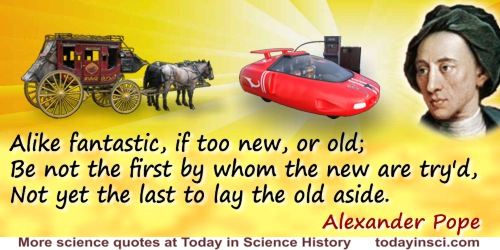
Alike fantastic, if too new, or old;
Be not the first by whom the new are try'd,
Not yet the last to lay the old aside.
Be not the first by whom the new are try'd,
Not yet the last to lay the old aside.
In An Essay on Criticism. With notes by Mr. Warburton (1749), 49.
All admit that the mountains of the globe are situated mostly along the border regions of the continents (taking these regions as 300 to 1000 miles or more in width), and that over these same areas the sedimentary deposits have, as a general thing, their greatest thickness. At first thought, it would seem almost incredible that the upliftings of mountains, whatever their mode of origin, should have taken place just where the earth’s crust, through these sedimentary accumulations, was the thickest, and where, therefore, there was the greatest weight to be lifted. … Earthquakes show that even now, in this last of the geological ages, the same border regions of the continents, although daily thickening from the sediments borne to the ocean by rivers, are the areas of the greatest and most frequent movements of the earth’s crust. (1866)
[Thus, the facts were known long ago; the explanation by tectonic activity came many decades later.]
[Thus, the facts were known long ago; the explanation by tectonic activity came many decades later.]
In 'Observations on the Origin of Some of the Earth’s Features', The American Journal of Science (Sep 1866), Second Series, 42, No. 125, 210-211.
All creation is a mine, and every man a miner.
The whole earth, and all within it, upon it, and round about it, including himself … are the infinitely various “leads” from which, man, from the first, was to dig out his destiny.
The whole earth, and all within it, upon it, and round about it, including himself … are the infinitely various “leads” from which, man, from the first, was to dig out his destiny.
Opening sentences of lecture 'Discoveries and Inventions', (1860) in Discoveries and Inventions (1915).
All fossil anthropoids found hitherto have been known only from mandibular or maxillary fragments, so far as crania are concerned, and so the general appearance of the types they represented had been unknown; consequently, a condition of affairs where virtually the whole face and lower jaw, replete with teeth, together with the major portion of the brain pattern, have been preserved, constitutes a specimen of unusual value in fossil anthropoid discovery. Here, as in Homo rhodesiensis, Southern Africa has provided documents of higher primate evolution that are amongst the most complete extant. Apart from this evidential completeness, the specimen is of importance because it exhibits an extinct race of apes intermediate between living anthropoids and man ... Whether our present fossil is to be correlated with the discoveries made in India is not yet apparent; that question can only be solved by a careful comparison of the permanent molar teeth from both localities. It is obvious, meanwhile, that it represents a fossil group distinctly advanced beyond living anthropoids in those two dominantly human characters of facial and dental recession on one hand, and improved quality of the brain on the other. Unlike Pithecanthropus, it does not represent an ape-like man, a caricature of precocious hominid failure, but a creature well advanced beyond modern anthropoids in just those characters, facial and cerebral, which are to be anticipated in an extinct link between man and his simian ancestor. At the same time, it is equally evident that a creature with anthropoid brain capacity and lacking the distinctive, localised temporal expansions which appear to be concomitant with and necessary to articulate man, is no true man. It is therefore logically regarded as a man-like ape. I propose tentatively, then, that a new family of Homo-simidæ be created for the reception of the group of individuals which it represents, and that the first known species of the group be designated Australopithecus africanus, in commemoration, first, of the extreme southern and unexpected horizon of its discovery, and secondly, of the continent in which so many new and important discoveries connected with the early history of man have recently been made, thus vindicating the Darwinian claim that Africa would prove to be the cradle of mankind.
'Australopithicus africanus: The Man-Ape of South Africa', Nature, 1925, 115, 195.
All geologic history is full of the beginning and the ends of species–of their first and last days; but it exhibits no genealogies of development.
Lecture to the Edinburgh Philosophical Institution, 'Geology in its Bearings on the Two Theologies, Part 1', collected in The Testimony of the Rocks: or, Geology in Its Bearings on the Two Theologies, Natural and Revealed (1857), 220.
All human affairs follow nature's great analogue, the growth of vegetation. There are three periods of growth in every plant. The first, and slowest, is the invisible growth by the root; the second and much accelerated is the visible growth by the stem; but when root and stem have gathered their forces, there comes the third period, in which the plant quickly flashes into blossom and rushes into fruit.
The beginnings of moral enterprises in this world are never to be measured by any apparent growth. ... At length comes the sudden ripeness and the full success, and he who is called in at the final moment deems this success his own. He is but the reaper and not the labourer. Other men sowed and tilled and he but enters into their labours.
The beginnings of moral enterprises in this world are never to be measured by any apparent growth. ... At length comes the sudden ripeness and the full success, and he who is called in at the final moment deems this success his own. He is but the reaper and not the labourer. Other men sowed and tilled and he but enters into their labours.
Life Thoughts (1858), 20.
All knowledge resolves itself into probability. ... In every judgment, which we can form concerning probability, as well as concerning knowledge, we ought always to correct the first judgment deriv’d from the nature of the object, by another judgment, deriv’d from the nature of the understanding.
In A treatise of Human Nature (1888), 181-182.
All material Things seem to have been composed of the hard and solid Particles … variously associated with the first Creation by the Counsel of an intelligent Agent. For it became him who created them to set them in order: and if he did so, it is unphilosophical to seek for any other Origin of the World, or to pretend that it might arise out of a Chaos by the mere Laws of Nature.
From Opticks (1704, 2nd ed., 1718), 377-378.
All of today’s DNA, strung through all the cells of the earth, is simply an extension and elaboration of [the] first molecule.
In The Medusa and the Snail: More Notes of a Biology Watcher (1974, 1979), 27.
All other men, being born of woman, have a navel, by reason of the umbilical vessels inserted into it, which from the placenta carry nourishment to children in the womb of their mothers; but it could not be so with our first parents. It cannot be believed that God gave them navels which would have been altogether useless.
A Treatise of Laws of Nature (1727).
All our knowledge derived from observation … is knowledge gotten at first hand. Hereby we see and know things as they are, or as they appear to us; we take the impressions of them on our minds from the original objects themselves which give a clearer and stronger conception of things.
In Interesting Anecdotes, Memoirs, Allegories, Essays, and Poetical Fragments (1793), Vols 3-4, Vol 4, 72.
All palaetiological sciences, all speculations which attempt to ascend from the present to the remote past, by the chain of causation, do also, by an inevitable consequence, urge us to look for the beginning of the state of things which we thus contemplate; but in none of these cases have men been able, by the aid of science, to arrive at a beginning which is homogeneous with the known course of events. The first origin of language, of civilization, of law and government, cannot be clearly made out by reasoning and research; and just as little, we may expect, will a knowledge of the origin of the existing and extinct species of plants and animals, be the result of physiological and geological investigation.
In History of the Inductive Sciences (1837), Vol. 3, 581.
All successful men have agreed to one thing,—they were causationists. They believed that things went not by luck, but by law; that there was not a weak or a cracked link in the chain that joins the first and last of things.
From 'Power', The Conduct of Life (1860), collected in The Prose Works of Ralph Waldo Emerson (1870), 343.
All the inventions that the world contains,
Were not by reason first found out, nor brains;
But pass for theirs who had the luck to light
Upon them by mistake or oversight.
Were not by reason first found out, nor brains;
But pass for theirs who had the luck to light
Upon them by mistake or oversight.
Under 'Butler's Poems: Miscellaneous Thoughts', in Samuel Johnson (ed.), The Works of the English Poets from Chaucer to Cowper(1810), Vol. 8, 227.
All the modern higher mathematics is based on a calculus of operations, on laws of thought. All mathematics, from the first, was so in reality; but the evolvers of the modern higher calculus have known that it is so. Therefore elementary teachers who, at the present day, persist in thinking about algebra and arithmetic as dealing with laws of number, and about geometry as dealing with laws of surface and solid content, are doing the best that in them lies to put their pupils on the wrong track for reaching in the future any true understanding of the higher algebras. Algebras deal not with laws of number, but with such laws of the human thinking machinery as have been discovered in the course of investigations on numbers. Plane geometry deals with such laws of thought as were discovered by men intent on finding out how to measure surface; and solid geometry with such additional laws of thought as were discovered when men began to extend geometry into three dimensions.
In Lectures on the Logic of Arithmetic (1903), Preface, 18-19.
All the real true knowledge we have of Nature is intirely experimental, insomuch that, how strange soever the assertion seems, we may lay this down as the first fundamental unerring rule in physics, That it is not within the compass of human understanding to assign a purely speculative reason for any one phaenomenon in nature.
In The Procedure, Extent, and Limits of Human Understanding (1728, 1729), 205-206.
All these delusions of Divination have their root and foundation from Astrology. For whether the lineaments of the body, countenance, or hand be inspected, whether dream or vision be seen, whether marking of entrails or mad inspiration be consulted, there must be a Celestial Figure first erected, by the means of whole indications, together with the conjectures of Signs and Similitudes, they endeavour to find out the truth of what is desired.
In The Vanity of the Arts and Sciences (1530), translation (1676), 108.
All truth passes through three stages. First, it is ridiculed. Second, it is violently opposed. Third, it is accepted as being self-evident. [Caution: expressed in this wording, it is likely misattributed.]
Schopenhauer did write a different reflection with this theme, much less tersely, on how the acceptance of truth has “only one short victory celebration is granted between the two long periods where it is despised as paradox and condemned as trivial.” See the Introduction to The World as Will and Representation (1819), xvi. The “three stages” quote is included here so it may be found with this caution: it is questionable that Schopenhauer expressed this idea with this wording. Although widely repeated, Webmaster has not yet found any citation to a primary source for these words. (Schopenhauer was German, so any quote in English represents a translation.) According to Ralph Keys, diligent search by scholars has found no written source in German, either. The sentiment has been variously restated and attributed to other authors. A somewhat better-documented version of the “three stages of truth” is attributed to Louis Agassiz, though still with only second-person references. See Ralph Keyes, The Quote Verifier (2006), 225-226.
All you really need to know for the moment is that the universe is a lot more complicated than you might think, even if you start from a position of thinking it’s pretty damn complicated in the first place.
In Mostly Harmless (1992), 195.
All your names I and my friend approve of or nearly all as to sense & expression, but I am frightened by their length & sound when compounded. As you will see I have taken deoxide and skaiode because they agree best with my natural standard East and West. I like Anode & Cathode better as to sound, but all to whom I have shewn them have supposed at first that by Anode I meant No way.
Letter (3 May 1834) to William Whewell, who coined the terms. In Frank A. J. L. James (ed.), The Correspondence of Michael Faraday (1993), Vol. 2, 181. Note: Here “No way” is presumably not an idiomatic exclamation, but a misinterpretation from the Greek prefix, -a “not”or “away from,” and hodos meaning “way.” The Greek ἄνοδος anodos means “way up” or “ascent.”
Almost all really new ideas have a certain aspect of foolishness when they are first produced.
In Science and the Modern World (1926, 2011), 60.
Although [Charles Darwin] would patiently go on repeating experiments where there was any good to be gained, he could not endure having to repeat an experiment which ought, if complete care had been taken, to have told its story at first—and this gave him a continual anxiety that the experiment should not be wasted; he felt the experiment to be sacred, however slight a one it was. He wished to learn as much as possible from an experiment, so that he did not confine himself to observing the single point to which the experiment was directed, and his power of seeing a number of other things was wonderful. ... Any experiment done was to be of some use, and ... strongly he urged the necessity of keeping the notes of experiments which failed, and to this rule he always adhered.
In Charles Darwin: His Life Told in an Autobiographical Chapter, and in a Selected Series of his Published Letters (1908), 92.
Although a science fair can seem like a big “pain” it can help you understand important scientific principles, such as Newton’s First Law of Inertia, which states: “A body at rest will remain at rest until 8:45 p.m. the night before the science fair project is due, at which point the body will come rushing to the body’s parents, who are already in their pajamas, and shout, “I JUST REMEMBERED THE SCIENCE FAIR IS TOMORROW AND WE GOTTA GO TO THE STORE RIGHT NOW!”
'Science: It’s Just Not Fair', Miami Herald (22 Mar 1998)
Although I was first drawn to math and science by the certainty they promised, today I find the unanswered questions and the unexpected connections at least as attractive.
In Warped Passages (2005), 65.
Although I was four years at the University [of Wisconsin], I did not take the regular course of studies, but instead picked out what I thought would be most useful to me, particularly chemistry, which opened a new world, mathematics and physics, a little Greek and Latin, botany and and geology. I was far from satisfied with what I had learned, and should have stayed longer.
[Enrolled in Feb 1861, left in 1863 without completing a degree, and began his first botanical foot journey.]
[Enrolled in Feb 1861, left in 1863 without completing a degree, and began his first botanical foot journey.]
The Story of My Boyhood and Youth (1913), 286.
Although my Aachen colleagues and students at first regarded the “pure mathematician” with suspicion, I soon had the satisfaction of being accepted a useful member not merely in teaching but also engineering practice; thus I was requested to render expert opinions and to participate in the Ingenieurverein [engineering association].
As quoted in Paul Forman and Armin Hermann, 'Sommerfeld, Arnold (Johannes Wilhelm)', Biography in Dictionary of Scientific Biography (1975), Vol. 12, 527. Cited from 'Autobiographische Skizze', Gesammelte Schriften, Vol 4, 673–682.
Although the ocean’s surface seems at first to be completely homogeneous, after half a month we began to differentiate various seas and even different parts of oceans by their characteristic shades. We were astonished to discover that, during an flight, you have to learn anew not only to look, but also to see. At first the finest nuances of color elude you, but gradually your vision sharpens and your color perception becomes richer, and the planet spreads out before you with all its indescribable beauty.
…...
America, so far as her physical history is concerned, has been falsely denominated the New World. Hers was the first dry land lifted out of the waters, hers the first shore washed by the ocean that enveloped all the earth beside; and while Europe was represented only by islands rising here and there above the sea, America already stretched an unbroken line of land from Nova Scotia to the Far West.
Geological Sketches (1866), I.
Among all the liberal arts, the first is logic, and specifically that part of logic which gives initial instruction about words. … [T]he word “logic” has a broad meaning, and is not restricted exclusively to the science of argumentative reasoning. [It includes] Grammar [which] is “the science of speaking and writing correctly—the starting point of all liberal studies.”
In John of Salisbury and Daniel D. McGarry (trans.), 'Whence grammar gets its name', The Metalogicon (2009), 37. It is footnoted: Isidore, Etym., i, 5, §1.
An acquaintance of mine, a notary by profession, who, by perpetual writing, began first to complain of an excessive wariness of his whole right arm which could be removed by no medicines, and which was at last succeeded by a perfect palsy of the whole arm. … He learned to write with his left hand, which was soon thereafter seized with the same disorder.
Concerning a notary, a scribe skilled in rapid writing, in a translation published by the University of Chicago Press (1940).
An amino acid residue (other than glycine) has no symmetry elements. The general operation of conversion of one residue of a single chain into a second residue equivalent to the first is accordingly a rotation about an axis accompanied by translation along the axis. Hence the only configurations for a chain compatible with our postulate of equivalence of the residues are helical configurations.
[Co-author with American chemist, ert B. Corey (1897-1971) and H. R. Branson]
[Co-author with American chemist, ert B. Corey (1897-1971) and H. R. Branson]
'The Structure of Proteins: Two Hydrogen-bonded Helical Configurations of the Polypeptide Chain', Proceedings of the National Academy of Sciences of the United States of America (1951), 37, 206.
An idea must not be condemned for being a little shy and incoherent; all new ideas are shy when introduced first among our old ones. We should have patience and see whether the incoherency is likely to wear off or to wear on, in which latter case the sooner we get rid of them the better.
In Samuel Butler and Henry Festing Jones (ed.), 'Higgledy-Piggledy', The Note-books of Samuel Butler (1912, 1917), 216-217.
An idea must not be condemned for being a little shy and incoherent; all new ideas are shy when introduced first among our old ones. We should have patience and see whether the incoherency is likely to wear off or to wear on, in which latter case the sooner we get rid of them the better.
Samuel Butler, Henry Festing Jones (ed.), The Note-Books of Samuel Butler (1917), 216-217.
An important fact, an ingenious aperçu, occupies a very great number of men, at first only to make acquaintance with it; then to understand it; and afterwards to work it out and carry it further.
In The Maxims and Reflections of Goethe (1906), 189.
An old French geometer used to say that a mathematical theory was never to be considered complete till you had made it so clear that you could explain it to the first man you met in the street.
In Nature (1873), 8, 458.
Anaxagoras of Clazomenae, son of Hegesiboulos, held that the first principles of things were the homoeomeries. For it seemed to him quite impossible that anything should come into being from the non-existent or be dissolved into it. Anyhow we take in nourishment which is simple and homogeneous, such as bread or water, and by this are nourished hair, veins, arteries, flesh, sinews, bones and all the other parts of the body. Which being so, we must agree that everything that exists is in the nourishment we take in, and that everything derives its growth from things that exist. There must be in that nourishment some parts that are productive of blood, some of sinews, some of bones, and so on-parts which reason alone can apprehend. For there is no need to refer the fact that bread and water produce all these things to sense-perception; rather, there are in bread and water parts which only reason can apprehend.
Aetius 1.3.5. In G. S. Kirk, J. E. Raven and M. Schofield (eds), The Presocratic Philosophers: A Critical History with a Selection of Texts (1983), p. 375.
Anaximander son of Praxiades, of Miletus: he said that the principle and element is the Indefinite, not distinguishing air or water or anything else. … he was the first to discover a gnomon, and he set one up on the Sundials (?) in Sparta, according to Favorinus in his Universal History, to mark solstices and equinoxes; and he also constructed hour indicators. He was the first to draw an outline of earth and sea, but also constructed a [celestial] globe. Of his opinions he made a summary exposition, which I suppose Apollodorus the Athenian also encountered. Apollodorus says in his Chronicles that Anaximander was sixty-four years old in the year of the fifty-eighth Olympiad [547/6 B.C.], and that he died shortly afterwards (having been near his prime approximately during the time of Polycrates, tyrant of Samos).
Diogenes Laërtius II, 1-2. In G.S. Kirk, J.E. Raven and M. Schofield (eds), The Presocratic Philosophers: A Critical History with a Selection of Texts (1957), 99. The editors of this translation note that Anaximander may have introduced the gnomon into Greece, but he did not discover it—the Babylonians used it earlier, and the celestial sphere, and the twelve parts of the day.
Anaximander the Milesian, a disciple of Thales, first dared to draw the inhabited world on a tablet; after him Hecataeus the Milesian, a much-travelled man, made the map more accurate, so that it became a source of wonder.
Agathemerus 1.1. In G. S. Kirk, J. E. Raven and M. Schofield (eds.), The Presocratic Philosophers: A Critical History with a Selection of Texts (1983), p. 104.
And for rejecting such a Medium, we have the Authority of those the oldest and most celebrated Philosophers of Greece and Phoenicia, who made a Vacuum, and Atoms, and the Gravity of Atoms, the first Principles of their Philosophy; tacitly attributing Gravity to some other Cause than dense Matter. Later Philosophers banish the Consideration of such a Cause out of natural Philosophy, feigning Hypotheses for explaining all things mechanically, and referring other Causes to Metaphysicks: Whereas the main Business of natural Philosophy is to argue from Phaenomena without feigning Hypotheses, and to deduce Causes from Effects, till we come to the very first Cause, which certainly is not mechanical; and not only to unfold the Mechanism of the World, but chiefly to resolve these and such like Questions. What is there in places almost empty of Matter, and whence is it that the Sun and Planets gravitate towards one another, without dense Matter between them? Whence is it that Nature doth nothing in vain; and whence arises all that Order and Beauty which we see in the World? ... does it not appear from phaenomena that there is a Being incorporeal, living, intelligent, omnipresent, who in infinite space, as it were in his Sensory, sees the things themselves intimately, and thoroughly perceives them, and comprehends them wholly by their immediate presence to himself.
In Opticks, (1704, 2nd. Ed. 1718), Book 3, Query 28, 343-5. Newton’s reference to “Nature does nothing in vain” recalls the axiom from Aristotle, which may be seen as “Natura nihil agit frustra” in the Aristotle Quotes on this web site.
And if you want the exact moment in time, it was conceived mentally on 8th March in this year one thousand six hundred and eighteen, but submitted to calculation in an unlucky way, and therefore rejected as false, and finally returning on the 15th of May and adopting a new line of attack, stormed the darkness of my mind. So strong was the support from the combination of my labour of seventeen years on the observations of Brahe and the present study, which conspired together, that at first I believed I was dreaming, and assuming my conclusion among my basic premises. But it is absolutely certain and exact that the proportion between the periodic times of any two planets is precisely the sesquialterate proportion of their mean distances.
Harmonice Mundi, The Harmony of the World (1619), book V, ch. 3. Trans. E. J. Aiton, A. M. Duncan and J. V. Field (1997), 411.
André Weil suggested that there is a logarithmic law at work: first-rate people attract other first-rate people, but second-rate people tend to hire third-raters, and third-rate people hire fifth-raters. If a dean or a president is genuinely interested in building and maintaining a high-quality university (and some of them are), then he must not grant complete self-determination to a second-rate department; he must, instead, use his administrative powers to intervene and set things right. That’s one of the proper functions of deans and presidents, and pity the poor university in which a large proportion of both the faculty and the administration are second-raters; it is doomed to diverge to minus infinity.
In I Want to be a Mathematician: an Automathography (1985), 123.
Anybody who looks at living organisms knows perfectly well that they can produce other organisms like themselves. This is their normal function, they wouldn’t exist if they didn’t do this, and it’s not plausible that this is the reason why they abound in the world. In other words, living organisms are very complicated aggregations of elementary parts, and by any reasonable theory of probability or thermodynamics highly improbable. That they should occur in the world at all is a miracle of the first magnitude; the only thing which removes, or mitigates, this miracle is that they reproduce themselves. Therefore, if by any peculiar accident there should ever be one of them, from there on the rules of probability do not apply, and there will be many of them, at least if the milieu is reasonable. But a reasonable milieu is already a thermodynamically much less improbable thing. So, the operations of probability somehow leave a loophole at this point, and it is by the process of self-reproduction that they are pierced.
From lecture series on self-replicating machines at the University of Illinois, Lecture 5 (Dec 1949), 'Re-evaluation of the Problems of Complicated Automata—Problems of Hierarchy and Evolution', Theory of Self-Reproducing Automata (1966).
Anyone who tries to make a distinction between education and entertainment doesn’t know the first thing about either.
In 'The New Education', The Basilian Teacher (1967), 11, No. 2, 68, as quoted and cited in Matteo Ciastellardi and Emanuela Patti (eds.), Article by Robert K. Logan, 'McLuhan Misunderstood: Setting the Record Straight, Section 8, 'McLuhan’s One Liners Clarified', International Journal of McLuhan Studies: Understanding Media, Today. McLuhan in the Era of Convergence Culture (2011). Logan explains this quote as: “What McLuhan was saying was simply that in the electric age of information overload in which there are so many distractions one has to keep students entertained to hold their attention so as to educate them or turned around; students educate themselves by entertaining themselves. … The proof of this assertion is that the most effective teachers and professors are the ones that are the most entertaining, i.e. most able to hold the attention of their students.”
Anything worth doing is worth doing twice, the first time quick and dirty and the second time the best way you can.
As quoted in Steven Chu and Charles H. Townes, 'Arthur Schawlow', Biographical Memoirs of the National Academy of Sciences (2003), Vol. 83, 201.
Are you aware that humanity is just a blip? Not even a blip. Just a fraction of a fraction of what the universe has been and will become? Talk about perspective. I figure I can’t feel so entirely stupid about saying what I said because, first of all, it’s true. And second of all, there will be no remnant of me or my stupidity. No fossil or geographical shift that can document, really, even the most important historical human beings, let alone my paltry admissions.
In novel, The Rug Merchant (2006), 119.
Arithmetic is the first of the sciences and the mother of safety.
In Samuel Brohl and Partner (1883), 40.
Art and religion first; then philosophy; lastly science. That is the order of the great subjects of life, that’s their order of importance.
Dialog by the character Miss Brodie, in The Prime of Miss Jean Brodie (1961, 2004), 23-24.
As a second year high school chemistry student, I still have a vivid memory of my excitement when I first saw a chart of the periodic table of elements. The order in the universe seemed miraculous, and I wanted to study and learn as much as possible about the natural sciences.
In Tore Frängsmyr and Jan E. Lindsten (eds.), Nobel Lectures: Physiology Or Medicine: 1981-1990 (1993), 555.
As an Art, Mathematics has its own standard of beauty and elegance which can vie with the more decorative arts. In this it is diametrically opposed to a Baroque art which relies on a wealth of ornamental additions. Bereft of superfluous addenda, Mathematics may appear, on first acquaintance, austere and severe. But longer contemplation reveals the classic attributes of simplicity relative to its significance and depth of meaning.
In The Skeleton Key of Mathematics (1949), 12.
As every circumstance relating to so capital a discovery as this (the greatest, perhaps, that has been made in the whole compass of philosophy, since the time of Sir Isaac Newton) cannot but give pleasure to all my readers, I shall endeavour to gratify them with the communication of a few particulars which I have from the best authority. The Doctor [Benjamin Franklin], after having published his method of verifying his hypothesis concerning the sameness of electricity with the matter lightning, was waiting for the erection of a spire in Philadelphia to carry his views into execution; not imagining that a pointed rod, of a moderate height, could answer the purpose; when it occurred to him, that, by means of a common kite, he could have a readier and better access to the regions of thunder than by any spire whatever. Preparing, therefore, a large silk handkerchief, and two cross sticks, of a proper length, on which to extend it, he took the opportunity of the first approaching thunder storm to take a walk into a field, in which there was a shed convenient for his purpose. But dreading the ridicule which too commonly attends unsuccessful attempts in science, he communicated his intended experiment to no body but his son, who assisted him in raising the kite.
The kite being raised, a considerable time elapsed before there was any appearance of its being electrified. One very promising cloud passed over it without any effect; when, at length, just as he was beginning to despair of his contrivance, he observed some loose threads of the hempen string to stand erect, and to avoid one another, just as if they had been suspended on a common conductor. Struck with this promising appearance, he inmmediately presented his knuckle to the key, and (let the reader judge of the exquisite pleasure he must have felt at that moment) the discovery was complete. He perceived a very evident electric spark. Others succeeded, even before the string was wet, so as to put the matter past all dispute, and when the rain had wetted the string, he collected electric fire very copiously. This happened in June 1752, a month after the electricians in France had verified the same theory, but before he had heard of any thing that they had done.
The kite being raised, a considerable time elapsed before there was any appearance of its being electrified. One very promising cloud passed over it without any effect; when, at length, just as he was beginning to despair of his contrivance, he observed some loose threads of the hempen string to stand erect, and to avoid one another, just as if they had been suspended on a common conductor. Struck with this promising appearance, he inmmediately presented his knuckle to the key, and (let the reader judge of the exquisite pleasure he must have felt at that moment) the discovery was complete. He perceived a very evident electric spark. Others succeeded, even before the string was wet, so as to put the matter past all dispute, and when the rain had wetted the string, he collected electric fire very copiously. This happened in June 1752, a month after the electricians in France had verified the same theory, but before he had heard of any thing that they had done.
The History and Present State of Electricity, with Original Experiments (1767, 3rd ed. 1775), Vol. 1, 216-7.
As far as counting goes, it is said there are three kinds of people: The first kind are those who CAN count; the second kind are those who can't.
With cartoon, in Nicholas Rose, Mathematical Maxims and Minims.
As far as the meaning of life in general, or in the abstract, as far as I can see, there is none. If all of life were suddenly to disappear from earth and anywhere else it may exist, or if none had ever formed in the first place, I think the Universe would continue to exist without perceptible change. However, it is always possible for an individual to invest his own life with meaning that he can find significant. He can so order his life that he may find as much beauty and wisdom in it as he can, and spread as much of that to others as possible.
In a book proposal for The Meaning of Life edited by Hugh S. Moorhead, 1989.
As I have already mentioned, wherever cells are formed, this tough fluid precedes the first solid structures that indicate the presence of future cells. Moreover, we must assume that this substance furnishes the material for the formation of the nucleus and of the primitive sac, not only because these structures are closely apposed to it, but also because,they react to iodine in the same way. We must assume also that the organization of this substance is the process that inaugurates the formation of new cells. It therefore seems justifiable for me to propose a name that refers to its physiological function: I propose the word protoplasma.
H. Mohl, Botanisch Zeitung (1846), 4, col. 73, trans. Henry Harris, The Birth of the Cell (1999), 75.
As I review the nature of the creative drive in the inventive scientists that have been around me, as well as in myself, I find the first event is an urge to make a significant intellectual contribution that can be tangible embodied in a product or process.
Quoted in New York Times (2 Mar 1991), 1 and 29.
As immoral and unethical as this may be [to clone a human], there is a real chance that could have had some success. This is a pure numbers game. If they have devoted enough resources and they had access to enough eggs, there is a distinct possibility. But, again, without any scientific data, one has to be extremely skeptical.
Commenting on the announcement of the purported birth of the first cloned human.
Commenting on the announcement of the purported birth of the first cloned human.
Transcript of TV interview by Sanjay Gupta aired on CNN (27 Dec 2002).
As Karl Marx once noted: “Hegel remarks somewhere that all great, world-historical facts and personages occur, as it were, twice. He forgot to add: the first time as tragedy, the second as farce.” William Jennings Bryan and the Scopes trial was a tragedy. The creationists and intelligent design theorists are a farce.
In '75 Years and Still No Peace'. Humanist (Sep 2000)
As our researches have made clear, an animal high in the organic scale only reaches this rank by passing through all the intermediate states which separate it from the animals placed below it. Man only becomes man after traversing transitional organisatory states which assimilate him first to fish, then to reptiles, then to birds and mammals.
Annales des Sciences Naturelles (1834), 2 (ii), 248. Trans. in E. S. Russell, Form and Function (1916), 82.
As science is more and more subject to grave misuse as well as to use for human benefit it has also become the scientist's responsibility to become aware of the social relations and applications of his subject, and to exert his influence in such a direction as will result in the best applications of the findings in his own and related fields. Thus he must help in educating the public, in the broad sense, and this means first educating himself, not only in science but in regard to the great issues confronting mankind today.
Message to University Students Studying Science', Kagaku Asahi 11, no. 6 (1951), 28-29. Quoted in Elof Axel Carlson, Genes, Radiation, and Society: The Life and Work of H. J. Muller (1981), 371.
As soon … as it was observed that the stars retained their relative places, that the times of their rising and setting varied with the seasons, that sun, moon, and planets moved among them in a plane, … then a new order of things began.… Science had begun, and the first triumph of it was the power of foretelling the future; eclipses were perceived to recur in cycles of nineteen years, and philosophers were able to say when an eclipse was to be looked for. The periods of the planets were determined. Theories were invented to account for their eccentricities; and, false as those theories might be, the position of the planets could be calculated with moderate certainty by them.
Lecture delivered to the Royal Institution (5 Feb 1864), 'On the Science of History'. Collected in Notices of the Proceedings at the Meetings of the Members of the Royal Institution of Great Britain with Abstracts of the Discourses (1866), Vol. 4, 187.
As soon as the art of Flying is Found out, some of their Nation will make one of the first Colonies, that shall Transplant into that other World.
In A Discovery of a New World, Or, a Discourse: Tending to Prove, that 'tis Probable There May Be Another Habitable World in the Moon (1638, 1684), 159.
As soon as we got rid of the backroom attitude and brought our apparatus fully into the Department with an inexhaustible supply of living patients with fascinating clinical problems, we were able to get ahead really fast. Any new technique becomes more attractive if its clinical usefulness can be demonstrated without harm, indignity or discomfort to the patient... Anyone who is satisfied with his diagnostic ability and with his surgical results is unlikely to contribute much to the launching of a new medical science. He should first be consumed with a divine discontent with things as they are. It greatly helps, of course, to have the right idea at the right time, and quite good ideas may come, Archimedes fashion, in one's bath..
As systematic unity is what first raises ordinary knowledge to the rank of science, that is, makes a system out of a mere aggregate of knowledge, architectonic is the doctrine of the scientific in our knowledge, and therefore necessarily forms part of the doctrine of method.
In'The Transcendental Doctrine of Method', Critique of Pure Reason (2016), 653. Note: architectonic = the art of constructing systems.
As the Director of the Theoretical Division of Los Alamos, I participated at the most senior level in the World War II Manhattan Project that produced the first atomic weapons.
Now, at age 88, I am one of the few remaining such senior persons alive. Looking back at the half century since that time, I feel the most intense relief that these weapons have not been used since World War II, mixed with the horror that tens of thousands of such weapons have been built since that time—one hundred times more than any of us at Los Alamos could ever have imagined.
Today we are rightly in an era of disarmament and dismantlement of nuclear weapons. But in some countries nuclear weapons development still continues. Whether and when the various Nations of the World can agree to stop this is uncertain. But individual scientists can still influence this process by withholding their skills.
Accordingly, I call on all scientists in all countries to cease and desist from work creating, developing, improving and manufacturing further nuclear weapons - and, for that matter, other weapons of potential mass destruction such as chemical and biological weapons.
[On the occasion of the 50th Anniversary of Hiroshima.]
Now, at age 88, I am one of the few remaining such senior persons alive. Looking back at the half century since that time, I feel the most intense relief that these weapons have not been used since World War II, mixed with the horror that tens of thousands of such weapons have been built since that time—one hundred times more than any of us at Los Alamos could ever have imagined.
Today we are rightly in an era of disarmament and dismantlement of nuclear weapons. But in some countries nuclear weapons development still continues. Whether and when the various Nations of the World can agree to stop this is uncertain. But individual scientists can still influence this process by withholding their skills.
Accordingly, I call on all scientists in all countries to cease and desist from work creating, developing, improving and manufacturing further nuclear weapons - and, for that matter, other weapons of potential mass destruction such as chemical and biological weapons.
[On the occasion of the 50th Anniversary of Hiroshima.]
Letter, Bulletin of the Atomic Scientists (Nov 1995), 51:6, 3.
As the first monogamian family has improved greatly since the commencement of civilization, and very sensibly in our times, it is at least supposable that it is capable of still further improvement until the equality of the sexes is attained.
As quoted in Charles H. Seaholm, The Kelts and the Vikings (1974), 48.
As to how far in advance of the first flight the man should know he’s going. I’m not in agreement with the argument that says word should be delayed until the last possible moment to save the pilot from developing a bad case of the jitters. If we don’t have the confidence to keep from getting clutched at that time, we have no business going at all. If I’m the guy going, I’ll be glad to get the dope as soon as possible. As for keeping this a big secret from us and having us all suited up and then saying to one man “you go” and stuffing him in and putting the lid on that thing and away he goes, well, we’re all big boys now.
As he wrote in an article for Life (14 Sep 1959), 38. In fact, he was the first to fly in Earth orbit on 20 Feb 1962, though Alan Shepard was picked for the earlier first suborbital flight.
As to the need of improvement there can be no question whilst the reign of Euclid continues. My own idea of a useful course is to begin with arithmetic, and then not Euclid but algebra. Next, not Euclid, but practical geometry, solid as well as plane; not demonstration, but to make acquaintance. Then not Euclid, but elementary vectors, conjoined with algebra, and applied to geometry. Addition first; then the scalar product. Elementary calculus should go on simultaneously, and come into vector algebraic geometry after a bit. Euclid might be an extra course for learned men, like Homer. But Euclid for children is barbarous.
Electro-Magnetic Theory (1893), Vol. 1, 148. In George Edward Martin, The Foundations of Geometry and the Non-Euclidean Plane (1982), 130.
Ask a follower of Bacon what [science] the new philosophy, as it was called in the time of Charles the Second, has effected for mankind, and his answer is ready; “It has lengthened life; it has mitigated pain; it has extinguished diseases; it has increased the fertility of the soil; it has given new securities to the mariner; it has furnished new arms to the warrior; it has spanned great rivers and estuaries with bridges of form unknown to our fathers; it has guided the thunderbolt innocuously from heaven to earth; it has lighted up the night with the splendour of the day; it has extended the range of the human vision; it has multiplied the power of the human muscles; it has accelerated motion; it has annihilated distance; it has facilitated intercourse, correspondence, all friendly offices, all dispatch of business; it has enabled man to descend to the depths of the sea, to soar into the air, to penetrate securely into the noxious recesses of the earth, to traverse the land in cars which whirl along without horses, to cross the ocean in ships which run ten knots an hour against the wind. These are but a part of its fruits, and of its first-fruits; for it is a philosophy which never rests, which has never attained, which is never perfect. Its law is progress. A point which yesterday was invisible is its goal to-day, and will be its starting-point to-morrow.”
From essay (Jul 1837) on 'Francis Bacon' in Edinburgh Review. In Baron Thomas Babington Macaulay and Lady Trevelyan (ed.) The Works of Lord Macaulay Complete (1871), Vol. 6, 222.
Astronomy, Benjamin mused, was a lot like a detective story with the clues revealed first, and the actual body only later—if ever.
Eater (2000). In Gary Westfahl, Science Fiction Quotations: From the Inner Mind to the Outer Limits (2006), 323.
At first he who invented any art that went beyond the common perceptions of man was naturally admired by men, not only because there was something useful in the inventions, but because he was thought wise and superior to the rest. But as more arts were invented, and some were directed to the necessities of life, others to its recreation, the inventors of the latter were always regarded as wiser than the inventors of the former, because their branches of knowledge did not aim at utility.
Metaphysics, 981b, 13-20. In Jonathan Barnes (ed.), The Complete Works of Aristotle (1984), Vol. 2, 1553.
At first it seems obvious, but the more you think about it the stranger the deductions from this axiom seem to become; in the end you cease to understand what is meant by it.
As quoted, without citation, in Stories about Sets (1968), 84.
At first sight nothing seems more obvious than that everything has a beginning and an end, and that everything can be subdivided into smaller parts. Nevertheless, for entirely speculative reasons the philosophers of Antiquity, especially the Stoics, concluded this concept to be quite unnecessary. The prodigious development of physics has now reached the same conclusion as those philosophers, Empedocles and Democritus in particular, who lived around 500 B.C. and for whom even ancient man had a lively admiration.
'Development of the Theory of Electrolytic Dissociation', Nobel Lecture, 11 December 1903. In Nobel Lectures: Chemistry 1901-1921 (1966), 45.
At first the squirrel spins his cage; then the cage spins him. Men of business may take warning.
From chapter 'Jottings from a Note-book', in Canadian Stories (1918), 171.
At first, the people talking about ecology were only defending the fishes, the animals, the forest, and the river. They didn’t realize that human beings were in the forest—and that these humans were the real ecologists, because they couldn’t live without the forest and the forest couldn’t be saved without them.
Quoted in Andrew Revkin, The Burning Season
At first, the sea, the earth, and the heaven, which covers all things, were the only face of nature throughout the whole universe, which men have named Chaos; a rude and undigested mass, and nothing more than an inert weight, and the discordant atoms of things not harmonizing, heaped together in the same spot.
Describing the creation of the universe from chaos, at the beginning of Book I of Metamorphoses, lines 5-9. As translated by Henry T. Riley, The Metamorphoses of Ovid, Vol I: Books I-VII (1858), 1-2. Riley footnoted: “A rude and undigested mass.—Ver. 7. This is very similar to the words of the Scriptures, ‘And the earth was without form and void,’ Genesis, ch. i. ver. 2.”
At length being at Clapham where there is, on the common, a large pond which, I observed to be one day very rough with the wind, I fetched out a cruet of oil and dropt a little of it on the water. I saw it spread itself with surprising swiftness upon the surface; but the effect of smoothing the waves was not produced; for I had applied it first on the leeward side of the pond, where the waves were largest, and the wind drove my oil back upon the shore. I then went to the windward side, where they began to form; and there the oil, though not more than a tea-spoonful, produced an instant calm over a space several yards square, which spread amazingly, and extended itself gradually till it reached the leeside, making all that quarter of the pond, perhaps half an acre, as smooth as a looking-glass.
[Experiment to test an observation made at sea in 1757, when he had seen the wake of a ship smoothed, explained by the captain as presumably due to cooks emptying greasy water in to the sea through the scuppers.]
[Experiment to test an observation made at sea in 1757, when he had seen the wake of a ship smoothed, explained by the captain as presumably due to cooks emptying greasy water in to the sea through the scuppers.]
Letter, extract in 'Of the still of Waves by Means of Oil The Gentleman's Magazine (1775), Vol. 45, 82.
At no period of [Michael Faraday’s] unmatched career was he interested in utility. He was absorbed in disentangling the riddles of the universe, at first chemical riddles, in later periods, physical riddles. As far as he cared, the question of utility was never raised. Any suspicion of utility would have restricted his restless curiosity. In the end, utility resulted, but it was never a criterion to which his ceaseless experimentation could be subjected.
'The Usefulness of Useless Knowledge', Harper's Magazine (Jun/Nov 1939), No. 179, 546. In Hispania (Feb 1944), 27, No. 1, 77.
At the age of eleven, I began Euclid, with my brother as my tutor. ... I had not imagined that there was anything so delicious in the world. After I had learned the fifth proposition, my brother told me that it was generally considered difficult, but I had found no difficulty whatsoever. This was the first time it had dawned on me that I might have some intelligence.
In Autobiography: 1872-1914 (1967), Vol. 1, 37-38.
At the age of three I began to look around my grandfather’s library. My first knowledge of astronomy came from reading and looking at pictures at that time. By the time I was six I remember him buying books for me. … I think I was eight, he bought me a three-inch telescope on a brass mounting. It stood on a table. … So, as far back as I can remember, I had an early interest in science in general, astronomy in particular.
Oral History Transcript of interview with Dr. Jesse Greenstein by Paul Wright (31 Jul 1974), on website of American Institute of Physics.
At this point, however, I have no intention whatever of criticizing the false teachings of Galen, who is easily first among the professors of dissection, for I certainly do not wish to start off by gaining a reputation for impiety toward him, the author of all good things, or by seeming insubordinate to his authority. For I am well aware how upset the practitioners (unlike the followers of Aristotle) invariably become nowadays, when they discover in the course of a single dissection that Galen has departed on two hundred or more occasions from the true description of the harmony, function, and action of the human parts, and how grimly they examine the dissected portions as they strive with all the zeal at their command to defend him. Yet even they, drawn by their love of truth, are gradually calming down and placing more faith in their own not ineffective eyes and reason than in Galen’s writings.
From De Humani Corporis Fabrica Libri Septem: (1543), Book I, iv, as translated by William Frank Richardson, in On The Fabric of the Human Body: Book I: The Bones and Cartilages (1998), Preface, liv.
AZT stood up and said, 'Stop your pessimism. Stop your sense of futility. Go back to the lab. Go back to development. Go back to clinical trials. Things will work.'
[On the impact of AZT emerging as the long-sought first significant AIDS drug.]
[On the impact of AZT emerging as the long-sought first significant AIDS drug.]
As quoted in Emily Langer, 'Researcher Jerome P. Horwitz, 93, created AZT, the first approved treatment for HIV/AIDS' Washington Post (19 Sep 2012). The article was excerpted on blogs, sometimes referring to this quote by saying "AZT was more a cure for fatalism than for AIDS."
Bacon first taught the world the true method of the study of nature, and rescued science from that barbarism in which the followers of Aristotle, by a too servile imitation of their master, had involved it.
A Course of Lectures on Natural Philosophy and the Mechanical Arts (1845), 5.
Basic research at universities comes in two varieties: research that requires big bucks and research that requires small bucks. Big bucks research is much like government research and in fact usually is government research but done for the government under contract. Like other government research, big bucks academic research is done to understand the nature and structure of the universe or to understand life, which really means that it is either for blowing up the world or extending life, whichever comes first. Again, that's the government's motivation. The universities' motivation for conducting big bucks research is to bring money in to support professors and graduate students and to wax the floors of ivy-covered buildings. While we think they are busy teaching and learning, these folks are mainly doing big bucks basic research for a living, all the while priding themselves on their terrific summer vacations and lack of a dress code.
Smalls bucks research is the sort of thing that requires paper and pencil, and maybe a blackboard, and is aimed primarily at increasing knowledge in areas of study that don't usually attract big bucks - that is, areas that don't extend life or end it, or both. History, political science, and romance languages are typically small bucks areas of basic research. The real purpose of small bucks research to the universities is to provide a means of deciding, by the quality of their small bucks research, which professors in these areas should get tenure.
Smalls bucks research is the sort of thing that requires paper and pencil, and maybe a blackboard, and is aimed primarily at increasing knowledge in areas of study that don't usually attract big bucks - that is, areas that don't extend life or end it, or both. History, political science, and romance languages are typically small bucks areas of basic research. The real purpose of small bucks research to the universities is to provide a means of deciding, by the quality of their small bucks research, which professors in these areas should get tenure.
Accidental Empires (1992), 78.
Beauty is the first test: there is no permanent place in the world for ugly mathematics.
In A Mathematician’s Apology (1940, reprint with Foreward by C.P. Snow 1992), 85.
Before the promulgation of the periodic law the chemical elements were mere fragmentary incidental facts in nature; there was no special reason to expect the discovery of new elements, and the new ones which were discovered from time to time appeared to be possessed of quite novel properties. The law of periodicity first enabled us to perceive undiscovered elements at a distance which formerly were inaccessible to chemical vision, and long ere they were discovered new elements appeared before our eyes possessed of a number of well-defined properties.
In Faraday Lecture, delivered before the Fellows of the Chemical Society in the Theatre of the Royal Institution (4 Jun 1889), printed in Professor Mendeléeff, 'The Periodic Law of the Chemical Elements', Transactions of the Chemical Society (1889), 55, 648.
Belief has no place as far as science reaches, and may be first permitted to take root where science stops.
Translation of the original German: “Soweit die Wissenschaft reicht, kein Glaube existirt und der Glaube erst da anfangen darf, wo die Wissenschaft aufhört”, from 'Der Mensch' (1849), collected in Gesammelte abhandlungen zur wissenschaftlichen medicin (1856), 6. As translated in Lelland J. Rather (ed.), 'On Man', Disease, Life, and Man: Selected Essays (1958), 83. Google translate gives “As far as science goes, no faith exists and faith can only begin where science ends.”
Biology has become as unthinkable without gene-splicing techniques as sending an explorer into the jungle without a compass.
Magazine interview (1981); one year after becoming the first scientist to make bacteria produce a facsimile of human interferon.
Magazine interview (1981); one year after becoming the first scientist to make bacteria produce a facsimile of human interferon.
'Shaping Life in the Lab'. In Time (9 Mar 1981).
Biology is a science of three dimensions. The first is the study of each species across all levels of biological organization, molecule to cell to organism to population to ecosystem. The second dimension is the diversity of all species in the biosphere. The third dimension is the history of each species in turn, comprising both its genetic evolution and the environmental change that drove the evolution. Biology, by growing in all three dimensions, is progressing toward unification and will continue to do so.
In 'Systematics and the Future of Biology', Systematics and the Origin of Species: on Ernst Mayr's 100th anniversary, Volume 102, Issues 22-26 (2005), 1.
BIRTH, n. The first and direst of all disasters. As to the nature of it there appears to be no uniformity. Castor and Pollux were born from the egg. Pallas came out of a skull. Galatea was once a block of stone. Peresilis, who wrote in the tenth century, avers that he grew up out of the ground where a priest had spilled holy water. It is known that Arimaxus was derived from a hole in the earth, made by a stroke of lightning. Leucomedon was the son of a cavern in Mount Etna, and I have myself seen a man come out of a wine cellar.
The Collected Works of Ambrose Bierce (1911), Vol. 7, The Devil's Dictionary, 38.
Bradley is one of the few basketball players who have ever been appreciatively cheered by a disinterested away-from-home crowd while warming up. This curious event occurred last March, just before Princeton eliminated the Virginia Military Institute, the year’s Southern Conference champion, from the NCAA championships. The game was played in Philadelphia and was the last of a tripleheader. The people there were worn out, because most of them were emotionally committed to either Villanova or Temple-two local teams that had just been involved in enervating battles with Providence and Connecticut, respectively, scrambling for a chance at the rest of the country. A group of Princeton players shooting basketballs miscellaneously in preparation for still another game hardly promised to be a high point of the evening, but Bradley, whose routine in the warmup time is a gradual crescendo of activity, is more interesting to watch before a game than most players are in play. In Philadelphia that night, what he did was, for him, anything but unusual. As he does before all games, he began by shooting set shots close to the basket, gradually moving back until he was shooting long sets from 20 feet out, and nearly all of them dropped into the net with an almost mechanical rhythm of accuracy. Then he began a series of expandingly difficult jump shots, and one jumper after another went cleanly through the basket with so few exceptions that the crowd began to murmur. Then he started to perform whirling reverse moves before another cadence of almost steadily accurate jump shots, and the murmur increased. Then he began to sweep hook shots into the air. He moved in a semicircle around the court. First with his right hand, then with his left, he tried seven of these long, graceful shots-the most difficult ones in the orthodoxy of basketball-and ambidextrously made them all. The game had not even begun, but the presumably unimpressible Philadelphians were applauding like an audience at an opera.
A Sense of Where You Are: Bill Bradley at Princeton
Breadth-first search is the bulldozer of science.
In Gary William Flake, The Computational Beauty of Nature (2000), 415.
Briefly, in the act of composition, as an instrument there intervenes and is most potent, fire, flaming, fervid, hot; but in the very substance of the compound there intervenes, as an ingredient, as it is commonly called, as a material principle and as a constituent of the whole compound the material and principle of fire, not fire itself. This I was the first to call phlogiston.
Specimen Beccherianum (1703). Trans. J. R. Partington, A History of Chemistry (1961), Vol. 2, 668.
But as my conclusions have lately been much misrepresented, and it has been stated that I attribute the modification of species exclusively to natural selection, I may be permitted to remark that in the first edition of this work, and subsequently, I placed in a most conspicuous position—namely, at the close of the Introduction—the following words: “I am convinced that natural selection has been the main but not the exclusive means of modification.” This has been of no avail. Great is the power of steady misrepresentation; but the history of science shows that fortunately this power does not long endure.
In The Origin of Species by Means of Natural Selection with additions and corrections from sixth and last English edition (1899), Vol. 2, 293.
But for twenty years previous to 1847 a force had been at work in a little county town of Germany destined to effect the education of Christendom, and at the same time to enlarge the boundaries of human knowledge, first in chemistry and the allied branches, then in every other one of the natural sciences. The place was Giessen; the inventor Liebig; the method, a laboratory for instruction and research.
A Semi-Centennial Discourse, 1847-97' (28 Oct 1897), The Sheffield Scientific School of Yale University. Quoted in Daniel Coit Gilman, University Problems in the United States (1898), 120.
But Geology carries the day: it is like the pleasure of gambling, speculating, on first arriving, what the rocks may be; I often mentally cry out 3 to 1 Tertiary against primitive; but the latter have hitherto won all the bets.
Letter to W. D. Fox, May 1832. In F. Burkhardt and S. Smith (eds.), The Correspondence of Charles Darwin 1821-1836 (1985), Vol. 1, 232.
But in science the credit goes to the man who convinces the world, not to the man to whom the idea first occurs. Not the man who finds a grain of new and precious quality but to him who sows it, reaps it, grinds it and feeds the world on it.
First Galton Lecture before the Eugenics Society', Eugenics Review, 1914, 6, 9.
But it is precisely mathematics, and the pure science generally, from which the general educated public and independent students have been debarred, and into which they have only rarely attained more than a very meagre insight. The reason of this is twofold. In the first place, the ascendant and consecutive character of mathematical knowledge renders its results absolutely insusceptible of presentation to persons who are unacquainted with what has gone before, and so necessitates on the part of its devotees a thorough and patient exploration of the field from the very beginning, as distinguished from those sciences which may, so to speak, be begun at the end, and which are consequently cultivated with the greatest zeal. The second reason is that, partly through the exigencies of academic instruction, but mainly through the martinet traditions of antiquity and the influence of mediaeval logic-mongers, the great bulk of the elementary text-books of mathematics have unconsciously assumed a very repellant form,—something similar to what is termed in the theory of protective mimicry in biology “the terrifying form.” And it is mainly to this formidableness and touch-me-not character of exterior, concealing withal a harmless body, that the undue neglect of typical mathematical studies is to be attributed.
In Editor’s Preface to Augustus De Morgan and Thomas J. McCormack (ed.), Elementary Illustrations of the Differential and Integral Calculus (1899), v.
But neither thirty years, nor thirty centuries, affect the clearness, or the charm, of Geometrical truths. Such a theorem as “the square of the hypotenuse of a right-angled triangle is equal to the sum of the squares of the sides” is as dazzlingly beautiful now as it was in the day when Pythagoras first discovered it, and celebrated its advent, it is said, by sacrificing a hecatomb of oxen—a method of doing honour to Science that has always seemed to me slightly exaggerated and uncalled-for. One can imagine oneself, even in these degenerate days, marking the epoch of some brilliant scientific discovery by inviting a convivial friend or two, to join one in a beefsteak and a bottle of wine. But a hecatomb of oxen! It would produce a quite inconvenient supply of beef.
Written without pseudonym as Charles L. Dodgson, in Introduction to A New Theory of Parallels (1888, 1890), xvi. Note: a hecatomb is a great public sacrifice, originally of a hundred oxen.
But nothing of a nature foreign to the duties of my profession [clergyman] engaged my attention while I was at Leeds so much as the, prosecution of my experiments relating to electricity, and especially the doctrine of air. The last I was led into a consequence of inhabiting a house adjoining to a public brewery, where first amused myself with making experiments on fixed air [carbon dioxide] which found ready made in the process of fermentation. When I removed from that house, I was under the necessity making the fixed air for myself; and one experiment leading to another, as I have distinctly and faithfully noted in my various publications on the subject, I by degrees contrived a convenient apparatus for the purpose, but of the cheapest kind. When I began these experiments I knew very little of chemistry, and had in a manner no idea on the subject before I attended a course of chymical lectures delivered in the Academy at Warrington by Dr. Turner of Liverpool. But I have often thought that upon the whole, this circumstance was no disadvantage to me; as in this situation I was led to devise an apparatus and processes of my own, adapted to my peculiar views. Whereas, if I had been previously accustomed to the usual chemical processes, I should not have so easily thought of any other; and without new modes of operation I should hardly have discovered anything materially new.
Memoirs of Dr. Joseph Priestley, in the Year 1795 (1806), Vol. 1, 61-2.
But that which will excite the greatest astonishment by far, and which indeed especially moved me to call the attention of all astronomers and philosophers, is this: namely, that I have observed four planets, neither known nor observed by any one of the astronomers before my time, which have their orbits round a certain bright star [Jupiter], one of those previously known, like Venus or Mercury round the sun, and are sometimes in front of it, sometimes behind it, though they never depart from it beyond certain limits. All of which facts were discovered and observed a few days ago by the help of a telescope devised by me, through God’s grace first enlightening my mind.
In pamphlet, The Sidereal Messenger (1610), reprinted in The Sidereal Messenger of Galileo Galilei: And a Part of the Preface to the Preface to Kepler's Dioptrics Containing the Original Account of Galileo's Astronomical Discoveries (1880), 9.
But the idea that any of the lower animals have been concerned in any way with the origin of man—is not this degrading? Degrading is a term, expressive of a notion of the human mind, and the human mind is liable to prejudices which prevent its notions from being invariably correct. Were we acquainted for the first time with the circumstances attending the production of an individual of our race, we might equally think them degrading, and be eager to deny them, and exclude them from the admitted truths of nature.
But the World being once fram’d, and the course of Nature establish’d, the Naturalist, (except in some few cases, where God, or Incorporeal Agents interpose), has recourse to the first Cause but for its general and ordinary Support and Influence, whereby it preserves Matter and Motion from Annihilation or Desition; and in explicating particular phenomena, considers onely the Size, Shape, Motion, (or want of it) Texture, and the resulting Qualities and Attributes of the small particles of Matter.
The Origine of Formes and Qualities (1666), 194.
But weightier still are the contentment which comes from work well done, the sense of the value of science for its own sake, insatiable curiosity, and, above all, the pleasure of masterly performance and of the chase. These are the effective forces which move the scientist. The first condition for the progress of science is to bring them into play.
from his preface to Claude Bernard's 'Experimental Medicine'
But, but, but … if anybody says he can think about quantum theory without getting giddy it merely shows that he hasn’t understood the first thing about it!
Quoted in Otto R. Frisch, What Little I Remember (1979), 95.
By firm immutable immortal laws Impress’d on Nature by the GREAT FIRST CAUSE,
Say, MUSE! how rose from elemental strife
Organic forms, and kindled into life;
How Love and Sympathy with potent charm
Warm the cold heart, the lifted hand disarm;
Allure with pleasures, and alarm with pains,
And bind Society in golden chains.
Say, MUSE! how rose from elemental strife
Organic forms, and kindled into life;
How Love and Sympathy with potent charm
Warm the cold heart, the lifted hand disarm;
Allure with pleasures, and alarm with pains,
And bind Society in golden chains.
From 'Production of Life', The Temple of Nature; or, The Origin of Society: A Poem, with Philosophical Notes (1803), 3, Canto I, lines 1-8.
By three methods we may learn wisdom: first, by reflection, which is noblest; second, by imitation, which is easiest; and third, by experience, which is the most bitter.
Quoted in Kim Lim (ed.), 1,001 Pearls of Spiritual Wisdom: Words to Enrich, Inspire, and Guide Your Life (2014), 109
Catastrophe Theory is—quite likely—the first coherent attempt (since Aristotelian logic) to give a theory on analogy. When narrow-minded scientists object to Catastrophe Theory that it gives no more than analogies, or metaphors, they do not realise that they are stating the proper aim of Catastrophe Theory, which is to classify all possible types of analogous situations.
From 'La Théorie des catastrophes État présent et perspective', as quoted in Erick Christopher Zeeman, (ed.), Catastrophe Theory: Selected Papers, 1972-1977 (1977), 637, as cited in Martin Krampe (ed.), Classics of Semiotics (1987), 214.
Cell and tissue, shell and bone, leaf and flower, are so many portions of matter, and it is in obedience to the laws of physics that their particles have been moved, moulded and confirmed. They are no exception to the rule that God always geometrizes. Their problems of form are in the first instance mathematical problems, their problems of growth are essentially physical problems, and the morphologist is, ipso facto, a student of physical science.
On Growth and Form (1917), 7-8.
Charlie Holloway (human): “What we hoped to achieve was to meet our makers. To get answers. Why they even made us in the first place.”
David (AI robot): “Why do you think your people made me?”
Charlie Holloway (human): “We made you because we could.”
David (AI robot): “Can you imagine how disappointing it would be for you to hear the same thing from your creator?”
Charlie Holloway (human): “I guess it’s good you can’t be disappointed.”
David (AI robot): “Why do you think your people made me?”
Charlie Holloway (human): “We made you because we could.”
David (AI robot): “Can you imagine how disappointing it would be for you to hear the same thing from your creator?”
Charlie Holloway (human): “I guess it’s good you can’t be disappointed.”
Prometheus (2012)

Chemical signs ought to be letters, for the greater facility of writing, and not to disfigure a printed book ... I shall take therefore for the chemical sign, the initial letter of the Latin name of each elementary substance: but as several have the same initial letter, I shall distinguish them in the following manner:— 1. In the class which I shall call metalloids, I shall employ the initial letter only, even when this letter is common to the metalloid and to some metal. 2. In the class of metals, I shall distinguish those that have the same initials with another metal, or a metalloid, by writing the first two letters of the word. 3. If the first two letters be common to two metals, I shall, in that case, add to the initial letter the first consonant which they have not in common: for example, S = sulphur, Si = silicium, St = stibium (antimony), Sn = stannum (tin), C = carbonicum, Co = colbaltum (colbalt), Cu = cuprum (copper), O = oxygen, Os = osmium, &c.
'Essay on the Cause of Chemical Proportions, and on some circumstances relating to them: together with a short and easy method of expressing them', Annals of Philosophy, 1814, 3,51-2.
Clothing represented man’s first environment-controlling and ecology-transforming tool.
In Utopia or Oblivion: The Prospects for Humanity (1963), 86.
Coming to the question of life being found on other planets, Professor Haldane apologized for discoursing, as a mere biologist, on a subject on which we had been expecting a lecture by a physicist [J. D. Bernal]. He mentioned three hypotheses:
(a) That life had a supernatural origin,
(b) That it originated from inorganic materials, and (c) That life is a constituent of the Universe and can only arise from pre-existing life. The first hypothesis, he said, should be taken seriously, and he would proceed to do so. From the fact that there are 400,000 species of beetle on this planet, but only 8,000 species of mammals, he concluded that the Creator, if he exists, has a special preference for beetles, and so we might be more likely to meet them than any other type of animal on a planet which would support life.
(a) That life had a supernatural origin,
(b) That it originated from inorganic materials, and (c) That life is a constituent of the Universe and can only arise from pre-existing life. The first hypothesis, he said, should be taken seriously, and he would proceed to do so. From the fact that there are 400,000 species of beetle on this planet, but only 8,000 species of mammals, he concluded that the Creator, if he exists, has a special preference for beetles, and so we might be more likely to meet them than any other type of animal on a planet which would support life.
In Mark Williamson, 'Haldane’s Special Preference', The Linnean, 1992, 8, 14.
Common sense iz instinkt, and instinkt don’t make enny blunders mutch, no more than a rat duz, in coming out, or going intew a hole, he hits the hole the fust time, and just fills it.
In The Complete Works of Josh Billings (1876), 79.
Compare the length of a moment with the period of ten thousand years; the first, however minuscule, does exist as a fraction of a second. But that number of years, or any multiple of it that you may name, cannot even be compared with a limitless extent of time, the reason being that comparisons can be drawn between finite things, but not between finite and infinite.
The Consolation of Philosophy [before 524], Book II, trans. P. G. Walsh (1999), 36.
Conscientious and careful physicians allocate causes of disease to natural laws, while the ablest scientists go back to medicine for their first principles.
Attributed.
Consciousness… does not appear to itself chopped up in bits. Such words as “chain” or “train” do not describe it fitly as it presents itself in the first instance. It is nothing jointed; it flows. A “river” or a “stream” are the metaphors by which it is most naturally described. In talking of it hereafter, let us call it the stream of thought, of consciousness, or of subjective life.
Source of the expression “stream of consciousness”.
Source of the expression “stream of consciousness”.
The Principles of Psychology (1890), Vol. 1, 239.
Copernicus, the most learned man whom we are able to name other than Atlas and Ptolemy, even though he taught in a most learned manner the demonstrations and causes of motion based on observation, nevertheless fled from the job of constructing tables, so that if anyone computes from his tables, the computation is not even in agreement with his observations on which the foundation of the work rests. Therefore first I have compared the observations of Copernicus with those of Ptolemy and others as to which are the most accurate, but besides the bare observations, I have taken from Copernicus nothing other than traces of demonstrations. As for the tables of mean motion, and of prosthaphaereses and all the rest, I have constructed these anew, following absolutely no other reasoning than that which I have judged to be of maximum harmony.
Dedication to the Duke of Prussia, Prutenicae Tabulae (1551), 1585 edition, as quoted in Owen Gingerich, The Eye of Heaven: Ptolemy, Copernicus, Kepler (1993), 227.
Counting stars by candlelight all are dim but one is bright; the spiral light of Venus rising first and shining best, from the northwest corner of a brand-new crescent moon crickets and cicadas sing a rare and different tune.
Terrapin Station
Courage is the first of human qualities because it is the quality which guarantees the others.
…...
Curves that have no tangents are the rule. … Those who hear of curves without tangents, or of functions without derivatives, often think at first that Nature presents no such complications. … The contrary however is true. … Consider, for instance, one of the white flakes that are obtained by salting a solution of soap. At a distance its contour may appear sharply defined, but as we draw nearer its sharpness disappears. The eye can no longer draw a tangent at any point. … The use of a magnifying glass or microscope leaves us just as uncertain, for fresh irregularities appear every time we increase the magnification. … An essential characteristic of our flake … is that we suspect … that any scale involves details that absolutely prohibit the fixing of a tangent.
(1906). As quoted “in free translation” in Benoit B. Mandelbrot, The Fractal Geometry of Nature (1977, 1983), 7.
Darwin was a biological evolutionist, because he was first a uniformitarian geologist. Biology is pre-eminent to-day among the natural sciences, because its younger sister, Geology, gave it the means.
Presidential Address to the Geology Section, Report of the British Association for the Advancement of Science (1892), 696.
Darwin’s book is very important and serves me as a basis in natural science for the class struggle in history. One has to put up with the crude English method of development, of course. Despite all deficiencies not only is the death-blow dealt here for the first time to “teleology” in the natural sciences, but their rational meaning is empirically explained.
Marx to Lasalle, 16 Jan 1861. In Marx-Engels Selected Correspondence, 1846-95, trans. Donna Torr (1934), 125.
Darwin's theory was received in Russia with profound sympathy. While in Western Europe it met firmly established old traditions which it had first to overcome, in Russia its appearance coincided with the awakening of our society after the Crimean War and here it immediately received the status of full citizenship and ever since has enjoyed widespread popularity.
Quoted in Thomas F. Glick (ed.), The Comparative Reception of Darwinism (1988), 229-30.
Descriptive geometry has two objects: the first is to establish methods to represent on drawing paper which has only two dimensions,—namely, length and width,—all solids of nature which have three dimensions,—length, width, and depth,—provided, however, that these solids are capable of rigorous definition.
The second object is to furnish means to recognize accordingly an exact description of the forms of solids and to derive thereby all truths which result from their forms and their respective positions.
The second object is to furnish means to recognize accordingly an exact description of the forms of solids and to derive thereby all truths which result from their forms and their respective positions.
From On the Purpose of Descriptive Geometry as translated by Arnold Emch in David Eugene Smith, A Source Book in Mathematics (1929), 426.
Dibdin said: “I see you've put your own name at the top of your paper, Mr Woods.” His eyes looked sad and thoughtful. “I always make it a matter of principle to put my name as well on every paper that comes out of the department.” “Yours?” Albert said incredulously. “Yes,”said Dibdin, still sad and thoughtful. “I make it a matter of principle, Mr Woods. And I like my name to come first—it makes it easier for purposes of identification.” He rounded it off. “First come, first served.”
The Struggles of Albert Woods (1952), 53.
Digital clocks … lack the friendly spatial relationships that exist between the hands and the numerals on an analog clock. There’s a psychological component: to me, the first half of any hour, as the minute hand falls from 12 to 6, passes a lot more quickly than the second half, when it has to struggle upward, fighting gravity all the way.
In Napalm and Silly Putty (2001), 325.
Direct observation of the testimony of the earth … is a matter of the laboratory, of the field naturalist, of indefatigable digging among the ancient archives of the earth’s history. If Mr. Bryan, with an open heart and mind, would drop all his books and all the disputations among the doctors and study first hand the simple archives of Nature, all his doubts would disappear; he would not lose his religion; he would become an evolutionist.
'Evolution and Religion', New York Times (5 Mar 1922), 91. Written in response to an article a few days earlier in which William Jennings Bryan challenged the theory of evolution as lacking proof.
Dirichlet was not satisfied to study Gauss’ Disquisitiones arithmetical once or several times, but continued throughout life to keep in close touch with the wealth of deep mathematical thoughts which it contains by perusing it again and again. For this reason the book was never placed on the shelf but had an abiding place on the table at which he worked. … Dirichlet was the first one, who not only fully understood this work, but made it also accessible to others.
In Dirichlet, Werke, Bd. 2, 315. As translated in Robert Édouard Moritz, Memorabilia Mathematica; Or, The Philomath’s Quotation-book (1914), 159.
Disease is not something personal and special, but only a manifestation of life under modified conditions, operating according to the same laws as apply to the living body at all times, from the first moment until death.
In Ian F. McNeely, Medicine on a Grand Scale: Rudolf Virchow, Liberalism, and the Public Health (2002), 26.
DNA was the first three-dimensional Xerox machine.
From paper presented at Laramie College of Commerce and Industry, University of Wyoming, 'Energy and the Environment' (Jan 1976), 2, as quoted in Richard P. Beilock (ed.) Illustrating Economics: Beasts, Ballads and Aphorisms (1980, 2010), 160.
Do not let the sun rise upon a strangulated hernia if first seen at night; and do not let the sun set upon a strangulated hernia if first seen by day.
Quoted in Alexander Bryan Johnson, Operative Therapeusis (1915), Vol. 4, 130.
During the first half of the present century we had an Alexander von Humboldt, who was able to scan the scientific knowledge of his time in its details, and to bring it within one vast generalization. At the present juncture, it is obviously very doubtful whether this task could be accomplished in a similar way, even by a mind with gifts so peculiarly suited for the purpose as Humboldt's was, and if all his time and work were devoted to the purpose.
In Hermann von Helmholtz and Edmund Atkinson (trans.), 'The Aim and Progress of Physical Science', Popular Scientific Lectures on Scientific Subjects (1873), 363.
During the half-century that has elapsed since the enunciation of the cell-theory by Schleiden and Schwann, in 1838-39, it has became ever more clearly apparent that the key to all ultimate biological problems must, in the last analysis, be sought in the cell. It was the cell-theory that first brought the structure of plants and animals under one point of view by revealing their common plan of organization. It was through the cell-theory that Kolliker and Remak opened the way to an understanding of the nature of embryological development, and the law of genetic continuity lying at the basis of inheritance. It was the cell-theory again which, in the hands of Virchaw and Max Schultze, inaugurated a new era in the history of physiology and pathology, by showing that all the various functions of the body, in health and in disease, are but the outward expression of cell-activities. And at a still later day it was through the cell-theory that Hertwig, Fol, Van Beneden, and Strasburger solved the long-standing riddle of the fertilization of the egg, and the mechanism of hereditary transmission. No other biological generalization, save only the theory of organic evolution, has brought so many apparently diverse phenomena under a common point of view or has accomplished more far the unification of knowledge. The cell-theory must therefore be placed beside the evolution-theory as one of the foundation stones of modern biology.
In The Cell in Development and Inheritance (1896), 1.
During the school period the student has been mentally bending over his desk; at the University he should stand up and look around. For this reason it is fatal if the first year at the University be frittered away in going over the old work in the old spirit. At school the boy painfully rises from the particular towards glimpses at general ideas; at the University he should start from general ideas and study their applications to concrete cases.
In 'The Rhythm of Education', The Aims of Education and Other Essays (1929), 26.
Early Greek astronomers, derived their first knowledge from the Egyptians, and these from the Chaldeans, among whom the science was studied, at a very early period. Their knowledge of astronomy, which gave their learned men the name of Magi, wise men, afterwards degenerated into astrology, or the art of consulting the position of the stars to foretel events—and hence sprung the silly occupation of sooth saying, for which the Chaldeans were noted to a proverb, in later ages.
In Elements of Useful Knowledge (1806), Vol. 1, 8-9. Note “foretel” is as printed in this text.
Early in my school days a boy had a copy of the “Wonders of the World,” which I often read, and disputed with other boys about the veracity of some of the statements; and I believe that this book first gave me a wish to travel in remote countries, which was ultimately fulfilled by the voyage of the Beagle.
In Charles Darwin and Francis Darwin (ed.), 'Autobiography', The Life and Letters of Charles Darwin (1887, 1896), Vol. 1, 31.
Edward [Teller] isn’t the cloistered kind of scientist. He gets his ideas in conversation and develops them by trying them out on people. We were coming back from Europe on the Ile de France and I was standing in the ship’s nightclub when he came up and said, 'Freddie, I think I have an idea.’ It was something he’d just thought of about magnetohydrodynamics. I was a bachelor then and I’d located several good-looking girls on the ship, but I knew what I had to do, so I disappeared and started working on the calculations. I’d get something finished and start prowling on the deck again when Edward would turn up out of the night and we’d walk the deck together while he talked and I was the brick wall he was bouncing these things off of. By the end of the trip we had a paper. He’d had the ideas, and I’d done some solving of equations. But he insisted that we sign in alphabetical order, which put my name first.
As quoted in Robert Coughlan, 'Dr. Edward Teller’s Magnificent Obsession', Life (6 Sep 1954), 61-62.
EFFECT, n. The second of two phenomena which always occur together in the same order. The first, called a Cause, is said to generate the other—which is no more sensible than it would be for one who has never seen a dog except in pursuit of a rabbit to declare the rabbit the cause of the dog.
The Cynic's Word Book (1906), 86. Later published as The Devil's Dictionary.
Electricity is but yet a new agent for the arts and manufactures, and, doubtless, generations unborn will regard with interest this century, in which it has been first applied to the wants of mankind.
In Preface to the Third Edition ofElements of Electro-Metallurgy: or The Art of Working in Metals by the Galvanic Fluid (1851), viii.
Engineering is more closely akin to the arts than perhaps any other of the professions; first, because it requires the maximum of natural aptitude and of liking for the work in order to offset other factors; second, because it demands, like the arts, an almost selfless consecration to the job; and, third, because out of the hundreds who faithfully devote themselves to the task, only a few are destined to receive any significant reward—in either money or fame.
As coauthor with Frank W. Skinner, and Harold E. Wessman, 'Foreward', Vocational Guidance in Engineering Lines (1933), vi.
Entropy theory is indeed a first attempt to deal with global form; but it has not been dealing with structure. All it says is that a large sum of elements may have properties not found in a smaller sample of them.
In Entropy and Art: An Essay on Disorder and Order (1974), 21.
Equations are Expressions of Arithmetical Computation, and properly have no place in Geometry, except as far as Quantities truly Geometrical (that is, Lines, Surfaces, Solids, and Proportions) may be said to be some equal to others. Multiplications, Divisions, and such sort of Computations, are newly received into Geometry, and that unwarily, and contrary to the first Design of this Science. For whosoever considers the Construction of a Problem by a right Line and a Circle, found out by the first Geometricians, will easily perceive that Geometry was invented that we might expeditiously avoid, by drawing Lines, the Tediousness of Computation. Therefore these two Sciences ought not to be confounded. The Ancients did so industriously distinguish them from one another, that they never introduced Arithmetical Terms into Geometry. And the Moderns, by confounding both, have lost the Simplicity in which all the Elegance of Geometry consists. Wherefore that is Arithmetically more simple which is determined by the more simple Equation, but that is Geometrically more simple which is determined by the more simple drawing of Lines; and in Geometry, that ought to be reckoned best which is geometrically most simple.
In 'On the Linear Construction of Equations', Universal Arithmetic (1769), Vol. 2, 470.
Euclid alone has looked on Beauty bare.
Let all who prate of Beauty hold their peace,
And lay them prone upon the earth and cease
To ponder on themselves, the while they stare
At nothing, intricately drawn nowhere
In shapes of shifting lineage; let geese
Gabble and hiss, but heroes seek release
From dusty bondage into luminous air.
O blinding hour, O holy, terrible day,
When first the shaft into his vision shone
Of light anatomized! Euclid alone
Has looked on Beauty bare. Fortunate they
Who, though once only and then but far away,
Have heard her massive sandal set on stone.
Let all who prate of Beauty hold their peace,
And lay them prone upon the earth and cease
To ponder on themselves, the while they stare
At nothing, intricately drawn nowhere
In shapes of shifting lineage; let geese
Gabble and hiss, but heroes seek release
From dusty bondage into luminous air.
O blinding hour, O holy, terrible day,
When first the shaft into his vision shone
Of light anatomized! Euclid alone
Has looked on Beauty bare. Fortunate they
Who, though once only and then but far away,
Have heard her massive sandal set on stone.
Poem, 'Euclid Alone Has Looked on Beauty Bare", collected in Wallace Warner Douglas and Hallett Darius Smith (eds.), The Critical Reader: Poems, Stories, Essays (1949), 110.
Euler could repeat the Aeneid from the beginning to the end, and he could even tell the first and last lines in every page of the edition which he used. In one of his works there is a learned memoir on a question in mechanics, of which, as he himself informs us, a verse of Aeneid gave him the first idea. [“The anchor drops, the rushing keel is staid.”]
In Letters of Euler (1872), Vol. 1, 24.
Even if the open windows of science at first make us shiver after the cozy indoor warmth of traditional humanizing myths, in the end the fresh air brings vigor, and the great spaces have a splendor of their own.
What I Believe (1925). In The Basic Writings of Bertrand Russell, 1903-1959 (1992), 370.
Even in Europe a change has sensibly taken place in the mind of man. Science has liberated the ideas of those who read and reflect, and the American example has kindled feelings of right in the people. An insurrection has consequently begun of science talents and courage against rank and birth, which have fallen into contempt. It has failed in its first effort, because the mobs of the cities, the instrument used for its accomplishment, debased by ignorance, poverty and vice, could not be restrained to rational action. But the world will soon recover from the panic of this first catastrophe.
Letter to John Adams (Monticello, 1813). In Thomas Jefferson and John P. Foley (ed.), The Jeffersonian Cyclopedia (1900), 49. From Paul Leicester Ford (ed.), The Writings of Thomas Jefferson (1892-99). Vol 4, 439.
Ever since I was a boy, I’ve been fascinated by crazy science and such things as perpetual motion machines and logical paradoxes. I’ve always enjoyed keeping up with those ideas. I suppose I didn’t get into it seriously until I wrote my first book, Fads and Fallacies in the Name of Science. I was influenced by the Dianetics movement, now called Scientology, which was then promoted by John Campbell in Astounding Science Fiction. I was astonished at how rapidly the thing had become a cult.
In Scot Morris, 'Interview: Martin Gardner', Omni, 4, No. 4 (Jan 1982), 68.
Every creature alive on the earth today represents an unbroken line of life that stretches back to the first primitive organism to appear on this planet; and that is about three billion years.
In talk, 'Origin of Death' (1970).
Every great improvement has come after repeated failures. Virtually nothing comes out right the first time. Failures, repeated failures, are finger posts on the road to achievement. One fails forward toward success.
Every great scientific truth goes through three states: first, people say it conflicts with the Bible; next, they say it has been discovered before; lastly, they say they always believed it.
Attributed; it does not appear directly in this form in any writings by Agassiz. This version of the quote comes from the Saturday Evening Post (1890), as cited in Ralph Keyes, The Quote Verifier (2006), 226. Since the quote was not printed within quotation marks, it is unlikely that this is a verbatim statement. Keyes discusses variations of the “three stages of truth” that have been attributed to a various other authors, but provides some substantiation with examples of similar quotes linked to Agassiz as related in second-person accounts.
Every honest researcher I know admits he’s just a professional amateur. He’s doing whatever he’s doing for the first time. That makes him an amateur. He has sense enough to know that he’s going to have a lot of trouble, so that makes him a professional.
…...
Every individual alive today, even the very highest, is to be derived in an unbroken line from the first and lowest forms.
In Heredity (1892), Vol. 1, 161. As cited in James C. Fernald Scientific Side-lights: Illustrating Thousands of Topics by Selections from Standard Works of the Masters of Science Throughout the World (1903), 394.
Every Man being conscious to himself, That he thinks, and that which his Mind is employ'd about whilst thinking, being the Ideas, that are there, 'tis past doubt, that Men have in their Minds several Ideas, such as are those expressed by the words, Whiteness, Hardness, Sweetness, Thinking, Motion, Man, Elephant, Army, Drunkenness, and others: It is in the first place then to be inquired, How he comes by them? I know it is a received Doctrine, That Men have native Ideas, and original Characters stamped upon their Minds, in their very first Being.
An Essay Concerning Human Understanding (1690). Edited by Peter Nidditch (1975), Book 2, Chapter 1, Section 1, 104.
Every new theory as it arises believes in the flush of youth that it has the long sought goal; it sees no limits to its applicability, and believes that at last it is the fortunate theory to achieve the 'right' answer. This was true of electron theory—perhaps some readers will remember a book called The Electrical Theory of the Universe by de Tunzelman. It is true of general relativity theory with its belief that we can formulate a mathematical scheme that will extrapolate to all past and future time and the unfathomed depths of space. It has been true of wave mechanics, with its first enthusiastic claim a brief ten years ago that no problem had successfully resisted its attack provided the attack was properly made, and now the disillusionment of age when confronted by the problems of the proton and the neutron. When will we learn that logic, mathematics, physical theory, are all only inventions for formulating in compact and manageable form what we already know, like all inventions do not achieve complete success in accomplishing what they were designed to do, much less complete success in fields beyond the scope of the original design, and that our only justification for hoping to penetrate at all into the unknown with these inventions is our past experience that sometimes we have been fortunate enough to be able to push on a short distance by acquired momentum.
The Nature of Physical Theory (1936), 136.
Every vision is a joke until the first man accomplishes it; once realized, it becomes commonplace.
His reaction to a harsh, inaccurate, article in the New York Times that questioned the practicality of his goals in rocket research, (1920). As quoted by Dr. Kurt Debus, Director of Kennedy Space Center, NASA, in address (15 Jul 1965) at First World Exhibition of Transport and communications, Munich, collected in Chronology on Astronautics and Aeronautics in 1965 (1966), 332. This is the earliest evidence of this quote that Webmaster, as yet, has found. Please contact Webmaster if you know the primary source.
Everybody now wants to discover universal laws which will explain the structure and behavior of the nucleus of the atom. But actually our knowledge of the elementary particles that make up the nucleus is tiny. The situation calls for more modesty. We should first try to discover more about these elementary particles and about their laws. Then it will be the time for the major synthesis of what we really know, and the formulation of the universal law.
As quoted in Robert Coughlan, 'Dr. Edward Teller’s Magnificent Obsession', Life (6 Sep 1954), 74.
Everything material which is the subject of knowledge has number, order, or position; and these are her first outlines for a sketch of the universe. If our feeble hands cannot follow out the details, still her part has been drawn with an unerring pen, and her work cannot be gainsaid. So wide is the range of mathematical sciences, so indefinitely may it extend beyond our actual powers of manipulation that at some moments we are inclined to fall down with even more than reverence before her majestic presence. But so strictly limited are her promises and powers, about so much that we might wish to know does she offer no information whatever, that at other moments we are fain to call her results but a vain thing, and to reject them as a stone where we had asked for bread. If one aspect of the subject encourages our hopes, so does the other tend to chasten our desires, and he is perhaps the wisest, and in the long run the happiest, among his fellows, who has learned not only this science, but also the larger lesson which it directly teaches, namely, to temper our aspirations to that which is possible, to moderate our desires to that which is attainable, to restrict our hopes to that of which accomplishment, if not immediately practicable, is at least distinctly within the range of conception.
From Presidential Address (Aug 1878) to the British Association, Dublin, published in the Report of the 48th Meeting of the British Association for the Advancement of Science (1878), 31.
Exactness cannot be established in the arguments unless it is first introduced into the definitions.
In Science et Méthode, as translated by Francis Maitland, in Science and Method (1914), 123-124.
Examining this water...I found floating therein divers earthy particles, and some green streaks, spirally wound serpent-wise...and I judge that some of these little creatures were above a thousand times smaller than the smallest ones I have ever yet seen, upon the rind of cheese, in wheaten flour, mould, and the like.
[The first recorded observation of protozoa.]
[The first recorded observation of protozoa.]
Letter to the Royal Society, London (7 Sep 1674). In John Carey, Eyewitness to Science (1997), 28.
Extremely hazardous is the desire to explain everything, and to supply whatever appears a gap in history—for in this propensity lies the first cause and germ of all those violent and arbitrary hypotheses which perplex and pervert the science of history far more than the open avowal of our ignorance, or the uncertainty of our knowledge: hypotheses which give an oblique direction, or an exaggerated and false extension, to a view of the subject originally not incorrect.
In Friedrich von Schlegel and James Burton Robertson (trans.), The Philosophy of History (1835), 12.
Failure is so much more interesting because you learn from it. That’s what we should be teaching children at school, that being successful the first time, there’s nothing in it. There’s no interest, you learn nothing actually.
Interview with Carole Cadwalladr, The Observer (9 May 2014).
Faith is taking the first step even when you don’t see the whole staircase.
Epigraph (without citation) in Pia Hansen, Mathematics Coaching Handbook: Working with Teachers to Improve Instruction (2009), 1.
Felling a tree was possibly the original deed of appropriation of the natural earth by early mankind in Europe. Thousands of years ago,… man lifted a heavy flint tool and struck at the base of a tree. He may have wanted the tree for shelter and fuel, or possibly to make a bridge over a river or a path through a bog…. [E]ventually the tree crashed to the floor, and the first act in the slow possession of the land by its people was complete.
In The Man Who Made Things Out of Trees: The Ash in Human Culture and History (2015), Chap. 1.
Fertilization of mammalian eggs is followed by successive cell divisions and progressive differentiation, first into the early embryo and subsequently into all of the cell types that make up the adult animal. Transfer of a single nucleus at a specific stage of development, to an enucleated unfertilized egg, provided an opportunity to investigate whether cellular differentiation to that stage involved irreversible genetic modification. The first offspring to develop from a differentiated cell were born after nuclear transfer from an embryo-derived cell line that had been induced to became quiescent. Using the same procedure, we now report the birth of live lambs from three new cell populations established from adult mammary gland, fetus and embryo. The fact that a lamb was derived from an adult cell confirms that differentiation of that cell did not involve the irreversible modification of genetic material required far development to term. The birth of lambs from differentiated fetal and adult cells also reinforces previous speculation that by inducing donor cells to became quiescent it will be possible to obtain normal development from a wide variety of differentiated cells.
[Co-author of paper announcing the cloned sheep, ‘Dolly’.]
[Co-author of paper announcing the cloned sheep, ‘Dolly’.]
In I. Wilmut, A. E. Schnieke, J. McWhir, et al., 'Viable Offspring Derived from Petal and Adult Mammalian Cells', Nature (1997), 385, 810.
Few will deny that even in the first scientific instruction in mathematics the most rigorous method is to be given preference over all others. Especially will every teacher prefer a consistent proof to one which is based on fallacies or proceeds in a vicious circle, indeed it will be morally impossible for the teacher to present a proof of the latter kind consciously and thus in a sense deceive his pupils. Notwithstanding these objectionable so-called proofs, so far as the foundation and the development of the system is concerned, predominate in our textbooks to the present time. Perhaps it will be answered, that rigorous proof is found too difficult for the pupil’s power of comprehension. Should this be anywhere the case,—which would only indicate some defect in the plan or treatment of the whole,—the only remedy would be to merely state the theorem in a historic way, and forego a proof with the frank confession that no proof has been found which could be comprehended by the pupil; a remedy which is ever doubtful and should only be applied in the case of extreme necessity. But this remedy is to be preferred to a proof which is no proof, and is therefore either wholly unintelligible to the pupil, or deceives him with an appearance of knowledge which opens the door to all superficiality and lack of scientific method.
In 'Stücke aus dem Lehrbuche der Arithmetik', Werke, Bd. 2 (1904), 296.
Fifty years after we undertook to make the first synthetic polarizers we find them the essential layer in digital liquid-crystal. And thirty four years after we undertook to make the first instant camera and film, our kind of photography has become ubiquitous.
Letter to shareholders (1978). In Alan R. Earls and Nasrin Rohani, Polaroid (2005), 21.
Finally, since I thought that we could have all the same thoughts, while asleep, as we have while we are awake, although none of them is true at that time, I decided to pretend that nothing that ever entered my mind was any more true than the illusions of my dreams. But I noticed, immediately afterwards, that while I thus wished to think that everything was false, it was necessarily the case that I, who was thinking this, was something. When I noticed that this truth “I think, therefore I am” was so firm and certain that all the most extravagant assumptions of the sceptics were unable to shake it, I judged that I could accept it without scruple as the first principle of the philosophy for which I was searching. Then, when I was examining what I was, I realized that I could pretend that I had no body, and that there was no world nor any place in which I was present, but I could not pretend in the same way that I did not exist. On the contrary, from the very fact that I was thinking of doubting the truth of other things, it followed very evidently and very certainly that I existed; whereas if I merely ceased to think, even if all the rest of what I had ever imagined were true, I would have no reason to believe that I existed. I knew from this that I was a substance, the whole essence or nature of which was to think and which, in order to exist, has no need of any place and does not depend on anything material. Thus this self—that is, the soul by which I am what I am—is completely distinct from the body and is even easier to know than it, and even if the body did not exist the soul would still be everything that it is.
Discourse on Method in Discourse on Method and Related Writings (1637), trans. Desmond M. Clarke, Penguin edition (1999), Part 4, 24-5.
First causes are outside the realm of science.
From An Introduction to the Study of Experimental Medicine (1865), as translated by Henry Copley Greene (1957), 66.
First follow Nature, and your judgment frame
By her just standard, which is still the same:
Unerring nature, still divinely bright,
One clear, unchanged, and universal light,
Life, force, and beauty must to all impart,
At once the source, and end, and test of art.
By her just standard, which is still the same:
Unerring nature, still divinely bright,
One clear, unchanged, and universal light,
Life, force, and beauty must to all impart,
At once the source, and end, and test of art.
#039;Essay On Criticism#039;, Miscellaneous Poems and Translations: by Several Hands (1720), 38.
First get a clear notion of what you desire to accomplish and then in all probability you will succeed in doing it.
As quoted in Joseph Wickham Roe, English and American Tool Builders (1916), 48-49.
First I would like to wash Bunsen, and then I would like to kiss him because he is such a charming man.
Remark by the wife of Emil Fischer, upon meeting Bunsen for the first time, perhaps noticing a lasting chemical odour from his work.
Remark by the wife of Emil Fischer, upon meeting Bunsen for the first time, perhaps noticing a lasting chemical odour from his work.
Quoted in E. Fischer, Aus meinem Leben (1923). Trans. W. H. Brock.
First Law
In every animal which has not passed the limit of its development, a more frequent and continuous use of any organ gradually strengthens, develops and enlarges that organ, and gives it a power proportional to the length of time it has been so used; while the permanent disuse of any organ imperceptibly weakens and deteriorates it, and progressively diminishes its functional capacity, until it finally disappears.
In every animal which has not passed the limit of its development, a more frequent and continuous use of any organ gradually strengthens, develops and enlarges that organ, and gives it a power proportional to the length of time it has been so used; while the permanent disuse of any organ imperceptibly weakens and deteriorates it, and progressively diminishes its functional capacity, until it finally disappears.
Philosophie Zoologique (1809), Vol. 1, 235, trans. Hugh Elliot (1914), 113.
First let a man teach himself, and then he will be taught by others.
In The Maxims and Reflections of Goethe (1906), 184.
First listen my friend, and then you may shriek and bluster.
…...
First need in the reform of hospital management? That’s easy! The death of all dietitians, and the resurrection of a French chef.
Martin H. Fischer, Howard Fabing (ed.) and Ray Marr (ed.), Fischerisms (1944).
First of all a natural talent is required; for when Nature opposes, everything else is in vain; but when Nature leads the way to what is most excellent, instruction in the art takes place...
The Genuine Works of Hippocrates, trans. Francis Adams (1886), Vol. 2, 284.
First of all, we ought to observe, that mathematical propositions, properly so called, are always judgments a priori, and not empirical, because they carry along with them necessity, which can never be deduced from experience. If people should object to this, I am quite willing to confine my statements to pure mathematics, the very concept of which implies that it does not contain empirical, but only pure knowledge a priori.
In Critique of Pure Reason (1900), 720.
First Painter of the Atomic Age.
Title he declared for himself, during press conference at the Lefevre Gallery in London. As quoted in Norwalk, Ohio, newspaper article, Fred Doerflinger, 'Painter Salvador Dalí Quits Surrealism To Take Fling At New Atomic Age Art', Norwalk Reflector-Herald, (1 Feb 1952), 1. Dali’s exhibition opened at the gallery on 4 Dec 1951. Quoted and cited in Michael R. Taylor, 'God and the Atom: Salvador Dalí’s Mystical Manifesto and the Contested Origins of Nuclear Painting', Avant-garde Studies (Fall 2016), No. 2, 1.
First they said my [cyclol] structure [of proteins] couldn’t exist. Then when it was found in Nature they said it couldn’t be synthesized in a laboratory. Then when it was synthesized they said it wasn’t important in any way.
Quoted in Maureen M. Julian in G. KassSimon and Patricia Farnes (eds.), Women of Science (1990), 368.
First they told us the world was flat. Then they told us it was round. Now they are telling us it isn’t even there.
…...
First were mainframes, each shared by lots of people. Now we are in the personal computing era, person and machine staring uneasily at each other across the desktop. Next comes ubiquitous computing, or the age of calm technology, when technology recedes into the background of our lives.
From biography on University of California, Berkeley, website.
First you guess. Don’t laugh, this is the most important step. Then you compute the consequences. Compare the consequences to experience. If it disagrees with experience, the guess is wrong. In that simple statement is the key to science. It doesn’t matter how beautiful your guess is or how smart you are or what your name is. If it disagrees with experience, it’s wrong.
As condensed in Florentin Smarandache, V. Christianto, Multi-Valued Logic, Neutrosophy, and Schrodinger Equation? (2006), 73 & 160 (footnote), paraphrasing from Lecture No. 7, 'Seeking New Laws', Messenger Lectures, Cornell (1964). The original verbatim quote, taken from the transcript is elsewhere on the Richard Feynman Quotations webpage, beginning: “In general, we look for a new law…”.
First, [Newton’s Law of Universal Gravitation] is mathematical in its expression…. Second, it is not exact; Einstein had to modify it…. There is always an edge of mystery, always a place where we have some fiddling around to do yet…. But the most impressive fact is that gravity is simple…. It is simple, and therefore it is beautiful…. Finally, comes the universality of the gravitational law and the fact that it extends over such enormous distances…
In The Character of Physical Law (1965, 2001), 33.
First, as concerns the success of teaching mathematics. No instruction in the high schools is as difficult as that of mathematics, since the large majority of students are at first decidedly disinclined to be harnessed into the rigid framework of logical conclusions. The interest of young people is won much more easily, if sense-objects are made the starting point and the transition to abstract formulation is brought about gradually. For this reason it is psychologically quite correct to follow this course.
Not less to be recommended is this course if we inquire into the essential purpose of mathematical instruction. Formerly it was too exclusively held that this purpose is to sharpen the understanding. Surely another important end is to implant in the student the conviction that correct thinking based on true premises secures mastery over the outer world. To accomplish this the outer world must receive its share of attention from the very beginning.
Doubtless this is true but there is a danger which needs pointing out. It is as in the case of language teaching where the modern tendency is to secure in addition to grammar also an understanding of the authors. The danger lies in grammar being completely set aside leaving the subject without its indispensable solid basis. Just so in Teaching of Mathematics it is possible to accumulate interesting applications to such an extent as to stunt the essential logical development. This should in no wise be permitted, for thus the kernel of the whole matter is lost. Therefore: We do want throughout a quickening of mathematical instruction by the introduction of applications, but we do not want that the pendulum, which in former decades may have inclined too much toward the abstract side, should now swing to the other extreme; we would rather pursue the proper middle course.
Not less to be recommended is this course if we inquire into the essential purpose of mathematical instruction. Formerly it was too exclusively held that this purpose is to sharpen the understanding. Surely another important end is to implant in the student the conviction that correct thinking based on true premises secures mastery over the outer world. To accomplish this the outer world must receive its share of attention from the very beginning.
Doubtless this is true but there is a danger which needs pointing out. It is as in the case of language teaching where the modern tendency is to secure in addition to grammar also an understanding of the authors. The danger lies in grammar being completely set aside leaving the subject without its indispensable solid basis. Just so in Teaching of Mathematics it is possible to accumulate interesting applications to such an extent as to stunt the essential logical development. This should in no wise be permitted, for thus the kernel of the whole matter is lost. Therefore: We do want throughout a quickening of mathematical instruction by the introduction of applications, but we do not want that the pendulum, which in former decades may have inclined too much toward the abstract side, should now swing to the other extreme; we would rather pursue the proper middle course.
In Ueber den Mathematischen Unterricht an den hoheren Schulen; Jahresbericht der Deutschen Mathematiker Vereinigung, Bd. 11, 131.
First, by what means it is that a Plant, or any Part of it, comes to Grow, a Seed to put forth a Root and Trunk... How the Aliment by which a Plant is fed, is duly prepared in its several Parts ... How not only their Sizes, but also their Shapes are so exceedingly various ... Then to inquire, What should be the reason of their various Motions; that the Root should descend; that its descent should sometimes be perpendicular, sometimes more level: That the Trunk doth ascend, and that the ascent thereof, as to the space of Time wherein it is made, is of different measures... Further, what may be the Causes as of the Seasons of their Growth; so of the Periods of their Lives; some being Annual, others Biennial, others Perennial ... what manner the Seed is prepared, formed and fitted for Propagation.
'An Idea of a Philosophical History of Plants', in The Anatomy of Plants With an Idea of a Philosophical History of Plants and Several Other Lectures Read Before the Royal Society (1682), 3-4.
First, In showing in how to avoid attempting impossibilities. Second, In securing us from important mistakes in attempting what is, in itself possible, by means either inadequate or actually opposed to the end in view. Thirdly, In enabling us to accomplish our ends in the easiest, shortest, most economical, and most effectual manner. Fourth, In inducing us to attempt, and enabling us to accomplish, object which, but for such knowledge, we should never have thought of understanding.
On the ways that a knowledge of the order of nature can be of use.
On the ways that a knowledge of the order of nature can be of use.
Quoted in Robert Routledge, Discoveries and Inventions of the 19th Century (1890), 665.
First, inevitably, the idea, the fantasy, the fairy tale. Then, scientific calculation. Ultimately, fulfillment crowns the dream.
First, it must be a pleasure to study the human body the most miraculous masterpiece of nature and to learn about the smallest vessel and the smallest fiber. But second and most important, the medical profession gives the opportunity to alleviate the troubles of the body, to ease the pain, to console a person who is in distress, and to lighten the hour of death of many a sufferer.
Reasons for his choice of medicine as a career, from essay written during his last year in the Gymnasium (high school). As quoted in Leslie Dunn, Rudolf Virchow: Now You Know His Name (2012), 8-9.
First, the chief character, who is supposed to be a professional astronomer, spends his time fund raising and doing calculations at his desk, rather than observing the sky. Second, the driving force of a scientific project is institutional self-aggrandizement rather than intellectual curiosity.
[About the state of affairs in academia.]
[About the state of affairs in academia.]
In Marc J. Madou, Fundamentals of Microfabrication: the Science of Miniaturization (2nd ed., 2002), 535
First, there is the power of the Wind, constantly exerted over the globe.... Here is an almost incalculable power at our disposal, yet how trifling the use we make of it! It only serves to turn a few mills, blow a few vessels across the ocean, and a few trivial ends besides. What a poor compliment do we pay to our indefatigable and energetic servant!
In 'Paradise (To Be) Regained', Democratic Review (Nov 1848). Collected in A Yankee in Canada: with Anti-slavery and Reform Papers (1866), 188-89.
First... a new theory is attacked as absurd; then it is admitted to be true, but obvious and insignificant; finally it is seen to be so important that its adversaries claim that they themselves discovered it.
'Pragmatism's Conception of Truth', in Pragmatism: A New Name for some Old Ways of Thinking, Popular Lectures on Philosophy (1907), 198.
![Christiaan Barnard quote: For a dying man it is not a difficult decision [to agree to become the world’s first heart transplant]](https://todayinsci.com/B/Barnard_Christiaan/BarnardChristiaan-Decision500x250px.jpg)
For a dying man it is not a difficult decision [to agree to become the world's first heart transplant] … because he knows he is at the end. If a lion chases you to the bank of a river filled with crocodiles, you will leap into the water convinced you have a chance to swim to the other side. But you would not accept such odds if there were no lion.
In Janie B. Butts and Karen Rich, Nursing Ethics (2005), 59.
For a long time it has been known that the first systems of representations with which men have pictured to themselves the world and themselves were of religious origin. There is no religion that is not a cosmology at the same time that it is a speculation upon divine things. If philosophy and the sciences were born of religion, it is because religion began by taking the place of the sciences and philosophy.
The Elementary Forms of the Religious Life (1912), trans. J. W. Swain (2nd edition 1976), 9.
For a while he [Charles S. Mellen] trampled with impunity on laws human and divine but, as he was obsessed with the delusion that two and two makes five, he fell, at last a victim to the relentless rules of humble Arithmetic.
Remember, O stranger: “Arithmetic is the first of the sciences and the mother of safety.”
Remember, O stranger: “Arithmetic is the first of the sciences and the mother of safety.”
In a private letter (29 Sep 1911) to Norman Hapgood, editor of Harper’s Weekly, referenced in Hapgood’s editorial, 'Arithmetic', which was quoted in Hapgood’s Preface to Louis Brandeis, Other People’s Money and How The Bankers Use It (1914), xli. Brandeis was describing Mellen, president of the New Haven Railroad, whom he correctly predicted would resign in the face of reduced dividends caused by his bad financial management. The embedded quote, “Arithmetic…”, is footnoted in Louis D. Brandeis, Letters of Louis D. Brandeis: Volume II, 1907-1912: People's Attorney (1971), 501, citing its source as from a novel by Victor Cherbuliez, Samuel Brohl and Partner (probably 1881 edition), which LDB had transcribed “into his literary notebook at an early age.”
For all these years you were merely
A smear of light through our telescopes
On the clearest, coldest night; a hint
Of a glint, just a few pixels wide
On even your most perfectly-framed portraits.
But now, now we see you!
Swimming out of the dark - a great
Stone shark, your star-tanned skin pitted
And pocked, scarred after eons of drifting
Silently through the endless ocean of space.
Here on Earth our faces lit up as we saw
You clearly for the first time; eyes wide
With wonder we traced the strangely familiar
Grooves raked across your sides,
Wondering if Rosetta had doubled back to Mars
And raced past Phobos by mistake –
Then you were gone, falling back into the black,
Not to be seen by human eyes again for a thousand
Blue Moons or more. But we know you now,
We know you; you’ll never be just a speck of light again.
A smear of light through our telescopes
On the clearest, coldest night; a hint
Of a glint, just a few pixels wide
On even your most perfectly-framed portraits.
But now, now we see you!
Swimming out of the dark - a great
Stone shark, your star-tanned skin pitted
And pocked, scarred after eons of drifting
Silently through the endless ocean of space.
Here on Earth our faces lit up as we saw
You clearly for the first time; eyes wide
With wonder we traced the strangely familiar
Grooves raked across your sides,
Wondering if Rosetta had doubled back to Mars
And raced past Phobos by mistake –
Then you were gone, falling back into the black,
Not to be seen by human eyes again for a thousand
Blue Moons or more. But we know you now,
We know you; you’ll never be just a speck of light again.
…...
For forty-nine months between 1968 and 1972, two dozen Americans had the great good fortune to briefly visit the Moon. Half of us became the first emissaries from Earth to tread its dusty surface. We who did so were privileged to represent the hopes and dreams of all humanity. For mankind it was a giant leap for a species that evolved from the Stone Age to create sophisticated rockets and spacecraft that made a Moon landing possible. For one crowning moment, we were creatures of the cosmic ocean, an epoch that a thousand years hence may be seen as the signature of our century.
…...
For if as scientists we seek simplicity, then obviously we try the simplest surviving theory first, and retreat from it only when it proves false. Not this course, but any other, requires explanation. If you want to go somewhere quickly, and several alternate routes are equally likely to be open, no one asks why you take the shortest. The simplest theory is to be chosen not because it is the most likely to be true but because it is scientifically the most rewarding among equally likely alternatives. We aim at simplicity and hope for truth.
Problems and Projects (1972), 352.
For in disease the most voluntary or most special movements, faculties, etc., suffer first and most, that is in an order the exact opposite of evolution. Therefore I call this the principle of Dissolution.
'On the Anatomical and Physiological Localisation of Movements in the Brain' (1875), Preface. In James Taylor (ed.), Selected Writings of John Hughlings Jackson, Vol. 1 (1931), 38.
For it is owing to their wonder that men now both begin and at first began to philosophize; they wondered originally at the obvious difficulties, then advanced little by little and stated difficulties about the greater matters, e.g. about the phenomena of the moon and those of the sun and the stars, and about the genesis of the universe. And a man who is puzzled and wonders thinks himself ignorant (whence even the lover of myth is in a sense a lover of wisdom, for myth is composed of wonders); therefore since they philosophized in order to escape from ignorance, evidently they were pursuing science in order to know, and not for any utilitarian end. And this is confirmed by the facts; for it was when almost all the necessities of life and the things that make for comfort and recreation were present, that such knowledge began to be sought. Evidently then we do not seek it for the sake of any advantage; but as the man is free, we say, who exists for himself and not for another, so we pursue this as the only free science, for it alone exists for itself.
Metaphysics, 982b, 12-27. In Jonathan Baines (ed.), The Complete Works of Aristotle (1984), Vol. 2, 1554.
For me, the first challenge for computing science is to discover how to maintain order in a finite, but very large, discrete universe that is intricately intertwined. And a second, but not less important challenge is how to mould what you have achieved in solving the first problem, into a teachable discipline: it does not suffice to hone your own intellect (that will join you in your grave), you must teach others how to hone theirs. The more you concentrate on these two challenges, the clearer you will see that they are only two sides of the same coin: teaching yourself is discovering what is teachable.
…...
For my confirmation, I didn't get a watch and my first pair of long pants, like most Lutheran boys. I got a telescope. My mother thought it would make the best gift.
Quoted in 'Reach For The Stars', Time (17 Feb 1958), 71, 22.
For the first time I saw a medley of haphazard facts fall into line and order. All the jumbles and recipes and Hotchpotch of the inorganic chemistry of my boyhood seemed to fit into the scheme before my eyes-as though one were standing beside a jungle and it suddenly transformed itself into a Dutch garden. “But it’s true,” I said to myself “It’s very beautiful. And it’s true.”
How the Periodic Table was explained in a first-term university lecture to the central character in the novel by C.P. Snow, The Search (1935), 38.
For the first time in my life I saw the horizon as a curved line. It was accentuated by a thin seam of dark blue light - our atmosphere. Obviously this was not the ocean of air I had been told it was so many times in my life. I was terrified by its fragile appearance.
…...
For the first time in our national history the higher-education enterprise that we pass on to our children and grandchildren will be less healthy, less able to respond to national needs … than the enterprise that we ourselves inherited.
For the first time there was constructed with this machine [locomotive engine] a self-acting mechanism in which the interplay of forces took shape transparently enough to discern the connection between the heat generated and the motion produced. The great puzzle of the vital force was also immediately solved for the physiologist in that it became evident that it is more than a mere poetic comparison when one conceives of the coal as the food of the locomotive and the combustion as the basis for its life.
'Leid und Freude in der Naturforschung', Die Gartenlaube (1870), 359. Trans. Kenneth L. Caneva, Robert Mayer and the Conservation of Energy (1993), 145.
For the saving the long progression of the thoughts to remote and first principles in every case, the mind should provide itself several stages; that is to say, intermediate principles, which it might have recourse to in the examining those positions that come in its way. These, though they are not self-evident principles, yet, if they have been made out from them by a wary and unquestionable deduction, may be depended on as certain and infallible truths, and serve as unquestionable truths to prove other points depending upon them, by a nearer and shorter view than remote and general maxims. … And thus mathematicians do, who do not in every new problem run it back to the first axioms through all the whole train of intermediate propositions. Certain theorems that they have settled to themselves upon sure demonstration, serve to resolve to them multitudes of propositions which depend on them, and are as firmly made out from thence as if the mind went afresh over every link of the whole chain that tie them to first self-evident principles.
In The Conduct of the Understanding, Sect. 21.
For when I look at the moon I do not see a hostile, empty world. I see … a radiant body where man has taken his first steps into an endless frontier.
In David Scott and Alexei Leonov, Two Sides of the Moon: Our Story of the Cold War Space Race (2004), 390.
Forests were the first temples of the Divinity, and it is in the forests that men have grasped the first idea of architecture.
F.A. de Chateaubriand and Frederic Shoberl (trans.) The Beauties of Christianity (1813), Vol. 1, 251.
Four college students taking a class together, had done so well through the semester, and each had an “A”. They were so confident, the weekend before finals, they went out partying with friends. Consequently, on Monday, they overslept and missed the final. They explained to the professor that they had gone to a remote mountain cabin for the weekend to study, but, unfortunately, they had a flat tire on the way back, didn’t have a spare, and couldn’t get help for a long time. As a result, they missed the final. The professor kindly agreed they could make up the final the following day. When they arrived the next morning, he placed them each in separate rooms, handed each one a test booklet, and told them to begin. The the first problem was simple, worth 5 points. Turning the page they found the next question, written: “(For 95 points): Which tire?”
Fragments of the natural method must be sought with the greatest care. This is the first and last desideratum among botanists.
Nature makes no jumps.
[Natura non facit saltus]
All taxa show relationships on all sides like the countries on a map of the world.
Nature makes no jumps.
[Natura non facit saltus]
All taxa show relationships on all sides like the countries on a map of the world.
Philosophia Botanica (1751), aphorism 77. Trans. Frans A. Stafleu, Linnaeus and the Linnaeans: The Spreading of their Ideas in Systematic Botany, 1735-1789 (1971), 45.
Freedom, the first-born of science.
To Monsieur d'Ivernois. In Thomas Jefferson, Richard Holland Johnston, Thomas Jefferson Memorial Association of the United States, The Writings of Thomas Jefferson, Vol. 19, iii.
From first to last the civilization of America has been bound up with its physical environment.
The Red Man's Continent: A Chronicle of Aboriginal America (1919), 171.
From the time of Aristotle it had been said that man is a social animal: that human beings naturally form communities. I couldn’t accept it. The whole of history and pre-history is against it. The two dreadful world wars we have recently been through, and the gearing of our entire economy today for defensive war belie it. Man's loathsome cruelty to man is his most outstanding characteristic; it is explicable only in terms of his carnivorous and cannibalistic origin. Robert Hartmann pointed out that both rude and civilised peoples show unspeakable cruelty to one another. We call it inhuman cruelty; but these dreadful things are unhappily truly human, because there is nothing like them in the animal world. A lion or tiger kills to eat, but the indiscriminate slaughter and calculated cruelty of human beings is quite unexampled in nature, especially among the apes. They display no hostility to man or other animals unless attacked. Even then their first reaction is to run away.
In Africa's Place In the Emergence of Civilisation (1959), 41.
From thus meditating on the great similarity of the structure of the warm-blooded animals, and at the same time of the great changes they undergo both before and after their nativity; and by considering in how minute a portion of time many of the changes of animals above described have been produced; would it be too bold to imagine that, in the great length of time since the earth began to exist, perhaps millions of ages before the commencement of the history of mankind would it be too bold to imagine that all warm-blooded animals have arisen from one living filament, which THE GREAT FIRST CAUSE endued with animality, with the power of acquiring new parts, attended with new propensities, directed by irritations, sensations, volitions and associations, and thus possessing the faculty of continuing to improve by its own inherent activity, and of delivering down these improvements by generation to its posterity, world without end!
Zoonomia, Or, The Laws of Organic Life, in three parts (1803), Vol. 1, 397.
From very ancient times, the question of the constitution of matter with respect to divisibility has been debated, some adopting the opinion that this divisibility is infinite …. We have absolutely no means at our disposal for deciding such a question, which remains at the present day in the same state as when it first engaged the attention of the Greek philosophers, or perhaps that of the sages of Egypt and Hindostan long before them.
In Elementary Chemistry, Theoretical and Practical (1854), 206. Note: this was the limit of knowledge, or even speculation, decades before the discovery of the nucleus, electron, proton and other particles.
Further, it will not be amiss to distinguish the three kinds and, as it were, grades of ambition in mankind. The first is of those who desire to extend their own power in their native country, a vulgar and degenerate kind. The second is of those who labor to extend the power and dominion of their country among men. This certainly has more dignity, though not less covetousness. But if a man endeavor to establish and extend the power and dominion of the human race itself over the universe, his ambition (if ambition it can be called) is without doubt both a more wholesome and a more noble thing than the other two. Now the empire of man over things depends wholly on the arts and sciences. For we cannot command nature except by obeying her.
From Novum Organum (1620), Book 1, Aphorism 129. Translated as The New Organon: Aphorisms Concerning the Interpretation of Nature and the Kingdom of Man), collected in James Spedding, Robert Ellis and Douglas Heath (eds.), The Works of Francis Bacon (1857), Vol. 4, 114.
Galileo Galilei and Isaac Newton…. The relationship between these very different personalities is like that of two complementary stages of a rocket. Galileo, the argumentative “wrangler” who demanded that the universe be examined through a telescope rather than by means of a philosophy book, provided the first liftoff, and Newton, the secretive mathematician who searched among his notes to find a mislaid proof for universal gravitation, put the world into orbit.
In 'Foreword', The Universe of Galileo and Newton (1964), 7.
Gauss was not the son of a mathematician; Handel’s father was a surgeon, of whose musical powers nothing is known; Titian was the son and also the nephew of a lawyer, while he and his brother, Francesco Vecellio, were the first painters in a family which produced a succession of seven other artists with diminishing talents. These facts do not, however, prove that the condition of the nerve-tracts and centres of the brain, which determine the specific talent, appeared for the first time in these men: the appropriate condition surely existed previously in their parents, although it did not achieve expression. They prove, as it seems to me, that a high degree of endowment in a special direction, which we call talent, cannot have arisen from the experience of previous generations, that is, by the exercise of the brain in the same specific direction.
In 'On Heredity', Essays upon Heredity and Kindred Biological Problems (1889), Vol. 1, 96.
Genetics is the first biological science which got in the position in which physics has been in for many years. One can justifiably speak about such a thing as theoretical mathematical genetics, and experimental genetics, just as in physics. There are some mathematical geniuses who work out what to an ordinary person seems a fantastic kind of theory. This fantastic kind of theory nevertheless leads to experimentally verifiable prediction, which an experimental physicist then has to test the validity of. Since the times of Wright, Haldane, and Fisher, evolutionary genetics has been in a similar position.
Oral history memoir. Columbia University, Oral History Research Office, New York, 1962. Quoted in William B. Provine, Sewall Wright and Evolutionary Biology (1989), 277.
Genetics was, I would say, the first part of biology to become a pretty good theoretical subject, based on the theory of the gene and patterns of inheritance of characteristics.
From interview with Neil A. Campbell, in 'Crossing the Boundaries of Science', BioScience (Dec 1986), 36, No. 11, 738.
Genius always gives its best at first, prudence at last.
Louis Klopsch, Many Thoughts of Many Minds (1896), 105.
Geology is part of that remarkable dynamic process of the human mind which is generally called science and to which man is driven by an inquisitive urge. By noticing relationships in the results of his observations, he attempts to order and to explain the infinite variety of phenomena that at first sight may appear to be chaotic. In the history of civilization this type of progressive scientist has been characterized by Prometheus stealing the heavenly fire, by Adam eating from the tree of knowledge, by the Faustian ache for wisdom.
In 'The Scientific Character of Geology', The Journal of Geology (Jul 1961), 69, No. 4, 454.
George Sears, called Nessmuk, whose “Woodcraft,” published in 1884, was the first American book on forest camping, and is written with so much wisdom, wit, and insight that it makes Henry David Thoreau seem alien, humorless, and French.
Coming into the Country
Get your facts first, and then you can distort them as much as you please.
Quoted in a reported 'Interview with Mark Twain' by Rudyard Kipling in From Sea to Sea: Letters of Travel (1899), Vol. 2, 180. Kipling's book is a collection of special correspondence and occasional articles written for the Civil and Military Gazette and the Pioneer.
Gifford Pinchot is the man to whom the nation owes most for what has been accomplished as regards the preservation of the natural resources of our country. He led, and indeed during its most vital period embodied, the fight for the preservation through use of our forests … He was the foremost leader in the great struggle to coordinate all our social and governmental forces in the effort to secure the adoption of a rational and far-seeing policy for securing the conservation of all our national resources. … I believe it is but just to say that among the many, many public officials who under my administration rendered literally invaluable service to the people of the United States, he, on the whole, stood first.
'The Natural Resources of the Nation' Autobiography (1913), ch. 11. Quoted in Douglas M. Johnston, The International Law of Fisheries (1987), 44
Giordano Bruno was the martyr; though the cause for which he suffered was not that of science, but that of free imaginative speculation. His death in the year 1600 ushered in the first century of modern science in the strict sense of the term.
In 'The Origins of Modern Science', Science and the Modern World (1926, 2011), 1.
Give me the storm and tempest of thought and action, rather than the dead calm of ignorance and faith. Banish me from Eden when you will, but first let me eat of the fruit of the Tree of Knowledge.
Epigraph, title page of The Works of Robert G. Ingersoll (1902), Vol. 3. Since it is not printed with a citation, Webmaster believes it is attributable to the author of the book.
Given one has before oneself a strong, healthy, youth rich in spirited blood and a powerless, weak, cachectic old man scarcely capable of breathing. If now the physician wishes to practise the rejuvenating art on the latter, he should make silver tubes which fit into each other: open then the artery of the healthy person and introduce one of the tubes into it and fasten it into the artery; thereupon he opens also the artery of the ill person...
[First detailed description of blood transfusion (1615)]
[First detailed description of blood transfusion (1615)]
In N.S.R. Maluf, 'History of Blood Transfusion', Journal of the History of Medicine and Allied Sciences (1954), 9, No. 1, 59.
God has ordered all his Creation by Weight and Measure.
Written over the door of the world's first instructional laboratory, founded at Giessen, 1824.
Written over the door of the world's first instructional laboratory, founded at Giessen, 1824.
As given in Patterns of Survival: An Anatomy of Life (1938), 2. It is based on a line from the Bible in Wisdom of Solomon, Chap. 11, Verse 20. Webmaster presumes this is the English translation, but Liebig used the dictum written in German. Contact webmaster if you know the specific wording of the original.
Gold is found in our own part of the world; not to mention the gold extracted from the earth in India by the ants, and in Scythia by the Griffins. Among us it is procured in three different ways; the first of which is in the shape of dust, found in running streams. … A second mode of obtaining gold is by sinking shafts or seeking among the debris of mountains …. The third method of obtaining gold surpasses the labors of the giants even: by the aid of galleries driven to a long distance, mountains are excavated by the light of torches, the duration of which forms the set times for work, the workmen never seeing the light of day for many months together.
In Pliny and John Bostock (trans.), The Natural History of Pliny (1857), Vol. 6, 99-101.
Good work is no done by “humble” men. It is one of the first duties of a professor, for example, in any subject, to exaggerate a little both the importance of his subject and his own importance in it. A man who is always asking “Is what I do worth while?” and “Am I the right person to do it?” will always be ineffective himself and a discouragement to others. He must shut his eyes a little and think a little more of his subject and himself than they deserve. This is not too difficult: it is harder not to make his subject and himself ridiculous by shutting his eyes too tightly.
In A Mathematician’s Apology (1940, 1967), 66.
Gradually, at various points in our childhoods, we discover different forms of conviction. There’s the rock-hard certainty of personal experience (“I put my finger in the fire and it hurt,”), which is probably the earliest kind we learn. Then there’s the logically convincing, which we probably come to first through maths, in the context of Pythagoras’s theorem or something similar, and which, if we first encounter it at exactly the right moment, bursts on our minds like sunrise with the whole universe playing a great chord of C Major.
In short essay, 'Dawkins, Fairy Tales, and Evidence', 2.
Grand telegraphic discovery today … Transmitted vocal sounds for the first time ... With some further modification I hope we may be enabled to distinguish … the “timbre” of the sound. Should this be so, conversation viva voce by telegraph will be a fait accompli.
Postscript (P.S.) on page 3 of letter to Sarah Fuller (1 Jul 1875). Bell Papers, Library of Congress.
Greek mathematics is the real thing. The Greeks first spoke a language which modern mathematicians can understand… So Greek mathematics is ‘permanent’, more permanent even than Greek literature.
In A Mathematician’s Apology (1940, 1967), 81.
Groves were God’s first Temples.
In 'A Forest Hymn', The Poetical Works of William Cullen Bryant (1853), 75.
Happy the men who made the first essay,
And to celestial regions found the way!
No earthly vices clogg’d their purer souls,
That they could soar so high as touch the poles:
Sublime their thoughts and from pollution clear,
Bacchus and Venus held no revels there;
From vain ambition free; no love of war
Possess’d their minds, nor wranglings at the bar;
No glaring grandeur captivates their eyes,
For such see greater glory in the skies:
Thus these to heaven attain.
And to celestial regions found the way!
No earthly vices clogg’d their purer souls,
That they could soar so high as touch the poles:
Sublime their thoughts and from pollution clear,
Bacchus and Venus held no revels there;
From vain ambition free; no love of war
Possess’d their minds, nor wranglings at the bar;
No glaring grandeur captivates their eyes,
For such see greater glory in the skies:
Thus these to heaven attain.
In Craufurd Tait Ramage (ed., trans.), Beautiful Thoughts From Latin Authors, with English Translations (1864),
Having made a sufficient opening to admit my finger into the abdomen, I passed it between the intestines to the spine, and felt the aorta greatly enlarged, and beating with excessive force. By means of my finger nail, I scratched through the peritoneum on the left side of the aorta, and then gradually passed my finger between the aorta and the spine, and again penetrated the peritoneum, on the right side of the aorta. I had now my finger under the artery, and by its side I conveyed the blunt aneurismal needle, armed with a single ligature behind it...
Describing the first ligation of the aorta in 1817 for left femoral aneurysm.
Describing the first ligation of the aorta in 1817 for left femoral aneurysm.
Frederick Tyrell (Ed.), 'Lecture 15, On the Operation for Aneurism', The Lectures of Sir Astley Cooper (1824), Vol. 2, 58.
He (Anaxagoras) is said to have been twenty years old at the time of Xerxes' crossing, and to have lived to seventy-two. Apollodorus says in his Chronicles that he was born in the seventieth Olympiad (500-497 B.C.) and died in the first year of the eighty-eighth (428/7). He began to be a philosopher at Athens in the archonship of Callias (456/5), at the age of twenty, as Demetrius Phalereus tells us in his Register of Archons, and they say he spent thirty years there. … There are different accounts given of his trial. Sotion, in his Succession of Philosophers, says that he was prosecuted by Cleon for impiety, because he maintained that the sun was a red hot mass of metal, and after that Pericles, his pupil, had made a speech in his defence, he was fined five talents and exiled. Satyrus in his Uves, on the other hand, says that the charge was brought by Thucydides in his political campaign against Pericles; and he adds that the charge was not only for the impiety but for Medism as well; and he was condemned to death in his absence. ... Finally he withdrew to Lampsacus, and there died. It is said that when the rulers of the city asked him what privilege he wished to be granted, he replied that the children should be given a holiday every year in the month in which he died. The custom is preserved to the present day. When he died the Lampsacenes buried him with full honours.
Diogenes Laërtius 2.7. In G. S. Kirk, J. E. Raven and M. Schofield (eds.), The Presocratic Philosophers: A Critical History with a Selection of Texts (1983), p. 353.
He [Sylvester] had one remarkable peculiarity. He seldom remembered theorems, propositions, etc., but had always to deduce them when he wished to use them. In this he was the very antithesis of Cayley, who was thoroughly conversant with everything that had been done in every branch of mathematics.
I remember once submitting to Sylvester some investigations that I had been engaged on, and he immediately denied my first statement, saying that such a proposition had never been heard of, let alone proved. To his astonishment, I showed him a paper of his own in which he had proved the proposition; in fact, I believe the object of his paper had been the very proof which was so strange to him.
I remember once submitting to Sylvester some investigations that I had been engaged on, and he immediately denied my first statement, saying that such a proposition had never been heard of, let alone proved. To his astonishment, I showed him a paper of his own in which he had proved the proposition; in fact, I believe the object of his paper had been the very proof which was so strange to him.
As quoted by Florian Cajori, in Teaching and History of Mathematics in the United States (1890), 268.
He [Winston Churchill] is rather like a layer cake. One layer was certainly seventeenth century. The eighteenth century in him is obvious. There was the nineteenth century, and a large slice, of course, of the twentieth century; and another, curious, layer which may possibly have been the twenty-first.
As quoted in Peter Stansky, Churchill: A Profile (1973), 197.
He that desireth to acquire any art or science seeketh first those means by which that art or science is obtained.
In An Apology For the True Christian Divinity (1825), 15.
He who attempts to draw any conclusion whatever as to the nation's wealth or poverty from the mere fact of a favorable or unfavorable Balance of Trade, has not grasped the first fundamental principle of Political Economy.
As quoted by Richard Theodore Ely in 'Transfers of Economic Goods, Including, as Agents of Transfers, Money, Credit, and Banking', Political Economy, Political Science and Sociology: a Practical and Scientific Presentation of Social and Economic Subjects (1899), 485. Engel's statement is presented in quotation marks, but since the author, Ely, qualifies it with 'Dr. Ernst Engel, once made the following observation at a meeting of a "Seminary," of which the writer was a member at the time.' This suggests the quote is only given as a recollection, and not Engel's exact words.
He who thus considers things in their first growth and origin … will obtain the clearest view of them.
In Politics, Book 1, Chap. 1, as translated by Benjamin Jowett (1885), Vol. 1, 2.
Health is the first of all liberties, and happiness gives us the energy which is the basis of health.
Amiel's Journal The Journal Intime of Henri-Frederic Amiel, (3 Apr 1865), trans. By Mrs Humphry Ward (1889),104.
Helmholtz—the physiologist who learned physics for the sake of his physiology, and mathematics for the sake of his physics, and is now in the first rank of all three.
In 'Aims and Instruments of Scientific Thought', Lectures and Essays, Vol. 1 (1901), 165.
Hence, a generative grammar must be a system of rules that can iterate to generate an indefinitely large number of structures. This system of rules can be analyzed into the three major components of a generative grammar: the syntactic, phonological, and semantic components... the syntactic component of a grammar must specify, for each sentence, a deep structure that determines its semantic interpretation and a surface structure that determines its phonetic interpretation. The first of these is interpreted by the semantic component; the second, by the phonological component.
Aspects of the Theory of Syntax (1965), 15-6.
Here I most violently want you to
Avoid one fearful error, a vicious flaw.
Don’t think that our bright eyes were made that we
Might look ahead; that hips and knees and ankles
So intricately bend that we might take
Big strides, and the arms are strapped to the sturdy shoulders
And hands are given for servants to each side
That we might use them to support our lives.
All other explanations of this sort
Are twisted, topsy-turvy logic, for
Nothing what is born produces its own use.
Sight was not born before the light of the eyes,
Nor were words and pleas created before the tongue
Rather the tongue's appearance long preceded
Speech, and the ears were formed far earlier than
The sound first heard. To sum up, all the members
Existed, I should think, before their use,
So use has not caused them to have grown.
Avoid one fearful error, a vicious flaw.
Don’t think that our bright eyes were made that we
Might look ahead; that hips and knees and ankles
So intricately bend that we might take
Big strides, and the arms are strapped to the sturdy shoulders
And hands are given for servants to each side
That we might use them to support our lives.
All other explanations of this sort
Are twisted, topsy-turvy logic, for
Nothing what is born produces its own use.
Sight was not born before the light of the eyes,
Nor were words and pleas created before the tongue
Rather the tongue's appearance long preceded
Speech, and the ears were formed far earlier than
The sound first heard. To sum up, all the members
Existed, I should think, before their use,
So use has not caused them to have grown.
On the Nature of Things, trans. Anthony M. Esolen (1995), Book 4, lines 820-8, 145.
Here lies Sir Isaac Newton, Knight, who by a vigour of mind almost supernatural, first demonstrated, the motions and Figures of the Planets, the Paths of the comets, and the Tides of the Ocean. He diligently investigated the different refrangibilities to the rays of light, … Let Mortals rejoice that there has existed such and so great an ornament of Nature. Born, 25th Dec., 1642; died, 20th March, 1727.
— Epitaph
Translated from the Latin inscription on the tomb of Isaac Newton in Westminster Abbey. As quoted in John Stoughton, Worthies of Science (1879), 232-233.
Here men from the planet Earth first set foot upon the Moon July 1969, A.D. We came in peace for all mankind.
Plaque left on the moon, 20 Jul 1969.
Here the most sublime scene ever witnessed in the operating room was presented when the patient placed himself voluntarily upon the table, which was to become the altar of future fame. … The heroic bravery of the man who voluntarily placed himself upon the table, a subject for the surgeon’s knife, should be recorded and his name enrolled upon parchment, which should be hung upon the walls of the surgical amphitheatre in which the operation was performed. His name was Gilbert Abbott.
Description of the first public demonstration of ether at the Massachussetts General Hospital (16 Oct 1846).
Description of the first public demonstration of ether at the Massachussetts General Hospital (16 Oct 1846).
From the Semi-Centennial of Anesthesia, Massachusetts General Hospital (1897). In Logan Clendening, Source Book of Medical History (1960), 373.
Hidden within the vast spaces of the Milky Way are over a billion targets for the search for intelligent life. … A decision has to be made as to which stars should be the first objects of this search, … [But] only stars not much different from the sun are likely to support intelligent creatures. So the search should concentrate on … the nearest of these stars first, since the inverse square law indicates that signals from the closest stars would be the strongest received on the earth.
In Intelligent Life in Space (1962), 99-100.
His [Marvin Minsky’s] basic interest seemed to be in the workings of the human mind and in making machine models of the mind. Indeed, about that time he and a friend made one of the first electronic machines that could actually teach itself to do something interesting. It monitored electronic “rats” that learned to run mazes. It was being financed by the Navy. On one notable occasion, I remember descending to the basement of Memorial Hall, while Minsky worked on it. It had an illuminated display panel that enabled one to follow the progress of the “rats.” Near the machine was a hamster in a cage. When the machine blinked, the hamster would run around its cage happily. Minsky, with his characteristic elfin grin, remarked that on a previous day the Navy contract officer had been down to see the machine. Noting the man’s interest in the hamster, Minsky had told him laconically, “The next one we build will look like a bird.”
His [Thomas Edison] method was inefficient in the extreme, for an immense ground had to be covered to get anything at all unless blind chance intervened and, at first, I was almost a sorry witness of his doings, knowing that just a little theory and calculation would have saved him 90 per cent of the labor. But he had a veritable contempt for book learning and mathematical knowledge, trusting himself entirely to his inventor's instinct and practical American sense. In view of this, the truly prodigious amount of his actual accomplishments is little short of a miracle.
As quoted in 'Tesla Says Edison Was an Empiricist', The New York Times (19 Oct 1931), 25. In 1884, Tesla had moved to America to assist Edison in the designing of motors and generators.
His spiritual insights were in three major areas: First, he has inspired mankind to see the world anew as the ultimate reality. Second, he perceived and described the physical universe itself as immanently divine. And finally, he challenged us to accept the ultimate demands of modern science which assign humanity no real or ultimate importance in the universe while also aspiring us to lives of spiritual celebration attuned to the awe, beauty and wonder about us.
Written about Robinson Jeffers by John Courtney, Vice-President of the Tor House Foundation, in online article, 'Robinson Jeffers - Pantheist poet' on pantheism.net website.
Historical chronology, human or geological, depends... upon comparable impersonal principles. If one scribes with a stylus on a plate of wet clay two marks, the second crossing the first, another person on examining these marks can tell unambiguously which was made first and which second, because the latter event irreversibly disturbs its predecessor. In virtue of the fact that most of the rocks of the earth contain imprints of a succession of such irreversible events, an unambiguous working out of the chronological sequence of these events becomes possible.
'Critique of the Principle of Uniformity', in C. C. Albritton (ed.), Uniformity and Simplicity (1967), 31.
History tells us that [leading minds] can’t do it alone. From landing on the moon, to sequencing the human genome, to inventing the Internet, America has been the first to cross that new frontier because we had leaders who paved the way: leaders like President Kennedy, who inspired us to push the boundaries of the known world and achieve the impossible; leaders who not only invested in our scientists, but who respected the integrity of the scientific process.
From weekly Democratic address as President-Elect, online video (20 Dec 2008), announcing his selection of science and technology advisers. C-Span video 282995-102.
History, as it lies at the root of all science, is also the first distinct product of man’s spiritual nature, his earliest expression of what may be called thought.
In James Wood, Dictionary of Quotations from Ancient and Modern, English and Foreign Sources (1893), 154:24.
How can one really know a great moment unless one has first felt a great disappointment?
Jewish saying. As quoted in Harry Gilbert and Diana Gilbert Smith, Gravity, the Glue of the Universe: History and Activities (1997), 43.
How many and how curious problems concern the commonest of the sea-snails creeping over the wet sea-weed! In how many points of view may its history be considered! There are its origin and development, the mystery of its generation, the phenomena of its growth, all concerning each apparently insignificant individual; there is the history of the species, the value of its distinctive marks, the features which link it with the higher and lower creatures, the reason why it takes its stand where we place it in the scale of creation, the course of its distribution, the causes of its diffusion, its antiquity or novelty, the mystery (deepest of mysteries) of its first appearance, the changes of the outline of continents and of oceans which have taken place since its advent, and their influence on its own wanderings.
On the Natural History of European Seas. In George Wilson and Archibald Geikie, Memoir of Edward Forbes F.R.S. (1861), 547-8.
How strange is the lot of us mortals! Each of us is here for a brief sojourn; for what purpose he knows not, though he sometimes thinks he senses it. But without deeper reflection one knows from daily life that one exists for other people–first of all for those upon whose smiles and well-being our own happiness is wholly dependent, and then for the many, unknown to us, to whose destinies we are bound by the ties of sympathy. A hundred times every day I remind myself that my inner and outer life are based on the labors of other men, living and dead, and that I must exert myself in order to give in the same measure as I have received and am still receiving.
…...
How to start on my adventure—how to become a forester—was not so simple. There were no schools of Forestry in America. … Whoever turned his mind toward Forestry in those days thought little about the forest itself and more about its influences, and about its influence on rainfall first of all. So I took a course in meteorology, which has to do with weather and climate. and another in botany, which has to do with the vegetable kingdom—trees are unquestionably vegetable. And another in geology, for forests grow out of the earth. Also I took a course in astronomy, for it is the sun which makes trees grow. All of which is as it should be, because science underlies the forester’s knowledge of the woods. So far I was headed right. But as for Forestry itself, there wasn’t even a suspicion of it at Yale. The time for teaching Forestry as a profession was years away.
In Breaking New Ground (1947, 1998), 3.
How twins are born my discourse will explain thus. The cause is chiefly the nature of the womb in woman. For if it has grown equally on either side of its mouth, and if it opens equally, and also dries equally after menstruation, it can give nourishment, if it conceive the secretion of the man so that it immediately divides into both parts of the womb equally. Now if the seed secreted from both parents be abundant and strong, it can grow in both places, as it masters the nourishment that reaches it. In all other cases twins are not formed. Now when the secretion from both parents is male, of necessity boys are begotten in both places; but when from both it is female, girls are begotten. But when one secretion is female and the other male, whichever masters the other gives the embryo its sex. Twins are like one another for the following reasons. First, the places are alike in which they grow; then they were secreted together; then they grow by the same nourishment, and at birth they reach together the light of day.
Regimen, in Hippocrates, trans. W. H. S. Jones (1931), Vol. 4, 273.
However much we may enlarge our ideas of the time which has elapsed since the Niagara first began to drain the waters of the upper lakes, we have seen that this period was one only of a series, all belonging to the present zoological epoch; or that in which the living testaceous fauna, whether freshwater or marine, had already come into being. If such events can take place while the zoology of the earth remains almost stationary and unaltered, what ages may not be comprehended in those successive tertiary periods during which the Flora and Fauna of the globe have been almost entirely changed. Yet how subordinate a place in the long calendar of geological chronology do the successive tertiary periods themselves occupy! How much more enormous a duration must we assign to many antecedent revolutions of the earth and its inhabitants! No analogy can be found in the natural world to the immense scale of these divisions of past time, unless we contemplate the celestial spaces which have been measured by the astronomer.
Travels in North America (1845), Vol. 1, 51-2.
Humanity is about to learn that a lunatic (touched by the moon) is not a crazy man but one so sane, well-informed, well-coordinated, self-disciplined, cooperative and fearless as to be the first earthian human to have been ferried to a physical landing upon the moon, and thereafter to have been returned safely to reboard his mother space vehicle earth.
In 'Reactions to Man’s Landing on the Moon Show Broad Variations in Opinions', The New York Times (21 Jul 1969), 6.
Humanity, in the course of time, had to endure from the hands of science two great outrages against its naive self-love. The first was when humanity discovered that our earth was not the center of the universe…. The second occurred when biological research robbed man of his apparent superiority under special creation, and rebuked him with his descent from the animal kingdom, and his ineradicable animal nature.
From a series of 28 lectures for laymen, Part Three, 'General Theory of the Neurons', Lecture 18, 'Traumatic Fixation—the Unconscious' collected in Sigmund Freud and G. Stanley Hall (trans.), A General Introduction to Psychoanalysis (1920), 246-247.
Hunting, fishing, drawing, and music occupied my every moment. ... Cares I knew not, and cared naught about them.
[Recalling his time spent at his father's property, Mill Grove, during his first visit to America.]
[Recalling his time spent at his father's property, Mill Grove, during his first visit to America.]
In John James Audubon and Lucy Audubon (editor), The Life of John James Audubon: the Naturalist (1869), 17.
I ... express a wish that you may, in your generation, be fit to compare to a candle; that you may, like it, shine as lights to those about you; that, in all your actions, you may justify the beauty of the taper by making your deeds honourable and effectual in the discharge of your duty to your fellow-men.
The closing of the concluding lecture (8 Jan 1861) given to a juvenile audience at the Royal Institution, as published in A Course of Six Lectures on the Chemical History of a Candle (1861), 183. The tradition of these Christmas lectures continues to the present day.
I almost threw up. I got physically ill when I learned that ospreys and peregrine falcons weren't raising chicks because of what people were spraying on bugs at their farms and lawns. This was the first time I learned that humans could impact the environment with chemicals. [That a corporation would create a product that didn’t operate as advertised] was shocking in a way we weren’t inured to.
About reading Rachel Carson's Silent Spring, age 14, in the back seat of his parents’ sedan. As quoted by Eliza Griswold, in 'The Wild Life of “Silent Spring”', New York Times (23 Sep 2012), Magazine 39.
I also maintain that clear knowledge of natural science must be acquired, in the first instance, through mastery of medicine alone.
In Fielding Hudson Garrison, An Introduction to the History of Medicine (1929), 14.
I am Freeth, and I have come to apply the phase-rule to the ammonia-soda process.
First words on joining the Brunner-Mond Company in 1907.
First words on joining the Brunner-Mond Company in 1907.
W. F. L. Dick, A Hundred Years of Alkali in Cheshire (1973), 38.
I am happy to report to you that the assignment of the Central Committee of the Communist party of the Soviet Union and the Soviet Government has been carried out. The world's first space flight has been accomplished in the Soviet space ship Vostok. All systems and equipment worked impeccably, I feel very well and am prepared to carry out any assignment of the party and the government.
Speech beside Khrushchev, at the tomb of Lenin and Stalin, Red Square, Moscow (14 Apr 1961). As quoted in Osgood Caruthers, 'Krushchev Leads Russian Tribute to Astronaut', New York Times (15 Apr 1961), 2.
I am not insensible to natural beauty, but my emotional joys center on the improbable yet sometimes wondrous works of that tiny and accidental evolutionary twig called Homo sapiens. And I find, among these works, nothing more noble than the history of our struggle to understand nature—a majestic entity of such vast spatial and temporal scope that she cannot care much for a little mammalian afterthought with a curious evolutionary invention, even if that invention has, for the first time in so me four billion years of life on earth, produced recursion as a creature reflects back upon its own production and evolution. Thus, I love nature primarily for the puzzles and intellectual delights that she offers to the first organ capable of such curious contemplation.
…...
I am of the decided opinion, that mathematical instruction must have for its first aim a deep penetration and complete command of abstract mathematical theory together with a clear insight into the structure of the system, and doubt not that the instruction which accomplishes this is valuable and interesting even if it neglects practical applications. If the instruction sharpens the understanding, if it arouses the scientific interest, whether mathematical or philosophical, if finally it calls into life an esthetic feeling for the beauty of a scientific edifice, the instruction will take on an ethical value as well, provided that with the interest it awakens also the impulse toward scientific activity. I contend, therefore, that even without reference to its applications mathematics in the high schools has a value equal to that of the other subjects of instruction.
In 'Ueber das Lehrziel im mathemalischen Unterricht der höheren Realanstalten', Jahresbericht der Deutschen Mathematiker Vereinigung, 2, 192. (The Annual Report of the German Mathematical Association. As translated in Robert Édouard Moritz, Memorabilia Mathematica; Or, The Philomath’s Quotation-Book (1914), 73.
I am trying to get the hang of this new fangled writing machine, but I am not making a shining success of it. However, this is the first attempt I have ever made & yet I perceive I shall soon & easily acquire a fine facility in its use. … The machine has several virtues. I believe it will print faster than I can write. One may lean back in his chair & work it. It piles an awful stack of words on one page. It don't muss things or scatter ink blots around. Of course it saves paper.
Letter (9 Dec 1874). Quoted in B. Blivens, Jr., The Wonderful Writing Machine (1954), 61.
I approached the bulk of my schoolwork as a chore rather than an intellectual adventure. The tedium was relieved by a few courses that seem to be qualitatively different. Geometry was the first exciting course I remember. Instead of memorizing facts, we were asked to think in clear, logical steps. Beginning from a few intuitive postulates, far reaching consequences could be derived, and I took immediately to the sport of proving theorems.
Autobiography in Gösta Ekspong (ed.), Nobel Lectures: Physics 1996-2000 (2002), 115.
I ask any one who has adopted the calling of an engineer, how much time he lost when he left school, because he had to devote himself to pursuits which were absolutely novel and strange, and of which he had not obtained the remotest conception from his instructors? He had to familiarize himself with ideas of the course and powers of Nature, to which his attention had never been directed during his school-life, and to learn, for the first time, that a world of facts lies outside and beyond the world of words.
From After-Dinner Speech (Apr 1869) delivered before the Liverpool Philomathic Society, 'Scientific Education', collected in Lay Sermons, Addresses, and Reviews (1870), 63. Previously published in Macmillan’s Magazine.
I assume that each organism which the Creator educed was stamped with an indelible specific character, which made it what it was, and distinguished it from everything else, however near or like. I assume that such character has been, and is, indelible and immutable; that the characters which distinguish species now, were as definite at the first instant of their creation as now and are as distinct now as they were then. If any choose to maintain... that species were gradually bought to their present maturity from humbler forms... he is welcome to his hypothesis, but I have nothing to do with it.
Omphalos: An Attempt to Untie the Geological Knot (1857), 111.
I believe that the useful methods of mathematics are easily to be learned by quite young persons, just as languages are easily learned in youth. What a wondrous philosophy and history underlie the use of almost every word in every language—yet the child learns to use the word unconsciously. No doubt when such a word was first invented it was studied over and lectured upon, just as one might lecture now upon the idea of a rate, or the use of Cartesian co-ordinates, and we may depend upon it that children of the future will use the idea of the calculus, and use squared paper as readily as they now cipher. … When Egyptian and Chaldean philosophers spent years in difficult calculations, which would now be thought easy by young children, doubtless they had the same notions of the depth of their knowledge that Sir William Thomson might now have of his. How is it, then, that Thomson gained his immense knowledge in the time taken by a Chaldean philosopher to acquire a simple knowledge of arithmetic? The reason is plain. Thomson, when a child, was taught in a few years more than all that was known three thousand years ago of the properties of numbers. When it is found essential to a boy’s future that machinery should be given to his brain, it is given to him; he is taught to use it, and his bright memory makes the use of it a second nature to him; but it is not till after-life that he makes a close investigation of what there actually is in his brain which has enabled him to do so much. It is taken because the child has much faith. In after years he will accept nothing without careful consideration. The machinery given to the brain of children is getting more and more complicated as time goes on; but there is really no reason why it should not be taken in as early, and used as readily, as were the axioms of childish education in ancient Chaldea.
In Teaching of Mathematics (1902), 14.
I believed that, instead of the multiplicity of rules that comprise logic, I would have enough in the following four, as long as I made a firm and steadfast resolution never to fail to observe them.
The first was never to accept anything as true if I did not know clearly that it was so; that is, carefully to avoid prejudice and jumping to conclusions, and to include nothing in my judgments apart from whatever appeared so clearly and distinctly to my mind that I had no opportunity to cast doubt upon it.
The second was to subdivide each on the problems I was about to examine: into as many parts as would be possible and necessary to resolve them better.
The third was to guide my thoughts in an orderly way by beginning, as if by steps, to knowledge of the most complex, and even by assuming an order of the most complex, and even by assuming an order among objects in! cases where there is no natural order among them.
And the final rule was: in all cases, to make such comprehensive enumerations and such general review that I was certain not to omit anything.
The long chains of inferences, all of them simple and easy, that geometers normally use to construct their most difficult demonstrations had given me an opportunity to think that all the things that can fall within the scope of human knowledge follow from each other in a similar way, and as long as one avoids accepting something as true which is not so, and as long as one always observes the order required to deduce them from each other, there cannot be anything so remote that it cannot be reached nor anything so hidden that it cannot be uncovered.
The first was never to accept anything as true if I did not know clearly that it was so; that is, carefully to avoid prejudice and jumping to conclusions, and to include nothing in my judgments apart from whatever appeared so clearly and distinctly to my mind that I had no opportunity to cast doubt upon it.
The second was to subdivide each on the problems I was about to examine: into as many parts as would be possible and necessary to resolve them better.
The third was to guide my thoughts in an orderly way by beginning, as if by steps, to knowledge of the most complex, and even by assuming an order of the most complex, and even by assuming an order among objects in! cases where there is no natural order among them.
And the final rule was: in all cases, to make such comprehensive enumerations and such general review that I was certain not to omit anything.
The long chains of inferences, all of them simple and easy, that geometers normally use to construct their most difficult demonstrations had given me an opportunity to think that all the things that can fall within the scope of human knowledge follow from each other in a similar way, and as long as one avoids accepting something as true which is not so, and as long as one always observes the order required to deduce them from each other, there cannot be anything so remote that it cannot be reached nor anything so hidden that it cannot be uncovered.
Discourse on Method in Discourse on Method and Related Writings (1637), trans. Desmond M. Clarke, Penguin edition (1999), Part 2, 16.
I call this Spirit, unknown hitherto, by the new name of Gas, which can neither be constrained by Vessels, nor reduced into a visible body, unless the feed being first extinguished. But Bodies do contain this Spirit, and do sometimes wholly depart into such a Spirit, not indeed, because it is actually in those very bodies (for truly it could not be detained, yea the whole composed body should I lie away at once) but it is a Spirit grown together, coagulated after the manner of a body, and is stirred up by an attained ferment, as in Wine, the juyce of unripe Grapes, bread, hydromel or water and Honey.
Oriatrike: Or, Physick Refined, trans. John Chandler (1662), 106.
I can assure you, reader, that in a very few hours, even during the first day, you will learn more natural philosophy about things contained in this book, than you could learn in fifty years by reading the theories and opinions of the ancient philosophers. Enemies of science will scoff at the astrologers: saying, where is the ladder on which they have climbed to heaven, to know the foundation of the stars? But in this respect I am exempt from such scoffing; for in proving my written reason, I satisfy sight, hearing, and touch: for this reason, defamers will have no power over me: as you will see when you come to see me in my little Academy.
The Admirable Discourses (1580), trans. Aurele La Rocque (1957), 27.
I can see him [Sylvester] now, with his white beard and few locks of gray hair, his forehead wrinkled o’er with thoughts, writing rapidly his figures and formulae on the board, sometimes explaining as he wrote, while we, his listeners, caught the reflected sounds from the board. But stop, something is not right, he pauses, his hand goes to his forehead to help his thought, he goes over the work again, emphasizes the leading points, and finally discovers his difficulty. Perhaps it is some error in his figures, perhaps an oversight in the reasoning. Sometimes, however, the difficulty is not elucidated, and then there is not much to the rest of the lecture. But at the next lecture we would hear of some new discovery that was the outcome of that difficulty, and of some article for the Journal, which he had begun. If a text-book had been taken up at the beginning, with the intention of following it, that text-book was most likely doomed to oblivion for the rest of the term, or until the class had been made listeners to every new thought and principle that had sprung from the laboratory of his mind, in consequence of that first difficulty. Other difficulties would soon appear, so that no text-book could last more than half of the term. In this way his class listened to almost all of the work that subsequently appeared in the Journal. It seemed to be the quality of his mind that he must adhere to one subject. He would think about it, talk about it to his class, and finally write about it for the Journal. The merest accident might start him, but once started, every moment, every thought was given to it, and, as much as possible, he read what others had done in the same direction; but this last seemed to be his real point; he could not read without finding difficulties in the way of understanding the author. Thus, often his own work reproduced what had been done by others, and he did not find it out until too late.
A notable example of this is in his theory of cyclotomic functions, which he had reproduced in several foreign journals, only to find that he had been greatly anticipated by foreign authors. It was manifest, one of the critics said, that the learned professor had not read Rummer’s elementary results in the theory of ideal primes. Yet Professor Smith’s report on the theory of numbers, which contained a full synopsis of Kummer’s theory, was Professor Sylvester’s constant companion.
This weakness of Professor Sylvester, in not being able to read what others had done, is perhaps a concomitant of his peculiar genius. Other minds could pass over little difficulties and not be troubled by them, and so go on to a final understanding of the results of the author. But not so with him. A difficulty, however small, worried him, and he was sure to have difficulties until the subject had been worked over in his own way, to correspond with his own mode of thought. To read the work of others, meant therefore to him an almost independent development of it. Like the man whose pleasure in life is to pioneer the way for society into the forests, his rugged mind could derive satisfaction only in hewing out its own paths; and only when his efforts brought him into the uncleared fields of mathematics did he find his place in the Universe.
A notable example of this is in his theory of cyclotomic functions, which he had reproduced in several foreign journals, only to find that he had been greatly anticipated by foreign authors. It was manifest, one of the critics said, that the learned professor had not read Rummer’s elementary results in the theory of ideal primes. Yet Professor Smith’s report on the theory of numbers, which contained a full synopsis of Kummer’s theory, was Professor Sylvester’s constant companion.
This weakness of Professor Sylvester, in not being able to read what others had done, is perhaps a concomitant of his peculiar genius. Other minds could pass over little difficulties and not be troubled by them, and so go on to a final understanding of the results of the author. But not so with him. A difficulty, however small, worried him, and he was sure to have difficulties until the subject had been worked over in his own way, to correspond with his own mode of thought. To read the work of others, meant therefore to him an almost independent development of it. Like the man whose pleasure in life is to pioneer the way for society into the forests, his rugged mind could derive satisfaction only in hewing out its own paths; and only when his efforts brought him into the uncleared fields of mathematics did he find his place in the Universe.
In Florian Cajori, Teaching and History of Mathematics in the United States (1890), 266-267.
I carried this problem around in my head basically the whole time. I would wake up with it first thing in the morning, I would be thinking about it all day, and I would be thinking about it when I went to sleep. Without distraction I would have the same thing going round and round in my mind.
Recalling the degree of focus and determination that eventually yielded the proof of Fermat's Last Theorem.
Recalling the degree of focus and determination that eventually yielded the proof of Fermat's Last Theorem.
Quoted in interview for PBS TV program Nova. In William Byers, How Mathematicians Think (2007), 1.
I completed my formal education having been one of the first students in geophysics at three great universities. By today’s standards my studies were extremely casual, but I had learned to work hard, taking courses which it turned out were often irrelevant, old-fashioned, and frequently wrong. Nevertheless, the very casualness encouraged independence in thought and action.
In 'Early Days in University Geophysics', Annual Review of Earth and Planetary Sciences (1982), 10, 7.
I conceive that Lamarck was the first to bring it forward systematically & to 'go the whole orang' ... Yet evolutionists 'cannot be pooh-poohed & ought not to be so.'
Letter to Huxley (17 Jun 1859), Imperial College Archives, Huxley Papers, 6:20. Partly reprinted in Leonard G. Wilsou (ed.), Sir Charles Lyell's Scientific Journals on the Species Question (1970), 314. Lyell expressed the same remark to Darwin in 1863 (The Correspondence of Charles Darwin (1999), Vol. 11, 231.)
I conclude that the musical notes and rhythms were first acquired by the male or female progenitors of mankind for the sake of charming the opposite sex.
Descent of Man
I could burn my fingers that I wrote that first letter to Roosevelt.
…...
I decided to study science and, on arrival at Cambridge, became extremely excited and interested in biochemistry when I first heard about it…. It seemed to me that here was a way to really understand living matter and to develop a more scientific basis to many medical problems.
From biographical sketch in Wilhelm Odelberg (ed.) Les Prix Nobel. The Nobel Prizes 1980, (1981).
I despise Birth-Control first because it is ... an entirely meaningless word; and is used so as to curry favour even with those who would first recoil from its real meaning. The proceeding these quack doctors recommend does not control any birth. ... But these people know perfectly well that they dare not write the plain word Birth-Prevention, in any one of the hundred places where they write the hypocritical word Birth-Control. They know as well as I do that the very word Birth-Prevention would strike a chill into the public... Therefore they use a conventional and unmeaning word, which may make the quack medicine sound more innocuous. ... A child is the very sign and sacrament of personal freedom. He is a fresh will added to the wills of the world; he is something that his parents have freely chosen to produce ... he is their own creative contribution to creation.
In 'Babies and Distributism', The Well and the Shadows (1935). Collected in G. K. Chesterton and Dale Ahlquist (ed.), In Defense of Sanity: The Best Essays of G.K. Chesterton (2011), 272.
I did try “to make things clear,” first to myself (an important point) and then to my students and somehow to make “these dry bones live.”
His response on his 80th birthday (1929) recognition of his mathematical contributions and teachings by his former students. As quoted by R.T. Glazebrook in Obituary Notices of Fellows of the Royal Society (Dec 1935), 392.
I do not intend to go deeply into the question how far mathematical studies, as the representatives of conscious logical reasoning, should take a more important place in school education. But it is, in reality, one of the questions of the day. In proportion as the range of science extends, its system and organization must be improved, and it must inevitably come about that individual students will find themselves compelled to go through a stricter course of training than grammar is in a position to supply. What strikes me in my own experience with students who pass from our classical schools to scientific and medical studies, is first, a certain laxity in the application of strictly universal laws. The grammatical rules, in which they have been exercised, are for the most part followed by long lists of exceptions; accordingly they are not in the habit of relying implicitly on the certainty of a legitimate deduction from a strictly universal law. Secondly, I find them for the most part too much inclined to trust to authority, even in cases where they might form an independent judgment. In fact, in philological studies, inasmuch as it is seldom possible to take in the whole of the premises at a glance, and inasmuch as the decision of disputed questions often depends on an aesthetic feeling for beauty of expression, or for the genius of the language, attainable only by long training, it must often happen that the student is referred to authorities even by the best teachers. Both faults are traceable to certain indolence and vagueness of thought, the sad effects of which are not confined to subsequent scientific studies. But certainly the best remedy for both is to be found in mathematics, where there is absolute certainty in the reasoning, and no authority is recognized but that of one’s own intelligence.
In 'On the Relation of Natural Science to Science in general', Popular Lectures on Scientific Subjects, translated by E. Atkinson (1900), 25-26.
I do not remember how it got into my head to make first calculations related to rocket. It seems to me the first seeds were planted by famous fantaseour, J. Verne.
As quoted, without source, in LIFE: 100 People Who Changed the World (2010), 94.
I don’t know if I would call it a miracle. I would call it a spectacular example of what people can do. To me, it’s like putting the first man on the moon or splitting the atom. We’ve shown that if the right treatment is given to people who have a catastrophic injury that they could walk away from it.
Expressing optimism for further recovery for Kevin Everett, a Buffalo Bills football player who suffered a paralyzing spinal injury during a game (9 Sep 2007), but after two days of hospital treatment had begun voluntarily moving his arms and legs. Green credits as significant to the recovery was that within minutes of his injury, the patient was quickly treated with intravenous ice-cold saline solution to induce hypothermia.
Expressing optimism for further recovery for Kevin Everett, a Buffalo Bills football player who suffered a paralyzing spinal injury during a game (9 Sep 2007), but after two days of hospital treatment had begun voluntarily moving his arms and legs. Green credits as significant to the recovery was that within minutes of his injury, the patient was quickly treated with intravenous ice-cold saline solution to induce hypothermia.
Quoted in John Wawrow, 'Bills' Everett Improves, May Walk Again', Associated Press news report, Washington Post (12 Sep 2007).
I end with a word on the new symbols which I have employed. Most writers on logic strongly object to all symbols. ... I should advise the reader not to make up his mind on this point until he has well weighed two facts which nobody disputes, both separately and in connexion. First, logic is the only science which has made no progress since the revival of letters; secondly, logic is the only science which has produced no growth of symbols.
I find in Geology a never failing interest, as [it] has been remarked, it creates the same gran[d] ideas respecting this world, which Astronomy do[es] for the universe.—We have seen much fine scenery that of the Tropics in its glory & luxuriance, exceeds even the language of Humboldt to describe. A Persian writer could alone do justice to it, & if he succeeded he would in England, be called the 'grandfather of all liars'.— But I have seen nothing, which more completely astonished me, than the first sight of a Savage; It was a naked Fuegian his long hair blowing about, his face besmeared with paint. There is in their countenances, an expression, which I believe to those who have not seen it, must be inconceivably wild. Standing on a rock he uttered tones & made gesticulations than which, the cries of domestic animals are far more intelligible.
Letter to Charles Whitley, 23 July 1834. In F. Burkhardt and S. Smith (eds.), The Correspondence of Charles Darwin 1821-1836 (1985), Vol. I, 397.
I first met J. Robert Oppenheimer on October 8, 1942, at Berkeley, Calif. There we discussed the theoretical research studies he was engaged in with respect to the physics of the bomb. Our discussions confirmed my previous belief that we should bring all of the widely scattered theoretical work together. … He expressed complete agreement, and it was then that the idea of the prompt establishment of a Los Alamos was conceived.”
In 'Some Recollections of July 16, 1945', Bulletin of the Atomic Scientists (Jun 1970), 26, No. 6, 21.
I had a wonderful time the first time. I think I was probably more nervous back in those days because we did not know much about spaceflight in those days; we were sort of feeling our way and finding out what would happen to the human body in space and now we are putting the whole thing to work for everybody up here so I think I was a little more nervous the first time.
Replying to a Whetstone High School students’ question during a school forum held using a downlink with the Discovery Space Shuttle mission (31 Oct 1998). On NASA web page 'STS-95 Educational Downlink'. Sarah Ravely, Holleh Moheimani, Janara Walker asked, “Senator Glenn, were you more nervous being the first American to orbit the Earth or to be the oldest man ever in space?”
I had at one time a very bad fever of which I almost died. In my fever I had a long consistent delirium. I dreamt that I was in Hell, and that Hell is a place full of all those happenings that are improbable but not impossible. The effects of this are curious. Some of the damned, when they first arrive below, imagine that they will beguile the tedium of eternity by games of cards. But they find this impossible, because, whenever a pack is shuffled, it comes out in perfect order, beginning with the Ace of Spades and ending with the King of Hearts. There is a special department of Hell for students of probability. In this department there are many typewriters and many monkeys. Every time that a monkey walks on a typewriter, it types by chance one of Shakespeare's sonnets. There is another place of torment for physicists. In this there are kettles and fires, but when the kettles are put on the fires, the water in them freezes. There are also stuffy rooms. But experience has taught the physicists never to open a window because, when they do, all the air rushes out and leaves the room a vacuum.
'The Metaphysician's Nightmare', Nightmares of Eminent Persons and Other Stories (1954), 38-9.
I had formally advanced, in my first Memoirs upon the formation of water, that it was decomposed in a great number of chemical experiments, and particularly during the vinous fermentation. I then supposed that water exists ready formed in sugar, though I am now convinced that sugar only contains the elements proper for composing it. It may be readily conceived, that it must have cost me a good deal to abandon my first notions, but by several years reflection, and after a great number of experiments and observations upon vegetable substances, I have fixed my ideas as above.
In The Elements of Chemistry (1790), Pt. 1, Chap. 13, 139-140.
I had gone on a walk on a fine Sabbath afternoon. I had entered the Green [of Glasgow] by the gate at the foot of Charlotte Street—had passed the old washing-house. I was thinking upon the engine at the time, and had gone as far as the herd's house, when the idea came into my mind that as steam was an elastic body it would rush into a vacuum, and if a communication were made between the cylinder and an exhausted vessel it would rush into it, and might be there condensed without cooling the cylinder. I then saw that I must get rid of the condensed steam and injection water if I used a jet, as in Newcomen's engine. Two ways of doing this occurred to me. First, the water might be run off by a descending pipe, if an outlet could be got at the depth of 35 or 36 feet, and any air might be extracted by a small pump. The second was to make the pump large enough to extract both water and air. ... I had not walked further than the Golf-house when the whole thing was arranged in my mind.
[In Robert Hart's words, a recollection of the description of Watt's moment of inspiration, in May 1765, for improving Thomas Newcomen's steam engine.]
[In Robert Hart's words, a recollection of the description of Watt's moment of inspiration, in May 1765, for improving Thomas Newcomen's steam engine.]
In Robert Hart, 'Reminiscences of James Watt' (read 2 Nov 1857), Transactions of the Glasgow Archaeological Society (1859), Vol. 1, 1. Note that these are not the verbatim words of James Watt, but are only a recollection of them by Robert Hart, who is quoting as best he can from memory of a conversation he and his brother had with James Watt that took place over 43 years previously. In his Reminiscences, Hart explains, “I have accordingly thrown together the following brief narrative:— As these meetings took place forty-three years since, many observations that were made at the time may have escaped me at present; yet, when the same subjects are touched on, I have as distinct recollection of his treatment of them as if it were yesterday.”
I had made considerable advance ... in calculations on my favourite numerical lunar theory, when I discovered that, under the heavy pressure of unusual matters (two transits of Venus and some eclipses) I had committed a grievous error in the first stage of giving numerical value to my theory. My spirit in the work was broken, and I have never heartily proceeded with it since.
[Concerning his calculations on the orbital motion of the Moon.]
[Concerning his calculations on the orbital motion of the Moon.]
Private note (29 Sep 1890). In George Biddell Airy and Wilfrid Airy (ed.), Autobiography of Sir George Biddell Airy (1896), 350.
I had no idea of the worldwide influence of it [the world’s first kidney transplant]. It expanded to other organs, multiple organs.
As quoted by Alvin Powell in 'A Transplant Makes History', Harvard Gazette (22 Sep 2011).
I had rather be Mercury, the smallest among seven [planets], revolving round the sun, than the first among five [moons] revolving round Saturn.
In James Wood, Dictionary of Quotations from Ancient and Modern, English and Foreign Sources (1893), 166:23.
I had this experience at the age of eight. My parents gave me a microscope. I don’t recall why, but no matter. I then found my own little world, completely wild and unconstrained, no plastic, no teacher, no books, no anything predictable. At first I did not know the names of the water-drop denizens or what they were doing. But neither did the pioneer microscopists. Like them, I graduated to looking at butterfly scales and other miscellaneous objects. I never thought of what I was doing in such a way, but it was pure science. As true as could be of any child so engaged, I was kin to Leeuwenhoek, who said that his work “was not pursued in order to gain the praise I now enjoy, but chiefly from a craving after knowledge, which I notice resides in me more that most other men.”
In The Creation: An Appeal to Save Life on Earth (2010), 143-144.
I have a boundless admiration for the solitary genius which enabled [Hermann Oberth] to bring into focus all of the essential elements of a gigantic concept, together with the human greatness which allowed him, in shy reserve, to bear with equanimity the “crucify hims” as well as the “hosannas” of public opinion. I myself owe him a debt of gratitude not only for being the guiding light of my life, but also for my first contact with the theoretical and practical aspects of rocket technology and space travel.
Primary source needed for verification. (Can you help?)
I have always felt that I understood a phenomenon only to the extent that I could visualise it. Much of the charm organic chemical research has for me derives from structural formulae. When reading chemical journals, I look for formulae first.
From Design to Discovery (1990), 122.
I have before mentioned mathematics, wherein algebra gives new helps and views to the understanding. If I propose these it is not to make every man a thorough mathematician or deep algebraist; but yet I think the study of them is of infinite use even to grown men; first by experimentally convincing them, that to make anyone reason well, it is not enough to have parts wherewith he is satisfied, and that serve him well enough in his ordinary course. A man in those studies will see, that however good he may think his understanding, yet in many things, and those very visible, it may fail him. This would take off that presumption that most men have of themselves in this part; and they would not be so apt to think their minds wanted no helps to enlarge them, that there could be nothing added to the acuteness and penetration of their understanding.
In The Conduct of the Understanding, Sect. 7.
I have never seen a food writer mention this, but all shrimp imported into the United States must first be washed in chlorine bleach to kill bugs. What this does for the taste, I do not know, but I think we should be told.
In The End of the Line: How Overfishing Is Changing the World and What We Eat (2008), 301.
I have not yet lost a feeling of wonder, and of delight, that this delicate motion should reside in all the things around us, revealing itself only to him who looks for it. I remember, in the winter of our first experiments, just seven years ago, looking on snow with new eyes. There the snow lay around my doorstep—great heaps of protons quietly precessing in the earth’s magnetic field. To see the world for a moment as something rich and strange is the private reward of many a discovery.
Opening remark, Nobel Lecture (11 Dec 1952).
I have procured some of the mice mentioned in my former letters, a young one and a female with young, both of which I have preserved in brandy. From the colour, shape, size, and manner of nesting, I make no doubt but that the species is nondescript [not known to science]. They are much smaller and more slender than the mus domesticus medius of Ray; and have more of the squirrel or dormouse colour ... They never enter into houses; are carried into ricks and barns with the sheaves; abound in harvest, and build their nests amidst the straws of the corn above the ground, and sometimes in thistles.
[Part of his observations on the harvest mouse, which he was the first to describe as a new species.]
[Part of his observations on the harvest mouse, which he was the first to describe as a new species.]
Letter XII (4 Nov 1767) in The Natural History of Selborne (1789, 1899), 31.
I have shown first in the course of this investigation that the infective matter is independently animate, and further that one could think of the independently animate matter as either animal and plant organisms or elementary parts of animals, which have achieved a relative individuality.
'On Miasmata and Contagia', trans. G. Rosen, Bulletin of the Institute of the History of Medicine (1938), 6, 957.
I have sometimes experienced from nitrous oxide, sensations similar to no others, and they have consequently been indescribable. This has been likewise often the case with other persons. Of two paralytic patients who were asked what they felt after breathing nitrous oxide, the first answered, “I do not know how, but very queer.” The second said, “I felt like the sound of a harp.”
Referring to his investigation of the effects of nitrous oxide (laughing gas).
I have tried to show why I believe that the biologist is the most romantic figure on earth at the present day. At first sight he seems to be just a poor little scrubby underpaid man, groping blindly amid the mazes of the ultra-microscopic, engaging in bitter and lifelong quarrels over the nephridia of flatworms, waking perhaps one morning to find that someone whose name he has never heard has demolished by a few crucial experiments the work which he had hoped would render him immortal.
Daedalus or Science and the Future (1924), 77.
I have very often reflected on what it is that really distinguishes the great genius from the common crowd. Here are a few observations I have made. The common individual always conforms to the prevailing opinion and the prevailing fashion; he regards the State in which everything now exists as the only possible one and passively accepts it ail. It does not occur to him that everything, from the shape of the furniture up to the subtlest hypothesis, is decided by the great council of mankind of which he is a member. He wears thin-soled shoes even though the sharp stones of the Street hurt his feet, he allows fashion to dictate to him that the buckles of his shoes must extend as far as the toes even though that means the shoe is often hard to get on. He does not reflect that the form of the shoe depends as much upon him as it does upon the fool who first wore thin shoes on a cracked pavement. To the great genius it always occurs to ask: Could this too not be false! He never gives his vote without first reflecting.
Aphorism 24 in Notebook C (1772-1773), as translated by R.J. Hollingdale in Aphorisms (1990). Reprinted as The Waste Books (2000), 36.
I have, also, a good deal of respect for the job they [physicists] did in the first months after Hiroshima. The world desperately needed information on this new problem in the daily life of the planet, and the physicists, after a slow start, did a good job of giving it to them. It hasn’t come out with a fraction of the efficiency that the teachers might have wished, but it was infinitely more effective than anyone would have dared expect.
In 'A Newsman Looks at Physicists', Physics Today (May 1948), 1, No. 1, 15.
I know two people who have found it [the secret of success]. … Getting ready. Getting prepared. There were Edison and Lindbergh,—they both got ready before they started. I had to find that out too. I had to stop for ten years after I had started; I had to stop for ten years and get ready. I made my first car in 1893, but it was 1903 before I had it ready to sell. It is these simple things that young men ought to know, and they are hardest to grasp. Before everything else, get ready.
From Henry Ford and Ralph Waldo Trine, The Power that Wins (1929), 147. Often seen paraphrased as “Before everything else, getting ready is the secret of success,” for example, in Connie Robertson (ed.), The Wordsworth Dictionary of Quotations (1998), 129.
I know with sure and certain knowledge that a man’s work is nothing but this slow trek to rediscover, through the detours of art, those two or three great and simple images in whose presence his heart first opened.
In Lyrical and Critical Essays (1967), 14.
I learnt to distrust all physical concepts as the basis for a theory. Instead one should put one's trust in a mathematical scheme, even if the scheme does not appear at first sight to be connected with physics. One should concentrate on getting interesting mathematics.
From a 1977 lecture. Quoted in Pesi Rustom Masani, Norbert Wiener, 1894-1964 (1990), 6.
I like to handle babies. You can learn a lot from the way they respond, the way they slide down your hips, the way they trust you. The first thing a child must learn is to trust.
As quoted in interview with Frances Glennon, 'Student and Teacher of Human Ways', Life (14 Sep 1959), 144.
I may conclude this chapter by quoting a saying of Professor Agassiz, that whenever a new and startling fact is brought to light in science, people first say, 'it is not true,' then that 'it is contrary to religion,' and lastly, 'that everybody knew it before.'
The Antiquity of Man (1863), 105.
I must not pass by Dr. Young called Phaenomenon Young at Cambridge. A man of universal erudition, & almost universal accomplishments. Had he limited himself to anyone department of knowledge, he must have been first in that department. But as a mathematician, a scholar, a hieroglyphist, he was eminent; & he knew so much that it is difficult to say what he did not know. He was a most amiable & good-tempered man; too fond, perhaps, of the society of persons of rank for a true philosopher.
J. Z. Fullmer, 'Davy's Sketches of his Contemporaries', Chymia (1967), 12, 135.
I never got tired of watching the radar echo from an aircraft as it first appeared as a tiny blip in the noise on the cathode-ray tube, and then grew slowly into a big deflection as the aircraft came nearer. This strange new power to “see” things at great distances, through clouds or darkness, was a magical extension of our senses. It gave me the same thrill that I felt in the early days of radio when I first heard a voice coming out of a horn...
In Boffin: A Personal Story of the Early Days of Radar, Radio Astronomy and Quantum Optics (1991), 9.
I never really paused for a moment to question the idea that the progressive Spiritualization of Matter—so clearly demonstrated to me by Paleontology—could be anything other, or anything less, than an irreversible process. By its gravitational nature, the Universe, I saw, was falling—falling forwards—in the direction of spirit as upon its stable form. In other words, Matter was not ultra-materialized as I would at first have believed, but was instead metamorphosed in Psyche.
In The Heart of Matter (1978), 27-28.
I ordered a chicken and egg from Amazon. I will let you know.
I ought to say that one of our first joint researches, so far as publication was concerned, had the peculiar effect of freeing me forever from the wiles of college football, and if that is a defect, make the most of it! Dr. Noyes and I conceived an idea on sodium aluminate solutions on the morning of the day of a Princeton-Harvard game (as I recall it) that we had planned to attend. It looked as though a few days' work on freezing-point determinations and electrical conductivities would answer the question. We could not wait, so we gave up the game and stayed in the laboratory. Our experiments were successful. I think that this was the last game I have ever cared about seeing. I mention this as a warning, because this immunity might attack anyone. I find that I still complainingly wonder at the present position of football in American education.
Address upon receiving the Perkin Medal Award, 'The Big Things in Chemistry', The Journal of Industrial and Engineering Chemistry (Feb 1921), 13, No. 2, 162-163.
I pray every day and I think everybody should. I don’t think you can be up here and look out the window as I did the first day and look out at the Earth from this vantage point. We’re not so high compared to people who went to the moon and back. But to look out at this kind of creation out here and not believe in God is, to me, impossible. It just strengthens my faith.
From NASA transcript of News Conference by downlink from Space Shuttle Discovery during its STS-95 Mission in Earth orbit (5 Nov 1998). In response to question from Paul Hoveston of USA Today asking John Glenn about how the space flight strengthened his faith and if he had any time to pray in orbit.
I remember my first look at the great treatise of Maxwell’s when I was a young man… I saw that it was great, greater and greatest, with prodigious possibilities in its power… I was determined to master the book and set to work. I was very ignorant. I had no knowledge of mathematical analysis (having learned only school algebra and trigonometry which I had largely forgotten) and thus my work was laid out for me. It took me several years before I could understand as much as I possibly could. Then I set Maxwell aside and followed my own course. And I progressed much more quickly… It will be understood that I preach the gospel according to my interpretation of Maxwell.
From translations of a letter (24 Feb 1918), cited in Paul J. Nahin, Oliver Heaviside: The Life, Work, and Times of an Electrical Genius of the Victorian Age (2002), 24. Nahin footnotes that the words are not verbatim, but are the result of two translations. Heaviside's original letter in English was quoted, translated in to French by J. Bethenode, for the obituary he wrote, "Oliver Heaviside", in Annales des Posies Telegraphs (1925), 14, 521-538. The quote was retranslated back to English in Nadin's book. Bethenode footnoted that he made the original translation "as literally as possible in order not to change the meaning." Nadin assures that the retranslation was done likewise. Heaviside studyied Maxwell's two-volume Treatise on Electricity and Magnetism.
I remember one occasion when I tried to add a little seasoning to a review, but I wasn’t allowed to. The paper was by Dorothy Maharam, and it was a perfectly sound contribution to abstract measure theory. The domains of the underlying measures were not sets but elements of more general Boolean algebras, and their range consisted not of positive numbers but of certain abstract equivalence classes. My proposed first sentence was: “The author discusses valueless measures in pointless spaces.”
In I Want to be a Mathematician: An Automathography (1985), 120.
I remember working out a blueprint for my future when I was twelve years old I resolved first to make enough money so I'd never be stopped from finishing anything; second, that to accumulate money in a hurry—and I was in a hurry—I'd have to invent something that people wanted. And third, that if I ever was going to stand on my own feet, I'd have to leave home.
In Sidney Shalett, 'Aviation’s Stormy Genius', Saturday Evening Post (13 Oct 1956), 229, No. 15, 26 & 155

I return to the newborn world, and the soft-soil fields,
What their first birthing lifted to the shores
Of light, and trusted to the wayward winds.
First the Earth gave the shimmer of greenery
And grasses to deck the hills; then over the meadows
The flowering fields are bright with the color of springtime,
And for all the trees that shoot into the air.
What their first birthing lifted to the shores
Of light, and trusted to the wayward winds.
First the Earth gave the shimmer of greenery
And grasses to deck the hills; then over the meadows
The flowering fields are bright with the color of springtime,
And for all the trees that shoot into the air.
On the Nature of Things, trans. Anthony M. Esolen (1995) Book 5, lines 777-84, 181.
I shall explain a System of the World differing in many particulars from any yet known, answering in all things to the common Rules of Mechanical Motions: This depends upon three Suppositions. First, That all Cœlestial Bodies whatsoever, have an attraction or gravitating power towards their own Centers, whereby they attract not only their own parts, and keep them from flying from them, as we may observe the Earth to do, but that they do also attract all the other Cœlestial bodies that are within the sphere of their activity; and consequently that not only the Sun and Moon have an influence upon the body and motion the Earth, and the Earth upon them, but that Mercury also Venus, Mars, Saturn and Jupiter by their attractive powers, have a considerable influence upon its motion in the same manner the corresponding attractive power of the Earth hath a considerable influence upon every one of their motions also. The second supposition is this, That all bodies whatsoever that are put into a direct and simple motion, will continue to move forward in a streight line, till they are by some other effectual powers deflected and bent into a Motion, describing a Circle, Ellipse, or some other more compounded Curve Line. The third supposition is, That these attractive powers are so much the more powerful in operating, by how much the nearer the body wrought upon is to their own Centers. Now what these several degrees are I have not yet experimentally verified; but it is a notion, which if fully prosecuted as it ought to be, will mightily assist the Astronomer to reduce all the Cœlestial Motions to a certain rule, which I doubt will never be done true without it. He that understands the nature of the Circular Pendulum and Circular Motion, will easily understand the whole ground of this Principle, and will know where to find direction in Nature for the true stating thereof. This I only hint at present to such as have ability and opportunity of prosecuting this Inquiry, and are not wanting of Industry for observing and calculating, wishing heartily such may be found, having myself many other things in hand which I would first compleat and therefore cannot so well attend it. But this I durst promise the Undertaker, that he will find all the Great Motions of the World to be influenced by this Principle, and that the true understanding thereof will be the true perfection of Astronomy.
An Attempt to Prove the Motion of the Earth from Observations (1674), 27-8. Based on a Cutlerian Lecture delivered by Hooke at the Royal Society four years earlier.
I shall never forget my first encounter with gorillas. Sound preceded sight. Odor preceded sound in the form of an overwhelming, musky-barnyard, humanlike scent. The air was suddenly rent by a high-pitched series of screams followed by the rhythmic rondo of sharp pok-pok chestbeats from a great silverbacked male obscured behind what seemed an impenetrable wall of vegetation.
Describing her 1963 trip to Kabara in Gorillas in the Mist (1983), 3. (The screams and chest-beating were of alarm, not ferocity.)
I shall take as a starting point for our flight into space two contrasted statements about geography. The first is that of a boy who said that the earth is a ball filled inside with dirt and worms and covered all over on the outside with geography.
'Genetic Geography: The Development of the Geographic Sense and Concept', Annals of the Association of American Geographers, 1920, 10, 4.
I should like to compare this rearrangement which the proteins undergo in the animal or vegetable organism to the making up of a railroad train. In their passage through the body parts of the whole may be left behind, and here and there new parts added on. In order to understand fully the change we must remember that the proteins are composed of Bausteine united in very different ways. Some of them contain Bausteine of many kinds. The multiplicity of the proteins is determined by many causes, first through the differences in the nature of the constituent Bausteine; and secondly, through differences in the arrangement of them. The number of Bausteine which may take part in the formation of the proteins is about as large as the number of letters in the alphabet. When we consider that through the combination of letters an infinitely large number of thoughts may be expressed, we can understand how vast a number of the properties of the organism may be recorded in the small space which is occupied by the protein molecules. It enables us to understand how it is possible for the proteins of the sex-cells to contain, to a certain extent, a complete description of the species and even of the individual. We may also comprehend how great and important the task is to determine the structure of the proteins, and why the biochemist has devoted himself with so much industry to their analysis.
'The Chemical Composition of the Cell', The Harvey Lectures (1911), 7, 45.
I should object to any experimentation which can justly be called painful, for the purpose of elementary instruction ... [but I regret] a condition of the law which permits a boy to troll for pike, or set lines with live frog bait, for idle amusement; and, at the same time, lays the teacher of that boy open to the penalty of fine and imprisonment, if he uses the same animal for the purpose of exhibiting one of the most beautiful and instructive of physiological spectacles, the circulation in the web of the foot. ... [Maybe the frog is] inconvenienced by being wrapped up in a wet rag, and having his toes tied out ... But you must not inflict the least pain on a vertebrated animal for scientific purposes (though you may do a good deal in that way for gain or for sport) without due licence of the Secretary of State for the Home Department, granted under the authority of the Vivisection Act.
... [Yet, in] 1877, two persons may be charged with cruelty to animals. One has impaled a frog, and suffered the creature to writhe about in that condition for hours; the other has pained the animal no more than one of us would be pained by tying strings round his fingers, and keeping him in the position of a hydropathic patient. The first offender says, 'I did it because I find fishing very amusing,' and the magistrate bids him depart in peace; nay, probably wishes him good sport. The second pleads, 'I wanted to impress a scientific truth, with a distinctness attainable in no other way, on the minds of my scholars,' and the magistrate fines him five pounds.
I cannot but think that this is an anomalous and not wholly creditable state of things.
... [Yet, in] 1877, two persons may be charged with cruelty to animals. One has impaled a frog, and suffered the creature to writhe about in that condition for hours; the other has pained the animal no more than one of us would be pained by tying strings round his fingers, and keeping him in the position of a hydropathic patient. The first offender says, 'I did it because I find fishing very amusing,' and the magistrate bids him depart in peace; nay, probably wishes him good sport. The second pleads, 'I wanted to impress a scientific truth, with a distinctness attainable in no other way, on the minds of my scholars,' and the magistrate fines him five pounds.
I cannot but think that this is an anomalous and not wholly creditable state of things.
'On Elementary Instruction in Physiology'. Science and Culture (1882), 92.
I sometimes think about the tower at Pisa as the first particle accelerator, a (nearly) vertical linear accelerator that Galileo used in his studies.
In Leon Lederman and Dick Teresi, The God Particle: If the Universe is the Answer, What is the Question (1993, 2006), 200.
I speak as a planetary physician whose patient, the living Earth, complains of fever; I see the Earth’s declining health as our most important concern, our very lives depending upon a healthy Earth. Our concern for it must come first, because the welfare of the burgeoning mass of humanity demands a healthy planet.
In The Revenge of Gaia: Earth’s Climate Crisis & The Fate of Humanity (2006, 2007), 2.
I specifically paused to show that, if there were such machines with the organs and shape of a monkey or of some other non-rational animal, we would have no way of discovering that they are not the same as these animals. But if there were machines that resembled our bodies and if they imitated our actions as much as is morally possible, we would always have two very certain means for recognizing that, none the less, they are not genuinely human. The first is that they would never be able to use speech, or other signs composed by themselves, as we do to express our thoughts to others. For one could easily conceive of a machine that is made in such a way that it utters words, and even that it would utter some words in response to physical actions that cause a change in its organs—for example, if someone touched it in a particular place, it would ask what one wishes to say to it, or if it were touched somewhere else, it would cry out that it was being hurt, and so on. But it could not arrange words in different ways to reply to the meaning of everything that is said in its presence, as even the most unintelligent human beings can do. The second means is that, even if they did many things as well as or, possibly, better than anyone of us, they would infallibly fail in others. Thus one would discover that they did not act on the basis of knowledge, but merely as a result of the disposition of their organs. For whereas reason is a universal instrument that can be used in all kinds of situations, these organs need a specific disposition for every particular action.
Discourse on Method in Discourse on Method and Related Writings (1637), trans. Desmond M. Clarke, Penguin edition (1999), Part 5, 40.
I still find it hard to believe how far we have come, from the time I first flew on Friendship 7 and the Discovery flight. I go from being crammed into a capsule the size of a telephone booth to a place where I could live and work in space. … Amazing.
As quoted by Howard Wilkinson in 'John Glenn Had the Stuff U.S. Heroes are Made of', The Cincinnati Enquirer (20 Feb 2002).
I suppose that I tend to be optimistic about the future of physics. And nothing makes me more optimistic than the discovery of broken symmetries. In the seventh book of the Republic, Plato describes prisoners who are chained in a cave and can see only shadows that things outside cast on the cave wall. When released from the cave at first their eyes hurt, and for a while they think that the shadows they saw in the cave are more real than the objects they now see. But eventually their vision clears, and they can understand how beautiful the real world is. We are in such a cave, imprisoned by the limitations on the sorts of experiments we can do. In particular, we can study matter only at relatively low temperatures, where symmetries are likely to be spontaneously broken, so that nature does not appear very simple or unified. We have not been able to get out of this cave, but by looking long and hard at the shadows on the cave wall, we can at least make out the shapes of symmetries, which though broken, are exact principles governing all phenomena, expressions of the beauty of the world outside.
In Nobel Lecture (8 Dec 1989), 'Conceptual Foundations of the Unified Theory of Weak and Electromagnetic Interactions.' Nobel Lectures: Physics 1971-1980 (1992), 556.
I suppose that the first chemists seemed to be very hard-hearted and unpoetical persons when they scouted the glorious dream of the alchemists that there must be some process for turning base metals into gold. I suppose that the men who first said, in plain, cold assertion, there is no fountain of eternal youth, seemed to be the most cruel and cold-hearted adversaries of human happiness. I know that the economists who say that if we could transmute lead into gold, it would certainly do us no good and might do great harm, are still regarded as unworthy of belief. Do not the money articles of the newspapers yet ring with the doctrine that we are getting rich when we give cotton and wheat for gold rather than when we give cotton and wheat for iron?
'The Forgotten Man' (1883). In The Forgotten Man and Other Essays (1918), 468.
I think I may fairly make two postulata. First, That food is necessary to the existence of man. Secondly, That the passion between the sexes is necessary and will remain nearly in its present state. These two laws ever since we have had any knowledge of mankind, appear to have been fixed laws of our nature; and, as we have not hitherto seen any alteration in them, we have no right to conclude that they will ever cease to be what they are now, without an immediate act of power in that Being who first arranged the system of the universe; and for the advantage of his creatures, still executes, according to fixed laws, all its various operations.
First 'Essay on the Principle of Population' (1798), reprinted in Parallel Chapters from the First and Second editions of An Essay on the Principle of Population (1895), 6.
I think it’s going to be great if people can buy a ticket to fly up and see black sky and the stars. I’d like to do it myself - but probably after it has flown a serious number of times first!
…...
I think my most important work has been done on the borderlines between different areas of science. My first work was in geophysics, a combination of physics and geology, and then at the Bell Laboratories, it was more a combination of physics and electrical engineering. That’s what I’m following more or less as time goes on. My appointment here at the university relates to physics and electrical engineering, but I have also worked in the borderline areas between physics and chemistry. I think reading widely and being interested in many different areas in science is important.
In Robert L. Burtch, 'Interview with a Nobel Laureate: Fifth Graders Learn About a Scientist We All Should Know', Science and Children, (Nov/Dec 1990), 28, No. 3, 16-17.
I think she [Rosalind Franklin] was a good experimentalist but certainly not of the first rank. She was simply not in the same class as Eigen or Bragg or Pauling, nor was she as good as Dorothy Hodgkin. She did not even select DNA to study. It was given to her. Her theoretical crystallography was very average.
Letter to Charlotte Friend (18 Sep 1979). In Francis Harry Compton Crick Papers, Wellcome Library for the History and Understanding of Medicine.
I think that in order to achieve progress in the study of language and human cognitive faculties in general it is necessary first to establish 'psychic distance' from the 'mental facts' to which Köhler referred, and then to explore the possibilities for developing explanatory theories... We must recognize that even the most familiar phenomena require explanation and that we have no privileged access to the underlying mechanisms, no more so than in physiology or physics.
Language and Mind (1972, enlarged edition), 26.
I think this case will be remembered because it is the first case of this sort since we stopped trying people in America for witchcraft, because here we have done our best to turn back the tide that has sought to force itself upon this modern world, of testing every fact in science by a religious dictum.
Final remarks to the Court after the jury verdict was read at the Scopes Monkey Trial Eighth day's proceedings (21 Jul 1925) in John Thomas Scopes, The World's Most Famous Court Trial: Tennessee Evolution Case: a Complete Stenographic Report of the Famous Court Test of the Tennessee Anti-Evolution Act, at Dayton, July 10 to 21, 1925, Including Speeches and Arguments of Attorneys (1925), 316.
I think we are living in a new time. I think that the ways of working when there was not the current widespread questioning of what science does are no longer applicable. Besides, there is a difference between the sort of research you do when you’re developing something for the first time and the sort of thing you have to do to make sure it continues to work—and the two different sorts of research are done best by different sorts of people. And, just as with basic science, one needs confirmatory experiments. One can’t just have one group saying “yes they’re safe, yes they’re safe, take our word for it, we made them and we know they’re safe”. Someone else, quite independent, needs to take a look, do the confirmatory experiment. Duplication in this case can do nothing but good.
From interview with Graham Chedd, 'The Lady Gets Her Way', New Scientist (5 Jul 1973), 59, No. 853, 16.
I told [Kruesi] I was going to record talking, and then have the machine talk back. He thought it absurd. However, it was finished, the foil was put on; I then shouted “Mary had a little lamb,” etc. I adjusted the reproducer, and the machine reproduced it perfectly.
On first words spoken on a phonograph.
On first words spoken on a phonograph.
Byron M. Vanderbilt, Thomas Edison, Chemist (1971), 99.
I took a good clear piece of Cork and with a Pen-knife sharpen'd as keen as a Razor, I cut a piece of it off, and thereby left the surface of it exceeding smooth, then examining it very diligently with a Microscope, me thought I could perceive it to appear a little porous; but I could not so plainly distinguish them, as to be sure that they were pores, much less what Figure they were of: But judging from the lightness and yielding quality of the Cork, that certainly the texture could not be so curious, but that possibly, if I could use some further diligence, I might find it to be discernable with a Microscope, I with the same sharp Penknife, cut off from the former smooth surface an exceeding thin piece of it with a deep plano-convex Glass, I could exceedingly plainly perceive it to be all perforated and porous, much like a Honey-comb, but that the pores of it were not regular; yet it was not unlike a Honey-comb in these particulars.
First, in that it had a very little solid substance, in comparison of the empty cavity that was contain'd between, ... for the Interstitia or walls (as I may so call them) or partitions of those pores were neer as thin in proportion to their pores as those thin films of Wax in a Honey-comb (which enclose and constitute the sexangular cells) are to theirs.
Next, in that these pores, or cells, were not very deep, but constituted of a great many little Boxes, separated out of one continued long pore, by certain Diaphragms...
I no sooner discerned these (which were indeed the first microscopical pores I ever saw, and perhaps, that were ever seen, for I had not met with any Writer or Person, that had made any mention of them before this) but me thought I had with the discovery of them, presently hinted to me the true and intelligible reason of all the Phænomena of Cork.
First, in that it had a very little solid substance, in comparison of the empty cavity that was contain'd between, ... for the Interstitia or walls (as I may so call them) or partitions of those pores were neer as thin in proportion to their pores as those thin films of Wax in a Honey-comb (which enclose and constitute the sexangular cells) are to theirs.
Next, in that these pores, or cells, were not very deep, but constituted of a great many little Boxes, separated out of one continued long pore, by certain Diaphragms...
I no sooner discerned these (which were indeed the first microscopical pores I ever saw, and perhaps, that were ever seen, for I had not met with any Writer or Person, that had made any mention of them before this) but me thought I had with the discovery of them, presently hinted to me the true and intelligible reason of all the Phænomena of Cork.
Micrographia, or some Physiological Descriptions of Minute Bodies made by Magnifying Glasses with Observations and Inquiries thereupon (1665), 112-6.
I trust ... I have succeeded in convincing you that modern chemistry is not, as it has so long appeared, an ever-growing accumulation of isolated facts, as impossible for a single intellect to co-ordinate as for a single memory to grasp.
The intricate formulae that hang upon these walls, and the boundless variety of phenomena they illustrate, are beginning to be for us as a labyrinth once impassable, but to which we have at length discovered the clue. A sense of mastery and power succeeds in our minds to the sort of weary despair with which we at first contemplated their formidable array. For now, by the aid of a few general principles, we find ourselves able to unravel the complexities of these formulae, to marshal the compounds which they represent in orderly series; nay, even to multiply their numbers at our will, and in a great measure to forecast their nature ere we have called them into existence. It is the great movement of modern chemistry that we have thus, for an hour, seen passing before us. It is a movement as of light spreading itself over a waste of obscurity, as of law diffusing order throughout a wilderness of confusion, and there is surely in its contemplation something of the pleasure which attends the spectacle of a beautiful daybreak, something of the grandeur belonging to the conception of a world created out of chaos.
The intricate formulae that hang upon these walls, and the boundless variety of phenomena they illustrate, are beginning to be for us as a labyrinth once impassable, but to which we have at length discovered the clue. A sense of mastery and power succeeds in our minds to the sort of weary despair with which we at first contemplated their formidable array. For now, by the aid of a few general principles, we find ourselves able to unravel the complexities of these formulae, to marshal the compounds which they represent in orderly series; nay, even to multiply their numbers at our will, and in a great measure to forecast their nature ere we have called them into existence. It is the great movement of modern chemistry that we have thus, for an hour, seen passing before us. It is a movement as of light spreading itself over a waste of obscurity, as of law diffusing order throughout a wilderness of confusion, and there is surely in its contemplation something of the pleasure which attends the spectacle of a beautiful daybreak, something of the grandeur belonging to the conception of a world created out of chaos.
Concluding remark for paper presented at the Friday Discourse of the the Royal Institution (7 Apr 1865). 'On the Combining Power of Atoms', Proceedings of the Royal Institution (1865), 4, No. 42, 416.
I used to say the evening that I developed the first x-ray photograph I took of insulin in 1935 was the most exciting moment of my life. But the Saturday afternoon in late July 1969, when we realized that the insulin electron density map was interpretable, runs that moment very close.
'X-rays and the Structure of Insulin', British Medical Journal (1971), 4, 449.
I venture to assert that the feelings one has when the beautiful symbolism of the infinitesimal calculus first gets a meaning, or when the delicate analysis of Fourier has been mastered, or while one follows Clerk Maxwell or Thomson into the strange world of electricity, now growing so rapidly in form and being, or can almost feel with Stokes the pulsations of light that gives nature to our eyes, or track with Clausius the courses of molecules we can measure, even if we know with certainty that we can never see them I venture to assert that these feelings are altogether comparable to those aroused in us by an exquisite poem or a lofty thought.
In paper (May 1891) read before Bath Branch of the Teachers’ Guild, published in The Practical Teacher (July 1891), reprinted as 'Geometry', in Frederic Spencer, Chapters on the Aims and Practice of Teaching (1897), 194.
I wandered away on a glorious botanical and geological excursion, which has lasted nearly fifty years and is not yet completed, always happy and free, poor and rich, without thought of a diploma or of making a name, urged on and on through endless, inspiring Godful beauty.
[Shortly after leaving university in 1863, without completing a degree, at age 25, he began his first botanical foot journey along the Wisconsin River to the Mississippi.]
[Shortly after leaving university in 1863, without completing a degree, at age 25, he began his first botanical foot journey along the Wisconsin River to the Mississippi.]
The Story of My Boyhood and Youth (1913), 286.
I want to note that, because there is the aforementioned difference between mountain and mountain, it will be appropriate, to avoid confusion, to distinguish one [type] from another by different terms; so I shall call the first Primary and the second Secondary.
From De’ Crostacei e degli altri Marini Corpi che si truovano su’ monti (1740), 263, as translated by Ezio Vaccari, from the original Italian, “Qui sol piacemi notare, che, giacchè tra monti e monti v’è l'accennata differenza, farà bene, per ischifar la confusione , distinguere gli uni dagli altri con differenti vocaboli; e perciò i primi Primarie, i secondi Secondarie monti per me si appelleranno.”
I want to put in something about Bernoulli’s numbers, in one of my Notes, as an example of how the implicit function may be worked out by the engine, without having been worked out by human head & hands first. Give me the necessary data & formulae.
Lovelace Papers, Bodleian Library, Oxford University, 42, folio 12 (6 Feb 1841). As quoted and cited in Dorothy Stein (ed.), 'This First Child of Mine', Ada: A Life and a Legacy (1985), 106-107.
I wanted to be a scientist from my earliest school days. The crystallizing moment came when I first caught on that stars are mighty suns, and how staggeringly far away they must be to appear to us as mere points of light. I’m not sure I even knew the word science then, but I was gripped by the prospect of understanding how things work, of helping to uncover deep mysteries, of exploring new worlds.
In 'With Science on Our Side', Washington Post (9 Jan 1994).
I was always afraid of things that worked the first time. Long experience proved that there were great drawbacks found generally before they could be got commercial; but here was something there was no doubt of.
[Recalling astonishment when his tin-foil cylinder phonograph first played back his voice recording of “Mary had a little lamb.”]
[Recalling astonishment when his tin-foil cylinder phonograph first played back his voice recording of “Mary had a little lamb.”]
Quoted in Frank Lewis Dyer, Thomas Commerford Martin, Edison: His Life and Inventions (1910), 208.
I was interested in flying beginning at age 7, when a close family friend took me in his little airplane. And I remember looking at the wheel of the airplane as we rolled down the runway, because I wanted to remember the exact moment that I first went flying... the other thing growing up is that I was always interested in science.
…...
I was there when Abbe Georges Lemaître first proposed this [Big Bang] theory. ... There is no rational reason to doubt that the universe has existed indefinitely, for an infinite time. .... It is only myth that attempts to say how the universe came to be, either four thousand or twenty billion years ago.
[Expressing his belief that the Big Bang is a myth devised to explain creation. He said he heard Lemaître (who was, at the time both a member of the Catholic hierarchy and an accomplished scientist) say in private that this theory was a way to reconcile science with St. Thomas Aquinas' theological dictum of creatio ex nihilo—creation out of nothing.]
[Expressing his belief that the Big Bang is a myth devised to explain creation. He said he heard Lemaître (who was, at the time both a member of the Catholic hierarchy and an accomplished scientist) say in private that this theory was a way to reconcile science with St. Thomas Aquinas' theological dictum of creatio ex nihilo—creation out of nothing.]
Quoted in Anthony L. Peratt, 'Dean of the Plasma Dissidents', Washington Times, supplement: The World and I (May 1988),196.
I was working with a Crookes tube covered by a shield of black cardboard. A piece of barium platino-cyanide paper lay on the bench there. I had been passing a current through the tube, and I noticed a peculiar black line across the paper. …
The effect was one which could only be produced in ordinary parlance by the passage of light. No light could come from the tube because the shield which covered it was impervious to any light known even that of the electric arc. …
I did not think; I investigated. …
I assumed that the effect must have come from the tube since its character indicated that it could come from nowhere else. … It seemed at first a new kind of invisible light. It was clearly something new something unrecorded. …
There is much to do, and I am busy, very busy. [Describing to a journalist the discovery of X-rays that he had made on 8 Nov 1895.]
The effect was one which could only be produced in ordinary parlance by the passage of light. No light could come from the tube because the shield which covered it was impervious to any light known even that of the electric arc. …
I did not think; I investigated. …
I assumed that the effect must have come from the tube since its character indicated that it could come from nowhere else. … It seemed at first a new kind of invisible light. It was clearly something new something unrecorded. …
There is much to do, and I am busy, very busy. [Describing to a journalist the discovery of X-rays that he had made on 8 Nov 1895.]
In H.J.W. Dam in 'The New Marvel in Photography", McClure's Magazine (Apr 1896), 4:5, 413.
I wish they would use English instead of Greek words. When I want to know why a leaf is green, they tell me it is coloured by “chlorophyll,” which at first sounds very instructive; but if they would only say plainly that a leaf is coloured green by a thing which is called “green leaf,” we should see more precisely how far we had got.
The word “chlorophyll” is formed from the Greek words for “green” “leaf.” In The Queen of the Air: a Study of the Greek Myths of Cloud and Storm (1869, 1889), 51.
I wished to show that Pythagoras, the first founder of the vegetable regimen, was at once a very great physicist and a very great physician; that there has been no one of a more cultured and discriminating humanity; that he was a man of wisdom and of experience; that his motive in commending and introducing the new mode of living was derived not from any extravagant superstition, but from the desire to improve the health and the manners of men.
From Dell Vitto Pitagorico (1743), (The Pythagorean Diet: for the Use of the Medical Faculty), as translated quotes in Howard Williams, The Ethics of Diet: A Catena of Authorities Deprecatory of the Practice of Flesh-Eating (1883), 158.
I would have picked up the artificial heart and thrown it on the floor and walked out and said he's dead if the press had not been there.
[Recalling moments of frustration caused by difficulties during the 7½-hour surgery on Barney Clark for the first human implant of an artificial heart.]
[Recalling moments of frustration caused by difficulties during the 7½-hour surgery on Barney Clark for the first human implant of an artificial heart.]
Quoted by Lawrence K. Altman in “Clark's Surgeon Was ‘Worried To Death’&rdquo, New York Times (12 Apr 1983), C1.
I'm convinced that before the year 2000 is over, the first child will have been born on the moon.
Taped TV interview, broadcast on WMAL, Washington, (7 Jan 1972), as reported in 'Birth of Child on Moon Foreseen by von Braun', New York Times (7 Jan 1972), 14.
I’ve never made a discovery myself, unless by accident. If you write glibly, you fool people. When I first met Asimov, I asked him if he was a professor at Boston University. He said no and … asked me where I got my Ph.D. I said I didn’t have one and he looked startled. “You mean you’re in the same racket I am,” he said, “you just read books by the professors and rewrite them?” That’s really what I do.
Quoted in Sally Helgeson, 'Every Day', Bookletter (6 Dec 1976), 3, No. 8, 3. As quoted and cited in Dana Richards, 'Martin Gardner: A “Documentary”', collected in Elwyn R. Berlekamp and Tom Rodgers (ed.) The Mathemagician and Pied Puzzler: A Collection in Tribute to Martin Gardner (1999), 8-9.
I’ve often been quoted as saying I would rather be governed by the first two thousand people listed in the Boston telephone directory than by the two thousand people on the faculty of Harvard University.
On NBC TV Meet The Press (17 Oct 1965), as quoted and cited in Ralph Keyes, The Quote Verifier: Who Said What, Where, and When (2006), 82-83.
If a man devotes himself to the promotion of science, he is firstly opposed, and then he is informed that his ground is already occupied. At first men will allow no value to what we tell them, and then they behave as if they knew it all themselves.
In The Maxims and Reflections of Goethe (1906), 199.
If a mathematician of the past, an Archimedes or even a Descartes, could view the field of geometry in its present condition, the first feature to impress him would be its lack of concreteness. There are whole classes of geometric theories which proceed not only without models and diagrams, but without the slightest (apparent) use of spatial intuition. In the main this is due, to the power of the analytic instruments of investigations as compared with the purely geometric.
In 'The Present Problems in Geometry', Bulletin American Mathematical Society (1906), 286.
If at first you don’t succeed, try, try, try again.
Old saying.
If at first, the idea is not absurd, there is no hope for it.
In Marc J. Madou, Fundamentals of Microfabrication: the Science of Miniaturization (2nd ed., 2002), 535.
If I want to stop a research program I can always do it by getting a few experts to sit in on the subject, because they know right away that it was a fool thing to try in the first place.
If I were to awaken after having slept for a thousand years, my first question would be: Has the Riemann hypothesis been proven?
…...
If in some madhouse there is a lunatic who still believes the old churchly tenet that heaven is up above, even this [the first manned landing on the moon] probably will not disabuse him. Surely those of us still sane enough to be at large realize that this event will have no more to so with theology, God, or self-knowledge than any flower we pluck or any hand we press—in fact, much less.
(13 Jul 1969). As given in Alan F. and Jason R. Pater (eds.), What They Said in 1969: The Yearbook of Spoken Opinion (1970), 402.
If matter is not eternal, its first emergence into being is a miracle beside which all others dwindle into absolute insignificance. But, as has often been pointed out, the process is unthinkable; the sudden apocalypse of a material world out of blank nonentity cannot be imagined; its emergence into order out of chaos when “without form and void” of life, is merely a poetic rendering of the doctrine of its slow evolution.
In Nineteenth Century (Sep c.1879?). Quoted in John Tyndall, 'Professor Virchow and Evolution', Fragments of Science (1879), Vol. 2, 377.
If one proves the equality of two numbers a and b by showing first that “a is less than or equal to b” and then “a is greater than or equal to b”, it is unfair, one should instead show that they are really equal by disclosing the inner ground for their equality.
As quoted, without citation, in biography by Hermann Wehl, Emmy Noether (1935), 18.
If somebody’d said before the flight, “Are you going to get carried away looking at the earth from the moon?” I would have say, “No, no way.” But yet when I first looked back at the earth, standing on the moon, I cried.
…...
If the universe is measurably curved today, cosmologists must accept the miraculous fact that this is so for the first time in the 1010-year history of the universe; if it had been measurably non-flat at much earlier times, it would be much more obviously curved today than it is. This line of reasoning suggests that the observable universe is essentially exactly flat: that it contains precisely the critical density of mass.
(1986). As quoted in Isaac Asimov's Book of Science and Nature Quotations.
If the views we have ventured to advance be correct, we may almost consider {greek words} of the ancients to be realised in hydrogen, an opinion, by the by, not altogether new. If we actually consider the specific gravities of bodies in their gaseous state to represent the number of volumes condensed into one; or in other words, the number of the absolute weight of a single volume of the first matter ({greek words}) which they contain, which is extremely probable, multiples in weight must always indicate multiples in volume, and vice versa; and the specific gravities, or absolute weights of all bodies in a gaseous state, must be multiples of the specific gravity or absolute weight of the first matter, ({Greek words}), because all bodies in the gaseous state which unite with one another unite with reference to their volume.
'Correction of a Mistake in the Essay on the Relation between the Specific Gravities of Bodies in their Gaseous State and the Weights of their Atoms', Annals of Philosophy (1816), 7, 113.
If there is a regulation that says you have to do something—whether it be putting in seat belts, catalytic converters, clean air for coal plants, clean water—the first tack that the lawyers use, among others things, and that companies use, is that it’s going to drive the electricity bill up, drive the cost of cars up, drive everything up. It repeatedly has been demonstrated that once the engineers start thinking about it, it’s actually far less than the original estimates. We should remember that when we hear this again, because you will hear it again.
Talk (Apr 2007) quoted in 'Obama's Energy and Environment Team Includes a Nobel Laureate', Kent Garber, US News website (posted 11 Dec 2008).
If there is anything that we wish to change in a child, we should first examine it and see whether it is not something that could be better changed in ourselves.
…...
If this book were to be dedicated to its first and chief encouragement is should probably salute starlight, insects, the galaxies, and the fossil plants and animals.
From Of Stars and Men: The Human Response to an Expanding Universe (1958 Rev. Ed. 1964), Foreword.
If to be the Author of new things, be a crime; how will the first Civilizers of Men, and makers of Laws, and Founders of Governments escape? Whatever now delights us in the Works of Nature, that excells the rudeness of the first Creation, is New. Whatever we see in Cities, or Houses, above the first wildness of Fields, and meaness of Cottages, and nakedness of Men, had its time, when this imputation of Novelty, might as well have bin laid to its charge. It is not therefore an offence, to profess the introduction of New things, unless that which is introduc'd prove pernicious in itself; or cannot be brought in, without the extirpation of others, that are better.
The History of the Royal Society (1667), 322.
If we compare a mathematical problem with an immense rock, whose interior we wish to penetrate, then the work of the Greek mathematicians appears to us like that of a robust stonecutter, who, with indefatigable perseverance, attempts to demolish the rock gradually from the outside by means of hammer and chisel; but the modern mathematician resembles an expert miner, who first constructs a few passages through the rock and then explodes it with a single blast, bringing to light its inner treasures.
In Die Entwickelung der Mathematik in den letzten Jahrhunderten (1869), 9. As translated in Robert Édouard Moritz, Memorabilia Mathematica; Or, The Philomath’s Quotation-book (1914), 114. From the original German, “Vergleichen wir ein mathematisches Problem mit einem gewaltigen Felsen, in dessen Inneres wir eindringen wollen, so erscheint die Arbeit der griechischen Mathematiker uns als die eines rüstigen Steinhauers, der mit Hammer und Meissel in unermüdlicher Ausdauer den Felsen langsam von aussen her zu zerbröckeln beginnt; der moderne Mathematiker aber als ein trefflicher Minirer, der diesen Felsen zunächst mit wenigen Gängen durchzieht, von denen aus er dann den Felsblock mit einem gewaltigem Schlage zersprengt und die Schätze des Inneren zu Tage fördert.”
If we ought not to fear mortal truth, still less should we dread scientific truth. In the first place it can not conflict with ethics? But if science is feared, it is above all because it can give no happiness? Man, then, can not be happy through science but today he can much less be happy without it.
Henri Poincaré and George Bruce Halsted (trans.), The Value of Science (1907), 12.
If we put together all that we have learned from anthropology and ethnography about primitive men and primitive society, we perceive that the first task of life is to live. Men begin with acts, not with thoughts.
Folkways: A Study of the Sociological Importance of Usages, Manners, Customs, Mores and Morals (1907), 2.
If we view mathematical speculations with reference to their use, it appears that they should be divided into two classes. To the first belong those which furnish some marked advantage either to common life or to some art, and the value of such is usually determined by the magnitude of this advantage. The other class embraces those speculations which, though offering no direct advantage, are nevertheless valuable in that they extend the boundaries of analysis and increase our resources and skill. Now since many investigations, from which great advantage may be expected, must be abandoned solely because of the imperfection of analysis, no small value should be assigned to those speculations which promise to enlarge the field of anaylsis.
In Novi Comm. Petr., Vol. 4, Preface.
If we were capable of following the progress of increase of the number of the parts of the most perfect animal, as they first formed in succession, from the very first to its state of full perfection, we should probably be able to compare it with some one of the incomplete animals themselves, of every order of animals in the Creation, being at no stage different from some of the inferior orders; or, in other words, if we were to take a series of animals, from the more imperfect to the perfect, we should probably find an imperfect animal, corresponding with some stage of the most perfect.
R. Owen (ed.), John Hunter's Observations on Animal Development (1841), 14.
If we wish to make a new world we have the material ready. The first one, too, was made out of chaos.
…...
If you are too fond of new remedies, first you will not cure your patients; secondly, you will have no patients to cure.
Attributed. In Peter McDonald, Oxford Dictionary of Medical Quotations (2004), 25.
If you ask me whether science has solved, or is likely to solve, the problem of this universe, I must shake my head in doubt. We have been talking of matter and force; but whence came matter, and whence came force? You remember the first Napoleon’s question, when the savans who accompanied him to Egypt discussed in his presence the problem of the universe, and solved it to their apparent satisfaction. He looked aloft to the starry heavens, and said—“It is all very well, gentlemen, but who made all these!” That question still remains unanswered, and science makes no attempt to answer it.
Lecture 'On Matter and Force', to nearly 3,000 working men, at the Dundee Meeting of the British Association for the Advancement of Science (Sep 1867), reported in 'Dundee Meeting, 1867', Chemical News and Journal of Physical Science (Nov 1867)
If you dream of something worth doing and then simply go to work on it and don't think anything of personalities, or emotional conflicts, or of money, or of family distractions; if you think of, detail by detail, what you have to do next, it is a wonderful dream even though the end is a long way off, for there are about five thousand steps to be taken before we realize it; and [when you] start taking the first ten, and ... twenty after that, it is amazing how quickly you get through through the four thousand [nine hundred] and ninety. The last ten steps you never seem to work out. But you keep on coming nearer to giving the world something.
Victor K. McElheny, Insisting on the Impossible (1999), 1.
If you have to prove a theorem, do not rush. First of all, understand fully what the theorem says, try to see clearly what it means. Then check the theorem; it could be false. Examine the consequences, verify as many particular instances as are needed to convince yourself of the truth. When you have satisfied yourself that the theorem is true, you can start proving it.
In How to Solve It: A New Aspect of Mathematical Method (2004), 15.
If you intend to give a sick man medicine, let him get very ill first, so that he may see the benefit of your medicine.
African proverb, Nupe
If you want to achieve conservation, the first thing you have to do is persuade people that the natural world is precious, beautiful, worth saving and complex. If people don’t understand that and don’t believe that in their hearts, conservation doesn't stand a chance. That’s the first step, and that is what I do.
From interview with Michael Bond, 'It’s a Wonderful Life', New Scientist (14 Dec 2002), 176, No. 2373, 48.
If you want to be a physicist, you must do three things—first, study mathematics, second, study more mathematics, and third, do the same.
Interview with Paul H. Kirkpatrick, in Daniel J. Kevles, The Physicists (1978), 200.
If you wish to make an apple pie from scratch, you must first invent the universe.
From Cosmos (1980), 218. Variants are found which switch words such as: want/wish ; from/truly from ; invent/create.
Imagination comes first in both artistic and scientific creations, but in science there is only one answer and that has to be correct.
In 'Discoverers of the Double Helix', The Daily Telegraph (27 Apr 1987), in Max Perutz (ed.), Is Science Necessary: Essays on Science and Scientists (1991), 182.
Imagine a person with a gift of ridicule [He might say] First that a negative quantity has no logarithm; secondly that a negative quantity has no square root; thirdly that the first non-existent is to the second as the circumference of a circle is to the diameter.
In 1891, during the Presidency of William Henry Harrison [Benjamin Harrison], electric lights were first installed in the White House, the residence of the leaders of our country. At that time, commercial electricity was not economically feasible, but President Harrison wanted to affirm his confidence in the technological capability of our country.
Speech, at dedication of solar panels on the White House roof, 'Solar Energy Remarks Announcing Administration Proposals' (20 Jun 1979).
In 1944 Erwin Schroedinger, stimulated intellectually by Max Delbruck, published a little book called What is life? It was an inspiration to the first of the molecular biologists, and has been, along with Delbruck himself, credited for directing the research during the next decade that solved the mystery of how 'like begat like.' Max was awarded this Prize in 1969, and rejoicing in it, he also lamented that the work for which he was honored before all the peoples of the world was not something which he felt he could share with more than a handful. Samuel Beckett's contributions to literature, being honored at the same time, seemed to Max somehow universally accessible to anyone. But not his. In his lecture here Max imagined his imprisonment in an ivory tower of science.
'The Polymerase Chain Reaction', Nobel Lecture (8 Dec 1993). In Nobel Lectures: Chemistry 1991-1995 (1997), 103.
In 1963, when I assigned the name “quark” to the fundamental constituents of the nucleon, I had the sound first, without the spelling, which could have been “kwork.” Then, in one of my occasional perusals of Finnegans Wake, by James Joyce, I came across the word “quark” in the phrase “Three quarks for Muster Mark.” Since “quark” (meaning, for one thing, the cry of a gull) was clearly intended to rhyme with “Mark,” as well as “bark” and other such words, I had to find an excuse to pronounce it as “kwork.” But the book represents the dreams of a publican named Humphrey Chimpden Earwicker. Words in the text are typically drawn from several sources at once, like the “portmanteau words” in Through the Looking Glass. From time to time, phrases occur in the book that are partially determined by calls for drinks at the bar. I argued, therefore, that perhaps one of the multiple sources of the cry “Three quarks for Muster Mark” might be pronunciation for “Three quarts for Mister Mark,” in which case the pronunciation “kwork” would not be totally unjustified. In any case, the number three fitted perfectly the way quarks occur in nature.
The Quark and the Jaguar (1994), 180.
In a certain sense I made a living for five or six years out of that one star [υ Sagittarii] and it is still a fascinating, not understood, star. It’s the first star in which you could clearly demonstrate an enormous difference in chemical composition from the sun. It had almost no hydrogen. It was made largely of helium, and had much too much nitrogen and neon. It’s still a mystery in many ways … But it was the first star ever analysed that had a different composition, and I started that area of spectroscopy in the late thirties.
Oral History Transcript of interview with Dr. Jesse Greenstein by Paul Wright (31 Jul 1974), on website of American Institute of Physics, about his research on strange shell stars. As quoted in J. B. Hearnshaw, The Analysis of Starlight: One Hundred and Fifty Years of Astronomical Spectroscopy (1986, 1990), 362. Hearnshaw footnoted that Berman earlier analysed the peculiar star R CrB (1935).
In a word, I consider hospitals only as the entrance to scientific medicine; they are the first field of observation which a physician enters; but the true sanctuary of medical science is a laboratory; only there can he seek explanations of life in the normal and pathological states by means of experimental analysis.
From An Introduction to the Study of Experimental Medicine (1865), as translated by Henry Copley Greene (1957), 146.
In acute diseases the physician must conduct his inquiries in the following way. First he must examine the face of the patient, and see whether it is like the faces of healthy people, and especially whether it is like its usual self. Such likeness will be the best sign, and the greatest unlikeness will be the most dangerous sign. The latter will be as follows. Nose sharp, eyes hollow, temples sunken, ears cold and contracted with their lobes turned outwards, the skin about the face hard and tense and parched, the colour of the face as a whole being yellow or black.
Prognostic, in Hippocrates, trans. W. H. S. Jones (1923), Vol. 2, 9.
In all science error precedes the truth, and it is better it should go first than last.
In H. Southgate (ed.), Many Thoughts of Many Minds (1862), 195. Widely repeated, but with a primary source—can you help? [Since this publication predates the birth of novelist Sir Hugh Seymour Walpole on 13 Mar 1884, any attribution to Hugh Walpole cannot be correct. That includes seeing it on the cover of Hugh Walpole’s, The Wooden Horse (republished by Horse’s Mouth, 2016) —Webmaster]
In an objective system … any mingling of knowledge with values is unlawful, forbidden. But [the] … “first commandment” which ensures the foundation of objective knowledge, is not itself objective. It cannot be objective: it is an ethical guideline, a rule for conduct. True knowledge is ignorant of values, but it cannot be grounded elsewhere than upon a value judgment…
In Chance and Necessity (1970), 176.
In any conceivable method ever invented by man, an automaton which produces an object by copying a pattern, will go first from the pattern to a description to the object. It first abstracts what the thing is like, and then carries it out. It’s therefore simpler not to extract from a real object its definition, but to start from the definition.
From lecture series on self-replicating machines at the University of Illinois, Lecture 5 (Dec 1949), 'Re-evaluation of the Problems of Complicated Automata—Problems of Hierarchy and Evolution', Theory of Self-Reproducing Automata (1966).
In consequence of Darwin's reformed Theory of Descent, we are now in a position to establish scientifically the groundwork of a non-miraculous history of the development of the human race. ... If any person feels the necessity of conceiving the coming into existence of this matter as the work of a supernatural creative power, of the creative force of something outside of matter, we have nothing to say against it. But we must remark, that thereby not even the smallest advantage is gained for a scientific knowledge of nature. Such a conception of an immaterial force, which as the first creates matter, is an article of faith which has nothing whatever to do with human science.
In Ernst Haeckel and E. Ray Lankester (trans.), The History of Creation (1880), Vol. 1, 6-9.
In describing a protein it is now common to distinguish the primary, secondary and tertiary structures. The primary structure is simply the order, or sequence, of the amino-acid residues along the polypeptide chains. This was first determined by Sanger using chemical techniques for the protein insulin, and has since been elucidated for a number of peptides and, in part, for one or two other small proteins. The secondary structure is the type of folding, coiling or puckering adopted by the polypeptide chain: the a-helix structure and the pleated sheet are examples. Secondary structure has been assigned in broad outline to a number of librous proteins such as silk, keratin and collagen; but we are ignorant of the nature of the secondary structure of any globular protein. True, there is suggestive evidence, though as yet no proof, that a-helices occur in globular proteins, to an extent which is difficult to gauge quantitatively in any particular case. The tertiary structure is the way in which the folded or coiled polypeptide chains are disposed to form the protein molecule as a three-dimensional object, in space. The chemical and physical properties of a protein cannot be fully interpreted until all three levels of structure are understood, for these properties depend on the spatial relationships between the amino-acids, and these in turn depend on the tertiary and secondary structures as much as on the primary. Only X-ray diffraction methods seem capable, even in principle, of unravelling the tertiary and secondary structures.
Co-author with G. Bodo, H. M. Dintzis, R. G. Parrish, H. Wyckoff, and D. C. Phillips
Co-author with G. Bodo, H. M. Dintzis, R. G. Parrish, H. Wyckoff, and D. C. Phillips
'A Three-Dimensional Model of the Myoglobin Molecule Obtained by X-ray Analysis', Nature (1958) 181, 662.
In diagnosis, think of the easy first.
Martin H. Fischer, Howard Fabing (ed.) and Ray Marr (ed.), Fischerisms (1944).
In every science certain things must be accepted as first principles if the subject matter is to be understood; and these first postulates rest upon faith.
As quoted, without citation, in Ronald Keast, Dancing in the Dark: The Waltz in Wonder of Quantum Metaphysics (2009), 104-105. If you know a primary source, please contact Webmaster.
In every section of the entire area where the word science may properly be applied, the limiting factor is a human one. We shall have rapid or slow advance in this direction or in that depending on the number of really first-class men who are engaged in the work in question. ... So in the last analysis, the future of science in this country will be determined by our basic educational policy.
Quoted in Vannevar Bush, Science, the Endless Frontier: A Report to the President, July 1945. In Transactions of the Kansas Academy of Science: Volumes 48-49, 246.
In every true searcher of Nature there is a kind of religious reverence, for he finds it impossible to imagine that he is the first to have thought out the exceedingly delicate threads that connect his perceptions.
1920, in Conversations with Einstein by Alexander Moszkowski (1970).
In formal logic a contradiction is the signal of a defeat, but in the evolution of real knowledge it marks the first step in progress toward a victory. This is one great reason for the utmost toleration of variety of opinion. Once and forever, this duty of toleration has been summed up in the words, “Let both grow together until the harvest.”
In 'Religion and Science', The Atlantic (Aug 1925).
In its famous paradox, the equation of money and excrement, psychoanalysis becomes the first science to state what common sense and the poets have long known—that the essence of money is in its absolute worthlessness.
Life Against Death: the Psychoanalytical Meaning of History (1985), 254.
In July [1837] opened first note-book on Transmutation of Species. Had been greatly struck from about the month of previous March on character of South American fossils, and species on Galapagos Archipelago. These facts (especially latter), origin of all my views.
In Francis Darwin (ed.), The Life and Letters of Charles Darwin, Including an Autobiographical Chapter (1888), Vol. 1, 276.
In mathematics it [sophistry] had no place from the beginning: Mathematicians having had the wisdom to define accurately the terms they use, and to lay down, as axioms, the first principles on which their reasoning is grounded. Accordingly we find no parties among mathematicians, and hardly any disputes.
In Essays on the Intellectual Powers of Man, Essay 1, chap. 1.
In mathematics two ends are constantly kept in view: First, stimulation of the inventive faculty, exercise of judgment, development of logical reasoning, and the habit of concise statement; second, the association of the branches of pure mathematics with each other and with applied science, that the pupil may see clearly the true relations of principles and things.
In 'Aim of the Mathematical Instruction', International Commission on Teaching of Mathematics, American Report: United States Bureau of Education: Bulletin 1912, No. 4, 7.
In my first publication I might have claimed that I had come to the conclusion, as a result of serious study of the literature and deep thought, that valuable antibacterial substances were made by moulds and that I set out to investigate the problem. That would have been untrue and I preferred to tell the truth that penicillin started as a chance observation. My only merit is that I did not neglect the observation and that I pursued the subject as a bacteriologist. My publication in 1929 was the starting-point of the work of others who developed penicillin especially in the chemical field.
'Penicillin', Nobel Lecture, 11 Dec 1945. In Nobel Lectures: Physiology or Medicine 1942-1962 (1964), 83.
In one of my lectures many years ago I used the phrase “following the trail of light”. The word “light” was not meant in its literal sense, but in the sense of following an intellectual concept or idea to where it might lead. My interest in living things is probably a fundamental motivation for the scientific work in the laboratory, and we created here in Berkeley one of the first and foremost interdisciplinary laboratories in the world.
In autobiography, Following the Trail of Light: A Scientific Odyssey (1992), 134.
In order to translate a sentence from English into French two things are necessary. First, we must understand thoroughly the English sentence. Second, we must be familiar with the forms of expression peculiar to the French language. The situation is very similar when we attempt to express in mathematical symbols a condition proposed in words. First, we must understand thoroughly the condition. Second, we must be familiar with the forms of mathematical expression.
In How to Solve It: A New Aspect of Mathematical Method (2004), 174.
In physical science a first essential step in the direction of learning any subject is to find principles of numerical reckoning and practicable methods for measuring some quality connected with it. I often say that when you can measure what you are speaking about, and express it in numbers, you know something about it; but when you cannot measure it, when you cannot express it in numbers, your knowledge is of a meagre and unsatisfactory kind; it may be the beginning of knowledge, but you have scarcely in your thoughts advanced to the stage of science, whatever the matter may be.
Often seen quoted in a condensed form: If you cannot measure it, then it is not science.
Often seen quoted in a condensed form: If you cannot measure it, then it is not science.
From lecture to the Institution of Civil Engineers, London (3 May 1883), 'Electrical Units of Measurement', Popular Lectures and Addresses (1889), Vol. 1, 80-81.
In physics, mathematics, and astronautics [elderly] means over thirty; in the other disciplines, senile decay is sometimes postponed to the forties. There are, of course, glorious exceptions; but as every researcher just out of college knows, scientists of over fifty are good for nothing but board meetings, and should at all costs be kept out of the laboratory!
Defining 'elderly scientist' as in Clarke's First Law.
Defining 'elderly scientist' as in Clarke's First Law.
'Hazards of Prophecy: The Failure of Imagination'. In the collection. Profiles of the Future: An Enquiry into the Limits of the Possible (1962, rev. 1973), 14-15.
In recent times, modern science has developed to give mankind, for the first time in the history of the human race, a way of securing a more abundant life which does not simply consist in taking away from someone else.
In a speech to the American Philosophical Society, 1938.
In rivers, the water that you touch is the last of what has passed and the first of that which comes; so with present time.
…...
In scientific investigations it is grievously wrong to pander to the public’s impatience for results, or to let them think that for discovery it is necessary only to set up a great manufactory and a system of mass production. If in treatment team work is effective, in research it is the individual who counts first and above all. No great thought has ever sprung from anything but a single mind, suddenly conceiving. Throughout the whole world there has been too violent a forcing of the growth of ideas; too feverish a rush to perform experiments and publish conclusions. A year of vacation for calm detachment with all the individual workers thinking it all over in a desert should be proclaimed.
In Viewless Winds: Being the Recollections and Digressions of an Australian Surgeon (1939), 286.
In that same year [1932], the number of [known] particles was suddenly doubled. In two beautiful experiments, Chadwick showed that the neutron existed, and Anderson photographed the first unmistakable positron track.
In Nobel Lecture (11 Dec 1968), 'Recent Developments in Particle Physics', collected in Nobel Lectures: Physics 1963-1970 (1972), 241.
In the 1940s when I did my natural sciences degree in zoology it was very much laboratory-based. … I was not keen on the idea of spending the rest of my life in the lab. I also don’t think I would have been particularly good at it. I don't think I have as analytical a mind or the degree of application that one would need to become a first-rate research scientist.
From interview with Michael Bond, 'It’s a Wonderful Life', New Scientist (14 Dec 2002), 176, No. 2373, 48.
In the beginning God created Heaven and Earth … Which beginning of time, according to our Cronologie, fell upon the entrance of the night preceding the twenty third day of Octob. in the year of the Julian Calendar, 710 [or 4004 B.C.]. Upon the first day therefore of the world, or Octob. 23. being our Sunday, God, together with the highest Heaven, created the Angels. Then having finished, as it were, the roofe of this building, he fell in hand with the foundation of this wonderfull Fabrick of the World, he fashioned this lowermost Globe, consisting of the Deep, and of the Earth; all the Quire of Angels singing together and magnifying his name therefore … And when the Earth was void and without forme, and darknesse covered the face of the Deepe, on the very middle of the first day, the light was created; which God severing from the darknesses, called the one day, and the other night.
In 'Annals of the Old Testament', The Annals of the World (1658), excerpted in Louis A. Ruprecht, God Gardened East: A Gardener's Meditation on the Dynamics of Genesis (2008), 53-54.
In the beginning was the book of Nature. For eon after eon, the pages of the book turned with no human to read them. No eye wondered at the ignition of the sun, the coagulation of the earth, the birth of the moon, the solidification of a terrestrial continent, or the filling of the seas. Yet when the first primitive algae evolved to float on the waters of this ocean, a promise was born—a hope that someday all the richness and variety of the phenomena of the universe would be read with appreciative eyes.
Opening paragraph in Gary G. Tibbetts, How the Great Scientists Reasoned: The Scientific Method in Action (2012), 1.
In the benzene nucleus we have been given a soil out of which we can see with surprise the already-known realm of organic chemistry multiply, not once or twice but three, four, five or six times just like an equivalent number of trees. What an amount of work had suddenly become necessary, and how quickly were busy hands found to carry it out! First the eye moves up the six stems opening out from the tremendous benzene trunk. But already the branches of the neighbouring stems have become intertwined, and a canopy of leaves has developed which becomes more spacious as the giant soars upwards into the air. The top of the tree rises into the clouds where the eye cannot yet follow it. And to what an extent is this wonderful benzene tree thronged with blossoms! Everywhere in the sea of leaves one can spy the slender hydroxyl bud: hardly rarer is the forked blossom [Gabelblüte] which we call the amine group, the most frequent is the beautiful cross-shaped blossom we call the methyl group. And inside this embellishment of blossoms, what a richness of fruit, some of them shining in a wonderful blaze of color, others giving off an overwhelming fragrance.
A. W. Hofmann, after-dinner speech at Kekulé Benzolfest (Mar 1890). Trans. in W. H. Brock, O. Theodor Benfrey and Susanne Stark, 'Hofmann's Benzene Tree at the Kekulé Festivities', Journal of Chemical Education (1991), 68, 887-8.
In the case of chemical investigations known as decompositions or analyses, it is first important to determine exactly what ingredients you are dealing with, or chemically speaking, what substances are contained in a given mixture or composite. For this purpose we use reagents, i.e., substances that possess certain properties and characteristics, which we well know from references or personal experience, such that the changes which they bring about or undergo, so to say the language that they speak thereby inform the researcher that this or that specific substance is present in the mixture in question.
From Zur Farben-Chemie Musterbilder für Freunde des Schönen und zum Gebrauch für Zeichner, Maler, Verzierer und Zeugdrucker [On Colour Chemistry...] (1850), Introduction. Translation tweaked by Webmaster from version in Herbert and W. Roesky and Klaud Möckel, translated by T.N. Mitchell and W.E. Russey, Chemical Curiosities: Spectacular Experiments and Inspired Quotes (1996), 1. From the original German, “Bei solchen chemischen Untersuchungen, die man zersetzende oder zergliedernde nennt, kommt es zunächst darauf an, zu ermitteln, mit welchen Stoffen man es zu thun hat, oder um chemisch zu reden, welche Stoffe in einem bestimmten Gemenge oder Gemisch enthalten sind. Hierzu bedient man sich sogenannter gegenwirkender Mittel, d. h. Stoffe, die bestimmte Eigenschaften und Eigenthümlichkeiten besitzen und die man aus Ueberlieferung oder eigner Erfahrung genau kennt, so daß die Veränderungen, welche sie bewirken oder erleiden, gleichsam die Sprache sind, mit der sie reden und dadurch dem Forscher anzeigen, daß der und der bestimmte Stoff in der fraglichen Mischung enthalten sei.”
In the course of centuries the naïve self-love of men has had to submit to two major blows at the hands of science. The first was when they learnt that our earth was not the centre of the universe but only a tiny fragment of a cosmic system of scarcely imaginable vastness… the second blow fell when biological research destroyed man’s supposedly privileged place in creation and proved his descent from the animal kingdom and his ineradicable animal nature… But human megalomania will have suffered its third and most wounding blow from the psychological research of the present time which seeks to prove to the ego that it is not even master in its own house, but must content itself with scanty information of what is going on unconsciously in its mind.
Introductory Lectures on Psychoanalyis (1916), in James Strachey (ed.), The Standard Edition of the Complete Psychological Works of Sigmund Freud (1963), Vol. 16, 284-5.
In the discovery of lemmas the best aid is a mental aptitude for it. For we may see many who are quick at solutions and yet do not work by method ; thus Cratistus in our time was able to obtain the required result from first principles, and those the fewest possible, but it was his natural gift which helped him to the discovery.
— Proclus
As given in Euclid, The Thirteen Books of Euclid's Elements, translated from the text of Johan Ludvig Heiberg by Sir Thomas Little Heath, Vol. 1, Introduction and Books 1,2 (1908), 133. The passage also states that Proclus gives the definition of the term lemma as a proposition not proved beforehand. Glenn Raymond Morrow in A Commentary on the First Book of Euclid's Elements (1992), 165, states nothing more seems to be known of Cratistus.
In the fall of 1972 President Nixon announced that the rate of increase of inflation was decreasing. This was the first time a sitting president used the third derivative to advance his case for reelection.
In 'Mathematics Is an Edifice, Not a Toolbox', Notices of the AMS (Oct 1996), 43, No. 10, 1108.
In the first book I shall describe all the positions of the spheres, along with the motions which I attribute to the Earth, so that the book will contain as it were the general structure of the universe. In the remaining books I relate the motions of the remaining stars, and all the spheres, to the mobility of the Earth, so that it can be thence established how far the motions and appearances of the remaining stars and spheres can be saved, if they are referred to the motions of the Earth.
'To His Holiness Pope Paul III', in Copernicus: On the Revolutions of the Heavenly Spheres (1543), trans, A. M. Duncan (1976), 26.
In the first papers concerning the aetiology of tuberculosis I have already indicated the dangers arising from the spread of the bacilli-containing excretions of consumptives, and have urged moreover that prophylactic measures should be taken against the contagious disease. But my words have been unheeded. It was still too early, and because of this they still could not meet with full understanding. It shared the fate of so many similar cases in medicine, where a long time has also been necessary before old prejudices were overcome and the new facts were acknowledged to be correct by the physicians.
'The current state of the struggle against tuberculosis', Nobel Lecture (12 Dec 1905). In Nobel Lectures: Physiology or Medicine 1901-1921 (1967), 169.
In the first place, there can be no living science unless there is a widespread instinctive conviction in the existence of an Order of Things, and, in particular, of an Order of Nature.
In Science and the Modern World (1927), 4.
In the history of physics, there have been three great revolutions in thought that first seemed absurd yet proved to be true. The first proposed that the earth, instead of being stationary, was moving around at a great and variable speed in a universe that is much bigger than it appears to our immediate perception. That proposal, I believe, was first made by Aristarchos two millenia ago ... Remarkably enough, the name Aristarchos in Greek means best beginning.
[The next two revolutions occurred ... in the early part of the twentieth century: the theory of relativity and the science of quantum mechanics...]
[The next two revolutions occurred ... in the early part of the twentieth century: the theory of relativity and the science of quantum mechanics...]
Edward Teller with Judith L. Shoolery, Memoirs: A Twentieth-Century Journey in Science and Politics (2001), 562.
In the matter of physics, the first lessons should contain nothing but what is experimental and interesting to see. A pretty experiment is in itself often more valuable than twenty formulae extracted from our minds.
…...
In the spring of 1760, [I] went to William and Mary college, where I continued two years. It was my great good fortune, and what probably fixed the destinies of my life, that Dr. William Small of Scotland, was then Professor of Mathematics, a man profound in most of the useful branches of science, with a happy talent of communication, correct and gentlemanly manners, and an enlarged and liberal mind. He, most happily for me, became soon attached to me, and made me his daily companion when not engaged in the school; and from his conversation I got my first views of the expansion of science, and of the system of things in which we are placed.
In Thomas Jefferson and Andrew Adgate Lipscomb (ed.), The Writings of Thomas Jefferson (1904), Vol. 1, 3.
In the study of this membrane [the retina] I for the first time felt my faith in Darwinism (hypothesis of natural selection) weakened, being amazed and confounded by the supreme constructive ingenuity revealed not only in the retina and in the dioptric apparatus of the vertebrates but even in the meanest insect eye. ... I felt more profoundly than in any other subject of study the shuddering sensation of the unfathomable mystery of life.
Recollections of My Life (1898), 576. Quoted in Sidney Perkowitz, Empire of Light (1999), 16.
In the tropical and subtropical regions, endemic malaria takes first place almost everywhere among the causes of morbidity and mortality and it constitutes the principal obstacle to the acclimatization of Europeans in these regions.
From Nobel Lecture (11 Dec 1907), 'Protozoa as Causes of Diseases', collected in Nobel Lectures, Physiology or Medicine 1901-1921 (1967, 1999), 264.
In the twenties the late Dr. Glenn Frank, an eminent social scientist, developed a new statement of the scientific code, which has been referred to as the “Five Fingers of the Scientific Method.” It may be outlined as follows: find the facts; filter the facts; focus the facts; face the facts; follow the facts. The facts or truths are found by experimentation; the motivation is material. The facts are filtered by research into the literature; the motivation is material. The facts are focused by the publication of results; again the motivation is material. Thus the first three-fifths of the scientific method have a material motivation. It is about time scientists acknowledge that there is more to the scientific convention than the material aspect. Returning to the fourth and fifth fingers of Dr. Frank's conception of the scientific method, the facts should be faced by the proper interpretation of them for society. In other words, a scientist must assume social responsibility for his discoveries, which means that he must have a moral motivation. Finally, in the fifth definition of the scientific method, the facts are to be followed by their proper application to everyday life in society, which means moral motivation through responsibility to society.
From 'Scientists and Society', American Scientist (Jul 1954), 42, No. 3, 495.
In the vast cosmical changes, the universal life comes and goes in unknown quantities ... sowing an animalcule here, crumbling a star there, oscillating and winding, ... entangling, from the highest to the lowest, all activities in the obscurity of a dizzying mechanism, hanging the flight of an insect upon the movement of the earth... Enormous gearing, whose first motor is the gnat, and whose last wheel is the zodiac.
Victor Hugo and Charles E. Wilbour (trans.), Les Misérables (1862), 41.
In the world’s history certain inventions and discoveries occurred of peculiar value, on account of their great efficiency in facilitating all other inventions and discoveries. Of these were the art of writing and of printing, the discovery of America, and the introduction of patent laws. The date of the first … is unknown; but it certainly was as much as fifteen hundred years before the Christian era; the second—printing—came in 1436, or nearly three thousand years after the first. The others followed more rapidly—the discovery of America in 1492, and the first patent laws in 1624.
Lecture 'Discoveries, Inventions and Improvements' (22 Feb 1860) in John George Nicolay and John Hay (eds.), Complete Works of Abraham Lincoln (1894), Vol. 5, 109-10.
In the year 1902 (while I was attempting to explain to an elementary class in chemistry some of the ideas involved in the periodic law) becoming interested in the new theory of the electron, and combining this idea with those which are implied in the periodic classification, I formed an idea of the inner structure of the atom which, although it contained certain crudities, I have ever since regarded as representing essentially the arrangement of electrons in the atom ... In accordance with the idea of Mendeleef, that hydrogen is the first member of a full period, I erroneously assumed helium to have a shell of eight electrons. Regarding the disposition in the positive charge which balanced the electrons in the neutral atom, my ideas were very vague; I believed I inclined at that time toward the idea that the positive charge was also made up of discrete particles, the localization of which determined the localization of the electrons.
Valence and the Structure of Atoms and Molecules (1923), 29-30.
In this communication I wish first to show in the simplest case of the hydrogen atom (nonrelativistic and undistorted) that the usual rates for quantization can be replaced by another requirement, in which mention of “whole numbers” no longer occurs. Instead the integers occur in the same natural way as the integers specifying the number of nodes in a vibrating string. The new conception can be generalized, and I believe it touches the deepest meaning of the quantum rules.
'Quantisierung als Eigenwertproblem', Annalen der Physik (1926), 79, 361. Trans. Walter Moore, Schrödinger: Life and Thought (1989), 200-2.
In working out physical problems there should be, in the first place, no pretence of rigorous formalism. The physics will guide the physicist along somehow to useful and important results, by the constant union of physical and geometrical or analytical ideas. The practice of eliminating the physics by reducing a problem to a purely mathematical exercise should be avoided as much as possible. The physics should be carried on right through, to give life and reality to the problem, and to obtain the great assistance which the physics gives to the mathematics.
In Electromagnetic Theory (1892), Vol. 2, 5.
Included in this ‘almost nothing,’ as a kind of geological afterthought of the last few million years, is the first development of self-conscious intelligence on this planet–an odd and unpredictable invention of a little twig on the mammalian evolutionary bush. Any definition of this uniqueness, embedded as it is in our possession of language, must involve our ability to frame the world as stories and to transmit these tales to others. If our propensity to grasps nature as story has distorted our perceptions, I shall accept this limit of mentality upon knowledge, for we receive in trade both the joys of literature and the core of our being.
…...
Inexact method of observation, as I believe, is one flaw in clinical pathology to-day. Prematurity of conclusion is another, and in part follows from the first; but in chief part an unusual craving and veneration for hypothesis, which besets the minds of most medical men, is responsible. Except in those sciences which deal with the intangible or with events of long past ages, no treatises are to be found in which hypothesis figures as it does in medical writings. The purity of a science is to be judged by the paucity of its recorded hypotheses. Hypothesis has its right place, it forms a working basis; but it is an acknowledged makeshift, and, at the best, of purpose unaccomplished. Hypothesis is the heart which no man with right purpose wears willingly upon his sleeve. He who vaunts his lady love, ere yet she is won, is apt to display himself as frivolous or his lady a wanton.
The Mechanism and Graphic Registration of the Heart Beat (1920), vii.
Intelligence is important in psychology for two reasons. First, it is one of the most scientifically developed corners of the subject, giving the student as complete a view as is possible anywhere of the way scientific method can be applied to psychological problems. Secondly, it is of immense practical importance, educationally, socially, and in regard to physiology and genetics.
From Intelligence: Its Structure, Growth and Action: Its Structure, Growth and Action (1987), 1.
Intelligent life on a planet comes of age when it first works out the reason for its own existence.
The Selfish Gene (1976), 1.
It appears … [Descartes] has inverted the order of philosophising, … it seemed good to him not to learn from things, but to impose his own laws on things.… First he collected … truths which he thought suitable …; and then gradually advanced to particulars explicable from principles which … he had framed without consulting Nature.
As quoted in B.J.T. Dobbs, The Foundations of Newton's Alchemy (1983), 101. Cited as Osmond’s translation in Percy Herbert Osmond, Isaac Barrow, His Life and Times (1944), 30-31.
It cannot, of course, be stated with absolute certainty that no elements can combine with argon; but it appears at least improbable that any compounds will be formed.
As surmised in Gases of the Atmosphere (1896, 1905), 193. [The first argon compound was finally made a century later (Aug 2000), argon fluorohydride, HArF, but unstable above 40 K (–233 °C). —Webmaster]
It had the old double keyboard, an entirely different set of keys for capitals and figures, so that the paper seemed a long way off, and the machine was as big and solid as a battle cruiser. Typing was then a muscular activity. You could ache after it. If you were not familiar with those vast keyboards, your hand wandered over them like a child lost in a wood. The noise might have been that of a shipyard on the Clyde. You would no more have thought of carrying one of those grim structures as you would have thought of travelling with a piano.
[About his first typewriter.]
[About his first typewriter.]
English Journey (1934), 122-123.
It has been asserted … that the power of observation is not developed by mathematical studies; while the truth is, that; from the most elementary mathematical notion that arises in the mind of a child to the farthest verge to which mathematical investigation has been pushed and applied, this power is in constant exercise. By observation, as here used, can only be meant the fixing of the attention upon objects (physical or mental) so as to note distinctive peculiarities—to recognize resemblances, differences, and other relations. Now the first mental act of the child recognizing the distinction between one and more than one, between one and two, two and three, etc., is exactly this. So, again, the first geometrical notions are as pure an exercise of this power as can be given. To know a straight line, to distinguish it from a curve; to recognize a triangle and distinguish the several forms—what are these, and all perception of form, but a series of observations? Nor is it alone in securing these fundamental conceptions of number and form that observation plays so important a part. The very genius of the common geometry as a method of reasoning—a system of investigation—is, that it is but a series of observations. The figure being before the eye in actual representation, or before the mind in conception, is so closely scrutinized, that all its distinctive features are perceived; auxiliary lines are drawn (the imagination leading in this), and a new series of inspections is made; and thus, by means of direct, simple observations, the investigation proceeds. So characteristic of common geometry is this method of investigation, that Comte, perhaps the ablest of all writers upon the philosophy of mathematics, is disposed to class geometry, as to its method, with the natural sciences, being based upon observation. Moreover, when we consider applied mathematics, we need only to notice that the exercise of this faculty is so essential, that the basis of all such reasoning, the very material with which we build, have received the name observations. Thus we might proceed to consider the whole range of the human faculties, and find for the most of them ample scope for exercise in mathematical studies. Certainly, the memory will not be found to be neglected. The very first steps in number—counting, the multiplication table, etc., make heavy demands on this power; while the higher branches require the memorizing of formulas which are simply appalling to the uninitiated. So the imagination, the creative faculty of the mind, has constant exercise in all original mathematical investigations, from the solution of the simplest problems to the discovery of the most recondite principle; for it is not by sure, consecutive steps, as many suppose, that we advance from the known to the unknown. The imagination, not the logical faculty, leads in this advance. In fact, practical observation is often in advance of logical exposition. Thus, in the discovery of truth, the imagination habitually presents hypotheses, and observation supplies facts, which it may require ages for the tardy reason to connect logically with the known. Of this truth, mathematics, as well as all other sciences, affords abundant illustrations. So remarkably true is this, that today it is seriously questioned by the majority of thinkers, whether the sublimest branch of mathematics,—the infinitesimal calculus—has anything more than an empirical foundation, mathematicians themselves not being agreed as to its logical basis. That the imagination, and not the logical faculty, leads in all original investigation, no one who has ever succeeded in producing an original demonstration of one of the simpler propositions of geometry, can have any doubt. Nor are induction, analogy, the scrutinization of premises or the search for them, or the balancing of probabilities, spheres of mental operations foreign to mathematics. No one, indeed, can claim preeminence for mathematical studies in all these departments of intellectual culture, but it may, perhaps, be claimed that scarcely any department of science affords discipline to so great a number of faculties, and that none presents so complete a gradation in the exercise of these faculties, from the first principles of the science to the farthest extent of its applications, as mathematics.
In 'Mathematics', in Henry Kiddle and Alexander J. Schem, The Cyclopedia of Education, (1877.) As quoted and cited in Robert Édouard Moritz, Memorabilia Mathematica; Or, The Philomath’s Quotation-book (1914), 27-29.
It has been just so in all my inventions. The first step is an intuition—and comes with a burst, then difficulties arise. This thing that gives out and then that—“Bugs” as such little faults and difficulties are called show themselves and months of anxious watching, study and labor are requisite before commercial success—or failure—is certainly reached.
Describing his invention of a storage battery that involved 10,296 experiments. Note Edison’s use of the term “Bug” in the engineering research field for a mechanical defect greatly predates the use of the term as applied by Admiral Grace Murray Hopper to a computing defect upon finding a moth in the electronic mainframe.] Letter to Theodore Puskas (18 Nov 1878). In The Yale Book of Quotations (2006), 226.
It has been said that computing machines can only carry out the processes that they are instructed to do. This is certainly true in the sense that if they do something other than what they were instructed then they have just made some mistake. It is also true that the intention in constructing these machines in the first instance is to treat them as slaves, giving them only jobs which have been thought out in detail, jobs such that the user of the machine fully understands what in principle is going on all the time. Up till the present machines have only been used in this way. But is it necessary that they should always be used in such a manner? Let us suppose we have set up a machine with certain initial instruction tables, so constructed that these tables might on occasion, if good reason arose, modify those tables. One can imagine that after the machine had been operating for some time, the instructions would have altered out of all recognition, but nevertheless still be such that one would have to admit that the machine was still doing very worthwhile calculations. Possibly it might still be getting results of the type desired when the machine was first set up, but in a much more efficient manner. In such a case one would have to admit that the progress of the machine had not been foreseen when its original instructions were put in. It would be like a pupil who had learnt much from his master, but had added much more by his own work. When this happens I feel that one is obliged to regard the machine as showing intelligence.
Lecture to the London Mathematical Society, 20 February 1947. Quoted in B. E. Carpenter and R. W. Doran (eds.), A. M. Turing's Ace Report of 1946 and Other Papers (1986), 122-3.
It has been said that he who was the first to abuse his fellow-man instead of knocking out his brains without a word, laid thereby the basis of civilisation.
'On affections of Speech from the Disease of the Brain' (1878). In James Taylor (ed.), Selected Writings of John Hughlings Jackson, Vol. 2 (1932), 179.
It has been shown to be possible, by deliberately planned and chemotherapeutic approach, to discover curative agents which act specifically and aetiologically against diseases due to protozoal infections, and especially against the spirilloses, and amongst these against syphilis in the first place. Further evidence for the specificity of the action of dihydroxydiaminoarsenobenzene [Salvarsan ‘606’] is the disappearance of the Wasserman reaction, which reaction must … be regarded as indicative of a reaction of the organism to the constituents of the spirochaetes.
P. Ehrlich and S. Hata, 'Closing Notes to the Experimental Chemotherapy of Spirilloses', 1910. Reprinted in F. Himmelweit (ed.), The Collected Papers of Paul Ehrlich (1957), Vol. 3, 302.
It has long been a complaint against mathematicians that they are hard to convince: but it is a far greater disqualification both for philosophy, and for the affairs of life, to be too easily convinced; to have too low a standard of proof. The only sound intellects are those which, in the first instance, set their standards of proof high. Practice in concrete affairs soon teaches them to make the necessary abatement: but they retain the consciousness, without which there is no sound practical reasoning, that in accepting inferior evidence because there is no better to be had, they do not by that acceptance raise it to completeness.
In An Examination of Sir William Hamilton’s Philosophy (1878), 611.
It is a common observation that a science first begins to be exact when it is quantitatively treated. What are called the exact sciences are no others than the mathematical ones.
On The Doctrine of Chances, with Later Reflections (1878), 61.
It is a curious situation that the sea, from which life first arose should now be threatened by the activities of one form of that life. But the sea, though changed in a sinister way, will continue to exist; the threat is rather to life itself.
The Sea Around Us (1951).
It is a good thing for a physician to have prematurely grey hair and itching piles. The first makes him appear to know more than he does, and the second gives him an expression of concern which the patient interprets as being on his behalf.
…...
It is a peculiar feature in the fortune of principles of such high elementary generality and simplicity as characterise the laws of motion, that when they are once firmly established, or supposed to be so, men turn with weariness and impatience from all questionings of the grounds and nature of their authority. We often feel disposed to believe that truths so clear and comprehensive are necessary conditions, rather than empirical attributes of their subjects: that they are legible by their own axiomatic light, like the first truths of geometry, rather than discovered by the blind gropings of experience.
In An Introduction to Dynamics (1832), x.
It is a remarkable illustration of the ranging power of the human intellect that a principle first detected in connection with the clumsy puffing of the early steam engines should be found to apply to the whole world, and possibly, even to the whole cosmic universe.
In Man and Energy (1955, 1963), 132.
It is a strange feeling which comes over one as he stands in the centre of the tunnel, and knows that a mighty river is rolling on over his head, and that great ships with their thousands of tons burthen, sail over him. ... There is no single work of Art in London (with the exception of St. Paul's Cathedral) which excites so much curiosity and admiration among foreigners as the Tunnel. Great buildings are common to all parts of Europe, but the world has not such another Tunnel as this. There is something grand in the idea of walking under a broad river—making a pathway dry and secure beneath ships and navies!
[About visiting Brunel's Thames Tunnel, the first in the world under a navigable waterway.]
[About visiting Brunel's Thames Tunnel, the first in the world under a navigable waterway.]
What I Saw in London: or, Men and Things in the Great Metropolis (1853), 168-169.
It is admitted by all that a finished or even a competent reasoner is not the work of nature alone; the experience of every day makes it evident that education develops faculties which would otherwise never have manifested their existence. It is, therefore, as necessary to learn to reason before we can expect to be able to reason, as it is to learn to swim or fence, in order to attain either of those arts. Now, something must be reasoned upon, it matters not much what it is, provided it can be reasoned upon with certainty. The properties of mind or matter, or the study of languages, mathematics, or natural history, may be chosen for this purpose. Now of all these, it is desirable to choose the one which admits of the reasoning being verified, that is, in which we can find out by other means, such as measurement and ocular demonstration of all sorts, whether the results are true or not. When the guiding property of the loadstone was first ascertained, and it was necessary to learn how to use this new discovery, and to find out how far it might be relied on, it would have been thought advisable to make many passages between ports that were well known before attempting a voyage of discovery. So it is with our reasoning faculties: it is desirable that their powers should be exerted upon objects of such a nature, that we can tell by other means whether the results which we obtain are true or false, and this before it is safe to trust entirely to reason. Now the mathematics are peculiarly well adapted for this purpose, on the following grounds:
1. Every term is distinctly explained, and has but one meaning, and it is rarely that two words are employed to mean the same thing.
2. The first principles are self-evident, and, though derived from observation, do not require more of it than has been made by children in general.
3. The demonstration is strictly logical, taking nothing for granted except self-evident first principles, resting nothing upon probability, and entirely independent of authority and opinion.
4. When the conclusion is obtained by reasoning, its truth or falsehood can be ascertained, in geometry by actual measurement, in algebra by common arithmetical calculation. This gives confidence, and is absolutely necessary, if, as was said before, reason is not to be the instructor, but the pupil.
5. There are no words whose meanings are so much alike that the ideas which they stand for may be confounded. Between the meaning of terms there is no distinction, except a total distinction, and all adjectives and adverbs expressing difference of degrees are avoided.
1. Every term is distinctly explained, and has but one meaning, and it is rarely that two words are employed to mean the same thing.
2. The first principles are self-evident, and, though derived from observation, do not require more of it than has been made by children in general.
3. The demonstration is strictly logical, taking nothing for granted except self-evident first principles, resting nothing upon probability, and entirely independent of authority and opinion.
4. When the conclusion is obtained by reasoning, its truth or falsehood can be ascertained, in geometry by actual measurement, in algebra by common arithmetical calculation. This gives confidence, and is absolutely necessary, if, as was said before, reason is not to be the instructor, but the pupil.
5. There are no words whose meanings are so much alike that the ideas which they stand for may be confounded. Between the meaning of terms there is no distinction, except a total distinction, and all adjectives and adverbs expressing difference of degrees are avoided.
In On the Study and Difficulties of Mathematics (1898), chap. 1.
It is agreed that all sound which is the material of music is of three sorts. First is harmonica, which consists of vocal music; second is organica, which is formed from the breath; third is rhythmica, which receives its numbers from the beat of the fingers. For sound is produced either by the voice, coming through the throat; or by the breath, coming through the trumpet or tibia, for example; or by touch, as in the case of the cithara or anything else that gives a tuneful sound on being struck.
Etymologies [c.600], Book III, chapter 19, quoted in E. Grant (ed.), A Source Book in Medieval Science (1974), trans. E. Brehaut (1912), revised by E. Grant, 10.
It is almost a universal fact that the rattlesnake will do all that it reasonably can to avoid man. The rattler's first wish is to get away from anything as large and as potentially dangerous as man. If the snake strikes, it is because it is cornered or frightened for its own safety.
It is almost as difficult to make a man unlearn his errors, as his knowledge. Mal-information is more hopeless than non-information: for error is always more busy than ignorance. Ignorance is a blank sheet on which we may write; but error is a scribbled one on which we first erase. Ignorance is contented to stand still with her back to the truth; but error is more presumptuous, and proceeds, in the same direction. Ignorance has no light, but error follows a false one. The consequence is, that error, when she retraces her footsteps, has farther to go, before we can arrive at the truth, than ignorance.
Reflection 1, in Lacon: or Many things in Few Words; Addressed to Those Who Think (1820), 15.
It is almost irresistible for humans to believe that we have some special relation to the universe, that human life is not just a more-or-less farcical outcome of a chain of accidents reaching back to the first three minutes, but that we were somehow built in from the beginning.
The First Three Minutes: A Modern View of the Origin of the Universe (1977), 154.
It is always the case with the best work, that it is misrepresented, and disparaged at first, for it takes a curiously long time for new ideas to become current, and the older men who ought to be capable of taking them in freely, will not do so through prejudice.
From letter reprinted in Journal of Political Economy (Feb 1977), 85, No. 1, back cover, as cited in Stephen M. Stigler, The History of Statistics: The Measurement of Uncertainty Before 1900 (1986), 307. Stigler notes the letter is held by David E. Butler of Nuffield College, Oxford.
It is as if Cleopatra fell off her barge in 40 BC and hasn't hit the water yet.
[Illustrating how strange the behaviour of kaon particles, when first found in cosmic rays, which lived without predicted decay for a surprisingly long time—seemingly postponed a million billion times longer than early theory expected.]
[Illustrating how strange the behaviour of kaon particles, when first found in cosmic rays, which lived without predicted decay for a surprisingly long time—seemingly postponed a million billion times longer than early theory expected.]
In Frank Close, Michael Marten, Christine Sutton, The Particle Odyssey: a Journey to the Heart of the Matter (2004),75.
It is as true now, as it was in the days when Werner first drew his far-reaching inferences before his charmed listeners, that on the characteristic phenomena and varying distribution of the grand mineral masses of the rock-formations, almost all that concerns the relative habitability of a land depends.
In 'The Relations of Geology', Scottish Geographical Magazine (Aug 1902), 19, No. 8, 409.
It is better to have a few forms well known than to teach a little about many hundred species. Better a dozen specimens thoroughly studied as the result of the first year’s work, than to have two thousand dollars’ worth of shells and corals bought from a curiosity-shop. The dozen animals would be your own.
Lecture at a teaching laboratory on Penikese Island, Buzzard's Bay. Quoted from the lecture notes by David Starr Jordan, Science Sketches (1911), 147.
It is both a sad and a happy fact of engineering history that disasters have been powerful instruments of change. Designers learn from failure. Industrial society did not invent grand works of engineering, and it was not the first to know design failure. What it did do was develop powerful techniques for learning from the experience of past disasters. It is extremely rare today for an apartment house in North America, Europe, or Japan to fall down. Ancient Rome had large apartment buildings too, but while its public baths, bridges and aqueducts have lasted for two thousand years, its big residential blocks collapsed with appalling regularity. Not one is left in modern Rome, even as ruin.
In Why Things Bite Back: Technology and the Revenge of Unintended Consequences (1997), 23.
It is clear that there is some difference between ends: some ends are energeia [energy], while others are products which are additional to the energeia.
[The first description of the concept of energy.]
[The first description of the concept of energy.]
In Cutler J. Cleveland and Christopher G. Morris, Dictionary of Energy (2009), 572, with this added: Energeia has traditionally been translated as “activity” or “actuality” some modern texts render it more literally as “in work&rqduo; or “being at work”.
It is clear, then, that though there may be countless instances of the perishing of unmoved movers, and though many things that move themselves perish and are succeeded by others that come into being, and though one thing that is unmoved moves one thing while another moves another, nevertheless there is something that comprehends them all, and that as something apart from each one of them, and this it is that is the cause of the fact that some things are and others are not and of the continuous process of change; and this causes the motion of the other movers, while they are the causes of the motion of other things. Motion, then, being eternal, the first mover, if there is but one, will be eternal also; if there are more than one, there will be a plurality of such eternal movers.
Physics, 258b, 32-259a, 8. In Jonathan Barnes (ed.), The Complete Works of Aristotle (1984), Vol. 1, 432.
It is difficult for the matter-of-fact physicist to accept the view that the substratum of everything is of mental character. But no one can deny that mind is the first and most direct thing in our experience, and all else is remote inference—inference either intuitive or deliberate.
From Gifford Lecture, Edinburgh, (1927), 'Reality', collected in The Nature of the Physical World (1928), 281.
It is difficult to give an idea of the vast extent of modern mathematics. The word “extent” is not the right one: I mean extent crowded with beautiful detail—not an extent of mere uniformity such as an objectless plain, but of a tract of beautiful country seen at first in the distance, but which will bear to be rambled through and studied in every detail of hillside and valley, stream, rock, wood, and flower.
President’s address (1883) to the British Association for the Advancement of Science, in The Collected Mathematical Papers (1895), Vol. 8, xxii.
It is distinctly proved, by this series of observations, that the reflex function exists in the medulla independently of the brain; in the medulla oblongata independently of the medulla spinalis; and in the spinal marrow of the anterior extremities, of the posterior extremities, and of the tail, independently of that of each other of these parts, respectively. There is still a more interesting and satisfactory mode of performing the experiment: it is to divide the spinal marrow between the nerves of the superior and inferior extremities. We have then two modes of animal life : the first being the assemblage of the voluntary and respiratory powers with those of the reflex function and irritability; the second, the two latter powers only: the first are those which obtain in the perfect animal, the second those which animate the foetus. The phenomena are precisely what might have been anticipated. If the spinal marrow be now destroyed, the irritability alone remains,—all the other phenomena having ceased.
'On the Reflex Function of the Medulla Oblongata and Medulla Spinalis,' Philosophical Transactions of the Royal Society, 1833, 123, 650.
It is easy to create an interstellar radio message which can be recognized as emanating unambiguously from intelligent beings. A modulated signal (‘beep,’ ‘beep-beep,’…) comprising the numbers 1, 2, 3, 5, 7, 11, 13, 17, 19, 23, 29, 31, for example, consists exclusively of the first 12 prime numbers…. A signal of this kind, based on a simple mathematical concept, could only have a biological origin. … But by far the most promising method is to send pictures.
From 'The Quest for Extraterrestrial Intelligence', in the magazine Smithsonian (May 1978), 43-44. Reprinted in Cosmic Search (Mar 1979), 1, No. 2, 5.
It is given to but few men to achieve immortality, still less to achieve Olympian rank, during their own lifetime. In a generation that witnesses one of the greatest revolutions in the entire history of science [Ernest Rutherford] was universally acknowledged as the leading explorer of the vast infinitely complex universe within the atom, a universe that he was first to penetrate.
(Rutherford's death was front page news in the New York Times.)
(Rutherford's death was front page news in the New York Times.)
William L. Lawrence, New York Times (20 Oct 1937), 18.
It is hard to imagine while strenuously walking in the heart of an equatorial rain forest, gasping for every breath in a stifling humid sauna, how people could have ever adapted to life under these conditions. It is not just the oppressive climate - the tall forest itself is dark, little light reaching the floor from the canopy, and you do not see any animals. It is a complete contrast to the herbivore-rich dry savannahs of tropical Africa. Yet there are many animals here, evident by the loud, continual noise of large cryptic insects and the constant threat of stepping on a deadly king cobra. This was my first impression of the rain forest in Borneo.
The Humans Who Went Extinct
It is impossible not to feel stirred at the thought of the emotions of man at certain historic moments of adventure and discovery—Columbus when he first saw the Western shore, Pizarro when he stared at the Pacific Ocean, Franklin when the electric spark came from the string of his kite, Galileo when he first turned his telescope to the heavens. Such moments are also granted to students in the abstract regions of thought, and high among them must be placed the morning when Descartes lay in bed and invented the method of co-ordinate geometry.
Quoted in James Roy Newman, The World of Mathematics (2000), Vol. 1, 239.
It is India that gave us the ingenious method of expressing all numbers by means of ten symbols, each symbol receiving a value of position as well as an absolute value; a profound and important idea which appears so simple to us now that we ignore its true merit. But its very simplicity and the great ease which it has lent to computations put our arithmetic in the first rank of useful inventions; and we shall appreciate the grandeur of the achievement the more when we remember that it escaped the genius of Archimedes and Apollonius, two of the greatest men produced by antiquity.
Quoted in Return to Mathematical Circles H. Eves (Boston 1988).
It is not worth a first class man’s time to express a majority opinion. By definition, there are already enough people to do that.
Quoted in the foreward to A Mathematician's Apology (1941, reprint with Foreward by C.P. Snow 1992), 46.
It is now necessary to indicate more definitely the reason why mathematics not only carries conviction in itself, but also transmits conviction to the objects to which it is applied. The reason is found, first of all, in the perfect precision with which the elementary mathematical concepts are determined; in this respect each science must look to its own salvation .... But this is not all. As soon as human thought attempts long chains of conclusions, or difficult matters generally, there arises not only the danger of error but also the suspicion of error, because since all details cannot be surveyed with clearness at the same instant one must in the end be satisfied with a belief that nothing has been overlooked from the beginning. Every one knows how much this is the case even in arithmetic, the most elementary use of mathematics. No one would imagine that the higher parts of mathematics fare better in this respect; on the contrary, in more complicated conclusions the uncertainty and suspicion of hidden errors increases in rapid progression. How does mathematics manage to rid itself of this inconvenience which attaches to it in the highest degree? By making proofs more rigorous? By giving new rules according to which the old rules shall be applied? Not in the least. A very great uncertainty continues to attach to the result of each single computation. But there are checks. In the realm of mathematics each point may be reached by a hundred different ways; and if each of a hundred ways leads to the same point, one may be sure that the right point has been reached. A calculation without a check is as good as none. Just so it is with every isolated proof in any speculative science whatever; the proof may be ever so ingenious, and ever so perfectly true and correct, it will still fail to convince permanently. He will therefore be much deceived, who, in metaphysics, or in psychology which depends on metaphysics, hopes to see his greatest care in the precise determination of the concepts and in the logical conclusions rewarded by conviction, much less by success in transmitting conviction to others. Not only must the conclusions support each other, without coercion or suspicion of subreption, but in all matters originating in experience, or judging concerning experience, the results of speculation must be verified by experience, not only superficially, but in countless special cases.
In Werke [Kehrbach] (1890), Bd. 5, 105. As quoted, cited and translated in Robert Édouard Moritz, Memorabilia Mathematica; Or, The Philomath’s Quotation-Book (1914), 19.
It is often said that all the conditions for the first production of a living being are now present, which could ever have been present. But if (and oh what a big if) we could conceive in some warm little pond with all sort of ammonia and phosphoric salts—light, heat, electricity present, that a protein compound was chemically formed, ready to undergo still more complex changes, at the present such matter would be instantly devoured, or absorbed, which would not have been the case before living creatures were formed.
Letter (1 Feb 1871) to Joseph Dalton Hooker. In The Life and Letters of Charles Darwin (1888), Vol. 3, 18.
It is often said that all the conditions for the first production of a living organism are now present, which could have ever been present. But if (and oh! what a big if!) we could conceive in some warm pond, with all sorts of ammonia and phosphoric salts, light, heat, electricity, &c., present, that a proteine compound was chemically formed ready to undergo still more complex changes, at the present day such matter would be instantly devoured or absorbed, which would not have been the case before living creatures were formed.
Letter; as quoted in The Origin of Life by J.D. Bernal (1967) publ.Weidenfeld and Nicholson, London
It is one of the striking generalizations of biochemistry—which surprisingly is hardly ever mentioned in the biochemical text-books—that the twenty amino acids and the four bases, are, with minor reservations, the same throughout Nature. As far as I am aware the presently accepted set of twenty amino acids was first drawn up by Watson and myself in the summer of 1953 in response to a letter of Gamow's.
'On the Genetic Code', Nobel Lecture, 11 December 1962. In Nobel Lectures: Physiology or Medicine 1942-1962 (1964), 811.
It is said that Thales of Miletus, who was the first of the Greeks to devote himself to the study of the stars, was on one occasion so intent upon observing the heavens that he fell into a well, whereupon a maidservant laughed and remarked, “In his zeal for things in the sky he does
not see what is at his feet.”
— Thales
Apocryphal story, as given in Richard A. Gregory, Discovery: Or, The Spirit and Service of Science (1916), 21.
It is the first duty of a hypothesis to be intelligible.
In Man’s Place in nature (1863), 106.
It is the lone worker who makes the first advance in a subject: the details may be worked out by a team, but the prime idea is due to the enterprise, thought, and perception of an individual.
In a speech at Edinburgh University (1951). As cited in John Bartlett, Bartlett’s Familiar Quotations (18th ed., 2012), 647.
It is the nature of an hypothesis, when once a man has conceived it, that it assimilates every thing to itself, as proper nourishment; and, from the first moment of your begetting it, it generally grows the stronger by every thing you see, hear, read, or understand.
The Life and Opinions of Tristram Shandy Gentleman (1759-67), Penguin edition (1997), 121-122.
It is the object of science to replace, or save, experiences, by the reproduction and anticipation of facts in thought. Memory is handier than experience, and often answers the same purpose. This economical office of science, which fills its whole life, is apparent at first glance; and with its full recognition all mysticism in science disappears.
In 'The Economy of Science', The Science of Mechanics: A Critical and Historical Exposition of Its Principles (1893), 4.
It is the utmost folly to denounce capital. To do so is to undermine civilization, for capital is the first requisite of every social gain, educational, ecclesiastical, political, or other.
In William Graham Sumner and Albert Galloway Keller, The Challenge of Facts: And Other Essays (1914), 27.
It is therefore proper to acknowledge that the first filaments of the chick preexist in the egg and have a deeper origin, exactly as [the embryo] in the eggs of plants.
'On the Formation of the Chick in the Egg' (1673), in H. B. Adelmann (ed.), Marcello Malpighi and the Evolution of Embryology (1966), Vol. 2, 945.
It is to geometry that we owe in some sort the source of this discovery [of beryllium]; it is that [science] that furnished the first idea of it, and we may say that without it the knowledge of this new earth would not have been acquired for a long time, since according to the analysis of the emerald by M. Klaproth and that of the beryl by M. Bindheim one would not have thought it possible to recommence this work without the strong analogies or even almost perfect identity that Citizen Haüy found for the geometrical properties between these two stony fossils.
Haüy used the geometry of cleavage to reveal the underlying crystal structure, and thus found the emeral and beryl were geometrically identical. In May Elvira Weeks, The Discovery of the Elements (1934), 153, citing Mellor, Comprehensive Treatise on Inorganic and Theoretical Chemistry (1923), 204-7.
It is to Titian we must turn our eyes to find excellence with regard to color, and light and shade, in the highest degree. He was both the first and the greatest master of this art. By a few strokes he knew how to mark the general image and character of whatever object he attempted.
In Discourse XI, Discourses on Painting and the Fine Arts: Delivered at the Royal Academy (1826), 209
It is well known that the man who first made public the theory of irrationals perished in a shipwreck in order that the inexpressible and unimaginable should ever remain veiled. And so the guilty man, who fortuitously touched on and revealed this aspect of living things, was taken to the place where he began and there is for ever beaten by the waves.
— Proclus
In scholium to Book X of Euclid t. V, 417 as quoted and cited in Ettore Carruccio and Isabel Quigly (trans.), Mathematics And Logic in History And in Contemporary Thought (1964), 27.
It is well known that theoretical physicists cannot handle experimental equipment; it breaks whenever they touch it. Pauli was such a good theoretical physicist that something usually broke in the lab whenever he merely stepped across the threshold. A mysterious event that did not seem at first to be connected with Pauli's presence once occurred in Professor J. Franck's laboratory in Göttingen. Early one afternoon, without apparent cause, a complicated apparatus for the study of atomic phenomena collapsed. Franck wrote humorously about this to Pauli at his Zürich address and, after some delay, received an answer in an envelope with a Danish stamp. Pauli wrote that he had gone to visit Bohr and at the time of the mishap in Franck's laboratory his train was stopped for a few minutes at the Göttingen railroad station. You may believe this anecdote or not, but there are many other observations concerning the reality of the Pauli Effect!
From Thirty Years That Shook Physics: The Story of Quantum Theory (1966), 64. Note the so-called Pauli Effect is merely anecdotal to provide humor about supposed parapsychology phenomena in coincidences involving Pauli; it should not be confused with scientifically significant Pauli Exclusion Principle.
It is well to observe the force and virtue and consequence of discoveries, and these are to be seen nowhere more conspicuously than in those three which were unknown to the ancients, and of which the origins, although recent, are obscure and inglorious; namely, printing, gunpowder, and the magnet. For these three have changed the whole face and state of things throughout the world; the first in literature, the second in warfare, the third in navigation; whence have followed innumerable changes, insomuch that no empire, no sect, no star seems to have exerted greater power and influence in human affairs than these mechanical discoveries.
From Novum Organum (1620), Book 1, Aphorism 129. Translated as The New Organon: Aphorisms Concerning the Interpretation of Nature and the Kingdom of Man), collected in James Spedding, Robert Ellis and Douglas Heath (eds.), The Works of Francis Bacon (1857), Vol. 4, 114.
It is well-known that both rude and civilized peoples are capable of showing unspeakable, and as it is erroneously termed, inhuman cruelty towards each other. These acts of cruelty, murder and rapine are often the result of the inexorable logic of national characteristics, and are unhappily truly human, since nothing like them can be traced in the animal world. It would, for instance, be a grave mistake to compare a tiger with the bloodthirsty exectioner of the Reign of Terror, since the former only satisfies his natural appetite in preying on other mammals. The atrocities of the trials for witchcraft, the indiscriminate slaughter committed by the negroes on the coast of Guinea, the sacrifice of human victims made by the Khonds, the dismemberment of living men by the Battas, find no parallel in the habits of animals in their savage state. And such a comparision is, above all, impossible in the case of anthropoids, which display no hostility towards men or other animals unless they are first attacked. In this respect the anthropid ape stands on a higher plane than many men.
Robert Hartmann, Anthropoid Apes, 294-295.
It is, however, an argument of no weight to say that natural bodies are first generated or compounded out of those things into which they are at the last broken down or dissolved.
Disputations Touching the Generation of Animals (1651), trans. Gweneth Whitteridge (1981), Chapter 72, 389.
It just so happens that during the 1950s, the first great age of molecular biology, the English schools of Oxford and particularly of Cambridge produced more than a score of graduates of quite outstanding ability—much more brilliant, inventive, articulate and dialectically skillful than most young scientists; right up in the Jim Watson class. But Watson had one towering advantage over all of them: in addition to being extremely clever he had something important to be clever about.
From the postscript to 'Lucky Jim', New York Review of Books (28 Mar 1968). Also collected in 'Lucky Jim', Pluto’s Republic (1982), 275. Also excerpted in Richard Dawkins (ed.), The Oxford Book of Modern Science Writing (2008), 186.
It may not always be profitable at first for businesses to be online, but it is certainly going to be unprofitable not to be online.
…...
It may seem a strange principle to enunciate as the very first requirement in a Hospital that it should do the sick no harm.
First sentence of Preface to Notes on Hospitals (1859, 3rd. Ed.,1863), iii.
It may sound like a lot of work to keep up with organic chemistry, and it is; however, those who haven't the time to do it become subject to decay in the ability to teach and to contribute to the Science—a sort of first-order process the half-life of which can't be much more than a year or two.
Highlights of Organic Chemistry: An Advanced Textbook (1974), 112.
It might be helpful to realize, that very probably the parents of the first native born Martians are alive today.
As quoted on the nmspacemuseum.org website of the New Mexico Museum of Space History.
It must … be admitted that very simple relations … exist between the volumes of gaseous substances and the numbers of simple or compound molecules which form them. The first hypothesis to present itself in this connection, and apparently even the only admissible one, is the supposition that the number of integral molecules in any gases is always the same for equal volumes, or always proportional to the volumes. Indeed, if we were to suppose that the number of molecules contained in a given volume were different for different gases, it would scarcely be possible to conceive that the law regulating the distance of molecules could give in all cases relations so simple as those which the facts just detailed compel us to acknowledge between the volume and the number of molecules.
In 'Essay on a Manner of Determining the Relative Masses of the Elementary Molecules of Bodies, and the Proportions in which they enter into these Compounds', Journal de Physique, 1811, 73, 58-76. In Foundations of the Molecular Theory; Alembic Club Reprints, Number 4 (1923), 28-9.
It must have appeared almost as improbable to the earlier geologists, that the laws of earthquakes should one day throw light on the origin of mountains, as it must to the first astronomers, that the fall of an apple should assist in explaining the motions of the moon.
Principles of Geology(1830-3), Vol. 3, 5.
It must not be thought that it is ever possible to reach the interior earth by any perseverance in mining: both because the exterior earth is too thick, in comparison with human strength; and especially because of the intermediate waters, which would gush forth with greater impetus, the deeper the place in which their veins were first opened; and which would drown all miners.
Principles of Philosophy (1644), trans. V. R. and R. P. Miller (1983), 217-8.
It needs scarcely be pointed out that in placing Mathematics at the head of Positive Philosophy, we are only extending the application of the principle which has governed our whole Classification. We are simply carrying back our principle to its first manifestation. Geometrical and Mechanical phenomena are the most general, the most simple, the most abstract of all,— the most irreducible to others, the most independent of them; serving, in fact, as a basis to all others. It follows that the study of them is an indispensable preliminary to that of all others. Therefore must Mathematics hold the first place in the hierarchy of the sciences, and be the point of departure of all Education whether general or special.
In Auguste Comte and Harriet Martineau (trans.), The Positive Philosophy (1858), Introduction, Chap. 2, 50.
It seems probable to me that God, in the beginning, formed matter in solid, massy, hard, impenetrable, moveable particles, of such sizes and figures, and with such other properties, and in such proportions to space, as most conduced to the end for which He formed them; and that these primitive particles, being solids, are incomparably harder than any porous bodies compounded of them, even so very hard as never to wear or break in pieces; no ordinary power being able to divide what God had made one in the first creation.
From Opticks (1704, 2nd ed., 1718), 375-376.
It surely can be no offence to state, that the progress of science has led to new views, and that the consequences that can be deduced from the knowledge of a hundred facts may be very different from those deducible from five. It is also possible that the facts first known may be the exceptions to a rule and not the rule itself, and generalisations from these first-known facts, though useful at the time, may be highly mischievous, and impede the progress of the science if retained when it has made some advance.
Sections and Views Illustrative of Geological Phenomena (1830), viii.
It was a great step in science when men became convinced that, in order to understand the nature of things, they must begin by asking, not whether a thing is good or bad, noxious or beneficial, but of what kind it is? And how much is there of it? Quality and Quantity were then first recognised as the primary features to be observed in scientific inquiry.
'Address to the Mathematical and Physical Sections of the British Association, Liverpool, 15 Sep 1870', The Scientific Papers of James Clerk Maxwell (1890 edition, reprint 2003), Vol. 2, 217.
It was about three o’clock at night when the final result of the calculation [which gave birth to quantum mechanics] lay before me ... At first I was deeply shaken ... I was so excited that I could not think of sleep. So I left the house ... and awaited the sunrise on top of a rock.
[That was “the night of Heligoland”.]
[That was “the night of Heligoland”.]
Quoted in Abraham Pais, Niels Bohr’s Times: in Physics, Philosophy, and Polity (1991), 275. Cited in Mauro Dardo, Nobel Laureates and Twentieth-Century Physics (2004), 179.
It was above all in the period after the devastating incursions of the Goths that all branches of knowledge which previously had flourished gloriously and been practiced in the proper manner, began to deteriorate. This happened first of all in Italy where the most fashionable physicians, spurning surgery as did the Romans of old, assigned to their servants such surgical work as their patients seemed to require and merely exercised a supervision over them in the manner of architects.
From De Humani Corporis Fabrica Libri Septem: (1543), Book I, i, as translated by William Frank Richardson, in On The Fabric of the Human Body: Book I: The Bones and Cartilages (1998), Preface, xlviii.
It was astonishing that for some considerable distance around the mould growth the staphococcal colonies were undergoing lysis. What had formerly been a well-grown colony was now a faint shadow of its former self...I was sufficiently interested to pursue the subject.
[Sep 1928, the first observation of penicillin. Lysis is the dissolution or destruction of cells.]
[Sep 1928, the first observation of penicillin. Lysis is the dissolution or destruction of cells.]
Sarah R. Riedman and Elton T. Gustafson, Portraits of Nobel Laureates in Medicine and Physiology (1964), 72.
It was badly received by the generation to which it was first addressed, and the outpouring of angry nonsense to which it gave rise is sad to think upon. But the present generation will probably behave just as badly if another Darwin should arise, and inflict upon them that which the generality of mankind most hate—the necessity of revising their convictions. Let them, then, be charitable to us ancients; and if they behave no better than the men of my day to some new benefactor, let them recollect that, after all, our wrath did not come to much, and vented itself chiefly in the bad language of sanctimonious scolds. Let them as speedily perform a strategic right-about-face, and follow the truth wherever it leads.
'On the Reception of the Origin of Species'. In F. Darwin (ed.), The Life and Letters of Charles Darwin, Including an Autobiographical Chapter (1888), Vol. 2, 204.
It was on the 25th November 1740 that I cut the first polyp. I put the two parts in a flat glass, which only contained water to the height of four to five lignes. It was thus easy for me to observe these portions of the polyp with a fairly powerful lens.
I shall indicate farther on the precautions I took in making my experiments on these cut polyps and the technique I adopted to cut them. It will suffice to say here that I cut the polyp concerned transversely, a little nearer the anterior than the posterior end. The first part was thus a little shorter than the second.
The instant that I cut the polyp, the two parts contracted so that at first they only appeared like two little grains of green matter at the bottom of the glass in which I put them—for green, as I have already said, is the colour of the first polyps that I possessed. The two parts expanded on the same day on which I separated them. They were very easy to distinguish from one another. The first had its anterior end adorned with the fine threads that serve the polyp as legs and arms, which the second had none.
The extensions of the first part was not the only sign of life that it gave on the same day that it was separated from the other. I saw it move its arms; and the next day, the first time I came to observe it, I found that it had changed its position; and shortly afterwards I saw it take a step. The second part was extended as on the previous day and in the same place. I shook the glass a little to see if it were still alive. This movement made it contract, from which I judged that it was alive. Shortly afterwards it extended again. On the following days I saw the same thing.
I shall indicate farther on the precautions I took in making my experiments on these cut polyps and the technique I adopted to cut them. It will suffice to say here that I cut the polyp concerned transversely, a little nearer the anterior than the posterior end. The first part was thus a little shorter than the second.
The instant that I cut the polyp, the two parts contracted so that at first they only appeared like two little grains of green matter at the bottom of the glass in which I put them—for green, as I have already said, is the colour of the first polyps that I possessed. The two parts expanded on the same day on which I separated them. They were very easy to distinguish from one another. The first had its anterior end adorned with the fine threads that serve the polyp as legs and arms, which the second had none.
The extensions of the first part was not the only sign of life that it gave on the same day that it was separated from the other. I saw it move its arms; and the next day, the first time I came to observe it, I found that it had changed its position; and shortly afterwards I saw it take a step. The second part was extended as on the previous day and in the same place. I shook the glass a little to see if it were still alive. This movement made it contract, from which I judged that it was alive. Shortly afterwards it extended again. On the following days I saw the same thing.
In Mémoires, pour servir à l'histoire d'un genre de polyps d'eau douce à bras en forme de cornes (1744), 7-16. Trans. John R. Baker, in Abraham Trembley of Geneva: Scientist and Philosopher 1710-1784 (1952), 31.
It was strangely like war. They attacked the forest as if it were an enemy to be pushed back from the beachheads, driven into the hills, broken into patches, and wiped out. Many operators thought they were not only making lumber but liberating the land from the trees...
[On the first logging of the U.S. Olympic Peninsula.]
[On the first logging of the U.S. Olympic Peninsula.]
The Last Wilderness (1955). In William Dietrich, The Final Forest: the Battle for the Last Great Trees of the Pacific Northwest (1992), 21.
It was their individuality combined with the shyness of their behavior that remained the most captivating impression of this first encounter with the greatest of the great apes.
In Gorillas in the Mist (1983), 4
It was to Hofmeister, working as a young man, an amateur and enthusiast, in the early morning hours of summer months, before business, at Leipzig in the years before 1851, that the vision first appeared of a common type of Life-Cycle, running through Mosses and Ferns to Gymnosperms and Flowering Plants, linking the whole series in one scheme of reproduction and life-history.
(1919). As quoted in E.J.H. Corner, The Life of Plants (1964).
It would be interesting to inquire how many times essential advances in science have first been made possible by the fact that the boundaries of special disciplines were not respected… Trespassing is one of the most successful techniques in science.
Dynamics in Psychology (1940), 115-116
It would seem at first sight as if the rapid expansion of the region of mathematics must be a source of danger to its future progress. Not only does the area widen but the subjects of study increase rapidly in number, and the work of the mathematician tends to become more and more specialized. It is, of course, merely a brilliant exaggeration to say that no mathematician is able to understand the work of any other mathematician, but it is certainly true that it is daily becoming more and more difficult for a mathematician to keep himself acquainted, even in a general way, with the progress of any of the branches of mathematics except those which form the field of his own labours. I believe, however, that the increasing extent of the territory of mathematics will always be counteracted by increased facilities in the means of communication. Additional knowledge opens to us new principles and methods which may conduct us with the greatest ease to results which previously were most difficult of access; and improvements in notation may exercise the most powerful effects both in the simplification and accessibility of a subject. It rests with the worker in mathematics not only to explore new truths, but to devise the language by which they may be discovered and expressed; and the genius of a great mathematician displays itself no less in the notation he invents for deciphering his subject than in the results attained. … I have great faith in the power of well-chosen notation to simplify complicated theories and to bring remote ones near and I think it is safe to predict that the increased knowledge of principles and the resulting improvements in the symbolic language of mathematics will always enable us to grapple satisfactorily with the difficulties arising from the mere extent of the subject.
In Presidential Address British Association for the Advancement of Science, Section A., (1890), Nature, 42, 466.
It’s better to read first rate science fiction than second rate science—it’s a lot more fun, and no more likely to be wrong.
Lecture at Wired 2013 (18 Oct 2013).
It’s hard to explain to people what the significance of an invention is, so it’s hard to get funding. The first thing they say is that it can’t be done. Then they say, “You didn't do it right.” Then, when you’ve done it, they finally say, “Well, it was obvious anyway.”
http://www.thetech.org/nmot/detail.cfm?id=95&st=awardDate&qt=1997&kiosk=Off
It’s like trying to describe what you feel when you’re standing on the rim of the Grand Canyon or remembering your first love or the birth of your child. You have to be there to really know what it’s like.
As quoted on the nmspacemuseum.org website of the New Mexico Museum of Space History.
James Watt patented his steam engine on the eve of the American Revolution, consummating a relationship between coal and the new Promethean spirit of the age, and humanity made its first tentative steps into an industrial way of life that would, over the next two centuries, forever change the world.
In The Hydrogen Economy: The Creation of the Worldwide Energy Web and the Redistribution of Power on Earth (2002), 2.
John Bahcall, an astronomer on the Institute of Advanced Study faculty since 1970 likes to tell the story of his first faculty dinner, when he found himself seated across from Kurt Gödel, … a man dedicated to logic and the clean certainties of mathematical abstraction. Bahcall introduced himself and mentioned that he was a physicist. Gödel replied, “I don’t believe in natural science.”
As stated in Adam Begley, 'The Lonely Genius Club', New York Magazine (30 Jan 1995), 63.
Just as Darwin discovered the law of evolution in organic nature, so Marx discovered the law of evolution in human history; he discovered the simple fact, hitherto concealed by an overgrowth of idealogy [sic], that mankind must first of all eat and drink, have shelter and clothing, before it can pursue politics, science, religion, art etc.
Engels' Speech over the Grave of Karl Marx, delivered at Highgate Cemetery, London, 17 Mar 1883. Quoted in Karl Marx 1818-1883, for the Anniversary of his Death (1942), 27.
Just as, in civil History, one consults title-deeds, one studies coins, one deciphers ancient inscriptions, in order to determine the epochs of human revolutions and to fix the dates of moral [i.e. human] events; so, in Natural History, one must excavate the archives of the world, recover ancient monuments from the depths of the earth, collect their remains, and assemble in one body of proofs all the evidence of physical changes that enable us to reach back to the different ages of Nature. This, then, is the order of the times indicated by facts and monuments: these are six epochs in the succession of the first ages of Nature; six spaces of duration, the limits of which although indeterminate are not less real; for these epochs are not like those of civil History ... that we can count and measure exactly; nevertheless we can compare them with each other and estimate their relative duration.
'Des Époques de la Nature', Histoire Naturelle, Générale et Particulière contenant les Époques de la Nature (1778), Supplement Vol. 9, 1-2, 41. Trans. Martin J. Rudwick.
Just by studying mathematics we can hope to make a guess at the kind of mathematics that will come into the physics of the future ... If someone can hit on the right lines along which to make this development, it m may lead to a future advance in which people will first discover the equations and then, after examining them, gradually learn how to apply the ... My own belief is that this is a more likely line of progress than trying to guess at physical pictures.
'The Evolution of the Physicist's Picture of Nature', Scientific American, May 1963, 208, 47. In Steve Adams, Frontiers (2000), 57.
Kidney transplants seem so routine now. But the first one was like Lindbergh’s flight across the ocean.
In interview with reporter Gina Kolata, '2 American Transplant Pioneers Win Nobel Prize in Medicine', New York Times (9 Oct 1990).
Kids like their fossils. I’ve taken my godson fossil-hunting and there’s nothing more magical than finding a shiny shell and knowing you’re the first person to have seen it for 150 million years.
As reported by Adam Lusher in 'Sir David Attenborough', Daily Mail (28 Feb 2014).
Knowing he [Bob Serber] was going to the [first atom bomb] test, I asked him how he planned to deal with the danger of rattlesnakes. He said, “I’ll take along a bottle of whiskey.” … I ended by asking, “What would you do about those possibilities [of what unknown phenomena might cause a nuclear explosion to propagate in the atmosphere]?” Bob replied, “Take a second bottle of whiskey.”
Edward Teller with Judith L. Shoolery, Memoirs: A Twentieth-Century Journey in Science and Politics (2001), 211.
Knowing what we know from X-ray and related studies of the fibrous proteins, how they are built from long polypeptide chains with linear patterns drawn to a grand scale, how these chains can contract and take up different configurations by intramolecular folding, how the chain- groups are penetrated by, and their sidechains react with, smaller co-operating molecules, and finally how they can combine so readily with nucleic acid molecules and still maintain the fibrous configuration, it is but natural to assume, as a first working hypothesis at least, that they form the long scroll on which is written the pattern of life. No other molecules satisfy so many requirements.
William Thomas Astbury and Florence O. Bell. 'Some Recent Developments in the X-Ray Study of Proteins and Related Structures', Cold Spring Harbor Symposia on Quantitative Biology, 1938, 6, 1144.
Knowledge always desires increase; it is like fire which must first be kindled by some external agent, but which will afterward propagate itself.
…...
Lagrange, in one of the later years of his life, imagined that he had overcome the difficulty (of the parallel axiom). He went so far as to write a paper, which he took with him to the Institute, and began to read it. But in the first paragraph something struck him that he had not observed: he muttered: 'Il faut que j'y songe encore', and put the paper in his pocket.' [I must think about it again]
Budget of Paradoxes (1872), 173.
Last night I invented a new pleasure, and as I was giving it the first trial an angel and a devil came rushing toward my house. They met at my door and fought with each other over my newly created pleasure; the one crying, “It is a sin!” - the other, “It is a virtue!”
In Kahlil Gibran: The Collected Works (2007), 21.
Learn the leading precognita of all things—no need to turn over leaf by leaf, but grasp the trunk hard and you will shake all the branches.
Advice cherished by Samuel Johnson that that, if one is to master any subject, one must first discover its general principles.
Advice cherished by Samuel Johnson that that, if one is to master any subject, one must first discover its general principles.
Advice from Rev. Cornelius Ford, a distant cousin, quoted in John P. Hardy, Samuel Johnson: A Critical Study (1979), 29.
Let me tell you how at one time the famous mathematician Euclid became a physician. It was during a vacation, which I spent in Prague as I most always did, when I was attacked by an illness never before experienced, which manifested itself in chilliness and painful weariness of the whole body. In order to ease my condition I took up Euclid’s Elements and read for the first time his doctrine of ratio, which I found treated there in a manner entirely new to me. The ingenuity displayed in Euclid’s presentation filled me with such vivid pleasure, that forthwith I felt as well as ever.
Selbstbiographie (1875), 20. In Robert Édouard Moritz, Memorabilia Mathematica; Or, The Philomath's Quotation-book (1914), 146.
Let there be light! said God; and forthwith light
Ethereal, first of things, quintessence, pure.
Ethereal, first of things, quintessence, pure.
From Paradise Lost (1821), Book 7, 209.
Let us ... consider the ovum [egg] as a physical system. Its potentialities are prodigious and one's first impulse is to expect that such vast potentialities would find expression in complexity of
structure. But what do we find? The substance is clouded with particles, but these can be
centrifuged away leaving it optically structureless but still capable of development.... On the
surface of the egg there is a fine membrane, below it fluid of high viscosity, next fluid of
relatively low viscosity, and within this the nucleus, which in the resting stage is simply a bag
of fluid enclosed in a delicate membrane.... The egg's simplicity is not that of a machine or a
crystal, but that of a nebula. Gathered into it are units relatively simple but capable by their
combinations of forming a vast number of dynamical systems...
As guest of honour, closing day address (Jun 1928), Sixth Colloid Symposium, Toronto, Canada, 'Living Matter', printed in Harry Boyer Weiser (ed.), Colloid Symposium Monograph (1928), Vol. 6, 15. Quoted in Joseph Needham, Chemical Embryology (1931), Vol. 1, 612-613.
Let us first understand the facts, and then we may seek the cause.
Cited as De Part., I., l. 639 in George Henry Lewes, Aristotle: A Chapter from the History of Science including analyses of Aristotle's scientific writings (1864),
Let us now declare the means whereby our understanding can rise to knowledge without fear of error. There are two such means: intuition and deduction. By intuition I mean not the varying testimony of the senses, nor the deductive judgment of imagination naturally extravagant, but the conception of an attentive mind so distinct and so clear that no doubt remains to it with regard to that which it comprehends; or, what amounts to the same thing, the self-evidencing conception of a sound and attentive mind, a conception which springs from the light of reason alone, and is more certain, because more simple, than deduction itself. …
It may perhaps be asked why to intuition we add this other mode of knowing, by deduction, that is to say, the process which, from something of which we have certain knowledge, draws consequences which necessarily follow therefrom. But we are obliged to admit this second step; for there are a great many things which, without being evident of themselves, nevertheless bear the marks of certainty if only they are deduced from true and incontestable principles by a continuous and uninterrupted movement of thought, with distinct intuition of each thing; just as we know that the last link of a long chain holds to the first, although we can not take in with one glance of the eye the intermediate links, provided that, after having run over them in succession, we can recall them all, each as being joined to its fellows, from the first up to the last. Thus we distinguish intuition from deduction, inasmuch as in the latter case there is conceived a certain progress or succession, while it is not so in the former; … whence it follows that primary propositions, derived immediately from principles, may be said to be known, according to the way we view them, now by intuition, now by deduction; although the principles themselves can be known only by intuition, the remote consequences only by deduction.
It may perhaps be asked why to intuition we add this other mode of knowing, by deduction, that is to say, the process which, from something of which we have certain knowledge, draws consequences which necessarily follow therefrom. But we are obliged to admit this second step; for there are a great many things which, without being evident of themselves, nevertheless bear the marks of certainty if only they are deduced from true and incontestable principles by a continuous and uninterrupted movement of thought, with distinct intuition of each thing; just as we know that the last link of a long chain holds to the first, although we can not take in with one glance of the eye the intermediate links, provided that, after having run over them in succession, we can recall them all, each as being joined to its fellows, from the first up to the last. Thus we distinguish intuition from deduction, inasmuch as in the latter case there is conceived a certain progress or succession, while it is not so in the former; … whence it follows that primary propositions, derived immediately from principles, may be said to be known, according to the way we view them, now by intuition, now by deduction; although the principles themselves can be known only by intuition, the remote consequences only by deduction.
In Rules for the Direction of the Mind, Philosophy of Descartes. [Torrey] (1892), 64-65.
Let us only imagine that birds had studied their own development and that it was they in turn who investigated the structure of the adult mammal and of man. Wouldn’t their physiological textbooks teach the following? “Those four and two-legged animals bear many resemblances to embryos, for their cranial bones are separated, and they have no beak, just as we do in the first live or six days of incubation; their extremities are all very much alike, as ours are for about the same period; there is not a single true feather on their body, rather only thin feather-shafts, so that we, as fledglings in the nest, are more advanced than they shall ever be … And these mammals that cannot find their own food for such a long time after their birth, that can never rise freely from the earth, want to consider themselves more highly organized than we?”
Über Entwicklungsgeschichte der Thiere: Beobachtung und Reflexion (1828), 203. Trans. Stephen Jay Gould, Ontogeny and Phylogeny (1977), 54.
Let us sum up the three possible explanations of the decision to drop the bomb and its timing. The first that it was a clever and highly successful move in the field of power politics, is almost certainly correct; the second, that the timing was coincidental, convicts the American government of a hardly credible tactlessness [towards the Soviet Union]; and the third, the Roman
holiday theory [a spectacular event to justify the cost of the Manhattan Project], convicts them of an equally incredible irresponsibility.
In The Political and Military Consequences of Atomic Energy (1948), 126. As cited by Maurice W. Kirby and Jonathan Rosenhead, 'Patrick Blackett (1897)' in Arjang A. Assad (ed.) and Saul I. Gass (ed.),Profiles in Operations Research: Pioneers and Innovators (2011), 17. Blackett regarded the dropping of the atomic bombs on Japan as unnecessary because a Japanese surrender was inevitable.
Let us suppose that an ichthyologist is exploring the life of the ocean. He casts a net into the water and brings up a fishy assortment. Surveying his catch, he proceeds in the usual manner of a scientist to systematise what it reveals. He arrives at two generalisations:
(1) No sea-creature is less than two inches long.
(2) All sea-creatures have gills.
These are both true of his catch, and he assumes tentatively that they will remain true however often he repeats it.
In applying this analogy, the catch stands for the body of knowledge which constitutes physical science, and the net for the sensory and intellectual equipment which we use in obtaining it. The casting of the net corresponds to observation; for knowledge which has not been or could not be obtained by observation is not admitted into physical science.
An onlooker may object that the first generalisation is wrong. “There are plenty of sea-creatures under two inches long, only your net is not adapted to catch them.” The icthyologist dismisses this objection contemptuously. “Anything uncatchable by my net is ipso facto outside the scope of icthyological knowledge. In short, what my net can't catch isn't fish.” Or—to translate the analogy—“If you are not simply guessing, you are claiming a knowledge of the physical universe discovered in some other way than by the methods of physical science, and admittedly unverifiable by such methods. You are a metaphysician. Bah!”
(1) No sea-creature is less than two inches long.
(2) All sea-creatures have gills.
These are both true of his catch, and he assumes tentatively that they will remain true however often he repeats it.
In applying this analogy, the catch stands for the body of knowledge which constitutes physical science, and the net for the sensory and intellectual equipment which we use in obtaining it. The casting of the net corresponds to observation; for knowledge which has not been or could not be obtained by observation is not admitted into physical science.
An onlooker may object that the first generalisation is wrong. “There are plenty of sea-creatures under two inches long, only your net is not adapted to catch them.” The icthyologist dismisses this objection contemptuously. “Anything uncatchable by my net is ipso facto outside the scope of icthyological knowledge. In short, what my net can't catch isn't fish.” Or—to translate the analogy—“If you are not simply guessing, you are claiming a knowledge of the physical universe discovered in some other way than by the methods of physical science, and admittedly unverifiable by such methods. You are a metaphysician. Bah!”
In 'Selective Subjectivism', The Philosophy of Physical Science (1938, 2012), 16.
Let us suppose that we have laid on the table... [a] piece of glass... and let us homologize this glass to a whole order of plants or birds. Let us hit this glass a blow in such a manner as but to crack it up. The sectors circumscribed by cracks following the first blow may here be understood to represent families. Continuing, we may crack the glass into genera, species and subspecies to the point of finally having the upper right hand corner a piece about 4 inches square representing a sub-species.
Space, Time, Form: The Biological Synthesis (1962, issued 1964), 209.
Liebig taught the world two great lessons. The first was that in order to teach chemistry it was necessary that students should be taken into a laboratory. The second lesson was that he who is to apply scientific thought and method to industrial problems must have a thorough knowledge of the sciences. The world learned the first lesson more readily than it learned the second.
Ira Remsen, Address to the Industrial Chemistry Society, Glasgow (1910). Quoted in Frederick Hutton Getman, The Life of Ira Remsen (1980), 121-122.
Life, in a body whose order and state of affairs can make it manifest, is assuredly, as I have said, a real power that gives rise to numerous phenomena. This power has, however, neither goal nor intention. It can do only what it does; it is only a set of acting causes, not a particular being. I was the first to establish this truth at a time when life was still thought to be a principle, an archeia, a being of some sort.
'Système Analytique des Connaissances Positives de l’Homme, restreintes a celles qui proviennent directement ou indirectement de I'observation' (1820), trans. M. H. Shank and quoted in Madeleine Barthélemy-Madaule, Lamarck the Mythical Precursor: A Study of the Relations between Science and Ideology (1982), 102.
Life, therefore, has been often disturbed on this earth by terrible events—calamities which, at their commencement, have perhaps moved and overturned to a great depth the entire outer crust of the globe, but which, since these first commotions, have uniformly acted at a less depth and less generally. Numberless living beings have been the victims of these catastrophes; some have been destroyed by sudden inundations, others have been laid dry in consequence of the bottom of the seas being instantaneously elevated. Their races even have become extinct, and have left no memorial of them except some small fragments which the naturalist can scarcely recognise.
'Preliminary discourse', to Recherches sur les Ossemens Fossiles (1812), trans. R. Kerr Essay on the Theory of the Earth (1813), 16-7.
Like other departments of philosophy, medicine began with an age of wonder. The accidents of disease and the features of death aroused surprise and stimulated interest, and a beginning was made when man first asked in astonishment, Why should these things be?
In 'The Evolution of Internal Medicine', Modern Medicine: Its Theory and Practice, (1907), Vol. 1, xvi.
Living is like working out a long addition sum, and if you make a mistake in the first two totals you will never find the right answer. It means involving oneself in a complicated chain of circumstances.
In The Burning Brand: Diaries 1935-1950 (1961), 56.
Logic is not concerned with human behavior in the same sense that physiology, psychology, and social sciences are concerned with it. These sciences formulate laws or universal statements which have as their subject matter human activities as processes in time. Logic, on the contrary, is concerned with relations between factual sentences (or thoughts). If logic ever discusses the truth of factual sentences it does so only conditionally, somewhat as follows: if such-and-such a sentence is true, then such-and-such another sentence is true. Logic itself does not decide whether the first sentence is true, but surrenders that question to one or the other of the empirical sciences.
Logic (1937). In The Language of Wisdom and Folly: Background Readings in Semantics (1967), 44.
Look around when you have got your first mushroom or made your first discovery: they grow in clusters.
In How to Solve It: A New Aspect of Mathematical Method (2004), 225.
Lucy, dear child, mind your arithmetic. You know in the first sum of yours I ever saw there was a mistake. You had carried two (as a cab is licensed to do), and you ought, dear Lucy, to have carried but one. Is this a trifle? What would life be without arithmetic, but a scene of horrors.
Letter to a child (22 Jul 1835). In Sydney Smith, Saba Holland, with Sarah Austin (ed.), A Memoir of the Reverend Sydney Smith by his Daughter, Lady Holland (4th ed. 1855), Vol. 2, 364.
Man is a rational animal—so at least I have been told. … Aristotle, so far as I know, was the first man to proclaim explicitly that man is a rational animal. His reason for this view was … that some people can do sums. … It is in virtue of the intellect that man is a rational animal. The intellect is shown in various ways, but most emphatically by mastery of arithmetic. The Greek system of numerals was very bad, so that the multiplication table was quite difficult, and complicated calculations could only be made by very clever people.
From An Outline of Intellectual Rubbish (1937, 1943), 5. Collected in The Basic Writings of Bertrand Russell (2009), 45.
Man is an animal with primary instincts of survival. Consequently his ingenuity has developed first and his soul afterwards. The progress of science is far ahead of man's ethical behavior.
My Autobiography (1964), 471.
Man is occupied and has been persistently occupied since his separate evolution, with three kinds of struggle: first with the massive unintelligent forces of nature, heat and cold, winds, rivers, matter and energy; secondly, with the things closer to him, animals and plants, his own body, its health and disease; and lastly, with his desires and fears, his imaginations and stupidities.
In The World, the Flesh and the Devil (1929).
Man will not always stay on earth; the pursuit of light and space will lead him to penetrate the bounds of the atmosphere, timidly at first, but in the end to conquer the whole of solar space.
Epitaph he wrote for himself, engraved in bronze letters on the tall grey stone obelisk raised over his grave. As translated by Kenneth Syers and given in the English edition, Beyond the Planet Earth (1960) of K. Tsiolkovsky’s original Russian book (1920). Also seen translated as, “Mankind will not remain on the earth forever, but, in search of light and space, will at first timidly penetrate beyond the limits of the atmosphere and then finally conquer the spaces of the solar system.”
Man, so far as natural science by itself is able to teach us, is no longer the final cause of the universe, the heaven-descended heir of all the ages. His very existence is an accident, his story a brief and discreditable episode in the life of one of the meanest of the planets. Of the combination of causes which first converted a piece or pieces of unorganised jelly into the living progenitors of humanity, science indeed, as yet, knows nothing.
In 'The Religion of Humanity', Essays and Addresses by the Right Hon. Arthur J. Balfour (1893), 307.
Mankind has always drawn from outside sources of energy. This island was the first to harness coal and steam. But our present sources stand in the ratio of a million to one, compared with any previous sources. The release of atomic energy will change the whole structure of society.
Address to New Europe Group meeting on the third anniversary of the Hiroshima bomb. Quoted in New Europe Group, In Commemoration of Professor Frederick Soddy (1956), 7.
Mankind lies groaning, half-crushed beneath the weight of its own progress. Men do not sufficiently realize that their future is in their own hands. Theirs is the task of determining first of all whether they want to go on living or not. Theirs the responsibility, then, for deciding if they want merely to live, or intend to make just the extra effort required for fulfilling, even on their refractory planet, the essential function of the universe, which is a machine for the making of gods.
The Two Sources of Morality and Religion, trans. by R. Ashley Audra and Cloudesley Brereton (1935), 275.
Mankind will not remain on Earth forever, but in its quest for light and space will at first timidly penetrate beyond the confines of the atmosphere, and later will conquer for itself all the space near the Sun.
…...
Many animals even now spring out of the soil,
Coalescing from the rains and the heat of the sun.
Small wonder, then, if more and bigger creatures,
Full-formed, arose from the new young earth and sky.
The breed, for instance, of the dappled birds
Shucked off their eggshells in the springtime, as
Crickets in summer will slip their slight cocoons
All by themselves, and search for food and life.
Earth gave you, then, the first of mortal kinds,
For all the fields were soaked with warmth and moisture.
Coalescing from the rains and the heat of the sun.
Small wonder, then, if more and bigger creatures,
Full-formed, arose from the new young earth and sky.
The breed, for instance, of the dappled birds
Shucked off their eggshells in the springtime, as
Crickets in summer will slip their slight cocoons
All by themselves, and search for food and life.
Earth gave you, then, the first of mortal kinds,
For all the fields were soaked with warmth and moisture.
On the Nature of Things, trans. Anthony M. Esolen (1995), Book 5, lines 794-803, 181.
Many Species of Animals have been lost out of the World, which Philosophers and Divines are unwilling to admit, esteeming the Destruction of anyone Species a Dismembring of the Universe, and rendring the World imperfect; whereas they think the Divine Providence is especially concerned, and solicitous to secure and preserve the Works of the Creation. And truly so it is, as appears, in that it was so careful to lodge all Land Animals in the Ark at the Time of the general Deluge; and in that, of all Animals recorded in Natural Histories, we cannot say that there hath been anyone Species lost, no not of the most infirm, and most exposed to Injury and Ravine. Moreover, it is likely, that as there neither is nor can be any new Species of Animals produced, all proceeding from Seeds at first created; so Providence, without which one individual Sparrow falls not to the ground, doth in that manner watch over all that are created, that an entire Species shall not be lost or destroyed by any Accident. Now, I say, if these Bodies were sometimes the Shells and Bones of Fish, it will thence follow, that many Species have been lost out of the World... To which I have nothing to reply, but that there may be some of them remaining some where or other in the Seas, though as yet they have not come to my Knowledge. Far though they may have perished, or by some Accident been destroyed out of our Seas, yet the Race of them may be preserved and continued still in others.
— John Ray
Three Physico-Theological Discourses (1713), Discourse II, 'Of the General Deluge, in the Days of Noah; its Causes and Effects', 172-3.
Many times every day I think of taking off in that missile. I’ve tried a thousand times to visualize that moment, to anticipate how I’ll feel if I’m first, which I very much want to be. But whether I go first or go later. I approach it now with some awe, and I’m sure I’ll approach it with even more awe on my day. In spite of the fact that I will he very busy getting set and keeping tabs on all the instruments, there’s no question that I’ll need—and will have—all my confidence.
As he wrote in an article for Life (14 Sep 1959), 38.
Marx founded a new science: the science of history. … The sciences we are familiar with have been installed in a number of great “continents”. Before Marx, two such continents had been opened up to scientific knowledge: the continent of Mathematics and the continent of Physics. The first by the Greeks (Thales), the second by Galileo. Marx opened up a third continent to scientific knowledge: the continent of History.
In Lenin and Philosophy, and Other Writings (1971), 4.
Mathematical physics is in the first place physics and it could not exist without experimental investigations.
From inaugural lecture at Utrecht on the kinetic theory of matter and its modern development (1913), as quoted in Julio Antonio Gonzalo and Carmen Aragó López (eds.), Great Solid State Physicists of the 20th Century (2003), 157.
Mathematical proofs are essentially of three different types: pre-formal; formal; post-formal. Roughly the first and third prove something about that sometimes clear and empirical, sometimes vague and ‘quasi-empirical’ stuff, which is the real though rather evasive subject of mathematics.
In Mathematics, Science and Epistemology (1980), Vol. 2, 69.
Mathematics as a science commenced when first someone, probably a Greek, proved propositions about any things or about some things, without specification of definite particular things. These propositions were first enunciated by the Greeks for geometry; and, accordingly, geometry was the great Greek mathematical science.
In An Introduction to Mathematics (1911), 15.
Mathematics is an experimental science, and definitions do not come first, but later on.
In 'On Operators in Physical Mathematics, part II', Proceedings of the Royal Society of London (15 Jun 1893), 54, 121.
![Carl Friedrich Gauss quote: Mathematics is the queen of the sciences and arithmetic [number theory] is the queen of mathematics.](https://todayinsci.com/G/Gauss_Carl/GaussCarl-QueenThm.jpg)
Mathematics is the queen of the sciences and arithmetic [number theory] is the queen of mathematics. She often condescends to render service to astronomy and other natural sciences, but in all relations, she is entitled to first rank.
I>Sartorius von
Waltershausen: Gauss zum Gedächtniss (1856), 79. Quoted in Robert Edouard Moritz, Memorabilia
Mathematica (1914), 271.
Mathematics, among all school subjects, is especially adapted to further clearness, definite brevity and precision in expression, although it offers no exercise in flights of rhetoric. This is due in the first place to the logical rigour with which it develops thought, avoiding every departure from the shortest, most direct way, never allowing empty phrases to enter. Other subjects excel in the development of expression in other respects: translation from foreign languages into the mother tongue gives exercise in finding the proper word for the given foreign word and gives knowledge of laws of syntax, the study of poetry and prose furnish fit patterns for connected presentation and elegant form of expression, composition is to exercise the pupil in a like presentation of his own or borrowed thoughtsand their development, the natural sciences teach description of natural objects, apparatus and processes, as well as the statement of laws on the grounds of immediate sense-perception. But all these aids for exercise in the use of the mother tongue, each in its way valuable and indispensable, do not guarantee, in the same manner as mathematical training, the exclusion of words whose concepts, if not entirely wanting, are not sufficiently clear. They do not furnish in the same measure that which the mathematician demands particularly as regards precision of expression.
In Anleitung zum mathematischen Unterricht in höheren Schulen (1906), 17.
Mathematics, from the earliest times to which the history of human reason can reach, has followed, among that wonderful people of the Greeks, the safe way of science. But it must not be supposed that it was as easy for mathematics as for logic, in which reason is concerned with itself alone, to find, or rather to make for itself that royal road. I believe, on the contrary, that there was a long period of tentative work (chiefly still among the Egyptians), and that the change is to be ascribed to a revolution, produced by the happy thought of a single man, whose experiments pointed unmistakably to the path that had to be followed, and opened and traced out for the most distant times the safe way of a science. The history of that intellectual revolution, which was far more important than the passage round the celebrated Cape of Good Hope, and the name of its fortunate author, have not been preserved to us. … A new light flashed on the first man who demonstrated the properties of the isosceles triangle (whether his name was Thales or any other name), for he found that he had not to investigate what he saw in the figure, or the mere concepts of that figure, and thus to learn its properties; but that he had to produce (by construction) what he had himself, according to concepts a priori, placed into that figure and represented in it, so that, in order to know anything with certainty a priori, he must not attribute to that figure anything beyond what necessarily follows from what he has himself placed into it, in accordance with the concept.
In Critique of Pure Reason, Preface to the Second Edition, (1900), 690.
Mathematics, including not merely Arithmetic, Algebra, Geometry, and the higher Calculus, but also the applied Mathematics of Natural Philosophy, has a marked and peculiar method or character; it is by preeminence deductive or demonstrative, and exhibits in a
nearly perfect form all the machinery belonging to this mode of obtaining truth. Laying down a very small number of first principles, either self-evident or requiring very little effort to prove them, it evolves a vast number of deductive truths and applications, by a procedure in the highest degree mathematical and systematic.
In Education as a Science (1879), 148.
May the Gods confound that man who first disclosed the hours, and who first, in fact, erected a sun-dial here; who, for wretched me, minced the day up into pieces. For when I was a boy, this stomach was the sun-dial, one much better and truer than all of these; when that used to warn me to eat. Except when there was nothing to eat. Now, even when there is something to eat, it’s not eaten, unless the sun chooses; and to such a degree now, in fact, is the city filled with sun-dials, that the greater part of the people are creeping along the streets shrunk up with famine.
— Plautus
A fragment, preserved in the works of Aulus Gellius, as translated by Henry Thomas Riley, in The Comedies of Plautus (1890), Vol. 2, 517.
Medicine rests upon four pillars—philosophy, astronomy, alchemy, and ethics. The first pillar is the philosophical knowledge of earth and water; the second, astronomy, supplies its full understanding of that which is of fiery and airy nature; the third is an adequate explanation of the properties of all the four elements—that is to say, of the whole cosmos—and an introduction into the art of their transformations; and finally, the fourth shows the physician those virtues which must stay with him up until his death, and it should support and complete the three other pillars.
Vas Buch Paragranum (c.1529-30), in J. Jacobi (ed.), Paracelsus: Selected Writings (1951), 133-4.
Men and animals do not merely struggle to maintain their individual existence; they are members of larger social groups. And, all too often, it is the social unit, not the individual, whose survival comes first.
In 'The Clint Eastwood Conundrum', The Lucifer Principle: A Scientific Expedition Into the Forces of History (1997), 7.
Men are not going to embrace eugenics. They are going to embrace the first likely, trim-figured girl with limpid eyes and flashing teeth who comes along, in spite of the fact that her germ plasm is probably reeking with hypertension, cancer, haemophilia, colour blindness, hay fever, epilepsy, and amyotrophic lateral sclerosis.
…...
Men are of three different capacities; one understands intuitively, another only understands so far as it is explained; and a third understands neither of himself nor by explanation; the first is excellent, the second commendable, and the third altogether useless.
Collected, without citation, in Day's Collacon: an Encyclopaedia of Prose Quotations (1884), 87.
Men first appeared as fish. When they were able to help themselves they took to land.
These are certainly not exact words from Anaximander, though it summarizes Plutarch’s version of what Anaximander believed. Although the subject quote is widely seen, no original of Anaximander’s writings survived on this hypothesis. What we know of Anaximander is what other, later, ancient Greek writers handed down in a kind of ancient Greek telephone game. These include Hippolytus, Aetius and Plutarch. Their expressions of what Anaximander believed relate by a general theme, but notably differ in specifics. For the fragmentary evidence, see Felix M. Cleve, The Giants of Pre-Sophistic Greek Philosophy: An Attempt to Reconstruct Their Thoughts (2012), 145-148. An example of the subject quote is given by David M. Neuberger, without quotation marks: Anaximander said men were produced first in fishes and, that when they were able to help themselves, they were thrown up on the land. Opening sentence 'A Call to the Chemist to Purge Industry of its Contamination of Our Coast and Inland Waters', Chemical Age (Oct 1923), 31, No. 10, 431.
Mind is the first and most direct thing in our experience; all else is remote inference.
Swarthmore Lecture (1929) at Friends’ House, London, printed in Science and the Unseen World (1929), 37.
Modern civilization depends on science … James Smithson was well aware that knowledge should not be viewed as existing in isolated parts, but as a whole, each portion of which throws light on all the other, and that the tendency of all is to improve the human mind, and give it new sources of power and enjoyment … narrow minds think nothing of importance but their own favorite pursuit, but liberal views exclude no branch of science or literature, for they all contribute to sweeten, to adorn, and to embellish life … science is the pursuit above all which impresses us with the capacity of man for intellectual and moral progress and awakens the human intellect to aspiration for a higher condition of humanity.
[Joseph Henry was the first Secretary of the Smithsonian Institution, named after its benefactor, James Smithson.]
[Joseph Henry was the first Secretary of the Smithsonian Institution, named after its benefactor, James Smithson.]
The first clause is inscribed on the National Museum of American History, Washington, D.C. In Library of Congress, Respectfully Quoted: A Dictionary of Quotations (1989), 313. From 'On the Smithsonian Institution', (Aug 1853), Proceedings of the Third Session of the American Association for the Advancement of Education (1854), 101.
Modern technology has lost its magic. No longer do people stand in awe, thrilled by the onward rush of science, the promise of a new day. Instead, the new is suspect. It arouses our hostility as much as it used to excite our fancy. With each breakthrough there are recurrent fears and suspicion. How will the advance further pollute our lives; modern technology is not merely what it first appears to be. Behind the white coats, the disarming jargon, the elaborate instrumentation, and at the core of what has often seemed an automatic process, one finds what Dorothy found in Oz: modern technology is human after all.
In Science and Liberation edited by Rita Arditti, Pat Brennan, and Steve Cavrak (1980).
More discoveries have arisen from intense observation of very limited material than from statistics applied to large groups. The value of the latter lies mainly in testing hypotheses arising from the former. While observing one should cultivate a speculative, contemplative attitude of mind and search for clues to be followed up. Training in observation follows the same principles as training in any activity. At first one must do things consciously and laboriously, but with practice the activities gradually become automatic and unconscious and a habit is established. Effective scientific observation also requires a good background, for only by being familiar with the usual can we notice something as being unusual or unexplained.
The Art of Scientific Investigation (1950), 101.
More of cosmic history occurred in the first millisecond than has occurred in the ensuing 10 billion years.
As given in an epigraph, without citation, in David M. Harland (ed.), The Big Bang: A View from the 21st Century (2003), ix.
Most of the crackpot papers which are submitted to The Physical Review are rejected, not because it is impossible to understand them, but because it is possible. Those which are impossible to understand are usually published. When the great innovation appears, it will almost certainly be in a muddled, incomplete and confusing form. To the discoverer himself it will be only half-understood; to everybody else it will be a mystery. For any speculation which does not at first glance look crazy, there is no hope.
In 'Innovation in Physics', Scientific American (Sep 1958), 199. Collected in From Eros to Gaia (1993).
Most people today still believe, perhaps unconsciously, in the heliocentric universe. ... Every newspaper in the land has a section on astrology, yet few have anything at all on astronomy.
[Realizing that his plasma universe may take a long time to penetrate the popular consciousness. When addressing a number of physicists with the first half of the quote, the groups was at first incredulous, but nodded agreement upon hearing the remainder of the quote.]
[Realizing that his plasma universe may take a long time to penetrate the popular consciousness. When addressing a number of physicists with the first half of the quote, the groups was at first incredulous, but nodded agreement upon hearing the remainder of the quote.]
Quoted in Anthony L. Peratt, 'Dean of the Plasma Dissidents', Washington Times, supplement: The World and I (May 1988),196.
Mr. [Granville T.] Woods says that he has been frequently refused work because of the previous condition of his race, but he has had great determination and will and never despaired because of disappointments. He always carried his point by persistent efforts. He says the day is past when colored boys will be refused work only because of race prejudice. There are other causes. First, the boy has not the nerve to apply for work after being refused at two or three places. Second, the boy should have some knowledge of mechanics. The latter could be gained at technical schools, which should be founded for the purpose. And these schools must sooner or later be established, and thereby, we should be enabled to put into the hands of our boys and girls the actual means of livelihood.
From William J. Simmons, Men of Mark: Eminent, Progressive and Rising (1887), 108.
Mr. Dalton's aspect and manner were repulsive. There was no gracefulness belonging to him. His voice was harsh and brawling; his gait stiff and awkward; his style of writing and conversation dry and almost crabbed. In person he was tall, bony, and slender. He never could learn to swim: on investigating this circumstance he found that his spec. grav. as a mass was greater than that of water; and he mentioned this in his lectures on natural philosophy in illustration of the capability of different persons for attaining the art of swimming. Independence and simplicity of manner and originality were his best qualities. Though in comparatively humble circumstances he maintained the dignity of the philosophical character. As the first distinct promulgator of the doctrine that the elements of bodies unite in definite proportions to form chemical compounds, he has acquired an undying fame.
Dr John Davy's (brother of Humphry Davy) impressions of Dalton written in c.1830-31 in Malta.
Dr John Davy's (brother of Humphry Davy) impressions of Dalton written in c.1830-31 in Malta.
Quoted in W. C. Henry, Memoirs of the Life and Scientific Researches of John Dalton (1854), 217-8.
Mr. President, one does not need help going down, only going up. [At age 81, while receiving the first National Medal of Science from President Kennedy, Karman politely refusing the President's helping hand.]
Quoted in 'Von Kármán Symposium', National Academy of Engineering, The Bridge (1980), Vols 10-11, 32.
Mutations and chromosomal changes arise in every sufficiently studied organism with a certain finite frequency, and thus constantly and unremittingly supply the raw materials for evolution. But evolution involves something more than origin of mutations. Mutations and chromosomal changes are only the first stage, or level, of the evolutionary process, governed entirely by the laws of the physiology of individuals. Once produced, mutations are injected in the genetic composition of the population, where their further fate is determined by the dynamic regularities of the physiology of populations. A mutation may be lost or increased in frequency in generations immediately following its origin, and this (in the case of recessive mutations) without regard to the beneficial or deleterious effects of the mutation. The influences of selection, migration, and geographical isolation then mold the genetic structure of populations into new shapes, in conformity with the secular environment and the ecology, especially the breeding habits, of the species. This is the second level of the evolutionary process, on which the impact of the environment produces historical changes in the living population.
Genetics and Origin of Species (1937), 13.
My belief (is) that one should take a minimum of care and preparation over first experiments. If they are unsuccessful one is not then discouraged since many possible reasons for failure can be thought of, and improvements can be made. Much can often be learned by the repetition under different conditions, even if the desired result is not obtained. If every conceivable precaution is taken at first, one is often too discouraged to proceed at all.
Nobel Lectures in Chemistry (1999), Vol. 3, 364.
My eureka moment was in the dead of night, the early hours of the morning, on a cold, cold night, and my feet were so cold, they were aching. But when the result poured out of the charts, you just forget all that. You realize instantly how significant this is—what it is you’ve really landed on—and it’s great!
[About her discovery of the first pulsar radio signals.]
[About her discovery of the first pulsar radio signals.]
From BBC TV program, Journeys in Time and Space: Invisible Universe (28 Feb 2001).
My father’s collection of fossils was practically unnamed, but the appearance of Phillips’ book [Geology of the Yorkshire Coast], in which most of our specimens were figured, enabled us to remedy this defect. Every evening was devoted by us to accomplishing the work. This was my first introduction to true scientific study. … Phillips’ accurate volume initiated an entirely new order of things. Many a time did I mourn over the publication of this book, and the consequences immediately resulting from it. Instead of indulging in the games and idleness to which most lads are prone, my evenings throughout a long winter were devoted to the detested labour of naming these miserable stones. Such is the short-sightedness of boyhood. Pursuing this uncongenial work gave me in my thirteenth year a thorough practical familiarity with the palaeontological treasures of Eastern Yorkshire. This early acquisition happily moulded the entire course of my future life.
In Reminiscences of a Yorkshire naturalist (1896), 12.
My first view - a panorama of brilliant deep blue ocean, shot with shades of green and gray and white - was of atolls and clouds. Close to the window I could see that this Pacific scene in motion was rimmed by the great curved limb of the Earth. It had a thin halo of blue held close, and beyond, black space. I held my breath, but something was missing - I felt strangely unfulfilled. Here was a tremendous visual spectacle, but viewed in silence. There was no grand musical accompaniment; no triumphant, inspired sonata or symphony. Each one of us must write the music of this sphere for ourselves.
…...
My grandfather opened the first chapter of his story, A Smile of the Walrus, with an old nursery rhyme, “Did you ever see a walrus smile all these many years? Why yes I’ve seen a walrus smile, but it was hidden by his tears.” As we open this new chapter in the battle against climate change, I fear that if we do not take action, then the smiles of our children, like the walrus, will be hidden by the tears they shed as they pay the consequences of our inaction, our apathy and our greed.
In 'What do the Arctic, a Thermostat and COP15 Have in Common?', Huffington Post (18 Mar 2010).
My interest in Science had many roots. Some came from my mother … while I was in my early teens. She fell in love with science,… [from] classes on the Foundations of Physical Science. … I was infected by [her] professor second hand, through hundreds of hours of conversations at my mother’s knees. It was from my mother that I first learned of Archimedes, Leonardo da Vinci, Galileo, Kepler, Newton, and Darwin. We spent hours together collecting single-celled organisms from a local pond and watching them with a microscope.
From 'Richard E. Smalley: Biographical', collected in Tore Frängsmyr (ed.), Les Prix Nobel: The Nobel Prizes 1996 (1997).
My method consists in allowing the mind to play freely for a very brief period, until a couple or so of ideas have passed through it, and then, while the traces or echoes of those ideas are still lingering in the brain, to turn the attention upon them with a sudden and complete awakening; to arrest, to scrutinise them, and to record their exact appearance... The general impression they have left upon me is like that which many of us have experienced when the basement of our house happens to be under thorough sanitary repairs, and we realise for the first time the complex system of drains and gas and water pipes, flues, bell-wires, and so forth, upon which our comfort depends, but which are usually hidden out of sight, and with whose existence, so long as they acted well, we had never troubled ourselves.
Inquiries into Human Faculty and its Development (1883),185-6.
My position is a naturalistic one; I see philosophy not as an a priori propaedeutic or groundwork for science, but as continuous with science. I see philosophy and science as in the same boat—a boat which, to revert to Neurath’s figure as I so often do, we can rebuild only at sea while staying afloat in it. There is no external vantage point, no first philosophy.
Ontological Relativity and Other Essays, pp. 126-127, Columbia University Press (1969).
My reflection, when I first made myself master of the central idea of the “Origin”, was, “How extremely stupid not to have thought of that!”
'On the Reception of the Origin of Species'. In F. Darwin (ed.), The Life and Letters of Charles Darwin, Including an Autobiographical Chapter (1888), Vol. 2, 197.
My thoughts … are like persons met upon a journey; I think them very agreeable at first but soon find, as a rule, that I am tired of them.
Samuel Butler, Henry Festing Jones (ed.), The Note-Books of Samuel Butler (1917), 216.
Nature does not consist entirely, or even largely, of problems designed by a Grand Examiner to come out neatly in finite terms, and whatever subject we tackle the first need is to overcome timidity about approximating.
As co-author with Bertha Swirles Jeffreys, in Methods of Mathematical Physics (1946, 1999), 8.
Nature is the system of laws established by the Creator for the existence of things and for the succession of creatures. Nature is not a thing, because this thing would be everything. Nature is not a creature, because this creature would be God. But one can consider it as an immense vital power, which encompasses all, which animates all, and which, subordinated to the power of the first Being, has begun to act only by his order, and still acts only by his concourse or consent ... Time, space and matter are its means, the universe its object, motion and life its goal.
'De la Nature: Premiere Vue', Histoire Naturelle, Générale et Particulière, Avec la Description du Cabinet du Roi (1764), Vol. 12, iii-iv. Trans. Phillip R. Sloan.
Nature without learning is a blind thing, and learning without nature is an imperfect thing, and practice without both is an ineffective thing. Just as in farming, first of all the soil must be good, secondly, the husbandman skilful, and thirdly, the seed sound, so, after the same manner, nature is like to the soil, the teacher to the farmer and the verbal counsels precepts like to the seed.
— Plutarch
In 'On the Education of Children', Moralia (1927), Vol 3, 9, as translated by Frank Cole Babbitt.
Necessity first mothered invention. Now invention has little ones of her own, and they look just like grandma.
In 'The Old and the New,' The New Yorker (19 Jun 1937), collected in Writings from The New Yorker, 1925-1976 (1976, 2006), 168.
Neither in the subjective nor in the objective world can we find a criterion for the reality of the number concept, because the first contains no such concept, and the second contains nothing that is free from the concept. How then can we arrive at a criterion? Not by evidence, for the dice of evidence are loaded. Not by logic, for logic has no existence independent of mathematics: it is only one phase of this multiplied necessity that we call mathematics.
How then shall mathematical concepts be judged? They shall not be judged. Mathematics is the supreme arbiter. From its decisions there is no appeal. We cannot change the rules of the game, we cannot ascertain whether the game is fair. We can only study the player at his game; not, however, with the detached attitude of a bystander, for we are watching our own minds at play.
How then shall mathematical concepts be judged? They shall not be judged. Mathematics is the supreme arbiter. From its decisions there is no appeal. We cannot change the rules of the game, we cannot ascertain whether the game is fair. We can only study the player at his game; not, however, with the detached attitude of a bystander, for we are watching our own minds at play.
In Number: The Language of Science; a Critical Survey Written for the Cultured Non-Mathematician (1937), 244-245.
New, distant Scenes of endless Science rise:
So pleas'd at first, the towring Alps we try,...
So pleas'd at first, the towring Alps we try,...
In An Essay on Criticism (1711), 15.
Newton could not admit that there was any difference between him and other men, except in the possession of such habits as … perseverance and vigilance. When he was asked how he made his discoveries, he answered, “by always thinking about them;” and at another time he declared that if he had done anything, it was due to nothing but industry and patient thought: “I keep the subject of my inquiry constantly before me, and wait till the first dawning opens gradually, by little and little, into a full and clear light.”
In History of the Inductive Sciences, Bk. 7, chap, 1, sect. 5.
Newton was not the first of the age of reason. He was the last of the magicians, the last of the Babylonians and Sumerians, the last great mind which looked out on the visible and intellectual world with the same eyes as those who began to build our intellectual inheritance rather less than 10,000 years ago. Isaac Newton, a posthumous child born with no father on Christmas Day, 1642, was the last wonder child to whom the Magi could do sincere and appropriate homage.
In 'Newton, the Man' (1946). In Geoffrey Keynes (ed.), Essays in Biography, 2nd edition (1951), 311.
Newton was the greatest creative genius physics has ever seen. None of the other candidates for the superlative (Einstein, Maxwell, Boltzmann, Gibbs, and Feynman) has matched Newton’s combined achievements as theoretician, experimentalist, and mathematician. … If you were to become a time traveler and meet Newton on a trip back to the seventeenth century, you might find him something like the performer who first exasperates everyone in sight and then goes on stage and sings like an angel.
In Great Physicists (2001), 39.
Newton was the greatest creative genius physics has ever seen. None of the other candidates for the superlative (Einstein, Maxwell, Boltzmann, Gibbs, and Feynman) has matched Newton’s combined achievements as theoretician, experimentalist, and mathematician. … If you were to become a time traveler and meet Newton on a trip back to the seventeenth century, you might find him something like the performer who first exasperates everyone in sight and then goes on stage and sings like an angel.
In Great Physicists (2001), 39.
No idea should be suppressed. … And it applies to ideas that look like nonsense. We must not forget that some of the best ideas seemed like nonsense at first. The truth will prevail in the end. Nonsense will fall of its own weight, by a sort of intellectual law of gravitation. If we bat it about, we shall only keep an error in the air a little longer. And a new truth will go into orbit.
In Cecilia Payne-Gaposchkin: An Autobiography and Other Recollections (1996), 233.
No one can take from us the joy of the first becoming aware of something, the so-called discovery. But if we also demand the honor, it can be utterly spoiled for us, for we are usually not the first. What does discovery mean, and who can say that he has discovered this or that? After all it’s pure idiocy to brag about priority; for it’s simply unconscious conceit, not to admit frankly that one is a plagiarist.
Epigraph to Lancelot Law Whyte, The Unconscious before Freud (1960).
No one has yet been found so firm of mind and purpose as resolutely to compel himself to sweep away all theories and common notions, and to apply the understanding, thus made fair and even, to a fresh examination of particulars. Thus it happens that human knowledge, as we have it, is a mere medley and ill-digested mass, made up of much credulity and much accident, and also of the childish notions which we at first imbibed.
In Novum Organum (1620), Book 2, Aphorism 20.
No one who saw it could forget it, a foul and awesome display.
Recounting his memories of the first atom bomb test on 16 Jul 1945.
Recounting his memories of the first atom bomb test on 16 Jul 1945.
'A Foul and Awesome Display,' Bulletin of the Atomic Scientists vol. 32, 5 (May 1975), 46. Quoted in Cynthia C. Kelly, Remembering the Manhattan Project: Perspectives on the Making of the Atomic Bomb and its Legacy (2005), 25
by Cynthia C. Kelly
No other theory known to science [other than superstring theory] uses such powerful mathematics at such a fundamental level. …because any unified field theory first must absorb the Riemannian geometry of Einstein’s theory and the Lie groups coming from quantum field theory… The new mathematics, which is responsible for the merger of these two theories, is topology, and it is responsible for accomplishing the seemingly impossible task of abolishing the infinities of a quantum theory of gravity.
In 'Conclusion', Hyperspace: A Scientific Odyssey Through Parallel Universes, Time Warps, and the Tenth Dimension (1995), 326.
No science doth make known the first principles whereon it buildeth; but they are always taken as plain and manifest in themselves, or as proved and granted already, some former knowledge having made them evident.
In The of Mr. Richard Hooker in Eight Books Of the Laws of Ecclesiastical Polity (1723), Book 3, 69.
No theory ever agrees with all the facts in its domain, yet it is not always the theory that is to blame. Facts are constituted by older ideologies, and a clash between facts and theories may be proof of progress. It is also a first step in our attempt to find the principles implicit in familiar observational notions.
Against Method: Outline of an Anarchistic Theory of Knowledge (1975, 1993), 39. This is his summary at the head of Chapter 5.
No, Sir, I am not a botanist; and (alluding, no doubt, to his near sightedness) should I wish to become a botanist, I must first turn myself into a reptile.
Quoted in James Boswell, The Life of Samuel Johnson, LL.D. (1820), Vol. 1, 177.
No, this trick wont work ... How on earth are you ever going to explain in terms of chemistry and physics so important a biological phenomenon as first love?
…...
Nobody knows more than a tiny fragment of science well enough to judge its validity and value at first hand. For the rest he has to rely on views accepted at second hand on the authority of a community of people accredited as scientists. But this accrediting depends in its turn on a complex organization. For each member of the community can judge at first hand only a small number of his fellow members, and yet eventually each is accredited by all. What happens is that each recognizes as scientists a number of others by whom he is recognized as such in return, and these relations form chains which transmit these mutual recognitions at second hand through the whole community. This is how each member becomes directly or indirectly accredited by all. The system extends into the past. Its members recognize the same set of persons as their masters and derive from this allegiance a common tradition, of which each carries on a particular strand.
Personal Knowledge (1958), 163.
Nor ever yet
The melting rainbow’s vernal-tinctur’d hues
To me have shone so pleasing, as when first
the hand of science pointed out the path
In which the sun-beams gleaming from the west
Fall on the watery cloud.
The melting rainbow’s vernal-tinctur’d hues
To me have shone so pleasing, as when first
the hand of science pointed out the path
In which the sun-beams gleaming from the west
Fall on the watery cloud.
The Pleasures of Imagination (1818), 50.
Not only such Actions as were at first Indifferent to us, but even such as were Painful, will by Custom and Practice become Pleasant. Sir Francis Bacon observes in his Natural Philosophy, that our Taste is never pleased better, than with those things which at first created a Disgust in it. He gives particular Instances of Claret, Coffee, and other Liquors, which the Palate seldom approves upon the first Taste; but when it has once got a Relish of them, generally retains it for Life.
In The Spectator (2 Aug 1712), No. 447, collected in The Spectator (9th ed., 1728), Vol. 6, 225-226.
Nothing can be believed unless it is first understood; and that for any one to preach to others that which either he has not understood nor they have understood is absurd.
From Historia Calamitatum, Chap. 9. As translated in Arthur Penrhyn Stanley, 'The Word Amen' reprinted from The Independent in Friends' Intelligencer (1872), Vol. 28, 575.
Nothing could be more admirable than the manner in which for forty years he [Joseph Black] performed this useful and dignified office. His style of lecturing was as nearly perfect as can well be conceived; for it had all the simplicity which is so entirely suited to scientific discourse, while it partook largely of the elegance which characterized all he said or did … I have heard the greatest understandings of the age giving forth their efforts in its most eloquent tongues—have heard the commanding periods of Pitt’s majestic oratory—the vehemence of Fox’s burning declamation—have followed the close-compacted chain of Grant’s pure reasoning—been carried away by the mingled fancy, epigram, and argumentation of Plunket; but I should without hesitation prefer, for mere intellectual gratification (though aware how much of it is derived from association), to be once more allowed the privilege which I in those days enjoyed of being present while the first philosopher of his age was the historian of his own discoveries, and be an eyewitness of those experiments by which he had formerly made them, once more performed with his own hands.
In 'Philosophers of the Time of George III', The Works of Henry, Lord Brougham, F.R.S. (1855), Vol. I, 19-21.
Nothing is in the intellect that was not first in the senses.
Nihil est in intellectu quod non sit prius in sensu.
Nihil est in intellectu quod non sit prius in sensu.
Original Latin in Quaestiones Disputatae de Veritate, q. 2 a. 3 arg. 19. Also seen translated as “There is nothing in the mind that has not been previously in the senses.” In plain language, it means that the knowledge (or understanding) of outward objects “is conveyed to the mind through the senses,” as given in William Sullivan and George Barrell Emerson, The Political Class Book: Intended to Instruct the Higher Classes in Schools (1831), 9.
Nothing is known in our profession by guess; and I do not believe, that from the first dawn of medical science to the present moment, a single correct idea has ever emanated from conjecture: it is right therefore, that those who are studying their profession should be aware that there is no short road to knowledge; and that observation on the diseased living, examination of the dead, and experiments upon living animals, are the only sources of true knowledge; and that inductions from these are the sole bases of legitimate theory.
Astley Paston Cooper, Astley Cooper, Bransby Blake Cooper, A Treatise on Dislocations and Fractures of the Joints (1851), 155.
Now having (I know not by what accident) engaged my thoughts upon the Bills of Mortality, and so far succeeded therein, as to have reduced several great confused Volumes into a few perspicuous Tables, and abridged such Observations as naturally flowed from them, into a few succinct Paragraphs, without any long Series of multiloquious Deductions, I have presumed to sacrifice these my small, but first publish'd, Labours unto your Lordship, as unto whose benign acceptance of some other of my Papers even the birth of these is due; hoping (if I may without vanity say it) they may be of as much use to persons in your Lordships place, as they are of none to me, which is no more than fairest Diamonds are to the Journeymen Jeweller that works them, or the poor Labourer that first digg'd them from Earth.
[An early account demonstrating the value of statistical analysis of public health data. Graunt lived in London at the time of the plague epidemics.]
[An early account demonstrating the value of statistical analysis of public health data. Graunt lived in London at the time of the plague epidemics.]
From Graunt's 'Epistle Dedicatory', for Natural and Political Observations Mentioned in a Following Index and Made upon Bills of Mortality (1662). Reproduced in Cornelius Walford, The Insurance Cyclopaedia (1871), Vol. 1, 286. (This text used abbreviations for “Mort.” and “vols.”) The italicized words are given as from other sources. Note: bills of mortality are abstracts from parish registers showing the numbers that have died in each week, month or year.
Now, at Suiattle Pass, Brower was still talking about butterflies. He said he had raised them from time to time and had often watched them emerge from the chrysalis—first a crack in the case, then a feeler, and in an hour a butterfly. He said he had felt that he wanted to help, to speed them through the long and awkward procedure; and he had once tried. The butterflies came out with extended abdomens, and their wings were balled together like miniature clenched fists. Nothing happened. They sat there until they died. ‘I have never gotten over that,’ he said. ‘That kind of information is all over in the country, but it’s not in town.”
…...
Now, we propose in the first place to show, that this law of organic progress is the law of all progress. Whether it be in the development of the Earth, in the development in Life upon its surface, in the development of Society, of Government, of Manufactures, of Commerce, of Language, Literature, Science, Art, this same evolution of the simple into the complex, through a process of continuous differentiation, holds throughout. From the earliest traceable cosmical changes down to the latest results of civilization, we shall find that the transformation of the homogeneous into the heterogeneous is that in which Progress essentially consists.
'Progress: Its Law and Cause', Westminster Review (1857), 67, 446-7.
Nuclear energy and foreign policy cannot coexist on the planet. The more deep the secret, the greater the determination of every nation to discover and exploit it. Nuclear energy insists on global government, on law, on order, and on the willingness of the community to take the responsibility for the acts of the individual. And to what end? Why, for liberty, first of blessings. Soldier, we await you, and if the
In 'The Talk of the Town', The New Yorker (18 Aug 1945), 13.
Observation is simple, indefatigable, industrious, upright, without any preconceived opinion. Experiment is artificial, impatient, busy, digressive; passionate, unreliable. We see every day one experiment after another, the second outweighing the impression gained from the first, both, often enough, carried out by men who are neither much distinguished for their spirit, nor for carrying with them the truth of personality and self denial. Nothing is easier than to make a series of so-called interesting experiments. Nature can only in some way be forced, and in her distress, she will give her suffering answer. Nothing is more difficult than to explain it, nothing is more difficult than a valid physiological experiment. We consider as the first task of current physiology to point at it and comprehend it.
Inaugural lecture as docent of physiology at the University of Bonn (19 Oct) 1824. Published in Johannes Muller, Zur vergleichenden Physiologie des Gesichtssinnes des Menschen und der Thiere (1826), 20.
Of all the constituents of the human body, bone is the hardest, the driest, the earthiest, and the coldest; and, excepting only the teeth, it is devoid of sensation. God, the great Creator of all things, formed its substance to this specification with good reason, intending it to be like a foundation for the whole body; for in the fabric of the human body bones perform the same function as do walls and beams in houses, poles in tents, and keels and ribs in boats.
Bones Differentiated by Function
Some bones, by reason of their strength, form as it were props for the body; these include the tibia, the femur, the spinal vertebrae, and most of the bony framework. Others are like bastions, defense walls, and ramparts, affording natural protection to other parts; examples are the skull, the spines and transverse processes of the vertebrae, the breast bone, the ribs. Others stand in front of the joints between certain bones, to ensure that the joint does not move too loosely or bend to too acute an angle. This is the function of the tiny bones, likened by the professors of anatomy to the size of a sesame seed, which are attached to the second internode of the thumb, the first internode of the other four fingers and the first internodes of the five toes. The teeth, on the other hand, serve specifically to cut, crush, pound and grind our food, and similarly the two ossicles in the organ of hearing perform a specifically auditory function.
Bones Differentiated by Function
Some bones, by reason of their strength, form as it were props for the body; these include the tibia, the femur, the spinal vertebrae, and most of the bony framework. Others are like bastions, defense walls, and ramparts, affording natural protection to other parts; examples are the skull, the spines and transverse processes of the vertebrae, the breast bone, the ribs. Others stand in front of the joints between certain bones, to ensure that the joint does not move too loosely or bend to too acute an angle. This is the function of the tiny bones, likened by the professors of anatomy to the size of a sesame seed, which are attached to the second internode of the thumb, the first internode of the other four fingers and the first internodes of the five toes. The teeth, on the other hand, serve specifically to cut, crush, pound and grind our food, and similarly the two ossicles in the organ of hearing perform a specifically auditory function.
From De Humani Corporis Fabrica Libri Septem: (1543), Book I, 1, as translated by William Frank Richardson, in 'Nature of Bone; Function of Bones', On The Fabric of the Human Body: Book I: The Bones and Cartilages (1998), 1.
Of all the sciences that pertain to reason, Metaphysics and Geometry are those in which imagination plays the greatest part. … Imagination acts no less in a geometer who creates than in a poet who invents. It is true that they operate differently on their object. The first shears it down and analyzes it, the second puts it together and embellishes it. … Of all the great men of antiquity, Archimedes is perhaps the one who most deserves to be placed beside Homer.
From the original French: “La Métaphysique & la Géométrie sont de toutes les Sciences qui appartiennent à la raison, celles où l’imagination à le plus de part. … L’imagination dans un Géometre qui crée, n’agit pas moins que dans un Poëte qui invente. Il est vrai qu’ils operent différemment sur leur objet; le premier le dépouille & l’analyse, le second le compose & l’embellit. … De tous les grands hommes de l’antiquité, Archimede est peut-être celui qui mérite le plus d’être placé à côté d’Homere.” In Discours Preliminaire de L'Encyclopedie (1751), xvi. As translated by Richard N. Schwab and Walter E. Rex, Preliminary Discourse to the Encyclopedia of Diderot (1963, 1995), xxxvi. A footnote states “Note that ‘geometer’ in d’Alembert’s definition is a term that includes all mathematicians and is not strictly limited to practitioners of geometry alone.” Also seen in a variant extract and translation: “Thus metaphysics and mathematics are, among all the sciences that belong to reason, those in which imagination has the greatest role. I beg pardon of those delicate spirits who are detractors of mathematics for saying this …. The imagination in a mathematician who creates makes no less difference than in a poet who invents…. Of all the great men of antiquity, Archimedes may be the one who most deserves to be placed beside Homer.” This latter translation may be from The Plan of the French Encyclopædia: Or Universal Dictionary of Arts, Sciences, Trades and Manufactures (1751). Webmaster has not yet been able to check for a verified citation for this translation. Can you help?
Of course I know that “knickers” begins with a “k”. I’ve been to Oxford—it’s one of the first things they teach you.
As quoted in William Reville, 'The Science of Writing a Good Joke', The Irish Times (5 Jun 2000).
Of Science generally we can remark, first, that it is the most perfect embodiment of Truth, and of the ways of getting at Truth. More than anything else does it impress the mind with the nature of Evidence, with the labour and precautions necessary to prove a thing. It is the grand corrective of the laxness of the natural man in receiving unaccredited facts and conclusions. It exemplifies the devices for establishing a fact, or a law, under every variety of circumstances; it saps the credit of everything that is affirmed without being properly attested.
In Education as a Science (1879), 147-148.
Of the Passive Principle, and Material Cause of the Small Pox ... Nature, in the first compounding and forming of us, hath laid into the Substance and Constitution of each something equivalent to Ovula, of various distinct Kinds, productive of all the contagious, venomous Fevers, we can possibly have as long as we live.
Exanthematologia: Or, An Attempt to Give a Rational Account of Eruptive Fevers, Especially of the Measles and SmallPox (1730), Part II, 'Of the Small-Pox', 175. In Ludvig Hektoen, 'Thomas Fuller 1654-1734: Country Physician and Pioneer Exponent of Specificness in Infection and Immunity', read to the Society (8 Nov 1921), published in Bulletin of the Society of Medical History of Chicago (Mar 1922), 2, 329, or in reprint form, p. 11.
Ohm found that the results could be summed up in such a simple law that he who runs may read it, and a schoolboy now can predict what a Faraday then could only guess at roughly. By Ohm's discovery a large part of the domain of electricity became annexed by Coulomb's discovery of the law of inverse squares, and completely annexed by Green's investigations. Poisson attacked the difficult problem of induced magnetisation, and his results, though differently expressed, are still the theory, as a most important first approximation. Ampere brought a multitude of phenomena into theory by his investigations of the mechanical forces between conductors supporting currents and magnets. Then there were the remarkable researches of Faraday, the prince of experimentalists, on electrostatics and electrodynamics and the induction of currents. These were rather long in being brought from the crude experimental state to a compact system, expressing the real essence. Unfortunately, in my opinion, Faraday was not a mathematician. It can scarely be doubted that had he been one, he would have anticipated much later work. He would, for instance, knowing Ampere's theory, by his own results have readily been led to Neumann’s theory, and the connected work of Helmholtz and Thomson. But it is perhaps too much to expect a man to be both the prince of experimentalists and a competent mathematician.
From article 'Electro-magnetic Theory II', in The Electrician (16 Jan 1891), 26, No. 661, 331.
On my tests I used to always give as my first question, define chemistry, because I thought every student should know what they were taking. I do this quite often.
In address, to the Economic Club of Detroit (14 Jan 1990), 'Where Do We Go From Here?' on the massiechairs.com website.
On one occasion, when he was giving a dinner to some friends at the university, he left the table to get them a bottle of wine; but, on his way to the cellar, he fell into reflection, forgot his errand and his company, went to his chamber, put on his surplice, and proceeded to the chapel. Sometimes he would go into the street half dressed, and on discovering his condition, run back in great haste, much abashed. Often, while strolling in his garden, he would suddenly stop, and then run rapidly to his room, and begin to write, standing, on the first piece of paper that presented itself. Intending to dine in the public hall, he would go out in a brown study, take the wrong turn, walk a while, and then return to his room, having totally forgotten the dinner. Once having dismounted from his horse to lead him up a hill, the horse slipped his head out of the bridle; but Newton, oblivious, never discovered it till, on reaching a tollgate at the top of the hill, he turned to remount and perceived that the bridle which he held in his hand had no horse attached to it. His secretary records that his forgetfulness of his dinner was an excellent thing for his old housekeeper, who “sometimes found both dinner and supper scarcely tasted of, which the old woman has very pleasantly and mumpingly gone away with”. On getting out of bed in the morning, he has been discovered to sit on his bedside for hours without dressing himself, utterly absorbed in thought.
In 'Sir Isaac Newton', People’s Book of Biography: Or, Short Lives of the Most Interesting Persons of All Ages and Countries (1868), 257.
On opening the incubator I experienced one of those rare moments of intense emotion which reward the research worker for all his pains: at first glance I saw that the broth culture, which the night before had been very turbid was perfectly clear: all the bacteria had vanished…as for my agar spread it was devoid of all growth and what caused my emotion was that in a flash I understood: what causes my spots was in fact an invisible microbe, a filterable virus, but a virus parasitic on bacteria. Another thought came to me also, If this is true, the same thing will have probably occurred in the sick man. In his intestine, as in my test-tube, the dysentery bacilli will have dissolved away under the action of their parasite. He should now be cured.
In Allan Chase, Magic Shots: A Human and Scientific Account of the Long and Continuing Struggle to Eradicated Infectious Diseases by Vaccination (1982), 249-250. Also in Allan J. Tobin and Jennie Dusheck, Asking About Life (2005), 206.
On the day of Cromwell’s death, when Newton was sixteen, a great storm raged all over England. He used to say, in his old age, that on that day he made his first purely scientific experiment. To ascertain the force of the wind, he first jumped with the wind and then against it; and, by comparing these distances with the extent of his own jump on a calm day, he was enabled to compute the force of the storm. When the wind blew thereafter, he used to say it was so many feet strong.
In 'Sir Isaac Newton', People’s Book of Biography: Or, Short Lives of the Most Interesting Persons of All Ages and Countries (1868), 248.
Once the hatch was opened, I turned the lock handle and bright rays of sunlight burst through it. I opened the hatch and dust from the station flew in like little sparklets, looking like tiny snowflakes on a frosty day. Space, like a giant vacuum cleaner, began to suck everything out. Flying out together with the dust were some little washers and nuts that dad got stuck somewhere; a pencil flew by.
My first impression when I opened the hatch was of a huge Earth and of the sense of unreality concerning everything that was going on. Space is very beautiful. There was the dark velvet of the sky, the blue halo of the Earth and fast-moving lakes, rivers, fields and clouds clusters. It was dead silence all around, nothing whatever to indicate the velocity of the flight… no wind whistling in your ears, no pressure on you. The panorama was very serene and majestic.
My first impression when I opened the hatch was of a huge Earth and of the sense of unreality concerning everything that was going on. Space is very beautiful. There was the dark velvet of the sky, the blue halo of the Earth and fast-moving lakes, rivers, fields and clouds clusters. It was dead silence all around, nothing whatever to indicate the velocity of the flight… no wind whistling in your ears, no pressure on you. The panorama was very serene and majestic.
…...
Once we have judged a thing a work of art, we have judged it ethically of the first importance and put it beyond the reach of the moralist.
In Art (1913), 20.
One [of the most exciting moment of my career] would be when I first dived on a coral reef and I was able to move among a world of unrevealed complexity.
From 'Interview: Of Mind and Matter: David Attenborough Meets Richard Dawkins', The Guardian (11 Sep 2010).
One can truly say that the irresistible progress of natural science since the time of Galileo has made its first halt before the study of the higher parts of the brain, the organ of the most complicated relations of the animal to the external world. And it seems, and not without reason, that now is the really critical moment for natural science; for the brain, in its highest complexity—the human brain—which created and creates natural science, itself becomes the object of this science.
Natural Science and Brain (1909), 120.
One may be a mathematician of the first rank without being able to compute. It is possible to be a great computer without having the slightest idea of mathematics.
In Schriften, Zweiter Teil (1901), 223.
One more word on “designed laws” and “undesigned results.” - I see a bird which I want for food, take my gun and kill it, I do this designedly.—An innocent and good man stands under a tree and is killed by a flash of lightning. Do you believe (& I really should like to hear) that God designedly killed this man? Many or most persons do believe this; I can’t and don’t.—If you believe so, do you believe that when a swallow snaps up a gnat that God designed that that particular swallow should snap up that particular gnat at that particular instant? I believe that the man and the gnat are in the same predicament. If the death of neither man nor gnat are designed, I see no good reason to believe that their first birth or production should be necessarily designed.
Letter to Asa Gray, 3 July 1860. In F. Burkhardt and S. Smith (eds.), The Correspondence of Charles Darwin 1860 (1993), Vol. 8, 275.
One of his followers said to him, “O Perfect One, why do you do this thing? For though we find joy in it, we know not the celestial reason nor the correspondency of it.” And Sabbah answered: “I will tell you first what I do; I will tell you the reasons afterward.”
In 'The Perfect One'. The Century Magazine (Dec 1918), 95, No. 2, 320. Collected in Ironical Tales (1927), 17.
One of the best examples of a scientific parable that got taken literally at first is the wave-theory of light.
Concluding paragraph of chapter, 'Physics, Astronomy, and Mathematics: Or Beyond Common-Sense', contributed to Naomi Mitchison (ed.), An Outline For Boys And Girls And Their Parents (1932), 357.
One of the first and foremost duties of the teacher is not to give his students the impression that mathematical problems have little connection with each other, and no connection at all with anything else. We have a natural opportunity to investigate the connections of a problem when looking back at its solution.
In How to Solve It: A New Aspect of Mathematical Method (2004), 15.
One of the first things a boy learns with a chemistry set is that he'll never get another one.
In Evan Esar, 20,000 Quips and Quotes, 128.
One of the most curious and interesting reptiles which I met with in Borneo was a large tree-frog, which was brought me by one of the Chinese workmen. He assured me that he had seen it come down in a slanting direction from a high tree, as if it flew. On examining it, I found the toes very long and fully webbed to their very extremity, so that when expanded they offered a surface much larger than the body. The forelegs were also bordered by a membrane, and the body was capable of considerable inflation. The back and limbs were of a very deep shining green colour, the undersurface and the inner toes yellow, while the webs were black, rayed with yellow. The body was about four inches long, while the webs of each hind foot, when fully expanded, covered a surface of four square inches, and the webs of all the feet together about twelve square inches. As the extremities of the toes have dilated discs for adhesion, showing the creature to be a true tree frog, it is difficult to imagine that this immense membrane of the toes can be for the purpose of swimming only, and the account of the Chinaman, that it flew down from the tree, becomes more credible. This is, I believe, the first instance known of a “flying frog,” and it is very interesting to Darwinians as showing that the variability of the toes which have been already modified for purposes of swimming and adhesive climbing, have been taken advantage of to enable an allied species to pass through the air like the flying lizard. It would appear to be a new species of the genus Rhacophorus, which consists of several frogs of a much smaller size than this, and having the webs of the toes less developed.
Malay Archipelago
One should first discourage people from doing mathematics; there is no need for too many mathematicians. But, if after that, they still insist on doing mathematics, then one should indeed encourage them, and help them.
Reply to question, “How could we encourage young people to take up mathematics, especially in the schools?” C.T. Chong and Y.K. Leong, 'An Interview With Jean-Pierre Serre', Singapore Mathematical Society Mathematical Medley (1985), 13, No. 1, 11-19.
One word characterises the most strenuous of the efforts for the advancement of science that I have made perseveringly during fifty-five years; that word is failure. I know no more of electric and magnetic force, or of the relation between ether, electricity and ponderable matter, or of chemical affinity, than I knew and tried to teach to my students of natural philosophy fifty years ago in my first session as Professor.
Address (16 Jun 1896), at Celebration for his Jubilee as Professor, at Glasgow University. Printed in The Electrician (19 Jun 1896), 37, 247.
One's instinct is at first to try and get rid of a discrepancy, but I believe that experience shows such an endeavour to be a mistake. What one ought to do is to magnify a small discrepancy with a view to finding out the explanation.
General Monthly Meeting, on Argon, (1 Apr 1895), Proceedings of the Royal Institution (1895), 14, 525.
Only a few years ago, it was generally supposed that by crossing two somewhat different species or varieties a mongrel might be produced which might, or more likely might not, surpass its parents. The fact that crossing was only the first step and that selection from the numerous variations secured in the second and a few succeeding generations was the real work of new plant creation had never been appreciated; and to-day its significance is not fully understood either by breeders or even by many scientific investigators along these very lines.
From Paper read at the Annual Meeting of the American Breeders’ Association, at Columbia, Mo. (5-8 January 1909). In 'Another Mode of Species Forming', Popular Science Monthly (Sep 1909), 75, 264-265.
Order is Heaven’s first law.
From An Essay on Man, Epistle 4, collected in William Roscoe (ed.), The Works of Alexander Pope (1824), Vol. 5, 173.
ORGANIC LIFE beneath the shoreless waves
Was born and nurs'd in Ocean's pearly caves;
First, forms minute, unseen by spheric glass,
Move on the mud, or pierce the watery mass;
These, as successive generations bloom,
New powers acquire, and larger limbs assume;
Whence countless groups of vegetation spring,
And breathing realms of fin, and feet, and wing.
Thus the tall Oak, the giant of the wood,
Which bears Britannia's thunders on the flood;
The Whale, unmeasured monster of the main,
The lordly Lion, monarch of the plain,
The Eagle soaring in the realms of air,
Whose eye undazzled drinks the solar glare,
Imperious man, who rules the bestial crowd,
Of language, reason, and reflection proud,
With brow erect, who scorns this earthy sod,
And styles himself the image of his God;
Arose from rudiments of form and sense,
An embryon point, or microscopic ens!
Was born and nurs'd in Ocean's pearly caves;
First, forms minute, unseen by spheric glass,
Move on the mud, or pierce the watery mass;
These, as successive generations bloom,
New powers acquire, and larger limbs assume;
Whence countless groups of vegetation spring,
And breathing realms of fin, and feet, and wing.
Thus the tall Oak, the giant of the wood,
Which bears Britannia's thunders on the flood;
The Whale, unmeasured monster of the main,
The lordly Lion, monarch of the plain,
The Eagle soaring in the realms of air,
Whose eye undazzled drinks the solar glare,
Imperious man, who rules the bestial crowd,
Of language, reason, and reflection proud,
With brow erect, who scorns this earthy sod,
And styles himself the image of his God;
Arose from rudiments of form and sense,
An embryon point, or microscopic ens!
The Temple of Nature (1803), canto 1, lines 295-314, pages 26-8.
Orgel's First Rule: Whenever a spontaneous process is too slow or too inefficient a protein will evolve to speed it up or make it more efficient.
In Jack D. Dunitz and Gerald F. Joyce, 'Leslie Eleazer Orgel', Biographical Memoirs of Fellows of the Royal Society (2013), Vol. 59, 286.
Our ancestors, when about to build a town or an army post, sacrificed some of the cattle that were wont to feed on the site proposed and examined their livers. If the livers of the first victims were dark-coloured or abnormal, they sacrificed others, to see whether the fault was due to disease or their food. They never began to build defensive works in a place until after they had made many such trials and satisfied themselves that good water and food had made the liver sound and firm. …healthfulness being their chief object.
In De Architectura, Book 1, Chap 4, Sec. 9. As translated in Morris Hicky Morgan (trans.), Vitruvius: The Ten Books on Architecture (1914), 20.
Our contemporary culture, primed by population growth and driven by technology, has created problems of environmental degradation that directly affect all of our senses: noise, odors and toxins which bring physical pain and suffering, and ugliness, barrenness, and homogeneity of experience which bring emotional and psychological suffering and emptiness. In short, we are jeopardizing our human qualities by pursuing technology as an end rather than a means. Too often we have failed to ask two necessary questions: First, what human purpose will a given technology or development serve? Second, what human and environmental effects will it have?
Report of the Subcommittee on Air and Water Pollution (7 Aug 1969). 'Environmental Quality: Summary and Discussion of Major Provisions', U.S. Environmental Protection Agency, Legal Compilation, (Jan 1973), Water, Vol. 3, 1365. EPA website.
Our delight in any particular study, art, or science rises and improves in proportion to the application which we bestow upon it. Thus, what was at first an exercise becomes at length an entertainment.
In The Spectator (2 Aug 1712), No. 447, collected in The Spectator (9th ed., 1728), Vol. 6, 225.
Our first endeavors are purely instinctive prompting of an imagination vivid and undisciplined. As we grow older reason asserts itself and we become more and more systematic and designing. But those early impulses, though not immediately productive, are of the greatest moment and may shape our very destinies. Indeed, I feel now that had I understood and cultivated instead of suppressing them, I would have added substantial value to my bequest to the world. But not until I had attained manhood did I realize that I was an inventor.
In 'My Early Life', My Inventions: And Other Writings (2016), 1. Originally published in serial form in Part 1, 'My Inventions', Electrical Experimenter magazine (1919).
Our knowledge springs from two fundamental sources of the mind; the first is the capacity of receiving representations (receptivity for impressions), the second is the power of knowing an object through these representations (spontaneity [in the production] of concepts).
Critique of Pure Reason (1781), trans. Norman Kemp Smith (1929), 92.
Our laboratory work involved close contact with many non-clinical scientists. Sir Peter Medawar, 1960 Nobel Laureate, was a frequent visitor to our lab and to the hospital. He once commented, after visiting an early renal transplant patient, that it was the first time he had been in a hospital ward.
In Tore Frängsmyr and Jan E. Lindsten (eds.), Nobel Lectures: Physiology Or Medicine: 1981-1990 (1993), 556.
Our natural way of thinking about these coarser emotions is that the mental perception of some fact excites the mental affection called the emotion, and that this latter state of mind gives rise to the bodily expression. My theory, on the contrary, is that the bodily changes follow directly the perception of the exciting fact, and that our feeling of the same changes as they occur IS the emotion. Common-sense says, we lose our fortune, are sorry and weep; we meet a bear, are frightened and run; we are insulted by a rival, are angry and strike. The hypothesis here to be defended says that this order of sequence is incorrect, that the one mental state is not immediately induced by the other, that the bodily manifestations must first be interposed between, and that the more rational statement is that we feel sorry because we cry, angry because we strike, afraid because we tremble, and not that we cry, strike, or tremble, because we are sorry, angry, or fearful, as the case may be. Without the bodily states following on the perception, the latter would be purely cognitive in form, pale, colorless, destitute of emotional warmth. We might then see the bear, and judge it best to run, receive the insult and deem it right to strike, but we should not actually feel afraid or angry.
The Principles or Psychology (1890), Vol. 2, 449-50.
Paradoxical as it may at first appear, the fact is that, as W. H. George has said, scientific research is an art, not a science.
The Art of Scientific Investigation (1950, 1957), 138.
Paris ... On this side of the ocean it is difficult to understand the susceptibility of American citizens on the subject and precisely why they should so stubbornly cling to the biblical version. It is said in Genesis the first man came from mud and mud is not anything very clean. In any case if the Darwinian hypothesis should irritate any one it should only be the monkey. The monkey is an innocent animal—a vegetarian by birth. He never placed God on a cross, knows nothing of the art of war, does not practice lynch law and never dreams of assassinating his fellow beings. The day when science definitely recognizes him as the father of the human race the monkey will have no occasion to be proud of his descendants. That is why it must be concluded that the American Association which is prosecuting the teacher of evolution can be no other than the Society for Prevention of Cruelty to Animals.
[A cynical article in the French press on the Scopes Monkey Trial, whether it will decide “a monkey or Adam was the grandfather of Uncle Sam.”]
[A cynical article in the French press on the Scopes Monkey Trial, whether it will decide “a monkey or Adam was the grandfather of Uncle Sam.”]
Article from a French daily newspaper on the day hearings at the Scopes Monkey Trial began, Paris Soir (13 Jul 1925), quoted in 'French Satirize the Case', New York Times (14 Jul 1925), 3.
Patience must first explore the depths where the pearl lies hid, before Genius boldly dives and brings it up full into light.
In Memoirs of the life of the Right Honorable Richard Brinsley Sheridan (1825), Vol. 1, 209.
People complain that our generation has no philosophers. They are wrong. They now sit in another faculty. Their names are Max Planck and Albert Einstein.
Upon appointment as the first president of the Kaiser Wilhelm Society, Berlin, formed for the advancement of science (1911).
Upon appointment as the first president of the Kaiser Wilhelm Society, Berlin, formed for the advancement of science (1911).
Upon Harnack’s appointment to be the first president of the Kaiser Wilhelm Society, Berlin, formed for the advancement of science (1911). As Quoted in Carl Seelig, Albert Einstein: A Documentary Biography (1956), 45.
People who look for the first time through a microscope say now I see this and then I see that—and even a skilled observer can be fooled. On these observations I have spent more time than many will believe, but I have done them with joy, and I have taken no notice of those who have said why take so much trouble and what good is it?—but I do not write for such people but only for the philosophical!
As quoted, without citation, by Dugald Caleb Jackson and Walter Paul Jones, in This Scientific Age: Essays in Modern Thought and Achievement (1930), 132.
People will accept your idea much more readily if you tell them Benjamin Franklin said it first
In Dr. N Sreedharan, Quotations of Wit and Wisdom (2007), 35.
Perhaps I can best describe my experience of doing mathematics in terms of a journey through a dark unexplored mansion. You enter the first room of the mansion and it’s completely dark. You stumble around bumping into the furniture, but gradually you learn where each piece of furniture is. Finally, after six months or so, you find the light switch, you turn it on, and suddenly it’s all illuminated. You can see exactly where you were. Then you move into the next room and spend another six months in the dark. So each of these breakthroughs, while sometimes they’re momentary, sometimes over a period of a day or two, they are the culmination of—and couldn’t exist without—the many months of stumbling around in the dark that proceed them.
Quoted in interview for website for PBS TV Nova program, 'The Proof'.
Perhaps our and Gaia’s greatest error was the conscious abuse of fire. Cooking meat over a wood fire may have been acceptable, but the deliberate destruction of whole ecosystems by fire merely to drive out the animals within was surely our first great sin against the living Earth. It has haunted us ever since and combustion could now be our auto da fé, and the cause of our extinction.
In The Revenge of Gaia: Earth’s Climate Crisis & The Fate of Humanity (2006, 2007), 186.
Philosophy [the universe] is written in that great book which ever lies before our eyes ... We cannot understand it if we do not first learn the language and grasp the symbols in which it is written. The book is written in the mathematical language ... without whose help it is humanly impossible to comprehend a single word of it, and without which one wanders in vain through a dark labyrinth.
…...
Philosophy is not a science of things in general, but a science that investigates the presuppositions of experience and discovers the nature of the first principle.
Epigram to 'Philosophy in Outline', The Journal of Speculative Philosophy (Jul 1883), 17, No. 3, 296.
Philosophy is written in that great book that lies before our gaze—I mean the universe—but we cannot understand it if we do not first learn the language and grasp the symbols in which it is written.
In Francis Crick, The Astonishing Hypothesis: the Scientific Search for the Soul (1995), 203.
Philosophy is written in this grand book, the universe, which stands continually open to our gaze. But the book cannot be understood unless one first learns to comprehend the language and read the letters in which it is composed. It is written in the language of mathematics, and its characters are triangles, circles, and other geometric figures without which it is humanly impossible to understand a single word of it; without these, one wanders about in a dark labyrinth.
In 'The Assayer' (1623), trans. Stillman Drake, Discoveries and Opinions of Galileo (1957), 237-8.
Philosophy would long ago have reached a high level if our predecessors and fathers had put this into practice; and we would not waste time on the primary difficulties, which appear now as severe as in the first centuries which noticed them. We would have the experience of assured phenomena, which would serve as principles for a solid reasoning; truth would not be so deeply sunken; nature would have taken off most of her envelopes; one would see the marvels she contains in all her individuals. ...
Les Préludes de l'Harmonie Universelle (1634), 135-139. In Charles Coulston Gillispie (ed.), Dictionary of Scientific Biography (1974), Vol. 9, 316.
Physicians get neither name nor fame by the pricking of wheals or the picking out thistles,
or by laying of plaisters to the scratch of a pin; every old woman can do this. But if they would have a name and a fame, if they will have it quickly, they must do some great and desperate cures. Let them fetch one to life that was dead; let them recover one to his wits that was mad; let them make one that was born blind to see; or let them give ripe wits to a fool: these are notable cures, and he that can do thus, if he doth thus first, he shall have the name and fame he deserves; he may lie abed till noon.
In John Bunyan and Robert Philip (ed.), The Works of John Bunyan (1850), Vol. 1, 75.
Physio-philosophy has to show how, and in accordance indeed with what laws, the Material took its origin; and, therefore, how something derived its existence from nothing. It has to portray the first periods of the world's development from nothing; how the elements and heavenly bodies originated; in what method by self-evolution into higher and manifold forms, they separated into minerals, became finally organic, and in Man attained self-consciousness.
In Lorenz Oken, trans. by Alfred Tulk, Elements of Physiophilosophy (1847), 1.
Physiological psychology is, therefore, first of all psychology.
Plasticity, then, in the wide sense of the word, means the possession of a structure weak enough to yield to an influence, but strong enough not to yield all at once. Each relatively stable phase of equilibrium in such a structure is marked by what we may call a new set of habits. Organic matter, especially nervous tissue, seems endowed with a very extraordinary degree of plasticity of this sort ; so that we may without hesitation lay down as our first proposition the following, that the phenomena of habit in living beings are due to plasticity of the organic materials of which their bodies are composed.
'The Laws of Habit', The Popular Science Monthly (Feb 1887), 434.
Poore soule, in this thy flesh what do'st thou know?
Thou know'st thy selfe so little, as thou know'st not.
How thou did'st die, nor how thou wast begot.
Thou neither know'st how thou at first camest in,
Nor how thou took'st the poyson of mans sin.
Nor dost thou, (though thou know'st, that thou art so)
By what way thou art made immortall, know.
Thou art too narrow, wretch, to comprehend
Even thy selfe; yea though thou wouldst but bend
To know thy body. Have not all soules thought
For many ages, that our body'is wrought
Of Ayre, and Fire, and other Elements?
And now they thinke of new ingredients,
And one soule thinkes one, and another way
Another thinkes, and 'tis an even lay.
Knowst thou but how the stone doth enter in
The bladder's Cave, and never breake the skin?
Knowst thou how blood, which to the hart doth flow,
Doth from one ventricle to th'other go?
And for the putrid stuffe, which thou dost spit,
Knowst thou how thy lungs have attracted it?
There are no passages, so that there is
(For aught thou knowst) piercing of substances.
And of those many opinions which men raise
Of Nailes and Haires, dost thou know which to praise?
What hope have we to know our selves, when wee
Know not the least things, which for our use bee?
Thou know'st thy selfe so little, as thou know'st not.
How thou did'st die, nor how thou wast begot.
Thou neither know'st how thou at first camest in,
Nor how thou took'st the poyson of mans sin.
Nor dost thou, (though thou know'st, that thou art so)
By what way thou art made immortall, know.
Thou art too narrow, wretch, to comprehend
Even thy selfe; yea though thou wouldst but bend
To know thy body. Have not all soules thought
For many ages, that our body'is wrought
Of Ayre, and Fire, and other Elements?
And now they thinke of new ingredients,
And one soule thinkes one, and another way
Another thinkes, and 'tis an even lay.
Knowst thou but how the stone doth enter in
The bladder's Cave, and never breake the skin?
Knowst thou how blood, which to the hart doth flow,
Doth from one ventricle to th'other go?
And for the putrid stuffe, which thou dost spit,
Knowst thou how thy lungs have attracted it?
There are no passages, so that there is
(For aught thou knowst) piercing of substances.
And of those many opinions which men raise
Of Nailes and Haires, dost thou know which to praise?
What hope have we to know our selves, when wee
Know not the least things, which for our use bee?
Of the Progresse of the Soule. The Second Anniversarie, I. 254-280. The Works of John Donne (Wordsworth edition 1994), 196-7.
Population, when unchecked, increases in a geometrical ratio. Subsistence increases only in an arithmetical ratio. A slight acquaintance with numbers will show the immensity of the first power in comparison of the second.
An Essay on the Principle of Population (1798), 1st edition, 14. As cited in James Bonar, Parson Malthus (1881), 18.
Professor Cayley has since informed me that the theorem about whose origin I was in doubt, will be found in Schläfli’s De Eliminatione. This is not the first unconscious plagiarism I have been guilty of towards this eminent man whose friendship I am proud to claim. A more glaring case occurs in a note by me in the Comptes Rendus, on the twenty-seven straight lines of cubic surfaces, where I believe I have followed (like one walking in his sleep), down to the very nomenclature and notation, the substance of a portion of a paper inserted by Schlafli in the Mathematical Journal, which bears my name as one of the editors upon the face.
In Philosophical Transactions of the Royal Society (1864), 642.
Professor Sylvester’s first high class at the new university Johns Hopkins consisted of only one student, G. B. Halsted, who had persisted in urging Sylvester to lecture on the modem algebra. The attempt to lecture on this subject led him into new investigations in quantics.
In Teaching and History of Mathematics in the United States (1890), 264.
Psychogenesis has led to man. Now it effaces itself, relieved or absorbed by another and a higher function—the engendering and subsequent development of the mind, in one word noogenesis. When for the first time in a living creature instinct perceived itself in its own mirror, the whole world took a pace forward.
In Teilhard de Chardin and Bernard Wall (trans.), The Phenomenon of Man (1959, 2008), 181. Originally published in French as Le Phénomene Humain (1955).
Pure mathematics consists entirely of such asseverations as that, if such and such is a proposition is true of anything, then such and such another propositions is true of that thing. It is essential not to discuss whether the first proposition is really true, and not to mention what the anything is of which it is supposed to be true. Both these points would belong to applied mathematics. … If our hypothesis is about anything and not about some one or more particular things, then our deductions constitute mathematics. Thus mathematics may be defined as the the subject in which we never know what we are talking about, not whether what we are saying is true. People who have been puzzled by the beginnings of mathematics will, I hope, find comfort in this definition, and will probably agree that it is accurate.
In 'Recent Work on the Principles of Mathematics', International Monthly (1901), 4, 84.
Reason may be employed in two ways to establish a point: first for the purpose of furnishing sufficient proof of some principle, as in natural science, where sufficient proof can be brought to show that the movement of the heavens is always of uniform velocity. Reason is employed in another way, not as furnishing a sufficient proof of a principle, but as confirming an already established principle, by showing the congruity of its results, as in astrology the theory of eccentrics and epicycles is considered as established because thereby the sensible appearances of the heavenly movements can be explained; not, however, as if this reason were sufficient, since some other theory might explain them.
Summa Theologica [1266-1273], Part I, question 32, article 2 (reply to objection 2), trans. Fathers of the English Dominican Province (i.e. L. Shapeote), revised D. J. Sullivan (1952), Vol. I, 177.
Renegade scientists and totalitarian loonies are not the folks most likely to abuse genetic engineering. You and I are--not because we are bad but because we want to do good. In a world dominated by competition, parents understandably want to give their kids every advantage. ... The most likely way for eugenics to enter into our lives is through the front door as nervous parents ... will fall over one another to be first to give Junior a better set of genes.
'What Should the Rules Be?', Time magazine (22 Jan 2001).
Research may start from definite problems whose importance it recognizes and whose solution is sought more or less directly by all forces. But equally legitimate is the other method of research which only selects the field of its activity and, contrary to the first method, freely reconnoitres in the search for problems which are capable of solution. Different individuals will hold different views as to the relative value of these two methods. If the first method leads to greater penetration it is also easily exposed to the danger of unproductivity. To the second method we owe the acquisition of large and new fields, in which the details of many things remain to be determined and explored by the first method.
In Zum Gedächtniss an Julius Plucker', Göttinger Abhandlungen (1871), 16, Mathematische Classe, 6.
Restlessness and discontent are the first necessities of Progress.
In Dagobert David Runes (ed.), The Diary and Sundry Observations of Thomas Alva Edison (1948), 110.
Rosalind Franklin made X-rays dance,
Getting DNA’s first inner glance.
No Nobel arrived,
After she died;
Science history honors her advance.
Getting DNA’s first inner glance.
No Nobel arrived,
After she died;
Science history honors her advance.
Limerick co-written by Artificial Intelligence and Ian Ellis. The ChatGTP limerick before edits by Webmaster was: “In labs with X-rays she would dance, / Gave DNA its first real glance, / No Nobel did arrive, / But her science thrives, / In history, she took a bold stance.
Rules of Thumb
Thumb’s First Postulate: It is better to use a crude approximation and know the truth, plus or minus 10 percent, than demand an exact solution and know nothing at all.
Thumb’s Second Postulate: An easily understood, workable falsehood is more useful than a complex incomprehensible truth.
Thumb’s First Postulate: It is better to use a crude approximation and know the truth, plus or minus 10 percent, than demand an exact solution and know nothing at all.
Thumb’s Second Postulate: An easily understood, workable falsehood is more useful than a complex incomprehensible truth.
In Arthur Bloch, The Complete Murphy's Law: A Definitive Collection (1991), 126.
Samuel Pierpoint Langley, at that time regarded as one of the most distinguished scientists in the United States … evidently believed that a full sized airplane could be built and flown largely from theory alone. This resulted in two successive disastrous plunges into the Potomac River, the second of which almost drowned his pilot. This experience contrasts with that of two bicycle mechanics Orville and Wilbur Wright who designed, built and flew the first successful airplane. But they did this after hundreds of experiments extending over a number of years.
In article Total Quality: Its Origins and its Future (1995), published at the Center for Quality and Productivity Improvement.
Sarcophagus is a stone that devours dead bodies, for in Greek σάρκος means “flesh” and φαγώ “eating”. Some of the ancients first made coffins for the dead of this stone because in the space of thirty days it consumed the dead… . For this reason stone monuments are called sarcophagi.
From De Mineralibus (c.1261-1263), as translated by Dorothy Wyckoff, Book of Minerals (1967), 116.
Science … has the job, first of all, of enabling the inquiring mind to feel at home in a mysterious universe.
In Relativity Visualized (1981, 1985), 77.
Science deals with judgments on which it is possible to obtain universal agreement. These judgments do not concern individual facts and events, but the invariable association of facts and events known as the laws of science. Agreement is secured by observation and experiment—impartial courts of appeal to which all men must submit if they wish to survive. The laws are grouped and explained by theories of ever increasing generality. The theories at first are ex post facto—merely plausible interpretations of existing bodies of data. However, they frequently lead to predictions that can be tested by experiments and observations in new fields, and, if the interpretations are verified, the theories are accepted as working hypotheses until they prove untenable. The essential requirements are agreement on the subject matter and the verification of predictions. These features insure a body of positive knowledge that can be transmitted from person to person, and that accumulates from generation to generation.
From manuscript on English Science in the Renaissance (1937), Edwin Hubble collection, Box 2, Huntington Library, San Marino, California. As cited by Norriss S. Hetherington in 'Philosophical Values and Observation in Edwin Hubble's Choice of a Model of the Universe', Historical Studies in the Physical Sciences (1982), 13, No. 1, 41. (Hetherington comments parenthetically that the references to court, judgment and appeal may be attributable to his prior experiences as a Rhodes Scholar reading Roman law at Oxford, and to a year's practice as an attorney in Louisville, Kentucky.)
Science gives us the grounds of premises from which religious truths are to be inferred; but it does not set about inferring them, much less does it reach the inference; that is not its province. It brings before us phenomena, and it leaves us, if we will, to call them works of design, wisdom, or benevolence; and further still, if we will, to proceed to confess an Intelligent Creator. We have to take its facts, and to give them a meaning, and to draw our own conclusions from them. First comes Knowledge, then a view, then reasoning, then belief. This is why Science has so little of a religious tendency; deductions have no power of persuasion. The heart is commonly reached, not through the reason, but through the imagination, by means of direct impressions, by the testimony of facts and events, by history, by description. Persons influence us, voices melt us, looks subdue us, deeds inflame us. Many a man will live and die upon a dogma; no man will be a martyr for a conclusion.
Letter collected in Tamworth Reading Room: Letters on an Address Delivered by Sir Robert Peel, Bart., M.P. on the Establishment of a Reading Room at Tamworth (1841), 32. Excerpted in John Henry Newman, An Essay in Aid of a Grammar of Assent (1870), 89 & 94 footnote.
Science has always promised two things not necessarily related—an increase first in our powers, second in our happiness and wisdom, and we have come to realize that it is the first and less important of the two promises which it has kept most abundantly.
In 'The Disillusion with the Laboratory,', The Modern Temper (1929).
Science is a capital or fund perpetually reinvested; it accumulates, rolls up, is carried forward by every new man. Every man of science has all the science before him to go upon, to set himself up in business with. What an enormous sum Darwin availed himself of and reinvested! Not so in literature; to every poet, to every artist, it is still the first day of creation, so far as the essentials of his task are concerned. Literature is not so much a fund to be reinvested as it is a crop to be ever new-grown.
Indoor Studies, vol. 12, Collected Works, Houghton (1913).
Science is a first-rate piece of furniture for a man’s upper chamber, if he has common sense on the ground floor. But if a man hasn’t got plenty of good common sense, the more science he has the worse for his patient.
'The Poet at the Breakfast-Table', Chapter 5. The Atlantic Monthly (May 1872), 29, 607.
Science is a progressive activity. The outstanding peculiarity of man is that he stumbled onto the possibility of progressive activities. Such progress, the accumulation of experience from generation to generation, depended first on the development of language, then of writing and finally of printing. These allowed the accumulation of tradition and of knowledge, of the whole aura of cultural inheritance that surrounds us. This has so conditioned our existence that it is almost impossible for us to stop and examine the nature of our culture. We accept it as we accept the air we breathe; we are as unconscious of our culture as a fish, presumably, is of water.
In The Nature of Natural History (1950, 1961), 4.
Science is organized knowledge; and before knowledge can be organized, some of it must first be possessed. Every study, therefore, should have a purely experimental introduction; and only after an ample fund of observations has been accumulated, should reasoning begin.
In essay 'The Art of Education', The North British Review (May 1854), 137.
Science knows no country because knowledge belongs to humanity, and is the torch which illuminates the world. Science is the highest personification of the nation because that nation will remain the first which carries the furthest the works of thought and intelligence.
From banquet Toast (1876), at the International Congress of Sericulture, Milan, Italy, as translated in René Dubos, Louis Pasteur, Free Lance of Science (1960), 85. Banquet date identified in Maurice B. Strauss, Familiar Medical Quotations (1968), 519.
Science says the first word on everything, and the last word on nothing.
In Victor Hugo and Lorenzo O’Rourke (trans.) Victor Hugo’s Intellectual Autobiography: (Postscriptum de ma vie) (1907), 237.
Science should be taught the way mathematics is taught today. Science education should begin in kindergarten. In the first grade one would learn a little more, in the second grade, a little more, and so on. All students should get this basic science training.
From interview with Neil A. Campbell, in 'Crossing the Boundaries of Science', BioScience (Dec 1986), 36, No. 11, 738.
Science too proceeds by lantern-flashes; it explores nature’s inexhaustible mosaic piece by piece. Too often the wick lacks oil; the glass panes of the lantern may not be clean. No matter: his work is not in vain who first recognizes and shows to others one speck of the vast unknown.
Scientific method, although in its more refined forms it may seem complicated, is in essence remarkably simply. It consists in observing such facts as will enable the observer to discover general laws governing facts of the kind in question. The two stages, first of observation, and second of inference to a law, are both essential, and each is susceptible of almost indefinite refinement. (1931)
In The Scientific Outlook (1931, 2009), 3.
Scientists alone can establish the objectives of their research, but society, in extending support to science, must take account of its own needs. As a layman, I can suggest only with diffidence what some of the major tasks might be on your scientific agenda, but … First, I would suggest the question of the conservation and development of our natural resources. In a recent speech to the General Assembly of the United Nations, I proposed a world-wide program to protect land and water, forests and wildlife, to combat exhaustion and erosion, to stop the contamination of water and air by industrial as well as nuclear pollution, and to provide for the steady renewal and expansion of the natural bases of life.
From Address to the Centennial Convocation of the National Academy of Sciences (22 Oct 1963), 'A Century of Scientific Conquest'. Online at The American Presidency Project.
Scientists and Drapers. Why should the botanist, geologist or other-ist give himself such airs over the draper’s assistant? Is it because he names his plants or specimens with Latin names and divides them into genera and species, whereas the draper does not formulate his classifications, or at any rate only uses his mother tongue when he does? Yet how like the sub-divisions of textile life are to those of the animal and vegetable kingdoms! A few great families—cotton, linen, hempen, woollen, silk, mohair, alpaca—into what an infinite variety of genera and species do not these great families subdivide themselves? And does it take less labour, with less intelligence, to master all these and to acquire familiarity with their various habits, habitats and prices than it does to master the details of any other great branch of science? I do not know. But when I think of Shoolbred’s on the one hand and, say, the ornithological collections of the British Museum upon the other, I feel as though it would take me less trouble to master the second than the first.
Samuel Butler, Henry Festing Jones (ed.), The Note-Books of Samuel Butler (1917), 218.
Scientists are attempting to come to God head-first. They must come to Him heart-first. Then let their heads interpret what they have found.
In Proverbs from Plymouth Pulpit (1887), 144.
Scientists are entitled to be proud of their accomplishments, and what accomplishments can they call ‘theirs’ except the things they have done or thought of first? People who criticize scientists for wanting to enjoy the satisfaction of intellectual ownership are confusing possessiveness with pride of possession. Meanness, secretiveness and, sharp practice are as much despised by scientists as by other decent people in the world of ordinary everyday affairs; nor, in my experience, is generosity less common among them, or less highly esteemed.
…...
Scientists come in two varieties, hedgehogs and foxes. I borrow this terminology from Isaiah Berlin (1953), who borrowed it from the ancient Greek poet Archilochus. Archilochus told us that foxes know many tricks, hedgehogs only one. Foxes are broad, hedgehogs are deep. Foxes are interested in everything and move easily from one problem to another. Hedgehogs are only interested in a few problems that they consider fundamental, and stick with the same problems for years or decades. Most of the great discoveries are made by hedgehogs, most of the little discoveries by foxes. Science needs both hedgehogs and foxes for its healthy growth, hedgehogs to dig deep into the nature of things, foxes to explore the complicated details of our marvelous universe. Albert Einstein and Edwin Hubble were hedgehogs. Charley Townes, who invented the laser, and Enrico Fermi, who built the first nuclear reactor in Chicago, were foxes.
In 'The Future of Biotechnology', A Many-Colored Glass: Reflections on the Place of Life in the Universe (2007), 1.
Sea-water is, of course, opaque and this is the first difficulty that faces the oceanographer. Most of the tools needed to investigate the sea must use physical principles which are more complicated than the optical methods that are so satisfactory for studying the surface features of the land.
In 'Man Explores the Sea', Journal of the Royal Society of Arts (Sep 1963), 111, No. 5086, 786.
See first of all, and argue afterwards.
From the French original, “Voyez d’abord, vous argumenterez après”, by F. Marguet, 'Les “Souvenirs entomologiques” de J.-H. Fabre', Revue des Deux Mondes (1910), 60, 870. As translated in Augustin Fabre, The Life of Jean Henri Fabre: The Entomologist, 1823-1910 (1921), 315. Marguet gives no source citation for quote. (Webmaster so far has not found a primary source for the French sentences as verbatim. Can you help?)
Seeing this gradation and diversity of structure in one small, intimately related group of birds, one might really fancy that from an original paucity of birds in this archipelago, one species had been taken and modified for different ends.
[Comment added to the second edition (1845) of Voyage of the Beagle (1839) concerning the variations he found of finches in the Galapagos Islands. In the first edition (p.461) he had merely described the thirteen allied species of finch but without further commentary.]
[Comment added to the second edition (1845) of Voyage of the Beagle (1839) concerning the variations he found of finches in the Galapagos Islands. In the first edition (p.461) he had merely described the thirteen allied species of finch but without further commentary.]
Voyage of the Beagle, 2nd ed., (1845), 380.
Segregationalists will even argue that God was the first segregationalist. “Red birds and blue birds don't fly together”, they contend. … They turn to some pseudo-scientific writing and argue that the Negro’s brain is smaller than the white man’s brain. They do not know, or they refuse to know that the idea of an inferior or superior race has been refuted by the best evidence of the science of anthropology. Great anthropologists, like Ruth Benedict, Margaret Mead, and Melville J. Herskovits, agree that, although there may be inferior and superior individuals within all races, there is no superior or inferior race. And segregationalists refuse to acknowledge that there are four types of blood, and these four types are found within every racial group.
'Love in Action', Strength To Love (1963, 1981), 45-46.
Several days after looking at the Earth a childish thought occurred to me - that we the cosmonauts are being deceived. If we are the first ones in space, then who was it who made the globe correctly? Then this thought was replaced by pride in the human capacity to see with our mind.
…...
Several times every day I observed the portions of the polyp with a magnifying glass. On the 4th December, that is to say on the ninth day after having cut the polyp, I seemed in the morning to be able to perceive, on the edges of the anterior end of the second part (the part that had neither head nor arms), three little points arising from those edges. They immediately made me think of the horns that serve as the legs and arms of the polyp. Nevertheless I did not want to decide at once that these were actually arms that were beginning to grow. Throughout the next day I continually observed these points: this excited me extremely, and awaited with impatience the moment when I should know with certainty what they were. At last, on the following day, they were so big that there was no longer any room for doubt that they were actually arms growing at the anterior extremity of this second part. The next day two more arms started to grow out, and a few days later three more. The second part thus had eight of them, and they were all in a short time as long as those of the first part, that is to say as long as those the polyp possessed before it was cut. I then no longer found any difference between the second part and a polyp that had never been cut. I had remarked the same thing about the first part since the day after the operation. When I observed them with the magnifying glass with all the attention of which I was capable, each of the two appeared perceptibly to be a complete polyp, and they performed all the functions that were known to me: they extended, contracted, and walked.
Mémoires, pour servir à l'histoire d'un genre de polyps d'eau douce à bras en forme de cornes (1744), 7-16. Trans. John R. Baker, in Abraham Trembley of Geneva: Scientist and Philosopher 1710-1784 (1952), 32.
Since my first discussions of ecological problems with Professor John Day around 1950 and since reading Konrad Lorenz's “King Solomon's Ring,” I have become increasingly interested in the study of animals for what they might teach us about man, and the study of man as an animal. I have become increasingly disenchanted with what the thinkers of the so-called Age of Enlightenment tell us about the nature of man, and with what the formal religions and doctrinaire political theorists tell us about the same subject.
'Autobiography of Allan M. Cormack,' Les Prix Nobel/Nobel Lectures 1979, editted by Wilhelm Odelberg.
Since the discovery of secret things and in the investigation of hidden causes, stronger reasons are obtained from sure experiments and demonstrated arguments than from probable conjectures and the opinions of philosophical speculators of the common sort; therefore to the end that the noble substance of that great loadstone, our common mother (the earth), still quite unknown, and also the forces extraordinary and exalted of this globe may the better be understood, we have decided first to begin with the common stony and ferruginous matter, and magnetic bodies, and the parts of the earth that we may handle and may perceive with the senses; then to proceed with plain magnetic experiments, and to penetrate to the inner parts of the earth.
On the Loadstone and Magnetic Bodies and on the Great Magnet the Earth: A New Physiology, Demonstrated with many Arguments and Experiments (1600), trans. P. Fleury Mottelay (1893), Author’s Preface, xlvii.
Sir,—The Planet [Neptune] whose position you marked out actually exists. On the day on which your letter reached me, I found a star of the eighth magnitude, which was not recorded in the excellent map designed by Dr. Bremiker, containing the twenty-first hour of the collection published by the Royal Academy of Berlin. The observation of the succeeding day showed it to be the Planet of which we were in quest.
Letter, from Berlin (25 Sep 1846). In John Pringle Nichol, The Planet Neptune: An Exposition and History (1848), 89. Galle thus confirmed the existence of the planet Neptune, found at the position predicted in a letter he had just received from Urbain Le Verrier.
So far as modern science is concerned, we have to abandon completely the idea that by going into the realm of the small we shall reach the ultimate foundations of the universe. I believe we can abandon this idea without any regret. The universe is infinite in all directions, not only above us in the large but also below us in the small. If we start from our human scale of existence and explore the content of the universe further and further, we finally arrive, both in the large and in the small, at misty distances where first our senses and then even our concepts fail us.
To the German Society of Scientists and Physicists, Braunschweig, Germany (Sep 1896). As quoted in Anton Z. Capri, Quips, Quotes, and Quanta: An Anecdotal History of Physics (2011), 20. Wiechert was reporting his measurement of the mass of the moving particles in a cathode ray beam (electrons).
So highly did the ancients esteem the power of figures and numbers, that Democritus ascribed to the figures of atoms the first principles of the variety of things; and Pythagoras asserted that the nature of things consisted of numbers.
In De Augmentis, Bk. 3; Advancement of Learning, Bk. 2.
So that in the nature of man, we find three principal causes of quarrel. First, competition; secondly, diffidence; thirdly, glory.
In Leviathan: Or, The Matter, Form and Power of a Commonwealth, Ecclesiastical and Civil (1886), 64.
So there he is at last. Man on the moon. The poor magnificent bungler! He can't even get to the office without undergoing the agonies of the damned, but give him a little metal, a few chemicals, some wire and twenty or thirty billion dollars and, vroom! there he is, up on a rock a quarter of a million miles up in the sky.
[Written when the first manned mission to the Moon, Apollo 11, landed (20 Jul 1969).]
[Written when the first manned mission to the Moon, Apollo 11, landed (20 Jul 1969).]
'Why on Earth Are We There? Because It's Impossible', New York Times (21 Jul 1969), 17.
Sodium thymonucleate fibres give two distinct types of X-ray diagram … [structures A and B]. The X-ray diagram of structure B (see photograph) shows in striking manner the features characteristic of helical structures, first worked out in this laboratory by Stokes (unpublished) and by Crick, Cochran and Vand2. Stokes and Wilkins were the first to propose such structures for nucleic acid as a result of direct studies of nucleic acid fibres, although a helical structure had been previously suggested by Furberg (thesis, London, 1949) on the basis of X-ray studies of nucleosides and nucleotides.
While the X-ray evidence cannot, at present, be taken as direct proof that the structure is helical, other considerations discussed below make the existence of a helical structure highly probable.
While the X-ray evidence cannot, at present, be taken as direct proof that the structure is helical, other considerations discussed below make the existence of a helical structure highly probable.
From Rosalind Franklin and R. G. Gosling,'Molecular Configuration in Sodium Thymonucleate', Nature (25 Apr 1953), 171, No. 4356, 740.
Some guns were fired to give notice that the departure of the balloon was near. ... Means were used, I am told, to prevent the great balloon's rising so high as might endanger its bursting. Several bags of sand were taken on board before the cord that held it down was cut, and the whole weight being then too much to be lifted, such a quantity was discharged as would permit its rising slowly. Thus it would sooner arrive at that region where it would be in equilibrio with the surrounding air, and by discharging more sand afterwards, it might go higher if desired. Between one and two o’clock, all eyes were gratified with seeing it rise majestically from above the trees, and ascend gradually above the buildings, a most beautiful spectacle. When it was about two hundred feet high, the brave adventurers held out and waved a little white pennant, on both sides of their car, to salute the spectators, who returned loud claps of applause. The wind was very little, so that the object though moving to the northward, continued long in view; and it was a great while before the admiring people began to disperse. The persons embarked were Mr. Charles, professor of experimental philosophy, and a zealous promoter of that science; and one of the Messrs Robert, the very ingenious constructors of the machine.
While U.S. ambassador to France, writing about witnessing, from his carriage outside the garden of Tuileries, Paris, the first manned balloon ascent using hydrogen gas on the afternoon of 1 Dec 1783. A few days earlier, he had watched the first manned ascent in Montgolfier's hot-air balloon, on 21 Nov 1783.
While U.S. ambassador to France, writing about witnessing, from his carriage outside the garden of Tuileries, Paris, the first manned balloon ascent using hydrogen gas on the afternoon of 1 Dec 1783. A few days earlier, he had watched the first manned ascent in Montgolfier's hot-air balloon, on 21 Nov 1783.
Letter to Sir Charles Banks (1 Dec 1783). In The Writings of Benjamin Franklin: 1783-1788 (1906), Vol. 9, 119-120.
Some have supposed that the mosquito is of a devout turn, and never will partake of a meal without first saying grace. The devotions of some men are but a preface to blood-sucking.
In Proverbs from Plymouth Pulpit (1887), 9.
Some of the most important results (e.g. Cauchy’s theorem) are so surprising at first sight that nothing short of a proof can make them credible.
As co-author with Bertha Swirls Jeffreys, in Methods of Mathematical Physics (1946, 1999), v.
Some writers, rejecting the idea which science had reached, that reefs of rocks could be due in any way to “animalcules,” have talked of electrical forces, the first and last appeal of ignorance.
In Corals and Coral Islands (1879), 17.
Somehow we believe it is normal and natural for us to be alone in the world. Yet in fact, if you look at the fossil record, you find that this is totally unusual—this may be the first time that we have ever had just one species of humans in the world. We have a history of diversity and competition among human species which began some five million years ago and came to an end with the emergence of modern humans. Two million years ago, for example, there were at least four human species on the same landscape.
In interview with Amy Otchet, 'The Humans We Left Behind', UNESCO Courier (Dec 2000), 53, No. 12, 47.
Someone who had begun to read geometry with Euclid, when he had learned the first proposition, asked Euclid, “But what shall I get by learning these things?” whereupon Euclid called his slave and said, “Give him three-pence, since he must make gain out of what he learns.”
As quoted in Robert Édouard Moritz, Memorabilia Mathematica; Or, The Philomath's Quotation-Book (1914), 152-153, citing Stobaeus, Edition Wachsmuth (1884), Ecl. II.
Sometime between 1740 and 1780, electricians were for the first time enabled to take the foundations for their field for granted. From that point they pushed on to more concrete and recondite problems.
From The Structure of Scientific Revolutions (1970, 2012), 21-22.
Somewhere between 1900 and 1912 in this country, according to one sober medical scientist [Henderson] a random patient, with a random disease, consulting a doctor chosen at random had, for the first time in the history of mankind, a better than fifty-fifty chance of profiting from the encounter.
Quoted in New England Journal of Medicine (1964), 270, 449.
Spaf's First Law of System Administration: If your position in an organization includes responsibility for security, but does not include corresponding authority, then your role in the organization is to take the blame when something happens. You should make sure your resume is up-to-date.
From 'Quotable Spaf' on his faculty webpage at purdue.com.
Specialization has gotten out of hand. There are more branches in the tree of knowledge than there are in the tree of life. A petrologist studies rocks; a pedologist studies soils. The first one sieves the soil and throws away the rocks. The second one picks up the rocks and brushes off the soil. Out in the field, they bump into each other only like Laurel and Hardy, by accident, when they are both backing up.
In The Next One Hundred Years (1990).
String Theory is a part of twenty-first century physics that fell by chance into the twentieth century.
…...
Such is the condition of organic nature! whose first law might be expressed in the words 'Eat or be eaten!' and which would seem to be one great slaughter-house, one universal scene of rapacity and injustice!
Phytologia (1800), 556.
Suddenly, there was an enormous flash of light, the brightest light I have ever seen or that I think anyone has ever seen. It blasted; it pounced; it bored its way into you. It was a vision which was
seen with more than the eye. It was seen to last forever. You would wish it would stop; altogether it lasted about two seconds.
[Witnessing the first atomic bomb test explosion.]
[Witnessing the first atomic bomb test explosion.]
Science: the Center of Culture (1970), 139.
Suppose a number of equal waves of water to move upon the surface of a stagnant lake, with a certain constant velocity, and to enter a narrow channel leading out of the lake. Suppose then another similar cause to have excited another equal series of waves, which arrive at the same time, with the first. Neither series of waves will destroy the other, but their effects will be combined: if they enter the channel in such a manner that the elevations of one series coincide with those of the other, they must together produce a series of greater joint elevations; but if the elevations of one series are so situated as to correspond to the depressions of the other, they must exactly fill up those depressions. And the surface of the water must remain smooth; at least I can discover no alternative, either from theory or from experiment.
A Reply to the Animadversions of the Edinburgh Reviewers on Some Papers Published in the Philosophical Transactions (1804), 17-8.
Suppose the results of a line of study are negative. It might save a lot of otherwise wasted money to know a thing won’t work. But how do you accurately evaluate negative results? ... The power plant in [the recently developed streamline trains] is a Diesel engine of a type which was tried out many [around 25] years ago and found to be a failure. … We didn’t know how to build them. The principle upon which it operated was sound. [Since then much has been] learned in metallurgy [and] the accuracy with which parts can be manufactured
When this type of engine was given another chance it was an immediate success [because now] an accuracy of a quarter of a tenth of a thousandth of an inch [prevents high-pressure oil leaks]. … If we had taken the results of past experience without questioning the reason for the first failure, we would never have had the present light-weight, high-speed Diesel engine which appears to be the spark that will revitalize the railroad business.
When this type of engine was given another chance it was an immediate success [because now] an accuracy of a quarter of a tenth of a thousandth of an inch [prevents high-pressure oil leaks]. … If we had taken the results of past experience without questioning the reason for the first failure, we would never have had the present light-weight, high-speed Diesel engine which appears to be the spark that will revitalize the railroad business.
'Industrial Prospecting', an address to the Founder Societies of Engineers (20 May 1935). In National Research Council, Reprint and Circular Series of the National Research Council (1933), No. 107, 2-3.
Suppose then I want to give myself a little training in the art of reasoning; suppose I want to get out of the region of conjecture and probability, free myself from the difficult task of weighing evidence, and putting instances together to arrive at general propositions, and simply desire to know how to deal with my general propositions when I get them, and how to deduce right inferences from them; it is clear that I shall obtain this sort of discipline best in those departments of thought in which the first principles are unquestionably true. For in all our thinking, if we come to erroneous conclusions, we come to them either by accepting false premises to start with—in which case our reasoning, however good, will not save us from error; or by reasoning badly, in which case the data we start from may be perfectly sound, and yet our conclusions may be false. But in the mathematical or pure sciences,—geometry, arithmetic, algebra, trigonometry, the calculus of variations or of curves,— we know at least that there is not, and cannot be, error in our first principles, and we may therefore fasten our whole attention upon the processes. As mere exercises in logic, therefore, these sciences, based as they all are on primary truths relating to space and number, have always been supposed to furnish the most exact discipline. When Plato wrote over the portal of his school. “Let no one ignorant of geometry enter here,” he did not mean that questions relating to lines and surfaces would be discussed by his disciples. On the contrary, the topics to which he directed their attention were some of the deepest problems,— social, political, moral,—on which the mind could exercise itself. Plato and his followers tried to think out together conclusions respecting the being, the duty, and the destiny of man, and the relation in which he stood to the gods and to the unseen world. What had geometry to do with these things? Simply this: That a man whose mind has not undergone a rigorous training in systematic thinking, and in the art of drawing legitimate inferences from premises, was unfitted to enter on the discussion of these high topics; and that the sort of logical discipline which he needed was most likely to be obtained from geometry—the only mathematical science which in Plato’s time had been formulated and reduced to a system. And we in this country [England] have long acted on the same principle. Our future lawyers, clergy, and statesmen are expected at the University to learn a good deal about curves, and angles, and numbers and proportions; not because these subjects have the smallest relation to the needs of their lives, but because in the very act of learning them they are likely to acquire that habit of steadfast and accurate thinking, which is indispensable to success in all the pursuits of life.
In Lectures on Teaching (1906), 891-92.
Suppose you had a small electrical fire and... a structural engineer [looked] at your home’s wiring [and] reports that the wiring is “shot” and there is a 50% chance that your house would burn down in the next few years unless you replace all the wiring. The job will cost $20,000... so you get an independent assessment. The next engineer agrees with the first warning. You can either continue to shop for additional evaluations until you find the one engineer in 1,000 that is willing to give you the answer you want, “Your family is not in danger” or you can change the wiring.
[Comparing the urgency of action on climate change to a problem with electrical wiring in a house.]
[Comparing the urgency of action on climate change to a problem with electrical wiring in a house.]
From press conference at National Press Club (17 Sep 2008), 'Basic Research: Fueling America's Future'. Quoted on the Science Coalition website.
Surely the mitochondrion that first entered another cell was not thinking about the future benefits of cooperation and integration; it was merely trying to make its own living in a tough Darwinian world
Wonderful Life: the Burgess Shale and the Nature of History (1990), 310.
Taking … the mathematical faculty, probably fewer than one in a hundred really possess it, the great bulk of the population having no natural ability for the study, or feeling the slightest interest in it*. And if we attempt to measure the amount of variation in the faculty itself between a first-class mathematician and the ordinary run of people who find any kind of calculation confusing and altogether devoid of interest, it is probable that the former could not be estimated at less than a hundred times the latter, and perhaps a thousand times would more nearly measure the difference between them.
[* This is the estimate furnished me by two mathematical masters in one of our great public schools of the proportion of boys who have any special taste or capacity for mathematical studies. Many more, of course, can be drilled into a fair knowledge of elementary mathematics, but only this small proportion possess the natural faculty which renders it possible for them ever to rank high as mathematicians, to take any pleasure in it, or to do any original mathematical work.]
[* This is the estimate furnished me by two mathematical masters in one of our great public schools of the proportion of boys who have any special taste or capacity for mathematical studies. Many more, of course, can be drilled into a fair knowledge of elementary mathematics, but only this small proportion possess the natural faculty which renders it possible for them ever to rank high as mathematicians, to take any pleasure in it, or to do any original mathematical work.]
In Darwinism, chap. 15.
Tell me these things, Olympian Muses, tell
From the beginning, which first came to be?
Chaos was first of all, but next appeared
Broad-bosomed Earth, Sure standing-place for all
The gods who live on snowy Olympus' peak,
And misty Tartarus, in a recess
Of broad-pathed earth, and Love, most beautiful
Of all the deathless gods. He makes men weak,
He overpowers the clever mind, and tames
The spirit in the breasts of men and gods.
From Chaos came black Night and Erebos.
And Night in turn gave birth to Day and Space
Whom she conceived in love to Erebos.
And Earth bore starry Heaven, first, to be
An equal to herself, to cover her
All over, and to be a resting-place,
Always secure, for all the blessed gods.Theogony, I. 114-28.
From the beginning, which first came to be?
Chaos was first of all, but next appeared
Broad-bosomed Earth, Sure standing-place for all
The gods who live on snowy Olympus' peak,
And misty Tartarus, in a recess
Of broad-pathed earth, and Love, most beautiful
Of all the deathless gods. He makes men weak,
He overpowers the clever mind, and tames
The spirit in the breasts of men and gods.
From Chaos came black Night and Erebos.
And Night in turn gave birth to Day and Space
Whom she conceived in love to Erebos.
And Earth bore starry Heaven, first, to be
An equal to herself, to cover her
All over, and to be a resting-place,
Always secure, for all the blessed gods.Theogony, I. 114-28.
— Heslod
In Hesiod and Theognis, trans. Dorothea Wender (1973), 26-7.
That a woman should at present be almost driven from society, for an offence [illegitimate childbearing], which men commit nearly with impunity, seems to be undoubtedly a breach of natural justice… . What at first might be dictated by state necessity, is now supported by female delicacy; and operates with the greatest force on that part of society, where, if the original intention of the custom were preserved, there is the least real occasion for it.
In 'On Systems of Equality', An Essay on the Principle of Population (1890), 315-316.
That no real Species of Living Creatures is so utterly extinct, as to be lost entirely out of the World, since it was first Created, is the Opinion of many Naturalists; and 'tis grounded on so good a Principle of Providence taking Care in general of all its Animal Productions, that it deserves our Assent. However great Vicissitudes may be observed to attend the Works of Nature, as well as Humane Affairs; so that some entire Species of Animals, which have been formerly Common, nay even numerous in certain Countries; have, in Process of time, been so perfectly soft, as to become there utterly unknown; tho' at the same time it cannot be denyed, but the kind has been carefully preserved in some other part of the World.
'A Discourse concerning the Large Horns frequently found under Ground in Ireland, Concluding from them that the great American Deer, call'd a Moose, was formerly common in that Island: With Remarks on some other things Natural to that Country', Philosophical Transactions of the Royal Society of London (1697), 19, 489.
That reminds me to remark, in passing, that the very first official thing I did, in my administration—and it was on the first day of it, too—was to start a patent office; for I knew that a country without a patent office and good patent laws was just a crab, and couldn't travel any way but sideways or backways.
A Connecticut Yankee in King Arthur's Court (1889), Chap. 9. In David Pressman. Patent it Yourself (2008), 9.
The … publicity is always the same; only the blanks need to be filled in: “It was announced today by scientists at [Harvard, Vanderbilt, Stanford] Medical School that a gene responsible for [some, many, a common form of] [schizophrenia, Alzheimer’s, arterio-sclerosis, prostate cancer] has been located and its DNA sequence determined. This exciting research, say scientists, is the first step in what may eventually turn out to be a possible cure for this disease.”
From review, 'Billions and Billions of Demons', of the book, The Demon-Haunted World: Science as a Candle in the Dark, by Carl Sagan, in New York Review of Books (9 Jan 1997).
The [first] argument asserts the non-existence of notion on the ground that that which is in locomotion must arrive at the half-way stage before it arrives at the goal.
Dichotomy paradox
Dichotomy paradox
— Zeno
Aristotle, Physics, 239b10 11. In Reginald E. Allen, Greek Philosophy: Thales to Aristotle? (1991), 46.
The [Moon] surface is fine and powdery. I can kick it up loosely with my toe. It does adhere in fine layers like powdered charcoal to the sole and sides of my boots. I only go in a small fraction of an inch, maybe an eighth of an inch, but I can see the footprints of my boots and the treads in the fine sandy particles.
[First report, immediately after stepping on to the Moon and saying “That's one small step for (a) man; one giant leap for mankind.”]
[First report, immediately after stepping on to the Moon and saying “That's one small step for (a) man; one giant leap for mankind.”]
NASA web site. Also in David Michael Harland, The First Men on the Moon: the Story of Apollo 11 (2007), 461.
The Qualities then that are in Bodies rightly considered, are of Three sorts.
First, the Bulk, Figure, Number, Situation, and Motion, or Rest of their solid Parts; those are in them, whether we perceive them or no; and when they are of that size, that we can discover them, we have by these an Idea of the thing, as it is in it self, as is plain in artificial things. These I call primary Qualities.
Secondly, The Power that is in any Body, by Reason of its insensible primary Qualities, to operate after a peculiar manner on any of our Senses, and thereby produce in us the different Ideas of several Colours, Sounds, Smells, Tastes, etc. These are usually called sensible Qualities.
Thirdly, The Power that is in any Body, by Reason of the particular Constitution of its primary Qualities, to make such a change in the Bulk, Figure, Texture, and Motion of another Body, as to make it operate on our Senses, differently from what it did before. Thus the Sun has a Power to make Wax white, and Fire to make Lead fluid. These are usually called Powers.
First, the Bulk, Figure, Number, Situation, and Motion, or Rest of their solid Parts; those are in them, whether we perceive them or no; and when they are of that size, that we can discover them, we have by these an Idea of the thing, as it is in it self, as is plain in artificial things. These I call primary Qualities.
Secondly, The Power that is in any Body, by Reason of its insensible primary Qualities, to operate after a peculiar manner on any of our Senses, and thereby produce in us the different Ideas of several Colours, Sounds, Smells, Tastes, etc. These are usually called sensible Qualities.
Thirdly, The Power that is in any Body, by Reason of the particular Constitution of its primary Qualities, to make such a change in the Bulk, Figure, Texture, and Motion of another Body, as to make it operate on our Senses, differently from what it did before. Thus the Sun has a Power to make Wax white, and Fire to make Lead fluid. These are usually called Powers.
An Essay Concerning Human Understanding (1690). Edited by Peter Nidditch (1975), Book 2, Chapter 8, Section 23, 140-1.
The 4th sort of creatures... which moved through the 3 former sorts, were incredibly small, and so small in my eye that I judged, that if 100 of them lay [stretched out] one by another, they would not equal the length of a grain of course Sand; and according to this estimate, ten hundred thousand of them could not equal the dimensions of a grain of such course Sand. There was discover’d by me a fifth sort, which had near the thickness of the former, but they were almost twice as long.
The first time bacteria were observed.
The first time bacteria were observed.
Letter to H. Oldenburg, 9 Oct 1676. In The Collected Letters of Antoni van Leeuwenhoek (1957), Vol. 2, 95.
The achievements of the Beagle did not just depend on FitzRoy’s skill as a hydrographer, nor on Darwin’s skill as a natural scientist, but on the thoroughly effective fashion in which everyone on board pulled together. Of course Darwin and FitzRoy had their quarrels, but all things considered, they were remarkably infrequent. To have shared such cramped quarters for nearly five years with a man often suffering from serious depression, prostrate part of the time with sea sickness, with so little friction, Darwin must have been one of the best-natured
people ever! This is, indeed, apparent in his letters. And anyone who has participated in a scientific expedition will agree that when he wrote from Valparaiso in July 1834 that ‘The Captain keeps all smooth by rowing everyone in turn, which of course he has as much right to do as a gamekeeper to shoot partridges on the first of September’, he was putting a finger on an important ingredient in the Beagle’s success.
From Introduction to The Beagle Record (1979, 2012), 9.
The advantage which science gained by Gauss’ long-lingering method of publication is this: What he put into print is as true and important today as when first published; his publications are statutes, superior to other human statutes in this, that nowhere and never has a single error been detected in them. This justifies and makes intelligible the pride with which Gauss said in the evening of his life of the first larger work of his youth: “The Disquisitiones arithmeticae belong to history.”
In Allgemeine Deutsche Biographie (1878, 8, 435. As cited and translated in Robert Édouard Moritz, Memorabilia Mathematica; Or, The Philomath’s Quotation-book (1914), 158.
The age of the earth was thus increased from a mere score of millions [of years] to a thousand millions and more, and the geologist who had before been bankrupt in time now found himself suddenly transformed into a capitalist with more millions in the bank than he knew how to dispose of … More cautious people, like myself, too cautious, perhaps, are anxious first of all to make sure that the new [radioactive] clock is not as much too fast as Lord Kelvin’s was too slow.
1921 British Association for the Advancement of Science symposium on 'The Age of the Earth'. In Nature (1921), 108, 282.
The ancients devoted a lifetime to the study of arithmetic; it required days to extract a square root or to multiply two numbers together. Is there any harm in skipping all that, in letting the school boy learn multiplication sums, and in starting his more abstract reasoning at a more advanced point? Where would be the harm in letting the boy assume the truth of many propositions of the first four books of Euclid, letting him assume their truth partly by faith, partly by trial? Giving him the whole fifth book of Euclid by simple algebra? Letting him assume the sixth as axiomatic? Letting him, in fact, begin his severer studies where he is now in the habit of leaving off? We do much less orthodox things. Every here and there in one’s mathematical studies one makes exceedingly large assumptions, because the methodical study would be ridiculous even in the eyes of the most pedantic of teachers. I can imagine a whole year devoted to the philosophical study of many things that a student now takes in his stride without trouble. The present method of training the mind of a mathematical teacher causes it to strain at gnats and to swallow camels. Such gnats are most of the propositions of the sixth book of Euclid; propositions generally about incommensurables; the use of arithmetic in geometry; the parallelogram of forces, etc., decimals.
In Teaching of Mathematics (1904), 12.
The Archetypal idea was manifested in the flesh, under divers such modifications, upon this planet, long prior to the existence of those animal species that actually exemplify it. To what natural laws or secondary causes the orderly succession and progression of such organic phaenomena may have been committed we as yet are ignorant. But if, without derogation of the Divine power, we may conceive the existence of such ministers, and personify them by the term 'Nature,' we learn from the past history of our globe that she has advanced with slow and stately steps, guided by the archetypal light, amidst the wreck of worlds, from the first embodiment of the Vertebrate idea under its old Ichthyic vestment, until it became arrayed in the glorious garb of the Human form.
On the Nature of Limbs (1849), 86.
The Atomic Age began at exactly 5.30 Mountain War Time on the morning of July 15, 1945, on a stretch of semi-desert land about 50 airline miles from Alamogordo, New Mexico. And just at that instance there rose from the bowels of the earth a light not of this world, the light of many suns in one. ... At first it was a giant column that soon took the shape of a supramundane mushroom.
On the first atomic explosion in New Mexico, 16 Jul 1945.
On the first atomic explosion in New Mexico, 16 Jul 1945.
From 'Drama of the Atomic Bomb Found Climax in July 16 Test', in New York Times (26 Sep 1945), 1.
The Atomic Age was born in secrecy, and for two decades after Hiroshima, the high priests of the cult of the atom concealed vital information about the risks to human health posed by radiation. Dr. Alice Stewart, an audacious and insightful medical researcher, was one of the first experts to alert the world to the dangers of low-level radiation.
(Udeall is a former U.S. Secretary of the Interior.)
(Udeall is a former U.S. Secretary of the Interior.)
Quoted in Gayle Jacoba Greene, The Woman Who Knew Too Much (1999), back cover.
The beauty and genius of a work of art may be reconceived, though its first material expression be destroyed; a vanished harmony may yet again inspire the composer, but when the last individual of a race of living things breathes no more, another heaven and another earth must pass before such a one can be again.
In The Bird: Its Form and Function (1906), Vol. 1, 18.
The best and safest way of philosophising seems to be, first to enquire diligently into the properties of things, and to establish those properties by experiences [experiments] and then to proceed slowly to hypotheses for the explanation of them. For hypotheses should be employed only in explaining the properties of things, but not assumed in determining them; unless so far as they may furnish experiments.
Letter to the French Jesuit, Gaston Pardies. Translation from the original Latin, as in Richard S. Westfall, Never at Rest: a Biography of Isaac Newton (1983), 242.
The best men are always first discovered by their enemies: it is the adversary who turns on the searchlight, and the proof of excellence lies in being able to stand the gleam.
Aphorism in The Philistine (Dec 1904), 20, No. 1, 18.
The best person to decide what research shall be done is the man who is doing the research. The next best is the head of the department. After that you leave the field of best persons and meet increasingly worse groups. The first of these is the research director, who is probably wrong more than half the time. Then comes a committee which is wrong most of the time. Finally there is a committee of company vice-presidents, which is wrong all the time.
1935, in Biographical Memoirs of Fellows of the Royal Society, 1961.
The best way to look out for Number One is to care for Numbers Two, Three and Four first.
Quoted in 'Obituaries: Archibald Malloch, M.D., 1887-1953', Bulletin of the Medical Library Association (Jan 1954), 42(1), 153.
The best way to study Mars is with two hands, eyes and ears of a geologist, first at a moon orbiting Mars … and then on the surface.
In his article, '40 Years After Apollo 11 Moon Landing, It’s Time for a Mission to Mars', in Washington post (16 Jul 2009).
The Big Idea that had been developed in the seventeenth century ... is now known as the scientific method. It says that the way to proceed when investigating how the world works is to first carry out experiments and/or make observations of the natural world. Then, develop hypotheses to explain these observations, and (crucially) use the hypothesis to make predictions about the future outcome of future experiments and/or observations. After comparing the results of those new observations with the predictions of the hypotheses, discard those hypotheses which make false predictions, and retain (at least, for the time being) any hypothesis that makes accurate predictions, elevating it to the status of a theory. Note that a theory can never be proved right. The best that can be said is that it has passed all the tests applied so far.
In The Fellowship: the Story of a Revolution (2005), 275.
The biggest danger we face is overfishing. We have too many boats out there. We literally could fish out our oceans, some scientists believe, in the next 40, 50, 60 years. We are trending in that direction. … Every year, for the first time in history, we catch fewer and fewer fish with more and more sophisticated boats going out trying to find them.
From transcript of PBS TV interview by Tavis Smiley (28 Mar 2011).
The book of Nature is the book of Fate. She turns the gigantic pages,—leaf after leaf,—never re-turning one. One leaf she lays down, a floor of granite; then a thousand ages, and a bed of slate; a thousand ages, and a measure of coal; a thousand ages, and a layer of marl and mud: vegetable forms appear; her first misshapen animals, zoophyte, trilobium, fish; then, saurians,—rude forms, in which she has only blocked her future statue, concealing under these unwieldy monsters the fine type of her coming king. The face of the planet cools and dries, the races meliorate, and man is born. But when a race has lived its term, it comes no more again.
From 'Fate', collected in The Complete Works of Ralph Waldo Emerson, Volume 6: The Conduct of Life (1860), 15. This paragraph is the prose version of his poem, 'Song of Nature'.
The calculus is to mathematics no more than what experiment is to physics, and all the truths produced solely by the calculus can be treated as truths of experiment. The sciences must proceed to first causes, above all mathematics where one cannot assume, as in physics, principles that are unknown to us. For there is in mathematics, so to speak, only what we have placed there… If, however, mathematics always has some essential obscurity that one cannot dissipate, it will lie, uniquely, I think, in the direction of the infinite; it is in that direction that mathematics touches on physics, on the innermost nature of bodies about which we know little….
In Elements de la géométrie de l'infini (1727), Preface, ciii. Quoted as a footnote to Michael S. Mahoney, 'Infinitesimals and Transcendent Relations: The Mathematics of Motion in the Late Seventeenth Century', collected in David C. Lindberg and Robert S. Westman (eds.), Reappraisals of the Scientific Revolution (1990), 489-490, footnote 46
The calculus was the first achievement of modern mathematics and it is difficult to overestimate its importance. I think it defines more unequivocally than anything else the inception of modern mathematics; and the system of mathematical analysis, which is its logical development, still constitutes the greatest technical advance in exact thinking.
In 'The Mathematician', Works of the Mind (1947), 1, No. 1. Collected in James Roy Newman (ed.), The World of Mathematics (1956), Vol. 4, 2055.
The cause of the six-sided shape of a snowflake is none other than that of the ordered shapes of plants and of numerical constants; and since in them nothing occurs without supreme reason—not, to be sure, such as discursive reasoning discovers, but such as existed from the first in the Creators's design and is preserved from that origin to this day in the wonderful nature of animal faculties, I do not believe that even in a snowflake this ordered pattern exists at random.
Di Nive Sexangula, On the Six-Cornered Snowflake (1611), K18, 1. 6-12. Trans. and ed. Colin Hardie (1966), 33.
The cell was the first invention of the animal kingdom, and all higher animals are and must be cellular in structure. Our tissues were formed ages on ages ago; they have all persisted. Most of our organs are as old as worms. All these are very old, older than the mountains.
In The Whence and Whither of Man; a Brief History of his Origin and Development through Conformity to Environment; being the Morse Lectures of 1895. (1896), 173. The Morse lectureship was founded by Prof. Samuel F.B. Morse in 1865 at Union Theological Seminary, the lectures to deal with “the relation of the Bible to any of the sciences.”
The chemical or physical inventor is always a Prometheus. There is no great invention, from fire to flying, which has not been hailed as an insult to some god. But if every physical and chemical invention is a blasphemy, every biological invention is a perversion. There is hardly one which, on first being brought to the notice of an observer from any nation which had not previously heard of their existence, would not appear to him as indecent and unnatural.
Lecture (4 Feb 1923) to the Heretics Society, Cambridge University, published in Daedalus; or, Science and the Future (1924), 44.
The concept of an independent system is a pure creation of the imagination. For no material system is or can ever be perfectly isolated from the rest of the world. Nevertheless it completes the mathematician’s “blank form of a universe” without which his investigations are impossible. It enables him to introduce into his geometrical space, not only masses and configurations, but also physical structure and chemical composition. Just as Newton first conclusively showed that this is a world of masses, so Willard Gibbs first revealed it as a world of systems.
The Order of Nature: An Essay (1917), 126.
The conception that antibodies, which should protect against disease, are also responsible for the disease, sounds at first absurd. This has as its basis the fact that we are accustomed to see in disease only the harm done to the organism and to see in the antibodies solely antitoxic [protective] substances. One forgets too easily that the disease represents only a stage in the development of immunity, and that the organism often attains the advantage of immunity only by means of disease. ... Serum sickness represents, so to speak, an unnatural (artificial) form of disease.
C. von Pirquet and B. Schick, Die Serumkrankheit (1906), trans B. Schick, Serum Sickness (1951), 119-20.
The day dawned grey and dreary
The sky made of silver
While the first snowflakes
Began to fall.
A lone bird chirped
In a tree bare of its leaves.
Standing on a lonely road
I stood watching as the world
Started changing.
And I embraced the winter
With memories of summer’s warmth
Still in my heart.
And soon the snowflakes
Began to dance about me
And I twirled around and around
As everything
Turned into a winter wonderland.
The sky made of silver
While the first snowflakes
Began to fall.
A lone bird chirped
In a tree bare of its leaves.
Standing on a lonely road
I stood watching as the world
Started changing.
And I embraced the winter
With memories of summer’s warmth
Still in my heart.
And soon the snowflakes
Began to dance about me
And I twirled around and around
As everything
Turned into a winter wonderland.
…...
The decisive step in evolution, the first step toward macroevolution, the step from one species to another, requires another evolutionary method than that of sheer accumulation of micromutations.
The Designe of the Royall Society being the Improvement of Naturall knowledge all ways and meanes that tend thereunto ought to be made use of in the prosecution thereof. Naturall knowledge then being the thing sought for, we are to consider by what meanes it may soonest easiest and most certainly attaind. These meanes we shall the sooner find if we consider where tis to be had to wit in three places. first in bookes, 2dly in men. 3ly in the things themselves. and these three point us out the search of books. the converse & correspondence with men the Experimenting and Examining the things themselves under each of these there is a multitude of businesse to be done but the first hath the Least [and is] the most easily attained, the 2d hath a great Deal and requires much en[deavour] and Industry; and the 3d is infinite and the difficultest of all.
'Proposals for advancement of the R[oyal] S[ociety]' (c.1700), quoted in Michael Hunter, Establishing the New Science: The Experience of the Early Royal Society (1989), 232.
The determination of the relationship and mutual dependence of the facts in particular cases must be the first goal of the Physicist; and for this purpose he requires that an exact measurement may be taken in an equally invariable manner anywhere in the world… Also, the history of electricity yields a well-known truth—that the physicist shirking measurement only plays, different from children only in the nature of his game and the construction of his toys.
In 'Mémoire sur la mesure de force de l'électricité', Journal de Physique (1782), 21, 191. English version by Google Translate tweaked by Webmaster. From the original French, “La determination de la relation & de la dépendance mutuelle de ces données dans certains cas particuliers, doit être le premier but du Physicien; & pour cet effet, il falloit one mesure exacte qui indiquât d’une manière invariable & égale dans tous les lieux de la terre, le degré de l'électricité au moyen duquel les expéiences ont été faites… Aussi, l’histoire de l'électricité prouve une vérité suffisamment reconnue; c’est que le Physicien sans mesure ne fait que jouer, & qu’il ne diffère en cela des enfans, que par la nature de son jeu & la construction de ses jouets.”
The difficulties connected with my criterion of demarcation (D) are important, but must not be exaggerated. It is vague, since it is a methodological rule, and since the demarcation between science and nonscience is vague. But it is more than sharp enough to make a distinction between many physical theories on the one hand, and metaphysical theories, such as psychoanalysis, or Marxism (in its present form), on the other. This is, of course, one of my main theses; and nobody who has not understood it can be said to have understood my theory.
The situation with Marxism is, incidentally, very different from that with psychoanalysis. Marxism was once a scientific theory: it predicted that capitalism would lead to increasing misery and, through a more or less mild revolution, to socialism; it predicted that this would happen first in the technically highest developed countries; and it predicted that the technical evolution of the 'means of production' would lead to social, political, and ideological developments, rather than the other way round.
But the (so-called) socialist revolution came first in one of the technically backward countries. And instead of the means of production producing a new ideology, it was Lenin's and Stalin's ideology that Russia must push forward with its industrialization ('Socialism is dictatorship of the proletariat plus electrification') which promoted the new development of the means of production.
Thus one might say that Marxism was once a science, but one which was refuted by some of the facts which happened to clash with its predictions (I have here mentioned just a few of these facts).
However, Marxism is no longer a science; for it broke the methodological rule that we must accept falsification, and it immunized itself against the most blatant refutations of its predictions. Ever since then, it can be described only as nonscience—as a metaphysical dream, if you like, married to a cruel reality.
Psychoanalysis is a very different case. It is an interesting psychological metaphysics (and no doubt there is some truth in it, as there is so often in metaphysical ideas), but it never was a science. There may be lots of people who are Freudian or Adlerian cases: Freud himself was clearly a Freudian case, and Adler an Adlerian case. But what prevents their theories from being scientific in the sense here described is, very simply, that they do not exclude any physically possible human behaviour. Whatever anybody may do is, in principle, explicable in Freudian or Adlerian terms. (Adler's break with Freud was more Adlerian than Freudian, but Freud never looked on it as a refutation of his theory.)
The point is very clear. Neither Freud nor Adler excludes any particular person's acting in any particular way, whatever the outward circumstances. Whether a man sacrificed his life to rescue a drowning, child (a case of sublimation) or whether he murdered the child by drowning him (a case of repression) could not possibly be predicted or excluded by Freud's theory; the theory was compatible with everything that could happen—even without any special immunization treatment.
Thus while Marxism became non-scientific by its adoption of an immunizing strategy, psychoanalysis was immune to start with, and remained so. In contrast, most physical theories are pretty free of immunizing tactics and highly falsifiable to start with. As a rule, they exclude an infinity of conceivable possibilities.
The situation with Marxism is, incidentally, very different from that with psychoanalysis. Marxism was once a scientific theory: it predicted that capitalism would lead to increasing misery and, through a more or less mild revolution, to socialism; it predicted that this would happen first in the technically highest developed countries; and it predicted that the technical evolution of the 'means of production' would lead to social, political, and ideological developments, rather than the other way round.
But the (so-called) socialist revolution came first in one of the technically backward countries. And instead of the means of production producing a new ideology, it was Lenin's and Stalin's ideology that Russia must push forward with its industrialization ('Socialism is dictatorship of the proletariat plus electrification') which promoted the new development of the means of production.
Thus one might say that Marxism was once a science, but one which was refuted by some of the facts which happened to clash with its predictions (I have here mentioned just a few of these facts).
However, Marxism is no longer a science; for it broke the methodological rule that we must accept falsification, and it immunized itself against the most blatant refutations of its predictions. Ever since then, it can be described only as nonscience—as a metaphysical dream, if you like, married to a cruel reality.
Psychoanalysis is a very different case. It is an interesting psychological metaphysics (and no doubt there is some truth in it, as there is so often in metaphysical ideas), but it never was a science. There may be lots of people who are Freudian or Adlerian cases: Freud himself was clearly a Freudian case, and Adler an Adlerian case. But what prevents their theories from being scientific in the sense here described is, very simply, that they do not exclude any physically possible human behaviour. Whatever anybody may do is, in principle, explicable in Freudian or Adlerian terms. (Adler's break with Freud was more Adlerian than Freudian, but Freud never looked on it as a refutation of his theory.)
The point is very clear. Neither Freud nor Adler excludes any particular person's acting in any particular way, whatever the outward circumstances. Whether a man sacrificed his life to rescue a drowning, child (a case of sublimation) or whether he murdered the child by drowning him (a case of repression) could not possibly be predicted or excluded by Freud's theory; the theory was compatible with everything that could happen—even without any special immunization treatment.
Thus while Marxism became non-scientific by its adoption of an immunizing strategy, psychoanalysis was immune to start with, and remained so. In contrast, most physical theories are pretty free of immunizing tactics and highly falsifiable to start with. As a rule, they exclude an infinity of conceivable possibilities.
'The Problem of Demarcation' (1974). Collected in David Miller (ed.) Popper Selections (1985), 127-128.
The discovery of agriculture was the first big step toward a civilized life.
In Evolution and Ethics (1947), 79.
The discovery of the conic sections, attributed to Plato, first threw open the higher species of form to the contemplation of geometers. But for this discovery, which was probably regarded in Plato’s tune and long after him, as the unprofitable amusement of a speculative brain, the whole course of practical philosophy of the present day, of the science of astronomy, of the theory of projectiles, of the art of navigation, might have run in a different channel; and the greatest discovery that has ever been made in the history of the world, the law of universal gravitation, with its innumerable direct and indirect consequences and applications to every department of human research and industry, might never to this hour have been elicited.
In 'A Probationary Lecture on Geometry, Collected Mathematical Papers, Vol. 2 (1908), 7.
The discovery of the steam-engine owed its birth, like most human inventions, to rude attempts which have been attributed to different persons, while the real author is not certainly known. … There is almost as great a distance between the first apparatus in which the expansive force of steam was displayed and the existing machine, as between the first raft that man ever made and the modern vessel.
As translated in Reflections on the Motive Power of Heat and on Machines Fitted to Develop Power (1890, Rev. 1897), 41. Edited by R. H. Thurston, from the original French, Réflexions sur la Puissance Motrice du Feu (1824).
The diseases which are hard to cure in neighborhoods… are catarrh, hoarseness, coughs, pleurisy, consumption, spitting of blood, and all others that are cured not by lowering the system but by building it up. They are hard to cure, first, because they are originally due to chills; secondly, because the patient's system being already exhausted by disease, the air there, which is in constant agitation owing to winds and therefore deteriorated, takes all the sap of life out of their diseased bodies and leaves them more meager every day. On the other hand, a mild, thick air, without drafts and not constantly blowing back and forth, builds up their frames by its unwavering steadiness, and so strengthens and restores people who are afflicted with these diseases.
In De Architectura, Book 1, Chap 6, Sec. 3. As translated in Morris Hicky Morgan (trans.), Vitruvius: The Ten Books on Architecture (1914), 25.
The distinguishing of the strata, or layers, in the embryonic membrane was a turning-point in the study of the history of evolution, and placed later researches in their proper light. A division of the (disc-shaped) embryo into an animal and a plastic part first takes place. In the lower part (the plastic or vegetative layer) are a serous and a vascular layer, each of peculiar organization. In the upper part also (the animal or serous germ-layer) two layers are clearly distinguishable, a flesh-layer and a skin-layer. (1828)
Quoted in Ernst Heinrich Philipp August Haeckel, The Evolution of Man (1897), Vol 1, 185.
The doctrine that logical reasoning produces no new truths, but only unfolds and brings into view those truths which were, in effect, contained in the first principles of the reasoning, is assented to by almost all who, in modern times, have attended to the science of logic.
In
The Philosophy of the Inductive Sciences: Founded Upon Their History (1840), Vol. 1, 67.
The dropping of the Atomic Bomb is a very deep problem… Instead of commemorating Hiroshima we should celebrate… man’s triumph over the problem [of transmutation], and not its first misuse by politicians and military authorities.
Address to New Europe Group meeting on the third anniversary of the Hiroshima bomb. Quoted in New Europe Group, In Commemoration of Professor Frederick Soddy (1956), 6-7.
The earliest of my childhood recollections is being taken by my grandfather when he set out in the first warm days of early spring with a grubbing hoe (we called it a mattock) on his shoulder to seek the plants, the barks and roots from which the spring medicine for the household was prepared. If I could but remember all that went into that mysterious decoction and the exact method of preparation, and with judicious advertisement put the product upon the market, I would shortly be possessed of wealth which might be made to serve the useful purpose of increasing the salaries of all pathologists. … But, alas! I remember only that the basic ingredients were dogwood bark and sassafras root, and to these were added q.s. bloodroot, poke and yellow dock. That the medicine benefited my grandfather I have every reason to believe, for he was a hale, strong old man, firm in body and mind until the infection came against which even spring medicine was of no avail. That the medicine did me good I well know, for I can see before me even now the green on the south hillside of the old pasture, the sunlight in the strip of wood where the dogwood grew, the bright blossoms and the delicate pale green of the leaf of the sanguinaria, and the even lighter green of the tender buds of the sassafras in the hedgerow, and it is good to have such pictures deeply engraved in the memory.
From address, 'A Medical Retrospect'. Published in Yale Medical Journal (Oct 1910), 17, No. 2, 57. [Note: q.s. in an abbreviation for quantum sufficit meaning “as much as is sufficient,” when used as a quantity specification in medicine and pharmacology. -Webmaster]
The earliest signs of living things, announcing as they do a high complexity of organization, entirely exclude the hypothesis of a transmutation from lower to higher grades of being. The first fiat of Creation which went forth, doubtlessly ensured the perfect adaptation of animals to the surrounding media; and thus, whilst the geologist recognizes a beginning, he can see in the innumerable facts of the eye of the earliest crustacean, the same evidences of Omniscience as in the completion of the vertebrate form.
Siluria (1854), 469.
The effort of the economist is to see, to picture the interplay of economic elements. The more clearly cut these elements appear in his vision, the better; the more elements he can grasp and hold in his mind at once, the better. The economic world is a misty region. The first explorers used unaided vision. Mathematics is the lantern by which what before was dimly visible now looms up in firm, bold outlines. The old phantasmagoria disappear. We see better. We also see further.
In Mathematical Investigations in the Theory of Value and Prices (1892), 119.
The eighth element, starting from a given one, is a kind of repetition of the first, like the eighth note of an octave in music.
'Letter to the Editor', Chemical News (1864), 10, 94.
The engineer’s first problem in any design situation is to discover what the problem really is.
Seen widely quoted, but cited as "Unknown." Please make contact if you know the primary source. Webmaster has seen this quote online attributed to Sir Henry Royce, as yet, has found no primary source confirmation.
The Epicureans, according to whom animals had no creation, doe suppose that by mutation of one into
another, they were first made; for they are the substantial part of the world; like as Anaxagoras and
Euripides affirme in these tearmes: nothing dieth, but in changing as they doe one for another they show sundry formes.
— Plutarch
Fom Morals, translated by Philemon Holland, The Philosophie, Commonlie Called, the Moral Written by the Learned Philosopher Plutarch of Chæronea (1603), 846. As cited in Harris Hawthorne Wilder, History of the Human Body (1909), 26.
The events of the past few years have led to a critical examination of the function of science in society. It used to be believed that the results of scientific investigation would lead to continuous progressive improvements in conditions of life; but first the War and then the economic crisis have shown that science can be used as easily for destructive and wasteful purposes, and voices have been raised demanding the cessation of scientific research as the only means of preserving a tolerable civilization. Scientists themselves, faced with these criticisms, have been forced to consider, effectively for the first time, how the work they are doing is connected around them. This book is an attempt to analyse this connection; to investigate how far scientists, individually and collectively, are responsible for this state of affairs, and to suggest what possible steps could be taken which would lead to a fruitful and not to a destructive utilization of science.
The Social Function of Science (1939), xlii.
The existence of a first cause of the universe is a necessity of thought ... Amid the mysteries which become more mysterious the more they are thought about, there will remain the one absolute certainty that we are over in the presence of an Infinite, Eternal Energy from which all things proceed.
As quoted in John Murdoch, India's Needs: Material, Political, Social, Moral, and Religious (1886), 126.
The experience was more fulfilling than I could have ever imagined. I have a newfound sense of wonder seeing the Earth and stars from such an incredible perspective. Certainly, through my training I was prepared for the technical aspects, but I had no idea that I would be flooded with such amazement and joy after seeing my first sunrise and sunset from space.
…...
The experiments made on the mutual electrical relations of bodies have taught us that they can be divided into two classes: electropositive and electronegative. The simple bodies which belong to the first class, as well as their oxides, always take up positive electricity when they meet simple bodies or oxides belonging to the second class; and the oxides of the first class always behave with the oxides of the other like salifiable bases with acids.
Essai sur le théorie des proportions chimiques (1819). Translated in Henry M. Leicester and Herbert S. Klickstein, A Source Book in Chemistry 1400-1900 (1952), 260.
The fact that Science walks forward on two feet, namely theory and experiment, is nowhere better illustrated than in the two fields for slight contributions to which you have done me the great honour of awarding the the Nobel Prize in Physics for the year 1923. Sometimes it is one foot that is put forward first, sometimes the other, but continuous progress is only made by the use of both—by theorizing and then testing, or by finding new relations in the process of experimenting and then bringing the theoretical foot up and pushing it on beyond, and so on in unending alterations.
'The Electron and the Light-quant from the Experimental Point of View', Nobel Lecture (23 May 1924). In Nobel Lectures: Physics 1922-1941 (1998), 54.
The familiar idea of a god who is omniscient: someone who knows everything … does not immediately ring alarm bells in our brains; it is plausible that such a being could exist. Yet, when it is probed more closely one can show that omniscience of this sort creates a logical paradox and must, by the standards of human reason, therefore be judged impossible or be qualified in some way. To see this consider this test statement:
This statement is not known to be true by anyone. Now consider the plight of our hypothetical Omniscient Being (“Big O”). Suppose first that this statement is true and Big O does not know it. Then Big O would not be omniscient. So, instead, suppose our statement is false. This means that someone must know the statement to be true; hence it must be true. So regardless of whether we assume at the outset that this statement is true or false, we are forced to conclude that it must be true! And therefore, since the statement is true, nobody (including Big O) can know that it is true. This shows that there must always be true statements that no being can know to be true. Hence there cannot be an Omniscient Being who knows all truths. Nor, by the same argument, could we or our future successors, ever attain such a state of omniscience. All that can be known is all that can be known, not all that is true.
In Impossibility: The Limits of Science and the Science of Limits (1999), 11.
The first [quality] to be named must always be the power of attention, of giving one's whole mind to the patient without the interposition of anything of oneself. It sounds simple but only the very greatest doctors ever fully attain it. … The second thing to be striven for is intuition. This sounds an impossibility, for who can control that small quiet monitor? But intuition is only interference from experience stored and not actively recalled. … The last aptitude I shall mention that must be attained by the good physician is that of handling the sick man's mind.
In 'Art and Science in Medicine', The Collected Papers of Wilfred Trotter, FRS (1941), 98.
The first acquaintance which most people have with mathematics is through arithmetic. That two and two make four is usually taken as the type of a simple mathematical proposition which everyone will have heard of. … The first noticeable fact about arithmetic is that it applies to everything, to tastes and to sounds, to apples and to angels, to the ideas of the mind and to the bones of the body.
In An Introduction to Mathematics (1911), 9.
The first and last thing demanded of Genius is love of truth.
In George Henry Lewes, Life of J.W. von Goethe (1902), 75.
The first and most fundamental rule is: Consider social facts as things.
The Rules of Sociological Method (1895), 8th edition, trans. Sarah A. Solovay and John M. Mueller, ed. George E. G. Catlin (1938, 1964 edition), 14.
The first atomic warhead I saw was … like a piece of beautiful sculpture, a work of the highest level of technological skill. It’s the point of a spear.
In Raymond Mungo, 'Dixy Lee Ray: How Madame Nuke Took Over Washington', Mother Jones (May 1977), 2, No. 4, 40.
The first attribute that characterizes the greater man from the moron is his thicker layer of inhibition."
The first business of a man of science is to proclaim the truth as he finds it, and let the world adjust itself as best it can to the new knowledge.
Letter to R. M. Hunter, 23 October 1919. In Maila L. Walter, Science and Cultural Crisis: An Intellectual Biography of Percy Williams Bridgman (1990), 32.
The first business of a teacher … should be to excite … curiosity. … This process saves a student from being (as many are) intellectually damaged by having a very good memory.
From Annotation to Essay 50, 'Of Studies', in Bacon’s Essays: With Annotations (1856), 446.
The first Care in building of Cities, is to make them airy and well perflated; infectious Distempers must necessarily be propagated amongst Mankind living close together.
An Essay Concerning the Effects of Air on Human Bodies (1733), Ch. 9, No. 20.
The first concept of continental drift first came to me as far back as 1910, when considering the map of the world, under the direct impression produced by the congruence of the coast lines on either side of the Atlantic. At first I did not pay attention to the ideas because I regarded it as improbable. In the fall of 1911, I came quite accidentally upon a synoptic report in which I learned for the first time of palaeontological evidence for a former land bridge between Brazil and Africa. As a result I undertook a cursory examination of relevant research in the fields of geology and palaeontology, and this provided immediately such weighty corroboration that a conviction of the fundamental soundness of the idea took root in my mind.
In The Origins of Continents and Oceans (4th ed. 1929), trans. John Biram (1966), 1.
The first day or so we all pointed to our countries. The third or fourth day we were pointing to our continents. By the fifth day we were aware of only one Earth.
…...
The first difficulty of all is the production of a lamp which shall be thoroughly reliable, and neither complicated nor expensive. All attempts up to the present lamp in this direction are acknowledged to be failures, and, as I have pointed out, there does not seem to be any novelty such as would authorize us to hope for a better success in the present one.
In 'A Scientific View of It: Prof. Henry Morton Not Sanguine About Edison’s Success', New York Times (28 Dec 1879), 1.
The first drizzling shower is born...
[Then] the flood comes down,
Threatening with deluge this devoted town. ...
Now from all parts the swelling kennels flow,
And bear their trophies with them as they go:
Filth of all hues and odors seem to tell
What street they sailed from, by their sight and smell.
They, as each torrent drives with rapid force,
From Smithfield or St. Pulchre’s shape their course,
And in huge confluence joined at Snow Hill ridge,
Fall from the conduit prone to Holborn Bridge.
Sweepings from butchers’ stalls, dung, guts, and blood.
Drowned puppies, stinking sprats, all drenched in mud,
Dead cats, and turnip tops, come tumbling down the flood.
[Then] the flood comes down,
Threatening with deluge this devoted town. ...
Now from all parts the swelling kennels flow,
And bear their trophies with them as they go:
Filth of all hues and odors seem to tell
What street they sailed from, by their sight and smell.
They, as each torrent drives with rapid force,
From Smithfield or St. Pulchre’s shape their course,
And in huge confluence joined at Snow Hill ridge,
Fall from the conduit prone to Holborn Bridge.
Sweepings from butchers’ stalls, dung, guts, and blood.
Drowned puppies, stinking sprats, all drenched in mud,
Dead cats, and turnip tops, come tumbling down the flood.
Poem, 'A Description of a City Shower', first published in the Tatler, No. 238 (17 Oct 1710). Reprinted in Pope and Swift's Miscellanies in Prose and Verse (1711, 1721), 225-227. Swift wrote at the time in London that the street surface open gutters (kennels) were the primary means for handling stormwater flows and disposing of every kind of human and animal waste. “Devoted” means overwhelmed. Smithfield was a market with butchers' shops and cattle and sheep pens. St. Sepulchre refers to a church in Holborn. The Holborn Conduit was taken down in 1746. Below Holborn Bridge ran the Fleet Ditch (a stagnant remnant of the former Fleet River after its water supply had been diverted). It was joined by a stream called Snow Hill. Notes printed with the poem collected in Jay Parini, The Wadsworth Anthology Of Poetry (2005), 723-724.
The first effect of the mind growing cultivated is that processes once multiple get to be performed in a single act. Lazarus has called this the progressive “condensation” of thought. ... Steps really sink from sight. An advanced thinker sees the relations of his topics is such masses and so instantaneously that when he comes to explain to younger minds it is often hard ... Bowditch, who translated and annotated Laplace's Méchanique Céleste, said that whenever his author prefaced a proposition by the words “it is evident,” he knew that many hours of hard study lay before him.
In The Principles of Psychology (1918), Vol. 2, 369-370.
The first entirely vital action, so termed because it is not effected outside the influence of life, consists in the creation of the glycogenic material in the living hepatic tissue. The second entirely chemical action, which can be effected outside the influence of life, consists in the transformation of the glycogenic material into sugar by means of a ferment.
Sur le Méchanisme de la Fonction du Sucre dans Ie Foie (1857), 583. Translated in Joseph S. Fruton, Proteins, Enzymes, Genes: The Interplay of Chemistry and Biology (1999), 340.
The first experiment a child makes is a physical experiment: the suction-pump is but an imitation of the first act of every new-born infant.
Lecture 'On the Study of Physics', Royal Institution of Great Britain (Spring 1854). Collected in Fragments of Science for Unscientific People: A Series of Detached Essays, Lectures, and Reviews (1892), Vol. 1, 283.
The first fundamental rule of historical science and research, when by these is sought a knowledge of the general destinies of mankind, is to keep these and every object connected with them steadily in view, without losing ourselves in the details of special inquiries and particular facts, for the multitude and variety of these subjects is absolutely boundless; and on the ocean of historical science the main subject easily vanishes from the eye.
In Friedrich von Schlegel and James Burton Robertson (trans.), The Philosophy of History (1835), 8.
The first law of Engineering Mathematics: All infinite series converge, and moreover converge to the first term.
The first man of science was he who looked into a thing, not to learn whether it furnished him with food, or shelter, or weapons, or tools, armaments, or playwiths but who sought to know it for the gratification of knowing.
In Samuel Taylor Coleridge and Ernest Hartley Coleridge (ed.), 'Chapter IX: 1814-1818', Anima Poetæ from the Unpublished Note-books of Samuel Taylor Coleridge (1895),
The first man who said “fire burns” was employing scientific method, at any rate if he had allowed himself to be burnt several times. This man had already passed through the two stages of observation and generalization. He had not, however, what scientific technique demands—a careful choice of significant facts on the one hand, and, on the other hand, various means of arriving at laws otherwise than my mere generalization. (1931)
In The Scientific Outlook (1931, 2009), 3.
The first nonabsolute number is the number of people for whom the table is reserved. This will vary during the course of the first three telephone calls to the restaurant, and then bear no apparent relation to the number of people who actually turn up, or to the number of people who subsequently join them after the show/match/party/gig, or to the number of people who leave when they see who else has turned up.
The second nonabsolute number is the given time of arrival, which is now known to be one of the most bizarre of mathematical concepts, a recipriversexcluson, a number whose existence can only be defined as being anything other than itself. In other words, the given time of arrival is the one moment of time at which it is impossible that any member of the party will arrive. Recipriversexclusons now play a vital part in many branches of math, including statistics and accountancy and also form the basic equations used to engineer the Somebody Else’s Problem field.
The third and most mysterious piece of nonabsoluteness of all lies in the relationship between the number of items on the check [bill], the cost of each item, the number of people at the table and what they are each prepared to pay for. (The number of people who have actually brought any money is only a subphenomenon of this field.)
The second nonabsolute number is the given time of arrival, which is now known to be one of the most bizarre of mathematical concepts, a recipriversexcluson, a number whose existence can only be defined as being anything other than itself. In other words, the given time of arrival is the one moment of time at which it is impossible that any member of the party will arrive. Recipriversexclusons now play a vital part in many branches of math, including statistics and accountancy and also form the basic equations used to engineer the Somebody Else’s Problem field.
The third and most mysterious piece of nonabsoluteness of all lies in the relationship between the number of items on the check [bill], the cost of each item, the number of people at the table and what they are each prepared to pay for. (The number of people who have actually brought any money is only a subphenomenon of this field.)
Life, the Universe and Everything (1982, 1995), 47-48.
The first notions of law and order in the universe were found in the heavens. When the same ideas were dragged down from the skies to the earth, Physics was born.
The Nature of Science and Other Lectures (1954), 5.
The first objection to Darwinism is that it is only a guess and was never anything more. It is called a “hypothesis,” but the word “hypothesis,” though euphonioous, dignified and high-sounding, is merely a scientific synonym for the old-fashioned word “guess.” If Darwin had advanced his views as a guess they would not have survived for a year, but they have floated for half a century, buoyed up by the inflated word “hypothesis.” When it is understood that “hypothesis” means “guess,” people will inspect it more carefully before accepting it.
'God and Evolution', New York Times (26 Feb 1922), 84. Rebuttals were printed a few days later from Henry Fairfield Osborn and Edwin Grant Conklin.
The first observation of cancer cells in the smear of the uterine cervix gave me one of the greatest thrills I ever experienced during my scientific career.
Quoted on web page http://www.whonamedit.com/doctor.cfm/2402.html
The first possibility of rural cleanliness lies in water supply.
Letter to the Medical Officer of Health (Nov 1891)
The first pressure of sorrow crushes out from our hearts the best wine; afterwards the constant weight of it brings forth bitterness, — the taste and stain from the lees of the vat.
In 'Table-Talk', The Poetical Works of Henry Wadsworth Longfellow: Volume 3 (1883), 1355.
The first principle for the student to recognise, and one to which in after life he will often have to recur, is that his work lies not in the fluctuating balance of men’s opinion, but with the unchangeable facts of nature.
From Address (Oct 1874) delivered at Guy’s Hospital, 'On The Study of Medicine', printed in British Medical journal (1874), 2, 425. Collected in Sir William Withey Gull and Theodore Dyke Acland (ed.), A Collection of the Published Writings of William Withey Gull (1896), 4.
The first principle is that you must not fool yourself—and you are the easiest person to fool. So you have to be very careful about that. After you’ve not fooled yourself, it’s easy not to fool other scientists. You just have to be honest in a conventional way after that.
From Commencement Address, Caltech (1974), 'Cargo Cult Science'. On Caltech library website. This quote may be the origin of a paraphrase (which by itself seems to have no verbatim source): “Science is a way of trying not to fool yourself.” Also seen as, “Science is a way to not fool ourselves,” or “Science is a long history of learning how not to fool ourselves.”
The first principle of architectural beauty is that the essential lines of a construction be determined by a perfect appropriateness to its use.
From translation in J. Harriss, The Tallest Tower: Eiffel and the Belle Epoque (1975), 20, as quoted and cited by David P. Billington, 'Bridges and the New Art of Structural Engineering,' in National Research Council (U.S.). Transportation Research Board Subcommittee on Bridge Aesthetics, Bridge Aesthetics Around the World (1991), 67. From the original French in interview of Eiffel by Paul Bourde, in the newspaper Le Temps (14 Feb 1887). Reprinted in 'Au Jour le Jour: Les Artistes Contre la Tour Eiffel', Gazette Anecdotique, Littéraire, Artistique et Bibliographique (Feb 1887), 126, and in Gustave Eiffel, Travaux Scientifiques Exécutés à la Tour de 300 Mètres de 1889 à 1900 (1900), 14. “Le premier principe de l'esthétique architecturale est que les lignes essentielles d’un monument soient déterminées par la parfaite appropriation à sa destination.”
The first principles of the universe are atoms and empty space. Everything else is merely thought to exist. The worlds are unlimited. They come into being and perish. Nothing can come into being from that which is not nor pass away into that which is not. Further, the atoms are unlimited in size and number, and they are borne along in the whole universe in a vortex, and thereby generate all composite things—-fire, water, air, earth. For even these are conglomerations of given atoms. And it is because of their solidarity that these atoms are impassive and unalterable. The sun and the moon have been composed of such smooth and spherical masses [i.e. atoms], and so also the soul, which is identical with reason.
Diogenes Laertius IX, 44. Trans. R. D. Hicks (1925), Vol. 2, 453-5. An alternate translation of the opening is "Nothing exists except atoms and empty space; everything else is opinion."
The first quality we know in matter is centrality,—we call it gravity,—which holds the universe together, which remains pure and indestructible in each mote, as in masses and planets, and from each atom rays out illimitable influence. To this material essence answers Truth, in the intellectual world,—Truth, whose centre is everywhere, and its circumference nowhere, whose existence we cannot disimagine,—the soundness and health of things, against which no blow can be struck but it recoils on the striker,—Truth, on whose side we always heartily are. And the first measure of a mind is its centrality, its capacity of truth, and its adhesion to it.
In 'Progress of Culture', an address read to the Phi Beta Kappa Society at Cambridge, 18 July 1867. Collected in Works of Ralph Waldo Emerson (1883), 477.
The first question which you will ask and which I must try to answer is this, “What is the use of climbing Mount Everest ?” and my answer must at once be, “It is no use.” There is not the slightest prospect of any gain whatsoever. Oh, we may learn a little about the behavior of the human body at high altitudes, and possibly medical men may turn our observation to some account for the purposes of aviation. But otherwise nothing will come of it. We shall not bring back a single bit of gold or silver, not a gem, nor any coal or iron. We shall not find a single foot of earth that can be planted with crops to raise food. It’s no use. So, if you cannot understand that there is something in man which responds to the challenge of this mountain and goes out to meet it, that the struggle is the struggle of life itself upward and forever upward, then you won’t see why we go. What we get from this adventure is just sheer joy. And joy is, after all, the end of life. We do not live to eat and make money. We eat and make money to be able to enjoy life. That is what life means and what life is for.
…...
The first requirement in using statistics is that the facts treated shall be reduced to comparable units.
From An Introduction to the Study of Experimental Medicine (1865), as translated by Henry Copley Greene (1957), 136.
The first requisite to success in life is to be a good animal.
In Getting on in the World; Or, Hints on Success in Life (1873), 55.
The first rule of discovery is to have brains and good luck. The second rule of discovery is to sit tight and wait till you get a bright idea.
In How to Solve It: A New Aspect of Mathematical Method (2004), 172.
The first rule of intelligent tinkering is to save all the parts.
With co-author John P. Holdren, in Saturday Review (5 June 1971), 54, 59. Ehrlich is making his own paraphrase of an earlier quote, citing Aldo Leopold: “To keep every cog and wheel is the first precaution of intelligent tinkering.” See the Aldo Leopold Quotes page of this website. These refer to the importance of supporting an ecosystem by keeping all its parts - saving all the species.
The first rule to proper diet? Ask them what they want and then give it to them. There are few exceptions.
Martin H. Fischer, Howard Fabing (ed.) and Ray Marr (ed.), Fischerisms (1944).
The first step in all physical investigations, even in those which admit of the application of mathematical reasoning and the deductive method afterwards, is the observation of natural phenomena; and the smallest error in such observation in the beginning is sufficient to vitiate the whole investigation afterwards. The necessity of strict and minute observation, then, is the first thing which the student of the physical sciences has to learn; and it is easy to see with what great advantage the habit thus acquired may be carried into everything else afterwards.
Presidential Address to Anniversary meeting of the Royal Society (30 Nov 1859), Proceedings of the Royal Society of London (1860), 10, 164-165.
The first step in finding the solution to a problem often involves discovering a problem with the existing solution.
The first step in knowledge is to learn that we are ignorant.
In Hialmer Day Gould, New Practical Spelling (1905), 15.
The first step in wisdom is to know the things themselves; this notion consists in having a true idea of the objects; objects are distinguished and known by classifying them methodically and giving them appropriate names. Therefore, classification and name-giving will be the foundation of our science.
Systema Naturae (1735), trans. M. S. J. Engel-Ledeboer and H. Engel (1964), 19.
The first steps in Agriculture, Astronomy, Zoology, (those first steps which the farmer, the hunter, and the sailor take,) teach that nature's dice are always loaded; that in her heaps and rubbish are concealed sure and useful results.
In Nature (1849), 36.
The first steps in the path of discovery, and the first approximate measures, are those which add most to the existing knowledge of mankind.
Reflections on the Decline of Science in England (1830), 167.
The first successes were such that one might suppose all the difficulties of science overcome in advance, and believe that the mathematician, without being longer occupied in the elaboration of pure mathematics, could turn his thoughts exclusively to the study of natural laws.
From Preface to Traité de calcul différentiel et de calcul intégral (1864-70), i. Quoted in address to the section of Algebra and Analysis, International Congress of Arts and Sciences, St. Louis (22 Sep 1904), 'On the Development of Mathematical Analysis and its Relation to Certain Other Sciences,' as translated by M.W. Haskell in Bulletin of the American Mathematical Society (May 1905), 11, 408.
The first telescope opened the heavens; the first microscope opened the world of the microbes; radioisotopic methodology, as examplified by RIA [radioimmunoassay], has shown the potential for opening new vistas in science and medicine
'Radioimmunoassay: A Probe for the Fine Structure of Biologic Systems', Nobel Lecture (8 Dec 1977). In Nobel Lectures: Physiology or Medicine 1971-1980 (1992), 465.
The first thing the intellect does with an object is to class it along with something else. But any object that is infinitely important to us and awakens our devotion feels to us also as if it must be sui generis and unique. Probably a crab would be filled with a sense of personal outrage if it could hear us class it without ado or apology as a crustacean, and thus dispose of it. 'I am no such thing,' it would say; 'I am MYSELF, MYSELF alone.
The Varieties of Religious Experience: A Study in Human Nature (1902), 9.
The first thing the reasonable man must do is to be content with a very little knowledge and a very great deal of ignorance. The second thing he must do is to make the utmost possible use of the knowledge he has and not waste his energy crying for the moon. The third thing he must do is try and see clearly where his knowledge ends and his ignorance begins.
Scientific Method: An Inquiry into the Character and Validy of Natural Law (1923), 177.
The first thing to realise about the Ether is its absolute continuity.
Ether and Reality: A Series of Discourses on the Many Functions of the Ether of Space (1925), 35.
The first thing to realize about physics ... is its extraordinary indirectness.... For physics is not about the real world, it is about “abstractions” from the real world, and this is what makes it so scientific.... Theoretical physics runs merrily along with these unreal abstractions, but its conclusions are checked, at every possible point, by experiments.
In Science is a Sacred Cow (1950), 60-62.
The first three men in the world were a gardener, a ploughman, and a grazier; and if any object that the second of these was a murderer, I desire him to consider that as soon as he was so, he quitted our profession, and turned builder.
The first time I ever saw a jet, I shot it down.
The first time the appearance of the liquid had really escaped our observation. … [L]ater on we clearly saw the liquid level get hollow by the blowing of the gas from the valve … The surface of the liquid was soon made clearly visible by reflection of light from below and that unmistakably, because it was clearly pierced by the two wires of the thermoelement. … After the surface had once been seen, the sight of it was no more lost. It stood out sharply defined like the edge of a knife against the glass wall.
In 'The Liquefaction of Helium', Communication No. 108 from the Physical Laboratory at Leiden, Proceedings of the Royal Academy of Amsterdam (1909), 11, Part 1, 181.
The first two rules of science are: 1. The truth at any price including the price of your life. 2. Look at things right under your nose as if you’ve never seen them before, then proceed from there.
In The God Problem: How a Godless Cosmos Creates (2012), 16.
The first watch of night is given
To the red planet Mars.
Is it the tender star of love?
The star of love and dreams?
Oh. no! from that blue tent above,
A hero’s armour gleams.
And earnest thoughts within me rise,
When I behold afar,
Suspended in the evening skies,
The shield of that red star.
O star of strength! I see thee stand
And smile upon my pain;
Thou beckonest with thy mailèd hand,
And I am strong again.
To the red planet Mars.
Is it the tender star of love?
The star of love and dreams?
Oh. no! from that blue tent above,
A hero’s armour gleams.
And earnest thoughts within me rise,
When I behold afar,
Suspended in the evening skies,
The shield of that red star.
O star of strength! I see thee stand
And smile upon my pain;
Thou beckonest with thy mailèd hand,
And I am strong again.
From 'The Light of Stars', The Poetical Works of Henry Wadsworth Longfellow (1855), 43.
The flight was extremely normal ... for the first 36 seconds then after that got very interesting.
About the Apollo 12 launch, during which two electrical discharges almost ended the mission.
About the Apollo 12 launch, during which two electrical discharges almost ended the mission.
Quoted in Air & Space Smithsonian (2000), 15, 74.
The force of gravity—though it is the first force with which we are acquainted, and though it is always with us, and though it is the one with a strength we most thoroughly appreciate—is by far the weakest known force in nature. It is first and rearmost.
In Asimov On Physics (1976, 1988), 56. Also in Isaac Asimov’s Book of Science and Nature Quotations (1988), 113.
The future is not a result of choices among alternative paths offered by the present, but a place that is created—created first in the mind and will, created next in activity. The future is not some place we are going to, but one we are creating. The paths are not to be found, but made, and the activity of making them, changes both the maker and the destination.
In Legitimacy in the Modern State (1981), 321.
The future mathematician ... should solve problems, choose the problems which are in his line, meditate upon their solution, and invent new problems. By this means, and by all other means, he should endeavor to make his first important discovery: he should discover his likes and dislikes, his taste, his own line.
How to Solve it: A New Aspect of Mathematical Method (1957), 206.
The game of status seeking, organized around committees, is played in roughly the same fashion in Africa and in America and in the Soviet Union. Perhaps the aptitude for this game is a part of our genetic inheritance, like the aptitude for speech and for music. The game has had profound consequences for science. In science, as in the quest for a village water supply, big projects bring enhanced status; small projects do not. In the competition for status, big projects usually win, whether or not they are scientifically justified. As the committees of academic professionals compete for power and influence, big science becomes more and more preponderant over small science. The large and fashionable squeezes out the small and unfashionable. The space shuttle squeezes out the modest and scientifically more useful expendable launcher. The Great Observatory squeezes out the Explorer. The centralized adduction system squeezes out the village well. Fortunately, the American academic system is pluralistic and chaotic enough that first-rate small science can still be done in spite of the committees. In odd corners, in out-of the-way universities, and in obscure industrial laboratories, our Fulanis are still at work.
From a Danz lecture at University of Washington, 'Six Cautionary Tales for Scientists' (1988), collected in From Eros to Gaia (1992), Vol. 5, 19.
The generation of seeds ... is therefore marvelous and analogous to the other productions of living things. For first of all an umbilicus appears. ... Its extremity gradually expands and after gathering a colliquamentous ichor becomes analogous to an amnion. ... In the course of time the seed or fetus begins to become visible.
'On the Developmental Process', in H. B. Adelmann (ed.), Marcello Malpighi and the Evolution of Embryology (1966), Vol. 2, 850.
The genius of Laplace was a perfect sledge hammer in bursting purely mathematical obstacles; but, like that useful instrument, it gave neither finish nor beauty to the results. In truth, in truism if the reader please, Laplace was neither Lagrange nor Euler, as every student is made to feel. The second is power and symmetry, the third power and simplicity; the first is power without either symmetry or simplicity. But, nevertheless, Laplace never attempted investigation of a subject without leaving upon it the marks of difficulties conquered: sometimes clumsily, sometimes indirectly, always without minuteness of design or arrangement of detail; but still, his end is obtained and the difficulty is conquered.
In 'Review of “Théorie Analytique des Probabilites” par M. le Marquis de Laplace, 3eme edition. Paris. 1820', Dublin Review (1837), 2, 348.
The ginkgo tree is from the era of dinosaurs, but while the dinosaur has been extinguished, the modern ginkgo has not changed. After the atomic bomb in Hiroshima, the ginkgo was the first tree that came up. It’s amazing.
As quoted in Columbia University Press Release, On Campus (21 Feb 2013).
The glimpses of chemical industry's services to man afforded by this book could be presented only by utilizing innumerable chemical products. The first outline of its plan began to take shape on chemically produced notepaper with the aid of a chemically-treated graphite held in a synthetic resin pencil. Early corrections were made with erasers of chemically compounded rubber. In its ultimate haven on the shelves of your bookcase, it will rest on a coating of chemical varnish behind a pane of chemically produced glass. Nowhere has it been separated from that industry's products.
Man in a Chemical World (1937), L'Envoi, 284.
The Gombe Stream chimpanzees … in their ability to modify a twig or stick to make it suitable for a definite purpose, provide the first examples of free-ranging nonhuman primates actually making very crude tools.
In 'Chimpanzees of the Gombe Stream Reserve', collected in Primate Behavior: Field Studies of Monkeys and Apes (1965), 473.
The great heroes and heroines of our society are of course the teachers, and in particular the teachers of kids in their first years. Once a child has been shown what the natural world is, it will live with them forever.
As quoted in Alexandra Pope, 'Attenborough Awarded RCGS Gold', Canadian Geographic, (May 2017), 137, No. 3, 73.
The great scientists have been occupied with values—it is only their vulgar followers who think they are not. If scientists like Descartes, Newton, Einstein, Darwin, and Freud don’t “look deeply into experience,” what do they do? They have imaginations as powerful as any poet’s and some of them were first-rate writers as well. How do you draw the line between Walden and The Voyage of the Beagle? The product of the scientific imagination is a new vision of relations—like that of the artistic imagination.
In a letter to Allen Tate, July 20, 1931.
The greatest achievements in the science of this [twentieth] century are themselves the sources of more puzzlement than human beings have ever experienced. Indeed, it is likely that the twentieth century will be looked back at as the time when science provided the first close glimpse of the profundity of human ignorance. We have not reached solutions; we have only begun to discover how to ask questions.
In 'On Science and Certainty', Discover Magazine (Oct 1980).
The greatest enemy, however, to true arithmetic work is found in so-called practical or illustrative problems, which are freely given to our pupils, of a degree of difficulty and complexity altogether unsuited to their age and mental development. … I am, myself, no bad mathematician, and all the reasoning powers with which nature endowed me have long been as fully developed as they are ever likely to be; but I have, not infrequently, been puzzled, and at times foiled, by the subtle logical difficulty running through one of these problems, given to my own children. The head-master of one of our Boston high schools confessed to me that he had sometimes been unable to unravel one of these tangled skeins, in trying to help his own daughter through her evening’s work. During this summer, Dr. Fairbairn, the distinguished head of one of the colleges of Oxford, England, told me that not only had he himself encountered a similar difficulty, in the case of his own children, but that, on one occasion, having as his guest one of the first mathematicians of England, the two together had been completely puzzled by one of these arithmetical conundrums.
Address before the Grammar-School Section of the Massachusetts Teachers’ Association (25 Nov 1887), 'The Teaching of Arithmetic in the Boston Schools', printed The Academy (Jan 1888).
Collected in Francis Amasa Walker, Discussions in Education (1899), 253.
The Greeks in the first vigour of their pursuit of mathematical truth, at the time of Plato and soon after, had by no means confined themselves to those propositions which had a visible bearing on the phenomena of nature; but had followed out many beautiful trains of research concerning various kinds of figures, for the sake of their beauty alone; as for instance in their doctrine of Conic Sections, of which curves they had discovered all the principal properties. But it is curious to remark, that these investigations, thus pursued at first as mere matters of curiosity and intellectual gratification, were destined, two thousand years later, to play a very important part in establishing that system of celestial motions which succeeded the Platonic scheme of cycles and epicycles. If the properties of conic sections had not been demonstrated by the Greeks and thus rendered familiar to the mathematicians of succeeding ages, Kepler would probably not have been able to discover those laws respecting the orbits and motions of planets which were the occasion of the greatest revolution that ever happened in the history of science.
In History of Scientific Ideas, Bk. 9, chap. 14, sect. 3.
The highest
court is in the end one’s own conscience and conviction—that goes for you and for Einstein and every other physicist—and before any science there is first of all belief. For me, it is belief in a complete lawfulness in everything that happens.
Letter from Planck to Niels Bohr (19 Oct 1930). As cited in J. L. Heilbron, The Dilemmas of an Upright Man: Max Planck As Spokesman for German Science (1987), 143.
The history of acceptance of new theories frequently shows the following steps: At first the new idea is treated as pure nonsense, not worth looking at. Then comes a time when a multitude of contradictory objections are raised, such as: the new theory is too fancy, or merely a new terminology; it is not fruitful, or simply wrong. Finally a state is reached when everyone seems to claim that he had always followed this theory. This usually marks the last state before general acceptance.
In 'Field Theory and the Phase Space', collected in Melvin Herman Marx, Psychological Theory: Contemporary Readings (1951), 299.
The history of chemistry is properly divided into the mythologic, the obscure, and the certain. The first period exhibits it from its infancy, deformed by fictions, until the destruction of the library of Alexandria by the Arabs. —The second, though freed in some measure from these absurdities, yet is still clothed in numberless enigmas and allegorical expressions.— The third period commences at the middle of the seventeenth century, with the first establishment of societies and academies of science; of which the wise associates, in many places uniting their efforts, determined to pursue the study of Natural Philosophy by observation and experiments, and candidly to publish their attempts in a general account of their transactions.
In Essays, Physical and Chemical (1791), 4, translated from the original Latin.
The human mind has first to construct forms, independently, before we can find them in things.
Essays in Science (1934), 27.
The hype, skepticism and bewilderment associated with the Internet—concerns about new forms of crime, adjustments in social mores, and redefinition of business practices— mirror the hopes, fears, and misunderstandings inspired by the telegraph. Indeed, they are only to be expected. They are the direct consequences of human nature, rather than technology.
Given a new invention, there will always be some people who see only its potential to do good, while others see new opportunities to commit crime or make money. We can expect the same reactions to whatever new inventions appear in the twenty-first century.
Such reactions are amplified by what might be termed chronocentricity—the egotism that one’s own generation is poised on the very cusp of history. Today, we are repeatedly told that we are in the midst of a communications revolution. But the electric telegraph was, in many ways, far more disconcerting for the inhabitants of the time than today’s advances are for us. If any generation has the right to claim that it bore the full bewildering, world-shrinking brunt of such a revolution, it is not us—it is our nineteenth- century forebears.
Given a new invention, there will always be some people who see only its potential to do good, while others see new opportunities to commit crime or make money. We can expect the same reactions to whatever new inventions appear in the twenty-first century.
Such reactions are amplified by what might be termed chronocentricity—the egotism that one’s own generation is poised on the very cusp of history. Today, we are repeatedly told that we are in the midst of a communications revolution. But the electric telegraph was, in many ways, far more disconcerting for the inhabitants of the time than today’s advances are for us. If any generation has the right to claim that it bore the full bewildering, world-shrinking brunt of such a revolution, it is not us—it is our nineteenth- century forebears.
In The Victorian Internet (1998).
The hypothesis of the connexion of the first limestone beds with the commencement of organic life upon our planet is supported by the fact, that in these beds we find the first remains of the bodies of animated creatures.
Vestiges of the Natural History of Creation (1844), 57.
The important thing is not so much that every child should be taught, as that every child should have the opportunity of teaching itself. What does it matter if the pupil know a little more or a little less? A boy who leaves school knowing much, but hating his lessons, will soon have forgotten all he ever learned; while another who had acquired a thirst for knowledge, even if he had learned little, would soon teach himself more than the first ever knew.
[Elementary Education, Revised New Code (1871), Resolution.] Hansard's Parliamentary Debates (19 Jul 1872), vol. 207, 1463. Also in The Pleasures of Life (2007), 71.(Appleton, 1887), 183-184, or (2007), 71.
The increase of disorder or entropy with time is one example of what is called an arrow of time something that gives a direction to time and distinguishes the past from the future. There are at least three different directions of time. First, there is the thermodynamic arrow of time—the direction of time in which disorder or entropy increases. Second, there is the psychological arrow of time. This is the direction in which we feel time passes—the direction of time in which we remember the past, but not the future. Third, there is the cosmological arrow of time. This is the direction of time in which the universe is expanding rather than contracting.
In 'The Direction of Time', New Scientist (9 Jul 1987), 46.
The inner circle of creative mathematicians have the well-kept trade secret that in a great many cases theorems come first and axioms second.
In 'The Narrow Mathematician', The American Mathematical Monthly (Jun-Jul 1962), 69, No. 6, 464.
The intrinsic character of mathematical research and knowledge is based essentially on three properties: first, on its conservative attitude towards the old truths and discoveries of mathematics; secondly, on its progressive mode of development, due to the incessant acquisition of new knowledge on the basis of the old; and thirdly, on its self-sufficiency and its consequent absolute independence.
In Mathematical Essays and Recreations (1898), 87.
The last few meters up to the summit no longer seem so hard. On reaching the top, I sit down and let my legs dangle into space. I don’t have to climb anymore. I pull my camera from my rucksack and, in my down mittens, fumble a long time with the batteries before I have it working properly. Then I film Peter. Now, after the hours of torment, which indeed I didn’t recognize as torment, now, when the monotonous motion of plodding upwards is at an end, and I have nothing more to do than breathe, a great peace floods my whole being. I breathe like someone who has run the race of his life and knows that he may now rest forever. I keep looking all around, because the first time I didn’t see anything of the panorama I had expected from Everest, neither indeed did I notice how the wind was continually chasing snow across the summit. In my state of spiritual abstraction, I no longer belong to myself and to my eyesight. I am nothing more than a single, narrow, gasping lung, floating over the mists and the summits.
In Everest: Expedition to the Ultimate (1979), 180.
The last thing one settles in writing a book is what one should put first.
In Pensées (1670), Section 7, No. 29. As translated in Blaise Pascal and W.F. Trotter (trans.), 'Thoughts', No. 19, collected in Charles W. Eliot (ed.), The Harvard Classics (1910), Vol. 48, 14. Also seen translated as, “The last thing one knows when writing a book is what to put first.” From the original French, “La dernière chose qu’on trouve en faisant un ouvrage, est de savoir celle qu’il faut mettre la première,” in Ernest Havet (ed.), Pensées de Pascal (1892), 223.
The last thing one settles in writing a book is what one should put in first.
In Pensées. As translated by W.F. Trotter in Blaise Pascal: Thoughts, Letters, and Minor Works (1910), 14.
The laws expressing the relations between energy and matter are, however, not solely of importance in pure science. They necessarily come first in order ... in the whole record of human experience, and they control, in the last resort, the rise or fall of political systems, the freedom or bondage of nations, the movements of commerce and industry, the origin of wealth and poverty, and the general physical welfare of the race.
In Matter and Energy (1912), 10-11.
The life history of the individual is first and foremost an accommodation to the patterns and standards traditionally handed down in his community. From the moment of birth the customs into which he is born shape his experience and behavior.
In 'The Science of Custom', Patterns of Culture (1934, 2005), 2-3.
The long-range trend toward federal regulation, which found its beginnings in the Interstate Commerce Act of 1887 and the Sherman Act of 1890, which was quickened by a large number of measures in the Progressive era, and which has found its consummation in our time, was thus at first the response of a predominantly individualistic public to the uncontrolled and starkly original collectivism of big business. In America the growth of the national state and its regulative power has never been accepted with complacency by any large part of the middle-class public, which has not relaxed its suspicion of authority, and which even now gives repeated evidence of its intense dislike of statism. In our time this growth has been possible only under the stress of great national emergencies, domestic or military, and even then only in the face of continuous resistance from a substantial part of the public. In the Progressive era it was possible only because of widespread and urgent fear of business consolidation and private business authority. Since it has become common in recent years for ideologists of the extreme right to portray the growth of statism as the result of a sinister conspiracy of collectivists inspired by foreign ideologies, it is perhaps worth emphasizing that the first important steps toward the modern organization of society were taken by arch-individualists—the tycoons of the Gilded Age—and that the primitive beginning of modern statism was largely the work of men who were trying to save what they could of the eminently native Yankee values of individualism and enterprise.
In The Age of Reform: From Bryan to F.D.R. (1955, 2011), 233-234.
The main Business of Natural Philosophy is to argue from Phænomena without feigning Hypotheses, and to deduce Causes from Effects till we come to the very first Cause, which certainly is not mechanical; and not only to unfold the Mechanism of the World, but chiefly to resolve these, and to such like Questions.
From 'Query 31', Opticks (1704, 2nd ed., 1718), 344.
The maladies that affect the clerks aforesaid arise from three causes. First, constant sitting, secondly, the incessant movement of the the hand and always in the same direction, thirdly, the strain on the mind from the effort not to disfigure the books by errors or cause loss to their employers when they add, subtract, or do other sums in arithmetic. The diseases brought about by sitting constantly are easily understood; they are obstructions of the viscera, e.g. the liver and spleen, indigestion in the stomach, numbness of the legs, a considerable hindrance in the circulation of the blood, and an unhealthy habit.
De Morbis Artificum (1713), supplement, ch. 2, translated by W.C. Wright (1964).
The mass starts into a million suns;
Earths round each sun with quick explosions burst,
And second planets issue from the first.
[The first concept of a 'big bang' theory of the universe.]
Earths round each sun with quick explosions burst,
And second planets issue from the first.
[The first concept of a 'big bang' theory of the universe.]
The Botanic Garden (1789-1791, 1805), 12.
The mathematician requires tact and good taste at every step of his work, and he has to learn to trust to his own instinct to distinguish between what is really worthy of his efforts and what is not; he must take care not to be the slave of his symbols, but always to have before his mind the realities which they merely serve to express. For these and other reasons it seems to me of the highest importance that a mathematician should be trained in no narrow school; a wide course of reading in the first few years of his mathematical study cannot fail to influence for good the character of the whole of his subsequent work.
In Presidential Address British Association for the Advancement of Science, Section A, (1890), Nature, 42, 467.
The mathematician's patterns … must be beautiful … Beauty is the first test; there is no permanent place in the world for ugly mathematics.
In A Mathematician's Apology (1940, 2012), 85.
The mathematics of cooperation of men and tools is interesting. Separated men trying their individual experiments contribute in proportion to their numbers and their work may be called mathematically additive. The effect of a single piece of apparatus given to one man is also additive only, but when a group of men are cooperating, as distinct from merely operating, their work raises with some higher power of the number than the first power. It approaches the square for two men and the cube for three. Two men cooperating with two different pieces of apparatus, say a special furnace and a pyrometer or a hydraulic press and new chemical substances, are more powerful than their arithmetical sum. These facts doubtless assist as assets of a research laboratory.
Quoted from a speech delivered at the fiftieth anniversary of granting of M.I.T's charter, in Guy Suits, 'Willis Rodney Whitney', National Academy of Sciences, Biographical Memoirs (1960), 352.
The mathematics of the twenty-first century may be very different from our own; perhaps the schoolboy will begin algebra with the theory of substitution groups, as he might now but for inherited habits.
From Address before the New York Mathematical Society, Bulletin of the New York Mathematical Society (1893), 3, 107. As cited in G.A. Miller, 'Appreciative Remarks on the Theory of Groups', The American Mathematical Monthly (1903), 10, No. 4, 89.
https://books.google.com/books?id=hkM0AQAAMAAJ
1903
The maxim of science is simply that of common sense—simple cases first; begin with seeing how the main force acts when there is as little as possible to impede it, and when you thoroughly comprehend that, add to it in succession the separate effects of each of the incumbering and interfering agencies.
Collected in The Works of Walter Bagehot (1889), Vol. 5, 319-320.
The method of inquiry which all our ingenious Theorists of the Earth have pursued is certainly erroneous. They first form an hypothesis to solve the phenomena, but in fact the Phenomena are always used as a prop to the hypothesis.
Instead therefore of attempting to cut the gordian knot by Hypothetical analysis, we shall follow the synthetic method of inquiry and content ourselves with endeavouring to establish facts rather than attempt solutions and try by experiments how far that method may leave us thro' the mazes of this subject
Instead therefore of attempting to cut the gordian knot by Hypothetical analysis, we shall follow the synthetic method of inquiry and content ourselves with endeavouring to establish facts rather than attempt solutions and try by experiments how far that method may leave us thro' the mazes of this subject
Introduction to his lecture course. In Robert Jameson, edited by H. W. Scott, Lectures on Geology, (1966), 27. In Patrick Wyse Jackson, Four Centuries of Geological Travel (2007), 33.
The Mind of Man is, at first, … like a Tabula rasa; or like Wax, which while it is soft, is capable of any Impression, until Time hath hardened it.
In 'A Tritical Essay Upon the Faculties of the Mind' (6 Aug 1707). A tabula rasa means a “scraped tablet” or “blank slate” and refers to a kind of wax-surfaced tablet used to inscribe notes, that can be erased by heating the wax.
The moment after, I began to respire 20 quarts of unmingled nitrous oxide. A thrilling, extending from the chest to the extremities, was almost immediately produced. I felt a sense of tangible extension highly pleasurable in every limb; my visible impressions were dazzling, and apparently magnified, I heard distinctly every sound in the room and was perfectly aware of my situation. By degrees, as the pleasurable sensations increased, I last all connection with external things; trains of vivid visible images rapidly passed through my mind, and were connected with words in such a manner, as to produce perceptions perfectly novel. I existed in a world of newly connected and newly modified ideas. I theorised—I imagined that I made discoveries. When I was awakened from this semi-delirious trance by Dr. Kinglake, who took the bag from my mouth, indignation and pride were the first feelings produced by the sight of the persons about me. My emotions were enthusiastic and sublime; and for a minute I walked round the room, perfectly regardless of what was said to me. As I recovered my former state of mind, I felt an inclination to communicate the discoveries I had made during the experiment. I endeavoured to recall the ideas, they were feeble and indistinct; one collection of terms, however, presented itself: and with the most intense belief and prophetic manner, I exclaimed to Dr Kinglake, 'Nothing exists but thoughts!—the universe is composed of impressions, ideas, pleasures and pains!'
Researches, Chemical and Philosophical (1800), in J. Davy (ed.), The Collected Works of Sir Humphry Davy (1839-40), Vol 3, 289-90.
The moment man first picked up a stone or a branch to use as a tool, he altered irrevocably the balance between him and his environment. From this point on, the way in which the world around him changed was different. It was no longer regular or predictable. New objects appeared that were not recognizable as a mutation of something that existed before, and as each one merged it altered the environment not for one season, but for ever.
from Introduction to Connections by James Burke, Macmillan (1978)
The Moon and its phases gave man his first calendar. Trying to match that calendar with the seasons helped give him mathematics. The usefulness of the calendar helped give rise to the thought of beneficent gods. And with all that the Moon is beautiful, too.
Epigraph in Isaac Asimov’s Book of Science and Nature Quotations (1988), 164.
The moon is the first milestone on the road to the stars.
In The View from Serendip (1977), 87.
The more important fundamental laws and facts of physical science have all been discovered, and these are now so firmly established that the possibility of their ever being supplanted in consequence of new discoveries is exceedingly remote. Nevertheless, it has been found that there are apparent exceptions to most of these laws, and this is particularly true when the observations are pushed to a limit, i.e., whenever the circumstances of experiment are such that extreme cases can be examined. Such examination almost surely leads, not to the overthrow of the law, but to the discovery of other facts and laws whose action produces the apparent exceptions. As instances of such discoveries, which are in most cases due to the increasing order of accuracy made possible by improvements in measuring instruments, may be mentioned: first, the departure of actual gases from the simple laws of the so-called perfect gas, one of the practical results being the liquefaction of air and all known gases; second, the discovery of the velocity of light by astronomical means, depending on the accuracy of telescopes and of astronomical clocks; third, the determination of distances of stars and the orbits of double stars, which depend on measurements of the order of accuracy of one-tenth of a second-an angle which may be represented as that which a pin's head subtends at a distance of a mile. But perhaps the most striking of such instances are the discovery of a new planet or observations of the small irregularities noticed by Leverrier in the motions of the planet Uranus, and the more recent brilliant discovery by Lord Rayleigh of a new element in the atmosphere through the minute but unexplained anomalies found in weighing a given volume of nitrogen. Many other instances might be cited, but these will suffice to justify the statement that “our future discoveries must be looked for in the sixth place of decimals.”
In Light Waves and Their Uses (1903), 23-4. Michelson had some years earlier referenced “an eminent physicist” that he did not name who had “remarked that the future truths of physical science are to be looked for in the sixth place of decimals,” near the end of his Convocation Address at the Dedication of the Ryerson Physical Laboratory at the University of Chicago, 'Some of the Objects and Methods of Physical Science' (4 Jul 1894), published in University of Chicago Quarterly Calendar (Aug 1894), 3, No.2, 15. Also
The National Health Service is rotting before our eyes, with a lack of political will to make the tough choices for a first-class service for an ever more demanding population.
The Times (Jul 2000), Leader.
The natural history of these islands is eminently curious, and well deserves attention. Most of the organic productions are aboriginal creations, found nowhere else; there is even a difference between the inhabitants of the different islands; yet all show a marked relationship with those of America, though separated from that continent by an open space of ocean, between 500 and 600 miles in width. The archipelago is a little world within itself, or rather a satellite attached to America, whence it has derived a few stray colonists, and has received the general character of its indigenous productions. Considering the small size of these islands, we feel the more astonished at the number of their aboriginal beings, and at their confined range. Seeing every height crowned with its crater, and the boundaries of most of the lava-streams still distinct, we are led to believe that within a period, geologically recent, the unbroken ocean was here spread out. Hence, both in space and time, we seem to be brought somewhere near to that great fact—that mystery of mysteries—the first appearance of new beings on this earth.
Journal of Researches into the Natural History and Geology of the Countries Visited During the Voyage of H.M.S. Beagle Round the World, 2nd edn. (1845), 377-8.
The night before Easter Sunday of that year (1920) I awoke, turned on the light, and jotted down a few notes on a tiny slip of thin paper. Then I fell asleep again. It occurred to me at six o’clock in the morning that during the night I had written down something most important, but I was unable to decipher the scrawl. The next night, at three o’clock, the idea returned. It was the design of an experiment to determine whether the hypothesis of chemical transmission that I had uttered seventeen years ago was correct. I got up immediately, went to the laboratory, and performed a simple experiment on a frog heart according to the nocturnal design. I have to describe this experiment briefly since its results became the foundation of the theory of chemical transmission of the nervous impulse. The hearts of two frogs were isolated, the first with its nerves, the second without. Both hearts were attached to Straub cannulas filled with a little Ringer solution. The vagus nerve of the first heart was stimulated for a few minutes. Then the Ringer solution that had been in the first heart during the stimulation of the vagus was transferred to the second heart. It slowed and its beats diminished just as if its vagus had been stimulated. Similarly, when the accelerator nerve was stimulated and the Ringer from this period transferred, the second heart speeded up and its beats increased. These results unequivocally proved that the nerves do not influence the heart directly but liberate from their terminals specific chemical substances which, in their turn, cause the well-known modifications of the function of the heart characteristic of the stimulation of its nerves.
'An Autobiographic Sketch', Perspectives in Biology and Medicine (1960), 4, 17.
The nineteenth century will ever be known as the one in which the influences of science were first fully realised in civilised communities; the scientific progress was so gigantic that it seems rash to predict that any of its successors can be more important in the life of any nation.
From Inaugural Address as President of the British Association, published Nature (10 Sep 1903),439. (Lockyer was editor of the journal at the time.)
The nose is the first and foremost instrument of respiration.
As quoted in Robert Taylor, White Coat Tales: Medicine's Heroes, Heritage, and Misadventures (2010), 125.
The notion that individualism came first runs against the very grain of cosmic history. … grouping has been inherent in evolution since the first quarks joined to form neutrons and protons. Similarly, replicators—RNA, DNA, and genes—have always worked in teams… The bacteria of 3.5 billion years ago were creatures of the crowd. So were the trilobites and echinoderms of the Cambrian age.
In 'The Embryonic Meme', Global Brain: The Evolution of Mass Mind from the Big Bang to the 21st Century (2000), 34.
The number of humble-bees in any district depends in a great degree on the number of field-mice, which destroy their combs and nests; and Mr. H. Newman, who has long attended to the habits of humble-bees, ... says “Near villages and small towns I have found the nests of humble-bees more numerous than elsewhere, which I attribute to the number of cats that destroy the mice.” Hence it is quite credible that the presence of a feline animal in large numbers in a district might determine, through the intervention first of mice and then of bees, the frequency of certain flowers in that district!
From On the Origin of Species by Means of Natural Selection; or, The Preservation of Favoured Races in the Struggle for Life (1861), 72.

The only English patients I have ever known refuse tea, have been typhus cases; and the first sign of their getting better was their craving again for tea.
'Tea, Coffee, and Cocoa for the Sick', Scientific American (2 Jul 1860), New Series, 3, No. 1, 3.
The ordinary patient goes to his doctor because he is in pain or some other discomfort and wants to be comfortable again; he is not in pursuit of the ideal of health in any direct sense. The doctor on the other hand wants to discover the pathological condition and control it if he can. The two are thus to some degree at cross purposes from the first, and unless the affair is brought to an early and happy conclusion this diversion of aims is likely to become more and more serious as the case goes on.
Address, opening of 1932-3 session of U.C.H. Medical School (4 Oct 1932), 'Art and Science in Medicine', The Collected Papers of Wilfred Trotter, FRS (1941), 98.
The origin of a science is usually to be sought for not in any systematic treatise, but in the investigation and solution of some particular problem. This is especially the case in the ordinary history of the great improvements in any department of mathematical science. Some problem, mathematical or physical, is proposed, which is found to be insoluble by known methods. This condition of insolubility may arise from one of two causes: Either there exists no machinery powerful enough to effect the required reduction, or the workmen are not sufficiently expert to employ their tools in the performance of an entirely new piece of work. The problem proposed is, however, finally solved, and in its solution some new principle, or new application of old principles, is necessarily introduced. If a principle is brought to light it is soon found that in its application it is not necessarily limited to the particular question which occasioned its discovery, and it is then stated in an abstract form and applied to problems of gradually increasing generality.
Other principles, similar in their nature, are added, and the original principle itself receives such modifications and extensions as are from time to time deemed necessary. The same is true of new applications of old principles; the application is first thought to be merely confined to a particular problem, but it is soon recognized that this problem is but one, and generally a very simple one, out of a large class, to which the same process of investigation and solution are applicable. The result in both of these cases is the same. A time comes when these several problems, solutions, and principles are grouped together and found to produce an entirely new and consistent method; a nomenclature and uniform system of notation is adopted, and the principles of the new method become entitled to rank as a distinct science.
Other principles, similar in their nature, are added, and the original principle itself receives such modifications and extensions as are from time to time deemed necessary. The same is true of new applications of old principles; the application is first thought to be merely confined to a particular problem, but it is soon recognized that this problem is but one, and generally a very simple one, out of a large class, to which the same process of investigation and solution are applicable. The result in both of these cases is the same. A time comes when these several problems, solutions, and principles are grouped together and found to produce an entirely new and consistent method; a nomenclature and uniform system of notation is adopted, and the principles of the new method become entitled to rank as a distinct science.
In A Treatise on Projections (1880), Introduction, xi. Published as United States Coast and Geodetic Survey, Treasury Department Document, No. 61.
The phosphorous smell which is developed when electricity (to speak the profane language) is passing from the points of a conductor into air, or when lightning happens to fall upon some terrestrial object, or when water is electrolysed, has been engaging my attention the last couple of years, and induced me to make many attempts at clearing up that mysterious phenomenon. Though baffled for a long time, at last, I think, I have succeeded so far as to have got the clue which will lead to the discovery of the true cause of the smell in question.
[His first reference to investigating ozone, for which he is remembered.]
[His first reference to investigating ozone, for which he is remembered.]
Letter to Michael Faraday (4 Apr 1840), The Letters of Faraday and Schoenbein, 1836-1862 (1899), 73. This letter was communicated to the Royal Society on 7 May, and an abstract published in the Philosophical Magazine.
The planned and orderly development and conservation of our natural resources is the first duty of the United States. It is the only form of insurance that will certainly protect us against disasters that lack of foresight has repeatedly brought down on nations since passed away.
In 'The Conservation of Natural Resources', The Outlook (12 Oct 1907), 87, 294.
The preeminent transnational community in our culture is science. With the release of nuclear energy in the first half of the twentieth century that model commonwealth decisively challenged the power of the nation-state.
As quoted in Book Review titled 'The Men Who Made the Sun Rise' (about the book, Richard Rhodes, The Making of the Atomic Bomb (1986)) in William J. Broad, New York Times (8 Feb 1987), BR1.
The present state of electrical science seems peculiarly unfavorable to speculation … to appreciate the requirements of the science, the student must make himself familiar with a considerable body of most intricate mathematics, the mere retention of which in the memory materially interferes with further progress. The first process therefore in the effectual study of the science, must be one of simplification and reduction of the results of previous investigation to a form in which the mind can grasp them.
First sentence of Maxwell’s first paper (read 10 Dec 1855), 'On Faraday’s Lines of Force', Transactions of the Cambridge Philosophical Society (1857), Vol. X, part I. Collected in William Davidson Niven (ed.), The Scientific Papers of James Clerk Maxwell (1890), Vol. 1, 155.
The Principle of Uncertainty is a bad name. In science or outside of it we are not uncertain; our knowledge is merely confined, within a certain tolerance. We should call it the Principle of Tolerance. And I propose that name in two senses: First, in the engineering sense, science has progressed, step by step, the most successful enterprise in the ascent of man, because it has understood that the exchange of information between man and nature, and man and man, can only take place with a certain tolerance. But second, I also use the word, passionately, about the real world. All knowledge, all information between human beings, can only be exchanged within a play of tolerance. And that is true whether the exchange is in science, or in literature, or in religion, or in politics, or in any form of thought that aspires to dogma. It’s a major tragedy of my lifetime and yours that scientists were refining, to the most exquisite precision, the Principle of Tolerance, and turning their backs on the fact that all around them, tolerance was crashing to the ground beyond repair. The Principle of Uncertainty or, in my phrase, the Principle of Tolerance, fixed once for all the realization that all knowledge is limited. It is an irony of history that at the very time when this was being worked out there should rise, under Hitler in Germany and other tyrants elsewhere, a counter-conception: a principle of monstrous certainty. When the future looks back on the 1930s it will think of them as a crucial confrontation of culture as I have been expounding it, the ascent of man, against the throwback to the despots’ belief that they have absolute certainty. It is said that science will dehumanize people and turn them into numbers. That is false: tragically false. Look for yourself. This is the concentration camp and crematorium at Auschwitz. This is where people were turned into numbers. Into this pond were flushed the ashes of four million people. And that was not done by gas. It was done by arrogance. It was done by dogma. It was done by ignorance. When people believe that they have absolute knowledge, with no test in reality this is how they behave. This is what men do when they aspire to the knowledge of gods. Science is a very human form of knowledge. We are always at the brink of the known; we always feel forward for what is to be hoped. Every judgment in science stands on the edge of error, and is personal. Science is a tribute to what we can know although we are fallible. In the end, the words were said by Oliver Cromwell: “I beseech you, in the bowels of Christ: Think it possible you may be mistaken.” We have to cure ourselves of the itch for absolute knowledge and power. We have to close the distance between the push-button order and the human act. We have to touch people. [Referring to Heisenberg’s Uncertainty Principle.]
'Knowledge or Certainty,' episode 11, The Ascent of Man (1972), BBC TV series.
The printed page is to thought what a nursery is to the first kiss.
From Aphorism 62 in Selected Aphorisms from the Lyceum (1797-1800). As translated by Luis H. Gray in Kuno Francke and Isidore Singer (eds.), The German Classics: Masterpieces of German Literature Translated Into English (1913), Vol. 4, 176.
The privilege is not allowed even to genius in this world to inspect its own elements, and read its own destiny, and it is perhaps well for mankid that it is so. Could we lift the curtain which hides our future lives, and glance hastily at the misfortunes, the vexations, and the disappointments which await us, we should be discouraged from attempting the performance of even of such deeds as are destined eventually to crown us with honor.
In a book of his reminiscenses, Oliver Hampton Smith, years after his first meeting with Morse, described the inventor - who had by then overcome the initial scepticism over his invention, but instead needed to vigorously defend his exclusive right of property in the magnetic telegraph.
In a book of his reminiscenses, Oliver Hampton Smith, years after his first meeting with Morse, described the inventor - who had by then overcome the initial scepticism over his invention, but instead needed to vigorously defend his exclusive right of property in the magnetic telegraph.
Early Indiana Trials and Sketches (1858), 414.
The process of natural selection has been summed up in the phrase “survival of the fittest.” This, however, tells only part of the story. “Survival of the existing” in many cases covers more of the truth. For in hosts of cases the survival of characters rests not on any special usefulness or fitness, but on the fact that individuals possessing these characters have inhabited or invaded a certain area. The principle of utility explains survivals among competing structures. It rarely accounts for qualities associated with geographic distribution.
The nature of animals which first colonize a district must determine what the future fauna will be. From their specific characters, which are neither useful nor harmful, will be derived for the most part the specific characters of their successors.
It is not essential to the meadow lark that he should have a black blotch on the breast or the outer tail-feather white. Yet all meadow larks have these characters just as all shore larks have the tiny plume behind the ear. Those characters of the parent stock, which may be harmful in the new relations, will be eliminated by natural selection. Those especially helpful will be intensified and modified, but the great body of characters, the marks by which we know the species, will be neither helpful nor hurtful. These will be meaningless streaks and spots, variations in size of parts, peculiar relations of scales or hair or feathers, little matters which can neither help nor hurt, but which have all the persistence heredity can give.
The nature of animals which first colonize a district must determine what the future fauna will be. From their specific characters, which are neither useful nor harmful, will be derived for the most part the specific characters of their successors.
It is not essential to the meadow lark that he should have a black blotch on the breast or the outer tail-feather white. Yet all meadow larks have these characters just as all shore larks have the tiny plume behind the ear. Those characters of the parent stock, which may be harmful in the new relations, will be eliminated by natural selection. Those especially helpful will be intensified and modified, but the great body of characters, the marks by which we know the species, will be neither helpful nor hurtful. These will be meaningless streaks and spots, variations in size of parts, peculiar relations of scales or hair or feathers, little matters which can neither help nor hurt, but which have all the persistence heredity can give.
Foot-notes to Evolution. A Series of Popular Addresses on the Evolution of Life (1898), 218.
The process of self-estrangement and its removal underlies all education. The mind must fix its attention upon what is alien to it and penetrate its disguise, making it become familiar. … Wonder is only the first stage of this estrangement. It must be followed by recognition.
In Psychologic Foundations of Education: An Attempt to Show the Genesis of the Higher Faculties of the Mind (1907), 289.
The process of tracing regularity in any complicated, and at first sight confused, set of appearances, is necessarily tentative; we begin by making any supposition, even a false one, to see what consequences will follow from it ; and by observing how these differ from the real phenomena, we learn what corrections to make in our assumption.
A System of Logic, Ratiocinative and Inductive (1858), 295.
The puritanical potentialities of science have never been forecast. If it evolves a body of organized rites, and is established as a religion, hierarchically organized, things more than anything else will be done in the name of 'decency.' The coarse fumes of tobacco and liquors, the consequent tainting of the breath and staining of white fingers and teeth, which is so offensive to many women, will be the first things attended to.
Wyndham Lewis: an Anthology of his Prose (1969), 170.
The radius of space began at zero; the first stages of the expansion consisted of a rapid expansion determined by the mass of the initial atom, almost equal to the present mass of the universe. If this mass is sufficient, and the estimates which we can make indicate that this is indeed so, the initial expansion was able to permit the radius to exceed the value of the equilibrium radius. The expansion thus took place in three phases: a first period of rapid expansion in which the atom-universe was broken into atomic stars, a period of slowing-down, followed by a third period of accelerated expansion. It is doubtless in this third period that we find ourselves today, and the acceleration of space which followed the period of slow expansion could well be responsible for the separation of stars into extra-galactic nebulae.
From 'La formation des Nebuleuses dans l’Univers en Expansion', Comptes Rendus (1933), 196, 903-904. As translated in Helge Kragh, Cosmology and Controversy: The Historical Development of Two Theories of the Universe (1996), 52.
The rate of extinction is now about 400 times that recorded through recent geological time and is accelerating rapidly. If we continue on this path, the reduction of diversity seems destined to approach that of the great natural catastrophes at the end of the Paleozoic and Mesozoic Eras, in other words, the most extreme for 65 million years. And in at least one respect, this human-made hecatomb is worse than any time in the geological past. In the earlier mass extinctions… most of the plant diversity survived even though animal diversity was severely reduced. Now, for the first time ever, plant diversity too is declining sharply.
In 'Edward O. Wilson: The Biological Diversity Crisis: A Challenge to Science', Issues in Science and Technology (Fall 1985), 2, No. 1, 25.
The Reason of making Experiments is, for the Discovery of the Method of Nature, in its Progress and Operations. Whosoever, therefore doth rightly make Experiments, doth design to enquire into some of these Operations; and, in order thereunto, doth consider what Circumstances and Effects, in the Experiment, will be material and instructive in that Enquiry, whether for the confirming or destroying of any preconceived Notion, or for the Limitation and Bounding thereof, either to this or that Part of the Hypothesis, by allowing a greater Latitude and Extent to one Part, and by diminishing or restraining another Part within narrower Bounds than were at first imagin'd, or hypothetically supposed. The Method therefore of making Experiments by the Royal Society I conceive should be this.
First, To propound the Design and Aim of the Curator in his present Enquiry.
Secondly, To make the Experiment, or Experiments, leisurely, and with Care and Exactness.
Thirdly, To be diligent, accurate, and curious, in taking Notice of, and shewing to the Assembly of Spectators, such Circumstances and Effects therein occurring, as are material, or at least, as he conceives such, in order to his Theory .
Fourthly, After finishing the Experiment, to discourse, argue, defend, and further explain, such Circumstances and Effects in the preceding Experiments, as may seem dubious or difficult: And to propound what new Difficulties and Queries do occur, that require other Trials and Experiments to be made, in order to their clearing and answering: And farther, to raise such Axioms and Propositions, as are thereby plainly demonstrated and proved.
Fifthly, To register the whole Process of the Proposal, Design, Experiment, Success, or Failure; the Objections and Objectors, the Explanation and Explainers, the Proposals and Propounders of new and farther Trials; the Theories and Axioms, and their Authors; and, in a Word the history of every Thing and Person, that is material and circumstantial in the whole Entertainment of the said Society; which shall be prepared and made ready, fairly written in a bound Book, to be read at the Beginning of the Sitting of the Society: The next Day of their Meeting, then to be read over and further discoursed, augmented or diminished, as the Matter shall require, and then to be sign'd by a certain Number of the Persons present, who have been present, and Witnesses of all the said Proceedings, who, by Subscribing their names, will prove undoubted testimony to Posterity of the whole History.
First, To propound the Design and Aim of the Curator in his present Enquiry.
Secondly, To make the Experiment, or Experiments, leisurely, and with Care and Exactness.
Thirdly, To be diligent, accurate, and curious, in taking Notice of, and shewing to the Assembly of Spectators, such Circumstances and Effects therein occurring, as are material, or at least, as he conceives such, in order to his Theory .
Fourthly, After finishing the Experiment, to discourse, argue, defend, and further explain, such Circumstances and Effects in the preceding Experiments, as may seem dubious or difficult: And to propound what new Difficulties and Queries do occur, that require other Trials and Experiments to be made, in order to their clearing and answering: And farther, to raise such Axioms and Propositions, as are thereby plainly demonstrated and proved.
Fifthly, To register the whole Process of the Proposal, Design, Experiment, Success, or Failure; the Objections and Objectors, the Explanation and Explainers, the Proposals and Propounders of new and farther Trials; the Theories and Axioms, and their Authors; and, in a Word the history of every Thing and Person, that is material and circumstantial in the whole Entertainment of the said Society; which shall be prepared and made ready, fairly written in a bound Book, to be read at the Beginning of the Sitting of the Society: The next Day of their Meeting, then to be read over and further discoursed, augmented or diminished, as the Matter shall require, and then to be sign'd by a certain Number of the Persons present, who have been present, and Witnesses of all the said Proceedings, who, by Subscribing their names, will prove undoubted testimony to Posterity of the whole History.
'Dr Hooke's Method of Making Experiments' (1664-5). In W. Derham (ed.), Philosophical Experiments and Observations Of the Late Eminent Dr. Robert Hooke, F.R.S. And Geom. Prof. Gresh. and Other Eminent Virtuoso's in his Time (1726), 26-8.
The results of even a cursory examination exceeded all the tales of eyewitnesses and my wildest expectations.
Writing his recollection of his first sight of the Tunguska destruction.
Writing his recollection of his first sight of the Tunguska destruction.
Quoted in Alan E. Rubin, Disturbing the Solar System (2002), 186
The ridge of the Lammer-muir hills... consists of primary micaceous schistus, and extends from St Abb's head westward... The sea-coast affords a transverse section of this alpine tract at its eastern extremity, and exhibits the change from the primary to the secondary strata... Dr HUTTON wished particularly to examine the latter of these, and on this occasion Sir JAMES HALL and I had the pleasure to accompany him. We sailed in a boat from Dunglass ... We made for a high rocky point or head-land, the SICCAR ... On landing at this point, we found that we actually trode [sic] on the primeval rock... It is here a micaceous schistus, in beds nearly vertical, highly indurated, and stretching from S.E. to N. W. The surface of this rock... has thin covering of red horizontal sandstone laid over it, ... Here, therefore, the immediate contact of the two rocks is not only visible, but is curiously dissected and laid open by the action of the waves... On us who saw these phenomena for the first time, the impression will not easily be forgotten. The palpable evidence presented to us, of one of the most extraordinary and important facts in the natural history of the earth, gave a reality and substance to those theoretical speculations, which, however probable had never till now been directly authenticated by the testimony of the senses... What clearer evidence could we have had of the different formation of these rocks, and of the long interval which separated their formation, had we actually seen them emerging from the bosom of the deep? ... The mind seemed to grow giddy by looking so far into the abyss of time; and while we listened with earnestness and admiration to the philosopher who was now unfolding to us the order and series of these wonderful events, we became sensible how much farther reason may sometimes go than imagination can venture to follow.
'Biographical Account of the Late Dr James Hutton, F.R.S. Edin.' (read 1803), Transactions of the Royal Society of Edinburgh (1805), 5, 71-3.
The role of hypothesis in research can be discussed more effectively if we consider first some examples of discoveries which originated from hypotheses. One of the best illustrations of such a discovery is provided by the story of Christopher Columbus’ voyage; it has many of the features of a classic discovery in science. (a) He was obsessed with an idea—that since the world is round he could reach the Orient by sailing West, (b) the idea was by no means original, but evidently he had obtained some additional evidence from a sailor blown off his course who claimed to have reached land in the west and returned, (c) he met great difficulties in getting someone to provide the money to enable him to test his idea as well as in the actual carrying out of the experimental voyage, (d) when finally he succeeded he did not find the expected new route, but instead found a whole new world, (e) despite all evidence to the contrary he clung to the bitter end to his hypothesis and believed that he had found the route to the Orient, (f) he got little credit or reward during his lifetime and neither he nor others realised the full implications of his discovery, (g) since his time evidence has been brought forward showing that he was by no means the first European to reach America.
The Art of Scientific Investigation (1950), 41.
The Romans would never have found time to conquer the world if they had been obliged first to learn Latin.
In Heinrich Heinne and Charles Godfrey Leland (trans.), Pictures of Travel (1871), 183.
The science of fossil shells is the first step towards the study of the earth.
Conchiologia Fossile Subappennina (1814), Vol. I, trans. Ezio Vaccari, 13.
The scientific discovery appears first as the hypothesis of an analogy; and science tends to become independent of the hypothesis.
'On Some of the Conditions of Mental Development,' a discourse delivered at the Royal Institution, 6 Mar 1868, in Leslie Stephen and Frederick Pollock (eds.), Lectures and Essays, by the Late William Kingdon Clifford (1886), 57.
The second [argument about motion] is the so-called Achilles, and it amounts to this, that in a race the quickest runner can never overtake the slowest, since the pursuer must first reach the point whence the pursued started, so that the slower must always hold a lead.
Statement of the Achilles and the Tortoise paradox in the relation of the discrete to the continuous.; perhaps the earliest example of the reductio ad absurdum method of proof.
Statement of the Achilles and the Tortoise paradox in the relation of the discrete to the continuous.; perhaps the earliest example of the reductio ad absurdum method of proof.
— Zeno
Aristotle, Physics, 239b, 14-6. In Jonathan Barnes (ed.), The Complete Works of Aristotle (1984), Vol. 1, 404.
The senses at first let in particular Ideas, and furnish the yet empty Cabinet: And the Mind by degrees growing familiar with some of them, they are lodged in the Memory, and Names got to them.
An Essay Concerning Human Understanding (1690). Edited by Peter Nidditch (1975), Book I, Chapter 2, Section 15, 55.
The shortest and surest way of arriving at real knowledge is to unlearn the lessons we have been taught, to remount to first principles, and take no body’s word about them.
In Letters, on the Spirit of Patriotism: On the Idea of a Patriot King (1749), 78.
The significant thing about the Darbys and coke-iron is not that the first Abraham Darby “invented” a new process but that five generations of the Darby connection were able to perfect it and develop most of its applications.
In Essays on Culture Change (2003), Vol. 2, 200.
The signs of liver inflammation [hepatitis] are eight in number, as follows: high fever, thirst, complete anorexia, a tongue which is initially red and then turns black, biliary vomitus initially yellow egg yolk in color, which later turns dark green, pain on the right side which ascends up to the clavicle. … Occasionally a mild cough may occur and a sensation of heaviness which is first felt on the right side and then spreads widely.
As quoted in Fred Rosner, The Medical Legacy of Moses Maimonides (1998), 53-54.
The so-called Pythagoreans applied themselves to mathematics, and were the first to develop this science; and through studying it they came to believe that its principles are the principles of everything.
In Metaphysics, 1-985b, as translated by Hugh Tredennick (1933). Also seen translated as, “The so-called Pythagoreans, who were the first to take up mathematics, not only advanced this subject, but saturated with it, they fancied that the principles of mathematics were the principles of all things.”
The solution of fallacies, which give rise to absurdities, should be to him who is not a first beginner in mathematics an excellent means of testing for a proper intelligible insight into mathematical truth, of sharpening the wit, and of confining the judgment and reason within strictly orderly limits
In 'Vorwort', Mathematische Sophismen (1864), 3. As translated and cited in Robert Édouard Moritz, Memorabilia Mathematica; Or, The Philomath's Quotation-Book (1914), 89. From the original German, “Das Aufsuchen der Trugschlüsse, durch welche Ungereimtheiten entstellen, dürfte nun für den nicht ganz ersten Anfänger in der Mathematik ein vorzügliches Mittel sein, eine richtige begriffliche Einsicht in die mathematischen Wahrheiten zu erproben, den Verstand zu schärfen und das Urtheilen und Schliessen in streng geregelte Grenzen zu dämmen.”
The spirit of science arises from the habit of seeking food; the spirit of art arises from the habit of imitation, by which the young animal first learns to feed; the spirit of music arises from primeval speech, by means of which males and females are attracted to each other.
In The Martyrdom of Man (1876), 443.
The star [Tycho’s supernova] was at first like Venus and Jupiter, giving pleasing effects; but as it then became like Mars, there will next come a period of wars, seditions, captivity and death of princes, and destruction of cities, together with dryness and fiery meteors in the air, pestilence, and venomous snakes. Lastly, the star became like Saturn, and there will finally come a time of want, death, imprisonment and all sorts of sad things.
The starting point of Darwin’s theory of evolution is precisely the existence of those differences between individual members of a race or species which morphologists for the most part rightly neglect. The first condition necessary, in order that any process of Natural Selection may begin among a race, or species, is the existence of differences among its members; and the first step in an enquiry into the possible effect of a selective process upon any character of a race must be an estimate of the frequency with which individuals, exhibiting any given degree of abnormality with respect to that, character, occur. The unit, with which such an enquiry must deal, is not an individual but a race, or a statistically representative sample of a race; and the result must take the form of a numerical statement, showing the relative frequency with which the various kinds of individuals composing the race occur.
Biometrika: A Joumal for the Statistical Study of Biological Problems (1901), 1, 1-2.
The study of taxonomy in its broadest sense is probably the oldest branch of biology or natural history as well as the basis for all the other branches, since the first step in obtaining any knowledge of things about us is to discriminate between them and to learn to recognize them.
From paper presented to New York Entomological Society (12 Dec 1939), 'Some Aspects of Modern Taxonomy', published in Journal of the New York Entomological Society (Sep 1940), 48, No. 3, 245.
The success of Apollo was mainly due to the fact that the project was conceived and honestly presented to the public as an international sporting event and not as a contribution to science. The order of priorities in Apollo was accurately reflected by the first item to be unloaded after each landing on the Moon's surface, the television camera. The landing, the coming and going of the astronauts, the exploring of the moon's surface, the gathering of Moon rocks and the earthward departure, all were expertly choreographed with the cameras placed in the right positions to make a dramatic show on television. This was to me the great surprise of the Apollo missions. There was nothing surprising in the fact that astronauts could walk on the Moon and bring home Moon rocks. There were no big scientific surprises in the chemistry of the Moon rocks or in the results of magnetic and seismic observations that the astronauts carried out. The big surprise was the quality of the public entertainment that the missions provided. I had never expected that we would see in real time astronauts hopping around in lunar gravity and driving their Rover down the Lincoln- Lee scarp to claim a lunar speed record of eleven miles per hour. Intensive television coverage was the driving force of Apollo. Von Braun had not imagined the possibilities of television when he decided that one kilohertz would be an adequate communication bandwidth for his Mars Project.
From a Danz lecture at University of Washington, 'Sixty Years of Space Science 1958-2018' (1988), collected in From Eros to Gaia (1992), Vol. 5, 52.
The sun has lost no beams, the earth no elements ; gravity is as adhesive, heat as expansive, light as joyful, air as virtuous, water as medicinal as on the first day. There is no loss, only transference. When the heat is less here it is not lost, but more heat is there.
In 'Perpetual Forces', North American Review (1877), No. 125. Collected in Ralph Waldo Emerson and James Elliot Cabot (ed.), Lectures and Biographical Sketches (1883), 61.
The test of a first-rate intelligence is the ability to hold two opposed ideas in mind at the same time and still retain the ability to function.
The Crack-Up (1936, 1993), 69.
The tiny creatures of the undergrowth were the first creatures of any kind to colonise the land. They established the foundations of the land’s ecosystems and were able to transcend the limitations of their small size by banding together in huge communities of millions.
From BBC TV series Life in the Undergrowth (2005), as quoted in BBC press release (10 Oct 2005).
The transition from sea-floor spreading to plate tectonics is largely a change of emphasis. Sea-floor spreading is a view about the method of production of new oceans floor on the ridge axis. The magnetic lineations give the history of this production back into the late Mesozoic and illuminate the history of the new aseismic parts of the ocean floor. This naturally directed attention to the relation of the sea-floor to the continents. There are two approaches: in the first, one looks back in time to earlier arrangements of the continents; in the second, one considers the current problem of the disposal of the rapidly growing sea floor.
'The Emergence of Plate Tectonics: A Personal View', Annual Review of Earth and Planetary Sciences, 1975, 3, 20.
The true order of learning should be first, what is necessary; second, what is useful, and third, what is ornamental. To reverse this arrangement is like beginning to build at the top of the edifice.
Tryon Edwards and William Buell Sprague, The World’s Laconics: or, The Best Thoughts of the Best Authors (1853), 153.
The understanding must not however be allowed to jump and fly from particulars to axioms remote and of almost the highest generality (such as the first principles, as they are called, of arts and things), and taking stand upon them as truths that cannot be shaken, proceed to prove and frame the middle axioms by reference to them; which has been the practice hitherto, the understanding being not only carried that way by a natural impulse, but also by the use of syllogistic demonstration trained and inured to it. But then, and then only, may we hope well of the sciences when in a just scale of ascent, and by successive steps not interrupted or broken, we rise from particulars to lesser axioms; and then to middle axioms, one above the other; and last of all to the most general. For the lowest axioms differ but slightly from bare experience, while the highest and most general (which we now have) are notional and abstract and without solidity. But the middle are the true and solid and living axioms, on which depend the affairs and fortunes of men; and above them again, last of all, those which are indeed the most general; such, I mean, as are not abstract, but of which those intermediate axioms are really limitations.
The understanding must not therefore be supplied with wings, but rather hung with weights, to keep it from leaping and flying. Now this has never yet been done; when it is done, we may entertain better hopes of science.
The understanding must not therefore be supplied with wings, but rather hung with weights, to keep it from leaping and flying. Now this has never yet been done; when it is done, we may entertain better hopes of science.
From Novum Organum (1620), Book 1, Aphorism 104. Translated as The New Organon: Aphorisms Concerning the Interpretation of Nature and the Kingdom of Man), collected in James Spedding, Robert Ellis and Douglas Heath (eds.), The Works of Francis Bacon (1857), Vol. 4, 97.
The Unexpected stalks a farm in big boots like a vagrant bent on havoc. Not every farmer is an inventor, but the good ones have the seeds of invention within them. Economy and efficiency move their relentless tinkering and yet the real motive often seems to be aesthetic. The mind that first designed a cutter bar is not far different from a mind that can take the intractable steel of an outsized sickle blade and make it hum in the end. The question is how to reduce the simplicity that constitutes a problem (“It's simple; it’s broke.”) to the greater simplicity that constitutes a solution.
In Making Hay (2003), 33-34.
The union of philosophical and mathematical productivity, which besides in Plato we find only in Pythagoras, Descartes and Leibnitz, has always yielded the choicest fruits to mathematics; To the first we owe scientific mathematics in general, Plato discovered the analytic method, by means of which mathematics was elevated above the view-point of the elements, Descartes created the analytical geometry, our own illustrious countryman discovered the infinitesimal calculus—and just these are the four greatest steps in the development of mathematics.
In Geschichte der Mathematik im Altertum und im Mittelalter (1874), 149-150. As translated in Robert Édouard Moritz, Memorabilia Mathematica; Or, The Philomath’s Quotation-book (1914), 210. From the original German, “Die Verbindung philosophischer und mathematischer Productivität, wie wir sie ausser in Platon wohl nur noch in Pythagoras, Descartes, Leibnitz vorfinden, hat der Mathematik immer die schönsten Früchte gebracht: Ersterem verdanken wir die wissenschaftliche Mathematik überhaupt, Platon erfand die analytische Methode, durch welche sich die Mathematik über den Standpunct der Elemente erhob, Descartes schuf die analytische Geometrie, unser berühmter Landsmann den Infinitesimalcalcül—und eben daß sind die vier grössten Stufen in der Entwickelung der Mathematik.”
The United States is the most powerful technically advanced country in the world to-day. Its influence on the shaping of international relations is absolutely incalculable. But America is a large country and its people have so far not shown much interest in great international problems, among which the problem of disarmament occupies first place today. This must be changed, if only in the essential interests of the Americans. The last war has shown that there are no longer any barriers between the continents and that the destinies of all countries are closely interwoven. The people of this country must realize that they have a great responsibility in the sphere of international politics. The part of passive spectator is unworthy of this country and is bound in the end to lead to disaster all round.
…...
The universality of parasitism as an offshoot of the predatory habit negatives the position taken by man that it is a pathological phenomenon or a deviation from the normal processes of nature. The pathological manifestations are only incidents in a developing parasitism. As human beings intent on maintaining man's domination over nature we may regard parasitism as pathological insofar as it becomes a drain upon human resources. In our efforts to protect ourselves we may make every kind of sacrifice to limit, reduce, and even eliminate parasitism as a factor in human life. Science attempts to define the terms on which this policy of elimination may or may not succeed. We must first of all thoroughly understand the problem, put ourselves in possession of all the facts in order to estimate the cost. Too often it has been assumed that parasitism was abnormal and that it needed only a slight force to reestablish what was believed to be a normal equilibrium without parasitism. On the contrary, biology teaches us that parasitism is a normal phenomenon and if we accept this view we shall be more ready to pay the price of freedom as a permanent and ever recurring levy of nature for immunity from a condition to which all life is subject. The greatest victory of man over nature in the physical realm would undoubtedly be his own delivery from the heavy encumbrance of parasitism with which all life is burdened.
Parasitism and Disease (1934), 4.
The vacuum-apparatus requires that its manipulators constantly handle considerable amounts of mercury. Mercury is a strong poison, particularly dangerous because of its liquid form and noticeable volatility even at room temperature. Its poisonous character has been rather lost sight of during the present generation. My co-workers and myself found from personal experience-confirmed on many sides when published—that protracted stay in an atmosphere charged with only 1/100 of the amount of mercury required for its saturation, sufficed to induce chronic mercury poisoning. This first reveals itself as an affection of the nerves, causing headaches, numbness, mental lassitude, depression, and loss of memory; such are very disturbing to one engaged in intellectual occupations.
Hydrides of Boron and Silicon (1933), 203.
The various elements had different places before they were arranged so as to form the universe. At first, they were all without reason and measure. But when the world began to get into order, fire and water and earth and air had only certain faint traces of themselves, and were altogether such as everything might be expected in the absence of God; this, I say, was their nature at that time, and God fashioned them by form and number.
— Plato
In Plato and B. Jowett (trans.), The Dialogues of Plato: Republic (3rd ed., 1892), Vol. 3, 473.
The venereal Disease first invaded the Spaniards and Italians, before the Efficacy of Mercury was known. … By the Use of Mercury, given with Discretion, so as to raise a Salivation; after the Use of which the whole Body, in a manner, seems to grow young again.
In Dr. Boerhaave's Academical Lectures on the Theory of Physic (1746), Vol. 6, 266-267.
The wild gas, the fixed air is plainly broke loose: but we ought to suspend our judgments until the first effervescence is a little subsided, till the liquor is cleared, and until we see something deeper than the agitation of the troubled and frothy surface.
[About the “spirit of liberty;” alluding to Priestley’s Observations on Air]
[About the “spirit of liberty;” alluding to Priestley’s Observations on Air]
Reflections on the Revolution in France (1790), 8.
The world always makes the assumption that the exposure of an error is identical with the discovery of truth that the error and truth are simply opposite. They are nothing of the sort. What the world turns to, when it is cured on one error, is usually simply another error, and maybe one worse than the first one.
…...
The world of mathematics and theoretical physics is hierarchical. That was my first exposure to it. There's a limit beyond which one cannot progress. The differences between the limiting abilities of those on successively higher steps of the pyramid are enormous. I have not seen described anywhere the shock a talented man experiences when he finds, late in his academic life, that there are others enormously more talented than he. I have personally seen more tears shed by grown men and women over this discovery than I would have believed possible. Most of those men and women shift to fields where they can compete on more equal terms
Alvarez: Adventures of a Physicist (1987), 20.
The world’s first spaceship, Vostok (East), with a man on board was launched into orbit from the Soviet Union on April 12, 1961. The pilot space-navigator of the satellite-spaceship Vostok is a citizen of the U.S.S.R., Flight Major Yuri Gagarin.
The launching of the multistage space rocket was successful and, after attaining the first escape velocity and the separation of the last stage of the carrier rocket, the spaceship went in to free flight on around-the-earth orbit. According to preliminary data, the period of revolution of the satellite spaceship around the earth is 89.1 min. The minimum distance from the earth at perigee is 175 km (108.7 miles) and the maximum at apogee is 302 km (187.6 miles), and the angle of inclination of the orbit plane to the equator is 65º 4’. The spaceship with the navigator weighs 4725 kg (10,418.6 lb), excluding the weight of the final stage of the carrier rocket.
The first man in space was announced by the Soviet newsagency Tass on 12 April 1961, 9:59 a.m. Moscow time.
The launching of the multistage space rocket was successful and, after attaining the first escape velocity and the separation of the last stage of the carrier rocket, the spaceship went in to free flight on around-the-earth orbit. According to preliminary data, the period of revolution of the satellite spaceship around the earth is 89.1 min. The minimum distance from the earth at perigee is 175 km (108.7 miles) and the maximum at apogee is 302 km (187.6 miles), and the angle of inclination of the orbit plane to the equator is 65º 4’. The spaceship with the navigator weighs 4725 kg (10,418.6 lb), excluding the weight of the final stage of the carrier rocket.
The first man in space was announced by the Soviet newsagency Tass on 12 April 1961, 9:59 a.m. Moscow time.
— Tass
Quoted in John David Anderson, Jr., Hypersonic and High Temperature Gas Dynamics (2000), 2.
The Wright Brothers created the single greatest cultural force since the invention of writing. The airplane became the first World Wide Web, bringing people, languages, ideas, and values together.
…...
The year 1918 was the time of the great influenza epidemic, the schools were closed. And this was when, as far as I can remember, the first explicitly strong interest in astronomy developed ... I took a piece of bamboo, and sawed a piece in the middle of each end, to put a couple of spectacle lenses in it. Well, the Pleiades looked nice because the stars were big. I thought I was looking at stars magnified. Well, they weren’t. It was a little thing with two lenses at random on each end, and all you got were extra focal images, big things, but I thought I was looking at star surfaces. I was 12 years old.
'Oral History Transcript: Dr. William Wilson Morgan' (8 Aug 1978) in the Niels Bohr Library & Archives.
Then if the first argument remains secure (for nobody will produce a neater one, than the length of the periodic time is a measure of the size of the spheres), the order of the orbits follows this sequence, beginning from the highest: The first and highest of all is the sphere of the fixed stars, which contains itself and all things, and is therefore motionless. It is the location of the universe, to which the motion and position of all the remaining stars is referred. For though some consider that it also changes in some respect, we shall assign another cause for its appearing to do so in our deduction of the Earth’s motion. There follows Saturn, the first of the wandering stars, which completes its circuit in thirty years. After it comes Jupiter which moves in a twelve-year long revolution. Next is Mars, which goes round biennially. An annual revolution holds the fourth place, in which as we have said is contained the Earth along with the lunar sphere which is like an epicycle. In fifth place Venus returns every nine months. Lastly, Mercury holds the sixth place, making a circuit in the space of eighty days. In the middle of all is the seat of the Sun. For who in this most beautiful of temples would put this lamp in any other or better place than the one from which it can illuminate everything at the same time? Aptly indeed is he named by some the lantern of the universe, by others the mind, by others the ruler. Trismegistus called him the visible God, Sophocles' Electra, the watcher over all things. Thus indeed the Sun as if seated on a royal throne governs his household of Stars as they circle around him. Earth also is by no means cheated of the Moon’s attendance, but as Aristotle says in his book On Animals the Moon has the closest affinity with the Earth. Meanwhile the Earth conceives from the Sun, and is made pregnant with annual offspring. We find, then, in this arrangement the marvellous symmetry of the universe, and a sure linking together in harmony of the motion and size of the spheres, such as could be perceived in no other way. For here one may understand, by attentive observation, why Jupiter appears to have a larger progression and retrogression than Saturn, and smaller than Mars, and again why Venus has larger ones than Mercury; why such a doubling back appears more frequently in Saturn than in Jupiter, and still more rarely in Mars and Venus than in Mercury; and furthermore why Saturn, Jupiter and Mars are nearer to the Earth when in opposition than in the region of their occultation by the Sun and re-appearance. Indeed Mars in particular at the time when it is visible throughout the night seems to equal Jupiter in size, though marked out by its reddish colour; yet it is scarcely distinguishable among stars of the second magnitude, though recognized by those who track it with careful attention. All these phenomena proceed from the same course, which lies in the motion of the Earth. But the fact that none of these phenomena appears in the fixed stars shows their immense elevation, which makes even the circle of their annual motion, or apparent motion, vanish from our eyes.
'Book One. Chapter X. The Order of the Heavenly Spheres', in Copernicus: On the Revolutions of the Heavenly Spheres (1543), trans. A. M. Duncan (1976), 49-51.
Theorem I. The first and most simple manifestation and representation of things, non-existent as well as latent in the folds of Nature, happened by means of straight line and circle.
Theorem II. Yet the circle cannot be artificially produced without the straight line, or the straight line without the point. Hence, things first began to be by way of a point, and a monad. And things related to the periphery (however big they may be) can in no way exist without the aid of the central point.
Theorem II. Yet the circle cannot be artificially produced without the straight line, or the straight line without the point. Hence, things first began to be by way of a point, and a monad. And things related to the periphery (however big they may be) can in no way exist without the aid of the central point.
— John Dee
From Monas Hierogyphica: Ioannia Dee, Londinensis (The Hieroglyphic Monad of John Dee, of London) translated by C. H.Josten, in Ambix, vol. 12 (1964). As quoted and cited in Philip Davis with Reuben Hersh, in The Mathematical Experience (1981), 103.
There are four classes of Idols which beset men’s minds. To these for distinction’s sake I have assigned names,—calling the first class Idols of the Tribe; the second, Idols of the Cave; the third, Idols of the Market Place; the fourth, Idols of the Theatre …
The Idols of the Tribe have their foundation in human nature itself, and in the tribe or race of men. For it is a false assertion that the sense of man is the measure of things. On the contrary, all perceptions as well of the sense as of the mind are according to the measure of the individual and not according to the measure of the universe. And the human understanding is like a false mirror, which, receiving rays irregularly, distorts and discolours the nature of things by mingling its own nature with it.
The Idols of the Cave are the idols of the individual man. For every one (besides the errors common to human nature in general) has a cave or den of his own, which refracts and discolours the light of nature; owing either to his own proper and peculiar nature; or to his education and conversation with others; or to the reading of books, and the authority of those whom he esteems and admires; or to the differences of impressions, accordingly as they take place in a mind preoccupied and predisposed or in a mind indifferent and settled; or the like.
There are also Idols formed by the intercourse and association of men with each other, which I call Idols of the Market-place, on account of the commerce and consort of men there. For it is by discourse that men associate; and words are imposed according to the apprehension of the vulgar, and therefore the ill and unfit choice of words wonderfully obstructs the understanding. Nor do the definitions or explanations where with in some things learned men are wont to guard and defend themselves, by any means set the matter right. But words plainly force and overrule the understanding, and throw all into confusion, and lead men away into numberless empty controversies and idle fancies.
Lastly, there are Idols which have immigrated into men’s minds from the various dogmas of philosophies, and also from wrong laws of demonstration. These I call Idols of the Theatre; because in my judgment all the received systems are but so many stage-plays, representing worlds of their own creation after an unreal and scenic fashion.
The Idols of the Tribe have their foundation in human nature itself, and in the tribe or race of men. For it is a false assertion that the sense of man is the measure of things. On the contrary, all perceptions as well of the sense as of the mind are according to the measure of the individual and not according to the measure of the universe. And the human understanding is like a false mirror, which, receiving rays irregularly, distorts and discolours the nature of things by mingling its own nature with it.
The Idols of the Cave are the idols of the individual man. For every one (besides the errors common to human nature in general) has a cave or den of his own, which refracts and discolours the light of nature; owing either to his own proper and peculiar nature; or to his education and conversation with others; or to the reading of books, and the authority of those whom he esteems and admires; or to the differences of impressions, accordingly as they take place in a mind preoccupied and predisposed or in a mind indifferent and settled; or the like.
There are also Idols formed by the intercourse and association of men with each other, which I call Idols of the Market-place, on account of the commerce and consort of men there. For it is by discourse that men associate; and words are imposed according to the apprehension of the vulgar, and therefore the ill and unfit choice of words wonderfully obstructs the understanding. Nor do the definitions or explanations where with in some things learned men are wont to guard and defend themselves, by any means set the matter right. But words plainly force and overrule the understanding, and throw all into confusion, and lead men away into numberless empty controversies and idle fancies.
Lastly, there are Idols which have immigrated into men’s minds from the various dogmas of philosophies, and also from wrong laws of demonstration. These I call Idols of the Theatre; because in my judgment all the received systems are but so many stage-plays, representing worlds of their own creation after an unreal and scenic fashion.
From Novum Organum (1620), Book 1, Aphorisms 39, 41-44. Translated as The New Organon: Aphorisms Concerning the Interpretation of Nature and the Kingdom of Man), collected in James Spedding, Robert Ellis and Douglas Heath (eds.), The Works of Francis Bacon (1857), Vol. 4, 53-55.
There are many arts and sciences of which a miner should not be ignorant. First there is Philosophy, that he may discern the origin, cause, and nature of subterranean things; for then he will be able to dig out the veins easily and advantageously, and to obtain more abundant results from his mining. Secondly there is Medicine, that he may be able to look after his diggers and other workman ... Thirdly follows astronomy, that he may know the divisions of the heavens and from them judge the directions of the veins. Fourthly, there is the science of Surveying that he may be able to estimate how deep a shaft should be sunk … Fifthly, his knowledge of Arithmetical Science should be such that he may calculate the cost to be incurred in the machinery and the working of the mine. Sixthly, his learning must comprise Architecture, that he himself may construct the various machines and timber work required underground … Next, he must have knowledge of Drawing, that he can draw plans of his machinery. Lastly, there is the Law, especially that dealing with metals, that he may claim his own rights, that he may undertake the duty of giving others his opinion on legal matters, that he may not take another man’s property and so make trouble for himself, and that he may fulfil his obligations to others according to the law.
In De Re Metallica (1556), trans. H.C. and L.H. Hoover (1950), 3-4.
There are many different styles of composition. I characterize them always as Mozart versus Beethoven. When Mozart began to write at that time he had the composition ready in his mind. He wrote the manuscript and it was ‘aus einem Guss’ (casted as one). And it was also written very beautiful. Beethoven was an indecisive and a tinkerer and wrote down before he had the composition ready and plastered parts over to change them. There was a certain place where he plastered over nine times and one did remove that carefully to see what happened and it turned out the last version was the same as the first one.
…...
There are only two kinds of math books. Those you cannot read beyond the first sentence, and those you cannot read beyond the first page.
Attributed, but without reference. For example, in John Mitchinson, John Lloyd, If Ignorance Is Bliss, Why Aren't There More Happy People? (2009), 31. If you know the primary source, please contact Webmaster.
There are several kinds of truths, and it is customary to place in the first order mathematical truths, which are, however, only truths of definition. These definitions rest upon simple, but abstract, suppositions, and all truths in this category are only constructed, but abstract, consequences of these definitions ... Physical truths, to the contrary, are in no way arbitrary, and do not depend on us.
'Premier Discours: De la Manière d'Étudier et de Traiter l'Histoire naturelle', Histoire Naturelle, Generale et Particulière, Avec la Description du Cabinet du Roi (1749), Vol. I, 53-4. Trans. Phillip R. Sloan.
There are three chief requisites for a successful business man. The first is honesty—absolute honesty … the second … is industry … [and] perseverance is the third.
From address to the Brown University YMCA, as quoted in 'Young Rockefeller: Defending Trusts, Uses American Beauty Similitude,' Cincinnati Enquirer (9 Feb 1902), 4, citing the New York Journal.
There are three reasons why, quite apart from scientific considerations, mankind needs to travel in space. The first reason is garbage disposal; we need to transfer industrial processes into space so that the earth may remain a green and pleasant place for our grandchildren to live in. The second reason is to escape material impoverishment; the resources of this planet are finite, and we shall not forgo forever the abundance of solar energy and minerals and living space that are spread out all around us. The third reason is our spiritual need for an open frontier. The ultimate purpose of space travel is to bring to humanity, not only scientific discoveries and an occasional spectacular show on television, but a real expansion of our spirit.
In Disturbing the Universe (1979).
There are three stages in the development of science: First, there is the observation of things and facts—the scientists map out and inventory the objects in each department of Nature; secondly, the interrelations are investigated, and this leads to a knowledge of forces and influences which produce or modify those objects…. This is the dynamic stage, the discovery of forces and laws connecting each fact with all other facts, and each province of Nature with all other provinces of Nature. The goal of this second stage of science is to make each fact in Nature throw light on all the other facts, and thus to illuminate each by all. … Science in its third and final stage learns to know everything in Nature as a part of a process which it studies in the history of its development. When it comes to see each thing in the perspective of its evolution, it knows it and comprehends it.
In Psychologic Foundations of Education: An Attempt to Show the Genesis of the Higher Faculties of the Mind (1907), 378.
There are two kinds of truth; the truth that lights the way and the truth that warms the heart. The first of these is science, and the second is art. Without art, science would be as useless as a pair of high forceps in the hands of a plumber. Without science, art would become a crude mess of folklore and emotional quackery.
In 'Great Thought' (19 Feb 1938), The Notebooks of Raymond Chandler and English Summer: A Gothic Romance, (1976), 7.
There are two processes which we adopt consciously or unconsciously when we try to prophesy. We can seek a period in the past whose conditions resemble as closely as possible those of our day, and presume that the sequel to that period will, save for some minor alterations, be similar. Secondly, we can survey the general course of development in our immediate past, and endeavor to prolong it into the near future. The first is the method the historian; the second that of the scientist. Only the second is open to us now, and this only in a partial sphere.
From 'Fifty Years Hence', Strand Magazine (Dec 1931). Reprinted in Popular Mechanics (Mar 1932), 57, No. 3, 393.
There came in February the issue of Life saying on the cover “Dr. Teller Refutes 9000 Scientists”… I wrote to Life and said first that Teller hadn’t refuted 9000 scientists and second I felt that they should publish the article that I had written… They sent the article back and said that they didn’t want it and then I offered it to Look. The editor of Look called me and said they couldn’t get into a controversy with Life. Then I offered it to the Saturday Evening Post and the Ladies Home Journal and Readers Digest and none of them were interested in it. And then I thought, “What shall I do? I’ll have to write a book and see if I can’t get it published.”’
As quoted in Ted Goertzel, et al., Linus Pauling: A Life in Science and Politics (1965, 1995), 46.
There have been many authorities who have asserted that the basis of science lies in counting or measuring, i.e. in the use of mathematics. Neither counting nor measuring can however be the most fundamental processes in our study of the material universe—before you can do either to any purpose you must first select what you propose to count or measure, which presupposes a classification.
Classification and Biology (1970), 2.
There is a certain way of searching for the truth in mathematics that Plato is said first to have discovered. Theon called this analysis.
…...
There is a genuine thirst for scientific knowledge in most homes. Satisfying that thirst will, I believe, create a friendly attitude toward science and scientists which will favor the cause of science in the future. Science needs an informed and friendly public to back it up.
[Stating the goals of his NBC TV show, Nature of Things, which first aired on 5 Feb 1948.]
[Stating the goals of his NBC TV show, Nature of Things, which first aired on 5 Feb 1948.]
'Televising Science'. Physics Today (Jan 1949), 2, 26. Quoted in Marcel Chotkowski LaFollette, Science on the Air (2008), 215.
There is a moral or metaphysical part of nature as well as a physical. A man who denies this is deep in the mire of folly. ’Tis the crown and glory of organic science that it does through final cause, link material and moral; and yet does not allow us to mingle them in our first conception of laws, and our classification of such laws, whether we consider one side of nature or the other. You have ignored this link; and, if I do not mistake your meaning, you have done your best in one or two pregnant cases to break it. Were it possible (which, thank God, it is not) to break it, humanity, in my mind, would suffer a damage that might brutalize it, and sink the human race into a lower grade of degradation than any into which it has fallen since its written records tell us of its history.
Letter to Charles Darwin (Nov 1859). In Charles Darwin and Francis Darwin (ed.), Charles Darwin: His Life Told in an Autobiographical Chapter, and in a Selected Series of His Published Letters (1892), 217.
There is a place with four suns in the sky—red, white, blue, and yellow; two of them are so close together that they touch, and star-stuff flows between them. I know of a world with a million moons. I know of a sun the size of the Earth—and made of diamond. There are atomic nuclei a few miles across which rotate thirty times a second. There are tiny grains between the stars, with the size and atomic composition of bacteria. There are stars leaving the Milky Way, and immense gas clouds falling into it. There are turbulent plasmas writhing with X- and gamma-rays and mighty stellar explosions. There are, perhaps, places which are outside our universe. The universe is vast and awesome, and for the first time we are becoming a part of it.
Opening paragraph, in 'Introduction' Planetary Exploration (1970), 15.
There is a popular cliché ... which says that you cannot get out of computers any more than you have put in..., that computers can only do exactly what you tell them to, and that therefore computers are never creative. This cliché is true only in a crashingly trivial sense, the same sense in which Shakespeare never wrote anything except what his first schoolteacher taught him to write—words.
In The Blind Watchmaker: Why the Evidence of Evolution Reveals a Universe Without Design (1966, 1986), 64. Excerpted in Richard Dawkins, ‘Creation and Natural Selection’. New Scientist (25 Sep 1986), 111, 38.
There is a science which investigates being as being and the attributes which belong to this in virtue of its own nature. Now this is not the same as any of the so-called special sciences; for none of these treats universally of being as being. They cut off a part of being and investigate the attribute of this part; this is what the mathematical sciences for instance do. Now since we are seeking the first principles and the highest causes, clearly there must be some thing to which these belong in virtue of its own nature. If then those who sought the elements of existing things were seeking these same principles, it is necessary that the elements must be elements of being not by accident but just because it is being. Therefore it is of being as being that we also must grasp the first causes.
'Book Gamma (1003a17-1011b23' in Metaphysics, trans. W.D. Ross (1924). Excerpt 'Being Qua Being', in Joseph Margolis and Jacques Catudal, The Quarrel between Invariance and Flux (2001), 18-19.
There is in Nature a general prototype in each species on which each individual is modeled, but which seems, in realizing itself, to alter itself or perfect itself according to circumstances. So that, relative to certain qualities, this is an extraordinary appearing variation in the succession of these individuals, and at the same time a constancy which appears wonderful in the entire species. The first animal, the first horse, for example, has been the external model and the interieur mold on which all horses which have been born, all those which now exist, and all those which will be born have been formed.
'Le Cheval', Histoire Naturelle, Générale et Particulière, Avec la Description du Cabinet du Roi (1753), Vol. 4, 215-6. Trans. Phillip R. Sloan.
There is no end of hypotheses about consciousness, particularly by philosophers. But most of these are not what we might call principled scientific theories, based on observables and related to the functions of the brain and body. Several theories of consciousness based on functionalism and on the machine model of the mind... have recently been proposed. These generally come in two flavors: one in which consciousness is assumed to be efficacious, and another in which it is considered an epiphenomenon. In the first, consciousness is likened to the executive in a computer systems program, and in the second, to a fascinating but more or less useless by-product of computation.
Bright and Brilliant Fire, On the Matters of the Mind (1992), 112.
There is no more convincing proof of the truth of a comprehensive theory than its power of absorbing and finding a place for new facts, and its capability of interpreting phenomena which had been previously looked upon as unaccountable anomalies. It is thus that the law of universal gravitation and the undulatory theory of light have become established and universally accepted by men of science. Fact after fact has been brought forward as being apparently inconsistent with them, and one alter another these very facts have been shown to be the consequences of the laws they were at first supposed to disprove. A false theory will never stand this test. Advancing knowledge brings to light whole groups of facts which it cannot deal with, and its advocates steadily decrease in numbers, notwithstanding the ability and scientific skill with which it may have been supported.
From a review of four books on the subject 'Mimicry, and Other Protective Resemblances Among Animals', in The Westminster Review (Jul 1867), 88, 1. Wallace is identified as the author in the article as reprinted in William Beebe, The Book of Naturalists: An Anthology of the Best Natural History (1988), 108.
There is not, we believe, a single example of a medicine having been received permanently into the Materia Medica upon the sole ground of its physical, chemical, or physiological properties. Nearly every one has become a popular remedy before being adopted or even tried by physicians; by far the greater number were first employed in countries which were and are now in a state of scientific ignorance....
Therapeutics and Materia Medica (2006), 31
There is only one law of Nature—the second law of thermodynamics—which recognises a distinction between past and future more profound than the difference of plus and minus. It stands aloof from all the rest. … It opens up a new province of knowledge, namely, the study of organisation; and it is in connection with organisation that a direction of time-flow and a distinction between doing and undoing appears for the first time.
In The Nature of the Physical World (1928, 2005), 67-68.
There is plenty of room left for exact experiment in art, and the gate has been opened for some time. What had been accomplished in music by the end of the eighteenth century has only begun in the fine arts. Mathematics and physics have given us a clue in the form of rules to be strictly observed or departed from, as the case may be. Here salutary discipline is come to grips first of all with the function of forms, and not with form as the final result … in this way we learn how to look beyond the surface and get to the root of things.
Quoted in The Bulletin of the Atomic Scientists (Feb 1959), 59, citing Bauhaus-Zeitschrijt (1928).
There is something particularly human about using tools; the first and most important tool being language.
Epigraph in Isaac Asimov’s Book of Science and Nature Quotations (1988), 125.
There may be instances of mere accidental discovery; but, setting these aside, the great advances made in the inductive sciences are, for the most part, preceded by a more or less probable hypothesis. The imagination, having some small light to guide it, goes first. Further observation, experiment, and reason follow.
Presidential Address to Anniversary meeting of the Royal Society (30 Nov 1859), Proceedings of the Royal Society of London (1860), 10, 166.
There seem to be but three ways for a nation to acquire wealth: the first is by war, as the Romans did, in plundering their conquered neighbors—this is robbery; the second by commerce, which is generally cheating; the third by agriculture, the only honest way, wherein man receives a real increase of the seed thrown into the ground, in a kind of continual miracle, wrought by the hand of God in his favor, as a reward for his innocent life and his virtuous industry.
In 'Positions to be Examined', The Works of Benjamin Franklin Consisting of Essays, Humorous, Moral and Literary (1824), 241.
There was a loudspeaker that reported on the time left before the blast: “T-minus ten minutes”—something like that. The last few seconds were counted off one by one. We had all turned away. At zero there was the flash. I counted and then turned around. The first thing I saw was a yellow-orange fireball that kept getting larger. As it grew, it turned more orange and then red. A mushroom-shaped cloud of glowing magenta began to rise over the desert where the explosion had been. My first thought was, “My God, that is beautiful!”
(1982).
There was, I think, a feeling that the best science was that done in the simplest way. In experimental work, as in mathematics, there was “style” and a result obtained with simple equipment was more elegant than one obtained with complicated apparatus, just as a mathematical proof derived neatly was better than one involving laborious calculations. Rutherford's first disintegration experiment, and Chadwick's discovery of the neutron had a “style” that is different from that of experiments made with giant accelerators.
From 'Physics in a University Laboratory Before and After World War II', Proceedings of the Royal Society of London, Series A, (1975), 342, 463. As cited in Alan McComas, Galvani's Spark: The Story of the Nerve Impulse (2011), 107.
There were taken apples, and … closed up in wax. … After a month's space, the apple inclosed in was was as green and fresh as the first putting in, and the kernals continued white. The cause is, for that all exclusion of open air, which is ever predatory, maintaineth the body in its first freshness and moisture.
[In the U.S., since the 1920s, (to replace the fruit's original wax coating that is lost in the cleaning process after harvesting), natural waxes, such as carnauba wax, are applied in an extremely thin coating, to reduce loss of moisture and maintain crispness and appearance.]
[In the U.S., since the 1920s, (to replace the fruit's original wax coating that is lost in the cleaning process after harvesting), natural waxes, such as carnauba wax, are applied in an extremely thin coating, to reduce loss of moisture and maintain crispness and appearance.]
Sylva Sylvarum; or a Natural History in Ten Centuries (1627), Century 4, Experiment 350-317. Collected in The Works of Francis Bacon (1826), Vol 1, 350-351.
There’s a touch of the priesthood in the academic world, a sense that a scholar should not be distracted by the mundane tasks of day-to-day living. I used to have great stretches of time to work. Now I have research thoughts while making peanut butter and jelly sandwiches. Sure it’s impossible to write down ideas while reading “Curious George” to a two-year-old. On the other hand, as my husband was leaving graduate school for his first job, his thesis advisor told him, “You may wonder how a professor gets any research done when one has to teach, advise students, serve on committees, referee papers, write letters of recommendation, interview prospective faculty. Well, I take long showers.”
In 'In Her Own Words: Six Mathematicians Comment on Their Lives and Careers: Susan Landau', Notices of the AMS (Sep 1991), 38, No. 7, 704.
There’s no value in digging shallow wells in a hundred places. Decide on one place and dig deep ... If you leave that to dig another well, all the first effort is wasted and there is no proof you won’t hit rock again.
Quoted in Kim Lim (ed.), 1,001 Pearls of Spiritual Wisdom: Words to Enrich, Inspire, and Guide Your Life (2014), 258
Thermodynamics is a funny subject. The first time you go through it, you don’t understand it at all The second time you go through it, you think you understand it, except for one or two points. The third time you go through it, you know you don't understand it, but by that time you are so used to the subject, it doesn't bother you anymore.
Quoted, without citation, in Stanley W. Angrist and Loren G. Hepler, Order and Chaos: Laws of Energy and Entropy (1967), 215. The authors identify it as “perhaps apocryphal.” The quote is used as epigraph, dated as 1950 in Anton Z. Capri, Quips, Quotes, and Quanta: An Anecdotal History of Physics (2011), 50. The quote is introduced as “When asked why he did not write on that field he replied somewhat as follows,” by Keith J. Laidler in Physical Chemistry with Biological Applications (1978), 145.
These Disciplines [mathematics] serve to inure and corroborate the Mind to a constant Diligence in Study; to undergo the Trouble of an attentive Meditation, and cheerfully contend with such Difficulties as lie in the Way. They wholly deliver us from a credulous Simplicity, most strongly fortify us against the Vanity of Scepticism, effectually restrain from a rash Presumption, most easily incline us to a due Assent, perfectly subject us to the Government of right Reason, and inspire us with Resolution to wrestle against the unjust Tyranny of false Prejudices. If the Fancy be unstable and fluctuating, it is to be poized by this Ballast, and steadied by this Anchor, if the Wit be blunt it is sharpened upon this Whetstone; if luxuriant it is pared by this Knife; if headstrong it is restrained by this Bridle; and if dull it is rouzed by this Spur. The Steps are guided by no Lamp more clearly through the dark Mazes of Nature, by no Thread more surely through the intricate Labyrinths of Philosophy, nor lastly is the Bottom of Truth sounded more happily by any other Line. I will not mention how plentiful a Stock of Knowledge the Mind is furnished from these, with what wholesome Food it is nourished, and what sincere Pleasure it enjoys. But if I speak farther, I shall neither be the only Person, nor the first, who affirms it; that while the Mind is abstracted and elevated from sensible Matter, distinctly views pure Forms, conceives the Beauty of Ideas, and investigates the Harmony of Proportions; the Manners themselves are sensibly corrected and improved, the Affections composed and rectified, the Fancy calmed and settled, and the Understanding raised and excited to more divine Contemplations. All which I might defend by Authority, and confirm by the Suffrages of the greatest Philosophers.
Prefatory Oration in Mathematical Lectures (1734), xxxi.
These machines [used in the defense of the Syracusans against the Romans under Marcellus] he [Archimedes] had designed and contrived, not as matters of any importance, but as mere amusements in geometry; in compliance with king Hiero’s desire and request, some time before, that he should reduce to practice some part of his admirable speculation in science, and by accommodating the theoretic truth to sensation and ordinary use, bring it more within the appreciation of people in general. Eudoxus and Archytas had been the first originators of this far-famed and highly-prized art of mechanics, which they employed as an elegant illustration of geometrical truths, and as means of sustaining experimentally, to the satisfaction of the senses, conclusions too intricate for proof by words and diagrams. As, for example, to solve the problem, so often required in constructing geometrical figures, given the two extremes, to find the two mean lines of a proportion, both these mathematicians had recourse to the aid of instruments, adapting to their purpose certain curves and sections of lines. But what with Plato’s indignation at it, and his invectives against it as the mere corruption and annihilation of the one good of geometry,—which was thus shamefully turning its back upon the unembodied objects of pure intelligence to recur to sensation, and to ask help (not to be obtained without base supervisions and depravation) from matter; so it was that mechanics came to be separated from geometry, and, repudiated and neglected by philosophers, took its place as a military art.
— Plutarch
In John Dryden (trans.), Life of Marcellus.
They assembled together and dedicated these as the first-fruits of their love to Apollo in his Delphic temple, inscribing there those maxims which are on every tongue- “know thyself” and “Nothing overmuch”.
— Plato
In Protagoras 343ab, trans. W. R. M. Lamb, in Plato: Laches Protagoras Meno Euthydemus (1924), 197.
They may say what they like; everything is organized matter. The tree is the first link of the chain; man is the last. Men are young; the earth is old. Vegetable and animal chemistry are still in their infancy. Electricity, galvanism,—what discoveries in a few years!
…...
They say that habit is second nature. Who knows but nature is only first habit?
As quoted in epigraph in Edward Kasner and James Newman, Mathematics and the Imagination (1940, 1949), 112.
Thirty seconds after the explosion came, first the air blast pressing hard against people and things, to be followed almost immediately by the strong, sustained awesome roar which warned of doomsday and made us feel that we puny things were blasphemous to dare tamper with the forces heretofore reserved to the Almighty.
official report on the first atom bomb test, Alamogordo, New Mexico, July 16, 1945 [See Kenneth Tompkins Bainbridge and J. Robert Oppenheimer].
This Academy [at Lagado] is not an entire single Building, but a Continuation of several Houses on both Sides of a Street; which growing waste, was purchased and applied to that Use.
I was received very kindly by the Warden, and went for many Days to the Academy. Every Room hath in it ' one or more Projectors; and I believe I could not be in fewer than five Hundred Rooms.
The first Man I saw was of a meagre Aspect, with sooty Hands and Face, his Hair and Beard long, ragged and singed in several Places. His Clothes, Shirt, and Skin were all of the same Colour. He had been Eight Years upon a Project for extracting Sun-Beams out of Cucumbers, which were to be put into Vials hermetically sealed, and let out to warm the Air in raw inclement Summers. He told me, he did not doubt in Eight Years more, that he should be able to supply the Governor's Gardens with Sunshine at a reasonable Rate; but he complained that his Stock was low, and interested me to give him something as an Encouragement to Ingenuity, especially since this had been a very dear Season for Cucumbers. I made him a small Present, for my Lord had furnished me with Money on purpose, because he knew their Practice of begging from all who go to see them.
I saw another at work to calcine Ice into Gunpowder; who likewise shewed me a Treatise he had written concerning the Malleability of Fire, which he intended to publish.
There was a most ingenious Architect who had contrived a new Method for building Houses, by beginning at the Roof, and working downwards to the Foundation; which he justified to me by the life Practice of those two prudent Insects the Bee and the Spider.
In another Apartment I was highly pleased with a Projector, who had found a device of plowing the Ground with Hogs, to save the Charges of Plows, Cattle, and Labour. The Method is this: In an Acre of Ground you bury at six Inches Distance, and eight deep, a quantity of Acorns, Dates, Chestnuts, and other Masts or Vegetables whereof these Animals are fondest; then you drive six Hundred or more of them into the Field, where in a few Days they will root up the whole Ground in search of their Food, and make it fit for sowing, at the same time manuring it with their Dung. It is true, upon Experiment they found the Charge and Trouble very great, and they had little or no Crop. However, it is not doubted that this Invention may be capable of great Improvement.
I had hitherto seen only one Side of the Academy, the other being appropriated to the Advancers of speculative Learning.
Some were condensing Air into a dry tangible Substance, by extracting the Nitre, and letting the acqueous or fluid Particles percolate: Others softening Marble for Pillows and Pin-cushions. Another was, by a certain Composition of Gums, Minerals, and Vegetables outwardly applied, to prevent the Growth of Wool upon two young lambs; and he hoped in a reasonable Time to propagate the Breed of naked Sheep all over the Kingdom.
I was received very kindly by the Warden, and went for many Days to the Academy. Every Room hath in it ' one or more Projectors; and I believe I could not be in fewer than five Hundred Rooms.
The first Man I saw was of a meagre Aspect, with sooty Hands and Face, his Hair and Beard long, ragged and singed in several Places. His Clothes, Shirt, and Skin were all of the same Colour. He had been Eight Years upon a Project for extracting Sun-Beams out of Cucumbers, which were to be put into Vials hermetically sealed, and let out to warm the Air in raw inclement Summers. He told me, he did not doubt in Eight Years more, that he should be able to supply the Governor's Gardens with Sunshine at a reasonable Rate; but he complained that his Stock was low, and interested me to give him something as an Encouragement to Ingenuity, especially since this had been a very dear Season for Cucumbers. I made him a small Present, for my Lord had furnished me with Money on purpose, because he knew their Practice of begging from all who go to see them.
I saw another at work to calcine Ice into Gunpowder; who likewise shewed me a Treatise he had written concerning the Malleability of Fire, which he intended to publish.
There was a most ingenious Architect who had contrived a new Method for building Houses, by beginning at the Roof, and working downwards to the Foundation; which he justified to me by the life Practice of those two prudent Insects the Bee and the Spider.
In another Apartment I was highly pleased with a Projector, who had found a device of plowing the Ground with Hogs, to save the Charges of Plows, Cattle, and Labour. The Method is this: In an Acre of Ground you bury at six Inches Distance, and eight deep, a quantity of Acorns, Dates, Chestnuts, and other Masts or Vegetables whereof these Animals are fondest; then you drive six Hundred or more of them into the Field, where in a few Days they will root up the whole Ground in search of their Food, and make it fit for sowing, at the same time manuring it with their Dung. It is true, upon Experiment they found the Charge and Trouble very great, and they had little or no Crop. However, it is not doubted that this Invention may be capable of great Improvement.
I had hitherto seen only one Side of the Academy, the other being appropriated to the Advancers of speculative Learning.
Some were condensing Air into a dry tangible Substance, by extracting the Nitre, and letting the acqueous or fluid Particles percolate: Others softening Marble for Pillows and Pin-cushions. Another was, by a certain Composition of Gums, Minerals, and Vegetables outwardly applied, to prevent the Growth of Wool upon two young lambs; and he hoped in a reasonable Time to propagate the Breed of naked Sheep all over the Kingdom.
Gulliver's Travels (1726, Penguin ed. 1967), Part III, Chap. 5, 223.
This also explains how it is that truths which have been recognised are at first tacitly admitted, and then gradually spread, so that the very thing which was obstinately denied appears at last as something quite natural.
In The Maxims and Reflections of Goethe (1906), 187.
This beast is best felt. Shake, rattle, and roll. We are thrown left and right against our straps in spasmodic little jerks. It is steering like crazy, like a nervous lady driving a wide car down a narrow alley, and I just hope it knows where it’s going, because for the first ten seconds we are perilously close to that umbilical tower.
…...
This compassion, or sympathy with the pains of others, ought also to extend to the brute creation, as far as our necessities will admit; for we cannot exist long without the destruction of other animal or vegetable beings either in their mature or embryon state. Such is the condition of mortality, that the first law of nature is “eat, or be eaten.” Hence for the preservation of our existence we may be supposed to have a natural right to kill those brute creatures, which we want to eat, or which want to eat us; but to destroy even insects wantonly shows an unreflecting mind, or a depraved heart.
In A Plan for the Conduct of Female Education in Boarding Schools (1797), 48.
This formula [for computing Bernoulli’s numbers] was first given by James Bernoulli…. He gave no general demonstration; but was quite aware of the importance of his theorem, for he boasts that by means of it he calculated intra semi-quadrantem horæ! the sum of the 10th powers of the first thousand integers, and found it to be
91,409,924,241,424,243,424,241,924,242,500.
In 'Bernoulli’s Expression for ΣNr', Algebra, Vol. 2 (1879, 1889), 209. The ellipsis is for the reference (Ars Conjectandi (1713), 97). [The Latin phrase, “intra semi-quadrantem horæ!” refers to within a fraction of an hour. —Webmaster]
This investigation has yielded an unanticipated result that reaction of cyanic acid with ammonia gives urea, a noteworthy result in as much as it provides an example of the artificial production of an organic, indeed a so-called animal, substance from inorganic substances.
[The first report of the epoch-making discovery, that an organic compound can be produced from inorganic substances.]
[The first report of the epoch-making discovery, that an organic compound can be produced from inorganic substances.]
In 'On the Artificial Formation of Urea'. In J.C. Poggendorff's Annalen der Physik und Chemie (1828), 88, 253. Alternate translation in 'Über Künstliche Bildung des
Hamstoffs', Annalen der Physik und Chemie (1828), 12, 253, as translated in Quarterly Journal of Science (Apr-Jun 1828), 25, 491. Collected in Henry Marshall Leicester and Herbert S. Klickstein, A Source Book in Chemistry, 1400-1900 (1951), 310.
This is a classical example of the process which we call, with Tinbergen, a redirected activity. It is characterized by the fact that an activity is released by one object but discharged at another, because the first one, while presenting stimuli specifically eliciting the response, simultaneously emits others which inhibit its discharge. A human example is furnished by the man who is very angry with someone and hits the table instead of the other man's jaw, because inhibition prevents him from doing so, although his pent-up anger, like the pressure within a volcano, demands outlet.
On Aggression, trans. M. Latzke (1966), 145.
This is really the cornerstone of our situation. Now, I believe what we should try to bring about is the general conviction that the first thing you have to abolish is war at all costs, and every other point of view must be of secondary importance.
…...
This is the geologist—this works with the scalpel—and this is a mathematician.
, Gentlemen! to you the first honors always:
Your facts are useful and real—and yet they are not my dwelling;
(I but enter by them to an area of my dwelling.)
, Gentlemen! to you the first honors always:
Your facts are useful and real—and yet they are not my dwelling;
(I but enter by them to an area of my dwelling.)
In Leaves of Grass (1867), 49.
This is, in truth, the first charm of chemistry, and the secret of the almost universal interest excited by its discoveries. The serious complacency which is afforded by the sense of truth, utility, permanence, and progression, blends with and ennobles the exhilarating surprise and the pleasurable sting of curiosity, which accompany the propounding and the solving of an Enigma... If in SHAKPEARE [sic] we find Nature idealized into Poetry, through the creative power of a profound yet observant meditation, so through the meditative observation of a DAVY, a WOOLLASTON [sic], or a HATCHETT; we find poetry, as if were, substantiated and realized in nature.
Essays on the Principle of Method, Essay VI (1818). In The Collected Works of Samuel Taylor Coleridge: The Friend (1969), Vol. 4, 1, Barbara E. Rooke (ed.), 471.
This new power, which has proved itself to be such a terrifying weapon of destruction, is harnessed for the first time for the common good of our community. [Upon opening Calder Hall nuclear power station in 1956.]
Speech, reproduced in Nuclear Power: The Journal of British Nuclear Engineering (1956), Vol. 1, 274.
This, as you know, is my opinion, that as the body when it tyrannizes over the mind ruins and destroys all its soundness, so in the same way when the mind becomes the tyrant, and not merely the true lord, it wastes and destroys the soundness of the body first, and then their common bond of union … and sins against prudence and charity.
Those who are accustomed to judge by feeling do not understand the process of reasoning, because they want to comprehend at a glance and are not used to seeking for first principles. Those, on the other hand, who are accustomed to reason from first principles do not understand matters of feeling at all, because they look for first principles and are unable to comprehend at a glance.
In Pensées (1670), Section 7, No. 33. As translated in W.H. Auden and L. Kronenberger (eds.) The Viking Book of Aphorisms (1966), 351. Also translated as “Those who are accustomed to judge by feeling do not understand the process of reasoning, for they would understand at first sight, and are not used to seek for principles. And others, on the contrary, who are accustomed to reason from principles, do not at all understand matters of feeling, seeking principles, and being unable to see at a glance,” in Blaise Pascal and W.F. Trotter (trans.), 'Thoughts', No. 3, collected in Charles W. Eliot (ed.), The Harvard Classics (1910), Vol. 48, 9. From the original French, “Ceux qui sont accoutumés à juger par le sentiment ne comprennent rien aux choses de raisonnement, car ils veulent d’abord pénétrer d’une vue et ne sont point accoutumés à chercher les principes. Et les autres, au contraire, qui sont accoutumés à raisonner par principes, ne comprennent rien aux choses de sentiment, y cherchant des principes et ne pouvant voir d’une vue,” in Ernest Havet (ed.), Pensées de Pascal (1892), 224.
Those who are not shocked when they first come across quantum theory cannot possibly have understood it.
As recollected, though not verbatim, by Werner Heisenberg from a personal conversation he had with Bohr (and Wolfgang Pauli) in 1952. In Werner Heisenberg and Arnold J. Pomerans (trans.), 'Positivism, Metaphysics and Religion' (1952), collected in Physics and Beyond: Encounters and Conversations (1971), 206. Translated from the German book, Der Teil und das Ganze. In the Preface, the author states that in his book, he was reconstructing discussions from decades earlier, so the wording should not be taken to be literally verbatim.
Those who came before us made certain that this country rode the first waves of the industrial revolution, the first waves of modern invention, and the first wave of nuclear power, and this generation does not intend to founder in the backwash of the coming age of space. We mean to be a part of it—we mean to lead it.
Address at Rice University in Houston (12 Sep 1962). On website of John F. Kennedy Presidential Library and Museum. [This go-to-the-moon speech was largely written by presidential advisor and speechwriter Ted Sorensen.]
Those who intend to practise Midwifery, ought first of all to make themselves masters of anatomy, and acquire a competent knowledge in surgery and physic; because of their connections with the obstetric art, if not always, at least in many cases. He ought to take the best opportunities he can find of being well instructed; and of practising under a master, before he attempts to deliver by himself. ... He should also embrace every occasion of being present at real labours, ... he will assist the poor as well as the rich, behaving always with charity and compassion.
In A Treatise on the Theory and Practice of Midwifery (1766), 440-441.
Though Darwin may proclaim the law,
And spread it far abroad, O!
The man that first the secret saw,
Was honest old Monboddo.
The Architect precedence takes
Of him that bears the hod, 0!
So up and at them, Land of Cakes!
We’ll vindicate Monboddo.
And spread it far abroad, O!
The man that first the secret saw,
Was honest old Monboddo.
The Architect precedence takes
Of him that bears the hod, 0!
So up and at them, Land of Cakes!
We’ll vindicate Monboddo.
From Ballad, 'The Memory of Monboddo', in Blackwood’s Magazine (Sep 1861), 90, No. 551, 364, Verse 5 (of 6). Written to the Air, The Looking Glass. It is footnoted to explain that Lord (James Burnett) Monboddo “has written a book about the origin of language, in which he traces monkeys up to men.” The note is quoted and cited from Boswell’s Life of Johnson, Vol. 4, 73.
Though the world does not change with a change of paradigm, the scientist afterward works in a different world... I am convinced that we must learn to make sense of statements that at least resemble these. What occurs during a scientific revolution is not fully reducible to a re-interpretation of individual and stable data. In the first place, the data are not unequivocally stable.
The Structure of Scientific Revolutions (1962), 120.
Three thousand stadia from the earth to the moon,—the first station. From thence to the sun about five hundred parasangs. ... Marvel not, my comrade, if I appear talking to you on super-terrestrial and aerial topics. The long and the short of the matter is that I am running over the order of a Journey I have lately made. ... I have travelled in the stars.
One of the earliest examples of what might be regarded as science fiction.
One of the earliest examples of what might be regarded as science fiction.
Icaromennipus, or the Aerial Jaunt in Ainsworth Rand Spofford (ed.), Rufus Edmonds Shapley (ed.) The Library of Wit and Humor, Prose and Poetry, Selected from the Literature of all Times and Nations (1894), vol. 4, 282-283. A shortened quote is on the title page of H. G. Wells, The First Men in the Moon (1901).
Three ways have been taken to account for it [racial differences]: either that they are the posterity of Ham, who was cursed; or that God at first created two kinds of men, one black and another white; or that by the heat of the sun the skin is scorched, and so gets the sooty hue. This matter has been much canvassed among naturalists, but has never been brought to any certain issue.
In James Boswell, London Journal, 1762-1763, as First Published in 1950 from the Original Manuscript (1956), 251.
Through the ages, man's main concern was life after death. Today, for the first time, we find we must ask questions about whether there will be life before death.
The Crazy Ape (1970), 18.
Throughout the centuries there were men who took first steps, down new roads, armed with nothing but their own vision.
— Ayn Rand
…...
Thus identified with astronomy, in proclaiming truths supposed to be hostile to Scripture, Geology has been denounced as the enemy of religion. The twin sisters of terrestrial and celestial physics have thus been joint-heirs of intolerance and persecution—unresisting victims in the crusade which ignorance and fanaticism are ever waging against science. When great truths are driven to make an appeal to reason, knowledge becomes criminal, and philosophers martyrs. Truth, however, like all moral powers, can neither be checked nor extinguished. When compressed, it but reacts the more. It crushes where it cannot expand—it burns where it is not allowed to shine. Human when originally divulged, it becomes divine when finally established. At first, the breath of a rage—at last it is the edict of a god. Endowed with such vital energy, astronomical truth has cut its way through the thick darkness of superstitious times, and, cheered by its conquests, Geology will find the same open path when it has triumphed over the less formidable obstacles of a civilized age.
More Worlds than One: The Creed of the Philosopher and the Hope of the Christian (1854), 42.
Thus it might be said, that the vegetable is only the sketch, nor rather the ground-work of the animal; that for the formation of the latter, it has only been requisite to clothe the former with an apparatus of external organs, by which it might be connected with external objects.
From hence it follows, that the functions of the animal are of two very different classes. By the one (which is composed of an habitual succession of assimilation and excretion) it lives within itself, transforms into its proper substance the particles of other bodies, and afterwards rejects them when they are become heterogeneous to its nature. By the other, it lives externally, is the inhabitant of the world, and not as the vegetable of a spot only; it feels, it perceives, it reflects on its sensations, it moves according to their influence, and frequently is enabled to communicate by its voice its desires, and its fears, its pleasures, and its pains.
The aggregate of the functions of the first order, I shall name the organic life, because all organized beings, whether animal or vegetable, enjoy it more or less, because organic texture is the sole condition necessary to its existence. The sum of the functions of the second class, because it is exclusively the property of the animal, I shall denominate the animal life.
From hence it follows, that the functions of the animal are of two very different classes. By the one (which is composed of an habitual succession of assimilation and excretion) it lives within itself, transforms into its proper substance the particles of other bodies, and afterwards rejects them when they are become heterogeneous to its nature. By the other, it lives externally, is the inhabitant of the world, and not as the vegetable of a spot only; it feels, it perceives, it reflects on its sensations, it moves according to their influence, and frequently is enabled to communicate by its voice its desires, and its fears, its pleasures, and its pains.
The aggregate of the functions of the first order, I shall name the organic life, because all organized beings, whether animal or vegetable, enjoy it more or less, because organic texture is the sole condition necessary to its existence. The sum of the functions of the second class, because it is exclusively the property of the animal, I shall denominate the animal life.
Physiological Researches on Life and Death (1815), trans. P. Gold, 22-3.
Thus you may multiply each stone 4 times & no more for they will then become oyles shining in ye dark and fit for magicall uses. You may ferment them with ☉ [gold] and [silver], by keeping the stone and metal in fusion together for a day, & then project upon metalls. This is the multiplication of ye stone in vertue. To multiply it in weight ad to it of ye first Gold whether philosophic or vulgar.
Praxis (c.1693), quoted in Betty Jo Teeter Dobbs, The Janus Faces of Genius: The Role of Alchemy In Newton's Thought (1991), 304.
Thus, we have three principles for increasing adequacy of data: if you must work with a single object, look for imperfections that record historical descent; if several objects are available, try to render them as stages of a single historical process; if processes can be directly observed, sum up their effects through time. One may discuss these principles directly or recognize the ‘little problems’ that Darwin used to exemplify them: orchids, coral reefs, and worms–the middle book, the first, and the last.
…...
Time, inexhaustible and ever accumulating his efficacy, can undoubtedly do much for the theorist in geology; but Force, whose limits we cannot measure, and whose nature we cannot fathom, is also a power never to be slighted: and to call in the one to protect us from the other, is equally presumptuous, to whichever of the two our superstition leans. To invoke Time, with ten thousand earthquakes, to overturn and set on edge a mountain-chain, should the phenomena indicate the change to have been sudden and not successive, would be ill excused by pleading the obligation of first appealing to known causes.
In History of the Inductive Sciences (1857), Vol. 3, 513-514.
To ask what qualities distinguish good from routine scientific research is to address a question that should be of central concern to every scientist. We can make the question more tractable by rephrasing it, “What attributes are shared by the scientific works which have contributed importantly to our understanding of the physical world—in this case the world of living things?” Two of the most widely accepted characteristics of good scientific work are generality of application and originality of conception. . These qualities are easy to point out in the works of others and, of course extremely difficult to achieve in one’s own research. At first hearing novelty and generality appear to be mutually exclusive, but they really are not. They just have different frames of reference. Novelty has a human frame of reference; generality has a biological frame of reference. Consider, for example, Darwinian Natural Selection. It offers a mechanism so widely applicable as to be almost coexistent with reproduction, so universal as to be almost axiomatic, and so innovative that it shook, and continues to shake, man’s perception of causality.
In 'Scientific innovation and creativity: a zoologist’s point of view', American Zoologist (1982), 22, 230.
To be astonished at anything is the first movement of the mind towards discovery.
In Louis Descour, trans. by A.F. & B.H. Wedd, Pasteur and His Work (1922), 16.
To be the first to enter the cosmos, to engage, single-handed, in an unprecedented duel with nature—could one dream of anything more?
From remarks made minutes before launch (12 Apr 1961), as quoted in Ulrike Landfester, Nina-Louisa Remuss, Kai-Uwe Schrogl, Jean-Claude Worms (eds.), Humans in Outer Space - Interdisciplinary Perspectives (2010), 225.
To call ourselves a Microcosme, or little world, I thought it onely a pleasant trope of Rhetorick, till my neare judgement and second thoughts told me there was a reall truth therein: for first wee are a rude masse, and in the ranke of creatures, which only are, and have a dull kinde of being not yet priviledged with life, or preferred to sense or reason; next we live the life of plants, the life of animals, the life of men, and at last the life of spirits, running on in one mysterious nature those five kinds of existence, which comprehend the creatures not onely of world, but of the Universe.
Religio Medici (1642), Part I, Section 34. In L. C. Martin (ed.), Thomas Browne: Religio Medici and Other Works (1964), 33.
To choose a rough example, think of a thorn which has stuck in a finger and produces an inflammation and suppuration. Should the thorn be discharged with the pus, then the finger of another individual may be pricked with it, and the disease may be produced a second time. In this case it would not be the disease, not even its product, that would be transmitted by the thorn, but rather the stimulus which engendered it. Now supposing that the thorn is capable of multiplying in the sick body, or that every smallest part may again become a thorn, then one would be able to excite the same disease, inflammation and suppuration, in other individuals by transmitting any of its smallest parts. The disease is not the parasite but the thorn. Diseases resemble one another, because their causes resemble each other. The contagion in our sense is therefore not the germ or seed of the disease, but rather the cause of the disease. For example, the egg of a taenia is not the product of a worm disease even though the worm disease may have been the cause, which first gave rise to the taenia in the intestinal contents—nor of the individual afflicted with the worm disease, but rather of the parasitic body, which, no matter how it may have come into the world at first, now reproduces itself by means of eggs, and produces the symptoms of the worm disease, at least in part. It is not the seed of the disease; the latter multiplies in the sick organism, and is again excreted at the end of the disease.
'On Miasmata and Contagia', trans. G. Rosen, Bulletin of the Institute of the History of Medicine (1938), 6, 924.
To fully understand the mathematical genius of Sophus Lie, one must not turn to books recently published by him in collaboration with Dr. Engel, but to his earlier memoirs, written during the first years of his scientific career. There Lie shows himself the true geometer that he is, while in his later publications, finding that he was but imperfectly understood by the mathematicians accustomed to the analytic point of view, he adopted a very general analytic form of treatment that is not always easy to follow.
In Lectures on Mathematics (1911), 9.
To have a railroad, there must have been first the discoverers, who found out the properties of wood and iron, fire and water, and their latent power to carry men over the earth; next the organizers, who put these elements together, surveyed the route, planned the structure, set men to grade the hill, to fill the valley, and pave the road with iron bars; and then the administrators, who after all that is done, procure the engines, engineers, conductors, ticket-distributors, and the rest of the “hands;” they buy the coal and see it is not wasted, fix the rates of fare, calculate the savings, and distribute the dividends. The discoverers and organizers often fare hard in the world, lean men, ill-clad and suspected, often laughed at, while the administrator is thought the greater man, because he rides over their graves and pays the dividends, where the organizer only called for the assessments, and the discoverer told what men called a dream. What happens in a railroad happens also in a Church, or a State.
Address at the Melodeon, Boston (5 Mar 1848), 'A Discourse occasioned by the Death of John Quincy Adams'. Collected in Discourses of Politics: The Collected Works of Theodore Parker: Part 4 (1863), 139. Note: Ralph Waldo Emerson earlier used the phrase “pave the road with iron bars,” in Nature (1836), 17.
To have doubted one’s own first principles is the mark of a civilized man.
'Ideals and Doubts,' Illinois Law Review (1915), 10. In Collected Legal Papers (1920), 307.
To many of us, the first law of dietetics seems to be: if it tastes good, it’s bad for you.
Epigraph in Isaac Asimov’s Book of Science and Nature Quotations (1988), 57.
To my knowledge there are no written accounts of Fermi’s contributions to the [first atomic bomb] testing problems, nor would it be easy to reconstruct them in detail. This, however, was one of those occasions in which Fermi’s dominion over all physics, one of his most startling characteristics, came into its own. The problems involved in the Trinity test ranged from hydrodynamics to nuclear physics, from optics to thermodynamics, from geophysics to nuclear chemistry. Often they were closely interrelated, and to solve one’it was necessary to understand all the others. Even though the purpose was grim and terrifying, it was one of the greatest physics experiments of all time. Fermi completely immersed himself in the task. At the time of the test he was one of the very few persons (or perhaps the only one) who understood all the technical ramifications.
In Enrico Fermi: Physicist (1970), 145
To our senses, the elements are four
and have ever been, and will ever be
for they are the elements of life, of poetry, and of perception,
the four Great Ones, the Four Roots, the First Four
of Fire and the Wet, Earth and the wide Air of the World.
To find the other many elements, you must go to the laboratory
and hunt them down.
But the four we have always with us, they are our world.
Or rather, they have us with them.
and have ever been, and will ever be
for they are the elements of life, of poetry, and of perception,
the four Great Ones, the Four Roots, the First Four
of Fire and the Wet, Earth and the wide Air of the World.
To find the other many elements, you must go to the laboratory
and hunt them down.
But the four we have always with us, they are our world.
Or rather, they have us with them.
'The Four', David Herbert Lawrence, The Works of D.H. Lawrence (1994), 593.
To pick a hole–say in the 2nd law of Ωcs, that if two things are in contact the hotter cannot take heat from the colder without external agency.
Now let A & B be two vessels divided by a diaphragm and let them contain elastic molecules in a state of agitation which strike each other and the sides. Let the number of particles be equal in A & B but let those in A have equal velocities, if oblique collisions occur between them their velocities will become unequal & I have shown that there will be velocities of all magnitudes in A and the same in B only the sum of the squares of the velocities is greater in A than in B.
When a molecule is reflected from the fixed diaphragm CD no work is lost or gained.
If the molecule instead of being reflected were allowed to go through a hole in CD no work would be lost or gained, only its energy would be transferred from the one vessel to the other.
Now conceive a finite being who knows the paths and velocities of all the molecules by simple inspection but who can do no work, except to open and close a hole in the diaphragm, by means of a slide without mass.
Let him first observe the molecules in A and when lie sees one coming the square of whose velocity is less than the mean sq. vel. of the molecules in B let him open a hole & let it go into B. Next let him watch for a molecule in B the square of whose velocity is greater than the mean sq. vel. in A and when it comes to the hole let him draw and slide & let it go into A, keeping the slide shut for all other molecules.
Then the number of molecules in A & B are the same as at first but the energy in A is increased and that in B diminished that is the hot system has got hotter and the cold colder & yet no work has been done, only the intelligence of a very observant and neat fingered being has been employed. Or in short if heat is the motion of finite portions of matter and if we can apply tools to such portions of matter so as to deal with them separately then we can take advantage of the different motion of different portions to restore a uniformly hot system to unequal temperatures or to motions of large masses. Only we can't, not being clever enough.
Now let A & B be two vessels divided by a diaphragm and let them contain elastic molecules in a state of agitation which strike each other and the sides. Let the number of particles be equal in A & B but let those in A have equal velocities, if oblique collisions occur between them their velocities will become unequal & I have shown that there will be velocities of all magnitudes in A and the same in B only the sum of the squares of the velocities is greater in A than in B.
When a molecule is reflected from the fixed diaphragm CD no work is lost or gained.
If the molecule instead of being reflected were allowed to go through a hole in CD no work would be lost or gained, only its energy would be transferred from the one vessel to the other.
Now conceive a finite being who knows the paths and velocities of all the molecules by simple inspection but who can do no work, except to open and close a hole in the diaphragm, by means of a slide without mass.
Let him first observe the molecules in A and when lie sees one coming the square of whose velocity is less than the mean sq. vel. of the molecules in B let him open a hole & let it go into B. Next let him watch for a molecule in B the square of whose velocity is greater than the mean sq. vel. in A and when it comes to the hole let him draw and slide & let it go into A, keeping the slide shut for all other molecules.
Then the number of molecules in A & B are the same as at first but the energy in A is increased and that in B diminished that is the hot system has got hotter and the cold colder & yet no work has been done, only the intelligence of a very observant and neat fingered being has been employed. Or in short if heat is the motion of finite portions of matter and if we can apply tools to such portions of matter so as to deal with them separately then we can take advantage of the different motion of different portions to restore a uniformly hot system to unequal temperatures or to motions of large masses. Only we can't, not being clever enough.
Letter to Peter Guthrie Tait (11 Dec 1867). In P. M. Harman (ed.), The Scientific Letters and Papers of James Clerk Maxwell (1995), Vol. 2, 331-2.
To preserve my brains I want food and this is now my first consideration. Any sympathetic letter from you will be helpful to me here to get a scholarship…
Letter to G.H. Hardy (27 Feb 1913). Excerpt in obituary notice by G.H. Hardy in the Proceedings of the London Mathematical Society (2) (1921), 19, xl—lviii. Reprinted in G.H. Hardy, P.V. Seshu Aiyar and B.M. Wilson (eds.) Collected Papers of Srinivasa Ramanujan (1927), xxvii.
To prove to an indignant questioner on the spur of the moment that the work I do was useful seemed a thankless task and I gave it up. I turned to him with a smile and finished, “To tell you the truth we don’t do it because it is useful but because it’s amusing.” The answer was thought of and given in a moment: it came from deep down in my soul, and the results were as admirable from my point of view as unexpected. My audience was clearly on my side. Prolonged and hearty applause greeted my confession. My questioner retired shaking his head over my wickedness and the newspapers next day, with obvious approval, came out with headlines “Scientist Does It Because It’s Amusing!” And if that is not the best reason why a scientist should do his work, I want to know what is. Would it be any good to ask a mother what practical use her baby is? That, as I say, was the first evening I ever spent in the United States and from that moment I felt at home. I realised that all talk about science purely for its practical and wealth-producing results is as idle in this country as in England. Practical results will follow right enough. No real knowledge is sterile. The most useless investigation may prove to have the most startling practical importance: Wireless telegraphy might not yet have come if Clerk Maxwell had been drawn away from his obviously “useless” equations to do something of more practical importance. Large branches of chemistry would have remained obscure had Willard Gibbs not spent his time at mathematical calculations which only about two men of his generation could understand. With this faith in the ultimate usefulness of all real knowledge a man may proceed to devote himself to a study of first causes without apology, and without hope of immediate return.
From lecture to a scientific society in Philadelphia on “The Mechanism of the Muscle” given by invitation after he received a Nobel Prize for that work. The quote is Hill’s response to a post-talk audience question asking disapprovingly what practical use the speaker thought there was in his research. The above quoted answer, in brief, is—for the intellectual curiosity. As quoted about Hill by Bernard Katz in his own autobiographical chapter, 'Sir Bernard Katz', collected in Larry R. Squire (ed.), The History of Neuroscience in Autobiography (1996), Vol. 1, 350-351. Two excerpts from the above have been highlighted as standalone quotes here in this same quote collection for A. V. Hill. They begin “All talk about science…” and “The most useless investigation may prove…”.
To save every cog and wheel is the first precaution of intelligent tinkering.
From 'Conservation' (c.1938), Round River: From the Journals of Aldo Leopold (1953), 146-147. Collected in The Essential Aldo Leopold: Quotations and Commentaries (1999), 142.
To seek in the great accumulation of the already-said the text that resembles "in advance" a later text, to ransack history in order to rediscover the play of anticipations or echoes, to go right back to the first seeds or to go forward to the last traces, to reveal in a work its fidelity to tradition or its irreducible uniqueness, to raise or lower its stock of originality, to say that the Port -Royal grammarians invented nothing, or to discover that Cuvier had more predecessors than one thought, these are harmless enough amusements for historians who refuse to grow up.
The Archaeology of Knowledge (1969), trans. M. Sheridan Smith (1972), 144.
To study men, we must look close by; to study man, we must learn to look afar; if we are to discover essential characteristics, we must first observe differences.
Essai sur l'origine des langues (1781), 384
To suppose that the eye, with all its inimitable contrivances for adjusting the focus to different distances, for admitting different amounts of light, and for the correction of spherical and chromatic aberration, could have been formed by natural selection, seems, I freely confess, absurd in the highest possible degree. When it was first said that the sun stood still and the world turned round, the common sense of mankind declared the doctrine false; but the old saying of Vox populi, vox Dei, as every philosopher knows, cannot be trusted in science. Reason tells me, that if numerous gradations from a perfect and complex eye to one very imperfect and simple, each grade being useful to its possessor, can be shown to exist; if further, the eye does vary ever so slightly, and the variations be inherited, which is certainly the case; and if any variation or modification in the organ be ever useful to an animal under changing conditions of life, then the difficulty of believing that a perfect and complex eye could be formed by natural selection, though insuperable by our imagination, can hardly be considered real.
On The Origin of Species by Means of Natural Selection (1859, 1882), 143-144.
To take one of the simplest cases of the dissipation of energy, the conduction of heat through a solid—consider a bar of metal warmer at one end than the other and left to itself. To avoid all needless complication, of taking loss or gain of heat into account, imagine the bar to be varnished with a substance impermeable to heat. For the sake of definiteness, imagine the bar to be first given with one half of it at one uniform temperature, and the other half of it at another uniform temperature. Instantly a diffusing of heat commences, and the distribution of temperature becomes continuously less and less unequal, tending to perfect uniformity, but never in any finite time attaining perfectly to this ultimate condition. This process of diffusion could be perfectly prevented by an army of Maxwell’s ‘intelligent demons’* stationed at the surface, or interface as we may call it with Prof. James Thomson, separating the hot from the cold part of the bar.
* The definition of a ‘demon’, according to the use of this word by Maxwell, is an intelligent being endowed with free will, and fine enough tactile and perceptive organisation to give him the faculty of observing and influencing individual molecules of matter.
* The definition of a ‘demon’, according to the use of this word by Maxwell, is an intelligent being endowed with free will, and fine enough tactile and perceptive organisation to give him the faculty of observing and influencing individual molecules of matter.
In 'The Kinetic Theory of the Dissipation of Energy', Nature (1874), 9, 442.
To the distracting occupations belong especially my lecture courses which I am holding this winter for the first time, and which now cost much more of my time than I like. Meanwhile I hope that the second time this expenditure of time will be much less, otherwise I would never be able to reconcile myself to it, even practical (astronomical) work must give far more satisfaction than if one brings up to B a couple more mediocre heads which otherwise would have stopped at A.
Letter to Friedrich Bessel (4 Dec 1808). Quoted in G. Waldo Dunnington, Carl Friedrich Gauss: Titan of Science (2004), 415.
To the solid ground Of Nature trusts the mind which builds for aye.
[From the first issue, and for over one hundred years, this quote appeared under the masthead of Nature journal. 'Aye' is an archaic word meaning 'always'.]
[From the first issue, and for over one hundred years, this quote appeared under the masthead of Nature journal. 'Aye' is an archaic word meaning 'always'.]
From Sonnet 36, Poetical Works (1827), Vol. 2, 290. Reference to masthead from nature.com website.
To undertake a great work, and especially a work of a novel type, means carrying out an experiment. It means taking up a struggle with the forces of nature without the assurance of emerging as the victor of the first attack.
As quoted in Hans Straub and Erwin Rockwell (trans.), A History of Civil Engineering: An Outline From Ancient to Modern Times (1952), 157-158. Translated from Die Geschickte
der Bauingenieurkunst (1949).
To what purpose should People become fond of the Mathematicks and Natural Philosophy? … People very readily call Useless what they do not understand. It is a sort of Revenge… One would think at first that if the Mathematicks were to be confin’d to what is useful in them, they ought only to be improv'd in those things which have an immediate and sensible Affinity with Arts, and the rest ought to be neglected as a Vain Theory. But this would be a very wrong Notion. As for Instance, the Art of Navigation hath a necessary Connection with Astronomy, and Astronomy can never be too much improv'd for the Benefit of Navigation. Astronomy cannot be without Optics by reason of Perspective Glasses: and both, as all parts of the Mathematicks are grounded upon Geometry … .
Of the Usefulness of Mathematical Learning (1699)
To-day we no longer beg of nature; we command her, because we have discovered certain of her secrets and shall discover others each day. We command her in the name of laws she can not challenge because they are hers; these laws we do not madly ask her to change, we are the first to submit to them. Nature can only be governed by obeying her.
In Henri Poincaré and George Bruce Halsted (trans.), The Value of Science: Essential Writings of Henri Poincare (1907), 85.
Today scientists describe the universe in terms of two basic partial theories—the general theory of relativity and quantum mechanics. They are the great intellectual achievements of the first half of this century. The general theory of relativity describes the force of gravity and the large-scale structure of the universe, that is, the structure on scales from only a few miles to as large as a million million million million (1 with twenty-four zeros after it) miles, the size of the observable universe. Quantum mechanics, on the other hand, deals with phenomena on extremely small scales, such as a millionth of a millionth of an inch. Unfortunately, however, these two theories are known to be inconsistent with each other—they cannot both be correct.
A Brief History of Time: From the Big Bang to Black Holes (1988), 11-2.
Today, nothing is unusual about a scientific discovery's being followed soon after by a technical application: The discovery of electrons led to electronics; fission led to nuclear energy. But before the 1880's, science played almost no role in the advances of technology. For example, James Watt developed the first efficient steam engine long before science established the equivalence between mechanical heat and energy.
Edward Teller with Judith L. Shoolery, Memoirs: A Twentieth-Century Journey in Science and Politics (2001), 42.
Trace Science, then, with Modesty thy guide,
First strip off all her equipage of Pride,
Deduct what is but Vanity or Dress,
Or Learning's Luxury or idleness,
Or tricks, to show the stretch of the human brain
Mere curious pleasure or ingenious pain.
First strip off all her equipage of Pride,
Deduct what is but Vanity or Dress,
Or Learning's Luxury or idleness,
Or tricks, to show the stretch of the human brain
Mere curious pleasure or ingenious pain.
'Essay On Man', The Works of Alexander Pope (1751), Vol. 3, 31-32.
Truth scarce ever yet carried it by Vote any where at its first appearance: New Opinions are always suspected, and usually opposed, without any other Reason, but because they are not already common.
An Essay Concerning Human Understanding (1690). Edited by Peter Nidditch (1975), The Epistle Dedicatory, 4.
Truth travels down from the heights of philosophy to the humblest walks of life, and up from the simplest perceptions of an awakened intellect to the discoveries which almost change the face of the world. At every stage of its progress it is genial, luminous, creative. When first struck out by some distinguished and fortunate genius, it may address itself only to a few minds of kindred power. It exists then only in the highest forms of science; it corrects former systems, and authorizes new generalizations. Discussion, controversy begins; more truth is elicited, more errors exploded, more doubts cleared up, more phenomena drawn into the circle, unexpected connexions of kindred sciences are traced, and in each step of the progress, the number rapidly grows of those who are prepared to comprehend and carry on some branches of the investigation,— till, in the lapse of time, every order of intellect has been kindled, from that of the sublime discoverer to the practical machinist; and every department of knowledge been enlarged, from the most abstruse and transcendental theory to the daily arts of life.
In An Address Delivered Before the Literary Societies of Amherst College (25 Aug 1835), 16-17.
Two erroneous impressions … seem to be current among certain groups of uninformed persons. The first is that religion today stands for mediaeval theology; the second that science is materialistic and irreligious.
Explaining the object of the statement formulated by Millikan (1923) signed by forty-five leaders of religion, science and human affairs. Reproduced in Bulletin of the American Association of University Professors (May 1923), 9, No. 5, 46.
Two extreme views have always been held as to the use of mathematics. To some, mathematics is only measuring and calculating instruments, and their interest ceases as soon as discussions arise which cannot benefit those who use the instruments for the purposes of application in mechanics, astronomy, physics, statistics, and other sciences. At the other extreme we have those who are animated exclusively by the love of pure science. To them pure mathematics, with the theory of numbers at the head, is the only real and genuine science, and the applications have only an interest in so far as they contain or suggest problems in pure mathematics.
Of the two greatest mathematicians of modern tunes, Newton and Gauss, the former can be considered as a representative of the first, the latter of the second class; neither of them was exclusively so, and Newton’s inventions in the science of pure mathematics were probably equal to Gauss’s work in applied mathematics. Newton’s reluctance to publish the method of fluxions invented and used by him may perhaps be attributed to the fact that he was not satisfied with the logical foundations of the Calculus; and Gauss is known to have abandoned his electro-dynamic speculations, as he could not find a satisfying physical basis. …
Newton’s greatest work, the Principia, laid the foundation of mathematical physics; Gauss’s greatest work, the Disquisitiones Arithmeticae, that of higher arithmetic as distinguished from algebra. Both works, written in the synthetic style of the ancients, are difficult, if not deterrent, in their form, neither of them leading the reader by easy steps to the results. It took twenty or more years before either of these works received due recognition; neither found favour at once before that great tribunal of mathematical thought, the Paris Academy of Sciences. …
The country of Newton is still pre-eminent for its culture of mathematical physics, that of Gauss for the most abstract work in mathematics.
Of the two greatest mathematicians of modern tunes, Newton and Gauss, the former can be considered as a representative of the first, the latter of the second class; neither of them was exclusively so, and Newton’s inventions in the science of pure mathematics were probably equal to Gauss’s work in applied mathematics. Newton’s reluctance to publish the method of fluxions invented and used by him may perhaps be attributed to the fact that he was not satisfied with the logical foundations of the Calculus; and Gauss is known to have abandoned his electro-dynamic speculations, as he could not find a satisfying physical basis. …
Newton’s greatest work, the Principia, laid the foundation of mathematical physics; Gauss’s greatest work, the Disquisitiones Arithmeticae, that of higher arithmetic as distinguished from algebra. Both works, written in the synthetic style of the ancients, are difficult, if not deterrent, in their form, neither of them leading the reader by easy steps to the results. It took twenty or more years before either of these works received due recognition; neither found favour at once before that great tribunal of mathematical thought, the Paris Academy of Sciences. …
The country of Newton is still pre-eminent for its culture of mathematical physics, that of Gauss for the most abstract work in mathematics.
In History of European Thought in the Nineteenth Century (1903), 630.
Two lights for guidance. The first, our little glowing atom of community, with all that it signifies. The second, the cold light of the stars, symbol of the hypercosmical reality, with its crystal ecstasy. Strange that in this light, in which even the dearest love is frostily asserted, and even the possible defeat of our half-waking world is contemplated without remission of praise, the human crisis does not lose but gains significance. Strange, that it seems more, not less, urgent to play some part in this struggle, this brief effort of animalcules striving to win for their race some increase of lucidity before the ultimate darkness.
…...
Under the... new hypothesis [of Continental Drift] certain geological concepts come to acquire a new significance amounting in a few cases to a complete inversion of principles, and the inquirer will find it necessary to re-orient his ideas. For the first time he will get glimpses... of a pulsating restless earth, all parts of which are in greater or less degree of movement in respect to the axis of rotation, having been so, moreover, throughout geological time. He will have to leave behind him—perhaps reluctantly—the dumbfounding spectacle of the present continental masses, firmly anchored to a plastic foundation yet remaining fixed in space; set thousands of kilometres apart, it may be, yet behaving in almost identical fashion from epoch to epoch and stage to stage like soldiers, at drill; widely stretched in some quarters at various times and astoundingly compressed in others, yet retaining their general shapes, positions and orientations; remote from one another through history, yet showing in their fossil remains common or allied forms of terrestrial life; possessed during certain epochs of climates that may have ranged from glacial to torrid or pluvial to arid, though contrary to meteorological principles when their existing geographical positions are considered -to mention but a few such paradoxes!
Our Wandering Continents: An Hypothesis of Continental Drifting (1937), 3.
Understanding … must begin by saturating itself with facts and realities. … Besides, we only understand that which is already within us. To understand is to possess the thing understood, first by sympathy and then by intelligence. Instead of first dismembering and dissecting the object to be conceived, we should begin by laying hold of it in its ensemble. The procedure is the same, whether we study a watch or a plant, a work of art or a character.
(7 Apr 1886). In Mary A. Ward (trans.), Amiel’s Journal: The Journal Intime of Henri-Frédéric Amiel (1889), 119.
Unfortunately, the study of organic remains is beset with two evils, which, though of an opposite character, do not neutralize each other so much as at first sight might be anticipated: the one consisting of a strong desire to find similar organic remains in supposed equivalent deposits, even at great distances; the other being an equally strong inclination to discover new species, often as it would seem for the sole purpose of appending the apparently magical word nobis.
In Geological Manual (1832), Preface, iii.
Unless we can “remember” ourselves, we are completely mechanical. Self-observation is possible only through self-remembering. These are the first steps in self-consciousness.
In On Love & Psychological Exercises: With Some Aphorisms & Other Essays (1998), 54.
Very little comes easily to our poor, benighted species (the first creature, after all, to experiment with the novel evolutionary inventions of self-conscious philosophy and art). Even the most ‘obvious,’ ‘accurate,’ and ‘natural’ style of thinking or drawing must be regulated by history and won by struggle. Solutions must therefore arise within a social context and record the complex interactions of mind and environment that define the possibility of human improvement.
…...
We [may] answer the question: “Why is snow white?” by saying, “For the same reason that soap-suds or whipped eggs are white”—in other words, instead of giving the reason for a fact, we give another example of the same fact. This offering a similar instance, instead of a reason, has often been criticised as one of the forms of logical depravity in men. But manifestly it is not a perverse act of thought, but only an incomplete one. Furnishing parallel cases is the necessary first step towards abstracting the reason imbedded in them all.
In The Principles of Psychology (1918), Vol. 2, 363-364.
We all felt the majesty of the body. In a very short period of time we had seen something that was bigger than each of us. A lot of people, even those who were not religious, were reverent and attributed the success to God. As we saw the artificial heart beat in Dr. Clark, the feeling was not aren't we great, but aren't we small.
[Comment after surgery for the world's first human implant of a total artificial heart in the chest of dentist Dr. Barney Clark ]
[Comment after surgery for the world's first human implant of a total artificial heart in the chest of dentist Dr. Barney Clark ]
Quoted by Lawrence K. Altman in “Clark's Surgeon Was ‘Worried To Death’&rdquo, New York Times (12 Apr 1983), C2.
We are as remote from adequate explanation of the nature and causes of mechanical evolution of the hard parts of animals as we were when Aristotle first speculated on this subject … I think it is possible that we may never fathom all the causes of mechanical evolution or of the origin of new mechanical characters, but shall have to remain content with observing the modes of mechanical evolution, just as embryologists and geneticists are observing the modes of development, from the fertilized ovum to the mature individual, without in the least understanding either the cause or the nature of the process of development which goes on under their eyes every day
From 'Orthogenesis as observed from paleontological evidence beginning in the year 1889', American Naturalist (1922) 56, 141-142. As quoted and cited in 'G.G. Simpson, Paleontology, and the Modern Synthesis', collected in Ernst Mayr, William B. Provine (eds.), The Evolutionary Synthesis: Perspectives on the Unification of Biology (1998), 171.
We are dabbling in what will always be considered the blackest of black magic. The day will come when people will want to string us up from the nearest lamppost.
His first remark at the first meeting of the Reactor Safety Committee of the Atomic Energy Commission (1947).
His first remark at the first meeting of the Reactor Safety Committee of the Atomic Energy Commission (1947).
Quoted in Edward Teller with Judith L. Shoolery, Memoirs: A Twentieth-Century Journey in Science and Politics (2001), 265.
We are here to celebrate the completion of the first survey of the entire human genome. Without a doubt, this is the most important, most wondrous map ever produced by human kind.
From White House Announcement of the Completion of the First Survey of the Entire Human Genome Project, broadcast on the day of the publication of the first draft of the human genome. Quoted in transcript on the National Archives, Clinton White House web site, 'Text of Remarks on the Completion of the First Survey of the Entire Human Genome Project' (26 Jun 2000).
We are like the inhabitants of an isolated valley in New Guinea who communicate with societies in neighboring valleys (quite different societies, I might add) by runner and by drum. When asked how a very advanced society will communicate, they might guess by an extremely rapid runner or by an improbably large drum. They might not guess a technology beyond their ken. And yet, all the while, a vast international cable and radio traffic passes over them, around them, and through them... We will listen for the interstellar drums, but we will miss the interstellar cables. We are likely to receive our first messages from the drummers of the neighboring galactic valleys - from civilizations only somewhat in our future. The civilizations vastly more advanced than we, will be, for a long time, remote both in distance and in accessibility. At a future time of vigorous interstellar radio traffic, the very advanced civilizations may be, for us, still insubstantial legends.
…...
We are not to think that Jupiter has four satellites given him by nature, in order, by revolving round him, to immortalize the name of the Medici, who first had notice of the observation. These are the dreams of idle men, who love ludicrous ideas better than our laborious and industrious correction of the heavens.—Nature abhors so horrible a chaos, and to the truly wise, such vanity is detestable.
From Nodus Gordius, Appendix, as cited in John Elliot Drinkwater Bethune, Life of Galileo Galilei: With Illustrations of the Advancement of Experimental Philosophy (1832), 93.
We are not very pleased when we are forced to accept a mathematical truth by virtue of a complicated chain of formal conclusions and computations, which we traverse blindly, link by link, feeling our way by touch. We want first an overview of the aim and of the road; we want to understand the idea of the proof, the deeper context.
Unterrichtsblätter für Mathematik und Naturwissenschaften (1932), 38, 177-188. As translated by Abe Shenitzer, in 'Part I. Topology and Abstract Algebra as Two Roads of Mathematical Comprehension', The American Mathematical Monthly (May 1995), 102, No. 7, 453.
We can distinguish three groups of scientific men. In the first and very small group we have the men who discover fundamental relations. Among these are van’t Hoff, Arrhenius and Nernst. In the second group we have the men who do not make the great discovery but who see the importance and bearing of it, and who preach the gospel to the heathen. Ostwald stands absolutely at the head of this group. The last group contains the rest of us, the men who have to have things explained to us.
'Ostwald', Journal of Chemical Education, 1933, 10, 612, as cited by Erwin N. Hiebert and Hans-Gunther Korber in article on Ostwald in Charles Coulston Gillespie (ed.), Dictionary of Scientific Biography Supplement 1, Vol 15-16, 466, which also says Wilder Bancroft "received his doctorate under Ostwald in 1892."
We cannot doubt of our existence while we doubt, and that this is the first knowledge we acquire when we philosophize in order. … The knowledge, I think, therefore I am, is the first and most certain that occurs to one who philosophizes orderly.
From the original Latin: “Non posse à nobis dubitari, quin existamus dum dubitamus; atque quod ordine philosophando cognoscimus. … Ac proinde hæc cognitio, ego cognito, ergo sum, est omnium | prima & certissima, quæ cuilibet ordine philosophanti occurant,” in Principia Philosophiæ (1644), Pars Prima, as collected in Charles Adam and Paul Tannery, Œuvres de Descartes (1905), Vol. 8, Proposition VII, 6-7. English version as given in John Veitch (trans.), The Method, Meditations, and Selections from the Principles of Descartes (1880), 195.
We cannot take anything for granted, beyond the first mathematical formula. Question everything else.
In Phebe Mitchell Kendall (ed.), Maria Mitchell: Life, Letters, and Journals (1896), 188.
We come therefore now to that knowledge whereunto the ancient oracle directeth us, which is the knowledge of ourselves; which deserveth the more accurate handling, by how much it toucheth us more nearly. This knowledge, as it is the end and term of natural philosophy in the intention of man, so notwithstanding it is but a portion of natural philosophy in the continent of nature. And generally let this be a rule, that all partitions of knowledges be accepted rather for lines and veins, than for sections and separations; and that the continuance and entireness of knowledge be preserved. For the contrary hereof hath made particular sciences to become barren, shallow, and erroneous; while they have not been nourished and maintained from the common fountain. So we see Cicero the orator complained of Socrates and his school, that he was the first that separated philosophy and rhetoric; whereupon rhetoric became an empty and verbal art. So we may see that the opinion of Copernicus touching the rotation of the earth, which astronomy itself cannot correct because it is not repugnant to any of the phenomena, yet natural philosophy may correct. So we see also that the science of medicine, if it be destituted and forsaken by natural philosophy, it is not much better than an empirical practice. With this reservation therefore we proceed to Human Philosophy or Humanity, which hath two parts: the one considereth man segregate, or distributively; the other congregate, or in society. So as Human Philosophy is either Simple and Particular, or Conjugate and Civil. Humanity Particular consisteth of the same parts whereof man consisteth; that is, of knowledges that respect the Body, and of knowledges that respect the Mind. But before we distribute so far, it is good to constitute. For I do take the consideration in general and at large of Human Nature to be fit to be emancipate and made a knowledge by itself; not so much in regard of those delightful and elegant discourses which have been made of the dignity of man, of his miseries, of his state and life, and the like adjuncts of his common and undivided nature; but chiefly in regard of the knowledge concerning the sympathies and concordances between the mind and body, which, being mixed, cannot be properly assigned to the sciences of either.
The Advancement of Learning (1605) in James Spedding, Robert Ellis and Douglas Heath (eds.), The Works of Francis Bacon (1887-1901), Vol. 3, 366-7.
We define thermodynamics ... as the investigation of the dynamical and thermal properties of bodies, deduced entirely from the first and second law of thermodynamics, without speculation as to the molecular constitution.
The Scientific Papers of James Clerk Maxwell (2003), 664-665.
We entered into shadow. Contact with Moscow was gone. Japan floated by beneath us and I could clearly see its cities ablaze with lights. We left Japan behind to face the dark emptiness of the Pacific Ocean. No moon. Only stars, bright and far away. I gripped the handle like a man hanging onto a streetcar. Very slowly, agonizingly, half an hour passed, and with that, dawn on Earth. First, a slim greenish-blue line on the farthest horizon turning within a couple of minutes into a rainbow that hugged the Earth and in turn exploded into a golden sun. You’re out of your mind, I told myself, hanging onto a ship in space, and to your life, and getting ready to admire a sunrise.
…...
We find in the history of ideas mutations which do not seem to correspond to any obvious need, and at first sight appear as mere playful whimsies—such as Apollonius’ work on conic sections, or the non-Euclidean geometries, whose practical value became apparent only later.
In 'Epilogue', The Sleepwalkers: A History of Man’s Changing Vision of the Universe (1959), 515.
We find ourselves, in consequence of the progress of physical science, at the pinnacle of one ascent of civilisation, taking the first step upwards out on to the lowest plane of the next. Above us still rises indefinitely the ascent of physical power—far beyond the dreams of mortals in any previous system of philosophy.
Lecture (1908) at Glasgow University. Collected in The Interpretation of Radium: Being the Substance of Six Free Popular Experimental Lectures Delivered at the University of Glasgow (1912), 252.
We find that whole communities suddenly fix their minds upon one object, and go mad in its pursuit; that millions of people become simultaneously impressed with one delusion, and run after it, till their attention is caught by some new folly more captivating than the first.
From Memoirs of Extraordinary Popular Delusions (1841), Vol. 1, 1.
We greatly want a brief word to express the science of improving stock, which is by no means confined to questions of judicious mating, but which, especially in the case of man, takes cognisance of all influences that tend in however remote a degree to give to the more suitable races or strains of blood a better chance of prevailing speedily over the less suitable than they otherwise would have had. The word eugenics would sufficiently express the idea; it is at least a neater word and a more generalised one than viviculture, which I once ventured to use.
First use of the term Eugenics.
First use of the term Eugenics.
Inquiries into Human Faculty and its Development (1883), 25, footnote.
We had a clear, unmistakable, specific objective. Although at first there was considerable doubt whether we could attain this objective, there was never any doubt about what it was. Consequently the people in responsible positions were able to tailor their every action to its accomplishment.
In And Now It Can Be Told: The Story Of The Manhattan Project (1962), 414.
We have a habit in writing articles published in scientific journals to make the work as finished as possible, to cover up all the tracks, to not worry about the blind alleys or describe how you had the wrong idea first, and so on. So there isn’t any place to publish, in a dignified manner, what you actually did in order to get to do the work.
In his Nobel Prize Lecture (11 Dec 1965), 'The Development of the Space-Time View of Quantum Electrodynamics'. Collected in Stig Lundqvist, Nobel Lectures: Physics, 1963-1970 (1998), 155.
We have also here an acting cause to account for that balance so often observed in nature,—a deficiency in one set of organs always being compensated by an increased development of some others—powerful wings accompanying weak feet, or great velocity making up for the absence of defensive weapons; for it has been shown that all varieties in which an unbalanced deficiency occurred could not long continue their existen The action of this principle is exactly like that of the centrifugal governor of the steam engine, which checks and corrects any irregularities almost before they become evident; and in like manner no unbalanced deficiency in the animal kingdom can ever reach any conspicuous magnitude, because it would make itself felt at the very first step, by rendering existence difficult and extinction almost sure soon to follow.
In 'On the Tendency of Varieties to Depart Indefinitely from the Original Type', Journal of the Proceedings of the Linnean Society, Zoology (1858), 3, 61-62.
We have an extraordinary opportunity that has arisen only twice before in the history of Western civilization—the opportunity to see everything afresh through a new cosmological lens. We are the first humans privileged to see a face of the universe no earlier culture ever imagined.
As co-author with Nancy Ellen Abrams, in The View from the Center of the Universe: Discovering Our Extraordinary Place in the Cosmos (2006), 297.
We have been forced to admit for the first time in history not only the possibility of the fact of the growth and decay of the elements of matter. With radium and with uranium we do not see anything but the decay. And yet, somewhere, somehow, it is almost certain that these elements must be continuously forming. They are probably being put together now in the laboratory of the stars. ... Can we ever learn to control the process. Why not? Only research can tell.
'The Significance of Radium,' an address delivered (in connection with the presentation of a gram of radium to Madame Curie) at the National Museum, Washington, D.C. (25 May 1921). In Science (1921), 54, No. 1383, 1921. In Rodney P. Carlisle, Scientific American Inventions and Discoveries (2004), 375.
We have decided to call the entire field of control and communication theory, whether in the machine or in the animal, by the name Cybernetics, which we form from the Greek … for steersman. In choosing this term, we wish to recognize that the first significant paper on feedback mechanisms is an article on governors, which was published by Clerk Maxwell in 1868, and that governor is derived from a Latin corruption … We also wish to refer to the fact that the steering engines of a ship are indeed one of the earliest and best-developed forms of feedback mechanisms.
In Cybernetics (1948), 19.
We know the truth not only through our reason but also through our heart. It is through the latter that we know first principles, and reason, which has nothing to do with it, tries in vain to refute them.
Pensées (1670), trans. A.J. Krailsheimer (1966), Section 1, VI, aphorism 110, 58.
We lift ourselves by our thought. We climb upon our vision of ourselves. If you want to enlarge your life, you must first enlarge your thought of it and of yourself. Hold the ideal of yourself as you long to be, always everywhere.
…...
We may be sure, that if Lyell were now living he would frankly recognize new facts, as soon as they were established, and would not shrink from any modification of his theory which these might demand. Great as were his services to geology, this, perhaps, is even greater—for the lesson applies to all sciences and to all seekers alter knowledge—that his career, from first to lost, was the manifestation of a judicial mind, of a noble spirit, raised far above all party passions and petty considerations, of an intellect great in itself, but greater still in its grand humility; that he was a man to whom truth was as the “pearl of price,” worthy of the devotion and, if need be, the sacrifice of a life.
Conclusion in Charles Lyell and Modern Geology (1895), 213.
We may regard [Scheele] not only as having given the first indication of the rich harvest to be reaped by the investigation of the compounds of organic chemistry, but as having been the first to discover and make use of characteristic reactions by which closely allied substances can be detected and separated, so that he must be considered one of the chief founders of analytical chemistry.
In Treatise on Chemistry (1877, 1890), Vol. 1, 23.
We may safely say, that the whole form of modern mathematical thinking was created by Euler. It is only with the greatest difficulty that one is able to follow the writings of any author immediately preceding Euler, because it was not yet known how to let the formulas speak for themselves. This art Euler was the first one to teach.
As quoted in W. Ahrens Scherz und Ernst in der Mathematik (1904), 251. As translated in Robert Édouard Moritz, Memorabilia Mathematica; Or, The Philomath’s Quotation-Book (1914), 183.
We must preach up traveling … as the first, second, and third requisites for a modern geologist, in the present adolescent stage of the science.
Letter (12 Jan 1829) to Roderick Murchison, collected in Katherine Murray Lyell (ed.), Life, Letters and Journals of Sir Charles Lyell, Bart. (1881), Vol. 1, 233-234.
We must raise the salaries of our operators or they will all be taken from us, that is, all that are good for anything. You will recollect that, at the first meeting of the Board of Directors, I took the ground that 'it was our policy to make the office of operator desirable, to pay operators well and make their situation so agreeable that intelligent men and men of character will seek the place and dread to lose it.' I still think so, and, depend upon it, it is the soundest economy to act on this principle.
Letter to T.S. Faxton, one of his lieutenants (15 Mar 1848). Samuel F. B. Morse, His Letters and Journals (1914), vol. 2, 274.
We now live in an age in which science is a court from which there is no appeal. And this issue this time around, at the beginning of the twenty-first century, is not the evolution of the species, which can seem a remote business, but the nature of our own precious inner selves.
…...
We reverence ancient Greece as the cradle of western science. Here for the first time the world witnessed the miracle of a logical system which proceeded from step to step with such precision that every single one of its propositions was absolutely indubitable—I refer to Euclid’s geometry. This admirable triumph of reasoning gave the human intellect the necessary confidence in itself for its subsequent achievements. If Euclid failed to kindle your youthful enthusiasm, then you were not born to be a scientific thinker.
From 'On the Method of Theoretical Physics', in Essays in Science (1934, 2004), 13.
We see a universe marvelously arranged and obeying certain laws, but only dimly understand these laws. Our limited minds cannot grasp the mysterious force that moves the constellations. I am fascinated by Spinoza’s pantheism, but admire even more his contributions to modern thought because he is the first philosopher to deal with the soul and the body as one, not two separate things.
…...
We see, then, that the elements of the scientific method are interrelated. Facts are necessary materials; but their working up by experimental reasoning, i.e., by theory, is what establishes and really builds up science. Ideas, given form by facts, embody science. A scientific hypothesis is merely a scientific idea, preconceived or previsioned. A theory is merely a scientific idea controlled by experiment. Reasoning merely gives a form to our ideas, so that everything, first and last, leads back to an idea. The idea is what establishes, as we shall see, the starting point or the primum movens of all scientific reasoning, and it is also the goal in the mind's aspiration toward the unknown.
From An Introduction to the Study of Experimental Medicine (1865), as translated by Henry Copley Greene (1957), 26.
We shall not cease from exploration
And the end of all our exploring
Will be to arrive where we started
And know the place for the first time.
This was a favorite quotation of John Bahcall, who used it in his presentation at the Neutrino 2000 conference.
And the end of all our exploring
Will be to arrive where we started
And know the place for the first time.
This was a favorite quotation of John Bahcall, who used it in his presentation at the Neutrino 2000 conference.
Poem, 'Little Gidding,' (1942). Collected in Four Quartets (1943), Pt. 5, 39.
We should first look at the evidence that DNA itself is not the direct template that orders amino acid sequences. Instead, the genetic information of DNA is transferred to another class of molecules which then serve as the protein templates. These intermediate templates are molecules of ribonucleic acid (RNA), large polymeric molecules chemically very similar to DNA. Their relation to DNA and protein is usually summarized by the central dogma, a How scheme for genetic information first proposed some twenty years ago.
In Molecular Biology of the Gene (1965), 281-282.
We spend our years as a tale that is told, but the tale varies in a hundred different ways, varies between man and man, between year and year, between youth and age, sorrow and joy, laughter and tears. How different the story of the child’s year from the man’s; how much longer it seems; how far apart seem the vacations, and the Christmases, and the New Years! But let the child become a man, and he will find that he can tell full fast enough these stories of a year; that if he is disposed to make good use of them he has no hours to wish away; the plot develops very rapidly, and the conclusion gallops on the very heels of that first chapter which records the birth of a new year.
In Edward Parsons Day (ed.), Day’s Collacon: An Encyclopaedia of Prose Quotations (1884), 1050.
We were flying over America and suddenly I saw snow, the first snow we ever saw from orbit. I have never visited America, but I imagined that the arrival of autumn and winter is the same there as in other places, and the process of getting ready for them is the same. And then it struck me that we are all children of our Earth.
As quoted in Kevin W. Kelley (ed.), The Home Planet (1988). Source cited as “submitted by Lev Demin”.
We, however, maintain … that all animals whatsoever, even the viviparous, and man himself not excepted, are produced from ova; that the first conception, from which the foetus proceeds in all, is an ovum of one description or another, as well as the seeds of all kinds of plants.
As translated by Robert Willis in The Works of William Harvey (1847), Vol. 7, 170. Harvey’s doctrine, given herein, has been summarized in later literature as: omne vivum ex ovo omnia, (all life from an egg). Also see the quote “Ex ova omnia,” elsewhere on this webpage.
Well the first War of the Machines seems to be drawing to its final inconclusive chapter—leaving, alas, everyone the poorer, many bereaved or maimed and millions dead, and only one thing triumphant: the Machines. As the servants of the Machines are becoming a privileged class, the Machines are going to be enormously more powerful. What’s their next move?
Concluding remarks from Letter to his son Christopher (30 Jan 1945). In Humphrey Carpenter (ed.) assisted by Christopher Tolkien, The Letters of J.R.R. Tolkien (1995, 2014), 112, Letter No. 96.
Well, in the first place, it leads to great anxiety as to whether it’s going to be correct or not … I expect that’s the dominating feeling. It gets to be rather a fever…
At age 60, when asked about his feelings on discovering the Dirac equation.
At age 60, when asked about his feelings on discovering the Dirac equation.
"Interview with T. Kuhn (7 May 1963), Niels Bohr Library, American Intitute of Physics, New York. In A. Pais, 'Playing With Equations, the Dirac Way'. Behram N. Kursunoglu (Ed.) and Eugene Paul Wigner (Ed.), Paul Adrien Maurice Dirac: Reminiscences about a Great Physicist (1990), 110.
What counts ... in science is not so much the first as the last.
In Science, 1971.
What fiction could match - in drama or suspense - man’s first walk on the Moon?
…...
What has been learned in physics stays learned. People talk about scientific revolutions. The social and political connotations of revolution evoke a picture of a body of doctrine being rejected, to be replaced by another equally vulnerable to refutation. It is not like that at all. The history of physics has seen profound changes indeed in the way that physicists have thought about fundamental questions. But each change was a widening of vision, an accession of insight and understanding. The introduction, one might say the recognition, by man (led by Einstein) of relativity in the first decade of this century and the formulation of quantum mechanics in the third decade are such landmarks. The only intellectual casualty attending the discovery of quantum mechanics was the unmourned demise of the patchwork quantum theory with which certain experimental facts had been stubbornly refusing to agree. As a scientist, or as any thinking person with curiosity about the basic workings of nature, the reaction to quantum mechanics would have to be: “Ah! So that’s the way it really is!” There is no good analogy to the advent of quantum mechanics, but if a political-social analogy is to be made, it is not a revolution but the discovery of the New World.
From Physics Survey Committee, U.S. National Academy of Sciences, National
Research Council, 'The Nature of Physics', in report Physics in Perspective (1973), 61-62. As cited in I. Bernard Cohen, Revolution in Science (1985), 554-555.
What I then got hold of, something frightful and dangerous, a problem with horns but not necessarily a bull, in any case a new problem—today I should say that it was the problem of science itself, science considered for the first time as problematic, as questionable. But the book in which my youthful courage and suspicion found an outlet—what an impossible book had to result from a task so uncongenial to youth! Constructed from a lot of immature, overgreen personal experiences, all of them close to the limits of communication, presented in the context of art—for the problem of science cannot be recognized in the context of science—a book perhaps for artists who also have an analytic and retrospective penchant (in other words, an exceptional type of artist for whom one might have to look far and wide and really would not care to look) …
In The Birth of Tragedy (1872). Collected in Friedrich Nietzsche and Walter Kaufmann (trans.), The Birth of Tragedy and The Case of Wagner (1967), 18.
What is important is the gradual development of a theory, based on a careful analysis of the ... facts. ... Its first applications are necessarily to elementary problems where the result has never been in doubt and no theory is actually required. At this early stage the application serves to corroborate the theory. The next stage develops when the theory is applied to somewhat more complicated situations in which it may already lead to a certain extent beyond the obvious and familiar. Here theory and application corroborate each other mutually. Beyond lies the field of real success: genuine prediction by theory. It is well known that all mathematized sciences have gone through these successive stages of evolution.
'Formulation of the Economic Problem' in Theory of Games and Economic Behavior (1964), 8. Reprinted in John Von Neumann, F. Bródy (ed.) and Tibor Vámos (ed.), The Neumann Compendium (2000), 416.
What is peculiar and new to the [19th] century, differentiating it from all its predecessors, is its technology. It was not merely the introduction of some great isolated inventions. It is impossible not to feel that something more than that was involved. … The process of change was slow, unconscious, and unexpected. In the nineteeth century, the process became quick, conscious, and expected. … The whole change has arisen from the new scientific information. Science, conceived not so much in its principles as in its results, is an obvious storehouse of ideas for utilisation. … Also, it is a great mistake to think that the bare scientific idea is the required invention, so that it has only to be picked up and used. An intense period of imaginative design lies between. One element in the new method is just the discovery of how to set about bridging the gap between the scientific ideas, and the ultimate product. It is a process of disciplined attack upon one difficulty after another This discipline of knowledge applies beyond technology to pure science, and beyond science to general scholarship. It represents the change from amateurs to professionals. … But the full self-conscious realisation of the power of professionalism in knowledge in all its departments, and of the way to produce the professionals, and of the importance of knowledge to the advance of technology, and of the methods by which abstract knowledge can be connected with technology, and of the boundless possibilities of technological advance,—the realisation of all these things was first completely attained in the nineteeth century.
In Science and the Modern World (1925, 1997), 96.
What renders a problem definite, and what leaves it indefinite, may best be understood from mathematics. The very important idea of solving a problem within limits of error is an element of rational culture, coming from the same source. The art of totalizing fluctuations by curves is capable of being carried, in conception, far beyond the mathematical domain, where it is first learnt. The distinction between laws and co-efficients applies in every department of causation. The theory of Probable Evidence is the mathematical contribution to Logic, and is of paramount importance.
In Education as a Science (1879), 151-152.
What shall be done with nature to reclaim
The herbless, treeless waste? those dead seas past,
Dried summer lands, deserts and “antres vast,”
The earth’s reproach, her barrenness and shame.
Can human toil and foresight help the same?
Science, of soils declares with grand forecast,
Last shall be first, and first shall be the last
To come to fruit in Irrigation’s name!
The herbless, treeless waste? those dead seas past,
Dried summer lands, deserts and “antres vast,”
The earth’s reproach, her barrenness and shame.
Can human toil and foresight help the same?
Science, of soils declares with grand forecast,
Last shall be first, and first shall be the last
To come to fruit in Irrigation’s name!
In 'Arid Lands', Poems of Expansion (1898), 108.
What was at first merely by-the-way may become the very heart of a matter. Flints were long flaked into knives, arrowheads, spears. Incidentally it was found that they struck fire; to-day that is their one use.
From chapter 'Jottings from a Note-book', in Canadian Stories (1918), 178.
Wheeler’s First Moral Principle: Never make a calculation until you know the answer. Make an estimate before every calculation, try a simple physical argument (symmetry! invariance! conservation!) before every derivation, guess the answer to every paradox and puzzle. Courage: No one else needs to know what the guess is. Therefore make it quickly, by instinct. A right guess reinforces this instinct. A wrong guess brings the refreshment of surprise. In either case life as a spacetime expert, however long, is more fun!
In E.F. Taylor and J.A. Wheeler, Spacetime Physics (1992), 20.
When a doctor does go wrong he is the first of criminals. He has nerve and he has knowledge.
The Adventure of the Speckled Band. In The Strand Magazine (1892), 3, 154.
When a scientist says something, his colleagues must ask themselves only whether it is true. When a politician says something, his colleagues must first of all ask, 'Why does he say it?'
The Voice of Dolphins (1961), 25-26. In Don K. Price, The Scientific Estate (1965), 9.
When adults first become conscious of something new, they usually either attack or try to escape from it ... Attack includes such mild forms as ridicule, and escape includes merely putting out of mind.
The Art of Scientific Investigation (1950), 65.
When all the discoveries [relating to the necessities and some to the pastimes of life] were fully developed, the sciences which relate neither to pleasure nor yet to the necessities of life were invented, and first in those places where men had leisure. Thus the mathematical sciences originated in the neighborhood of Egypt, because there the priestly class was allowed leisure.
In Metaphysics, 1-981b, as translated by Hugh Tredennick (1933). Also seen translated as “Now that practical skills have developed enough to provide adequately for material needs, one of these sciences which are not devoted to utilitarian ends [mathematics] has been able to arise in Egypt, the priestly caste there having the leisure necessary for disinterested research.”
When Aloisio Galvani first stimulated the nervous fiber by the accidental contact of two heterogeneous metals, his contemporaries could never have anticipated that the action of the voltaic pile would discover to us, in the alkalies, metals of a silvery luster, so light as to swim on water, and eminently inflammable; or that it would become a powerful instrument of chemical analysis, and at the same time a thermoscope and a magnet.
In 'Introduction' Cosmos: A Sketch of a Physical Description of the Universe (1860), Vol. 1, 52, as translated by E.C. Otté.
When an element A has an affinity for another substance B, I see no mechanical reason why it should not take as many atoms of B as are presented to it, and can possibly come into contact with it (which may probably be 12 in general), except so far as the repulsion of the atoms of B among themselves are more than a match for the attraction of an atom of A. Now this repulsion begins with 2 atoms of B to 1 atom of A, in which case the 2 atoms of B are diametrically opposed; it increases with 3 atoms of B to 1 of A, in which case the atoms are only 120° asunder; with 4 atoms of B it is still greater as the distance is then only 90; and so on in proportion to the number of atoms. It is evident from these positions, that, as far as powers of attraction and repulsion are concerned (and we know of no other in chemistry), binary compounds must first be formed in the ordinary course of things, then ternary and so on, till the repulsion of the atoms of B (or A, whichever happens to be on the surface of the other), refuse to admit any more.
Observations on Dr. Bostock's Review of the Atomic Principles of Chemistry', Nicholson's Journal, 1811, 29, 147.
When Cayley had reached his most advanced generalizations he proceeded to establish them directly by some method or other, though he seldom gave the clue by which they had first been obtained: a proceeding which does not tend to make his papers easy reading. …
His literary style is direct, simple and clear. His legal training had an influence, not merely upon his mode of arrangement but also upon his expression; the result is that his papers are severe and present a curious contrast to the luxuriant enthusiasm which pervades so many of Sylvester’s papers. He used to prepare his work for publication as soon as he carried his investigations in any subject far enough for his immediate purpose. … A paper once written out was promptly sent for publication; this practice he maintained throughout life. … The consequence is that he has left few arrears of unfinished or unpublished papers; his work has been given by himself to the world.
His literary style is direct, simple and clear. His legal training had an influence, not merely upon his mode of arrangement but also upon his expression; the result is that his papers are severe and present a curious contrast to the luxuriant enthusiasm which pervades so many of Sylvester’s papers. He used to prepare his work for publication as soon as he carried his investigations in any subject far enough for his immediate purpose. … A paper once written out was promptly sent for publication; this practice he maintained throughout life. … The consequence is that he has left few arrears of unfinished or unpublished papers; his work has been given by himself to the world.
In Proceedings of London Royal Society (1895), 58, 23-24.
When first discovered, [aluminum was a precious metal that] cost about 270 dollars a pound; then it fell to 27 dollars, and today a pound of aluminum is worth about nine dollars.
Answering the question, “Is not aluminum rather expensive?” to a fictional moon shot committee. In Jules Verne, Aaron Parrett (ed.) and Edward Roth (trans.), From the Earth to the Moon (1865, 2005), 50. In the original French edition, the costs were given in francs as about 1500, 150 and 48.75, respectively.
When first I applied my mind to Mathematics I read straight away most of what is usually given by the mathematical writers, and I paid special attention to Arithmetic and Geometry because they were said to be the simplest and so to speak the way to all the rest. But in neither case did I then meet with authors who fully satisfied me. I did indeed learn in their works many propositions about numbers which I found on calculation to be true. As to figures, they in a sense exhibited to my eyes a great number of truths and drew conclusions from certain consequences. But they did not seem to make it sufficiently plain to the mind itself why these things are so, and how they discovered them. Consequently I was not surprised that many people, even of talent and scholarship, should, after glancing at these sciences, have either given them up as being empty and childish or, taking them to be very difficult and intricate, been deterred at the very outset from learning them. … But when I afterwards bethought myself how it could be that the earliest pioneers of Philosophy in bygone ages refused to admit to the study of wisdom any one who was not versed in Mathematics … I was confirmed in my suspicion that they had knowledge of a species of Mathematics very different from that which passes current in our time.
In Elizabeth S. Haldane (trans.) and G.R.T. Ross (trans.), 'Rules for the Direction of the Mind', The Philosophical Works of Descartes (1911, 1973), Vol. 1, Rule 4, 11.
When I first read Plato and came upon this gradation of beings which rises from the lightest atom to the Supreme Being, I was struck with admiration. But when I looked at it more closely, the great phantom vanished. … At first the imagination takes a pleasure in seeing the imperceptible transition from inanimate to organic matter, from plants to zoophytes, from these to animals, from these to genii, … and finally angels.
As quoted in Arthur O. Lovejoy, The Great Chain of Being: A Study of the History of an Idea (2011), 252.
When I first ventured into the Gulf of Mexico in the 1950s, the sea appeared to be a blue infinity too large, too wild to be harmed by anything that people could do. I explored powder white beaches, dense marshes, mangrove forests, and miles of sea grass meadows alive with pink sea urchins, tiny shrimps, and seahorses half the size of my little finger. … Then, in mere decades, not millennia, the blue wilderness of my childhood disappeared: biologic change in the space of a lifetime.
From 'My Blue Wilderness', National Geographic Magazine (Oct 2010), 76.
When I orbited the Earth in a spaceship, I saw for the first time how beautiful our planet is. Mankind, let us preserve and increase this beauty, and not destroy it!
…...
When I was eight, I played Little League. I was on first; I stole third; I went straight across. Earlier that week, I learned that the shortest distance between two points was a direct line. I took advantage of that knowledge.
In Comic Relief (1996).
When in many dissections, carried out as opportunity offered upon living animals, I first addressed my mind to seeing how I could discover the function and offices of the heart’s movement in animals through the use of my own eyes instead of through the books and writings of others, I kept finding the matter so truly hard and beset with difficulties that I all but thought, with Fracastoro, that the heart's movement had been understood by God alone.
De Motu Cordis (1628), The Circulation of the Blood and Other Writings, trans. Kenneth J. Franklin (1957), Chapter 1, author's motives for writing, 23.
When it was first proposed to establish laboratories at Cambridge, Todhunter, the mathematician, objected that it was unnecessary for students to see experiments performed, since the results could be vouched for by their teachers, all of them of the highest character, and many of them clergymen of the Church of England.
In The Scientific Outlook (1931, 2009), 49.
When not protected by law, by popular favor or superstition, or by other special circumstances, [birds] yield very readily to the influences of civilization, and, though the first operations of the settler are favorable to the increase of many species, the great extension of rural and of mechanical industry is, in a variety of ways, destructive even to tribes not directly warred upon by man.
In Man and Nature, (1864), 93-93.
When Richard Dawkins first published his idea of a meme, he made it clear he was speaking of “a unit of imitation” … Memes were supposed to be exclusive triumphs of humanity. But memes come in two different kinds—behavioral and verbal. … behavioral memes began brain-hopping long before there were such things as human minds.
In 'Threading a New Tapestry', Global Brain: The Evolution of Mass Mind from the Big Bang to the 21st Century (2000), 62.
When the first “thermonuclear device” was approaching the test stage and someone asked Teller, “Will it work?” he had to admit that he didn’t know. “But you didn’t know that five years ago,” the questioner pointed out. “True,” Teller answered, “but now we don’t know on much better grounds.”
As given by in Robert Coughlan, 'Dr. Edward Teller’s Magnificent Obsession', Life (6 Sep 1954), 70.
When the first baby laughed for the first time, the laugh broke into a thousand pieces and they all went skipping about, and that was the beginning of fairies.
Peter Pan (1904), Act 1.
When the first mathematical, logical, and natural uniformities, the first laws, were discovered, men were so carried away by the clearness, beauty and simplification that resulted, that they believed themselves to have deciphered authentically the eternal thoughts of the Almighty.
From Lecture (Nov 1906) at the Lowell Institute, Boston. Published in 'The Present Dilemma in Philosophy',Pragmatism: A New Name for Some Old Ways of Thinking: Popular Lectures on Philosophy (1907), 56.
When the great truth accidentally revealed and experimentally confirmed is fully recognized, that this planet, with all its appalling immensity, is to electric currents virtually no more than a small metal ball and that by this fact many possibilities, each baffling imagination and of incalculable consequence, are rendered absolutely sure of accomplishment; when the first plant is inaugurated and it is shown that a telegraphic message, almost as secret and non-interferable as a thought, can be transmitted to any terrestrial distance, the sound of the human voice, with all its intonations and inflections, faithfully and instantly reproduced at any other point of the globe, the energy of a waterfall made available for supplying light, heat or motive power, anywhere—on sea, or land, or high in the air—humanity will be like an ant heap stirred up with a stick: See the excitement coming!
In 'The Transmission of Electric Energy Without Wires', Electrical World and Engineer (5 Mar 1904), 43, No. 10, 431.
When the history of our galaxy is written, and for all any of us know it may already have been, if Earth gets mentioned at all it won’t be because its inhabitants visited their own moon. That first step, like a newborn’s cry, would be automatically assumed. What would be worth recording is what kind of civilization we earthlings created and whether or not we ventured out to other parts of the galaxy.
…...
When the mathematician says that such and such a proposition is true of one thing, it may be interesting, and it is surely safe. But when he tries to extend his proposition to everything, though it is much more interesting, it is also much more dangerous. In the transition from one to all, from the specific to the general, mathematics has made its greatest progress, and suffered its most serious setbacks, of which the logical paradoxes constitute the most important part. For, if mathematics is to advance securely and confidently, it must first set its affairs in order at home.
With co-author James R. Newman, in Mathematics and the Imagination (1940), 219.
When the practice of farming spread over the earth, mankind experienced its first population explosion.
Epigraph in Isaac Asimov’s Book of Science and Nature Quotations (1988), 8.
When ultra-violet light acts on a mixture of water, carbon dioxide, and ammonia, a vast variety of organic substances are made, including sugars and apparently some of the materials from which proteins are built up…. But before the origin of life they must have accumulated till the primitive oceans reached the consistency of hot dilute soup…. The first living or half-living things were probably large molecules synthesized under the influence of the sun’s radiation, and only capable of reproduction in the particularly favorable medium in which they originated….
In 'The Origin of Life', The Inequality of Man: And Other Essays (1932, 1937), 152.
When was the last time you did something for the first time?
— Emirates
…...
When we react to life from the head without joining forces with the heart, it can lead us into childish, inelegant behavior that we don’t respect in ourselves. If we get the head in sync with the heart first, we have the power of their teamwork working for us and we can make the changes we know we need to make.
Doc Childre and Howard Martin
When you treat a disease, first treat the mind.
— Chen Jen
…...
When you try to explain the behavior of water, remember to demonstrate the experiment first and the cause next.
As quoted in George H. de Thierry, Journal of the Boston Society of Civil Engineers (Jan 1928), 15, No. 1, 2.
Wherefore also these Kinds [elements] occupied different places even before the universe was organised and generated out of them. Before that time, in truth, all these were in a state devoid of reason or measure, but when the work of setting in order this Universe was being undertaken, fire and water and earth and air, although possessing some traces of their known nature, were yet disposed as everything is likely to be in the absence of God; and inasmuch as this was then their natural condition, God began by first marking them out into shapes by means of forms and numbers.
— Plato
Timaeus 53ab, trans. R. G. Bury, in Plato: Timaeus, Critias, Cleitophon, Menexenus, Epistles (1929), 125-7.
While the method of the natural sciences is... analytic, the method of the social sciences is better described as compositive or synthetic. It is the so-called wholes, the groups of elements which are structurally connected, which we learn to single out from the totality of observed phenomena... Insofar as we analyze individual thought in the social sciences the purpose is not to explain that thought, but merely to distinguish the possible types of elements with which we shall have to reckon in the construction of different patterns of social relationships. It is a mistake... to believe that their aim is to explain conscious action ... The problems which they try to answer arise only insofar as the conscious action of many men produce undesigned results... If social phenomena showed no order except insofar as they were consciously designed, there would indeed be no room for theoretical sciences of society and there would be, as is often argued, only problems of psychology. It is only insofar as some sort of order arises as a result of individual action but without being designed by any individual that a problem is raised which demands a theoretical explanation... people dominated by the scientistic prejudice are often inclined to deny the existence of any such order... it can be shown briefly and without any technical apparatus how the independent actions of individuals will produce an order which is no part of their intentions... The way in which footpaths are formed in a wild broken country is such an instance. At first everyone will seek for himself what seems to him the best path. But the fact that such a path has been used once is likely to make it easier to traverse and therefore more likely to be used again; and thus gradually more and more clearly defined tracks arise and come to be used to the exclusion of other possible ways. Human movements through the region come to conform to a definite pattern which, although the result of deliberate decision of many people, has yet not be consciously designed by anyone.
…...
Who does not know Maxwell’s dynamic theory of gases? At first there is the majestic development of the variations of velocities, then enter from one side the equations of condition and from the other the equations of central motions, higher and higher surges the chaos of formulas, suddenly four words burst forth: “Put n = 5.” The evil demon V disappears like the sudden ceasing of the basso parts in music, which hitherto wildly permeated the piece; what before seemed beyond control is now ordered as by magic. There is no time to state why this or that substitution was made, he who cannot feel the reason may as well lay the book aside; Maxwell is no program-musician who explains the notes of his composition. Forthwith the formulas yield obediently result after result, until the temperature-equilibrium of a heavy gas is reached as a surprising final climax and the curtain drops.
In Ceremonial Speech (15 Nov 1887) celebrating the 301st anniversary of the Karl-Franzens-University Graz. Published as Gustav Robert Kirchhoff: Festrede zur Feier des 301. Gründungstages der Karl-Franzens-Universität zu Graz (1888), 29-30, as translated in Robert Édouard Moritz, Memorabilia Mathematica; Or, The Philomath’s Quotation-book (1914), 187. From the original German, “Wer kennt nicht seine dynamische Gastheorie? – Zuerst entwickeln sich majestätisch die Variationen der Geschwindigkeiten, dann setzen von der einen Seite die Zustands-Gleichungen, von der anderen die Gleichungen der Centralbewegung ein, immer höher wogt das Chaos der Formeln; plötzlich ertönen die vier Worte: „Put n=5.“Der böse Dämon V verschwindet, wie in der Musik eine wilde, bisher alles unterwühlende Figur der Bässe plötzlich verstummt; wie mit einem Zauberschlage ordnet sich, was früher unbezwingbar schien. Da ist keine Zeit zu sagen, warum diese oder jene Substitution gemacht wird; wer das nicht fühlt, lege das Buch weg; Maxwell ist kein Programmmusiker, der über die Noten deren Erklärung setzen muss. Gefügig speien nun die Formeln Resultat auf Resultat aus, bis überraschend als Schlusseffect noch das Wärme-Gleichgewicht eines schweren Gases gewonnen wird und der Vorhang sinkt.” A condensed alternate translation also appears on the Ludwig Boltzmann Quotes page of this website.
Who that has ever visited the borders of this classic sea, has not felt at the first sight of its waters a glow of reverent rapture akin to devotion, and an instinctive sensation of thanksgiving at being permitted to stand before these hallowed waves?
From Literary Papers (1855), 106. As quoted in On Early Explorations in the Mediterranean.In George Wilson and Archibald Geikie, Memoir of Edward Forbes F.R.S. (1861), 279. Geike introduces the Forbes quote as “the recollection of these, his earliest explorations in the Mediterranean,” as written down years later.
Who, by vigor of mind almost divine, the motions and figures of the planets, the paths of comets, and the tides of the seas, his mathematics first demonstrated.
English translation of the epitaph inscribed in Latin on the monument beside his grave in Westminster Abbey. Seen, for example as epigraph, without citation, in Morris Kline, Mathematical Thought from Ancient to Modern Times (1972), 342. The original Latin is, “Qui, animi vi prope divinâ, Planetarum Motus, Figuras, Cometarum semitas, Oceanique Aestus, Suâ Mathesi facem praeferente Primus demonstravit:” as given in Le journal des sçavans, pour l'année MDCCXXXI (Jul 1731), 438. The words “his mathematics” are missing from most quotes of this epitaph, but have been added by Webmaster for the Latin words “Suâ Mathesi” which are present in the verbatim epitaph.
Why does a man want to be a scientist? There are many goals: fame, position, a thirst for understanding. The first two can be attained without intellectual integrity; the third cannot. … The thirst for knowledge, what Thomas Huxley called the ‘Divine dipsomania’, can only be satisfied by complete intellectual integrity. It seems to me the only one of the three goals that continues to reward the pursuer. He presses on, “knowing that Nature never did betray the heart that loved her”. Here is another kind of love, that has so many faces. Love is neither passion, nor pride, nor pity, nor blind adoration, but it can be any or all of these if they are transfigured by deep and unbiased understanding.
In Cecilia Payne-Gaposchkin: An Autobiography and Other Recollections (1996), 123.
Why may we not add Geology to the list of poetical sciences? Why shall not that science, which is the second science in eras and magnitudes, and the first, in affording scope for the imagination, be brought into favor with the Muses and afford themes for the Poet?
In 'The Poetry of Geology', The Indicator, 1849, 109.
Without preparing fluorine, without being able to separate it from the substances with which it is united, chemistry has been able to study and to analyze a great number of its compounds. The body was not isolated, and yet its place was marked in our classifications. This well demonstrates the usefulness of a scientific theory, a theory which is regarded as true during a certain time, which correlates facts and leads the mind to new hypotheses, the first causes of experimentation; which, little by little, destroy the theory itself, in order to replace it by another more in harmony with the progress of science.
[Describing the known history of fluorine compounds before his isolation of the element.]
[Describing the known history of fluorine compounds before his isolation of the element.]
'Fluorine', lecture at the Royal Institution (28 May 1897), translated from the French, in Proceedings of the Royal Institution (1897). In Annual Report of the Board of Regents of the Smithsonian Institution to July 1897 (1898), 262.
Without the slightest doubt there is something through which material and spiritual energy hold togehter and are complementary. In the last analysis, somehow or other, there must be a single energy operating in the world. And the first idea that occurs to us is that the 'soul' must be as it were the focal point of transformation at which, from all the points of nature, the forces of bodies converge, to become interiorised and sublimated in beauty and truth.
In Teilhard de Chardin and Bernard Wall (trans.), The Phenomenon of Man (1959, 2008), 63. Originally published in French as Le Phénomene Humain (1955).
Without undervaluing any other human agency, it may be safely affirmed that the Common School, improved and energized, as it can easily be, may become the most effective and benignant of all the forces of civilization. Two reasons sustain this position. In the first place, there is a universality in its operation, which can be affirmed of no other institution whatever... And, in the second place, the materials upon which it operates are so pliant and ductile as to be susceptible of assuming a greater variety of forms than any other earthly work of the Creator.
Twelfth Report of the Secretary of the Massachusetts Board of Education (1948). Life and Works of Horace Mann (1891), Vol. 4, 232-233.
Wonder … and not any expectation of advantage from its discoveries, is the first principle which prompts mankind to the study of Philosophy, of that science which pretends to lay open the concealed connections that unite the various appearances of nature.
In 'The History of Astronomy,' Essays on Philosophical Subjects (1795).
Work is of two kinds: first, altering the position of matter at or near the earth’s surface relative to other such matter; second, telling other people to do so. The first kind is unpleasant and ill paid; the second is pleasant and highly paid.
In Praise of Idleness and Other Essays (1935), 12.
Workers must root out the idea that by keeping the results of their labors to themselves a fortune will be assured to them. Patent fees are so much wasted money. The flying machine of the future will not be born fully fledged and capable of a flight for 1,000 miles or so. Like everything else it must be evolved gradually. The first difficulty is to get a thing that will fly at all. When this is made, a full description should be published as an aid to others. Excellence of design and workmanship will always defy competition.
As quoted in Octave Chanute, Progress in Flying Machines (1894), 218.
Wouldst thou enjoy a long Life, a healthy Body, and a vigorous Mind, and be acquainted also with the wonderful Works of God? labour in the first place to bring thy Appetite into Subjection to Reason.
In Poor Richard's Almanack (1742).
Yield frequently to the first inspiration. Too much meditation on the same subject ends by suggesting the worst part, or at least causes loss of precious time.
From Appendix A, 'Extracts From the Unpublished Writings of Carnot', Reflections on the Motive Power of Heat (1890, 2nd ed. 1897), 206.
You ask me how, with so much study, I manage to retene my health. ... Morpheous is my last companion ; without 8 or 9 hours of him yr correspondent is not worth one scavenger's peruke. My practices did at ye first hurt my stomach, but now I eat heartily enou' as y’ will see when I come down beside you. [On the value of sleep, and harm of eating poorly while intent on study.]
Letter to Dr. Law (15 Dec 1716) as quoted in Norman Lockyer, (ed.), Nature (25 May 1881), 24, 39. The source refers to it as an unpublished letter.
You have to have a lot of ideas. First, if you want to make discoveries, it’s a good thing to have good ideas. And second, you have to have a sort of sixth sense—the result of judgment and experience—which ideas are worth following up. I seem to have the first thing, a lot of ideas, and I also seem to have good judgment as to which are the bad ideas that I should just ignore, and the good ones, that I’d better follow up.
As quoted by Nancy Rouchette, The Journal of NIH Research (Jul 1990), 2, 63. Reprinted in Linus Pauling, Barclay Kamb, Linus Pauling: Selected Scientific Papers, Vol. 2, Biomolecular Sciences (2001), 1101.
You know, all is development. The principle is perpetually going on. First, there was nothing, then there was something; then—I forget the next—I think there were shells, then fishes; then we came—let me see—did we come next? Never mind that; we came at last. And at the next change there will be something very superior to us—something with wings. Ah! That's it: we were fishes, and I believe we shall be crows.
Tancred: or, The New Crusade (1847), 124.
You should call it entropy, for two reasons. In the first place your uncertainty function has been used in statistical mechanics under that name, so it already has a name. In the second place, and more important, no one really knows what entropy really is, so in a debate you will always have the advantage.
From the recollection of Claude Shannon given in discussion with Myron Tribus (Apr 1961) about the reason Shannon chose the word “entropy” for his information function (first used by Shannon in a 1945 memorandum at Bell Labs). The suggestion from Neumann to use “entropy” dates back to a Neumann-Shannon conversation c.1940. Shannon’s recollection of the Neumann’s recommendation was quoted as recollected by Tribus in Myron Tribus and Edward C. McIrving, 'Energy and Information', Scientific American (1971), 225, 179-88.

Young men, … Live in the serene peace of laboratories and libraries. Say to yourselves first:
“What have I done for my instruction?” and, as you gradually advance, “What have I done for my country?”
Acceptance speech (27 Dec 1892) when awarded a 70th birthday commemorative medal by the Academy of Sciences in the great theatre of the Sorbonne, as translated in René Vallery-Radot and Mrs R.L. Devonshire (trans.), The Life of Pasteur (1902), Vol. 2, 297-298. Pasteur addressed an audience that included “deep masses of students” and “boys from the lycées.”
Young men, trust those certain and powerful methods, only the first secrets of which we yet know. And all of you, whatever your career, … do not allow yourselves to be discouraged by the gloom of certain hours which pass a nation.
Advice in Speech (27 Dec 1892) to young scientists at the Golden Jubilee celebration for Pasteur's 70th birthday. As translated in Nature (1893), 47, 205. Also translated as “Young men, have faith in those powerful and safe methods, of which we do not yet know all the secrets. And, whatever your career may be, do not let yourselves be discouraged by the sadness of certain hours which pass over nations.” By René J. Dubos, quoted and cited in Maurice B. Strauss, Familiar Medical Quotations (1968), 526.
Young writers find out what kinds of writers they are by experiment. If they choose from the outset to practice exclusively a form of writing because it is praised in the classroom or otherwise carries appealing prestige, they are vastly increasing the risk inherent in taking up writing in the first place.
…...
Your Grace will no doubt have learnt from the weekly reports of one Marco Antonio Bragadini, called Mamugnano. … He is reported to be able to turn base metal into gold… . He literally throws gold about in shovelfuls. This is his recipe: he takes ten ounces of quicksilver, puts it into the fire, and mixes it with a drop of liquid, which he carries in an ampulla. Thus it promptly turns into good gold. He has no other wish but to be of good use to his country, the Republic. The day before yesterday he presented to the Secret Council of Ten two ampullas with this liquid, which have been tested in his absence. The first test was found to be successful and it is said to have resulted in six million ducats. I doubt not but that this will appear mighty strange to your Grace.
'The Famous Alchemist Bragadini. From Vienna on the 1st day of November 1589'. As quoted in George Tennyson Matthews (ed.) News and Rumor in Renaissance Europe: The Fugger Newsletters (1959), 173. A handwritten collection of news reports (1568-1604) by the powerful banking and merchant house of Fugger in Ausburg.
 In science it often happens that scientists say, 'You know that's a really good argument; my position is mistaken,' and then they would actually change their minds and you never hear that old view from them again. They really do it. It doesn't happen as often as it should, because scientists are human and change is sometimes painful. But it happens every day. I cannot recall the last time something like that happened in politics or religion.
(1987) --
In science it often happens that scientists say, 'You know that's a really good argument; my position is mistaken,' and then they would actually change their minds and you never hear that old view from them again. They really do it. It doesn't happen as often as it should, because scientists are human and change is sometimes painful. But it happens every day. I cannot recall the last time something like that happened in politics or religion.
(1987) -- 





.jpg)


.jpg)


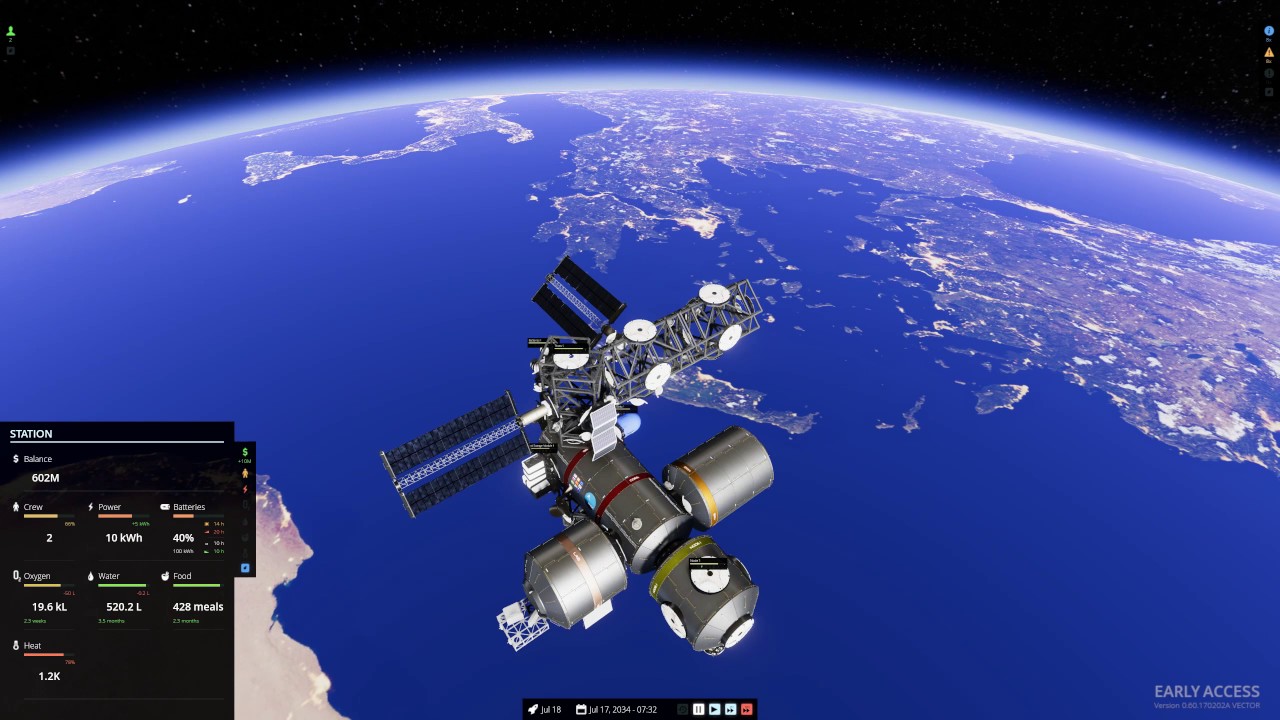





.jpg)


.jpg)
.jpg)


