Fire Quotes (206 quotes)
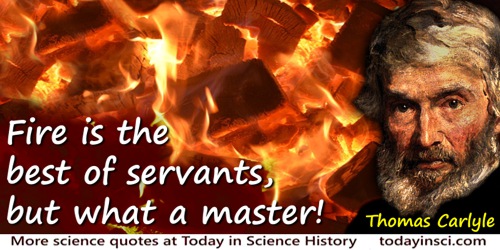
[An] old Pythagorean prejudice … thought it a crime to eat eggs; because an egg was a microcosm, or universe in little; the shell being the earth; the white, water; fire, the yolk; and the air found between the shell and the white.
'Common Cookery'. Household Words (26 Jan 1856), 13, 43. An English weekly magazine edited by Charles Dickens.
[Henry Cavendish] fixed the weight of the earth; he established the proportions of the constituents of the air; he occupied himself with the quantitative study of the laws of heat; and lastly, he demonstrated the nature of water and determined its volumetric composition. Earth, air, fire, and water—each and all came within the range of his observations.
Essays in Historical Chemistry (1894), 86.
[Man] … his origin, his growth, his hopes and fears, his loves and his beliefs are but the outcome of accidental collocations of atoms; that no fire, no heroism, no intensity of thought and feeling can preserve an individual life beyond the grave; that all the labour of the ages, all the devotion, all the inspiration, all the noonday brightness of human genius are destined to extinction in the vast death of the solar system, and that the whole temple of Man's achievement must inevitably be buried beneath the debris of a universe in ruins…
From 'A Free Man's Worship', Independent Review (Dec 1903). Collected in Mysticism and Logic: And Other Essays (1918), 47-48.
[On the volcano.] And many a fire there burns beneath the ground.
Fragment 52. In The Fragments of Empedocles, translated by William Ellery Leonard, (1908), 35.
[Reporting after the now infamous 22 Jun 1969 burning of the Cuyahoga River:] Some River! Chocolate-brown, oily, bubbling with subsurface gases, it oozes rather than flows. “Anyone who falls into the Cuyahoga does not drown,” Cleveland’s citizens joke grimly. “He decays” … The Federal Water Pollution Control Administration dryly notes: “The lower Cuyahoga has no visible signs of life, not even low forms such as leeches and sludge worms that usually thrive on wastes.” It is also—literally—a fire hazard.
— Magazine
As reported in Time magazine (1 Aug 1969).
[To] explain the phenomena of the mineral kingdom ... systems are usually reduced to two classes, according as they refer to the origin of terrestrial bodies to FIRE or to WATER; and ... their followers have of late been distinguished by the fanciful names of Vulcanists and Neptunists. To the former of these Dr HUTTON belongs much more than to the latter; though, as he employs the agency both of fire and water in his system, he cannot, in strict propriety, be arranged with either.
Illustrations of the Huttonian Theory of the Earth (1802) collected in The Works of John Playfair (1822), Vol. 1, 21
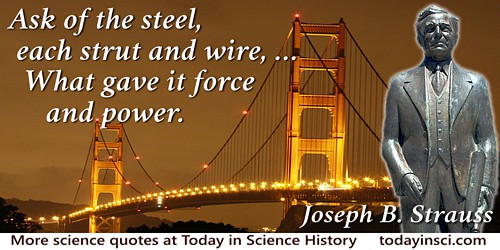
The Mighty Task is Done
At last the mighty task is done;
Resplendent in the western sun
The Bridge looms mountain high;
Its titan piers grip ocean floor,
Its great steel arms link shore with shore,
Its towers pierce the sky.
On its broad decks in rightful pride,
The world in swift parade shall ride,
Throughout all time to be;
Beneath, fleet ships from every port,
Vast landlocked bay, historic fort,
And dwarfing all the sea.
To north, the Redwood Empires gates;
To south, a happy playground waits,
In Rapturous appeal;
Here nature, free since time began,
Yields to the restless moods of man,
Accepts his bonds of steel.
Launched midst a thousand hopes and fears,
Damned by a thousand hostile sneers,
Yet Neer its course was stayed,
But ask of those who met the foe
Who stood alone when faith was low,
Ask them the price they paid.
Ask of the steel, each strut and wire,
Ask of the searching, purging fire,
That marked their natal hour;
Ask of the mind, the hand, the heart,
Ask of each single, stalwart part,
What gave it force and power.
An Honored cause and nobly fought
And that which they so bravely wrought,
Now glorifies their deed,
No selfish urge shall stain its life,
Nor envy, greed, intrigue, nor strife,
Nor false, ignoble creed.
High overhead its lights shall gleam,
Far, far below lifes restless stream,
Unceasingly shall flow;
For this was spun its lithe fine form,
To fear not war, nor time, nor storm,
For Fate had meant it so.
At last the mighty task is done;
Resplendent in the western sun
The Bridge looms mountain high;
Its titan piers grip ocean floor,
Its great steel arms link shore with shore,
Its towers pierce the sky.
On its broad decks in rightful pride,
The world in swift parade shall ride,
Throughout all time to be;
Beneath, fleet ships from every port,
Vast landlocked bay, historic fort,
And dwarfing all the sea.
To north, the Redwood Empires gates;
To south, a happy playground waits,
In Rapturous appeal;
Here nature, free since time began,
Yields to the restless moods of man,
Accepts his bonds of steel.
Launched midst a thousand hopes and fears,
Damned by a thousand hostile sneers,
Yet Neer its course was stayed,
But ask of those who met the foe
Who stood alone when faith was low,
Ask them the price they paid.
Ask of the steel, each strut and wire,
Ask of the searching, purging fire,
That marked their natal hour;
Ask of the mind, the hand, the heart,
Ask of each single, stalwart part,
What gave it force and power.
An Honored cause and nobly fought
And that which they so bravely wrought,
Now glorifies their deed,
No selfish urge shall stain its life,
Nor envy, greed, intrigue, nor strife,
Nor false, ignoble creed.
High overhead its lights shall gleam,
Far, far below lifes restless stream,
Unceasingly shall flow;
For this was spun its lithe fine form,
To fear not war, nor time, nor storm,
For Fate had meant it so.
Written upon completion of the building of the Golden Gate Bridge, May 1937. In Allen Brown, Golden Gate: biography of a Bridge (1965), 229.
[On the propulsive force of rockets] One part of fire takes up as much space as ten parts of air, and one part of air takes up the space of ten parts of water, and one part of water as much as ten parts of earth. Now powder is earth, consisting of the four elementary principles, and when the sulfur conducts the fire into the dryest part of the powder, fire, and air increase … the other elements also gird themselves for battle with each other and the rage of battle is changed by their heat and moisture into a strong wind.
In De La Pirotechnia (1540). From the 1943 English translation, as given in Willy Ley, Rockets: The Future of Travel Beyond the Stratosphere (1944), 64. Though Birinuccio provided the first insight into what propels a rocket, the “strong wind” blowing downward, he did not explain why that should cause the rocket to rise upward, as Issac Newton would do with his Third Law of Motion, nearly a century and a half later.
But how shall we this union well expresse?
Naught tyes the soule: her subtiltie is such
She moves the bodie, which she doth possesse.
Yet no part toucheth, but by Vertue's touch.
Then dwels she not therein as in a tent;
Nor as a pilot in his Ship doth sit;
Nor as the spider in his web is pent;
Nor as the Waxe retaines the print in it;
Nor as a Vessell water doth containe;
Nor as one Liquor in another shed;
Nor as the heate dath in the fire remaine;
Nor as a voice throughout the ayre is spred;
But as the faire and cheerfull morning light,
Doth here, and there, her silver beames impart,
And in an instant doth her selfe unite
To the transparent Aire, in all, and part:
Still resting whole, when blowes the Aire devide;
Abiding pure, when th' Aire is most corrupted;
Throughout the Aire her beames dispersing wide,
And when the Aire is tost, not interrupted:
So doth the piercing Soule the body fill;
Being all in all, and all in part diffus'd;
Indivisible, incorruptible still,
Not forc't, encountred, troubled or confus'd.
And as the Sunne above the light doth bring,
Tough we behold it in the Aire below;
So from th'eternall light the Soule doth spring,
Though in the Bodie she her powers do show.
Naught tyes the soule: her subtiltie is such
She moves the bodie, which she doth possesse.
Yet no part toucheth, but by Vertue's touch.
Then dwels she not therein as in a tent;
Nor as a pilot in his Ship doth sit;
Nor as the spider in his web is pent;
Nor as the Waxe retaines the print in it;
Nor as a Vessell water doth containe;
Nor as one Liquor in another shed;
Nor as the heate dath in the fire remaine;
Nor as a voice throughout the ayre is spred;
But as the faire and cheerfull morning light,
Doth here, and there, her silver beames impart,
And in an instant doth her selfe unite
To the transparent Aire, in all, and part:
Still resting whole, when blowes the Aire devide;
Abiding pure, when th' Aire is most corrupted;
Throughout the Aire her beames dispersing wide,
And when the Aire is tost, not interrupted:
So doth the piercing Soule the body fill;
Being all in all, and all in part diffus'd;
Indivisible, incorruptible still,
Not forc't, encountred, troubled or confus'd.
And as the Sunne above the light doth bring,
Tough we behold it in the Aire below;
So from th'eternall light the Soule doth spring,
Though in the Bodie she her powers do show.
From 'Nosce Teipsum' (1599), in Claire Howard (ed.), The Poems of Sir John Davies (1941), 151-2.
Eine brennendste Zeitfrage allerdings! Es brennt in allen Ecken und Enden der ethnologischen Welt, brennt hell, lichterloh, in vollster Brunst, es brennt ringsum, Gross Feuer! und Niemand regt eine Hand.
A most burning question of time, though. It burns in every nook and cranny of the ethnological world, burning, bright, brightly, in the fullest blaze, and it burns all around, huge fire! and no one lifts a hand.
[Expressing his desperation over the loss of the cultural memory of ethnic traditions as so many cultures were no longer living in isolation.]
A most burning question of time, though. It burns in every nook and cranny of the ethnological world, burning, bright, brightly, in the fullest blaze, and it burns all around, huge fire! and no one lifts a hand.
[Expressing his desperation over the loss of the cultural memory of ethnic traditions as so many cultures were no longer living in isolation.]
From Das Besẗandige in den Menschenrassen und die Spielweite ihrer Veränderlichkeit (1868), 180, footnote. Approximate translation by Webmaster using Google Translate.
Prospero: Hast thou, spirit,
Performed, to point, the tempest that I bade thee?
Ariel: To every article.
I boarded the king’s ship. Now on the beak,
Now in the waist, the deck, in every cabin,
I flamed amazement.
Sometime I’d divide
And burn in many places; on the topmast,
The yards, and bowsprit would I flame distinctly,
Then meet and join. Jove’s lightnings, the precursors
O’ th’ dreadful thunderclaps, more momentary
And sight-outrunning were not. The fire and cracks
Of sulphurous roaring the most mighty Neptune
Seem to besiege, and make his bold waves tremble;
Yea, his dread trident shake.
Performed, to point, the tempest that I bade thee?
Ariel: To every article.
I boarded the king’s ship. Now on the beak,
Now in the waist, the deck, in every cabin,
I flamed amazement.
Sometime I’d divide
And burn in many places; on the topmast,
The yards, and bowsprit would I flame distinctly,
Then meet and join. Jove’s lightnings, the precursors
O’ th’ dreadful thunderclaps, more momentary
And sight-outrunning were not. The fire and cracks
Of sulphurous roaring the most mighty Neptune
Seem to besiege, and make his bold waves tremble;
Yea, his dread trident shake.
In The Tempest (1611), Act 1, Scene 2, line 193-206.
Question: State the relations existing between the pressure, temperature, and density of a given gas. How is it proved that when a gas expands its temperature is diminished?
Answer: Now the answer to the first part of this question is, that the square root of the pressure increases, the square root of the density decreases, and the absolute temperature remains about the same; but as to the last part of the question about a gas expanding when its temperature is diminished, I expect I am intended to say I don't believe a word of it, for a bladder in front of a fire expands, but its temperature is not at all diminished.
Answer: Now the answer to the first part of this question is, that the square root of the pressure increases, the square root of the density decreases, and the absolute temperature remains about the same; but as to the last part of the question about a gas expanding when its temperature is diminished, I expect I am intended to say I don't believe a word of it, for a bladder in front of a fire expands, but its temperature is not at all diminished.
Genuine student answer* to an Acoustics, Light and Heat paper (1880), Science and Art Department, South Kensington, London, collected by Prof. Oliver Lodge. Quoted in Henry B. Wheatley, Literary Blunders (1893), 175, Question 1. (*From a collection in which Answers are not given verbatim et literatim, and some instances may combine several students' blunders.)
1122 … Thereafter there were many sailors on the sea and on inland water who said that they had seen a great and extensive fire near the ground in the northeast which continuously increased in width as it mounted to the sky. And the heavens opened into four parts and fought against it as if determined to put it out, and the fire stopped rising upwards. They saw that fire at the first streak of dawn, and it lasted until full daylight: this happened on 7 December.
From the 'Peterborough Chronicle (Laud Manuscript)', The Anglo-Saxon Chronicle, as translated in The Anglo-Saxon Chronicle, Issue 1624 (1975), 250. The Chronicle is the work of many successive hands at several monasteries across England.
A comet is sublimated fire assimilated to the nature of one of the seven planets.
As quoted in Alistair Cameron Crombie, Robert Grosseteste and the Origins of Experimental Science, 1100-1700 (1953), 90.
A few months after a devastating defeat at Fredericksburg,… President Abraham Lincoln signed into law an act creating the National Academy of Sciences—in the midst of civil war. Lincoln refused to accept that our nation’s sole purpose was mere survival. He created this academy, founded the land grant colleges, and began the work of the transcontinental railroad, believing that we must add—and I quote—“the fuel of interest to the fire of genius in the discovery … of new and useful things.”
Speech to the National Academy of Sciences Annual Meeting (27 Apr 2009).
A fire eater must eat fire even if he has to kindle it himself.
In Foundation (1951, 2004), Vol. 1, 137.
A fire-mist and a planet,
A crystal and a cell,
A jellyfish and a saurian,
And caves where the cavemen dwell;
Then a sense of law and beauty,
And a face turned from the clod—
Some call it Evolution,
And others call it God.
A crystal and a cell,
A jellyfish and a saurian,
And caves where the cavemen dwell;
Then a sense of law and beauty,
And a face turned from the clod—
Some call it Evolution,
And others call it God.
'Each in his Own Tongue', in Kansas in Literature: Part One, Poetry (1900), 83.
A first step in the study of civilization is to dissect it into details, and to classify these in their proper groups. Thus, in examining weapons, they are to be classed under spear, club, sling, bow and arrow, and so forth; among textile arts are to be ranged matting, netting, and several grades of making and weaving threads; myths are divided under such headings as myths of sunrise and sunset, eclipse-myths, earthquake-myths, local myths which account for the names of places by some fanciful tale, eponymic myths which account for the parentage of a tribe by turning its name into the name of an imaginary ancestor; under rites and ceremonies occur such practices as the various kinds of sacrifice to the ghosts of the dead and to other spiritual beings, the turning to the east in worship, the purification of ceremonial or moral uncleanness by means of water or fire. Such are a few miscellaneous examples from a list of hundreds … To the ethnographer, the bow and arrow is the species, the habit of flattening children’s skulls is a species, the practice of reckoning numbers by tens is a species. The geographical distribution of these things, and their transmission from region to region, have to be studied as the naturalist studies the geography of his botanical and zoological species.
In Primitive Culture (1871), Vol. 1, 7.
A great ball of fire about a mile in diameter, changing colors as it kept shooting upward, from deep purple to orange, expanding, growing bigger, rising as it was expanding, an elemental force freed from its bonds after being chained for billions of years.
On the first atomic explosion in New Mexico, 16 Jul 1945.
On the first atomic explosion in New Mexico, 16 Jul 1945.
From 'Drama of the Atomic Bomb Found Climax in July 16 Test', in New York Times (26 Sep 1945). This was the first of a series of articles by Laurence, who was the only civilian witness of the first bomb test. He was on a flight to see the dropping of a bomb on Nagasaki. Laurence, science writer for the NYT, had been requested for service to the War Department to explain the atomic bomb to the lay public.
A Miracle is a Violation of the Laws of Nature; and as a firm and unalterable Experience has established these Laws, the Proof against a Miracle, from the very Nature of the Fact, is as entire as any Argument from Experience can possibly be imagined. Why is it more than probable, that all Men must die; that Lead cannot, of itself, remain suspended in the Air; that Fire consumes Wood, and is extinguished by Water; unless it be, that these Events are found agreeable to the Laws of Nature, and there is required a Violation of these Laws, or in other Words, a Miracle to prevent them? Nothing is esteem'd a Miracle, if it ever happen in the common Course of Nature... There must, therefore, be a uniform Experience against every miraculous Event, otherwise the Event would not merit that Appellation. And as a uniform Experience amounts to a Proof, there is here a direct and full Proof, from the Nature of the Fact, against the Existence of any Miracle; nor can such a Proof be destroy'd, or the Miracle render'd credible, but by an opposite Proof, which is superior.
An Enquiry Concerning Human Understanding (1748), 180-181.
About 6 or 8 years ago My Ingenious friend Mr John Robinson having [contrived] conceived that a fire engine might be made without a Lever—by Inverting the Cylinder & placing it above the mouth of the pit proposed to me to make a model of it which was set about by having never Compleated & I [being] having at that time Ignorant little knoledge of the machine however I always thought the Machine Might be applied to [more] other as valuable purposes [than] as drawing Water.
Entry in notebook (1765). The bracketed words in square brackets were crossed out by Watt. in Eric Robinson and Douglas McKie (eds.), Partners in Science: Letters of James Watt and Joseph Black (1970), 434.
About the year 1772, being then an apprentice to a wheel-wright, or wagon maker, I laboured to discover some means of propelling land carriages without animal power. … one of my brothers [told me of] blacksmith’s boys, who, for amusement, had stopped up the touch hole of a gun barrel, then put in about a gill of water, and rammed down a tight wad; after which they put the breech in the smith’s fire, when it discharged itself with as loud a crack as if it had been loaded with powder. It immediately occurred to me, that here was the power to propel any wagon, if I could only apply it.
From 'On the Origin of Steam Boats and Steam Wagons', Thomas Cooper (ed.), The Emporium of Arts and Sciences (Feb 1814), 2, No. 2, 205.
After some experiments made one day at my house upon the phosphorus, a little piece of it being left negligently upon the table in my chamber, the maid making the bed took it up in the bedclothes she had put on the table, not seeing the little piece. The person who lay afterwards in the bed, waking at night and feeling more than ordinary heat, perceived that the coverlet was on fire.
Quoted in John Emsley, The 13th Element: The Sordid Tale of Murder, Fire, and Phosphorus (2000), 11.
After the planet becomes theirs, many millions of years will have to pass before a beetle particularly loved by God, at the end of its calculations will find written on a sheet of paper in letters of fire that energy is equal to the mass multiplied by the square of the velocity of light. The new kings of the world will live tranquilly for a long time, confining themselves to devouring each other and being parasites among each other on a cottage industry scale.
'Beetles' Other People’s Trades (1985, trans. 1989).
All over the world there lingers on the memory of a giant tree, the primal tree, rising up from the centre of the Earth to the heavens and ordering the universe around it. It united the three worlds: its roots plunged down into subterranean abysses, Its loftiest branches touched the empyrean. Thanks to the Tree, it became possible to breathe the air; to all the creatures that then appeared on Earth it dispensed its fruit, ripened by the sun and nourished by the water which it drew from the soil. From the sky it attracted the lightning from which man made fire and, beckoning skyward, where clouds gathered around its fall. The Tree was the source of all life, and of all regeneration. Small wonder then that tree-worship was so prevalent in ancient times.
From 'L'Arbre Sacre' ('The Sacred Tree'), UNESCO Courier (Jan 1989), 4. Epigraph to Chap 1, in Kenton Miller and Laura Tangley, Trees of Life: Saving Tropical Forests and Their Biological Wealt (1991), 1.
All the human culture, all the results of art, science and technology that we see before us today, are almost exclusively the creative product of the Aryan. This very fact admits of the not unfounded inference that he alone was the founder of all higher humanity, therefore representing the prototype of all that we understand by the word 'man.' He is the Prometheus of mankind from whose shining brow the divine spark of genius has sprung at all times, forever kindling anew that fire of knowledge which illuminated the night of silent mysteries and thus caused man to climb the path to mastery over the other beings of the earth ... It was he who laid the foundations and erected the walls of every great structure in human culture.
Mein Kampf (1925-26), American Edition (1943), 290. In William Lawrence Shirer, The Rise and Fall of the Third Reich (1990), 86-87.
Anaximenes ... also says that the underlying nature is one and infinite ... but not undefined as Anaximander said but definite, for he identifies it as air; and it differs in its substantial nature by rarity and density. Being made finer it becomes fire; being made thicker it becomes wind, then cloud, then (when thickened still more) water, then earth, then stones; and the rest come into being from these.
Simplicius, Commentary on Aristotle’s Physics, 24, 26-31, quoting Theophrastus on Anaximenes. In G. S. Kirk, J. E. Raven and M.Schofield (eds), The Presocratic Philosophers: A Critical History with a Selection of Texts (1983), p. 145.
Anaximenes ... said that infinite air was the principle, from which the things that are becoming, and that are, and that shall be, and gods and things divine, all come into being, and the rest from its products. The form of air is of this kind: whenever it is most equable it is invisible to sight, but is revealed by the cold and the hot and the damp and by movement. It is always in motion; for things that change do not change unless there be movement. Through becoming denser or finer it has different appearances; for when it is dissolved into what is finer it becomes fire, while winds, again, are air that is becoming condensed, and cloud is produced from air by felting. When it is condensed still more, water is produced; with a further degree of condensation earth is produced, and when condensed as far as possible, stones. The result is that the most influential components of the generation are opposites, hot and cold.
Hippolytus, Refutation, 1.7.1. In G. S. Kirk, J. E. Raven and M. Schofield (eds.), The Presocratic Philosophers: A Critical History with a Selection of Texts (1983), p. 145.
And new philosophy calls all in doubt,
The Element of fire is quite put out;
The Sun is lost, and th’earth, and no mans wit
Can well direct him where to look for it.
And freely men confesse that this world’s spent,
When in the Planets, and the Firmament
They seeke so many new; and then see that this
Is crumbled out againe to his Atomies.
’Tis all in pieces, all cohaerence gone;
All just supply, and all Relation;
Prince, Subject, Father, Sonne, are things forgot,
For every man alone thinkes he hath got
To be a phoenix, and that then can bee
None of that kinde, of which he is, but hee.
The Element of fire is quite put out;
The Sun is lost, and th’earth, and no mans wit
Can well direct him where to look for it.
And freely men confesse that this world’s spent,
When in the Planets, and the Firmament
They seeke so many new; and then see that this
Is crumbled out againe to his Atomies.
’Tis all in pieces, all cohaerence gone;
All just supply, and all Relation;
Prince, Subject, Father, Sonne, are things forgot,
For every man alone thinkes he hath got
To be a phoenix, and that then can bee
None of that kinde, of which he is, but hee.
An Anatomie of the World, I. 205-18. The Works of John Donne (Wordsworth edition 1994), 177.
And we daily in our experiments electrise bodies plus or minus, as we think proper. [These terms we may use till your Philosophers give us better.] To electrise plus or minus, no more needs to be known than this, that the parts of the Tube or Sphere, that are rubb’d, do, in the Instant of Friction, attract the Electrical Fire, and therefore take it from the Thin rubbing; the same parts immediately, as the Friction upon them ceases, are disposed to give the fire they have received, to any Body that has less.
Letter 25 May 1747. Quoted in I. Bernard Cohen, Franklin and Newton: An Enquiry into Speculative Newtonian Experimental Science and Franklin’s Work in Electricity as an Example Thereof (1956), 439.
And, notwithstanding a few exceptions, we do undoubtedly find that the most truly eminent men have had not only their affections, but also their intellect, greatly influenced by women. I will go even farther; and I will venture to say that those who have not undergone that influence betray a something incomplete and mutilated. We detect, even in their genius, a certain frigidity of tone; and we look in vain for that burning fire, that gushing and spontaneous nature with which our ideas of genius are indissolubly associated. Therefore, it is, that those who are most anxious that the boundaries of knowledge should be enlarged, ought to be most eager that the influence of women should be increased, in order that every resource of the human mind may be at once and quickly brought into play.
Lecture (19 Mar 1858) at the Royal Institution, 'The Influence Of Women On The Progress Of Knowledge', collected in The Miscellaneous and Posthumous Works of Henry Thomas Buckle (1872), Vol. 1, 17. Published in Frazier’s Magazine (Apr 1858).
Anton Chekhov wrote that ‘one must not put a loaded rifle on stage if no one is thinking of firing it.’ Good drama requires spare and purposive action, sensible linking of potential causes with realized effects. Life is much messier; nothing happens most of the time. Millions of Americans (many hotheaded) own rifles (many loaded), but the great majority, thank God, do not go off most of the time. We spend most of real life waiting for Godot, not charging once more unto the breach.
…...
As every circumstance relating to so capital a discovery as this (the greatest, perhaps, that has been made in the whole compass of philosophy, since the time of Sir Isaac Newton) cannot but give pleasure to all my readers, I shall endeavour to gratify them with the communication of a few particulars which I have from the best authority. The Doctor [Benjamin Franklin], after having published his method of verifying his hypothesis concerning the sameness of electricity with the matter lightning, was waiting for the erection of a spire in Philadelphia to carry his views into execution; not imagining that a pointed rod, of a moderate height, could answer the purpose; when it occurred to him, that, by means of a common kite, he could have a readier and better access to the regions of thunder than by any spire whatever. Preparing, therefore, a large silk handkerchief, and two cross sticks, of a proper length, on which to extend it, he took the opportunity of the first approaching thunder storm to take a walk into a field, in which there was a shed convenient for his purpose. But dreading the ridicule which too commonly attends unsuccessful attempts in science, he communicated his intended experiment to no body but his son, who assisted him in raising the kite.
The kite being raised, a considerable time elapsed before there was any appearance of its being electrified. One very promising cloud passed over it without any effect; when, at length, just as he was beginning to despair of his contrivance, he observed some loose threads of the hempen string to stand erect, and to avoid one another, just as if they had been suspended on a common conductor. Struck with this promising appearance, he inmmediately presented his knuckle to the key, and (let the reader judge of the exquisite pleasure he must have felt at that moment) the discovery was complete. He perceived a very evident electric spark. Others succeeded, even before the string was wet, so as to put the matter past all dispute, and when the rain had wetted the string, he collected electric fire very copiously. This happened in June 1752, a month after the electricians in France had verified the same theory, but before he had heard of any thing that they had done.
The kite being raised, a considerable time elapsed before there was any appearance of its being electrified. One very promising cloud passed over it without any effect; when, at length, just as he was beginning to despair of his contrivance, he observed some loose threads of the hempen string to stand erect, and to avoid one another, just as if they had been suspended on a common conductor. Struck with this promising appearance, he inmmediately presented his knuckle to the key, and (let the reader judge of the exquisite pleasure he must have felt at that moment) the discovery was complete. He perceived a very evident electric spark. Others succeeded, even before the string was wet, so as to put the matter past all dispute, and when the rain had wetted the string, he collected electric fire very copiously. This happened in June 1752, a month after the electricians in France had verified the same theory, but before he had heard of any thing that they had done.
The History and Present State of Electricity, with Original Experiments (1767, 3rd ed. 1775), Vol. 1, 216-7.
As for the earth, out of it comes bread, but underneath it is turned up as by fire. Its stones are the place of sapphires, and it has dust of gold.
— Bible
Bible: English Standard Version, Job Chap 28, verses 5-6.
As plants convert the minerals into food for animals, so each man converts some raw material in nature to human use. The inventors of fire, electricity, magnetism, iron, lead, glass, linen, silk, cotton; the makers of tools; the inventor of decimal notation, the geometer, the engineer, the musician, severally make an easy way for all, through unknown and impossible confusions.
In 'Uses of Great Men', Representative Men (1850), 5-6.
As turning the logs, will make a dull fire burn, so change of studies a dull brain.
In 'Table-Talk', The Poetical Works of Henry Wadsworth Longfellow: Volume 3 (1883), 1354.
At first men try with magic charms
To fertilize the earth,
To keep their flocks and herds from harm
And bring new young to birth.
Then to capricious gods they turn
To save from fire or flood;
Their smoking sacrifices burn
On altars red with blood.
Next bold philosopher and sage
A settled plan decree
And prove by thought or sacred page
What Nature ought to be.
But Nature smiles—a Sphinx-like smile
Watching their little day
She waits in patience for a while—
Their plans dissolve away.
Then come those humbler men of heart
With no completed scheme,
Content to play a modest part,
To test, observe, and dream.
Till out of chaos come in sight
Clear fragments of a Whole;
Man, learning Nature’s ways aright
Obeying, can control.
To fertilize the earth,
To keep their flocks and herds from harm
And bring new young to birth.
Then to capricious gods they turn
To save from fire or flood;
Their smoking sacrifices burn
On altars red with blood.
Next bold philosopher and sage
A settled plan decree
And prove by thought or sacred page
What Nature ought to be.
But Nature smiles—a Sphinx-like smile
Watching their little day
She waits in patience for a while—
Their plans dissolve away.
Then come those humbler men of heart
With no completed scheme,
Content to play a modest part,
To test, observe, and dream.
Till out of chaos come in sight
Clear fragments of a Whole;
Man, learning Nature’s ways aright
Obeying, can control.
Epigraph in A History of Science and Its Relation with Philosophy & Religion (1968), vi.
Become as fast as the wind, yet as sturdy as the forest. Raid and plunder like fire, yet be as impassive as mountains. Let your plans be dark as night, and when you move, strike like lightning.
— Sun Tzu
In Sun Tzu and Jeff Mcneill (trans.), The Art of War by Sun Tzu: New Modern Edition (2012), Chap. 7, 17.
Being perpetually charmed by his familiar siren, that is, by his geometry, he [Archimedes] neglected to eat and drink and took no care of his person; that he was often carried by force to the baths, and when there he would trace geometrical figures in the ashes of the fire, and with his finger draws lines upon his body when it was anointed with oil, being in a state of great ecstasy and divinely possessed by his science.
— Plutarch
As translated in George Finlay Simmons, Calculus Gems: Brief Lives and Memorable Mathematics, (1992), 39.
Believe me, this planet has put up with much worse than us. It’s been through earthquakes, volcanoes, plate tectonics, solar flares, sun-spots, magnetic storms, pole reversals, planetary floods, worldwide fires, tidal waves, wind and water erosion, cosmic rays, ice ages, and hundreds of thousands of years of bombardment by comets, asteroids, and meteors. And people think a few plastic bags and aluminum cans are going to make a difference?
In Napalm and Silly Putty (2002), 97.
Blow, winds, and crack your cheeks! Rage, blow,
You cataracts and hurricanoes, spout
Till you have drench’d our steeples, drowned the cocks!
You sulph'rous and thought-executing fires,
Vaunt-couriers of oak-cleaving thunderbolts,
Singe my white head; and thou all-shaking thunder,
Strike flat the thick rotundity o'th' world,
Crack nature’s moulds, all germens spill at once
That makes ingrateful man.
You cataracts and hurricanoes, spout
Till you have drench’d our steeples, drowned the cocks!
You sulph'rous and thought-executing fires,
Vaunt-couriers of oak-cleaving thunderbolts,
Singe my white head; and thou all-shaking thunder,
Strike flat the thick rotundity o'th' world,
Crack nature’s moulds, all germens spill at once
That makes ingrateful man.
King Lear (1605-61, III, ii.
Briefly, in the act of composition, as an instrument there intervenes and is most potent, fire, flaming, fervid, hot; but in the very substance of the compound there intervenes, as an ingredient, as it is commonly called, as a material principle and as a constituent of the whole compound the material and principle of fire, not fire itself. This I was the first to call phlogiston.
Specimen Beccherianum (1703). Trans. J. R. Partington, A History of Chemistry (1961), Vol. 2, 668.
But as a philosopher said, one day after mastering the winds, the waves, the tides and gravity, after all the scientific and technological achievements, we shall harness for God the energies of love. And then, for the second time in the history of the world, man will have discovered fire.
Speech accepting nomination as candidate for vice president, Democratic National Committee, Washington, D.C. (8 Aug 1972) as reported in New York Times (9 Aug 1972), 18. Shriver slightly paraphrased the similar sentiment written in 1934 by Pierre Teilhard de Chardin, translated by René Hague in 'The Evolution of Chastity', Toward the Future (1975), 86-87.
But come, hear my words, for truly learning causes the mind to grow. For as I said before in declaring the ends of my words … at one time there grew to be the one alone out of many, and at another time it separated so that there were many out of the one; fire and water and earth and boundless height of air, and baneful Strife apart from these, balancing each of them, and Love among them, their equal in length and breadth.
From The Fragments, Bk. 1, line 74. In Arthur Fairbanks (ed., trans.), Quotations from The First Philosophers of Greece (1898), 167-168.
But for the persistence of a student of this university in urging upon me his desire to study with me the modern algebra I should never have been led into this investigation; and the new facts and principles which I have discovered in regard to it (important facts, I believe), would, so far as I am concerned, have remained still hidden in the womb of time. In vain I represented to this inquisitive student that he would do better to take up some other subject lying less off the beaten track of study, such as the higher parts of the calculus or elliptic functions, or the theory of substitutions, or I wot not what besides. He stuck with perfect respectfulness, but with invincible pertinacity, to his point. He would have the new algebra (Heaven knows where he had heard about it, for it is almost unknown in this continent), that or nothing. I was obliged to yield, and what was the consequence? In trying to throw light upon an obscure explanation in our text-book, my brain took fire, I plunged with re-quickened zeal into a subject which I had for years abandoned, and found food for thoughts which have engaged my attention for a considerable time past, and will probably occupy all my powers of contemplation advantageously for several months to come.
In Johns Hopkins Commemoration Day Address, Collected Mathematical Papers, Vol. 3, 76.
But the dreams about the modes of creation, enquiries whether our globe has been formed by the agency of fire or water, how many millions of years it has cost Vulcan or Neptune to produce what the fiat of the Creator would effect by a single act of will, is too idle to be worth a single hour of any man’s life.
Letter (2 May 1826) to Doctor John P. Emmet. Collected in The Writings of Thomas Jefferson (1854), Vol. 7, 443.
By blending water and minerals from below with sunlight and CO2 from above, green plants link the earth to the sky. We tend to believe that plants grow out of the soil, but in fact most of their substance comes from the air. The bulk of the cellulose and the other organic compounds produced through photosynthesis consists of heavy carbon and oxygen atoms, which plants take directly from the air in the form of CO2. Thus the weight of a wooden log comes almost entirely from the air. When we burn a log in a fireplace, oxygen and carbon combine once more into CO2, and in the light and heat of the fire we recover part of the solar energy that went into making the wood.
The Web of Life: A New Scientific Understanding of Living Systems (1997), 178.
Chemists have made of phlogiston a vague principle which is not at all rigorously defined, and which, in consequence, adapts itself to all explanations in which it is wished it shall enter; sometimes it is free fire, sometimes it is fire combined with the earthy element; sometimes it passes through the pores of vessels, sometimes they are impenetrable to it; it explains both the causticity and non-causticity, transparency and opacity, colours and absence of colours. It is a veritable Proteus which changes its form every instant. It is time to conduct chemistry to a more rigorous mode of reasoning ... to distinguish fact and observation from what is systematic and hypothetical.
'Réflexions sur le phlogistique', Mémoires de l'Académie des Sciences, 1783, 505-38. Reprinted in Oeuvres de Lavoisier (1864), Vol. 2, 640, trans. M. P. Crosland.
Chymistry. … An art whereby sensible bodies contained in vessels … are so changed, by means of certain instruments, and principally fire, that their several powers and virtues are thereby discovered, with a view to philosophy or medicine.
An antiquated definition, as quoted in Samuel Johnson, entry for 'Chymistry' in Dictionary of the English Language (1785). Also in The Quarterly Journal of Science, Literature, and the Arts (1821), 284, wherein a letter writer (only identified as “C”) points out that this definition still appeared in the, then, latest Rev. Mr. Todd’s Edition of Johnson’s Dictionary, and that it showed “very little improvement of scientific words.” The letter included examples of better definitions by Black and by Davy. (See their pages on this website.)
City after city, state after state, had essentially failed in their efforts to protect their air and their water, the land, the health of their citizens. By 1970, our city’ skylines were so polluted that in many places it was all but impossible to see from one city skyscraper to another. … We had rivers that were fouled with raw sewage and toxic chemicals. One actually caught on fire. There was a very famous photograph from my teenage years of the Cuyahoga River
burning. In fact, it was memorialized in a song at the time.
In 'Environmental Protection: Meeting the Challenges of the Twenty-First Century', Harvard Environmental Law Review (2001), 25, 329, 330-331. [In fact, the Cuyahoga River had caught fire several times over a number of decades, and there had been fires on other rivers. Webmaster]
Darwin recognized that thus far the civilization of mankind has passed through four successive stages of evolution, namely, those based on the use of fire, the development of agriculture, the development of urban life and the use of basic science for technological advancement.
In The Science Matrix: The Journey, Travails, Triumphs (1992, 2012), 86.
Doctor Thomas …
Said, “Cancer’s a funny thing.
Nobody knows what the cause is,
Though some pretend they do;
It’s like some hidden assassin
Waiting to strike at you.
Childless women get it.
And men when they retire;
It’s as if there had to be some outlet
For their foiled creative fire.”
Said, “Cancer’s a funny thing.
Nobody knows what the cause is,
Though some pretend they do;
It’s like some hidden assassin
Waiting to strike at you.
Childless women get it.
And men when they retire;
It’s as if there had to be some outlet
For their foiled creative fire.”
In 'Miss Gee', in Collected Shorter Poems, 1930-1944 (1950), 242.
Education is not the filling of a pail, but the lighting of a fire.
…...
Even if there is only one possible unified theory, it is just a set of rules and equations. What is it that breathes fire into the equations and makes a universe for them to describe? The usual approach of science of constructing a mathematical model cannot answer the questions of why there should be a universe for the model to describe. Why does the universe go to all the bother of existing?
A Brief History of Time (1998), 190.
Every 12 years Jupiter returns to the same position in the sky; every 370 days it disappears in the fire of the Sun in the evening to the west, 30 days later it reappears in the morning to the east...[Observation in 4th century B.C.]
— Gan De
In the lost book Suixing Jing (Treatise on Jupiter), quoted in the extensive compilation Kaiyuan Zhanjing, (The Kaiyuan Treatise on Astrology (compiled 718-726). Quotation as given in Norman K. Glendenning, Our Place in the Universe (2007), 126. Source cited in Helaine Selin, Encyclopaedia of the History of Science, Technology, and Medicine in Non-Western Cultures (1997), 342.
Every man looks at his wood-pile with a kind of affection. … [T]hey warmed me twice, once while I was splitting them, and again when they were on the fire, so that no fuel could give out more heat.
In Walden: or, Life in the Woods (1854, 1899), 263.
Fire is the best of servants, but what a master!
In Past and Present (1843, 1872), 78.
Fire is the Sun unwinding from the tree’s log. … Each ring of the many rings of the saw-cut log is one year’s Sun-energy impoundment.
In Critical Path (1982), 62.
Fires from beneath, and meteors from above,
Portentous, unexampled, unexplain'd,
Have kindled beacons in the skies; and th' old
And crazy earth has had her shaking fits
More frequent, and foregone her usual rest.
Is it a time to wrangle, when the props
And pillars of our planet seem to fail,
And nature, with a dim and sickly eye,
To wait the close of all?
Alluding the meteors of 17 Aug 1883.
Portentous, unexampled, unexplain'd,
Have kindled beacons in the skies; and th' old
And crazy earth has had her shaking fits
More frequent, and foregone her usual rest.
Is it a time to wrangle, when the props
And pillars of our planet seem to fail,
And nature, with a dim and sickly eye,
To wait the close of all?
Alluding the meteors of 17 Aug 1883.
'The Time-Piece,' Task, Book ii, lines 58-66. In William Cowper, Henry Francis Cary, The Poetical Works of William Cowper (1863), 52-53.
For any two portions of fire, small or great, will exhibit the same ratio of solid to void; but the upward movement of the greater is quicker than that of the less, just as the downward movement of a mass of gold or lead, or of any other body endowed with weight, is quicker in proportion to its size.
On the Heavens, 309b, 11-5. In Jonathan Barnes (ed.), The Complete Works of Aristotle (1984), Vol. I, 505.
For several years this great man [Isaac Newton] was intensely occupied in endeavoring to discover a way of changing the base metals into gold. … There were periods when his furnace fires were not allowed to go out for six weeks; he and his secretary sitting up alternate nights to replenish them.
In 'Sir Isaac Newton', People’s Book of Biography: Or, Short Lives of the Most Interesting Persons of All Ages and Countries (1868), 256.
For there are two modes of acquiring knowledge, namely, by reasoning and experience. Reasoning draws a conclusion and makes us grant the conclusion, but does not make the conclusion certain, nor does it remove doubt so that the mind may rest on the intuition of truth, unless the mind discovers it by the path of experience; since many have the arguments relating to what can be known, but because they lack experience they neglect the arguments, and neither avoid what is harmful nor follow what is good. For if a man who has never seen fire should prove by adequate reasoning that fire burns and injures things and destroys them, his mind would not be satisfied thereby, nor would he avoid fire, until he placed his hand or some combustible substance in the fire, so that he might prove by experience that which reasoning taught. But when he has had actual experience of combustion his mind is made certain and rests in the full light of truth. Therefore reasoning does not suffice, but experience does.
Opus Majus [1266-1268], Part VI, chapter I, trans. R. B. Burke, The Opus Majus of Roger Bacon (1928), Vol. 2, 583.
Frost is but slender weeks away,
Tonight the sunset glow will stay,
Swing to the north and burn up higher
And Northern Lights wall earth with fire.
Nothing is lost yet, nothing broken,
And yet the cold blue word is spoken:
Say goodbye to the sun.
The days of love and leaves are done.
Tonight the sunset glow will stay,
Swing to the north and burn up higher
And Northern Lights wall earth with fire.
Nothing is lost yet, nothing broken,
And yet the cold blue word is spoken:
Say goodbye to the sun.
The days of love and leaves are done.
Apples by Ocean (1950), 10.
Geology is part of that remarkable dynamic process of the human mind which is generally called science and to which man is driven by an inquisitive urge. By noticing relationships in the results of his observations, he attempts to order and to explain the infinite variety of phenomena that at first sight may appear to be chaotic. In the history of civilization this type of progressive scientist has been characterized by Prometheus stealing the heavenly fire, by Adam eating from the tree of knowledge, by the Faustian ache for wisdom.
In 'The Scientific Character of Geology', The Journal of Geology (Jul 1961), 69, No. 4, 454.
Gluttony is the source of all our infirmities, and the fountain of all our diseases. As a lamp is choked by a superabundance of oil, a fire extinguished by excess of fuel, so is the natural health of the body destroyed by intemperate diet.
In Louis Klopsch, Many Thoughts of Many Minds (1896), 110.
God is love… . We wouldn’t recognize that love. It might even look like hate. It would be enough to scare us—God’s love. It set fire to a bush in the desert, didn’t it, and smashed open graves and set the dead walking in the dark.
Quoted in Kim Lim (ed.), 1,001 Pearls of Spiritual Wisdom: Words to Enrich, Inspire, and Guide Your Life (2014), 143
Gradually, at various points in our childhoods, we discover different forms of conviction. There’s the rock-hard certainty of personal experience (“I put my finger in the fire and it hurt,”), which is probably the earliest kind we learn. Then there’s the logically convincing, which we probably come to first through maths, in the context of Pythagoras’s theorem or something similar, and which, if we first encounter it at exactly the right moment, bursts on our minds like sunrise with the whole universe playing a great chord of C Major.
In short essay, 'Dawkins, Fairy Tales, and Evidence', 2.
Heat is a universal solvent, melting out of things their power of resistance, and sucking away and removing their natural strength with its fiery exhalations so that they grow soft, and hence weak, under its glow.
In De Architectura, Book 1, Chap 4, Sec. 3. As translated in Morris Hicky Morgan (trans.), Vitruvius: The Ten Books on Architecture (1914), 18.
Hence dusky Iron sleeps in dark abodes,
And ferny foliage nestles in the nodes;
Till with wide lungs the panting bellows blow,
And waked by fire the glittering torrents flow;
Quick whirls the wheel, the ponderous hammer falls,
Loud anvils ring amid the trembling walls,
Strokes follow strokes, the sparkling ingot shines,
Flows the red slag, the lengthening bar refines;
Cold waves, immersed, the glowing mass congeal,
And turn to adamant the hissing Steel.
And ferny foliage nestles in the nodes;
Till with wide lungs the panting bellows blow,
And waked by fire the glittering torrents flow;
Quick whirls the wheel, the ponderous hammer falls,
Loud anvils ring amid the trembling walls,
Strokes follow strokes, the sparkling ingot shines,
Flows the red slag, the lengthening bar refines;
Cold waves, immersed, the glowing mass congeal,
And turn to adamant the hissing Steel.
High technology has done us one great service: It has retaught us the delight of performing simple and primordial tasks—chopping wood, building a fire, drawing water from a spring.
In 'Science and Technology', A Voice Crying in the Wilderness (Vox Clamantis in Deserto) (1989), 91.
Huts they made then, and fire, and skins for clothing,
And a woman yielded to one man in wedlock...
… Common, to see the offspring they had made;
The human race began to mellow then.
Because of fire their shivering forms no longer
Could bear the cold beneath the covering sky.
And a woman yielded to one man in wedlock...
… Common, to see the offspring they had made;
The human race began to mellow then.
Because of fire their shivering forms no longer
Could bear the cold beneath the covering sky.
On the Nature of Things, trans. Authony M. Esolen (1995), Book 5, lines 1008-13, 187.
I do not find that any one has doubted that there are four elements. The highest of these is supposed to be fire, and hence proceed the eyes of so many glittering stars. The next is that spirit, which both the Greeks and ourselves call by the same name, air. It is by the force of this vital principle, pervading all things and mingling with all, that the earth, together with the fourth element, water, is balanced in the middle of space.
In The Natural History of Pliny (1855), Vol. 1, 18.
I had at one time a very bad fever of which I almost died. In my fever I had a long consistent delirium. I dreamt that I was in Hell, and that Hell is a place full of all those happenings that are improbable but not impossible. The effects of this are curious. Some of the damned, when they first arrive below, imagine that they will beguile the tedium of eternity by games of cards. But they find this impossible, because, whenever a pack is shuffled, it comes out in perfect order, beginning with the Ace of Spades and ending with the King of Hearts. There is a special department of Hell for students of probability. In this department there are many typewriters and many monkeys. Every time that a monkey walks on a typewriter, it types by chance one of Shakespeare's sonnets. There is another place of torment for physicists. In this there are kettles and fires, but when the kettles are put on the fires, the water in them freezes. There are also stuffy rooms. But experience has taught the physicists never to open a window because, when they do, all the air rushes out and leaves the room a vacuum.
'The Metaphysician's Nightmare', Nightmares of Eminent Persons and Other Stories (1954), 38-9.
I prefer the spagyric chemical physicians, for they do not consort with loafers or go about gorgeous in satins, silks and velvets, gold rings on their fingers, silver daggers hanging at their sides and white gloves on their hands, but they tend their work at the fire patiently day and night. They do not go promenading, but seek their recreation in the laboratory, wear plain learthern dress and aprons of hide upon which to wipe their hands, thrust their fingers amongst the coals, into dirt and rubbish and not into golden rings. They are sooty and dirty like the smiths and charcoal burners, and hence make little show, make not many words and gossip with their patients, do not highly praise their own remedies, for they well know that the work must praise the master, not the master praise his work. They well know that words and chatter do not help the sick nor cure them... Therefore they let such things alone and busy themselves with working with their fires and learning the steps of alchemy. These are distillation, solution, putrefaction, extraction, calcination, reverberation, sublimination, fixation, separation, reduction, coagulation, tinction, etc.
Quoted in R. Oesper, The Human Side of Scientists (1975), 150. [Spagyric is a form of herbalism based on alchemic procedures of preparation.]
I shall conclude, for the time being, by saying that until Philosophers make observations (especially of mountains) that are longer, more attentive, orderly, and interconnected, and while they fail to recognize the two great agents, fire and water, in their distinct affects, they will not be able to understand the causes of the great natural variety in the disposition, structure, and other matter that can be observed in the terrestrial globe in a manner that truly corresponds to the facts and to the phenomena of Nature.
'Aleune Osservazioni Orittologiche fatte nei Monti del Vicentino', Giomale d’Italia, 1769, 5, 411, trans. Ezio Vaccari.
I took a glass retort, capable of containing eight ounces of water, and distilled fuming spirit of nitre according to the usual method. In the beginning the acid passed over red, then it became colourless, and lastly again all red: no sooner did this happen, than I took away the receiver; and tied to the mouth of the retort a bladder emptied of air, which I had moistened in its inside with milk of lime lac calcis, (i.e. lime-water, containing more quicklime than water can dissolve) to prevent its being corroded by the acid. Then I continued the distillation, and the bladder gradually expanded. Here-upon I left every thing to cool, tied up the bladder, and took it off from the mouth of the retort.— I filled a ten-ounce glass with this air and put a small burning candle into it; when immediately the candle burnt with a large flame, of so vivid a light that it dazzled the eyes. I mixed one part of this air with three parts of air, wherein fire would not burn; and this mixture afforded air, in every respect familiar to the common sort. Since this air is absolutely necessary for the generation of fire, and makes about one-third of our common air, I shall henceforth, for shortness sake call it empyreal air, [literally fire-air] the air which is unserviceable for the fiery phenomenon, and which makes abut two-thirds of common air, I shall for the future call foul air [literally corrupted air].
Chemische Abhandlung von der Luft und dem Feuer (1777), Chemical Observations and Experiments on Air and Fire (1780), trans. J. R. Forster, 34-5.
I was sitting writing at my textbook but the work did not progress; my thoughts were elsewhere. I turned my chair to the fire and dozed. Again the atoms were gambolling before my eyes. This time the smaller groups kept modestly in the background. My mental eye, rendered more acute by the repeated visions of the kind, could now distinguish larger structures of manifold confirmation: long rows, sometimes more closely fitted together all twining and twisting in snake like motion. But look! What was that? One of the snakes had seized hold of its own tail, and the form whirled mockingly before my eyes. As if by a flash of lightning I awoke; and this time also I spent the rest of the night in working out the rest of the hypothesis. Let us learn to dream, gentlemen, then perhaps we shall find the truth... But let us beware of publishing our dreams till they have been tested by waking understanding.
Kekule at Benzolfest in Berichte (1890), 23, 1302.
If it was the warmth of the sun, and not its light, that produced this operation, it would follow, that, by warming the water near the fire about as much as it would have been in the sun, this very air would be produced; but this is far from being the case.
In Tobias George Smollett (ed.), 'Experiments Upon Vegetables', The Critical Review, Or, Annals of Literature (1779), 48, 336.
If my legs give up, they give up. But in that case I could sit and do programmes about amoebas—Micro Monsters, perhaps. What else do you want to do? Sit by the fire and read yesterday’s newspaper?
Stating his intent to never retire. Reported by Adam Lusher in 'Sir David Attenborough', Daily Mail (28 Feb 2014).
If this fire determined by the sun, be received on the blackest known bodies, its heat will be long retain'd therein; and hence such bodies are the soonest and the strongest heated by the flame fire, as also the quickest dried, after having been moisten'd with water; and it may be added, that they also burn by much the readiest: all which points are confirm'd by daily observations. Let a piece of cloth be hung in the air, open to the sun, one part of it dyed black, another part of a white colour, others of scarlet, and diverse other colours; the black part will always be found to heat the most, and the quickest of all; and the others will each be found to heat more slowly, by how much they reflect the rays more strongly to the eye; thus the white will warm the slowest of them all, and next to that the red, and so of the rest in proportion, as their colour is brighter or weaker.
A New Method of Chemistry, 2nd edition (1741), 262.
In discussing the state of the atmosphere following a nuclear exchange, we point especially to the effects of the many fires that would be ignited by the thousands of nuclear explosions in cities, forests, agricultural fields, and oil and gas fields. As a result of these fires, the loading of the atmosphere with strongly light absorbing particles in the submicron size range (1 micron = 10-6 m) would increase so much that at noon solar radiation at the ground would be reduced by at least a factor of two and possibly a factor of greater than one hundred.
Paul J. Crutzen -and John W. Birks (1946-, American chemist), 'The Atmosphere after a Nuclear War: Twilight at Noon', Ambio, 1982, 11, 115.
In every combustion there is disengagement of the matter of fire or of light. A body can burn only in pure air [oxygen]. There is no destruction or decomposition of pure air and the increase in weight of the body burnt is exactly equal to the weight of air destroyed or decomposed. The body burnt changes into an acid by addition of the substance that increases its weight. Pure air is a compound of the matter of fire or of light with a base. In combustion the burning body removes the base, which it attracts more strongly than does the matter of heat, which appears as flame, heat and light.
'Memoire sur la combustion en général', Mémoires de l'Académie des Sciences, 1777, 592. Reprinted in Oeuvres de Lavoisier (1864), Vol. 2, 225-33, trans. M. P. Crosland.
In its most primitive form, life is, therefore, no longer bound to the cell, the cell which possesses structure and which can be compared to a complex wheel-work, such as a watch which ceases to exist if it is stamped down in a mortar. No, in its primitive form life is like fire, like a flame borne by the living substance;—like a flame which appears in endless diversity and yet has specificity within it;—which can adopt the form of the organic world, of the lank grass-leaf and of the stem of the tree.
Address given at the 1913 meeting of the Koninklijke Akademie van Wetenschappen in Amsterdam. Trans. in G. Van Iterson, Jr, L. E. Den Dooren De Jong and A. J. Kluyver, Martinus Willem Beilerinck: His Life and Work (1940), 120.
In the beginning was the mounting fire
That set alight the weathers from a spark.
That set alight the weathers from a spark.
From poem, 'In the Beginning', in 18 poems by Dylan Thomas (1934), 25.
In the year of our Lord’s incarnation 729, two comets appeared about the sun, to the great terror of the beholders. One of them went before the rising sun in the morning, the other followed him when he set at night, as it were presaging much destruction to the east and west; one was the forerunner of the day, and the other of the night, to signify that mortals were threatened with calamities at both times. They carried their flaming tails towards the north, as it were ready to set the world on fire. They appeared in January, and continued nearly a fortnight. At which time a dreadful plague of Saracens ravaged France with miserable slaughter; … the beginning
and progress of Ceolwulf’s reign were so filled with commotions, that it cannot yet be known what is to be said concerning them, or what end they will have.
— Bede
From Historia Ecclesiastica Gentis Anglorum, Book V, Chap. XXIII, as translated in J.A. Giles (ed.), The Venerable Bede’s Ecclesiastical History of England. Also the Anglo-Saxon Chronicle (1894), 291-292. The editor reprinted the translation based on the 1723 work of John Stevens into modern English. Note: The observation likely was on a single comet seen twice each day. The event is also in both the Laud and Parker manuscripts of The Anglo-Saxon Chronicle.
Incandescent carbon particles, by the tens of millions, leap free of the log and wave like banners, as flame. Several hundred significantly different chemical reactions are now going on. For example, a carbon atom and four hydrogen atoms, coming out of the breaking cellulose, may lock together and form methane, natural gas. The methane, burning (combining with oxygen), turns into carbon dioxide and water, which also go up the flue. If two carbon atoms happen to come out of the wood with six hydrogen atoms, they are, agglomerately, ethane, which bums to become, also, carbon dioxide and water. Three carbons and eight hydrogens form propane, and propane is there, too, in the fire. Four carbons and ten hydrogens—butane. Five carbons … pentane. Six … hexane. Seven … heptane. Eight carbons and eighteen hydrogens—octane. All these compounds come away in the breaking of the cellulose molecule, and burn, and go up the chimney as carbon dioxide and water. Pentane, hexane, heptane, and octane have a collective name. Logs burning in a fireplace are making and burning gasoline.
In 'Firewood', Pieces of the Frame (1975), 205-206.
Indians walk softly and hurt the landscape hardly more than the birds and squirrels, and their brush and bark huts last hardly longer than those of wood rats, while their more enduring monuments, excepting those wrought on the forests by the fires they made to improve their hunting grounds, vanish in a few centuries.
In My First Summer in the Sierra (1911), 73. Based on Muir’s original journals and sketches of his 1869 stay in the Sierra.
Is not Fire a Body heated so hot as to emit Light copiously? For what else is a red hot Iron than Fire? And what else is a burning Coal than red hot Wood?
Opticks (1704), Book 3, Query 9, 134.
Is not light grander than fire? It is the same element in the state of purity.
It goes so heavily with my disposition that this goodly frame, the earth, seems to me a sterile promontory. This most excellent canopy the air, look you, this brave o'erhanging, this majestic roof fretted with golden fire—why, it appears no other thing to me than a foul and pestilent congregation of vapours. What a piece of work is a man. How noble in reason, how infinite in faculty, in form and moving, how express and admirable, in action, how like an angel! in apprehension, how like a god—the beauty of the world, the paragon of animals! And yet to me, what is this quintessence of dust? Man delights not me—no, nor woman neither, though by your smiling you seem to say so.
Hamlet (1601), II, ii.
It has been said that America is like a gigantic boiler in that once the fire is lighted, there are no limits to the power it can generate. Environmentally, the fire has been lit.
Opening remark in Foreward, U.S. Environmental Protection Agency, Legal Compilation (Jan 1973), iii. EPA website.
It is clear that all the valuable things, material, spiritual, and moral, which we receive from society can be traced back through countless generations to certain creative individuals. The use of fire, the cultivation of edible plants, the steam engine–each was discovered by one man.
…...
It occurred to me that if I could invent a machine - a gun - which could by its rapidity of fire, enable one man to do as much battle duty as a hundred, that it would, to a large extent supersede the necessity of large armies, and consequently, exposure to battle and disease [would] be greatly diminished.
In P. Wahl and D. R. Toppel, The Gatling Gun (1966), 12.
July 11, 1656. Came home by Greenwich ferry, where I saw Sir J. Winter’s project of charring sea-coal to burn out the sulphur and render it sweet [coke]. He did it by burning the coals in such earthen pots as the glassmen melt their metal, so firing them without consuming them, using a bar of iron in each crucible, or pot, which bar has a hook at one end, that so the coals being melted in a furnace with other crude sea-coals under them, may be drawn out of the pots sticking to the iron, whence they are beaten off in great half-exhausted cinders, which being rekindled make a clear pleasant chamber-fire deprived of their sulphur and arsenic malignity. What success it may have, time will discover.
Knowledge always desires increase; it is like fire which must first be kindled by some external agent, but which will afterward propagate itself.
…...
Let us now recapitulate all that has been said, and let us conclude that by hermetically sealing the vials, one is not always sure to prevent the birth of the animals in the infusions, boiled or done at room temperature, if the air inside has not felt the ravages of fire. If, on the contrary, this air has been powerfully heated, it will never allow the animals to be born, unless new air penetrates from outside into the vials. This means that it is indispensable for the production of the animals that they be provided with air which has not felt the action of fire. And as it would not be easy to prove that there were no tiny eggs disseminated and floating in the volume of air that the vials contain, it seems to me that suspicion regarding these eggs continues, and that trial by fire has not entirely done away with fears of their existence in the infusions. The partisans of the theory of ovaries will always have these fears and will not easily suffer anyone's undertaking to demolish them.
Nouvelles Recherches sur les Découvertes Microscopiques, et la Génération des Corps Organisés (1769), 134-5. Quoted in Jacques Roger, The Life Sciences in Eighteenth-Century French Thought, ed. Keith R. Benson and trans. Robert Ellrich (1997), 510-1.
Life, this anti-entropy, ceaselessly reloaded with energy, is a climbing force, toward order amidst chaos, toward light, among the darkness of the indefinite, toward the mystic dream of Love, between the fire which devours itself and the silence of the Cold.
Nobel Lecture, The Coming Age of the Cell, 12 Dec 1974
Look for God. Look for God like a man with his head on fire looks for water.
Eat, Pray, Love. Quoted in Kim Lim (ed.), 1,001 Pearls of Spiritual Wisdom: Words to Enrich, Inspire, and Guide Your Life (2014), 155
Looking at the thunder machine which had been set up, I saw not the slightest indication of the presence of electricity. However, while they were putting the food on the table, I obtained extraordinary electric sparks from the wire. My wife and others approached from it, for the reason that I wished to have witnesses see the various colors of fire about which the departed Professor Richmann used to argue with me. Suddenly it thundered most violently at the exact time that I was holding my hand to the metal, and sparks crackled. All fled away from me, and my wife implored that I go away. Curiosity kept me there two or three minutes more, until they told me that the soup was getting cold. By that time the force of electricity greatly subsided. I had sat at table only a few minutes when the man servant of the departed Richmann suddenly opened the door, all in tears and out of breath from fear. I thought that some one had beaten him as he was on his way to me, but he said, with difficulty, that the professor had been injured by thunder… . Nonetheless, Mr. Richmann died a splendid death, fulfilling a duty of his profession.
As quoted in Boris Menshutkin, 'Lomonosov: Excerpts', collected in Thomas Riha (ed.), Readings for Introduction to Russian Civilization (1963), Vol. 2, 30.
Man is a little germ that lives on an unimportant rock ball that revolves about a small star at the outskirts of an ordinary galaxy. ... I am absolutely amazed to discover myself on this rock ball rotating around a spherical fire. It’s a very odd situation. And the more I look at things I cannot get rid of the feeling that existence is quite weird.
From lecture, 'Images of God,' available as a podcast, and part of The Tao of Philosophy six-CD collection of lectures by Watts.
May not subterraneous fire be considered as the great plough (if I may be allowed the expression) which Nature makes use of to turn up the bowels of the earth?
Observations on Mount Vesuvius, Mount Etna, and other Volcanoes (1774),161.
Medicine rests upon four pillars—philosophy, astronomy, alchemy, and ethics. The first pillar is the philosophical knowledge of earth and water; the second, astronomy, supplies its full understanding of that which is of fiery and airy nature; the third is an adequate explanation of the properties of all the four elements—that is to say, of the whole cosmos—and an introduction into the art of their transformations; and finally, the fourth shows the physician those virtues which must stay with him up until his death, and it should support and complete the three other pillars.
Vas Buch Paragranum (c.1529-30), in J. Jacobi (ed.), Paracelsus: Selected Writings (1951), 133-4.
Microbes and fungi change a forest just as surely as a ranging fire, only inconspicuously and more slowly.
From Forest Primeval: The Natural History of an Ancient Forest (1989), 89.
Most of these Mountains and Inland places whereon these kind of Petrify’d Bodies and Shells are found at present, or have been heretofore, were formerly under the Water, and that either by the descending of the Waters to another part of the Earth by the alteration of the Centre of Gravity of the whole bulk, or rather by the Eruption of some kind of Subterraneous Fires or Earthquakes, great quantities of Earth have been deserted by the Water and laid bare and dry.
Lectures and Discourses of Earthquakes (1668). In The Posthumous Works of Robert Hooke, containing his Cutlerian Lectures and other Discourses read at the Meetings of the Illustrious Royal Society (1705), 320-1.
Nature crying out and speaking to country people in these words: Clown, wherefore dost thou behold the heavens? Why dost thou seek after the stars? When thou art now werry with short sleep, the nights are troublesome to thee. So I scatter little stars in the grass, and I shew them in the evening when thy labour is ended, and thou art miraculously allured to look upon them when thous passest by: Dost thou not see how a light like fire is covered when she closeth her wings, and she carrieth both night and day with her.
In Thomas Moffett, 'Glow-Worms', The Theater of Insects.
Nature uncovers the inner secrets of nature in two ways: one by the force of bodies operating outside it; the other by the very movements of its innards. The external actions are strong winds, rains, river currents, sea waves, ice, forest fires, floods; there is only one internal force—earthquake.
About the Layers of the Earth and other Works on Geology (1757), trans. A. P. Lapov (1949), 45.
Neither fire nor wind, birth nor death can erase our good deeds.
— Buddha
Quoted in Kim Lim (ed.), 1,001 Pearls of Spiritual Wisdom: Words to Enrich, Inspire, and Guide Your Life (2014), 239
Neither had Watt of the Steam engine a heroic origin, any kindred with the princes of this world. The princes of this world were shooting their partridges… While this man with blackened fingers, with grim brow, was searching out, in his workshop, the Fire-secret.
From Chartism, collected in James Wood (ed.) The Carlyle Reader (1894), 73.
Next came the patent laws. These began in England in 1624, and in this country with the adoption of our Constitution. Before then any man [might] instantly use what another man had invented, so that the inventor had no special advantage from his own invention. The patent system changed this, secured to the inventor for a limited time exclusive use of his inventions, and thereby added the fuel of interest to the fire of genius in the discovery and production of new and useful things.
Lecture 'Discoveries, Inventions and Improvements' (22 Feb 1860) in John George Nicolay and John Hay (eds.), Complete Works of Abraham Lincoln (1894), Vol. 5, 113. In Eugene C. Gerhart, Quote it Completely! (1998), 802.
No other animals have ever lighted fires as far as we can tell. In field archeology, a charcoal deposit found in such a location that it could not have been made by a forest fire is taken as conclusive evidence of man. A circular dark disk in the soil five or six feet in diameter is such a find. … With … modern radioactive dating methods, we can trace man’s history.
In 'Man’s Place in the Physical Universe', Bulletin of the Atomic Scientists (Sep 1965), 21, No. 7, 15.
No subject of philosophical inquiry within the limits of human investigation is more calculated to excite admiration and to awaken curiosity than fire; and there is certainly none more extensively useful to mankind. It is owing, no doubt, to our being acquainted with it from our infancy, that we are not more struck with its appearance, and more sensible of the benefits we derive from it. Almost every comfort and convenience which man by his ingenuity procures for himself is obtained by its assistance; and he is not more distinguished from the brute creation by the use of speech, than by his power over that wonderful agent.
In The Complete Works of Count Rumford (1876), Vol. 4, 3-4.
Not greatly moved with awe am I
To learn that we may spy
Five thousand firmaments beyond our own.
The best that's known
Of the heavenly bodies does them credit small.
View'd close, the Moon's fair ball
Is of ill objects worst,
A corpse in Night's highway, naked, fire-scarr'd, accurst;
And now they tell
That the Sun is plainly seen to boil and burst
Too horribly for hell.
So, judging from these two,
As we must do,
The Universe, outside our living Earth,
Was all conceiv'd in the Creator's mirth,
Forecasting at the time Man's spirit deep,
To make dirt cheap.
Put by the Telescope!
Better without it man may see,
Stretch'd awful in the hush'd midnight,
The ghost of his eternity.
To learn that we may spy
Five thousand firmaments beyond our own.
The best that's known
Of the heavenly bodies does them credit small.
View'd close, the Moon's fair ball
Is of ill objects worst,
A corpse in Night's highway, naked, fire-scarr'd, accurst;
And now they tell
That the Sun is plainly seen to boil and burst
Too horribly for hell.
So, judging from these two,
As we must do,
The Universe, outside our living Earth,
Was all conceiv'd in the Creator's mirth,
Forecasting at the time Man's spirit deep,
To make dirt cheap.
Put by the Telescope!
Better without it man may see,
Stretch'd awful in the hush'd midnight,
The ghost of his eternity.
'The Two Deserts' (1880-85). Poems, Introduction Basil Champneys (1906), 302.
Not since the Lord himself showed his stuff to Ezekiel in the valley of dry bones had anyone shown such grace and skill in the reconstruction of animals from disarticulated skeletons. Charles R. Knight, the most celebrated of artists in the reanimation of fossils, painted all the canonical figures of dinosaurs that fire our fear and imagination to this day.
In Wonderful Life: the Burgess Shale and the Nature of History (1990), 23. First sentence of chapter one.
Now that is the wisdom of a man, in every instance of his labor, to hitch his wagon to a star, and see his chore done by the gods themselves. That is the way we are strong, by borrowing the might of the elements. The forces of steam, gravity, galvanism, light, magnets, wind, fire, serve us day by day and cost us nothing.
From Chap. 2, 'Civilization', in Society and Solitude (1870), 24.
Now, I must tell you of a strange experience which bore fruit in my later life. … We had a cold [snap] drier that ever observed before. People walking in the snow left a luminous trail behind them and a snowball thrown against an obstacle gave a flare of light like a loaf of sugar hit with a knife. [As I stroked] Mačak’s back, [it became] a sheet of light and my hand produced a shower of sparks. … My father … remarked, this is nothing but electricity, the same thing you see on the trees in a storm. My mother seemed alarmed. Stop playing with the cat, she said, he might start a fire. I was thinking abstractly. Is nature a cat? If so, who strokes its back? It can only be God, I concluded. …
I cannot exaggerate the effect of this marvelous sight on my childish imagination. Day after day I asked myself what is electricity and found no answer. Eighty years have gone by since and I still ask the same question, unable to answer it.
I cannot exaggerate the effect of this marvelous sight on my childish imagination. Day after day I asked myself what is electricity and found no answer. Eighty years have gone by since and I still ask the same question, unable to answer it.
Letter to Miss Pola Fotitch, 'A Story of Youth Told by Age' (1939). In John Ratzlaff, editor, Tesla Said (1984), 283-84. Cited in Marc J. Seifer, Wizard: The Life and Times of Nikola Tesla (1998), 5.
Nymphs! you disjoin, unite, condense, expand,
And give new wonders to the Chemist’s hand;
On tepid clouds of rising steam aspire,
Or fix in sulphur all its solid fire;
With boundless spring elastic airs unfold,
Or fill the fine vacuities of gold
With sudden flash vitrescent sparks reveal,
By fierce collision from the flint and steel. …
And give new wonders to the Chemist’s hand;
On tepid clouds of rising steam aspire,
Or fix in sulphur all its solid fire;
With boundless spring elastic airs unfold,
Or fill the fine vacuities of gold
With sudden flash vitrescent sparks reveal,
By fierce collision from the flint and steel. …
O for the Muse of fire, that would ascend
The brightest heaven of invention…
The brightest heaven of invention…
Henry V, Prologue. In Carl Sagan, Broca's Brain (1986), 262.
Oh Diamond! Diamond! thou little knowest the mischief done! [Apocryphal]
Purportedly a rebuke to his pet dog, Diamond, which, in Newton's absence, upset a candle and set alight the papers recording much of Newton's work and 'destroyed the almost finished labours of some years'. The only source for this is Thomas Maude, in his poem, Wensley-Dale; or, Rural Contemplation (1780) written a half-century after Newton's death. According to D. Gjertsen, in The Newton Handbook (1986), 177, Maude's story must be regarded as baseless since no corroboration of such a dog's action exists in the writings of Newton's associates at the time.
Old King Coal was a merry old soul:
“I’ll move the world,” quoth he;
“My England’s high, and rich, and great,
But greater she shall be !”
And he call’d for the pick, and he call’d for the spade,
And he call’d for his miners bold;
“ And it’s dig,” he said, “in the deep, deep earth;
You’ll find my treasures better worth
Than mines of Indian gold!”
Old King Coal was a merry old soul,
Yet not content was he;
And he said, “I’ve found what I’ve desired,
Though ’tis but one of three.”
And he call’d for water, he call’d for fire,
For smiths and workmen true:
“Come, build me engines great and strong ;
We’ll have,” quoth he, “a change ere long;
We’ll try what Steam can do.”
Old King Coal was a merry old soul:
“’Tis fairly done,” quoth he,
When he saw the myriad wheels at work
O’er all the land and sea.
They spared the bones and strength of men,
They hammer’d, wove, and spun;
There was nought too great, too mean, or small,
The giant Steam had power for all;—
His task was never done.
“I’ll move the world,” quoth he;
“My England’s high, and rich, and great,
But greater she shall be !”
And he call’d for the pick, and he call’d for the spade,
And he call’d for his miners bold;
“ And it’s dig,” he said, “in the deep, deep earth;
You’ll find my treasures better worth
Than mines of Indian gold!”
Old King Coal was a merry old soul,
Yet not content was he;
And he said, “I’ve found what I’ve desired,
Though ’tis but one of three.”
And he call’d for water, he call’d for fire,
For smiths and workmen true:
“Come, build me engines great and strong ;
We’ll have,” quoth he, “a change ere long;
We’ll try what Steam can do.”
Old King Coal was a merry old soul:
“’Tis fairly done,” quoth he,
When he saw the myriad wheels at work
O’er all the land and sea.
They spared the bones and strength of men,
They hammer’d, wove, and spun;
There was nought too great, too mean, or small,
The giant Steam had power for all;—
His task was never done.
From song, 'Old King Coal' (1846), collected in The Poetical Works of Charles Mackay: Now for the First Time Collected Complete in One Volume (1876), 565. To the melody of 'Old King Cole'.
Only the mountain has lived long enough to listen objectively to the howl of a wolf.… Mountains have a secret opinion about them.… Our rifles were empty, the old wolf was down… We reached the old wolf in time to watch a fierce green fire dying in her eyes. I realized then, and have known ever since, that there was something new to me in those eyes—something known only to her and to the mountain.
Others consider us superior because of our cultured ways and intellectual tendencies; our technology lets us drive cars, use word processors and travel great distances by air. Some of us live in air-conditioned houses and we are entertained by the media. We think that we are more intelligent than stone-agers, yet how many modern humans could live successfully in caves, or would know how to light wood fires for cooking, or make clothes and shoes from animal skins or bows and arrows good enough to keep their families fed?
In The Revenge of Gaia: Earth’s Climate Crisis & The Fate of Humanity (2006, 2007), 185
Our earth is very old, an old warrior that has lived through many battles. Nevertheless, the face of it is still changing, and science sees no certain limit of time for its stately evolution. Our solid earth, apparently so stable, inert, and finished, is changing, mobile, and still evolving. Its major quakings are largely the echoes of that divine far-off event, the building of our noble mountains. The lava floods and intriguing volcanoes tell us of the plasticity, mobility, of the deep interior of the globe. The slow coming and going of ancient shallow seas on the continental plateaus tell us of the rhythmic distortion of the deep interior-deep-seated flow and changes of volume. Mountain chains prove the earth’s solid crust itself to be mobile in high degree. And the secret of it all—the secret of the earthquake, the secret of the “temple of fire,” the secret of the ocean basin, the secret of the highland—is in the heart of the earth, forever invisible to human eyes.
In Our Mobile Earth (1926), 320.
People were getting ridiculous amounts [of bluefin tuna]. Somebody got on the radio and said, “Guys, maybe we should leave some for tomorrow.” Another guy came on and said, “Hey, they didn't leave any buffalo for me.” [Heard from fishermen crowding off Fire Island in 1998, which he cites as his source for the phrase “the last buffalo hunt” inspiring his writings on overfishing.]
As quoted by William J. Broad in 'High-Seas Hunter Pleads for Preservation of Fish', New York Times (22 Sep 1998), F1.
People wonder why the novel is the most popular form of literature; people wonder why it is read more than books of science or books of metaphysics. The reason is very simple; it is merely that the novel is more true than they are. … In the fiery alphabet of every sunset is written “to be continued in our next.”
'On Certain Modern Writers and the institution of the Family' Heretics (1903). Collected in G. K. Chesterton and Dale Ahlquist (ed.), In Defense of Sanity: The Best Essays of G.K. Chesterton (2011), 82.
Perhaps our and Gaia’s greatest error was the conscious abuse of fire. Cooking meat over a wood fire may have been acceptable, but the deliberate destruction of whole ecosystems by fire merely to drive out the animals within was surely our first great sin against the living Earth. It has haunted us ever since and combustion could now be our auto da fé, and the cause of our extinction.
In The Revenge of Gaia: Earth’s Climate Crisis & The Fate of Humanity (2006, 2007), 186.
Poore soule, in this thy flesh what do'st thou know?
Thou know'st thy selfe so little, as thou know'st not.
How thou did'st die, nor how thou wast begot.
Thou neither know'st how thou at first camest in,
Nor how thou took'st the poyson of mans sin.
Nor dost thou, (though thou know'st, that thou art so)
By what way thou art made immortall, know.
Thou art too narrow, wretch, to comprehend
Even thy selfe; yea though thou wouldst but bend
To know thy body. Have not all soules thought
For many ages, that our body'is wrought
Of Ayre, and Fire, and other Elements?
And now they thinke of new ingredients,
And one soule thinkes one, and another way
Another thinkes, and 'tis an even lay.
Knowst thou but how the stone doth enter in
The bladder's Cave, and never breake the skin?
Knowst thou how blood, which to the hart doth flow,
Doth from one ventricle to th'other go?
And for the putrid stuffe, which thou dost spit,
Knowst thou how thy lungs have attracted it?
There are no passages, so that there is
(For aught thou knowst) piercing of substances.
And of those many opinions which men raise
Of Nailes and Haires, dost thou know which to praise?
What hope have we to know our selves, when wee
Know not the least things, which for our use bee?
Thou know'st thy selfe so little, as thou know'st not.
How thou did'st die, nor how thou wast begot.
Thou neither know'st how thou at first camest in,
Nor how thou took'st the poyson of mans sin.
Nor dost thou, (though thou know'st, that thou art so)
By what way thou art made immortall, know.
Thou art too narrow, wretch, to comprehend
Even thy selfe; yea though thou wouldst but bend
To know thy body. Have not all soules thought
For many ages, that our body'is wrought
Of Ayre, and Fire, and other Elements?
And now they thinke of new ingredients,
And one soule thinkes one, and another way
Another thinkes, and 'tis an even lay.
Knowst thou but how the stone doth enter in
The bladder's Cave, and never breake the skin?
Knowst thou how blood, which to the hart doth flow,
Doth from one ventricle to th'other go?
And for the putrid stuffe, which thou dost spit,
Knowst thou how thy lungs have attracted it?
There are no passages, so that there is
(For aught thou knowst) piercing of substances.
And of those many opinions which men raise
Of Nailes and Haires, dost thou know which to praise?
What hope have we to know our selves, when wee
Know not the least things, which for our use bee?
Of the Progresse of the Soule. The Second Anniversarie, I. 254-280. The Works of John Donne (Wordsworth edition 1994), 196-7.
Quiet this metal!
Let the manes put off their terror, let
them put off their aqueous bodies with fire.
Let them assume the milk-white bodies of agate.
Let them draw together the bones of the metal.
Let the manes put off their terror, let
them put off their aqueous bodies with fire.
Let them assume the milk-white bodies of agate.
Let them draw together the bones of the metal.
'The Alchemist: Chant for the Transmutation of Metal'. In T. S. Eliot (ed.), Ezra Pound: Selected Poems (1928), 61-2.
Remind me that the most fertile lands were built by the fires of volcanoes.
…...
Seeing therefore the variety of Motion which we find in the World is always decreasing, there is a necessity of conserving and recruiting it by active Principles, such as are the cause of Gravity, by which Planets and Comets keep their Motions in their Orbs, and Bodies acquire great Motion in falling; and the cause of Fermentation, by which the Heart and Blood of Animals are kept in perpetual Motion and Heat; the inward Parts of the Earth are constantly warm'd, and in some places grow very hot; Bodies burn and shine, Mountains take fire, the Caverns of the Earth are blown up, and the Sun continues violently hot and lucid, and warms all things by his Light. For we meet with very little Motion in the World, besides what is owing to these active Principles.
From Opticks, (1704, 2nd ed. 1718), Book 3, Query 31, 375.
So, then, the Tincture of the Philosophers is a universal medicine, and consumes all diseases, by whatsoever name they are called, just like an invisible fire. The dose is very small, but its effect is most powerful. By means thereof I have cured the leprosy, venereal disease, dropsy, the falling sickness, colic, scab, and similar afflictions; also lupus, cancer, noli-metangere, fistulas, and the whole race of internal diseases, more surely than one could believe.
Quoted in Paracelsus and Arthur Edward Waite (ed.), The Hermetic and Alchemical Writings of Paracelsus (1894), Vol. 1, 29.
Some critics are like chimney-sweepers; they put out the fire below, or frighten the swallows from their nests above: they scrape a long time in the chimney, cover themselves with soot, and bring nothing away but a bag of cinders, and then sing from the top of the house as if they had built it.
In 'Table-Talk', The Poetical Works of Henry Wadsworth Longfellow: Volume 3 (1883), 1355.
Some say the world will end in fire,
Some say in ice.
From what I've tasted of desire
I hold with those who favor fire
But if I had to perish twice,
I think I know enough of hate
To say that for destruction ice
Is also great
And would suffice. - Robert Frost
Some say in ice.
From what I've tasted of desire
I hold with those who favor fire
But if I had to perish twice,
I think I know enough of hate
To say that for destruction ice
Is also great
And would suffice. - Robert Frost
Poem, 'Fire and Ice', collected in New Hampshire (1923). First published in Harper’s Magazine (Dec 1920).
Some think that the earth remains at rest. But Philolaus the Pythagorean believes that, like the sun and moon, it revolves around the fire in an oblique circle. Heraclides of Pontus, and Ephantus the Pythagorean make the earth move, not in a progressive motion, but like a wheel in a rotation from west to east about its own center.
From Preface to Book on the Revolutions.
Suppose you had a small electrical fire and... a structural engineer [looked] at your home’s wiring [and] reports that the wiring is “shot” and there is a 50% chance that your house would burn down in the next few years unless you replace all the wiring. The job will cost $20,000... so you get an independent assessment. The next engineer agrees with the first warning. You can either continue to shop for additional evaluations until you find the one engineer in 1,000 that is willing to give you the answer you want, “Your family is not in danger” or you can change the wiring.
[Comparing the urgency of action on climate change to a problem with electrical wiring in a house.]
[Comparing the urgency of action on climate change to a problem with electrical wiring in a house.]
From press conference at National Press Club (17 Sep 2008), 'Basic Research: Fueling America's Future'. Quoted on the Science Coalition website.
Sure Prometheus discovered fire, but what has he done since?
In A Dictionary of Scientific Quotations by Alan L. Mackay (1991).
Sylvester was incapable of reading mathematics in a purely receptive way. Apparently a subject either fired in his brain a train of active and restless thought, or it would not retain his attention at all. To a man of such a temperament, it would have been peculiarly helpful to live in an atmosphere in which his human associations would have supplied the stimulus which he could not find in mere reading. The great modern work in the theory of functions and in allied disciplines, he never became acquainted with …
What would have been the effect if, in the prime of his powers, he had been surrounded by the influences which prevail in Berlin or in Gottingen? It may be confidently taken for granted that he would have done splendid work in those domains of analysis, which have furnished the laurels of the great mathematicians of Germany and France in the second half of the present century.
What would have been the effect if, in the prime of his powers, he had been surrounded by the influences which prevail in Berlin or in Gottingen? It may be confidently taken for granted that he would have done splendid work in those domains of analysis, which have furnished the laurels of the great mathematicians of Germany and France in the second half of the present century.
In Address delivered at a memorial meeting at the Johns Hopkins University (2 May 1897), published in Bulletin of the American Mathematical Society (Jun 1897), 303. Also in Johns Hopkins University Circulars, 16 (1897), 54.
Take an arrow, and hold it in flame for the space of ten pulses, and when it cometh forth you shall find those parts of the arrow which were on the outsides of the flame more burned, blacked, and turned almost to coal, whereas the midst of the flame will be as if the fire had scarce touched it. This is an instance of great consequence for the discovery of the nature of flame; and sheweth manifestly, that flame burneth more violently towards the sides than in the midst.
Observing, but not with the knowledge, that a flame burns at its outside in contact with air, and there is no combustion within the flame which is not mixed with air. In Sylva Sylvarum; or a Natural History in Ten Centuries (1627), Century 1, Experiment 32. Collected in The Works of Francis Bacon (1740), Vol 3, 9.
Take away these instinctive dispositions with their powerful impulses, and the organism would become incapable of activity of any kind; it would lie inert and motionless like a wonderful clockwork whose mainspring had been removed or a steam-engine whose fires had been withdrawn.
An Introduction to Social Psychology (1928), 38.
Thales thought that water was the primordial substance of all things. Heraclitus of Ephesus… thought that it was fire. Democritus and his follower Epicurus thought that it was the atoms, termed by our writers “bodies that cannot be cut up” or, by some “indivisibles.” The school of the Pythagoreans added air and the earthy to the water and fire. Hence, although Democritus did not in a strict sense name them, but spoke only of indivisible bodies, yet he seems to have meant these same elements, because when taken by themselves they cannot be harmed, nor are they susceptible of dissolution, nor can they be cut up into parts, but throughout time eternal they forever retain an infinite solidity.
In De Architectura, Book 2, Chap 2, Sec. 1. As translated in Morris Hicky Morgan (trans.), Vitruvius: The Ten Books on Architecture (1914), 42.
That atomic energy though harnessed by American scientists and army men for destructive purposes may be utilised by other scientists for humanitarian purposes is undoubtedly within the realm of possibility. … An incendiary uses fire for his destructive and nefarious purpose, a housewife makes daily use of it in preparing nourishing food for mankind.
In The Words of Gandhi (2001), 87.
The Qualities then that are in Bodies rightly considered, are of Three sorts.
First, the Bulk, Figure, Number, Situation, and Motion, or Rest of their solid Parts; those are in them, whether we perceive them or no; and when they are of that size, that we can discover them, we have by these an Idea of the thing, as it is in it self, as is plain in artificial things. These I call primary Qualities.
Secondly, The Power that is in any Body, by Reason of its insensible primary Qualities, to operate after a peculiar manner on any of our Senses, and thereby produce in us the different Ideas of several Colours, Sounds, Smells, Tastes, etc. These are usually called sensible Qualities.
Thirdly, The Power that is in any Body, by Reason of the particular Constitution of its primary Qualities, to make such a change in the Bulk, Figure, Texture, and Motion of another Body, as to make it operate on our Senses, differently from what it did before. Thus the Sun has a Power to make Wax white, and Fire to make Lead fluid. These are usually called Powers.
First, the Bulk, Figure, Number, Situation, and Motion, or Rest of their solid Parts; those are in them, whether we perceive them or no; and when they are of that size, that we can discover them, we have by these an Idea of the thing, as it is in it self, as is plain in artificial things. These I call primary Qualities.
Secondly, The Power that is in any Body, by Reason of its insensible primary Qualities, to operate after a peculiar manner on any of our Senses, and thereby produce in us the different Ideas of several Colours, Sounds, Smells, Tastes, etc. These are usually called sensible Qualities.
Thirdly, The Power that is in any Body, by Reason of the particular Constitution of its primary Qualities, to make such a change in the Bulk, Figure, Texture, and Motion of another Body, as to make it operate on our Senses, differently from what it did before. Thus the Sun has a Power to make Wax white, and Fire to make Lead fluid. These are usually called Powers.
An Essay Concerning Human Understanding (1690). Edited by Peter Nidditch (1975), Book 2, Chapter 8, Section 23, 140-1.
The atom bomb was no “great decision.” It was used in the war, and for your information, there were more people killed by fire bombs in Tokyo than dropping of the atomic bombs accounted for. It was merely another powerful weapon in the arsenal of righteousness. The dropping of the bombs stopped the war, save millions of lives.
In reply to a question at a symposium, Columbia University, NYC (28 Apr 1959). In Truman Speaks (1960), 67.
The beauty of his better self lives on
In minds he touched with fire, in many an eye
He trained to Truth’s exact severity;
He was a teacher: why be grieved for him
Whose living word still stimulates the air?
In minds he touched with fire, in many an eye
He trained to Truth’s exact severity;
He was a teacher: why be grieved for him
Whose living word still stimulates the air?
[On Jean Louis Rodolphe Agassiz.] 'Ode on the Death of Agassiz' (1888). In The Poetical Works of James Russell Lowell (1978),381.
The best way to make a fire with two sticks is to make sure that one of them is a match.
(1925) In Cutler J. Cleveland and Christopher G. Morris, Dictionary of Energy (2009), 575. If you know a primary source, please contact Webmaster.
The big concern is that we’re starting to see a new normal, where fires, deforestation, drought and climate change are all interacting to make the Amazon more flammable.
As quoted in Brad Plumer, 'Tropical Forests Suffered Near-Record Tree Losses in 2017', New York Times (27 Jun 2018).
The chemical or physical inventor is always a Prometheus. There is no great invention, from fire to flying, which has not been hailed as an insult to some god. But if every physical and chemical invention is a blasphemy, every biological invention is a perversion. There is hardly one which, on first being brought to the notice of an observer from any nation which had not previously heard of their existence, would not appear to him as indecent and unnatural.
Lecture (4 Feb 1923) to the Heretics Society, Cambridge University, published in Daedalus; or, Science and the Future (1924), 44.
The day will come when, after harnessing space, the winds, the tides, and gravitation, we shall harness for God the energies of love. And on that day, for the second time in the history of the world, we shall have discovered fire.
From 'The Evolution of Chastity' (Feb 1934), as translated by René Hague in Toward the Future (1975), 86-87.
The essence of knowledge is generalization. That fire can be produced by rubbing wood in a certain way is a knowledge derived by generalization from individual experiences; the statement means that rubbing wood in this way will always produce fire. The art of discovery is therefore the art of correct generalization. ... The separation of relevant from irrelevant factors is the beginning of knowledge.
The Rise of Scientific Philosophy (1951), 5.
The fire at Lipara, Xenophanes says, ceased once for sixteen years, and came back in the seventeenth. And he says that the lavastream from Aetna is neither of the nature of fire, nor is it continuous, but it appears at intervals of many years.
De mirac. oscult. 38; 833 a 16. Quoted in Arthur Fairbanks (ed. And trans.), The First Philosophers of Greece (1898), 79.
The first man who said “fire burns” was employing scientific method, at any rate if he had allowed himself to be burnt several times. This man had already passed through the two stages of observation and generalization. He had not, however, what scientific technique demands—a careful choice of significant facts on the one hand, and, on the other hand, various means of arriving at laws otherwise than my mere generalization. (1931)
In The Scientific Outlook (1931, 2009), 3.
The first principles of the universe are atoms and empty space. Everything else is merely thought to exist. The worlds are unlimited. They come into being and perish. Nothing can come into being from that which is not nor pass away into that which is not. Further, the atoms are unlimited in size and number, and they are borne along in the whole universe in a vortex, and thereby generate all composite things—-fire, water, air, earth. For even these are conglomerations of given atoms. And it is because of their solidarity that these atoms are impassive and unalterable. The sun and the moon have been composed of such smooth and spherical masses [i.e. atoms], and so also the soul, which is identical with reason.
Diogenes Laertius IX, 44. Trans. R. D. Hicks (1925), Vol. 2, 453-5. An alternate translation of the opening is "Nothing exists except atoms and empty space; everything else is opinion."
The frequent allegation that the selective processes in the human species are no longer 'natural' is due to persistence of the obsolete nineteenth-century concept of 'natural' selection. The error of this view is made clear when we ask its proponents such questions as, why should the 'surviving fittest' be able to withstand cold and inclement weather without the benefit of fire and clothing? Is it not ludicrous to expect selection to make us good at defending ourselves against wild beasts when wild beasts are getting to be so rare that it is a privilege to see one outside of a zoo? Is it necessary to eliminate everyone who has poor teeth when our dentists stand ready to provide us with artificial ones? Is it a great virtue to be able to endure pain when anaesthetics are available?
[Co-author with American statistician Gordon Allen]
[Co-author with American statistician Gordon Allen]
Theodosius Dobzhansky and Gordon Allen, 'Does Natural Selection Continue to Operate in Modern Mankind?', American Anthropologist, 1956, 58, 595.
The key to SETI is to guess the type of communication that an alien society would use. The best guesses so far have been that they would use radio waves, and that they would choose a frequency based on 'universal' knowledge—for instance, the 1420 MHz hydrogen frequency. But these are assumptions formulated by the human brain. Who knows what sort of logic a superadvanced nonhuman life form might use? ... Just 150 years ago, an eyeblink in history, radio waves themselves were inconceivable, and we were thinking of lighting fires to signal the Martians.
Quoted on PBS web page related to Nova TV program episode on 'Origins: Do Aliens Exist in the Milky Way'.
The laboratory was an unattractive half basement and low ceilinged room with an inner dark room for the galvanometer and experimental animals. It was dark, crowded with equipment and uninviting. Into it came patients for electrocardiography, dogs for experiments, trays with coffee and buns for lunch. It was hot and dusty in summer and cold in winter. True a large fire burnt brightly in the winter but anyone who found time to warm his backside at it was not beloved by [Sir Thomas] Lewis. It was no good to try and look out of the window for relaxation, for it was glazed with opaque glass. The scientific peaks were our only scenery, and it was our job to try and find the pathways to the top.
— Magazine
'Tribute to Sir Thomas Lewis', University College Hospital Magazine (1955), 40, 71.
The Laws of Nature are just, but terrible. There is no weak mercy in them. Cause and consequence are inseparable and inevitable. The elements have have no forbearance. The fire burns, the water drowns, the air consumes, the earth buries.
In 'Table-Talk', The Poetical Works of Henry Wadsworth Longfellow: Volume 3 (1883), 1354.
The least thing contains something of the unknown. Let us find it. To describe a fire that flames and a tree in a field, we must remain facing that fire and that tree until they no longer resemble, to us, any other tree, or fire. This is the way we become original.
From 'Le Roman', Pierre et Jean (1888), as translated by Alexina Loranger in 'Introduction: The Novel', Pierre et Jean (Peter and John) (1890), 39. The opening words are quoted from Gustave Flaubert. From the original French, “La moindre chose contient un peu d’inconnu. Trouvons-le. Pour décrire un feu qui flambe et un arbre dans une plaine, demeurons en face de ce feu et de cet arbre jusqu’à ce 'qu’ils ne ressemblent plus, pour nous, à aucun autre arbre et à aucun autre feu. C’est de cette façon qu’on devient original.” [Because “devient” is present tense, where the original text gave “became”, the present tense “become” has been substituted in the above quote by Webmaster.]
The maintenance of biological diversity requires special measures that extend far beyond the establishment of nature reserves. Several reasons for this stand out. Existing reserves have been selected according to a number of criteria, including the desire to protect nature, scenery, and watersheds, and to promote cultural values and recreational opportunities. The actual requirements of individual species, populations, and communities have seldom been known, nor has the available information always been employed in site selection and planning for nature reserves. The use of lands surrounding nature reserves has typically been inimical to conservation, since it has usually involved heavy use of pesticides, industrial development, and the presence of human settlements in which fire, hunting, and firewood gathering feature as elements of the local economy.
The Fragmented Forest: Island Biogeography Theory and the Preservation of Biotic Diversity (1984), xii.
The most striking impression was that of an overwhelming bright light. I had seen under similar conditions the explosion of a large amount—100 tons—of normal explosives in the April test, and I was flabbergasted by the new spectacle. We saw the whole sky flash with unbelievable brightness in spite of the very dark glasses we wore. Our eyes were accommodated to darkness, and thus even if the sudden light had been only normal daylight it would have appeared to us much brighter than usual, but we know from measurements that the flash of the bomb was many times brighter than the sun. In a fraction of a second, at our distance, one received enough light to produce a sunburn. I was near Fermi at the time of the explosion, but I do not remember what we said, if anything. I believe that for a moment I thought the explosion might set fire to the atmosphere and thus finish the earth, even though I knew that this was not possible.
In Enrico Fermi: Physicist (1970), 147.
The neurons that fire together wire together.
Hebb's rule, saying that two neurons firing together will strengthen the connection and make it easier for the two neurons to illicit a response from the third in neural networking. This is a catch-phrase, a summary, not a verbatim quote. Hebb explains his idea at length in The Organization of Behavior (1949).
The night spread out of the east in a great flood, quenching the red sunlight in a single minute. We wriggled by breathless degrees deep into our sleeping bags. Our sole thought was of comfort; we were not alive to the beauty or the grandeur of our position; we did not reflect on the splendor of our elevation. A regret I shall always have is that I did not muster up the energy to spend a minute or two stargazing. One peep I did make between the tent flaps into the night, and I remember dimly an appalling wealth of stars, not pale and remote as they appear when viewed through the moisture-laden air of lower levels, but brilliant points of electric blue fire standing out almost stereoscopically. It was a sight an astronomer would have given much to see, and here were we lying dully in our sleeping bags concerned only with the importance of keeping warm and comfortable.
…...
The observations we make in everyday life as well as the more systematic observations of science reveal certain repetitions or regularities in the world. Day always follows night; the seasons repeat themselves in the same order; fire always feels hot; objects fall when we drop them; and so on. The laws of science are nothing more than statements expressing these regularities as precisely as possible.
In An Introduction to the Philosophy of Science (1966, 1995), 3.
The primary rocks, … I regard as the deposits of a period in which the earth’s crust had sufficiently cooled down to permit the existence of a sea, with the necessary denuding agencies,—waves and currents,—and, in consequence, of deposition also; but in which the internal heat acted so near the surface, that whatever was deposited came, matter of course, to be metamorphosed into semi-plutonic forms, that retained only the stratification. I dare not speak of the scenery of the period. We may imagine, however, a dark atmosphere of steam and vapour, which for age after age conceals the face of the sun, and through which the light of moon or star never penetrates; oceans of thermal water heated in a thousand centres to the boiling point; low, half-molten islands, dim through the log, and scarce more fixed than the waves themselves, that heave and tremble under the impulsions of the igneous agencies; roaring geysers, that ever and anon throw up their intermittent jets of boiling fluid, vapour, and thick steam, from these tremulous lands; and, in the dim outskirts of the scene, the red gleam of fire, shot forth from yawning cracks and deep chasms, and that bears aloft fragments of molten rock and clouds of ashes. But should we continue to linger amid a scene so featureless and wild, or venture adown some yawning opening into the abyss beneath, where all is fiery and yet dark,—a solitary hell, without suffering or sin,—we would do well to commit ourselves to the guidance of a living poet of the true faculty,—Thomas Aird and see with his eyes.
Lecture Sixth, collected in Popular Geology: A Series of Lectures Read Before the Philosophical Institution of Edinburgh, with Descriptive Sketches from a Geologist's Portfolio (1859), 297-298.
The problems of the infinite have challenged man’s mind and have fired his imagination as no other single problem in the history of thought. The infinite appears both strange and familiar, at times beyond our grasp, at times easy and natural to understand. In conquering it, man broke the fetters that bound him to earth. All his faculties were required for this conquest—his reasoning powers, his poetic fancy, his desire to know.
With co-author James R Newman, in 'Beyond the Google', Mathematics and the Imagination (1940), 35.
The responsibility for maintaining the composition of the blood in respect to other constituents devolves largely upon the kidneys. It is no exaggeration to say that the composition of the blood is determined not by what the mouth ingests but by what the kidneys keep; they are the master chemists of our internal environment, which, so to speak, they synthesize in reverse. When, among other duties, they excrete the ashes of our body fires, or remove from the blood the infinite variety of foreign substances which are constantly being absorbed from our indiscriminate gastrointestinal tracts, these excretory operations are incidental to the major task of keeping our internal environment in an ideal, balanced state. Our glands, our muscles, our bones, our tendons, even our brains, are called upon to do only one kind of physiological work, while our kidneys are called upon to perform an innumerable variety of operations. Bones can break, muscles can atrophy, glands can loaf, even the brain can go to sleep, without immediately endangering our survival, but when the kidneys fail to manufacture the proper kind of blood neither bone, muscle, gland nor brain can carry on.
'The Evolution of the Kidney', Lectures on the Kidney (1943), 3.
The sad and solemn night
Hath yet her multitude of cheerful fires;
The glorious host of light
Walk the dark hemisphere till she retires;
All through her silent watches, gliding slow,
Her constellations come, and climb the heavens, and go.
Hath yet her multitude of cheerful fires;
The glorious host of light
Walk the dark hemisphere till she retires;
All through her silent watches, gliding slow,
Her constellations come, and climb the heavens, and go.
Poem, 'Hymn to the North Star', collected in Poems by William Cullen Bryant: Collected and Arranged by Himself (1873), 84.
The sea fires our imagination and rekindles our spirit.
…...
The sky seems to be a pure, a cooler blue, the trees a deeper green. The whole world is charged with the glory of God and I feel fire and music under my feet.
On reading the scriptures. Quoted in Kim Lim (ed.), 1,001 Pearls of Spiritual Wisdom: Words to Enrich, Inspire, and Guide Your Life (2014), 166
The smallest particles of matter were said [by Plato] to be right-angled triangles which, after combining in pairs, ... joined together into the regular bodies of solid geometry; cubes, tetrahedrons, octahedrons and icosahedrons. These four bodies were said to be the building blocks of the four elements, earth, fire, air and water ... [The] whole thing seemed to be wild speculation. ... Even so, I was enthralled by the idea that the smallest particles of matter must reduce to some mathematical form ... The most important result of it all, perhaps, was the conviction that, in order to interpret the material world we need to know something about its smallest parts.
[Recalling how as a teenager at school, he found Plato's Timaeus to be a memorable poetic and beautiful view of atoms.]
[Recalling how as a teenager at school, he found Plato's Timaeus to be a memorable poetic and beautiful view of atoms.]
In Werner Heisenberg and A.J. Pomerans (trans.) The Physicist's Conception of Nature (1958), 58-59. Quoted in Jagdish Mehra and Helmut Rechenberg, The Historical Development of Quantum Theory (2001), Vol. 2, 12. Cited in Mauro Dardo, Nobel Laureates and Twentieth-Century Physics (2004), 178.
The steam-engine I call fire-demon and great; but it is nothing to the invention of fire.
From Chartism, collected in James Wood (ed.) The Carlyle Reader (1894), 74.
The truly awesome intellectuals in our history have not merely made discoveries; they have woven variegated, but firm, tapestries of comprehensive coverage. The tapestries have various fates: Most burn or unravel in the foot steps of time and the fires of later discovery. But their glory lies in their integrity as unified structures of great complexity and broad implication.
…...
The Universe, that is the All, is made neither of gods nor of men, but ever has been and ever will be an eternal living Fire, kindling and extinguishing in destined measure, a game which Zeus plays with himself.
Translation as an epigraph in Ludwig Büchner, Force and Matter: Or, Principles of the Natural Order of the Universe (1891), 1. Various alternate translations can be found, including: “The unchanging order of all things was made neither by a god nor a man, but it has always been, is, and will be, the living fire, which is kindled arid extinguished in regular succession.” In K. O. Müller, History of the Literature of Ancient Greece (1840), Vol. 1, 245.
The various elements had different places before they were arranged so as to form the universe. At first, they were all without reason and measure. But when the world began to get into order, fire and water and earth and air had only certain faint traces of themselves, and were altogether such as everything might be expected in the absence of God; this, I say, was their nature at that time, and God fashioned them by form and number.
— Plato
In Plato and B. Jowett (trans.), The Dialogues of Plato: Republic (3rd ed., 1892), Vol. 3, 473.
There are various causes for the generation of force: a tensed spring, an air current, a falling mass of water, fire burning under a boiler, a metal that dissolves in an acid—one and the same effect can be produced by means of all these various causes. But in the animal body we recognise only one cause as the ultimate cause of all generation of force, and that is the reciprocal interaction exerted on one another by the constituents of the food and the oxygen of the air. The only known and ultimate cause of the vital activity in the animal as well as in the plant is a chemical process.
'Der Lebensprocess im Thiere und die Atmosphare', Annalen der Chemie und Pharmacie (1841), 41, 215-7. Trans. Kenneth L. Caneva, Robert Mo.yer and the Conservation of Energy (1993), 78.
There is another passage from the Old Testament that comes nearer to my own sympathies—“And behold the Lord passed by, and a great and strong wind rent the mountains, and brake in pieces the rocks before the Lord; but the Lord was not in the wind: and after the wind an earthquake; but the Lord was not in the earthquake: and after the earthquake a fire; but the Lord was not in the fire: and after the fire a still small voice. …And behold there came a voice unto him, and said. What doest thou here, Elijah?”
Swarthmore Lecture (1929) at Friends’ House, London, printed in Science and the Unseen World (1929), 25-26.
There may only be a small number of laws, which are self-consistent and which lead to complicated beings like ourselves. … And even if there is only one unique set of possible laws, it is only a set of equations. What is it that breathes fire into the equations and makes a universe for them to govern? Is the ultimate unified theory so compelling that it brings about its own existence?
Lecture (1987), 'The Origin of the Universe', collected in Black Holes And Baby Universes And Other Essays (1993), 99.
They say that the best weapon is the one you never have to fire. I respectfully disagree. I prefer the weapon you only have to fire once. That’s how Dad did it, that’s how America does it... and it’s worked out pretty well so far. I present to you the newest in Stark Industries’ Freedom line. Find an excuse to let one of these off the chain, and I personally guarantee, the bad guys won’t even wanna come out of their caves. Ladies and gentlemen, for your consideration... the Jericho.
…...
This Academy [at Lagado] is not an entire single Building, but a Continuation of several Houses on both Sides of a Street; which growing waste, was purchased and applied to that Use.
I was received very kindly by the Warden, and went for many Days to the Academy. Every Room hath in it ' one or more Projectors; and I believe I could not be in fewer than five Hundred Rooms.
The first Man I saw was of a meagre Aspect, with sooty Hands and Face, his Hair and Beard long, ragged and singed in several Places. His Clothes, Shirt, and Skin were all of the same Colour. He had been Eight Years upon a Project for extracting Sun-Beams out of Cucumbers, which were to be put into Vials hermetically sealed, and let out to warm the Air in raw inclement Summers. He told me, he did not doubt in Eight Years more, that he should be able to supply the Governor's Gardens with Sunshine at a reasonable Rate; but he complained that his Stock was low, and interested me to give him something as an Encouragement to Ingenuity, especially since this had been a very dear Season for Cucumbers. I made him a small Present, for my Lord had furnished me with Money on purpose, because he knew their Practice of begging from all who go to see them.
I saw another at work to calcine Ice into Gunpowder; who likewise shewed me a Treatise he had written concerning the Malleability of Fire, which he intended to publish.
There was a most ingenious Architect who had contrived a new Method for building Houses, by beginning at the Roof, and working downwards to the Foundation; which he justified to me by the life Practice of those two prudent Insects the Bee and the Spider.
In another Apartment I was highly pleased with a Projector, who had found a device of plowing the Ground with Hogs, to save the Charges of Plows, Cattle, and Labour. The Method is this: In an Acre of Ground you bury at six Inches Distance, and eight deep, a quantity of Acorns, Dates, Chestnuts, and other Masts or Vegetables whereof these Animals are fondest; then you drive six Hundred or more of them into the Field, where in a few Days they will root up the whole Ground in search of their Food, and make it fit for sowing, at the same time manuring it with their Dung. It is true, upon Experiment they found the Charge and Trouble very great, and they had little or no Crop. However, it is not doubted that this Invention may be capable of great Improvement.
I had hitherto seen only one Side of the Academy, the other being appropriated to the Advancers of speculative Learning.
Some were condensing Air into a dry tangible Substance, by extracting the Nitre, and letting the acqueous or fluid Particles percolate: Others softening Marble for Pillows and Pin-cushions. Another was, by a certain Composition of Gums, Minerals, and Vegetables outwardly applied, to prevent the Growth of Wool upon two young lambs; and he hoped in a reasonable Time to propagate the Breed of naked Sheep all over the Kingdom.
I was received very kindly by the Warden, and went for many Days to the Academy. Every Room hath in it ' one or more Projectors; and I believe I could not be in fewer than five Hundred Rooms.
The first Man I saw was of a meagre Aspect, with sooty Hands and Face, his Hair and Beard long, ragged and singed in several Places. His Clothes, Shirt, and Skin were all of the same Colour. He had been Eight Years upon a Project for extracting Sun-Beams out of Cucumbers, which were to be put into Vials hermetically sealed, and let out to warm the Air in raw inclement Summers. He told me, he did not doubt in Eight Years more, that he should be able to supply the Governor's Gardens with Sunshine at a reasonable Rate; but he complained that his Stock was low, and interested me to give him something as an Encouragement to Ingenuity, especially since this had been a very dear Season for Cucumbers. I made him a small Present, for my Lord had furnished me with Money on purpose, because he knew their Practice of begging from all who go to see them.
I saw another at work to calcine Ice into Gunpowder; who likewise shewed me a Treatise he had written concerning the Malleability of Fire, which he intended to publish.
There was a most ingenious Architect who had contrived a new Method for building Houses, by beginning at the Roof, and working downwards to the Foundation; which he justified to me by the life Practice of those two prudent Insects the Bee and the Spider.
In another Apartment I was highly pleased with a Projector, who had found a device of plowing the Ground with Hogs, to save the Charges of Plows, Cattle, and Labour. The Method is this: In an Acre of Ground you bury at six Inches Distance, and eight deep, a quantity of Acorns, Dates, Chestnuts, and other Masts or Vegetables whereof these Animals are fondest; then you drive six Hundred or more of them into the Field, where in a few Days they will root up the whole Ground in search of their Food, and make it fit for sowing, at the same time manuring it with their Dung. It is true, upon Experiment they found the Charge and Trouble very great, and they had little or no Crop. However, it is not doubted that this Invention may be capable of great Improvement.
I had hitherto seen only one Side of the Academy, the other being appropriated to the Advancers of speculative Learning.
Some were condensing Air into a dry tangible Substance, by extracting the Nitre, and letting the acqueous or fluid Particles percolate: Others softening Marble for Pillows and Pin-cushions. Another was, by a certain Composition of Gums, Minerals, and Vegetables outwardly applied, to prevent the Growth of Wool upon two young lambs; and he hoped in a reasonable Time to propagate the Breed of naked Sheep all over the Kingdom.
Gulliver's Travels (1726, Penguin ed. 1967), Part III, Chap. 5, 223.
This is the question
Marry
Children—(if it Please God)—Constant companion (& friend in old age) who will feel interested in one—object to be beloved and played with—better than a dog anyhow. Home, & someone to take care of house—Charms of music and female chit-chat.—These things good for one’s health.—but terrible loss of time.—
My God, it is Intolerable to think of spending ones whole life, like a neuter bee, working, working—& nothing after all.—No, no, won’t do. Imagine living all one’s day solitary in smoky dirty London House.—Only picture to yourself a nice soft wife on a sofa with good fire, & books & music perhaps-—Compare this vision with the dingy reality of Grt. Marlbro’ Street.
Not Marry
Freedom to go where one liked—choice of Society and little of it. —Conversation of clever men at clubs—Not forced to visit relatives, & to bend in every trifle. —to have the expense and anxiety of children—perhaps quarreling—Loss of time. —cannot read in the Evenings—fatness & idleness—Anxiety & responsibility—less money for books &c—if many children forced to gain one’s bread. —(but then it is very bad for ones health to work too much)
Perhaps my wife won’t like London; then the sentence is banishment & degradation into indolent, idle fool.
Marry—Marry—Marry Q.E.D.
It being proved necessary to Marry When? Soon or late?
Marry
Children—(if it Please God)—Constant companion (& friend in old age) who will feel interested in one—object to be beloved and played with—better than a dog anyhow. Home, & someone to take care of house—Charms of music and female chit-chat.—These things good for one’s health.—but terrible loss of time.—
My God, it is Intolerable to think of spending ones whole life, like a neuter bee, working, working—& nothing after all.—No, no, won’t do. Imagine living all one’s day solitary in smoky dirty London House.—Only picture to yourself a nice soft wife on a sofa with good fire, & books & music perhaps-—Compare this vision with the dingy reality of Grt. Marlbro’ Street.
Not Marry
Freedom to go where one liked—choice of Society and little of it. —Conversation of clever men at clubs—Not forced to visit relatives, & to bend in every trifle. —to have the expense and anxiety of children—perhaps quarreling—Loss of time. —cannot read in the Evenings—fatness & idleness—Anxiety & responsibility—less money for books &c—if many children forced to gain one’s bread. —(but then it is very bad for ones health to work too much)
Perhaps my wife won’t like London; then the sentence is banishment & degradation into indolent, idle fool.
Marry—Marry—Marry Q.E.D.
It being proved necessary to Marry When? Soon or late?
Notes on Marriage, July 1838. In F. Burkhardt and S. Smith (eds.), The Correspondence of Charles Darwin 1837-1843 (1986), Vol. 2, 444.
Thou canst not make water flow uphill but by expenditure of greater force than draws it down. The spirit of fire can do this,—converting it to steam. Spiritualise water, and it ascends in spite of itself.
In Sir William Withey Gull and Theodore Dyke Acland (ed.), A Collection of the Published Writings of William Withey Gull (1896), lxv.
To engage in experiments on heat was always one of my most agreeable employments. This subject had already begun to excite my attention when, in my seventeenth year, I read Boerhave’s admirable Treatise on Fire. Subsequently, indeed, I was often prevented by other matters from devoting my attention to it, but whenever I could snatch a moment I returned to it anew, and always with increased interest.
In 'Historical Review of the Various Experiments of the Author on the Subject of Heat', The Complete Works of Count Rumford (1873), Vol. 2, 188. It is translated from the original German, in Vol. IV, of Rumford’s Kleine Schriften.
To have a railroad, there must have been first the discoverers, who found out the properties of wood and iron, fire and water, and their latent power to carry men over the earth; next the organizers, who put these elements together, surveyed the route, planned the structure, set men to grade the hill, to fill the valley, and pave the road with iron bars; and then the administrators, who after all that is done, procure the engines, engineers, conductors, ticket-distributors, and the rest of the “hands;” they buy the coal and see it is not wasted, fix the rates of fare, calculate the savings, and distribute the dividends. The discoverers and organizers often fare hard in the world, lean men, ill-clad and suspected, often laughed at, while the administrator is thought the greater man, because he rides over their graves and pays the dividends, where the organizer only called for the assessments, and the discoverer told what men called a dream. What happens in a railroad happens also in a Church, or a State.
Address at the Melodeon, Boston (5 Mar 1848), 'A Discourse occasioned by the Death of John Quincy Adams'. Collected in Discourses of Politics: The Collected Works of Theodore Parker: Part 4 (1863), 139. Note: Ralph Waldo Emerson earlier used the phrase “pave the road with iron bars,” in Nature (1836), 17.
To our senses, the elements are four
and have ever been, and will ever be
for they are the elements of life, of poetry, and of perception,
the four Great Ones, the Four Roots, the First Four
of Fire and the Wet, Earth and the wide Air of the World.
To find the other many elements, you must go to the laboratory
and hunt them down.
But the four we have always with us, they are our world.
Or rather, they have us with them.
and have ever been, and will ever be
for they are the elements of life, of poetry, and of perception,
the four Great Ones, the Four Roots, the First Four
of Fire and the Wet, Earth and the wide Air of the World.
To find the other many elements, you must go to the laboratory
and hunt them down.
But the four we have always with us, they are our world.
Or rather, they have us with them.
'The Four', David Herbert Lawrence, The Works of D.H. Lawrence (1994), 593.
To pray without faith is to make a small fire while it is raining heavily.
Quoted in Kim Lim (ed.), 1,001 Pearls of Spiritual Wisdom: Words to Enrich, Inspire, and Guide Your Life (2014), 177
Underneath his sweetness and gentleness was the heat of a volcano. [Michael Faraday] was a man of excitable and fiery nature; but through high self-discipline he had converted the fire into a central glow and motive power of life, instead of permitting it to waste itself in useless passion.
In Faraday as a Discoverer (1868), 37.
Unless you make yourself equal to God, you cannot understand God: for the like is not intelligible save to the like. Make yourself grow to a greatness beyond measure, by a bound free yourself from the body; raise yourself above all time, become Eternity; then you will understand God. Believe that nothing is impossible for you, think yourself immortal and capable of understanding all, all arts, all sciences, the nature of every living being. Mount higher than the highest height; descend lower than the lowest depth. Draw into yourself all sensations of everything created, fire and water, dry and moist, imagining that you are everywhere, on earth, in the sea, in the sky, that you are not yet born, in the maternal womb, adolescent, old, dead, beyond death. If you embrace in your thought all things at once, times, places, substances, qualities, quantities, you may understand God.
Quoted in F. A. Yales, Giordano Bruno and the Hermetic Tradition (1964), 198.
We call that fire of the black thunder-cloud “electricity,” and lecture learnedly about it, and grind the like of it out of glass and silk: but what is it? What made it? Whence comes it? Whither goes it?
The Carlyle Anthology (1876), 230.
We are ignorant of the Beyond because this ignorance is the condition sine qua non of our own life. Just as ice cannot know fire except by melting, by vanishing.
Journal, September 1890.
We grow great by dreams. All big men are dreamers. They see things in the soft haze of a spring day or in the red fire of a long winter’s evening. Some of us let these great dreams die, but others nourish and protect them; nurse them through bad days till they bring them to the sunshine and light which comes always to those who sincerely hope that their dreams will come true.
Quoted, for example, in The American Exporter (1930), Vol. 106, 158. Webmaster has found this quote in numerous texts, but as yet has not identified the original. (Can you help?)
We have one great guiding principle which, like the pillar of cloud by day, and the pillar of fire by night, will conduct us, as Moses and the Israelites were once conducted, to an eminence from which we can survey the promised scientific future. That principle is the conservation of energy.
In 'What is Electricity?', Popular Science Monthly (Nov 1884), 26, 77.
We inhabit a dead ember swimming wide in the blank of space, dizzily spinning as it swims, and lighted up from several million miles away by a more horrible hell-fire than was ever conceived by the theological imagination. Yet the dead ember is a green, commodious dwelling-place; and the reverberation of this hell-fire ripens flower and fruit and mildly warms us on summer eves upon the lawn.
In Lay Morals, collected in Works: Letters and Miscellanies of Robert Louis Stevenson: Sketches, Criticism, Etc. (1898) Vol. 22, 552.
We, the people, still believe that our obligations as Americans are not just to ourselves, but to all posterity. We will respond to the threat of climate change, knowing that the failure to do so would betray our children and future generations. Some may still deny the overwhelming judgment of science, but none can avoid the devastating impact of raging fires and crippling drought and more powerful storms.
In Second Inaugural Address (21 Jan 2013) at the United States Capitol.
What are the most brilliant of our chymical discoveries compared with the invention of fire and the metals?
Lothair (1879), preface, xvii.
What is there about fire that's so lovely? ... It's perpetual motion; the thing man wanted to invent but never did. Or almost perpetual motion. ... What is fire? It's a mystery. Scientists give us gobbledegook about friction and molecules. But they don't really know.
[Fahrenheit 451 refers to the temperature at which book paper burns. In the short novel of this title 'firemen' burn books forbidden by the totalitaran regime.]
[Fahrenheit 451 refers to the temperature at which book paper burns. In the short novel of this title 'firemen' burn books forbidden by the totalitaran regime.]
Fahrenheit 451 (1953, 1996), 115.
What politicians do not understand is that [Ian] Wilmut discovered not so much a technical trick as a new law of nature. We now know that an adult mammalian cell can fire up all the dormant genetic instructions that shut down as it divides and specializes and ages, and thus can become a source of new life. You can outlaw technique; you cannot repeal biology.
Writing after Wilmut's successful cloning of the sheep, Dolly, that research on the cloning of human beings cannot be suppressed.
Writing after Wilmut's successful cloning of the sheep, Dolly, that research on the cloning of human beings cannot be suppressed.
'A Special Report on Cloning'. Charles Krauthammer in Time (10 Mar 1997).
What was at first merely by-the-way may become the very heart of a matter. Flints were long flaked into knives, arrowheads, spears. Incidentally it was found that they struck fire; to-day that is their one use.
From chapter 'Jottings from a Note-book', in Canadian Stories (1918), 178.
When [Humphry Davy] saw the minute globules of potassium burst through the crust of potash, and take fire as they entered the atmosphere, he could not contain his joy—he actually bounded about the room in ecstatic delight; some little time was required for him to compose himself to continue the experiment.
Quoted in Memoirs of the Life of Sir Humphry Davy, in J. Davy (ed.), The Collected Works of Sir Humphry Davy(1839-40), Vol 1, 109.
When by night the frogs are croaking, kindle but a torch’s fire,
Ha! how soon they all are silent! Thus Truth silences the liar.
Ha! how soon they all are silent! Thus Truth silences the liar.
Translated by Longfellow as a poetic aphorism from the Sinngedichte of Frifjjrich von Logau (17th century), 'Truth' Poems (1856), 255.
When carbon (C), Oxygen (o) and hydrogen (H) atoms bond in a certain way to form sugar, the resulting compound has a sweet taste. The sweetness resides neither in the C, nor in the O, nor in the H; it resides in the pattern that emerges from their interaction. It is an emergent property. Moreover, strictly speaking, is not a property of the chemical bonds. It is a sensory experience that arises when the sugar molecules interact with the chemistry of our taste buds, which in turns causes a set of neurons to fire in a certain way. The experience of sweetness emerges from that neural activity.
In The Hidden Connections (2002), 116-117.
When the most abstract and “useless” disciplines have been cultivated for a time, they are often seized upon as practical tools by other departments of science. I conceive that this is no accident, as if one bought a top hat for a wedding, and discovered later when a fire broke out, that it could be used as a water bucket.
In James R. Newman (ed.), 'Commentary on The Use of a Top Hat as a Water Bucket', The World of Mathematics (1956), Vol.4, 2051.
When the movement of the comets is considered and we reflect on the laws of gravity, it will be readily perceived that their approach to Earth might there cause the most woeful events, bring back the deluge, or make it perish in a deluge of fire, shatter it into small dust, or at least turn it from its orbit, drive away its Moon, or, still worse, the Earth itself outside the orbit of Saturn, and inflict upon us a winter several centuries long, which neither men nor animals would be able to bear. The tails even of comets would not be unimportant phenomena, if in taking their departure left them in whole or part in our atmosphere
From Cosmologische Briefe über die Einrichtung des Weltbaues (1761). As quoted in Carl Sagan, Broca’s Brain: Reflections on the Romance of Science (1986), 95.
When you say, “The burned child dreads the fire, “ you mean that he is already a master of induction.
Epigraph in Isaac Asimov’s Book of Science and Nature Quotations (1988), 132.
Wherefore also these Kinds [elements] occupied different places even before the universe was organised and generated out of them. Before that time, in truth, all these were in a state devoid of reason or measure, but when the work of setting in order this Universe was being undertaken, fire and water and earth and air, although possessing some traces of their known nature, were yet disposed as everything is likely to be in the absence of God; and inasmuch as this was then their natural condition, God began by first marking them out into shapes by means of forms and numbers.
— Plato
Timaeus 53ab, trans. R. G. Bury, in Plato: Timaeus, Critias, Cleitophon, Menexenus, Epistles (1929), 125-7.
Wind, earthquake, fire—meteorology, seismology, physics—pass in review, as we have been reviewing the natural forces of evolution; the Lord was not in them. Afterwards, a stirring, an awakening in the organ of the brain, a voice which asks “What doest thou here?”
Swarthmore Lecture (1929) at Friends’ House, London, printed in Science and the Unseen World (1929), 26.
You may drink the ocean dry; you may uproot from its base the mountain Meru: you may swallow fire. But more difficult than all these, oh Good One! is control over the mind.
Quoted in Kim Lim (ed.), 1,001 Pearls of Spiritual Wisdom: Words to Enrich, Inspire, and Guide Your Life (2014), 258.
You see layers as you look down. You see clouds towering up. You see their shadows on the sunlit plains, and you see a ship’s wake in the Indian Ocean and brush fires in Africa and a lightning storm walking its way across Australia. You see the reds and the pinks of the Australian desert, and it’s just like a stereoscopic view of all nature, except you’re a hundred ninety miles up.
…...
Your Grace will no doubt have learnt from the weekly reports of one Marco Antonio Bragadini, called Mamugnano. … He is reported to be able to turn base metal into gold… . He literally throws gold about in shovelfuls. This is his recipe: he takes ten ounces of quicksilver, puts it into the fire, and mixes it with a drop of liquid, which he carries in an ampulla. Thus it promptly turns into good gold. He has no other wish but to be of good use to his country, the Republic. The day before yesterday he presented to the Secret Council of Ten two ampullas with this liquid, which have been tested in his absence. The first test was found to be successful and it is said to have resulted in six million ducats. I doubt not but that this will appear mighty strange to your Grace.
'The Famous Alchemist Bragadini. From Vienna on the 1st day of November 1589'. As quoted in George Tennyson Matthews (ed.) News and Rumor in Renaissance Europe: The Fugger Newsletters (1959), 173. A handwritten collection of news reports (1568-1604) by the powerful banking and merchant house of Fugger in Ausburg.
 In science it often happens that scientists say, 'You know that's a really good argument; my position is mistaken,' and then they would actually change their minds and you never hear that old view from them again. They really do it. It doesn't happen as often as it should, because scientists are human and change is sometimes painful. But it happens every day. I cannot recall the last time something like that happened in politics or religion.
(1987) --
In science it often happens that scientists say, 'You know that's a really good argument; my position is mistaken,' and then they would actually change their minds and you never hear that old view from them again. They really do it. It doesn't happen as often as it should, because scientists are human and change is sometimes painful. But it happens every day. I cannot recall the last time something like that happened in politics or religion.
(1987) --