Find Quotes (1024 quotes)
Found Quotes, finding Quotes
Found Quotes, finding Quotes
... [I]nfectious disease is merely a disagreeable instance of a widely prevalent tendency of all living creatures to save themselves the bother of building, by their own efforts, the things they require. Whenever they find it possible to take advantage of the constructive labors of others, this is the path of least resistance. The plant does the work with its roots and its green leaves. The cow eats the plant. Man eats both of them; and bacteria (or investment bankers) eat the man. ...
Rats, Lice and History (1935).
… just as the astronomer, the physicist, the geologist, or other student of objective science looks about in the world of sense, so, not metaphorically speaking but literally, the mind of the mathematician goes forth in the universe of logic in quest of the things that are there; exploring the heights and depths for facts—ideas, classes, relationships, implications, and the rest; observing the minute and elusive with the powerful microscope of his Infinitesimal Analysis; observing the elusive and vast with the limitless telescope of his Calculus of the Infinite; making guesses regarding the order and internal harmony of the data observed and collocated; testing the hypotheses, not merely by the complete induction peculiar to mathematics, but, like his colleagues of the outer world, resorting also to experimental tests and incomplete induction; frequently finding it necessary, in view of unforeseen disclosures, to abandon one hopeful hypothesis or to transform it by retrenchment or by enlargement:—thus, in his own domain, matching, point for point, the processes, methods and experience familiar to the devotee of natural science.
In Lectures on Science, Philosophy and Art (1908), 26
... semantics ... is a sober and modest discipline which has no pretensions of being a universal patent-medicine for all the ills and diseases of mankind, whether imaginary or real. You will not find in semantics any remedy for decayed teeth or illusions of grandeur or class conflict. Nor is semantics a device for establishing that everyone except the speaker and his friends is speaking nonsense
In 'The Semantic Conception of Truth and the Foundations of Semantics', collected in
Leonard Linsky (ed.), Semantics and the Philosophy of Language: A Collection of Readings (1952), 17.
… the Einsteins were taken to the Mt. Wilson Observatory in California. Mrs. Einstein was particularly impressed by the giant telescope. “What on earth do they use it for?” she asked. Her host explained that one of its chief purposes was to find out the shape of the universe. “Oh,” said Mrs. Einstein, “my husband does that on the back of an envelope.”
In Try and Stop Me (1945).
... we ought to have saints' days to commemorate the great discoveries which have been made for all mankind, and perhaps for all time—or for whatever time may be left to us. Nature ... is a prodigal of pain. I should like to find a day when we can take a holiday, a day of jubilation when we can fête good Saint Anaesthesia and chaste and pure Saint Antiseptic. ... I should be bound to celebrate, among others, Saint Penicillin...
Speech at Guildhall, London (10 Sep 1947). Collected in Winston Churchill and Randolph Spencer Churchill (ed.), Europe Unite: Speeches, 1947 and 1948 (1950), 138.
…resort to science has rendered modern war so destructive of life and property that it presents a new problem to mankind, such, that unless our civilization shall find some means of making an end to war, war will make an end to our civilization.
America and World Peace (1925), 37. In Edward C. Luck, Mixed Messages: American Politics and International Organization, 1919-1999 (1999), 143.
...the scientific cast of mind examines the world critically, as if many alternative worlds might exist, as if other things might be here which are not. Then we are forced to ask why what we see is present and not something else. Why are the Sun and moon and the planets spheres? Why not pyramids, or cubes, or dodecahedra? Why not irregular, jumbly shapes? Why so symmetrical, worlds? If you spend any time spinning hypotheses, checking to see whether they make sense, whether they conform to what else we know. Thinking of tests you can pose to substantiate or deflate hypotheses, you will find yourself doing science.
…...
…there is no prescribed route to follow to arrive at a new idea. You have to make the intuitive leap. But the difference is that once you’ve made the intuitive leap you have to justify it by filling in the intermediate steps. In my case, it often happens that I have an idea, but then I try to fill in the intermediate steps and find that they don’t work, so I have to give it up.
In Michael Harwood, 'The Universe and Dr. Hawking', New York Times Magazine (23 Jan 1983), 53.
“Crawling at your feet,” said the Gnat … “you may observe a Bread-and-Butterfly. …”
“And what does it live on?”
“Weak tea with cream in it.”
A new difficulty came into Alice's head. “Supposing it couldn't find any?” she suggested.
“Then it would die, of course.”
“But that must happen very often,” Alice remarked thoughtfully.
“It always happens,” said the Gnat.
“And what does it live on?”
“Weak tea with cream in it.”
A new difficulty came into Alice's head. “Supposing it couldn't find any?” she suggested.
“Then it would die, of course.”
“But that must happen very often,” Alice remarked thoughtfully.
“It always happens,” said the Gnat.
In Through the Looking Glass: And what Alice Found There (1893), 66-67.
“Endow scientific research and we shall know the truth, when and where it is possible to ascertain it;” but the counterblast is at hand: “To endow research is merely to encourage the research for endowment; the true man of science will not be held back by poverty, and if science is of use to us, it will pay for itself.” Such are but a few samples of the conflict of opinion which we find raging around us.
From The Grammar of Science (1892), 5.
“In order to ascertain the height of the tree I must be in such a position that the top of the tree is exactly in a line with the top of a measuring-stick—or any straight object would do, such as an umbrella—which I shall secure in an upright position between my feet. Knowing then that the ratio that the height of the tree bears to the length of the measuring stick must equal the ratio that the distance from my eye to the base of the tree bears to my height, and knowing (or being able to find out) my height, the length of the measuring stick and the distance from my eye to the base of the tree, I can, therefore, calculate the height of the tree.”
“What is an umbrella?”
“What is an umbrella?”
In Mr. Fortune’s Maggot (1927), 175.
“Yes,” he said. “But these things (the solutions to problems in solid geometry such as the duplication of the cube) do not seem to have been discovered yet.” “There are two reasons for this,” I said. “Because no city holds these things in honour, they are investigated in a feeble way, since they are difficult; and the investigators need an overseer, since they will not find the solutions without one. First, it is hard to get such an overseer, and second, even if one did, as things are now those who investigate these things would not obey him, because of their arrogance. If however a whole city, which did hold these things in honour, were to oversee them communally, the investigators would be obedient, and when these problems were investigated continually and with eagerness, their solutions would become apparent.”
— Plato
In The Republic 7 528bc, trans. R.W. Sharples.
[About his invention of an invisible paint, Pop Porter (Victor Moore):] You paint something with it and you can't see it. I'm worried about it though ... I painted the can with it and now I can't find it.
From movie True to Life (1943). Writers, Don Hartman and Harry Tugend. In Larry Langman and Paul Gold, Comedy Quotes from the Movies (2001), 289.
[Great scientists] are men of bold ideas, but highly critical of their own ideas: they try to find whether their ideas are right by trying first to find whether they are not perhaps wrong. They work with bold conjectures and severe attempts at refuting their own conjectures.
'The Problem of Demarcation' (1974). Collected in David Miller (ed.) Popper Selections (1985), 118-119.
[Haunted by the statistic that the best predictor of SAT scores is family income:] Where you were born, into what family you are born, what their resources are, are to a large extent are going to determine the quality of education you receive, beginning in preschool and moving all the way up through college.
And what this is going to create in America is a different kind of aristocracy that's going to be self-perpetuating, unless we find ways to break that juggernaut.
... I think what that really reflects is the fact that resources, and not wealth necessarily, but just good middle-class resources, can buy quality of experience for children.
And what this is going to create in America is a different kind of aristocracy that's going to be self-perpetuating, unless we find ways to break that juggernaut.
... I think what that really reflects is the fact that resources, and not wealth necessarily, but just good middle-class resources, can buy quality of experience for children.
In a segment from PBS TV program, Newshour (9 Sep 2013).
[I find it as difficult] to understand a scientist who does not acknowledge the presence of a superior rationality behind the existence of the universe as it is to comprehend a theologian who would deny the advances of science.
Speech, Huntsville Ministerial Association, in Wernher Von Braun and Irene E. Powell-Willhite (ed.), The Voice of Dr. Wernher Von Braun: An Anthology (2007), 89.

[Ignorance] of the principle of conservation of energy … does not prevent inventors without background from continually putting forward perpetual motion machines… Also, such persons undoubtedly have their exact counterparts in the fields of art, finance, education, and all other departments of human activity… persons who are unwilling to take the time and to make the effort required to find what the known facts are before they become the champions of unsupported opinions—people who take sides first and look up facts afterward when the tendency to distort the facts to conform to the opinions has become well-nigh irresistible.
From Evolution in Science and Religion (1927), 58-59. An excerpt from the book including this quote appears in 'New Truth and Old', Christian Education (Apr 1927), 10, No. 7, 394-395.
[Locating, from scratch, the gene related to a disease is like] trying to find a burned-out light bulb in a house located somewhere between the East and West coasts without knowing the state, much less the town or street the house is on.
Quoted in Philip Elmer-Dewitt, et al.,'The Genetic Revolution', Time magazine (17 Jan 1994), 46-53.
[M]y work, which I’ve done for a long time, was not pursued in order to gain the praise I now enjoy, but chiefly from a craving after knowledge, which I notice resides in me more than in most other men. And therewithal, whenever I found out anything remarkable, I have thought it my duty to put down my discovery on paper, so that all ingenious people might be informed thereof.
Letter (27 Jun 1716) thanking the University of Louvain for ending him a medal designed in honour of his research. (Leeuwenhoek was then in his 84th year.) As cited by Charles-Edward Amory Winslow in The Conquest of Epidemic Disease: A Chapter in the History of Ideas (), 156.
[My uncle said to me…] When I read, forty years ago, that shells from Syria were found in the Alps, I say, I admit, with a slightly mocking tone, that these shells were apparently brought by pilgrims who were returning from Jerusalem. M. de Buffon reprimanded me very sharply in his Theory of the Earth, page 281. I did not want to quarrel with him over shells, but I remain of the same opinion, because the impossibility that the sea formed the mountains is evident to me. Some may tell me that porphyry is made of sea urchin spikes, I’ll believe it when I see white marble is made of ostrich feathers.
Voltaire is recounting one of the reasons his uncle (Abbe Ambroise Bazing) had told him, for disputing Buffon’s claim that the sea that made the mountains. Translated by Webmaster from 'La Défense de Mon Oncle: Des montagnes et des Coquilles', collected in Oeuvres complètes: Histoire.- Mélanges historiques (1817), Tome 15, Chap. 19, 133-134. From the original French; “Quand je lus, il y a quarante ans, qu’on avait trouvé dans les Alpes des coquilles de Syrie, je dis, je l’avoue , d’un ton un peu goguenard, que ces coquilles avaient été apparemment apportées par des pélerins qui revenaient de Jérusalem. M. de Buffon m’en reprit très-vertement dans sa Théorie de la terre, page 281. Je n’ai pas voulu me brouiller avec lui pour des coquilles, mais je suis demeuré dans non opinion, parce que l’impossibilité que la mer ait formé les montagnes m’est démontrée. On a beau me dire que le porphyre est fait de pointes d’oursin, je le croirai quand je verrai que le marbre blanc est fait de plumes d’autruche.” [Note: porphyry is a form of igneous rock. Also note, this passage does NOT appear in 'Les Singularités de la Nature', which may be found elsewhere incorrectly cited as the source. —Webmaster]
[Newton wrote to Halley … that he would not give Hooke any credit] That, alas, is vanity. You find it in so many scientists. You know, it has always hurt me to think that Galileo did not acknowledge the work of Kepler.
In I. Bernard Cohen, 'An Interview with Einstein', in Anthony Philip French (ed.), Einstein: A Centenary Volume (1979), 41. Cited in Timothy Ferris, Coming of Age in the Milky Way (2003), 94-95.
[Otto Struve] made the remark once that he never looked at the spectrum of a star, any star, where he didn’t find something important to work on.
'Oral History Transcript: Dr. William Wilson Morgan' (8 Aug 1978) in the Niels Bohr Library & Archives.
[P]olitical and social and scientific values … should be correlated in some relation of movement that could be expressed in mathematics, nor did one care in the least that all the world said it could not be done, or that one knew not enough mathematics even to figure a formula beyond the schoolboy s=(1/2)gt2. If Kepler and Newton could take liberties with the sun and moon, an obscure person ... could take liberties with Congress, and venture to multiply its attraction into the square of its time. He had only to find a value, even infinitesimal, for its attraction.
The Education of Henry Adams: An Autobiography? (1918), 376.
[Pure mathematics is] good to give chills in the spine to a certain number of people, me included. I don’t know what else it is good for, and I don’t care. But … like von Neumann said, one never knows whether someone is going to find another use for it.
In The Beauty of Doing Mathematics: Three Public Dialogues (1985), 49.
[Reply when questioned, “Don’t you find it very inconvenient stammering, Dr. Darwin?”] No, sir, because I have time to think before I speak, and don’t ask impertinent questions.
In Charles Darwin and Francis Darwin (ed.), 'Reminiscences', The Life and Letters of Charles Darwin (1887, 1896), Vol. 1, 118, footnote. The quote is stated by Francis Darwin to have been told to him by his father, Charles Darwin.
[Richard Drew] always encouraged his people to pursue ideas… He said, “If it’s a dumb idea, you’ll find out. You’ll smack into that brick wall, then you’ll stagger back and see another opportunity that you wouldn’t have seen otherwise.”
— Art Fry
As quoted in W. James McNerney Jr., A Century of Innovation: The 3M Story (2002), 68. (Note: The quote is in the words of Art Fry, as a recollection, and not necessarily a verbatim quote as spoken by Drew.)
[Simplicio] is much puzzled and perplexed. I think I hear him say, 'To whom then should we repair for the decision of our controversies if Aristotle were removed from the choir? What other author should we follow in the schools, academies, and studies? What philosopher has written all the divisions of Natural Philosophy, and so methodically, without omitting as much as a single conclusion? Shall we then overthrow the building under which so many voyagers find shelter? Shall we destroy that sanctuary, that Prytaneum, where so many students find commodious harbour; where without exposing himself to the injuries of the air, with only the turning over of a few leaves, one may learn all the secrets of Nature.'
Dialogue on the Great World Systems (1632). Revised and Annotated by Giorgio De Santillana (1953), 66.
[The teaching of Nature] is harsh and wasteful in its operation. Ignorance is visited as sharply as wilful disobedience—incapacity meets with the same punishment as crime. Nature’s discipline is not even a word and a blow, and the blow first; but the blow without the word. It is left to you to find out why your ears are boxed.
The object of what we commonly call education—that education in which man intervenes, and which I shall distinguish as artificial education—is to make good these defects in Nature’s methods; to prepare the child to receive Nature’s education, neither incapably, nor ignorantly, nor with wilful disobedience; and to understand the preliminary symptoms of her displeasure, without waiting for the box on the ear. In short, all artificial education ought to he an anticipation of natural education. And a liberal education is an artificial education, which has not only prepared a man to escape the great evils of disobedience to natural laws, but has trained him to appreciate and to seize upon the rewards, which Nature scatters with as free a hand as her penalties.
The object of what we commonly call education—that education in which man intervenes, and which I shall distinguish as artificial education—is to make good these defects in Nature’s methods; to prepare the child to receive Nature’s education, neither incapably, nor ignorantly, nor with wilful disobedience; and to understand the preliminary symptoms of her displeasure, without waiting for the box on the ear. In short, all artificial education ought to he an anticipation of natural education. And a liberal education is an artificial education, which has not only prepared a man to escape the great evils of disobedience to natural laws, but has trained him to appreciate and to seize upon the rewards, which Nature scatters with as free a hand as her penalties.
From Inaugural Address as Principal, South London Working Men’s College, in 'A Liberal Education; and Where to Find it', Macmillan's Magazine (Mar 1868), 17, 370.
[There are only three ways to increase our chances against an asteroid aimed at Earth:] Find it early; find it early; find it early.
On Near-Earth Object (NEO) Program at NASA’s Jet Propulsion Laboratory. As quoted in Bridget Mintz Testa, 'Saving the Earth by Inches Per Second', Mechanical Engineering (1 Apr 2014), 136, No. 4, 20.
[Thomas Henry] Huxley is a very genial, comfortable being—yet with none of the noisy and windy geniality of some folks here, whom you find with their backs turned when you are responding to the remarks that they have made you.
Letter to William James (29 Mar 1877). In Percy Lubbock (ed.), The Letters of Henry James (1920), Vol. 1, 52. Also in Justin Wintle and Richard Kenin (eds.), The Dictionary of Biographical Quotation of British and American Subjects (1978), 402.
[When his physician father died of a heart attack:] It was then and there that I gave myself to medicine the way a monk gives himself to God. Not to have done so would have seemed an act of filial impiety. Since I could not find him in the flesh, I would find him in the work he did.
In Down From Troy: A Doctor Comes of Age (1992), 136.
[When I was a child] I grew up in Brooklyn, New York, and I was a street kid. … [T]here was one aspect of that environment that, for some reason, struck me as different, and that was the stars. … I could tell they were lights in the sky, but that wasn’t an explanation. I mean, what were they? Little electric bulbs on long black wires, so you couldn’t see what they were held up by? What were they? … My mother said to me, "Look, we’ve just got you a library card … get out a book and find the answer.” … It was in there. It was stunning. The answer was that the Sun was a star, except very far away. … The dazzling idea of a universe vast beyond imagining swept over me. … I sensed awe.
In 'Wonder and Skepticism', Skeptical Enquirer (Jan-Feb 1995), 19, No. 1.
[Describing the effects of over-indulgence in wine:]
But most too passive, when the blood runs low
Too weakly indolent to strive with pain,
And bravely by resisting conquer fate,
Try Circe's arts; and in the tempting bowl
Of poisoned nectar sweet oblivion swill.
Struck by the powerful charm, the gloom dissolves
In empty air; Elysium opens round,
A pleasing frenzy buoys the lightened soul,
And sanguine hopes dispel your fleeting care;
And what was difficult, and what was dire,
Yields to your prowess and superior stars:
The happiest you of all that e'er were mad,
Or are, or shall be, could this folly last.
But soon your heaven is gone: a heavier gloom
Shuts o'er your head; and, as the thundering stream,
Swollen o'er its banks with sudden mountain rain,
Sinks from its tumult to a silent brook,
So, when the frantic raptures in your breast
Subside, you languish into mortal man;
You sleep, and waking find yourself undone,
For, prodigal of life, in one rash night
You lavished more than might support three days.
A heavy morning comes; your cares return
With tenfold rage. An anxious stomach well
May be endured; so may the throbbing head;
But such a dim delirium, such a dream,
Involves you; such a dastardly despair
Unmans your soul, as maddening Pentheus felt,
When, baited round Citheron's cruel sides,
He saw two suns, and double Thebes ascend.
But most too passive, when the blood runs low
Too weakly indolent to strive with pain,
And bravely by resisting conquer fate,
Try Circe's arts; and in the tempting bowl
Of poisoned nectar sweet oblivion swill.
Struck by the powerful charm, the gloom dissolves
In empty air; Elysium opens round,
A pleasing frenzy buoys the lightened soul,
And sanguine hopes dispel your fleeting care;
And what was difficult, and what was dire,
Yields to your prowess and superior stars:
The happiest you of all that e'er were mad,
Or are, or shall be, could this folly last.
But soon your heaven is gone: a heavier gloom
Shuts o'er your head; and, as the thundering stream,
Swollen o'er its banks with sudden mountain rain,
Sinks from its tumult to a silent brook,
So, when the frantic raptures in your breast
Subside, you languish into mortal man;
You sleep, and waking find yourself undone,
For, prodigal of life, in one rash night
You lavished more than might support three days.
A heavy morning comes; your cares return
With tenfold rage. An anxious stomach well
May be endured; so may the throbbing head;
But such a dim delirium, such a dream,
Involves you; such a dastardly despair
Unmans your soul, as maddening Pentheus felt,
When, baited round Citheron's cruel sides,
He saw two suns, and double Thebes ascend.
The Art of Preserving Health: a Poem in Four Books (2nd. ed., 1745), Book IV, 108-110.
[When questioned on his longevity] First of all, I selected my ancestors very wisely. ... They were long-lived, healthy people. Then, as a chemist, I know how to eat, how to exercise, keep my blood circulating. ... I don't worry. I don't get angry at people. I don't worry about things I can't help. I do what I can to make the world a better place to live, but I don't complain if things aren't right. As a scientist I take the world as I find it.
[About celebrating his 77th birthday by swimming a half mile in 22 minutes] I used swim fins and webbed gloves because a man of intelligence should apply his power efficiently, not just churn the water.
[About celebrating his 77th birthday by swimming a half mile in 22 minutes] I used swim fins and webbed gloves because a man of intelligence should apply his power efficiently, not just churn the water.
As quoted in obituary by Wallace Turner, 'Joel Hildebrand, 101', New York Times (3 May 1983), D27.
A l’aide de ces sciences expérimentales actives, l’homme devient un inventeur de phénomènes, un véritable contremaître de la création; et l'on ne saurait, sous ce rapport, assigner de limites à la puissance qu’il peut acquérir sur la nature, par les progrès futurs des sciences expérimentales
With the aid of these active experimental sciences man becomes an inventor of phenomena, a real foreman of creation; and under this head we cannot set limits to the power that he may gain over nature through future progress of the experimental sciences.
With the aid of these active experimental sciences man becomes an inventor of phenomena, a real foreman of creation; and under this head we cannot set limits to the power that he may gain over nature through future progress of the experimental sciences.
Original French text in Introduction à l'Étude de la Médecine Expérimentale (1898), 32. English version from An Introduction to the Study of Experimental Medicine (1865), as translated by Henry Copley Greene (1957), 18.
Ce grand ouvrage, toujours plus merveilleux à mesure qu’il est plus connu, nous donne une si grande idée de son ouvrier, que nous en sentons notre esprit accablé d’admiration et de respect.
[The Universe] This great work, always more amazing in proportion as it is better known, raises in us so grand an idea of its Maker, that we find our mind overwhelmed with feelings of wonder and adoration.
[The Universe] This great work, always more amazing in proportion as it is better known, raises in us so grand an idea of its Maker, that we find our mind overwhelmed with feelings of wonder and adoration.
Original French and translation in Craufurd Tait Ramage (ed.) Beautiful Thoughts from French and Italian Authors (1866), 119-120.
I cannot give any scientist of any age better advice than this: the intensity of the conviction that a hypothesis is true has no bearing on whether it is true or not. The importance of the strength of our conviction is only to provide a proportionally strong incentive to find out if the hypothesis will stand up to critical examination.
In Advice to a Young Scientist (1979), 39.
L’art du chercheur c’est d’abord de se trouver un bon patron.
The researcher’s art is first of all to find himself a good boss.
The researcher’s art is first of all to find himself a good boss.
Cited in Review of Advice to a Young Scientist by P. B. Medawar. In Max Perutz, Is Science Necessary?: Essays on Science and Scientists (1991), 194.
La Patience cherche et le Génie trouve.
Patience seeks; Genius finds.
Patience seeks; Genius finds.
Quoted as from an unnamed “French writer” in Thomas Moore, Memoirs of the life of the Right Honorable Richard Brinsley Sheridan (1825), Vol. 1, 209. Translation by Webmaster.
Neue Phaenomena zu erklären, dieses macht meine Sorgen aus, und wie froh ist der Forscher, wenn er das so fleissig Gesuche findet, eine Ergötzung wobei das Herz lacht.
To explain new phenomena, that is my task; and how happy is the scientist when he finds what he so diligently sought, a pleasure that gladdens the heart.
To explain new phenomena, that is my task; and how happy is the scientist when he finds what he so diligently sought, a pleasure that gladdens the heart.
Letter to Johan Gahn. Original German quote in Mary Elivira Weeks, The Discovery of the Elements (1934), 153, citing Nordenskiöld, Scheeles nachgelassene Briefe und Aufzeichnungen (1892), 151. Translation in Mary Elvira Weeks and Henry M. Leicester (ed.)The Discovery of the Elements (6th ed. 1956), 223.
Question: Why do the inhabitants of cold climates eat fat? How would you find experimentally the relative quantities of heat given off when equal weights of sulphur, phosphorus, and carbon are thoroughly burned?
Answer: An inhabitant of cold climates (called Frigid Zoans) eats fat principally because he can't get no lean, also because he wants to rise is temperature. But if equal weights of sulphur phosphorus and carbon are burned in his neighbourhood he will give off eating quite so much. The relative quantities of eat given off will depend upon how much sulphur etc. is burnt and how near it is burned to him. If I knew these facts it would be an easy sum to find the answer.
Answer: An inhabitant of cold climates (called Frigid Zoans) eats fat principally because he can't get no lean, also because he wants to rise is temperature. But if equal weights of sulphur phosphorus and carbon are burned in his neighbourhood he will give off eating quite so much. The relative quantities of eat given off will depend upon how much sulphur etc. is burnt and how near it is burned to him. If I knew these facts it would be an easy sum to find the answer.
Genuine student answer* to an Acoustics, Light and Heat paper (1880), Science and Art Department, South Kensington, London, collected by Prof. Oliver Lodge. Quoted in Henry B. Wheatley, Literary Blunders (1893), 183, Question 32. (*From a collection in which Answers are not given verbatim et literatim, and some instances may combine several students' blunders.)
The Charms of Statistics.—It is difficult to understand why statisticians commonly limit their inquiries to Averages, and do not revel in more comprehensive views. Their souls seem as dull to the charm of variety as that of the native of one of our flat English counties, whose retrospect of Switzerland was that, if its mountains could be thrown into its lakes, two nuisances would be got rid of at once. An Average is but a solitary fact, whereas if a single other fact be added to it, an entire Normal Scheme, which nearly corresponds to the observed one, starts potentially into existence. Some people hate the very name of statistics, but I find them full of beauty and interest. Whenever they are not brutalised, but delicately handled by the higher methods, and are warily interpreted, their power of dealing with complicated phenomena is extraordinary. They are the only tools by which an opening can be cut through the formidable thicket of difficulties that bars the path of those who pursue the Science of man.
Natural Inheritance (1889), 62-3.
Wenn sich für ein neues Fossil kein, auf eigenthümliche Eigenschaften desselben hinweisender, Name auffinden lassen Will; als in welchem Falle ich mich bei dem gegenwärtigen zu befinden gestehe; so halte ich es für besser, eine solche Benennung auszuwählen, die an sich gar nichts sagt, und folglich auch zu keinen unrichtigen Begriffen Anlass geben kann. Diesem zufolge will ich den Namen für die gegenwärtige metallische Substanz, gleichergestalt wie bei dem Uranium geschehen, aus der Mythologie, und zwar von den Ursöhnen der Erde, den Titanen, entlehnen, und benenne also dieses neue Metallgeschlecht: Titanium.
Wherefore no name can be found for a new fossil [element] which indicates its peculiar and characteristic properties (in which position I find myself at present), I think it is best to choose such a denomination as means nothing of itself and thus can give no rise to any erroneous ideas. In consequence of this, as I did in the case of Uranium, I shall borrow the name for this metallic substance from mythology, and in particular from the Titans, the first sons of the earth. I therefore call this metallic genus TITANIUM.
Wherefore no name can be found for a new fossil [element] which indicates its peculiar and characteristic properties (in which position I find myself at present), I think it is best to choose such a denomination as means nothing of itself and thus can give no rise to any erroneous ideas. In consequence of this, as I did in the case of Uranium, I shall borrow the name for this metallic substance from mythology, and in particular from the Titans, the first sons of the earth. I therefore call this metallic genus TITANIUM.
Martin Heinrich Klaproth. Original German edition, Beiträge Zur Chemischen Kenntniss Der Mineralkörper (1795), Vol. 1 , 244. English edition, translator not named, Analytical Essays Towards Promoting the Chemical Knowledge of Mineral Substances (1801), Vol. 1, 210. Klaproth's use of the term fossil associates his knowledge of the metal as from ore samples dug out of a mine.
~~[Attributed]~~ You cannot teach a man anything, you can only help him find it within himself.
Doubtful that this was said by Galileo because it is never cited with a primary source, and does not seem to appear in 19th century collections of quotations. The earliest Webmaster has found so far is a passing mention (without citation) in a weekly paper by J. Vila Blake, 'Compensation', in Benjamin Franklin Underwood (ed.), The Index (6 Apr 1882), 2, Volume 2, new series, No. 40, 476.
~~[Unverified attribution]~~ Most people stop looking when they find the proverbial needle in the haystack. I would continue looking to see if there were other needles.
Alice Calaprice, the most definitive editor of Einstein’s quotes, relegates this to the end of her book under 'Attributed to Einstein', meaning no primary source could be verified for it when published. See Alice Calaprice (ed.), The Ultimate Quotable Einstein (2013), 481.
~~[Unverified]~~ Why has elegance found so little following? Elegance has the disadvantage that hard work is needed to achieve it and a good education to appreciate it.
Webmaster has thus far found no primary source for verification. (Can you help?)
1839—The fermentation satire
THE MYSTERY OF ALCOHOLIC FERMENTATION RESOLVED
(Preliminary Report by Letter) Schwindler
I am about to develop a new theory of wine fermentation … Depending on the weight, these seeds carry fermentation to completion somewhat less than as in the beginning, which is understandable … I shall develop a new theory of wine fermentation [showing] what simple means Nature employs in creating the most amazing phenomena. I owe it to the use of an excellent microscope designed by Pistorius.
When brewer’s yeast is mixed with water the microscope reveals that the yeast dissolves into endless small balls, which are scarcely 1/800th of a line in diameter … If these small balls are placed in sugar water, it can be seen that they consist of the eggs of animals. As they expand, they burst, and from them develop small creatures that multiply with unbelievable rapidity in a most unheard of way. The form of these animals differs from all of the 600 types described up until now. They possess the shape of a Beinsdorff still (without the cooling apparatus). The head of the tube is a sort of proboscis, the inside of which is filled with fine bristles 1/2000th of a line long. Teeth and eyes are not discernible; however, a stomach, intestinal canal, anus (a rose red dot), and organs for secretion of urine are plainly discernible. From the moment they are released from the egg one can see these animals swallow the sugar from the solution and pass it to the stomach. It is digested immediately, a process recognized easily by the resultant evacuation of excrements. In a word, these infusors eat sugar, evacuate ethyl alcohol from the intestinal canal, and carbon dioxide from the urinary organs. The bladder, in the filled state, has the form of a champagne bottle; when empty, it is a small button … As soon as the animals find no more sugar present, they eat each other up, which occurs through a peculiar manipulation; everything is digested down to the eggs which pass unchanged through the intestinal canal. Finally, one again fermentable yeast, namely the seed of the animals, which remain over.
THE MYSTERY OF ALCOHOLIC FERMENTATION RESOLVED
(Preliminary Report by Letter) Schwindler
I am about to develop a new theory of wine fermentation … Depending on the weight, these seeds carry fermentation to completion somewhat less than as in the beginning, which is understandable … I shall develop a new theory of wine fermentation [showing] what simple means Nature employs in creating the most amazing phenomena. I owe it to the use of an excellent microscope designed by Pistorius.
When brewer’s yeast is mixed with water the microscope reveals that the yeast dissolves into endless small balls, which are scarcely 1/800th of a line in diameter … If these small balls are placed in sugar water, it can be seen that they consist of the eggs of animals. As they expand, they burst, and from them develop small creatures that multiply with unbelievable rapidity in a most unheard of way. The form of these animals differs from all of the 600 types described up until now. They possess the shape of a Beinsdorff still (without the cooling apparatus). The head of the tube is a sort of proboscis, the inside of which is filled with fine bristles 1/2000th of a line long. Teeth and eyes are not discernible; however, a stomach, intestinal canal, anus (a rose red dot), and organs for secretion of urine are plainly discernible. From the moment they are released from the egg one can see these animals swallow the sugar from the solution and pass it to the stomach. It is digested immediately, a process recognized easily by the resultant evacuation of excrements. In a word, these infusors eat sugar, evacuate ethyl alcohol from the intestinal canal, and carbon dioxide from the urinary organs. The bladder, in the filled state, has the form of a champagne bottle; when empty, it is a small button … As soon as the animals find no more sugar present, they eat each other up, which occurs through a peculiar manipulation; everything is digested down to the eggs which pass unchanged through the intestinal canal. Finally, one again fermentable yeast, namely the seed of the animals, which remain over.
In 'Das entriithselle Geheimiss der geisligen Giihrung', Annalen der Pharmacie und Chemie (1839), 29, 100-104; adapted from English translalion by Ralph E. Oesper, The Human Side of Scientists (1975), 203-205.
230(231-1) ... is the greatest perfect number known at present, and probably the greatest that ever will be discovered; for; as they are merely curious without being useful, it is not likely that any person will attempt to find a number beyond it.
In An Elementary Investigation of the Theory of Numbers (1811), 43. The stated number, which evaluates as 2305843008139952128 was discovered by Euler in 1772 as the eighth known perfect number. It has 19 digits. By 2013, the 48th perfect number found had 34850340 digits.
A Law of Nature, (Lex Naturalis) is a Precept, or generall Rule, found out by Reason, by which a man is forbidden to do, that, which is destructive of his life, or taketh away the means of preserving the same; and to omit, that, by which he thinketh it may be best preserved.
In Leviathan (1651), 64. Hobbes is identifying a precept of morality that men should naturally observe, as contrasted with a law set by politics of government.
A closer look at the course followed by developing theory reveals for a start that it is by no means as continuous as one might expect, but full of breaks and at least apparently not along the shortest logical path. Certain methods often afforded the most handsome results only the other day, and many might well have thought that the development of science to infinity would consist in no more than their constant application. Instead, on the contrary, they suddenly reveal themselves as exhausted and the attempt is made to find other quite disparate methods. In that event there may develop a struggle between the followers of the old methods and those of the newer ones. The former's point of view will be termed by their opponents as out-dated and outworn, while its holders in turn belittle the innovators as corrupters of true classical science.
In 'On the Development of the Methods of Theoretical Physics in Recent Times', Populäre Schriften, Essay 14. Address (22 Sep 1899) to the Meeting of Natural Scientists at Munich. Collected in Brian McGuinness (ed.), Ludwig Boltzmann: Theoretical Physics and Philosophical Problems, Selected Writings (1974), 79.
A comparatively small variety of species is found in the older rocks, although of some particular ones the remains are very abundant; ... Ascending to the next group of rocks, we find the traces of life become more abundant, the number of species extended.
Vestiges of the Natural History of Creation (1844), 60-1.
A depressing number of people seem to process everything literally. They are to wit as a blind man is to a forest, able to find every tree, but each one coming as a surprise.
Quoted in Kim Lim (ed.), 1,001 Pearls of Spiritual Wisdom: Words to Enrich, Inspire, and Guide Your Life (2014), 32
A discovery in science, or a new theory, even when it appears most unitary and most all-embracing, deals with some immediate element of novelty or paradox within the framework of far vaster, unanalysed, unarticulated reserves of knowledge, experience, faith, and presupposition. Our progress is narrow; it takes a vast world unchallenged and for granted. This is one reason why, however great the novelty or scope of new discovery, we neither can, nor need, rebuild the house of the mind very rapidly. This is one reason why science, for all its revolutions, is conservative. This is why we will have to accept the fact that no one of us really will ever know very much. This is why we shall have to find comfort in the fact that, taken together, we know more and more.
Science and the Common Understanding (1954), 53-4.
A Dr van’t Hoff of the veterinary college at Utrecht, appears to have no taste for exact chemical investigation. He finds it a less arduous task to mount Pegasus (evidently borrowed from the veterinary school) and to proclaim in his La Chemie dans l’espace how, during his bold fight to the top of the chemical Parnassus, the atoms appeared to him to have grouped themselves together throughout universal space. … I should have taken no notice of this matter had not Wislicenus oddly enough written a preface to the pamphlet, and not by way of a joke but in all seriousness recommended it a worthwhile performance.
'Signs of the Times', Journal fur Praktische Chemie, 15, 473. Trans. W. H. Brock.
A drop of old tuberculin, which is an extract of tubercle bacilli, is put on the skin and then a small superficial scarification is made by turning, with some pressure, a vaccination lancet on the surface of the skin. The next day only those individuals show an inflammatory reaction at the point of vaccination who have already been infected with tuberculosis, whereas the healthy individuals show no reaction at all. Every time we find a positive reaction, we can say with certainty that the child is tuberculous.
'The Relation of Tuberculosis to Infant Mortality', read at the third mid-year meeting of the American Academy of Medicine, New Haven, Conn, (4 Nov 1909). In Bulletin of the American Academy of Medicine (1910), 11, 75.
A faithful friend is the medicine of life; and they that fear the Lord shall find him.
— Bible
King James version, Ecclesiasticus 6:16.
A few days afterwards, I went to him [the same actuary referred to in another quote] and very gravely told him that I had discovered the law of human mortality in the Carlisle Table, of which he thought very highly. I told him that the law was involved in this circumstance. Take the table of the expectation of life, choose any age, take its expectation and make the nearest integer a new age, do the same with that, and so on; begin at what age you like, you are sure to end at the place where the age past is equal, or most nearly equal, to the expectation to come. “You don’t mean that this always happens?”—“Try it.” He did try, again and again; and found it as I said. “This is, indeed, a curious thing; this is a discovery!” I might have sent him about trumpeting the law of life: but I contented myself with informing him that the same thing would happen with any table whatsoever in which the first column goes up and the second goes down.
In Budget of Paradoxes (1872), 172.
A few of the results of my activities as a scientist have become embedded in the very texture of the science I tried to serve—this is the immortality that every scientist hopes for. I have enjoyed the privilege, as a university teacher, of being in a position to influence the thought of many hundreds of young people and in them and in their lives I shall continue to live vicariously for a while. All the things I care for will continue for they will be served by those who come after me. I find great pleasure in the thought that those who stand on my shoulders will see much farther than I did in my time. What more could any man want?
In 'The Meaning of Death,' in The Humanist Outlook edited by A. J. Ayer (1968) [See Gerald Holton and Sir Isaac Newton].
A fossil hunter needs sharp eyes and a keen search image, a mental template that subconsciously evaluates everything he sees in his search for telltale clues. A kind of mental radar works even if he isn’t concentrating hard. A fossil mollusk expert has a mollusk search image. A fossil antelope expert has an antelope search image. … Yet even when one has a good internal radar, the search is incredibly more difficult than it sounds. Not only are fossils often the same color as the rocks among which they are found, so they blend in with the background; they are also usually broken into odd-shaped fragments. … In our business, we don’t expect to find a whole skull lying on the surface staring up at us. The typical find is a small piece of petrified bone. The fossil hunter’s search therefore has to have an infinite number of dimensions, matching every conceivable angle of every shape of fragment of every bone on the human body.
Describing the skill of his co-worker, Kamoya Kimeu, who discovered the Turkana Boy, the most complete specimen of Homo erectus, on a slope covered with black lava pebbles.
Describing the skill of his co-worker, Kamoya Kimeu, who discovered the Turkana Boy, the most complete specimen of Homo erectus, on a slope covered with black lava pebbles.
Richard Leakey and Roger Lewin, Origins Reconsidered: In Search of What Makes Us Human (1992), 26.
A Frenchman who arrives in London, will find Philosophy, like every Thing else, very much chang’d there. He had left the World a plenum, and he now finds it a vacuum. At Paris the Universe is seen, compos’d of Vortices of subtile Matter; but nothing like it is seen in London. In France, ‘tis the Pressure of the Moon that causes the Tides; but in England ‘tis the Sea that gravitates towards the Moon; so what when you think that the Moon should make it flood with us, those Gentlemen fancy it should be Ebb, which, very unluckily, cannot be prov’d. For to be able to do this, ‘tis necessary the Moon and the Tides should have been enquir’d into, at the very instant of the Creation.
Letter XIV. 'On DesCartes and Sir Isaac Newton', in Letters Concerning the English Nation (1733), 109-110.
A good theoretical physicist today might find it useful to have a wide range of physical viewpoints and mathematical expressions of the same theory (for example, of quantum electrodynamics) available to him. This may be asking too much of one man. Then new students should as a class have this. If every individual student follows the same current fashion in expressing and thinking about electrodynamics or field theory, then the variety of hypotheses being generated to understand strong interactions, say, is limited. Perhaps rightly so, for possibly the chance is high that the truth lies in the fashionable direction. But, on the off-chance that it is in another direction—a direction obvious from an unfashionable view of field theory—who will find it?
In his Nobel Prize Lecture (11 Dec 1965), 'The Development of the Space-Time View of Quantum Electrodynamics'. Collected in Stig Lundqvist, Nobel Lectures: Physics, 1963-1970 (1998), 177.
A great part of its [higher arithmetic] theories derives an additional charm from the peculiarity that important propositions, with the impress of simplicity on them, are often easily discovered by induction, and yet are of so profound a character that we cannot find the demonstrations till after many vain attempts; and even then, when we do succeed, it is often by some tedious and artificial process, while the simple methods may long remain concealed.
Quoted in H. Eves, Mathematical Circles (1977) .
A great swindle of our time is the assumption that science has made religion obsolete. All science has damaged is the story of Adam and Eve and the story of Jonah and the Whale. Everything else holds up pretty well, particularly lessons about fairness and gentleness. People who find those lessons irrelevant in the twentieth century are simply using science as an excuse for greed and harshness. Science has nothing to do with it, friends.
Through the Looking Glass. In Carl Sagan, Broca's Brain (1986), 206.
A hero is an ordinary individual who finds the strength to persevere and endure in spite of overwhelming obstacles.
…...
A large number of areas of the brain are involved when viewing equations, but when one looks at a formula rated as beautiful it activates the emotional brain—the medial orbito-frontal cortex—like looking at a great painting or listening to a piece of music. … Neuroscience can’t tell you what beauty is, but if you find it beautiful the medial orbito-frontal cortex is likely to be involved; you can find beauty in anything.
As quoted in James Gallagher, 'Mathematics: Why The Brain Sees Maths As Beauty,' BBC News (13 Feb 2014), on bbc.co.uk web site.
A layman will no doubt find it hard to understand how pathological disorders of the body and mind can be eliminated by 'mere' words. He will feel that he is being asked to believe in magic. And he will not be so very wrong, for the words which we use in our everyday speech are nothing other than watered-down magic. But we shall have to follow a roundabout path in order to explain how science sets about restoring to words a part at least of their former magical power.
Psychical (or Mental) Treatment (1905), In James Strachey (ed.), The Standard Edition of the Complete Psychological Works of Sigmund Freud (1953), Vol. 7, 283.
A lot of scientific papers do deal with matters of atheoretical fact ... for example, whenever somebody finds a new “world's largest dinosaur,” which has only slightly more scientific relevance than shooting the record moose. In short, not everything that gets published in scientific journals bears the distinctive hallmarks of science.
In 'Paleoanthropology: Science or Mythical Charter?', Journal of Anthropological Research (Summer 2002), 58, No. 2, 186.
A man cannot well stand by himself, and so he is glad to join a party; because if he does not find rest there, he at any rate finds quiet and safety.
In The Maxims and Reflections of Goethe (1906), 183.
A man of science rises ever, in seeking truth; and if he never finds it in its wholeness, he discovers nevertheless very significant fragments; and these fragments of universal truth are precisely what constitutes science.
From An Introduction to the Study of Experimental Medicine (1927, 1957), as translated by Henry Copley Greene (1927, 1957), 222. From the original French by Claude Bernard: “le savant monte toujours en cherchant la vérité, et s'il ne la trouve jamais tout entière, il en découvre néanmoins des fragments très-importants, et ce sont précisément ces fragments de la vérité générale qui constituent la science.” (1865), 389. A Google translation gives: “The scientist always rises by seeking the truth, and if he never finds it entirely, he nevertheless discovers very important fragments of it, and it is precisely these fragments of the general truth which constitute science.”
A man reserves his true and deepest love not for the species of woman in whose company he finds himself electrified and enkindled, but for that one in whose company he may feel tenderly drowsy.
…...
A mathematician who can only generalise is like a monkey who can only climb UP a tree. ... And a mathematician who can only specialise is like a monkey who can only climb DOWN a tree. In fact neither the up monkey nor the down monkey is a viable creature. A real monkey must find food and escape his enemies and so must be able to incessantly climb up and down. A real mathematician must be able to generalise and specialise. ... There is, I think, a moral for the teacher. A teacher of traditional mathematics is in danger of becoming a down monkey, and a teacher of modern mathematics an up monkey. The down teacher dishing out one routine problem after another may never get off the ground, never attain any general idea. and the up teacher dishing out one definition after the other may never climb down from his verbiage, may never get down to solid ground, to something of tangible interest for his pupils.
From 'A Story With A Moral', Mathematical Gazette (Jun 1973), 57, No. 400, 86-87
A modern branch of mathematics, having achieved the art of dealing with the infinitely small, can now yield solutions in other more complex problems of motion, which used to appear insoluble. This modern branch of mathematics, unknown to the ancients, when dealing with problems of motion, admits the conception of the infinitely small, and so conforms to the chief condition of motion (absolute continuity) and thereby corrects the inevitable error which the human mind cannot avoid when dealing with separate elements of motion instead of examining continuous motion. In seeking the laws of historical movement just the same thing happens. The movement of humanity, arising as it does from innumerable human wills, is continuous. To understand the laws of this continuous movement is the aim of history. … Only by taking an infinitesimally small unit for observation (the differential of history, that is, the individual tendencies of man) and attaining to the art of integrating them (that is, finding the sum of these infinitesimals) can we hope to arrive at the laws of history.
War and Peace (1869), Book 11, Chap. 1.
A physician’s subject of study is necessarily the patient, and his first field for observation is the hospital. But if clinical observation teaches him to know the form and course of diseases, it cannot suffice to make him understand their nature; to this end he must penetrate into the body to find which of the internal parts are injured in their functions. That is why dissection of cadavers and microscopic study of diseases were soon added to clinical observation. But to-day these various methods no longer suffice; we must push investigation further and, in analyzing the elementary phenomena of organic bodies, must compare normal with abnormal states. We showed elsewhere how incapable is anatomy alone to take account of vital phenenoma, and we saw that we must add study of all physico-chemical conditions which contribute necessary elements to normal or pathological manifestations of life. This simple suggestion already makes us feel that the laboratory of a physiologist-physician must be the most complicated of all laboratories, because he has to experiment with phenomena of life which are the most complex of all natural phenomena.
From An Introduction to the Study of Experimental Medicine (1865), as translated by Henry Copley Greene (1957), 140-141.
A rock or stone is not a subject that, of itself, may interest a philosopher to study; but, when he comes to see the necessity of those hard bodies, in the constitution of this earth, or for the permanency of the land on which we dwell, and when he finds that there are means wisely provided for the renovation of this necessary decaying part, as well as that of every other, he then, with pleasure, contemplates this manifestation of design, and thus connects the mineral system of this earth with that by which the heavenly bodies are made to move perpetually in their orbits.
Theory of the Earth, with Proofs and l1lustrations, Vol. 1 (1795), 276.
A touchstone to determine the actual worth of an “intellectual”—find out how he feels about astrology.
In Time Enough for Love: The Lives of Lazarus Long (1973), 268.
A typical triumph of modern science to find the only part of Randolph [Churchill] that was not malignant and remove it.
Comment after Randolph Churchill had a noncancerous lung removed. As quoted in Tuttle Dictionary of Quotations (1989), 70.
A Vulgar Mechanick can practice what he has been taught or seen done, but if he is in an error he knows not how to find it out and correct it, and if you put him out of his road, he is at a stand; Whereas he that is able to reason nimbly and judiciously about figure, force and motion, is never at rest till he gets over every rub.
Letter (25 May 1694) to Nathaniel Hawes. In J. Edleston (ed.), Correspondence of Sir Isaac Newton and Professor Cotes (1850), 284.
A young man once asked [Erasmus Darwin] in, as he thought, an offensive manner, whether he did not find stammering very inconvenient. He answered, 'No, Sir, it gives me time for reflection, and saves me from asking impertinent questions.'
C. Darwin, The Life of Erasmus Darwin (1887), 40.
Absorbed in the special investigation, I paid no heed to the edifice which was meanwhile unconsciously building itself up. Having however completed the comparison of the fossil species in Paris, I wanted, for the sake of an easy revision of the same, to make a list according to their succession in geological formations, with a view of determining the characteristics more exactly and bringing them by their enumeration into bolder relief. What was my joy and surprise to find that the simplest enumeration of the fossil fishes according to their geological succession was also a complete statement of the natural relations of the families among themselves; that one might therefore read the genetic development of the whole class in the history of creation, the representation of the genera and species in the several families being therein determined; in one word, that the genetic succession of the fishes corresponds perfectly with their zoological classification, and with just that classification proposed by me.
Quoted in Elizabeth Cary Agassiz (ed.), Louis Agassiz: His Life and Correspondence (1885), Vol. I, 203-4.
Accordingly, we find Euler and D'Alembert devoting their talent and their patience to the establishment of the laws of rotation of the solid bodies. Lagrange has incorporated his own analysis of the problem with his general treatment of mechanics, and since his time M. Poinsôt has brought the subject under the power of a more searching analysis than that of the calculus, in which ideas take the place of symbols, and intelligent propositions supersede equations.
J. C. Maxwell on Louis Poinsôt (1777-1859) in 'On a Dynamical Top' (1857). In W. D. Niven (ed.), The Scientific Papers of James Clerk Maxwell (1890), Vol. 1, 248.
Adrenalin does not excite sympathetic ganglia when applied to them directly, as does nicotine. Its effective action is localised at the periphery. The existence upon plain muscle of a peripheral nervous network, that degenerates only after section of both the constrictor and inhibitory nerves entering it, and not after section of either alone, has been described. I find that even after such complete denervation, whether of three days' or ten months' duration, the plain muscle of the dilatator pupillae will respond to adrenalin, and that with greater rapidity and longer persistence than does the iris whose nervous relations are uninjured. Therefore it cannot be that adrenalin excites any structure derived from, and dependent for its persistence on, the peripheral neurone. But since adrenalin does not evoke any reaction from muscle that has at no time of its life been innervated by the sympathetic, the point at which the stimulus of the chemical excitant is received, and transformed into what may cause the change of tension of the muscle fibre, is perhaps a mechanism developed out of the muscle cell in response to its union with the synapsing sympathetic fibre, the function of which is to receive and transform the nervous impulse. Adrenalin might then be the chemical stimulant liberated on each occasion when the impulse arrives at the periphery.
'On the Action of Adrenalin', Proceedings of the Physiological Society, 21 May 1904, in The Journal of Physiology 1904, 31, xxi.
After the planet becomes theirs, many millions of years will have to pass before a beetle particularly loved by God, at the end of its calculations will find written on a sheet of paper in letters of fire that energy is equal to the mass multiplied by the square of the velocity of light. The new kings of the world will live tranquilly for a long time, confining themselves to devouring each other and being parasites among each other on a cottage industry scale.
'Beetles' Other People’s Trades (1985, trans. 1989).
After you have exhausted what there is in business, politics, conviviality, and so on - have found that none of these finally satisfy, or permanently wear - what remains? Nature remains.
In Specimen Days & Collect (1882), 82.
All advances in science consist either in enlarging the range of experience or in expressing the regularities found or to be found in it.
Presidential Address, Royal Astronomical Society, London (13 Feb 1953), 'On Science and Modern Cosmology', Monthly Notices of the Royal Astronomical Society (1953), 113, No. 3, 393.
All infections, of whatever type, with no exceptions, are products of parasitic beings; that is, by living organisms that enter in other living organisms, in which they find nourishment, that is, food that suits them, here they hatch, grow and reproduce themselves.
Quoted in English in Paolo Mazzarello, The Hidden Structure: A Scientific Biography of Camillo Golgi (1999), trans. and ed. Henry A. Buchtel and Aldo Hadiani, 19.
All of my life, I have been fascinated by the big questions that face us, and have tried to find scientific answers to them. If, like me, you have looked at the stars, and tried to make sense of what you see, you too have started to wonder what makes the universe exist.
From website for PBS program, Stephen Hawking's Universe (1997).
All people dream, but not equally. Those who dream by night in the dusty recesses of their mind, wake in the morning to find that it was vanity. But the dreamers of the day are dangerous people, for they dream their dreams with open eyes, and make them come true.
…...
All science has one aim, namely, to find a theory of nature.
In Nature (1849), 2.
All that Eddington and Millikan achieve, when they attempt their preposterous reconciliation of science and theology, is to prove that they themselves, for all their technical skill, are scientists only by trade, not by conviction. They practice science diligently and to some effect, but only in the insensate way in which Blind Tom played the piano. … they can’t get rid of a congenital incredulity. Science, to them, remains a bit strange and shocking. They are somewhat in the position of a Christian clergyman who finds himself unable to purge himself of a suspicion that Jonah, after all, probably did not swallow the whale.
Minority Report (1956, 2006 reprint), 140.
All these delusions of Divination have their root and foundation from Astrology. For whether the lineaments of the body, countenance, or hand be inspected, whether dream or vision be seen, whether marking of entrails or mad inspiration be consulted, there must be a Celestial Figure first erected, by the means of whole indications, together with the conjectures of Signs and Similitudes, they endeavour to find out the truth of what is desired.
In The Vanity of the Arts and Sciences (1530), translation (1676), 108.
Although I must say that research problems I worked on were frequently the result of serendipity and often grew out of my interest in some species or some environment which I found to be particularly appealing—marine birds and tropical islands for example.
Bartholomew, April 1993, unpublished remarks when receiving the Miller Award from the Cooper Ornithological Society.
Although I was first drawn to math and science by the certainty they promised, today I find the unanswered questions and the unexpected connections at least as attractive.
In Warped Passages (2005), 65.
Always preoccupied with his profound researches, the great Newton showed in the ordinary-affairs of life an absence of mind which has become proverbial. It is related that one day, wishing to find the number of seconds necessary for the boiling of an egg, he perceived, after waiting a minute, that he held the egg in his hand, and had placed his seconds watch (an instrument of great value on account of its mathematical precision) to boil!
This absence of mind reminds one of the mathematician Ampere, who one day, as he was going to his course of lectures, noticed a little pebble on the road; he picked it up, and examined with admiration the mottled veins. All at once the lecture which he ought to be attending to returned to his mind; he drew out his watch; perceiving that the hour approached, he hastily doubled his pace, carefully placed the pebble in his pocket, and threw his watch over the parapet of the Pont des Arts.
This absence of mind reminds one of the mathematician Ampere, who one day, as he was going to his course of lectures, noticed a little pebble on the road; he picked it up, and examined with admiration the mottled veins. All at once the lecture which he ought to be attending to returned to his mind; he drew out his watch; perceiving that the hour approached, he hastily doubled his pace, carefully placed the pebble in his pocket, and threw his watch over the parapet of the Pont des Arts.
Popular Astronomy: a General Description of the Heavens (1884), translated by J. Ellard Gore, (1907), 93.
Among both the Northern and Eastern Hamites are to be found some of the most beautiful types of humanity.
In An Introduction to Physical Anthropology (1960), 456.
Among the older records, we find chapter after chapter of which we can read the characters, and make out their meaning: and as we approach the period of man’s creation, our book becomes more clear, and nature seems to speak to us in language so like our own, that we easily comprehend it. But just as we begin to enter on the history of physical changes going on before our eyes, and in which we ourselves bear a part, our chronicle seems to fail us—a leaf has been torn out from nature's record, and the succession of events is almost hidden from our eyes.
Letter 1 to William Wordsworth. Quoted in the appendix to W. Wordsworth, A Complete Guide to the Lakes, Comprising Minute Direction for the Tourist, with Mr Wordsworth's Description of the Scenery of the County and Three Letters upon the Geology of the Lake District (1842), 14.
Among those whom I could never pursuade to rank themselves with idlers, and who speak with indignation of my morning sleeps and nocturnal rambles, one passes the day in catching spiders, that he may count their eyes with a microscope; another exhibits the dust of a marigold separated from the flower with a dexterity worthy of Leuwenhoweck himself. Some turn the wheel of electricity; some suspend rings to a lodestone, and find that what they did yesterday, they can do again to-day.—Some register the changes of the wind, and die fully convinced that the wind is changeable.—There are men yet more profound, who have heard that two colorless liquors may produce a color by union, and that two cold bodies will grow hot of they are mingled: they mingle them, and produce the effect expected, say it is strange, and mingle them again.
In Tryon Edwards, A Dictionary of Thoughts (1908), 243.
An engineer, a physicist and a mathematician find themselves in an anecdote, indeed an anecdote quite similar to many that you have no doubt already heard.
After some observations and rough calculations the engineer realizes the situation and starts laughing.
A few minutes later the physicist understands too and chuckles to himself happily, as he now has enough experimental evidence to publish a paper.
This leaves the mathematician somewhat perplexed, as he had observed right away that he was the subject of an anecdote, and deduced quite rapidly the presence of humor from similar anecdotes, but considers this anecdote to be too trivial a corollary to be significant, let alone funny.
After some observations and rough calculations the engineer realizes the situation and starts laughing.
A few minutes later the physicist understands too and chuckles to himself happily, as he now has enough experimental evidence to publish a paper.
This leaves the mathematician somewhat perplexed, as he had observed right away that he was the subject of an anecdote, and deduced quite rapidly the presence of humor from similar anecdotes, but considers this anecdote to be too trivial a corollary to be significant, let alone funny.
In 'Zero Gravity: The Lighter Side of Science' APS News (Jun 2003), 12 No. 6.
An immune system of enormous complexity is present in all vertebrate animals. When we place a population of lymphocytes from such an animal in appropriate tissue culture fluid, and when we add an antigen, the lymphocytes will produce specific antibody molecules, in the absence of any nerve cells. I find it astonishing that the immune system embodies a degree of complexity which suggests some more or less superficial though striking analogies with human language, and that this cognitive system has evolved and functions without assistance of the brain.
'The Generative Grammar of the Immune System', Nobel Lecture, 8 Dec 1984. In Nobel Lectures: Physiology or Medicine 1981-1990 (1993), 223.
An unelectrified atom is so elusive that unless more than a million million are present we have no means sufficiently sensitive to detect them, or, to put it another way, unless we had a better test for a man than for an unelectrified molecule, we should be unable to find out that the earth was inhabited. … A billion unelectrified atoms may escape our observation, whereas a dozen or so electrified ones are detected without difficulty.
From the Romanes Lecture (10 Jun 1914) delivered in the Sheldonian Theatre, published as The Atomic Theory (1914), 9.
And in acting thus he remains equally at ease whether the majority agree with him or he finds himself in a minority. For he has done what he could: he has expressed his convictions; and he is not master of the minds or hearts of others.
In The Maxims and Reflections of Goethe (1906), 190.
And when with excellent Microscopes I discern in otherwise invisible Objects the Inimitable Subtlety of Nature’s Curious Workmanship; And when, in a word, by the help of Anatomicall Knives, and the light of Chymicall Furnaces, I study the Book of Nature, and consult the Glosses of Aristotle, Epicurus, Paracelsus, Harvey, Helmont, and other learn'd Expositors of that instructive Volumne; I find my self oftentimes reduc’d to exclaim with the Psalmist, How manifold are thy works, O Lord? In wisdom hast thou made them all.
Some Motives and Incentives to the Love of God (1659), 56-7.
And, notwithstanding a few exceptions, we do undoubtedly find that the most truly eminent men have had not only their affections, but also their intellect, greatly influenced by women. I will go even farther; and I will venture to say that those who have not undergone that influence betray a something incomplete and mutilated. We detect, even in their genius, a certain frigidity of tone; and we look in vain for that burning fire, that gushing and spontaneous nature with which our ideas of genius are indissolubly associated. Therefore, it is, that those who are most anxious that the boundaries of knowledge should be enlarged, ought to be most eager that the influence of women should be increased, in order that every resource of the human mind may be at once and quickly brought into play.
Lecture (19 Mar 1858) at the Royal Institution, 'The Influence Of Women On The Progress Of Knowledge', collected in The Miscellaneous and Posthumous Works of Henry Thomas Buckle (1872), Vol. 1, 17. Published in Frazier’s Magazine (Apr 1858).
Another advantage of a mathematical statement is that it is so definite that it might be definitely wrong; and if it is found to be wrong, there is a plenteous choice of amendments ready in the mathematicians’ stock of formulae. Some verbal statements have not this merit; they are so vague that they could hardly be wrong, and are correspondingly useless.
From 'Mathematics of War and Foreign Politics', in James R. Newman, The World of Mathematics (1956), Vol. 2, 1248.
Anthropology has reached that point of development where the careful investigation of facts shakes our firm belief in the far-reaching theories that have been built up. The complexity of each phenomenon dawns on our minds, and makes us desirous of proceeding more cautiously. Heretofore we have seen the features common to all human thought. Now we begin to see their differences. We recognize that these are no less important than their similarities, and the value of detailed studies becomes apparent. Our aim has not changed, but our method must change. We are still searching for the laws that govern the growth of human culture, of human thought; but we recognize the fact that before we seek for what is common to all culture, we must analyze each culture by careful and exact methods, as the geologist analyzes the succession and order of deposits, as the biologist examines the forms of living matter. We see that the growth of human culture manifests itself in the growth of each special culture. Thus we have come to understand that before we can build up the theory of the growth of all human culture, we must know the growth of cultures that we find here and there among the most primitive tribes of the Arctic, of the deserts of Australia, and of the impenetrable forests of South America; and the progress of the civilization of antiquity and of our own times. We must, so far as we can, reconstruct the actual history of mankind, before we can hope to discover the laws underlying that history.
The Jesup North Pacific Expedition: Memoir of the American Museum of Natural History (1898), Vol. 1, 4.
Any one, if he will only observe, can find some little thing he does not understand as a starter for an investigation.
From Address (22 May 1914) to the graduating class of the Friends’ School, Washington, D.C. Printed in 'Discovery and Invention', The National Geographic Magazine (1914), 25, 650.
Archaeology is the science of digging in the earth to try and find a civilization worse than ours.
In Evan Esar, 20,000 Quips & Quotes (1968, 1995), 40.
As a teenage fisherman, I watched and followed terns to find fish. Later I studied terns for my Ph.D. During those studies I came to see and love other seabirds. Albatrosses are the biggest, so they get your attention.
In 'Field Notes', National Geographic (Dec 2007).
As Arkwright and Whitney were the demi-gods of cotton, so prolific Time will yet bring an inventor to every plant. There is not a property in nature but a mind is born to seek and find it.
In Fortune of the Republic (1878), 3.
As experimentalists, we always can find something to do, even if we have to work with string and sealing wax.
As quoted in T.W. Hänsch, 'From (Incr)edible Lasers to New Spectroscopy', collected in William M. Yen and Marc D. Levenson (eds.), Lasers, Spectroscopy and New Ideas: A Tribute to Arthur L. Schawlow (2013), 6.
As far as the meaning of life in general, or in the abstract, as far as I can see, there is none. If all of life were suddenly to disappear from earth and anywhere else it may exist, or if none had ever formed in the first place, I think the Universe would continue to exist without perceptible change. However, it is always possible for an individual to invest his own life with meaning that he can find significant. He can so order his life that he may find as much beauty and wisdom in it as he can, and spread as much of that to others as possible.
In a book proposal for The Meaning of Life edited by Hugh S. Moorhead, 1989.
As for the skies, I quit using the flying machines in 1929 after the pilot of one of them, blinded by snow, handed the chart to me and asked me to find the Cleveland airport.
Remarks (in absentia) on receiving the National Medal for Literature (2 Dec 1971). In 'The Egg Is All', New York Times (7 Dec 1971).
As I review the nature of the creative drive in the inventive scientists that have been around me, as well as in myself, I find the first event is an urge to make a significant intellectual contribution that can be tangible embodied in a product or process.
Quoted in New York Times (2 Mar 1991), 1 and 29.
As physicists have arranged an extensive series of effects under the general term of Heat, so they have named another series Light, and a third they have called Electricity. We find ... that all these principles are capable of being produced through the medium of living bodies, for nearly all animals have the power of evolving heat; many insects, moreover, can voluntarily emit light; and the property of producing electricity is well evinced in the terrible shock of the electric eel, as well as in that of some other creatures. We are indeed in the habit of talking of the Electric fluid, or the Galvanic fluid, but this in reality is nothing but a licence of expression suitable to our finite and material notions.
In the Third Edition of Elements of Electro-Metallurgy: or The Art of Working in Metals by the Galvanic Fluid (1851), 1.
As regards railways, it is certain that nothing is so profitable, because nothing is so cheaply transported, as passenger traffic. Goods traffic, of whatsoever description, must be more or less costly. Every article conveyed by railway requires handling and conveyance beyond the limit of the railway stations; but passengers take care of themselves, and find their own way.
From 'Railway System and its Results' (Jan 1856) read to the Institution of Civil Engineers, reprinted in Samuel Smiles, Life of George Stephenson (1857), 520.
As time goes on, it becomes increasingly evident that the rules which the mathematician finds interesting are the same as those which Nature has chosen.
At age 36.
At age 36.
"Proceedings of the Royal Society of Edinburgh (1939), 59 122. In A. Pais, 'Playing With Equations, the Dirac Way'. Behram N. Kursunoglu (Ed.) and Eugene Paul Wigner (Ed.), Paul Adrien Maurice Dirac: Reminiscences about a Great Physicist (1990), 109-110. This quote is also on this web page in a longer version that begins, “Pure mathematics and physics are… ”.
At its heart, engineering is about using science to find creative, practical solutions. It is a noble profession!
From a speech by The Queen at The Queen Elizabeth Prize for Engineering (25 Jun 2013).
At the sea shore you pick up a pebble, fashioned after a law of nature, in the exact form that best resists pressure, and worn as smooth as glass. It is so perfect that you take it as a keepsake. But could you know its history from the time when a rough fragment of rock fell from the overhanging cliff into the sea, to be taken possession of by the under currents, and dragged from one ocean to another, perhaps around the world, for a hundred years, until in reduced and perfect form it was cast upon the beach as you find it, you would have a fit illustration of what many principles, now in familiar use, have endured, thus tried, tortured and fashioned during the ages.
From Address (1 Aug 1875), 'The Growth of Principles' at Saratoga. Collected in William L. Snyder (ed.), Great Speeches by Great Lawyers: A Collection of Arguments and Speeches (1901), 246.
At the voice of comparative anatomy, every bone, and fragment of a bone, resumed its place. I cannot find words to express the pleasure I have in seeing, as I discovered one character, how all the consequences, which I predicted from it, were successively confirmed; the feet were found in accordance with the characters announced by the teeth; the teeth in harmony with those indicated beforehand by the feet; the bones of the legs and thighs, and every connecting portion of the extremities, were found set together precisely as I had arranged them, before my conjectures were verified by the discovery of the parts entire: in short, each species was, as it were, reconstructed from a single one of its component elements.
Geology and Mineralogy (1836), Vol. I, 83-4.
Attempt the end and never stand to doubt;
Nothing's so hard, but search will find it out.
Nothing's so hard, but search will find it out.
'Seeke and Finde', Hesperides: Or, the Works Both Humane and Divine of Robert Herrick Esq. (1648). In J. Max Patrick (ed.), The Complete Poetry of Robert Herrick (1963), 411.
Basic research may seem very expensive. I am a well-paid scientist. My hourly wage is equal to that of a plumber, but sometimes my research remains barren of results for weeks, months or years and my conscience begins to bother me for wasting the taxpayer’s money. But in reviewing my life’s work, I have to think that the expense was not wasted.
Basic research, to which we owe everything, is relatively very cheap when compared with other outlays of modern society. The other day I made a rough calculation which led me to the conclusion that if one were to add up all the money ever spent by man on basic research, one would find it to be just about equal to the money spent by the Pentagon this past year.
Basic research, to which we owe everything, is relatively very cheap when compared with other outlays of modern society. The other day I made a rough calculation which led me to the conclusion that if one were to add up all the money ever spent by man on basic research, one would find it to be just about equal to the money spent by the Pentagon this past year.
In The Crazy Ape (1971).
Be of good cheer. Do not think of today’s failures, but of the success that may come tomorrow. You have set yourself a difficult task, but you will succeed if you persevere; and you will find a joy in overcoming obstacles.
…...
Before a complex of sensations becomes a recollection placeable in time, it has ceased to be actual. We must lose our awareness of its infinite complexity, or it is still actual ... It is only after a memory has lost all life that it can be classed in time, just as only dissected flowers find their way into the herbarium of a botanist.
…...
Before an experiment can be performed, it must be planned—the question to nature must be formulated before being posed. Before the result of a measurement can be used, it must be interpreted—nature's answer must be understood properly. These two tasks are those of the theorist, who finds himself always more and more dependent on the tools of abstract mathematics. Of course, this does not mean that the experimenter does not also engage in theoretical deliberations. The foremost classical example of a major achievement produced by such a division of labor is the creation of spectrum analysis by the joint efforts of Robert Bunsen, the experimenter, and Gustav Kirchoff, the theorist. Since then, spectrum analysis has been continually developing and bearing ever richer fruit.
'The Meaning and Limits of Exact Science', Science (30 Sep 1949), 110, No. 2857, 325. Advance reprinting of chapter from book Max Planck, Scientific Autobiography (1949), 110.
Besides it is an error to believe that rigor is the enemy of simplicity. On the contrary we find it confirmed by numerous examples that the rigorous method is at the same time the simpler and the more easily comprehended. The very effort for rigor forces us to find out simpler methods of proof. It also frequently leads the way to methods which are more capable of development than the old methods of less rigor.
'Mathematical Problems', Bulletin of the American Mathematical Society (Jul 1902), 8, 441.
Beware of old Linnaeus,
The Man of the Linden-tree,
So beautiful, bright and early
He brushed away the dews
He found the wicked wild-flowers
All courting there in twos.
The Man of the Linden-tree,
So beautiful, bright and early
He brushed away the dews
He found the wicked wild-flowers
All courting there in twos.
In 'Tycho Brahe', The Torch-Bearers: The Book of Earth (1925), Vol. 2, 174.
Biofuels may be palliative in the short term in terms of greener energy. But in the long term we are going to run out of space to grow food, which is more important than finding alternative ways to power Rolls-Royces and superjets.
From interview with Nick Harding in 'Sir David Attenborough: ‘This awful summer? We've only ourselves to blame…’' The Independent (July 2012). On the website of independent.co.uk online.
Book-knowledge is a poor resource … In many cases, ignorance is a good thing: the mind retains its freedom of investigation and does not stray along roads that lead nowhither, suggested by one’s reading. … Ignorance can have its advantages; the new is found far from the beaten track.
In Jean-Henri Fabre and Alexander Teixeira de Mattos (trans.), The Life and Love of the Insect (1918), 243.
But as no two (theoreticians) agree on this (skin friction) or any other subject, some not agreeing today with what they wrote a year ago, I think we might put down all their results, add them together, and then divide by the number of mathematicians, and thus find the average coefficient of error. (1908)
In Artificial and Natural Flight (1908), 3. Quoted in John David Anderson, Jr., Hypersonic and High Temperature Gas Dynamics (2000), 335.
But for the persistence of a student of this university in urging upon me his desire to study with me the modern algebra I should never have been led into this investigation; and the new facts and principles which I have discovered in regard to it (important facts, I believe), would, so far as I am concerned, have remained still hidden in the womb of time. In vain I represented to this inquisitive student that he would do better to take up some other subject lying less off the beaten track of study, such as the higher parts of the calculus or elliptic functions, or the theory of substitutions, or I wot not what besides. He stuck with perfect respectfulness, but with invincible pertinacity, to his point. He would have the new algebra (Heaven knows where he had heard about it, for it is almost unknown in this continent), that or nothing. I was obliged to yield, and what was the consequence? In trying to throw light upon an obscure explanation in our text-book, my brain took fire, I plunged with re-quickened zeal into a subject which I had for years abandoned, and found food for thoughts which have engaged my attention for a considerable time past, and will probably occupy all my powers of contemplation advantageously for several months to come.
In Johns Hopkins Commemoration Day Address, Collected Mathematical Papers, Vol. 3, 76.
But I believe that there is no philosophical high-road in science, with epistemological signposts. No, we are in a jungle and find our way by trial and error, building our road behind us as we proceed. We do not find signposts at cross-roads, but our own scouts erect them, to help the rest.
— Max Born
In Experiment and Theory in Physics (1943), 44.
But if we are to control evolution we shall have to find out how to influence gene reproduction in a definite direction, just as organic chemists nowadays work for definite ends. Such a possibility is at present entirely beyond our grasp, but a century hence it may not be so.
In 'The Biochemistry of the Individual' (1937), collected in Neurath Hans (ed.), Perspectives in Biochemistry (1989), 6.
But in my opinion we can now be assured sufficiently that no animals, however small they may be, take their origin in putrefaction, but exclusively in procreation… For seeing that animals, from the largest down to the little despised animal, the flea, have animalcules in their semen, seeing also that some of the vessels of the lungs of horses and cows consist of rings and that these rings can occur on the flea's veins, why cannot we come to the conclusion that as well as the male sperm of that large animal the horse and similar animals, and of all manner of little animals, the flea included, is furnished with animalcules (and other intestines, for I have often been astonished when I beheld the numerous vessels in a flea), why, I say should not the male sperm of the smallest animals, smaller than a flea may even the very smallest animalcules have the perfection that we find in a flea.
Letter to Robert Hooke, 12 Nov 1680. In The Collected Letters of Antoni van Leeuwenhoek (1957), Vol. 3, 329.
But in science the credit goes to the man who convinces the world, not to the man to whom the idea first occurs. Not the man who finds a grain of new and precious quality but to him who sows it, reaps it, grinds it and feeds the world on it.
First Galton Lecture before the Eugenics Society', Eugenics Review, 1914, 6, 9.
But in the heavens we discover by their light, and by their light alone, stars so distant from each other that no material thing can ever have passed from one to another; and yet this light, which is to us the sole evidence of the existence of these distant worlds, tells us also that each of them is built up of molecules of the same kinds as those which we find on earth. A molecule of hydrogen, for example, whether in Sirius or in Arcturus, executes its vibrations in precisely the same time. Each molecule, therefore, throughout the universe, bears impressed on it the stamp of a metric system as distinctly as does the metre of the Archives at Paris, or the double royal cubit of the Temple of Karnac ... the exact quantity of each molecule to all others of same kind gives it, as Sir John Herschel has well said, the essential character of a manufactured article and precludes the idea of its being external and self-existent.
'Molecules', 1873. In W. D. Niven (ed.), The Scientific Papers of James Clerk Maxwell (1890), Vol. 2, 375-6.
But just as much as it is easy to find the differential of a given quantity, so it is difficult to find the integral of a given differential. Moreover, sometimes we cannot say with certainty whether the integral of a given quantity can be found or not.
Webmaster has looked and found no citation, and no example, in books with this wording, earlier than in a list of quotes, without citation, in Baumslag Benjamin, Fundamentals Of Teaching Mathematics At University Level (2000), 214. The original would be in native French, so different translations are possible. Can you help?
But many of our imaginations and investigations of nature are futile, especially when we see little living animals and see their legs and must judge the same to be ten thousand times thinner than a hair of my beard, and when I see animals living that are more than a hundred times smaller and am unable to observe any legs at all, I still conclude from their structure and the movements of their bodies that they do have legs... and therefore legs in proportion to their bodies, just as is the case with the larger animals upon which I can see legs... Taking this number to be about a hundred times smaller, we therefore find a million legs, all these together being as thick as a hair from my beard, and these legs, besides having the instruments for movement, must be provided with vessels to carry food.
Letter to N. Grew, 27 Sep 1678. In The Collected Letters of Antoni van Leeuwenhoek (1957), Vol. 2, 391.
But the real glory of science is that we can find a way of thinking such that the law is evident.
The Feynman Lectures on Physics (1965), Vol. 1, 26-3. In Carver A. Mead, Collective Electrodynamics: Quantum Foundations of Electromagnetism (2002), 1.
But when you come right down to it, the reason that we did this job is because it was an organic necessity. If you are a scientist you cannot stop such a thing. If you are a scientist you believe that it is good to find out how the world works; that it is good to find out what the realities are; that it is good to turn over to mankind at large the greatest possible power to control the world and to deal with it according to its lights and values.
Regarding the atomic bomb project.
Regarding the atomic bomb project.
From speech at Los Alamos (17 Oct 1945). Quoted in David C. Cassidy, J. Robert Oppenheimer and the American Century (2009), 214.
By far the most important consequence of the conceptual revolution brought about in physics by relativity and quantum theory lies not in such details as that meter sticks shorten when they move or that simultaneous position and momentum have no meaning, but in the insight that we had not been using our minds properly and that it is important to find out how to do so.
'Quo Vadis'. In Gerald Holton (ed.), Science and the Modern Mind (1971), 84.
By research in pure science I mean research made without any idea of application to industrial matters but solely with the view of extending our knowledge of the Laws of Nature. I will give just one example of the ‘utility’ of this kind of research, one that has been brought into great prominence by the War—I mean the use of X-rays in surgery. Now, not to speak of what is beyond money value, the saving of pain, or, it may be, the life of the wounded, and of bitter grief to those who loved them, the benefit which the state has derived from the restoration of so many to life and limb, able to render services which would otherwise have been lost, is almost incalculable. Now, how was this method discovered? It was not the result of a research in applied science starting to find an improved method of locating bullet wounds. This might have led to improved probes, but we cannot imagine it leading to the discovery of X-rays. No, this method is due to an investigation in pure science, made with the object of discovering what is the nature of Electricity. The experiments which led to this discovery seemed to be as remote from ‘humanistic interest’ —to use a much misappropriated word—as anything that could well be imagined. The apparatus consisted of glass vessels from which the last drops of air had been sucked, and which emitted a weird greenish light when stimulated by formidable looking instruments called induction coils. Near by, perhaps, were great coils of wire and iron built up into electro-magnets. I know well the impression it made on the average spectator, for I have been occupied in experiments of this kind nearly all my life, notwithstanding the advice, given in perfect good faith, by non-scientific visitors to the laboratory, to put that aside and spend my time on something useful.
In Speech made on behalf of a delegation from the Conjoint Board of Scientific Studies in 1916 to Lord Crewe, then Lord President of the Council. In George Paget Thomson, J. J. Thomson and the Cavendish Laboratory in His Day (1965), 167-8.
Can quantum mechanics represent the fact that an electron finds itself approximately in a given place and that it moves approximately with a given velocity, and can we make these approximations so close that they do not cause experimental difficulties?
Physics and Beyond: Encounters and Conversations, trans. Arnold J. Pomerans (1971), 78.
Chief Seattle, of the Indians that inhabited the Seattle area, wrote a wonderful paper that has to do with putting oneself in tune with the universe. He said, “Why should I lament the disappearance of my people! All things end, and the white man will find this out also.” And this goes for the universe. One can be at peace with that. This doesn’t mean that one shouldn’t participate in efforts to correct the situation. But underlying the effort to change must be an “at peace.” To win a dog sled race is great. To lose is okay too.
In Diane K. Osbon (ed.), A Joseph Campbell Companion: Reflections on the Art of Living (Collected Works of Joseph Campbell) (1991, 1995), 98-99.
Clearly it is not reason that has failed. What has failed—as it has always failed—is the attempt to achieve certainty, to reach an absolute, to find the course of human events to a final end. ... It is not reason that has promised to eliminate risk in human undertakings; it is the emotional needs of men.
In The Quest For Identity (1958), 135.
Committees are dangerous things that need most careful watching. I believe that a research committee can do one useful thing and one only. It can find the workers best fitted to attack a particular problem, bring them together, give them the facilities they need, and leave them to get on with the work. It can review progress from time to time, and make adjustments; but if it tries to do more, it will do harm.
Attributed without citation in W.I.B. Beveridge, The Art of Scientific Investigation (1951), 118.
Common to all these types is the anthropomorphic character of their conception of God. In general, only individuals of exceptional endowments, and exceptionally high-minded communities, rise to any considerable extent above this level. But there is a third stage of religious experience which belongs to all of them, even though it is rarely found in a pure form: I shall call it cosmic religious feeling. It is very difficult to elucidate this feeling to anyone who is entirely without it, especially as there is no anthropomorphic conception of God corresponding to it.
…...
Computer science is no more about computers than astronomy is about telescopes, biology is about microscopes or chemistry is about beakers and test tubes. Science is not about tools. It is about how we use them, and what we find out when we do.
In G. Michael Schneider, Judith L. Gersting, Sara Baase, An invitation to Computer Science: Java version (2000), 2.
Concerned to reconstruct past ideas, historians must approach the generation that held them as the anthropologist approaches an alien culture. They must, that is, be prepared at the start to find that natives speak a different language and map experience into different categories from those they themselves bring from home. And they must take as their object the discovery of those categories and the assimilation of the corresponding language.
'Revisiting Planck', Historical Studies in the Physical Sciences (1984), 14, 246.
Consider the plight of a scientist of my age. I graduated from the University of California at Berkeley in 1940. In the 41 years since then the amount of biological information has increased 16 fold; during these 4 decades my capacity to absorb new information has declined at an accelerating rate and now is at least 50% less than when I was a graduate student. If one defines ignorance as the ratio of what is available to be known to what is known, there seems no alternative to the conclusion that my ignorance is at least 25 times as extensive as it was when I got my bachelor’s degree. Although I am sure that my unfortunate condition comes as no surprise to my students and younger colleagues, I personally find it somewhat depressing. My depression is tempered, however, by the fact that all biologists, young or old, developing or senescing, face the same melancholy situation because of an interlocking set of circumstances.
In 'Scientific innovation and creativity: a zoologist’s point of view', American Zoologist (1982), 22, 228.
Creative imagination is likely to find corroborating novel evidence even for the most 'absurd' programme, if the search has sufficient drive. This look-out for new confirming evidence is perfectly permissible. Scientists dream up phantasies and then pursue a highly selective hunt for new facts which fit these phantasies. This process may be described as “science creating its own universe” (as long as one remembers that “creating” here is used in a provocative-idiosyncratic sense). A brilliant school of scholars (backed by a rich society to finance a few well-planned tests) might succeed in pushing any fantastic programme ahead, or alternatively, if so inclined, in overthrowing any arbitrarily chosen pillar of “established knowledge”.
In 'Falsification and the Methodology of Scientific Research Programmes', in I. Lakatos and A. Musgrave (eds.), Criticism and the Growth of Knowledge: Proceedings of the International Colloquium in the Philosophy of Science, London 1965 (1970), Vol. 4, 187-8.
Development of Western science is based on two great achievements: the invention of the formal logical system (in Euclidean geometry) by the Greek philosophers, and the discovery of the possibility to find out causal relationships by systematic experiment (during the Renaissance). In my opinion, one has not to be astonished that the Chinese sages have not made these steps. The astonishing thing is that these discoveries were made at all.
Letter to J. S. Switzer, 23 Apr 1953, Einstein Archive 61-381. Quoted in Alice Calaprice, The Quotable Einstein (1996), 180.
Developmental Biology, in capitals, is the wave of the future. The creeping reductionism of biochemistry and molecular biology has taken over the cell and heredity, and looks covetously toward the heights of development and evolution. Recent literature is last year. Ancient literature is a decade ago. The rest is history, doubtfully alive. There is no time and often no opportunity to find and study the work of experimental biologists of 50 or 100 years ago, yet that was a time when the world was fresh.
Developmental biology was a lowercase phrase that graduated about 1950 and had previously lived under the cloak of Experimental Zoology
Developmental biology was a lowercase phrase that graduated about 1950 and had previously lived under the cloak of Experimental Zoology
In obituary by Charles R. Scriver, Biographical Memoirs of Fellows of the Royal Society (Nov 1999), 45, 33.
Discovery begins by finding the discoverer.
From chapter 'Jottings from a Note-book', in Canadian Stories (1918), 169.
Divers of Hermetic Books have such involv’d Obscuritys that they may justly be compar’d to Riddles written in Cyphers. For after a Man has surmounted the difficulty of decyphering the Words & Terms, he finds a new & greater difficulty to discover ye meaning of the seemingly plain Expression.
Fragment In Boyle papers. Cited by Lawrence Principe, 'Boyle's Alchemical Pursuits', In M. Hunter (ed.), Robert Boyle Reconsidered (1994), 95
Do not struggle. Go with the flow of things, and you will find yourself at one with the mysterious unity of the Universe.
Quoted in Kim Lim (ed.), 1,001 Pearls of Spiritual Wisdom: Words to Enrich, Inspire, and Guide Your Life (2014), 184
Dr. Wallace, in his Darwinism, declares that he can find no ground for the existence of pure scientists, especially mathematicians, on the hypothesis of natural selection. If we put aside the fact that great power in theoretical science is correlated with other developments of increasing brain-activity, we may, I think, still account for the existence of pure scientists as Dr. Wallace would himself account for that of worker-bees. Their function may not fit them individually to survive in the struggle for existence, but they are a source of strength and efficiency to the society which produces them.
In Grammar of Science (1911), Part, 1, 221.
Dreams are the reality you are afraid to live, reality is the fact that your dreams will probably never come true. You can find the word me in dream, that is because it is up to you to make them come true.
…...
Each worldview was a cultural product, but evolution is true and separate creation is not ... Worldviews are social constructions, and they channel the search for facts. But facts are found and knowledge progresses, however fitfully. Fact and theory are intertwined, and all great scientists understand the interaction.
…...
Education is not a matter of getting facts and sowing them within brains, but that it is an attitude of mind that you teach children to find out for themselves
Interview with David Barrett, 'Attenborough: Children Don’t Know Enough About Nature', Daily Telegraph (17 Apr 2011).
ENGINEER, in the military art, an able expert man, who, by a perfect knowledge in mathematics, delineates upon paper, or marks upon the ground, all sorts of forts, and other works proper for offence and defence. He should understand the art of fortification, so as to be able, not only to discover the defects of a place, but to find a remedy proper for them; as also how to make an attack upon, as well as to defend, the place. Engineers are extremely necessary for these purposes: wherefore it is requisite that, besides being ingenious, they should be brave in proportion. When at a siege the engineers have narrowly surveyed the place, they are to make their report to the general, by acquainting him which part they judge the weakest, and where approaches may be made with most success. Their business is also to delineate the lines of circumvallation and contravallation, taking all the advantages of the ground; to mark out the trenches, places of arms, batteries, and lodgments, taking care that none of their works be flanked or discovered from the place. After making a faithful report to the general of what is a-doing, the engineers are to demand a sufficient number of workmen and utensils, and whatever else is necessary.
In Encyclopaedia Britannica or a Dictionary of Arts and Sciences (1771), Vol. 2, 497.
Engineering is quite different from science. Scientists try to understand nature. Engineers try to make things that do not exist in nature. Engineers stress invention. To embody an invention the engineer must put his idea in concrete terms, and design something that people can use. That something can be a device, a gadget, a material, a method, a computing program, an innovative experiment, a new solution to a problem, or an improvement on what is existing. Since a design has to be concrete, it must have its geometry, dimensions, and characteristic numbers. Almost all engineers working on new designs find that they do not have all the needed information. Most often, they are limited by insufficient scientific knowledge. Thus they study mathematics, physics, chemistry, biology and mechanics. Often they have to add to the sciences relevant to their profession. Thus engineering sciences are born.
Y.C. Fung and P. Tong, Classical and Computational Solid Mechanics (2001), 1.
Enhydros is a variety of geode. The name comes from the water it contains. It is always round, smooth, and very white but will sway back and forth when moved. Inside it is a liquid just as in an egg, as Pliny, our Albertus, and others believed, and it may even drip water. Liquid bitumen, sometimes with a pleasant odor, is found enclosed in rock just as in a vase.
As translated by Mark Chance Bandy and Jean A. Bandy from the first Latin Edition of 1546 in De Natura Fossilium: (Textbook of Mineralogy) (2004), 104. Originally published by Geological Society of America as a Special Paper (1955). There are other translations with different wording.
Environment counts for a great deal. A man’s particular idea may have no chance for growth or encouragement in his community. Real success is denied that man, until he finds a proper environment.
In Orison Swett Marden, 'Bell Telephone Talk: Hints on Success by Alexander G. Bell', How They Succeeded: Life Stories of Successful Men Told by Themselves (1901), 39.
Equations are Expressions of Arithmetical Computation, and properly have no place in Geometry, except as far as Quantities truly Geometrical (that is, Lines, Surfaces, Solids, and Proportions) may be said to be some equal to others. Multiplications, Divisions, and such sort of Computations, are newly received into Geometry, and that unwarily, and contrary to the first Design of this Science. For whosoever considers the Construction of a Problem by a right Line and a Circle, found out by the first Geometricians, will easily perceive that Geometry was invented that we might expeditiously avoid, by drawing Lines, the Tediousness of Computation. Therefore these two Sciences ought not to be confounded. The Ancients did so industriously distinguish them from one another, that they never introduced Arithmetical Terms into Geometry. And the Moderns, by confounding both, have lost the Simplicity in which all the Elegance of Geometry consists. Wherefore that is Arithmetically more simple which is determined by the more simple Equation, but that is Geometrically more simple which is determined by the more simple drawing of Lines; and in Geometry, that ought to be reckoned best which is geometrically most simple.
In 'On the Linear Construction of Equations', Universal Arithmetic (1769), Vol. 2, 470.
Ethical axioms are found and tested not very differently from the axioms of science. Truth is what stands the test of experience.
…...
Even in populous districts, the practice of medicine is a lonely road which winds up-hill all the way and a man may easily go astray and never reach the Delectable Mountains unless he early finds those shepherd guides of whom Bunyan tells, Knowledge, Experience, Watchful, and Sincere.
In Aequanimitas (1904), 299.
Even the mind depends so much on temperament and the disposition of one’s bodily organs that, if it is possible to find a way to make people generally more wise and more skilful than they have been in the past, I believe that we should look for it in medicine. It is true that medicine as it is currently practiced contains little of much use.
In Discourse on Method as translated by Desmond M. Clarke, in Discourse on Method and Related Writings (1999), 44. Also see an earlier translation that begins “For the mind…” on this web page.
Even today I still get letters from young students here and there who say, Why are you people trying to program intelligence? Why don’t you try to find a way to build a nervous system that will just spontaneously create it? Finally I decided that this was either a bad idea or else it would take thousands or millions of neurons to make it work and I couldn’t afford to try to build a machine like that.
As quoted in Jeremy Bernstein, 'A.I.', The New Yorker (14 Dec 1981), 57, 70.
Ever since celestial mechanics in the skillful hands of Leverrier and Adams led to the world-amazed discovery of Neptune, a belief has existed begotten of that success that still other planets lay beyond, only waiting to be found.
…...
Every individual is continually exerting himself to find out the most advantageous employment for whatever capital he can command. It is his own advantage, indeed, and not that of society, which he has in view. But the study of his own advantage naturally, or rather necessarily, leads him to prefer that employment which is most advantageous to the society.
In 'Of Restraints upon Importation', An Inquiry Into the Nature and Causes of the Wealth of Nations (1776), Vol. 2, Book 4, 32
Every man has some forte something he can do better than he can do anything else. Many men, however, never find the job they are best fitted for. And often this is because they do not think enough. Too many men drift lazily into any job, suited or unsuited for them; and when they don’t get along well they blame everybody and everything except themselves.
As quoted from an interview by B.C. Forbes in The American Magazine (Jan 1921), 10.
Every mathematical book that is worth reading must be read “backwards and forwards”, if I may use the expression. I would modify Lagrange’s advice a little and say, “Go on, but often return to strengthen your faith.” When you come on a hard or dreary passage, pass it over; and come back to it after you have seen its importance or found the need for it further on.
In Algebra, Part 2 (1889), Preface, viii.
Every one is fond of comparing himself to something great and grandiose, as Louis XIV likened himself to the sun, and others have had like similes. I am more humble. I am a mere street scavenger (chiffonier) of science. With my hook in my hand and my basket on my back, I go about the streets of science, collecting what I find.
Quoted in Michael Foster, Claude Bernard (1899), 40.
Every student who enters upon a scientific pursuit, especially if at a somewhat advanced period of life, will find not only that he has much to learn, but much also to unlearn.
Outlines of Astronomy (1871), 11th edn., 1.
Every thoughtful man who hopes for the creation of a contemporary culture knows that this hinges on one central problem: to find a coherent relation between science and the humanities.
With co-author Bruce Mazlish, in The Western Intellectual Tradition (1960).
Every time a significant discovery is being made one sets in motion a tremendous activity in laboratories and industrial enterprises throughout the world. It is like the ant who suddenly finds food and walks back to the anthill while sending out material called food attracting substance. The other ants follow the path immediately in order to benefit from the finding and continue to do so as long as the supply is rich.
Nobel Banquet speech (10 Dec 1982). In Wilhelm Odelberg (ed.), Les Prix Nobel. The Nobel Prizes 1982 (1983)
Every well established truth is an addition to the sum of human power, and though it may not find an immediate application to the economy of every day life, we may safely commit it to the stream of time, in the confident anticipation that the world will not fail to realize its beneficial results.
In 'Report of the Secretary', Annual Report of the Board of Regents of the Smithsonian Institution for 1856 (1857), 20.
Everybody’s a mad scientist, and life is their lab. We’re all trying to experiment to find a way to live, to solve problems, to fend off madness and chaos.
In David Chronenberg and Chris Rodley (ed.), Chronenberg on Chronenberg (1992), 7. As cited in Carl Royer, B Lee Cooper, The Spectacle of Isolation in Horror Films: Dark Parades (2013), 55.
Everyone is aware of the difficult and menacing situation in which human society–shrunk into one community with a common fate–now finds itself, but only a few act accordingly. Most people go on living their every-day life: half frightened, half indifferent, they behold the ghostly tragicomedy which is being performed on the international stage before the eyes and ears of the world. But on that stage, on which the actors under the floodlights play their ordained parts, our fate of tomorrow, life or death of the nations, is being decided.
…...
Everything around us is filled with mystery and magic. I find this no cause for despair, no reason to turn for solace to esoteric formulae or chariots of gods. On the contrary, our inability to find easy answers fills me with a fierce pride in our ambivalent biology … with a constant sense of wonder and delight that we should be part of anything so profound.
In Lifetide: A Biology of the Unconscious (1979), 14.
Everything in nature is a puzzle until it finds its solution in man, who solves it in some way with God, and so completes the circle of creation.
The Appeal to Life (1891), 315.
Everything is like a purse—there may be money in it, and we can generally say by the feel of it whether there is or is not. Sometimes, however, we must turn it inside out before we can be quite sure whether there is anything in it or no. When I have turned a proposition inside out, put it to stand on its head, and shaken it, I have often been surprised to find how much came out of it.
Samuel Butler, Henry Festing Jones (ed.), The Note-Books of Samuel Butler (1917), 222.
Everything that you could possibly imagine, you will find that nature has been there before you.
Attributed to John Berrill in Joseph Silk, The Infinite Cosmos, (2006), 201. Webmaster is tentatively matching this name to Norman John Berrill who is an author of several books, and he is referred to as John Berrill in obituary by Charles R. Scriver in Biographical Memoirs of Fellows of the Royal Society (Nov 1999), 45, 21-34. Please contact webmaster if you have either confirmation or correction.
Everywhere in nature we seek some certainty, but all this is nothing more than an arrangement of the dark feeling of our own. All the mathematical laws that we find in Nature are always suspicious to me, despite their beauty. They give me no pleasure. They are merely expedients. Everything is not true at close range.
From the original German, in Physikalische und Mathematische Schriften (1806), Vol. 4, 145, “Wir suchen in der Natur überall eine gewisse Bestimmtheit, aber das Alles ist weiter nichts, als Anordnung des dunkeln Gefühls unserer eigenen. Alle mathematischen Gesetze, die wir in der Natur finden, sind mir trotz ihrer Schönheit immer verdächtig. Sie Freuen mich nicht. Sie sind bloss Hülfsmittel. In der Nähe ist Alles nicht wahr.” English version by Webmaster using Google translate.
Evolution is the conviction that organisms developed their current forms by an extended history of continual transformation, and that ties of genealogy bind all living things into one nexus. Panselectionism is a denial of history, for perfection covers the tracks of time. A perfect wing may have evolved to its current state, but it may have been created just as we find it. We simply cannot tell if perfection be our only evidence. As Darwin himself understood so well, the primary proofs of evolution are oddities and imperfections that must record pathways of historical descent–the panda’s thumb and the flamingo’s smile of my book titles (chosen to illustrate this paramount principle of history).
…...
Examine your words well, and you will find that even when you have no motive to be false, it is a very hard thing to say the exact truth, even about your own immediate feelings—much harder than to say something fine about them which is not the exact truth.
In Adam Bede (1859, 1860), 151.
Experiments may be of two kinds: experiments of simple fact, and experiments of quantity. ...[In the latter] the conditions will ... vary, not in quality, but quantity, and the effect will also vary in quantity, so that the result of quantitative induction is also to arrive at some mathematical expression involving the quantity of each condition, and expressing the quantity of the result. In other words, we wish to know what function the effect is of its conditions. We shall find that it is one thing to obtain the numerical results, and quite another thing to detect the law obeyed by those results, the latter being an operation of an inverse and tentative character.
Principles of Science: A Treatise on Logic and Scientific Method (1874, 1892), 439.
Face this world. Learn its ways, watch it, be careful of too hasty guesses at its meaning. In the end you will find clues to it all.
In The Time Machine (1898), 90.
Facts are certainly the solid and true foundation of all sectors of nature study ... Reasoning must never find itself contradicting definite facts; but reasoning must allow us to distinguish, among facts that have been reported, those that we can fully believe, those that are questionable, and those that are false. It will not allow us to lend faith to those that are directly contrary to others whose certainty is known to us; it will not allow us to accept as true those that fly in the face of unquestionable principles.
Memoires pour Servir a l'Histoire des Insectes (1736), Vol. 2, xxxiv. Quoted in Jacques Roger, The Life Sciences in Eighteenth-Century French Thought, ed. Keith R. Benson and trans. Robert Ellrich (1997), 165.
Few intellectual tyrannies can be more recalcitrant than the truths that everybody knows and nearly no one can defend with any decent data (for who needs proof of anything so obvious). And few intellectual activities can be more salutary than attempts to find out whether these rocks of ages might crumble at the slightest tap of an informational hammer.
…...
Few will deny that even in the first scientific instruction in mathematics the most rigorous method is to be given preference over all others. Especially will every teacher prefer a consistent proof to one which is based on fallacies or proceeds in a vicious circle, indeed it will be morally impossible for the teacher to present a proof of the latter kind consciously and thus in a sense deceive his pupils. Notwithstanding these objectionable so-called proofs, so far as the foundation and the development of the system is concerned, predominate in our textbooks to the present time. Perhaps it will be answered, that rigorous proof is found too difficult for the pupil’s power of comprehension. Should this be anywhere the case,—which would only indicate some defect in the plan or treatment of the whole,—the only remedy would be to merely state the theorem in a historic way, and forego a proof with the frank confession that no proof has been found which could be comprehended by the pupil; a remedy which is ever doubtful and should only be applied in the case of extreme necessity. But this remedy is to be preferred to a proof which is no proof, and is therefore either wholly unintelligible to the pupil, or deceives him with an appearance of knowledge which opens the door to all superficiality and lack of scientific method.
In 'Stücke aus dem Lehrbuche der Arithmetik', Werke, Bd. 2 (1904), 296.
Fifty years after we undertook to make the first synthetic polarizers we find them the essential layer in digital liquid-crystal. And thirty four years after we undertook to make the first instant camera and film, our kind of photography has become ubiquitous.
Letter to shareholders (1978). In Alan R. Earls and Nasrin Rohani, Polaroid (2005), 21.
Find out all you have to buck, and then breed 'em tough.
[About breeding hardier strains of disease-resistant wheat.]
[About breeding hardier strains of disease-resistant wheat.]
As quoted in 'Milestones', Time magazine (5 Feb 1979), 113.
Florey was not an easy personality. His drive and ambition were manifest from the day he arrived ... He could be ruthless and selfish; on the other hand, he could show kindliness, a warm humanity and, at times, sentiment and a sense of humour. He displayed utter integrity and he was scathing of humbug and pretence. His attitude was always—“You must take me as you find me.” But to cope with him at times, you had to do battle, raise your voice as high as his and never let him shout you down. You had to raise your pitch to his but if you insisted on your right he was always, in the end, very fair. I must say that at times, he went out of his way to cut people down to size with some very destructive criticism. But I must also say in the years I knew him he did not once utter a word of praise about himself.
Personal communication (1970) to Florey's Australian biographer, Lennard Bickel. By letter, Drury described his experience as a peer, being a research collaborator while Florey held a Studentship at Cambridge in the 1920s. This quote appears without naming Drury, in Eric Lax, The Mold in Dr. Florey's Coat: The Story of the Penicillin Miracle (2004), 40. Dury is cited in Lennard Bickel, Rise Up to Life: A Biography of Howard Walter Florey Who Gave Penicillin to the World (1972), 24. Also in Eric Lax
For he who knows not mathematics cannot know any other science; what is more, he cannot discover his own ignorance, or find its proper remedy.
For it is too bad that there are so few who seek the truth and so few who do not follow a mistaken method in philosophy. This is not, however, the place to lament the misery of our century, but to rejoice with you over such beautiful ideas for proving the truth. So I add only, and I promise, that I shall read your book at leisure; for I am certain that I shall find the noblest things in it. And this I shall do the more gladly, because I accepted the view of Copernicus many years ago, and from this standpoint I have discovered from their origins many natural phenomena, which doubtless cannot be explained on the basis of the more commonly accepted hypothesis.
Letter (4 Aug 1597) to Kepler, expressing thanks and interest in the book Kepler sent him. As quoted in translation in Jackson J. Spielvogel, Western Civilization: Alternate Volume: Since 1300 (2010), Vol. 2, 494.
For it is too bad that there are so few who seek the truth and so few who do not follow a mistaken method in philosophy. This is not, however, the place to lament the misery of our century, but to rejoice with you over such beautiful ideas for proving the truth. So I add only, and I promise, that I shall read your book at leisure; for I am certain that I shall find the noblest things in it. And this I shall do the more gladly, because I accepted the view of Copernicus many years ago, and from this standpoint I have discovered from their origins many natural phenomena, which doubtless cannot be explained on the basis of the more commonly accepted hypothesis.
In Letter to Johannes Kepler. As quoted in The Portable Renaissance Reader (1968), 597.
For many centuries chemists labored to change lead into precious gold, and eventually found that precious uranium turned to lead without any human effort at all.
Epigraph in Isaac Asimov and Jason A. Shulman (eds.), Isaac Asimov’s Book of Science and Nature Quotations (1988), 43.
For terrestrial vertebrates, the climate in the usual meteorological sense of the term would appear to be a reasonable approximation of the conditions of temperature, humidity, radiation, and air movement in which terrestrial vertebrates live. But, in fact, it would be difficult to find any other lay assumption about ecology and natural history which has less general validity. … Most vertebrates are much smaller than man and his domestic animals, and the universe of these small creatures is one of cracks and crevices, holes in logs, dense underbrush, tunnels, and nests—a world where distances are measured in yards rather than miles and where the difference between sunshine and shadow may be the difference between life and death. Actually, climate in the usual sense of the term is little more than a crude index to the physical conditions in which most terrestrial animals live.
From 'Interaction of physiology and behavior under natural conditions', collected in R.I. Bowman (ed.), The Galapagos (1966), 40.
For these two years I have been gravitating towards your doctrines, and since the publication of your primula paper with accelerated velocity. By about this time next year I expect to have shot past you, and to find you pitching into me for being more Darwinian than yourself. However, you have set me going, and must just take the consequences, for I warn you I will stop at no point so long as clear reasoning will take me further.
Thomas Henry Huxley, Leonard Huxley, Life and Letters of Thomas Henry Huxley (1901), 211.
Fortunately Nature herself seems to have prepared for us the means of supplying that want which arises from the impossibility of making certain experiments on living bodies. The different classes of animals exhibit almost all the possible combinations of organs: we find them united, two and two, three and three, and in all proportions; while at the same time it may be said that there is no organ of which some class or some genus is not deprived. A careful examination of the effects which result from these unions and privations is therefore sufficient to enable us to form probable conclusions respecting the nature and use of each organ, or form of organ. In the same manner we may proceed to ascertain the use of the different parts of the same organ, and to discover those which are essential, and separate them from those which are only accessory. It is sufficient to trace the organ through all the classes which possess it, and to examine what parts constantly exist, and what change is produced in the respective functions of the organ, by the absence of those parts which are wanting in certain classes.
Letter to Jean Claude Mertrud. In Lectures on Comparative Anatomy (1802), Vol. I, xxiii--xxiv.
Frege has the merit of ... finding a third assertion by recognising the world of logic which is neither mental nor physical.
Our Knowledge of the External World (1914), 201.
From all we have learnt about the structure of living matter, we must be prepared to find it working in a manner that cannot be reduced to the ordinary laws of physics. And that not on the ground that there is any “new force” or what not, directing the behavior of the single atoms within a living organism, but because the construction is different from anything we have yet tested in the physical laboratory.
What is Life? (1956), 74.
From astronomy we find the east, west, south, and north, as well as the theory of the heavens, the equinox, solstice, and courses of the stars. If one has no knowledge of these matters, he will not be able to have any comprehension of the theory of sundials.
In De Architectura, Book 1, Chap 1, Sec. 10. As translated in Morris Hicky Morgan (trans.), Vitruvius: The Ten Books on Architecture (1914), 10.
From the age of 13, I was attracted to physics and mathematics. My interest in these subjects derived mostly from popular science books that I read avidly. Early on I was fascinated by theoretical physics and determined to become a theoretical physicist. I had no real idea what that meant, but it seemed incredibly exciting to spend one's life attempting to find the secrets of the universe by using one's mind.
From 'Autobiography', in Tore Frängsmyr (ed.) Les Prix Nobel. The Nobel Prizes 2004, (2005).
From this fountain (the free will of God) it is those laws, which we call the laws of nature, have flowed, in which there appear many traces of the most wise contrivance, but not the least shadow of necessity. These therefore we must not seek from uncertain conjectures, but learn them from observations and experimental. He who is presumptuous enough to think that he can find the true principles of physics and the laws of natural things by the force alone of his own mind, and the internal light of his reason, must either suppose the world exists by necessity, and by the same necessity follows the law proposed; or if the order of Nature was established by the will of God, the [man] himself, a miserable reptile, can tell what was fittest to be done.
…...
Galileo Galilei and Isaac Newton…. The relationship between these very different personalities is like that of two complementary stages of a rocket. Galileo, the argumentative “wrangler” who demanded that the universe be examined through a telescope rather than by means of a philosophy book, provided the first liftoff, and Newton, the secretive mathematician who searched among his notes to find a mislaid proof for universal gravitation, put the world into orbit.
In 'Foreword', The Universe of Galileo and Newton (1964), 7.
Gel’fand amazed me by talking of mathematics as though it were poetry. He once said about a long paper bristling with formulas that it contained the vague beginnings of an idea which could only hint at and which he had never managed to bring out more clearly. I had always thought of mathematics as being much more straightforward: a formula is a formula, and an algebra is an algebra, but Gel’fand found hedgehogs lurking in the rows of his spectral sequences!
In '1991 Ruth Lyttle Satter Prize', Notices of the American Mathematical Society (Mar 1991), 38, No. 3, 186. This is from her acceptance of the 1991 Ruth Lyttle Satter Prize.
Generalisations which are fruitful because they reveal in a single general principle the rationale of a great many particular truths, the connections and common origins of which had not previously been seen, are found in all the sciences, and particularly in mathematics. Such generalisations are the most important of all, and their discovery is the work of genius.
From Essai sur les Fondements de nos Connaissances et sur les Caractères de la Critique Philosophique (1851), 28, as translated by Merritt H Moore in An Essay on the Foundations of Our Knowledge (1956), 24. From the original French: “Il y a dans toutes les sciences, et en mathématiques particulièrement, des généralisations fécondes, parce qu’elles nous montrent dans une vérité générale la raison d’une multitude de vérités particulières dont les liens et la commune origine n’étaient point aperçus. De telles généralisations sont des découvertes du génie, et les plus importantes de toutes.”
Genius finds its own road and carries its own lamp.
In James Wood, Dictionary of Quotations from Ancient and Modern, English and Foreign Sources (1893), 120:22.
Geological strata are like pages in the book of time and need to be read by qualified experts to learn what happened at the Kennewick find site.
From 'Mystery of the First Americans: Claims for the Remains: C. Vance Haynes, Jr.', web page on pbs.org website.
Geometric writings are not rare in which one would seek in vain for an idea at all novel, for a result which sooner or later might be of service, for anything in fact which might be destined to survive in the science; and one finds instead treatises on trivial problems or investigations on special forms which have absolutely no use, no importance, which have their origin not in the science itself but in the caprice of the author; or one finds applications of known methods which have already been made thousands of times; or generalizations from known results which are so easily made that the knowledge of the latter suffices to give at once the former. Now such work is not merely useless; it is actually harmful because it produces a real incumbrance in the science and an embarrassment for the more serious investigators; and because often it crowds out certain lines of thought which might well have deserved to be studied.
From 'On Some Recent Tendencies in Geometric Investigations', Rivista di Matematica (1891), 43. In Bulletin American Mathematical Society (1904), 443.
Geometry seems to stand for all that is practical, poetry for all that is visionary, but in the kingdom of the imagination you will find them close akin, and they should go together as a precious heritage to every youth.
From The Proceedings of the Michigan Schoolmasters’ Club, reprinted in School Review (1898), 6 114.
Given angel’s wings, where might you fly?
In what sweet heaven might you find your love?
Unwilling to be bound, where might you move,
Lost between the wonder and the why?...
In what sweet heaven might you find your love?
Unwilling to be bound, where might you move,
Lost between the wonder and the why?...
…...
God plays dice with the universe, but they’re loaded dice. And the main objective of physics now is to find out by what rules were they loaded and how can we use them for our own ends.
Quoted in James Gleick, Chaos: Making a New Science (1987), 314.
Gödel proved that the world of pure mathematics is inexhaustible; no finite set of axioms and rules of inference can ever encompass the whole of mathematics; given any finite set of axioms, we can find meaningful mathematical questions which the axioms leave unanswered. I hope that an analogous Situation exists in the physical world. If my view of the future is correct, it means that the world of physics and astronomy is also inexhaustible; no matter how far we go into the future, there will always be new things happening, new information coming in, new worlds to explore, a constantly expanding domain of life, consciousness, and memory.
From Lecture 1, 'Philosophy', in a series of four James Arthur Lectures, 'Lectures on Time and its Mysteries' at New York University (Autumn 1978). Printed in 'Time Without End: Physics and Biology in an Open Universe', Reviews of Modern Physics (Jul 1979), 51, 449.
Governments and parliaments must find that astronomy is one of the sciences which cost most dear: the least instrument costs hundreds of thousands of dollars, the least observatory costs millions; each eclipse carries with it supplementary appropriations. And all that for stars which are so far away, which are complete strangers to our electoral contests, and in all probability will never take any part in them. It must be that our politicians have retained a remnant of idealism, a vague instinct for what is grand; truly, I think they have been calumniated; they should be encouraged and shown that this instinct does not deceive them, that they are not dupes of that idealism.
In Henri Poincaré and George Bruce Halsted (trans.), The Value of Science: Essential Writings of Henri Poincare (1907), 84.
Great spirits have always found violent opposition from mediocrities. The latter cannot understand it when a man does not thoughtlessly submit to hereditary prejudices but honestly and courageously uses his intelligence and fulfills the duty to express the results of his thoughts in clear form.
…...
Hardly a year passes that fails to find a new, oft-times exotic, research method or technique added to the armamentarium of political inquiry. Anyone who cannot negotiate Chi squares, assess randomization, statistical significance, and standard deviations
…...
He saw virus particles shaped like snakes, in negative images. They were white cobras tangled among themselves, like the hair of Medusa. They were the face of nature herself, the obscene goddess revealed naked. This life form thing was breathtakingly beautiful. As he stared at it, he found himself being pulled out of the human world into a world where moral boundaries blur and finally dissolve completely. He was lost in wonder and admiration, even though he knew that he was the prey.
The Hot Zone
He that breaks a thing to find out what it is has left the path of wisdom.
The Fellowship of the Ring (1954)
He who finds a thought that lets us even a little deeper into the eternal mystery of nature has been granted great peace.
…...
He who makes two blades of grass grow where one grew before is the benefactor of mankind, but he who obscurely worked to find the laws of such growth is the intellectual superior as well as the greater benefactor of mankind.
Presidential Address (28 Oct 1899) to the Physical Society of America Meeting, New York. Printed in American Journal of Science (Dec 1899). Reprinted in the The Johns Hopkins University Circular (Mar 1900), 19, No. 143, 17. Compare earlier remark by Jonathan Swift, beginning “whoever could make two ears of corn…” on the Jonathan Swift Quotes page of this website.
He who would know what geometry is, must venture boldly into its depths and learn to think and feel as a geometer. I believe that it is impossible to do this, and to study geometry as it admits of being studied and am conscious it can be taught, without finding the reason invigorated, the invention quickened, the sentiment of the orderly and beautiful awakened and enhanced, and reverence for truth, the foundation of all integrity of character, converted into a fixed principle of the mental and moral constitution, according to the old and expressive adage “abeunt studia in mores”.
In 'A Probationary Lecture on Geometry, in Collected Mathematical Papers (1908), Vol. 2, 9. [The Latin phrase, “abeunt studia in mores” translates as “studies pass on into character”. —Webmaster]
He will also find that the high and independent spirit, which usually dwells in the breast of those who are deeply versed in scientific pursuits, is ill adapted for administrative appointments; and that even if successful, he must hear many things he disapproves, and raise no voice against them.
Reflections on the Decline of Science in England and on Some of its Causes, (1830), 38.
Here are the most important pieces of advice that I’ve passed on to my children. One, remember to look up at the stars and not down at your feet. Two, never give up work. Work gives you meaning and purpose and life is empty without it. Three, if you are lucky enough to find love, remember it is rare and don’t throw it away.
From Interview with Diane Sawyer on ABC TV, World News Tonight (2010). As quoted in 'The Most Important Pieces of Advice Stephen Hawking Gave to his Children' (14 Mar 2018), on abcnews.go.com webpage.
Herewith I offer you the Omnipotent Finger of God in the anatomy of a louse: wherein you will find miracles heaped on miracles and will see the wisdom of God clearly manifested in a minute point.
Letter to Melchisedec Thevenot (Apr 1678). In G. A. Lindeboom (ed.), The Letters of Jan Swammerdam to Melchisedec Thivenot (1975), 104-5.
History is the record of what one age finds worthy of note in another.
Judgements on History and Historians (1958), 11.
Houston, that may have seemed like a very long final phase. The autotargeting was taking us right into a... crater, with a large number of big boulders and rocks ... and it required... flying manually over the rock field to find a reasonably good area.
…...
How do you find enough time to do all the things you want to do? Well, there are 24 hours in every day… And, if that’s not enough, you’ve always got the nights.
With cartoon, in Nicholas Rose, Mathematical Maxims and Minims.
However dangerous might be the shock of a comet, it might be so slight, that it would only do damage at the part of the Earth where it actually struck; perhaps even we might cry quits if while one kingdom were devastated, the rest of the Earth were to enjoy the rarities which a body which came from so far might bring it. Perhaps we should be very surprised to find that the debris of these masses that we despised were formed of gold and diamonds; but who would be the most astonished, we, or the comet-dwellers, who would be cast on our Earth? What strange being each would find the other!
From 'Lettre sur la comète', Œuvres de M. Maupertuis (1752), 203. As quoted in Carl Sagan, Broca's Brain: Reflections on the Romance of Science (1979), 95-96.
Humans everywhere share the same goals when the context is large enough. And the study of the Cosmos provides the largest possible context … . If a human disagrees with you, let him live. In a hundred billion galaxies, you will not find another … . If we are to survive, our loyalties must be broadened further, to include the whole human community, the entire planet Earth.
Cosmos
Hygiene is the corruption of medicine by morality. It is impossible to find a
hygienist who does not debase his theory of the healthful with a theory of the virtuous. 3. The aim of medicine is surely not to make men virtuous; it is to safeguard them from the consequences of their vices.
In 'The Physician', Prejudices: third series (1922), 269.
I am an organic chemist, albeit one who adheres to the definition of organic chemistry given by the great Swedish chemist Berzelius, namely, the chemistry of substances found in living matter, and my science is one of the more abstruse insofar as it rests on concepts and employs a jargon neither of which is a part of everyday experience. Nevertheless, organic chemistry deals with matters of truly vital Importance and in some of its aspects with which I myself have been particularly concerned it may prove to hold the keys to Life itself.
In 'Synthesis in the Study of Nucleotides', Nobel Lecture, 11 December 1957. In Nobel Lectures: Chemistry 1942-1962 (1964), 522.
I am born into an environment–I know not whence I came nor whither I go nor who I am. This is my situation as yours, every single one of you. The fact that everyone always was in this same situation, and always will be, tells me nothing. Our burning question as to the whence and whither–all we can ourselves observe about it is the present environment. That is why we are eager to find out about it as much as we can. That is science, learning, knowledge; it is the true source of every spiritual endeavour of man. We try to find out as much as we can about the spatial and temporal surroundings of the place in which we find ourselves put by birth.
…...
I am further inclined to think, that when our views are sufficiently extended, to enable us to reason with precision concerning the proportions of elementary atoms, we shall find the arithmetical relation alone will not be sufficient to explain their mutual action, and that we shall be obliged to acquire a geometric conception of their relative arrangement in all three dimensions of solid extension.
Paper. Read to the Royal Society (28 Jan 1808), in 'On Super-acid and Sub-acid salts', Philosophical Transactions of the Royal Society of London, (1808), 98, 101.
I am not insensible to natural beauty, but my emotional joys center on the improbable yet sometimes wondrous works of that tiny and accidental evolutionary twig called Homo sapiens. And I find, among these works, nothing more noble than the history of our struggle to understand nature—a majestic entity of such vast spatial and temporal scope that she cannot care much for a little mammalian afterthought with a curious evolutionary invention, even if that invention has, for the first time in so me four billion years of life on earth, produced recursion as a creature reflects back upon its own production and evolution. Thus, I love nature primarily for the puzzles and intellectual delights that she offers to the first organ capable of such curious contemplation.
…...
I am persuaded that there is not in the nature of science anything unfavourable to religious feelings, and if I were not so persuaded I should be much puzzled to account for our being invested, as we so amply are, with the facilities that lead us to the discovery of scientific truth. It would be strange if our Creator should be found to be urging us on in a career which tended to be a forgetfulness of him.
Letter to H. J. Rose (19 Nov 1826). Quoted in I. Todhunter (ed.), William Whewell: An Account of His Writings with Selections From His Literary and Scientific Correspondence (1876), Vol. 2, 76.
I am quite aware that we have just now lightheartedly expelled in imagination many excellent men who are largely, perhaps chiefly, responsible for the buildings of the temple of science; and in many cases our angel would find it a pretty ticklish job to decide. But of one thing I feel sure: if the types we have just expelled were the only types there were, the temple would never have come to be, any more than a forest can grow which consists of nothing but creepers. For these people any sphere of human activity will do, if it comes to a point; whether they become engineers, officers, tradesmen, or scientists depends on circumstances.
…...
I am very sorry, Pyrophilus, that to the many (elsewhere enumerated) difficulties which you may meet with, and must therefore surmount, in the serious and effectual prosecution of experimental philosophy I must add one discouragement more, which will perhaps is much surprise as dishearten you; and it is, that besides that you will find (as we elsewhere mention) many of the experiments published by authors, or related to you by the persons you converse with, false and unsuccessful (besides this, I say), you will meet with several observations and experiments which, though communicated for true by candid authors or undistrusted eye-witnesses, or perhaps recommended by your own experience, may, upon further trial, disappoint your expectation, either not at all succeeding constantly, or at least varying much from what you expected.
Opening paragraph of The First Essay Concerning the Unsuccessfulness of Experiments (1673), collected in The Works of the Honourable Robert Boyle in Six Volumes to Which is Prefixed the Life of the Author (1772), Vol. 1, 318-319.
I assumed that nature would “evaluate” my work as I went along. If I was doing what nature wanted done, and if I was doing it in promising ways, permitted by nature’s principles, I would find my work being economically sustained—and vice versa, in which latter negative case I must quickly cease doing what I had been doing and seek logically alternative courses until I found the new course that nature signified her approval of by providing for its physical support.
In Critical Path (1982), 145.
I believe that the useful methods of mathematics are easily to be learned by quite young persons, just as languages are easily learned in youth. What a wondrous philosophy and history underlie the use of almost every word in every language—yet the child learns to use the word unconsciously. No doubt when such a word was first invented it was studied over and lectured upon, just as one might lecture now upon the idea of a rate, or the use of Cartesian co-ordinates, and we may depend upon it that children of the future will use the idea of the calculus, and use squared paper as readily as they now cipher. … When Egyptian and Chaldean philosophers spent years in difficult calculations, which would now be thought easy by young children, doubtless they had the same notions of the depth of their knowledge that Sir William Thomson might now have of his. How is it, then, that Thomson gained his immense knowledge in the time taken by a Chaldean philosopher to acquire a simple knowledge of arithmetic? The reason is plain. Thomson, when a child, was taught in a few years more than all that was known three thousand years ago of the properties of numbers. When it is found essential to a boy’s future that machinery should be given to his brain, it is given to him; he is taught to use it, and his bright memory makes the use of it a second nature to him; but it is not till after-life that he makes a close investigation of what there actually is in his brain which has enabled him to do so much. It is taken because the child has much faith. In after years he will accept nothing without careful consideration. The machinery given to the brain of children is getting more and more complicated as time goes on; but there is really no reason why it should not be taken in as early, and used as readily, as were the axioms of childish education in ancient Chaldea.
In Teaching of Mathematics (1902), 14.
I believe the best test of a model is how well can the modeller answer the questions, ‘What do you know now that you did not know before?’ and ‘How can you find out if it is true?’
In Francis Crick, The Astonishing Hypothesis: the Scientific Search for the Soul (1995), 177.
I believe—and human psychologists, particularly psychoanalysts should test this—that present-day civilized man suffers from insufficient discharge of his aggressive drive. It is more than probable that the evil effects of the human aggressive drives, explained by Sigmund Freud as the results of a special death wish, simply derive from the fact that in prehistoric times intra-specific selection bred into man a measure of aggression drive for which in the social order today he finds no adequate outlet.
On Aggression, trans. M. Latzke (1966), 209.
I came to realize that exaggerated concern about what others are doing can be foolish. It can paralyze effort, and stifle a good idea. One finds that in the history of science almost every problem has been worked out by someone else. This should not discourage anyone from pursuing his own path.
From Theodore von Karman and Lee Edson (ed.), The Wind and Beyond: Theodore von Karman, Pioneer in Aviation and Pathfinder in Science (1967).
I can see him [Sylvester] now, with his white beard and few locks of gray hair, his forehead wrinkled o’er with thoughts, writing rapidly his figures and formulae on the board, sometimes explaining as he wrote, while we, his listeners, caught the reflected sounds from the board. But stop, something is not right, he pauses, his hand goes to his forehead to help his thought, he goes over the work again, emphasizes the leading points, and finally discovers his difficulty. Perhaps it is some error in his figures, perhaps an oversight in the reasoning. Sometimes, however, the difficulty is not elucidated, and then there is not much to the rest of the lecture. But at the next lecture we would hear of some new discovery that was the outcome of that difficulty, and of some article for the Journal, which he had begun. If a text-book had been taken up at the beginning, with the intention of following it, that text-book was most likely doomed to oblivion for the rest of the term, or until the class had been made listeners to every new thought and principle that had sprung from the laboratory of his mind, in consequence of that first difficulty. Other difficulties would soon appear, so that no text-book could last more than half of the term. In this way his class listened to almost all of the work that subsequently appeared in the Journal. It seemed to be the quality of his mind that he must adhere to one subject. He would think about it, talk about it to his class, and finally write about it for the Journal. The merest accident might start him, but once started, every moment, every thought was given to it, and, as much as possible, he read what others had done in the same direction; but this last seemed to be his real point; he could not read without finding difficulties in the way of understanding the author. Thus, often his own work reproduced what had been done by others, and he did not find it out until too late.
A notable example of this is in his theory of cyclotomic functions, which he had reproduced in several foreign journals, only to find that he had been greatly anticipated by foreign authors. It was manifest, one of the critics said, that the learned professor had not read Rummer’s elementary results in the theory of ideal primes. Yet Professor Smith’s report on the theory of numbers, which contained a full synopsis of Kummer’s theory, was Professor Sylvester’s constant companion.
This weakness of Professor Sylvester, in not being able to read what others had done, is perhaps a concomitant of his peculiar genius. Other minds could pass over little difficulties and not be troubled by them, and so go on to a final understanding of the results of the author. But not so with him. A difficulty, however small, worried him, and he was sure to have difficulties until the subject had been worked over in his own way, to correspond with his own mode of thought. To read the work of others, meant therefore to him an almost independent development of it. Like the man whose pleasure in life is to pioneer the way for society into the forests, his rugged mind could derive satisfaction only in hewing out its own paths; and only when his efforts brought him into the uncleared fields of mathematics did he find his place in the Universe.
A notable example of this is in his theory of cyclotomic functions, which he had reproduced in several foreign journals, only to find that he had been greatly anticipated by foreign authors. It was manifest, one of the critics said, that the learned professor had not read Rummer’s elementary results in the theory of ideal primes. Yet Professor Smith’s report on the theory of numbers, which contained a full synopsis of Kummer’s theory, was Professor Sylvester’s constant companion.
This weakness of Professor Sylvester, in not being able to read what others had done, is perhaps a concomitant of his peculiar genius. Other minds could pass over little difficulties and not be troubled by them, and so go on to a final understanding of the results of the author. But not so with him. A difficulty, however small, worried him, and he was sure to have difficulties until the subject had been worked over in his own way, to correspond with his own mode of thought. To read the work of others, meant therefore to him an almost independent development of it. Like the man whose pleasure in life is to pioneer the way for society into the forests, his rugged mind could derive satisfaction only in hewing out its own paths; and only when his efforts brought him into the uncleared fields of mathematics did he find his place in the Universe.
In Florian Cajori, Teaching and History of Mathematics in the United States (1890), 266-267.
I can understand your aversion to the use of the term ‘religion’ to describe an emotional and psychological attitude which shows itself most clearly in Spinoza ... I have not found a better expression than ‘religious’ for the trust in the rational nature of reality that is, at least to a certain extent, accessible to human reason.
…...
I cannot find anything showing early aptitude for acquiring languages; but that he [Clifford] had it and was fond of exercising it in later life is certain. One practical reason for it was the desire of being able to read mathematical papers in foreign journals; but this would not account for his taking up Spanish, of which he acquired a competent knowledge in the course of a tour to the Pyrenees. When he was at Algiers in 1876 he began Arabic, and made progress enough to follow in a general way a course of lessons given in that language. He read modern Greek fluently, and at one time he was furious about Sanskrit. He even spent some time on hieroglyphics. A new language is a riddle before it is conquered, a power in the hand afterwards: to Clifford every riddle was a challenge, and every chance of new power a divine opportunity to be seized. Hence he was likewise interested in the various modes of conveying and expressing language invented for special purposes, such as the Morse alphabet and shorthand. … I have forgotten to mention his command of French and German, the former of which he knew very well, and the latter quite sufficiently; …
In paper, 'William Kingdon Clifford', The Fortnightly Review (1879), 31, 671. Published in advance of Leslie Stephen and Frederick Pollock (eds.), Clifford’s Lectures and Essays (1879), Vol. 1, Introduction, 9. The 'Introduction' was written by Pollock.
I confess, that very different from you, I do find sometimes scientific inspiration in mysticism … but this is counterbalanced by an immediate sense for mathematics.
Letter to Niels Bohr (1955). Quoted in Robert J. Scully, The Demon and the Quantum (2007), 7.
I continued to do arithmetic with my father, passing proudly through fractions to decimals. I eventually arrived at the point where so many cows ate so much grass, and tanks filled with water in so many hours I found it quite enthralling.
In Agatha Christie: An Autobiography (1977), 89.
I did not expect to find the electric cable in its primitive state, such as it was on leaving the manufactory. The long serpent, covered with the remains of shells, bristling with foraminiferae, was encrusted with a strong coating which served as a protection against all boring mollusks. It lay quietly sheltered from the motions of the sea, and under a favorable pressure for the transmission of the electric spark which passes from Europe to America in .32 of a second. Doubtless this cable will last for a great length of time, for they find that the gutta-percha covering is improved by the sea water.
[Referring to the Transatlantic telegraph cable laid in 1866, as viewed from the fictional submarine Nautilus.]
[Referring to the Transatlantic telegraph cable laid in 1866, as viewed from the fictional submarine Nautilus.]
Twenty Thousand Leagues Under The Seas, (1874), 285. Translated from the original French edition, Vingt Mille Lieues Sous Les Mers (1870).
I do not find that any one has doubted that there are four elements. The highest of these is supposed to be fire, and hence proceed the eyes of so many glittering stars. The next is that spirit, which both the Greeks and ourselves call by the same name, air. It is by the force of this vital principle, pervading all things and mingling with all, that the earth, together with the fourth element, water, is balanced in the middle of space.
In The Natural History of Pliny (1855), Vol. 1, 18.
I do not intend to go deeply into the question how far mathematical studies, as the representatives of conscious logical reasoning, should take a more important place in school education. But it is, in reality, one of the questions of the day. In proportion as the range of science extends, its system and organization must be improved, and it must inevitably come about that individual students will find themselves compelled to go through a stricter course of training than grammar is in a position to supply. What strikes me in my own experience with students who pass from our classical schools to scientific and medical studies, is first, a certain laxity in the application of strictly universal laws. The grammatical rules, in which they have been exercised, are for the most part followed by long lists of exceptions; accordingly they are not in the habit of relying implicitly on the certainty of a legitimate deduction from a strictly universal law. Secondly, I find them for the most part too much inclined to trust to authority, even in cases where they might form an independent judgment. In fact, in philological studies, inasmuch as it is seldom possible to take in the whole of the premises at a glance, and inasmuch as the decision of disputed questions often depends on an aesthetic feeling for beauty of expression, or for the genius of the language, attainable only by long training, it must often happen that the student is referred to authorities even by the best teachers. Both faults are traceable to certain indolence and vagueness of thought, the sad effects of which are not confined to subsequent scientific studies. But certainly the best remedy for both is to be found in mathematics, where there is absolute certainty in the reasoning, and no authority is recognized but that of one’s own intelligence.
In 'On the Relation of Natural Science to Science in general', Popular Lectures on Scientific Subjects, translated by E. Atkinson (1900), 25-26.
I do not maintain that the chief value of the study of arithmetic consists in the lessons of morality that arise from this study. I claim only that, to be impressed from day to day, that there is something that is right as an answer to the questions with which one is able to grapple, and that there is a wrong answer—that there are ways in which the right answer can be established as right, that these ways automatically reject error and slovenliness, and that the learner is able himself to manipulate these ways and to arrive at the establishment of the true as opposed to the untrue, this relentless hewing to the line and stopping at the line, must color distinctly the thought life of the pupil with more than a tinge of morality. … To be neighborly with truth, to feel one’s self somewhat facile in ways of recognizing and establishing what is right, what is correct, to find the wrong persistently and unfailingly rejected as of no value, to feel that one can apply these ways for himself, that one can think and work independently, have a real, a positive, and a purifying effect upon moral character. They are the quiet, steady undertones of the work that always appeal to the learner for the sanction of his best judgment, and these are the really significant matters in school work. It is not the noise and bluster, not even the dramatics or the polemics from the teacher’s desk, that abide longest and leave the deepest and stablest imprint upon character. It is these still, small voices that speak unmistakably for the right and against the wrong and the erroneous that really form human character. When the school subjects are arranged on the basis of the degree to which they contribute to the moral upbuilding of human character good arithmetic will be well up the list.
In Arithmetic in Public Education (1909), 18. As quoted and cited in Robert Édouard Moritz, Memorabilia Mathematica; Or, The Philomath’s Quotation-book (1914), 69.
I do not seek, I find.
Pablo Picasso and José María Faerna (ed.), Picasso (1995), 5.
I don’t believe in evolution, like people believe in God … Science and technology are not advanced by people who believe, but by people who don’t know but are doing their best to find out.
With co-author Jack Cohen. In Terry Pratchett, Ian Stewart and Jack Cohen, Chap. 4, 'Science and Magic', The Science of Discworld (1999), 36-37. Pratchett wrote the fantasy story told in the odd-numbered chapters. Following each, relevant real science is provided by his co-authors, Stewart and Cohen, in the even-numbered chapters (such as Chap. 4), but which of the two wrote which lines, is not designated. For the subject quote, the wider context suggests co-author Jack Cohen was relating his own experience.
I find four great classes of students: The dumb who stay dumb. The dumb who become wise. The wise who go dumb. The wise who remain wise.
I find hope in the darkest of days, and focus in the brightest. I do not judge the universe.
Quoted in Kim Lim (ed.), 1,001 Pearls of Spiritual Wisdom: Words to Enrich, Inspire, and Guide Your Life (2014), 23
I find I’m luckier when I work harder.
I find in Geology a never failing interest, as [it] has been remarked, it creates the same gran[d] ideas respecting this world, which Astronomy do[es] for the universe.—We have seen much fine scenery that of the Tropics in its glory & luxuriance, exceeds even the language of Humboldt to describe. A Persian writer could alone do justice to it, & if he succeeded he would in England, be called the 'grandfather of all liars'.— But I have seen nothing, which more completely astonished me, than the first sight of a Savage; It was a naked Fuegian his long hair blowing about, his face besmeared with paint. There is in their countenances, an expression, which I believe to those who have not seen it, must be inconceivably wild. Standing on a rock he uttered tones & made gesticulations than which, the cries of domestic animals are far more intelligible.
Letter to Charles Whitley, 23 July 1834. In F. Burkhardt and S. Smith (eds.), The Correspondence of Charles Darwin 1821-1836 (1985), Vol. I, 397.
I find in the domestic duck that the bones of the wing weigh less and the bones of the leg more, in proportion to the whole skeleton, than do the same bones in the wild duck; and this change may be safely attributed to the domestic duck flying much less, and walking more, than its wild parents.
From On the Origin of Species by Means of Natural Selection; or, The Preservation of Favoured Races in the Struggle for Life (1861), 17.
I find it [science] analytical, pretentious and superficial—largely because it does not address itself to dreams, chance, laughter, feelings, or paradox—in other words,—all the things I love the most.
My Last Sigh, trans. Abigail Israel (1983), 174.
I find it quite improbable that such order came out of chaos. There has to be some organizing principle. God to me is a mystery, but is the explanation for the miracle of existence, why there is something instead of nothing.
As quoted in John Noble Wilford, 'Sizing up the Cosmos: An Astronomers Quest', New York Times (12 Mar 1991), C10.
I find more sure marks of the authenticity of the Bible than in any profane history whatever.
As written by Bishop Richard Watson, this anecdote was relayed to him by his former teacher, Dr. Robert Smith, late Master of Trinity College, who was told by Newton, while he was writing his Observations on Daniel and the Apocalypse of St. John. Quoted in Richard Watson, 'An Apology For Christianity', Bishop of Landaff’s Sermons on Public Occasions, and Tracts on Religious Subjects (1788), 286. At the time of publication, the author was Lord Bishop of Landaff and Regius Professor of Divinity, University of Cambridge. 'Apology' was one in a series of Letters addressed to Ed. Gibbon, Esq (author of the History of the Decline and Fall of the Roman Empire first printed in 1776). Dr. Robert Smith (1689-2 Feb 1768) was a mathematician who helped to spread Isaac Newton’s ideas in Europe.
I find myself now preaching about the golden age of manned spaceflight, because something went on there, within us, that we’re missing. When we went to the Moon, it was not only just standing on a new plateau for all mankind. We changed the way everybody in the world thought of themselves, you know. It was a change that went on inside of us. And we’re losing that.
From interview with Ron Stone (24 May 1999) for NASA Johnson Space Center Oral History Project on NASA website.
I find out what the world needs, then I proceed to invent. My main purpose in life is to make money so that I can afford to go on creating more inventions.
…...
I find sitting at a specially equipped desk in front of some pretty ugly plastics and staring at a little window is a very unnatural event.
…...
I find that by confining a workman to one particular limb of the pistol until he has made two thousand, I save at least one quarter of his labor, to what I should provided I finishd them by small quantities; and the work will be as much better as it is quicker made. ... I have some seventeen thousand screws & other parts of pistols now forgd. & many parts nearly finished & the business is going on brisk and lively.
Describing subdivision of labour and standardization of parts.
Describing subdivision of labour and standardization of parts.
Letter to the Secretary of the Navy (1808), in S.N.D. and R.H. North, Memoir of Simeon North (1913), 64. Quoted in Joseph Wickham Roe, English and American Tool Builders (1916), 134.
I find that most men would rather have their bellies opened for five hundred dollars than have a tooth pulled for five.
Martin H. Fischer, Howard Fabing (ed.) and Ray Marr (ed.), Fischerisms (1944).
I found that I could find the energy…that I could find the determination to keep on going. I learned that your mind can amaze your body, it you just keep telling yourself, I can do it…I can do it…I can do it!
…...
I grew up in love with science, asking the same questions all children ask as they try to codify the world to find out what makes it work. “Who is the smartest person in the world?” and “Where is the tallest mountain in the world?” turned into questions like, “How big is the universe?” and “What is it that makes us alive?”
In Introduction to Isaac Asimov and Jason A. Shulman (eds.), Isaac Asimov’s Book of Science and Nature Quotations (1988), xix.
I had at one time a very bad fever of which I almost died. In my fever I had a long consistent delirium. I dreamt that I was in Hell, and that Hell is a place full of all those happenings that are improbable but not impossible. The effects of this are curious. Some of the damned, when they first arrive below, imagine that they will beguile the tedium of eternity by games of cards. But they find this impossible, because, whenever a pack is shuffled, it comes out in perfect order, beginning with the Ace of Spades and ending with the King of Hearts. There is a special department of Hell for students of probability. In this department there are many typewriters and many monkeys. Every time that a monkey walks on a typewriter, it types by chance one of Shakespeare's sonnets. There is another place of torment for physicists. In this there are kettles and fires, but when the kettles are put on the fires, the water in them freezes. There are also stuffy rooms. But experience has taught the physicists never to open a window because, when they do, all the air rushes out and leaves the room a vacuum.
'The Metaphysician's Nightmare', Nightmares of Eminent Persons and Other Stories (1954), 38-9.
I had made up my mind to find that for which I was searching even if it required the remainder of my life. After innumerable failures I finally uncovered the principle for which I was searching, and I was astounded at its simplicity. I was still more astounded to discover the principle I had revealed not only beneficial in the construction of a mechanical hearing aid but it served as well as means of sending the sound of the voice over a wire. Another discovery which came out of my investigation was the fact that when a man gives his order to produce a definite result and stands by that order it seems to have the effect of giving him what might be termed a second sight which enables him to see right through ordinary problems. What this power is I cannot say; all I know is that it exists and it becomes available only when a man is in that state of mind in which he knows exactly what he wants and is fully determined not to quit until he finds it.
As quoted, without citation, in Mack R. Douglas, Making a Habit of Success: How to Make a Habit of Succeeding, How to Win With High Self-Esteem (1966, 1994), 38. Note: Webmaster is dubious of a quote which seems to appear in only one source, without a citation, decades after Bell’s death. If you know a primary source, please contact Webmaster.
I had this experience at the age of eight. My parents gave me a microscope. I don’t recall why, but no matter. I then found my own little world, completely wild and unconstrained, no plastic, no teacher, no books, no anything predictable. At first I did not know the names of the water-drop denizens or what they were doing. But neither did the pioneer microscopists. Like them, I graduated to looking at butterfly scales and other miscellaneous objects. I never thought of what I was doing in such a way, but it was pure science. As true as could be of any child so engaged, I was kin to Leeuwenhoek, who said that his work “was not pursued in order to gain the praise I now enjoy, but chiefly from a craving after knowledge, which I notice resides in me more that most other men.”
In The Creation: An Appeal to Save Life on Earth (2010), 143-144.
I hate science. It denies a man’s responsibility for his own deeds, abolishes the brotherhood that springs from God’s fatherhood. It is a hectoring, dictating expertise, which makes the least lovable of the Church Fathers seem liberal by contrast. It is far easier for a Hitler or a Stalin to find a mock-scientific excuse for persecution than it was for Dominic to find a mock-Christian one.
…...
I have been able to solve a few problems of mathematical physics on which the greatest mathematicians since Euler have struggled in vain … But the pride I might have held in my conclusions was perceptibly lessened by the fact that I knew that the solution of these problems had almost always come to me as the gradual generalization of favorable examples, by a series of fortunate conjectures, after many errors. I am fain to compare myself with a wanderer on the mountains who, not knowing the path, climbs slowly and painfully upwards and often has to retrace his steps because he can go no further—then, whether by taking thought or from luck, discovers a new track that leads him on a little till at length when he reaches the summit he finds to his shame that there is a royal road by which he might have ascended, had he only the wits to find the right approach to it. In my works, I naturally said nothing about my mistake to the reader, but only described the made track by which he may now reach the same heights without difficulty.
(1891) As quoted in translation in Leo Koenigsberger and Frances A. Welby (trans.), Hermann von Helmholtz (1906), 180-181.
I have been driven to assume for some time, especially in relation to the gases, a sort of conducting power for magnetism. Mere space is Zero. One substance being made to occupy a given portion of space will cause more lines of force to pass through that space than before, and another substance will cause less to pass. The former I now call Paramagnetic & the latter are the diamagnetic. The former need not of necessity assume a polarity of particles such as iron has with magnetic, and the latter do not assume any such polarity either direct or reverse. I do not say more to you just now because my own thoughts are only in the act of formation, but this I may say: that the atmosphere has an extraordinary magnetic constitution, & I hope & expect to find in it the cause of the annual & diurnal variations, but keep this to yourself until I have time to see what harvest will spring from my growing ideas.
Letter to William Whewell, 22 Aug 1850. In L. Pearce Williams (ed.), The Selected Correspondence of Michael Faraday (1971), Vol. 2, 589.
I have been scientifically studying the traits and dispositions of the “lower animals” (so-called,) and contrasting them with the traits and dispositions of man. I find the result profoundly humiliating to me. For it obliges me to renounce my allegiance to the Darwinian theory of the Ascent of Man from the Lower Animals; since it now seems plain to me that that theory ought to be vacated in favor of a new and truer one, this new and truer one to be named the Descent of Man from the Higher Animals.
From 'Man's Place in the Animal World' (1896) in What is Man?: and Other Philosophical Writings (1973), 81.
I have failed in finding parasites in mosquitoes fed on malaria patients, but perhaps I am not using the proper kind of mosquito.
Letter to his wife (14 Aug 1897). In Memoirs, With a Full Account of the Great Malaria Problem and its Solution (1923), 221.
I have found a wonderful solution to Fermats’ Last Theorem—but my train is leaving.
Graffiti on wall of subway, New York. As quoted in William Reville, 'The Science of Writing a Good Joke', The Irish Times (5 Jun 2000).
I have found no better expression than ‘religious’ for confidence in the rational nature of reality, insofar as it is accessible to human reason. Whenever this feeling is absent, science degenerates into uninspired empiricism.
…...
I have found you an argument: but I am not obliged to find you an understanding.
In James Boswell, The Life of Samuel Johnson (1784, 1791), Vol. 2, 514.
I have just received copies of “To-day” containing criticisms of my letter. I am in no way surprised to find that these criticisms are not only unfair and misleading in the extreme. They are misleading in so far that anyone reading them would be led to believe the exact opposite of the truth. It is quite possible that I, an old and trained engineer and chronic experimenter, should put an undue value upon truth; but it is common to all scientific men. As nothing but the truth is of any value to them, they naturally dislike things that are not true. ... While my training has, perhaps, warped my mind so that I put an undue value upon truth, their training has been such as to cause them to abhor exact truth and logic.
[Replying to criticism by Colonel Acklom and other religious parties attacking Maxim's earlier contribution to the controversy about the modern position of Christianity.]
[Replying to criticism by Colonel Acklom and other religious parties attacking Maxim's earlier contribution to the controversy about the modern position of Christianity.]
In G.K. Chesterton, 'The Maxims of Maxim', Daily News (25 Feb 1905). Collected in G. K. Chesterton and Dale Ahlquist (ed.), In Defense of Sanity: The Best Essays of G.K. Chesterton (2011), 86.
I have no doubt that certain learned men, now that the novelty of the hypotheses in this work has been widely reported—for it establishes that the Earth moves, and indeed that the Sun is motionless in the middle of the universe—are extremely shocked, and think that the scholarly disciplines, rightly established once and for all, should not be upset. But if they are willing to judge the matter thoroughly, they will find that the author of this work has committed nothing which deserves censure. For it is proper for an astronomer to establish a record of the motions of the heavens with diligent and skilful observations, and then to think out and construct laws for them, or rather hypotheses, whatever their nature may be, since the true laws cannot be reached by the use of reason; and from those assumptions the motions can be correctly calculated, both for the future and for the past. Our author has shown himself outstandingly skilful in both these respects. Nor is it necessary that these hypotheses should be true, nor indeed even probable, but it is sufficient if they merely produce calculations which agree with the observations. … For it is clear enough that this subject is completely and simply ignorant of the laws which produce apparently irregular motions. And if it does work out any laws—as certainly it does work out very many—it does not do so in any way with the aim of persuading anyone that they are valid, but only to provide a correct basis for calculation. Since different hypotheses are sometimes available to explain one and the same motion (for instance eccentricity or an epicycle for the motion of the Sun) an astronomer will prefer to seize on the one which is easiest to grasp; a philosopher will perhaps look more for probability; but neither will grasp or convey anything certain, unless it has been divinely revealed to him. Let us therefore allow these new hypotheses also to become known beside the older, which are no more probable, especially since they are remarkable and easy; and let them bring with them the vast treasury of highly learned observations. And let no one expect from astronomy, as far as hypotheses are concerned, anything certain, since it cannot produce any such thing, in case if he seizes on things constructed for another other purpose as true, he departs from this discipline more foolish than he came to it.
Although this preface would have been assumed by contemporary readers to be written by Copernicus, it was unsigned. It is now believed to have been written and added at press time by Andreas Osiander (who was then overseeing the printing of the book). It suggests the earth’s motion as described was merely a mathematical device, and not to be taken as absolute reality. Text as given in 'To the Reader on the Hypotheses in this Work', Copernicus: On the Revolutions of the Heavenly Spheres (1543), translated by Alistair Matheson Duncan (1976), 22-3. By adding this preface, Osiander wished to stave off criticism by theologians. See also the Andreas Osiander Quotes page of this website.
I have no fault to find with those who teach geometry. That science is the only one which has not produced sects; it is founded on analysis and on synthesis and on the calculus; it does not occupy itself with the probable truth; moreover it has the same method in every country.
In Oeuvres de Frederic Le Grand edited by J.D.E. Preuss (1849), Vol. 7, 100. In Robert Édouard Moritz, Memorabilia Mathematica (1917), 310.
I have not failed. I’ve just found 10,000 ways that won’t work.
…...
I have now reached the point where I may indicate briefly what to me constitutes the essence of the crisis of our time. It concerns the relationship of the individual to society. The individual has become more conscious than ever of his dependence upon society. But he does not experience this dependence as a positive asset, as an organic tie, as a protective force, but rather as a threat to his natural rights, or even to his economic existence. Moreover, his position in society is such that the egotistical drives of his make-up are constantly being accentuated, while his social drives, which are by nature weaker, progressively deteriorate. All human beings, whatever their position in society, are suffering from this process of deterioration. Unknowingly prisoners of their own egotism, they feel insecure, lonely, and deprived of the naive, simple, and unsophisticated enjoyment of life. Man can find meaning in life, short and perilous as it is, only through devoting himself to society.
…...
I have spent much time in the study of the abstract sciences; but the paucity of persons with whom you can communicate on such subjects disgusted me with them. When I began to study man, I saw that these abstract sciences are not suited to him, and that in diving into them, I wandered farther from my real object than those who knew them not, and I forgave them for not having attended to these things. I expected then, however, that I should find some companions in the study of man, since it was so specifically a duty. I was in error. There are fewer students of man than of geometry.
Thoughts of Blaise Pascal (1846), 137.
I have tried to show why I believe that the biologist is the most romantic figure on earth at the present day. At first sight he seems to be just a poor little scrubby underpaid man, groping blindly amid the mazes of the ultra-microscopic, engaging in bitter and lifelong quarrels over the nephridia of flatworms, waking perhaps one morning to find that someone whose name he has never heard has demolished by a few crucial experiments the work which he had hoped would render him immortal.
Daedalus or Science and the Future (1924), 77.
I hope when I get to Heaven I shall not find the women playing second fiddle.
(Shortly before her death)
(Shortly before her death)
I keep looking for some … problem where someone has made an observation that doesn’t fit into my picture of the universe. If it doesn't fit in, then I find some way of fitting it in.
Interview with George B. Kauffman and Laurie M. Kauffman, in 'Linus Pauling: Reflections', American Scientist (Nov-Dec 1994), 82, No. 6, 522.
I know two people who have found it [the secret of success]. … Getting ready. Getting prepared. There were Edison and Lindbergh,—they both got ready before they started. I had to find that out too. I had to stop for ten years after I had started; I had to stop for ten years and get ready. I made my first car in 1893, but it was 1903 before I had it ready to sell. It is these simple things that young men ought to know, and they are hardest to grasp. Before everything else, get ready.
From Henry Ford and Ralph Waldo Trine, The Power that Wins (1929), 147. Often seen paraphrased as “Before everything else, getting ready is the secret of success,” for example, in Connie Robertson (ed.), The Wordsworth Dictionary of Quotations (1998), 129.
I know, indeed, and can conceive of no pursuit so antagonistic to the cultivation of the oratorical faculty … as the study of Mathematics. An eloquent mathematician must, from the nature of things, ever remain as rare a phenomenon as a talking fish, and it is certain that the more anyone gives himself up to the study of oratorical effect the less will he find himself in a fit state to mathematicize.
In Address (22 Feb 1877) for Commemoration Day at Johns Hopkins University. Published as a pamphlet, and reprinted in The Collected Mathematical Papers of James Joseph Sylvester: (1870-1883) (1909), Vol. 3, 72.
https://books.google.com/books?id=wgVbAAAAQAAJ
James Joseph Sylvester - 1877
I like to find mavericks, students who don’t know what they’re looking for, who are sensitive and vulnerable and have unusual pasts. If you do enough work with these students you can often transform their level of contribution. After all, the real breakthroughs come from the mavericks.
As quoted in interview with Frances Glennon, 'Student and Teacher of Human Ways', Life (14 Sep 1959), 143. Mead attributes her own pioneering approach to being educated at home by her grandmother, a retired schoolteacher, whom she said “was about 50 years ahead of her time—for instance, she taught me algebra before arithmetic.”
I myself consider that gravity is merely a certain natural inclination with which parts are imbued by the architect of all things for gathering themselves together into a unity and completeness by assembling into the form of a globe. It is easy to believe that the Sun, Moon and other luminaries among the wandering stars have this tendency also, so that by its agency they retain the rounded shape in which they reveal themselves, but nevertheless go round their orbits in various ways. If then the Earth also performs other motions, as for example the one about the centre, they must necessarily be like those which are similarly apparent in many external bodies in which we find an annual orbit.
'Book One. Chapter IX. Whether several motions can be attributed to the Earth, and on the centre of the universe', in Copernicus: On the Revolutions of the Heavenly Spheres (1543), trans. A. M. Duncan (1976), 46.
I myself, a professional mathematician, on re-reading my own work find it strains my mental powers to recall to mind from the figures the meanings of the demonstrations, meanings which I myself originally put into the figures and the text from my mind. But when I attempt to remedy the obscurity of the material by putting in extra words, I see myself falling into the opposite fault of becoming chatty in something mathematical.
Astronomia Nova, New Astronomy, (1609), Introduction, second paragraph.
I never come across one of Laplace’s “Thus it plainly appears” without feeling sure that I have hours of hard work before me to fill up the chasm and find out and show how it plainly appears.
In Florian Cajori, Teaching and History of Mathematics in the United States (1896), 104.
I often get letters … from people who say … I never give credit to the almighty power that created nature. … I reply … “Well, it’s funny that the people, when they say that this is evidence of the Almighty, always quote beautiful things … orchids and hummingbirds and butterflies and roses.” But I always have to think too of a little boy sitting on the banks of a river in west Africa who has a worm boring through his eyeball, turning him blind before he’s five years old. And I … say, “Well, presumably the God you speak about created the worm as well,” and now, I find that baffling to credit a merciful God with that action. And therefore it seems to me safer to show things that I know to be truth, truthful and factual, and allow people to make up their own minds about the moralities of this thing, or indeed the theology of this thing.
From BBC TV, Life on Air (2002).
I ought to say that one of our first joint researches, so far as publication was concerned, had the peculiar effect of freeing me forever from the wiles of college football, and if that is a defect, make the most of it! Dr. Noyes and I conceived an idea on sodium aluminate solutions on the morning of the day of a Princeton-Harvard game (as I recall it) that we had planned to attend. It looked as though a few days' work on freezing-point determinations and electrical conductivities would answer the question. We could not wait, so we gave up the game and stayed in the laboratory. Our experiments were successful. I think that this was the last game I have ever cared about seeing. I mention this as a warning, because this immunity might attack anyone. I find that I still complainingly wonder at the present position of football in American education.
Address upon receiving the Perkin Medal Award, 'The Big Things in Chemistry', The Journal of Industrial and Engineering Chemistry (Feb 1921), 13, No. 2, 162-163.
I respect Kirkpatrick both for his sponges and for his numinous nummulosphere. It is easy to dismiss a crazy theory with laughter that debars any attempt to understand a man’s motivation–and the nummulosphere is a crazy theory. I find that few men of imagination are not worth my attention. Their ideas may be wrong, even foolish, but their methods often repay a close study ... The different drummer often beats a fruitful tempo.
…...
I said that there is something every man can do, if he can only find out what that something is. Henry Ford has proved this. He has installed in his vast organization a system for taking hold of a man who fails in one department, and giving him a chance in some other department. Where necessary every effort is made to discover just what job the man is capable of filling. The result has been that very few men have had to be discharged, for it has been found that there was some kind of work each man could do at least moderately well. This wonderful system
adopted by my friend Ford has helped many a man to find himself. It has put many a fellow on his feet. It has taken round pegs out of square holes and found a round hole for them. I understand that last year only 120 workers out of his force of 50,000 were discharged.
As quoted from an interview by B.C. Forbes in The American Magazine (Jan 1921), 10.
I shall collect plants and fossils, and with the best of instruments make astronomic observations. Yet this is not the main purpose of my journey. I shall endeavor to find out how nature's forces act upon one another, and in what manner the geographic environment exerts its influence on animals and plants. In short, I must find out about the harmony in nature.
Letter to Karl Freiesleben (Jun 1799). In Helmut de Terra, Humboldt: The Life and Times of Alexander van Humboldt 1769-1859 (1955), 87.
I shall explain a System of the World differing in many particulars from any yet known, answering in all things to the common Rules of Mechanical Motions: This depends upon three Suppositions. First, That all Cœlestial Bodies whatsoever, have an attraction or gravitating power towards their own Centers, whereby they attract not only their own parts, and keep them from flying from them, as we may observe the Earth to do, but that they do also attract all the other Cœlestial bodies that are within the sphere of their activity; and consequently that not only the Sun and Moon have an influence upon the body and motion the Earth, and the Earth upon them, but that Mercury also Venus, Mars, Saturn and Jupiter by their attractive powers, have a considerable influence upon its motion in the same manner the corresponding attractive power of the Earth hath a considerable influence upon every one of their motions also. The second supposition is this, That all bodies whatsoever that are put into a direct and simple motion, will continue to move forward in a streight line, till they are by some other effectual powers deflected and bent into a Motion, describing a Circle, Ellipse, or some other more compounded Curve Line. The third supposition is, That these attractive powers are so much the more powerful in operating, by how much the nearer the body wrought upon is to their own Centers. Now what these several degrees are I have not yet experimentally verified; but it is a notion, which if fully prosecuted as it ought to be, will mightily assist the Astronomer to reduce all the Cœlestial Motions to a certain rule, which I doubt will never be done true without it. He that understands the nature of the Circular Pendulum and Circular Motion, will easily understand the whole ground of this Principle, and will know where to find direction in Nature for the true stating thereof. This I only hint at present to such as have ability and opportunity of prosecuting this Inquiry, and are not wanting of Industry for observing and calculating, wishing heartily such may be found, having myself many other things in hand which I would first compleat and therefore cannot so well attend it. But this I durst promise the Undertaker, that he will find all the Great Motions of the World to be influenced by this Principle, and that the true understanding thereof will be the true perfection of Astronomy.
An Attempt to Prove the Motion of the Earth from Observations (1674), 27-8. Based on a Cutlerian Lecture delivered by Hooke at the Royal Society four years earlier.
I should object to any experimentation which can justly be called painful, for the purpose of elementary instruction ... [but I regret] a condition of the law which permits a boy to troll for pike, or set lines with live frog bait, for idle amusement; and, at the same time, lays the teacher of that boy open to the penalty of fine and imprisonment, if he uses the same animal for the purpose of exhibiting one of the most beautiful and instructive of physiological spectacles, the circulation in the web of the foot. ... [Maybe the frog is] inconvenienced by being wrapped up in a wet rag, and having his toes tied out ... But you must not inflict the least pain on a vertebrated animal for scientific purposes (though you may do a good deal in that way for gain or for sport) without due licence of the Secretary of State for the Home Department, granted under the authority of the Vivisection Act.
... [Yet, in] 1877, two persons may be charged with cruelty to animals. One has impaled a frog, and suffered the creature to writhe about in that condition for hours; the other has pained the animal no more than one of us would be pained by tying strings round his fingers, and keeping him in the position of a hydropathic patient. The first offender says, 'I did it because I find fishing very amusing,' and the magistrate bids him depart in peace; nay, probably wishes him good sport. The second pleads, 'I wanted to impress a scientific truth, with a distinctness attainable in no other way, on the minds of my scholars,' and the magistrate fines him five pounds.
I cannot but think that this is an anomalous and not wholly creditable state of things.
... [Yet, in] 1877, two persons may be charged with cruelty to animals. One has impaled a frog, and suffered the creature to writhe about in that condition for hours; the other has pained the animal no more than one of us would be pained by tying strings round his fingers, and keeping him in the position of a hydropathic patient. The first offender says, 'I did it because I find fishing very amusing,' and the magistrate bids him depart in peace; nay, probably wishes him good sport. The second pleads, 'I wanted to impress a scientific truth, with a distinctness attainable in no other way, on the minds of my scholars,' and the magistrate fines him five pounds.
I cannot but think that this is an anomalous and not wholly creditable state of things.
'On Elementary Instruction in Physiology'. Science and Culture (1882), 92.
I start with the seedling, and I don't want to leave it. I don't feel I really know the story if I don't watch the plant all the way along. So I know every plant in the field. I know them intimately, and I find it a real pleasure to know them.
In Jay B. McDaniel, 'Christian Spirituality as Openness to Fellow Creatures', Environmental Ethics (1986) 8(1), 34. Quoted in Charles Birch, Biology and the Riddle of Life (1999), 56.
I still find it hard to believe how far we have come, from the time I first flew on Friendship 7 and the Discovery flight. I go from being crammed into a capsule the size of a telephone booth to a place where I could live and work in space. … Amazing.
As quoted by Howard Wilkinson in 'John Glenn Had the Stuff U.S. Heroes are Made of', The Cincinnati Enquirer (20 Feb 2002).
I tell them if they will occupy themselves with the study of mathematics they will find in it the best remedy against the lusts of the flesh.
The Magic Mountain (1924, 1965), 417.
I think all museums should be directed toward 12-year-old boys. They’re the brightest group you can find and this is the age when you can arouse their curiosity and interest.
As quoted in interview with Frances Glennon, 'Student and Teacher of Human Ways', Life (14 Sep 1959), 147. [See another quote on this webpage beginning, “Junior high school…” in which Mead compares boys “in junior high school with girls who are two years ahead of them.” That suggests that the subject quote is comparing boys with boys. Unfortunately, the subject quote includes no further context from the interview. —Webmaster]
I think that science would never have achieved much progress if it had always imagined unknown obstacles hidden round every corner. At least we may peer gingerly round the corner, and perhaps we shall find there is nothing very formidable after all.
In Stars and Atoms (1927), 20.
I think that the difference between pure and applied mathematics is social rather than scientific. A pure mathematician is paid for making mathematical discoveries. An applied mathematician is paid for the solution of given problems.
When Columbus set sail, he was like an applied mathematician, paid for the search of the solution of a concrete problem: find a way to India. His discovery of the New World was similar to the work of a pure mathematician.
When Columbus set sail, he was like an applied mathematician, paid for the search of the solution of a concrete problem: find a way to India. His discovery of the New World was similar to the work of a pure mathematician.
In S.H. Lui, 'An Interview with Vladimir Arnol’d', Notices of the AMS (Apr 1997) 44, No. 4, 438. Reprinted from the Hong Kong Mathematics Society (Feb 1996).
I think the next [21st] century will be the century of complexity. We have already discovered the basic laws that govern matter and understand all the normal situations. We don’t know how the laws fit together, and what happens under extreme conditions. But I expect we will find a complete unified theory sometime this century. The is no limit to the complexity that we can build using those basic laws.
[Answer to question: Some say that while the twentieth century was the century of physics, we are now entering the century of biology. What do you think of this?]
[Answer to question: Some say that while the twentieth century was the century of physics, we are now entering the century of biology. What do you think of this?]
'"Unified Theory" Is Getting Closer, Hawking Predicts', interview in San Jose Mercury News (23 Jan 2000), 29A. Answer quoted in Ashok Sengupta, Chaos, Nonlinearity, Complexity: The Dynamical Paradigm of Nature (2006), vii. Question included in Hans-Joachim Schellnhuber, Nicholas Stern and Mario Molina , Global Sustainability: a Nobel Cause (2010), 13. Cite from Brent Davis and Dennis J. Sumara, Complexity and Education: Inquiries Into Learning, Teaching, and Research (2006), 171.
I took a good clear piece of Cork and with a Pen-knife sharpen'd as keen as a Razor, I cut a piece of it off, and thereby left the surface of it exceeding smooth, then examining it very diligently with a Microscope, me thought I could perceive it to appear a little porous; but I could not so plainly distinguish them, as to be sure that they were pores, much less what Figure they were of: But judging from the lightness and yielding quality of the Cork, that certainly the texture could not be so curious, but that possibly, if I could use some further diligence, I might find it to be discernable with a Microscope, I with the same sharp Penknife, cut off from the former smooth surface an exceeding thin piece of it with a deep plano-convex Glass, I could exceedingly plainly perceive it to be all perforated and porous, much like a Honey-comb, but that the pores of it were not regular; yet it was not unlike a Honey-comb in these particulars.
First, in that it had a very little solid substance, in comparison of the empty cavity that was contain'd between, ... for the Interstitia or walls (as I may so call them) or partitions of those pores were neer as thin in proportion to their pores as those thin films of Wax in a Honey-comb (which enclose and constitute the sexangular cells) are to theirs.
Next, in that these pores, or cells, were not very deep, but constituted of a great many little Boxes, separated out of one continued long pore, by certain Diaphragms...
I no sooner discerned these (which were indeed the first microscopical pores I ever saw, and perhaps, that were ever seen, for I had not met with any Writer or Person, that had made any mention of them before this) but me thought I had with the discovery of them, presently hinted to me the true and intelligible reason of all the Phænomena of Cork.
First, in that it had a very little solid substance, in comparison of the empty cavity that was contain'd between, ... for the Interstitia or walls (as I may so call them) or partitions of those pores were neer as thin in proportion to their pores as those thin films of Wax in a Honey-comb (which enclose and constitute the sexangular cells) are to theirs.
Next, in that these pores, or cells, were not very deep, but constituted of a great many little Boxes, separated out of one continued long pore, by certain Diaphragms...
I no sooner discerned these (which were indeed the first microscopical pores I ever saw, and perhaps, that were ever seen, for I had not met with any Writer or Person, that had made any mention of them before this) but me thought I had with the discovery of them, presently hinted to me the true and intelligible reason of all the Phænomena of Cork.
Micrographia, or some Physiological Descriptions of Minute Bodies made by Magnifying Glasses with Observations and Inquiries thereupon (1665), 112-6.
I trust ... I have succeeded in convincing you that modern chemistry is not, as it has so long appeared, an ever-growing accumulation of isolated facts, as impossible for a single intellect to co-ordinate as for a single memory to grasp.
The intricate formulae that hang upon these walls, and the boundless variety of phenomena they illustrate, are beginning to be for us as a labyrinth once impassable, but to which we have at length discovered the clue. A sense of mastery and power succeeds in our minds to the sort of weary despair with which we at first contemplated their formidable array. For now, by the aid of a few general principles, we find ourselves able to unravel the complexities of these formulae, to marshal the compounds which they represent in orderly series; nay, even to multiply their numbers at our will, and in a great measure to forecast their nature ere we have called them into existence. It is the great movement of modern chemistry that we have thus, for an hour, seen passing before us. It is a movement as of light spreading itself over a waste of obscurity, as of law diffusing order throughout a wilderness of confusion, and there is surely in its contemplation something of the pleasure which attends the spectacle of a beautiful daybreak, something of the grandeur belonging to the conception of a world created out of chaos.
The intricate formulae that hang upon these walls, and the boundless variety of phenomena they illustrate, are beginning to be for us as a labyrinth once impassable, but to which we have at length discovered the clue. A sense of mastery and power succeeds in our minds to the sort of weary despair with which we at first contemplated their formidable array. For now, by the aid of a few general principles, we find ourselves able to unravel the complexities of these formulae, to marshal the compounds which they represent in orderly series; nay, even to multiply their numbers at our will, and in a great measure to forecast their nature ere we have called them into existence. It is the great movement of modern chemistry that we have thus, for an hour, seen passing before us. It is a movement as of light spreading itself over a waste of obscurity, as of law diffusing order throughout a wilderness of confusion, and there is surely in its contemplation something of the pleasure which attends the spectacle of a beautiful daybreak, something of the grandeur belonging to the conception of a world created out of chaos.
Concluding remark for paper presented at the Friday Discourse of the the Royal Institution (7 Apr 1865). 'On the Combining Power of Atoms', Proceedings of the Royal Institution (1865), 4, No. 42, 416.

I want to find a voracious, small-minded predator and name it after the IRS.
Quoted, without citation, in E. Gene Davis, Get 'Em Laughing: Public Speaking Humor, Quotes and Illustrations (2007), 195.
I was sitting writing at my textbook but the work did not progress; my thoughts were elsewhere. I turned my chair to the fire and dozed. Again the atoms were gambolling before my eyes. This time the smaller groups kept modestly in the background. My mental eye, rendered more acute by the repeated visions of the kind, could now distinguish larger structures of manifold confirmation: long rows, sometimes more closely fitted together all twining and twisting in snake like motion. But look! What was that? One of the snakes had seized hold of its own tail, and the form whirled mockingly before my eyes. As if by a flash of lightning I awoke; and this time also I spent the rest of the night in working out the rest of the hypothesis. Let us learn to dream, gentlemen, then perhaps we shall find the truth... But let us beware of publishing our dreams till they have been tested by waking understanding.
Kekule at Benzolfest in Berichte (1890), 23, 1302.
I wasn’t aware of Chargaff’s rules when he said them, but the effect on me was quite electric because I realized immediately that if you had this sort of scheme that John Griffith was proposing, of adenine being paired with thymine, and guanine being paired with cytosine, then you should get Chargaff’s rules.
I was very excited, but I didn’t actually tell Chargaff because it was something I was doing with John Griffith. There was a sort of musical comedy effect where I forgot what the bases were and I had to go to the library to check, and I went back to John Griffith to find out which places he said. Low and behold, it turned out that John Griffith’s ideas fitted in with Chargaff’s rules!
This was very exciting, and we thought “ah ha!” and we realized—I mean what anyone who is familiar with the history of science ought to realize—that when you have one-to-one ratios, it means things go to together. And how on Earth no one pointed out this simple fact in those years, I don’t know.
I was very excited, but I didn’t actually tell Chargaff because it was something I was doing with John Griffith. There was a sort of musical comedy effect where I forgot what the bases were and I had to go to the library to check, and I went back to John Griffith to find out which places he said. Low and behold, it turned out that John Griffith’s ideas fitted in with Chargaff’s rules!
This was very exciting, and we thought “ah ha!” and we realized—I mean what anyone who is familiar with the history of science ought to realize—that when you have one-to-one ratios, it means things go to together. And how on Earth no one pointed out this simple fact in those years, I don’t know.
From Transcript of documentary by VSM Productions, The DNA Story (1973). As excerpted on web page 'Chargaff’s Rules', Linus Pauling and the Race for DNA on website scarc.library.oregonstate.edu
I will insist particularly upon the following fact, which seems to me quite important and beyond the phenomena which one could expect to observe: The same [double sulfate of uranium and potassium] crystalline crusts, arranged the same way [as reported to the French academy on 24 Feb 1896] with respect to the photographic plates, in the same conditions and through the same screens, but sheltered from the excitation of incident rays and kept in darkness, still produce the same photographic images … [when kept from 26 Feb 1896] in the darkness of a bureau drawer. … I developed the photographic plates on the 1st of March, expecting to find the images very weak. Instead the silhouettes appeared with great intensity.
It is important to observe that it appears this phenomenon must not be attributed to the luminous radiation emitted by phosphorescence … One hypothesis which presents itself to the mind naturally enough would be to suppose that these rays, whose effects have a great similarity to the effects produced by the rays studied by M. Lenard and M. Röntgen, are invisible rays …
[Having eliminated phosphorescence as a cause, he has further revealed the effect of the as yet unknown radioactivity.]
It is important to observe that it appears this phenomenon must not be attributed to the luminous radiation emitted by phosphorescence … One hypothesis which presents itself to the mind naturally enough would be to suppose that these rays, whose effects have a great similarity to the effects produced by the rays studied by M. Lenard and M. Röntgen, are invisible rays …
[Having eliminated phosphorescence as a cause, he has further revealed the effect of the as yet unknown radioactivity.]
Read at French Academy of Science (2 Mar 1896). In Comptes Rendus (1896), 122, 501. As translated by Carmen Giunta on the Classic Chemistry web site.
I would not be confident in everything I say about the argument: but one thing I would fight for to the end, both in word and in deed if I were able—that if we believe we should try to find out what is not known, we should be better and braver and less idle than if we believed that what we do not know is impossible to find out and that we need not even try.
…...
I would not leave anything to a man of action; as he would be tempted to give up work. On the other hand I would like to help dreamers as they find it difficult to get on in life.
A few months before his death. As translated and stated in H. Schück and Ragnar Sohlman, The Life of Alfred Nobel (1929), 241.
I wrote a fair amount of poetry in college. It was really, really bad. I mean, bad. And that’s how I found out—by doing it.
…...
I’m a lapel-clutcher by nature. I’m always running up to people and shaking them and saying, “Have you heard?” I believe man has a compulsion to communicate and his evolutionary success is due to it. And I’ve got it. I relive the pleasure I found in it when I tell someone about it.
In Justine de Lacy, 'Around the World With Attenborough', New York Times (27 Jan 1985), Sec. 2, 25.
I’m astounded by people who want to “know” the universe when its hard enough to find your way around Chinatown.
Getting Even. In Lily Splane, Quantum Consciousness (2004),307
I’m convinced that the best solutions are often the ones that are counterintuitive—that challenge conventional thinking—and end in breakthroughs. It is always easier to do things the same old way … why change? To fight this, keep your dissatisfaction index high and break with tradition. Don’t be too quick to accept the way things are being done. Question whether there’s a better way. Very often you will find that once you make this break from the usual way - and incidentally, this is probably the hardest thing to do—and start on a new track your horizon of new thoughts immediately broadens. New ideas flow in like water. Always keep your interests broad - don’t let your mind be stunted by a limited view.
1988
I’m not sure what solutions we’ll find to deal with all our environmental problems, but I’m sure of this: They will be provided by industry; they will be products of technology. Where else can they come from?
Nation's Business (12 Jun 1988).
I’m saying that the leaders of the church have locked the sacred cow called science in the stable and they won’t let anybody enter; they should open it immediately so that we can milk that cow in the name of humanity and thus find the truth.
From the play Galileo Galilei (2001) .
I’ve never looked through a keyhole without finding someone was looking back.
…...
If [a man's] wit be not apt to distinguish or find differences, let him study the schoolmen; for they are cymini sectores, [splitters of hairs,]
Translation in Francis Bacon, James Spedding (ed.) et al., Works of Francis Bacon (1858) Vol. 6, 498. (Note: The translation of cymini sectores, 'splitters of hairs,' is provided in the translated work cited. 'If [a man's]' has been added to clarify context of this quote from that work.)
If [in a rain forest] the traveler notices a particular species and wishes to find more like it, he must often turn his eyes in vain in every direction. Trees of varied forms, dimensions, and colors are around him, but he rarely sees any of them repeated. Time after time he goes towards a tree which looks like the one he seeks, but a closer examination proves it to be distinct.
In 'Equitorial Vegetation', Natural Selection and Tropical Nature Essays on Descriptive and Theoretical Biology (1891), 267.
If [science] tends to thicken the crust of ice on which, as it were, we are skating, it is all right. If it tries to find, or professes to have found, the solid ground at the bottom of the water it is all wrong. Our business is with the thickening of this crust by extending our knowledge downward from above, as ice gets thicker while the frost lasts; we should not try to freeze upwards from the bottom.
Samuel Bulter, Henry Festing Jones (ed.), The Note-Books of Samuel Butler (1917), 329.
If a mathematician wishes to disparage the work of one of his colleagues, say, A, the most effective method he finds for doing this is to ask where the results can be applied. The hard pressed man, with his back against the wall, finally unearths the researches of another mathematician B as the locus of the application of his own results. If next B is plagued with a similar question, he will refer to another mathematician C. After a few steps of this kind we find ourselves referred back to the researches of A, and in this way the chain closes.
From final remarks in 'The Semantic Conception of Truth and the Foundations of Semantics' (1944), collected in Leonard Linsky (ed.), Semantics and the Philosophy of Language: A Collection of Readings (1952), 41.
If a specific question has meaning, it must be possible to find operations by which an answer may be given to it ... I believe that many of the questions asked about social and philosophical subjects will be found to be meaningless when examined from the point of view of operations.
The Logic of Modern Physics (1960), 28.
If any layman were to ask a number of archaeologists to give, on the spur of the moment, a definition of archaeology, I suspect that such a person might find the answers rather confusing. He would, perhaps, sympathize with Socrates who, when he hoped to learn from the poets and artisans something about the arts they practised, was forced to go away with the conviction that, though they might themselves be able to accomplish something, they certainly could give no clear account to others of what they were trying to do.
Opening statement in lecture at Columbia University (8 Jan 1908), 'Archaeology'. Published by the Columbia University Press (1908).
If any student comes to me and says he wants to be useful to mankind and go into research to alleviate human suffering, I advise him to go into charity instead. Research wants real egotists who seek their own pleasure and satisfaction, but find it in solving the puzzles of nature.
In Science Today (May 1980), 35. In Vladimir Burdyuzha, The Future of Life and the Future of Our Civilization (2006), 374.
If experiments are performed thousands of times at all seasons and in every place without once producing the effects mentioned by your philosophers, poets, and historians, this will mean nothing and we must believe their words rather our own eyes? But what if I find for you a state of the air that has all the conditions you say are required, and still the egg is not cooked nor the lead ball destroyed? Alas! I should be wasting my efforts... for all too prudently you have secured your position by saying that 'there is needed for this effect violent motion, a great quantity of exhalations, a highly attenuated material and whatever else conduces to it.' This 'whatever else' is what beats me, and gives you a blessed harbor, a sanctuary completely secure.
'The Assayer' (1623), trans. Stillman Drake, Discoveries and Opinions of Galileo (1957), 273.
![Nikola Tesla quote: If he [Thomas Edison] had a needle to find in a haystack, he would not stop to reason where it was most like](https://todayinsci.com/T/Tesla_Nikola/TeslaNikola-Haystack500x250px.jpg)
If he [Thomas Edison] had a needle to find in a haystack, he would not stop to reason where it was most likely to be, but would proceed at once with the feverish diligence of a bee, to examine straw after straw until he found the object of his search. … [J]ust a little theory and calculation would have saved him ninety percent of his labor.
As quoted in 'Tesla Says Edison Was an Empiricist', The New York Times (19 Oct 1931), 25. In 1884, Tesla had moved to America to assist Edison in the designing of motors and generators.
If human thought is a growth, like all other growths, its logic is without foundation of its own, and is only the adjusting constructiveness of all other growing things. A tree cannot find out, as it were, how to blossom, until comes blossom-time. A social growth cannot find out the use of steam engines, until comes steam-engine-time.
Lo! (1931, 1941), 20.
If I were working in astrophysics I would find it quite hard to explain to people what I was doing. Natural history is a pretty easy thing to explain. It does have its complexities, but nowhere do you speak about things that are outside people’s experience. You might speak about a species that is outside their experience, but nothing as remote as astrophysics.
From interview with Michael Bond, 'It’s a Wonderful Life', New Scientist (14 Dec 2002), 176, No. 2373, 48.
If I would be a young man again and had to decide how to make my living, I would not try to become a scientist or scholar or teacher. I would rather choose to be a plumber or a peddler in the hope to find that modest degree of independence still available under present circumstances.
According to Ralph Keyes, The Quote Verifier: Who Said What, Where, and When (2006), 53, on other occasions Einstein said “he might rather have been a musician, or light-house keeper”; however it is a “popular misquotation” that refers to being a watchmaker.
If man were by nature a solitary animal, the passions of the soul by which he was conformed to things so as to have knowledge of them would be sufficient for him; but since he is by nature a political and social animal it was necessary that his conceptions be made known to others. This he does through vocal sound. Therefore there had to be significant vocal sounds in order that men might live together. Whence those who speak different languages find it difficult to live together in social unity.
As quoted in Jeffrey J. Maciejewski, Thomas Aquinas on Persuasion: Action, Ends, and Natural Rhetoric (2013), 36.
If physics is too difficult for the physicists, the nonphysicist may wonder whether he should try at all to grasp its complexities and ambiguities. It is undeniably an effort, but probably one worth making, for the basic questions are important and the new experimental results are often fascinating. And if the layman runs into serious perplexities, he can be consoled with the thought that the points which baffle him are more than likely the ones for which the professionals have not found satisfactory answers.
From essay, 'Physics', contributed to James Roy Newman (ed.), What is Science?: Twelve Eminent Scientists and Philosophers Explain Their Various Fields to the Layman (1955), 102.
If that's how it all started, then we might as well face the fact that what's left out there is a great deal of shrapnel and a whole bunch of cinders (one of which is, fortunately, still hot enough and close enough to be good for tanning). Trying to find some sense and order in this mess may be as futile as trying to … reconstruct the economy of Iowa from a bowl of popcorn. [On searching for evidence of the Big Bang.]
From essay 'First Person Secular: Blocking the Gates to Heaven', Mother Jones Magazine (Jun 1986), 48. Collected in The Worst Years of our Lives: Irreverent Notes from a Decade of Greed (1995), 267.
If the poor overweight jogger only knew how far he had to run to work off the calories in a crust of bread he might find it better in terms of pound per mile to go to a massage parlor.
In M. P. Singh, Quote Unquote: A Handbook of Quotations (2007), 131.
If the whole universe has no meaning, we should never have found out that it has no meaning: just as, if there were no light in the universe and therefore no creatures with eyes, we should never know it was dark. Dark would be without meaning.
…...
If there is a problem you can’t solve, then there is an easier problem you can solve: find it.
Quoted in Preface, How to Solve It: A New Aspect of Mathematical Method (2004), xxi.
If there is such a thing as luck, then I must be the most unlucky fellow in the world. I’ve never once made a lucky strike in all my life. When I get after something that I need, I start finding everything in the world that I don’t need—one damn thing after another. I find ninety-nine things that I don’t need, and then comes number one hundred, and that—at the very last—turns out to be just what I had been looking for.
In Martin André Rosanoff, 'Edison in His Laboratory', Harper’s Magazine (Sep 1932), 406.
If thou art able, O stranger, to find out all these things and gather them together in your mind, giving all the relations, thou shalt depart crowned with glory and knowing that thou hast been adjudged perfect in this species of wisdom.
From a letter to Eratosthenes, the chief librarian at Alexandria, containing the Cattle Problem, an exceedingly difficult calculation involving huge numbers (which was not solved exactly until the use of a supercomputer in 1981). In David J. Darling, The Universal Book of Mathematics (2004), 23. The debate by scholars regarding whether Archimedes is the true author is in T. L. Heath (ed.), The Works of Archimedes (1897), xxxiv.
If we define 'thought collective' as a community of persons mutually exchanging ideas or maintaining intellectual interaction, we will find by implication that it also provides the special 'carrier' for the historical development of any field of thought, as well as for the given stock of knowledge and level of culture. This we have designated thought style.
Genesis and the Development of a Scientific Fact (1935), 39.
If we do discover a complete unified theory, it should be in time understandable in broad principle by everyone, not just a few scientists. Then we shall all, philosophers, scientists and just ordinary people, be able to take part in the discussion of why it is that we and the universe exist. If we find the answer to that, it would be the ultimate triumph of human reason—for then we would know the mind of God.
A Brief History of Time (1988), 191.
If we examine the accomplishments of man in his most advanced endeavors, in theory and in practice, we find that the cell has done all this long before him, with greater resourcefulness and much greater efficiency.
Nobel Lecture, The Coming Age of the Cell, 12 Dec 1974
If we had nothing but pecuniary rewards and worldly honours to look to, our profession would not be one to be desired. But in its practice you will find it to be attended with peculiar privileges, second to none in intense interest and pure pleasures. It is our proud office to tend the fleshly tabernacle of the immortal spirit, and our path, rightly followed, will be guided by unfettered truth and love unfeigned. In the pursuit of this noble and holy calling I wish you all God-speed.
Conclusion of Graduation Address, University of Edinburgh (1876). In John Vaughan, 'Lord Lister', The Living Age (1918), 297, 361.
If we have not found heaven within, it is a certainty we will not find it without.
Quoted in Kim Lim (ed.), 1,001 Pearls of Spiritual Wisdom: Words to Enrich, Inspire, and Guide Your Life (2014), 250
If we justify war, it is because all peoples always justify the traits of which they find themselves possessed, not because war will bear an objective examination of its merits.
In 'The Diversity of Cultures', Patterns of Culture (1934, 2005), 31.
If we look into ourselves we discover propensities which declare that our intellects have arisen from a lower form; could our minds be made visible we should find them tailed.
In The Martyrdom of Man (1876), 242.
If we range through the whole territory of nature, and endeavour to extract from each department the rich stores of knowledge and pleasure they respectively contain, we shall not find a more refined or purer source of amusement, or a more interesting and unfailing subject for recreation, than that which the observation and examination of the structure, affinities, and habits of plants and vegetables, afford.
In A Practical Treatise on the Cultivation of the Dahlia (1838), 2.
If we take a survey of our own world … our portion in the immense system of creation, we find every part of it, the earth, the waters, and the air that surround it, filled, and as it were crouded with life, down from the largest animals that we know of to the smallest insects the naked eye can behold, and from thence to others still smaller, and totally invisible without the assistance of the microscope. Every tree, every plant, every leaf, serves not only as an habitation, but as a world to some numerous race, till animal existence becomes so exceedingly refined, that the effluvia of a blade of grass would be food for thousands.
In The Age of Reason: Being an Investigation of True and Fabulous Theology (27 Jan O.S. 1794), 60. The word “crouded” is as it appears in the original.
If we turn to the problems to which the calculus owes its origin, we find that not merely, not even primarily, geometry, but every other branch of mathematical physics—astronomy, mechanics, hydrodynamics, elasticity, gravitation, and later electricity and magnetism—in its fundamental concepts and basal laws contributed to its development and that the new science became the direct product of these influences.
Opening of Presidential Address (27 Apr 1907) to the American Mathematical Society, 'The Calculus in Colleges and Technical Schools', published in Bulletin of the American Mathematical Society (Jun 1907), 13, 449.
If we were capable of following the progress of increase of the number of the parts of the most perfect animal, as they first formed in succession, from the very first to its state of full perfection, we should probably be able to compare it with some one of the incomplete animals themselves, of every order of animals in the Creation, being at no stage different from some of the inferior orders; or, in other words, if we were to take a series of animals, from the more imperfect to the perfect, we should probably find an imperfect animal, corresponding with some stage of the most perfect.
R. Owen (ed.), John Hunter's Observations on Animal Development (1841), 14.
If you advertise to tell lies, it will ruin you, but if you advertise to tell the public the truth, and particularly to give information, it will bring you success. I learned early that to tell a man how best to use tires, and to make him want them, was far better than trying to tell him that your tire is the best in the world. If you believe that yours is, let your customer find it out.
As quoted by H.M. Davidson, in System: The Magazine of Business (Apr 1922), 41, 446.
If you ask a person, “What were you thinking?” you may get an answer that is richer and more revealing of the human condition than any stream of thoughts a novelist could invent. I try to see through people’s faces into their minds and listen through their words into their lives, and what I find there is beyond imagining.
…...
If you find a gold key without a lock, don’t throw it away. The gold is also sufficient.
Aphorism as given by the fictional character Dezhnev Senior, in Fantastic Voyage II: Destination Brain (1987), 153.
If you find nothing, you are never to come begging at our door again.
To paleontologist Richard Leakey, regarding funding of Richard’s first dig in Kenya. As quoted in Sonia Mary Cole, Leakey's Luck: The Life of Louis Seymour Bazett Leakey, 1903-1972 (1975), 297.
If you keep your standards high, people will always find a place for you.
Found in The NIH Catalyst (May-June 2003), 11, No. 3, 8, as part of list 'A Scientist’s Dozen,' cited as “culled and adapted…from a variety of sources” by Howard Young.
If you want to find out anything from the theoretical physicists about the methods they use, I advise you to stick closely to one principle: don't listen to their words, fix your attention on their deeds. To him who is a discoverer in this field the products of his imagination appear so necessary and natural that he regards them, and would like to have them regarded by others, not as creations of thought but as given realities.
From 'On the Method of Theoretical Physics', in Essays in Science (1934, 2004), 12.
Ignorance may find a truth on its doorstep that erudition vainly seeks in the stars.
From chapter 'Jottings from a Note-book', in Canadian Stories (1918), 168.
In 1684 Dr Halley came to visit him at Cambridge, after they had been some time together, the Dr asked him what he thought the Curve would be that would be described by the Planets supposing the force of attraction towards the Sun to be reciprocal to the square of their distance from it. Sr Isaac replied immediately that it would be an Ellipsis, the Doctor struck with joy & amazement asked him how he knew it, why saith he I have calculated it, whereupon Dr Halley asked him for his calculation without any farther delay. Sr Isaac looked among his papers but could not find it, but he promised him to renew it, & then to send it him.
[Recollecting Newton's account of the meeting after which Halley prompted Newton to write The Principia. When asking Newton this question, Halley was aware, without revealing it to Newton that Robert Hooke had made this hypothesis of plantary motion a decade earlier.]
[Recollecting Newton's account of the meeting after which Halley prompted Newton to write The Principia. When asking Newton this question, Halley was aware, without revealing it to Newton that Robert Hooke had made this hypothesis of plantary motion a decade earlier.]
Quoted in Richard Westfall, Never at Rest: A Biography of Isaac Newton (1980), 403.
In 1808 … Malus chanced to look through a double refracting prism at the light of the setting sun, reflected from the windows of the Luxembourg Palace. In turning the prism round, he was surprised to find that the ordinary image disappeared at two opposite positions of the prism. He remarked that the reflected light behaved like light which had been polarized by passing through another prism.
In Principles of Science (1874), Vols. 1-2, Book IV, Chap. 18, 163.
In 1945, therefore, I proved a sentimental fool; and Mr. Truman could safely have classified me among the whimpering idiots he did not wish admitted to the presidential office. For I felt that no man has the right to decree so much suffering, and that science, in providing and sharpening the knife and in upholding the ram, had incurred a guilt of which it will never get rid. It was at that time that the nexus between science and murder became clear to me. For several years after the somber event, between 1947 and 1952, I tried desperately to find a position in what then appeared to me as a bucolic Switzerland,—but I had no success.
Heraclitean Fire: Sketches from a Life before Nature (1978), 4.
In 1963, when I assigned the name “quark” to the fundamental constituents of the nucleon, I had the sound first, without the spelling, which could have been “kwork.” Then, in one of my occasional perusals of Finnegans Wake, by James Joyce, I came across the word “quark” in the phrase “Three quarks for Muster Mark.” Since “quark” (meaning, for one thing, the cry of a gull) was clearly intended to rhyme with “Mark,” as well as “bark” and other such words, I had to find an excuse to pronounce it as “kwork.” But the book represents the dreams of a publican named Humphrey Chimpden Earwicker. Words in the text are typically drawn from several sources at once, like the “portmanteau words” in Through the Looking Glass. From time to time, phrases occur in the book that are partially determined by calls for drinks at the bar. I argued, therefore, that perhaps one of the multiple sources of the cry “Three quarks for Muster Mark” might be pronunciation for “Three quarts for Mister Mark,” in which case the pronunciation “kwork” would not be totally unjustified. In any case, the number three fitted perfectly the way quarks occur in nature.
The Quark and the Jaguar (1994), 180.
In a sense Shapley’s telling me that space was transparent, which I shouldn’t have believed, illustrates a fundamental problem in science, believing what people tell you. Go and find it out for yourself. That same error has persisted in my life and in many other people’s. Authorities are not always authorities on everything; they often cling to their own mistakes.
Oral History Transcript of interview with Dr. Jesse Greenstein by Paul Wright (31 Jul 1974), on website of American Institute of Physics.
In a time of drastic change it is the learners who inherit the future. The learned usually find themselves equipped to live in a world that no longer exists.
In Reflections on the Human Condition (1973), 22.
In all disciplines in which there is systematic knowledge of things with principles, causes, or elements, it arises from a grasp of those: we think we have knowledge of a thing when we have found its primary causes and principles, and followed it back to its elements. Clearly, then, systematic knowledge of nature must start with an attempt to settle questions about principles.
In Physics Book 1, Chap 1, as translated in J.L. Ackrill, A New Aristotle Reader (1988), 81.
In all matters of opinion and science ... the difference between men is ... oftener found to lie in
generals than in particulars; and to be less in reality than in appearance. An explication of the
terms commonly ends the controversy, and the disputants are surprised to find that they had been
quarrelling, while at bottom they agreed in their judgement.
Dissertation IV, 'Of the Standard of Taste', Four Dissertations (1757), 204.
In all works on Natural History, we constantly find details of the marvellous adaptation of animals to their food, their habits, and the localities in which they are found. But naturalists are now beginning to look beyond this, and to see that there must be some other principle regulating the infinitely varied forms of animal life. It must strike every one, that the numbers of birds and insects of different groups having scarcely any resemblance to each other, which yet feed on the same food and inhabit the same localities, cannot have been so differently constructed and adorned for that purpose alone. Thus the goat-suckers, the swallows, the tyrant fly-catchers, and the jacamars, all use the same kind ‘Of food, and procure it in the same manner: they all capture insects on the wing, yet how entirely different is the structure and the whole appearance of these birds!
In A Narrative of Travels on the Amazon and Rio Negro (1853), 83-84.
In any field find the strangest thing and then explore it.
Quoted in James Gleick, Genius: the Life and Science of Richard Feynman (1993), 93.
In biology, nothing is clear, everything is too complicated, everything is a mess, and just when you think you understand something, you peel off a layer and find deeper complications beneath. Nature is anything but simple.
The Hot Zone
In defining an element let us not take an external boundary, Let us say, e.g., the smallest ponderable quantity of yttrium is an assemblage of ultimate atoms almost infinitely more like each other than they are to the atoms of any other approximating element. It does not necessarily follow that the atoms shall all be absolutely alike among themselves. The atomic weight which we ascribe to yttrium, therefore, merely represents a mean value around which the actual weights of the individual atoms of the “element” range within certain limits. But if my conjecture is tenable, could we separate atom from atom, we should find them varying within narrow limits on each side of the mean.
Address to Annual General Meeting of the Chemical Society (28 Mar 1888), printed in Journal of the Chemical Society (1888), 491.
In design, people like Buckminster Fuller amazed me at the levels at which he could think. He could think molecularly. And he could think at the almost galactic scale. And the idea that somebody could actually talk about molecules and talk about buildings and structures and talk about space just amazed me. As I get older–I’ll be 60 next year–what I’ve discovered is that I find myself in those three realms too.
In interview with Kerry A. Dolan, 'William McDonough On Cradle-to-Cradle Design', Forbes (4 Aug 2010)
In early times, when the knowledge of nature was small, little attempt was made to divide science into parts, and men of science did not specialize. Aristotle was a master of all science known in his day, and wrote indifferently treatises on physics or animals. As increasing knowledge made it impossible for any one man to grasp all scientific subjects, lines of division were drawn for convenience of study and of teaching. Besides the broad distinction into physical and biological science, minute subdivisions arose, and, at a certain stage of development, much attention was, given to methods of classification, and much emphasis laid on the results, which were thought to have a significance beyond that of the mere convenience of mankind.
But we have reached the stage when the different streams of knowledge, followed by the different sciences, are coalescing, and the artificial barriers raised by calling those sciences by different names are breaking down. Geology uses the methods and data of physics, chemistry and biology; no one can say whether the science of radioactivity is to be classed as chemistry or physics, or whether sociology is properly grouped with biology or economics. Indeed, it is often just where this coalescence of two subjects occurs, when some connecting channel between them is opened suddenly, that the most striking advances in knowledge take place. The accumulated experience of one department of science, and the special methods which have been developed to deal with its problems, become suddenly available in the domain of another department, and many questions insoluble before may find answers in the new light cast upon them. Such considerations show us that science is in reality one, though we may agree to look on it now from one side and now from another as we approach it from the standpoint of physics, physiology or psychology.
But we have reached the stage when the different streams of knowledge, followed by the different sciences, are coalescing, and the artificial barriers raised by calling those sciences by different names are breaking down. Geology uses the methods and data of physics, chemistry and biology; no one can say whether the science of radioactivity is to be classed as chemistry or physics, or whether sociology is properly grouped with biology or economics. Indeed, it is often just where this coalescence of two subjects occurs, when some connecting channel between them is opened suddenly, that the most striking advances in knowledge take place. The accumulated experience of one department of science, and the special methods which have been developed to deal with its problems, become suddenly available in the domain of another department, and many questions insoluble before may find answers in the new light cast upon them. Such considerations show us that science is in reality one, though we may agree to look on it now from one side and now from another as we approach it from the standpoint of physics, physiology or psychology.
In article 'Science', Encyclopedia Britannica (1911), 402.
In every true searcher of Nature there is a kind of religious reverence, for he finds it impossible to imagine that he is the first to have thought out the exceedingly delicate threads that connect his perceptions.
1920, in Conversations with Einstein by Alexander Moszkowski (1970).
In going on with these Experiments, how many pretty systems do we build, which we soon find ourselves oblig’d to destroy! If there is no other Use discover’d of Electricity, this, however, is something considerable, that it may help to make a vain Man humble.
Letter to Peter Collinson, 14 Aug 1747. In I. Bernard Cohen (ed.), Benjamin Franklin’s Experiments (1941), 63.
In many cases, mathematics is an escape from reality. The mathematician finds his own monastic niche and happiness in pursuits that are disconnected from external affairs. Some practice it as if using a drug. Chess sometimes plays a similar role. In their unhappiness over the events of this world, some immerse themselves in a kind of self-sufficiency in mathematics. (Some have engaged in it for this reason alone.)
In Adventures of a Mathematician (1976), 120.
In mathematics … we find two tendencies present. On the one hand, the tendency towards abstraction seeks to crystallise the logical relations inherent in the maze of materials ... being studied, and to correlate the material in a systematic and orderly
Geometry and the Imagination (New York, 1952).
In mathematics as in other fields, to find one self lost in wonder at some manifestation is frequently the half of a new discovery.
In Werke, Bd. 8 (1897), 233.
In mathematics it [sophistry] had no place from the beginning: Mathematicians having had the wisdom to define accurately the terms they use, and to lay down, as axioms, the first principles on which their reasoning is grounded. Accordingly we find no parties among mathematicians, and hardly any disputes.
In Essays on the Intellectual Powers of Man, Essay 1, chap. 1.
In mathematics we find the primitive source of rationality; and to mathematics must the biologists resort for means to carry out their researches.
The Positive Philosophy, trans. Harriet Martineau (1853), Vol. 1, 388.
In mathematics, if a pattern occurs, we can go on to ask, Why does it occur? What does it signify? And we can find answers to these questions. In fact, for every pattern that appears, a mathematician feels he ought to know why it appears.
in Prelude to mathematics (1955), 23.
In modern times the belief that the ultimate explanation of all things was to be found in Newtonian mechanics was an adumbration of the truth that all science, as it grows towards perfection, becomes mathematical in its ideas.
In An Introduction to Mathematics (1911), 13-14. [To suggest, disclose, or outline partially, produces an “adumbration”, which gives only the main facts and not the details. —Webmaster]
In nature we find not only that which is expedient, but also everything which is not so inexpedient as to endanger the existence of the species.
On Aggression, trans. M. Latzke (1966), 260.
In physical science a first essential step in the direction of learning any subject is to find principles of numerical reckoning and practicable methods for measuring some quality connected with it. I often say that when you can measure what you are speaking about, and express it in numbers, you know something about it; but when you cannot measure it, when you cannot express it in numbers, your knowledge is of a meagre and unsatisfactory kind; it may be the beginning of knowledge, but you have scarcely in your thoughts advanced to the stage of science, whatever the matter may be.
Often seen quoted in a condensed form: If you cannot measure it, then it is not science.
Often seen quoted in a condensed form: If you cannot measure it, then it is not science.
From lecture to the Institution of Civil Engineers, London (3 May 1883), 'Electrical Units of Measurement', Popular Lectures and Addresses (1889), Vol. 1, 80-81.
In primitive art you will find no accurate representation: you will find only significant form. Yet no other art moves us so profoundly.
In Art (1913), 22.
In scientific thought we adopt the simplest theory which will explain all the facts under consideration and enable us to predict new facts of the same kind. The catch in this criterion lies in the world “simplest.” It is really an aesthetic canon such as we find implicit in our criticisms of poetry or painting. The layman finds such a law as dx/dt = κ(d²x/dy²) much less simple than “it oozes,” of which it is the mathematical statement. The physicist reverses this judgment, and his statement is certainly the more fruitful of the two, so far as prediction is concerned. It is, however, a statement about something very unfamiliar to the plain man, namely the rate of change of a rate of change.
In 'Science and Theology as Art-Forms', Possible Worlds (1927), 227.
In the animal world we have seen that the vast majority of species live in societies, and that they find in association the best arms for the struggle for life: understood, of course, in its wide Darwinian sense—not as a struggle for the sheer means of existence, but as a struggle against all natural conditions unfavourable to the species. The animal species, in which individual struggle has been reduced to its narrowest limits, and the practice of mutual aid has attained the greatest development, are invariably the most numerous, the most prosperous, and the most open to further progress. The mutual protection which is obtained in this case, the possibility of attaining old age and of accumulating experience, the higher intellectual development, and the further growth of sociable habits, secure the maintenance of the species, its extension, and its further progressive evolution. The unsociable species, on the contrary, are doomed to decay.
Mutual Aid: A Factor of Evolution (1902), 293.
In the beginning the gods did not at all reveal all things clearly to mortals, but by searching men in the course of time find them out better.
Quoted in Arthur Fairbanks (ed. And trans.), The First Philosophers of Greece (1898), 71, fragment 16.
In the case of a Christian clergyman, the tragic-comical is found in this: that the Christian religion demands love from the faithful, even love for the enemy. This demand, because it is indeed superhuman, he is unable to fulfill. Thus intolerance and hatred ring through the oily words of the clergyman. The love, which on the Christian side is the basis for the conciliatory attempt towards Judaism is the same as the love of a child for a cake. That means that it contains the hope that the object of the love will be eaten up.
…...
In the center of everything rules the sun; for who in this most beautiful temple could place this luminary at another better place whence it can light up the whole at once? … In fact, the sun sitting on his royal throne guides the family of stars surrounding him. … In this arrangement we thus find an admirable harmony of the world, and a constant harmonious connection between the motion and the size of the orbits as could not be found otherwise.
In De Revolutionibus Orbium Coelestium (1543), Book 1, Ch. 10. As translated in Hermann Kesten, Copernicus and his World (1945), 182-183. From the original Latin: “In medio vero omnium residet Sol. Quis enim in hoc pulcherrimo templo lampadem hanc in alio vel meliori loco poneret, quam unde totum simul possit illuminare? … Ita profecto tanquam in solio regali Sol residens circum agentem gubernat Astrorum familiam. … Invenimus igitur sub hac ordinatione admirandam mundi symmetriam, ac certum harmoniae nexum motus et magnitudinis orbium: qualis alio modo reperiri non potest.” Corresponding translations also found in Charles Glenn Wallis (trans.), On the Revolutions of Heavenly Spheres (1939, 1995), 24-25, which gives: “In the center of all rests the sun. For who would place this lamp of a very beautiful temple in another or better place than this wherefrom it can illuminate everything at the same time? … And so the sun, as if resting on a kingly throne, governs the family of stars which wheel around. … Therefore in this ordering we find that the world has a wonderful commensurability and that there is a sure bond of harmony for the movement and magnitude of the orbital circles such as cannot be found in any other way.” The passage is translated in Robert Reinhold, 'After 500 Years, Now the Year of Copernicus', New York Times (28 Dec 1972), 33, as: “At rest in the middle of everything is the sun, for in this most beautiful temple, who would place this lamp in another or better position than that from which it can light up the whole thing at the same time? … As though seated on a royal throne, the sun governs the family of planets revolving around it.” Also seen translated in Edwin Arthur Burtt, The Metaphysical Foundations of Modern Physical Science (1925), 45, as: “Then in the middle of all stands the sun. For who, in our most beautiful temple, could set this light in another or better place, than that from which it can at once illuminate the whole? … And in fact does the sun, seated on his royal throne, guide his family of planets as they circle round him.” [Notice the original Latin reads “Astrorum familiam”, so the literal translation is “family of stars” rather than what we now call “planets.” —Webmaster]
In the equilibrium of the vernal equinox, we find a moment of cosmic serenity—a fleeting balance between opposing forces that propels us into the blooming embrace of springtime.
A fictional quote imagined in the style typical of a scientist (19 Mar 2024).
In the heavens we discover [stars] by their light, and by their light alone ... the sole evidence of the existence of these distant worlds ... that each of them is built up of molecules of the same kinds we find on earth. A molecule of hydrogen, for example, whether in Sirius or in Arcturus, executes its vibrations in precisely the same time. Each molecule therefore throughout the universe bears impressed upon it the stamp of a metric system as distinctly as does the metre of the Archives at Paris, or the royal cubit of the Temple of Karnac.
[Footnote: Where Maxwell uses the term “molecule” we now use the term “atom.”]
[Footnote: Where Maxwell uses the term “molecule” we now use the term “atom.”]
Lecture to the British Association at Bradford (1873), 'Atoms and Molecules'. Quoted by Ernest Rutherford, in 'The Constitution of Matter and the Evolution of the Elements', The Popular Science Monthly (Aug 1915), 112.
In the history of science and throughout the whole course of its progress we see certain epochs following one another more or less rapidly. Some important view is expressed, it may be original or only revived; sooner or later it receives recognition; fellow-Workers spring up; the outcome of it finds its way into the schools; it is taught and handed down; and we observe, unhappily, that it does not in the least matter whether the view be true or false. In either case its course is the same; in either case it comes in the end to he a mere phrase, a lifeless word stamped on the memory.
In The Maxims and Reflections of Goethe (1906), 184.
In the last four days I have got the spectrum given by Tantalum. Chromium. Manganese. Iron. Nickel. Cobalt. and Copper and part of the Silver spectrum. The chief result is that all the elements give the same kind of spectrum, the result for any metal being quite easy to guess from the results for the others. This shews that the insides of all the atoms are very much alike, and from these results it will be possible to find out something of what the insides are made up of.
Letter to his mother (2 Nov 1913). In J. L. Heilbron (ed.), H. G. J. Moseley: The Life and Letters of an English Physicist 1887-1915 (1974), 209.
In the moment of the vernal equinox, we find ourselves standing at the threshold between winter’s chill and spring’s warmth, a testament to the resilience of life and the promise of new beginnings.
A fictional quote imagined in the style typical of a scientist (19 Mar 2024).
In the patient who succumbed, the cause of death was evidently something which was not found in the patient who recovered; this something we must determine, and then we can act on the phenomena or recognize and foresee them accurately. But not by statistics shall we succeed in this; never have statistics taught anything, and never can they teach anything about the nature of the phenomenon.
From An Introduction to the Study of Experimental Medicine (1865), as translated by Henry Copley Greene (1957), 138.
In the realm of science all attempts to find any evidence of supernatural beings, of metaphysical conceptions, as God, immortality, infinity, etc., thus far have failed, and if we are honest we must confess that in science there exists no God, no immortality, no soul or mind as distinct from the body.
In 'Religion and Modern Science', The Christian Register (16 Nov 1922), 101, 1089. The article is introduced as “the substance of an address to the Laymen’s League in All Soul’s Church (5 Nov 1922).
In the search for truth there are certain questions that are not important. Of what material is the universe constructed? Is the universe eternal? Are there limits or not to the universe? ... If a man were to postpone his search and practice for Enlightenment until such questions were solved, he would die before he found the path.
— Budha
…...
In the twenties the late Dr. Glenn Frank, an eminent social scientist, developed a new statement of the scientific code, which has been referred to as the “Five Fingers of the Scientific Method.” It may be outlined as follows: find the facts; filter the facts; focus the facts; face the facts; follow the facts. The facts or truths are found by experimentation; the motivation is material. The facts are filtered by research into the literature; the motivation is material. The facts are focused by the publication of results; again the motivation is material. Thus the first three-fifths of the scientific method have a material motivation. It is about time scientists acknowledge that there is more to the scientific convention than the material aspect. Returning to the fourth and fifth fingers of Dr. Frank's conception of the scientific method, the facts should be faced by the proper interpretation of them for society. In other words, a scientist must assume social responsibility for his discoveries, which means that he must have a moral motivation. Finally, in the fifth definition of the scientific method, the facts are to be followed by their proper application to everyday life in society, which means moral motivation through responsibility to society.
From 'Scientists and Society', American Scientist (Jul 1954), 42, No. 3, 495.
In this great society wide lying around us, a critical analysis would find very few spontaneous actions. It is almost all custom and gross sense.
In this world [of art] the emotions of life find no place.
In Art (1913), 27.
Inasmuch as science represents one way of dealing with the world, it does tend to separate its practitioners from the rest. Being a scientist resembles membership of a religious order and a scientist usually finds that he has more in common with a colleague on the other side of the world than with his next-door neighbor.
In A Dictionary of Scientific Quotations (1991).
Indeed, while Nature is wonderfully inventive of new structures, her conservatism in holding on to old ones is still more remarkable. In the ascending line of development she tries an experiment once exceedingly thorough, and then the question is solved for all time. For she always takes time enough to try the experiment exhaustively. It took ages to find how to build a spinal column or brain, but when the experiment was finished she had reason to be, and was, satisfied.
In The Whence and Whither of Man; a Brief History of his Origin and Development through Conformity to Environment; being the Morse Lectures of 1895. (1896), 173. The Morse lectureship was founded by Prof. Samuel F.B. Morse in 1865 at Union Theological Seminary, the lectures to deal with “the relation of the Bible to any of the sciences.”
Individual dolphins and whales are to be given the legal rights of human individuals. … Research into communication with cetaceans is no longer simply a scientific pursuit…. We must learn their needs, their ethics, their philosophy, to find out who we are on this planet, in this galaxy.
In The Rights of Cetaceans under Human Laws (1978), 138. This shows Lilly’s enthusiasm, but is definitely an over-reach. Edward O. Wilson bluntly rejects it. See the quote beginning “Lilly's writing differs…” on the Edward Wilson Quotation page on this website.
Inequality of the pulse is in most cases accompanied by irregularity; one hardly ever finds a regular unequal pulse.
As quoted in Robert Taylor, White Coat Tales: Medicine's Heroes, Heritage, and Misadventures (2010), 125.
Infidels are intellectual discoverers. They sail the unknown seas and find new isles and continents in the infinite realms of thought. An Infidel is one who has found a new fact, who
has an idea of his own, and who in the mental sky has seen another star. He is an intellectual capitalist, and for that reason excites the envy and hatred of the theological pauper.
In 'The Great Infidels', The Works of Robert G. Ingersoll (1902), Vol. 3, 309.
Inspect every piece of pseudoscience and you will find a security blanket, a thumb to suck, a skirt to hold. What does the scientist have to offer in exchange? Uncertainty! Insecurity!
Past, Present, and Future (1987), 65.
Instead of dismissing professors for finding something out, let us rather discharge those who do not. Let each teacher understand that investigation is not dangerous for him; that his bread is safe, no matter how much truth he may discover, and that his salary will not be reduced, simply because he finds that the ancient Jews did not know the entire history of the world.
In Some Mistakes of Moses (1879), 27.
Is not disease the rule of existence? There is not a lily pad floating on the river but has been riddled by insects. Almost every shrub and tree has its gall, oftentimes esteemed its chief ornament and hardly to be distinguished from the fruit. If misery loves company, misery has company enough. Now, at midsummer, find me a perfect leaf or fruit.
In The Writings of Henry David Thoreau (1893), Vol. 9, 458.
Isolated, so-called “pretty theorems” have even less value in the eyes of a modern mathematician than the discovery of a new “pretty flower” has to the scientific botanist, though the layman finds in these the chief charm of the respective Sciences.
In Die Entwickelung der Mathematik in den letzten Jahrhunderten (1869), 19. As translated in Robert Édouard Moritz, Memorabilia Mathematica; Or, The Philomath’s Quotation-book (1914), 92. From the original German, “Einzelne, sogenannte „hübsche Sätze“ haben an und für sich in den Augen eines modernen Mathematikers noch weniger Werth, als für den wissenschaftlichen Botaniker die Entdeckung einer neuen „hübschen Blume“, obgleich dem Laien gerade hierin der Hauptreiz der betreffenden Wissenschaft zu liegen pflegt.”
It [analysis] lacks at this point such plan and unity that it is really amazing that it can be studied by so many people. The worst is that it has not at all been treated with rigor. There are only a few propositions in higher analysis that have been demonstrated with complete rigor. Everywhere one finds the unfortunate manner of reasoning from the particular to the general, and it is very unusual that with such a method one finds, in spite of everything, only a few of what many be called paradoxes. It is really very interesting to seek the reason.
In my opinion that arises from the fact that the functions with which analysis has until now been occupied can, for the most part, be expressed by means of powers. As soon as others appear, something that, it is true, does not often happen, this no longer works and from false conclusions there flow a mass of incorrect propositions.
In my opinion that arises from the fact that the functions with which analysis has until now been occupied can, for the most part, be expressed by means of powers. As soon as others appear, something that, it is true, does not often happen, this no longer works and from false conclusions there flow a mass of incorrect propositions.
From a letter to his professor Hansteen in Christiania, Oslo in Correspondence (1902), 23 . In Umberto Bottazzini and Warren Van Egmond, The Higher Calculus (1986), 87-88.
It [mathematics] is in the inner world of pure thought, where all entia dwell, where is every type of order and manner of correlation and variety of relationship, it is in this infinite ensemble of eternal verities whence, if there be one cosmos or many of them, each derives its character and mode of being,—it is there that the spirit of mathesis has its home and its life.
Is it a restricted home, a narrow life, static and cold and grey with logic, without artistic interest, devoid of emotion and mood and sentiment? That world, it is true, is not a world of solar light, not clad in the colours that liven and glorify the things of sense, but it is an illuminated world, and over it all and everywhere throughout are hues and tints transcending sense, painted there by radiant pencils of psychic light, the light in which it lies. It is a silent world, and, nevertheless, in respect to the highest principle of art—the interpenetration of content and form, the perfect fusion of mode and meaning—it even surpasses music. In a sense, it is a static world, but so, too, are the worlds of the sculptor and the architect. The figures, however, which reason constructs and the mathematic vision beholds, transcend the temple and the statue, alike in simplicity and in intricacy, in delicacy and in grace, in symmetry and in poise. Not only are this home and this life thus rich in aesthetic interests, really controlled and sustained by motives of a sublimed and supersensuous art, but the religious aspiration, too, finds there, especially in the beautiful doctrine of invariants, the most perfect symbols of what it seeks—the changeless in the midst of change, abiding things hi a world of flux, configurations that remain the same despite the swirl and stress of countless hosts of curious transformations.
Is it a restricted home, a narrow life, static and cold and grey with logic, without artistic interest, devoid of emotion and mood and sentiment? That world, it is true, is not a world of solar light, not clad in the colours that liven and glorify the things of sense, but it is an illuminated world, and over it all and everywhere throughout are hues and tints transcending sense, painted there by radiant pencils of psychic light, the light in which it lies. It is a silent world, and, nevertheless, in respect to the highest principle of art—the interpenetration of content and form, the perfect fusion of mode and meaning—it even surpasses music. In a sense, it is a static world, but so, too, are the worlds of the sculptor and the architect. The figures, however, which reason constructs and the mathematic vision beholds, transcend the temple and the statue, alike in simplicity and in intricacy, in delicacy and in grace, in symmetry and in poise. Not only are this home and this life thus rich in aesthetic interests, really controlled and sustained by motives of a sublimed and supersensuous art, but the religious aspiration, too, finds there, especially in the beautiful doctrine of invariants, the most perfect symbols of what it seeks—the changeless in the midst of change, abiding things hi a world of flux, configurations that remain the same despite the swirl and stress of countless hosts of curious transformations.
In 'The Universe and Beyond', Hibbert Journal (1904-1906), 3, 314.
It appears, nevertheless, that all such simple solutions of the problem of vertebrate ancestry are without warrant. They arise from a very common tendency of the mind, against which the naturalist has to guard himself,—a tendency which finds expression in the very widespread notion that the existing anthropoid apes, and more especially the gorilla, must be looked upon as the ancestors of mankind, if once the doctrine of the descent of man from ape-like forefathers is admitted. A little reflexion suffices to show that any given living form, such as the gorilla, cannot possibly be the ancestral form from which man was derived, since ex-hypothesi that ancestral form underwent modification and development, and in so doing, ceased to exist.
'Vertebrata', entry in Encyclopaedia Britannica, 9th edition (1899), Vol. 24, 180.
It did not cause anxiety that Maxwell’s equations did not apply to gravitation, since nobody expected to find any link between electricity and gravitation at that particular level. But now physics was faced with an entirely new situation. The same entity, light, was at once a wave and a particle. How could one possibly imagine its proper size and shape? To produce interference it must be spread out, but to bounce off electrons it must be minutely localized. This was a fundamental dilemma, and the stalemate in the wave-photon battle meant that it must remain an enigma to trouble the soul of every true physicist. It was intolerable that light should be two such contradictory things. It was against all the ideals and traditions of science to harbor such an unresolved dualism gnawing at its vital parts. Yet the evidence on either side could not be denied, and much water was to flow beneath the bridges before a way out of the quandary was to be found. The way out came as a result of a brilliant counterattack initiated by the wave theory, but to tell of this now would spoil the whole story. It is well that the reader should appreciate through personal experience the agony of the physicists of the period. They could but make the best of it, and went around with woebegone faces sadly complaining that on Mondays, Wednesdays, and Fridays they must look on light as a wave; on Tuesdays, Thursdays, and Saturdays, as a particle. On Sundays they simply prayed.
The Strange Story of the Quantum (1947), 42.
It has become, in my view, a bit too trendy to regard the acceptance of death as something tantamount to intrinsic dignity. Of course I agree with the preacher of Ecclesiastes that there is a time to love and a time to die - and when my skein runs out I hope to face the end calmly and in my own way. For most situations, however, I prefer the more martial view that death is the ultimate enemy - and I find nothing reproachable in those who rage mightily against the dying of the light.
Bully for Brontosaurus: Reflections on Natural History (1991).
It has been a fortunate fact in the modern history of physical science that the scientist constructing a new theoretical system has nearly always found that the mathematics he required for his system had already been worked out by pure mathematicians for their own amusement. … The moral for statesmen would seem to be that, for proper scientific “planning”, pure mathematics should be endowed fifty years ahead of scientists.
In 'Scientific Deductive Systems and Their Representations', Scientific Explanation: A Study of the Function of Theory, Probability and Law in Science (1968), 48-49. This book is elaborated and developed from his series of Tarner lectures (Lent 1946).
It has been asserted … that the power of observation is not developed by mathematical studies; while the truth is, that; from the most elementary mathematical notion that arises in the mind of a child to the farthest verge to which mathematical investigation has been pushed and applied, this power is in constant exercise. By observation, as here used, can only be meant the fixing of the attention upon objects (physical or mental) so as to note distinctive peculiarities—to recognize resemblances, differences, and other relations. Now the first mental act of the child recognizing the distinction between one and more than one, between one and two, two and three, etc., is exactly this. So, again, the first geometrical notions are as pure an exercise of this power as can be given. To know a straight line, to distinguish it from a curve; to recognize a triangle and distinguish the several forms—what are these, and all perception of form, but a series of observations? Nor is it alone in securing these fundamental conceptions of number and form that observation plays so important a part. The very genius of the common geometry as a method of reasoning—a system of investigation—is, that it is but a series of observations. The figure being before the eye in actual representation, or before the mind in conception, is so closely scrutinized, that all its distinctive features are perceived; auxiliary lines are drawn (the imagination leading in this), and a new series of inspections is made; and thus, by means of direct, simple observations, the investigation proceeds. So characteristic of common geometry is this method of investigation, that Comte, perhaps the ablest of all writers upon the philosophy of mathematics, is disposed to class geometry, as to its method, with the natural sciences, being based upon observation. Moreover, when we consider applied mathematics, we need only to notice that the exercise of this faculty is so essential, that the basis of all such reasoning, the very material with which we build, have received the name observations. Thus we might proceed to consider the whole range of the human faculties, and find for the most of them ample scope for exercise in mathematical studies. Certainly, the memory will not be found to be neglected. The very first steps in number—counting, the multiplication table, etc., make heavy demands on this power; while the higher branches require the memorizing of formulas which are simply appalling to the uninitiated. So the imagination, the creative faculty of the mind, has constant exercise in all original mathematical investigations, from the solution of the simplest problems to the discovery of the most recondite principle; for it is not by sure, consecutive steps, as many suppose, that we advance from the known to the unknown. The imagination, not the logical faculty, leads in this advance. In fact, practical observation is often in advance of logical exposition. Thus, in the discovery of truth, the imagination habitually presents hypotheses, and observation supplies facts, which it may require ages for the tardy reason to connect logically with the known. Of this truth, mathematics, as well as all other sciences, affords abundant illustrations. So remarkably true is this, that today it is seriously questioned by the majority of thinkers, whether the sublimest branch of mathematics,—the infinitesimal calculus—has anything more than an empirical foundation, mathematicians themselves not being agreed as to its logical basis. That the imagination, and not the logical faculty, leads in all original investigation, no one who has ever succeeded in producing an original demonstration of one of the simpler propositions of geometry, can have any doubt. Nor are induction, analogy, the scrutinization of premises or the search for them, or the balancing of probabilities, spheres of mental operations foreign to mathematics. No one, indeed, can claim preeminence for mathematical studies in all these departments of intellectual culture, but it may, perhaps, be claimed that scarcely any department of science affords discipline to so great a number of faculties, and that none presents so complete a gradation in the exercise of these faculties, from the first principles of the science to the farthest extent of its applications, as mathematics.
In 'Mathematics', in Henry Kiddle and Alexander J. Schem, The Cyclopedia of Education, (1877.) As quoted and cited in Robert Édouard Moritz, Memorabilia Mathematica; Or, The Philomath’s Quotation-book (1914), 27-29.
It has been found experimentally that the ratio of the amounts of adenine to thymine, and the ratio of guanine to cytosine, are always very close to unity for deoxyribose nucleic acid.
[Co-author with Francis Crick]
[Co-author with Francis Crick]
In 'Molecular Structure of Nucleic Acids', Nature (1953), 171, 737.
It has occurred to me that possibly the white corpuscles may have the office of picking up and digesting bacterial organisms when by any means they find their way into the blood. The propensity exhibited by the leukocytes for picking up inorganic granules is well known, and that they may be able not only to pick up but to assimilate, and so dispose of, the bacteria which come in their way does not seem to me very improbable in view of the fact that amoebae, which resemble them so closely, feed upon bacteria and similar organisms.
'A Contribution to the Study of the Bacterial Organisms Commonly Found Upon Exposed Mucous Surfaces and in the Alimentary Canal of Healthy Individuals', Studies from the Biological Laboratory (1883), 2, 175.
It is a melancholy experience for a professional mathematician to find him writing about mathematics. The function of a mathematician is to do something, to prove new theorems, to add to mathematics, and not to talk about what he or other mathematicians have done. Statesmen despise publicists, painters despise art-critics, and physiologists, physicists, or mathematicians have usually similar feelings; there is no scorn more profound, or on the whole more justifiable, than that of men who make for the men who explain. Exposition, criticism, appreciation, is work for second-rate minds.
In A Mathematician's Apology (1940, reprint with Foreward by C.P. Snow 1992), 61 (Hardy's opening lines after Snow's foreward).
It is a profound and necessary truth that the deep things in science are not found because they are useful; they are found because it was possible to find them.
Epigraph in Richard Rhodes, The Making of the Atomic Bomb (1986), 11.
It is a vulgar belief that our astronomical knowledge dates only from the recent century when it was rescued from the monks who imprisoned Galileo; but Hipparchus…who among other achievements discovered the precession of the eqinoxes, ranks with the Newtons and the Keplers; and Copernicus, the modern father of our celestial science, avows himself, in his famous work, as only the champion of Pythagoras, whose system he enforces and illustrates. Even the most modish schemes of the day on the origin of things, which captivate as much by their novelty as their truth, may find their precursors in ancient sages, and after a careful analysis of the blended elements of imagination and induction which charaterise the new theories, they will be found mainly to rest on the atom of Epicurus and the monad of Thales. Scientific, like spiritual truth, has ever from the beginning been descending from heaven to man.
Lothair (1879), preface, xvii.
It is admitted by all that a finished or even a competent reasoner is not the work of nature alone; the experience of every day makes it evident that education develops faculties which would otherwise never have manifested their existence. It is, therefore, as necessary to learn to reason before we can expect to be able to reason, as it is to learn to swim or fence, in order to attain either of those arts. Now, something must be reasoned upon, it matters not much what it is, provided it can be reasoned upon with certainty. The properties of mind or matter, or the study of languages, mathematics, or natural history, may be chosen for this purpose. Now of all these, it is desirable to choose the one which admits of the reasoning being verified, that is, in which we can find out by other means, such as measurement and ocular demonstration of all sorts, whether the results are true or not. When the guiding property of the loadstone was first ascertained, and it was necessary to learn how to use this new discovery, and to find out how far it might be relied on, it would have been thought advisable to make many passages between ports that were well known before attempting a voyage of discovery. So it is with our reasoning faculties: it is desirable that their powers should be exerted upon objects of such a nature, that we can tell by other means whether the results which we obtain are true or false, and this before it is safe to trust entirely to reason. Now the mathematics are peculiarly well adapted for this purpose, on the following grounds:
1. Every term is distinctly explained, and has but one meaning, and it is rarely that two words are employed to mean the same thing.
2. The first principles are self-evident, and, though derived from observation, do not require more of it than has been made by children in general.
3. The demonstration is strictly logical, taking nothing for granted except self-evident first principles, resting nothing upon probability, and entirely independent of authority and opinion.
4. When the conclusion is obtained by reasoning, its truth or falsehood can be ascertained, in geometry by actual measurement, in algebra by common arithmetical calculation. This gives confidence, and is absolutely necessary, if, as was said before, reason is not to be the instructor, but the pupil.
5. There are no words whose meanings are so much alike that the ideas which they stand for may be confounded. Between the meaning of terms there is no distinction, except a total distinction, and all adjectives and adverbs expressing difference of degrees are avoided.
1. Every term is distinctly explained, and has but one meaning, and it is rarely that two words are employed to mean the same thing.
2. The first principles are self-evident, and, though derived from observation, do not require more of it than has been made by children in general.
3. The demonstration is strictly logical, taking nothing for granted except self-evident first principles, resting nothing upon probability, and entirely independent of authority and opinion.
4. When the conclusion is obtained by reasoning, its truth or falsehood can be ascertained, in geometry by actual measurement, in algebra by common arithmetical calculation. This gives confidence, and is absolutely necessary, if, as was said before, reason is not to be the instructor, but the pupil.
5. There are no words whose meanings are so much alike that the ideas which they stand for may be confounded. Between the meaning of terms there is no distinction, except a total distinction, and all adjectives and adverbs expressing difference of degrees are avoided.
In On the Study and Difficulties of Mathematics (1898), chap. 1.
It is easier to love humanity as a whole than to love one’s neighbor. There may even be a certain antagonism between love of humanity and love of neighbor; a low capacity for getting along with those near us often goes hand in hand with a high receptivity to the idea of the brotherhood of men. About a hundred years ago a Russian landowner by the name of Petrashevsky recorded a remarkable conclusion: “Finding nothing worthy of my attachment either among women or among men, I have vowed myself to the service of mankind.” He became a follower of Fourier, and installed a phalanstery on his estate. The end of the experiment was sad, but what one might perhaps have expected: the peasants—Petrashevsky’s neighbors-burned the phalanstery.
In 'Brotherhood', The Ordeal of Change (1963), 91.
It is easier to perceive error than to find truth, for the former lies on the surface and is easily seen, while the latter lies in the depth, where few are willing to search for it.
…...
It is human to search for the theory of everything and it is superhuman to find it.
Quotations: Superultramodern Science and Philosophy (2005).
It is indeed an Opinion strangely prevailing amongst Men, that Houses, Mountains, Rivers, and in a word all sensible Objects have an Existence Natural or Real, distinct from their being perceived by the Understanding. But with how great an Assurance and Acquiescence soever this Principle may be entertained in the World; yet whoever shall find in his Heart to call it in Question, may, if I mistake not, perceive it to involve a manifest Contradiction. For what are the forementioned Objects but the things we perceive by Sense, and what do we perceive besides our own Ideas or Sensations; and is it not plainly repugnant that anyone of these or any Combination of them should exist unperceived?
A Treatise Concerning the Principles of Human Knowledge [first published 1710], (1734),38.
It is interesting to note how many fundamental terms which the social sciences are trying to adopt from physics have as a matter of historical fact originated in the social field. Take, for instance, the notion of cause. The Greek aitia or the Latin causa was originally a purely legal term. It was taken over into physics, developed there, and in the 18th century brought back as a foreign-born kind for the adoration of the social sciences. The same is true of the concept of law of nature. Originally a strict anthropomorphic conception, it was gradually depersonalized or dehumanized in the natural sciences and then taken over by the social sciences in an effort to eliminate final causes or purposes from the study of human affairs. It is therefore not anomalous to find similar transformations in the history of such fundamental concepts of statistics as average and probability. The concept of average was developed in the Rhodian laws as to the distribution of losses in maritime risks. After astronomers began to use it in correcting their observations, it spread to other physical sciences; and the prestige which it thus acquired has given it vogue in the social field. The term probability, as its etymology indicates, originates in practical and legal considerations of probing and proving.
The Statistical View of Nature (1936), 327-8.
It is not always the truth that tells us where to look for new knowledge. We don’t search for the penny under the lamp post where the light is. We know we are more likely to find it out there in the darkness. My favorite way of expressing this notion to graduate students who are trying to do very hard experiments is to remind them that “God loves the noise as much as he does the signal.”
In 'Physics and the APS in 1979', Physics Today (Apr 1980), 33, No. 4, 50.
It is not enough to say that we cannot know or judge because all the information is not in. The process of gathering knowledge does not lead to knowing. A child's world spreads only a little beyond his understanding while that of a great scientist thrusts outward immeasurably. An answer is invariably the parent of a great family of new questions. So we draw worlds and fit them like tracings against the world about us, and crumple them when we find they do not fit and draw new ones.
In John Steinbeck and Edward Flanders Ricketts, Sea of Cortez: a Leisurely Journal of Travel and Research (1941), 165-66.
It is not failure but success that is forcing man off this earth. It is not sickness but the triumph of health... Our capacity to survive has expanded beyond the capacity of Earth to support us. The pains we are feeling are growing pains. We can solve growth problems in direct proportion to our capacity to find new worlds... If man stays on Earth, his extinction is sure even if he lasts till the sun expands and destroys him... It is no longer reasonable to assume that the meaning of life lies on this earth alone. If Earth is all there is for man, we are reaching the foreseeable end of man.
…...
It is not improbable that some of the presentations which come before the mind in sleep may even be causes of the actions cognate to each of them. For as when we are about to act [in waking hours], or are engaged in any course of action, or have already performed certain actions, we often find ourselves concerned with these actions, or performing them, in a vivid dream.
In Mortimer Jerome Adler, Charles Lincoln Van Doren (eds.) Great Treasury of Western Thought: A Compendium of Important Statements on Man and His Institutions by the Great Thinkers in Western History (1977), 352
It is not nature which imposes time and space upon us, it is we who impose them upon nature because we find them convenient.
…...
It is not only by the questions we have answered that progress may be measured, but also by those we are still asking. The passionate controversies of one era are viewed as sterile preoccupations by another, for knowledge alters what we seek as well as what we find.
In Freda Adler and Herbert Marcus Adler, Sisters in Crime (1975), 31.
It is not possible to find in all geometry more difficult and more intricate questions or more simple and lucid explanations [than those given by Archimedes]. Some ascribe this to his natural genius; while others think that incredible effort and toil produced these, to all appearance, easy and unlaboured results. No amount of investigation of yours would succeed in attaining the proof, and yet, once seen, you immediately believe you would have discovered it; by so smooth and so rapid a path he leads you to the conclusion required.
— Plutarch
In John Dryden (trans.), Life of Marcellus.
It is not surprising, in view of the polydynamic constitution of the genuinely mathematical mind, that many of the major heros of the science, men like Desargues and Pascal, Descartes and Leibnitz, Newton, Gauss and Bolzano, Helmholtz and Clifford, Riemann and Salmon and Plücker and Poincaré, have attained to high distinction in other fields not only of science but of philosophy and letters too. And when we reflect that the very greatest mathematical achievements have been due, not alone to the peering, microscopic, histologic vision of men like Weierstrass, illuminating the hidden recesses, the minute and intimate structure of logical reality, but to the larger vision also of men like Klein who survey the kingdoms of geometry and analysis for the endless variety of things that flourish there, as the eye of Darwin ranged over the flora and fauna of the world, or as a commercial monarch contemplates its industry, or as a statesman beholds an empire; when we reflect not only that the Calculus of Probability is a creation of mathematics but that the master mathematician is constantly required to exercise judgment—judgment, that is, in matters not admitting of certainty—balancing probabilities not yet reduced nor even reducible perhaps to calculation; when we reflect that he is called upon to exercise a function analogous to that of the comparative anatomist like Cuvier, comparing theories and doctrines of every degree of similarity and dissimilarity of structure; when, finally, we reflect that he seldom deals with a single idea at a tune, but is for the most part engaged in wielding organized hosts of them, as a general wields at once the division of an army or as a great civil administrator directs from his central office diverse and scattered but related groups of interests and operations; then, I say, the current opinion that devotion to mathematics unfits the devotee for practical affairs should be known for false on a priori grounds. And one should be thus prepared to find that as a fact Gaspard Monge, creator of descriptive geometry, author of the classic Applications de l’analyse à la géométrie; Lazare Carnot, author of the celebrated works, Géométrie de position, and Réflections sur la Métaphysique du Calcul infinitesimal; Fourier, immortal creator of the Théorie analytique de la chaleur; Arago, rightful inheritor of Monge’s chair of geometry; Poncelet, creator of pure projective geometry; one should not be surprised, I say, to find that these and other mathematicians in a land sagacious enough to invoke their aid, rendered, alike in peace and in war, eminent public service.
In Lectures on Science, Philosophy and Art (1908), 32-33.
It is now necessary to indicate more definitely the reason why mathematics not only carries conviction in itself, but also transmits conviction to the objects to which it is applied. The reason is found, first of all, in the perfect precision with which the elementary mathematical concepts are determined; in this respect each science must look to its own salvation .... But this is not all. As soon as human thought attempts long chains of conclusions, or difficult matters generally, there arises not only the danger of error but also the suspicion of error, because since all details cannot be surveyed with clearness at the same instant one must in the end be satisfied with a belief that nothing has been overlooked from the beginning. Every one knows how much this is the case even in arithmetic, the most elementary use of mathematics. No one would imagine that the higher parts of mathematics fare better in this respect; on the contrary, in more complicated conclusions the uncertainty and suspicion of hidden errors increases in rapid progression. How does mathematics manage to rid itself of this inconvenience which attaches to it in the highest degree? By making proofs more rigorous? By giving new rules according to which the old rules shall be applied? Not in the least. A very great uncertainty continues to attach to the result of each single computation. But there are checks. In the realm of mathematics each point may be reached by a hundred different ways; and if each of a hundred ways leads to the same point, one may be sure that the right point has been reached. A calculation without a check is as good as none. Just so it is with every isolated proof in any speculative science whatever; the proof may be ever so ingenious, and ever so perfectly true and correct, it will still fail to convince permanently. He will therefore be much deceived, who, in metaphysics, or in psychology which depends on metaphysics, hopes to see his greatest care in the precise determination of the concepts and in the logical conclusions rewarded by conviction, much less by success in transmitting conviction to others. Not only must the conclusions support each other, without coercion or suspicion of subreption, but in all matters originating in experience, or judging concerning experience, the results of speculation must be verified by experience, not only superficially, but in countless special cases.
In Werke [Kehrbach] (1890), Bd. 5, 105. As quoted, cited and translated in Robert Édouard Moritz, Memorabilia Mathematica; Or, The Philomath’s Quotation-Book (1914), 19.
It is possible for a mathematician to be “too strong” for a given occasion. He forces through, where another might be driven to a different, and possible more fruitful, approach. (So a rock climber might force a dreadful crack, instead of finding a subtle and delicate route.)
In A Mathematician's Miscellany (1953). Reissued as Béla Bollobás (ed.), Littlewood’s Miscellany (1986), 144.
It is probable that the scheme of physics will be enlarged so as to embrace the behaviour of living organisms under the influence of life and mind. Biology and psychology are not alien sciences; their operations are not solely mechanical, nor can they be formulated by physics as it is today; but they belong to a physical universe, and their mode of action ought to be capable of being formulated in terms of an enlarged physics in the future, in which the ether will take a predominant place. On the other hand it may be thought that those entities cannot be brought to book so easily, and that they will always elude our ken. If so, there will be a dualism in the universe, which posterity will find staggering, but that will not alter the facts.
In Past Years: an Autobiography (1932), 350. Quoted in book review, Waldehar Kaempfert, 'Sir Oliver Lodge Stands by the Old Physics', New York Times (21 Feb 1932), BR5.
It is safe to say that the little pamphlet which was left to find its way through the slow mails to the English scientist outweighed in importance and interest for the human race all the press dispatches which have been flashed under the channel since the delivery of the address—March 24. The rapid growth of the Continental capitals, the movements of princely noodles and fat, vulgar Duchesses, the debates in the Servian Skupschina, and the progress or receding of sundry royal gouts are given to the wings of lightning; a lumbering mail-coach is swift enough for the news of one of the great scientific discoveries of the age. Similarly, the gifted gentlemen who daily sift out for the American public the pith and kernel of the Old World's news; leave Dr. KOCH and his bacilli to chance it in the ocean mails, while they challenge the admiration of every gambler and jockey in this Republic by the fullness and accuracy of their cable reports of horse-races.
New York Times (3 May 1882). Quoted in Thomas D. Brock, Robert Koch (1988), 131.
It is sages and grey-haired philosophers who ought to sit up all night reading Alice in Wonderland in order to study that darkest problem of metaphysics, the borderland between reason and unreason, and the nature of the most erratic of spiritual forces, humour, which eternally dances between the two. That we do find a pleasure in certain long and elaborate stories, in certain complicated and curious forms of diction, which have no intelligible meaning whatever, is not a subject for children to play with; it is a subject for psychologists to go mad over.
In 'The Library of the Nursery', in Lunacy and Letters (1958), 26.
It is said that the composing of the Lilavati was occasioned by the following circumstance. Lilavati was the name of the author’s daughter, concerning whom it appeared, from the qualities of the ascendant at her birth, that she was destined to pass her life unmarried, and to remain without children. The father ascertained a lucky hour for contracting her in marriage, that she might be firmly connected and have children. It is said that when that hour approached, he brought his daughter and his intended son near him. He left the hour cup on the vessel of water and kept in attendance a time-knowing astrologer, in order that when the cup should subside in the water, those two precious jewels should be united. But, as the intended arrangement was not according to destiny, it happened that the girl, from a curiosity natural to children, looked into the cup, to observe the water coming in at the hole, when by chance a pearl separated from her bridal dress, fell into the cup, and, rolling down to the hole, stopped the influx of water. So the astrologer waited in expectation of the promised hour. When the operation of the cup had thus been delayed beyond all moderate time, the father was in consternation, and examining, he found that a small pearl had stopped the course of the water, and that the long-expected hour was passed. In short, the father, thus disappointed, said to his unfortunate daughter, I will write a book of your name, which shall remain to the latest times—for a good name is a second life, and the ground-work of eternal existence.
In Preface to the Persian translation of the Lilavati by Faizi (1587), itself translated into English by Strachey and quoted in John Taylor (trans.) Lilawati, or, A Treatise on Arithmetic and Geometry by Bhascara Acharya (1816), Introduction, 3. [The Lilavati is the 12th century treatise on mathematics by Indian mathematician, Bhaskara Acharya, born 1114.]
It is still believed, apparently, that there is some thing mysteriously laudable about achieving viable offspring. I have searched the sacred and profane scriptures, for many years, but have yet to find any ground for this notion. To have a child is no more creditable than to have rheumatism–and no more discreditable. Ethically, it is absolutely meaningless. And practically, it is mainly a matter of chance.
…...
It is supposed that the ancients were ignorant of the law in hydraulics, by which water, in a tube, will rise as high as the fountain-head; and hence they carried their stupendous aqueducts horizontally, from hill-top to hill-top, upon lofty arches, with an incredible expenditure of labor and money. The knowledge of a single law, now familiar to every well-instructed school-boy,— namely, that water seeks a level, and, if not obstructed, will find it,—enables the poorest man of the present day to do what once demanded the wealth of an empire. The beautiful fragments of the ancient Roman aqueducts, which have survived the ravage of centuries, are often cited to attest the grandeur and power of their builders. To me, they are monuments, not of their power, but of their weakness.
In Thoughts Selected From the Writings of Horace Mann (1872), 231.
It is the reciprocity of these appearances—that each party should think the other has contracted—that is so difficult to realise. Here is a paradox beyond even the imagination of Dean Swift. Gulliver regarded the Lilliputians as a race of dwarfs; and the Lilliputians regarded Gulliver as a giant. That is natural. If the Lilliputians had appeared dwarfs to Gulliver, and Gulliver had appeared a dwarf to the Lilliputians—but no! that is too absurd for fiction, and is an idea only to be found in the sober pages of science. …It is not only in space but in time that these strange variations occur. If we observed the aviator carefully we should infer that he was unusually slow in his movements; and events in the conveyance moving with him would be similarly retarded—as though time had forgotten to go on. His cigar lasts twice as long as one of ours. …But here again reciprocity comes in, because in the aviator’s opinion it is we who are travelling at 161,000 miles a second past him; and when he has made all allowances, he finds that it is we who are sluggish. Our cigar lasts twice as long as his.
In Space, Time and Gravitation: An Outline of the General Relativity Theory (1920, 1921), 23-24.
It is well-known that both rude and civilized peoples are capable of showing unspeakable, and as it is erroneously termed, inhuman cruelty towards each other. These acts of cruelty, murder and rapine are often the result of the inexorable logic of national characteristics, and are unhappily truly human, since nothing like them can be traced in the animal world. It would, for instance, be a grave mistake to compare a tiger with the bloodthirsty exectioner of the Reign of Terror, since the former only satisfies his natural appetite in preying on other mammals. The atrocities of the trials for witchcraft, the indiscriminate slaughter committed by the negroes on the coast of Guinea, the sacrifice of human victims made by the Khonds, the dismemberment of living men by the Battas, find no parallel in the habits of animals in their savage state. And such a comparision is, above all, impossible in the case of anthropoids, which display no hostility towards men or other animals unless they are first attacked. In this respect the anthropid ape stands on a higher plane than many men.
Robert Hartmann, Anthropoid Apes, 294-295.
It is, I find, in zoology as it is in botany: all nature is so full, that that district produces the greatest variety which is the most examined.
Letter XX to Thomas Pennant (8 Oct 1768), in The Natural History and Antiquities of Selborne (1789), 55.
It isn’t easy to become a fossil. … Only about one bone in a billion, it is thought, becomes fossilized. If that is so, it means that the complete fossil legacy of all the Americans alive today—that’s 270 million people with 206 bones each—will only be about 50 bones, one-quarter of a complete skeleton. That’s not to say, of course, that any of these bones will ever actually be found.
In A Short History of Nearly Everything (2003), 321-322.
It sometimes seems necessary to suspend one's normal critical faculties not to find the problems of fusion overwhelming.
Science (1976). In Ervan G. Garrison, A History of Engineering and Technology
It was found after many troublesome experiments that when the vacuum within the lamp globe was good, and the contact between the carbon and the conductor which supported it sufficient, there was no blackening of the globes, and no appreciable wasting away of the carbons. Thus was swept away a pernicious error, which, like a misleading finger post proclaiming “No road this way,” tended to bar progress along a good thoroughfare. It only remained to perfect the details of the lamp, to find the best material from which to form the carbon, and to fix this material in the lamp in the best manner. These points, I think, I have now satisfactorily settled, and you see the result in the lamp before me on the table.
In Lecture (20 Oct 1880) at Newcastle-Upon-Tyne, as quoted in United States Courts of Appeals Reports: Cases Adjudged in the United States Circuit Court of Appeals (1894), Vol. 11, 419-420.
It will be noticed that the fundamental theorem proved above bears some remarkable resemblances to the second law of thermodynamics. Both are properties of populations, or aggregates, true irrespective of the nature of the units which compose them; both are statistical laws; each requires the constant increase of a measurable quantity, in the one case the entropy of a physical system and in the other the fitness, measured by m, of a biological population. As in the physical world we can conceive the theoretical systems in which dissipative forces are wholly absent, and in which the entropy consequently remains constant, so we can conceive, though we need not expect to find, biological populations in which the genetic variance is absolutely zero, and in which fitness does not increase. Professor Eddington has recently remarked that “The law that entropy always increases—the second law of thermodynamics—holds, I think, the supreme position among the laws of nature.” It is not a little instructive that so similar a law should hold the supreme position among the biological sciences. While it is possible that both may ultimately be absorbed by some more general principle, for the present we should note that the laws as they stand present profound differences—-(1) The systems considered in thermodynamics are permanent; species on the contrary are liable to extinction, although biological improvement must be expected to occur up to the end of their existence. (2) Fitness, although measured by a uniform method, is qualitatively different for every different organism, whereas entropy, like temperature, is taken to have the same meaning for all physical systems. (3) Fitness may be increased or decreased by changes in the environment, without reacting quantitatively upon that environment. (4) Entropy changes are exceptional in the physical world in being irreversible, while irreversible evolutionary changes form no exception among biological phenomena. Finally, (5) entropy changes lead to a progressive disorganization of the physical world, at least from the human standpoint of the utilization of energy, while evolutionary changes are generally recognized as producing progressively higher organization in the organic world.
The Genetical Theory of Natural Selection (1930), 36.
It would be a mistake to suppose that a science consists entirely of strictly proved theses, and it would be unjust to require this. Only a disposition with a passion for authority will raise such a demand, someone with a craving to replace his religious catechism by another, though it is a scientific one. Science has only a few apodeictic propositions in its catechism: the rest are assertions promoted by it to some particular degree of probability. It is actually a sign of a scientific mode of thought to find satisfaction in these approximations to certainty and to be able to pursue constructive work further in spite of the absence of final confirmation.
In Introductory Lectures on Psycho-Analysis (1916-17). Also seen translated as: “It is a mistake to believe that a science consists in nothing but conclusively proved propositions, and it is unjust to demand that it should. It is a demand only made by those who feel a craving for authority in some form and a need to replace the religious catechism by something else, even if it be a scientific one.”
It would indeed be a great delusion, if we stated that those sports of Nature [we find] enclosed in rocks are there by chance or by some vague creative power. Ah, that would be superficial indeed! In reality, those shells, which once were alive in water and are now dead and decomposed, were made thus by time not Nature; and what we now find as very hard, figured stone, was once soft mud and which received the impression of the shape of a shell, as I have frequently demonstrated.
La vana speculazione disingannata del senso (1670), trans. Ezio Vaccari, 83-4.
It would not be difficult to come to an agreement as to what we understand by science. Science is the century-old endeavor to bring together by means of systematic thought the perceptible phenomena of this world into as thoroughgoing an association as possible. To put it boldly, it is the attempt at the posterior reconstruction of existence by the process of conceptualization. But when asking myself what religion is I cannot think of the answer so easily. And even after finding an answer which may satisfy me at this particular moment, I still remain convinced that I can never under any circumstances bring together, even to a slight extent, the thoughts of all those who have given this question serious consideration.
…...
It’s among the intelligentsia … that we often find the glib compulsion to explain everything and to understand nothing.
The Rape of the Mind World 56
It’s humbling to realise that the developmental gulf between a miniscule ant colony and our modern human civilisation is only a tiny fraction of the distance between a Type 0 and a Type III civilisation – a factor of 100 billion billion, in fact. Yet we have such a highly regarded view of ourselves, we believe a Type III civilisation would find us irresistible and would rush to make contact with us. The truth is, however, they may be as interested in communicating with humans as we are keen to communicate with ants.
'Star Makers', Cosmos (Feb 2006).
Its [science’s] goal is to find out how the world works, to seek what regularities there may be, to penetrate to the connections of things—from subatomic particles, which may be the constituents of all matter, to living organisms, the human social community, and thence to the cosmos as a whole.
Broca’s Brain: Reflections on the Romance of Science (1979, 1986), 15.
Journalism must find the facts, it must not prejudge things in terms of conservatism or liberalism or radicalism; it must not decide in advance that it is to be conformist or non-conformist; it cannot fly in the face of facts without courting ultimate disaster.
Journalism must focus the facts; facts are not important for their own sake; they are important only as a basis for action; journalism must focus the facts it finds upon the issues its readers face.
Journalism must filter the facts; it must with conscientious care separate the facts from admixtures of prejudice, passion, partisanship, and selfish interest; facts that are diluted, colored, or perverted are valueless as a basis for action.
Journalism must face the facts; it must learn that the energy spent in trying to find ways to get around, under, or over the facts is wasted energy; facts have a ruthless way of winning the day sooner or later.
Journalism must follow the facts; journalism must say of facts as Job said, of God: though they slay us, yet shall we trust them; if the facts threaten to upset a paper's cherished policy, it always pays the journalist to re-examine his policy; that way lies realism, and realism is the ultimate good.
Journalism must focus the facts; facts are not important for their own sake; they are important only as a basis for action; journalism must focus the facts it finds upon the issues its readers face.
Journalism must filter the facts; it must with conscientious care separate the facts from admixtures of prejudice, passion, partisanship, and selfish interest; facts that are diluted, colored, or perverted are valueless as a basis for action.
Journalism must face the facts; it must learn that the energy spent in trying to find ways to get around, under, or over the facts is wasted energy; facts have a ruthless way of winning the day sooner or later.
Journalism must follow the facts; journalism must say of facts as Job said, of God: though they slay us, yet shall we trust them; if the facts threaten to upset a paper's cherished policy, it always pays the journalist to re-examine his policy; that way lies realism, and realism is the ultimate good.
From address as president of the Wisconsin local chapter of Theta Sigma Phi, at its first annual Matrix Table (9 Jan 1926). quoted in 'Journalism News and Notes', in Robert S. Crawford (ed.), The Wisconsin Alumni Magazine (Feb 1926), 27, No. 4, 101. If you know any other example of Glenn Frank speaking about his five themes on facts, please contact Webmaster.
Just as a tree constitutes a mass arranged in a definite manner, in which, in every single part, in the leaves as in the root, in the trunk as in the blossom, cells are discovered to be the ultimate elements, so is it also with the forms of animal life. Every animal presents itself as a sum of vital unities, every one of which manifests all the characteristics of life. The characteristics and unity of life cannot be limited to anyone particular spot in a highly developed organism (for example, to the brain of man), but are to be found only in the definite, constantly recurring structure, which every individual element displays. Hence it follows that the structural composition of a body of considerable size, a so-called individual, always represents a kind of social arrangement of parts, an arrangement of a social kind, in which a number of individual existences are mutually dependent, but in such a way, that every element has its own special action, and, even though it derive its stimulus to activity from other parts, yet alone effects the actual performance of its duties.
In Lecture I, 'Cells and the Cellular Theory' (1858), Rudolf Virchow and Frank Chance (trans.) ,Cellular Pathology (1860), 13-14.
Kids like their fossils. I’ve taken my godson fossil-hunting and there’s nothing more magical than finding a shiny shell and knowing you’re the first person to have seen it for 150 million years.
As reported by Adam Lusher in 'Sir David Attenborough', Daily Mail (28 Feb 2014).
Know thyself! This is the source of all wisdom, said the great thinkers of the past, and the sentence was written in golden letters on the temple of the gods. To know himself, Linnæus declared to be the essential indisputable distinction of man above all other creatures. I know, indeed, in study nothing more worthy of free and thoughtful man than the study of himself. For if we look for the purpose of our existence, we cannot possibly find it outside ourselves. We are here for our own sake.
As translated and quoted in Ernst Haeckel and E. Ray Lankester (trans.) as epigraph for Chap. 9, The History of Creation (1886), Vol. 1, 244.
Lawyers have to make a living and can only do so by inducing people to believe that a straight line is crooked. This accounts for their penchant for politics, where they can usually find everything crooked enough to delight their hearts.
As quoted in Harry Black, Canada and the Nobel Prize: Biographies, Portraits and Fascinating Facts (2002), 19.
Leave the beaten track occasionally and dive into the woods. Every time you do so you will be certain to find something that you have never seen before. Of course, it will be a little thing, but do not ignore it. Follow it up, explore all around it: one discovery will lead to another, and before you know it, you will have something worth thinking about to occupy your mind. All really big discoveries are the results of thought.
Address (22 May 1914) to the graduating class of the Friends’ School, Washington, D.C. Printed in 'Discovery and Invention', The National Geographic Magazine (1914), 25, 650.
Let him look at that dazzling light hung aloft as an eternal lamp to lighten the universe; let him behold the earth, a mere dot compared with the vast circuit which that orb describes, and stand amazed to find that the vast circuit itself is but a very fine point compared with the orbit traced by the stars as they roll their course on high. But if our vision halts there, let imagination pass beyond; it will fail to form a conception long before Nature fails to supply material. The whole visible world is but an imperceptible speck in the ample bosom of Nature. No notion comes near it. Though we may extend our thought beyond imaginable space, yet compared with reality we bring to birth mere atoms. Nature is an infinite sphere whereof the centre is everywhere, the circumference nowhere. In short, imagination is brought to silence at the thought, and that is the most perceptible sign of the all-power of God.
Let man reawake and consider what he is compared with the reality of things; regard himself lost in this remote corner of Nature; and from the tiny cell where he lodges, to wit the Universe, weigh at their true worth earth, kingdoms, towns, himself. What is a man face to face with infinity?
Let man reawake and consider what he is compared with the reality of things; regard himself lost in this remote corner of Nature; and from the tiny cell where he lodges, to wit the Universe, weigh at their true worth earth, kingdoms, towns, himself. What is a man face to face with infinity?
Pensées (1670), Section 1, aphorism 43. In H. F. Stewart (ed.), Pascal’s Pensées (1950), 19.
Let the young know they will never find a more interesting, more instructive book than the patient himself.
Attributed.
Let us ... consider the ovum [egg] as a physical system. Its potentialities are prodigious and one's first impulse is to expect that such vast potentialities would find expression in complexity of
structure. But what do we find? The substance is clouded with particles, but these can be
centrifuged away leaving it optically structureless but still capable of development.... On the
surface of the egg there is a fine membrane, below it fluid of high viscosity, next fluid of
relatively low viscosity, and within this the nucleus, which in the resting stage is simply a bag
of fluid enclosed in a delicate membrane.... The egg's simplicity is not that of a machine or a
crystal, but that of a nebula. Gathered into it are units relatively simple but capable by their
combinations of forming a vast number of dynamical systems...
As guest of honour, closing day address (Jun 1928), Sixth Colloid Symposium, Toronto, Canada, 'Living Matter', printed in Harry Boyer Weiser (ed.), Colloid Symposium Monograph (1928), Vol. 6, 15. Quoted in Joseph Needham, Chemical Embryology (1931), Vol. 1, 612-613.
Let us draw an arrow arbitrarily. If as we follow the arrow we find more and more of the random element in the state of the world, then the arrow is pointing towards the future; if the random element decreases the arrow points towards the past … I shall use the phrase “time's arrow” to express this one-way property of time which has no analogue in space.
Gifford Lectures (1927), The Nature of The Physical World (1928), 69.
Let us only imagine that birds had studied their own development and that it was they in turn who investigated the structure of the adult mammal and of man. Wouldn’t their physiological textbooks teach the following? “Those four and two-legged animals bear many resemblances to embryos, for their cranial bones are separated, and they have no beak, just as we do in the first live or six days of incubation; their extremities are all very much alike, as ours are for about the same period; there is not a single true feather on their body, rather only thin feather-shafts, so that we, as fledglings in the nest, are more advanced than they shall ever be … And these mammals that cannot find their own food for such a long time after their birth, that can never rise freely from the earth, want to consider themselves more highly organized than we?”
Über Entwicklungsgeschichte der Thiere: Beobachtung und Reflexion (1828), 203. Trans. Stephen Jay Gould, Ontogeny and Phylogeny (1977), 54.
Life has found ways to flourish in boiling hot springs and on icy mountain tops, to fly, glow in the dark, put forth leaves in a rainless desert, or plumb the ocean, reproducing and adapting, reincarnating itself in new forms in defiance of time and death.
…...
Life is a journey, but don’t worry, you’ll find a parking spot at the end.
…...
Life is a phenomenon sui generis, a primal fact in its own right, like energy. Cut flesh or wood how you like, hack at them in a baffled fury—you cannot find life itself, you can only see what it built out of the lifeless dust.
In An Almanac for Moderns (1935), 393.
Life isn’t about finding yourself. Life is about creating yourself.
…...
Like children out on a treasure hunt, scientists don’t know what they will find.
In 'Preface', I Wish I’d Made You Angry Earlier: Essays on Science, Scientists, and Humanity (1998), x.
Living is like working out a long addition sum, and if you make a mistake in the first two totals you will never find the right answer. It means involving oneself in a complicated chain of circumstances.
In The Burning Brand: Diaries 1935-1950 (1961), 56.
Look round the world, contemplate the whole and every part of it: you will find it to be nothing but one great machine, subdivided into an infinite number of lesser machines, which again admit of subdivisions to a degree beyond what human senses and faculties can trace and explain. All these various machines, and even their most minute parts, are adjusted to each other with an accuracy which ravishes into admiration all men who have ever contemplated them. The curious adapting of means to ends, throughout all nature, resembles exactly, though it much exceeds, the productions of human contrivance-of human design, thought, wisdom, and intelligence.
Dialogues Concerning Natural Religion (1779), 47-48.
Lord Kelvin, unable to meet his classes one day, posted the following notice on the door of his lecture room, “Professor Thomson will not meet his classes today.” The disappointed class decided to play a joke on the professor. Erasing the “c” they left the legend to read, “Professor Thomson will not meet his lasses today.” When the class assembled the next day in anticipation of the effect of their joke, they were astonished and chagrined to find that the professor had outwitted them. The legend of yesterday was now found to read, “Professor Thomson will not meet his asses today.”
From Address (2 Nov 1908) at the University of Washington. Footnote: E.T. Bell attributes the same anecdote to J.S. Blackie, Professor of Greek at Aberdeen and Edinburgh. As quoted and cited in Robert Édouard Moritz, Memorabilia Mathematica; Or, The Philomath’s Quotation-Book (1914), 180.
Lost time is never found again.
No. 332, Poor Richard’s Almanack (Jan 1748). Collected in Poor Richard's Almanack (1914), 35.
M.D.—Make Do.— Quaint idea! … Work for the handicapped … who is handicapped, your patients, or you? Both. Helping the survival of the unfit.… With more to come. What in the world was the solution. Where to find a formula for head and heart too?
Quoted in M.C. Winternitz, 'Alan Gregg, Physician', Science (20 Dec 1957), 1279.
Man is born, not to solve the problems of the universe, but to find out where the problem applies, and then to restrain himself within the limits of the comprehensible.
Wed. 12 Oct 1825. Johann Peter Eckermann, Conversations with Goethe, ed. J. K. Moorhead and trans. J. Oxenford (1971), 120.
Man is not born to solve the problem of the universe, but to find out where the problem begins and then restrain himself within the limits of the comprehensible.
The Homiletic Review, Vol. 83-84 (1922), Vol. 84, 290.
Man is programmed to find the programmer.
Quotations: Superultramodern Science and Philosophy (2005).
Man is the highest product of his own history. The discoverer finds nothing so grand or tall as himself, nothing so valuable to him. The greatest star is at the small end of the telescope, the star that is looking, not looked after nor looked at.
In Theodore Parker and Rufus Leighton (ed.), Lessons from the World of Matter and the World of Man: Selected from Notes of Unpublished Sermons (1865), 70.
Man tries to make for himself in the fashion that suits him best a simplified and intelligible picture of the world; he then tries to some extent to substitute this cosmos of his for the world of experience, and thus to overcome it. This is what the painter, the poet, the speculative philosopher, and the natural scientist do, each in his own fashion. Each makes this cosmos and its construction the pivot of his emotional life, in order to find in this way the peace and security which he cannot find in the narrow whirlpool of personal experience.
Address at The Physical Society, Berlin (1918) for Max Planck’s 60th birthday, 'Principles of Research', collected in Essays in Science (1934, 2004) 3.
Man was made to try. Afterward he’s free to keep or throw away what pleasures or what promise that he’s found. What knowledge gained or stumbled on can be discarded or retained.
In 'Reactions to Man’s Landing on the Moon Show Broad Variations in Opinions', The New York Times (21 Jul 1969), 6.
Mankind always takes up only such problems as it can solve; since, looking at the matter more closely, we will always find that the problem itself arises only when the material conditions necessary for its solution already exist or are at least in the process of formation.
In Karl Marx and N.I. Stone (trans.), A Contribution to the Critique of Political Economy (1904), 12.
Many quite nefarious ideologies pass for common sense. For decades of American history, it was common sense in some quarters for white people to own slaves and for women not to vote. … If common sense sometimes preserves the social status quo, and that status quo sometimes treats unjust social hierarchies as natural, it makes good sense on such occasions to find ways of challenging common sense.
In 'A “Bad Writer” Bites Back', The New York Times (20 Mar 1999), A15.
Marly 30 July 1705. From all I hear of Leibniz he must be very intelligent, and pleasant company in consequence. It is rare to find learned men who are clean, do not stink and have a sense of humour.
From Letter (30 Jul 1705), to Sophie of Hanover, in Maria Kroll (trans.), Letters from Liselotte: Elisabeth-Charlotte, Princess Palatine and Duchess of Orléans, "Madame" 1652-1722 (1970), 131. Also seen in Alan L. MacKay, A Dictionary of Scientific Quotations (1991), 175. Also seen attributed to Charles-Louis de Secondat Montesquieu, in Alan L. MacKay, Dictionary of Scientific Quotations (1977), 175, citing Letter LXVI (30 Jul 1705) in Les Lettres Persanes. However, Webmaster does not find this quote when looking at Letter LXVI in Les Lettres Persanes (1721), text prepared by André Lefèvre (1873). (Can you help).
Mars was surprising in its way but not flabbergasting; it was a disappointment not to find evidences of life, and there was some sadness in the pictures sent back to earth from the Mars Lander, that lonely long-legged apparatus poking about with its jointed arm, picking up sample after sample of the barren Mars soil, looking for any flicker of life and finding none; the only sign of life on Mars was the Lander itself, an extension of the human mind all the way from earth to Mars, totally alone.
In Late Night Thoughts on Listening to Mahler’s Ninth Symphony (1984), 22.
Mathematicians may flatter themselves that they possess new ideas which mere human language is as yet unable to express. Let them make the effort to express these ideas in appropriate words without the aid of symbols, and if they succeed they will not only lay us laymen under a lasting obligation, but, we venture to say, they will find themselves very much enlightened during the process, and will even be doubtful whether the ideas as expressed in symbols had ever quite found their way out of the equations into their minds.
Mathematics accomplishes really nothing outside of the realm of magnitude; marvellous, however, is the skill with which it masters magnitude wherever it finds it. We recall at once the network of lines which it has spun about heavens and earth; the system of lines to which azimuth and altitude, declination and right ascension, longitude and latitude are referred; those abscissas and ordinates, tangents and normals, circles of curvature and evolutes; those trigonometric and logarithmic functions which have been prepared in advance and await application. A look at this apparatus is sufficient to show that mathematicians are not magicians, but that everything is accomplished by natural means; one is rather impressed by the multitude of skilful machines, numerous witnesses of a manifold and intensely active industry, admirably fitted for the acquisition of true and lasting treasures.
In Werke [Kehrbach] (1890), Bd. 5, 101. As quoted, cited and translated in Robert Édouard Moritz, Memorabilia Mathematica; Or, The Philomath’s Quotation-Book (1914), 13.
Mathematics is a form of poetry which transcends poetry in that it proclaims a truth; a form of reasoning which transcends reasoning in that it wants to bring about the truth it proclaims; a form of action, of ritual behavior, which does not find fulfilment in the act but must proclaim and elaborate a poetic form of truth.
'Why Mathematics Grows', Journal of the History of Ideas (Jan-Mar 1965), 26, No. 1, 3. In Salomon Bochner and Robert Clifford Gunning (ed.) Collected Papers of Salomon Bochner (1992), Vol. 4, 191. Footnoted as restating about Mathematics what was written about Myth by Henri Frankfort, et al., in The Intellectual Adventures of Ancient Man (1946), 8.
Mathematics is a study which, when we start from its most familiar portions, may be pursued in either of two opposite directions. The more familiar direction is constructive, towards gradually increasing complexity: from integers to fractions, real numbers, complex numbers; from addition and multiplication to differentiation and integration, and on to higher mathematics. The other direction, which is less familiar, proceeds, by analysing, to greater and greater abstractness and logical simplicity; instead of asking what can be defined and deduced from what is assumed to begin with, we ask instead what more general ideas and principles can be found, in terms of which what was our starting-point can be defined or deduced. It is the fact of pursuing this opposite direction that characterises mathematical philosophy as opposed to ordinary mathematics.
In Introduction to Mathematical Philosophy (1920), 1.
Mathematics is not a book confined within a cover and bound between brazen clasps, whose contents it needs only patience to ransack; it is not a mine, whose treasures may take long to reduce into possession, but which fill only a limited number of veins and lodes; it is not a soil, whose fertility can be exhausted by the yield of successive harvests; it is not a continent or an ocean, whose area can be mapped out and its contour defined: it is limitless as that space which it finds too narrow for its aspirations; its possibilities are as infinite as the worlds which are forever crowding in and multiplying upon the astronomer’s gaze; it is as incapable of being restricted within assigned boundaries or being reduced to definitions of permanent validity, as the consciousness of life, which seems to slumber in each monad, in every atom of matter, in each leaf and bud cell, and is forever ready to burst forth into new forms of vegetable and animal existence.
From Commemoration Day Address (22 Feb 1877) at Johns Hopkins University, Baltimore, collected in The Collected Mathematical Papers: (1870-1883) (1909), 77-78.
Mathematics is often erroneously referred to as the science of common sense. Actually, it may transcend common sense and go beyond either imagination or intuition. It has become a very strange and perhaps frightening subject from the ordinary point of view, but anyone who penetrates into it will find a veritable fairyland, a fairyland which is strange, but makes sense, if not common sense.
With co-author James R. Newman, in Mathematics and the Imagination (1940), 359.
Mathematics is the predominant science of our time; its conquests grow daily, though without noise; he who does not employ it for himself, will some day find it employed against himself.
In Werke [Kehrbach] (1890), Bd. 6, 105. As quoted, cited and translated in Robert Édouard Moritz, Memorabilia Mathematica; Or, The Philomath’s Quotation-Book (1914), 12.
Mathematics vindicates the right … to stand in the front rank of the pioneers that search the real truth and find it crystallized forever in brilliant gems.
In Lectures on the Philosophy of Mathematics (1918), 194.
Mathematics, among all school subjects, is especially adapted to further clearness, definite brevity and precision in expression, although it offers no exercise in flights of rhetoric. This is due in the first place to the logical rigour with which it develops thought, avoiding every departure from the shortest, most direct way, never allowing empty phrases to enter. Other subjects excel in the development of expression in other respects: translation from foreign languages into the mother tongue gives exercise in finding the proper word for the given foreign word and gives knowledge of laws of syntax, the study of poetry and prose furnish fit patterns for connected presentation and elegant form of expression, composition is to exercise the pupil in a like presentation of his own or borrowed thoughtsand their development, the natural sciences teach description of natural objects, apparatus and processes, as well as the statement of laws on the grounds of immediate sense-perception. But all these aids for exercise in the use of the mother tongue, each in its way valuable and indispensable, do not guarantee, in the same manner as mathematical training, the exclusion of words whose concepts, if not entirely wanting, are not sufficiently clear. They do not furnish in the same measure that which the mathematician demands particularly as regards precision of expression.
In Anleitung zum mathematischen Unterricht in höheren Schulen (1906), 17.
Mathematics, from the earliest times to which the history of human reason can reach, has followed, among that wonderful people of the Greeks, the safe way of science. But it must not be supposed that it was as easy for mathematics as for logic, in which reason is concerned with itself alone, to find, or rather to make for itself that royal road. I believe, on the contrary, that there was a long period of tentative work (chiefly still among the Egyptians), and that the change is to be ascribed to a revolution, produced by the happy thought of a single man, whose experiments pointed unmistakably to the path that had to be followed, and opened and traced out for the most distant times the safe way of a science. The history of that intellectual revolution, which was far more important than the passage round the celebrated Cape of Good Hope, and the name of its fortunate author, have not been preserved to us. … A new light flashed on the first man who demonstrated the properties of the isosceles triangle (whether his name was Thales or any other name), for he found that he had not to investigate what he saw in the figure, or the mere concepts of that figure, and thus to learn its properties; but that he had to produce (by construction) what he had himself, according to concepts a priori, placed into that figure and represented in it, so that, in order to know anything with certainty a priori, he must not attribute to that figure anything beyond what necessarily follows from what he has himself placed into it, in accordance with the concept.
In Critique of Pure Reason, Preface to the Second Edition, (1900), 690.
Medicine is a science which hath been (as we have said) more professed than laboured, and yet more laboured than advanced: the labour having been, in my judgment, rather in circle than in progression. For I find much iteration, but small addition. It considereth causes of diseases, with the occasions or impulsions; the diseases themselves, with the accidents; and the cures, with the preservation.
The Advancement of Learning (1605) in James Spedding, Robert Ellis and Douglas Heath (eds.), The Works of Francis Bacon (1887-1901), Vol. 3, 373.
Men go into space to see whether it is the kind of place where other men, and their families and their children, can eventually follow them. A disturbingly high proportion of the intelligent young are discontented because they find the life before them intolerably confining. The moon offers a new frontier. It is as simple and splendid as that.
— Magazine
Editorial on the moon landing, The Economist (1969).
Men make their own history, but not just as they please. They do not choose the circumstances for themselves, but have to work upon circumstances as they find them, have to fashion the material handed down by the past. The legacy of the dead generations weighs like an alp upon the brains of the living.
The Eighteenth Brumaire of Louis Bonaparte (1852).
Men of science, fit to teach, hardly exist. There is no demand for such men. The sciences make up life; they are important to life. The highly educated man fails to understand the simplest things of science, and has no peculiar aptitude for grasping them. I find the grown-up mind coming back to me with the same questions over and over again.
Giving Evidence (18 Nov 1862) to the Public Schools Commission. As quoted in John L. Lewis, 125 Years: The Physical Society & The Institute of Physics (1999), 168.
Men will never disappoint us if we observe two rules: (i) To find out what they are; (2) to expect them to be just that.
From chapter 'Jottings from a Note-book', in Canadian Stories (1918), 175.
Menny people are limiting after uncommon sense, but they never find it a good deal; uncommon sense iz ov the nature of genius, and all genius iz the gift of God, and kant be had, like hens eggs, for the hunting.
In The Complete Works of Josh Billings (1876), 78.
Metaphysics is the finding of bad reasons for what we believe upon instinct, but to find these reasons is no less an instinct.
Appearance and Reality: A Metaphysical Essay (1893), preface, xlv.
Microbiology is usually regarded as having no relevance to the feelings and aspirations of the man of flesh and bone. Yet, never in my professional life do I find myself far removed from the man of flesh and bone. It is not only because microbes are ubiquitous in our environment, and therefore must be studied for the sake of human welfare. More interesting, and far more important in the long run, is the fact that microbes exhibit profound resemblances to man. They resemble him in their physical makeup, in their properties, in their responses to various stimuli; they also display associations with other living things which have perplexing and illuminating analogies with human societies.
Mineral substances vary greatly in color, transparency, luster, brilliance, odor, taste, and other properties which are shown by their strength and weakness, shape, and form. They do not have the variety of origins that we find not only in living matter but also in original matter. Moreover they have not been classified like the latter on the basis of the place where they pass their life since mineral substances lack life and with rare exceptions are found only within the earth. They do not have the differences in characters and actions which nature has given to living things alone. Great differences are not the essential features of minerals as they are of living and original matter.
De Natura Fossilium (1546), trans. M. C. and J. A. Bandy (1955), 1.
Modern discoveries have not been made by large collections of facts, with subsequent discussion, separation, and resulting deduction of a truth thus rendered perceptible. A few facts have suggested an hypothesis, which means a supposition, proper to explain them. The necessary results of this supposition are worked out, and then, and not till then, other facts are examined to see if their ulterior results are found in Nature.
In A Budget of Paradoxes (1872), 55.
Modern Science has along with the theory that the Earth dated its beginning with the advent of man, swept utterly away this beautiful imagining. We can, indeed, find no beginning of the world. We trace back events and come to barriers which close our vistabarriers which, for all we know, may for ever close it. They stand like the gates of ivory and of horn; portals from which only dreams proceed; and Science cannot as yet say of this or that dream if it proceeds from the gate of horn or from that of ivory.
In short, of the Earth's origin we have no certain knowledge; nor can we assign any date to it. Possibly its formation was an event so gradual that the beginning was spread over immense periods. We can only trace the history back to certain events which may with considerable certainty be regarded as ushering in our geological era.
In short, of the Earth's origin we have no certain knowledge; nor can we assign any date to it. Possibly its formation was an event so gradual that the beginning was spread over immense periods. We can only trace the history back to certain events which may with considerable certainty be regarded as ushering in our geological era.
Lecture at the Royal Dublin Society, 6 Feb 1914. Published in Science Progress, Vol. 9, 37. Republished in The Birth-Time of the World and Other Scientific Essays, (1915), 2.
Modern technology has lost its magic. No longer do people stand in awe, thrilled by the onward rush of science, the promise of a new day. Instead, the new is suspect. It arouses our hostility as much as it used to excite our fancy. With each breakthrough there are recurrent fears and suspicion. How will the advance further pollute our lives; modern technology is not merely what it first appears to be. Behind the white coats, the disarming jargon, the elaborate instrumentation, and at the core of what has often seemed an automatic process, one finds what Dorothy found in Oz: modern technology is human after all.
In Science and Liberation edited by Rita Arditti, Pat Brennan, and Steve Cavrak (1980).
Most inventors who have an idea never stop to think whether their invention will be saleable when they get it made. Unless a man has plenty of money to throw away, he will find that making inventions is about the costliest amusement he can find.
As quoted in French Strother, 'The Modern Profession of Inventing', World's Work and Play (Jul 1905), 6, No. 32, 186.
Most of us who become experimental physicists do so for two reasons; we love the tools of physics because to us they have intrinsic beauty, and we dream of finding new secrets of nature as important and as exciting as those uncovered by our scientific heroes.
In Nobel Lecture (11 Dec 1968), 'Recent Developments in Particle Physics', collected in Nobel Lectures: Physics 1963-1970 (1972), 241.
Most people … do not know that when the white man came Honolulu was a treeless, sandy plain, with a fringe of cocoanut trees along the shore. Honolulu, as it is to-day, is the creation of the foreigner. It is his handiwork. Walk into one of the numerous yards where plants and trees and vines are growing, as though on their native soil, and you will find that every one of them has been imported within a comparatively recent period. … Here is the rubber tree, the banyan, the baobab, the litchee, the avocado, the mango, and palms innumerable.
In John Leavitt Stevens and W.B. Oleson, 'Honolulu, and Other Places of Interest', Picturesque Hawaii (1894), 50.
Mssr. Fermat—what have you done?
Your simple conjecture has everyone
Churning out proofs,
Which are nothing but goofs!
Could it be that your statement’s an erudite spoof?
A marginal hoax
That you’ve played on us folks?
But then you’re really not known for your practical jokes.
Or is it then true
That you knew what to do
When n was an integer greater than two?
Oh then why can’t we find
That same proof…are we blind?
You must be reproved, for I’m losing my mind.
Your simple conjecture has everyone
Churning out proofs,
Which are nothing but goofs!
Could it be that your statement’s an erudite spoof?
A marginal hoax
That you’ve played on us folks?
But then you’re really not known for your practical jokes.
Or is it then true
That you knew what to do
When n was an integer greater than two?
Oh then why can’t we find
That same proof…are we blind?
You must be reproved, for I’m losing my mind.
In 'Fermat's Last Theorem', Mathematics Magazine (Apr 1986), 59, No. 2, 76.
Music and poesy use to quicken you;
The mathematics and the metaphysics—
Fall to them as you find your stomach serves you.
No profit grows where is no pleasure ta’en:
In brief, sir, study what you most affect.
The mathematics and the metaphysics—
Fall to them as you find your stomach serves you.
No profit grows where is no pleasure ta’en:
In brief, sir, study what you most affect.
In Taming of the Shrew, Act 1, Scene 1.
My child you may search forever the depths of this science [metaphysics] and you will never find a bottom. The secrets of eternal wisdom are not to be fathomed by our narrow understandings.
Letter to George Washington Adams (grandson) (10 Feb 1822). Quoted in James H. Hutson (ed.), The Founders on Religion: A Book of Quotations (2009), 49; citing Adams Papers (microfilm), reel 454, Library of Congress. Hutson provided "metaphysics" as the meaning of "science" in this context.
My dynamite will sooner lead to peace than a thousand world conventions. As soon as men will find that in one instant, whole armies can be utterly destroyed, they surely will abide by golden peace.
As quoted, without citation, in Peter T. Davis and Craig R. McGuffin, Wireless Local Area Networks: Technology, Issues, and Strategies (1995), 159. Various sources since then have the quote with that wording. This shares the same sentiment - and may be an alternate translation - as Nobel’s quote given by Linus Pauling in his Nobel Acceptance Speech (see elsewhere on this page). Pauling in his speech said it was from a statement by Nobel in 1892, as reported by Bertha von Sutter. Webmaster has so far found no definitive print source for either version. Please contact Webmaster if you have.
My experiments proved that the radiation of uranium compounds ... is an atomic property of the element of uranium. Its intensity is proportional to the quantity of uranium contained in the compound, and depends neither on conditions of chemical combination, nor on external circumstances, such as light or temperature.
... The radiation of thorium has an intensity of the same order as that of uranium, and is, as in the case of uranium, an atomic property of the element.
It was necessary at this point to find a new term to define this new property of matter manifested by the elements of uranium and thorium. I proposed the word radioactivity which has since become generally adopted; the radioactive elements have been called radio elements.
... The radiation of thorium has an intensity of the same order as that of uranium, and is, as in the case of uranium, an atomic property of the element.
It was necessary at this point to find a new term to define this new property of matter manifested by the elements of uranium and thorium. I proposed the word radioactivity which has since become generally adopted; the radioactive elements have been called radio elements.
In Pierre Curie, with the Autobiographical Notes of Marie Curie, trans. Charlotte and Vernon Kellogg (1923), 96. Also in reprint (2012) 45-46.
My father introduced me to three black men who had earned doctorates in chemistry and physics. The best jobs they could find were at the post office. My father said I was taking the long road toward working at the post office.
Recalling how his parents were disappointed that he chose to study physics at university instead of medicine to be a doctor. Quoted in Johns Hopkins University News Release (9 Jan 2003) on jh.edu web site.
My Lord said that he who knew men only in this way [from history] was like one who had got the theory of anatomy perfectly, but who in practice would find himself very awkward and liable to mistakes. That he again who knew men by observation was like one who picked up anatomy by practice, but who like all empirics would for a long time be liable to gross errors.
My mother, my dad and I left Cuba when I was two [January, 1959]. Castro had taken control by then, and life for many ordinary people had become very difficult. My dad had worked [as a personal bodyguard for the wife of Cuban president Batista], so he was a marked man. We moved to Miami, which is about as close to Cuba as you can get without being there. It’s a Cuba-centric society. I think a lot of Cubans moved to the US thinking everything would be perfect. Personally, I have to say that those early years were not particularly happy. A lot of people didn’t want us around, and I can remember seeing signs that said: “No children. No pets. No Cubans.” Things were not made easier by the fact that Dad had begun working for the US government. At the time he couldn’t really tell us what he was doing, because it was some sort of top-secret operation. He just said he wanted to fight against what was happening back at home. [Estefan’s father was one of the many Cuban exiles taking part in the ill-fated, anti-Castro Bay of Pigs invasion to overthrow dictator Fidel Castro.] One night, Dad disappeared. I think he was so worried about telling my mother he was going that he just left her a note. There were rumors something was happening back home, but we didn’t really know where Dad had gone. It was a scary time for many Cubans. A lot of men were involved—lots of families were left without sons and fathers. By the time we found out what my dad had been doing, the attempted coup had taken place, on April 17, 1961. Initially he’d been training in Central America, but after the coup attempt he was captured and spent the next two years as a political prisoner in Cuba. That was probably the worst time for my mother and me. Not knowing what was going to happen to Dad. I was only a kid, but I had worked out where my dad was. My mother was trying to keep it a secret, so she used to tell me Dad was on a farm. Of course, I thought that she didn’t know what had really happened to him, so I used to keep up the pretense that Dad really was working on a farm. We used to do this whole pretending thing every day, trying to protect each other. Those two years had a terrible effect on my mother. She was very nervous, just going from church to church. Always carrying her rosary beads, praying her little heart out. She had her religion, and I had my music. Music was in our family. My mother was a singer, and on my father’s side there was a violinist and a pianist. My grandmother was a poet.
…...
My soul is an entangled knot,
Upon a liquid vortex wrought
By Intellect in the Unseen residing,
And thine doth like a convict sit,
With marline-spike untwisting it,
Only to find its knottiness abiding;
Since all the tools for its untying
In four-dimensional space are lying,
Wherein they fancy intersperses
Long avenues of universes,
While Klein and Clifford fill the void
With one finite, unbounded homoloid,
And think the Infinite is now at last destroyed. (1878)
Upon a liquid vortex wrought
By Intellect in the Unseen residing,
And thine doth like a convict sit,
With marline-spike untwisting it,
Only to find its knottiness abiding;
Since all the tools for its untying
In four-dimensional space are lying,
Wherein they fancy intersperses
Long avenues of universes,
While Klein and Clifford fill the void
With one finite, unbounded homoloid,
And think the Infinite is now at last destroyed. (1878)
A parody of Shelley as 'A Paradoxical Ode', quoted in Lewis Campbell and William Garnett, The Life of James Clerk Maxwell (1882), 649-650.
My thoughts … are like persons met upon a journey; I think them very agreeable at first but soon find, as a rule, that I am tired of them.
Samuel Butler, Henry Festing Jones (ed.), The Note-Books of Samuel Butler (1917), 216.
Natural history is a matter of observation; it is a harvest which you gather when and where you find it growing. Birds and squirrels and flowers are not always in season, but philosophy we have always with us. It is a crop which we can grow and reap at all times and in all places and it has its own value and brings its own satisfaction.
From Under the Apple-Trees (1916), Preface.
Nature is so delightful and abundant in its variations that there would not be one that resembles another, and not only plants as a whole, but among their branches, leaves and fruit, will not be found one which is precisely like another.
…...
Nature when more shy in one, hath more freely confest and shewn herself in another; and a Fly sometimes hath given greater light towards the true knowledge of the structure and the uses of the Parts in Humane Bodies, than an often repeated dissection of the same might have done … We must not therefore think the meanest of the Creation vile or useless, since that in them in lively Characters (if we can but read) we may find the knowledge of a Deity and ourselves … In every Animal there is a world of wonders; each is a Microcosme or a world in it self.
Phocrena, or the Anatomy of a Porpess, dissected at Gresham College: With a Prreliminary Discourse Concerning Anatomy, and a Natural History of Animals (1680), 2-3.
Neither in the subjective nor in the objective world can we find a criterion for the reality of the number concept, because the first contains no such concept, and the second contains nothing that is free from the concept. How then can we arrive at a criterion? Not by evidence, for the dice of evidence are loaded. Not by logic, for logic has no existence independent of mathematics: it is only one phase of this multiplied necessity that we call mathematics.
How then shall mathematical concepts be judged? They shall not be judged. Mathematics is the supreme arbiter. From its decisions there is no appeal. We cannot change the rules of the game, we cannot ascertain whether the game is fair. We can only study the player at his game; not, however, with the detached attitude of a bystander, for we are watching our own minds at play.
How then shall mathematical concepts be judged? They shall not be judged. Mathematics is the supreme arbiter. From its decisions there is no appeal. We cannot change the rules of the game, we cannot ascertain whether the game is fair. We can only study the player at his game; not, however, with the detached attitude of a bystander, for we are watching our own minds at play.
In Number: The Language of Science; a Critical Survey Written for the Cultured Non-Mathematician (1937), 244-245.
Neither you nor I nor anybody else knows what makes a mathematician tick. It is not a question of cleverness. I know many mathematicians who are far abler than I am, but they have not been so lucky. An illustration may be given by considering two miners. One may be an expert geologist, but he does not find the golden nuggets that the ignorant miner does.
In 'Reminiscences of an Octogenarian Mathematician', The American Mathematical Monthly (Nov 1971), 78, No. 9, 960-961.
Neurophysiologists will not likely find what they are looking for, for that which they are looking for is that which is looking.
…...
Never believe that the atom is a complex mystery—it is not. The atom is what we find when we look for the underlying architecture in nature, whose bricks are as few, as simple and orderly as possible.
Quoted in Andrew Jon Rotter, Hiroshima (2008), 7, without citation. Also in 'ABC of the Atom'. Reader's Digest (Feb 1952), 40, 25.
Never leave an unsolved difficulty behind. I mean, don’t go any further in that book till the difficulty is conquered. In this point, Mathematics differs entirely from most other subjects. Suppose you are reading an Italian book, and come to a hopelessly obscure sentence—don’t waste too much time on it, skip it, and go on; you will do very well without it. But if you skip a mathematical difficulty, it is sure to crop up again: you will find some other proof depending on it, and you will only get deeper and deeper into the mud.
From letter to Edith Rix with hints for studying (about Mar 1885), in Stuart Dodgson Collingwood, The Life and Letters of Lewis Carroll (1898), 241.
Never look for a psychological explanation unless every effort to find a cultural one has been exhausted.
Final summary statement of his lectures on psychological aspects of culture. As quoted by Margaret Mead (who was a student of Benedict), in Ruth Benedict, 'Search: 1920-1930', An Anthropologist at Work (1959, 2011), 16. Mead explains: “‘Psychological’ referred to the innate, generic characteristics of the mind; ‘cultural’ referred to the behavior learned as a member of a given society.”
Newton was the greatest creative genius physics has ever seen. None of the other candidates for the superlative (Einstein, Maxwell, Boltzmann, Gibbs, and Feynman) has matched Newton’s combined achievements as theoretician, experimentalist, and mathematician. … If you were to become a time traveler and meet Newton on a trip back to the seventeenth century, you might find him something like the performer who first exasperates everyone in sight and then goes on stage and sings like an angel.
In Great Physicists (2001), 39.
Newton was the greatest creative genius physics has ever seen. None of the other candidates for the superlative (Einstein, Maxwell, Boltzmann, Gibbs, and Feynman) has matched Newton’s combined achievements as theoretician, experimentalist, and mathematician. … If you were to become a time traveler and meet Newton on a trip back to the seventeenth century, you might find him something like the performer who first exasperates everyone in sight and then goes on stage and sings like an angel.
In Great Physicists (2001), 39.
Newton was the greatest genius that ever existed, and the most fortunate, for we cannot find more than once a system of the world to establish.
Quoted by F. R. Moulton, in Introduction to Astronomy (1906), 199.
Night after night, among the gabled roofs,
Climbing and creeping through a world unknown
Save to the roosting stork, he learned to find
The constellations, Cassiopeia’s throne,
The Plough still pointing to the Polar Star,
The movements of the planets, hours and hours,
And wondered at the mystery of it all.
Climbing and creeping through a world unknown
Save to the roosting stork, he learned to find
The constellations, Cassiopeia’s throne,
The Plough still pointing to the Polar Star,
The movements of the planets, hours and hours,
And wondered at the mystery of it all.
In 'Tycho Brahe', The Torch-Bearers: Watchers of the Sky (1922), Vol. 1, 40.
No engineer can go upon a new work and not find something peculiar, that will demand his careful reflection, and the deliberate consideration of any advice that he may receive; and nothing so fully reveals his incapacity as a pretentious assumption of knowledge, claiming to understand everything.
In Railway Property: A Treatise on the Construction and Management of Railways (1866), 247.
No history of civilization can be tolerably complete which does not give considerable space to the explanation of scientific progress. If we had any doubts about this, it would suffice to ask ourselves what constitutes the essential difference between our and earlier civilizations. Throughout the course of history, in every period, and in almost every country, we find a small number of saints, of great artists, of men of science. The saints of to-day are not necessarily more saintly than those of a thousand years ago; our artists are not necessarily greater than those of early Greece; they are more likely to be inferior; and of course, our men of science are not necessarily more intelligent than those of old; yet one thing is certain, their knowledge is at once more extensive and more accurate. The acquisition and systematization of positive knowledge is the only human activity which is truly cumulative and progressive. Our civilization is essentially different from earlier ones, because our knowledge of the world and of ourselves is deeper, more precise, and more certain, because we have gradually learned to disentangle the forces of nature, and because we have contrived, by strict obedience to their laws, to capture them and to divert them to the gratification of our own needs.
Introduction to the History of Science (1927), Vol. 1, 3-4.
No matter how far you have wandered hitherto, or how many famous gorges and valleys you have seen, this one, the Grand Cañon of the Colorado, will seem as novel to you, as unearthly in the color and grandeur and quantity of its architecture, as if you have found it after death, on some other star.
In 'The Wild Parks and Forest Reservations of the West', The Atlantic Monthly (1896), 81, 28.
No more impressive warning can be given to those who would confine knowledge and research to what is apparently useful, than the reflection that conic sections were studied for eighteen hundred years merely as an abstract science, without regard to any utility other than to satisfy the craving for knowledge on the part of mathematicians, and that then at the end of this long period of abstract study, they were found to be the necessary key with which to attain the knowledge of the most important laws of nature.
In Introduction to Mathematics (1911), 136-137.
No national sovereignty rules in outer space. Those who venture there go as envoys of the entire human race. Their quest, therefore, must be for all mankind, and what they find should belong to all mankind.
In 'The President’s News Conference at the LBJ Ranch' (29 Aug 1965). Collected in Public Papers of the Presidents of the United States: Lyndon B. Johnson: 1965 (1966), 945.
No occupation is more worthy of an intelligent and enlightened mind, than the study of Nature and natural objects; and whether we labour to investigate the structure and function of the human system, whether we direct our attention to the classification and habits of the animal kingdom, or prosecute our researches in the more pleasing and varied field of vegetable life, we shall constantly find some new object to attract our attention, some fresh beauties to excite our imagination, and some previously undiscovered source of gratification and delight.
In A Practical Treatise on the Cultivation of the Dahlia (1838), 1-2.
No other animals have ever lighted fires as far as we can tell. In field archeology, a charcoal deposit found in such a location that it could not have been made by a forest fire is taken as conclusive evidence of man. A circular dark disk in the soil five or six feet in diameter is such a find. … With … modern radioactive dating methods, we can trace man’s history.
In 'Man’s Place in the Physical Universe', Bulletin of the Atomic Scientists (Sep 1965), 21, No. 7, 15.
No place affords a more striking conviction of the vanity of human hopes than a publick library; for who can see the wall crouded on every side by mighty volumes, the works of laborious meditation, and accurate inquiry, now scarcely known but by the catalogue, and preserved only to encrease the pomp of learning, without considering how many hours have been wasted in vain endeavours, how often imagination has anticipated the praises of futurity, how many statues have risen to the eye of vanity, how many ideal converts have elevated zeal, how often wit has exulted in the eternal infamy of his antagonists, and dogmatism has delighted in the gradual advances of his authority, the immutability of his decrees, and the perpetuity of his power.
Non unquam dedit
Documenta fors majora, quam fragili loco
Starent superbi.
Seneca, Troades, II, 4-6
Insulting chance ne'er call'd with louder voice,
On swelling mortals to be proud no more.
Of the innumerable authors whose performances are thus treasured up in magnificent obscurity, most are forgotten, because they never deserved to be remembered, and owed the honours which they have once obtained, not to judgment or to genius, to labour or to art, but to the prejudice of faction, the stratagem of intrigue, or the servility of adulation.
Nothing is more common than to find men whose works are now totally neglected, mentioned with praises by their contemporaries, as the oracles of their age, and the legislators of science. Curiosity is naturally excited, their volumes after long enquiry are found, but seldom reward the labour of the search. Every period of time has produced these bubbles of artificial fame, which are kept up a while by the breath of fashion and then break at once and are annihilated. The learned often bewail the loss of ancient writers whose characters have survived their works; but perhaps if we could now retrieve them we should find them only the Granvilles, Montagus, Stepneys, and Sheffields of their time, and wonder by what infatuation or caprice they could be raised to notice.
It cannot, however, be denied, that many have sunk into oblivion, whom it were unjust to number with this despicable class. Various kinds of literary fame seem destined to various measures of duration. Some spread into exuberance with a very speedy growth, but soon wither and decay; some rise more slowly, but last long. Parnassus has its flowers of transient fragrance as well as its oaks of towering height, and its laurels of eternal verdure.
Non unquam dedit
Documenta fors majora, quam fragili loco
Starent superbi.
Seneca, Troades, II, 4-6
Insulting chance ne'er call'd with louder voice,
On swelling mortals to be proud no more.
Of the innumerable authors whose performances are thus treasured up in magnificent obscurity, most are forgotten, because they never deserved to be remembered, and owed the honours which they have once obtained, not to judgment or to genius, to labour or to art, but to the prejudice of faction, the stratagem of intrigue, or the servility of adulation.
Nothing is more common than to find men whose works are now totally neglected, mentioned with praises by their contemporaries, as the oracles of their age, and the legislators of science. Curiosity is naturally excited, their volumes after long enquiry are found, but seldom reward the labour of the search. Every period of time has produced these bubbles of artificial fame, which are kept up a while by the breath of fashion and then break at once and are annihilated. The learned often bewail the loss of ancient writers whose characters have survived their works; but perhaps if we could now retrieve them we should find them only the Granvilles, Montagus, Stepneys, and Sheffields of their time, and wonder by what infatuation or caprice they could be raised to notice.
It cannot, however, be denied, that many have sunk into oblivion, whom it were unjust to number with this despicable class. Various kinds of literary fame seem destined to various measures of duration. Some spread into exuberance with a very speedy growth, but soon wither and decay; some rise more slowly, but last long. Parnassus has its flowers of transient fragrance as well as its oaks of towering height, and its laurels of eternal verdure.
The Rambler, Number 106, 23 Mar 1751. In W. J. Bate and Albrecht B. Strauss (eds.), The Rambler (1969), Vol. 2, 200-1.
No theory ever agrees with all the facts in its domain, yet it is not always the theory that is to blame. Facts are constituted by older ideologies, and a clash between facts and theories may be proof of progress. It is also a first step in our attempt to find the principles implicit in familiar observational notions.
Against Method: Outline of an Anarchistic Theory of Knowledge (1975, 1993), 39. This is his summary at the head of Chapter 5.
Nobody in the world of policy appears to be asking what is best for society, wild fish or farmed fish. And what sort of farmed fish, anyway? Were this question to be asked, and answered honestly, we might find that our interests lay in prioritizing wild fish and making their ecosystems more productive by leaving them alone enough of the time.
In The End of the Line: How Overfishing Is Changing the World and What We Eat (2008), 313.
Nonconformists travel as a rule in bunches. You rarely find a nonconformist who goes it alone. And woe to him inside a nonconformist clique who does not conform with nonconformity.
In Reflections on the Human Condition (1973), 33.
Not long ago the head of what should be a strictly scientific department in one of the major universities commented on the odd (and ominous) phenomenon that persons who can claim to be scientists on the basis of the technical training that won them the degree of Ph.D. are now found certifying the authenticity of the painted rag that is called the “Turin Shroud” or adducing “scientific” arguments to support hoaxes about the “paranormal” or an antiquated religiosity. “You can hire a scientist [sic],” he said, “to prove anything.” He did not adduce himself as proof of his generalization, but he did boast of his cleverness in confining his own research to areas in which the results would not perturb the Establishment or any vociferous gang of shyster-led fanatics. If such is indeed the status of science and scholarship in our darkling age, Send not to ask for whom the bell tolls.
In 'The Price of the Head', Instauration Magazine (Mar 1980).
Nothing in physics seems so hopeful to as the idea that it is possible for a theory to have a high degree of symmetry was hidden from us in everyday life. The physicist's task is to find this deeper symmetry.
In American Scientist (1977) (as cited in The Atlantic (1984), 254, 81.) As an epigraph in Crystal and Dragon: The Cosmic Dance of Symmetry and Chaos in Nature, Art and Consciousness (1993), 139.
Nothing in the whole system of nature is isolated or unimportant. The fall of a leaf and the motion of a planet are governed by the same laws. … It is in the study of objects considered trivial and unworthy of notice by the casual observer that genius finds the most important and interesting phenomena. It was in the investigation of the varying colors of the soap-bubble that Newton detected the remarkable fact of the fits of easy reflection and easy refraction presented by a ray of light in its passage through space, and upon which he established the fundamental principle of the present generalization of the undulatory theory of light. … The microscopic organization of animals and plants is replete with the highest instruction; and, surely, in the language of one of the fathers of modern physical science, “nothing can be unworthy of being investigated by man which was thought worthy of being created by GOD.”
In 'Report of the Secretary', Seventh Annual Report of the Board of Regents of the Smithsonian Institution for 1852 (1853), 15.
Now, we propose in the first place to show, that this law of organic progress is the law of all progress. Whether it be in the development of the Earth, in the development in Life upon its surface, in the development of Society, of Government, of Manufactures, of Commerce, of Language, Literature, Science, Art, this same evolution of the simple into the complex, through a process of continuous differentiation, holds throughout. From the earliest traceable cosmical changes down to the latest results of civilization, we shall find that the transformation of the homogeneous into the heterogeneous is that in which Progress essentially consists.
'Progress: Its Law and Cause', Westminster Review (1857), 67, 446-7.
Nowhere can man find a quieter or more untroubled retreat than in his own soul.
Meditations.
O’ Great Spirit, help me always to speak the truth quietly, to listen with an open mind when others speak, and to remember the peace that may be found in silence.
— Cherokee
Quoted in Kim Lim (ed.), 1,001 Pearls of Spiritual Wisdom: Words to Enrich, Inspire, and Guide Your Life (2014), 180
Occasionally and frequently the exercise of the judgment ought to end in absolute reservation. It may be very distasteful, and great fatigue, to suspend a conclusion; but as we are not infallible, so we ought to be cautious; we shall eventually find our advantage, for the man who rests in his position is not so far from right as he who, proceeding in a wrong direction, is ever increasing his distance.
Lecture at the Royal Institution, 'Observations on the Education of the Judgment'. Collected in Edward Livingston Youmans (ed)., Modern Culture (1867), 219.
Occurrences that other men would have noted only with the most casual interest became for Whitney exciting opportunities to experiment. Once he became disturbed by a scientist's seemingly endless pursuit of irrelevant details in the course of an experiment, and criticized this as being as pointless as grabbing beans out of a pot, recording the numbers, and then analyzing the results. Later that day, after he had gone home, his simile began to intrigue him, and he asked himself whether it would really be pointless to count beans gathered in such a random manner. Another man might well have dismissed this as an idle fancy, but to Whitney an opportunity to conduct an experiment was not to be overlooked. Accordingly, he set a pot of beans beside his bed, and for several days each night before retiring he would take as many beans as he could grasp in one hand and make a note of how many were in the handful. After several days had passed he was intrigued to find that the results were not as unrewarding as he had expected. He found that each handful
contained more beans than the one before, indicating that with practice he was learning to grasp more and more beans. “This might be called research in morphology, the science of animal structure,” he mused. “My hand was becoming webbed … so I said to myself: never label a real experiment useless, it may reveal something unthought of but worth knowing.”
'Willis Rodney Whitney', National Academy of Sciences, Biographical Memoirs (1960), 358-359.
Oddly enough, eccentrics are happier and healthier than conformists. A study of 1,000 people found that eccentrics visit a doctor an average of just once every eight years, while conformists go twice a year. Eccentrics apparently enjoy better health because they feel less pressured to follow society’s rules, said the researcher who did the study at Royal Edinburgh Hospital in Scotland.
Eccentrics (1995).Study results in SELF magazine - 1992 National Enquirer.
Of my own age I may say … I was x years old in the year x × x. … I dare say Professor De Morgan, or some of your mathematical correspondents, will be able to find my age.
In Notes and Queries: Volume Twelve: July—December 1855 (4 Aug 1855), Vol. 12 No. 301, 94. The reply is signed as by M. However De Morgan is identified as author in C.O. Tuckey, 'Noughts and Crosses', The Mathematical Gazette (Dec 1929), 14, No. 204, 577, which points out: M “contributed other replies that were certainly from the pen of De Morgan.” Furthermore, De Morgan, mathematician, born in 1806, was 43 in the year 1849 (43 × 43, which is the only reasonable solution for an adult writing in 1855 since 42² = 1764).
Of these austerer virtues the love of truth is the chief, and in mathematics, more than elsewhere, the love of truth may find encouragement for waning faith. Every great study is not only an end in itself, but also a means of creating and sustaining a lofty habit of mind; and this purpose should be kept always in view throughout the teaching and learning of mathematics.
Essay, 'The Study of Mathematics' (1902), collected in Philosophical Essays (1910), 73-74. Also collected in Mysticism and Logic: And Other Essays (1919), 73.
Of what use are the great number of petrifactions, of different species, shape and form which are dug up by naturalists? Perhaps the collection of such specimens is sheer vanity and inquisitiveness. I do not presume to say; but we find in our mountains the rarest animals, shells, mussels, and corals embalmed in stone, as it were, living specimens of which are now being sought in vain throughout Europe. These stones alone whisper in the midst of general silence.
Philosophia Botanica (1751), aphorism 132. Trans. Frans A. Stafleu, Linnaeus and the Linnaeans: The Spreading of their Ideas in Systematic Botany, 1735-1789 (1971), 56.
Often in evolutionary processes a species must adapt to new conditions in order to survive. Today the atomic bomb has altered profoundly the nature of the world as we know it, and the human race consequently finds itself in a new habitat to which it must adapt its thinking.
…...
Oh! But I have better news for you, Madam, if you have any patriotism as citizen of this world and wish its longevity. Mr. Herschel has found out that our globe is a comely middle-aged personage, and has not so many wrinkles as seven stars, who are evidently our seniors. Nay, he has discovered that the Milky Way is not only a mob of stars, but that there is another dairy of them still farther off, whence, I conclude, comets are nothing but pails returning from milking, instead of balloons filled with inflammable air.
Letter to the Countess of Upper Ossory (4 Jul 1785) in W. S. Lewis (ed.), Horace Walpole's Correspondence with the Countess of Upper Ossory (1965), Vol. 33, 474.
Old King Coal was a merry old soul:
“I’ll move the world,” quoth he;
“My England’s high, and rich, and great,
But greater she shall be !”
And he call’d for the pick, and he call’d for the spade,
And he call’d for his miners bold;
“ And it’s dig,” he said, “in the deep, deep earth;
You’ll find my treasures better worth
Than mines of Indian gold!”
Old King Coal was a merry old soul,
Yet not content was he;
And he said, “I’ve found what I’ve desired,
Though ’tis but one of three.”
And he call’d for water, he call’d for fire,
For smiths and workmen true:
“Come, build me engines great and strong ;
We’ll have,” quoth he, “a change ere long;
We’ll try what Steam can do.”
Old King Coal was a merry old soul:
“’Tis fairly done,” quoth he,
When he saw the myriad wheels at work
O’er all the land and sea.
They spared the bones and strength of men,
They hammer’d, wove, and spun;
There was nought too great, too mean, or small,
The giant Steam had power for all;—
His task was never done.
“I’ll move the world,” quoth he;
“My England’s high, and rich, and great,
But greater she shall be !”
And he call’d for the pick, and he call’d for the spade,
And he call’d for his miners bold;
“ And it’s dig,” he said, “in the deep, deep earth;
You’ll find my treasures better worth
Than mines of Indian gold!”
Old King Coal was a merry old soul,
Yet not content was he;
And he said, “I’ve found what I’ve desired,
Though ’tis but one of three.”
And he call’d for water, he call’d for fire,
For smiths and workmen true:
“Come, build me engines great and strong ;
We’ll have,” quoth he, “a change ere long;
We’ll try what Steam can do.”
Old King Coal was a merry old soul:
“’Tis fairly done,” quoth he,
When he saw the myriad wheels at work
O’er all the land and sea.
They spared the bones and strength of men,
They hammer’d, wove, and spun;
There was nought too great, too mean, or small,
The giant Steam had power for all;—
His task was never done.
From song, 'Old King Coal' (1846), collected in The Poetical Works of Charles Mackay: Now for the First Time Collected Complete in One Volume (1876), 565. To the melody of 'Old King Cole'.
On careful examination the physicist finds that in the sense in which he uses language no meaning at all can be attached to a physical concept which cannot ultimately be described in terms of some sort of measurement. A body has position only in so far as its position can be measured; if a position cannot in principle be measured, the concept of position applied to the body is meaningless, or in other words, a position of the body does not exist. Hence if both the position and velocity of electron cannot in principle be measured, the electron cannot have the same position and velocity; position and velocity as expressions of properties which an electron can simultaneously have are meaningless.
Reflections of a Physicist (1950), 90.
On entering his [John James Audubon] room, I was astonished and delighted to find that it was turned into a museum. The walls were festooned with all kinds of birds’ eggs, carefully blown out and strung on a thread. The chimney-piece was covered with stuffed squirrels, raccoons, and opossums; and the shelves around were likewise crowded with specimens, among which were fishes, frogs, snakes, lizards, and other reptiles. Besides these stuffed varieties, many paintings were arrayed on the walls, chiefly of birds.
In Richard Rhodes, John James Audubon: The Making of an American (2004), 36.
Once I found out the secret of the universe. I have forgotten what it was, but I know that the Creator does not take Creation seriously, for I remember that He sat in Space with all His work in front of Him and laughed.
In The Hashish Man, collected in E.F. Bleiler (ed.), Gods, Men and Ghosts: The Best Supernatural Fiction of Lord Dunsany (1972), 158.
One day a math-deficient frog was sitting on a tiny lily pad in a big pond—a lily pad that doubled in size each night—and on this day the pad covered just one-eighth of the pond. The frog still saw the vast majority of his beloved water and so was unconcerned. Then, just three days later, he woke to find the pond had vanished while he slept.
Epigraph, without citation, 'A sad cautionary tale for frogs with their heads in the sand.' in In Praise of Simple Physics: The Science and Mathematics behind Everyday Questions (2016), 11.
One day at least in every week,
The sects of every kind
Their doctrines here are sure to seek,
And just as sure to find.
The sects of every kind
Their doctrines here are sure to seek,
And just as sure to find.
From Matter to Spirit, Preface.
One feature which will probably most impress the mathematician accustomed to the rapidity and directness secured by the generality of modern methods is the deliberation with which Archimedes approaches the solution of any one of his main problems. Yet this very characteristic, with its incidental effects, is calculated to excite the more admiration because the method suggests the tactics of some great strategist who foresees everything, eliminates everything not immediately conducive to the execution of his plan, masters every position in its order, and then suddenly (when the very elaboration of the scheme has almost obscured, in the mind of the spectator, its ultimate object) strikes the final blow. Thus we read in Archimedes proposition after proposition the bearing of which is not immediately obvious but which we find infallibly used later on; and we are led by such easy stages that the difficulties of the original problem, as presented at the outset, are scarcely appreciated. As Plutarch says: “It is not possible to find in geometry more difficult and troublesome questions, or more simple and lucid explanations.” But it is decidedly a rhetorical exaggeration when Plutarch goes on to say that we are deceived by the easiness of the successive steps into the belief that anyone could have discovered them for himself. On the contrary, the studied simplicity and the perfect finish of the treatises involve at the same time an element of mystery. Though each step depends on the preceding ones, we are left in the dark as to how they were suggested to Archimedes. There is, in fact, much truth in a remark by Wallis to the effect that he seems “as it were of set purpose to have covered up the traces of his investigation as if he had grudged posterity the secret of his method of inquiry while he wished to extort from them assent to his results.” Wallis adds with equal reason that not only Archimedes but nearly all the ancients so hid away from posterity their method of Analysis (though it is certain that they had one) that more modern mathematicians found it easier to invent a new Analysis than to seek out the old.
In The Works of Archimedes (1897), Preface, vi.
One must be wary in attributing scientific discovery wholly to any one person. Almost every discovery has a long and precarious history. Someone finds a bit here, another a bit there. A third step succeeds later and thus onward till a genius pieces the bits together and makes the decisive contribution. Science, like the Mississippi, begins in a tiny rivulet in the distant forest. Gradually other streams swell its volume. And the roaring river that bursts the dikes is formed from countless sources.
In 'The Usefulness of Useless Knowledge', Harper’s (Jun/Nov 1939), No. 179, 549
One must believe that every living thing whatsoever must change insensibly in its organization and in its form... One must therefore never expect to find among living species all those which are found in the fossil state, and yet one may not assume that any species has really been lost or rendered extinct.
Système des Animaux sans Vertébres, (1801) trans. D. R. Newth, in Annals of Science (1952), 5, 253-4.
One never finds fossil bones bearing no resemblance to human bones. Egyptian mummies, which are at least three thousand years old, show that men were the same then. The same applies to other mummified animals such as cats, dogs, crocodiles, falcons, vultures, oxen, ibises, etc. Species, therefore, do not change by degrees, but emerged after the new world was formed. Nor do we find intermediate species between those of the earlier world and those of today's. For example, there is no intermediate bear between our bear and the very different cave bear. To our knowledge, no spontaneous generation occurs in the present-day world. All organized beings owe their life to their fathers. Thus all records corroborate the globe's modernity. Negative proof: the barbaritY of the human species four thousand years ago. Positive proof: the great revolutions and the floods preserved in the traditions of all peoples.
'Note prese al Corso di Cuvier. Corso di Geologia all'Ateneo nel 1805', quoted in Pietro Corsi, The Age of Lamarck, trans. J. Mandelbaum (1988), 183.
One of his followers said to him, “O Perfect One, why do you do this thing? For though we find joy in it, we know not the celestial reason nor the correspondency of it.” And Sabbah answered: “I will tell you first what I do; I will tell you the reasons afterward.”
In 'The Perfect One'. The Century Magazine (Dec 1918), 95, No. 2, 320. Collected in Ironical Tales (1927), 17.
One of the greatest discoveries a man makes, one of his great surprises, is to find he can do what he was afraid he couldn’t do.
…...
One of the major goals when studying specific genetic diseases is to find the primary gene product, which in turn leads to a better understanding of the biochemical basis of the disorder. The bottom line often reads, 'This may lead to effective prenatal diagnosis and eventual eradication of the disease.' But we now have the ironic situation of being able to jump right to the bottom line without reading the rest of the page, that is, without needing to identify the primary gene product or the basic biochemical mechanism of the disease. The technical capability of doing this is now available. Since the degree of departure from our previous approaches and the potential of this procedure are so great, one will not be guilty of hyperbole in calling it the 'New Genetics'.
'Prenatal Diagnosis and the New Genetics', The American Journal of Human Genetics, 1980, 32:3, 453.
One of the most curious and interesting reptiles which I met with in Borneo was a large tree-frog, which was brought me by one of the Chinese workmen. He assured me that he had seen it come down in a slanting direction from a high tree, as if it flew. On examining it, I found the toes very long and fully webbed to their very extremity, so that when expanded they offered a surface much larger than the body. The forelegs were also bordered by a membrane, and the body was capable of considerable inflation. The back and limbs were of a very deep shining green colour, the undersurface and the inner toes yellow, while the webs were black, rayed with yellow. The body was about four inches long, while the webs of each hind foot, when fully expanded, covered a surface of four square inches, and the webs of all the feet together about twelve square inches. As the extremities of the toes have dilated discs for adhesion, showing the creature to be a true tree frog, it is difficult to imagine that this immense membrane of the toes can be for the purpose of swimming only, and the account of the Chinaman, that it flew down from the tree, becomes more credible. This is, I believe, the first instance known of a “flying frog,” and it is very interesting to Darwinians as showing that the variability of the toes which have been already modified for purposes of swimming and adhesive climbing, have been taken advantage of to enable an allied species to pass through the air like the flying lizard. It would appear to be a new species of the genus Rhacophorus, which consists of several frogs of a much smaller size than this, and having the webs of the toes less developed.
Malay Archipelago
One of the most disturbing ways that climate change is already playing out is through what ecologists call “mismatch” or “mistiming.” This is the process whereby warming causes animals to fall out of step with a critical food source, particularly at breeding times, when a failure to find enough food can lead to rapid population losses.
In 'The Change Within: The Obstacles We Face Are Not Just External', The Nation (12 May 2014).
One of the most immediate consequences of the electrochemical theory is the necessity of regarding all chemical compounds as binary substances. It is necessary to discover in each of them the positive and negative constituents... No view was ever more fitted to retard the progress of organic chemistry. Where the theory of substitution and the theory of types assume similar molecules, in which some of the elements can be replaced by others without the edifice becoming modified either in form or outward behaviour, the electrochemical theory divides these same molecules, simply and solely, it may be said, in order to find in them two opposite groups, which it then supposes to be combined with each other in virtue of their mutual electrical activity... I have tried to show that in organic chemistry there exist types which are capable, without destruction, of undergoing the most singular transformations according to the nature of the elements.
Traité de Chemie Appliquée aux Arts, Vol. I (1828), 53. Trans. J. R. Partington, A History of Chemistry, Vol. 4, 366.
One of the principal objects of theoretical research in my department of knowledge is to find the point of view from which the subject appears in its greatest simplicity.
In letter published in Proceedings of the American Academy of Arts and Sciences (1881), 420.
One of the ways of stopping science would be only to do experiments in the region where you know the law. … In other words we are trying to prove ourselves wrong as quickly as possible, because only in that way can we find progress.
In The Character of Physical Law (1965, 2001), 158.
One precept for the scientist-to-be is already obvious. Do not place yourself in an environment where your advisor is already suffering from scientific obsolescence. If one is so unfortunate as to receive his training under a person who is either technically or intellectually obsolescent, one finds himself to be a loser before he starts. It is difficult to move into a position of leadership if one’s launching platform is a scientific generation whose time is already past.
In 'Scientific innovation and creativity: a zoologist’s point of view', American Zoologist (1982), 22, 229.
One reason which has led the organic chemist to avert his mind from the problems of Biochemistry is the obsession that the really significant happenings in the animal body are concerned in the main with substances of such high molecular weight and consequent vagueness of molecular structure as to make their reactions impossible of study by his available and accurate methods. There remains, I find, pretty widely spread, the feeling—due to earlier biological teaching—that, apart from substances which are obviously excreta, all the simpler products which can be found in cells or tissues are as a class mere objects, already too remote from the fundamental biochemical events to have much significance. So far from this being the case, recent progress points in the clearest way to the fact that the molecules with which a most important and significant part of the chemical dynamics of living tissues is concerned are of a comparatively simple character.
In 'The Dynamic Side of Biochemistry', Address (11 Sep 1913) in Report on the 83rd Meeting of the British Association for the Advancement of Science (1914), 657-8.
One sometimes finds what one is not looking for.
Quoted, without source, in Calyampudi Radhakrishna Rao, Statistics and Truth (1989), 23.
One's instinct is at first to try and get rid of a discrepancy, but I believe that experience shows such an endeavour to be a mistake. What one ought to do is to magnify a small discrepancy with a view to finding out the explanation.
General Monthly Meeting, on Argon, (1 Apr 1895), Proceedings of the Royal Institution (1895), 14, 525.
Only after the last tree has been cut down. Only after the last river has been poisoned. Only after the last fish has been caught. Only then will you find that money cannot be eaten.
— Cree
Cree Indian prophecy. Quoted by the United Nations Director for the Environment at a conference in Geneva. Recalled by a writer in Ann: Zoologische wetenschappen Issues 275-276 (1984), 16.
Only he who finds empiricism irksome is driven to method.
Maxims and Reflections (1998), trans. E. Stopp, 154.
Only the applied scientist sets out to find a “useful” pot of gold. The pure scientist sets out to find nothing. Anything. Everything. The applied scientist is a prospector. The pure scientist is an explorer.
In Jacques Cousteau and Susan Schiefelbein, The Human, the Orchid, and the Octopus: Exploring and Conserving Our Natural World (2007), 181.
Only to often on meeting scientific men, even those of genuine distiction, one finds that they are dull fellows and very stupid. They know one thing to excess; they know nothing else. Pursuing facts too doggedly and unimaginatively, they miss all the charming things that are not facts. ... Too much learning, like too little learning, is an unpleasant and dangerous thing.
A Second Mencken Chrestomathy: A New Selection from the Writings of America's Legendary Editor, Critic, and Wit (2006), 157.
Originality finds the unexpected but inevitable next step.
City Aphorisms, Twelfth Selection (1993).
Our brains have evolved to get us out of the rain, find where the berries are, and keep us from getting killed. Our brains did not evolve to help us grasp really large numbers or to look a things in a hundred thousand dimensions.
As quoted by Paul Hoffman, 'The Man Who Loves Only Numbers', The Atlantic (Nov 1987), 260, No. 5, 74. Also quoted in Clifford Pickover, 'Preface', Wonders of Numbers: Adventures in Mathematics, Mind and Meaning (2000), x.
Our confused wish finds expression in the confused question as to the nature of force and electricity. But the answer which we want is not really an answer to this question. It is not by finding out more and fresh relations and connections that it can be answered; but by removing the contradictions existing between those already known, and thus perhaps by reducing their number. When these painful contradictions are removed, the question as to the nature of force will not have been answered; but our minds, no longer vexed, will cease to ask illegitimate questions.
Principles of Mechanics (1899), 7-8.
Our highest claim to respect, as a nation, rests not in the gold, nor in the iron and the coal, nor in inventions and discoveries, nor in agricultural productions, nor in our wealth, grown so great that a war debt of billions fades out under ministrations of the revenue collector without fretting the people; nor, indeed, in all these combined. That claim finds its true elements in our systems of education and of unconstrained religious worship; in our wise and just laws, and the purity of their administration; in the conservative spirit with which the minority submits to defeat in a hotly-contested election; in a free press; in that broad humanity which builds hospitals and asylums for the poor, sick, and insane on the confines of every city; in the robust, manly, buoyant spirit of a people competent to admonish others and to rule themselves; and in the achievements of that people in every department of thought and learning.
From his opening address at an annual exhibition of the Brooklyn Industrial Institute. As quoted in biographical preface by T. Bigelow to Austin Abbott (ed.), Official Report of the Trial of Henry Ward Beecher (1875), Vol. 1, xiv.
Our system of philosophy is itself on trial; it must stand or fall according as it is broad enough to find room for this experience as an element of life.
Swarthmore Lecture (1929) at Friends’ House, London, printed in Science and the Unseen World (1929), 46.

Our ultimate task is to find interpretative procedures that will uncover each bias and discredit its claims to universality. When this is done the eighteenth century can be formally closed and a new era that has been here a long time can be officially recognised. The individual human being, stripped of his humanity, is of no use as a conceptual base from which to make a picture of human society. No human exists except steeped in the culture of his time and place. The falsely abstracted individual has been sadly misleading to Western political thought. But now we can start again at a point where major streams of thought converge, at the other end, at the making of culture. Cultural analysis sees the whole tapestry as a whole, the picture and the weaving process, before attending to the individual threads.
As co-author with Baron Isherwood, The World of Goods: Towards an Anthropology of Consumption (1979, 2002), 41-42.
Our world is not an optimal place, fine tuned by omnipotent forces of selection. It is a quirky mass of imperfections, working well enough (often admirably); a jury-rigged set of adaptations built of curious parts made available by past histories in different contexts ... A world optimally adapted to current environments is a world without history, and a world without history might have been created as we find it. History matters; it confounds perfection and proves that current life transformed its own past.
…...
Penguins are an indicator of the health of our watery planet, and if they are unable to survive, we had better take notice or we might find our own survival threatened.
In Penguins (1998), 160.
People are always blaming their circumstances for what they are. I don’t believe in circumstances. The people who get on in this world are the people who get up and look for the circumstances they want, and if they can’t find them, make them.
…...
People looked at glaciers for thousands of years before they found out that ice was a fluid, so it has taken them and will continue to take them not less before they see that the inorganic is not wholly inorganic.
In Samuel Butler and Henry Festing Jones (ed.), 'Mind and Matter', The Note-books of Samuel Butler (1912, 1917), 77.
People move out to the suburbs to make their lives and seek their dream, only too often to find that they are playing leapfrog with bulldozers, longing for the meadow that used to be the children’s paradise at the end of the street.
— Al Gore
As quoted in Time (1999), 153, 159. Also in Lecture (2 Dec 1998) to 1998 Democratic Leadership Council Annual Conference, Washington, D.C., collected in Joseph Kaufmann (ed.), The World According To Al Gore: An A-To-Z Compilation Of His Opinions, Positions and Public Statements (1999), 282.
People say to me, “Are you looking for the ultimate laws of physics?” No, I’m not; I’m just looking to find out more about the world and if it turns out there is a simple ultimate law which explains everything, so be it; that would be very nice to discover. If it turns out it’s like an onion with millions of layers, and we’re just sick and tired of looking at the layers, then that’s the way it is …
From Interview in BBC TV program Horizon (1981). As quoted in The Pleasure of Finding Things Out: The Best Short Works of Richard P. Feynman 1983, (1999), 23.
Perhaps I can best describe my experience of doing mathematics in terms of a journey through a dark unexplored mansion. You enter the first room of the mansion and it’s completely dark. You stumble around bumping into the furniture, but gradually you learn where each piece of furniture is. Finally, after six months or so, you find the light switch, you turn it on, and suddenly it’s all illuminated. You can see exactly where you were. Then you move into the next room and spend another six months in the dark. So each of these breakthroughs, while sometimes they’re momentary, sometimes over a period of a day or two, they are the culmination of—and couldn’t exist without—the many months of stumbling around in the dark that proceed them.
Quoted in interview for website for PBS TV Nova program, 'The Proof'.
Perhaps the most impressive illustration of all is to suppose that you could label the molecules in a tumbler of water. ... threw it anywhere you please on the earth, and went away from the earth for a few million years while all the water on the earth, the oceans, rivers, lakes and clouds had had time to mix up perfectly. Now supposing that perfect mixing had taken place, you come back to earth and draw a similar tumbler of water from the nearest tap, how many of those marked molecules would you expect to find in it? Well, the answer is 2000. There are 2000 times more molecules in a tumbler of water than there are tumblers of water in the whole earth.
In Lecture (1936) on 'Forty Years of Atomic Theory', collected in Needham and Pagel (eds.) in Background to Modern Science: Ten Lectures at Cambridge Arranged by the History of Science Committee, (1938), 99-100.
Persecution is used in theology, not in arithmetic, because in arithmetic there is knowledge, but in theology there is only opinion. So whenever you find yourself getting angry about a difference of opinion, be on your guard, you will probably find, on examination, that your belief is going beyond what the evidence warrants?
In An Outline of Intellectual Rubbish (1943), 22.
Persons possessing great intellect and a capacity for excelling in the creative arts and also in the sciences are generally likely to have heavier brains than the ordinary individual. Arguing from this we might expect to find a corresponding lightness in the brain of the criminal, but this is not always the case ... Many criminals show not a single anomaly in their physical or mental make-up, while many persons with marked evidences of morphological aberration have never exhibited the criminal tendency.
Every attempt to prove crime to be due to a constitution peculiar only to criminals has failed signally. It is because most criminals are drawn from the ranks of the low, the degraded, the outcast, that investigators were ever deceived into attempting to set up a 'type' of criminal. The social conditions which foster the great majority of crimes are more needful of study and improvement.
From study of known normal brains we have learned that there is a certain range of variation. No two brains are exactly alike, and the greatest source of error in the assertions of Benedict and Lombroso has been the finding of this or that variation in a criminal’s brains, and maintaining such to be characteristic of the 'criminal constitution,' unmindful of the fact that like variations of structure may and do exist in the brains of normal, moral persons.
Every attempt to prove crime to be due to a constitution peculiar only to criminals has failed signally. It is because most criminals are drawn from the ranks of the low, the degraded, the outcast, that investigators were ever deceived into attempting to set up a 'type' of criminal. The social conditions which foster the great majority of crimes are more needful of study and improvement.
From study of known normal brains we have learned that there is a certain range of variation. No two brains are exactly alike, and the greatest source of error in the assertions of Benedict and Lombroso has been the finding of this or that variation in a criminal’s brains, and maintaining such to be characteristic of the 'criminal constitution,' unmindful of the fact that like variations of structure may and do exist in the brains of normal, moral persons.
Address to the American Association for the Advancement of Science in Philadelphia (28 Dec 1904), as quoted in 'Americans of Future Will Have Best Brains', New York Times (29 Dec 1904), 6.
Philosophy became a gloomy science, in the labyrinth of which people vainly tried to find the exit, called The Truth.
One Step Forward, Two Steps Backward (2003), 145.
Phony psychics like Uri Geller have had particular success in bamboozling scientists with ordinary stage magic, because only scientists are arrogant enough to think that they always observe with rigorous and objective scrutiny, and therefore could never be so fooled–while ordinary mortals know perfectly well that good performers can always find a way to trick people.
…...
Physic is of little use to a temperate person, for a man's own observation on what he finds does him good or what hurts him, is the best physic to preserve health.
In James Wood, Dictionary of Quotations from Ancient and Modern, English and Foreign Sources (1893), 348:17.
Physics tries to discover the pattern of events which controls the phenomena we observe. But we can never know what this pattern means or how it originates; and even if some superior intelligence were to tell us, we should find the explanation unintelligible.
In Physics And Philosophy: the Revolution In Modern Science (1942), 16.
Plants have all the same kinds of problems of survival that animals have. … They must find food, a place to live, a mate and they must get on with their neighbors and fight to survive.
In Nadine Brozan, 'Chronicle: Bringing the Secret Life of Plants to Light', New York Times (9 Oct 1995), Sec. A, 13. Attenborough was on a lecture tour about The Private Life of Plants, the title of his book and a six-part BBC TV series.
POTABLE, n. Suitable for drinking. Water is said to be potable; indeed, some declare it our natural beverage, although even they find it palatable only when suffering from the recurrent disorder known as thirst, for which it is a medicine. Upon nothing has so great and diligent ingenuity been brought to bear in all ages and in all countries, except the most uncivilized, as upon the invention of substitutes for water. To hold that this general aversion to that liquid has no basis in the preservative instinct of the race is to be unscientific—and without science we are as the snakes and toads.
The Collected Works of Ambrose Bierce (1911), Vol. 7, The Devil's Dictionary, 260-261.
Practical application is found by not looking for it, and one can say that the whole progress of civilization rests on that principle.
In An Essay on the Psychology of Invention in the Mathematical Field (1945), 124.
Preferring a search for objective reality over revelation is another way of satisfying religious hunger. It is an endeavor almost as old as civilization and intertwined with traditional religion, but it follows a very different course—a stoic’s creed, an acquired taste, a guidebook to adventure plotted across rough terrain. It aims to save the spirit, not by surrender but by liberation of the human mind. Its central tenet, as Einstein knew, is the unification of knowledge. When we have unified enough certain knowledge, we will understand who we are and why we are here. If those committed to the quest fail, they will be forgiven. When lost, they will find another way.
In Consilience: The Unity of Knowledge (1998), 5.
Professor Brown: “Since this slide was made,” he opined, “My students have re-examined the errant points and I am happy to report that all fall close to the [straight] line.” Questioner: “Professor Brown, I am delighted that the points which fell off the line proved, on reinvestigation, to be in compliance. I wonder, however, if you have had your students reinvestigate all these points that previously fell on the line to find out how many no longer do so?”
Quoted in D. A. Davenport, 'The Invective Effect', Chemtech, September 1987, 530.
Professor Cayley has since informed me that the theorem about whose origin I was in doubt, will be found in Schläfli’s De Eliminatione. This is not the first unconscious plagiarism I have been guilty of towards this eminent man whose friendship I am proud to claim. A more glaring case occurs in a note by me in the Comptes Rendus, on the twenty-seven straight lines of cubic surfaces, where I believe I have followed (like one walking in his sleep), down to the very nomenclature and notation, the substance of a portion of a paper inserted by Schlafli in the Mathematical Journal, which bears my name as one of the editors upon the face.
In Philosophical Transactions of the Royal Society (1864), 642.
Progress is achieved by exchanging our theories for new ones which go further than the old, until we find one based on a larger number of facts. … Theories are only hypotheses, verified by more or less numerous facts. Those verified by the most facts are the best, but even then they are never final, never to be absolutely believed.
From An Introduction to the Study of Experimental Medicine (1865), as translated by Henry Copley Greene (1957), 165.
Pure mathematics and physics are becoming ever more closely connected, though their methods remain different. One may describe the situation by saying that the mathematician plays a game in which he himself invents the rules while the while the physicist plays a game in which the rules are provided by Nature, but as time goes on it becomes increasingly evident that the rules which the mathematician finds interesting are the same as those which Nature has chosen. … Possibly, the two subjects will ultimately unify, every branch of pure mathematics then having its physical application, its importance in physics being proportional to its interest in mathematics.
From Lecture delivered on presentation of the James Scott prize, (6 Feb 1939), 'The Relation Between Mathematics And Physics', printed in Proceedings of the Royal Society of Edinburgh (1938-1939), 59, Part 2, 124.
Pure mathematics consists entirely of such asseverations as that, if such and such is a proposition is true of anything, then such and such another propositions is true of that thing. It is essential not to discuss whether the first proposition is really true, and not to mention what the anything is of which it is supposed to be true. Both these points would belong to applied mathematics. … If our hypothesis is about anything and not about some one or more particular things, then our deductions constitute mathematics. Thus mathematics may be defined as the the subject in which we never know what we are talking about, not whether what we are saying is true. People who have been puzzled by the beginnings of mathematics will, I hope, find comfort in this definition, and will probably agree that it is accurate.
In 'Recent Work on the Principles of Mathematics', International Monthly (1901), 4, 84.
Putting on the spectacles of science in expectation of finding an answer to everything looked at signifies inner blindness.
The Voice of the Coyote (1947, 1961), xvi.
Quantum mechanics and relativity, taken together, are extraordinarily restrictive, and they therefore provide us with a great logical machine. We can explore with our minds any number of possible universes consisting of all kinds of mythical particles and interactions, but all except a very few can be rejected on a priori grounds because they are not simultaneously consistent with special relativity and quantum mechanics. Hopefully in the end we will find that only one theory is consistent with both and that theory will determine the nature of our particular universe.
As quoted in John D. Barrow, The Universe that Discovered Itself (2000), 360.
Quite distinct from the theoretical question of the manner in which mathematics will rescue itself from the perils to which it is exposed by its own prolific nature is the practical problem of finding means of rendering available for the student the results which have been already accumulated, and making it possible for the learner to obtain some idea of the present state of the various departments of mathematics. … The great mass of mathematical literature will be always contained in Journals and Transactions, but there is no reason why it should not be rendered far more useful and accessible than at present by means of treatises or higher text-books. The whole science suffers from want of avenues of approach, and many beautiful branches of mathematics are regarded as difficult and technical merely because they are not easily accessible. … I feel very strongly that any introduction to a new subject written by a competent person confers a real benefit on the whole science. The number of excellent text-books of an elementary kind that are published in this country makes it all the more to be regretted that we have so few that are intended for the advanced student. As an example of the higher kind of text-book, the want of which is so badly felt in many subjects, I may mention the second part of Prof. Chrystal’s Algebra published last year, which in a small compass gives a great mass of valuable and fundamental knowledge that has hitherto been beyond the reach of an ordinary student, though in reality lying so close at hand. I may add that in any treatise or higher text-book it is always desirable that references to the original memoirs should be given, and, if possible, short historic notices also. I am sure that no subject loses more than mathematics by any attempt to dissociate it from its history.
In Presidential Address British Association for the Advancement of Science, Section A (1890), Nature, 42, 466.
Read no newspapers, try to find a few friends who think as you do, read the wonderful writers of earlier times, Kant, Goethe, Lessing, and the classics of other lands, and enjoy the natural beauties of Munich’s surroundings. Make believe all the time that you are living, so to speak, on Mars among alien creatures and blot out any deeper interest in the actions of those creatures. Make friends with a few animals. Then you will become a cheerful man once more and nothing will be able to trouble you.
Letter (5 Apr 1933). As quoted in Jamie Sayen, Einstein in America: The Scientist’s Conscience in the Age of Hitler and Hiroshima (1985), 12. This is part of Einstein’s reply to a letter from a troubled, unemployed musician, presumably living in Munich.
Read not to contradict and confute, not to believe and take for granted, not to find talk and discourse, but to weigh and consider.
'Of Studies.' Translation in Francis Bacon, James Spedding (ed.) et al., Works of Francis Bacon (1858) Vol. 6, 497.
Religion and science ... constitute deep-rooted and ancient efforts to find richer experience and deeper meaning than are found in the ordinary biological and social satisfactions. As pointed out by Whitehead, religion and science have similar origins and are evolving toward similar goals. Both started from crude observations and fanciful concepts, meaningful only within a narrow range of conditions for the people who formulated them of their limited tribal experience. But progressively, continuously, and almost simultaneously, religious and scientific concepts are ridding themselves of their coarse and local components, reaching higher and higher levels of abstraction and purity. Both the myths of religion and the laws of science, it is now becoming apparent, are not so much descriptions of facts as symbolic expressions of cosmic truths.
'On Being Human,' A God Within, Scribner (1972).
Remember the Three Princes of Serendip who went out looking for treasure? They didn't find what they were looking for, but they kept finding things just as valuable. That's serendipity, and our business [drugs] is full of it.
'What the Doctor Ordered&#-30;, Time (18 Aug 1952)
Research has deserted the individual and entered the group. The individual worker find the problem too large, not too difficult. He must learn to work with others.
Letter to Dr. E. B. Krumhaar (11 Oct 1933), in Journal of Bacteriology (Jan 1934), 27, No. 1, 20.
Research is industrial prospecting. The oil prospectors use every scientific means to find new paying wells. Oil is found by each one of a number of methods. My own group of men are prospecting in a different field, using every possible scientific means. We believe there are still things left to be discovered. We have only stumbled upon a few barrels of physical laws from the great pool of knowledge. Some day we are going to hit a gusher.
'Industrial Prospecting', an address to the Founder Societies of Engineers (20 May 1935). In National Research Council, Reprint and Circular Series of the National Research Council (1933), No. 107, 1.
Researchers keep identifying new species, but they have no idea about the life cycle of a given species or its other hosts. They cut open an animal and find a new species. Where did it come from? What effect does it have on its host? What is its next host? They don't know and they don't have time to find out, because there are too many other species waiting to be discovered and described.
Talk at Columbia University, 'The Power of Parasites.'
Returning now to the Malay Archipelago, we find that all the wide expanse of sea which divides Java, Sumatra, and Borneo from each other, and from Malacca and Siam, is so shallow that ships can anchor in any part of it, since it rarely exceeds forty fathoms in depth; and if we go as far as the line of a hundred fathoms, we shall include the Philippine Islands and Bali, east of Java. If, therefore, these islands have been separated from each other and the continent by subsidence of the intervening tracts of land, we should conclude that the separation has been comparatively recent, since the depth to which the land has subsided is so small. It is also to be remarked that the great chain of active volcanoes in Sumatra and Java furnishes us with a sufficient cause for such subsidence, since the enormous masses of matter they have thrown out would take away the foundations of the surrounding district; and this may be the true explanation of the often-noticed fact that volcanoes and volcanic chains are always near the sea. The subsidence they produce around them will, in time, make a sea, if one does not already exist.
Malay Archipelago
Saturated with that speculative spirit then pervading the Greek mind, he [Pythagoras] endeavoured to discover some principle of homogeneity in the universe. Before him, the philosophers of the Ionic school had sought it in the matter of things; Pythagoras looked for it in the structure of things. He observed the various numerical relations or analogies between numbers and the phenomena of the universe. Being convinced that it was in numbers and their relations that he was to find the foundation to true philosophy, he proceeded to trace the origin of all things to numbers. Thus he observed that musical strings of equal lengths stretched by weights having the proportion of 1/2, 2/3, 3/4, produced intervals which were an octave, a fifth and a fourth. Harmony, therefore, depends on musical proportion; it is nothing but a mysterious numerical relation. Where harmony is, there are numbers. Hence the order and beauty of the universe have their origin in numbers. There are seven intervals in the musical scale, and also seven planets crossing the heavens. The same numerical relations which underlie the former must underlie the latter. But where number is, there is harmony. Hence his spiritual ear discerned in the planetary motions a wonderful “Harmony of spheres.”
In History of Mathematics (1893), 67.
Science … is perpetually advancing. It is like a torch in the sombre forest of mystery. Man enlarges every day the circle of light which spreads round him, but at the same time, and in virtue of his very advance, he finds himself confronting, at an increasing number of points, the darkness of the Unknown.
In Einstein and the Universe; A Popular Exposition of the Famous Theory (1922), xvi.
Science and technology revolutionize our lives, but memory, tradition and myth frame our response. Expelled from individual consciousness by the rush of change, history finds its revenge by stamping the collective unconsciousness with habits, values, expectations, dreams. The dialectic between past and future will continue to form our lives.
…...
Science appears to us with a very different aspect after we have found out that it is not in lecture rooms only, and by means of the electric light projected on a screen, that we may witness physical phenomena, but that we may find illustrations of the highest doctrines of science in games and gymnastics, in travelling by land and by water, in storms of the air and of the sea, and wherever there is matter in motion.
'Introductory Lecture on Experimental Physics' (1871). In W. D. Niven (ed.), The Scientific Papers of James Clerk Maxwell (1890), Vol. 2, 243.
Science attempts to find logic and simplicity in nature. Mathematics attempts to establish order and simplicity in human thought.
The Pursuit of Simplicity (1980), 17.
Science can be interpreted effectively only for those who have more than the usual intelligence and innate curiosity. These will work hard if given the chance and if they find they acquire something by so doing.
(1940). Epigraph, without citation, in I. Bernard Cohen, Science, Servant of Man: A Layman's Primer for the Age of Science (1948), xi. Also seen epigraph, without citation in Science Digest (1950), 28, 17.
Science finds it methods.
Journal excerpt in 'Notes', collected in The Complete Works of Ralph Waldo Emerson (1903), 380.
Science is a boundless adventure of the human spirit, its insights afford terror as well as beauty, and it will continue to agitate the world with new findings and new powers.
In Francis Bello, Lawrence Lessing and George A.W. Boehm, Great American Scientists (1960, 1961), 4.
Science is a game we play with God, to find out what his rules are.
…...
Science is a wonderful thing if one does not have to earn one’s living at it. One should earn one’s living by work of which one is sure one is capable. Only when we do not have to be accountable to anybody can we find joy in scientific endeavor.
Reply to a 24 Mar 1951 letter from a student uncertain whether to pursue astronomy, while not outstanding in mathematics. In Albert Einstein, Helen Dukas (ed.) and Banesh Hoffmann (ed.), Albert Einstein, The Human Side (1981), 57.
Science is beautiful when it makes simple explanations of phenomena or connections between different observations. Examples include the double helix in biology, and the fundamental equations of physics.
[Answer to question: What are the things you find most beautiful in science?]
[Answer to question: What are the things you find most beautiful in science?]
'Stephen Hawking: "There is no heaven; it's a fairy story"', interview in newspaper The Guardian (15 May 2011).
Science is certainty, is truth found out.
In The Evangel: in Verse (1874), 5.
Science is one thing, wisdom is another. Science is an edged tool, with which men play like children, and cut their own fingers. If you look at the results which science has brought in its train, you will find them to consist almost wholly in elements of mischief. See how much belongs to the word “Explosion” alone, of which the ancients knew nothing.
Written for fictional character, the Rev. Dr. Opimian, in Gryll Grange (1861), collected in Sir Henry Cole (ed.) The Works of Thomas Love Peacock(1875), Vol. 2, 380. (An incorrect citation is found in Robert L. Weber, More Random Walks in Science (1982), 48. Weber attributes to Arthur Eddington in 'The Decline of Determinism.' Webmaster checked an article by this name in Mathematical Gazette (May 1932) but found nothing resembling the quote therein.)
Science is simply the classification of the common knowledge of the common people. It is bringing together the things we all know and putting them together so we can use them. This is creation and finds its analogy in Nature, where the elements are combined in certain ways to give us fruits or flowers or grain.
In Elbert Hubbard (ed. and publ.), The Philistine (Dec 1907), 26, 10.
Science is the art of finding patterns in reality. How do shadows fall as the sun moves in the sky? What does light do when it shines through a prism? What direction do you go in when you fall over? Scientific experiments are designed to elicit these patterns. If they produce the same result time and again, the pattern might be important. It might reveal a law of nature.
In Massive: The Missing Particle That Sparked the Greatest Hunt in Science (), 43.
Science is the language of the temporal world; love is that of the spiritual world. Man, indeed, describes more than he explains; while the angelic spirit sees and understands. Science saddens man; love enraptures the angel; science is still seeking; love has found.
The Works of Honoré de Balzac (1896), Vol. 19, 80.
Science is the search for truth. It is not a game in which one tries to beat his opponent, to do harm to others. We need to have the spirit of science in international affairs, to make the conduct of international affairs the effort to find the right solution, the just solution of international problems, not the effort by each nation to get the better of other nations, to do harm to them when it is possible.
In No More War! (1958).
Science now finds itself in paradoxical strife with society: admired but mistrusted; offering hope for the future but creating ambiguous choice; richly supported yet unable to fulfill all its promise; boasting remarkable advances but criticized for not serving more directly the goals of society.
How to Win the Nobel Prize: An Unexpected Life in Science (2004), xi.
Scientific training gives its votaries freedom from the impositions of modern quackery. Those who know nothing of the laws and processes of Nature fall an easy prey to quacks and impostors. Perfectionism in the realm of religion; a score of frauds in the realm of medicine, as electric shoe soles, hair brushes and belts, electropises, oxydonors, insulating bed casters, and the like; Christian science, in the presence of whose unspeakable stillness and self-stultifying idealism a wise man knows not whether to laugh or cry; Prof. Weltmer’s magnetic treatment of disease; divine healing and miracle working by long-haired peripatetics—these and a score of other contagious fads and rank impostures find their followers among those who have no scientific training. Among their deluded victims are thousands of men and women of high character, undoubted piety, good intentions, charitable impulses and literary culture, but none trained to scientific research. Vaccinate the general public with scientific training and these epidemics will become a thing of the past.
As quoted by S.D. Van Meter, Chairman, closing remarks for 'Report of Committee on Public Policy and Legislation', to the Colorado State Medical Society in Denver, printed in Colorado Medicine (Oct 1904), 1, No. 12, 363. Van Meter used the quote following his statement, “In conclusion, allow me to urge once more the necessity of education of the public as well as the profession if we ever expect to correct the evils we are striving to reach by State and Society legislation. Much can be accomplished toward this end by the publication of well edited articles in the secular press upon medical subjects the public is eager to know about.” Prof. Weltmer is presumably Sidney A. Weltmer, founder of The Weltmer Institute of Suggestive Therapeutics, who offered a Course in Magnetic Healing by mail order correspondence (1899). [The word printed as “electropises” in the article is presumably a typo for “electropoises”. —Webmaster]
Scientists are attempting to come to God head-first. They must come to Him heart-first. Then let their heads interpret what they have found.
In Proverbs from Plymouth Pulpit (1887), 144.
Scientists constantly get clobbered with the idea that we spent 27 billion dollars on the Apollo programs, and are asked “What more do you want?” We didn't spend it; it was done for political reasons. ... Apollo was a response to the Bay of Pigs fiasco and to the successful orbital flight of Yuri Gagarin. President Kennedy's objective was not to find out the origin of the moon by the end of the decade; rather it was to put a man on the moon and bring him back, and we did that.
Quoted by Dennis Meredith, in 'Carl Sagan's Cosmic Connection and Extraterrestrial Life-Wish', Science Digest (Jun 1979), 85, 38 & 89. Reproduced in Carl Sagan and Tom Head, Conversations With Sagan (2006), 55-56.
Scientists still do not appear to understand sufficiently that all earth sciences must contribute evidence toward unveiling the state of our planet in earlier times, and that the truth of the matter can only be reached by combing all this evidence. ... It is only by combing the information furnished by all the earth sciences that we can hope to determine 'truth' here, that is to say, to find the picture that sets out all the known facts in the best arrangement and that therefore has the highest degree of probability. Further, we have to be prepared always for the possibility that each new discovery, no matter what science furnishes it, may modify the conclusions we draw.
The Origins of Continents and Oceans
Scratch an intellectual, and you find a would-be aristocrat who loathes the sight, the sound and the smell of common folk.
In 'The Young and the New York Times Magazine (22 Nov 1970), 120.
Search the scriptures of human achievement and you cannot find any to equal in beneficence the introduction of Anæsthesia, Sanitation, with ail that it includes, and Asepsis—a short half century’s contribution towards the practical solution of the problems of human suffering, regarded as eternal and insoluble.
Address to the Canadian Medical association, Montreal (1902). Collected in 'Chavinism in Medicine', Aequanimitas (1904), 283.
Search your parks in all your cities, you’ll find no statues of committees.
…...
Secondly, the study of mathematics would show them the necessity there is in reasoning, to separate all the distinct ideas, and to see the habitudes that all those concerned in the present inquiry have to one another, and to lay by those which relate not to the proposition in hand, and wholly to leave them out of the reckoning. This is that which, in other respects besides quantity is absolutely requisite to just reasoning, though in them it is not so easily observed and so carefully practised. In those parts of knowledge where it is thought demonstration has nothing to do, men reason as it were in a lump; and if upon a summary and confused view, or upon a partial consideration, they can raise the appearance of a probability, they usually rest content; especially if it be in a dispute where every little straw is laid hold on, and everything that can but be drawn in any way to give color to the argument is advanced with ostentation. But that mind is not in a posture to find truth that does not distinctly take all the parts asunder, and, omitting what is not at all to the point, draws a conclusion from the result of all the particulars which in any way influence it.
In Conduct of the Understanding, Sect. 7.
Seeing therefore the variety of Motion which we find in the World is always decreasing, there is a necessity of conserving and recruiting it by active Principles, such as are the cause of Gravity, by which Planets and Comets keep their Motions in their Orbs, and Bodies acquire great Motion in falling; and the cause of Fermentation, by which the Heart and Blood of Animals are kept in perpetual Motion and Heat; the inward Parts of the Earth are constantly warm'd, and in some places grow very hot; Bodies burn and shine, Mountains take fire, the Caverns of the Earth are blown up, and the Sun continues violently hot and lucid, and warms all things by his Light. For we meet with very little Motion in the World, besides what is owing to these active Principles.
From Opticks, (1704, 2nd ed. 1718), Book 3, Query 31, 375.
Select such subjects that your pupils cannot walk out without seeing them. Train your pupils to be observers, and have them provided with the specimens about which you speak. If you can find nothing better, take a house-fly or a cricket, and let each one hold a specimen and examine it as you talk.
Lecture at a teaching laboratory on Penikese Island, Buzzard's Bay. Quoted from the lecture notes by David Starr Jordan, Science Sketches (1911), 146.
Sex appeal is a matter of chemistry, but you don't have to be a chemist to find the formula.
In Evan Esar, 20,000 Quips and Quotes, 128.
Should a person do good, let him do it again and again. Let him find pleasure therein, for blissful is the accumulation of good.
— Buddha
The Dhammapada. Quoted in Kim Lim (ed.), 1,001 Pearls of Spiritual Wisdom: Words to Enrich, Inspire, and Guide Your Life (2014), 236
Significant inventions are not mere accidents. The erroneous view [that they are] is widely held, and it is one that the scientific and technical community, unfortunately, has done little to dispel. Happenstance usually plays a part, to be sure, but there is much more to invention than the popular notion of a bolt out of the blue. Knowledge in depth and in breadth are virtual prerequisites. Unless the mind is thoroughly charged beforehand, the proverbial spark of genius, if it should manifest itself, probably will find nothing to ignite.
Speech, at award of Perkin Medal. As quoted in 'Introduction', Royston M. Roberts, Serendipity (1989), x.
Since my mother is the type that’s called schizophrenogenic in the literature—she's the one who makes crazy people, crazy children—I was awfully curious to find out why I didn’t go insane.
Quoted in Colin Wilson,New Pathways in Psychology: Maslow and the Post-Freudian Revolution (1972, 2001), 155-56.
Sir, the reason is very plain; knowledge is of two kinds. We know a subject ourselves, or we know where we can find information upon it.
In James Boswell, The Life of Samuel Johnson, LL.D. (1820), Vol. 1, 418.
So that in the nature of man, we find three principal causes of quarrel. First, competition; secondly, diffidence; thirdly, glory.
In Leviathan: Or, The Matter, Form and Power of a Commonwealth, Ecclesiastical and Civil (1886), 64.
So-called extraordinary events always split into two extremes naturalists who have not witnessed them: those who believe blindly and those who do not believe at all. The latter have always in mind the story of the golden goose; if the facts lie slightly beyond the limits of their knowledge, they relegate them immediately to fables. The former have a secret taste for marvels because they seem to expand Nature; they use their imagination with pleasure to find explanations. To remain doubtful is given to naturalists who keep a middle path between the two extremes. They calmly examine facts; they refer to logic for help; they discuss probabilities; they do not scoff at anything, not even errors, because they serve at least the history of the human mind; finally, they report rather than judge; they rarely decide unless they have good evidence.
Quoted in Albert V. Carozzi, Histoire des sciences de la terre entre 1790 et 1815 vue à travers les documents inédités de la Societé de Physique et d'Histoire Naturelle de Genève, trans. Albert V. and Marguerite Carozzi. (1990), 175.
Some beliefs may be subject to such instant, brutal and unambiguous rejection. For example: no left-coiling periwinkle has ever been found among millions of snails examined. If I happen to find one during my walk on Nobska beach tomorrow morning, a century of well nurtured negative evidence will collapse in an instant.
'A Foot Soldier for Evolution', In Eight Little Piggies (1994), 452.
Some may claim that is it unscientific to speak of the operations of nature as “miracles.” But the point of the title lies in the paradox of finding so many wonderful things … subservient to the rule of law.
In Nature’s Miracles: Familiar Talks on Science (1899), Vol. 1, Introduction, v.
Some people say they cannot understand a million million. Those people cannot understand that twice two makes four. That is the way I put it to people who talk to me about the incomprehensibility of such large numbers. I say finitude is incomprehensible, the infinite in the universe is comprehensible. Now apply a little logic to this. Is the negation of infinitude incomprehensible? What would you think of a universe in which you could travel one, ten, or a thousand miles, or even to California, and then find it comes to an end? Can you suppose an end of matter or an end of space? The idea is incomprehensible. Even if you were to go millions and millions of miles the idea of coming to an end is incomprehensible. You can understand one thousand per second as easily as you can understand one per second. You can go from one to ten, and then times ten and then to a thousand without taxing your understanding, and then you can go on to a thousand million and a million million. You can all understand it.
In 'The Wave Theory of Light' (1884), Popular Lectures and Addresses (1891), Vol. 1, 322.
Some scientists find, or so it seems, that they get their best ideas when smoking; others by drinking coffee or whisky. Thus there is no reason why I should not admit that some may get their ideas by observing, or by repeating observations.
Realism and the Aim of Science (1983), 36.
Somehow we believe it is normal and natural for us to be alone in the world. Yet in fact, if you look at the fossil record, you find that this is totally unusual—this may be the first time that we have ever had just one species of humans in the world. We have a history of diversity and competition among human species which began some five million years ago and came to an end with the emergence of modern humans. Two million years ago, for example, there were at least four human species on the same landscape.
In interview with Amy Otchet, 'The Humans We Left Behind', UNESCO Courier (Dec 2000), 53, No. 12, 47.
Sometime in my early teens, I started feeling an inner urgency, ups and downs of excitement and frustration, caused by such unlikely occupations as reading Granville’s course of calculus ... I found this book in the attic of a friend’s apartment. Among other standard stuff, it contained the notorious epsilon-delta definition of continuous functions. After struggling with this definition for some time (it was the hot Crimean summer, and I was sitting in the shadow of a dusty apple tree), I got so angry that I dug a shallow grave for the book between the roots, buried it there, and left in disdain. Rain started in an hour. I ran back to the tree and exhumed the poor thing. Thus, I discovered that I loved it, regardless.
'Mathematics as Profession and vocation', in V. Arnold et al. (eds.), Mathematics: Frontiers and Perspectives (2000), 153. Reprinted in Mathematics as Metaphor: Selected Essays of Yuri I. Manin (2007), 79.
Speaking of libraries: A big open-stack academic or public library is no small pleasure to work in. You’re, say, trying to do a piece on something in Nevada, and you go down to C Floor, deep in the earth, and out to what a miner would call a remote working face. You find 10995.497S just where the card catalog and the online computer thought it would be, but that is only the initial nick. The book you knew about has led you to others you did not know about. To the ceiling the shelves are loaded with books about Nevada. You pull them down, one at a time, and sit on the floor and look them over until you are sitting on a pile five feet high, at which point you are late home for dinner and you get up and walk away. It’s an incomparable boon to research, all that; but it is also a reason why there are almost no large open-stack libraries left in the world.
…...
Spherical space is not very easy to imagine. We have to think of the properties of the surface of a sphere—the two-dimensional case—and try to conceive something similar applied to three-dimensional space. Stationing ourselves at a point let us draw a series of spheres of successively greater radii. The surface of a sphere of radius r should be proportional to r2; but in spherical space the areas of the more distant spheres begin to fall below the proper proportion. There is not so much room out there as we expected to find. Ultimately we reach a sphere of biggest possible area, and beyond it the areas begin to decrease. The last sphere of all shrinks to a point—our antipodes. Is there nothing beyond this? Is there a kind of boundary there? There is nothing beyond and yet there is no boundary. On the earth’s surface there is nothing beyond our own antipodes but there is no boundary there
In Space, Time and Gravitation: An Outline of the General Relativity Theory (1920, 1921), 158-159.
Standing now in diffused light, with the wind at my back, I experience suddenly a feeling of completeness–not a feeling of having achieved something or of being stronger than everyone who was ever here before, not a feeling of having arrived at the ultimate point, not a feeling of supremacy. Just a breath of happiness deep inside my mind and my breast. The summit seemed suddenly to me to be a refuge, and I had not expected to find any refuge up here. Looking at the steep, sharp ridges below us, I have the impression that to have come later would have been too late. Everything we now say to one another, we only say out of embarrassment. I don’t think anymore. As I pull the tape recorder, trancelike, from my rucksack, and switch it on wanting to record a few appropriate phrases, tears again well into my eyes. “Now we are on the summit of Everest,” I begin, “it is so cold that we cannot take photographs…” I cannot go on, I am immediately shaken with sobs. I can neither talk nor think, feeling only how this momentous experience changes everything. To reach only a few meters below the summit would have required the same amount of effort, the same anxiety and burden of sorrow, but a feeling like this, an eruption of feeling, is only possible on the summit itself.
In Everest: Expedition to the Ultimate (1979), 180.
Statistics are somewhat like old medical journals, or like revolvers in newly opened mining districts. Most men rarely use them, and find it troublesome to preserve them so as to have them easy of access; but when they do want them, they want them badly.
'On Vital and Medical Statistics', The Medical Record, 1889, 36, 589.
Sufficient for us is the testimony of things produced in the salt waters and now found again in the high mountains, sometimes far from the sea.
Manuscript held by the Earl of Leicester, 31 a [R984]. In Edward McCurdy (ed.), Leonardo da Vinci's note-books: arranged and rendered into English with introductions (1908), 109.
Suppose [an] imaginary physicist, the student of Niels Bohr, is shown an experiment in which a virus particle enters a bacterial cell and 20 minutes later the bacterial cell is lysed and 100 virus particles are liberated. He will say: “How come, one particle has become 100 particles of the same kind in 20 minutes? That is very interesting. Let us find out how it happens! How does the particle get in to the bacterium? How does it multiply? Does it multiply like a bacterium, growing and dividing, or does it multiply by an entirely different mechanism ? Does it have to be inside the bacterium to do this multiplying, or can we squash the bacterium and have the multiplication go on as before? Is this multiplying a trick of organic chemistry which the organic chemists have not yet discovered ? Let us find out. This is so simple a phenomenon that the answers cannot be hard to find. In a few months we will know. All we have to do is to study how conditions will influence the multiplication. We will do a few experiments at different temperatures, in different media, with different viruses, and we will know. Perhaps we may have to break into the bacteria at intermediate stages between infection and lysis. Anyhow, the experiments only take a few hours each, so the whole problem can not take long to solve.”
[Eight years later] he has not got anywhere in solving the problem he set out to solve. But [he may say to you] “Well, I made a slight mistake. I could not do it in a few months. Perhaps it will take a few decades, and perhaps it will take the help of a few dozen other people. But listen to what I have found, perhaps you will be interested to join me.”
[Eight years later] he has not got anywhere in solving the problem he set out to solve. But [he may say to you] “Well, I made a slight mistake. I could not do it in a few months. Perhaps it will take a few decades, and perhaps it will take the help of a few dozen other people. But listen to what I have found, perhaps you will be interested to join me.”
From 'Experiments with Bacterial Viruses (Bacteriophages)', Harvey Lecture (1946), 41, 161-162. As cited in Robert Olby, The Path of the Double Helix: The Discovery of DNA (1974, 1994), 237.
Suppose you had a small electrical fire and... a structural engineer [looked] at your home’s wiring [and] reports that the wiring is “shot” and there is a 50% chance that your house would burn down in the next few years unless you replace all the wiring. The job will cost $20,000... so you get an independent assessment. The next engineer agrees with the first warning. You can either continue to shop for additional evaluations until you find the one engineer in 1,000 that is willing to give you the answer you want, “Your family is not in danger” or you can change the wiring.
[Comparing the urgency of action on climate change to a problem with electrical wiring in a house.]
[Comparing the urgency of action on climate change to a problem with electrical wiring in a house.]
From press conference at National Press Club (17 Sep 2008), 'Basic Research: Fueling America's Future'. Quoted on the Science Coalition website.
Surrender. Let silence have you. And if you find you are still swimming on the surface of the ocean, let go and sink into the depths of love.
Quoted in Kim Lim (ed.), 1,001 Pearls of Spiritual Wisdom: Words to Enrich, Inspire, and Guide Your Life (2014), 189
Sylvester was incapable of reading mathematics in a purely receptive way. Apparently a subject either fired in his brain a train of active and restless thought, or it would not retain his attention at all. To a man of such a temperament, it would have been peculiarly helpful to live in an atmosphere in which his human associations would have supplied the stimulus which he could not find in mere reading. The great modern work in the theory of functions and in allied disciplines, he never became acquainted with …
What would have been the effect if, in the prime of his powers, he had been surrounded by the influences which prevail in Berlin or in Gottingen? It may be confidently taken for granted that he would have done splendid work in those domains of analysis, which have furnished the laurels of the great mathematicians of Germany and France in the second half of the present century.
What would have been the effect if, in the prime of his powers, he had been surrounded by the influences which prevail in Berlin or in Gottingen? It may be confidently taken for granted that he would have done splendid work in those domains of analysis, which have furnished the laurels of the great mathematicians of Germany and France in the second half of the present century.
In Address delivered at a memorial meeting at the Johns Hopkins University (2 May 1897), published in Bulletin of the American Mathematical Society (Jun 1897), 303. Also in Johns Hopkins University Circulars, 16 (1897), 54.
Take an arrow, and hold it in flame for the space of ten pulses, and when it cometh forth you shall find those parts of the arrow which were on the outsides of the flame more burned, blacked, and turned almost to coal, whereas the midst of the flame will be as if the fire had scarce touched it. This is an instance of great consequence for the discovery of the nature of flame; and sheweth manifestly, that flame burneth more violently towards the sides than in the midst.
Observing, but not with the knowledge, that a flame burns at its outside in contact with air, and there is no combustion within the flame which is not mixed with air. In Sylva Sylvarum; or a Natural History in Ten Centuries (1627), Century 1, Experiment 32. Collected in The Works of Francis Bacon (1740), Vol 3, 9.
Taking … the mathematical faculty, probably fewer than one in a hundred really possess it, the great bulk of the population having no natural ability for the study, or feeling the slightest interest in it*. And if we attempt to measure the amount of variation in the faculty itself between a first-class mathematician and the ordinary run of people who find any kind of calculation confusing and altogether devoid of interest, it is probable that the former could not be estimated at less than a hundred times the latter, and perhaps a thousand times would more nearly measure the difference between them.
[* This is the estimate furnished me by two mathematical masters in one of our great public schools of the proportion of boys who have any special taste or capacity for mathematical studies. Many more, of course, can be drilled into a fair knowledge of elementary mathematics, but only this small proportion possess the natural faculty which renders it possible for them ever to rank high as mathematicians, to take any pleasure in it, or to do any original mathematical work.]
[* This is the estimate furnished me by two mathematical masters in one of our great public schools of the proportion of boys who have any special taste or capacity for mathematical studies. Many more, of course, can be drilled into a fair knowledge of elementary mathematics, but only this small proportion possess the natural faculty which renders it possible for them ever to rank high as mathematicians, to take any pleasure in it, or to do any original mathematical work.]
In Darwinism, chap. 15.
Technology, while adding daily to our physical ease, throws daily another loop of fine wire around our souls. It contributes hugely to our mobility, which we must not confuse with freedom. The extensions of our senses, which we find so fascinating, are no
My Faith in Democratic Capitalism, in Fortune (Oct 1955).
Th’invention all admir’d, and each, how he
To be th’inventor miss’d; so easy it seem’d,
Once found, which yet unfound most would have thought
Impossible.
To be th’inventor miss’d; so easy it seem’d,
Once found, which yet unfound most would have thought
Impossible.
From Paradise Lost (1821), Book 6, 183.
That Mettals, Small Stones, Rocky-Stones, Sulphurs, Salts, and so the whole rank of Minerals, do find their Seeds in the Matrix or Womb of the Waters, which contain the Reasons, Gifts, Knowledges, Progresses, Appointments, Offices, and Durations of the same.
Oriatrike: Or, Physick Refined, trans. John Chandler (1662), 693.
That there is no such thing as the scientific method, one might easily discover by asking several scientists to define it. One would find, I am sure, that no two of them would exactly agree. Indeed, no two scientists work and think in just the same ways.
In Science in the Making (1957), 8-9.
The actual evolution of mathematical theories proceeds by a process of induction strictly analogous to the method of induction employed in building up the physical sciences; observation, comparison, classification, trial, and generalisation are essential in both cases. Not only are special results, obtained independently of one another, frequently seen to be really included in some generalisation, but branches of the subject which have been developed quite independently of one another are sometimes found to have connections which enable them to be synthesised in one single body of doctrine. The essential nature of mathematical thought manifests itself in the discernment of fundamental identity in the mathematical aspects of what are superficially very different domains. A striking example of this species of immanent identity of mathematical form was exhibited by the discovery of that distinguished mathematician … Major MacMahon, that all possible Latin squares are capable of enumeration by the consideration of certain differential operators. Here we have a case in which an enumeration, which appears to be not amenable to direct treatment, can actually be carried out in a simple manner when the underlying identity of the operation is recognised with that involved in certain operations due to differential operators, the calculus of which belongs superficially to a wholly different region of thought from that relating to Latin squares.
In Presidential Address British Association for the Advancement of Science, Sheffield, Section A,
Nature (1 Sep 1910), 84, 290.
The advance of science is not comparable to the changes of a city, where old edifices are pitilessly torn down to give place to new, but to the continuous evolution of zoologic types which develop ceaselessly and end by becoming unrecognisable to the common sight, but where an expert eye finds always traces of the prior work of the centuries past. One must not think then that the old-fashioned theories have been sterile and vain.
The Value of Science (1905), in The Foundations of Science: Science and Hypothesis, The Value of Science, Science and Method(1946), trans. by George Bruce Halsted, 208.
The animals of the Burgess Shale are holy objects–in the unconventional sense that this word conveys in some cultures. We do not place them on pedestals and worship from afar. We climb mountains and dynamite hillsides to find them. We quarry them, split them, carve them, draw them, and dissect them, struggling to wrest their secrets. We vilify and curse them for their damnable intransigence. They are grubby little creatures of a sea floor 530 million years old, but we greet them with awe because they are the Old Ones, and they are trying to tell us something.
…...
The art of doing mathematics consists in finding that special case which contains all the germs of generality.
Given as “attributed (apocryphally perhaps)” and no further citation; stated without quotation marks, in M. Kac, 'Wiener and Integration in Function Spaces', Bulletin of the American Mathematical Society (Jan 1966), 72, No. 1, Part 2, 65. This issue of the Bulletin, subtitled 'Norbert Wiener
1894-1964', Felix E. Browder (ed.), was dedicated to the memory of Norbert Wiener.
The belief that mathematics, because it is abstract, because it is static and cold and gray, is detached from life, is a mistaken belief. Mathematics, even in its purest and most abstract estate, is not detached from life. It is just the ideal handling of the problems of life, as sculpture may idealize a human figure or as poetry or painting may idealize a figure or a scene. Mathematics is precisely the ideal handling of the problems of life, and the central ideas of the science, the great concepts about which its stately doctrines have been built up, are precisely the chief ideas with which life must always deal and which, as it tumbles and rolls about them through time and space, give it its interests and problems, and its order and rationality. That such is the case a few indications will suffice to show. The mathematical concepts of constant and variable are represented familiarly in life by the notions of fixedness and change. The concept of equation or that of an equational system, imposing restriction upon variability, is matched in life by the concept of natural and spiritual law, giving order to what were else chaotic change and providing partial freedom in lieu of none at all. What is known in mathematics under the name of limit is everywhere present in life in the guise of some ideal, some excellence high-dwelling among the rocks, an “ever flying perfect” as Emerson calls it, unto which we may approximate nearer and nearer, but which we can never quite attain, save in aspiration. The supreme concept of functionality finds its correlate in life in the all-pervasive sense of interdependence and mutual determination among the elements of the world. What is known in mathematics as transformation—that is, lawful transfer of attention, serving to match in orderly fashion the things of one system with those of another—is conceived in life as a process of transmutation by which, in the flux of the world, the content of the present has come out of the past and in its turn, in ceasing to be, gives birth to its successor, as the boy is father to the man and as things, in general, become what they are not. The mathematical concept of invariance and that of infinitude, especially the imposing doctrines that explain their meanings and bear their names—What are they but mathematicizations of that which has ever been the chief of life’s hopes and dreams, of that which has ever been the object of its deepest passion and of its dominant enterprise, I mean the finding of the worth that abides, the finding of permanence in the midst of change, and the discovery of a presence, in what has seemed to be a finite world, of being that is infinite? It is needless further to multiply examples of a correlation that is so abounding and complete as indeed to suggest a doubt whether it be juster to view mathematics as the abstract idealization of life than to regard life as the concrete realization of mathematics.
In 'The Humanization of Teaching of Mathematics', Science, New Series, 35, 645-46.
The best place to find God is in a garden. You can dig for Him there.
In The Black Girl In Search Of God And Some Lesser Tales (1934), 67.
The better educated we are and the more acquired information we have, the better prepared shall we find our minds for making great and fruitful discoveries.
In An Introduction to the Study of Experimental Medicine (1927, 1957), 38, as translated by Henry Copley Greene. From the original French by Claude Bernard: “Plus on est instruit, plus on possède de connaissances antérieures, mieux on aura l’esprit disposé pour faire des découvertes grandes et fécondes.” (1865), 67. A Google translation gives: “The more educated one is, the more prior knowledge one possesses, the better disposed one’s mind will be to make great and fruitful discoveries.”
The biggest danger we face is overfishing. We have too many boats out there. We literally could fish out our oceans, some scientists believe, in the next 40, 50, 60 years. We are trending in that direction. … Every year, for the first time in history, we catch fewer and fewer fish with more and more sophisticated boats going out trying to find them.
From transcript of PBS TV interview by Tavis Smiley (28 Mar 2011).
The bird which is drawn to the water by its need of finding there the prey on which it lives, separates the digits of its feet in trying to strike the water and move about on the surface. The skin which unites these digits at their base acquires the habit of being stretched by these continually repeated separations of the digits; thus in course of time there are formed large webs which unite the digits of ducks, geese, etc., as we actually find them. In the same way efforts to swim, that is to push against the water so as to move about in it, have stretched the membranes between the digits of frogs, sea-tortoises, the otter, beaver, etc.
On the other hand, a bird which is accustomed to perch on trees and which springs from individuals all of whom had acquired this habit, necessarily has longer digits on its feet and differently shaped from those of the aquatic animals that I have just named. Its claws in time become lengthened, sharpened and curved into hooks, to clasp the branches on which the animal so often rests.
We find in the same way that the bird of the water-side which does not like swimming and yet is in need of going to the water's edge to secure its prey, is continually liable to sink into the mud. Now this bird tries to act in such a way that its body should not be immersed in the liquid, and hence makes its best efforts to stretch and lengthen its legs. The long-established habit acquired by this bird and all its race of continually stretching and lengthening its legs, results in the individuals of this race becoming raised as though on stilts, and gradually obtaining long, bare legs, denuded of feathers up to the thighs and often higher still.
On the other hand, a bird which is accustomed to perch on trees and which springs from individuals all of whom had acquired this habit, necessarily has longer digits on its feet and differently shaped from those of the aquatic animals that I have just named. Its claws in time become lengthened, sharpened and curved into hooks, to clasp the branches on which the animal so often rests.
We find in the same way that the bird of the water-side which does not like swimming and yet is in need of going to the water's edge to secure its prey, is continually liable to sink into the mud. Now this bird tries to act in such a way that its body should not be immersed in the liquid, and hence makes its best efforts to stretch and lengthen its legs. The long-established habit acquired by this bird and all its race of continually stretching and lengthening its legs, results in the individuals of this race becoming raised as though on stilts, and gradually obtaining long, bare legs, denuded of feathers up to the thighs and often higher still.
Philosophie Zoologique (1809), Vol. 1, 249-50, trans. Hugh Elliot (1914), 119-20.
The books of the great scientists are gathering dust on the shelves of learned libraries. ... While the artist's communication is linked forever with its original form, that of the scientist is modified, amplified, fused with the ideas and results of others and melts into the stream of knowledge and ideas which forms our culture. The scientist has in common with the artist only this: that he can find no better retreat from the world than his work and also no stronger link with the world than his work.
From Nobel Lecture (10 Dec 1969), 'A Physicist's Renewed Look at Biology – Twenty Years Later.' in Nobel Lectures, Physiology or Medicine 1963-1970 (1972), 409.
The bottom line for mathematicians is that the architecture has to be right. In all the mathematics that I did, the essential point was to find the right architecture. It’s like building a bridge. Once the main lines of the structure are right, then the details miraculously fit. The problem is the overall design.
In interview by Donald J. Albers, in 'Freeman Dyson: Mathematician, Physicist, and Writer', The College Mathematics Journal (Jan 1994), 25, No. 1, 20.
The brain that isn’t used rusts. The brain that is used responds. The brain is exactly like any other part of the body: it can be strengthened by proper exercise, by proper use. Put your arm in a sling and keep it there for a considerable length of time, and, when you take it out, you find that you can’t use it. In the same way, the brain that isn’t used suffers atrophy.
As quoted from an interview by B.C. Forbes in The American Magazine (Jan 1921), 10.
The case I shall find evidence for is that when literature arrives, it expels science.
From 'Science and Literature', Pluto’s Republic (1984), 43.
The cases of action at a distance are becoming, in a physical point of view, daily more and more important. Sound, light, electricity, magnetism, gravitation, present them as a series.
The nature of sound and its dependence on a medium we think we understand, pretty well. The nature of light as dependent on a medium is now very largely accepted. The presence of a medium in the phenomena of electricity and magnetism becomes more and more probable daily. We employ ourselves, and I think rightly, in endeavouring to elucidate the physical exercise of these forces, or their sets of antecedents and consequents, and surely no one can find fault with the labours which eminent men have entered upon in respect of light, or into which they may enter as regards electricity and magnetism. Then what is there about gravitation that should exclude it from consideration also? Newton did not shut out the physical view, but had evidently thought deeply of it; and if he thought of it, why should not we, in these advanced days, do so too?
The nature of sound and its dependence on a medium we think we understand, pretty well. The nature of light as dependent on a medium is now very largely accepted. The presence of a medium in the phenomena of electricity and magnetism becomes more and more probable daily. We employ ourselves, and I think rightly, in endeavouring to elucidate the physical exercise of these forces, or their sets of antecedents and consequents, and surely no one can find fault with the labours which eminent men have entered upon in respect of light, or into which they may enter as regards electricity and magnetism. Then what is there about gravitation that should exclude it from consideration also? Newton did not shut out the physical view, but had evidently thought deeply of it; and if he thought of it, why should not we, in these advanced days, do so too?
Letter to E. Jones, 9 Jun 1857. In Michael Faraday, Bence Jones (ed.), The Life and Letters of Faraday (1870), Vol. 2, 387.

The Commissioner of Patents may be likened to a wine merchant. He has in his office the wine of human progress of every kind and quality—wine, one may say, produced from the fermentation of the facts of the world through the yeast of human effort. Sometimes the yeast is “wild” and sometimes the “must” is poor, and while it all lies there shining with its due measure of the sparkle of divine effort, it is but occasionally that one finds a wine whose bouquet is the result of a pure culture on the true fruit of knowledge. But it is this true, pure wine of discovery that is alone of lasting significance.
In Some Chemical Problems of Today (1911), 108.
The complexity of contemporary biology has led to an extreme specialization, which has inevitably been followed by a breakdown in communication between disciplines. Partly as a result of this, the members of each specialty tend to feel that their own work is fundamental and that the work of other groups, although sometimes technically ingenious, is trivial or at best only peripheral to an understanding of truly basic problems and issues. There is a familiar resolution to this problem but it is sometimes difficulty to accept emotionally. This is the idea that there are a number of levels of biological integration and that each level offers problems and insights that are unique to it; further, that each level finds its explanations of mechanism in the levels below, and its significances in the levels above it.
From 'Interaction of physiology and behavior under natural conditions', collected in R.I. Bowman (ed.), The Galapagos (1966), 39.
The critical mathematician has abandoned the search for truth. He no longer flatters himself that his propositions are or can be known to him or to any other human being to be true; and he contents himself with aiming at the correct, or the consistent. The distinction is not annulled nor even blurred by the reflection that consistency contains immanently a kind of truth. He is not absolutely certain, but he believes profoundly that it is possible to find various sets of a few propositions each such that the propositions of each set are compatible, that the propositions of each such set imply other propositions, and that the latter can be deduced from the former with certainty. That is to say, he believes that there are systems of coherent or consistent propositions, and he regards it his business to discover such systems. Any such system is a branch of mathematics.
In George Edward Martin, The Foundations of Geometry and the Non-Euclidean Plane (1982), 94. Also in Science (1912), New Series, 35, 107.
The design of a book is the pattern of reality controlled and shaped by the mind of the writer. This is completely understood about poetry or fiction, but it is too seldom realized about books of fact. And yet the impulse which drives a man to poetry will send a man into the tide pools and force him to report what he finds there. Why is an expedition to Tibet undertaken, or a sea bottom dredged? Why do men, sitting at the microscope, examine the calcareous plates of a sea cucumber and give the new species a name, and write about it possessively? It would be good to know the impulse truly, not to be confused by the “services to science” platitudes or the other little mazes into which we entice our minds so that they will not know what we are doing.
In John Steinbeck and Edward Flanders Ricketts, Introduction to Sea of Cortez: a Leisurely Journal of Travel and Research (1941), opening paragraph. John Steinbeck had an interest in marine science before he met Ricketts. This book is an account of their trip in the Gulf of California, once called the Sea of Cortez, and recording the marine life to be found there.
The Designe of the Royall Society being the Improvement of Naturall knowledge all ways and meanes that tend thereunto ought to be made use of in the prosecution thereof. Naturall knowledge then being the thing sought for, we are to consider by what meanes it may soonest easiest and most certainly attaind. These meanes we shall the sooner find if we consider where tis to be had to wit in three places. first in bookes, 2dly in men. 3ly in the things themselves. and these three point us out the search of books. the converse & correspondence with men the Experimenting and Examining the things themselves under each of these there is a multitude of businesse to be done but the first hath the Least [and is] the most easily attained, the 2d hath a great Deal and requires much en[deavour] and Industry; and the 3d is infinite and the difficultest of all.
'Proposals for advancement of the R[oyal] S[ociety]' (c.1700), quoted in Michael Hunter, Establishing the New Science: The Experience of the Early Royal Society (1989), 232.
The difficulty really is psychological and exists in the perpetual torment that results from your saying to yourself, “But how can it be like that?” which is a reflection of uncontrolled but utterly vain desire to see it in terms of something familiar. … If you will simply admit that maybe [Nature] does behave like this, you will find her a delightful, entrancing thing. Do not keep saying to yourself, if you can possible avoid it, "But how can it be like that?" because you will get 'down the drain', into a blind alley from which nobody has escaped. Nobody knows how it can be like that.
[About wave-particle duality.]
[About wave-particle duality.]
'Probability abd Uncertainty—the Quantum Mechanical View of Nature', the sixth of his Messenger Lectures (1964), Cornell University. Collected in The Character of Physical Law (1967), 129.
The Earth Speaks, clearly, distinctly, and, in many of the realms of Nature, loudly, to William Jennings Bryan, but he fails to hear a single sound. The earth speaks from the remotest periods in its wonderful life history in the Archaeozoic Age, when it reveals only a few tissues of its primitive plants. Fifty million years ago it begins to speak as “the waters bring forth abundantly the moving creatures that hath life.” In successive eons of time the various kinds of animals leave their remains in the rocks which compose the deeper layers of the earth, and when the rocks are laid bare by wind, frost, and storm we find wondrous lines of ascent invariably following the principles of creative evolution, whereby the simpler and more lowly forms always precede the higher and more specialized forms.
The earth speaks not of a succession of distinct creations but of a continuous ascent, in which, as the millions of years roll by, increasing perfection of structure and beauty of form are found; out of the water-breathing fish arises the air-breathing amphibian; out of the land-living amphibian arises the land-living, air-breathing reptile, these two kinds of creeping things resembling each other closely. The earth speaks loudly and clearly of the ascent of the bird from one kind of reptile and of the mammal from another kind of reptile.
This is not perhaps the way Bryan would have made the animals, but this is the way God made them!
The earth speaks not of a succession of distinct creations but of a continuous ascent, in which, as the millions of years roll by, increasing perfection of structure and beauty of form are found; out of the water-breathing fish arises the air-breathing amphibian; out of the land-living amphibian arises the land-living, air-breathing reptile, these two kinds of creeping things resembling each other closely. The earth speaks loudly and clearly of the ascent of the bird from one kind of reptile and of the mammal from another kind of reptile.
This is not perhaps the way Bryan would have made the animals, but this is the way God made them!
The Earth Speaks to Bryan (1925), 5-6. Osborn wrote this book in response to the Scopes Monkey Trial, where William Jennings Bryan spoke against the theory of evolution. They had previously been engaged in the controversy about the theory for several years. The title refers to a Biblical verse from the Book of Job (12:8), “Speak to the earth and it shall teach thee.”
The engineer is concerned to travel from the abstract to the concrete. He begins with an idea and ends with an object. He journeys from theory to practice. The scientist’s job is the precise opposite. He explores nature with his telescopes or microscopes, or much more sophisticated techniques, and feeds into a computer what he finds or sees in an attempt to define mathematically its significance and relationships. He travels from the real to the symbolic, from the concrete to the abstract. The scientist and the engineer are the mirror image of each other.
In The Development of Design (1981), 19-20.
The establishment of such a tax would certainly find many opponents among proprietors, landed non-cultivators who form in fact the influential personnel in the state, for it is they who usually make the laws
From Appendix A, 'Extracts From the Unpublished Writings of Carnot', Reflections on the Motive Power of Heat (1890, 2nd ed. 1897), 213-214.
The experiences are so innumerable and varied, that the journey appears to be interminable and the Destination is ever out of sight. But the wonder of it is, when at last you reach your Destination you find that you had never travelled at all! It was a journey from here to Here.
In 'A Journey Without Journeying', The Everything and the Nothing (1963), 11.
The experimenter who does not know what he is looking for will never understand what he finds.
Attributed. Also seen as, “He who does not know what he is looking for will not lay hold of what he has found when he gets it.” If you know a primary source, perhaps in the original French, please contact Webmaster.
The fascination of any search after truth lies not in the attainment, which at best is found to be very relative, but in the pursuit, where all the powers of the mind and character are brought into play and are absorbed by the task. One feels oneself in contact with something that is infinite and one finds joy that is beyond expression in sounding the abyss of science and the secrets of the infinite mind.
In Isabel Fothergill Smith, The Stone Lady: a Memoir of Florence Bascom (1981). Cited in Earth Sciences History: Journal of the History of the Earth Sciences Society (992), Vols. 11-12, 39.
The field cannot well be seen from within the field. The astronomer must have his diameter of the earth’s orbit as a base to find the parallax of any star.
In Essay 10, 'Circles', Essays by R.W. Emerson (1841), 314.
The first business of a man of science is to proclaim the truth as he finds it, and let the world adjust itself as best it can to the new knowledge.
Letter to R. M. Hunter, 23 October 1919. In Maila L. Walter, Science and Cultural Crisis: An Intellectual Biography of Percy Williams Bridgman (1990), 32.
The first question which you will ask and which I must try to answer is this, “What is the use of climbing Mount Everest ?” and my answer must at once be, “It is no use.” There is not the slightest prospect of any gain whatsoever. Oh, we may learn a little about the behavior of the human body at high altitudes, and possibly medical men may turn our observation to some account for the purposes of aviation. But otherwise nothing will come of it. We shall not bring back a single bit of gold or silver, not a gem, nor any coal or iron. We shall not find a single foot of earth that can be planted with crops to raise food. It’s no use. So, if you cannot understand that there is something in man which responds to the challenge of this mountain and goes out to meet it, that the struggle is the struggle of life itself upward and forever upward, then you won’t see why we go. What we get from this adventure is just sheer joy. And joy is, after all, the end of life. We do not live to eat and make money. We eat and make money to be able to enjoy life. That is what life means and what life is for.
…...
The flights of the imagination which occur to the pure mathematician are in general so much better described in his formulas than in words, that it is not remarkable to find the subject treated by outsiders as something essentially cold and uninteresting— … the only successful attempt to invest mathematical reasoning with a halo of glory—that made in this section by Prof. Sylvester—is known to a comparative few, …
In Presidential Address British Association for the Advancement of Science (1871), Nature Vol. 4, 271,
The fuel in the earth will be exhausted in a thousand or more years, and its mineral wealth, but man will find substitutes for these in the winds, the waves, the sun's heat, and so forth. (1916)
From Under the Apple-Trees (1916), 308.
The future is not a result of choices among alternative paths offered by the present, but a place that is created—created first in the mind and will, created next in activity. The future is not some place we are going to, but one we are creating. The paths are not to be found, but made, and the activity of making them, changes both the maker and the destination.
In Legitimacy in the Modern State (1981), 321.
The general knowledge of our author [Leonhard Euler] was more extensive than could well be expected, in one who had pursued, with such unremitting ardor, mathematics and astronomy as his favorite studies. He had made a very considerable progress in medical, botanical, and chemical science. What was still more extraordinary, he was an excellent scholar, and possessed in a high degree what is generally called erudition. He had attentively read the most eminent writers of ancient Rome; the civil and literary history of all ages and all nations was familiar to him; and foreigners, who were only acquainted with his works, were astonished to find in the conversation of a man, whose long life seemed solely occupied in mathematical and physical researches and discoveries, such an extensive acquaintance with the most interesting branches of literature. In this respect, no doubt, he was much indebted to an uncommon memory, which seemed to retain every idea that was conveyed to it, either from reading or from meditation.
In Philosophical and Mathematical Dictionary (1815), 493-494.
The genuine spirit of Mathesis is devout. No intellectual pursuit more truly leads to profound impressions of the existence and attributes of a Creator, and to a deep sense of our filial relations to him, than the study of these abstract sciences. Who can understand so well how feeble are our conceptions of Almighty Power, as he who has calculated the attraction of the sun and the planets, and weighed in his balance the irresistible force of the lightning? Who can so well understand how confused is our estimate of the Eternal Wisdom, as he who has traced out the secret laws which guide the hosts of heaven, and combine the atoms on earth? Who can so well understand that man is made in the image of his Creator, as he who has sought to frame new laws and conditions to govern imaginary worlds, and found his own thoughts similar to those on which his Creator has acted?
In 'The Imagination in Mathematics', North American Review, 85, 226.
The geologist, in those tables of stone which form his records, finds no examples of dynasties once passed away again returning. There has no repetition of the dynasty of the fish, of the reptile, of the mammal. The dynasty of the future is to have glorified man for its inhabitant; but it is to be the dynasty—“the kingdom”—not of glorified man made in the image of God, but of God himself in the form man.
The Testimony of the Rocks: or, Geology in Its Bearings on the Two Theologies, Natural and Revealed (1857), 178.
The great difference between science and technology is a difference of initial attitude. The scientific man follows his method whithersoever it may take him. He seeks acquaintance with his subjectmatter, and he does not at all care about what he shall find, what shall be the content of his knowledge when acquaintance-with is transformed into knowledge-about. The technologist moves in another universe; he seeks the attainment of some determinate end, which is his sole and obsessing care; and he therefore takes no heed of anything that he cannot put to use as means toward that end.
Systematic Psychology: Prolegomena (1929), 66.
The great enemy of communication, we find, is the illusion of it. We have talked enough; but we have not listened. And by not listening we have failed to concede the immense complexity of our society–and thus the great gaps between ourselves and those with whom we seek understanding.
In magazine article, 'Is Anybody Listening?', Fortune magazine (Sep 1950), 174.
The great mathematician, like the great poet or naturalist or great administrator, is born. My contention shall be that where the mathematic endowment is found, there will usually be found associated with it, as essential implications in it, other endowments in generous measure, and that the appeal of the science is to the whole mind, direct no doubt to the central powers of thought, but indirectly through sympathy of all, rousing, enlarging, developing, emancipating all, so that the faculties of will, of intellect and feeling learn to respond, each in its appropriate order and degree, like the parts of an orchestra to the “urge and ardor” of its leader and lord.
In Lectures on Science, Philosophy and Art (1908), 22.
The great object is to find the theory of the matter [of X-rays] before anyone else, for nearly every professor in Europe is now on the warpath.
In Letter to Mary Newton (28 Jan 1896), collected in Arthur Stewart Eve, Rutherford: Being the Life and Letters of the Rt. Hon. Lord Rutherford, O.M. (1939), 25.
The great rule: If the little bit you have is nothing special in itself, at least find a way of saying it that is a little bit special.
Aphorism 55 in Notebook E, as translated by R.J. Hollingdale in Aphorisms (1990).
The great truths with which it [mathematics] deals, are clothed with austere grandeur, far above all purposes of immediate convenience or profit. It is in them that our limited understandings approach nearest to the conception of that absolute and infinite, towards which in most other things they aspire in vain. In the pure mathematics we contemplate absolute truths, which existed in the divine mind before the morning stars sang together, and which will continue to exist there, when the last of their radiant host shall have fallen from heaven. They existed not merely in metaphysical possibility, but in the actual contemplation of the supreme reason. The pen of inspiration, ranging all nature and life for imagery to set forth the Creator’s power and wisdom, finds them best symbolized in the skill of the surveyor. "He meted out heaven as with a span;" and an ancient sage, neither falsely nor irreverently, ventured to say, that “God is a geometer”.
In Orations and Speeches (1870), Vol. 3, 614.
The greater intellect one has, the more originality one finds in men. Ordinary persons find no difference between men.
In Pascal’s Pensées (1958), 4.
The greater intellect one has, the more originality one finds in men. Ordinary persons find no difference between men.
In Pensées (1670), Section 7, No. 1. As translated in Blaise Pascal and W.F. Trotter (trans.), 'Thoughts', No. 7, collected in Charles W. Eliot (ed.), The Harvard Classics (1910), Vol. 48, 10. Also seen translated as, “The more intelligent one is, the more men of originality one finds. Ordinary people find no difference between men.” From the original French, “A mesure qu’on a plus d’esprit, on trouve qu’il y a plus d’hommes originaux. Les gens du commun ne trouvent pas de différence entre les hommes,” in Ernest Havet (ed.), Pensées de Pascal (1892), 205.
The greatest scientists have always looked on scientific materialism as a kind of religion, as a mythology. They are impelled by a great desire to explore mystery, to celebrate mystery in the universe, to open it up, to read the stars, to find the deeper meaning.
In Pamela Weintraub (ed.), 'E. O. Wilson', The Omni Interviews (1984), 231.
The habitat of an organism is the place where it lives, or the place where one would go to find it. The ecological niche, on the other hand, is the position or status of an organism within its community and ecosystem resulting from the organism’s structural adaptations, physiological responses and specific behavior (inherited and/or learned). The ecological niche of an organism depends not only on where it lives, but also on what it does. By analogy, it may be said that the habitat is the organism’s ‘address,’ and the niche is its ‘profession,’ biologically speaking.
Fundamentals of Ecology
The helium which we handle must have been put together at some time and some place. We do not argue with the critic who urges that the stars are not hot enough for this process; we tell him to go and find a hotter place.
The Internal Constitution of the Stars (1926), 301.
The history of mathematics may be instructive as well as agreeable; it may not only remind us of what we have, but may also teach us to increase our store. Says De Morgan, “The early history of the mind of men with regards to mathematics leads us to point out our own errors; and in this respect it is well to pay attention to the history of mathematics.” It warns us against hasty conclusions; it points out the importance of a good notation upon the progress of the science; it discourages excessive specialization on the part of the investigator, by showing how apparently distinct branches have been found to possess unexpected connecting links; it saves the student from wasting time and energy upon problems which were, perhaps, solved long since; it discourages him from attacking an unsolved problem by the same method which has led other mathematicians to failure; it teaches that fortifications can be taken by other ways than by direct attack, that when repulsed from a direct assault it is well to reconnoiter and occupy the surrounding ground and to discover the secret paths by which the apparently unconquerable position can be taken.
In History of Mathematics (1897), 1-2.
The human mind delights in finding pattern–so much so that we often mistake coincidence or forced analogy for profound meaning. No other habit of thought lies so deeply within the soul of a small creature trying to make sense of a complex world not constructed for it.
…...
The human mind has first to construct forms, independently, before we can find them in things.
Essays in Science (1934), 27.
The human understanding is of its own nature prone to suppose the existence of more order and regularity in the world than it finds. And though there be many things in nature which are singular and unmatched, yet it devises for them parallels and conjugates and relatives which do not exist. Hence the fiction that all celestial bodies move in perfect circles, spirals and dragons being (except in name) utterly rejected.
From Aphorism 45, Novum Organum, Book I (1620). Collected in James Spedding (ed.), The Works of Francis Bacon (1858), Vol. 4, 55.
The hypothesis of the connexion of the first limestone beds with the commencement of organic life upon our planet is supported by the fact, that in these beds we find the first remains of the bodies of animated creatures.
Vestiges of the Natural History of Creation (1844), 57.
The idea of a method that contains firm, unchanging, and absolutely binding principles for conducting the business of science meets considerable difficulty when confronted with the results of historical research. We find, then, that there is not a single rule, however plausible, and however firmly grounded in epistemology, that is not violated at some time or another.
Against Method: Outline of an Anarchistic Theory of Knowledge (1975, 1993), 14.
The indescribable pleasure—which pales the rest of life's joys—is abundant compensation for the investigator who endures the painful and persevering analytical work that precedes the appearance of the new truth, like the pain of childbirth. It is true to say that nothing for the scientific scholar is comparable to the things that he has discovered. Indeed, it would be difficult to find an investigator willing to exchange the paternity of a scientific conquest for all the gold on earth. And if there are some who look to science as a way of acquiring gold instead of applause from the learned, and the personal satisfaction associated with the very act of discovery, they have chosen the wrong profession.
From Reglas y Consejos sobre Investigacíon Cientifica: Los tónicos de la voluntad. (1897), as translated by Neely and Larry W. Swanson, in Advice for a Young Investigator (1999), 50.
The individual feels the futility of human desires and aims and the sublimity and marvelous order which reveal themselves both in nature and in the world of thought. Individual existence impresses him as a sort of prison and he wants to experience the universe as a single significant whole. The beginnings of cosmic religious feeling already appear at an early stage of development, e.g., in many of the Psalms of David and in some of the Prophets. Buddhism, as we have learned especially from the wonderful writings of Schopenhauer, contains a much stronger element of this. The religious geniuses of all ages have been distinguished by this kind of religious feeling, which knows no dogma and no God conceived in man’s image; so that there can be no church whose central teachings are based on it. Hence it is precisely among the heretics of every age that we find men who were filled with this highest kind of religious feeling and were in many cases regarded by their contemporaries as atheists, sometimes also as saints. Looked at in this light, men like Democritus, Francis of Assisi, and Spinoza are closely akin to one another.
In 'Religion and Science', New York Times Magazine (9 Nov 1930), 136. Collected in Cal Seelig (ed.), Ideas and Opinions (1954, 1982), 38.
The knowledge of Natural-History, being Observation of Matters of Fact, is more certain than most others, and in my slender Opinion, less subject to Mistakes than Reasonings, Hypotheses, and Deductions are; ... These are things we are sure of, so far as our Senses are not fallible; and which, in probability, have been ever since the Creation, and will remain to the End of the World, in the same Condition we now find them.
A Voyage to the Islands Madera, Barbados, Nieves, S. Christophers and Jamaica: With the Natural History of the Herbs and Trees, Four-footed Beasts, Fishes, Birds, Insects, Reptiles, &c. of the Last of those Islands (1707), Vol. 1, 1.
The known is finite, the unknown infinite; spiritually we find ourselves on a tiny island in the middle of a boundless ocean of the inexplicable. It is our task, from generation to generation, to drain a small amount of additional land.
As given in Herbert and W. Roesky and Klaud Möckel, translated from the original German by T.N. Mitchell and W.E. Russey, Chemical Curiosities: Spectacular Experiments and Inspired Quotes
(1996), 212. It is a restatement of an original quote from concluding remarks to a chapter by Thomas Huxley, 'On the Reception of the ‘Origin of Species’', the last chapter in Charles Darwin and Francis Darwin (ed.), The Life and Letters of Charles Darwin (1887), Vol. 1, 557. Webmaster suggests, the original Huxley quote was translated for the original German text, and when that was translated for the English edition, the quote morphed into into the form above.
The laboratory was an unattractive half basement and low ceilinged room with an inner dark room for the galvanometer and experimental animals. It was dark, crowded with equipment and uninviting. Into it came patients for electrocardiography, dogs for experiments, trays with coffee and buns for lunch. It was hot and dusty in summer and cold in winter. True a large fire burnt brightly in the winter but anyone who found time to warm his backside at it was not beloved by [Sir Thomas] Lewis. It was no good to try and look out of the window for relaxation, for it was glazed with opaque glass. The scientific peaks were our only scenery, and it was our job to try and find the pathways to the top.
— Magazine
'Tribute to Sir Thomas Lewis', University College Hospital Magazine (1955), 40, 71.
The large collection of problems which our modern Cambridge books supply will be found to be almost an exclusive peculiarity of these books; such collections scarcely exist in foreign treatises on mathematics, nor even in English treatises of an earlier date. This fact shows, I think, that a knowledge of mathematics may be gained without the perpetual working of examples. … Do not trouble yourselves with the examples, make it your main business, I might almost say your exclusive business, to understand the text of your author.
In 'Private Study of Mathematics', Conflict of Studies and other Essays (1873), 74.
The last level of metaphor in the Alice books is this: that life, viewed rationally and without illusion, appears to be a nonsense tale told by an idiot mathematician. At the heart of things science finds only a mad, never-ending quadrille of Mock Turtle Waves and Gryphon Particles. For a moment the waves and particles dance in grotesque, inconceivably complex patterns capable of reflecting on their own absurdity.
In 'Introduction', The Annotated Alice (1974), viii.
The least thing contains something of the unknown. Let us find it. To describe a fire that flames and a tree in a field, we must remain facing that fire and that tree until they no longer resemble, to us, any other tree, or fire. This is the way we become original.
From 'Le Roman', Pierre et Jean (1888), as translated by Alexina Loranger in 'Introduction: The Novel', Pierre et Jean (Peter and John) (1890), 39. The opening words are quoted from Gustave Flaubert. From the original French, “La moindre chose contient un peu d’inconnu. Trouvons-le. Pour décrire un feu qui flambe et un arbre dans une plaine, demeurons en face de ce feu et de cet arbre jusqu’à ce 'qu’ils ne ressemblent plus, pour nous, à aucun autre arbre et à aucun autre feu. C’est de cette façon qu’on devient original.” [Because “devient” is present tense, where the original text gave “became”, the present tense “become” has been substituted in the above quote by Webmaster.]
The long-range trend toward federal regulation, which found its beginnings in the Interstate Commerce Act of 1887 and the Sherman Act of 1890, which was quickened by a large number of measures in the Progressive era, and which has found its consummation in our time, was thus at first the response of a predominantly individualistic public to the uncontrolled and starkly original collectivism of big business. In America the growth of the national state and its regulative power has never been accepted with complacency by any large part of the middle-class public, which has not relaxed its suspicion of authority, and which even now gives repeated evidence of its intense dislike of statism. In our time this growth has been possible only under the stress of great national emergencies, domestic or military, and even then only in the face of continuous resistance from a substantial part of the public. In the Progressive era it was possible only because of widespread and urgent fear of business consolidation and private business authority. Since it has become common in recent years for ideologists of the extreme right to portray the growth of statism as the result of a sinister conspiracy of collectivists inspired by foreign ideologies, it is perhaps worth emphasizing that the first important steps toward the modern organization of society were taken by arch-individualists—the tycoons of the Gilded Age—and that the primitive beginning of modern statism was largely the work of men who were trying to save what they could of the eminently native Yankee values of individualism and enterprise.
In The Age of Reform: From Bryan to F.D.R. (1955, 2011), 233-234.
The lover is moved by the thing loved, as the sense is by that which perceives, and it unites with it and they become one and the same thing... when the lover is united with the beloved it finds rest there; when the burden is laid down there it finds rest.
…...
The man in the street will, therefore, twist the statement that the scientist has come to the end of meaning into the statement that the scientist has penetrated as far as he can with the tools at his command, and that there is something beyond the ken of the scientist. This imagined beyond, which the scientist has proved he cannot penetrate, will become the playground of the imagination of every mystic and dreamer. The existence of such a domain will be made the basis of an orgy of rationalizing. It will be made the substance of the soul; the spirits of the dead will populate it; God will lurk in its shadows; the principle of vital processes will have its seat here; and it will be the medium of telepathic communication. One group will find in the failure of the physical law of cause and effect the solution of the age-long problem of the freedom of the will; and on the other hand the atheist will find the justification of his contention that chance rules the universe.
Reflections of a Physicist (1950),102-3.
The mathematician can afford to leave to his clients, the engineers, or perhaps the popular philosophers, the emotion of belief: for himself he keeps the lyrical pleasure of metre and of evolving equations: and it is a pleasant surprise to him and an added problem if he finds that the arts can use his calculations, or that the senses can verify them, much as if a composer found that sailors could heave better when singing his songs.
In 'Revolution in Science', Some Turns of Thought in Modern Philosophy (1933), 81.
The mathematician is entirely free, within the limits of his imagination, to construct what worlds he pleases. What he is to imagine is a matter for his own caprice; he is not thereby discovering the fundamental principles of the universe nor becoming acquainted with the ideas of God. If he can find, in experience, sets of entities which obey the same logical scheme as his mathematical entities, then he has applied his mathematics to the external world; he has created a branch of science.
Aspects of Science: Second Series (1926), 92.
The mathematician is fascinated with the marvelous beauty of the forms he constructs, and in their beauty he finds everlasting truth.
In Lectures on the Philosophy of Mathematics (1918), 194. This quote by J.B. Shaw is also seen incorrectly attributed to G.B. Shaw, or George Bernard Shaw.
The mathematician plays a game in which he himself invents the rules while the physicist plays a game in which the rules are provided by nature, but as time goes on it becomes increasingly evident that the rules which the mathematician finds interesting are the same as those which nature has chosen.
In Ian Stewart, Why Beauty is Truth (2007), 279.
The method of producing these numbers is called a sieve by Eratosthenes, since we take the odd numbers mingled and indiscriminate and we separate out of them by this method of production, as if by some instrument or sieve, the prime and incomposite numbers by themselves, and the secondary and composite numbers by themselves, and we find separately those that are mixed.
Nicomachus, Introduction to Arithmetic, 1.13.2. Quoted in Morris R. Cohen and I. E. Drabkin, A Sourcebook in Greek Science (1948), 19-20.
The mind likes a strange idea as little as the body likes a strange protein and resists it with similar energy. It would not perhaps be too fanciful to say that a new idea is the most quickly acting antigen known to science. If we watch ourselves honestly we shall often find that we have begun to argue against a new idea even before it has been completely stated.
In The Collected Papers of Wilfred Trotter, FRS (1941), 186. This is seen in several places attributed to W.I.B. Beveridge. However,it appears in his The Art of Scientific Investigation (1950), 109, where it is clearly shown as a quote from Wilfred Trotter, with a footnote citing the source as Collected Papers. (The quote has been removed from the Beveridge page on this web site 29 Jun 2015.)
The miracle of man is not how far he has sunk but how magnificently he has risen. We are known among the stars by our poems, not our corpses. No creature who began as a mathematical improbability, who was selected through millions of years of unprecedented environmental hardship and change for ruggedness, ruthlessness, cunning, and adaptability, and who in the short ten thousand years of what we may call civilization has achieved such wonders as we find about us, may be regarded as a creature without promise.
African Genesis: A Personal Investigation into the Animal Origins and Nature of Man (1961), 348.
The modern physicist is a quantum theorist on Monday, Wednesday, and Friday and a student of gravitational relativity theory on Tuesday, Thursday, and Saturday. On Sunday he is neither, but is praying to his God that someone, preferably himself, will find the reconciliation between the two views.
In I Am a Mathematician, the Later Life of a Prodigy (1956), 109.
The moment philosophy supposes it can find a final and comprehensive solution, it ceases to be inquiry and becomes either apologetics or propaganda.
Logic (1938), 42.
The Moon is a white strange world, great, white, soft-seeming globe in the night sky, and what she actually communicates to me across space I shall never fully know. But the Moon that pulls the tides, and the Moon that controls the menstrual periods of women, and the Moon that touches the lunatics, she is not the mere dead lump of the astronomist.... When we describe the Moon as dead, we are describing the deadness in ourselves. When we find space so hideously void, we are describing our own unbearable emptiness.
…...
The more I examine the universe and study the details of its architecture, the more evidence I find that the universe in some sense must have known that we were coming.
In Disturbing the Universe (1979), 250. As cited in Daniel C. Dennett, Darwin's Dangerous Idea: Evolution and the Meaning of Life (1996), 163.
The more I find life to be a great design, the more I suspect it to be singular in existence; the more I suspect it to be singular, the more I feel it to be specific and personal; the more I feel it to be personal, the more I think of it to be a mere question; And the more I think of it to be a question, the less I understand the questioner.
Quotations: Superultramodern Science and Philosophy (2005).
The more I study the things of the mind the more mathematical I find them. In them as in mathematics it is a question of quantities; they must be treated with precision. I have never had more satisfaction than in proving this in the realms of art, politics and history.
Notes made after the completion of the third chapter of Vol. 3 of La Rivolution, 22 April 1883. In E. Sparvel-Bayly (trans.), Life and Letters of H. Taine (1902-1908), Vol. 3, 239.
The more I think about the physical portion of Schrödinger’s theory, the more repulsive I find it…. What Schrödinger writes about the visualizability of his theory “is probably not quite right”; in other words it’s crap.
Letter to Wolfgang Pauli (8 Jun 1926). 17. In a subsequent letter to Pauli, he referred to Dirac’s theory as “learned crap.”
The more I think of it, I find this conclusion more impressed upon me—that the greatest thing a human soul ever does in this world is to see something, and tell what it saw in a plain way.
Modern Painters: pt. 4. Of Many Things (1850), 268.
books.google.com
John Ruskin - 1850
The more we study Art, the less we care for Nature. What Art really reveals to us is Nature’s lack of design, her curious crudities, her extraordinary monotony, her absolutely unfinished condition. … It is fortunate for us, however, that Nature is so imperfect, as otherwise we should have had no art at all. Art is our spirited protest, our gallant attempt to teach Nature her proper place. As for the infinite variety of Nature, that is a pure myth. It is not to be found in Nature herself. It resides in the imagination, or fancy, or cultivated blindness of the man who looks at her.
In 'Decay of Lying', The Writings of Oscar Wilde: Epigrams, Phrases and Philosophies For the Use of the Young (1907), 5.
The most ordinary things are to philosophy a source of insoluble puzzles. In order to explain our perceptions it constructs the concept of matter and then finds matter quite useless either for itself having or for causing perceptions in a mind. With infinite ingenuity it constructs a concept of space or time and then finds it absolutely impossible that there be objects in this space or that processes occur during this time ... The source of this kind of logic lies in excessive confidence in the so-called laws of thought.
'On Statistical Mechanics' (1904), in Theoretical Physics and Philosophical Problems (1974), 164-5.
The most striking characteristic of the written language of algebra and of the higher forms of the calculus is the sharpness of definition, by which we are enabled to reason upon the symbols by the mere laws of verbal logic, discharging our minds entirely of the meaning of the symbols, until we have reached a stage of the process where we desire to interpret our results. The ability to attend to the symbols, and to perform the verbal, visible changes in the position of them permitted by the logical rules of the science, without allowing the mind to be perplexed with the meaning of the symbols until the result is reached which you wish to interpret, is a fundamental part of what is called analytical power. Many students find themselves perplexed by a perpetual attempt to interpret not only the result, but each step of the process. They thus lose much of the benefit of the labor-saving machinery of the calculus and are, indeed, frequently incapacitated for using it.
In 'Uses of Mathesis', Bibliotheca Sacra (Jul 1875), 32, 505.
The motto of all the mongoose family is, 'Run and find out'.
'Rikki-Tikki-Tavi', The Jungle Book (1894), 124.
The natural scientist is concerned with a particular kind of phenomena … he has to confine himself to that which is reproducible … I do not claim that the reproducible by itself is more important than the unique. But I do claim that the unique exceeds the treatment by scientific method. Indeed it is the aim of this method to find and test natural laws…
In Aufsätze und Vorträge über Physik und Erkenntnistheorie (1961), 94. Quoted in Erhard Scheibe and Brigitte Falkenburg (ed), Between Rationalism and Empiricism: Selected Papers in the Philosophy of Physics (2001), 276
The notion of evolution predicts the nested pattern of relationships we find in the living world; supernatural creation, on the other hand, predicts nothing. It is concepts of this latter kind that are truly untestable.
In The Monkey in the Mirror: Essays on the Science of What Makes Us Human (2003), 15.
The old Sussex tortoise, that I have mentioned to you so often, is become my property. I dug it out of its winter dormitory in March last, when it was enough awakened to express its resentments by hissing; and, packing it in a box with earth, carried it eighty miles in post-chaises. The rattle and hurry of the journey so perfectly roused it that, when I turned it out on a border, it walked twice down to the bottom of my garden; however, in the evening, the weather being cold, it buried it-self in the loose mound, and continues still concealed … When one reflects on the state of this strange being, it is a matter of wonder to find that Providence should bestow such a profusion of days, such a seeming waste of longevity, on a reptile that appears to relish it so little as to squander more than two-thirds of its existence in joyless stupor, and be lost to all sensation for months together in the profoundest of slumbers.
In Letter to Daines Barrington, (21 Apr 1780) in The Natural History and Antiquities of Selborne (1789), 357.
The only way to get rid of the [football] combats of gorillas which now bring millions to the colleges will be to invent some imbecility which brings in even more. To that enterprise, I regret to have to report, I find myself unequal.
From American Mercury (Jun 1931). Collected in A Mencken Chrestomathy (1949, 1956), 372.
The origin of a science is usually to be sought for not in any systematic treatise, but in the investigation and solution of some particular problem. This is especially the case in the ordinary history of the great improvements in any department of mathematical science. Some problem, mathematical or physical, is proposed, which is found to be insoluble by known methods. This condition of insolubility may arise from one of two causes: Either there exists no machinery powerful enough to effect the required reduction, or the workmen are not sufficiently expert to employ their tools in the performance of an entirely new piece of work. The problem proposed is, however, finally solved, and in its solution some new principle, or new application of old principles, is necessarily introduced. If a principle is brought to light it is soon found that in its application it is not necessarily limited to the particular question which occasioned its discovery, and it is then stated in an abstract form and applied to problems of gradually increasing generality.
Other principles, similar in their nature, are added, and the original principle itself receives such modifications and extensions as are from time to time deemed necessary. The same is true of new applications of old principles; the application is first thought to be merely confined to a particular problem, but it is soon recognized that this problem is but one, and generally a very simple one, out of a large class, to which the same process of investigation and solution are applicable. The result in both of these cases is the same. A time comes when these several problems, solutions, and principles are grouped together and found to produce an entirely new and consistent method; a nomenclature and uniform system of notation is adopted, and the principles of the new method become entitled to rank as a distinct science.
Other principles, similar in their nature, are added, and the original principle itself receives such modifications and extensions as are from time to time deemed necessary. The same is true of new applications of old principles; the application is first thought to be merely confined to a particular problem, but it is soon recognized that this problem is but one, and generally a very simple one, out of a large class, to which the same process of investigation and solution are applicable. The result in both of these cases is the same. A time comes when these several problems, solutions, and principles are grouped together and found to produce an entirely new and consistent method; a nomenclature and uniform system of notation is adopted, and the principles of the new method become entitled to rank as a distinct science.
In A Treatise on Projections (1880), Introduction, xi. Published as United States Coast and Geodetic Survey, Treasury Department Document, No. 61.
The other experiment (which I shall hardly, I confess, make again, because it was cruel) was with a dog, which, by means of a pair of bellows, wherewith I filled his lungs, and suffered them to empty again, I was able to preserve alive as long as I could desire, after I had wholly opened the thorax, and cut off all the ribs, and opened the belly. Nay, I kept him alive above an hour after I had cut off the pericardium and the mediastinum, and had handled and turned his lungs and heart and all the other parts of its body, as I pleased. My design was to make some enquiries into the nature of respiration. But though I made some considerable discovery of the necessity of fresh air, and the motion of the lungs for the continuance of the animal life, yet I could not make the least discovery in this of what I longed for, which was, to see, if I could by any means discover a passage of the air of the lungs into either the vessels or the heart; and I shall hardly be induced to make any further trials of this kind, because of the torture of this creature: but certainly the enquiry would be very noble, if we could any way find a way so to stupify the creature, as that it might not be sensible.
Letter from Robert Hooke to Robert Boyle (10 Nov 1664). In M. Hunter, A. Clericuzio and L. M. Principe (eds.), The Correspondence of Robert Boyle (2001), Vol. 2, 399.
The Patent-Office Commissioner knows that all machines in use have been invented and re-invented over and over; that the mariner’s compass, the boat, the pendulum, glass, movable types, the kaleidoscope, the railway, the power-loom, etc., have been many times found and lost, from Egypt, China and Pompeii down; and if we have arts which Rome wanted, so also Rome had arts which we have lost; that the invention of yesterday of making wood indestructible by means of vapor of coal-oil or paraffine was suggested by the Egyptian method which has preserved its mummy-cases four thousand years.
In Lecture, second in a series given at Freeman Place Chapel, Boston (Mar 1859), 'Quotation and Originality', Letters and Social Aims (1875, 1917), 178-179.
The Pole moves from day to day. Perhaps if commander Byrd did not strike the exact spot with his flag the Pole will find the flag.
In 'Quotation Marks', New York Times (15 Dec 1929), XX4. Byrd made the first flight over the South Pole on 29 Nov 1929 and dropped a small American flag.
The problem is not to find the best or most efficient method to proceed to a discovery, but to find any method at all.
In his Nobel Prize Lecture (11 Dec 1965), 'The Development of the Space-Time View of Quantum Electrodynamics'. Collected in Stig Lundqvist, Nobel Lectures: Physics, 1963-1970 (1998), 177.
The production of heat alone is not sufficient to give birth to the impelling power: it is necessary that there should also be cold; without it the heat would be useless. And in fact, if we should find about us only bodies as hot as our furnaces, how can we condense steam? What should we do with it if once produced? We should not presume that we might discharge it into the atmosphere, as is done in some engines; the atmosphere would not receive it. It does receive it under the actual condition of things only because…it is at a lower temperature, otherwise it…would be already saturated.
As translated in Reflections on the Motive Power of Heat and on Machines Fitted to Develop Power (1890, Rev. 1897), 46-47. Edited by R. H. Thurston, from the original French, Réflexions sur la Puissance Motrice du Feu (1824).
The progress of science requires more than new data; it needs novel frameworks and contexts. And where do these fundamentally new views of the world arise? They are not simply discovered by pure observation; they require new modes of thought. And where can we find them, if old modes do not even include the right metaphors? The nature of true genius must lie in the elusive capacity to construct these new modes from apparent darkness. The basic chanciness and unpredictability of science must also reside in the inherent difficulty of such a task.
…...
The publication of the Darwin and Wallace papers in 1858, and still more that of the 'Origin' in 1859, had the effect upon them of the flash of light, which to a man who has lost himself in a dark night, suddenly reveals a road which, whether it takes him straight home or not, certainly goes his way. That which we were looking for, and could not find, was a hypothesis respecting the origin of known organic forms, which assumed the operation of no causes but such as could be proved to be actually at work. We wanted, not to pin our faith to that or any other speculation, but to get hold of clear and definite conceptions which could be brought face to face with facts and have their validity tested. The 'Origin' provided us with the working hypothesis we sought.
'On the Reception of the Origin of Species'. In F. Darwin (ed.), The Life and Letters of Charles Darwin, Including an Autobiographical Chapter (1888), Vol 2, 197.
The pursuit of mathematical science makes its votary appear singularly indifferent to the ordinary interests and cares of men. Seeking eternal truths, and finding his pleasures in the realities of form and number, he has little interest in the disputes and contentions of the passing hour. His views on social and political questions partake of the grandeur of his favorite contemplations, and, while careful to throw his mite of influence on the side of right and truth, he is content to abide the workings of those general laws by which he doubts not that the fluctuations of human history are as unerringly guided as are the perturbations of the planetary hosts.
In 'Imagination in Mathematics', North American Review, 85, 227.
The quantum hypothesis will eventually find its exact expression in certain equations which will be a more exact formulation of the law of causality.
In Max Planck and James Vincent Murphy (trans.), Where is Science Going?, (1932), 143.
The question whether atoms exist or not... belongs rather to metaphysics. In chemistry we have only to decide whether the assumption of atoms is an hypothesis adapted to the explanation of chemical phenomena... whether a further development of the atomic hypothesis promises to advance our knowledge of the mechanism of chemical phenomena... I rather expect that we shall some day find, for what we now call atoms, a mathematico-mechanical explanation, which will render an account of atomic weight, of atomicity, and of numerous other properties of the so-called atoms.
Laboratory (1867), 1, 303.
The radius of space began at zero; the first stages of the expansion consisted of a rapid expansion determined by the mass of the initial atom, almost equal to the present mass of the universe. If this mass is sufficient, and the estimates which we can make indicate that this is indeed so, the initial expansion was able to permit the radius to exceed the value of the equilibrium radius. The expansion thus took place in three phases: a first period of rapid expansion in which the atom-universe was broken into atomic stars, a period of slowing-down, followed by a third period of accelerated expansion. It is doubtless in this third period that we find ourselves today, and the acceleration of space which followed the period of slow expansion could well be responsible for the separation of stars into extra-galactic nebulae.
From 'La formation des Nebuleuses dans l’Univers en Expansion', Comptes Rendus (1933), 196, 903-904. As translated in Helge Kragh, Cosmology and Controversy: The Historical Development of Two Theories of the Universe (1996), 52.
The reader will find no figures in this work. The methods which I set forth do not require either constructions or geometrical or mechanical reasonings: but only algebraic operations, subject to a regular and uniform rule of procedure.
From the original French, “On ne trouvera point de Figures dans set Ouvrage. Les méthodes que j’y expose ne demandent ni constructions, ni raisonnements géométriqus ou méchaniques, mais seulement des opérations algébriques, assujetties à une march régulière et uniforme.” In 'Avertissement', Mécanique Analytique (1788, 1811), Vol. 1, i. English version as given in Cornelius Lanczos, The Variational Principles of Mechanics (1966), Vol. 1, 347.
The reason I cannot really say that I positively enjoy nature is that I do not quite realize what it is that I enjoy. A work of art, on the other hand, I can grasp. I can — if I may put it this way — find that Archimedian point, and as soon as I have found it, everything is readily clear for me. Then I am able to pursue this one main idea and see how all the details serve to illuminate it.
Søren Kierkegaard, translation by Howard Vincent Hong and Edna Hatlestad Hong Søren Kierkegaard’s Journal and Papers (1834), 50.
The reformer [of the body of law] who would seek to improve such a system in any material degree, mistakes his vocation. That task had better be left to time and experience. He will often find it impossible to know what to eradicate and what to spare, and in plucking up the tares, the wheat may sometimes be destroyed. “The pound of flesh” may be removed, indeed, but with it will come, gushing forth, the blood of life.
From biographical preface by T. Bigelow to Austin Abbott (ed.), Official Report of the Trial of Henry Ward Beecher (1875), Vol. 1, xii.
The result of all these experiments has given place to a new division of the parts of the human body, which I shall follow in this short essay, by distinguishing those which are susceptible of Irritability and Sensibility, from those which are not. But the theory, why some parts of the human body are endowed with these properties, while others are not, I shall not at all meddle with. For I am persuaded that the source of both lies concealed beyond the reach of the knife and microscope, beyond which I do not chuse to hazard many conjectures, as I have no desire of teaching what I am ignorant of myself. For the vanity of attempting to guide others in paths where we find ourselves in the dark, shews, in my humble opinion, the last degree of arrogance and ignorance.
'A Treatise on the Sensible and Irritable Parts of Animals' (Read 1752). Trans. 1755 and reprinted in Bulletin of the Institute of the History of Medicine, 1936, 4(2), 657-8.
The role of hypothesis in research can be discussed more effectively if we consider first some examples of discoveries which originated from hypotheses. One of the best illustrations of such a discovery is provided by the story of Christopher Columbus’ voyage; it has many of the features of a classic discovery in science. (a) He was obsessed with an idea—that since the world is round he could reach the Orient by sailing West, (b) the idea was by no means original, but evidently he had obtained some additional evidence from a sailor blown off his course who claimed to have reached land in the west and returned, (c) he met great difficulties in getting someone to provide the money to enable him to test his idea as well as in the actual carrying out of the experimental voyage, (d) when finally he succeeded he did not find the expected new route, but instead found a whole new world, (e) despite all evidence to the contrary he clung to the bitter end to his hypothesis and believed that he had found the route to the Orient, (f) he got little credit or reward during his lifetime and neither he nor others realised the full implications of his discovery, (g) since his time evidence has been brought forward showing that he was by no means the first European to reach America.
The Art of Scientific Investigation (1950), 41.
The Romans would never have found time to conquer the world if they had been obliged first to learn Latin.
In Heinrich Heinne and Charles Godfrey Leland (trans.), Pictures of Travel (1871), 183.
The sciences are like a beautiful river, of which the course is easy to follow, when it has acquired a certain regularity; but if one wants to go back to the source, one will find it nowhere, because it is everywhere; it is spread so much [as to be] over all the surface of the earth; it is the same if one wants to go back to the origin of the sciences, one will find only obscurity, vague ideas, vicious circles; and one loses oneself in the primitive ideas.
In Essai sur les machines en général (1783), conclusion, as translated in Ivor Grattan-Guinness, Convolutions in French Mathematics, 1800-1840 (1990), Vol. 1, 32.
The sciences throw an inexpressible grace over our compositions, even where they are not immediately concerned; as their effects are discernible where we least expect to find them.
'A Dialogue Concerning Oratory', The Works of Tacitus By Cornelius Tacitus (1854), Vol. 2, 439.
The scientist has marched in and taken the place of the poet. But one day somebody will find the solution to the problems of the world and remember, it will be a poet, not a scientist.
As quoted in The Star (1959). Collected in Jonathon Green, Morrow's International Dictionary of Contemporary Quotations (1982).
The scientist is not responsible for the laws of nature, but it is a scientist’s job to find out how these laws operate. It is the scientist’s job to find ways in which these laws can serve the human will. However, it is not the scientist’s job to determine whether a hydrogen bomb should be used. …
In A Passion for Science edited by L. Wolpert and A. Richards (1988).
The scientist is not responsible for the laws of nature. It is his job to find out how these laws operate. It is the scientist’s job to find the ways in which these laws can serve the human will. However, it is not the scientist’s job to determine whether a hydrogen bomb should be constructed, whether it should be used, or how it should be used. This responsibility rests with the American people and with their chosen representatives.
In 'Back to the Laboratories', Bulletin of the Atomic Scientists (Mar 1950), 6, No. 3, 71. Quoted in L. Wolpert and A. Richards (eds.), A Passion for Science (1988), 9, but incorrectly attributed to Robert Oppenheimer.
The scientist’s task is to find ways to try to disprove things that seem to make sense.
With co-author Jack Cohen. In Terry Pratchett, Ian Stewart and Jack Cohen, Chap. 28, 'The Iceberg Cometh', The Science of Discworld (Rev. Ed. 2002), 230. Pratchett wrote the fantasy story told in the odd-numbered chapters. Following each, relevant real science is provided by his co-authors, Stewart and Cohen, in the even-numbered chapters (such as Chap. 28), but which of the two wrote which lines, is not designated.
The so-called science of psychology is now in chaos, with no sign that order is soon to be restored. It is hard to find two of its professors who agree, and when the phenomenon is encountered it usually turns out that one of them is not a psychologist at all, but simply a teacher of psychology. … Not even anthropology offers a larger assortment of conflicting theories, or a more gaudy band of steaming and blood-sweating professors.
From book review (of Psychology: A Simplification) in American Mercury (Jul 1927), 582-583. Collected in A Mencken Chrestomathy (1949, 1956), 317.
The speculative propositions of mathematics do not relate to facts; … all that we are convinced of by any demonstration in the science, is of a necessary connection subsisting between certain suppositions and certain conclusions. When we find these suppositions actually take place in a particular instance, the demonstration forces us to apply the conclusion. Thus, if I could form a triangle, the three sides of which were accurately mathematical lines, I might affirm of this individual figure, that its three angles are equal to two right angles; but, as the imperfection of my senses puts it out of my power to be, in any case, certain of the exact correspondence of the diagram which I delineate, with the definitions given in the elements of geometry, I never can apply with confidence to a particular figure, a mathematical theorem. On the other hand, it appears from the daily testimony of our senses that the speculative truths of geometry may be applied to material objects with a degree of accuracy sufficient for the purposes of life; and from such applications of them, advantages of the most important kind have been gained to society.
In Elements of the Philosophy of the Human Mind (1827), Vol. 3, Chap. 1, Sec. 3, 180.
The student of mathematics often finds it hard to throw off the uncomfortable feeling that his science, in the person of his pencil, surpasses him in intelligence,—an impression which the great Euler confessed he often could not get rid of. This feeling finds a sort of justification when we reflect that the majority of the ideas we deal with were conceived by others, often centuries ago. In a great measure it is really the intelligence of other people that confronts us in science.
In Popular Scientific Lectures (1910), 196.
The study of economics does not seem to require any specialised gifts of an unusually high order. Is it not, intellectually regarded, a very easy subject compared with the higher branches of philosophy and pure science? Yet good, or even competent, economists are the rarest of birds. An easy subject, at which very few excel! The paradox finds its explanation, perhaps, in that the master-economist must possess a rare combination of gifts. He must reach a high standard in several different directions and must combine talents not often found together. He must be mathematician, historian, statesman, philosopher—in some degree. He must understand symbols and speak in words. He must contemplate the particular in terms of the general, and touch abstract and concrete in the same flight of thought. He must study the present in the light of the past for the purposes of the future. No part of man's nature or his institutions must lie entirely outside his regard. He must be purposeful and disinterested in a simultaneous mood; as aloof and incorruptible as an artist, yet sometimes as near the earth as a politician.
'Alfred Marshall: 1842-1924' (1924). In Geoffrey Keynes (ed.), Essays in Biography (1933), 170.
The swelling and towering omnibuses, the huge trucks and wagons and carriages, the impetuous hansoms and the more sobered four-wheelers, the pony-carts, donkey-carts, hand-carts, and bicycles which fearlessly find their way amidst the turmoil, with foot-passengers winding in and out, and covering the sidewalks with their multitude, give the effect of a single monstrous organism, which writhes swiftly along the channel where it had run in the figure of a flood till you were tired of that metaphor. You are now a molecule of that vast organism.
Describing streets in London, from 'London Films', Harper’s Magazine (), 110, No. 655, 72.
The technical genius which could find answers … was not cooped up in military or civilian bureaucracy, but was to be found in universities and in the people at large.
Quoted by Theodore von Karman, The Wind and Beyond: Theodore von Karman, Pioneer in Aviation and Pathfinder in Science (1967), 268. As cited in Office of Air Force History, Harnessing the Genie: Science and Technology Forecasting for the Air Force 1944-1986 (1988), 186.
Arnold was expressing the value of a balance between independent and government science.
The trees have not only been regarded by man as his lawful plunder, but he has even seemed to find a positive pleasure in their destruction. He … has been reckless of the future. The supply has seemed to be abundant, and the future has been left to take care of itself.
'What We Owe to the Trees', Harper's New Monthly Magazine (Apr 1882), 46, No. 383, 675.
The trick in discovering evolutionary laws is the same as it is in discovering laws of physics or chemistry—namely, finding the right level of generalization to make prediction possible. We do not try to find a law that says when and where explosions will occur. We content ourselves with saying that certain sorts of compounds are explosive under the right conditions, and we predict that explosions will occur whenever those conditions are realized.
In 'Paleoanthropology: Science or Mythical Charter?', Journal of Anthropological Research (Summer 2002), 58, No. 2, 193.
The truth is out there, and we will find it.
…...
The union of philosophical and mathematical productivity, which besides in Plato we find only in Pythagoras, Descartes and Leibnitz, has always yielded the choicest fruits to mathematics; To the first we owe scientific mathematics in general, Plato discovered the analytic method, by means of which mathematics was elevated above the view-point of the elements, Descartes created the analytical geometry, our own illustrious countryman discovered the infinitesimal calculus—and just these are the four greatest steps in the development of mathematics.
In Geschichte der Mathematik im Altertum und im Mittelalter (1874), 149-150. As translated in Robert Édouard Moritz, Memorabilia Mathematica; Or, The Philomath’s Quotation-book (1914), 210. From the original German, “Die Verbindung philosophischer und mathematischer Productivität, wie wir sie ausser in Platon wohl nur noch in Pythagoras, Descartes, Leibnitz vorfinden, hat der Mathematik immer die schönsten Früchte gebracht: Ersterem verdanken wir die wissenschaftliche Mathematik überhaupt, Platon erfand die analytische Methode, durch welche sich die Mathematik über den Standpunct der Elemente erhob, Descartes schuf die analytische Geometrie, unser berühmter Landsmann den Infinitesimalcalcül—und eben daß sind die vier grössten Stufen in der Entwickelung der Mathematik.”
The United States pledges before you—and therefore before the world—its determination to help solve the fearful atomic dilemma—to devote its entire heart and mind to find the way by which the miraculous inventiveness of man shall not be dedicated to his death, but consecrated to his life.
From address to the General Assembly of the United Nations (8 Dec 1953).
The Universe forces those who live in it to understand it. Those creatures who find everyday experience a muddled jumble of events with no predictability, no regularity, are in grave peril. The Universe belongs to those who, at least to some degree, have figured it out.
In Broca’s Brain: Reflections on the Romance of Science (1979, 1980), 19.
The unscientific person takes things as they are, and cares not for their origin. To study things from a scientific standpoint means to take an inventory of them—to find the process in which they are being produced; to connect them with other things; to see things in their causal process.
From a series of lectures at Johns Hopkins University. Lecture 5 (4 Feb 1893), 'Herbert Spencer and What Knowledge is of Most Worth', The Philosophy of Education (1893), 7.
The value the world sets upon motives is often grossly unjust and inaccurate. Consider, for example, two of them: mere insatiable curiosity and the desire to do good. The latter is put high above the former, and yet it is the former that moves some of the greatest men the human race has yet produced: the scientific investigators. What animates a great pathologist? Is it the desire to cure disease, to save life? Surely not, save perhaps as an afterthought. He is too intelligent, deep down in his soul, to see anything praiseworthy in such a desire. He knows by life-long observation that his discoveries will do quite as much harm as good, that a thousand scoundrels will profit to every honest man, that the folks who most deserve to be saved will probably be the last to be saved. No man of self-respect could devote himself to pathology on such terms. What actually moves him is his unquenchable curiosity–his boundless, almost pathological thirst to penetrate the unknown, to uncover the secret, to find out what has not been found out before. His prototype is not the liberator releasing slaves, the good Samaritan lifting up the fallen, but the dog sniffing tremendously at an infinite series of rat-holes.
In 'Types of Men: The Scientist', Prejudices (1923), 269-70.
The watchmaker to whom one gives a watch that does not run will take it all apart and will examine each of the pieces until he finds out which one is damaged. The physician to whom one presents a patient cannot dissect him to establish the diagnosis. The physicist resembles a doctor, not a watchmaker.
In Revue des Questions Scientifiques, 1897.
The weeping philosopher too often impairs his eyesight by his woe, and becomes unable from his tears to see the remedies for the evils which he deplores. Thus it will often be found that the man of no tears is the truest philanthropist, as he is the best physician who wears a cheerful face, even in the worst of cases.
From Memoirs of Extraordinary Popular Delusions (1841), Vol. 1, 323.
The whole strenuous intellectual work of an industrious research worker would appear, after all, in vain and hopeless, if he were not occasionally through some striking facts to find that he had, at the end of all his criss-cross journeys, at last accomplished at least one step which was conclusively nearer the truth.
Nobel Lecture (2 Jun 1920), in Nobel Lectures in Physics, 1901-1921 (1998), 407.
The whole subject of the X rays is opening out wonderfully, Bragg has of course got in ahead of us, and so the credit all belongs to him, but that does not make it less interesting. We find that an X ray bulb with a platinum target gives out a sharp line spectrum of five wavelengths which the crystal separates out as if it were a diffraction grating. In this way one can get pure monochromatic X rays. Tomorrow we search for the spectra of other elements. There is here a whole new branch of spectroscopy, which is sure to tell one much about the nature of an atom.
Letter to his mother (18 May 1913). In J. L. Heilbron (ed.), H. G. J. Moseley: The Life and Letters of an English Physicist 1887-1915 (1974), 205.
The work I have done has, already, been adequately rewarded and recognized. Imagination reaches out repeatedly trying to achieve some higher level of understanding, until suddenly I find myself momentarily alone before one new corner of nature’s pattern of beauty and true majesty revealed. That was my reward.
Nobel Banquet Speech (10 Dec 1965).
The work of a pioneer in science of technique often consists of finding a correct solution, or creating a working mechanism, based on laws that are not yet discovered.
In The Story of the Winged-S: The Autobiography of Igor I. Sikorsky (2011).
The world is very complicated and it is clearly impossible for the human mind to understand it completely. Man has therefore devised an artifice which permits the complicated nature of the world to be blamed on something which is called accidental and thus permits him to abstract a domain in which simple laws can be found.
In Floyd Merrell, Unthinking Thinking: Jorge Luis Borges, Mathematics, and the New Physics (1991), 156.
The world of mathematics and theoretical physics is hierarchical. That was my first exposure to it. There's a limit beyond which one cannot progress. The differences between the limiting abilities of those on successively higher steps of the pyramid are enormous. I have not seen described anywhere the shock a talented man experiences when he finds, late in his academic life, that there are others enormously more talented than he. I have personally seen more tears shed by grown men and women over this discovery than I would have believed possible. Most of those men and women shift to fields where they can compete on more equal terms
Alvarez: Adventures of a Physicist (1987), 20.
Then if the first argument remains secure (for nobody will produce a neater one, than the length of the periodic time is a measure of the size of the spheres), the order of the orbits follows this sequence, beginning from the highest: The first and highest of all is the sphere of the fixed stars, which contains itself and all things, and is therefore motionless. It is the location of the universe, to which the motion and position of all the remaining stars is referred. For though some consider that it also changes in some respect, we shall assign another cause for its appearing to do so in our deduction of the Earth’s motion. There follows Saturn, the first of the wandering stars, which completes its circuit in thirty years. After it comes Jupiter which moves in a twelve-year long revolution. Next is Mars, which goes round biennially. An annual revolution holds the fourth place, in which as we have said is contained the Earth along with the lunar sphere which is like an epicycle. In fifth place Venus returns every nine months. Lastly, Mercury holds the sixth place, making a circuit in the space of eighty days. In the middle of all is the seat of the Sun. For who in this most beautiful of temples would put this lamp in any other or better place than the one from which it can illuminate everything at the same time? Aptly indeed is he named by some the lantern of the universe, by others the mind, by others the ruler. Trismegistus called him the visible God, Sophocles' Electra, the watcher over all things. Thus indeed the Sun as if seated on a royal throne governs his household of Stars as they circle around him. Earth also is by no means cheated of the Moon’s attendance, but as Aristotle says in his book On Animals the Moon has the closest affinity with the Earth. Meanwhile the Earth conceives from the Sun, and is made pregnant with annual offspring. We find, then, in this arrangement the marvellous symmetry of the universe, and a sure linking together in harmony of the motion and size of the spheres, such as could be perceived in no other way. For here one may understand, by attentive observation, why Jupiter appears to have a larger progression and retrogression than Saturn, and smaller than Mars, and again why Venus has larger ones than Mercury; why such a doubling back appears more frequently in Saturn than in Jupiter, and still more rarely in Mars and Venus than in Mercury; and furthermore why Saturn, Jupiter and Mars are nearer to the Earth when in opposition than in the region of their occultation by the Sun and re-appearance. Indeed Mars in particular at the time when it is visible throughout the night seems to equal Jupiter in size, though marked out by its reddish colour; yet it is scarcely distinguishable among stars of the second magnitude, though recognized by those who track it with careful attention. All these phenomena proceed from the same course, which lies in the motion of the Earth. But the fact that none of these phenomena appears in the fixed stars shows their immense elevation, which makes even the circle of their annual motion, or apparent motion, vanish from our eyes.
'Book One. Chapter X. The Order of the Heavenly Spheres', in Copernicus: On the Revolutions of the Heavenly Spheres (1543), trans. A. M. Duncan (1976), 49-51.
There are about 3,000,000 people seriously ill in the United States…. More than half of this illness is preventable. If we count the value of each life lost at only $1700 and reckon the average earning lost by illness at $700 a year for grown men, we find that the economic gain from mitigation of preventable disease in the United States would exceed $1,500,000,000 a year. … This gain … can be secured through medical investigation and practice, school and factory hygiene, restriction of labor by women and children, the education of the people in both public and private hygiene, and through improving the efficiency of our health service, municipal, state, and national.
From 'National Efficiency', Report of the National Conservation Commission (Feb 1909), Vol. 1, 25. Collected in United States Congressional Serial Set (1909), Issue 5397, 60th Congress, 2nd Session, Senate, Document 676. In transmitting the report to Congress on 22 Jan 1909, President Theodore Roosevelt introduced this report as the “first inventory of natural resources,” which “presents a statement of our available capital in material resources, which are the means of progress.” [It is noteworthy that the above quoted commentary on “National Efficiency” was included with the inventory of mineral, lands, forest and lands of the United States. —Webmaster]
There are hosts of men, of the profoundest thought, who find nothing in the disclosures of science to shake their faith in the eternal virtues of reason and religion.
…...
There are those who say that the human kidney was created to keep the blood pure, or more precisely, to keep our internal environment in an ideal balanced state. This I must deny. I grant that the human kidney is a marvelous organ, but I cannot grant that it was purposefully designed to excrete urine or to regulate the composition of the blood or to subserve the physiological welfare of Homo sapiens in any sense. Rather I contend that the human kidney manufactures the kind of urine that it does, and it maintains the blood in the composition which that fluid has, because this kidney has a certain functional architecture; and it owes that architecture not to design or foresight or to any plan, but to the fact that the earth is an unstable sphere with a fragile crust, to the geologic revolutions that for six hundred million years have raised and lowered continents and seas, to the predacious enemies, and heat and cold, and storms and droughts; to the unending succession of vicissitudes that have driven the mutant vertebrates from sea into fresh water, into desiccated swamps, out upon the dry land, from one habitation to another, perpetually in search of the free and independent life, perpetually failing, for one reason or another, to find it.
From Fish to Philosopher (1953), 210-1.
There are three schools of magic. One: State a tautology, then ring the changes on its corollaries; that’s philosophy. Two: Record many facts. Try to find a pattern. Then make a wrong guess at the next fact; that’s science. Three: Be aware that you live in a malevolent Universe controlled by Murphy’s Law, sometimes offset by Brewster’s Factor; that’s engineering.
From the last chapter of The Number of the Beast (1980), 553.
There are very few theorems in advanced analysis which have been demonstrated in a logically tenable manner. Everywhere one finds this miserable way of concluding from the special to the general and it is extremely peculiar that such a procedure has led to so few of the so-called paradoxes.
From letter to his professor Christoffer Hansteen (1826) in Oeuvres, 2, 263-65. In Morris Kline, Mathematical Thought from Ancient to Modern Times (1990), Vol. 3, 947.
There is a story that once, not long after he came to Berlin, Planck forgot which room had been assigned to him for a lecture and stopped at the entrance office of the university to find out. Please tell me, he asked the elderly man in charge, “In which room does Professor Planck lecture today?” The old man patted him on the shoulder “Don't go there, young fellow,” he said “You are much too young to understand the lectures of our learned Professor Planck.”
In Barbara Lovett Cline, Men Who Made a New Physics: Physicists and the Quantum Theory (1987), 46.
There is inherent in nature a hidden harmony that reflects itself in our minds under the image of simple mathematical laws. That then is the reason why events in nature are predictable by a combination of observation and mathematical analysis. Again and again in the history of physics this conviction, or should I say this dream, of harmony in nature has found fulfillments beyond our expectations.
…...
There is no field of biological inquiry in which the influence of the Origin of Species is not traceable; the foremost men of science in every country are either avowed champions of its leading doctrines, or at any rate abstain from opposing them; a host of young and ardent investigators seek for and find inspiration and guidance in Mr. Darwin’s great work; and the general doctrine of Evolution, to one side of which it gives expression, finds in the phenomena of biology a firm base of operations whence it may conduct its conquest of the whole realm of nature.
From Lecture (19 Mar 1880) delivered at the Royal Institute 'The Coming of Age of The Origin of Species', printed in John Michels (ed.), Science (3 Jul 1880), 1, 15.
There is no one who equals him [Edward Teller] for sheer, speed of thought. There may be better scientists, but none more brilliant. You always find him a thousand feet ahead of you.
As quoted in Robert Coughlan, 'Dr. Edward Teller’s Magnificent Obsession', Life (6 Sep 1954), 61.
There is no permanence in doubt; it incites the mind to closer inquiry and experiment, from which, if rightly managed, certainty proceeds, and in this alone can man find thorough satisfaction.
In James Wood, Dictionary of Quotations from Ancient and Modern, English and Foreign Sources (1893), 474:2.
There is no record in human history of a happy philosopher; they exist only in romantic legend. Many of them have committed suicide; many others have turned their children out of doors and beaten their wives. And no wonder. If you want to find out how a philosopher feels when he is engaged in the practise of his profession, go to the nearest zoo and watch a chimpanzee at the wearying and hopeless job of chasing fleas. Both suffer damnably, and neither can win.
From The Human Mind, Prejudices: Sixth Series (1927), 85. Collected in A Mencken Chrestomathy (1949, 1956), 16.
There is no vice that doth so cover a man with shame as to be found false and perfidious.
…...
There is no way to guarantee in advance what pure mathematics will later find application. We can only let the process of curiosity and abstraction take place, let mathematicians obsessively take results to their logical extremes, leaving relevance far behind, and wait to see which topics turn out to be extremely useful. If not, when the challenges of the future arrive, we won’t have the right piece of seemingly pointless mathematics to hand.
In 'The Unplanned Impact of Mathematics', Nature (14 Jul 2011), 475, No. 7355, 167.
There is one thing even more vital to science than intelligent methods; and that is, the sincere desire to find out the truth, whatever it may be.
Pragmatism as a Principle and Method of Right Thinking (1997), 266.
There is something sublime in the secrecy in which the really great deeds of the mathematician are done. No popular applause follows the act; neither contemporary nor succeeding generations of the people understand it. The geometer must be tried by his peers, and those who truly deserve the title of geometer or analyst have usually been unable to find so many as twelve living peers to form a jury. Archimedes so far outstripped his competitors in the race, that more than a thousand years elapsed before any man appeared, able to sit in judgment on his work, and to say how far he had really gone. And in judging of those men whose names are worthy of being mentioned in connection with his,—Galileo, Descartes, Leibnitz, Newton, and the mathematicians created by Leibnitz and Newton’s calculus,—we are forced to depend upon their testimony of one another. They are too far above our reach for us to judge of them.
In 'Imagination in Mathematics', North American Review, 86, 223.
There’s Nature and she’s going to come out the way She is. So therefore when we go to investigate we shouldn’t predecide what it is we’re looking for only to find out more about it. Now you ask: “Why do you try to find out more about it?” If you began your investigation to get an answer to some deep philosophical question, you may be wrong. It may be that you can’t get an answer to that particular question just by finding out more about the character of Nature. But that’s not my interest in science; my interest in science is to simply find out about the world and the more I find out the better it is, I like to find out...
…...
There's no art To find the mind's construction in the face.
Macbeth (1606), I, iv.
These creators, makers of the new, can never become obsolete, for in the arts there is no correct answer. The story of discoverers could be told in simple chronological order, since the latest science replaces what went before. But the arts are another story—a story of infinite addition. We must find order in the random flexings of the imagination.
In The Creators: A History of Heroes of the Imagination (1992), xv.
These machines [used in the defense of the Syracusans against the Romans under Marcellus] he [Archimedes] had designed and contrived, not as matters of any importance, but as mere amusements in geometry; in compliance with king Hiero’s desire and request, some time before, that he should reduce to practice some part of his admirable speculation in science, and by accommodating the theoretic truth to sensation and ordinary use, bring it more within the appreciation of people in general. Eudoxus and Archytas had been the first originators of this far-famed and highly-prized art of mechanics, which they employed as an elegant illustration of geometrical truths, and as means of sustaining experimentally, to the satisfaction of the senses, conclusions too intricate for proof by words and diagrams. As, for example, to solve the problem, so often required in constructing geometrical figures, given the two extremes, to find the two mean lines of a proportion, both these mathematicians had recourse to the aid of instruments, adapting to their purpose certain curves and sections of lines. But what with Plato’s indignation at it, and his invectives against it as the mere corruption and annihilation of the one good of geometry,—which was thus shamefully turning its back upon the unembodied objects of pure intelligence to recur to sensation, and to ask help (not to be obtained without base supervisions and depravation) from matter; so it was that mechanics came to be separated from geometry, and, repudiated and neglected by philosophers, took its place as a military art.
— Plutarch
In John Dryden (trans.), Life of Marcellus.
They had neither compass, nor astronomical instruments, nor any of the appliances of our time for finding their position at sea; they could only sail by the sun, moon, and stars, and it seems incomprehensible how for days and weeks, when these were invisible, they were able to find their course through fog and bad weather; but they found it, and in the open craft of the Norwegian Vikings, with their square sails, fared north and west over the whole ocean, from Novaya Zemlya and Spitsbergen to Greenland, Baffin Bay, Newfoundland, and North America.
In northern mists: Arctic exploration in early times - Volume 1 - Page 248
https://books.google.com/books?id=I1ugAAAAMAAJ
Fridtjof Nansen - 1911
They say that the best weapon is the one you never have to fire. I respectfully disagree. I prefer the weapon you only have to fire once. That’s how Dad did it, that’s how America does it... and it’s worked out pretty well so far. I present to you the newest in Stark Industries’ Freedom line. Find an excuse to let one of these off the chain, and I personally guarantee, the bad guys won’t even wanna come out of their caves. Ladies and gentlemen, for your consideration... the Jericho.
…...
Things of all kinds are subject to a universal law which may be called the law of large numbers. It consists in the fact that, if one observes very considerable numbers of events of the same nature, dependent on constant causes and causes which vary irregularly, sometimes in one direction, sometimes in the other, it is to say without their variation being progressive in any definite direction, one shall find, between these numbers, relations which are almost constant.
Poisson’s Law of Large Numbers (16 Nov 1837), in Recherches sur la Probabilités (1837), 7. English version by Webmaster using Google Translate, from the original French, “Les choses de toutes natures sont soumises à une loi universelle qu’on) peut appeler la loi des grands nombres. Elle consiste en ce que, si l’on observe des nombres très considérables d’événements d’une même nature, dépendants de causes constantes et de causes qui varient irrégulièrement, tantôt dans un sens, tantôt daus l’autre, c’est-à-dire sans que leur variation soit progressive dans aucun sens déterminé, on trouvera, entre ces nombres, des rapports a très peu près constants.”
This conviction of the solvability of every mathematical problem is a powerful incentive to the worker. We hear within us the perpetual call: There is the problem. Seek its solution. You can find it by pure reason, for in mathematics there is no ignorabimus!
Ignorabimus as used here, means “we will not know”, in the future (which is slightly different from ignoramus meaning ignorance in the present, “we do not know”). In Lecture (1900), 'Mathematische Probleme' (Mathematical Problems), to the International Congress of Mathematicians, Paris. From the original German reprinted in David Hilbert: Gesammelte Abhandlungen (Collected Treatises, 1970), Vol. 3, 298, “Diese Überzeugung von der Lösbarkeit eines jeden mathematischer Problems ist uns ein kräftiger Ansporn während der Arbeit ; wir hören in uns den steten Zuruf: Da ist das Problem, suche die Lösung. Du kannst sie durch reines Denken finden; denn in der Mathematik gibt es kein Ignorabimus. English version as translated by Dr. Maby Winton Newson for Bulletin of the American Mathematical Society (1902), 8, 437-479. The address was first published in Göttinger Nachrichten is Nachrichten von der Königl. Gesellschaft der Wiss. zu Göttingen (1900), 253-297; and Archiv der Mathematik und Physik (1901), 3, No. 1, 44-63.
This day relenting God
Hath placed within my hand
A wondrous thing; and God
Be praised. At His command,
Seeking His secret deeds
With tears and toiling breath,
I find thy cunning seeds,
O million-murdering Death.
I know this little thing
A myriad men will save.
O Death, where is thy sting?
Thy victory, O Grave?
Poem he wrote following the discovery that the malaria parasite was carried by the amopheline mosquito.
Hath placed within my hand
A wondrous thing; and God
Be praised. At His command,
Seeking His secret deeds
With tears and toiling breath,
I find thy cunning seeds,
O million-murdering Death.
I know this little thing
A myriad men will save.
O Death, where is thy sting?
Thy victory, O Grave?
Poem he wrote following the discovery that the malaria parasite was carried by the amopheline mosquito.
From a privately printed book of verse, anonymously published, by R.R., In Exile (1906). As cited by S. Weir Mitchell, in 'The Literary Side of a Physician’s Life—Ronald Ross as a Poet', Journal of the American Medical Association (7 Sep 1907), 49, No. 10, 853. In his book, Ronald Ross stated “These verses were written in India between the years 1891 and 1899, as a means of relief after the daily labors of a long, scientific research.”
This is, in truth, the first charm of chemistry, and the secret of the almost universal interest excited by its discoveries. The serious complacency which is afforded by the sense of truth, utility, permanence, and progression, blends with and ennobles the exhilarating surprise and the pleasurable sting of curiosity, which accompany the propounding and the solving of an Enigma... If in SHAKPEARE [sic] we find Nature idealized into Poetry, through the creative power of a profound yet observant meditation, so through the meditative observation of a DAVY, a WOOLLASTON [sic], or a HATCHETT; we find poetry, as if were, substantiated and realized in nature.
Essays on the Principle of Method, Essay VI (1818). In The Collected Works of Samuel Taylor Coleridge: The Friend (1969), Vol. 4, 1, Barbara E. Rooke (ed.), 471.
This knot of nature is so well tied that nobody was ever cunning enough to find the two ends.
From 'Fate', collected in The Complete Works of Ralph Waldo Emerson, Volume 6: The Conduct of Life (1860), 36.
This weapon [the atomic bomb] has added an additional responsibility—or, better, an additional incentive—to find a sound basis for lasting peace. It provides an overwhelming inducement for the avoidance of war. It emphasizes the crisis we face in international matters and strengthens the conviction that adequate safeguards for peace must be found.
Opening address (7 Nov 1945) of Town Hall’s annual lecture series, as quoted in 'Gen. Groves Warns on Atom ‘Suicide’', New York Times (8 Nov 1945), 4. (Just three months before he spoke, two atom bombs dropped on Japan in Aug 1945 effectively ended WW II.)
This whole theory of electrostatics constitutes a group of abstract ideas and general propositions, formulated in the clear and precise language of geometry and algebra, and connected with one another by the rules of strict logic. This whole fully satisfies the reason of a French physicist and his taste for clarity, simplicity and order. The same does not hold for the Englishman. These abstract notions of material points, force, line of force, and equipotential surface do not satisfy his need to imagine concrete, material, visible, and tangible things. 'So long as we cling to this mode of representation,' says an English physicist, 'we cannot form a mental representation of the phenomena which are really happening.' It is to satisfy the need that he goes and creates a model.
The French or German physicist conceives, in the space separating two conductors, abstract lines of force having no thickness or real existence; the English physicist materializes these lines and thickens them to the dimensions of a tube which he will fill with vulcanised rubber. In place of a family of lines of ideal forces, conceivable only by reason, he will have a bundle of elastic strings, visible and tangible, firmly glued at both ends to the surfaces of the two conductors, and, when stretched, trying both to contact and to expand. When the two conductors approach each other, he sees the elastic strings drawing closer together; then he sees each of them bunch up and grow large. Such is the famous model of electrostatic action imagined by Faraday and admired as a work of genius by Maxwell and the whole English school.
The employment of similar mechanical models, recalling by certain more or less rough analogies the particular features of the theory being expounded, is a regular feature of the English treatises on physics. Here is a book* [by Oliver Lodge] intended to expound the modern theories of electricity and to expound a new theory. In it are nothing but strings which move around pulleys, which roll around drums, which go through pearl beads, which carry weights; and tubes which pump water while others swell and contract; toothed wheels which are geared to one another and engage hooks. We thought we were entering the tranquil and neatly ordered abode of reason, but we find ourselves in a factory.
*Footnote: O. Lodge, Les Théories Modernes (Modern Views on Electricity) (1889), 16.
The French or German physicist conceives, in the space separating two conductors, abstract lines of force having no thickness or real existence; the English physicist materializes these lines and thickens them to the dimensions of a tube which he will fill with vulcanised rubber. In place of a family of lines of ideal forces, conceivable only by reason, he will have a bundle of elastic strings, visible and tangible, firmly glued at both ends to the surfaces of the two conductors, and, when stretched, trying both to contact and to expand. When the two conductors approach each other, he sees the elastic strings drawing closer together; then he sees each of them bunch up and grow large. Such is the famous model of electrostatic action imagined by Faraday and admired as a work of genius by Maxwell and the whole English school.
The employment of similar mechanical models, recalling by certain more or less rough analogies the particular features of the theory being expounded, is a regular feature of the English treatises on physics. Here is a book* [by Oliver Lodge] intended to expound the modern theories of electricity and to expound a new theory. In it are nothing but strings which move around pulleys, which roll around drums, which go through pearl beads, which carry weights; and tubes which pump water while others swell and contract; toothed wheels which are geared to one another and engage hooks. We thought we were entering the tranquil and neatly ordered abode of reason, but we find ourselves in a factory.
*Footnote: O. Lodge, Les Théories Modernes (Modern Views on Electricity) (1889), 16.
The Aim and Structure of Physical Theory (1906), 2nd edition (1914), trans. Philip P. Wiener (1954), 70-1.
Those intervening ideas, which serve to show the agreement of any two others, are called proofs; and where the agreement or disagreement is by this means plainly and clearly perceived, it is called demonstration; it being shown to the understanding, and the mind made to see that it is so. A quickness in the mind to find out these intermediate ideas, (that shall discover the agreement or disagreement of any other) and to apply them right, is, I suppose, that which is called sagacity.
In An Essay concerning Human Understanding, Bk. 6, chaps. 2, 3.
Those skilled in mathematical analysis know that its object is not simply to calculate numbers, but that it is also employed to find the relations between magnitudes which cannot be expressed in numbers and between functions whose law is not capable of algebraic expression.
In Antoine-Augustin Cournot and Nathaniel T. Bacon (trans.), Mathematical Theory of the Principles of Wealth (1897), Preface, 3.
Those that can readily master the difficulties of Mathematics find a considerable charm in the study, sometimes amounting to fascination. This is far from universal; but the subject contains elements of strong interest of a kind that constitutes the pleasures of knowledge. The marvellous devices for solving problems elate the mind with the feeling of intellectual power; and the innumerable constructions of the science leave us lost in wonder.
In Education as a Science (1879), 153.
Those who dwell as scientists … among the beauties and mysteries of the earth are never alone or weary of life. Those who contemplate the beauty of the earth find reserves of strength that will endure as long as life lasts.
In The Sense of Wonder (1956, 1965), 88-89.
Those who have handled sciences have been either men of experiment or men of dogmas. The men of experiment are like the ant; they only collect and use; the reasoners resemble spiders, who make cobwebs out of their own substance. But the bee takes a middle course; it gathers its material from the flowers of the garden and of the field, but transforms and digests it by a power of its own. Not unlike this is the true business of philosophy; for it neither relies solely or chiefly on the powers of the mind, nor does it take the matter which it gathers from natural history and mechanical experiments and lay it up in the memory whole, as it finds it; but lays it up in the understanding altered and digested. Therefore from a closer and purer league between these two faculties, the experimental and the rational (such as has never yet been made), much may be hoped.
From Novum Organum (1620), Book 1, Aphorism 95. Translated as The New Organon: Aphorisms Concerning the Interpretation of Nature and the Kingdom of Man), collected in James Spedding, Robert Ellis and Douglas Heath (eds.), The Works of Francis Bacon (1857), Vol. 4, 92-3.
Those who intend to practise Midwifery, ought first of all to make themselves masters of anatomy, and acquire a competent knowledge in surgery and physic; because of their connections with the obstetric art, if not always, at least in many cases. He ought to take the best opportunities he can find of being well instructed; and of practising under a master, before he attempts to deliver by himself. ... He should also embrace every occasion of being present at real labours, ... he will assist the poor as well as the rich, behaving always with charity and compassion.
In A Treatise on the Theory and Practice of Midwifery (1766), 440-441.
Those who knew that the judgements of many centuries had reinforced the opinion that the Earth is placed motionless in the middle of heaven, as though at its centre, if I on the contrary asserted that the Earth moves, I hesitated for a long time whether to bring my treatise, written to demonstrate its motion, into the light of day, or whether it would not be better to follow the example of the Pythagoreans and certain others, who used to pass on the mysteries of their philosophy merely to their relatives and friends, not in writing but by personal contact, as the letter of Lysis to Hipparchus bears witness. And indeed they seem to me to have done so, not as some think from a certain jealousy of communicating their doctrines, but so that their greatest splendours, discovered by the devoted research of great men, should not be exposed to the contempt of those who either find it irksome to waste effort on anything learned, unless it is profitable, or if they are stirred by the exhortations and examples of others to a high-minded enthusiasm for philosophy, are nevertheless so dull-witted that among philosophers they are like drones among bees.
'To His Holiness Pope Paul III', in Copernicus: On the Revolutions of the Heavenly Spheres (1543), trans. A. M. Duncan (1976), 24.
Through the ages, man's main concern was life after death. Today, for the first time, we find we must ask questions about whether there will be life before death.
The Crazy Ape (1970), 18.
Through the magic of motion pictures, someone who’s never left Peoria knows the softness of a Paris spring, the color of a Nile sunset, the sorts of vegetation one will find along the upper Amazon and that Big Ben has not yet gone digital.
…...
Throughout his last half-dozen books, for example, Arthur Koestler has been conducting a campaign against his own misunderstanding of Darwinism. He hopes to find some ordering force, constraining evolution to certain directions and overriding the influence of natural selection ... Darwinism is not the theory of capricious change that Koestler imagines. Random variation may be the raw material of change, but natural selection builds good design by rejecting most variants while accepting and accumulating the few that improve adaptation to local environments.
In The Panda’s Thumb: More Reflections in Natural History (1990, 2010), 38.
Throughout history, engineers have served their neighbours, their towns and their countries by making tools, machines and countless other things that improve every aspect of life. From information technology to medical science and mining, from building roads to space travel, engineers are working to make a difference to our standard of living, and with it our health, wealth and happiness. At its heart, engineering is about using science to find creative, practical solutions. It is a noble profession.
In Speech (25 Jun 2013), for the 2013 Queen Elizabeth Prize for Engineering.
Thus identified with astronomy, in proclaiming truths supposed to be hostile to Scripture, Geology has been denounced as the enemy of religion. The twin sisters of terrestrial and celestial physics have thus been joint-heirs of intolerance and persecution—unresisting victims in the crusade which ignorance and fanaticism are ever waging against science. When great truths are driven to make an appeal to reason, knowledge becomes criminal, and philosophers martyrs. Truth, however, like all moral powers, can neither be checked nor extinguished. When compressed, it but reacts the more. It crushes where it cannot expand—it burns where it is not allowed to shine. Human when originally divulged, it becomes divine when finally established. At first, the breath of a rage—at last it is the edict of a god. Endowed with such vital energy, astronomical truth has cut its way through the thick darkness of superstitious times, and, cheered by its conquests, Geology will find the same open path when it has triumphed over the less formidable obstacles of a civilized age.
More Worlds than One: The Creed of the Philosopher and the Hope of the Christian (1854), 42.
Thus ordered thinking arises out of the ordered course of nature in which man finds himself, and this thinking is from the beginning nothing more than the subjective reproduction of the regularity according to the law of natural phenomena. On the other hand, this reproduction is only possible by means of the will that controls the concatenation of ideas.
An Introduction to Psychology (1912)
Till Algebra, that great Instrument and Instance of Humane Sagacity, was discovered, Men, with amazement, looked on several of the Demonstrations of ancient Mathematicians, and could scarce forbear to think the finding some of those Proofs, more than humane.
In 'Of Reason', Essay Concerning Humane Understanding (1690), Book 4, Ch. 17, Sec. 11, 345. Note: humane (obsolete) = human.
Time is that which is measured by a clock. This is a sound way of looking at things. A quantity like time, or any other physical measurement, does not exist in a completely abstract way. We find no sense in talking about something unless we specify how we measure it. It is the definition by the method of measuring a quantity that is the one sure way of avoiding talking nonsense about this kind of thing.
From Relativity and Common Sense: A New Approach to Einstein (1980), 65.
To discover a Conception of the mind which will justly represent a train of observed facts is, in some measure, a process of conjecture, ... and the business of conjecture is commonly conducted by calling up before our minds several suppositions, selecting that one which most agrees with what we know of the observed facts. Hence he who has to discover the laws of nature may have to invent many suppositions before he hits upon the right one; and among the endowments which lead to his success, we must reckon that fertility of invention which ministers to him such imaginary schemes, till at last he finds the one which conforms to the true order of nature.
Philosophy of the Inductive Sciences (1847), Vol. 2, 54.
To find fault with our ancestors for not having annual parliaments, universal suffrage, and vote by ballot, would be like quarrelling with the Greeks and Romans for not using steam navigation, when we know it is so safe and expeditious; which would be, in short, simply finding fault with the third century before Christ for not being the eighteenth century after. It was necessary that many other things should be thought and done, before, according to the laws of human affairs, it was possible that steam navigation should be thought of. Human nature must proceed step by step, in politics as well as in physics.
The Spirit of the Age (1831). Ed. Frederick A. von Hayek (1942), 48.
To find old sites, you must look in old dirt.
Epigraph, without citation, in David Hurst Thomas, Archaeology (1998), 205.
To find out what happens to a system when you interfere with it you have to interfere with it (not just passively observe it).
Use and Abuse of Regression (1966), 629.
To find the cause of our ills in something outside ourselves, something specific that can be spotted and eliminated, is a diagnosis that cannot fail to appeal. To say that the cause of our troubles is not in us but in the Jews, and pass immediately to the extermination of the Jews, is a prescription likely to find a wide acceptance.
In The Passionate State of Mind (1955), 79.
To fully understand the mathematical genius of Sophus Lie, one must not turn to books recently published by him in collaboration with Dr. Engel, but to his earlier memoirs, written during the first years of his scientific career. There Lie shows himself the true geometer that he is, while in his later publications, finding that he was but imperfectly understood by the mathematicians accustomed to the analytic point of view, he adopted a very general analytic form of treatment that is not always easy to follow.
In Lectures on Mathematics (1911), 9.
To him who devotes his life to science, nothing can give more happiness than increasing the number of discoveries, but his cup of joy is full when the results of his studies immediately find practical applications.
As quoted in René J. Dubos, Louis Pasteur, Free Lance of Science (1960, 1986), 85.
To learn… the ordinary arrangement of the different strata of minerals in the earth, to know from their habitual colocations and proximities, where we find one mineral; whether another, for which we are seeking, may be expected to be in its neighborhood, is useful.
In The Writings of Thomas Jefferson (1854), Vol. 7, 443.
To mean understandings, it is sufficient honour to be numbered amongst the lowest labourers of learning; but different abilities must find different tasks. To hew stone, would have been unworthy of Palladio; and to have rambled in search of shells and flowers, had but ill suited with the capacity of Newton.
From 'Numb. 83, Tuesday, January 1, 1750', The Rambler (1756), Vol. 2, 154. (Italian architect Palladio, 1509-80, is widely considered the most influential in the history of Western architecture.)
To our senses, the elements are four
and have ever been, and will ever be
for they are the elements of life, of poetry, and of perception,
the four Great Ones, the Four Roots, the First Four
of Fire and the Wet, Earth and the wide Air of the World.
To find the other many elements, you must go to the laboratory
and hunt them down.
But the four we have always with us, they are our world.
Or rather, they have us with them.
and have ever been, and will ever be
for they are the elements of life, of poetry, and of perception,
the four Great Ones, the Four Roots, the First Four
of Fire and the Wet, Earth and the wide Air of the World.
To find the other many elements, you must go to the laboratory
and hunt them down.
But the four we have always with us, they are our world.
Or rather, they have us with them.
'The Four', David Herbert Lawrence, The Works of D.H. Lawrence (1994), 593.
To see the world, things dangerous to come to, to see behind walls, to draw closer, to find each other and to feel. That is the purpose of Life.
The Secret Life of Walter Mitty
To show, therefore, that we are capable of knowing, i.e. being certain that there is a God, and how we may come by this certainty, I think we need go no further than ourselves, and that undoubted knowledge we have of our own existence... For man knows that he himself exists... If any one pretends to be so sceptical as to deny his own existence, (for really to doubt of it is manifestly impossible,) let him for me enjoy his beloved happiness of being nothing, until hunger or some other pain convince him of the contrary... He knows also that nothing cannot produce a being; therefore something must have existed from eternity... Next, it is evident, that what had its being and beginning from another, must also have all that which is in and belongs to its being from another too. All the powers it has must be owing to and received from the same source. This eternal source, then, of all being must also be the source and original of all power; and so this eternal Being must be also the most powerful... And most knowing. Again, a man finds in himself perception and knowledge. We have then got one step further; and we are certain now that there is not only some being, but some knowing, intelligent being in the world. There was a time, then, when there was no knowing being, and when knowledge began to be; or else there has been also a knowing being from eternity...And therefore God.
Essay Concerning Human Understanding (1690), book 4, ch. 10, sec 19.
To use Newton’s words, our efforts up till this moment have but turned over a pebble or shell here and there on the beach, with only a forlorn hope that under one of them was the gem we were seeking. Now we have the sieve, the minds, the hands, the time, and, particularly, the dedication to find those gems—no matter in which favorite hiding place the children of distant worlds have placed them.
[Co-author with Dava Sobel.]
[Co-author with Dava Sobel.]
In Frank Drake and Dava Sobel, Is Anyone Out There? (1993), 236.
Train yourselves. Don’t wait to be fed knowledge out of a book. Get out and seek it. Make explorations. Do your own research work. Train your hands and your mind. Become curious. Invent your own problems and solve them. You can see things going on all about you. Inquire into them. Seek out answers to your own questions. There are many phenomena going on in nature the explanation of which cannot be found in books. Find out why these phenomena take place. Information a boy gets by himself is enormously more valuable than that which is taught to him in school.
In 'Dr. Irving Langmuir', Boys' Life (Jul 1941), 12.
True religion is rational: if it excludes reason, it is self-condemned. And reason without religion fails of its object; since, if philosophy can find no place for religion, it can not explain man.
'An Essay On The Christian Doctrine of God', Lux Mundi: A Series of Studies in the Religion of the Incarnation (1890), 82.
Truth is hardest to find when anything could be the truth.
Unkempt Thoughts (1962), 80.
Try and penetrate with our limited means the secrets of nature and you will find that, behind all the discernible concatenations, there remains something subtle, intangible and inexplicable. Veneration for this force beyond anything that we can comprehend is my religion. To that extent I am, in point of fact, religious.
…...
Try to find pleasure in the speed that you’re not used to. Changing the way you do routine things allows a new person to grow inside of you.
Quoted in Kim Lim (ed.), 1,001 Pearls of Spiritual Wisdom: Words to Enrich, Inspire, and Guide Your Life (2014), 236
Two extreme views have always been held as to the use of mathematics. To some, mathematics is only measuring and calculating instruments, and their interest ceases as soon as discussions arise which cannot benefit those who use the instruments for the purposes of application in mechanics, astronomy, physics, statistics, and other sciences. At the other extreme we have those who are animated exclusively by the love of pure science. To them pure mathematics, with the theory of numbers at the head, is the only real and genuine science, and the applications have only an interest in so far as they contain or suggest problems in pure mathematics.
Of the two greatest mathematicians of modern tunes, Newton and Gauss, the former can be considered as a representative of the first, the latter of the second class; neither of them was exclusively so, and Newton’s inventions in the science of pure mathematics were probably equal to Gauss’s work in applied mathematics. Newton’s reluctance to publish the method of fluxions invented and used by him may perhaps be attributed to the fact that he was not satisfied with the logical foundations of the Calculus; and Gauss is known to have abandoned his electro-dynamic speculations, as he could not find a satisfying physical basis. …
Newton’s greatest work, the Principia, laid the foundation of mathematical physics; Gauss’s greatest work, the Disquisitiones Arithmeticae, that of higher arithmetic as distinguished from algebra. Both works, written in the synthetic style of the ancients, are difficult, if not deterrent, in their form, neither of them leading the reader by easy steps to the results. It took twenty or more years before either of these works received due recognition; neither found favour at once before that great tribunal of mathematical thought, the Paris Academy of Sciences. …
The country of Newton is still pre-eminent for its culture of mathematical physics, that of Gauss for the most abstract work in mathematics.
Of the two greatest mathematicians of modern tunes, Newton and Gauss, the former can be considered as a representative of the first, the latter of the second class; neither of them was exclusively so, and Newton’s inventions in the science of pure mathematics were probably equal to Gauss’s work in applied mathematics. Newton’s reluctance to publish the method of fluxions invented and used by him may perhaps be attributed to the fact that he was not satisfied with the logical foundations of the Calculus; and Gauss is known to have abandoned his electro-dynamic speculations, as he could not find a satisfying physical basis. …
Newton’s greatest work, the Principia, laid the foundation of mathematical physics; Gauss’s greatest work, the Disquisitiones Arithmeticae, that of higher arithmetic as distinguished from algebra. Both works, written in the synthetic style of the ancients, are difficult, if not deterrent, in their form, neither of them leading the reader by easy steps to the results. It took twenty or more years before either of these works received due recognition; neither found favour at once before that great tribunal of mathematical thought, the Paris Academy of Sciences. …
The country of Newton is still pre-eminent for its culture of mathematical physics, that of Gauss for the most abstract work in mathematics.
In History of European Thought in the Nineteenth Century (1903), 630.
Two important characteristics of maps should be noticed. A map is not the territory it represents, but, if correct, it has a similar structure to the territory, which accounts for its usefulness. ... If we reflect upon our languages, we find at best they must be considered only as maps.
Science and Sanity: An Introduction to Non-Aristotelian Systems and General Semantics (1958), 58.
Two managers decided they would go moose hunting. They shot a moose, and as they were about to drag the animal by the hind legs, a biologist and an engineer came along.
The Biologist said, “You know, the hair follicles on a moose have a grain to them that causes the hair to lie toward the back.”
The Engineer said, “So dragging the moose that way increases your coefficient of friction by a tremendous amount. Pull from the other end, and you will find the work required to be quite minimal.”
The managers thanked the two and started dragging the moose by the antlers.
After about an hour, one manager said, “I can’t believe how easy it is to move this moose this way. I sure am glad we ran across those two.”
“Yeah,” said the other.“But we’re getting further and further away from our truck.”
The Biologist said, “You know, the hair follicles on a moose have a grain to them that causes the hair to lie toward the back.”
The Engineer said, “So dragging the moose that way increases your coefficient of friction by a tremendous amount. Pull from the other end, and you will find the work required to be quite minimal.”
The managers thanked the two and started dragging the moose by the antlers.
After about an hour, one manager said, “I can’t believe how easy it is to move this moose this way. I sure am glad we ran across those two.”
“Yeah,” said the other.“But we’re getting further and further away from our truck.”
In Jon Fripp, Michael Fripp and Deborah Fripp, Speaking of Science (2000), 193.
Two of his [Euler’s] pupils having computed to the 17th term, a complicated converging series, their results differed one unit in the fiftieth cipher; and an appeal being made to Euler, he went over the calculation in his mind, and his decision was found correct.
In Letters of Euler (1872), Vol. 2, 22.
Tyndall declared that he saw in Matter the promise and potency of all forms of life, and with his Irish graphic lucidity made a picture of a world of magnetic atoms, each atom with a positive and a negative pole, arranging itself by attraction and repulsion in orderly crystalline structure. Such a picture is dangerously fascinating to thinkers oppressed by the bloody disorders of the living world. Craving for purer subjects of thought, they find in the contemplation of crystals and magnets a happiness more dramatic and less childish than the happiness found by mathematicians in abstract numbers, because they see in the crystals beauty and movement without the corrupting appetites of fleshly vitality.
In Back to Methuselah: A Metabiological Pentateuch (1921), lxi-lxii.
Unavoidably, physics is usually expensive, and too many physicists find themselves with outdated or incomplete apparatus. The average factory worker in the United States has his productivity supported by a capital investment of $25,000 in machines and equipment. If physicists engaged in
small science were as well supported as the average factory worker, they would share a total of ¾ billion dollars of depreciated equipment. I seriously doubt that they are that well supported.
In 'Physics and the APS in 1979', Physics Today (Apr 1980), 33, No. 4, 50.
Under the... new hypothesis [of Continental Drift] certain geological concepts come to acquire a new significance amounting in a few cases to a complete inversion of principles, and the inquirer will find it necessary to re-orient his ideas. For the first time he will get glimpses... of a pulsating restless earth, all parts of which are in greater or less degree of movement in respect to the axis of rotation, having been so, moreover, throughout geological time. He will have to leave behind him—perhaps reluctantly—the dumbfounding spectacle of the present continental masses, firmly anchored to a plastic foundation yet remaining fixed in space; set thousands of kilometres apart, it may be, yet behaving in almost identical fashion from epoch to epoch and stage to stage like soldiers, at drill; widely stretched in some quarters at various times and astoundingly compressed in others, yet retaining their general shapes, positions and orientations; remote from one another through history, yet showing in their fossil remains common or allied forms of terrestrial life; possessed during certain epochs of climates that may have ranged from glacial to torrid or pluvial to arid, though contrary to meteorological principles when their existing geographical positions are considered -to mention but a few such paradoxes!
Our Wandering Continents: An Hypothesis of Continental Drifting (1937), 3.
Unfortunately, the study of organic remains is beset with two evils, which, though of an opposite character, do not neutralize each other so much as at first sight might be anticipated: the one consisting of a strong desire to find similar organic remains in supposed equivalent deposits, even at great distances; the other being an equally strong inclination to discover new species, often as it would seem for the sole purpose of appending the apparently magical word nobis.
In Geological Manual (1832), Preface, iii.
Unless you expect the unexpected you will never find it, for it is hard to discover and hard to attain.
As quoted in Peter Pešic, Labyrinth: A Search for the Hidden Meaning of Science (2001), 2.
Using any reasonable definition of a scientist, we can say that 80 to 90 percent of all the scientists that have ever lived are alive now. Alternatively, any young scientist, starting now and looking back at the end of his career upon a normal life span, will find that 80 to 90 percent of all scientific work achieved by the end of the period will have taken place before his very eyes, and that only 10 to 20 percent will antedate his experience.
Little Science, Big Science (1963), 1-2.
Very great charm of shadow and light is to be found in the faces of those who sit in the doors of dark houses. The eye of the spectator sees that part of the face which is in shadow lost in the darkness of the house, and that part of the face which is lit draws its brilliancy from the splendor of the sky. From this intensification of light and shade the face gains greatly in relief and beauty by showing the subtlest shadows in the light part and the subtlest lights in the dark part.
…...
Very little of Roman literature will find its way into the kingdom of heaven, when the events of this world will have lost their importance. The languages of heaven will be Chinese, Greek, French, German, Italian, and English, and the blessed Saints will dwell with delight on these golden expressions of eternal life. They will be wearied with the moral fervour of Hebrew literature in its battle with a vanished evil, and with Roman authors who have mistaken the Forum for the footstool of the living God.
In 'The Place of Classics in Education', The Aims of Education: & Other Essays (1917), 104.
We … find a number of quotations illustrating the use of the word [probability], most of them taken from philosophical works. I shall only refer to a few examples: “The probable is something which lies midway between truth and error” (Thomasius, 1688); “An assertion, of which the contrary is not completely self-contradictory or impossible, is called probable” (Reimarus). Kant says: “That which, if it were held as truth, would be more than half certain, is called probable.”
In Probability, Statistics, and Truth (1939), 3.
We academic scientists move within a certain sphere, we can go on being useless up to a point, in the confidence that sooner or later some use will be found for our studies. The mathematician, of course, prides himself on being totally useless, but usually turns out to be the most useful of the lot. He finds the solution but he is not interested in what the problem is: sooner or later, someone will find the problem to which his solution is the answer.
'Concluding Remarks', Proceedings of the Royal Society of London, Series A, A Discussion of New Materials, 1964, 282, 152-3.
We are concerned to understand the motivation for the development of pure mathematics, and it will not do simply to point to aesthetic qualities in the subject and leave it at that. It must be remembered that there is far more excitement to be had from creating something than from appreciating it after it has been created. Let there be no mistake about it, the fact that the mathematician is bound down by the rules of logic can no more prevent him from being creative than the properties of paint can prevent the artist. … We must remember that the mathematician not only finds the solutions to his problems, he creates the problems themselves.
In A Signpost to Mathematics (1951), 19. As quoted and cited in William L. Schaaf, 'Memorabilia Mathematica', The Mathematics Teacher (Mar 1957), 50, No. 3, 230. Note that this paper incorrectly attributes “A.H. Head”.
We are living in an age of awesome agricultural enterprise that needs to be interpreted. We find our simple faith in science dominated by the Religion of PhDeism under the reign of Data; so narrow in people and often so meaningless in context as to be worthless to the scientific farmer.
Letter to Joshua Lederberg (19 Apr 1970), Joshua Lederberg papers, National Library of Medicine (online). Hildebrand was a response to a Lederberg's letter published in the Washington Post (18 Apr 1970) about 'Ecology Has All Requisites of an Authentic Religion.' Note that Sam Murchid claimed this term PhDeism in another context in his diaries (as seen in diaries of 1964 and others).
We are not to suppose, that there is any violent exertion of power, such as is required in order to produce a great event in little time; in nature, we find no deficiency in respect of time, nor any limitation with regard to power. But time is not made to flow in vain; nor does there ever appear the exertion of superfluous power, or the manifestation of design, not calculated in wisdom to effect some general end.
'Theory of the Earth', Transactions of the Royal Society of Edinburgh, 1788, 1, 294.
We are once for all adapted to the military status. A millennium of peace would not breed the fighting disposition out of our bone and marrow, and a function so ingrained and vital will never consent to die without resistance, and will always find impassioned apologists and idealizers.
From 'Remarks at The Peace Banquet' (7 Oct 1904), Boston, on the closing day of the World’s Peace Congress. Printed in Atlantic Monthly (Dec 1904), 845-846. Collected in Essays in Religion and Morality (1982), Vol. 9, 121.
We are the children of a technological age. We have found streamlined ways of doing much of our routine work. Printing is no longer the only way of reproducing books. Reading them, however, has not changed...
…...
We can found no scientific discipline, nor a hearty profession, on the technical mistakes of the Department of Defense and, mainly, one computer manufacturer.
…...
We cannot see how the evidence afforded by the unquestioned progressive development of organised existence—crowned as it has been by the recent creation of the earth's greatest wonder, MAN, can be set aside, or its seemingly necessary result withheld for a moment. When Mr. Lyell finds, as a witty friend lately reported that there had been found, a silver-spoon in grauwacke, or a locomotive engine in mica-schist, then, but not sooner, shall we enrol ourselves disciples of the Cyclical Theory of Geological formations.
Review of Murchison's Silurian System, Quarterly Review (1839), 64, 112-3.
We dissect nature along lines laid down by our native languages. The categories and types that we isolate from the world of phenomena we do not find there because they stare every observer in the face; on the contrary, the world is presented in a kaleidoscopic flux of impressions which has to be organized by our minds—and this means largely by the linguistic systems in our minds.
In Four Articles on Metalinguistics (1950), 5.
We do not know why we are born into the world, but we can try to find out what sort of a world it is—at least in its physical aspects.
As quoted in Gale E. Christianson, Edwin Hubble: Mariner of the Nebulae (1996), 183. Cited as from Edwin P. Hubble Manuscript Collection, Henry Huntington Library. San Manno, California, in writings of Grace Burke Hubble on E.P H. Characteristics, 2: 82(9). Box 7, 23.
We find in the history of ideas mutations which do not seem to correspond to any obvious need, and at first sight appear as mere playful whimsies—such as Apollonius’ work on conic sections, or the non-Euclidean geometries, whose practical value became apparent only later.
In 'Epilogue', The Sleepwalkers: A History of Man’s Changing Vision of the Universe (1959), 515.
We find it a law of our state of being that where only observation can be made the growth of knowledge creeps; where experiment can be made knowledge leaps forward.
From Norman Lockyer Lecture delivered before the British Science Guild (19 Nov 1929), 'Medical Research: The Tree and the Fruit', in The British Medical Journal (30 Nov 1929), Vol. 2, No. 3595, 995. Fletcher introduces this statement as a “truism,” without mention of any prior person saying it. Yet it is very similar to a quote often seen, perhaps incorrectly, as a quote attributed to Michael Faraday: “A natural law regulates the advance of science. Where only observation can be made, the growth of knowledge creeps; where laboratory experiments can be carried on, knowledge leaps forward.” Webmaster has found no instance of this quote being made prior to 1929, which raises the suspicion that Faraday did not originate it — else why is it not easily found in his written work or quoted in a book in all the years since his time? If you know a primary source linking it to Faraday, please contact Webmaster.
We find it hard to believe that other people’s thoughts are as silly as our own, but they probably are.
The Mind in the Making
We find it hard to picture to ourselves the state of mind of a man of older days who firmly believed that the Earth was the centre of the Universe, and that all the heavenly bodies revolved around it. He could feel beneath his feet the writhings of the damned amid the flames; very likely he had seen with his own eyes and smelt with his own nostrils the sulphurous fumes of Hell escaping from some fissure in the rocks. Looking upwards, he beheld ... the incorruptible firmament, wherein the stars hung like so many lamps.
The Garden of Epicurus (1894) translated by Alfred Allinson, in The Works of Anatole France in an English Translation (1920), 11.
We find no sense in talking about something unless we specify how we measure it; a definition by the method of measuring a quantity is the one sure way of avoiding talking nonsense...
in Relativity and Common Sense (1964)
We find ourselves, in consequence of the progress of physical science, at the pinnacle of one ascent of civilisation, taking the first step upwards out on to the lowest plane of the next. Above us still rises indefinitely the ascent of physical power—far beyond the dreams of mortals in any previous system of philosophy.
Lecture (1908) at Glasgow University. Collected in The Interpretation of Radium: Being the Substance of Six Free Popular Experimental Lectures Delivered at the University of Glasgow (1912), 252.
We find that light acquires properties which are relative only to the sides of the ray,–which are the same for the north and south sides of the ray, (using the points of the compass for description’s sake only) and which are different when we go from the north and south to the east or to the west sides of the ray. I shall give the name of poles to these sides of the ray, and shall call polarization the modification which gives to light these properties relative to these poles.
(1811). As quoted in William Whewell, The Philosophy of the Inductive Sciences (1840), 336.
We find that one of the most rewarding features of being scientists these days ... is the common bond which the search for truth provides to scholars of many tongues and many heritages. In the long run, that spirit will inevitably have a constructive effect on the benefits which man can derive from knowledge of himself and his environment.
Nobel Prize Banquet Speech (10 Dec 1972).
We find that whole communities suddenly fix their minds upon one object, and go mad in its pursuit; that millions of people become simultaneously impressed with one delusion, and run after it, till their attention is caught by some new folly more captivating than the first.
From Memoirs of Extraordinary Popular Delusions (1841), Vol. 1, 1.
We have chosen to write the biography of our disease because we love it platonically — as Amy Lowell loved Keats — and have sought its acquaintance wherever we could find it. And in this growing intimacy we have become increasingly impressed with the influence that this and other infectious diseases, which span — in their protoplasmic continuities — the entire history of mankind, have had upon the fates of men.
Rats, Lice and History (1935)
We have come to look at our planet as a resource for our species, which is funny when you think that the planet has been around for about five billion years, and Homo sapiens for perhaps one hundred thousand. We have acquired an arrogance about ourselves that I find frightening. We have come to feel that we are so far apart from the rest of nature that we have but to command.
'The Human Environment', Horace M. Albright Conservation Lectureship, Berkeley, California (23 Apr 1962).
We have found that where science has progressed the farthest, the mind has but regained from nature that which the mind has put into nature.
We have found a strange foot-print on the shores of the unknown. We have devised profound theories, one after another, to account for its origin. At last, we have succeeded in reconstructing the creature that made the foot-print. And Lo! it is our own.
We have found a strange foot-print on the shores of the unknown. We have devised profound theories, one after another, to account for its origin. At last, we have succeeded in reconstructing the creature that made the foot-print. And Lo! it is our own.
Concluding sentences in Space, Time and Gravitation: An Outline of the General Relativity Theory (1921), 200-201
We have genuflected before the god of science only to find that it has given us the atomic bomb, producing fears and anxieties that science can never mitigate.
In Strength to Love (1963).
We have here no esoteric theory of the ultimate nature of concepts, nor a philosophical championing of the primacy of the 'operation'. We have merely a pragmatic matter, namely that we have observed after much experience that if we want to do certain kinds of things with our concepts, our concepts had better be constructed in certain ways. In fact one can see that the situation here is no different from what we always find when we push our analysis to the limit; operations are not ultimately sharp or irreducible any more than any other sort of creature. We always run into a haze eventually, and all our concepts are describable only in spiralling approximation.
In Reflections of a Physicist (1950), 9.
We have no other notion of cause and effect, but that of certain objects, which have always conjoin’d together, and which in all past instances have been found inseparable. We cannot penetrate into the reason of the conjunction. We only observe the thing itself, and always find that from the constant conjunction the objects acquire an union in the imagination.
A Treatise on Human Nature (1739-40), ed. L. A. Selby-Bigge (1888), book 1, part 3, section 6, 93.
We have reached the end of our journey into the depths of matter. We have sought for firm ground and found none. The deeper we penetrate, the more restless becomes the universe…: all is rushing about and vibrating in a wild dance.
— Max Born
In The Restless Universe (2013), Chap. 5, 277.
We have sought truth, and sometimes perhaps found it. But have we had any fun?
As quoted in Geoffrey Madan’s Notebooks: A Selection (1984), 61.
We have the opportunity of observing her [Nature] through these delicate and pellucid teguments of the bodies of Insects acting according to her usual course and way, undisturbed, whereas when we endeavour to pry into her secrets by breaking open the doors upon her, and dissecting and mangling creatures whil'st there is life yet within them, we find her indeed at work, but put into such disorder by the violence offer'd, as it may easily be imagin'd how differing a thing we should find, if we could, as we can with a Microscope, in these smaller creatures, quietly peep in at the windows, without frighting her out of her usual byas.
Micrographia, or some Physiological Descriptions of Minute Bodies made by Magnifying Glasses with Observations and Inquiries thereupon (1665), 186.
We have the satisfaction to find, that in nature there is wisdom, system and consistency. For having, in the natural history of this earth, seen a succession of worlds, we may from this conclude that, there is a system in nature; in like manner as, from seeing revolutions of the planets, it is concluded, that there is a system by which they are intended to continue those revolutions. But if the succession of worlds is established in the system of nature, it is vain to look for anything higher in the origin of the earth. The result, therefore, of our present enquiry is, that we find no vestige of a beginning,-no prospect of an end.
'Theory of the Earth', Transactions of the Royal Society of Edinburgh, 1788, 1, 304.
We know by experience itself, that … we find out but a short way, by long wandering.
The Scholemaster (1570), Book 1.
We live in a glass-soaked civilization, but as for the bird in the Chinese proverb who finds it so difficult to discover air, the substance is almost invisible to us. To use a metaphor drawn from glass, it may be revealing for us to re-focus, to stop looking through glass, and let our eyes dwell on it for a moment to contemplate its wonder. [Co-author with Gerry Martin.]
Glass: A World History (2002), 4.
We love to discover in the cosmos the geometrical forms that exist in the depths of our consciousness. The exactitude of the proportions of our monuments and the precision of our machines express a fundamental character of our mind. Geometry does not exist in the earthly world. It has originated in ourselves. The methods of nature are never so precise as those of man. We do not find in the universe the clearness and accuracy of our thought. We attempt, therefore, to abstract from the complexity of phenomena some simple systems whose components bear to one another certain relations susceptible of being described mathematically.
In Man the Unknown (1935), 8.
We may affirm of Mr. Buffon, that which has been said of the chemists of old; though he may have failed in attaining his principal aim, of establishing a theory, yet he has brought together such a multitude of facts relative to the history of the earth, and the nature of its fossil productions, that curiosity finds ample compensation, even while it feels the want of conviction.
In History of the Earth and Animated Nature (1774, 1847), Vol. 1, 73.
We need go back only a few centuries to find the great mass of people depending on religion for the satisfaction of practically all their wishes. From rain out of the sky to good health on earth, they sought their desires at the altars of their gods. Whether they wanted large families, good crops, freedom from pestilence, or peace of mind, they conceived themselves as dependent on the favor of heaven. Then science came with its alternative, competitive method of getting what we want. That is science’s most important attribute. As an intellectual influence it is powerful enough, but as a practical way of achieving man’s desires it is overwhelming.
In 'The Real Point of Conflict between Science and Religion', collected in Living Under Tension: Sermons On Christianity Today (1941), 140-141.
We need to teach the highly educated man that it is not a disgrace to fail and that he must analyze every failure to find its cause. He must learn how to fail intelligently, for failing is one of the greatest arts in the world.
We of an older generation can get along with what we have, though with growing hardship; but in your full manhood and womanhood you will want what nature once so bountifully supplied and man so thoughtlessly destroyed; and because of that want you will reproach us, not for what we have used, but for what we have wasted...So any nation which in its youth lives only for the day, reaps without sowing, and consumes without husbanding, must expect the penalty of the prodigal whose labor could with difficulty find him the bare means of life.
'Arbor Day: A Message to the School-Children of the United States', 15 Apr 1907. In Presidential Addresses and State Papers (1910), Vol. 11, 1207-8.
We often frame our understanding of what the [Hubble] space telescope will do in terms of what we expect to find, and actually it would be terribly anticlimactic if in fact we find what we expect to find. … The most important discoveries will provide answers to questions that we do not yet know how to ask and will concern objects we have not yet imagined.
As quoted in Timothy Ferris, 'The Space Telescope: A Sign of Intelligent Life', New York Times (29 Apr 1990), A1.
We often think, naïvely, that missing data are the primary impediments to intellectual progress–just find the right facts and all problems will dissipate. But barriers are often deeper and more abstract in thought. We must have access to the right metaphor, not only to the requisite information. Revolutionary thinkers are not, primarily, gatherers of fact s, but weavers of new intellectual structures.
…...
We ourselves introduce that order and regularity in the appearance which we entitle ‘nature’. We could never find them in appearances had we not ourselves, by the nature of our own mind, originally set them there.
…...
We receive it as a fact, that some minds are so constituted as absolutely to require for their nurture the severe logic of the abstract sciences; that rigorous sequence of ideas which leads from the premises to the conclusion, by a path, arduous and narrow, it may be, and which the youthful reason may find it hard to mount, but where it cannot stray; and on which, if it move at all, it must move onward and upward… . Even for intellects of a different character, whose natural aptitude is for moral evidence and those relations of ideas which are perceived and appreciated by taste, the study of the exact sciences may be recommended as the best protection against the errors into which they are most likely to fall. Although the study of language is in many respects no mean exercise in logic, yet it must be admitted that an eminently practical mind is hardly to be formed without mathematical training.
In Orations and Speeches (1870), Vol. 8, 510.
We shall find everywhere, that the several Species are linked together, and differ but in almost insensible degrees. And when we consider the infinite Power and Wisdom of the Maker, we have reason to think, that it is suitable to the magnificent Harmony of the Universe, and the great Design and infinite Goodness of the Architect, that the Species of Creatures should also, by gentle degrees, ascend upward from us toward his infinite Perfection, as we see they gradually descend from us downwards.
In An Essay Concerning Humane Understanding (1689, 1706, 5th ed.), 381.
We speak erroneously of “artificial” materials, “synthetics”, and so forth. The basis for this erroneous terminology is the notion that Nature has made certain things which we call natural, and everything else is “man-made”, ergo artificial. But what one learns in chemistry is that Nature wrote all the rules of structuring; man does not invent chemical structuring rules; he only discovers the rules. All the chemist can do is find out what Nature permits, and any substances that are thus developed or discovered are inherently natural. It is very important to remember that.
From 'The Comprehensive Man', Ideas and Integrities: A Spontaneous Autobiographical Disclosure (1963), 75-76.
We spend our years as a tale that is told, but the tale varies in a hundred different ways, varies between man and man, between year and year, between youth and age, sorrow and joy, laughter and tears. How different the story of the child’s year from the man’s; how much longer it seems; how far apart seem the vacations, and the Christmases, and the New Years! But let the child become a man, and he will find that he can tell full fast enough these stories of a year; that if he is disposed to make good use of them he has no hours to wish away; the plot develops very rapidly, and the conclusion gallops on the very heels of that first chapter which records the birth of a new year.
In Edward Parsons Day (ed.), Day’s Collacon: An Encyclopaedia of Prose Quotations (1884), 1050.
We stand by the river and admire the great body of water flowing so sweetly on; could you trace it back to its source, you might find a mere rivulet, but meandering on, joined by other streams and by secret springs, and fed by the rains and dews of heaven, it gathers volume and force, makes its way through the gorges of the mountains, plows, widens and deepens its channel through the provinces, and attains its present majesty.
From Address (1 Aug 1875), 'The Growth of Principles' at Saratoga. Collected in William L. Snyder (ed.), Great Speeches by Great Lawyers: A Collection of Arguments and Speeches (1901), 246.
We think the heavens enjoy their spherical
Their round proportion, embracing all;
But yet their various and perplexed course,
Observed in divers ages, doth enforce
Men to find out so many eccentric parts,
Such diverse downright lines, such overthwarts,
As disproportion that pure form.
Their round proportion, embracing all;
But yet their various and perplexed course,
Observed in divers ages, doth enforce
Men to find out so many eccentric parts,
Such diverse downright lines, such overthwarts,
As disproportion that pure form.
From poem, 'An Anatomy of the World: The First Anniversary', lines 251-257, as collected in The Poems of John Donne (1896), Vol. 2, 113.
We woke periodically throughout the night to peel off leeches. In the light of the head torch, the ground was a sea of leeches - black, slithering, standing up on one end to sniff the air and heading inexorably our way to feed. Our exposed faces were the main problem, with leeches feeding off our cheeks and becoming entangled in our hair. I developed a fear of finding one feeding in my ear, and that it would become too large to slither out, causing permanent damage.
Kinabalu Escape: The Soldiers’ Story
Were the succession of stars endless, then the background of the sky would present us an uniform luminosity, like that displayed by the Galaxy—since there could be absolutely no point, in all that background, at which would not exist a star. The only mode, therefore, in which, under such a state of affairs, we could comprehend the voids which our telescopes find in innumerable directions, would be by supposing the distance of the invisible background so immense that no ray from it has yet been able to reach us at all.
'Eureka: An Essay on the Material and Spiritual Universe' (1848). Collected in The Works of the Late Edgar Allan Poe (1857), Vol. 2, 183.
What a curious picture it is to find man, homo sapiens, of divine origin, we are told, seriously considering going underground to escape the consequences of his own folly. With a little wisdom and foresight, surely it is not yet necessary to forsake life in the fresh air and in the warmth of sunlight. What a paradox if our own cleverness in science should force us to live underground with the moles.
'The Effect of the Atomic Bomb on American Foreign Policy', address to the Foreign Policy Association, New York City, 20 Oct 1945. Congressional Record 2 Nov 1945, 91, Appendix, p. A4654.
What animates a great pathologist? Is it the desire to cure disease, to save life? Surely not, save perhaps as an afterthought. He is too intelligent, deep in his soul, to see anything praiseworthy in such a desire. He knows from life-long observation that his discoveries will do quite as much harm as good, that a thousand scoundrels will profit to every honest man, that the folks who most deserve to be saved will probably be the last to be saved. ... What actually moves him is his unquenchable curiosity—his boundless, almost pathological thirst to penetrate the unknown, to uncover the secret, to find out what has not been found out before. ... [like] the dog sniffing tremendously at an infinite series of rat-holes. ... And yet he stands in the very front rank of the race
In 'The Scientist', Prejudices: third series (1922), 269-70.
What caused me to undertake the catalog was the nebula I discovered above the southern horn of Taurus on September 12, 1758, while observing the comet of that year. ... This nebula had such a resemblance to a comet in its form and brightness that I endeavored to find others, so that astronomers would not confuse these same nebulae with comets just beginning to shine. I observed further with suitable refractors for the discovery of comets, and this is the purpose I had in mind in compiling the catalog.
After me, the celebrated Herschel published a catalog of 2000 which he has observed. This unveiling the sky, made with instruments of great aperture, does not help in the perusal of the sky for faint comets. Thus my object is different from his, and I need only nebulae visible in a telescope of two feet [focal length].
After me, the celebrated Herschel published a catalog of 2000 which he has observed. This unveiling the sky, made with instruments of great aperture, does not help in the perusal of the sky for faint comets. Thus my object is different from his, and I need only nebulae visible in a telescope of two feet [focal length].
Connaissance des Temps for 1800/1801. In Charles Coulston Gillespie (ed.), Dictionary of Scientific Biography (1974), Vol. 9, 330.
What is found in biology is mechanisms, mechanisms built with chemical components and that are often modified by other, later, mechanisms added to the earlier ones.
In What Mad Pursuit: A Personal View of Scientific Discovery (1988), 138.
What the scientists have always found by physical experiment was an a priori orderliness of nature, or Universe always operating at an elegance level that made the discovering scientist’s working hypotheses seem crude by comparison. The discovered reality made the scientists’ exploratory work seem relatively disorderly.
As quoted by L.L. Larison Cudmore in The Center of Life: A Natural History of the Cell (1977), xi.
What was at first merely by-the-way may become the very heart of a matter. Flints were long flaked into knives, arrowheads, spears. Incidentally it was found that they struck fire; to-day that is their one use.
From chapter 'Jottings from a Note-book', in Canadian Stories (1918), 178.
What we call matter is only a complex of energies which we find together in the same place.
'Faraday Lecture: Elements and Compounds', Journal of the Chemical Society (1904), 85, 520.
Whatever answers faith gives.. .such answers always give an infinite meaning to the finite existence of man; a meaning that is not destroyed by suffering, deprivation or death. This means only in faith can we find the meaning and possibility of life.
Quoted in Kim Lim (ed.), 1,001 Pearls of Spiritual Wisdom: Words to Enrich, Inspire, and Guide Your Life (2014), 19
Whatever you can teach him from the nature of things themselves, do not teach him by words. Leave him to himself to see, hear, find, stumble, rise again, and be mistaken. Give no words when action or deed is possible. What he can do for himself, let him do.
…...
Whatsoever thy hand findeth to do, do it with all thy might.
Quoted as Carroll’s “rule of life” in Stuart Dodgson Collingwood, The Life and Letters of Lewis Carroll (1898), 292.
When a physician is called to a patient, he should decide on the diagnosis, then the prognosis, and then the treatment. … Physicians must know the evolution of the disease, its duration and gravity in order to predict its course and outcome. Here statistics intervene to guide physicians, by teaching them the proportion of mortal cases, and if observation has also shown that the successful and unsuccessful cases can be recognized by certain signs, then the prognosis is more certain.
From An Introduction to the Study of Experimental Medicine (1865), as translated by Henry Copley Greene (1957), 213.
When an investigator has developed a formula which gives a complete representation of the phenomena within a certain range, he may be prone to satisfaction. Would it not be wiser if he should say “Foiled again! I can find out no more about Nature along this line.”
Quoted in Astro-Physical Journal, 1945, 101, 133.
When asked … [about] an underlying quantum world, Bohr would answer, “There is no quantum world. There is only an abstract quantum physical description. It is wrong to think that the task of physics is to find out how nature is. Physics concerns what we can say about Nature.”
As quoted in Aage Petersen, 'The Philosophy of Niels Bohr', Bulletin of the Atomic Scientists, 1963, 19, 12. Note: Bohr's remark, although in quotation marks, should not be regarded as a direct quote in these exact words. It is a generalised statement in Petersen’s words to represent Bohr’s viewpoint. This is explained in a footnote in Michael Frayn, The Human Touch (2007), 431 based on an article by N. David Mermin in Physics Today (Feb 2004).
When ever we turn in these days of iron, steam and electricity we find that Mathematics has been the pioneer. Were its back bone removed, our material civilization would inevitably collapse. Modern thought and belief would have been altogether different, had Mathematics not made the various sciences exact.
The Teaching of Mathematics in the Elementary and the Secondary School (1907), 13.
When experimental results are found to be in conflict with those of an earlier investigator, the matter is often taken too easily and disposed of for an instance by pointing out a possible source of error in the experiments of the predessessor, but without enquiring whether the error, if present, would be quantitatively sufficient to explain the discrepancy. I think that disagreement with former results should never be taken easily, but every effort should be made to find a true explanation. This can be done in many more cases than it actually is; and as a result, it can be done more easily by the man “on the spot” who is already familiar with the essential details. But it may require a great deal of imagination, and very often it will require supplementary experiments.
From 'August Krogh' in Festkrift Københavns Universitet 1950 (1950), 18, as cited by E. Snorrason, 'Krogh, Schack August Steenberg', in Charles Coulton Gillispie (ed.), Dictionary of Scientific Biography (1973), Vol 7, 501. The DSB quote is introduced, “All his life Krogh was more interested in physical than in chemiical problems in biology, and he explained his critical attitude thus.”
When found, make a note of.
From Dealings With the Firm of Dombey and Son (1846), Vol. 1, 231. An injunction from Captain Cuttle, which character uses the quotation two more times later in the story. Also used as the motto of Dickens’s publication, Notes and Queries, from its commencement. As stated in Notes and Queries (1 Jan 1898), 9th Series, Vol. 1, 1.
When he had a few moments for diversion, he [Napoleon] not unfrequently employed them over a book of logarithms, in which he always found recreation.
In Napoleon Bonaparte (1904), Vol. 1, chap. 10.
When I find myself in the company of scientists, I feel like a shabby curate who has strayed by mistake into a drawing room full of dukes.
In 'The Poet and the City' (1962), collected in The Dyer’s Hand and Other Essays (1965), 81.
When I quitted business and took to science as a career, I thought I had left behind me all the petty meannesses and small jealousies which hinder man in his moral progress; but I found myself raised into another sphere, only to find poor human nature just the same everywhere—subject to the same weaknesses and the same self-seeking, however exalted the intellect.
As quoted “as well as I can recollect” by Mrs. Cornelia Crosse, wife of the scientist Andrew Crosse. She was with him during a visit by Andrew to see his friend Faraday at the Royal Institution, and she had some conversation with him. This was Faraday’s reply to her comment that he must be happy to have elevated himself (presumably, from his apprenticeship as a bookbinder) above all the “meaner aspects and lower aims of common life.” As stated in John Hall Gladstone, Michael Faraday (1872), 117.
When I was in college studying science, I found the experience fundamentally unsatisfying. I was continually oppressed by the feeling that my only role was to “shut up and learn.” I felt there was nothing I could say to my instructors that they would find interesting. … As I sat in the science lecture hall, I was utterly silent. That’s not a good state to be in when you are 19 years old.
In Understanding the Universe: An Inquiry Approach to Astronomy and the Nature of Scientific Research (2013), ix.
When I was reading Mathematics for University honours, I would sometimes, after working a week or two at some new book, and mastering ten or twenty pages, get into a hopeless muddle, and find it just as bad the next morning. My rule was to begin the book again. And perhaps in another fortnight I had come to the old difficulty with impetus enough to get over it. Or perhaps not. I have several books that I have begun over and over again.
From letter to Edith Rix with hints for studying (about Mar 1885), in Stuart Dodgson Collingwood, The Life and Letters of Lewis Carroll (1898), 240-241.
When I was research head of General Motors and wanted a problem solved, I’d place a table outside the meeting room with a sign: “Leave slide rules here.” If I didn’t do that, I'd find someone reaching for his slide rule. Then he’d be on his feet saying, “Boss, you can’t do it.”
In Jacob Morton Braude, Speaker's Desk Book of Quips, Quotes, & Anecdotes (1966), 323.
When in Ames, I had charge of a football team and a track team. I was the official ‘rubber.’ Now we call them ‘Masseurs.’ But we weren’t so stylish in those days, so my title was that of a ‘rubber.’ I noticed then that there was something lacking in the oils used for such purposes, which set me thinking. When I came to Tuskegee, I found a healing strength in peanut oil not found in other oils. I have found great possibilities in it. I am simply a scientist attempting to work out a complete oil therapy. In my investigations I find that the peanut oils give better results when skillfully applied than any of the 44 other oils that I have used. So far my success is very gratifying. I have more than 6,000 letters before me on this subject, and there are people who come to consult with me every day.
As quoted in 'Chemistry and Peace', Atlanta Daily World (3 Jan 1943), 4.
When intelligent machines are constructed, we should not be surprised to find them as confused and as stubborn as men in their convictions about mind-matter, consciousness, free will, and the like.
Concluding sentence from 'Matter, Mind, and Models', Proceedings of the International Federation of Information Processing Congress (1965), Vol. 1, 49. As quoted in Jeremy Bernstein, 'A.I.', The New Yorker (14 Dec 1981), 57, 70.
When it becomes clear that you cannot find out by reasoning whether the cat is in the linen-cupboard, it is Reason herself who whispers, “Go and look. This is not my job: it is a matter for the senses.”
In Miracles: A Preliminary Study (1947), 110. Collected in Words to Live By: A Guide for the Merely Christian (2007), 245.
When meditating over a disease, I never think of finding a remedy for it, but, instead, a means of preventing it.
From address (15 May 1884), to École Centrale des Arts et Manufactures, Paris. In Maurice Benjamin Strauss, Familiar Medical Quotations (1968), 451.
When one begins to speak of something it sounds plausible, but when we reflect on it we find it false. The initial impression a thing makes on my mind is very important. Taking an overall view of a thing the mind sees every side of it obscurely, which is often of more value than a clear idea of only one side of it.
Aphorism 47 in Notebook D (1773-1775), as translated by R.J. Hollingdale in Aphorisms (1990). Reprinted as The Waste Books (2000), 50-51.
When one ponders on the tremendous journey of evolution over the past three billion years or so, the prodigious wealth of structures it has engendered, and the extraordinarily effective teleonomic performances of living beings from bacteria to man, one may well find oneself beginning to doubt again whether all this could conceiveably be the product of an enormous lottery presided over by natural selection, blindly picking the rare winners from among numbers drawn at random. [Nevertheless,] a detailed review of the accumulated modern evidence [shows] that this conception alone is compatible with the facts.
In Jacques Monod and Austryn Wainhouse (trans.), Chance and Necessity: An Essay on the Natural Philosophy of Modern Biology (1971), 138.
When out fossil hunting, it is very easy to forget that rather than telling you how the creatures lived, the remains you find indicate only where they became fossilized.
Co-author with American science writer Roger Amos Lewin (1946), Origins: What New Discoveries Reveal about the Emergence of our Species and its Possible Future (1977), 96.
When the difficulty of a problem lies only in finding out what follows from certain fixed premises, mathematical methods furnish invaluable wings for flying over intermediate obstructions.
From The Economic Theory of the Location of Railways (1887, 1914), viii.
When the intensity of emotional conviction subsides, a man who is in the habit of reasoning will search for logical grounds in favor of the belief which he finds in himself.
In Mysticism and Logic (2004), 15.
When the world is mad, a mathematician may find in mathematics an incomparable anodyne. For mathematics is, of all the arts and sciences, the most austere and the most remote, and a mathematician should be of all men the one who can most easily take refuge where, as Bertrand Russell says, “one at least of our nobler impulses can best escape from the dreary exile of
the actual world.”
In A Mathematician's Apology (1940, 2012), 43.
When things are bad, we take comfort in the thought that they could always be worse. And when they are, we find hope in the thought that things are so bad that they have to get better.
…...
When we are young, we think that science has to do with facts, with finding answers and solutions, and that it proceeds like an arrow from the primitive to the sophisticated, from mystery to light. But as we get older, we find that, while science does have to do with facts and laws, it has equally to do with wisdom.
In Introduction to Isaac Asimov and Jason A. Shulman (eds.), Isaac Asimov’s Book of Science and Nature Quotations (1988), xix.
When we find facts within our knowledge exhibited by some new method, or even, it may be, described in a foreign language, they receive a peculiar charm of novelty and wear a fresh air.
In The Maxims and Reflections of Goethe (1906), 186.
When we see a natural style, we are astonished and delighted; for we expected to see an author, and we find a man.
In Pensées (1670), Section 7, No. 28. As translated in Blaise Pascal and W.F. Trotter (trans.), 'Thoughts', No. 29, collected in Charles W. Eliot (ed.), The Harvard Classics (1910), Vol. 48, 16. Translated as “When we encounter a natural style we are always surprised and delighted, for we thought to see an author and found a man,” in W.H. Auden and L. Kronenberger (eds.) The Viking Book of Aphorisms (1966), 277. From the original French, “Quand on voit le style naturel, on est tout étonné et ravi, car on s’attendait de voir un auteur, et on trouve un homme,” in Ernest Havet (ed.), Pensées de Pascal (1892), 222.
When we try to pick out anything by itself we find it hitched to everything else in the
universe … The whole wilderness is unity and interrelation, is alive and familiar, full of humanity. The very stones seem talkative, sympathetic, brotherly.
In My First Summer in the Sierra (1911), 211 and 319. Based on Muir’s original journals and sketches of his 1869 stay in the Sierra.
When you are famous it is hard to work on small problems. This is what did [Claude Elwood] Shannon in. After information theory, what do you do for an encore? The great scientists often make this error. They fail to continue to plant the little acorns from which the mighty oak trees grow. They try to get the big thing right off. And that isn’t the way things go. So that is another reason why you find that when you get early recognition it seems to sterilize you.
'You and Your Research', Bell Communications Research Colloquium Seminar, 7 Mar 1986.
When you look at the companies that have really won customers over in technology—say, Apple and Google—you find that they spend billions of dollars on R&D [research and development] each year, often spending that much on a product before they ever make a dime back in profits. Unfortunately, in the environment, I don’t see as much willingness to invest heavily in R&D as I do in consumer technology. And that’s a pity.
From interview with Mark Tercek, 'Q&A With Ramez Naam: Dialogues on the Environment', Huffington Post (1 Jul 2013).
When you’re really shipwrecked, you do really find what you want. When you’re really on a desert island, you never find it a desert. If we were really besieged in this garden we’d find a hundred English birds and English berries that we never knew were here.
In Manalive (1912), 58.
Whenever I get gloomy with the state of the world, I think about the arrivals gate at Heathrow Airport. General opinion’s starting to make out that we live in a world of hatred and greed, but I don’t see that. It seems to me that love is everywhere. Often it’s not particularly dignified or newsworthy, but it’s always there - fathers and sons, mothers and daughters, husbands and wives, boyfriends, girlfriends, old friends. When the planes hit the Twin Towers, as far as I know none of the phone calls from the people on board were messages of hate or revenge - they were all messages of love. If you look for it, I’ve got a sneaky feeling you’ll find that love actually is all around.
— Movie
Love Actually (Prime Minister)
Whenever there is a hard job to be done I assign it to a lazy man; he is sure to find an easy way of doing it.
Whenever you look at a piece of work and you think the fellow was crazy, then you want to pay some attention to that. One of you is likely to be, and you had better find out which one it is. It makes an awful lot of difference.
Where we reach the sphere of mathematics we are among processes which seem to some the most inhuman of all human activities and the most remote from poetry. Yet it is just here that the artist has the fullest scope for his imagination. … We are in the imaginative sphere of art, and the mathematician is engaged in a work of creation which resembles music in its orderliness, … It is not surprising that the greatest mathematicians have again and again appealed to the arts in order to find some analogy to their own work. They have indeed found it in the most varied arts, in poetry, in painting, and in sculpture, although it would certainly seem that it is in music, the most abstract of all the arts, the art of number and time, that we find the closest analogy.
In The Dance of Life (1923), 138-139.
Whereas the chemico-chemists always find in industry a beautiful field of gold-laden soil, the physico-chemists stand somewhat farther off, especially those who seek only the greatest dilution, for in general there is little to make with watery solutions.
Attributed.
Whereas the man of action binds his life to reason and its concepts so that he will not be swept away and lost, the scientific investigator builds his hut right next to the tower of science so that he will be able to work on it and to find shelter for himself beneath those bulwarks which presently exist.
On Truth and Lies in a Nonmoral Sense (1873). Collected in Keith Ansell-Pearson (ed.), and Duncan Large (ed.), The Nietzsche Reader (2006), 121.
Whereas there is nothing more necessary for promoting the improvement of Philosophical Matters, than the communicating to such, as apply their Studies and Endeavours that way, such things as are discovered or put in practice by others; it is therefore thought fit to employ the Press, as the most proper way to gratifie those, whose engagement in such Studies, and delight in the advancement of Learning and profitable Discoveries, doth entitle them to the knowledge of what this Kingdom, or other parts of the World, do, from time to time, afford as well of the progress of the Studies, Labours, and attempts of the Curious and learned in things of this kind, as of their compleat Discoveries and performances: To the end, that such Productions being clearly and truly communicated, desires after solid and usefull knowledge may be further entertained, ingenious Endeavours and Undertakings cherished, and those, addicted to and conversant in such matters, may be invited and encouraged to search, try, and find out new things, impart their knowledge to one another, and contribute what they can to the Grand design of improving Natural knowledge, and perfecting all Philosophical Arts, and Sciences. All for the Glory of God, the Honour and Advantage of these Kingdoms, and the Universal Good of Mankind.
'Introduction', Philosophical Transactions (1665), 1, 1-2.
Wherever the steam mill resounds with the hum of Industry, whether grinding flour on … the Schuylkill, or cutting logs in Oregon, there you find a monument to the memory of Oliver Evans.
As quoted by Coleman Sellers, Jr., in his Lecture (20 Nov 1885) delivered at the Franklin Institute. Printed in Coleman Sellers, Jr., 'Oliver Evans and his Inventions', Journal of the Franklin Institute (Jul 1886), 122, No. 1, 16.
Wherever we seek to find constancy we discover change. Having looked at the old woodlands in Hutcheson Forest, at Isle Royale, and in the wilderness of the boundary waters, in the land of the moose and the wolf, and having uncovered the histories hidden within the trees and within the muds, we find that nature undisturbed is not constant in form, structure, or proportion, but changes at every scale of time and space. The old idea of a static landscape, like a single musical chord sounded forever, must be abandoned, for such a landscape never existed except in our imagination. Nature undisturbed by human influence seems more like a symphony whose harmonies arise from variation and change over many scales of time and space, changing with individual births and deaths, local disruptions and recoveries, larger scale responses to climate from one glacial age to another, and to the slower alterations of soils, and yet larger variations between glacial ages.
Discordant Harmonies (1990), 62.
Wherever you may find the inventor … you may give him wealth or you may take from him all that he has; and he will go on inventing. He can no more help inventing than he can help thinking or breathing. Inventors are born, not made.
(1891) As quoted in Stacy V. Jones, You Ought to Patent That (1962), 21.
Who are we? We find that we live on an insignificant planet of a humdrum star lost between two spiral arms in the outskirts of a galaxy, tucked away in some forgotten corner of a universe in which there are far more galaxies than people.
Cosmos (1985), 160.
Who has studied the works of such men as Euler, Lagrange, Cauchy, Riemann, Sophus Lie, and Weierstrass, can doubt that a great mathematician is a great artist? The faculties possessed by such men, varying greatly in kind and degree with the individual, are analogous with those requisite for constructive art. Not every mathematician possesses in a specially high degree that critical faculty which finds its employment in the perfection of form, in conformity with the ideal of logical completeness; but every great mathematician possesses the rarer faculty of constructive imagination.
In Presidential Address British Association for the Advancement of Science, Sheffield, Section A,
Nature (1 Sep 1910), 84, 290.
Who runs may read the scroll which reason has placed as a warning over the human menageries: “chained, not tamed.” And yet who can doubt that the leaven of science, working in the individual, leavens in some slight degree the whole social fabric. Reason is at least free, or nearly so; the shackles of dogma have been removed, and faith herself, freed from a morganatic alliance, finds in the release great gain.
Address to the Wistar Institute of Anatomy and Biology of the University of Pennsylvania (1894). Collected in 'The Leaven of Science', Aequanimitas (1904), 100. A “morganatic” alliance is one between persons of unequal rank, the noble and the common.
Who—aside from certain big children who are indeed found in the natural sciences—still believes that the findings of astronomy, biology, physics, or chemistry could teach us anything about the meaning of the world?
From a Speech (1918) presented at Munich University, published in 1919, and collected in 'Wissenschaft als Beruf', Gessammelte Aufsätze zur Wissenschaftslehre (1922), 524-525. As given in H.H. Gerth and C. Wright-Mills (translators and eds.), 'Science as a Vocation', Max Weber: Essays in Sociology (1946), 142.
Whoever it was who searched the heavens with a telescope and found no God would not have found the human mind if he had searched the brain with a microscope.
…...
Whoever wins to a great scientific truth will find a poet before him in the quest.
…...
Why are atoms so small? ... Many examples have been devised to bring this fact home to an audience, none of them more impressive than the one used by Lord Kelvin: Suppose that you could mark the molecules in a glass of water, then pour the contents of the glass into the ocean and stir the latter thoroughly so as to distribute the marked molecules uniformly throughout the seven seas; if you then took a glass of water anywhere out of the ocean, you would find in it about a hundred of your marked molecules.
What is life?: the Physical Aspect of the Living Cell (1944). Collected in What is Life? with Mind And Matter & Autobiographical Sketches (1967, 1992), 6-7.
Why do the laws that govern [the universe] seem constant in time? One can imagine a Universe in which laws are not truly law-full. Talk of miracle does just this, invoking God to make things work. Physics aims to find the laws instead, and hopes that they will be uniquely constrained, as when Einstein wondered whether God had any choice when He made the Universe.
Gregory Benford, in John Brockman, What We Believe But Cannot Prove. In Clifford A. Pickover, Archimedes to Hawking: Laws of Science and the Great Minds Behind Them (2008), 182-183.
Why is the world five—or ten or twenty—billion years old?
Because it took that long to find that out.
Because it took that long to find that out.
Reflecting on the time before the man existed, and have consciousness of the the world to answer the question. Unattributed joke given by George Wald in lecture, 'Life and Mind in the Universe', versions of which he delivered throughout the 1980s. On the website of his son, Elijah Wald, who states it was the last of his father's major lectures.
Why, these men would destroy the Bible on evidence that would not convict a habitual criminal of a misdemeanor. They found a tooth in a sand pit in Nebraska with no other bones about it, and from that one tooth decided that it was the remains of the missing link. They have queer ideas about age too. They find a fossil and when they are asked how old it is they say they can't tell without knowing what rock it was in, and when they are asked how old the rock is they say they can't tell unless they know how old the fossil is.
In Henry Fairfield Osborn, 'Osborn States the Case For Evolution', New York Times (12 Jul 1925), XX1. In fact, the tooth was misidentified as anthropoid by Osborn, who over-zealously proposed Nebraska Man in 1922. This tooth was shortly thereafter found to be that of a peccary (a Pliocene pig) when further bones were found. A retraction was made in 1927, correcting the scientific blunder.
William James used to preach the “will to believe.” For my part, I should wish to preach the “will to doubt.” … What is wanted is not the will to believe, but the wish to find out, which is the exact opposite.
From Conway Memorial Lecture, South Place Institute, London (24 Mar 1922), printed as Free Thought and Official Propaganda (1922), 14. Collected in Sceptical Essays (1928, 2004), 129.
With the extension of mathematical knowledge will it not finally become impossible for the single investigator to embrace all departments of this knowledge? In answer let me point out how thoroughly it is ingrained in mathematical science that every real advance goes hand in hand with the invention of sharper tools and simpler methods which, at the same time, assist in understanding earlier theories and in casting aside some more complicated developments.
In 'Mathematical Problems', Lecture at the International Congress of Mathematics, Paris, (8 Aug 1900). Translated by Dr. Maby Winton Newson in Bulletin of the American Mathematical Society (1902), 8, 479. As quoted and cited in Robert Édouard Moritz, Memorabilia Mathematica; Or, The Philomath's Quotation-book (1914), 94-95. It is reprinted in Jeremy Gray, The Hilbert Challenge (2000), 282.
With the neutron bomb, which destroys life but not property, capitalism has found the weapon of its dreams.
In 'Money Et Cetera', A Voice Crying in the Wilderness (Vox Clamantis in Deserto) (1989), 100.
Without the concepts, methods and results found and developed by previous generations right down to Greek antiquity one cannot understand either the aims or achievements of mathematics in the last fifty years.
In 'A Half-Century of Mathematics', The American Mathematical Monthly, 58, No. 8, 523.
World Game finds that 60 percent of all the jobs in the U.S.A. are not producing any real wealth—i.e., real life support. They are in fear-underwriting industries or are checking-on-other-checkers, etc.
In Critical Path (1982), 223.
World views are social constructions and they channel the search for facts. But facts are found and knowledge progresses, however fitfully.
…...
Yes indeed: the human mind, so blind and languid, shamefully and dishonourably wishes to hide, and yet does not wish anything to be concealed from itself. But it is repaid on the principle that while the human mind lies open to the truth, truth remains hidden from it. Yet even thus, in its miserable condition, it prefers to find joy in true rather than false things. It will be happy if it comes to find joy only in that truth by which all things are true—without any distraction interfering.
Confessions [c.397], Book X, chapter 23 (34), trans. H. Chadwick (1991), 200.
Yet I exist in the hope that these memoirs... may find their way to the minds of humanity in Some Dimension, and may stir up a race of rebels who shall refuse to be confined to limited Dimensionality.
Flatland (1899), 154.
You can find that sort of regularity in Stock Exchange quotations.
[Expressing his lack of confidence in reported regularities in the periodic classification of elements.]
[Expressing his lack of confidence in reported regularities in the periodic classification of elements.]
As quoted in Stanley I. Levy, 'Brauner Memorial Lecture', Journal of the Chemical Society (1935), Pt. 2, 1878. It has also been quoted as “One might just as well seek regularities in the figures of stock exchange bulletins” in L. Vlasov and D. Trifonov, trans. from Russian by David Sobolev, 107 Stories About Chemistry (1970).
You can only find truth with logic if you have already found truth without it.
In G.K. Chesterton, 'The Maxims of Maxim', Daily News (25 Feb 1905). Collected in G. K. Chesterton and Dale Ahlquist (ed.), In Defense of Sanity: The Best Essays of G.K. Chesterton (2011), 90.
You cannot teach a man anything; you can only help him find it within himself.
Unverified (even though seen attributed—without citation—to Galileo Galilei). Notably, Webmaster has, so far, been unable to found it in any old books of quotations. The earliest use Webmaster found was in a weekly paper, Benjamin Franklin Underwood (ed.), The Index (6 Apr 1881), New Series Vol. 2, 476. Webmaster found no primary evidence that it came from Galileo.
You do not know what you will find, you may set out to find one thing and end up by discovering something entirely different.
About “pure fundamental research.” From Dedication Address opening the Oklahoma Medical Research Foundation, Fleming stressed training “to look for significance in scientific ‘accidents,’” and “the importance of serendipity in science,” as well as a “free atmosphere which will allow genius full play.” In 'Penicillin Discoverer Calls For Free Path for Research', New York Times (4 Jul 1949), 1.
You find FACTS as things given; I get them only by a long process of excavating (so to say), and so regard them as the very antipodes of things given.
In Letter, collected in Adolf Meyer and Edward Bradford Titchener, Defining American Psychology: The Correspondence Between Adolf Meyer and Edward Bradford Titchener (1990), 259.
You find sometimes that a Thing which seemed very Thingish inside you is quite different when it gets out into the open and has other people looking at it.
Winnie-the-Pooh
You want to find out what the facts are, and what you do is in that respect similar to what a laboratory technician does. Possibly philosophers would look on us mathematicians the same way as we look on the technicians, if they dared.
In I Want to be a Mathematician: an Automathography (1985), 321.
You will be astonished to find how the whole mental disposition of your children changes with advancing years. A young child and the same when nearly grown, sometimes differ almost as much as do a caterpillar and butterfly.
Letter to E. Haeckel (19 Nov 1868). In Charles Darwin and Francis Darwin, The Life and Letters of Charles Darwin (1887), 104.
You will be astonished when I tell you what this curious play of carbon amounts to. A candle will burn some four, five, six, or seven hours. What, then, must be the daily amount of carbon going up into the air in the way of carbonic acid! ... Then what becomes of it? Wonderful is it to find that the change produced by respiration ... is the very life and support of plants and vegetables that grow upon the surface of the earth.
From the concluding lecture (8 Jan 1861) given to a juvenile audience at the Royal Institution, as published in A Course of Six Lectures on the Chemical History of a Candle (1861), 177.
You will never convince some palaeontologists that an impact killed the dinosaurs unless you find a dinosaur skeleton with a crushed skull and a ring of iridium round the hole.
Quoted in 'Extinction Wars' by Stell Weisburd, Science News (1 Feb 1986), 77.
You will never find anybody who can give you a clear and compelling reason why we observe “Daylight Saving Time.”
From newspaper column '25 Things I Have Learned in 50 Years' (Oct 1998), collected in Dave Barry Turns Fifty (2010), 181.
You will never find time for anything. If you want time you must make it.
…...
Young writers find out what kinds of writers they are by experiment. If they choose from the outset to practice exclusively a form of writing because it is praised in the classroom or otherwise carries appealing prestige, they are vastly increasing the risk inherent in taking up writing in the first place.
…...
Your mind works very simply: you are either trying to find out what are God’s laws in order to follow them; or you are trying to outsmart Him.
Your theories are those which you and many other people find easiest and pleasantest to believe, but, so far as I can see, they have no foundation other than they lead to a pleasant view of life … I agree that faith is essential to success in life … but I do not accept your definition of faith, i.e. belief in life after death. In my view, all that is necessary for faith is the belief that by doing our best we shall come nearer to success and that success in our aims (the improvement of the lot of mankind, present and future) is worth attaining … I maintain that faith in this world is perfectly possible without faith in another world.
Letter to her father, Ellis Franklin (undated, summer 1940? while she was an undergraduate at Cambridge). Excerpted in Brenda Maddox, The Dark Lady of DNA (2002), 61.
 In science it often happens that scientists say, 'You know that's a really good argument; my position is mistaken,' and then they would actually change their minds and you never hear that old view from them again. They really do it. It doesn't happen as often as it should, because scientists are human and change is sometimes painful. But it happens every day. I cannot recall the last time something like that happened in politics or religion.
(1987) --
In science it often happens that scientists say, 'You know that's a really good argument; my position is mistaken,' and then they would actually change their minds and you never hear that old view from them again. They really do it. It doesn't happen as often as it should, because scientists are human and change is sometimes painful. But it happens every day. I cannot recall the last time something like that happened in politics or religion.
(1987) -- 





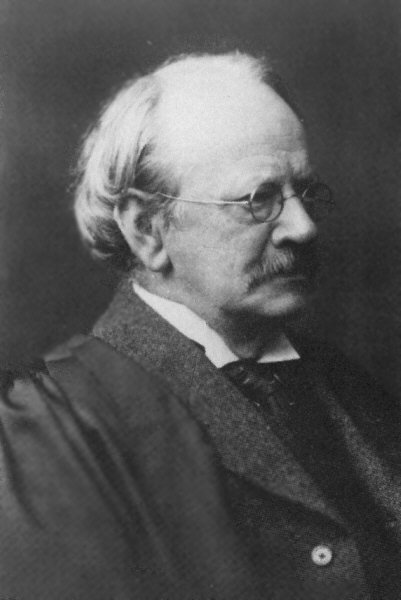





-LLNL.jpg)
.jpg)

