Fiction Quotes (24 quotes)
[Among the books he chooses, a statesman] ought to read interesting books on history and government, and books of science and philosophy; and really good books on these subjects are as enthralling as any fiction ever written in prose or verse.
In Theodore Roosevelt: An Autobiography (1913), 333.
~~[Unverified]~~ [Louis Pasteur’s] … theory of germs is a ridiculous fiction. How do you think that these germs in the air can be numerous enough to develop into all these organic infusions? If that were true, they would be numerous enough to form a thick fog, as dense as iron.
Webmaster has not yet been able to verify this quote - and is very suspicious of it - but includes it to provide this cautionary note. It appears in several books, such as Rob Kaplan, Science Says (2001), 201-202, which cites “Professor of Physiology at Toulouse, The Universe: The Infinitely Great and the Infinitely Small (1872).” Webmaster has not yet found any information on Pierre Pochet as a 19th-century scientist, anywhere. A similar book title was found as The Universe: The Infinitely Great and the Infinitely Little (1870) but that author is Félix-Archimède Pochet, Director of the Natural History Museum at Rouen. This book, translated from the French, presents germs in the normal way, with no trace of the subject quote to be found in it. The Preface (dated 1867) begins, “My sole object in writing this work was…” implying it was totally authored by F.A. Pochet with no reference to taking over from earlier work by another person. It does, however, have this curious statement: “One of my learned colleagues at the Academy of Sciences lately brought out a similar work, but under a fictitious name,” which F.A. Pochet thought was a questionable practice, and did not provide any name of the individual involved. If you find more definitive information, please contact Webmaster.
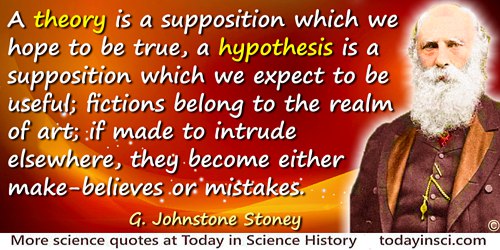
A theory is a supposition which we hope to be true, a hypothesis is a supposition which we expect to be useful; fictions belong to the realm of art; if made to intrude elsewhere, they become either make-believes or mistakes.
As quoted by William Ramsay, in 'Radium and Its Products', Harper’s Magazine (Dec 1904), 52. The first part, about suppositions, appears in a paper read by G. Johnson Stoney to the American Philosophical Society, Philadelphia (3 Apr 1903), printed in 'On the Dependence of What Apparently Takes Place in Nature Upon What Actually Occurs in the Universe of Real Existences', Proceedings of the American Philosophical Society Held at Philadelphia for Promoting Useful Knowledge (Apr-May 1903) 42, No. 173, 107. If you know a primary source for the part on fictions and mistakes, please contact Webmaster.
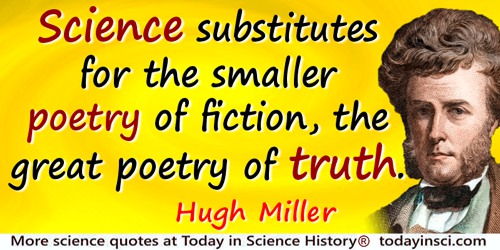
Because science flourishes, must poesy decline? The complaint serves but to betray the weakness of the class who urge it. True, in an age like the present,—considerably more scientific than poetical,—science substitutes for the smaller poetry of fiction, the great poetry of truth.
Lecture Second, collected in Popular Geology: A Series of Lectures Read Before the Philosophical Institution of Edinburgh, with Descriptive Sketches from a Geologist's Portfolio (1859), 123.
Fiction is, indeed, an indispensable supplement to logic, or even a part of it; whether we are working inductively or deductively, both ways hang closely together with fiction: and axioms, though they seek to be primary verities, are more akin to fiction. If we had realized the nature of axioms, the doctrine of Einstein, which sweeps away axioms so familiar to us that they seem obvious truths, and substitutes others which seem absurd because they are unfamiliar, might not have been so bewildering.
In The Dance of Life (1923), 86.
Fiction tends to become “fact” simply by serial passage via the printed page.
Saying.
Google can aggregate all web and paper-based information, and they can build fantastic search engines, but that will not directly lead to truth or wisdom. For that we will continue to need education, training in critical thought, and good editors who can help us winnow the fact from the fiction.
From post 're:The Pursuit of Knowledge, from Genesis to Google' to the 'Interesting People' List (6 Jan 2005) maintained by David J. Farber, now archived at interesting-people.org website.
Now it is by a fiction that the purchaser pays the mutation tax. In fact, it is always the seller who pays it. The buyer compares the money that he spends with the advantage that he gains, and this comparison determines it. If he did not make money out of it he would not buy it. When the registration tax did not exist, the purchaser had to pay the same sum for the same purpose, and this sum went into the pocket of the seller.
From Appendix A, 'Extracts From the Unpublished Writings of Carnot', Reflections on the Motive Power of Heat (1890, 2nd ed. 1897), 214-215.
One of the commonest dietary superstitions of the day is a belief in instinct as a guide to dietary excellence ... with a corollary that the diets of primitive people are superior to diets approved by science ... [and even] that light might be thrown on the problems of human nutrition by study of what chimpanzees eat in their native forests. ... Such notions are derivative of the eighteenth-century fiction of the happy and noble savage.
Nutrition and Public Health', League of Nations Health Organization Quarterly Bulletin (1935) 4, 323–474. In Kenneth J. Carpenter, 'The Work of Wallace Aykroyd: International Nutritionist and Author', The Journal of Nutrition (2007), 137, 873-878.
One should not wrongly reify “cause” and “effect,” as the natural scientists do (and whoever, like them, now “naturalizes” in his thinking), according to the prevailing mechanical doltishness which makes the cause press and push until it “effects” its end; one should use “cause” and “effect” only as pure concepts, that is to say, as conventional fictions for the purpose of designation and communication—not for explanation.
In Beyond Good and Evil (1886). Trans. W. Kaufmann (ed.), Basic Writings of Nietzsche (1968), 219.
Our imagination is stretched to the utmost, not as in fiction, to imagine things which are not really there, but just to comprehend those things which are there.
In The Character of Physical Law (1965, reprint 2001), 127-128.
Science fiction writers, I am sorry to say, really do not know anything. We can’t talk about science, because our knowledge of it is limited and unofficial, and usually our fiction is dreadful.
'How to Build a Universe That Doesn't Fall Apart Two Days Later,' introduction, I Hope I Shall Arrive Soon (1986).
Scientific practice is above all a story-telling practice. ... Biology is inherently historical, and its form of discourse is inherently narrative. ... Biology as a way of knowing the world is kin to Romantic literature, with its discourse about organic form and function. Biology is the fiction appropriate to objects called organisms; biology fashions the facts “discovered” about organic beings.
Primate Visions: Gender, Race and Nature in the World of Modern Science(1989), 4-5.
The aim of science is to discover and illuminate truth. And that, I take it, is the aim of literature, whether biography or history or fiction. It seems to me, then, that there can be no separate literature of science.
Address upon receiving National Book Award at reception, Hotel Commodore, New York (27 Jan 1952). As cited in Linda Lear, Rachel Carson: Witness for Nature (1997), 219.
The design of a book is the pattern of reality controlled and shaped by the mind of the writer. This is completely understood about poetry or fiction, but it is too seldom realized about books of fact. And yet the impulse which drives a man to poetry will send a man into the tide pools and force him to report what he finds there. Why is an expedition to Tibet undertaken, or a sea bottom dredged? Why do men, sitting at the microscope, examine the calcareous plates of a sea cucumber and give the new species a name, and write about it possessively? It would be good to know the impulse truly, not to be confused by the “services to science” platitudes or the other little mazes into which we entice our minds so that they will not know what we are doing.
In John Steinbeck and Edward Flanders Ricketts, Introduction to Sea of Cortez: a Leisurely Journal of Travel and Research (1941), opening paragraph. John Steinbeck had an interest in marine science before he met Ricketts. This book is an account of their trip in the Gulf of California, once called the Sea of Cortez, and recording the marine life to be found there.
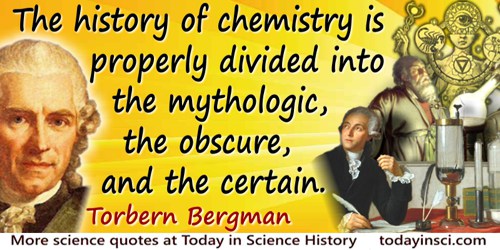
The history of chemistry is properly divided into the mythologic, the obscure, and the certain. The first period exhibits it from its infancy, deformed by fictions, until the destruction of the library of Alexandria by the Arabs. —The second, though freed in some measure from these absurdities, yet is still clothed in numberless enigmas and allegorical expressions.— The third period commences at the middle of the seventeenth century, with the first establishment of societies and academies of science; of which the wise associates, in many places uniting their efforts, determined to pursue the study of Natural Philosophy by observation and experiments, and candidly to publish their attempts in a general account of their transactions.
In Essays, Physical and Chemical (1791), 4, translated from the original Latin.
The instinct to command others, in its primitive essence, is a carnivorous, altogether bestial and savage instinct. Under the influence of the mental development of man, it takes on a somewhat more ideal form and becomes somewhat ennobled, presenting itself as the instrument of reason and the devoted servant of that abstraction, or political fiction, which is called the public good. But in its essence it remains just as baneful, and it becomes even more so when, with the application of science, it extends its scope and intensifies the power of its action. If there is a devil in history, it is this power principle.
In Mikhail Aleksandrovich Bakunin, Grigorii Petrovich Maksimov, Max Nettlau, The political philosophy of Bakunin (1953), 248.
The Mathematics are usually considered as being the very antipodes of Poesy. Yet Mathesis and Poesy are of the closest kindred, for they are both works of imagination. Poetry is a creation, a making, a fiction; and the Mathematics have been called, by an admirer of them, the sublimest and the most stupendous of fictions. It is true, they are not only μάθησις learning, but ποίησις, a creation.
From a review of William Rowan Hamilton’s, Lectures on Quaternions (1853), in 'The Imagination in Mathematics', The North American Review (Jul 1857), 85, No. 176, 229. Also in Robert Édouard Moritz, Memorabilia Mathematica; Or, The Philomath’s Quotation-book (1914), 189. The original text has “Poetry is a creation…” but the latter text gives “Poesy is a creation…”.
The neurotic ... is nailed to the cross of his fiction.
Aflred Adler and Bernard Glueck (trans.), The Neurotic Constitution: Outlines of a Comparative Individualistic Psychology and Physchotherapy (1917), 66.
The one [favourite fictional scientist] I can think of is Conan Doyle’s Professor Challenger, but he was a very irascible character and not a good role model.
From 'Interview: Of Mind and Matter: David Attenborough Meets Richard Dawkins', The Guardian (11 Sep 2010).
The task allotted to me is to state what is fact and what is fancy in our researches into immunity. We have reached the stage when we marshal our facts and court-martial our fictions.
At opening session of the Pathology Section of the British Medical Association Annual Meeting, Oxford (1904). Quoted as recollected by D.J. Hamilton in 'Obituary: The Late Prof. William Bulloch', The British Medical Journal (15 Mar 1941), 1, No. 4184, 422.
Truth is the most powerful thing in the world, since even fiction itself must be governed by it, and can only please by its resemblance.
In 'A Letter Concerning Enthusiasm', Characteristicks of Men, Manners, Opinions, Times (1723), Vol. 1, 4.
What fiction could match - in drama or suspense - man’s first walk on the Moon?
…...
When Faraday filled space with quivering lines of force, he was bringing mathematics into electricity. When Maxwell stated his famous laws about the electromagnetic field it was mathematics. The relativity theory of Einstein which makes gravity a fiction, and reduces the mechanics of the universe to geometry, is mathematical research.
In 'The Spirit of Research', III, 'Mathematical Research', in The Monist (Oct 1922), 32, No. 4, 542-543.
 In science it often happens that scientists say, 'You know that's a really good argument; my position is mistaken,' and then they would actually change their minds and you never hear that old view from them again. They really do it. It doesn't happen as often as it should, because scientists are human and change is sometimes painful. But it happens every day. I cannot recall the last time something like that happened in politics or religion.
(1987) --
In science it often happens that scientists say, 'You know that's a really good argument; my position is mistaken,' and then they would actually change their minds and you never hear that old view from them again. They really do it. It doesn't happen as often as it should, because scientists are human and change is sometimes painful. But it happens every day. I cannot recall the last time something like that happened in politics or religion.
(1987) --