Faith Quotes (213 quotes)
… There can be no doubt about faith and not reason being the ultima ratio. Even Euclid, who has laid himself as little open to the charge of credulity as any writer who ever lived, cannot get beyond this. He has no demonstrable first premise. He requires postulates and axioms which transcend demonstration, and without which he can do nothing. His superstructure indeed is demonstration, but his ground his faith. Nor again can he get further than telling a man he is a fool if he persists in differing from him. He says “which is absurd,” and declines to discuss the matter further. Faith and authority, therefore, prove to be as necessary for him as for anyone else.
In The Way of All Flesh (1917), 319-320.
’Tis a short sight to limit our faith in laws to those of gravity, of chemistry, of botany, and so forth. Those laws do not stop where our eyes lose them, but push the same geometry and chemistry up into the invisible plane of social and rational life, so that, look where we will, in a boy's game, or in the strifes of races, a perfect reaction, a perpetual judgment keeps watch and ward.
From 'Worship', The Conduct of Life (1860) collected in The Complete Works of Ralph Waldo Emerson (1866), Vol.2, 401.
“Faith” as an imperative is a veto against science—in praxi, it means lies at any price.
The Antichrist (1888) collected in Twilight of the Idols, with The Antichrist and Ecce Homo, translated by Anthony M. Ludovici (2007), 140.
“Faith” is a fine invention
When Gentlemen can see—
But Microscopes are prudent
In an Emergency.
When Gentlemen can see—
But Microscopes are prudent
In an Emergency.
Faith is a Fine Invention (c.1860). T.W. Higginson and Mabel Loomis Todd (eds.), Poems: Second Series (1892), 53.
“I should have more faith,” he said; “I ought to know by this time that when a fact appears opposed to a long train of deductions it invariably proves to be capable of bearing some other interpretation.”
Spoken by character, Sherlock Holmes, in A Study in Scarlet (1887), in Works of Arthur Conan Doyle (1902), Vol. 11, 106.
[Certain students] suppose that because science has penetrated the structure of the atom it can solve all the problems of the universe. ... They are known in every ... college as the most insufferable, cocksure know-it-alls. If you want to talk to them about poetry, they are likely to reply that the "emotive response" to poetry is only a conditioned reflex .... If they go on to be professional scientists, their sharp corners are rubbed down, but they undergo no fundamental change. They most decidedly are not set apart from the others by their intellectual integrity and faith, and their patient humility in front of the facts of nature.... They are uneducated, in the fullest sense of the word, and they certainly are no advertisement for the claims of science teachers.
In Science is a Sacred Cow (1950), 18-19.
[I]t is truth alone—scientific, established, proved, and rational truth—which is capable of satisfying nowadays the awakened minds of all classes. We may still say perhaps, 'faith governs the world,'—but the faith of the present is no longer in revelation or in the priest—it is in reason and in science.
Entry for 15 Nov 1876 in Amiel’s Journal: The Journal Intime of Henri-Frédéric Amiel, trans. Humphry Ward (1893), 234.
[Magic] enables man to carry out with confidence his important tasks, to maintain his poise and his mental integrity in fits of anger, in the throes of hate, of unrequited love, of despair and anxiety. The function of magic is to ritualize man's optimism, to enhance his faith in the victory of hope over fear. Magic expresses the greater value for man of confidence over doubt, of steadfastness over vacillation, of optimism over pessimism.
Magic, Science and Religion (1925), 90.
[May] this civic and social landmark [the Washington, D.C., Jewish Community Center] ... be a constant reminder of the inspiring service that has been rendered to civilization by men and women of the Jewish faith. May [visitors] recall the long array of those who have been eminent in statecraft, in science, in literature, in art, in the professions, in business, in finance, in philanthropy and in the spiritual life of the world.
Speech upon laying the cornerstone of the Jewish Community Center, Washington, D.C. (3 May 1925). In William J. Federer, A Treasury of Presidential Quotations (2004), 240.
[Reading a cartoon story,] the boy favored reading over reality. Adults might have characterized him in any number of negative ways—as uninquisitive, uninvolved, apathetic about the world around him and his place in it. I’ve often wondered: Are many adults much different when they read the scriptures of their respective faiths?
In Jacques Cousteau and Susan Schiefelbein, The Human, the Orchid, and the Octopus: Exploring and Conserving Our Natural World (2007), 117.
[Reply to a lady enquiring: “Have we lost faith?”] Certainly not, but we have only transferred it from God to the General Medical Council.
Invited to contribute to a series of article in a Manchester paper in reply to an enquiry [Have we lost faith?] the question, Shaws’s reply was the single sentence. In The Collected Works of Bernard Shaw (1930), Vol.22, 1.
[The intellectual] is not religious in the sense of the ordinary man is religious, for the religion of the ordinary man is man-centred and takes faith as its cornerstone. The intellectual is sparing of faith, reserving it for those things which seem, for the time at least, to be scientifically demonstrated, such as the results of repeatable experiments or natural laws tested many times. But in another sense the intellectual is more religious than the ordinary man, because he is passionately interested in the nature of things. He wants to take everything in pieces, actually or figuratively, in order to discover the plan according to which it was constructed. If an active wonder with regard to the universe is a criterion for religion, then the intellectual is very religious indeed.
From Lecture (28 Nov 1957) in the Queen’s University, Belfast, 'Is the Study of its History a Brake on the Progress of Science', printed in Hermethena (1958), 19, 28.
[The religion of science was] an implicit faith that by the methods of physical science, and by these methods alone, could be solved all the problems arising out of the relation of man to man and of man towards the universe.
In My Apprenticeship (1926), 89.
[The Royal Society] is quite simply the voice of science in Britain. It is intellectually rigorous, not afraid to be outspoken on controversial issues such as climate change, but it is not aggressively secular either, insisting on a single view of the world. In fact, there are plenty of eminent scientists – Robert Winston, for instance – who are also men of faith.
Quoted in Max Davidson, 'Bill Bryson: Have faith, science can solve our problems', Daily Telegraph (26 Sep 2010)
[W]e have made a thing, a most terrible weapon, that has altered abruptly and profoundly the nature of the world. We have made a thing that, by all standards of the world we grew up in, is an evil thing. And by doing so, by our participation in making it possible to make these things, we have raised again the question of whether science is good for man, of whether it is good to learn about the world, to try to understand it, to try to control it, to help give to the world of men increased insight, increased power. Because we are scientists, we must say an unalterable yes to these questions; it is our faith and our commitment, seldom made explicit, even more seldom challenged, that knowledge is a good in itself, knowledge and such power as must come with it.
Speech to the American Philosophical Society (Jan 1946). 'Atomic Weapons', printed in Proceedings of the American Philosophical Society, 90(1), 7-10. In Deb Bennett-Woods, Nanotechnology: Ethics and Society (2008), 23. Identified as a speech to the society in Kai Bird, Martin J. Sherwin, American Prometheus: the Triumph and Tragedy of J. Robert Oppenheimer (2005), 323.
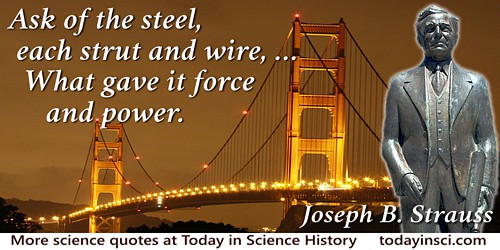
The Mighty Task is Done
At last the mighty task is done;
Resplendent in the western sun
The Bridge looms mountain high;
Its titan piers grip ocean floor,
Its great steel arms link shore with shore,
Its towers pierce the sky.
On its broad decks in rightful pride,
The world in swift parade shall ride,
Throughout all time to be;
Beneath, fleet ships from every port,
Vast landlocked bay, historic fort,
And dwarfing all the sea.
To north, the Redwood Empires gates;
To south, a happy playground waits,
In Rapturous appeal;
Here nature, free since time began,
Yields to the restless moods of man,
Accepts his bonds of steel.
Launched midst a thousand hopes and fears,
Damned by a thousand hostile sneers,
Yet Neer its course was stayed,
But ask of those who met the foe
Who stood alone when faith was low,
Ask them the price they paid.
Ask of the steel, each strut and wire,
Ask of the searching, purging fire,
That marked their natal hour;
Ask of the mind, the hand, the heart,
Ask of each single, stalwart part,
What gave it force and power.
An Honored cause and nobly fought
And that which they so bravely wrought,
Now glorifies their deed,
No selfish urge shall stain its life,
Nor envy, greed, intrigue, nor strife,
Nor false, ignoble creed.
High overhead its lights shall gleam,
Far, far below lifes restless stream,
Unceasingly shall flow;
For this was spun its lithe fine form,
To fear not war, nor time, nor storm,
For Fate had meant it so.
At last the mighty task is done;
Resplendent in the western sun
The Bridge looms mountain high;
Its titan piers grip ocean floor,
Its great steel arms link shore with shore,
Its towers pierce the sky.
On its broad decks in rightful pride,
The world in swift parade shall ride,
Throughout all time to be;
Beneath, fleet ships from every port,
Vast landlocked bay, historic fort,
And dwarfing all the sea.
To north, the Redwood Empires gates;
To south, a happy playground waits,
In Rapturous appeal;
Here nature, free since time began,
Yields to the restless moods of man,
Accepts his bonds of steel.
Launched midst a thousand hopes and fears,
Damned by a thousand hostile sneers,
Yet Neer its course was stayed,
But ask of those who met the foe
Who stood alone when faith was low,
Ask them the price they paid.
Ask of the steel, each strut and wire,
Ask of the searching, purging fire,
That marked their natal hour;
Ask of the mind, the hand, the heart,
Ask of each single, stalwart part,
What gave it force and power.
An Honored cause and nobly fought
And that which they so bravely wrought,
Now glorifies their deed,
No selfish urge shall stain its life,
Nor envy, greed, intrigue, nor strife,
Nor false, ignoble creed.
High overhead its lights shall gleam,
Far, far below lifes restless stream,
Unceasingly shall flow;
For this was spun its lithe fine form,
To fear not war, nor time, nor storm,
For Fate had meant it so.
Written upon completion of the building of the Golden Gate Bridge, May 1937. In Allen Brown, Golden Gate: biography of a Bridge (1965), 229.
Il n'y a qu'un demi-siècle, un orateur chrétien, se défiant des hommes de la science leur disait: 'Arrêtez-vous enfin, et ne creusez pas jusqu'aux enfers.' Aujourd'hui, Messieurs, rassurés sur l'inébranlable constance de notre foi, nous vous disons: creusez, creusez encore; plus vous descendrez, plus vous rapprocherez du grand mystère de l'impuissance de l'homme et de la vérité de la religion. Creusez donc, creusez toujours,mundum tradidit disputationibus eorum; et quand la science aura donné son dernier coup de marteau sur les fondements de la terre, vous pourrez à la lueur du feu qu'il fera jaillir, lire encore l'idée de Dieu et contempler l'empreinte de sa main.
Only a half-century ago, a Christian speaker, mistrustful of men of science told them: 'Stop finally, and do not dig to hell.' Today, gentlemen, reassured about the steadfastness of our unshakeable faith, we say: dig, dig again; the further down you, the closer you come to the great mystery of the impotence of man and truth of religion. So dig, always dig: and when science has stuck its final hammer blow on the bosom of the earth, you will be able to ignite a burst of light, read furthermore the mind of God and contemplate the imprint of His hand.
Only a half-century ago, a Christian speaker, mistrustful of men of science told them: 'Stop finally, and do not dig to hell.' Today, gentlemen, reassured about the steadfastness of our unshakeable faith, we say: dig, dig again; the further down you, the closer you come to the great mystery of the impotence of man and truth of religion. So dig, always dig: and when science has stuck its final hammer blow on the bosom of the earth, you will be able to ignite a burst of light, read furthermore the mind of God and contemplate the imprint of His hand.
As Monseigneur Rendu, Bishop of Annecy, Savoy, presiding at the closing session of a meeting of the Geological Society of France at Chambéry, Savoy (27 Aug 1844). In Bulletin de la Société Géologique de France 1843 à 1844, Tome 1, Ser. 2, 857. (1844), li. Google trans., edited by Webmaster.
Ueber den Glauben lässt sich wissenschaftlich nicht rechten, denn die Wissenschaft und der Glaube schliessen sich aus. Nicht so, dass der eine die andere unmöglich machte oder umgekehrt, sondern so, dass, soweit die Wissenschaft reicht, kein Glaube existirt und der Glaube erst da anfangen darf, wo die Wissenschaft aufhört. Es lässt „sich nicht läugnen, dass, wenn diese Grenze eingehalten wird, der Glaube wirklich reale Objekte haben kann. Die Aufgabe der Wissenschaft ist es daher nicht, die Gegenstände des Glaubens anzugreifen, sondern nur die Grenzen zu stecken, welche die Erkenntniss erreichen kann, und innerhalb derselben das einheitliche Selbstbewusstsein zu begründen.
There is no scientific justification for faith, for science and faith are mutually exclusive. Not that one made the other impossible, or vice versa, but that, as far as science goes, there is no faith, and faith can only begin where science ends. It can not be denied that, if this limit is adhered to, faith can really have real objects. The task of science, therefore, is not to attack the objects of faith, but merely to set the limits which knowledge can attain and to establish within it the unified self-esteem.
There is no scientific justification for faith, for science and faith are mutually exclusive. Not that one made the other impossible, or vice versa, but that, as far as science goes, there is no faith, and faith can only begin where science ends. It can not be denied that, if this limit is adhered to, faith can really have real objects. The task of science, therefore, is not to attack the objects of faith, but merely to set the limits which knowledge can attain and to establish within it the unified self-esteem.
Original German from 'Der Mensch' (1849), collected in Gesammelte abhandlungen zur wissenschaftlichen medicin (1856), 6. Webmaster used Google translate for the English version. This longer quote unites the shorter quotes from within it shown separately on the Rudolf Virchow quotations page, with alternative translations, which begin: “There can be no scientific dispute…”, “Belief has no place…”, and “The task of science…”.
Where faith commences, science ends. Both these arts of the human mind must be strictly kept apart from each other. Faith has its origin in the poetic imagination; knowledge, on the other hand, originates in the reasoning intelligence of man. Science has to pluck the blessed fruits from the tree of knowledge, unconcerned whether these conquests trench upon the poetical imaginings of faith or not.
In Ernst Haeckel and E. Ray Lankester (trans.), The History of Creation (1880), Vol. 1, 9.
SIR TOBY: Does not our lives consist of the four elements?
SIR ANDREW: Faith, so they say; but I think it rather consists of eating and drinking.
SIR TOBY: Thou'rt a scholar; let us therefore eat and drink.
SIR ANDREW: Faith, so they say; but I think it rather consists of eating and drinking.
SIR TOBY: Thou'rt a scholar; let us therefore eat and drink.
Twelfth Night (1601), II, iii.
A discovery in science, or a new theory, even when it appears most unitary and most all-embracing, deals with some immediate element of novelty or paradox within the framework of far vaster, unanalysed, unarticulated reserves of knowledge, experience, faith, and presupposition. Our progress is narrow; it takes a vast world unchallenged and for granted. This is one reason why, however great the novelty or scope of new discovery, we neither can, nor need, rebuild the house of the mind very rapidly. This is one reason why science, for all its revolutions, is conservative. This is why we will have to accept the fact that no one of us really will ever know very much. This is why we shall have to find comfort in the fact that, taken together, we know more and more.
Science and the Common Understanding (1954), 53-4.
A political law or a scientific truth may be perilous to the morals or the faith of individuals; but it cannot on this ground be resisted by the Church. … A discovery may be made in science which will shake the faith of thousands; yet religion cannot regret it or object to it. The difference in this respect between a true and a false religion is, that one judges all things by the standard of their truth, the other by the touchstone of its own interests. A false religion fears the progress of all truth; a true religion seeks and recognises truth wherever it can be found.
From 'Cardinal Wiseman and the Home and Foreign Review' (1862), collected in John Emerich Edward Dalberg Acton Baron Acton, John Neville Figgis (ed.) and Reginald Vere Laurence (ed.), The History of Freedom and Other Essays (1907), 449-450. The Darwinian controversy was at its height when this was written.
A religion old or new, that stressed the magnificence of the universe as revealed by modern science, might be able to draw forth reserves of reverence and awe hardly tapped by the conventional faiths. Sooner or later such a religion will emerge.
Pale Blue Dot: a Vision of the Human Future in Space (1994), 52.
Again and again the imaginary plan on which one attempts to build up order breaks down and then we must try another. This imaginative vision and faith in the ultimate success are indispensable. The pure rationalist has no place here.
In Max Planck and James Vincent Murphy (trans.), Where Is Science Going? (1932), 215.
All talk about science purely for its practical and wealth-producing results is … idle. … Practical results will follow right enough. No real knowledge is sterile. … With this faith in the ultimate usefulness of all real knowledge a man may proceed to devote himself to a study of first causes without apology, and without hope of immediate return.
Quoted in Larry R. Squire (ed.), The History of Neuroscience in Autobiography (1996), Vol. 1, 350-351. The above is a highlight excerpted from a longer quote beginning “To prove to an indignant questioner ….” in this same collection for A. V. Hill.
Ampère was a mathematician of various resources & I think might rather be called excentric [sic] than original. He was as it were always mounted upon a hobby horse of a monstrous character pushing the most remote & distant analogies. This hobby horse was sometimes like that of a child ['s] made of heavy wood, at other times it resembled those [?] shapes [?] used in the theatre [?] & at other times it was like a hypogrif in a pantomime de imagie. He had a sort of faith in animal magnetism & has published some refined & ingenious memoirs to prove the identity of electricity & magnetism but even in these views he is rather as I said before excentric than original. He has always appeared to me to possess a very discursive imagination & but little accuracy of observation or acuteness of research.
'Davy’s Sketches of his Contemporaries', Chymia, 1967, 12, 135-6.

And ‘tis my faith that every flower
Enjoys the air it breathes.
Enjoys the air it breathes.
In Lines Written in Early Spring (1798). In The Works of William Wordsworth (1994), Book 4, 482.
Anybody who has been seriously engaged in scientific work of any kind realizes that over the entrance to the gates of the temple of science are written the words: Ye must have faith. It is a quality which the scientist cannot dispense with.
In Max Planck and James Vincent Murphy (trans.), Where is Science Going?, (1932), 214.
Are we using science in ways that it wasn't intended to, in which case we should be a little careful, or are we using faith in ways that faith wasn't really designed for? There are certain questions that are better answered by one approach than the other, and if you start mixing that up, then you end up in … conflict.
From video of interview with Huffington post reporter at the 2014 Davos Annual Meeting, World Economic Forum (25 Jan 2014). On web page 'Dr. Francis Collins: “There Is An Uneasiness” About Evolution'
As for those wingy mysteries in divinity, and airy subtleties in religion, which have unhinged the brains of better heads, they never stretched the pia mater of mine: methinks there be not impossibilities enough in Religion for an active faith.
In T. Chapman (ed.), Religio Medici (1643, 1831), part 1, sect. 9, 17.
At this point, however, I have no intention whatever of criticizing the false teachings of Galen, who is easily first among the professors of dissection, for I certainly do not wish to start off by gaining a reputation for impiety toward him, the author of all good things, or by seeming insubordinate to his authority. For I am well aware how upset the practitioners (unlike the followers of Aristotle) invariably become nowadays, when they discover in the course of a single dissection that Galen has departed on two hundred or more occasions from the true description of the harmony, function, and action of the human parts, and how grimly they examine the dissected portions as they strive with all the zeal at their command to defend him. Yet even they, drawn by their love of truth, are gradually calming down and placing more faith in their own not ineffective eyes and reason than in Galen’s writings.
From De Humani Corporis Fabrica Libri Septem: (1543), Book I, iv, as translated by William Frank Richardson, in On The Fabric of the Human Body: Book I: The Bones and Cartilages (1998), Preface, liv.
Behind and permeating all our scientific activity, whether in critical analysis or in discovery, there is an elementary and overwhelming faith in the possibility of grasping the real world with out concepts, and, above all, faith in the truth over which we have no control but in the service of which our rationality stands or falls. Faith and intrinsic rationality are interlocked with one another
Christian Theology of Scientific Culture (1981), 63. In Vinoth Ramachandra, Subverting Global Myths: Theology and the Public Issues Shaping our World (2008), 187.
Belief cannot be reckoned with in terms of science, for science and faith are mutually exclusive.
In Fielding Hudson Garrison, An Introduction to the History of Medicine (1966), 576.
Blessings on Science! When the earth seem’d old,
When Faith grew doting, and the Reason cold,
Twas she discover’d that the world was young,
And taught a language to its lisping tongue:
’Twas she disclosed a future to its view,
And made old knowledge pale before the new.
When Faith grew doting, and the Reason cold,
Twas she discover’d that the world was young,
And taught a language to its lisping tongue:
’Twas she disclosed a future to its view,
And made old knowledge pale before the new.
From poem, 'Railways' (1846), collected in The Poetical Works of Charles Mackay: Now for the First Time Collected Complete in One Volume (1876), 214.
Both Religion and science require faith in God. For believers, God is in the beginning, and for physicists He is at the end of all considerations.
Sometimes seen attributed (doubtfully?) to Max Planck. Widely seen on the web, but always without citation. Webmaster has not yet found any evidence in print that this is a valid Planck quote, and must be skeptical that it is. Contact Webmaster if you know a primary source.
But having considered everything which has been said, one could by this believe that the earth and not the heavens is so moved, and there is no evidence to the contrary. Nevertheless, this seems prima facie as much, or more, against natural reason as are all or several articles of our faith. Thus, that which I have said by way of diversion (esbatement) in this manner can be valuable to refute and check those who would impugn our faith by argument.
On the Book of the Heavens and the World of Aristotle [1377], bk. II, ch. 25, sect. 10, trans. A. D. Menut and A. J. Denomy, quoted in Marshall Clagett, The Science of Mechanics in the Middle Ages (1959), 606.
By research in pure science I mean research made without any idea of application to industrial matters but solely with the view of extending our knowledge of the Laws of Nature. I will give just one example of the ‘utility’ of this kind of research, one that has been brought into great prominence by the War—I mean the use of X-rays in surgery. Now, not to speak of what is beyond money value, the saving of pain, or, it may be, the life of the wounded, and of bitter grief to those who loved them, the benefit which the state has derived from the restoration of so many to life and limb, able to render services which would otherwise have been lost, is almost incalculable. Now, how was this method discovered? It was not the result of a research in applied science starting to find an improved method of locating bullet wounds. This might have led to improved probes, but we cannot imagine it leading to the discovery of X-rays. No, this method is due to an investigation in pure science, made with the object of discovering what is the nature of Electricity. The experiments which led to this discovery seemed to be as remote from ‘humanistic interest’ —to use a much misappropriated word—as anything that could well be imagined. The apparatus consisted of glass vessels from which the last drops of air had been sucked, and which emitted a weird greenish light when stimulated by formidable looking instruments called induction coils. Near by, perhaps, were great coils of wire and iron built up into electro-magnets. I know well the impression it made on the average spectator, for I have been occupied in experiments of this kind nearly all my life, notwithstanding the advice, given in perfect good faith, by non-scientific visitors to the laboratory, to put that aside and spend my time on something useful.
In Speech made on behalf of a delegation from the Conjoint Board of Scientific Studies in 1916 to Lord Crewe, then Lord President of the Council. In George Paget Thomson, J. J. Thomson and the Cavendish Laboratory in His Day (1965), 167-8.
By the fruit one judges the tree; the tree of science grows exceedingly slowly; centuries elapse before one can pluck the ripe fruits; even today it is hardly possible for us to shell and appraise the kernel of the teachings that blossomed in the seventeenth century. He who sows cannot therefore judge the worth of the corn. He must have faith in the fruitfulness of the seed in order that he may follow untiringly his chosen furrow when he casts his ideas to the four winds of heaven.
As quoted in Philipp Frank, Modern Science and its Philosophy (1949), 62, which cites Évolution de la Mécanique (1903).
DOCTOR. Always preceded by “The good”. Among men, in familiar conversation, “Oh! balls, doctor!” Is a wizard when he enjoys your confidence, a jack-ass when you're no longer on terms. All are materialists: “you can't probe for faith with a scalpel.”
The Dictionary of Accepted Ideas (1881), trans. Jaques Barzun (1968), 30.
Does the evolutionary doctrine clash with religious faith? It does not. It is a blunder to mistake the Holy Scriptures for elementary textbooks of astronomy, geology, biology, and anthropology. Only if symbols are construed to mean what they are not intended to mean can there arise imaginary, insoluble conflicts. ... the blunder leads to blasphemy: the Creator is accused of systematic deceitfulness.
In 'Nothing in Biology Makes Sense Except in the Light of Evolution', The American Biology Teacher (Mar 1973), 125-129.
Drugs are not always necessary. Belief in recovery always is.
Anatomy of an Illness As Perceived by the Patient: Reflections on Healing (2005), 55.
Even though the realms of religion and science in themselves are clearly marked off from each other, nevertheless there exist between the two strong reciprocal relationships and dependencies. Though religion may be that which determines the goal, it has, nevertheless, learned from science, in the broadest sense, what means will contribute to the attainment of the goals it has set up. But science can only be created by those who are thoroughly imbued with the aspiration toward truth and understanding. This source of feeling, however, springs from the sphere of religion. To this there also belongs the faith in the possibility that the regulations valid for the world of existence are rational, that is, comprehensible to reason. I cannot conceive of a genuine scientist without that profound faith. The situation may be expressed by an image: science without religion is lame, religion without science is blind.
From paper 'Science, Philosophy and Religion', prepared for initial meeting of the Conference on Science, Philosophy and Religion in Their Relation to the Democratic Way of Life, at the Jewish Theological Seminary of America, New York City (9-11 Sep 1940). Collected in Albert Einstein: In His Own Words (2000), 212.
Every mathematical book that is worth reading must be read “backwards and forwards”, if I may use the expression. I would modify Lagrange’s advice a little and say, “Go on, but often return to strengthen your faith.” When you come on a hard or dreary passage, pass it over; and come back to it after you have seen its importance or found the need for it further on.
In Algebra, Part 2 (1889), Preface, viii.
Every utterance from government - from justifying 90-day detention to invading other countries [and] to curtailing civil liberties - is about the dangers of religious division and fundamentalism. Yet New Labour is approving new faith schools hand over fist. We have had the grotesque spectacle of a British prime minister, on the floor of the House of Commons, defending - like some medieval crusader - the teaching of creationism in the science curriculum at a sponsor-run school whose running costs are wholly met from the public purse.
In The Guardian (10 Apr 2006).
Evolution ... is really two theories, the vague theory and the precise theory. The vague theory has been abundantly proved.... The precise theory has never been proved at all. However, like relativity, it is accepted on faith.... On getting down to actual details, difficulties begin.
In Science is a Sacred Cow (1950), 101 & 103.
Facts are certainly the solid and true foundation of all sectors of nature study ... Reasoning must never find itself contradicting definite facts; but reasoning must allow us to distinguish, among facts that have been reported, those that we can fully believe, those that are questionable, and those that are false. It will not allow us to lend faith to those that are directly contrary to others whose certainty is known to us; it will not allow us to accept as true those that fly in the face of unquestionable principles.
Memoires pour Servir a l'Histoire des Insectes (1736), Vol. 2, xxxiv. Quoted in Jacques Roger, The Life Sciences in Eighteenth-Century French Thought, ed. Keith R. Benson and trans. Robert Ellrich (1997), 165.
Faith and knowledge lean largely upon each other in the practice of medicine.
In The Collected Works of Dr. P.M. Latham (1878), Vol. 2, 408.
Faith is a knowledge within the heart, beyond the reach of proof.
In The Kahlil Gibran Reader: Inspirational Writings (2006), 38.
Faith is a permanent and vital endowment of the human mind—a part of reason itself. The insane alone are without it.
A Shadow Passes (1919), 62.
Faith is a wondrous thing; it is not only capable of moving mountains, but also of making you believe that a herring is a race horse.
In Andre Gide et al., "The God That Failed" (1952), 39
Faith is different from proof; the latter is human, the former is a Gift from God.
In Pensées (1670), Section 10, 11. As translated in Blaise Pascal and W.F. Trotter (trans.), 'Thoughts', No. 248, collected in Charles W. Eliot (ed.), The Harvard Classics (1910), Vol. 48, 92. From the original French, “La foi est différente de la preuve: l’une est humaine, l’autre est un don de Dieu,” in Ernest Havet (ed.), Pensées de Pascal (1892), 276.
Faith is like electricity. You can't see it, but you can see its light shining on you.
In 'Quotes and Quips', Hinduism Today Magazine (Jan-Mar 2009), web edition.
Faith is taking the first step even when you don’t see the whole staircase.
Epigraph (without citation) in Pia Hansen, Mathematics Coaching Handbook: Working with Teachers to Improve Instruction (2009), 1.
For science, in so far as it is a substitute for religion, and reason, in so far as it is a substitute for faith, have always foundered. Science will be able to satisfy in an increasing measure, and in fact does satisfy, our increasing logical and intellectual needs, our desire to know and understand the truth; but science does not satisfy the needs of our heart and our will, our hunger for immortality—far from satisfying it, it contradicts it.
From Miguel Unamuno and J. E. Crawford Flitch (trans.), Essays and Soliloquies (1926), 209.
For strictly scientific or technological purposes all this is irrelevant. On a pragmatic view, as on a religious view, theory and concepts are held in faith. On the pragmatic view the only thing that matters is that the theory is efficacious, that it “works” and that the necessary preliminaries and side issues do not cost too much in time and effort. Beyond that, theory and concepts go to constitute a language in which the scientistic matters at issue can be formulated and discussed.
In Nobel Lecture (8 Dec 1994), 'Slow Neutron Spectroscopy and the Grand Atlas of the Physical World', Nobel Lectures: Physics 1991-1995 (1997), 111.
Geology, ethnology, what not?—(Greek endings, each the little passing bell
That signifies some faith’s about to die.)
That signifies some faith’s about to die.)
Give me the storm and tempest of thought and action, rather than the dead calm of ignorance and faith. Banish me from Eden when you will, but first let me eat of the fruit of the Tree of Knowledge.
Epigraph, title page of The Works of Robert G. Ingersoll (1902), Vol. 3. Since it is not printed with a citation, Webmaster believes it is attributable to the author of the book.

Governments, universities and industry must put their faith in science and tell their people to study what they want to study.
From speech at the University of Saskatchewan, as quoted in Sean Trembath, 'Chemist Henry Taube Was Saskatchewan's First Nobel Laureate', Saskatoon StarPhoenix (5 Jan 2017).
Great is the faith of the flush of knowledge and of the investigation of the depths of qualities and things.
In Walt Whitman and William Michael Rossetti (ed.), 'Preface to the First Edition of Leaves of Grass', Poems By Walt Whitman (1868), 46.
Have faith in the Lord but use sulphur for the itch.
He had seen too much of the cosmos to have any great faith in man's ability to understand it.
Ghetto (1954)
Hope is faith holding out its hands in the dark.
From chapter 'Jottings from a Note-book', in Canadian Stories (1918), 167.
I am afraid I am not in the flight for “aerial navigation”. I was greatly interested in your work with kites; but I have not the smallest molecule of faith in aerial navigation other than ballooning or of expectation of good results from any of the trials we hear of. So you will understand that I would not care to be a member of the aëronautical Society.
Letter (8 Dec 1896) to Baden Powell. This is the full text of the letter. An image of the handwritten original is on the zapatopi.net website
I am by training a positivist, by inclination a pragmatist, in temperament a mystic, in practice a democrat; my faith Jewish, educated by Catholics, a habitual Protestant; born in Europe, raised in the Midwest, hardened in the East, softened in California and living in Israel.
Given as “said of himself”, in Eyal Diskin, 'Abraham Kaplan' in Michael Berenbaum and Fred Skolnik (eds.), Encyclopaedia Judaica (2007).
I beg to present Columbus as a man of science and a man of faith. As a scientist, considering the time in which he lived, he eminently deserves our respect. Both in theory and in practice he was one of the best geographers and cosmographers of the age.
Address, in Chicago (12 Oct 1892). In E.S. Werner (ed.), Werner's Readings and Recitations (1908), 71.
I believe as a matter of faith that the extension of space travel to the limits of the solar system will probably be accomplished in several decades, perhaps before the end of the century. Pluto is 4000 million miles from the sun. The required minimum launching velocity is about 10 miles per second and the transit time is 46 years. Thus we would have to make the velocity considerably higher to make the trip interesting to man. Travel to the stars is dependent on radically new discoveries in science and technology. The nearest star is 25 million million miles way and requires a travel time of more than four years at the speed of light. Prof. Dr. Ing. E. Sanger has speculated that velocities comparable with the speed of light might be attained in the next century, but such extrapolation of current technology is probably not very reliable.
In Popular Mechanics (Sep 1961), 262.
I believe that the useful methods of mathematics are easily to be learned by quite young persons, just as languages are easily learned in youth. What a wondrous philosophy and history underlie the use of almost every word in every language—yet the child learns to use the word unconsciously. No doubt when such a word was first invented it was studied over and lectured upon, just as one might lecture now upon the idea of a rate, or the use of Cartesian co-ordinates, and we may depend upon it that children of the future will use the idea of the calculus, and use squared paper as readily as they now cipher. … When Egyptian and Chaldean philosophers spent years in difficult calculations, which would now be thought easy by young children, doubtless they had the same notions of the depth of their knowledge that Sir William Thomson might now have of his. How is it, then, that Thomson gained his immense knowledge in the time taken by a Chaldean philosopher to acquire a simple knowledge of arithmetic? The reason is plain. Thomson, when a child, was taught in a few years more than all that was known three thousand years ago of the properties of numbers. When it is found essential to a boy’s future that machinery should be given to his brain, it is given to him; he is taught to use it, and his bright memory makes the use of it a second nature to him; but it is not till after-life that he makes a close investigation of what there actually is in his brain which has enabled him to do so much. It is taken because the child has much faith. In after years he will accept nothing without careful consideration. The machinery given to the brain of children is getting more and more complicated as time goes on; but there is really no reason why it should not be taken in as early, and used as readily, as were the axioms of childish education in ancient Chaldea.
In Teaching of Mathematics (1902), 14.
I cannot accept any concept of God based on the fear of life or the fear of death, or blind faith.
As recollected from a visit some months earlier, and quoted in William Miller, 'Old Man’s Advice to Youth: “Never Lose a Holy Curiosity”', Life (2 May 1955), 62.
I do not think words alone will solve humanity’s present problems. The sound of bombs drowns out
men’s voices. In times of peace I have great faith in the communication of ideas among thinking men, but today, with brute force dominating so many millions of lives, I fear that the appeal to
man’s intellect is fast becoming virtually meaningless.
In 'I Am an American' (22 Jun 1940), Einstein Archives 29-092. Excerpted in David E. Rowe and Robert J. Schulmann, Einstein on Politics: His Private Thoughts and Public Stands on Nationalism, Zionism, War, Peace, and the Bomb (2007), 470. It was during a radio broadcast for the Immigration and Naturalization Service, interviewed by a State Department Official. Einstein spoke following an examination on his application for American citizenship in Trenton, New Jersey. The attack on Pearl Harbor and America’s declaration of war on Japan was still over a year in the future.
I have always felt that astronomical hypotheses should not be regarded as articles of faith, but should only serve as a framework for astronomical calculations, so that it does not matter whether they were right or wrong, as long as the phenomena can be characterized precisely. For who could possibly be certain as to whether the uneven movement of the sun, if we follow the hypotheses of Ptolemy, can be explained by assuming an epicycle or eccentricity. Both assumptions are plausible. That’s why I would consider it quite desirable for you to tell something about that in the preface. In this way you would appease the Aristotelians and the theologians, whose opposition you dread.
From surviving fragment of a Letter (20 Apr 1541) answering a query from Copernicus as to whether he should publish his book (De Revolutionibus). From the German in Leopold Friedrich Prowe, Nicolaus Coppernicus (1883), Vol. 1, Part 2, 521-522. Translated from Prowe by Webmaster using web resources. Original German: “Hypothesen nicht als Glaubens-Artikel zu betrachten seien, sondern nur als Grundlage für die astronomischen Rechnungen zu dienen hätten, so dass es nicht darauf ankomme, ob sie richtig oder falsch seien, wofern sich nur die Erscheinungen dadurch genau bestimmen liessen. »Denn wer dürfte uns wohl darüber sichere Auskunft geben, ob die ungleiche Bewegung der Sonne, wenn wir den Hypothesen des Ptolemaeus folgen, durch Annahme eines Epicykels oder der Ekcentricität zu erklären sei. Beide Annahmen sind gestattet. Daher würde ich—so schliesst Osiander—es für recht wünschenswerth erachten, wenn Du hierüber in der Vorrede etwas beibrächtest. Auf diese Weise würdest Du die Aristoteliker und die Theologen milder stimmen, von denen Du befürchtest, dass sie heftigen Widerspruch kundthun werden.«” Compare Latin text, from Johannes Kepler, 'Apologia Tychonia', Astronomi Opera Omnia (1858), Vol. 1, 246: “De hypothesibus ego sic sensi semper, non esse articulos fidei, sed fundamenta calculi ita ut, etiamsi falsae sint, modo motuum φαινομενα exacte exhibeant, nihil referat; quis enim nos certiores reddet, an Solis inaequalis motus nomine epicycli an nomine eccentricitatis contingat, si Ptolemaei hypotheses sequamur, cum id possit utrumque. Quare plausibile fore videretur, si hac de re in praefatione nonnihil attingeres. Sic enim placidiores redderes peripatheticos et theologos, quos contradicturos metuis.”
I have deep faith that the principle of the universe will be beautiful and simple.
…...
I have learned to have more faith in the scientist than he does in himself.
As quoted in Obituary, Newsweek (27 Dec 1971).
I have no great faith in political arithmetic.
In An inquiry into the nature and causes of the wealth of nations (1789), 310.
I have not the smallest molecule of faith in aerial navigation other than ballooning.
From letter (8 Dec 1896) to Baden Powell. The full text of the letter, which begins “I am afraid I am not in the flight for “aerial navigation.”…, is on the Lord Kelvin Quotes page of this website.
I have said that science is impossible without faith. … Inductive logic, the logic of Bacon, is rather something on which we can act than something which we can prove, and to act on it is a supreme assertion of faith … Science is a way of life which can only fluorish when men are free to have faith.
In Calyampudi Radhakrishna Rao, Statistics and Truth (1997), 31.
I know nothing of the science of astrology and I consider it to be a science, if it is a science, of doubtful value, to be severely left alone by those who have any faith in Providence.
The Collected Works of Mahatma Gandhi (1976), Vol. 36, 46.
I pray every day and I think everybody should. I don’t think you can be up here and look out the window as I did the first day and look out at the Earth from this vantage point. We’re not so high compared to people who went to the moon and back. But to look out at this kind of creation out here and not believe in God is, to me, impossible. It just strengthens my faith.
From NASA transcript of News Conference by downlink from Space Shuttle Discovery during its STS-95 Mission in Earth orbit (5 Nov 1998). In response to question from Paul Hoveston of USA Today asking John Glenn about how the space flight strengthened his faith and if he had any time to pray in orbit.
I prefer rationalism to atheism. The question of God and other objects-of-faith are outside reason and play no part in rationalism, thus you don't have to waste your time in either attacking or defending.
In Isaac Asimov and Janet Asimov (ed.), It's Been a Good Life (2002), 21. Attribution uncertain. If you know an original print citation, please contact Webmaster.
I see no reason to believe that a creator of protoplasm or primeval matter, if such there be, has any reason to be interested in our insignificant race in a tiny corner of the universe, and still less in us, as still more insignificant individuals. Again, I see no reason why the belief that we are insignificant or fortuitous should lessen our faith.
Letter to her father, Ellis Franklin, undated, perhaps summer 1940 while she was an undergraduate at Cambridge. Excerpted in Brenda Maddox, The Dark Lady of DNA (2002), 61.
I should rejoice to see … Euclid honourably shelved or buried “deeper than did ever plummet sound” out of the schoolboys’ reach; morphology introduced into the elements of algebra; projection, correlation, and motion accepted as aids to geometry; the mind of the student quickened and elevated and his faith awakened by early initiation into the ruling ideas of polarity, continuity, infinity, and familiarization with the doctrines of the imaginary and inconceivable.
From Presidential Address (1869) to the British Association, Exeter, Section A, collected in Collected Mathematical Papers of Lames Joseph Sylvester (1908), Vol. 2, 657. Also in George Edward Martin, The Foundations of Geometry and the Non-Euclidean Plane (1982), 93. [Note: “plummet sound” refers to ocean depth measurement (sound) from a ship using a line dropped with a weight (plummet). —Webmaster]
I wanted certainty in the kind of way in which people want religious faith. I thought that certainty is more likely to be found in mathematics than elsewhere. But I discovered that many mathematical demonstrations, which my teachers expected me to accept, were full of fallacies, and that, if certainty were indeed discoverable in mathematics, it would be in a new field of mathematics, with more solid foundations than those that had hitherto been thought secure. But as the work proceeded, I was continually reminded of the fable about the elephant and the tortoise. Having constructed an elephant upon which the mathematical world could rest, I found the elephant tottering, and proceeded to construct a tortoise to keep the elephant from falling. But the tortoise was no more secure than the elephant, and after some twenty years of very arduous toil, I came to the conclusion that there was nothing more that I could do in the way of making mathematical knowledge indubitable.
In 'Reflections on my Eightieth Birthday', Portraits from Memory (1956), 54.
I, Galileo Galilei, son of the late Vincenzo Galilei, of Florence, aged seventy years, being brought personally to judgment, and kneeling before your Most Eminent and Most Reverend Lords Cardinals, General Inquisitors of the universal Christian republic against heretical depravity, having before my eyes the Holy Gospels, which I touch with my own hands, swear that I have always believed, and now believe, and with the help of God will in future believe, every article which the Holy Catholic and Apostolic Church of Rome holds, teaches, and preaches. But because I have been enjoined by this Holy Office altogether to abandon the false opinion which maintains that the sun is the centre and immovable, and forbidden to hold, defend, or teach the said false doctrine in any manner, and after it hath been signified to me that the said doctrine is repugnant with the Holy Scripture, I have written and printed a book, in which I treat of the same doctrine now condemned, and adduce reasons with great force in support of the same, without giving any solution, and therefore have been judged grievously suspected of heresy; that is to say, that I held and believed that the sun is the centre of the universe and is immovable, and that the earth is not the centre and is movable; willing, therefore, to remove from the minds of your Eminences, and of every Catholic Christian, this vehement suspicion rightfully entertained toward me, with a sincere heart and unfeigned faith, I abjure, curse, and detest the said errors and heresies, and generally every other error and sect contrary to Holy Church; and I swear that I will never more in future say or assert anything verbally, or in writing, which may give rise to a similar suspicion of me; but if I shall know any heretic, or anyone suspected of heresy, that I will denounce him to this Holy Office, or to the Inquisitor or Ordinary of the place where I may be; I swear, moreover, and promise, that I will fulfil and observe fully, all the penances which have been or shall be laid on me by this Holy Office. But if it shall happen that I violate any of my said promises, oaths, and protestations (which God avert!), I subject myself to all the pains and punishments which have been decreed and promulgated by the sacred canons, and other general and particular constitutions, against delinquents of this description. So may God help me, and his Holy Gospels which I touch with my own hands. I, the above-named Galileo Galilei, have abjured, sworn, promised, and bound myself as above, and in witness thereof with my own hand have subscribed this present writing of my abjuration, which I have recited word for word. At Rome, in the Convent of Minerva, June 22, 1633. I, Galileo Galilei, have abjured as above with my own hand.
Abjuration, 22 Jun 1633. In J.J. Fahie, Galileo, His Life and Work (1903), 319-321.
I’ve lost my faith in science.
…...
If even in science there is no a way of judging a theory but by assessing the number, faith and vocal energy of its supporters, then this must be even more so in the social sciences: truth lies in power.
In Radio Lecture (30 Jun 1973) broadcast by the Open University, collected in Imre Lakatos, John Worrall (ed.) and Gregory Currie (ed.), 'Introduction: Science and Pseudoscience', The Methodology of Scientific Research Programmes (1978, 1980), Vol. 1, 9.
If faith cannot be reconciled with rational thinking, it has to be eliminated as an anachronistic remnant of earlier stages of culture and replaced by science dealing with facts and theories which are intelligible and can be validated.
In Man for Himself: An Inquiry into the Psychology of Ethics (1947), 197.
If finally, the science should prove that society at a certain time revert to the church and recover its old foundation of absolute faith in a personal providence and a revealed religion, it commits suicide.
In The Degradation of the Democratic Dogma (1919), 131.
If Russia is to be a great power, it will be, not because of its nuclear potential, faith in God or the president, or Western investment, but thanks to the labor of the nation, faith in knowledge and science and the maintenance and development of scientific potential and education.
Quoted in Darryl J. Leiter, Sharon Leiter, A to Z of physicists (2003), 3.
If the God of revelation is most appropriately worshipped in the temple of religion, the God of nature may be equally honored in the temple of science. Even from its lofty minarets the philosopher may summon the faithful to prayer, and the priest and sage exchange altars without the compromise of faith or knowledge.
In Tryon Edwards (ed.), A Dictionary of Thoughts: Being a Cyclopedia of Laconic Quotations from the Best Authors of the World, Both Ancient and Modern (1891), 507.
If, in the course of a thousand or two thousand years, science arrives at the necessity of renewing its points of view, that will not mean that science is a liar. Science cannot lie, for it’s always striving, according to the momentary state of knowledge, to deduce what is true. When it makes a mistake, it does so in good faith. It’s Christianity that’s the liar. It’s in perpetual conflict with itself.
In Adolf Hitler, Hugh Redwald Trevor-Roper, translated by Norman Cameron and R. H. Stevens, '14 October 1941', Secret Conversations (1941 - 1944) (1953), 51
In a democracy dissent is an act of faith. Like medicine, the test of its value is not in its taste, but its effects.
Speech to the U.S. Senate (21 Apr 1966). In Tristram Coffin, Senator Fulbright; Portrait of a Public Philosopher (1966), 12.
In all things, therefore, where we have clear evidence from our ideas, and those principles of knowledge I have above mentioned, reason is the proper judge; and revelation, though it may, in consenting with it, confirm its dictates, yet cannot in such cases invalidate its decrees: nor can we be obliged, where we have the clear and evident sentience of reason, to quit it for the contrary opinion, under a pretence that it is matter of faith: which can have no authority against the plain and clear dictates of reason.
in Essay Concerning Human Understanding (1690), book 4, ch. 18, sec. 20.
In consequence of Darwin's reformed Theory of Descent, we are now in a position to establish scientifically the groundwork of a non-miraculous history of the development of the human race. ... If any person feels the necessity of conceiving the coming into existence of this matter as the work of a supernatural creative power, of the creative force of something outside of matter, we have nothing to say against it. But we must remark, that thereby not even the smallest advantage is gained for a scientific knowledge of nature. Such a conception of an immaterial force, which as the first creates matter, is an article of faith which has nothing whatever to do with human science.
In Ernst Haeckel and E. Ray Lankester (trans.), The History of Creation (1880), Vol. 1, 6-9.
In every science certain things must be accepted as first principles if the subject matter is to be understood; and these first postulates rest upon faith.
As quoted, without citation, in Ronald Keast, Dancing in the Dark: The Waltz in Wonder of Quantum Metaphysics (2009), 104-105. If you know a primary source, please contact Webmaster.
In my opinion, the American “war on drugs” represents merely a new variation in humanity’s age-old passion to “purge” itself of its “impurities” by staging vast dramas of scapegoat persecutions. In the past, we have witnessed religious or “holy” wars waged against people who professed the wrong faith; … now we are witnessing a medical or “therapeutic” war, waged against people who use the wrong drugs.
From 'The Morality of Drug Controls', collected in Ronald Hamowy (ed.), Dealing with Drugs: Consequences of Government Control (1987), 329.
In order to imbue civilization with sound principles and enliven it with the spirit of the gospel, it is not enough to be illumined with the gift of faith and enkindled with the desire of forwarding a good cause. For this end it is necessary to take an active part in the various organizations and influence them from within. And since our present age is one of outstanding scientific and technical progress and excellence, one will not be able to enter these organizations and work effectively from within unless he is scientifically competent, technically capable and skilled in the practice of his own profession.
Encyclical (10 Apr 1963). In Pacem in Terris, Pt. 5, 50
In the light of [current research on atomic structure] the physicists have, I think, some justification for their faith that they are building on the solid rock of fact, and not, as we are often so solemnly warned by some of our scientific brethren, on the shifting sands of imaginative hypothesis.
From Opening Address to the Mathematics and Physics Section at the Annual Meeting of the British Association for the Advancement of Science, Winnipeg. Collected in 'The British Association at Winnipeg', Nature (26 Aug 1909), 81. No. 2078, 263.
In the study of this membrane [the retina] I for the first time felt my faith in Darwinism (hypothesis of natural selection) weakened, being amazed and confounded by the supreme constructive ingenuity revealed not only in the retina and in the dioptric apparatus of the vertebrates but even in the meanest insect eye. ... I felt more profoundly than in any other subject of study the shuddering sensation of the unfathomable mystery of life.
Recollections of My Life (1898), 576. Quoted in Sidney Perkowitz, Empire of Light (1999), 16.
In the year 1692, James Bernoulli, discussing the logarithmic spiral [or equiangular spiral, ρ = αθ] … shows that it reproduces itself in its evolute, its involute, and its caustics of both reflection and refraction, and then adds: “But since this marvellous spiral, by such a singular and wonderful peculiarity, pleases me so much that I can scarce be satisfied with thinking about it, I have thought that it might not be inelegantly used for a symbolic representation of various matters. For since it always produces a spiral similar to itself, indeed precisely the same spiral, however it may be involved or evolved, or reflected or refracted, it may be taken as an emblem of a progeny always in all things like the parent, simillima filia matri. Or, if it is not forbidden to compare a theorem of eternal truth to the mysteries of our faith, it may be taken as an emblem of the eternal generation of the Son, who as an image of the Father, emanating from him, as light from light, remains ὁμοούσιος with him, howsoever overshadowed. Or, if you prefer, since our spira mirabilis remains, amid all changes, most persistently itself, and exactly the same as ever, it may be used as a symbol, either of fortitude and constancy in adversity, or, of the human body, which after all its changes, even after death, will be restored to its exact and perfect self, so that, indeed, if the fashion of Archimedes were allowed in these days, I should gladly have my tombstone bear this spiral, with the motto, ‘Though changed, I arise again exactly the same, Eadem numero mutata resurgo.’”
In 'The Uses of Mathesis', Bibliotheca Sacra, Vol. 32, 516-516. [The Latin phrase “simillima filia matri” roughly translates as “the daughter resembles the mother”. “Spira mirabilis” is Latin for “marvellous spiral”. The Greek word (?µ???s???) translates as “consubstantial”, meaning of the same substance or essence (used especially of the three persons of the Trinity in Christian theology). —Webmaster]
Indeed, not all attacks—especially the bitter and ridiculing kind leveled at Darwin—are offered in good faith, but for practical purposes it is good policy to assume that they are.
From Dream to Discovery: On Being a Scientist (1964), 157
It [an ethical problem with in vitro fertilization] depends on whether you're talking ethics from the standpoint of some religious denomination or from just truly religious people. The Jewish or Catholic faiths, for example, have their own rules. But just religious people, who will make very devoted parents, have no problem with in vitro fertilization.
From address to the annual meeeting of the American Fertility Society in San Francisco (5 Feb 1979), as quoted in a UPI news article, reprinted in, for example, 'Steptoe Discusses Test Tube Ethics', The Milwaukee Journal (6 Feb 1979), 5. As reported, each sentence was separated in its own quote marks, separated by “Dr. Patrick Steptoe said” and “he said,” so the quote may not have been delivered as a single statement.
It is an old saying, abundantly justified, that where sciences meet there growth occurs. It is true moreover to say that in scientific borderlands not only are facts gathered that [are] often new in kind, but it is in these regions that wholly new concepts arise. It is my own faith that just as the older biology from its faithful studies of external forms provided a new concept in the doctrine of evolution, so the new biology is yet fated to furnish entirely new fundamental concepts of science, at which physics and chemistry when concerned with the non-living alone could never arrive.
'Biological Thought and Chemical Thought: A Plea for Unification', Linacre Lecture, Cambridge (6 May 1938), published in Lancet (1938),2, 1204.
It is baffling, I must say, that in our modern world we have such blind trust in science and technology that we all accept what science tells us about everything—until, that is, it comes to climate science. All of a sudden, and with a barrage of sheer intimidation, we are told by powerful groups of deniers that the scientists are wrong and we must abandon all our faith in so much overwhelming scientific evidence. So thank goodness for our young entrepreneurs here this evening, who have the far-sightedness and confidence in what they know is happening to ignore the headless chicken brigade and do something practical to help.
Speech, awards ceremony for green entrepreneurs, Buckingham Palace (30 Jan 2014). As quoted in Benn Quinn, 'Climate Change Sceptics are ‘Headless Chickens’, Says Prince Charles', The Guardian (31 Jan 2014).
It is in the name of Moses that Bellarmin thunderstrikes Galileo; and this great vulgarizer of the great seeker Copernicus, Galileo, the old man of truth, the magian of the heavens, was reduced to repeating on his knees word for word after the inquisitor this formula of shame: “Corde sincera et fide non ficta abjuro maledico et detestor supradictos errores et hereses.” Falsehood put an ass's hood on science.
[With a sincere heart, and of faith unfeigned, I deny by oath, condemn and detest the aforesaid errors and heresies.]
[With a sincere heart, and of faith unfeigned, I deny by oath, condemn and detest the aforesaid errors and heresies.]
In Victor Hugo and Lorenzo O'Rourke (trans.) Victor Hugo's Intellectual Autobiography: (Postscriptum de ma vie) (1907), 313.
It is not clear to anyone, least of all the practitioners, how science and technology in their headlong course do or should influence ethics and law, education and government, art and social philosophy, religion and the life of the affections. Yet science is an all-pervasive energy, for it is at once a mode of thought, a source of strong emotion, and a faith as fanatical as any in history.
Science: The Glorious Entertainment (1964), 3.
It is precisely because I have studied and reflected that I have to-day the faith of a Breton; and had I studied and reflected more I should have the faith of a Breton’s wife.
Apocryphal - doubtful that Pasteur actually said this. There seem to be no first-hand documents to support it. Alleged reply to a student, who supposedly asked Pasteur how it was possible for a scientific man, who had studied and reflected so much, to remain a devout Roman Catholic. As given in Michael Peter Hill, 'Scientific Freedom', The Catholic's Ready Answer: A Popular Vindication of Christian Beliefs and Practices Against the Attacks of Modern Criticism (1915), 415. Translated from the German, and expanded, from the work of Franz Xaver Brors, Modernes A B C. It was Pasteur’s position that science and faith were not mutually exclusive.
It is unreasonable to expect science to produce a system of ethics—ethics are a kind of highway code for traffic among mankind—and the fact that in physics atoms which were yesterday assumed to be square are now assumed to be round is exploited with unjustified tendentiousness by all who are hungry for faith; so long as physics extends our dominion over nature, these changes ought to be a matter of complete indifference to you.
Letter to Oskar Pfister, 24 Feb 1928. Quoted in H. Meng and E. Freud (eds.), Psycho-Analysis and Faith: The Letters of Sigmund Freud and Oscar Pfister (1963), 123.
It seems now clear that a belief in the functional importance of all enzymes found in bacteria is possible only to those richly endowed with Faith.
In J. Needham (ed.) and D.E. Green (ed.), Perspectives in Biochemistry (1937). Quoted in 'Obituary Notice: Marjory Stephenson, 1885–1948', Biochemistry Journal (1950), 46:4, 383.
It seems to me that your Reverence and Signor Galileo act prudently when you content yourselves with speaking hypothetically and not absolutely, as I have always understood that Copernicus spoke. To say that on the supposition of the Earth’s movement and the Sun's quiescence all the celestial appearances are explained better than by the theory of eccentrics and epicycles is to speak with excellent good sense and to run no risk whatsoever. Such a manner of speaking is enough for a mathematician. But to want to affirm that the Sun, in very truth, is at the center of the universe and only rotates on its axis without going from east to west, is a very dangerous attitude and one calculated not only to arouse all Scholastic philosophers and theologians but also to injure our holy faith by contradicting the Scriptures.
Letter to Paolo Antonio Foscarini, 12 April 1615. Quoted in Giorgio De Santillana, The Crime of Galileo (1955), 99.
It would seem at first sight as if the rapid expansion of the region of mathematics must be a source of danger to its future progress. Not only does the area widen but the subjects of study increase rapidly in number, and the work of the mathematician tends to become more and more specialized. It is, of course, merely a brilliant exaggeration to say that no mathematician is able to understand the work of any other mathematician, but it is certainly true that it is daily becoming more and more difficult for a mathematician to keep himself acquainted, even in a general way, with the progress of any of the branches of mathematics except those which form the field of his own labours. I believe, however, that the increasing extent of the territory of mathematics will always be counteracted by increased facilities in the means of communication. Additional knowledge opens to us new principles and methods which may conduct us with the greatest ease to results which previously were most difficult of access; and improvements in notation may exercise the most powerful effects both in the simplification and accessibility of a subject. It rests with the worker in mathematics not only to explore new truths, but to devise the language by which they may be discovered and expressed; and the genius of a great mathematician displays itself no less in the notation he invents for deciphering his subject than in the results attained. … I have great faith in the power of well-chosen notation to simplify complicated theories and to bring remote ones near and I think it is safe to predict that the increased knowledge of principles and the resulting improvements in the symbolic language of mathematics will always enable us to grapple satisfactorily with the difficulties arising from the mere extent of the subject.
In Presidential Address British Association for the Advancement of Science, Section A., (1890), Nature, 42, 466.
Just as in the animal and vegetable kingdoms, an individual comes into being, so to speak, grows, remains in being, declines and passes on, will it not be the same for entire species? If our faith did not teach us that animals left the Creator's hands just as they now appear and, if it were permitted to entertain the slightest doubt as to their beginning and their end, may not a philosopher, left to his own conjectures, suspect that, from time immemorial, animal life had its own constituent elements, scattered and intermingled with the general body of matter, and that it happened when these constituent elements came together because it was possible for them to do so; that the embryo formed from these elements went through innumerable arrangements and developments, successively acquiring movement, feeling, ideas, thought, reflection, consciousness, feelings, emotions, signs, gestures, sounds, articulate sounds, language, laws, arts and sciences; that millions of years passed between each of these developments, and there may be other developments or kinds of growth still to come of which we know nothing; that a stationary point either has been or will be reached; that the embryo either is, or will be, moving away from this point through a process of everlasting decay, during which its faculties will leave it in the same way as they arrived; that it will disappear for ever from nature-or rather, that it will continue to exist there, but in a form and with faculties very different from those it displays at this present point in time? Religion saves us from many deviations, and a good deal of work. Had religion not enlightened us on the origin of the world and the universal system of being, what a multitude of different hypotheses we would have been tempted to take as nature's secret! Since these hypotheses are all equally wrong, they would all have seemed almost equally plausible. The question of why anything exists is the most awkward that philosophy can raise- and Revelation alone provides the answer.
Thoughts on the Interpretation of Nature and Other Philosophical Works (1753/4), ed. D. Adams (1999), Section LVIII, 75-6.
Just go on ... and faith will soon return.
[To a friend hesitant with respect to infinitestimals].
[To a friend hesitant with respect to infinitestimals].
As expressed in P. J. Davis and R. Hersh, The Mathematical Experience (1981, 1995), 277.
Keep your faith in all beautiful things; in the Sun when it is hidden, in the Spring when it is gone.
…...
LECTURER, n. One with his hand in your pocket, his tongue in your ear and his faith in your patience.
The Collected Works of Ambrose Bierce (1911), Vol. 7, The Devil's Dictionary, 188.
Life is a thin narrowness of taken-for-granted, a plank over a canyon in a fog. There is something under our feet, the taken-for-granted. A table is a table, food is food, we are we—because we don’t question these things. And science is the enemy because it is the questioner. Faith saves our souls alive by giving us a universe of the taken-for-granted.
From a 1923 journal entry. As quoted in The Ghost in the Little House, ch. 7, by William V. Holtz (1993).
Mankind have been slow to believe that order reigns in the universe—that the world is a cosmos and a chaos.
… The divinities of heathen superstition still linger in one form or another in the faith of the ignorant, and even intelligent men shrink from the contemplation of one supreme will acting regularly, not fortuitously, through laws beautiful and simple rather than through a fitful and capricious system of intervention.
... The scientific spirit has cast out the demons, and presented us with nature clothed in her right mind and living under the reign of law. It has given us, for the sorceries of the alchemist, the beautiful laws of chemistry; for the dreams of the astrologer, the sublime truths of astronomy; for the wild visions of cosmogony, the monumental records of geology; for the anarchy of diabolism, the laws of God.
… The divinities of heathen superstition still linger in one form or another in the faith of the ignorant, and even intelligent men shrink from the contemplation of one supreme will acting regularly, not fortuitously, through laws beautiful and simple rather than through a fitful and capricious system of intervention.
... The scientific spirit has cast out the demons, and presented us with nature clothed in her right mind and living under the reign of law. It has given us, for the sorceries of the alchemist, the beautiful laws of chemistry; for the dreams of the astrologer, the sublime truths of astronomy; for the wild visions of cosmogony, the monumental records of geology; for the anarchy of diabolism, the laws of God.
Speech (16 Dec 1867) given while a member of the U.S. House of Representatives, introducing resolution for the appointment of a committee to examine the necessities for legislation upon the subject of the ninth census to be taken the following year. Quoted in John Clark Ridpath, The Life and Work of James A. Garfield (1881), 216.
Men who have excessive faith in their theories … make poor observations, because they choose among the results of their experiments only what suits their object, neglecting whatever is unrelated to it and carefully setting aside everything which might tend toward the idea they wish to combat.
From An Introduction to the Study of Experimental Medicine (1927, 1957), as translated by Henry Copley Greene (1957), 38. Note: the ellipsis condenses the quote from two paragraphs, beginning with the same clause as another quote on this web page, beginning, “Men who have excessive faith….” From the original French by Claude Bernard: “Les hommes qui ont une foi excessive dans leurs théories … font de mauvaises observations parce qu'ils ne prennent dans les résultats de leurs expériences que ce qui convient à leur but en négligeant ce qui ne s'y rapporte pas, et en écartant bien soigneusement tout ce qui pourrait aller dans le sens de l'idée qu'ils veulent combattre.” (1865), 67-68. A Google translation gives: “Men who have excessive faith in their theories … make bad observations because they only take from the results of their experiments what suits their purpose, neglecting what does not relate to it, and carefully discarding everything that could go in the direction of the idea they want to fight.”
Men who have excessive faith in their theories or ideas are not only ill prepared for making discoveries; they also make very poor observations. Of necessity, they observe with a preconceived idea, and when they devise an experiment, they can see, in its results,only a confirmation of their theory. In this way they distort observation and often neglect very important facts because they do not further their aim.
From An Introduction to the Study of Experimental Medicine (1927, 1957), as translated by Henry Copley Greene (1957), 38. From the original French by Claude Bernard: “Les hommes qui ont une foi excessive dans leurs théories ou dans leurs idées sont non-seulement mal disposés pour faire des découvertes, mais ils font aussi de très-mauvaises observations. Ils observent nécessairement avec une idée préconçue, et quand ils ont institué une expérience, ils ne veulent voir dans ses résultats qu'une confirmation de leur théorie. Ils défigurent ainsi l'observation et négligent souvent des faits très-importants, parce qu’ils ne concourent pas à leur but.” (1865), 68. A Google translation gives: “Men who have excessive faith in their theories or in their ideas are not only ill disposed to make discoveries, but they also make very bad observations. They necessarily observe with a preconceived idea, and when they have instituted an experiment, they only want to see in its results a confirmation of their theory. They thus disfigure observation and often neglect very important facts, because they do not contribute to their end.”
Most institutions demand unqualified faith; but the institution of science makes skepticism a virtue.
Social Theory and Social Structure (1962), 547.
My teacher, Hopkins, often commented on the craving for certainty that led so many physicists into mysticism or into the Church and similar organisations ... Faith seems to be an occupational hazard for physicists.
Penguin New Biology (1954), 16, 44
Never forget that tyranny most often springs from a fanatical faith in the absoluteness of one’s beliefs.
In Ashley Montagu (ed.), Science and Creationism (1984), Introduction, 9.
Nominally a great age of scientific inquiry, ours has become an age of superstition about the infallibility of science; of almost mystical faith in its non-mystical methods; above all—which perhaps most explains the expert's sovereignty—of external verities; of traffic-cop morality and rabbit-test truth.
In Company Manners: A Cultural Inquiry into American Life (1954), 94.
Now any dogma, based primarily on faith and emotionalism, is a dangerous weapon to use on others, since it is almost impossible to guarantee that the weapon will never be turned on the user.
In The Foundation Trilogy (1951), 155.
O Timothy, keep that which is committed to thy trust, avoiding profane and vain babblings, and oppositions of science falsely so called; Which some professing have erred concerning faith. Grace be with thee. Amen.
— Bible
I Timothy 6:20-21, in The Holy Bible (1756).
Of these austerer virtues the love of truth is the chief, and in mathematics, more than elsewhere, the love of truth may find encouragement for waning faith. Every great study is not only an end in itself, but also a means of creating and sustaining a lofty habit of mind; and this purpose should be kept always in view throughout the teaching and learning of mathematics.
Essay, 'The Study of Mathematics' (1902), collected in Philosophical Essays (1910), 73-74. Also collected in Mysticism and Logic: And Other Essays (1919), 73.
Optimism is the faith that leads to achievement. Nothing can be done without hope or confidence.
…...
Our abiding belief is that just as the workmen in the tunnel of St. Gothard, working from either end, met at last to shake hands in the very central root of the mountain, so students of nature and students of Christianity will yet join hands in the unity of reason and faith, in the heart of their deepest mysteries.
…...
Our belief is not a belief. Our principles are not a faith. We do not rely solely upon science and reason, because these are necessary rather than sufficient factors, but we distrust anything that contradicts science or outrages reason.
…...

Our faith in the present dies out long before our faith in the future.
In An Anthropologist at Work (1959, 2011), 125.
Proofs are the last thing looked for by a truly religious mind which feels the imaginative fitness of
its faith.
Interpretations of Poetry and Religion (1900), 95.
Religion is a culture of faith; science is a culture of doubt.
…...
Researchers, with science as their authority, will be able to cut [animals] up, alive, into small pieces, drop them from a great height to see if they are shattered by the fall, or deprive them of sleep for sixteen days and nights continuously for the purposes of an iniquitous monograph... Animal trust, undeserved faith, when at last will you turn away from us? Shall we never tire of deceiving, betraying, tormenting animals before they cease to trust us?
…...
Say I have lost all faith in patents, judges, and everything relating to patents.
Science … is creating a firm and living faith in the existence of immutable moral and physical laws, perfect obedience to which is the highest possible aim of an intelligent being.
From lecture, 'On Zoology', delivered at The South Kensington Museum (14 May 1860), published as a 16-page pamphlet, Lectures Addressed to Teachers: Lecture IV (1869), 14. Also known in later collections by the title, 'A Lobster; or, The Study of Zoology', for example, in Twelve Lectures and Essays (1908), 128.
Science adjusts its views based on what’s observed.
Faith is the denial of observation so that belief can be preserved.
Faith is the denial of observation so that belief can be preserved.
In Storm: The Animated Movie (2011).
Science and poetry are, in fact, inseparable. By providing a vision of life, of Earth, of the universe in all its splendor, science does not challenge human values; it can inspire human values. It does not negate faith; it celebrates faith.
In Jacques Cousteau and Susan Schiefelbein, The Human, the Orchid, and the Octopus: Exploring and Conserving Our Natural World (2007), 201.
Science and religion are in full accord, but science and faith are in complete discord.
In The Kahlil Gibran Reader: Inspirational Writings (2006), 41.
Science cannot supply faith in a loving God, and a God whom we can love.
In Proverbs from Plymouth Pulpit (1887), 124.
Science corrects the old creeds, sweeps away, with every new perception, our infantile catechisms, and necessitates a faith commensurate with the grander orbits and universal laws which it discloses yet it does not surprise the moral sentiment that was older and awaited expectant these larger insights.
Hialmer Day Gould and Edward Louis Hessenmueller, Best Thoughts of Best Thinkers (1904), 330.
Science Fiction, SF, is related to the mainstream of writing much as ghost stories were related to it in the past. Possibly tales of the supernatural were a by-product of a waning religious faith and possibly SF is a by-product of our increasing loss of faith in science.
In 'Utopia and Utopias',A Moving Target (1982), 174.
Science has a simple faith, which transcends utility. Nearly all men of science, all men of learning for that matter, and men of simple ways too, have it in some form and in some degree. It is the faith that it is the privilege of man to learn to understand, and that this is his mission. If we abandon that mission under stress we shall abandon it forever, for stress will not cease. Knowledge for the sake of understanding, not merely to prevail, that is the essence of our being. None can define its limits, or set its ultimate boundaries.
Science is Not Enough (1967), 191.
Science has never shaken off the impress of its origin In the historical revolt of the later Renaissance, It has remained predominately an anti-rationalistic movement, based on a naive faith. What reasoning it has wanted it borrowed from mathematics, which is a surviving relic of Greek rationalism, following the deductive method. Science repudiated Philosophy. In other words, it never cared to justify its faith or explain its meaning; it has remained blandly indifferent to its refutation by Hume.
In Science and the Modern World: Lowell Lectures, 1925 (1926), 23-24.
Science has sometimes been said to be opposed to faith and inconsistent with it. But all science in fact rests on a basis of faith for it assumes the permanence and uniformity of natural laws—a thing which can never be demonstrated.
In Tryon Edwards (ed.), A Dictionary of Thoughts: Being a Cyclopedia of Laconic Quotations from the Best Authors of the World, Both Ancient and Modern (1891), 165.
Science is able to make cooperate catholics and mechanics, students and Nobel prize winners, because a common faith distributes the functions of workmanship despite all differences of rational formulation.
In 'The Scientific Grammar of Michael Faraday’s Diaries', Part I, 'The Classic of Science', A Classic and a Founder (1937), collected in Rosenstock-Huessy Papers (1981), Vol. 1, 8.
Science is like society and trade, in resting at bottom upon a basis of faith. There are some things here, too, that we can not prove, otherwise there would be nothing we can prove. Science is busy with the hither-end of things, not the thither-end. It is a mistake to contrast religion and science in this respect, and to think of religion as taking everything for granted, and science as doing only
clean work, and having all the loose ends gathered up and tucked in. We never reach the roots of things in science more than in religion.
From 'Walking by Faith', The Pattern in the Mount: And Other Sermons (1885), 49. The sentence “Science is busy with the hither-end of things, not the thither-end” is quoted alone in collections such as James Wood, Dictionary of Quotations from Ancient and Modern, English and Foreign Sources (1893), 382:35.
Science is not a system of certain, or -established, statements; nor is it a system which steadily advances towards a state of finality... And our guesses are guided by the unscientific, the metaphysical (though biologically explicable) faith in laws, in regularities which we can uncover—discover. Like Bacon, we might describe our own contemporary science—'the method of reasoning which men now ordinarily apply to nature'—as consisting of 'anticipations, rash and premature' and as 'prejudices'.
The Logic of Scientific Discovery (1959), 278.
Science, which now offers us a golden age with one hand, offers at the same time with the other the doom of all that we have built up inch by inch since the Stone Age and the dawn of any human annals. My faith is in the high progressive destiny of man. I do not believe we are to be flung back into abysmal darkness by those fiercesome discoveries which human genius has made. Let us make sure that they are servants, but not our masters.
In The Wit & Wisdom of Winston Churchill by James C. Humes (1994).
Scientific research is based on the idea that everything that takes place is determined by laws of nature, and therefore this holds for the actions of people. For this reason, a research scientist will hardly be inclined to believe that events could be influenced by a prayer, i.e. by a wish addressed to a supernatural Being.
However, it must be admitted that our actual knowledge of these laws is only imperfect and fragmentary, so that, actually, the belief in the existence of basic all-embracing laws in Nature also rests on a sort of faith. All the same this faith has been largely justified so far by the success of scientific research.
However, it must be admitted that our actual knowledge of these laws is only imperfect and fragmentary, so that, actually, the belief in the existence of basic all-embracing laws in Nature also rests on a sort of faith. All the same this faith has been largely justified so far by the success of scientific research.
Letter (24 Jan 1936) replying to a letter (19 Jan 1936) asking if scientists pray, from Phyllis Wright in the sixth grade of a New York City Sunday School. Einstein Archive Reel 52-337. In Albert Einstein, Helen Dukas (ed.) and Banesh Hoffmann (ed.), Albert Einstein, The Human Side (1981), 32-33.
Scientific studies have strengthened my faith, strengthened it indeed to an extent that no study besides could have effected.
Quoted in Arthur Holmes, 'The Faith of the Scientist', The Biblical World (1916), 48 7. [Source identifies 'Professor Meehan'. Webmaster believes this would be Thomas Meeham.'.]
Scientists often have a naive faith that if only they could discover enough facts about a problem, these facts would somehow arrange themselves in a compelling and true solution.
In Mankind Evolving: The Evolution of the Human Species, 128. As cited in Ted Woods & Alan Grant, Reason in Revolt - Dialectical Philosophy and Modern Science (2003), Vol. 2, 183.
Scientists were rated as great heretics by the church, but they were truly religious men because of their faith in the orderliness of the universe.
…...
Seldom has there occurred a more pitifully tragic disaster than the sudden fall of the Wright aeroplane, involving the death of that promising young officer Lieut. Thomas Selfridge, and inflicting shocking injuries on the talented inventor, Orville Wright. But although the accident is deplorable, it should not be allowed to discredit the art of aeroplane navigation. If it emphasizes the risks, there is nothing in the mishap to shake our faith in the principles upon which the Wright brothers built their machine, and achieved such brilliant success.
— Magazine
In Scientific American (Sep 1908). As cited in '50, 100 & 150 Years Ago', Scientific American (Sep 2008), 299, No. 3, 14.
So I want to admit the assumption which the astronomer—and indeed any scientist—makes about the Universe he investigates. It is this: that the same physical causes give rise to the same physical results anywhere in the Universe, and at any time, past, present, and future. The fuller examination of this basic assumption, and much else besides, belongs to philosophy. The scientist, for his part, makes the assumption I have mentioned as an act of faith; and he feels confirmed in that faith by his increasing ability to build up a consistent and satisfying picture of the universe and its behavior.
From Science and the Nation (1957), 49. Also quoted in Ronald Keast, Dancing in the Dark: The Waltz in Wonder of Quantum Metaphysics (2009), 106.
So why fret and care that the actual version of the destined deed was done by an upper class English gentleman who had circumnavigated the globe as a vigorous youth, lost his dearest daughter and his waning faith at the same time, wrote the greatest treatise ever composed on the taxonomy of barnacles, and eventually grew a white beard, lived as a country squire just south of London, and never again traveled far enough even to cross the English Channel? We care for the same reason that we love okapis, delight in the fossil evidence of trilobites, and mourn the passage of the dodo. We care because the broad events that had to happen, happened to happen in a certain particular way. And something unspeakably holy –I don’t know how else to say this–underlies our discovery and confirmation of the actual details that made our world and also, in realms of contingency, assured the minutiae of its construction in the manner we know, and not in any one of a trillion other ways, nearly all of which would not have included the evolution of a scribe to record the beauty, the cruelty, the fascination, and the mystery.
…...
Society lives by faith, develops by science.
Entry for 7 May 1870 in Amiel’s Journal: The Journal Intime of Henri-Frédéric Amiel, trans. Humphry Ward (1893), 169.
Success is achievable without public recognition, and the world has many unsung heroes. The teacher who inspires you to pursue your education to your ultimate ability is a success. The parents who taught you the noblest human principles are a success. The coach who shows you the importance of teamwork is a success. The spiritual leader who instills in you spiritual values and faith is a success. The relatives, friends, and neighbors with whom you develop a reciprocal relationship of respect and support - they, too, are successes. The most menial workers can properly consider themselves successful if they perform their best and if the product of their work is of service to humanity.
From 'Getting to the Heart of Success', in Jim Stovall, Success Secrets of Super Achievers: Winning Insights from Those Who Are at the Top (1999), 42-43.
Such is the substance of my faith; and if I were to sum up my credo in a single word, it would be that proud motto of Fustel de Coulanges, Quaero, I seek to learn.
From Conclusion of Presidential Address (29 Dec 1950) read at the annual dinner of the American Historical Association, Chicago, 'Faith of a Historian', The American Historical Review (Jan 1951), 56, No. 2, 261-275.
Suppose we loosely define a religion as any discipline whose foundations rest on an element of faith, irrespective of any element of reason which may be present. Quantum mechanics for example would be a religion under this definition. But mathematics would hold the unique position of being the only branch of theology possessing a rigorous demonstration of the fact that it should be so classified.
Concluding remark in 'Consistency and Completeness—A Résumé', The American Mathematical Monthly (May 1956), 63, No.5, 305.
Take note, theologians, that in your desire to make matters of faith out of propositions relating to the fixity of sun and earth you run the risk of eventually having to condemn as heretics those who would declare the earth to stand still and the sun to change position—eventually, I say, at such a time as it might be physically or logically proved that the earth moves and the sun stands still.
Note added by Galileo in the preliminary leaves of his copy of Dialogue on the Great World Systems (1632).
Technology can relieve the symptoms of a problem without affecting the underlying causes. Faith in technology as the ultimate solution to all problems can thus divert our attention from the most fundamental problem—the problem of growth in a finite system
et al., The Limits to Growth (1972).
That which enters the mind through reason can be corrected. That which is admitted through faith, hardly ever.
In Charlas de Café: pensamientos, anécdotas y confidencias (1920). (Café Chats: Thoughts, Anecdotes and Confidences). As translated in Peter McDonald (ed.) Oxford Dictionary of Medical Quotations (2004), 83.
The ancients devoted a lifetime to the study of arithmetic; it required days to extract a square root or to multiply two numbers together. Is there any harm in skipping all that, in letting the school boy learn multiplication sums, and in starting his more abstract reasoning at a more advanced point? Where would be the harm in letting the boy assume the truth of many propositions of the first four books of Euclid, letting him assume their truth partly by faith, partly by trial? Giving him the whole fifth book of Euclid by simple algebra? Letting him assume the sixth as axiomatic? Letting him, in fact, begin his severer studies where he is now in the habit of leaving off? We do much less orthodox things. Every here and there in one’s mathematical studies one makes exceedingly large assumptions, because the methodical study would be ridiculous even in the eyes of the most pedantic of teachers. I can imagine a whole year devoted to the philosophical study of many things that a student now takes in his stride without trouble. The present method of training the mind of a mathematical teacher causes it to strain at gnats and to swallow camels. Such gnats are most of the propositions of the sixth book of Euclid; propositions generally about incommensurables; the use of arithmetic in geometry; the parallelogram of forces, etc., decimals.
In Teaching of Mathematics (1904), 12.
The antithesis of faith is inquiry.
In Sir William Withey Gull and Theodore Dyke Acland (ed.), A Collection of the Published Writings of William Withey Gull (1896), lxiv.
The claims of certain so-called scientific men as to 'science overthrowing religion' are as baseless as the fears of certain sincerely religious men on the same subject. The establishment of the doctrine of evolution in out time offers no more justification for upsetting religious beliefs than the discovery of the facts concerning the solar system a few centuries ago. Any faith sufficiently robust to stand the—surely very slight—strain of admitting that the world is not flat and does not move round the sun need have no apprehensions on the score of evolution, and the materialistic scientists who gleefully hail the discovery of the principle of evolution as establishing their dreary creed might with just as much propriety rest it upon the discovery of the principle of gravity.
'The Search for Truth in a Reverent Spirit', (originally published in The Outlook, 2 Dec 1911). In The Works of Theodore Roosevelt (1913), Vol. 26, 256.
The essence of modernity is that progress no longer waits on genius; instead we have learned to put our faith in the organized efforts of ordinary men. Science is as old as the race, but the effective organization of science is new. Ancient science, like placer mining, was a pursuit of solitary prospectors. Nuggets of truth were found, but the total wealth of knowledge increased slowly. Modern man began to transform this world when he began to mine the hidden veins of knowledge systematically.
In School and Society (1930), 31, 581.
The fact that stares one in the face is that people of the greatest sincerity and of all levels of intelligence differ and have always differed in their religious beliefs. Since at most one faith can be true, it follows that human beings are extremely liable to believe firmly and honestly in something untrue in the field of revealed religion. One would have expected this obvious fact to lead to some humility, to some thought that however deep one's faith, one may conceivably be mistaken. Nothing is further from the believer, any believer, than this elementary humility. All in his power … must have his faith rammed down their throats. In many cases children are indeed indoctrinated with the disgraceful thought that they belong to the one group with superior knowledge who alone have a private wire to the office of the Almighty, all others being less fortunate than they themselves.
From 'Religion is a Good Thing', collected in R. Duncan and M. Wesson-Smith (eds.) Lying Truths: A Critical Scruting of Current Beliefs and Conventions (1979), 205. As quoted in Paul Davies, God and the New Physics (1984), 6-7.
The faith of scientists in the power and truth of mathematics is so implicit that their work has gradually become less and less observation, and more and more calculation. The promiscuous collection and tabulation of data have given way to a process of assigning possible meanings, merely supposed real entities, to mathematical terms, working out the logical results, and then staging certain crucial experiments to check the hypothesis against the actual empirical results. But the facts which are accepted by virtue of these tests are not actually observed at all. With the advance of mathematical technique in physics, the tangible results of experiment have become less and less spectacular; on the other hand, their significance has grown in inverse proportion. The men in the laboratory have departed so far from the old forms of experimentation—typified by Galileo's weights and Franklin's kite—that they cannot be said to observe the actual objects of their curiosity at all; instead, they are watching index needles, revolving drums, and sensitive plates. No psychology of 'association' of sense-experiences can relate these data to the objects they signify, for in most cases the objects have never been experienced. Observation has become almost entirely indirect; and readings take the place of genuine witness.
Philosophy in a New Key; A Study in Inverse the Symbolism of Reason, Rite, and Art (1942), 19-20.
The further the spiritual evolution of mankind advances, the more certain it seems to me that the path to genuine religiosity does not lie through the fear of life, and the fear of death, and blind faith, but through striving after rational knowledge.
…...
The future can be anything we want it to be, providing we have the faith and that we realize that peace, no less than war, required 'blood and sweat and tears.'
The history of Science is not a mere record of isolated discoveries; it is a narrative of the conflict of two contending powers, the expansive force of the human intellect on one side, and the compression arising from traditionary faith and human interests on the other.
In History of the Conflict Between Religion and Science (1875), vi.
The imagination is the secret and marrow of civilization. It is the very eye of faith. The soul without imagination is what an observatory would be without a telescope.
In Proverbs from Plymouth Pulpit (1887), 9.
The improver of natural knowledge absolutely refuses to acknowledge authority as such. For him, scepticism is the highest of duties, blind faith the one unpardonable sin. The man of science has learned to believe in justification, not by faith, but by verification.
In Lecture (7 Jan 1866), a Lay Sermon delivered at St. Martin’s Hall, 'Advisableness of Improving Natural Knowledge', Lay Sermons, Addresses, and Reviews (1872), 18. Previously published in Fortnightly Review.
The man of science has learned to believe in justification, not by faith, but by verification.
'On the Advisableness of Improving Natural knowledge' (1866). In Collected Essays (1893), Vol. 1, 41.
The Mathematics, I say, which effectually exercises, not vainly deludes or vexatiously torments studious Minds with obscure Subtilties, perplexed Difficulties, or contentious Disquisitions; which overcomes without Opposition, triumphs without Pomp, compels without Force, and rules absolutely without Loss of Liberty; which does not privately over-reach a weak Faith, but openly assaults an armed Reason, obtains a total Victory, and puts on inevitable Chains; whose Words are so many Oracles, and Works as many Miracles; which blabs out nothing rashly, nor designs anything from the Purpose, but plainly demonstrates and readily performs all Things within its Verge; which obtrudes no false Shadow of Science, but the very Science itself, the Mind firmly adhering to it, as soon as possessed of it, and can never after desert it of its own Accord, or be deprived of it by any Force of others: Lastly the Mathematics, which depends upon Principles clear to the Mind, and agreeable to Experience; which draws certain Conclusions, instructs by profitable Rules, unfolds pleasant Questions; and produces wonderful Effects; which is the fruitful Parent of, I had almost said all, Arts, the unshaken Foundation of Sciences, and the plentiful Fountain of Advantage to human Affairs.
Address to the University of Cambridge upon being elected Lucasian Professor of Mathematics (14 Mar 1664). In Mathematical Lectures (1734), xxviii.
The mystery of life is certainly the most persistent problem ever placed before the thought of man. There is no doubt that from the time humanity began to think it has occupied itself with the problem of its origin and its future which undoubtedly is the problem of life. The inability of science to solve it is absolute. This would be truly frightening were it not for faith.
Address (10 Sep 1934) to the International Congress of Electro-Radio Biology, Venice. In Associated Press, 'Life a Closed Book, Declares Marconi', New York Times (11 Sep 1934), 15.
The origin of what we call civilization is not due to religion but to skepticism. … The modern world is the child of doubt and inquiry, as the ancient world was the child of fear and faith.
In Summer for the Gods by Edward J. Larson (1997).
The position of the anthropologist of to-day resembles in some sort the position of classical scholars at the revival of learning. To these men the rediscovery of ancient literature came like a revelation, disclosing to their wondering eyes a splendid vision of the antique world, such as the cloistered of the Middle Ages never dreamed of under the gloomy shadow of the minster and within the sound of its solemn bells. To us moderns a still wider vista is vouchsafed, a greater panorama is unrolled by the study which aims at bringing home to us the faith and the practice, the hopes and the ideals, not of two highly gifted races only, but of all mankind, and thus at enabling us to follow the long march, the slow and toilsome ascent, of humanity from savagery to civilization. And as the scholar of the Renaissance found not merely fresh food for thought but a new field of labour in the dusty and faded manuscripts of Greece and Rome, so in the mass of materials that is steadily pouring in from many sides—from buried cities of remotest antiquity as well as from the rudest savages of the desert and the jungle—we of to-day must recognise a new province of knowledge which will task the energies of generations of students to master.
'Author’s Introduction' (1900). In Dr Theodor H. Gaster (ed.), The New Golden Bough (1959), xxv-xxvi.
The problem is that people think faith is something to be admired. In fact, faith means you believe in something for which you have no evidence.
In God and the Folly of Faith: The Incompatibility of Science (2012), 18.
The publication of the Darwin and Wallace papers in 1858, and still more that of the 'Origin' in 1859, had the effect upon them of the flash of light, which to a man who has lost himself in a dark night, suddenly reveals a road which, whether it takes him straight home or not, certainly goes his way. That which we were looking for, and could not find, was a hypothesis respecting the origin of known organic forms, which assumed the operation of no causes but such as could be proved to be actually at work. We wanted, not to pin our faith to that or any other speculation, but to get hold of clear and definite conceptions which could be brought face to face with facts and have their validity tested. The 'Origin' provided us with the working hypothesis we sought.
'On the Reception of the Origin of Species'. In F. Darwin (ed.), The Life and Letters of Charles Darwin, Including an Autobiographical Chapter (1888), Vol 2, 197.
The real crisis we face today is a spiritual one; at root, it is a test of moral will and faith.
Quoted in Kim Lim (ed.), 1,001 Pearls of Spiritual Wisdom: Words to Enrich, Inspire, and Guide Your Life (2014), 28
The stakes are immense, the task colossal, the time is short. But we may hope–we must hope–that man’s own creation, man’s own genius, will not destroy him. Scholars, indeed all men, must move forward in the faith of that philosopher who held that there is no problem the human reason can propound which the human reason cannot reason out.
From 'Is Einstein Right?', in William Allison Shimer (ed.), The American Scholar (1946), 15, 476. Reprinted in American Thought 1947 (1947), 196. Gauss is commenting on an article by Einstein about the challenges following the creation of the atomic bomb, 'The Real Problem Is in the Hearts of Men', New York Times Magazine (23 Jun 1946), SM4.
The sum total of the NASA space program is the role of service, to the community of science and technology, to the community of industry, and to the entire community of individual citizens whose personal investment of faith and resources makes our whole program possible and worthwhile. This is the nature of NASA’s complete role in space.
In 'After Apollo, What?', Science Teacher (Sep 1969), 36, No. 6. 24.
The superstition of science scoffs at the superstition of faith.
Attributed.
The task of science, therefore, is not to attack the objects of faith, but to establish the limits beyond which knowledge cannot go and found a unified self-consciousness within these limits.
Translation of the original German: Die Aufgabe der Wissenschaft ist es daher nicht, die Gegenstände des Glaubens anzugreifen, sondern nur die Grenzen zu stecken, welche die Erkenntniss erreichen kann, und innerhalb derselben das einheitliche Selbstbewusstsein zu begründen., from 'Der Mensch' (1849), collected in Gesammelte abhandlungen zur wissenschaftlichen medicin (1856), 6. As translated in Lelland J. Rather (ed., trans.), 'On Man', Disease, Life, and Man: Selected Essays (1958), 83-84.
The University is a Mecca to which students come with something less than perfect faith. It is important that students bring a certain ragamuffin, barefoot irreverence to their studies; they are not here to worship what is known, but to question it.
From The Ascent of Man (1973,2011), 275.
The wisest man could ask no more of fate
Than to be simple, modest, manly, true,
Safe from the many, honored by the few;
Nothing to count in world, or church, or state,
But inwardly in secret to be great;
To feel mysterious nature ever new,
To touch, if not to grasp, her endless clue,
And learn by each discovery how to wait,
To widen knowledge and escape the praise;
Wisely to teach because more wise to learn;
To toil for science, not to draw men’s gate,
But for her love of self denial stern;
That such a man could spring from our decays
Fans the soul’s nobler faith until it burn.
Than to be simple, modest, manly, true,
Safe from the many, honored by the few;
Nothing to count in world, or church, or state,
But inwardly in secret to be great;
To feel mysterious nature ever new,
To touch, if not to grasp, her endless clue,
And learn by each discovery how to wait,
To widen knowledge and escape the praise;
Wisely to teach because more wise to learn;
To toil for science, not to draw men’s gate,
But for her love of self denial stern;
That such a man could spring from our decays
Fans the soul’s nobler faith until it burn.
Elegy to Dr. Leidy for introduction to the inauguration of the Joseph Leidy Memorial Lectureship. As published in 'The Joseph Leidy Lecture: Introduction by the Provost of the University of Pennsylvania', Science (30 May 1913), 37, No. 961, 809.
Theoretical physicists accept the need for mathematical beauty as an act of faith... For example, the main reason why the theory of relativity is so universally accepted is its mathematical beauty.
'Methods in Theoretical Physics', From A Life of Physics: Evening Lectures at the International Centre for Theoretical Physics, Trieste, Italy. A Special Supplement of the IAEA Bulletin (1968), 22.
There are hosts of men, of the profoundest thought, who find nothing in the disclosures of science to shake their faith in the eternal virtues of reason and religion.
…...
There can be no scientific dispute with respect to faith, for science and faith exclude one another.
Translation of the original German: “Ueber den Glauben lässt sich wissenschaftlich nicht rechten, denn die Wissenschaft und der Glaube schliessen sich aus”, from 'Der Mensch' (1849), collected in Gesammelte abhandlungen zur wissenschaftlichen medicin (1856), 6. As translated in Lelland J. Rather (ed.), 'On Man', Disease, Life, and Man: Selected Essays (1958), 83. Google translate gives, “There is no scientific justification for faith, for science and faith are mutually exclusive.”
There is no belief, however foolish, that will not gather its faithful adherents who will defend it to the death.
In The Stars in Their Courses? (1971), 36.
Though genius isn't something that can be produced arbitrarily, it is freely willed—like wit, love, and faith, which one day will have to become arts and sciences. You should demand genius from everyone, but not expect it. A Kantian would call this the categorical imperative of genius.
Critical Fragment 16 in Friedrich Schlegel's Lucinde and the Fragments (1971), 144.
Through fear of being shown to be vacuous, religion denies the awesome power of human comprehension. It seeks to thwart, by encouraging awe in things unseen, the disclosure of the emptiness of faith.
Essay collected in John Cornwell (ed.), 'The Limitless Power of Science', Nature's Imagination: The Frontiers of Scientific Vision (1995), 125.
Through it [Science] we believe that man will be saved from misery and degradation, not merely acquiring new material powers, but learning to use and to guide his life with understanding. Through Science he will be freed from the fetters of superstition; through faith in Science he will acquire a new and enduring delight in the exercise of his capacities; he will gain a zest and interest in life such as the present phase of culture fails to supply.
'Biology and the State', The Advancement of Science: Occasional Essays & Addresses (1890), 108-9.
To pray without faith is to make a small fire while it is raining heavily.
Quoted in Kim Lim (ed.), 1,001 Pearls of Spiritual Wisdom: Words to Enrich, Inspire, and Guide Your Life (2014), 177
To prove to an indignant questioner on the spur of the moment that the work I do was useful seemed a thankless task and I gave it up. I turned to him with a smile and finished, “To tell you the truth we don’t do it because it is useful but because it’s amusing.” The answer was thought of and given in a moment: it came from deep down in my soul, and the results were as admirable from my point of view as unexpected. My audience was clearly on my side. Prolonged and hearty applause greeted my confession. My questioner retired shaking his head over my wickedness and the newspapers next day, with obvious approval, came out with headlines “Scientist Does It Because It’s Amusing!” And if that is not the best reason why a scientist should do his work, I want to know what is. Would it be any good to ask a mother what practical use her baby is? That, as I say, was the first evening I ever spent in the United States and from that moment I felt at home. I realised that all talk about science purely for its practical and wealth-producing results is as idle in this country as in England. Practical results will follow right enough. No real knowledge is sterile. The most useless investigation may prove to have the most startling practical importance: Wireless telegraphy might not yet have come if Clerk Maxwell had been drawn away from his obviously “useless” equations to do something of more practical importance. Large branches of chemistry would have remained obscure had Willard Gibbs not spent his time at mathematical calculations which only about two men of his generation could understand. With this faith in the ultimate usefulness of all real knowledge a man may proceed to devote himself to a study of first causes without apology, and without hope of immediate return.
From lecture to a scientific society in Philadelphia on “The Mechanism of the Muscle” given by invitation after he received a Nobel Prize for that work. The quote is Hill’s response to a post-talk audience question asking disapprovingly what practical use the speaker thought there was in his research. The above quoted answer, in brief, is—for the intellectual curiosity. As quoted about Hill by Bernard Katz in his own autobiographical chapter, 'Sir Bernard Katz', collected in Larry R. Squire (ed.), The History of Neuroscience in Autobiography (1996), Vol. 1, 350-351. Two excerpts from the above have been highlighted as standalone quotes here in this same quote collection for A. V. Hill. They begin “All talk about science…” and “The most useless investigation may prove…”.
Understanding is the reward of faith. Therefore, do not seek to understand in order to believe, but believe that thou mayest understand; since “except ye believe ye shall not understand.”
From Tractate 29, as translated by Marcus Dods in Saint Augustine (Bishop of Hippo), The Works of Aurelius Augustine: A New Translation (1873), Vol. 10, 405.
Undeterred by poverty, failure, domestic tragedy, and persecution, but sustained by his mystical belief in an attainable mathematical harmony and perfection of nature, Kepler persisted for fifteen years before finding the simple regularity [of planetary orbits] he sought… . What stimulated Kepler to keep slaving all those fifteen years? An utter absurdity. In addition to his faith in the mathematical perfectibility of astronomy, Kepler also believed wholeheartedly in astrology. This was nothing against him. For a scientist of Kepler’s generation astrology was as respectable scientifically and mathematically as the quantum theory or relativity is to theoretical physicists today. Nonsense now, astrology was not nonsense in the sixteenth century.
In The Handmaiden of the Sciences (1937), 30.
We are living in an age of awesome agricultural enterprise that needs to be interpreted. We find our simple faith in science dominated by the Religion of PhDeism under the reign of Data; so narrow in people and often so meaningless in context as to be worthless to the scientific farmer.
Letter to Joshua Lederberg (19 Apr 1970), Joshua Lederberg papers, National Library of Medicine (online). Hildebrand was a response to a Lederberg's letter published in the Washington Post (18 Apr 1970) about 'Ecology Has All Requisites of an Authentic Religion.' Note that Sam Murchid claimed this term PhDeism in another context in his diaries (as seen in diaries of 1964 and others).
We do whatever we can to deny intuition of the invisible realms. We clog up our senses with smog, jam our minds with media overload. We drown ourselves in alcohol or medicate ourselves into rigidly artificial states... we take pride in our cynicism and detachment. Perhaps we are terrified to discover that our “rationality” is itself a kind of faith, an artifice, that beneath it lies the vast territory of the unknown.
Quoted in Kim Lim (ed.), 1,001 Pearls of Spiritual Wisdom: Words to Enrich, Inspire, and Guide Your Life (2014), 29
We fall from womb to tomb, from one blackness and toward another, remembering little of the one and knowing nothing of the other… except through faith.
Danse Macabre. Quoted in Kim Lim (ed.), 1,001 Pearls of Spiritual Wisdom: Words to Enrich, Inspire, and Guide Your Life (2014), 14
We have passed midnight in the great struggle between Fact and Faith, between Science and
Superstition.
In 'The Great Infidels', The Works of Robert G. Ingersoll (1902), Vol. 3, 308.
We may have to live with the failure to control atomic energy for the rest of our lives. If that is to be our lot, let us face it steadfastly with faith in the civilisation we defend. The acid test of the strength of our society is the self-discipline of its adherents.
As quoted in 'On This Day', The Times (1 Feb 2001), 21, reprinting the article 'United States to Develop Hydrogen Bomb' from The Times (1 Feb 1950), which in turn was quoting Baruch from 'International Control of Atomic Energy', Air Affairs (Spring 1950), 319.
We must remain, in a word, in an intellectual disposition which seems paradoxical, but which, in my opinion, represents the true mind of the investigator. We must have a robust faith and yet not believe.
[Often seen summarized as: The investigator should have a robust faith—and yet not believe.]
[Often seen summarized as: The investigator should have a robust faith—and yet not believe.]
Introduction to the Study of Experimental Medicine (1865). In Alan S. Weber, Nineteenth Century Science: a Selection of Original Texts (2000), 333.
We sometimes are inclined to look into a science not our own as into a catalogue of results. In Faraday’s Diary, it becomes again what it really is, a campaign of mankind, balancing in any given moment, past experience, present speculation, and future experimentation, in a unique concoction of scepticism, faith, doubt, and expectation.
In 'The Scientific Grammar of Michael Faraday’s Diaries', Part I, 'The Classic of Science', A Classic and a Founder (1937), collected in Rosenstock-Huessy Papers (1981), Vol. 1, 1. The context is that Faraday, for “more than four decades. He was in the habit of describing each experiment and every observation inside and outside his laboratory, in full and accurate detail, on the very day they were made. Many of the entries discuss the consequences which he drew
from what he observed. In other cases they outline the proposed course of research for the future.”
What a deep faith in the rationality of the structure of the world and what a longing to understand even a small glimpse of the reason revealed in the world there must have been in Kepler and Newton to enable them to unravel the mechanism of the heavens in long years of lonely work!
'Religion and Science', The New York Times (9 Nov 1930), Sunday Magazine, 1.
Whatever answers faith gives.. .such answers always give an infinite meaning to the finite existence of man; a meaning that is not destroyed by suffering, deprivation or death. This means only in faith can we find the meaning and possibility of life.
Quoted in Kim Lim (ed.), 1,001 Pearls of Spiritual Wisdom: Words to Enrich, Inspire, and Guide Your Life (2014), 19
Whatever universe a professor believes in must at any rate be a universe that lends itself to lengthy discourse. A universe definable in two sentences is something for which the professorial intellect has no use. No faith in anything of that cheap kind!
First of eight lectures on ‘Pragmatism: A New Name For an Old Way of Thinking’ given at the Lowell Institute, Boston and the Departments of Philosophy and Psychology, Columbia University. In The Popular Science Monthly (Mar 1907), 193.
When I had satisfied myself that no star of that kind had ever shone before, I was led into such perplexity by the unbelievability of the thing that I began to doubt the faith of my own eyes.
When one longs for a drink, it seems as though one could drink a whole ocean—that is faith; but when one begins to drink, one can only drink altogether two glasses—that is science.
In Anton Chekhov, S. S. Koteliansky (trans.) and Leonard Woolf (trans.), Note-Book of Anton Chekhov (1921), 104.
Where there is the necessary technical skill to move mountains, there is no need for the faith that moves mountains.
In The Passionate State of Mind: And Other Aphorisms (1955), 7.
Who could believe in the prophecies ... that the world would end this summer, while one milkweed with faith matured its seeds.
In William Ellery Channing, Thoreau, the Poet-Naturalist: with Memorial Verses (1873), 205. Also identified as Journal entry (24 Sep 1851), collected in Bradford Torrey (ed.), The Writings of Henry David Thoreau: Journal (1906), Vol. 3, 18.
Who runs may read the scroll which reason has placed as a warning over the human menageries: “chained, not tamed.” And yet who can doubt that the leaven of science, working in the individual, leavens in some slight degree the whole social fabric. Reason is at least free, or nearly so; the shackles of dogma have been removed, and faith herself, freed from a morganatic alliance, finds in the release great gain.
Address to the Wistar Institute of Anatomy and Biology of the University of Pennsylvania (1894). Collected in 'The Leaven of Science', Aequanimitas (1904), 100. A “morganatic” alliance is one between persons of unequal rank, the noble and the common.
You can certainly destroy enough of humanity so that only the greatest act of faith can persuade you that what’s left will be human.
…...
Your theories are those which you and many other people find easiest and pleasantest to believe, but, so far as I can see, they have no foundation other than they lead to a pleasant view of life … I agree that faith is essential to success in life … but I do not accept your definition of faith, i.e. belief in life after death. In my view, all that is necessary for faith is the belief that by doing our best we shall come nearer to success and that success in our aims (the improvement of the lot of mankind, present and future) is worth attaining … I maintain that faith in this world is perfectly possible without faith in another world.
Letter to her father, Ellis Franklin (undated, summer 1940? while she was an undergraduate at Cambridge). Excerpted in Brenda Maddox, The Dark Lady of DNA (2002), 61.
 In science it often happens that scientists say, 'You know that's a really good argument; my position is mistaken,' and then they would actually change their minds and you never hear that old view from them again. They really do it. It doesn't happen as often as it should, because scientists are human and change is sometimes painful. But it happens every day. I cannot recall the last time something like that happened in politics or religion.
(1987) --
In science it often happens that scientists say, 'You know that's a really good argument; my position is mistaken,' and then they would actually change their minds and you never hear that old view from them again. They really do it. It doesn't happen as often as it should, because scientists are human and change is sometimes painful. But it happens every day. I cannot recall the last time something like that happened in politics or religion.
(1987) --