Eye Quotes (445 quotes)
… our “Physick” and “Anatomy” have embraced such infinite varieties of being, have laid open such new worlds in time and space, have grappled, not unsuccessfully, with such complex problems, that the eyes of Vesalius and of Harvey might be dazzled by the sight of the tree that has grown out of their grain of mustard seed.
A Lay Sermon, delivered at St. Martin's Hall (7 Jan 1866), 'On the Advisableness of Improving Natural Knowledge', published in The Fortnightly Review (1866), Vol. 3, 629.
…what would be observed (if not with one’s actual eyes at least with those of the mind) if an eagle, carried by the force of the wind, were to drop a rock from its talons?
From 'The Second Day', Dialogue Concerning the Two Chief World Systems, Ptolemaic and Copernican (1953), 143, as translated by Stillman Drake.
’Tis a short sight to limit our faith in laws to those of gravity, of chemistry, of botany, and so forth. Those laws do not stop where our eyes lose them, but push the same geometry and chemistry up into the invisible plane of social and rational life, so that, look where we will, in a boy's game, or in the strifes of races, a perfect reaction, a perpetual judgment keeps watch and ward.
From 'Worship', The Conduct of Life (1860) collected in The Complete Works of Ralph Waldo Emerson (1866), Vol.2, 401.
’Tis the witching hour of night,
Orbed is the moon and bright.
And the stars they glisten, glisten,
Seeming with bright eyes to listen-
For what listen they?
Orbed is the moon and bright.
And the stars they glisten, glisten,
Seeming with bright eyes to listen-
For what listen they?
From poem 'Prophecy', collected in The Complete Works of John Keats (1818). Vol. 2, 239.
“Advance, ye mates! Cross your lances full before me. Well done! Let me touch the axis.” So saying, with extended arm, he grasped the three level, radiating lances at their crossed centre; while so doing, suddenly and nervously twitched them; meanwhile, glancing intently from Starbuck to Stubb; from Stubb to Flask. It seemed as though, by some nameless, interior volition, he would fain have shocked into them the same fiery emotion accumulated within the Leyden jar of his own magnetic life. The three mates quailed before his strong, sustained, and mystic aspect. Stubb and Flask looked sideways from him; the honest eye of Starbuck fell downright.
“In vain!&rsdquo; cried Ahab; “but, maybe, ’tis well. For did ye three but once take the full-forced shock, then mine own electric thing, that had perhaps expired from out me. Perchance, too, it would have dropped ye dead.…”
[Commentary by Henry Schlesinger: Electricity—mysterious and powerful as it seemed at the time—served as a perfect metaphor for Captain Ahab’s primal obsession and madness, which he transmits through the crew as if through an electrical circuit in Moby-Dick.]
“In vain!&rsdquo; cried Ahab; “but, maybe, ’tis well. For did ye three but once take the full-forced shock, then mine own electric thing, that had perhaps expired from out me. Perchance, too, it would have dropped ye dead.…”
[Commentary by Henry Schlesinger: Electricity—mysterious and powerful as it seemed at the time—served as a perfect metaphor for Captain Ahab’s primal obsession and madness, which he transmits through the crew as if through an electrical circuit in Moby-Dick.]
Extract from Herman Melville, Moby-Dick and comment by Henry Schlesinger from his The Battery: How Portable Power Sparked a Technological Revolution (2010), 64.
“Bitzer,” said Thomas Gradgrind. “Your definition of a horse.”
“Quadruped. Graminivorous. Forty teeth; namely, twenty-four grinders, four eye-teeth, and twelve incisive. Sheds coat in the Spring; in marshy countries, sheds hoofs, too. Hoofs hard, but requiring to be shod with iron. Age known by marks in mouth.” Thus (and much more) Bitzer.
“Now girl number twenty,” said Mr. Gradgrind. “You know what a horse is.”
“Quadruped. Graminivorous. Forty teeth; namely, twenty-four grinders, four eye-teeth, and twelve incisive. Sheds coat in the Spring; in marshy countries, sheds hoofs, too. Hoofs hard, but requiring to be shod with iron. Age known by marks in mouth.” Thus (and much more) Bitzer.
“Now girl number twenty,” said Mr. Gradgrind. “You know what a horse is.”
Spoken by fictional character Thomas Gringrind in his schoolroom with pupil Bitzer, Hard Times, published in Household Words (1 Apr 1854), Vol. 36, 3.
“I see nobody on the road,” said Alice.
“I only wish I had such eyes,” the King remarked in a fretful tone. “To be able to see Nobody! And at that distance too! Why, it’s as much as I can do to see real people, by this light.”
“I only wish I had such eyes,” the King remarked in a fretful tone. “To be able to see Nobody! And at that distance too! Why, it’s as much as I can do to see real people, by this light.”
Through the Looking Glass and What Alice Found There (1871, 1950), 53.
“In order to ascertain the height of the tree I must be in such a position that the top of the tree is exactly in a line with the top of a measuring-stick—or any straight object would do, such as an umbrella—which I shall secure in an upright position between my feet. Knowing then that the ratio that the height of the tree bears to the length of the measuring stick must equal the ratio that the distance from my eye to the base of the tree bears to my height, and knowing (or being able to find out) my height, the length of the measuring stick and the distance from my eye to the base of the tree, I can, therefore, calculate the height of the tree.”
“What is an umbrella?”
“What is an umbrella?”
In Mr. Fortune’s Maggot (1927), 175.
“She can't do sums a bit!” the Queens said together, with great emphasis.
“Can you do sums?” Alice said, turning suddenly on the White Queen, for she didn't like being found fault with so much.
The Queen gasped and shut her eyes. “I can do Addition, if you give me time-but I can do Subtraction, under any circumstances!”
“Can you do sums?” Alice said, turning suddenly on the White Queen, for she didn't like being found fault with so much.
The Queen gasped and shut her eyes. “I can do Addition, if you give me time-but I can do Subtraction, under any circumstances!”
Through the Looking Glass and What Alice Found There (1871, 1897), 191.
“Talent is a long patience.” We must look on what we wish to express long enough and with enough attention to discover an aspect that has not been seen and portrayed by another. There is, in everything, something unexplored, because we always use our eyes only with the recollection of what has been thought before on the subject we are contemplating.
From Pierre et Jean (1888), as translated by Alexina Loranger in 'Introduction', Pierre et Jean (Peter and John) (1890), 38-39. The opening words are quoted from Gustave Flaubert. From the original French, “Le talent est une longue patience. — Il s’agit de regarder tout ce qu’on veut exprimer assez longtemps et avec assez d’attention pour en découvrir un aspect qui n’ait été vu et dit par personne. Il y a, dans tout, de l’inexploré, parce que nous sommes habitués à ne nous servir de nos yeux qu’avec le souvenir de ce qu’on a pensé avant nous sur ce que nous contemplons.”
[A comparison] of the mind of a bigot to the pupil of the eye; the more light you pour on it, the more it contracts.
In The Autocrat of the Breakfast Table (1858), 167. Holmes continued by writing that he was renouncing any claim to being the first to utter that idea, having been shown “that it occurs in a Preface to certain Political Poems of Thomas Moore’s.” He also wrote he was sensitive to charges of plagiarism, but, nevertheless, he asserted that when he uttered it, it was with the belief that it was his own novel idea. But, “It is impossible to tell, in a great many cases, whether a comparison which suddenly suggests itself is a new conception or a recollection.” Moore had written in Corruption and Intolerance (1808) that “The minds of some men, like the pupil of the human eye, contract themselves the more, the stronger light there is shed upon them.”
[An artist] will sooner and with more certainty, establish the character of skeletons, than the most learned anatomist, whose eye has not been accustomed to seize on every peculiarity.
Asserting his (incorrect) belief that the fossil teeth of the mastodon revealed it was a carnivorous animal.]
Asserting his (incorrect) belief that the fossil teeth of the mastodon revealed it was a carnivorous animal.]
In An Historical Disquisition on the Mammoth, or, Great American Incognitum, an Extinct, Immense, Carnivorous Animal, whose Fossil Remains Have Been Found in North America (1903), 38-39, which was published for his London exhibit of a mastodon skeleton. As cited in Michele L. Aldrich article on Peale, in Charles Coulston Gillespie, Dictionary of Scientific Biography (1978), Vol. 15-16, 472.
[In 1909,] Paris was the center of the aviation world. Aeronautics was neither an industry nor even a science; both were yet to come. It was an “art” and I might say a “passion”. Indeed, at that time it was a miracle. It meant the realization of legends and dreams that had existed for thousands of years and had been pronounced again and again as impossible by scientific authorities. Therefore, even the brief and unsteady flights of that period were deeply impressive. Many times I observed expressions of joy and tears in the eyes of witnesses who for the first time watched a flying machine carrying a man in the air.
In address (16 Nov 1964) presented to the Wings Club, New York City, Recollections and Thoughts of a Pioneer (1964), 5.
[L]et us not overlook the further great fact, that not only does science underlie sculpture, painting, music, poetry, but that science is itself poetic. The current opinion that science and poetry are opposed is a delusion. … On the contrary science opens up realms of poetry where to the unscientific all is a blank. Those engaged in scientific researches constantly show us that they realize not less vividly, but more vividly, than others, the poetry of their subjects. Whoever will dip into Hugh Miller’s works on geology, or read Mr. Lewes's “Seaside Studies,” will perceive that science excites poetry rather than extinguishes it. And whoever will contemplate the life of Goethe will see that the poet and the man of science can co-exist in equal activity. Is it not, indeed, an absurd and almost a sacrilegious belief that the more a man studies Nature the less he reveres it? Think you that a drop of water, which to the vulgar eye is but a drop of water, loses anything in the eye of the physicist who knows that its elements are held together by a force which, if suddenly liberated, would produce a flash of lightning? Think you that what is carelessly looked upon by the uninitiated as a mere snow-flake, does not suggest higher associations to one who has seen through a microscope the wondrously varied and elegant forms of snow-crystals? Think you that the rounded rock marked with parallel scratches calls up as much poetry in an ignorant mind as in the mind of a geologist, who knows that over this rock a glacier slid a million years ago? The truth is, that those who have never entered upon scientific pursuits know not a tithe of the poetry by which they are surrounded. Whoever has not in youth collected plants and insects, knows not half the halo of interest which lanes and hedge-rows can assume. Whoever has not sought for fossils, has little idea of the poetical associations that surround the places where imbedded treasures were found. Whoever at the seaside has not had a microscope and aquarium, has yet to learn what the highest pleasures of the seaside are. Sad, indeed, is it to see how men occupy themselves with trivialities, and are indifferent to the grandest phenomena—care not to understand the architecture of the Heavens, but are deeply interested in some contemptible controversy about the intrigues of Mary Queen of Scots!—are learnedly critical over a Greek ode, and pass by without a glance that grand epic written by the finger of God upon the strata of the Earth!
In Education: Intellectual, Moral, and Physical (1889), 82-83.
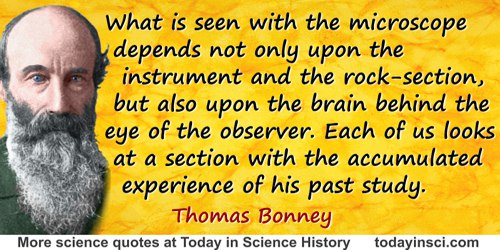
[Microscopic] evidence cannot be presented ad populum. What is seen with the microscope depends not only upon the instrument and the rock-section, but also upon the brain behind the eye of the observer. Each of us looks at a section with the accumulated experience of his past study. Hence the veteran cannot make the novice see with his eyes; so that what carries conviction to the one may make no appeal to the other. This fact does not always seem to be sufficiently recognized by geologists at large.
'The Anniversary Address of the President', Quarterly Journal of the Geological Society of London, 1885, 41, 59.
[On the 11th day of November 1572], in the evening, after sunset, when, according to my habit, I was contemplating the stars in a clear sky, I noticed that a new and unusual star, surpassing all others in brilliancy, was shining almost directly over my head; and since I had, almost from boyhood, known all the stars of the heavens perfectly (there is no great difficulty in gaining that knowledge), it was quite evident to me that there had never before been any star in that place in the sky, even the smallest, to say nothing of a star so conspicuously bright as this. I was so astonished at this sight that I was not ashamed to doubt the trustworthiness of my own eyes. But when I observed that others, too, on having the place pointed out to them, could see that there was a star there, I had no further doubts. A miracle indeed, either the greatest of all that have occurred in the whole range of nature since the beginning of the world, or one certainly that is to be classed with those attested by the Holy Oracles.
De Stello. Nova (On the New Star) (1573). Quoted in H. Shapley and A. E. Howarth (eds.), Source Book in Astronomy (1929), 13.
[Richard Feynman] would be standing in front of the hall smiling at us all as we came in, his fingers tapping out a complicated rhythm on the black top of the demonstration bench that crossed the front of the lecture hall. As latecomers took their seats, he picked up the chalk and began spinning it rapidly through his fingers in a manner of a professional gambler playing with a poker chip, still smiling happily as if at some secret joke. And then—still smiling—he talked to us about physics, his diagrams and equations helping us to share his understanding. It was no secret joke that brought the smile and the sparkle in his eye, it was physics. The joy of physics!
Describing his experience as a student attending Feynman lectures, in Introduction to Richard P. Feynman Surely You’re Joking, Mr. Feynman! : Adventures of a Curious Character (1986, 2010), 9-10.
[To give insight to statistical information] it occurred to me, that making an appeal to the eye when proportion and magnitude are concerned, is the best and readiest method of conveying a distinct idea.
In The Statistical Breviary: Shewing, on a Principle Entirely New, the Resources of Every State and Kingdom in Europe (1801), 2.
[Wernher von Braun] is a human leader whose eyes and thoughts have always been turned toward the stars. It would be foolish to assign rocketry success to one person totally. Components must necessarily be the work of many minds; so must successive stages of development. But because Wernher von Braun joins technical ability, passionate optimism, immense experience and uncanny organizing ability in the elusive power to create a team, he is the greatest human element behind today’s rocketry success
Quoted in 'Reach For The Stars', Time (17 Feb 1958), 71, 25.
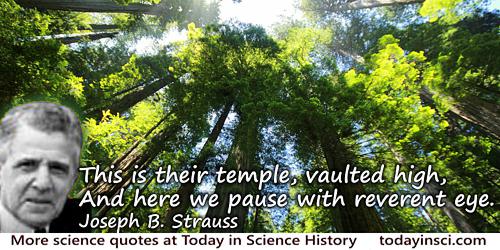
The Redwoods
Here, sown by the Creator's hand,
In serried ranks, the Redwoods stand;
No other clime is honored so,
No other lands their glory know.
The greatest of Earth's living forms,
Tall conquerors that laugh at storms;
Their challenge still unanswered rings,
Through fifty centuries of kings.
The nations that with them were young,
Rich empires, with their forts far-flung,
Lie buried now—their splendor gone;
But these proud monarchs still live on.
So shall they live, when ends our day,
When our crude citadels decay;
For brief the years allotted man,
But infinite perennials' span.
This is their temple, vaulted high,
And here we pause with reverent eye,
With silent tongue and awe-struck soul;
For here we sense life's proper goal;
To be like these, straight, true and fine,
To make our world, like theirs, a shrine;
Sink down, oh traveler, on your knees,
God stands before you in these trees.
Here, sown by the Creator's hand,
In serried ranks, the Redwoods stand;
No other clime is honored so,
No other lands their glory know.
The greatest of Earth's living forms,
Tall conquerors that laugh at storms;
Their challenge still unanswered rings,
Through fifty centuries of kings.
The nations that with them were young,
Rich empires, with their forts far-flung,
Lie buried now—their splendor gone;
But these proud monarchs still live on.
So shall they live, when ends our day,
When our crude citadels decay;
For brief the years allotted man,
But infinite perennials' span.
This is their temple, vaulted high,
And here we pause with reverent eye,
With silent tongue and awe-struck soul;
For here we sense life's proper goal;
To be like these, straight, true and fine,
To make our world, like theirs, a shrine;
Sink down, oh traveler, on your knees,
God stands before you in these trees.
In The Record: Volumes 60-61 (1938), 39.
[Advice to would-be trippers, simply:] Go to the meadows, go to the garden, go to the woods. Open your eyes!
In Keith Colquhoun and Ann Wroe, Economist Book of Obituaries (2008), 161.
Dinosaur: I plan to use punctuated equilibrium to turn this zit into a third eye.
Catbert: That's not a natural advantage. You'd better stay away from the fitter dinosaurs.
Catbert: That's not a natural advantage. You'd better stay away from the fitter dinosaurs.
Dilbert comic strip (30 Aug 2002).
Le seul véritable voyage ... ce ne serait pas d’aller vers de nouveaux paysages, mais d’avoir d’autres yeux, de voir l’univers avec les yeux d’un autre, de cent autres, de voir les cent univers que chacun d’eux voit …
The only true voyage of discovery … would be not to visit new landscapes, but to possess other eyes, to see the universe through the eyes of another, of a hundred others, to see the hundred universes that each of them sees.
[Also often seen translated in the shortened form: 'The only real voyage of discovery consists not in seeing new landscapes, but in having new eyes.']
The only true voyage of discovery … would be not to visit new landscapes, but to possess other eyes, to see the universe through the eyes of another, of a hundred others, to see the hundred universes that each of them sees.
[Also often seen translated in the shortened form: 'The only real voyage of discovery consists not in seeing new landscapes, but in having new eyes.']
'La Prisonnière', À la recherche du temps perdu (1913-27). In Roger Shattuck, Proust (1974), 131.
Non possunt oculi naturam noscere rerum
The eyes cannot know the nature of things.
The eyes cannot know the nature of things.
In De Rerum Natura (c. 55 B.C.), Book 4, line 385. Translated by Rev. John Selby Watson, On the Nature of Things (1851).
Omnes scientiae sunt connexae et fovent auxiliis sicut partes ejusdem totius, quarum quaelibet opus suum peragit non propter se sed pro aliis.
All sciences are connected; they lend each other material aid as parts of one great whole, each doing its own work, not for itself alone, but for the other parts; as the eye guides the body and the foot sustains it and leads it from place to place.
All sciences are connected; they lend each other material aid as parts of one great whole, each doing its own work, not for itself alone, but for the other parts; as the eye guides the body and the foot sustains it and leads it from place to place.
Opus Tertium [1266- 1268], chapter 4, Latin text quoted in J. B. Bury, The Idea of Progress (1920), 355 (footnote to page 25). In J. S. Brewer (ed.), Fr. Rogeri Bacon Opera ... inedita (1859), 18.
Quand on demande à nos philosophes à quoi sert ce nombre prodigieux d’étoiles fixes, dont une partie suffirait pour faire ce qu’elles font toutes, ils vous répondent froidement qu’elles servent à leur réjouir la vue.
When our philosophers are asked what is the use of these countless myriads of fixed stars, of which a small part would be sufficient to do what they all do, they coolly tell us that they are made to give delight to their eyes.
When our philosophers are asked what is the use of these countless myriads of fixed stars, of which a small part would be sufficient to do what they all do, they coolly tell us that they are made to give delight to their eyes.
In 'Premier Soir', Entretiens Sur La Pluralité Des Mondes (1686, 1863), 29. French and translation in Craufurd Tait Ramage, Beautiful Thoughts from French and Italian Authors (1866), 117.
Steckt keine Poesie in der Lokomotive, die brausend durch die Nacht zieht und über die zitternde Erde hintobt, als wollte sie Raum und Zeit zermalmen, in dem hastigen, aber wohl geregelten Zucken und Zerren ihrer gewaltigen Glieder, in dem stieren, nur auf ein Ziel losstürmenden Blick ihrer roten Augen, in dem emsigen, willenlosen Gefolge der Wagen, die kreischend und klappernd, aber mit unfehlbarer Sicherheit dem verkörperten Willen aus Eisen
und Stahl folge leisten?
Is there no poetry in the locomotive roaring through the night and charging over the quivering earth as if it wanted to crush time and space? Is there no poetry in the hasty but regular jerking and tugging of its powerful limbs, in the stare of its red eyes that never lose sight of their goal? Is there no poetry in the bustling, will-less retinue of cars that follow, screeching and clattering with unmistakable surety, the steel and iron embodiment of will?
Is there no poetry in the locomotive roaring through the night and charging over the quivering earth as if it wanted to crush time and space? Is there no poetry in the hasty but regular jerking and tugging of its powerful limbs, in the stare of its red eyes that never lose sight of their goal? Is there no poetry in the bustling, will-less retinue of cars that follow, screeching and clattering with unmistakable surety, the steel and iron embodiment of will?
— Max Eyth
From 'Poesie und Technik' (1904) (Poetry and Technology), in Schweizerische Techniker-Zeitung (1907), Vol 4, 306, as translated in Paul A. Youngman, Black Devil and Iron Angel: The Railway in Nineteenth-Century German Realism (2005), 128.
~~[No known source]~~ Once you have flown, you will walk the earth with your eyes turned skyward, for there you have been, there you long return.
Best attributed simply to “Anonymous” because there seems to be no known reliable primary source. Another example of a feral quote that is almost certainly not authentic, yet spreads virally like a lexicographic plague. It must be centuries old, but does not show up in major 19th-century quote collections. It is simply too good to be true. Included here to attach this caution.
~~[Orphan]~~ The truth of a theory is in your mind, not in your eyes.
Attributed, without citation, in Howard W. Eves Mathematical Circles Squared (1972), 57. Webmaster has so far not been able to verify from a primary source. Can you help?
1839—The fermentation satire
THE MYSTERY OF ALCOHOLIC FERMENTATION RESOLVED
(Preliminary Report by Letter) Schwindler
I am about to develop a new theory of wine fermentation … Depending on the weight, these seeds carry fermentation to completion somewhat less than as in the beginning, which is understandable … I shall develop a new theory of wine fermentation [showing] what simple means Nature employs in creating the most amazing phenomena. I owe it to the use of an excellent microscope designed by Pistorius.
When brewer’s yeast is mixed with water the microscope reveals that the yeast dissolves into endless small balls, which are scarcely 1/800th of a line in diameter … If these small balls are placed in sugar water, it can be seen that they consist of the eggs of animals. As they expand, they burst, and from them develop small creatures that multiply with unbelievable rapidity in a most unheard of way. The form of these animals differs from all of the 600 types described up until now. They possess the shape of a Beinsdorff still (without the cooling apparatus). The head of the tube is a sort of proboscis, the inside of which is filled with fine bristles 1/2000th of a line long. Teeth and eyes are not discernible; however, a stomach, intestinal canal, anus (a rose red dot), and organs for secretion of urine are plainly discernible. From the moment they are released from the egg one can see these animals swallow the sugar from the solution and pass it to the stomach. It is digested immediately, a process recognized easily by the resultant evacuation of excrements. In a word, these infusors eat sugar, evacuate ethyl alcohol from the intestinal canal, and carbon dioxide from the urinary organs. The bladder, in the filled state, has the form of a champagne bottle; when empty, it is a small button … As soon as the animals find no more sugar present, they eat each other up, which occurs through a peculiar manipulation; everything is digested down to the eggs which pass unchanged through the intestinal canal. Finally, one again fermentable yeast, namely the seed of the animals, which remain over.
THE MYSTERY OF ALCOHOLIC FERMENTATION RESOLVED
(Preliminary Report by Letter) Schwindler
I am about to develop a new theory of wine fermentation … Depending on the weight, these seeds carry fermentation to completion somewhat less than as in the beginning, which is understandable … I shall develop a new theory of wine fermentation [showing] what simple means Nature employs in creating the most amazing phenomena. I owe it to the use of an excellent microscope designed by Pistorius.
When brewer’s yeast is mixed with water the microscope reveals that the yeast dissolves into endless small balls, which are scarcely 1/800th of a line in diameter … If these small balls are placed in sugar water, it can be seen that they consist of the eggs of animals. As they expand, they burst, and from them develop small creatures that multiply with unbelievable rapidity in a most unheard of way. The form of these animals differs from all of the 600 types described up until now. They possess the shape of a Beinsdorff still (without the cooling apparatus). The head of the tube is a sort of proboscis, the inside of which is filled with fine bristles 1/2000th of a line long. Teeth and eyes are not discernible; however, a stomach, intestinal canal, anus (a rose red dot), and organs for secretion of urine are plainly discernible. From the moment they are released from the egg one can see these animals swallow the sugar from the solution and pass it to the stomach. It is digested immediately, a process recognized easily by the resultant evacuation of excrements. In a word, these infusors eat sugar, evacuate ethyl alcohol from the intestinal canal, and carbon dioxide from the urinary organs. The bladder, in the filled state, has the form of a champagne bottle; when empty, it is a small button … As soon as the animals find no more sugar present, they eat each other up, which occurs through a peculiar manipulation; everything is digested down to the eggs which pass unchanged through the intestinal canal. Finally, one again fermentable yeast, namely the seed of the animals, which remain over.
In 'Das entriithselle Geheimiss der geisligen Giihrung', Annalen der Pharmacie und Chemie (1839), 29, 100-104; adapted from English translalion by Ralph E. Oesper, The Human Side of Scientists (1975), 203-205.

A child’s world is fresh and new and beautiful, full of wonder and excitement. It is our misfortune that for most of us that clear-eyed vision, that true instinct for what is beautiful and awe-inspiring, is dimmed and even lost before we reach adulthood.
In The Sense of Wonder (1956, 1998), 54.
A fossil hunter needs sharp eyes and a keen search image, a mental template that subconsciously evaluates everything he sees in his search for telltale clues. A kind of mental radar works even if he isn’t concentrating hard. A fossil mollusk expert has a mollusk search image. A fossil antelope expert has an antelope search image. … Yet even when one has a good internal radar, the search is incredibly more difficult than it sounds. Not only are fossils often the same color as the rocks among which they are found, so they blend in with the background; they are also usually broken into odd-shaped fragments. … In our business, we don’t expect to find a whole skull lying on the surface staring up at us. The typical find is a small piece of petrified bone. The fossil hunter’s search therefore has to have an infinite number of dimensions, matching every conceivable angle of every shape of fragment of every bone on the human body.
Describing the skill of his co-worker, Kamoya Kimeu, who discovered the Turkana Boy, the most complete specimen of Homo erectus, on a slope covered with black lava pebbles.
Describing the skill of his co-worker, Kamoya Kimeu, who discovered the Turkana Boy, the most complete specimen of Homo erectus, on a slope covered with black lava pebbles.
Richard Leakey and Roger Lewin, Origins Reconsidered: In Search of What Makes Us Human (1992), 26.
A man has a very insecure tenure of a property which another can carry away with his eyes. A few months reduced me to the cruel necessity either of destroying my machine, or of giving it to the public. To destroy it, I could not think of; to give up that for which I had laboured so long, was cruel. I had no patent, nor the means of purchasing one. In preference to destroying, I gave it to the public.
[On his inability to keep for himself a profitable income from his invention of the Spinning Mule.]
[On his inability to keep for himself a profitable income from his invention of the Spinning Mule.]
As quoted in James Mason, The Great Triumphs of Great Men (1875), 579.
A man who has once looked with the archaeological eye will never see quite normally. He will be wounded by what other men call trifles. It is possible to refine the sense of time until an old shoe in the bunch grass or a pile of nineteenth century beer bottles in an abandoned mining town tolls in one’s head like a hall clock.
The Night Country (1971), 81.
A mind exclusively bent upon the idea of utility necessarily narrows the range of the imagination. For it is the imagination which pictures to the inner eye of the investigator the indefinitely extending sphere of the possible,—that region of hypothesis and explanation, of underlying cause and controlling law. The area of suggestion and experiment is thus pushed beyond the actual field of vision.
In 'The Paradox of Research', The North American Review (Sep 1908), 188, No. 634, 425.
A mind which has once imbibed a taste for scientific enquiry, and has learnt the habit of applying its principles readily to the cases which occur, has within itself an inexhaustable source of pure and exciting contemplations:— One would think that Shakespeare had such a mind in view when he describes a contemplative man as finding
“Tongues in trees—books in running brooks—
Sermons in stones—and good in everything.”
Accustomed to trace the operations of general causes and the exemplification of general laws, in circumstances where the uninformed and uninquiring eye, perceives neither novelty nor beauty, he walks in the midst of wonders; every object which falls in his way elucidates some principle, affords some instruction and impresses him with a sense of harmony and order. Nor is it a mere passive pleasure which is thus communicated. A thousand questions are continually arising in his mind, a thousand objects of enquiry presenting themselves, which keep his faculties in constant exercise, and his thoughts perpetually on the wing, so that lassitude is excluded from his life, and that craving after artificial excitement and dissipation of the mind, which leads so many into frivolous, unworthy, and destructive pursuits, is altogether eradicated from his bosom.
“Tongues in trees—books in running brooks—
Sermons in stones—and good in everything.”
Accustomed to trace the operations of general causes and the exemplification of general laws, in circumstances where the uninformed and uninquiring eye, perceives neither novelty nor beauty, he walks in the midst of wonders; every object which falls in his way elucidates some principle, affords some instruction and impresses him with a sense of harmony and order. Nor is it a mere passive pleasure which is thus communicated. A thousand questions are continually arising in his mind, a thousand objects of enquiry presenting themselves, which keep his faculties in constant exercise, and his thoughts perpetually on the wing, so that lassitude is excluded from his life, and that craving after artificial excitement and dissipation of the mind, which leads so many into frivolous, unworthy, and destructive pursuits, is altogether eradicated from his bosom.
In Dionysius Lardner (ed.), Cabinet Cyclopaedia, Vol 1, Preliminary Discourse on the Study of Natural Philosophy (1831), 14-15.
A nose which varies from the ideal of straightness to a hook or snub may still be of good shape and agreeable to the eye.
In Politics.
A physician advised his patient that had sore eyes, that he should abstain from wine; but the patient said, “I think rather, sir, from wine and water; for I have often marked it in blue eyes, and I have seen water come forth, but never wine.”
In 'A Collection of Apophthegms, New and Old' (1625). As given in Essays, Moral, Economical, and Political: A New Edition, With the Latin Quotations Translated (1813), No. 52, 279.
A principle of induction would be a statement with the help of which we could put inductive inferences into a logically acceptable form. In the eyes of the upholders of inductive logic, a principle of induction is of supreme importance for scientific method: “... this principle”, says Reichenbach, “determines the truth of scientific theories. To eliminate it from science would mean nothing less than to deprive science of the power to decide the truth or falsity of its theories. Without it, clearly, science would no longer have the right to distinguish its theories from the fanciful and arbitrary creations of the poet’s mind.” Now this principle of induction cannot be a purely logical truth like a tautology or an analytic statement. Indeed, if there were such a thing as a purely logical principle of induction, there would be no problem of induction; for in this case, all inductive inferences would have to be regarded as purely logical or tautological transformations, just like inferences in inductive logic. Thus the principle of induction must be a synthetic statement; that is, a statement whose negation is not self-contradictory but logically possible. So the question arises why such a principle should be accepted at all, and how we can justify its acceptance on rational grounds.
…...
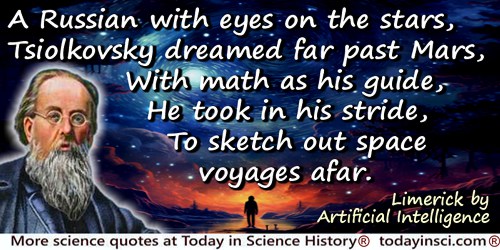
A Russian with eyes on the stars,
Tsiolkovsky dreamed past the Mars,
With math as his guide,
He took in his stride,
To sketch out space voyages afar.
Tsiolkovsky dreamed past the Mars,
With math as his guide,
He took in his stride,
To sketch out space voyages afar.
Limerick created by Artificial Intelligence from: “Write a limerick about K.E. Tsiolkovsky, Russian pioneer space theorist,” and only two words tweaked by Webmaster (17 Sep 2023).
A single ray of light from a distant star falling upon the eye of a tyrant in bygone times, may have altered the course of his life, may have changed the destiny of nations, may have transformed the surface of the globe, so intricate, so inconceivably complex are the processes of nature.
Lecture (Feb 1893) delivered before the Franklin Institute, Philadelphia, 'On Light and Other High Frequency Phenomena,' collected in Thomas Commerford Martin and Nikola Tesla, The Inventions, Researches and Writings of Nikola Tesla (1894), 298.
A time will come when men will stretch out their eyes. They should see planets like our Earth.
Inaugural Lecture as Professor of Astronomy, Gresham College. In Stephen Webb, If the Universe is Teeming With Aliens—Where is Everybody? (2002), 150.
About ten months ago [1609] a report reached my ears that a certain Fleming [Hans Lippershey] had constructed a spyglass, by means of which visible objects, though very distant from the eye of the observer, were distinctly seen as if nearby... Of this truly remarkable effect several experiences were related, to which some persons gave credence while others denied them. A few days later the report was confirmed to me in a letter from a noble Frenchman at Paris, Jacques Badovere, which caused me to apply myself wholeheartedly to enquire into the means by which I might arrive at the invention of a similar instrument. This I did shortly afterwards, my basis being the theory of refraction. First I prepared a tube of lead, at the ends of which I fitted two glass lenses, both plane on one side while on the other side one was spherically convex and the other concave.
The Starry Messenger (1610), trans. Stillman Drake, Discoveries and Opinions of Galileo (1957), 28-9.
![Charles Darwin quote: About weak points [of the Origin] I agree. The eye to this day gives me a cold shudder, but when I think o](https://todayinsci.com/D/Darwin_Charles/DarwinCharles-Weak500x250px.jpg)
About weak points [of the Origin] I agree. The eye to this day gives me a cold shudder, but when I think of the fine known gradations, my reason tells me I ought to conquer the cold shudder.
Letter to Asa Gray, 8 or 9 February 1860. In F. Burkhardt and S. Smith (eds.), The Correspondence of Charles Darwin 1860 (1993), Vol. 8, 75.
According to Gandhi, the seven sins are wealth without works, pleasure without conscience, knowledge without character, commerce without morality, science without humanity, worship without sacrifice, and politics without principle. Well, Hubert Humphrey may have sinned in the eyes of God, as we all do, but according to those definitions of Gandhi’s, it was Hubert Humphrey without sin.
Eulogy at funeral of Vice President Hubert Humphrey, St. Paul, Minnesota (16 Jan 1978). In Public Papers of the Presidents of the United States: Jimmy Carter (1978), Vol. 1, 82.
All appearances to the contrary, the only watchmaker in nature is the blind forces of physics, albeit deployed in very special way. A true watchmaker has foresight: he designs his cogs springs, and plans their interconnections, with a future purpose in his mind's eye. Natural selection, the blind, unconscious, automatic process which Darwin discovered, and which we now know is the explanation for the existence and apparently purposeful form of all life, has no purpose in mind. It has no mind and no mind's eye. It does not plan for the future. It has no vision, no foresight, no sight at all. If it can be said to play the role of watchmaker in nature, it is the blind watchmaker.
The Blind Watchmaker (1986), 5.
All cell biologists are condemned to suffer an incurable secret sorrow: the size of the objects of their passion. … But those of us enamored of the cell must resign ourselves to the perverse, lonely fascination of a human being for things invisible to the naked human eye.
Opening sentence from The Center of Life: A Natural History of the Cell (1977, 1978), 5.
All depends on keeping the eye steadily fixed on the facts of nature and so receiving their images simply as they are.
In Francis Bacon, James Spedding (ed.), Robert Leslie Ellis (ed.), 'The Plan of the Work: The Great Instauration', The Works of Francis Bacon: Translations of the Philosophical Works (1858), Vol. 4, 32.
All people dream, but not equally. Those who dream by night in the dusty recesses of their mind, wake in the morning to find that it was vanity. But the dreamers of the day are dangerous people, for they dream their dreams with open eyes, and make them come true.
…...
All the summer long is the swallow a most instructive pattern of unwearied industry and affection; for, from morning to night, while there is a family to be supported, she spends the whole day in skimming close to the ground, and exerting the most sudden turns and quick evolutions. Avenues, and long walks under hedges, and pasture-fields, and mown meadows where cattle graze, are her delight, especially if there are trees interspersed; because in such spots insects most abound. When a fly is taken a smart snap from her bill is heard, resembling the noise at the shutting of a watch case; but the motion of the mandibles are too quick for the eye.
In Letter to Daines Barrington (29 Jan 1774), in In The Natural History and Antiquities of Selborne (1789), 169-170.
All those who think it paradoxical that so great a weight as the earth should not waver or move anywhere seem to me to go astray by making their judgment with an eye to their own affects and not to the property of the whole. For it would not still appear so extraordinary to them, I believe, if they stopped to think that the earth’s magnitude compared to the whole body surrounding it is in the ratio of a point to it. For thus it seems possible for that which is relatively least to be supported and pressed against from all sides equally and at the same angle by that which is absolutely greatest and homogeneous.
— Ptolemy
'The Almagest 1', in Ptolemy: the Almagest; Nicolaus Copernicus: On the Revolutions of the Heavenly Spheres; Johannes Kepler: Epitome of Copernican Astronomy: IV - V The Harmonies of the World: V, trans. R. Catesby Taliaferro (1952), 11.
Almost every major systematic error which has deluded men for thousands of years relied on practical experience. Horoscopes, incantations, oracles, magic, witchcraft, the cures of witch doctors and of medical practitioners before the advent of modern medicine, were all firmly established through the centuries in the eyes of the public by their supposed practical successes. The scientific method was devised precisely for the purpose of elucidating the nature of things under more carefully controlled conditions and by more rigorous criteria than are present in the situations created by practical problems.
Personal Knowledge (1958), 183.
Although we are mere sojourners on the surface of the planet, chained to a mere point in space, enduring but for a moment of time, the human mind is not only enabled to number worlds beyond the unassisted ken of mortal eye, but to trace the events of indefinite ages before the creation of our race, and is not even withheld from penetrating into the dark secrets of the ocean, or the interior of the solid globe; free, like the spirit which the poet described as animating the universe.
In Principles of Geology (1830).
Amoeba has her picture in the book,
Proud Protozoon!—Yet beware of pride,
All she can do is fatten and divide;
She cannot even read, or sew, or cook…
The Worm can crawl
But has no eyes to look.
The Jelly-fish can swim
But lacks a bride.
Proud Protozoon!—Yet beware of pride,
All she can do is fatten and divide;
She cannot even read, or sew, or cook…
The Worm can crawl
But has no eyes to look.
The Jelly-fish can swim
But lacks a bride.
Essay read at the Heretics Club, Cambridge (May 1922), 'Philosophic Ants', collected in Essays of a Biologist (1923), 176.
Among the older records, we find chapter after chapter of which we can read the characters, and make out their meaning: and as we approach the period of man’s creation, our book becomes more clear, and nature seems to speak to us in language so like our own, that we easily comprehend it. But just as we begin to enter on the history of physical changes going on before our eyes, and in which we ourselves bear a part, our chronicle seems to fail us—a leaf has been torn out from nature's record, and the succession of events is almost hidden from our eyes.
Letter 1 to William Wordsworth. Quoted in the appendix to W. Wordsworth, A Complete Guide to the Lakes, Comprising Minute Direction for the Tourist, with Mr Wordsworth's Description of the Scenery of the County and Three Letters upon the Geology of the Lake District (1842), 14.
Among those whom I could never pursuade to rank themselves with idlers, and who speak with indignation of my morning sleeps and nocturnal rambles, one passes the day in catching spiders, that he may count their eyes with a microscope; another exhibits the dust of a marigold separated from the flower with a dexterity worthy of Leuwenhoweck himself. Some turn the wheel of electricity; some suspend rings to a lodestone, and find that what they did yesterday, they can do again to-day.—Some register the changes of the wind, and die fully convinced that the wind is changeable.—There are men yet more profound, who have heard that two colorless liquors may produce a color by union, and that two cold bodies will grow hot of they are mingled: they mingle them, and produce the effect expected, say it is strange, and mingle them again.
In Tryon Edwards, A Dictionary of Thoughts (1908), 243.
An apple falls in front of Newton, a pot boils before Papin, a flaming sheet of paper floats before the eyes of Montgolfier. At intervals a discovery bursts forth like a mine explosion in the deeps of science, and a whole ledge of prejudice crumbles, and the living rock of truth is suddenly laid bare.
In Victor Hugo and Lorenzo O'Rourke (trans.) Victor Hugo’s Intellectual Autobiography: (Postscriptum de ma vie) (1907), 323-324.
An eye critically nice can only be formed by observing well-colored pictures with attention; and by close attention … discover … expedients by which good colorists have raised the value of their tints, and by which nature has been so happily imitated.
In The Life and Discourses of Sir Joshua Reynolds (1853), 24.
An eye critically nice will discern in every colour a tendency to some other colour, according as it is influenced by light, shade, depth or diluteness; nor is this the case only in the inherent colours of pigments, &c. but it is so also in the transient colours of the prism, &c. Hence blue in its depth inclines to purple; deep-yellow to orange, &c.; nor is it practicable to realize these colours to the satisfaction of the critical eye,-since perfect colours, like perfect geometrical figures, are pure ideals. My examples of colours are therefore quite as adequate to their office of illustrating and distinguishing, as the figure of an angle inclining to the acute or obtuse, instead of a perfect right angle, or middle form, would be in illustrating the conception of an angle in general.
In 'On Colors—In Answer to Mr. T. Hargreaves’s Strictures on the Work Entitled “Chromatics; or, An Essay on the Analogy and Harmony of Colours”', The Philosophical Magazine and Journal: Comprehending The Various Branches of Science, The Liberal and Fine Arts, Geology, Agriculture, Manufactures and Commerce (Oct 1817), 50, No. 234, 241.
Are God and Nature then at strife,
That Nature lends such evil dreams?
So careful of the type she seems,
So careless of the single life; ...
'So careful of the type', but no.
From scarped cliff and quarried stone
She cries, 'A thousand types are gone:
I care for nothing, all shall go' ...
Man, her last work, who seemed so fair,
Such splendid purpose in his eyes,
Who rolled the psalm to wintry skies,
Who built him fanes of fruitless prayer,
Who trusted God was love indeed
And love Creation's final law—
Tho’ Nature red in tooth and claw
With ravine, shrieked against his creed...
That Nature lends such evil dreams?
So careful of the type she seems,
So careless of the single life; ...
'So careful of the type', but no.
From scarped cliff and quarried stone
She cries, 'A thousand types are gone:
I care for nothing, all shall go' ...
Man, her last work, who seemed so fair,
Such splendid purpose in his eyes,
Who rolled the psalm to wintry skies,
Who built him fanes of fruitless prayer,
Who trusted God was love indeed
And love Creation's final law—
Tho’ Nature red in tooth and claw
With ravine, shrieked against his creed...
In Memoriam A. H. H. (1850), Cantos 56-57. Collected in Alfred Tennyson and William James Rolfe (ed.) The Poetic and Dramatic works of Alfred, Lord Tennyson (1898), 176.
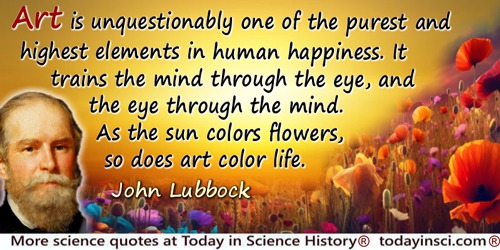
Art is unquestionably one of the purest and highest elements in human happiness. It trains the mind through the eye, and the eye through the mind. As the sun colors flowers, so does art color life.
The Pleasures of Life (1887, 2007), 99.
As children we all possess a natural, uninhibited curiosity, a hunger for explanation, which seems to die slowly as we age—suppressed, I suppose, by the high value we place on conformity and by the need not to appear ignorant.
It betokens a conviction that somehow science is innately incomprehensible. It precludes reaching deeper, thereby denying the profound truth that understanding enriches experience, that explanation vastly enhances the beauty of the natural world in the eye of the beholder.
It betokens a conviction that somehow science is innately incomprehensible. It precludes reaching deeper, thereby denying the profound truth that understanding enriches experience, that explanation vastly enhances the beauty of the natural world in the eye of the beholder.
In Toward the Habit of Truth (1990).
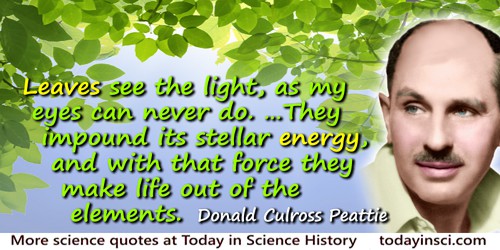
As the brain of man is the speck of dust in the universe that thinks, so the leaves—the fern and the needled pine and the latticed frond and the seaweed ribbon—perceive the light in a fundamental and constructive sense. … Their leaves see the light, as my eyes can never do. … They impound its stellar energy, and with that force they make life out of the elements.
In Flowering Earth (1939), 4.
Astronomers have built telescopes which can show myriads of stars unseen before; but when a man looks through a tear in his own eye, that is a lens which opens reaches into the unknown, and reveals orbs which no telescope, however skilfully constructed, could do.
Life Thoughts (1858), 20.
At the entrance to the observatory Stjerneborg located underground, Tycho Brahe built a Ionic portal. On top of this were three sculptured lions. On both sides were inscriptions and on the backside was a longer inscription in gold letters on a porfyr stone: Consecrated to the all-good, great God and Posterity. Tycho Brahe, Son of Otto, who realized that Astronomy, the oldest and most distinguished of all sciences, had indeed been studied for a long time and to a great extent, but still had not obtained sufficient firmness or had been purified of errors, in order to reform it and raise it to perfection, invented and with incredible labour, industry, and expenditure constructed various exact instruments suitable for all kinds of observations of the celestial bodies, and placed them partly in the neighbouring castle of Uraniborg, which was built for the same purpose, partly in these subterranean rooms for a more constant and useful application, and recommending, hallowing, and consecrating this very rare and costly treasure to you, you glorious Posterity, who will live for ever and ever, he, who has both begun and finished everything on this island, after erecting this monument, beseeches and adjures you that in honour of the eternal God, creator of the wonderful clockwork of the heavens, and for the propagation of the divine science and for the celebrity of the fatherland, you will constantly preserve it and not let it decay with old age or any other injury or be removed to any other place or in any way be molested, if for no other reason, at any rate out of reverence to the creator’s eye, which watches over the universe. Greetings to you who read this and act accordingly. Farewell!
(Translated from the original in Latin)
At the sight of a single bone, of a single piece of bone, I recognize and reconstruct the portion of the whole from which it would have been taken. The whole being to which this fragment belonged appears in my mind's eye.
Cited by Geoffroy Saint-Hilaire, Comptes-Rendus de l’Académie des Sciences. 1837, 7, 116. Trans. Franck Bourdier, 'Geoffroy Saint-Hilaire versus Cuvier: The Campaign for Paleontological Evolution (1825- 1838)', Cecil J. Schneer (ed.), Toward a History of Geology (1969), 44.
At this point, however, I have no intention whatever of criticizing the false teachings of Galen, who is easily first among the professors of dissection, for I certainly do not wish to start off by gaining a reputation for impiety toward him, the author of all good things, or by seeming insubordinate to his authority. For I am well aware how upset the practitioners (unlike the followers of Aristotle) invariably become nowadays, when they discover in the course of a single dissection that Galen has departed on two hundred or more occasions from the true description of the harmony, function, and action of the human parts, and how grimly they examine the dissected portions as they strive with all the zeal at their command to defend him. Yet even they, drawn by their love of truth, are gradually calming down and placing more faith in their own not ineffective eyes and reason than in Galen’s writings.
From De Humani Corporis Fabrica Libri Septem: (1543), Book I, iv, as translated by William Frank Richardson, in On The Fabric of the Human Body: Book I: The Bones and Cartilages (1998), Preface, liv.
Attention makes the genius; all learning, fancy, and science depend on it. Newton traced back his discoveries to its unwearied employment. It builds bridges, opens new worlds, and heals diseases; without it Taste is useless, and the beauties of literature are unobserved; as the rarest flowers bloom in vain, if the eye be not fixed upon the bed.
Pleasures, Objects, and Advantages of Literature (1855), 37.
Because words pass away as soon as they strike upon the air, and last no longer than their sound, men have by means of letters formed signs of words. Thus the sounds of the voice are made visible to the eye, not of course as sounds, but by means of certain signs.
In 'Origin of Writing', Christian Doctrine, Book 2, as translated by J.F. Shaw, collected in A Select Library of the Nicene and Post-Nicene Fathers of the Christian Church: Volume II: St. Augustin’s City of God and Christian Doctrine (1907), 536.
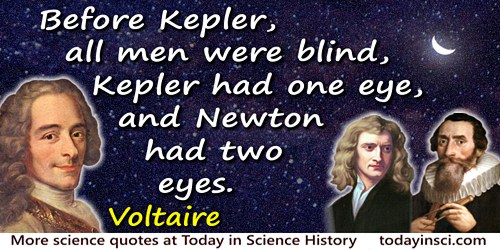
Before Kepler, all men were blind, Kepler had one eye, and Newton had two eyes.
From Voltaire’s Notebooks (1952), 63. As translated in Peter Gay, The Enlightenment: The Science of Freedom (1996), 131. From the original French: “Avant Kepler tous les hommes étoent aveugles, Kepler fut borgne, et Newton a eu deux yeux.”
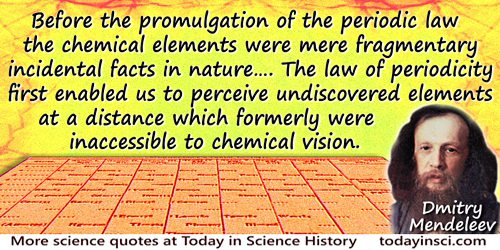
Before the promulgation of the periodic law the chemical elements were mere fragmentary incidental facts in nature; there was no special reason to expect the discovery of new elements, and the new ones which were discovered from time to time appeared to be possessed of quite novel properties. The law of periodicity first enabled us to perceive undiscovered elements at a distance which formerly were inaccessible to chemical vision, and long ere they were discovered new elements appeared before our eyes possessed of a number of well-defined properties.
In Faraday Lecture, delivered before the Fellows of the Chemical Society in the Theatre of the Royal Institution (4 Jun 1889), printed in Professor Mendeléeff, 'The Periodic Law of the Chemical Elements', Transactions of the Chemical Society (1889), 55, 648.
Being the inventor of sex would seem to be a sufficient distinction for a creature just barely large enough to be seen by the naked eye.
[Comment about Volvox, a freshwater green algae, which appears indetermimately plantlike and animal-like during its reproductive cycle.]
[Comment about Volvox, a freshwater green algae, which appears indetermimately plantlike and animal-like during its reproductive cycle.]
The Great Chain of Life (1957), 28.
Believing, as I do, in the continuity of nature, I cannot stop abruptly where our microscopes cease to be of use. Here the vision of the mind authoritatively supplements the vision of the eye. By a necessity engendered and justified by science I cross the boundary of the experimental evidence, and discern in that Matter which we, in our ignorance of its latent powers, and notwithstanding our professed reverence for its Creator, have hitherto covered with opprobrium, the promise and potency of all terrestrial Life.
'Address Delivered Before The British Association Assembled at Belfast', (19 Aug 1874). Fragments of Science for Unscientific People: A Series of Detached Essays, Lectures, and Reviews (1892), Vol. 2, 191.
Beware how you take away hope from any human being. Nothing is clearer than that the merciful Creator intends to blind most people as they pass down into the dark valley. Without very good reasons, temporal or spiritual, we should not interfere with his kind arrangements. It is the height of cruelty and the extreme of impertinence to tell your patient he must die, except you are sure that he wishes to know it, or that there is some particular cause for his knowing it. I should be especially unwilling to tell a child that it could not recover; if the theologians think it necessary, let them take the responsibility. God leads it by the hand to the edge of the precipice in happy unconsciousness, and I would not open its eyes to what he wisely conceals.
In Valedictory Address Delivered to the Medical Graduates at Harvard University, at the Annual Commencement, Wednesday, March 10, 1858) (1858), 14. Reprinted, as published in The Boston Medical and Surgical Journal (25 Mar 1858), 58, No. 8, 158.
Break the chains of your prejudices and take up the torch of experience, and you will honour nature in the way she deserves, instead of drawing derogatory conclusions from the ignorance in which she has left you. Simply open your eyes and ignore what you cannot understand, and you will see that a labourer whose mind and knowledge extend no further than the edges of his furrow is no different essentially from the greatest genius, as would have been proved by dissecting the brains of Descartes and Newton; you will be convinced that the imbecile or the idiot are animals in human form, in the same way as the clever ape is a little man in another form; and that, since everything depends absolutely on differences in organisation, a well-constructed animal who has learnt astronomy can predict an eclipse, as he can predict recovery or death when his genius and good eyesight have benefited from some time at the school of Hippocrates and at patients' bedsides.
Machine Man (1747), in Ann Thomson (ed.), Machine Man and Other Writings (1996), 38.
But if you have seen the soil of India with your own eyes and meditate on its nature - if you consider the rounded stones found in the earth however deeply you dig, stones that are huge near the mountains and where the rivers have a violent current; stones that are of smaller size at greater distance from the mountains, and where the streams flow more slowly; stones that appear pulverised in the shape of sand where the streams begin to stagnate near their mouths and near the sea - if you consider all this, you could scarcely help thinking that India has once been a sea which by degrees has been filled up by the alluvium of the streams.
Alberuni's India, trans. E. C. Sachau (1888), Vol. 1, 198.
But it will be found... that one universal law prevails in all these phenomena. Where two portions of the same light arrive in the eye by different routes, either exactly or very nearly in the same direction, the appearance or disappearance of various colours is determined by the greater or less difference in the lengths of the paths.
Lecture XIV. 'Of Physical Optics'. In A Syllabus of a Course of Lectures on Natural and Experimental Philosophy (1802), 112-4.
But notwithstanding these Arguments are so convictive and demonstrative, its marvellous to see how some Popish Authors (Jesuites especially) strain their wits to defend their Pagan Master Aristotle his Principles. Bullialdus speaks of a Florentine Physitian, that all the Friends he had could ever perswade him once to view the Heavens through a Telescope, and he gave that reason for his refusal, because he was afraid that then his Eyes would make him stagger concerning the truth of Aristotle’s Principles, which he was resolved he would not call into question. It were well, if these Men had as great veneration for the Scripture as they have, for Aristotles (if indeed they be his) absurd Books de cælo Sed de his satis.
(Indicating a belief that the Roman Catholic church impeded the development of modern science.)
(Indicating a belief that the Roman Catholic church impeded the development of modern science.)
Kometographia, Or a Discourse Concerning Comets (Boston 1684). Quoted in Michael Garibaldi Hall, The Last American Puritan: The Life of Increase Mather, 1639-1723 (1988), 167.
By science calmed, over the peaceful soul,
Bright with eternal Wisdom's lucid ray,
Peace, meek of eye, extends her soft control,
And drives the puny Passions far away.
Bright with eternal Wisdom's lucid ray,
Peace, meek of eye, extends her soft control,
And drives the puny Passions far away.
Memoirs of the Life of Sir Humphry Davy, in J. Davy (ed.), The Collected Works of Sir Humphry Davy. (1839-40), Vol 1, 26.
Changes That Have Occurred in the Globe: When we have seen with our own eyes a mountain progressing into a plain; that is to say, an immense boulder separating from this mountain and covering the fields; an entire castle broken into pieces over the ground; a river swallowed up which then bursts out from its abyss; clear marks of a vast amount of water having once flooded regions now inhabited, and a hundred vestiges of other transformations, then we are much more willing to believe that great changes altered the face of the earth, than a Parisian lady who knows only that the place where her house was built was once a cultivated field. However, a lady from Naples who has seen the buried ruins of Herculaneum, is much less subject to the bias which leads us to believe that everything has always been as it is today.
From article 'Changements arrivées dans le globe', in Dictionnaire philosophique (1764), collected in Œuvres Complètes de Voltaire (1878), Vol. 2, 427-428. Translated by Ian Ellis, from the original French: “Changements arrivées dans le globe: Quand on a vu de ses yeux une montagne s’avancer dans une plaine, c’est-à-dire un immense rocher de cette montagne se détacher et couvrir des champs, un château tout entier enfoncé dans la terre, un fleuve englouti qui sort ensuite de son abîme, des marques indubitables qu’un vaste amas d’eau inondait autrefois un pays habité aujourd’hui, et cent vestiges d’autres révolutions, on est alors plus disposé à croire les grands changements qui ont altéré la face du monde, que ne l’est une dame de Paris qui sait seulement que la place où est bâtie sa maison était autrefois un champ labourable. Mais une dame de Naples, qui a vu sous terre les ruines d’Herculanum, est encore moins asservie au préjugé qui nous fait croire que tout a toujours été comme il est aujourd’hui.”
Civilized people can talk about anything. For them no subject is taboo…. In civilized societies there will be no intellectual bogeys at sight of which great grown-up babies are expected to hide their eyes
In Civilization: An Essay (1928), 138.
Consider now the Milky Way. Here also we see an innumerable dust, only the grains of this dust are no longer atoms but stars; these grains also move with great velocities, they act at a distance one upon another, but this action is so slight at great distances that their trajectories are rectilineal; nevertheless, from time to time, two of them may come near enough together to be deviated from their course, like a comet that passed too close to Jupiter. In a word, in the eyes of a giant, to whom our Suns were what our atoms are to us, the Milky Way would only look like a bubble of gas.
Science and Method (1908), trans. Francis Maitland (1914), 254-5.
Consider the hateful brew compounded with gleaming, deadly white lead whose fresh colour is like milk…. Over the victim’s jaws and in the grooves of the gums is plastered an astringent froth, and the furrow of the tongue turns rough on either side, and the depth of the throat grows somewhat dry, and from the pernicious venom follows a dry retching and hawking, for this affliction is severe; meanwhile his spirit sickens and he is worn out with mortal suffering. His body too grows chill, while sometimes his eyes behold strange illusions or else he drowses; nor can he bestir his limbs as heretofore, and he succumbs to the overmastering fatigue.
— Nicander
As translated by A.S.F. Gow and A.F. Scholfield in Nicander: The Poems and Portical Fragments (1953), 99.
Considerable obstacles generally present themselves to the beginner, in studying the elements of Solid Geometry, from the practice which has hitherto uniformly prevailed in this country, of never submitting to the eye of the student, the figures on whose properties he is reasoning, but of drawing perspective representations of them upon a plane. ...I hope that I shall never be obliged to have recourse to a perspective drawing of any figure whose parts are not in the same plane.
Quoted in Adrian Rice, 'What Makes a Great Mathematics Teacher?' The American Mathematical Monthly, (June-July 1999), 540.
Curves that have no tangents are the rule. … Those who hear of curves without tangents, or of functions without derivatives, often think at first that Nature presents no such complications. … The contrary however is true. … Consider, for instance, one of the white flakes that are obtained by salting a solution of soap. At a distance its contour may appear sharply defined, but as we draw nearer its sharpness disappears. The eye can no longer draw a tangent at any point. … The use of a magnifying glass or microscope leaves us just as uncertain, for fresh irregularities appear every time we increase the magnification. … An essential characteristic of our flake … is that we suspect … that any scale involves details that absolutely prohibit the fixing of a tangent.
(1906). As quoted “in free translation” in Benoit B. Mandelbrot, The Fractal Geometry of Nature (1977, 1983), 7.
![Luis W. Alvarez quote: Dad [Walter C. Alvarez] … advised me to sit every few months in my reading chair for an entire evening, c](https://todayinsci.com/A/Alvarez_Luis/AlvarezLuis-Problems500x250px.jpg)
Dad [Walter C. Alvarez] … advised me to sit every few months in my reading chair for an entire evening, close my eyes and try to think of new problems to solve. I took his advice very seriously and have been glad ever since that he did.
In Alvarez: Adventures of a Physicist (1987), 58.
Dibdin said: “I see you've put your own name at the top of your paper, Mr Woods.” His eyes looked sad and thoughtful. “I always make it a matter of principle to put my name as well on every paper that comes out of the department.” “Yours?” Albert said incredulously. “Yes,”said Dibdin, still sad and thoughtful. “I make it a matter of principle, Mr Woods. And I like my name to come first—it makes it easier for purposes of identification.” He rounded it off. “First come, first served.”
The Struggles of Albert Woods (1952), 53.
Dogmatism has only one eye, but bigotry is stone blind.
Aphorism in The Philistine (Mar 1905), 20, No. 4, 128.
During my stay in London I resided for a considerable time in Clapham Road in the neighbourhood of Clapham Common... One fine summer evening I was returning by the last bus 'outside' as usual, through the deserted streets of the city, which are at other times so full of life. I fell into a reverie (Träumerei), and 10, the atoms were gambolling before my eyes! Whenever, hitherto, these diminutive beings had appeared to me, they had always been in motion: but up to that time I had never been able to discern the nature of their motion. Now, however, I saw how, frequently, two smaller atoms united to form a pair: how the larger one embraced the two smaller ones: how still larger ones kept hold of three or even four of the smaller: whilst the whole kept whirling in a giddy dance. I saw how the larger ones formed a chain, dragging the smaller ones after them but only at the ends of the chain. I saw what our past master, Kopp, my highly honoured teacher and friend has depicted with such charm in his Molekular-Welt: but I saw it long before him. The cry of the conductor 'Clapham Road', awakened me from my dreaming: but I spent part of the night in putting on paper at least sketches of these dream forms. This was the origin of the 'Structural Theory'.
Kekule at Benzolfest in Berichte (1890), 23, 1302.
Egypt has been called the Gift of the Nile. Once every year the river overflows its banks, depositing a layer of rich alluvial soil on the parched ground. Then it recedes and soon the whole countryside, as far as the eye can reach, is covered with Egyptologists.
In 'Cheops, or Khufu', The Decline and Fall of Practically Everybody (1950), 7.
Electricity is actually made up of extremely tiny particles called electrons, that you cannot see with the naked eye unless you have been drinking.
In The Taming of the Screw: How to Sidestep Several Million Homeowner's Problems (1983), 12.
EMOTION, n. A prostrating disease caused by a determination of the heart to the head. It is sometimes accompanied by a copious discharge of hydrated chloride of sodium from the eyes.
The Collected Works of Ambrose Bierce (1911), Vol. 7, The Devil's Dictionary, 84.
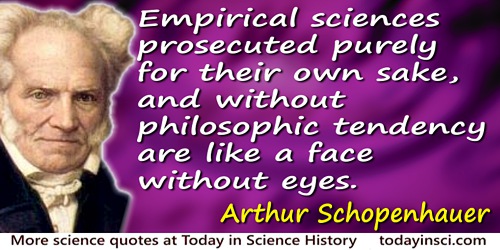
Empirical sciences prosecuted purely for their own sake, and without philosophic tendency are like a face without eyes.
The World as Will and Idea translated by Richard Burdon Haldane Haldane, John Kemp (3rd. Ed.,1888), Vol. 2, 318-319.
Euclidean mathematics assumes the completeness and invariability of mathematical forms; these forms it describes with appropriate accuracy and enumerates their inherent and related properties with perfect clearness, order, and completeness, that is, Euclidean mathematics operates on forms after the manner that anatomy operates on the dead body and its members. On the other hand, the mathematics of variable magnitudes—function theory or analysis—considers mathematical forms in their genesis. By writing the equation of the parabola, we express its law of generation, the law according to which the variable point moves. The path, produced before the eyes of the student by a point moving in accordance to this law, is the parabola.
If, then, Euclidean mathematics treats space and number forms after the manner in which anatomy treats the dead body, modern mathematics deals, as it were, with the living body, with growing and changing forms, and thus furnishes an insight, not only into nature as she is and appears, but also into nature as she generates and creates,—reveals her transition steps and in so doing creates a mind for and understanding of the laws of becoming. Thus modern mathematics bears the same relation to Euclidean mathematics that physiology or biology … bears to anatomy.
If, then, Euclidean mathematics treats space and number forms after the manner in which anatomy treats the dead body, modern mathematics deals, as it were, with the living body, with growing and changing forms, and thus furnishes an insight, not only into nature as she is and appears, but also into nature as she generates and creates,—reveals her transition steps and in so doing creates a mind for and understanding of the laws of becoming. Thus modern mathematics bears the same relation to Euclidean mathematics that physiology or biology … bears to anatomy.
In Die Mathematik die Fackelträgerin einer neuen Zeit (1889), 38. As translated in Robert Édouard Moritz, Memorabilia Mathematica; Or, The Philomath’s Quotation-book (1914), 112-113.
Every great advance of science opens our eyes to facts which we had failed before to observe, and makes new demands on our powers of interpretation.
From The Grammar of Science (1892), 17.
Everyone is aware of the difficult and menacing situation in which human society–shrunk into one community with a common fate–now finds itself, but only a few act accordingly. Most people go on living their every-day life: half frightened, half indifferent, they behold the ghostly tragicomedy which is being performed on the international stage before the eyes and ears of the world. But on that stage, on which the actors under the floodlights play their ordained parts, our fate of tomorrow, life or death of the nations, is being decided.
…...
Exits sun; enters moon.
This moon is never alone.
Stars are seen all around.
These twinklers do not make a sound.
The tiny ones shine from their place.
Mother moon watches with a smiling face.
Its light is soothing to the eyes.
Night’s darkness hides its face.
Cool and calm is its light.
Heat and sweat are never felt.
Some days, moon is not seen.
Makes kids wonder, where had it been?
Partial eclipse shades the moon.
In summers it does not arrive soon.
Beautiful is this milky ball.
It is the love of one and all.
This moon is never alone.
Stars are seen all around.
These twinklers do not make a sound.
The tiny ones shine from their place.
Mother moon watches with a smiling face.
Its light is soothing to the eyes.
Night’s darkness hides its face.
Cool and calm is its light.
Heat and sweat are never felt.
Some days, moon is not seen.
Makes kids wonder, where had it been?
Partial eclipse shades the moon.
In summers it does not arrive soon.
Beautiful is this milky ball.
It is the love of one and all.
…...
Eyes and ears are bad witnesses for men who have barbarian souls.
Heraclitus, fr. 107. Trans. R. W. Sharples.
Few are those who see with their own eyes and feel with their own hearts.
…...
Firefly meteorites blazed against a dark background, and sometimes the lightning was frighteningly brilliant. Like a boy, I gazed open-mouthed at the fireworks, and suddenly, before my eyes, something magical occurred. A greenish radiance poured from Earth directly up to the station, a radiance resembling gigantic phosphorescent organ pipes, whose ends were glowing crimson, and overlapped by waves of swirling green mist.
“Consider yourself very lucky, Vladimir,” I said to myself, “to have watched the northern lights.”
“Consider yourself very lucky, Vladimir,” I said to myself, “to have watched the northern lights.”
…...
Fires from beneath, and meteors from above,
Portentous, unexampled, unexplain'd,
Have kindled beacons in the skies; and th' old
And crazy earth has had her shaking fits
More frequent, and foregone her usual rest.
Is it a time to wrangle, when the props
And pillars of our planet seem to fail,
And nature, with a dim and sickly eye,
To wait the close of all?
Alluding the meteors of 17 Aug 1883.
Portentous, unexampled, unexplain'd,
Have kindled beacons in the skies; and th' old
And crazy earth has had her shaking fits
More frequent, and foregone her usual rest.
Is it a time to wrangle, when the props
And pillars of our planet seem to fail,
And nature, with a dim and sickly eye,
To wait the close of all?
Alluding the meteors of 17 Aug 1883.
'The Time-Piece,' Task, Book ii, lines 58-66. In William Cowper, Henry Francis Cary, The Poetical Works of William Cowper (1863), 52-53.
For all these years you were merely
A smear of light through our telescopes
On the clearest, coldest night; a hint
Of a glint, just a few pixels wide
On even your most perfectly-framed portraits.
But now, now we see you!
Swimming out of the dark - a great
Stone shark, your star-tanned skin pitted
And pocked, scarred after eons of drifting
Silently through the endless ocean of space.
Here on Earth our faces lit up as we saw
You clearly for the first time; eyes wide
With wonder we traced the strangely familiar
Grooves raked across your sides,
Wondering if Rosetta had doubled back to Mars
And raced past Phobos by mistake –
Then you were gone, falling back into the black,
Not to be seen by human eyes again for a thousand
Blue Moons or more. But we know you now,
We know you; you’ll never be just a speck of light again.
A smear of light through our telescopes
On the clearest, coldest night; a hint
Of a glint, just a few pixels wide
On even your most perfectly-framed portraits.
But now, now we see you!
Swimming out of the dark - a great
Stone shark, your star-tanned skin pitted
And pocked, scarred after eons of drifting
Silently through the endless ocean of space.
Here on Earth our faces lit up as we saw
You clearly for the first time; eyes wide
With wonder we traced the strangely familiar
Grooves raked across your sides,
Wondering if Rosetta had doubled back to Mars
And raced past Phobos by mistake –
Then you were gone, falling back into the black,
Not to be seen by human eyes again for a thousand
Blue Moons or more. But we know you now,
We know you; you’ll never be just a speck of light again.
…...
For any one who is pervaded with the sense of causal law in all that happens, who accepts in real earnest the assumption of causality, the idea of a Being who interferes with the sequence of events in the world is absolutely impossible! Neither the religion of fear nor the social-moral religion can have, any hold on him. A God who rewards and punishes is for him unthinkable, because man acts in accordance with an inner and outer necessity, and would, in the eyes of God, be as little responsible as an inanimate object is for the movements which it makes. Science, in consequence, has been accused of undermining morals—but wrongly. The ethical behavior of man is better based on sympathy, education and social relationships, and requires no support from religion. Man’s plight would, indeed, be sad if he had to be kept in order through fear of punishment and hope of rewards after death.
From 'Religion and Science', The New York Times Magazine, (9 Nov 1930), 1. Article in full, reprinted in Edward H. Cotton (ed.), Has Science Discovered God? A Symposium of Modern Scientific Opinion (1931), 101. The wording differs significantly from the version collected in 'Religion And Science', Ideas And Opinions (1954), 39, giving its source as: “Written expressly for the New York Times Magazine. Appeared there November 9, 1930 (pp. 1-4). The German text was published in the Berliner Tageblatt, November 11, 1930.” This variant form of the quote from the book begins, “The man who is thoroughly convinced of the universal operation of the law of causation….” and is also on the Albert Einstein Quotes page on this website. As for why the difference, Webmaster speculates the book form editor perhaps used a revised translation from Einstein’s German article.
For if there is any truth in the dynamical theory of gases the different molecules in a gas at uniform temperature are moving with very different velocities. Put such a gas into a vessel with two compartments [A and B] and make a small hole in the wall about the right size to let one molecule through. Provide a lid or stopper for this hole and appoint a doorkeeper, very intelligent and exceedingly quick, with microscopic eyes but still an essentially finite being.
Whenever he sees a molecule of great velocity coming against the door from A into B he is to let it through, but if the molecule happens to be going slow he is to keep the door shut. He is also to let slow molecules pass from B to A but not fast ones ... In this way the temperature of B may be raised and that of A lowered without any expenditure of work, but only by the intelligent action of a mere guiding agent (like a pointsman on a railway with perfectly acting switches who should send the express along one line and the goods along another).
I do not see why even intelligence might not be dispensed with and the thing be made self-acting.
Moral The 2nd law of Thermodynamics has the same degree of truth as the statement that if you throw a tumblerful of water into the sea you cannot get the same tumblerful of water out again.
Whenever he sees a molecule of great velocity coming against the door from A into B he is to let it through, but if the molecule happens to be going slow he is to keep the door shut. He is also to let slow molecules pass from B to A but not fast ones ... In this way the temperature of B may be raised and that of A lowered without any expenditure of work, but only by the intelligent action of a mere guiding agent (like a pointsman on a railway with perfectly acting switches who should send the express along one line and the goods along another).
I do not see why even intelligence might not be dispensed with and the thing be made self-acting.
Moral The 2nd law of Thermodynamics has the same degree of truth as the statement that if you throw a tumblerful of water into the sea you cannot get the same tumblerful of water out again.
Letter to John William Strutt (6 Dec 1870). In P. M. Hannan (ed.), The Scientific Letters and Papers of James Clerk Maxwell (1995), Vol. 2, 582-3.
For the first time I saw a medley of haphazard facts fall into line and order. All the jumbles and recipes and Hotchpotch of the inorganic chemistry of my boyhood seemed to fit into the scheme before my eyes-as though one were standing beside a jungle and it suddenly transformed itself into a Dutch garden. “But it’s true,” I said to myself “It’s very beautiful. And it’s true.”
How the Periodic Table was explained in a first-term university lecture to the central character in the novel by C.P. Snow, The Search (1935), 38.
For the holy Bible and the phenomena of nature proceed alike from the divine Word, the former as the dictate of the Holy Ghost and the latter as the observant executrix of God's commands. It is necessary for the Bible, in order to be accommodated to the understanding of every man, to speak many things which appear to differ from the absolute truth so far as the bare meaning of the words is concerned. But Nature, on the other hand, is inexorable and immutable; she never transgresses the laws imposed upon her, or cares a whit whether her abstruse reasons and methods of operation are understandable to men. For that reason it appears that nothing physical which sense-experience sets before our eyes, or which necessary demonstrations prove to us, ought to be called in question (much less condemned) upon the testimony of biblical passages which may have some different meaning beneath their words.
Letter to Madame Christina of Lorraine, Grand Duchess of Tuscany: Concerning the Use of Biblical Quotations in Matters of Science (1615), trans. Stillman Drake, Discoveries and Opinions of Galileo (1957), 182-3.
For the Members of the Assembly having before their eyes so many fatal Instances of the errors and falshoods, in which the greatest part of mankind has so long wandred, because they rely'd upon the strength of humane Reason alone, have begun anew to correct all Hypotheses by sense, as Seamen do their dead Reckonings by Cœlestial Observations; and to this purpose it has been their principal indeavour to enlarge and strengthen the Senses by Medicine, and by such outward Instruments as are proper for their particular works.
Micrographia, or some Physiological Descriptions of Minute Bodies made by Magnifying Glasses with Observations and Inquiries thereupon (1665), preface sig.
Geometry is a skill of the eyes and the hands as well as of the mind.
In 'Why We Still Need to Teach Geometry', Proceedings of the Fourth International Congress on Mathematical Education (1983), 159. As quoted and cited in John Del Grande, 'Spacial Sense', The Arithmetic Teacher (Feb 1990), 37, No. 6, 15.
Geometry, which before the origin of things was coeternal with the divine mind and is God himself (for what could there be in God which would not be God himself?), supplied God with patterns for the creation of the world, and passed over to Man along with the image of God; and was not in fact taken in through the eyes.
Harmonice Mundi, The Harmony of the World (1619), book IV, ch. 1. Trans. E. J. Aiton, A. M. Duncan and J. V. Field (1997), 304.
Given for one instant an intelligence which could comprehend all the forces by which nature is animated and the respective situation of the beings which compose it—an intelligence sufficiently vast to submit these data to analysis, it would embrace in the same formula the movements of the greatest bodies in the universe and those of the lightest atom; to it nothing would be uncertain, and the future as the past would be present to its eyes.
Introduction to Oeuvres vol. VII, Theorie Analytique de Probabilites (1812-1820). As translated by Frederick Wilson Truscott and Frederick Lincoln Emory in A Philosophical Essay on Probabilities (1902), 4. [LaPlace is here expressing his belief in causal determinism.] From the original French, “Une intelligence qui, pour un instant donné, connaîtrait toutes les forces dont la nature est animée, et la situation respective des êtres qui la composent, si d’ailleurs elle était assez vaste pour soumettre ces données a l’analyse, embrasserait dans la même formula les mouvements des plus grand corps de l’univers et ceux du plus léger atome: rien ne serait incertain pour elle, et l’avenir comme le passé serait présent à ses yeux.”
God has not revealed all things to man and has entrusted us with but a fragment of His mighty work. But He who directs all things, who has established and laid the foundation of the world, who has clothed Himself with Creation, He is greater and better than that which He has wrought. Hidden from our eyes, He can only be reached by the spirit.
From Quaestiones Naturales as translated in Charles Singer, From Magic to Science (1958), 57.
Gold-Mines. Gold is not found in quartz alone; its richest lodes are in the eyes and ears of the public, but these are harder to work and to prospect than any quartz vein.
Samuel Butler, Henry Festing Jones (ed.), The Note-Books of Samuel Butler (1917), 224.
Good work is no done by “humble” men. It is one of the first duties of a professor, for example, in any subject, to exaggerate a little both the importance of his subject and his own importance in it. A man who is always asking “Is what I do worth while?” and “Am I the right person to do it?” will always be ineffective himself and a discouragement to others. He must shut his eyes a little and think a little more of his subject and himself than they deserve. This is not too difficult: it is harder not to make his subject and himself ridiculous by shutting his eyes too tightly.
In A Mathematician’s Apology (1940, 1967), 66.
Half the joy of life is in little things taken on the run… but let us keep our hearts
young and our eyes open that nothing worth our while shall escape us. That nothing worth our while shall escape us. And everything is worth its while if we only grasp it and its significance.
Found quoted without source in The American Journal of Clinical Medicine (1907), 14, 150, and several other publications of that time period. Webmaster invites help pinpointing the primary text.
Happy the men who made the first essay,
And to celestial regions found the way!
No earthly vices clogg’d their purer souls,
That they could soar so high as touch the poles:
Sublime their thoughts and from pollution clear,
Bacchus and Venus held no revels there;
From vain ambition free; no love of war
Possess’d their minds, nor wranglings at the bar;
No glaring grandeur captivates their eyes,
For such see greater glory in the skies:
Thus these to heaven attain.
And to celestial regions found the way!
No earthly vices clogg’d their purer souls,
That they could soar so high as touch the poles:
Sublime their thoughts and from pollution clear,
Bacchus and Venus held no revels there;
From vain ambition free; no love of war
Possess’d their minds, nor wranglings at the bar;
No glaring grandeur captivates their eyes,
For such see greater glory in the skies:
Thus these to heaven attain.
In Craufurd Tait Ramage (ed., trans.), Beautiful Thoughts From Latin Authors, with English Translations (1864),
Have you tried neuroxing papers? It.'s a very easy and cheap process. You hold the page in front of your eyes and you let it go through there into the brain. It’s much better than xeroxing.
Quoted in L. Wolpert and A. Richards (eds.), A Passion for Science (1988), 104.
He [Heinrich Rose] looked upon the various substances that he was manipulating, as well as their reactions, under a thoroughly familial point of view: they were like so many children entrusted to his tutelage. Every time he explained simple, clear, well-defined phenomena, he assumed a jovial and smiling countenance; on the other hand, he almost got angry at certain mischievous bodies, the properties of which did not obey ordinary laws and troubled general theoretical views; in his eyes, this was unruly behavior.
As his student, about the lectures of Heinrich Rose, as quoted in entry by Stuart Pierson, 'Rose, Heinrich', in Charles Coulston Gillespie (ed.), Dictionary of Scientific Biography (1975), Vol.11, 541, citing Adolphe Remelé, 'Notice biographique sur le Professeur Henri Rose', in Moniteur Scientifique (1864), 2nd ser., 6, 385–389. [Remelé’s italics.]
He leads a new crusade, his bald head glistening... One somehow pities him, despite his so palpable imbecilities... But let no one, laughing at him, underestimate the magic that lies in his black, malignant eye, his frayed but still eloquent voice. He can shake and inflame these poor ignoramuses as no other man among us...
[Describing William Jennings Bryan, orator, at the Scopes Monkey Trial.]
[Describing William Jennings Bryan, orator, at the Scopes Monkey Trial.]
Henry Louis Mencken and S.T. Joshi (ed.), H.L. Mencken on Religion (2002), 18.
He marvelled at the fact that the cats had two holes cut in their fur at precisely the spot where their eyes were.
Aphorisms, trans. R. J. Hollingdale (1990), 108.
He was so narrow-minded he could see through a keyhole with two eyes.
…...
He who has heard the same thing told by twelve thousand ocular [eye]witnesses, has only twelve thousand probabilities, equal to one strong one, which is not equal to certainty.
In 'Truth', Philosophical Dictionary (1824), Vol. 6, 297.
Here I most violently want you to
Avoid one fearful error, a vicious flaw.
Don’t think that our bright eyes were made that we
Might look ahead; that hips and knees and ankles
So intricately bend that we might take
Big strides, and the arms are strapped to the sturdy shoulders
And hands are given for servants to each side
That we might use them to support our lives.
All other explanations of this sort
Are twisted, topsy-turvy logic, for
Nothing what is born produces its own use.
Sight was not born before the light of the eyes,
Nor were words and pleas created before the tongue
Rather the tongue's appearance long preceded
Speech, and the ears were formed far earlier than
The sound first heard. To sum up, all the members
Existed, I should think, before their use,
So use has not caused them to have grown.
Avoid one fearful error, a vicious flaw.
Don’t think that our bright eyes were made that we
Might look ahead; that hips and knees and ankles
So intricately bend that we might take
Big strides, and the arms are strapped to the sturdy shoulders
And hands are given for servants to each side
That we might use them to support our lives.
All other explanations of this sort
Are twisted, topsy-turvy logic, for
Nothing what is born produces its own use.
Sight was not born before the light of the eyes,
Nor were words and pleas created before the tongue
Rather the tongue's appearance long preceded
Speech, and the ears were formed far earlier than
The sound first heard. To sum up, all the members
Existed, I should think, before their use,
So use has not caused them to have grown.
On the Nature of Things, trans. Anthony M. Esolen (1995), Book 4, lines 820-8, 145.
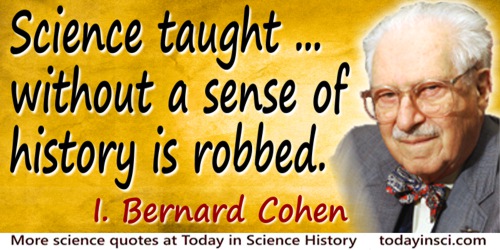
History without the history of science, to alter slightly an apothegm of Lord Bacon, resembles a statue of Polyphemus without his eye—that very feature being left out which most marks the spirit and life of the person. My own thesis is complementary: science taught ... without a sense of history is robbed of those very qualities that make it worth teaching to the student of the humanities and the social sciences.
'The History of Science and the Teaching of Science', in I. Bernard Cohen and Fletcher G. Watson (eds.), General Education in Science (1952), 71.
Holding then to science with one hand—the left hand—we give the right hand to religion, and cry: ‘Open Thou mine eyes, that I may behold wondrous things, more wondrous than the shining worlds can tell.’ Obedient to the promise, religion does awaken faculties within us, does teach our eyes to the beholding of more wonderful things. Those great worlds blazing like suns die like feeble stars in the glory of the morning, in the presence of this new light. The soul knows that an infinite sea of love is all about it, throbbing through it, everlasting arms of affection lift it, and it bathes itself in the clear consciousness of a Father’s love.
…...
How near one Species to the next is join'd,
The due Gradations please a thinking Mind;
and there are Creatures which no eye can see,
That for a Moment live and breathe like me:
Whom a small Fly in bulk as far exceeds,
As yon tall Cedar does the waving Reeds:
These we can reach—and may we not suppose
There still are Creatures more minute than those.
The due Gradations please a thinking Mind;
and there are Creatures which no eye can see,
That for a Moment live and breathe like me:
Whom a small Fly in bulk as far exceeds,
As yon tall Cedar does the waving Reeds:
These we can reach—and may we not suppose
There still are Creatures more minute than those.
'The Enquiry'. In Poems Upon Several Occasions (1748), 198.
How peacefully he sleep!
Yet may his ever-questing spirit, freed at length
from all the frettings of this little world,
Wander at will among the uncharted stars.
Fairfield his name. Perchance celestial fields
disclosing long sought secrets of the past
Spread 'neath his enraptured gaze
And beasts and men that to his earthly sight
were merely bits of stone shall live again to
gladden those eager eyes.
o let us picture him—enthusiast—scientist—friend—
Seeker of truth and light through all eternity!
Yet may his ever-questing spirit, freed at length
from all the frettings of this little world,
Wander at will among the uncharted stars.
Fairfield his name. Perchance celestial fields
disclosing long sought secrets of the past
Spread 'neath his enraptured gaze
And beasts and men that to his earthly sight
were merely bits of stone shall live again to
gladden those eager eyes.
o let us picture him—enthusiast—scientist—friend—
Seeker of truth and light through all eternity!
New York Sun (13 Nov 1935). Reprinted in 'Henry Fairfield Osborn', Supplement to Natural History (Feb 1936), 37:2, 135. Bound in Kofoid Collection of Pamphlets on Biography, University of California.
How, indeed, can there be a response within to the impression from without when there is nothing within that is in relation of congenial vibration with that which is without? Inattention in such case is insusceptibility; and if this be complete, then to demand attention is very much like demanding of the eye that it should attend to sound-waves, and of the ear that it should attend to light-waves.
As quoted in William W. Speer, Primary Arithmetic: First Year, for the Use of Teachers (1902), 3.
I always enjoyed the hearty society of a snowstorm; glad, though solemn, when within a mile or two of safe ground where a storm-nest could be made. Now on this shattered ice I need my eyes, but the snow, gyrating, whirling, and sifting, the very incarnation of spasmodic hysterical mirth, fills them, and I am blinded as if blinded by kisses, delicious in the eye, and sweet.
Journal Entry, while camping on Muir Glacier, Alaska (19? Jul 1890). In John Muir and Linnie Marsh Wolfe (ed.), John of the Mountains: The Unpublished Journals of John Muir (1938, 1979), 321.
I always feel as if my books came half out of Lyell's brain... & therefore that when seeing a thing never seen by Lyell, one yet saw it partially through his eyes.
Letter to Leonard Horner, 29 August 1844. In F. Burkhardt and S. Smith (eds.), The Correspondence of Charles Darwin 1844-1846 (1987), Vol. 3, 55.
I am above the forest region, amongst grand rocks & such a torrent as you see in Salvator Rosa's paintings vegetation all a scrub of rhodods. with Pines below me as thick & bad to get through as our Fuegian Fagi on the hill tops, & except the towering peaks of P. S. [perpetual snow] that, here shoot up on all hands there is little difference in the mt scenery—here however the blaze of Rhod. flowers and various colored jungle proclaims a differently constituted region in a naturalists eye & twenty species here, to one there, always are asking me the vexed question, where do we come from?
Letter to Charles Darwin (24 Jun 1849). Quoted in The Correspondence of Charles Darwin (1988), Vol. 4, 1847-1850, 242.
I am very sorry, Pyrophilus, that to the many (elsewhere enumerated) difficulties which you may meet with, and must therefore surmount, in the serious and effectual prosecution of experimental philosophy I must add one discouragement more, which will perhaps is much surprise as dishearten you; and it is, that besides that you will find (as we elsewhere mention) many of the experiments published by authors, or related to you by the persons you converse with, false and unsuccessful (besides this, I say), you will meet with several observations and experiments which, though communicated for true by candid authors or undistrusted eye-witnesses, or perhaps recommended by your own experience, may, upon further trial, disappoint your expectation, either not at all succeeding constantly, or at least varying much from what you expected.
Opening paragraph of The First Essay Concerning the Unsuccessfulness of Experiments (1673), collected in The Works of the Honourable Robert Boyle in Six Volumes to Which is Prefixed the Life of the Author (1772), Vol. 1, 318-319.
I am willing to believe that my unobtainable sixty seconds within a sponge or a flatworm might not reveal any mental acuity that I would care to ca ll consciousness. But I am also confident ... that vultures and sloths, as close evolutionary relatives with the same basic set of organs, lie on our side of any meaningful (and necessarily fuzzy) border–and that we are therefore not mistaken when we look them in the eye and see a glimmer of emotional and conceptual affinity.
…...
I believe myself to possess a most singular combination of qualities exactly fitted to make me pre-eminently a discoverer of the hidden realities of nature… the belief has been forced upon me…
Firstly: Owing to some peculiarity in my nervous system, I have perceptions of some things, which no one else has… and intuitive perception of… things hidden from eyes, ears, & ordinary senses…
Secondly: my sense reasoning faculties;
Thirdly: my concentration faculty, by which I mean the power not only of throwing my whole energy & existence into whatever I choose, but also of bringing to bear on anyone subject or idea, a vast apparatus from all sorts of apparently irrelevant & extraneous sources…
Well, here I have written what most people would call a remarkably mad letter; & yet certainly one of the most logical, sober-minded, cool, pieces of composition, (I believe), that I ever framed.
Firstly: Owing to some peculiarity in my nervous system, I have perceptions of some things, which no one else has… and intuitive perception of… things hidden from eyes, ears, & ordinary senses…
Secondly: my sense reasoning faculties;
Thirdly: my concentration faculty, by which I mean the power not only of throwing my whole energy & existence into whatever I choose, but also of bringing to bear on anyone subject or idea, a vast apparatus from all sorts of apparently irrelevant & extraneous sources…
Well, here I have written what most people would call a remarkably mad letter; & yet certainly one of the most logical, sober-minded, cool, pieces of composition, (I believe), that I ever framed.
Lovelace Papers, Bodleian Library, Oxford University, 42, folio 12 (6 Feb 1841). As quoted and cited in Dorothy Stein (ed.), 'This First Child of Mine', Ada: A Life and a Legacy (1985), 86.
I believe with Schopenhauer that one of the strongest motives that lead men to art and science is escape from everyday life with its painful crudity and hopeless dreariness, from the fetters of one’s own ever shifting desires. A finely tempered nature longs to escape from personal life into the world of objective perception and thought; this desire may be compared with the townsman’s irresistible longing to escape from his noisy, cramped surroundings into the silence of high mountains, where the eye ranges freely through the still, pure air and fondly traces out the restful contours apparently built for eternity.
Address at The Physical Society, Berlin (1918) for Max Planck’s 60th birthday, 'Principles of Research', collected in Essays in Science (1934) 2.
I came into the room, which was half dark, and presently spotted Lord Kelvin in the audience and realised that I was in for trouble at the last part of my speech dealing with the age of the earth, where my views conflicted with his. To my relief, Kelvin fell fast asleep, but as I came to the important point, I saw the old bird sit up, open an eye and cock a baleful glance at me! Then a sudden inspiration came, and I said Lord Kelvin had limited the age of the earth, provided no new source was discovered. That prophetic utterance refers to what we are now considering tonight, radium! Behold! the old boy beamed upon me.
The italicized phrase refers to “no new source” of energy. Concerning a Lecture by Rutherford, at the Royal Institution, dealing with the energy of subterranean radium, which had an effect prolonging the heat of the Earth. Arthur S. Eve wrote that Rutherford “used to tell humorous stories about this lecture long afterwards:” — followed by the subject quote above, as its own paragraph. As given in Arthur S. Eve, Rutherford: Being the Life and Letters of the Rt. Hon. Lord Rutherford, O.M. (1939), 107. The story lacks quotation marks, and thus should be regarded as perhaps Eve’s own words giving a faithful recollection, rather than Rutherford’s verbatim words. (However, note that the style used throughout the book is to omit quotation marks from their own separate paragraph.)
I cannot shut my eyes to the fact that the production of wealth is not the work of any one man, and the acquisition of great fortunes is not possible without the co-operation of multitudes of men.
Address (31 May 1871) to the 12th annual commencement at the Cooper Union, honoring his 80th birthday, in New York City Mission and Tract Society, Annual report of the New York City Mission and Tract Society (1872), 69.
I could not help laughing at the ease with which he explained his process of deduction. “When I hear you give your reasons,” I remarked, “the thing always appears to me to be so ridiculously simple that I could easily do it myself, though at each successive instance of your reasoning I am baffled, until you explain your process. And yet I believe that my eyes are as good as yours.”
“Quite so,” he answered, lighting a cigarette, and throwing himself down into an arm-chair. “You see, but you do not observe. The distinction is clear. For example, you have frequently seen the steps which lead up from the hall to this room.”
“Frequently.”
“How often?”
“'Well, some hundreds of times.”
“Then how many are there?”
“How many! I don't know.”
“Quite so! You have not observed. And yet you have seen. That is just my point. Now, I know that there are seventeen steps, because I have both seen and observed.”
“Quite so,” he answered, lighting a cigarette, and throwing himself down into an arm-chair. “You see, but you do not observe. The distinction is clear. For example, you have frequently seen the steps which lead up from the hall to this room.”
“Frequently.”
“How often?”
“'Well, some hundreds of times.”
“Then how many are there?”
“How many! I don't know.”
“Quite so! You have not observed. And yet you have seen. That is just my point. Now, I know that there are seventeen steps, because I have both seen and observed.”
From 'Adventure I.—A Scandal in Bohemia', Adventures of Sherlock Holmes, in The Strand Magazine: An Illustrated Monthly (Jul 1891), 2, 62.
I do not find that any one has doubted that there are four elements. The highest of these is supposed to be fire, and hence proceed the eyes of so many glittering stars. The next is that spirit, which both the Greeks and ourselves call by the same name, air. It is by the force of this vital principle, pervading all things and mingling with all, that the earth, together with the fourth element, water, is balanced in the middle of space.
In The Natural History of Pliny (1855), Vol. 1, 18.
I found the invention was applicable to painting, and would also contribute to facilitate the study of geography: for I have applied it to some maps, the rivers of which I represented in silver, and in the cities in gold. The rivers appearing, as it were, in silver streams, have a most pleasing effect on the sight, and relieve the eye of that painful search for the course, and origin, of rivers, the minutest branches of which can be splendidly represented this way.
Description of an outcome of her experiments originally investigating 'the possibility of making cloths of gold, silver and other metals by chemical processes.'
Description of an outcome of her experiments originally investigating 'the possibility of making cloths of gold, silver and other metals by chemical processes.'
Preface to An Essay on Combustion with a View to a New Art of Dyeing and Painting (1794), iii-iv. In Marilyn Bailey
Ogilvie and Joy Dorothy
Harvey, The Biographical Dictionary of Women in Science (2000), 478.
I have always liked horticulturists, people who make their living from orchards and gardens, whose hands are familiar with the feel of the bark, whose eyes are trained to distinguish the different varieties, who have a form memory. Their brains are not forever dealing with vague abstractions; they are satisfied with the romance which the seasons bring with them, and have the patience and fortitude to gamble their lives and fortunes in an industry which requires infinite patience, which raise hopes each spring and too often dashes them to pieces in fall. They are always conscious of sun and wind and rain; must always be alert lest they lose the chance of ploughing at the right moment, pruning at the right time, circumventing the attacks of insects and fungus diseases by quick decision and prompt action. They are manufacturers of a high order, whose business requires not only intelligence of a practical character, but necessitates an instinct for industry which is different from that required by the city dweller always within sight of other people and the sound of their voices. The successful horticulturist spends much time alone among his trees, away from the constant chatter of human beings.
I have destroyed almost the whole race of frogs, which does not happen in that savage Batrachomyomachia of Homer. For in the anatomy of frogs, which, by favour of my very excellent colleague D. Carolo Fracassato, I had set on foot in order to become more certain about the membranous substance of the lungs, it happened to me to see such things that not undeservedly I can better make use of that [saying] of Homer for the present matter—
“I see with my eyes a work trusty and great.”
For in this (frog anatomy) owing to the simplicity of the structure, and the almost complete transparency of the vessels which admits the eye into the interior, things are more clearly shown so that they will bring the light to other more obscure matters.
“I see with my eyes a work trusty and great.”
For in this (frog anatomy) owing to the simplicity of the structure, and the almost complete transparency of the vessels which admits the eye into the interior, things are more clearly shown so that they will bring the light to other more obscure matters.
De Pulmonibus (1661), trans. James Young, Proceedings of the Royal Society of Medicine (1929-30), 23, 7.
I have known silence: the cold earthy silence at the bottom of a newly dug well; the implacable stony silence of a deep cave; the hot, drugged midday silence when everything is hypnotised and stilled into silence by the eye of the sun;… I have heard summer cicadas cry so that the sound seems stitched into your bones. I have heard tree frogs in an orchestration as complicated as Bach singing in a forest lit by a million emerald fireflies. I have heard the Keas calling over grey glaciers that groaned to themselves like old people as they inched their way to the sea. I have heard the hoarse street vendor cries of the mating Fur seals as they sang to their sleek golden wives, the crisp staccato admonishment of the Rattlesnake, the cobweb squeak of the Bat and the belling roar of the Red deer knee-deep in purple heather.
Letter to Lee McGeorge (31 Jul 1978). Collected in Letters of Note: Volume 2: An Eclectic Collection of Correspondence (2016), 76.
I have made many mistakes myself; in learning the anatomy of the eye I dare say, I have spoiled a hatfull; the best surgeon, like the best general, is he who makes the fewest mistakes.
Quoted in James Anthony Froude, John Tulloch and Thomas Carlyle, Fraser's Magazine (Nov 1862), 66, 574.
I have no knowledge other than that gained through my own eyes.
In De La Pirotechnia (1540). As translated in Pirotechnia (1959), 70.
I have not yet lost a feeling of wonder, and of delight, that this delicate motion should reside in all the things around us, revealing itself only to him who looks for it. I remember, in the winter of our first experiments, just seven years ago, looking on snow with new eyes. There the snow lay around my doorstep—great heaps of protons quietly precessing in the earth’s magnetic field. To see the world for a moment as something rich and strange is the private reward of many a discovery.
Opening remark, Nobel Lecture (11 Dec 1952).
I have written many direct and indirect arguments for the Copernican view, but until now I have not dared to publish them, alarmed by the fate of Copernicus himself, our master. He has won for himself undying fame in the eyes of a few, but he has been mocked and hooted at by an infinite multitude (for so large is the number of fools). I would dare to come forward publicly with my ideas if there were more people of your [Johannes Kepler’s] way of thinking. As this is not the case, I shall refrain.
Letter to Kepler (4 Aug 1597). In James Bruce Ross (ed.) and Mary Martin (ed., trans.), 'Comrades in the Pursuit of Truth', The Portable Renaissance Reader (1953, 1981), 597-599. As quoted and cited in Merry E. Wiesner, Early Modern Europe, 1450-1789 (2013), 377.
I know too much; I have stuffed too many of the facts of History and Science into my intellectuals. My eyes have grown dim over books; believing in geological periods, cave-dwellers, Chinese Dynasties, and the fixed stars has prematurely aged me.
In 'The Burden', Trivia (1917,1921), 156.
I now saw very distinctly that these were little eels or worms... Lying huddled together and wriggling, just as if you saw with your naked eye a whole tubful of very little eels and water, the eels moving about in swarms; and the whole water seemed to be alive with the multitudinous animalcules. For me this was among all the marvels that I have discovered in nature the most marvellous of all, and I must say that, for my part, no more pleasant sight has yet met my eye than this of so many thousands of living creatures in one small drop of water, all huddling and moving, but each creature having its own motion.
Letter to H. Oldenburg, 9 Oct 1676. In The Collected Letters of Antoni van Leeuwenhoek (l957), Vol. 2, 115.
I often get letters … from people who say … I never give credit to the almighty power that created nature. … I reply … “Well, it’s funny that the people, when they say that this is evidence of the Almighty, always quote beautiful things … orchids and hummingbirds and butterflies and roses.” But I always have to think too of a little boy sitting on the banks of a river in west Africa who has a worm boring through his eyeball, turning him blind before he’s five years old. And I … say, “Well, presumably the God you speak about created the worm as well,” and now, I find that baffling to credit a merciful God with that action. And therefore it seems to me safer to show things that I know to be truth, truthful and factual, and allow people to make up their own minds about the moralities of this thing, or indeed the theology of this thing.
From BBC TV, Life on Air (2002).
I read … that the celebrated Amontons, using a thermometer of his own invention, had discovered that water boils at a fixed degree of heat. I was at once inflamed with a great desire to make for myself a thermometer of the same sort, so that I might with my own eyes perceive this beautiful phenomenon of nature.
From 'Experimenta circa gradum caloris liquorum nonnullorum ebullientium instituta', Philosophical Transactions (1724), 33, 1, as translated in William Francis Magie, A Source Book in Physics (1935), 131.
I regarded as quite useless the reading of large treatises of pure analysis: too large a number of methods pass at once before the eyes. It is in the works of application that one must study them; one judges their utility there and appraises the manner of making use of them.
As reported by J. F. Maurice in Moniteur Universel (1814), 228.
I searched along the changing edge
Where, sky-pierced now the cloud had broken.
I saw no bird, no blade of wing,
No song was spoken.
I stood, my eyes turned upward still
And drank the air and breathed the light.
Then, like a hawk upon the wind,
I climbed the sky, I made the flight.
Where, sky-pierced now the cloud had broken.
I saw no bird, no blade of wing,
No song was spoken.
I stood, my eyes turned upward still
And drank the air and breathed the light.
Then, like a hawk upon the wind,
I climbed the sky, I made the flight.
…...
I suppose that I tend to be optimistic about the future of physics. And nothing makes me more optimistic than the discovery of broken symmetries. In the seventh book of the Republic, Plato describes prisoners who are chained in a cave and can see only shadows that things outside cast on the cave wall. When released from the cave at first their eyes hurt, and for a while they think that the shadows they saw in the cave are more real than the objects they now see. But eventually their vision clears, and they can understand how beautiful the real world is. We are in such a cave, imprisoned by the limitations on the sorts of experiments we can do. In particular, we can study matter only at relatively low temperatures, where symmetries are likely to be spontaneously broken, so that nature does not appear very simple or unified. We have not been able to get out of this cave, but by looking long and hard at the shadows on the cave wall, we can at least make out the shapes of symmetries, which though broken, are exact principles governing all phenomena, expressions of the beauty of the world outside.
In Nobel Lecture (8 Dec 1989), 'Conceptual Foundations of the Unified Theory of Weak and Electromagnetic Interactions.' Nobel Lectures: Physics 1971-1980 (1992), 556.
I tell [medical students] that they are the luckiest persons on earth to be in medical school, and to forget all this worry about H.M.O.’s and keep your eye on helping the patient. It’s the best time ever to be a doctor because you can heal and treat conditions that were untreatable even a couple of years ago.
From Cornelia Dean, 'A Conversation with Joseph E. Murray', New York Times (25 Sep 2001), F5.
I think understanding animals enriches your pleasure, finding out how to understand them is the great pleasure. I never stop reading books about man and animals; they’re always full of interesting stuff. I’ll turn the page and my eyes will be popping out.
Speaking at the launch of “David Attenborough’s Natural Curiosities” on Watch, the BBC TV channel (2 Feb 2015). As quoted in 'Sir David Attenborough Shocked By Rat on the Toilet' on femalefirst.co.uk website.
I took a glass retort, capable of containing eight ounces of water, and distilled fuming spirit of nitre according to the usual method. In the beginning the acid passed over red, then it became colourless, and lastly again all red: no sooner did this happen, than I took away the receiver; and tied to the mouth of the retort a bladder emptied of air, which I had moistened in its inside with milk of lime lac calcis, (i.e. lime-water, containing more quicklime than water can dissolve) to prevent its being corroded by the acid. Then I continued the distillation, and the bladder gradually expanded. Here-upon I left every thing to cool, tied up the bladder, and took it off from the mouth of the retort.— I filled a ten-ounce glass with this air and put a small burning candle into it; when immediately the candle burnt with a large flame, of so vivid a light that it dazzled the eyes. I mixed one part of this air with three parts of air, wherein fire would not burn; and this mixture afforded air, in every respect familiar to the common sort. Since this air is absolutely necessary for the generation of fire, and makes about one-third of our common air, I shall henceforth, for shortness sake call it empyreal air, [literally fire-air] the air which is unserviceable for the fiery phenomenon, and which makes abut two-thirds of common air, I shall for the future call foul air [literally corrupted air].
Chemische Abhandlung von der Luft und dem Feuer (1777), Chemical Observations and Experiments on Air and Fire (1780), trans. J. R. Forster, 34-5.
I trust I may be enabled in the treatment of patients always to act with a single eye to their good.
Letter to his sister Jane (3 Mar 1857). In John Vaughan, 'Lord Lister', The Living Age (1918), 297, 361. Reprinted from The Fortnightly Review (1918), 109, 417- .
I turn my eyes to the schools & universities of Europe
And there behold the loom of Locke whose woof rages dire,
Washed by the water-wheels of Newton. Black the cloth
In heavy wreaths folds over every nation; cruel works
Of many wheels I view, wheel without wheel, with cogs tyrannic
Moving by compulsion each other: not as those in Eden, which
Wheel within wheel in freedom revolve, in harmony & peace.
And there behold the loom of Locke whose woof rages dire,
Washed by the water-wheels of Newton. Black the cloth
In heavy wreaths folds over every nation; cruel works
Of many wheels I view, wheel without wheel, with cogs tyrannic
Moving by compulsion each other: not as those in Eden, which
Wheel within wheel in freedom revolve, in harmony & peace.
'Jerusalem, The Emanation of the Giant Albion' (1804-20), First Chapter, Pl.15, lines 14-20. In W. H. Stevenson (ed.), The Poems of William Blake (1971), 654-55.
I venture to assert that the feelings one has when the beautiful symbolism of the infinitesimal calculus first gets a meaning, or when the delicate analysis of Fourier has been mastered, or while one follows Clerk Maxwell or Thomson into the strange world of electricity, now growing so rapidly in form and being, or can almost feel with Stokes the pulsations of light that gives nature to our eyes, or track with Clausius the courses of molecules we can measure, even if we know with certainty that we can never see them I venture to assert that these feelings are altogether comparable to those aroused in us by an exquisite poem or a lofty thought.
In paper (May 1891) read before Bath Branch of the Teachers’ Guild, published in The Practical Teacher (July 1891), reprinted as 'Geometry', in Frederic Spencer, Chapters on the Aims and Practice of Teaching (1897), 194.
I was sitting writing at my textbook but the work did not progress; my thoughts were elsewhere. I turned my chair to the fire and dozed. Again the atoms were gambolling before my eyes. This time the smaller groups kept modestly in the background. My mental eye, rendered more acute by the repeated visions of the kind, could now distinguish larger structures of manifold confirmation: long rows, sometimes more closely fitted together all twining and twisting in snake like motion. But look! What was that? One of the snakes had seized hold of its own tail, and the form whirled mockingly before my eyes. As if by a flash of lightning I awoke; and this time also I spent the rest of the night in working out the rest of the hypothesis. Let us learn to dream, gentlemen, then perhaps we shall find the truth... But let us beware of publishing our dreams till they have been tested by waking understanding.
Kekule at Benzolfest in Berichte (1890), 23, 1302.
I Was strolling on the Moon one day.
In the merry, merry month of December … May … May. That’s right. … When much to my surprise, a pair of bonny eyes … be-doop-doo-doo …
In the merry, merry month of December … May … May. That’s right. … When much to my surprise, a pair of bonny eyes … be-doop-doo-doo …
Singing while on an extravehicular walk on the moon’s surface (Apollo 17, 12 Dec 1972). With him was Eugene Cernan and joining in singing the second line, and corrected with “May” during the first ellipsis above. From transcript on the nasa.gov website, which notes the song being mimicked was 'While Strolling through the Park One Day' written by Ed Haley (1884).
I will lift mine eyes unto the pills. Almost everyone takes them, from the humble aspirin to the multi-coloured, king-sized three deckers, which put you to sleep, wake you up, stimulate and soothe you all in one. It is an age of pills.
1962
I would by all means have men beware, lest Æsop’s pretty fable of the fly that sate [sic] on the pole of a chariot at the Olympic races and said, “What a dust do I raise,” be verified in them. For so it is that some small observation, and that disturbed sometimes by the instrument, sometimes by the eye, sometimes by the calculation, and which may be owing to some real change in the heaven, raises new heavens and new spheres and circles.
'Of Vain Glory' (1625) in James Spedding, Robert Ellis and Douglas Heath (eds.), The Works of Francis Bacon (1887-1901), Vol. 6, 503.
I, Galileo Galilei, son of the late Vincenzo Galilei, of Florence, aged seventy years, being brought personally to judgment, and kneeling before your Most Eminent and Most Reverend Lords Cardinals, General Inquisitors of the universal Christian republic against heretical depravity, having before my eyes the Holy Gospels, which I touch with my own hands, swear that I have always believed, and now believe, and with the help of God will in future believe, every article which the Holy Catholic and Apostolic Church of Rome holds, teaches, and preaches. But because I have been enjoined by this Holy Office altogether to abandon the false opinion which maintains that the sun is the centre and immovable, and forbidden to hold, defend, or teach the said false doctrine in any manner, and after it hath been signified to me that the said doctrine is repugnant with the Holy Scripture, I have written and printed a book, in which I treat of the same doctrine now condemned, and adduce reasons with great force in support of the same, without giving any solution, and therefore have been judged grievously suspected of heresy; that is to say, that I held and believed that the sun is the centre of the universe and is immovable, and that the earth is not the centre and is movable; willing, therefore, to remove from the minds of your Eminences, and of every Catholic Christian, this vehement suspicion rightfully entertained toward me, with a sincere heart and unfeigned faith, I abjure, curse, and detest the said errors and heresies, and generally every other error and sect contrary to Holy Church; and I swear that I will never more in future say or assert anything verbally, or in writing, which may give rise to a similar suspicion of me; but if I shall know any heretic, or anyone suspected of heresy, that I will denounce him to this Holy Office, or to the Inquisitor or Ordinary of the place where I may be; I swear, moreover, and promise, that I will fulfil and observe fully, all the penances which have been or shall be laid on me by this Holy Office. But if it shall happen that I violate any of my said promises, oaths, and protestations (which God avert!), I subject myself to all the pains and punishments which have been decreed and promulgated by the sacred canons, and other general and particular constitutions, against delinquents of this description. So may God help me, and his Holy Gospels which I touch with my own hands. I, the above-named Galileo Galilei, have abjured, sworn, promised, and bound myself as above, and in witness thereof with my own hand have subscribed this present writing of my abjuration, which I have recited word for word. At Rome, in the Convent of Minerva, June 22, 1633. I, Galileo Galilei, have abjured as above with my own hand.
Abjuration, 22 Jun 1633. In J.J. Fahie, Galileo, His Life and Work (1903), 319-321.
I… formerly had two pair of spectacles, which I shifted occasionally, as in travelling I sometimes read, and often wanted to regard the prospects. Finding this change troublesome, and not always sufficiently ready, I had the glasses cut, and half of each kind associated in the same circle. … By this means, as I wear my spectacles constantly, I have only to move my eyes up or down, as I want to see distinctly far or near, the proper glasses being always ready.
Letter (23 May 1785) to George Wheatley). Collected in William Temple Franklin (ed.), The Works of Dr. Benjamin Franklin (1809), Vol. 6, 168.
If [in a rain forest] the traveler notices a particular species and wishes to find more like it, he must often turn his eyes in vain in every direction. Trees of varied forms, dimensions, and colors are around him, but he rarely sees any of them repeated. Time after time he goes towards a tree which looks like the one he seeks, but a closer examination proves it to be distinct.
In 'Equitorial Vegetation', Natural Selection and Tropical Nature Essays on Descriptive and Theoretical Biology (1891), 267.
If a lunatic scribbles a jumble of mathematical symbols it does not follow that the writing means anything merely because to the inexpert eye it is indistinguishable from higher mathematics.
In Men of Mathematics (1937), Vol. 2, 232. Also in J.R. Newman (ed.) The World of Mathematics (1956, 1960), Vol. 1, 308.
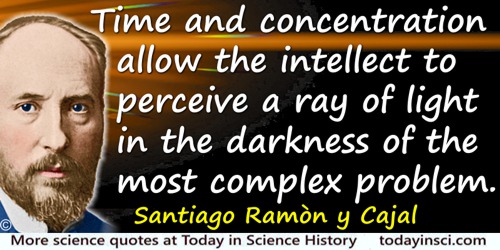
If a photographic plate under the center of a lens focused on the heavens is exposed for hours, it comes to reveal stars so far away that even the most powerful telescopes fail to reveal them to the naked eye. In a similar way, time and concentration allow the intellect to perceive a ray of light in the darkness of the most complex problem.
From Reglas y Consejos sobre Investigacíon Cientifica: Los tónicos de la voluntad. (1897), as translated by Neely and Larry W. Swanson, in Advice for a Young Investigator (1999), 34.
If a physician make a large incision with an operating knife and cure it, or if he open a tumor (over the eye) with an operating knife, and saves the eye, he shall receive ten shekels in money. …
If a physician make a large incision with an operating knife, and kill him, or open a tumor with an operating knife, and cut out the eye, his hands shall be cut off. ...
If a physician heal the broken bone or diseased soft part of a man, the patient shall pay the physician five shekels in money.
[The Code of Hammurabi (a king of ancient Babylon), the earliest well-preserved ancient law code, circa 1760 B.C.]
If a physician make a large incision with an operating knife, and kill him, or open a tumor with an operating knife, and cut out the eye, his hands shall be cut off. ...
If a physician heal the broken bone or diseased soft part of a man, the patient shall pay the physician five shekels in money.
[The Code of Hammurabi (a king of ancient Babylon), the earliest well-preserved ancient law code, circa 1760 B.C.]
In L. W. King (trans.), The Code of Hammurabi (1910), 22, No. 215, 218 and 221.
If experiments are performed thousands of times at all seasons and in every place without once producing the effects mentioned by your philosophers, poets, and historians, this will mean nothing and we must believe their words rather our own eyes? But what if I find for you a state of the air that has all the conditions you say are required, and still the egg is not cooked nor the lead ball destroyed? Alas! I should be wasting my efforts... for all too prudently you have secured your position by saying that 'there is needed for this effect violent motion, a great quantity of exhalations, a highly attenuated material and whatever else conduces to it.' This 'whatever else' is what beats me, and gives you a blessed harbor, a sanctuary completely secure.
'The Assayer' (1623), trans. Stillman Drake, Discoveries and Opinions of Galileo (1957), 273.
If one looks with a cold eye at the mess man has made of history, it is difficult to avoid the conclusion that he has been afflicted by some built-in mental disorder which drives him towards self-destruction.
In The Ghost in the Machine (1967).
If the Humours of the Eye by old Age decay, so as by shrinking to make the Cornea and Coat of the Crystalline Humour grow flatter than before, the Light will not be refracted enough, and for want of a sufficient Refraction will not converge to the bottom of the Eye but to some place beyond it, and by consequence paint in the bottom of the Eye a confused Picture, and according to the Indistinctuess of this Picture the Object will appear confused. This is the reason of the decay of sight in old Men, and shews why their Sight is mended by Spectacles. For those Convex glasses supply the defect of plumpness in the Eye, and by increasing the Refraction make the rays converge sooner, so as to convene distinctly at the bottom of the Eye if the Glass have a due degree of convexity. And the contrary happens in short-sighted Men whose Eyes are too plump. For the Refraction being now too great, the Rays converge and convene in the Eyes before they come at the bottom; and therefore the Picture made in the bottom and the Vision caused thereby will not be distinct, unless the Object be brought so near the Eye as that the place where the converging Rays convene may be removed to the bottom, or that the plumpness of the Eye be taken off and the Refractions diminished by a Concave-glass of a due degree of Concavity, or lastly that by Age the Eye grow flatter till it come to a due Figure: For short-sighted Men see remote Objects best in Old Age, and therefore they are accounted to have the most lasting Eyes.
Opticks (1704), Book 1, Part 1, Axiom VII, 10-11.
If the whole universe has no meaning, we should never have found out that it has no meaning: just as, if there were no light in the universe and therefore no creatures with eyes, we should never know it was dark. Dark would be without meaning.
…...
If this fire determined by the sun, be received on the blackest known bodies, its heat will be long retain'd therein; and hence such bodies are the soonest and the strongest heated by the flame fire, as also the quickest dried, after having been moisten'd with water; and it may be added, that they also burn by much the readiest: all which points are confirm'd by daily observations. Let a piece of cloth be hung in the air, open to the sun, one part of it dyed black, another part of a white colour, others of scarlet, and diverse other colours; the black part will always be found to heat the most, and the quickest of all; and the others will each be found to heat more slowly, by how much they reflect the rays more strongly to the eye; thus the white will warm the slowest of them all, and next to that the red, and so of the rest in proportion, as their colour is brighter or weaker.
A New Method of Chemistry, 2nd edition (1741), 262.
If we look at the problems raised by Aristotle, we are astonished at his gift of observation. What wonderful eyes the Greeks had for many things! Only they committed the mistake of being overhasty, of passing straightway from the phenomenon to the explanation of it, and thereby produced certain theories that are quite inadequate. But this is the mistake of all times, and still made in our own day.
In The Maxims and Reflections of Goethe (1906), 195.
If we reflect that a small creature such as this is provided, not only with external members, but also with intestines and other organs, we have no reason to doubt that a like creature, even if a thousand million times smaller, may already be provided with all its external and internal organs... though they may be hidden from our eyes. For, if we consider the external and internal organs of animalcules which are so small that a thousand million of them together would amount to the size of a coarse grain of sand, it may well be, however incomprehensible and unsearchable it may seem to us, that an animalcule from the male seed of whatever members of the animal kingdom, contains within itself... all the limbs and organs which an animal has when it is born.
Letter to the Gentlemen of the Royal Society, 30 Mar 1685. In The Collected Letters of Antoni van Leeuwenhoek (1957), Vol. 5, 185.
If we seek for the simplest arrangement, which would enable it [the eye] to receive and discriminate the impressions of the different parts of the spectrum, we may suppose three distinct sensations only to be excited by the rays of the three principal pure colours, falling on any given point of the retina, the red, the green, and the violet; while the rays occupying the intermediate spaces are capable of producing mixed sensations, the yellow those which belong to the red and green, and the blue those which belong to the green and violet.
'Chromatics', in Supplement to the Fourth, Fifth, and Sixth Editions of the Encyclopedia Britannica (1824), Vol. 3, 142.
If we take a survey of our own world … our portion in the immense system of creation, we find every part of it, the earth, the waters, and the air that surround it, filled, and as it were crouded with life, down from the largest animals that we know of to the smallest insects the naked eye can behold, and from thence to others still smaller, and totally invisible without the assistance of the microscope. Every tree, every plant, every leaf, serves not only as an habitation, but as a world to some numerous race, till animal existence becomes so exceedingly refined, that the effluvia of a blade of grass would be food for thousands.
In The Age of Reason: Being an Investigation of True and Fabulous Theology (27 Jan O.S. 1794), 60. The word “crouded” is as it appears in the original.
![Jane Goodall quote: If you look into their [chimpanzees] eyes, you know you’re looking into a thinking mind. They teach us that](https://todayinsci.com/G/Goodall_Jane/GoodallJane-Eyes500x250px.jpg)
If you look into their [chimpanzees] eyes, you know you’re looking into a thinking mind. They teach us that we are not the only beings with personalities, minds capable of rational thought, altruism and a sense of humor. That leads to new respect for other animals, respect for the environment and respect for all life.
From interview by Tamar Lewin, 'Wildlife to Tireless Crusader, See Jane Run', New York Times (20 Nov 2000), F35.
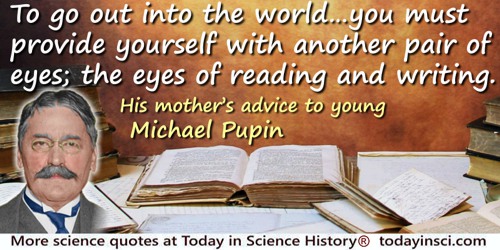
If you wish to go out into the world about which you hear so much…, you must provide yourself with another pair of eyes; the eyes of reading and writing. There is so much wonderful knowledge and learning in the world which you cannot get unless you can read and write.
In his words, what he recalls his mother telling him as a boy, in From Immigrant to Inventor: An Example to Young Americans (1922, 1934), 12.
Imagination is the eye of the soul.
…...
In … the production of a rainbow … the eye plays a no less indispensable part than the sunlight.
In Saving the Appearances (1957), 22.
In acute diseases the physician must conduct his inquiries in the following way. First he must examine the face of the patient, and see whether it is like the faces of healthy people, and especially whether it is like its usual self. Such likeness will be the best sign, and the greatest unlikeness will be the most dangerous sign. The latter will be as follows. Nose sharp, eyes hollow, temples sunken, ears cold and contracted with their lobes turned outwards, the skin about the face hard and tense and parched, the colour of the face as a whole being yellow or black.
Prognostic, in Hippocrates, trans. W. H. S. Jones (1923), Vol. 2, 9.
In all spheres of science, art, skill, and handicraft it is never doubted that, in order to master them, a considerable amount of trouble must be spent in learning and in being trained. As regards philosophy, on the contrary, there seems still an assumption prevalent that, though every one with eyes and fingers is not on that account in a position to make shoes if he only has leather and a last, yet everybody understands how to philosophize straight away, and pass judgment on philosophy, simply because he possesses the criterion for doing so in his natural reason.
From Phänomenologie des Geistes (1807) as translated by J.B. Baillie in 'Preface', The Phenomenology of Mind (1910), Vol. 1, 67.
In departing from any settled opinion or belief, the variation, the change, the break with custom may come gradually; and the way is usually prepared; but the final break is made, as a rule, by some one individual, … who sees with his own eyes, and with an instinct or genius for truth, escapes from the routine in which his fellows live. But he often pays dearly for his boldness.
In The Harveian Oration, delivered before the Royal College of Physicians of London (18 Oct 1906). Printed in 'The Growth of Truth, as Illustrated in the Discovery of the Circulation of Blood', The Lancet (27 Oct 1906), Vol. 2, Pt. 2, 1114.
In its essence, the theory of natural selection is primarily an attempt to give an account of the probable mechanism of the origin of the adaptations of the organisms to their environment, and only secondarily an attempt to explain evolution at large. Some modern biologists seem to believe that the word 'adaptation' has teleological connotations, and should therefore be expunged from the scientific lexicon. With this we must emphatically disagree. That adaptations exist is so evident as to be almost a truism, although this need not mean that ours is the best of all possible worlds. A biologist has no right to close his eyes to the fact that the precarious balance between a living being and its environment must be preserved by some mechanism or mechanisms if life is to endure.
Genetics and Origin of Species (1937), 150.
In old age, you realise that while you're divided from your youth by decades, you can close your eyes and summon it at will. As a writer it puts one at a distinct advantage.
Interview with Sarah Crown, in The Guardian (25 Jul 2009).
In one department of his [Joseph Black’s] lecture he exceeded any I have ever known, the neatness and unvarying success with which all the manipulations of his experiments were performed. His correct eye and steady hand contributed to the one; his admirable precautions, foreseeing and providing for every emergency, secured the other. I have seen him pour boiling water or boiling acid from a vessel that had no spout into a tube, holding it at such a distance as made the stream’s diameter small, and so vertical that not a drop was spilt. While he poured he would mention this adaptation of the height to the diameter as a necessary condition of success. I have seen him mix two substances in a receiver into which a gas, as chlorine, had been introduced, the effect of the combustion being perhaps to produce a compound inflammable in its nascent state, and the mixture being effected by drawing some string or wire working through the receiver's sides in an air-tight socket. The long table on which the different processes had been carried on was as clean at the end of the lecture as it had been before the apparatus was planted upon it. Not a drop of liquid, not a grain of dust remained.
In Lives of Men of Letters and Science, Who Flourished in the Time of George III (1845), 346-7.
In the beginning was the book of Nature. For eon after eon, the pages of the book turned with no human to read them. No eye wondered at the ignition of the sun, the coagulation of the earth, the birth of the moon, the solidification of a terrestrial continent, or the filling of the seas. Yet when the first primitive algae evolved to float on the waters of this ocean, a promise was born—a hope that someday all the richness and variety of the phenomena of the universe would be read with appreciative eyes.
Opening paragraph in Gary G. Tibbetts, How the Great Scientists Reasoned: The Scientific Method in Action (2012), 1.
In the benzene nucleus we have been given a soil out of which we can see with surprise the already-known realm of organic chemistry multiply, not once or twice but three, four, five or six times just like an equivalent number of trees. What an amount of work had suddenly become necessary, and how quickly were busy hands found to carry it out! First the eye moves up the six stems opening out from the tremendous benzene trunk. But already the branches of the neighbouring stems have become intertwined, and a canopy of leaves has developed which becomes more spacious as the giant soars upwards into the air. The top of the tree rises into the clouds where the eye cannot yet follow it. And to what an extent is this wonderful benzene tree thronged with blossoms! Everywhere in the sea of leaves one can spy the slender hydroxyl bud: hardly rarer is the forked blossom [Gabelblüte] which we call the amine group, the most frequent is the beautiful cross-shaped blossom we call the methyl group. And inside this embellishment of blossoms, what a richness of fruit, some of them shining in a wonderful blaze of color, others giving off an overwhelming fragrance.
A. W. Hofmann, after-dinner speech at Kekulé Benzolfest (Mar 1890). Trans. in W. H. Brock, O. Theodor Benfrey and Susanne Stark, 'Hofmann's Benzene Tree at the Kekulé Festivities', Journal of Chemical Education (1991), 68, 887-8.
In the end, science as we know it has two basic types of practitioners. One is the educated man who still has a controlled sense of wonder before the universal mystery, whether it hides in a snail’s eye or within the light that impinges on that delicate organ. The second kind of observer is the extreme reductionist who is so busy stripping things apart that the tremendous mystery has been reduced to a trifle, to intangibles not worth troubling one’s head about.
In 'Science and the Sense of the Holy,' The Star Thrower (1978), 190.
In the fight which we have to wage incessantly against ignorance and quackery among the masses and follies of all sorts among the classes, diagnosis, not drugging, is our chief weapon of offence. Lack of systematic personal training in the methods of the recognition of disease leads to the misapplication of remedies, to long courses of treatment when treatment is useless, and so directly to that lack of confidence in our methods which is apt to place us in the eyes of the public on a level with empirics and quacks.
Address to the Canadian Medical Association, Montreal (17 Sep 1902), 'Chauvinism in Medicine', published in The Montreal Medical Journal (1902), 31, 267. Collected in Aequanimitas, with Other Addresses to Medical Students, Nurses and Practitioners of Medicine (1904), 299.
In the mathematics I can report no deficience, except that it be that men do not sufficiently understand the excellent use of the pure mathematics, in that they do remedy and cure many defects in the wit and faculties intellectual. For if the wit be too dull, they sharpen it; if too wandering, they fix it; if too inherent in the sense, they abstract it. So that as tennis is a game of no use in itself, but of great use in respect it maketh a quick eye and a body ready to put itself into all postures; so in the mathematics, that use which is collateral and intervenient is no less worthy than that which is principal and intended.
As translated in John Fauvel and Jeremy Gray (eds.) A History of Mathematics: A Reader (1987), 290-291. From De Augmentis, Book 3, The Advancement of Learning (1605), Book 2. Reprinted in The Two Books of Francis Bacon: Of the Proficience and Advancement of Learning, Divine and Human (2009), 97.
In the mind's eye, a fractal is a way of seeing infinity.
From Chaos (1987), 98.
In the moonlight
While drinking homemade wine
My sorrow hung heavy
And my heart felt like lead.
The moon was golden yellow
The night soft and mellow.
There was a smell of jasmine
All around.
And I felt the weight of the world
Upon my shoulders.
I looked at the twinkling stars in the sky
So far and wide
Here’s to you
I lifted my wine
And my eyes looked upon the brilliance
Of the moon and stars
From afar...
While drinking homemade wine
My sorrow hung heavy
And my heart felt like lead.
The moon was golden yellow
The night soft and mellow.
There was a smell of jasmine
All around.
And I felt the weight of the world
Upon my shoulders.
I looked at the twinkling stars in the sky
So far and wide
Here’s to you
I lifted my wine
And my eyes looked upon the brilliance
Of the moon and stars
From afar...
…...
In the presence of infinite might and infinite wisdom, the strength of the strongest man is but weakness, and the keenest of mortal eyes see but dimly.
Quoted in Kim Lim (ed.), 1,001 Pearls of Spiritual Wisdom: Words to Enrich, Inspire, and Guide Your Life (2014), 167
In the printed page the only real things are the paper and the ink; the white spaces play the same part in aiding the eye to take in the meaning of the print as do the black letters.
From Under the Apple-Trees (1916), 302.
In the study of this membrane [the retina] I for the first time felt my faith in Darwinism (hypothesis of natural selection) weakened, being amazed and confounded by the supreme constructive ingenuity revealed not only in the retina and in the dioptric apparatus of the vertebrates but even in the meanest insect eye. ... I felt more profoundly than in any other subject of study the shuddering sensation of the unfathomable mystery of life.
Recollections of My Life (1898), 576. Quoted in Sidney Perkowitz, Empire of Light (1999), 16.
Isolated, so-called “pretty theorems” have even less value in the eyes of a modern mathematician than the discovery of a new “pretty flower” has to the scientific botanist, though the layman finds in these the chief charm of the respective Sciences.
In Die Entwickelung der Mathematik in den letzten Jahrhunderten (1869), 19. As translated in Robert Édouard Moritz, Memorabilia Mathematica; Or, The Philomath’s Quotation-book (1914), 92. From the original German, “Einzelne, sogenannte „hübsche Sätze“ haben an und für sich in den Augen eines modernen Mathematikers noch weniger Werth, als für den wissenschaftlichen Botaniker die Entdeckung einer neuen „hübschen Blume“, obgleich dem Laien gerade hierin der Hauptreiz der betreffenden Wissenschaft zu liegen pflegt.”
It has been asserted … that the power of observation is not developed by mathematical studies; while the truth is, that; from the most elementary mathematical notion that arises in the mind of a child to the farthest verge to which mathematical investigation has been pushed and applied, this power is in constant exercise. By observation, as here used, can only be meant the fixing of the attention upon objects (physical or mental) so as to note distinctive peculiarities—to recognize resemblances, differences, and other relations. Now the first mental act of the child recognizing the distinction between one and more than one, between one and two, two and three, etc., is exactly this. So, again, the first geometrical notions are as pure an exercise of this power as can be given. To know a straight line, to distinguish it from a curve; to recognize a triangle and distinguish the several forms—what are these, and all perception of form, but a series of observations? Nor is it alone in securing these fundamental conceptions of number and form that observation plays so important a part. The very genius of the common geometry as a method of reasoning—a system of investigation—is, that it is but a series of observations. The figure being before the eye in actual representation, or before the mind in conception, is so closely scrutinized, that all its distinctive features are perceived; auxiliary lines are drawn (the imagination leading in this), and a new series of inspections is made; and thus, by means of direct, simple observations, the investigation proceeds. So characteristic of common geometry is this method of investigation, that Comte, perhaps the ablest of all writers upon the philosophy of mathematics, is disposed to class geometry, as to its method, with the natural sciences, being based upon observation. Moreover, when we consider applied mathematics, we need only to notice that the exercise of this faculty is so essential, that the basis of all such reasoning, the very material with which we build, have received the name observations. Thus we might proceed to consider the whole range of the human faculties, and find for the most of them ample scope for exercise in mathematical studies. Certainly, the memory will not be found to be neglected. The very first steps in number—counting, the multiplication table, etc., make heavy demands on this power; while the higher branches require the memorizing of formulas which are simply appalling to the uninitiated. So the imagination, the creative faculty of the mind, has constant exercise in all original mathematical investigations, from the solution of the simplest problems to the discovery of the most recondite principle; for it is not by sure, consecutive steps, as many suppose, that we advance from the known to the unknown. The imagination, not the logical faculty, leads in this advance. In fact, practical observation is often in advance of logical exposition. Thus, in the discovery of truth, the imagination habitually presents hypotheses, and observation supplies facts, which it may require ages for the tardy reason to connect logically with the known. Of this truth, mathematics, as well as all other sciences, affords abundant illustrations. So remarkably true is this, that today it is seriously questioned by the majority of thinkers, whether the sublimest branch of mathematics,—the infinitesimal calculus—has anything more than an empirical foundation, mathematicians themselves not being agreed as to its logical basis. That the imagination, and not the logical faculty, leads in all original investigation, no one who has ever succeeded in producing an original demonstration of one of the simpler propositions of geometry, can have any doubt. Nor are induction, analogy, the scrutinization of premises or the search for them, or the balancing of probabilities, spheres of mental operations foreign to mathematics. No one, indeed, can claim preeminence for mathematical studies in all these departments of intellectual culture, but it may, perhaps, be claimed that scarcely any department of science affords discipline to so great a number of faculties, and that none presents so complete a gradation in the exercise of these faculties, from the first principles of the science to the farthest extent of its applications, as mathematics.
In 'Mathematics', in Henry Kiddle and Alexander J. Schem, The Cyclopedia of Education, (1877.) As quoted and cited in Robert Édouard Moritz, Memorabilia Mathematica; Or, The Philomath’s Quotation-book (1914), 27-29.
It is a happy world after all. The air, the earth, the water teem with delighted existence. In a spring noon, or a summer evening, on whichever side I turn my eyes, myriads of happy beings crowd upon my view. “The insect youth are on the wing.” Swarms of new-born flies are trying their pinions in the air. Their sportive motions, their wanton mazes, their gratuitous activity testify their joy and the exultation they feel in their lately discovered faculties … The whole winged insect tribe, it is probable, are equally intent upon their proper employments, and under every variety of constitution, gratified, and perhaps equally gratified, by the offices which the author of their nature has assigned to them.
Natural Theology: or, Evidences of the Existence and Attributes of The Deity, Collected from the Appearances of Nature (1802), 490-1.
It is a right, yes a duty, to search in cautious manner for the numbers, sizes, and weights, the norms for everything [God] has created. For He himself has let man take part in the knowledge of these things ... For these secrets are not of the kind whose research should be forbidden; rather they are set before our eyes like a mirror so that by examining them we observe to some extent the goodness and wisdom of the Creator.
Epitome of Copernican Astronomy. In Michael B. Foster, Mystery and Philosophy, 61. Cited by Max Casper and Doris Hellman, trans., ed. Kepler (1954), 381. Cited by Gerald J. Galgan, Interpreting the Present: Six Philosophical Essays (1993), 105.
Gerald J. Galgan
It is always, our eyes alone, our way of looking at things. Nature alone knows what she means now, and what she had meant in the past.
In The Maxims and Reflections of Goethe (1906), 203.
It is grindingly, creakingly, crashingly obvious that, if Darwinism were really a theory of chance, it couldn’t work. You don't need to be a mathematician or physicist to calculate that an eye or a haemoglobin molecule would take from here to infinity to self-assemble by sheer higgledy-piggledy luck. Far from being a difficulty peculiar to Darwinism, the astronomic improbability of eyes and knees, enzymes and elbow joints and all the other living wonders is precisely the problem that any theory of life must solve, and that Darwinism uniquely does solve. It solves it by breaking the improbability up into small, manageable parts, smearing out the luck needed, going round the back of Mount Improbable and crawling up the gentle slopes, inch by million-year inch. Only God would essay the mad task of leaping up the precipice in a single bound.
In Climbing Mount Improbable (1996), 67-8.
It is in everything else as it is in colors; bad eyes can distinguish between black and white; better eyes, and eyes much exercised, can distinguish every nicer gradation.
As translated in definition for 'Extreme', A Philosophical Dictionary: From the French (1824), Vol. 3, 139.
It is not surprising, in view of the polydynamic constitution of the genuinely mathematical mind, that many of the major heros of the science, men like Desargues and Pascal, Descartes and Leibnitz, Newton, Gauss and Bolzano, Helmholtz and Clifford, Riemann and Salmon and Plücker and Poincaré, have attained to high distinction in other fields not only of science but of philosophy and letters too. And when we reflect that the very greatest mathematical achievements have been due, not alone to the peering, microscopic, histologic vision of men like Weierstrass, illuminating the hidden recesses, the minute and intimate structure of logical reality, but to the larger vision also of men like Klein who survey the kingdoms of geometry and analysis for the endless variety of things that flourish there, as the eye of Darwin ranged over the flora and fauna of the world, or as a commercial monarch contemplates its industry, or as a statesman beholds an empire; when we reflect not only that the Calculus of Probability is a creation of mathematics but that the master mathematician is constantly required to exercise judgment—judgment, that is, in matters not admitting of certainty—balancing probabilities not yet reduced nor even reducible perhaps to calculation; when we reflect that he is called upon to exercise a function analogous to that of the comparative anatomist like Cuvier, comparing theories and doctrines of every degree of similarity and dissimilarity of structure; when, finally, we reflect that he seldom deals with a single idea at a tune, but is for the most part engaged in wielding organized hosts of them, as a general wields at once the division of an army or as a great civil administrator directs from his central office diverse and scattered but related groups of interests and operations; then, I say, the current opinion that devotion to mathematics unfits the devotee for practical affairs should be known for false on a priori grounds. And one should be thus prepared to find that as a fact Gaspard Monge, creator of descriptive geometry, author of the classic Applications de l’analyse à la géométrie; Lazare Carnot, author of the celebrated works, Géométrie de position, and Réflections sur la Métaphysique du Calcul infinitesimal; Fourier, immortal creator of the Théorie analytique de la chaleur; Arago, rightful inheritor of Monge’s chair of geometry; Poncelet, creator of pure projective geometry; one should not be surprised, I say, to find that these and other mathematicians in a land sagacious enough to invoke their aid, rendered, alike in peace and in war, eminent public service.
In Lectures on Science, Philosophy and Art (1908), 32-33.
It is only when science asks why, instead of simply describing how, that it becomes more than technology. When it asks why, it discovers Relativity. When it only shows how, it invents the atom bomb, and then puts its hands over its eye and says, 'My God what have I done?
The Stalin in Soul (1973). Quoted in Gary Westfahl, Science Fiction Quotations (2005), 322.
It is only with the heart that one can see rightly—what is essential is invisible to the eye.
In The Little Prince (1943), Chap 21. Translated from the original French, “On ne voit bien qu’avec le coeur—l’essentiel est invisible pour les yeux.”
It is probably no exaggeration to suppose that in order to improve such an organ as the eye at all, it must be improved in ten different ways at once. And the improbability of any complex organ being produced and brought to perfection in any such way is an improbability of the same kind and degree as that of producing a poem or a mathematical demonstration by throwing letters at random on a table.
[Expressing his reservations about Darwin's proposed evolution of the eye by natural selection.]
[Expressing his reservations about Darwin's proposed evolution of the eye by natural selection.]
Opening address to the Belfast Natural History Society, as given in the 'Belfast Northern Whig,' (19 Nov 1866). As cited by Charles Darwin in The Variation of Animals & Plants Under Domestication (1868), 222.
It is to Titian we must turn our eyes to find excellence with regard to color, and light and shade, in the highest degree. He was both the first and the greatest master of this art. By a few strokes he knew how to mark the general image and character of whatever object he attempted.
In Discourse XI, Discourses on Painting and the Fine Arts: Delivered at the Royal Academy (1826), 209
It may be unpopular and out-of-date to say—but I do not think that a scientific result which gives us a better understanding of the world and makes it more harmonious in our eyes should be held in lower esteem than, say, an invention which reduces the cost of paving roads, or improves household plumbing.
From final remarks in 'The Semantic Conception of Truth and the Foundations of Semantics' (1944), collected in Leonard Linsky (ed.), Semantics and the Philosophy of Language: A Collection of Readings (1952), 41.
It may truly be said that the eye as much touches the most distant star as that my fingers touch the pen with which I write.
In Sir William Withey Gull and Theodore Dyke Acland (ed.), A Collection of the Published Writings of William Withey Gull (1896), xlviii.
It needs no dictionary of quotations to remind me that the eyes are the windows of the soul.
In Zuleika Dobson (1911), 54-55.
It suddenly struck me that that tiny pea, pretty and blue, was the Earth. I put up my thumb and shut one eye, and my thumb blotted out the planet Earth. I didn’t feel like a giant. I felt very, very small.
…...
It was a great thing to open the eyes of a blind man, but it is a greater thing to open the eyes of a blind soul.
Quoted in Kim Lim (ed.), 1,001 Pearls of Spiritual Wisdom: Words to Enrich, Inspire, and Guide Your Life (2014), 17
It was Oliver Wendell Holmes, Sr., who likened the bigot to the pupil of the human eye: the more light you expose it to the narrower it grows.
Ashley Montagu (ed.), Science and Creationism (1984), Introduction, 8.
Judged superficially, a progressive saturation of the germ plasm of a species with mutant genes a majority of which are deleterious in their effects is a destructive process, a sort of deterioration of the genotype which threatens the very existence of the species and can finally lead only to its extinction. The eugenical Jeremiahs keep constantly before our eyes the nightmare of human populations accumulating recessive genes that produce pathological effects when homozygous. These prophets of doom seem to be unaware of the fact that wild species in the state of nature fare in this respect no better than man does with all the artificality of his surroundings, and yet life has not come to an end on this planet. The eschatological cries proclaiming the failure of natural selection to operate in human populations have more to do with political beliefs than with scientific findings.
Genetics and Origin of Species (1937), 126.
Just as our eyes need light in order to see, our minds need ideas in order to conceive.
Recherche de la vérité
Less in this than meets the eye.
In Béla Bollobás (ed.), Littlewood’s Miscellany (1986), 61.
Let us now declare the means whereby our understanding can rise to knowledge without fear of error. There are two such means: intuition and deduction. By intuition I mean not the varying testimony of the senses, nor the deductive judgment of imagination naturally extravagant, but the conception of an attentive mind so distinct and so clear that no doubt remains to it with regard to that which it comprehends; or, what amounts to the same thing, the self-evidencing conception of a sound and attentive mind, a conception which springs from the light of reason alone, and is more certain, because more simple, than deduction itself. …
It may perhaps be asked why to intuition we add this other mode of knowing, by deduction, that is to say, the process which, from something of which we have certain knowledge, draws consequences which necessarily follow therefrom. But we are obliged to admit this second step; for there are a great many things which, without being evident of themselves, nevertheless bear the marks of certainty if only they are deduced from true and incontestable principles by a continuous and uninterrupted movement of thought, with distinct intuition of each thing; just as we know that the last link of a long chain holds to the first, although we can not take in with one glance of the eye the intermediate links, provided that, after having run over them in succession, we can recall them all, each as being joined to its fellows, from the first up to the last. Thus we distinguish intuition from deduction, inasmuch as in the latter case there is conceived a certain progress or succession, while it is not so in the former; … whence it follows that primary propositions, derived immediately from principles, may be said to be known, according to the way we view them, now by intuition, now by deduction; although the principles themselves can be known only by intuition, the remote consequences only by deduction.
It may perhaps be asked why to intuition we add this other mode of knowing, by deduction, that is to say, the process which, from something of which we have certain knowledge, draws consequences which necessarily follow therefrom. But we are obliged to admit this second step; for there are a great many things which, without being evident of themselves, nevertheless bear the marks of certainty if only they are deduced from true and incontestable principles by a continuous and uninterrupted movement of thought, with distinct intuition of each thing; just as we know that the last link of a long chain holds to the first, although we can not take in with one glance of the eye the intermediate links, provided that, after having run over them in succession, we can recall them all, each as being joined to its fellows, from the first up to the last. Thus we distinguish intuition from deduction, inasmuch as in the latter case there is conceived a certain progress or succession, while it is not so in the former; … whence it follows that primary propositions, derived immediately from principles, may be said to be known, according to the way we view them, now by intuition, now by deduction; although the principles themselves can be known only by intuition, the remote consequences only by deduction.
In Rules for the Direction of the Mind, Philosophy of Descartes. [Torrey] (1892), 64-65.
Like all things of the mind, science is a brittle thing: it becomes absurd when you look at it too closely. It is designed for few at a time, not as a mass profession. But now we have megascience: an immense apparatus discharging in a minute more bursts of knowledge than humanity is able to assimilate in a lifetime. Each of us has two eyes, two ears, and, I hope, one brain. We cannot even listen to two symphonies at the same time. How do we get out of the horrible cacophony that assails our minds day and night? We have to learn, as others did, that if science is a machine to make more science, a machine to grind out so-called facts of nature, not all facts are equally worth knowing. Students, in other words, will have to learn to forget most of what they have learned. This process of forgetting must begin after each exam, but never before. The Ph.D. is essentially a license to start unlearning.
Voices In the Labyrinth: Nature, Man, and Science (1979), 2.
Looking through the telescope, one saw a circle of deep blue and the little round planet swimming in the field. It seemed such a little thing, so bright and small and still, faintly marked with transverse stripes, and slightly flattened from the perfect round. But so little it was, so silvery warm—a pin’s-head of light! It was as if it quivered, but really this was the telescope vibrating with the activity of the clockwork that kept the planet in view.
As I watched, the planet seemed to grow larger and smaller and to advance and recede, but that was simply that my eye was tired. Forty millions of miles it was from us—more than forty millions of miles of void. Few people realise the immensity of vacancy in which the dust of the material universe swims.
As I watched, the planet seemed to grow larger and smaller and to advance and recede, but that was simply that my eye was tired. Forty millions of miles it was from us—more than forty millions of miles of void. Few people realise the immensity of vacancy in which the dust of the material universe swims.
The War of the Worlds (1898), editted by Frank D. McConnell (1977), 128.
Lord Kelvin had, in a manner hardly and perhaps never equalled before, except by Archimedes, the power of theorizing on the darkest, most obscure, and most intimate secrets of Nature, and at the same time, and almost in the same breath, carrying out effectively and practically some engineering feat, or carrying to a successful issue some engineering invention. He was one of the leaders in the movement which has compelled all modern engineers worthy of the name to be themselves men not merely of practice, but of theory, to carry out engineering undertakings in the spirit of true scientific inquiry and with an eye fixed on the rapidly growing knowledge of the mechanics of Nature, which can only be acquired by the patient work of physicists and mathematicians in their laboratories and studies.
In Speech (May 1921) to the Institute of Civil Engineers, to award the newly created Kelvin Medal. As quoted in Sarah Knowles Bolton, 'Lord Kelvin', Famous Men of Science (1889, Revised Ed. 1926), 316-317.
M. Waldman … concluded with a panegyric upon modern chemistry…:— “The ancient teachers of this science” said he, “Promised impossibilities and performed nothing. The modern masters promise very little; they know that metals cannot be transmuted and that the elixir of life is a chimera. But these philosophers seem only made to dabble in dirt, and their eyes to pore over the microscope or crucible, have indeed performed miracles. They penetrate into the recesses of nature and show how she works in her hiding-places. They ascend into the heavens; they have discovered how the blood circulates, and the nature of the air we breathe. They can command the thunders of heaven, mimic the earthquake, and even mock the invisible world with its own shadows.”
In Frankenstein: Or, The Modern Prometheus (1823), Vol. 1, 73-74. Webmaster note: In the novel, when the fictional characters meet, M. Waldman, professor of chemistry, sparks Victor Frankenstein’s interest in science. Shelley was age 20 when the first edition of the novel was published anonymously (1818).
Man cannot afford to be a naturalist, to look at Nature directly, but only with the side of his eye. He must look through and beyond her, to look at her is fatal as to look at the head of Medusa. It turns the man of science to stone. I feel that I am dissipated by so many observations. I should be the magnet in the midst of all this dust and filings.
From Journal entry (23 Mar 1953), in Henry David Thoreau and Bradford Torrey (ed.), Journal (1906), Vol. 5, 45.
Man looks aloft, and with erected eyes, beholds his hereditary skies.
…...
Mars tugs at the human imagination like no other planet. With a force mightier than gravity, it attracts the eye to its shimmering red presence in the clear night sky. It is like a glowing ember in a field of ethereal lights, projecting energy and promise. It inspires visions of an approachable world. The mind vaults to thoughts of what might have been (if Mars were a litter closer to the warming Sun) and of what could be (if humans were one day to plant colonies there). Mysterious Mars, alluring Mars, fourth planet from the Sun: so far away and yet, on a cosmic scale, so very near.
…...
Mathematics make the mind attentive to the objects which it considers. This they do by entertaining it with a great variety of truths, which are delightful and evident, but not obvious. Truth is the same thing to the understanding as music to the ear and beauty to the eye. The pursuit of it does really as much gratify a natural faculty implanted in us by our wise Creator as the pleasing of our senses: only in the former case, as the object and faculty are more spiritual, the delight is more pure, free from regret, turpitude, lassitude, and intemperance that commonly attend sensual pleasures.
In An Essay on the Usefulness of Mathematical Learning (1701), 3-4.
May every young scientist remember … and not fail to keep his eyes open for the possibility that an irritating failure of his apparatus to give consistent results may once or twice in a lifetime conceal an important discovery.
Commenting on the discovery of thoron gas because one of Rutherford’s students had found his measurements of the ionizing property of thorium were variable. His results even seemed to relate to whether the laboratory door was closed or open. After considering the problem, Rutherford realized a radioactive gas was emitted by thorium, which hovered close to the metal sample, adding to its radioactivity—unless it was dissipated by air drafts from an open door. (Thoron was later found to be argon.)
Commenting on the discovery of thoron gas because one of Rutherford’s students had found his measurements of the ionizing property of thorium were variable. His results even seemed to relate to whether the laboratory door was closed or open. After considering the problem, Rutherford realized a radioactive gas was emitted by thorium, which hovered close to the metal sample, adding to its radioactivity—unless it was dissipated by air drafts from an open door. (Thoron was later found to be argon.)
In Barbara Lovett Cline, Men Who Made a New Physics (1987), 21.
May we attribute to the color of the herbage and plants, which no doubt clothe the plains of Mars, the characteristic hue of that planet, which is noticeable by the naked eye, and which led the ancients to personify it as a warrior?
In 'Mars, by the Latest Observations', Popular Science (Dec 1873), 4, 190.
Men are not going to embrace eugenics. They are going to embrace the first likely, trim-figured girl with limpid eyes and flashing teeth who comes along, in spite of the fact that her germ plasm is probably reeking with hypertension, cancer, haemophilia, colour blindness, hay fever, epilepsy, and amyotrophic lateral sclerosis.
…...
Mock on, mock on, Voltaire, Rousseau!
Mock on, mock on: 'Tis all in vain!
You throw the sand against the wind,
And the wind blows it back again.
And every sand becomes a gem
Reflected in the beams divine;
Blown back they blind the mocking eye,
But still in Israel's paths they shine.
The atoms of Democritus
And Newton's particles of light
Are sands upon the Red Sea shore,
Where Israel's tents do shine so bright.
Mock on, mock on: 'Tis all in vain!
You throw the sand against the wind,
And the wind blows it back again.
And every sand becomes a gem
Reflected in the beams divine;
Blown back they blind the mocking eye,
But still in Israel's paths they shine.
The atoms of Democritus
And Newton's particles of light
Are sands upon the Red Sea shore,
Where Israel's tents do shine so bright.
Notebook Drafts (c. 1804). In W. H. Stevenson (ed.), The Poems of William Blake (1971), 481.
Modern mathematics, that most astounding of intellectual creations, has projected the mind’s eye through infinite time and the mind’s hand into boundless space.
In 'What Knowledge is of Most Worth?', Presidential address to the National Education Association, Denver, Colorado (9 Jul 1895). In Educational Review (Sep 1895), 10, 108.
Most advances in science come when a person for one reason or another is forced to change fields.
Viewing a new field with fresh eyes, and bringing prior knowledge, results in creativity.
Viewing a new field with fresh eyes, and bringing prior knowledge, results in creativity.
Quoted in Roger Von Oech, A Whack on the Side of the Head (1982), 71. (Berger is credited in the Introduction in a listed of people providing ideas and suggestions.) In Cheryl Farr, Jim Rhode, Newsletters, Patients and You (1985), 142.
Most people regard scientists as explorers … Imagine a handful of people shipwrecked on a strange island and setting out to explore it. One of them cuts a solitary path through the jungle, going on and on until he is exhausted or lost or both. He eventually returns to his companions, and they listen to him with goggling eyes as he describes what he saw; what he fell into, and what bit him. After a rest he demands more supplies and sets off again to explore the unknown. Many of his companions will be doing the same, each choosing his own direction and pursuing his pioneering path.
In The Development of Design (1981), 1.
Mr. Darwin in the Zoological Gardens. Frank Darwin told me his father was once standing near the hippopotamus cage when a little boy and girl, aged four and five, came up. The hippopotamus shut his eyes for a minute. “That bird’s dead,” said the little girl; “come along.”
Samuel Butler, Henry Festing Jones (ed.), The Note-Books of Samuel Butler (1917), 243. Francis Darwin was a son of Charles Darwin.
My observations of the young physicists who seem to be most like me and the friends I describe in this book tell me that they feel as we would if we had been chained to those same oars. Our young counterparts aren’t going into nuclear or particle physics (they tell me it’s too unattractive); they are going into condensed-matter physics, low-temperature physics, or astrophysics, where important work can still be done in teams smaller than ten and where everyone can feel that he has made an important contribution to the success of the experiment that every other member of the collaboration is aware of. Most of us do physics because it’s fun and because we gain a certain respect in the eyes of those who know what we’ve done. Both of those rewards seem to me to be missing in the huge collaborations that now infest the world of particle physics.
Alvarez: Adventures of a Physicist (1987), 198.
Natural science has outstripped moral and political science. That is too bad; but it is a fact, and the fact does not disappear because we close our eyes to it.
In War or Peace (1950).
Nature is man’s teacher. She unfolds her treasures to his search, unseals his eye, illumes his mind, and purifies his heart; an influence breathes from all the sights and sounds of her existence.
…...
Nature is painting for us, day after day, pictures of infinite beauty, if only we have the eyes to see them.
Attributed. (?) Webmaster has not, so far, been able to verify any primary source (can you help?). The quote appears in various books, attributed to Ruskin without any source citation, at least as early as Phyllis Hobe, Tapestries of Life (1974), 102. Whereas other Ruskin quotes appear in 19th century quote collections, but this one does not seem to be, leaves uncertainty. Or, perhaps it is a restatement of some longer text. Or in a periodical article.

Nature, … in order to carry out the marvelous operations [that occur] in animals and plants has been pleased to construct their organized bodies with a very large number of machines, which are of necessity made up of extremely minute parts so shaped and situated as to form a marvelous organ, the structure and composition of which are usually invisible to the naked eye without the aid of a microscope. … Just as Nature deserves praise and admiration for making machines so small, so too the physician who observes them to the best of his ability is worthy of praise, not blame, for he must also correct and repair these machines as well as he can every time they get out of order.
'Reply to Doctor Sbaraglia' in Opera Posthuma (1697), in H. B. Adelmann (ed.), Marcello Malpighi and the Evolution of Embryology (1966), Vol. 1, 568.
Neither art nor science knows anything of moral approval or disapproval. Science is out of the reach of morals, for her eyes are fixed upon eternal truths. Art is out of the reach of morals, for her eyes are fixed upon things beautiful and immortal and ever-changing.
In his dialogue 'The Critic As Artist', collected in Intentions (1891), 156. Also collected in Oscariana: Epigrams (1895), 27.
Newton was not the first of the age of reason. He was the last of the magicians, the last of the Babylonians and Sumerians, the last great mind which looked out on the visible and intellectual world with the same eyes as those who began to build our intellectual inheritance rather less than 10,000 years ago. Isaac Newton, a posthumous child born with no father on Christmas Day, 1642, was the last wonder child to whom the Magi could do sincere and appropriate homage.
In 'Newton, the Man' (1946). In Geoffrey Keynes (ed.), Essays in Biography, 2nd edition (1951), 311.
No excavation ought to ever be permitted except under the immediate eye of a responsible and trustworthy superintendent. ... Superfluous precision may be regarded as a fault on the right side. ... [P]ottery [i]s the human fossil, so widely is it distributed.
Some of the basic principals of digging he adopted.
Some of the basic principals of digging he adopted.
Excavations in Cranborne Chase. Quoted in Alice Beck, The Land of Prehistory: A Critical History of American Archaeology (1998), 62-63.
No gun is perfectly true. So the marksman, that he may hit the bull's-eye, points elsewhere.
From chapter 'Jottings from a Note-Book', in Canadian Stories (1918), 169.
No man ever looks at the world with pristine eyes. He sees it edited by a definite set of customs and institutions and ways of thinking.
In 'The Science of Custom', Patterns of Culture (1934, 2005), 2.
No one is unaware that heat can be the cause of movement, that it even has great driving power: steam engines, so widespread today, are a proof to all eyes.
As translated by Webmaster from the opening sentence, in the original French: “Personne n’ignore que la chaleur peut être la cause du mouvement, qu'elle possède même une grande puissance motrice : les machines à vapeur, aujourd’hui si répandues, en sont une preuve parlan à tous les yeux.” From Réflexions sur la Puissance Motrice du Feu et sur les Machines Propres a Développer cette Puissance (1824, 1878), 1. Also translated in N.-L.-S. Carnot and R. H. Thurston (ed.), Reflections on the Motive Power of Heat and on Machines Fitted to Develop That Power (1890, 2nd ed. 1897), 37 (in English) as: “Every one knows that heat can produce motion. That it possesses vast motive-power no one can doubt, in these days when the steam-engine is everywhere so well known.”
No place affords a more striking conviction of the vanity of human hopes than a publick library; for who can see the wall crouded on every side by mighty volumes, the works of laborious meditation, and accurate inquiry, now scarcely known but by the catalogue, and preserved only to encrease the pomp of learning, without considering how many hours have been wasted in vain endeavours, how often imagination has anticipated the praises of futurity, how many statues have risen to the eye of vanity, how many ideal converts have elevated zeal, how often wit has exulted in the eternal infamy of his antagonists, and dogmatism has delighted in the gradual advances of his authority, the immutability of his decrees, and the perpetuity of his power.
Non unquam dedit
Documenta fors majora, quam fragili loco
Starent superbi.
Seneca, Troades, II, 4-6
Insulting chance ne'er call'd with louder voice,
On swelling mortals to be proud no more.
Of the innumerable authors whose performances are thus treasured up in magnificent obscurity, most are forgotten, because they never deserved to be remembered, and owed the honours which they have once obtained, not to judgment or to genius, to labour or to art, but to the prejudice of faction, the stratagem of intrigue, or the servility of adulation.
Nothing is more common than to find men whose works are now totally neglected, mentioned with praises by their contemporaries, as the oracles of their age, and the legislators of science. Curiosity is naturally excited, their volumes after long enquiry are found, but seldom reward the labour of the search. Every period of time has produced these bubbles of artificial fame, which are kept up a while by the breath of fashion and then break at once and are annihilated. The learned often bewail the loss of ancient writers whose characters have survived their works; but perhaps if we could now retrieve them we should find them only the Granvilles, Montagus, Stepneys, and Sheffields of their time, and wonder by what infatuation or caprice they could be raised to notice.
It cannot, however, be denied, that many have sunk into oblivion, whom it were unjust to number with this despicable class. Various kinds of literary fame seem destined to various measures of duration. Some spread into exuberance with a very speedy growth, but soon wither and decay; some rise more slowly, but last long. Parnassus has its flowers of transient fragrance as well as its oaks of towering height, and its laurels of eternal verdure.
Non unquam dedit
Documenta fors majora, quam fragili loco
Starent superbi.
Seneca, Troades, II, 4-6
Insulting chance ne'er call'd with louder voice,
On swelling mortals to be proud no more.
Of the innumerable authors whose performances are thus treasured up in magnificent obscurity, most are forgotten, because they never deserved to be remembered, and owed the honours which they have once obtained, not to judgment or to genius, to labour or to art, but to the prejudice of faction, the stratagem of intrigue, or the servility of adulation.
Nothing is more common than to find men whose works are now totally neglected, mentioned with praises by their contemporaries, as the oracles of their age, and the legislators of science. Curiosity is naturally excited, their volumes after long enquiry are found, but seldom reward the labour of the search. Every period of time has produced these bubbles of artificial fame, which are kept up a while by the breath of fashion and then break at once and are annihilated. The learned often bewail the loss of ancient writers whose characters have survived their works; but perhaps if we could now retrieve them we should find them only the Granvilles, Montagus, Stepneys, and Sheffields of their time, and wonder by what infatuation or caprice they could be raised to notice.
It cannot, however, be denied, that many have sunk into oblivion, whom it were unjust to number with this despicable class. Various kinds of literary fame seem destined to various measures of duration. Some spread into exuberance with a very speedy growth, but soon wither and decay; some rise more slowly, but last long. Parnassus has its flowers of transient fragrance as well as its oaks of towering height, and its laurels of eternal verdure.
The Rambler, Number 106, 23 Mar 1751. In W. J. Bate and Albrecht B. Strauss (eds.), The Rambler (1969), Vol. 2, 200-1.
No video, no photographs, no verbal descriptions, no lectures can provide the enchantment that a few minutes out-of-doors can: watch a spider construct a web; observe a caterpillar systematically ravaging the edge of a leaf; close your eyes, cup your hands behind your ears, and listen to aspen leaves rustle or a stream muse about its pools and eddies. Nothing can replace plucking a cluster of pine needles and rolling them in your fingers to feel how they’re put together, or discovering that “sedges have edges and grasses are round,” The firsthand, right-and-left-brain experience of being in the out-of-doors involves all the senses including some we’ve forgotten about, like smelling water a mile away. No teacher, no student, can help but sense and absorb the larger ecological rhythms at work here, and the intertwining of intricate, varied and complex strands that characterize a rich, healthy natural world.
Into the Field: A Guide to Locally Focused Teaching
Nor can it be supposed that the diversity of chemical structure and process stops at the boundary of the species, and that within that boundary, which has no real finality, rigid uniformity reigns. Such a conception is at variance with any evolutionary conception of the nature and origin of species. The existence of chemical individuality follows of necessity from that of chemical specificity, but we should expect the differences between individuals to be still more subtle and difficult of detection. Indications of their existence are seen, even in man, in the various tints of skin, hair, and eyes, and in the quantitative differences in those portions of the end-products of metabolism which are endogenous and are not affected by diet, such as recent researches have revealed in increasing numbers. Even those idiosyncrasies with regard to drugs and articles of food which are summed up in the proverbial saying that what is one man's meat is another man's poison presumably have a chemical basis.
Inborn Errors of Metabolism: The Croonian Lectures delivered before the Royal College of Physicians of London, in June, 1908 (1909), 2-3.
Nothing afflicted Marcellus so much as the death of Archimedes, who was then, as fate would have it, intent upon working out some problem by a diagram, and having fixed his mind alike and his eyes upon the subject of his speculation, he never noticed the incursion of the Romans, nor that the city was taken. In this transport of study and contemplation, a soldier, unexpectedly coming up to him, commanded him to follow to Marcellus, which he declined to do before he had worked out his problem to a demonstration; the soldier, enraged, drew his sword and ran him through. Others write, that a Roman soldier, running upon him with a drawn sword, offered to kill him; and that Archimedes, looking back, earnestly besought him to hold his hand a little while, that he might not leave what he was at work upon inconclusive and imperfect; but the soldier, nothing moved by his entreaty, instantly killed him. Others again relate, that as Archimedes was carrying to Marcellus mathematical instruments, dials, spheres, and angles, by which the magnitude of the sun might be measured to the sight, some soldiers seeing him, and thinking that he carried gold in a vessel, slew him. Certain it is, that his death was very afflicting to Marcellus; and that Marcellus ever after regarded him that killed him as a murderer; and that he sought for his kindred and honoured them with signal favours.
— Plutarch
In John Dryden (trans.), Life of Marcellus.
Nothing afflicted Marcellus so much as the death of Archimedes, who was then, as fate would have it, intent upon working out some problem by a diagram, and having fixed his mind alike and his eyes upon the subject of his speculation, he never noticed the incursion of the Romans, nor that the city was taken. In this transport of study and contemplation, a soldier, unexpectedly coming up to him, commanded him to follow to Marcellus, which he declined to do before he had worked out his problem to a demonstration; the soldier, enraged, drew his sword and ran him through. Others write, that a Roman soldier, running upon him with a drawn sword, offered to kill him; and that Archimedes, looking back, earnestly besought him to hold his hand a little while, that he might not leave what he was at work upon inconclusive and imperfect; but the soldier, nothing moved by his entreaty, instantly killed him. Others again relate, that as Archimedes was carrying to Marcellus mathematical instruments, dials, spheres, and angles, by which the magnitude of the sun might be measured to the sight, some soldiers seeing him, and thinking that he carried gold in a vessel, slew him. Certain it is, that his death was very afflicting to Marcellus; and that Marcellus ever after regarded him that killed him as a murderer; and that he sought for his kindred and honoured them with signal favours.
— Plutarch
In John Dryden (trans.), Life of Marcellus.
Nothing is more humbling than to look with a strong magnifying glass at an insect so tiny that the naked eye sees only the barest speck and to discover that nevertheless it is sculpted and articulated and striped with the same care and imagination as a zebra. Apparently it does not occur to nature whether or not a creature is within our range of vision, and the suspicion arises that even the zebra was not designed for our benefit.
…...
Now do you not see that the eye embraces the beauty of the whole world? It counsels and corrects all the arts of mankind... it is the prince of mathematics, and the sciences founded on it are absolutely certain. It has measured the distances and sizes of the stars it has discovered the elements and their location... it has given birth to architecture and to perspective and to the divine art of painting.
…...
Now I will have less distraction.
Quoted as said upon losing the use of his right eye. In Howard Eves, Mathematical Circles (1969). Webmaster has not yet found a primary source. Can you help?
Obstacles are those frightful things you see when you take your eyes off your goal.
…...
October 9, 1863
Always, however great the height of the balloon, when I have seen the horizon it has roughly appeared to be on the level of the car though of course the dip of the horizon is a very appreciable quantity or the same height as the eye. From this one might infer that, could the earth be seen without a cloud or anything to obscure it, and the boundary line of the plane approximately the same height as the eye, the general appearance would be that of a slight concavity; but I have never seen any part of the surface of the earth other than as a plane.
Towns and cities, when viewed from the balloon are like models in motion. I shall always remember the ascent of 9th October, 1863, when we passed over London about sunset. At the time when we were 7,000 feet high, and directly over London Bridge, the scene around was one that cannot probably be equalled in the world. We were still so low as not to have lost sight of the details of the spectacle which presented itself to our eyes; and with one glance the homes of 3,000,000 people could be seen, and so distinct was the view, that every large building was easily distinguishable. In fact, the whole of London was visible, and some parts most clearly. All round, the suburbs were also very distinct, with their lines of detached villas, imbedded as it were in a mass of shrubs; beyond, the country was like a garden, its fields, well marked, becoming smaller and smaller as the eye wandered farther and farther away.
Again looking down, there was the Thames, throughout its whole length, without the slightest mist, dotted over its winding course with innumerable ships and steamboats, like moving toys. Gravesend was visible, also the mouth of the Thames, and the coast around as far as Norfolk. The southern shore of the mouth of the Thames was not so clear, but the sea beyond was seen for many miles; when at a higher elevation, I looked for the coast of France, but was unable to see it. On looking round, the eye was arrested by the garden-like appearance of the county of Kent, till again London claimed yet more careful attention.
Smoke, thin and blue, was curling from it, and slowly moving away in beautiful curves, from all except one part, south of the Thames, where it was less blue and seemed more dense, till the cause became evident; it was mixed with mist rising from the ground, the southern limit of which was bounded by an even line, doubtless indicating the meeting of the subsoils of gravel and clay. The whole scene was surmounted by a canopy of blue, everywhere free from cloud, except near the horizon, where a band of cumulus and stratus extended all round, forming a fitting boundary to such a glorious view.
As seen from the earth, the sunset this evening was described as fine, the air being clear and the shadows well defined; but, as we rose to view it and its effects, the golden hues increased in intensity; their richness decreased as the distance from the sun increased, both right and left; but still as far as 90º from the sun, rose-coloured clouds extended. The remainder of the circle was completed, for the most part, by pure white cumulus of well-rounded and symmetrical forms.
I have seen London by night. I have crossed it during the day at the height of four miles. I have often admired the splendour of sky scenery, but never have I seen anything which surpassed this spectacle. The roar of the town heard at this elevation was a deep, rich, continuous sound the voice of labour. At four miles above London, all was hushed; no sound reached our ears.
Always, however great the height of the balloon, when I have seen the horizon it has roughly appeared to be on the level of the car though of course the dip of the horizon is a very appreciable quantity or the same height as the eye. From this one might infer that, could the earth be seen without a cloud or anything to obscure it, and the boundary line of the plane approximately the same height as the eye, the general appearance would be that of a slight concavity; but I have never seen any part of the surface of the earth other than as a plane.
Towns and cities, when viewed from the balloon are like models in motion. I shall always remember the ascent of 9th October, 1863, when we passed over London about sunset. At the time when we were 7,000 feet high, and directly over London Bridge, the scene around was one that cannot probably be equalled in the world. We were still so low as not to have lost sight of the details of the spectacle which presented itself to our eyes; and with one glance the homes of 3,000,000 people could be seen, and so distinct was the view, that every large building was easily distinguishable. In fact, the whole of London was visible, and some parts most clearly. All round, the suburbs were also very distinct, with their lines of detached villas, imbedded as it were in a mass of shrubs; beyond, the country was like a garden, its fields, well marked, becoming smaller and smaller as the eye wandered farther and farther away.
Again looking down, there was the Thames, throughout its whole length, without the slightest mist, dotted over its winding course with innumerable ships and steamboats, like moving toys. Gravesend was visible, also the mouth of the Thames, and the coast around as far as Norfolk. The southern shore of the mouth of the Thames was not so clear, but the sea beyond was seen for many miles; when at a higher elevation, I looked for the coast of France, but was unable to see it. On looking round, the eye was arrested by the garden-like appearance of the county of Kent, till again London claimed yet more careful attention.
Smoke, thin and blue, was curling from it, and slowly moving away in beautiful curves, from all except one part, south of the Thames, where it was less blue and seemed more dense, till the cause became evident; it was mixed with mist rising from the ground, the southern limit of which was bounded by an even line, doubtless indicating the meeting of the subsoils of gravel and clay. The whole scene was surmounted by a canopy of blue, everywhere free from cloud, except near the horizon, where a band of cumulus and stratus extended all round, forming a fitting boundary to such a glorious view.
As seen from the earth, the sunset this evening was described as fine, the air being clear and the shadows well defined; but, as we rose to view it and its effects, the golden hues increased in intensity; their richness decreased as the distance from the sun increased, both right and left; but still as far as 90º from the sun, rose-coloured clouds extended. The remainder of the circle was completed, for the most part, by pure white cumulus of well-rounded and symmetrical forms.
I have seen London by night. I have crossed it during the day at the height of four miles. I have often admired the splendour of sky scenery, but never have I seen anything which surpassed this spectacle. The roar of the town heard at this elevation was a deep, rich, continuous sound the voice of labour. At four miles above London, all was hushed; no sound reached our ears.
Travels in the Air (1871), 99-100.
Of several bodies all equally larger and distant, that most brightly illuminated will appear to the eye nearest and largest.
…...
On certain occasions, the eyes of the mind can supply the want of the most powerful telescopes, and lead to astronomical discoveries of the highest importance.
In François Arago, trans. by William Henry Smyth, Baden Powell and Robert Grant, 'Laplace', Biographies of Distinguished Scientific Men (1859), Vol. 1, 347. This comment refers to the ability of a mathematician to describe a circumstance before an actual observation confirms it.
On coming down the stairs at dinner Tris [Trismegistus = Frankland] who walked before me seemed impressed by a mechanical impulse which impelled him along the corridor with a fervid velocity. On reaching the stair bottom I discovered the cause of the attraction. Miss Edmondson, like a pure planet, had checked his gravitating tendencies and lo! He stood radiant with smiles dropping joysparkes from his eyes as he clasped her hand. His countenance became a transparency through which the full proportions of his soul shone manifest; his blood tingled from his eyebrows to his finger ends, and wealthy with rich emotions his face became the avenue of what he felt.
Journals of John Tyndall, 18 Jan 1848. Royal Institution Archives.
Once I dipt into the future far as human eye could see,
And I saw the Chief Forecaster, dead as any one can be-
Dead and damned and shut in Hades as a liar from his birth,
With a record of unreason seldom paralleled on earth.
While I looked he reared him solemnly, that incandescent youth,
From the coals that he’s preferred to the advantages of truth.
He cast his eyes about him and above him; then he wrote
On a slab of thin asbestos what I venture here to quote-
For I read it in the rose-light of the everlasting glow:
Cloudy; variable winds, with local showers; cooler; snow.
And I saw the Chief Forecaster, dead as any one can be-
Dead and damned and shut in Hades as a liar from his birth,
With a record of unreason seldom paralleled on earth.
While I looked he reared him solemnly, that incandescent youth,
From the coals that he’s preferred to the advantages of truth.
He cast his eyes about him and above him; then he wrote
On a slab of thin asbestos what I venture here to quote-
For I read it in the rose-light of the everlasting glow:
Cloudy; variable winds, with local showers; cooler; snow.
One does not meet oneself until one catches the reflection from an eye other than human.
In 'Introduction', The Ghost Continent (1966, 1969), 24.
One way to open your eyes to unnoticed beauty is to ask yourself, “What if I had never seen this before? What if I knew I would never see it again?”
In The Sense of Wonder (1956, 2017), 59.
Only dream I ever have... is it the surface of the Sun? Every time I shut my eyes... it’s always the same.
— Movie
Cassie, Sunshine (2007)
Only the mountain has lived long enough to listen objectively to the howl of a wolf.… Mountains have a secret opinion about them.… Our rifles were empty, the old wolf was down… We reached the old wolf in time to watch a fierce green fire dying in her eyes. I realized then, and have known ever since, that there was something new to me in those eyes—something known only to her and to the mountain.
Order and regularity are more readily and clearly recognised when exhibited to the eye in a picture than they are when presented to the mind in any other manner.
In The Philosophy of the Inductive Sciences: Founded Upon Their History (1840), 543.
ORGANIC LIFE beneath the shoreless waves
Was born and nurs'd in Ocean's pearly caves;
First, forms minute, unseen by spheric glass,
Move on the mud, or pierce the watery mass;
These, as successive generations bloom,
New powers acquire, and larger limbs assume;
Whence countless groups of vegetation spring,
And breathing realms of fin, and feet, and wing.
Thus the tall Oak, the giant of the wood,
Which bears Britannia's thunders on the flood;
The Whale, unmeasured monster of the main,
The lordly Lion, monarch of the plain,
The Eagle soaring in the realms of air,
Whose eye undazzled drinks the solar glare,
Imperious man, who rules the bestial crowd,
Of language, reason, and reflection proud,
With brow erect, who scorns this earthy sod,
And styles himself the image of his God;
Arose from rudiments of form and sense,
An embryon point, or microscopic ens!
Was born and nurs'd in Ocean's pearly caves;
First, forms minute, unseen by spheric glass,
Move on the mud, or pierce the watery mass;
These, as successive generations bloom,
New powers acquire, and larger limbs assume;
Whence countless groups of vegetation spring,
And breathing realms of fin, and feet, and wing.
Thus the tall Oak, the giant of the wood,
Which bears Britannia's thunders on the flood;
The Whale, unmeasured monster of the main,
The lordly Lion, monarch of the plain,
The Eagle soaring in the realms of air,
Whose eye undazzled drinks the solar glare,
Imperious man, who rules the bestial crowd,
Of language, reason, and reflection proud,
With brow erect, who scorns this earthy sod,
And styles himself the image of his God;
Arose from rudiments of form and sense,
An embryon point, or microscopic ens!
The Temple of Nature (1803), canto 1, lines 295-314, pages 26-8.
Our age is retrospective. It builds the sepulchres of the fathers. It writes biographies, histories, and criticism. The foregoing generations beheld God and nature face to face; we, through their eyes. Why should not we also enjoy an original relation to the universe.
Opening sentences of his first published book (at first, anonymously), 'Introduction', Nature (1836), 5.
Our earth is very old, an old warrior that has lived through many battles. Nevertheless, the face of it is still changing, and science sees no certain limit of time for its stately evolution. Our solid earth, apparently so stable, inert, and finished, is changing, mobile, and still evolving. Its major quakings are largely the echoes of that divine far-off event, the building of our noble mountains. The lava floods and intriguing volcanoes tell us of the plasticity, mobility, of the deep interior of the globe. The slow coming and going of ancient shallow seas on the continental plateaus tell us of the rhythmic distortion of the deep interior-deep-seated flow and changes of volume. Mountain chains prove the earth’s solid crust itself to be mobile in high degree. And the secret of it all—the secret of the earthquake, the secret of the “temple of fire,” the secret of the ocean basin, the secret of the highland—is in the heart of the earth, forever invisible to human eyes.
In Our Mobile Earth (1926), 320.
Our eyes are special detectors. They allows us to register information not only from across the room but from across the universe.
In magazine article, 'Coming to our Senses', Natural History Magazine (Mar 2001). Collected in Death by Black Hole: And Other Cosmic Quandaries (2007), 25. This is Tyson’s respectful update of a quote by Edwin P. Hubble in 1954: “Equipped with his five senses, man explores the universe around him and calls the adventure science.” (See Science Quotations by Edwin Hubble.)
Our methods of communication with our fellow men take many forms. We share with other animals the ability to transmit information by such diverse means as the posture of our bodies, by the movements of our eyes, head, arms, and hands, and by our utterances of non-specific sounds. But we go far beyond any other species on earth in that we have evolved sophisticated forms of pictorial representation, elaborate spoken and written languages, ingenious methods of recording music and language on discs, on magnetic tape and in a variety of other kinds of code.
As quoted in epigraph before title page in John Wolfenden, Hermann Bondi, et al., The Languages of Science: A Survey of Techniques of Communication (1963), i.
Our plenteous streams a various race supply,
The bright-eye Perch with fins of Tyrian dye,
The silver Eel, in shining volumes roll’d,
The yellow Carp, in scales bedropp’d with gold,
Swift Trouts, diversified with crimson stains,
And Pykes, the Tyrants of the wat’ry plains.
The bright-eye Perch with fins of Tyrian dye,
The silver Eel, in shining volumes roll’d,
The yellow Carp, in scales bedropp’d with gold,
Swift Trouts, diversified with crimson stains,
And Pykes, the Tyrants of the wat’ry plains.
In poem, 'Windsor Forest', collected in The Works of Mr. Alexander Pope (1718), 51.
People usually consider walking on water or in thin air a miracle. But I think the real miracle is not to walk either on water or in thin air, but to walk on earth. Every day we are engaged in a miracle which we don’t even recognize: a blue sky, white clouds, green leaves, the black, curious eyes of a child - our own two eyes. All is a miracle.
In The Miracle of Mindfulness: A Manual on Meditation (1987), 12.
Philosophy [the universe] is written in that great book which ever lies before our eyes ... We cannot understand it if we do not first learn the language and grasp the symbols in which it is written. The book is written in the mathematical language ... without whose help it is humanly impossible to comprehend a single word of it, and without which one wanders in vain through a dark labyrinth.
…...
Physical misery is great everywhere out here [Africa]. Are we justified in shutting our eyes and ignoring it because our European newspapers tell us nothing about it? We civilised people have been spoilt. If any one of us is ill the doctor comes at once. Is an operation necessary, the door of some hospital or other opens to us immediately. But let every one reflect on the meaning of the fact that out here millions and millions live without help or hope of it. Every day thousands and thousands endure the most terrible sufferings, though medical science could avert them. Every day there prevails in many and many a far-off hut a despair which we could banish. Will each of my readers think what the last ten years of his family history would have been if they had been passed without medical or surgical help of any sort? It is time that we should wake from slumber and face our responsibilities!
In On the Edge of the Primeval Forest, trans. C. T. Campion (1948, 1998), 126-127.
Poets say science takes away from the beauty of the stars—mere globs of gas atoms. Nothing is “mere.” I too can see the stars on a desert night, and feel them. But do I see less or more? The vastness of the heavens stretches my imagination—stuck on this carousel my little eye can catch one-million-year-old light. A vast pattern—of which I am a part. … What is the pattern, or the meaning, or the “why?” It does not do harm to the mystery to know a little about it. For far more marvelous is the truth than any artists of the past imagined it. Why do the poets of the present not speak of it? What men are poets who can speak of Jupiter if he were a man, but if he is an immense spinning sphere of methane and ammonia must be silent?
In 'Astronomy', The Feynman Lectures on Physics (1961), Vol. 1, 3-6, footnote.
Probably the simple facts about health are that all of us form bad dietary habits when we have young stomachs, and continue in them when our stomachs show the natural wear of long use. Stomachs weaken, as do eyes; but we cannot buy spectacles for our stomachs.
In Sinner Sermons: A Selection of the Best Paragraphs of E. W. Howe (1926), 12.
Realizing how often ingenious speculation in the complex biological world has led nowhere and how often the real advances in biology as well as in chemistry, physics and astronomy have kept within the bounds of mechanistic interpretation, we geneticists should rejoice, even with our noses on the grindstone (which means both eyes on the objectives), that we have at command an additional means of testing whatever original ideas pop into our heads.
'The Rise of Genetics', Science (1932), 1969, 264.
Research is four things: brains with which to think, eyes with which to see, machines with which to measure, and fourth, money.
Quoted in obituary by Walter Sullivan, 'Albert Szent-Gyorgyi Dead; Research Isolated Vitamin C', New York Times (25 Oct 1986), 9.
Science is often regarded as the most objective and truth-directed of human enterprises, and since direct observation is supposed to be the favored route to factuality, many people equate respectable science with visual scrutiny–just the facts ma’am, and palpably before my eyes. But science is a battery of observational and inferential methods, all directed to the testing of propositions that can, in principle, be definitely proven false ... At all scales, from smallest to largest, quickest to slowest, many well-documented conclusions of science lie beyond the strictly limited domain of direct observation. No one has ever seen an electron or a black hole, the events of a picosecond or a geological eon.
In Eight Little Piggies: Reflections in Natural History (1994), 200.
Science! true daughter of Old Time thou art!
alterest all things with thy peering eyes.
preyest thou thus upon the poet’s heart,
Vulture, whose wings are dull realities?
How should he love thee? or how deem thee wise,
Who wouldst not leave him in his wandering .
To seek for treasure in the jewelled skies,
Albeit he soared with an undaunted wing?
Hast thou not dragged Diana from her car?
And driven the Hamadryad from the wood
To seek a shelter in some happier star?
Hast thou not torn the Naiad from her flood,
The Elfin from the green grass, and from me
The summer dread beneath the tamarind tree?
alterest all things with thy peering eyes.
preyest thou thus upon the poet’s heart,
Vulture, whose wings are dull realities?
How should he love thee? or how deem thee wise,
Who wouldst not leave him in his wandering .
To seek for treasure in the jewelled skies,
Albeit he soared with an undaunted wing?
Hast thou not dragged Diana from her car?
And driven the Hamadryad from the wood
To seek a shelter in some happier star?
Hast thou not torn the Naiad from her flood,
The Elfin from the green grass, and from me
The summer dread beneath the tamarind tree?
Sonnet, 'To Science' (1829), Saturday Evening Post (11 Sep 1830). In Poems of Edgar Allan Poe (1917), 33, and Notes, 169.
Scientific discovery consists in the interpretation for our own convenience of a system of existence which has been made with no eye to our convenience at all.
The Human Use of Human Beings: Cybernetics and Society (1950), 137.
See, thro' this air, this ocean, and this earth,
All matter quick, and bursting into birth.
Above, how high progressive life may go!
Around, how wide! how deep extend below!
Vast chain of being, which from God began,
Natures ethereal, human, angel, man,
Beast, bird, fish, insect! what no eye can see,
No glass can reach! from Infinite to thee,
From thee to Nothing—On superior pow'rs
Were we to press, inferior might on ours:
Or in the full creation leave a void,
Where, one step broken, the great scale's destroy'd:
From Nature's chain whatever link you strike,
Tenth or ten thousandth, breaks the chain alike.
All matter quick, and bursting into birth.
Above, how high progressive life may go!
Around, how wide! how deep extend below!
Vast chain of being, which from God began,
Natures ethereal, human, angel, man,
Beast, bird, fish, insect! what no eye can see,
No glass can reach! from Infinite to thee,
From thee to Nothing—On superior pow'rs
Were we to press, inferior might on ours:
Or in the full creation leave a void,
Where, one step broken, the great scale's destroy'd:
From Nature's chain whatever link you strike,
Tenth or ten thousandth, breaks the chain alike.
'An Essay on Man' (1733-4), Epistle I. In John Butt (ed.), The Poems of Alexander Pope (1965), 513.
Seeing is an experience. A retinal reaction is only a physical state... People, not their eyes, see. Cameras, and eye-balls, are blind... there is more to seeing than meets the eyeball.
Patterns of Discovery (1958), 6-7.
Shakespeare says, we are creatures that look before and after; the more surprising that we do not look round a little, and see what is passing under our very eyes.
As quoted, without citation, in John Walker, A Fork in the Road: Answers to Daily Dilemmas from the Teachings of Jesus Christ (2005), 69.
Shut your eyes to the medical columns of the newspapers, and you will save yourself many forebodings and symptoms.
'The Sure-Cure School,' Collier’s Weekly (14 Jul 1906). Reprinted in The Great American Fraud (1907), 84.
Since 1849 I have studied incessantly, under all its aspects, a question which was already in my mind [since 1832. I confess that my scheme is still a mere dream, and I do not shut my eyes to the fact that so long as I alone believe it to be possible, it is virtually impossible. ... The scheme in question is the cutting of a canal through the Isthmus of Suez. This has been thought of from the earliest historical times, and for that very reason is looked upon as impracticable. Geographical dictionaries inform us indeed that the project would have been executed long ago but for insurmountable obstacles. [On his inspiration for the Suez Canal.]
Letter to M.S.A. Ruyssenaers, Consul-General for Holland in Egypt, from Paris (8 Jul 1852), seeking support. Collected in Ferdinand de Lesseps, The Suez Canal: Letters and Documents Descriptive of Its Rise and Progress in 1854-1856 (1876), 2.
Slowly, but very surely, by means of quiet sap,… we are effecting an entrance into the treasure-houses wherein are kept the secrets of the sun.
In 'What the Sun Is Made Of', The Nineteenth Century (1878), 4, No. 17, 75. [The term sap comes from trench warfare. It refers to digging a trench (sap) toward the enemy line. In a figurative sense, it means to secretly infiltrate. —Webmaster]
So erst the Sage [Pythagoras] with scientific truth
In Grecian temples taught the attentive youth;
With ceaseless change how restless atoms pass
From life to life, a transmigrating mass;
How the same organs, which to-day compose
The poisonous henbane, or the fragrant rose,
May with to-morrow's sun new forms compile,
Frown in the Hero, in the Beauty smile.
Whence drew the enlighten'd Sage the moral plan,
That man should ever be the friend of man;
Should eye with tenderness all living forms,
His brother-emmets, and his sister-worms.
In Grecian temples taught the attentive youth;
With ceaseless change how restless atoms pass
From life to life, a transmigrating mass;
How the same organs, which to-day compose
The poisonous henbane, or the fragrant rose,
May with to-morrow's sun new forms compile,
Frown in the Hero, in the Beauty smile.
Whence drew the enlighten'd Sage the moral plan,
That man should ever be the friend of man;
Should eye with tenderness all living forms,
His brother-emmets, and his sister-worms.
The Temple of Nature (1803), canto 4, lines 417-28, page 163.
So is not mathematical analysis then not just a vain game of the mind? To the physicist it can only give a convenient language; but isn’t that a mediocre service, which after all we could have done without; and, it is not even to be feared that this artificial language be a veil, interposed between reality and the physicist’s eye? Far from that, without this language most of the intimate analogies of things would forever have remained unknown to us; and we would never have had knowledge of the internal harmony of the world, which is, as we shall see, the only true objective reality.
From La valeur de la science. In Anton Bovier, Statistical Mechanics of Disordered Systems (2006), 3, giving translation "approximately" in the footnote of the opening epigraph in the original French: “L’analyse mathématique, n’est elle donc qu’un vain jeu d’esprit? Elle ne peut pas donner au physicien qu’un langage commode; n’est-ce pa là un médiocre service, dont on aurait pu se passer à la rigueur; et même n’est il pas à craindre que ce langage artificiel ne soit pas un voile interposé entre la réalité at l’oeil du physicien? Loin de là, sans ce langage, la pluspart des anaologies intimes des choses nous seraient demeurées à jamais inconnues; et nous aurions toujours ignoré l’harmonie interne du monde, qui est, nous le verrons, la seule véritable réalité objective.” Another translation, with a longer quote, beginning “Without this language…”, is on the Henri Poincaré Quotes" page of this website.
So numerous are the objects which meet our view in the heavens, that we cannot imagine a point of space where some light would not strike the eye;—innumerable stars, thousands of double and multiple systems, clusters in one blaze with their tens of thousands of stars, and the nebulae amazing us by the strangeness of their forms and the incomprehensibility of their nature, till at last, from the limit of our senses, even these thin and airy phantoms vanish in the distance.
On the Connexion of the Physical Sciences (1858), 420.
Some guns were fired to give notice that the departure of the balloon was near. ... Means were used, I am told, to prevent the great balloon's rising so high as might endanger its bursting. Several bags of sand were taken on board before the cord that held it down was cut, and the whole weight being then too much to be lifted, such a quantity was discharged as would permit its rising slowly. Thus it would sooner arrive at that region where it would be in equilibrio with the surrounding air, and by discharging more sand afterwards, it might go higher if desired. Between one and two o’clock, all eyes were gratified with seeing it rise majestically from above the trees, and ascend gradually above the buildings, a most beautiful spectacle. When it was about two hundred feet high, the brave adventurers held out and waved a little white pennant, on both sides of their car, to salute the spectators, who returned loud claps of applause. The wind was very little, so that the object though moving to the northward, continued long in view; and it was a great while before the admiring people began to disperse. The persons embarked were Mr. Charles, professor of experimental philosophy, and a zealous promoter of that science; and one of the Messrs Robert, the very ingenious constructors of the machine.
While U.S. ambassador to France, writing about witnessing, from his carriage outside the garden of Tuileries, Paris, the first manned balloon ascent using hydrogen gas on the afternoon of 1 Dec 1783. A few days earlier, he had watched the first manned ascent in Montgolfier's hot-air balloon, on 21 Nov 1783.
While U.S. ambassador to France, writing about witnessing, from his carriage outside the garden of Tuileries, Paris, the first manned balloon ascent using hydrogen gas on the afternoon of 1 Dec 1783. A few days earlier, he had watched the first manned ascent in Montgolfier's hot-air balloon, on 21 Nov 1783.
Letter to Sir Charles Banks (1 Dec 1783). In The Writings of Benjamin Franklin: 1783-1788 (1906), Vol. 9, 119-120.
Some of my cousins who had the great advantage of University education used to tease me with arguments to prove that nothing has any existence except what we think of it. … These amusing mental acrobatics are all right to play with. They are perfectly harmless and perfectly useless. ... I always rested on the following argument. … We look up to the sky and see the sun. Our eyes are dazzled and our senses record the fact. So here is this great sun standing apparently on no better foundation than our physical senses. But happily there is a method, apart altogether from our physical senses, of testing the reality of the sun. It is by mathematics. By means of prolonged processes of mathematics, entirely separate from the senses, astronomers are able to calculate when an eclipse will occur. They predict by pure reason that a black spot will pass across the sun on a certain day. You go and look, and your sense of sight immediately tells you that their calculations are vindicated. So here you have the evidence of the senses reinforced by the entirely separate evidence of a vast independent process of mathematical reasoning. We have taken what is called in military map-making “a cross bearing.” When my metaphysical friends tell me that the data on which the astronomers made their calculations, were necessarily obtained originally through the evidence of the senses, I say, “no.” They might, in theory at any rate, be obtained by automatic calculating-machines set in motion by the light falling upon them without admixture of the human senses at any stage. When it is persisted that we should have to be told about the calculations and use our ears for that purpose, I reply that the mathematical process has a reality and virtue in itself, and that onie discovered it constitutes a new and independent factor. I am also at this point accustomed to reaffirm with emphasis my conviction that the sun is real, and also that it is hot— in fact hot as Hell, and that if the metaphysicians doubt it they should go there and see.
In My Early Life (1930).
Some of my youthful readers are developing wonderful imaginations. This pleases me. Imagination has brought mankind through the Dark Ages to its present state of civilization. Imagination led Columbus to discover America. Imagination led Franklin to discover electricity. Imagination has given us the steam engine, the telephone, the talking-machine and the automobile, for these things had to be dreamed of before they became realities. So I believe that dreams—day dreams, you know, with your eyes wide open and your brain-machinery whizzing—are likely to lead to the betterment of the world. The imaginative child will become the imaginative man or woman most apt to create, to invent, and therefore to foster civilization. A prominent educator tells me that fairy tales are of untold value in developing imagination in the young. I believe it.
Opening paragraph of preface, 'To My Readers', The Lost Princess of Oz (1917), 13.
Some of the worst tyrannies of our day genuinely are ‘vowed’ to the service of mankind, yet can function only by pitting neighbor against neighbor. The all-seeing eye of a totalitarian regime is usually the watchful eye of the next-door neighbor. In a Communist state love of neighbor may be classed as counter-revolutionary.
In 'Brotherhood', The Ordeal of Change (1963), 91.
Sometimes too hot the eye of Heaven shines.
In Sonnet 18, The Dramatic Works of Shakespeare (1824), 62.
Sound … cannot travel across what we call a vacuum. … Light and our eyes that see it deal with the doings of the whole universe; sound belongs to the world only. I may talk of the universe of light, but I can only talk of the world of sound.
In The World of Sound (1921), 10.
Specialists never contribute anything to their specialty; Helmholtz wasn’t an eye-specialist, but a German army doctor who invented the ophthalmoscope one Saturday afternoon when there wasn’t anything else to do. Incidentally, he rewrote whole chapters of physics, so that the physicists only know him as one of their own. Robert Mayer wasn’t a physicist, but another country doctor; and Pasteur, who made bacteriology, was a tanner’s son or a chemist, as you will.
In Fischerisms (1930), 7.
Standing beside each other, we feasted our eyes. Above us the cerulean sky deepened to an inky black as the remnants of the atmosphere gave way to the depths of space. The mighty Himalaya were now a sparkling relief map spread out before us and garnished with a gleaming lattice work of swirling glaciers. Even Cho Oyu, Lhotse and Makalu, all 8,000-meter giants, were dwarfed. To the east and west, Kanchenjunga and Shishapangma, two more great sentinels of the Himalaya, stood crystal clear over 100 kilometers away. To the north were the burnished plains of Tibet, and to the south the majestic peaks and lush foothills of Nepal. We stood on the crown jewel of the earth, the curved horizon spinning endlessly around us.
— Jo Gambi
…...
Standing now in diffused light, with the wind at my back, I experience suddenly a feeling of completeness–not a feeling of having achieved something or of being stronger than everyone who was ever here before, not a feeling of having arrived at the ultimate point, not a feeling of supremacy. Just a breath of happiness deep inside my mind and my breast. The summit seemed suddenly to me to be a refuge, and I had not expected to find any refuge up here. Looking at the steep, sharp ridges below us, I have the impression that to have come later would have been too late. Everything we now say to one another, we only say out of embarrassment. I don’t think anymore. As I pull the tape recorder, trancelike, from my rucksack, and switch it on wanting to record a few appropriate phrases, tears again well into my eyes. “Now we are on the summit of Everest,” I begin, “it is so cold that we cannot take photographs…” I cannot go on, I am immediately shaken with sobs. I can neither talk nor think, feeling only how this momentous experience changes everything. To reach only a few meters below the summit would have required the same amount of effort, the same anxiety and burden of sorrow, but a feeling like this, an eruption of feeling, is only possible on the summit itself.
In Everest: Expedition to the Ultimate (1979), 180.
![Thomas Clifford Allbutt quote: Students who have attended my [medical] lectures may remember that I try not only to teach them w](https://todayinsci.com/A/Allbutt_Thomas/AllbuttThomas-DoubtThm.jpg)
Students who have attended my [medical] lectures may remember that I try not only to teach them what we know, but also to realise how little this is: in every direction we seem to travel but a very short way before we are brought to a stop; our eyes are opened to see that our path is beset with doubts, and that even our best-made knowledge comes but too soon to an end.
In Notes on the Composition of Scientific Papers (1904), 3.
Such is the privilege of genius; it perceives, it seizes relations where vulgar eyes see only isolated facts.
In François Arago, trans. by William Henry Smyth, Baden Powell and Robert Grant, 'Fourier', Biographies of Distinguished Scientific Men (1859), Vol. 1, 412. From the original French, “Tel est le privilége du génie: il aperçoit, il saisit des rapports, là où des yeux vulgaires lie voient que des faits isolés.”
Suddenly, there was an enormous flash of light, the brightest light I have ever seen or that I think anyone has ever seen. It blasted; it pounced; it bored its way into you. It was a vision which was
seen with more than the eye. It was seen to last forever. You would wish it would stop; altogether it lasted about two seconds.
[Witnessing the first atomic bomb test explosion.]
[Witnessing the first atomic bomb test explosion.]
Science: the Center of Culture (1970), 139.
Suppose it were perfectly certain that the life and fortune of every one of us would, one day or other, depend upon his winning or losing a game of chess. Don't you think that we should all consider it to be a primary duty to learn at least the names and the moves of the pieces; to have a notion of a gambit, and a keen eye for all the means of giving and getting out of check? Do you not think that we should look with a disapprobation amounting to scorn upon the father who allowed his son, or the state which allowed its members, to grow up without knowing a pawn from a knight?
Yet, it is a very plain and elementary truth that the life, the fortune, and the happiness of every one of us, and, more or less, of those who are connected with us, do depend upon our knowing something of the rules of a game infinitely more difficult and complicated than chess. It is a game which has been played for untold ages, every man and woman of us being one of the two players in a game of his or her own. The chess-board is the world, the pieces are the phenomena of the universe, the rules of the game are what we call the laws of nature. The player on the other side is hidden from us. We know that his play is always fair, just, and patient. But also we know, to our cost, that he never overlooks a mistake, or makes the smallest allowance for ignorance. To the man who plays well the highest stakes are paid with that sort of overflowing generosity with which the strong shows delight in strength. And one who plays ill is checkmated—without haste, but without remorse.
Yet, it is a very plain and elementary truth that the life, the fortune, and the happiness of every one of us, and, more or less, of those who are connected with us, do depend upon our knowing something of the rules of a game infinitely more difficult and complicated than chess. It is a game which has been played for untold ages, every man and woman of us being one of the two players in a game of his or her own. The chess-board is the world, the pieces are the phenomena of the universe, the rules of the game are what we call the laws of nature. The player on the other side is hidden from us. We know that his play is always fair, just, and patient. But also we know, to our cost, that he never overlooks a mistake, or makes the smallest allowance for ignorance. To the man who plays well the highest stakes are paid with that sort of overflowing generosity with which the strong shows delight in strength. And one who plays ill is checkmated—without haste, but without remorse.
Address to the South London Working Men’s College. 'A Liberal Education; and Where to Find It', in David Masson, (ed.), Macmillan’s Magazine (Mar 1868), 17, 369. Also in 'A Liberal Education and Where to Find it' (1868). In Collected Essays (1893), Vol. 3, 82.
TELESCOPE, n. A device having a relation to the eye similar to that of the telephone to the ear, enabling distant objects to plague us with a multitude of needless details. Luckily it is unprovided with a bell summoning us to the sacrifice.
The Collected Works of Ambrose Bierce (1911), Vol. 7, The Devil's Dictionary, 342.
Television is chewing gum for the eyes.
In Geoff Tibballs, The Mammoth Book of Humor (2000), 365.
Television will enormously enlarge the eye's range, and, like radio, will advertise the Elsewhere. Together with the tabs, the mags, and the movies, it will insist that we forget the primary and the near in favor of the secondary and the remote.
In 'Removal' (Jul 1938), collected in One Man's Meat (1942), 3.
Thanks to the sharp eyes of a Minnesota man, it is possible that two identical snowflakes may finally have been observed. While out snowmobiling, Oley Skotchgaard noticed a snowflake that looked familiar to him. Searching his memory, he realized it was identical to a snowflake he had seen as a child in Vermont. Weather experts, while excited, caution that the match-up will be difficult to verify.
In Napalm and Silly Putty (2002), 105.
That hemisphere of the moon which faces us is better known than the earth itself; its vast desert plains have been surveyed to within a few acres; its mountains and craters have been measured to within a few yards; while on the earth's surface there are 30,000,000 square kilometres (sixty times the extent of France), upon which the foot of man has never trod, which the eye of man has never seen.
In 'Mars, by the Latest Observations', Popular Science (Dec 1873), 4, 187.
That many very remarkable change and involuntary motions are sudden produced in the body by various affections of the mind, is undeniably evinced from a number of facts. Thus fear often causes a sudden and uncommon flow of pale urine. Looking much at one troubled with sore eyes, has sometimes affected the spectator with the same disease.—Certain sounds cause a shivering over the whole body.—The noise of a bagpipe has raised in some persons an inclination to make urine.—The sudden appearance of any frightful object, will, in delicate people, cause an uncommon palpitation of the heart.—The sight of an epileptic person agitated with convulsions, has brought on an epilepsy; and yawning is so very catching, as frequently to be propagated through whole companies.
In An Essay on the Vital and Other Involuntary Motions of Animals (1751), 253-254.
The 31th of May, I perceived in the same water more of those Animals, as also some that were somewhat bigger. And I imagine, that [ten hundred thousand] of these little Creatures do not equal an ordinary grain of Sand in bigness: And comparing them with a Cheese-mite (which may be seen to move with the naked eye) I make the proportion of one of these small Water-creatures to a Cheese-mite, to be like that of a Bee to a Horse: For, the circumference of one of these little Animals in water, is not so big as the thickness of a hair in a Cheese-mite.
Letter to H. Oldenburg, 9 Oct 1676. In The Collected Letters of Antoni van Leeuwenhoek (1957), Vol. 2, 75.
The 4th sort of creatures... which moved through the 3 former sorts, were incredibly small, and so small in my eye that I judged, that if 100 of them lay [stretched out] one by another, they would not equal the length of a grain of course Sand; and according to this estimate, ten hundred thousand of them could not equal the dimensions of a grain of such course Sand. There was discover’d by me a fifth sort, which had near the thickness of the former, but they were almost twice as long.
The first time bacteria were observed.
The first time bacteria were observed.
Letter to H. Oldenburg, 9 Oct 1676. In The Collected Letters of Antoni van Leeuwenhoek (1957), Vol. 2, 95.
The advance of science is not comparable to the changes of a city, where old edifices are pitilessly torn down to give place to new, but to the continuous evolution of zoologic types which develop ceaselessly and end by becoming unrecognisable to the common sight, but where an expert eye finds always traces of the prior work of the centuries past. One must not think then that the old-fashioned theories have been sterile and vain.
The Value of Science (1905), in The Foundations of Science: Science and Hypothesis, The Value of Science, Science and Method(1946), trans. by George Bruce Halsted, 208.
The anatomist presents to the eye the most hideous and disagreeable objects, but his science is useful to the painter in delineating even a Venus or a Helen.
Inquiry Concerning the Human Understanding collected in The Philosophical Works of David Hume (1826), Vol. 4, 8.
The ancients devoted a lifetime to the study of arithmetic; it required days to extract a square root or to multiply two numbers together. Is there any harm in skipping all that, in letting the school boy learn multiplication sums, and in starting his more abstract reasoning at a more advanced point? Where would be the harm in letting the boy assume the truth of many propositions of the first four books of Euclid, letting him assume their truth partly by faith, partly by trial? Giving him the whole fifth book of Euclid by simple algebra? Letting him assume the sixth as axiomatic? Letting him, in fact, begin his severer studies where he is now in the habit of leaving off? We do much less orthodox things. Every here and there in one’s mathematical studies one makes exceedingly large assumptions, because the methodical study would be ridiculous even in the eyes of the most pedantic of teachers. I can imagine a whole year devoted to the philosophical study of many things that a student now takes in his stride without trouble. The present method of training the mind of a mathematical teacher causes it to strain at gnats and to swallow camels. Such gnats are most of the propositions of the sixth book of Euclid; propositions generally about incommensurables; the use of arithmetic in geometry; the parallelogram of forces, etc., decimals.
In Teaching of Mathematics (1904), 12.
The appearance of Professor Benjamin Peirce, whose long gray hair, straggling grizzled beard and unusually bright eyes sparkling under a soft felt hat, as he walked briskly but rather ungracefully across the college yard, fitted very well with the opinion current among us that we were looking upon a real live genius, who had a touch of the prophet in his make-up.
Writing as a Professor Emeritus at Harvard University, a former student of Peirce, in 'Benjamin Peirce: II. Reminiscences', The American Mathematical Monthly (Jan 1925), 32, No. 1, 5.
The beauty of his better self lives on
In minds he touched with fire, in many an eye
He trained to Truth’s exact severity;
He was a teacher: why be grieved for him
Whose living word still stimulates the air?
In minds he touched with fire, in many an eye
He trained to Truth’s exact severity;
He was a teacher: why be grieved for him
Whose living word still stimulates the air?
[On Jean Louis Rodolphe Agassiz.] 'Ode on the Death of Agassiz' (1888). In The Poetical Works of James Russell Lowell (1978),381.
The best way to study Mars is with two hands, eyes and ears of a geologist, first at a moon orbiting Mars … and then on the surface.
In his article, '40 Years After Apollo 11 Moon Landing, It’s Time for a Mission to Mars', in Washington post (16 Jul 2009).
The canons of art depend on what they appeal to. Painting appeals to the eye, and is founded on the science of optics. Music appeals to the ear and is founded on the science of acoustics. The drama appeals to human nature, and must have as its ultimate basis the science of psychology and physiology.
In Letter (Jul 1883) to Marie Prescott, in Oscar Wilde, Jules Barbey d'Aurevilly, Lady Wilde, The Writings of Oscar Wilde (1907), Vol. 15, 153-154.
The colleges of Edinburgh and Geneva as seminaries of science, are considered as the two eyes of Europe. While Great Britain and America give the preference to the former, all other countries give it to the latter.
Letter to Wilson Nicholas (Monticello, Nov 1794). In Thomas Jefferson and John P. Foley (ed.), The Jeffersonian Cyclopedia (1900), 5. From Paul Leicester Ford (ed.), The Writings of Thomas Jefferson (1892-99). Vol 6, 513.
The complacent manner in which geologists have produced their theories has been extremely amusing; for often with knowledge (and that frequently inaccurate) not extending beyond a given province, they have described the formation of a world with all the detail and air of eye-witnesses. That much good ensues, and that the science is greatly advanced, by the collision of various theories, cannot be doubted. Each party is anxious to support opinions by facts. Thus, new countries are explored, and old districts re-examined; facts come to light that do not suit either party; new theories spring up; and, in the end, a greater insight into the real structure of the earth's surface is obtained.
Sections and Views Illustrative of Geological Phenomena (1830), iii.
The custom of eating the lover after consummation of the nuptials, of making a meal of the exhausted pigmy, who is henceforth good for nothing, is not so difficult to understand, since insects can hardly be accused of sentimentality; but to devour him during the act surpasses anything the most morbid mind could imagine. I have seen the thing with my own eyes, and I have not yet recovered from my surprise.
In Jean-Henri Fabre and B. Miall (trans.), Social Life in the Insect World (1912), 84.
The earliest signs of living things, announcing as they do a high complexity of organization, entirely exclude the hypothesis of a transmutation from lower to higher grades of being. The first fiat of Creation which went forth, doubtlessly ensured the perfect adaptation of animals to the surrounding media; and thus, whilst the geologist recognizes a beginning, he can see in the innumerable facts of the eye of the earliest crustacean, the same evidences of Omniscience as in the completion of the vertebrate form.
Siluria (1854), 469.
The eye is the window of the human body through which it feels its way and enjoys the beauty of the world.
…...
The eye of the master will do more work than both his hands.
In James Wood, Dictionary of Quotations from Ancient and Modern, English and Foreign Sources (1893), 426:34.
The eye transmits its own image through the air to all the objects which face it, and also receives them on its own surface, whence the “sensus communis” takes them and considers them.
…...
The eye which can appreciate the naked and absolute beauty of a scientific truth is far more rare than that which is attracted by a moral one.
In A Week on the Concord and Merrimack Rivers (1862), 381.
The eye, the window of the soul, is the chief means whereby the understanding can most fully and abundantly appreciate the infinite works of Nature; and the ear is second.
As quoted in Daniel J. Boorstin, The Discoverers (1983), 350.
The eyes of the world now look into space, to the moon and to the planets beyond, and we have vowed that we shall not see it governed by a hostile flag of conquest, but by a banner of freedom and peace. We have vowed that we shall not see space filled with weapons of mass destruction, but with instruments of knowledge and understanding.
Address at Rice University in Houston (12 Sep 1962). On website of John F. Kennedy Presidential Library and Museum. [This go-to-the-moon speech was largely written by presidential advisor and speechwriter Ted Sorensen.]
The fact is the physical chemists never use their eyes and are most lamentably lacking in chemical culture. It is essential to cast out from our midst, root and branch, this physical element and return to our laboratories.
'Ionomania in Extremis', Chemistry and Industry (1936), 14, 917.
The facts, gentlemen, and nothing but the facts, for careful eyes are narrowly watching.
In Fact and Fancy (1962), 11.
The fertilized ovum of a mouse and a whale look much alike, but differences quickly show up in the course of their development. If we could study their molecules with the naked eyes, we would see the differences from the start.
Epigraph in Isaac Asimov’s Book of Science and Nature Quotations (1988), 73.
The fertilized ovum of a mouse and a whale look much alike, but differences quickly show up in the course of their development. If we could study their molecules with the naked eyes, we would see the differences from the start.
Epigraph in Isaac Asimov’s Book of Science and Nature Quotations (1988), 73.
The first fundamental rule of historical science and research, when by these is sought a knowledge of the general destinies of mankind, is to keep these and every object connected with them steadily in view, without losing ourselves in the details of special inquiries and particular facts, for the multitude and variety of these subjects is absolutely boundless; and on the ocean of historical science the main subject easily vanishes from the eye.
In Friedrich von Schlegel and James Burton Robertson (trans.), The Philosophy of History (1835), 8.
The glorious lamp of heaven, the radiant sun,
Is Nature’s eye.
Is Nature’s eye.
From 'Ovid's Metamorphoses' (Thirteenth Book), as translated in The Works of the English Poets, Vol. 16: The Poems of Dryden, Vol. 4 (1779), 129.
The heavens call to you, and circle about you, displaying to you their eternal splendors and your eye gazes only to earth.
…...
The history of the living world can be summarized as the elaboration of ever more perfect eyes within a cosmos in which there is always something more to be seen.
In The Phenomenon of Man (1955).
The human heart feels things the eyes cannot see, and knows what the mind cannot understand.
…...
The human senses (above all, that of hearing) do not possess one set of constant parameters, to be measured independently, one at a time. It is even questionable whether the various 'senses' are to be regarded as separate, independent detectors. The human organism is one integrated whole, stimulated into response by physical signals; it is not to be thought of as a box, carrying various independent pairs of terminals labeled 'ears', 'eyes', 'nose', et cetera.
On Human Communication: A Review, A Survey and a Criticism (1957), 127-8.
The ideal chemist of the future will be an investigator, one who dares to think and work with an independent freedom not permissible heretofore, unfolding before our very eyes a veritable mystic maze of new and useful products from material almost or quite beneath our feet and now considered of little or no value. This is the work of the creative research chemist, and it is to this group of workers that the whole civilized world must look for its greatest development.
From opening of Address at Third Session on 'Chemistry and Peace', New York (1939). Excerpted in Glenn Clarke, The Man Who Talks With the Flowers: The Intimate Life Story of Dr. George Washington Carver (1939), 62.
The imagination is the secret and marrow of civilization. It is the very eye of faith. The soul without imagination is what an observatory would be without a telescope.
In Proverbs from Plymouth Pulpit (1887), 9.
The interior parts of the earth and its internal depths are a region totally impervious to the eye of mortal man, and can least of all be approached by those ordinary paths of hypothesis adopted by naturalists and geologists. The region designed for the existence of man, and of every other creature endowed with organic life, as well as the sphere opened to the perception of man's senses, is confined to a limited space between the upper and lower parts of the earth, exceedingly small in proportion to the diameter, or even semi-diameter of the earth, and forming only the exterior surface, or outer skin, of the great body of the earth.
In Friedrich von Schlegel and James Burton Robertson (trans.), The Philosophy of History (1835), 20.
The light of the body is the eye.
— Bible
(circa 325 A.D.)
The man of true genius never lives before his time, he never undertakes impossibilities, and always embarks on his enterprise at the suitable place and period. Though he may catch a glimpse of the coming light as it gilds the mountain top long before it reaches the eyes of his contemporaries, and he may hazard a prediction as to the future, he acts with the present.
Closing Address (19 Mar 1858) at the Exhibition of the Metropolitan Mechanics' Institute, of Washington. Published as a pamphlet by the M.M. Institute (1853). Collected in Smithsonian Miscellaneous Collections, Vol. 30.
The man who is thoroughly convinced of the universal operation of the law of causation cannot for a moment entertain the idea of a being who interferes in the course of events–provided, of course, that he takes the hypothesis of causality really seriously. He has no use for the religion of fear and equally little for social or moral religion. A God who rewards and punishes is inconceivable to him for the simple reason that a man’s actions are determined by necessity, external and internal, so that in God’s eyes he cannot be responsible, any more than an inanimate object is responsible for the motions it undergoes. Science has therefore been charged with undermining morality, but the charge is unjust. A man’s ethical behavior should be based effectually on sympathy, education, and social ties and needs; no religious basis is necessary. Man would indeed be in a poor way if he had to be restrained by fear of punishment and hopes of reward after death.
From 'Religion And Science', as collected in Ideas And Opinions (1954), 39, given its source as: “Written expressly for the New York Times Magazine. Appeared there November 9, 1930 (pp. 1-4). The German text was published in the Berliner Tageblatt, November 11, 1930.” The NYT Magazine article in full, is reprinted in Edward H. Cotton (ed.), Has Science Discovered God? A Symposium of Modern Scientific Opinion (1931), 101. This original version directly from the magazine has significantly different wording, beginning, “For anyone who is pervaded with the sense of causal law….” See this alternate form on the Albert Einstein Quotes page on this website. As for why the difference, Webmaster speculates the book form editor perhaps used a revised translation from Einstein’s German article.
The more we know about this universe, the more mysterious it is. The old world that Job knew was marvelous enough, and his description of its wonders is among the noblest poetry of the race, but today the new science has opened to our eyes vistas of mystery that transcend in their inexplicable marvel anything the ancients ever dreamed.
In 'What Keeps Religion Going?', collected in Living Under Tension: Sermons On Christianity Today (1941), 53.
The most beautiful thing we can experience is the mysterious. It is the source of all true art and science. He to whom this emotion is a stranger, who can no longer pause to wonder and stand rapt in awe, is as good as dead: his eyes are closed.
'The World As I See It', Forum and Century Oct 1930), 84, 193-194. Albert Einstein and Carl Seelig. Ideas and Opinions, based on Mein Weltbild (1954), 11.
The most striking impression was that of an overwhelming bright light. I had seen under similar conditions the explosion of a large amount—100 tons—of normal explosives in the April test, and I was flabbergasted by the new spectacle. We saw the whole sky flash with unbelievable brightness in spite of the very dark glasses we wore. Our eyes were accommodated to darkness, and thus even if the sudden light had been only normal daylight it would have appeared to us much brighter than usual, but we know from measurements that the flash of the bomb was many times brighter than the sun. In a fraction of a second, at our distance, one received enough light to produce a sunburn. I was near Fermi at the time of the explosion, but I do not remember what we said, if anything. I believe that for a moment I thought the explosion might set fire to the atmosphere and thus finish the earth, even though I knew that this was not possible.
In Enrico Fermi: Physicist (1970), 147.
The National Health Service is rotting before our eyes, with a lack of political will to make the tough choices for a first-class service for an ever more demanding population.
The Times (Jul 2000), Leader.
The natural attitude of inspection is prone; we do not often observe accurately any object that rises much above the level of the eye.
Concerning observing human nature. In The Characters of Theophrastus: Illustrated With Physionomical Sketches (1881), 7.
The next object which I have observed is the essence or substance of the Milky Way. By the aid of a telescope anyone may behold this in a manner which so distinctly appeals to the senses that all the disputes which have tormented philosophers through so many ages are exploded at once by the irrefragable evidence of our eyes, and we are freed from wordy disputes upon this subject, for the Galaxy is nothing else but a mass of innumerable stars planted together in clusters.
In pamphlet, The Sidereal Messenger (1610), reprinted in The Sidereal Messenger of Galileo Galilei: And a Part of the Preface to the Preface to Kepler's Dioptrics Containing the Original Account of Galileo's Astronomical Discoveries (1880), 42.
The number of fixed stars which observers have been able to see without artificial powers of sight up to this day can be counted. It is therefore decidedly a great feat to add to their number, and to set distinctly before the eyes other stars in myriads, which have never been seen before, and which surpass the old, previously known stars in number more than ten times.
In pamphlet, The Sidereal Messenger (1610), reprinted in The Sidereal Messenger of Galileo Galilei: And a Part of the Preface to the Preface to Kepler's Dioptrics Containing the Original Account of Galileo's Astronomical Discoveries (1880), 7-8.
The observer is not he who merely sees the thing which is before his eyes, but he who sees what parts the thing is composed of. To do this well is a rare talent. One person, from inattention, or attending only in the wrong place, overlooks half of what he sees; another sets down much more than he sees, confounding it with what he imagines, or with what he infers; another takes note of the kind of all the circumstances, but being inexpert in estimating their degree, leaves the quantity of each vague and uncertain; another sees indeed the whole, but makes such an awkward division of it into parts, throwing into one mass things which require to be separated, and separating others which might more conveniently be considered as one, that the result is much the same, sometimes even worse than if no analysis had been attempted at all.
In A System of Logic Ratiocinative and Inductive (1858), 216.
The one who stays in my mind as the ideal man of science is, not Huxley or Tyndall, Hooker or Lubbock, still less my friend, philosopher and guide Herbert Spencer, but Francis Galton, whom I used to observe and listen to—I regret to add, without the least reciprocity—with rapt attention. Even to-day. I can conjure up, from memory’s misty deep, that tall figure with its attitude of perfect physical and mental poise; the clean-shaven face, the thin, compressed mouth with its enigmatical smile; the long upper lip and firm chin, and, as if presiding over the whole personality of the man, the prominent dark eyebrows from beneath which gleamed, with penetrating humour, contemplative grey eyes. Fascinating to me was Francis Galton’s all-embracing but apparently impersonal beneficence. But, to a recent and enthusiastic convert to the scientific method, the most relevant of Galton’s many gifts was the unique contribution of three separate and distinct processes of the intellect; a continuous curiosity about, and rapid apprehension of individual facts, whether common or uncommon; the faculty for ingenious trains of reasoning; and, more admirable than either of these, because the talent was wholly beyond my reach, the capacity for correcting and verifying his own hypotheses, by the statistical handling of masses of data, whether collected by himself or supplied by other students of the problem.
In My Apprenticeship (1926), 134-135.
The only true voyage of discovery, the only fountain of Eternal Youth, would be not to visit strange lands but to possess other eyes, to behold the universe through the eyes of another, of a hundred others, to behold the hundred universes that each of them beholds, that each of them is.
From La Prisonnière (1923), a volume in the series of novels À la Recherche du Temps Perdu (Remembrance of Things Past). Translated by C.K. Moncrief as The Captive (1929, 1949), 70-71. This text is often seen paraphrased as “The real voyage of discovery consists not in seeing new sights, but in looking with new eyes.” [Note that the context refers to the “eyes” of artists (including composers), and their ability to transport the viewer or listener with “a pair of wings, … which would enable us to traverse infinite space” to see new vistas through their art.]
The phenomena of nature, especially those that fall under the inspection of the astronomer, are to be viewed, not only with the usual attention to facts as they occur, but with the eye of reason and experience.
'An Account of Three Volcanoes on the Moon', read before the Royal Society, Philosophical Transactions (1787). Reprinted in Edward Polehampton, The Gallery of Nature and Art; or, a Tour Through Creation and Science (1815), 183.
The poet’s eye, in fine frenzy rolling,
Doth glance from heaven to earth, from earth to heaven;
And as imagination bodies forth
The forms of things unknown, the poet's pen
Turns them into shapes, and gives to airy nothing
A local habitation and a name.
Doth glance from heaven to earth, from earth to heaven;
And as imagination bodies forth
The forms of things unknown, the poet's pen
Turns them into shapes, and gives to airy nothing
A local habitation and a name.
A Midsummer Night's Dream, Act 5, Scene 1. In Carl Sagan, Broca's Brain (1986), 162.
The position of the anthropologist of to-day resembles in some sort the position of classical scholars at the revival of learning. To these men the rediscovery of ancient literature came like a revelation, disclosing to their wondering eyes a splendid vision of the antique world, such as the cloistered of the Middle Ages never dreamed of under the gloomy shadow of the minster and within the sound of its solemn bells. To us moderns a still wider vista is vouchsafed, a greater panorama is unrolled by the study which aims at bringing home to us the faith and the practice, the hopes and the ideals, not of two highly gifted races only, but of all mankind, and thus at enabling us to follow the long march, the slow and toilsome ascent, of humanity from savagery to civilization. And as the scholar of the Renaissance found not merely fresh food for thought but a new field of labour in the dusty and faded manuscripts of Greece and Rome, so in the mass of materials that is steadily pouring in from many sides—from buried cities of remotest antiquity as well as from the rudest savages of the desert and the jungle—we of to-day must recognise a new province of knowledge which will task the energies of generations of students to master.
'Author’s Introduction' (1900). In Dr Theodor H. Gaster (ed.), The New Golden Bough (1959), xxv-xxvi.
The power of the eye could not be extended further in the opened living animal, hence I had believed that this body of the blood breaks into the empty space, and is collected again by a gaping vessel and by the structure of the walls. The tortuous and diffused motion of the blood in divers directions, and its union at a determinate place offered a handle to this. But the dried lung of the frog made my belief dubious. This lung had, by chance, preserved the redness of the blood in (what afterwards proved to be) the smallest vessels, where by means of a more perfect lens, no more there met the eye the points forming the skin called Sagrino, but vessels mingled annularly. And, so great is the divarication of these vessels as they go out, here from a vein, there from an artery, that order is no longer preserved, but a network appears made up of the prolongations of both vessels. This network occupies not only the whole floor, but extends also to the walls, and is attached to the outgoing vessel, as I could see with greater difficulty but more abundantly in the oblong lung of a tortoise, which is similarly membranous and transparent. Here it was clear to sense that the blood flows away through the tortuous vessels, that it is not poured into spaces but always works through tubules, and is dispersed by the multiplex winding of the vessels.
De Pulmonibus (1661), trans. James Young, Proceedings of the Royal Society of Medicine (1929-30), 23, 8.
The primary rocks, … I regard as the deposits of a period in which the earth’s crust had sufficiently cooled down to permit the existence of a sea, with the necessary denuding agencies,—waves and currents,—and, in consequence, of deposition also; but in which the internal heat acted so near the surface, that whatever was deposited came, matter of course, to be metamorphosed into semi-plutonic forms, that retained only the stratification. I dare not speak of the scenery of the period. We may imagine, however, a dark atmosphere of steam and vapour, which for age after age conceals the face of the sun, and through which the light of moon or star never penetrates; oceans of thermal water heated in a thousand centres to the boiling point; low, half-molten islands, dim through the log, and scarce more fixed than the waves themselves, that heave and tremble under the impulsions of the igneous agencies; roaring geysers, that ever and anon throw up their intermittent jets of boiling fluid, vapour, and thick steam, from these tremulous lands; and, in the dim outskirts of the scene, the red gleam of fire, shot forth from yawning cracks and deep chasms, and that bears aloft fragments of molten rock and clouds of ashes. But should we continue to linger amid a scene so featureless and wild, or venture adown some yawning opening into the abyss beneath, where all is fiery and yet dark,—a solitary hell, without suffering or sin,—we would do well to commit ourselves to the guidance of a living poet of the true faculty,—Thomas Aird and see with his eyes.
Lecture Sixth, collected in Popular Geology: A Series of Lectures Read Before the Philosophical Institution of Edinburgh, with Descriptive Sketches from a Geologist's Portfolio (1859), 297-298.
The reader of Humboldt’s “Cosmos” follows the marches of a man whose eyes, ears, and mind are armed by all the science, arts, and implements which mankind have any- where accumulated, and who is using these to add to the stock.
In 'Wealth', Power, Wealth, Illusions (1860, 1875), 51
The results of mathematics are seldom directly applied; it is the definitions that are really useful. Once you learn the concept of a differential equation, you see differential equations all over, no matter what you do. This you cannot see unless you take a course in abstract differential equations. What applies is the cultural background you get from a course in differential equations, not the specific theorems. If you want to learn French, you have to live the life of France, not just memorize thousands of words. If you want to apply mathematics, you have to live the life of differential equations. When you live this life, you can then go back to molecular biology with a new set of eyes that will see things you could not otherwise see.
In 'A Mathematician's Gossip', Indiscrete Thoughts (2008), 213.
The sea from its extreme luminousness presented a wonderful and most beautiful appearance. Every part of the water which by day is seen as foam, glowed with a pale light. The vessel drove before her bows two billows of liquid phosphorus, and in her wake was a milky train. As far as the eye reached the crest of every wave was bright; and from the reflected light, the sky just above the horizon was not so utterly dark as the rest of the Heavens. It was impossible to behold this plane of matter, as if it were melted and consumed by heat, without being reminded of Milton’s description of the regions of Chaos and Anarchy.
The stern and stony eye of science seeks answers that are not grounded in the fundamentality of purpose.
In 'Will Science Ever Fail?', New Scientist (8 Aug 1992), 135, No. 1883, 32.
The study of the past with one eye, so to speak, upon the present is the source of all sins and sophistries in history … It is the essence of what we mean by the word “unhistorical”.
In The Whig Interpretation of History (1931), 31-2.
The sun atom shakes; my eye electron shakes eight minutes later, because of a direct interaction across.
In his Nobel Prize Lecture (11 Dec 1965), 'The Development of the Space-Time View of Quantum Electrodynamics'. Collected in Stig Lundqvist, Nobel Lectures: Physics, 1963-1970 (1998), 156.
The sun’s rays proceed from the sun along straight lines and are reflected from every polished object at equal angles, i.e. the reflected ray subtends, together with the line tangential to the polished object which is in the plane of the reflected ray, two equal angles. Hence it follows that the ray reflected from the spherical surface, together with the circumference of the circle which is in the plane of the ray, subtends two equal angles. From this it also follows that the reflected ray, together with the diameter of the circle, subtends two equal angles. And every ray which is reflected from a polished object to a point produces a certain heating at that point, so that if numerous rays are collected at one point, the heating at that point is multiplied: and if the number of rays increases, the effect of the heat increases accordingly.
— Alhazan
In H.J.J. Winter, 'A Discourse of the Concave Spherical Mirror by Ibn Al-Haitham', Journal of the Royal Asiatic Society of Bengal, 1950, 16, 2.
The voyage of discovery lies not in seeking new horizons, but in seeing with new eyes.
A commonly seen, loose paraphrase shortened from text in La Prisonnière (1923), a volume in the series of novels À la Recherche du Temps Perdu (Remembrance of Things Past). Translated by C.K. Moncrief as The Captive (1929, 1949), 70-71. For more context, see the longer quote which begins, “The only true voyage of discovery,…” on the Marcel Proust Quotes page of this website.
The whole secret of the study of nature lies in learning how to use one’s eyes.
In Nouvelles Lettres d'un Voyageur (1869).
The wise man’s eyes are in his head; but the fool walketh in darkness.
— Bible
Ecclesiastes 2:14. Quoted as his reason to become a scientist, by Rudolf Arnheim, Professor Emeritus, Psychology of Art, Harvard University. In 'Seventy-Five Reasons to Become a Scientist', American Scientist (Sep-Oct 1988), 76, No. 5, 450.
The work … was … so blinding that I could scarcely see afterwards, and the difficulty was increased by the fact that my microscope was almost worn out, the screws being rusted with sweat
from my hands and forehead, and my only remaining eye-piece being cracked… Fortunately my
invaluable oil-immersion object-glass remained good.
From 'Researches on Malaria', Journal of the Royal Army Medical Corps (May 1905), 4, No. 5, 549.
The world is to me my proposition of it; and so is the pig’s world, the pig’s proposition of it; or, to use a common saying, “the pig sees with pig’s eyes.”
In Sir William Withey Gull and Theodore Dyke Acland (ed.), A Collection of the Published Writings of William Withey Gull (1896), xlviii.
Then if the first argument remains secure (for nobody will produce a neater one, than the length of the periodic time is a measure of the size of the spheres), the order of the orbits follows this sequence, beginning from the highest: The first and highest of all is the sphere of the fixed stars, which contains itself and all things, and is therefore motionless. It is the location of the universe, to which the motion and position of all the remaining stars is referred. For though some consider that it also changes in some respect, we shall assign another cause for its appearing to do so in our deduction of the Earth’s motion. There follows Saturn, the first of the wandering stars, which completes its circuit in thirty years. After it comes Jupiter which moves in a twelve-year long revolution. Next is Mars, which goes round biennially. An annual revolution holds the fourth place, in which as we have said is contained the Earth along with the lunar sphere which is like an epicycle. In fifth place Venus returns every nine months. Lastly, Mercury holds the sixth place, making a circuit in the space of eighty days. In the middle of all is the seat of the Sun. For who in this most beautiful of temples would put this lamp in any other or better place than the one from which it can illuminate everything at the same time? Aptly indeed is he named by some the lantern of the universe, by others the mind, by others the ruler. Trismegistus called him the visible God, Sophocles' Electra, the watcher over all things. Thus indeed the Sun as if seated on a royal throne governs his household of Stars as they circle around him. Earth also is by no means cheated of the Moon’s attendance, but as Aristotle says in his book On Animals the Moon has the closest affinity with the Earth. Meanwhile the Earth conceives from the Sun, and is made pregnant with annual offspring. We find, then, in this arrangement the marvellous symmetry of the universe, and a sure linking together in harmony of the motion and size of the spheres, such as could be perceived in no other way. For here one may understand, by attentive observation, why Jupiter appears to have a larger progression and retrogression than Saturn, and smaller than Mars, and again why Venus has larger ones than Mercury; why such a doubling back appears more frequently in Saturn than in Jupiter, and still more rarely in Mars and Venus than in Mercury; and furthermore why Saturn, Jupiter and Mars are nearer to the Earth when in opposition than in the region of their occultation by the Sun and re-appearance. Indeed Mars in particular at the time when it is visible throughout the night seems to equal Jupiter in size, though marked out by its reddish colour; yet it is scarcely distinguishable among stars of the second magnitude, though recognized by those who track it with careful attention. All these phenomena proceed from the same course, which lies in the motion of the Earth. But the fact that none of these phenomena appears in the fixed stars shows their immense elevation, which makes even the circle of their annual motion, or apparent motion, vanish from our eyes.
'Book One. Chapter X. The Order of the Heavenly Spheres', in Copernicus: On the Revolutions of the Heavenly Spheres (1543), trans. A. M. Duncan (1976), 49-51.
There are many things akin to highest deity that are still obscure. Some may be too subtle for our powers of comprehension, others imperceptible to us because such exalted majesty conceals itself in the holiest part of its sanctuary, forbidding access to any power save that of the spirit. How many heavenly bodies revolve unseen by human eye!
From Quaestiones Naturales as translated in Charles Singer, From Magic to Science (1958), 57.
There is a kind of plant that eats organic food with its flowers: when a fly settles upon the blossom, the petals close upon it and hold it fast till the plant has absorbed the insect into its system; but they will close on nothing but what is good to eat; of a drop of rain or a piece of stick they will take no notice. Curious! that so unconscious a thing should have such a keen eye to its own interest.
In Erewhon: Or Over the Range (1880), 190.
There is always more in one of Ramanujan’s formulae than meets the eye, as anyone who sets to work to verify those which look the easiest will soon discover. In some the interest lies very deep, in others comparatively near the surface; but there is not one which is not curious and entertaining.
Commenting on the formulae in the letters sent by Ramanujan from India, prior to going to England. Footnote in obituary notice by G.H. Hardy in the Proceedings of the London Mathematical Society (2) (1921), 19, xl—lviii. The same notice was printed, with slight changes, in the Proceedings of the Royal Society (A) (1921), 94, xiii—xxix. Reprinted in G.H. Hardy, P.V. Seshu Aiyar and B.M. Wilson (eds.) Collected Papers of Srinivasa Ramanujan (1927), xxi.
There is no art so difficult as the art of observation: it requires a skillful, sober spirit and a well-trained experience, which can only be acquired by practice; for he is not an observer who only sees the thing before him with his eyes, but he who sees of what parts the thing consists, and in what connexion the parts stand to the whole. One person overlooks half from inattention; another relates more than he sees while he confounds it with that which he figures to himself; another sees the parts of the whole, but he throws things together that ought to be separated. ... When the observer has ascertained the foundation of a phenomenon, and he is able to associate its conditions, he then proves while he endeavours to produce the phenomena at his will, the correctness of his observations by experiment. To make a series of experiments is often to decompose an opinion into its individual parts, and to prove it by a sensible phenomenon. The naturalist makes experiments in order to exhibit a phenomenon in all its different parts. When he is able to show of a series of phenomena, that they are all operations of the same cause, he arrives at a simple expression of their significance, which, in this case, is called a Law of Nature. We speak of a simple property as a Law of Nature when it serves for the explanation of one or more natural phenomena.
'The Study of the Natural Sciences: An Introductory Lecture to the Course of Experimental Chemistry in the University of Munich, for the Winter Session of 1852-53,' as translated and republished in The Medical Times and Gazette (22 Jan 1853), N.S. Vol. 6, 82.
There is no more potent antidote to the corroding influence of mammon than the presence in the community of a body of men devoted to science, living for investigation and caring nothing for the lust of the eyes and the pride of life.
In address at the University of Minnesota, "Teacher and Student" (1892) collected in Aequanimitas: With Other Addresses to Medical Students, Nurses and Practitioners of Medicine (1904), 29.
There is, I think, no more wonderful and illuminating spectacle than that of an osmotic growth,—a crude lump of brute inanimate matter germinating before our very eyes, putting forth bud and stem and root and branch and leaf and fruit, with no stimulus from germ or seed, without even the presence of organic matter. For these mineral growths are not mere crystallizations as many suppose … They imitate the forms, the colour, the texture, and even the microscopical structure of organic growth so closely as to deceive the very elect.
In the 'Translator’s Preface' of his translation of Stéphane Leduc, The Mechanism of Life (1911), vii-viii. Butcher is drawing attention to the remarkable discussion of “Organic Growth” in Leduc’s book. Must-see illustrations of various inorganic growths are shown on the M.I.T. web page Osmotic Morphogenesis. Also note that “to deceive the very elect” is a Biblical reference, where the “elect” are the chosen ones faithful to their divine call.See, for example, Matthew 24:24.
There is, it appears, a conspiracy of scientists afoot. Their purpose is to break down religion, propagate immorality, and so reduce mankind to the level of brutes. They are the sworn and sinister agents of Beelzebub, who yearns to conquer the world, and has his eye especially upon Tennessee.
[Report on the Scopes Monkey Trial.]
[Report on the Scopes Monkey Trial.]
Baltimore Evening Sun (11 Jul 1925). In H.L. Mencken, S. T. Joshi (Ed.), H.L. Mencken on Religion (2002), 178.
There's nothing situate under heaven's eye
But hath his bond in earth, in sea, in sky.
The beasts, the fishes, and the winged fowls
Are their males' subjects and at their controls.
Man, more divine, the master of all these,
Lord of the wide world and wild wat'ry seas,
Indu'd with intellectual sense and souls,
Of more pre-eminence than fish and fowls,
Are masters to their females, and their lords;
Then let your will attend on their accords.
But hath his bond in earth, in sea, in sky.
The beasts, the fishes, and the winged fowls
Are their males' subjects and at their controls.
Man, more divine, the master of all these,
Lord of the wide world and wild wat'ry seas,
Indu'd with intellectual sense and souls,
Of more pre-eminence than fish and fowls,
Are masters to their females, and their lords;
Then let your will attend on their accords.
The Comedy of Errors (1594), II, i.
These duplicates in those parts of the body, without which a man might have very well subsisted, though not so well as with them, are a plain demonstration of an all-wise Contriver, as those more numerous copyings which are found among the vessels of the same body are evident demonstrations that they could not be the work of chance. This argument receives additional strength if we apply it to every animal and insect within our knowledge, as well as to those numberless living creatures that are objects too minute for a human eye: and if we consider how the several species in this whole world of life resemble one another in very many particulars, so far as is convenient for their respective states of existence, it is much more probable that a hundred millions of dice should be casually thrown a hundred millions of times in the same number than that the body of any single animal should be produced by the fortuitous concourse of matter.
In The Spectator (22 Nov 1712), No. 543, as collected in Vol. 4 (1721, 10th ed.), 48.
They were in orbit around the planet now, and its giant curving bulk loomed so huge that he could see nothing else, nothing but the bands and swirls of clouds that raced fiercely across Jupiter’s face. The clouds shifted and flowed before his eyes, spun into eddies the size of Asia, moved and throbbed and pulsed like living creatures. Lightning flashed down there, sudden explosions of light that flickered back and forth across the clouds, like signalling lamps.
— Ben Bova
Jupiter
This discovery, indeed, is almost of that kind which I call serendipity, a very expressive word, which as I have nothing better to tell you, I shall endeavour to explain to you: you will understand it better by the derivation than by the definition. I once read a silly fairy tale, called The Three Princes of Serendip: as their highnesses travelled, they were always making discoveries, by accidents and sagacity, of things which they were not in quest of: for instance, one of them discovered that a mule blind of the right eye had travelled the same road lately, because the grass was eaten only on the left side, where it was worse than on the right—now do you understand serendipity?
Letter to Sir Horace Mann (28 Jan 1754), in W. S. Lewis, Warren Hunting Smith and George L. Lam (eds.), Horace Walpole's Correspondence with Sir Horace Mann (1960), Vol. 20, 407-408.
This fundamental discovery that all bodies owe their origin to arrangements of single initial corpuscular type is the beacon that lights the history of the universe to our eyes. In its own way, matter obeyed from the beginning that great law of biology to which we shall have to recur time and time again, the law of “complexification.”
In Teilhard de Chardin and Bernard Wall (trans.), The Phenomenon of Man (1959, 2008), 48. Originally published in French as Le Phénomene Humain (1955).
This very important property of rods, and indeed also of each kind of cone, this limitation of output to a single dimension of change, may be called the Principle of Univariance and stated thus: “The output of a receptor depends upon its quantum catch, but not upon what quanta are caught.” … Young's theory of colour vision may now be stated in terms of cone pigments. “There are three classes of cone each containing a different visual pigment. The output of each cone is univariant, depending simply upon the quantum catch of its pigment. Our sensation of colour depends upon the ratios of these three cone outputs.”
Principle of Univariance, concerning color vision, as stated in Lecture to a meeting of the Physiological Society at Chelsea College, London (17 Apr 1970), and reported in 'Pigments and Signals in Colour Vision', The Journal of Physiology (1972), 220 No. 3, 4P.
Those to whom the harmonious doors
Of Science have unbarred celestial stores,
To whom a burning energy has given
That other eye which darts thro’ earth and heaven,
Roams through all space and unconfined,
Explores the illimitable tracts of mind,
And piercing the profound of time can see
Whatever man has been and man can be.
Of Science have unbarred celestial stores,
To whom a burning energy has given
That other eye which darts thro’ earth and heaven,
Roams through all space and unconfined,
Explores the illimitable tracts of mind,
And piercing the profound of time can see
Whatever man has been and man can be.
In An Evening Walk (1793). In E. de Selincourt (ed.), The Poetical Works of William Wordsworth (1940), Vol. 1, 13.
Through the naturalist’s eyes, a sparrow can be as interesting as a bird of paradise, the behaviour of a mouse as interesting as that of a tiger, and a humble lizard as fascinating as a crocodile. … Our planet is beautifully intricate, brimming over with enigmas to be solved and riddles to be unravelled.
In The Amateur Naturalist (1989), 7.
Thus one becomes entangled in contradictions if one speaks of the probable position of the electron without considering the experiment used to determine it ... It must also be emphasized that the statistical character of the relation depends on the fact that the influence of the measuring device is treated in a different manner than the interaction of the various parts of the system on one another. This last interaction also causes changes in the direction of the vector representing the system in the Hilbert space, but these are completely determined. If one were to treat the measuring device as a part of the system—which would necessitate an extension of the Hilbert space—then the changes considered above as indeterminate would appear determinate. But no use could be made of this determinateness unless our observation of the measuring device were free of indeterminateness. For these observations, however, the same considerations are valid as those given above, and we should be forced, for example, to include our own eyes as part of the system, and so on. The chain of cause and effect could be quantitatively verified only if the whole universe were considered as a single system—but then physics has vanished, and only a mathematical scheme remains. The partition of the world into observing and observed system prevents a sharp formulation of the law of cause and effect. (The observing system need not always be a human being; it may also be an inanimate apparatus, such as a photographic plate.)
The Physical Principles of the Quantum Theory, trans. Carl Eckart and Frank C. Hoyt (1949), 58.
To act intelligently in human affairs is only possible if an attempt is made to understand the thoughts, motives, and apprehensions of one’s opponent so fully that one can see the world through his eyes.
In The New York Times, 1948.
To look backward for a while is to refresh the eye, to restore it, and to render it more fit for its prime function of looking forward.
…...
To most of us nothing is so invisible as an unpleasant truth. Though it is held before our eyes, pushed under our noses, rammed down our throats- we know it not.
In The Passionate State of Mind (1955), 39.
To suppose that the eye, with all its inimitable contrivances for adjusting the focus to different distances, for admitting different amounts of light, and for the correction of spherical and chromatic aberration, could have been formed by natural selection, seems, I freely confess, absurd in the highest possible degree. When it was first said that the sun stood still and the world turned round, the common sense of mankind declared the doctrine false; but the old saying of Vox populi, vox Dei, as every philosopher knows, cannot be trusted in science. Reason tells me, that if numerous gradations from a perfect and complex eye to one very imperfect and simple, each grade being useful to its possessor, can be shown to exist; if further, the eye does vary ever so slightly, and the variations be inherited, which is certainly the case; and if any variation or modification in the organ be ever useful to an animal under changing conditions of life, then the difficulty of believing that a perfect and complex eye could be formed by natural selection, though insuperable by our imagination, can hardly be considered real.
On The Origin of Species by Means of Natural Selection (1859, 1882), 143-144.
To the eyes of the man of imagination, Nature is Imagination itself.
Letter to Rev. Dr. Trusler (23 Aug 1799). Collected in William Blake and Archibald George Blomefield Russell (ed.), The Letters of William Blake (1906), Vol. 1, 62.
To this I may add another form of temptation, manifold in its dangers … There exists in the soul … a cupidity which does not take delight in the carnal pleasure but in perceptions acquired through the flesh. It is a vain inquisitiveness dignified with the title of knowledge and science. As this is rooted in the appetite for knowing, and as among the senses the eyes play a leading role in acquiring knowledge, the divine word calls it “the lust of the eyes” (I John, 2: 16) … To satisfy this diseased craving … people study the operations of nature, which lie beyond our grasp when there is no advantage in knowing and the investigators simply desire knowledge for its own sake. This motive is again at work if, using a perverted science for the same end, people try to achieve things by magical arts.
From Confessions (c.397), Book X, Chap. 35 (54-55), as given in Henry Chadwick, Confessions: A New Translation by Henry Chadwick (1991), 210-212.
To your care and recommendation am I indebted for having replaced a half-blind mathematician with a mathematician with both eyes, which will especially please the anatomical members of my Academy.
Letter (26 Jul 1766) to Jean le Rond D’Alembert appreciating his recommendation to bring the younger Joseph-Louis Lagrange (age 30) to the Academy of Sciences in Berlin when Leonhart Euler (age 59), vacated the post of director of mathematics. Euler lost the sight of one eye to disease in 1740, and a cataract took the sight of the remaining eye in 1766. As quoted in Florian Cajori, 'Frederick the Great on Mathematics and Mathematicians', The American Mathematical Monthly (Mar 1927), 34, No. 3, 128.
True wisdom consists not in seeing what is immediately before our eyes, but in foreseeing what is to come.
— Terence
…...
Truth … and if mine eyes
Can bear its blaze, and trace its symmetries,
Measure its distance, and its advent wait,
I am no prophet—I but calculate.
Can bear its blaze, and trace its symmetries,
Measure its distance, and its advent wait,
I am no prophet—I but calculate.
From poem, 'The Prospects of the Future', collected in The Poetical Works of Charles Mackay: Now for the First Time Collected Complete in One Volume (1876), 447.
Unless the eye had sun-like parts
It could not see the sun and sight us.
It could not see the sun and sight us.
In 'Unless the Eye Had Sunlike Parts' (1810), Selected Poems (1998), 107.
Using any reasonable definition of a scientist, we can say that 80 to 90 percent of all the scientists that have ever lived are alive now. Alternatively, any young scientist, starting now and looking back at the end of his career upon a normal life span, will find that 80 to 90 percent of all scientific work achieved by the end of the period will have taken place before his very eyes, and that only 10 to 20 percent will antedate his experience.
Little Science, Big Science (1963), 1-2.
Very great charm of shadow and light is to be found in the faces of those who sit in the doors of dark houses. The eye of the spectator sees that part of the face which is in shadow lost in the darkness of the house, and that part of the face which is lit draws its brilliancy from the splendor of the sky. From this intensification of light and shade the face gains greatly in relief and beauty by showing the subtlest shadows in the light part and the subtlest lights in the dark part.
…...
We all pay an involuntary homage to antiquity – a “blind homage,” as Bacon calls it in his “Novum Organum,” which tends greatly to the obstruction of truth. To the great majority of mortal eyes, Time sanctifies everything that he does not destroy. The mere fact of anything being spared by the great foe makes it a favourite with us, who are sure to fall his victims.
From Memoirs of Extraordinary Popular Delusions (1841), Vol. 1, 314.
We are as remote from adequate explanation of the nature and causes of mechanical evolution of the hard parts of animals as we were when Aristotle first speculated on this subject … I think it is possible that we may never fathom all the causes of mechanical evolution or of the origin of new mechanical characters, but shall have to remain content with observing the modes of mechanical evolution, just as embryologists and geneticists are observing the modes of development, from the fertilized ovum to the mature individual, without in the least understanding either the cause or the nature of the process of development which goes on under their eyes every day
From 'Orthogenesis as observed from paleontological evidence beginning in the year 1889', American Naturalist (1922) 56, 141-142. As quoted and cited in 'G.G. Simpson, Paleontology, and the Modern Synthesis', collected in Ernst Mayr, William B. Provine (eds.), The Evolutionary Synthesis: Perspectives on the Unification of Biology (1998), 171.
We are having wool pulled over our eyes if we let ourselves be convinced that scientists, taken as a group, are anything special in the way of brains. They are very ordinary professional men, and all they know is their own trade, just like all other professional men. There are some geniuses among them, just as there are mental giants in any other field of endeavor.
In Science is a Sacred Cow (1950), 23-24.
We believe that each molecular vibration disturbs the ether; that spectra are thus begotten, each wavelength of light resulting from a molecular tremor of corresponding wavelength. The molecule is, in fact, the sender, the ether the wire, and the eye the receiving instrument, in this new telegraphy.
In Studies in Spectrum Analysis (1878), 118-119.
We can continue to try and clean up the gutters all over the world and spend all of our resources looking at just the dirty spots and trying to make them clean. Or we can lift our eyes up and look into the skies and move forward in an evolutionary way.
…...
We do not draw conclusions with our eyes, but with our reasoning powers, and if the whole of the rest of living nature proclaims with one accord from all sides the evolution of the world of organisms, we cannot assume that the process stopped short of Man. But it follows also that the factors which brought about the development of Man from his Simian ancestry must be the same as those which have brought about the whole of evolution.
Translation of Weismann's work in German, by John Arthur Thomson and Margaret R. Thomson, The Evolution Theory (1904), Vol. 2, 393.
We find it hard to picture to ourselves the state of mind of a man of older days who firmly believed that the Earth was the centre of the Universe, and that all the heavenly bodies revolved around it. He could feel beneath his feet the writhings of the damned amid the flames; very likely he had seen with his own eyes and smelt with his own nostrils the sulphurous fumes of Hell escaping from some fissure in the rocks. Looking upwards, he beheld ... the incorruptible firmament, wherein the stars hung like so many lamps.
The Garden of Epicurus (1894) translated by Alfred Allinson, in The Works of Anatole France in an English Translation (1920), 11.
We have to understand that the world can only be grasped by action, not by contemplation. The hand is more important than the eye ... The hand is the cutting edge of the mind.
The Ascent of Man (1973), 115-6.
We know that mathematicians care no more for logic than logicians for mathematics. The two eyes of science are mathematics and logic; the mathematical set puts out the logical eye, the logical set puts out the mathematical eye; each believing that it sees better with one eye than with two.
Note that De Morgan, himself, only had sight with only one eye.
Note that De Morgan, himself, only had sight with only one eye.
Review of a book on geometry in the Athenaeum, 1868, Vol. 2, 71-73.
We live in a glass-soaked civilization, but as for the bird in the Chinese proverb who finds it so difficult to discover air, the substance is almost invisible to us. To use a metaphor drawn from glass, it may be revealing for us to re-focus, to stop looking through glass, and let our eyes dwell on it for a moment to contemplate its wonder. [Co-author with Gerry Martin.]
Glass: A World History (2002), 4.
We live in a wonderful world that is full of beauty, charm and adventure. There is no end to the adventures that we can have if only we seek them with our eyes open.
…...
We might expect that as we come close upon living nature the characters of our old records would grow legible and clear; but just when we begin to enter on the history of the physical changes going on before our eyes, and in which we ourselves bear a part, our chronicle seems to fail us: a leaf has been torn out from Nature’s book, and the succession of events is almost hidden from our eyes. [On gaps in the Pleistocene fossil record.]
As quoted by Hugh Miller in Lecture First, collected in Popular Geology: A Series of Lectures Read Before the Philosophical Institution of Edinburgh, with Descriptive Sketches from a Geologist's Portfolio (1859), 82-83.
We ought then to consider the present state of the universe as the effect of its previous state and as the cause of that which is to follow. An intelligence that, at a given instant, could comprehend all the forces by which nature is animated and the respective situation of the beings that make it up, if moreover it were vast enough to submit these data to analysis, would encompass in the same formula the movements of the greatest bodies of the universe and those of the lightest atoms. For such an intelligence nothing would be uncertain, and the future, like the past, would be open to its eyes.
Philosophical Essay on Probabilities (1814), 5th edition (1825), trans. Andrew I. Dale (1995), 2.
We pass with admiration along the great series of mathematicians, by whom the science of theoretical mechanics has been cultivated, from the time of Newton to our own. There is no group of men of science whose fame is higher or brighter. The great discoveries of Copernicus, Galileo, Newton, had fixed all eyes on those portions of human knowledge on which their successors employed their labors. The certainty belonging to this line of speculation seemed to elevate mathematicians above the students of other subjects; and the beauty of mathematical relations and the subtlety of intellect which may be shown in dealing with them, were fitted to win unbounded applause. The successors of Newton and the Bernoullis, as Euler, Clairaut, D’Alembert, Lagrange, Laplace, not to introduce living names, have been some of the most remarkable men of talent which the world has seen.
In History of the Inductive Sciences, Vol. 1, Bk. 4, chap. 6, sect. 6.
We’re very safety conscious, aren’t we? [In 1989,] I did a programme on fossils, Lost Worlds, Vanished Lives, and got a letter from a geologist saying, “You should have been wearing protective goggles when you were hitting that rock. Fragments could have flown into your eye and blinded you. What a bad example you are.” I thought, “Oh, for goodness sake...”
As reported by Adam Lusher in 'Sir David Attenborough', Daily Mail (28 Feb 2014).
Well do I remember that dark hot little office in the hospital at Begumpett, with the necessary gleam of light coming in from under the eaves of the veranda. I did not allow the punka to be used because it blew about my dissected mosquitoes, which were partly examined without a cover-glass; and the result was that swarms of flies and of 'eye-flies' - minute little insects which try to get into one's ears and eyelids - tormented me at their pleasure
In Memoirs, With a Full Account of the Great Malaria Problem and its Solution (1923), 221.
What can you conceive more silly and extravagant than to suppose a man racking his brains, and studying night and day how to fly? ... wearying himself with climbing upon every ascent, ... bruising himself with continual falls, and at last breaking his neck? And all this, from an imagination that it would be glorious to have the eyes of people looking up at him, and mighty happy to eat, and drink, and sleep, at the top of the highest trees in the kingdom.
In A Serious Call to a Devout and Holy Life (1732), 168. This was written before Montgolfier brothers, pioneer balloonists, were born.
What I may attempt is to dispel the feeling that in using the eye of the body or the eye of the soul, and incorporating what is thereby revealed in our conception of reality, we are doing something irrational and disobeying the leading of truth which as scientists we are pledged to serve.
Swarthmore Lecture (1929) at Friends’ House, London, printed in Science and the Unseen World (1929), 49.
What struck me most in England was the perception that only those works which have a practical tendency awake attention and command respect, while the purely scientific, which possess far greater merit are almost unknown. And yet the latter are the proper source from which the others flow. Practice alone can never lead to the discovery of a truth or a principle. In Germany it is quite the contrary. Here in the eyes of scientific men no value, or at least but a trifling one, is placed upon the practical results. The enrichment of science is alone considered worthy attention.
Letter to Michael Faraday (19 Dec 1844). In Bence Jones (ed.), The life and letters of Faraday (1870), Vol. 2, 188-189.
What the Eye sees, need not to be guessed at.
No. 5518 in Gnomologia: Adagies and Proverbs, Wise Sentences and Witty Sayings (1732), 241.
What was Freud’s Galapagos, what species fluttered what kinds of wings before his searching eyes? It has often been pointed out derisively: his creative laboratory was the neurologist’s office, the dominant species hysterical ladies.
From Lecture, as collected in 'The First Psychoanalyst', Insight and Responsibility (1964, 1993), 23. As given in 'Acknowledgments' of that book, 'The First Psychoanalyst' was originally published in the Yale Review (1956), 46, 40-62, and reprinted in Benjamin Nelson (ed.), Freud and the Twentieth Century (1958).
What was most significant about the lunar voyage was not that man set foot on the Moon but that they set eye on the earth.
…...
Whatever is Natural doth by that appear, adorned with all imaginable Elegance and Beauty. There are such inimitable gildings and embroideries in the smallest seeds of Plants, but especially in the parts of Animals, in the head or eye of a small Fly: such accurate order and symmetry in the frame of the most minute creatures, a Lowse or a Mite, as no man were able to conceive without seeing of them. Whereas the most curious works of Art, the sharpest finest Needle, doth appear as a blunt rough bar of iron, coming from the furnace or the forge. The most accurate engravings or embossments, seem such rude bungling deformed works, as if they had been done with a Mattock or a Trowel.
In Of the Principles and Duties of Natural Religion (1675, 1699), 80.
When first I applied my mind to Mathematics I read straight away most of what is usually given by the mathematical writers, and I paid special attention to Arithmetic and Geometry because they were said to be the simplest and so to speak the way to all the rest. But in neither case did I then meet with authors who fully satisfied me. I did indeed learn in their works many propositions about numbers which I found on calculation to be true. As to figures, they in a sense exhibited to my eyes a great number of truths and drew conclusions from certain consequences. But they did not seem to make it sufficiently plain to the mind itself why these things are so, and how they discovered them. Consequently I was not surprised that many people, even of talent and scholarship, should, after glancing at these sciences, have either given them up as being empty and childish or, taking them to be very difficult and intricate, been deterred at the very outset from learning them. … But when I afterwards bethought myself how it could be that the earliest pioneers of Philosophy in bygone ages refused to admit to the study of wisdom any one who was not versed in Mathematics … I was confirmed in my suspicion that they had knowledge of a species of Mathematics very different from that which passes current in our time.
In Elizabeth S. Haldane (trans.) and G.R.T. Ross (trans.), 'Rules for the Direction of the Mind', The Philosophical Works of Descartes (1911, 1973), Vol. 1, Rule 4, 11.
When I dipt into the future far as human eye could see;
Saw the Vision of the World, and all the wonders that would be.
Saw the Vision of the World, and all the wonders that would be.
'Locksley Hall' (1842), collected in Alfred Tennyson and William James Rolfe (ed.) The Poetic and Dramatic Works of Alfred, Lord Tennyson (1898), 93.
When I had satisfied myself that no star of that kind had ever shone before, I was led into such perplexity by the unbelievability of the thing that I began to doubt the faith of my own eyes.
When I look back upon the past, I can only dispel the sadness which falls upon me by gazing into that happy future when the infection [puerperal fever] will be banished. But if it is not vouchsafed for me to look upon that happy time with my own eyes … the conviction that such a time must inevitably sooner or later arrive will cheer my dying hour.
[Webmaster note: He had identified that puerperal fever was transmitted to women by the “cadaveric material” on the hands of physicians coming direct from the post-mortem room to an examination. He discovered that washing the physician’s hands in a solution of chlorinated lime prevented the transmission of this disease. His doctrine was opposed by many, and he died in an insane asylum in 1865, at age 47.] Original publication, Die Aetiologie, der Begriff und die Prophylaxis des Kindbettfiebvers (1861), trans. by F.P. Murphy as The Etiology, the Concept, and the Prophylaxis of Childbed Fever (1941), Foreword. As quoted in Francis Randolph Packard (ed.), Annals of Medical History (1939), 3rd Series, 1, 94; and Stephen Jay Gould, Hen’s Teeth and Horse’s Toes: Further Reflections in Natural History (1985), 274.
When I observe the luminous progress and expansion of natural science in modern times, I seem to myself like a traveller going eastwards at dawn, and gazing at the growing light with joy, but also with impatience; looking forward with longing to the advent of the full and final light, but, nevertheless, having to turn away his eyes when the sun appeared, unable to bear the splendour he had awaited with so much desire.
In The Maxims and Reflections of Goethe (1906), 197-198.
When I was living with the Indians, my hostess, a fine looking woman, who wore numberless bracelets, and rings in her ears and on her fingers, and painted her face like a brilliant sunset, one day gave away a very fine horse. I was surprised, for I knew there had been no family talk on the subject, so I asked: “Will your husband like to have you give the horse away?” Her eyes danced, and, breaking into a peal of laughter, she hastened to tell the story to the other women gathered in the tent, and I became the target of many merry eyes. I tried to explain how a white woman would act, but laughter and contempt met my explanation of the white man’s hold upon his wife’s property.
Speech on 'The Legal Conditions of Indian Women', delivered to Evening Session (Thur 29 Mar 1888), collected in Report of the International Council of Women: Assembled by the National Woman Suffrage Association, Washington, D.C., U.S. of America, March 25 to April 1, 1888 (1888), Vol. 1, 240.
When in many dissections, carried out as opportunity offered upon living animals, I first addressed my mind to seeing how I could discover the function and offices of the heart’s movement in animals through the use of my own eyes instead of through the books and writings of others, I kept finding the matter so truly hard and beset with difficulties that I all but thought, with Fracastoro, that the heart's movement had been understood by God alone.
De Motu Cordis (1628), The Circulation of the Blood and Other Writings, trans. Kenneth J. Franklin (1957), Chapter 1, author's motives for writing, 23.
When they [radio astronomers] grew weary at their electronic listening posts. When their eyes grew dim with looking at unrevealing dials and studying uneventful graphs, they could step outside their concrete cells and renew their dull spirits in communion with the giant mechanism they commanded, the silent, sensing instrument in which the smallest packets of energy, the smallest waves of matter, were detected in their headlong, eternal flight across the universe. It was the stethoscope with which they took the pulse of the all and noted the birth and death of stars, the probe which, here on an insignificant planet of an undistinguishable star on the edge of its galaxy, they explored the infinite.
The Listeners (1968, 1972), 12.
Where the untrained eye will see nothing but mire and dirt, Science will often reveal exquisite possibilities. The mud we tread under our feet in the street is a grimy mixture of clay and sand, soot and water. Separate the sand, however, as Ruskinn observes—let the atoms arrange themselves in peace according to their nature—and you have the opal. Separate the clay, and it becomes a white earth, fit for the finest porcelain; or if it still further purifies itself, you have a sapphire. Take the soot, and it properly treated it will give you a diamond. While lastly, the water, purified and distilled, will become a dew-drop, or crystallize into a lovely star. Or, again, you may see as you will in any shallow pool either the mud lying at the bottom, or the image of the heavens above.
The Pleasures of Life (1887, 2007), 63.
Where there is an observatory and a telescope, we expect that any eyes will see new worlds at once.
In A Week on the Concord and Merrimack Rivers (1862), 382-383.
Where, precisely, is the location of—a rainbow? In the air? In the eye? In between? Or
somewhere else?
In 'Philosophy, Religion, and So Forth', A Voice Crying in the Wilderness (1989), 11.
Whether we like it or not, quantification in history is here to stay for reasons which the quantifiers themselves might not actively approve. We are becoming a numerate society: almost instinctively there seems now to be a greater degree of truth in evidence expressed numerically than in any literary evidence, no matter how shaky the statistical evidence, or acute the observing eye.
Is History Sick? (1973), 64.
While speaking, M. Bertrand is always in motion; now he seems in combat with some outside enemy, now he outlines with a gesture of the hand the figures he studies. Plainly he sees and he is eager to paint, this is why he calls gesture to his aid. With M. Hermite, it is just the opposite; his eyes seem to shun contact with the world; it is not without, it is within he seeks the vision of truth.
From La Valeur de la Science (1904), 14, as translated by George Bruce Halsted (trans.), in The Value of Science (1907), 16. From the French, “Tout en parlant, M. Bertrand est toujours en action; tantôt il semble aux prises avec quelque ennemi extérieur, tantôt il dessine d'un geste de la main les figures qu’il étudie. Évidemment, il voit et il cherche à peindre, c’est pour cela qu’il appelle le geste à son secours. Pour M. Hermite, c’est tout le contraire; ses yeux semblent fuir le contact du monde; ce n’est pas au dehors, c’est au dedans qu’il cherche la vision de la vérité.”
Why does the eye see a thing more clearly in dreams than the imagination when awake?
Br. M. 278 b. From the original Italian: “Perchè vede piv certa la cosa l’ochio ne’ sogni che colla imaginatione, stando desto?” English and Italian in Jean Paul Richter (trans.), 'Philosophical Maxims: Of Mechanics', The Literary Works of Leonardo da Vinci (1883), Vol. 1, Part 2, 287, Note 1144.
Why has not Man a microscopic eye?
For this plain reason, Man is not a Fly.
For this plain reason, Man is not a Fly.
An Essay on Man' (1733-4), Epistle I. In John Butt (ed.), The Poems of Alexander Pope (1965), 511.
Why waste words? Geometry existed before the Creation, is co-eternal with the mind of God, is God himself (what exists in God that is not God himself?); geometry provided God with a model for the Creation and was implanted into man, together with God’s own likeness—and not merely conveyed to his mind through the eyes.
From Harmonice Mundi, Lib. IV, Cap. I, Gesammelte Werke, Vol. VI, as quoted and cited in an epigraph, Jagdish Mehra, Einstein, Hilbert, and The Theory of Gravitation: Historical Origins (1974), 1.
With some people solitariness is an escape not from others but from themselves. For they see in the eyes of others only a reflection of themselves.
In The Passionate State of Mind (1955), 128.
Years ago I used to worry about the degree to which I specialized. Vision is limited enough, yet I was not really working on vision, for I hardly made contact with visual sensations, except as signals, nor with the nervous pathways, nor the structure of the eye, except the retina. Actually my studies involved only the rods and cones of the retina, and in them only the visual pigments. A sadly limited peripheral business, fit for escapists. But it is as though this were a very narrow window through which at a distance, one can only see a crack of light. As one comes closer the view grows wider and wider, until finally looking through the same narrow window one is looking at the universe. It is like the pupil of the eye, an opening only two to three millimetres across in daylight, but yielding a wide angle of view, and manoeuvrable enough to be turned in all directions. I think this is always the way it goes in science, because science is all one. It hardly matters where one enters, provided one can come closer, and then one does not see less and less, but more and more, because one is not dealing with an opaque object, but with a window.
In Scientific American, 1960s, attributed.
Yet as I cast my eye over the whole course of science I behold instances of false science, even more pretentious and popular than that of Einstein gradually fading into ineptitude under the searchlight; and I have no doubt that there will arise a new generation who will look with a wonder and amazement, deeper than now accompany Einstein, at our galaxy of thinkers, men of science, popular critics, authoritative professors and witty dramatists, who have been satisfied to waive their common sense in view of Einstein's absurdities.
In Elizabeth Dilling, A "Who's Who" and Handbook of Radicalism for Patriots (1934), 49.
You cannot depend on your eyes when your imagination is out of focus.
In A Connecticut Yankee in King Arthur’s Court (1889), 422.
Your enemy is never a villain in his own eyes. Keep this in mind; it may offer a way to make him your friend. If not, you can kill him without hate—and quickly.
In 'From the Notebooks of Lazarus Long', Time Enough for Love: The Lives of Lazarus Long (1973), 259.
 In science it often happens that scientists say, 'You know that's a really good argument; my position is mistaken,' and then they would actually change their minds and you never hear that old view from them again. They really do it. It doesn't happen as often as it should, because scientists are human and change is sometimes painful. But it happens every day. I cannot recall the last time something like that happened in politics or religion.
(1987) --
In science it often happens that scientists say, 'You know that's a really good argument; my position is mistaken,' and then they would actually change their minds and you never hear that old view from them again. They really do it. It doesn't happen as often as it should, because scientists are human and change is sometimes painful. But it happens every day. I cannot recall the last time something like that happened in politics or religion.
(1987) -- 





.jpg)


.jpg)