Extinction Quotes (80 quotes)
“Crawling at your feet,” said the Gnat … “you may observe a Bread-and-Butterfly. …”
“And what does it live on?”
“Weak tea with cream in it.”
A new difficulty came into Alice's head. “Supposing it couldn't find any?” she suggested.
“Then it would die, of course.”
“But that must happen very often,” Alice remarked thoughtfully.
“It always happens,” said the Gnat.
“And what does it live on?”
“Weak tea with cream in it.”
A new difficulty came into Alice's head. “Supposing it couldn't find any?” she suggested.
“Then it would die, of course.”
“But that must happen very often,” Alice remarked thoughtfully.
“It always happens,” said the Gnat.
In Through the Looking Glass: And what Alice Found There (1893), 66-67.
[Man] … his origin, his growth, his hopes and fears, his loves and his beliefs are but the outcome of accidental collocations of atoms; that no fire, no heroism, no intensity of thought and feeling can preserve an individual life beyond the grave; that all the labour of the ages, all the devotion, all the inspiration, all the noonday brightness of human genius are destined to extinction in the vast death of the solar system, and that the whole temple of Man's achievement must inevitably be buried beneath the debris of a universe in ruins…
From 'A Free Man's Worship', Independent Review (Dec 1903). Collected in Mysticism and Logic: And Other Essays (1918), 47-48.
A grove of giant redwoods or sequoias should be kept just as we keep a great or beautiful cathedral. The extermination of the passenger pigeon meant that mankind was just so much poorer; exactly as in the case of the destruction of the cathedral at Rheims. And to lose the chance to see frigate-birds soaring in circles above the storm, or a file of pelicans winging their way homeward across the crimson afterglow of the sunset, or a myriad terns flashing in the bright light of midday as they hover in a shifting maze above the beach—why, the loss is like the loss of a gallery of the masterpieces of the artists of old time.
In A Book-Lover's Holidays in the Open (1916), 316-317.
According to my derivative hypothesis, a change takes place first in the structure of the animal, and this, when sufficiently advanced, may lead to modifications of habits… . “Derivation” holds that every species changes, in time, by virtue of inherent tendencies thereto. “Natural Selection” holds that no such change can take place without the influence of altered external circumstances educing or selecting such change… . The hypothesis of “natural selection” totters on the extension of a conjectural condition, explanatory of extinction to the majority of organisms, and not known or observed to apply to the origin of any species.
In On the Anatomy of Vertebrates (1868), Vol. 3, 808.
All geologic history is full of the beginning and the ends of species–of their first and last days; but it exhibits no genealogies of development.
Lecture to the Edinburgh Philosophical Institution, 'Geology in its Bearings on the Two Theologies, Part 1', collected in The Testimony of the Rocks: or, Geology in Its Bearings on the Two Theologies, Natural and Revealed (1857), 220.
Amidst the vicissitudes of the earth’s surface, species cannot be immortal, but must perish, one after another, like the individuals which compose them. There is no possibility of escaping from this conclusion.
Principles of Geology (1837), Vol. 2, 202.
An evolutionary perspective of our place in the history of the earth reminds us that Homo sapiens sapiens has occupied the planet for the tiniest fraction of that planet's four and a half thousand million years of existence. In many ways we are a biological accident, the product of countless propitious circumstances. As we peer back through the fossil record, through layer upon layer of long-extinct species, many of which thrived far longer than the human species is ever likely to do, we are reminded of our mortality as a species. There is no law that declares the human animal to be different, as seen in this broad biological perspective, from any other animal. There is no law that declares the human species to be immortal.
Co-author with American science writer Roger Amos Lewin (1946), Origins: What New Discoveries Reveal about the Emergence of our Species and its Possible Future (1977), 256.
Are God and Nature then at strife,
That Nature lends such evil dreams?
So careful of the type she seems,
So careless of the single life…
So careful of the type, but no.
From scarped cliff and quarried stone
She cries, “A thousand types are gone;
I care for nothing, all shall go.”
That Nature lends such evil dreams?
So careful of the type she seems,
So careless of the single life…
So careful of the type, but no.
From scarped cliff and quarried stone
She cries, “A thousand types are gone;
I care for nothing, all shall go.”
From poem, 'In Memoriam A.H.H.' written between 1833-50, and first published anonymously in 1850. Collected in Poetical Works of Alfred Tennyson (1860), Vol.2, 64.
As long as a branch of science offers an abundance of problems, so long it is alive; a lack of problems foreshadows extinction or the cessation of independent development.
In 'Mathematical Problems', Bulletin American Mathematical Society, 8, 438.
Because we are urban dwellers we are obsessed with human problems. … We are so alienated from the world of nature that few of us can name the wild flowers and insects of our locality or notice the rapidity of their extinction.
In 'The Earth as a Living Organism', Essay collected in E. O. Wilson and F. M. Peter (eds.), Biodiversity (1988), Chap. 56, 489. The ellipsis is for a sentence that Webmaster has extracted as a standalone quote on this webpage, beginning: “Even environmentalists seem more concerned”.
Change—and extinctions—are inevitable. There are many things totally out of our control. I think we have to come up with a formula that will enable us to preserve biodiversity without necessarily managing it in the sense of trying to freeze it in time. It can't be kept as we first knew it.
From interview with Scott Harris, 'Conversations: Richard Leakey (July-Aug '96)' originally on website of emagazine.com.
Cheetah genes cooperate with cheetah genes but not with camel genes, and vice versa. This is not because cheetah genes, even in the most poetic sense, see any virtue in the preservation of the cheetah species. They are not working to save the cheetah from extinction like some molecular World Wildlife Fund.
From Unweaving the Rainbow: Science, Delusion, and the Appetite for Wonder (1998), 218.
Comets giveth and comets taketh away.
In Comet (1885, 1997), 337. [Note the context refers to the idea that although perhaps comets seeded life on earth, later comet collisions with Earth could cause mass extinctions.]
Deprived, therefore, as regards this period, of any assistance from history, but relieved at the same time from the embarrassing interference of tradition, the archaeologist is free to follow the methods which have been so successfully pursued in geology—the rude bone and stone implements of bygone ages being to the one what the remains of extinct animals are to the other. The analogy may be pursued even further than this. Many mammalia which are extinct in Europe have representatives still living in other countries. Our fossil pachyderms, for instance, would be almost unintelligible but for the species which still inhabit some parts of Asia and Africa; the secondary marsupials are illustrated by their existing representatives in Australia and South America; and in the same manner, if we wish clearly to understand the antiquities of Europe, we must compare them with the rude implements and weapons still, or until lately, used by the savage races in other parts of the world. In fact, the Van Diemaner and South American are to the antiquary what the opossum and the sloth are to the geologist.
Pre-historic Times, as Illustrated by Ancient Remains, and the Manners and Customs of Modern Savages, (2nd ed. 1869, 1890), 429-430.
Despite the high long-term probability of extinction, every organism alive today, including every person reading this paper, is a link in an unbroken chain of parent-offspring relationships that extends back unbroken to the beginning of life on earth. Every living organism is a part of an enormously long success story—each of its direct ancestors has been sufficiently well adapted to its physical and biological environments to allow it to mature and reproduce successfully. Viewed thus, adaptation is not a trivial facet of natural history, but a biological attribute so central as to be inseparable from life itself.
In 'Integrative Biology: An Organismic Biologist’s Point of View', Integrative and Comparative Biology (2005), 45, 330.
During cycles long anterior to the creation of the human race, and while the surface of the globe was passing from one condition to another, whole races of animals–each group adapted to the physical conditions in which they lived–were successively created and exterminated.
Siluria (1854), 5.
Each time one of the medicine men dies, it's as if a library has burned down.
{Referring to potential knowledge from indiginous peoples of the medicinal value of tropical plants, speaking as director of the plant program of the World Wildlife Fund and having spent many months living with the Tirio tribe on the Suriname-Brazil border.]
{Referring to potential knowledge from indiginous peoples of the medicinal value of tropical plants, speaking as director of the plant program of the World Wildlife Fund and having spent many months living with the Tirio tribe on the Suriname-Brazil border.]
Quoted in Jamie Murphy and Andrea Dorfman, 'The Quiet Apocalypse,' Time (13 Oct 1986).
Everywhere in science the talk is of winners, patents, pressures, money, no money, the rat race, the lot; things that are so completely alien ... that I no longer know whether I can be classified as a modern scientist or as an example of a beast on the way to extinction.
An Imagined World: A Story of Scientific Discovery (1981), 213. Quoted in Evelyn Fox Keller, A Feeling for the Organism: The Life and Work of Barbara McClintock (1984), 207.
Extinction has only separated groups: it has by no means made them; for if every form which has ever lived on this earth were suddenly to reappear, though it would be quite impossible to give definitions by which each group could be distinguished from other groups, as all would blend together by steps as fine as those between the finest existing varieties, nevertheless a natural classification, or at least a natural arrangement, would be possible.
From On the Origin of Species by Means of Natural Selection; or, The Preservation of Favoured Races in the Struggle for Life (1860), 431.
EXTINCTION, n. The raw material out of which theology created the future state.
The Collected Works of Ambrose Bierce (1911), Vol. 7, The Devil's Dictionary, 94.
Few problems are less recognized, but more important than, the accelerating disappearance of the earth’s biological resources. In pushing other species to extinction, humanity is busy sawing off the limb on which it is perched.
In Ashton Applewhite, William R. Evans and Andrew Frothingham, And I Quote (2003)
Hitherto man had to live with the idea of death as an individual; from now onward mankind will have to live with the idea of its death as a species.
As excerpted in Paul S. Burtness, 'Arthur Koestler (1905-)', The Contemporary University Reader (1963), 286.
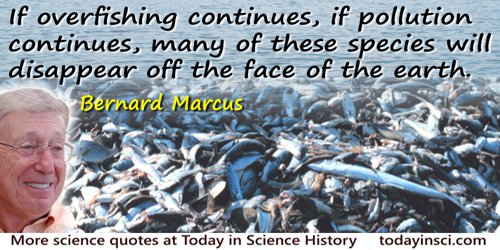
I am concerned about the air we breathe and the water we drink. If overfishing continues, if pollution continues, many of these species will disappear off the face of the earth.
I am of opinion, then, ... that, if there is any circumstance thoroughly established in geology, it is, that the crust of our globe has been subjected to a great and sudden revolution, the epoch of which cannot be dated much farther back than five or six thousand years ago; that this revolution had buried all the countries which were before inhabited by men and by the other animals that are now best known; that the same revolution had laid dry the bed of the last ocean, which now forms all the countries at present inhabited; that the small number of individuals of men and other animals that escaped from the effects of that great revolution, have since propagated and spread over the lands then newly laid dry; and consequently, that the human race has only resumed a progressive state of improvement since that epoch, by forming established societies, raising monuments, collecting natural facts, and constructing systems of science and of learning.
'Preliminary discourse', to Recherches sur les Ossemens Fossiles (1812), trans. R. Kerr Essay on the Theory of the Earth (1813), 171-2.
I am sorry to say that there is too much point to the wisecrack that life is extinct on other planets because their scientists were more advanced than ours.
From Speech (11 Dec 1959) at Washington, D.C., 'Disarmament', printed in President John F. Kennedy, A Grand and Global Alliance (1968), 1.
I forget whether you take in the Times; for the chance of your not doing so, I send the enclosed rich letter. It is, I am sure, by Fitz-Roy. … It is a pity he did not add his theory of the extinction of Mastodon, etc., from the door of the Ark being made too small.
Letter (5 Dec 1859) to Charles Lyell. In Francis Darwin and Albert Charles Seward (eds.), More Letters of Charles Darwin: A Record of his Work in a Series of Hitherto Unpublished Letters (103), Vol. 1, 129. The referenced letters in the Times were on 1 Dec and 5 Dec 1859, signed under the pseudonym “Senex”, on the topic of “Works of Art in the Drift.”
I had a Meccano set with which I “played” endlessly. Meccano which was invented by Frank Hornby around 1900, is called Erector Set in the US. New toys (mainly Lego) have led to the extinction of Meccano and this has been a major disaster as far as the education of our young engineers and scientists is concerned. Lego is a technically trivial plaything and kids love it partly because it is so simple and partly because it is seductively coloured. However it is only a toy, whereas Meccano is a real engineering kit and it teaches one skill which I consider to be the most important that anyone can acquire: This is the sensitive touch needed to thread a nut on a bolt and tighten them with a screwdriver and spanner just enough that they stay locked, but not so tightly that the thread is stripped or they cannot be unscrewed. On those occasions (usually during a party at your house) when the handbasin tap is closed so tightly that you cannot turn it back on, you know the last person to use the washroom never had a Meccano set.
Nobel laureate autobiography in Les Prix Nobel/Nobel Lectures 1996 (1997), 189.
I have attempted to form a judgment as to the conditions for evolution based on the statistical consequences of Mendelian heredity. The most general conclusion is that evolution depends on a certain balance among its factors. There must be a gene mutation, but an excessive rate gives an array of freaks, not evolution; there must be selection, but too severe a process destroys the field of variability, and thus the basis for further advance; prevalence of local inbreeding within a species has extremely important evolutionary consequences, but too close inbreeding leads merely to extinction. A certain amount of crossbreeding is favorable but not too much. In this dependence on balance the species is like a living organism. At all levels of organization life depends on the maintenance of a certain balance among its factors.
In Proceedings of the Sixth International Congress of Genetics: Ithaca, New York, 1932 (1932) Vol. 1, 365.
I was suffering from a sharp attack of intermittent fever, and every day during the cold and succeeding hot fits had to lie down for several hours, during which time I had nothing to do but to think over any subjects then particularly interesting me. One day something brought to my recollection Malthus's 'Principles of Population', which I had read about twelve years before. I thought of his clear exposition of 'the positive checks to increase'—disease, accidents, war, and famine—which keep down the population of savage races to so much lower an average than that of more civilized peoples. It then occurred to me that these causes or their equivalents are continually acting in the case of animals also; and as animals usually breed much more rapidly than does mankind, the destruction every year from these causes must be enormous in order to keep down the numbers of each species, since they evidently do not increase regularly from year to year, as otherwise the world would long ago have been densely crowded with those that breed most quickly. Vaguely thinking over the enormous and constant destruction which this implied, it occurred to me to ask the question, Why do some die and some live? The answer was clearly, that on the whole the best fitted live. From the effects of disease the most healthy escaped; from enemies, the strongest, swiftest, or the most cunning; from famine, the best hunters or those with the best digestion; and so on. Then it suddenly flashed upon me that this self-acting process would necessarily improve the race, because in every generation the inferior would inevitably be killed off and the superior would remain—that is, the fittest would survive.
[The phrase 'survival of the fittest,' suggested by the writings of Thomas Robert Malthus, was expressed in those words by Herbert Spencer in 1865. Wallace saw the term in correspondence from Charles Darwin the following year, 1866. However, Wallace did not publish anything on his use of the expression until very much later, and his recollection is likely flawed.]
[The phrase 'survival of the fittest,' suggested by the writings of Thomas Robert Malthus, was expressed in those words by Herbert Spencer in 1865. Wallace saw the term in correspondence from Charles Darwin the following year, 1866. However, Wallace did not publish anything on his use of the expression until very much later, and his recollection is likely flawed.]
My Life: A Record of Events and Opinions (1905), Vol. 1, 361-362, or in reprint (2004), 190.
If I had my life to live over again I would not devote it to develop new industrial processes: I would try to add my humble efforts to use Science to the betterment of the human race.
I despair of the helter-skelter methods of our vaulted homo sapiens, misguided by his ignorance and his politicians. If we continue our ways, there is every possibility that the human race may follow the road of former living races of animals whose fossils proclaim that they were not fit to continue. Religion, laws and morals is not enough. We need more. Science can help us.
I despair of the helter-skelter methods of our vaulted homo sapiens, misguided by his ignorance and his politicians. If we continue our ways, there is every possibility that the human race may follow the road of former living races of animals whose fossils proclaim that they were not fit to continue. Religion, laws and morals is not enough. We need more. Science can help us.
Letter to a friend (14 Jan 1934). In Savage Grace (1985, 2007), 62.
If one small and odd lineage of fishes had not evolved fins capable of bearing weight on land (though evolved for different reasons in lakes and seas,) terrestrial vertebrates would never have arisen. If a large extraterrestrial object—the ultimate random bolt from the blue—had not triggered the extinction of dinosaurs 65 million years ago, mammals would still be small creatures, confined to the nooks and crannies of a dinosaur's world, and incapable of evolving the larger size that brains big enough for self-consciousness require. If a small and tenuous population of protohumans had not survived a hundred slings and arrows of outrageous fortune (and potential extinction) on the savannas of Africa, then Homo sapiens would never have emerged to spread throughout the globe. We are glorious accidents of an unpredictable process with no drive to complexity, not the expected results of evolutionary principles that yearn to produce a creature capable of understanding the mode of its own necessary construction.
Full House: The Spread of Excellence from Plato to Darwin (1996), 216.
If this [human kind’s extinction] happens I venture to hope that we shall not have destroyed the rat, an animal of considerable enterprise which stands as good a chance as any … of evolving toward intelligence.
In The Inequality of Man: And Other Essays (1937), 143.
In summary, very large populations may differentiate rapidly, but their sustained evolution will be at moderate or slow rates and will be mainly adaptive. Populations of intermediate size provide the best conditions for sustained progressive and branching evolution, adaptive in its main lines, but accompanied by inadaptive fluctuations, especially in characters of little selective importance. Small populations will be virtually incapable of differentiation or branching and will often be dominated by random inadaptive trends and peculiarly liable to extinction, but will be capable of the most rapid evolution as long as this is not cut short by extinction.
Tempo and Mode in Evolution (1944), 70-1.
It is even harder to realize that this present universe has evolved from an unspeakably unfamiliar early condition, and faces a future extinction of endless cold or intolerable heat. The more the universe seems comprehensible, the more it seems pointless.
The First Three Minutes: A Modern View of the Origin of the Universe (1977, 1993), 154.
It is for such inquiries the modern naturalist collects his materials; it is for this that he still wants to add to the apparently boundless treasures of our national museums, and will never rest satisfied as long as the native country, the geographical distribution, and the amount of variation of any living thing remains imperfectly known. He looks upon every species of animal and plant now living as the individual letters which go to make up one of the volumes of our earth’s history; and, as a few lost letters may make a sentence unintelligible, so the extinction of the numerous forms of life which the progress of cultivation invariably entails will necessarily render obscure this invaluable record of the past. It is, therefore, an important object, which governments and scientific institutions should immediately take steps to secure, that in all tropical countries colonised by Europeans the most perfect collections possible in every branch of natural history should be made and deposited in national museums, where they may be available for study and interpretation. If this is not done, future ages will certainly look back upon us as a people so immersed in the pursuit of wealth as to be blind to higher considerations. They will charge us with having culpably allowed the destruction of some of those records of Creation which we had it in our power to preserve; and while professing to regard every living thing as the direct handiwork and best evidence of a Creator, yet, with a strange inconsistency, seeing many of them perish irrecoverably from the face of the earth, uncared for and unknown.
In 'On the Physical Geography of the Malay Archipelago', Journal of the Royal Geographical Society (1863), 33, 234.
It is interesting to contemplate an entangled bank, clothed with many plants of many kinds, with birds singing on the bushes, with various insects flitting about, and with worms crawling through the damp earth, and to reflect that these elaborately constructed forms, so different from each other, and dependent on each other in so complex a manner, have all been produced by laws acting around us. These laws, taken in the largest sense, being Growth with Reproduction; Inheritance which is almost implied by reproduction; Variability from the indirect and direct action of the external conditions of life, and from use and disuse; a Ratio of Increase so high as to lead to a Struggle for Life, and as a consequence to Natural Selection, entailing Divergence of Character and the Extinction of less-improved forms.
Concluding remarks in final chapter, The Origin of Species (1859), 490.
It is not failure but success that is forcing man off this earth. It is not sickness but the triumph of health... Our capacity to survive has expanded beyond the capacity of Earth to support us. The pains we are feeling are growing pains. We can solve growth problems in direct proportion to our capacity to find new worlds... If man stays on Earth, his extinction is sure even if he lasts till the sun expands and destroys him... It is no longer reasonable to assume that the meaning of life lies on this earth alone. If Earth is all there is for man, we are reaching the foreseeable end of man.
…...
It is so hard for an evolutionary biologist to write about extinction caused by human stupidity ... Let me then float an unconventional plea, the inverse of the usual argument ... The extinction of Partula is unfair to Partula. That is the conventional argument, and I do not challenge its primacy. But we need a humanistic ecology as well, both for the practical reason that people will always touch people more than snails do or can, and for the moral reason that humans are legitimately the measure of all ethical questions–for these are our issues, not nature’s.
…...
It will be noticed that the fundamental theorem proved above bears some remarkable resemblances to the second law of thermodynamics. Both are properties of populations, or aggregates, true irrespective of the nature of the units which compose them; both are statistical laws; each requires the constant increase of a measurable quantity, in the one case the entropy of a physical system and in the other the fitness, measured by m, of a biological population. As in the physical world we can conceive the theoretical systems in which dissipative forces are wholly absent, and in which the entropy consequently remains constant, so we can conceive, though we need not expect to find, biological populations in which the genetic variance is absolutely zero, and in which fitness does not increase. Professor Eddington has recently remarked that “The law that entropy always increases—the second law of thermodynamics—holds, I think, the supreme position among the laws of nature.” It is not a little instructive that so similar a law should hold the supreme position among the biological sciences. While it is possible that both may ultimately be absorbed by some more general principle, for the present we should note that the laws as they stand present profound differences—-(1) The systems considered in thermodynamics are permanent; species on the contrary are liable to extinction, although biological improvement must be expected to occur up to the end of their existence. (2) Fitness, although measured by a uniform method, is qualitatively different for every different organism, whereas entropy, like temperature, is taken to have the same meaning for all physical systems. (3) Fitness may be increased or decreased by changes in the environment, without reacting quantitatively upon that environment. (4) Entropy changes are exceptional in the physical world in being irreversible, while irreversible evolutionary changes form no exception among biological phenomena. Finally, (5) entropy changes lead to a progressive disorganization of the physical world, at least from the human standpoint of the utilization of energy, while evolutionary changes are generally recognized as producing progressively higher organization in the organic world.
The Genetical Theory of Natural Selection (1930), 36.
It’s like seeing a light at the end of the tunnel and the tunnel has leaves on it.
About rain forest destruction and species extinction.
About rain forest destruction and species extinction.
Quoted in Douglas Martin, 'A Brief Walk Through Time', New York Times (4 Jan 2002), E39.
Judged superficially, a progressive saturation of the germ plasm of a species with mutant genes a majority of which are deleterious in their effects is a destructive process, a sort of deterioration of the genotype which threatens the very existence of the species and can finally lead only to its extinction. The eugenical Jeremiahs keep constantly before our eyes the nightmare of human populations accumulating recessive genes that produce pathological effects when homozygous. These prophets of doom seem to be unaware of the fact that wild species in the state of nature fare in this respect no better than man does with all the artificality of his surroundings, and yet life has not come to an end on this planet. The eschatological cries proclaiming the failure of natural selection to operate in human populations have more to do with political beliefs than with scientific findings.
Genetics and Origin of Species (1937), 126.
Life is a copiously branching bush, continually pruned by the grim reaper of extinction, not a ladder of predictable progress.
Wonderful Life (1989), 35.
Life is extinct on other planets because their scientists were more advanced than ours.
In Lily Splane, Quantum Consciousness (2004), 307
Life, therefore, has been often disturbed on this earth by terrible events—calamities which, at their commencement, have perhaps moved and overturned to a great depth the entire outer crust of the globe, but which, since these first commotions, have uniformly acted at a less depth and less generally. Numberless living beings have been the victims of these catastrophes; some have been destroyed by sudden inundations, others have been laid dry in consequence of the bottom of the seas being instantaneously elevated. Their races even have become extinct, and have left no memorial of them except some small fragments which the naturalist can scarcely recognise.
'Preliminary discourse', to Recherches sur les Ossemens Fossiles (1812), trans. R. Kerr Essay on the Theory of the Earth (1813), 16-7.
Looking back over the geological record it would seem that Nature made nearly every possible mistake before she reached her greatest achievement Man—or perhaps some would say her worst mistake of all. ... At last she tried a being of no great size, almost defenseless, defective in at least one of the more important sense organs; one gift she bestowed to save him from threatened extinction—a certain stirring, a restlessness, in the organ called the brain.
…...
Many Species of Animals have been lost out of the World, which Philosophers and Divines are unwilling to admit, esteeming the Destruction of anyone Species a Dismembring of the Universe, and rendring the World imperfect; whereas they think the Divine Providence is especially concerned, and solicitous to secure and preserve the Works of the Creation. And truly so it is, as appears, in that it was so careful to lodge all Land Animals in the Ark at the Time of the general Deluge; and in that, of all Animals recorded in Natural Histories, we cannot say that there hath been anyone Species lost, no not of the most infirm, and most exposed to Injury and Ravine. Moreover, it is likely, that as there neither is nor can be any new Species of Animals produced, all proceeding from Seeds at first created; so Providence, without which one individual Sparrow falls not to the ground, doth in that manner watch over all that are created, that an entire Species shall not be lost or destroyed by any Accident. Now, I say, if these Bodies were sometimes the Shells and Bones of Fish, it will thence follow, that many Species have been lost out of the World... To which I have nothing to reply, but that there may be some of them remaining some where or other in the Seas, though as yet they have not come to my Knowledge. Far though they may have perished, or by some Accident been destroyed out of our Seas, yet the Race of them may be preserved and continued still in others.
— John Ray
Three Physico-Theological Discourses (1713), Discourse II, 'Of the General Deluge, in the Days of Noah; its Causes and Effects', 172-3.
Meat reared on land matures relatively quickly, and it takes only a few pounds of plants to produce a pound of meat. Tuna take 10 to 14 years to mature, require thousands of pounds of food to develop, and we’re hunting them to the point of extinction.
In 'Can We Stop Killing Our Oceans Now, Please?', Huffington Post (14 Aug 2013).
Nature does not know extinction; all it knows is transformation. … Everything science has taught me—and continues to teach me—strengthens my belief in the continuity of our spiritual existence after death. Nothing disappears without a trace.
Wehner von Braun article in This Week Magazine (24 Jan 1960), 2. Excerpted in Viola Walden, Sword Scrapbook (1980), 66.
No comfort should be drawn from the spurious belief that because extinction is a natural process, man is merely another Darwinian agent.
In 'Edward O. Wilson: The Biological Diversity Crisis: A Challenge to Science', Issues in Science and Technology (Fall 1985), 2, No. 1, 25.
No one knows the diversity in the world, not even to the nearest order of magnitude. … We don’t know for sure how many species there are, where they can be found or how fast they’re disappearing. It’s like having astronomy without knowing where the stars are.
Quoted in Jamie Murphy and Andrea Dorfman, 'The Quiet Apocalypse,' Time (13 Oct 1986).
Now the American eagle is verging on extinction. Even the polar bear on its ice floes has become easy game for flying sportsmen. A peninsula named Udjung Kulon holds the last two or three dozen Javan rhinoceroses. The last known herd of Arabian oryx has been machine-gunned by a sheik. Blue whales have nearly been harpooned out of their oceans. Pollution ruins bays and rivers. Refuse litters beaches. Dam projects threaten Colorado canyons, Hudson valleys, every place of natural beauty that can be a reservoir for power. Obviously the scientific progress so alluring to me is destroying qualities of greater worth.
In 'The Wisdom of Wilderness', Life (22 Dec 1967), 63, No. 25, 8-9. (Note: the Arabian oryx is no longer listed as extinct.)
Of what use are the great number of petrifactions, of different species, shape and form which are dug up by naturalists? Perhaps the collection of such specimens is sheer vanity and inquisitiveness. I do not presume to say; but we find in our mountains the rarest animals, shells, mussels, and corals embalmed in stone, as it were, living specimens of which are now being sought in vain throughout Europe. These stones alone whisper in the midst of general silence.
Philosophia Botanica (1751), aphorism 132. Trans. Frans A. Stafleu, Linnaeus and the Linnaeans: The Spreading of their Ideas in Systematic Botany, 1735-1789 (1971), 56.
Perhaps our and Gaia’s greatest error was the conscious abuse of fire. Cooking meat over a wood fire may have been acceptable, but the deliberate destruction of whole ecosystems by fire merely to drive out the animals within was surely our first great sin against the living Earth. It has haunted us ever since and combustion could now be our auto da fé, and the cause of our extinction.
In The Revenge of Gaia: Earth’s Climate Crisis & The Fate of Humanity (2006, 2007), 186.
Run the tape again, and let the tiny twig of Homo sapiens expire in Africa. Other hominids may have stood on the threshold of what we know as human possibilities, but many sensible scenarios would never generate our level of mentality. Run the tape again, and this time Neanderthal perishes in Europe and Homo erectus in Asia (as they did in our world). The sole surviving human stock, Homo erectus in Africa, stumbles along for a while, even prospers, but does not speciate and therefore remains stable. A mutated virus then wipes Homo erectus out, or a change in climate reconverts Africa into inhospitable forest. One little twig on the mammalian branch, a lineage with interesting possibilities that were never realized, joins the vast majority of species in extinction. So what? Most possibilities are never realized, and who will ever know the difference? Arguments of this form lead me to the conclusion that biology's most profound insight into human nature, status, and potential lies in the simple phrase, the embodiment of contingency: Homo sapiens is an entity, not a tendency.
Wonderful Life (1989), 320.
Science has found that nothing can disappear without a trace. Nature does not know extinction. All it knows is transformation.
In This Week Magazine (24 Jan 1960), 2. As quoted in Martin A. Recio, From the Threshold of Heaven (2008), 102.
So long as the fur of the beaver was extensively employed as a material for fine hats, it bore a very high price, and the chase of this quadruped was so keen that naturalists feared its speedy consideration. When a Parisian manufacturer invented the silk hat, which soon came into almost universal use, the demand for beavers' fur fell off, and this animal–whose habits, as we have seen, are an important agency in the formation of bogs and other modifications of forest nature–immediately began to increase, reappeared in haunts which we had long abandoned, and can no longer be regarded as rare enough to be in immediate danger of extirpation. Thus the convenience or the caprice of Parisian fashion has unconsciously exercised an influence which may sensibly affect the physical geography of a distant continent.
In Man and Nature, (1864), 84.
Something will have gone out of us as a people if we ever let the remaining wilderness be destroyed; if we permit the last virgin forests to be turned into comic books and plastic cigarette cases; if we drive the few remaining members of the wild species into zoos or to extinction; if we pollute the last clean air and dirty the last clean streams and push our paved roads through the last of the silence, so that never again will Americans be free in their own country from the noise, the exhausts, the stinks of human and automotive waste.
Letter (3 Dec 1960) written to David E. Pesonen of the Outdoor Recreation Resources Review Commission. Collected in 'Coda: Wilderness Letter', The Sound of Mountain Water: The Changing American West (1969), 146.
That no real Species of Living Creatures is so utterly extinct, as to be lost entirely out of the World, since it was first Created, is the Opinion of many Naturalists; and 'tis grounded on so good a Principle of Providence taking Care in general of all its Animal Productions, that it deserves our Assent. However great Vicissitudes may be observed to attend the Works of Nature, as well as Humane Affairs; so that some entire Species of Animals, which have been formerly Common, nay even numerous in certain Countries; have, in Process of time, been so perfectly soft, as to become there utterly unknown; tho' at the same time it cannot be denyed, but the kind has been carefully preserved in some other part of the World.
'A Discourse concerning the Large Horns frequently found under Ground in Ireland, Concluding from them that the great American Deer, call'd a Moose, was formerly common in that Island: With Remarks on some other things Natural to that Country', Philosophical Transactions of the Royal Society of London (1697), 19, 489.
The beauty and genius of a work of art may be reconceived, though its first material expression be destroyed; a vanished harmony may yet again inspire the composer, but when the last individual of a race of living things breathes no more, another heaven and another earth must pass before such a one can be again.
In The Bird: Its Form and Function (1906), Vol. 1, 18.
The diversity of life is extraordinary. There is said to be a million or so different kinds of living animals, and hundreds of thousands of kinds of plants. But we don’t need to think of the world at large. It is amazing enough to stop and look at a forest or at a meadow—at the grass and trees and caterpillars and hawks and deer. How did all these different kinds of things come about; what forces governed their evolution; what forces maintain their numbers and determine their survival or extinction; what are their relations to each other and to the physical environment in which they live? These are the problems of natural history.
In The Nature of Natural History (1950), 8.
The epoch of intense cold which preceded the present creation has been only a temporary oscillation of the earth’s temperature, more important than the century-long phases of cooling undergone by the Alpine valleys. It was associated with the disappearance of the animals of the diluvial epoch of the geologists, as still demonstrated by the Siberian mammoths; it preceded the uplifting of the Alps and the appearance of the present-day living organisms, as demonstrated by the moraines and the existence of fishes in our lakes. Consequently, there is complete separation between the present creation and the preceding ones, and if living species are sometimes almost identical to those buried inside the earth, we nevertheless cannot assume that the former are direct descendants of the latter or, in other words, that they represent identical species.
From Discours de Neuchâtel (1837), as translated by Albert V. Carozzi in Studies on Glaciers: Preceded by the Discourse of Neuchâtel (1967), lviii.
The extinctions ongoing worldwide promise to be at least as great as the mass extinction that occurred at the end of the age of dinosaurs.
Quoted in Jamie Murphy and Andrea Dorfman, 'The Quiet Apocalypse,' Time (13 Oct 1986).
The morning was hardly propitious
When sailors discovered Mauritius
They killed off the lot Stewed them up in a pot
And pronounced them extinct, but delicious.
When sailors discovered Mauritius
They killed off the lot Stewed them up in a pot
And pronounced them extinct, but delicious.
In History of Life (1989, 5th ed. 2013), 293. As a chapter review question to explain the science indicated.
The process of mutation is the only known source of the raw materials of genetic variability, and hence of evolution. It is subject to experimental study, and considerable progress has been accomplished in this study in recent years. An apparent paradox has been disclosed. Although the living matter becomes adapted to its environment through formation of superior genetic patterns from mutational components, the process of mutation itself is not adaptive. On the contrary, the mutants which arise are, with rare exceptions, deleterious to their carriers, at least in the environments which the species normally encounters. Some of them are deleterious apparently in all environments. Therefore, the mutation process alone, not corrected and guided by natural selection, would result in degeneration and extinction rather than in improved adaptedness.
'On Methods of Evolutionary Biology and Anthropology', American Scientist, 1957, 45, 385.
The question now at issue, whether the living species are connected with the extinct by a common bond of descent, will best be cleared up by devoting ourselves to the study of the actual state of the living world, and to those monuments of the past in which the relics of the animate creation of former ages are best preserved and least mutilated by the hand of time.
The Antiquity of Man (1863), 470.
The rate of extinction is now about 400 times that recorded through recent geological time and is accelerating rapidly. If we continue on this path, the reduction of diversity seems destined to approach that of the great natural catastrophes at the end of the Paleozoic and Mesozoic Eras, in other words, the most extreme for 65 million years. And in at least one respect, this human-made hecatomb is worse than any time in the geological past. In the earlier mass extinctions… most of the plant diversity survived even though animal diversity was severely reduced. Now, for the first time ever, plant diversity too is declining sharply.
In 'Edward O. Wilson: The Biological Diversity Crisis: A Challenge to Science', Issues in Science and Technology (Fall 1985), 2, No. 1, 25.
The ravages committed by man subvert the relations and destroy the balance which nature had established between her organized and her inorganic creations; and she avenges herself upon the intruder, by letting loose upon her defaced provinces destructive energies hitherto kept in check by organic forces destined to be his best auxiliaries, but which he has unwisely dispersed and driven from the field of action. When the forest is gone, the great reservoir of moisture stored up in its vegetable mould is evaporated, and returns only in deluges of rain to wash away the parched dust into which that mould has been converted. The well-wooded and humid hills are turned to ridges of dry rock, which encumbers the low grounds and chokes the watercourses with its debris, and–except in countries favored with an equable distribution of rain through the seasons, and a moderate and regular inclination of surface–the whole earth, unless rescued by human art from the physical degradation to which it tends, becomes an assemblage of bald mountains, of barren, turfless hills, and of swampy and malarious plains. There are parts of Asia Minor, of Northern Africa, of Greece, and even of Alpine Europe, where the operation of causes set in action by man has brought the face of the earth to a desolation almost as complete as that of the moon; and though, within that brief space of time which we call “the historical period,” they are known to have been covered with luxuriant woods, verdant pastures, and fertile meadows, they are now too far deteriorated to be reclaimable by man, nor can they become again fitted for human use, except through great geological changes, or other mysterious influences or agencies of which we have no present knowledge, and over which we have no prospective control. The earth is fast becoming an unfit home for its noblest inhabitant, and another era of equal human crime and human improvidence, and of like duration with that through which traces of that crime and that improvidence extend, would reduce it to such a condition of impoverished productiveness, of shattered surface, of climatic excess, as to threaten the depravation, barbarism, and perhaps even extinction of the species.
Man and Nature, (1864), 42-3.
The secrets of evolution are death and time—the deaths of enormous numbers of lifeforms that were imperfectly adapted to the environment; and time for a long succession of small mutations.
Cosmos (1980, 1985), 20.
The struggle for existence holds as much in the intellectual as in the physical world. A theory is a species of thinking, and its right to exist is coextensive with its power of resisting extinction by its rivals.
Science and Culture, and Other Essays (1890), 335.
The worst thing that will probably happen—in fact is already well underway—is not energy depletion, economic collapse, conventional war, or the expansion of totalitarian governments. As terrible as these catastrophes would be for us, they can be repaired in a few generations. The one process now going on that will take millions of years to correct is loss of genetic and species diversity by the destruction of natural habitats. This is the folly our descendants are least likely to forgive us.
Biophilia (1984), 121.(1990), 182.
They fall from the branches to wait
But they’re 12,000 summers too late
You can smell them for miles
They’re rotting in piles
The fruits that the gomphotheres ate.
But they’re 12,000 summers too late
You can smell them for miles
They’re rotting in piles
The fruits that the gomphotheres ate.
In History of Life (1989, 5th ed. 2013), 293. As a chapter review question to explain the science indicated.
We have also here an acting cause to account for that balance so often observed in nature,—a deficiency in one set of organs always being compensated by an increased development of some others—powerful wings accompanying weak feet, or great velocity making up for the absence of defensive weapons; for it has been shown that all varieties in which an unbalanced deficiency occurred could not long continue their existen The action of this principle is exactly like that of the centrifugal governor of the steam engine, which checks and corrects any irregularities almost before they become evident; and in like manner no unbalanced deficiency in the animal kingdom can ever reach any conspicuous magnitude, because it would make itself felt at the very first step, by rendering existence difficult and extinction almost sure soon to follow.
In 'On the Tendency of Varieties to Depart Indefinitely from the Original Type', Journal of the Proceedings of the Linnean Society, Zoology (1858), 3, 61-62.
We have very strong physical and chemical evidence for a large impact; this is the most firmly established part of the whole story. There is an unquestionable mass extinction at this time, and in the fossil groups for which we have the best record, the extinction coincides with the impact to a precision of a centimeter or better in the stratigraphic record. This exact coincidence in timing strongly argues for a causal relationship.
Referring to the theory that he, and his father (physicist Luis W. Alvarez), held that dinosaurs abruptly went extinct as a result of a 6-mile-wide asteroid or comet struck the earth. In American Geophysical Union, EOS (2 Sep 1986), as quoted and cited in John Noble Wilford, 'New Data Extend Era of Dinosaurs' New York Times (9 Nov 1986), A41.
We must somehow keep the dreams of space exploration alive, for in the long run they will prove to be of far more importance to the human race than the attainment of material benefits. Like Darwin, we have set sail upon an ocean: the cosmic sea of the Universe. There can be no turning back. To do so could well prove to be a guarantee of extinction. When a nation, or a race or a planet turns its back on the future, to concentrate on the present, it cannot see what lies ahead. It can neither plan nor prepare for the future, and thus discards the vital opportunity for determining its evolutionary heritage and perhaps its survival.
…...
What happened to those Ice Age beasts? What caused the mammoth and mastodon and wooly rhinoceros to pay the ultimate Darwinian penalty, while bison and musk ox survived? Why didn't the fauna of Africa suffer the kinds of losses evident in other regions of the world? And if something like climatic change caused the extinction of North America's Pleistocene horse, how have feral horses managed to reestablish themselves on the western range?
(1986)
When not protected by law, by popular favor or superstition, or by other special circumstances, [birds] yield very readily to the influences of civilization, and, though the first operations of the settler are favorable to the increase of many species, the great extension of rural and of mechanical industry is, in a variety of ways, destructive even to tribes not directly warred upon by man.
In Man and Nature, (1864), 93-93.
Who, foe to Nature, hears the gen’ral groan,
Murders their species, and betrays his own.
Murders their species, and betrays his own.
In 'Epistle III', Essay on Man,: Being the First Book of Ethic Epistles (1734), 46.
Why Become Extinct? Authors with varying competence have suggested that dinosaurs disappeared because the climate deteriorated (became suddenly or slowly too hot or cold or dry or wet), or that the diet did (with too much food or not enough of such substances as fern oil; from poisons in water or plants or ingested minerals; by bankruptcy of calcium or other necessary elements). Other writers have put the blame on disease, parasites, wars, anatomical or metabolic disorders (slipped vertebral discs, malfunction or imbalance of hormone and endocrine systems, dwindling brain and consequent stupidity, heat sterilization, effects of being warm-blooded in the Mesozoic world), racial old age, evolutionary drift into senescent overspecialization, changes in the pressure or composition of the atmosphere, poison gases, volcanic dust, excessive oxygen from plants, meteorites, comets, gene pool drainage by little mammalian egg-eaters, overkill capacity by predators, fluctuation of gravitational constants, development of psychotic suicidal factors, entropy, cosmic radiation, shift of Earth’s rotational poles, floods, continental drift, extraction of the moon from the Pacific Basin, draining of swamp and lake environments, sunspots, God’s will, mountain building, raids by little green hunters in flying saucers, lack of standing room in Noah’s Ark, and palaeoweltschmerz.
'Riddles of the Terrible Lizards', American Scientist (1964) 52, 231.
Why the dinosaurs died out is not known, but it is supposed to be because they had minute brains and devoted themselves to the growth of weapons of offense in the shape of numerous horns. However that may be, it was not through their line that life developed.
In 'Men versus. Insects' (1933), collected in In Praise of Idleness and Other Essays (1935), 199.
You will never convince some palaeontologists that an impact killed the dinosaurs unless you find a dinosaur skeleton with a crushed skull and a ring of iridium round the hole.
Quoted in 'Extinction Wars' by Stell Weisburd, Science News (1 Feb 1986), 77.
 In science it often happens that scientists say, 'You know that's a really good argument; my position is mistaken,' and then they would actually change their minds and you never hear that old view from them again. They really do it. It doesn't happen as often as it should, because scientists are human and change is sometimes painful. But it happens every day. I cannot recall the last time something like that happened in politics or religion.
(1987) --
In science it often happens that scientists say, 'You know that's a really good argument; my position is mistaken,' and then they would actually change their minds and you never hear that old view from them again. They really do it. It doesn't happen as often as it should, because scientists are human and change is sometimes painful. But it happens every day. I cannot recall the last time something like that happened in politics or religion.
(1987) -- 





