Exclusive Quotes (30 quotes)
[Helmholtz] is not a philosopher in the exclusive sense, as Kant, Hegel, Mansel are philosophers, but one who prosecutes physics and physiology, and acquires therein not only skill in developing any desideratum, but wisdom to know what are the desiderata, e.g., he was one of the first, and is one of the most active, preachers of the doctrine that since all kinds of energy are convertible, the first aim of science at this time. should be to ascertain in what way particular forms of energy can be converted into each other, and what are the equivalent quantities of the two forms of energy.
Letter to Lewis Campbell (21 Apr 1862). In P.M. Harman (ed.), The Scientific Letters and Papers of James Clerk Maxwell (1990), Vol. 1, 711.
Ueber den Glauben lässt sich wissenschaftlich nicht rechten, denn die Wissenschaft und der Glaube schliessen sich aus. Nicht so, dass der eine die andere unmöglich machte oder umgekehrt, sondern so, dass, soweit die Wissenschaft reicht, kein Glaube existirt und der Glaube erst da anfangen darf, wo die Wissenschaft aufhört. Es lässt „sich nicht läugnen, dass, wenn diese Grenze eingehalten wird, der Glaube wirklich reale Objekte haben kann. Die Aufgabe der Wissenschaft ist es daher nicht, die Gegenstände des Glaubens anzugreifen, sondern nur die Grenzen zu stecken, welche die Erkenntniss erreichen kann, und innerhalb derselben das einheitliche Selbstbewusstsein zu begründen.
There is no scientific justification for faith, for science and faith are mutually exclusive. Not that one made the other impossible, or vice versa, but that, as far as science goes, there is no faith, and faith can only begin where science ends. It can not be denied that, if this limit is adhered to, faith can really have real objects. The task of science, therefore, is not to attack the objects of faith, but merely to set the limits which knowledge can attain and to establish within it the unified self-esteem.
There is no scientific justification for faith, for science and faith are mutually exclusive. Not that one made the other impossible, or vice versa, but that, as far as science goes, there is no faith, and faith can only begin where science ends. It can not be denied that, if this limit is adhered to, faith can really have real objects. The task of science, therefore, is not to attack the objects of faith, but merely to set the limits which knowledge can attain and to establish within it the unified self-esteem.
Original German from 'Der Mensch' (1849), collected in Gesammelte abhandlungen zur wissenschaftlichen medicin (1856), 6. Webmaster used Google translate for the English version. This longer quote unites the shorter quotes from within it shown separately on the Rudolf Virchow quotations page, with alternative translations, which begin: “There can be no scientific dispute…”, “Belief has no place…”, and “The task of science…”.
A mind exclusively bent upon the idea of utility necessarily narrows the range of the imagination. For it is the imagination which pictures to the inner eye of the investigator the indefinitely extending sphere of the possible,—that region of hypothesis and explanation, of underlying cause and controlling law. The area of suggestion and experiment is thus pushed beyond the actual field of vision.
In 'The Paradox of Research', The North American Review (Sep 1908), 188, No. 634, 425.
Belief cannot be reckoned with in terms of science, for science and faith are mutually exclusive.
In Fielding Hudson Garrison, An Introduction to the History of Medicine (1966), 576.
But as my conclusions have lately been much misrepresented, and it has been stated that I attribute the modification of species exclusively to natural selection, I may be permitted to remark that in the first edition of this work, and subsequently, I placed in a most conspicuous position—namely, at the close of the Introduction—the following words: “I am convinced that natural selection has been the main but not the exclusive means of modification.” This has been of no avail. Great is the power of steady misrepresentation; but the history of science shows that fortunately this power does not long endure.
In The Origin of Species by Means of Natural Selection with additions and corrections from sixth and last English edition (1899), Vol. 2, 293.
First, as concerns the success of teaching mathematics. No instruction in the high schools is as difficult as that of mathematics, since the large majority of students are at first decidedly disinclined to be harnessed into the rigid framework of logical conclusions. The interest of young people is won much more easily, if sense-objects are made the starting point and the transition to abstract formulation is brought about gradually. For this reason it is psychologically quite correct to follow this course.
Not less to be recommended is this course if we inquire into the essential purpose of mathematical instruction. Formerly it was too exclusively held that this purpose is to sharpen the understanding. Surely another important end is to implant in the student the conviction that correct thinking based on true premises secures mastery over the outer world. To accomplish this the outer world must receive its share of attention from the very beginning.
Doubtless this is true but there is a danger which needs pointing out. It is as in the case of language teaching where the modern tendency is to secure in addition to grammar also an understanding of the authors. The danger lies in grammar being completely set aside leaving the subject without its indispensable solid basis. Just so in Teaching of Mathematics it is possible to accumulate interesting applications to such an extent as to stunt the essential logical development. This should in no wise be permitted, for thus the kernel of the whole matter is lost. Therefore: We do want throughout a quickening of mathematical instruction by the introduction of applications, but we do not want that the pendulum, which in former decades may have inclined too much toward the abstract side, should now swing to the other extreme; we would rather pursue the proper middle course.
Not less to be recommended is this course if we inquire into the essential purpose of mathematical instruction. Formerly it was too exclusively held that this purpose is to sharpen the understanding. Surely another important end is to implant in the student the conviction that correct thinking based on true premises secures mastery over the outer world. To accomplish this the outer world must receive its share of attention from the very beginning.
Doubtless this is true but there is a danger which needs pointing out. It is as in the case of language teaching where the modern tendency is to secure in addition to grammar also an understanding of the authors. The danger lies in grammar being completely set aside leaving the subject without its indispensable solid basis. Just so in Teaching of Mathematics it is possible to accumulate interesting applications to such an extent as to stunt the essential logical development. This should in no wise be permitted, for thus the kernel of the whole matter is lost. Therefore: We do want throughout a quickening of mathematical instruction by the introduction of applications, but we do not want that the pendulum, which in former decades may have inclined too much toward the abstract side, should now swing to the other extreme; we would rather pursue the proper middle course.
In Ueber den Mathematischen Unterricht an den hoheren Schulen; Jahresbericht der Deutschen Mathematiker Vereinigung, Bd. 11, 131.
General preparatory instruction must continue to be the aim in the instruction at the higher institutions of learning. Exclusive selection and treatment of subject matter with reference to specific avocations is disadvantageous.
In Resolution adopted by the German Association for the Advancement of Scientific and Mathematical Instruction, in Jahresbericht der Deutschen Mathematiker Vereinigung (1896), 41. As translated in Robert Édouard Moritz, Memorabilia Mathematica; Or, The Philomath’s Quotation-Book (1914), 72.
I have long recognized the theory and aesthetic of such comprehensive display: show everything and incite wonder by sheer variety. But I had never realized how power fully the decor of a cabinet museum can promote this goal until I saw the Dublin [Natural History Museum] fixtures redone right ... The exuberance is all of one piece–organic and architectural. I write this essay to offer my warmest congratulations to the Dublin Museum for choosing preservation–a decision not only scientifically right, but also ethically sound and decidedly courageous. The avant-garde is not an exclusive locus of courage; a principled stand within a reconstituted rear unit may call down just as much ridicule and demand equal fortitude. Crowds do not always rush off in admirable or defendable directions.
…...
I learnt very quickly that the only reason that would be accepted for not attending a committee meeting was that one already had a previous commitment to attend a meeting of another organization on the same day. I therefore invented a society, the Orion Society, a highly secret and very exclusive society that spawned a multitude of committees, sub-committees, working parties, evaluation groups and so on that, regrettably, had a prior claim on my attention. Soon people wanted to know more about this club and some even decided that they would like to join it. However, it was always made clear to them that applications were never entertained and that if they were deemed to qualify for membership they would be discreetly approached at the appropriate time.
Loose Ends from Current Biology (1997), 14.
It may be true that people who are merely mathematicians have certain specific shortcomings; however that is not the fault of mathematics, but is true of every exclusive occupation. Likewise a mere linguist, a mere jurist, a mere soldier, a mere merchant, and so forth. One could add such idle chatter that when a certain exclusive occupation is often connected with certain specific shortcomings, it is on the other hand always free of certain other shortcomings.
Letter to Heinrich Schumacher (1-5 Jan 1845). Quoted in G. Waldo Dunnington, Carl Friedrich Gauss: Titan of Science (2004), 414.
It may be true, that men, who are mere mathematicians, have certain specific shortcomings, but that is not the fault of mathematics, for it is equally true of every other exclusive occupation. So there are mere philologists, mere jurists, mere soldiers, mere merchants, etc. To such idle talk it might further be added: that whenever a certain exclusive occupation is coupled with specific shortcomings, it is likewise almost certainly divorced from certain other shortcomings.
In Gauss-Schumacher Briefwechsel, Bd. 4, (1862), 387.
Knowledge is never the exclusive possession of any favoured race; the whole world is inter-dependent and a constant stream of thought had through ages enriched the common heritage of mankind.
From 'Sir J.C. Bose’s Address', Benares Hindu University 1905-1935 (1936), 423-424.
Most classifications, whether of inanimate objects or of organisms, are hierarchical. There are “higher” and “lower” categories, there are higher and lower ranks. What is usually overlooked is that the use of the term “hierarchy” is ambiguous, and that two fundamentally different kinds of arrangements have been designated as hierarchical. A hierarchy can be either exclusive or inclusive. Military ranks from private, corporal, sergeant, lieutenant, captain, up to general are a typical example of an exclusive hierarchy. A lower rank is not a subdivision of a higher rank; thus, lieutenants are not a subdivision of captains. The scala naturae, which so strongly dominated thinking from the sixteenth to the eighteenth century, is another good illustration of an exclusive hierarchy. Each level of perfection was considered an advance (or degradation) from the next lower (or higher) level in the hierarchy, but did not include it.
The Growth of Biological Thought: Diversity, Evolution and Inheritance (1982), 205-6.
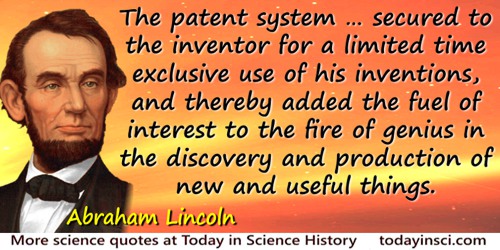
Next came the patent laws. These began in England in 1624, and in this country with the adoption of our Constitution. Before then any man [might] instantly use what another man had invented, so that the inventor had no special advantage from his own invention. The patent system changed this, secured to the inventor for a limited time exclusive use of his inventions, and thereby added the fuel of interest to the fire of genius in the discovery and production of new and useful things.
Lecture 'Discoveries, Inventions and Improvements' (22 Feb 1860) in John George Nicolay and John Hay (eds.), Complete Works of Abraham Lincoln (1894), Vol. 5, 113. In Eugene C. Gerhart, Quote it Completely! (1998), 802.
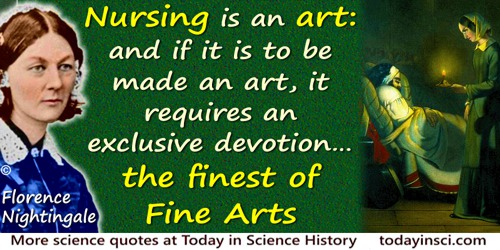
Nursing is an art: and if it is to be made an art, it requires an exclusive devotion as hard a preparation as any painter’s or sculptor’s work; for what is the having to do with dead canvas or dead marble, compared with having to do with the living body, the temple of God’s spirit? It is one of the Fine Arts: I had almost said, the finest of Fine Arts.
First published as a eulogy to an unnamed nurse in 'Una and the Lion', Good Words (1 Jun 1868), 360-366. Reprinted in Una and the Lion (1871), 6.
Of … habitable worlds, such as the Earth, all which we may suppose to be of a terrestrial or terraqueous nature, and filled with beings of the human species, subject to mortality, it may not be amiss in this place to compute how many may he conceived within our finite view every clear Star-light night. … In all together then we may safely reckon 170,000,000, and yet be much within compass, exclusive Of the Comets which I judge to be by far the most numerous part of the creation.
In The Universe and the Stars: Being an Original Theory on the Visible Creation, Founded on the Laws of Nature (1750, 1837), 131-132.
Physicists speak of the particle representation or the wave representation. Bohr's principle of complementarity asserts that there exist complementary properties of the same object of knowledge, one of which if known will exclude knowledge of the other. We may therefore describe an object like an electron in ways which are mutually exclusive—e.g., as wave or particle—without logical contradiction provided we also realize that the experimental arrangements that determine these descriptions are similarly mutually exclusive. Which experiment—and hence which description one chooses—is purely a matter of human choice.
The Cosmic Code: Quantum Physics as the Language of Nature (1982), 94.
Science is not only compatible with spirituality; it is a profound source of spirituality. When we recognize our place in an immensity of light-years and in the passage of ages, when we grasp the intricacy, beauty, and subtlety of life, then that soaring feeling, that sense of elation and humility combined, is surely spiritual ... The notion that science and spirituality are somehow mutually exclusive does a disservice to both.
In Demon-Haunted World: Science as a Candle in the Dark (1995), 29.
So the horns of the stag are sharp to offend his adversary, but are branched for the purpose of parrying or receiving the thrusts of horns similar to his own, and have therefore been formed for the purpose of combating other stags for the exclusive possession of the females; who are observed, like the ladies in the times of chivalry, to attend to the car of the victor... The final cause of this contest amongst the males seems to be, that the strongest and most active animal should propagate the species, which should thence become improved.
Zoonomia (1794), Vol. 1, 507.
Taxes are a means of influencing production and commerce to give to them a direction which they would not naturally have taken. Such an influence may undoubtedly have disagreeable consequences if the taxes are imposed without discrimination or exclusively for a fiscal purpose, but it is entirely otherwise if wisdom and tact preside at their institution.
From Appendix A, 'Extracts From the Unpublished Writings of Carnot', Reflections on the Motive Power of Heat (1890, 2nd ed. 1897), 212.
The attainment of knowledge is the high and exclusive attribute of man, among the numberless myriads of animated beings, inhabitants of the terrestrial globe. On him alone is bestowed, by the bounty of the Creator of the universe, the power and the capacity of acquiring knowledge. Knowledge is the attribute of his nature which at once enables him to improve his condition upon earth, and to prepare him for the enjoyment of a happier existence hereafter.
Report, as chairman of a committee, on the establishment of the Smithsonian Institution (Jan 1836). In Josiah Quincy, Memoir of the life of John Quincy Adams (1858), 265.
The best that Gauss has given us was likewise an exclusive production. If he had not created his geometry of surfaces, which served Riemann as a basis, it is scarcely conceivable that anyone else would have discovered it. I do not hesitate to confess that to a certain extent a similar pleasure may be found by absorbing ourselves in questions of pure geometry.
Quoted in G. Waldo Dunnington, Carl Friedrich Gauss: Titan of Science (2004), 350.
The Congress shall have power to ... promote the progress of science and useful arts, by securing for limited times to authors and inventors the exclusive right to their respective writings and discoveries.
Founding U.S. Patents.
Founding U.S. Patents.
Constitution of the United States, Art. 1, Sec.8, Par. 8. In George Sewall Boutwell, The Constitution of the United States at the End of the First Century (1895), 219.
The golden age of mathematics—that was not the age of Euclid, it is ours. Ours is the age when no less than six international congresses have been held in the course of nine years. It is in our day that more than a dozen mathematical societies contain a growing membership of more than two thousand men representing the centers of scientific light throughout the great culture nations of the world. It is in our time that over five hundred scientific journals are each devoted in part, while more than two score others are devoted exclusively, to the publication of mathematics. It is in our time that the Jahrbuch über die Fortschritte der Mathematik, though admitting only condensed abstracts with titles, and not reporting on all the journals, has, nevertheless, grown to nearly forty huge volumes in as many years. It is in our time that as many as two thousand books and memoirs drop from the mathematical press of the world in a single year, the estimated number mounting up to fifty thousand in the last generation. Finally, to adduce yet another evidence of a similar kind, it requires not less than seven ponderous tomes of the forthcoming Encyclopaedie der Mathematischen Wissenschaften to contain, not expositions, not demonstrations, but merely compact reports and bibliographic notices sketching developments that have taken place since the beginning of the nineteenth century.
In Lectures on Science, Philosophy and Art (1908), 8.
The Javanese Anthropopithecus, which in its skull is more human than any other known anthropoid ape, already had an upright, erect posture, which has always been considered to be the exclusive privilege of humans. Thus this ancient
Report of 1892, quoted in Pat Shipman, The Man Who Found the Missing Link: The Extraordinary Life of Eugene Dubois (2001), 186.
The large collection of problems which our modern Cambridge books supply will be found to be almost an exclusive peculiarity of these books; such collections scarcely exist in foreign treatises on mathematics, nor even in English treatises of an earlier date. This fact shows, I think, that a knowledge of mathematics may be gained without the perpetual working of examples. … Do not trouble yourselves with the examples, make it your main business, I might almost say your exclusive business, to understand the text of your author.
In 'Private Study of Mathematics', Conflict of Studies and other Essays (1873), 74.
The privilege is not allowed even to genius in this world to inspect its own elements, and read its own destiny, and it is perhaps well for mankid that it is so. Could we lift the curtain which hides our future lives, and glance hastily at the misfortunes, the vexations, and the disappointments which await us, we should be discouraged from attempting the performance of even of such deeds as are destined eventually to crown us with honor.
In a book of his reminiscenses, Oliver Hampton Smith, years after his first meeting with Morse, described the inventor - who had by then overcome the initial scepticism over his invention, but instead needed to vigorously defend his exclusive right of property in the magnetic telegraph.
In a book of his reminiscenses, Oliver Hampton Smith, years after his first meeting with Morse, described the inventor - who had by then overcome the initial scepticism over his invention, but instead needed to vigorously defend his exclusive right of property in the magnetic telegraph.
Early Indiana Trials and Sketches (1858), 414.
To ask what qualities distinguish good from routine scientific research is to address a question that should be of central concern to every scientist. We can make the question more tractable by rephrasing it, “What attributes are shared by the scientific works which have contributed importantly to our understanding of the physical world—in this case the world of living things?” Two of the most widely accepted characteristics of good scientific work are generality of application and originality of conception. . These qualities are easy to point out in the works of others and, of course extremely difficult to achieve in one’s own research. At first hearing novelty and generality appear to be mutually exclusive, but they really are not. They just have different frames of reference. Novelty has a human frame of reference; generality has a biological frame of reference. Consider, for example, Darwinian Natural Selection. It offers a mechanism so widely applicable as to be almost coexistent with reproduction, so universal as to be almost axiomatic, and so innovative that it shook, and continues to shake, man’s perception of causality.
In 'Scientific innovation and creativity: a zoologist’s point of view', American Zoologist (1982), 22, 230.
True conservation provides for wise use by the general public. The American people do not want our resources preserved for the exclusive use of the wealthy. These land and water resources belong to the people, and people of all income levels should have easy access to them.
As quoted, without source citation, in John Eggink, Managing Energy Costs: A Behavioral and Non-Technical Approach (2007), 217.
When Richard Dawkins first published his idea of a meme, he made it clear he was speaking of “a unit of imitation” … Memes were supposed to be exclusive triumphs of humanity. But memes come in two different kinds—behavioral and verbal. … behavioral memes began brain-hopping long before there were such things as human minds.
In 'Threading a New Tapestry', Global Brain: The Evolution of Mass Mind from the Big Bang to the 21st Century (2000), 62.
 In science it often happens that scientists say, 'You know that's a really good argument; my position is mistaken,' and then they would actually change their minds and you never hear that old view from them again. They really do it. It doesn't happen as often as it should, because scientists are human and change is sometimes painful. But it happens every day. I cannot recall the last time something like that happened in politics or religion.
(1987) --
In science it often happens that scientists say, 'You know that's a really good argument; my position is mistaken,' and then they would actually change their minds and you never hear that old view from them again. They really do it. It doesn't happen as often as it should, because scientists are human and change is sometimes painful. But it happens every day. I cannot recall the last time something like that happened in politics or religion.
(1987) -- 




