Erosion Quotes (20 quotes)
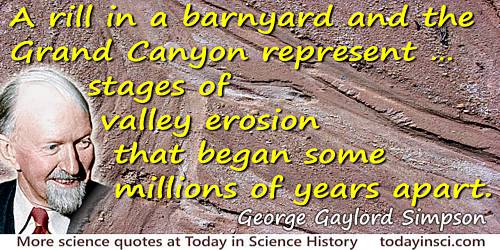
A rill in a barnyard and the Grand Canyon represent, in the main, stages of valley erosion that began some millions of years apart.
Uniformitarianism. An Inquiry into Principle, Theory, and Method in Geohistory and Biohistory', M. K. Hecht and W. C. Steere (eds.), Essays in Evolution and Genetics in Honor of Theodosius Dobzhansky (1970), 83.
And part of the soil is called to wash away
In storms and streams shave close and gnaw the rocks.
Besides, whatever the earth feeds and grows
Is restored to earth. And since she surely is
The womb of all things and their common grave,
Earth must dwindle, you see and take on growth again.
In storms and streams shave close and gnaw the rocks.
Besides, whatever the earth feeds and grows
Is restored to earth. And since she surely is
The womb of all things and their common grave,
Earth must dwindle, you see and take on growth again.
On the Nature of Things, trans. Anthony M. Esolen (1995), Book 5, lines 255-60, 166.
Believe me, this planet has put up with much worse than us. It’s been through earthquakes, volcanoes, plate tectonics, solar flares, sun-spots, magnetic storms, pole reversals, planetary floods, worldwide fires, tidal waves, wind and water erosion, cosmic rays, ice ages, and hundreds of thousands of years of bombardment by comets, asteroids, and meteors. And people think a few plastic bags and aluminum cans are going to make a difference?
In Napalm and Silly Putty (2002), 97.
Changes That Have Occurred in the Globe: When we have seen with our own eyes a mountain progressing into a plain; that is to say, an immense boulder separating from this mountain and covering the fields; an entire castle broken into pieces over the ground; a river swallowed up which then bursts out from its abyss; clear marks of a vast amount of water having once flooded regions now inhabited, and a hundred vestiges of other transformations, then we are much more willing to believe that great changes altered the face of the earth, than a Parisian lady who knows only that the place where her house was built was once a cultivated field. However, a lady from Naples who has seen the buried ruins of Herculaneum, is much less subject to the bias which leads us to believe that everything has always been as it is today.
From article 'Changements arrivées dans le globe', in Dictionnaire philosophique (1764), collected in Œuvres Complètes de Voltaire (1878), Vol. 2, 427-428. Translated by Ian Ellis, from the original French: “Changements arrivées dans le globe: Quand on a vu de ses yeux une montagne s’avancer dans une plaine, c’est-à-dire un immense rocher de cette montagne se détacher et couvrir des champs, un château tout entier enfoncé dans la terre, un fleuve englouti qui sort ensuite de son abîme, des marques indubitables qu’un vaste amas d’eau inondait autrefois un pays habité aujourd’hui, et cent vestiges d’autres révolutions, on est alors plus disposé à croire les grands changements qui ont altéré la face du monde, que ne l’est une dame de Paris qui sait seulement que la place où est bâtie sa maison était autrefois un champ labourable. Mais une dame de Naples, qui a vu sous terre les ruines d’Herculanum, est encore moins asservie au préjugé qui nous fait croire que tout a toujours été comme il est aujourd’hui.”
Etna presents us not merely with an image of the power of subterranean heat, but a record also of the vast period of time during which that power has been exerted. A majestic mountain has been produced by volcanic action, yet the time of which the volcanic forms the register, however vast, is found by the geologist to be of inconsiderable amount, even in the modern annals of the earth’s history. In like manner, the Falls of Niagara teach us not merely to appreciate the power of moving water, but furnish us at the same time with data for estimating the enormous lapse of ages during which that force has operated. A deep and long ravine has been excavated, and the river has required ages to accomplish the task, yet the same region affords evidence that the sum of these ages is as nothing, and as the work of yesterday, when compared to the antecedent periods, of which there are monuments in the same district.
Travels in North America (1845), Vol. 1, 28-9.
I shall conclude, for the time being, by saying that until Philosophers make observations (especially of mountains) that are longer, more attentive, orderly, and interconnected, and while they fail to recognize the two great agents, fire and water, in their distinct affects, they will not be able to understand the causes of the great natural variety in the disposition, structure, and other matter that can be observed in the terrestrial globe in a manner that truly corresponds to the facts and to the phenomena of Nature.
'Aleune Osservazioni Orittologiche fatte nei Monti del Vicentino', Giomale d’Italia, 1769, 5, 411, trans. Ezio Vaccari.
Leaders who assert they will not concede one square meter of national territory to an invader should think of the hundreds of square kilometers of topsoil eroded from their countries each year.
Quoted, without source, in Epigraph in P. G. Dhar Chakrabarti (ed.), People, Planet, and Progress Beyond 2015 (2017), 33. [Please contact Webmaster if you know the primary source.]
One naturally asks, what was the use of this great engine set at work ages ago to grind, furrow, and knead over, as it were, the surface of the earth? We have our answer in the fertile soil which spreads over the temperate regions of the globe. The glacier was God’s great plough.
In 'Ice-Period in America', Geological Sketches (1875), 99.
Ploughing deep, your recipe for killing weeds, is also the recipe for almost every good thing in farming. … We now plough horizontally following the curvatures of the hills and hollows, on the dead level, however crooked the lines may be. Every furrow thus acts as a reservoir to receive and retain the waters, all of which go to the benefit of the growing plant, instead of running off into streams … In point of beauty nothing can exceed that of the waving lines and rows winding along the face of the hills and vallies.
In letter (17 Apr 1813) from Jefferson at Monticello to Charles Willson Peale. Collected in The Jefferson Papers: 1770-1826 (1900), 178-180.
Scientists alone can establish the objectives of their research, but society, in extending support to science, must take account of its own needs. As a layman, I can suggest only with diffidence what some of the major tasks might be on your scientific agenda, but … First, I would suggest the question of the conservation and development of our natural resources. In a recent speech to the General Assembly of the United Nations, I proposed a world-wide program to protect land and water, forests and wildlife, to combat exhaustion and erosion, to stop the contamination of water and air by industrial as well as nuclear pollution, and to provide for the steady renewal and expansion of the natural bases of life.
From Address to the Centennial Convocation of the National Academy of Sciences (22 Oct 1963), 'A Century of Scientific Conquest'. Online at The American Presidency Project.
The breaking up of the terrestrial globe, this it is we witness. It doubtless began a long time ago, and the brevity of human life enables us to contemplate it without dismay. It is not only in the great mountain ranges that the traces of this process are found. Great segments of the earth's crust have sunk hundreds, in some cases, even thousands, of feet deep, and not the slightest inequality of the surface remains to indicate the fracture; the different nature of the rocks and the discoveries made in mining alone reveal its presence. Time has levelled all.
The Face of the Earth (1904), Vol. 1, 604.
The crust of erosion is always linked to life.
In A.V. Lapo, 'Problemy biogeokhimii' (“Problems of Biogeochemistry”), Works of the Biogeochemical Laboratory (1980), 16, 123.
The Earth Speaks, clearly, distinctly, and, in many of the realms of Nature, loudly, to William Jennings Bryan, but he fails to hear a single sound. The earth speaks from the remotest periods in its wonderful life history in the Archaeozoic Age, when it reveals only a few tissues of its primitive plants. Fifty million years ago it begins to speak as “the waters bring forth abundantly the moving creatures that hath life.” In successive eons of time the various kinds of animals leave their remains in the rocks which compose the deeper layers of the earth, and when the rocks are laid bare by wind, frost, and storm we find wondrous lines of ascent invariably following the principles of creative evolution, whereby the simpler and more lowly forms always precede the higher and more specialized forms.
The earth speaks not of a succession of distinct creations but of a continuous ascent, in which, as the millions of years roll by, increasing perfection of structure and beauty of form are found; out of the water-breathing fish arises the air-breathing amphibian; out of the land-living amphibian arises the land-living, air-breathing reptile, these two kinds of creeping things resembling each other closely. The earth speaks loudly and clearly of the ascent of the bird from one kind of reptile and of the mammal from another kind of reptile.
This is not perhaps the way Bryan would have made the animals, but this is the way God made them!
The earth speaks not of a succession of distinct creations but of a continuous ascent, in which, as the millions of years roll by, increasing perfection of structure and beauty of form are found; out of the water-breathing fish arises the air-breathing amphibian; out of the land-living amphibian arises the land-living, air-breathing reptile, these two kinds of creeping things resembling each other closely. The earth speaks loudly and clearly of the ascent of the bird from one kind of reptile and of the mammal from another kind of reptile.
This is not perhaps the way Bryan would have made the animals, but this is the way God made them!
The Earth Speaks to Bryan (1925), 5-6. Osborn wrote this book in response to the Scopes Monkey Trial, where William Jennings Bryan spoke against the theory of evolution. They had previously been engaged in the controversy about the theory for several years. The title refers to a Biblical verse from the Book of Job (12:8), “Speak to the earth and it shall teach thee.”
The ruthless destruction of their forests by the Chinese is one of the reasons why famine and plague today hold this nation in their sinister grasp. Denudation, wherever practiced, leaves naked soil; floods and erosion follow, and when the soil is gone men must also go—and the process does not take long. The great plains of Eastern China were centuries ago transformed from forest into agricultural land. The mountain plateau of Central China have also within a few hundred years been utterly devastated of tree growth, and no attempt made at either natural or artificial reforestation. As a result, the water rushes off the naked slopes in veritable floods, gullying away the mountain sides, causing rivers to run muddy with yellow soil, and carrying enormous masses of fertile earth to the sea. Water courses have also changed; rivers become uncontrollable, and the water level of the country is lowered perceptibly. In consequence, the unfortunate people see their crops wither and die for lack of water when it is most needed.
Statement (11 May 1921) by United States Department of Agriculture (USDA) concerning the famine in China in seven out of every ten years. Reported in 'Blames Deforestation: Department of Agriculture Ascribes Chinese Famine to it', New York Times (12 May 1921), 12.
We expect that the study of lunar geology will help to answer some longstanding questions about the early evolution of the earth. The moon and the earth are essentially a two-planet system, and the two bodies are probably closely related in origin. In this connection the moon is of special interest because its surface has not been subjected to the erosion by running water that has helped to shape the earth’s surface.
In Scientific American (Sep 1964). As cited in '50, 100 & 150 Years Ago', Scientific American (Dec 2014), 311, No. 6, 98.
We stand by the river and admire the great body of water flowing so sweetly on; could you trace it back to its source, you might find a mere rivulet, but meandering on, joined by other streams and by secret springs, and fed by the rains and dews of heaven, it gathers volume and force, makes its way through the gorges of the mountains, plows, widens and deepens its channel through the provinces, and attains its present majesty.
From Address (1 Aug 1875), 'The Growth of Principles' at Saratoga. Collected in William L. Snyder (ed.), Great Speeches by Great Lawyers: A Collection of Arguments and Speeches (1901), 246.
When the aggregate amount of solid matter transported by rivers in a given number of centuries from a large continent, shall be reduced to arithmetical computation, the result will appear most astonishing to those...not in the habit of reflecting how many of the mightiest of operations in nature are effected insensibly, without noise or disorder.
Principles of Geology (1837), Vol. 1, 230.
While a glacier is moving, it rubs and wears down the bottom on which it moves, scrapes its surface (now smooth), triturates the broken-off material that is found between the ice and the rock, pulverizes or reduces it to a clayey paste, rounds angular blocks that resist its pressure, and polishes those having a larger surface. At the surface of the glacier, other processes occur. Fragments of rocks that are broken-off from the neighbouring walls and fall on the ice, remain there or can be transported to the sides; they advance in this way on the top of the glacier, without moving or rubbing against each other … and arrive at the extremity of the glacier with their angles, sharp edges, and their uneven surfaces intact.
La théorie des glaciers et ses progrès les plus récents. Bibl. universelle de Genève, (3), Vol. 41, p.127. Trans. Karin Verrecchia.
With the sole guidance of our practical knowledge of those physical agents which we see actually used in the continuous workings of nature, and of our knowledge of the respective effects induced by the same workings, we can with reasonable basis surmise what the forces were which acted even in the remotest times.
Quoted in Francesco Rodolico, 'Arduino', In Charles Coulston Gillispie (ed.), Dictionary of Scientific Biography (1970), Vol. 1, 234.
Without the death of forests by Ice Age advance, there would be no northern lakes.
Without the death of mountains, there would be no sand or soil.
Without the death of mountains, there would be no sand or soil.
In 'The Nested Emergent Nature of Divine Creativity', Thank God for Evolution: How the Marriage of Science and Religion Will Transform Your Life and Our World (2007), 99.
 In science it often happens that scientists say, 'You know that's a really good argument; my position is mistaken,' and then they would actually change their minds and you never hear that old view from them again. They really do it. It doesn't happen as often as it should, because scientists are human and change is sometimes painful. But it happens every day. I cannot recall the last time something like that happened in politics or religion.
(1987) --
In science it often happens that scientists say, 'You know that's a really good argument; my position is mistaken,' and then they would actually change their minds and you never hear that old view from them again. They really do it. It doesn't happen as often as it should, because scientists are human and change is sometimes painful. But it happens every day. I cannot recall the last time something like that happened in politics or religion.
(1987) -- 




