Entropy Quotes (46 quotes)
Die Energie der Welt ist constant. Die Entropie der Welt strebt einem Maximum zu.
The energy of the world is constant. The entropy of the world tends towards a maximum.
The energy of the world is constant. The entropy of the world tends towards a maximum.
The “world” here refers to the universe as a whole. This is the way Clausius gave a summary of the first and second laws of thermodynamics. German from Clausius, conclusion of 'Ueber verschiedene für die Anwendung bequeme Formen der Hauptgleichungen der mechanischen Wärmetheorie' in Poggendorff’s Annals of Physics (1865)‚ 125, 400. Also quoted at the conclusion of 'Theorie der Wärme', in G. Quincke and B. Schwalbe (eds.), Die Fortschritte der Physik im Jahre 1866 (1869), 22, 254. As translated in P.K. Nag, Engineering Thermodynamics (5th ed., 2013), 25.
Augustine's Law XVI: Software is like entropy. It is difficult to grasp, weighs nothing, and obeys the second law of thermodynamics; i.e. it always increases.
In Augustine's Laws (1997), 114.
Disorder increases with time because we measure time in the direction in which disorder increases.
In 'The Direction of Time', New Scientist (9 Jul 1987), 115, No. 1568, 47. Also in 'The Arrow of Time', A Brief History of Time: From the Big Bang to Black Holes (1988, 1998), Chap. 9, 152.
Entropy is the universe’s tendency to go completely bullshit.
attributed to Onsager
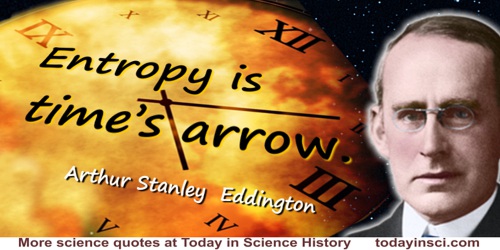
Entropy is time’s arrow.
Entropy isn’t what it used to be.
Thomas F. Shubnell, Greatest Jokes of the Century Book 2 (2008), 90.
Entropy theory is indeed a first attempt to deal with global form; but it has not been dealing with structure. All it says is that a large sum of elements may have properties not found in a smaller sample of them.
In Entropy and Art: An Essay on Disorder and Order (1974), 21.
Entropy theory, on the other hand, is not concerned with the probability of succession in a series of items but with the overall distribution of kinds of items in a given arrangement.
In Entropy and Art: An Essay on Disorder and Order (1974), 19.
Evolution in the biosphere is therefore a necessarily irreversible process defining a direction in time; a direction which is the same as that enjoined by the law of increasing entropy, that is to say, the second law of thermodynamics. This is far more than a mere comparison: the second law is founded upon considerations identical to those which establish the irreversibility of evolution. Indeed, it is legitimate to view the irreversibility of evolution as an expression of the second law in the biosphere.
In Jacques Monod and Austryn Wainhouse (trans.), Chance and Necessity: An Essay on the Natural Philosophy of Modern Biology (1971), 123.
Heat energy of uniform temperature [is] the ultimate fate of all energy. The power of sunlight and coal, electric power, water power, winds and tides do the work of the world, and in the end all unite to hasten the merry molecular dance.
Matter and Energy (1911), 140.
How would we express in terms of the statistical theory the marvellous faculty of a living organism, by which it delays the decay into thermodynamical equilibrium (death)? … It feeds upon negative entropy … Thus the device by which an organism maintains itself stationary at a fairly high level of orderliness (= fairly low level of entropy) really consists in continually sucking orderliness from its environment.
In 'Organization Maintained by Extracting “Order” from the Environment', What is Life? : The Physical Aspect of the Living Cell (1944), 74.
Humpty Dumpty sate on a wall,
Humpti dumpti had a great fall;
Threescore men and threescore more,
Cannot place Humpty dumpty as he was before.
Humpti dumpti had a great fall;
Threescore men and threescore more,
Cannot place Humpty dumpty as he was before.
Nursery rhyme. In Joseph Ritson, Gammer Gurton's Garland: or, the Nursery Parnassus; a Choice Collection of Pretty Songs and Verses For the Amusement of All Little Good Children (1810), 36.
I had a dream, which was not all a dream.
The bright sun was extinguish'd, and the stars
Did wander darkling in the eternal space,
Rayless, and pathless, and the icy earth
Swung blind and blackening in the moonless air;
Morn came, and went—and came, and brought no day.
The bright sun was extinguish'd, and the stars
Did wander darkling in the eternal space,
Rayless, and pathless, and the icy earth
Swung blind and blackening in the moonless air;
Morn came, and went—and came, and brought no day.
Darkness (1816), lines 1-6. In Jerome J. McGann (ed.), Lord Byron: The Complete Poetical Works (1986), Vol. 4, 40-1.
If entropy must constantly and continuously increase, then the universe is remorselessly running down, thus setting a limit (a long one, to be sure) on the existence of humanity. To some human beings, this ultimate end poses itself almost as a threat to their personal immortality, or as a denial of the omnipotence of God. There is, therefore, a strong emotional urge to deny that entropy must increase.
In Asimov on Physics (1976), 141. Also in Isaac Asimov’s Book of Science and Nature Quotations (1988), 279.
In despair, I offer your readers their choice of the following definitions of entropy. My authorities are such books and journals as I have by me at the moment.
(a) Entropy is that portion of the intrinsic energy of a system which cannot be converted into work by even a perfect heat engine.—Clausius.
(b) Entropy is that portion of the intrinsic energy which can be converted into work by a perfect engine.—Maxwell, following Tait.
(c) Entropy is that portion of the intrinsic energy which is not converted into work by our imperfect engines.—Swinburne.
(d) Entropy (in a volume of gas) is that which remains constant when heat neither enters nor leaves the gas.—W. Robinson.
(e) Entropy may be called the ‘thermal weight’, temperature being called the ‘thermal height.’—Ibid.
(f) Entropy is one of the factors of heat, temperature being the other.—Engineering.
I set up these bald statement as so many Aunt Sallys, for any one to shy at.
[Lamenting a list of confused interpretations of the meaning of entropy, being hotly debated in journals at the time.]
(a) Entropy is that portion of the intrinsic energy of a system which cannot be converted into work by even a perfect heat engine.—Clausius.
(b) Entropy is that portion of the intrinsic energy which can be converted into work by a perfect engine.—Maxwell, following Tait.
(c) Entropy is that portion of the intrinsic energy which is not converted into work by our imperfect engines.—Swinburne.
(d) Entropy (in a volume of gas) is that which remains constant when heat neither enters nor leaves the gas.—W. Robinson.
(e) Entropy may be called the ‘thermal weight’, temperature being called the ‘thermal height.’—Ibid.
(f) Entropy is one of the factors of heat, temperature being the other.—Engineering.
I set up these bald statement as so many Aunt Sallys, for any one to shy at.
[Lamenting a list of confused interpretations of the meaning of entropy, being hotly debated in journals at the time.]
In The Electrician (9 Jan 1903).
In high school, when I first heard of entropy, I was attracted to it immediately. They said that in nature all systems are breaking down, and I thought, What a wonderful thing; perhaps I can make some small contribution to this process, myself. And, of course, it’s not just true of nature, it’s true of society as well. If you look carefully, you can see that the social structure is just beginning to break down, just beginning to come apart at the seams.
In Napalm and Silly Putty (2001), 130.
It is my thesis that the physical functioning of the living individual and the operation of some of the newer communication machines are precisely parallel in their analogous attempts to control entropy through feedback. Both of them have sensory receptors as one stage in their cycle of operation: that is, in both of them there exists a special apparatus for collecting information from the outer world at low energy levels, and for making it available in the operation of the individual or of the machine. In both cases these external messages are not taken neat, but through the internal transforming powers of the apparatus, whether it be alive or dead. The information is then turned into a new form available for the further stages of performance. In both the animal and the machine this performance is made to be effective on the outer world. In both of them, their performed action on the outer world, and not merely their intended aetion, is reported back to the central regulatory apparatus.
In The Human Use of Human Beings: Cybernetics and Society (1954), 26-27.
It is tempting to wonder if our present universe, large as it is and complex though it seems, might not be merely the result of a very slight random increase in order over a very small portion of an unbelievably colossal universe which is virtually entirely in heat-death. Perhaps we are merely sliding down a gentle ripple that has been set up, accidently and very temporarily, in a quiet pond, and it is only the limitation of our own infinitesimal range of viewpoint in space and time that makes it seem to ourselves that we are hurtling down a cosmic waterfall of increasing entropy, a waterfall of colossal size and duration.
(1976). In Isaac Asimov’s Book of Science and Nature Quotations (1988), 331.
It is very desirable to have a word to express the Availability for work of the heat in a given magazine; a term for that possession, the waste of which is called Dissipation. Unfortunately the excellent word Entropy, which Clausius has introduced in this connexion, is applied by him to the negative of the idea we most naturally wish to express. It would only confuse the student if we were to endeavour to invent another term for our purpose. But the necessity for some such term will be obvious from the beautiful examples which follow. And we take the liberty of using the term Entropy in this altered sense ... The entropy of the universe tends continually to zero.
Sketch of Thermodynamics (1868), 100-2.
It was not easy for a person brought up in the ways of classical thermodynamics to come around to the idea that gain of entropy eventually is nothing more nor less than loss of information.
Letter to Irving Langmuir, 5 Aug 1930. Quoted in Arthur Lachman, Borderland of the Unknown: The Life Story of Gilbert Newton, One of the World’s Great Scientists (1955), 64.
It will be noticed that the fundamental theorem proved above bears some remarkable resemblances to the second law of thermodynamics. Both are properties of populations, or aggregates, true irrespective of the nature of the units which compose them; both are statistical laws; each requires the constant increase of a measurable quantity, in the one case the entropy of a physical system and in the other the fitness, measured by m, of a biological population. As in the physical world we can conceive the theoretical systems in which dissipative forces are wholly absent, and in which the entropy consequently remains constant, so we can conceive, though we need not expect to find, biological populations in which the genetic variance is absolutely zero, and in which fitness does not increase. Professor Eddington has recently remarked that “The law that entropy always increases—the second law of thermodynamics—holds, I think, the supreme position among the laws of nature.” It is not a little instructive that so similar a law should hold the supreme position among the biological sciences. While it is possible that both may ultimately be absorbed by some more general principle, for the present we should note that the laws as they stand present profound differences—-(1) The systems considered in thermodynamics are permanent; species on the contrary are liable to extinction, although biological improvement must be expected to occur up to the end of their existence. (2) Fitness, although measured by a uniform method, is qualitatively different for every different organism, whereas entropy, like temperature, is taken to have the same meaning for all physical systems. (3) Fitness may be increased or decreased by changes in the environment, without reacting quantitatively upon that environment. (4) Entropy changes are exceptional in the physical world in being irreversible, while irreversible evolutionary changes form no exception among biological phenomena. Finally, (5) entropy changes lead to a progressive disorganization of the physical world, at least from the human standpoint of the utilization of energy, while evolutionary changes are generally recognized as producing progressively higher organization in the organic world.
The Genetical Theory of Natural Selection (1930), 36.
Just as the constant increase of entropy is the basic law of the universe, so it is the basic law of life to be ever more highly structured and to struggle against entropy.
In 'Letter to Dr. Gustáv Husák', Václav Havel: Or Living in Truth (1986), Pt. 1, 23.
Let us draw an arrow arbitrarily. If as we follow the arrow we find more and more of the random element in the state of the world, then the arrow is pointing towards the future; if the random element decreases the arrow points towards the past … I shall use the phrase “time's arrow” to express this one-way property of time which has no analogue in space.
Gifford Lectures (1927), The Nature of The Physical World (1928), 69.
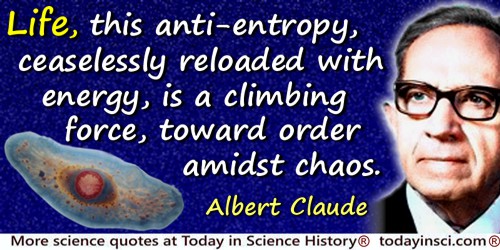
Life, this anti-entropy, ceaselessly reloaded with energy, is a climbing force, toward order amidst chaos, toward light, among the darkness of the indefinite, toward the mystic dream of Love, between the fire which devours itself and the silence of the Cold.
Nobel Lecture, The Coming Age of the Cell, 12 Dec 1974
No other part of science has contributed as much to the liberation of the human spirit as the Second Law of Thermodynamics. Yet, at the same time, few other parts of science are held to be so recondite. Mention of the Second Law raises visions of lumbering steam engines, intricate mathematics, and infinitely incomprehensible entropy. Not many would pass C.P. Snow’s test of general literacy, in which not knowing the Second Law is equivalent to not having read a work of Shakespeare.
In The Second Law (1984), Preface, vii.
One summer day, while I was walking along the country road on the farm where I was born, a section of the stone wall opposite me, and not more than three or four yards distant, suddenly fell down. Amid the general stillness and immobility about me the effect was quite startling. ... It was the sudden summing up of half a century or more of atomic changes in the material of the wall. A grain or two of sand yielded to the pressure of long years, and gravity did the rest.
Under the Apple-Trees (1916), 105.
Only entropy comes easy.
Quoted in Ben Greenman, Anton Pavlovich Chekhov, Celebrity Chekhov: Stories by Anton Chekhov (2010), xiii.
S = k log Ω
Carved above his name on his tombstone in the Zentralfriedhof in Vienna. Image in Stephen Brush, The Kind of Motion we Call Heat: A History of the Kinetic Theory of Gases in the 19th Century (1976), 609.
Scientists have long been baffled by the existence of spontaneous order in the universe. The laws of thermodynamics seem to dictate the opposite, that nature should inexorably degenerate toward a state of greater disorder, greater entropy. Yet all around
John Mitchinson and John Lloyd, If Ignorance Is Bliss, Why Aren't There More Happy People?: Smart Quotes for Dumb Times (2009), 274.
Since a given system can never of its own accord go over into another equally probable state but into a more probable one, it is likewise impossible to construct a system of bodies that after traversing various states returns periodically to its original state, that is a perpetual motion machine.
'The Second Law of Thermodynamics', Populäre Schriften, Essay 3. Address to a Formal meeting of the Imperial Academy of Science, 29 May 1886. In Brian McGuinness (ed.), Ludwig Boltzmann: Theoretical Physics and Philosophical Problems, Selected Writings (1974), 30.
So far as physics is concerned, time’s arrow is a property of entropy alone.
Gifford Lectures (1927), The Nature of the Physical World (1928), 80.
Suppose we divide the space into little volume elements. If we have black and white molecules, how many ways could we distribute them among the volume elements so that white is on one side and black is on the other? On the other hand, how many ways could we distribute them with no restriction on which goes where? Clearly, there are many more ways to arrange them in the latter case. We measure “disorder” by the number of ways that the insides can be arranged, so that from the outside it looks the same. The logarithm of that number of ways is the entropy. The number of ways in the separated case is less, so the entropy is less, or the “disorder” is less.
In 'Order And Entropy', The Feynman Lectures on Physics (1964), 46-7.
Take the living human brain endowed with mind and thought. …. The physicist brings his tools and commences systematic exploration. All that he discovers is a collection of atoms and electrons and fields of force arranged in space and time, apparently similar to those found in inorganic objects. He may trace other physical characteristics, energy, temperature, entropy. None of these is identical with thought. … How can this collection of ordinary atoms be a thinking machine? … The Victorian physicist felt that he knew just what he was talking about when he used such terms as matter and atoms. … But now we realize that science has nothing to say as to the intrinsic nature of the atom. The physical atom is, like everything else in physics, a schedule of pointer readings.
From a Gifford Lecture, University of Edinburgh (1927), published in 'Pointer Readings: Limits of Physical Knowledge', The Nature of the Physical World (1929), 258-259.
The fundamental laws of the universe which correspond to the two fundamental theorems of the mechanical theory of heat.
1. The energy of the universe is constant.
2. The entropy of the universe tends to a maximum.
1. The energy of the universe is constant.
2. The entropy of the universe tends to a maximum.
The Mechanical Theory of Heat (1867), 365.
The history of thermodynamics is a story of people and concepts. The cast of characters is large. At least ten scientists played major roles in creating thermodynamics, and their work spanned more than a century. The list of concepts, on the other hand, is surprisingly small; there are just three leading concepts in thermodynamics: energy, entropy, and absolute temperature.
In Great Physicists (2001), 93.
The increase of disorder or entropy with time is one example of what is called an arrow of time something that gives a direction to time and distinguishes the past from the future. There are at least three different directions of time. First, there is the thermodynamic arrow of time—the direction of time in which disorder or entropy increases. Second, there is the psychological arrow of time. This is the direction in which we feel time passes—the direction of time in which we remember the past, but not the future. Third, there is the cosmological arrow of time. This is the direction of time in which the universe is expanding rather than contracting.
In 'The Direction of Time', New Scientist (9 Jul 1987), 46.
The law that entropy always increases—the Second Law of Thermodynamics—holds, I think, the supreme position among the laws of Nature. If someone points out to you that your pet theory of the universe is in disagreement with Maxwell’s equations—then so much the worse for Maxwell’s equations. If it is found to be contradicted by observation—well these experimentalists do bungle things sometimes. But if your theory is found to be against the second law of thermodynamics I can give you no hope; there is nothing for it but to collapse in deepest humiliation.
Gifford Lectures (1927), The Nature of the Physical World (1928), 74.
The law that entropy increases—the Second Law of Thermodynamics—holds, I think, the supreme position among the laws of Nature.
Gifford Lectures (1927), The Nature of the Physical World (1928), 74.
The powerful notion of entropy, which comes from a very special branch of physics … is certainly useful in the study of communication and quite helpful when applied in the theory of language.
From 'The Growth of Science and the Structure of Culture', Daedalus (Winter 1958), 87, No. 1, 67.
The total disorder in the universe, as measured by the quantity that physicists call entropy, increases steadily steadily as we go from past to future. On the other hand, the total order in the universe, as measured by the complexity and permanence of organized structures, also increases steadily as we go from past to future.
From Page-Barbour lecture, University of Virginia (Mar 2004). Collected in 'A Friendly Universe', A Many-Colored Glass: Reflections on the Place of Life in the Universe (2007), 62.
Things are always best seen when they are a trifle mixed up, a trifle disordered; the chilly administrative neatness of museums and filing cases, of statistics and cemeteries, is an inhuman and antinatural kind of order; it is, in a word, disorder. True order belongs to Nature, which never yet has produced two identical trees or mountains or horses.
In Journey to the Alcarria: Travels Through the Spanish Countryside (1948, 1990), 131.
We might call it the transformational content of the body … But as I hold it better to borrow terms for important magnitudes from the ancient languages, so that they may be adopted unchanged in all modern languages, I propose to call [it] the entropy of the body, from the Greek word “trope” for “transformation” I have intentionally formed the word “entropy” to be as similar as possible to the word “energy”; for the two magnitudes to be denoted by these words are so nearly allied in their physical meanings, that a certain similarity in designation appears to be desirable.
In 'The Bulldog: A Profile of Ludwig Boltzmann', The American Scholar (1 Jan 1999), 99.
We must make the following remark: a proof, that after a certain time t1, the spheres must necessarily be mixed uniformly, whatever may be the initial distribution of states, cannot be given. This is in fact a consequence of probability theory, for any non-uniform distribution of states, no matter how improbable it may be, is still not absolutely impossible. Indeed it is clear that any individual uniform distribution, which might arise after a certain time from some particular initial state, is just as improbable as an individual non-uniform distribution; just as in the game of Lotto, any individual set of five numbers is as improbable as the set 1, 2, 3, 4, 5. It is only because there are many more uniform distributions than non-uniform ones that the distribution of states will become uniform in the course of time. One therefore cannot prove that, whatever may be the positions and velocities of the spheres at the beginning, the distributions must become uniform after a long time; rather one can only prove that infinitely many more initial states will lead to a uniform one after a definite length of time than to a non-uniform one. Loschmidt's theorem tells us only about initial states which actually lead to a very non-uniform distribution of states after a certain time t1; but it does not prove that there are not infinitely many more initial conditions that will lead to a uniform distribution after the same time. On the contrary, it follows from the theorem itself that, since there are infinitely many more uniform distributions, the number of states which lead to uniform distributions after a certain time t1, is much greater than the number that leads to non-uniform ones, and the latter are the ones that must be chosen, according to Loschmidt, in order to obtain a non-uniform distribution at t1.
From 'On the Relation of a General Mechanical Theorem to the Second Law of Thermodynamics' (1877), in Stephen G. Brush (ed.), Selected Readings in Physics (1966), Vol. 2, Irreversible Processes, 191-2.
We sound the future, and learn that after a period, long compared with the divisions of time open to our investigation, the energies of our system will decay, the glory of the sun will be dimmed and the earth, tideless and inert, will no longer tolerate the race which has for a moment disturbed its solitude. Man will go down into the pit, and all his thoughts will perish.
The Foundations of Belief: Being Notes Introductory to the Study of Theology (1895), 30-1.
Why Become Extinct? Authors with varying competence have suggested that dinosaurs disappeared because the climate deteriorated (became suddenly or slowly too hot or cold or dry or wet), or that the diet did (with too much food or not enough of such substances as fern oil; from poisons in water or plants or ingested minerals; by bankruptcy of calcium or other necessary elements). Other writers have put the blame on disease, parasites, wars, anatomical or metabolic disorders (slipped vertebral discs, malfunction or imbalance of hormone and endocrine systems, dwindling brain and consequent stupidity, heat sterilization, effects of being warm-blooded in the Mesozoic world), racial old age, evolutionary drift into senescent overspecialization, changes in the pressure or composition of the atmosphere, poison gases, volcanic dust, excessive oxygen from plants, meteorites, comets, gene pool drainage by little mammalian egg-eaters, overkill capacity by predators, fluctuation of gravitational constants, development of psychotic suicidal factors, entropy, cosmic radiation, shift of Earth’s rotational poles, floods, continental drift, extraction of the moon from the Pacific Basin, draining of swamp and lake environments, sunspots, God’s will, mountain building, raids by little green hunters in flying saucers, lack of standing room in Noah’s Ark, and palaeoweltschmerz.
'Riddles of the Terrible Lizards', American Scientist (1964) 52, 231.
You should call it entropy, for two reasons. In the first place your uncertainty function has been used in statistical mechanics under that name, so it already has a name. In the second place, and more important, no one really knows what entropy really is, so in a debate you will always have the advantage.
From the recollection of Claude Shannon given in discussion with Myron Tribus (Apr 1961) about the reason Shannon chose the word “entropy” for his information function (first used by Shannon in a 1945 memorandum at Bell Labs). The suggestion from Neumann to use “entropy” dates back to a Neumann-Shannon conversation c.1940. Shannon’s recollection of the Neumann’s recommendation was quoted as recollected by Tribus in Myron Tribus and Edward C. McIrving, 'Energy and Information', Scientific American (1971), 225, 179-88.
 In science it often happens that scientists say, 'You know that's a really good argument; my position is mistaken,' and then they would actually change their minds and you never hear that old view from them again. They really do it. It doesn't happen as often as it should, because scientists are human and change is sometimes painful. But it happens every day. I cannot recall the last time something like that happened in politics or religion.
(1987) --
In science it often happens that scientists say, 'You know that's a really good argument; my position is mistaken,' and then they would actually change their minds and you never hear that old view from them again. They really do it. It doesn't happen as often as it should, because scientists are human and change is sometimes painful. But it happens every day. I cannot recall the last time something like that happened in politics or religion.
(1987) -- 




