England Quotes (44 quotes)
[The old red sandstone of the Orkneys] furnished more fossil fishes than every other geological system in England, Scotland, and Wales, from the coal measures to the chalk, inclusive. It is, in short, the “land of fish,” and could supply with ichthyolites, by the ton or ship-load, the museums of the world.
As quoted, without citation, by Samuel Kneeland, in Travels in Iceland: An Account of Its Scenery, People and History (1875), 23.
[Thomas Henry] Huxley, I believe, was the greatest Englishman of the Nineteenth Century—perhaps the greatest Englishman of all time. When one thinks of him, one thinks inevitably of such men as Goethe and Aristotle. For in him there was that rich, incomparable blend of intelligence and character, of colossal knowledge and high adventurousness, of instinctive honesty and indomitable courage which appears in mankind only once in a blue moon. There have been far greater scientists, even in England, but there has never been a scientist who was a greater man.
'Thomas Henry Huxley.' In the Baltimore Evening Sun (4 May 1925). Reprinted in A Second Mencken Chrestomathy: A New Selection from the Writings of America's Legendary Editor, Critic, and Wit (2006), 157.
1066. … At that time, throughout all England, a portent such as men had never seen before was seen in the heavens. Some declared that the star was a comet, which some call “the long-haired star”: it first appeared on the eve of the festival of Letania Maior, that is on 24 April, and shone every night for a week.
In George Norman Garmonsway (ed., trans.), 'The Parker Chronicle', The Anglo-Saxon Chronicle (1953), 195. This translation from the original Saxon, is a modern printing of an ancient anthology known as The Anglo-Saxon Chronicle. Manuscript copies were held at various English monasteries. These copies of the Chronicle include content first recorded in the late 9th century. The monasteries continued independently updating these annals. This quote comes from a copy once owned by Matthew Parker, Archbishop of Canterbury. Known as the Winchester (or Parker) Chronicle, it is the oldest surviving manuscript.
A Frenchman who arrives in London, will find Philosophy, like every Thing else, very much chang’d there. He had left the World a plenum, and he now finds it a vacuum. At Paris the Universe is seen, compos’d of Vortices of subtile Matter; but nothing like it is seen in London. In France, ‘tis the Pressure of the Moon that causes the Tides; but in England ‘tis the Sea that gravitates towards the Moon; so what when you think that the Moon should make it flood with us, those Gentlemen fancy it should be Ebb, which, very unluckily, cannot be prov’d. For to be able to do this, ‘tis necessary the Moon and the Tides should have been enquir’d into, at the very instant of the Creation.
Letter XIV. 'On DesCartes and Sir Isaac Newton', in Letters Concerning the English Nation (1733), 109-110.
A work of genius is something like the pie in the nursery song, in which the four and twenty blackbirds are baked. When the pie is opened, the birds begin to sing. Hereupon three fourths of the company run away in a fright; and then after a time, feeling ashamed, they would fain excuse themselves by declaring, the pie stank so, they could not sit near it. Those who stay behind, the men of taste and epicures, say one to another, We came here to eat. What business have birds, after they have been baked, to be alive and singing? This will never do. We must put a stop to so dangerous an innovation: for who will send a pie to an oven, if the birds come to life there? We must stand up to defend the rights of all the ovens in England. Let us have dead birds..dead birds for our money. So each sticks his fork into a bird, and hacks and mangles it a while, and then holds it up and cries, Who will dare assert that there is any music in this bird’s song?
Co-author with his brother Augustus William Hare Guesses At Truth, By Two Brothers: Second Edition: With Large Additions (1848), Second Series, 86. (The volume is introduced as “more than three fourths new.” This quote is identified as by Julius; Augustus had died in 1833.)
An incidental remark from a German colleague illustrates the difference between Prussian ways and our own. He had apparently been studying the progress of our various crews on the river, and had been struck with the fact that though the masters in charge of the boats seemed to say and do very little, yet the boats went continually faster and faster, and when I mentioned Dr. Young’s book to him, he made the unexpected but suggestive reply: “Mathematics in Prussia! Ah, sir, they teach mathematics in Prussia as you teach your boys rowing in England: they are trained by men who have been trained by men who have themselves been trained for generations back.”
In John Perry (ed.), Discussion on the Teaching of Mathematics (1901), 43. The discussion took place on 14 Sep 1901 at the British Association at Glasgow, during a joint meeting of the mathematics and physics sections with the education section. The proceedings began with an address by John Perry. Langley related this anecdote during the Discussion which followed.
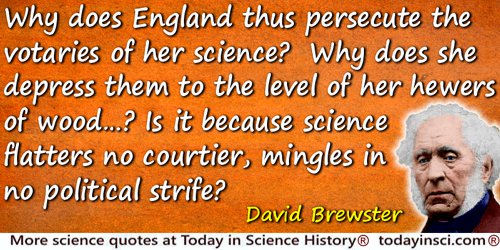
And why does England thus persecute the votaries of her science? Why does she depress them to the level of her hewers of wood and her drawers of water? Is it because science flatters no courtier, mingles in no political strife? … Can we behold unmoved the science of England, the vital principle of her arts, struggling for existence, the meek and unarmed victim of political strife?
From his review of the book by Charles Babbage, Reflections on the Decline of Science in England(1830). In Quarterly Review, 1830, 43, 323-4.
As for France and England, with all their pre-eminence in science, the one is a den of robbers, and the other of pirates. If science produces no better fruits than tyranny, murder, rapine, and destitution of national morality, I would rather wish our country to be ignorant, honest, and estimable as our neighboring savages are.
Letter (21 Jan 1812) to John Adams. Collected in Thomas Jefferson Randolph (ed.), Memoirs, Correspondence and Private Papers (1829), Vol. 4, 173.
By an application of the theory of relativity to the taste of readers, today in Germany I am called a German man of science, and in England I am represented as a Swiss Jew. If I come to be regarded as a bête noire the descriptions will be reversed, and I shall become a Swiss Jew for the Germans and a German man of science for the English!
Times (28 Nov 1919). In Robert Andrews Famous Lines: a Columbia Dictionary of Familiar Quotations (1997), 414. Variations of this quote were made by Einstein on other occasions.
Darwin’s book is very important and serves me as a basis in natural science for the class struggle in history. One has to put up with the crude English method of development, of course. Despite all deficiencies not only is the death-blow dealt here for the first time to “teleology” in the natural sciences, but their rational meaning is empirically explained.
Marx to Lasalle, 16 Jan 1861. In Marx-Engels Selected Correspondence, 1846-95, trans. Donna Torr (1934), 125.
England was nothing, compared to continental nations until she had become commercial … until about the middle of the last century, when a number of ingenious and inventive men, without apparent relation to each other, arose in various parts of the kingdom, succeeded in giving an immense impulse to all the branches of the national industry; the result of which has been a harvest of wealth and prosperity, perhaps without a parallel in the history of the world.
In Lives of the Engineers (1862, 1874), xvii.
Fleets are not confined to the ocean, but now sail over the land. … All the power of the British Navy has not been able to prevent Zeppelins from reaching England and attacking London, the very heart of the British Empire. Navies do not protect against aerial attack. … Heavier-than-air flying machines of the aeroplane type have crossed right over the heads of armies, of million of men, armed with the most modern weapons of destruction, and have raided places in the rear. Armies do not protect against aerial war.
In 'Preparedness for Aerial Defense', Addresses Before the Eleventh Annual Convention of the Navy League of the United States, Washington, D.C., April 10-13, 1916 (1916), 70.
I am patriot enough to take pains to bring this usefull invention [smallpox inoculation] into fashion in England, and I should not fail to write to some of our Doctors very particularly about it, if I knew anyone of 'em that I thought had Virtue enough to destroy such a considerable branch of Revenue for the good of Mankind, but that Distemper is too beneficial to them not to expose to all their Resentment the hardy wight that should undertake to put an end to it.
Letter to Sarah Chiswell (1 Apr 1717). In Robert Halsband (ed.), The Complete Letters of the Lady Mary Wortley Montagu (1965), Vol. 1, 339.
I believe the statement that in this war a hundred physicists are worth a million soldiers originated in England.
From First Richtmyer Memorial Lecture (30 Dec 1941) to the American Physical Society, Princeton, printed in 'War Problems of the Physics Teacher', American Journal of Physics (1942), 10, 92. Also reprinted in 'War problems of the Physics Teacher', The Scientific Monthly (Apr 1942), 54, No. 4, 370.
I do not approve of anything that tampers with natural ignorance. Ignorance is like a delicate exotic fruit; touch it and the bloom is gone. The whole theory of modern education is radically unsound. Fortunately in England, at any rate, education produces no effect whatsoever. If it did, it would prove a serious danger to the upper classes.
Lines for fictional Lady Bracknell in play, The Importance of Being Earnest. Collected in Plays (1898), 293-294. [Wilde is speaking his mind through her voice, in characteristic trenchant style, about the mind-boggling stupidity of the British aristocratic leisure class. Wilde is making a serious social and political point. Effective education could threaten the established order. If the English downtrodden poor knew anything about anything they probably would overthrow the ruling class. —condensed from sparknotes.com]
I grew up in Leicestershire, in Leicester, which is on the Jurassic, and it’s full of lovely fossils. Ammonites, belemnites, brachiopods—very beautiful. How did they get there, in the middle of the rocks, in the middle of England, and so on? And I had the collecting bug, which I still have, actually, which is the basis of so much of natural history, really, and so much of science. And so collecting all these things, and discovering what they were, and how they lived, and when they had lived, and all that, was abiding fascination to me from the age of I suppose about eight. And I still feel that way, actually.
Speaking about fossils that first inspired his love of natural history. In video by Royal Society of Biology, 'Sir David Attenborough, Biology: Changing the World Interview,' published on YouTube (13 Feb 2015).
I have long been interested in landscape history, and when younger and more robust I used to do much tramping of the English landscape in search of ancient field systems, drove roads, indications of prehistoric settlement. Towns and cities, too, which always retain the ghost of their earlier incarnations beneath today's concrete and glass.
From 'An Interview With Penelope Lively', in a Reading Guide to the book The Photograph on the publisher's Penguin website.
I have now said enough to show you that it is indispensable for this country to have a scientific education in connexion with manufacturers, if we wish to outstrip the intellectual competition which now, happily for the world, prevails in all departments of industry. As surely as darkness follows the setting of the sun, so surely will England recede as a manufacturing nation, unless her industrial population become much more conversant with science than they are now.
In 'The Study of Abstract Science Essential to the Progress of Industry', Records of the School of Mines (1852) 1, 48.
I have spent some months in England, have seen an awful lot and learned little. England is not a land of science, there is only a widely practised dilettantism, the chemists are ashamed to call themselves chemists because the pharmacists, who are despised, have assumed this name.
Liebig to Berzelius, 26 Nov 1837. Quoted in J. Carriere (ed.), Berzelius und Liebig.; ihre Briefe (1898), 134. Trans. W. H. Brock.
I traveled among unknown men,
In lands beyond the sea;
Nor England! did I know till then
What love I bore to thee.
In lands beyond the sea;
Nor England! did I know till then
What love I bore to thee.
First verse of poem, 'I Travelled among Unknown Men', In Poems: In Two Volumes (1807), Vol. 1, 68.
Illiteracy in England is mainly determined by congenital weak-mindedness, in India by parental poverty.
In 'Eugenics and Social Reform', The Nation & The Athenæum (31 May 1924), 291.
Immense deposits of kimmeridge clay, containing the oil-bearing bands or seams, stretch across England from Dorsetshire to Lincolnshire. [An early political recognition of the native resource. The Geological Survey had identified the inflammable oil shale in reports since at least 1888.]
On 17 Jul 1913. Quoted in Winston Churchill and Richard Langworth (ed.), Churchill by Himself: The Definitive Collection of Quotations (2008), 269. For earlier report of the kimmerage clay, see Memoirs of the Geological Survey: England and Wales: The Geology of the Country Around Lincoln (1888), 81.
In England, more than in any other country, science is felt rather than thought. … A defect of the English is their almost complete lack of systematic thinking. Science to them consists of a number of successful raids into the unknown.
The Social Function of Science (1939), 197.
Instead of disbursing her annual millions for these dye stuffs, England will, beyond question, at no distant day become herself the greatest coloring producing country in the world; nay, by the very strangest of revolutions she may ere long send her coal-derived blues to indigo-growing India, her tar-distilled crimson to cochineal-producing Mexico, and her fossil substitutes for quercitron and safflower to China, Japan and the other countries whence these articles are now derived.
From 'Report on the Chemical Section of the Exhibition of 1862.' As quoted in Sir Frederick Abel, 'The Work of the Imperial Institute' Nature (28 Apr 1887), 35, No. 913, 620. Abel called the display of the first dye-products derived from coal tar at the Exhibition of 1862, “one of the features of greatest novelty.”
It has been said by a distinguished philosopher that England is “usually the last to enter into the general movement of the European mind.” The author of the remark probably meant to assert that a man or a system may have become famous on the continent, while we are almost ignorant of the name of the man and the claims of his system. Perhaps, however, a wider range might be given to the assertion. An exploded theory or a disadvantageous practice, like a rebel or a patriot in distress, seeks refuge on our shores to spend its last days in comfort if not in splendour.
Opening from essay, 'Elementary Geometry', included in The Conflict of Studies and Other Essays (1873), 136.
It is a serious question whether America, following England’s lead, has not gone into problem-solving too extensively. Certain it is that we are producing no text-books in which the theory is presented in the delightful style which characterizes many of the French works … , or those of the recent Italian school, or, indeed, those of the continental writers in general.
In The Teaching of Elementary Mathematics (1902), 219.
Looking upon you [Richard Owen] as the Cuvier of England.
Greeting in letter (1848) to Richard Owen. As quoted, without citation, in Henry Fairfield Osborn, 'Biographical Memoir of Joseph Leidy', collected in National Academy of Sciences, Biographical Memoirs: Volume 7 (1913), 345.
March 15th. Imperial Banquet for Welcoming the English Cruelty to Animals. MENU OF FOODS: VITAMIN A, Tin Sardines. VITAMIN B, Roasted Beef. VITAMIN C, Small Roasted Suckling Porks. VITAMIN D, Hot Sheep and Onions. VITAMIN E, Spiced Turkey. VITAMIN F, Sweet Puddings. VITAMIN G, Coffee. VITAMIN H, Jam.
In Black Mischief (1932), 1962 edn., 170.
Mental events proceeding beneath the threshold of consciousness are the substrate upon which all conscious experience depends. To argue that all we need of our mental equipment is that part of which we are conscious is about as helpful as equating the United States with the Senate or England with the Houses of Parliament.
Quoted in 'Anthony (George) Stevens' in Gale, Contemporary Authors Online (2005).
Of the two eminent engineers in the recent construction of railways in England, Mr. Brunel went straight from terminus to terminus, through mountains, over streams, crossing highways, cutting ducal estates in two, and shooting through this man’s cellar, and that man’s attic window, and so arriving at his end, at great pleasure to geometers, but with cost to his company. Mr. Stephenson, on the contrary, believing that the river knows the way, followed his valley, as implicitly as our Western Railroad follows the Westfield River, and turned out to be the safest and cheapest engineer.
In 'Wealth', Power, Wealth, Illusions (1860, 1875), 80.
Science in England, in America, is jealous of theory, hates the name of love and moral purpose. There's revenge for this humanity. What manner of man does science make? The boy is not attracted. He says, I do not wish to be such a kind of man as my professor is.
In essay. 'Beauty', collected in The Conduct of Life (1860), 250.
Suppose then I want to give myself a little training in the art of reasoning; suppose I want to get out of the region of conjecture and probability, free myself from the difficult task of weighing evidence, and putting instances together to arrive at general propositions, and simply desire to know how to deal with my general propositions when I get them, and how to deduce right inferences from them; it is clear that I shall obtain this sort of discipline best in those departments of thought in which the first principles are unquestionably true. For in all our thinking, if we come to erroneous conclusions, we come to them either by accepting false premises to start with—in which case our reasoning, however good, will not save us from error; or by reasoning badly, in which case the data we start from may be perfectly sound, and yet our conclusions may be false. But in the mathematical or pure sciences,—geometry, arithmetic, algebra, trigonometry, the calculus of variations or of curves,— we know at least that there is not, and cannot be, error in our first principles, and we may therefore fasten our whole attention upon the processes. As mere exercises in logic, therefore, these sciences, based as they all are on primary truths relating to space and number, have always been supposed to furnish the most exact discipline. When Plato wrote over the portal of his school. “Let no one ignorant of geometry enter here,” he did not mean that questions relating to lines and surfaces would be discussed by his disciples. On the contrary, the topics to which he directed their attention were some of the deepest problems,— social, political, moral,—on which the mind could exercise itself. Plato and his followers tried to think out together conclusions respecting the being, the duty, and the destiny of man, and the relation in which he stood to the gods and to the unseen world. What had geometry to do with these things? Simply this: That a man whose mind has not undergone a rigorous training in systematic thinking, and in the art of drawing legitimate inferences from premises, was unfitted to enter on the discussion of these high topics; and that the sort of logical discipline which he needed was most likely to be obtained from geometry—the only mathematical science which in Plato’s time had been formulated and reduced to a system. And we in this country [England] have long acted on the same principle. Our future lawyers, clergy, and statesmen are expected at the University to learn a good deal about curves, and angles, and numbers and proportions; not because these subjects have the smallest relation to the needs of their lives, but because in the very act of learning them they are likely to acquire that habit of steadfast and accurate thinking, which is indispensable to success in all the pursuits of life.
In Lectures on Teaching (1906), 891-92.
That science has long been neglected and declining in England, is not an opinion originating with me, but is shared by many, and has been expressed by higher authority than mine. (1830)
In Reflections on the Decline of Science in England, and on Some of Its Causes (1830), Preface, v.
The bushels of rings taken from the fingers of the slain at the battle of Cannæ, above two thousand years ago, are recorded; … but the bushels of corn produced in England at this day, or the number of the inhabitants of the country, are unknown, at the very time that we are debating that most important question, whether or not there is sufficient substance for those who live in the kingdom.
In The Statistical Breviary: Shewing, on a Principle Entirely New, the Resources of Every State and Kingdom in Europe (1801), 7-8.
The dangers of atomic war are underrated. It would be hard on little, concentrated countries like England. In the United States, we have lots of space.
Chicago Tribune (23 Feb 1950).
The discoveries of Newton have done more for England and for the race, than has been done by whole dynasties of British monarchs; and we doubt not that in the great mathematical birth of 1853, the Quaternions of Hamilton, there is as much real promise of benefit to mankind as in any event of Victoria’s reign.
In 'Imagination in Mathematics', North American Review, 85, 228.
The Foundation of Empire is Art & Science. Remove them, or Degrade them, & the Empire is No More. Empire follows Art, & not Vice Versa as Englishmen suppose.
Marginal note (c. 1808) written in his copy of The Works of Sir Joshua Reynolds (1798), at foot of first page of table of contents. As given in William Blake, Edwin John Ellis (ed.) and William Butler Yeats (ed.), The Works of William Blake (1893), Vol. 2, 319.
The function of Latin literature is its expression of Rome. When to England and France your imagination can add Rome in the background, you have laid firm the foundations of culture. The understanding of Rome leads back to the Mediterranean civilisation of which Rome was the last phase, and it automatically exhibits the geography of Europe, and the functions of seas and rivers and mountains and plains. The merit of this study in the education of youth is its concreteness, its inspiration to action, and the uniform greatness of persons, in their characters and their staging. Their aims were great, their virtues were great, and their vices were great. They had the saving merit of sinning with cart ropes.
In 'The Place of Classics in Education', The Aims of Education: & Other Essays (1917), 106.
The prominent reason why a mathematician can be judged by none but mathematicians, is that he uses a peculiar language. The language of mathesis is special and untranslatable. In its simplest forms it can be translated, as, for instance, we say a right angle to mean a square corner. But you go a little higher in the science of mathematics, and it is impossible to dispense with a peculiar language. It would defy all the power of Mercury himself to explain to a person ignorant of the science what is meant by the single phrase “functional exponent.” How much more impossible, if we may say so, would it be to explain a whole treatise like Hamilton’s Quaternions, in such a wise as to make it possible to judge of its value! But to one who has learned this language, it is the most precise and clear of all modes of expression. It discloses the thought exactly as conceived by the writer, with more or less beauty of form, but never with obscurity. It may be prolix, as it often is among French writers; may delight in mere verbal metamorphoses, as in the Cambridge University of England; or adopt the briefest and clearest forms, as under the pens of the geometers of our Cambridge; but it always reveals to us precisely the writer’s thought.
In North American Review (Jul 1857), 85, 224-225.
This sceptred isle,…
This fortress built by Nature for herself…
This precious stone set in the silver sea,
Which serves it in the office of a wall
Or as a moat defensive to a house,
Against the envy of less happier lands,
This blessed plot, this earth, this realm, this England.
This fortress built by Nature for herself…
This precious stone set in the silver sea,
Which serves it in the office of a wall
Or as a moat defensive to a house,
Against the envy of less happier lands,
This blessed plot, this earth, this realm, this England.
In Richard II, Act 2, Scene 1.
Those who nod sagely and quote the tragedy of the commons in relation to environmental problems from pollution of the atmosphere to poaching of national parks tend to forget that Garrett Hardin revised his conclusions many times…. He recognized, most importantly, that anarchy did not prevail on the common pastures of medieval England in the way he had described…. “A managed commons, though it may have other defects, is not automatically subject to the tragic fate of the unmanaged commons,” wrote Hardin…. At sea, where a common exists in most waters… None of Hardin’s requirements for a successfully managed common is fulfilled by high-seas fishery regimes.
In The End of the Line: How Overfishing is Changing the World and what We Eat (2004), 153-155.
To produce any given motion, to spin a certain weight of cotton, or weave any quantity of linen, there is required steam; to produce the steam, fuel; and thus the price of fuel regulates effectively the cost of mechanical power. Abundance and cheapness of fuel are hence main ingredients in industrial success. It is for this reason that in England the active manufacturing districts mark, almost with geological accuracy, the limits of the coal fields.
In The Industrial Resources of Ireland (1844), 2.
What struck me most in England was the perception that only those works which have a practical tendency awake attention and command respect, while the purely scientific, which possess far greater merit are almost unknown. And yet the latter are the proper source from which the others flow. Practice alone can never lead to the discovery of a truth or a principle. In Germany it is quite the contrary. Here in the eyes of scientific men no value, or at least but a trifling one, is placed upon the practical results. The enrichment of science is alone considered worthy attention.
Letter to Michael Faraday (19 Dec 1844). In Bence Jones (ed.), The life and letters of Faraday (1870), Vol. 2, 188-189.
When I asked Sir Isaac how the study of the mathematics flourished in England, he said, “Not so much as it has done here; but more than it does in any other country.”
As recalled and recorded in Joseph Spence and Edmund Malone (ed.) Anecdotes, Observations, and Characters of Books and Men (1858), 160.
 In science it often happens that scientists say, 'You know that's a really good argument; my position is mistaken,' and then they would actually change their minds and you never hear that old view from them again. They really do it. It doesn't happen as often as it should, because scientists are human and change is sometimes painful. But it happens every day. I cannot recall the last time something like that happened in politics or religion.
(1987) --
In science it often happens that scientists say, 'You know that's a really good argument; my position is mistaken,' and then they would actually change their minds and you never hear that old view from them again. They really do it. It doesn't happen as often as it should, because scientists are human and change is sometimes painful. But it happens every day. I cannot recall the last time something like that happened in politics or religion.
(1987) -- 




