Engineering Quotes (188 quotes)
[An engineer's] invention causes things to come into existence from ideas, makes world conform to thought; whereas science, by deriving ideas from observation, makes thought conform to existence.
Types of Technology', Research in Philosophy & Technology (1978), Vol. 1, 244.
[Engineering] is a great profession. There is the fascination of watching a figment of the imagination emerge through the aid of science to a plan on paper. Then it moves to realization in stone or metal or energy. Then it brings homes to men or women. Then it elevates the standards of living and adds to the comforts of life. That is the engineer’s high privilege.
Reprint of his 1916 statement in 'Engineering as a Profession', Engineer’s Week (1954).
[Engineers are] the direct and necessary instrument of coalition by which alone the new social order can commence.
[It has been ascertained by statistical observation that in engineering enterprises one man is killed for every million francs that is spent on the works.] Supposing you have to build a bridge at an expense of one hundred million francs, you must be prepared for the death of one hundred men. In building the Eiffel Tower, which was a construction costing six million and a half, we only lost four men, thus remaining below the average. In the construction of the Forth Bridge, 55 men were lost in over 45,000,000 francs’ worth of work. That would appear to be a large number according to the general rule, but when the special risks are remembered, this number shows as a very small one.
As quoted in 'M. Eiffel and the Forth Bridge', The Tablet (15 Mar 1890), 75, 400. Similarly quoted in Robert Harborough Sherard, Twenty Years in Paris: Being Some Recollections of a Literary Life (1905), 169, which adds to the end “, and reflects very great credit on the engineers for the precautions which they took on behalf of their men.” Sherard gave the context that Eiffel was at the inauguration [4 Mar 1890] of the Forth Bridge, and gave this compliment when conversing there with the Prince of Wales.
[It was] a lot of fun and we were so absorbed trying to do a good job that we didn’t think of the dangers. Until later on when people were saying, “You were sitting on top of all that hydrogen and oxygen.” Those tanks were right outside, the control room’s right there. I mean now, like up at Plum Brook, the control room for B-2 is like half a mile away. We were fifty feet away.
Recalling his experience with rocket engine tests using liquid hydrogen and liquid oxygen, while working as an engineer at the Propulsion Systems Laboratory. From Interview (1 Sep 2009), for the NASA Glenn History Collection, Oral History Collection, Cleveland, Ohio. As quoted an cited in Robert S. Arrighi, Pursuit of Power: NASA’s Propulsion and Systems Laboratory No. 1 and 2 (2012), 91.
![James Dyson quote: [M]anufacturing, science and engineering are … incredibly creative. I’d venture to say more so than creative](https://todayinsci.com/D/Dyson_James/DysonJames-Creative500x250px.jpg)
[M]anufacturing, science and engineering are … incredibly creative. I’d venture to say more so than creative advertising agencies and things that are known as the creative industries.
Interview by Melanie D.G. Kaplan, 'James Dyson: Why we need to re-focus on the old economy' posted on smartplanet.com (3 Nov 2010).
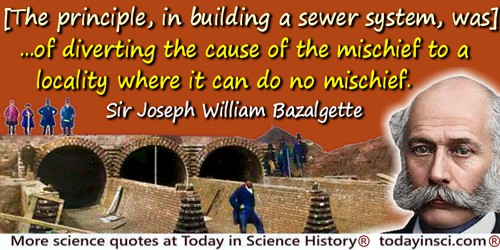
[The principle, in building a sewer system, was] ...of diverting the cause of the mischief to a locality where it can do no mischief.
Quoted in George Drysdale Dempsey and Daniel Kinnear Clark, On the Drainage of Lands, Towns, & Buildings (1887), 246.
[The surplus of basic knowledge of the atomic nucleus was] largely used up [during the war with the atomic bomb as the dividend.] We must, without further delay restore this surplus in preparation for the important peacetime job for the nucleus - power production. ... Many of the proposed applications of atomic power - even for interplanetary rockets - seem to be within the realm of possibility provided the economic factor is ruled out completely, and the doubtful physical and chemical factors are weighted heavily on the optimistic side. ... The development of economic atomic power is not a simple extrapolation of knowledge gained during the bomb work. It is a new and difficult project to reach a satisfactory answer. Needless to say, it is vital that the atomic policy legislation now being considered by the congress recognizes the essential nature of this peacetime job, and that it not only permits but encourages the cooperative research-engineering effort of industrial, government and university laboratories for the task. ... We must learn how to generate the still higher energy particles of the cosmic rays - up to 1,000,000,000 volts, for they will unlock new domains in the nucleus.
Addressing the American Institute of Electrical Engineering, in New York (24 Jan 1946). In Schenectady Gazette (25 Jan 1946),
[Using mice as model systems for genetic engineering in biomedicine, instead of bacterial or yeast systems matters because] this transition will have as big an impact on the future of biology as the shift from printing presses to video technology has had on pop culture. A mouse-based world looks and feels different from one viewed through microorganisms.
Quoted in Michael Schrage, 'Biomedical Researchers Scurry to Make Genetically Altered Mice', San Jose Mercury News (8 Feb 1993), 3D. In Donna Jeanne Haraway and Lynn M. Randolph, [email protected]: Feminism and Technoscience (1996), 98.
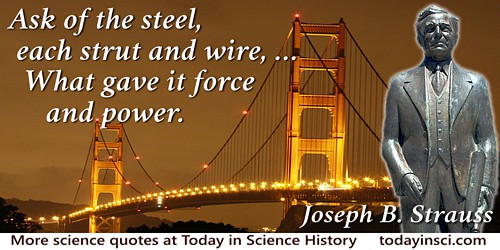
The Mighty Task is Done
At last the mighty task is done;
Resplendent in the western sun
The Bridge looms mountain high;
Its titan piers grip ocean floor,
Its great steel arms link shore with shore,
Its towers pierce the sky.
On its broad decks in rightful pride,
The world in swift parade shall ride,
Throughout all time to be;
Beneath, fleet ships from every port,
Vast landlocked bay, historic fort,
And dwarfing all the sea.
To north, the Redwood Empires gates;
To south, a happy playground waits,
In Rapturous appeal;
Here nature, free since time began,
Yields to the restless moods of man,
Accepts his bonds of steel.
Launched midst a thousand hopes and fears,
Damned by a thousand hostile sneers,
Yet Neer its course was stayed,
But ask of those who met the foe
Who stood alone when faith was low,
Ask them the price they paid.
Ask of the steel, each strut and wire,
Ask of the searching, purging fire,
That marked their natal hour;
Ask of the mind, the hand, the heart,
Ask of each single, stalwart part,
What gave it force and power.
An Honored cause and nobly fought
And that which they so bravely wrought,
Now glorifies their deed,
No selfish urge shall stain its life,
Nor envy, greed, intrigue, nor strife,
Nor false, ignoble creed.
High overhead its lights shall gleam,
Far, far below lifes restless stream,
Unceasingly shall flow;
For this was spun its lithe fine form,
To fear not war, nor time, nor storm,
For Fate had meant it so.
At last the mighty task is done;
Resplendent in the western sun
The Bridge looms mountain high;
Its titan piers grip ocean floor,
Its great steel arms link shore with shore,
Its towers pierce the sky.
On its broad decks in rightful pride,
The world in swift parade shall ride,
Throughout all time to be;
Beneath, fleet ships from every port,
Vast landlocked bay, historic fort,
And dwarfing all the sea.
To north, the Redwood Empires gates;
To south, a happy playground waits,
In Rapturous appeal;
Here nature, free since time began,
Yields to the restless moods of man,
Accepts his bonds of steel.
Launched midst a thousand hopes and fears,
Damned by a thousand hostile sneers,
Yet Neer its course was stayed,
But ask of those who met the foe
Who stood alone when faith was low,
Ask them the price they paid.
Ask of the steel, each strut and wire,
Ask of the searching, purging fire,
That marked their natal hour;
Ask of the mind, the hand, the heart,
Ask of each single, stalwart part,
What gave it force and power.
An Honored cause and nobly fought
And that which they so bravely wrought,
Now glorifies their deed,
No selfish urge shall stain its life,
Nor envy, greed, intrigue, nor strife,
Nor false, ignoble creed.
High overhead its lights shall gleam,
Far, far below lifes restless stream,
Unceasingly shall flow;
For this was spun its lithe fine form,
To fear not war, nor time, nor storm,
For Fate had meant it so.
Written upon completion of the building of the Golden Gate Bridge, May 1937. In Allen Brown, Golden Gate: biography of a Bridge (1965), 229.
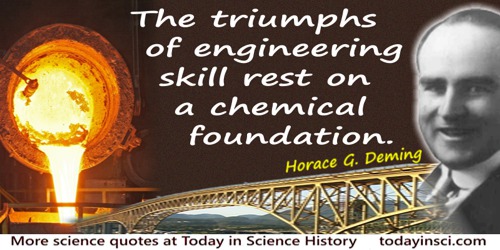
Engineering, too, owes its most useful materials to the achievements of chemists in identifying, separating, and transforming materials: structural steel for the framework of bridges and buildings, portland cement for roadways and aqueducts, pure copper for the electrical industries, aluminum alloys for automobiles and airplanes, porcelain for spark plugs and electrical insulators. The triumphs of engineering skill rest on a chemical foundation.
In Fundamental Chemistry, and Elementary Textbook for College Classes (1936), 8.
Natura non facit saltum or, Nature does not make leaps… If you assume continuity, you can open the well-stocked mathematical toolkit of continuous functions and differential equations, the saws and hammers of engineering and physics for the past two centuries (and the foreseeable future).
From Benoit B. Mandelbrot and Richard Hudson, The (Mis)Behaviour of Markets: A Fractal View of Risk, Ruin and Reward (2004,2010), 85-86.
~~[Attributed without source]~~ The more physics you have the less engineering you need.
Often seen, virally spread, but always without a source citation. If you can provide a primary source, please contact Webmaster. Until then the quote should be regarded as not authenticated.
~~[No known source]~~ The human foot is a masterpiece of engineering and a work of art.
Webmaster has as yet found no primary source, and strongly doubts the authenticity of this quote. Can you help? For such an early author, evidence of this quote should abound, but it does not. It is viral on the web, but Webmaster has so far found no instance with a valid citation. This dubious quote is included here to associate with this caution.
A common mistake that people make when trying to design something completely foolproof is to underestimate the ingenuity of complete fools.
In Mostly Harmless (1992), 135.
A good scientist is a person with original ideas. A good engineer is a person who makes a design that works with as few original ideas as possible. There are no prima donnas in engineering.
In Disturbing the Universe (1979), 114.
A graduate with a science degree asks: 'Why does it work?'
A graduate with an engineering degree asks: 'How does it work?'
A graduate with an accounting degree asks: 'How much will it cost?'
A graduate with an arts degree asks: 'Do you want fries with that?'
A graduate with an engineering degree asks: 'How does it work?'
A graduate with an accounting degree asks: 'How much will it cost?'
A graduate with an arts degree asks: 'Do you want fries with that?'
In Geoff Tibballs, The Mammoth Book of Humor (2000), 83.
A scientist can discover a new star but he cannot make one. He would have to ask an engineer to do it for him.
The Design of Design (1969), 1
Abroad, energy efficiency was a respectable form of engineering. Whereas Americans largely purchased by least “first cost,” Europeans understood and operated under the concept of “life cycle cost.”
An early insight at a 1974 summer study at Princeton, on efficient use of energy, with experts in buildings, industry, transportation, and utilities. In 'The Art of Energy Efficiency: Protecting the Environment with Better Technology', Annual Review of Energy and the Environment (Nov 1999), 24, 37.
Aeroplanes are not designed by science, but by art in spite of some pretence and humbug to the contrary. I do not mean to suggest that engineering can do without science, on the contrary, it stands on scientific foundations, but there is a big gap between scientific research and the engineering product which has to be bridged by the art of the engineer.
In John D. North, 'The Case for Metal Construction', The Journal of the Royal Aeronautical Society, (Jan 1923), 27, 11.
All important unit operations have much in common, and if the underlying principles upon which the rational design and operation of basic types of engineering equipment depend are understood, their successful adaptation to manufacturing processes becomes a matter of good management rather than of good fortune.
In William H. Walker, Warren K. Lewis and William H. MacAdams, The Principles of Chemical Engineering (1923), Preface to 1st. edition, v.
Although my Aachen colleagues and students at first regarded the “pure mathematician” with suspicion, I soon had the satisfaction of being accepted a useful member not merely in teaching but also engineering practice; thus I was requested to render expert opinions and to participate in the Ingenieurverein [engineering association].
As quoted in Paul Forman and Armin Hermann, 'Sommerfeld, Arnold (Johannes Wilhelm)', Biography in Dictionary of Scientific Biography (1975), Vol. 12, 527. Cited from 'Autobiographische Skizze', Gesammelte Schriften, Vol 4, 673–682.
An undertaking of great magnitude and importance, the successful accomplishment of which, in so comparatively short a period, notwithstanding the unheard of unestimable difficulties and impediments which had to be encountered and surmounted, in an almost unexplored and uninhabited wilderness … evinced on your part a moral courage and an undaunted spirit and combination of science and management equally exciting our admiration and deserving our praise.
(In recognition of his achievement building the Rideau Canal.)
(In recognition of his achievement building the Rideau Canal.)
— John By
Address by the Montreal Committee of Trade. Quoted in 'John By', University of Toronto Press, Dictionary of Canadian Biography (1966), vol.7, 130.
And having thus passed the principles of arithmetic, geometry, astronomy, and geography, with a general compact of physics, they may descend in mathematics to the instrumental science of trigonometry, and from thence to fortification, architecture, engineering, or navigation. And in natural philosophy they may proceed leisurely from the history of meteors, minerals, plants, and living creatures, as far as anatomy. Then also in course might be read to them out of some not tedious writer the institution of physic. … To set forward all these proceedings in nature and mathematics, what hinders but that they may procure, as oft as shall be needful, the helpful experiences of hunters, fowlers, fishermen, shepherds, gardeners, apothecaries; and in other sciences, architects, engineers, mariners, anatomists.
In John Milton and Robert Fletcher (ed.), 'On Education', The Prose Works of John Milton: With an Introductory Review (1834), 100.
Archimedes possessed so high a spirit, so profound a soul, and such treasures of highly scientific knowledge, that though these inventions [used to defend Syracuse against the Romans] had now obtained him the renown of more than human sagacity, he yet would not deign to leave behind him any commentary or writing on such subjects; but, repudiating as sordid and ignoble the whole trade of engineering, and every sort of art that lends itself to mere use and profit, he placed his whole affection and ambition in those purer speculations where there can be no reference to the vulgar needs of life; studies, the superiority of which to all others is unquestioned, and in which the only doubt can be whether the beauty and grandeur of the subjects examined, or the precision and cogency of the methods and means of proof, most deserve our admiration.
— Plutarch
In John Dryden (trans.), Life of Marcellus.
Ask a follower of Bacon what [science] the new philosophy, as it was called in the time of Charles the Second, has effected for mankind, and his answer is ready; “It has lengthened life; it has mitigated pain; it has extinguished diseases; it has increased the fertility of the soil; it has given new securities to the mariner; it has furnished new arms to the warrior; it has spanned great rivers and estuaries with bridges of form unknown to our fathers; it has guided the thunderbolt innocuously from heaven to earth; it has lighted up the night with the splendour of the day; it has extended the range of the human vision; it has multiplied the power of the human muscles; it has accelerated motion; it has annihilated distance; it has facilitated intercourse, correspondence, all friendly offices, all dispatch of business; it has enabled man to descend to the depths of the sea, to soar into the air, to penetrate securely into the noxious recesses of the earth, to traverse the land in cars which whirl along without horses, to cross the ocean in ships which run ten knots an hour against the wind. These are but a part of its fruits, and of its first-fruits; for it is a philosophy which never rests, which has never attained, which is never perfect. Its law is progress. A point which yesterday was invisible is its goal to-day, and will be its starting-point to-morrow.”
From essay (Jul 1837) on 'Francis Bacon' in Edinburgh Review. In Baron Thomas Babington Macaulay and Lady Trevelyan (ed.) The Works of Lord Macaulay Complete (1871), Vol. 6, 222.
At its heart, engineering is about using science to find creative, practical solutions. It is a noble profession!
From a speech by The Queen at The Queen Elizabeth Prize for Engineering (25 Jun 2013).
At their best, at their most creative, science and engineering are attributes of liberty—noble expressions of man’s God-given right to investigate and explore the universe without fear of social or political or religious reprisals.
From 'Sarnoff Honored by I.R.E.', in Department of Information of the Radio Corporation of America, Radio Age: Research, Manufacturing, Communications, Broadcasting (Apr 1953), 12, No. 2, 32.
Because it’s my generation that’s going to have to deal with the effects of climate change.
Title of article promoting support future generations, especially for careers in engineering on website of IET (The Institution of Engineering and Technology).
Besides electrical engineering theory of the transmission of messages, there is a larger field [cybernetics] which includes not only the study of language but the study of messages as a means of controlling machinery and society, the development of computing machines and other such automata, certain reflections upon psychology and the nervous system, and a tentative new theory of scientific method.
In Cybernetics (1948).
But, contrary to the lady’s prejudices about the engineering profession, the fact is that quite some time ago the tables were turned between theory and applications in the physical sciences. Since World War II the discoveries that have changed the world are not made so much in lofty halls of theoretical physics as in the less-noticed labs of engineering and experimental physics. The roles of pure and applied science have been reversed; they are no longer what they were in the golden age of physics, in the age of Einstein, Schrödinger, Fermi and Dirac.
'The Age of Computing: a Personal Memoir', Daedalus (1992), 121, 120.
Can one think that because we are engineers, beauty does not preoccupy us or that we do not try to build beautiful, as well as solid and long lasting structures? Aren’t the genuine functions of strength always in keeping with unwritten conditions of harmony? … Besides, there is an attraction, a special charm in the colossal to which ordinary theories of art do not apply.
As translated in Henry Petroski, Remaking the World: Adventures in Engineering (1998), 173. From the original French in interview of Eiffel by Paul Bourde, in the newspaper Le Temps (14 Feb 1887). Quoted in 'Au Jour le Jour: Les Artistes Contre la Tour Eiffel', Gazette Anecdotique, Littéraire, Artistique et Bibliographique (Feb 1887), 126, and in Gustave Eiffel, Travaux Scientifiques Exécutés à la Tour de 300 Mètres de 1889 à 1900 (1900), 14. “Parce que nous sommes des ingénieurs, croit-on donc que la beauté ne nous préoccupe pas dans nos constructions et qu'en même temps que nous faisons solide et durable nous ne nous efforçons pas rletfaire élégant? Est-ce que les véritables conditions de la force ne sont pas toujours conformes aux conditions secrètes de l'harmonie?.… Il y a du reste dans le colossal une attraction, un charme propre auxquels les théories d'art ordinaires ne sont guère applicables.
Chemical engineering is the profession in which a knowledge of mathematics, chemistry and other natural sciences gained by study, experience and practice is applied with judgment to develop economic ways of using materials and energy for the benefit of mankind.
— AIChE
In Article III, 'Definition of the Profession', Constitution of the American Institute of
Chemical Engineers (as amended 17 Jan 2003). The same wording is found in the 1983 Constitution, as quoted in Nicholas A. Peppas (ed.), One Hundred Years of Chemical Engineering: From Lewis M. Norton (M.I.T. 1888) to Present (2012), 334.
Don’t ask me to put up a shelf, but I love engineering.
As quoted on imdb.com biography page for Bruce Dickinson. Webmaster has not yet found a primary source for this quote. Can you help?
During the war years I worked on the development of radar and other radio systems for the R.A.F. and, though gaining much in engineering experience and in understanding people, rapidly forgot most of the physics I had learned.
From Autobiography in Wilhelm Odelberg (ed.), Les Prix Nobel en 1974/Nobel Lectures (1975)
Education in my family was not merely emphasized, it was our raison d'être. Virtually all of our aunts and uncles had Ph.D.s in science or engineering, and it was taken for granted that the next generation of Chu's were to follow the family tradition. When the dust had settled, my two brothers and four cousins collected three MDs, four Ph.D.s and a law degree. I could manage only a single advanced degree.
Autobiography in Gösta Ekspong (ed.), Nobel Lectures: Physics 1996-2000 (2002), 115.
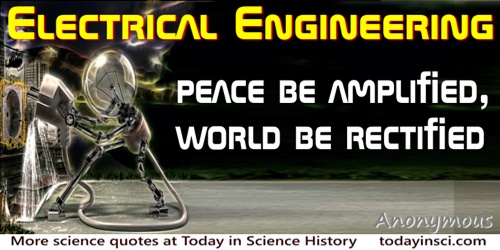
Electrical Engineering: Peace be amplified, world be rectified.
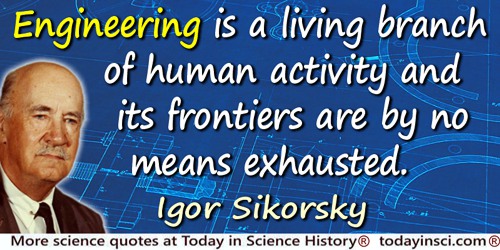
Engineering is a living branch of human activity and its frontiers are by no means exhausted.
From 'Igor Sikorsky the Aviation Pioneer Speaks', Igor I. Sikorsky Historical Archives, sikorskyarchives.com.
Engineering is a modest profession, which tends not to blow its own trumpet.
From a speech by The Queen at The Queen Elizabeth Prize for Engineering (25 Jun 2013).
Engineering is an activity other than purely manual and physical work which brings about the utilization of the materials and laws of nature for the good of humanity.
1929
Engineering is more closely akin to the arts than perhaps any other of the professions; first, because it requires the maximum of natural aptitude and of liking for the work in order to offset other factors; second, because it demands, like the arts, an almost selfless consecration to the job; and, third, because out of the hundreds who faithfully devote themselves to the task, only a few are destined to receive any significant reward—in either money or fame.
As coauthor with Frank W. Skinner, and Harold E. Wessman, 'Foreward', Vocational Guidance in Engineering Lines (1933), vi.
Engineering is not merely knowing and being knowledgeable, like a walking encyclopedia; engineering is not merely analysis; engineering is not merely the possession of the capacity to get elegant solutions to non-existent engineering problems; engineering is practicing the art of the organizing forces of technological change ... Engineers operate at the interface between science and society.
In Bert Scalzo, et al., Database Benchmarking: Practical Methods for Oracle & SQL Server (2007), 37.
Engineering is quite different from science. Scientists try to understand nature. Engineers try to make things that do not exist in nature. Engineers stress invention. To embody an invention the engineer must put his idea in concrete terms, and design something that people can use. That something can be a device, a gadget, a material, a method, a computing program, an innovative experiment, a new solution to a problem, or an improvement on what is existing. Since a design has to be concrete, it must have its geometry, dimensions, and characteristic numbers. Almost all engineers working on new designs find that they do not have all the needed information. Most often, they are limited by insufficient scientific knowledge. Thus they study mathematics, physics, chemistry, biology and mechanics. Often they have to add to the sciences relevant to their profession. Thus engineering sciences are born.
Y.C. Fung and P. Tong, Classical and Computational Solid Mechanics (2001), 1.
Engineering is the application of scientific and mathematical principles to practical ends such as the design, manufacture, and operation of efficient and economical structures, machines, processes, and systems.
In Bernice Zeldin Schacter, Issues and Dilemmas of Biotechnology: A Reference Guide (1999), 1, citing the American Heritage Dictionary, 2nd College Edition.
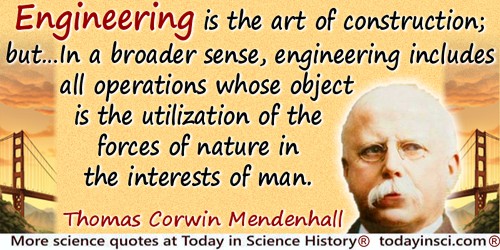
Engineering is the art of construction; but to limit it to this would be to restrict its meaning much within the range of the ordinary use of the word. In a broader sense, engineering includes all operations whose object is the utilization of the forces of nature in the interests of man.
From Address to the International Engineering Congress of the Columbia Exposition, Chicago, 1893. Published in Transactions of the American Society of Civil Engineers (Oct 1893), 120. Reprinted in 'Fundamental Units of Measure', Smithsonian Report for 1893 (1894), 135.
Engineering is the art of directing the great sources of power in nature for the use and convenience of man.
(1828) At a meeting of the Council of the Institution of Civil Engineers of Great Britain (29 Dec 1827), by resolution, Honorary Member Thomas Tredgold was asked for a description of what a Civil Engineer is, in order that it could be put in the petition for a charter. (As cited by F.R. Hutton, in 'The Field of the Mechanical Engineer', The Engineering Digest (1908), Vol. 3 , 10.) The wording was repeated in the Charter of the Institution. (Reported in 'Society of Civil Engineers', The Gentleman's Magazine (1828), 143, 628.) The quote is excerpted from the longer definition therein.
Engineering is the art of directing the great sources of power in nature for the use and the convenience of people. In its modern form engineering involves people, money, materials, machines, and energy. It is differentiated from science because it is primarily concerned with how to direct to useful and economical ends the natural phenomena which scientists discover and formulate into acceptable theories. Engineering therefore requires above all the creative imagination to innovate useful applications of natural phenomena. It seeks newer, cheaper, better means of using natural sources of energy and materials.
In McGraw Hill, Science and Technology Encyclopedia
Engineering is the art of organizing and directing men and controlling the forces and materials of nature for the benefit of the human race.
1907
Engineering is the art or science of making practical.
The Existential Pleasures of Engineering (1976), x.
Engineering is the art or science of utilizing, directing or instructing others in the utilization of the principles, forces, properties and substance of nature in the production, manufacture, construction, operation and use of things ... or of means, methods, machines, devices and structures ...
(1920}
Engineering is the conscious application of science to the problems of economic production.
1910
Engineering is the practice of safe and economic application of the scientific laws governing the forces and materials of nature by means of organization, design and construction, for the general benefit of mankind.
1920
Engineering is the profession in which a knowledge of the mathematical and natural sciences gained by study, experience, and practice is applied with judgment to develop ways to utilize, economically, the materials and forces of nature for the benefit of mankind.
— ABET
In EAC Criteria for 1999-2000 as cited in Charles R. Lord, Guide to Information Sources in Engineering (2000), 5. Found in many sources, and earlier, for example, Otis E. Lancaster, American Society for Engineering Education, Engineers' Council for Professional Development, Achieve Learning Objectives (1962), 8.
Engineering is the professional and systematic application of science to the efficient utilization of natural resources to produce wealth.
T. J. Hoover and John Charles Lounsbury (J.C.L.) Fish, The Engineering Profession (1941), 10.
Engineering is the professional art of applying science to the optimum conversion of the resources of nature to the uses of humankind.
— ASCE
In American Society of Civil Engineers, Engineering Issues (1964), 90-92, 49. Other sources attribute, without citation, to Ralph J. Smith (1962).
Engineering is the science and art of efficient dealing with materials and forces … it involves the most economic design and execution … assuring, when properly performed, the most advantageous combination of accuracy, safety, durability, speed, simplicity, efficiency, and economy possible for the conditions of design and service.
As coauthor with Frank W. Skinner, and Harold E. Wessman, Vocational Guidance in Engineering Lines (1933), 6.
Engineering is the science of economy, of conserving the energy, kinetic and potential, provided and stored up by nature for the use of man. It is the business of engineering to utilize this energy to the best advantage, so that there may be the least possible waste.
(1908). Quoted, without source, in Appendix A, 'Some Definitions of Engineering' in Theodore Jesse Hoover and John Charles Lounsbury Fish, The Engineering Profession (1941), 463.
Engineering or Technology is the making of things that did not previously exist, whereas science is the discovering of things that have long existed.
The Tower and the Bridge: The New Art of Structural Engineering (1983), 9.
Engineering stimulates the mind.
As quoted on imdb.com biography page for Bruce Dickinson. Webmaster has not yet found a primary source for this quote. Can you help?
Engineering stimulates the mind. Kids get bored easily. They have got to get out and get their hands dirty: make things, dismantle things, fix things. When schools can offer that, you’ll have an engineer for life.
As quoted on imdb.com biography page for Bruce Dickinson. Webmaster has not yet found a primary source for this quote. Can you help?
Engineering training deals with the exact sciences. That sort of exactness makes for truth and conscience. It might be good for the world if more men had that sort of mental start in life even if they did not pursue the profession.
Reprint of his 1916 statement in 'Engineering as a Profession', Engineer’s Week (1954).
Engineering without imagination sinks to a trade.
Reprint of his 1916 statement in 'Engineering as a Profession', Engineer’s Week (1954).
Engineering, medicine, business, architecture and painting are concerned not with the necessary but with the contingent—not with how things are but with how they might be—in short, with design.
In The Sciences of the Artificial (1996), xii.
ENGINEERING. The finest career for a young man; he learns all the sciences.
In The Dictionary of Accepted Ideas (1881), trans. Jaques Barzun (1968), 35.
Engineering…is both an art and a science, and as a science it consists for the most part of mathematics applied to physics and mechanics. It is of necessity, therefore, a measuring science, and a congress of engineers ought, in the nature of things, to be interested in anything relating to progress in metrology.
From Address to the International Engineering Congress of the Columbia Exposition, Chicago, 1893. Published in Transactions of the American Society of Civil Engineers (Oct 1893), 120. Reprinted in 'Fundamental Units of Measure', Smithsonian Report for 1893 (1894), 135.
Engineers use knowledge primarily to design, produce, and operate artifacts. … Scientists, by contrast, use knowledge primarily to generate more knowledge.
What Engineers Know and How They Know It (1990), 226. In Camilla Stivers, Democracy, Bureaucracy, and the Study of Administration (2001), 144.
Every technological success is hailed as a great scientific achievement; every technological disaster is deemed an engineering failure.
Faced with the admitted difficulty of managing the creative process, we are doubling our efforts to do so. Is this because science has failed to deliver, having given us nothing more than nuclear power, penicillin, space travel, genetic engineering, transistors, and superconductors? Or is it because governments everywhere regard as a reproach activities they cannot advantageously control? They felt that way about the marketplace for goods, but trillions of wasted dollars later, they have come to recognize the efficiency of this self-regulating system. Not so, however, with the marketplace for ideas.
Quoted in Martin Moskovits (ed.), Science and Society, the John C. Polanyi Nobel Lareates Lectures (1995), 8.
Failure is central to engineering. Every single calculation that an engineer makes is a failure calculation. Successful engineering is all about understanding how things break or fail.
From an interview. As quoted in Cornelia Deanmay, 'An Engineer Who Revels in Success of Failure', New York Times (3 May 2006).
For many parts of Nature can neither be invented with sufficient subtlety, nor demonstrated with sufficient perspicuity, nor accommodated to use with sufficient dexterity, without the aid and intervention of Mathematic: of which sort are Perspective, Music, Astronomy, cosmography, Architecture, Machinery, and some others.
In De Augmentis, Bk. 3; The Advancement of Learning (1605), Book 3. As translated in Francis Bacon, James Spedding and Robert Leslie Ellis, 'Of the great Appendix of Natural Philosophy, both Speculative and Operative, namely Mathematic; and that it ought rather
to be placed among Appendices than among Substantive Sciences. Division of Mathematic into Pure and Mixed', The Works of Francis Bacon (1858), Vol. 4, Chap. 6, 371.
Fun years for me, for a guy who used to like to blow up things. We had lots of explosions, lots of blowups.
Recalling his experience as an engineer at the Propulsion Systems Laboratory. From Interview (1 Sep 2009), for the NASA Glenn History Collection, Oral History Collection, Cleveland, Ohio. As quoted an cited in Robert S. Arrighi, Pursuit of Power: NASA’s Propulsion and Systems Laboratory No. 1 and 2 (2012), 82.
Genetic engineering is to traditional crossbreeding what the nuclear bomb was to the sword.
Quoted in 'Animal Patenting: Impact of Bioengineering on Altering Animals', in B. Julie Johnson E: The Environmental Magazine (Apr 1994).
Great triumphs of engineering genius—the locomotive, the truss bridge, the steel rail— ... are rather invention than engineering proper.
From The Economic Theory of the Location of Railways (1887, 1914), 1.
I ask any one who has adopted the calling of an engineer, how much time he lost when he left school, because he had to devote himself to pursuits which were absolutely novel and strange, and of which he had not obtained the remotest conception from his instructors? He had to familiarize himself with ideas of the course and powers of Nature, to which his attention had never been directed during his school-life, and to learn, for the first time, that a world of facts lies outside and beyond the world of words.
From After-Dinner Speech (Apr 1869) delivered before the Liverpool Philomathic Society, 'Scientific Education', collected in Lay Sermons, Addresses, and Reviews (1870), 63. Previously published in Macmillan’s Magazine.
I consider [H. G. Wells], as a purely imaginative writer, to be deserving of very high praise, but our methods are entirely different. I have always made a point in my romances of basing my so-called inventions upon a groundwork of actual fact, and of using in their construction methods and materials which are not entirely without the pale of contemporary engineering skill and knowledge. ... The creations of Mr. Wells, on the other hand, belong unreservedly to an age and degree of scientific knowledge far removed from the present, though I will not say entirely beyond the limits of the possible.
Gordon Jones, 'Jules Verne at Home', Temple Bar (Jun 1904), 129, 670.
I had a Meccano set with which I “played” endlessly. Meccano which was invented by Frank Hornby around 1900, is called Erector Set in the US. New toys (mainly Lego) have led to the extinction of Meccano and this has been a major disaster as far as the education of our young engineers and scientists is concerned. Lego is a technically trivial plaything and kids love it partly because it is so simple and partly because it is seductively coloured. However it is only a toy, whereas Meccano is a real engineering kit and it teaches one skill which I consider to be the most important that anyone can acquire: This is the sensitive touch needed to thread a nut on a bolt and tighten them with a screwdriver and spanner just enough that they stay locked, but not so tightly that the thread is stripped or they cannot be unscrewed. On those occasions (usually during a party at your house) when the handbasin tap is closed so tightly that you cannot turn it back on, you know the last person to use the washroom never had a Meccano set.
Nobel laureate autobiography in Les Prix Nobel/Nobel Lectures 1996 (1997), 189.
I have long aspired to make our company a noble prototype of industry, penetrating in science, reliable in engineering, creative in aesthetics and wholesomely prosperous in economics.
In Alan R. Earls and Nasrin Rohani, Polaroid (2005), 7.
I like the word “nanotechnology.” I like it because the prefix “nano” guarantees it will be fundamental science for decades; the “technology” says it is engineering, something you’re involved in not just because you’re interested in how nature works but because it will produce something that has a broad impact.
From interview in 'Wires of Wonder', Technology Review (Mar 2001), 104, No. 2, 88.
I see nothing wrong ethically with the idea of correcting single gene defects [through genetic engineering]. But I am concerned about any other kind of intervention, for anything else would be an experiment, [which would] impose our will on future generations [and take unreasonable chances] with their welfare ... [Thus] such intervention is beyond the scope of consideration.
in The Second Creation: Dolly and the Age of Biological Control
I think my most important work has been done on the borderlines between different areas of science. My first work was in geophysics, a combination of physics and geology, and then at the Bell Laboratories, it was more a combination of physics and electrical engineering. That’s what I’m following more or less as time goes on. My appointment here at the university relates to physics and electrical engineering, but I have also worked in the borderline areas between physics and chemistry. I think reading widely and being interested in many different areas in science is important.
In Robert L. Burtch, 'Interview with a Nobel Laureate: Fifth Graders Learn About a Scientist We All Should Know', Science and Children, (Nov/Dec 1990), 28, No. 3, 16-17.
I will build a motor car for the great multitude … constructed of the best materials, by the best men to be hired, after the simplest designs that modern engineering can devise … so low in price that no man making a good salary will be unable to own one—and enjoy with his family the blessing of pleasure in God’s great open spaces.
(1909). In My Life and Work (1922), 73.
I’m particularly adept at making mistakes—it’s a necessity as an engineer. Each iteration of the vacuum came about because of a mistake I needed to fix.
In 'My Favorite Mistake', Newsweek (29 May 2011). About developing his revolutionary Dyson vacuum cleaner.
I’m quite into the idea of engineering being beautiful.
As quoted in The Wire (2003), 32, dating it as a declaration made “back then” around the 1997 release of the Chiastic Slide album.
I've never seen a job being done by a five-hundred-person engineering team that couldn't be done better by fifty people.
Statement once told to the author, as quoted in Thomas J. Peters, Liberation Management: Necessary Disorganization for the Nanosecond Nineties (1992), 572.
If it’s green or wriggles, it’s biology. If it stinks, it’s chemistry. If it doesn’t work, it’s physics or engineering. If it’s green and wiggles and stinks and still doesn’t work, it’s psychology. If it’s incomprehensible, it’s mathematics. If it puts you to sleep, it’s statistics.
In Journal of the South African Institute of Mining and Metallurgy (1978), 79, 97, and additional lines from other sources.
If the Commission is to enquire into the conditions “to be observed,” it is to be presumed that they will give the result of their enquiries; or, in other words, that they will lay down, or at least suggest, “rules” and “conditions to be (hereafter) observed” in the construction of bridges, or, in other words, embarrass and shackle the progress of improvement to-morrow by recording and registering as law the prejudices or errors of to-day.
[Objecting to any interference by the State with the freedom of civil engineers in the conduct of their professional work.]
[Objecting to any interference by the State with the freedom of civil engineers in the conduct of their professional work.]
Letter (13 Mar 1848) to the Royal Commission on the Application of Iron in Railway Structures. Collected in The Life of Isambard Kingdom Brunel, Civil Engineer (1870), 487. The above verbatim quote may be the original source of the following statement as seen in books and on the web without citation: “I am opposed to the laying down of rules or conditions to be observed in the construction of bridges lest the progress of improvement tomorrow might be embarrassed or shackled by recording or registering as law the prejudices or errors of today.” Webmaster has not yet found a primary source for his latter form, and suspects it may be a synopsis, rather than a verbatim quote. If you know of such a primary source, please inform Webmaster.
If you ask ... the man in the street ... the human significance of mathematics, the answer of the world will be, that mathematics has given mankind a metrical and computatory art essential to the effective conduct of daily life, that mathematics admits of countless applications in engineering and the natural sciences, and finally that mathematics is a most excellent instrumentality for giving mental discipline... [A mathematician will add] that mathematics is the exact science, the science of exact thought or of rigorous thinking.
Address (28 Mar 1912), Michigan School Masters' Club, Ann Arbor, 'The Humanization of the Teaching of Mathematics. Printed in Science (26 Apr 1912). Collected in The Human Worth of Rigorous Thinking: Essays and Addresses (1916), 65-66.
Improvements in industry can be left to chance in the hope that someone, sometime, will think of something useful. that some good invention will show up. The other way is to organize so that new knowledge shall always be coming from the researches in the fundamental sciences and engineering arts on which business is based. From that steady stream will arise inventions and new methods. This is the way of Bell Laboratories.
From a Bell Telephone System advertisement, 'The Search That Never Ends', placed, for example, in Life Magazine (17 Jan 1944), 33.
In despair, I offer your readers their choice of the following definitions of entropy. My authorities are such books and journals as I have by me at the moment.
(a) Entropy is that portion of the intrinsic energy of a system which cannot be converted into work by even a perfect heat engine.—Clausius.
(b) Entropy is that portion of the intrinsic energy which can be converted into work by a perfect engine.—Maxwell, following Tait.
(c) Entropy is that portion of the intrinsic energy which is not converted into work by our imperfect engines.—Swinburne.
(d) Entropy (in a volume of gas) is that which remains constant when heat neither enters nor leaves the gas.—W. Robinson.
(e) Entropy may be called the ‘thermal weight’, temperature being called the ‘thermal height.’—Ibid.
(f) Entropy is one of the factors of heat, temperature being the other.—Engineering.
I set up these bald statement as so many Aunt Sallys, for any one to shy at.
[Lamenting a list of confused interpretations of the meaning of entropy, being hotly debated in journals at the time.]
(a) Entropy is that portion of the intrinsic energy of a system which cannot be converted into work by even a perfect heat engine.—Clausius.
(b) Entropy is that portion of the intrinsic energy which can be converted into work by a perfect engine.—Maxwell, following Tait.
(c) Entropy is that portion of the intrinsic energy which is not converted into work by our imperfect engines.—Swinburne.
(d) Entropy (in a volume of gas) is that which remains constant when heat neither enters nor leaves the gas.—W. Robinson.
(e) Entropy may be called the ‘thermal weight’, temperature being called the ‘thermal height.’—Ibid.
(f) Entropy is one of the factors of heat, temperature being the other.—Engineering.
I set up these bald statement as so many Aunt Sallys, for any one to shy at.
[Lamenting a list of confused interpretations of the meaning of entropy, being hotly debated in journals at the time.]
In The Electrician (9 Jan 1903).
In engineering, that only is great which achieves. It matters not what the intention is, he who in the day of battle is not victorious is not saved by his intention.
In Proverbs from Plymouth Pulpit (1887), 21.
In my intercourse with mankind, I have always found those who would thrust theory into practical matters to be, at bottom, men of no judgement and pure quacks.
Quoted in James Kip Finch, Engineering Classics of James Kip Finch.
In the conception of a machine or the product of a machine there is a point where one may leave off for parsimonious reasons, without having reached aesthetic perfection; at this point perhaps every mechanical factor is accounted for, and the sense of incompleteness is due to the failure to recognize the claims of the human agent. Aesthetics carries with it the implications of alternatives between a number of mechanical solutions of equal validity; and unless this awareness is present at every stage of the process … it is not likely to come out with any success in the final stage of design.
From 'The Esthetic Assimilation of the Machine', Technics and Civilization (1934), 349.
In the early days of telephone engineering, the mere sending of a message was so much of a miracle that nobody asked how it should be sent.
In The Human Use of Human Beings: Cybernetics and Society (1950), 4.
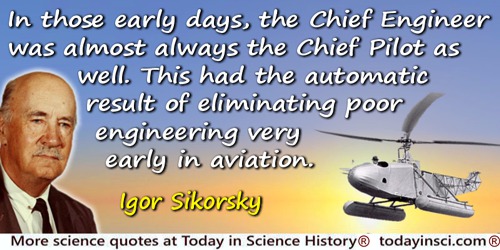
In those early days, the Chief Engineer was almost always the Chief Pilot as well. This had the automatic result of eliminating poor engineering very early in aviation.
In The Story of the Winged-S: The Autobiography of Igor I. Sikorsky (2011).
Indeed, the most important part of engineering work—and also of other scientific work—is the determination of the method of attacking the problem, whatever it may be, whether an experimental investigation, or a theoretical calculation. … It is by the choice of a suitable method of attack, that intricate problems are reduced to simple phenomena, and then easily solved.
In Engineering Mathematics: A Series of Lectures Delivered at Union College (1911, 1917), Vol. 2, 275.
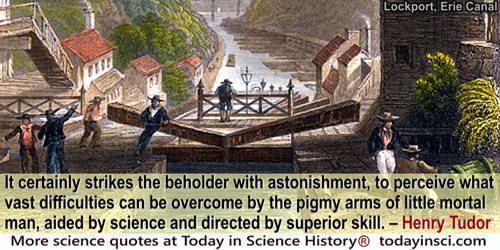
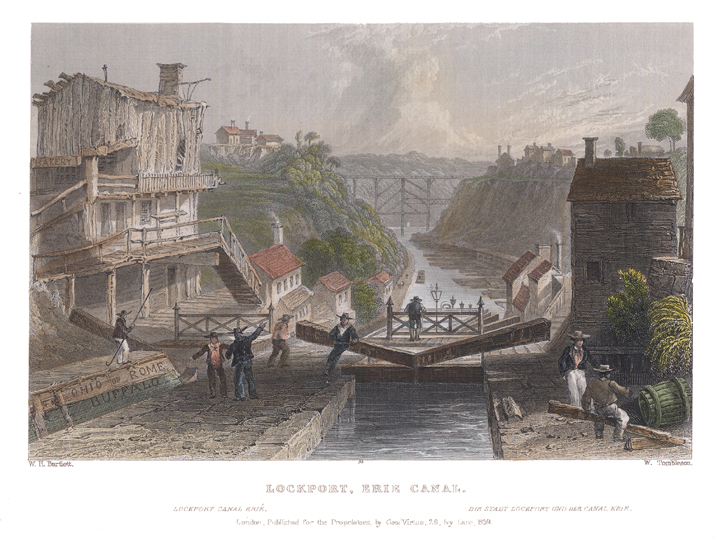
It certainly strikes the beholder with astonishment, to perceive what vast difficulties can be overcome by the pigmy arms of little mortal man, aided by science and directed by superior skill.
About his visit to Lockport on the Erie Canal, in Letter IX, to a friend in England from Lockport, New York (25 Jul 1831), collected in Narrative of a Tour in North America (1834), Vol. 1, 233-234,
It has been just so in all my inventions. The first step is an intuition—and comes with a burst, then difficulties arise. This thing that gives out and then that—“Bugs” as such little faults and difficulties are called show themselves and months of anxious watching, study and labor are requisite before commercial success—or failure—is certainly reached.
Describing his invention of a storage battery that involved 10,296 experiments. Note Edison’s use of the term “Bug” in the engineering research field for a mechanical defect greatly predates the use of the term as applied by Admiral Grace Murray Hopper to a computing defect upon finding a moth in the electronic mainframe.] Letter to Theodore Puskas (18 Nov 1878). In The Yale Book of Quotations (2006), 226.
It is both a sad and a happy fact of engineering history that disasters have been powerful instruments of change. Designers learn from failure. Industrial society did not invent grand works of engineering, and it was not the first to know design failure. What it did do was develop powerful techniques for learning from the experience of past disasters. It is extremely rare today for an apartment house in North America, Europe, or Japan to fall down. Ancient Rome had large apartment buildings too, but while its public baths, bridges and aqueducts have lasted for two thousand years, its big residential blocks collapsed with appalling regularity. Not one is left in modern Rome, even as ruin.
In Why Things Bite Back: Technology and the Revenge of Unintended Consequences (1997), 23.
It is characteristic of our age to endeavour to replace virtues by technology. That is to say, wherever possible we strive to use methods of physical or social engineering to achieve goals which our ancestors thought attainable only by the training of character. Thus, we try so far as possible to make contraception take the place of chastity, and anaesthetics to take the place of fortitude; we replace resignation by insurance policies and munificence by the Welfare State. It would be idle romanticism to deny that such techniques and institutions are often less painful and more efficient methods of achieving the goods and preventing the evils which unaided virtue once sought to achieve and avoid. But it would be an equal and opposite folly to hope that the take-over of virtue by technology may one day be complete, so that the necessity for the laborious acquisition of the capacity for rational choice by individuals can be replaced by the painless application of the fruits of scientific discovery over the whole field of human intercourse and enterprise.
'Mental Health in Plato's Republic', in The Anatomy of the Soul: Historical Essays in the Philosophy of Mind (1973), 26.
It is contrary to the usual practice of professional men to give their opinions upon each other's work unless regularly called upon in the way of their profession.
It seems to be saying perpetually; 'I am the end of the nineteenth century; I am glad they built me of iron; let me rust.' ... It is like a passing fool in a crowd of the University, a buffoon in the hall; for all the things in Paris has made, it alone has neither wits nor soul.
About the Eiffel Tower.
About the Eiffel Tower.
Paris (1900). In Peter Yapp, The Travellers' Dictionary of Quotation: Who Said What, About Where? (1983), 183.
It so happens that the work which is likely to be our most durable monument, and to convey some knowledge of us to the most remote posterity, is a work of bare utility; not a shrine, not a fortress, not a palace, but a bridge.
Writing upon the opening of the Brooklyn Bridge, New York.
Writing upon the opening of the Brooklyn Bridge, New York.
'The Bridge as a Monument', Harper's Weekly (26 May 1883), 27, 326. In David P. Billington, The Tower and the Bridge: The New Art of Structural Engineering (1983), 17.
It would be well if engineering were less generally thought of, and even defined, as the art of constructing. In a certain important sense it is rather the art of not constructing; or, to define it rudely but not inaptly, it is the art of doing that well with one dollar, which any bungler can do with two after a fashion.
From The Economic Theory of the Location of Railways (1887, 1914), 1.
Just as the arts of tanning and dyeing were practiced long before the scientific principles upon which they depend were known, so also the practice of Chemical Engineering preceded any analysis or exposition of the principles upon which such practice is based.
In William H. Walker, Warren K. Lewis and William H. MacAdams, The Principles of Chemical Engineering (1923), Preface to 1st. edition, v.
Leaving aside genetic surgery applied humans, I foresee that the coming century will place in our hands two other forms of biological technology which are less dangerous but still revolutionary enough to transform the conditions of our existence. I count these new technologies as powerful allies in the attack on Bernal's three enemies. I give them the names “biological engineering” and “self-reproducing machinery.” Biological engineering means the artificial synthesis of living organisms designed to fulfil human purposes. Self-reproducing machinery means the imitation of the function and reproduction of a living organism with non-living materials, a computer-program imitating the function of DNA and a miniature factory imitating the functions of protein molecules. After we have attained a complete understanding of the principles of organization and development of a simple multicellular organism, both of these avenues of technological exploitation should be open to us.
From 3rd J.D. Bernal Lecture, Birkbeck College London (16 May 1972), The World, the Flesh and the Devil (1972), 6. Collected in The Scientist as Rebel (2006), 292. (The World, the Flesh & the Devil: An Enquiry into the Future of the Three Enemies of the Rational Soul is the title of a book by J. D Bernal, a scientist who pioneered X-ray crystallography.)
Lord Kelvin had, in a manner hardly and perhaps never equalled before, except by Archimedes, the power of theorizing on the darkest, most obscure, and most intimate secrets of Nature, and at the same time, and almost in the same breath, carrying out effectively and practically some engineering feat, or carrying to a successful issue some engineering invention. He was one of the leaders in the movement which has compelled all modern engineers worthy of the name to be themselves men not merely of practice, but of theory, to carry out engineering undertakings in the spirit of true scientific inquiry and with an eye fixed on the rapidly growing knowledge of the mechanics of Nature, which can only be acquired by the patient work of physicists and mathematicians in their laboratories and studies.
In Speech (May 1921) to the Institute of Civil Engineers, to award the newly created Kelvin Medal. As quoted in Sarah Knowles Bolton, 'Lord Kelvin', Famous Men of Science (1889, Revised Ed. 1926), 316-317.
Mankind cannot survive without technology. But unless technology becomes a true servant of man, the survival of mankind is in jeopardy. And if technology is to be the servant, then the engineer’s paramount loyalty must be to society.
In 'Preface', Conference on Engineering Ethics, May 18-19, 1975, Baltimore, Md. (1975), 1.
Manufacturing is more than just putting parts together. It’s coming up with ideas, testing principles and perfecting the engineering, as well as final assembly.
Epigraph in The Business Book (2014), 286. Need primary source - can you help?
Much like engineering. Design by theory, then beef it up anyhow.
In Glory Road (1963, 1981), 156.
My two Jamaican cousins … were studying engineering. “That’s where the money is,” Mom advised. … I was to be an engineering major, despite my allergy to science and math. … Those who preceded me at CCNY include the polio vaccine discoverer, Dr. Jonas Salk … and eight Nobel Prize winners. … In class, I stumbled through math, fumbled through physics, and did reasonably well in, and even enjoyed, geology. All I ever looked forward to was ROTC.
Explaining his original reason for going to the City College of New York, where he shortly turned to his military career, in My American Journey (1996), 23-26. ROTC is the Reserve Officers’ Training Corps (ROTC) school-based program of the U.S. military. From there, the self-described “C-average student out of middling Morris High School” went on to become a four-star general.
Nature never “fails.” Nature complies with its own laws. Nature is the law. When Man lacks understanding of Nature’s laws and a Man-contrived structure buckles unexpectedly, it does not fail. It only demonstrates that Man did not understand Nature’s laws and behaviors. Nothing failed. Man’s knowledge or estimating was inadequate.
In "How Little I Know", in Saturday Review (12 Nov 1966), 152. Excerpted in Buckminster Fuller and Answar Dil, Humans in Universe (1983), 31.
No one wants to learn by mistakes, but we cannot learn enough from successes to go beyond the state of the art
To Engineer is Human: The Role of Failure in Successful Design (1992), 62.
On one occasion committee members were asked by the chairman, who was also in charge of the project, to agree that a certain machine be run at a power which was ten percent lower than the design value. [Franz Eugen] Simon objected, arguing that “design value” should mean what it said. Thereupon the chairman remarked, “Professor Simon, don’t you see that we are not talking about science, but about engineering, which is an art.” Simon was persistent: “What would happen if the machine were run at full power?” “It might get too hot.” “But, Mr. Chairman,” came Simon’s rejoinder, “Can’t artists use thermometers?”
(1908). From N. Kurti, 'Franz Eugen Simon', Biographical Memoirs of Fellows of the Royal Society (Nov 1958), 4, 247.
One can claim that chemical engineering was practiced even by the ancient Greeks and Romans when they were making soap or wine, or treating ores in Lavrion or Sicily.
In 'The Origins of Academic Chemical Engineering', collected in Nicholas A. Peppas, One Hundred Years of Chemical Engineering: From Lewis M. Norton (M.I.T. 1888) to Present (2012), 1.
One man’s “magic” is another man’s engineering. “Supernatural” is a null word.
In Time Enough for Love: The Lives of Lazarus Long (1973), 269.
Our civilization is an engineering civilization, and the prosperous life of the large population, which our earth now supports has become possible only by the work of the engineer. Engineering, however, is the application of science to the service of man, and so to-day science is the foundation, not only of our prosperity, but of our very existence, and thus necessarily has become the dominant power in our human society.
In 'Religion and Modern Science', The Christian Register (16 Nov 1922), 101, 1089. The article is introduced as “the substance of an address to the Laymen’s League in All Soul’s Church (5 Nov 1922).
Our federal income tax law defines the tax y to be paid in terms of the income x; it does so in a clumsy enough way by pasting several linear functions together, each valid in another interval or bracket of income. An archaeologist who, five thousand years from now, shall unearth some of our income tax returns together with relics of engineering works and mathematical books, will probably date them a couple of centuries earlier, certainly before Galileo and Vieta.
From Address (1940), given at the Bicentennial Conference at the University of Pennsylvania, 'The Mathematical Way of Thinking'. Collected in Hermann Weyl and Peter Pesic (ed.), Levels of Infinity: Selected Writings on Mathematics and Philosophy (2012), 67.
Our remote ancestors tried to interpret nature in terms of anthropomorphic concepts of their own creation and failed. The efforts of our nearer ancestors to interpret nature on engineering lines proved equally inadequate. Nature refused to accommodate herself to either of these man-made moulds. On the other hand, our efforts to interpret nature in terms of the concepts of pure mathematics have, so far, proved brilliantly successful. It would now seem to be beyond dispute that in some way nature is more closely allied to the concepts of pure mathematics than to those of biology or of engineering, and…the mathematical interpretation…fits objective nature incomparably better than the two previously tried.
In The Mysterious Universe (1930, Rev. Ed. 1942), 158.
Our science, in contrast with others, is not founded on a single period of human history, but has accompanied the development of culture through all its stages. Mathematics is as much interwoven with Greek culture as with the most modern problems in Engineering. She not only lends a hand to the progressive natural sciences but participates at the same time in the abstract investigations of logicians and philosophers.
In Klein und Riecke: Ueber angewandte Mathematik und Physik (1900), 228.
Piecemeal social engineering resembles physical engineering in regarding the ends as beyond the province of technology. (All that technology may say about ends is whether or not they are compatible with each other or realizable.)
In The Poverty of Historicism (1960), 64.
Problems in human engineering will receive during the coming years the same genius and attention which the nineteenth century gave to the more material forms of engineering.
We have laid good foundations for industrial prosperity, now we want to assure the happiness and growth of the workers through vocational education, vocational guidance, and wisely managed employment departments. A great field for industrial experimentation and statemanship is opening up.
We have laid good foundations for industrial prosperity, now we want to assure the happiness and growth of the workers through vocational education, vocational guidance, and wisely managed employment departments. A great field for industrial experimentation and statemanship is opening up.
Letter printed in Engineering Magazine (Jan 1917), cover. Quoted in an article by Meyer Bloomfield, 'Relation of Foremen to the Working Force', reproduced in Daniel Bloomfield, Selected Articles on Employment Management (1919), 301.
Put glibly:
In science if you know what you are doing you should not be doing it.
In engineering if you do not know what you are doing you should not be doing it.
Of course, you seldom, if ever, see either pure state.
In science if you know what you are doing you should not be doing it.
In engineering if you do not know what you are doing you should not be doing it.
Of course, you seldom, if ever, see either pure state.
In The Art of Doing Science and Engineering: Learning to Learn (1975, 2005), 5.
Renegade scientists and totalitarian loonies are not the folks most likely to abuse genetic engineering. You and I are--not because we are bad but because we want to do good. In a world dominated by competition, parents understandably want to give their kids every advantage. ... The most likely way for eugenics to enter into our lives is through the front door as nervous parents ... will fall over one another to be first to give Junior a better set of genes.
'What Should the Rules Be?', Time magazine (22 Jan 2001).
Science and engineering students presumably are left to learn about their literature in the same way they learn about sex.
'Learning for Life', Journal of Chemical Information and Computer Sciences (1981), 21 (4), 2A.
Science can amuse and fascinate us all, but it is engineering that changes the world.
Isaac Asimov’s Book of Science and Nature Quotations (1988), 78.
Science is concerned with what is possible while engineering is concerned with choosing, from among the many possible ways, one that meets a number of often poorly stated economic and practical objectives.
From Turing Award lecture (1968), 'One Man's View of Computer Science', collected in ACM Turing Award Lectures: The First Twenty Years, 1966 to 1985 (1987), 209. ACM is the Association for Computing Machinery. Also in Journal of the ACM (Jan 1969), 16, No. 1, 5.
Science is dangerous. There is no question but that poison gas, genetic engineering, and nuclear weapons and power stations are terrifying. It may be that civilization is falling apart and the world we know is coming to an end. In that case, why no turn to religion and look forward to the Day of Judgment, ... [being] lifted into eternal bliss ... [and] watching the scoffers and disbelievers writhe forever in torment.
The 'Threat' of Creationism. In Ashley Montagu (ed.), Science and Creationism (1984), 192.
Science is in a literal sense constructive of new facts. It has no fixed body of facts passively awaiting explanation, for successful theories allow the construction of new instruments—electron microscopes and deep space probes—and the exploration of phenomena that were beyond description—the behavior of transistors, recombinant DNA, and elementary particles, for example. This is a key point in the progressive nature of science—not only are there more elegant or accurate analyses of phenomena already known, but there is also extension of the range of phenomena that exist to be described and explained.
Co-author with Michael A. Arbib, English-born professor of computer science and biomedical engineering (1940-)
Co-author with Michael A. Arbib, English-born professor of computer science and biomedical engineering (1940-)
Michael A. Arbib and Mary B. Hesse, The Construction of Reality (1986), 8.
Screw Machine Engineering, a magazine whose name a hyphen would have improved.
In Uncommon Carriers.
Since [World War I] we have seen the atomic age, the computer age, the space age, and the bio-engineering age, each as epochal as the Bronze Age, the Iron Age, the Renaissance and the Industrial Revolution. And all these have occurred in one generation. Man has stood on the moon and looked back on the earth, that small planet now reduced to a neighbourhood. But our material achievements have exceeded the managerial capacities of our human minds and institutions.
As quoted in Colin Bingham (ed.), Wit and Wisdom: A Public Affairs Miscellany (1982), 227.
Some see a clear line between genetic enhancement and other ways that people seek improvement in their children and themselves. Genetic manipulation seems somehow worse—more intrusive, more sinister—than other ways of enhancing performance and seeking success. But, morally speaking, the difference is less significant than it seems. Bioengineering gives us reason to question the low-tech, high-pressure child-rearing practices we commonly accept. The hyperparenting familiar in our time represents an anxious excess of mastery and dominion that misses the sense of life as a gift. This draws it disturbingly close to eugenics... Was the old eugenics objectionable only insofar as it was coercive? Or is there something inherently wrong with the resolve to deliberately design our progeny’s traits... But removing coercion does not vindicate eugenics. The problem with eugenics and genetic engineering is that they represent a one-sided triumph of willfulness over giftedness, of dominion over reverence, of molding over beholding.
Michael J. Sandel, 'The Case Against Perfection', The Atlantic Monthly (Apr 2004).
Steel doesn't know how old it is.
In Timothy Aeppel, 'Old machines show why Trump tax breaks may not spark new company spending' article on reuters.com (19 May 2017), quoting it as a favorite saying Dan Moore, CEO of the Dan T. Moore Co., explaining how to get value out of rebuilding and updating good used industrial machines.
Stone, wood and iron are wrought and put together by mechanical methods, but the greatest work is to keep right the animal part of the machinery.
Teachers need to be more inspirational. But it’s also up to engineering to make itself more interesting.
As quoted on imdb.com biography page for Bruce Dickinson. Webmaster has not yet found a primary source for this quote. Can you help?
The activity characteristic of professional engineering is the design of structures, machines, circuits, or processes, or of combinations of these elements into systems or plants and the analysis and prediction of their performance and costs under specified working conditions.
1954
The automatic computing engine now being designed at N.P.L. [National Physics Laboratory] is atypical large scale electronic digital computing machine. In a single lecture it will not be possible to give much technical detail of this machine, and most of what I shall say will apply equally to any other machine of this type now being planned. From the point of view of the mathematician the property of being digital should be of greater interest than that of being electronic. That it is electronic is certainly important because these machines owe their high speed to this, and without the speed it is doubtful if financial support for their construction would be forthcoming. But this is virtually all that there is to be said on that subject. That the machine is digital however has more subtle significance. It means firstly that numbers are represented by sequences of digits which can be as long as one wishes. One can therefore work to any desired degree of accuracy. This accuracy is not obtained by more careful machining of parts, control of temperature variations, and such means, but by a slight increase in the amount of equipment in the machine.
Lecture to the London Mathematical Society, 20 February 1947. Quoted in B. E. Carpenter and R. W. Doran (eds.), A. M. Turing's Ace Report of 1946 and Other Papers (1986), 106.
The bones of Descartes were returned to France (all except those of the right hand, which were retained by the French Treasurer-General as a souvenir for his skill in engineering the transaction) and were re-entombed in what is now the Pantheon. There was to have been a public oration, but this was hastily forbidden by order of the crown, as the doctrines of Descartes were deemed to be still too hot for handling before the people.
In Men of Mathematics (1937), 51-52. The remains of Descartes were returned to his native France, seventeen years after he died in Stockholm, Sweden.
The cloning of humans is on most of the lists of things to worry about from Science, along with behaviour control, genetic engineering, transplanted heads, computer poetry and the unrestrained growth of plastic flowers.
In The Medusa and the Snail: More Notes of a Biology Watcher (1979), 51.
The day when the scientist, no matter how devoted, may make significant progress alone and without material help is past. This fact is most self-evident in our work. Instead of an attic with a few test tubes, bits of wire and odds and ends, the attack on the atomic nucleus has required the development and construction of great instruments on an engineering scale.
Nobel Prize banquet speech (29 Feb 1940)
The dollar is the final term in almost every equation which arises in the practice of engineering in any or all of its branches, except qualifiedly as to military and naval engineering, where in some cases cost may be ignored.
From Address on 'Industrial Engineering' at Purdue University (24 Feb 1905). Reprinted by Yale & Towne Mfg Co of New York and Stamford, Conn. for the use of students in its works.
The engineer is the key figure in the material progress of the world. It is his engineering that makes a reality of the potential value of science by translating scientific knowledge into tools, resources, energy and labor to bring them to the service of man ... To make contribution of this kind the engineer requires the imagination to visualize the needs of society and to appreciate what is possible as well as the technological and broad social age understanding to bring his vision to reality.
In Philip Sporn, Foundations of Engineering: Cornell College of Engineering Lectures, Spring 1963 (1964), 22.
The essence of engineering consists not so much in the mere construction of the spectacular layouts or developments, but in the invention required—the analysis of the problem, the design, the solution by the mind which directs it all.
As quoted, “he said to the writer in effect,” Robert Fletcher, 'William Hood '67, Chief Engineer of the Southern Pacific Railroad Lines, Dartmouth Alumni Magazine (1919), Vol. 11, 223.
The first law of Engineering Mathematics: All infinite series converge, and moreover converge to the first term.
The first nonabsolute number is the number of people for whom the table is reserved. This will vary during the course of the first three telephone calls to the restaurant, and then bear no apparent relation to the number of people who actually turn up, or to the number of people who subsequently join them after the show/match/party/gig, or to the number of people who leave when they see who else has turned up.
The second nonabsolute number is the given time of arrival, which is now known to be one of the most bizarre of mathematical concepts, a recipriversexcluson, a number whose existence can only be defined as being anything other than itself. In other words, the given time of arrival is the one moment of time at which it is impossible that any member of the party will arrive. Recipriversexclusons now play a vital part in many branches of math, including statistics and accountancy and also form the basic equations used to engineer the Somebody Else’s Problem field.
The third and most mysterious piece of nonabsoluteness of all lies in the relationship between the number of items on the check [bill], the cost of each item, the number of people at the table and what they are each prepared to pay for. (The number of people who have actually brought any money is only a subphenomenon of this field.)
The second nonabsolute number is the given time of arrival, which is now known to be one of the most bizarre of mathematical concepts, a recipriversexcluson, a number whose existence can only be defined as being anything other than itself. In other words, the given time of arrival is the one moment of time at which it is impossible that any member of the party will arrive. Recipriversexclusons now play a vital part in many branches of math, including statistics and accountancy and also form the basic equations used to engineer the Somebody Else’s Problem field.
The third and most mysterious piece of nonabsoluteness of all lies in the relationship between the number of items on the check [bill], the cost of each item, the number of people at the table and what they are each prepared to pay for. (The number of people who have actually brought any money is only a subphenomenon of this field.)
Life, the Universe and Everything (1982, 1995), 47-48.
The first principle of architectural beauty is that the essential lines of a construction be determined by a perfect appropriateness to its use.
From translation in J. Harriss, The Tallest Tower: Eiffel and the Belle Epoque (1975), 20, as quoted and cited by David P. Billington, 'Bridges and the New Art of Structural Engineering,' in National Research Council (U.S.). Transportation Research Board Subcommittee on Bridge Aesthetics, Bridge Aesthetics Around the World (1991), 67. From the original French in interview of Eiffel by Paul Bourde, in the newspaper Le Temps (14 Feb 1887). Reprinted in 'Au Jour le Jour: Les Artistes Contre la Tour Eiffel', Gazette Anecdotique, Littéraire, Artistique et Bibliographique (Feb 1887), 126, and in Gustave Eiffel, Travaux Scientifiques Exécutés à la Tour de 300 Mètres de 1889 à 1900 (1900), 14. “Le premier principe de l'esthétique architecturale est que les lignes essentielles d’un monument soient déterminées par la parfaite appropriation à sa destination.”
The Golden Gate Bridge is a giant moving math problem.
Quoted on web site for PBS American Experience episode for 'Golden Gate Bridge.'
The highest mathematical principles may be involved in the production of the simplest mechanical result.
In 'Academical Education', Orations and Speeches on Various Occasions (1870), Vol. 3, 513. This is seen misattributed to Eric Temple Bell, but he only quoted it, attributing it to Everett, in for example, Mathematics: Queen and Servant of Sciences (1938), 20.
The ideal engineer is a composite ... He is not a scientist, he is not a mathematician, he is not a sociologist or a writer; but he may use the knowledge and techniques of any or all of these disciplines in solving engineering problems.
…...
The inspirational value of the space program is probably of far greater importance to education than any input of dollars... A whole generation is growing up which has been attracted to the hard disciplines of science and engineering by the romance of space.
Neil Armstrong, Michael Collins, Buzz Aldrin, Edwin E. Aldrin et al., First on the Moon (1970), 376.
The life work of the engineer consists in the systematic application of natural forces and the systematic development of natural resources in the service of man.
Paper presented (15 Nov 1905) to the Association of American Agricultural Colleges and Experiment Stations, Washington, D.C., Proceedings of the 19th Annual Convention of the Association of American Agricultural Colleges and Experiment Stations (1906), Vol. 19-24, 90. Initials only given in this paper for H.W. Tyler (of Massachussetts); Webmaster tentatively matched with Harry Walter Tyler of M.I.T.
The most important object of Civil Engineering is to improve the means of production and of traffic in states, both for external and internal trade. It is applied in the construction and management of roads, bridges, railroads, aqueducts, canals, river navigation, docks and storehouses, for the convenience of internal intercourse and exchange; and in the construction of ports, harbours, moles, breakwaters and lighthouses; and in the navigation by artificial power for the purposes of commerce. It is applied to the protection of property where natural powers are the sources of injury, as by embankments forthe defence of tracts of country from the encroachments of the sea, or the overflowing of rivers; it also directs the means of applying streams and rivers to use, either as powers to work machines, or as supplies for the use of cities and towns, or for irrigation; as well as the means of removing noxious accumulations, as by the drainage of towns and districts to ... secure the public health.
1828
The politician … is sometimes tempted to encroach on the normal territory of the scientific estate. Sometimes he interferes directly with the scientist’s pursuit of basic science; but he is more likely to interfere when the scientist proposes to publish findings that upset the established political or economic order, or when he joins with the engineering or medical profession in proposing to translate the findings of science into new policies. … Who decides when the apparent consensus of scientific opinion on the relation of cigarettes to lung cancer is great enough to justify governmental regulatory action, and of what kind? In such issues the problem is less often whether politics will presume to dictate to science than it is how much politics is to be influenced by the new findings of science.
In The Scientific Estate (1965), 201.
The Principle of Uncertainty is a bad name. In science or outside of it we are not uncertain; our knowledge is merely confined, within a certain tolerance. We should call it the Principle of Tolerance. And I propose that name in two senses: First, in the engineering sense, science has progressed, step by step, the most successful enterprise in the ascent of man, because it has understood that the exchange of information between man and nature, and man and man, can only take place with a certain tolerance. But second, I also use the word, passionately, about the real world. All knowledge, all information between human beings, can only be exchanged within a play of tolerance. And that is true whether the exchange is in science, or in literature, or in religion, or in politics, or in any form of thought that aspires to dogma. It’s a major tragedy of my lifetime and yours that scientists were refining, to the most exquisite precision, the Principle of Tolerance, and turning their backs on the fact that all around them, tolerance was crashing to the ground beyond repair. The Principle of Uncertainty or, in my phrase, the Principle of Tolerance, fixed once for all the realization that all knowledge is limited. It is an irony of history that at the very time when this was being worked out there should rise, under Hitler in Germany and other tyrants elsewhere, a counter-conception: a principle of monstrous certainty. When the future looks back on the 1930s it will think of them as a crucial confrontation of culture as I have been expounding it, the ascent of man, against the throwback to the despots’ belief that they have absolute certainty. It is said that science will dehumanize people and turn them into numbers. That is false: tragically false. Look for yourself. This is the concentration camp and crematorium at Auschwitz. This is where people were turned into numbers. Into this pond were flushed the ashes of four million people. And that was not done by gas. It was done by arrogance. It was done by dogma. It was done by ignorance. When people believe that they have absolute knowledge, with no test in reality this is how they behave. This is what men do when they aspire to the knowledge of gods. Science is a very human form of knowledge. We are always at the brink of the known; we always feel forward for what is to be hoped. Every judgment in science stands on the edge of error, and is personal. Science is a tribute to what we can know although we are fallible. In the end, the words were said by Oliver Cromwell: “I beseech you, in the bowels of Christ: Think it possible you may be mistaken.” We have to cure ourselves of the itch for absolute knowledge and power. We have to close the distance between the push-button order and the human act. We have to touch people. [Referring to Heisenberg’s Uncertainty Principle.]
'Knowledge or Certainty,' episode 11, The Ascent of Man (1972), BBC TV series.
The professional standards of conduct for engineers set a very high bar for the professional engineer. Sure, there have been engineering mistakes. Sure, there has been liability ascribed to faulty engineering design. Sure, there are some “bad apples” in the profession. However, considering the scope of the work that engineers have addressed over the last century, their collective performance has been superior.
In 'Engineering Ethics: Only Your Reputation is at Risk' (10 Jul 2015) article on Brigham Young University Wheatley Institution wheatley.byu.edu website. Originally published in Pittsburgh Engineer (Spring 2013).
The required techniques of effective reasoning are pretty formal, but as long as programming is done by people that don’t master them, the software crisis will remain with us and will be considered an incurable disease. And you know what incurable diseases do: they invite the quacks and charlatans in, who in this case take the form of Software Engineering gurus.
…...
The sand should be neither coarse nor fine but of a middling quality or about the size of the common pop[p]y seed. If the sand is too coarse the mortar will be short or brittle … If the sand is too fine the cement will shrink and crack after it has been used.
Directions for Using White's Patent Hydraulic Cement.
The scientist describes what is; the engineer creates what never was.
Biographical Memoirs of Fellows of the Royal Society (1980), 26, 110. As cited in Alan L. Mackay, A Dictionary of Scientific Quotations (1994), 138. (Also seen as “Scientists study/discover the world as it is, engineers create the world that never has been.”)
The scientist discovers a new type of material or energy and the engineer discovers a new use for it.
The Development of Design (1981), 19.
The so-called ‘crank’ may be quite original in his ideas. … Invention, however, in the engineering sense involves originality; but not that alone, if the results are to be of value. There is imagination more or less fertile, but with it a knowledge of what has been done before, carried perhaps by the memory, together with a sense of the present or prospective needs in art or industry. Necessity is not always the mother of invention. It may be prevision.
Address as M.I.T. acting president, to the graduating class (11 Jun 1920). Published in Massachusetts Institute of Technology, Technology Review (Jul 1920), 22, 419-420.
The story of civilization is, in a sense, the story of engineering—that long and arduous struggle to make the forces of nature work for man’s good.
In The Ancient Engineers (1963), 1.
The time to talk about it [genetic engineering to improve a baby's genes] in schools and churches and magazines and debate societies is now. If you wait, five years from now the gene doctor will be hanging out the MAKE A SMARTER BABY sign down the street.
'If We Have It, Do We Use It?', Time magazine (13 Sep 1999).
The valuable properties of this cement depend in a great measure on the mode of preparing it for use. The mixing should therefore be conducted with care in order to form a perfect union of the powdered cement, sand and water. This can be best accomplished by the use of the New England corn hoe on a board floor or by beating with a hand stamper; not much labour is required if properly applied. Mechanics can judge when the mixture is perfect by the appearance of the mortar, which, when properly prepared, very much resembles putty.
Directions for Using White's Patent Hydraulic Cement.
The way you learn anything is that something fails, and you figure out how not to have it fail again.
From Interview (1 Sep 2009), for the NASA Glenn History Collection, Oral History Collection, Cleveland, Ohio. As quoted an cited in Robert S. Arrighi, Pursuit of Power: NASA’s Propulsion and Systems Laboratory No. 1 and 2 (2012), 82. This quote is widely seen on the web, often incorrectly attributed to Arrighi, who was only the author of the book in which the quote by Kobak was given.
There are three schools of magic. One: State a tautology, then ring the changes on its corollaries; that’s philosophy. Two: Record many facts. Try to find a pattern. Then make a wrong guess at the next fact; that’s science. Three: Be aware that you live in a malevolent Universe controlled by Murphy’s Law, sometimes offset by Brewster’s Factor; that’s engineering.
From the last chapter of The Number of the Beast (1980), 553.
There is nothing in machinery, there is nothing in embankments and railways and iron bridges and engineering devices to oblige them to be ugly. Ugliness is the measure of imperfection.
repr. In The Works of H.G. Wells, vol. 9 (1925). A Modern Utopia, ch. 3, sct. 8 (1905).
There is only one nature—the division into science and engineering is a human imposition, not a natural one. Indeed, the division is a human failure; it reflects our limited capacity to comprehend the whole.
from Recent Development of Physical Science (p. 10)
These days, engineering is seldom a solo effort and is increasingly a global endeavour.
From a speech by The Queen at The Queen Elizabeth Prize for Engineering (25 Jun 2013).
This cement can be used in any situation and for any purpose to which any other mortar or hydraulic cement can be applied. It does not become perfectly hard within one or two months.
Directions for Using White's Patent Hydraulic Cement.
Three engineering students were discussing who designed the human body. One said, “It was a mechanical engineer. Just look at all the joints and levers.” The second said, “No, it was an electrical engineer. The nervous system has thousands of electrical connections.” The last said, “Obviously, it was a civil engineer. Who else would run a toxic waste pipeline through a major recreation area?”
Throughout history, engineers have served their neighbours, their towns and their countries by making tools, machines and countless other things that improve every aspect of life. From information technology to medical science and mining, from building roads to space travel, engineers are working to make a difference to our standard of living, and with it our health, wealth and happiness. At its heart, engineering is about using science to find creative, practical solutions. It is a noble profession.
In Speech (25 Jun 2013), for the 2013 Queen Elizabeth Prize for Engineering.
To create a human through genetic engineering that is more complex, more refined, more subtle, farther from animals, than the ones we have today.
The Genes of Hope. In Marc J. Madou, Fundamentals of Microfabrication: the Science of Miniaturization (2nd ed., 2002), 467.
To every bushel of the powdered cement add one bushel of sand, mix them together and pass them through a sieve, then add a sufficient quantity of water to make it (by well mixing and working) about the consistency of a soft putty. It is then fit to use but should not be kept more than six or eight hours and should be thoroughly worked just before it is used.
Directions for Using White's Patent Hydraulic Cement.
To Monsieur Eiffel the Engineer, the brave builder of so gigantic and original a specimen of modern Engineering from one who has the greatest respect and admiration for all Engineers including the Great Engineer the Bon Dieu.
As stated by Joseph Harriss in The Tallest Tower (2004), 95. The author wrote that Edison was displaying his phonograph at the Paris World's Fair for which the Eiffel Tower was built as a centrepiece. On one of his visits to ascend the tower, Edison presented to Eiffel a phograph and a recording of “The Marseillaise.” On that occasion, Edison signed the guest book with the quoted remark.
To undertake a great work, and especially a work of a novel type, means carrying out an experiment. It means taking up a struggle with the forces of nature without the assurance of emerging as the victor of the first attack.
As quoted in Hans Straub and Erwin Rockwell (trans.), A History of Civil Engineering: An Outline From Ancient to Modern Times (1952), 157-158. Translated from Die Geschickte
der Bauingenieurkunst (1949).
Today we are on the eve of launching a new industry, based on imagination, on scientific research and accomplishment. … Now we add radio sight to sound. It is with a feeling of humbleness that I come to this moment of announcing the birth in this country of a new art so important in its implications that it is bound to affect all society. It is an art which shines like a torch of hope in the troubled world. It is a creative force which we must learn to utilize for the benefit of all mankind. This miracle of engineering skill which one day will bring the world to the home also brings a new American industry to serve man’s material welfare … [Television] will become an important factor in American economic life.
Address at dedication of RCA Exhibit Building, New York World Fair before unveiling the RCA television exhibit (20 Apr 1939). In RCA Review: A Technical Journal (1938), Vols 3-4, 4.
As quoted in Marcy Carsey and Tom Werner, 'Father of Broadcasting: David Sarnoff (Time 100)', Time (7 Dec 1998), 152, No. 23, 88; and in Eugene Lyons, David Sarnoff: A Biography (1966), 216.
Today's water institutions—the policies and laws, government agencies and planning and engineering practices that shape patterns of water use—are steeped in a supply-side management philosophy no longer appropriate to solving today's water problems.
From a study Postel wrote for Worldwatch Institute, quoted in New York Times (22 Sep 1985), 19.
Truth in politics is optional — Truth in engineering is mandatory.
From 'Igor Sikorsky the Aviation Pioneer Speaks', Igor I. Sikorsky Historical Archives, sikorskyarchives.com.
We are the generation that searched on Mars for evidence of life, but couldn’t rouse enough moral sense to stop the destruction of even the grandest manifestations of life on earth. In that sense, we are like the Romans whose works of an, architecture, and engineering inspire our awe but whose traffic in slaves and gladiatorial combat is mystifying and loathsome.
[Co-author with Anna Sequoia.]
[Co-author with Anna Sequoia.]
67 Ways to Save the Animals
We had the full backing of our government, combined with the nearly infinite potential of American science, engineering and industry, and an almost unlimited supply of people endowed with ingenuity and determination.
In And Now It Can Be Told: The Story Of The Manhattan Project (1962), 415.
We have not been seeing our Spaceship Earth as an integrally-designed machine which to be persistently successful must be comprehended and serviced in total.
In Operating Manual for Spaceship Earth (1969), 52.
We may discover resources on the moon or Mars that will boggle the imagination, that will test our limits to dream. And the fascination generated by further exploration will inspire our young people to study math, and science, and engineering and create a new generation of innovators and pioneers.
Speech, NASA Headquarters (14 Jan 2004). In Office of the Federal Register (U.S.) Staff (eds.), Public Papers of the Presidents of the United States, George W. Bush (2007), 58-59.
Well, I think the curves of the four pillars of the monument, as the calculations have provided them,… give it a great sense of force and beauty.
From the original French, “Eh bien! je prétends que les courbes des quatre arêtes du monument, telles que le calcul les a fournies,… donneront une grand impression de force et de beauté,” in interview with Paul Bourde, in the newspaper Le Temps (14 Feb 1887), rebutting the protestations of many artists against the tower. Reprinted in 'Au Jour le Jour: Les Artistes Contre la Tour Eiffel', Gazette Anecdotique, Littéraire, Artistique et Bibliographique (Feb 1887), 126, and in Gustave Eiffel, Travaux Scientifiques Exécutés à la Tour de 300 Mètres de 1889 à 1900 (1900), 13-14. Also an epigraph, in French and with English translation, in Horst Hamann, Paris Vertical, (2004, 2006), 26.
What made Manhattan Manhattan was the underground infrastructure, that engineering marvel.
Primary source needed. Can you help?
What we usually consider as impossible are simply engineering problems … there’s no law of physics preventing them.
As quoted in Alok Ajh, 'Science Weekly with Michio Kaku: Impossibility is Relative' (15 Jun 2009), on website of The Guardian.
When we build, let us think that we build forever. Let it not be for present delight nor for present use alone. Let it be such work as our descendants will thank us for; and let us think, as we lay stone on stone, that a time is to come when those stones will be held sacred because our hands have touched them, and that men will say, as they look upon the labor and wrought substance of them, “See! This our father did for us.”
From Lectures on 'Architecture and Painting' (Nov 1853), delivered at Edinburgh, collected in The Seven Lamps of Architecture (May 1849, 1887), 172.
While electric railroading is perhaps the most important branch of electrical engineering, at least as regards commercial importance, considering the amount capital invested therein, nevertheless it is a remarkable fact that while most other branches of electrical engineering had been developed to a very high degree of perfection, even a few years ago theoretical investigation of electric railroading was still conspicuous by its almost entire absence.
All the work was done by some kind of empirical experimenting, that is, some kind of motor was fitted up with some gearing or some sort of railway car, and then run, and if the motor burned out frequently it was replaced with a larger motor, and if it did not burn out, a trailer was put on the car, and perhaps a second trailer, until the increase of the expense account in burn-outs of the motors balanced the increased carrying capacity of the train.
All the work was done by some kind of empirical experimenting, that is, some kind of motor was fitted up with some gearing or some sort of railway car, and then run, and if the motor burned out frequently it was replaced with a larger motor, and if it did not burn out, a trailer was put on the car, and perhaps a second trailer, until the increase of the expense account in burn-outs of the motors balanced the increased carrying capacity of the train.
'The Electric Railway', Transactions of the American Institute of Electrical Engineers (1902), 125.
Why does not science, instead of troubling itself about sunspots, which nobody ever saw, or, if they did, ought not to speak about. — Why does not science busy itself with drainage and sanitary engineering? Why does it not clean the streets and free the rivers from pollution? Why, in England there is scarcely a river at some point is not polluted; and the flowers are all withering on the banks.
Interview, 'A Talk with Wilde: The Apostle of the Aesthetes Enunciates His Views', Philadelphia Press (17 Jan 1882), 2. Collected in E.H. Mikhail (ed.), Oscar Wilde: Interviews and Recollections (1979), Vol. 1, 45.
Why is it that the self-aggrandizements of Cicero, the lecheries and whining of Ovid and the blatherings of that debauched old goose Seneca made it onto the Net before the works that give us solid technical information about what Rome was really good at, viz. the construction of her great buildings and works of engineering?
From headnotes written by Bill Thayer to his online transcription of Vitruvius: On Architecture.
 In science it often happens that scientists say, 'You know that's a really good argument; my position is mistaken,' and then they would actually change their minds and you never hear that old view from them again. They really do it. It doesn't happen as often as it should, because scientists are human and change is sometimes painful. But it happens every day. I cannot recall the last time something like that happened in politics or religion.
(1987) --
In science it often happens that scientists say, 'You know that's a really good argument; my position is mistaken,' and then they would actually change their minds and you never hear that old view from them again. They really do it. It doesn't happen as often as it should, because scientists are human and change is sometimes painful. But it happens every day. I cannot recall the last time something like that happened in politics or religion.
(1987) --