Engine Quotes (100 quotes)
…indeed what reason may not go to Schoole to the wisdome of Bees, Aunts, and Spiders? what wise hand teacheth them to doe what reason cannot teach us? Ruder heads stand amazed at those prodigious pieces of nature, Whales, Elephants, Dromidaries and Camels; these I confesse, are the Colossus and Majestick pieces of her hand; but in these narrow Engines there is more curious Mathematicks, and the civilitie of these little Citizens more neatly sets forth the wisedome of their Maker.
In Religio Medici and Other Writings (1909), 17.
[At the end of the story, its main character, Tom] is now a great man of science, and can plan railroads, and steam-engines, and electric telegraphs, and rifled guns, and so forth; and knows everything about everything, except why a hen's egg don't turn into a crocodile, and two or three other little things that no one will know till the coming of the Cocqcigrues.
The Water-babies (1886), 368-9.
[I predict] the electricity generated by water power is the only thing that is going to keep future generations from freezing. Now we use coal whenever we produce electric power by steam engine, but there will be a time when there’ll be no more coal to use. That time is not in the very distant future. … Oil is too insignificant in its available supply to come into much consideration.
As quoted in 'Electricity Will Keep The World From Freezing Up', New York Times (12 Nov 1911), SM4.
[We need not think] that there is any Contradiction, when Philosophy teaches that to be done by Nature; which Religion, and the Sacred Scriptures, teach us to be done by God: no more, than to say, That the balance of a Watch is moved by the next Wheel, is to deny that Wheel, and the rest, to be moved by the Spring; and that both the Spring, and all the other Parts, are caused to move together by the Maker of them. So God may be truly the Cause of This Effect, although a Thousand other Causes should be supposed to intervene: For all Nature is as one Great Engine, made by, and held in His Hand.
'An Idea of a Philosophical History of Plants', in The Anatomy of Plants With an Idea of a Philosophical History of Plants and Several Other Lectures Read Before the Royal Society (1682),80.
A calculating engine is one of the most intricate forms of mechanism, a telegraph key one of the simplest. But compare their value.
From chapter 'Jottings from a Note-Book', in Canadian Stories (1918), 174.
A perfect thermo-dynamic engine is such that, whatever amount of mechanical effect it can derive from a certain thermal agency; if an equal amount be spent in working it backwards, an equal reverse thermal effect will be produced.
'Thomson on Carnot’s Motive Power of Heat' (appended to 'Réflexions sur la puissance motrice du feu' (1824) translated by R.H. Thurston) in Reflections on the Motive Power of Fire, and on Machines Fitted to Develop that Power (1890), 139.
A stone arrowhead is as convincing as a steam-engine.
As proof that there has been a continuing advance of technology since prehistoric times. In 'A Law of Acceleration' (1904), The Education of Henry Adams: An Autobiography (1918), 493.
About 6 or 8 years ago My Ingenious friend Mr John Robinson having [contrived] conceived that a fire engine might be made without a Lever—by Inverting the Cylinder & placing it above the mouth of the pit proposed to me to make a model of it which was set about by having never Compleated & I [being] having at that time Ignorant little knoledge of the machine however I always thought the Machine Might be applied to [more] other as valuable purposes [than] as drawing Water.
Entry in notebook (1765). The bracketed words in square brackets were crossed out by Watt. in Eric Robinson and Douglas McKie (eds.), Partners in Science: Letters of James Watt and Joseph Black (1970), 434.
About the year 1821, I undertook to superintend, for the Government, the construction of an engine for calculating and printing mathematical and astronomical tables. Early in the year 1833, a small portion of the machine was put together, and was found to perform its work with all the precision which had been anticipated. At that period circumstances, which I could not control, caused what I then considered a temporary suspension of its progress; and the Government, on whose decision the continuance or discontinuance of the work depended, have not yet communicated to me their wishes on the question.
In The Ninth Bridgewater Treatise: A Fragment (1838), 186.
Again, it [the Analytical Engine] might act upon other things besides number, were objects found whose mutual fundamental relations could be expressed by those of the abstract science of operations, and which should be also susceptible of adaptations to the action of the operating notation and mechanism of the engine. Supposing for instance, that the fundamental relations of pitched sounds in the science of harmony and of musical composition were susceptible of such expression and adaptations, the engine might compose elaborate and scientific pieces of music of any degree of complexity or extent.
In Richard Taylor (ed.), 'Translator’s Notes to M. Menabrea’s Memoir', Scientific Memoirs, Selected from the Transactions of Foreign Academies and Learned Societies and from Foreign Journals (1843), 3, Note A, 694. Her notes were appended to L.F. Menabrea, of Turin, Officer of the Military Engineers, 'Article XXIX: Sketch of the Analytical Engine invented by Charles Babbage Esq.', Bibliothèque Universelle de Gnve (Oct 1842), No. 82.
Already the steam-engine works our mines, impels our ships, excavates our ports and our rivers, forges iron, fashions wood, grinds grain, spins and weaves our cloths, transports the heaviest burdens, etc. It appears that it must some day serve as a universal motor, and be substituted for animal power, waterfalls, and air currents.
'Réflexions sur la puissance motrice du feu' (1824) translated by R.H. Thurston in Reflections on the Motive Power of Fire, and on Machines Fitted to Develop that Power (1890), 38.
An inventive age
Has wrought, if not with speed of magic, yet
To most strange issues. I have lived to mark
A new and unforeseen creation rise
From out the labours of a peaceful Land:
Wielding her potent enginery to frame
And to produce, with appetite as keen
As that of war, which rests not night or day.
Has wrought, if not with speed of magic, yet
To most strange issues. I have lived to mark
A new and unforeseen creation rise
From out the labours of a peaceful Land:
Wielding her potent enginery to frame
And to produce, with appetite as keen
As that of war, which rests not night or day.
In The Excursion (1814). In The Works of William: Wordsworth (1994), Book 8, 875.
Archimedes … had stated that given the force, any given weight might be moved, and even boasted, we are told, relying on the strength of demonstration, that if there were another earth, by going into it he could remove this. Hiero being struck with amazement at this, and entreating him to make good this problem by actual experiment, and show some great weight moved by a small engine, he fixed accordingly upon a ship of burden out of the king’s arsenal, which could not be drawn out of the dock without great labor and many men; and, loading her with many passengers and a full freight, sitting himself the while far off with no great endeavor, but only holding the head of the pulley in his hand and drawing the cords by degrees, he drew the ship in a straight line, as smoothly and evenly, as if she had been in the sea. The king, astonished at this, and convinced of the power of the art, prevailed upon Archimedes to make him engines accommodated to all the purposes, offensive and defensive, of a siege. … the apparatus was, in most opportune time, ready at hand for the Syracusans, and with it also the engineer himself.
— Plutarch
In John Dryden (trans.), Life of Marcellus.
Books are the carriers of civilization. Without books, history is silent, literature dumb, science crippled, thought and speculation at a standstill. Without books the development of civilization would have been impossible. They are engines of change, windows on the world, “lighthouses,” (as a poet said), “erected in the sea of time.”
In Authors League Bulletin (1979). As city in Charles Francis (ed.), Wisdom Well Said (2009), 48.
But we shall not satisfy ourselves simply with improving steam and explosive engines or inventing new batteries; we have something much better to work for, a greater task to fulfill. We have to evolve means for obtaining energy from stores which are forever inexhaustible, to perfect methods which do not imply consumption and waste of any material whatever.
Speech (12 Jan 1897) at a gala inaugurating power service from Niagara Falls to Buffalo, NY. Printed in 'Tesla on Electricity', The Electrical Review (27 Jan 1897), 30, No. 3, 47.
But who can say that the vapour engine has not a kind of consciousness? Where does consciousness begin, and where end? Who can draw the line? Who can draw any line? Is not everything interwoven with everything? Is not machinery linked with animal life in an infinite variety of ways?
Don’t talk to me of your Archimedes’ lever. He was an absent-minded person with a mathematical imagination. Mathematics commands all my respect, but I have no use for engines. Give me the right word and the right accent and I will move the world.
In 'Preface', A Personal Record (1912), 2.
Engineers at General Motors have developed a revolutionary new engine whose only function is to lubricate itself.
In Napalm and Silly Putty (2002), 105.
Engines will drive boats ten or twelve miles per hour, and there will be many hundred steamboats running on the Mississippi.
(about 1804). As quoted in Henry Howe, 'Oliver Evans', Memoirs of the Most Eminent American Mechanics: (1840), 80.
Even the development of the steam engine owed but little to the advancement of science.
Science and Common Sense (1951), 299-300.
For FRICTION is inevitable because the Universe is FULL of God's works.
For the PERPETUAL MOTION is in all works of Almighty GOD.
For it is not so in the engines of man, which are made of dead materials, neither indeed can be.
For the Moment of bodies, as it is used, is a false term—bless God ye Speakers on the Fifth of November.
For Time and Weight are by their several estimates.
For I bless GOD in the discovery of the LONGITUDE direct by the means of GLADWICK.
For the motion of the PENDULUM is the longest in that it parries resistance.
For the WEDDING GARMENTS of all men are prepared in the SUN against the day of acceptation.
For the wedding Garments of all women are prepared in the MOON against the day of their purification.
For CHASTITY is the key of knowledge as in Esdras, Sir Isaac Newton & now, God be praised, in me.
For Newton nevertheless is more of error than of the truth, but I am of the WORD of GOD.
For the PERPETUAL MOTION is in all works of Almighty GOD.
For it is not so in the engines of man, which are made of dead materials, neither indeed can be.
For the Moment of bodies, as it is used, is a false term—bless God ye Speakers on the Fifth of November.
For Time and Weight are by their several estimates.
For I bless GOD in the discovery of the LONGITUDE direct by the means of GLADWICK.
For the motion of the PENDULUM is the longest in that it parries resistance.
For the WEDDING GARMENTS of all men are prepared in the SUN against the day of acceptation.
For the wedding Garments of all women are prepared in the MOON against the day of their purification.
For CHASTITY is the key of knowledge as in Esdras, Sir Isaac Newton & now, God be praised, in me.
For Newton nevertheless is more of error than of the truth, but I am of the WORD of GOD.
From 'Jubilate Agno' (c.1758-1763), in N. Callan (ed.), The Collected Poems of Christopher Smart (1949), Vol. 1, 276.
For the first time there was constructed with this machine [locomotive engine] a self-acting mechanism in which the interplay of forces took shape transparently enough to discern the connection between the heat generated and the motion produced. The great puzzle of the vital force was also immediately solved for the physiologist in that it became evident that it is more than a mere poetic comparison when one conceives of the coal as the food of the locomotive and the combustion as the basis for its life.
'Leid und Freude in der Naturforschung', Die Gartenlaube (1870), 359. Trans. Kenneth L. Caneva, Robert Mayer and the Conservation of Energy (1993), 145.
Fundamentally, as is readily seen, there exists neither force nor matter. Both are abstractions of things, such as they are, looked at from different standpoints. They complete and presuppose each other. Isolated they are meaningless. … Matter is not a go-cart, to and from which force, like a horse, can be now harnessed, now loosed. A particle of iron is and remains exactly the same thing, whether it shoot through space as a meteoric stone, dash along on the tire of an engine-wheel, or roll in a blood-corpuscle through the veins of a poet. … Its properties are eternal, unchangeable, untransferable.
From the original German text in 'Über die Lebenskraft', Preface to Untersuchungen über tierische Elektrizität (1848), xliii. As translated in Ludwig Büchner, Force and Matter: Or, Principles of the Natural Order of the Universe (1891), 1.
George Stephenson, with a sagacity of mind in advance of the science of his day, answered, when asked what was the ultimate cause of motion of his locomotive engine, ‘that it went by the bottled-up rays of the sun.’
From 'Fuel', Lecture delivered to the British Association at Bradford, printed in Nature (25 Sep 1873), 8, 443.
Google can aggregate all web and paper-based information, and they can build fantastic search engines, but that will not directly lead to truth or wisdom. For that we will continue to need education, training in critical thought, and good editors who can help us winnow the fact from the fiction.
From post 're:The Pursuit of Knowledge, from Genesis to Google' to the 'Interesting People' List (6 Jan 2005) maintained by David J. Farber, now archived at interesting-people.org website.
Guido was as much enchanted by the rudiments of algebra as he would have been if I had given him an engine worked by steam, with a methylated spirit lamp to heat the boiler; more enchanted, perhaps for the engine would have got broken, and, remaining always itself, would in any case have lost its charm, while the rudiments of algebra continued to grow and blossom in his mind with an unfailing luxuriance. Every day he made the discovery of something which seemed to him exquisitely beautiful; the new toy was inexhaustible in its potentialities.
In Young Archimedes: And Other Stories (1924), 299. The fictional character, Guido, is a seven year old boy. Methylated spirit is an alcohol fuel.
I had gone on a walk on a fine Sabbath afternoon. I had entered the Green [of Glasgow] by the gate at the foot of Charlotte Street—had passed the old washing-house. I was thinking upon the engine at the time, and had gone as far as the herd's house, when the idea came into my mind that as steam was an elastic body it would rush into a vacuum, and if a communication were made between the cylinder and an exhausted vessel it would rush into it, and might be there condensed without cooling the cylinder. I then saw that I must get rid of the condensed steam and injection water if I used a jet, as in Newcomen's engine. Two ways of doing this occurred to me. First, the water might be run off by a descending pipe, if an outlet could be got at the depth of 35 or 36 feet, and any air might be extracted by a small pump. The second was to make the pump large enough to extract both water and air. ... I had not walked further than the Golf-house when the whole thing was arranged in my mind.
[In Robert Hart's words, a recollection of the description of Watt's moment of inspiration, in May 1765, for improving Thomas Newcomen's steam engine.]
[In Robert Hart's words, a recollection of the description of Watt's moment of inspiration, in May 1765, for improving Thomas Newcomen's steam engine.]
In Robert Hart, 'Reminiscences of James Watt' (read 2 Nov 1857), Transactions of the Glasgow Archaeological Society (1859), Vol. 1, 1. Note that these are not the verbatim words of James Watt, but are only a recollection of them by Robert Hart, who is quoting as best he can from memory of a conversation he and his brother had with James Watt that took place over 43 years previously. In his Reminiscences, Hart explains, “I have accordingly thrown together the following brief narrative:— As these meetings took place forty-three years since, many observations that were made at the time may have escaped me at present; yet, when the same subjects are touched on, I have as distinct recollection of his treatment of them as if it were yesterday.”
I have always considered that the substitution of the internal combustion engine for the horse marked a very gloomy milestone in the progress of mankind.
Speaking in the House of Commons (24 Jun 1952), as cited in Jack House (ed.), Winston Churchill, His Wit and Wisdom: Selections from His (1965), 115.
I have been branded with folly and madness for attempting what the world calls impossibilities, and even from the great engineer, the late James Watt, who said ... that I deserved hanging for bringing into use the high-pressure engine. This has so far been my reward from the public; but should this be all, I shall be satisfied by the great secret pleasure and laudable pride that I feel in my own breast from having been the instrument of bringing forward new principles and new arrangements of boundless value to my country, and however much I may be straitened in pecuniary circumstances, the great honour of being a useful subject can never be taken from me, which far exceeds riches.
From letter to Davies Gilbert, written a few months before Trevithick's last illness. Quoted in Francis Trevithick, Life of Richard Trevithick: With an Account of his Inventions (1872), Vol. 2, 395-6.
I have no doubt but that my engines will propel boats against the current of the Mississippi, and wagons on turnpike roads, with great profit.
Address to Lancaster turnpike company (25 Sep 1804). As cited in 'On the Origin of Steam Boats and Steam Wagons', Thomas Cooper (ed.), The Emporium of Arts and Sciences (Feb 1814), 2, No. 2, 213.
I sell here, Sir, what all the world desires to have—POWER.
About the improved steam engine invented by James Watt and brought into production at Boulton’s manufactory.
About the improved steam engine invented by James Watt and brought into production at Boulton’s manufactory.
Entry for Friday 22 March 1776. In George Birkbeck-Hill (ed.), Boswell’s Life of Johnson (1934-50), Vol. 2, 459.
I want to put in something about Bernoulli’s numbers, in one of my Notes, as an example of how the implicit function may be worked out by the engine, without having been worked out by human head & hands first. Give me the necessary data & formulae.
Lovelace Papers, Bodleian Library, Oxford University, 42, folio 12 (6 Feb 1841). As quoted and cited in Dorothy Stein (ed.), 'This First Child of Mine', Ada: A Life and a Legacy (1985), 106-107.
Ideas can be willed, and the imagination is their engine.
In The Marketing Imagination (1983, 1986), 127.
If human thought is a growth, like all other growths, its logic is without foundation of its own, and is only the adjusting constructiveness of all other growing things. A tree cannot find out, as it were, how to blossom, until comes blossom-time. A social growth cannot find out the use of steam engines, until comes steam-engine-time.
Lo! (1931, 1941), 20.
If you know how to make chemical or electrical energy out of solar energy the way plants do it—without going through a heat engine—that is certainly a trick. And I’m sure we can do it. It’s just a question of how long it will take to solve the technical question.
As quoted in 'Melvin Calvin and Photosynthesis', Science Matters@Berkeley, 2, No. 11.
If, unwarned by my example, any man shall undertake and shall succeed in really constructing an engine embodying in itself the whole of the executive department of mathematical analysis upon different principles or by simpler mechanical means, I have no fear of leaving my reputation in his charge, for he alone will be fully able to appreciate the nature of my efforts and the value of their results.
In Passages from the Life of a Philosopher (1864), 450.
In despair, I offer your readers their choice of the following definitions of entropy. My authorities are such books and journals as I have by me at the moment.
(a) Entropy is that portion of the intrinsic energy of a system which cannot be converted into work by even a perfect heat engine.—Clausius.
(b) Entropy is that portion of the intrinsic energy which can be converted into work by a perfect engine.—Maxwell, following Tait.
(c) Entropy is that portion of the intrinsic energy which is not converted into work by our imperfect engines.—Swinburne.
(d) Entropy (in a volume of gas) is that which remains constant when heat neither enters nor leaves the gas.—W. Robinson.
(e) Entropy may be called the ‘thermal weight’, temperature being called the ‘thermal height.’—Ibid.
(f) Entropy is one of the factors of heat, temperature being the other.—Engineering.
I set up these bald statement as so many Aunt Sallys, for any one to shy at.
[Lamenting a list of confused interpretations of the meaning of entropy, being hotly debated in journals at the time.]
(a) Entropy is that portion of the intrinsic energy of a system which cannot be converted into work by even a perfect heat engine.—Clausius.
(b) Entropy is that portion of the intrinsic energy which can be converted into work by a perfect engine.—Maxwell, following Tait.
(c) Entropy is that portion of the intrinsic energy which is not converted into work by our imperfect engines.—Swinburne.
(d) Entropy (in a volume of gas) is that which remains constant when heat neither enters nor leaves the gas.—W. Robinson.
(e) Entropy may be called the ‘thermal weight’, temperature being called the ‘thermal height.’—Ibid.
(f) Entropy is one of the factors of heat, temperature being the other.—Engineering.
I set up these bald statement as so many Aunt Sallys, for any one to shy at.
[Lamenting a list of confused interpretations of the meaning of entropy, being hotly debated in journals at the time.]
In The Electrician (9 Jan 1903).
In science its main worth is temporary, as a stepping-stone to something beyond. Even the Principia, as Newton with characteristic modesty entitled his great work, is truly but the beginning of a natural philosophy, and no more an ultimate work, than Watt’s steam-engine, or Arkwright's spinning-machine.
Co-author with his brother Augustus William Hare Guesses At Truth, By Two Brothers: Second Edition: With Large Additions (1848), Second Series, 46. (The volume is introduced as “more than three fourths new.” This quote is identified as by Julius; Augustus had died in 1833.)
In the beginning of the year 1800 the illustrious professor [Volta] conceived the idea of forming a long column by piling up, in succession, a disc of copper, a disc of zinc, and a disc of wet cloth, with scrupulous attention to not changing this order. What could be expected beforehand from such a combination? Well, I do not hesitate to say, this apparently inert mass, this bizarre assembly, this pile of so many couples of unequal metals separated by a little liquid is, in the singularity of effect, the most marvellous instrument which men have yet invented, the telescope and the steam engine not excepted.
In François Arago, 'Bloge for Volta' (1831), Oeuvres Completes de François Arago (1854), Vol. 1, 219-20.
In the heat of the sun, the ocean is the boiler and condenser of a gigantic steam engine, a weather engine that governs crops, floods, droughts, frosts, hurricanes.
In 'Ocean Policy and Reasonable Utopias', The Forum (Summer 1981), 16, No. 5, 900.
It is a remarkable illustration of the ranging power of the human intellect that a principle first detected in connection with the clumsy puffing of the early steam engines should be found to apply to the whole world, and possibly, even to the whole cosmic universe.
In Man and Energy (1955, 1963), 132.
It is arguable whether the human race have been gainers by the march of science beyond the steam engine. Electricity opens a field of infinite conveniences to ever greater numbers, but they may well have to pay dearly for them. But anyhow in my thought I stop short of the internal combustion engine which has made the world so much smaller. Still more must we fear the consequences of entrusting a human race so little different from their predecessors of the so-called barbarous ages such awful agencies as the atomic bomb. Give me the horse.
Address to the Royal College of Surgeons (10 Jul 1951). Collected in Stemming the Tide: Speeches 1951 and 1952 (1953), 91.
It is by the aid of iron that we construct houses, cleave rocks, and perform so many other useful offices of life. But it is with iron also that wars, murders, and robberies are effected, and this, not only hand to hand, but from a distance even, by the aid of missiles and winged weapons, now launched from engines, now hurled by the human arm, and now furnished with feathery wings. This last I regard as the most criminal artifice that has been devised by the human mind; for, as if to bring death upon man with still greater rapidity, we have given wings to iron and taught it to fly. ... Nature, in conformity with her usual benevolence, has limited the power of iron, by inflicting upon it the punishment of rust; and has thus displayed her usual foresight in rendering nothing in existence more perishable, than the substance which brings the greatest dangers upon perishable mortality.
Natural History of Pliny, translation (1857, 1898) by John Bostock and H. T. Riley, 205-6.
It is clear that all the valuable things, material, spiritual, and moral, which we receive from society can be traced back through countless generations to certain creative individuals. The use of fire, the cultivation of edible plants, the steam engine–each was discovered by one man.
…...
It is sunlight in modified form which turns all the windmills and water wheels and the machinery which they drive. It is the energy derived from coal and petroleum (fossil sunlight) which propels our steam and gas engines, our locomotives and automobiles. ... Food is simply sunlight in cold storage.
In New Dietetics: What to Eat and How (1921), 29.
It is the tension between the scientist’s laws and his own attempted breaches of them that powers the engines of science and makes it forge ahead.
In Quiddities (1987).
It is worthy of note that nearly all that has been done for the improvement of the steam engine has been accomplished, not by men educated in colleges or technical schools, but by laborers, mechanics, and engine-men. There seem to be instances where the mechanical instinct takes precedence over the higher powers of the mind, in efficiency in harnessing the forces of nature and causing them to do our work.
In paper 'Stephenson and Transportation' (1916), collected in Francis Edgar Stanley, Theories Worth Having and Other Papers (1919), 66-67.
James Watt patented his steam engine on the eve of the American Revolution, consummating a relationship between coal and the new Promethean spirit of the age, and humanity made its first tentative steps into an industrial way of life that would, over the next two centuries, forever change the world.
In The Hydrogen Economy: The Creation of the Worldwide Energy Web and the Redistribution of Power on Earth (2002), 2.
Man has mounted science, and is now run away with. I firmly believe that before many centuries more, science will be the master of men. The engines he will have invented will be beyond his strength to control. Someday science may have the existence of mankind in its power, and the human race commit suicide, by blowing up the world. Not only shall we be able to cruise in space, but I’ll be hanged if I see any reason why some future generation shouldn’t walk off like a beetle with the world on its back, or give it another rotary motion so that every zone should receive in turn its due portion of heat and light.
Letter to his brother, Charles Francis Adams Jr., London, (11 Apr 1862). In J. C. Levenson, E. Samuels, C. Vandersee and V. Hopkins Winner (eds.), The Letters of Henry Adams: 1858-1868 (1982), Vol. 1, 290.
My steamboat voyage to Albany and back, has turned out rather more favorable than I had calculated. The distance from New York to Albany is one hundred and fifty miles; I ran it up in thirty-two hours, and down in thirty. I had a light breeze against me the whole way, both going and coming, and the voyage has been performed wholly by, the power of the steam engine. I overtook many sloops and schooners beating to windward and parted with them as if they had been at anchor. The power of propelling boats by steam is now fully proved.
Letter to Joel Barlow, Philadelphia, from New York (22 Aug 1807), in The Literary Magazine, and American Register for 1807 (1808), Vol. 8, No. 47, 96.
Neither had Watt of the Steam engine a heroic origin, any kindred with the princes of this world. The princes of this world were shooting their partridges… While this man with blackened fingers, with grim brow, was searching out, in his workshop, the Fire-secret.
From Chartism, collected in James Wood (ed.) The Carlyle Reader (1894), 73.
New sources of power … will surely be discovered. Nuclear energy is incomparably greater than the molecular energy we use today. The coal a man can get in a day can easily do five hundred times as much work as himself. Nuclear energy is at least one million times more powerful still. If the hydrogen atoms in a pound of water could be prevailed upon to combine and form helium, they would suffice to drive a thousand-horsepower engine for a whole year. If the electrons, those tiny planets of the atomic systems, were induced to combine with the nuclei in hydrogen, the horsepower would be 120 times greater still. There is no question among scientists that this gigantic source of energy exists. What is lacking is the match to set the bonfire alight, or it may be the detonator to cause the dynamite to explode. The scientists are looking for this.
[In his last major speech to the House of Commons on 1 Mar 1955, Churchill quoted from his original printed article, nearly 25 years earlier.]
[In his last major speech to the House of Commons on 1 Mar 1955, Churchill quoted from his original printed article, nearly 25 years earlier.]
'Fifty Years Hence'. Strand Magazine (Dec 1931). Reprinted in Popular Mechanics (Mar 1932), 57:3, 395.
No other part of science has contributed as much to the liberation of the human spirit as the Second Law of Thermodynamics. Yet, at the same time, few other parts of science are held to be so recondite. Mention of the Second Law raises visions of lumbering steam engines, intricate mathematics, and infinitely incomprehensible entropy. Not many would pass C.P. Snow’s test of general literacy, in which not knowing the Second Law is equivalent to not having read a work of Shakespeare.
In The Second Law (1984), Preface, vii.
Old King Coal was a merry old soul:
“I’ll move the world,” quoth he;
“My England’s high, and rich, and great,
But greater she shall be !”
And he call’d for the pick, and he call’d for the spade,
And he call’d for his miners bold;
“ And it’s dig,” he said, “in the deep, deep earth;
You’ll find my treasures better worth
Than mines of Indian gold!”
Old King Coal was a merry old soul,
Yet not content was he;
And he said, “I’ve found what I’ve desired,
Though ’tis but one of three.”
And he call’d for water, he call’d for fire,
For smiths and workmen true:
“Come, build me engines great and strong ;
We’ll have,” quoth he, “a change ere long;
We’ll try what Steam can do.”
Old King Coal was a merry old soul:
“’Tis fairly done,” quoth he,
When he saw the myriad wheels at work
O’er all the land and sea.
They spared the bones and strength of men,
They hammer’d, wove, and spun;
There was nought too great, too mean, or small,
The giant Steam had power for all;—
His task was never done.
“I’ll move the world,” quoth he;
“My England’s high, and rich, and great,
But greater she shall be !”
And he call’d for the pick, and he call’d for the spade,
And he call’d for his miners bold;
“ And it’s dig,” he said, “in the deep, deep earth;
You’ll find my treasures better worth
Than mines of Indian gold!”
Old King Coal was a merry old soul,
Yet not content was he;
And he said, “I’ve found what I’ve desired,
Though ’tis but one of three.”
And he call’d for water, he call’d for fire,
For smiths and workmen true:
“Come, build me engines great and strong ;
We’ll have,” quoth he, “a change ere long;
We’ll try what Steam can do.”
Old King Coal was a merry old soul:
“’Tis fairly done,” quoth he,
When he saw the myriad wheels at work
O’er all the land and sea.
They spared the bones and strength of men,
They hammer’d, wove, and spun;
There was nought too great, too mean, or small,
The giant Steam had power for all;—
His task was never done.
From song, 'Old King Coal' (1846), collected in The Poetical Works of Charles Mackay: Now for the First Time Collected Complete in One Volume (1876), 565. To the melody of 'Old King Cole'.
One naturally asks, what was the use of this great engine set at work ages ago to grind, furrow, and knead over, as it were, the surface of the earth? We have our answer in the fertile soil which spreads over the temperate regions of the globe. The glacier was God’s great plough.
In 'Ice-Period in America', Geological Sketches (1875), 99.
Our model of Nature should not be like a building—a handsome structure for the populace to admire, until in the course of time some one takes away a corner stone and the edifice comes toppling down. It should be like an engine with movable parts. We need not fix the position of any one lever; that is to be adjusted from time to time as the latest observations indicate. The aim of the theorist is to know the train of wheels which the lever sets in motion—that binding of the parts which is the soul of the engine.
In 'The Internal Constitution of the Stars', The Scientific Monthly (Oct 1920), 11, No. 4, 302.
Science owes more to the steam engine than the steam engine owes to science.
Attributed (1917 ?). The quote means that whereas the steam engine was developed with little use of scientific theory, the machine spurred great advances in science including the ideas of entropy and thermodynamics that were not previously suggested by nature. The quote appears in various books without source citation, for example, in Charles Coulston Gillispie, The Edge of Objectivity: An Essay in the History of Scientific Ideas (1960), 357. If you know a primary source, please contact Webmaster.
Some of my youthful readers are developing wonderful imaginations. This pleases me. Imagination has brought mankind through the Dark Ages to its present state of civilization. Imagination led Columbus to discover America. Imagination led Franklin to discover electricity. Imagination has given us the steam engine, the telephone, the talking-machine and the automobile, for these things had to be dreamed of before they became realities. So I believe that dreams—day dreams, you know, with your eyes wide open and your brain-machinery whizzing—are likely to lead to the betterment of the world. The imaginative child will become the imaginative man or woman most apt to create, to invent, and therefore to foster civilization. A prominent educator tells me that fairy tales are of untold value in developing imagination in the young. I believe it.
Opening paragraph of preface, 'To My Readers', The Lost Princess of Oz (1917), 13.
Suppose the results of a line of study are negative. It might save a lot of otherwise wasted money to know a thing won’t work. But how do you accurately evaluate negative results? ... The power plant in [the recently developed streamline trains] is a Diesel engine of a type which was tried out many [around 25] years ago and found to be a failure. … We didn’t know how to build them. The principle upon which it operated was sound. [Since then much has been] learned in metallurgy [and] the accuracy with which parts can be manufactured
When this type of engine was given another chance it was an immediate success [because now] an accuracy of a quarter of a tenth of a thousandth of an inch [prevents high-pressure oil leaks]. … If we had taken the results of past experience without questioning the reason for the first failure, we would never have had the present light-weight, high-speed Diesel engine which appears to be the spark that will revitalize the railroad business.
When this type of engine was given another chance it was an immediate success [because now] an accuracy of a quarter of a tenth of a thousandth of an inch [prevents high-pressure oil leaks]. … If we had taken the results of past experience without questioning the reason for the first failure, we would never have had the present light-weight, high-speed Diesel engine which appears to be the spark that will revitalize the railroad business.
'Industrial Prospecting', an address to the Founder Societies of Engineers (20 May 1935). In National Research Council, Reprint and Circular Series of the National Research Council (1933), No. 107, 2-3.
Take away these instinctive dispositions with their powerful impulses, and the organism would become incapable of activity of any kind; it would lie inert and motionless like a wonderful clockwork whose mainspring had been removed or a steam-engine whose fires had been withdrawn.
An Introduction to Social Psychology (1928), 38.
That great, growling engine of change—technology.
Future Shock (1970).
The Analytical Engine weaves algebraical patterns just as the Jacquard loom weaves flowers and leaves.
[Describing Charles Babbage's machine.]
[Describing Charles Babbage's machine.]
In her notes as translator, following her translation of I. F. Menabrea, 'Sketch of the Analytical Engine Invented by Charles Babbage, Esq.', (from Bibliothègue Universelle de Génève (Oct 1842), No. 82) in Richard Taylor (ed.), Scientific Memoirs (1843), 3, 696.
The Analytical Engine has no pretensions whatever to originate anything. It can do whatever we know how to order it to perform. It can follow analysis; but it has no power of anticipating any analytical relations or truths. Its province is to assist us to making available what we are already acquainted with.
[Describing Charles Babbage's machine.]
[Describing Charles Babbage's machine.]
In her notes as translator, following her translation of I. F. Menabrea, 'Sketch of the Analytical Engine Invented by Charles Babbage, Esq.', (from Bibliothègue Universelle de Génève (Oct 1842), No. 82) in Richard Taylor (ed.), Scientific Memoirs (1843), 3, 722.
The animal frame, though destined to fulfill so many other ends, is as a machine more perfect than the best contrived steam-engine—that is, is capable of more work with the same expenditure of fuel.
'On Matter, Living Force, and Heat' (1847). In The Scientific Papers of James Prescott Joule (1884), Vol. 1, 271.
The attempted synthesis of paleontology and genetics, an essential part of the present study, may be particularly surprising and possibly hazardous. Not long ago, paleontologists felt that a geneticist was a person who shut himself in a room, pulled down the shades, watched small flies disporting themselves in milk bottles, and thought that he was studying nature. A pursuit so removed from the realities of life, they said, had no significance for the true biologist. On the other hand, the geneticists said that paleontology had no further contributions to make to biology, that its only point had been the completed demonstration of the truth of evolution, and that it was a subject too purely descriptive to merit the name 'science'. The paleontologist, they believed, is like a man who undertakes to study the principles of the internal combustion engine by standing on a street corner and watching the motor cars whiz by.
Tempo and Mode in Evolution (1944), 1.
The automatic computing engine now being designed at N.P.L. [National Physics Laboratory] is atypical large scale electronic digital computing machine. In a single lecture it will not be possible to give much technical detail of this machine, and most of what I shall say will apply equally to any other machine of this type now being planned. From the point of view of the mathematician the property of being digital should be of greater interest than that of being electronic. That it is electronic is certainly important because these machines owe their high speed to this, and without the speed it is doubtful if financial support for their construction would be forthcoming. But this is virtually all that there is to be said on that subject. That the machine is digital however has more subtle significance. It means firstly that numbers are represented by sequences of digits which can be as long as one wishes. One can therefore work to any desired degree of accuracy. This accuracy is not obtained by more careful machining of parts, control of temperature variations, and such means, but by a slight increase in the amount of equipment in the machine.
Lecture to the London Mathematical Society, 20 February 1947. Quoted in B. E. Carpenter and R. W. Doran (eds.), A. M. Turing's Ace Report of 1946 and Other Papers (1986), 106.
The automobile is our worst polluter of the air. Adequate control requires further advances in engine design and fuel composition. We shall intensify our research, set increasingly strict standards, and strengthen enforcement procedures—and we shall do it now.
In State of the Union Address (22 Jan 1970).
The desire to understand the world and the desire to reform it are the two great engines of progress.
In Marriage and Morals (1929), 301.
THE DYING AIRMAN
A handsome young airman lay dying,
As on the aerodrome he lay,
To the mechanics who round him came sighing,
These last words he did say.
“Take the cylinders out of my kidneys,
The connecting-rod out of my brain,
Take the cam-shaft from out of my backbone,
And assemble the engine again.”
A handsome young airman lay dying,
As on the aerodrome he lay,
To the mechanics who round him came sighing,
These last words he did say.
“Take the cylinders out of my kidneys,
The connecting-rod out of my brain,
Take the cam-shaft from out of my backbone,
And assemble the engine again.”
From Edith L. Tiempo, Introduction to Poetry: Poetry Through Image and Statement (1993), 6.
The fact is, a biologist to-day [1928] is pretty much where an engineer would be if he knew even in detail the cycle of chemical changes which took place within an internal combustion engine but was wholly ignorant of the disposition of tho moving parts.
As guest of honour, closing day address (Jun 1928), Sixth Colloid Symposium, Toronto, Canada, 'Living Matter', printed in Harry Boyer Weiser (ed.), Colloid Symposium Monograph (1928), Vol. 6, 7.
The frost continuing more and more severe, the Thames before London was still planted with booths in formal streets … so that it see’d to be a bacchanalian triumph or carnival on the water, whilst it was a severe judgement on the land, the trees not only splitting as if lightning-struck, but men and cattle perishing in diverse places, and the very seas so lock’d up with ice, that no vessels could stir out or come in. London, by reason of the smoke, was so filled with the fuliginous steame of the sea-coale, that hardly could one see crosse the streets, and this filling the breast, so as one could hardly breath. Here was no water to be had from the pipes and engines, nor could the brewers and divers other tradesmen worke, and every moment was full of disastrous accidents.
Writing about the Great Frost (1683-84).
The mighty steam-engine has its germ in the simple boiler in which the peasant prepares his food. The huge ship is but the expansion of the floating leaf freighted with its cargo of atmospheric dust; and the flying balloon is but the infant's soap-bubble lightly laden and overgrown. But the Telescope, even in its most elementary form, embodies a novel and gigantic idea, without an analogue in nature, and without a prototype in experience
Stories of Inventors and Discoverers in Science and the Useful Arts (1860), 145.
The more we resist the steam the greater is the effect of the engine. On these principles, very light, but powerful engines, can be made, suitable for propelling boats and land-carriages, without the great incumbrance of their own weight
From 'On the Origin of Steam Boats and Steam Wagons', Thomas Cooper (ed.), The Emporium of Arts and Sciences (Feb 1814), 2, No. 2, 212.
The most convincing proof of the conversion of heat into living force [vis viva] has been derived from my experiments with the electro-magnetic engine, a machine composed of magnets and bars of iron set in motion by an electrical battery. I have proved by actual experiment that, in exact proportion to the force with which this machine works, heat is abstracted from the electrical battery. You see, therefore, that living force may be converted into heat, and that heat may be converted into living force, or its equivalent attraction through space.
'On Matter, Living Force, and Heat' (1847). In The Scientific Papers of James Prescott Joule (1884), Vol. 1, 270-1.
The power of my [steam] engine rises in a geometrical proportion, while the consumption of fuel has only an arithmetical ratio; in such proportion that every time I added one fourth more to the consumption of fuel, the powers of the engine were doubled.
From 'On the Origin of Steam Boats and Steam Wagons', Thomas Cooper (ed.), The Emporium of Arts and Sciences (Feb 1814), 2, No. 2, 211-212.
The production of heat alone is not sufficient to give birth to the impelling power: it is necessary that there should also be cold; without it the heat would be useless. And in fact, if we should find about us only bodies as hot as our furnaces, how can we condense steam? What should we do with it if once produced? We should not presume that we might discharge it into the atmosphere, as is done in some engines; the atmosphere would not receive it. It does receive it under the actual condition of things only because…it is at a lower temperature, otherwise it…would be already saturated.
As translated in Reflections on the Motive Power of Heat and on Machines Fitted to Develop Power (1890, Rev. 1897), 46-47. Edited by R. H. Thurston, from the original French, Réflexions sur la Puissance Motrice du Feu (1824).
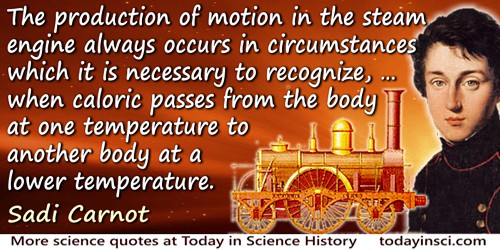
The production of motion in the steam engine always occurs in circumstances which it is necessary to recognize, namely when the equilibrium of caloric is restored, or (to express this differently) when caloric passes from the body at one temperature to another body at a lower temperature.
In 'Réflexions sur la Puissance Motrice du Feu et sur les Machines Propres a Développer cette Puissance' (1824). As translated by Robert Fox, Reflexions on the Motive Power of Fire (1986), 64.
The steam-engine I call fire-demon and great; but it is nothing to the invention of fire.
From Chartism, collected in James Wood (ed.) The Carlyle Reader (1894), 74.
The steam-engine in its manifold applications, the crime-decreasing gas-lamp, the lightning conductor, the electric telegraph, the law of storms and rules for the mariner's guidance in them, the power of rendering surgical operations painless, the measures for preserving public health, and for preventing or mitigating epidemics,—such are among the more important practical results of pure scientific research, with which mankind have been blessed and States enriched.
President's Address to the British Association, Leeds (1858). In Charles W. Vincent and James Mason (eds.), The Year-book of Facts in Science and Art (1859), title page.
The time will come when people will travel in stages moved by steam engines, from city to city, almost as fast as birds fly,—fifteen or twenty miles an hour. Passing through the air with such velocity, changing the scene in such rapid succession, will be the most exhilarating exercise.
(about 1804). As quoted in Henry Howe, 'Oliver Evans', Memoirs of the Most Eminent American Mechanics: (1840), 80.
The whole of the developments and operations of analysis are now capable of being executed by machinery ... As soon as an Analytical Engine exists, it will necessarily guide the future course of science.
Passages From the Life of a Philosopher (1864), 136-137.
The whole theory of the motive power of heat is founded on the two following propositions, due respectively to Joule, and to Carnot and Clausius.
PROP. I. Joule).—When equal quantities of mechanical effect are produced by any means whatever from purely thermal sources, or lost in purely thermal effects, equal quantities of heat are put out of existence or are generated.
PROP. II. (Carnot and Clausius).—If an engine be such that, when it is worked backwards, the physical and mechanical agencies in every part of its motions are all reversed, it produces as much mechanical effect as can be produced by any thermo-dynamic engine, with the same temperatures of source and refrigerator, from a given quantity of heat.
PROP. I. Joule).—When equal quantities of mechanical effect are produced by any means whatever from purely thermal sources, or lost in purely thermal effects, equal quantities of heat are put out of existence or are generated.
PROP. II. (Carnot and Clausius).—If an engine be such that, when it is worked backwards, the physical and mechanical agencies in every part of its motions are all reversed, it produces as much mechanical effect as can be produced by any thermo-dynamic engine, with the same temperatures of source and refrigerator, from a given quantity of heat.
In 'On the Dynamical Theory of Heat, with Numerical Results Deduced from Mr Joule's Equivalent of a Thermal Unit, and M. Regnault's Observations on Steam' (1851). In Mathematical and Physical Papers (1882), Vol. 1, 178.
There are many points in the history of an invention which the inventor himself is apt to overlook as trifling, but in which posterity never fail to take a deep interest. The progress of the human mind is never traced with such a lively interest as through the steps by which it perfects a great invention; and there is certainly no invention respecting which this minute information will be more eagerly sought after, than in the case of the steam-engine.
Quoted in The Origin and Progress of the Mechanical Inventions of James Watt (1854), Vol.1, 4.
There are no physicists in the hottest parts of hell, because the existence of a ‘‘hottest part’’ implies a temperature difference, and any marginally competent physicist would immediately use this to run a heat engine and make some other part of hell comfortably cool. This is obviously impossible.
…...
Those who admire modern civilization usually identify it with the steam engine and the electric telegraph.
In 'Maxims for Revolutionists: Civilization', in Man and Superman (1903), 241.
Those who understand the steam engine and the electric telegraph spend their lives in trying to replace them with something better.
In 'Maxims for Revolutionists: Civilization', in Man and Superman (1903), 241.
Thursday, December 17 [1903]. In the afternoon about 5:30 we received the following telegram from Orvill[e], dated Kitty Hawk, N.C., Dec. 17. “Bishop M. Wright: “Success four flights Thursday morning all against a twenty-one mile wind started from level with engine power alone average speed through the air thirty one miles—longest 57 seconds. XXX home Christmas. Orville Wright.”
From Milton’s handwritten Diary entry for Thur, 17 Dec 1903. Milton is now age 75.
To have a railroad, there must have been first the discoverers, who found out the properties of wood and iron, fire and water, and their latent power to carry men over the earth; next the organizers, who put these elements together, surveyed the route, planned the structure, set men to grade the hill, to fill the valley, and pave the road with iron bars; and then the administrators, who after all that is done, procure the engines, engineers, conductors, ticket-distributors, and the rest of the “hands;” they buy the coal and see it is not wasted, fix the rates of fare, calculate the savings, and distribute the dividends. The discoverers and organizers often fare hard in the world, lean men, ill-clad and suspected, often laughed at, while the administrator is thought the greater man, because he rides over their graves and pays the dividends, where the organizer only called for the assessments, and the discoverer told what men called a dream. What happens in a railroad happens also in a Church, or a State.
Address at the Melodeon, Boston (5 Mar 1848), 'A Discourse occasioned by the Death of John Quincy Adams'. Collected in Discourses of Politics: The Collected Works of Theodore Parker: Part 4 (1863), 139. Note: Ralph Waldo Emerson earlier used the phrase “pave the road with iron bars,” in Nature (1836), 17.
To work our railways, even to their present extent, there must be at least 5,000 locomotive engines; and supposing an engine with its tender to measure only 35 feet, it will be seen, that the whole number required to work our railway system would extend, in one straight line, over 30 miles, or the whole distance from London to Chatham.
From 'Railway System and its Results' (Jan 1856) read to the Institution of Civil Engineers, reprinted in Samuel Smiles, Life of George Stephenson (1857), 512.
Today, nothing is unusual about a scientific discovery's being followed soon after by a technical application: The discovery of electrons led to electronics; fission led to nuclear energy. But before the 1880's, science played almost no role in the advances of technology. For example, James Watt developed the first efficient steam engine long before science established the equivalence between mechanical heat and energy.
Edward Teller with Judith L. Shoolery, Memoirs: A Twentieth-Century Journey in Science and Politics (2001), 42.
True science is distinctively the study of useless things. For the useful things will get studied without the aid of scientific men. To employ these rare minds on such work is like running a steam engine by burning diamonds.
From 'Lessons from the History of Science: The Scientific Attitude' (c.1896), in Collected Papers (1931), Vol. 1, 32.
War and the steam engine joined forces and forged what was to become one of the most delicate of concepts. Sadi Carnot … formed the opinion that one cause of France’s defeat had been her industrial inferiority. … Carnot saw steam power as a universal motor. … Carnot was a visionary and sharp analyst of what was needed to improve the steam engine. … Carnot’s work … laid the foundations of [thermodynamics].
In The Second Law (1984), 1-2.
We cannot see how the evidence afforded by the unquestioned progressive development of organised existence—crowned as it has been by the recent creation of the earth's greatest wonder, MAN, can be set aside, or its seemingly necessary result withheld for a moment. When Mr. Lyell finds, as a witty friend lately reported that there had been found, a silver-spoon in grauwacke, or a locomotive engine in mica-schist, then, but not sooner, shall we enrol ourselves disciples of the Cyclical Theory of Geological formations.
Review of Murchison's Silurian System, Quarterly Review (1839), 64, 112-3.
We have also here an acting cause to account for that balance so often observed in nature,—a deficiency in one set of organs always being compensated by an increased development of some others—powerful wings accompanying weak feet, or great velocity making up for the absence of defensive weapons; for it has been shown that all varieties in which an unbalanced deficiency occurred could not long continue their existen The action of this principle is exactly like that of the centrifugal governor of the steam engine, which checks and corrects any irregularities almost before they become evident; and in like manner no unbalanced deficiency in the animal kingdom can ever reach any conspicuous magnitude, because it would make itself felt at the very first step, by rendering existence difficult and extinction almost sure soon to follow.
In 'On the Tendency of Varieties to Depart Indefinitely from the Original Type', Journal of the Proceedings of the Linnean Society, Zoology (1858), 3, 61-62.
We have decided to call the entire field of control and communication theory, whether in the machine or in the animal, by the name Cybernetics, which we form from the Greek … for steersman. In choosing this term, we wish to recognize that the first significant paper on feedback mechanisms is an article on governors, which was published by Clerk Maxwell in 1868, and that governor is derived from a Latin corruption … We also wish to refer to the fact that the steering engines of a ship are indeed one of the earliest and best-developed forms of feedback mechanisms.
In Cybernetics (1948), 19.
We seem ambitious God's whole work to undo.
...With new diseases on ourselves we war,
And with new physic, a worse engine far.
...With new diseases on ourselves we war,
And with new physic, a worse engine far.
'An Anatomy of the World' (1611), collected in The Poetical Works of Dr. John Donne (1864), 83.
Whether we like it or not, the ultimate goal of every science is to become trivial, to become a well-controlled apparatus for the solution of schoolbook exercises or for practical application in the construction of engines.
'Nonequilibrium Thermodynamics', International Science and Technology (Oct 1963), 44.
Why may we not say, that all Automata (Engines that move themselves by springs and wheeles as doth a watch) have an artificiall life? For what is the Heart, but a Spring; and the Nerves, but so many Strings; and the Joynts, but so many Wheeles, giving motion to the whole Body, such as was intended by the Artificer? Art goes yet further, imitating the rationall and most excellent worke of Nature, Man. For by Art is created the great LEVIATHAN called a COMMON-WEALTH, or STATE, (in latine CIVITAS) which is but an Artificiall Man; though of greater stature and strength than the Naturall, for whose protection and defence it was intended; and in which, the Soveraignty is an Artificiall Soul, as giving life and motion to the whole body.
Leviathan (1651), ed. C. B. Macpherson (1968), Part I, Introduction, 81.
You will be able to appreciate the influence of such an Engine on the future progress of science. I live in a country which is incapable of estimating it.
To an unidentified American, Burndy Library, as quoted inAnthony Hyman, Charles Babbage: Pioneer of the Computer (1985), 135.
You will be able to appreciate the influence of such an Engine on the future progress of science. I live in a country which is incapable of estimating it.
To an unidentified American, Burndy Library, as quoted inAnthony Hyman, Charles Babbage: Pioneer of the Computer (1985), 135.
 In science it often happens that scientists say, 'You know that's a really good argument; my position is mistaken,' and then they would actually change their minds and you never hear that old view from them again. They really do it. It doesn't happen as often as it should, because scientists are human and change is sometimes painful. But it happens every day. I cannot recall the last time something like that happened in politics or religion.
(1987) --
In science it often happens that scientists say, 'You know that's a really good argument; my position is mistaken,' and then they would actually change their minds and you never hear that old view from them again. They really do it. It doesn't happen as often as it should, because scientists are human and change is sometimes painful. But it happens every day. I cannot recall the last time something like that happened in politics or religion.
(1987) -- 





.jpg)