Encounter Quotes (23 quotes)
A scientific writer can scarcely encounter anything more undesirable than, after completing a work, to have one of the foundations shaken. I became aware of this situation through a letter from Mr. Bertrand Russell as the printing of this volume neared completion.
In Epilog, Grundgestze der Arithmetic (1903), Vol. 2, 253. Russell wrote in 1901, just as Frege was about to publish Volume 2 of his last major work. English translation by Webmaster using Google translate and online dictionaries, from the original German: “Einem wissenschaftlichen Schriftsteller kann kaum etwas Unerwünschteres begegnen, als dass ihm nach Vollendung einer Arbeit eine der Grundlagen seines Baues erschüttert wird. In diese Lage wurde ich durch einen Brief des Herrn Bertrand Russell versetzt, als der Druck dieses Bandes sich seinem Ende näherte.” The translation in John E. Hopcroft, 'Turing Machines', Scientific American (May 1984), 250, No. 5, 95, gives: “A scientist can hardly meet with anything more undesirable than to have the foundations give way just as the work is finished. I was put in this position by a letter from Mr. Bertrand Russell when the work was nearly through the press.”
Art and science encounter each other when they seek exactitude.
AS quoted in Gus Kayafas, Estelle Jussim and Harry N. Abrams, Stopping Time: The Photographs of Harold Edgerton (2000), 24.
Clearly, we have compiled a record of serious failures in recent technological encounters with the environment. In each case, the new technology was brought into use before the ultimate hazards were known. We have been quick to reap the benefits and slow to comprehend the costs.
In 'Frail Reeds in a Harsh World', Natural History Journal of the American Museum of Natural History (Feb 1969), 79, No. 2, 44.
Every scientist, through personal study and research, completes himself and his own humanity. ... Scientific research constitutes for you, as it does for many, the way for the personal encounter with truth, and perhaps the privileged place for the encounter itself with God, the Creator of heaven and earth. Science shines forth in all its value as a good capable of motivating our existence, as a great experience of freedom for truth, as a fundamental work of service. Through research each scientist grows as a human being and helps others to do likewise.
Address to the members of the Pontifical Academy of Sciences (13 Nov 2000). In L’Osservatore Romano (29 Nov 2000), translated in English edition, 5.
For if those who hold that there must be a physical basis for everything hold that these mystical views are nonsense, we may ask—What then is the physical basis of nonsense? ... In a world of ether and electrons we might perhaps encounter nonsense; we could not encounter damned nonsense.
…...
Great spirits have always encountered violent opposition from mediocre minds.
…...
He who gives a portion of his time and talent to the investigation of mathematical truth will come to all other questions with a decided advantage over his opponents. He will be in argument what the ancient Romans were in the field: to them the day of battle was a day of comparative recreation, because they were ever accustomed to exercise with arms much heavier than they fought; and reviews differed from a real battle in two respects: they encountered more fatigue, but the victory was bloodless.
Reflection 352, in Lacon: or Many things in Few Words; Addressed to Those Who Think (1820), 159.
However, the small probability of a similar encounter [of the earth with a comet], can become very great in adding up over a huge sequence of centuries. It is easy to picture to oneself the effects of this impact upon the Earth. The axis and the motion of rotation changed; the seas abandoning their old position to throw themselves toward the new equator; a large part of men and animals drowned in this universal deluge, or destroyed by the violent tremor imparted to the terrestrial globe.
Exposition du Système du Monde, 2nd edition (1799), 208, trans. Ivor Grattan-Guinness.
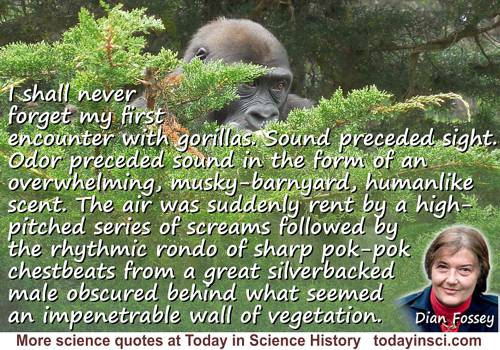
I shall never forget my first encounter with gorillas. Sound preceded sight. Odor preceded sound in the form of an overwhelming, musky-barnyard, humanlike scent. The air was suddenly rent by a high-pitched series of screams followed by the rhythmic rondo of sharp pok-pok chestbeats from a great silverbacked male obscured behind what seemed an impenetrable wall of vegetation.
Describing her 1963 trip to Kabara in Gorillas in the Mist (1983), 3. (The screams and chest-beating were of alarm, not ferocity.)
No! What we need are not prohibitory marriage laws, but a reformed society, an educated public opinion which will teach individual duty in these matters. And it is to the women of the future that I look for the needed reformation. Educate and train women so that they are rendered independent of marriage as a means of gaining a home and a living, and you will bring about natural selection in marriage, which will operate most beneficially upon humanity. When all women are placed in a position that they are independent of marriage, I am inclined to think that large numbers will elect to remain unmarried—in some cases, for life, in others, until they encounter the man of their ideal. I want to see women the selective agents in marriage; as things are, they have practically little choice. The only basis for marriage should be a disinterested love. I believe that the unfit will be gradually eliminated from the race, and human progress secured, by giving to the pure instincts of women the selective power in marriage. You can never have that so long as women are driven to marry for a livelihood.
In 'Heredity and Pre-Natal Influences. An Interview With Dr. Alfred Russel Wallace', Humanitarian (1894), 4, 87.
Science requires an engagement with the world, a live encounter between the knower and the known.
In The Courage to Teach: Exploring the Inner Landscape of a Teacher’s Life (1998), 54.
The moment you encounter string theory and realise that almost all of the major developments in physics over the last hundred years emerge—and emerge with such elegance—from such a simple starting point, you realise that this incredibly compelling theory is in a class of its own.
…...
The student should read his author with the most sustained attention, in order to discover the meaning of every sentence. If the book is well written, it will endure and repay his close attention: the text ought to be fairly intelligible, even without illustrative examples. Often, far too often, a reader hurries over the text without any sincere and vigorous effort to understand it; and rushes to some example to clear up what ought not to have been obscure, if it had been adequately considered. The habit of scrupulously investigating the text seems to me important on several grounds. The close scrutiny of language is a very valuable exercise both for studious and practical life. In the higher departments of mathematics the habit is indispensable: in the long investigations which occur there it would be impossible to interpose illustrative examples at every stage, the student must therefore encounter and master, sentence by sentence, an extensive and complicated argument.
In 'Private Study of Mathematics', Conflict of Studies and other Essays (1873), 67.
The test of a theory is its ability to cope with all the relevant phenomena, not its a priori 'reasonableness'. The latter would have proved a poor guide in the development of science, which often makes progress by its encounter with the totally unexpected and initially extremely puzzling.
'From DAMTP [Department of Applied Mathematics and Theoretical Physics] to Westcott House', Cambridge Review (1981), 103, 61.
The way in which the persecution of Galileo has been remembered is a tribute to the quiet commencement of the most intimate change in outlook which the human race had yet encountered. Since a babe was born in a manger, it may be doubted whether so great a thing has happened with so little stir
In Science and the Modern World (1925), 2.
The work of the inventor consists of conceptualizing, combining, and ordering what is possible according to the laws of nature. This inner working out which precedes the external has a twofold characteristic: the participation of the subconscious in the inventing subject; and that encounter with an external power which demands and obtains complete subjugation, so that the way to the solution is experienced as the fitting of one's own imagination to this power.
Philosophie der Technik (1927). 'Technology in Its Proper Sphere' translated by William Carroll. In Carl Mitcham (ed.) and Robert Mackey (ed.), Philosophy and Technology: Readings in the Philosophical Problems of Technology, (1972), Vol. 14, 321. In David Lovekin, Technique, Discourse, and Consciousness (1991), 73.
Though all the winds of doctrine were let loose to play upon the earth, so Truth be in the field…. Let her and Falsehood grapple; who ever knew Truth put to the worse, in a free and open encounter?
In Areopagitica: A speech of Mr John Milton for the Liberty of Unlicenced printing to the Parliament of England (23 Nov 1644), 35.
To encounter the sacred is to be alive at the deepest center of human existence.
Quoted in Kim Lim (ed.), 1,001 Pearls of Spiritual Wisdom: Words to Enrich, Inspire, and Guide Your Life (2014), 164
When asked what it was like to set about proving something, the mathematician likened proving a theorem to seeing the peak of a mountain and trying to climb to the top. One establishes a base camp and begins scaling the mountain’s sheer face, encountering obstacles at every turn, often retracing one’s steps and struggling every foot of the journey. Finally when the top is reached, one stands examining the peak, taking in the view of the surrounding countryside and then noting the automobile road up the other side!
Space-filler in The Two-Year College Mathematics Journal (Nov 1980), 11, No. 5, 295.
When coming to close quarters with a skunk … one has to fear from an encounter; the worst is that effluvium, after which crushed garlic is lavender, which tortures the olfactory nerves, and appears to pervade the whole system like a pestilent ether, nauseating one until sea-sickness seems almost a pleasant sensation in comparison.
In The Naturalist in La Plata (1892, 1895), 116-117.
When I arrived in California to join the faculty of the New University which opened in October 1891, it was near the end of the dry season and probably no rain had fallen for three or four months. The bare cracked adobe fields surrounding the new buildings ... offered a decidedly unpromising outlook... A month or two later, however, there was a magical transformation. With the advent of the autumn rains the whole country quickly turned green, and a profusion of liverworts such as I had never seen before appeared on the open ground... I soon realized that right in my own backyard, so to speak, was a wealth of material such as I had never imagined would be my good fortune to encounter. ... Such an invitation to make a comprehensive study of the structure and development of the liverworts could not be resisted; and the next three years were largely devoted to this work which finally resulted in the publication of 'The Mosses and Ferns' in 1895.
In The Structure and Development of Mosses and Ferns (Archegoniatae) (1905, 3rd ed. 1918, rev. 1928). Cited in William C. Steere, Obituary, 'Douglas Houghton Campbell', American Bryological and Lichenological Society, The Bryologist (1953), 131.
When Ramanujan was sixteen, he happened upon a copy of Carr’s Synopsis of Mathematics. This chance encounter secured immortality for the book, for it was this book that suddenly woke Ramanujan into full mathematical activity and supplied him essentially with his complete mathematical equipment in analysis and number theory. The book also gave Ramanujan his general direction as a dealer in formulas, and it furnished Ramanujan the germs of many of his deepest developments.
In Mathematical Circles Squared (1972), 158. George Shoobridge Carr (1837-1914) wrote his Synopsis of Elementary Results in Mathematics in 1886.
When we see a natural style, we are astonished and delighted; for we expected to see an author, and we find a man.
In Pensées (1670), Section 7, No. 28. As translated in Blaise Pascal and W.F. Trotter (trans.), 'Thoughts', No. 29, collected in Charles W. Eliot (ed.), The Harvard Classics (1910), Vol. 48, 16. Translated as “When we encounter a natural style we are always surprised and delighted, for we thought to see an author and found a man,” in W.H. Auden and L. Kronenberger (eds.) The Viking Book of Aphorisms (1966), 277. From the original French, “Quand on voit le style naturel, on est tout étonné et ravi, car on s’attendait de voir un auteur, et on trouve un homme,” in Ernest Havet (ed.), Pensées de Pascal (1892), 222.
 In science it often happens that scientists say, 'You know that's a really good argument; my position is mistaken,' and then they would actually change their minds and you never hear that old view from them again. They really do it. It doesn't happen as often as it should, because scientists are human and change is sometimes painful. But it happens every day. I cannot recall the last time something like that happened in politics or religion.
(1987) --
In science it often happens that scientists say, 'You know that's a really good argument; my position is mistaken,' and then they would actually change their minds and you never hear that old view from them again. They really do it. It doesn't happen as often as it should, because scientists are human and change is sometimes painful. But it happens every day. I cannot recall the last time something like that happened in politics or religion.
(1987) -- 




